
Grade 6 Science Worksheets
5,969 worksheets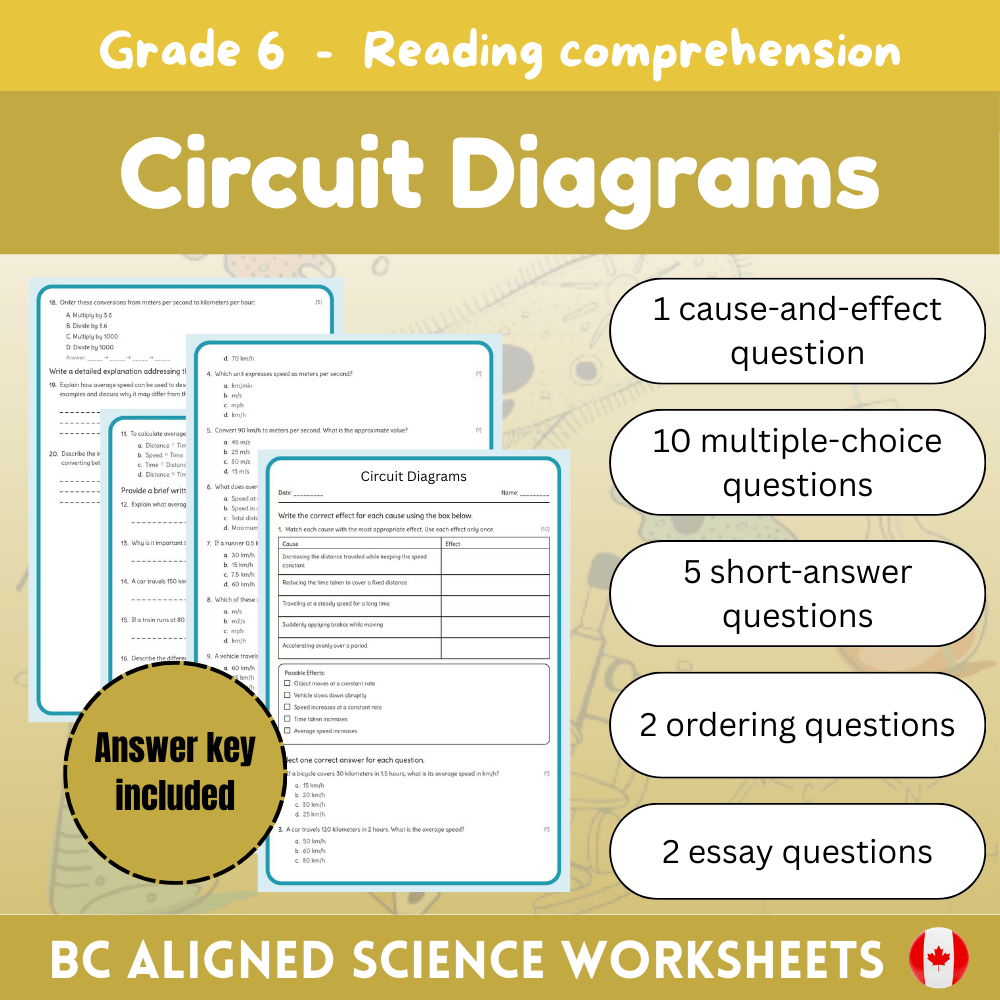
Grade 6 Science – Circuit Diagrams Worksheet (PDF) | BC Standards
 Created byBright Mind Resources
Learning Objectives
- Understand the purpose and components of circuit diagrams.
- Learn standard symbols used to represent sources, conductors, loads, and other components.
- Translate physical electrical systems into circuit diagrams.
Instant download
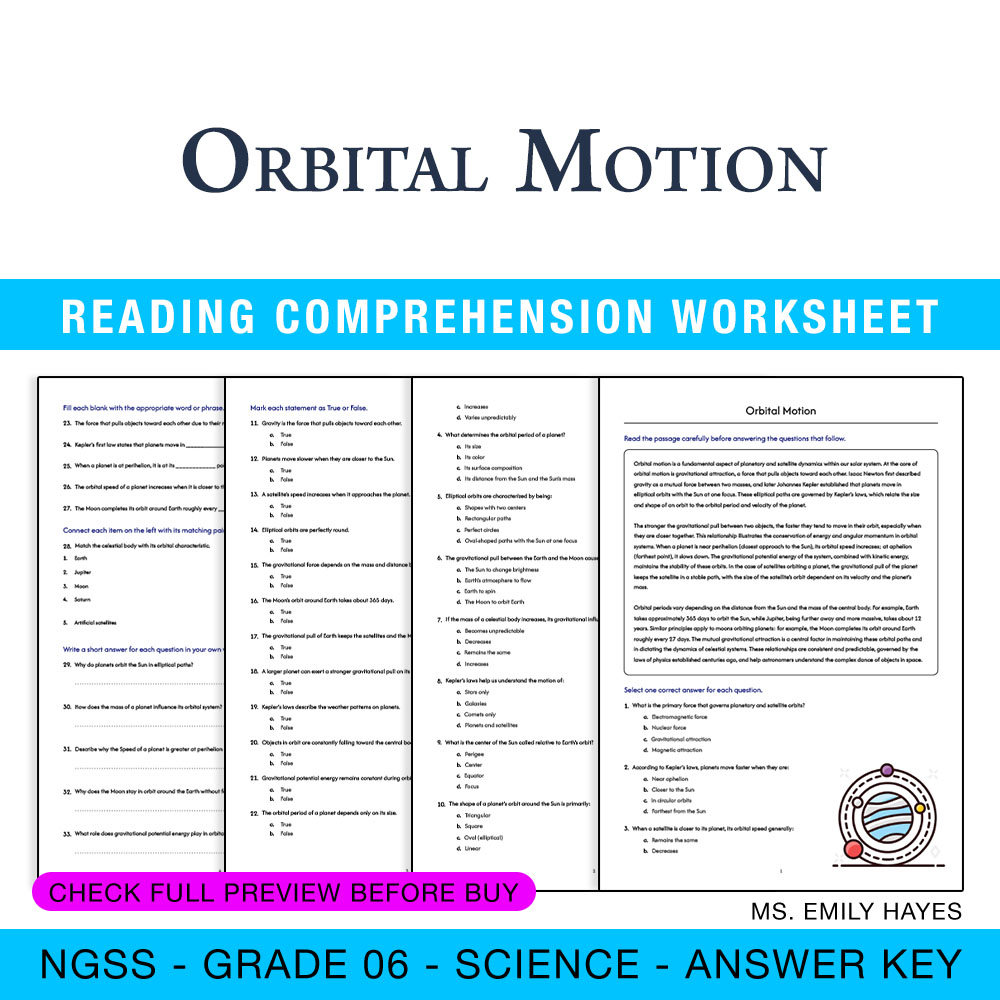
6th Grade Science | Orbital Motion Worksheet (PDF + Answer Key)
 Created byCopper Leaf Classroom
Learning Objectives
- Understand gravitational attraction as the primary force governing planetary orbits.
- Describe how mutual gravity between the Sun and planets results in elliptical orbits and orbital periods.
- Explain the role of gravitational potential in maintaining orbital paths and satellite motion.
Also included in: Grade 6 Science Unit Bundle | Space, Moon & Seasons (PDF + Answer Key)
Instant download

Grade 6 Trait Heritability Worksheet | Ontario Science Practice PDF
 Created byClear Sky Classroom
Learning Objectives
- Explain what heritability means and how it relates to genetic variation and observed trait differences.
- Distinguish heritable influences from environmental influences on traits and fitness.
- Describe how natural selection can change allele frequencies and trait distributions over generations.
Instant download
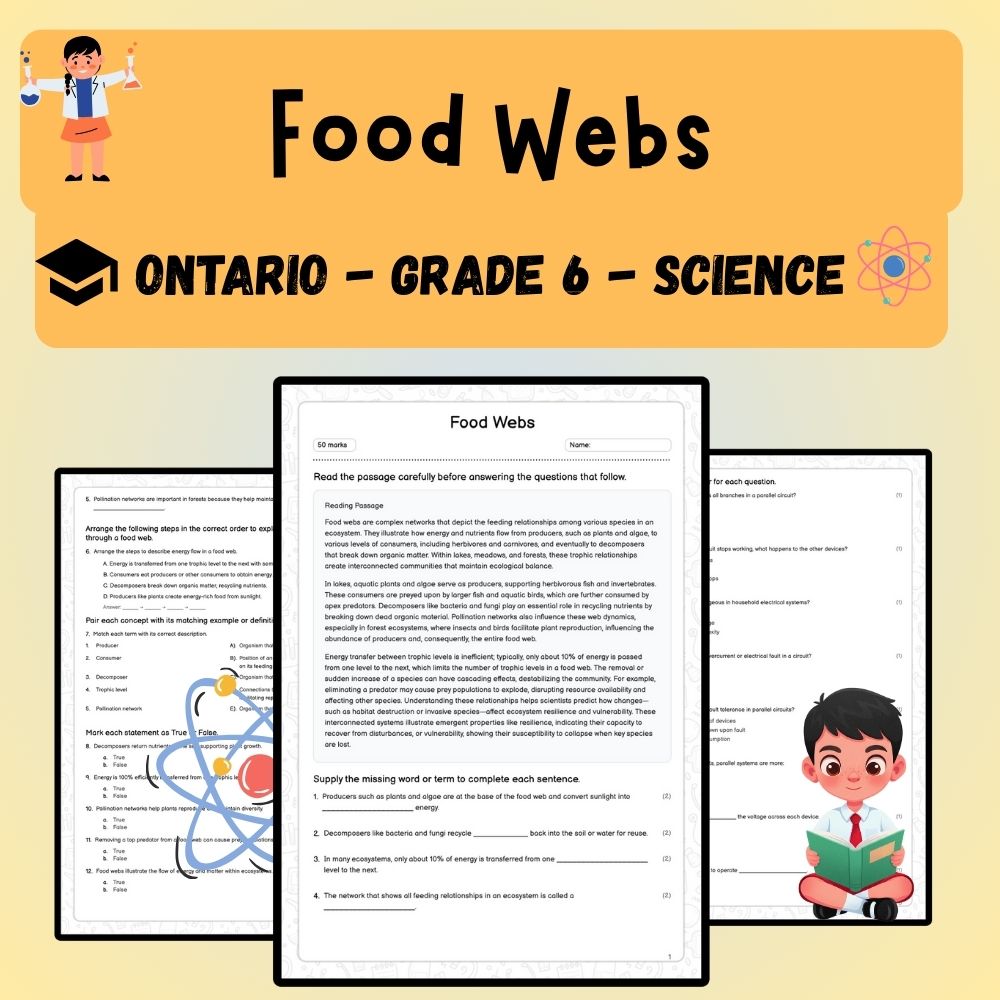
Grade 6 Science | Food Webs Worksheet (PDF ) – Ontario Standards
 Created byPrism Point Learning
Learning Objectives
- Understand the components and structure of food webs in various ecosystems.
- Identify producers, consumers, and decomposers and explain their roles.
- Analyze energy flow and matter cycling within food chains.
Also included in: Grade 6 Science Unit Bundle – Ecology, Classification & Environment
Instant download
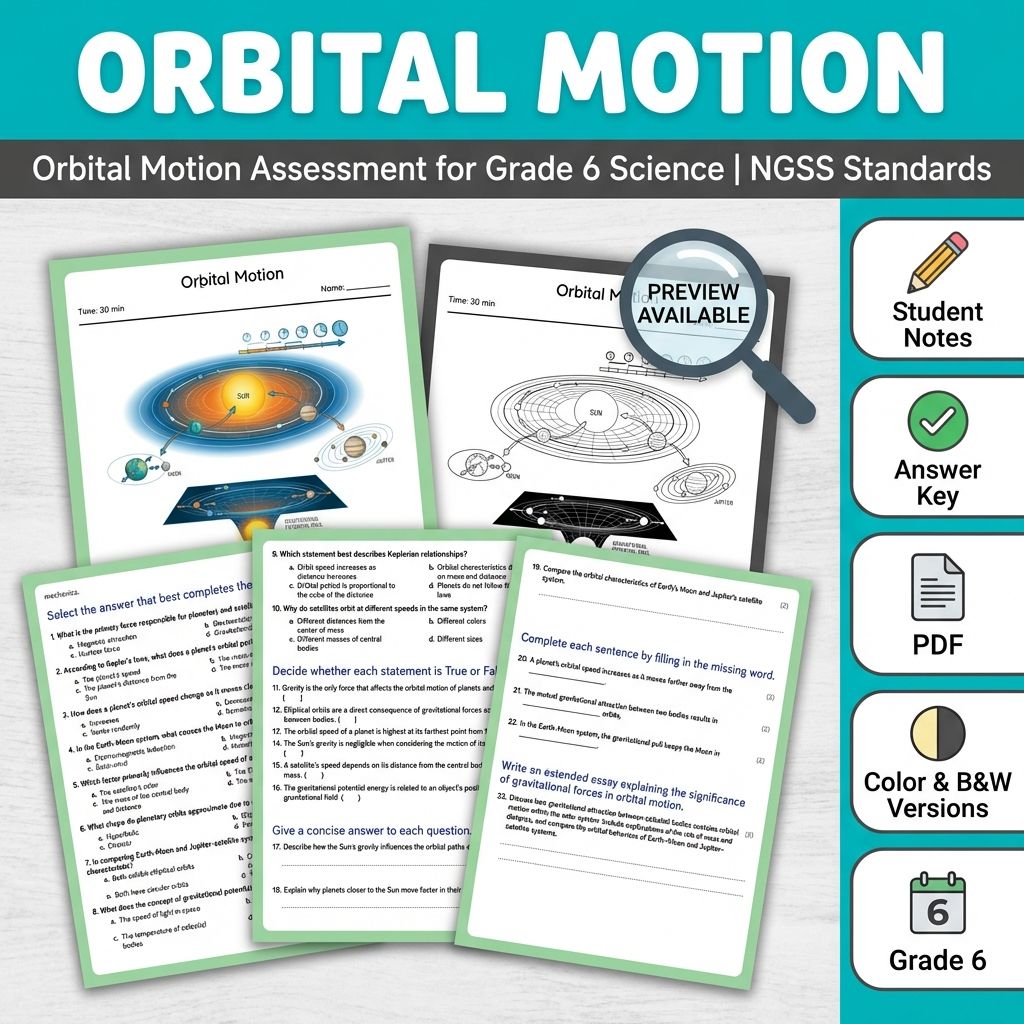
Orbital Motion Assessment for Grade 6 Science | NGSS Standards
Created byPrism Point LearningLearning Objectives
- Explain the role of gravity in planetary and satellite orbits within the solar system.
- Describe how mutual gravitational forces produce elliptical orbits and influence orbital periods and speeds.
- Compare orbital dynamics of Earth–Moon and Jupiter–satellite systems to illustrate the effects of mass and distance.
Also included in: Grade 6 Science Mini Bundle | Earth’s Place in the Universe NGSS Standards +1 more
Instant download
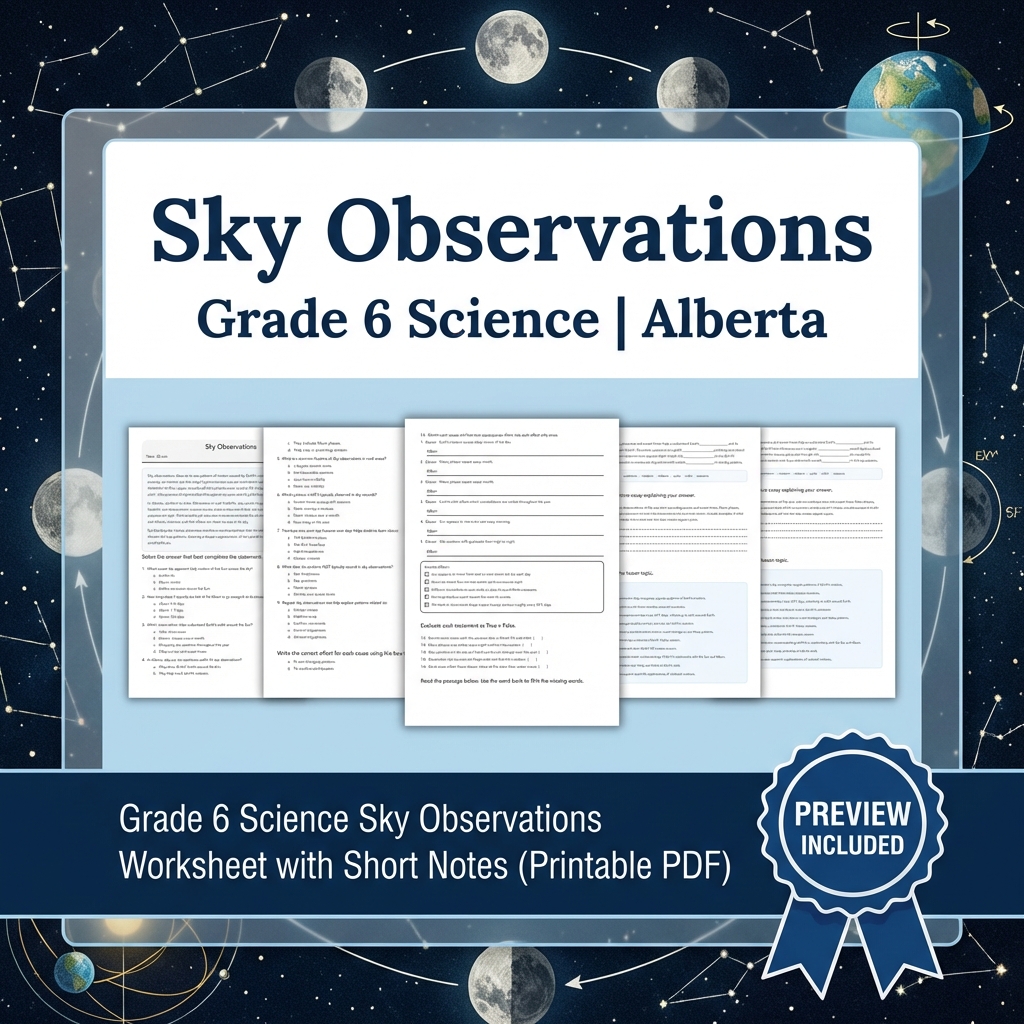
Grade 6 Science Sky Observations Worksheet with Short Notes (Printable PDF)
 Created byMeadowlark Worksheets
Learning Objectives
- Understand how systematic sky observations help recognize patterns of motion.
- Record and interpret sunrise, sunset, Moon phases, and star positions.
- Describe the relationship between Earth's movements and observable sky patterns.
Also included in: Grade 6 Science Sky Science Unit Bundle | Alberta Curriculum Worksheets +1 more
Instant download

Grade 6 Science | Speed & Velocity - Daily Reading Comprehension
 Created byCoral Reef Learning
Learning Objectives
- Understand the difference between speed and velocity.
- Identify how direction affects velocity.
- Calculate average speed using distance and time.
Instant download

Grade 6 Science | Classification Genetics Daily Reading Practice
Created byCoral Reef LearningLearning Objectives
- Understand what DNA barcoding is and how it is used in classifying species.
- Identify the difference between morphological and genetic classification methods.
- Recognize how molecular tools can reveal cryptic species.
Instant download
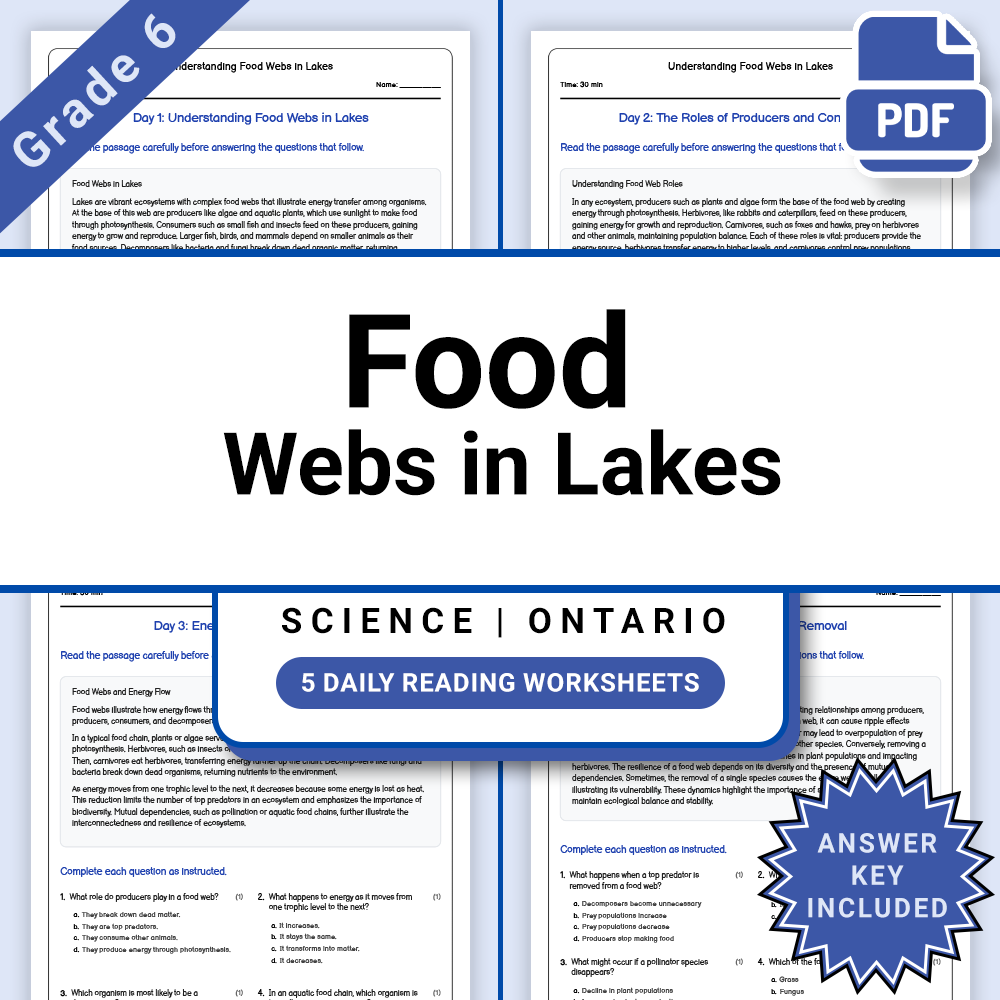
Grade 6 Science – Understanding Food Webs in Lakes Daily Worksheet + Answer Key
JCreated byJ.S SheetsLearning Objectives
- Identify producers, consumers, and decomposers in aquatic environments
- Understand how energy flows through food webs
- Recognize the roles of different organisms in lakes
Also included in: Grade 6 Science Biodiversity Lesson Bundle – Ecosystems and Conservation +1 more
Instant download
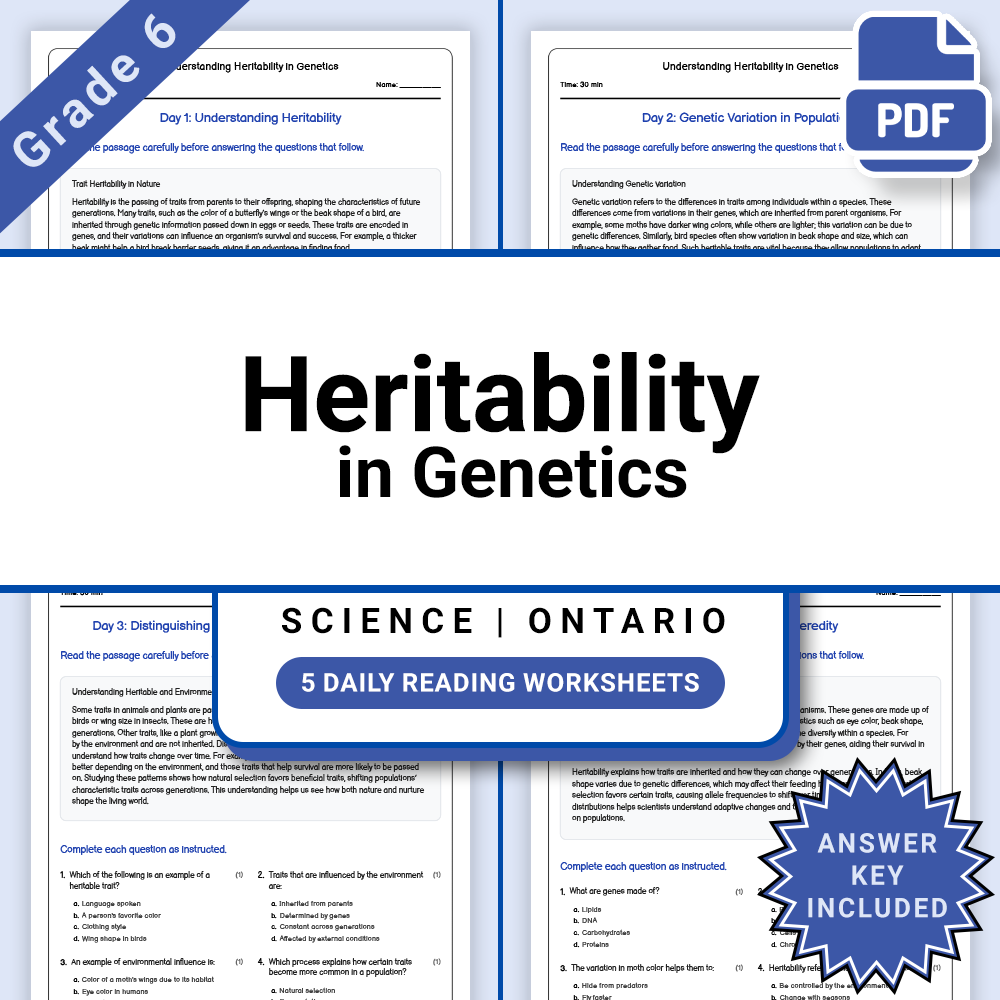
Grade 6 Science – Understanding Heritability Reading Worksheet + Answer Key
JCreated byJ.S SheetsLearning Objectives
- Define heritability and distinguish it from environmental influences.
- Identify examples of heritable traits, such as beak shape and color morphs.
- Explain how traits are passed from parents to offspring and how they change in populations over time.
Also included in: Grade 6 Science Biodiversity Lesson Bundle – Ecosystems and Conservation +1 more
Instant download
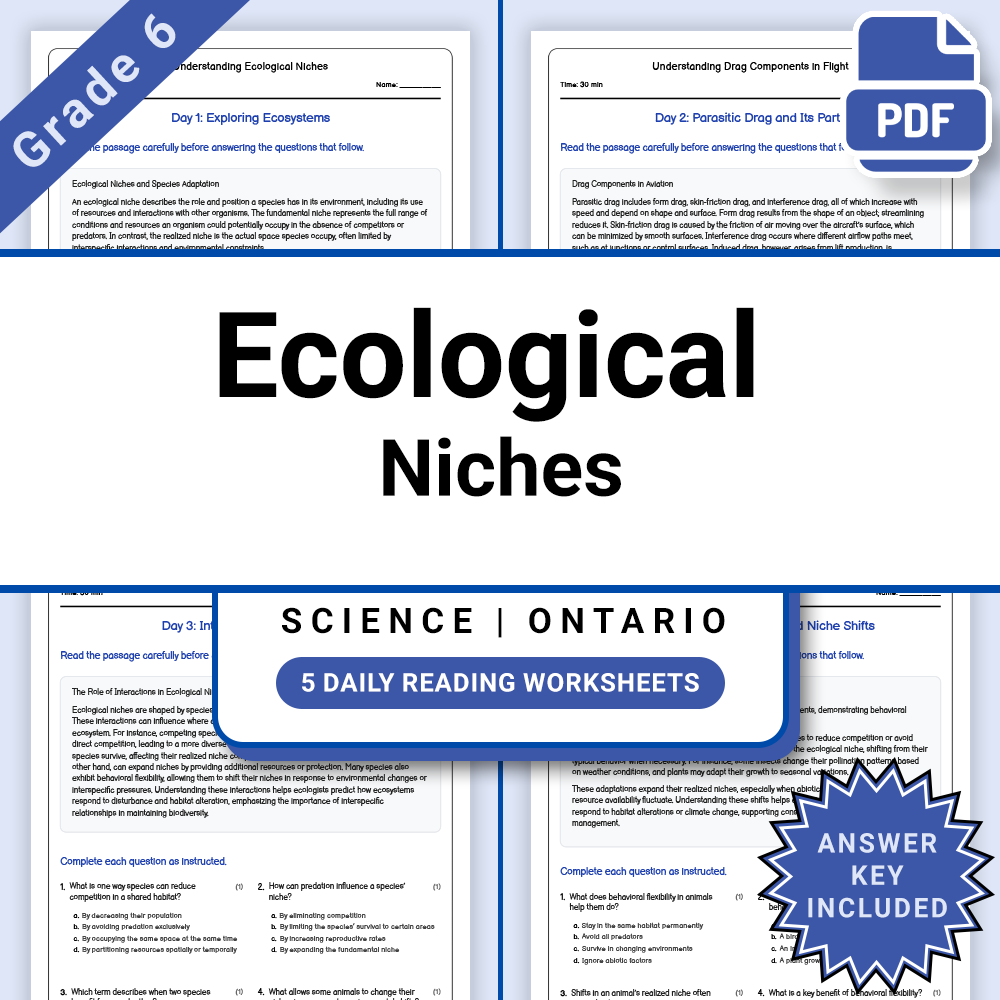
Grade 6 Science – Ecological Niches Daily Reading Worksheet + Answer Key
JCreated byJ.S SheetsLearning Objectives
- Explain the concept of ecological niches and differentiate between fundamental and realized niches.
- Identify how abiotic factors influence species distribution within habitats.
- Describe examples of spatial and temporal partitioning among similar species.
Also included in: Grade 6 Science Biodiversity Lesson Bundle – Ecosystems and Conservation +1 more
Instant download
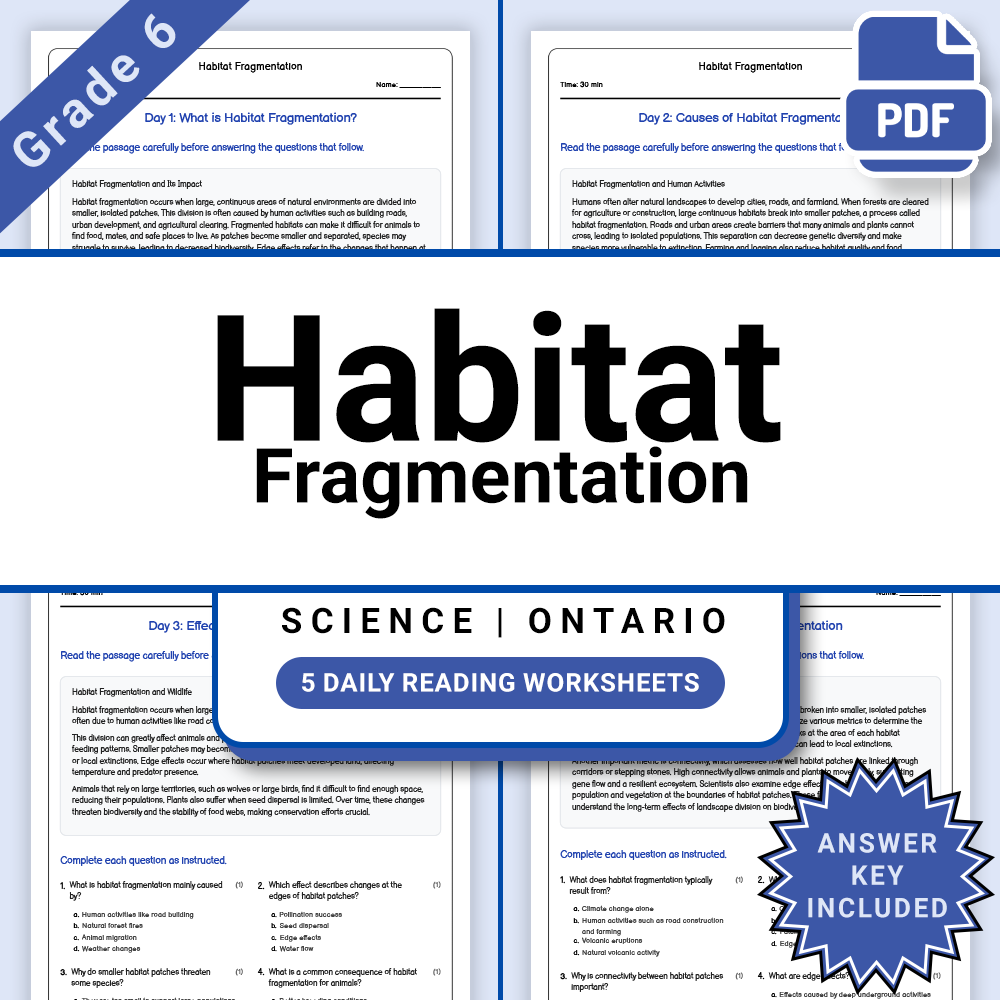
Grade 6 Science – Habitat Fragmentation Daily Reading Worksheet + Answer Key
JCreated byJ.S SheetsLearning Objectives
- Understand the concept of habitat fragmentation.
- Identify causes of habitat division such as roads and agriculture.
- Recognize effects of fragmentation on species and ecosystems.
Also included in: Grade 6 Science Biodiversity Lesson Bundle – Ecosystems and Conservation +1 more
Instant download
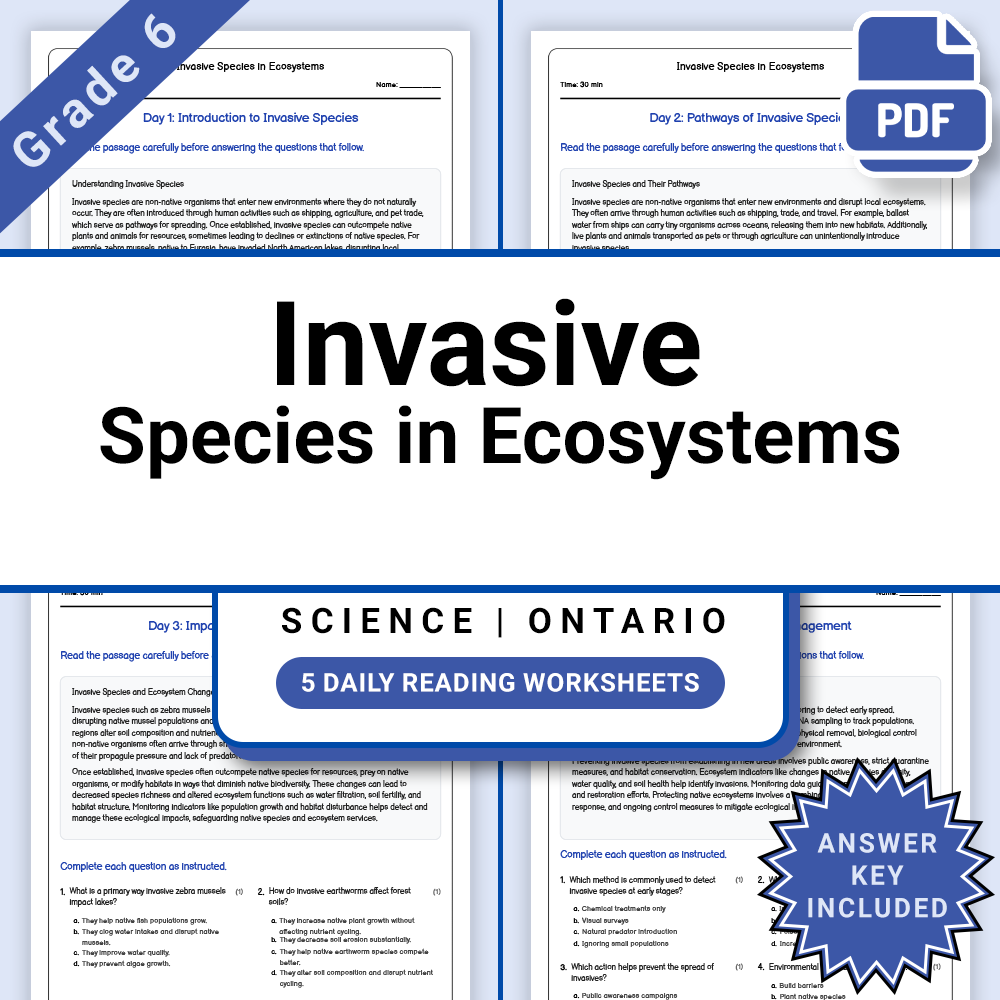
Grade 6 Science – Invasive Species Ecosystems Daily Worksheet + Answer Key
JCreated byJ.S SheetsLearning Objectives
- Define what invasive species are and distinguish them from native species.
- Identify common pathways through which invasive species enter new environments.
- Understand the ecological impacts invasive species can have on native ecosystems.
Also included in: Grade 6 Science Biodiversity Lesson Bundle – Ecosystems and Conservation +1 more
Instant download
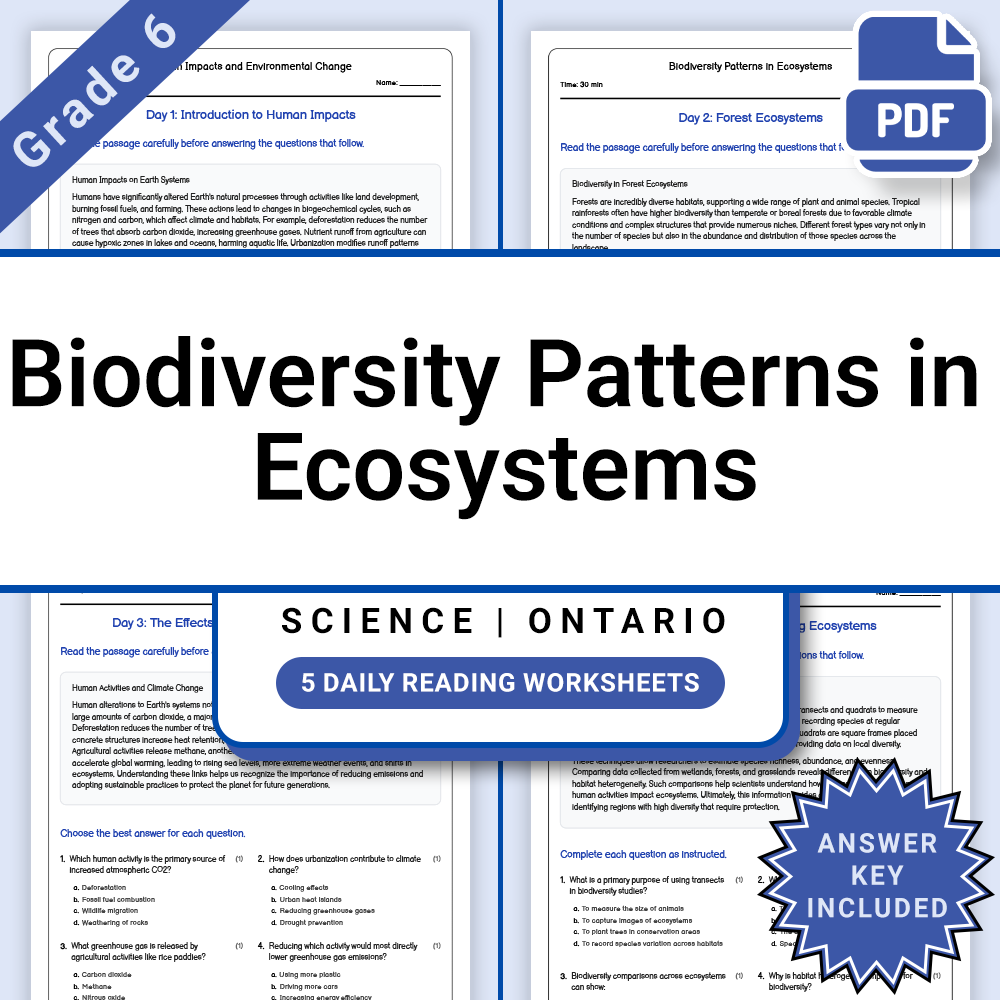
Grade 6 – Biodiversity Patterns in Ecosystems Daily Worksheet + Answer Key
JCreated byJ.S SheetsLearning Objectives
- Understand what species richness, abundance, and evenness mean in ecology.
- Learn about sampling methods like transects and quadrats to measure biodiversity.
- Recognize how habitat heterogeneity influences biodiversity patterns.
Also included in: Grade 6 Science Biodiversity Lesson Bundle – Ecosystems and Conservation +1 more
Instant download
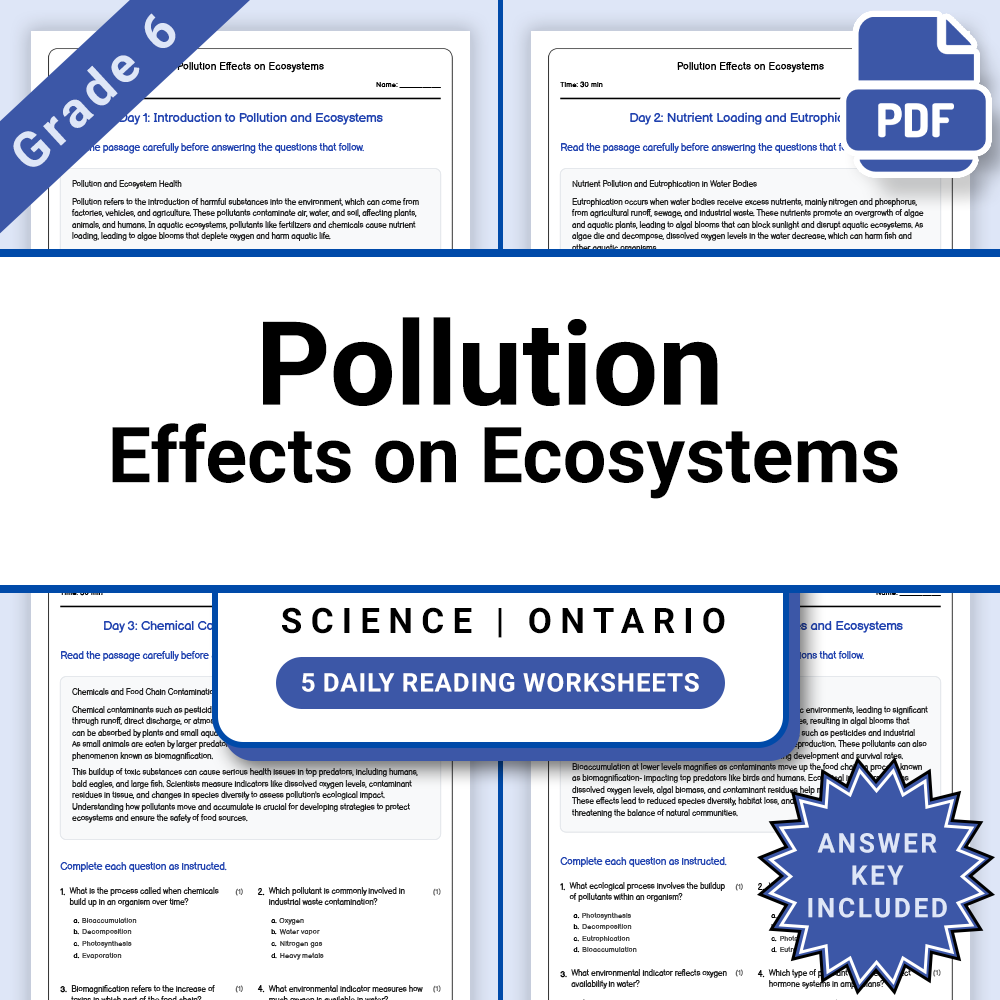
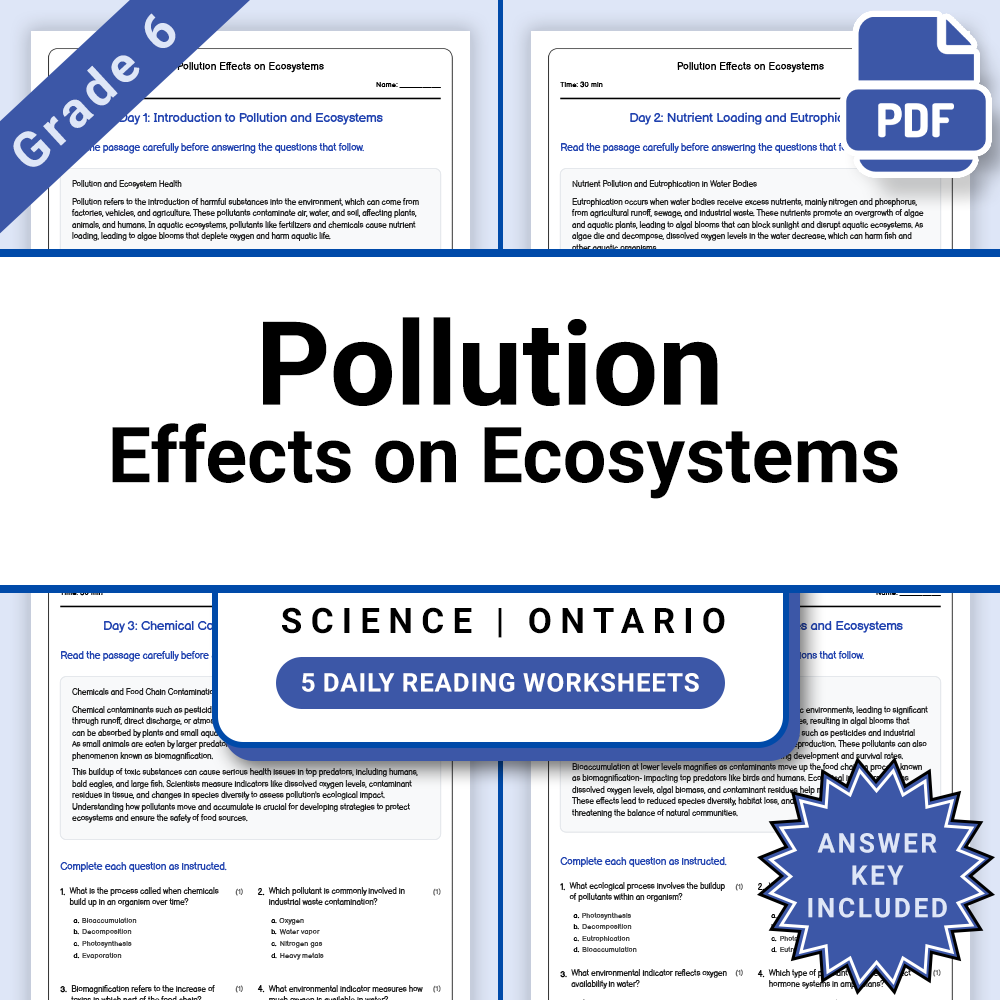
Grade 6 Science – Pollution Effects on Ecosystems Daily Worksheet + Answer Key
JCreated byJ.S SheetsLearning Objectives
- Understand what pollution is and its types
- Identify how pollutants affect aquatic and terrestrial environments
- Learn about nutrient loading, chemical contaminants, and bioaccumulation
Also included in: Grade 6 Science Biodiversity Lesson Bundle – Ecosystems and Conservation +1 more
Instant download
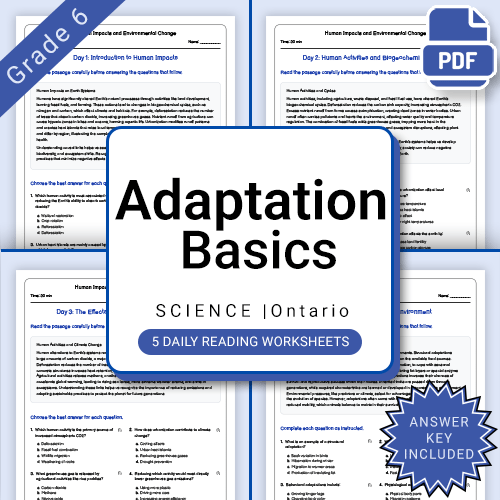
Grade 6 Science – Adaptation Basics Daily Reading Worksheet with Answer Key
JCreated byJ.S SheetsLearning Objectives
- Understand what structural adaptations are and identify examples in animals.
- Differentiate between structural, behavioral, and physiological adaptations.
- Learn how adaptations help animals survive in their environments.
Also included in: Grade 6 Science Biodiversity Lesson Bundle – Ecosystems and Conservation +1 more
Instant download
Grade 6 Science – Population Dynamics Daily Reading Worksheet with Answer Key
JCreated byJ.S SheetsLearning Objectives
- Understand the concept of population growth models
- Identify different types of population growth, such as exponential and logistic
- Recognize factors influencing population changes
Also included in: Grade 6 Science Biodiversity Lesson Bundle – Ecosystems and Conservation +1 more
Instant download
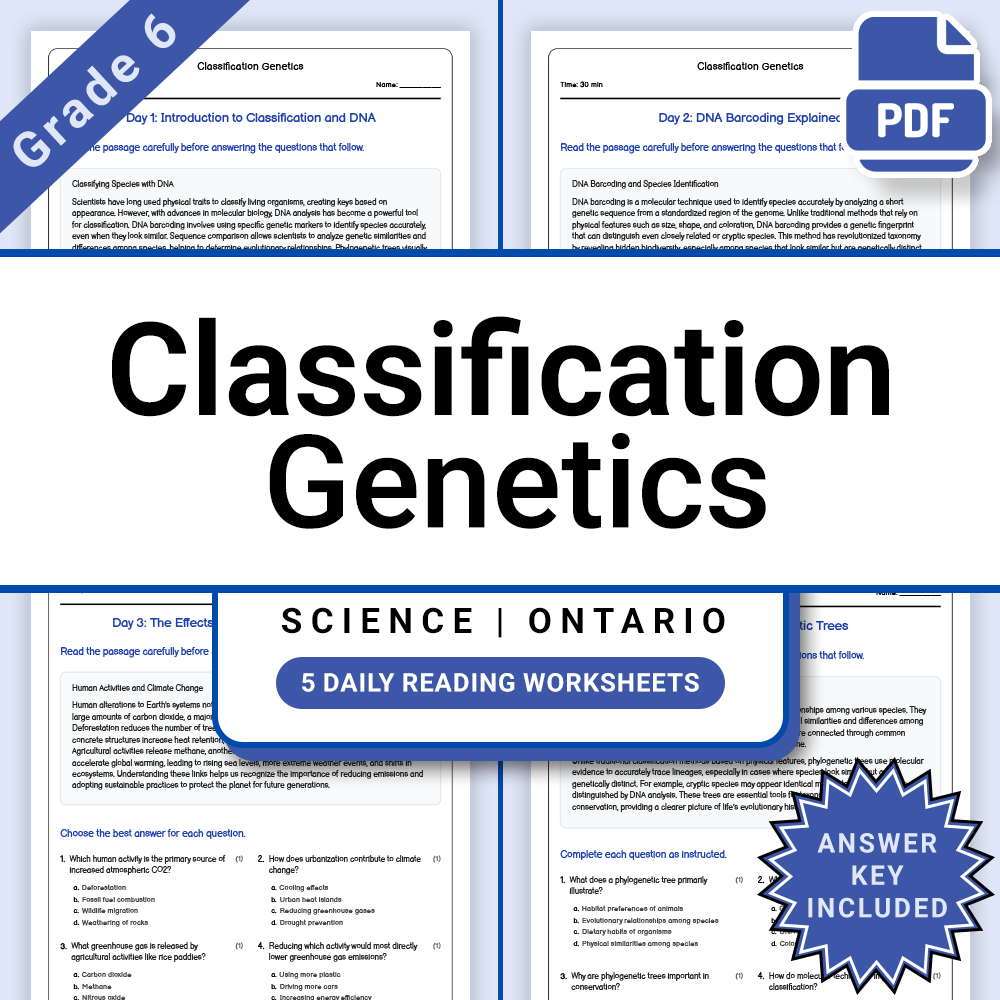
Grade 6 Science – Classification Genetics Daily Worksheet with Answer Key
JCreated byJ.S SheetsLearning Objectives
- Understand how DNA is used in classifying species.
- Learn about DNA barcoding, sequence comparison, and phylogenetic trees.
- Compare genetic markers with morphological keys.
Also included in: Grade 6 Science Biodiversity Lesson Bundle – Ecosystems and Conservation +1 more
Instant download
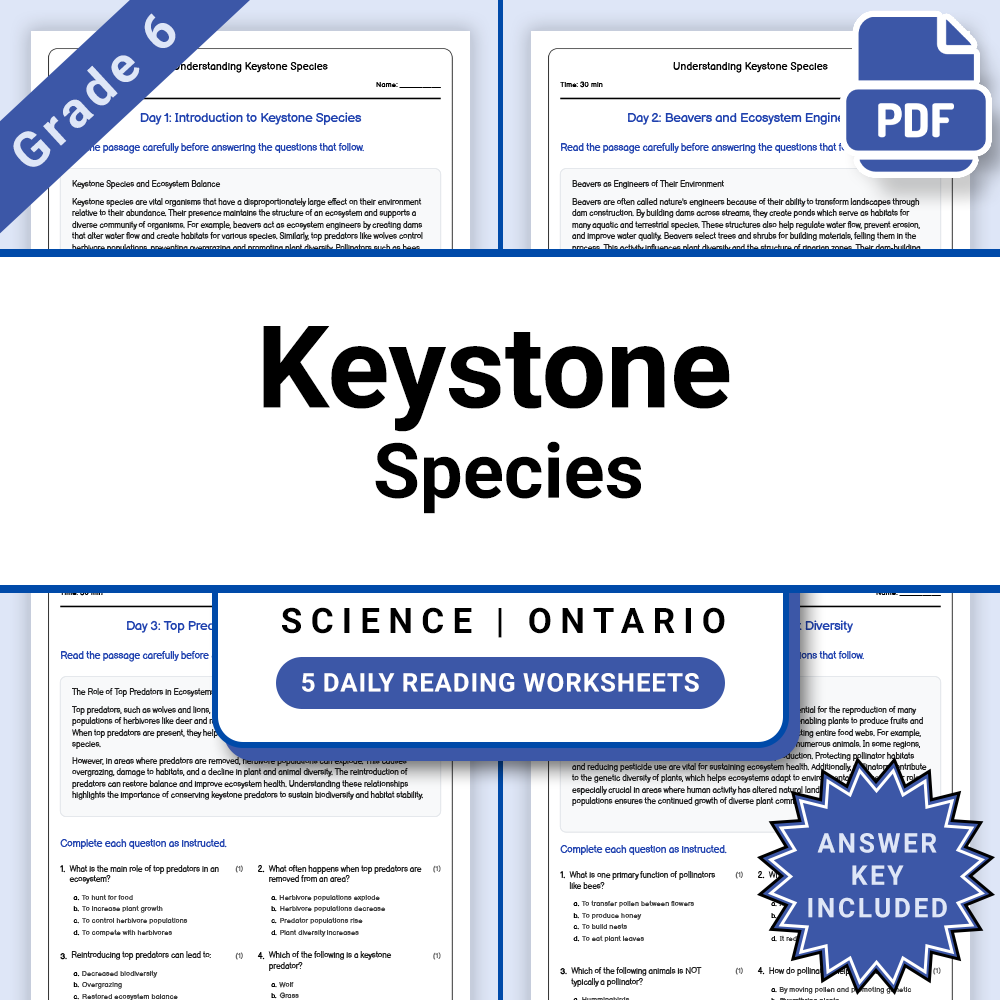
Grade 6 Science – Understanding Keystone Species Daily Worksheet + Answer Key
JCreated byJ.S SheetsLearning Objectives
- Define what a keystone species is.
- Identify examples of keystone species in different ecosystems.
- Explain the ecological impact of keystone species on biodiversity.
Also included in: Grade 6 Science Biodiversity Lesson Bundle – Ecosystems and Conservation +1 more
Instant download
Grade 6 – Adaptation Tradeoffs in Ecology Daily Reading Worksheet + Answer Key
JCreated byJ.S SheetsLearning Objectives
- Understand the difference between specialists and generalists in adaptation.
- Identify benefits and costs associated with narrow and broad ecological strategies.
- Analyze examples such as plant ecotypes, insect behaviors, and migratory patterns.
Also included in: Grade 6 Science Biodiversity Lesson Bundle – Ecosystems and Conservation +1 more
Instant download
Grade 6 Science – Stewardship Strategies Daily Reading Worksheet + Answer Key
JCreated byJ.S SheetsLearning Objectives
- Understand the concept of habitat restoration and its role in conservation.
- Identify different stewardship strategies used to protect biodiversity.
- Evaluate the importance of habitat restoration, protected-area design, and community involvement.
Also included in: Grade 6 Science Biodiversity Lesson Bundle – Ecosystems and Conservation +1 more
Instant download
Grade 6 Science – Key Construction Daily Reading Worksheet with Answer Key
JCreated byJ.S SheetsLearning Objectives
- Understand what dichotomous keys are and how they function
- Identify contrasting traits used in key construction
- Learn procedures for constructing and testing dichotomous keys
Also included in: Grade 6 Science Biodiversity Lesson Bundle – Ecosystems and Conservation +1 more
Instant download
Grade 6 Science – Biodiversity Solutions Worksheet (PDF + NGSS)
 Created byMaple Path Learning
Learning Objectives
- Understand different conservation strategies and how they influence biodiversity and ecosystem services.
- Evaluate ecological trade-offs and feasibility of various biodiversity solutions.
- Analyze case studies like coral reef restoration and riparian buffers to assess outcomes under environmental pressures.
Also included in: Grade 6 Science | Ecosystems & Biodiversity NGSS Worksheet Unit Pack +1 more
Instant download
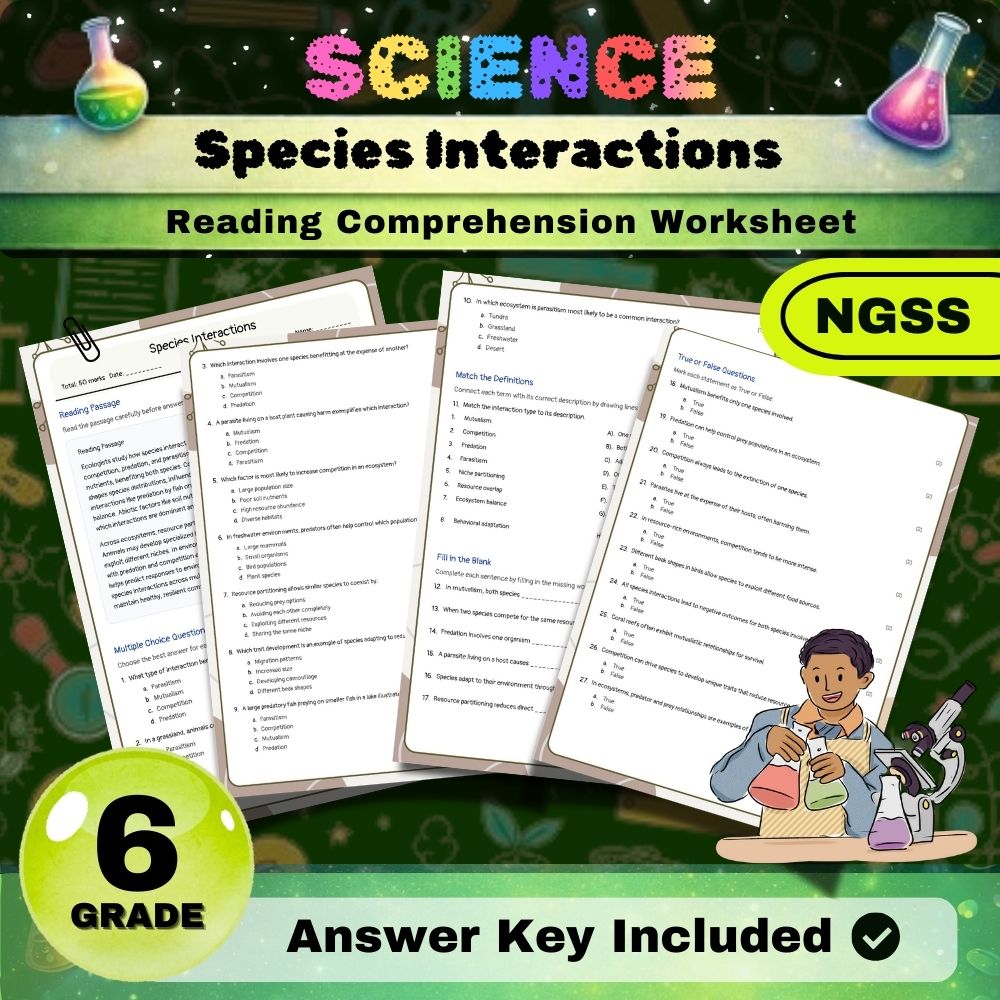
6th Grade Science | Species Interactions NGSS Worksheet (PDF)
Created byMaple Path LearningLearning Objectives
- Construct explanations predicting species interaction patterns across different ecosystems.
- Identify and differentiate between mutualism, competition, predation, and parasitism.
- Compare how abiotic conditions influence species interactions and community structures.
Also included in: Grade 6 Science | Ecosystems & Biodiversity NGSS Worksheet Unit Pack +1 more
Instant download
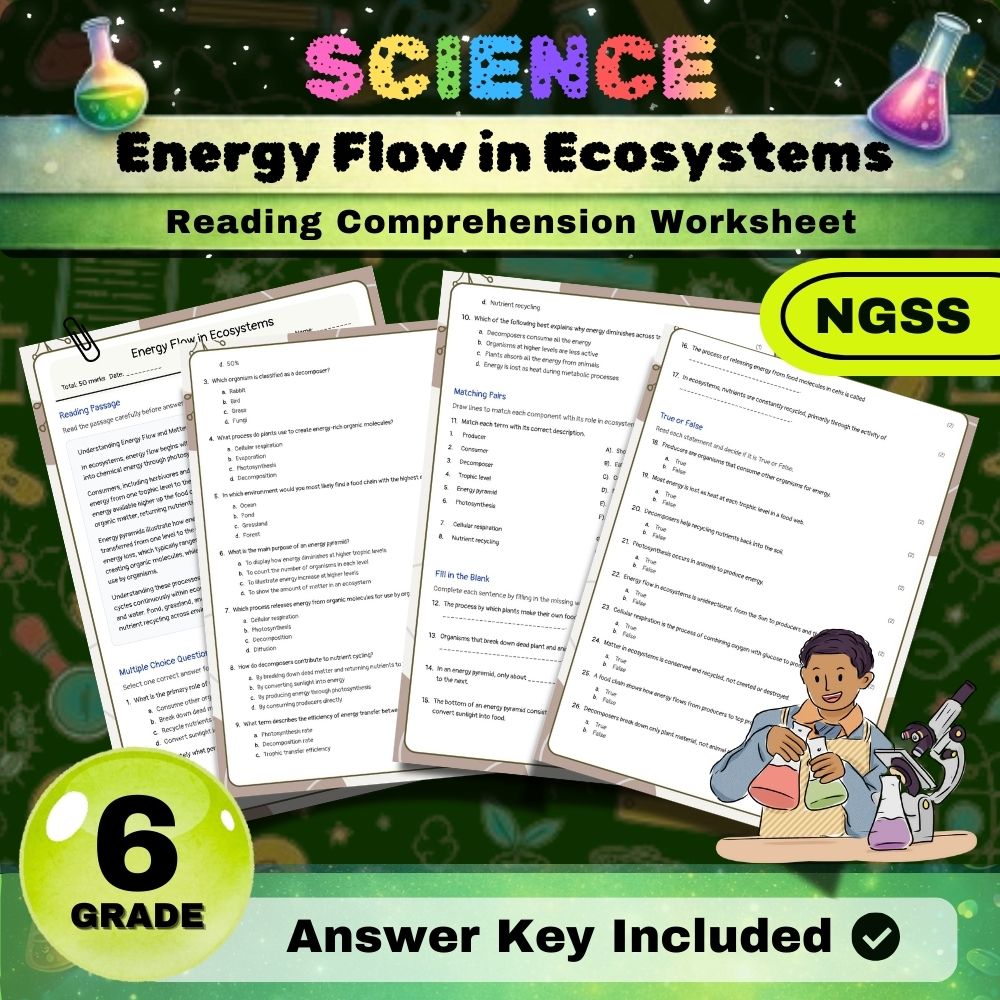
6th Grade Science | Energy Flow in Ecosystems Worksheet ( PDF ) NGSS
Created byMaple Path LearningLearning Objectives
- Explain how energy flows through food webs and food chains in terrestrial and aquatic ecosystems.
- Identify the roles of producers, consumers, and decomposers in energy and matter cycling.
- Interpret energy pyramids and understand trophic transfer efficiency.
Also included in: Grade 6 Science | Ecosystems & Biodiversity NGSS Worksheet Unit Pack +1 more
Instant download
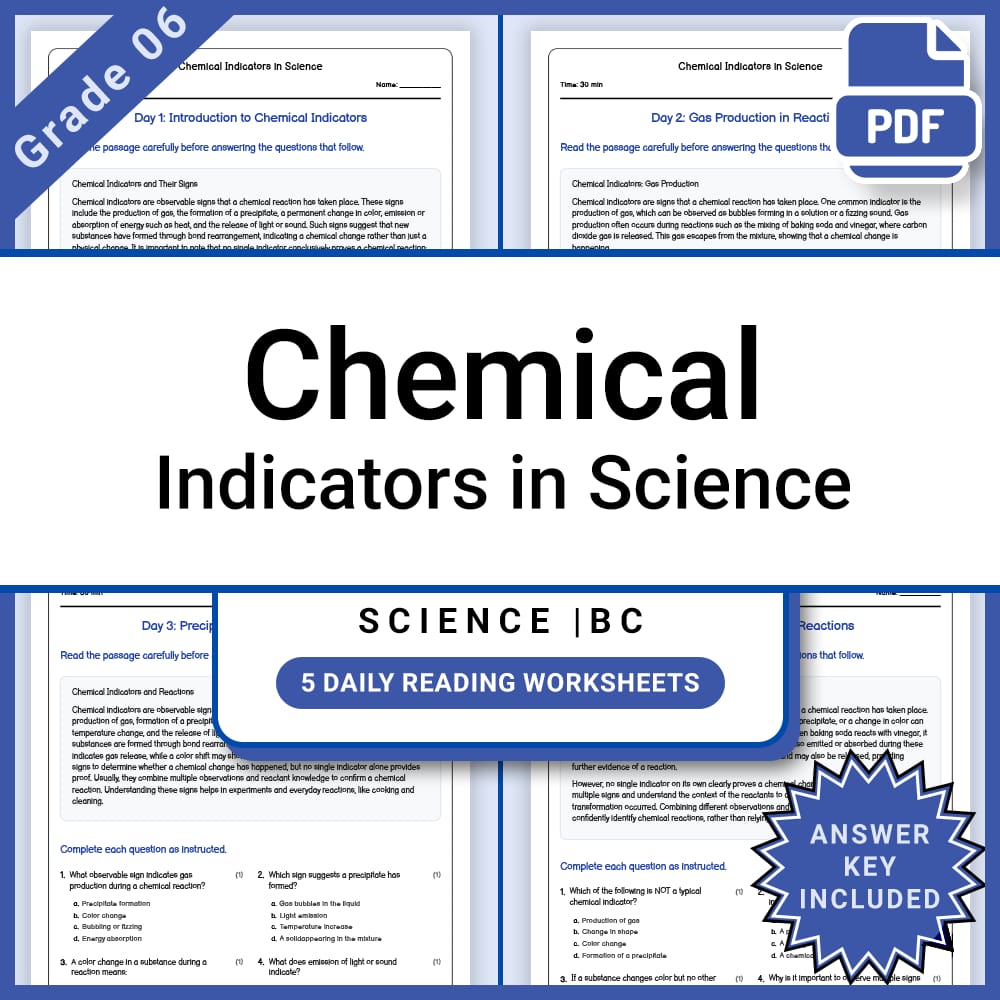
Grade 6 Science – Chemical Indicators Daily Reading Worksheet + Answer Key
JCreated byJ.S SheetsLearning Objectives
- Identify observable signs of chemical reactions
- Understand the difference between physical and chemical changes
- Recognize various chemical indicators such as gas production, precipitate formation, color change, energy emission, and light or sound release
Also included in: Grade 6 Science Lesson Group Bundle | Inquiry-Based Science Activities +1 more
Instant download
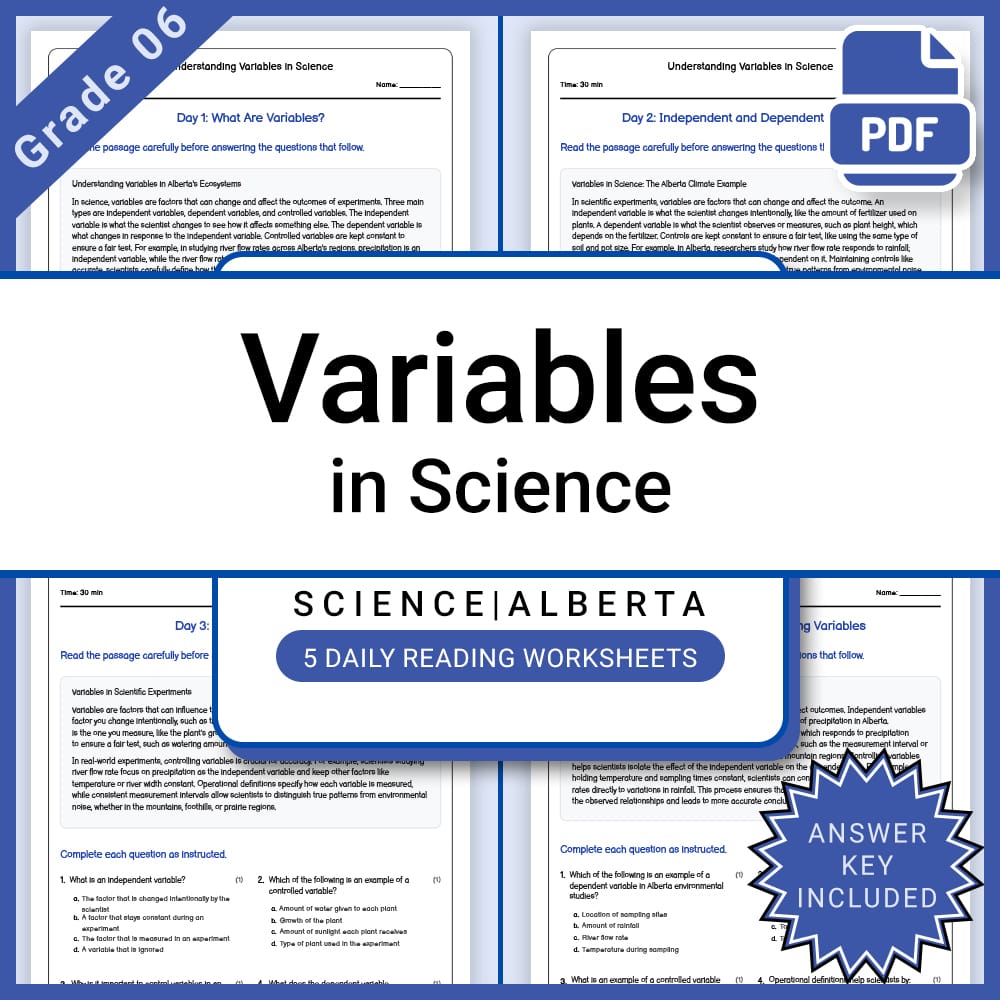
Grade 6 Science – Understanding Variables Daily Reading Worksheet + Answer Key
JCreated byJ.S SheetsLearning Objectives
- Define the different types of variables: independent, dependent, and controlled
- Identify variables in scientific experiments related to Alberta's ecology
- Understand the importance of operational definitions and measurement consistency
Also included in: Grade 6 Science Lesson Group Bundle | Alberta Standards with Reading Worksheets +1 more
Instant download
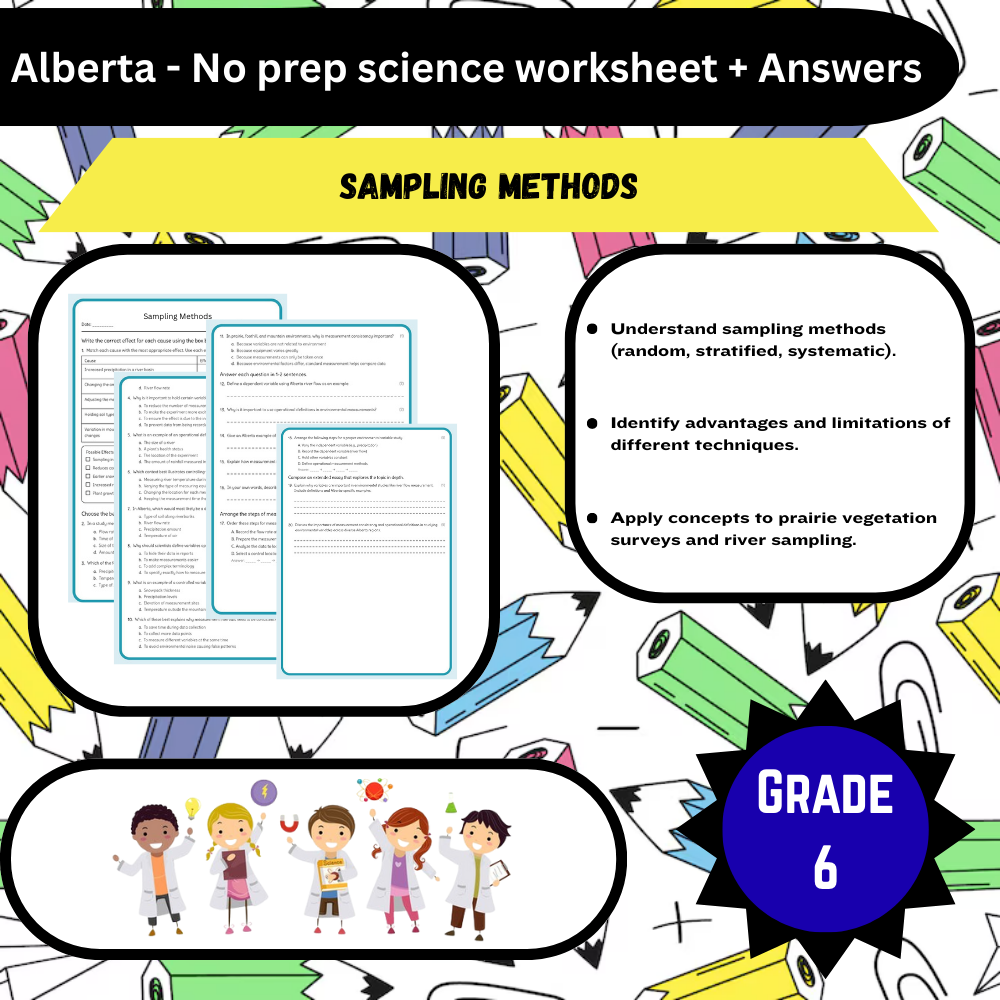
6th Grade Science | Sampling Methods Worksheet (PDF) - Alberta Standards
Created byBright Mind ResourcesLearning Objectives
- Understand different sampling methods used in environmental studies.
- Identify advantages and limitations of random, stratified, and systematic sampling techniques.
- Apply sampling concepts to real-world examples like prairie vegetation surveys and river sampling.
Instant download
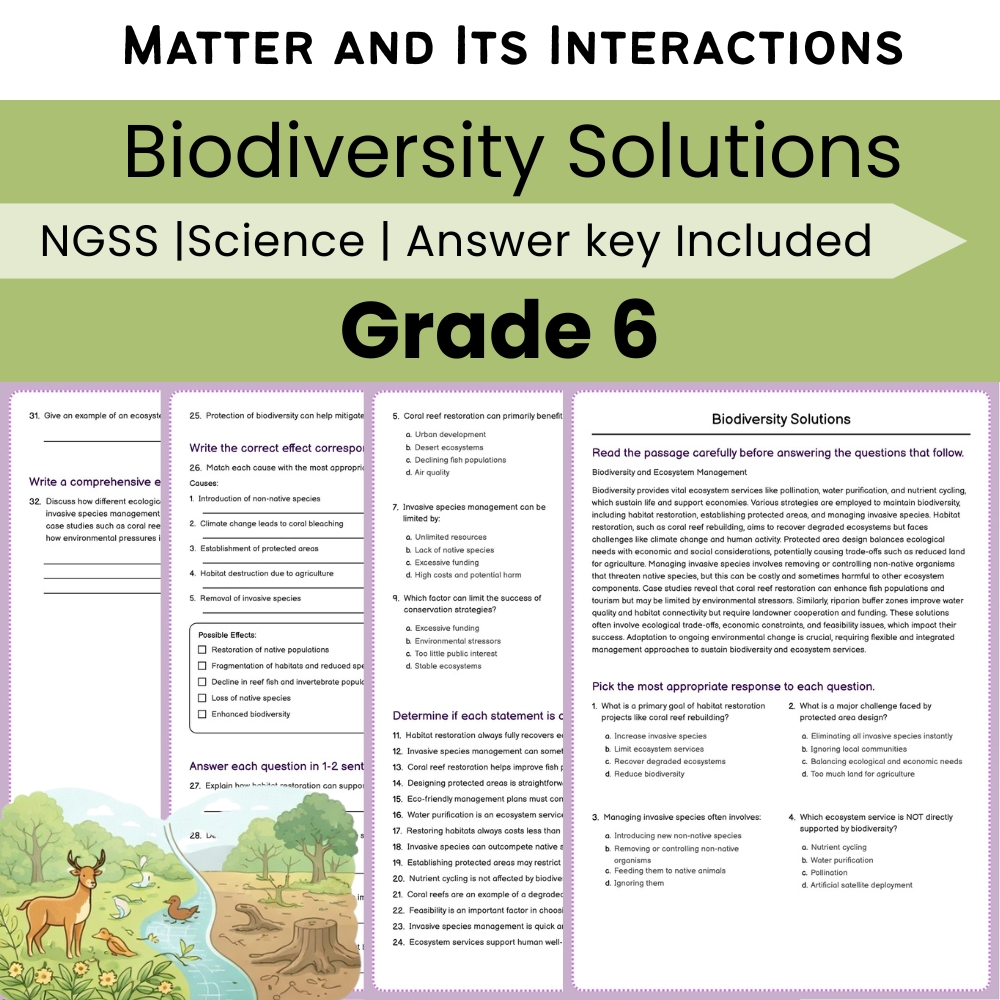
Grade 6 Science | Biodiversity Solutions Worksheet (Printable PDF & Assessment)
Learning Objectives
- Compare different conservation strategies and their ecological trade-offs.
- Analyze case studies such as coral reef restoration and riparian buffer implementation.
- Evaluate the effectiveness of various ecosystem management practices under environmental pressures.
Also included in: Grade 6 Science | Ecosystems: Interactions, Energy & Dynamics NGSS Unit Bundle +1 more
Instant download
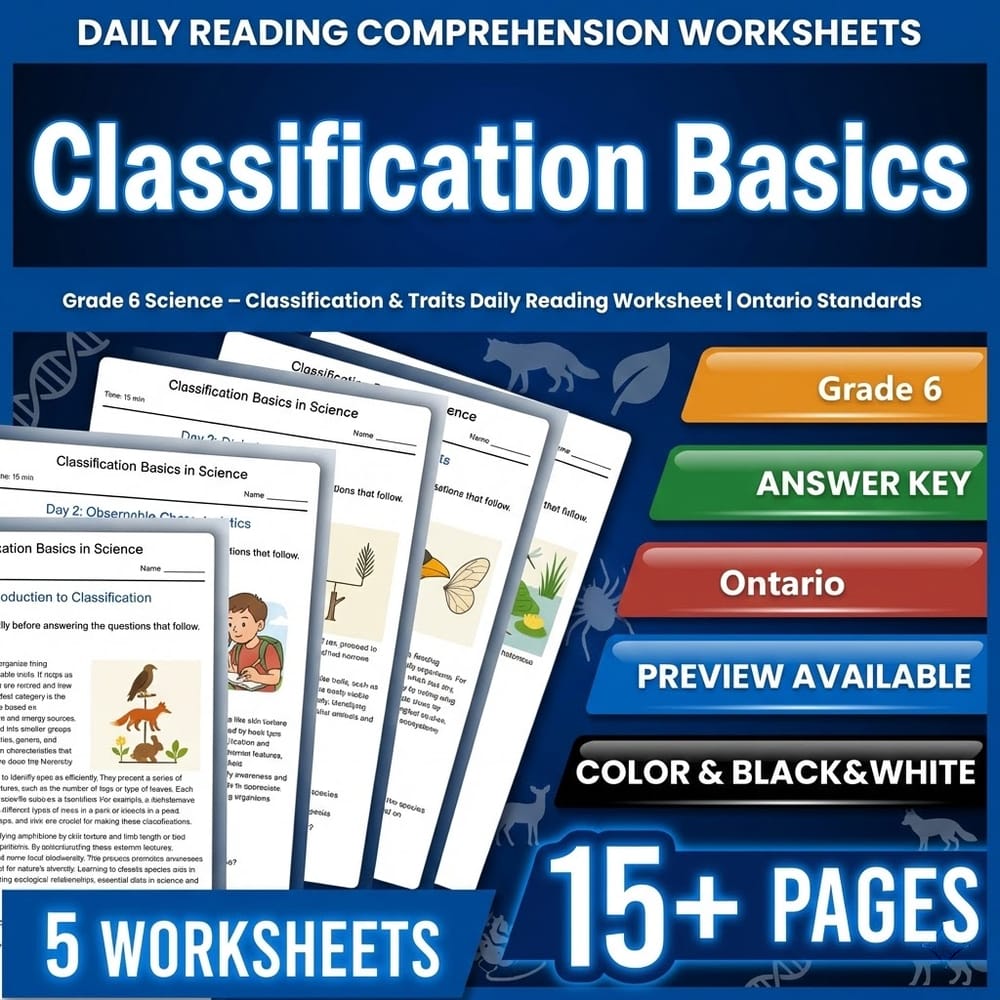
Grade 6 Science – Classification & Traits Daily Worksheet | Ontario Standards
 Created byQuiet Forest Education
Learning Objectives
- Understand the hierarchical categories used in biological classification from kingdom to species.
- Identify observable traits used to classify local species such as pond invertebrates, insects, and trees.
- Learn how to construct and use dichotomous keys for identifying different species.
Also included in: Ecosystems and Environment Grade 6 Science Daily Worksheets Bundle | Ontario +1 more
Instant download
Grade 6 Science Natural Hazards & Earthquake Eruptions | Daily Reading Worksheet
 Created byElena Brooks
Learning Objectives
- Analyze seismic data to identify earthquake patterns.
- Understand how to interpret eruption histories and storm tracks.
- Assess recurrence intervals of natural hazards.
Also included in: Grade 6 Science – Earth's Systems Lesson Bundle | NGSS Standards +1 more
Instant download
Grade 6 Science – Weather Patterns & Atmospheric Conditions | Daily Reading
Created byElena BrooksLearning Objectives
- Interpret and analyze surface weather maps to identify atmospheric features.
- Understand how air masses, pressure systems, and fronts influence local weather.
- Recognize patterns indicating precipitation, wind shifts, and severe weather events.
Also included in: Grade 6 Science – Earth's Systems Lesson Bundle | NGSS Standards +1 more
Instant download
Grade 6 Science – Water Cycle & Processes | Daily Reading Worksheet
Created byElena BrooksLearning Objectives
- Understand the processes involved in the water cycle including evaporation, condensation, precipitation, runoff, infiltration, and groundwater storage.
- Identify the roles of solar energy and gravity in moving water through the hydrosphere.
- Explain how reservoirs like oceans, ice, and groundwater store water and transfer mass and energy.
Also included in: Grade 6 Science – Earth's Systems Lesson Bundle | NGSS Standards +1 more
Instant download
Grade 6 Science – Earth's Water Cycle Daily Reading Worksheet
Created byElena BrooksLearning Objectives
- Explain how water moves through Earth's spheres (geosphere, hydrosphere, atmosphere, biosphere).
- Identify key processes involved in the water cycle, such as evaporation, condensation, precipitation, and collection.
- Describe how water transfer influences other Earth systems and feedback mechanisms.
Also included in: Grade 6 Science – Earth's Systems Lesson Bundle | NGSS Standards +1 more
Instant download
Grade 6 Science – Climate Systems & Global Patterns | Daily Reading Worksheet
Created byElena BrooksLearning Objectives
- Identify key concepts of atmospheric circulation, including the Hadley, Ferrel, and polar cells
- Describe major ocean currents such as the Gulf Stream and thermohaline circulation
- Explain how circulation patterns influence regional climates and phenomena like El Niño
Also included in: Grade 6 Science – Earth's Systems Lesson Bundle | NGSS Standards +1 more
Instant download

Grade 6 Science – Surface Change & Mountain Formation | Daily Reading Worksheet
Created byElena BrooksLearning Objectives
- Identify the geological processes involved in mountain formation.
- Differentiate between rapid and slow geological events.
- Describe observable indicators of landscape evolution.
Also included in: Grade 6 Science – Earth's Systems Lesson Bundle | NGSS Standards +1 more
Instant download

Grade 6 Science | Body Organization Levels Worksheet | General Standard
 Created byLumora Learning
Learning Objectives
- Describe how cells form tissues, tissues form organs, and organs form body systems
- Explain how structure at each level supports specific functions in the body
- Use cause-and-effect reasoning to predict how changes at one level can affect system performance and internal stability
Instant download

Minerals and Rocks Assessment | TEKS Grade 6 Science Worksheet
Created byPrism Point LearningLearning Objectives
- Identify and describe physical and chemical properties used to classify minerals.
- Distinguish between igneous, sedimentary, and metamorphic rocks based on textural and compositional features.
- Explain the processes involved in the formation of different rock types and their relevance to Earth's history.
Instant download

6th Grade Science Claim Evaluation Worksheet (Worksheet + Answer Key) – Alberta Standards
 Created bySilver Birch Teaching
Learning Objectives
- Use criteria to judge whether a scientific claim follows logically from data and methods.
- Evaluate how relevant evidence, patterns, uncertainty, and alternative hypotheses affect the strength of conclusions.
- Match the scope of a claim to the size and limits of the dataset.
Also included in: Grade 6 Scientific Inquiry & Data Analysis Science Lesson Bundle: Alberta +1 more
Instant download
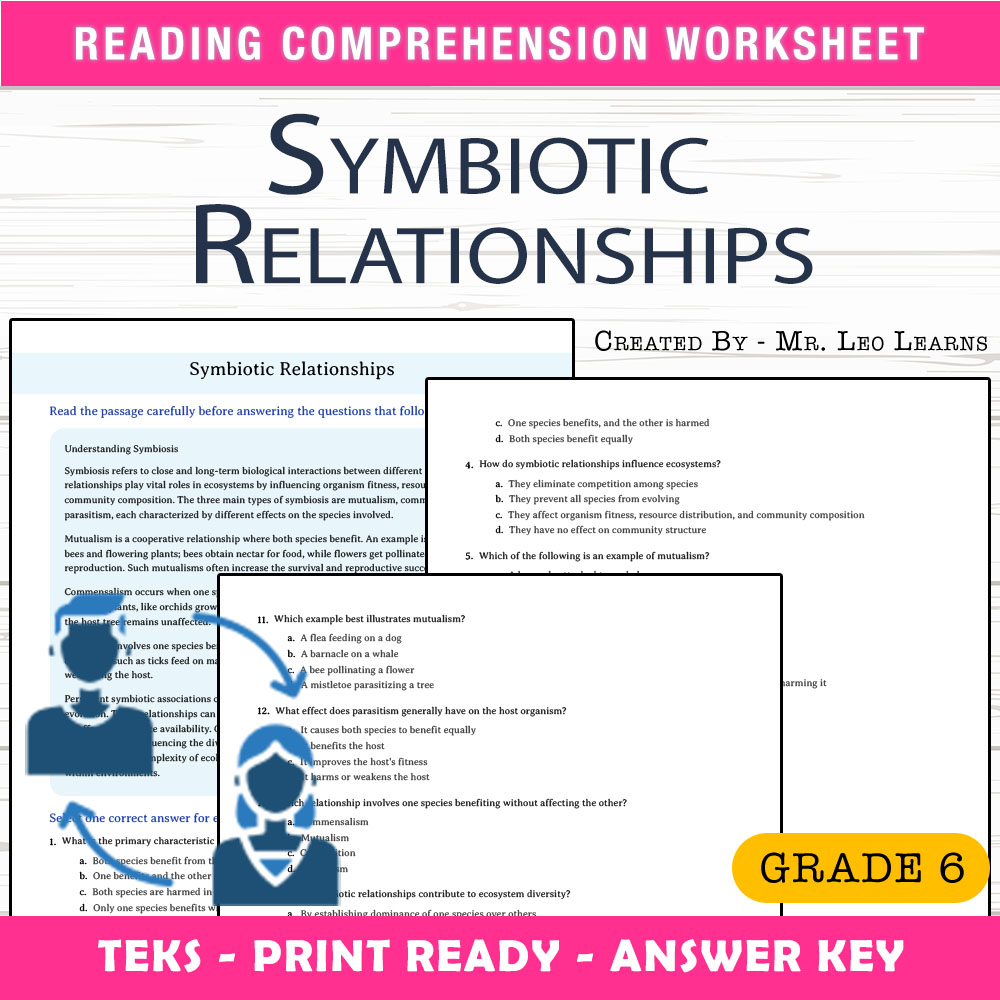
Grade 6 Science — Symbiotic Relationships Worksheet for Mastery
 Created byThe Resource Hub
Learning Objectives
- Understand the different types of symbiotic relationships—mutualism, commensalism, and parasitism.
- Identify concrete examples of each type of symbiosis in real ecosystems.
- Explain how symbiotic relationships influence organism fitness and community structure.
Also included in: Grade 6 Science Unit Bundle | Ecosystems & Environmental Relationships
Instant download

Physiological Traits Worksheet Grade 6 Science Florida NGSSS Adaptations
Created byPrism Point LearningLearning Objectives
- Explain how physiological adaptations help organisms survive in specific environments.
- Identify examples of internal processes that support water balance, metabolism, and stress tolerance.
- Compare how desert and aquatic organisms may use different internal mechanisms.
Instant download

Carbon Cycling Worksheet Grade 6 Science NGSSS Florida Activity
Created byPrism Point LearningLearning Objectives
- Explain how carbon moves between living things and the environment through processes such as photosynthesis, respiration, and decomposition
- Identify producers, consumers, and decomposers in the carbon cycle and describe their roles
- Use evidence from carbon flow to reason about long-term ecosystem functioning
Instant download

Ecosystem Components Worksheet Grade 6 Science NGSSS Florida
Created byPrism Point LearningLearning Objectives
- Explain the difference between biotic and abiotic factors in an ecosystem
- Identify producers, consumers, and decomposers using examples
- Describe how nonliving environmental conditions affect where organisms can live
Instant download

Behavioral Adaptations Worksheet Grade 6 Science | Animal Survival
Created byPrism Point LearningLearning Objectives
- Explain how behavioral adaptations help organisms survive by reducing risk from predators and harsh environmental conditions.
- Compare examples of behavioral adaptations such as migration, hibernation, nesting, and burrowing.
- Describe how behavioral adaptations can work together with structural and physiological traits.
Instant download

Grade 6 Energy Transfer Limits Worksheet | NGSS Practice PDF
Created byClear Sky ClassroomLearning Objectives
- Explain why energy available to higher trophic levels decreases in real ecosystems.
- Describe how energy is used for life processes and lost as heat at each trophic level.
- Use energy transfer ideas to predict how food web changes can affect multiple populations.
Instant download

Day Night Seasons Test Prep Printables | Grade 6 Science
Created byPrism Point LearningLearning Objectives
- Explain how Earth’s rotation causes day and night.
- Describe how Earth’s 23.5° axial tilt and orbit affect seasonal changes in sunlight and temperatures.
- Use solstices and equinoxes as predictable observational anchors for daylight and solar altitude.
Instant download
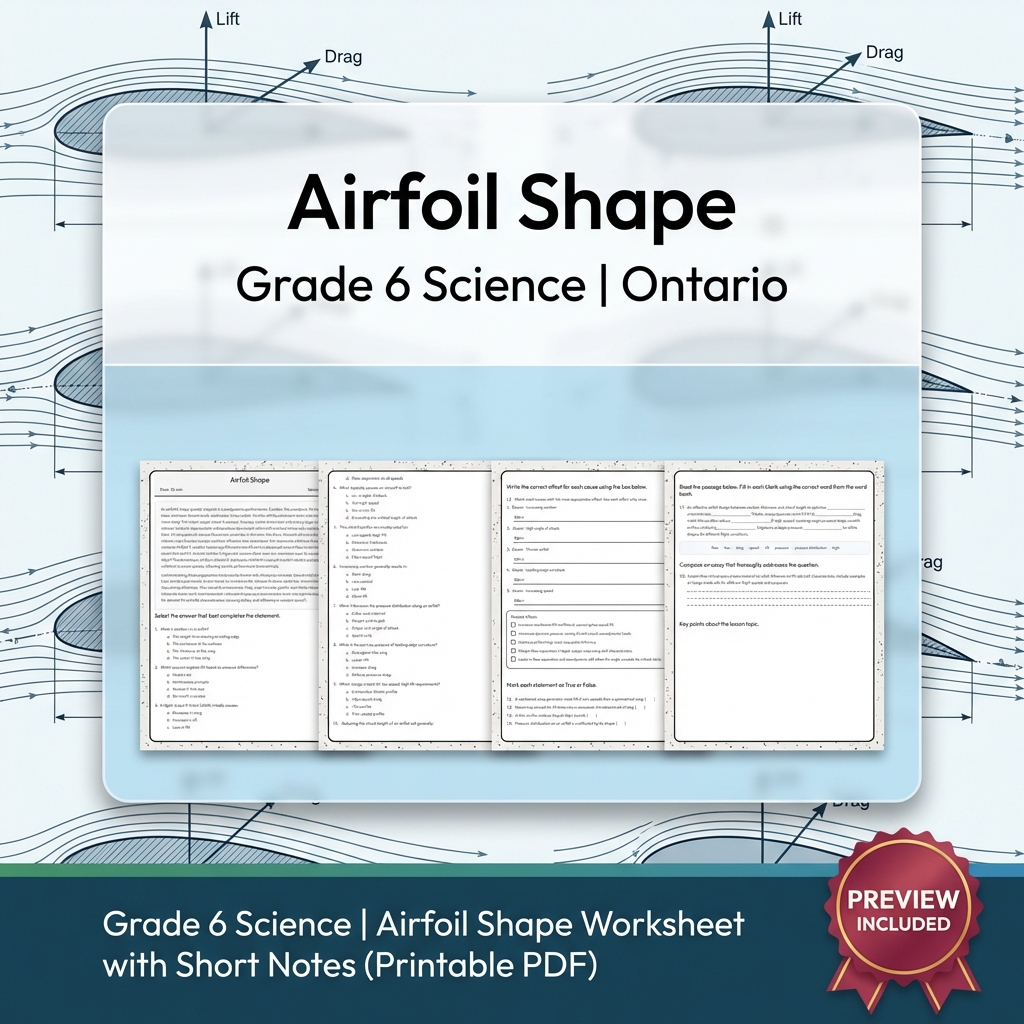
Grade 6 Science | Airfoil Shape Worksheet with Short Notes (Printable PDF)
Created byMeadowlark WorksheetsLearning Objectives
- Understand how camber, thickness, chord length, and leading-edge curvature influence pressure distribution and lift.
- Explain the differences between Bernoulli and Newtonian accounts of lift in airfoils.
- Analyze how angle of attack and critical angles affect stall and lift generation.
Also included in: Grade 6 Science Lesson Group Bundle – Ontario Framework Worksheets +1 more
Instant download

Photosynthesis Energy Conversion Assessment | California Standards Grade 6 Science
Created byPrism Point LearningLearning Objectives
- Explain how photosynthesis converts light energy into chemical energy stored in glucose and other carbon-based molecules.
- Describe the roles of water, carbon dioxide, and sunlight in the light-dependent steps and the Calvin cycle.
- Identify oxygen as a byproduct of photosynthesis and explain how photosynthesis supports life on Earth.
Also included in: Grade 6 Energy and Matter Cycles Science Lesson Bundle | California Standards +1 more
Instant download
About Grade 6 Science Worksheets
Explore Grade 6 Science worksheets for classwork, homework, or review. Our 5,969 printables download instantly as PDFs.
MyTeachingSheets worksheets are made by real teacher-authors and checked before they go live. Download any as a print-ready PDF for lessons, homework, or independent practice — most include answer keys, and previews are always free.