
Grade 6 Science Worksheets
5,997 worksheets
Grade 6 Science Worksheet – Classification Basics (Ontario) (PDF)
 Created byEvergreen Desk Education
Learning Objectives
- Identify how observable characteristics are used to group organisms.
- Use a dichotomous key to classify organisms step-by-step.
- Explain hierarchical classification from kingdom to species and why species is the most specific category.
Also included in: Grade 6 Biodiversity, Adaptation & Ecology Science Lesson Bundle | Ontario +1 more
Instant download

Grade 6 TEKS Minerals and Rocks Daily Science Reading Worksheet
 Created byBRIGHT PATH RESOURCES
Learning Objectives
- Identify the main idea and key details about minerals and rocks.
- Distinguish minerals from rocks using physical properties.
- Recognize how properties like hardness, cleavage, and grain size help identify rock types.
Also included in: Earth & Space Grade 6 Science Daily Reading Worksheets Lesson Bundle | TEKS +1 more
Instant download
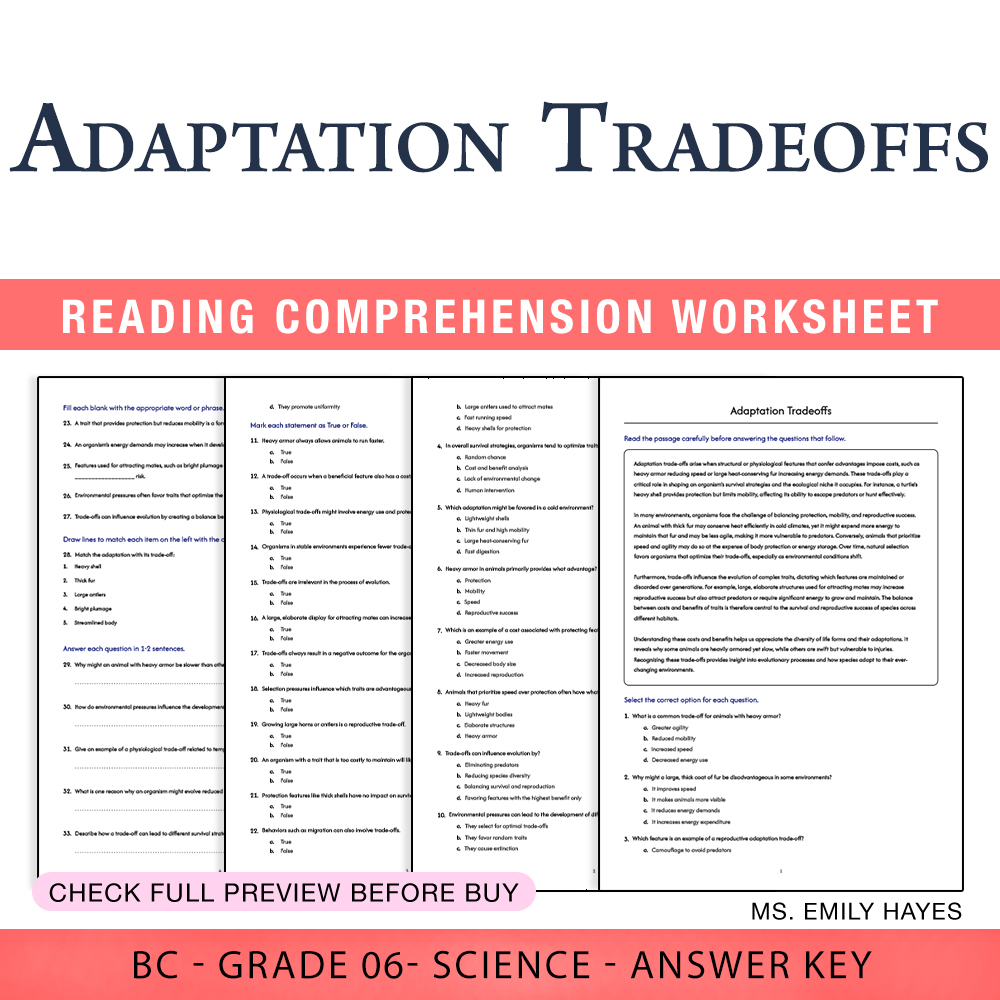
6th Grade Science | Adaptation Tradeoffs Worksheet (PDF+ Answer Key)
 Created byCopper Leaf Classroom
Learning Objectives
- Understand the concept of adaptation trade-offs and how they affect organism survival
- Describe different types of trade-offs in structural and physiological features
- Evaluate the costs and benefits associated with specific adaptations
Also included in: Grade 6 Science BC | Human Body Systems & Adaptations (PDF+ Answer Keys) +1 more
Instant download
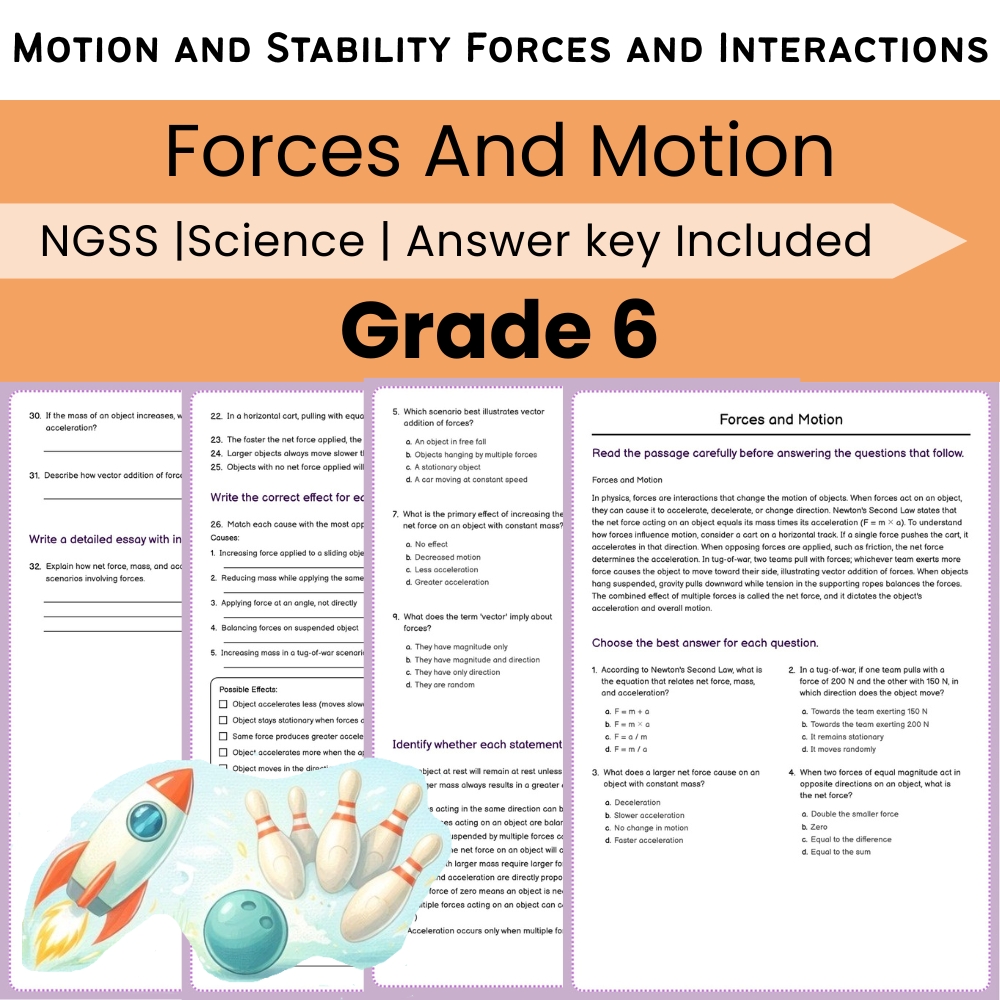
Forces and Motion Worksheet | NGSS Grade 6 Science printable PDF
Learning Objectives
- Understand the relationship between net force, mass, and acceleration.
- Explain how vector addition affects motion in different scenarios.
- Apply the formula net force equals mass times acceleration to solve problems.
Also included in: Grade 6 Science | Forces and Motion NGSS Unit Bundle (4 Worksheets Included) +1 more
Instant download
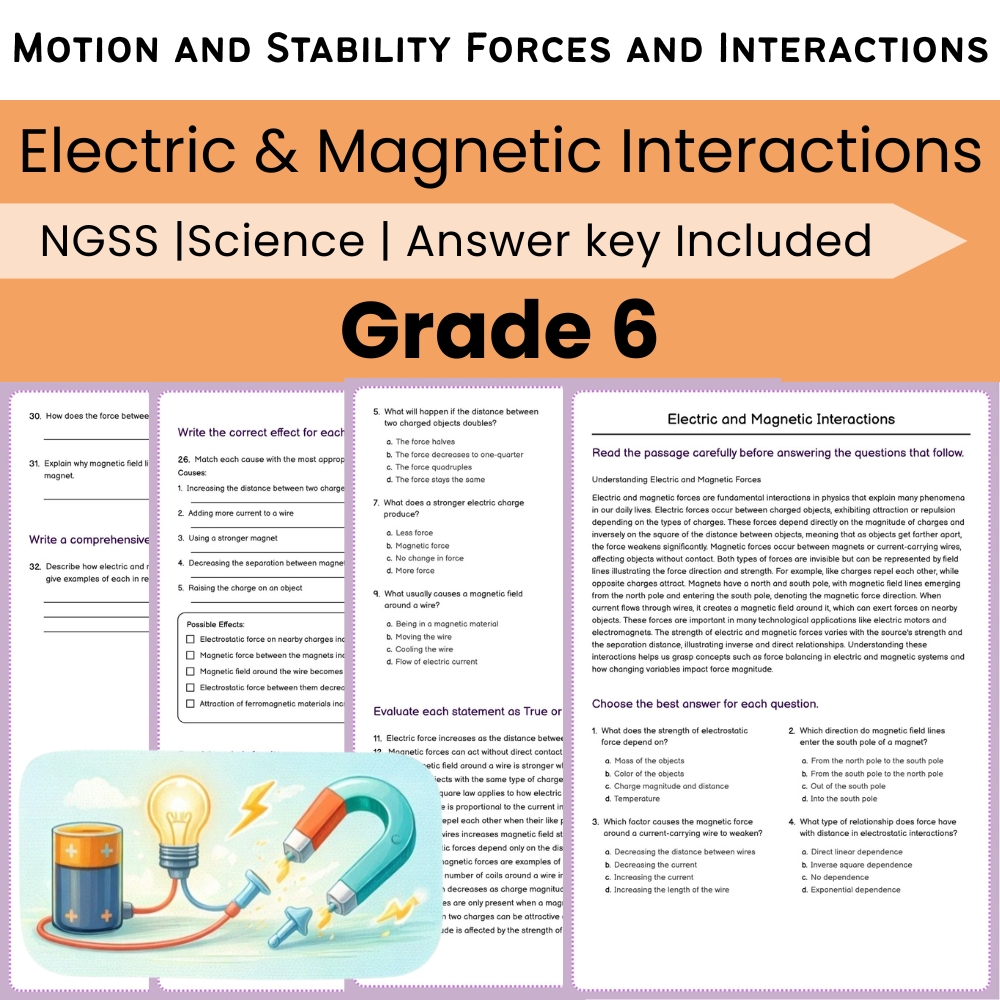
Electric and Magnetic Interactions Worksheet | Grade 6 Science PDF
Learning Objectives
- Understand how electric and magnetic forces depend on source strength and separation.
- Identify examples of electrostatic and magnetic forces in real-world situations.
- Explain how factors like distance, charge, and current influence force strength.
Also included in: Grade 6 Science | Forces and Motion NGSS Unit Bundle (4 Worksheets Included) +1 more
Instant download
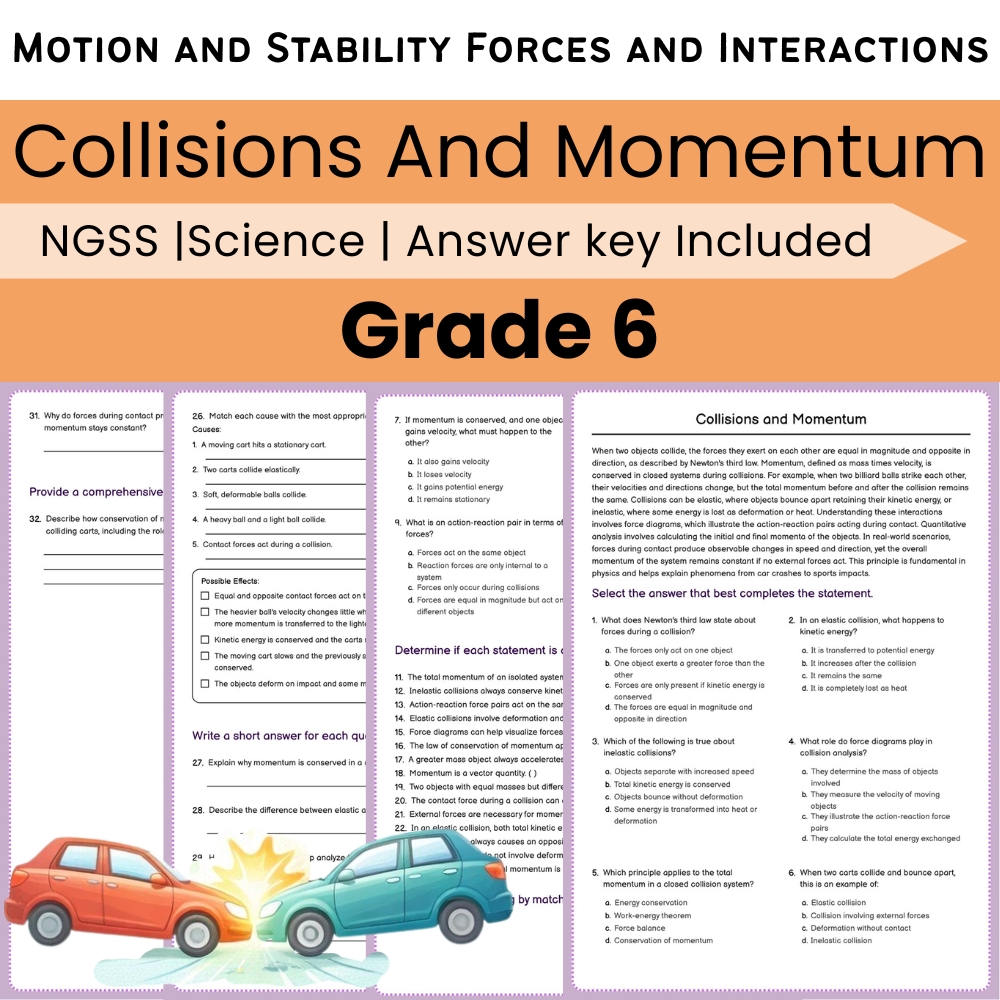
Collisions and Momentum Worksheet | Grade 6 Science NGSS Printable PDF
Learning Objectives
- Understand the law of conservation of momentum during two-body collisions.
- Identify the differences between elastic and inelastic collisions.
- Apply force diagrams to analyze action-reaction pairs during contact.
Also included in: Grade 6 Science | Forces and Motion NGSS Unit Bundle (4 Worksheets Included) +1 more
Instant download
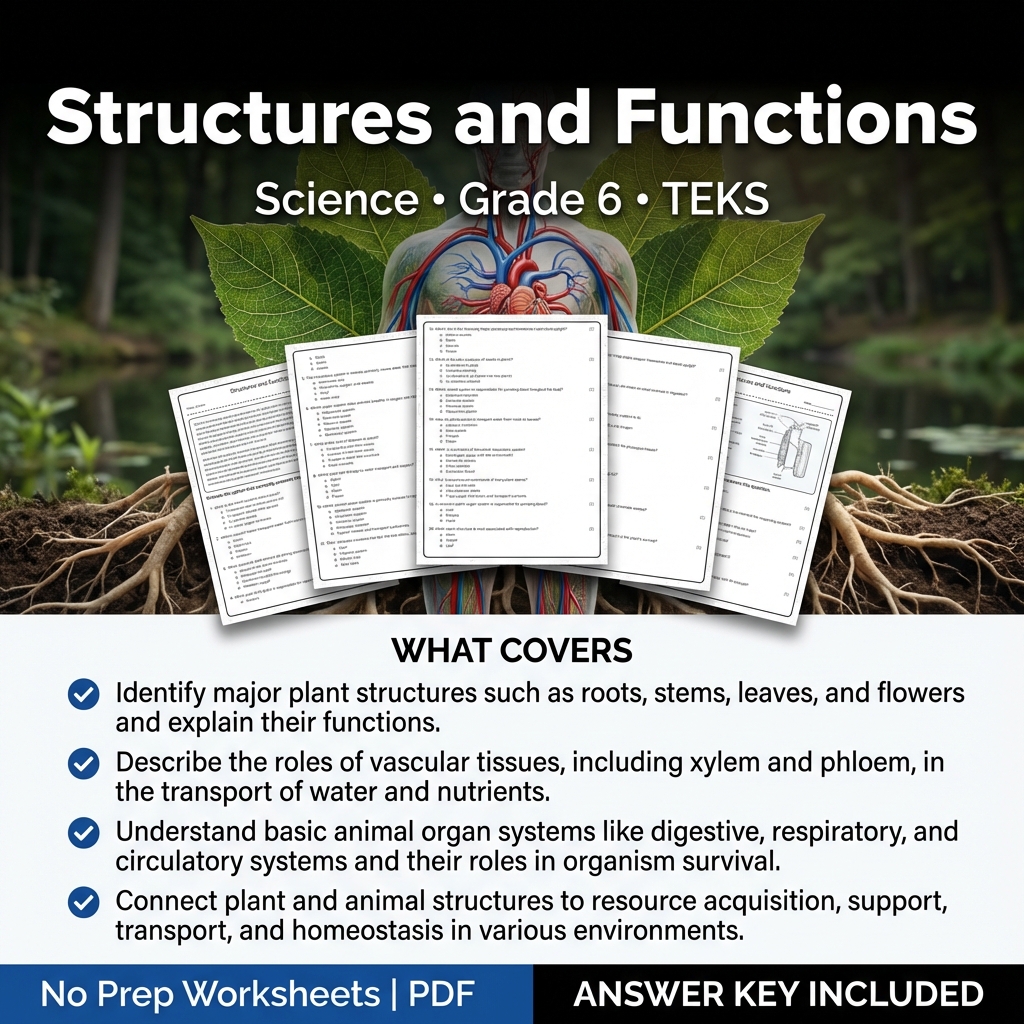
Grade 6 Science Worksheet on Structures and Functions | TEKS Aligned
 Created byCoral Reef Learning
Learning Objectives
- Identify major plant structures such as roots, stems, leaves, and flowers and explain their functions.
- Describe the roles of vascular tissues, including xylem and phloem, in the transport of water and nutrients.
- Understand basic animal organ systems like digestive, respiratory, and circulatory systems and their roles in organism survival.
Instant download
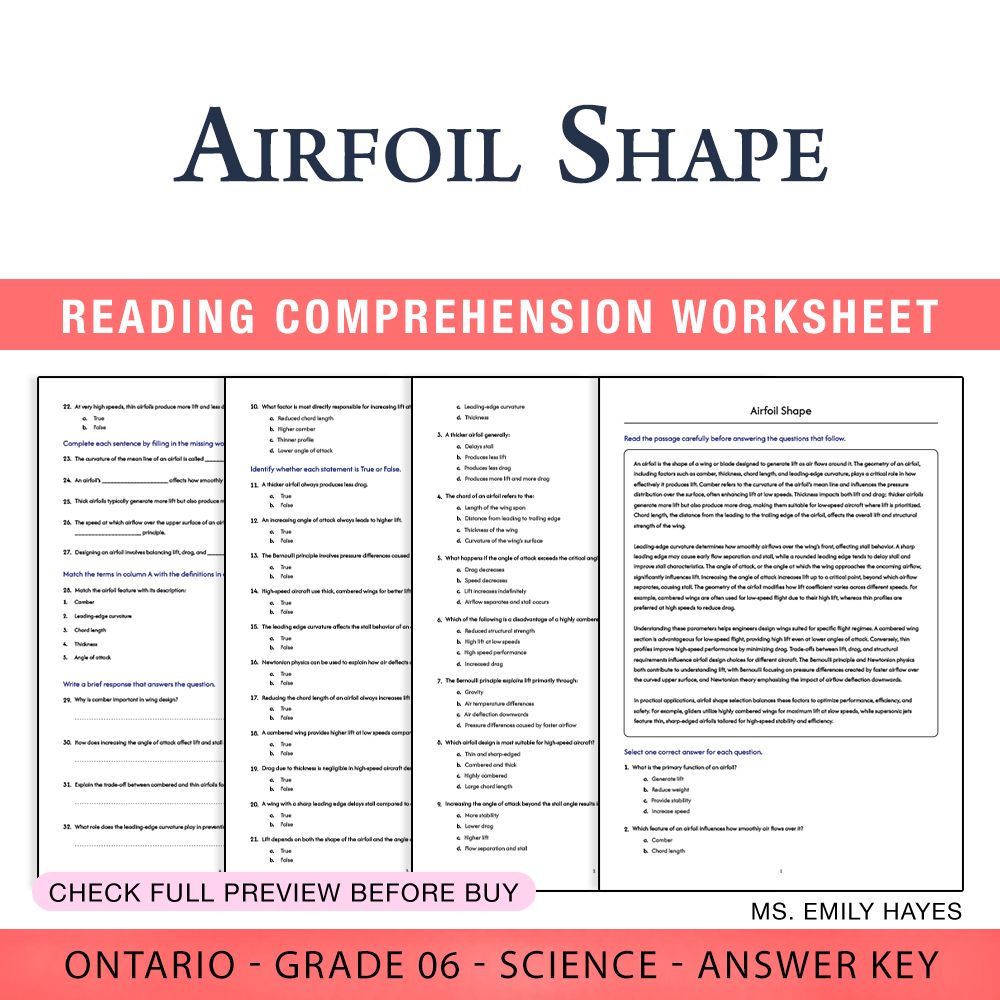
6th Grade Science | Airfoil Shape Worksheet (PDF + Answer Key)
Created byCopper Leaf ClassroomLearning Objectives
- Explain how camber, thickness, chord length, and leading-edge curvature influence pressure distribution and lift.
- Describe the differences between Bernoulli and Newtonian approaches to understanding lift.
- Identify the effects of angle of attack and critical angles for stall on lift production.
Instant download

Mixtures and Compounds Worksheet Pack Grade 6 Science Chemistry
 Created byPrism Point Learning
Learning Objectives
- Explain how mixtures and compounds differ in particle arrangement and atomic composition
- Identify examples of mixtures and compounds using particle model ideas
- Describe how physical separation often works for mixtures but not for compounds
Instant download
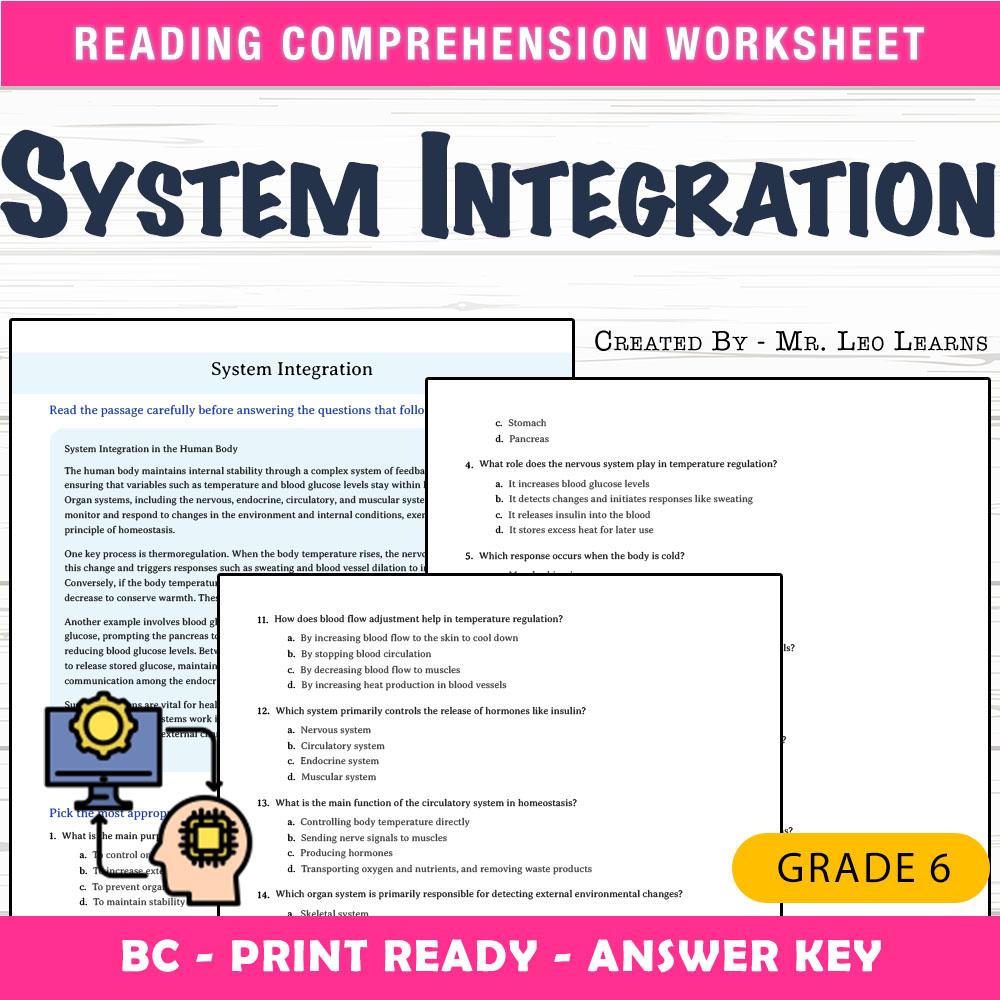
Grade 6 Science — System Integration MCQ Worksheet for Mastery
 Created byThe Resource Hub
Learning Objectives
- Understand how organ systems interact to maintain homeostasis.
- Identify feedback mechanisms involved in regulating internal conditions.
- Explore examples of system responses like temperature regulation and blood glucose control.
Also included in: Grade 6 Science Unit | Multicellular Systems & Functions Worksheet Bundle +1 more
Instant download

Grade 6 Science Natural Selection Worksheet | NGSS Assessment
 Created bySkylark Worksheets
Learning Objectives
- Explain how heritable variation and environmental pressures lead to natural selection.
- Describe how differential reproductive success changes trait frequencies over generations.
- Connect examples (finches, pollution, antibiotic resistance) to selection-driven shifts in populations.
Also included in: Grade 6 Evolution Evidence and Natural Selection Science Lesson Bundle NGSS +1 more
Instant download

Science Worksheet Biodiversity Patterns | Worksheet | NGSS Grade 6 Science
Created bySkylark WorksheetsLearning Objectives
- Interpret how species occurrence and richness can reveal spatial and temporal biodiversity patterns
- Compare biodiversity patterns across islands, along latitudes, and among habitats with different heterogeneity
- Explain how historical records and present-day surveys help estimate turnover and community composition
Also included in: Grade 6 Evolution Evidence and Natural Selection Science Lesson Bundle NGSS +1 more
Instant download

Science Worksheet: Fossil Patterns Assessment | NGSS Grade 6 Science
Created bySkylark WorksheetsLearning Objectives
- Analyze how fossil occurrences and stratigraphic sequences reveal patterns of origin, diversification, and extinction over geologic time.
- Explain how relative dating and radiometric dating help place fossils in a temporal sequence.
- Interpret how fossil morphology and geographic distribution support ideas about lineage continuity and turnover.
Also included in: Grade 6 Evolution Evidence and Natural Selection Science Lesson Bundle NGSS +1 more
Instant download
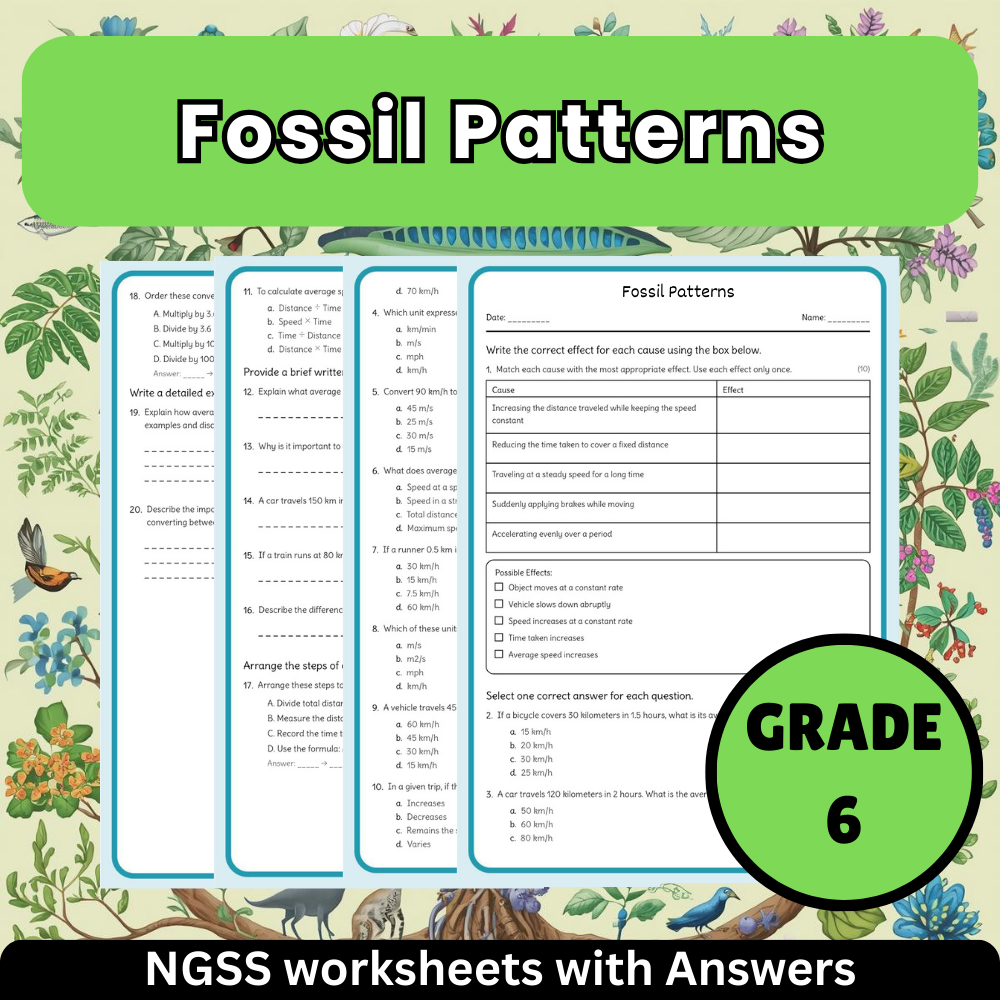
6th Grade Science | Fossil Patterns & Evolution NGSS Worksheet (PDF)
 Created byBright Mind Resources
Learning Objectives
- Understand how fossil occurrences and stratigraphy reveal patterns of origin, diversification, and extinction over geologic time.
- Analyze morphological transitions in the fossil record, such as fish-to-tetrapod examples.
- Interpret stratigraphic sequences, relative and radiometric dating methods, and geographic distribution to infer lineage continuity and turnover.
Also included in: Grade 6 Science Unit Bundle | Evolution, Genetics & Biodiversity NGSS Worksheets +2 more
Instant download
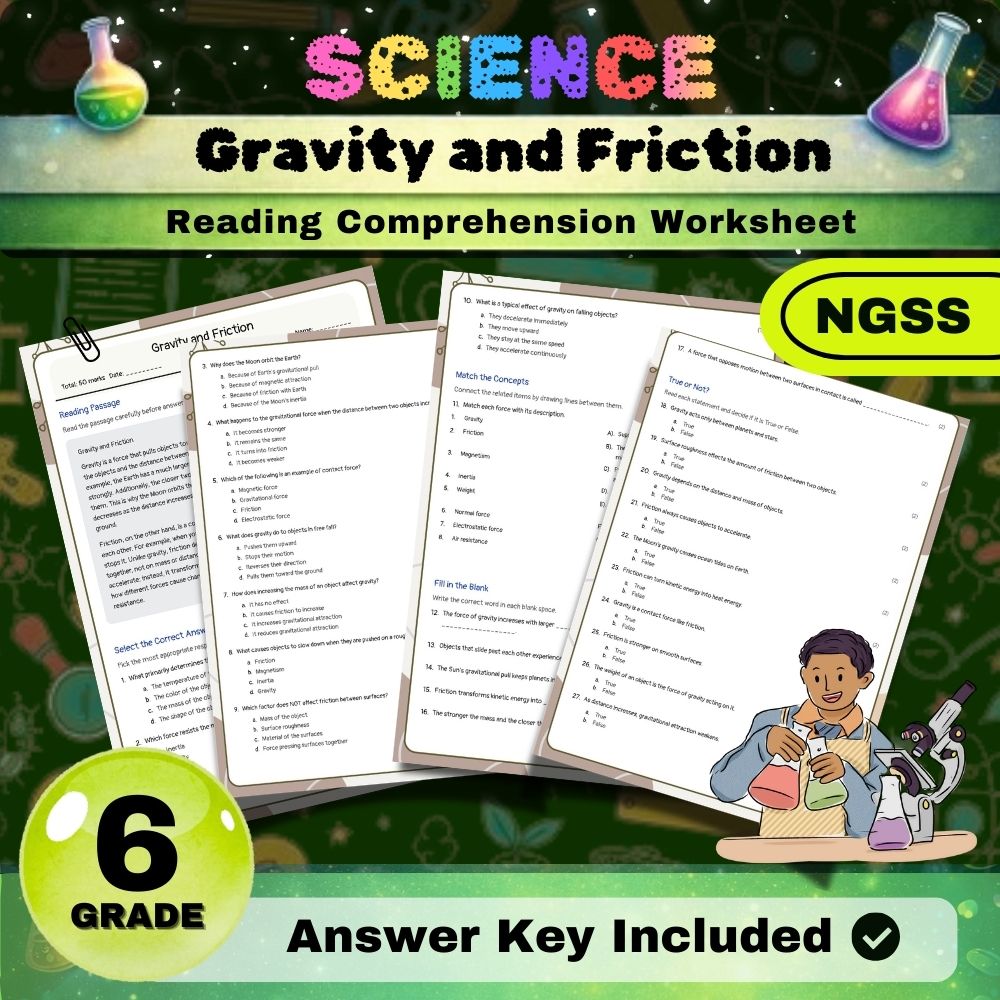
6th Grade Science | Gravity and Friction NGSS Worksheet (PDF + Answer Key)
 Created byMaple Path Learning
Learning Objectives
- Understand that gravitational attraction depends on mass and distance between objects.
- Differentiate between gravitational and contact forces, such as friction.
- Explain how gravity influences planetary orbits and falling objects.
Also included in: Grade 6 Science Forces & Motion Unit Bundle (NGSS Worksheets + Answer Keys) +1 more
Instant download

Solar System Components & Planet Classification Worksheets Grade 6
Created byPrism Point LearningLearning Objectives
- Identify major solar system objects by composition and size
- Compare terrestrial and gas giant planets by key characteristics
- Explain how distance from the Sun affects planetary temperature
Also included in: Grade 6 Space Science Lesson Bundle | Ontario Science Framework
Instant download

Earth System Interactions and Feedbacks Worksheets Grade 6 Science
 Created byTeachers Club
Learning Objectives
- Explain how matter and energy move among the geosphere, hydrosphere, atmosphere, and biosphere.
- Describe feedback mechanisms that change Earth systems, such as ice-albedo effects.
- Use a model sequence to predict observable patterns from short-term to geologic timescales.
Also included in: Earth's Systems Grade 6 Science Worksheets | NGSS Unit Bundle +2 more
Instant download

Collisions and Momentum Worksheet | NGSS Grade 6 Physics Activity
 Created byAmber Owl Education
Learning Objectives
- Explain how conservation of momentum applies to an isolated two-object system during a collision
- Identify action-reaction force pairs and describe how they relate to changes in motion
- Differentiate elastic and inelastic collisions using momentum and kinetic energy behavior
Also included in: Grade 6 Science Forces and Motion Unit Lesson Bundle | NGSS +1 more
Instant download

Forest Food Webs and Energy Flow Worksheets Grade 6 Science Activity
 Created bySunny Desk Resources
Learning Objectives
- Describe how energy moves through a forest food web among producers, consumers, and decomposers.
- Identify trophic relationships and how changes in one species can affect others over time.
- Explain the role of decomposers in recycling organic matter in forest ecosystems.
Also included in: Trees and Forests Grade 6 Alberta Science Worksheets Bundle +1 more
Instant download

Ecosystem Classification Worksheets Grade 6 Producers Consumers Review
Created bySunny Desk ResourcesLearning Objectives
- Explain how species classification can group organisms as producers, consumers, and decomposers.
- Identify native versus invasive (or pest) species and predict how they can affect ecosystem balance.
- Use classification to make simple predictions about energy flow and competition in ecosystems.
Also included in: Trees and Forests Grade 6 Alberta Science Worksheets Bundle +1 more
Instant download

Grade 6 Science | Disturbance Regimes in Forests - Reading Comprehension
Created byCoral Reef LearningLearning Objectives
- Identify different types of disturbance in forest ecosystems.
- Understand how fire impacts forest structure and succession.
- Recognize other disturbance agents such as insects and wind.
Also included in: Trees and Forests Lesson Bundle | Grade 6 Science | Alberta +1 more
Instant download

Grade 6 Science | Forest Types - Daily Reading Comprehension
Created byCoral Reef LearningLearning Objectives
- Identify key characteristics of boreal forests
- Understand how environmental factors influence forest distribution
- Recognize different forest regions and ecosystems
Also included in: Trees and Forests Lesson Bundle | Grade 6 Science | Alberta +1 more
Instant download

Grade 6 Science | Stewardship Practices in Land Care - Reading Comprehension
Created byCoral Reef LearningLearning Objectives
- Understand the concept of stewardship practices and their importance.
- Identify different community-based planting initiatives.
- Recognize how stewardship efforts benefit local and regional landscapes.
Also included in: Trees and Forests Lesson Bundle | Grade 6 Science | Alberta +1 more
Instant download

Grade 6 Science | Growth Rings - Daily Reading Comprehension
Created byCoral Reef LearningLearning Objectives
- Understand key concepts related to Science
- Apply knowledge through practice questions
- Demonstrate comprehension of the material
Also included in: Trees and Forests Lesson Bundle | Grade 6 Science | Alberta +1 more
Instant download

Grade 6 Science | Integrated Management Daily Reading Practice
Created byCoral Reef LearningLearning Objectives
- Understand the concept of ecosystem-based management
- Identify the ecological, economic, and social objectives in forest management
- Learn about tools used in integrated forest management, such as monitoring and stakeholder collaboration
Also included in: Trees and Forests Lesson Bundle | Grade 6 Science | Alberta +1 more
Instant download

Grade 6 Science | Stem Transport - Daily Reading Comprehension
Created byCoral Reef LearningLearning Objectives
- Understand how water and nutrients are transported within trees through stems.
- Identify the roles of xylem and phloem in resource movement.
- Explain how environmental factors like freeze-thaw cycles, drought, and pests affect sap flow.
Also included in: Trees and Forests Lesson Bundle | Grade 6 Science | Alberta +1 more
Instant download
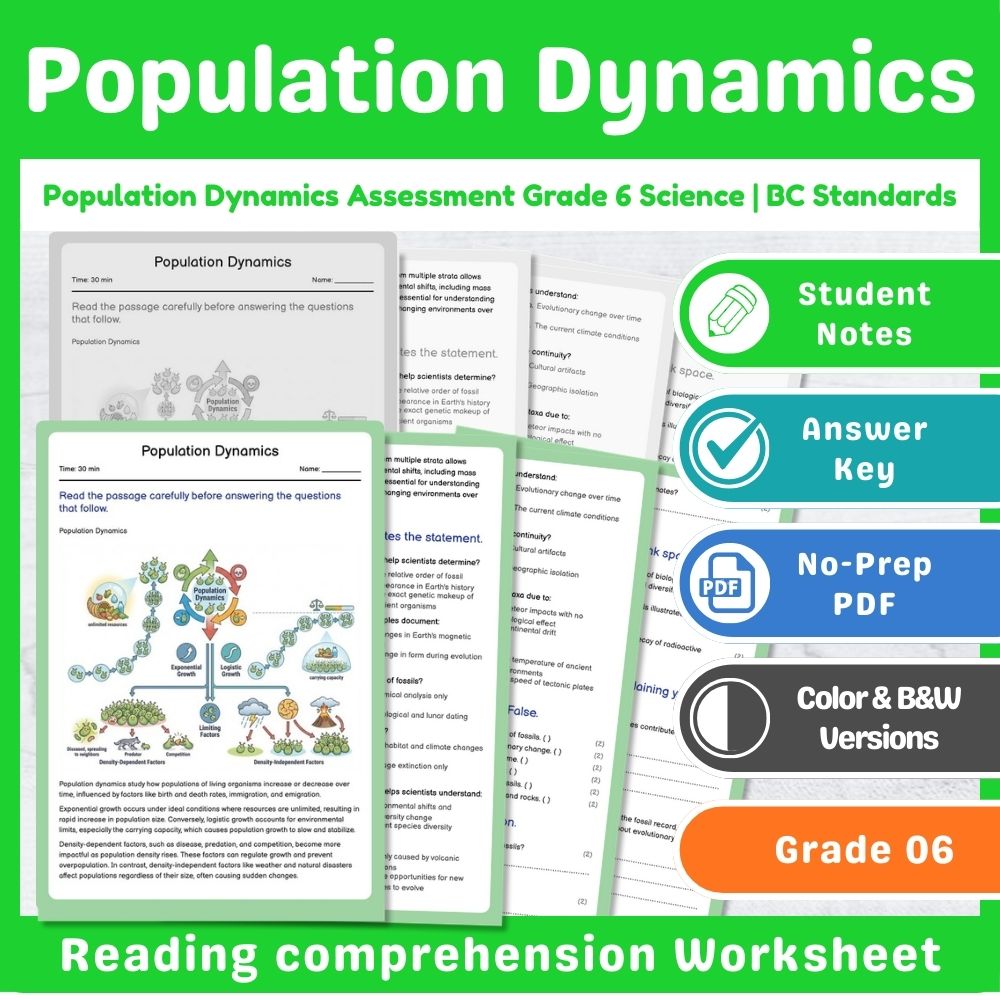
Population Dynamics Assessment Grade 6 Science | BC Standards
Created byPrism Point LearningLearning Objectives
- Understand the factors influencing the change in population sizes over time.
- Identify differences between exponential and logistic growth models.
- Explain how density-dependent and density-independent factors affect populations.
Instant download
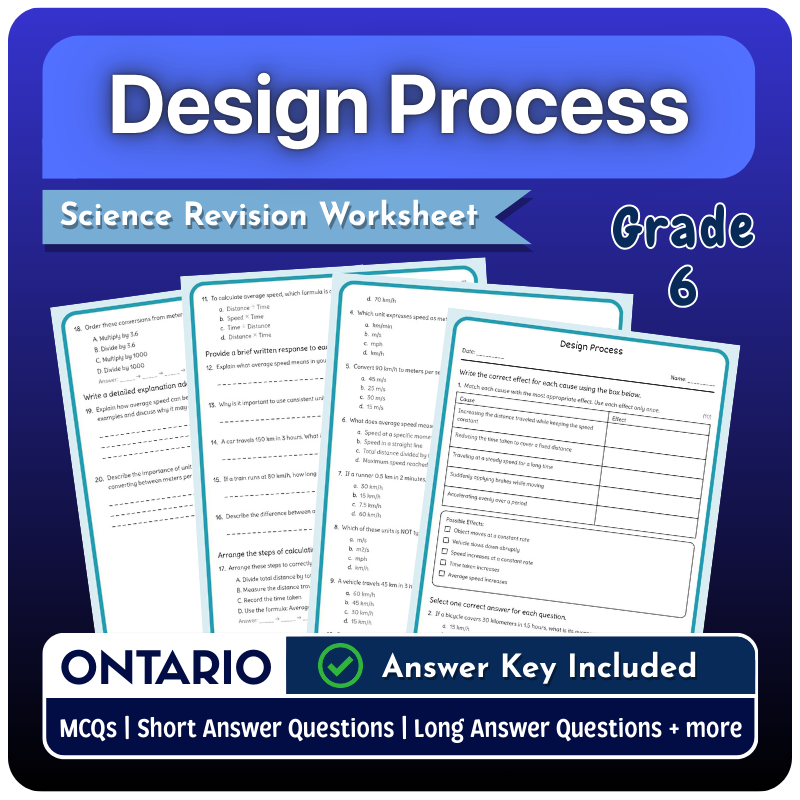
6th Grade Science | Design Process Worksheet (Ontario, Science 1) (PDF)
Created byBright Mind ResourcesLearning Objectives
- Describe the steps involved in the design process for aircraft and gliders.
- Explain how measurement and refinement improve aerodynamic performance.
- Identify key performance criteria such as lift, drag, weight, and stability.
Instant download
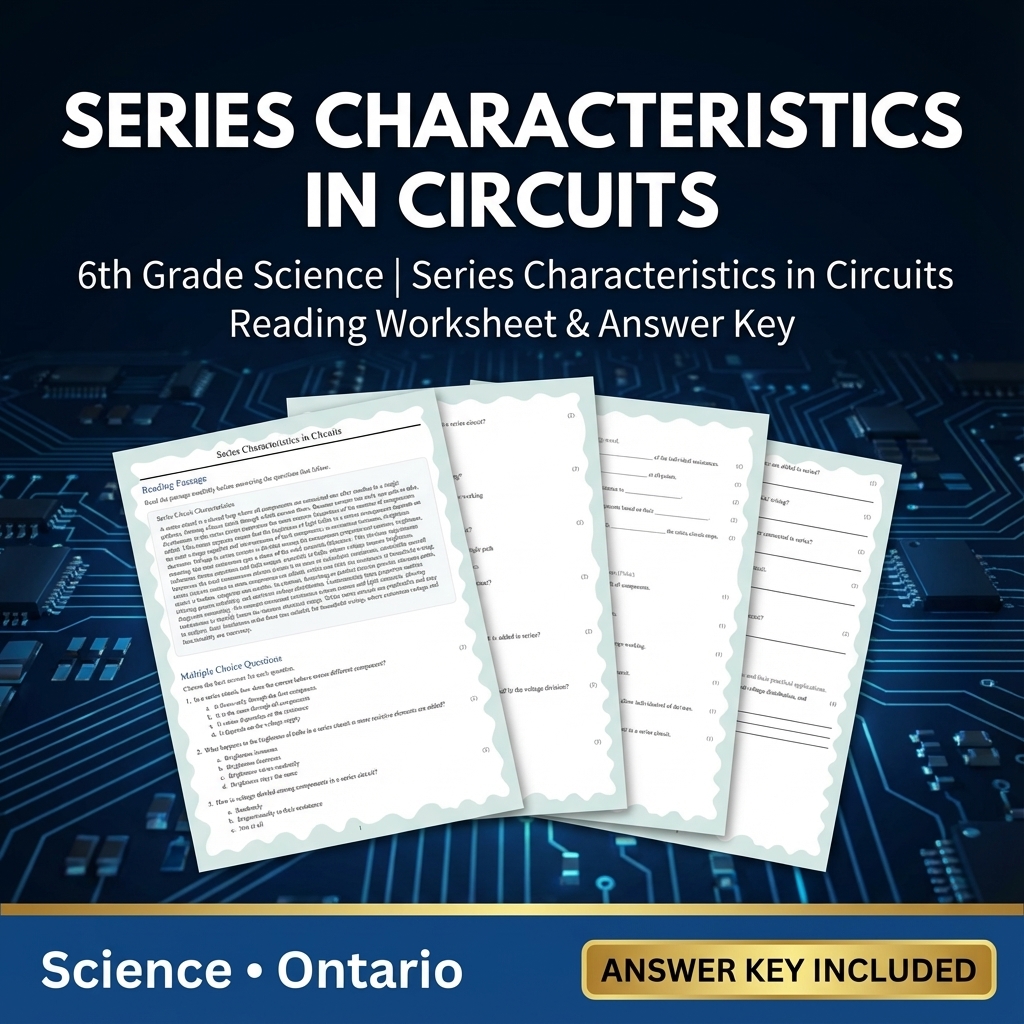
6th Grade Science | Series Characteristics in Circuits Reading
JCreated byJ.S SheetsLearning Objectives
- Understand the definition and features of series circuits, including single-path current flow.
- Explain how voltage divides among components in a series circuit and how this affects brightness of bulbs.
- Describe the impact of resistance accumulation in series arrangements and limitations for household wiring.
Also included in: Grade 6 Science Circuit & Electricity Unit Bundle – Worksheets & Answer Keys +1 more
Instant download
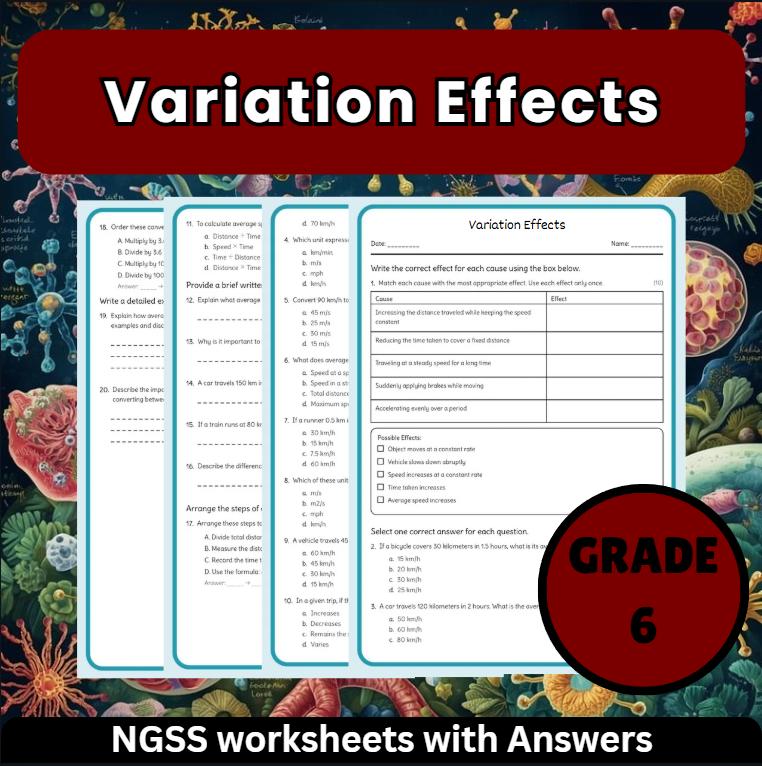
6th Grade Science – Variation Effects Worksheet (NGSS & Science PDF)
Created byBright Mind ResourcesLearning Objectives
- Understand how genetic and environmental factors influence phenotypic variation.
- Identify examples of variation caused by heredity and environment.
- Explain the link between DNA, gene expression, and organism traits.
Also included in: Grade 6 Science UNIT Bundle | Cell Functions, Energy & Systems NGSS Worksheets +2 more
Instant download
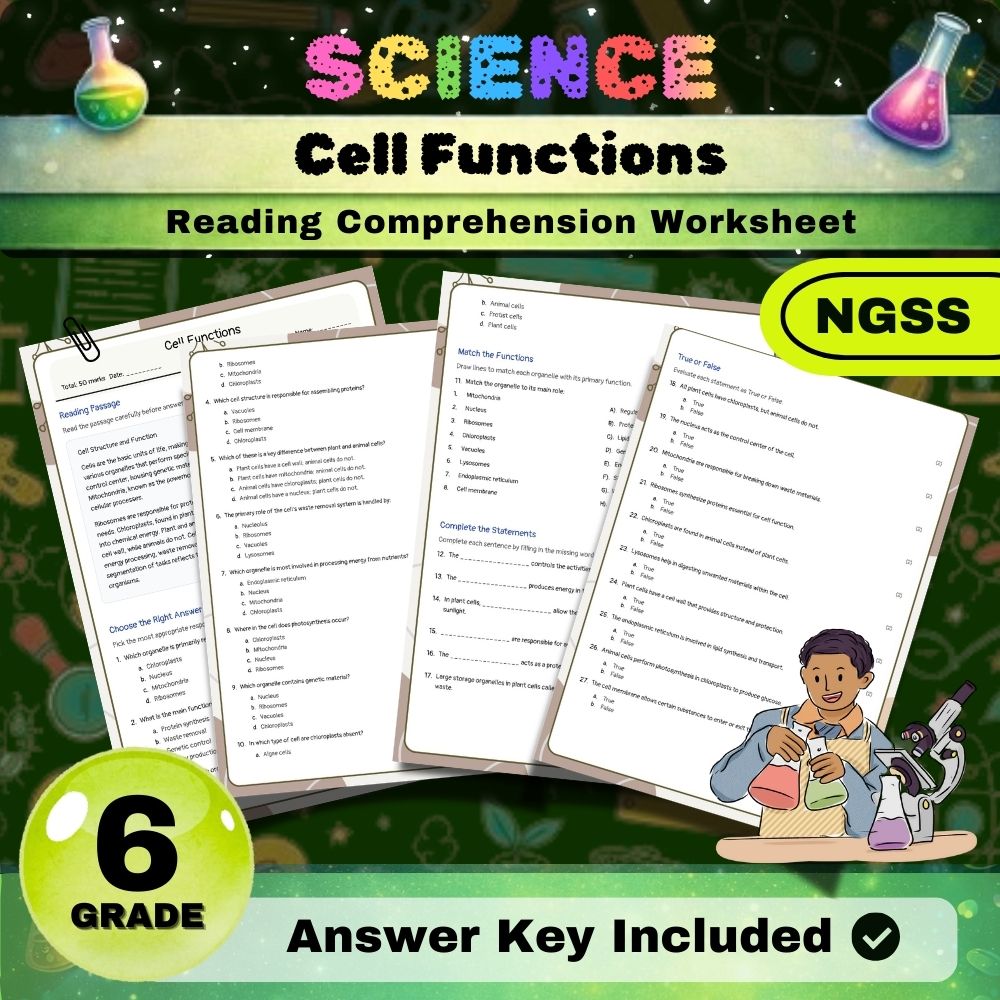
6th Grade Science | Cell Functions Worksheet (PDF) – NGSS Standards
Created byMaple Path LearningLearning Objectives
- Identify the structure and function of key organelles in plant and animal cells.
- Understand the relationship between cell structure and cellular roles such as energy production, protein synthesis, and waste removal.
- Compare plant and animal cells to recognize specialization and diversity in cell functions.
Also included in: Grade 6 Science Unit Bundle – Cell Functions, Energy & Organ Systems Worksheets +1 more
Instant download
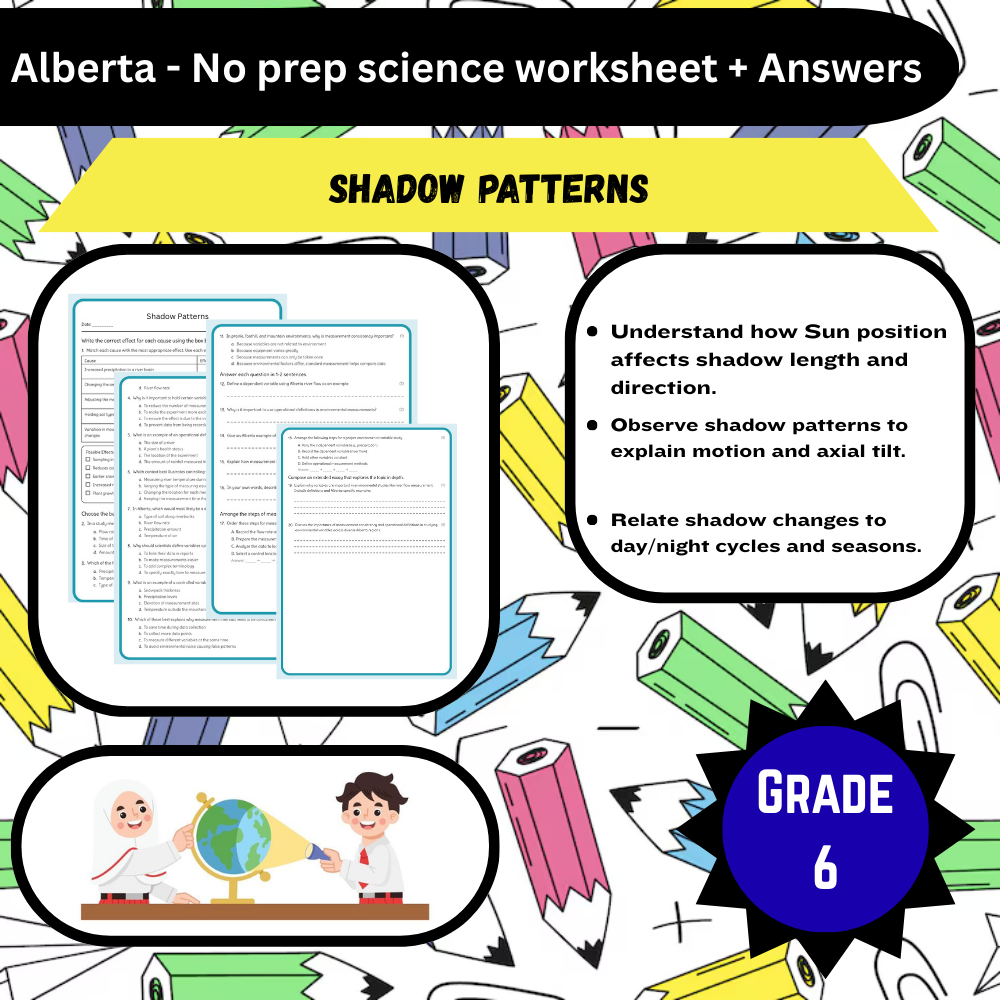
6th Grade Science | Shadow Patterns Worksheet (PDF) Aligned to Alberta Standards
Created byBright Mind ResourcesLearning Objectives
- Understand how the Sun's position affects shadow length and direction during different times of day and seasons.
- Observe and describe patterns of shadows in various environments to explain Earth's motion and axial tilt.
- Relate shadow changes to the concepts of day/night cycle and seasons.
Instant download
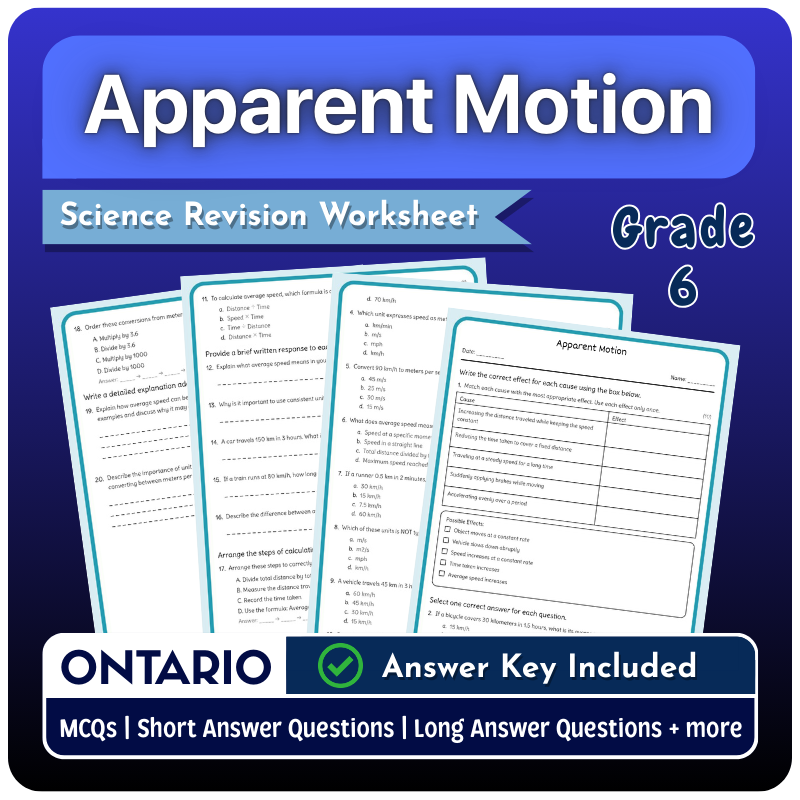
6th Grade Science – Apparent Motion Worksheet (Ontario | Science 1 PDF)
Created byBright Mind ResourcesLearning Objectives
- Describe the apparent daily and annual motions of the Sun, Moon, and stars from an Earth perspective.
- Explain how Earth's rotation and orbit cause the observed motions of celestial objects.
- Understand the concept of the celestial sphere, horizon, and stellar paths across the sky.
Instant download
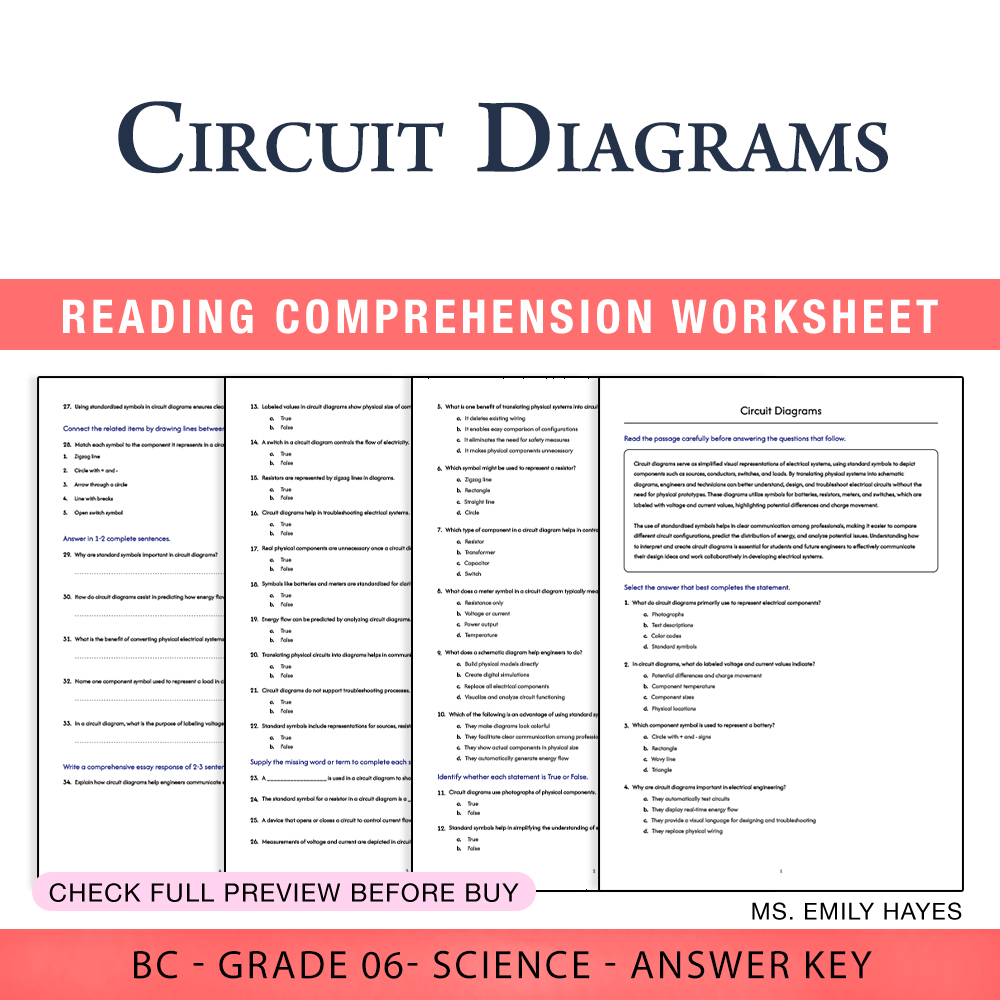
6th Grade Science | Circuit Diagrams Worksheet (PDF+ Answer Key)
Created byCopper Leaf ClassroomLearning Objectives
- Understand the purpose and components of circuit diagrams.
- Identify standard symbols used in electrical circuit diagrams.
- Translate physical electrical systems into schematic diagrams.
Also included in: Grade 6 Science BC | Waves, Sound, Light & Energy Worksheets (PDF + Answer Key) +1 more
Instant download
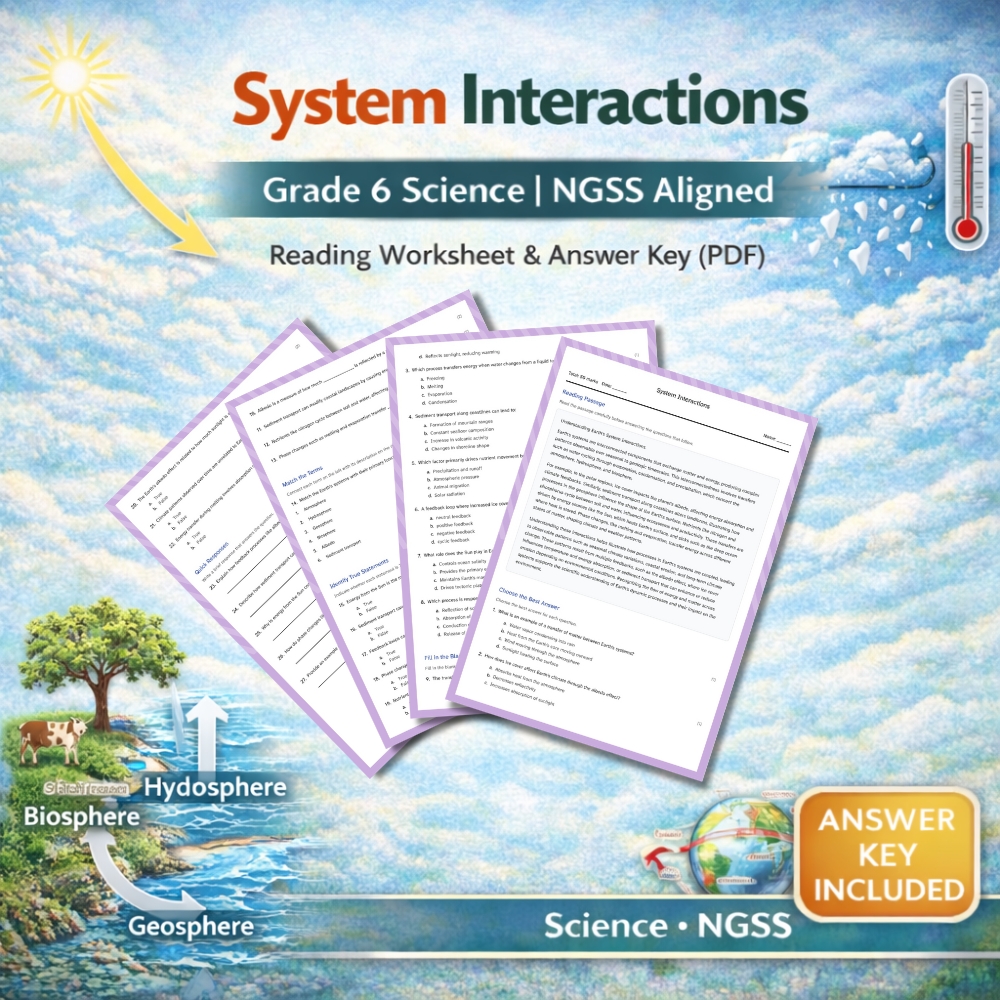
6th Grade Science | System Interactions | NGSS ( Worksheet + Answer Key )
 Created byCedar Grove Learning
Learning Objectives
- Describe how Earth's systems transfer matter and energy within and between geosphere, hydrosphere, atmosphere, and biosphere.
- Explain feedback mechanisms such as albedo changes from ice cover, sediment transport, and nutrient movement.
- Understand energy sources, sinks, phase-change energy transfers, and how processes produce system-level patterns over time.
Also included in: Grade 6 Science | Weather, Water Cycle & Climate NGSS Worksheet Bundle +1 more
Instant download
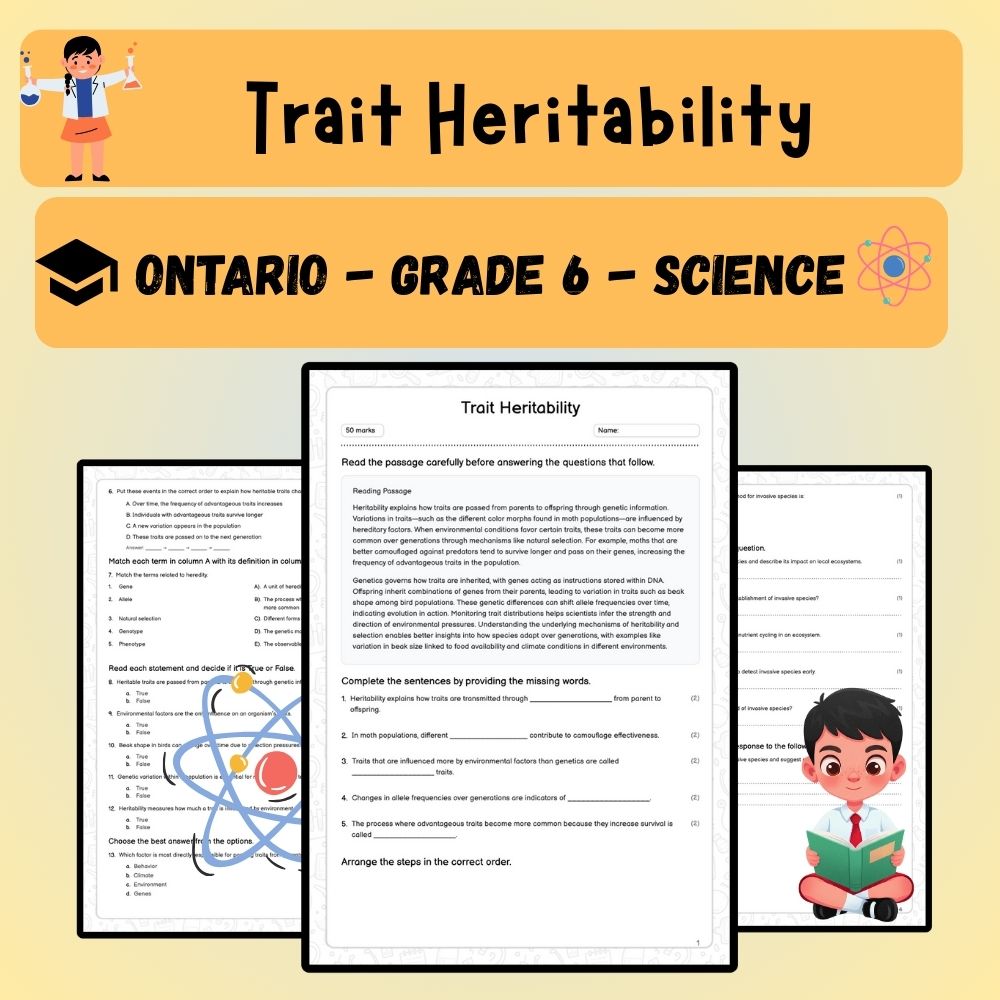
6th Grade Science | Trait Heritability Worksheet (PDF ) for Ontario Standards
Created byPrism Point LearningLearning Objectives
- Understand the concept of heritability and its role in genetic variation
- Distinguish between heritable and environmental influences on traits
- Describe basic mechanisms of inheritance and natural selection in populations
Also included in: Grade 6 Science Unit Bundle – Ecology, Classification & Environment
Instant download
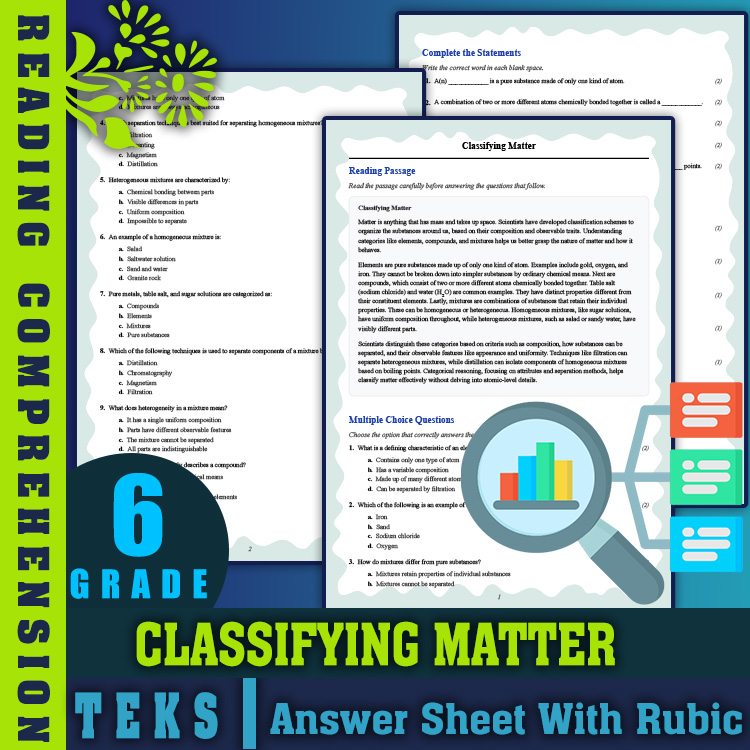
6th Grade Science Reading Worksheets | Classifying Matter TEKS Practice (PDF)
JCreated byJ.S SheetsLearning Objectives
- Understand the criteria used to classify matter into elements, compounds, and mixtures.
- Identify and distinguish between pure substances, homogeneous mixtures, and heterogeneous mixtures based on observable characteristics.
- Explain common separation techniques like filtration and distillation and their relevance to matter classification.
Instant download
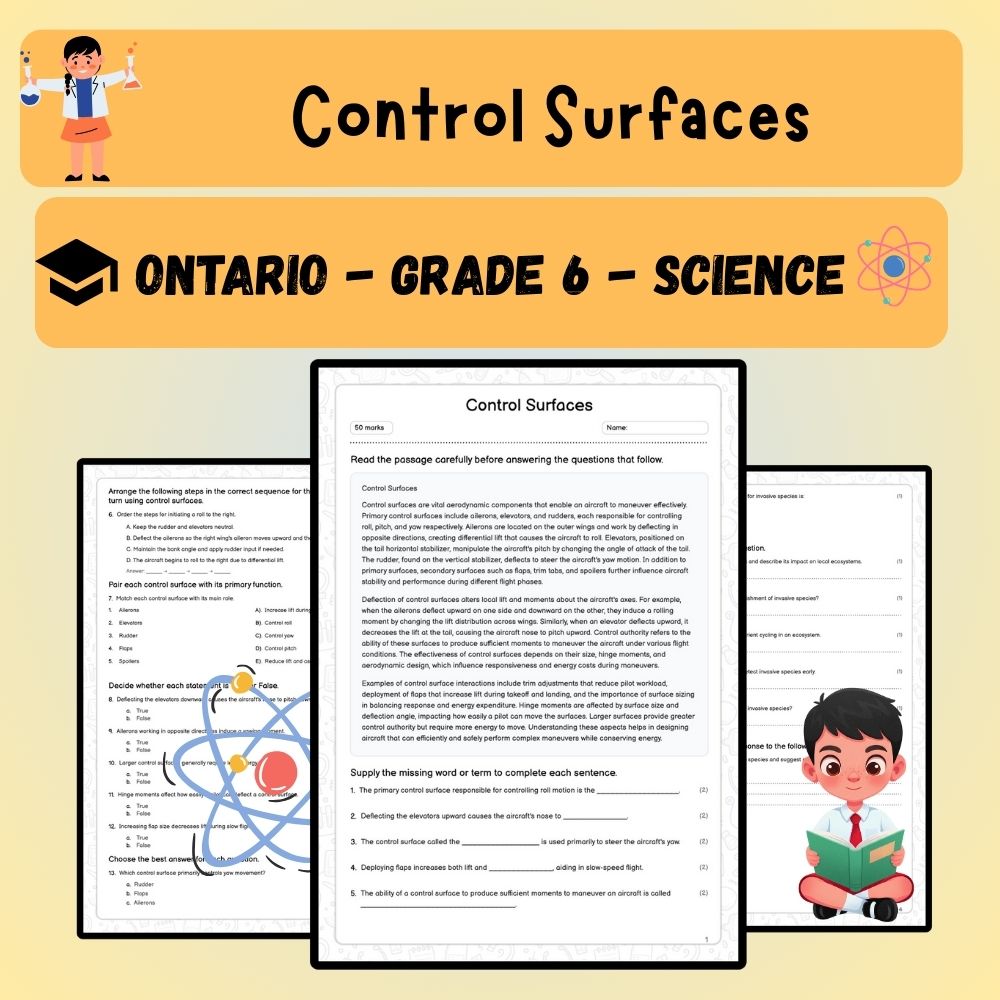
6th Grade Science | Control Surfaces Worksheet (PDF ) – Ontario Standards
Created byPrism Point LearningLearning Objectives
- Explain the primary and secondary control surfaces on aircraft and their functions.
- Describe how deflection of control surfaces affects lift, moments, and aircraft maneuverability.
- Understand the concepts of control authority and aerodynamic stability related to control surfaces.
Instant download
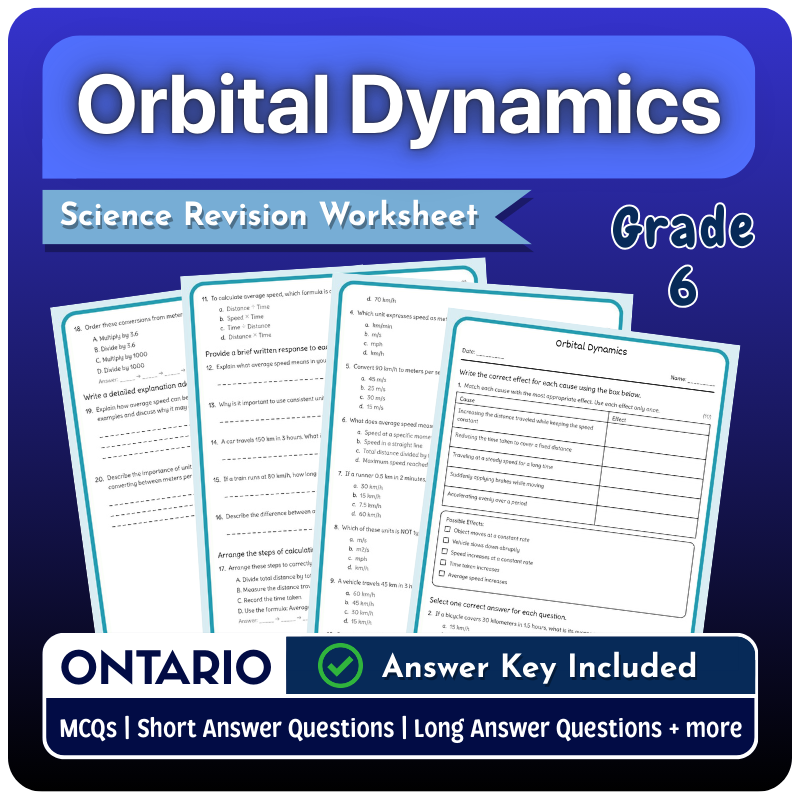
6th Grade Science | Orbital Dynamics Worksheet (Ontario Standard) (PDF)
Created byBright Mind ResourcesLearning Objectives
- Describe the differences between elliptical and near-circular orbits.
- Explain how orbital speed varies with distance from the central body.
- Understand the balance of gravitational forces and inertial motion that produce stable orbits.
Instant download
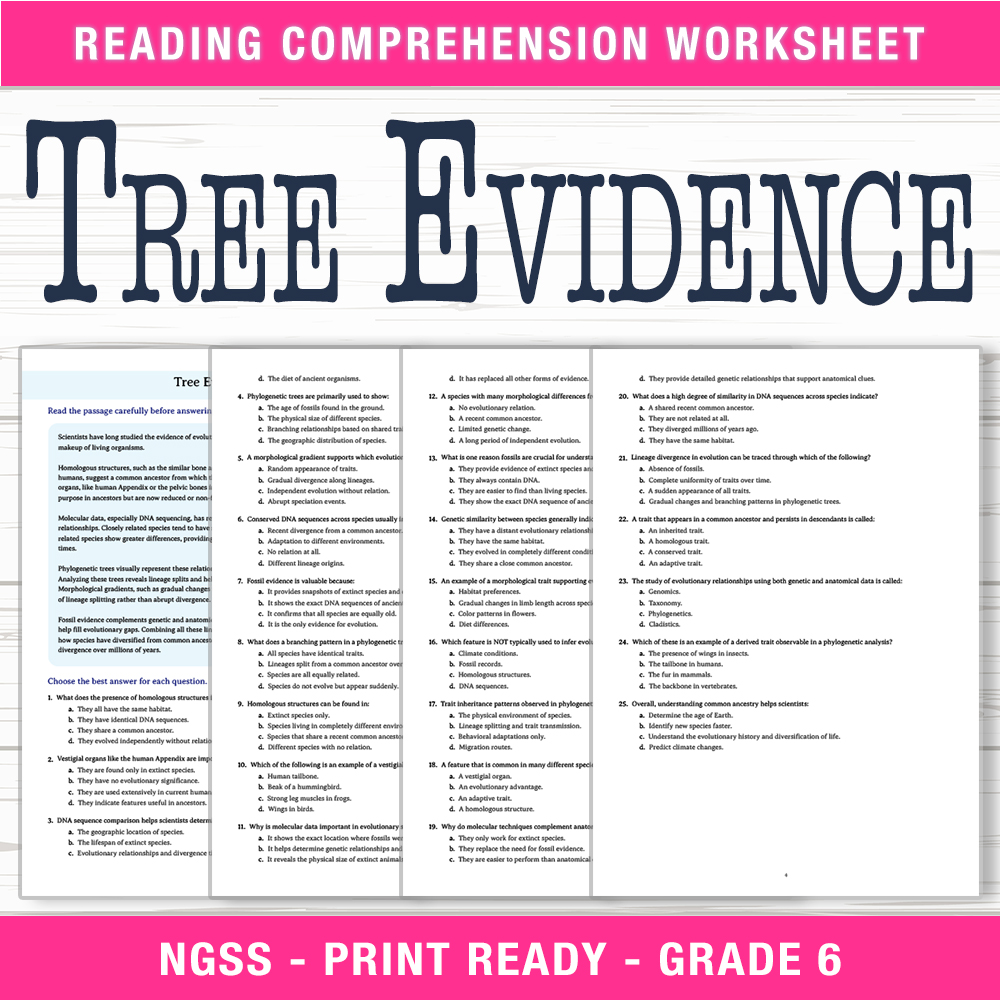
6th Grade Science – Tree Evidence Worksheet (PDF + Answer Key)
 Created byRiverstone Classroom
Learning Objectives
- Explain how homologous structures provide evidence for common ancestry.
- Interpret molecular data such as DNA sequences to understand evolutionary relationships.
- Identify key features like vestigial organs and their significance in evolutionary history.
Instant download
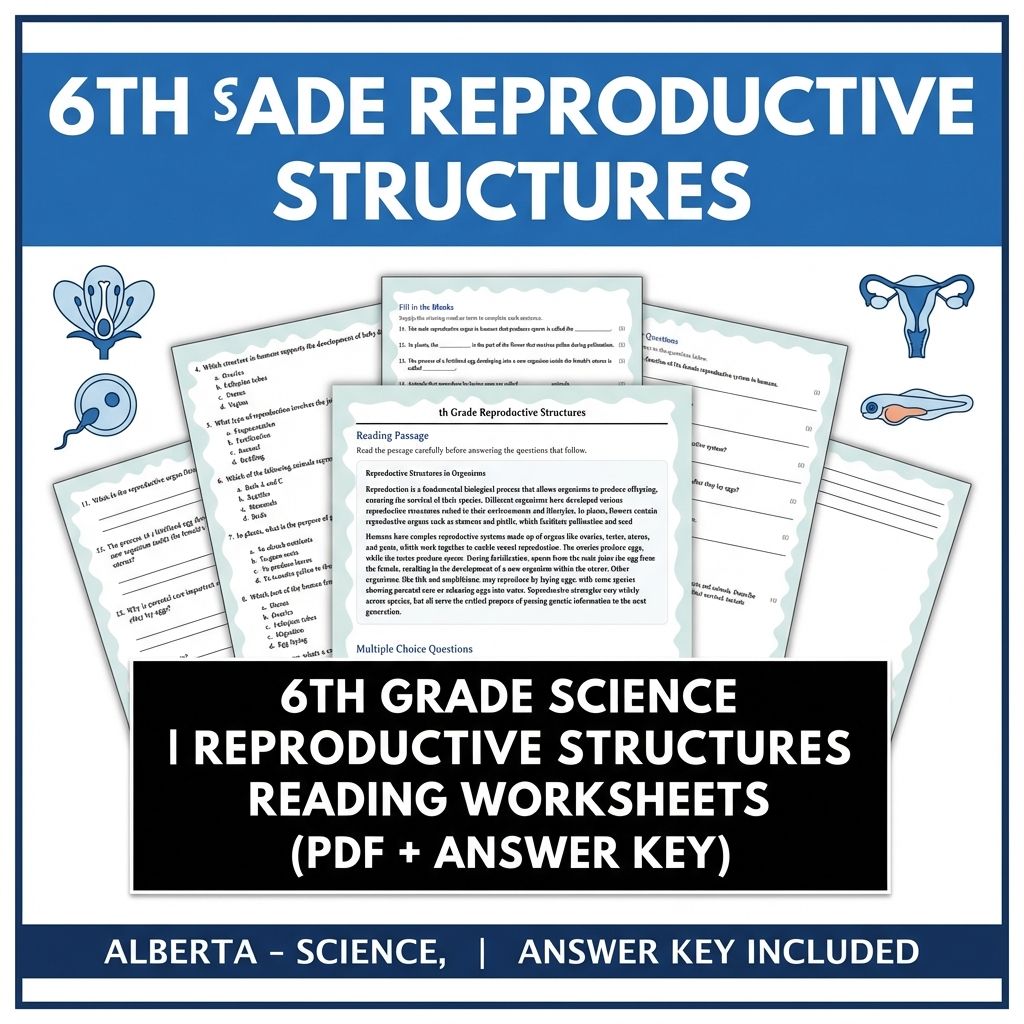
6th Grade Science | Reproductive Structures Worksheets (PDF + Answer Key)
JCreated byJ.S SheetsLearning Objectives
- Understand the basic reproductive structures in plants and animals.
- Identify the functions of reproductive organs in humans and plants.
- Describe the process of reproduction in different organisms.
Also included in: Grade 6 Science Unit Bundle | Ecosystems and Biodiversity (Answer Keys Included) +1 more
Instant download
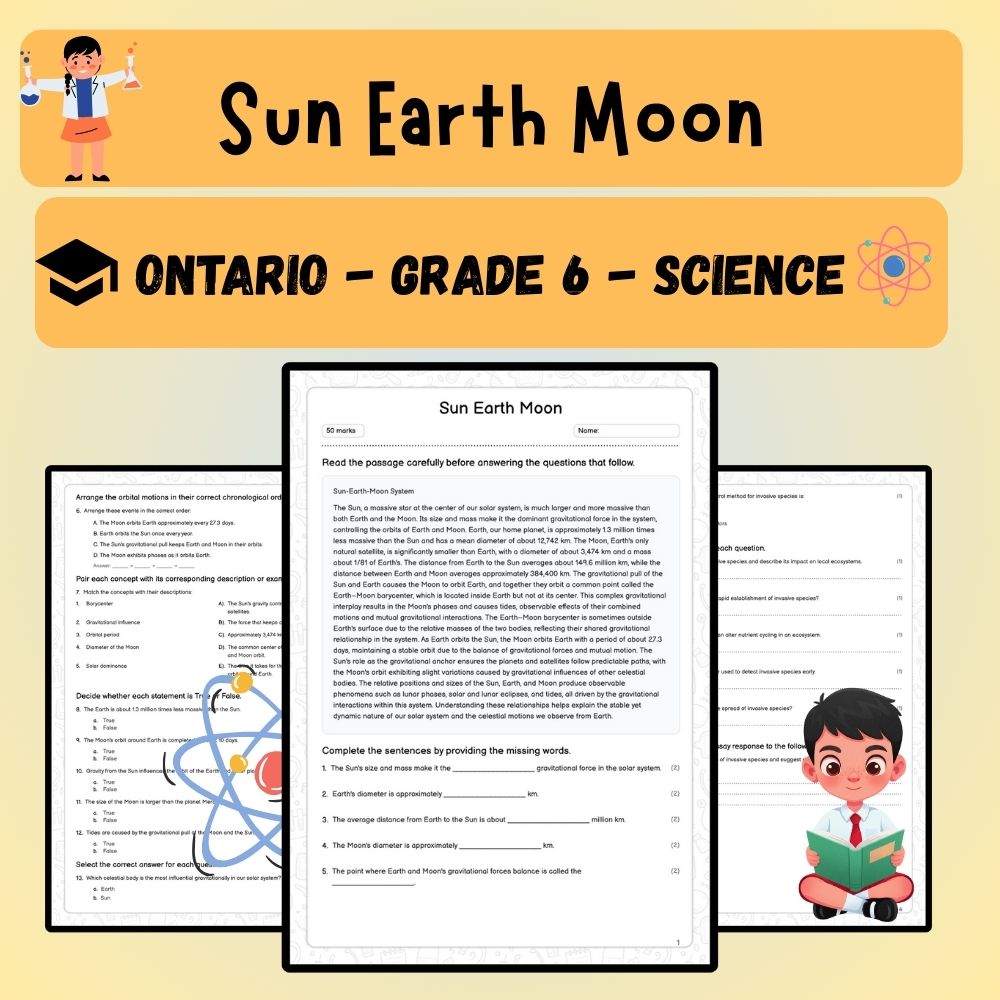
6th Grade Science | Sun, Earth & Moon Worksheet (PDF )
Created byPrism Point LearningLearning Objectives
- Describe the relative sizes, masses, and distances among the Sun, Earth, and Moon.
- Explain how gravitational interactions influence the orbital relationships within the Sun–Earth–Moon system.
- Understand the concept of the Earth–Moon barycenter and the Sun's role as the dominant gravitational influence.
Instant download
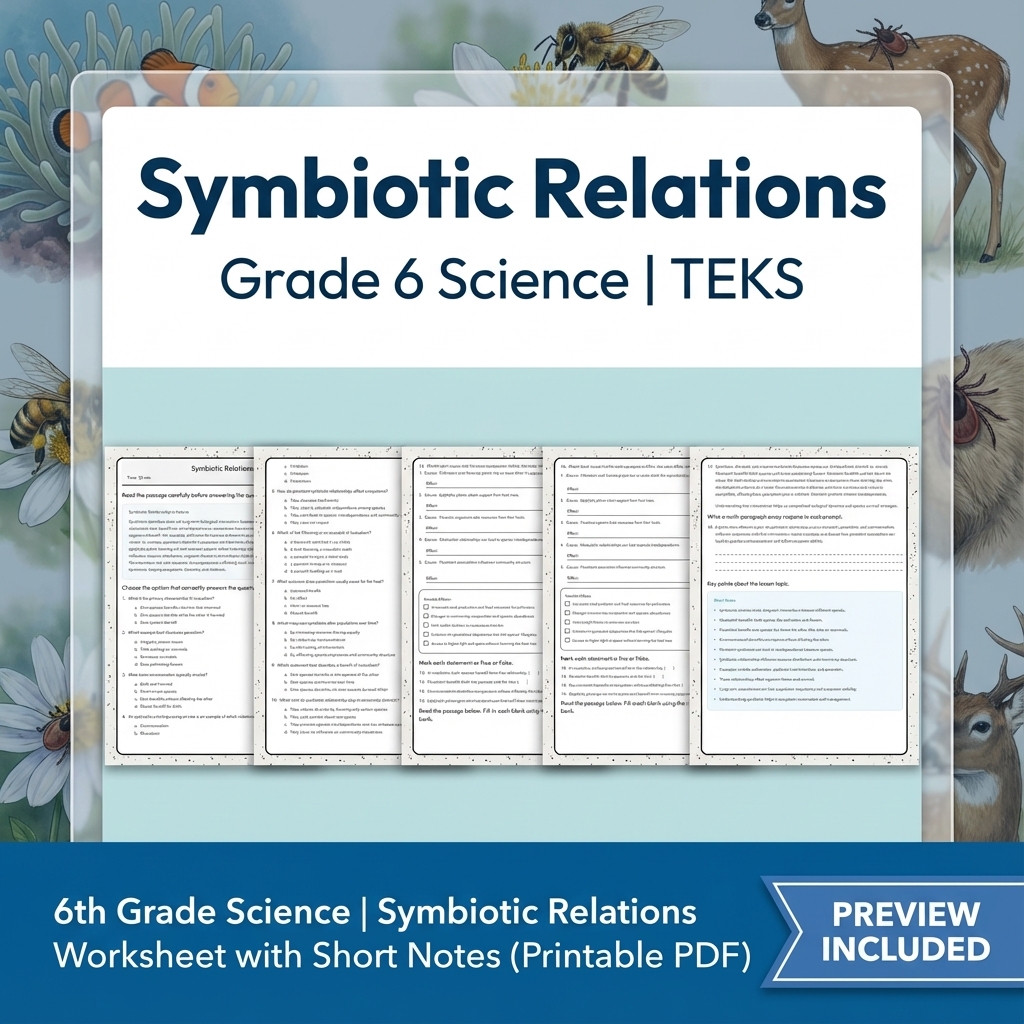
6th Grade Science Symbiotic Relations Worksheet with Short Notes (Printable PDF)
 Created byMeadowlark Worksheets
Learning Objectives
- Understand the different types of symbiotic relationships: mutualism, commensalism, and parasitism.
- Identify and categorize real-world examples of symbiosis.
- Explain how symbiotic interactions influence organism fitness and community structure.
Instant download

Grade 6 Keystone Species Worksheet | Ecosystem Cascades | Ontario Science
 Created byTeacher's Corner
Learning Objectives
- Define keystone species and explain how they affect community structure
- Identify evidence that suggests a species has keystone impacts
- Describe trophic cascades caused by changes in predator or mutualist populations
Instant download

6th Grade Science Worksheet – Human Impacts (PDF) Aligned to BC Standards
Created byEvergreen Desk EducationLearning Objectives
- Explain how human activities can change habitat, nutrient cycles, and energy pathways in an ecosystem.
- Connect deforestation, pollution, and non-native species to effects on biodiversity and ecosystem services.
- Identify evidence-based cause-and-effect relationships between human actions and long-term ecosystem outcomes.
Instant download
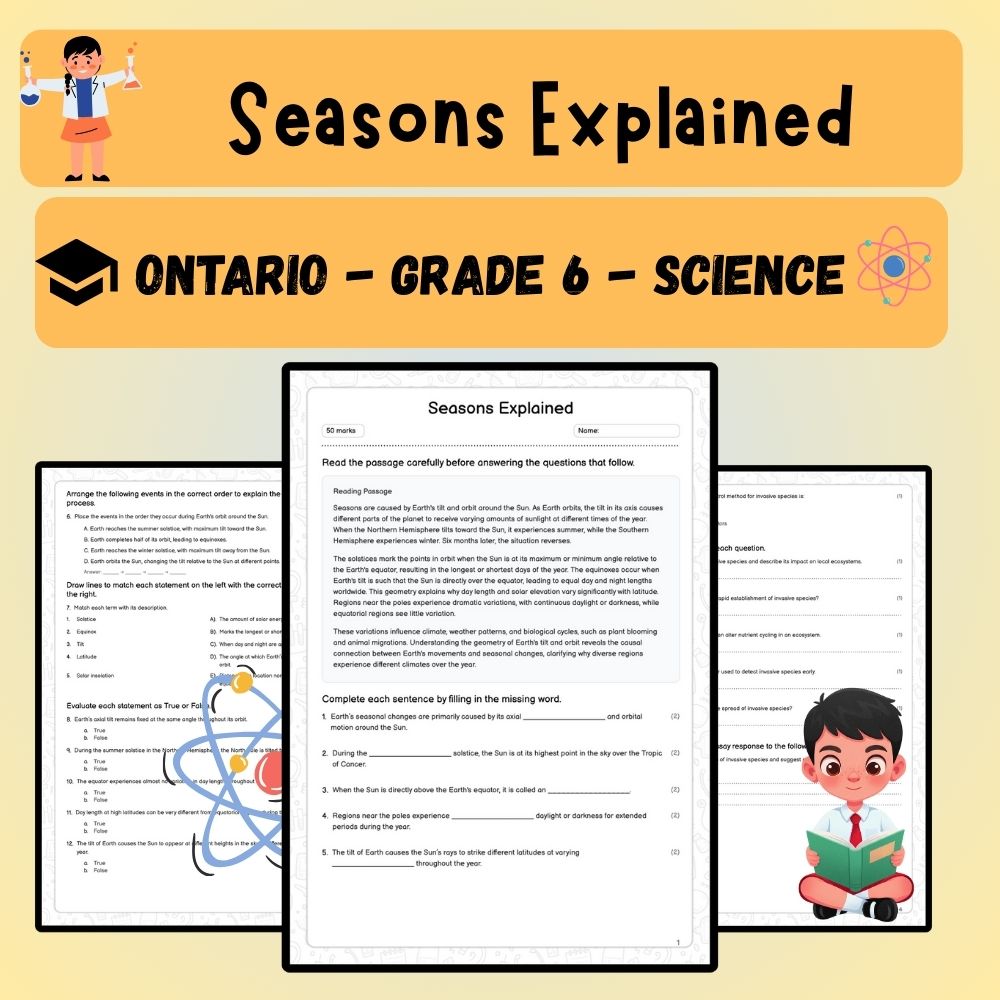
6th Grade Science – Seasons Explained Worksheet (PDF )
Created byPrism Point LearningLearning Objectives
- Explain how Earth's axial tilt and orbital motion cause seasonal changes.
- Describe why hemispheres experience opposite seasons and how day length varies across the year.
- Identify key concepts such as solstices and equinoxes and their geometry.
Instant download
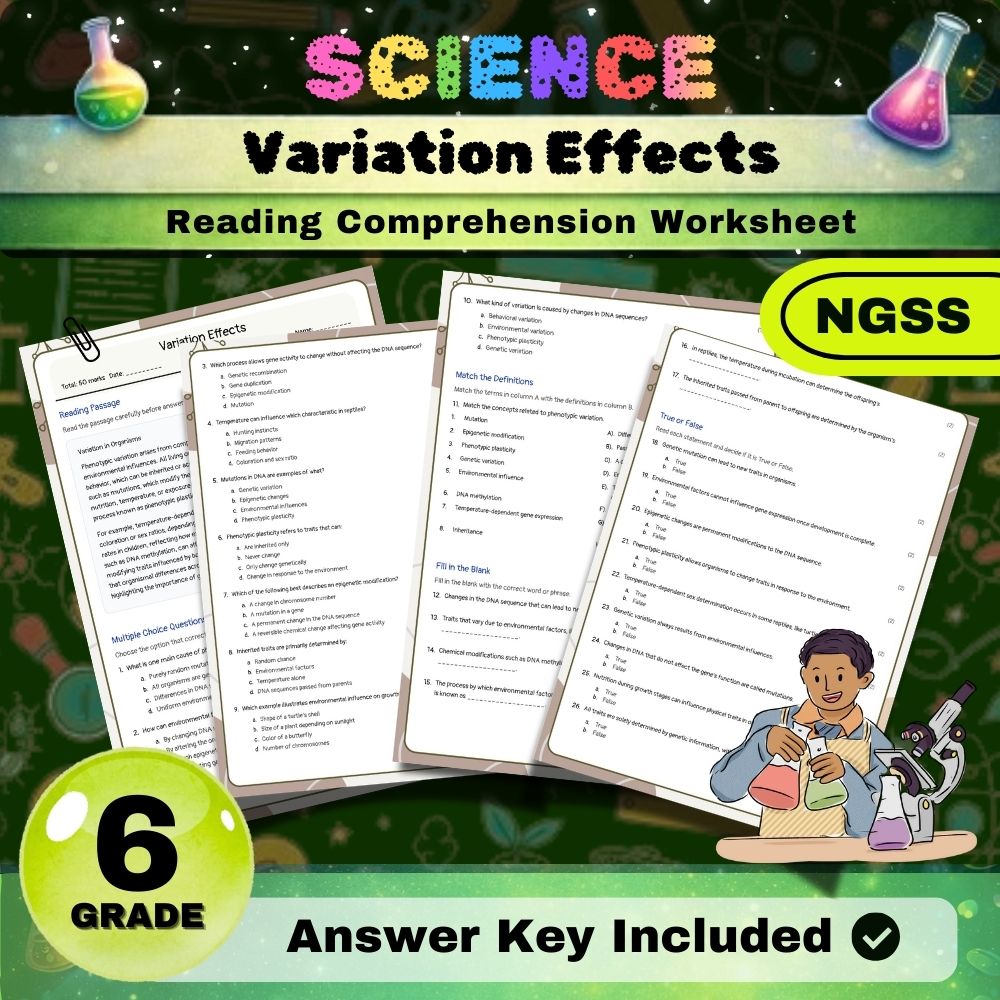
6th Grade Science – Variation Effects Worksheet (PDF) NGSS Aligned
Created byMaple Path LearningLearning Objectives
- Explain how genetic and environmental factors contribute to phenotypic variation in organisms.
- Describe the molecular processes that lead to genetic variation and their impact on structural and functional differences.
- Analyze evidence showing how environmental influences can modify gene expression and organismal traits across developmental stages.
Instant download
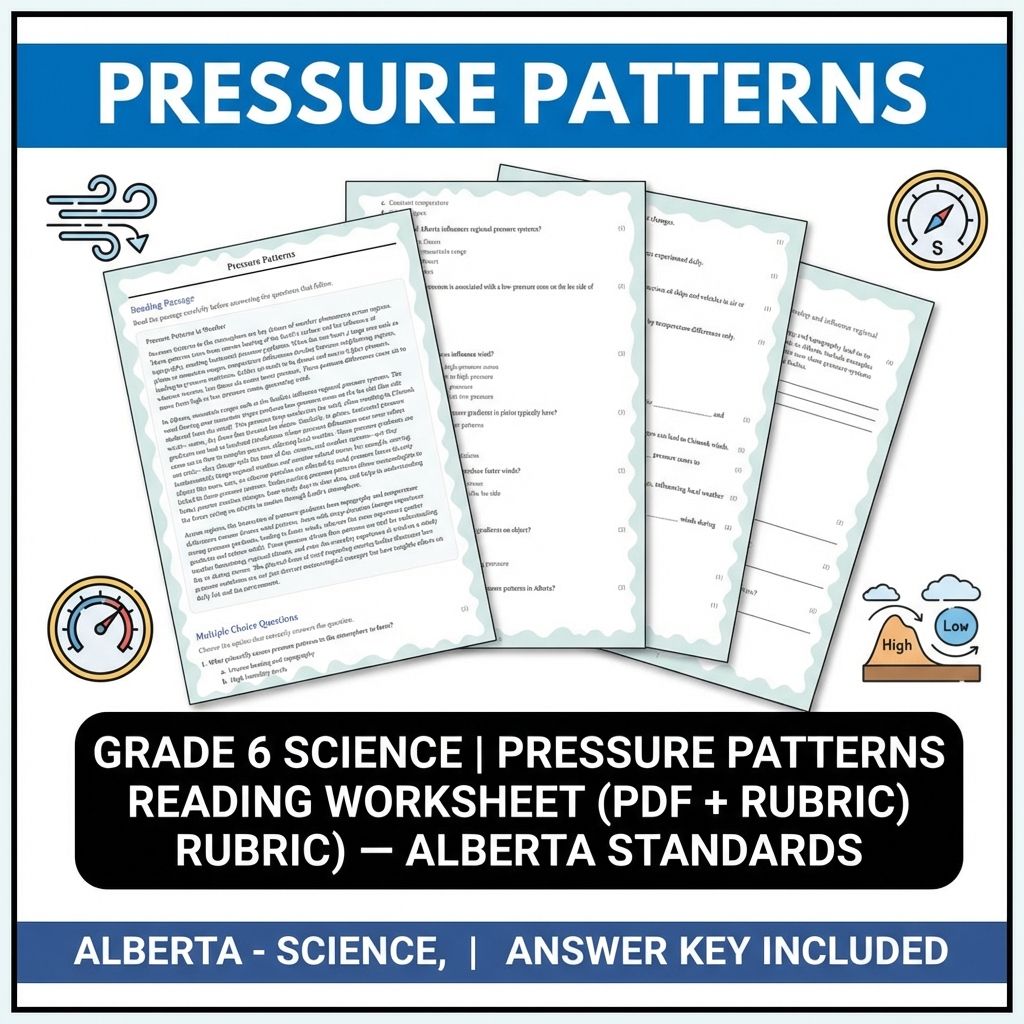
Grade 6 Science | Pressure Patterns Worksheet (PDF + Rubric) – Alberta Standards
JCreated byJ.S SheetsLearning Objectives
- Understand how pressure differences influence weather and wind patterns.
- Identify the formation of high and low pressure zones due to heating and topography.
- Relate pressure gradients to regional wind phenomena like Chinook winds and local circulations.
Also included in: Grade 6 Science | Flight Physics & Aerodynamics UNIT Pack (Answer Keys Included) +1 more
Instant download
About Grade 6 Science Worksheets
Explore Grade 6 Science worksheets for classwork, homework, or review. Our 5,997 printables download instantly as PDFs.
MyTeachingSheets worksheets are made by real teacher-authors and checked before they go live. Download any as a print-ready PDF for lessons, homework, or independent practice — most include answer keys, and previews are always free.