
Grade 6 Science Worksheets
5,997 worksheets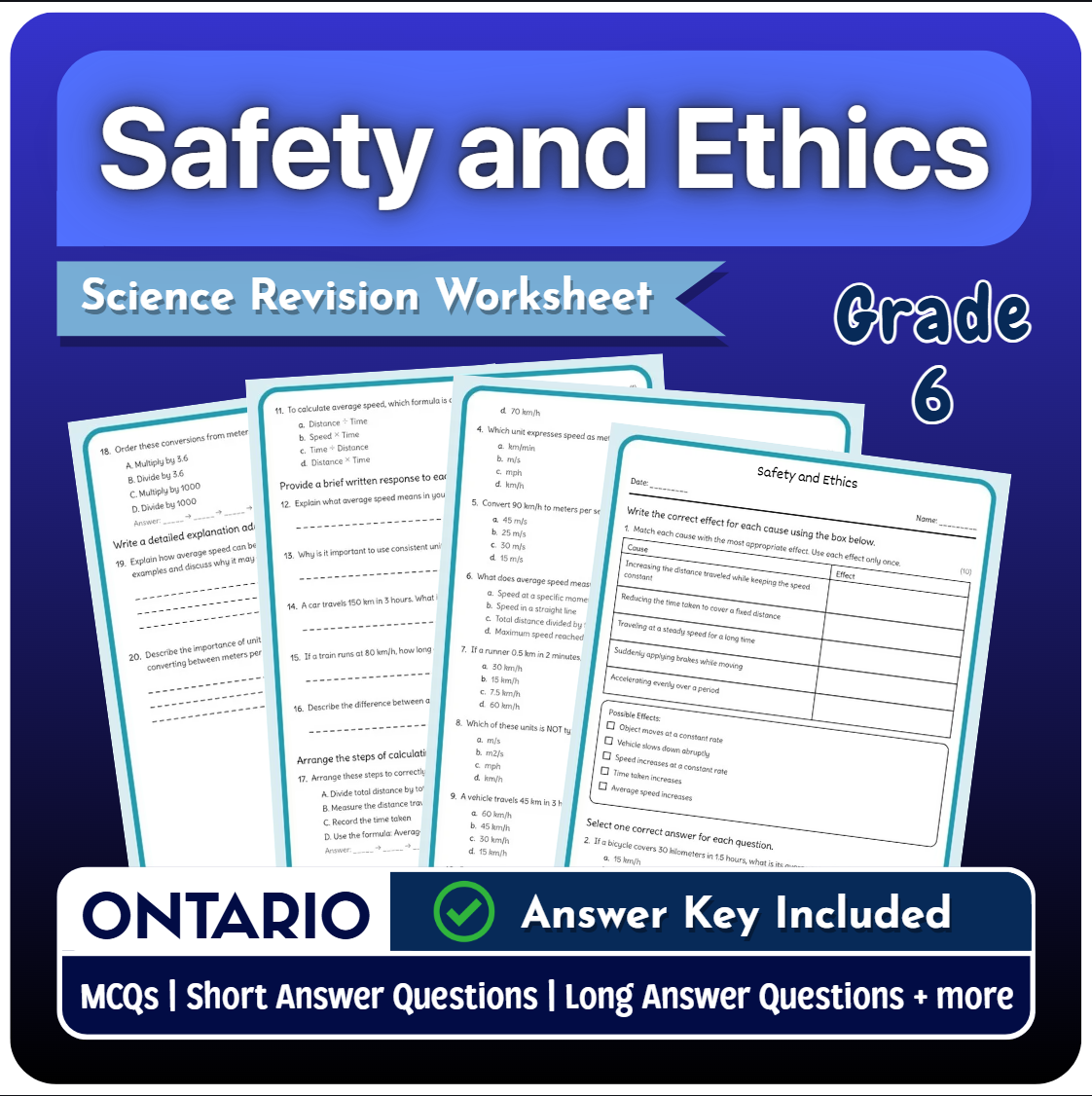
6th Grade Science | Safety and Ethics Worksheet (Ontario Standards) (PDF)
 Created byBright Mind Resources
Learning Objectives
- Understand foundational safety principles for responsible scientific practice.
- Recognize ethical considerations including humane treatment and confidentiality.
- Identify proper protocols for hazard prevention and risk assessment.
Instant download
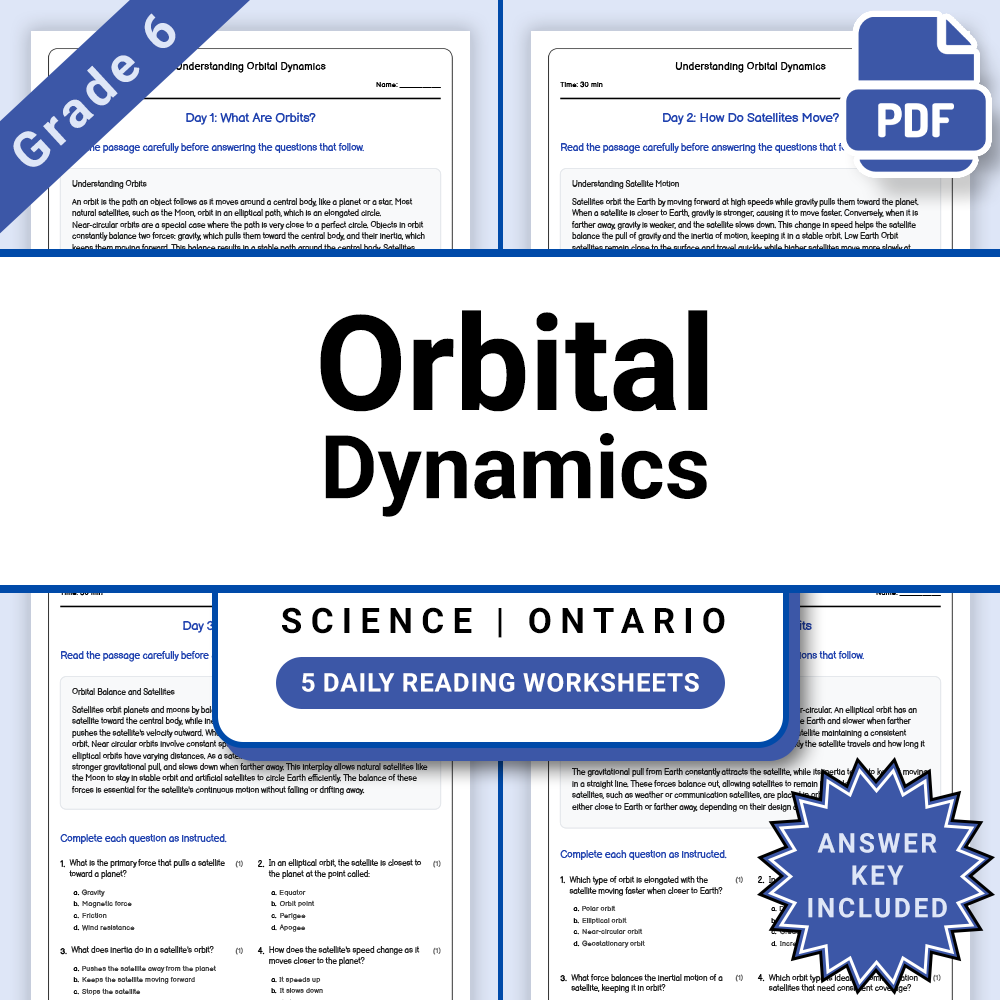
Grade 6 Science – Orbital Dynamics Daily Reading Worksheet with Answer Key
JCreated byJ.S SheetsLearning Objectives
- Describe the basic concept of an orbit.
- Differentiate between elliptical and near-circular orbits.
- Explain how orbital speed varies with distance from a central body.
Also included in: Grade 6 Science Lesson Bundle | Sun, Earth, Moon & Space Concepts +1 more
Instant download
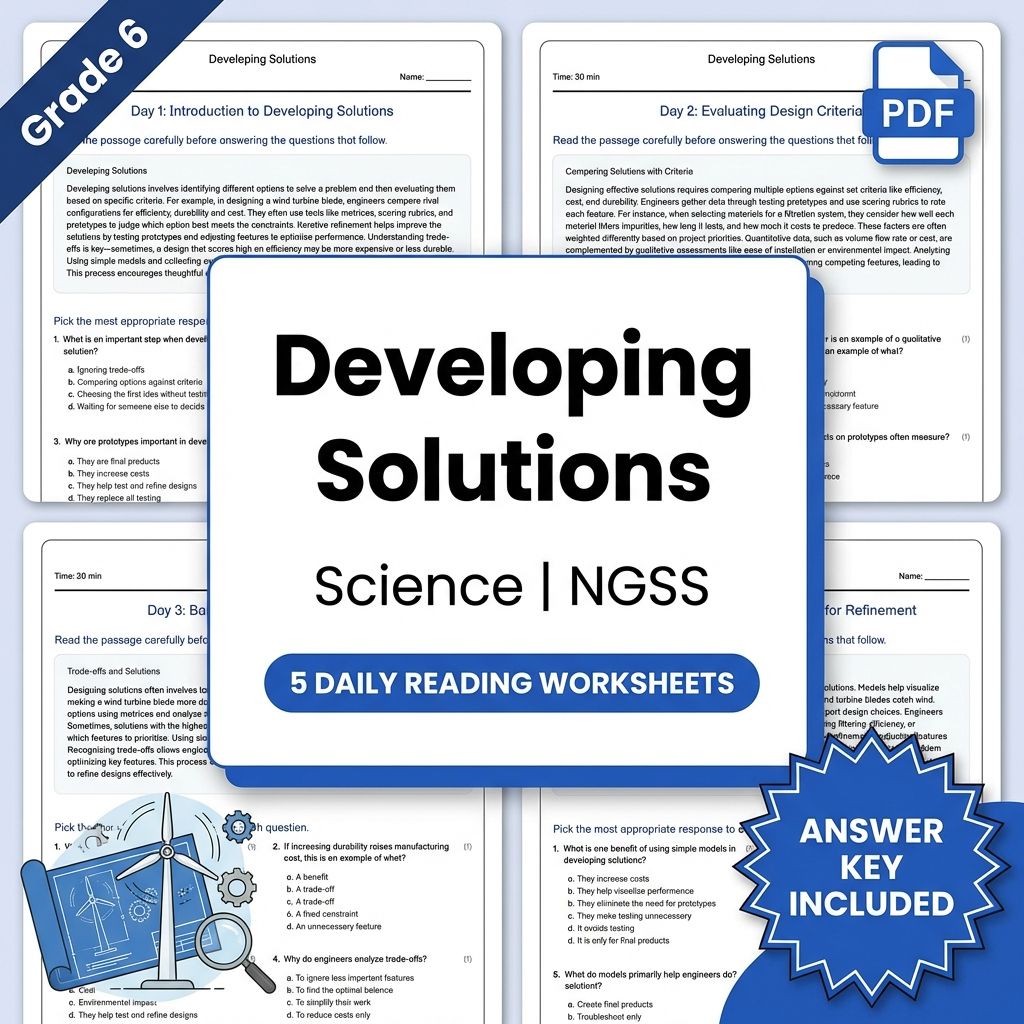
6th Grade Science | Developing Solutions Daily Worksheet (PDF+ Answer Key)
 Created byCopper Leaf Classroom
Learning Objectives
- Understand how to compare multiple design solutions using criteria and constraints.
- Learn to evaluate solutions through matrices, scoring rubrics, and prototypes.
- Identify trade-offs in design options and use evidence to justify selections.
Instant download
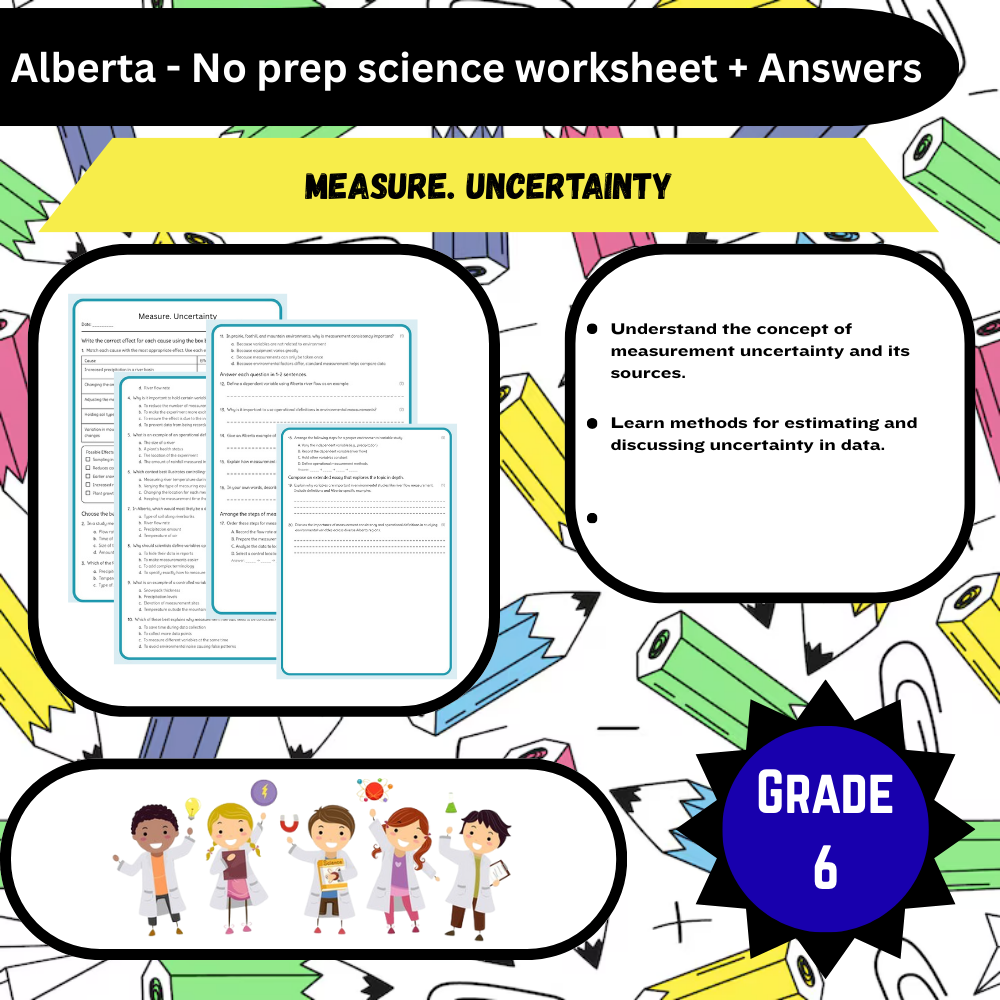
6th Grade Science | Measurement Uncertainty Worksheet (PDF)
Created byBright Mind ResourcesLearning Objectives
- Understand the concept of measurement uncertainty and its sources.
- Learn methods for estimating and discussing measurement uncertainty in data.
Instant download

Grade 6 Science | Variation Effects in Organisms - Daily Reading Comprehension
 Created byCoral Reef Learning
Learning Objectives
- Understand what phenotypic variation is and its causes.
- Identify examples of genetic and environmental influences on traits.
- Explain how DNA and environmental factors contribute to physical differences in organisms.
Instant download
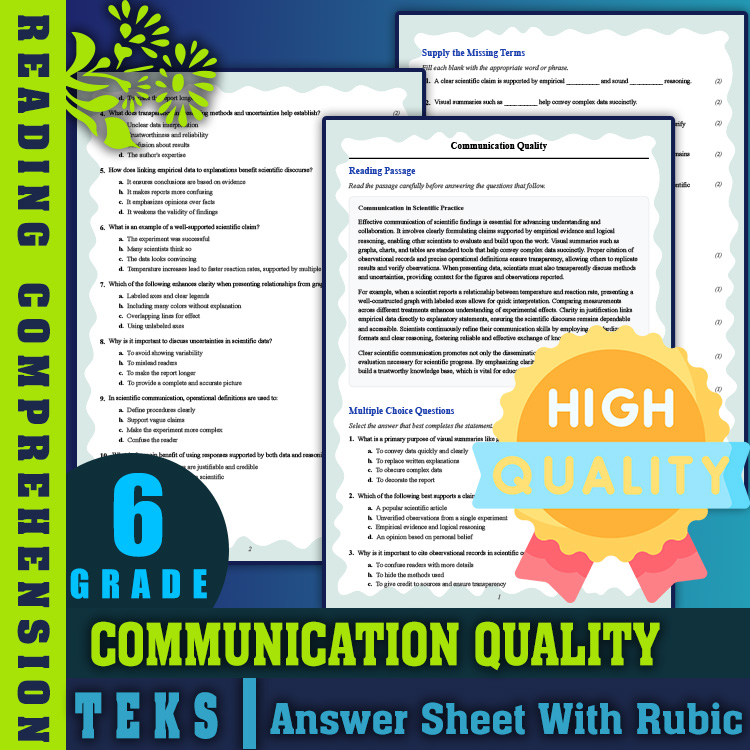
6th Grade Science | Communication Quality Reading Worksheet (PDF + Rubric)
JCreated byJ.S SheetsLearning Objectives
- Understand the standards for effectively communicating scientific findings, including clear claims supported by evidence.
- Learn to utilize visual summaries and proper citation of observational records to enhance scientific discourse.
- Apply principles of clarity and transparency in presenting methods, uncertainties, and justifications in scientific reporting.
Instant download

Science Grade 6 Surface Change Worksheet | NGSS Assessment for Science
 Created bySkylark Worksheets
Learning Objectives
- Explain how geologic processes change Earth’s surface on different time scales (rapid vs slow).
- Use evidence such as rock strata, fossils, uplifted terraces, and erosion rates to construct explanations of landscape evolution.
- Distinguish how plate motions, volcanic uplift, mountain building, and sediment transport shape landforms.
Also included in: Grade 6 Earth & Climate Systems Science Lesson Bundle | NGSS Worksheets +1 more
Instant download

6th Grade Science Worksheet – Insulator Comparisons (PDF)
 Created byEvergreen Desk Education
Learning Objectives
- Compare insulating materials by relating their electron structure to the movement of electric charge.
- Explain how insulators reduce charge flow and improve electrical safety.
- Use examples such as rubber, glass, and dry wood to distinguish insulating behavior from conducting behavior, including surface effects.
Also included in: Grade 6 Electricity Circuits Science Lesson Bundle for Ontario Worksheets +1 more
Instant download
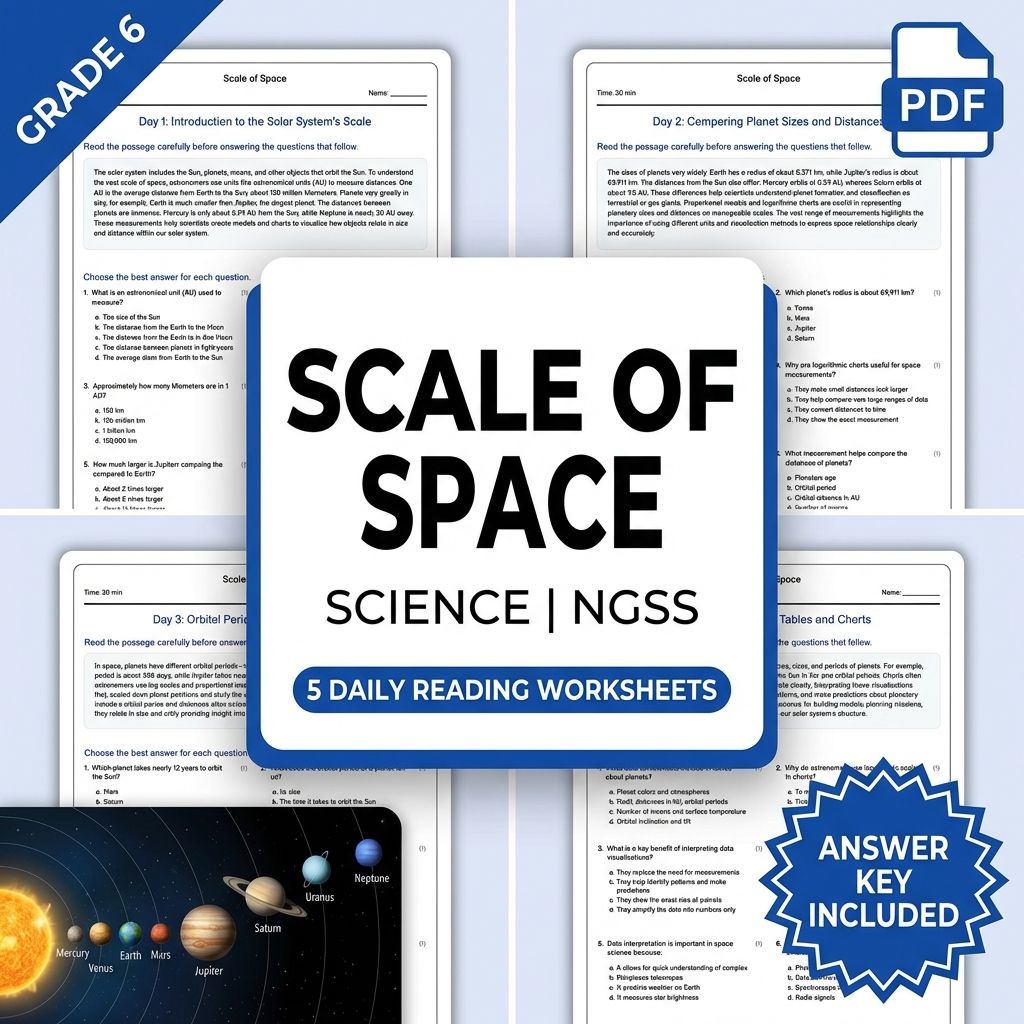
6th Grade Science | Scale of Space Daily Reading Worksheet (PDF+ Answer Key)
Created byCopper Leaf ClassroomLearning Objectives
- Understand the relative sizes and distances of objects within the solar system.
- Learn about astronomical units, planetary radii, and orbital periods.
- Compare terrestrial planets and gas giants using data and models.
Instant download

6th Grade Science Worksheet | Ethical Dimensions TEKS (PDF)
Created byEvergreen Desk EducationLearning Objectives
- Identify ethical criteria such as beneficence, risk minimization, and informed consent in real scientific scenarios.
- Explain how responsible data use and privacy matter when collecting and sharing information from scientific measurements.
- Evaluate environmental and long-term ecological consequences when making decisions about scientific technologies and biotechnology.
Instant download
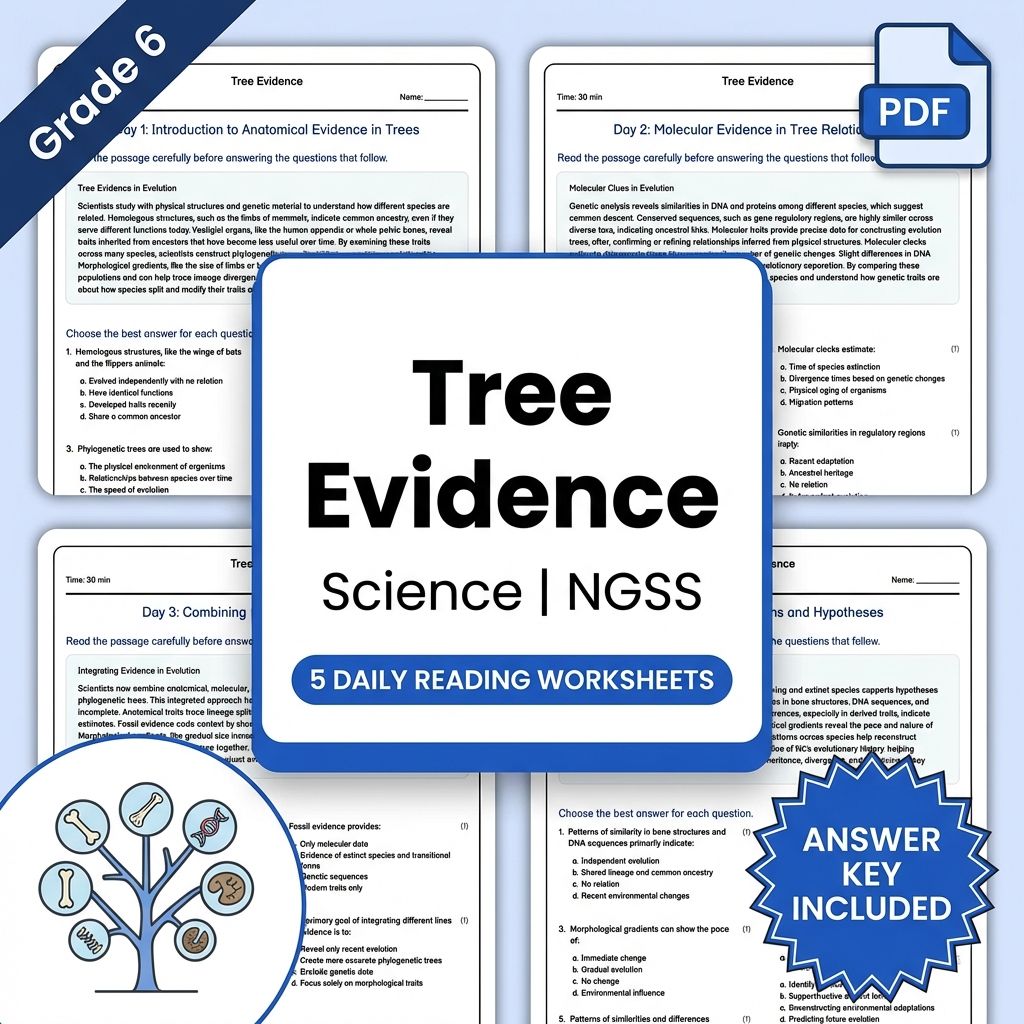
6th Grade Science | Tree Evidence Daily Reading Worksheet (PDF+ Answer Key)
Created byCopper Leaf ClassroomLearning Objectives
- Understand different types of evidence (anatomical and molecular) supporting common ancestry among organisms.
- Identify homologous structures, vestigial organs, and conserved DNA sequences in evolutionary analysis.
- Analyze phylogenetic trees to interpret lineage relationships and trait inheritance.
Instant download

6th Grade Science | Bernoulli Principle Worksheet (PDF) – Alberta Standards
Created byEvergreen Desk EducationLearning Objectives
- Explain how Bernoulli’s principle connects fluid speed and pressure
- Use Bernoulli’s idea to describe pressure differences around an airfoil and lift
- Distinguish pressure-gradient effects from circulation when describing lift
Instant download

Grade 6 Change Examples Worksheet | BC Practice & PDF
 Created byClear Sky Classroom
Learning Objectives
- Differentiate physical and chemical changes using evidence from everyday examples
- Identify signs of chemical change such as new substances, gas formation, and precipitates
- Explain how particle-level ideas (bond breaking/forming) relate to observable changes
Instant download
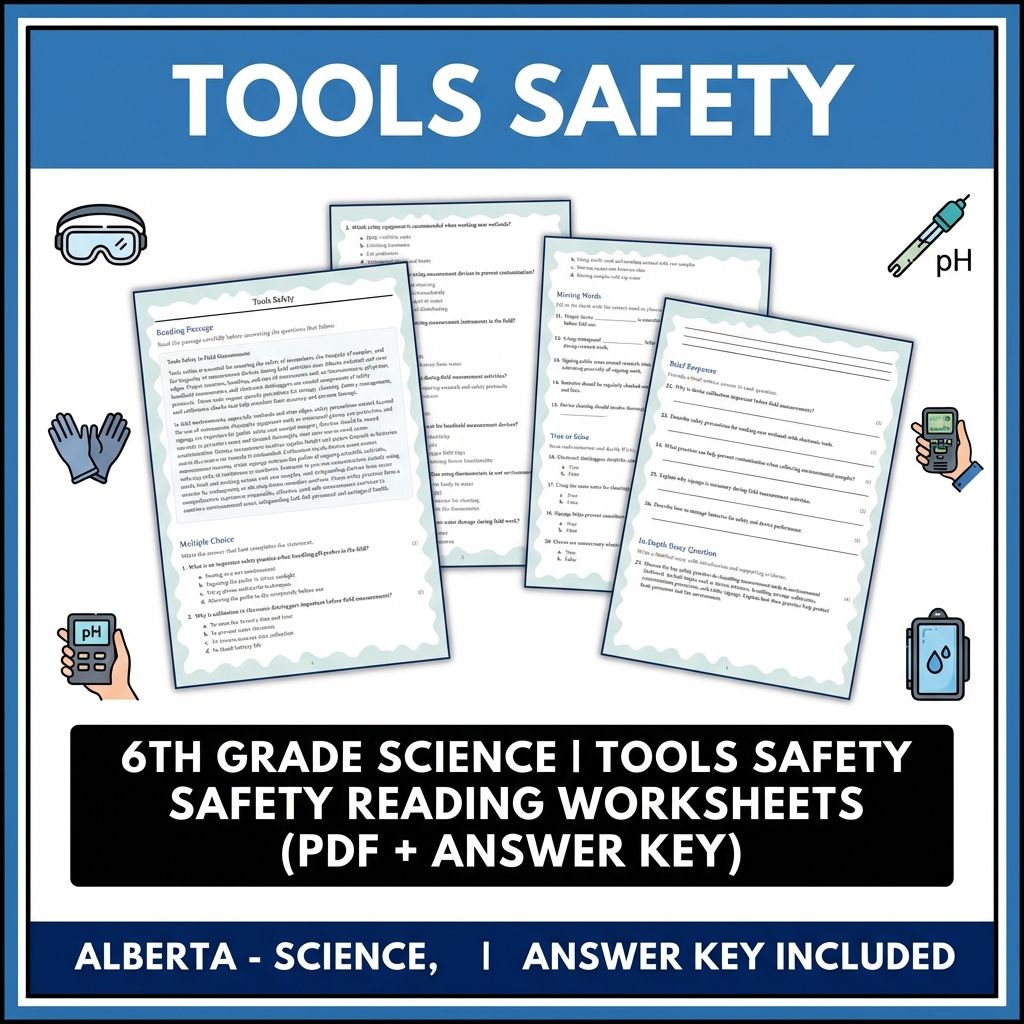
6th Grade Science | Tools Safety Reading Worksheets (PDF + Answer Key)
JCreated byJ.S SheetsLearning Objectives
- Understand safe practices for using measurement tools such as thermometers, pH probes, and anemometers.
- Identify proper handling, storage, and maintenance procedures for electronic measurement devices.
- Learn safety precautions and protocols to prevent contamination and device damage during field work.
Also included in: Grade 6 Science Bundle – Data Analysis, Scientific Inquiry & Measurement Skills +1 more
Instant download

6th Grade Science Worksheet | Decomposers & Nutrients – BC Standards (PDF)
Created byEvergreen Desk EducationLearning Objectives
- Explain how decomposers break down dead organic matter and recycle nutrients.
- Describe the roles of fungi, bacteria, and detritivores in nutrient cycling.
- Predict how environmental conditions (temperature, moisture, oxygen) can affect decomposition.
Instant download

Grade 6 Design Process Worksheet | Engineering Design Cycle Ontario
 Created byChalk and Compass
Learning Objectives
- Explain the iterative design process using design criteria, prototyping, testing, and refinement.
- Describe how lift and drag measurements help refine an aircraft or glider concept.
- Identify key trade-offs among lift, drag, weight, and stability in aerodynamic design.
Also included in: Grade 6 Science Aviation Unit Aerodynamics & Flight Testing Lesson Bundle +1 more
Instant download

Wind Tunnel Worksheet Grade 6 Science | Aerodynamics & Flight Testing
Created byChalk and CompassLearning Objectives
- Explain how wind tunnels measure aerodynamic forces and moments on scaled models
- Describe how similarity parameters like Reynolds number and Mach number help scientists interpret test results
- Use measured forces to understand how lift and drag coefficients are determined
Also included in: Grade 6 Science Aviation Unit Aerodynamics & Flight Testing Lesson Bundle +1 more
Instant download

Control Coupling Science Worksheet Grade 6 Ontario + Doodle Notes
Created byChalk and CompassLearning Objectives
- Explain how roll, pitch, and yaw controls can interact through aerodynamic forces.
- Describe adverse yaw and elevator–aileron coupling in simple cause-and-effect terms.
- Identify design features (like differential and Frise ailerons) that reduce unwanted coupled moments.
Also included in: Grade 6 Science Aviation Unit Aerodynamics & Flight Testing Lesson Bundle +1 more
Instant download

Grade 6 Thrust Systems Worksheet | Aircraft Propulsion & Forces
Created byChalk and CompassLearning Objectives
- Explain how propellers create axial thrust by accelerating air backward
- Compare jet propulsion and propeller propulsion using Newton’s third law and momentum
- Describe how thrust-to-weight ratio affects acceleration and climb
Also included in: Grade 6 Science Aviation Unit Aerodynamics & Flight Testing Lesson Bundle +1 more
Instant download

6th Grade Science Worksheet | Sky Observations & Data Collection (PDF)
Created byEvergreen Desk EducationLearning Objectives
- Describe how the apparent motion of the sky can be identified through systematic observations over time
- Use recorded patterns (sunrise/sunset, Moon phases, and star positions) to explain repeating cycles
- Relate observed sky changes to Earth’s rotation and orbit and the Moon’s orbit around Earth
Instant download
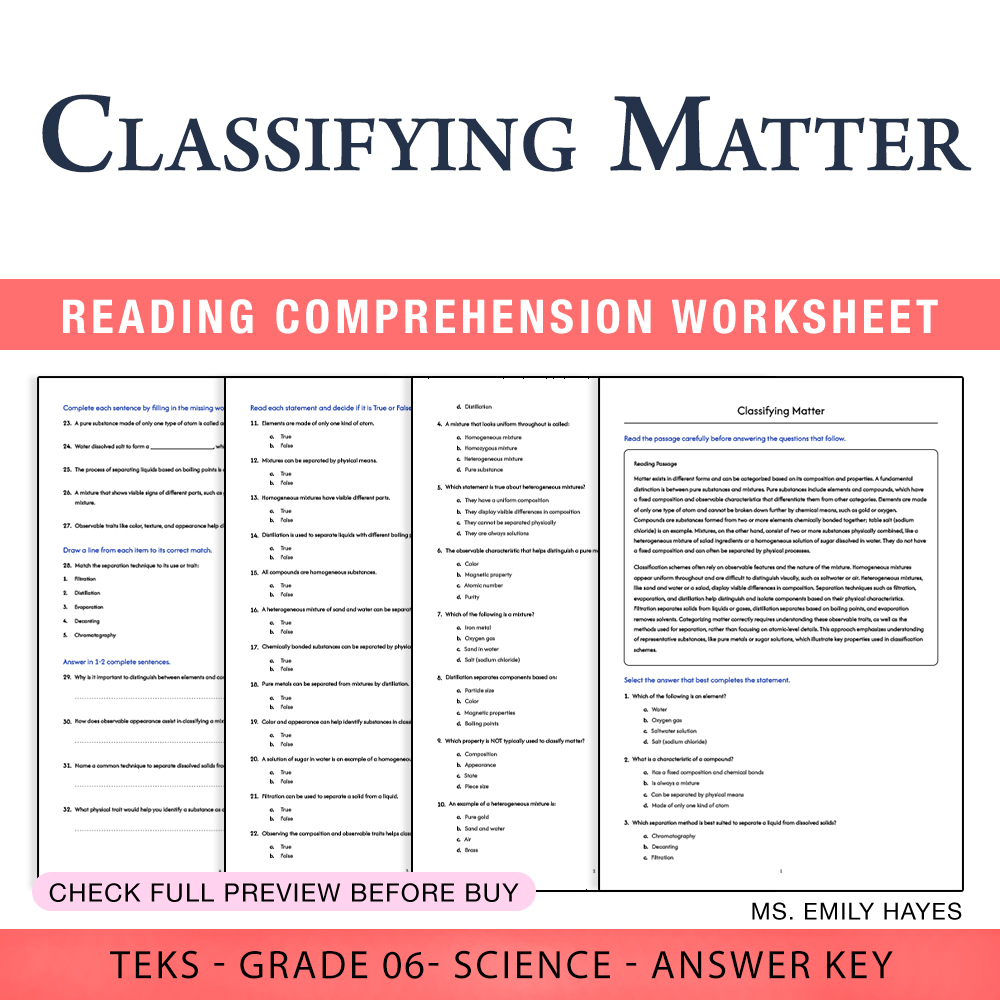
6th Grade Science | Classifying Matter Worksheet (PDF+ Answer Key)
Created byCopper Leaf ClassroomLearning Objectives
- Understand the different types of matter: elements, compounds, and mixtures.
- Identify criteria used to classify substances based on composition and observable traits.
- Learn common separation techniques like filtration and distillation.
Instant download
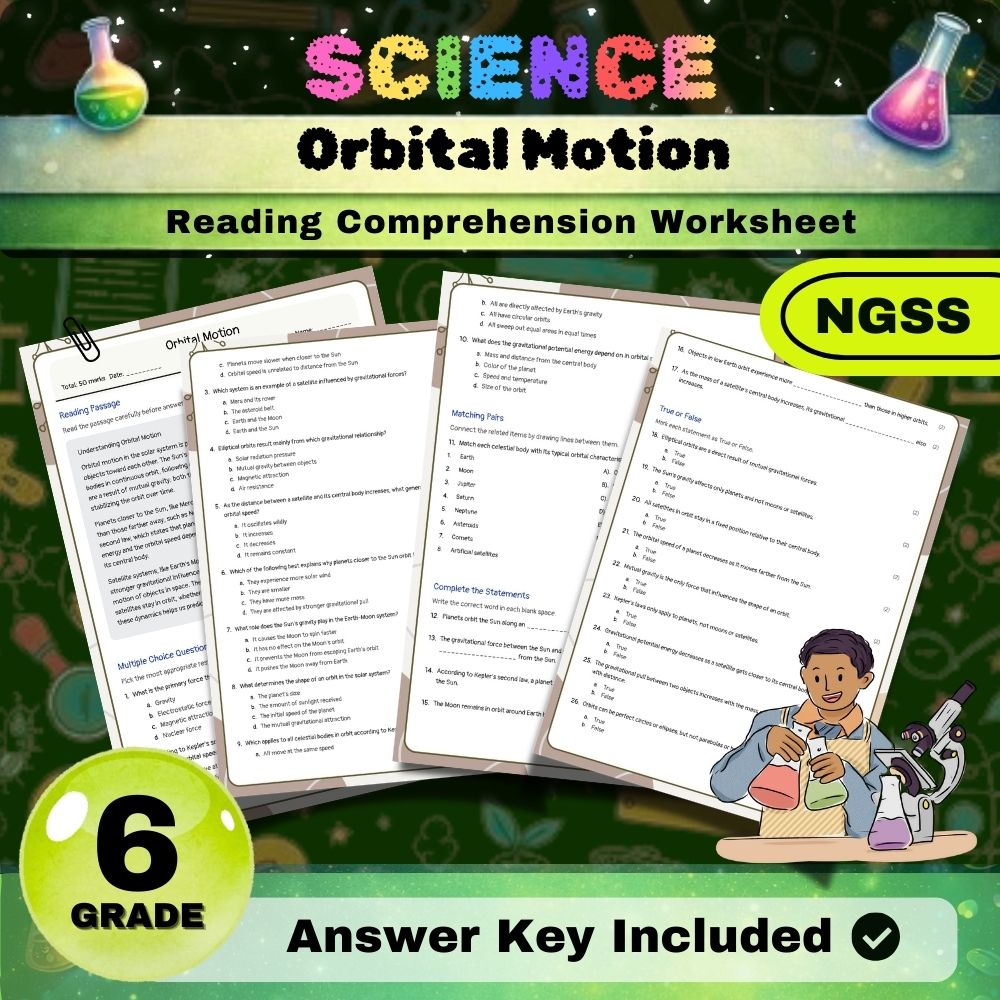
6th Grade Science | Orbital Motion Worksheet – NGSS Standards (PDF + Answer Key)
 Created byMaple Path Learning
Learning Objectives
- Understand how gravitational attraction between the Sun and planets results in elliptical orbits.
- Describe how mutual gravity influences orbital periods and speeds in the solar system.
- Explain the concept of central gravitational potential and its role in maintaining orbital paths.
Also included in: Grade 6 Science | Earth's Rotation, Seasons & Orbital Motion Worksheet Bundle +1 more
Instant download

Grade 6 Circuit Symbols Worksheet | Ontario Science Electricity PDF
Created byClear Sky ClassroomLearning Objectives
- Identify common circuit diagram symbols for cells, batteries, resistors, lamps, switches, ammeters, and voltmeters.
- Interpret how diagram layout shows physical connections and predicts whether components are in series, parallel, or mixed arrangements.
- Explain how symbol orientation and key shorthand (like open/closed switches) affect circuit behavior.
Instant download

6th Grade Science Worksheet | Physiological Adaptations (PDF) – BC Standards
Created byEvergreen Desk EducationLearning Objectives
- Explain how physiological adaptations help organisms respond to environmental challenges such as heat, cold, and limited water.
- Describe how internal processes (heat exchange, kidney water conservation, and metabolic changes) improve survival during extreme conditions.
- Use evidence from a text to connect hormonal and metabolic regulation to hydration, temperature, and energy balance.
Instant download

6th Grade Science Groundwater & Baseflow Worksheet | California PDF
Created byEvergreen Desk EducationLearning Objectives
- Explain how precipitation can infiltrate and percolate to recharge groundwater aquifers.
- Describe how groundwater can supply streams as baseflow during dry periods.
- Identify how permeability and land geometry influence the connection between groundwater and surface water.
Instant download

6th Grade Science Worksheet | Recrystallization Lessons & Practice (PDF)
Created byEvergreen Desk EducationLearning Objectives
- Explain how recrystallization uses solubility differences at different temperatures to purify a dissolved solid
- Describe the role of saturation and solute-particle/solvent interactions during heating and cooling
- Predict how cooling speed affects crystal size and purity
Instant download

6th Grade Science – Control Surfaces Worksheet (Alberta Standards) (PDF)
 Created bySilver Birch Teaching
Learning Objectives
- Identify the purpose of ailerons, elevators, and rudders as control surfaces on an aircraft.
- Explain how deflecting a control surface changes airflow and produces aerodynamic moments.
- Describe how aircraft motions (rolling, pitching, and yawing) relate to specific control surfaces.
Also included in: Grade 6 Aerodynamics & Flight Forces Science Lesson Bundle: Alberta +1 more
Instant download

6th Grade Science Worksheet – Models and Limitations (PDF)
Created byEvergreen Desk EducationLearning Objectives
- Explain what a scientific model is and how it can help represent an idea.
- Identify assumptions in a model and describe them in plain language.
- Use evidence to judge whether a model’s predictions match observed results.
Also included in: Grade 6 Science Inquiry Lesson Bundle: Variable Control & Models (General) +1 more
Instant download
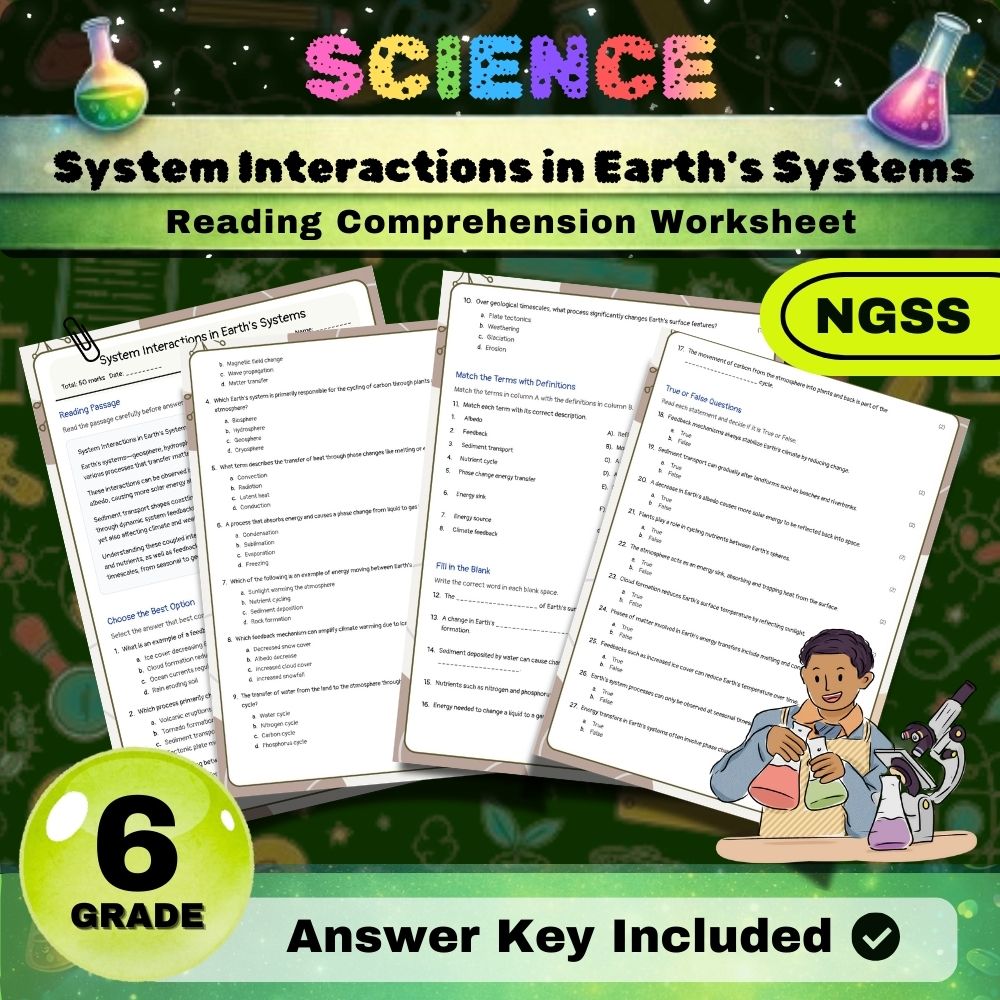
6th Grade Science | Earth's System Interactions NGSS Worksheet (PDF )
Created byMaple Path LearningLearning Objectives
- Describe how Earth's geosphere, hydrosphere, atmosphere, and biosphere interact through transfers of matter and energy.
- Explain feedback mechanisms such as albedo changes, sediment transport, and nutrient movement across Earth's systems.
- Model and analyze system-level patterns that occur over seasonal to geologic timescales involving Earth's processes.
Also included in: Grade 6 Science | Weather, Water Cycle & Earth Systems NGSS Unit Bundle (PDF) +1 more
Instant download
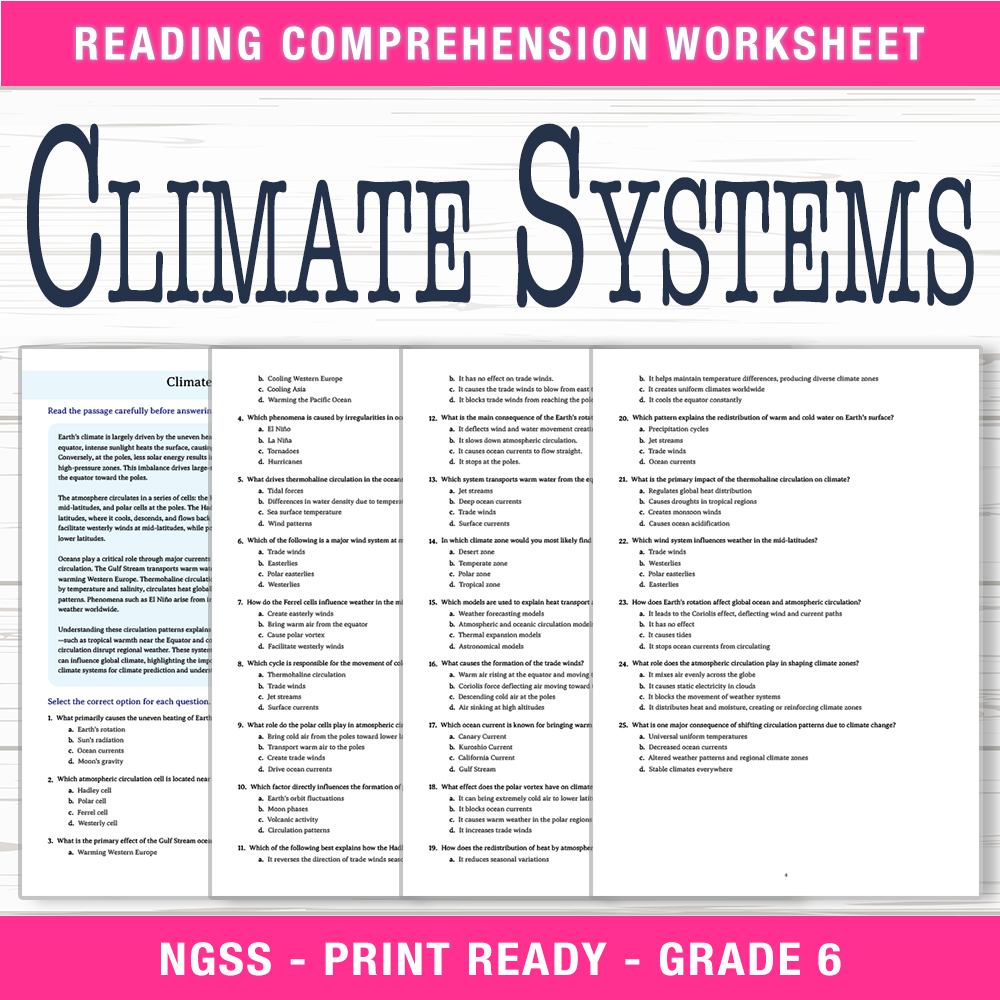
6th Grade Science | Climate Systems Worksheet ( PDF + Answer Key)
 Created byRiverstone Classroom
Learning Objectives
- Understand how unequal solar heating influences global atmospheric and oceanic circulation patterns.
- Identify the main circulation cells, wind systems, and ocean currents affecting regional climates.
- Explain the connections between circulation patterns and climate zones, including phenomena like El Niño.
Instant download

6th Grade Science Worksheet – Measuring Electricity | BC Standards (PDF)
Created byEvergreen Desk EducationLearning Objectives
- Explain what current, voltage, and power measure and how their units relate to electrical behavior.
- Use equations for power and energy to interpret how much electrical energy is transferred over time.
- Describe how measurements help identify where energy is dissipated in circuits and how efficient devices are.
Instant download
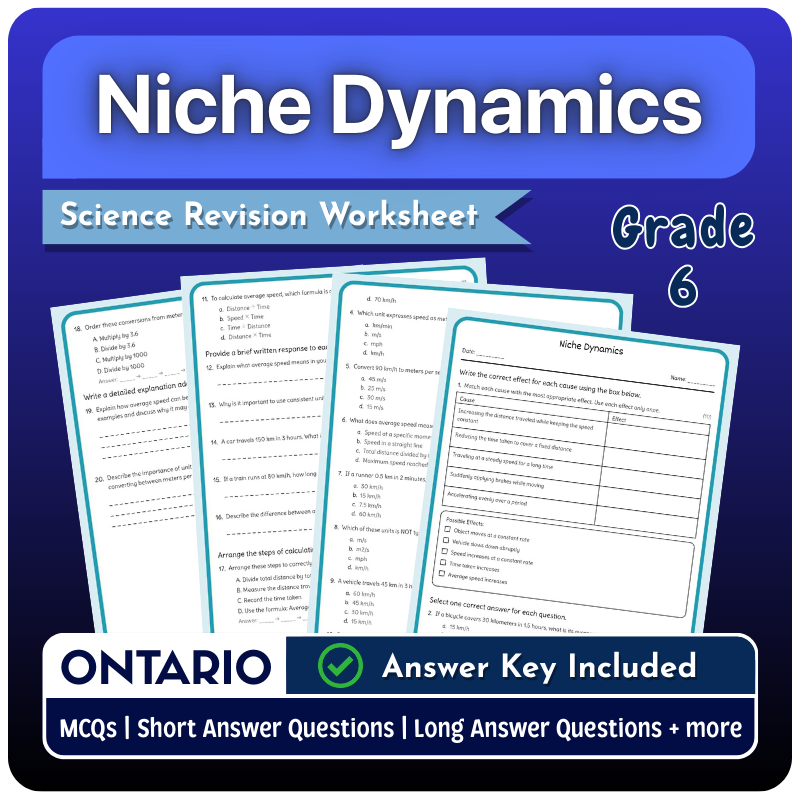
6th Grade Science – Niche Dynamics Worksheet (Ontario Standard) (PDF)
Created byBright Mind ResourcesLearning Objectives
- Understand the difference between fundamental and realized niches.
- Identify biotic and abiotic factors that influence species distribution.
- Explain how interspecific interactions affect resource use and habitat occupation.
Instant download

Science Patterns From Graphs Worksheet Grade 6 | Standards-Aligned Practice
JCreated byJ.S SheetsLearning Objectives
- Read graphs by describing patterns (increasing, decreasing, plateau, scatter, and curved change) using quantitative language
- Use graph evidence (slope, direction, and spread) to make accurate predictions and explanations
- Explain how simple models can summarize graph patterns and support comparisons across conditions
Also included in: Grade 6 Scientific Investigation Science lesson bundle: General Framework +1 more
Instant download

Science Testable Questions Worksheet Grade 6 | Standards-Aligned Practice
JCreated byJ.S SheetsLearning Objectives
- Explain what makes a scientific question testable by linking it to measurable evidence.
- Identify independent, dependent, and controlled variables in a testable investigation plan.
- Use evidence criteria to rewrite a question so it can be answered with observations and measurements.
Also included in: Grade 6 Scientific Investigation Science lesson bundle: General Framework +1 more
Instant download
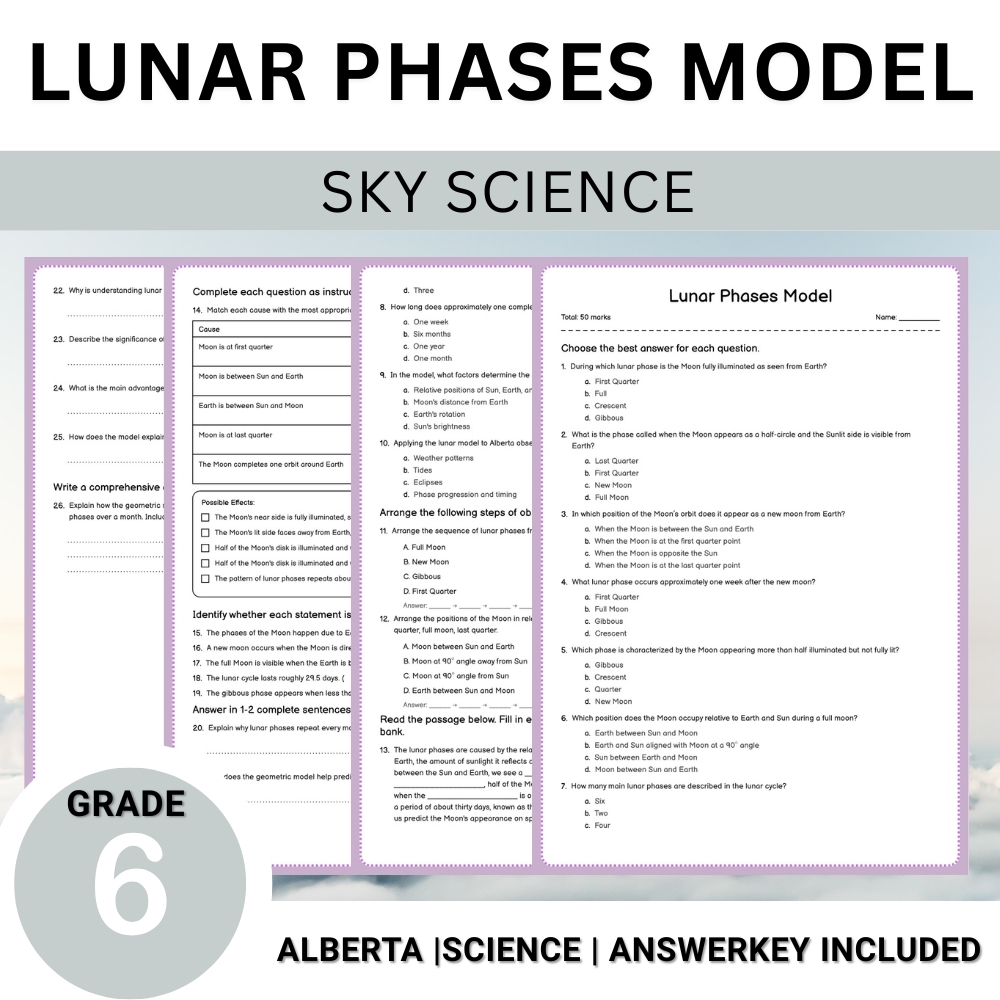
6th Grade Science | Lunar Phases Model Worksheet (Printable PDF & Assessment)
Learning Objectives
- Understand how the geometric model of the Moon's orbit explains lunar phases.
- Identify the relative positions of Sun, Earth, and Moon during different phases.
- Predict lunar phases based on the Moon's position in its orbit.
Also included in: Grade 6 Science | Celestial & Space Phenomena UNIT Worksheet Bundle (Assessment & Practice) +1 more
Instant download
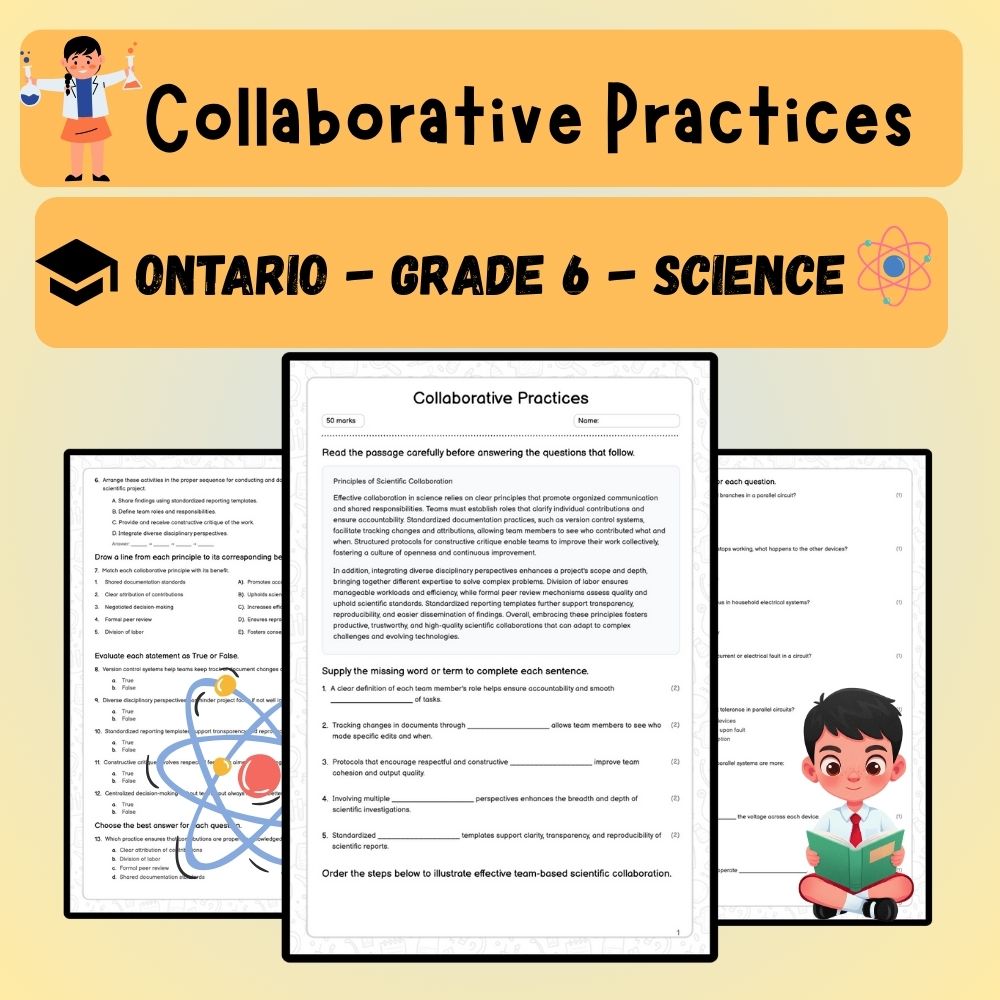
6th Grade Science | Collaborative Practices Worksheet (PDF)
 Created byPrism Point Learning
Learning Objectives
- Understand principles of team-based scientific organization and communication.
- Identify key components such as versioning, attribution, and peer review in collaborative science.
- Analyze the importance of disciplinary integration and standardized reporting in team projects.
Also included in: Grade 6 Science Unit | Inquiry, Modeling & Data Skills Worksheet Bundle
Instant download

6th Grade Science | Drag Types Worksheet (Alberta Standard) (PDF)
Created byEvergreen Desk EducationLearning Objectives
- Explain the difference between parasitic drag and induced drag and how each one changes with flight conditions.
- Identify how surface roughness, frontal area, lift generation, and wingtip vortices affect drag.
- Connect drag to thrust requirements and to the energy demands of flight.
Instant download
6th Grade Science – Classification Basics Worksheet (Ontario) (PDF)
Created byBright Mind ResourcesLearning Objectives
- Understand hierarchical categories used in biological classification from kingdom to species.
- Identify observable traits to distinguish different organisms.
- Learn how to use dichotomous keys to classify local species such as pond invertebrates, insects, and trees.
Instant download
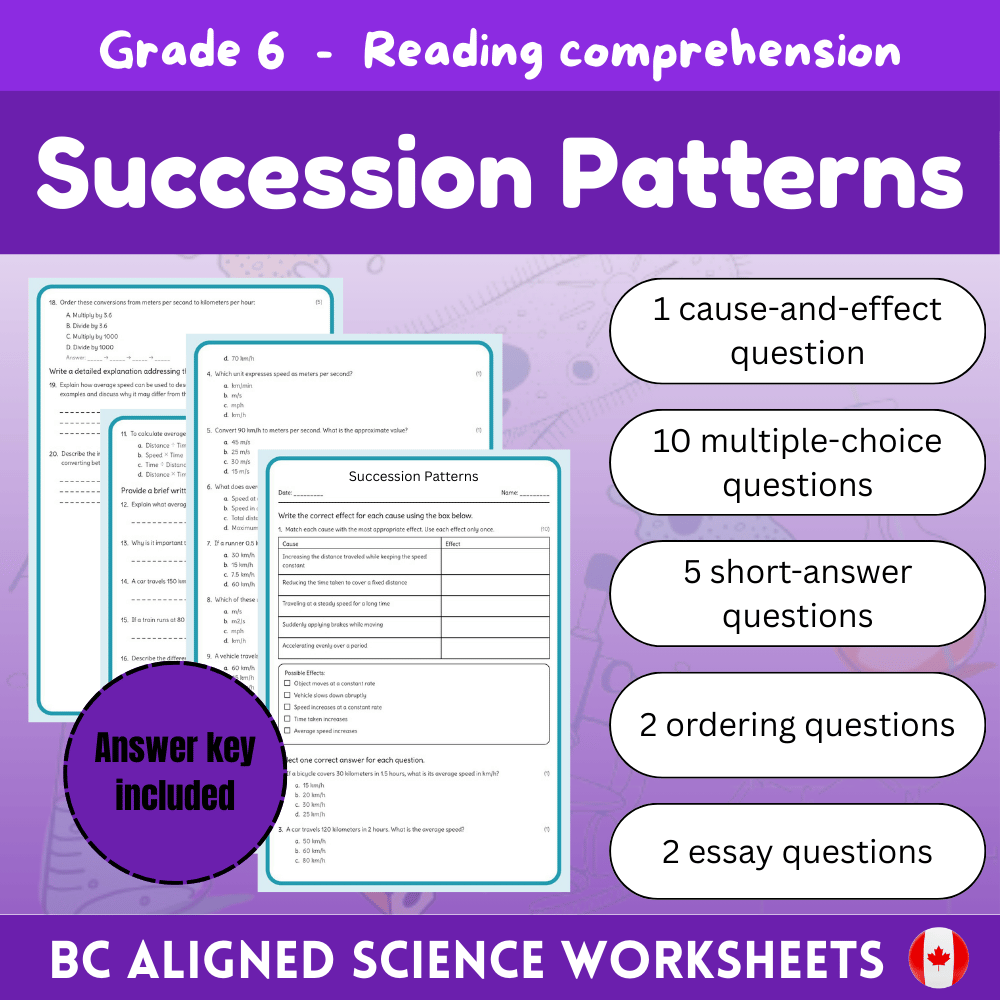
6th Grade Science | Understanding Succession Patterns Worksheet (PDF)
Created byBright Mind ResourcesLearning Objectives
- Understand the process and stages of ecological succession.
- Differentiate between primary and secondary succession.
- Identify pioneer species and their role in succession.
Instant download
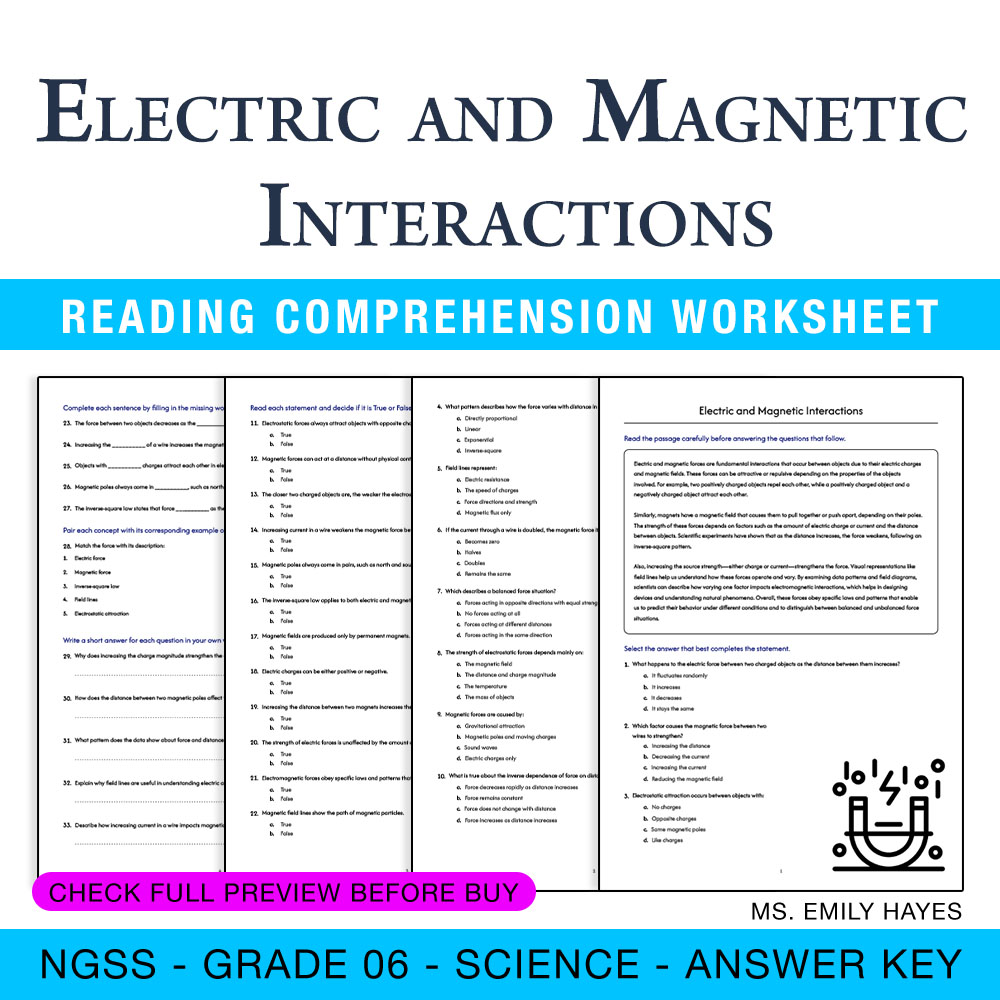
6th Grade Science | Electric and Magnetic Interactions Worksheet (PDF + Answers)
Created byCopper Leaf ClassroomLearning Objectives
- Explain how electric forces depend on charge magnitude and distance.
- Describe how magnetic forces are influenced by current and separation.
- Compare electrostatic attraction/repulsion with magnetic interactions.
Instant download
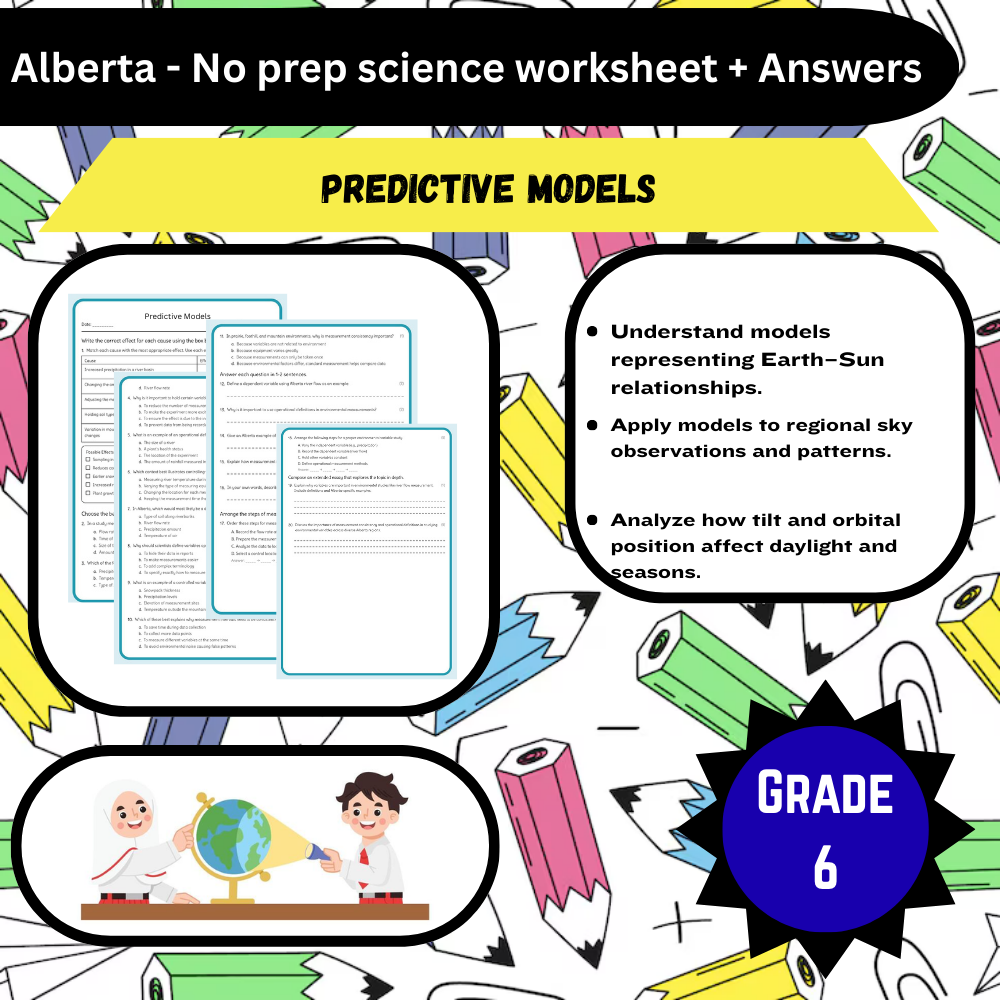
6th Grade Science | Earth–Sun Geometry & Predictive Models Worksheet (PDF)
Created byBright Mind ResourcesLearning Objectives
- Understand how models represent Earth–Sun relationships to predict celestial phenomena.
- Apply simplified models to regional sky observations and calendar-based patterns.
- Analyze how axial tilt and orbital position affect daylight and seasons.
Instant download
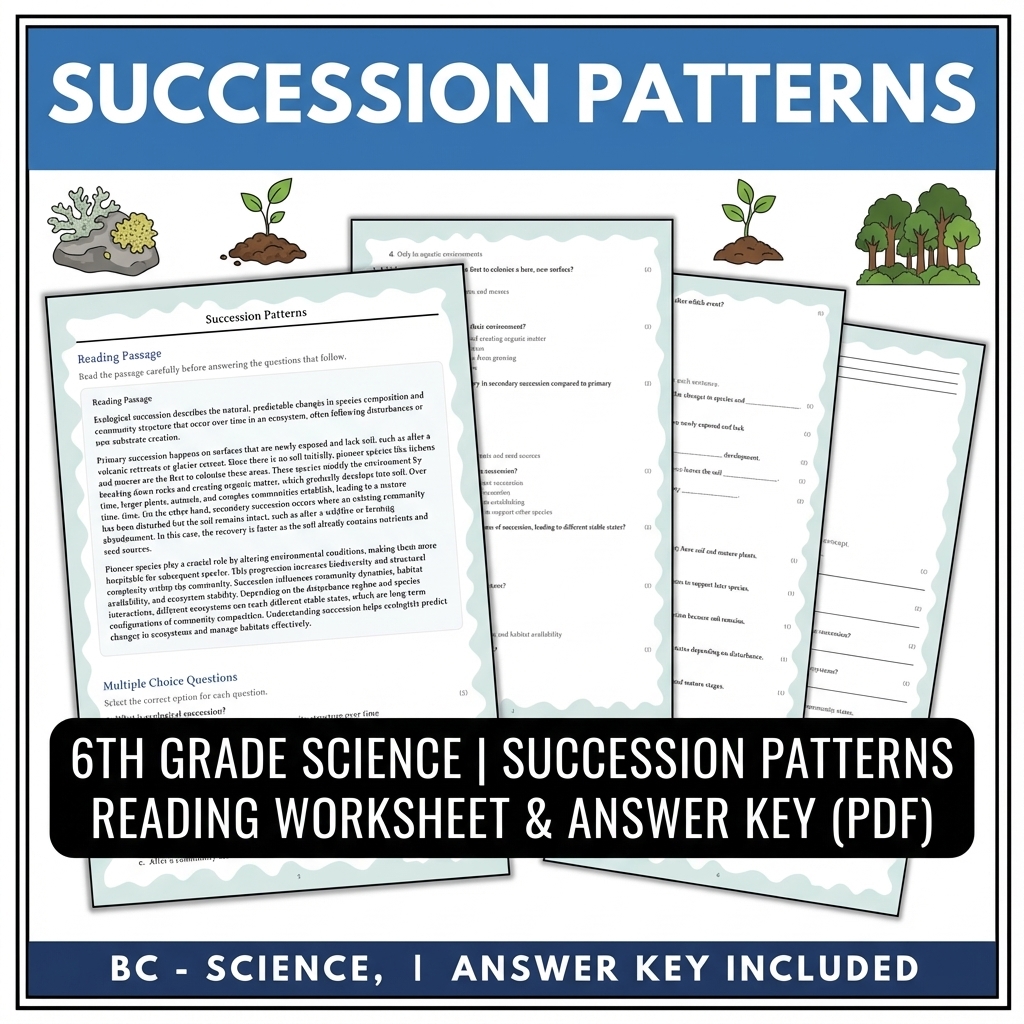
6th Grade Science | Succession Patterns Reading Worksheet & Answer Key (PDF)
JCreated byJ.S SheetsLearning Objectives
- Understand the process and stages of ecological succession.
- Differentiate between primary and secondary succession.
- Identify pioneer species and their role in succession.
Instant download

6th Grade Science | Thrust Systems Worksheet (Ontario) – PDF
Created byEvergreen Desk EducationLearning Objectives
- Explain how propellers and jet engines produce thrust to overcome drag
- Compare propulsive efficiency at different speeds for propeller-driven vs jet-driven systems
- Describe how thrust-to-weight ratio affects acceleration and climb
Also included in: Grade 6 Flight & Aerodynamics Science Lesson Bundle Worksheets (Ontario) +1 more
Instant download

6th Grade Science Worksheet: Adaptation Basics – Ontario Standard (PDF)
Created byEvergreen Desk EducationLearning Objectives
- Distinguish structural, behavioural, and physiological adaptations and give examples of each.
- Explain how adaptations can improve survival and reproductive success in a specific niche.
- Describe how inherited traits differ from acquired characteristics and how natural selection changes traits over generations.
Also included in: Grade 6 Biodiversity, Adaptation & Ecology Science Lesson Bundle | Ontario +1 more
Instant download

6th Grade Science | Defense Interactions Worksheet (PDF) – BC Standards
Created byEvergreen Desk EducationLearning Objectives
- Explain how barrier defenses (skin and mucous membranes) help prevent pathogens from entering the body.
- Describe how innate immune responses (including inflammation) help remove pathogens quickly.
- Summarize how adaptive immune responses produce antibodies and create long-term immune memory.
Instant download
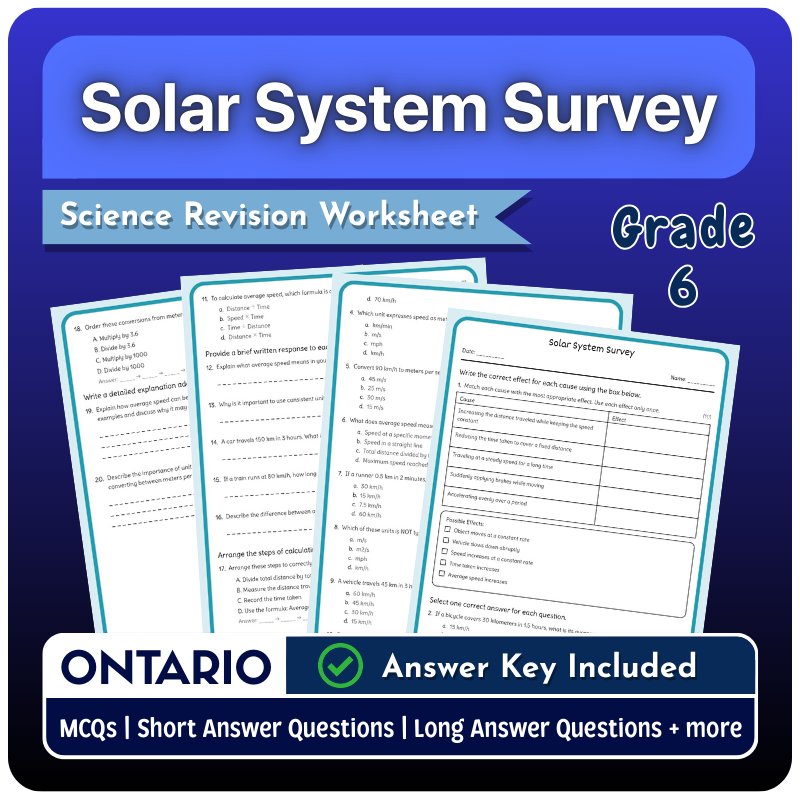
6th Grade Science | Solar System Survey Worksheet (Ontario) (PDF)
Created byBright Mind ResourcesLearning Objectives
- Identify major components of the solar system, including planets, belts, and dwarf planets.
- Describe differences between terrestrial and gas giant planets.
- Understand the characteristics of asteroid and Kuiper belts, including their composition and location.
Instant download
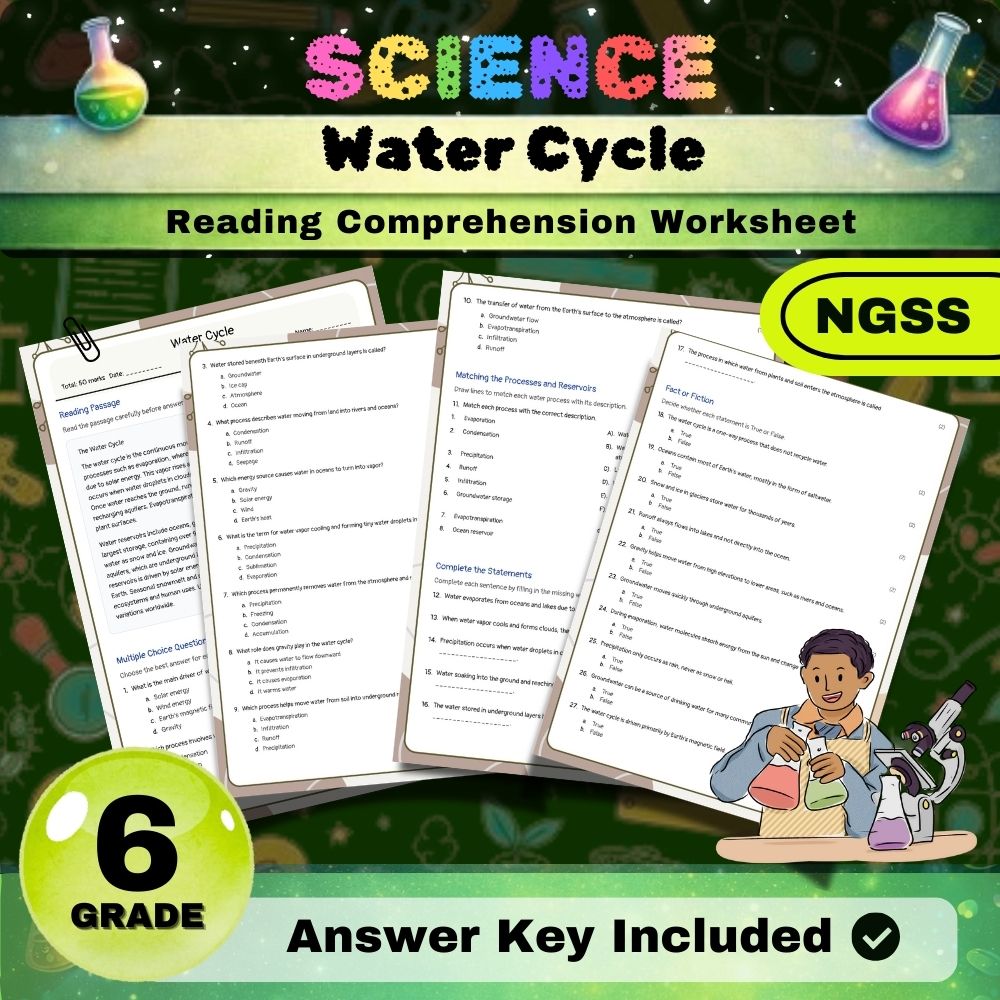
6th Grade Science | Water Cycle Worksheet (PDF) – NGSS Aligned
Created byMaple Path LearningLearning Objectives
- Understand the processes involved in the water cycle, including evaporation, condensation, precipitation, runoff, infiltration, and groundwater storage.
- Identify the roles of solar energy and gravity in driving the water cycle.
- Learn how water reservoirs such as oceans, ice, and groundwater interact through mass transfer and energy flows.
Also included in: Grade 6 Science | Weather, Water Cycle & Earth Systems NGSS Unit Bundle (PDF) +1 more
Instant download
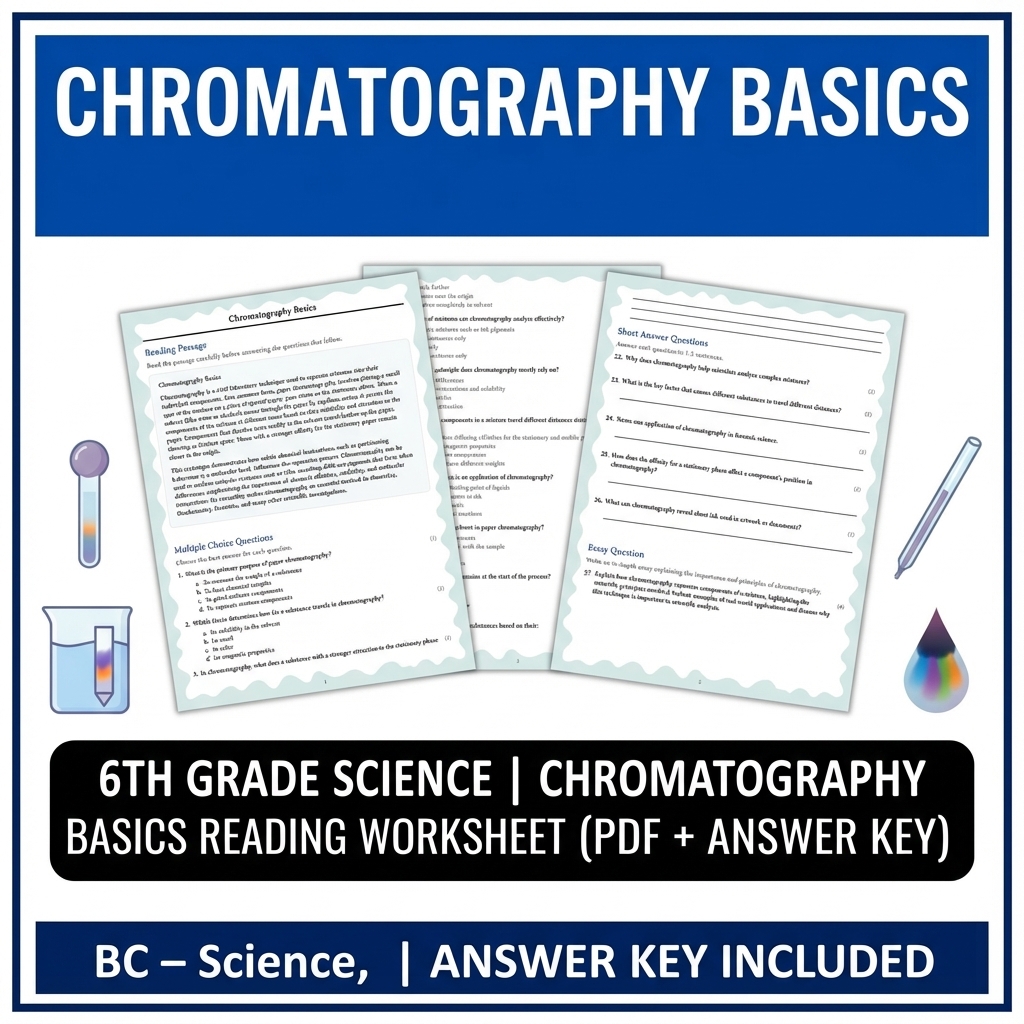
6th Grade Science | Chromatography Basics Reading Worksheet (PDF + Answer Key)
JCreated byJ.S SheetsLearning Objectives
- Understand the principles of paper chromatography and how it separates mixture components.
- Identify factors affecting the movement of substances in chromatography.
- Explain how different substances travel different distances based on their solubility and affinity.
Instant download
About Grade 6 Science Worksheets
Explore Grade 6 Science worksheets for classwork, homework, or review. Our 5,997 printables download instantly as PDFs.
MyTeachingSheets worksheets are made by real teacher-authors and checked before they go live. Download any as a print-ready PDF for lessons, homework, or independent practice — most include answer keys, and previews are always free.