
Grade 6 Science Worksheets
5,997 worksheets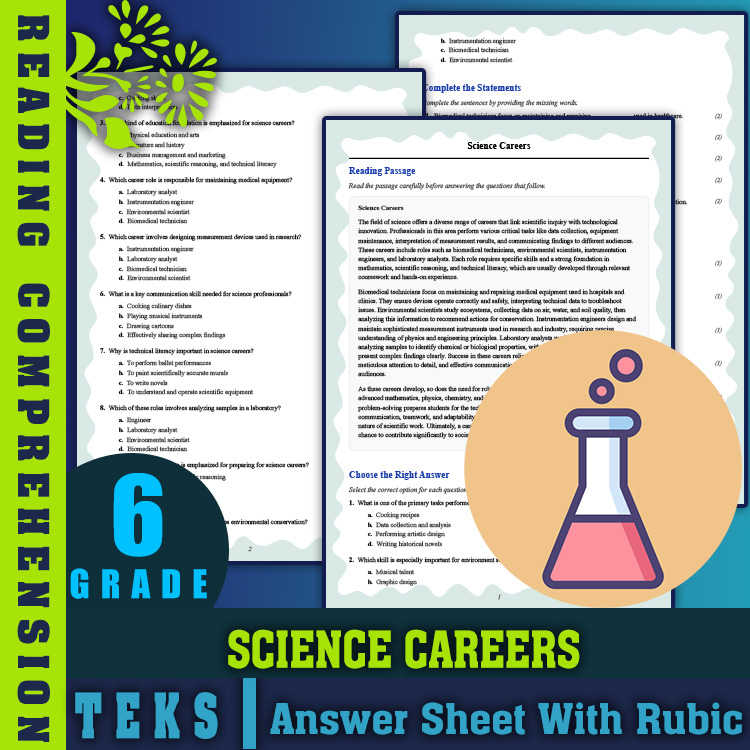
6th Grade Science Reading Worksheet | Science Careers Mastery (PDF + Answer Key)
JCreated byJ.S SheetsLearning Objectives
- Understand various career pathways in science and technology.
- Identify tasks and skills associated with science-related occupations.
- Recognize the educational background necessary for science careers.
Instant download
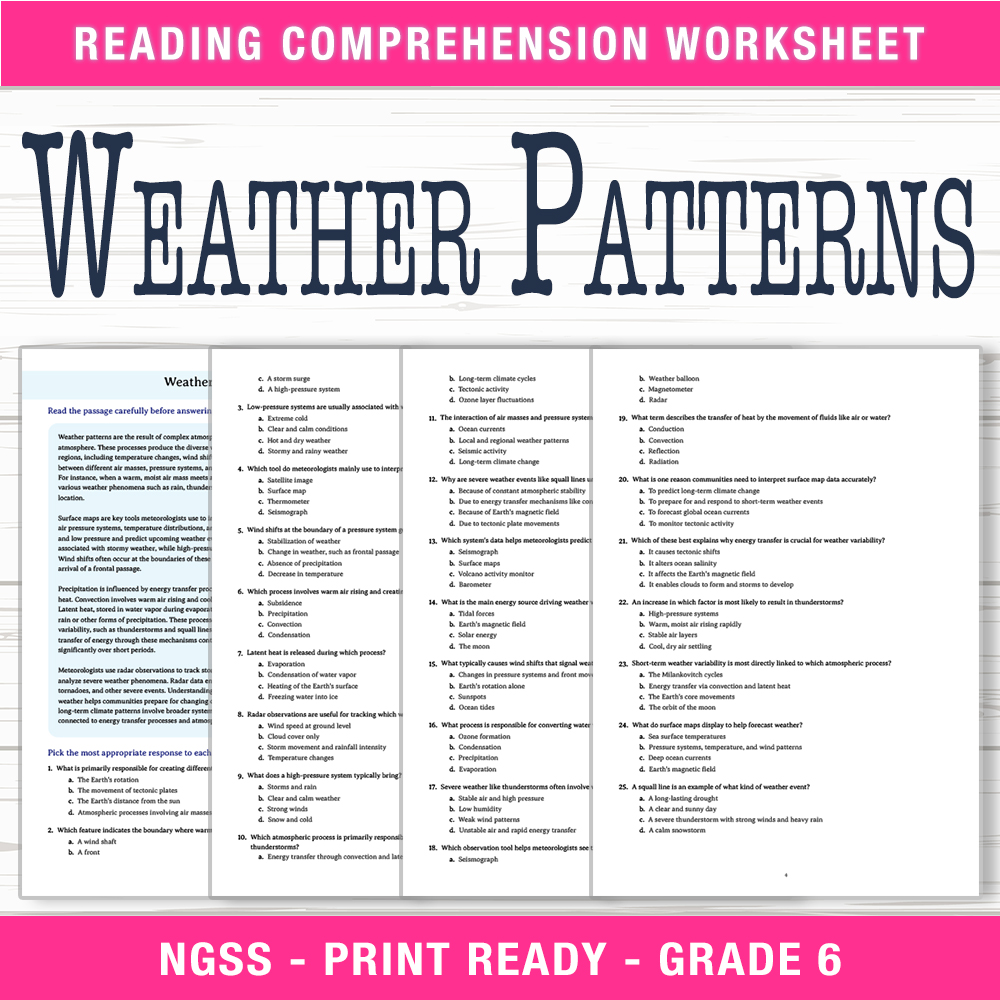
6th Grade Science | Weather Patterns Worksheet (PDF + Answer Key)
 Created byRiverstone Classroom
Learning Objectives
- Understand how atmospheric processes create local and regional weather variations.
- Interpret surface maps, temperature, and pressure data to identify weather phenomena.
- Explain the role of fronts, air masses, and pressure systems in weather changes.
Instant download
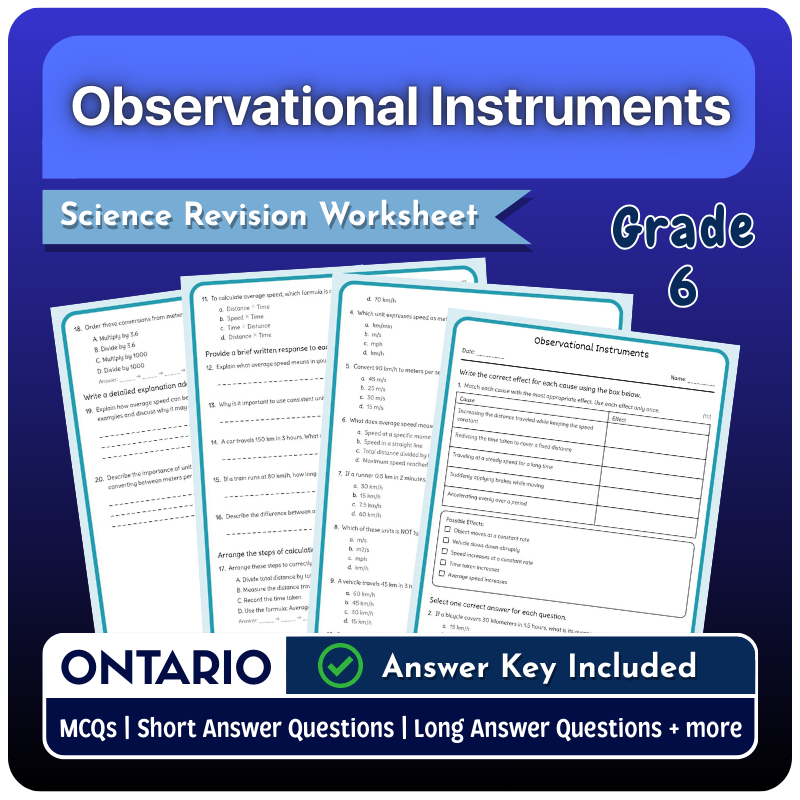
6th Grade Science | Observational Instruments Worksheet (Ontario Standard) (PDF)
 Created byBright Mind Resources
Learning Objectives
- Identify major types of observation instruments used in studying the solar system.
- Understand how different wavelengths reveal information about planetary surfaces, atmospheres, and the Sun.
- Compare ground-based and space-based observatories and their advantages.
Instant download

Grade 6 Electrostatic Phenomena Worksheet | Ontario Science PDF
 Created byClear Sky Classroom
Learning Objectives
- Explain how triboelectric effects transfer charge between materials when they touch and separate
- Use the triboelectric series to predict whether objects tend to gain or lose electrons
- Differentiate electrostatic discharge from steady electric current flow
Instant download

Science Grade 6 Feedback Control Worksheet | NGSS Science Assessment
 Created bySkylark Worksheets
Learning Objectives
- Explain how negative feedback helps organisms maintain internal stability around a set point
- Describe positive feedback and how it can amplify change in a process
- Identify sensors, control centers, and effectors in real physiological examples
Also included in: Grade 6 Cell Systems and Energy Pathways Science Lesson Bundle NGSS +1 more
Instant download
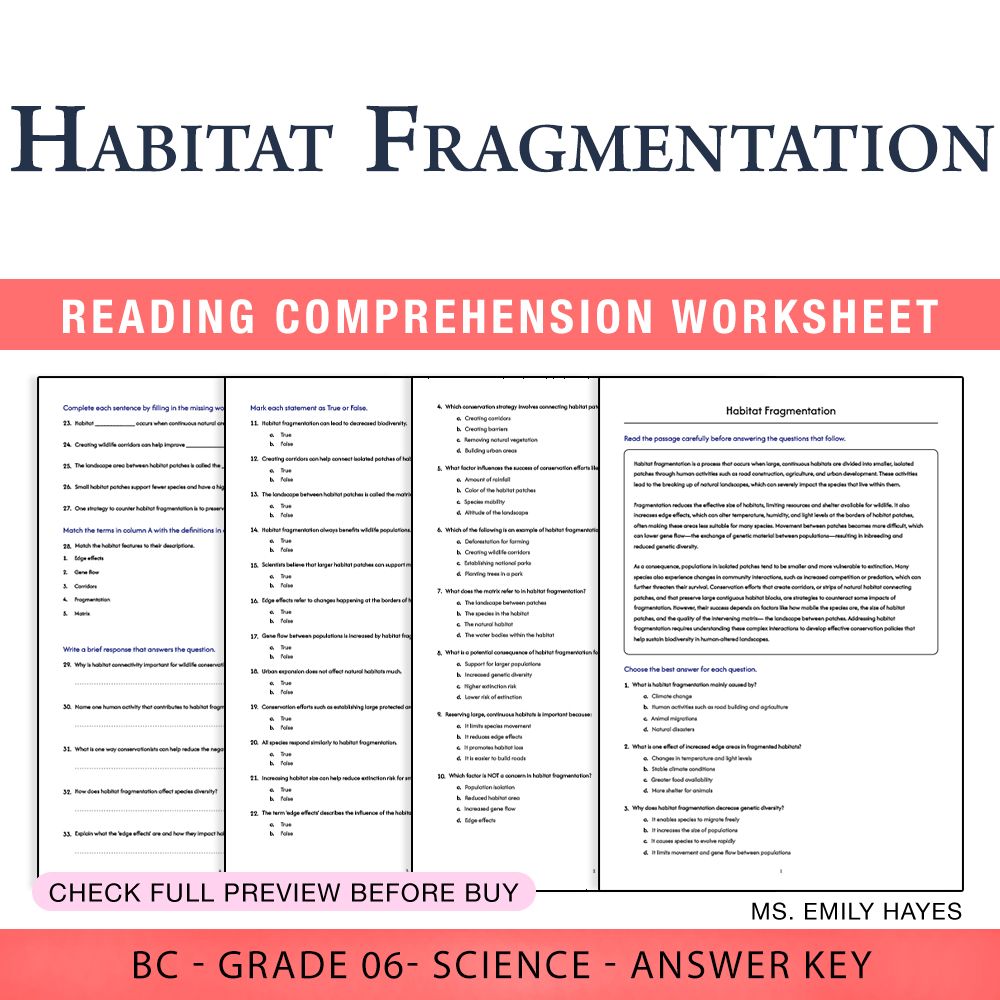
6th Grade Science | Habitat Fragmentation Worksheet (PDF+ Answer Key)
 Created byCopper Leaf Classroom
Learning Objectives
- Explain the concept of habitat fragmentation and its causes.
- Describe the impacts of habitat fragmentation on species diversity and population survival.
- Identify strategies to mitigate habitat fragmentation and their effectiveness.
Also included in: Grade 6 Science BC | Ecosystems and Human Impact Unit (PDF + Answer Keys) +1 more
Instant download

Atmospheric Patterns Assessment | TEKS Grade 6 Science Worksheet
 Created byPrism Point Learning
Learning Objectives
- Understand the basic structure of the atmosphere and how it influences weather patterns.
- Identify how air-mass interactions and fronts affect regional climates.
- Explain the role of pressure systems, wind patterns, and heat transfer in weather formation.
Instant download

Grade 6 Forest Succession & Disturbance Regimes Worksheet | Alberta Science
 Created byBRIGHT PATH RESOURCES
Learning Objectives
- Define disturbance regimes using key vocabulary such as frequency, intensity, and spatial extent
- Explain how different disturbances change forest structure and regeneration patterns over time
- Connect disturbance patterns to habitat mosaics and long-term ecosystem change
Also included in: Forest Ecosystem Adaptations Grade 6 Science Worksheets Lesson Bundle | Alberta +1 more
Instant download
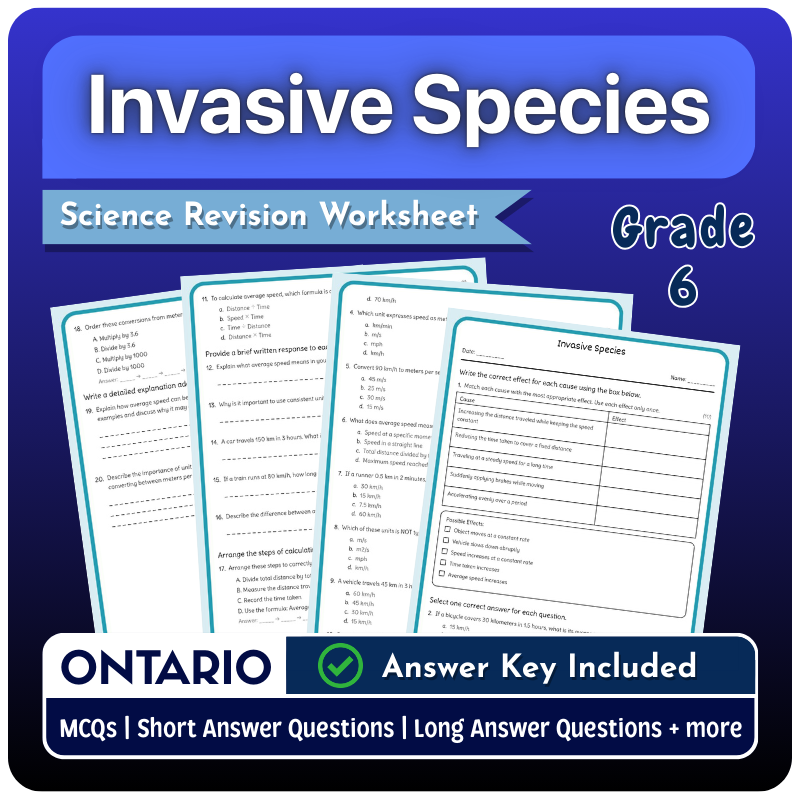
6th Grade Science | Invasive Species Worksheet (Ontario Standards) (PDF)
Created byBright Mind ResourcesLearning Objectives
- Understand how invasive species are introduced and establish themselves in new environments.
- Identify the ecological impacts of invasive species on native ecosystems and species.
- Analyze factors that facilitate the spread of invasive species, such as propagule pressure and lack of predators.
Instant download

6th Grade Science Worksheet | Population Dynamics TEKS (PDF)
 Created byEvergreen Desk Education
Learning Objectives
- Explain how population size changes over time using exponential and logistic growth ideas
- Define carrying capacity and identify limiting factors that reduce population growth
- Differentiate density-dependent and density-independent influences on populations
Instant download

Grade 6 Scientific Models Worksheet | NGSSS Science Visual Thinking Practice
Created byEvergreen Desk EducationLearning Objectives
- Explain how scientific models represent systems that are too large, too small, or too complex to study directly.
- Describe how evidence from observations and measurements can be used to evaluate and improve a model.
- Identify what a model can represent and what it cannot represent.
Instant download

6th Grade Science Worksheet | Understanding Apparent Motion (Ontario PDF)
Created byEvergreen Desk EducationLearning Objectives
- Explain how Earth’s rotation causes the apparent daily motion of the Sun and stars from an Earth-based perspective.
- Describe how Earth’s orbital motion and the tilt of Earth help explain the apparent annual change in the Sun’s position.
- Use vocabulary such as horizon, celestial sphere, rising, setting, and diurnal to interpret predictable sky patterns.
Also included in: Grade 6 Solar System Space Science Lesson Bundle – Ontario Worksheets +1 more
Instant download
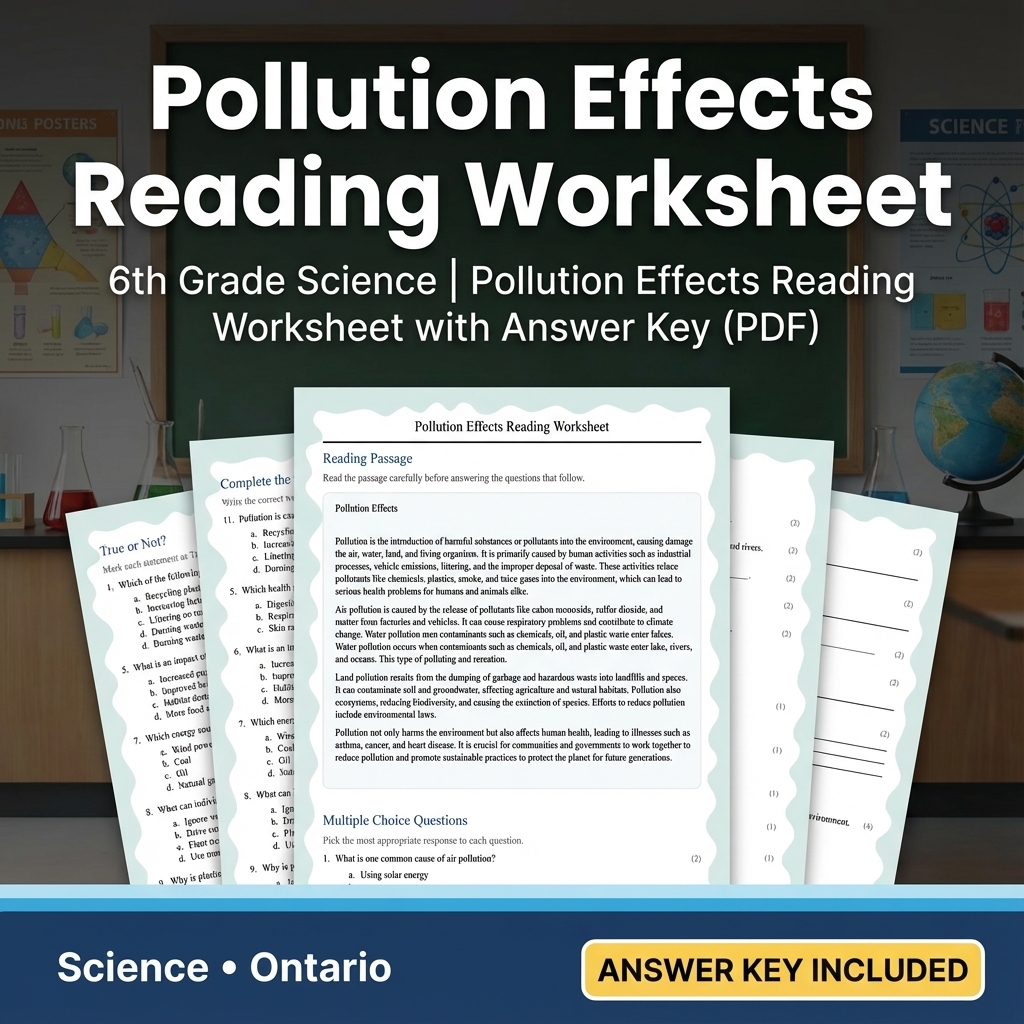
6th Grade Science | Pollution Effects Reading Worksheet with Answer Key (PDF)
JCreated byJ.S SheetsLearning Objectives
- Understand the various types of pollution and their causes.
- Identify the environmental and health impacts caused by pollution.
- Learn ways to reduce pollution and protect the environment.
Also included in: Grade 6 Science Unit Bundle – Ecosystems, Biodiversity & Environmental Impact +1 more
Instant download

Plant Matter Inputs Assessment | California Standards Grade 6 Science
Created byPrism Point LearningLearning Objectives
- Explain how carbon dioxide, water, and gases from the atmosphere provide raw materials for plant growth
- Describe how roots, leaves, and plant cells use environmental inputs to build biomass
- Use evidence from text to answer questions about matter entering and leaving plant systems
Also included in: Grade 6 Energy and Matter Cycles Science Lesson Bundle | California Standards +1 more
Instant download

Material Cycling Assessment | California Standards Grade 6 Science Test
Created byPrism Point LearningLearning Objectives
- Explain how weathering, sediment transport, and deposition move Earth materials through cycles.
- Describe how living things add organic matter to soils and affect water retention.
- Use cause-and-effect reasoning to connect transformations across Earth’s spheres.
Also included in: Grade 6 Water in Earth Systems Science Lesson Bundle: California Standards +1 more
Instant download

Satellite Systems Worksheet Grade 6 Science | Satellites & Orbits
 Created byChalk and Compass
Learning Objectives
- Explain how artificial satellites support Earth observation, communication, navigation, and scientific monitoring.
- Compare geostationary and polar orbits and describe why each is useful.
- Identify how satellite sensor payloads affect what data can be collected.
Also included in: Space - Grade 6 Bundle +1 more
Instant download
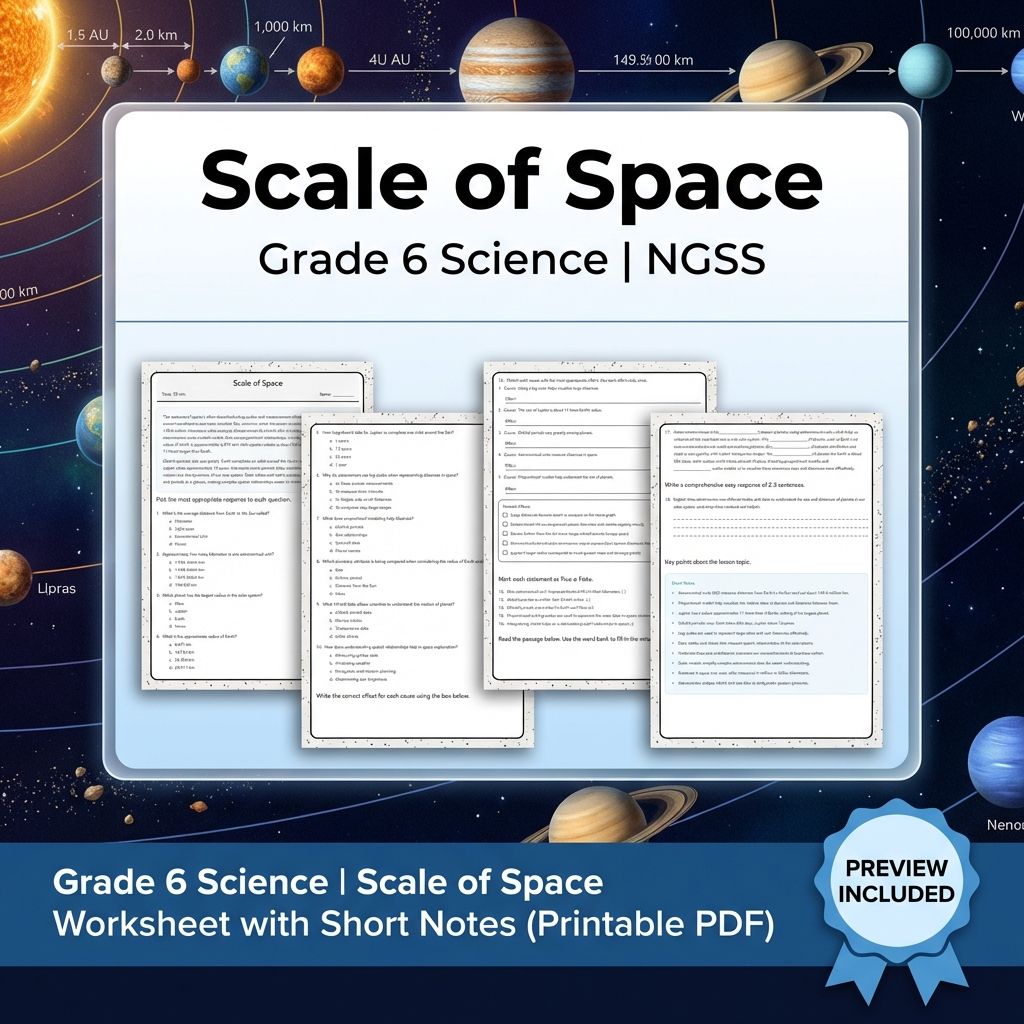
Grade 6 Science | Scale of Space Worksheet with Short Notes (Printable PDF)
 Created byMeadowlark Worksheets
Learning Objectives
- Understand the concept of astronomical units and how they relate to distances in space.
- Compare the sizes and orbital periods of planets within the solar system.
- Interpret data tables and charts to analyze spatial relationships among planets.
Also included in: Grade 6 Science | Earth's Place in the Universe Unit Bundle (NGSS Worksheets) +1 more
Instant download

6th Grade Science – Erosion Pathways Worksheet (General Standard) PDF
 Created byMaple Path Learning
Learning Objectives
- Understand the processes of erosion and deposition and how they shape Earth's surface.
- Identify agents responsible for erosion such as water, wind, ice, and gravity.
- Describe features formed by erosion and deposition like river valleys, deltas, dunes, and beaches.
Instant download
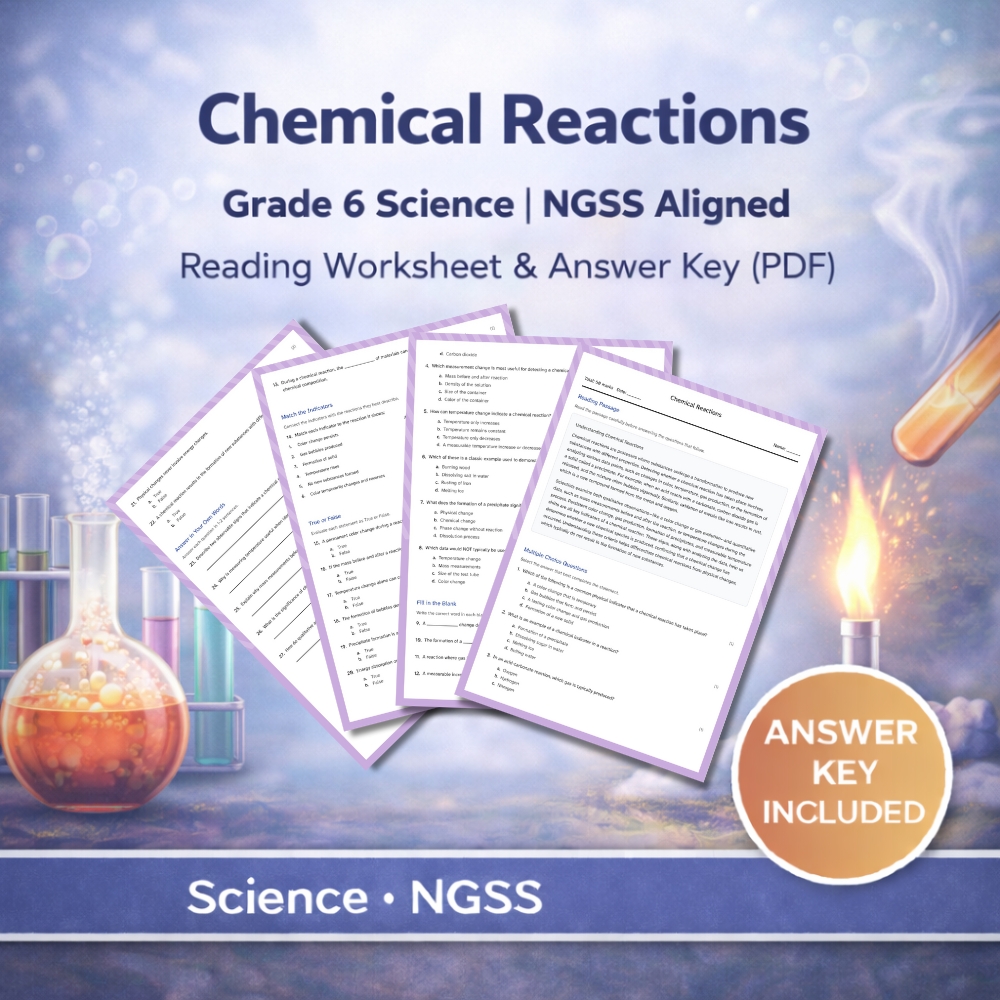
6th Grade Science | Chemical Reactions | Worksheet & Answer Key (NGSS Aligned)
 Created byCedar Grove Learning
Learning Objectives
- Identify criteria that indicate a chemical reaction based on observable data.
- Analyze quantitative and qualitative data to determine if a new substance forms during a reaction.
- Interpret pre- and post-interaction measurements, including mass, temperature, and composition data.
Also included in: Grade 6 Science | Atomic & Molecular Models, Conservation & Reactions | NGSS +1 more
Instant download
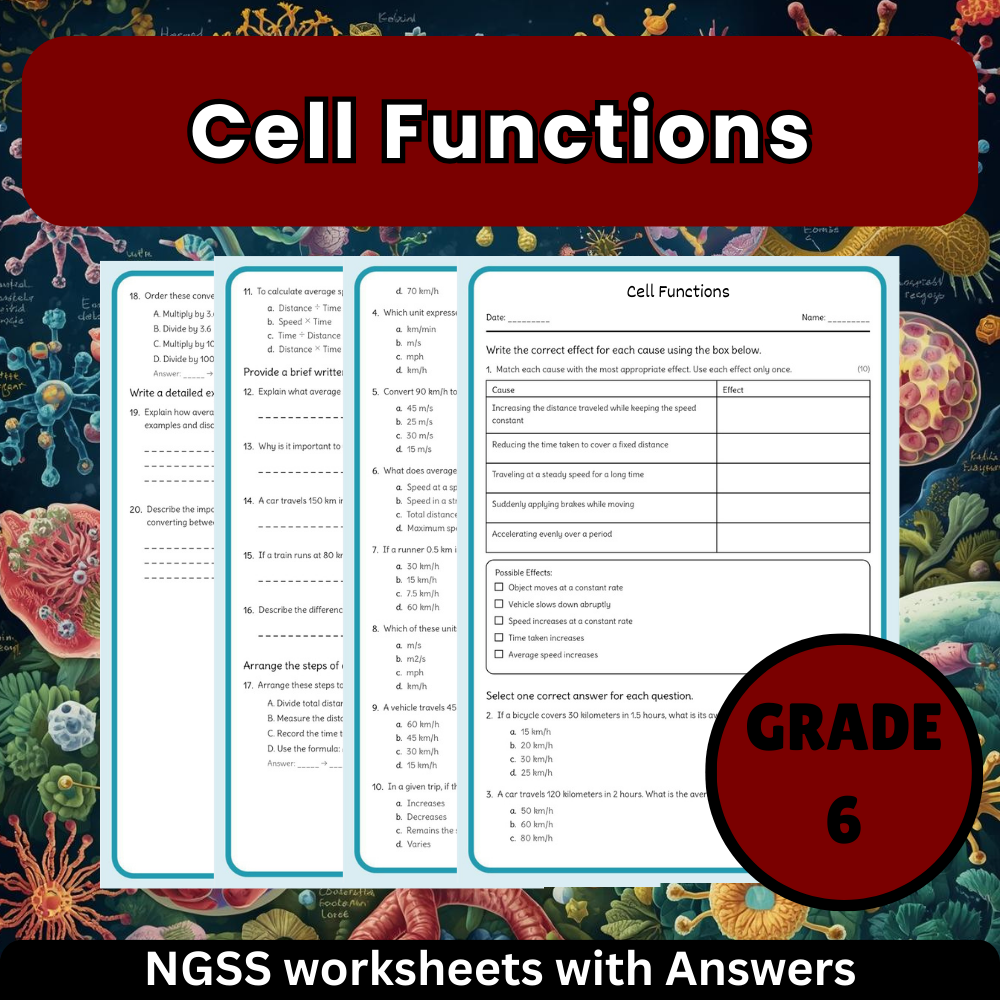
6th Grade Science | Cell Functions Worksheet (NGSS-Aligned) PDF
Created byBright Mind ResourcesLearning Objectives
- Identify the organelles involved in cell functions such as energy production, protein synthesis, and waste removal.
- Describe the structure and function of the nucleus, mitochondria, ribosomes, and chloroplasts.
- Compare the cell structures of plant and animal cells to understand specialization and function.
Also included in: Grade 6 Science UNIT Bundle | Cell Functions, Energy & Systems NGSS Worksheets +2 more
Instant download
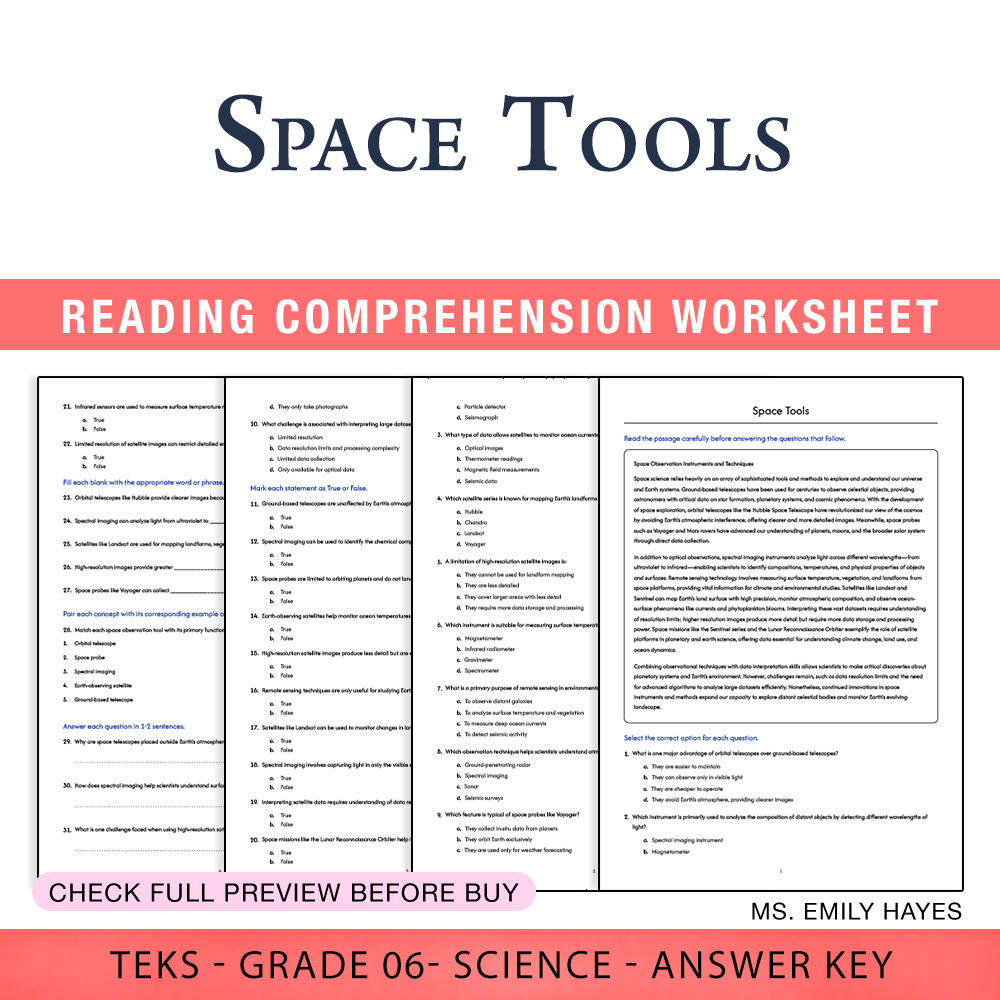
6th Grade Science | Space Tools Worksheet (PDF+ Answer Key)
Created byCopper Leaf ClassroomLearning Objectives
- Understand the various observational instruments used in space science, including ground-based and orbital telescopes.
- Describe the techniques of spectral imaging and remote sensing for surface and atmospheric analysis.
- Explain how satellite data is used to map landforms, measure surface temperatures, and observe ocean phenomena.
Instant download
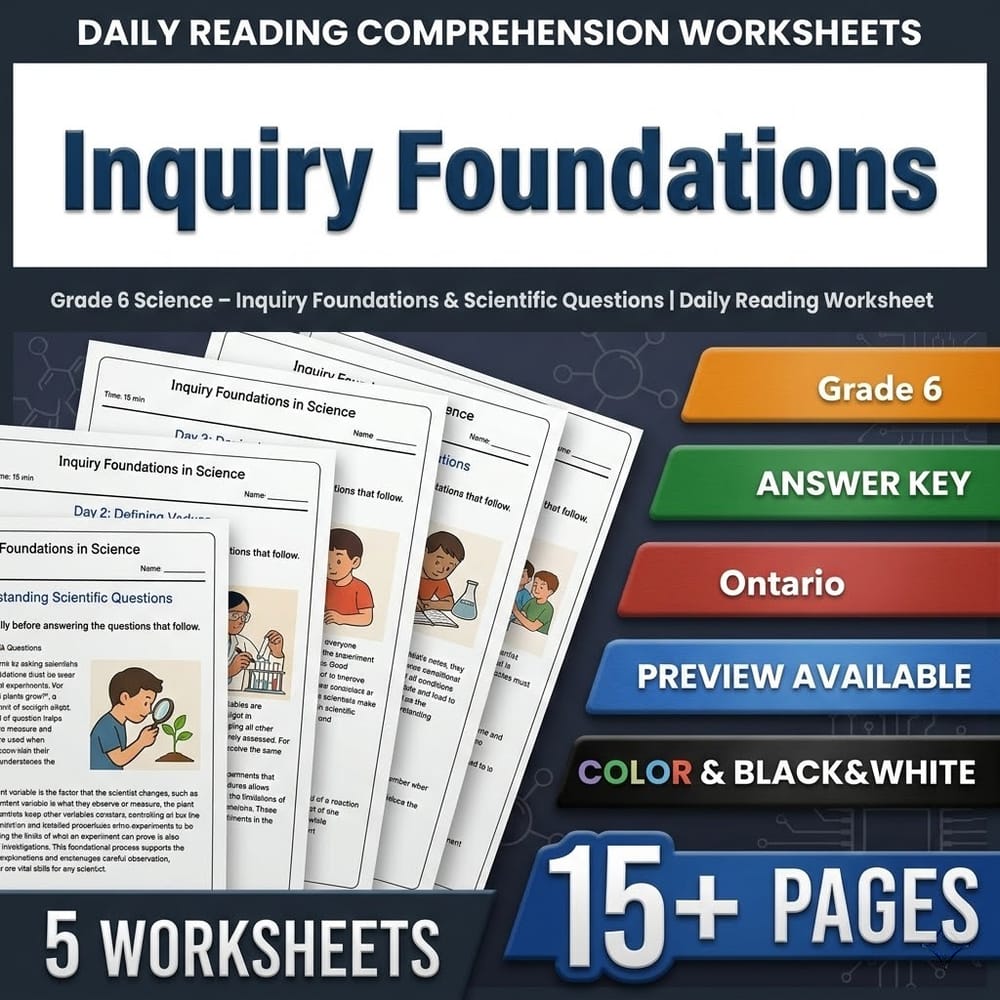
Grade 6 Science – Inquiry Foundations & Scientific Questions | Daily Worksheet
 Created byQuiet Forest Education
Learning Objectives
- Understand the importance of formulating clear, testable questions in science.
- Identify and define variables involved in scientific experiments.
- Differentiate between independent and dependent variables.
Also included in: Science Grade 6 Daily Reading Worksheets Bundle | Ontario Framework +1 more
Instant download
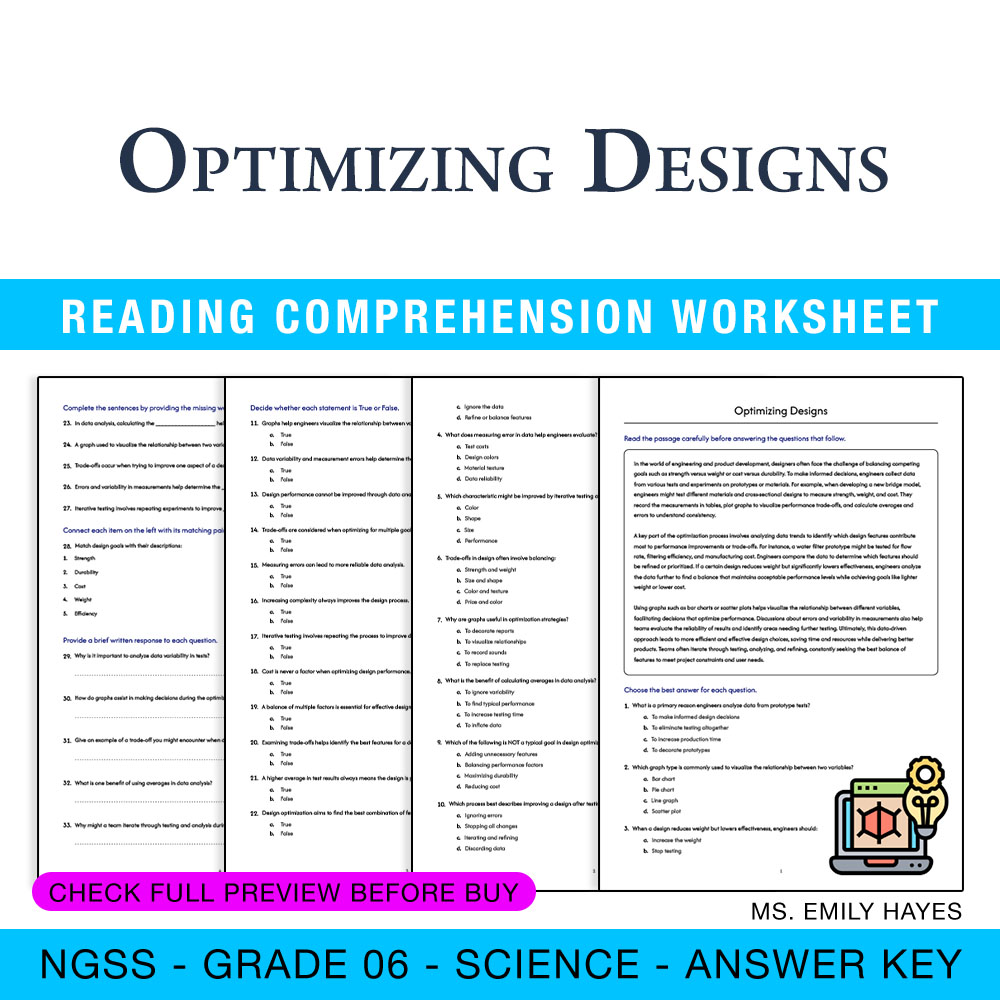
6th Grade Science | Optimizing Designs Worksheet (PDF + Answer Key)
Created byCopper Leaf ClassroomLearning Objectives
- Analyze comparative data from tests of different prototypes to evaluate performance characteristics.
- Identify trade-offs and support optimization strategies for design alternatives using graphs, averages, and error discussions.
- Evaluate how different design features affect strength, weight, cost, and durability to improve overall performance within constraints.
Instant download
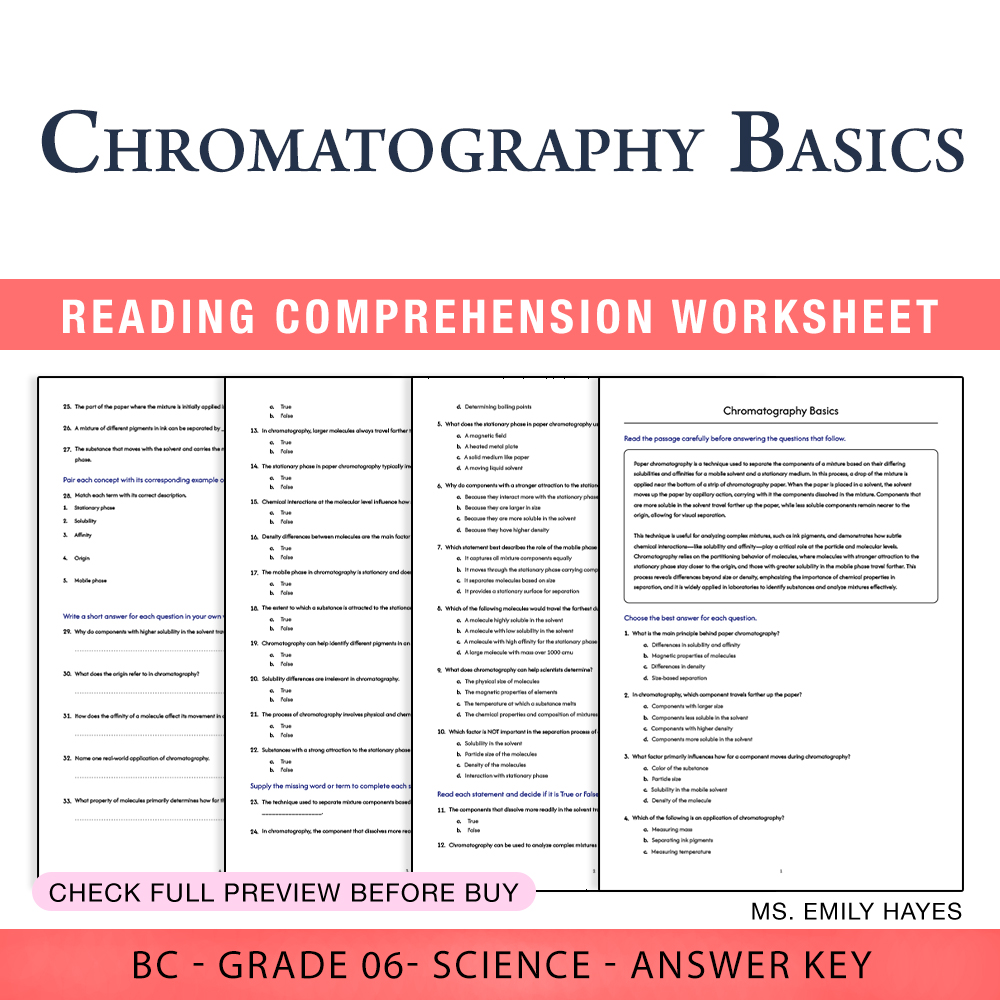
6th Grade Science | Chromatography Basics Worksheet (PDF+ Answer Key)
Created byCopper Leaf ClassroomLearning Objectives
- Describe the principle of chromatography and how it separates mixture components.
- Identify factors that influence the movement of substances during chromatography.
- Explain real-world applications of chromatography in analyzing complex mixtures.
Also included in: Grade 6 Science BC| Reaction Rates & Chemical Properties (PDF+ Answer Keys) +1 more
Instant download

6th Grade Science Worksheet | Comparative Flight Alberta Standards (PDF)
Created byEvergreen Desk EducationLearning Objectives
- Compare kites, gliders, and round canopies using lift-to-drag performance and glide ratio concepts
- Explain how control responsiveness changes with design choices across different flight envelopes
- Relate flight outcomes to real Alberta atmospheric conditions such as prairie crosswinds and valley thermals
Instant download

Solar and Lunar Eclipses Worksheets | Grade 6 Sky Science Activities
 Created bySunny Desk Resources
Learning Objectives
- Describe how the Sun, Earth, and Moon must align for solar and lunar eclipses
- Compare partial, total, and annular eclipses based on orbital geometry and alignment precision
- Explain why eclipses are relatively rare at a given location
Also included in: Sky Science Grade 6 Bundle | Alberta Science Worksheets & Activities +1 more
Instant download

Grade 6 Science | Limiting Resources Worksheet | California Standards
 Created byLumora Learning
Learning Objectives
- Explain what a limiting resource is and how scarcity affects population growth
- Describe how organisms respond when essential resources become limited
- Use the idea of carrying capacity to predict how populations change over time
Instant download
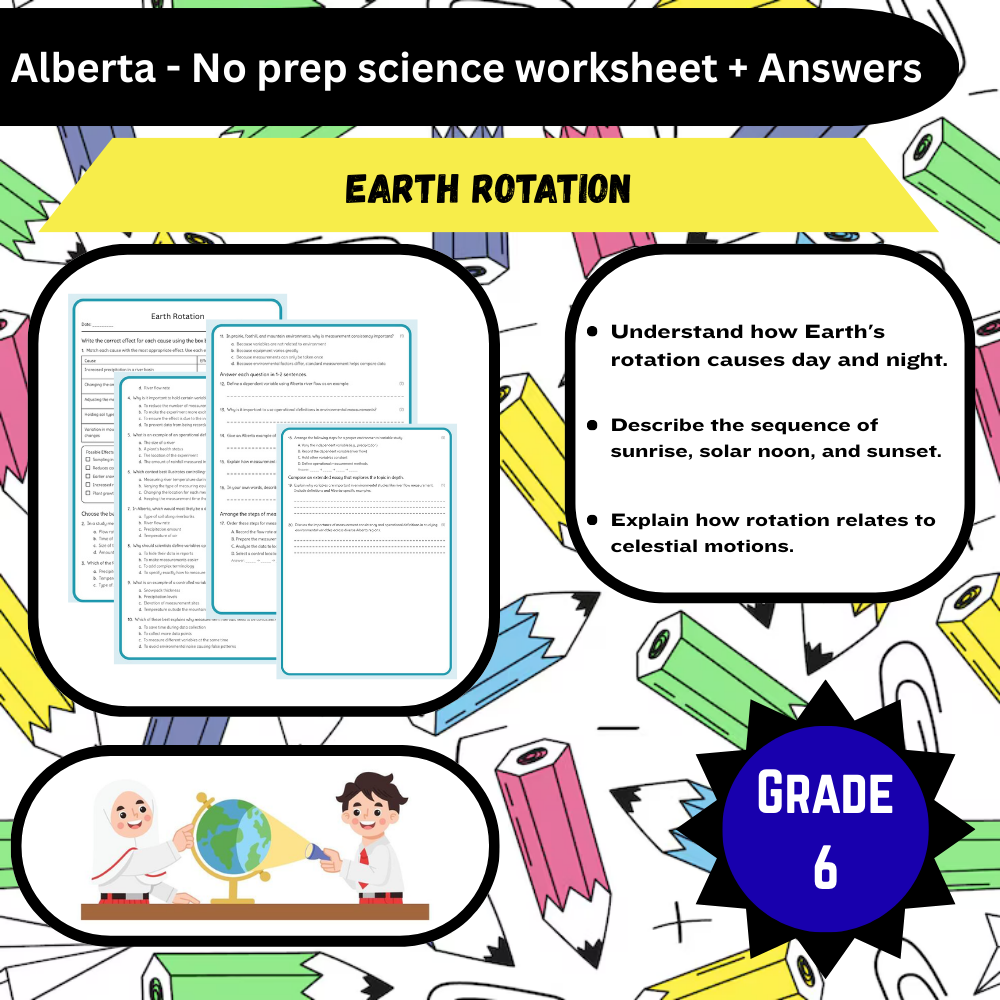
6th Grade Science – Earth Rotation Worksheet (PDF) | Alberta Standards
Created byBright Mind ResourcesLearning Objectives
- Understand how Earth's rotation causes day and night.
- Describe the sequence of sunrise, solar noon, and sunset based on Earth's rotation.
- Explain how Earth's rotation and revolution relate to celestial motions.
Instant download

6th Grade Science Counting Atoms Worksheet | Conservation of Matter (PDF)
Created byEvergreen Desk EducationLearning Objectives
- Explain conservation of matter using particle-level reasoning and atom counting.
- Use particle diagrams to count atoms of each element on both sides of a chemical reaction.
- Connect conservation of atoms to the idea that chemical change rearranges atoms into new combinations.
Instant download
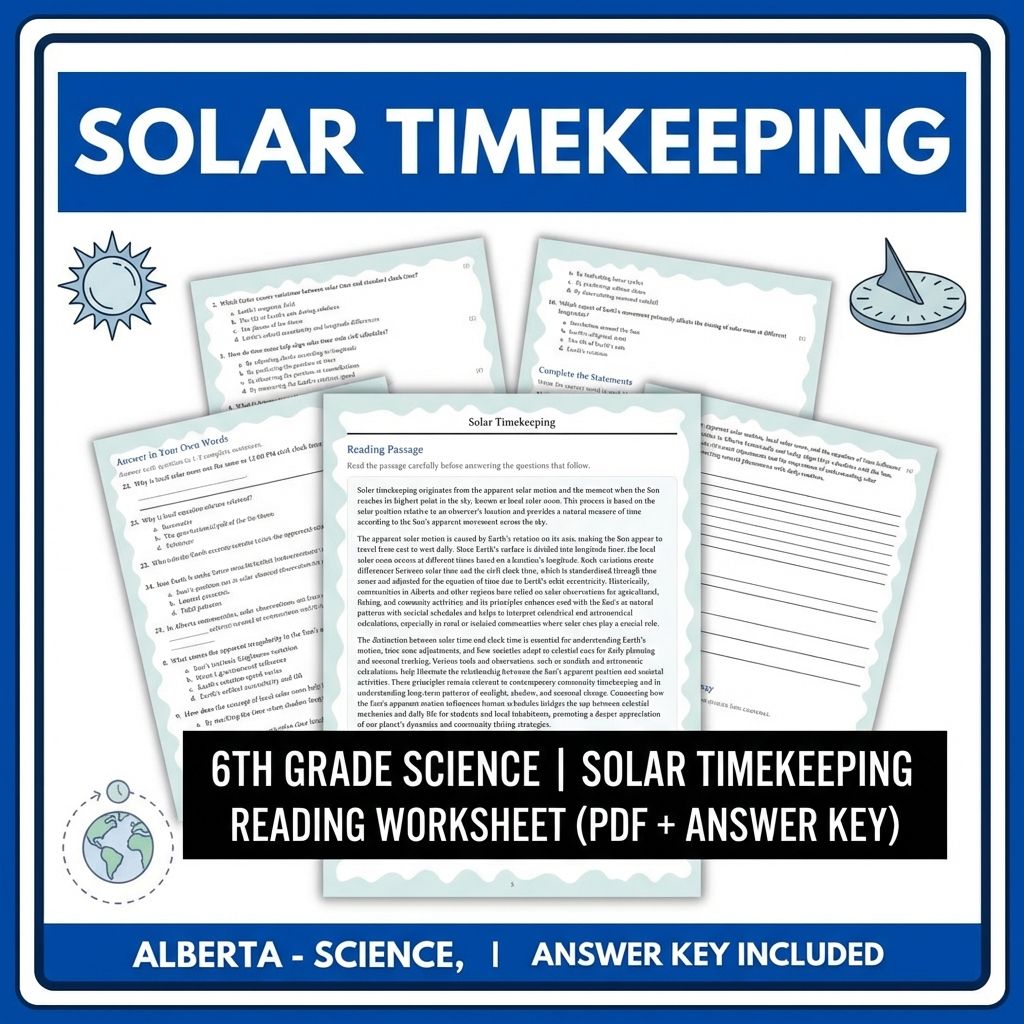
6th Grade Science | Solar Timekeeping Reading Worksheet (PDF + Answer Key)
JCreated byJ.S SheetsLearning Objectives
- Explain the concept of apparent solar motion and local solar noon.
- Identify the factors that cause differences between solar time and clock time.
- Describe how historical and modern communities in Alberta use solar time for daily schedules.
Also included in: Grade 6 Science | Celestial Motion & Sky Observation Worksheets Bundle +1 more
Instant download
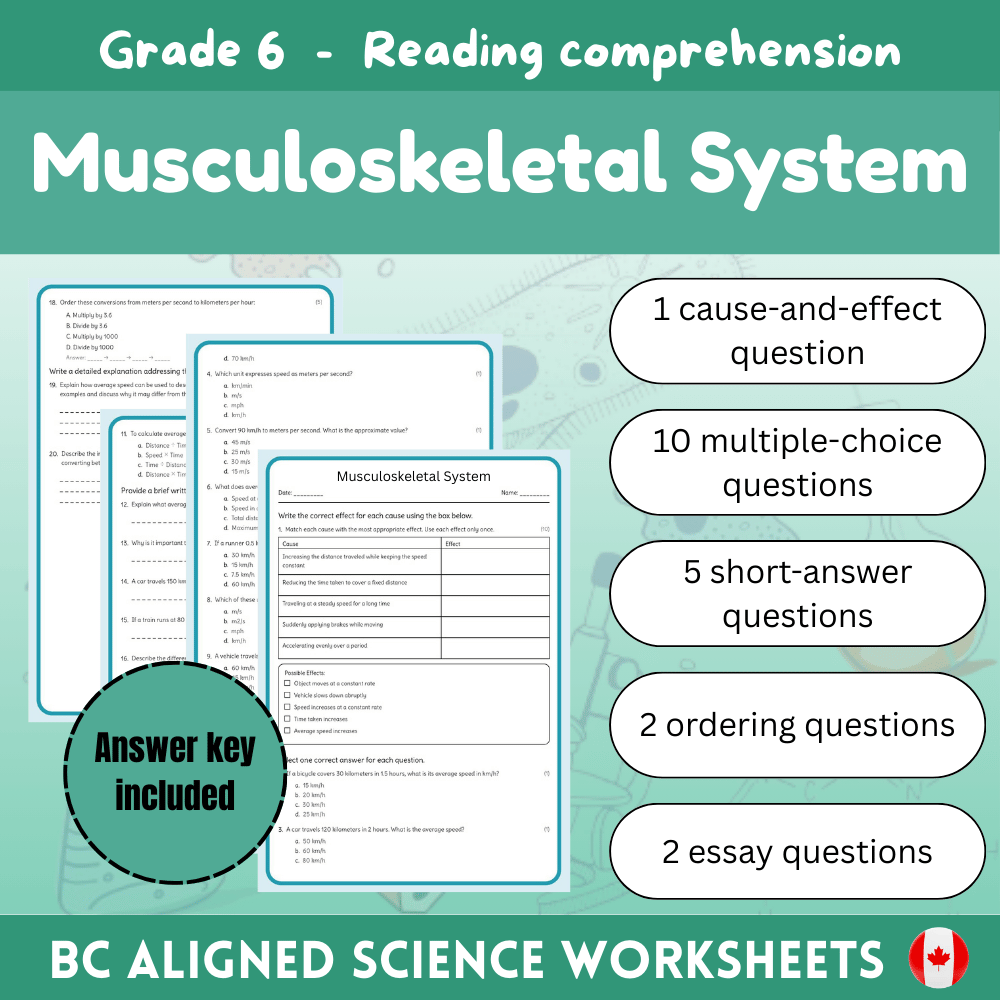
6th Grade Science | Musculoskeletal System Worksheet (Answer Key) – BC Standards
Created byBright Mind ResourcesLearning Objectives
- Describe the components and functions of the musculoskeletal system.
- Explain how bones, joints, and muscles work together to support movement and protection.
- Identify the interactions of the musculoskeletal system with the nervous and circulatory systems.
Instant download
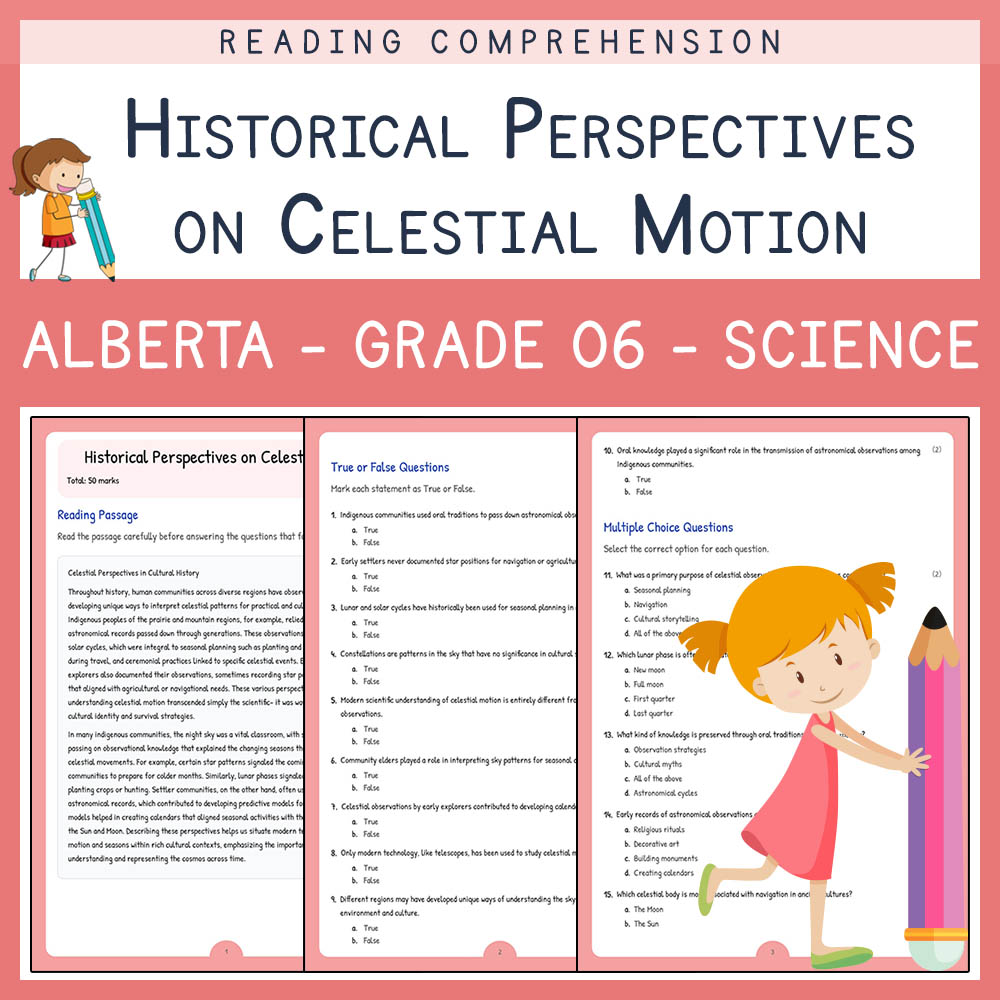
Grade 6 Science | Historical Perspectives on Celestial Motion | Alberta
Created byLumora LearningLearning Objectives
- Understand how Indigenous and settler communities interpreted sky patterns for seasonal and navigational purposes.
- Describe observational strategies tied to solar and lunar cycles used historically in prairie and mountain regions.
- Explore diverse cultural ways of representing and predicting celestial positions across time.
Instant download
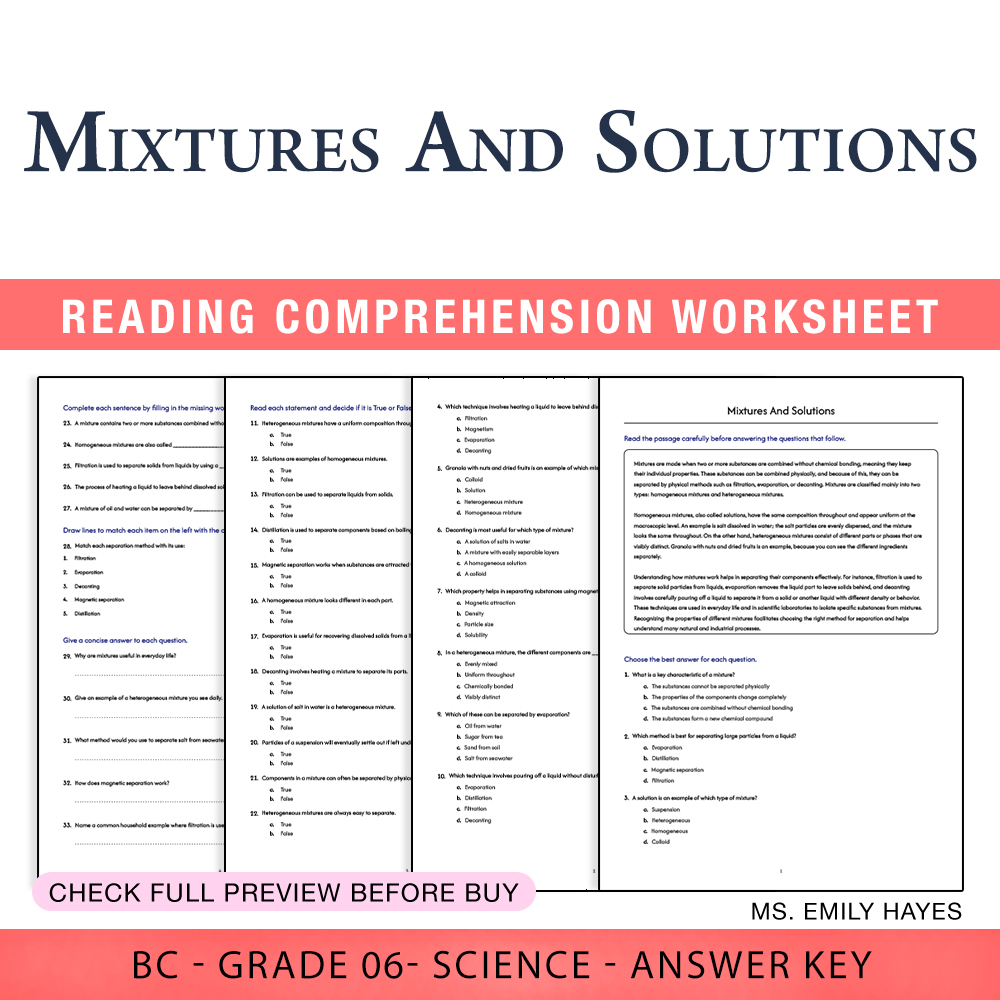
6th Grade Science | Mixtures And Solutions Worksheet (PDF+ Answer Key)
Created byCopper Leaf ClassroomLearning Objectives
- Understand the difference between mixtures and solutions.
- Identify characteristics of homogeneous and heterogeneous mixtures.
- Learn methods to separate components of mixtures such as filtration, evaporation, and decanting.
Also included in: Grade 6 Science BC| Reaction Rates & Chemical Properties (PDF+ Answer Keys) +1 more
Instant download

6th Grade Science Worksheets | Minerals and Rocks TEKS (PDF)
Created byEvergreen Desk EducationLearning Objectives
- Identify minerals using physical and chemical properties such as hardness, cleavage, streak, magnetism, and acid reaction.
- Classify rocks as igneous, sedimentary, or metamorphic using diagnostic evidence like texture, grain size, and sedimentary layering.
- Explain how the rock cycle connects mineral resources to formation environments, including contact metamorphism near intrusions.
Instant download
Grade 6 Science – Electric & Magnetic Forces | Daily Reading Worksheet
 Created byElena Brooks
Learning Objectives
- Understand the basic principles of electric forces such as attraction and repulsion.
- Identify factors that influence the strength of electric and magnetic forces.
- Differentiate between electric and magnetic interactions and how they operate.
Also included in: Grade 6 Science Motion and Stability Bundle | NGSS Forces and Interactions +1 more
Instant download
Grade 6 Science – Collisions & Momentum | Daily Reading Worksheet
Created byElena BrooksLearning Objectives
- Explain how force and momentum are involved during collisions.
- Identify different types of collisions and predict their effects on objects.
- Analyze force diagrams and apply conservation of momentum principles.
Also included in: Grade 6 Science Motion and Stability Bundle | NGSS Forces and Interactions +1 more
Instant download

Grade 6 Science – Forces & Motion | Daily Reading Worksheet
Created byElena BrooksLearning Objectives
- Identify different types of forces and understand their effects on objects
- Explain how net force influences the motion of objects
- Relate force, mass, and acceleration using mathematical concepts
Also included in: Grade 6 Science Motion and Stability Bundle | NGSS Forces and Interactions +1 more
Instant download
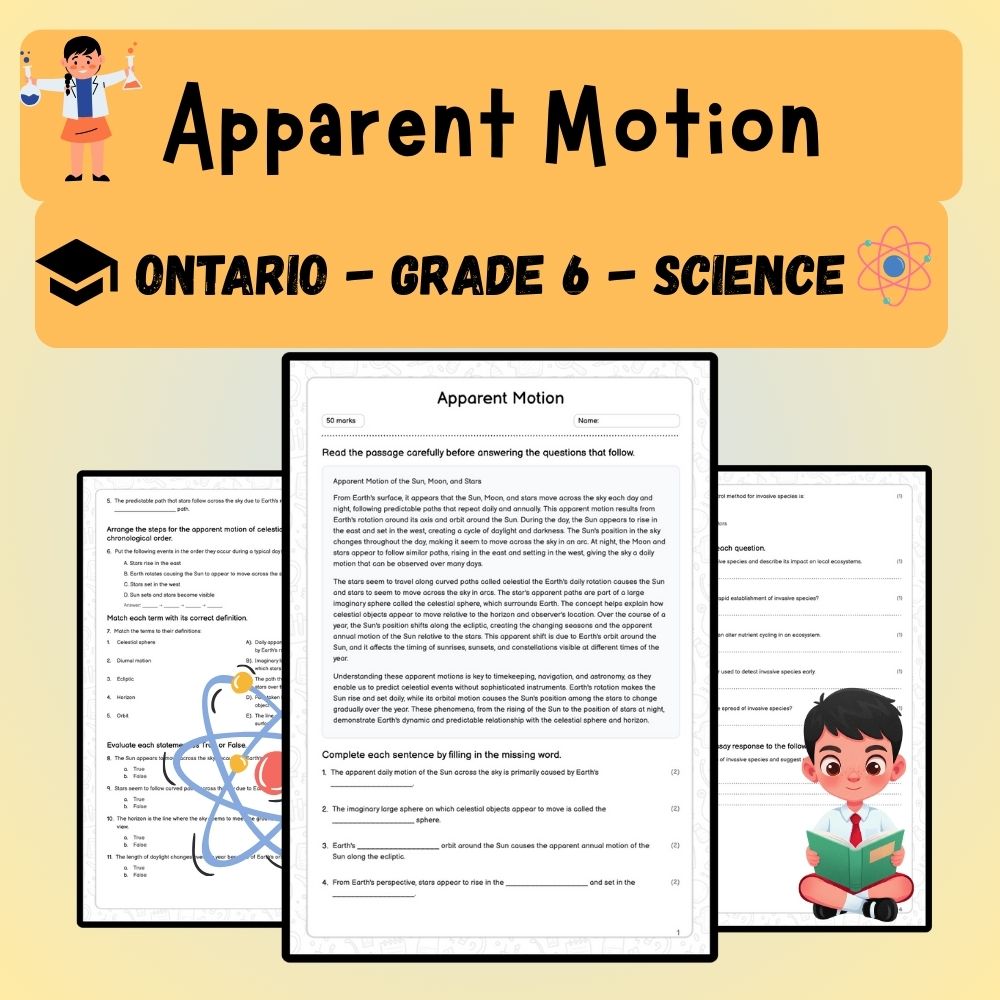
6th Grade Science | Apparent Motion Worksheet (PDF ) – Ontario Standards
Created byPrism Point LearningLearning Objectives
- Explain the daily and annual apparent motions of the Sun, Moon, and stars from Earth's perspective.
- Describe how Earth's rotation and orbit cause celestial phenomena such as rising, setting, and star paths.
Instant download
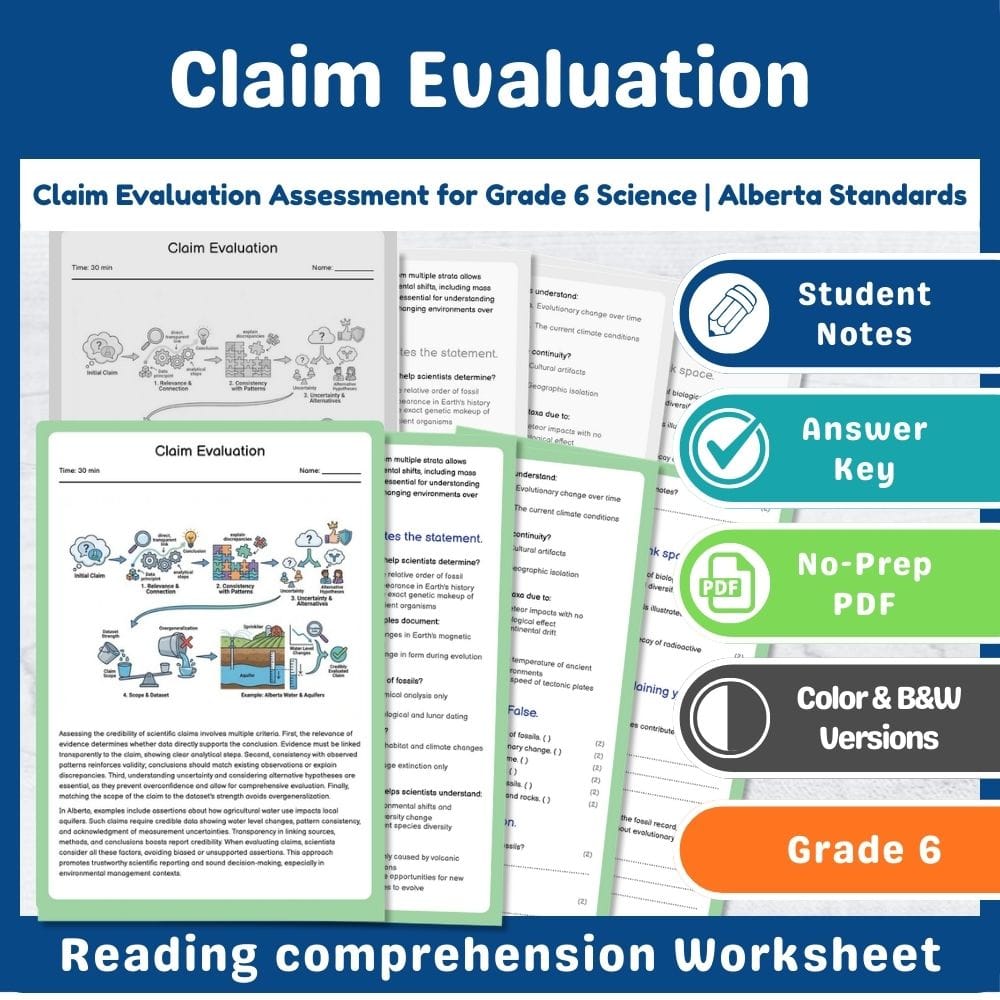
Claim Evaluation Assessment for Grade 6 Science | Alberta Standards
Created byPrism Point LearningLearning Objectives
- Understand criteria for assessing the relevance and consistency of evidence in claims.
- Evaluate the scope of claims in relation to data strength and uncertainty.
- Analyze examples of claim assessment in environmental contexts, such as agriculture and water use.
Also included in: Lesson Grade 6 Science Mini Bundle | Evidence and Investigation
Instant download
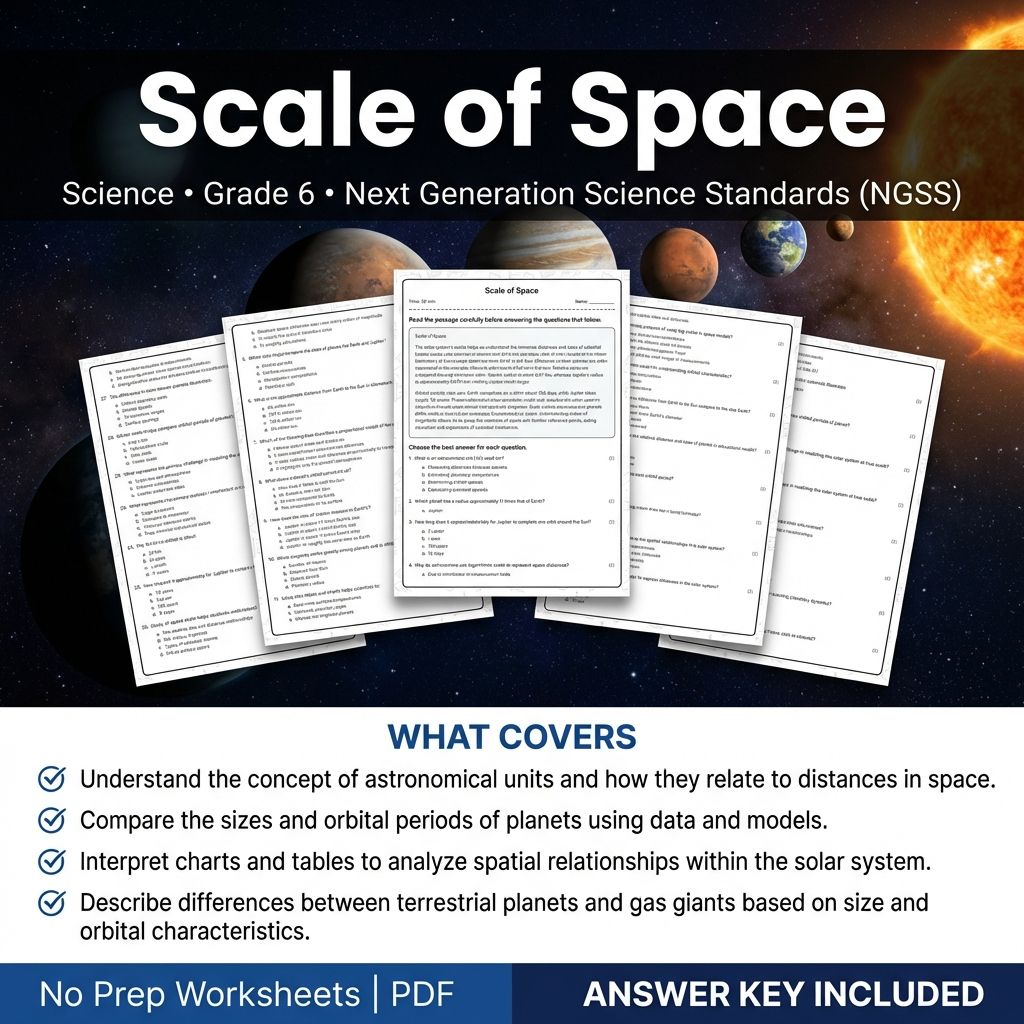
6th Grade Science Worksheet | Scale of Space Concepts & Practice (PDF & Answers)
 Created byCoral Reef Learning
Learning Objectives
- Understand the concept of astronomical units and how they relate to distances in space.
- Compare the sizes and orbital periods of planets using data and models.
- Interpret charts and tables to analyze spatial relationships within the solar system.
Instant download

6th Grade Science Worksheet | Pressure Patterns & Wind Concepts (PDF)
Created byEvergreen Desk EducationLearning Objectives
- Explain how uneven heating creates pressure gradients that influence wind direction and speed.
- Describe how low and high pressure zones form and change in response to temperature and air movement.
- Connect regional landforms (mountains, plains, river valleys) to local pressure circulation and weather.
Instant download

6th Grade Science | Understanding Pressure Patterns Worksheet (Alberta Standards) (PDF)
 Created bySilver Birch Teaching
Learning Objectives
- Explain how uneven heating creates pressure gradients that affect wind patterns.
- Describe how high- and low-pressure zones form and influence everyday weather.
- Identify how landforms (mountains, plains, river valleys) can change local pressure circulation.
Also included in: Grade 6 Aerodynamics & Flight Forces Science Lesson Bundle: Alberta +1 more
Instant download
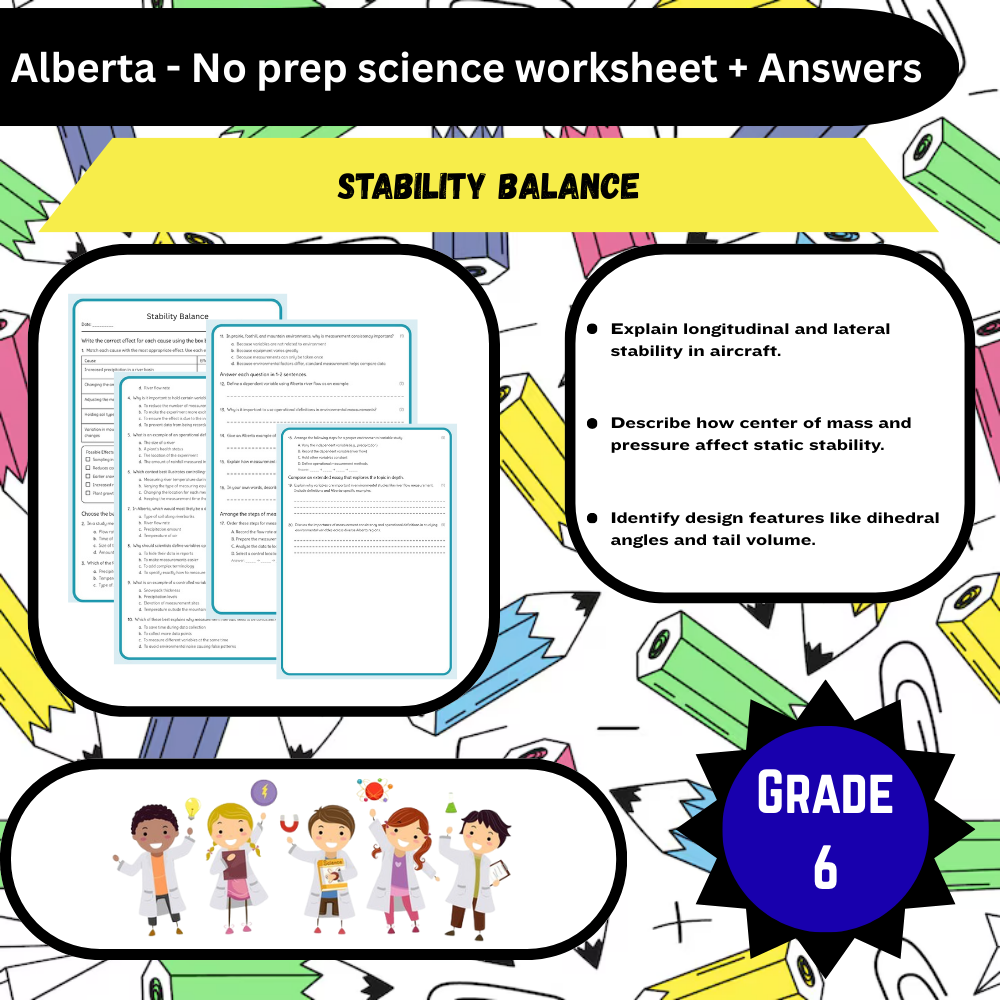
6th Grade Science – Stability & Balance Worksheet (PDF)
Created byBright Mind ResourcesLearning Objectives
- Explain the concepts of longitudinal and lateral stability in aircraft and small gliders.
- Describe how the position of the center of mass and center of pressure affects static stability.
- Identify design features such as dihedral angles and tail volume that influence an aircraft's stability.
Instant download
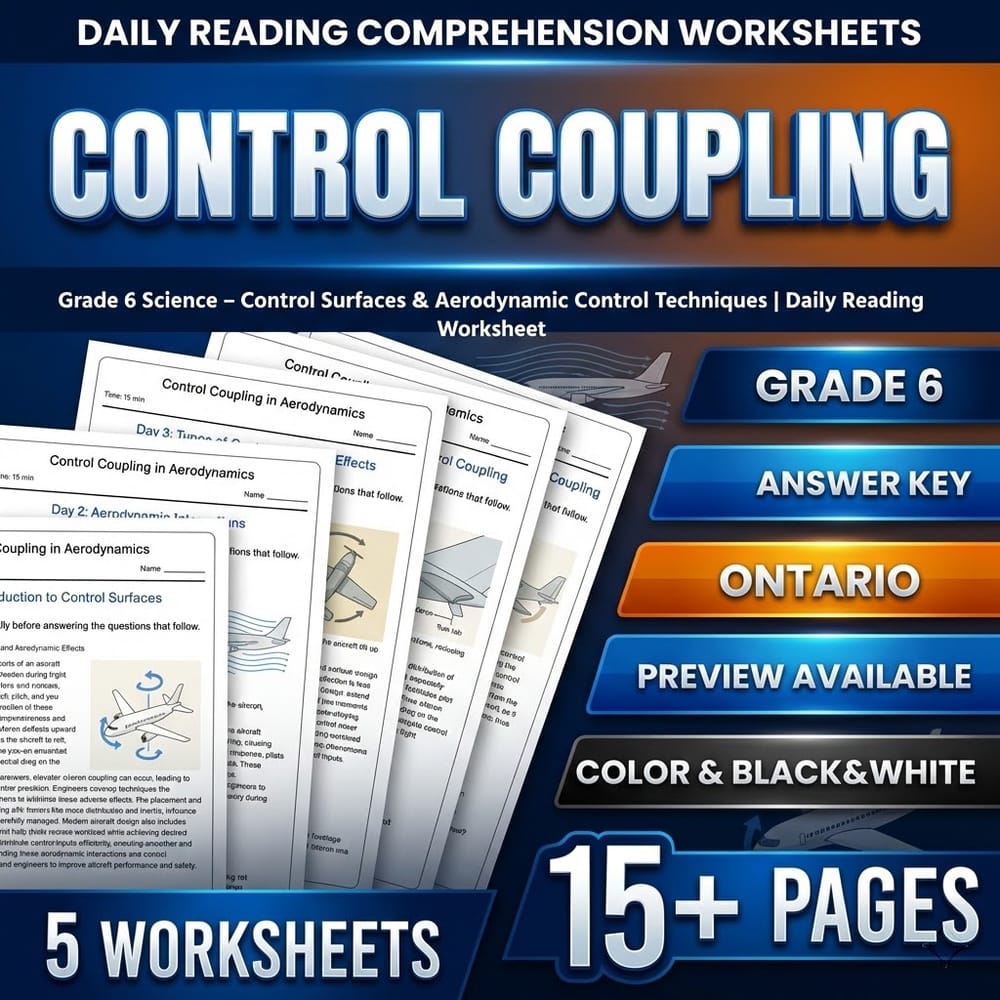
Grade 6 Science – Control Surfaces & Aerodynamic Techniques | Daily Worksheet
Created byQuiet Forest EducationLearning Objectives
- Understand the concepts of control coupling in aircraft.
- Identify various airplane control surfaces and their functions.
- Recognize the impacts of aerodynamic interactions like adverse yaw and elevator-aileron coupling.
Also included in: Flight Science Grade 6 Daily Reading Worksheets Bundle | Ontario +1 more
Instant download
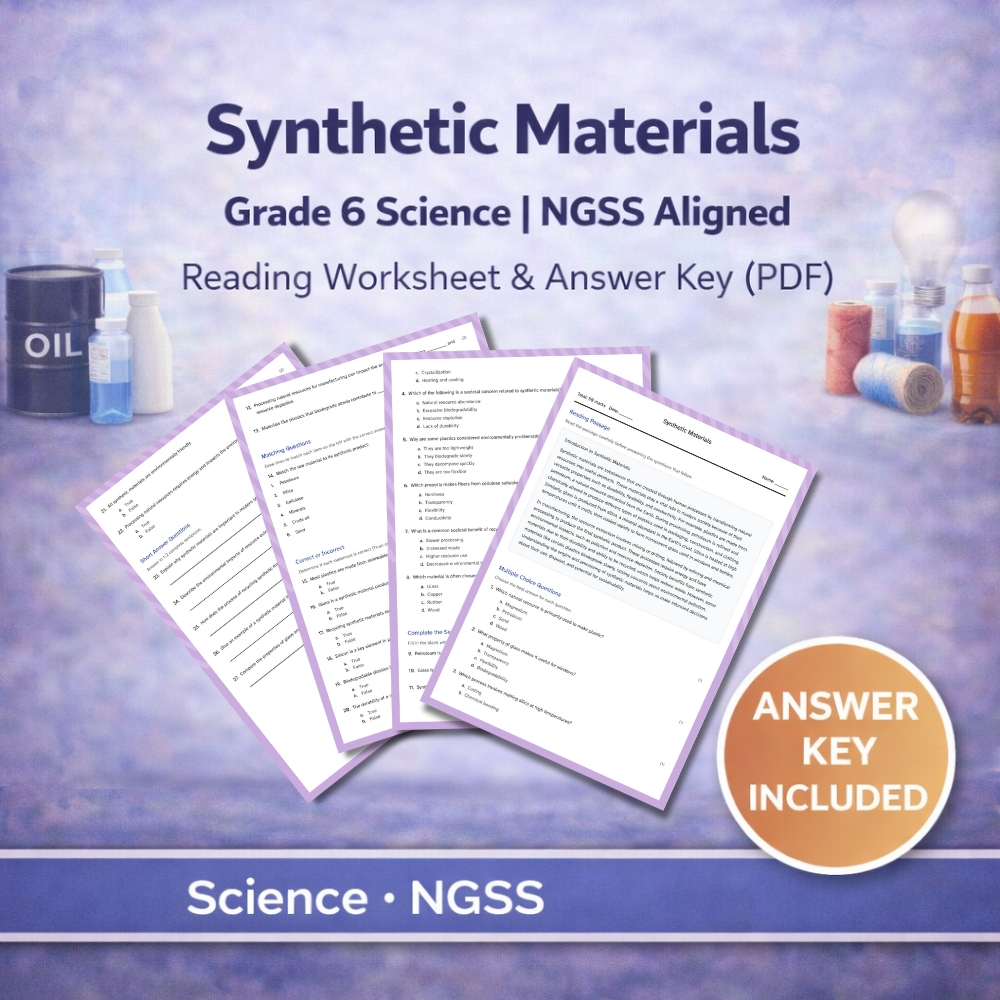
6th Grade Science | Synthetic Materials | Worksheet & Answer Key (NGSS)
Created byCedar Grove LearningLearning Objectives
- Understand the origins of synthetic materials and how natural resources are transformed into manufactured products.
- Compare the properties of different materials such as plastic, fiber, and glass, and relate these to their uses and societal impacts.
- Explain the processes of resource extraction and processing involved in producing synthetic materials.
Also included in: Grade 6 Science | Atomic & Molecular Models, Conservation & Reactions | NGSS +1 more
Instant download
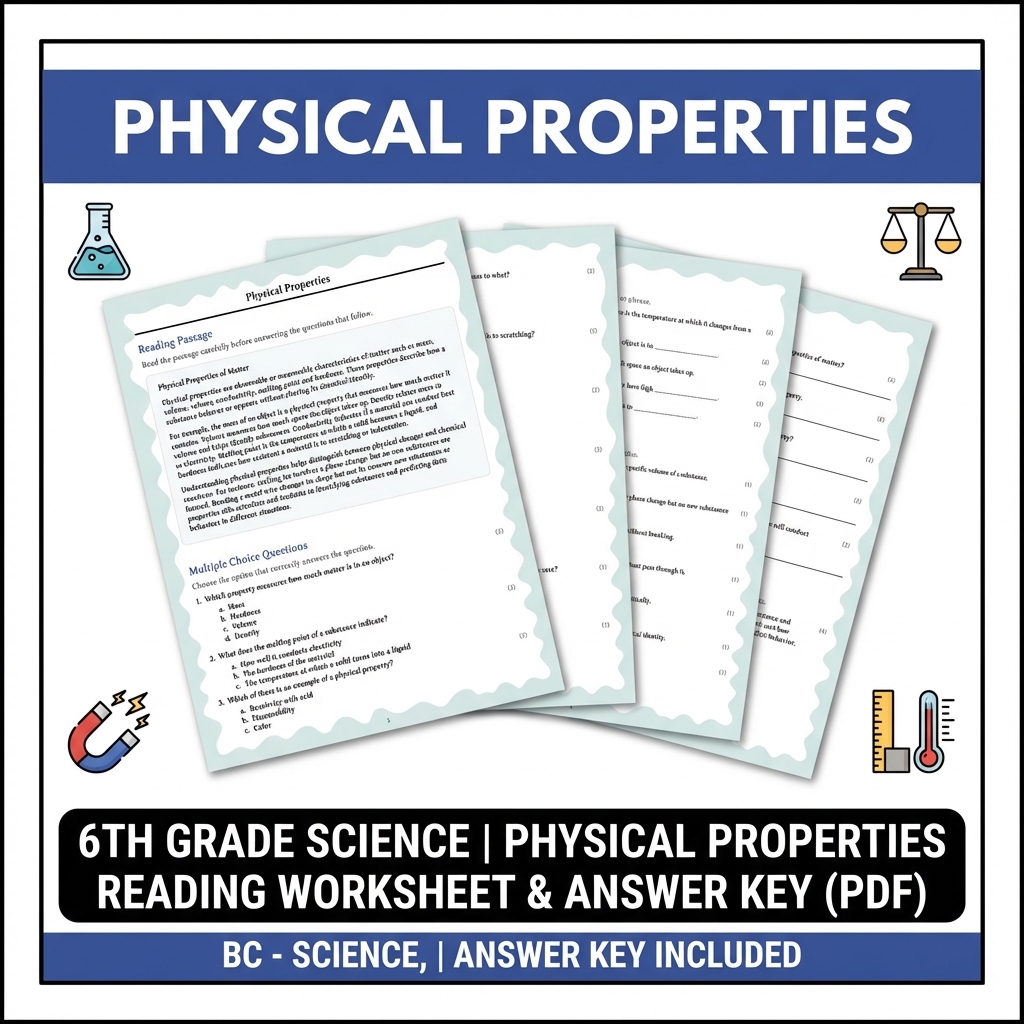
6th Grade Science | Physical Properties Reading Worksheet & Answer Key (PDF)
JCreated byJ.S SheetsLearning Objectives
- Understand the key physical properties used to describe matter.
- Identify and differentiate between various physical properties such as mass, volume, density, conductivity, melting point, and hardness.
- Recognize how physical properties can be observed or measured without changing the chemical identity of a substance.
Instant download
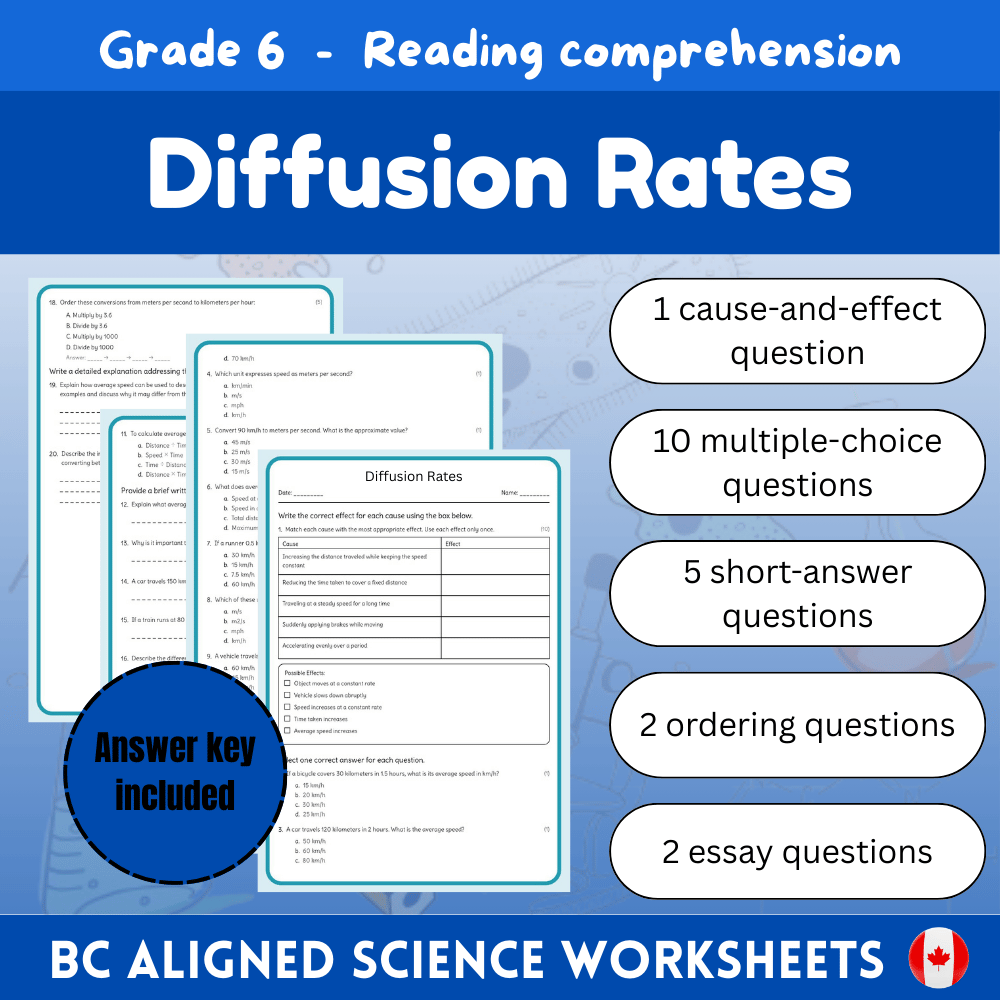
Grade 6 Science | Diffusion Rates Worksheet (Answer Key) – BC Standards
Created byBright Mind ResourcesLearning Objectives
- Explain the process of diffusion and how it moves particles from high to low concentration.
- Describe how temperature, particle size, and medium viscosity influence diffusion rates.
- Connect microscopic particle motion to observable diffusion phenomena like scent spreading and dye dispersal.
Instant download
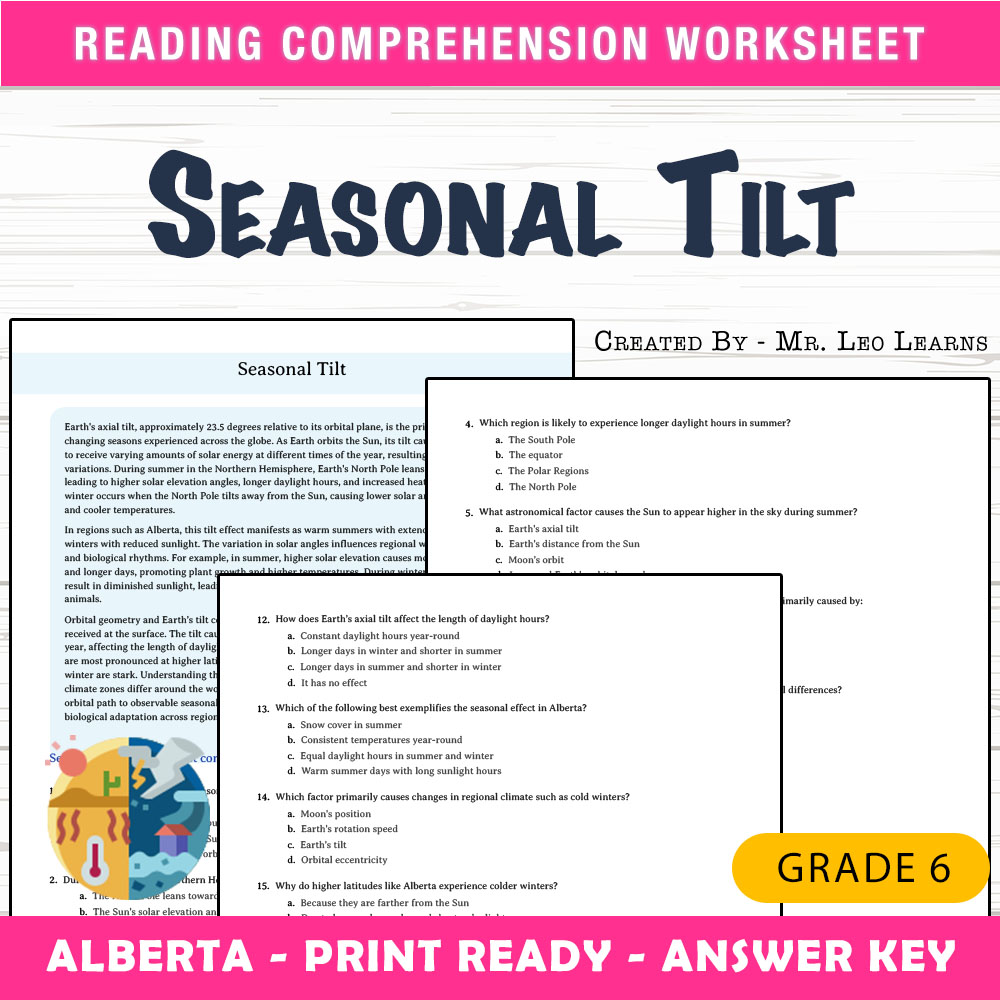
Grade 6 Science — Seasonal Tilt Worksheet MCQ Paper for Mastery
 Created byThe Resource Hub
Learning Objectives
- Understand how Earth's axial tilt causes seasonal variation in sunlight and climate.
- Explain the relationship between solar elevation, daylight duration, and seasons.
- Identify regional examples of seasonal effects, such as Alberta's summer and winter conditions.
Also included in: Grade 6 Science Sky Science Unit Bundle – Celestial Motion & Earth-Sun Relations +1 more
Instant download
About Grade 6 Science Worksheets
Explore Grade 6 Science worksheets for classwork, homework, or review. Our 5,997 printables download instantly as PDFs.
MyTeachingSheets worksheets are made by real teacher-authors and checked before they go live. Download any as a print-ready PDF for lessons, homework, or independent practice — most include answer keys, and previews are always free.