
Grade 6 Science Worksheets
5,997 worksheets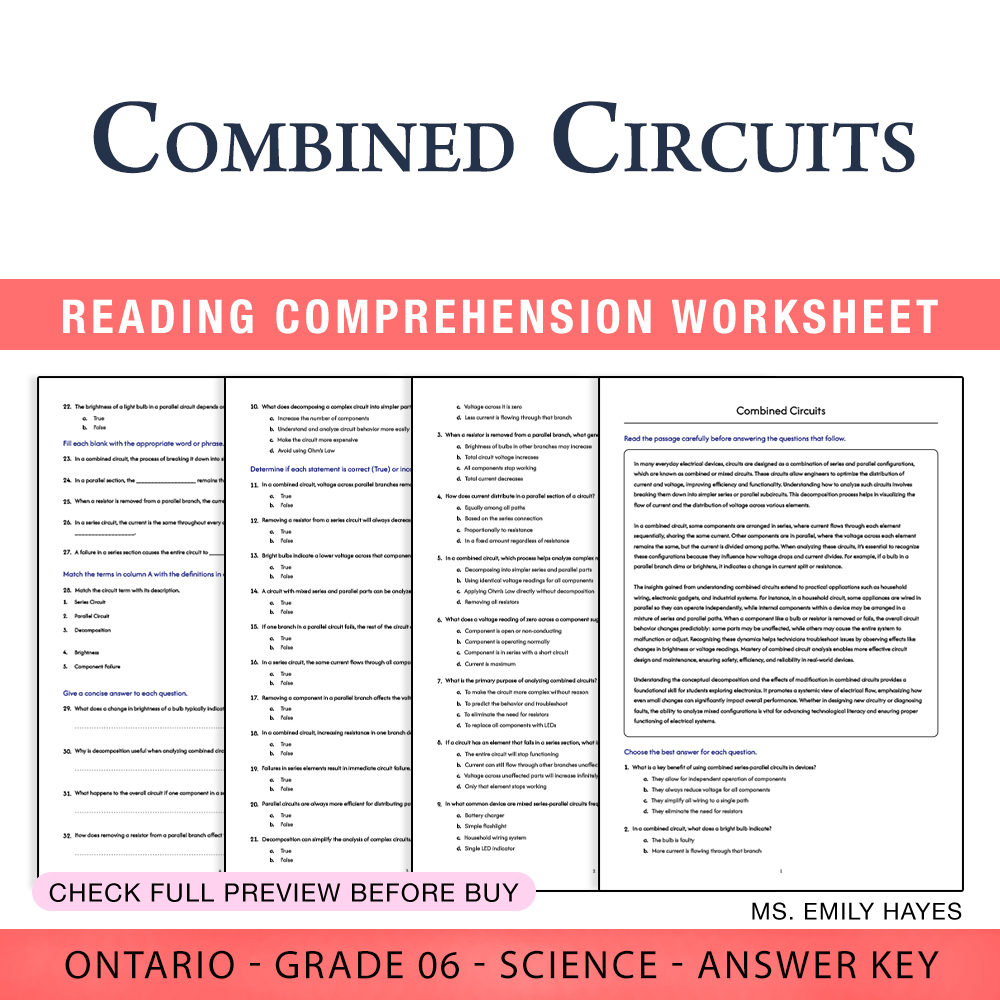
6th Grade Science | Combined Circuits Worksheet (PDF + Answer Key)
 Created byCopper Leaf Classroom
Learning Objectives
- Understand the basic concepts of combined series-parallel electrical circuits
- Analyze how current and voltage distribute in mixed circuit configurations
- Identify the effects of element removal or failure on circuit behavior
Instant download
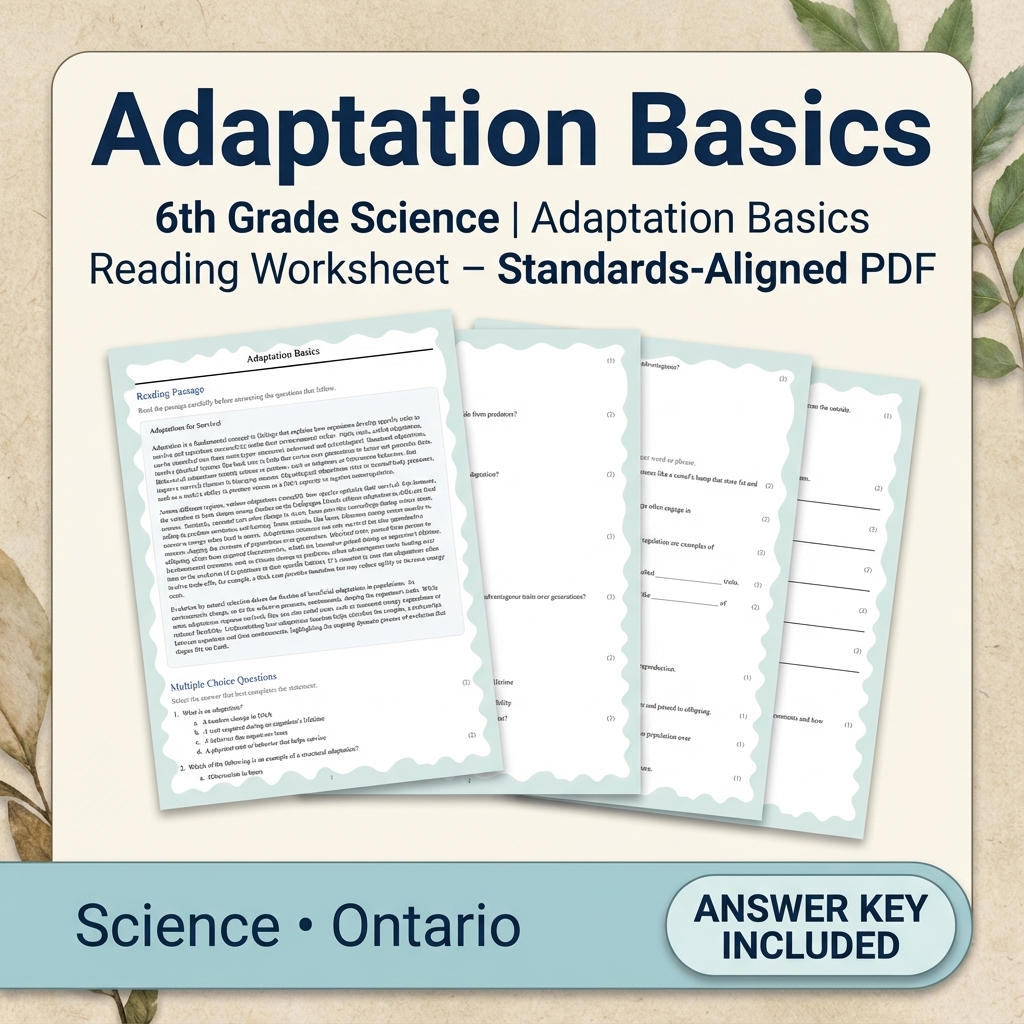
6th Grade Science | Adaptation Basics Reading Worksheet – Standards-Aligned PDF
JCreated byJ.S SheetsLearning Objectives
- Understand the types of adaptations (structural, behavioral, physiological)
- Identify regional examples of adaptations and how they influence survival
- Explain how inherited traits differ from acquired characteristics
Also included in: Grade 6 Science Unit Bundle – Ecosystems, Biodiversity & Environmental Impact +1 more
Instant download

6th Grade Science Worksheets | Exploring Indigenous Sky Knowledge (PDF)
 Created bySilver Birch Teaching
Learning Objectives
- Explain how different communities used observations of the sky to plan for seasons and daily activities
- Describe how solar and lunar cycles can be used to predict changes in daylight and timing
- Connect scientific ideas about celestial motion to cultural and historical ways of recording observations
Also included in: Grade 6 Celestial Motion & Seasons Science Lesson Bundle | Alberta +1 more
Instant download
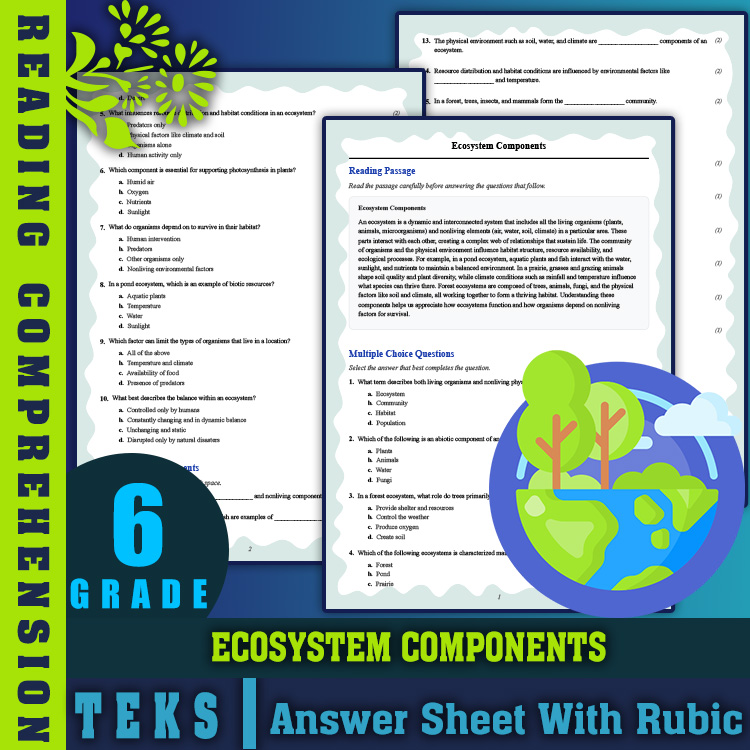
6th Grade Science | Ecosystem Components Reading Worksheet (PDF + Answer Key)
JCreated byJ.S SheetsLearning Objectives
- Define ecosystems as interacting systems of populations, communities, and physical factors.
- Identify biotic and abiotic components and explain their roles in habitat structure.
- Describe examples of ecosystems such as ponds, prairies, and forests and understand resource distribution and habitat relationships.
Instant download
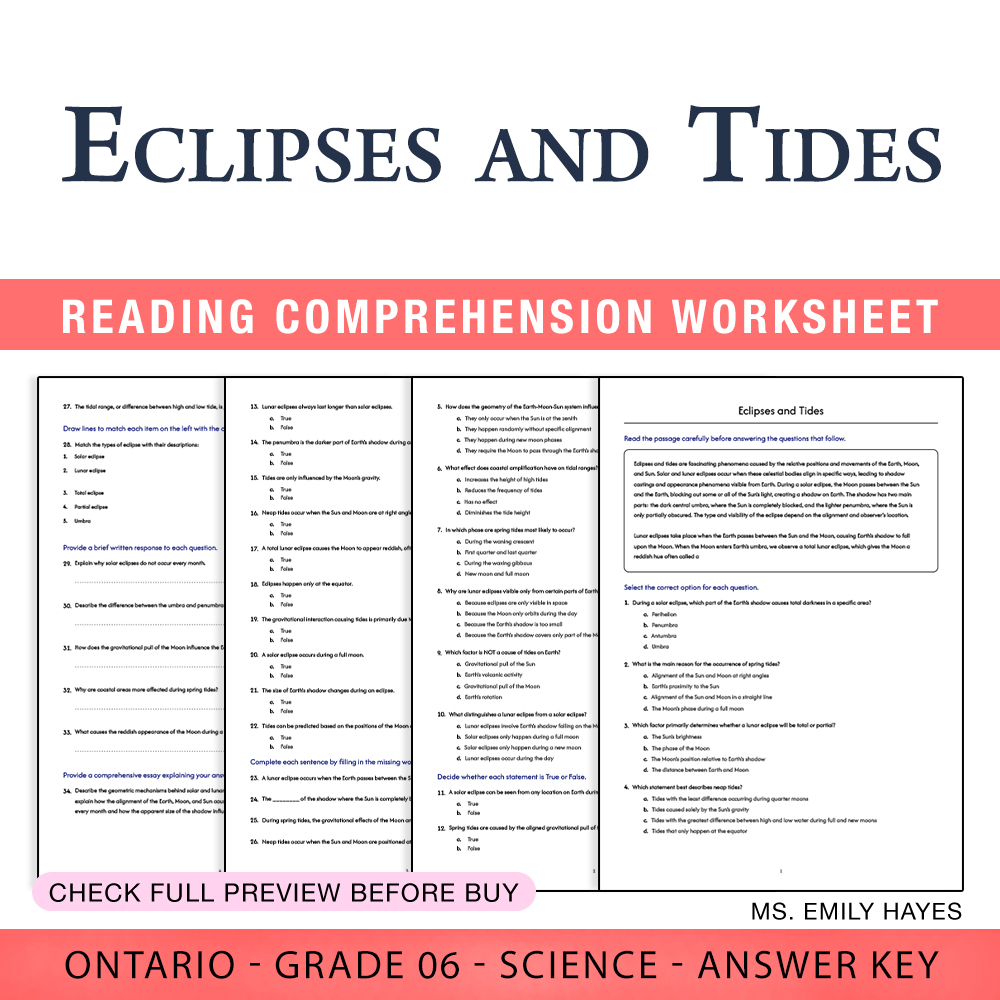
6th Grade Science | Eclipses & Tides Comprehension Worksheet (PDF + Answer Key)
Created byCopper Leaf ClassroomLearning Objectives
- Describe the geometric conditions that lead to solar and lunar eclipses, including the concepts of umbra and penumbra.
- Explain the causes of tides through gravitational interactions between the Earth, Moon, and Sun, including the differences between spring and neap tides.
Instant download
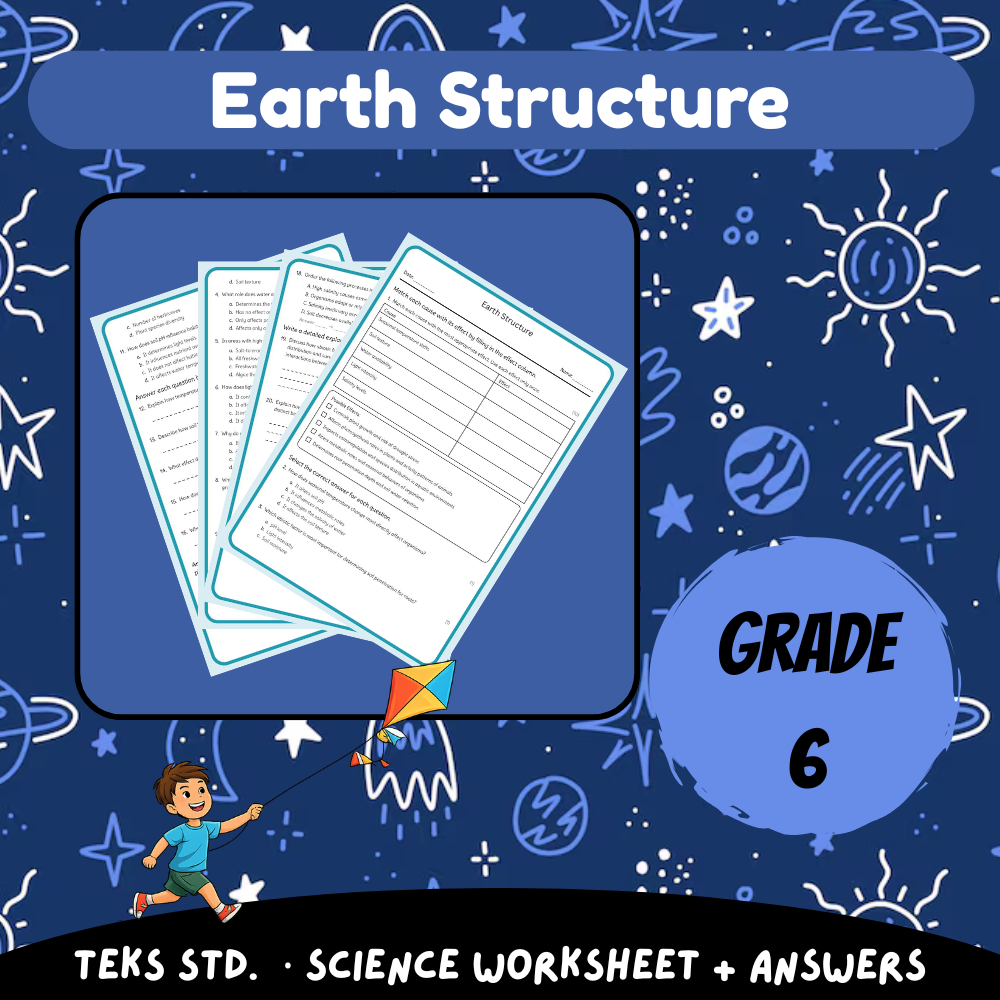
6th Grade Science – Earth Structure (Worksheet + Answer Key) | TEKS Aligned
 Created byBright Mind Resources
Learning Objectives
- Describe the internal structure of Earth and the processes driving tectonic plate movements.
- Identify different types of plate boundaries and the surface features associated with them.
- Explain geological phenomena such as earthquakes, volcanic eruptions, and mountain building in terms of tectonic processes.
Instant download

Circuit Diagrams Test Prep Printables | Grade 6 Science
 Created byPrism Point Learning
Learning Objectives
- Identify common symbols on circuit diagrams, including sources, conductors, switches, loads, and meters
- Explain how current and voltage are represented in circuit diagrams and what they mean for charge flow and energy changes
- Translate a simple physical circuit into a labeled circuit diagram and compare possible configurations
Also included in: Energy, Waves & Circuits Lesson Bundle | Grade 6 Science | BC Framework +1 more
Instant download
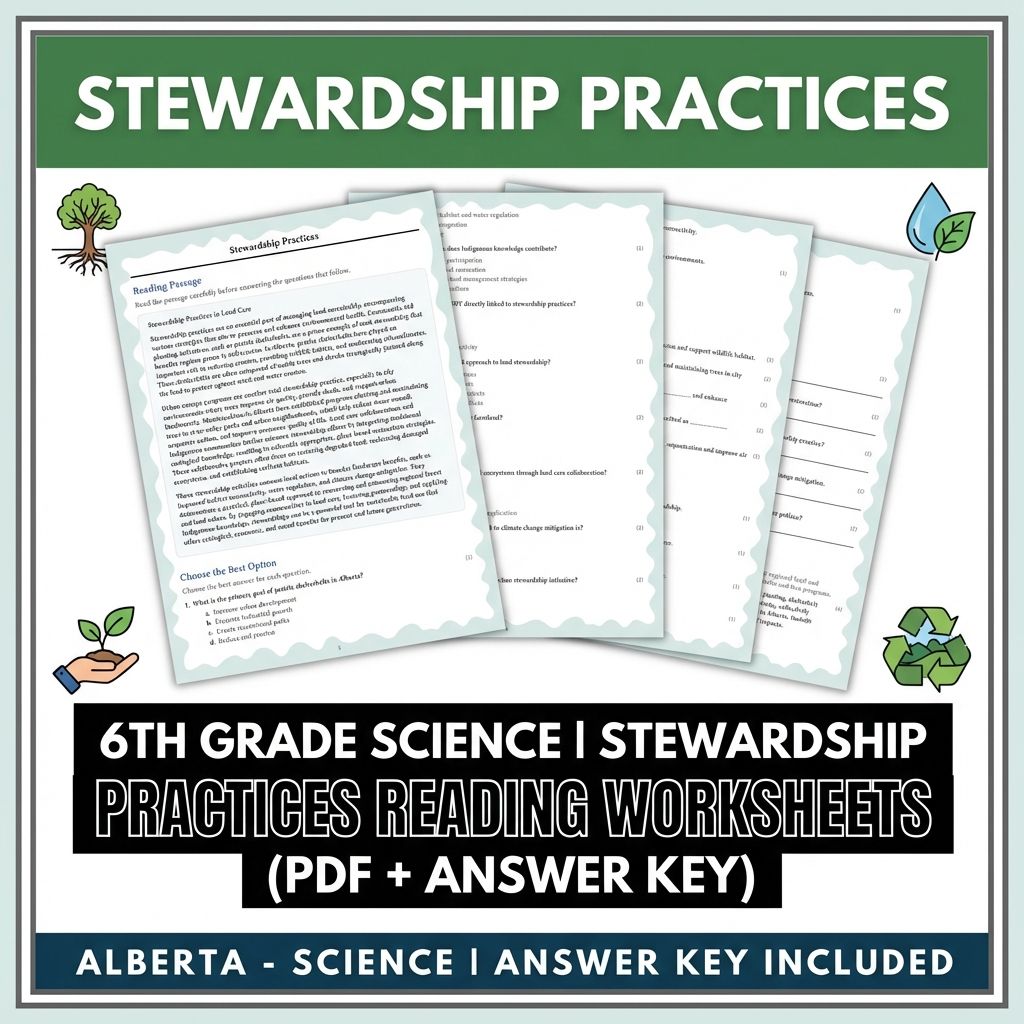
6th Grade Science | Stewardship Practices Reading Worksheets (PDF + Answer Key)
JCreated byJ.S SheetsLearning Objectives
- Understand community-based stewardship practices such as planting and shelterbelt establishment.
- Identify land care methods that improve habitat, water, and carbon storage.
- Recognize examples of land stewardship from Alberta such as prairie shelterbelts and municipal tree programs.
Also included in: Grade 6 Science Unit Bundle | Ecosystems and Biodiversity (Answer Keys Included) +1 more
Instant download
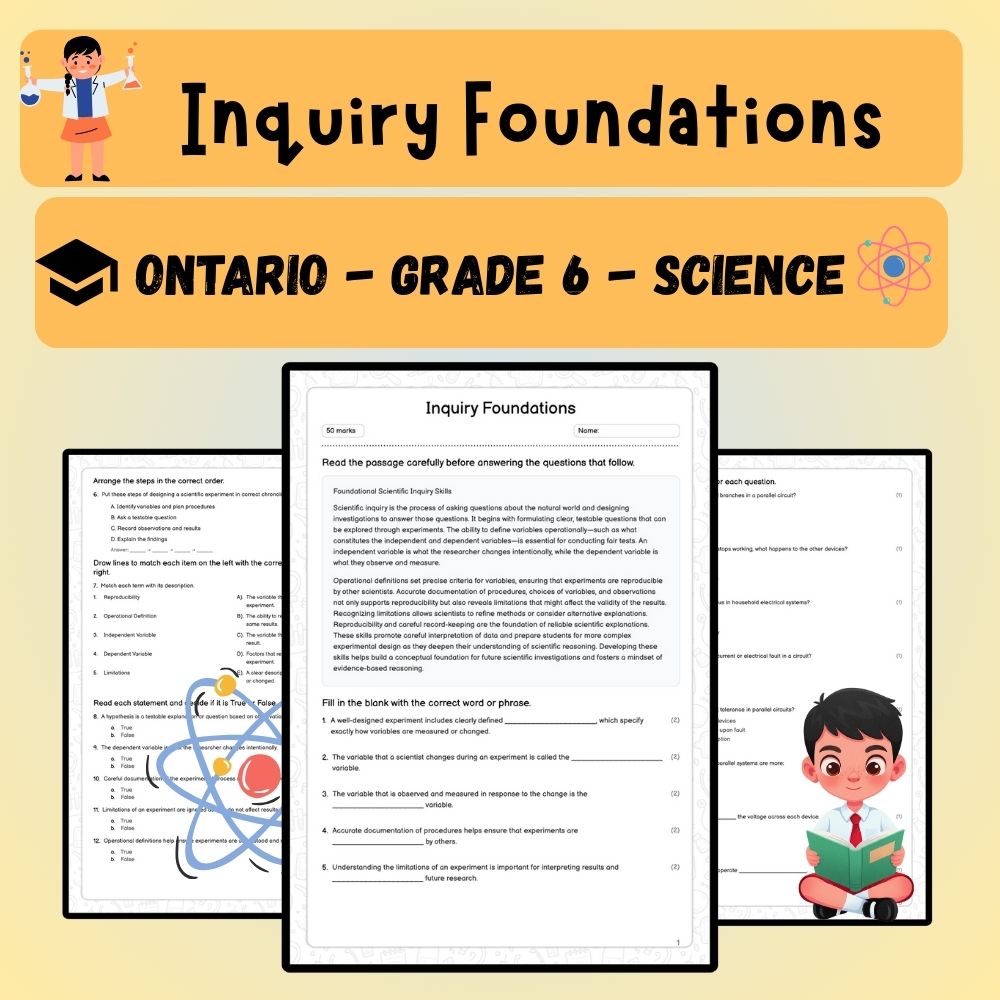
6th Grade Science | Inquiry Foundations Worksheet (PDF ) – Ontario Standard
Created byPrism Point LearningLearning Objectives
- Understand the key concepts of scientific inquiry, including posing testable questions and defining variables.
- Learn to distinguish between independent and dependent variables and establish fair tests through operational definitions.
- Practice documenting procedures for reproducibility and recognizing limitations of experiments.
Also included in: Grade 6 Science Unit | Inquiry, Modeling & Data Skills Worksheet Bundle
Instant download

Grade 6 Science Careers Daily Reading Worksheet | TEKS STEM Activity
 Created byBRIGHT PATH RESOURCES
Learning Objectives
- Identify the main idea and key details in a science career passage.
- Explain how scientific questions lead to data collection, equipment use, and communication of results.
Also included in: Science in Society Daily Reading Worksheets Bundle | Grade 6 Science | TEKS +1 more
Instant download

Grade 6 Clean Water Safer Communities Daily Reading | TEKS Science
Created byBRIGHT PATH RESOURCESLearning Objectives
- Identify evidence that supports a public health action.
- Explain cause-and-effect relationships in water safety decisions.
- Use indicators to judge short-term and long-term impacts on community health.
Also included in: Science in Society Daily Reading Worksheets Bundle | Grade 6 Science | TEKS +1 more
Instant download
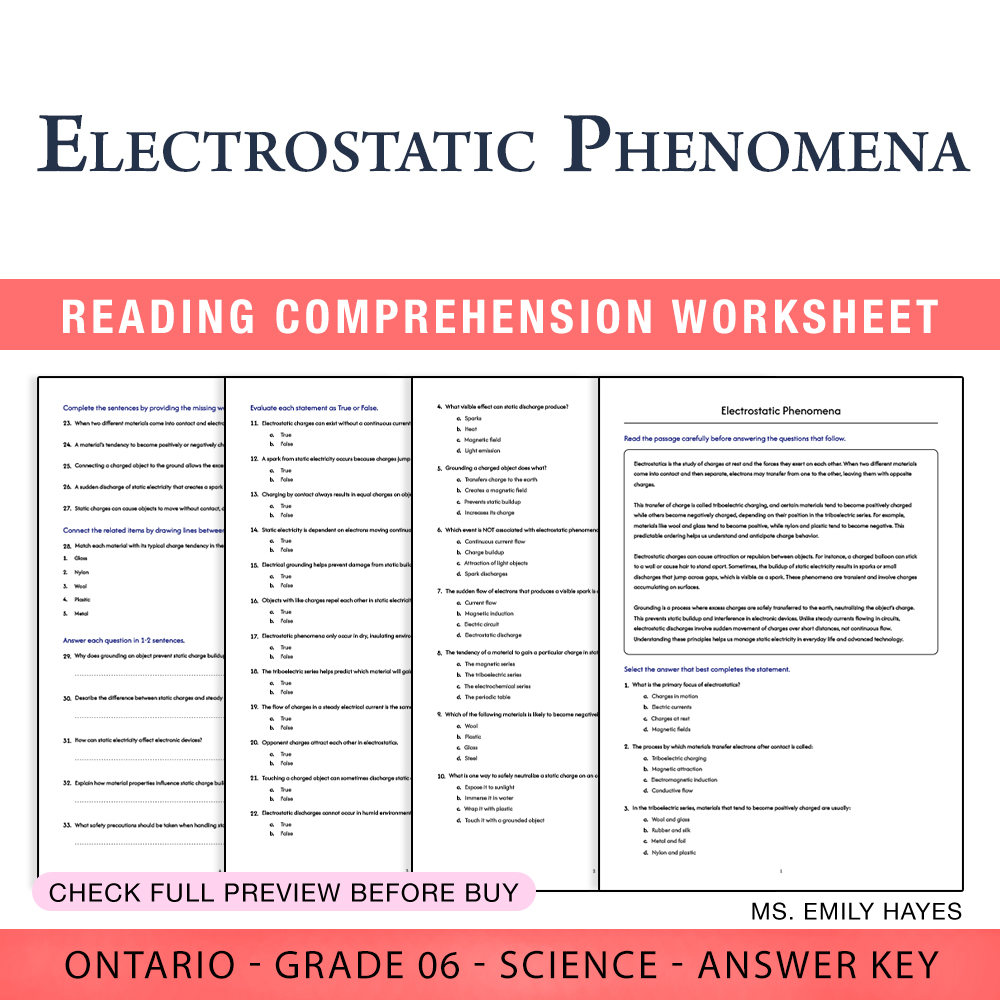
6th Grade Science | Electrostatic Phenomena Worksheet (PDF + Answer Key)
Created byCopper Leaf ClassroomLearning Objectives
- Explain the concept of static electricity and how charge transfer occurs between materials.
- Describe the triboelectric series and its use in predicting charge tendencies of materials.
- Identify common phenomena related to electrostatics such as attraction, repulsion, and sparks.
Instant download

Science Grade 6 Worksheet: Defining Problems NGSS Assessment
 Created bySkylark Worksheets
Learning Objectives
- Define a design problem by listing required functions and measurable success measures.
- Identify constraints (such as materials, cost, and safety) and explain why they limit possible solutions.
- Use cause-and-effect reasoning to predict how design choices may affect people and natural systems.
Also included in: Grade 6 Engineering Design Data & Problem-Solving Science Lesson Bundle NGSS +1 more
Instant download

Developing Solutions Worksheet | NGSS Grade 6 Science Assessment
Created bySkylark WorksheetsLearning Objectives
- Compare multiple design solutions using established criteria and constraints.
- Use both qualitative and quantitative metrics to evaluate solutions (e.g., efficiency, durability, manufacturability, cost).
- Justify which prototype to refine by using evidence and a scoring approach.
Also included in: Grade 6 Engineering Design Data & Problem-Solving Science Lesson Bundle NGSS +1 more
Instant download
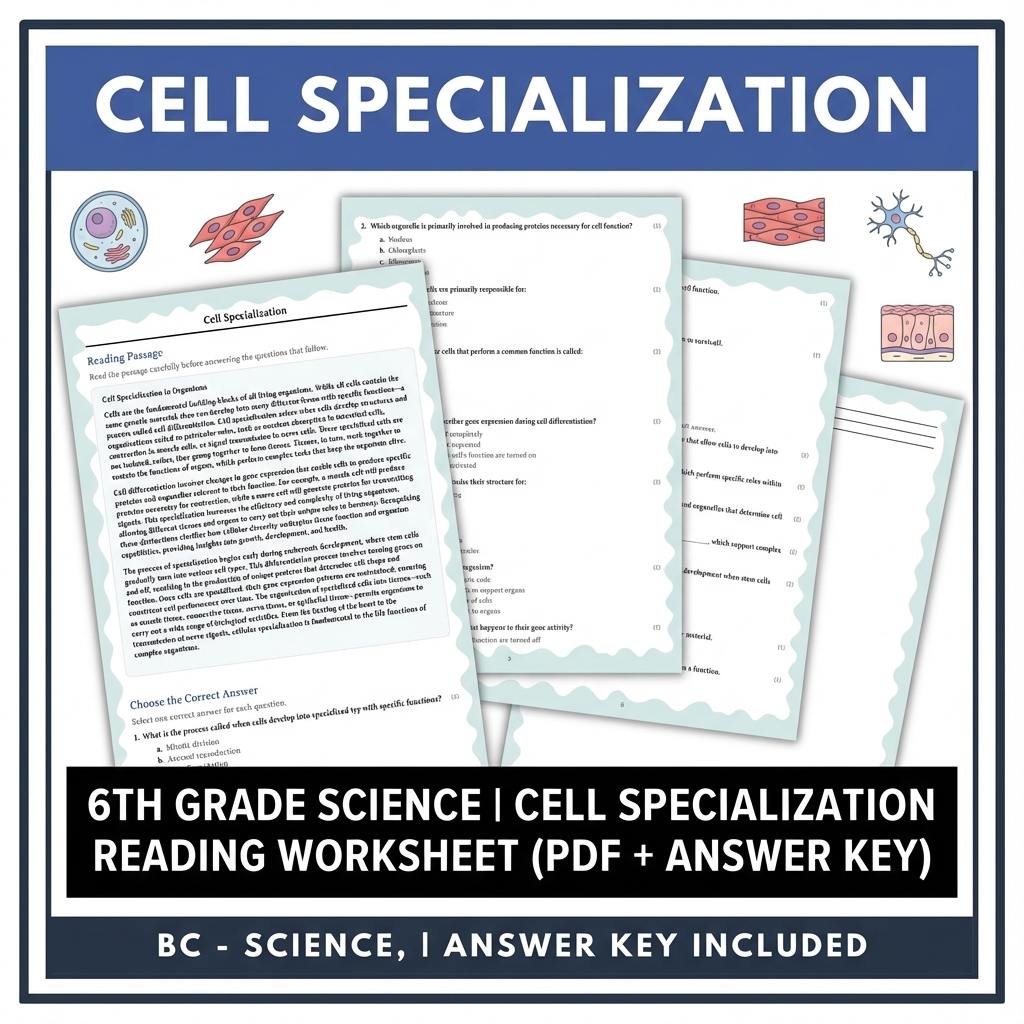
6th Grade Science | Cell Specialization Reading Worksheet (PDF + Answer Key)
JCreated byJ.S SheetsLearning Objectives
- Understand the concept of cell specialization and its role in organism function.
- Identify different types of specialized cells and their specific roles.
- Explain how differentiation leads to varied cell functions through gene expression.
Instant download
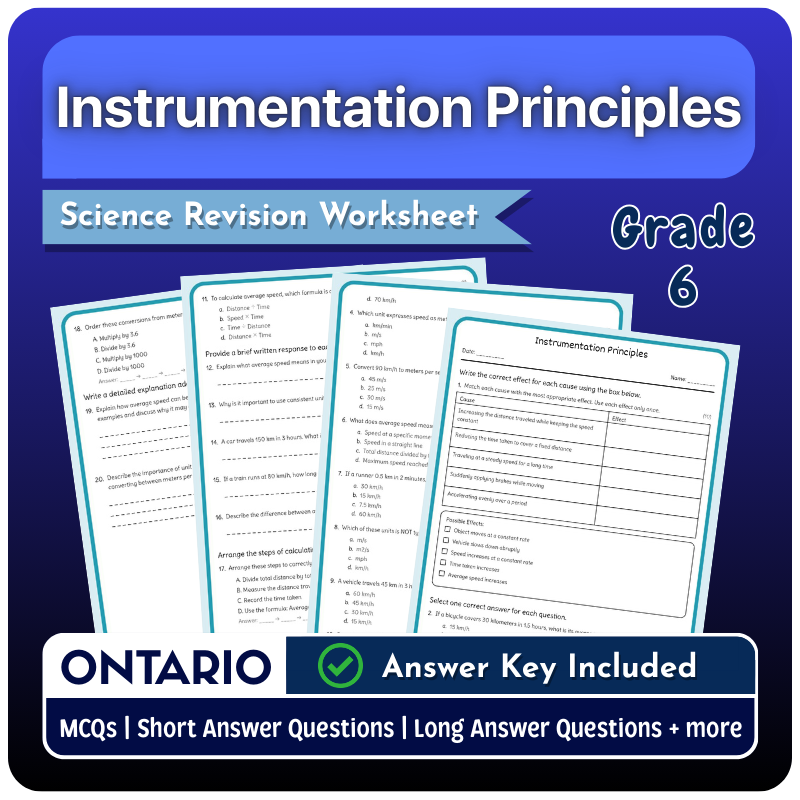
6th Grade Science | Instrumentation Principles Worksheet (Ontario Standards)
Created byBright Mind ResourcesLearning Objectives
- Understand the roles of ammeters and voltmeters in electrical measurements.
- Identify measurement units of amperes and volts.
- Describe the placement of instruments in simple circuits (series and parallel).
Instant download
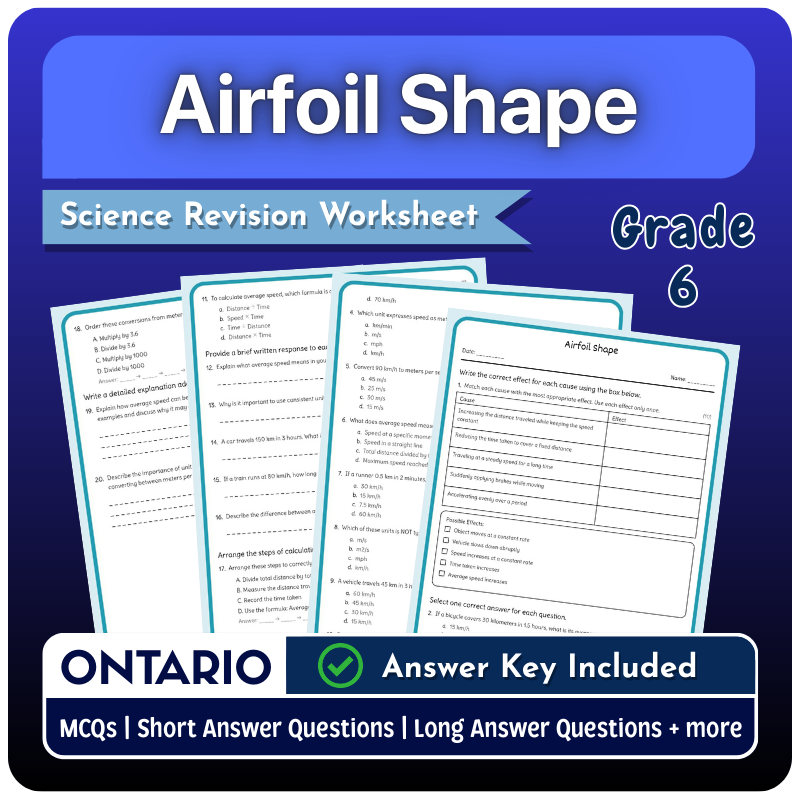
6th Grade Science | Airfoil Shape Worksheet (Ontario) (Practice Set)
Created byBright Mind ResourcesLearning Objectives
- Understand how camber, thickness, chord length, and leading-edge curvature influence pressure distribution and lift.
- Compare Bernoulli and Newtonian explanations of lift.
- Identify how angle of attack affects lift and stall conditions.
Instant download

6th Grade Science Worksheet | Sampling Methods & Standards (PDF)
Created bySilver Birch TeachingLearning Objectives
- Explain how random, stratified, and systematic sampling differ when selecting a sample
- Describe how sample size and spatial distribution affect how confident we can be in conclusions
- Use sampling vocabulary to interpret real-world science investigations
Also included in: Grade 6 Scientific Inquiry & Data Analysis Science Lesson Bundle: Alberta +1 more
Instant download
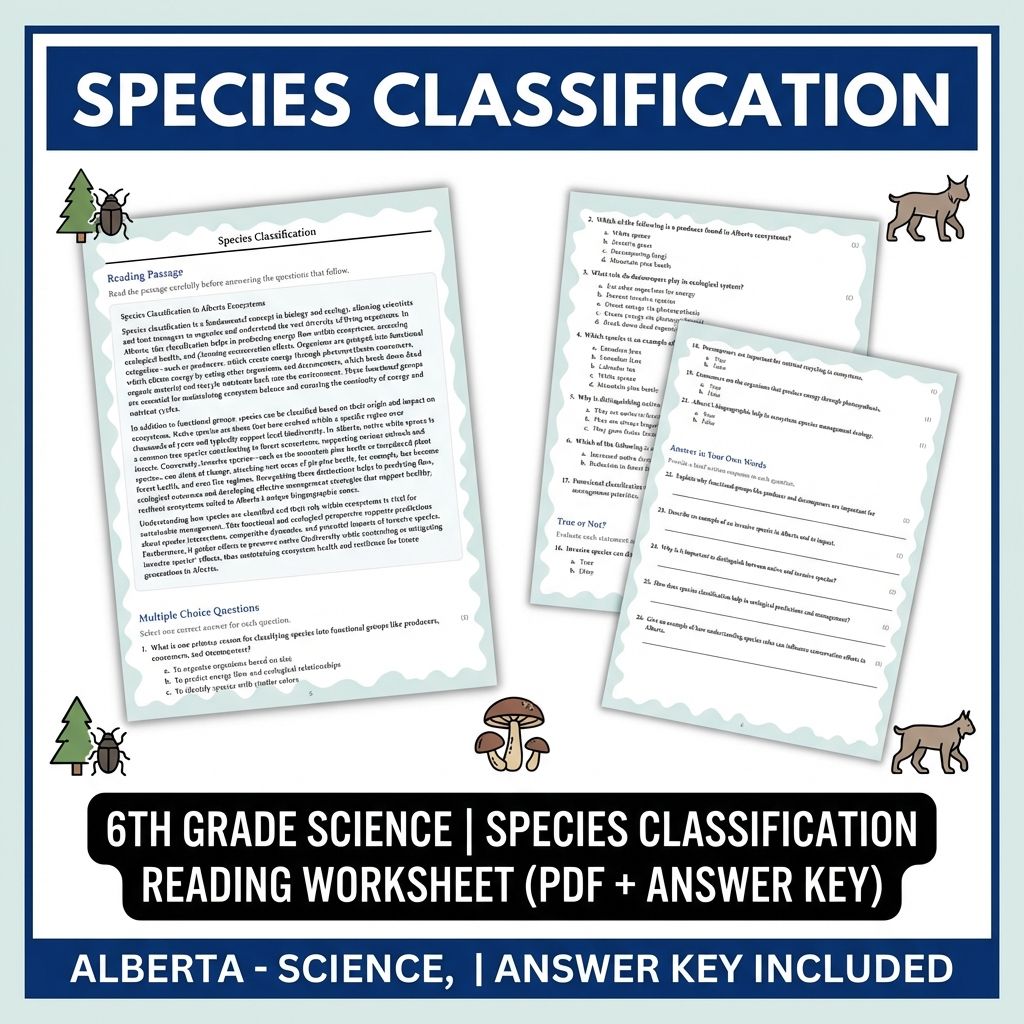
6th Grade Science | Species Classification Reading Worksheet (PDF + Answer Key)
JCreated byJ.S SheetsLearning Objectives
- Understand how organisms are classified into functional groups such as producers, consumers, and decomposers.
- Distinguish between native and invasive species within ecosystems.
- Recognize Alberta-relevant examples of species classification, including local flora and fauna.
Also included in: Grade 6 Science Unit Bundle | Ecosystems and Biodiversity (Answer Keys Included) +1 more
Instant download
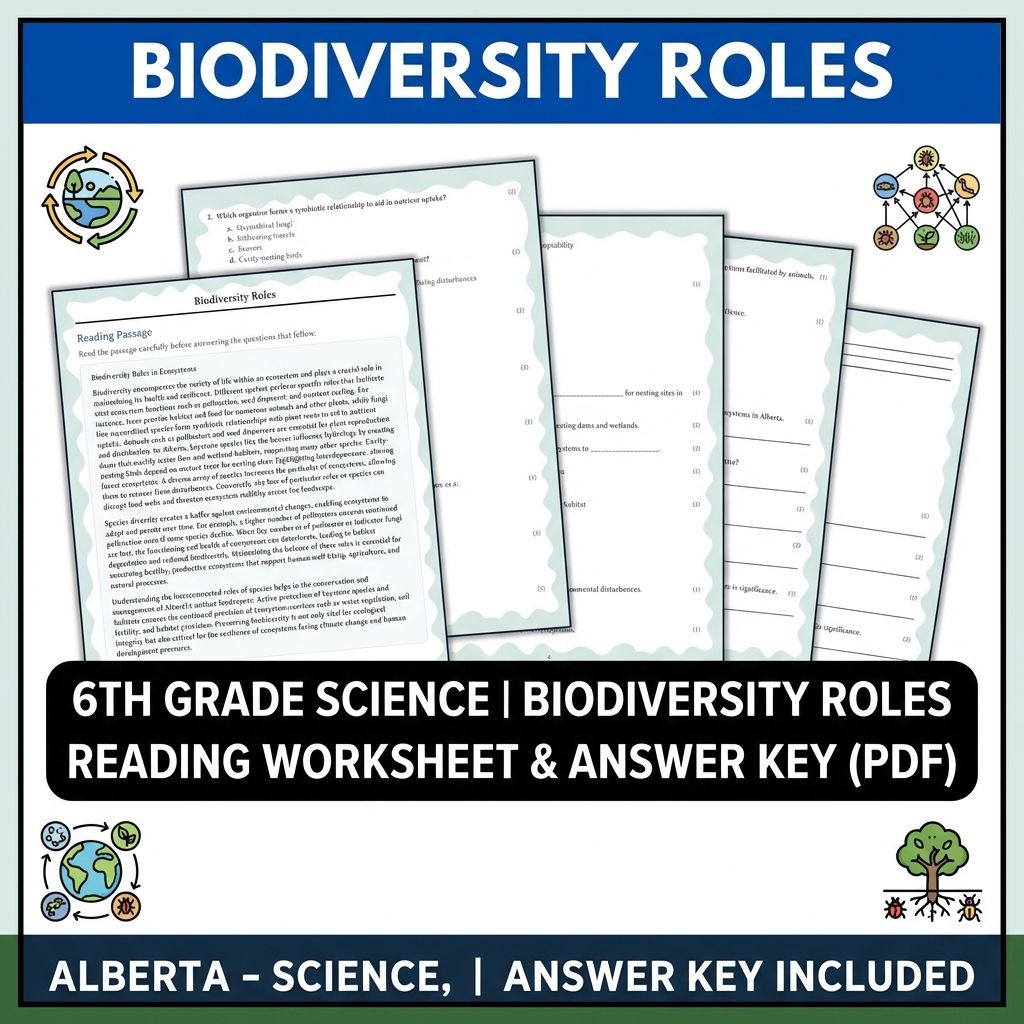
6th Grade Science | Biodiversity Roles Reading Worksheet & Answer Key (PDF)
JCreated byJ.S SheetsLearning Objectives
- Understand how different species contribute to ecosystem functions such as pollination, seed dispersal, and nutrient cycling.
- Identify examples of keystone and indicator species in Alberta and their ecological roles.
- Explain how species diversity enhances ecosystem resilience and stability.
Also included in: Grade 6 Science Unit Bundle | Ecosystems and Biodiversity (Answer Keys Included) +1 more
Instant download
6th Grade Science | Reasoning Claims (Worksheet + Answer Key) – TEKS Aligned
Created byBright Mind ResourcesLearning Objectives
- Understand the process of connecting evidence to explanatory claims in scientific reasoning.
- Interpret patterns in data such as distance-time graphs for motion analysis.
- Evaluate the strength of inferences based on evidence and models.
Instant download
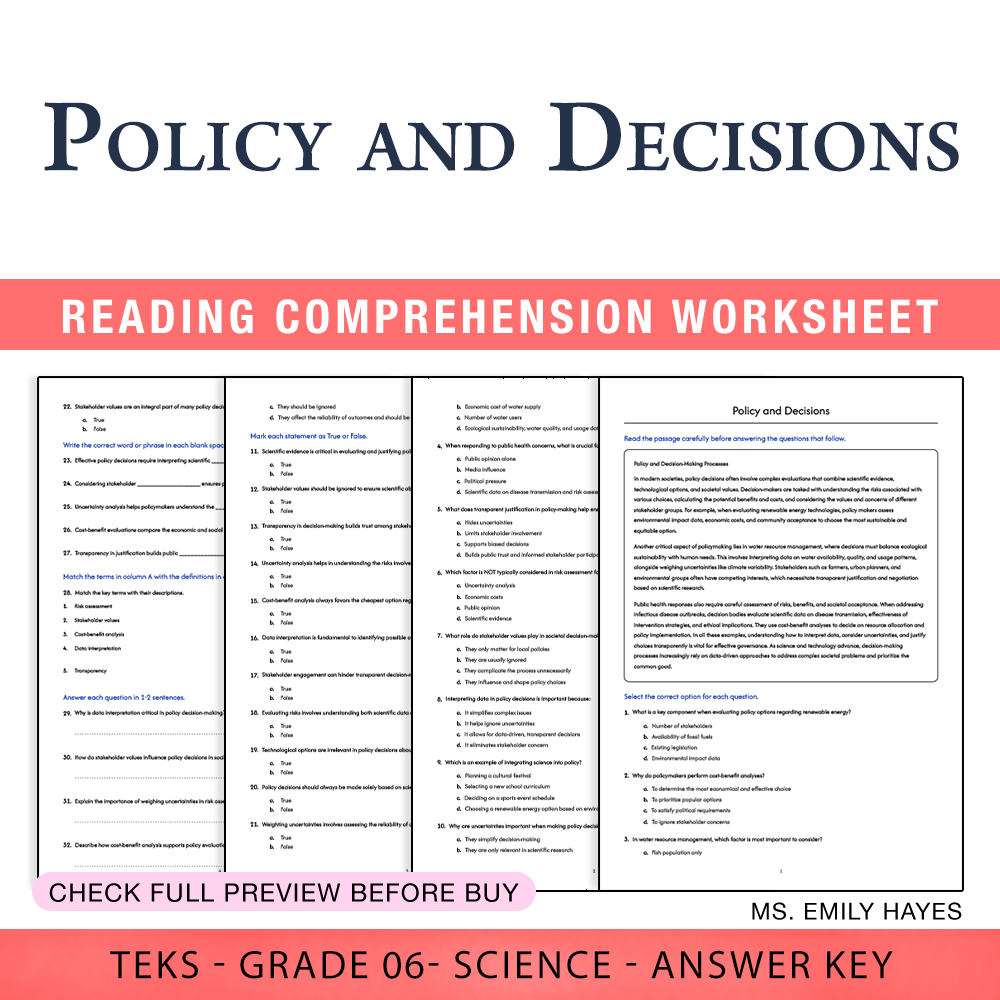
6th Grade Science | Policy and Decisions Worksheet (PDF+ Answer Key)
Created byCopper Leaf ClassroomLearning Objectives
- Analyze the decision-making process using scientific evidence and technological options.
- Evaluate risk assessment, cost-benefit analysis, and stakeholder values in policy choices.
- Interpret data and weigh uncertainties to support transparent policy decisions.
Instant download
6th Grade Science | Classifying Matter Worksheet (Answer Key) TEKS-Aligned
Created byBright Mind ResourcesLearning Objectives
- Understand the classification of matter into elements, compounds, and mixtures.
- Identify examples of pure substances and mixtures based on observable characteristics.
- Explain criteria used to distinguish different types of matter.
Instant download

6th Grade Science | Classification Genetics Worksheet (PDF) | Ontario Standards
 Created byEvergreen Desk Education
Learning Objectives
- Explain how DNA barcoding and sequence comparison help scientists identify species.
- Describe how phylogenetic trees show relationships among organisms.
- Compare morphological classification keys with genetic marker evidence.
Also included in: Grade 6 Biodiversity, Adaptation & Ecology Science Lesson Bundle | Ontario +1 more
Instant download
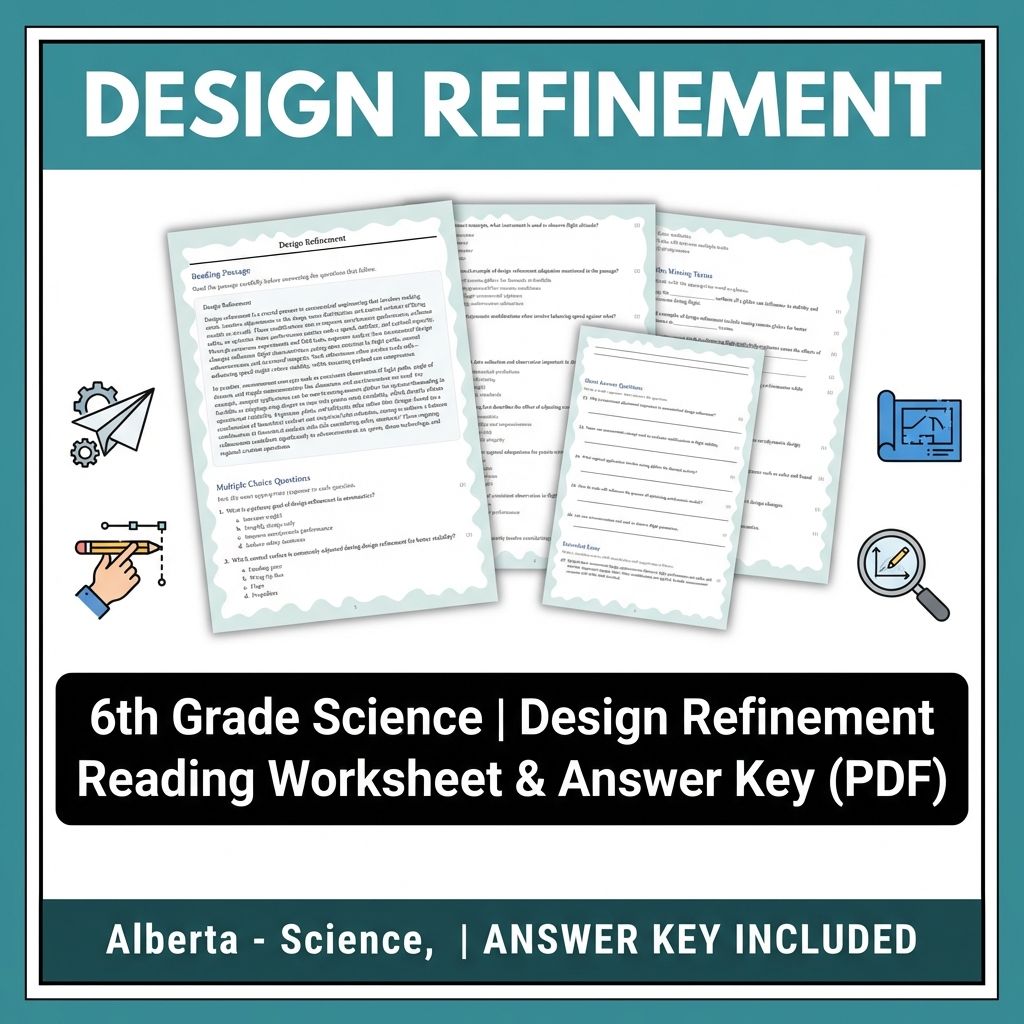
6th Grade Science | Design Refinement Reading Worksheet & Answer Key (PDF)
JCreated byJ.S SheetsLearning Objectives
- Explain how incremental design modifications influence aerodynamic performance and safety.
- Identify criteria used to evaluate modifications on aerodynamic models.
- Understand trade-offs between speed, stability, and payload in aerodynamic design.
Also included in: Grade 6 Science | Flight Physics & Aerodynamics UNIT Pack (Answer Keys Included) +1 more
Instant download

6th Grade Science Worksheet | Sun–Earth–Moon Phases & Eclipses (PDF)
Created byEvergreen Desk EducationLearning Objectives
- Describe how the relative positions of the Sun, Earth, and Moon help explain lunar phases.
- Explain how alignment can produce solar and lunar eclipses using the idea of shadows.
- Connect the Moon’s gravity to tides on Earth and identify how tides change over time.
Instant download

6th Grade Science – Integrated Synthesis Worksheet (Alberta Standards) (PDF)
Created byEvergreen Desk EducationLearning Objectives
- Coordinate scientific inquiry steps: framing questions, designing fair investigations, choosing measurements, and handling data
- Use Alberta-scale watershed examples to explain how multi-site monitoring supports stronger evidence-based conclusions
- Communicate results clearly, including data provenance, cross-site comparability, and limitations
Instant download

6th Grade Science | Seasonal Tilt Worksheet (PDF) - Alberta Standards
Created byEvergreen Desk EducationLearning Objectives
- Explain how Earth’s axial tilt changes the solar angle across the year
- Describe how changes in solar angle affect day length and seasonal heating
- Connect seasonal tilt to climate and observable patterns in Alberta
Instant download

6th Grade Science Worksheet | Measurement Uncertainty & Accuracy (PDF)
Created byEvergreen Desk EducationLearning Objectives
- Explain what measurement uncertainty means and why it affects the confidence of conclusions
- Identify common sources of uncertainty in real scientific measurements
- Estimate uncertainty using repeated measurements and compare results using ranges or percent error
Instant download

6th Grade Science Worksheet – Writing Testable Questions (PDF)
Created byEvergreen Desk EducationLearning Objectives
- Explain what makes a scientific question testable by linking it to measurable evidence.
- Identify variables: what can change, what must stay the same, and what gets measured.
- Revise a question so it includes measurable outcomes and clear comparisons.
Also included in: Grade 6 Science Inquiry Lesson Bundle: Variable Control & Models (General) +1 more
Instant download

Grade 6 Adaptation Tradeoffs Worksheet | Ontario Science Activity
 Created byChalk and Compass
Learning Objectives
- Explain how specialists and generalists differ in fitness across changing environments
- Describe adaptation tradeoffs using niche specialization and tolerance examples
- Use vocabulary such as niche, tradeoff, fitness, and ecological conditions to answer questions
Also included in: Grade 6 Science Ecosystems, Adaptations & Biodiversity Lesson Bundle | Ontario +1 more
Instant download

Earth’s Axial Tilt and Seasonal Changes Worksheets Grade 6 Science
 Created bySunny Desk Resources
Learning Objectives
- Explain how Earth’s axial tilt affects solar angle and daylight duration over the year
- Describe how seasonal changes in sunlight can influence temperature and snow cover in a region
- Use evidence from a local example (Alberta) to connect seasons to climate and biological rhythms
Also included in: Sky Science Grade 6 Bundle | Alberta Science Worksheets & Activities +1 more
Instant download
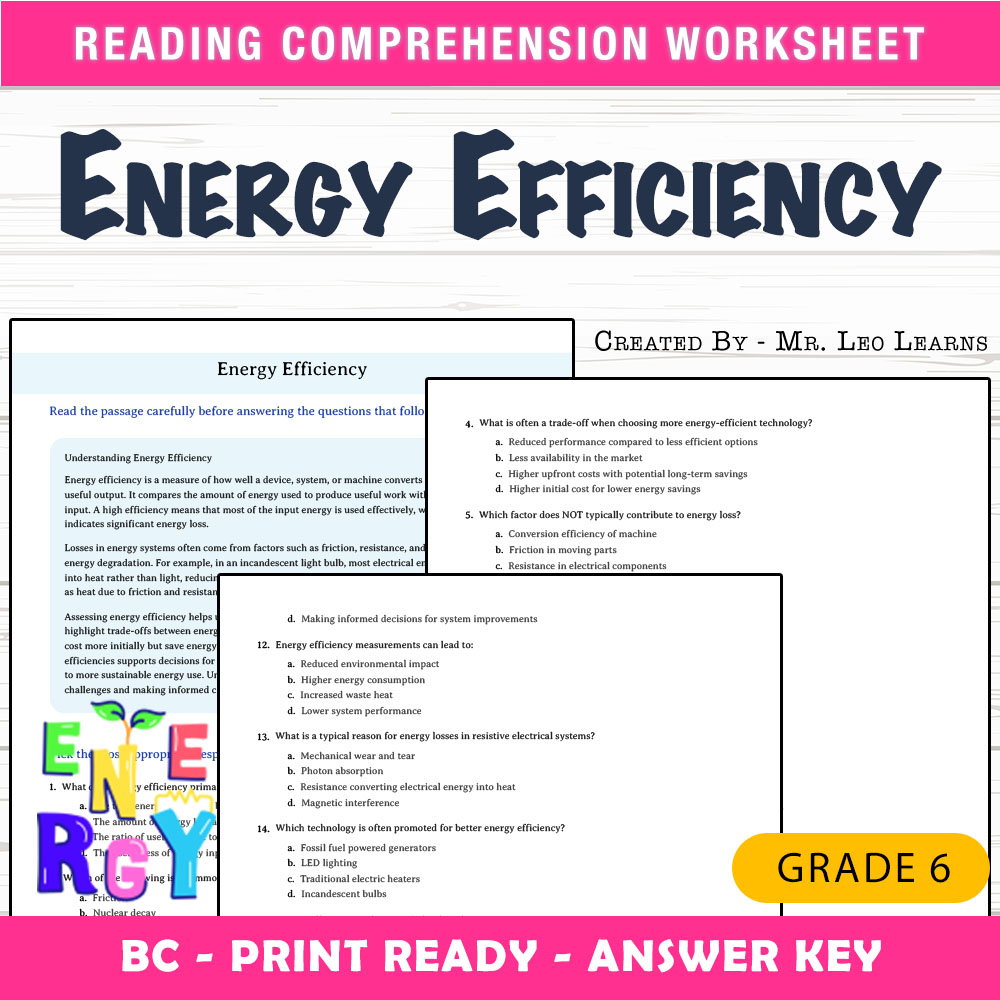
Grade 6 Science — Worksheet MCQ Paper for Mastering Energy Efficiency
 Created byThe Resource Hub
Learning Objectives
- Understand the concept of energy efficiency and how to measure it.
- Identify common sources of energy loss in machines and systems.
- Evaluate the trade-offs between performance and energy waste.
Also included in: Grade 6 Science Energy, Waves & Circuits UNIT Bundle | BC Standards +1 more
Instant download
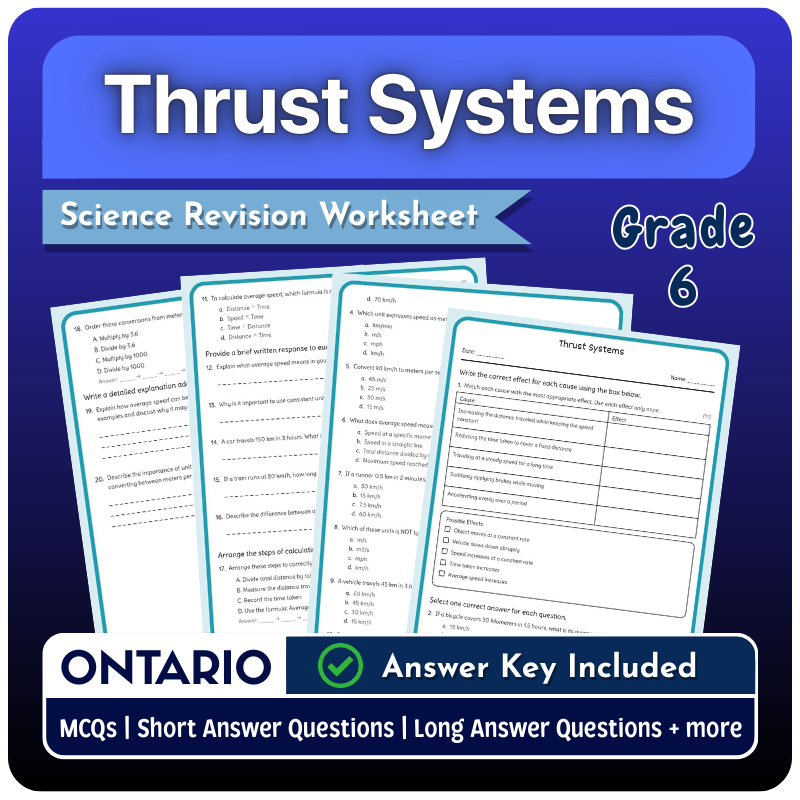
6th Grade Science | Thrust Systems Worksheet (Ontario Standards) (PDF)
Created byBright Mind ResourcesLearning Objectives
- Understand how propeller-driven and jet-driven thrust generate propulsion.
- Compare propulsive efficiency across different flight regimes.
- Analyze the impact of propulsion methods on aircraft design, mass distribution, noise, and fuel considerations.
Instant download
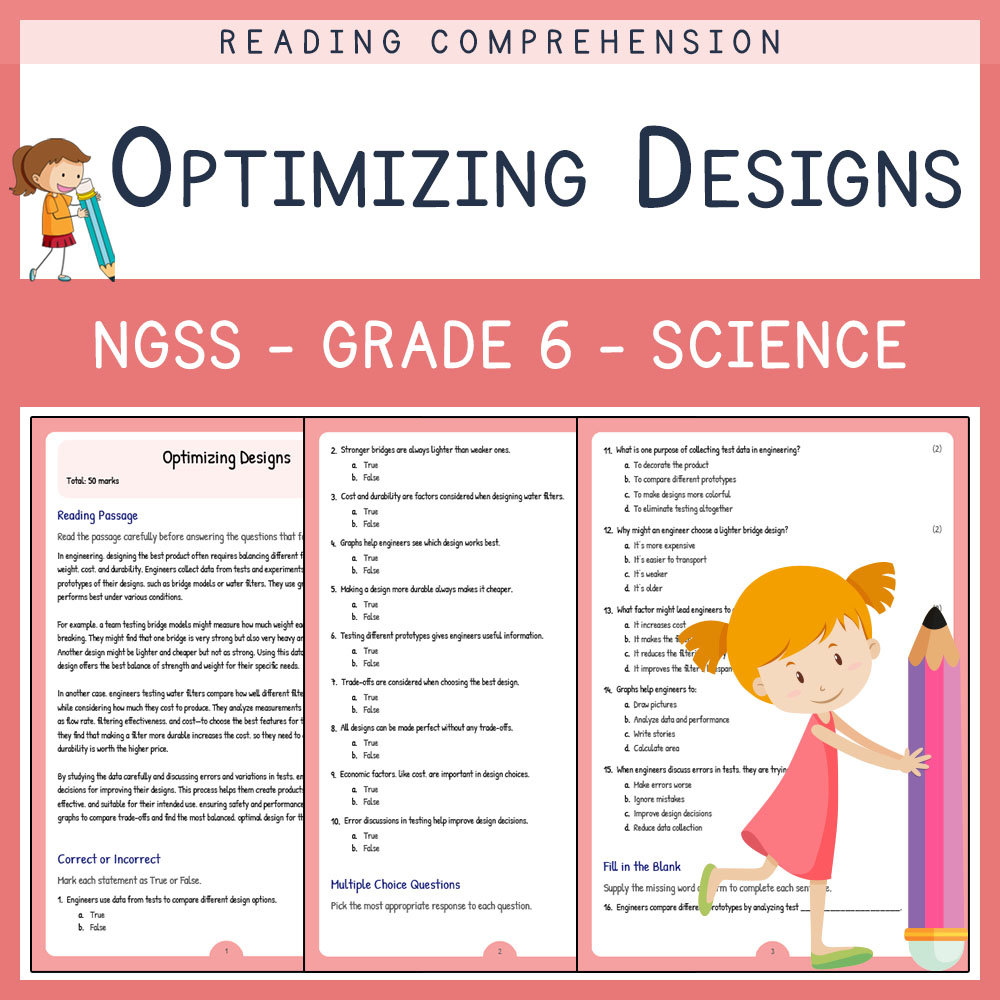
Grade 6 Science | Optimizing Designs Worksheet (Answer Key) | NGSS Aligned
 Created byLumora Learning
Learning Objectives
- Understand how data can be used to compare different design options.
- Learn to read graphs and analyze performance measurements.
- Identify trade-offs when selecting optimal design features.
Instant download

6th Grade Science Worksheet | Watershed Pathways & California Standards (PDF)
Created byEvergreen Desk EducationLearning Objectives
- Explain how gravity and terrain shape water pathways within a watershed.
- Describe how infiltration, soil storage, and land cover affect runoff and timing of streamflow.
- Connect vegetation and erosion/sediment movement to downstream water conditions.
Instant download

6th Grade Science Worksheet – Organ Systems Overview (PDF) | BC Standards
Created byEvergreen Desk EducationLearning Objectives
- Identify major organ systems and describe their primary functions in the human body
- Explain how organ systems interact to maintain homeostasis and internal balance
- Use vocabulary from organ systems to describe digestion, gas exchange, transport, defense, and control
Instant download

Respiration And Digestion Worksheet | Grade 6 Science Practice
Created byPrism Point LearningLearning Objectives
- Explain how the respiratory system exchanges gases using diffusion across gas-exchange surfaces.
- Describe how the digestive system breaks food into smaller molecules that can enter circulation.
- Connect coordinated air flow and digestion to energy release in cells.
Instant download
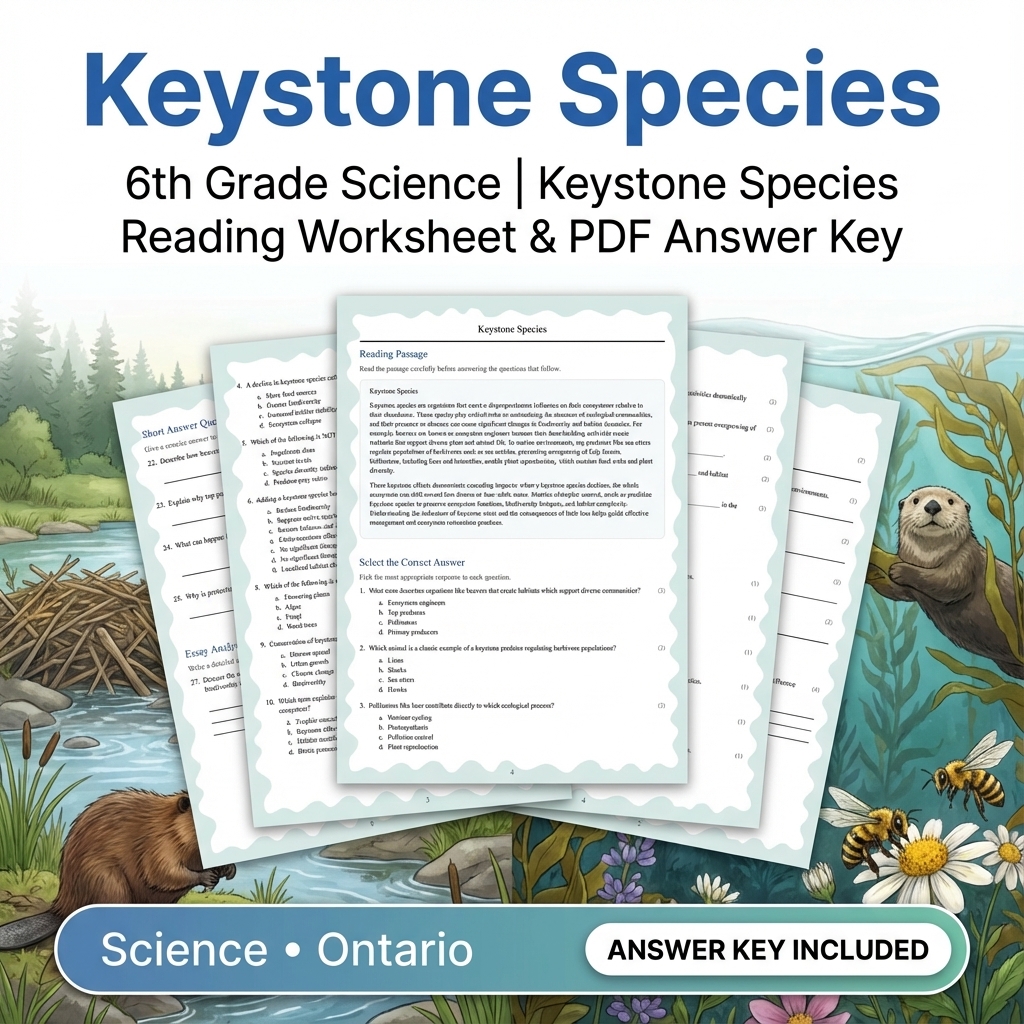
6th Grade Science | Keystone Species Reading Worksheet & PDF Answer Key
JCreated byJ.S SheetsLearning Objectives
- Understand the role of keystone species in maintaining ecosystem balance.
- Identify examples of keystone species and their ecological impacts.
- Analyze cascading effects caused by changes in keystone species populations.
Also included in: Grade 6 Science Unit Bundle – Ecosystems, Biodiversity & Environmental Impact +1 more
Instant download
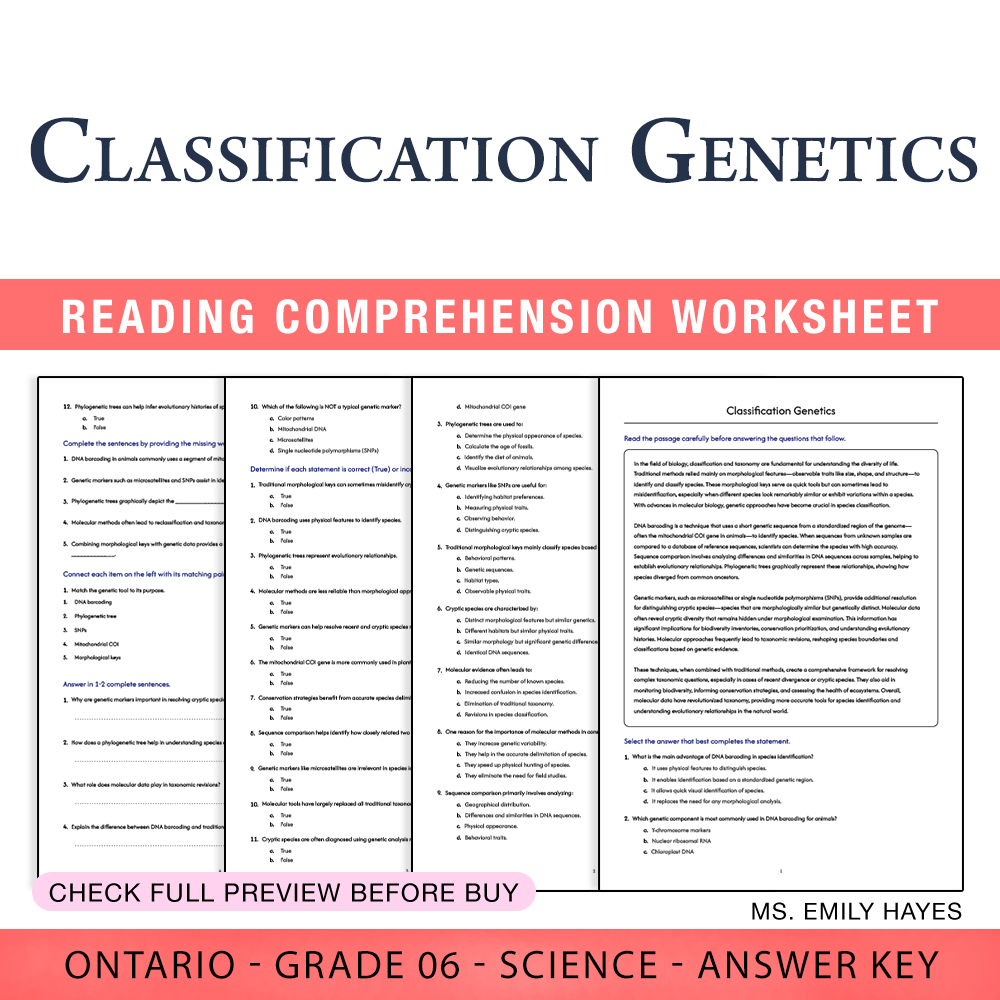
6th Grade Science | Classification Genetics Worksheet (PDF+ Answer Key)
Created byCopper Leaf ClassroomLearning Objectives
- Understand the molecular approaches used in classifying species, including DNA barcoding and sequence comparison.
- Explain how genetic markers and phylogenetic trees help determine species relationships.
- Compare morphological keys and genetic markers in species identification.
Instant download

6th Grade Science Worksheet | Trophic Interactions & Ecosystem Relationships (PDF)
Created byEvergreen Desk EducationLearning Objectives
- Explain how predation, herbivory, parasitism, competition, and mutualism affect organisms in an ecosystem.
- Use trophic interaction terms to describe how populations and community structure change over time.
- Analyze real-world examples (like pollination and predator-prey relationships) to predict outcomes.
Instant download
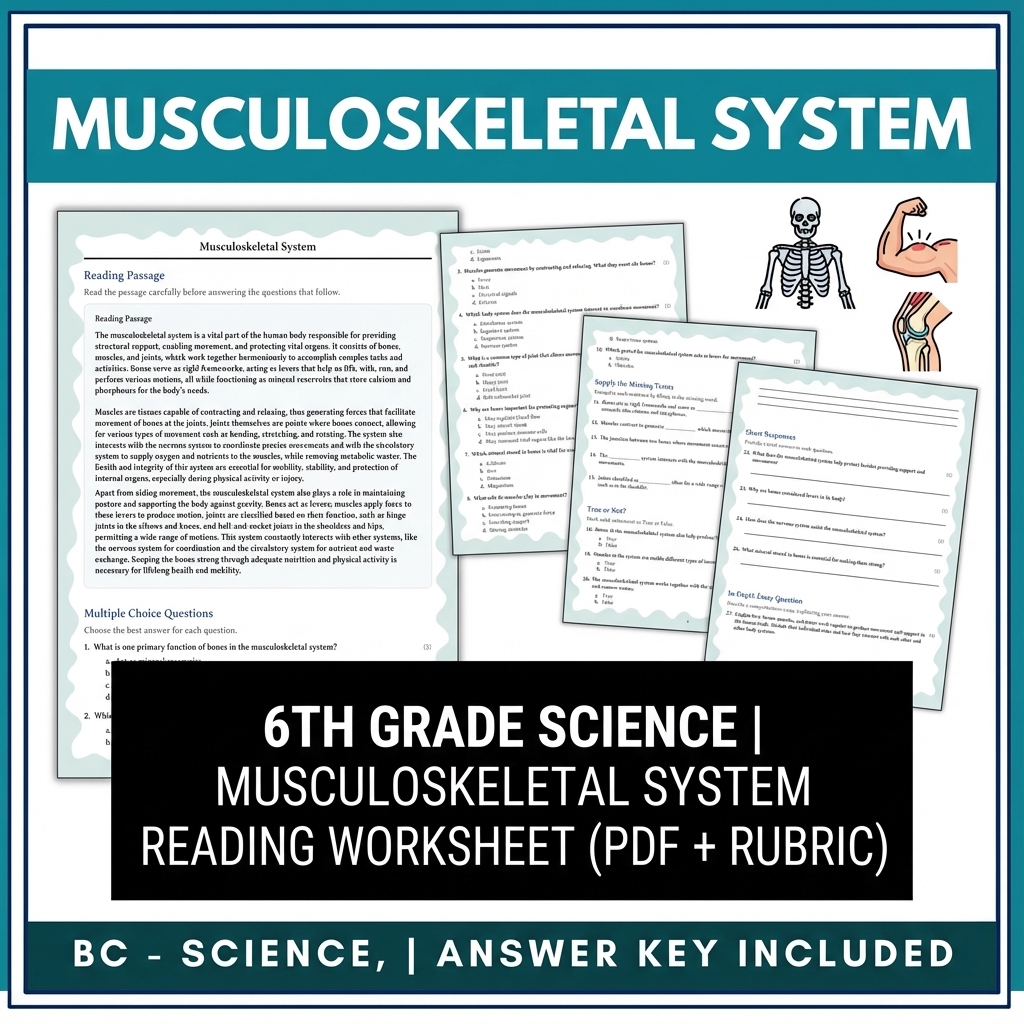
6th Grade Science | Musculoskeletal System Reading Worksheet (PDF + Rubric)
JCreated byJ.S SheetsLearning Objectives
- Describe the components and functions of the musculoskeletal system.
- Explain the roles of bones, joints, and muscles in movement and support.
- Identify how the musculoskeletal system interacts with other body systems.
Instant download
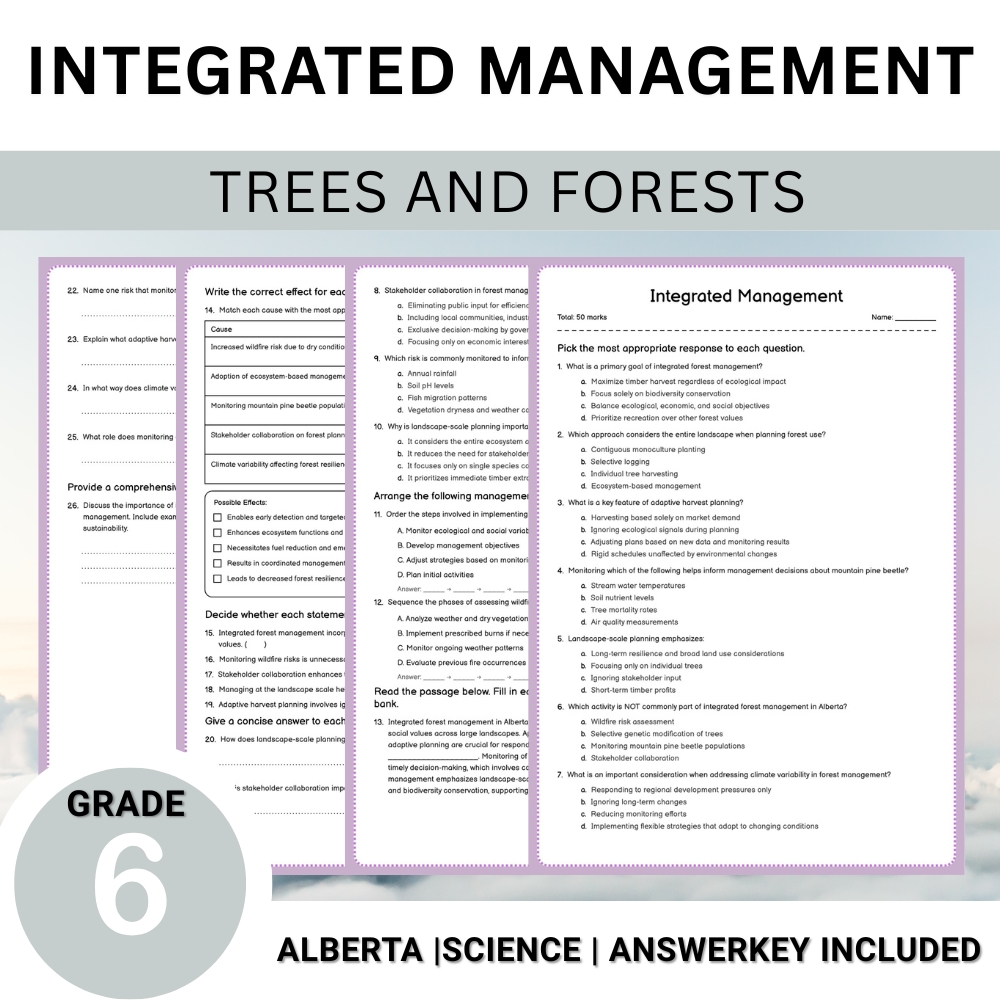
6th Grade Science | Integrated Forest Management Worksheet (Printable PDF) for Assessment and Student Practice
Learning Objectives
- Understand the principles of integrated forest management, including ecological, economic, and social objectives.
- Identify approaches such as ecosystem-based management, adaptive harvest planning, and risk monitoring techniques.
- Explain the importance of landscape-scale planning and stakeholder collaboration in sustainable forest management.
Also included in: Grade 6 Science | Tree Anatomy, Ecology & Conservation Unit Worksheet Bundle +1 more
Instant download

6th Grade Science | Celestial Patterns Worksheet (PDF) Alberta Standards
Created bySilver Birch TeachingLearning Objectives
- Explain how the Sun, Moon, planets, and constellations show predictable patterns in the sky from a fixed location.
- Describe how Earth’s seasons affect which constellations are visible at different times of year.
- Use vocabulary such as apparent motion, star background, rise, set, and seasonal cycle to interpret celestial observations.
Also included in: Grade 6 Celestial Motion & Seasons Science Lesson Bundle | Alberta +1 more
Instant download
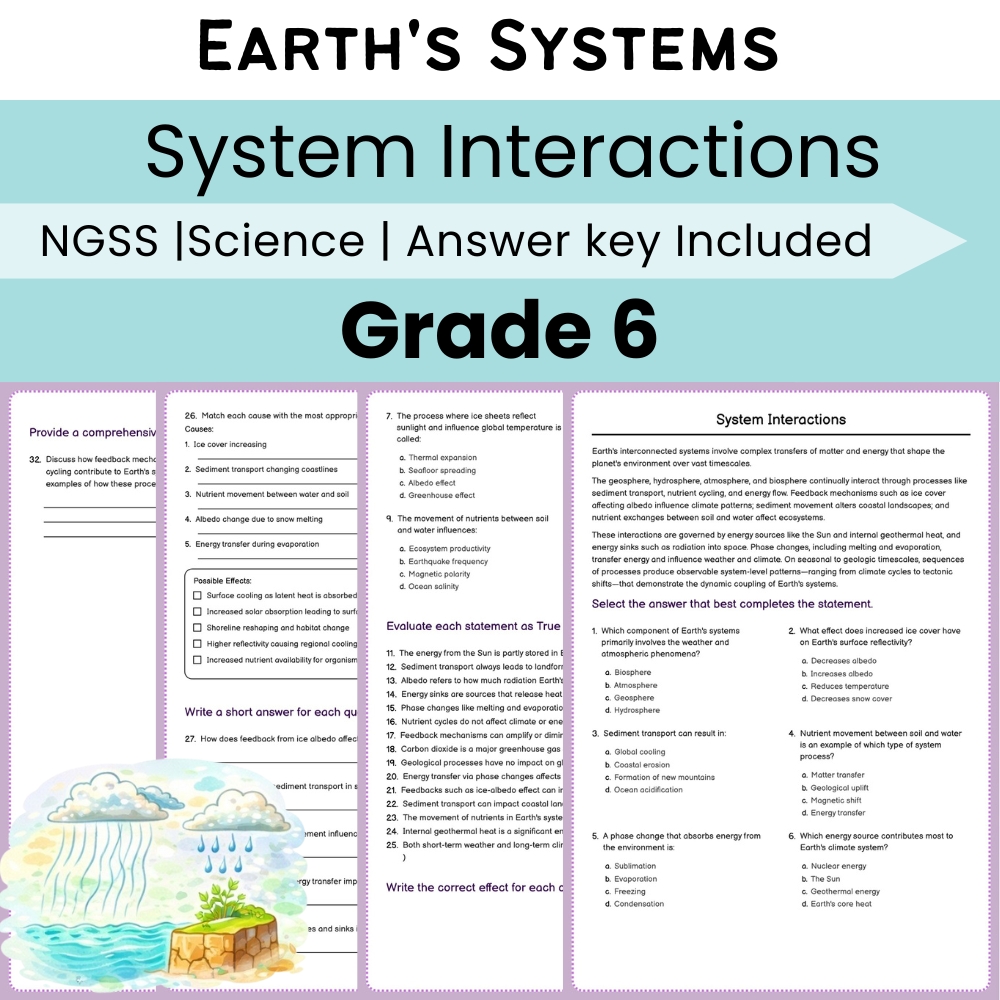
System Interactions Science Worksheet | NGSS Grade 6 Science printable PDF
Learning Objectives
- Describe how Earth's systems transfer matter and energy among the geosphere, hydrosphere, atmosphere, and biosphere.
- Identify feedback mechanisms such as albedo changes, sediment transport, and nutrient cycles.
- Explain how energy sources, sinks, and phase changes influence environmental patterns across time scales.
Also included in: Grade 6 Science | Earth's Systems Unit Worksheet Bundle (NGSS Aligned) +1 more
Instant download
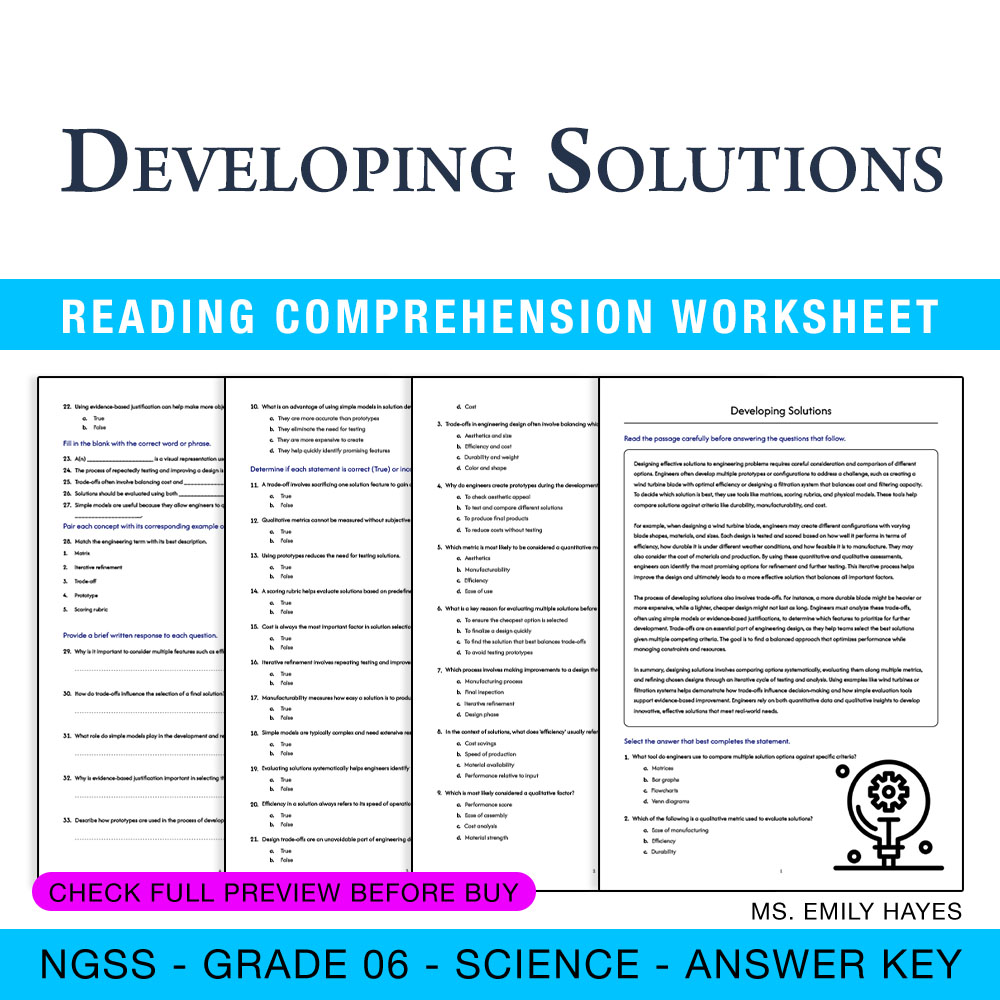
6th Grade Science | Developing Solutions Worksheet (PDF + Answer Key)
Created byCopper Leaf ClassroomLearning Objectives
- Compare multiple design solutions using matrices, scoring rubrics, and prototypes.
- Apply quantitative and qualitative metrics such as efficiency, durability, manufacturability, and cost to evaluate solutions.
- Use evidence-based justification and simple models to rank options.
Instant download
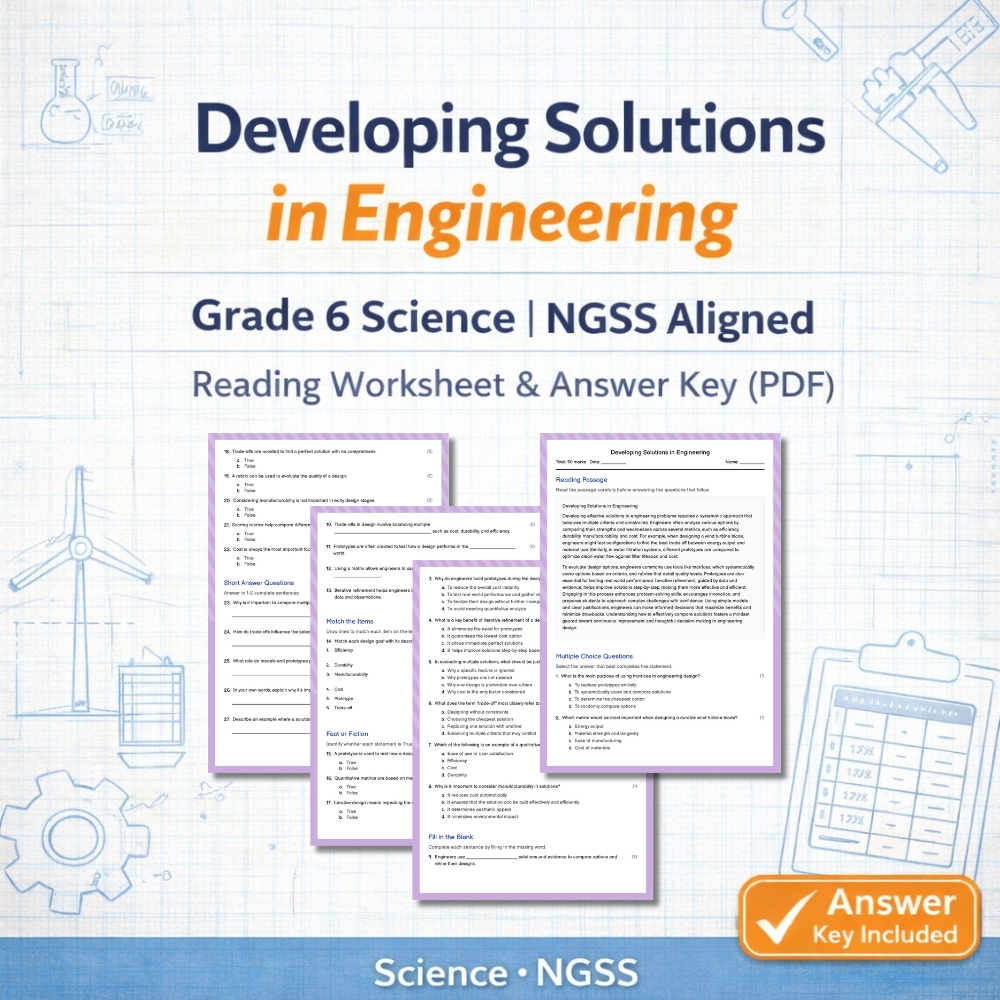
6th Grade Science | Developing Solutions in Engineering | NGSS aligned
 Created byCedar Grove Learning
Learning Objectives
- Compare multiple design solutions against established criteria and constraints using matrices and rubrics.
- Apply quantitative and qualitative metrics such as efficiency, durability, manufacturability, and cost during solution development.
- Use models and evidence-based justification to rank options and identify promising features for refinement.
Also included in: Grade 6 Science Unit Bundle | Engineering Design & Problem Solving Worksheets +1 more
Instant download

6th Grade Science Worksheet | Decomposers & Nutrient Cycle (PDF)
Created byEvergreen Desk EducationLearning Objectives
- Explain how decomposers (fungi and bacteria) break down dead organisms and waste
- Describe how decomposers return nutrients to soil and water for producers to reuse
- Connect decomposer activity to ecosystem productivity, growth patterns, and long-term sustainability
Also included in: Grade 6 Life Processes & Ecosystem Interactions Science Lesson Bundle: General +1 more
Instant download
About Grade 6 Science Worksheets
Explore Grade 6 Science worksheets for classwork, homework, or review. Our 5,997 printables download instantly as PDFs.
MyTeachingSheets worksheets are made by real teacher-authors and checked before they go live. Download any as a print-ready PDF for lessons, homework, or independent practice — most include answer keys, and previews are always free.