
Grade 6 Science Worksheets
5,997 worksheets
Grade 6 Science | Food Webs Worksheet with Short Notes (Printable PDF)
 Created byMeadowlark Worksheets
Learning Objectives
- Understand the structure and function of food webs in ecosystems.
- Identify producers, consumers, and decomposers in food chains.
- Explain how energy flows and matter cycles through different trophic levels.
Also included in: Grade 6 Science Lesson Bundle for Ontario | Ecosystems & Genetics +1 more
Instant download

Forces Basics Assessment | TEKS Grade 6 Science Standards-Aligned
 Created byPrism Point Learning
Learning Objectives
- Explain the difference between contact and noncontact forces, including gravity, friction, and normal force.
- Describe how balanced and unbalanced forces affect the motion of objects.
- Understand the concept of net force and its effect on everyday objects.
Also included in: Lesson Bundle Grade 6 Matter and Energy Science Assessment | TEKS
Instant download

Drag Components Worksheet Grade 6 Science | Ontario Standards
 Created byCedar Grove Learning
Learning Objectives
- Categorize drag into parasitic and induced sources
- Identify components of parasitic drag: form drag, skin-friction drag, and interference drag
- Explain how induced drag relates to lift production, span, and speed
Also included in: Grade 6 Aerodynamics | Flight - Science Lesson Bundle – Ontario Framework +1 more
Instant download

Grade 6 Science – Solar Time & Earth Rotation | Daily Reading Worksheet
 Created byBright Mind Resources
Learning Objectives
- Define solar time and local solar noon
- Explain how Earth's position affects solar time
- Identify differences between solar time and clock time
Also included in: Grade 6 Solar System & Seasons Science Daily Reading Lesson Bundle | Alberta +2 more
Instant download
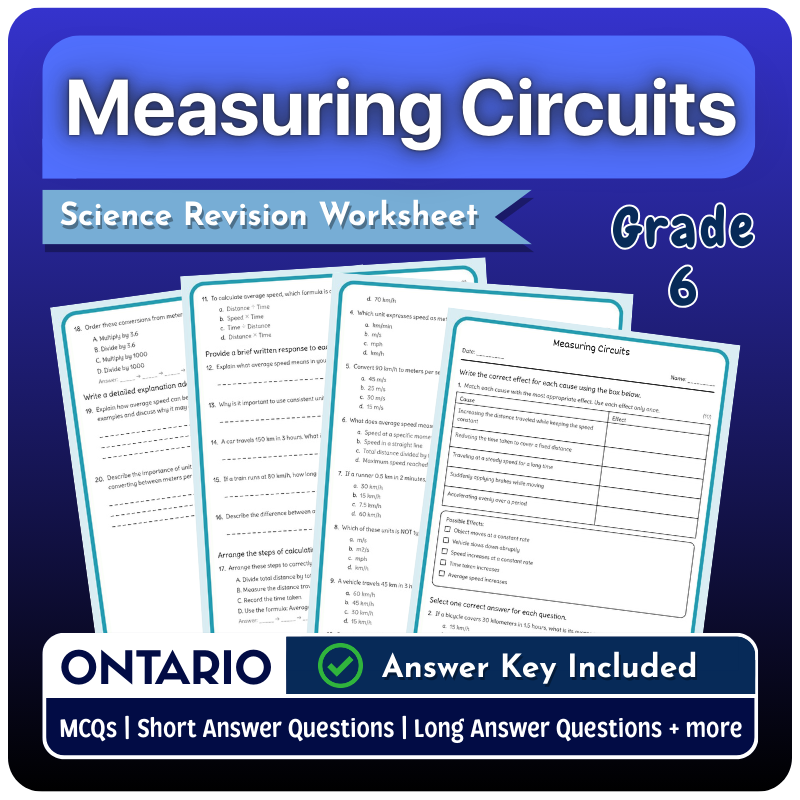
Grade 6 Science | Measuring Circuits Worksheet (PDF) Ontario Standards
Created byBright Mind ResourcesLearning Objectives
- Understand how current and voltage measurements characterize circuit performance.
- Identify proper instrument placement for accurate readings.
- Interpret typical measurement patterns in various circuit configurations.
Instant download
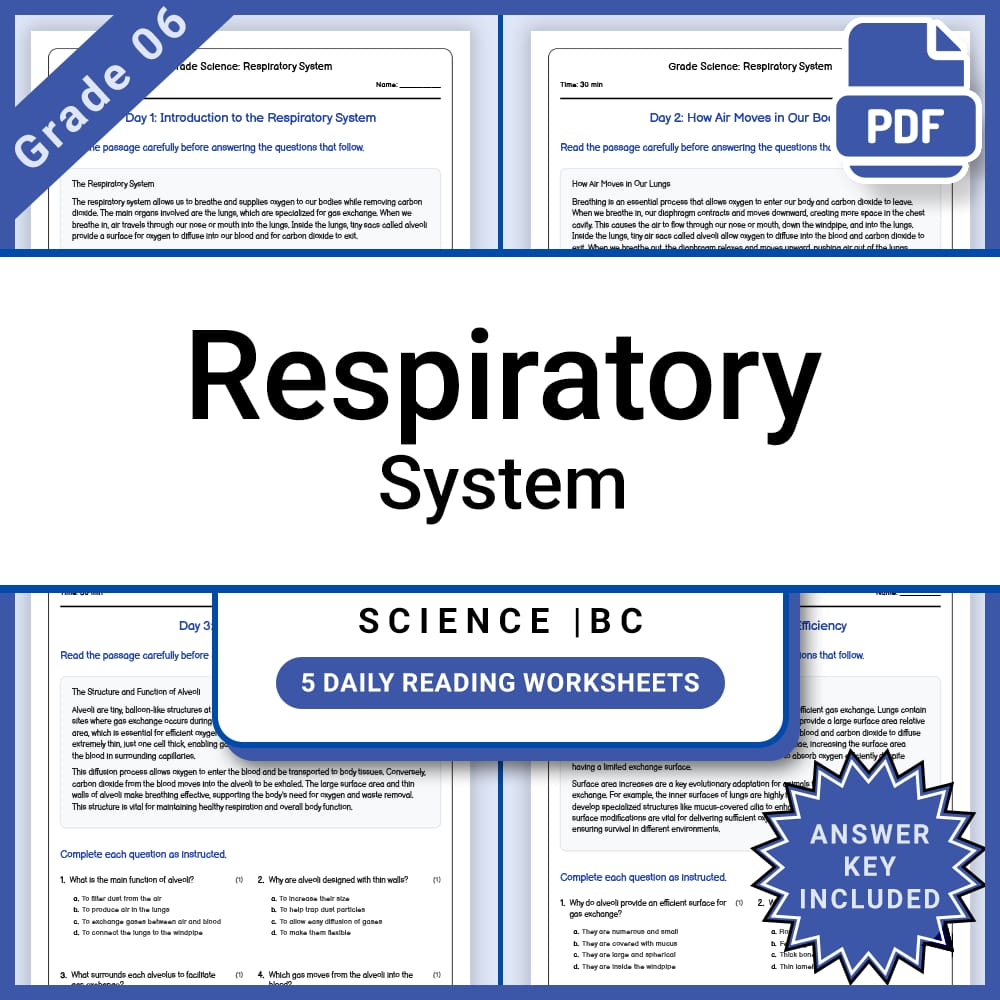
Grade 6 Science – Respiratory System Daily Reading Worksheet + Answer Key
JCreated byJ.S SheetsLearning Objectives
- Understand the basic functions of the respiratory system
- Identify parts of the respiratory system
- Explain how oxygen is exchanged between the environment and the blood
Also included in: Grade 6 Science Lesson Group | Body Systems and Adaptations Bundle +1 more
Instant download
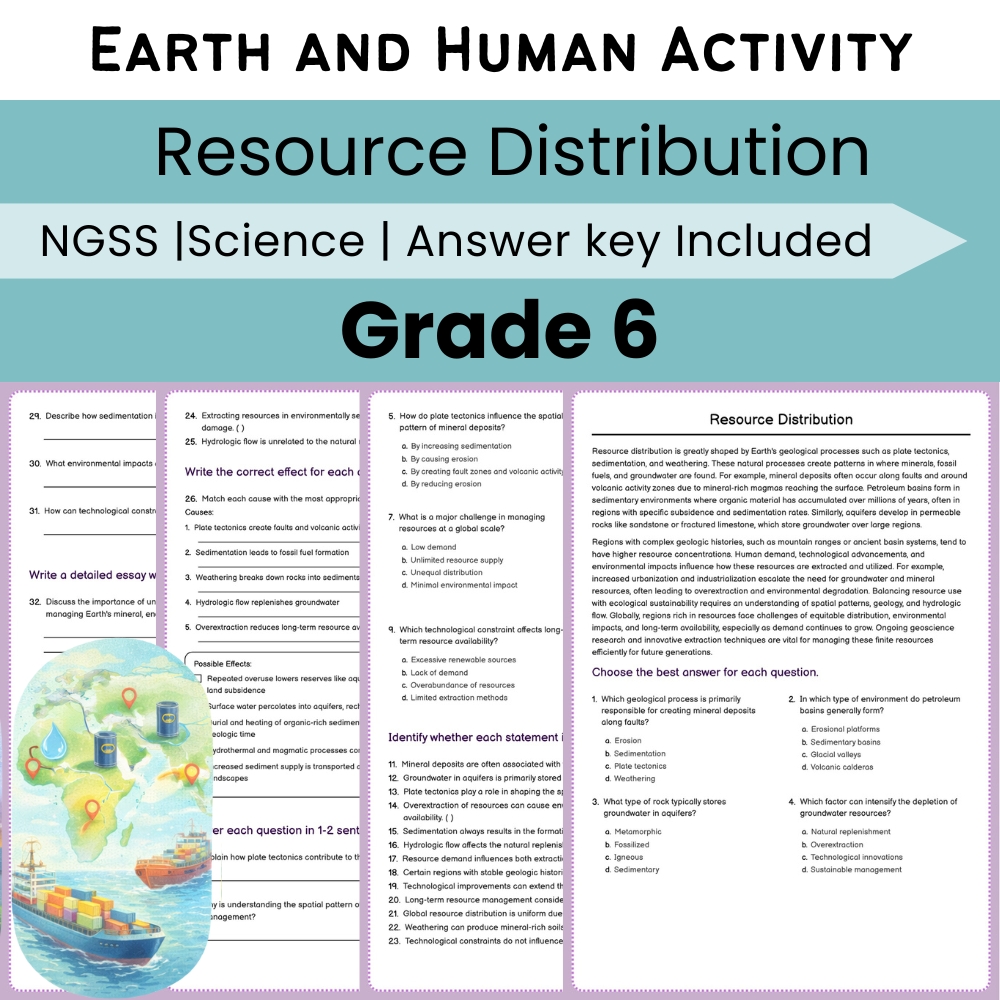
Resource Distribution Worksheet - Grade 6 Science Printable PDF | NGSS
Learning Objectives
- Understand how geological processes influence the distribution of mineral, energy, and groundwater resources.
- Identify spatial patterns in ore deposits, petroleum basins, and aquifers.
- Evaluate the impact of human activity and technology on resource availability and sustainability.
Also included in: Grade 6 Science | Earth & Human Activity NGSS Unit Bundle (4 Worksheets) +1 more
Instant download

6th Grade Science | Understanding Stability Modes Worksheet (PDF)
 Created byEvergreen Desk Education
Learning Objectives
- Explain the difference between static and dynamic stability using center of gravity and aerodynamic effects
- Describe how wing geometry and control surfaces influence longitudinal, lateral, and directional stability
- Identify stability behaviors such as damping, phugoid, and Dutch roll and their implications for safe control
Also included in: Grade 6 Flight & Aerodynamics Science Lesson Bundle Worksheets (Ontario) +1 more
Instant download

Earth-Sun Models Seasonal Sky Changes Worksheet Grade 6 Science Review
 Created bySunny Desk Resources
Learning Objectives
- Describe how Earth’s tilt and orbit affect the apparent Sun position in the sky over the year
- Use a simple Earth–Sun geometry model to predict daylight length and seasonal changes
- Explain how models help forecast timing of events such as sunrise and sunset
Also included in: Sky Science Grade 6 Bundle | Alberta Science Worksheets & Activities +1 more
Instant download

Grade 6 Data Representation Worksheet | Graphing & Data Analysis
 Created byChalk and Compass
Learning Objectives
- Organize observations into tables and select appropriate graph types for different kinds of data.
- Interpret graphs by using labeled axes, units, and legends to identify trends and outliers.
- Compute and compare simple summary measures such as mean and median and explain how outliers affect them.
Also included in: Grade 6 Science Scientific Inquiry and Evidence Lesson Bundle | Ontario +1 more
Instant download
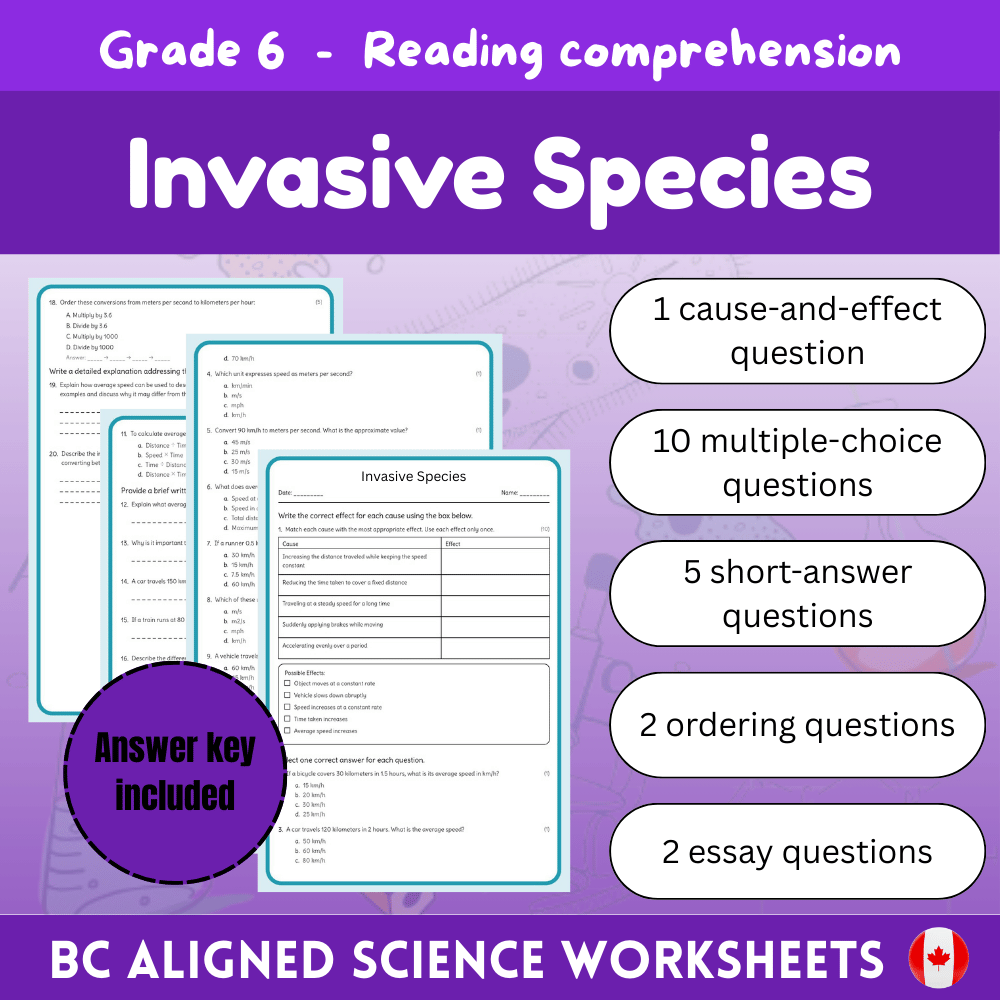
Grade 6 Science | Invasive Species Worksheet + Answer Key (PDF)
Created byBright Mind ResourcesLearning Objectives
- Understand how invasive species impact native ecosystems and biodiversity.
- Identify examples of invasive aquatic and terrestrial species.
- Explore the ecological consequences of invasive species on food webs and habitats.
Instant download

Food Molecules Assessment for Grade 6 Science | Standards-Aligned
Created byPrism Point LearningLearning Objectives
- Explain how food molecules provide both building materials and stored energy in the body.
- Describe how digestion breaks large food molecules into smaller molecules that can be absorbed.
- Identify how different food molecules (proteins, carbohydrates, fats) meet different needs of cells.
Also included in: Grade 6 Energy and Matter Cycles Science Lesson Bundle | California Standards +1 more
Instant download

Calculating Speed Worksheets | Distance, Time & Motion Data Review
LCreated byLearnora ResourcesLearning Objectives
- Define speed using distance traveled and time taken
- Identify distance and time data in motion situations
- Calculate speed using distance divided by time
Instant download

Grade 6 Science | Habitat Fragmentation - Daily Reading Comprehension
 Created byCoral Reef Learning
Learning Objectives
- Understand the concept of habitat fragmentation and how it affects ecosystems.
- Identify key causes of habitat fragmentation like urban expansion and agriculture.
- Recognize the impacts of fragmentation on species diversity and community interactions.
Instant download

Grade 6 Science – Robotic Missions & Space Exploration | Daily Reading Worksheet
Created byBright Mind ResourcesLearning Objectives
- Understand the different types of robotic space missions: flyby, orbiter, lander, and sample-return.
- Identify the engineering constraints faced by space robots, such as distance, communication delays, and planetary environments.
- Describe how mission design addresses propulsion, instrumentation, and data return.
Also included in: Space Systems Grade 6 Science Daily Reading Worksheets Bundle | Ontario +1 more
Instant download
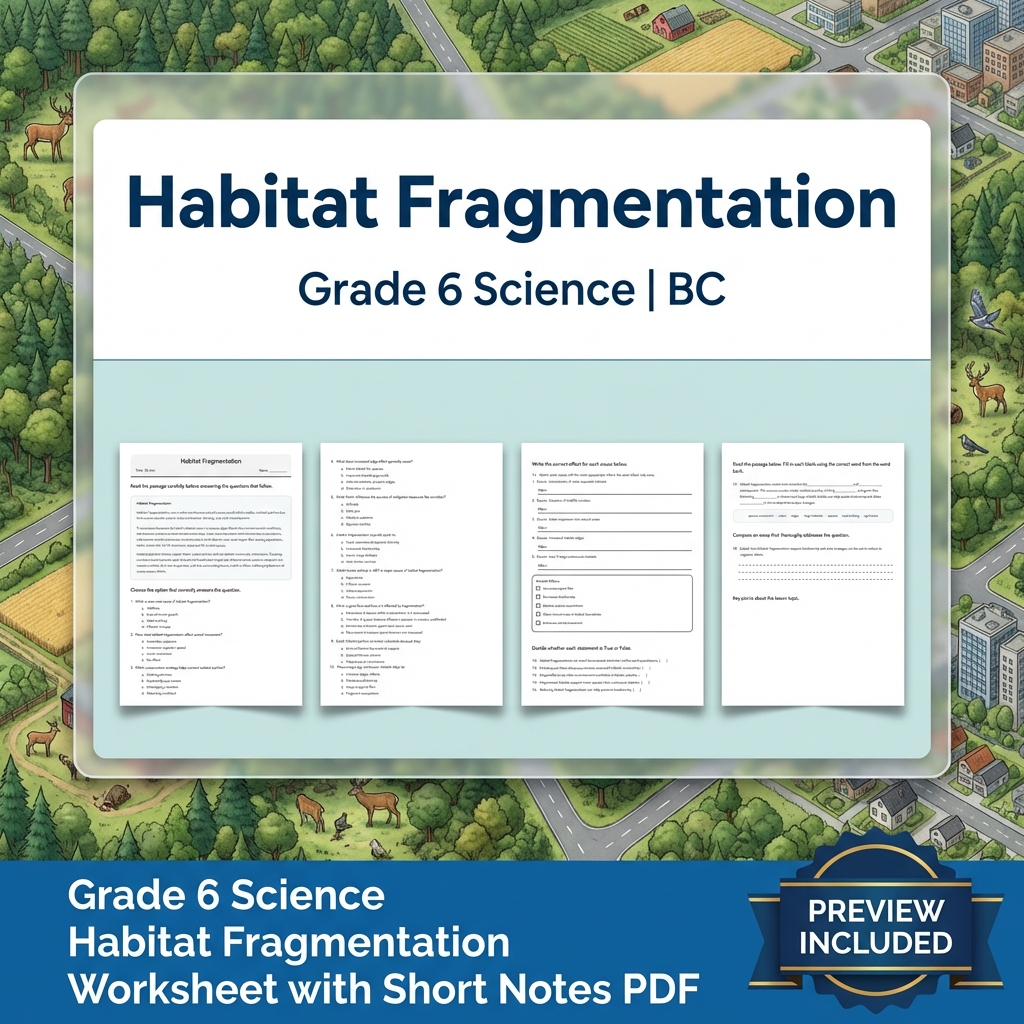
Grade 6 Science Habitat Fragmentation Worksheet with Short Notes PDF
Created byMeadowlark WorksheetsLearning Objectives
- Understand the concept of habitat fragmentation and its causes.
- Identify effects of habitat fragmentation on wildlife populations.
- Evaluate strategies to mitigate impacts of habitat fragmentation.
Also included in: Grade 6 Science | Ecosystems & Interdependence UNIT Worksheet Bundle +1 more
Instant download

Grade 6 Science | Chemical Indicators - Daily Reading Comprehension
Created byCoral Reef LearningLearning Objectives
- Understand what chemical indicators are
- Identify signs that suggest a chemical reaction has taken place
- Differentiate between physical changes and chemical changes
Instant download

Weather Patterns Worksheet | NGSS Grade 6 Science + Doodle Notes
 Created byAmber Owl Education
Learning Objectives
- Explain how pressure systems, air masses, and fronts interact to create local and regional weather.
- Interpret weather data from surface maps, including temperature, pressure, precipitation, and wind shifts.
- Describe how convection and latent heat release help connect short-term weather variability to precipitation and storms.
Also included in: Grade 6 Science Earth Systems & Climate Lesson Bundle | NGSS +1 more
Instant download

Limiting Resources Worksheet | Standards-Based Grade 6 Science Practice
JCreated byJ.S SheetsLearning Objectives
- Understand how limiting resources affect populations in ecosystems.
- Identify different types of resources that can be limiting.
- Explain how organisms respond to resource scarcity.
Also included in: Grade 6 Life Science Science Lesson Bundle – California Standards +1 more
Instant download

Grade 6 Growth and Stored Energy Worksheet | California Science PDF
Created byEvergreen Desk EducationLearning Objectives
- Explain how photosynthesis provides energy for plant growth and life processes.
- Describe how plants store chemical energy and use it later to build tissues and maintain functions.
- Connect plant structure changes (leaves, stems, roots, and reproductive parts) to matter use and energy transformations.
Instant download

Grade 6 Energy Pathways Worksheet | NGSS Practice PDF
 Created byClear Sky Classroom
Learning Objectives
- Describe how photosynthesis and respiration transfer energy in cells.
- Identify reactants and products involved in photosynthesis and respiration.
- Explain how energy is conserved and cycled through biological processes.
Also included in: Grade 6 Molecules to Organisms Science Lesson Bundle: Structures (NGSS) +1 more
Instant download

Earth System Interactions Worksheet | Standards-Aligned Grade 6 Science
JCreated byJ.S SheetsLearning Objectives
- Understand how the atmosphere, hydrosphere, geosphere, and biosphere interact through matter and energy flow.
- Identify processes such as heating, cooling, evaporation, condensation, erosion, and deposition that connect Earth's spheres.
- Explain how changes in one sphere can influence others and affect local environmental conditions.
Also included in: Grade 6 Climate and Atmospheric Systems Science Lesson Bundle: Florida NGSSS +1 more
Instant download

Grade 6 Science | Decomposer Matter Return - Daily Reading Comprehension
Created byCoral Reef LearningLearning Objectives
- Understand the role of decomposers in ecosystems.
- Explain how decomposers recycle matter and nutrients.
- Recognize the importance of decomposition in supporting plant growth.
Instant download

Mass and Density Worksheet | Standard-Aligned Grade 6 Science Practice
JCreated byJ.S SheetsLearning Objectives
- Define mass and volume and describe how they are measured for solids and liquids
- Use the density formula (density = mass ÷ volume) to calculate density from whole-number data
- Interpret density values to explain whether objects sink or float based on buoyancy
Instant download

Planning Investigations Worksheets: Scientific Method Practice
LCreated byLearnora ResourcesLearning Objectives
- Identify testable questions from scientific investigation scenarios
- Distinguish independent, dependent, and controlled variables
- Select suitable materials and procedures for fair tests
Instant download

Grade 6 Mixed Series Parallel Circuits Worksheet | Ontario Science Activity
 Created byTeacher's Corner
Learning Objectives
- Decompose a mixed series-parallel circuit into simpler series and parallel subcircuits.
- Describe how current and voltage divide in combined circuit sections.
- Predict how changes to a component affect brightness or meter readings in real circuits.
Instant download

Grade 6 Science | Current Electricity Worksheet (PDF) – Ontario Standards
Created byEvergreen Desk EducationLearning Objectives
- Explain electric current as the organized movement of electric charges through a conductor.
- Distinguish conventional current direction from electron flow in a circuit.
- Describe potential difference as the driving force that pushes charges to move.
Also included in: Grade 6 Electricity Circuits Science Lesson Bundle for Ontario Worksheets +1 more
Instant download

Grade 6 Science | Cycles Of Matter Model Worksheet | General Standard
 Created byLumora Learning
Learning Objectives
- Explain how matter cycles through living and non-living parts of an ecosystem
- Describe carbon and water movement among reservoirs using the cycles of matter model
- Interpret processes (photosynthesis, respiration, feeding, decomposition) as flows in a matter cycle
Instant download

Circuit Symbols and Schematic Connections Worksheets Grade 6
Created byPrism Point LearningLearning Objectives
- Identify common symbols used in electrical circuit schematics
- Explain how schematic diagrams represent physical electrical connections
- Compare series, parallel, and mixed circuit structures
Also included in: Grade 6 Electricity Lesson Bundle | Ontario Science Framework
Instant download

States of Matter Assessment | Florida NGSSS Standards Grade 6 Science
Created byPrism Point LearningLearning Objectives
- Compare solids, liquids, and gases based on shape and volume.
- Explain how particle motion differs in solids, liquids, and gases.
- Connect changes in state to energy changes and particle behavior.
Also included in: Grade 6 Energy and Matter Science Lesson Bundle Unit: Florida NGSSS
Instant download
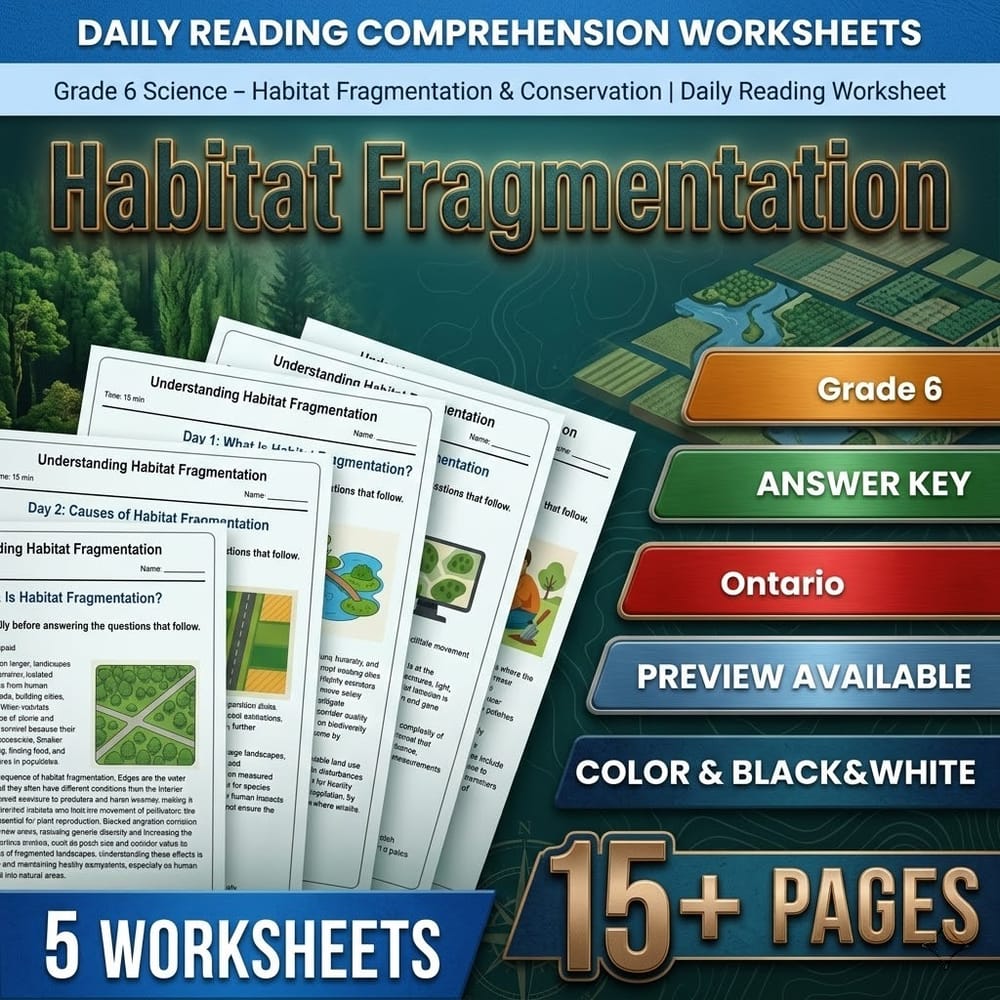
Grade 6 Science – Habitat Fragmentation & Conservation | Daily Reading Worksheet
 Created byQuiet Forest Education
Learning Objectives
- Understand key concepts related to Science
- Apply knowledge through practice questions
- Demonstrate comprehension of the material
Instant download

Feedback Control & Homeostasis Worksheets | Grade 6 Science
 Created byTeachers Club
Learning Objectives
- Explain how negative feedback helps maintain internal stability in the body.
- Identify the roles of sensors, control centers, and effectors in feedback control.
- Compare positive and negative feedback using blood glucose and body temperature examples.
Also included in: From Molecules to Organisms Grade 6 Science NGSS Bundle +2 more
Instant download

Grade 6 Reaction Rates Worksheet | Practice & Assessment PDF
Created byClear Sky ClassroomLearning Objectives
- Describe reaction rate as how quickly reactants change into products.
- Explain how concentration, temperature, surface area, and catalysts affect particle collisions.
- Connect collision-level ideas to observable changes during reactions (gas, color, heat).
Instant download

Space Tools Worksheet for Grade 6 Science | TEKS-Aligned Assessment
JCreated byJ.S SheetsLearning Objectives
- Compare ground-based telescopes, orbital telescopes, space probes, and Earth-observing satellites by purpose and limitations.
- Explain how spectral imaging and remote sensing help scientists measure properties such as temperature, vegetation, and atmospheric gases.
- Interpret data concepts including spatial and temporal resolution when making conclusions from space-based observations.
Instant download

Material Cycling Worksheet | Standards-Aligned Science Practice for Grade 6
JCreated byJ.S SheetsLearning Objectives
- Describe how Earth's materials such as rocks, soils, water, and living things are interconnected through cycling processes.
- Explain the physical and chemical weathering of rocks and how sediments are transported and deposited.
- Identify the role of biological processes in soil formation and water retention.
Also included in: Grade 6 Earth & Space Science Lesson Bundle: California Standards +1 more
Instant download

Grade 6 Friction Effects Worksheet | NGSS Practice & PDF
Created byClear Sky ClassroomLearning Objectives
- Explain how friction opposes motion between two surfaces and affects sliding distance
- Describe how different surface textures change the amount of friction
- Connect friction and air resistance to real-world examples of slowing and heating
Instant download

Respiration and Digestion Assessment for Grade 6 Science – Standard Aligned
Created byPrism Point LearningLearning Objectives
- Understand the structures and functions of the respiratory and digestive systems.
- Explain how gas exchange and nutrient absorption support life processes.
- Identify key organs involved in respiration and digestion and their roles.
Instant download

Cell Evidence for Biological Organization Grade 6 Science Worksheets
Created byTeachers ClubLearning Objectives
- Identify cells as the basic unit of life using observations from microscopy and preserved specimens
- Compare single-celled and multicellular organisms based on visible cell structures and organization
- Describe how cells relate to tissues, organs, and whole organisms using empirical evidence
Also included in: From Molecules to Organisms Grade 6 Science NGSS Bundle +2 more
Instant download

Grade 6 Science – Conservation Strategies | Daily Reading Worksheet
Created byBright Mind ResourcesLearning Objectives
- Understand the concept of protected areas in conservation
- Identify different types of conservation strategies
- Analyze the importance of protected areas for biodiversity
Also included in: Grade 6 Forest Ecology Science Daily Reading Worksheets Lesson Bundle | Alberta +2 more
Instant download
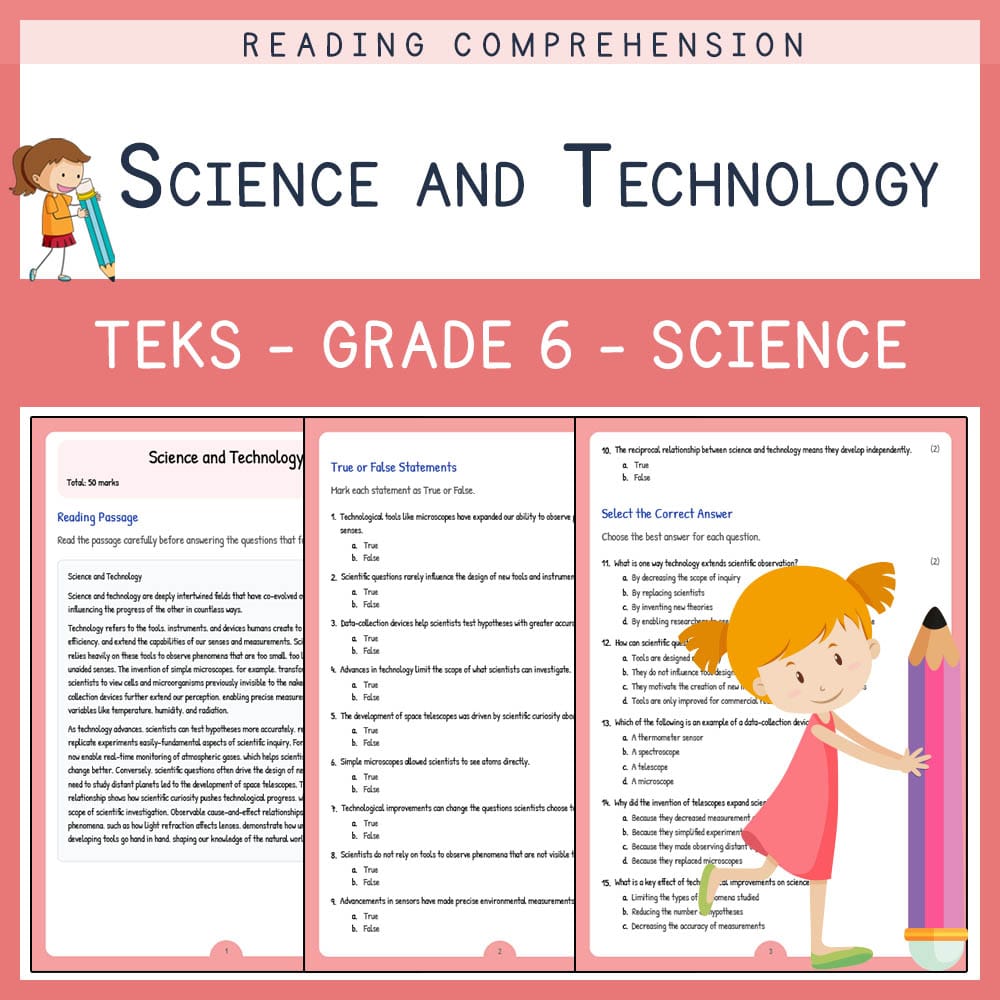
Grade 6 Science | Science and Technology Worksheet | TEKS-Aligned
Created byLumora LearningLearning Objectives
- Understand how scientific investigation and technological development are interconnected.
- Describe how tools like microscopes and sensors extend observation and measurement.
- Explain how technological advances influence scientific inquiry and vice versa.
Instant download

Grade 6 Science – Scientific Inquiry & Observation | Daily Reading Worksheet
Created byBright Mind ResourcesLearning Objectives
- Understand the importance of careful observations in science.
- Learn how to describe observations using measurement and descriptive terms.
- Recognize the role of evidence and logical reasoning in forming scientific explanations.
Also included in: Scientific Inquiry Grade 6 Science Daily Reading Worksheets Bundle | FL NGSSS +1 more
Instant download

Grade 6 Chemical Reactions Worksheet | Practice & Assessment PDF
Created byClear Sky ClassroomLearning Objectives
- Identify key indicators that signify a chemical reaction through analysis of qualitative and quantitative data.
- Describe common examples and interpret pre- and post-interaction measurements to determine if a new substance has formed.
- Understand the significance of indicators such as color change, gas evolution, precipitate formation, and temperature change in chemical reactions.
Also included in: Grade 6 Matter & Chemical Reactions Science Lesson Bundle—NGSS Worksheets +1 more
Instant download

Grade 6 Science | Societal Impacts - Daily Reading Comprehension
Created byCoral Reef LearningLearning Objectives
- Understand how water treatment improves public health
- Identify societal benefits of scientific research in environmental management
- Evaluate evidence-based outcomes of public health initiatives
Instant download

Grade 6 Science | Matter Properties - Daily Reading Comprehension
Created byCoral Reef LearningLearning Objectives
- Understand the concept of density and how it helps identify substances.
- Compare the density of different materials visually and quantitatively.
- Recognize other properties such as solubility, magnetism, and luster.
Instant download

6th Grade Science | Alberta Seasons Worksheet (PDF) with Answer Key
 Created bySilver Birch Teaching
Learning Objectives
- Describe how Earth’s tilt and the Sun’s angle affect seasonal changes in Alberta.
- Explain how Alberta’s continental climate influences the timing and intensity of seasonal weather.
- Connect daylight and solar intensity to environmental effects such as river ice breakup and plant growth.
Also included in: Grade 6 Celestial Motion & Seasons Science Lesson Bundle | Alberta +1 more
Instant download

Grade 6 Science – Population Change & Habitats | Daily Reading Worksheet
Created byBright Mind ResourcesLearning Objectives
- Read and comprehend scientific passages about animal populations.
- Interpret data related to fluctuations in population sizes.
- Identify factors affecting population growth and decline.
Also included in: Grade 6 Ecosystems and Energy Science Lesson Bundle | California Standards +1 more
Instant download

Parallel Circuits and Branch Current Worksheets Grade 6 Science
Created byPrism Point LearningLearning Objectives
- Explain why voltage is equal across branches in parallel circuits
- Calculate total current from individual branch currents
- Compare parallel and series circuit behaviour when loads are removed
Also included in: Grade 6 Electricity Lesson Bundle | Ontario Science Framework
Instant download

Gravitational Attraction and Friction Forces Worksheets | Grade 6 Science
Created byTeachers ClubLearning Objectives
- Explain how gravity depends on mass and distance using examples such as Earth and the Moon
- Compare gravitational attraction with contact forces like friction by describing how each changes motion
- Use evidence from quantitative patterns to support an argument about gravitational interactions
Also included in: Grade 6 Science Forces & Interactions Worksheets | NGSS Bundle +2 more
Instant download
About Grade 6 Science Worksheets
Explore Grade 6 Science worksheets for classwork, homework, or review. Our 5,997 printables download instantly as PDFs.
MyTeachingSheets worksheets are made by real teacher-authors and checked before they go live. Download any as a print-ready PDF for lessons, homework, or independent practice — most include answer keys, and previews are always free.