
Grade 6 Science Worksheets
5,997 worksheets
Grade 6 Science – Weather & Climate | Daily Reading Worksheet
 Created byBright Mind Resources
Learning Objectives
- Understand the difference between weather and climate.
- Identify various weather conditions based on a description.
- Describe how weather can change throughout a day.
Also included in: Earth Systems Grade 6 Science Daily Reading Worksheets Lesson Bundle | General +1 more
Instant download

Grade 6 Science – Earth's Tilt & Sun Path Daily Reading Worksheet
Created byBright Mind ResourcesLearning Objectives
- Describe how Earth's axial tilt affects seasons
- Identify regional sky phenomena linked to Earth's tilt
- Explain how models predict sunlight duration and solar angles
Also included in: Grade 6 Solar System & Seasons Science Daily Reading Lesson Bundle | Alberta +2 more
Instant download
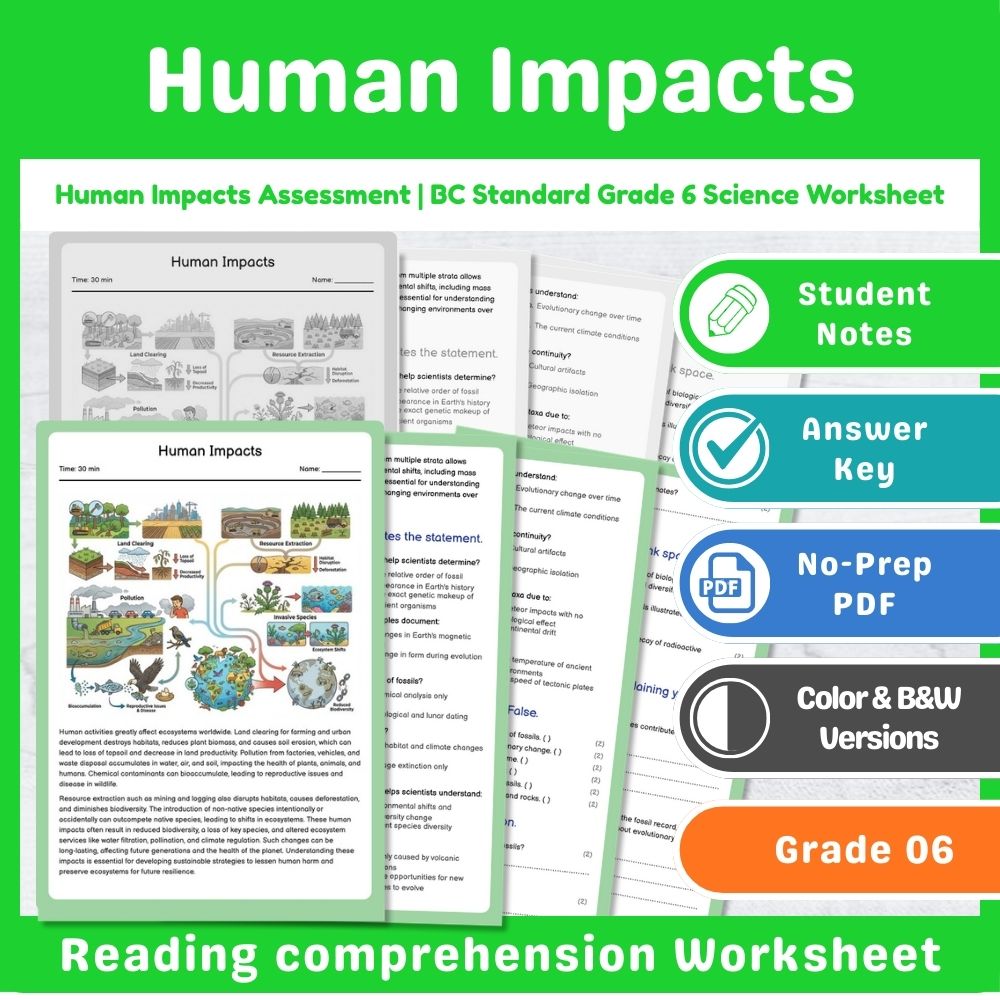
Human Impacts Assessment | BC Standards Grade 6 Science
 Created byPrism Point Learning
Learning Objectives
- Understand how human activities alter ecosystems through land clearing, pollution, resource extraction, and species introduction.
- Identify the effects of deforestation and pollution on biodiversity and ecosystem functions.
- Analyze how human impacts can lead to long-term environmental changes and reduced ecosystem services.
Instant download
Grade 6 Science Worksheet 1 – Learn Safety and Ethics Easily | PDF
 Created byMeadowlark Worksheets
Learning Objectives
- Understand foundational safety principles in scientific practice.
- Identify ethical considerations in research involving organisms and community data.
- Recognize protocols for hazard prevention and proper disposal of substances.
Also included in: Grade 6 Science Lesson Bundle | Ontario Framework & Inquiry Skills +1 more
Instant download

Communication Quality Worksheet | TEKS-Aligned Grade 6 Science Practice
JCreated byJ.S SheetsLearning Objectives
- Write scientific claims that are supported by evidence and justified with reasoning.
- Interpret and describe trends shown in standardized visual summaries such as graphs and tables.
- Use clear operational definitions and transparent methods, including uncertainties and replication.
Instant download

Grade 6 Understanding Phenotypic Variation Worksheet | NGSS Science Activity
 Created byBRIGHT PATH RESOURCES
Learning Objectives
- Identify how genetic differences influence traits in organisms.
- Describe environmental factors that affect phenotypic variation.
- Explain the relationship between DNA, gene expression, and observable characteristics.
Also included in: From Molecules to Organisms Lesson Bundle | Grade 6 Science | NGSS +2 more
Instant download

Organ Systems Overview Test Prep Printable | Grade 6 Science
Created byPrism Point LearningLearning Objectives
- Identify major organ systems and describe their principal functions in the human body
- Explain how organ systems interact to maintain internal balance
- Use science vocabulary to describe transport, exchange, digestion, defense, and control
Also included in: Multicellular Systems & Functions Lesson Bundle | Grade 6 Science | BC +1 more
Instant download

Grade 6 Aerodynamic Design Worksheet | NCSS Practice PDF
 Created byClear Sky Classroom
Learning Objectives
- Explain how lift, drag, and stability are affected by wing shape, smoothness, and orientation.
- Identify how design changes such as aspect ratio and surface area can improve or reduce flight performance.
- Use evidence from a passage to select main ideas and evaluate statements about aerodynamic principles.
Also included in: Grade 6 Air and Aerodynamics Science Lesson Bundle (Alberta Framework) +1 more
Instant download

Grade 6 Science Worksheet | Parallel Circuit Characteristics (PDF)
 Created byEvergreen Desk Education
Learning Objectives
- Describe the key characteristics of parallel circuits, including multiple branching pathways and equal potential difference across branches.
- Explain how current divides in parallel circuits and how overall current equals the sum of branch currents.
- Compare how loads in parallel circuits behave independently and how parallel circuits differ from series circuits during faults.
Also included in: Grade 6 Electricity Circuits Science Lesson Bundle for Ontario Worksheets +1 more
Instant download

Grade 6 Science – Stewardship Strategies & Biodiversity Conservation | Worksheet
Created byBright Mind ResourcesLearning Objectives
- Understand the concept of habitat restoration and its significance.
- Identify different stewardship strategies used to protect ecosystems.
- Analyze the trade-offs involved in various conservation approaches.
Also included in: Grade 6 Ecology & Biodiversity Science Lesson Bundle | Ontario Daily Reading +1 more
Instant download

Grade 6 Collisions and Momentum Worksheet | NGSS Practice PDF
Created byClear Sky ClassroomLearning Objectives
- Understand the principles of conservation of momentum in two-body collisions.
- Differentiate between elastic and inelastic collisions through examples.
- Identify the forces involved during contact in collisions and how they produce action-reaction pairs.
Also included in: Grade 6 Motion and Stability: Forces and Interactions Science Lesson Bundle NGSS +1 more
Instant download

Science Grade 6 Variable Control Worksheet | Standards-Aligned Practice
JCreated byJ.S SheetsLearning Objectives
- Identify the independent variable and the dependent variable in an investigation
- Explain why control variables must be kept constant to make evidence reliable
- Use an experiment plan to separate the changing factor from measured outcomes
Also included in: Grade 6 Scientific Investigation Science lesson bundle: General Framework +1 more
Instant download

Grade 6 Science | Digestive System - Daily Reading Comprehension
 Created byCoral Reef Learning
Learning Objectives
- Identify the main organs involved in digestion
- Understand the basic functions of the digestive organs
- Learn how food is broken down and nutrients are absorbed
Instant download

Grade 6 Science – Mass & Density Daily Reading Worksheet | TEKS Aligned
Created byBright Mind ResourcesLearning Objectives
- Define and measure mass and volume of objects.
- Understand how density relates mass and volume.
- Calculate density with simple formulas.
Also included in: Matter & Energy Grade 6 Science Daily Reading Worksheets Bundle | TEKS +2 more
Instant download
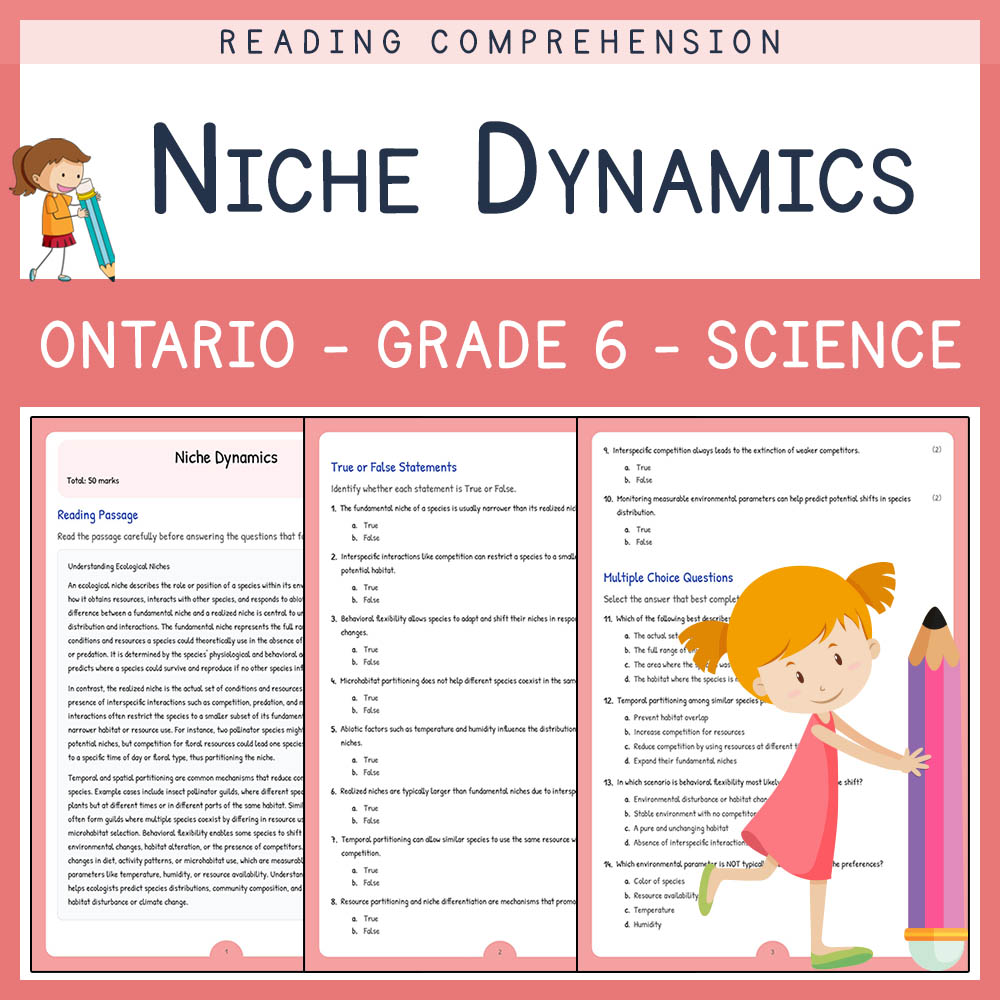
Grade 6 Science | Niche Dynamics Worksheet & Answer Key | Ontario Standards
 Created byLumora Learning
Learning Objectives
- Describe the difference between fundamental and realized ecological niches.
- Explain how abiotic factors and interspecific interactions influence resource use and habitat occupation.
- Analyze examples of spatial and temporal partitioning among species.
Also included in: Grade 6 Science | Biodiversity Custom Unit Resource | Ontario Framework
Instant download

Eclipses And Tides Practice Test Printables | Grade 6 Science
Created byPrism Point LearningLearning Objectives
- Explain how solar and lunar eclipses happen using Earth–Moon–Sun alignment and the ideas of umbra and penumbra.
- Distinguish the causal mechanisms behind eclipse visibility and tidal range by relating them to the Earth–Moon–Sun system.
- Describe how spring and neap tides form and why some coasts experience stronger tide effects.
Also included in: Grade 6 Space Systems Science Lesson Bundle for Ontario (10 Worksheets)
Instant download
Grade 6 Science | Solar Motions Worksheet (Answer Key) – TEKS Aligned
Created byBright Mind ResourcesLearning Objectives
- Describe the orbital motions of planets and the Moon.
- Explain how gravitational interactions influence celestial bodies.
- Identify how Earth's tilt and revolution cause seasons and climate changes.
Instant download

6th Grade Science Worksheets | Collaborative Practices & Reproducibility (PDF)
Created byEvergreen Desk EducationLearning Objectives
- Explain how roles, shared documentation standards, and communication protocols improve team science projects.
- Use trackable versioning and clear attribution to make scientific records transparent and reproducible.
- Practice constructive critique by using agreed-upon review and decision-making processes to resolve conflicting observations.
Also included in: Grade 6 Science Inquiry and Data Collection Lesson Bundle | Ontario +1 more
Instant download
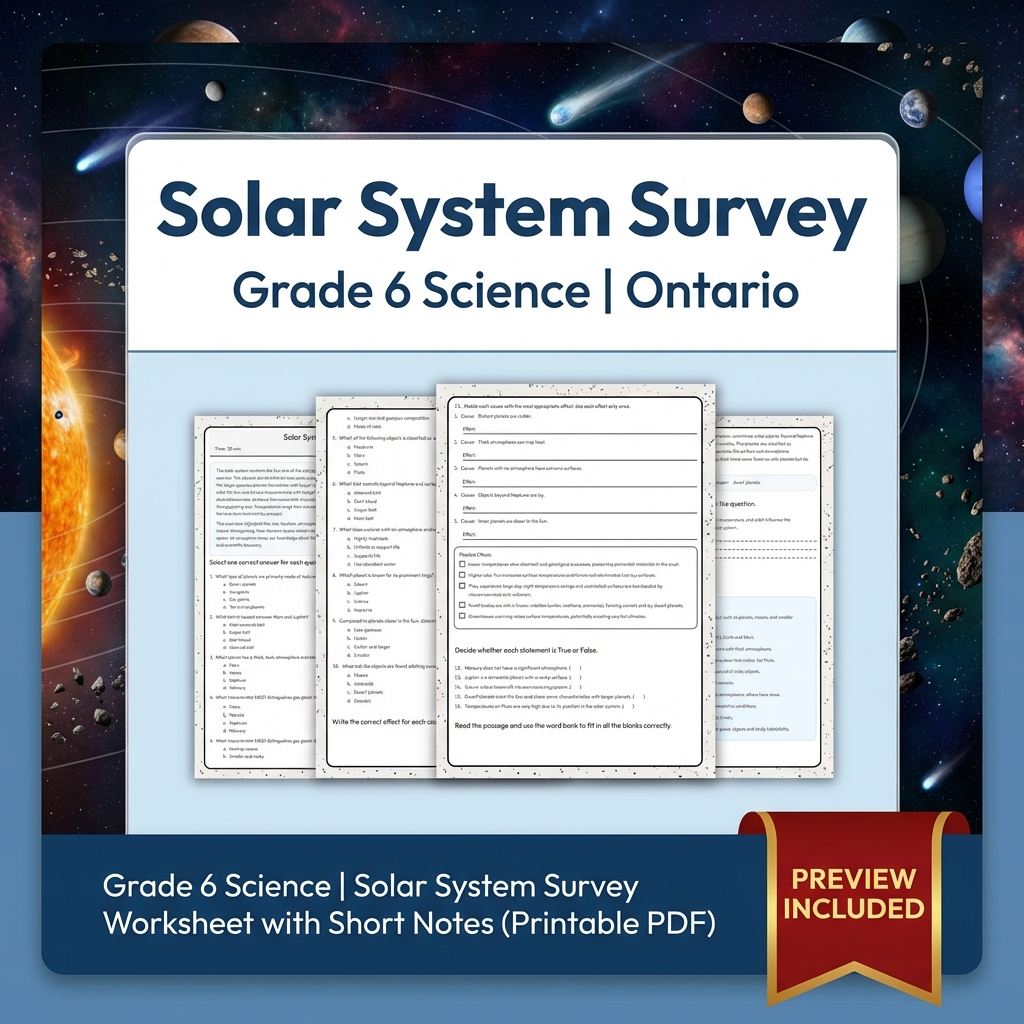
Grade 6 Science | Solar System Survey Worksheet with Short Notes (Printable PDF)
Created byMeadowlark WorksheetsLearning Objectives
- Identify major components of the solar system and their characteristics.
- Distinguish between terrestrial planets, gas giants, and dwarf planets.
- Understand the locations and features of asteroid and Kuiper belts.
Also included in: Grade 6 Science Lesson Group Bundle – Ontario Curriculum Worksheets +1 more
Instant download

Variables Control Worksheet Pack | Grade 6 Science Activities
Created byPrism Point LearningLearning Objectives
- Identify independent, dependent, and controlled variables in a controlled experiment.
- Use operational definitions to clearly describe what is being measured and manipulated.
- Recognize potential confounding variables and explain how to reduce them using controls, replication, and randomization.
Also included in: Grade 6 Scientific Investigation Practices Science Lesson Bundle TEKS +1 more
Instant download

Grade 6 Science – Understanding Iterative Improvement | Daily Reading Worksheet
Created byBright Mind ResourcesLearning Objectives
- Define iterative improvement and explain its importance in science and engineering.
- Identify how evaluation results guide design refinements.
- Describe the process of testing and fixing in iterative development.
Also included in: Engineering & Technology Grade 6 Science Worksheets Lesson Bundle | General +1 more
Instant download

Science Worksheet Population Change | NGSS Grade 6 Science Assessment
 Created bySkylark Worksheets
Learning Objectives
- Use evidence to explain how ecosystem changes can cause population increases or declines
- Interpret population data (birth/death rates, age structure, and growth patterns) to support claims
- Connect ecosystem interactions (predators, prey, invasive species, disease) to trophic cascades and recovery or collapse
Also included in: Grade 6 Ecosystems Lesson Bundle: NGSS Science Worksheets & Food Webs +1 more
Instant download

Earth Rotation Worksheet | Grade 6 Science Activities
Created byPrism Point LearningLearning Objectives
- Explain how Earth’s rotation about its axis produces alternating daylight and darkness.
- Describe how Earth’s axial rotation creates the apparent daily motion of the Sun and stars.
- Connect the timing of sunrise, solar noon, and sunset to different time zones across Alberta.
Also included in: Celestial Patterns & Seasons Lesson Bundle | Grade 6 Science | Alberta
Instant download

Grade 6 Science – Graph Selection & Data Visualization | Daily Reading Worksheet
Created byBright Mind ResourcesLearning Objectives
- Understand different types of graphs and their uses in science.
- Learn when to use line graphs, bar charts, and scatter plots.
- Recognize the importance of appropriate axis labeling and scaling.
Also included in: Grade 6 Science Data & Inquiry Daily Reading Worksheets Lesson Bundle | Alberta +2 more
Instant download

Drag Types Worksheet | Grade 6 Science Activities
Created byPrism Point LearningLearning Objectives
- Explain how friction and pressure differences contribute to drag.
- Differentiate parasitic drag and induced drag using examples.
- Describe how reducing drag can lower required thrust and energy demands.
Also included in: Aerodynamics and Flight Design Lesson Bundle – Grade 6 Science Alberta
Instant download

Grade 6 Science – Data Tables & Graphs Daily Reading Worksheet | TEKS
Created byBright Mind ResourcesLearning Objectives
- Learn how to organize data in tables and graphs.
- Identify patterns and outliers in data sets.
- Interpret trends from line graphs, bar graphs, and scatter plots.
Also included in: Grade 6 Science Inquiry & Modeling Daily Reading Lesson Bundle | TEKS +2 more
Instant download

6th Grade Science | Data Representations Worksheet (Worksheet + Answer Key)
Created byEvergreen Desk EducationLearning Objectives
- Organize numerical and categorical observations into tables and graphs for comparison
- Use consistent labels, units, and scales to read results accurately
- Identify when to use bar graphs, line graphs, and tables based on the type of data
Also included in: Grade 6 Science Inquiry Lesson Bundle: Variable Control & Models (General) +1 more
Instant download
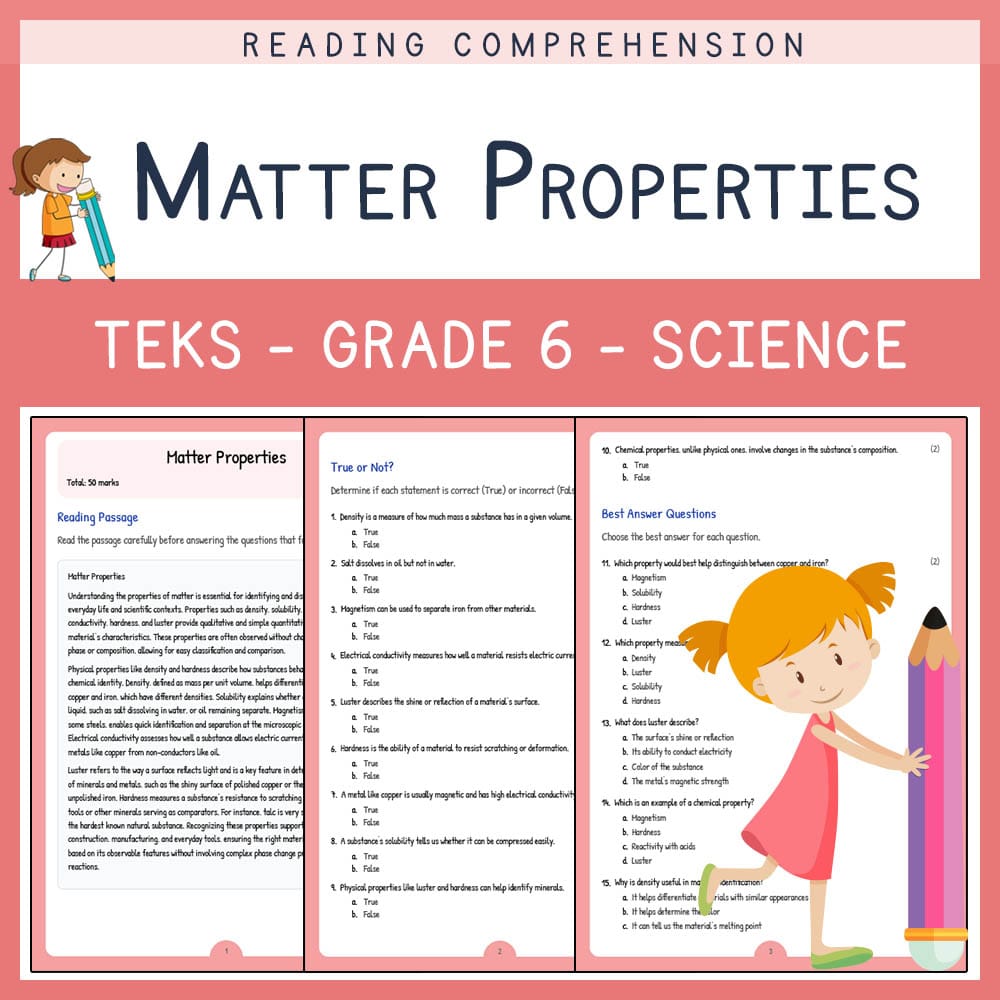
Grade 6 Science | Matter Properties Worksheet | TEKS-Aligned
Created byLumora LearningLearning Objectives
- Understand the different types of physical and chemical properties used to identify substances.
- Learn how to describe properties such as density, solubility, magnetism, electrical conductivity, hardness, and luster.
- Relate observed properties to real-world examples like iron, salt, oil, and copper.
Also included in: Grade 6 Science | Matter and Energy Lesson Bundle | TEKS Aligned
Instant download

Grade 6 Science | Observational Instruments Worksheet (Ontario Standards) (PDF)
Created byEvergreen Desk EducationLearning Objectives
- Describe how different observational instruments (optical, radio, spectrometers, and space-based observatories) collect information about the solar system.
- Explain how wavelength helps determine composition, motion, and temperature of space objects.
- Compare ground-based and space-based observing platforms and identify key advantages of avoiding atmospheric distortion.
Also included in: Grade 6 Solar System Space Science Lesson Bundle – Ontario Worksheets +1 more
Instant download

Balanced Forces Assessment | NGSSS Florida Grade 6 Science
Created byPrism Point LearningLearning Objectives
- Explain how balanced forces result in a net force of zero and can maintain motion at constant speed or rest
- Describe how unbalanced forces create a net force that changes an object’s speed and/or direction
- Determine the direction of the net force from a force diagram or word description of forces
Also included in: Grade 6 Energy and Matter Science Lesson Bundle Unit: Florida NGSSS
Instant download

Variables Control Assessment | TEKS Science Grade 6 Worksheet
Created byPrism Point LearningLearning Objectives
- Understand the roles of independent, dependent, and controlled variables in experiments.
- Identify operational definitions and potential confounding influences in controlled testing.
- Apply understanding of variable control to plant growth experiments under varied light conditions.
Also included in: Scientific Inquiry and Processes Grade 6 Science Lesson Bundle | TEKS
Instant download

Solar System Survey Worksheet | Ontario Grade 6 Science Assessment
 Created byCedar Grove Learning
Learning Objectives
- Identify major components of the solar system (terrestrial planets, gas giants, ice giants, dwarf planets, asteroid belt, and Kuiper belt).
- Describe how distance from the Sun affects temperature and typical surface or atmospheric conditions.
- Explain how planet classification relates to composition and orbital behavior (such as clearing an orbital zone).
Also included in: Grade 6 Earth and Space Systems Science Lesson Bundle: Ontario +1 more
Instant download

Grade 6 Climate Systems Worksheet | NGSS Practice PDF
Created byClear Sky ClassroomLearning Objectives
- Explain how unequal solar heating and planetary rotation create global circulation patterns.
- Identify major atmospheric cells, wind patterns, and ocean currents involved in heat and moisture transport.
- Describe the influence of circulation patterns on regional climates and phenomena like El Niño.
Also included in: Grade 6 Earth's Systems Science Lesson Bundle (NGSS-Aligned) Worksheets +1 more
Instant download
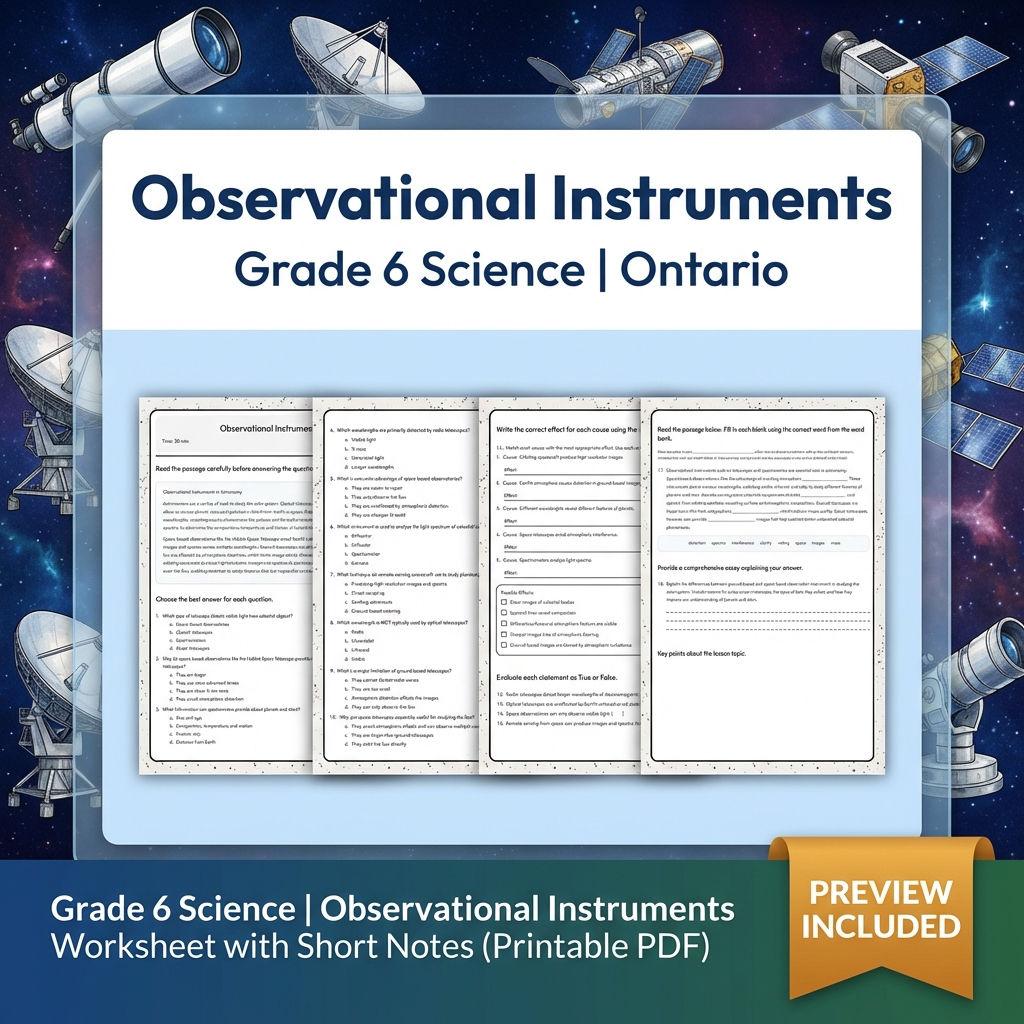
Grade 6 Science | Observational Instruments Worksheet with Short Notes (PDF)
Created byMeadowlark WorksheetsLearning Objectives
- Identify different types of observational instruments used to study the solar system.
- Explain the advantages of space-based observatories over ground-based telescopes.
- Describe how different wavelengths provide information about planetary composition, motion, and temperature.
Also included in: Grade 6 Science Lesson Group Bundle – Ontario Curriculum Worksheets +1 more
Instant download

Cell Functions Worksheet | NGSS Grade 6 Science Practice PDF
JCreated byJ.S SheetsLearning Objectives
- Identify the main organelles in a cell and their functions.
- Explain how organelle structure relates to its role in the cell.
- Differentiate between plant and animal cell organelles and their specialization.
Also included in: Grade 6 Cellular Processes and Feedback Science Lesson Bundle – NGSS +1 more
Instant download

Biodiversity Patterns Worksheet | NGSS Grade 6 Ecosystems Activity
 Created byAmber Owl Education
Learning Objectives
- Explain how species richness and occurrence can be used to identify biodiversity patterns across space and time.
- Compare biodiversity patterns using island faunas, latitudinal gradients, and habitat heterogeneity.
- Describe community turnover, endemism, and colonization using ecological and historical factors.
Also included in: Grade 6 Science Natural Selection & Biodiversity Lesson Bundle | NGSS +1 more
Instant download

Day Night Seasons Worksheet | NGSS Grade 6 Science Practice
JCreated byJ.S SheetsLearning Objectives
- Explain Earth's rotation and its effect on day and night.
- Describe how Earth's orbit and axial tilt cause seasons.
- Identify key observational events like solstices and equinoxes.
Also included in: Grade 6 Earth-Moon Relationships Space Science Lesson Bundle | NGSS +1 more
Instant download

Air Density Worksheet | Grade 6 Science Activities
Created byPrism Point LearningLearning Objectives
- Explain how temperature, humidity, and altitude affect air density.
- Describe how air density influences buoyancy and aerodynamic lift.
- Use science vocabulary to compare atmospheric conditions in different places.
Also included in: Aerodynamics and Flight Design Lesson Bundle – Grade 6 Science Alberta
Instant download

Grade 6 Species Interactions Worksheet | NGSS Practice PDF
Created byClear Sky ClassroomLearning Objectives
- Construct explanations predicting patterns of species interactions across ecosystems.
- Identify and differentiate mutualism, competition, predation, and parasitism.
- Compare interaction outcomes in forest, grassland, and freshwater environments.
Also included in: Grade 6 Ecosystems Science Lesson Bundle for NGSS: Species, Energy, Biodiversity +1 more
Instant download
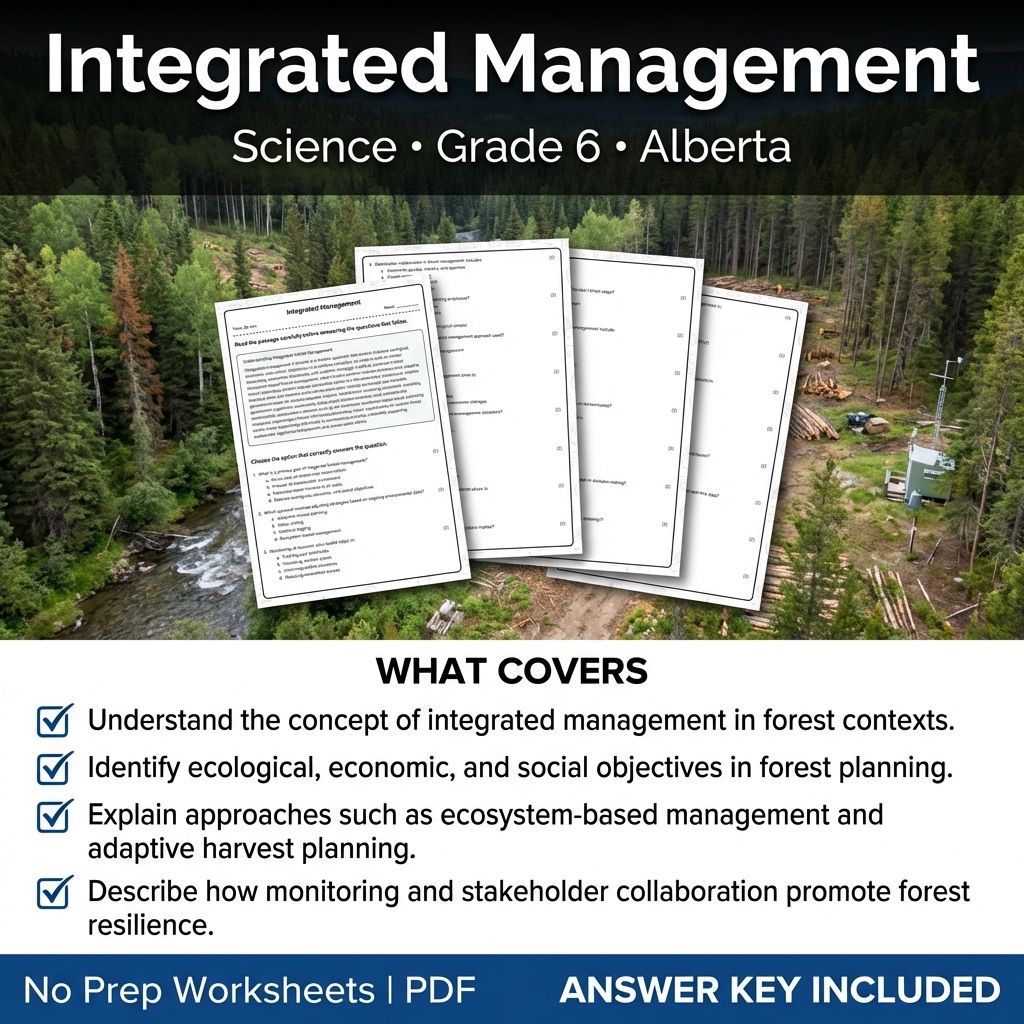
Grade 6 Science Worksheet on Integrated Management Alberta Standards
Created byCoral Reef LearningLearning Objectives
- Understand the concept of integrated management in forest contexts.
- Identify ecological, economic, and social objectives in forest planning.
- Explain approaches such as ecosystem-based management and adaptive harvest planning.
Instant download

Grade 6 Forms Of Energy Worksheet | Practice & Assessment PDF
Created byClear Sky ClassroomLearning Objectives
- Identify common forms of energy (kinetic, potential, thermal, chemical, electrical) in real-world situations
- Explain how energy transforms when one form changes into another in natural and engineered systems
- Use energy vocabulary to describe what energy is stored, what energy is moving, and what energy results
Instant download

Before After Properties Worksheet | Standards-Aligned Science Grade 6
JCreated byJ.S SheetsLearning Objectives
- Understand how to compare properties of substances before and after interaction.
- Identify evidence that indicates new substances are formed during interactions.
- Recognize changes in color, formation of solids, release of gases, and new material behaviors as signs of chemical change.
Also included in: Grade 6 Physical Science Lesson Bundle for Science – California Standards +1 more
Instant download

Interdependence Roles Worksheet Grade 6 Science NGSSS Florida
Created byPrism Point LearningLearning Objectives
- Explain how predators and prey populations can affect each other in an ecosystem.
- Describe competition and mutualism and how each relationship affects organisms.
- Use evidence to predict how changes in one population can ripple through a community.
Instant download

Adaptation and Speciation Test Prep Printables | Grade 6 Science
Created byPrism Point LearningLearning Objectives
- Explain how heritable variation and natural selection contribute to adaptation in populations.
- Describe how geographic separation and reproductive isolation lead to speciation.
- Use evidence (morphology, reproductive compatibility, and biogeography) to support claims about speciation.
Also included in: Grade 6 Evolution and Biodiversity Science lesson bundle | NGSS
Instant download

Matter Cycling Carbon Worksheet for Grade 6 Science | Standards-Aligned Practice
JCreated byJ.S SheetsLearning Objectives
- Explain how carbon atoms cycle through ecosystems, including processes like photosynthesis, respiration, and decomposition.
- Identify the roles of plants, animals, and the environment in the carbon cycle.
- Describe how matter is conserved and reused in ecosystems despite energy flow.
Also included in: Grade 6 Life Science Science Lesson Bundle – California Standards +1 more
Instant download

Pollution Effects Test Prep Printables | Grade 6 Science
Created byPrism Point LearningLearning Objectives
- Explain how different pollutants enter ecosystems from industrial, agricultural, and urban sources
- Describe how pollution can harm organisms through habitat degradation, health effects, and reduced oxygen
- Use terms bioaccumulation and biomagnification to explain how pollutants increase in top predators
Also included in: Ecosystems & Interdependence Lesson Bundle | Grade 6 Science | BC +1 more
Instant download

Population Dynamics Practice Worksheet | Grade 6 Science Ontario
Created byPrism Point LearningLearning Objectives
- Explain how birth and death rates, immigration and emigration, and carrying capacity affect population size
- Compare exponential growth with logistic growth using real-world examples of organisms
- Describe density-dependent and density-independent limiting factors and how they influence populations over time
Also included in: Grade 6 Biodiversity & Adaptation Science Lesson Bundle Ontario
Instant download

Measuring Circuits Worksheet Practice | Grade 6 Science Ontario
Created byPrism Point LearningLearning Objectives
- Explain how current and voltage measurements describe circuit performance
- Identify conceptually where current and voltage instruments are connected in a circuit
- Interpret common measurement readings and patterns to infer component behavior
Also included in: Grade 6 Circuits & Electricity Science lesson bundle: Ontario
Instant download
About Grade 6 Science Worksheets
Explore Grade 6 Science worksheets for classwork, homework, or review. Our 5,997 printables download instantly as PDFs.
MyTeachingSheets worksheets are made by real teacher-authors and checked before they go live. Download any as a print-ready PDF for lessons, homework, or independent practice — most include answer keys, and previews are always free.