
Grade 6 Science Worksheets
5,997 worksheets
Grade 6 Natural Selection Worksheet | NGSS Practice PDF
 Created byClear Sky Classroom
Learning Objectives
- Understand how heritable traits influence survival and reproduction.
- Identify examples of natural selection in real-world scenarios.
- Explain the process by which populations change over generations due to environmental pressures.
Also included in: Grade 6 Biological Evolution: Unity & Diversity Science lesson bundle NGSS +1 more
Instant download
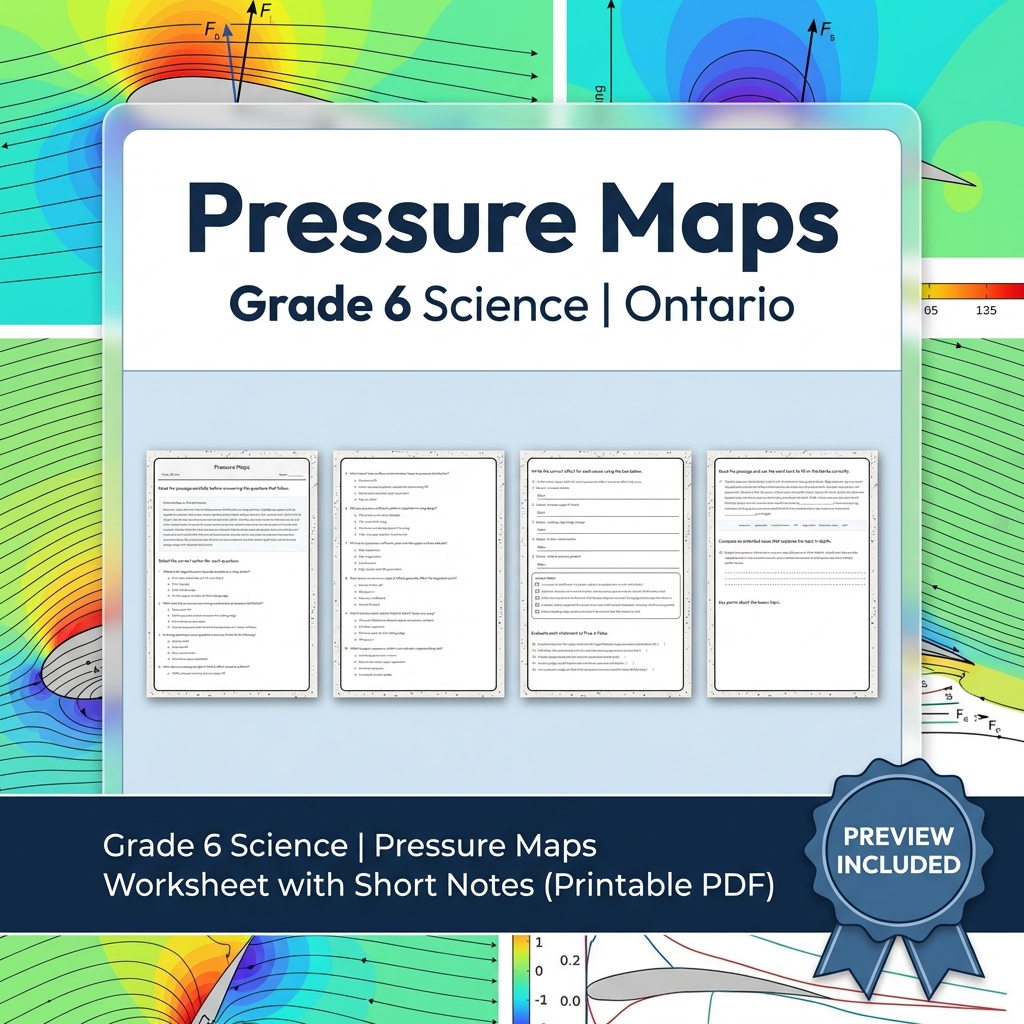
Grade 6 Science | Pressure Maps Worksheet with Short Notes (Printable PDF)
 Created byMeadowlark Worksheets
Learning Objectives
- Describe how surface pressure distribution around wing sections influences lift and pitching moments.
- Identify key pressure features such as stagnation points, suction peaks, and pressure coefficients.
- Explain how camber and angle of attack affect pressure minima and pressure patterns.
Also included in: Grade 6 Science Lesson Group Bundle – Ontario Framework Worksheets +1 more
Instant download

Niche Dynamics Worksheet | Ontario Grade 6 Science Assessment
 Created byCedar Grove Learning
Learning Objectives
- Distinguish between fundamental niche and realized niche using measurable environmental factors
- Explain how abiotic factors and species interactions affect where organisms can live and what resources they use
- Describe how spatial and temporal partitioning reduce competition among similar species
Also included in: Grade 6 Biodiversity and Adaptations Science Lesson Bundle Ontario +1 more
Instant download

6th Grade Science – Invasive Species Worksheet (Ontario Standards) (PDF)
 Created byEvergreen Desk Education
Learning Objectives
- Explain how invasive species are introduced and why they can become established in new ecosystems.
- Describe how invasive species affect native species through competition, predation, and habitat alteration.
- Use terms such as propagule pressure and lack of natural predators to predict invasion success.
Also included in: Grade 6 Biodiversity, Adaptation & Ecology Science Lesson Bundle | Ontario +1 more
Instant download
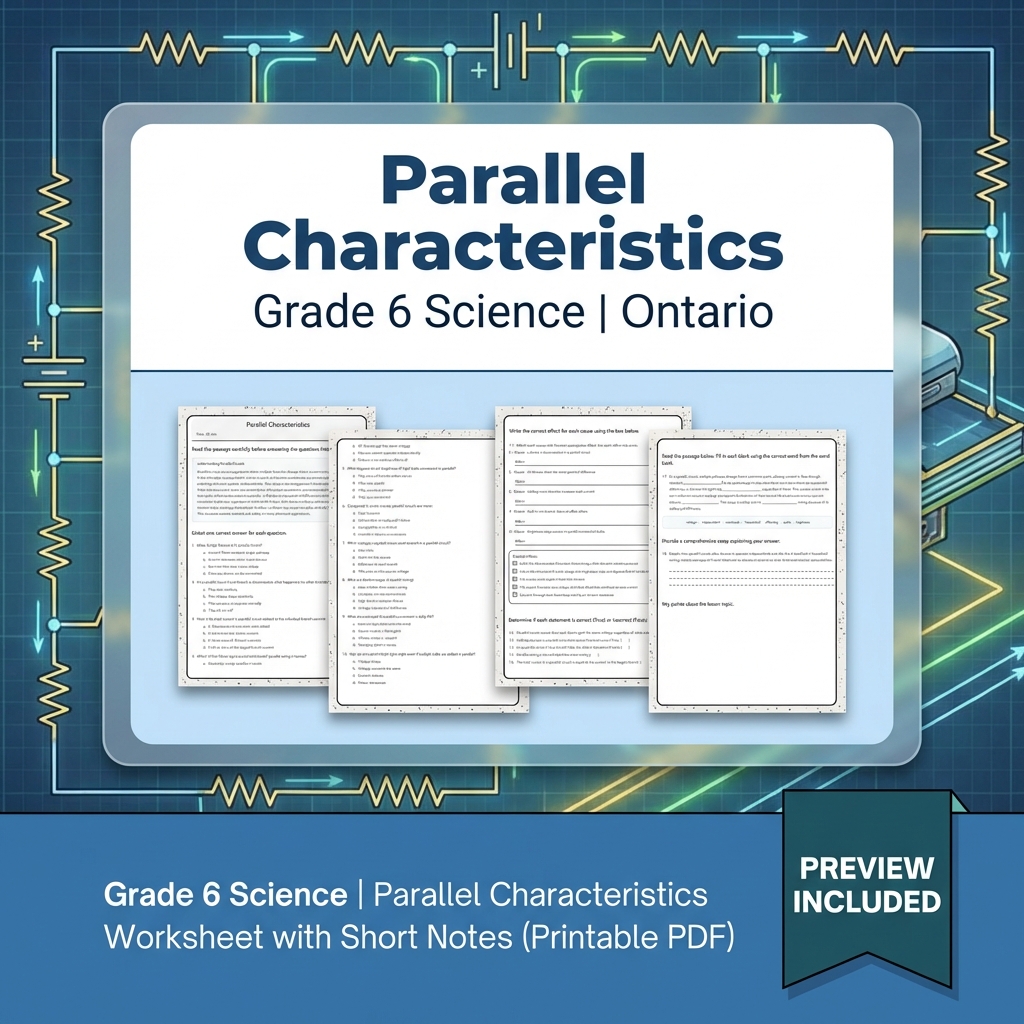
Grade 6 Science | Parallel Characteristics Worksheet with Short Notes ( PDF)
Created byMeadowlark WorksheetsLearning Objectives
- Understand the concept of parallel circuits, including multiple branching pathways.
- Explain the principles of equal potential difference across parallel branches.
- Describe how the overall current is the sum of branch currents in parallel wiring.
Also included in: Grade 6 Science Lesson Group on Energy, Circuits & Properties +1 more
Instant download

Satellite Systems Practice Worksheet | Grade 6 Science Assessment
 Created byPrism Point Learning
Learning Objectives
- Describe how artificial satellites support Earth observation, communication, navigation, and scientific monitoring.
- Explain the difference between geostationary and polar orbits and how orbit choice affects coverage.
- Identify how satellite sensor payloads and data help scientists track events like tides, solar activity, and surface changes on the Moon and planets.
Also included in: Grade 6 Space Systems Science Lesson Bundle for Ontario (10 Worksheets)
Instant download

Grade 6 Science | Comparative Flight - Daily Reading Comprehension
 Created byCoral Reef Learning
Learning Objectives
- Understand the differences in design features of kites, gliders, and round canopies.
- Identify how glide ratio, lift-to-drag performance, and control responsiveness affect flight.
- Explain how regional atmospheric conditions influence flying device performance.
Also included in: Air and Aerodynamics Lesson Bundle – Grade 6 Science Alberta Reading Comp. +1 more
Instant download
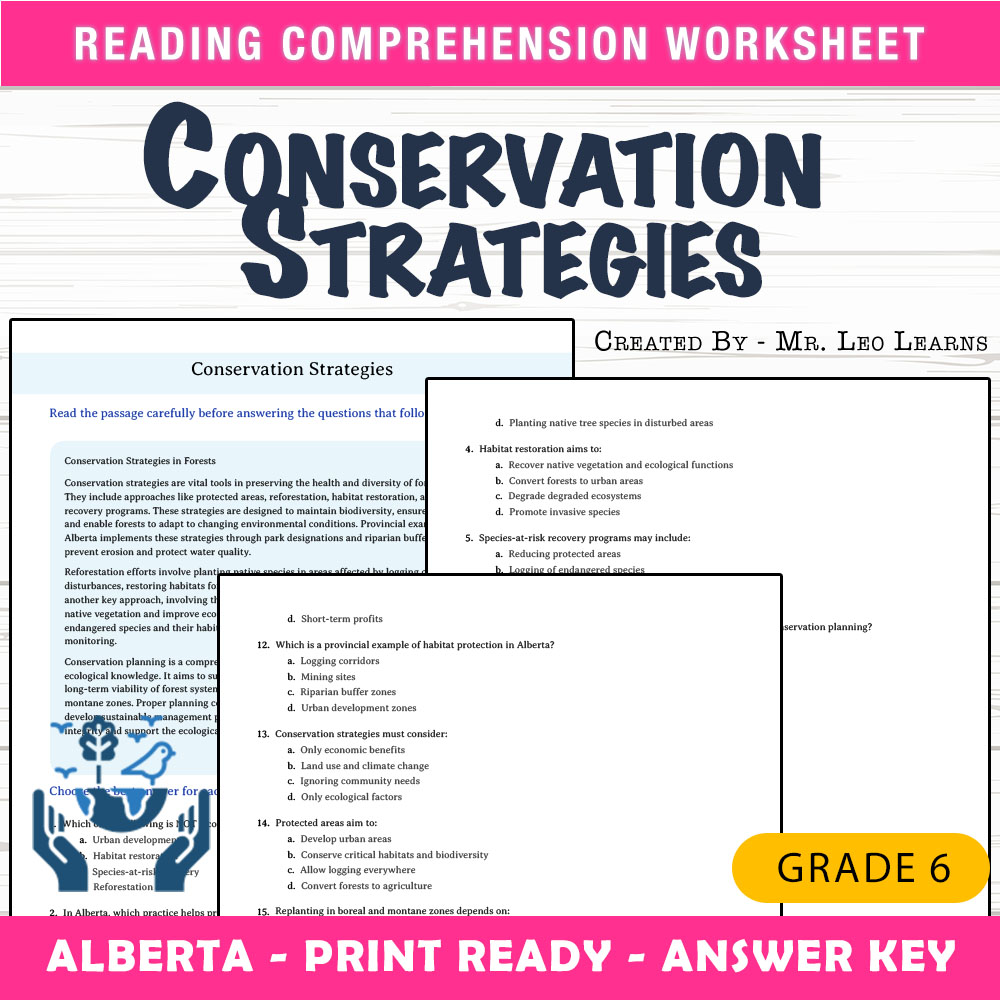
Grade 6 Science — Conservation Strategies Worksheet for Mastery
 Created byThe Resource Hub
Learning Objectives
- Understand various approaches used to conserve forest biodiversity and ecosystem functions.
- Identify examples of conservation strategies, including protected areas and habitat restoration.
- Recognize provincial examples of conservation planning in Alberta's landscapes.
Also included in: Grade 6 Science | Trees and Forests Unit Bundle for Alberta (Worksheet Pack) +1 more
Instant download

Building Knowledge Assessment | NGSSS Standards Grade 6 Science
Created byPrism Point LearningLearning Objectives
- Explain how scientific knowledge changes when new evidence becomes available.
- Differentiate scientific theories from scientific laws using examples.
- Describe how peer evaluation and reproducibility strengthen scientific claims.
Also included in: Grade 6 Scientific Assessment Science Lesson Bundle – Florida NGSSS
Instant download

Groundwater and Baseflow Worksheet for Grade 6 Science | California Standards
JCreated byJ.S SheetsLearning Objectives
- Understand how groundwater is stored and moves through the geosphere.
- Explain the role of groundwater in supplying streams as baseflow during dry periods.
- Describe factors affecting the connection between groundwater and surface water.
Also included in: Grade 6 Earth & Space Science Lesson Bundle: California Standards +1 more
Instant download

Grade 6 Science | Thrust Systems Worksheet (PDF) – Ontario Standards
Created byPrism Point LearningLearning Objectives
- Explain the principles of propeller-driven thrust and how it overcomes drag.
- Describe how reaction engines produce thrust through exhaust momentum.
- Compare propeller and jet propulsion methods in terms of efficiency, mass distribution, and noise.
Instant download

Sampling Methods Worksheet | Grade 6 Science Activities
Created byPrism Point LearningLearning Objectives
- Explain the purpose of sampling methods and why samples must represent a larger population or area
- Compare random, stratified, and systematic sampling and describe when each may be useful
- Use sampling choices to predict how strong (or limited) the conclusions from data might be
Instant download

Grade 6 Science | Evaporation Separation Worksheet with Short Notes
Created byMeadowlark WorksheetsLearning Objectives
- Understand the process of evaporation as a method of separating soluble solids from liquids.
- Identify evidence that indicates evaporation has occurred.
- Differentiate evaporation from other separation methods based on state change.
Also included in: Grade 6 Science Lesson Bundle – Teaching Transfer, Mixtures, Motion & More +1 more
Instant download

Grade 6 Science | Flight Forces Worksheet with Short Notes (Printable PDF)
Created byMeadowlark WorksheetsLearning Objectives
- Understand the four aerodynamic forces: lift, drag, thrust, and weight.
- Describe how these forces interact to determine aircraft motion.
- Explain the concepts of vector addition and equilibrium in steady level flight.
Also included in: Grade 6 Science Lesson Group Bundle – Ontario Framework Worksheets +1 more
Instant download

Grade 6 Science – Flight Forces & Principles | Daily Reading Worksheet
 Created byBright Mind Resources
Learning Objectives
- Understand the concept of lift and how it helps objects rise in the air
- Identify the four primary forces involved in flight: lift, thrust, drag, and weight
- Describe how forces interact to produce controlled flight or descent
Also included in: Aerodynamics Grade 6 Science Daily Reading Worksheets Lesson Bundle | Alberta +2 more
Instant download

Fossil Occurrences Through Time Worksheets for Grade 6 Science
 Created byTeachers Club
Learning Objectives
- Explain how fossil occurrences and stratigraphic order support ideas about evolution, diversification, and extinction.
- Identify how relative dating and radiometric dating help establish the age order of rock layers.
- Use fossil assemblage comparisons to infer changes in biodiversity and environments.
Also included in: Biological Evolution & Unity and Diversity | Grade 6 Science NGSS +2 more
Instant download

Cloud and Precipitation Worksheet | Standards-Aligned Grade 6 Science Practice
JCreated byJ.S SheetsLearning Objectives
- Understand how clouds form through condensation of water vapor.
- Identify different types of precipitation and the conditions that cause them.
- Explain how cloud development provides evidence about atmospheric processes.
Also included in: Grade 6 Climate and Atmospheric Systems Science Lesson Bundle: Florida NGSSS +1 more
Instant download

Grade 6 Science | Effects of Angles in Flight - Daily Reading Comprehension
Created byCoral Reef LearningLearning Objectives
- Identify parts of an angle related to flight mechanics
- Explain how small increases in angle of attack influence lift and drag
- Recognize the concept of stall caused by excessive angle adjustments
Also included in: Air and Aerodynamics Lesson Bundle – Grade 6 Science Alberta Reading Comp. +1 more
Instant download

Heat and Temperature Worksheet | Grade 6 Science Energy Transfer Activity
Created byPrism Point LearningLearning Objectives
- Differentiate heat and temperature based on what each describes and how energy moves.
- Explain how temperature relates to average particle kinetic energy.
- Predict how systems warm or cool when there is a temperature difference.
Also included in: Grade 6 Energy, Matter & Motion Lesson Bundle | Florida NGSSS
Instant download

Grade 6 Science | Biodiversity Roles - Reading Comprehension Practice
Created byCoral Reef LearningLearning Objectives
- Understand the concept of keystone species and their influence on ecosystems.
- Recognize the roles of different species such as beavers, fungi, and birds in maintaining ecosystem health.
- Learn about interdependence among species and how it contributes to biodiversity.
Also included in: Trees and Forests Lesson Bundle | Grade 6 Science | Alberta +1 more
Instant download

Grade 6 Science – Speed & Velocity | Daily Reading Worksheet
Created byBright Mind ResourcesLearning Objectives
- Understand the difference between speed and velocity
- Calculate average speed
- Identify the importance of direction in motion analysis
Also included in: Grade 6 Science Energy & Matter Daily Reading Lesson Bundle | Florida NGSSS +1 more
Instant download

6th Grade Science – Population Change NGSS Worksheet (PDF)
 Created byMaple Path Learning
Learning Objectives
- Construct evidence-based explanations linking ecosystem changes to population trends.
- Analyze case studies involving predator reintroduction, invasive species, habitat fragmentation, and disease outbreaks.
- Interpret empirical data and population metrics to infer causal relationships.
Also included in: Grade 6 Science | Ecosystems & Biodiversity NGSS Worksheet Unit Pack +1 more
Instant download

Competition for Survival Worksheet Grade 6 Science Ecosystems Activity
Created byPrism Point LearningLearning Objectives
- Explain how organisms compete for limited resources and how that affects survival and reproduction
- Describe how competition can be direct or indirect when organisms share requirements
- Use evidence to predict which species is more likely to persist under different resource conditions
Also included in: Animals Matter Lesson Bundle | Grade 6 Science | California Standards
Instant download

Grade 6 Inheritance Modeling in Science Worksheet | NGSS Printable Activity
 Created byBRIGHT PATH RESOURCES
Learning Objectives
- Understand the concept of genes and how traits are inherited from parents.
- Identify different traits and determine their inheritance patterns.
- Use models to predict likelihoods of offspring traits based on parental traits.
Also included in: Variation & Inheritance Grade 6 Science Daily Reading Lesson Bundle | NGSS +2 more
Instant download

Grade 6 Science Communicating Evidence Worksheet & Doodle Note
 Created byChalk and Compass
Learning Objectives
- Explain how a scientific claim should connect to evidence and reasoning.
- Use graphs, diagrams, and models appropriately to communicate evidence.
- Select relevant data and cite sources when justifying conclusions.
Also included in: Grade 6 Science Scientific Inquiry and Evidence Lesson Bundle | Ontario +1 more
Instant download

Natural Hazards Science Worksheet | NGSS Grade 6 Earth Systems Activity
 Created byAmber Owl Education
Learning Objectives
- Interpret observations and instrumental data to identify patterns in natural hazards.
- Use recurrence intervals and frequency data to estimate how likely events are to occur.
- Explain how hazard magnitude and likely locations are used in risk assessment and response planning.
Also included in: Grade 6 Science Earth Systems & Climate Lesson Bundle | NGSS +1 more
Instant download

Change Evidence Worksheet | Grade 6 Science Activities
Created byPrism Point LearningLearning Objectives
- Differentiate physical changes from chemical changes by using observable evidence
- Identify common chemical evidence such as gas formation, precipitate, permanent color change, and temperature change
- Explain how conservation of matter applies to both physical and chemical changes
Also included in: Grade 6 Matter, Energy, and Change Science Lesson Bundle TEKS Worksheets +1 more
Instant download

Climate Data Patterns Assessment for Grade 6 Science – Standards-Aligned
Created byPrism Point LearningLearning Objectives
- Understand how graphs of temperature and precipitation reveal climate patterns.
- Identify and interpret trends and variability in climate data over multiple years.
- Differentiate between typical climate patterns and anomalies using historical data.
Also included in: Grade 6 Life Science Science Lesson Bundle – General Framework Unit
Instant download

Structures and Functions Worksheet | Grade 6 Science TEKS Practice
Created byPrism Point LearningLearning Objectives
- Identify major plant structures and explain how they help plants survive by acquiring resources, transporting materials, and supporting growth and reproduction.
- Describe how animal organ systems (digestive, respiratory, and circulatory) work together to maintain survival needs such as nutrients, oxygen, and transport of materials.
- Connect structure to function by giving examples of how specific plant and animal parts support homeostasis in different environments.
Also included in: Grade 6 Ecosystem Interactions Science Lesson Bundle Worksheets | TEKS +1 more
Instant download

Grade 6 Science – Control Surfaces & Flight Mechanisms | Daily Reading Worksheet
Created byBright Mind ResourcesLearning Objectives
- Identify primary and secondary control surfaces such as ailerons, elevators, rudder, and flaps.
- Understand the role of ailerons in controlling roll movement.
- Explain how control surfaces affect airplane stability and maneuverability.
Also included in: Grade 6 Aerodynamics Science Lesson Bundle Daily Reading Worksheets | Ontario +1 more
Instant download

Grade 6 Molecular Processes Science Worksheet | NGSS Life Science Activity
Created byBRIGHT PATH RESOURCESLearning Objectives
- Understand key concepts related to Science
- Apply knowledge through practice questions
- Demonstrate comprehension of the material
Also included in: From Molecules to Organisms Lesson Bundle | Grade 6 Science | NGSS +2 more
Instant download

Grade 6 Conservation of Mass Worksheet | NGSS Matter Science Activity
Created byBRIGHT PATH RESOURCESLearning Objectives
- Understand key concepts related to Science
- Apply knowledge through practice questions
- Demonstrate comprehension of the material
Also included in: Matter and Its Interactions Grade 6 Science Lesson Bundle | NGSS +2 more
Instant download

Grade 6 Science – Sun's Apparent Path | Daily Reading Worksheet
Created byBright Mind ResourcesLearning Objectives
- Understand key concepts related to Science
- Apply knowledge through practice questions
- Demonstrate comprehension of the material
Also included in: Grade 6 Solar System & Seasons Science Daily Reading Lesson Bundle | Alberta +2 more
Instant download

6th Grade Science | Drag Types Worksheet ( Answer Key) – Alberta Standards
Learning Objectives
- Describe the two main types of drag: parasitic and induced.
- Explain how surface roughness and wingtip vortices affect drag.
- Identify design features that reduce drag, such as streamlined shapes and fairings.
Also included in: Grade 6 Science Unit Bundle | Flight, Air Pressure & Aerodynamics Worksheets +1 more
Instant download

Energy Decreases Upward Worksheet Grade 6 Science Energy Flow Pack
Created byPrism Point LearningLearning Objectives
- Explain why usable energy decreases from one trophic level to the next.
- Describe how some energy becomes heat and how the rest becomes biomass for organisms at higher levels.
- Use a food chain example to predict how many organisms can be supported at each trophic level.
Also included in: Animals Matter Lesson Bundle | Grade 6 Science | California Standards
Instant download

Earth System Links Worksheet | Standards-Aligned Grade 6 Science Practice
JCreated byJ.S SheetsLearning Objectives
- Identify how the lithosphere, hydrosphere, atmosphere, and biosphere interact as connected Earth systems.
- Explain how energy from the Sun drives cycles that move water, gases, and heat.
- Use cause-and-effect reasoning to describe how changes in one system can affect other systems over different timescales.
Also included in: Grade 6 Earth System Cycles Science Lesson Bundle: General Framework +1 more
Instant download

6th Grade Science Worksheet | Circulatory System Blood Movement (PDF)
Created byEvergreen Desk EducationLearning Objectives
- Explain how the heart’s rhythmic pumping creates pressure that moves blood through the circulatory system.
- Compare the structure and function of arteries, veins, and capillaries in transporting blood.
- Describe how capillaries enable exchange of oxygen, nutrients, and wastes between blood and body cells.
Also included in: Grade 6 Life Processes & Ecosystem Interactions Science Lesson Bundle: General +1 more
Instant download

Apparent Sky Motions and Cycles Worksheets Grade 6 Science
 Created bySunny Desk Resources
Learning Objectives
- Describe how the Sun, Moon, and stars appear to move across the sky from Earth.
- Use daily records to recognize patterns and cycles in sunrise, sunset, and Moon phases.
- Explain how observations lead to models of Earth’s and the Moon’s motion relative to the Sun.
Also included in: Sky Science Grade 6 Bundle | Alberta Science Worksheets & Activities +1 more
Instant download

Fossil Patterns Worksheet Grade 6 NGSS Evolution & Fossil Evidence
 Created byNorthstar Worksheets
Learning Objectives
- Use stratigraphic order and fossil evidence to describe patterns of change through geologic time
- Compare fossil assemblages from different rock layers to infer biodiversity shifts and environmental change
- Explain how relative dating and radiometric dating support timelines for fossil lineages
Also included in: Grade 6 NGSS Evolution & Common Ancestry Lesson Bundle | Science +1 more
Instant download

Food Webs Worksheet Practice Assessment | Grade 6 Science BC
Created byPrism Point LearningLearning Objectives
- Explain how energy and matter move through interconnected feeding relationships in a food web.
- Describe how removing or reducing one species can cascade through a food web.
- Compare how generalist vs. specialized feeding links can affect ecosystem stability.
Also included in: Ecosystems & Interdependence Lesson Bundle | Grade 6 Science | BC +1 more
Instant download

Matter Properties Worksheet | Standards-Aligned Science Practice for Grade 6
JCreated byJ.S SheetsLearning Objectives
- Describe physical properties and explain how they help identify unknown substances (density, solubility, magnetism, conductivity, hardness, luster).
- Distinguish between qualitative observations and simple quantitative comparisons using measurements and data.
- Use property-based evidence to select materials for familiar tasks and explain why measurements support classification.
Instant download

Grade 6 Measurement Tools & Metric Units Worksheet | Alberta Science
Created byBRIGHT PATH RESOURCESLearning Objectives
- Identify the main idea and key details about why measurement choices matter
- Explain why units must be chosen and recorded consistently
- Use information from a passage to answer questions about measurement tools and data recording
Also included in: Inquiry Data Grade 6 Science Daily Reading Worksheets Lesson Bundle | Alberta +1 more
Instant download

Grade 6 Science | Understanding Wing Shapes - Daily Reading Comprehension
Created byCoral Reef LearningLearning Objectives
- Identify different wing features such as camber, thickness, and aspect ratio.
- Explain how wing shape influences lift, stall behavior, and maneuverability.
- Compare high-aspect-ratio wings with low-aspect, robust wings used in regional aircraft.
Also included in: Air and Aerodynamics Lesson Bundle – Grade 6 Science Alberta Reading Comp. +1 more
Instant download

Insulator Comparisons Worksheet | Electricity & Conductors Grade 6
Created byChalk and CompassLearning Objectives
- Explain why insulators resist electric charge flow using the ideas of bound electrons and lack of free charge carriers.
- Compare common insulating materials (rubber, glass, dry wood) based on their electron behavior and safety uses.
- Distinguish bulk insulating properties from how charges can behave on a material’s surface.
Also included in: Grade 6 Science Circuits & Electricity Lesson Bundle | Ontario +1 more
Instant download

Grade 6 Science – Angle Effects on Aerodynamics Worksheet for Mastery
Created byThe Resource HubLearning Objectives
- Explain how the angle of attack influences airflow and lift production in wings.
- Identify the different regimes of lift coefficient variation with changing angle.
- Describe how wing incidence and pilot control inputs modify the effective angle of attack.
Also included in: Grade 6 Science | Aerodynamics & Engineering Unit Workbook (Worksheet Pack) +1 more
Instant download

Scientific Inquiry Worksheet | Grade 6 Science Activities
Created byPrism Point LearningLearning Objectives
- Explain how observations lead to scientific questions and investigations
- Use evidence and logical reasoning to support or reject an explanation
- Apply measurement and observation vocabulary to describe changes over time
Also included in: Scientific Inquiry Lesson Bundle | Grade 6 Science | Florida NGSSS
Instant download

Grade 6 Science | Food Webs Worksheet – Alberta Standards (PDF)
 Created bySilver Birch Teaching
Learning Objectives
- Explain how energy moves through forest food webs using producers, consumers, and decomposers.
- Identify trophic relationships and describe how predators, herbivores, and decomposers are connected.
- Describe how seasonal changes and disruptions (like invasive species) can affect food web structure and function.
Also included in: Grade 6 Ecosystem Interactions Science Lesson Bundle: Alberta Framework +1 more
Instant download

Grade 6 System Interactions Worksheet | NGSS Earth Science & Answer Key
Created byNorthstar WorksheetsLearning Objectives
- Explain how Earth systems interact through transfers of matter and energy among the geosphere, hydrosphere, atmosphere, and biosphere.
- Describe how feedbacks (such as albedo changes and sediment transport) can amplify or slow system changes.
- Use models to connect sequential processes to observable patterns from seasons to geologic time.
Also included in: Weather, Water Cycle & Climate Systems Lesson Bundle | Grade 6 Science | NGSS +1 more
Instant download
About Grade 6 Science Worksheets
Explore Grade 6 Science worksheets for classwork, homework, or review. Our 5,997 printables download instantly as PDFs.
MyTeachingSheets worksheets are made by real teacher-authors and checked before they go live. Download any as a print-ready PDF for lessons, homework, or independent practice — most include answer keys, and previews are always free.