
Grade 6 Science Worksheets
5,997 worksheets
Grade 6 Science | Evidence Explanations - Daily Reading Comprehension
 Created byCoral Reef Learning
Learning Objectives
- Learn how to identify evidence that supports scientific claims.
- Understand the connection between evidence and explanations in science.
- Recognize different types of evidence such as trends, ranges, and match between observed and expected values.
Instant download

Grade 6 Science | Habitats and Niches Worksheet | BC Aligned
 Created byLumora Learning
Learning Objectives
- Understand the difference between habitats and niches in ecosystems.
- Identify how resource sharing leads to competition or coexistence among species.
- Describe how variations in niches and habitats influence ecosystem resilience.
Instant download

Grade 6 Science | Waves and Technology Worksheet | BC Aligned
Created byLumora LearningLearning Objectives
- Understand how sound and light waves transfer energy in devices like speakers, microphones, and cameras.
- Explain the process of energy conversion between electrical signals and wave pressure or photon energy.
- Identify the properties of waves, such as frequency and intensity, that influence device performance.
Also included in: Grade 6 Science | Energy, Waves & Circuits | Custom Bundle | BC Aligned
Instant download

Grade 6 Science – Errors in Data & Error Sources | Daily Reading Worksheet
 Created byBright Mind Resources
Learning Objectives
- Identify different sources of measurement errors in scientific experiments.
- Distinguish between random and systematic errors.
- Analyze how errors can impact data accuracy and interpretation.
Also included in: Grade 6 Science Inquiry & Modeling Daily Reading Lesson Bundle | TEKS +2 more
Instant download

Grade 6 Surface Change Science Worksheet | NGSS Earth Science Printable
 Created byBRIGHT PATH RESOURCES
Learning Objectives
- Understand how tectonic plate movements influence Earth's surface
- Identify different geologic processes that modify landscapes
- Recognize evidence of surface change in rocks and landforms
Also included in: Earth's Systems Grade 6 Science Daily Reading Worksheets Lesson Bundle | NGSS +2 more
Instant download

Grade 6 Science – Lunar Phases Daily Reading Worksheet | Ontario Standards
Created byBright Mind ResourcesLearning Objectives
- Identify the sequence of lunar phases between new moon and full moon
- Describe the appearance of each lunar phase
- Explain the positions of the Sun, Earth, and Moon that create different phases
Also included in: Space Systems Grade 6 Science Daily Reading Worksheets Bundle | Ontario +1 more
Instant download
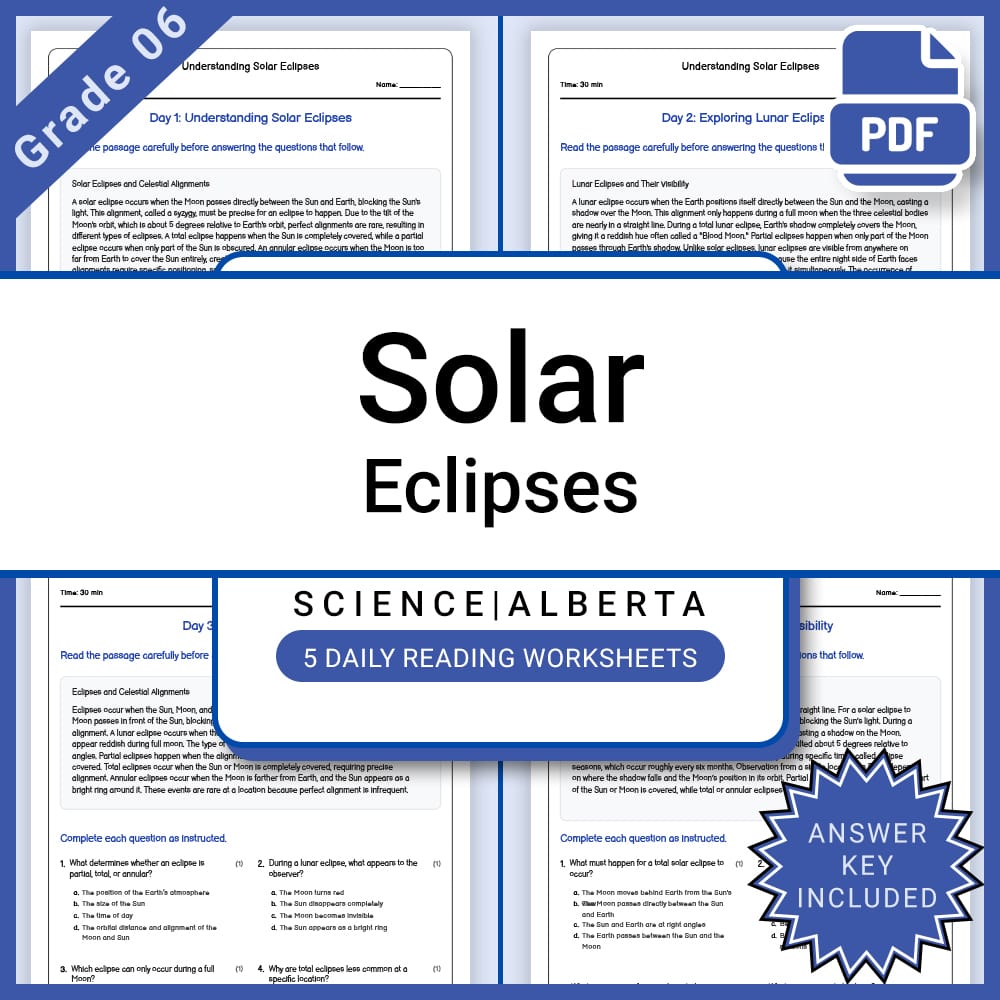
Grade 6 Science – Solar Timekeeping Daily Reading Worksheet + Answer Key
JCreated byJ.S SheetsLearning Objectives
- Understand key concepts related to Science
- Apply knowledge through practice questions
- Demonstrate comprehension of the material
Also included in: Grade 6 Science Lesson Group: Earth & Space Reading Worksheets Bundle +1 more
Instant download

Grade 6 Apparent Sun Path & Seasonal Solar Changes | Alberta Science
Created byBRIGHT PATH RESOURCESLearning Objectives
- Explain how Earth’s tilt changes the Sun’s apparent path across the sky.
- Describe how seasonal solar elevation at noon affects day length and sunlight intensity.
- Compare how latitude changes sunrise, sunset, and noon height for locations in Alberta.
Also included in: Sun-Earth-Moon Patterns Lesson Bundle Grade 6 Science Alberta Daily Reading +1 more
Instant download

Grade 6 Science – Measuring Electricity & Circuits | Daily Reading Worksheet
Created byBright Mind ResourcesLearning Objectives
- Understand basic electrical components such as current, voltage, and power.
- Learn how to quantify electrical quantities in circuits.
- Recognize the importance of measuring energy transfer and efficiency in electrical devices.
Also included in: Grade 6 Daily Reading Science Worksheets | Lesson Bundle | BC Framework +1 more
Instant download
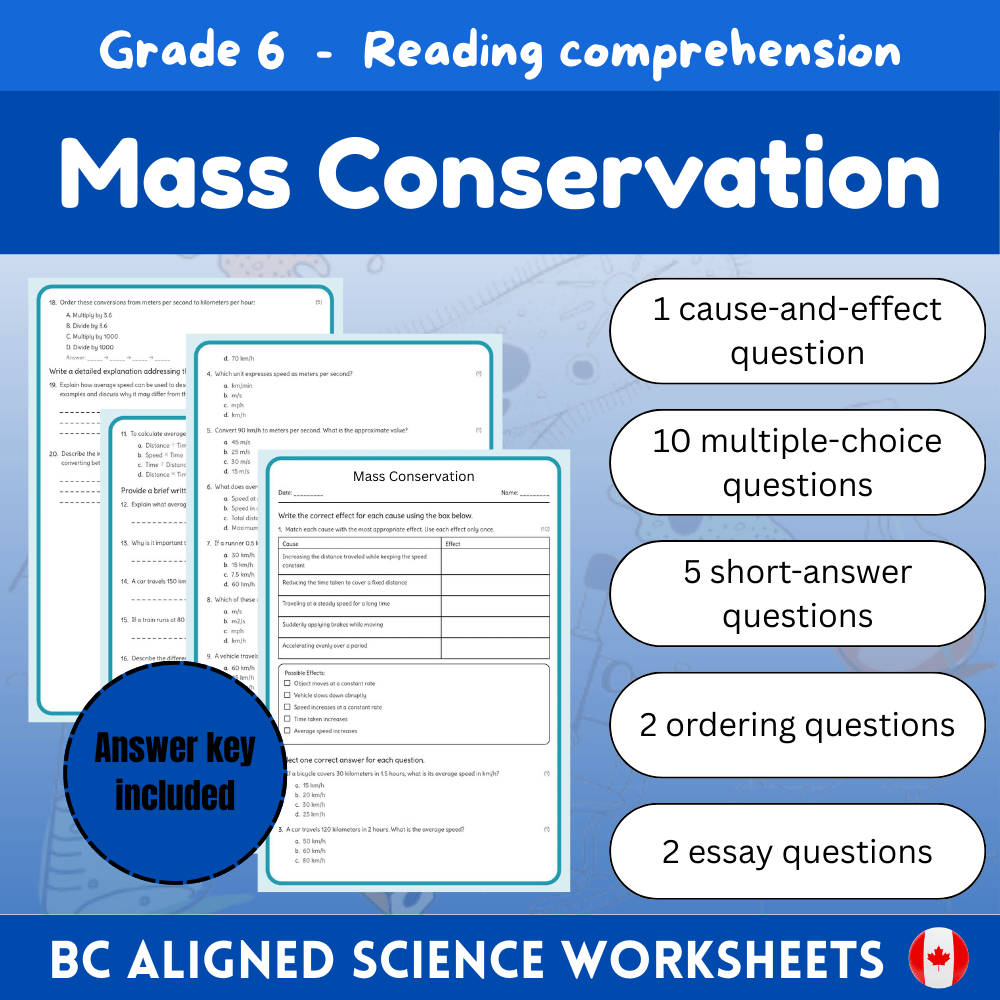
Grade 6 Science | Mass Conservation Worksheet + Answer Key (PDF)
Created byBright Mind ResourcesLearning Objectives
- Understand the law of conservation of mass and its application in physical and chemical changes.
- Differentiate between open and closed systems based on mass measurement.
- Identify processes that do or do not conserve mass through atom rearrangement or boundary limitations.
Instant download

Planning Investigations Worksheets: Testable Questions & Fair Tests
LCreated byLearnora ResourcesLearning Objectives
- Identify questions that can be investigated using collected evidence
- Construct a testable question from an observation
- Identify changed, measured, and controlled factors in an investigation
Instant download

Grade 6 Science – Physical Changes & Properties Daily Reading Worksheet
Created byBright Mind ResourcesLearning Objectives
- Recognize and describe physical changes in matter before and after interactions
- Identify evidence of physical changes such as change in appearance without substance formation
- Differentiate between physical and chemical changes based on properties observed
Also included in: Grade 6 Matter Science Daily Reading Worksheets Lesson Bundle | CA Standards +1 more
Instant download

Grade 6 Science Worksheet on Electricity, Current Fundamentals | Ontario
 Created byCedar Grove Learning
Learning Objectives
- Explain electric current as the organized movement of electric charges through a conductor
- Distinguish conventional current direction from electron flow
- Describe potential difference as the driving force that pushes charges through a circuit
Also included in: Grade 6 Electricity and Circuits Science lesson bundle: Ontario framework +1 more
Instant download

Filtration And Sieving Practice Test | Grade 6 Science Worksheet
 Created byPrism Point Learning
Learning Objectives
- Explain how filtration separates mixtures using a porous barrier
- Describe how sieving separates mixtures using a rigid screen and particle size
- Use particle size and state (solid in liquid or gas) to choose the best separation method
Also included in: Matter, Properties & Change Lesson Bundle — Grade 6 Science BC Framework +1 more
Instant download

Scale of Space Science Worksheet | NGSS Grade 6 Assessment
JCreated byJ.S SheetsLearning Objectives
- Understand the concept of astronomical units, planetary radii, and orbital periods to compare solar system objects.
- Analyze relative sizes and distances within the solar system using data tables and charts.
- Interpret orders of magnitude for Earth–Sun distance and planet sizes to develop proportional models.
Also included in: Grade 6 Earth-Moon Relationships Space Science Lesson Bundle | NGSS +1 more
Instant download

Collaborative Practices Worksheet | Ontario Grade 6 Science Assessment
Created byCedar Grove LearningLearning Objectives
- Explain how roles and clear communication improve team-based science investigations
- Use collaborative documentation practices such as versioning and attribution to track changes and contributions
- Describe how teams use protocols for constructive critique, peer review, and resolving conflicting observations
Also included in: Grade 6 Scientific Inquiry & Data Practices Science Lesson Bundle | Ontario +1 more
Instant download

Reactants and Products Assessment | California Standards Grade 6 Science
Created byPrism Point LearningLearning Objectives
- Explain the difference between reactants and products in a chemical reaction.
- Describe how product properties can differ from reactant properties to support the idea that a reaction occurred.
- Use particle diagrams to show that atoms are rearranged into new combinations during a reaction.
Also included in: Grade 6 Atoms and Chemical Change Science lesson bundle | California Standards +1 more
Instant download

Chemical Reactions Worksheets | Grade 6 Review & Conservation Practice
LCreated byLearnora ResourcesLearning Objectives
- Identify reactants, products, and evidence of chemical reactions
- Classify everyday changes as physical or chemical changes
- Interpret observations that indicate a chemical reaction occurred
Instant download

Grade 6 Science – Reaction Rates & Factors Daily Reading Worksheet
Created byBright Mind ResourcesLearning Objectives
- Define reaction rate and understand its significance.
- Identify factors that influence reaction rates such as concentration, temperature, surface area, and catalysts.
- Explain how microscopic particle collisions relate to observable signs of chemical reactions.
Also included in: Matter & Change Grade 6 Science Daily Reading Worksheets Lesson Bundle | BC +1 more
Instant download

Evidence Reasoning Worksheet | Standards-Aligned Science Practice Grade 6
JCreated byJ.S SheetsLearning Objectives
- Understand how evidence-based explanations connect data to claims using patterns.
- Identify relevant measurements, observations, and evidence described in consistent terms.
- Recognize the importance of considering multiple lines of evidence to strengthen reasoning.
Also included in: Grade 6 Scientific Inquiry Evidence Reasoning Science Lesson Bundle +1 more
Instant download

Grade 6 Science | Particle Model Worksheet | BC Aligned
Created byLumora LearningLearning Objectives
- Describe the particle model of matter and its main features.
- Explain how particle arrangements differ in solids, liquids, and gases.
- Connect microscopic particle behavior to macroscopic properties such as shape, volume, and flow.
Instant download

Circuit Symbols Worksheet | Ontario Grade 6 Science Assessment
Created byCedar Grove LearningLearning Objectives
- Interpret common circuit schematic symbols for sources, components, and measuring devices
- Explain how wire connections and topology (series vs. parallel) affect predicted circuit behavior
- Identify which instrument (ammeter or voltmeter) measures current or potential difference based on diagram placement
Also included in: Grade 6 Electricity and Circuits Science lesson bundle: Ontario framework +1 more
Instant download
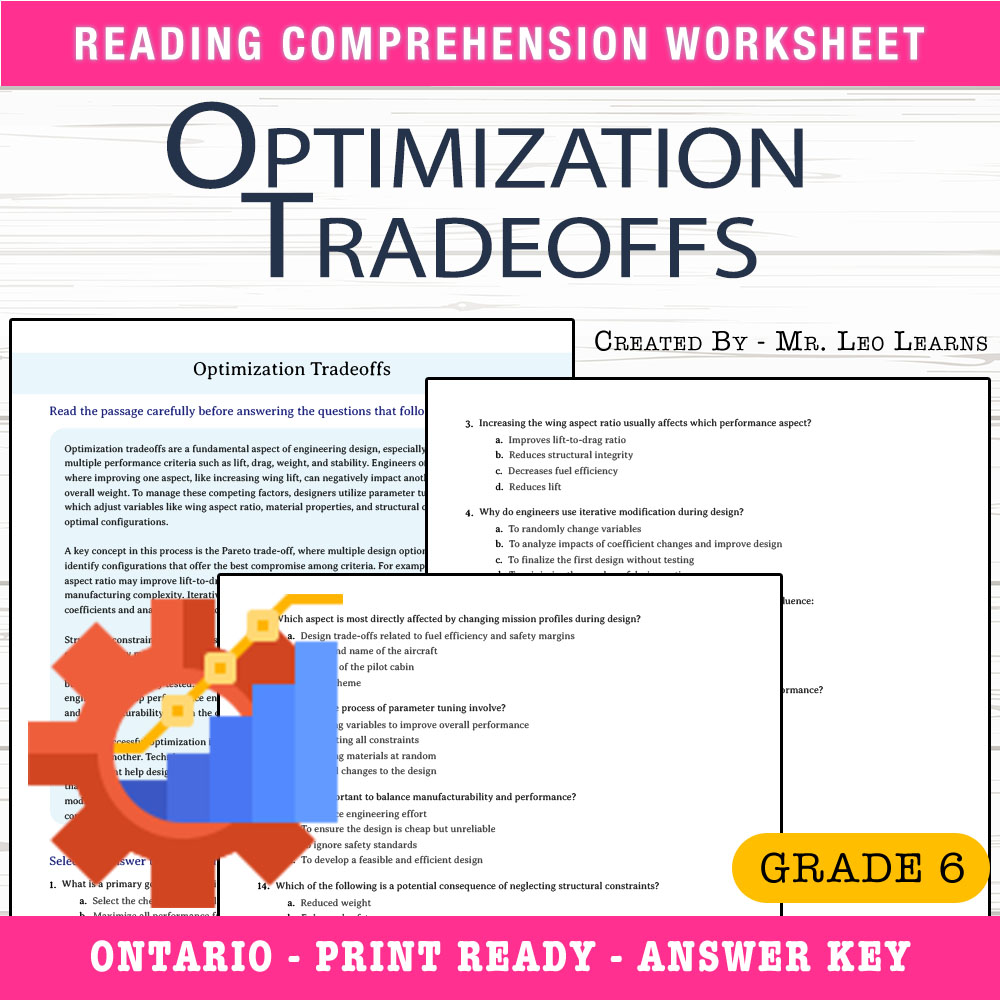
Grade 6 Science — Optimization Tradeoffs Worksheet for Mastering Engineering Concepts
 Created byThe Resource Hub
Learning Objectives
- Understand the concept of multi-criteria design in engineering.
- Identify how trade-offs affect performance in wing design.
- Explain the methods used to balance factors like lift, drag, and stability.
Also included in: Grade 6 Science | Aerodynamics & Engineering Unit Workbook (Worksheet Pack) +1 more
Instant download

Grade 6 Pressure Patterns in Uneven Heating Science Worksheet Alberta
Created byBRIGHT PATH RESOURCESLearning Objectives
- Explain how uneven heating creates pressure differences in the atmosphere
- Describe how topography can redirect winds through pressure gradients
- Connect pressure patterns to everyday weather changes
Also included in: Aerodynamics & Flight Physics Grade 6 Science Worksheets Bundle | Alberta +1 more
Instant download

Adaptation Tradeoffs Worksheet | Grade 6 Science Assessment Ontario
Created byPrism Point LearningLearning Objectives
- Explain how adaptation trade-offs can favor specialists in stable conditions and generalists in variable conditions.
- Compare benefits and costs of narrow niche specialization versus broad tolerance using examples from plants, insects, and animal movement.
- Describe how fluctuating environments can change which traits improve survival and reproduction over time.
Also included in: Grade 6 Biodiversity & Adaptation Science Lesson Bundle Ontario
Instant download

Weather Elements Assessment | Florida NGSSS Grade 6 Science
Created byPrism Point LearningLearning Objectives
- Identify major weather elements (temperature, precipitation, wind speed/direction, cloud cover, humidity) and explain what each one describes.
- Use observations of multiple weather elements to describe current weather conditions and understand why forecasts can change.
- Interpret simple statements about weather elements using evidence from observations and basic cause-and-effect relationships.
Instant download

Grade 6 Science Signal Integration Worksheet | NGSS Standards Practice
JCreated byJ.S SheetsLearning Objectives
- Explain how cells communicate through chemical and electrical signals.
- Describe the processes of neurotransmission, hormonal regulation, and signal transduction cascades.
- Contrast rapid nervous impulses with longer-term endocrine effects.
Also included in: Grade 6 Cellular Processes and Feedback Science Lesson Bundle – NGSS +1 more
Instant download

Stewardship Strategies Test Prep Worksheet | Grade 6 Science Ontario
Created byPrism Point LearningLearning Objectives
- Describe how stewardship strategies like habitat restoration, protected areas, and community monitoring help maintain biodiversity.
- Compare trade-offs among conservation approaches and explain why some actions may be prioritized for species at risk.
- Explain how assisted migration and invasive species removal can affect ecosystems and why monitoring matters.
Also included in: Grade 6 Biodiversity & Adaptation Science Lesson Bundle Ontario
Instant download

Wing Shapes Worksheet Pack | Grade 6 Science Activities
Created byPrism Point LearningLearning Objectives
- Explain how wing features like camber, thickness, and aspect ratio affect lift and stall behavior.
- Compare wing designs for different mission profiles, such as gliders versus short-field agricultural aircraft.
- Use evidence from a passage to answer questions about pressure, drag, and maneuverability.
Also included in: Aerodynamics and Flight Design Lesson Bundle – Grade 6 Science Alberta
Instant download

Predator Prey Dynamics Assessment for Grade 6 Science Standards
Created byPrism Point LearningLearning Objectives
- Understand the interactions between predators and prey in ecosystems.
- Identify cause-and-effect relationships in food webs.
- Explain how predator and prey populations influence each other over time.
Instant download

Grade 6 Science | Energy & Power in Circuits - Daily Reading Comprehension
Created byCoral Reef LearningLearning Objectives
- Understand the concept of electrical energy transfer in circuits.
- Identify how power is related to energy transfer rate, current, and voltage.
- Recognize everyday examples of electrical power use, such as lighting and heating.
Instant download

Natural Selection Worksheets: Changing Trait Frequencies Grade 6
 Created byTeachers Club
Learning Objectives
- Explain how heritable variation and differential reproductive success can change trait frequencies over generations
- Identify examples of natural selection driven by environmental pressures
- Match key vocabulary terms to correct definitions related to natural selection
Also included in: Biological Evolution & Unity and Diversity | Grade 6 Science NGSS +2 more
Instant download

Science Worksheet Evaporation Separation Grade 6
JCreated byJ.S SheetsLearning Objectives
- Explain how evaporation can separate a soluble solid from a liquid
- Identify the evidence that suggests evaporation occurred in a separation experiment
- Compare evaporation to size-based separation methods
Also included in: Grade 6 Matter, Motion, and Heat Science Lesson Bundle – General Framework +1 more
Instant download

Habitats And Niches Test Prep Printables | Grade 6 Science
Created byPrism Point LearningLearning Objectives
- Explain the difference between a habitat and a niche in an ecosystem
- Describe how niche overlap can lead to competition and limit population growth
- Use examples of resource partitioning to explain how species can coexist
Also included in: Ecosystems & Interdependence Lesson Bundle | Grade 6 Science | BC +1 more
Instant download

Scientific Models Worksheet for Grade 6 Science | Standards-Aligned Practice
JCreated byJ.S SheetsLearning Objectives
- Understand how models are used to represent complex systems in science.
- Identify different types of scientific models and their purposes.
- Evaluate the limitations of models by comparing them with real measurements.
Also included in: Grade 6 Scientific Inquiry Evidence Reasoning Science Lesson Bundle +1 more
Instant download
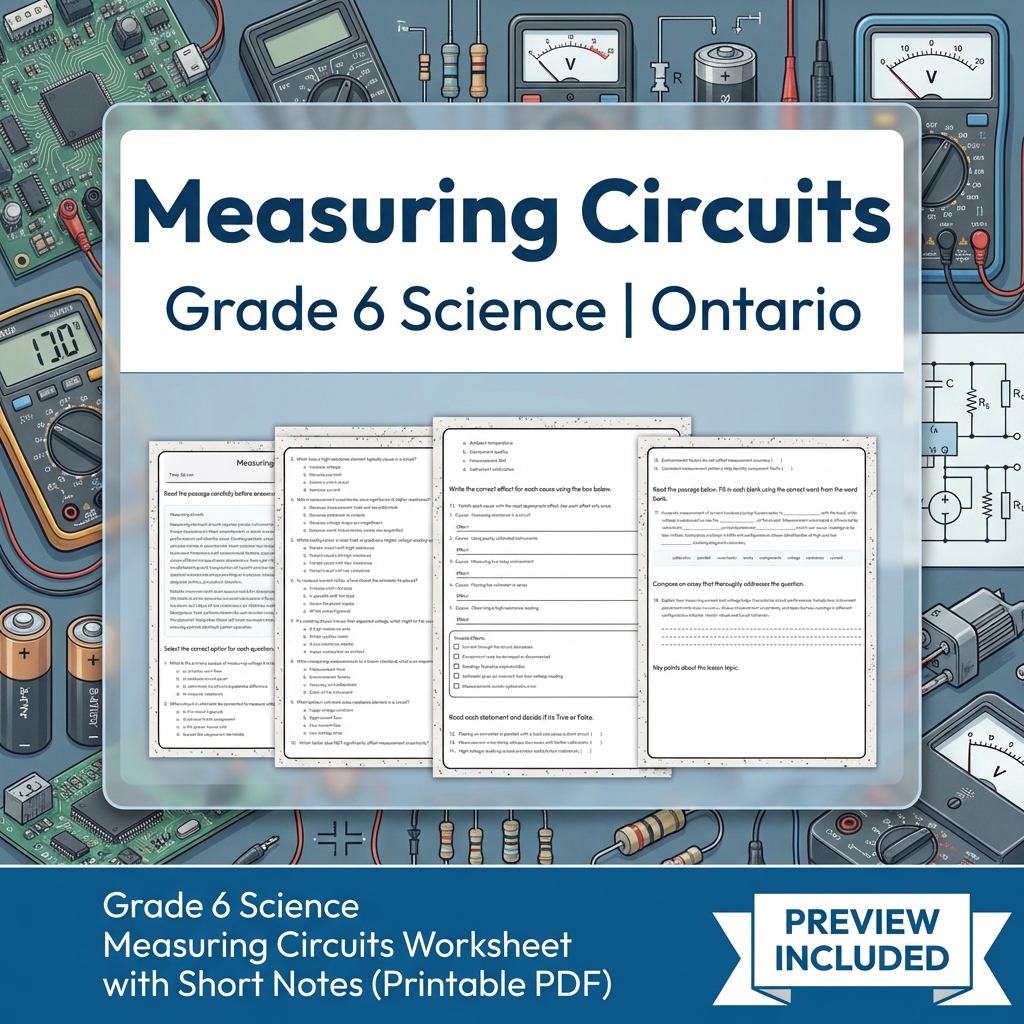
Grade 6 Science Measuring Circuits Worksheet with Short Notes (Printable PDF)
 Created byMeadowlark Worksheets
Learning Objectives
- Understand how current and voltage measurements characterize circuit performance.
- Recognize proper instrument placement for circuit measurements.
- Interpret typical reading patterns in various circuit configurations.
Also included in: Grade 6 Science Lesson Group on Energy, Circuits & Properties +1 more
Instant download

Scientific Models Worksheet Grade 6 Science NGSSS Inquiry Practice
Created byPrism Point LearningLearning Objectives
- Explain how scientific models help scientists represent systems that are too large, too small, or too complex to study directly.
- Describe how observable features and measurements provide evidence to support or refine scientific models.
- Identify the limits of a model by comparing what the model shows with real-world data.
Also included in: Scientific Inquiry Lesson Bundle | Grade 6 Science | Florida NGSSS
Instant download

Grade 6 Science | Solar Timekeeping - Daily Reading Comprehension
Created byCoral Reef LearningLearning Objectives
- Understand the concept of solar time and how it is based on the Sun's position.
- Learn about the differences between solar time and clock time.
- Recognize the factors that influence solar time, such as longitude and Earth's orbit.
Also included in: Sky Science Lesson Bundle | Grade 6 Science Daily Reading | Alberta +1 more
Instant download

Grade 6 Science – Respiratory System & Daily Reading Worksheet | BC Standards
Created byBright Mind ResourcesLearning Objectives
- Understand the basic functions of the respiratory system
- Identify key organs such as lungs and gills
- Describe how gas exchange occurs between the environment and tissues
Also included in: Grade 6 Science: Organ Systems & Adaptations Daily Reading Lesson Bundle | BC +1 more
Instant download

Grade 6 Science | Invasive Species Worksheet | BC Aligned
Created byLumora LearningLearning Objectives
- Understand what invasive species are and how they impact native ecosystems.
- Identify examples of invasive plants and animals introduced by human activities.
- Explain the ecological and economic effects of invasive species.
Instant download

Grade 6 Science | Decomposers And Nutrient Return Worksheet | General Standard
Created byLumora LearningLearning Objectives
- Explain how decomposers break down dead organisms and waste to return nutrients to ecosystems
- Describe the roles of fungi and bacteria in nutrient cycling through soil and water
- Connect nutrient availability to the growth and structure of producer populations over time
Instant download
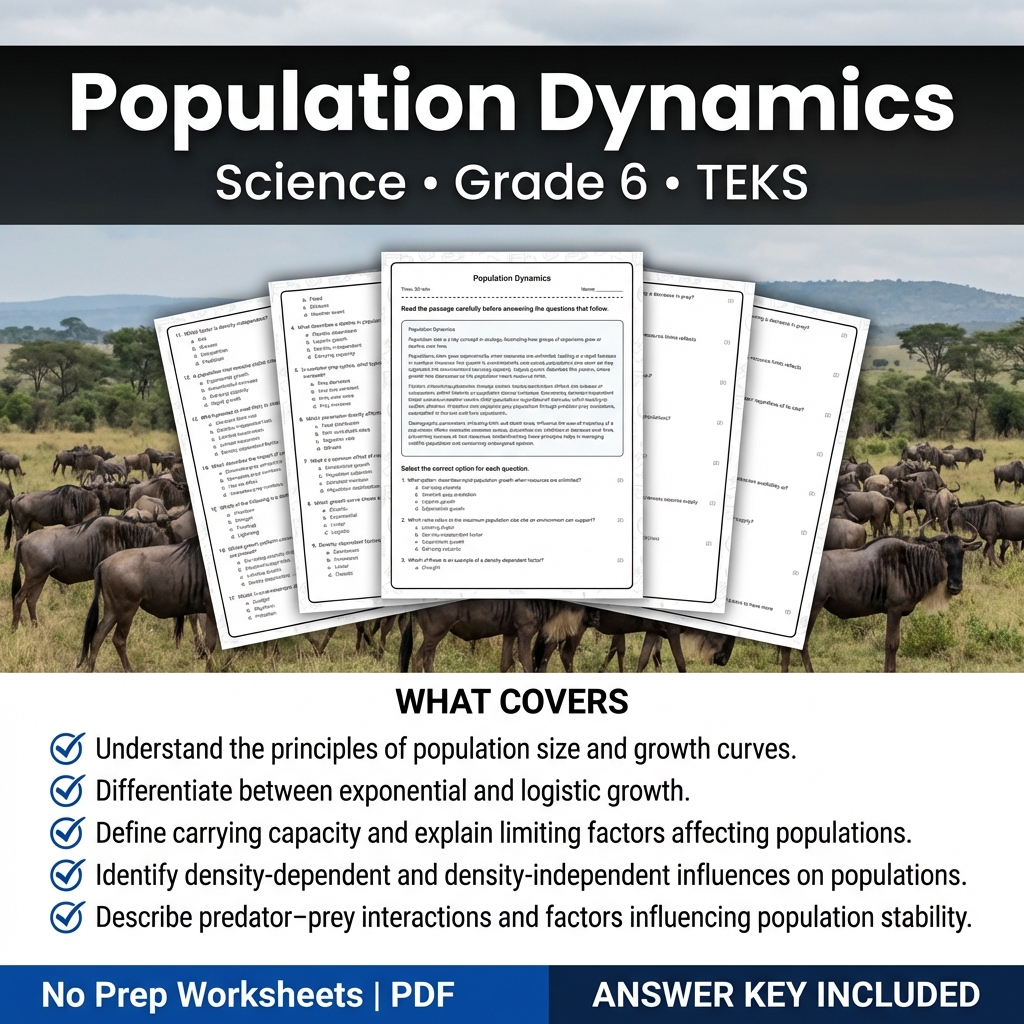
Grade 6 Science Worksheet on Population Dynamics | TEKS Standards
Created byCoral Reef LearningLearning Objectives
- Understand the principles of population size and growth curves.
- Differentiate between exponential and logistic growth.
- Define carrying capacity and explain limiting factors affecting populations.
Instant download

Grade 6 Signal Integration Worksheet | NGSS Practice PDF
 Created byClear Sky Classroom
Learning Objectives
- Explain how cells communicate using chemical and electrical signals.
- Differentiate between rapid nervous responses and longer-term hormonal effects.
- Describe key signaling pathways such as synaptic transmission and receptor-mediated gene expression.
Also included in: Grade 6 Molecules to Organisms Science Lesson Bundle: Structures (NGSS) +1 more
Instant download

Grade 6 Science | Design Problem Worksheet with Short Notes (Printable PDF)
Created byMeadowlark WorksheetsLearning Objectives
- Understand the key elements of a design problem, including needs and requirements.
- Learn how to generate solution ideas using sketches, dimensions, and constraints.
- Apply knowledge to real-world examples such as designing protective cases for fragile items.
Also included in: Grade 6 Science Lesson Bundle | Critical Thinking & Problem Solving +1 more
Instant download

Grade 6 Science – Food Webs & Ecosystem Interconnections | Reading Worksheet
Created byBright Mind ResourcesLearning Objectives
- Identify different organisms involved in a forest food web
- Understand the flow of energy among producers, consumers, and decomposers
- Analyze how seasonal changes and human disruptions impact food webs
Also included in: Grade 6 Forest Ecology Science Daily Reading Worksheets Lesson Bundle | Alberta +2 more
Instant download

Biodiversity Patterns Worksheet | NGSS Grade 6 Science Practice
JCreated byJ.S SheetsLearning Objectives
- Understand how species occurrence and richness reveal biodiversity patterns across ecosystems.
- Identify factors influencing biodiversity distribution, such as habitat heterogeneity and colonization events.
- Interpret data from ecological and historical records to analyze species turnover and community composition.
Also included in: Grade 6 Evolution and Natural Selection Science Lesson Bundle NGSS +1 more
Instant download

Conservation Strategies Test Prep | Grade 6 Science Worksheet PDF
Created byPrism Point LearningLearning Objectives
- Explain how protected areas, habitat restoration, sustainable harvesting, and invasive species control help maintain ecosystem balance.
- Describe trade-offs among ecological goals, economic needs, and social values when choosing conservation strategies.
- Use monitoring evidence to evaluate whether conservation efforts are improving habitat and species outcomes.
Also included in: Ecosystems & Interdependence Lesson Bundle | Grade 6 Science | BC +1 more
Instant download

Grade 6 Science | Seasonal Tilt Worksheet (PDF) – Alberta Standards
 Created bySilver Birch Teaching
Learning Objectives
- Explain how Earth’s axial tilt changes the solar angle and length of daylight during the year.
- Describe how seasonal changes affect temperature, snow cover, and living things in different regions (including Alberta).
- Connect seasonal effects to the geometry of Earth’s orbit and the resulting solar energy received at Earth’s surface.
Also included in: Grade 6 Celestial Motion & Seasons Science Lesson Bundle | Alberta +1 more
Instant download
About Grade 6 Science Worksheets
Explore Grade 6 Science worksheets for classwork, homework, or review. Our 5,997 printables download instantly as PDFs.
MyTeachingSheets worksheets are made by real teacher-authors and checked before they go live. Download any as a print-ready PDF for lessons, homework, or independent practice — most include answer keys, and previews are always free.