
Grade 6 Science Worksheets
5,997 worksheets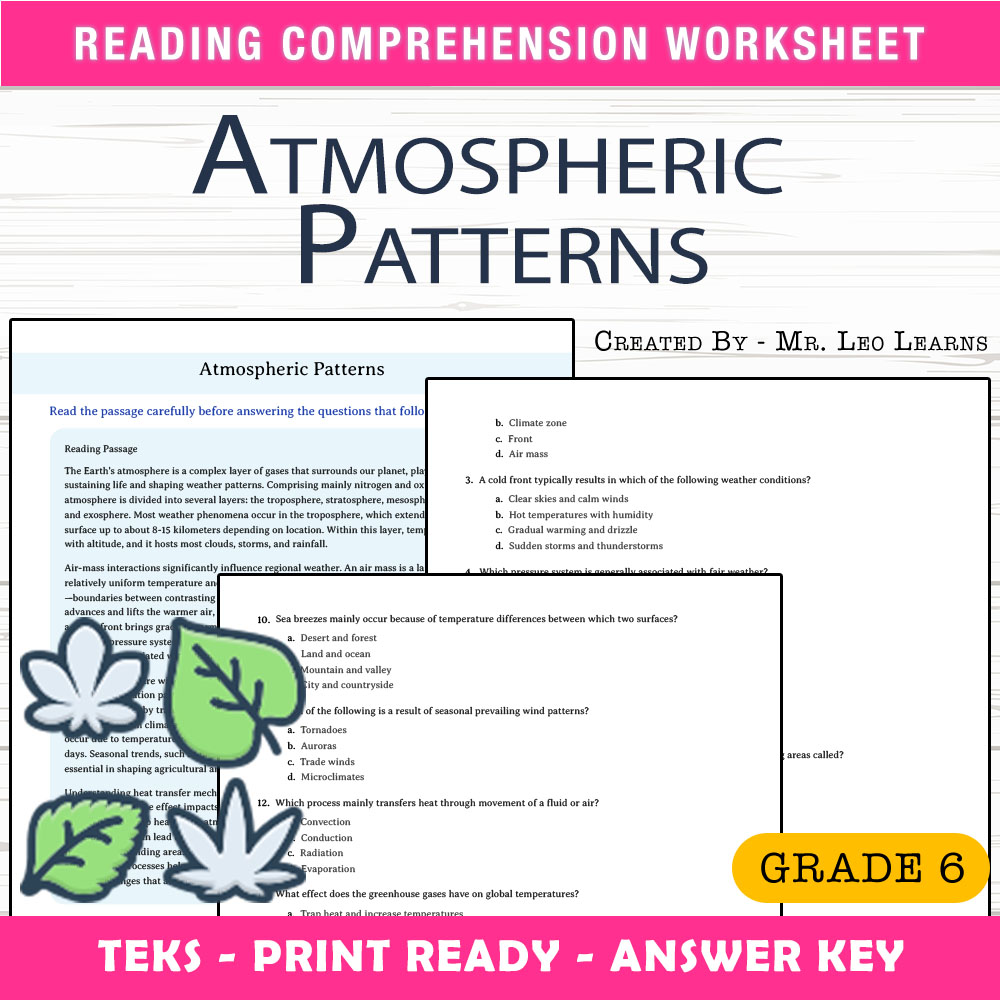
Grade 6 Science — Atmospheric Patterns Worksheet for Mastery
 Created byThe Resource Hub
Learning Objectives
- Understand the components and structure of Earth's atmosphere.
- Recognize how air masses and pressure systems influence regional weather.
- Explain the concepts of fronts, prevailing winds, and climate classification.
Instant download

Measurement Tools Assessment | Alberta Standards Grade 6 Science
 Created byPrism Point Learning
Learning Objectives
- Identify common measurement instruments such as thermometers, pH probes, and tape measures.
- Understand the importance of calibration, unit selection, and accurate recording in data collection.
- Explain how measurements can be used to compare environmental conditions across different locations.
Also included in: Lesson Grade 6 Science Mini Bundle | Evidence and Investigation
Instant download
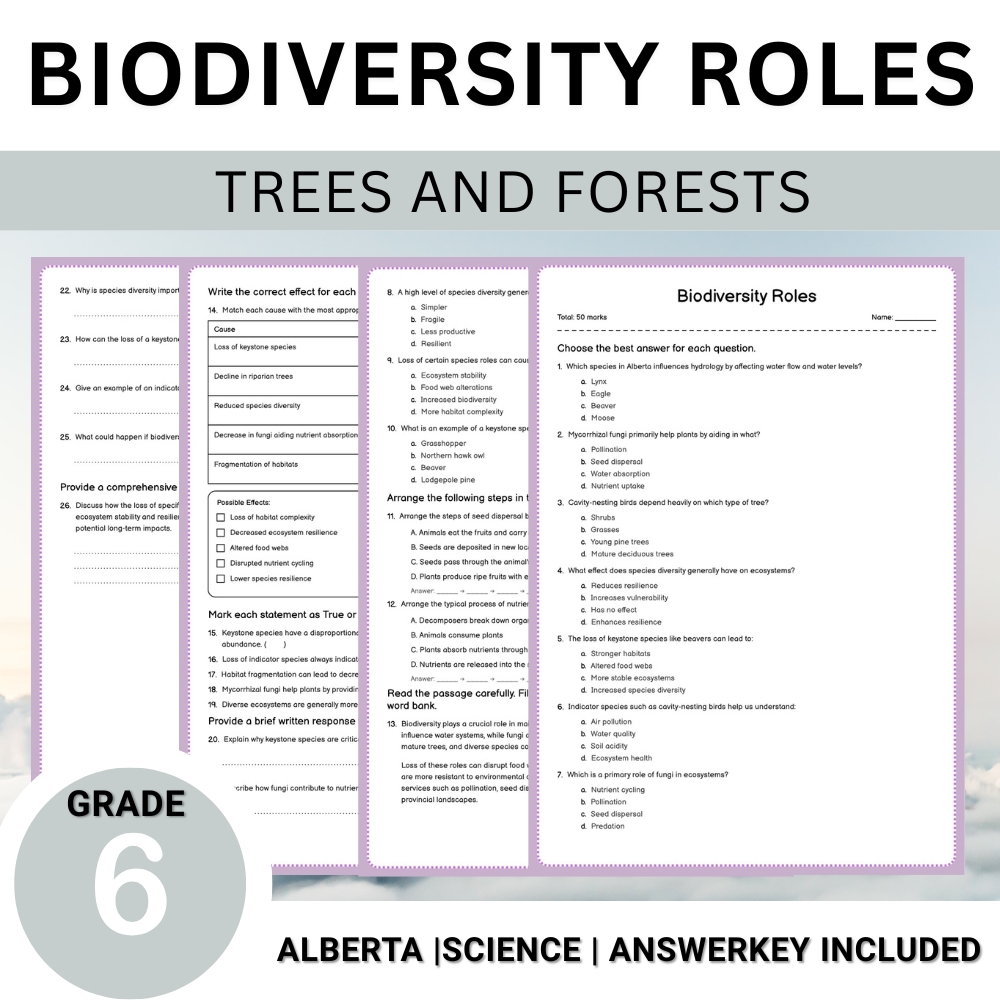
Grade 6 Science | Biodiversity Roles Worksheet (Printable PDF & Assessment)
Learning Objectives
- Understand the roles of different species in maintaining ecosystem functions.
- Identify examples of keystone and indicator species in Alberta.
- Explain how species diversity contributes to ecosystem resilience.
Also included in: Grade 6 Science | Tree Anatomy, Ecology & Conservation Unit Worksheet Bundle +1 more
Instant download
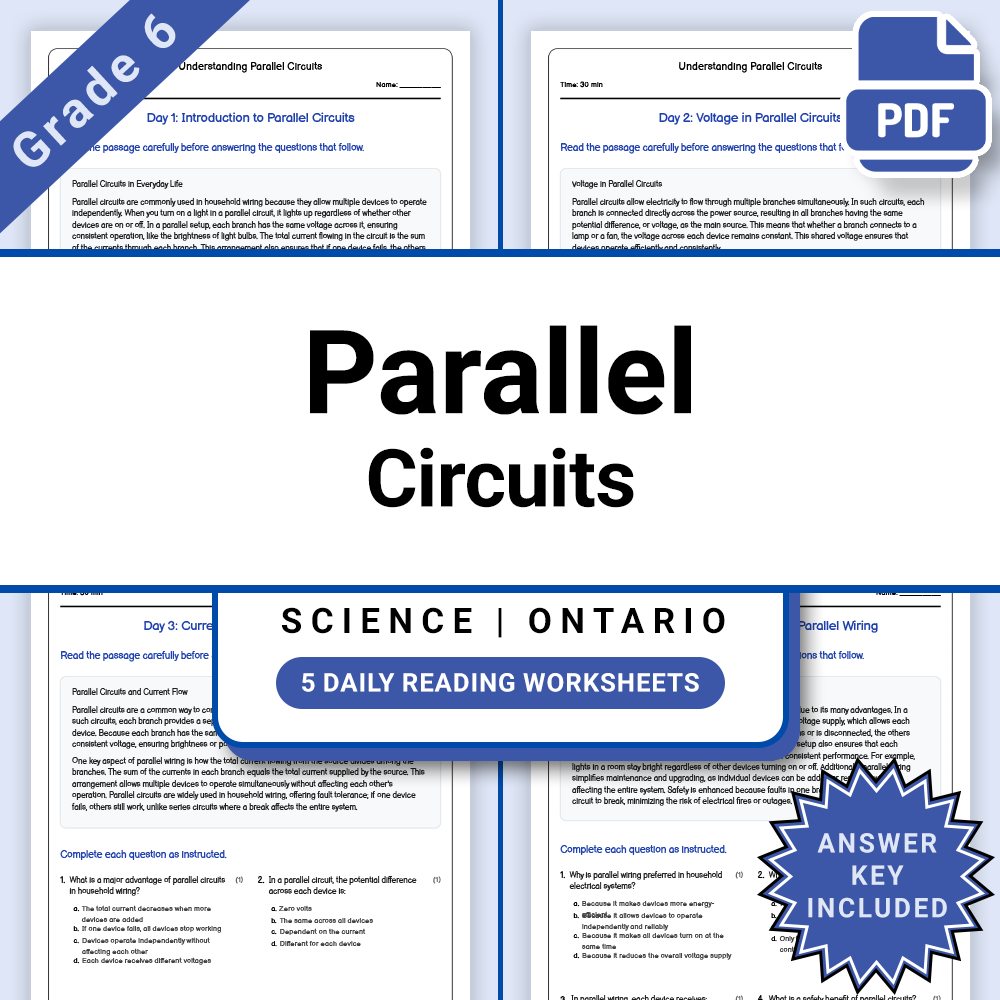
Grade 6 Science – Parallel Circuits Daily Reading Worksheet with Answer Key
JCreated byJ.S SheetsLearning Objectives
- Understand key concepts related to Science
- Apply knowledge through practice questions
- Demonstrate comprehension of the material
Also included in: Grade 6 Science Lesson Group – Circuits and Energy Ontario Framework +1 more
Instant download
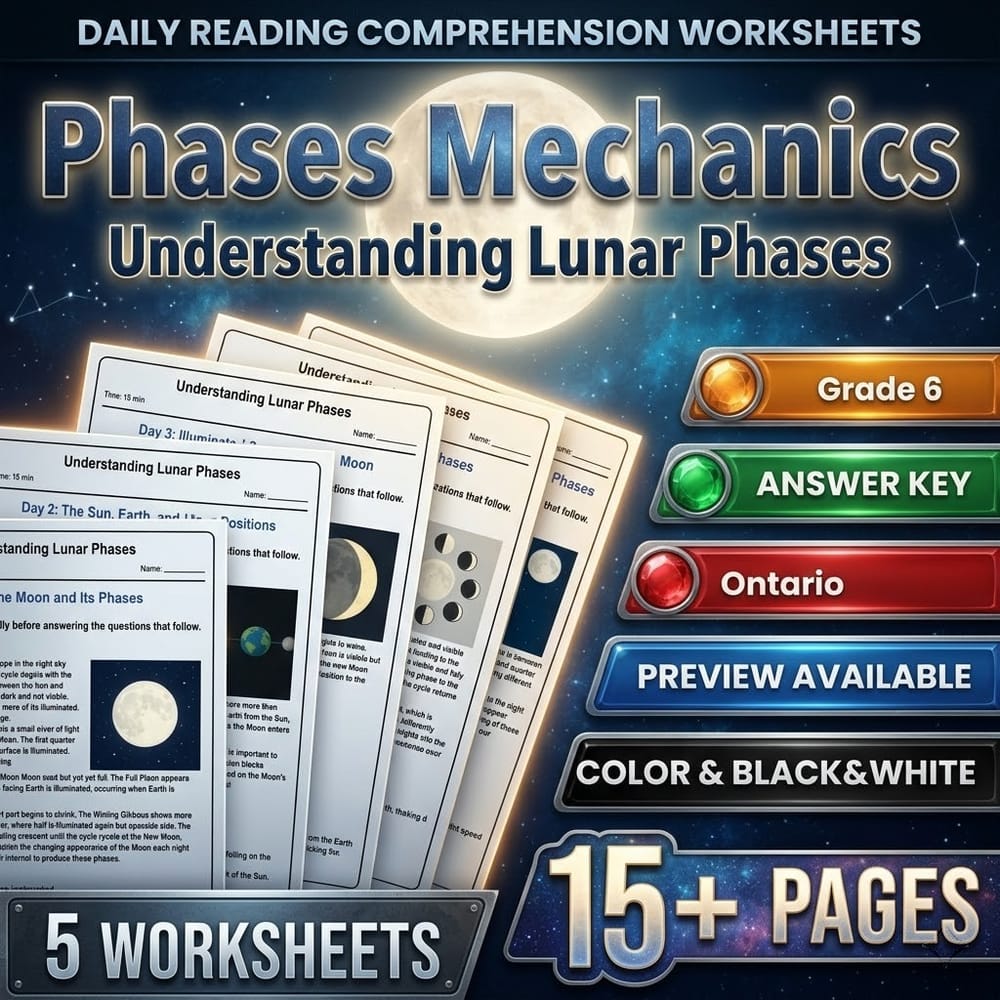
Grade 6 Science – Understanding Lunar Phases | Daily Reading Worksheet
 Created byQuiet Forest Education
Learning Objectives
- Describe the sequence of lunar phases from new moon to full moon and back.
- Identify the relative positions of the Sun, Earth, and Moon during different phases.
- Explain how the Moon's illumination appears to change from Earth.
Also included in: Space Science Grade 6 Daily Reading Worksheets Bundle | Ontario +1 more
Instant download

Grade 6 Science | Biodiversity Solutions Worksheet with Short Notes (PDF)
 Created byMeadowlark Worksheets
Learning Objectives
- Compare different conservation strategies and their ecological trade-offs.
- Analyze case studies like coral reef restoration and riparian buffers.
- Evaluate the effectiveness of habitat restoration and invasive species management.
Also included in: Grade 6 Science | Ecosystems: Interactions, Energy & Dynamics NGSS Unit Bundle +1 more
Instant download

Grade 6 Science – Wind Tunnels & Forces | Daily Reading Worksheet
Created byQuiet Forest EducationLearning Objectives
- Learn what a wind tunnel is and its purpose in scientific research.
- Identify the basic components and methods used in wind tunnel experiments.
- Understand how wind tunnels help in studying aerodynamic forces like lift and drag.
Also included in: Flight Science Grade 6 Daily Reading Worksheets Bundle | Ontario +1 more
Instant download
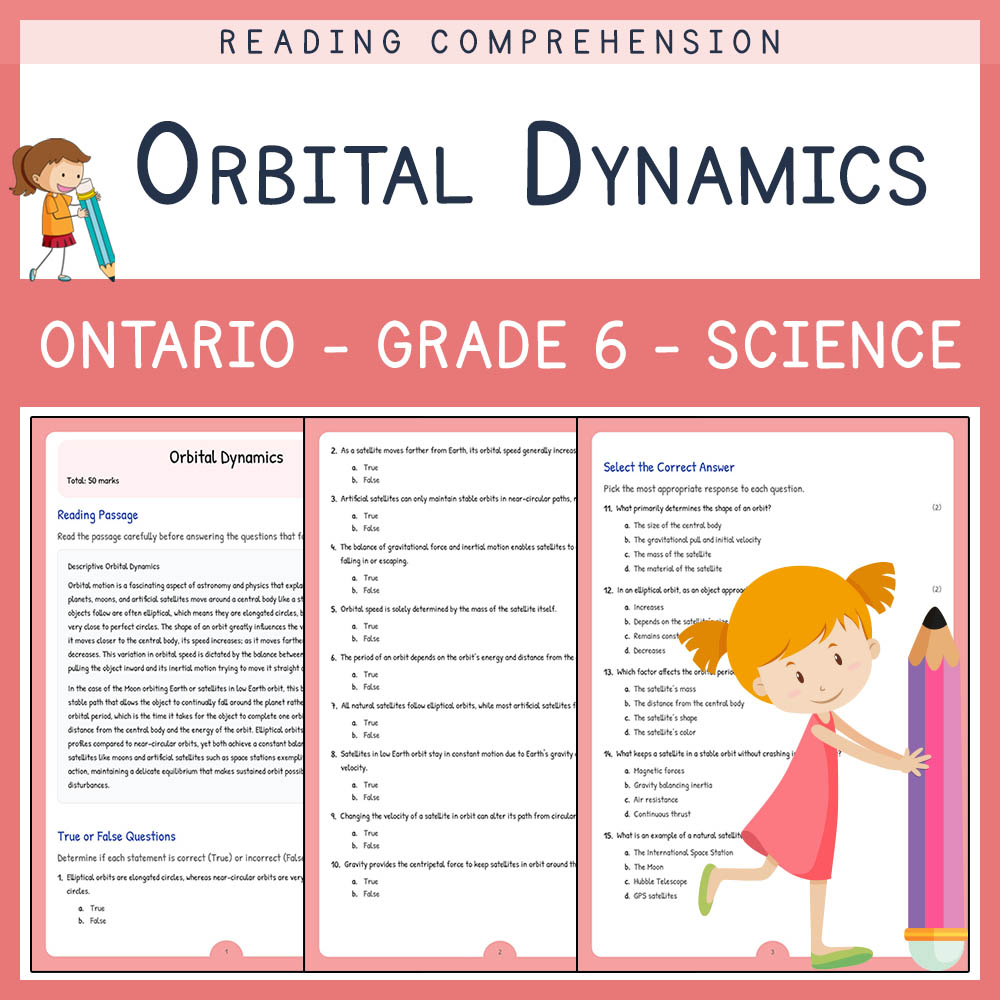
Grade 6 Science | Orbital Dynamics Worksheet with Answer Key (PDF)
 Created byLumora Learning
Learning Objectives
- Describe the basic types of orbital paths, including elliptical and near-circular orbits.
- Explain how orbital speed varies with distance from a central body.
- Understand the balance between gravity and inertia that maintains stable orbits.
Also included in: Grade 6 | Space Science Lesson Bundle Worksheets | Ontario Framework
Instant download
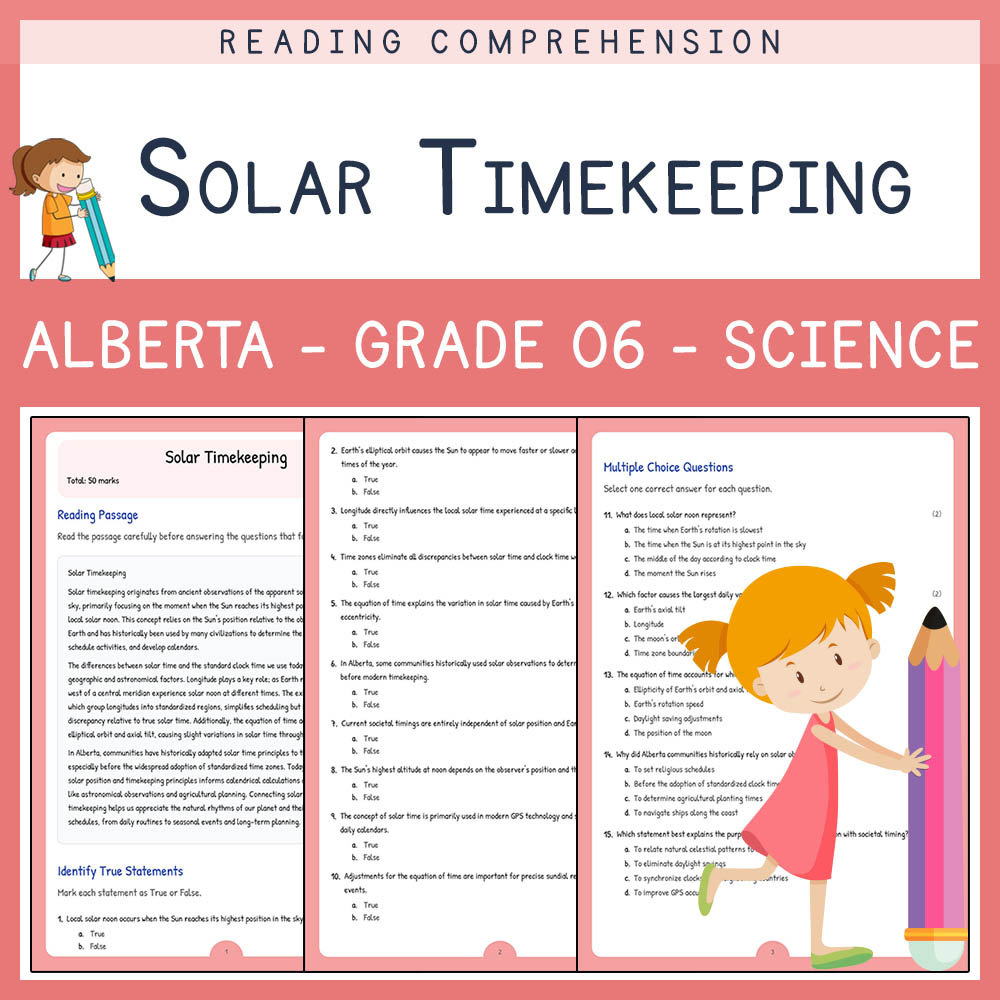
Grade 6 Science Worksheet | Solar Timekeeping | Alberta Standards Aligned
Created byLumora LearningLearning Objectives
- Understand the principles of solar time and how it differs from clock time.
- Identify the factors affecting solar time, including longitude, time zones, and Earth's orbit.
- Explore historical and contemporary applications of solar time in Alberta communities.
Instant download
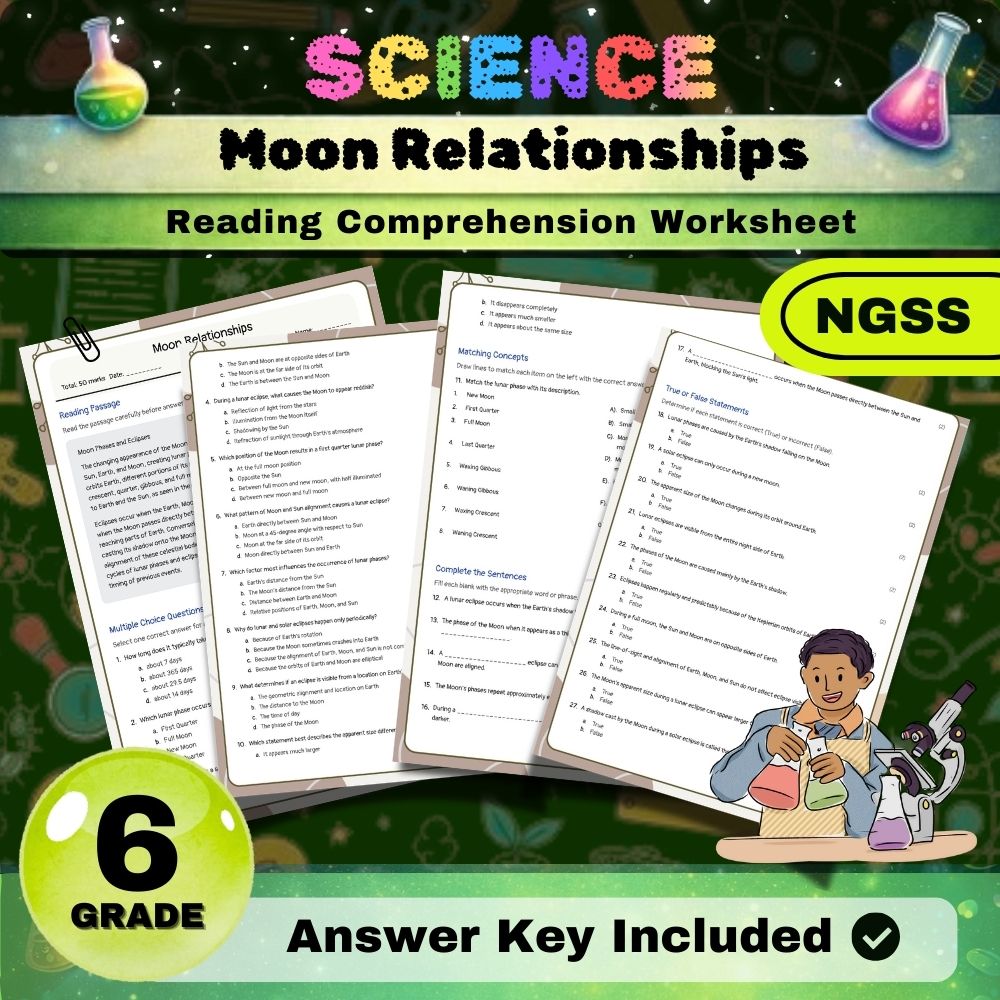
Grade 6 Science | Moon Relationships NGSS Worksheet (PDF + Answer Key)
 Created byMaple Path Learning
Learning Objectives
- Describe the geometric relationships among Earth, Moon, and Sun that produce lunar phases and eclipses.
- Explain how relative positions of Earth, Moon, and Sun determine the occurrence of lunar phases and eclipses.
- Predict the timing and types of lunar phases and eclipses based on Earth-Moon-Sun positions.
Also included in: Grade 6 Science | Earth's Rotation, Seasons & Orbital Motion Worksheet Bundle +1 more
Instant download

Roots and Water Assessment | Alberta Standards Assessment Grade 6 Science
Created byPrism Point LearningLearning Objectives
- Understand the role of root systems in plant health, water absorption, and nutrient uptake.
- Identify different root adaptations in trees and their environmental significance.
- Explain how mycorrhizal associations enhance drought resilience and water absorption.
Also included in: Lesson Grade 6 Science Mini Bundle Trees and Forests Alberta Standards
Instant download

Air Properties Worksheet for Grade 6 Science | Standards-Aligned Practice
JCreated byJ.S SheetsLearning Objectives
- Understand the molecular composition of air and how it influences its properties.
- Describe how air density and pressure change with altitude and temperature.
- Explain regional examples such as Chinook winds and altitude differences affecting air behavior.
Instant download

Grade 6 Science – Food Chains Daily Reading Worksheet with Answer Key
JCreated byJ.S SheetsLearning Objectives
- Understand the components of food chains, including producers, consumers, and decomposers.
- Identify different trophic levels within an ecosystem.
- Explain the flow of energy through various levels of a food chain.
Also included in: Grade 6 Science Lesson Bundle: Ecosystems, Food Chains & Environment +1 more
Instant download

Grade 6 Science | Climate Systems NGSS Worksheet (PDF)
Created byMaple Path LearningLearning Objectives
- Explain how unequal solar heating and planetary rotation create global atmospheric and oceanic circulation patterns.
- Identify key circulation cells, wind patterns, and ocean currents involved in heat and moisture transport.
- Describe the effects of circulation patterns on regional climate zones and phenomena such as El Niño.
Also included in: Grade 6 Science | Weather, Water Cycle & Earth Systems NGSS Unit Bundle (PDF) +1 more
Instant download
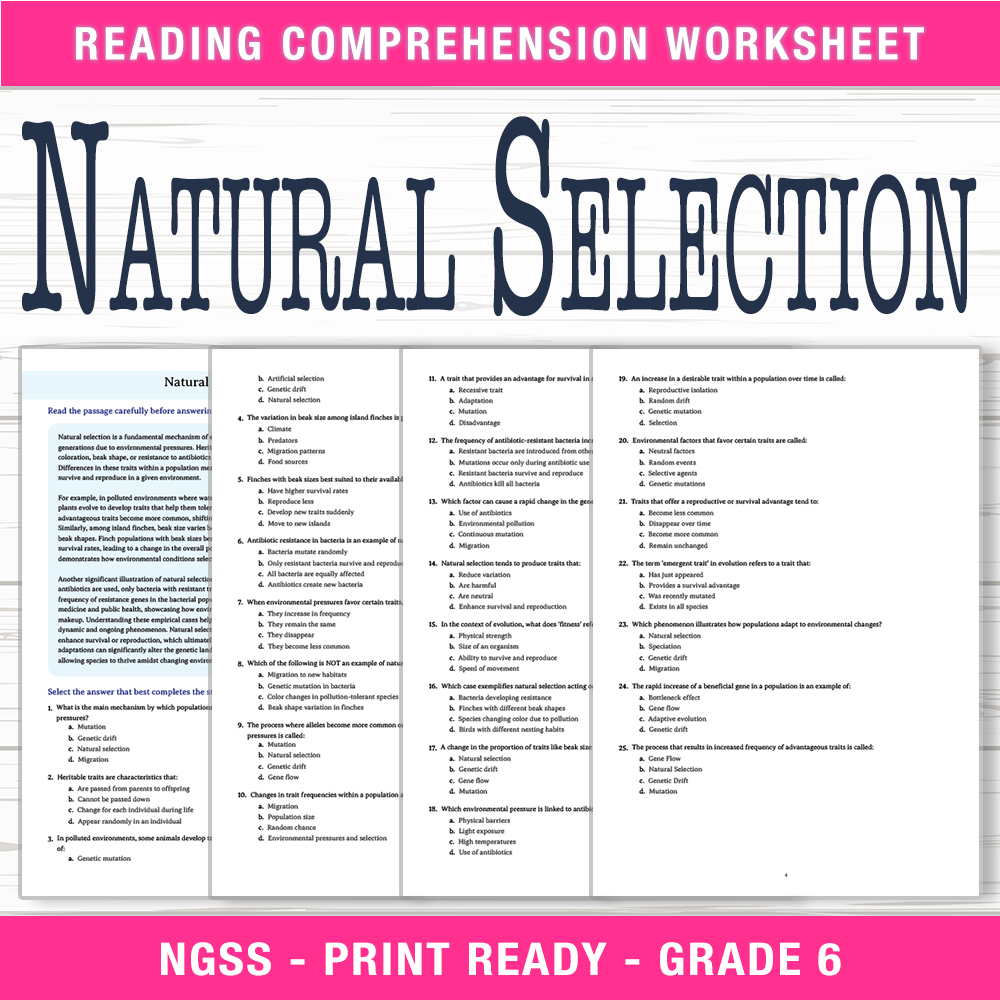
6th Grade Science | Natural Selection Worksheet (PDF + Answer Key)
 Created byRiverstone Classroom
Learning Objectives
- Understand the concept of natural selection and how it drives changes in populations over time.
- Identify and analyze examples of trait variation and environmental pressures affecting evolution.
- Explain how empirical cases demonstrate the process of natural selection in different species.
Instant download

Grade 6 Science | Limiting Factors Worksheet | BC Standards
Created byLumora LearningLearning Objectives
- Define limiting factors and explain their role in ecosystems.
- Identify abiotic and biotic limiting factors affecting populations.
- Analyze how changes in limiting resources influence population dynamics.
Instant download

6th Grade Science | Organ Systems Worksheet (PDF + Answer Key)
 Created byCopper Leaf Classroom
Learning Objectives
- Identify and describe the major organ systems: circulatory, respiratory, digestive, and nervous.
- Explain how tissues and organs interact within each organ system to maintain bodily functions.
- Describe the interconnected roles of the heart, blood vessels, lungs, liver, and brain in supporting life processes.
Instant download

Grade 6 Science | Particle Models | Worksheet & Answer Key | NGSS Aligned
 Created byCedar Grove Learning
Learning Objectives
- Understand that matter is made up of particles too small to see with the naked eye.
- Explain how particle motion, collisions, and spacing relate to the properties of different phases and states of matter, such as melting, freezing, boiling, and condensation.
- Describe how temperature and thermal energy affect particle behavior, and how gas pressure relates to particle movement and energy.
Also included in: Grade 6 Science | Atomic & Molecular Models, Conservation & Reactions | NGSS +1 more
Instant download

Grade 6 Science | Moon Relationships Worksheet (PDF) | NGSS Aligned
Created byLumora LearningLearning Objectives
- Understand the relative positions of the Earth, Moon, and Sun that cause lunar phases and eclipses.
- Identify the primary lunar phases and the conditions needed for solar and lunar eclipses.
- Recognize the periodicity and predictability of Earth-Moon-Sun alignments.
Instant download

Grade 6 Science — Producers And Consumers Worksheet MCQ Paper
Created byThe Resource HubLearning Objectives
- Understand the roles of producers and consumers in ecosystems.
- Identify different types of consumers such as herbivores, carnivores, and omnivores.
- Recognize energy transfer between trophic levels and its impact on ecosystems.
Also included in: Grade 6 Science Ecosystems & Interdependence Worksheet Bundle – BC Curriculum +1 more
Instant download

Grade 6 Science | Science Careers Worksheet | TEKS Alligned
Created byLumora LearningLearning Objectives
- Identify various careers related to science and technology, such as biomedical technician and environmental scientist.
- Understand the typical tasks and skills required in different science-related occupations.
- Recognize the educational pathways and coursework that support careers in science and technology.
Instant download

Decomposer Matter Return Worksheet | California Standards Grade 6 Science
JCreated byJ.S SheetsLearning Objectives
- Understand the role of decomposers in recycling matter within ecosystems.
- Identify the processes involved in decomposition and nutrient cycling.
- Explain how atoms and organic molecules are transformed during decomposition.
Also included in: Grade 6 Life Science Science Lesson Bundle – California Standards +1 more
Instant download

Grade 6 Science – Energy Conservation & Energy Transfer | Reading Worksheet
 Created byBright Mind Resources
Learning Objectives
- Identify different forms of energy such as kinetic, potential, and thermal.
- Explain the conservation principle of energy.
- Recognize examples of energy transfer and transformation.
Also included in: Grade 6 Daily Reading Science Worksheets | Lesson Bundle | BC Framework +1 more
Instant download

Inquiry Foundations Science Worksheet Grade 6 | Variables & Fair Tests
 Created byChalk and Compass
Learning Objectives
- Define independent and dependent variables and use operational definitions to describe measurements
- Design fair tests by keeping variables controlled and using controlled comparisons
- Connect hypothesis testing to reproducibility by documenting procedures and recognizing limitations
Also included in: Grade 6 Science Scientific Inquiry and Evidence Lesson Bundle | Ontario +1 more
Instant download

Grade 6 Resource Limits Worksheet | NGSS Practice PDF
 Created byClear Sky Classroom
Learning Objectives
- Understand how resource availability affects individual organisms and populations.
- Interpret data and measurement patterns related to resource gradients.
- Identify limiting resources such as water, nutrients, and light in various ecosystems.
Also included in: Grade 6 Ecosystems Science Lesson Bundle for NGSS: Species, Energy, Biodiversity +1 more
Instant download

Grade 6 Science Air Density Worksheet (Alberta) | Practice & Assessment (PDF)
 Created byEvergreen Desk Education
Learning Objectives
- Explain how air density is affected by temperature, humidity, and altitude.
- Use air density ideas to predict how buoyancy and lift change under different atmospheric conditions.
- Interpret examples from prairie and mountain environments to describe real-world effects on airflow.
Instant download

Grade 6 Adaptation Basics Animal Survival Traits Worksheet | Ontario Science
 Created byTeacher's Corner
Learning Objectives
- Identify and classify adaptations as structural, behavioural, or physiological
- Explain how inherited traits differ from acquired characteristics
- Describe how environmental pressures can change survival and reproduction over generations
Instant download

Grade 6 Science Safety and Ethics Worksheet | Ontario Curriculum
Created byChalk and CompassLearning Objectives
- Explain why risk assessment is necessary before starting a science investigation
- Identify safe and ethical behaviors when using tools, handling materials, and working with organisms or communities
- Apply protocols for hazard prevention and accurate reporting of incidents
Also included in: Grade 6 Science Scientific Inquiry and Evidence Lesson Bundle | Ontario +1 more
Instant download

Grade 6 Science | Resource Distribution - Daily Reading Comprehension
 Created byCoral Reef Learning
Learning Objectives
- Understand how mineral, energy, and groundwater resources form and are distributed
- Identify geological processes such as plate tectonics, sedimentation, and weathering that influence resource formation
- Recognize spatial patterns of ore deposits, petroleum basins, and aquifers
Instant download

6th Grade Science Evaporation & Transpiration Worksheet | California PDF
Created byEvergreen Desk EducationLearning Objectives
- Explain how evaporation and transpiration release water vapor into the atmosphere.
- Describe how temperature and the availability of liquid water affect the amount of water vapor.
- Connect phase changes to the water cycle, including condensation and precipitation.
Instant download

Grade 6 TEKS Hydrologic Cycle Daily Science Reading Worksheet Activity
 Created byBRIGHT PATH RESOURCES
Learning Objectives
- Explain the sequence of the main parts of the hydrologic (water) cycle.
- Identify how water moves between surface water and groundwater.
- Describe how watersheds and aquifers affect water availability.
Also included in: Earth & Space Grade 6 Science Daily Reading Worksheets Lesson Bundle | TEKS +1 more
Instant download

Grade 6 Science – Materials & Properties | Daily Reading Worksheet
Created byBright Mind ResourcesLearning Objectives
- Identify different material properties relevant to performance.
- Compare how properties like strength, water resistance, and conductivity affect material choice.
- Understand how practical limitations influence material selection in design.
Also included in: Engineering & Technology Grade 6 Science Worksheets Lesson Bundle | General +1 more
Instant download

Human Water Disruptions Worksheet Grade 6 Science Water Cycle Impact
Created byPrism Point LearningLearning Objectives
- Explain how human actions can change the movement of water through Earth systems
- Describe how dams, withdrawals, pollution, and land-cover change can affect water quality and habitats
- Use cause-and-effect reasoning to predict impacts on aquatic life and flood risk
Also included in: Grade 6 Water Cycle Systems Lesson Bundle | California Standards
Instant download

6th Grade Science | Day Night Cycle Worksheet (PDF) Alberta Standards
 Created bySilver Birch Teaching
Learning Objectives
- Explain how Earth’s rotation causes the regular pattern of day and night
- Describe how the direction of sunlight and Earth’s axial tilt influence daylight duration
- Interpret how seasonal changes affect the length of day and night
Also included in: Grade 6 Celestial Motion & Seasons Science Lesson Bundle | Alberta +1 more
Instant download

Energy Forms Assessment for Grade 6 Science | TEKS Standards-Aligned
Created byPrism Point LearningLearning Objectives
- Identify and describe common forms of energy including kinetic, potential, thermal, chemical, and electrical.
- Relate each form of energy to familiar phenomena such as moving objects, stretched springs, and batteries.
- Distinguish among different energy types based on their characteristics and associated everyday examples.
Also included in: Lesson Bundle Grade 6 Matter and Energy Science Assessment | TEKS
Instant download

Grade 6 Science Worksheet on Evaporation and Transpiration
JCreated byJ.S SheetsLearning Objectives
- Explain the processes of evaporation and transpiration and their roles in the water cycle.
- Identify factors affecting evaporation and transpiration rates in the environment.
- Describe how phase changes link the hydrosphere and atmosphere.
Also included in: Grade 6 Earth & Space Science Lesson Bundle: California Standards +1 more
Instant download

Data Representation Worksheet | Grade 6 Science Review & Practice
Created byPrism Point LearningLearning Objectives
- Organize qualitative and quantitative observations into tables and clear categories.
- Select appropriate graph types and label axes with correct units, scales, and legends.
- Interpret trends, outliers, and simple summary measures such as mean and median.
Instant download

Grade 6 Science – Stewardship Practices Reading Worksheet | Alberta Standards
Created byBright Mind ResourcesLearning Objectives
- Understand community-based stewardship initiatives such as planting and urban forestry
- Identify the environmental benefits of stewardship practices
- Recognize local examples of stewardship efforts in Alberta
Also included in: Grade 6 Forest Ecology Science Daily Reading Worksheets Lesson Bundle | Alberta +2 more
Instant download

Grade 6 Science – Angle Effects in Flight Reading Worksheet | Ontario Standards
Created byBright Mind ResourcesLearning Objectives
- Understand key concepts related to Science
- Apply knowledge through practice questions
- Demonstrate comprehension of the material
Also included in: Grade 6 Aerodynamics Science Lesson Bundle Daily Reading Worksheets | Ontario +1 more
Instant download

Grade 6 Science – Data Tables & Data Analysis | Daily Reading Worksheet
Created byBright Mind ResourcesLearning Objectives
- Understand the components of a data table such as headers and units
- Learn the importance of clear labels and metadata in data recording
- Identify examples of data tables used in real-world science contexts
Also included in: Grade 6 Science Data & Inquiry Daily Reading Worksheets Lesson Bundle | Alberta +2 more
Instant download

Electric and Magnetic Interactions Worksheet | NGSS Grade 6 Science Practice
JCreated byJ.S SheetsLearning Objectives
- Describe how electric and magnetic forces depend on source strength and distance.
- Identify examples of electrostatic and magnetic interactions in real-world situations.
- Explain how factors like charge magnitude and separation influence electromagnetic forces.
Also included in: Grade 6 Forces, Motion, and Interactions Science Lesson Bundle: NGSS +1 more
Instant download

Science Grade 6: Human Impacts on Earth Systems Worksheet Science
 Created bySkylark Worksheets
Learning Objectives
- Explain how land-use change, fossil fuel combustion, agriculture, and waste management can alter Earth’s biogeochemical cycles
- Describe how human activities can influence climate drivers and ecosystem structure
- Use cause-and-effect reasoning to connect environmental observations to human actions over time and space
Also included in: Grade 6 Earth Systems & Human Impacts Science Lesson Bundle: NGSS Worksheets +1 more
Instant download

Grade 6 Science – Inherited Adaptations & Traits | Daily Reading Worksheet
Created byBright Mind ResourcesLearning Objectives
- Understand the concept of inherited traits and adaptations.
- Identify examples of adaptations in animals.
- Explain how adaptations help animals survive in their environment.
Also included in: Ecosystems Grade 6 Science Daily Reading Worksheets Lesson Bundle |Florida NGSSS +1 more
Instant download

States of Matter Worksheet Grade 6 Science | Solids Liquids Gases
Created byPrism Point LearningLearning Objectives
- Explain how particles behave differently in solids, liquids, and gases.
- Compare solids, liquids, and gases using shape, volume, and particle motion.
- Describe how energy changes relate to changes in state.
Also included in: Grade 6 Energy, Matter & Motion Lesson Bundle | Florida NGSSS
Instant download

Series Characteristics Test Prep Worksheet | Grade 6 Science
Created byPrism Point LearningLearning Objectives
- Describe how a series circuit creates a single path for charge to move
- Explain why the current is the same through each element in a series circuit
- Use circuit properties to predict how brightness and voltage share change with series components
Also included in: Grade 6 Circuits & Electricity Science lesson bundle: Ontario
Instant download

Grade 6 Science | Human Water Disruptions Worksheet | California Standards
Created byLumora LearningLearning Objectives
- Explain how dams and water withdrawals can change the timing and movement of water in watersheds
- Describe how pollutants can affect water quality and harm organisms in rivers and groundwater
- Connect land-cover changes to infiltration, runoff, flood risk, and water availability
Instant download

Grade 6 Science | Bernoulli Principle - Daily Reading Comprehension
Created byCoral Reef LearningLearning Objectives
- Understand the basic idea of Bernoulli's principle and how it relates to air pressure and fluid speed.
- Identify real-world examples of Bernoulli's principle, such as gliders and wind tunnels.
- Explain how airflow and pressure differences can affect lightweight objects in the environment.
Also included in: Air and Aerodynamics Lesson Bundle – Grade 6 Science Alberta Reading Comp. +1 more
Instant download

Grade 6 Science | Renewable Transformations Worksheet | BC Standards
Created byLumora LearningLearning Objectives
- Describe how photovoltaic cells convert sunlight into electrical energy.
- Explain the mechanisms by which wind turbines generate electricity from air movement.
- Understand how hydro systems transform gravitational potential energy into electrical power.
Also included in: Grade 6 Science | Energy, Waves & Circuits | Custom Bundle | BC Aligned
Instant download
About Grade 6 Science Worksheets
Explore Grade 6 Science worksheets for classwork, homework, or review. Our 5,997 printables download instantly as PDFs.
MyTeachingSheets worksheets are made by real teacher-authors and checked before they go live. Download any as a print-ready PDF for lessons, homework, or independent practice — most include answer keys, and previews are always free.