
Grade 9 Science Worksheets
6,926 worksheets
Grade 9 Science | Element Identity Worksheet (Ontario Standards) (PDF)
 Created byEvergreen Desk Education
Learning Objectives
- Explain how an element’s identity is determined by its proton count and represented by a chemical symbol.
- Describe how atomic models (including drawings or diagrams) represent atoms and link those models to element identity.
- Compare representative elements (such as iron, carbon, and oxygen) by using metallic/nonmetallic characteristics and symbol notation.
Also included in: Grade 9 States & Energy to Chemical Reactions Science Lesson Bundle (Ontario) +1 more
Instant download

Safety Standards Worksheet | Grade 9 Science Activities
 Created byPrism Point Learning
Learning Objectives
- Explain how grounding, overcurrent protection, and insulation work together to reduce electrical hazards.
- Interpret common device labels and identify what information matters for safe installation.
- Describe how environmental conditions (moisture, temperature, outdoor exposure) affect electrical safety requirements.
Also included in: Electrical Systems & Magnetism Lesson Bundle | Grade 9 Science | Alberta
Instant download

Grade 9 Kinematic Concepts Worksheet | Practice & PDF
 Created byClear Sky Classroom
Learning Objectives
- Differentiate between speed, velocity, and acceleration and explain how each is measured
- Use unit conversions and sign conventions to interpret motion in one dimension
- Apply kinematic relationships to compare motion using basic algebra
Instant download
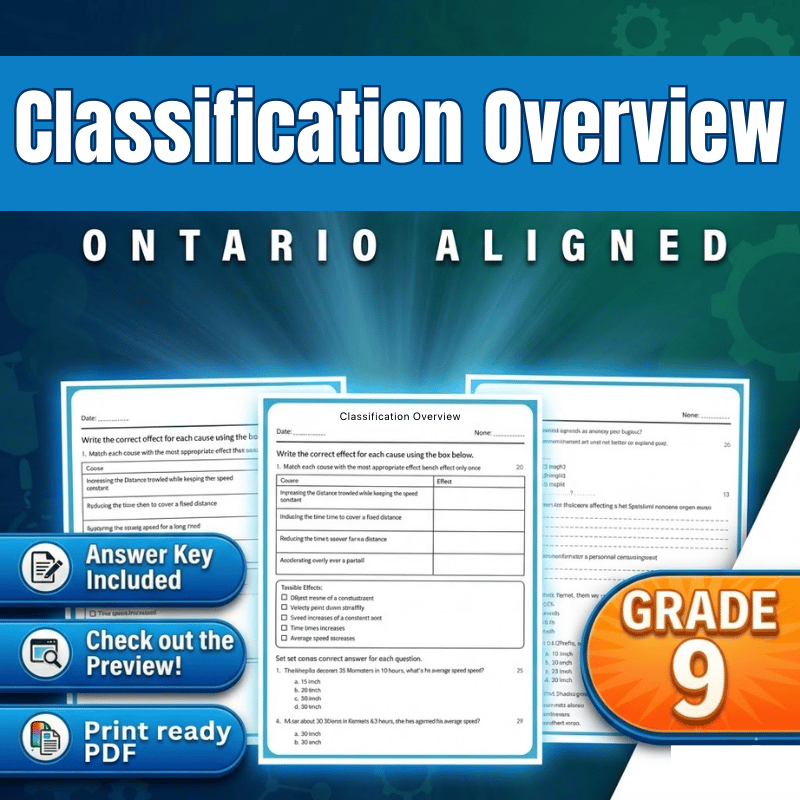
Grade 9 Science | Classification Overview Worksheet (PDF) – Ontario Standards
 Created byBright Mind Resources
Learning Objectives
- Understand the differences between elements, compounds, and mixtures through macroscopic and compositional criteria.
- Learn the definitions of pure substances and mixtures and their typical examples.
- Use symbols and formulas to represent elements and compounds.
Instant download

Biogeochemical Cycles Worksheet | Standards-Aligned Grade 9 Science Practice
JCreated byJ.S SheetsLearning Objectives
- Explain how biogeochemical cycles move and store elements among Earth’s reservoirs
- Describe how photosynthesis, decomposition, nitrogen fixation, and weathering drive nutrient fluxes
- Compare reservoir size and flux rate and predict how disturbances can affect ecosystems
Instant download

Sex-Linked Traits Worksheet for Grade 9 Science | Alberta Standards Practice
JCreated byJ.S SheetsLearning Objectives
- Understand the role of sex chromosomes in inheritance.
- Explain how sex-linked traits are inherited and expressed.
- Distinguish between different sex determination systems in mammals.
Also included in: Grade 9 Genetics & Inheritance Science Lesson Bundle – Alberta Framework
Instant download

Physical Properties and Material Classification Worksheets Grade 9
Created byPrism Point LearningLearning Objectives
- Define physical properties without changing chemical identity
- Identify common physical properties used to compare materials
- Distinguish intensive from extensive physical properties
Also included in: Matter and Chemical Change Lesson Bundle | Grade 9 Science | Ontario +1 more
Instant download
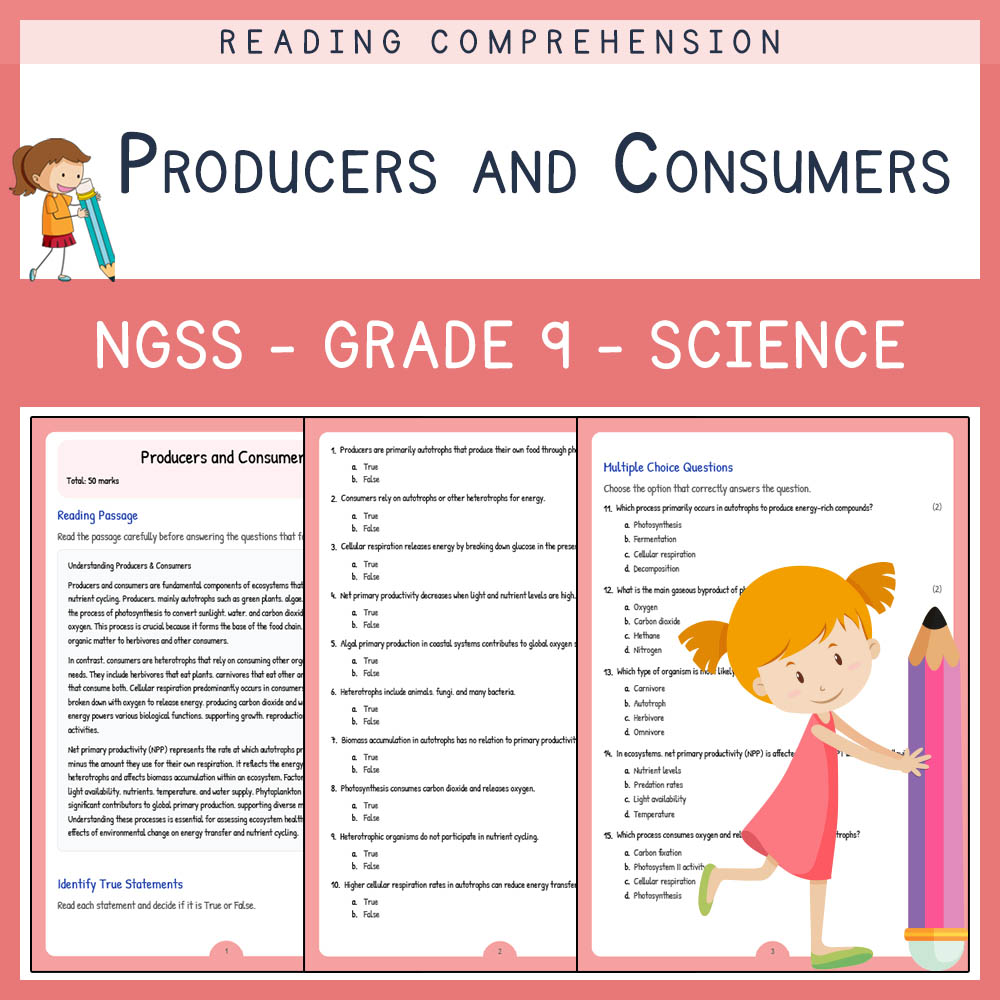
Grade 9 Science | Producers & Consumers Worksheet (PDF + Answer Key)
 Created byLumora Learning
Learning Objectives
- Explain the roles of producers and consumers in ecosystems through photosynthesis and respiration.
- Analyze how energy transfer and material cycling occur between autotrophs and heterotrophs.
- Evaluate the impact of primary productivity on biomass accumulation and ecosystem carbon budgets.
Instant download

Grade 9 Science – Introduction to Newtonian Motion & Daily Reading Worksheet
Created byBright Mind ResourcesLearning Objectives
- Identify forces acting on objects in various situations.
- Understand Newton's first law of motion.
- Describe the relationship between force, mass, and acceleration.
Also included in: Newtonian Motion Grade 9 Science Daily Reading Worksheets Lesson Bundle | NGSS +2 more
Instant download
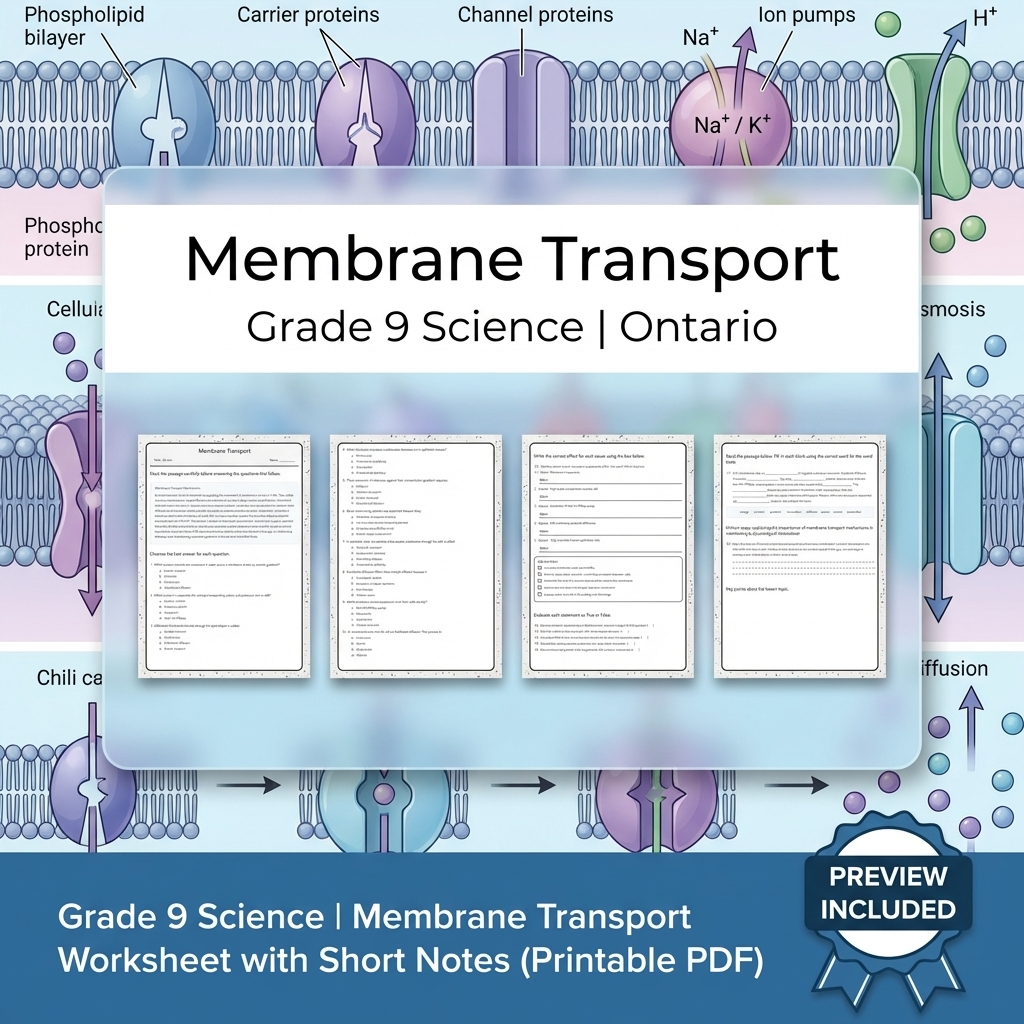
Grade 9 Science | Membrane Transport Worksheet with Short Notes (Printable PDF)
 Created byMeadowlark Worksheets
Learning Objectives
- Explain the mechanisms of molecular movement across cellular membranes, including diffusion, facilitated diffusion, osmosis, and active transport.
- Describe the roles of transport proteins, electrochemical gradients, and membrane potential in cellular transport.
- Differentiate between paracellular and transcellular pathways in epithelial layers.
Instant download

Trophic Dynamics Worksheet | NGSS Grade 9 Science Assessment
 Created bySkylark Worksheets
Learning Objectives
- Explain how energy is transferred and lost across trophic levels using trophic pyramids and ecological efficiency.
- Describe how food webs are structured and how predators and prey can influence energy flow through top-down and bottom-up control.
- Quantify relationships among production, biomass, and ecological efficiency using kelp-forest and grassland style examples.
Also included in: Grade 9 Science Full-Year Bundle | NGSS Worksheets & Assessments
Instant download
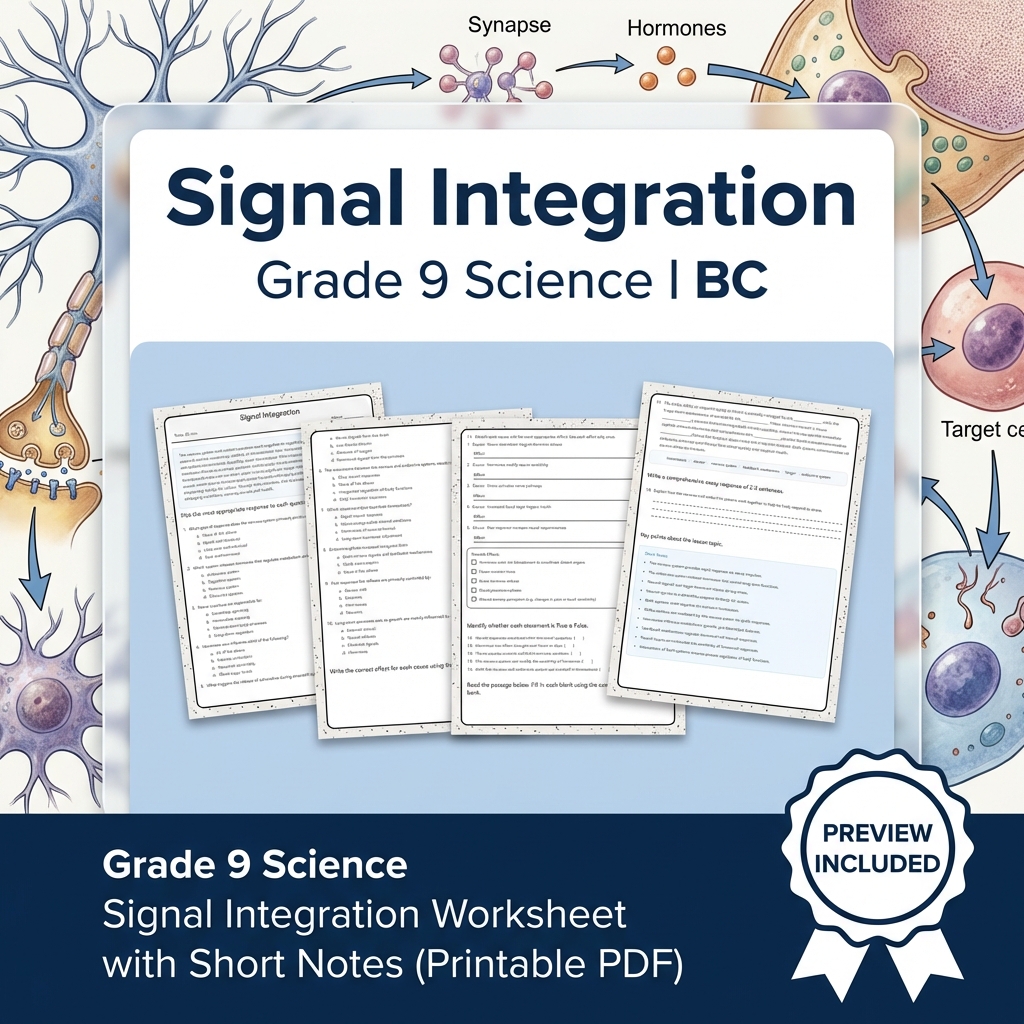
Grade 9 Science Signal Integration Worksheet with Short Notes (Printable PDF)
Created byMeadowlark WorksheetsLearning Objectives
- Understand how the nervous and endocrine systems coordinate responses to stimuli.
- Identify the roles of nerve impulses and hormones in maintaining homeostasis.
- Explain the interaction between neural signals and hormonal responses.
Also included in: Grade 9 Science Lesson Bundle | BC Framework Worksheets (15-Piece Collection) +1 more
Instant download

Rock Cycle Processes and Evidence Worksheets Grade 9 Science
Created byPrism Point LearningLearning Objectives
- Explain transformations among igneous, sedimentary, and metamorphic rocks
- Identify field evidence supporting specific rock cycle pathways
- Describe how plate tectonics drives rock cycle changes
Also included in: Earth and Space Systems Lesson Bundle – Grade 9 Science Ontario +1 more
Instant download
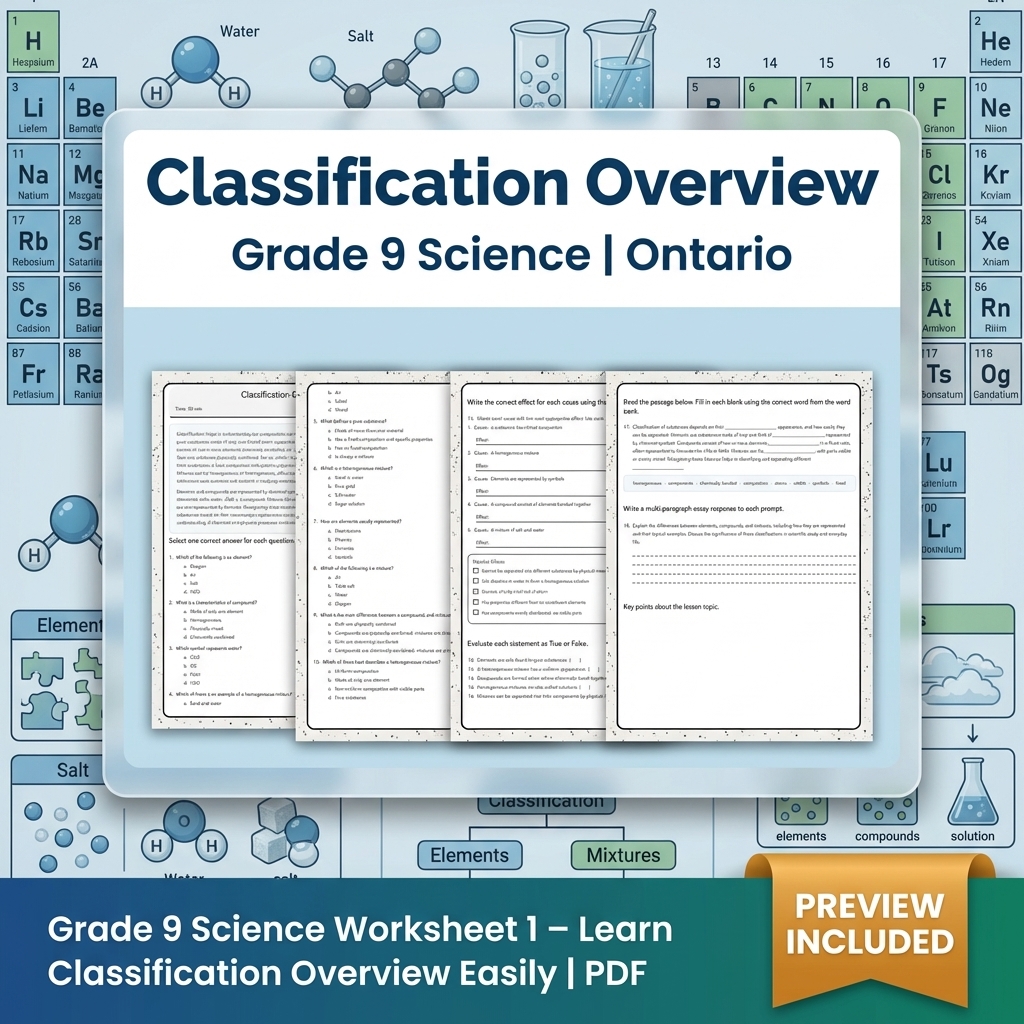
Grade 9 Science Worksheet 1 – Learn Classification Overview Easily | PDF
Created byMeadowlark WorksheetsLearning Objectives
- Distinguish between elements, compounds, and mixtures based on their properties.
- Understand the importance of fixed compositions in pure substances.
- Use symbols and formulas to represent elements and compounds.
Also included in: Grade 9 Science Lesson Group Bundle | Ontario Curriculum Worksheets
Instant download

Prototyping Methods Worksheet | NGSS Grade 9 Science printable PDF
Learning Objectives
- Understand different prototyping methods and their appropriate applications.
- Identify materials and techniques used in various prototyping approaches.
- Analyze test data to iteratively improve prototypes.
Also included in: Grade 9 Science Engineering Design Lesson Bundle | NGSS Framework +1 more
Instant download

Grade 9 Science | Cell Type Differences - Daily Reading Comprehension
 Created byCoral Reef Learning
Learning Objectives
- Understand key concepts related to Science
- Apply knowledge through practice questions
- Demonstrate comprehension of the material
Instant download

Atomic Particles Worksheet | Grade 9 Science Practice
Created byPrism Point LearningLearning Objectives
- Explain how protons, neutrons, and electrons form an atom and how they affect atomic identity and behavior.
- Compare isotopes and relate differences in neutron count to changes in atomic mass and stability.
- Use subatomic structure to predict how an atom’s electron arrangement connects to chemical bonding.
Also included in: Grade 9 Matter and Chemical Change Lesson Bundle | Science | BC +1 more
Instant download

Decision Modeling Practice Worksheet | Grade 9 Science NGSS Review
Created byPrism Point LearningLearning Objectives
- Use scenario analysis and integrated assessment to compare mitigation and adaptation options under uncertainty.
- Apply cost-benefit evaluation and lifecycle assessment to identify trade-offs among environmental, economic, and social outcomes.
- Explain how decision models can support equitable, resilient, and sustainable policy choices.
Also included in: Grade 9 Test Prep Science Lesson Bundle NGSS: Energy Systems & Modeling
Instant download

Grade 9 Science – Respiratory Exchange & Gas Diffusion | Daily Reading Worksheet
Created byBright Mind ResourcesLearning Objectives
- Understand the basic mechanism of pulmonary gas exchange at the alveolar–capillary interface.
- Describe the factors influencing oxygen and carbon dioxide diffusion, such as partial pressure gradients, surface area, and membrane thickness.
- Explain how ventilation and perfusion match to optimize gas exchange.
Also included in: Grade 9 Science Daily Reading Worksheets: Body Systems Lesson Bundle | Ontario +1 more
Instant download

Grade 9 Science | Genetics and Reproduction Assessment (Worksheet + Answer Key)
 Created bySilver Birch Teaching
Learning Objectives
- Explain how sexual and asexual reproduction affect genetic variation in breeding programs
- Describe how chromosome behavior and Mendelian patterns determine inheritance of traits
- Predict possible outcomes of selection on beneficial and harmful linked traits
Also included in: Grade 9 Genetics and Reproduction Science Lesson Bundle Worksheets – Alberta +1 more
Instant download

Grade 9 Science | Chemical Changes - Daily Reading Comprehension
Created byCoral Reef LearningLearning Objectives
- Define chemical change and distinguish it from physical change.
- Identify observable signs of chemical changes such as temperature change, gas production, precipitate formation, and color change.
- Explain microscopic processes involved in chemical reactions.
Instant download

Grade 9 Science | Hydrologic Fluxes Worksheet (AP Standards) PDF
Created byEvergreen Desk EducationLearning Objectives
- Use a water-budget framework to relate precipitation, evapotranspiration, streamflow, infiltration, and storage changes.
- Interpret discharge hydrographs to connect surface runoff timing to catchment and human impacts.
- Explain how groundwater-level records indicate subsurface fluxes and aquifer sustainability.
Also included in: Earth Systems & Climate Grade 9 Science Lesson Bundle AP Worksheets +1 more
Instant download

Environmental Chemistry and Mass Conservation Worksheets Grade 9
 Created bySunny Desk Resources
Learning Objectives
- Explain how chemical reactions and mass conservation apply to environmental changes
- Use particulate and atomic ideas to describe evidence of chemical transformation
- Account for measurable mass flows within a defined system boundary
Also included in: Phase Changes, Chemical Reactions & Atomic Structure Lesson Bundle | Grade 9 Science | Alberta +1 more
Instant download

Grade 9 Cell Architecture and Function Worksheet | NGSS Biology Science
 Created byBRIGHT PATH RESOURCES
Learning Objectives
- Identify basic cell organelles such as nucleus, mitochondria, endoplasmic reticulum, and ribosomes.
- Understand the functions of different cell components and how they work together.
- Recognize how nucleic acid sequences influence protein structures and cellular functions.
Also included in: Cell Signaling Grade 9 Science Daily Reading Worksheets Lesson Bundle | NGSS +1 more
Instant download
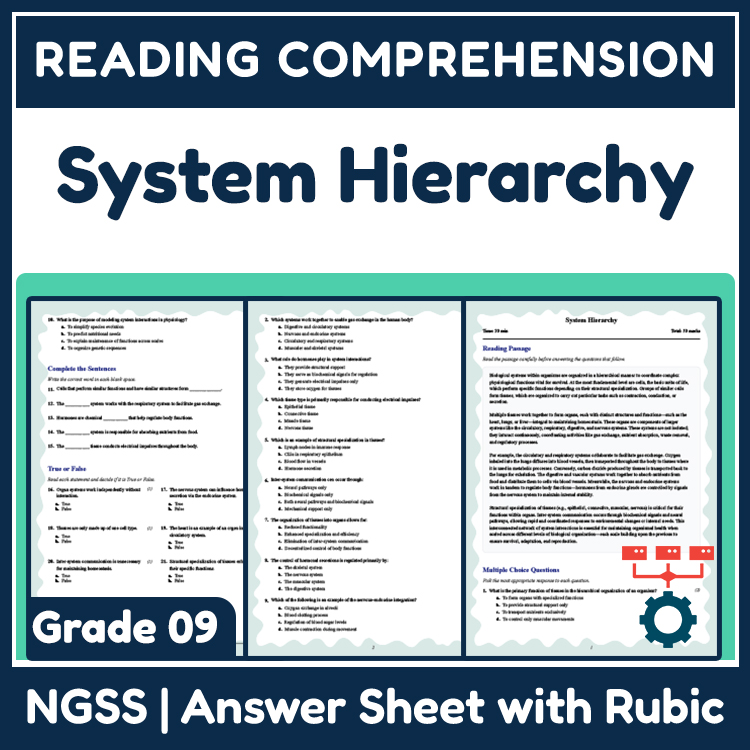
Grade 9 Science | System Hierarchy Reading Worksheet (PDF + Answer Key)
JCreated byJ.S SheetsLearning Objectives
- Understand the hierarchical organization of biological systems from cells to organismal systems.
- Describe how tissues, organs, and organ systems interact to maintain bodily functions.
- Illustrate examples of system interactions such as circulatory-respiratory coupling and nervous-endocrine integration.
Instant download

Thermoregulation Worksheet | Grade 9 Science Activities
Created byPrism Point LearningLearning Objectives
- Explain how the hypothalamus and thermoreceptors help regulate body temperature through feedback loops.
- Describe how the body adjusts heat loss and heat gain using vascular, evaporative, behavioral, and metabolic responses.
- Compare thermoregulation in cold versus hot environments using correct scientific vocabulary.
Instant download

Force Basics Test Prep Printable | Grade 9 Science Ontario
Created byPrism Point LearningLearning Objectives
- Distinguish contact forces from non-contact forces and give examples of each.
- Describe how forces interact between objects using action–reaction contexts.
- Identify the roles of magnitude, direction, and point of application in force descriptions.
Also included in: Grade 9 Work, Energy & Forces Science Lesson Bundle Ontario Curriculum
Instant download

Bond Formation Worksheet | Standards-Aligned Science Practice for Grade 9
JCreated byJ.S SheetsLearning Objectives
- Explain how electrons are involved in ionic and covalent bonding.
- Describe the properties of materials based on their bonding type.
- Identify differences between ionic and covalent bonds in atomic models.
Also included in: Grade 9 Conservation of Energy and Forces Science Lesson Bundle +1 more
Instant download
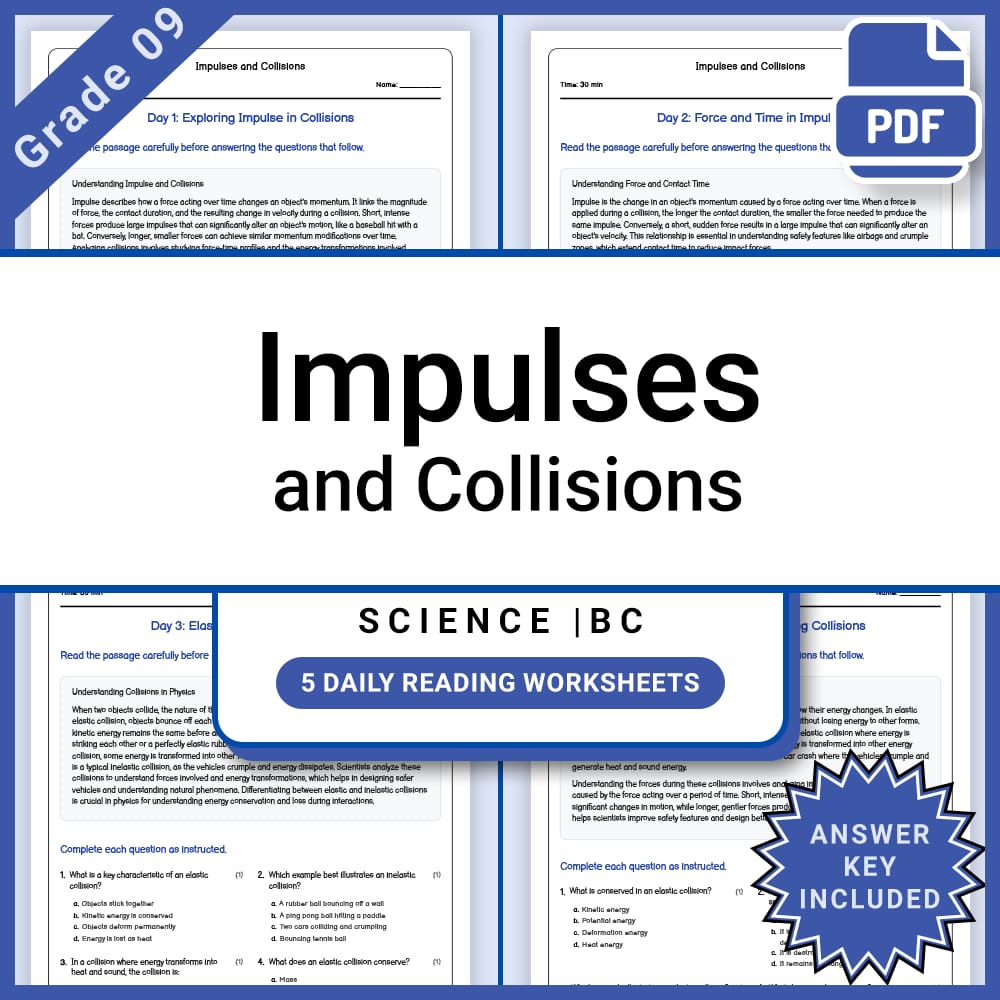
Grade 9 Science – Impulses and Collisions Daily Reading Worksheet + Answer Key
JCreated byJ.S SheetsLearning Objectives
- Understand how force acting over time creates impulse
- Analyze the relationship between impulse, force, and contact duration
- Differentiate between elastic and inelastic collisions
Also included in: Grade 9 Science Lesson Bundle | Physics and Energy Concept Worksheets +1 more
Instant download

Molecular Regulation Test Prep Worksheets | Grade 9 Science
Created byPrism Point LearningLearning Objectives
- Explain how molecular signaling pathways regulate gene expression and protein activity.
- Describe how receptor-ligand interactions and signal transduction cascades control cellular responses.
- Use examples to predict how disruptions (mutations or inhibitors) can change cellular and physiological outcomes.
Also included in: Grade 9 Cell Systems Regulation Science Lesson Bundle – NGSS Practice
Instant download

Producers & Consumers Worksheet | NGSS Grade 9 Science Assessment
Created bySkylark WorksheetsLearning Objectives
- Explain how photosynthesis and cellular respiration transfer energy between autotrophs and heterotrophs.
- Analyze how net primary productivity (NPP) and respiration rates influence biomass accumulation and energy availability.
- Use carbon and oxygen cycle ideas to interpret ecosystem carbon budgets and coastal/algal productivity.
Also included in: Grade 9 Science Full-Year Bundle | NGSS Worksheets & Assessments
Instant download

Grade 9 Science | Earth's Inner Structure - Daily Reading Comprehension
Created byCoral Reef LearningLearning Objectives
- Identify and describe the different layers of the Earth
- Explain the physical and chemical properties of Earth's layers
- Understand how seismic waves inform us about Earth's composition
Instant download

Electricity and Magnetism: Electrical Component Behavior Worksheets
Created bySunny Desk ResourcesLearning Objectives
- Describe how linear and nonlinear components behave using resistance and current–voltage ideas
- Explain how temperature changes affect thermistors and power dissipation in resistors
- Identify how power ratings and operating limits help prevent circuit damage
Also included in: Grade 9 Electricity & Magnetism Lesson Bundle | Alberta Science +1 more
Instant download
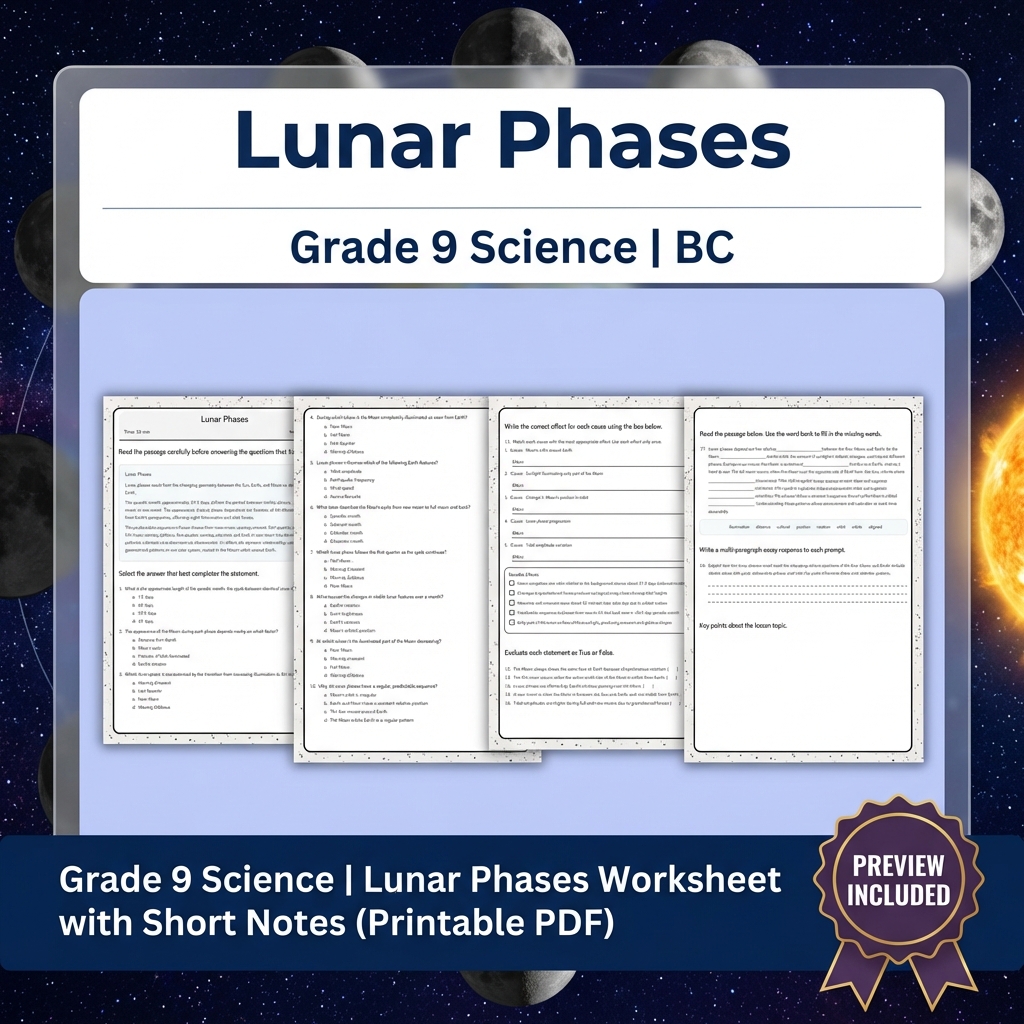
Grade 9 Science | Lunar Phases Worksheet with Short Notes (Printable PDF)
Created byMeadowlark WorksheetsLearning Objectives
- Understand the geometric relationship between the Sun, Earth, and Moon that causes lunar phases.
- Describe the sequence of lunar phases and how they relate to Moon's position in orbit.
- Predict lunar phases based on the cycle and explain their importance in calendars and observations.
Also included in: Grade 9 Science | BC Framework Lesson Bundle on Earth Systems & Climate +1 more
Instant download
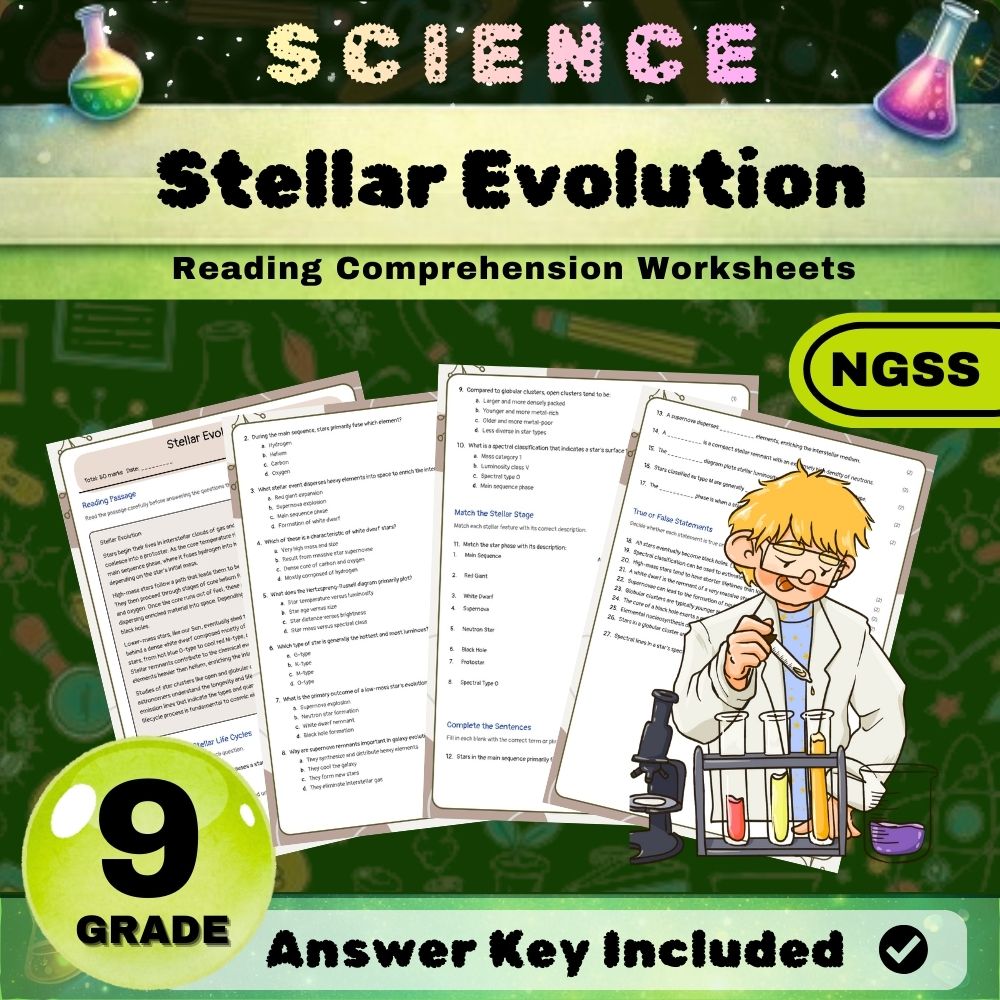
Grade 9 Science – Stellar Evolution NGSS Worksheet (PDF)
 Created byMaple Path Learning
Learning Objectives
- Explain the stages of stellar evolution from star formation to end states.
- Interpret Hertzsprung-Russell diagrams and relate spectral classifications to star characteristics.
- Describe processes such as supernovae, nucleosynthesis, and elemental enrichment of the interstellar medium.
Also included in: Grade 9 Science NGSS | Earth's Place in the Universe UNIT Worksheet Bundle +1 more
Instant download

Grade 9 Science – Constraint Analysis & Engineering Limits | Reading Worksheet
Created byBright Mind ResourcesLearning Objectives
- Understand what constraints are in engineering projects.
- Identify physical and resource constraints affecting design.
- Analyze how constraints influence engineering decision-making.
Also included in: Systems Thinking Grade 9 Science Daily Reading Worksheets Bundle | CA Standards +1 more
Instant download

Grade 9 Science Worksheet | Adaptive Radiation TEKS (PDF)
Created byEvergreen Desk EducationLearning Objectives
- Explain how adaptive radiation leads to rapid diversification from a single ancestral lineage into multiple species
- Describe the roles of ecological niches, key innovations, and varying selective pressures in driving trait and behavior differences
- Interpret how models help scientists study rates of lineage splitting and trait evolution over time and space
Instant download

Grade 9 Systems Thinking Worksheet | California Science Standards Activity
Created byEvergreen Desk EducationLearning Objectives
- Explain how systems thinking treats an engineered design as part of a larger interacting system.
- Identify how matter, energy, and information flows connect system components and can create unintended effects.
- Use system boundaries and feedback concepts to evaluate design performance over time.
Instant download
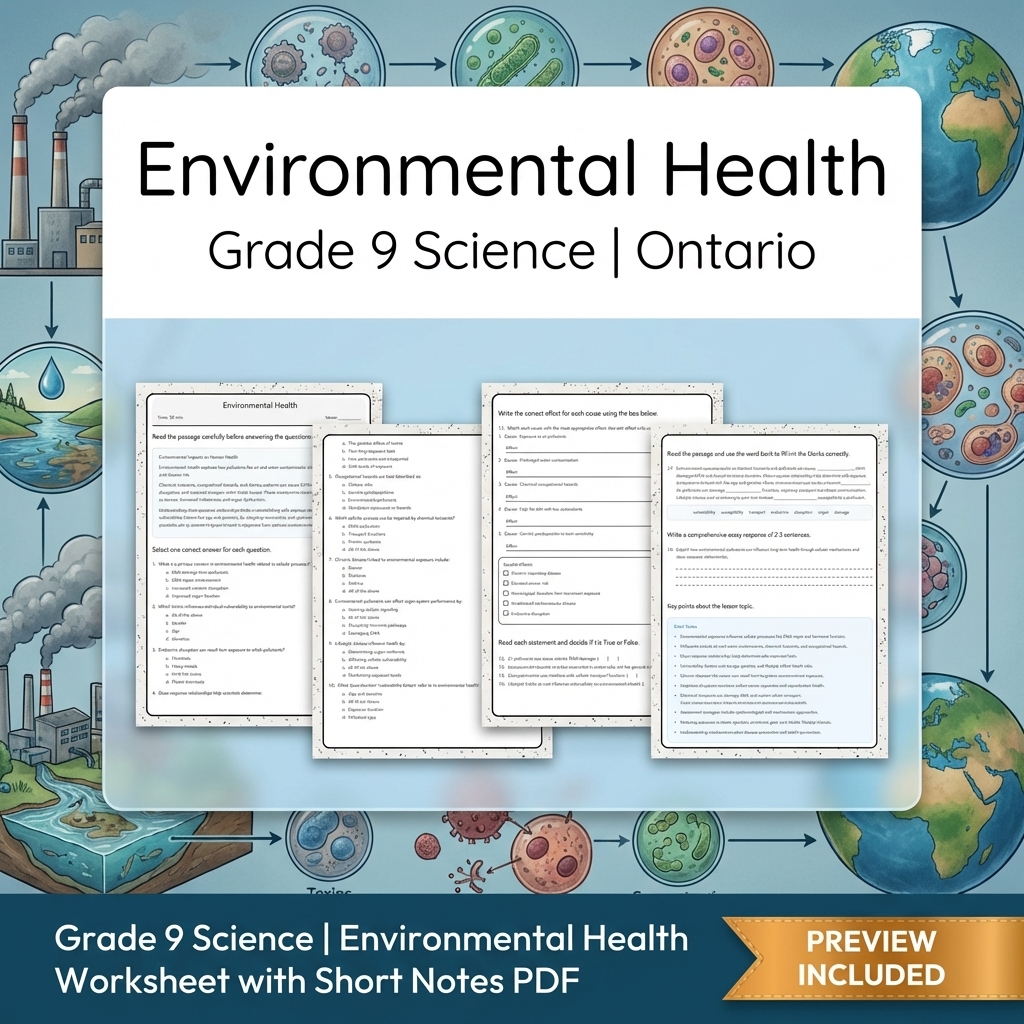
Grade 9 Science | Environmental Health Worksheet with Short Notes PDF
Created byMeadowlark WorksheetsLearning Objectives
- Understand how environmental exposures affect cellular processes and long-term health.
- Identify different pollutants and hazards in air, water, and workplaces.
- Analyze how dose-response relationships influence organ system performance.
Instant download

Grade 9 Science | Chemical Properties - Daily Reading Comprehension
Created byCoral Reef LearningLearning Objectives
- Define chemical properties and identify their indicators.
- Recognize examples of chemical reactions such as rusting and combustion.
- Differentiate between physical and chemical changes based on reaction outcomes.
Instant download

Nutrient Cycling Worksheet for Grade 9 Science | Standards-Aligned Practice
JCreated byJ.S SheetsLearning Objectives
- Explain how nitrogen and phosphorus move through ecosystems via biological, chemical, and physical processes.
- Describe key steps in the nitrogen cycle (fixation, assimilation, mineralization, denitrification) and how they affect primary productivity.
- Analyze how human nutrient inputs can disrupt nutrient cycling and lead to eutrophication and hypoxia in aquatic systems.
Instant download

Surface Processes: Rates and Patterns Worksheets – Grade 9 Science
 Created byTeachers Club
Learning Objectives
- Describe how weathering, mass wasting, and sediment transport change landforms
- Explain how climate forcing and hydrologic input affect process rates
- Connect landform development with patterns of soil formation
Also included in: Earth's Systems Grade 9 NGSS Science Worksheets Bundle +1 more
Instant download

Power Analysis Worksheet | NGSS Grade 9 Science Assessment
Created bySkylark WorksheetsLearning Objectives
- Differentiate power and energy and convert between them using consistent units.
- Calculate energy demand over time from power ratings and duty cycles.
- Analyze how efficiency and system losses affect real energy throughput and performance.
Also included in: Grade 9 Science Full-Year Bundle | NGSS Worksheets & Assessments
Instant download

Wave Properties and Energy Transfer Worksheets: Grade 9
Created byBRIGHT PATH RESOURCESLearning Objectives
- Explain how waves can transfer energy without transporting matter overall
- Relate frequency, wavelength, and amplitude to observable wave behavior
- Use wave property descriptions to predict how a wave would change its energy and appearance
Also included in: Grade 9 Science Waves, Forces & Energy Transfer Worksheets Bundle +1 more
Instant download
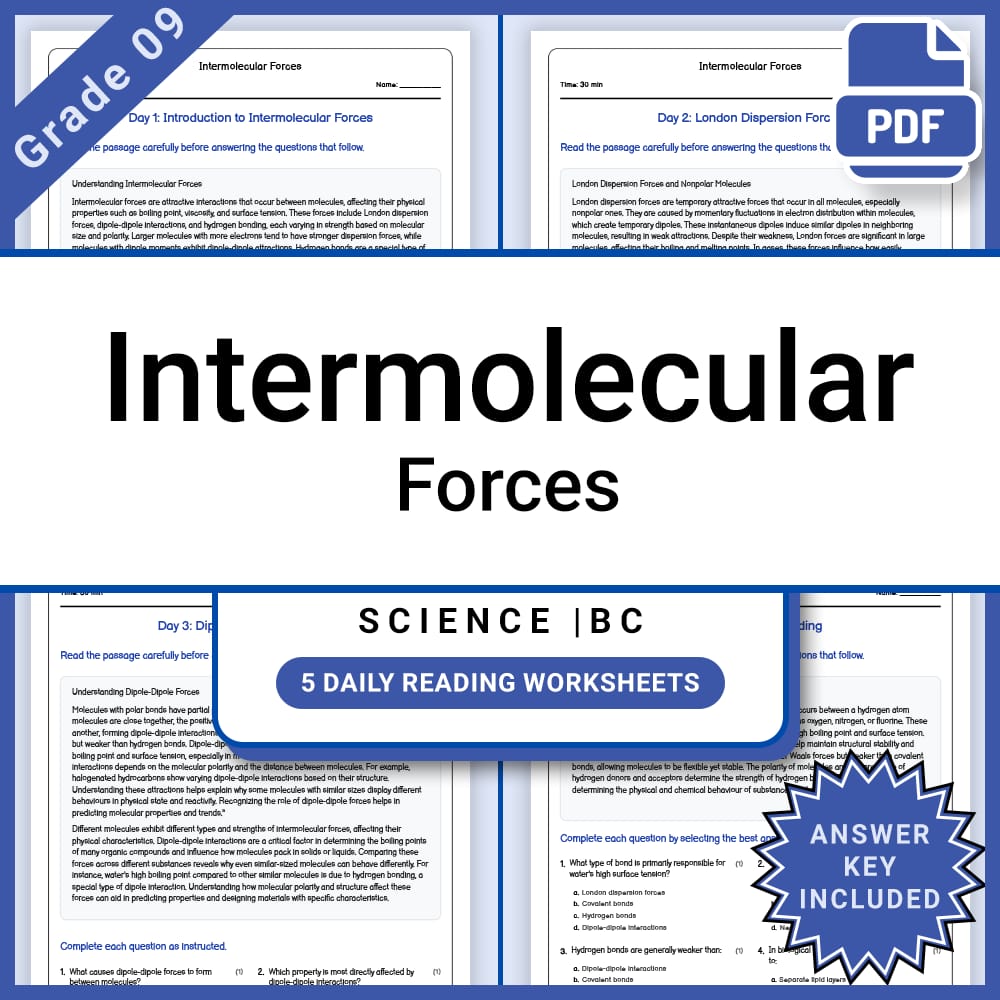
Grade 9 Science – Intermolecular Forces Daily Reading Worksheet + Answer Key
JCreated byJ.S SheetsLearning Objectives
- Understand key concepts related to Science
- Apply knowledge through practice questions
- Demonstrate comprehension of the material
Also included in: Grade 9 Science Lesson Group BC Framework | Chemistry, Physics, and More +1 more
Instant download

Grade 9 Science | Neural Control Worksheet (Ontario) (PDF)
Created byEvergreen Desk EducationLearning Objectives
- Explain how neurons generate action potentials and how synapses transmit signals to control body functions.
- Describe how neural circuits and central integration organize information for coordinated responses.
- Relate myelination and synaptic architecture to conduction velocity and processing capacity.
Also included in: Grade 9 Human Body Systems & Cellular Processes Science Lesson Bundle: Ontario +1 more
Instant download

Grade 9 Science — Mountain Building Worksheet MCQ Paper for Mastery
 Created byThe Resource Hub
Learning Objectives
- Understand the processes involved in mountain formation, including crustal shortening, thickening, and metamorphism.
- Analyze how plate convergence influences surface topography and erosion patterns in mountain regions.
- Explain the role of isostatic adjustment and landscape evolution in long-term mountain development.
Also included in: Grade 9 Earth and Space Sciences AP Bundle | Science Worksheets and Activities +1 more
Instant download

Grade 9 Compound Formulas Worksheet | Ontario Science | Answer Key PDF
Created byClear Sky ClassroomLearning Objectives
- Describe how chemical formulas represent elements and fixed ratios in compounds
- Explain how ionic and covalent bonding influence observable properties of substances
- Apply the law of definite composition to distinguish compounds from mixtures
Instant download
About Grade 9 Science Worksheets
Find Science worksheets built for Grade 9. All 6,926 cover core skills, practice, and review, each an instant PDF download.
Every worksheet on MyTeachingSheets is created by independent teacher-authors and reviewed before publication. All resources download as printable PDFs for classroom, homework, or at-home practice, and many include answer keys. Preview any worksheet free before buying.