
Grade 9 Science Worksheets
6,926 worksheets
Energy Conservation Worksheet | NGSS Grade 9 Science Assessment
 Created bySkylark Worksheets
Learning Objectives
- Explain energy conservation using the idea of system boundaries for open and closed systems.
- Use an energy bookkeeping approach (reservoirs and transfers) to track energy changes quantitatively.
- Interpret and construct simple energy flow diagrams for mechanical and electrical (or chemical) processes.
Also included in: Grade 9 Science Full-Year Bundle | NGSS Worksheets & Assessments
Instant download

Newton's Laws Worksheet for Grade 9 Science | Standards-Aligned Practice
JCreated byJ.S SheetsLearning Objectives
- Understand the three fundamental laws of motion proposed by Sir Isaac Newton.
- Identify real-world examples illustrating each of Newton's laws.
- Explain how forces influence the motion of objects in different scenarios.
Instant download
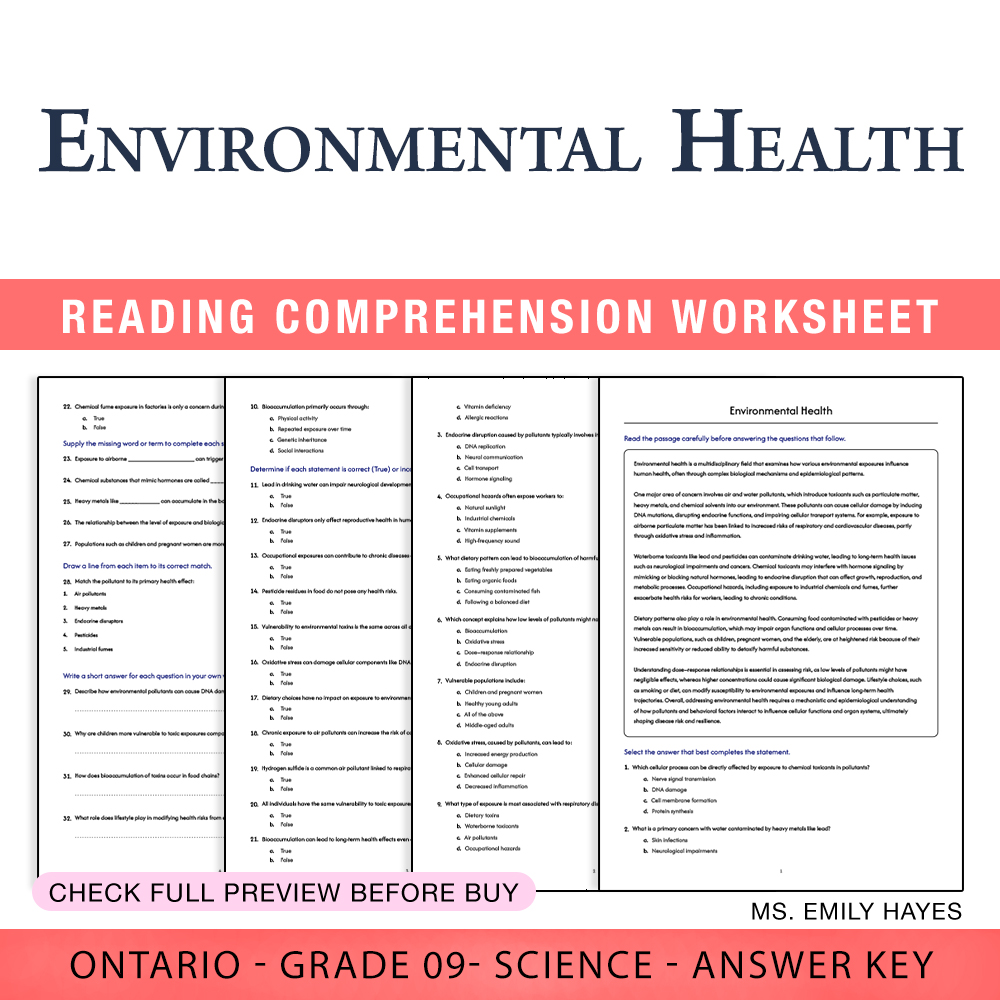
Grade 9 Science | Environmental Health Worksheet (PDF + Answer Key)
 Created byCopper Leaf Classroom
Learning Objectives
- Understand how environmental exposures impact cellular processes and organ systems.
- Identify common pollutants and toxicants and their effects on human health.
- Explain concepts of dose-response and vulnerability factors in environmental health.
Instant download

Ecosystem Change and Resilience Worksheet | Grade 9 Science Standards
JCreated byJ.S SheetsLearning Objectives
- Explain how disturbances can change ecosystem stability by altering species interactions and environmental conditions.
- Describe resilience and recovery rate, including the role of feedback processes in ecosystem response.
- Use long-term evidence (population trends and community structure) to distinguish gradual shifts from rapid transitions.
Also included in: Grade 9 Ecosystems & Heredity Science Lesson Bundle – General Framework +1 more
Instant download
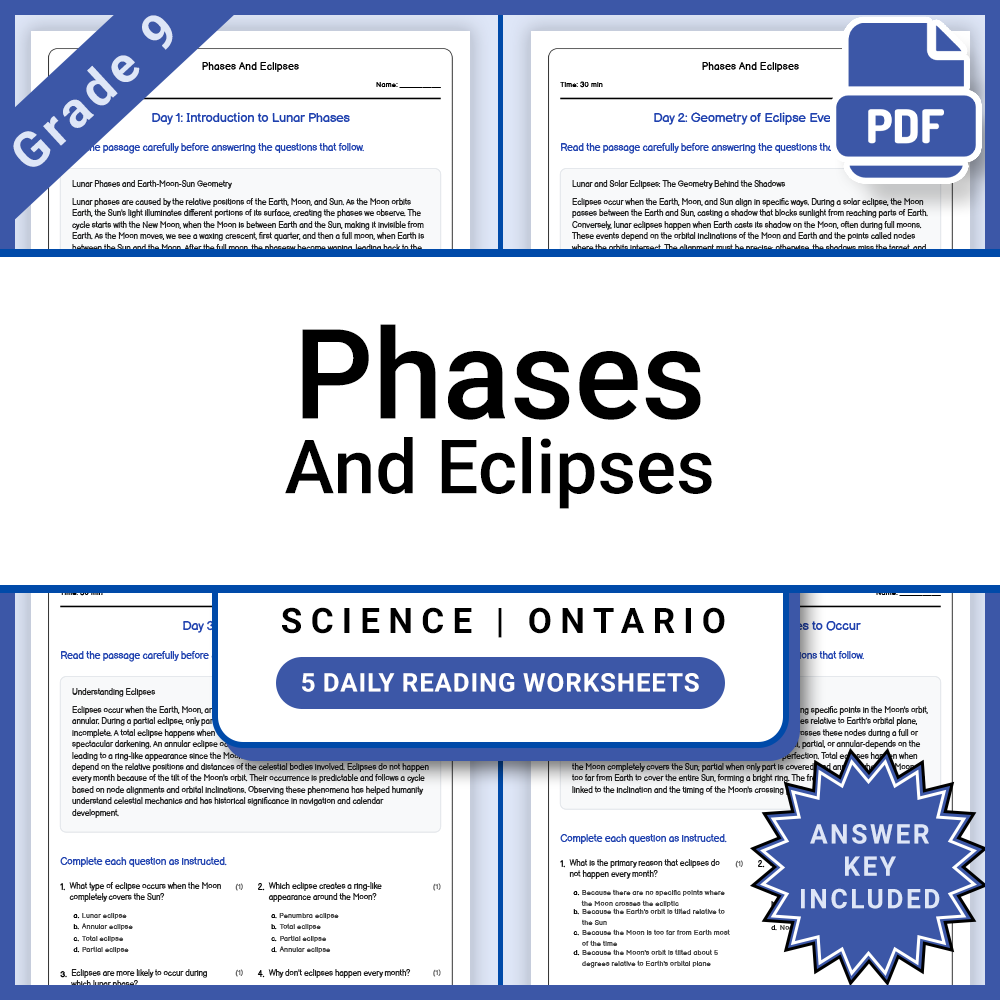
Grade 9 Science – Phases and Eclipses Daily Reading Worksheet with Answer Key
JCreated byJ.S SheetsLearning Objectives
- Understand the sequence and causes of lunar phases
- Identify different types of solar and lunar eclipses
- Describe the conditions necessary for eclipses to occur
Also included in: Grade 9 Science Lesson Group Bundle – Earth Systems & Planetary Concepts +1 more
Instant download

Atomic Structure and Isotopes Grade 9 Science Worksheets
 Created bySunny Desk Resources
Learning Objectives
- Explain how protons, neutrons, and electrons define atomic number and mass number
- Describe how isotopes of an element differ and why they still count as the same element
- Use simple nuclear and electron-shell models to predict basic chemical behaviour
Also included in: Phase Changes, Chemical Reactions & Atomic Structure Lesson Bundle | Grade 9 Science | Alberta +1 more
Instant download

Hierarchy of Living Systems Worksheets: Cells to Organ Systems | Grade 9
 Created byTeachers Club
Learning Objectives
- Explain how cells, tissues, organs, and systems form a hierarchy
- Describe how organ systems couple functions to support homeostasis
- Model how nervous and endocrine signals coordinate body regulation
Also included in: Grade 9 Science Worksheets: From Molecules to Organisms NGSS Bundle +1 more
Instant download

Grade 9 Science System Interactions for Homeostasis Worksheet Ontario
 Created byChalk and Compass
Learning Objectives
- Explain how feedback mechanisms help maintain homeostasis in the human body.
- Describe how circulation, respiration, kidneys, and the nervous system interact to support survival.
- Use examples of thermoregulation, acid–base balance, and stress responses to predict system crosstalk.
Also included in: Homeostasis and Human Body Systems Lesson Bundle | Grade 9 Science | Ontario +1 more
Instant download

Grade 9 Science | Hierarchical Organization in Cells - Reading Comprehension
 Created byCoral Reef Learning
Learning Objectives
- Understand the basic structure and functions of cells
- Identify different levels of organization in multicellular organisms
- Explain how cells form tissues, tissues form organs, and organs form organ systems
Instant download

Ecosystem Interaction Networks Worksheet | Grade 9 Science Activities
 Created byPrism Point Learning
Learning Objectives
- Explain how predator-prey, competition, and mutualism connect species in an ecosystem network.
- Describe how abiotic factors like temperature and nutrient availability can change survival and population size.
- Use interaction networks to predict how changes in one population can cascade through a community.
Instant download

Grade 9 Science | Hierarchical Organization Worksheet | California Standards
 Created byLumora Learning
Learning Objectives
- Explain how multicellular organisms are organized from cells to tissues, organs, and organ systems.
- Describe how specialized structures at smaller scales support functions at larger scales (support, transport, regulation, coordination).
- Use evidence from a scientific description to predict how changes at one level can affect higher levels of organization.
Instant download

Hierarchical Organization Worksheet | Grade 9 Biology Systems & Levels
Created byPrism Point LearningLearning Objectives
- Explain how cells, tissues, organs, and organ systems form a hierarchy in multicellular organisms.
- Describe how functions at one level depend on functions at smaller levels.
- Use examples to connect structure to specific processes such as transport, support, regulation, and coordination.
Also included in: Grade 9 Evolution & Ecology Lesson Bundle | California Science Standards
Instant download

Hierarchical Organization Science Worksheet Cells to Biosphere Grade 9
 Created byEvergreen Desk Education
Learning Objectives
- Explain how cells, tissues, organs, and organ systems work together to maintain complex functions in multicellular organisms.
- Describe how specialization at smaller scales supports processes such as support, transport, regulation, and coordination at larger scales.
- Use cause-and-effect reasoning to connect structure at one level to function at the next level.
Instant download

Science Grade 9 Worksheet Energy Transformations | Standards-Aligned Practice
JCreated byJ.S SheetsLearning Objectives
- Explain how energy transforms between mechanical, thermal, sound, and electrical forms within a chosen system
- Use energy-balance reasoning to predict how friction and air resistance change motion outcomes
- Describe how temperature changes can affect material behavior and device performance
Also included in: Grade 9 Forces, Energy, and Matter Transformations Science lesson bundle +1 more
Instant download
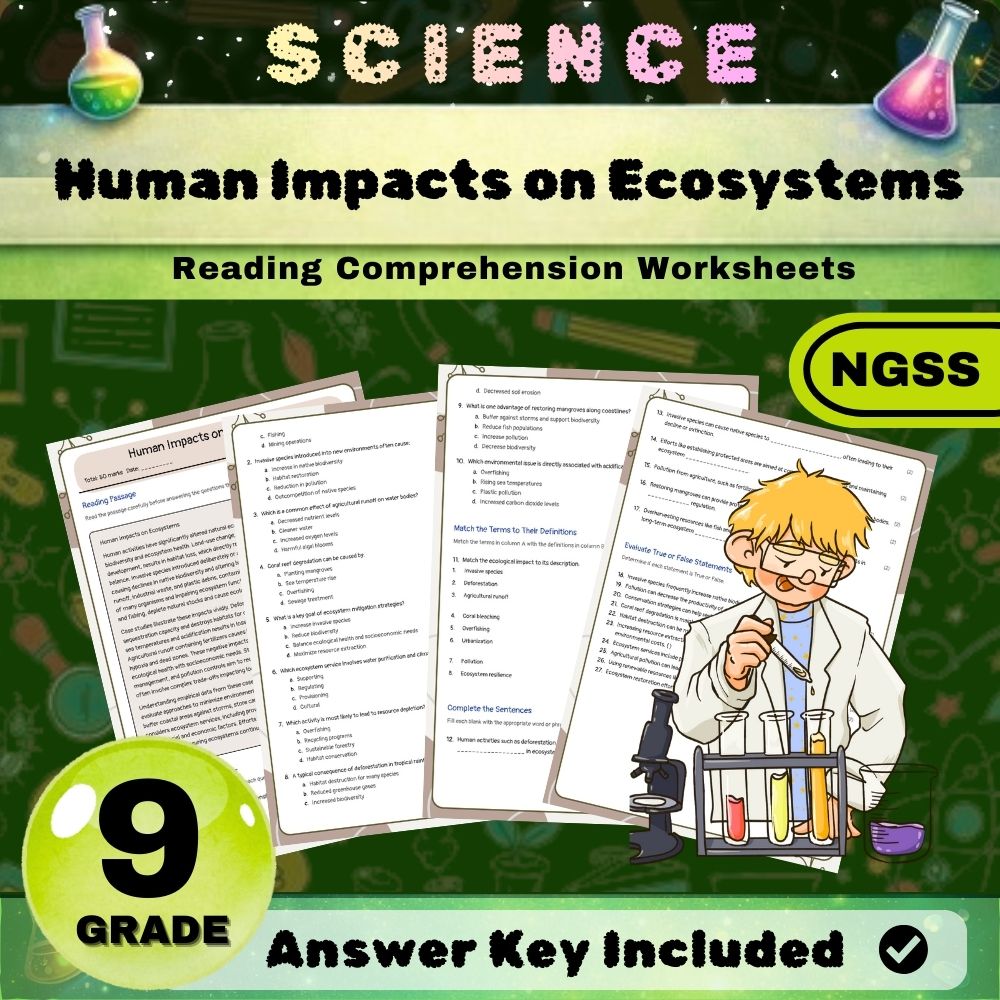
Grade 9 Science | Human Impacts on Ecosystems NGSS Worksheet (PDF)
 Created byMaple Path Learning
Learning Objectives
- Analyze how land-use change, invasive species, pollution, and resource extraction affect biodiversity and ecosystem services.
- Interpret case studies such as deforestation, coral reef degradation, and agricultural runoff to evaluate environmental impacts.
- Assess trade-offs between conservation efforts and provisioning services in socioecological contexts.
Also included in: Grade 9 Science Ecosystems Lesson Bundle | NGSS Interactions & Energy +1 more
Instant download

Grade 9 Science Worksheet Atmospheric Weather Processes | Standards-Aligned Practice
JCreated byJ.S SheetsLearning Objectives
- Explain how temperature differences create pressure gradients that drive wind and atmospheric circulation.
- Describe how water vapor changes phase to form clouds and produce precipitation.
- Compare energy transfer by radiation, conduction, and convection in shaping weather.
Also included in: Grade 9 Earth Systems Weather & Climate Science Lesson Bundle: Florida NGSSS +1 more
Instant download

Human Impacts and Ecosystem Resilience Worksheet | Grade 9 Science Printable PDF
Learning Objectives
- Analyze how land-use change, invasive species, pollution, and resource extraction impact biodiversity.
- Interpret case studies such as deforestation, coral reef degradation, and agricultural runoff.
- Evaluate trade-offs between conservation efforts, provisioning services, and socioecological outcomes.
Also included in: Grade 9 Ecosystems Lesson Bundle: Interactions, Energy & Dynamics NGSS +1 more
Instant download

Energy Transformations Worksheet Grade 9 Science NGSSS Physics
Created byEvergreen Desk EducationLearning Objectives
- Explain how energy transforms between forms while conserving total energy for a chosen system
- Describe how friction and air resistance convert mechanical energy into thermal energy
- Connect changes in temperature to motion through material behavior and density effects
Instant download

Gravity and Orbits Worksheet | Grade 9 Science Standards-Aligned Practice
JCreated byJ.S SheetsLearning Objectives
- Explain how gravity provides the centripetal force that keeps planets and moons in curved orbits
- Describe how orbital speed and orbital period relate to distance from the central body
- Use the idea of periodic motion to interpret predictable patterns in the night sky
Also included in: Grade 9 Earth and Space Science lesson bundle worksheet: General +1 more
Instant download

Adaptive Radiation Assessment for Grade 9 Science | TEKS Standards
Created byPrism Point LearningLearning Objectives
- Understand the concept of adaptive radiation and its ecological significance.
- Identify key processes that drive diversification in species.
- Explain how ecological factors influence morphological and behavioral differentiation.
Instant download

Grade 9 Science Worksheet | Energy Conservation & Energy Principles (PDF)
Created byEvergreen Desk EducationLearning Objectives
- Explain how mechanical energy can change between kinetic and potential forms when forces do work.
- Use energy conservation and energy bookkeeping to predict feasible speeds and heights when losses are small.
- Identify how non-conservative forces (like friction and air resistance) dissipate mechanical energy.
Instant download

Grade 9 Science | Work Calculations Worksheet (Ontario) (PDF)
Created byEvergreen Desk EducationLearning Objectives
- Calculate work using the dot-product idea: W = F d cos(θ) for constant force and displacement
- Differentiate work done by constant forces versus variable forces
- Approximate work for variable forces using areas under a force–distance graph
Also included in: Grade 9 Forces, Motion & Energy Science Lesson Bundle (Ontario) +1 more
Instant download
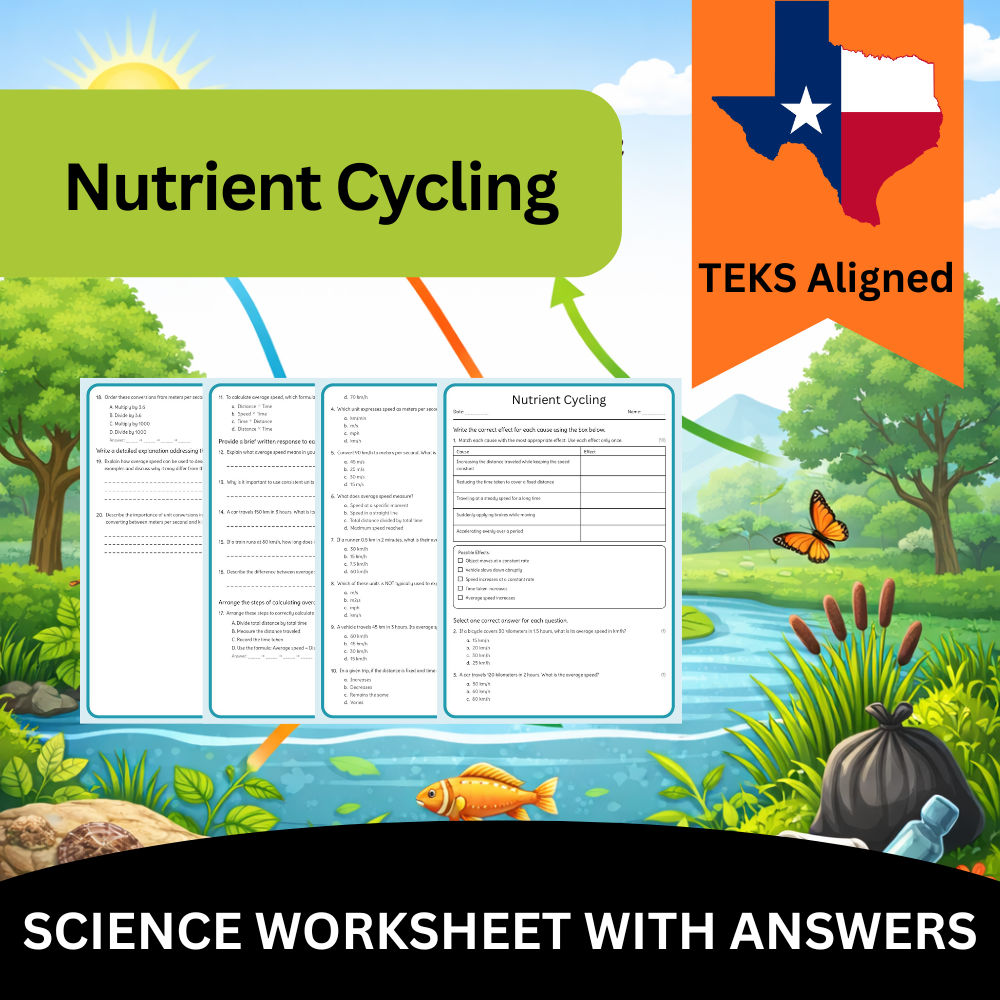
Grade 9 Science | Nutrient Cycling Worksheet (Worksheet + Answer Key) – TEKS Aligned
 Created byBright Mind Resources
Learning Objectives
- Explain the main biological processes involved in nutrient cycling.
- Identify how physical and human activities influence nutrient movement in ecosystems.
- Describe the impact of excess nutrients on aquatic systems and biodiversity.
Also included in: Grade 9 Science UNIT Bundle | Ecosystems & Biogeochemical Cycles TEKS-Aligned +3 more
Instant download
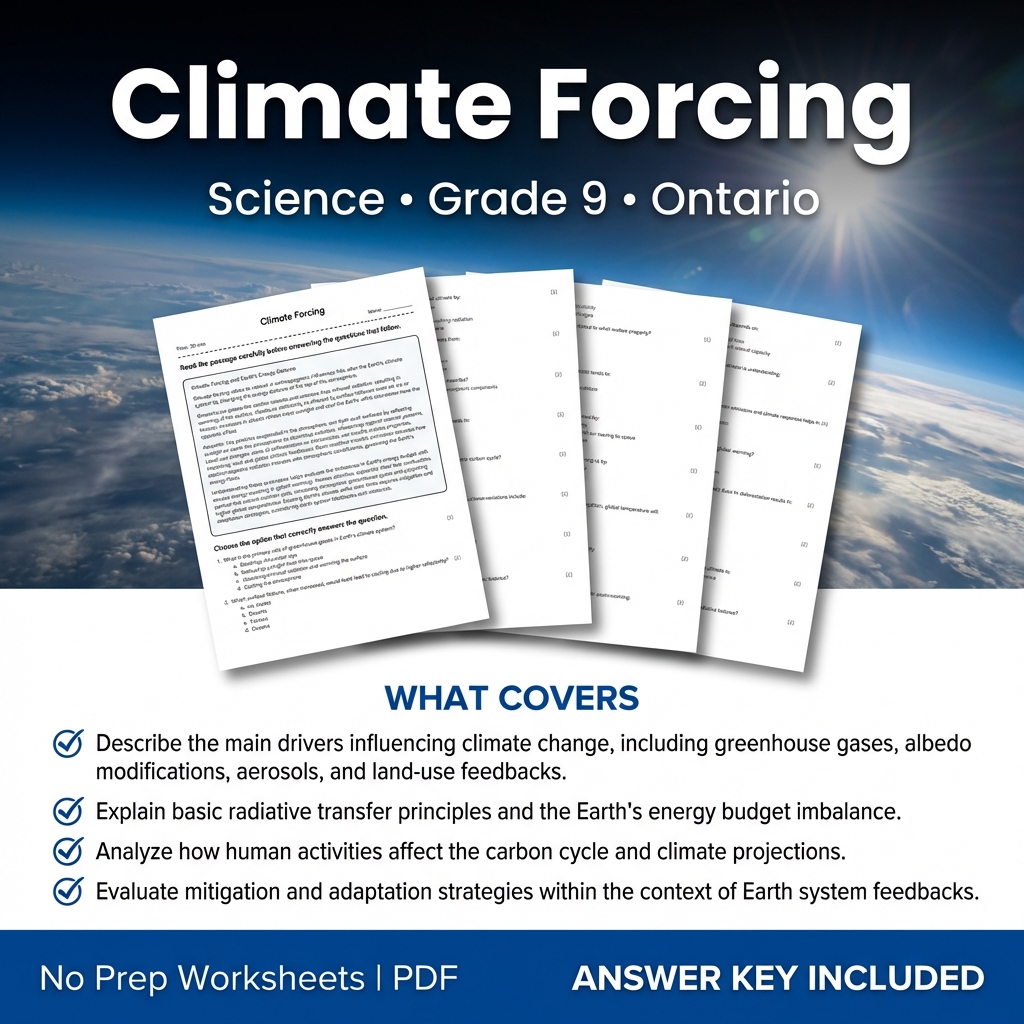
Climate Forcing Worksheet for Grade 9 Science - Ontario Standards
Created byCoral Reef LearningLearning Objectives
- Describe the main drivers influencing climate change, including greenhouse gases, albedo modifications, aerosols, and land-use feedbacks.
- Explain basic radiative transfer principles and the Earth's energy budget imbalance.
- Analyze how human activities affect the carbon cycle and climate projections.
Instant download

Grade 9 Science – Celestial Motions & Earth’s Rotation Daily Reading Worksheet
Created byBright Mind ResourcesLearning Objectives
- Understand Earth's rotation and how it causes day and night
- Identify the observable effects of Earth's rotation from a terrestrial perspective
- Distinguish between solar and sidereal days
Also included in: Grade 9 Earth & Space Science Daily Reading Worksheets Lesson Bundle | Ontario +1 more
Instant download

Grade 9 Science – Wave Speed & Relations | Daily Reading Worksheet
Created byBright Mind ResourcesLearning Objectives
- Understand the relationship between wave speed, frequency, and wavelength.
- Identify how changes in frequency affect wavelength in a given medium.
- Apply the wave speed formula to different scenarios involving waves.
Also included in: Waves & Forces Grade 9 Science Daily Reading Worksheets Lesson Bundle | General +1 more
Instant download

Grade 9 Science – Measurement Fundamentals & AP Standards | Reading Worksheet
Created byBright Mind ResourcesLearning Objectives
- Understand basic metric units and their importance in scientific measurement.
- Learn about instrument resolution and how calibration affects measurement accuracy.
- Connect raw measurements to data representation through tables and graphs.
Also included in: Grade 9 Science Data Analysis Daily Reading Worksheets Lesson Bundle | AP +2 more
Instant download

Digestive Absorption Worksheets: Intestinal Villi Grade 9 Science
Created byPrism Point LearningLearning Objectives
- Explain how mechanical and chemical digestion prepare nutrients for absorption
- Describe how villi and microvilli increase intestinal surface area
- Compare transport routes for sugars, amino acids, and lipids
Also included in: Grade 9 Science Lesson Bundle: Human Homeostasis & Cell Systems | Ontario +1 more
Instant download

Grade 9 Science Worksheet | Mastering the Calvin Cycle (PDF) - TEKS Aligned
Created byEvergreen Desk EducationLearning Objectives
- Explain how the Calvin cycle uses ATP and NADPH to fix carbon dioxide into organic molecules.
- Describe the main phases of the Calvin cycle: carbon fixation, reduction, and RuBP regeneration.
- Connect specific enzymes and intermediates (like RuBisCO and 3-carbon intermediates) to each phase.
Instant download

Mutation Sources Assessment | Florida NGSSS Grade 9 Science Standards
Created byPrism Point LearningLearning Objectives
- Explain how mutations can originate from errors during DNA copying.
- Describe how environmental factors such as radiation and chemicals can increase mutation rates.
- Distinguish between mutations that affect gene function/regulation and those that may have little phenotypic effect.
Also included in: Grade 9 Evolution & Genetics Science Lesson Bundle – Florida NGSSS
Instant download

Cell Essential Functions Assessment for Grade 9 Science | Standards-Aligned
Created byPrism Point LearningLearning Objectives
- Understand the key functions of cell membranes and their role in regulating transport.
- Describe how cellular energy powers chemical reactions vital for cell survival and growth.
- Connect cell structure to function through models of internal balance, growth, and environmental response.
Also included in: Grade 9 Ecology, Genetics, and Cells Science Lesson Bundle – General
Instant download

Grade 9 Science – Greenhouse Feedbacks & Climate Change | Reading Worksheet
Created byBright Mind ResourcesLearning Objectives
- Understand how water vapor influences climate through feedback mechanisms
- Identify the processes that amplify or reduce greenhouse effects
- Explore the role of surface reflectivity and cloud cover in climate dynamics
Also included in: Earth Systems Grade 9 Science Daily Reading Worksheets Bundle | Florida NGSSS +1 more
Instant download
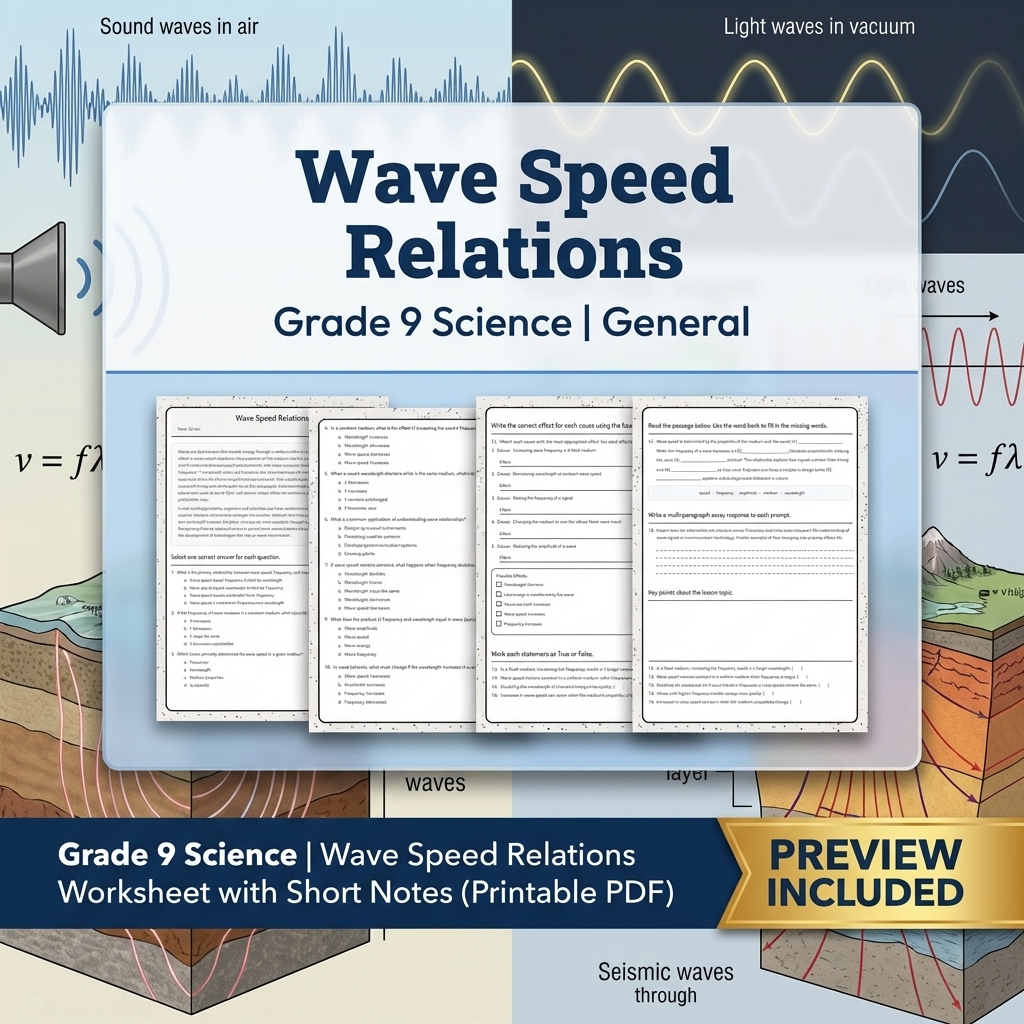
Grade 9 Science | Wave Speed Relations Worksheet with Short Notes
 Created byMeadowlark Worksheets
Learning Objectives
- Understand how wave speed relates to frequency and wavelength.
- Explain the inverse relationship between frequency and wavelength in wave behavior.
- Apply the wave speed formula to different scenarios involving waves in various media.
Also included in: Grade 9 Motion and Energy Science Lesson Bundle: General Framework +1 more
Instant download

Grade 9 Science | Energy Transfer in Earth Systems - Daily Reading Comprehension
Created byCoral Reef LearningLearning Objectives
- Identify sources of solar energy that enter Earth's atmosphere.
- Describe pathways through which solar radiation and geothermal energy are transferred within Earth systems.
- Understand how energy gradients drive atmospheric and oceanic circulation.
Instant download

Grade 9 Science Worksheet on Periodic Patterns | Standards-Aligned Practice
JCreated byJ.S SheetsLearning Objectives
- Understand how the periodic table links atomic number to chemical properties.
- Identify trends in element behavior across periods and groups.
- Explain how electron arrangements influence reactivity and bonding tendencies.
Also included in: Grade 9 Conservation of Energy and Forces Science Lesson Bundle +1 more
Instant download

Greenhouse Feedbacks Assessment | Florida NGSSS Grade 9 Science
Created byPrism Point LearningLearning Objectives
- Explain how changes in greenhouse gases can trigger climate feedbacks that amplify or reduce warming.
- Describe at least three feedback pathways involving water vapor, ice/snow albedo, and clouds.
- Use cause-and-effect reasoning to connect atmospheric processes to Earth’s energy balance (absorbed sunlight vs. outgoing infrared).
Also included in: Grade 9 Earth Systems Science Lesson Bundle: Florida NGSSS Assessments
Instant download

Pedigree Analysis Assessment for Grade 9 Science TEKS Standards
Created byPrism Point LearningLearning Objectives
- Understand how to interpret family trees and pedigree charts to analyze inheritance patterns.
- Identify characteristics of autosomal dominant, autosomal recessive, X-linked, and mitochondrial inheritance modes.
- Apply principles of pedigree analysis to determine inheritance modes and predict genotypes.
Instant download

Grade 9 Science | Cardiopulmonary Interaction - Daily Reading Comprehension
Created byCoral Reef LearningLearning Objectives
- Understand how the heart and lungs work together to supply oxygen and remove carbon dioxide
- Identify the roles of pulmonary ventilation and cardiovascular transport in gas exchange
- Explain how the body adjusts heart rate, stroke volume, and vascular resistance in response to respiratory needs
Instant download

Grade 9 Science | Organ Structures - Daily Reading Comprehension Practice
Created byCoral Reef LearningLearning Objectives
- Identify the different parts of the human heart and understand their functions.
- Explain how the structure of the heart supports its role in circulatory health.
- Recognize the importance of organ organization for physiological processes.
Instant download

Energy in Earth Systems Worksheet Grade 9 Science Activity | NGSSS
Created byPrism Point LearningLearning Objectives
- Explain how incoming solar radiation and outgoing infrared radiation drive Earth’s energy balance.
- Describe how energy moves through Earth system spheres using radiation, conduction, convection, and phase change.
- Interpret how energy balance affects long-term temperature patterns and Earth system processes.
Also included in: Grade 9 Earth, Weather & Climate Systems Lesson Bundle | Florida ngsss
Instant download

Grade 9 Circuit Diagrams Worksheet | Practice & Assessment PDF
 Created byClear Sky Classroom
Learning Objectives
- Interpret circuit diagram symbols and connection types to determine circuit topology and possible current paths
- Identify reference nodes and explain how node relationships support voltage measurements
- Use standardized notation to translate between physical components and schematic representations
Instant download
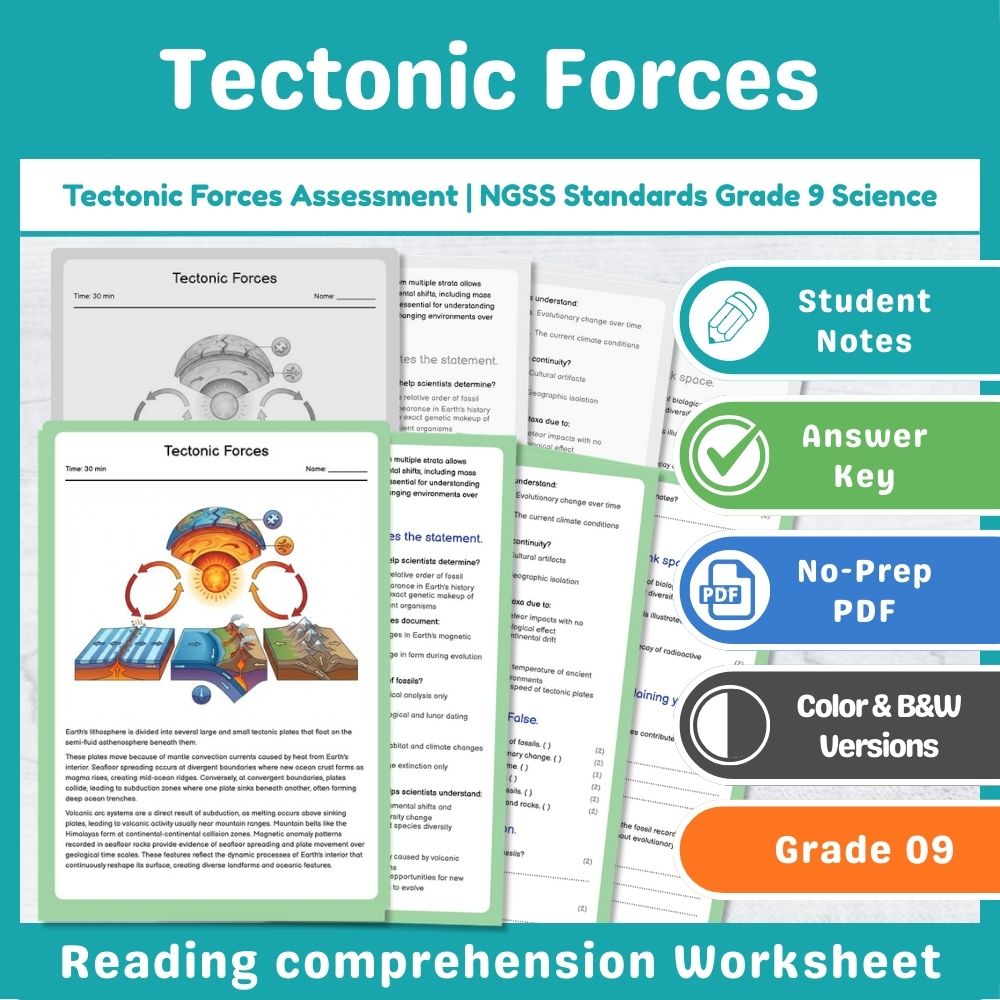
Tectonic Forces Assessment | NGSS Standards Grade 9 Science
Created byPrism Point LearningLearning Objectives
- Explain the processes of seafloor spreading, subduction zones, and volcanic arc systems.
- Connect mantle convection and faulting with surface features like mountain belts and bathymetry.
- Analyze geologic cross-sections and magnetic anomaly patterns as evidence for plate tectonics.
Instant download
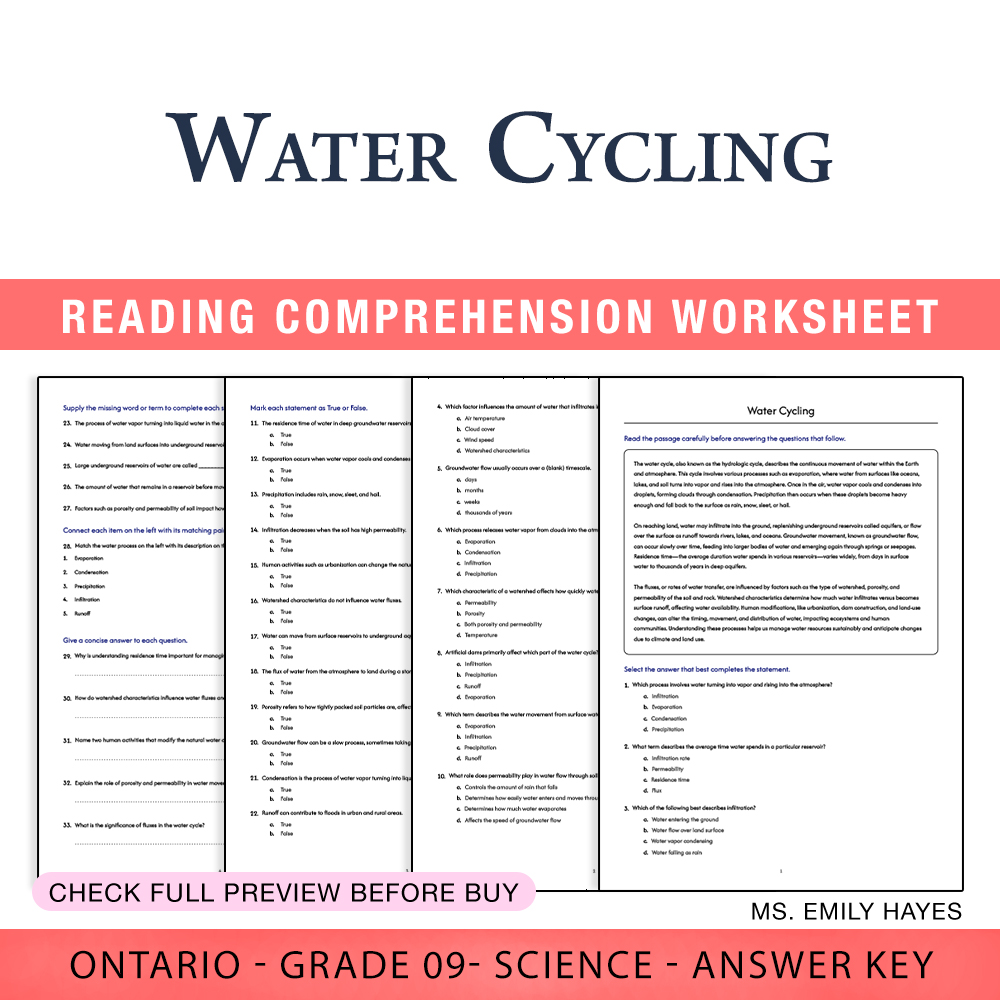
Grade 9 Science Water Cycling Worksheet (PDF + Answer Key)
Created byCopper Leaf ClassroomLearning Objectives
- Explain the processes involved in the hydrologic cycle, including evaporation, condensation, precipitation, infiltration, runoff, and groundwater flow.
- Describe how watershed characteristics, porosity, and permeability influence water movement and storage.
- Analyze human modifications such as engineered and land-use changes that affect water timing and distribution.
Instant download
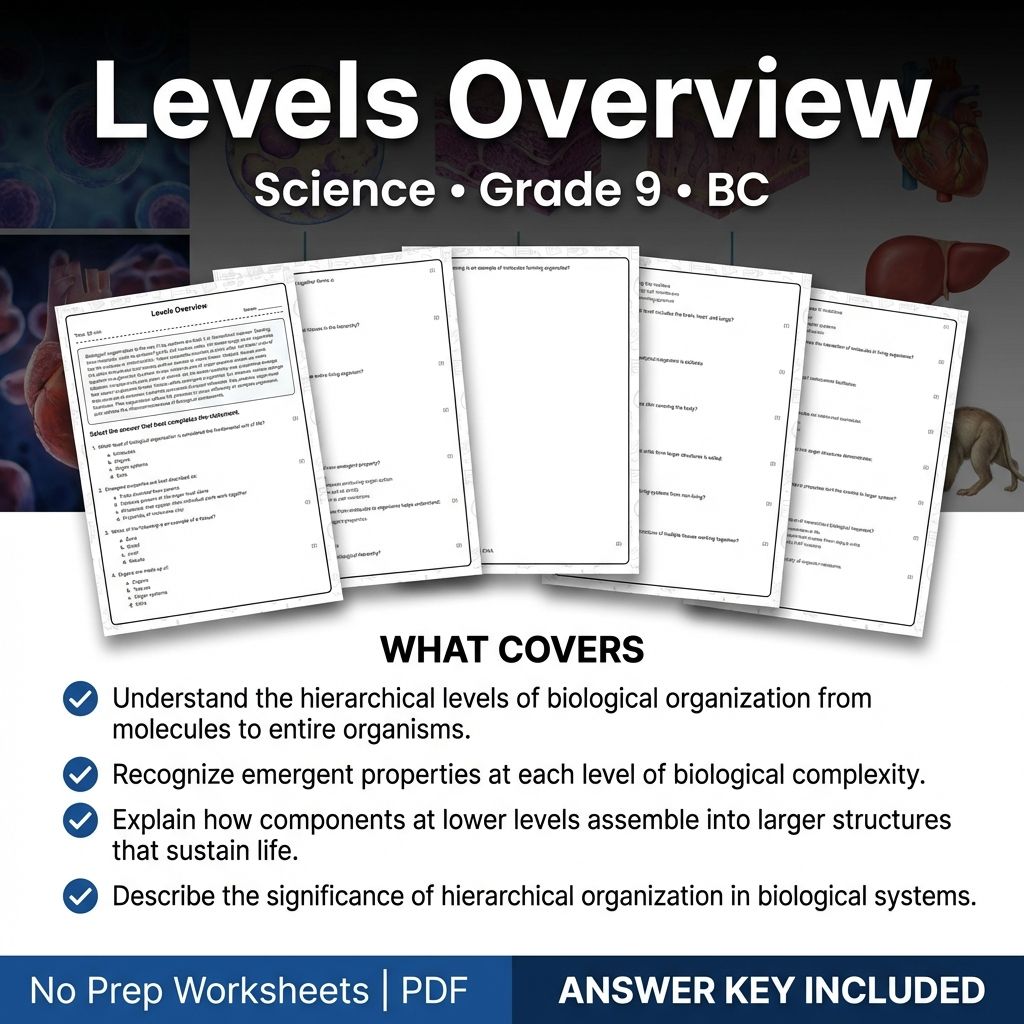
Levels Overview Grade 9 Science Worksheet | BC Standard Practice
Created byCoral Reef LearningLearning Objectives
- Understand the hierarchical levels of biological organization from molecules to entire organisms.
- Recognize emergent properties at each level of biological complexity.
- Explain how components at lower levels assemble into larger structures that sustain life.
Instant download

System Coordination Worksheet Grade 9 Science Activities
Created byPrism Point LearningLearning Objectives
- Explain how feedback loops, redundancy, and cross-regulation help maintain homeostasis in complex body systems.
- Describe how neural, hormonal, and local signals coordinate respiratory, cardiovascular, and metabolic responses during exercise.
- Analyze how a disruption in one component can cascade to affect whole-organism outcomes.
Also included in: Cells and Body Systems Lesson Bundle | Grade 9 Science | BC +1 more
Instant download
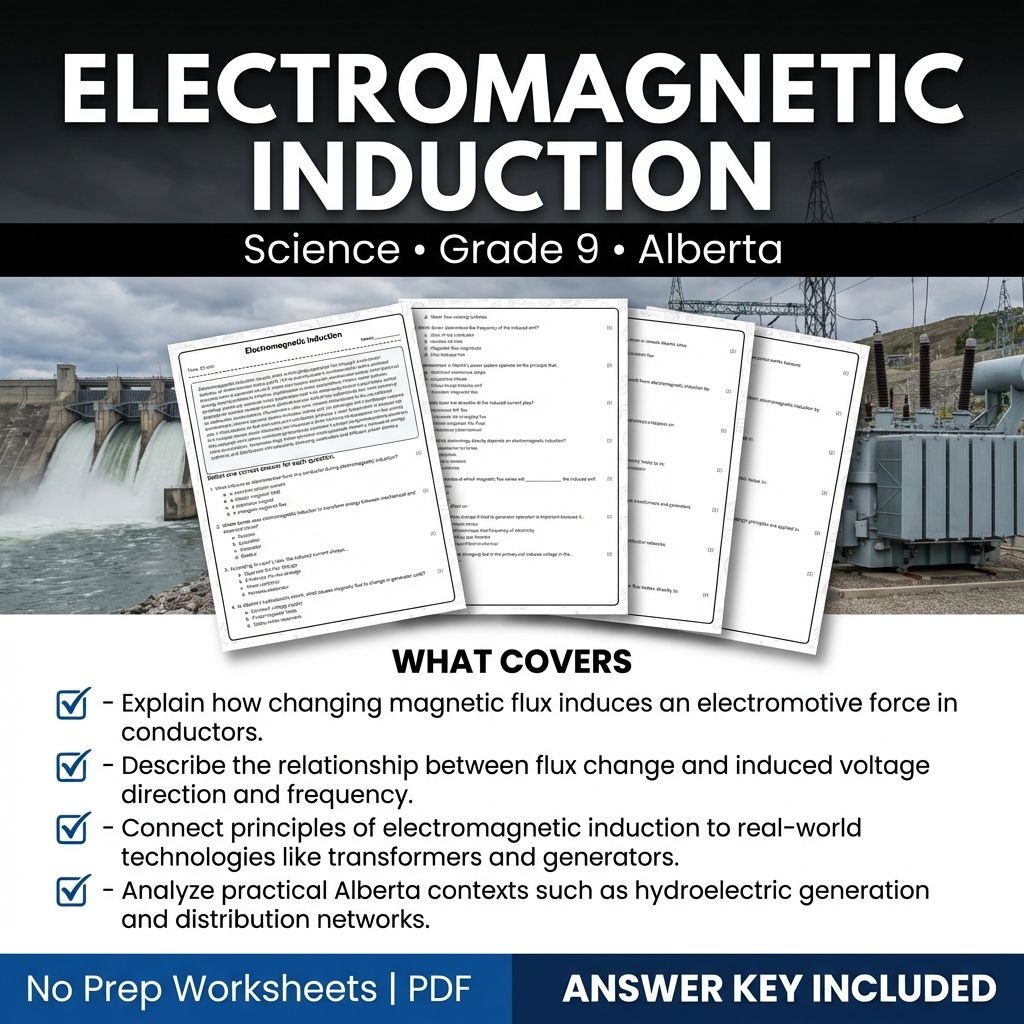
Electromagnetic Induction Worksheet for Grade 9 Science | Standard Practice
Created byCoral Reef LearningLearning Objectives
- Explain how changing magnetic flux induces an electromotive force in conductors.
- Describe the relationship between flux change and induced voltage direction and frequency.
- Connect principles of electromagnetic induction to real-world technologies like transformers and generators.
Instant download

Grade 9 Design Criteria Worksheet | California Standards Practice PDF
Created byClear Sky ClassroomLearning Objectives
- Explain the difference between design criteria and constraints in engineering solutions
- Identify how measurable requirements and constraints guide feasible design choices
- Use models and evidence to connect design features to expected performance
Instant download

Grade 9 Science | Net Force and Acceleration Worksheet | NGSSS Assessment
Created byLumora LearningLearning Objectives
- Explain how net force determines an object's acceleration and how direction matters
- Use Newton’s second law ideas qualitatively to predict how changing mass affects acceleration
- Interpret real-world motion (e.g., pushing a cart) as the result of combined forces
Instant download
About Grade 9 Science Worksheets
Find Science worksheets built for Grade 9. All 6,926 cover core skills, practice, and review, each an instant PDF download.
Every worksheet on MyTeachingSheets is created by independent teacher-authors and reviewed before publication. All resources download as printable PDFs for classroom, homework, or at-home practice, and many include answer keys. Preview any worksheet free before buying.