
Grade 9 Science Worksheets
6,926 worksheets
Trophic Dynamics Worksheet | NGSS-Aligned Science Practice Grade 9
JCreated byJ.S SheetsLearning Objectives
- Explain the flow of energy through different trophic levels in an ecosystem.
- Describe the structure of food webs and the concept of biomass distribution.
- Analyze how energy transfer efficiency impacts ecosystem productivity and stability.
Also included in: Grade 9 Nutrient Cycling & Trophic Dynamics Science – Lesson Bundle NGSS +1 more
Instant download
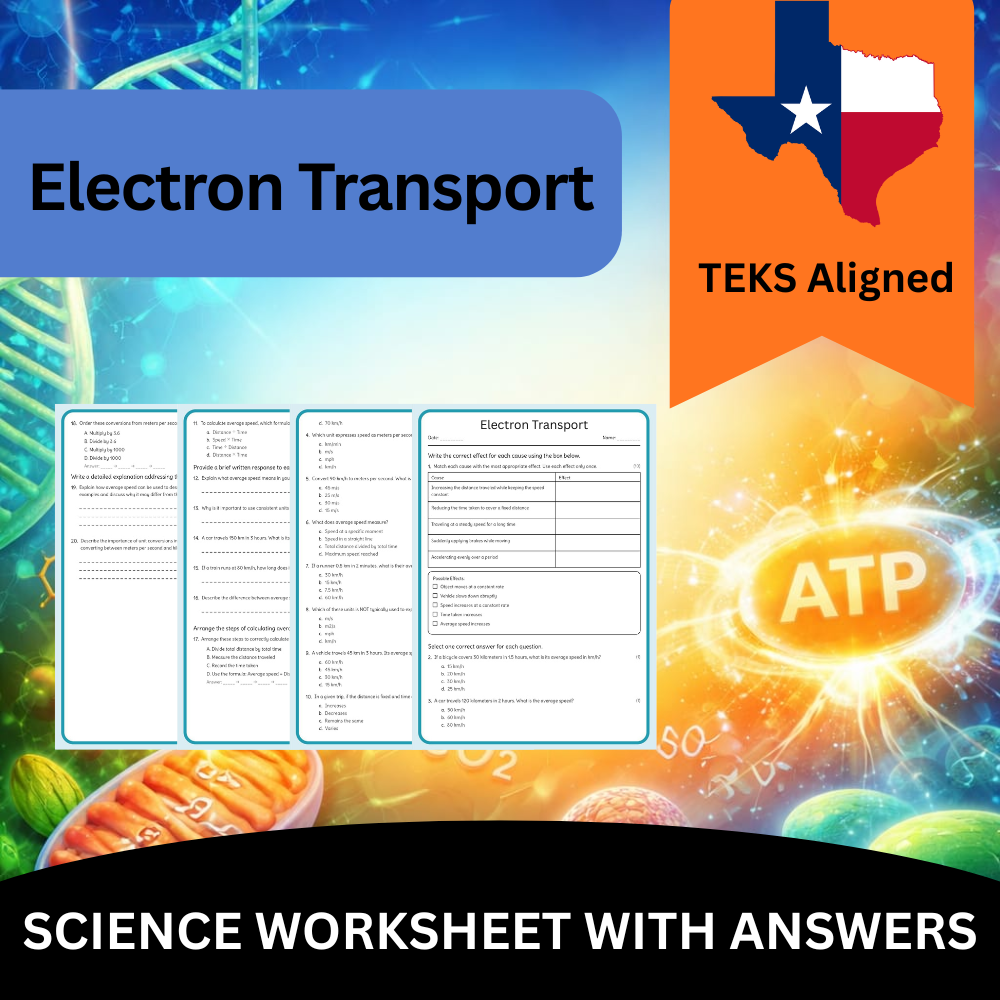
Grade 9 Science | Electron Transport Chain Worksheet (Answer Key) – TEKS Standards
 Created byBright Mind Resources
Learning Objectives
- Understand the process of electron transport chains in mitochondria and chloroplasts.
- Describe how redox reactions couple with proton pumping to generate ATP.
- Explain the role of membrane integrity and oxygen availability in ATP synthesis efficiency.
Also included in: Grade 9 Science | Photosynthesis & Metabolic Pathways Unit Bundle (TEKS Aligned) +3 more
Instant download

Heat Transfer Calculations & Sign Conventions Worksheets Grade 9
 Created byTeachers Club
Learning Objectives
- Calculate thermal energy transferred using q = m c ΔT
- Interpret positive and negative q values for heat flow
- Apply conservation of energy to closed heat-transfer systems
Also included in: Grade 9 Energy Science Worksheets Bundle | NGSS Energy Unit +1 more
Instant download

Grade 9 Science | Cell Architecture - Daily Reading Comprehension
 Created byCoral Reef Learning
Learning Objectives
- Identify and describe the functions of basic cell organelles.
- Understand how nucleic acid sequences determine amino acid chains.
- Connect molecular coding and protein folding to organelle architecture.
Instant download
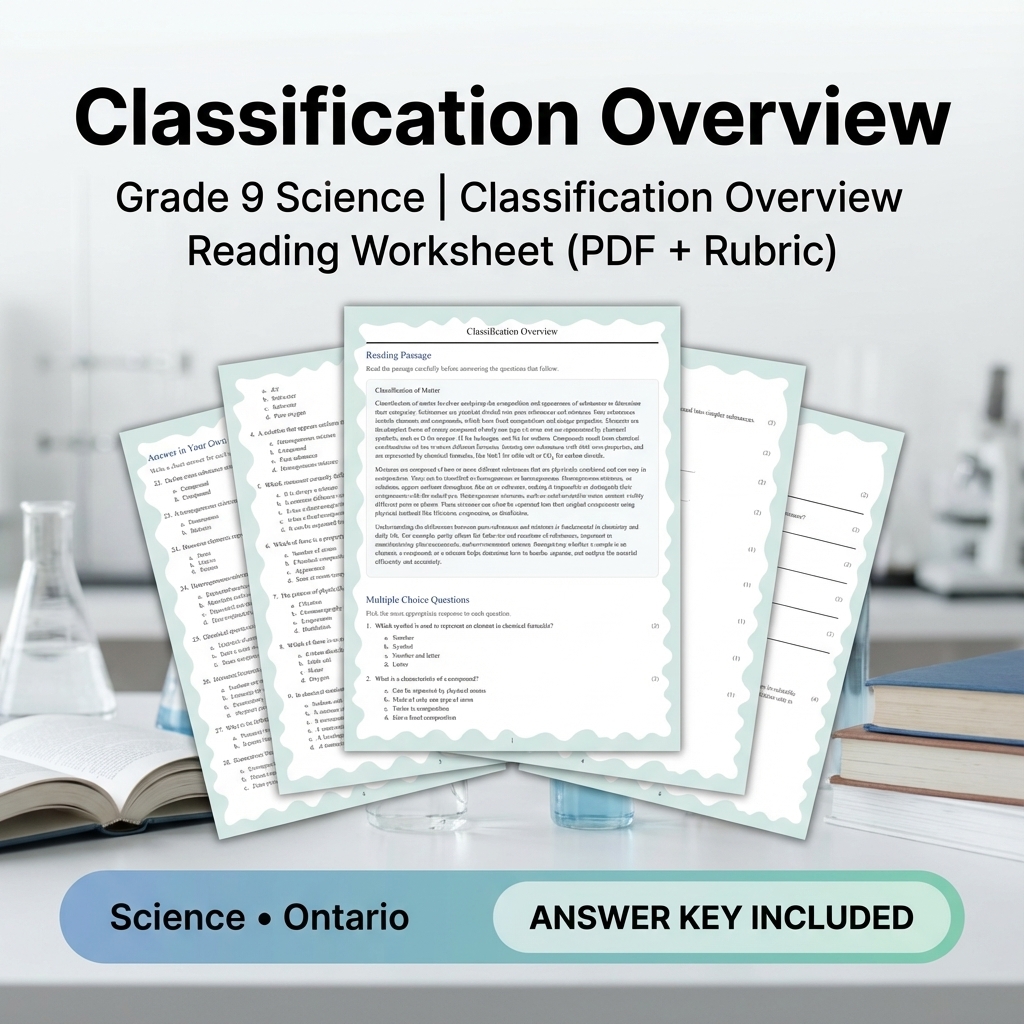
Grade 9 Science | Classification Overview Reading Worksheet (PDF + Rubric)
JCreated byJ.S SheetsLearning Objectives
- Understand the key features that distinguish elements, compounds, and mixtures.
- Learn how to represent elements and compounds using symbols and formulas.
- Identify and classify substances as pure substances or mixtures based on their composition.
Also included in: Grade 9 Science Unit Bundle | Essential Concepts & Skills (Answer Keys Included) +1 more
Instant download

Grade 9 Science Worksheet | Particle Model — Alberta Standard (PDF)
 Created byEvergreen Desk Education
Learning Objectives
- Explain the particulate (particle) model of matter using particle motion, spacing, and collisions
- Use the particulate model to predict diffusion, pressure, and temperature changes in solids, liquids, and gases
- Relate everyday and Alberta examples (e.g., salt on roads, odour spread from farms) to particle-level processes
Instant download

Grade 9 Science – Kinematic Concepts: Speed & Velocity | Daily Reading Worksheet
Created byBright Mind ResourcesLearning Objectives
- Define and distinguish between speed and velocity
- Understand basic units of motion measurement
- Apply real-world examples of speed and velocity
Also included in: Grade 9 Simple Machines Science Daily Reading Lesson Bundle | Alberta +1 more
Instant download

Grade 9 Science | Ecosystem Dynamics - Daily Reading Comprehension
Created byCoral Reef LearningLearning Objectives
- Identify key components of ecosystems and their interactions.
- Understand trophic levels and food chain relationships.
- Explain the concepts of resilience, regime shifts, and thresholds in ecosystems.
Also included in: Biology and Ecosystems Lesson Bundle – Grade 9 Science AP Daily Reading +1 more
Instant download
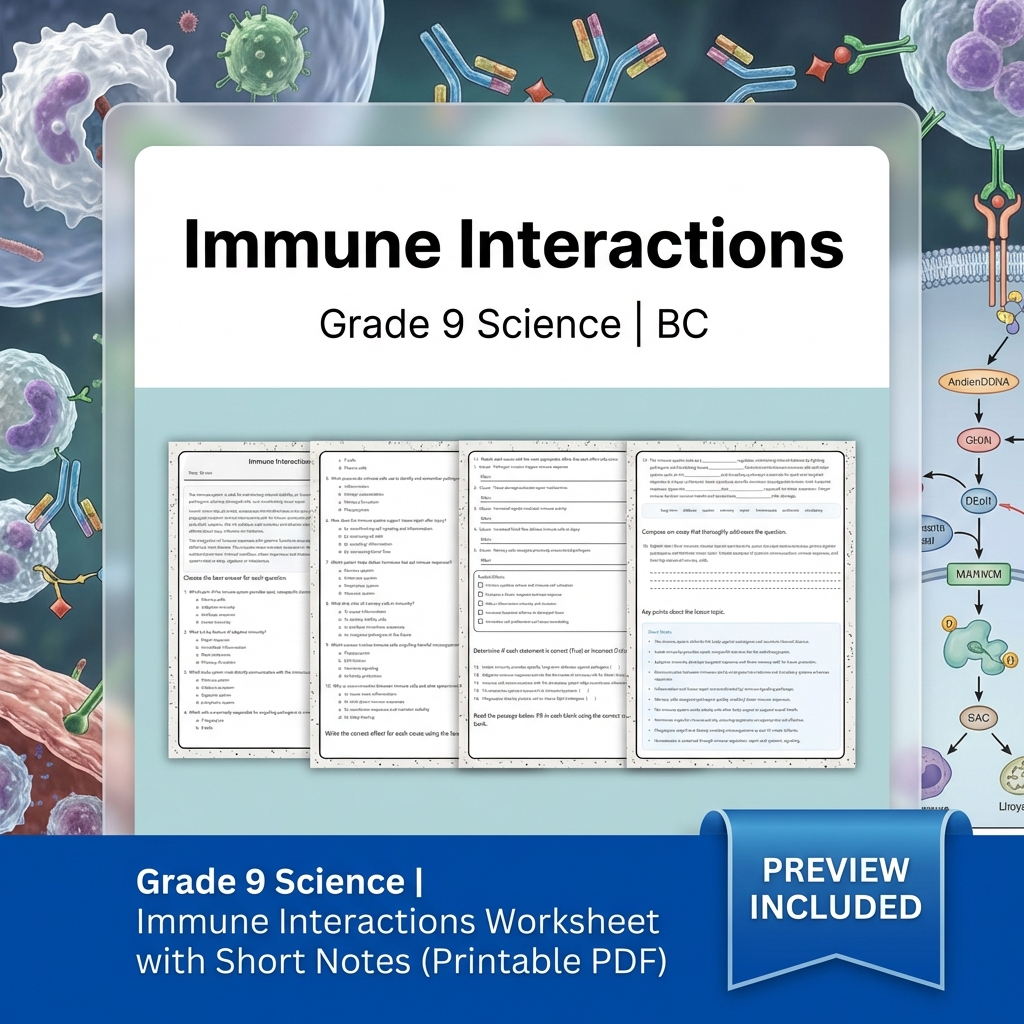
Grade 9 Science | Immune Interactions Worksheet with Short Notes (Printable PDF)
 Created byMeadowlark Worksheets
Learning Objectives
- Understand the roles and differences of innate and adaptive immune responses.
- Identify how immune cells communicate with other body systems.
- Describe how the immune system supports homeostasis and tissue repair.
Also included in: Grade 9 Science Lesson Bundle | BC Framework Worksheets (15-Piece Collection) +1 more
Instant download

Hazard Assessment Using Probabilities and Impacts Worksheets Grade 9
Created byTeachers ClubLearning Objectives
- Explain how historical frequency supports hazard occurrence estimates
- Interpret return period ideas for earthquakes and storms
- Analyze how exposure and vulnerability influence risk
Also included in: Earth and Human Activity Grade 9 Science NGSS Worksheets Bundle +1 more
Instant download

Grade 9 NGSS Engineering Problem Framing Worksheet | Science Activity
 Created byBRIGHT PATH RESOURCES
Learning Objectives
- Understand key concepts related to Science
- Apply knowledge through practice questions
- Demonstrate comprehension of the material
Also included in: Engineering Design Grade 9 Science Daily Reading Worksheets Lesson Bundle | NGSS +1 more
Instant download
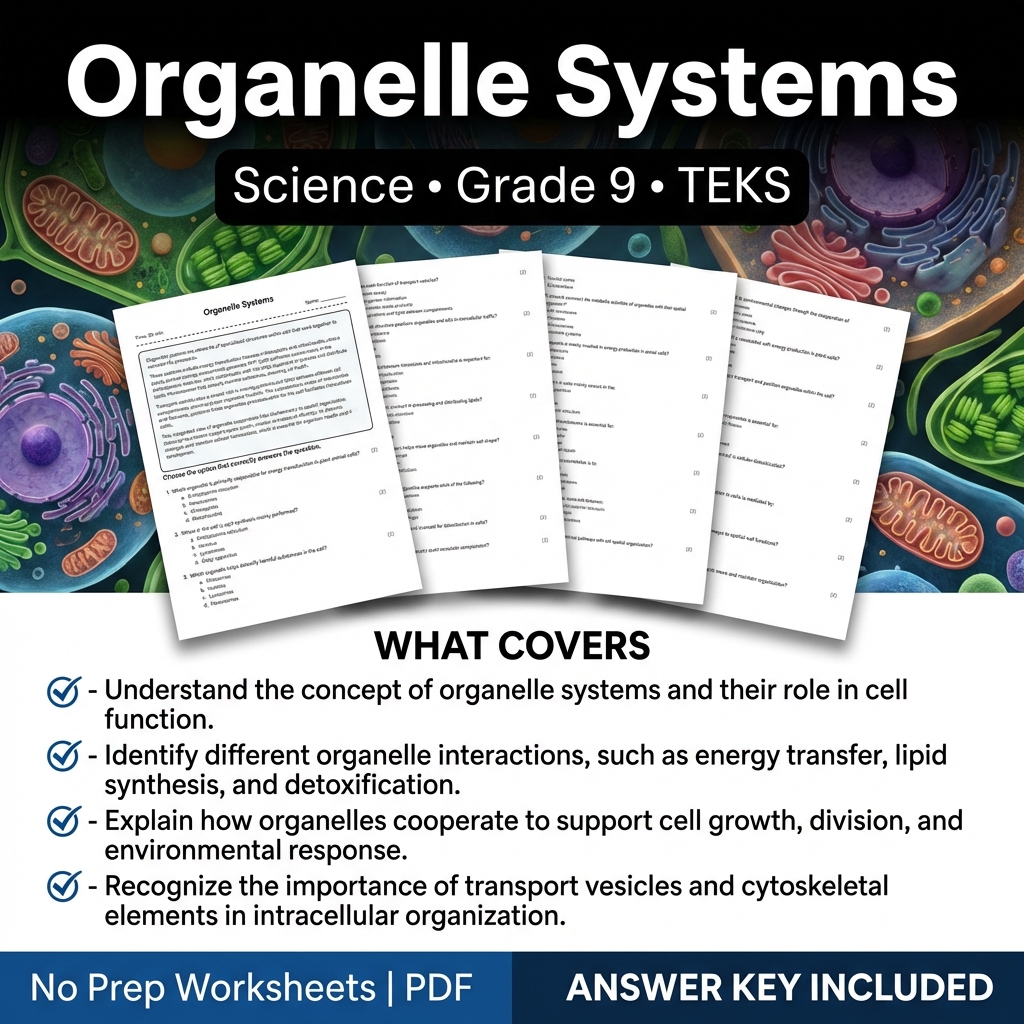
Organelle Systems Worksheet for Grade 9 Science | TEKS-Aligned Practice
Created byCoral Reef LearningLearning Objectives
- Understand the concept of organelle systems and their role in cell function.
- Identify different organelle interactions, such as energy transfer, lipid synthesis, and detoxification.
- Explain how organelles cooperate to support cell growth, division, and environmental response.
Instant download
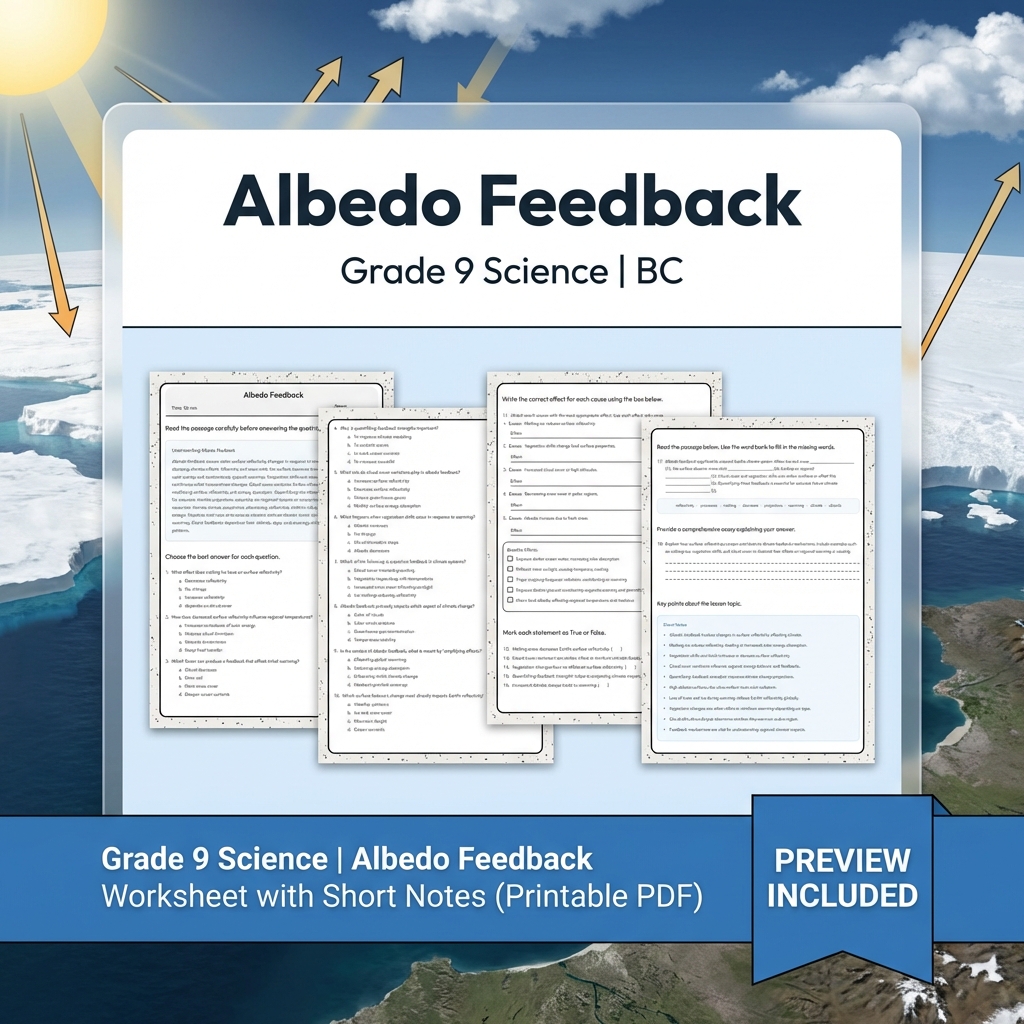
Grade 9 Science | Albedo Feedback Worksheet with Short Notes (Printable PDF)
Created byMeadowlark WorksheetsLearning Objectives
- Understand the concept of albedo feedback and its effect on climate change.
- Identify factors that influence surface reflectivity and regional warming.
- Analyze how melting ice, snow, vegetation shifts, and cloud cover contribute to feedback mechanisms.
Also included in: Grade 9 Science | BC Framework Lesson Bundle on Earth Systems & Climate +1 more
Instant download

Phase Changes and Energy Transfer Worksheets Grade 9 Science
 Created byPrism Point Learning
Learning Objectives
- Explain energy transfer during common phase changes
- Interpret temperature plateaus on heating and cooling curves
- Describe latent heat during phase transitions
Also included in: Matter and Chemical Change Lesson Bundle | Grade 9 Science | Ontario +1 more
Instant download

Conservation of Linear Momentum in Collisions Worksheets Grade 9
Created byTeachers ClubLearning Objectives
- Calculate total momentum before and after a two-body interaction
- Determine unknown velocities using conservation of linear momentum
- Distinguish elastic and inelastic collisions using kinetic energy
Also included in: Motion and Stability Grade 9 Science Worksheets | NGSS Bundle +1 more
Instant download

Grade 9 Science Daily Reading Organ Systems TEKS Biology Worksheet
Created byBRIGHT PATH RESOURCESLearning Objectives
- Identify the main idea of how the circulatory system transports materials.
- Describe key roles of blood flow in delivering oxygen and nutrients and removing wastes.
Also included in: Grade 9 Homeostasis and Body Systems Biology Worksheets Bundle | TEKS +1 more
Instant download

Grade 9 Science | Integrated Analysis Worksheet (Alberta Standard) PDF
 Created bySilver Birch Teaching
Learning Objectives
- Apply kinematics, net-force reasoning, and energy considerations together to explain complex motion.
- Use free-body diagrams and Newton’s 2nd law to predict acceleration for real-world scenarios.
- Use energy (work and the work-energy theorem) to check or refine predictions such as stopping distance.
Also included in: Grade 9 Relative Motion, Forces & Energy Science Lesson Bundle – Alberta +1 more
Instant download

Grade 9 Work Calculations Worksheet | Science Physics | Ontario + Answer Key
 Created byClear Sky Classroom
Learning Objectives
- Calculate mechanical work using the relationship W = F d cos(θ) for forces applied at an angle.
- Differentiate work done by constant forces versus work done by variable forces.
- Model variable-force work using the area under a force–distance curve.
Instant download

Grade 9 Science Worksheet | Immune Barriers Ontario Standards (PDF)
Created byEvergreen Desk EducationLearning Objectives
- Explain how physical barriers, innate immune cells, and adaptive immune responses protect the body from pathogens and environmental insults.
- Compare antigen recognition in innate versus adaptive immunity and describe how antibody-mediated responses contribute to protection.
- Describe how inflammation and immune memory help the body respond to threats, and how nutrition, stress, and exposures can change immune competence.
Also included in: Grade 9 Human Body Systems & Cellular Processes Science Lesson Bundle: Ontario +1 more
Instant download

Lunar Phases Worksheet | Grade 9 Science Practice & Assessment
Created byPrism Point LearningLearning Objectives
- Explain how the relative positions of the Sun, Earth, and Moon create the sequence of lunar phases
- Describe how the synodic month controls the regular timing of repeating lunar phases
- Use the fraction of the Moon’s disk illuminated from Earth to predict which phase is visible
Also included in: Earth and Space Systems Lesson Bundle | Grade 9 Science | BC Framework +1 more
Instant download

Grade 9 Science | Moon Phases And Eclipses Worksheet | General Standard
 Created byLumora Learning
Learning Objectives
- Explain how relative positions of the Sun, Moon, and Earth determine Moon phases.
- Describe why eclipses require specific alignment and do not occur every month.
- Use viewing geometry and orbital tilt to predict when eclipses are more likely.
Instant download
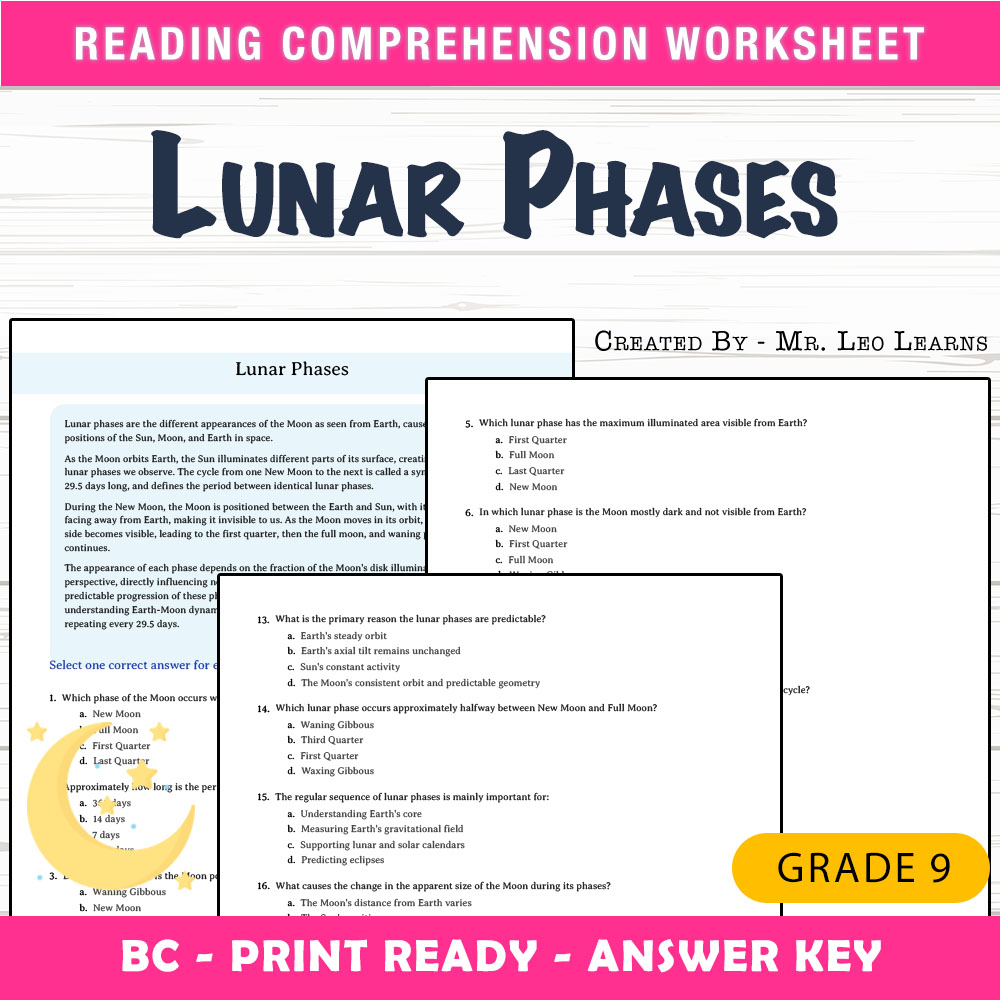
Grade 9 Science — Worksheet MCQ Paper for Mastering Lunar Phases
 Created byThe Resource Hub
Learning Objectives
- Understand the geometric relationship between the Sun, Earth, and Moon during different lunar phases.
- Identify the sequence and appearance of lunar phases over a synodic month.
- Explain how lunar phases influence nocturnal illumination and tidal patterns.
Also included in: Grade 9 Science | Earth and Space Systems Unit Worksheet Bundle (BC Framework) +1 more
Instant download
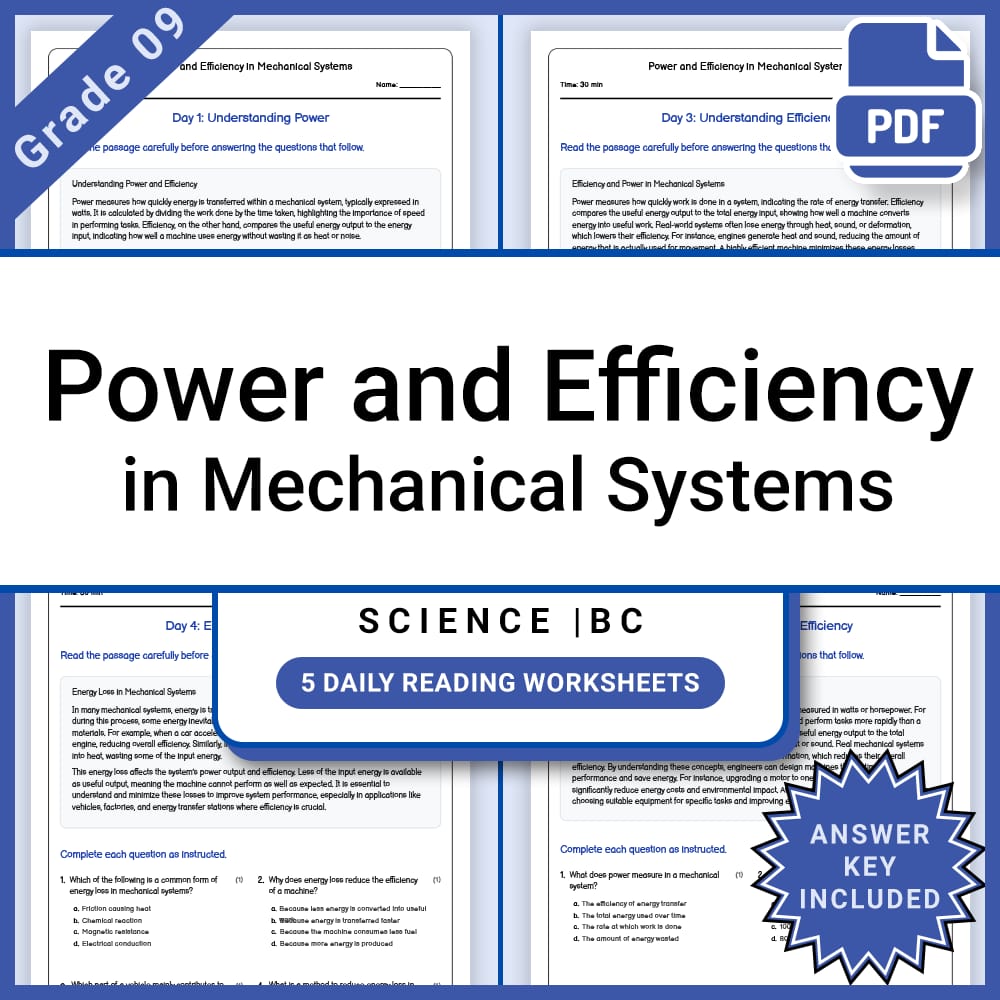
Grade 9 Science Power and Efficiency Daily Reading Worksheet with Answer Key
JCreated byJ.S SheetsLearning Objectives
- Understand the concepts of power and efficiency in mechanical systems
- Learn how to calculate power and efficiency
- Analyze how energy transfer affects machine performance
Also included in: Grade 9 Science Lesson Bundle | Physics and Energy Concept Worksheets +1 more
Instant download

Grade 9 Environmental Health Worksheet | Chronic Disease & Exposures Ontario
 Created byChalk and Compass
Learning Objectives
- Explain how environmental exposures and lifestyle factors can contribute to chronic disease through biological mechanisms.
- Describe how dose–response relationships and vulnerability factors affect health outcomes over time.
- Compare epidemiological evidence with mechanistic evidence when evaluating health risks from pollutants and toxicants.
Also included in: Homeostasis and Human Body Systems Lesson Bundle | Grade 9 Science | Ontario +1 more
Instant download

Grade 9 Science – Decision Modeling & Environmental Strategies | Worksheet
Created byBright Mind ResourcesLearning Objectives
- Understand the fundamentals of decision modeling and scenario analysis.
- Explore how systems approach integrates economic, environmental, and social factors.
- Evaluate trade-offs involved in greenhouse gas reduction and sustainability.
Also included in: Grade 9 Environmental Impact Science Daily Reading Worksheets Lesson Bundle | NGSS +2 more
Instant download

Grade 9 Science – Conservation of Energy & Energy Models | Reading Worksheet
Created byBright Mind ResourcesLearning Objectives
- Identify different forms of energy and how they transfer between objects
- Understand the concept of energy conservation in a system
- Interpret energy diagrams and models illustrating energy changes
Also included in: Science Grade 9 Science Daily Reading Worksheets lesson-bundle | Calif. Stds +1 more
Instant download

Grade 9 Center Stability Worksheet | Center of Mass, Torque & Tipping NGSS
 Created byAmber Owl Education
Learning Objectives
- Calculate the center of mass for composite rigid bodies using given component masses and positions.
- Apply moment and net torque conditions to determine static equilibrium for objects with multiple forces.
- Analyze stability using tipping thresholds by comparing the center of mass relative to the support base.
Also included in: Grade 9 Science Forces, Motion, Momentum & Fields Lesson Bundle – NGSS +1 more
Instant download

Grade 9 Field Dynamics Worksheet | Electric & Magnetic Fields | NGSS
Created byAmber Owl EducationLearning Objectives
- Explain how electric and magnetic field lines represent direction and relative strength.
- Predict the force direction on a moving charge using the Lorentz force relationship for magnetic fields.
- Use vector superposition ideas to describe how fields combine.
Also included in: Grade 9 Science Forces, Motion, Momentum & Fields Lesson Bundle – NGSS +1 more
Instant download

Speciation Processes Worksheet | NGSS Grade 9 Science Assessment
 Created bySkylark Worksheets
Learning Objectives
- Explain how reproductive isolation prevents gene flow and enables speciation
- Compare allopatric and sympatric speciation models using examples
- Describe how genetic divergence, hybrid zones, and polyploidy contribute to new species
Also included in: Grade 9 Science Full-Year Bundle | NGSS Worksheets & Assessments
Instant download

Evolutionary Evidence Worksheets: Common Ancestry & Evolution Grade 9
Created byTeachers ClubLearning Objectives
- Identify evidence from fossils, anatomy, molecules, and biogeography
- Explain how stratigraphy and radiometric dating place evidence in time
- Describe how homologous structures support common ancestry
Also included in: Grade 9 Biology Evolution Worksheets | NGSS Unit Bundle +1 more
Instant download
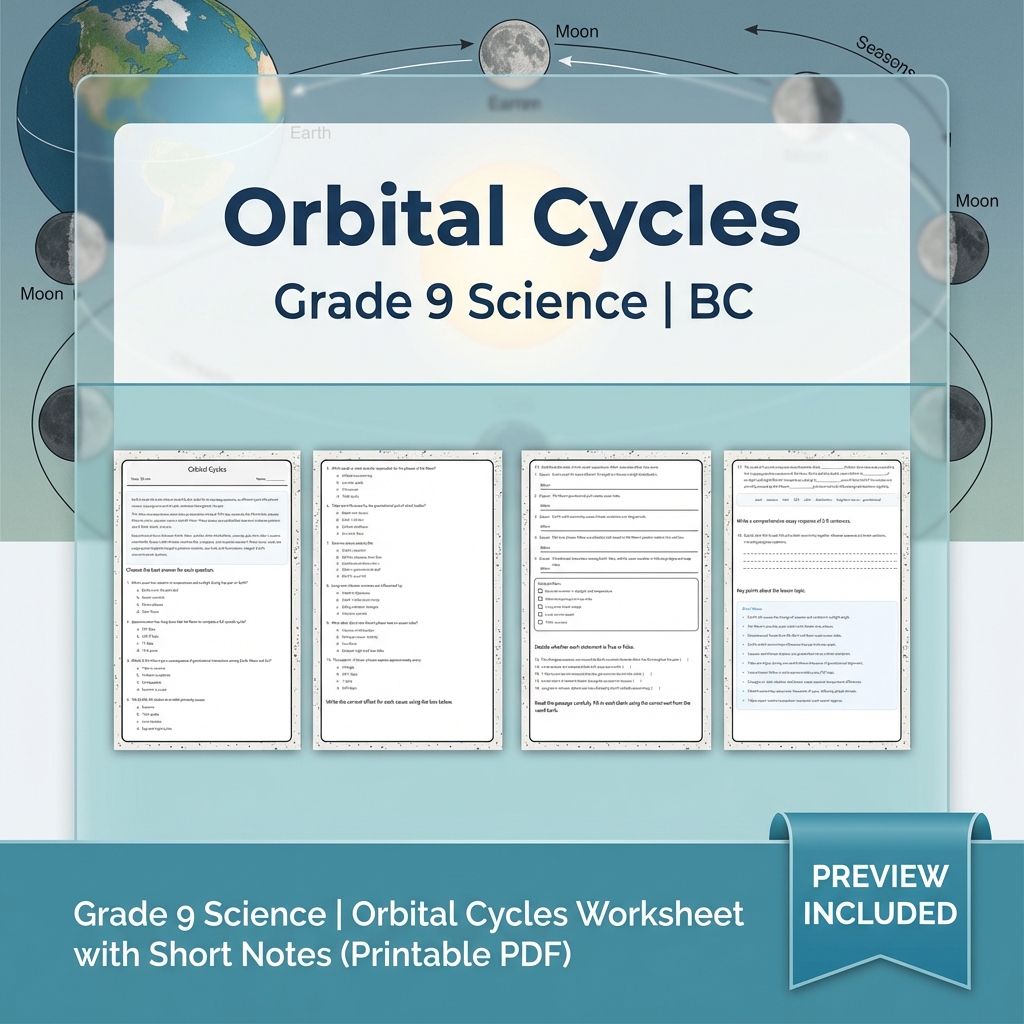
Grade 9 Science | Orbital Cycles Worksheet with Short Notes (Printable PDF)
Created byMeadowlark WorksheetsLearning Objectives
- Understand the relationships between Earth's, Moon's, and Sun's orbital patterns and effects.
- Identify phenomena such as seasons, lunar phases, and tides resulting from orbital interactions.
- Describe how Earth's axial tilt and orbital eccentricity influence climate cycles.
Also included in: Grade 9 Science | BC Framework Lesson Bundle on Earth Systems & Climate +1 more
Instant download

Friction And Drag Assessment for Grade 9 Science | NGSSS Standards
Created byPrism Point LearningLearning Objectives
- Explain how friction and drag oppose relative motion and affect acceleration.
- Use the idea that friction depends on normal force and surface conditions.
- Describe how drag depends on an object’s speed and the surrounding fluid.
Also included in: Grade 9 Forces, Energy, and Matter Science Lesson Bundle | Florida NGSSS
Instant download
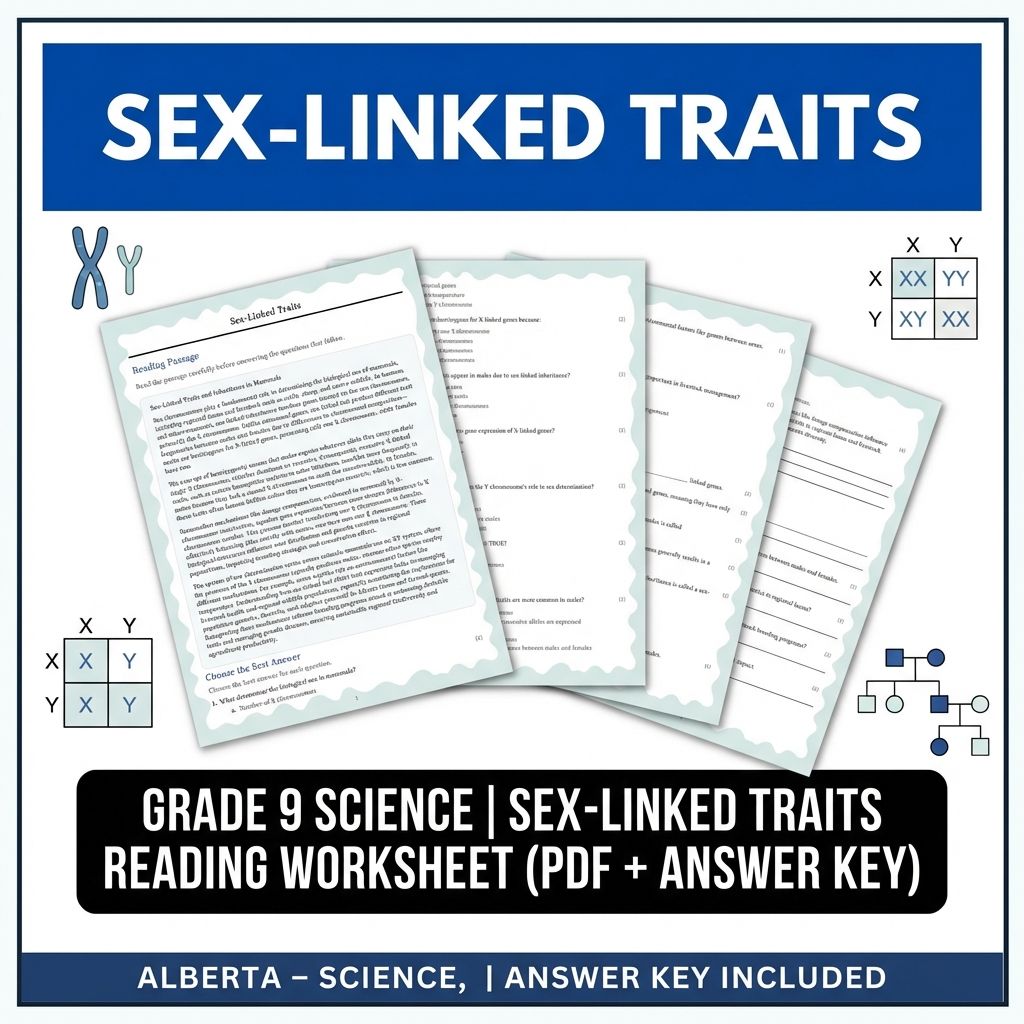
Grade 9 Science | Sex-Linked Traits Reading Worksheet (PDF + Answer Key)
JCreated byJ.S SheetsLearning Objectives
- Understand the role of sex chromosomes in inheritance.
- Explain mechanisms of sex-linked trait expression in mammals.
- Distinguish between sex determination systems and inheritance patterns.
Also included in: Grade 9 Science Unit Bundle | Genetics, Cell Biology & Biotechnology Worksheets +1 more
Instant download

Orbital Motion Worksheets: Kepler’s Laws & Gravity | Grade 9 Science
Created byTeachers ClubLearning Objectives
- Explain how Kepler’s laws describe orbital shape, area, and period
- Apply Newton’s gravity law to reason about orbital speed changes
- Relate orbital period to semi-major axis for the same central mass
Also included in: Earth's Place in the Universe Grade 9 NGSS Science Bundle +1 more
Instant download

Hydrologic Change Worksheet | NGSS Grade 9 Science Assessment
Created bySkylark WorksheetsLearning Objectives
- Explain how runoff, discharge, and sediment load influence erosion, transport, and deposition over time
- Interpret hydrologic data (discharge records and sediment measurements) to make evidence-based claims about channel or shoreline change
- Describe how different time scales (storms vs. long-term evolution) affect landscape form
Also included in: Grade 9 Science Lesson Bundle Earth Systems & Tectonic Forces | NGSS +1 more
Instant download
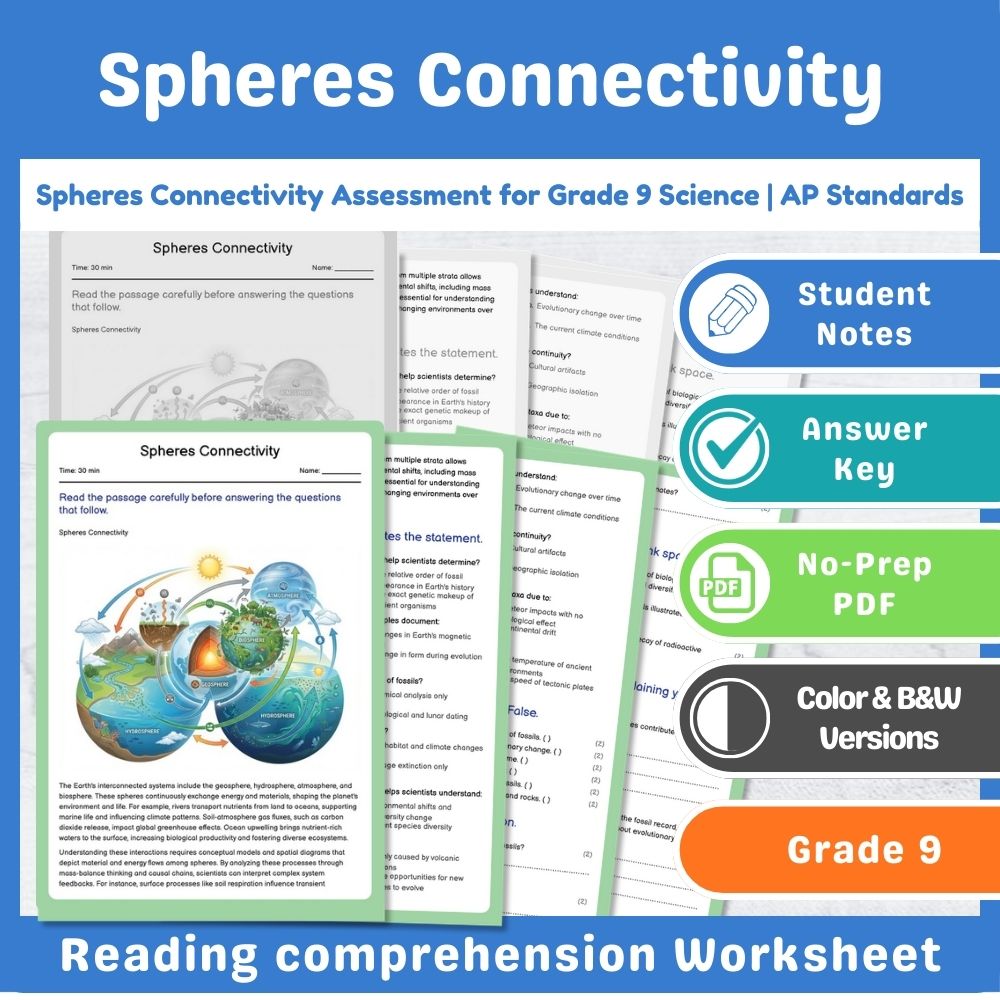
Spheres Connectivity Assessment for Grade 9 Science | AP Standards
Created byPrism Point LearningLearning Objectives
- Describe the interactions among the geosphere, hydrosphere, atmosphere, and biosphere using models and diagrams.
- Explain material and energy exchanges such as nutrient transport, gas fluxes, and ocean upwelling effects.
- Use spatial schematics and causal chains to interpret coupled environmental phenomena and feedbacks.
Also included in: Grade 9 Science Mini Bundle | Earth and Space Sciences AP Standards
Instant download

Lifestyle and Environmental Health Worksheets Grade 9 Science
Created byPrism Point LearningLearning Objectives
- Distinguish correlation from evidence needed to support causation
- Explain how oxidative stress damages cellular components
- Describe how chronic inflammation can affect health over time
Also included in: Grade 9 Science Lesson Bundle: Human Homeostasis & Cell Systems | Ontario +1 more
Instant download

Grade 9 Science – Molecular Bonding & Bond Types | Daily Reading Worksheet
Created byBright Mind ResourcesLearning Objectives
- Understand the concept of ionic bonding and electron transfer
- Identify properties of ionic compounds versus covalent compounds
- Recognize examples of ionic bonds in real-world materials
Also included in: States of Matter Grade 9 Science Daily Reading Worksheets lesson bundle |Alberta +1 more
Instant download

Reproductive Modes Worksheet | Grade 9 Science Activities
Created byPrism Point LearningLearning Objectives
- Compare sexual and asexual reproduction in terms of how offspring are produced and how variation changes.
- Explain how specific asexual mechanisms (budding, binary fission, and vegetative cloning) affect genetic similarity in offspring.
- Connect reproductive modes to ecological trade-offs such as population growth rate and genetic diversity.
Instant download

Balancing Equations Worksheet Grade 9 Science NGSSS Chemistry Practice
Created byEvergreen Desk EducationLearning Objectives
- Explain how coefficients in a chemical equation represent relative particle amounts and help maintain conservation of matter.
- Balance simple chemical equations by ensuring the number of atoms of each element matches on both sides.
- Interpret how changing one reactant amount can affect the possible amounts of products using the balanced equation.
Instant download

Net Force and Acceleration Worksheets | Grade 9 Physical Science Practice
Created byBRIGHT PATH RESOURCESLearning Objectives
- Explain how a net force changes an object's velocity over time.
- Determine whether forces are balanced or unbalanced from a motion description.
- Identify the direction of the net force and resulting acceleration.
Also included in: Grade 9 Science Waves, Forces & Energy Transfer Worksheets Bundle +1 more
Instant download
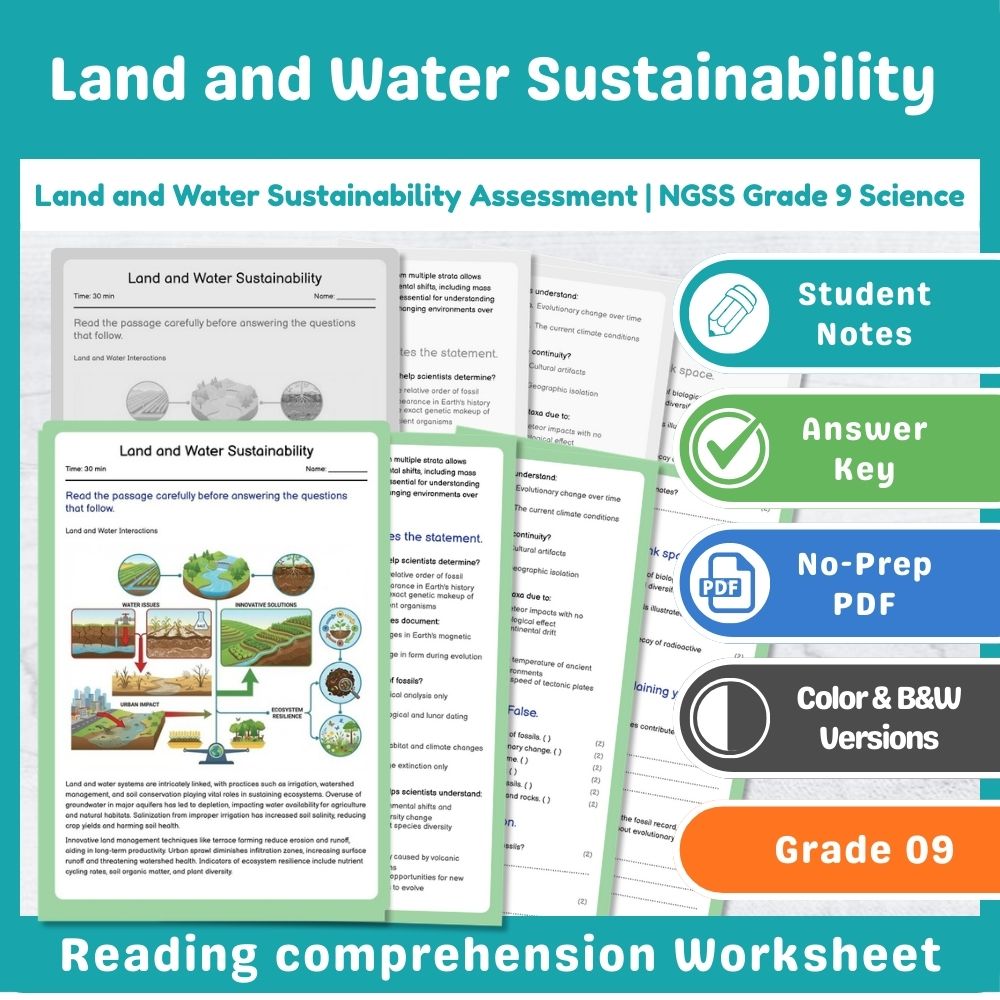
Land and Water Sustainability Assessment | NGSS Grade 9 Science
Created byPrism Point LearningLearning Objectives
- Understand how soil conservation, irrigation, and watershed management contribute to land sustainability.
- Identify indicators of ecosystem resilience, nutrient cycling, and productivity under land-use scenarios.
- Evaluate trade-offs among food production, biodiversity, and watershed health in land management practices.
Instant download

Conservation of Mass in Closed Systems Worksheets Grade 9 Science
Created byPrism Point LearningLearning Objectives
- State the conservation of mass principle for closed chemical systems
- Compare total reactant mass with total product mass
- Explain how atoms rearrange during chemical reactions
Also included in: Matter and Chemical Change Lesson Bundle | Grade 9 Science | Ontario +1 more
Instant download

Simple Machines and Mechanical Advantage Worksheets Grade 9 Physics
Created byPrism Point LearningLearning Objectives
- Identify classical simple machines and their mechanical functions
- Calculate ideal mechanical advantage using force relationships
- Relate input distance to output distance in ideal machines
Also included in: Physics: Forces and Energy Lesson Bundle | Grade 9 Science | Ontario +1 more
Instant download

Grade 9 Science – Earth Material Cycling & Water Cycle | Daily Reading Worksheet
Created byBright Mind ResourcesLearning Objectives
- Describe the processes involved in Earth's water cycle, including evaporation, condensation, and precipitation.
- Explain how water moves through various reservoirs such as the atmosphere, surface, and groundwater.
- Understand the importance of water cycle processes in influencing climate and weather patterns.
Also included in: Grade 9 Science Worksheets: Space-to-Climate Lesson Bundle | Calif. Standards +1 more
Instant download

Grade 9 Science | Understanding Natural Selection - Daily Reading Comprehension
Created byCoral Reef LearningLearning Objectives
- Define natural selection and explain its role in evolution.
- Identify key traits that can influence an organism's survival.
- Understand how certain traits become more common over generations.
Instant download

Grade 9 Science – Complex Inheritance Patterns | Daily Worksheet + Answer Key
JCreated byJ.S SheetsLearning Objectives
- Identify traits influenced by multiple genes
- Understand phenomena like epistasis and pleiotropy
- Recognize how environment affects genetic traits
Also included in: Grade 9 Science Lesson Bundle on Genetics and DNA TEKS Aligned +1 more
Instant download
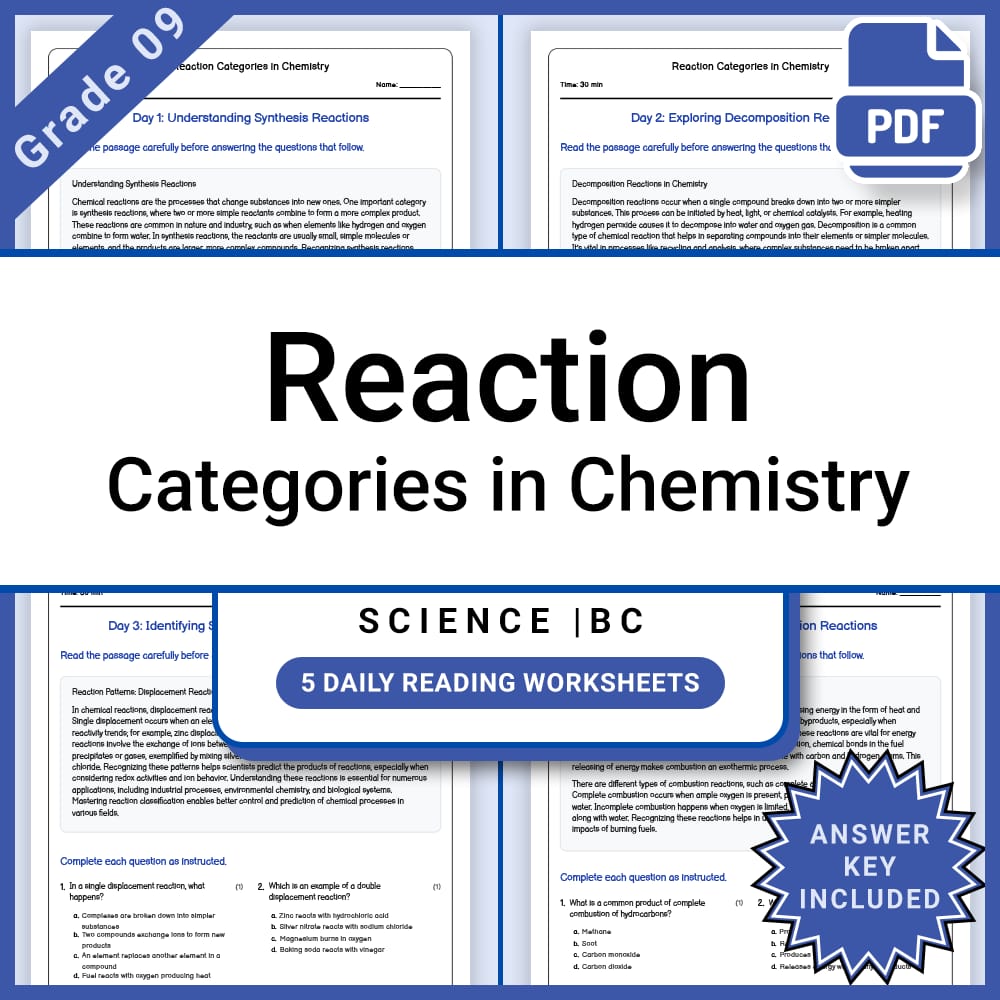
Grade 9 Science – Reaction Categories in Chemistry Daily Worksheet + Answer Key
JCreated byJ.S SheetsLearning Objectives
- Understand the different types of chemical reactions, focusing on synthesis reactions.
- Identify synthesis reactions from textual descriptions.
- Recognize the characteristic reactant patterns and products of synthesis reactions.
Also included in: Grade 9 Science Lesson Group BC Framework | Chemistry, Physics, and More +1 more
Instant download
About Grade 9 Science Worksheets
Find Science worksheets built for Grade 9. All 6,926 cover core skills, practice, and review, each an instant PDF download.
Every worksheet on MyTeachingSheets is created by independent teacher-authors and reviewed before publication. All resources download as printable PDFs for classroom, homework, or at-home practice, and many include answer keys. Preview any worksheet free before buying.