
Grade 9 Science Worksheets
6,926 worksheets
Grade 9 Science – Fault Diagnosis & Electrical Circuits - Reading Worksheet
 Created byBright Mind Resources
Learning Objectives
- Understand common symptoms indicating electrical faults.
- Recognize the topologies of electrical circuits affected by faults.
- Apply logical reasoning to diagnose open circuits, short circuits, and component degradation.
Also included in: Grade 9 Electrical Circuits & Electromagnetism Science Lesson Bundle | Alberta +1 more
Instant download

Grade 9 Science | Pedigree Analysis - Daily Reading Comprehension
 Created byCoral Reef Learning
Learning Objectives
- Understand the standard symbols used in pedigree charts
- Interpret inheritance patterns from pedigree diagrams
- Identify autosomal, sex-linked, and mitochondrial inheritance
Instant download

Natural Hazards Review Practice Assessment | Grade 9 Science
 Created byPrism Point Learning
Learning Objectives
- Explain how geological and atmospheric indicators help characterize natural hazards by origin, frequency, and potential impacts.
- Use hazard maps and recurrence intervals to discuss risk to human and ecological systems.
- Describe how triggering mechanisms and intersystem feedbacks influence the spread and long-term effects of natural hazards.
Instant download

Grade 9 Science | Mutation Sources Worksheet | NGSSS Aligned
 Created byLumora Learning
Learning Objectives
- Explain how DNA replication errors can cause spontaneous mutations
- Identify environmental factors (such as radiation and chemicals) that can induce mutations
- Describe how mutations may or may not affect proteins and gene regulation
Instant download

Orbital Cycles Worksheet | Grade 9 Science Practice
Created byPrism Point LearningLearning Objectives
- Explain how Earth’s axial tilt and orbital eccentricity affect the intensity and distribution of sunlight over yearly cycles
- Describe how the Moon’s synodic cycle leads to predictable lunar phases
- Connect gravitational interactions between Earth, the Sun, and the Moon to tidal patterns
Also included in: Earth and Space Systems Lesson Bundle | Grade 9 Science | BC Framework +1 more
Instant download

Decision Modeling in Climate Strategies Worksheet | NGSS Grade 9 Science
 Created byCedar Grove Learning
Learning Objectives
- Understand how systems and decision models evaluate mitigation and adaptation strategies for climate change.
- Analyze trade-offs among environmental, social, and economic variables using scenario analysis and assessment approaches.
- Apply concepts of cost-benefit analysis and lifecycle assessment to policy decisions such as carbon pricing and land-use planning.
Instant download
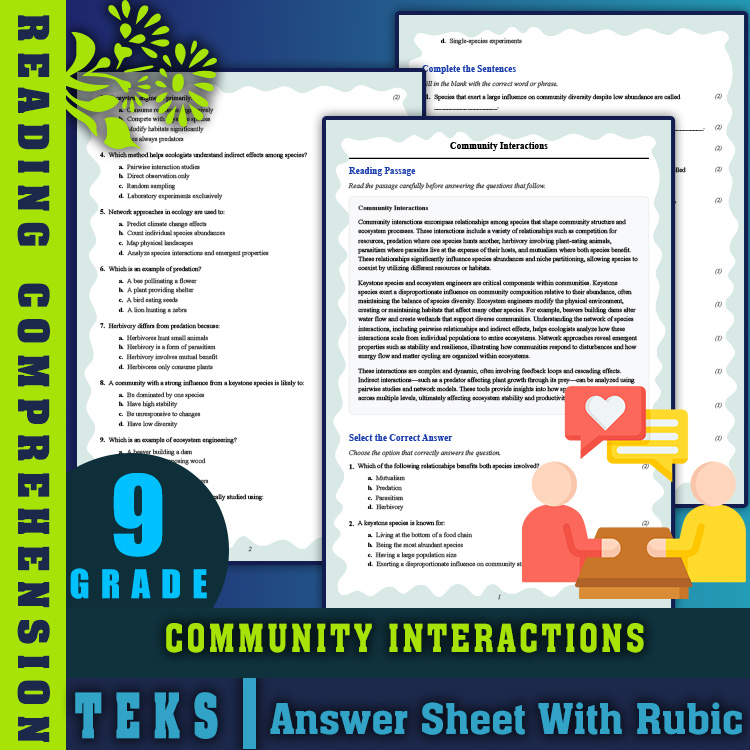
Grade 9 Science | Community Interactions Reading Worksheet & Answer Key (PDF)
JCreated byJ.S SheetsLearning Objectives
- Describe different types of species interactions such as competition, predation, and mutualism.
- Explain the roles of keystone species and ecosystem engineers in shaping community structure.
- Analyze how species interactions influence ecosystem stability and energy flow.
Instant download

Grade 9 Science Reaction Rates Worksheet with Short Notes (Printable PDF)
 Created byMeadowlark Worksheets
Learning Objectives
- Understand how collision frequency, activation energy, and pathways influence reaction rates.
- Explain how temperature, concentration, and catalysts affect accessible energy distributions.
- Apply rate laws and reaction order concepts to real-world reactions like bromine-iodide kinetics.
Also included in: Grade 9 Science Unit | Matter and Its Interactions NGSS Worksheet Pack +1 more
Instant download

Natural Selection Patterns Worksheet | Standards-Aligned Grade 9
JCreated byJ.S SheetsLearning Objectives
- Understand how natural selection influences genetic variation within populations.
- Identify traits that provide survival advantages in specific environments.
- Describe the process by which advantageous traits increase over generations.
Also included in: Grade 9 Evolution, Genetics, and Ecosystems Science Lesson Bundle +1 more
Instant download

Grade 9 Science - Wave Property Links Worksheet (PDF) for Standards Practice
 Created byEvergreen Desk Education
Learning Objectives
- Explain how amplitude, wavelength, and frequency describe a wave signal.
- Relate changes in wave parameters to how the wave appears in different representations.
- Use parameter relationships to interpret or compare signals produced by the same source.
Also included in: Grade 9 Waves, Forces, and Energy Science Lesson Bundle | General +1 more
Instant download

Grade 9 Science | Genes and Proteins Worksheet (Alberta Standards) (PDF)
 Created bySilver Birch Teaching
Learning Objectives
- Explain how genes on DNA can determine protein structure and function
- Describe how transcription and translation work at a high level
- Analyze how gene regulation (including promoter function) can change phenotype
Also included in: Grade 9 Genetics and Reproduction Science Lesson Bundle Worksheets – Alberta +1 more
Instant download
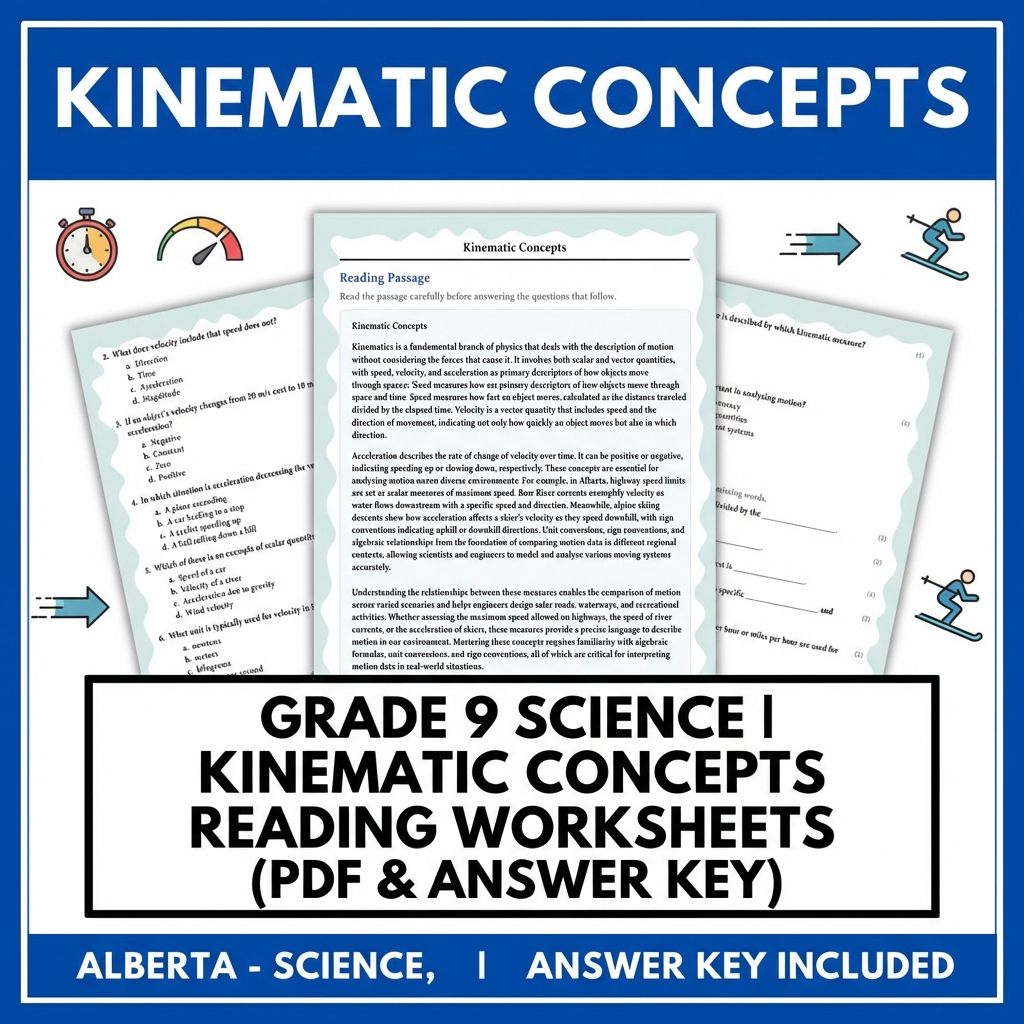
Grade 9 Science | Kinematic Concepts Reading Worksheets (PDF & Answer Key)
JCreated byJ.S SheetsLearning Objectives
- Understand the basic scalar and vector measures used to describe motion.
- Differentiate between speed, velocity, and acceleration in various real-world contexts.
- Apply unit conversions and sign conventions to analyze motion data.
Also included in: Grade 9 Science Unit Bundle | Motion, Forces & Energy Activities (PDF) +1 more
Instant download

Grade 9 Seafloor Spreading Worksheet | BC Practice PDF
 Created byClear Sky Classroom
Learning Objectives
- Explain how new oceanic crust forms at mid-ocean ridges and how older crust moves away over time.
- Interpret magnetic striping patterns as evidence for seafloor spreading and geomagnetic reversals.
- Use seafloor age, bathymetry, and sediment thickness to describe evidence for plate-motion models.
Instant download

Grade 9 Transmission Tradeoffs Worksheet | NGSS Practice PDF
Created byClear Sky ClassroomLearning Objectives
- Understand the key tradeoffs involved in digital and analog communication systems.
- Analyze how bandwidth, signal-to-noise ratio, and error correction techniques affect data transmission.
- Evaluate the performance limitations of wireless, optical, and wired networks based on quantitative metrics.
Also included in: Grade 9 Electromagnetic Radiation Science Lesson Bundle for NGSS +1 more
Instant download

Grade 9 Science | Model-Data Fit Worksheet | AP Data Analysis Practice
Created byLumora LearningLearning Objectives
- Understand quantitative methods for assessing the fit between models and data.
- Interpret residual plots and goodness-of-fit measures to evaluate model accuracy.
- Identify patterns indicating systematic divergence or heteroscedasticity.
Also included in: Grade 9 Science | Practices in Science Custom Bundle | AP Standards
Instant download

Prokaryote Comparison Worksheet | Grade 9 Science Activities
Created byPrism Point LearningLearning Objectives
- Compare prokaryotic (bacteria and archaea) cell structures with eukaryotic cell structures.
- Explain how differences in compartmentalization and genetic arrangement affect cell organization.
- Identify key features such as nucleoid, nucleus, organelles, and chromosome type.
Instant download

Grade 9 Producers & Consumers Worksheet | NGSS Practice PDF
Created byClear Sky ClassroomLearning Objectives
- Understand the roles of producers and consumers in ecosystems.
- Analyze how photosynthesis and cellular respiration transfer energy and cycle carbon and oxygen.
- Evaluate the impact of net primary productivity and biomass accumulation on ecosystems.
Also included in: Grade 9 Ecosystem Dynamics Science Lesson Bundle (NGSS) +1 more
Instant download
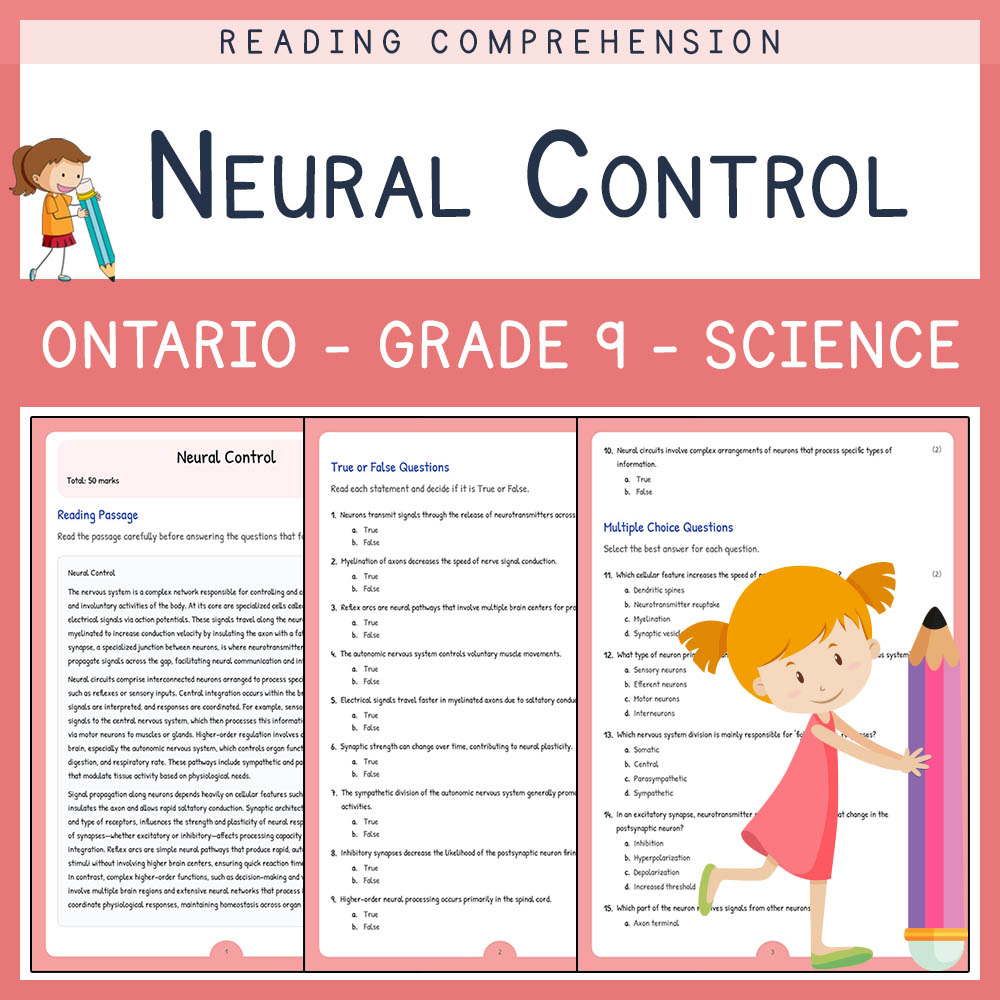
Grade 9 Science Assessment | Neural Control Worksheet Elena | Ontario
Created byLumora LearningLearning Objectives
- Describe the organization of the nervous system from neurons and synapses to neural circuits.
- Explain how action potentials and synaptic transmission enable signal propagation and processing.
- Relate cellular features such as myelination and synaptic architecture to conduction velocity and neural processing capacity.
Also included in: Grade 9 Science | Life Systems Lesson Bundle | Ontario Framework
Instant download

Balancing Equations Worksheet | Grade 9 Science | Alberta Standards
JCreated byJ.S SheetsLearning Objectives
- Understand the law of conservation of mass through balancing chemical equations.
- Identify and balance chemical equations to ensure equal atoms of each element on both sides.
- Link formula notation to measurable mass relationships in chemical reactions.
Also included in: Grade 9: Chemical Reactions and Matter Science lesson bundle Alberta
Instant download

DNA Replication Worksheet | Grade 9 Science Activities
Created byPrism Point LearningLearning Objectives
- Explain why DNA replication is semi-conservative and produces two DNA molecules with one original strand each.
- Describe the main steps of DNA replication, including initiation, primer formation, and leading vs. lagging strand synthesis.
- Connect replication fidelity and repair mechanisms to mutation rates and genome stability.
Also included in: Grade 9 Genetics & Biotechnology Lesson Bundle | TeKS Science
Instant download
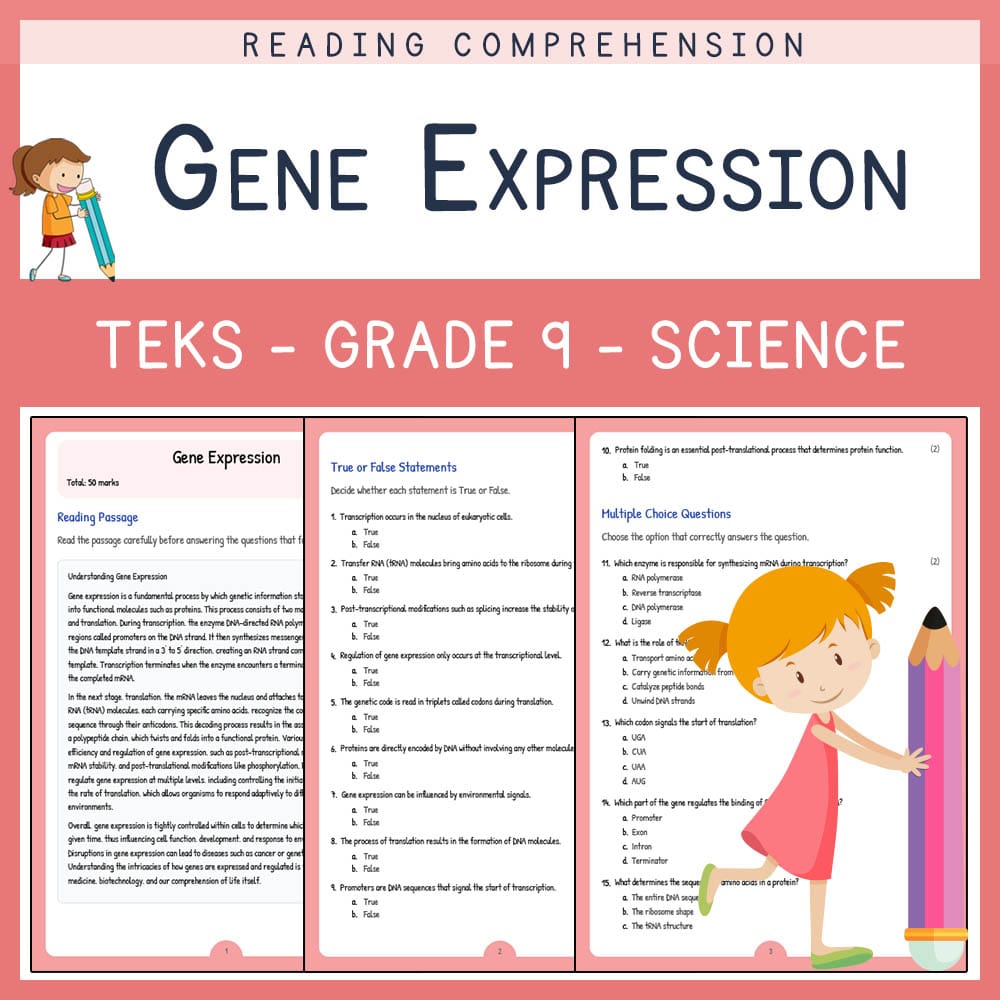
Grade 9 Science | Gene Expression Worksheet | TEKS-Aligned
Created byLumora LearningLearning Objectives
- Describe the processes of transcription and translation in gene expression.
- Identify key components involved in gene expression such as RNA polymerase, mRNA, tRNA, and ribosomes.
- Explain how regulation and modifications influence gene expression outcomes.
Also included in: Grade 9 Science | Genetics & Biotechnology Lesson Bundle | TEKS Aligned
Instant download
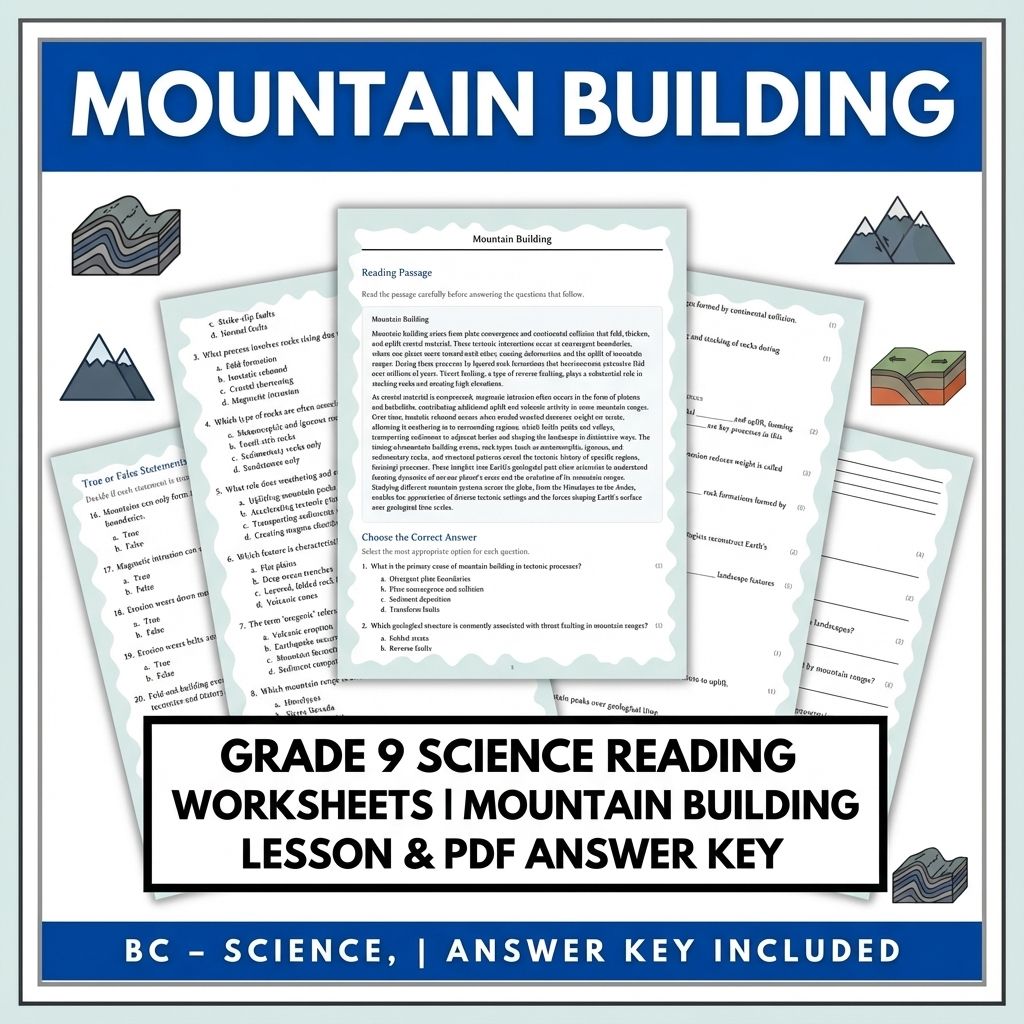
Grade 9 Science Reading Worksheets | Mountain Building Lesson & PDF Answer Key
JCreated byJ.S SheetsLearning Objectives
- Understand the geological processes involved in mountain formation from plate convergence and collision.
- Identify key features and structures associated with mountain ranges and orogenic events.
- Explain how weathering and erosion shape mountain landscapes over time.
Instant download

Grade 9 Science | Impulse & Collision - Daily Reading Comprehension
Created byCoral Reef LearningLearning Objectives
- Understand the concept of impulse and its relation to force and time
- Differentiate between elastic and inelastic collisions
- Analyze how forces during collisions affect an object's momentum
Instant download

Grade 9 Science — Ecosystem Dynamics Worksheet for Mastery
 Created byThe Resource Hub
Learning Objectives
- Understand how multiple factors influence ecosystem responses and resilience.
- Identify the components of trophic interactions, feedback loops, and material fluxes.
- Analyze the effects of climate variability, land-use change, and species introductions on ecosystems.
Also included in: Grade 9 Science Biology and Ecosystems Lesson Bundle for AP Curriculum +1 more
Instant download
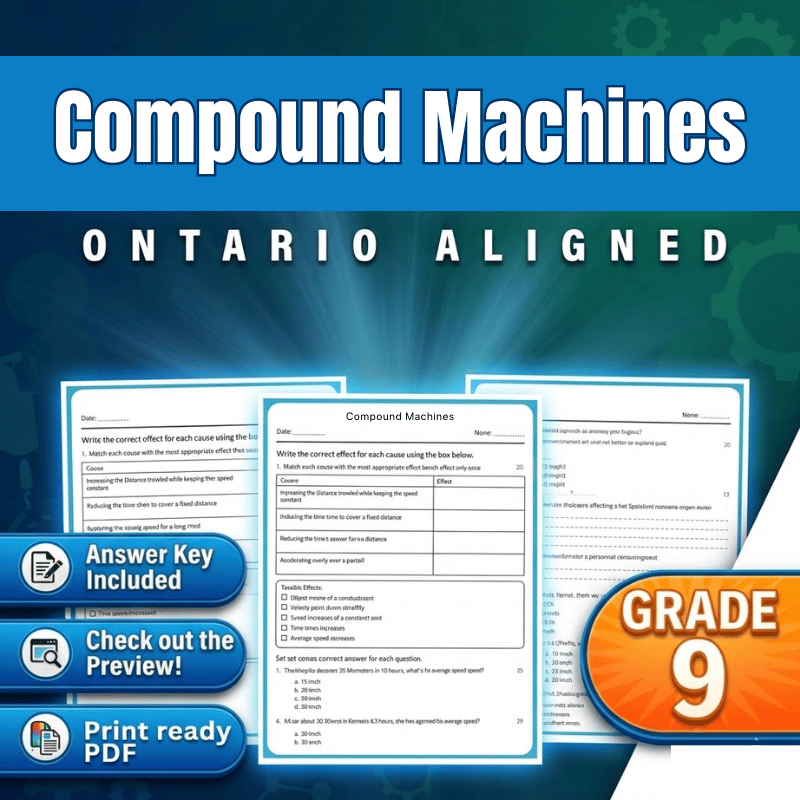
Grade 9 Science | Compound Machines Worksheet (Ontario - PDF)
Created byBright Mind ResourcesLearning Objectives
- Understand the concept of compound machines and how they combine multiple simple machines.
- Learn to calculate overall mechanical advantage using force and displacement relationships.
- Differentiate between ideal and actual mechanical advantage, considering frictional losses.
Instant download

Grade 9 Science | Device Systems Worksheet (PDF) | General Standards
Created byEvergreen Desk EducationLearning Objectives
- Explain how a device can be viewed as a system with interacting parts that perform specific roles.
- Map a device system by identifying inputs, outputs, energy transfers, and material flow.
- Use system boundaries to determine what belongs inside a device model and what counts as outside constraints.
Also included in: Grade 9 Engineering Design & Prototype Evidence Science Lesson Bundle: General +1 more
Instant download

Grade 9 Evidence Change Worksheet | Practice & Assessment PDF
Created byClear Sky ClassroomLearning Objectives
- Identify observable evidence of chemical change, including colour shifts, gas evolution, precipitate formation, temperature change, and irreversibility.
- Use evidence to distinguish chemical changes from physical changes in environmental and industrial contexts.
- Explain how multiple evidence markers together strengthen the conclusion that a new substance formed.
Instant download

Reaction Design Worksheet | NGSS Grade 9 Science Assessment
 Created bySkylark Worksheets
Learning Objectives
- Explain how equilibrium and kinetics influence which products form in a chemical process.
- Use equilibrium constants, rate ideas, and mass balance reasoning to predict and improve product distribution in a closed system.
- Describe how temperature, pressure, concentration, and catalysts can be refined to increase yield and selectivity while limiting side reactions.
Also included in: Chemical Reactions & Structure of Matter Lesson Bundle | Grade 9 Science | NGSS +1 more
Instant download

Evolution Evidence Worksheet | Grade 9 AP Science Evolution Activity
Created byPrism Point LearningLearning Objectives
- Interpret multiple lines of evidence for descent with modification, including fossils, comparative anatomy, biogeographic patterns, and molecular phylogenies.
- Explain how mutation, natural selection, genetic drift, and gene flow can change allele frequencies over short and long timescales.
- Use simple models or scenarios to predict how populations respond to changing environmental pressures.
Instant download

Momentum Conservation Test Prep Worksheet | Grade 9 Science NGSS
Created byPrism Point LearningLearning Objectives
- Explain how linear momentum is conserved in an isolated system using vector addition and momentum exchange.
- Differentiate elastic and inelastic collisions using quantitative momentum before-and-after calculations.
- Use center-of-mass ideas for two-body interactions and apply conservation to real situations like recoil and car crashes.
Also included in: Grade 9 Newtonian Motion & Collisions Science Lesson Bundle NGSS
Instant download

Grade 9 Science – Third Law Pairs & Action–Reaction Forces | Reading Worksheet
Created byBright Mind ResourcesLearning Objectives
- Define Newton's Third Law and identify action-reaction pairs.
- Recognize examples of interaction pairs in everyday scenarios.
- Explain why these forces act on different objects and do not cancel each other.
Also included in: Grade 9 Forces, Energy & Matter Science lesson bundle Florida NGSSS +1 more
Instant download

Periodic Patterns Worksheet | Grade 9 Chemistry Periodic Table Activities
Created byPrism Point LearningLearning Objectives
- Explain how atomic number relates to repeating patterns in the periodic table.
- Predict trends in element properties (reactivity and typical ion charge) using group and period patterns.
- Describe how electron arrangement in outer energy levels drives periodic behavior.
Instant download

Grade 9 Science Worksheet | Cellular Energy (PDF) Ontario Standards
Created byEvergreen Desk EducationLearning Objectives
- Explain how glycolysis, the citric acid cycle, and oxidative phosphorylation work together to produce ATP
- Describe how mitochondrial structure supports proton gradients and ATP synthase activity
- Compare aerobic and anaerobic energy pathways and predict where each pathway is used
Also included in: Grade 9 Human Body Systems & Cellular Processes Science Lesson Bundle: Ontario +1 more
Instant download

Grade 9 Science | Understanding Heat & Work - Daily Reading Comprehension
Created byCoral Reef LearningLearning Objectives
- Define heat transfer and work transfer in physical and chemical changes.
- Differentiate between heat and work as pathways of energy transfer.
- Identify real-life examples of heat transfer and work.
Instant download
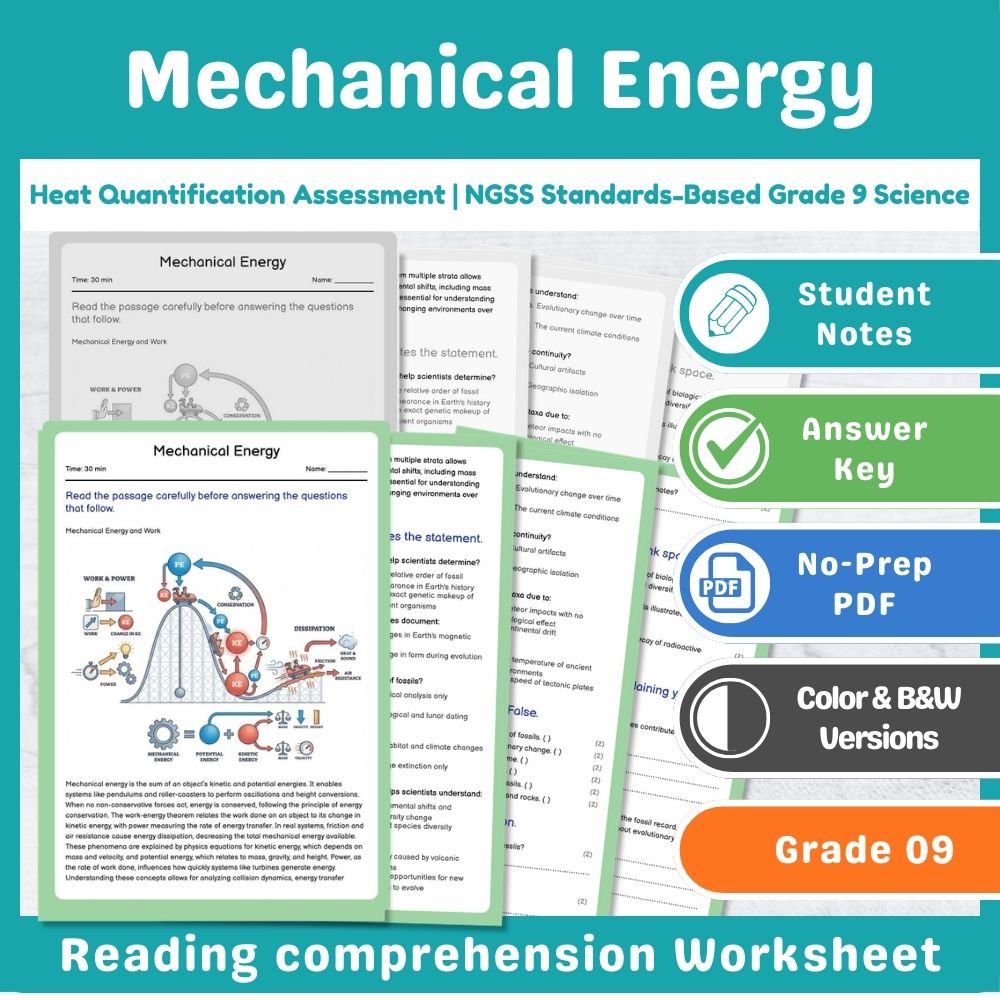
Mechanical Energy Assessment | NGSS Grade 9 Science Standards
Created byPrism Point LearningLearning Objectives
- Explain the concepts of kinetic and potential energy in mechanical systems.
- Apply work-energy principles to analyze motion and energy transfer.
- Calculate power in mechanical contexts and understand the effect of non-conservative forces.
Instant download

Grade 9 Climate Variability Worksheet | NGSS Practice & PDF
Created byClear Sky ClassroomLearning Objectives
- Explain how ocean-atmosphere interactions can cause climate variability over months to years
- Differentiate natural climate variability from longer-term climate trends
- Use evidence from multiple timescales and regions to interpret climate changes
Instant download

Grade 9 Fluid Balance Worksheet | BC Practice & PDF
Created byClear Sky ClassroomLearning Objectives
- Explain how kidney osmoregulation maintains blood volume, osmolarity, and electrolyte balance.
- Describe how filtration, selective reabsorption, secretion, and concentration occur across nephron segments.
- Analyze how hormones such as ADH and aldosterone change urine concentration and ion composition.
Instant download
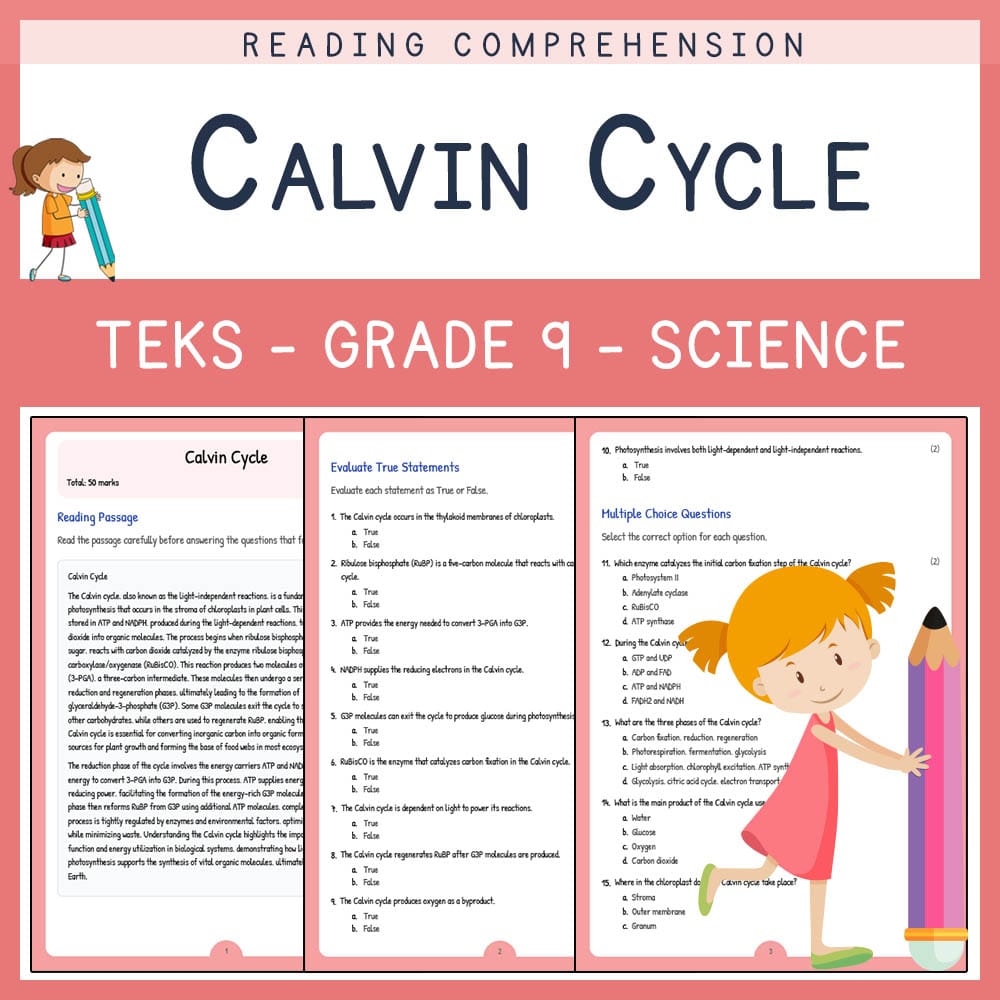
Grade 9 Science | Calvin Cycle Worksheet | TEKS Aligned
Created byLumora LearningLearning Objectives
- Describe the purpose and key processes of the Calvin cycle in photosynthesis.
- Identify the enzymes and molecules involved in the Calvin cycle.
- Explain how ATP and NADPH are utilized during the cycle to synthesize sugars.
Instant download

Grade 9 Science | Human Impacts on Ecosystems - Daily Reading Comprehension
Created byCoral Reef LearningLearning Objectives
- Understand the effects of deforestation on biodiversity.
- Identify key factors contributing to forest loss.
- Analyze data from case studies on land-use change.
Instant download

Grade 9 Science Motion Graphs Worksheet (Ontario) | Practice & Assessment (PDF)
Created byEvergreen Desk EducationLearning Objectives
- Interpret position–time graphs to determine velocity from the slope and direction from the sign of the slope
- Interpret velocity–time graphs to determine acceleration from the slope and displacement from the area under the graph
- Relate piecewise motion graphs to algebraic kinematics and to the idea of net force causing acceleration under Newton’s laws
Also included in: Grade 9 Forces, Motion & Energy Science Lesson Bundle (Ontario) +1 more
Instant download

Grade 9 DNA Replication Daily Reading TEKS Biology Science Worksheet
 Created byBRIGHT PATH RESOURCES
Learning Objectives
- Identify the main idea of a scientific passage about DNA replication.
- Explain key details of semi-conservative DNA replication.
- Use vocabulary from the passage (helicase, primase, leading strand, lagging strand, Okazaki fragments).
Also included in: Grade 9 Genetics Molecular Biology Science Reading Worksheets Bundle | TEKS +1 more
Instant download

Transmission Tradeoffs Worksheet for Grade 9 Science | NGSS Practice
JCreated byJ.S SheetsLearning Objectives
- Understand the key tradeoffs involved in digital and analog transmission systems.
- Identify the impact of bandwidth constraints, noise, and error correction on communication quality.
- Analyze case studies involving bandwidth-limited radio channels and high-capacity fiber optic systems.
Also included in: Grade 9 Electromagnetic Signals and Waves Science Lesson Bundle – NGSS +1 more
Instant download

Interpreting Seismic Signals and Earthquake Mechanisms Worksheets Grade 9
Created byPrism Point LearningLearning Objectives
- Identify P-waves, S-waves, and surface waves by motion and arrival
- Explain how P–S arrival times help locate an earthquake epicentre
- Interpret focal mechanisms to identify fault types and stress orientation
Also included in: Earth and Space Systems Lesson Bundle – Grade 9 Science Ontario +1 more
Instant download

Motion Equations Worksheet for Grade 9 Science – Standards-Aligned Practice
JCreated byJ.S SheetsLearning Objectives
- Understand and apply the constant-acceleration equations to solve for displacement, velocity, acceleration, and time.
- Interpret the sign conventions and units used in motion equations for accurate problem solving.
- Analyze real-world motion scenarios such as vehicle stopping distances, ski slopes, and falling objects using equations.
Also included in: Grade 9 Newtonian Motion & Energy Science Lesson Bundle | Alberta
Instant download

Grade 9 Science | Bond Formation in Chemistry - Daily Reading Comprehension
Created byCoral Reef LearningLearning Objectives
- Explain how atoms form bonds through electron transfer and sharing.
- Differentiate between ionic and covalent bonds.
- Describe how bonds influence the properties of materials such as melting point and conductivity.
Instant download

Digestive Absorption Practice Worksheet | Grade 9 Science Assessment
Created byPrism Point LearningLearning Objectives
- Explain how mechanical and chemical digestion prepare food for absorption in the small intestine.
- Describe how villi and microvilli increase surface area to improve nutrient transport.
- Compare how monosaccharides, amino acids, and lipids are absorbed and transported after digestion.
Also included in: Grade 9 Body Systems and Cells Science Ontario Lesson Bundle Test Prep
Instant download
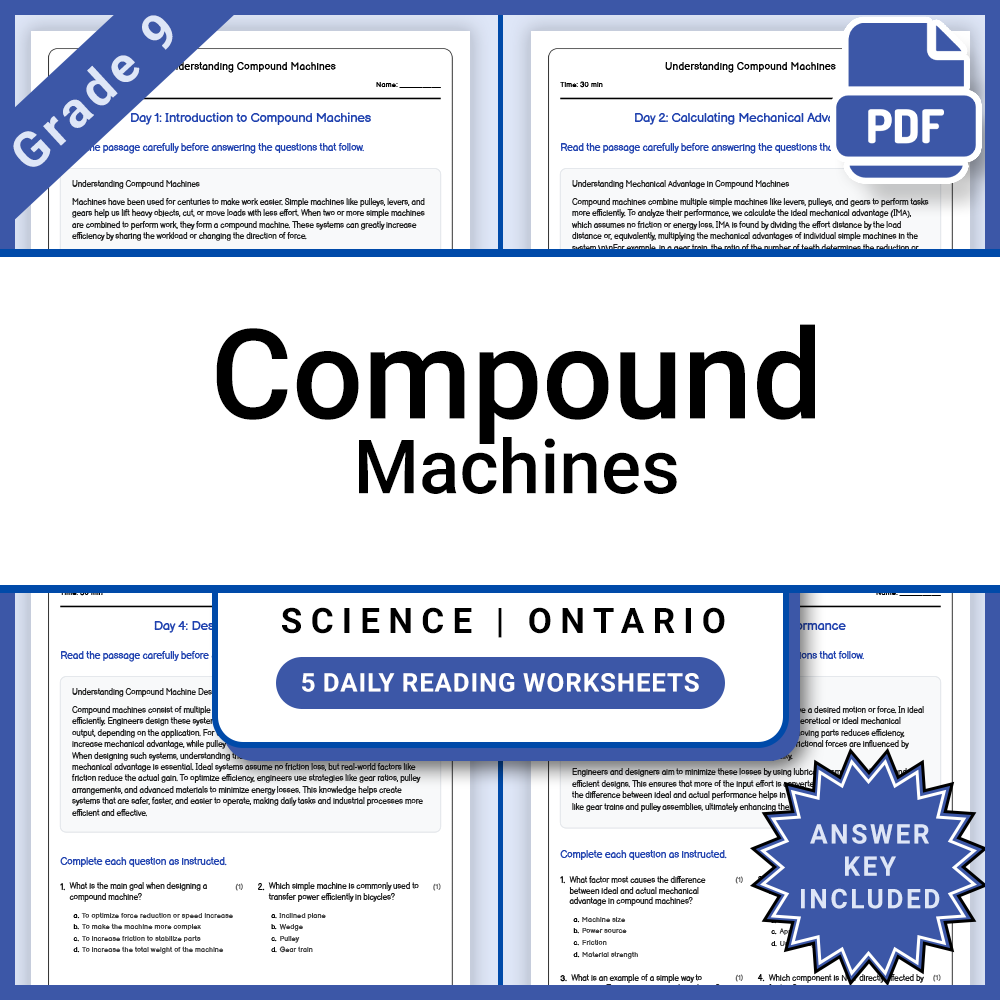
Grade 9 Science – Compound Machines Daily Reading Worksheet with Answer Key
JCreated byJ.S SheetsLearning Objectives
- Understand key concepts related to Science
- Apply knowledge through practice questions
- Demonstrate comprehension of the material
Also included in: Grade 9 Science Lesson Group: Physics and Motion Worksheets Bundle +1 more
Instant download

Grade 9 Science | Lunar Phases Worksheet | BC Aligned
Created byLumora LearningLearning Objectives
- Understand the relationship between the Sun, Earth, and Moon in creating lunar phases.
- Describe the sequence of lunar phases and what causes their appearance.
- Explain how lunar phases influence tides and nocturnal illumination.
Also included in: Grade 9 Science | Earth Systems Unit Bundle | BC Aligned Worksheets
Instant download
About Grade 9 Science Worksheets
Find Science worksheets built for Grade 9. All 6,926 cover core skills, practice, and review, each an instant PDF download.
Every worksheet on MyTeachingSheets is created by independent teacher-authors and reviewed before publication. All resources download as printable PDFs for classroom, homework, or at-home practice, and many include answer keys. Preview any worksheet free before buying.