
Science Worksheets
44,620 subject resources
Science Evidence Argumentation Worksheet Grade 11 | Standards-Aligned Practice
JCreated byJ.S SheetsLearning Objectives
- Explain how scientific evidence supports claims using criteria like consistency, sufficiency, and transparency about assumptions.
- Evaluate competing scientific explanations by comparing predictions and accounting for uncertainties, outliers, and alternative causes.
- Write an evidence-based argument that makes reasoning checkable and allows revisions as new data appear.
Also included in: Grade 11 Scientific Argumentation and Modeling Science Lesson Bundle +1 more
Instant download

Uncertainty Graphs Practice Worksheet | Standards-Aligned Grade 11 Science
JCreated byJ.S SheetsLearning Objectives
- Interpret line graphs and scatter plots that include uncertainty ranges or error bars
- Connect uncertainty (spread and possible measurement error) to statistical comparisons between groups
- Use mean, spread, and correlation ideas to explain trends and relationships in data
Also included in: Grade 11 Scientific Argumentation and Modeling Science Lesson Bundle +1 more
Instant download

Science Worksheet Testable Hypotheses for Grade 11 | Standard Practice
JCreated byJ.S SheetsLearning Objectives
- Distinguish independent variables and dependent variables when forming testable hypotheses.
- Choose appropriate controls and constants to ensure fair scientific tests.
- Explain how outcomes can confirm or refute a hypothesis using evidence from measurements.
Also included in: Grade 11 Scientific Argumentation and Modeling Science Lesson Bundle +1 more
Instant download
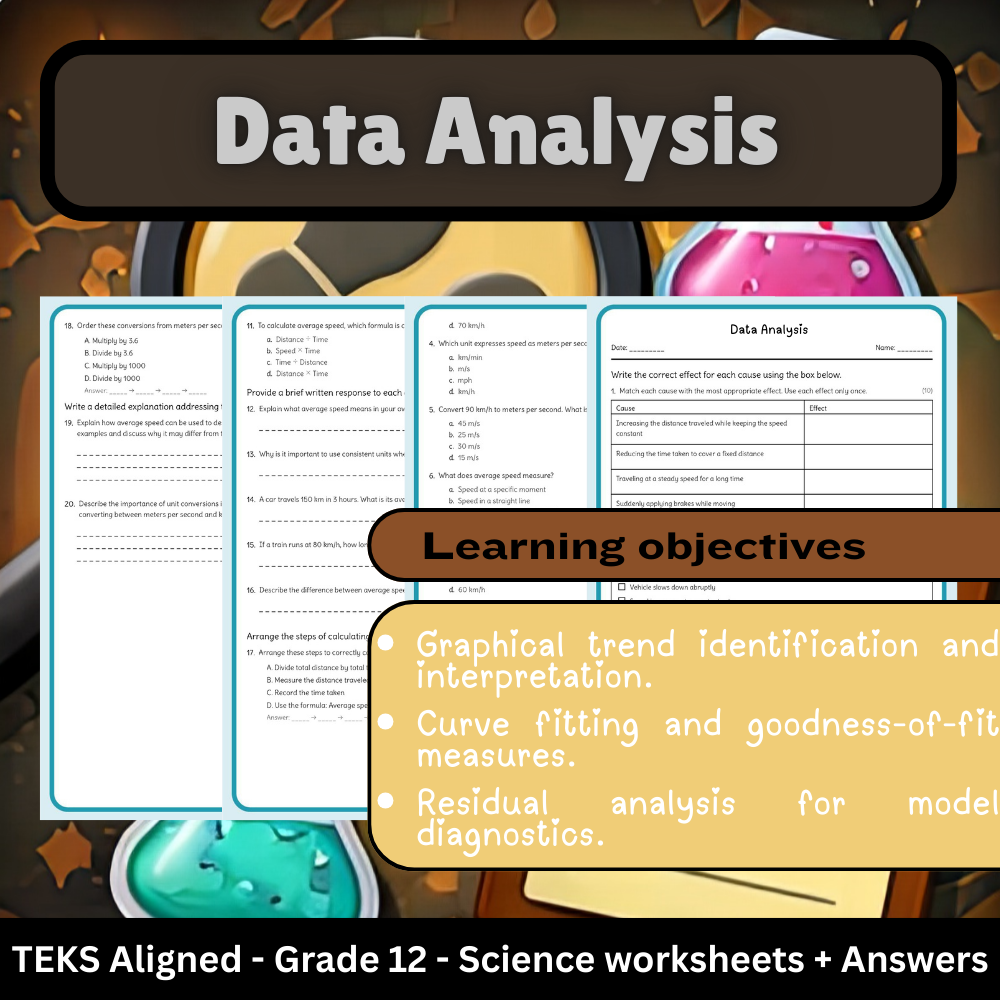
Grade 12 Science | Data Analysis Practice Worksheet (TEKS Standard) PDF
 Created byBright Mind Resources
Learning Objectives
- Interpret data through various graphical representations and identify trends.
- Apply curve fitting and analyze goodness-of-fit measures to evaluate models.
- Assess residuals to diagnose model accuracy and detect anomalies.
Instant download

Population Dynamics Worksheet | Grade 12 Science Activities
 Created byPrism Point Learning
Learning Objectives
- Explain how birth rates, death rates, immigration, and emigration affect population size over time
- Differentiate exponential growth from logistic growth using carrying capacity and limiting resources
- Describe how biotic interactions (predation, competition, mutualism, parasitism) and abiotic factors shape community structure
Also included in: Evolution, Speciation & Genetics Lesson Bundle | Grade 12 Science | BC
Instant download
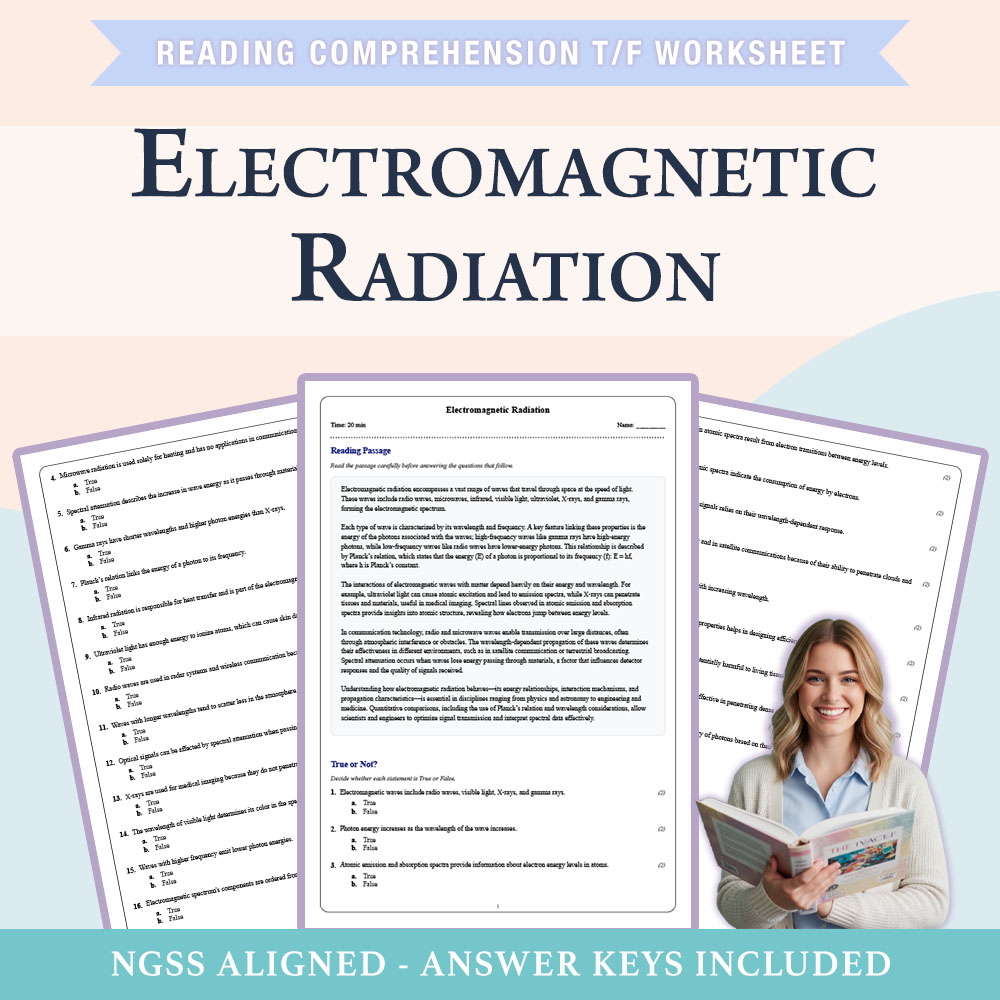
9th Grade Science | Electromagnetic Radiation Worksheet (PDF + Answer Key)
 Created byCopper Leaf Classroom
Learning Objectives
- Understand the spectrum of electromagnetic radiation and its relationship with photon energy.
- Explain how different types of electromagnetic waves interact with matter, including phenomena like atomic emission and absorption.
- Apply Planck’s relation to compare energies and wavelengths across the electromagnetic spectrum.
Also included in: Grade 9 Science Unit| Wave Properties & Electromagnetic Radiation (PDF +Answers) +1 more
Instant download
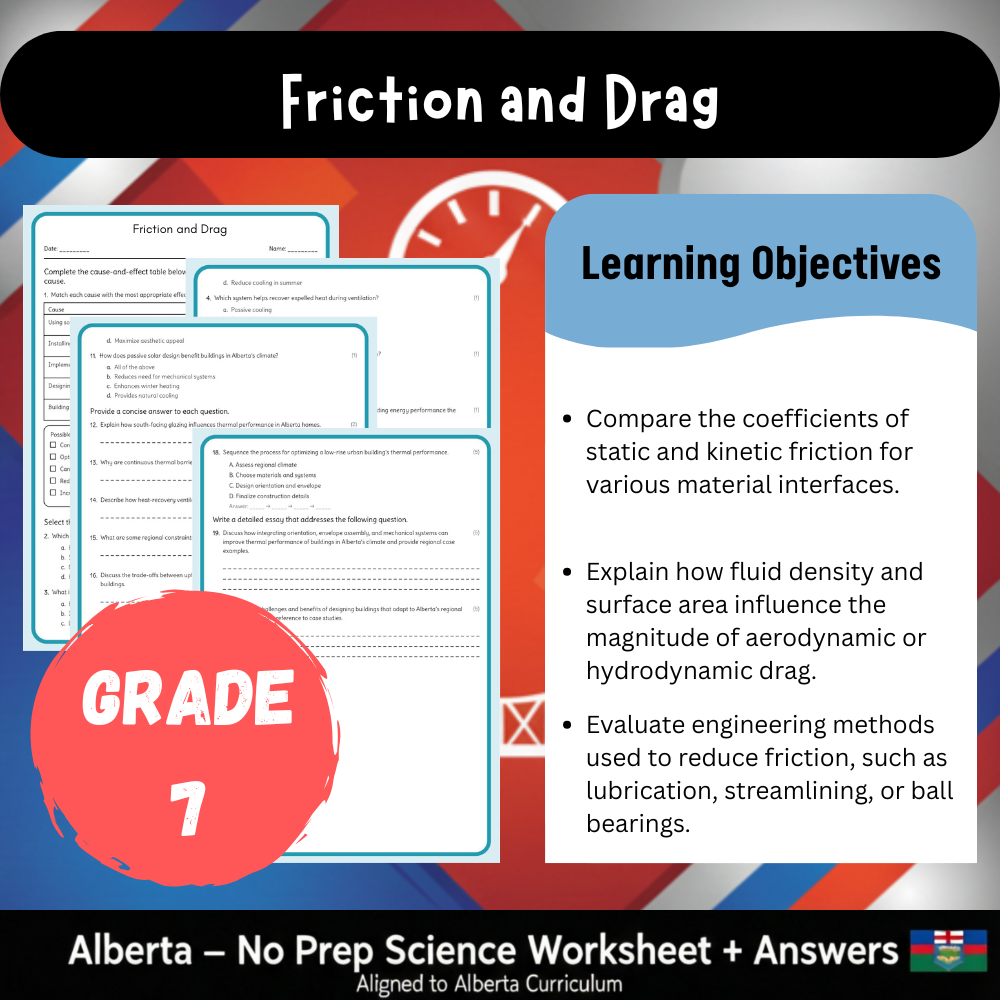
Grade 7 Science | Friction and Drag (Worksheet + Answer Key) – Alberta Standards
Created byBright Mind ResourcesLearning Objectives
- Explain the differences between static and kinetic friction and provide real-world examples.
- Describe how surface texture and normal force affect the magnitude of friction.
- Understand the concept of aerodynamic drag and how it impacts motion, especially in outdoor transportation.
Instant download
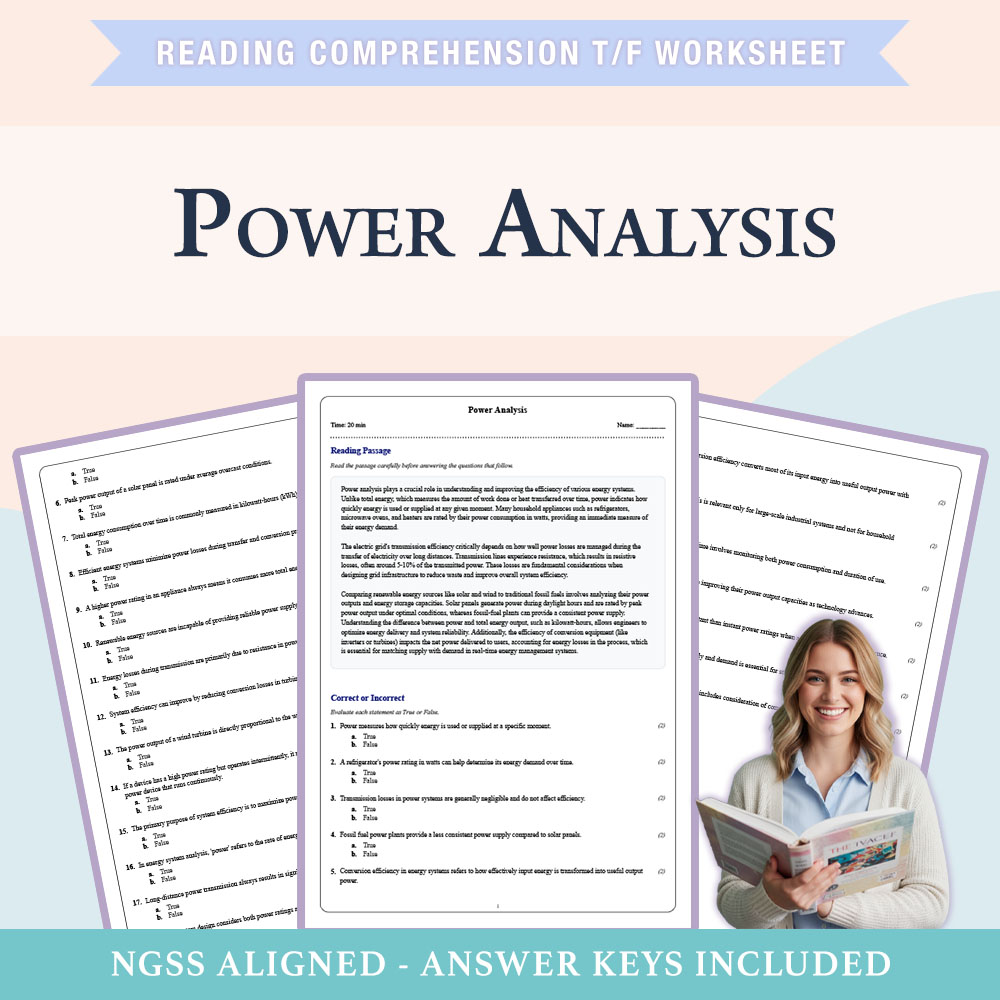
Grade 9 Science | Power Analysis Worksheet (PDF + Answer Key)
Created byCopper Leaf ClassroomLearning Objectives
- Understand the distinction between power and energy in evaluating system performance.
- Learn methods to calculate and compare power consumption and energy demand over time.
- Assess the impacts of efficiency and losses in energy systems such as appliances and grids.
Also included in: Grade 9 Science | Energy & Heat Worksheets Bundle (PDF + Answer Key) +1 more
Instant download

9th Grade Science | Energy Conservation Worksheet (PDF + Answer Key)
Created byCopper Leaf ClassroomLearning Objectives
- Understand the concept of energy conservation within different system boundaries.
- Identify how energy flows between system components and the importance of energy bookkeeping.
- Differentiate between open and closed systems in energy transfer processes.
Also included in: Grade 9 Science | Energy & Heat Worksheets Bundle (PDF + Answer Key) +1 more
Instant download

Grade 5 Ecosystem Components Worksheet | NGSS Practice PDF
 Created byClear Sky Classroom
Learning Objectives
- Identify biotic factors in an ecosystem (producers, consumers, decomposers).
- Identify abiotic factors in an ecosystem (sunlight, water, temperature, soil, air).
- Explain how living and nonliving factors interact to support life in a habitat.
Instant download

Grade 10 TEKS Body Temperature Regulation & Hypothalamus Worksheet
 Created byBRIGHT PATH RESOURCES
Learning Objectives
- Explain how the hypothalamus compares core body temperature to a set point.
- Identify how vasodilation, vasoconstriction, sweating, and shivering help restore thermal equilibrium.
Also included in: Grade 10 Homeostasis & Body Systems Science Worksheets Bundle | TEKS +1 more
Instant download
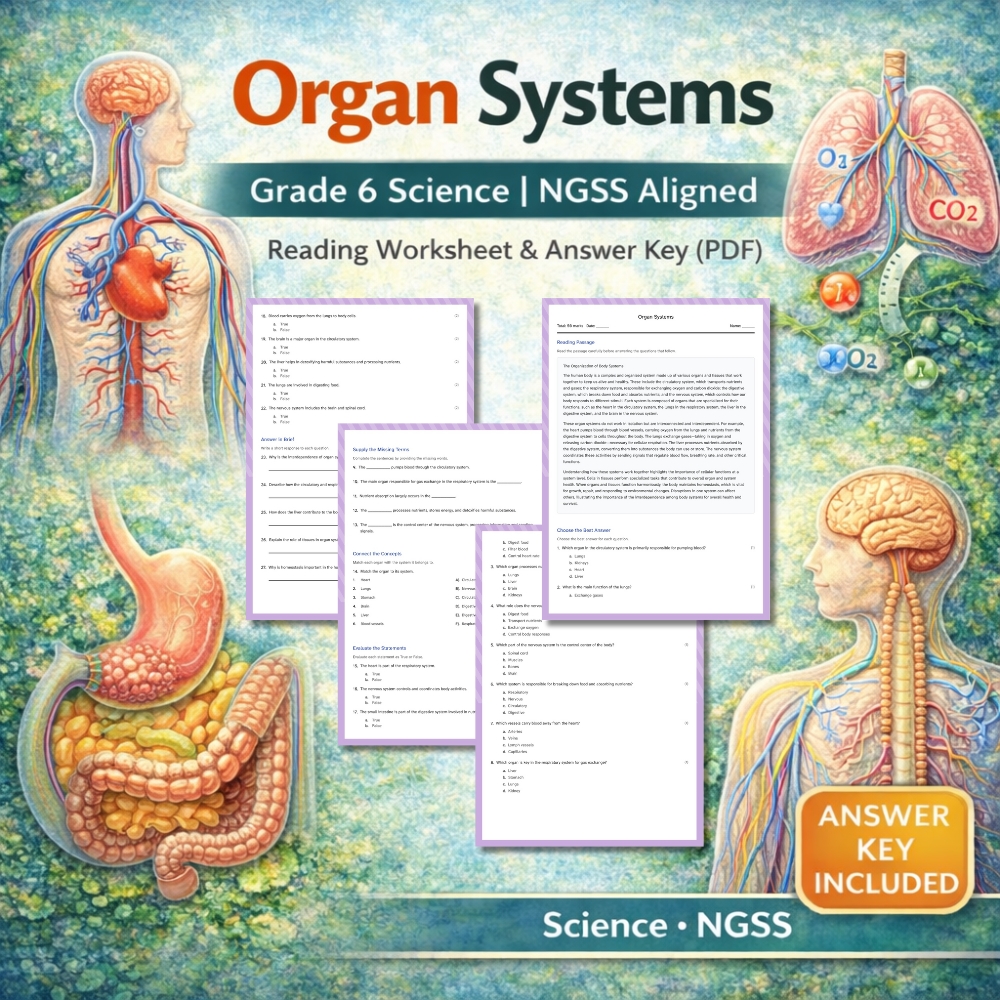
6th Grade Science | Organ Systems | Worksheet & Answer Key | NGSS Standards
 Created byCedar Grove Learning
Learning Objectives
- Identify the main organs involved in the circulatory, respiratory, digestive, and nervous systems.
- Explain how different organ systems interact and depend on each other to maintain body functions.
- Describe how tissues and organs work together to facilitate cellular functions and physiological outcomes.
Also included in: Grade 6 Science Worksheet Bundle | Cell Processes & Systems NGSS(PDF+Answer Key) +1 more
Instant download
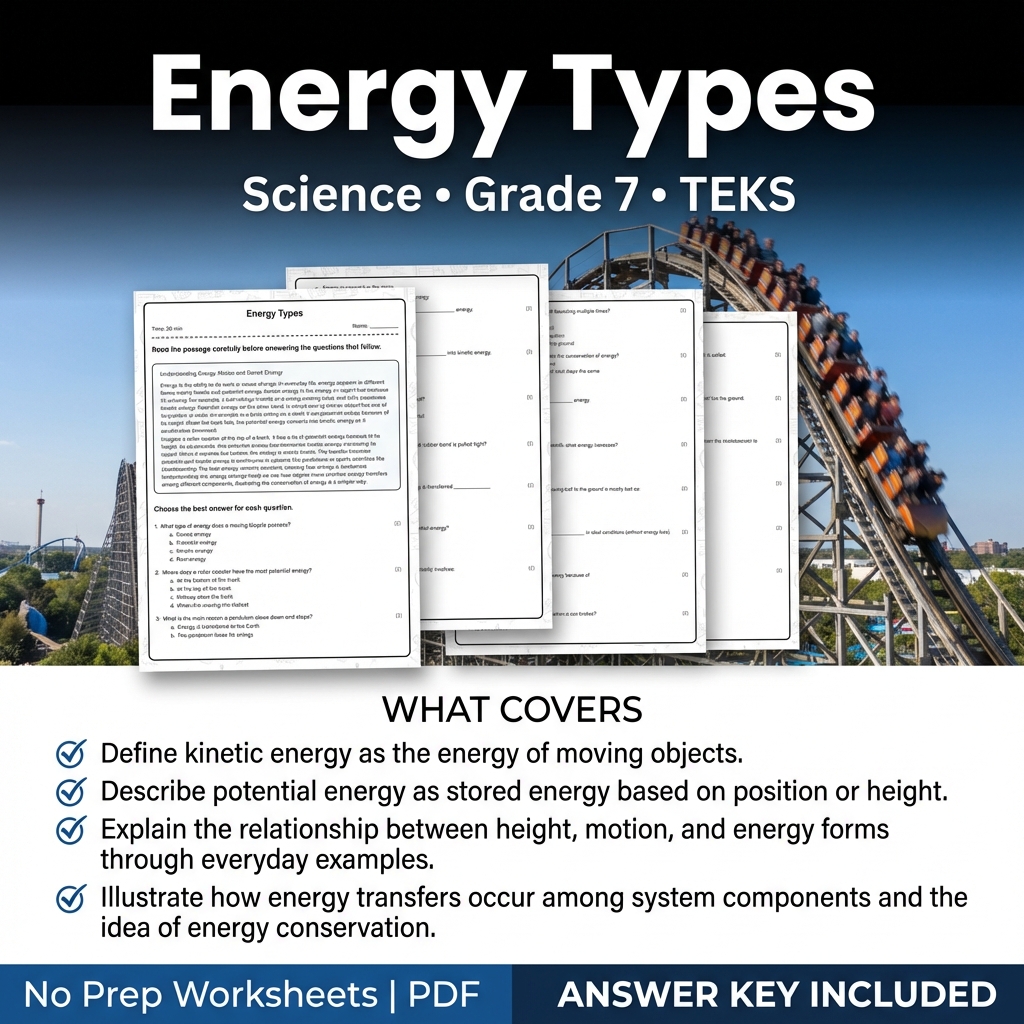
Energy Types Science Worksheet for Grade 7 | TEKS Standards Practice
 Created byCoral Reef Learning
Learning Objectives
- Define kinetic energy as the energy of moving objects.
- Describe potential energy as stored energy based on position or height.
- Explain the relationship between height, motion, and energy forms through everyday examples.
Instant download
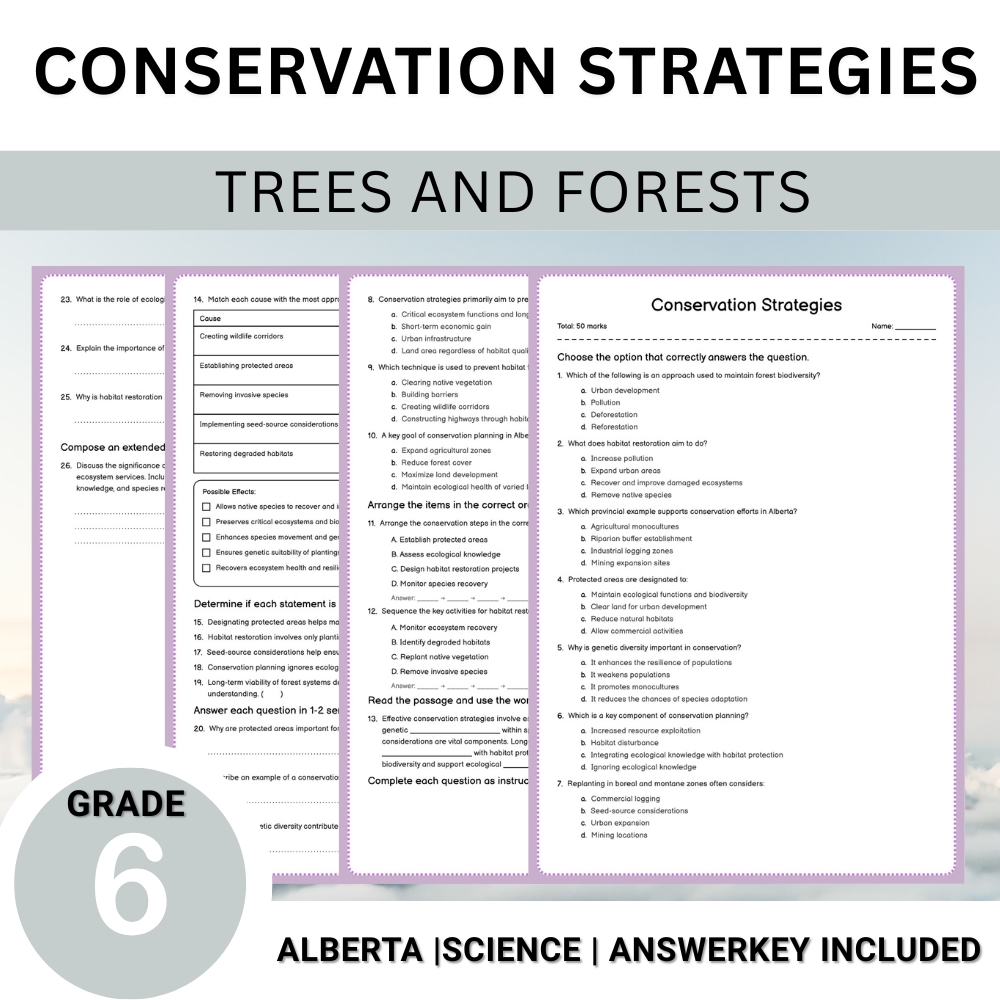
Grade 6 Science | Conservation Strategies Worksheet (Printable PDF + Answer Key)
Learning Objectives
- Identify different conservation strategies used to maintain biodiversity.
- Understand examples of conservation practices in Alberta landscapes.
- Describe the importance of habitat protection and ecological knowledge.
Also included in: Grade 6 Science | Tree Anatomy, Ecology & Conservation Unit Worksheet Bundle +1 more
Instant download

Grade 10 Projectile Motion Worksheet | BC Practice & PDF
Created byClear Sky ClassroomLearning Objectives
- Explain how projectile motion separates into independent horizontal and vertical components.
- Use kinematics relationships to predict time of flight, range, and maximum height for a projectile.
- Interpret motion graphs or descriptions using constant horizontal velocity and constant vertical acceleration due to gravity.
Instant download

Bond Polarity Worksheet | AP Science Practice for Grade 10
JCreated byJ.S SheetsLearning Objectives
- Understand how electronegativity differences influence bond polarity.
- Interpret dipole moment representations and their vector analysis.
- Differentiate between polar covalent and ionic bonds on a continuum.
Also included in: Grade 10 Chemistry Lesson Bundle – AP Chemistry Concepts & Practice
Instant download

6th Grade Science | Variables Worksheet (Alberta Standards) (PDF)
 Created bySilver Birch Teaching
Learning Objectives
- Identify independent, dependent, and controlled variables in science investigations
- Use operational definitions and consistent measurement intervals to collect reliable data
- Explain why controls must be held constant to see true patterns in results
Also included in: Grade 6 Scientific Inquiry & Data Analysis Science Lesson Bundle: Alberta +1 more
Instant download
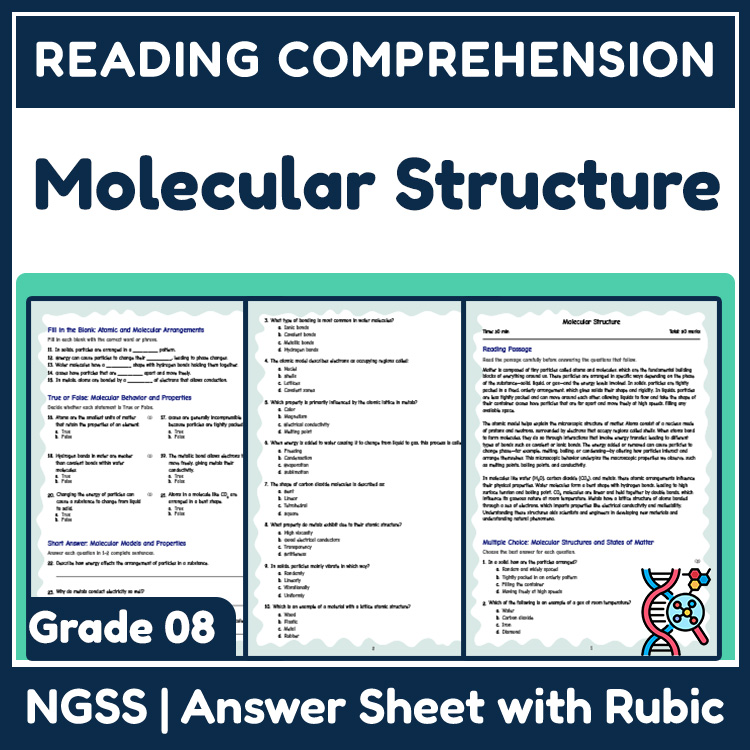
8th Grade Science | Molecular Structure Reading Worksheets (NGSS Aligned)
JCreated byJ.S SheetsLearning Objectives
- Understand how atoms and molecules make up matter in different states
- Describe how energy influences particle arrangement and bonding
- Connect microscopic atomic interactions to macroscopic properties of solids, liquids, and gases
Instant download

Grade 4 Lever Basics Worksheet | Practice & Assessment PDF
Created byClear Sky ClassroomLearning Objectives
- Identify the fulcrum, input arm, and output arm in common lever examples (seesaw, wheelbarrow, tweezers).
- Classify levers into first-, second-, and third-class based on fulcrum, load, and effort positions.
- Explain how input force, output force, and mechanical advantage are related to arm lengths.
Instant download

Grade 10 Science | Plate Narratives Worksheet | AP Aligned
 Created byLumora Learning
Learning Objectives
- Explain the mechanisms of plate motion, mantle convection, and subduction.
- Interpret tectonic settings using maps, cross-sections, and seismic evidence.
- Connect plate interactions to mountain building, volcanism, and earthquake distribution.
Instant download

Grade 10 Science | Human Footprints Worksheet | AP Science
Created byLumora LearningLearning Objectives
- Understand how human activities alter Earth systems through land-use change, emissions, and resource extraction.
- Analyze the observable environmental consequences of anthropogenic forcing such as soil degradation and coastal subsidence.
- Interpret emission inventories, land-cover time series, and system diagrams to quantify perturbations to Earth's cycles.
Instant download

Grade 8 Organ Systems Survival Worksheet | NGSS Practice PDF
Created byClear Sky ClassroomLearning Objectives
- Explain how organ systems support survival needs such as nutrient distribution, gas exchange, water balance, and movement of materials
- Describe how structure and function at the organ level help organisms maintain stable internal conditions for metabolism and growth
- Use evidence to interpret how systems work together to respond to changing environments
Instant download
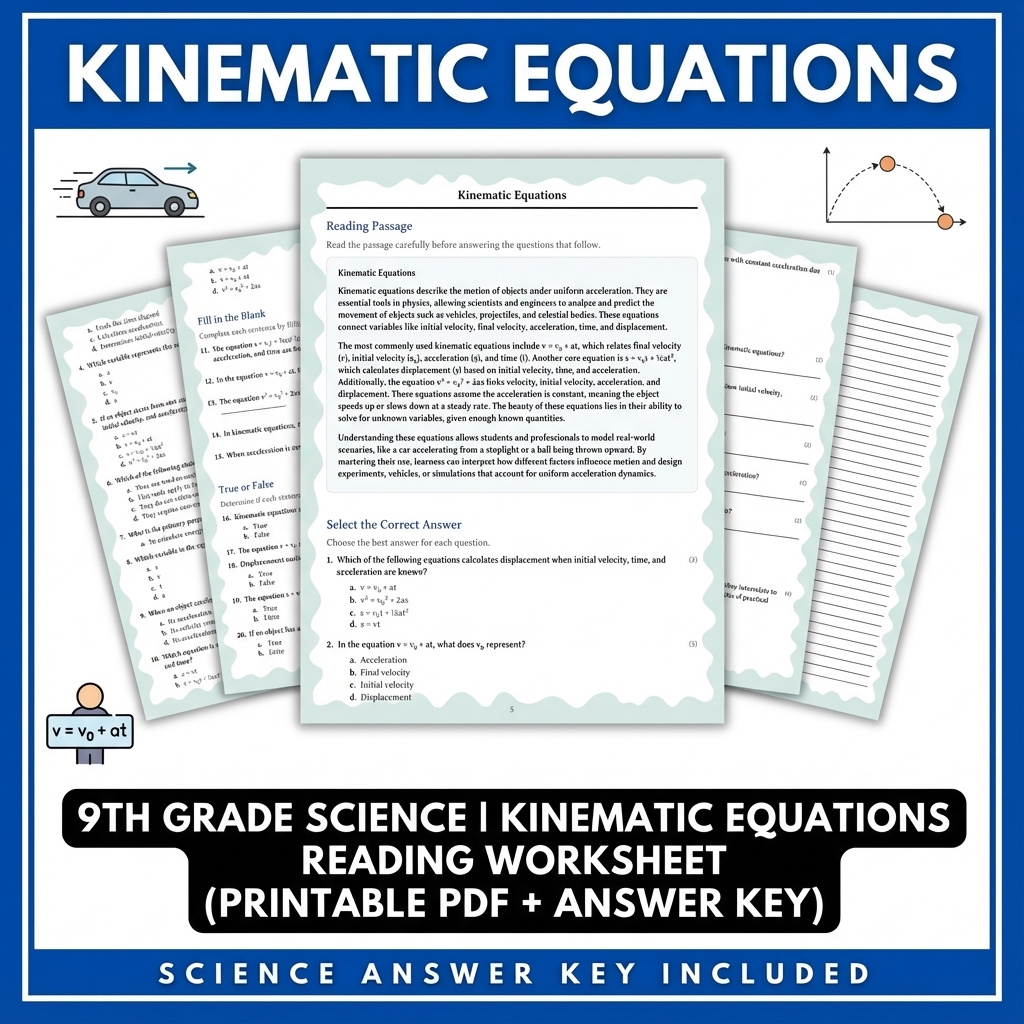
9th Grade Science | Kinematic Equations Reading Worksheet (PDF + Answer Key)
JCreated byJ.S SheetsLearning Objectives
- Understand the basic form and components of kinematic equations.
- Apply kinematic equations to solve for distance, velocity, and acceleration.
- Interpret real-world problems involving motion using the equations.
Also included in: Grade 9 Science Unit | Force, Motion & Energy Worksheets & Answer Keys Bundle +1 more
Instant download
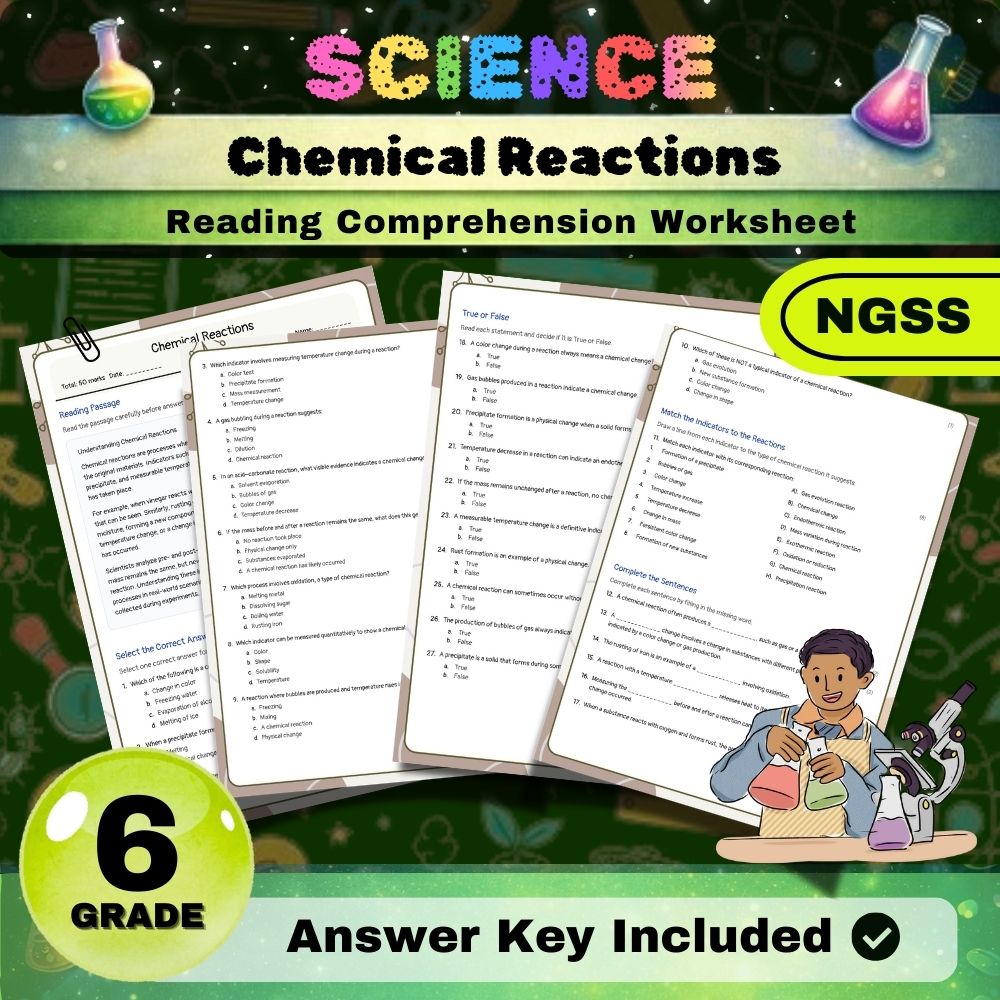
6th Grade Science – Chemical Reactions Worksheet (PDF) NGSS
 Created byMaple Path Learning
Learning Objectives
- Identify key indicators of chemical reactions through data analysis.
- Distinguish between physical and chemical changes using qualitative and quantitative evidence.
- Interpret pre- and post-interaction measurements to determine if a chemical reaction has occurred.
Also included in: Grade 6 Science| Matter, Chemical Reactions & Conservation NGSS Worksheet Bundle +1 more
Instant download

Grade 6 Population Change Worksheet | California Science Resource & Answer Key
 Created byEvergreen Desk Education
Learning Objectives
- Explain how birth rates, death rates, and resource availability can change a population over time.
- Interpret population data to infer whether a population is increasing or decreasing.
- Connect seasonal or habitat resource changes to real patterns in population counts.
Instant download
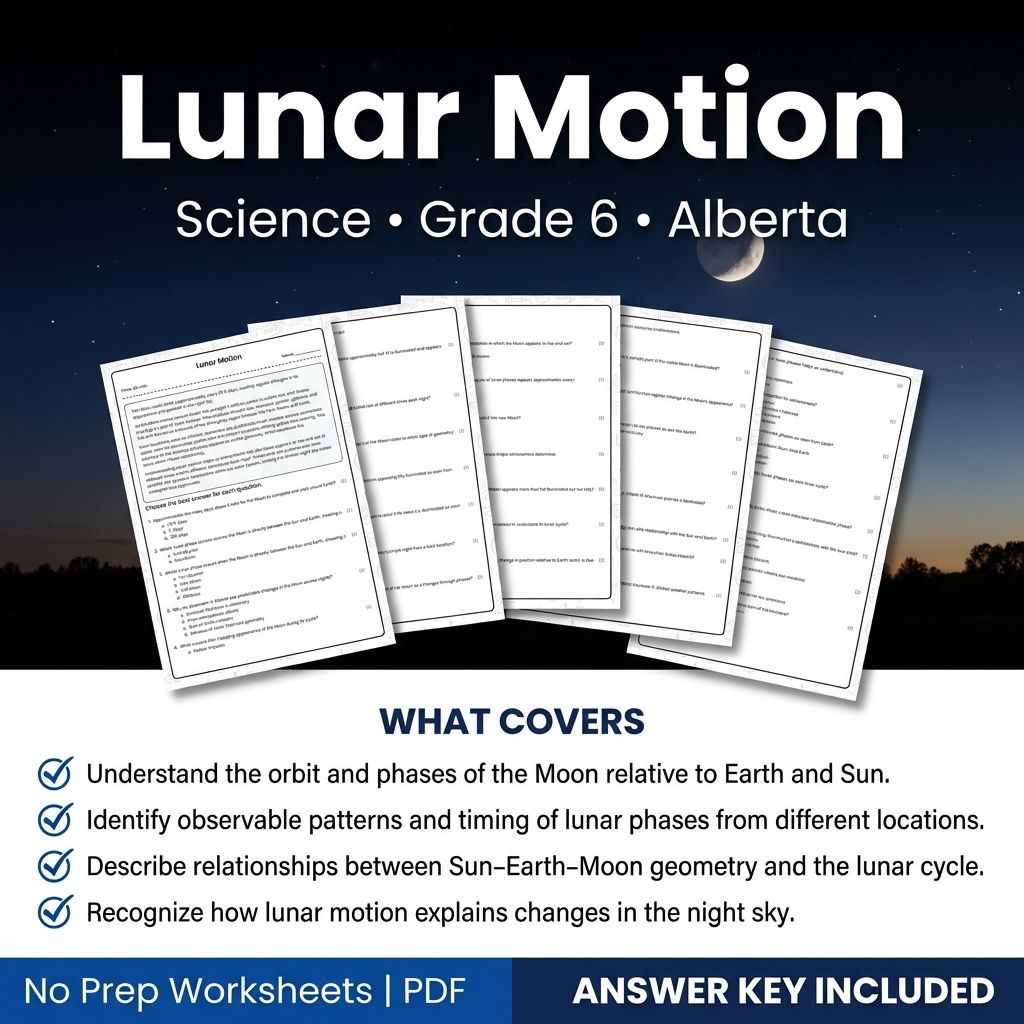
Grade 6 Science Worksheet on Lunar Motion | Alberta Standards
Created byCoral Reef LearningLearning Objectives
- Understand the orbit and phases of the Moon relative to Earth and Sun.
- Identify observable patterns and timing of lunar phases from different locations.
- Describe relationships between Sun–Earth–Moon geometry and the lunar cycle.
Instant download
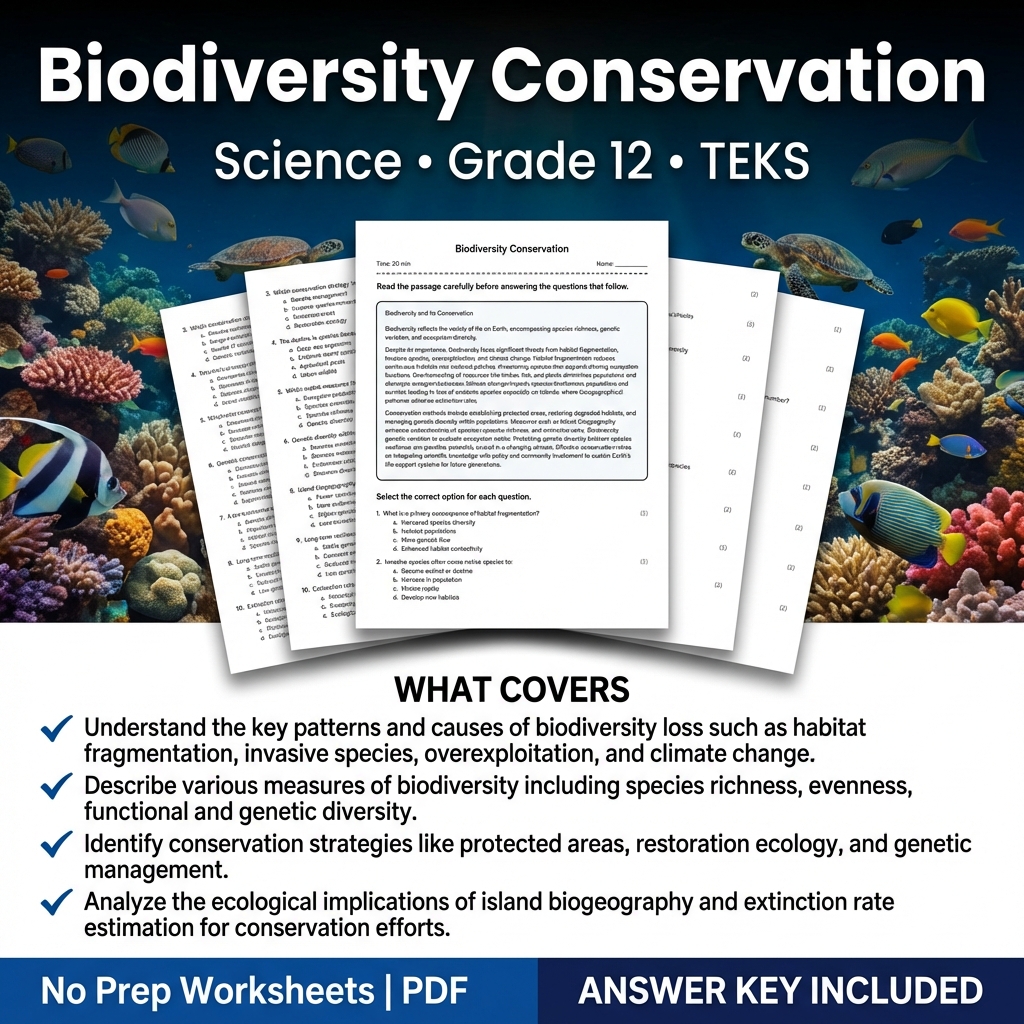
Grade 12 Science Worksheet on Biodiversity Conservation | TEKS Standard
Created byCoral Reef LearningLearning Objectives
- Understand the key patterns and causes of biodiversity loss such as habitat fragmentation, invasive species, overexploitation, and climate change.
- Describe various measures of biodiversity including species richness, evenness, functional and genetic diversity.
- Identify conservation strategies like protected areas, restoration ecology, and genetic management.
Instant download
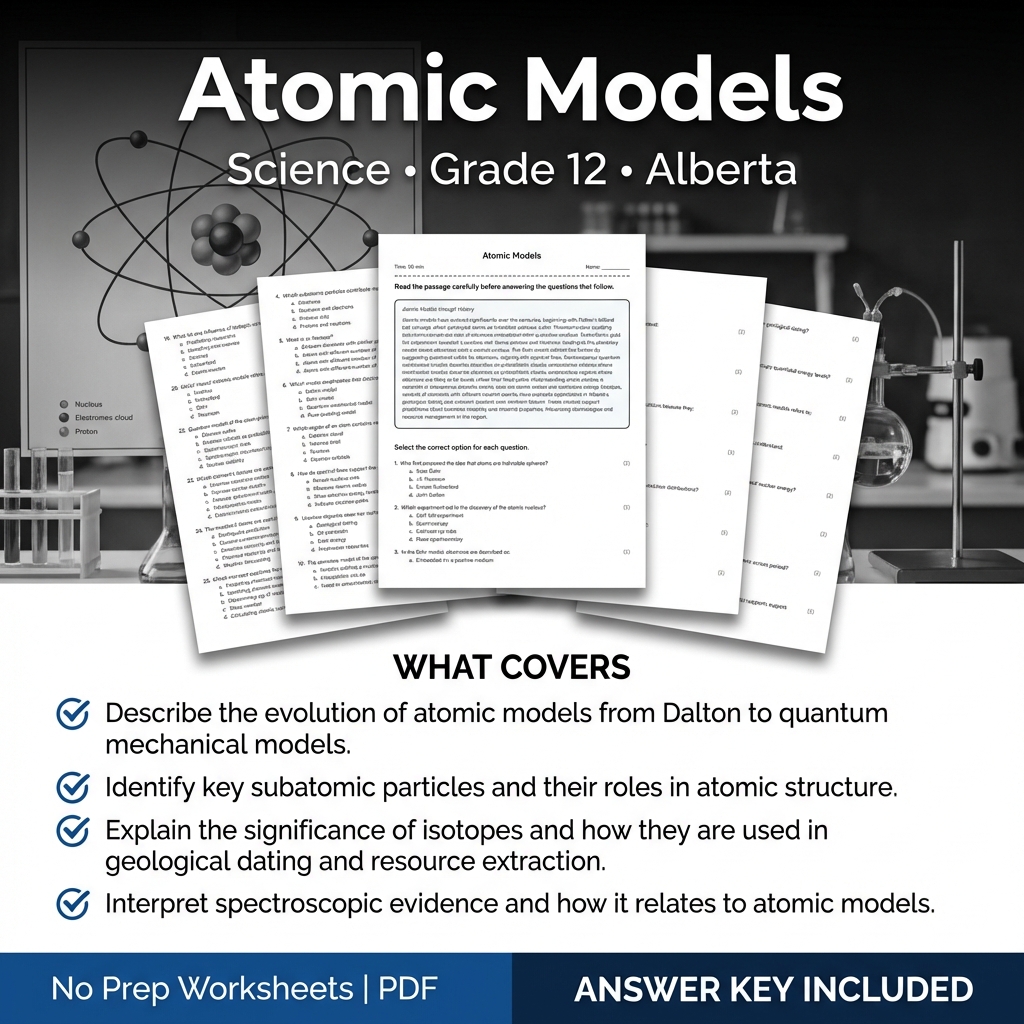
Grade 12 Science Worksheet on Atomic Models | Alberta Standards
Created byCoral Reef LearningLearning Objectives
- Describe the evolution of atomic models from Dalton to quantum mechanical models.
- Identify key subatomic particles and their roles in atomic structure.
- Explain the significance of isotopes and how they are used in geological dating and resource extraction.
Instant download
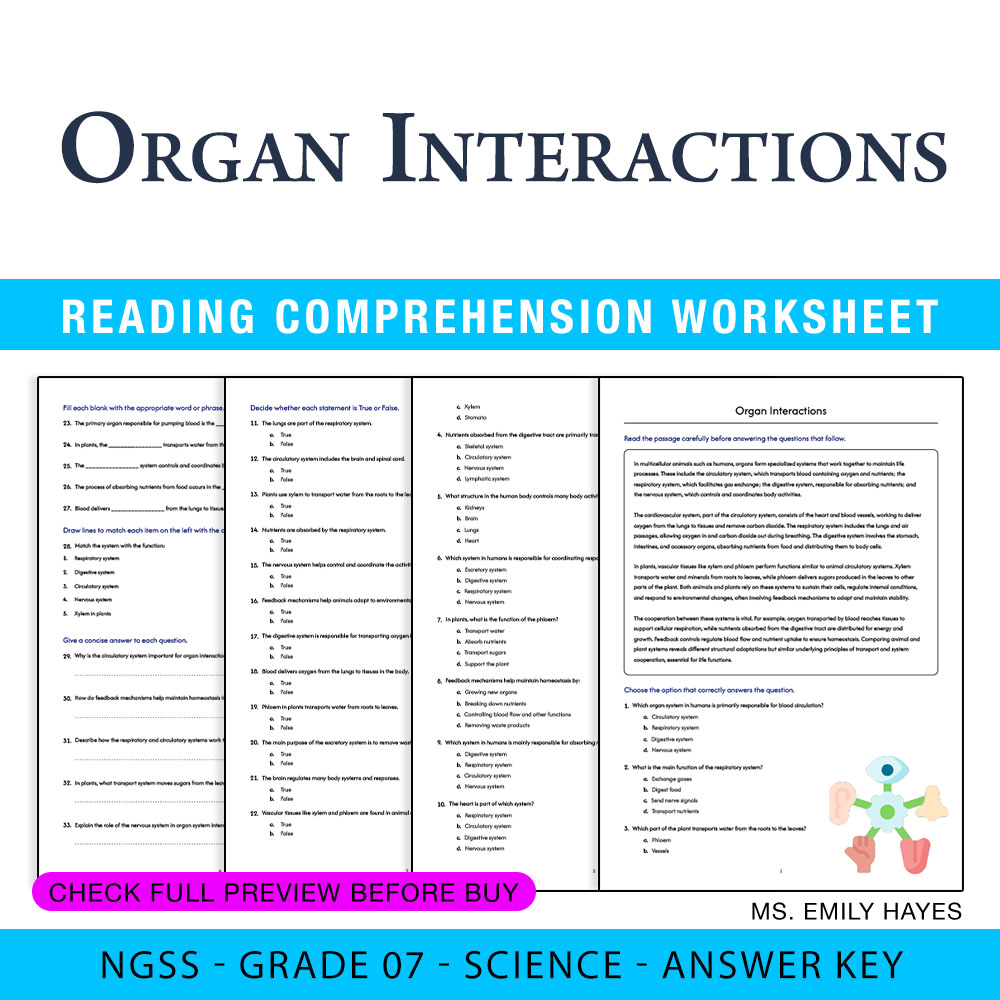
7th Grade Science | Organ Interactions Worksheet (PDF + Answer Key)
Created byCopper Leaf ClassroomLearning Objectives
- Describe the functions of the circulatory, respiratory, digestive, and nervous systems in multicellular animals.
- Explain how organ systems cooperate to support gas exchange, nutrient distribution, and homeostasis.
- Identify examples of system-level dependencies and feedback mechanisms in animal and plant systems.
Instant download

Solar System Worksheet | Grade 8 Science Activities
Created byPrism Point LearningLearning Objectives
- Explain the major parts of the solar system, including the Sun, planets, dwarf planets, moons, asteroids, and comets.
- Describe how gravity and solar energy influence orbits, planetary environments, and atmospheric conditions.
- Use evidence from telescopes and spacecraft to support basic claims about the solar system.
Also included in: Grade 8 Earth and Space Science Lesson Bundle for TEKS Worksheets +1 more
Instant download

Grade 7 Science | Conservation Status Worksheet (PDF) – Alberta Standards
Created bySilver Birch TeachingLearning Objectives
- Explain how conservation status assessments combine population trends, threat severity, and recovery potential to estimate risk
- Identify how land use, genetic diversity, and habitat connectivity can increase or decrease vulnerability
- Interpret evidence used in conservation status and describe how results can guide regional priorities
Also included in: Grade 7 Ecosystems & Biodiversity Science Lesson Bundle for Alberta Framework +1 more
Instant download
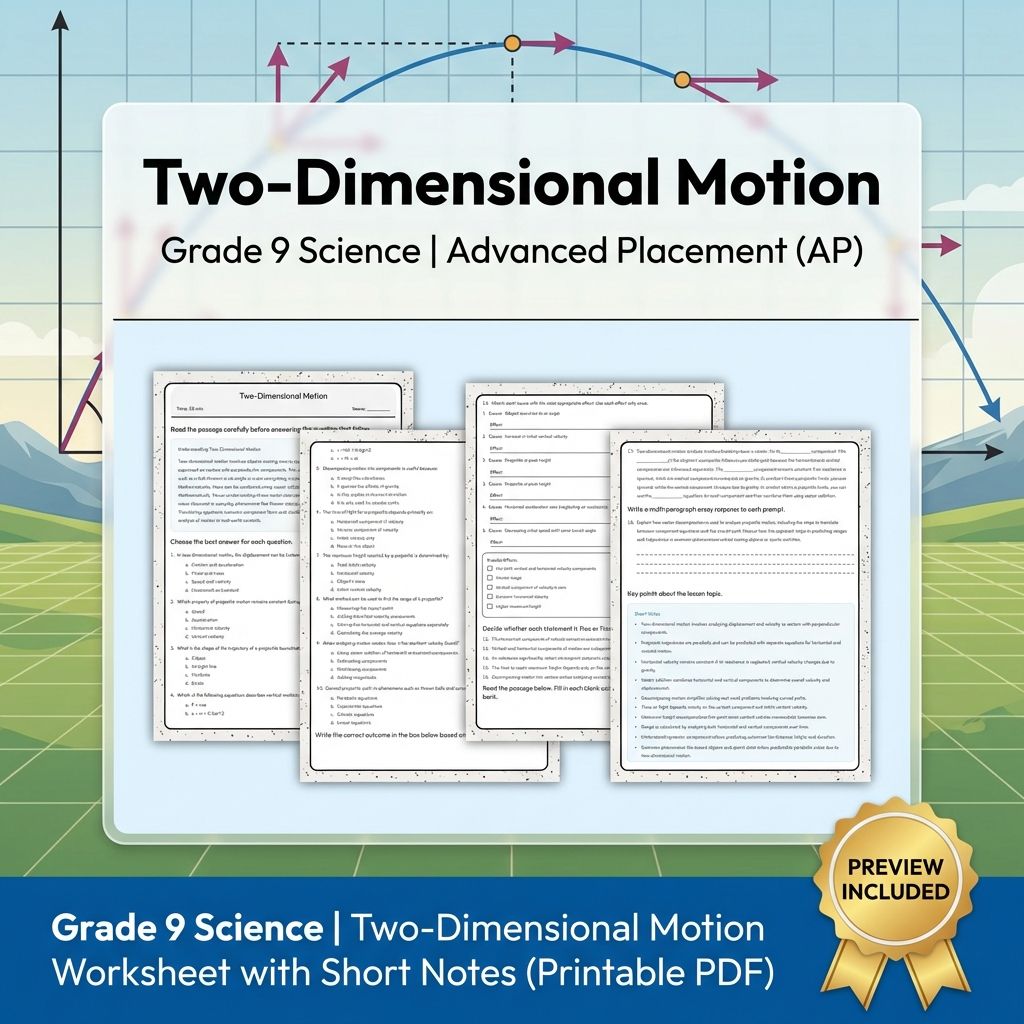
Grade 9 Science | Two-Dimensional Motion Worksheet with Short Notes (PDF)
 Created byMeadowlark Worksheets
Learning Objectives
- Understand the principles of motion in a plane using vector components.
- Explain how projectile trajectories can be predicted through vector decomposition.
- Translate between component equations and overall motion in two dimensions.
Also included in: Grade 9 Science Motion & Force Unit Worksheet Bundle (PDF Download) +1 more
Instant download
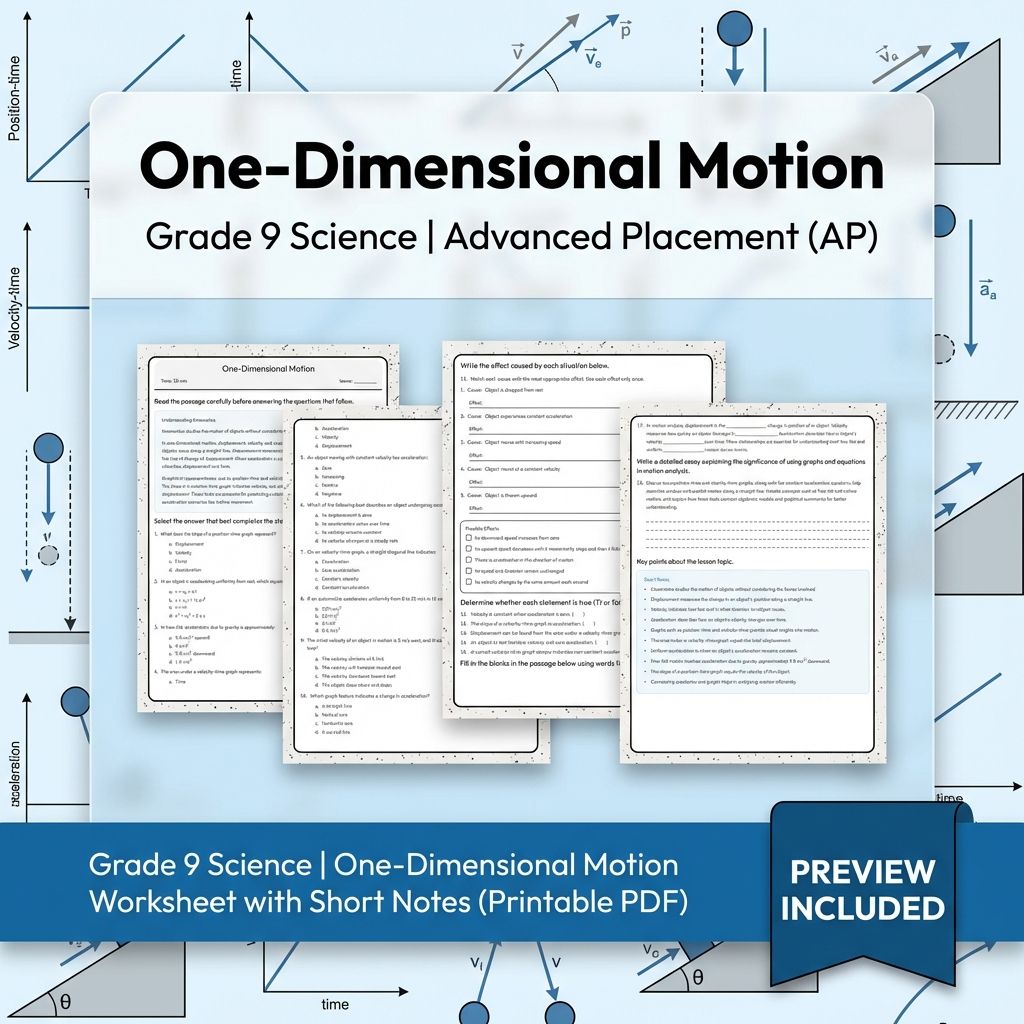
Grade 9 Science | One-Dimensional Motion Worksheet with Short Notes (PDF)
Created byMeadowlark WorksheetsLearning Objectives
- Understand the fundamental relationships among displacement, velocity, and acceleration in straight-line motion.
- Interpret position–time and velocity–time graphs to analyze motion patterns.
- Apply constant-acceleration equations to solve kinematic problems.
Also included in: Grade 9 Science Motion & Force Unit Worksheet Bundle (PDF Download) +1 more
Instant download
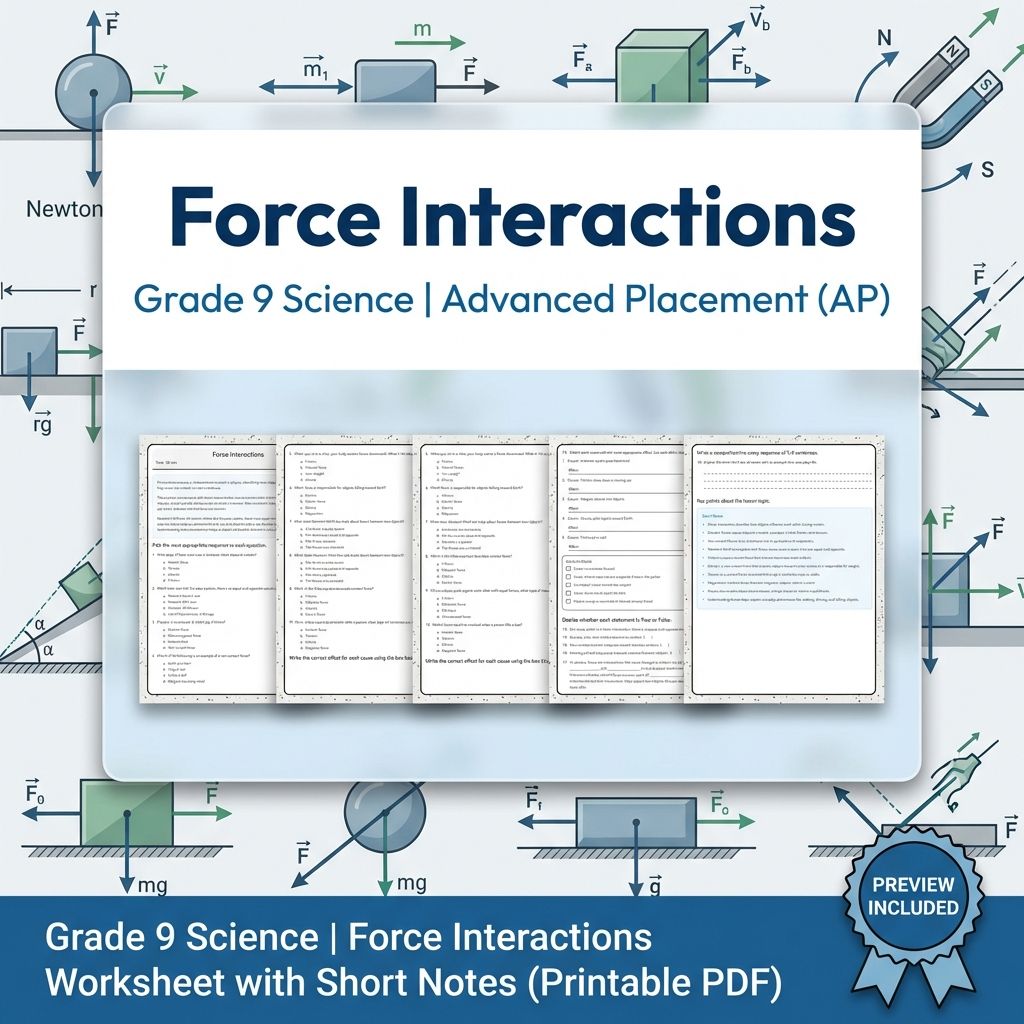
Grade 9 Science | Force Interactions Worksheet with Short Notes (Printable PDF)
Created byMeadowlark WorksheetsLearning Objectives
- Understand the different types of force interactions in physics.
- Identify examples of forces and their effects.
- Explain Newton's third law of motion.
Also included in: Grade 9 Science Motion & Force Unit Worksheet Bundle (PDF Download) +1 more
Instant download

Grade 11 Science | Basic Circuits Worksheet | AP Aligned
Created byLumora LearningLearning Objectives
- Understand the fundamental concepts of electric potential difference, current, resistance, and energy transfer in DC circuits.
- Apply Ohm’s law and Kirchhoff’s rules to analyze series and parallel circuits.
- Calculate power dissipation and energy transfer in simple electrical systems.
Also included in: Grade 11 Science | Physics Principles Science Custom Bundle | AP-Aligned
Instant download

Grade 12 Science | Electricity and Power - Daily Reading Comprehension
Created byCoral Reef LearningLearning Objectives
- Understand the relationship between voltage, current, and power in resistive circuits
- Calculate power dissipation in resistive elements
- Analyze power delivery from electrical sources including internal resistance effects
Also included in: Daily Reading Comprehension Skills Lesson Bundle | Grade 12 Science AP +1 more
Instant download

Grade 12 Science | Force Interactions in Physics - Daily Reading Comprehension
Created byCoral Reef LearningLearning Objectives
- Understand key concepts related to Science
- Apply knowledge through practice questions
- Demonstrate comprehension of the material
Also included in: Daily Reading Comprehension Skills Lesson Bundle | Grade 12 Science AP +1 more
Instant download

Grade 7 Science | Cell Communication Worksheet (BC Standards) (PDF)
Created byEvergreen Desk EducationLearning Objectives
- Explain how cells communicate using chemical and electrical signals.
- Describe how receptor proteins and signal pathways can change metabolism and gene expression.
- Compare gap junctions and plasmodesmata as direct cell-to-cell connections.
Instant download
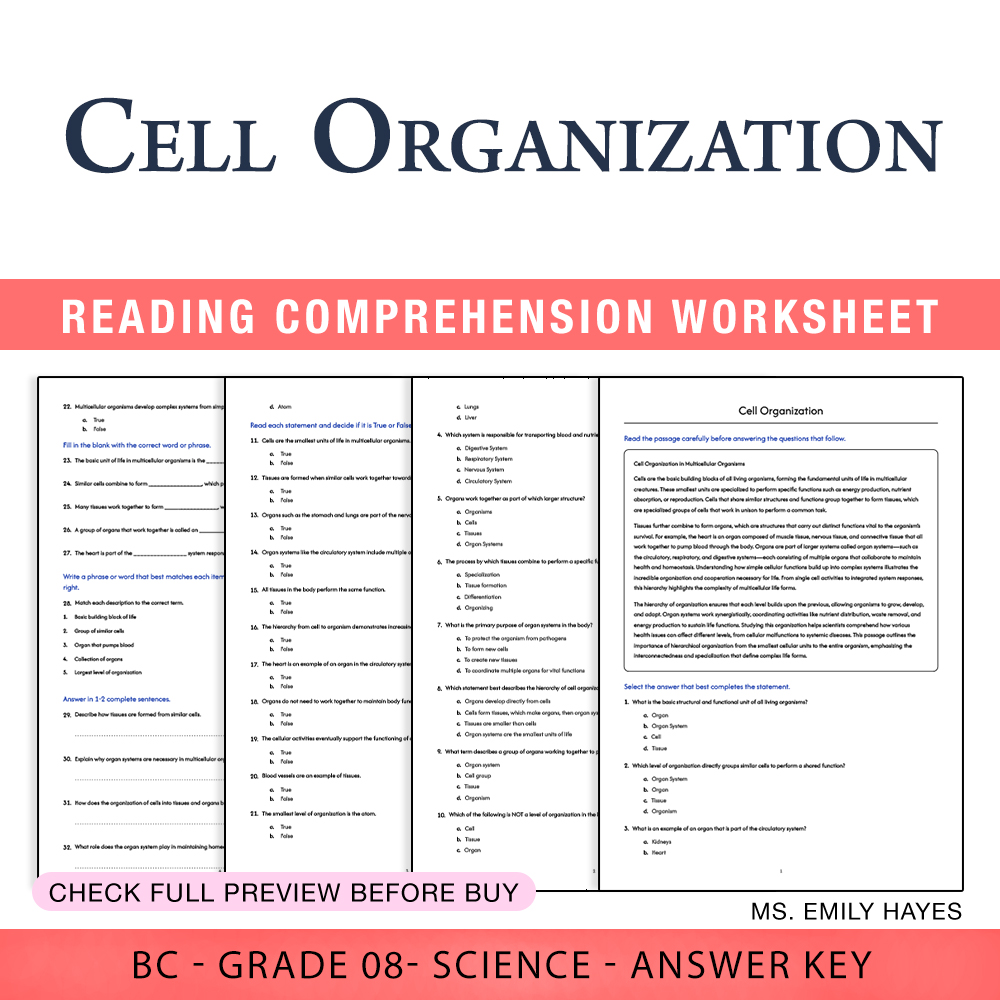
8th Grade Science | Cell Organization Worksheet (PDF+ Answer Key)
Created byCopper Leaf ClassroomLearning Objectives
- Understand the hierarchical levels of cell organization in multicellular organisms.
- Identify how cells assemble into tissues, organs, and organ systems.
- Explain the function of each level of organization from cells to organismal systems.
Also included in: Grade 8 Science Bundle – Cell Structure, Systems & Organisms (PDF + Answer Key) +1 more
Instant download
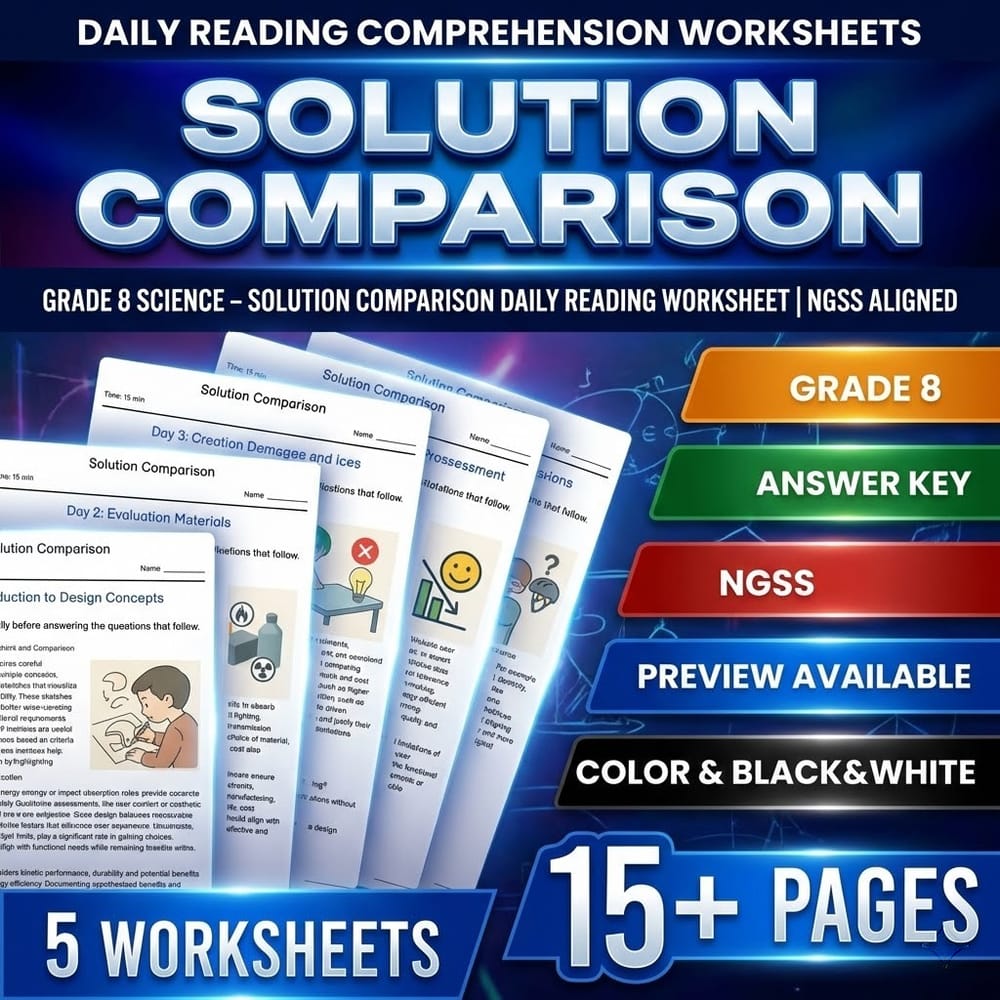
Grade 8 Science – Solution Comparison Daily Reading Worksheet | NGSS Aligned
 Created byElena Brooks
Learning Objectives
- Understand the principles of designing and evaluating solutions based on criteria and constraints.
- Learn how to develop and interpret sketches, trade-off matrices, and assessment indicators.
- Differentiate between qualitative and quantitative evaluations of solutions.
Instant download

Grade 9 Science | Systems Thinking Worksheet | California Standards
Created byLumora LearningLearning Objectives
- Explain how a design functions as part of a larger system using matter, energy, and information flows
- Identify feedback and unintended effects that can occur when system components interact
- Use systems thinking to evaluate boundary conditions and how system behavior changes over time
Instant download
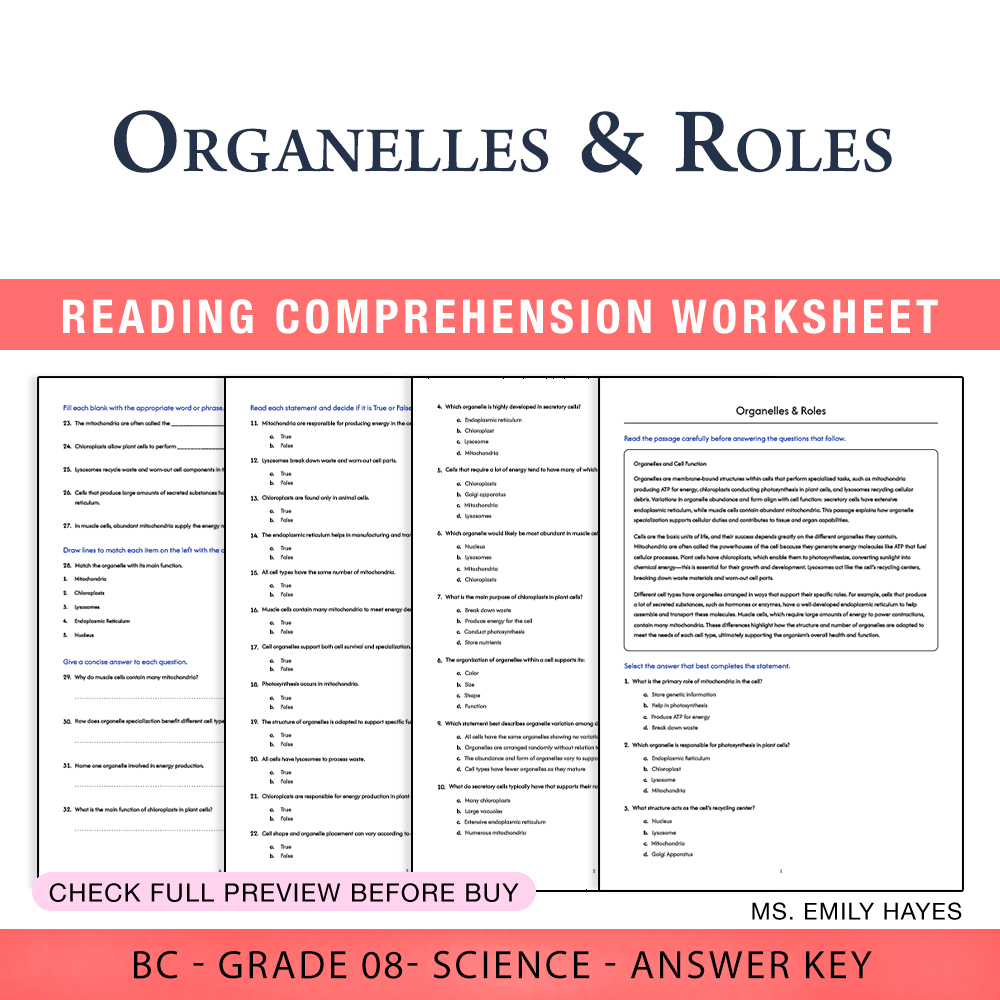
8th Grade Science | Organelles & Roles Worksheet (PDF+ Answer Key)
Created byCopper Leaf ClassroomLearning Objectives
- Understand the structure and functions of different cell organelles.
- Explain how organelle specialization supports cell and tissue functions.
- Describe variations in organelle abundance related to cell types.
Also included in: Grade 8 Science Bundle – Cell Structure, Systems & Organisms (PDF + Answer Key) +1 more
Instant download
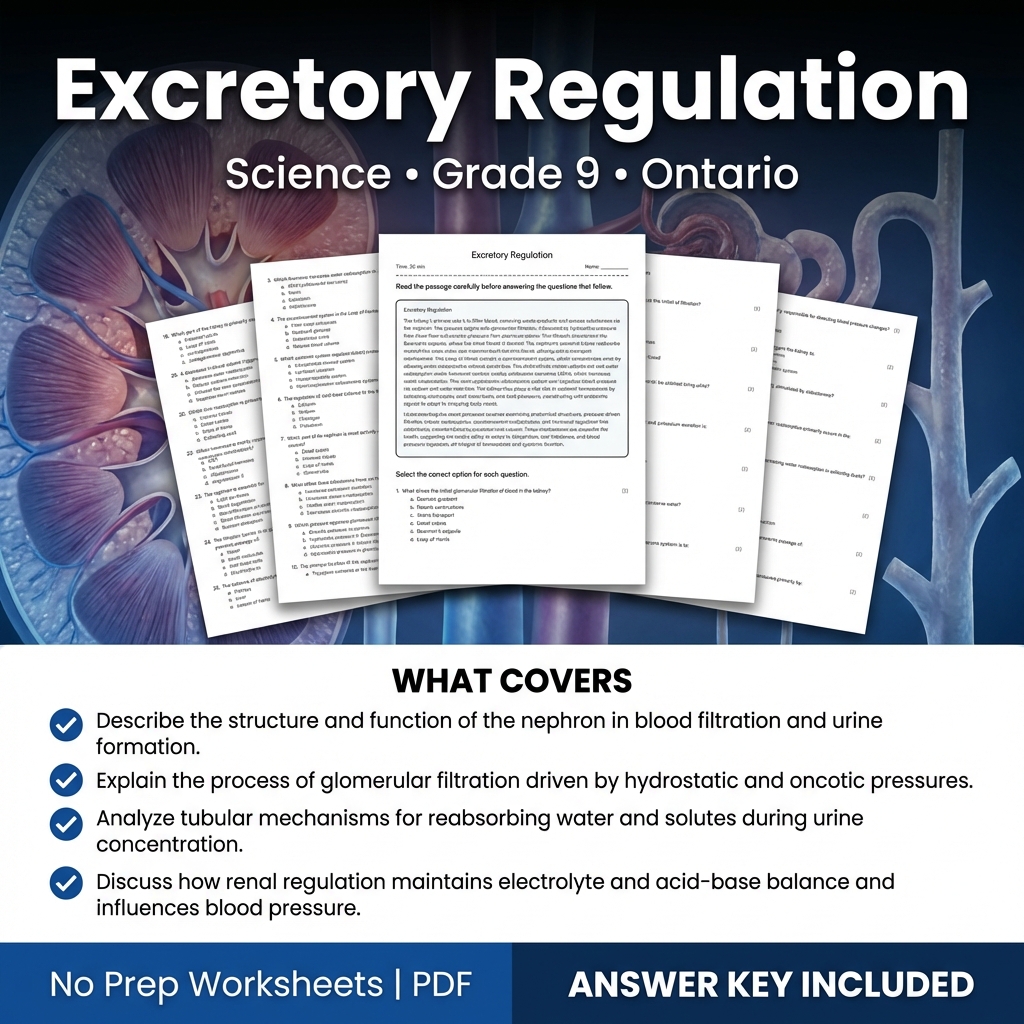
Grade 9 Science Worksheet on Excretory Regulation | Ontario Standards
Created byCoral Reef LearningLearning Objectives
- Describe the structure and function of the nephron in blood filtration and urine formation.
- Explain the process of glomerular filtration driven by hydrostatic and oncotic pressures.
- Analyze tubular mechanisms for reabsorbing water and solutes during urine concentration.
Instant download

Graphical Reasoning Worksheet for Grade 8 Science | TEKS-Aligned Practice
JCreated byJ.S SheetsLearning Objectives
- Interpret the meaning of slope and area under a curve on common science graphs
- Translate information between equations, data tables, and graphs to explain trends
- Use units, scales, and domain limits to make sound graphical inferences
Instant download
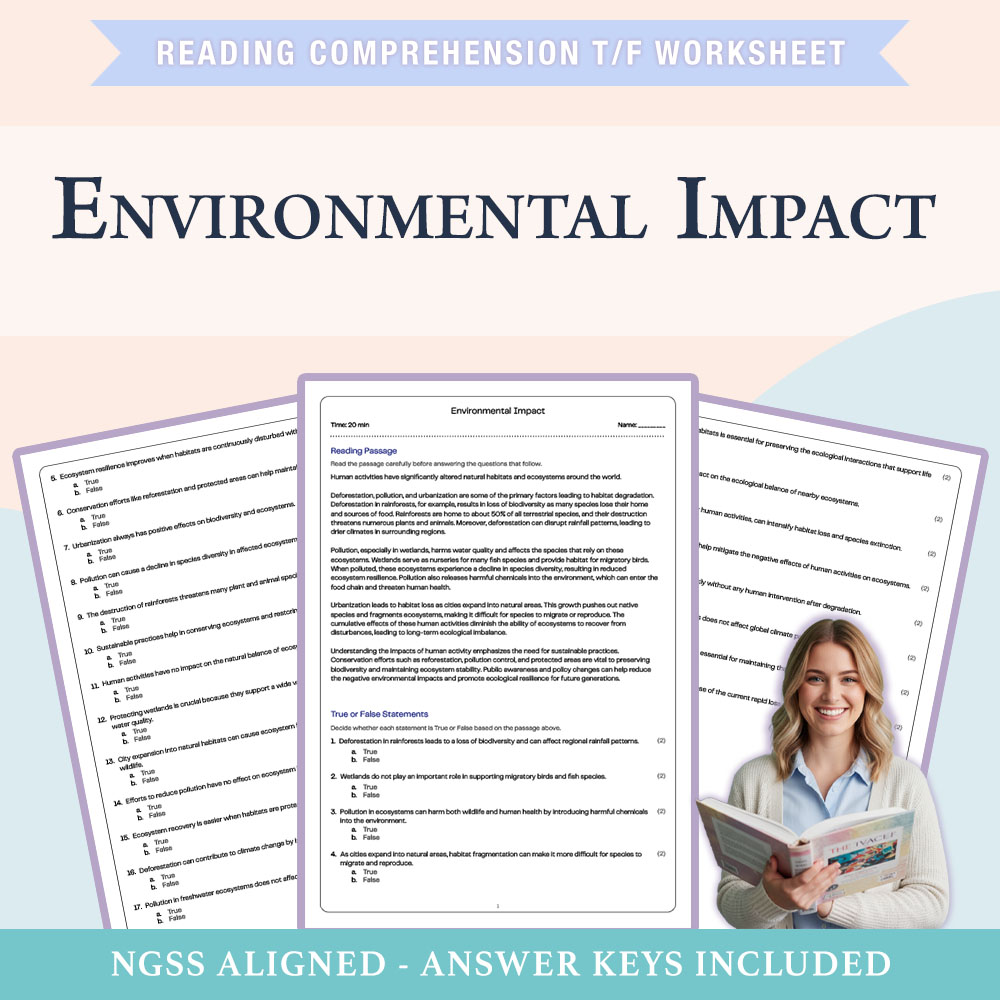
6th Grade Science | Environmental Impact True or False (PDF + Answer sheet)
Created byCopper Leaf ClassroomLearning Objectives
- Understand how human activities such as deforestation, pollution, and urbanization affect habitats and ecosystems.
- Analyze case studies involving rainforest deforestation and wetland pollution.
- Recognize the importance of conservation and sustainable practices for ecological stability.
Instant download
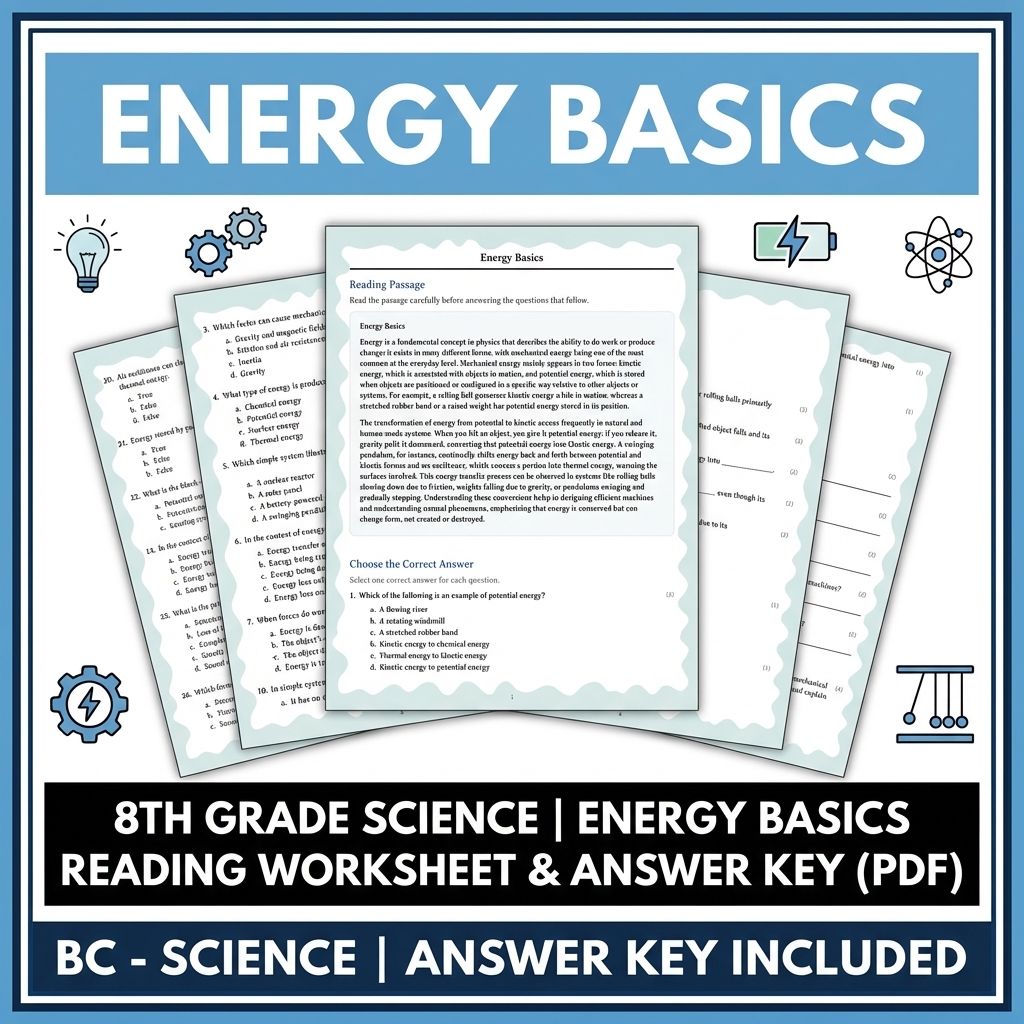
8th Grade Science | Energy Basics Reading Worksheet & Answer Key (PDF)
JCreated byJ.S SheetsLearning Objectives
- Understand the different forms of mechanical energy, such as kinetic and potential energy.
- Explain how energy transfers occur through work done by forces.
- Recognize how energy can be transformed from one form to another in simple systems.
Instant download
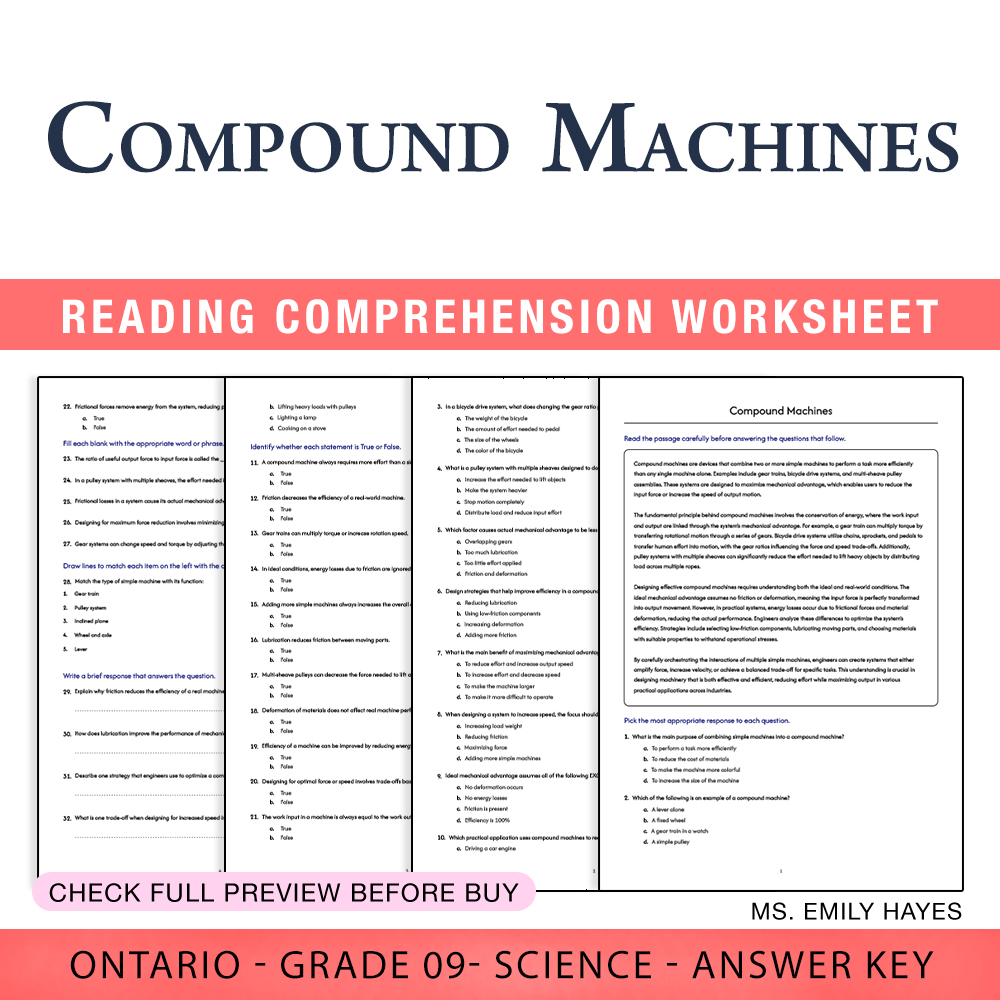
9th Grade Science | Compound Machines Worksheet (PDF + Answer Key)
Created byCopper Leaf ClassroomLearning Objectives
- Explain how multiple simple machines combine to form compound machines and analyze their mechanical advantage.
- Calculate overall mechanical advantage using force and displacement relationships in compound systems.
- Differentiate between ideal and actual mechanical advantage, and understand the effects of friction and deformation.
Instant download

Grade 9 Science – Work and Machines Worksheet (Alberta Standards) (PDF)
Created byEvergreen Desk EducationLearning Objectives
- Explain how work depends on force and distance and how units connect to energy transfer
- Describe how simple machines change force magnitude and/or direction
- Use mechanical advantage and trade-offs (force vs distance) to predict machine performance
Instant download
Browse more categories
About Science Worksheets
Find Science worksheets spanning core skills, practice, and review. All 44,620 resources are instant PDF downloads for the classroom or home.
Every worksheet on MyTeachingSheets is created by independent teacher-authors and reviewed before publication. All resources download as printable PDFs for classroom, homework, or at-home practice, and many include answer keys. Preview any worksheet free before buying.