
Science Worksheets
44,620 subject resources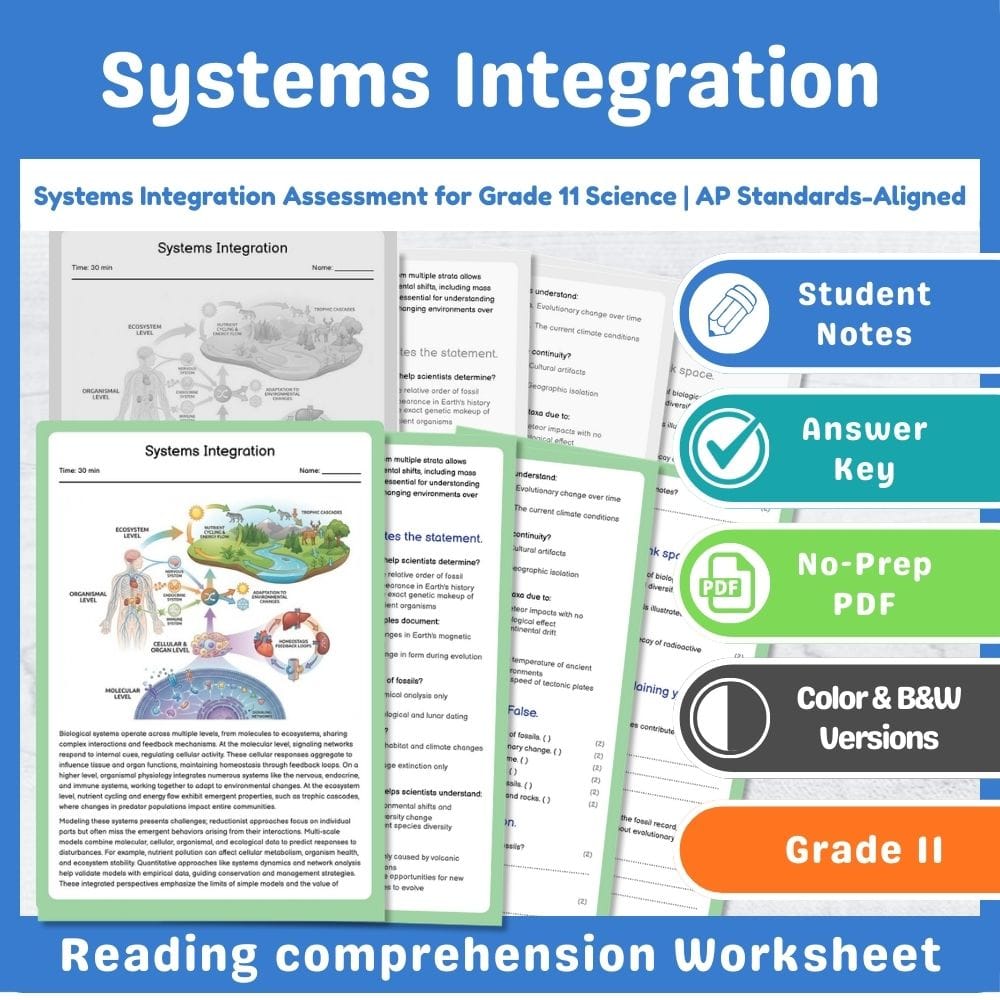
Systems Integration Assessment for Grade 11 Science | AP Standards-Aligned
 Created byPrism Point Learning
Learning Objectives
- Explain how biological systems integrate molecular, cellular, organismal, and ecosystem processes.
- Describe feedback loops, regulatory networks, and emergent properties in systems biology.
- Analyze examples such as nutrient cycling, homeostasis, and trophic cascades using models.
Instant download

Rock Cycle Worksheet | AP Science Practice Grade 11
JCreated byJ.S SheetsLearning Objectives
- Explain the processes involved in rock formation, transformation, and destruction over geologic time.
- Describe how plate tectonics influence metamorphism, magma generation, and sedimentation.
- Identify resources associated with the rock cycle, such as ore deposits and fossil fuels.
Instant download

Grade 9 Science – Succession Daily Reading Worksheet + Answer Key
JCreated byJ.S SheetsLearning Objectives
- Identify the differences between primary and secondary succession
- Explain key processes and species changes during succession
- Understand factors influencing ecosystem recovery and stability
Also included in: Grade 9 Science Lesson Bundle: Ecosystems and Ecology Worksheets +1 more
Instant download

Grade 9 Science – Trophic Levels Daily Reading Worksheet with Answer Key
JCreated byJ.S SheetsLearning Objectives
- Define and identify different trophic levels within an ecosystem.
- Describe how food chains and food webs illustrate energy flow.
- Explain the concepts of trophic efficiency and trophic cascades.
Also included in: Grade 9 Science Lesson Bundle: Ecosystems and Ecology Worksheets +1 more
Instant download

6th Grade Science | Tree Anatomy Worksheet (Alberta Standards) (PDF)
 Created bySilver Birch Teaching
Learning Objectives
- Identify major parts of a tree (roots, trunk, branches, leaves, buds, and bark) and describe their functions.
- Explain how form–function relationships help trees survive in different habitats.
- Use scientific vocabulary to describe transport, storage, support, and protection in trees.
Also included in: Grade 6 Ecosystem Interactions Science Lesson Bundle: Alberta Framework +1 more
Instant download

Grade 6 Science | Roots and Water Worksheet (Alberta Standards) (PDF)
Created bySilver Birch TeachingLearning Objectives
- Explain how root systems provide anchorage, water and nutrient uptake, and storage
- Describe how different root adaptations (lateral roots and taproots) help trees survive in different environments
- Summarize how mycorrhizal fungi improve absorption and drought resilience
Also included in: Grade 6 Ecosystem Interactions Science Lesson Bundle: Alberta Framework +1 more
Instant download
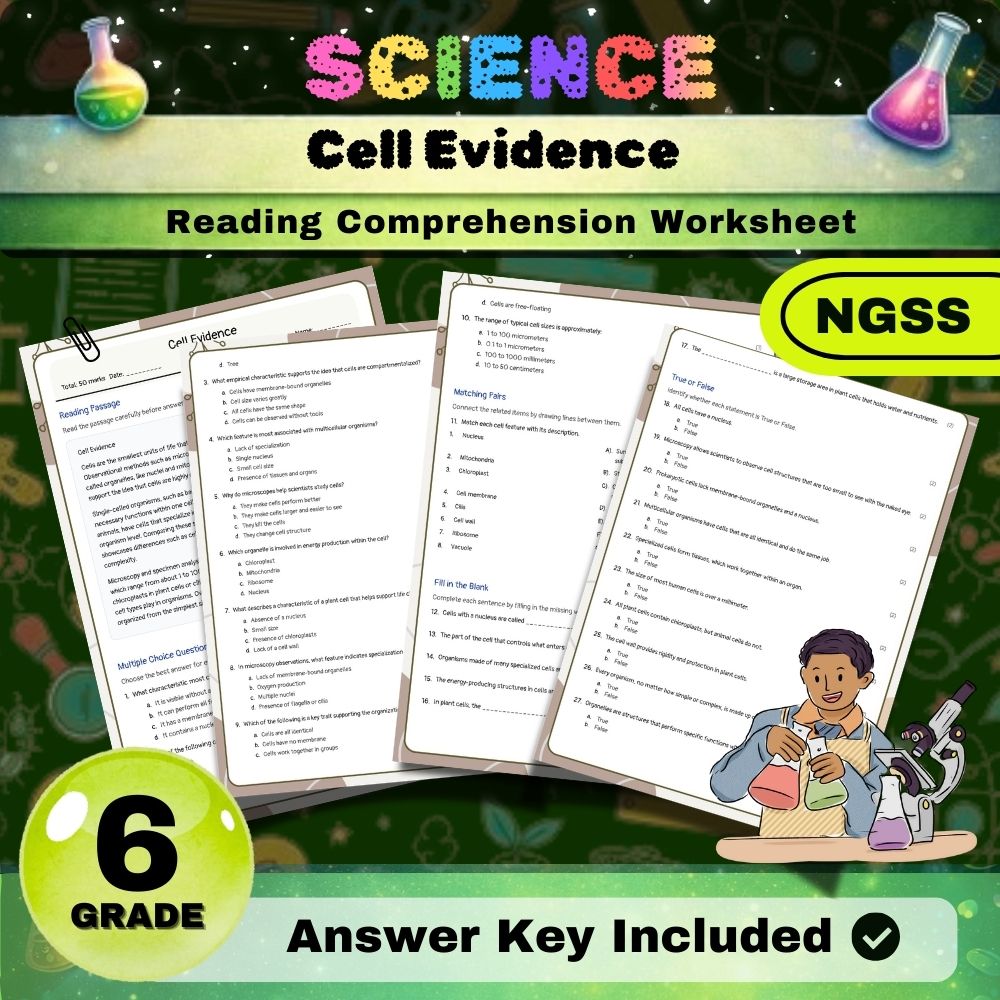
6th Grade Science | Cell Evidence NGSS Worksheet (PDF)
 Created byMaple Path Learning
Learning Objectives
- Identify the basic features that distinguish cells as the fundamental units of life.
- Compare the characteristics of single-celled and multicellular organisms using microscopy and specimen evidence.
- Describe relationships among cells, tissues, organs, and entire organisms to support biological organization claims.
Also included in: Grade 6 Science Unit Bundle – Cell Functions, Energy & Organ Systems Worksheets +1 more
Instant download
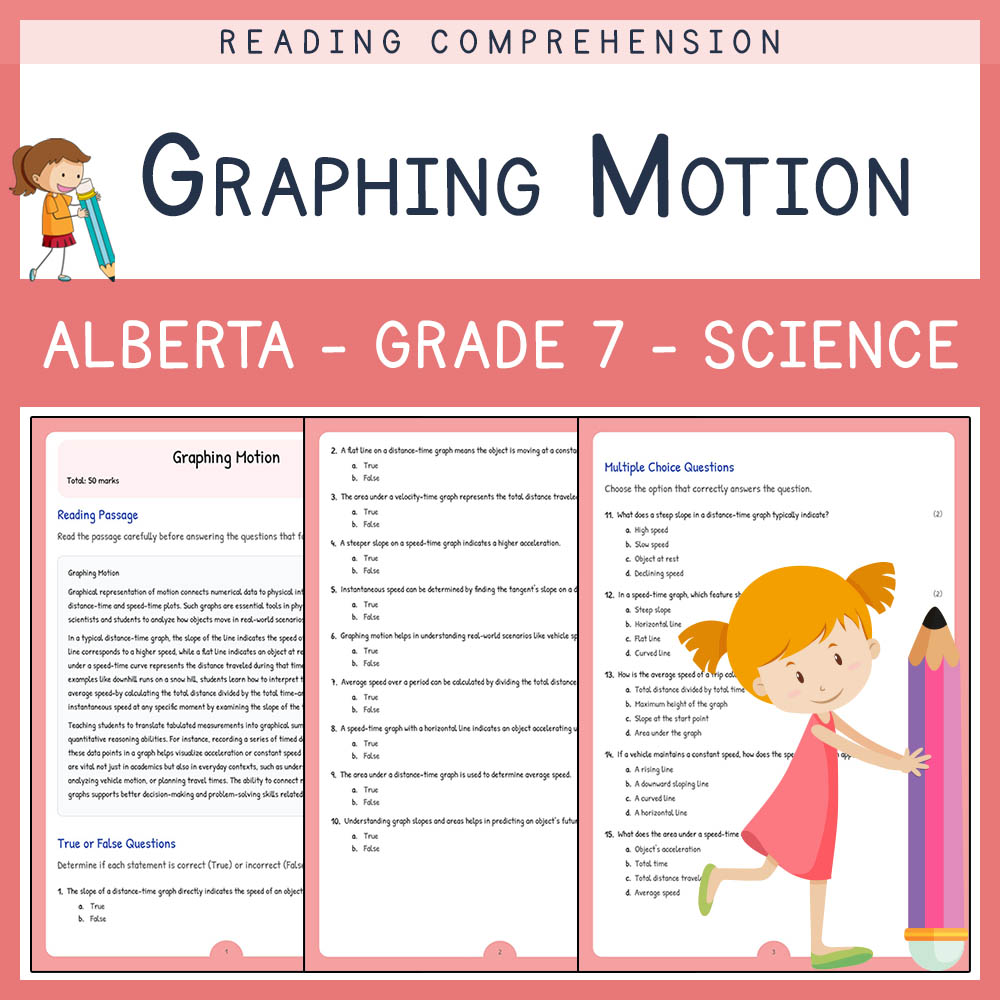
Grade 7 Science Assessment | Graphing Motion Worksheet | Alberta
 Created byLumora Learning
Learning Objectives
- Understand how to represent motion visually through distance–time and speed–time graphs.
- Interpret slope meanings in motion graphs to determine speed and rate of change.
- Learn methods to calculate average and instantaneous speeds from graphs.
Instant download
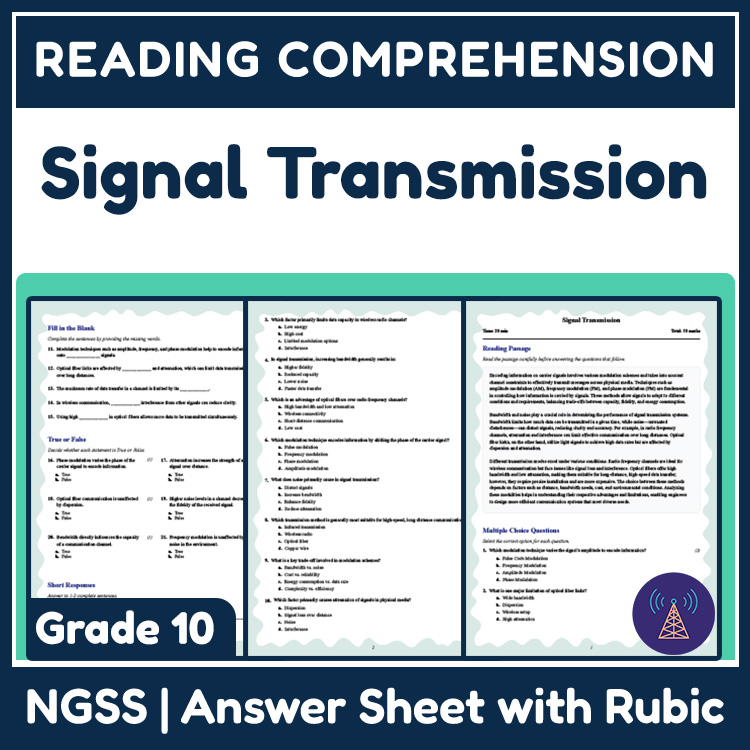
Grade 10 Science | Signal Transmission Reading Worksheet (PDF + Rubric)
JCreated byJ.S SheetsLearning Objectives
- Understand the principles of modulation techniques such as amplitude, frequency, and phase modulation.
- Describe how bandwidth and noise influence signal capacity and fidelity.
- Compare different transmission modes, including radio frequency channels and optical fiber links, regarding their advantages and limitations.
Instant download
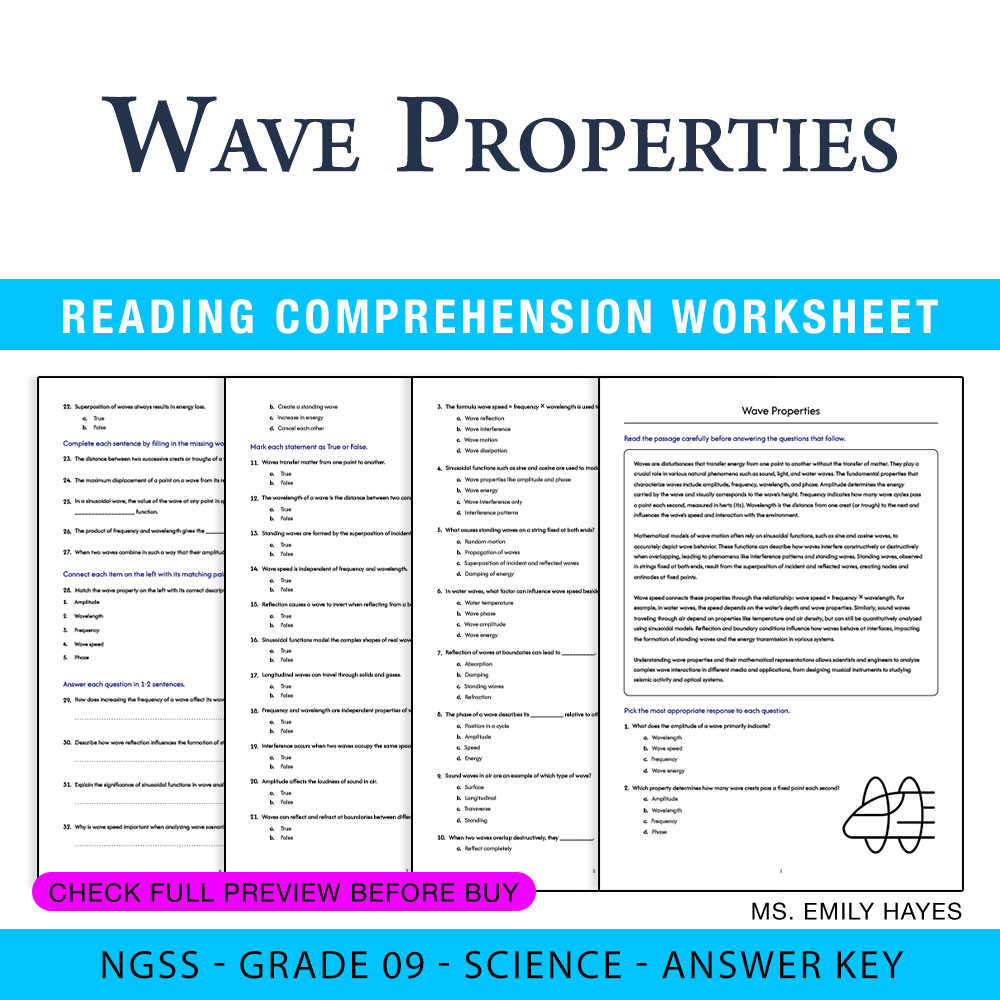
9th Grade Science | Wave Properties Worksheet (PDF+ Answer Key)
 Created byCopper Leaf Classroom
Learning Objectives
- Understand and describe the key properties of waves, including amplitude, frequency, wavelength, and phase.
- Apply the wave speed formula: wave speed = frequency × wavelength to analyze wave scenarios.
- Explain how sinusoidal functions model wave behavior and describe interference and standing waves.
Instant download
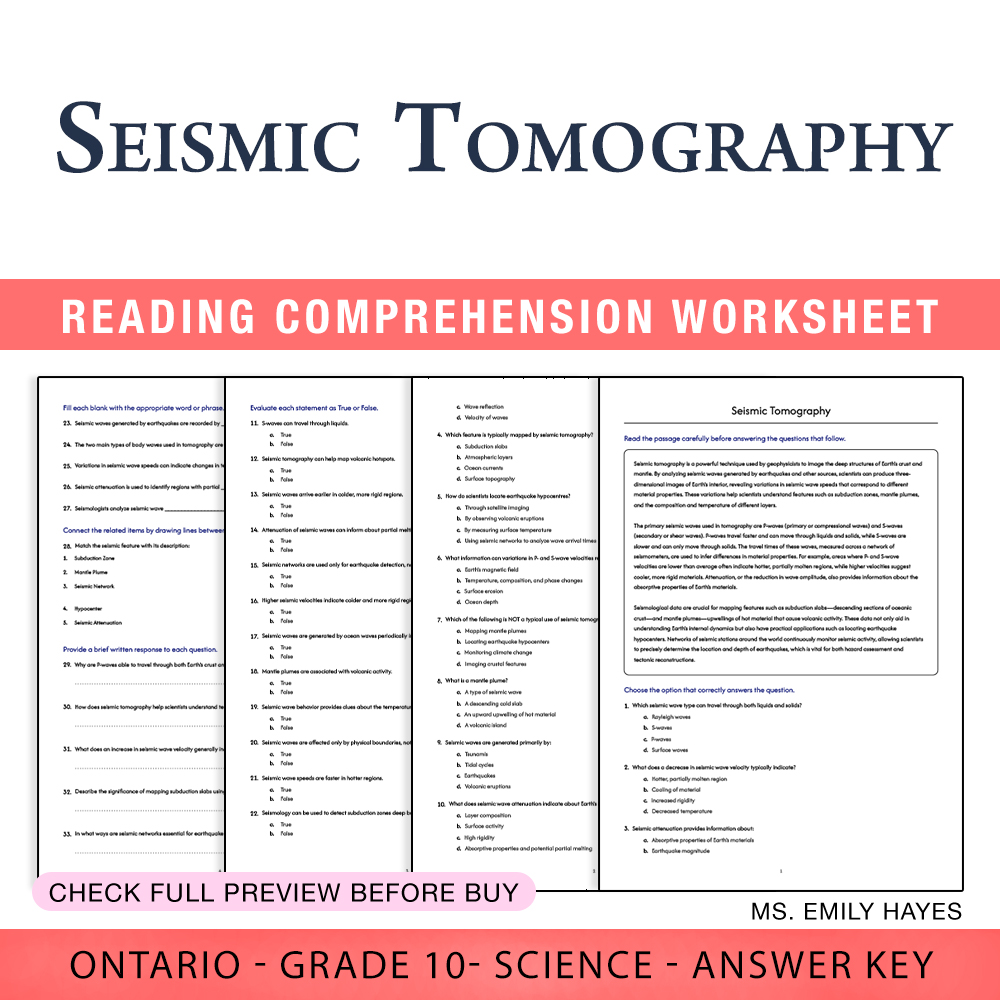
Grade 10 Science | Seismic Tomography Worksheet (PDF + Answer Key)
Created byCopper Leaf ClassroomLearning Objectives
- Explain the different types of seismic waves and their properties.
- Describe how seismic travel times and attenuation are used to image Earth's crust and mantle.
- Interpret variations in P- and S-wave velocities to infer geological features and phase changes.
Instant download
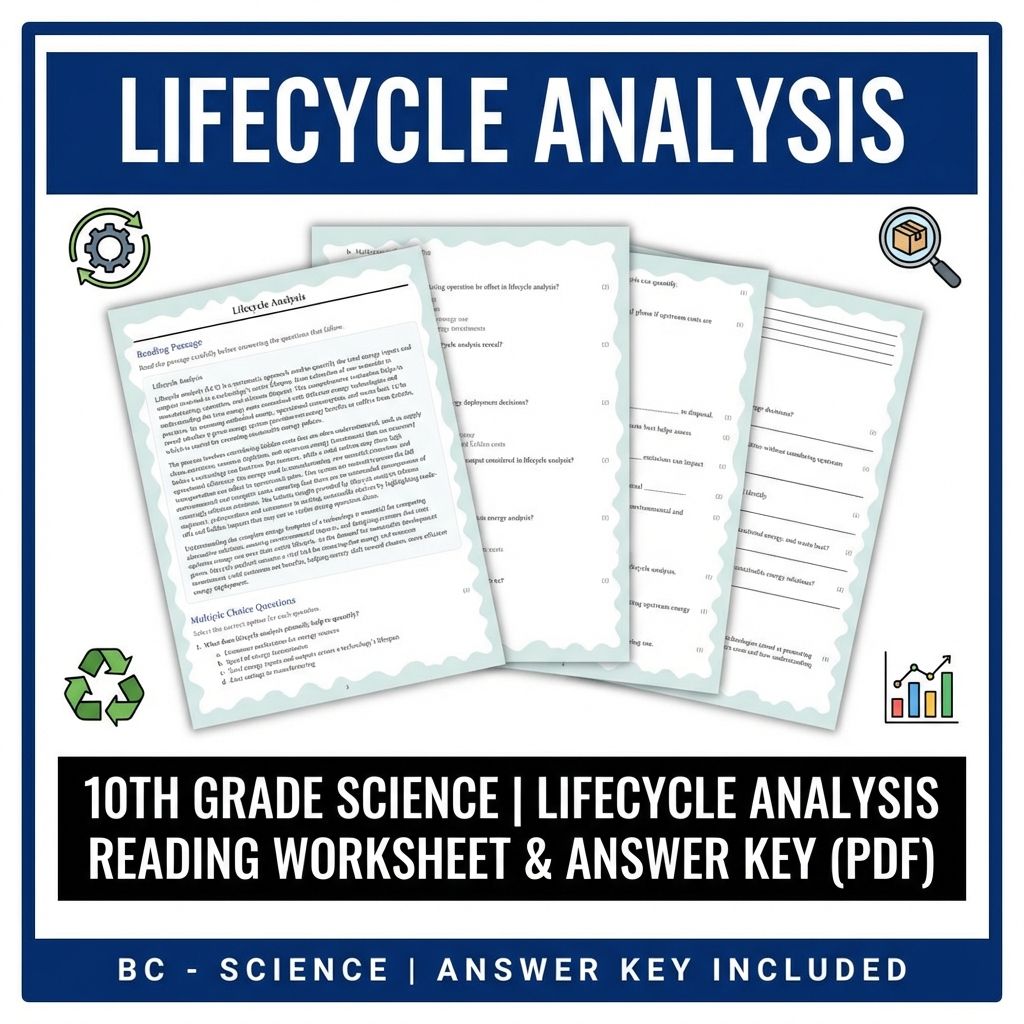
10th Grade Science | Lifecycle Analysis Reading Worksheet & Answer Key (PDF)
JCreated byJ.S SheetsLearning Objectives
- Understand the concept of lifecycle analysis and its significance in energy evaluation.
- Identify the stages involved in a technology's cradle-to-grave energy inputs and outputs.
- Analyze how conservation principles apply to lifecycle energy assessments.
Instant download
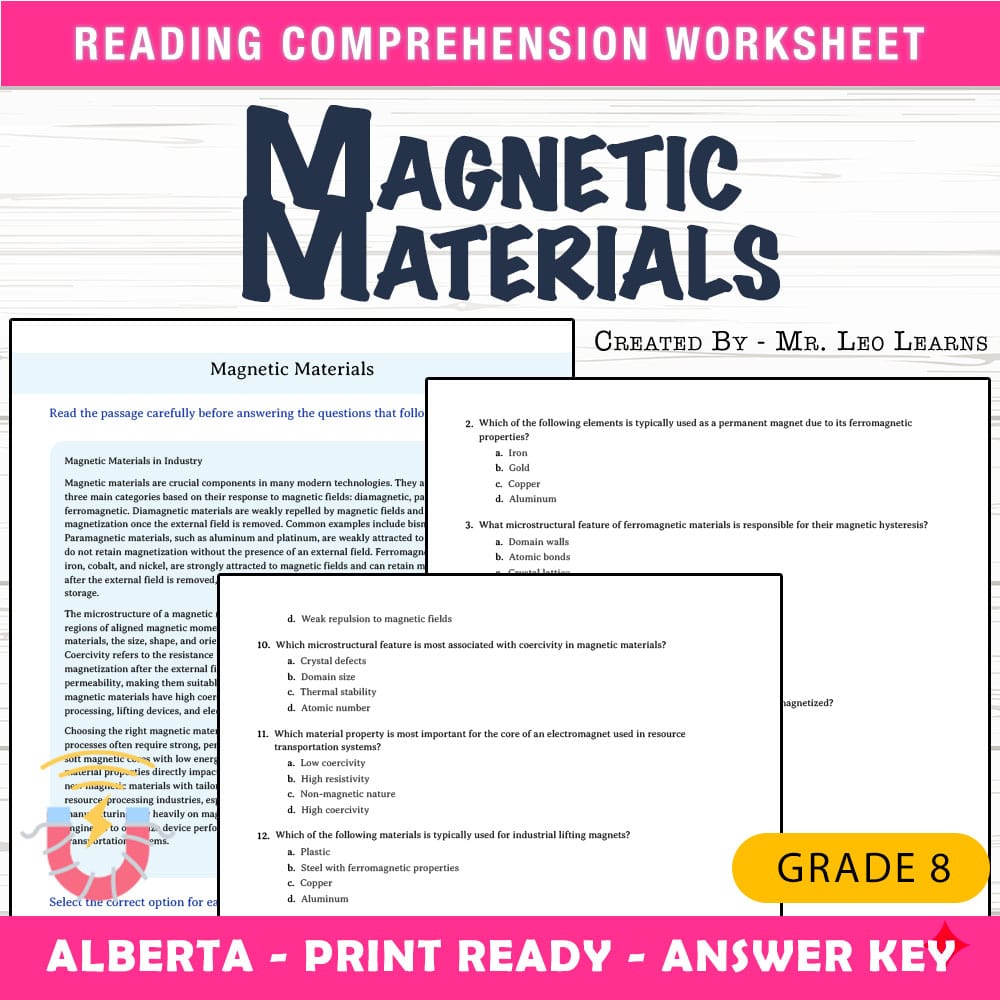
Grade 8 Science — Worksheet MCQ Paper for Mastering Magnetic Materials
 Created byThe Resource Hub
Learning Objectives
- Understand the classification of materials based on their magnetic response.
- Explain the microstructural factors affecting magnetic properties like coercivity and remanence.
- Identify applications of different magnetic materials in industry and technology.
Also included in: Grade 8 Science Electricity & Magnetism Worksheet Bundle | Alberta Standards +1 more
Instant download
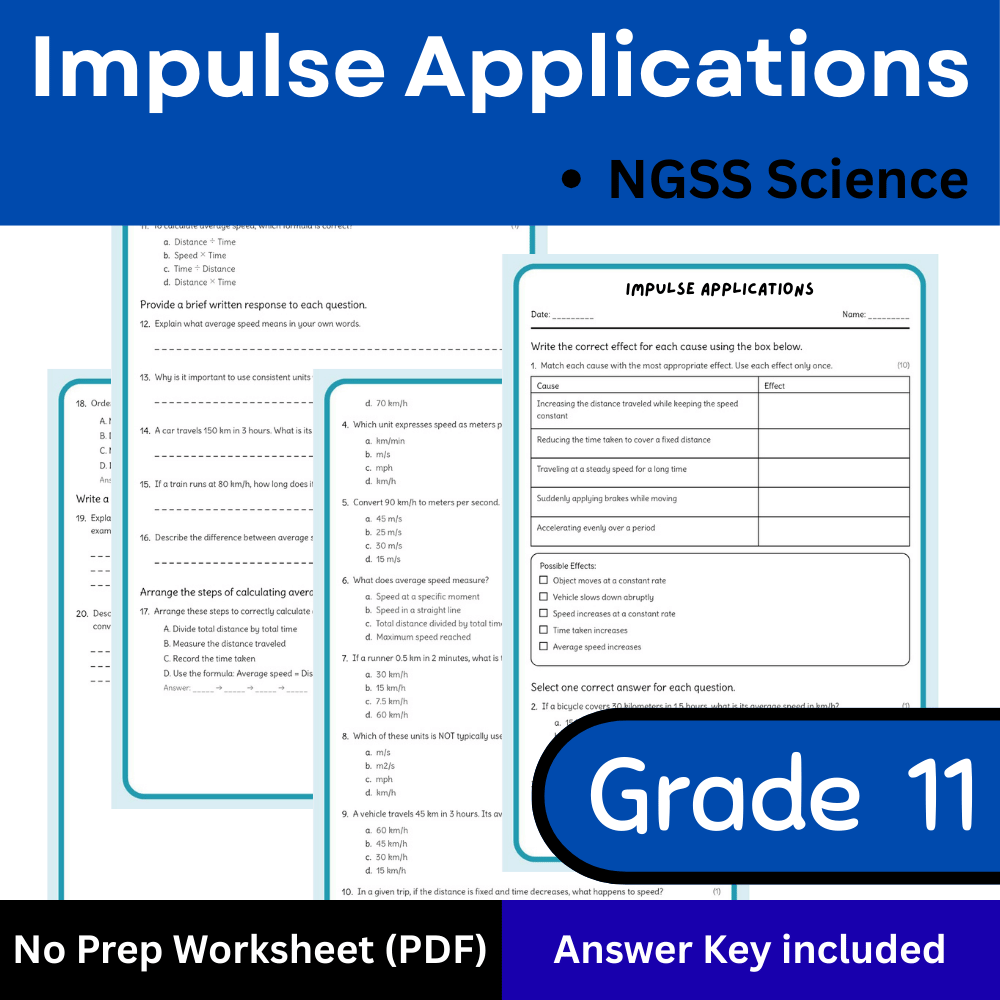
Grade 11 Science | Impulse Applications Worksheet (Answer Key) – NGSS Aligned
 Created byBright Mind Resources
Learning Objectives
- Explain the impulse–momentum relationship (Δp = ∫F dt) and its relevance to collision scenarios.
- Design and evaluate crash-protection systems that minimize forces experienced during collisions.
- Apply force–time data and deformation parameters to analyze safety features.
Instant download

Grade 9 Science – Levels of Biological Organization | Daily Reading Worksheet
Created byBright Mind ResourcesLearning Objectives
- Understand the hierarchy from molecules to organisms
- Identify the properties of each level of biological organization
- Explain how emergent properties develop at higher levels
Also included in: Grade 9 Cell and Human Body Systems Science Daily Reading Lesson Bundle | BC +1 more
Instant download
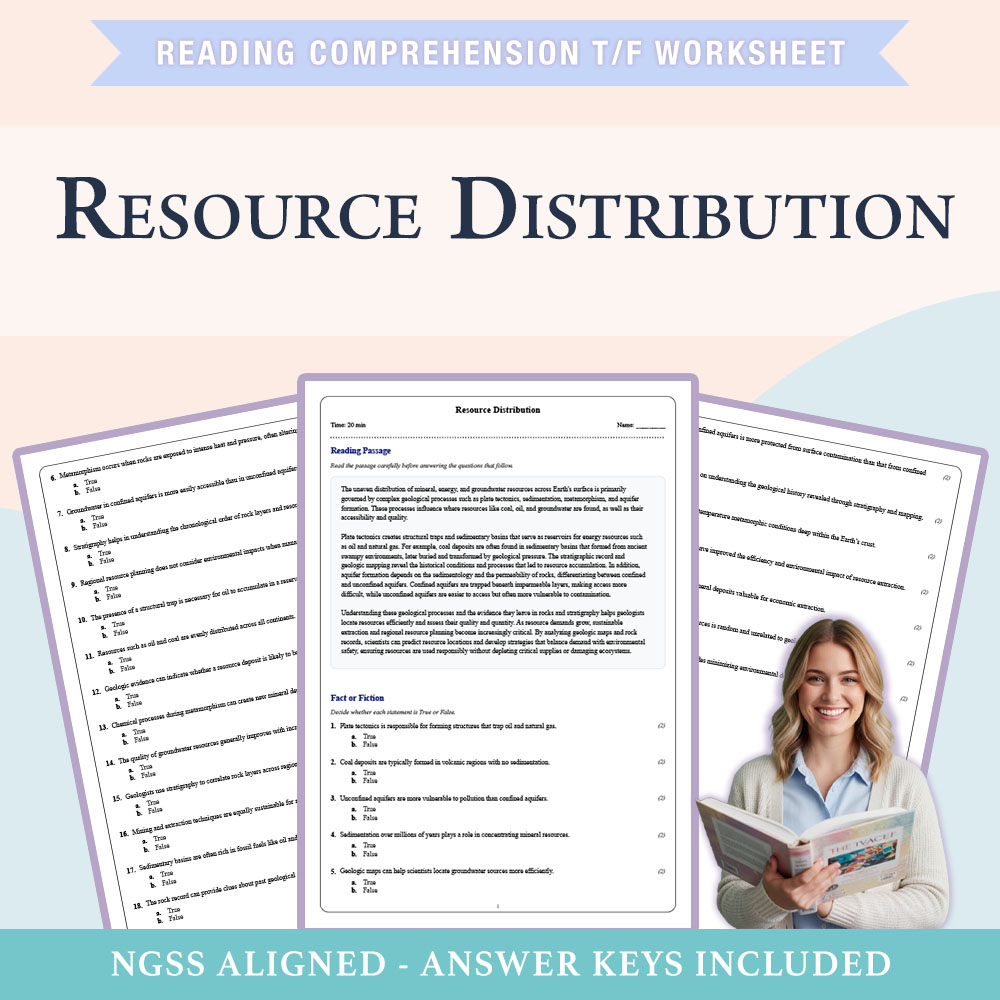
8th Grade Science | Resource Distribution Worksheet (PDF +Answer Key)
Created byCopper Leaf ClassroomLearning Objectives
- Understand geological processes influencing resource formation
- Identify examples of resource deposits like coal basins and oil reservoirs
- Recognize differences between aquifer types
Also included in: Grade 8 Science Unit | Environmental Change & Climate Drivers (PDF +Answer Key) +1 more
Instant download

Grade 11 Science | Fossil Record Worksheet (BC Standard) PDF
 Created byEvergreen Desk Education
Learning Objectives
- Explain how stratigraphic distribution and fossil context help determine relative timing in deep time.
- Describe how radiometric dating provides absolute ages for rocks that contain fossils.
- Evaluate how taphonomic processes affect what is preserved in the fossil record.
Instant download
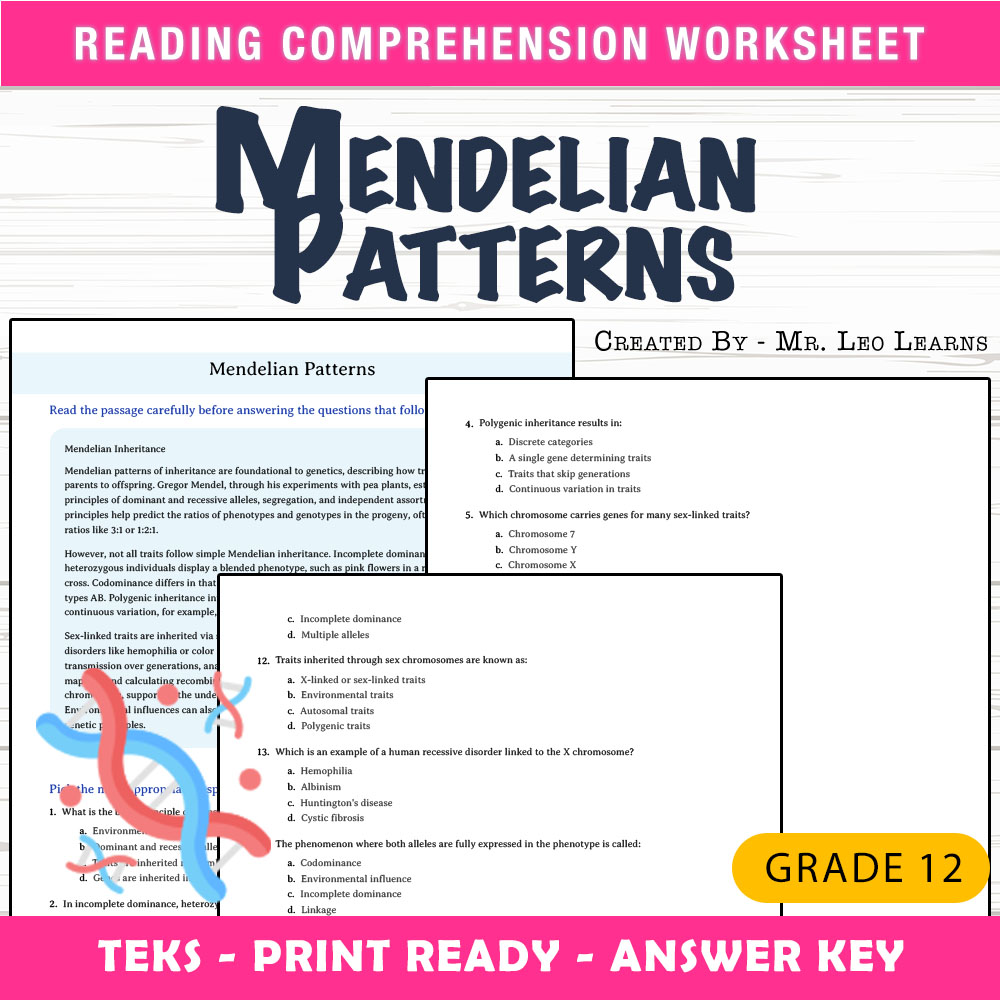
Grade 12 Science – Mendelian Patterns Worksheet for Mastery
Created byThe Resource HubLearning Objectives
- Understand the principles of Mendelian inheritance and how dominant and recessive traits are transmitted.
- Identify different inheritance patterns including incomplete dominance, codominance, polygenic inheritance, and sex-linked traits.
- Analyze pedigree charts, linkage mapping, and recombination frequencies to interpret inheritance data.
Also included in: Grade 12 Science Worksheet Bundle – Genetics, Evolution & Biodiversity Mastery +1 more
Instant download
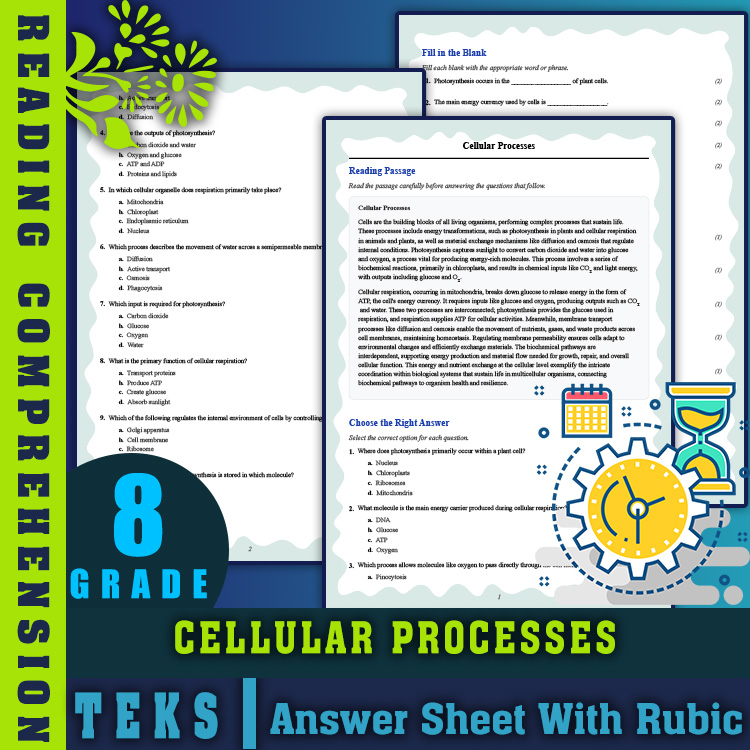
8th Grade Science | Cellular Processes Reading Worksheet + Answer Key PDF
JCreated byJ.S SheetsLearning Objectives
- Understand the biochemical pathways of photosynthesis and cellular respiration.
- Describe the role of membrane transport processes such as diffusion and osmosis in cells.
- Explain how energy is transformed and materials are exchanged within cellular organelles.
Instant download
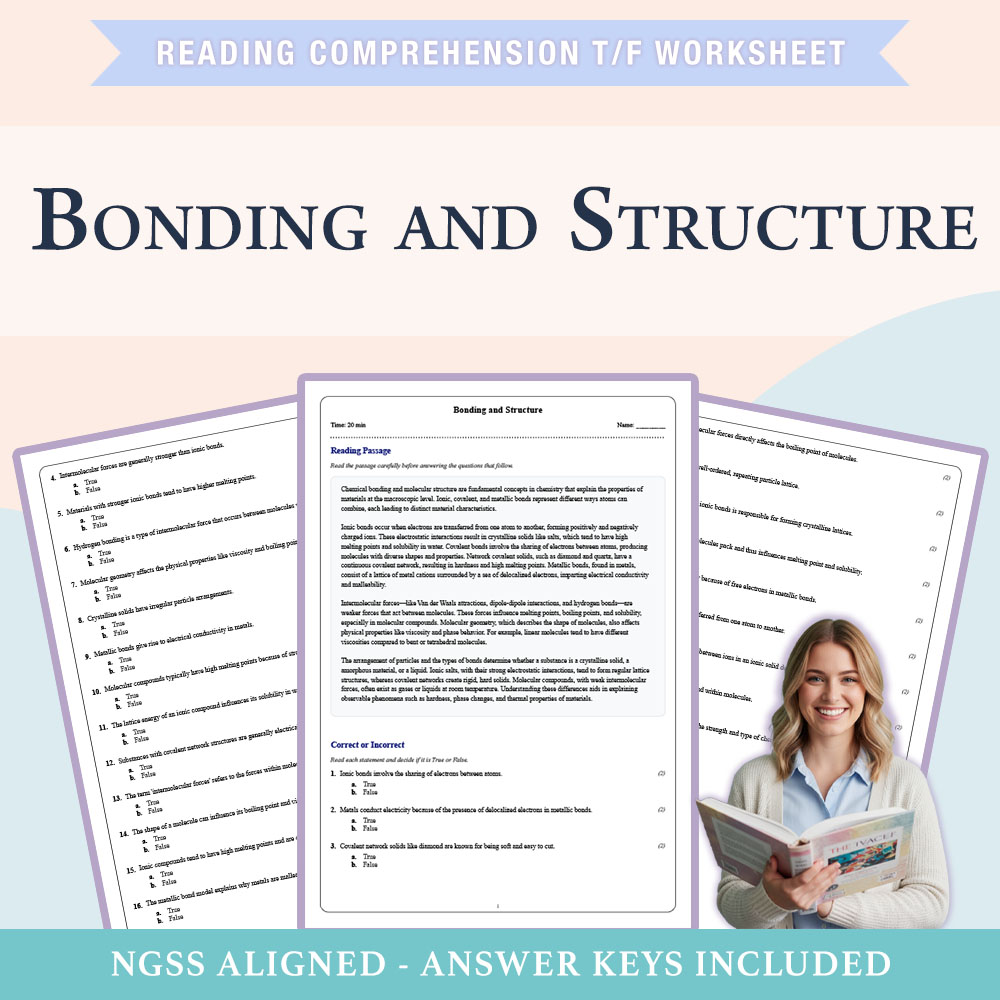
11th Grade Science | Bonding and Structure Worksheet (PDF + Answer Key)
Created byCopper Leaf ClassroomLearning Objectives
- Explain how ionic, covalent, and metallic bonding affect the properties of materials.
- Identify relationships between molecular structure, intermolecular forces, and observable characteristics like melting point and conductivity.
- Compare different types of bonding and structure in representative compounds.
Also included in: Grade 11 Science | Reaction and Bonding Unit Worksheets (PDF + Answer Keys) +1 more
Instant download
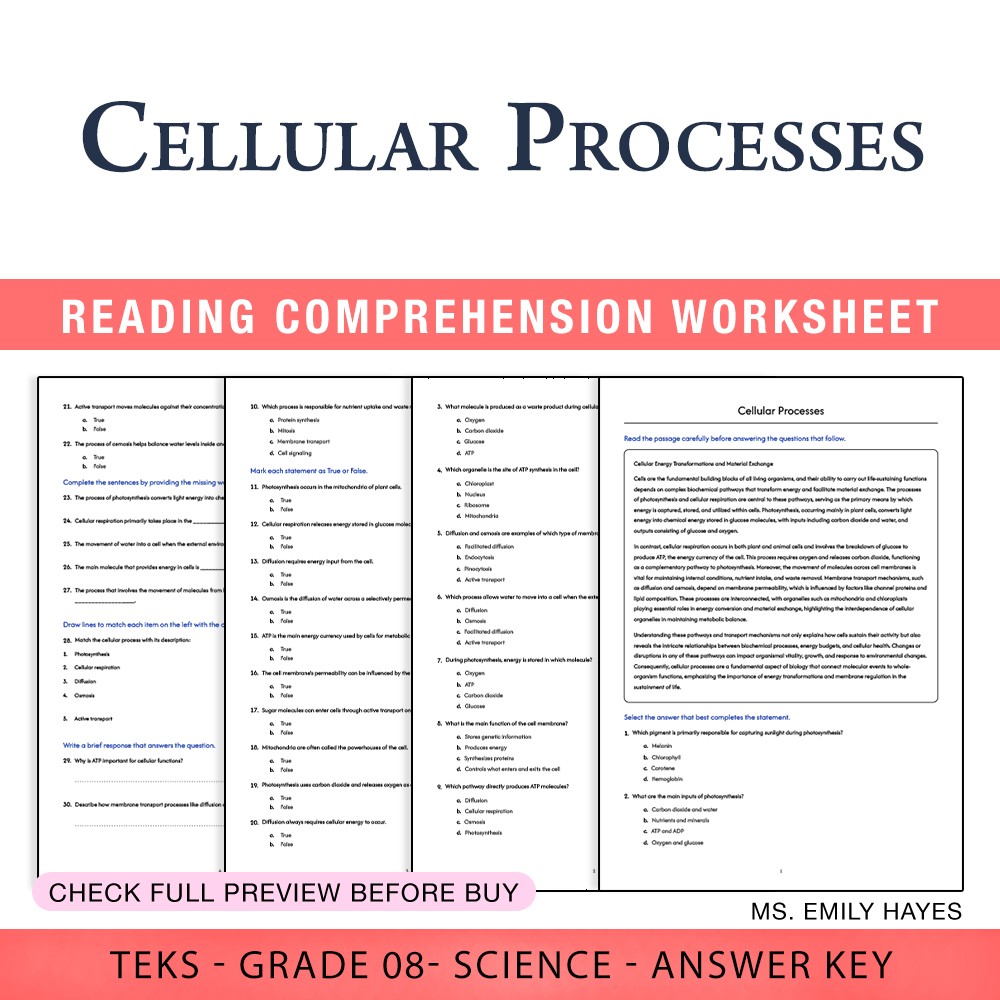
8th Grade Science | Cellular Processes Worksheet (PDF+ Answer Key)
Created byCopper Leaf ClassroomLearning Objectives
- Explain the biochemical pathways of photosynthesis and cellular respiration.
- Describe how membrane transport mechanisms regulate internal conditions in cells.
- Identify the inputs and outputs of photosynthesis and respiration.
Instant download
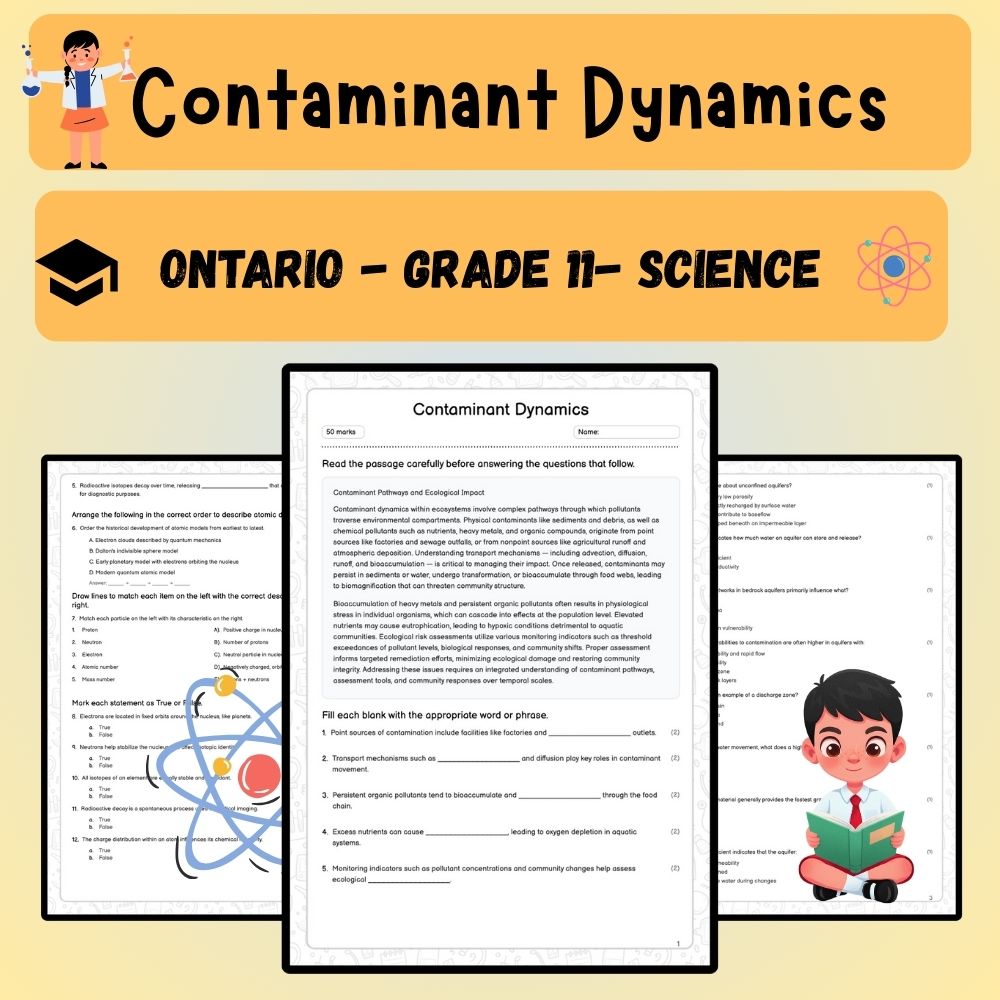
Grade 11 Science | Contaminant Dynamics Worksheet (PDF) – Ontario Standards
Created byPrism Point LearningLearning Objectives
- Understand the pathways and environmental fate of physical and chemical contaminants in ecosystems.
- Identify sources, transport mechanisms, and effects of nutrients, heavy metals, and persistent organic pollutants.
- Analyze how contaminants bioaccumulate and biomagnify in food webs and influence community composition.
Also included in: Grade 11 Science Ecosystems & Sustainability UNIT Worksheet Pack +1 more
Instant download
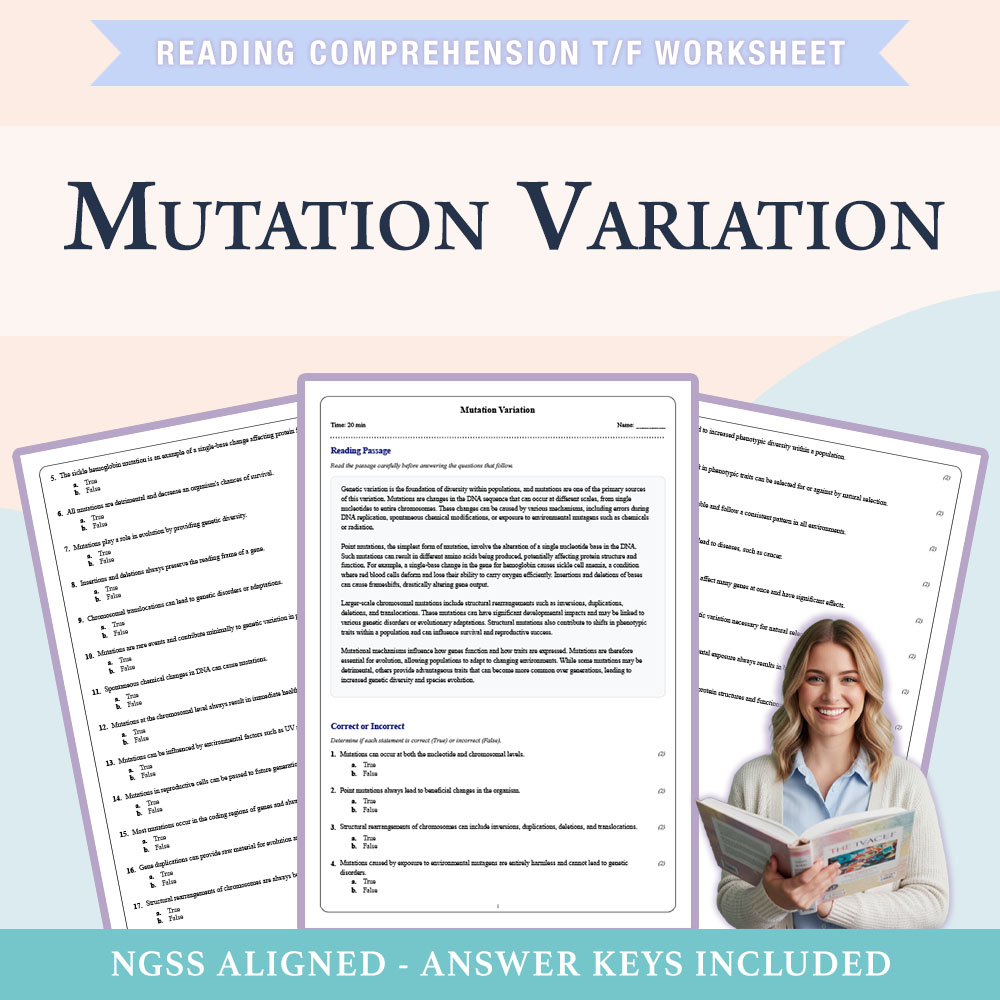
10th Grade Science | Mutation Variation Worksheet (PDF + Answer Key)
Created byCopper Leaf ClassroomLearning Objectives
- Understand how genetic mutations at nucleotide and chromosomal levels contribute to genetic variation.
- Identify different mutational mechanisms and their effects on gene function and phenotype.
- Differentiate between small-scale mutations (point mutations, insertions, deletions) and large-scale chromosomal changes.
Also included in: Grade 10 Science | Genetics & DNA Unit Worksheet Pack (PDF +Answer Key) +1 more
Instant download
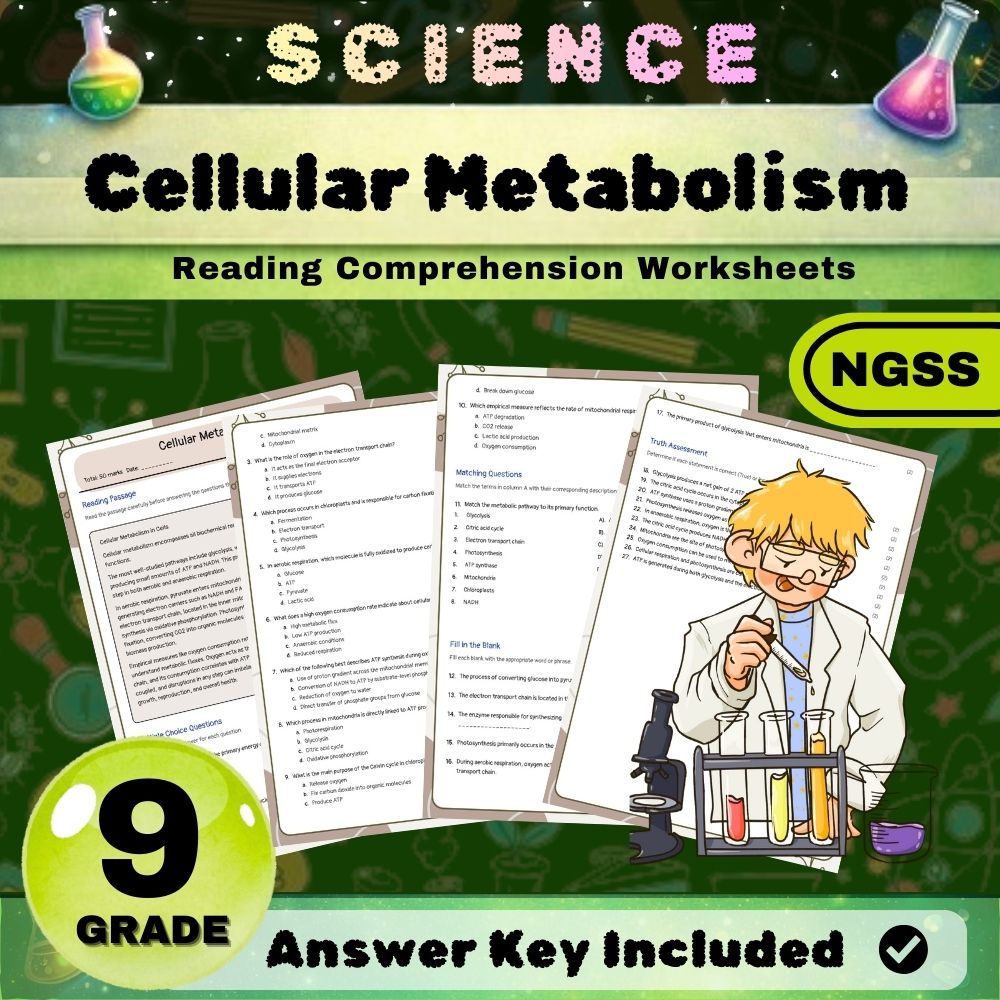
Grade 9 Science | Cellular Metabolism Worksheet (NGSS) – PDF
Created byMaple Path LearningLearning Objectives
- Describe the biochemical pathways involved in cellular respiration, including glycolysis, the citric acid cycle, and electron transport chain.
- Explain how ATP is produced and utilized in energy coupling within cells.
- Relate organelle functions of mitochondria and chloroplasts to metabolic processes like respiration and photosynthesis.
Instant download
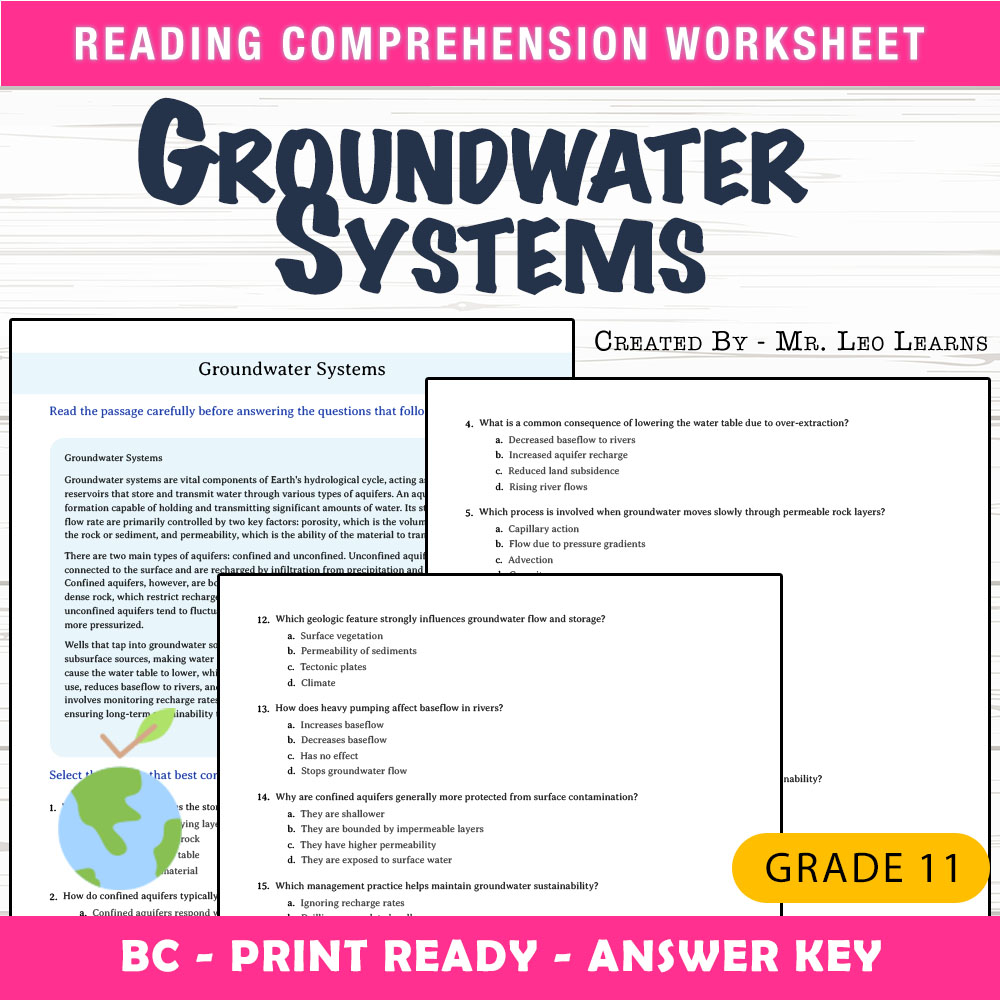
Grade 11 Science — Worksheet MCQ Paper for Mastering Groundwater Systems
Created byThe Resource HubLearning Objectives
- Understand the differences between confined and unconfined aquifers and their responses to recharge and pumping.
- Identify factors affecting groundwater storage and flow rates.
- Analyze the impacts of groundwater over-extraction on water tables and land stability.
Also included in: Grade 11 Science Earth Science Unit | BC Curriculum MCQ Worksheet Pack +1 more
Instant download
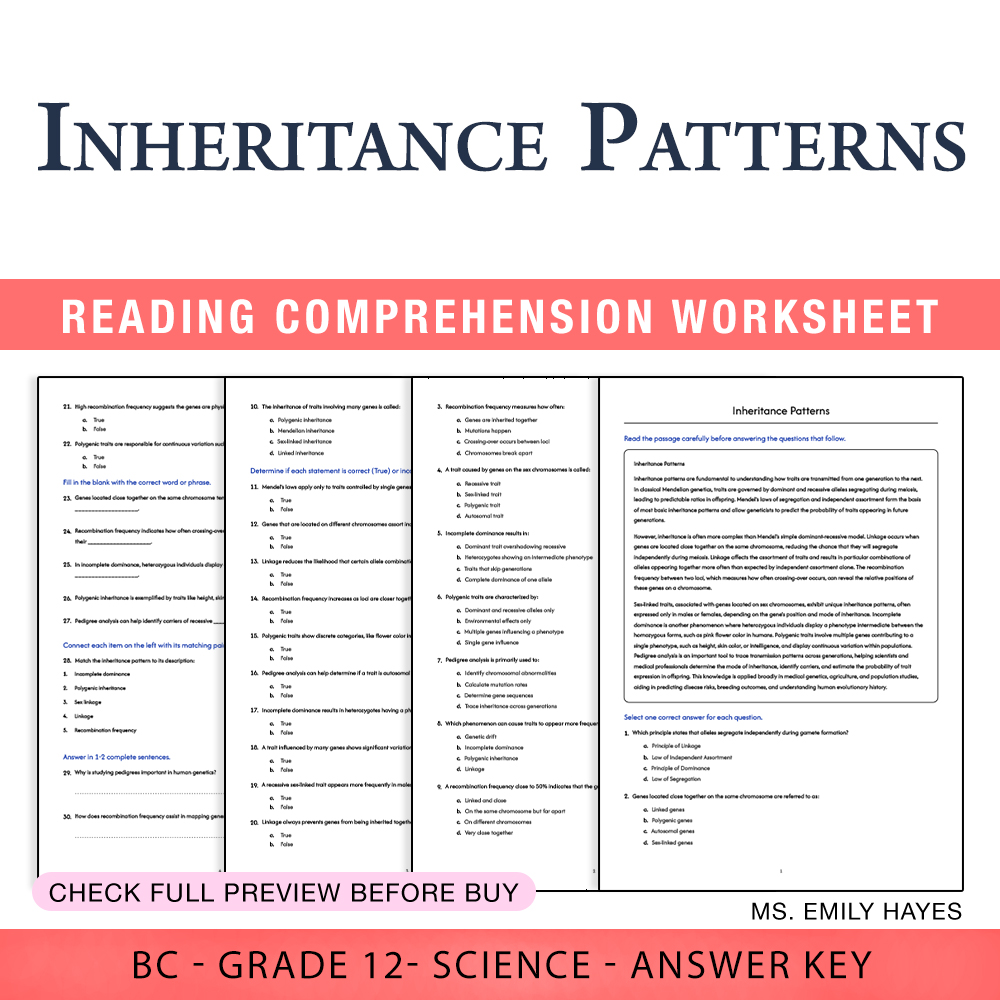
12th Grade Science | Inheritance Patterns Worksheet (PDF + Answer Key)
Created byCopper Leaf ClassroomLearning Objectives
- Understand different inheritance models including Mendelian, linkage, sex linkage, incomplete dominance, and polygenic traits.
- Analyze pedigrees to infer inheritance modes and estimate carriers.
- Interpret recombination frequency data to determine relative loci positions and trait assortment.
Also included in: Grade 12 Science | Genetics, Evolution & Ecology (PDF+ Answer Keys) +1 more
Instant download
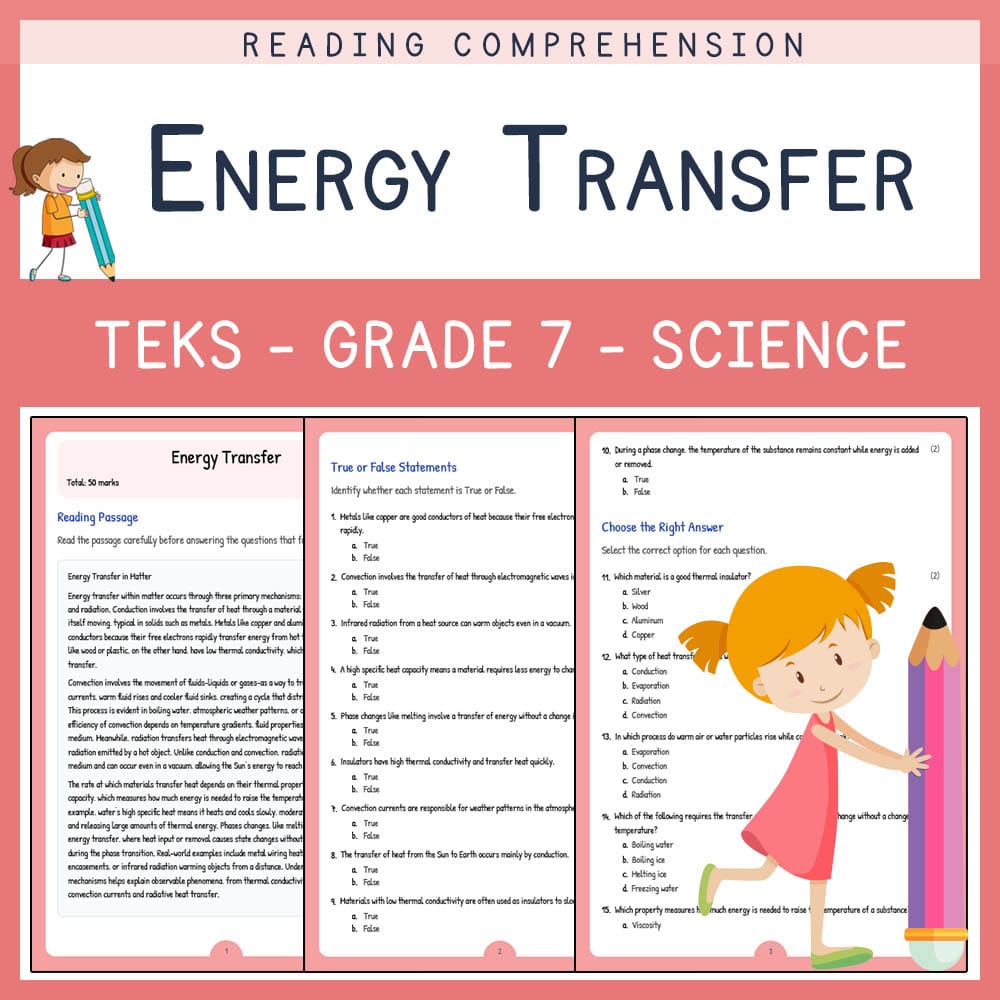
Grade 7 Science | Energy Transfer Worksheet | TEKS-Aligned
Created byLumora LearningLearning Objectives
- Explain the mechanisms of heat transfer: conduction, convection, and radiation.
- Relate energy transfer processes to real-world phenomena such as thermal conductivity differences and radiant warming.
- Describe how temperature gradients, specific heat, and phase changes influence energy flow.
Also included in: Grade 7 Science | Matter and Energy Lesson Bundle | TEKS Aligned
Instant download
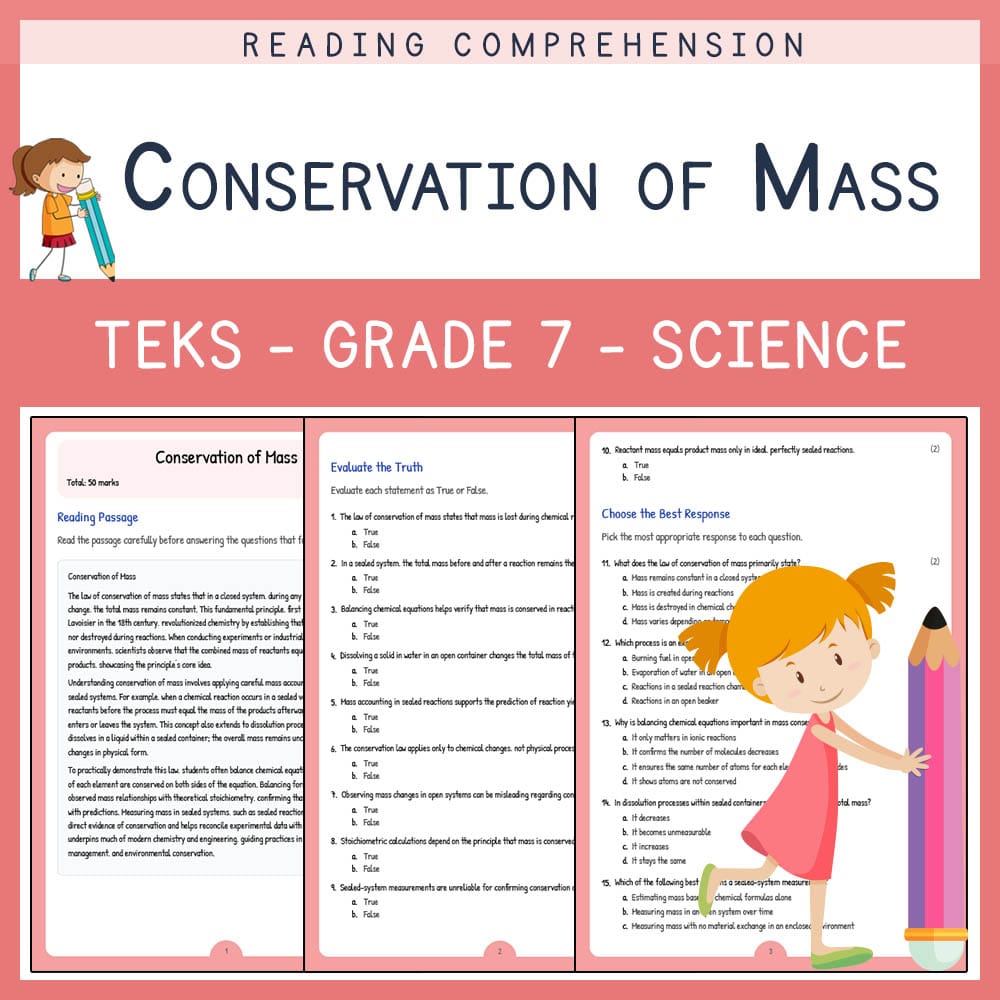
Grade 7 Science | Conservation of Mass Worksheet | TEKS-Aligned
Created byLumora LearningLearning Objectives
- Understand the principle of conservation of mass in physical and chemical transformations.
- Apply mass accounting techniques to reactions and dissolution processes.
- Balance simple chemical formulas to illustrate mass relationships.
Also included in: Grade 7 Science | Matter and Energy Lesson Bundle | TEKS Aligned
Instant download
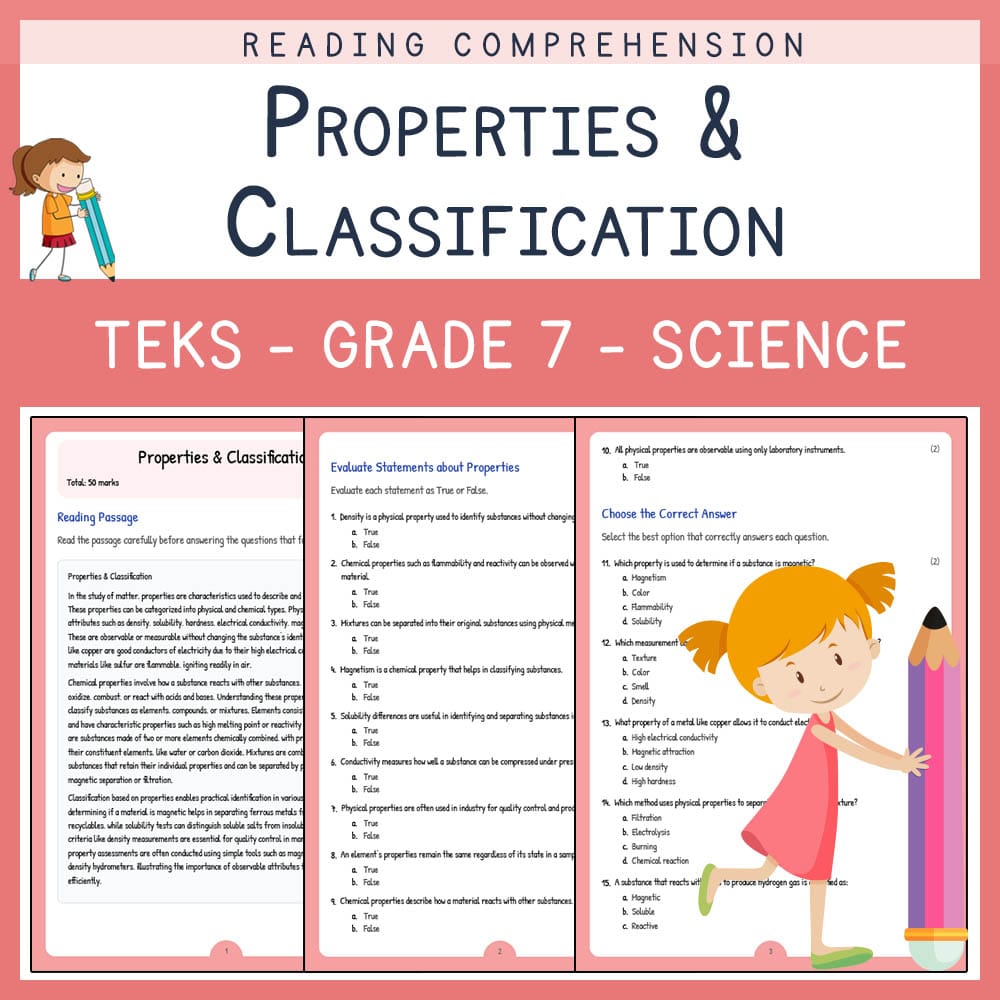
Grade 7 Science | Properties and Classification Worksheet | TEKS-Aligned
Created byLumora LearningLearning Objectives
- Define and differentiate between physical and chemical properties of substances.
- Identify measurable attributes such as density, solubility, hardness, and conductivity.
- Classify substances as elements, compounds, or mixtures based on their properties.
Also included in: Grade 7 Science | Matter and Energy Lesson Bundle | TEKS Aligned
Instant download
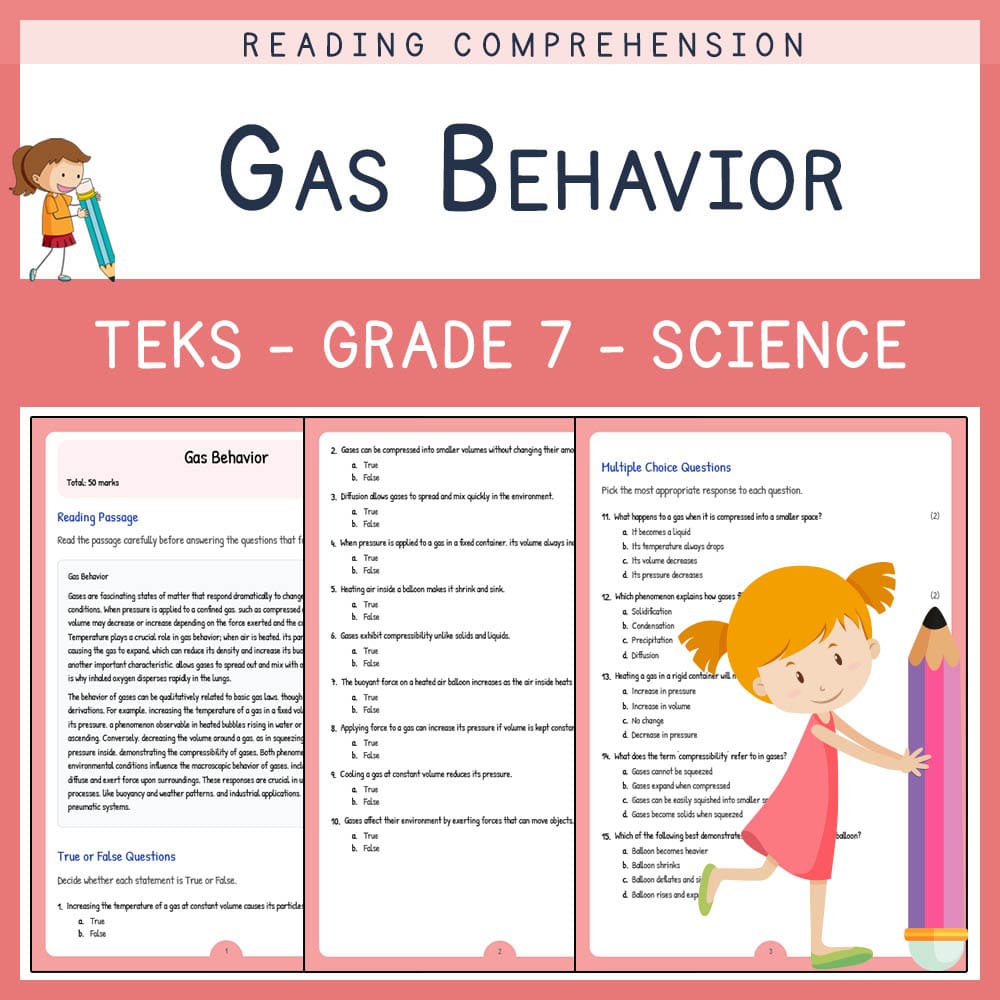
Grade 7 Science | Gas Behavior Worksheet | TEKS-Aligned
Created byLumora LearningLearning Objectives
- Describe qualitatively how pressure, volume, and temperature interrelate in gases.
- Explain phenomena such as diffusion and compressibility in gases.
- Relate macroscopic observations like pressure variation and buoyant behavior to gas responses.
Also included in: Grade 7 Science | Matter and Energy Lesson Bundle | TEKS Aligned
Instant download
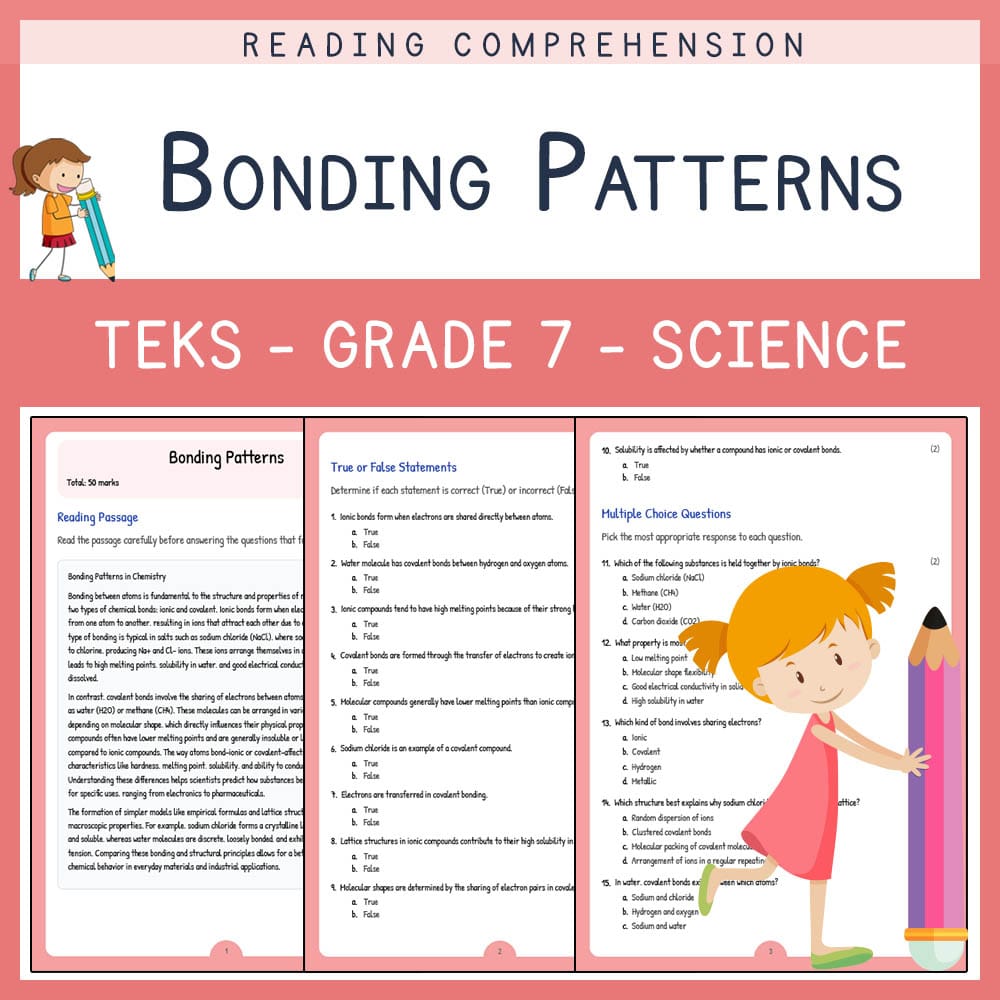
Grade 7 Science | Bonding Patterns Worksheet | TEKS-Aligned
Created byLumora LearningLearning Objectives
- Understand the differences between ionic and covalent bonding and their effects on macroscopic properties.
- Identify and describe simple formation of binary ionic salts and molecular compounds using empirical formulas.
- Relate bonding types to observable properties such as melting point, solubility, and electrical conductivity.
Also included in: Grade 7 Science | Matter and Energy Lesson Bundle | TEKS Aligned
Instant download
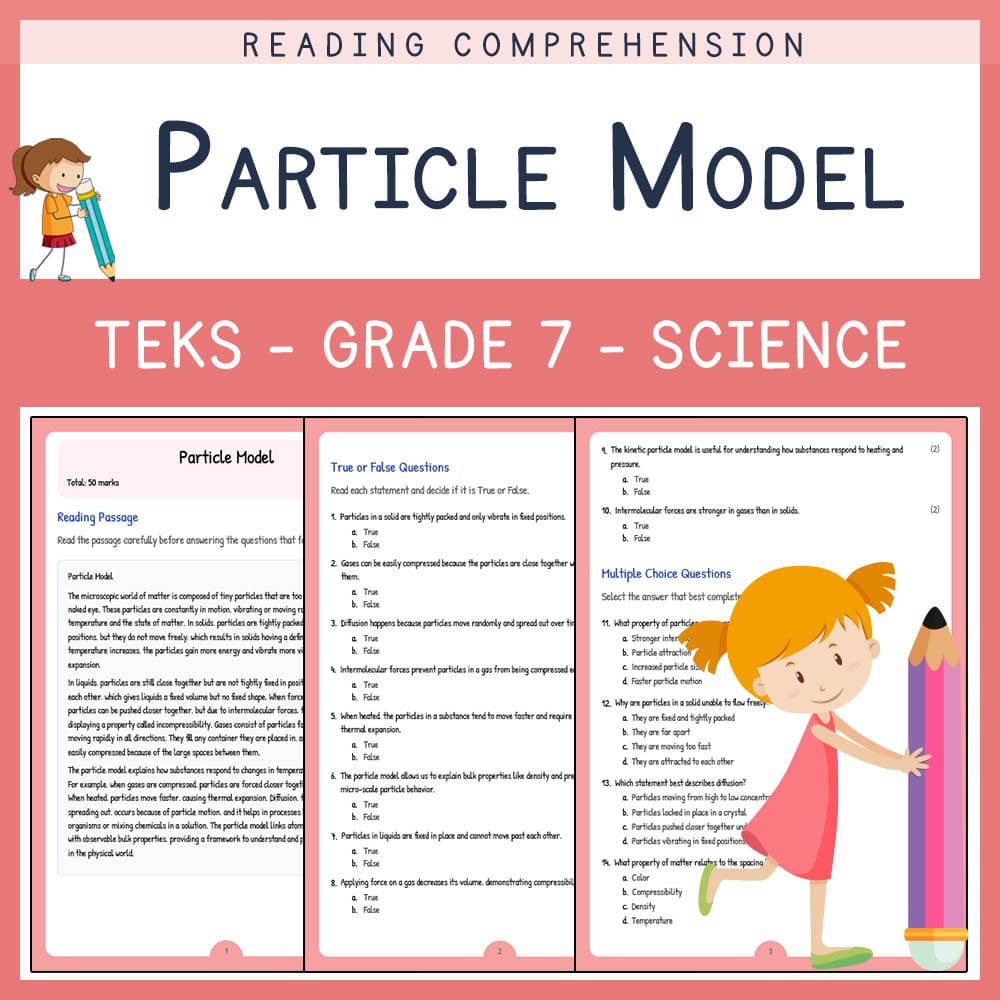
Grade 7 Science | Particle Model Worksheet | TEKS Alligned
Created byLumora LearningLearning Objectives
- Understand the particle model as an explanation for properties of matter.
- Describe particle spacing, motion, and forces in different states of matter.
- Relate micro-scale particle behavior to macro-scale measurements such as density and pressure.
Also included in: Grade 7 Science | Matter and Energy Lesson Bundle | TEKS Aligned
Instant download
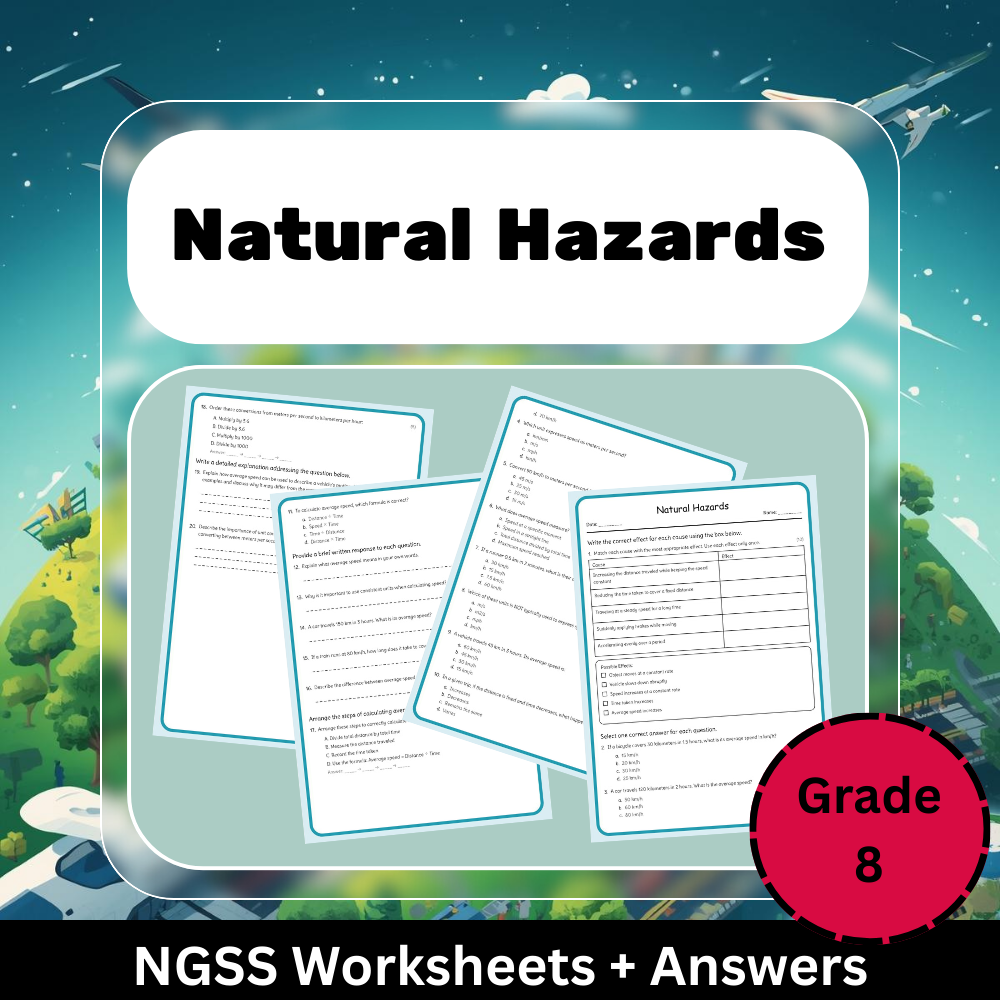
Grade 8 Science | Understanding Natural Hazards Worksheet (Answer Key) – NGSS
Created byBright Mind ResourcesLearning Objectives
- Analyze patterns, frequency, and magnitude of natural hazard data.
- Interpret instrumental records and historical observations for risk assessment.
- Evaluate hazard mitigation techniques using data analysis.
Also included in: Grade 8 Science Unit | Climate & Environment NGSS Worksheets & Resources +2 more
Instant download
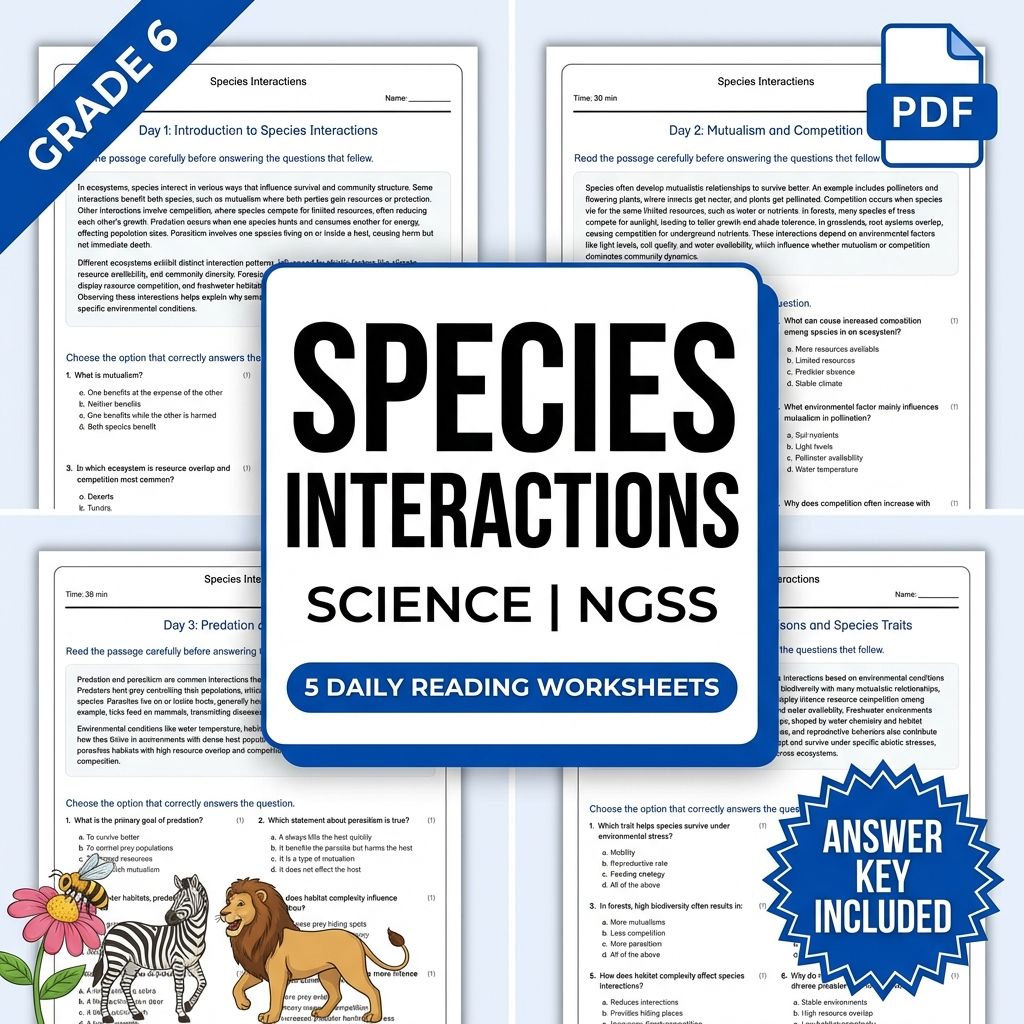
6th Grade Science | Species Interactions Reading Worksheet (PDF+ Answer Key)
Created byCopper Leaf ClassroomLearning Objectives
- Construct explanations predicting patterns of species interactions across ecosystems.
- Identify and differentiate mutualism, competition, predation, and parasitism as recurring interaction types.
- Compare outcomes of species interactions in forest, grassland, and freshwater environments.
Instant download

Grade 11 Science – Respiration Pathways Daily Reading Worksheet + Answer Key
JCreated byJ.S SheetsLearning Objectives
- Understand the steps involved in cellular respiration
- Identify the process of glycolysis and its products
- Explain how the citric acid cycle links to other pathways
Also included in: Grade 11 Science Lesson Group | Metabolic Regulation and Photosynthesis Bundle +1 more
Instant download
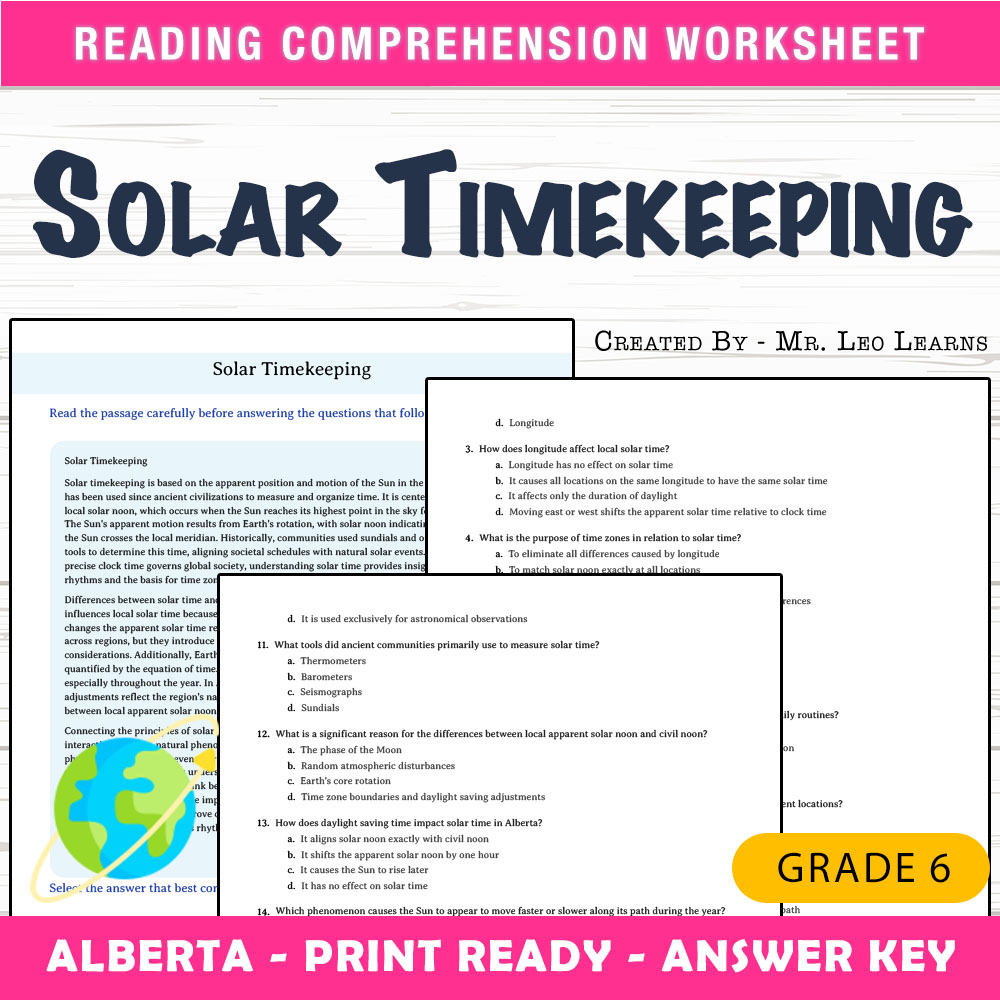
Grade 6 Science — Solar Timekeeping Worksheet MCQ Paper for Mastery
Created byThe Resource HubLearning Objectives
- Explain the principles of solar timekeeping and its connection to apparent solar motion.
- Identify factors that cause differences between solar time and clock time, such as longitude, time zones, and Earth's orbital eccentricity.
- Describe how historical and contemporary communities in Alberta use solar time for scheduling and calendar calculations.
Also included in: Grade 6 Science Sky Science Unit Bundle – Celestial Motion & Earth-Sun Relations +1 more
Instant download
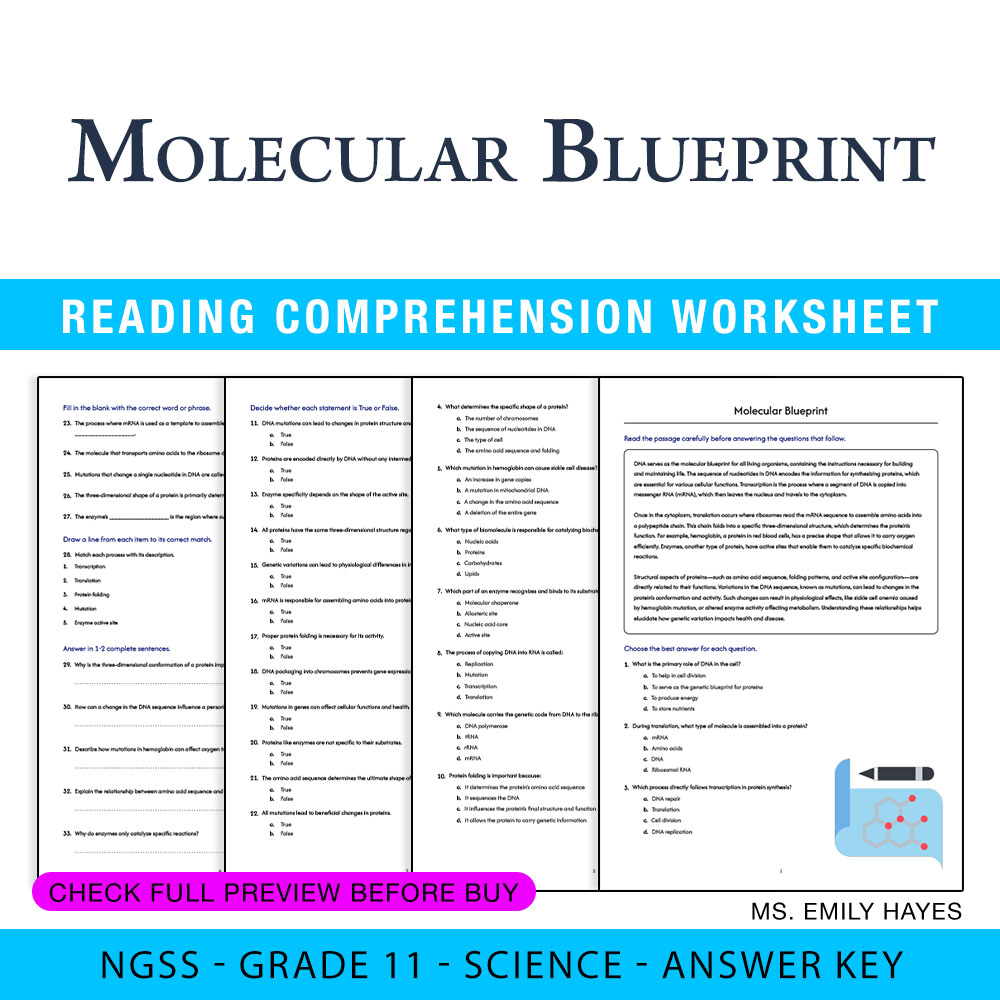
11th Grade Science | Molecular Blueprint Worksheet (PDF+ Answer Key)
Created byCopper Leaf ClassroomLearning Objectives
- Explain how DNA sequences influence protein structure and function.
- Describe the processes of transcription and translation in protein synthesis.
- Identify the relationship between gene variation and physiological effects.
Instant download
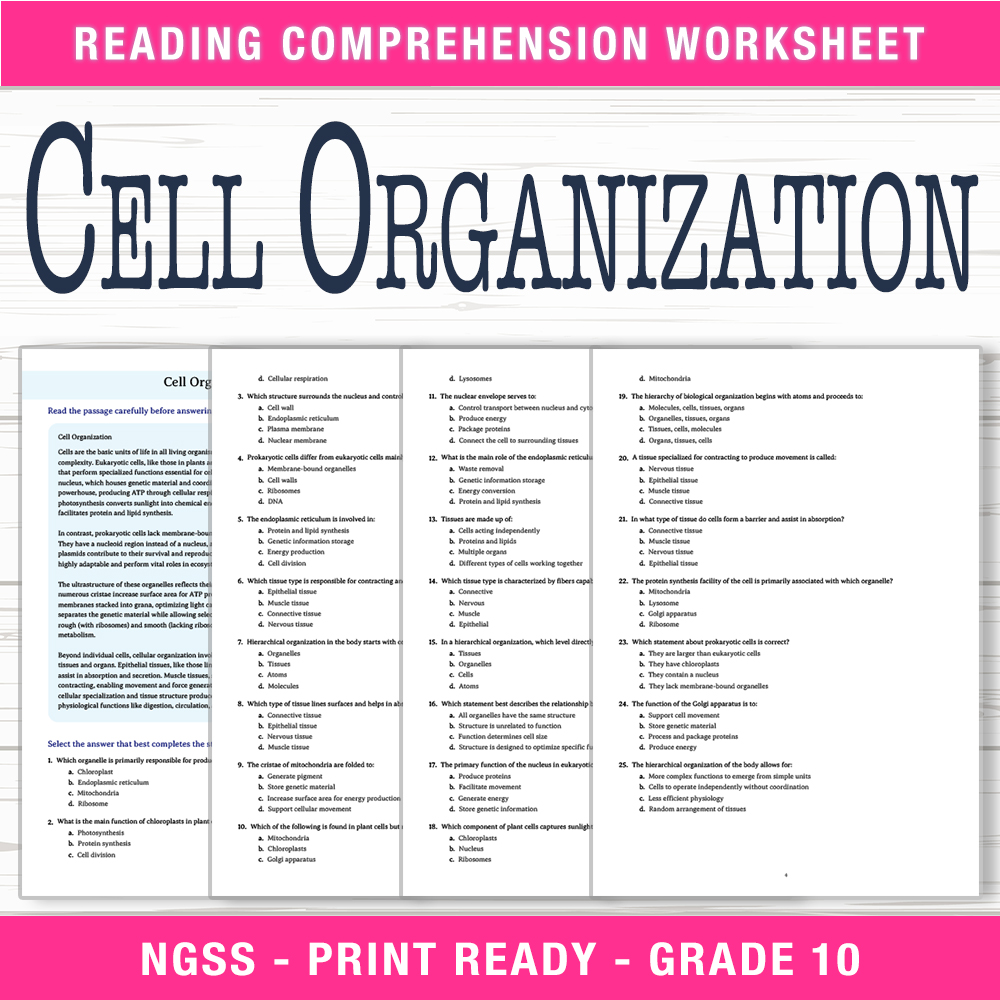
Grade 10 Science | Cell Organization Worksheet (PDF + Answer Key)
 Created byRiverstone Classroom
Learning Objectives
- Understand the structure and function of membrane-bound organelles in eukaryotic and prokaryotic cells.
- Compare the ultrastructure of mitochondria, chloroplasts, endoplasmic reticulum, and nucleus and link their structures to their functions.
- Explain how cellular arrangements and tissue organization contribute to organ performance and physiological properties.
Instant download
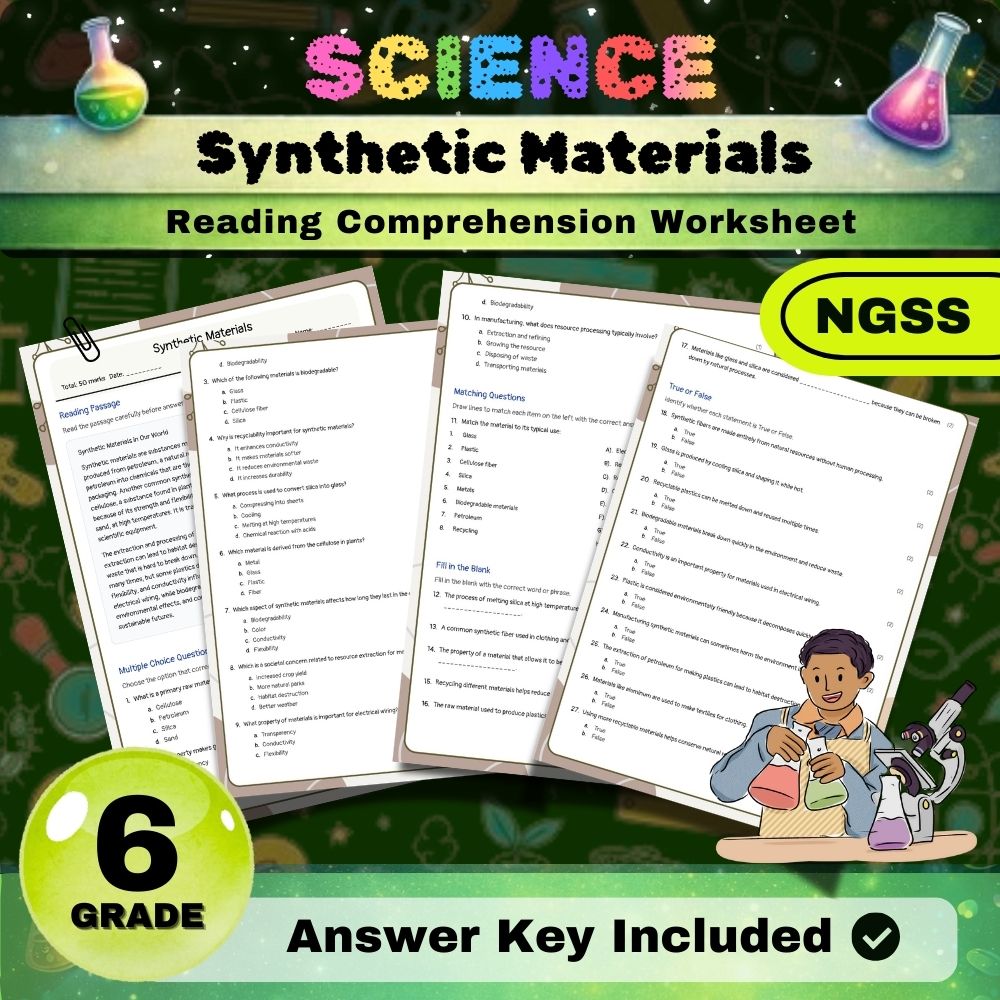
6th Grade Science – Synthetic Materials NGSS Worksheet (PDF)
Created byMaple Path LearningLearning Objectives
- Explain how natural resources are used to create synthetic materials.
- Compare properties of different substances used in manufacturing.
- Describe processes involved in resource extraction and material processing.
Also included in: Grade 6 Science| Matter, Chemical Reactions & Conservation NGSS Worksheet Bundle +1 more
Instant download
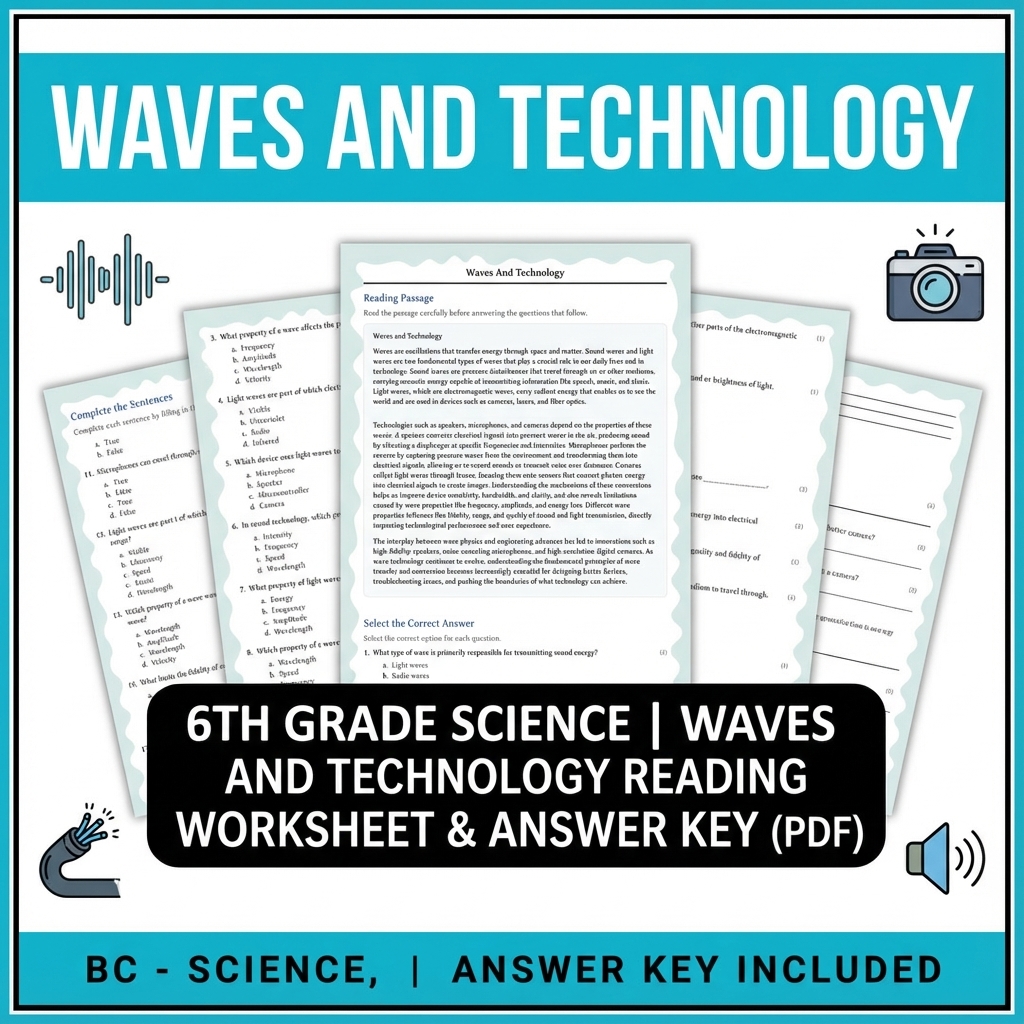
6th Grade Science | Waves and Technology Reading Worksheet & Answer Key (PDF)
JCreated byJ.S SheetsLearning Objectives
- Understand how sound and light waves are used in modern technology devices.
- Explain how energy is transferred and converted in speakers, microphones, and cameras.
- Identify wave properties like frequency and intensity that affect device performance.
Instant download
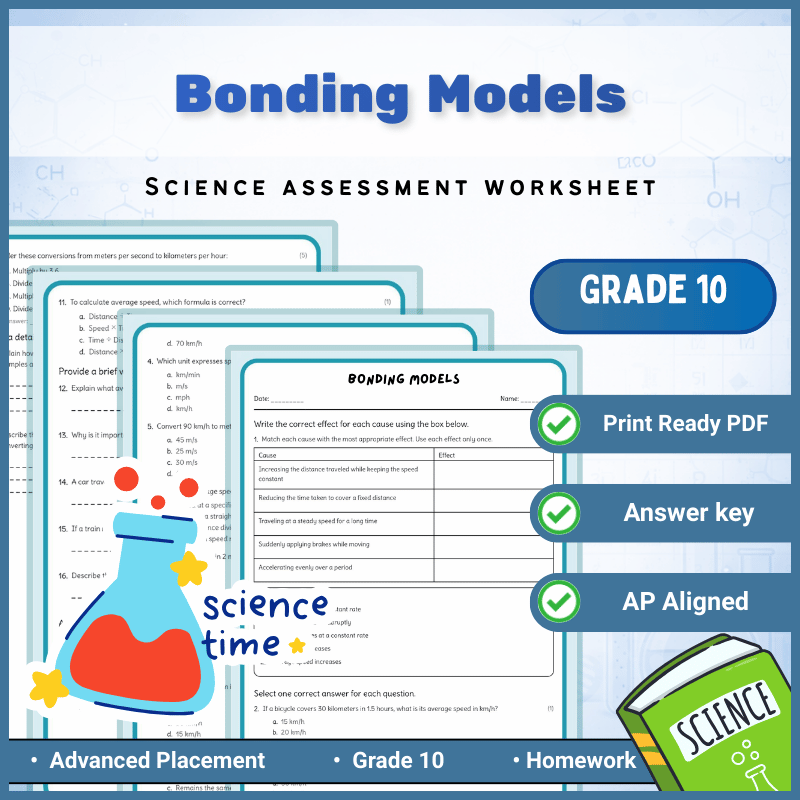
Grade 10 Science | Bonding Models Worksheet (AP Standards) – Science 1 (PDF)
Created byBright Mind ResourcesLearning Objectives
- Describe the major types of chemical bonding: ionic, covalent, and metallic.
- Relate bonding frameworks to observable properties like conductivity, melting point, and solubility.
- Interpret Lewis structures, electron-sharing, and electron-transfer representations.
Instant download
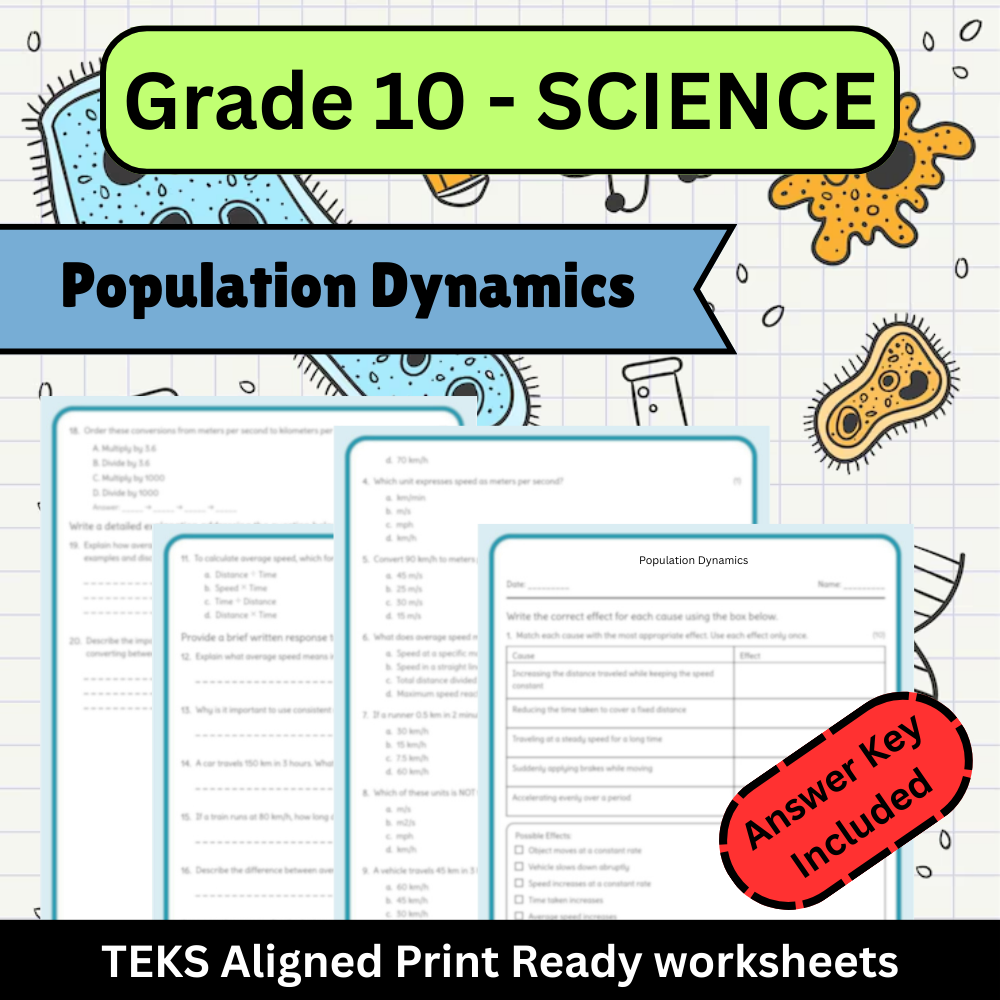
Grade 10 Science | Population Dynamics Worksheet (Answer Key) aligned with TEKS
Created byBright Mind ResourcesLearning Objectives
- Explain how birth rates, death rates, immigration, and emigration influence population size.
- Analyze how interactions like competition, predation, and resource availability affect population survival.
- Use mathematical models to describe exponential and logistic growth patterns.
Also included in: Grade 10 Science | Ecosystems & Biodiversity Unit Worksheet Bundle(TEKS-Aligned) +5 more
Instant download

Grade 9 Chemical Changes Worksheet | Ontario Science | Reactions & Answer Key
 Created byClear Sky Classroom
Learning Objectives
- Distinguish chemical changes from physical changes by using evidence that new substances form.
- Identify observable indicators of chemical change such as temperature change, gas production, precipitate formation, and persistent color change.
- Explain reactant-to-product transformation using the idea of particles at the microscopic level.
Instant download

Grade 12 Science | Wave Behaviour Reading Worksheet (PDF & Rubric)
JCreated byJ.S SheetsLearning Objectives
- Understand the key characteristics of wave behaviour, including wavelength, frequency, amplitude, and wave speed.
- Apply quantitative models to analyze wave propagation in different contexts such as acoustics, seismic activity, and optics.
- Interpret real-world examples of wave interactions, including mirages, seismic waves, and acoustic propagation across landscapes.
Also included in: Grade 12 Science UNIT Bundle – Waves, Nuclear & Electromagnetism Worksheets +1 more
Instant download
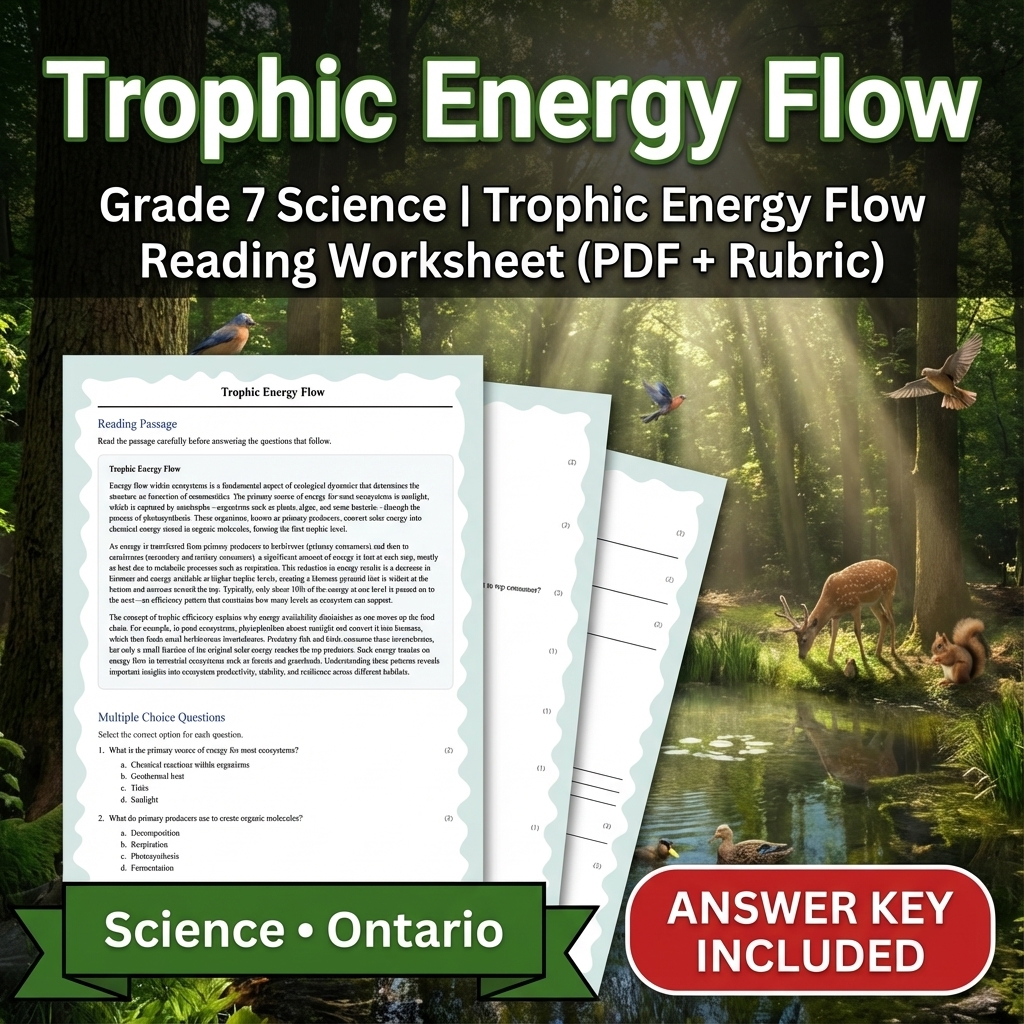
Grade 7 Science | Trophic Energy Flow Reading Worksheet (PDF + Rubric)
JCreated byJ.S SheetsLearning Objectives
- Understand how energy moves through trophic levels in ecosystems.
- Explain the concepts of energy efficiency, biomass pyramids, and energy transfer limitations.
- Describe how solar energy is captured by primary producers and lost through respiration and heat.
Also included in: Grade 7 Science | Ecosystems, Biodiversity & Environmental Stewardship +1 more
Instant download
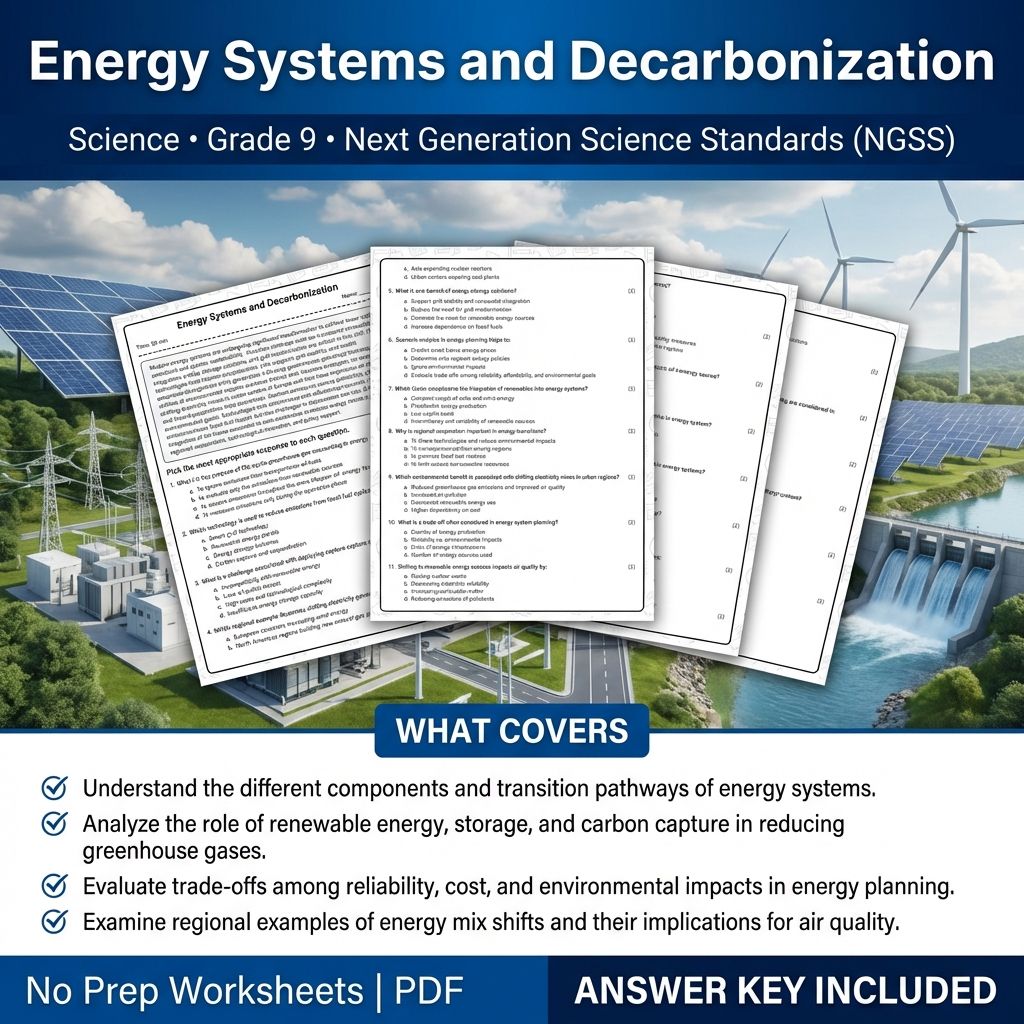
Grade 9 Science Worksheet | Energy Systems & Decarbonization (PDF + Answer Key)
 Created byCoral Reef Learning
Learning Objectives
- Understand the different components and transition pathways of energy systems.
- Analyze the role of renewable energy, storage, and carbon capture in reducing greenhouse gases.
- Evaluate trade-offs among reliability, cost, and environmental impacts in energy planning.
Also included in: Grade 9 Science UNIT Worksheet Pack-Resource Management & Energy Decarbonization +1 more
Instant download
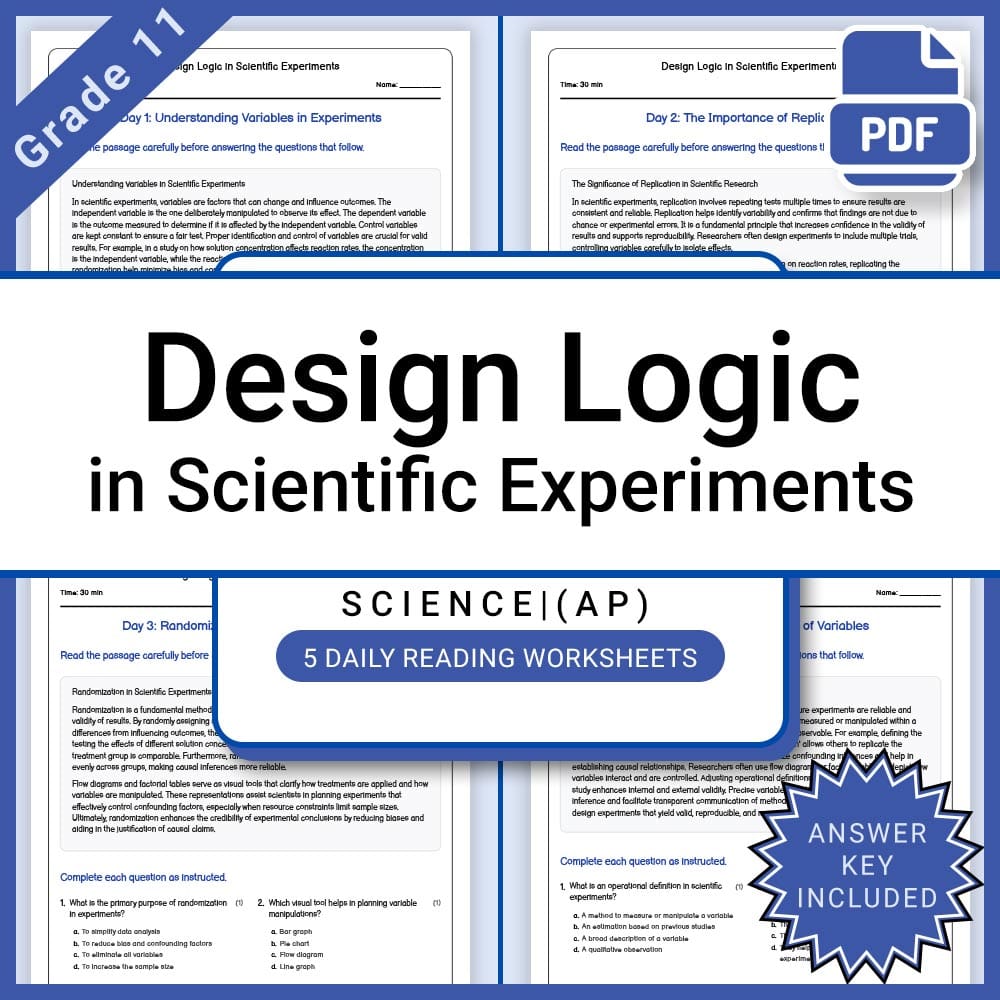
Grade 11 Science – Scientific Experiment Design Daily Worksheet + Answer Key
JCreated byJ.S SheetsLearning Objectives
- Understand the concept of variables in experiments
- Identify independent, dependent, and control variables
- Learn principles of experimental design including variable control, replication, and randomization
Also included in: AP Biology Cell Structure and Function Activities | Grade 11 Advanced Placement +1 more
Instant download
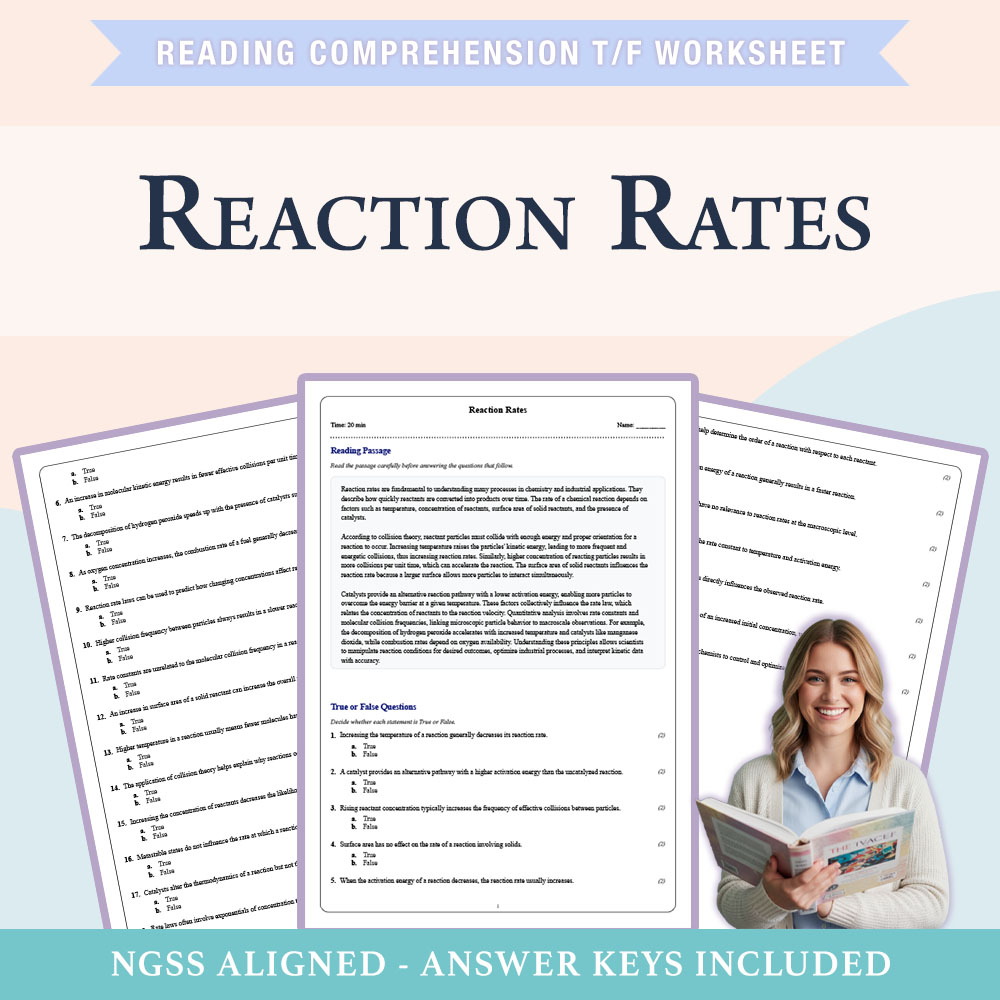
10th Grade Science | Reaction Rates Worksheet (PDF + Answer Key)
Created byCopper Leaf ClassroomLearning Objectives
- Explain how temperature, concentration, surface area, and catalysts influence reaction rates.
- Interpret empirical rate data using collision theory, activation energy, and rate laws.
- Describe how particle kinetic energy and collision frequency affect macroscopic reaction progress.
Also included in: Grade 10 Science | Chemical Reaction & Particle Interactions (PDF + Answer Key) +1 more
Instant download
Browse more categories
About Science Worksheets
Find Science worksheets spanning core skills, practice, and review. All 44,620 resources are instant PDF downloads for the classroom or home.
Every worksheet on MyTeachingSheets is created by independent teacher-authors and reviewed before publication. All resources download as printable PDFs for classroom, homework, or at-home practice, and many include answer keys. Preview any worksheet free before buying.