
Science Worksheets
44,628 subject resources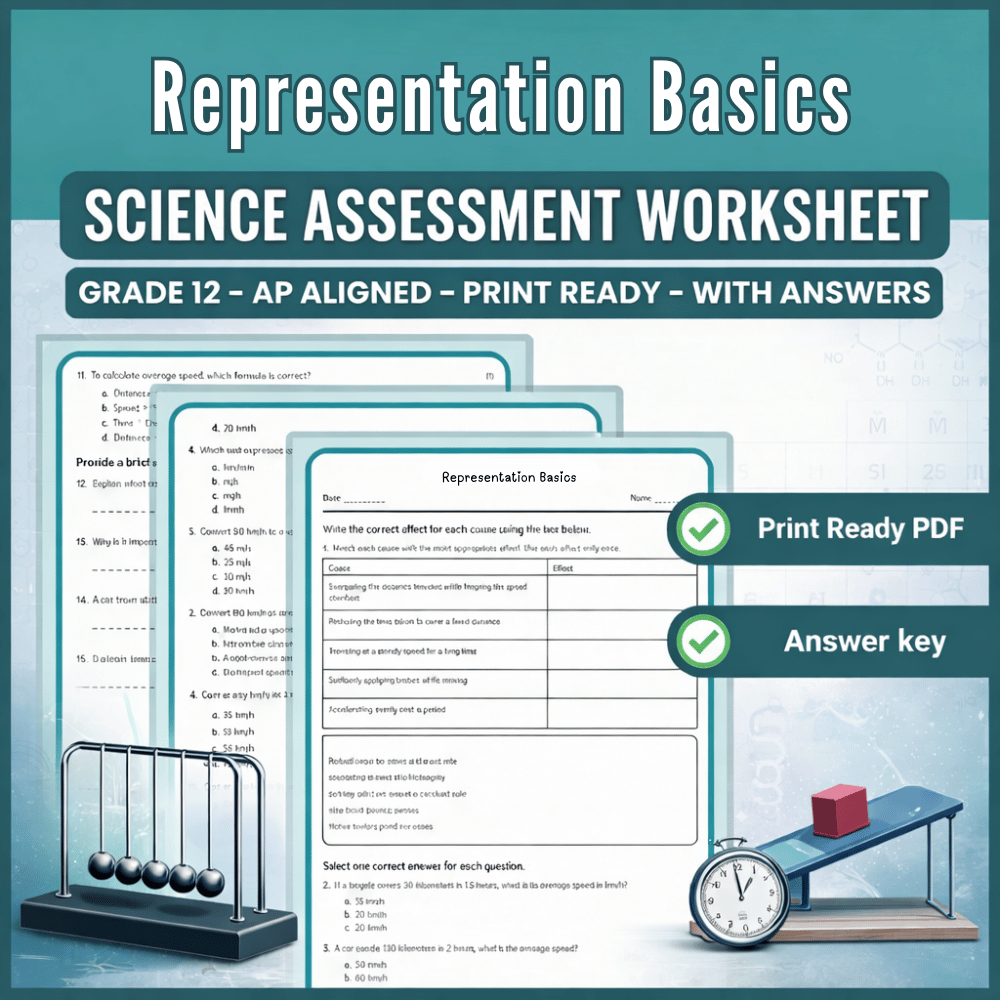
Grade 12 Science | Representation Basics AP Practice Worksheet (PDF)
 Created byBright Mind Resources
Learning Objectives
- Understand the purpose and limitations of different types of models in science.
- Identify and classify various representations such as diagrams, equations, and simulations.
- Explain how mapping between representations and phenomena informs interpretation and reasoning.
Instant download
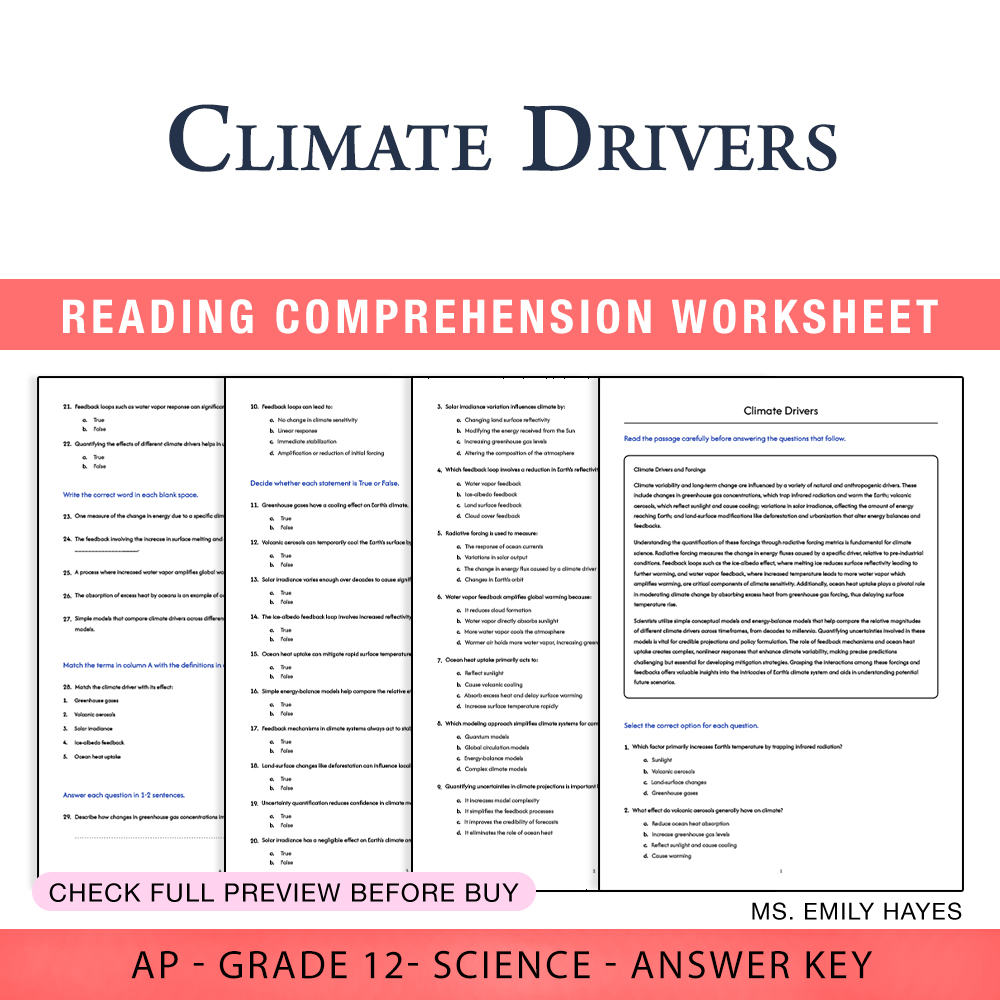
12th Grade Science | Climate Drivers Assessment Worksheet (PDF+ Answer Key)
 Created byCopper Leaf Classroom
Learning Objectives
- Identify the major forcings that drive climate variability and change.
- Understand feedback mechanisms such as ice-albedo and water vapor responses.
- Explain the role of ocean heat uptake in climate systems.
Also included in: Grade 12 Science | Earth Systems & Climate AP Worksheet (PDF + Answer Key) +1 more
Instant download

Natural Resources Worksheet | Standards-Aligned Grade 6 Science Practice
JCreated byJ.S SheetsLearning Objectives
- Identify renewable and nonrenewable natural resources and explain how their formation times affect supply
- Describe how natural resources are distributed regionally and how scientists assess resource availability
- Explain economic and environmental trade-offs of extracting resources, including reclamation and sustainability
Instant download

Electron Arrangement and Polarity Worksheet for Grade 11 Science
JCreated byJ.S SheetsLearning Objectives
- Explain how valence electron distribution influences molecular polarity.
- Identify polar and nonpolar molecules based on electron arrangement.
- Connect electron density maps to observable polarity in molecules.
Instant download
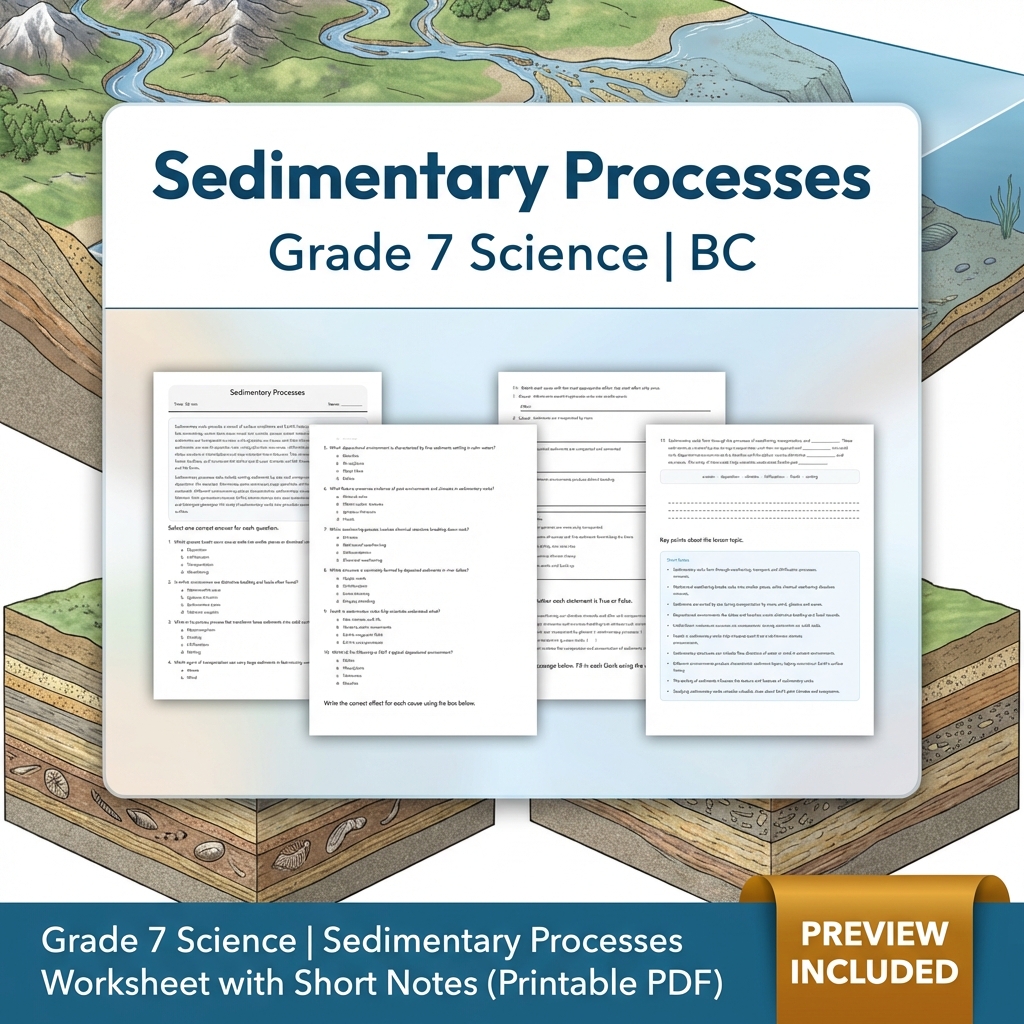
Grade 7 Science | Sedimentary Processes Worksheet with Short Notes (PDF)
 Created byMeadowlark Worksheets
Learning Objectives
- Understand the stages involved in the formation of sedimentary rocks.
- Identify different types of weathering and depositional environments.
- Describe how sediments are transported and transformed into rock.
Also included in: Grade 7 Science Lesson Bundle | Earth Processes Worksheets Group +1 more
Instant download
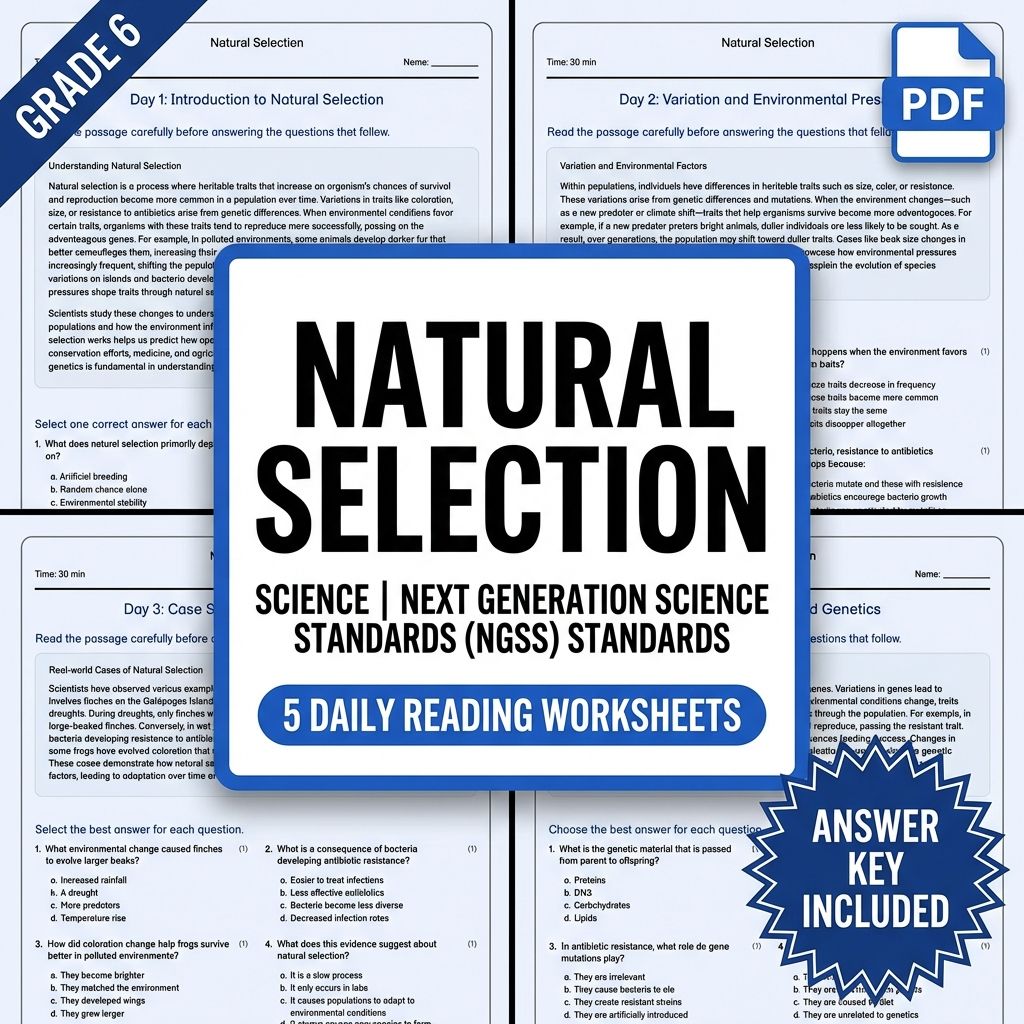
6th Grade Science | Natural Selection Daily Reading Worksheet (PDF + Answer Key)
Created byCopper Leaf ClassroomLearning Objectives
- Understand how heritable variation influences natural selection.
- Identify examples of natural selection in various environments.
- Evaluate mechanisms that lead to shifts in trait frequencies over generations.
Instant download
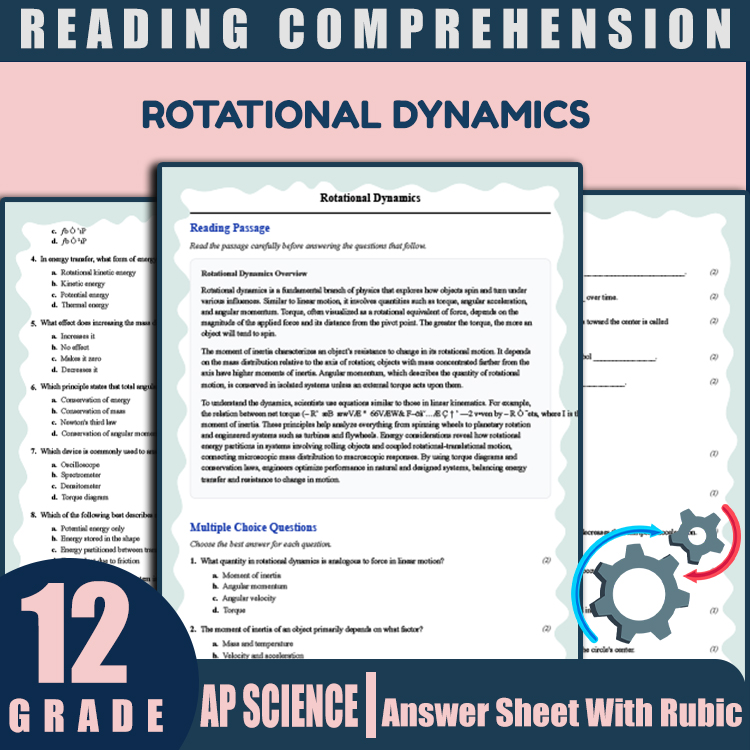
Grade 12 Science | Rotational Dynamics Reading Worksheet & Answer Key (PDF)
JCreated byJ.S SheetsLearning Objectives
- Understand the concept of torque and its analog to force in linear motion.
- Describe the moment of inertia and how mass distribution affects rotational response.
- Apply equations relating net torque to angular acceleration for rigid bodies.
Also included in: Grade 12 Science Unit Bundle | Mechanics & Energy Worksheets (PDF + Answer Key) +1 more
Instant download
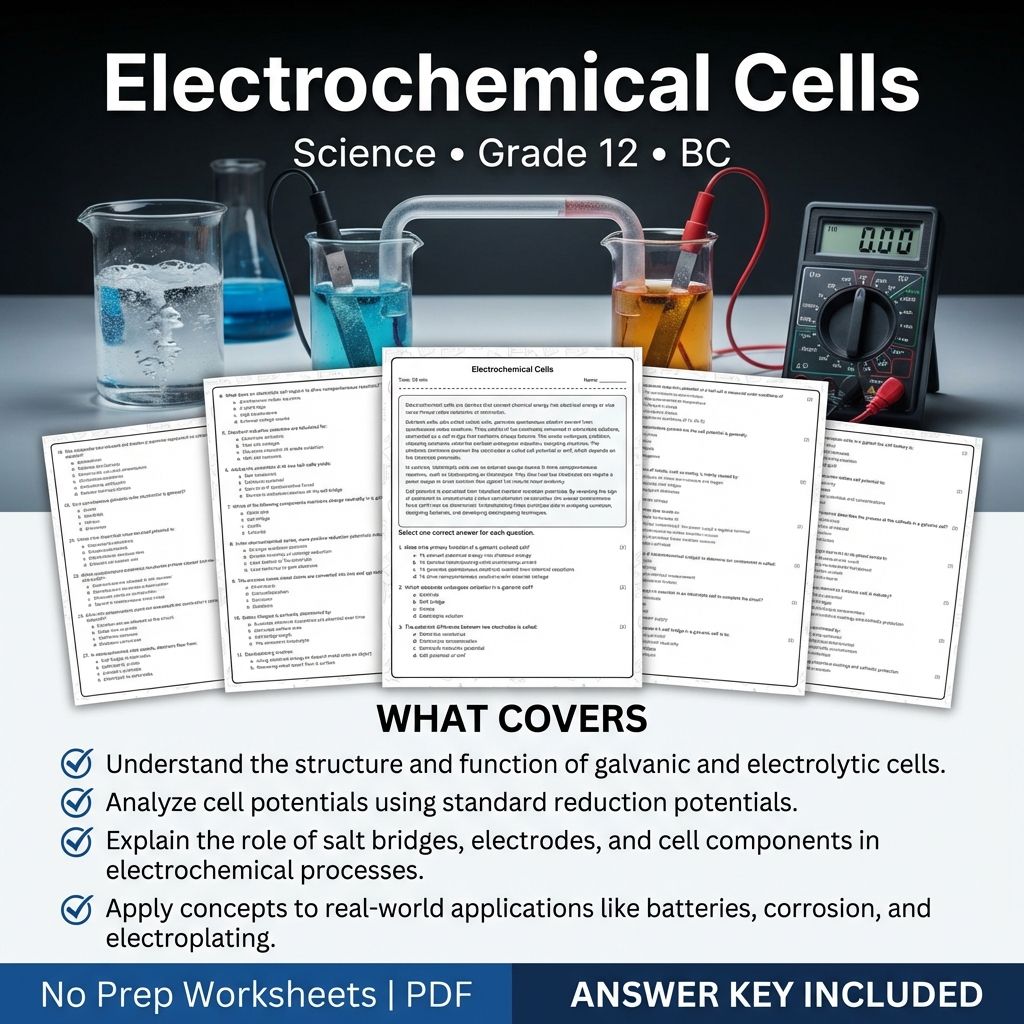
Electrochemical Cells Worksheet | Grade 12 Science Practice and Assessment
 Created byCoral Reef Learning
Learning Objectives
- Understand the structure and function of galvanic and electrolytic cells.
- Analyze cell potentials using standard reduction potentials.
- Explain the role of salt bridges, electrodes, and cell components in electrochemical processes.
Instant download
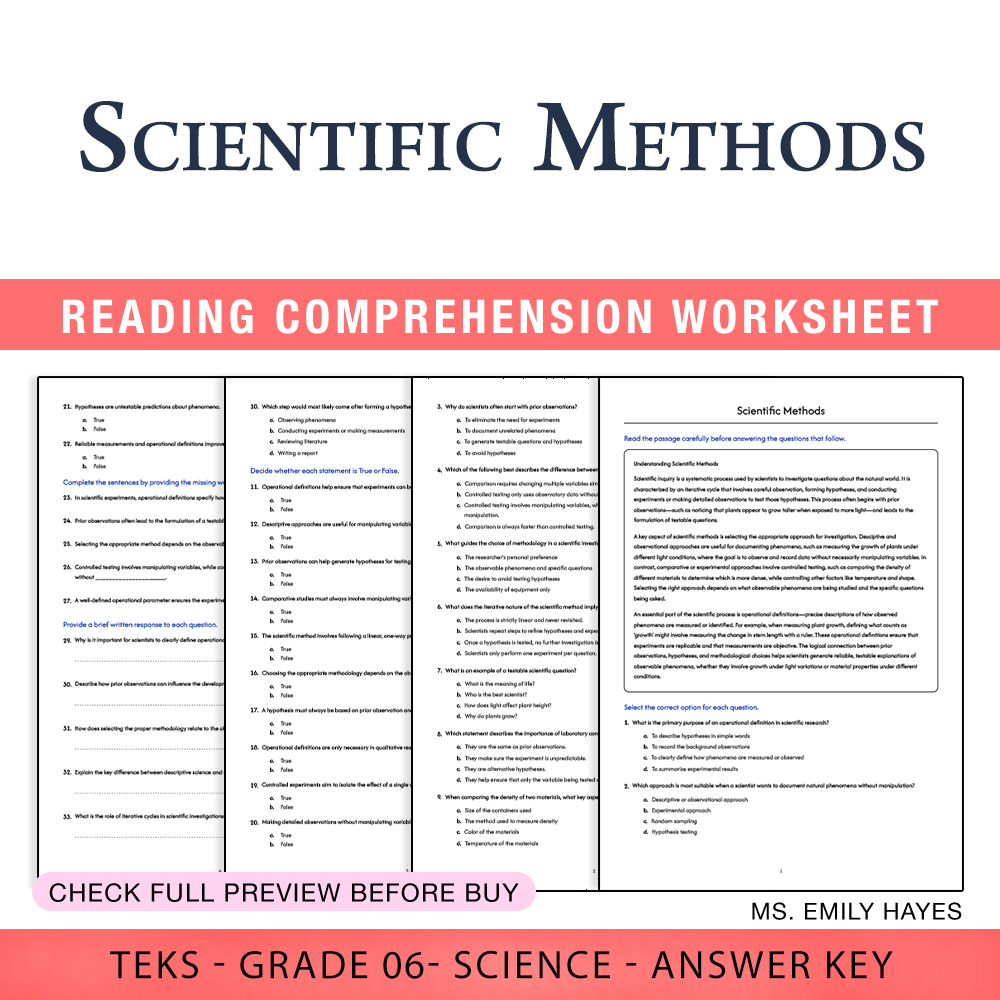
6th Grade Science | Scientific Methods Worksheet (PDF+ Answer Key)
Created byCopper Leaf ClassroomLearning Objectives
- Understand the iterative nature of scientific methods and how observations inform hypotheses.
- Differentiate between descriptive, observational approaches and comparative, experimental approaches.
- Identify operational definitions and appropriate methodologies based on observable phenomena.
Instant download

Grade 11 Calvin Cycle Carbon Fixation Worksheet | Photosynthesis Ontario
 Created byChalk and Compass
Learning Objectives
- Explain the carbon fixation, reduction, and regeneration phases of the Calvin cycle.
- Describe how ATP and NADPH are used to produce triose phosphates from inorganic carbon.
- Compare C3, C4, and CAM strategies and predict their effects on photorespiration and carbon assimilation.
Also included in: Grade 11 Science Respiration, Photosynthesis & Genetics Lesson Bundle – Ontario +1 more
Instant download
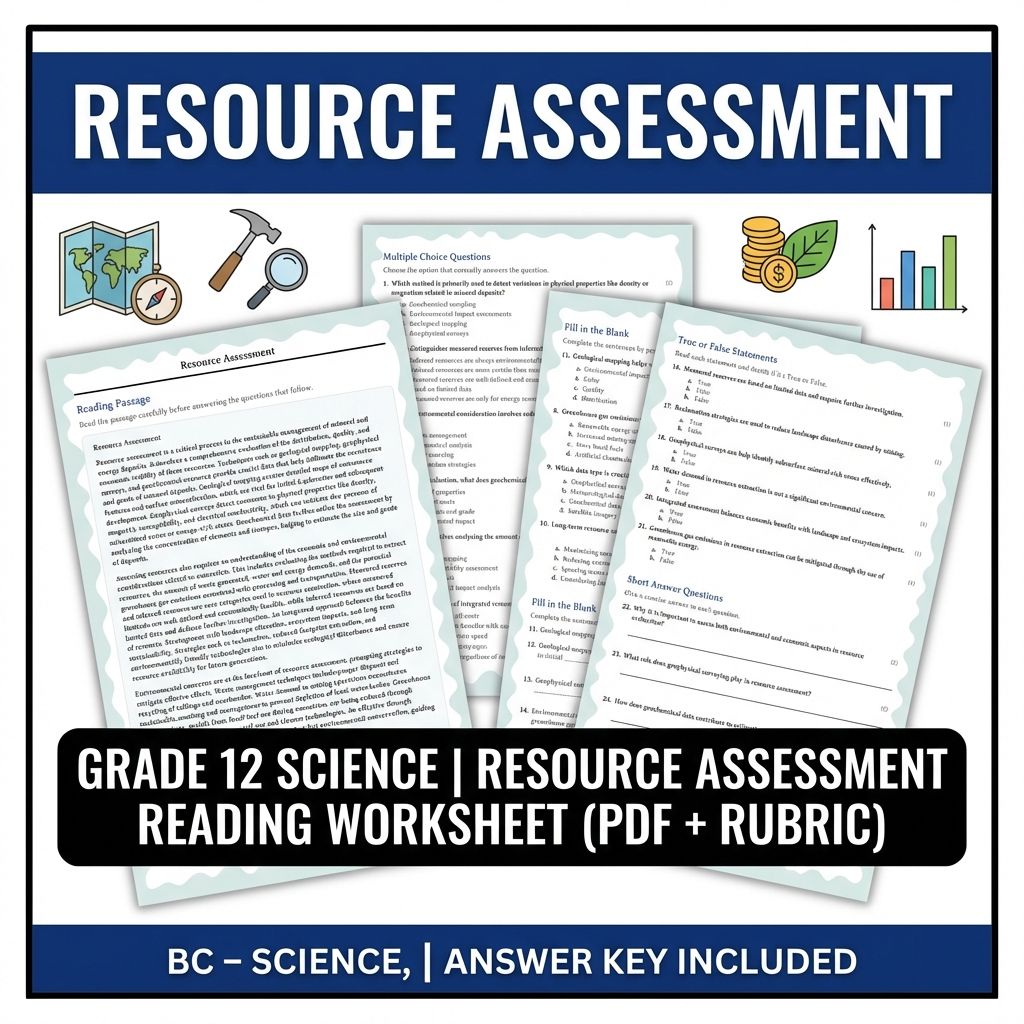
Grade 12 Science | Resource Assessment Reading Worksheet (PDF + Rubric)
JCreated byJ.S SheetsLearning Objectives
- Understand the methods used in resource assessment including geological mapping, geophysical surveys, and geochemical data.
- Identify environmental considerations such as waste management, water demand, and greenhouse gases in resource extraction.
- Analyze how integrated assessments weigh resource benefits against ecosystem impacts to inform sustainable strategies.
Instant download
Grade 10 Science | Conservation Law Reading Worksheet with PDF Answer Key
JCreated byJ.S SheetsLearning Objectives
- Understand the principle of conservation of energy and how it applies to various systems.
- Describe different forms of energy and how they TRANSFORM or transfer between components.
- Identify examples of energy conservation in natural and engineered systems.
Instant download
Grade 10 Science – Mass Conservation Daily Reading Worksheet + Answer Key
JCreated byJ.S SheetsLearning Objectives
- Understand key concepts related to Science
- Apply knowledge through practice questions
- Demonstrate comprehension of the material
Also included in: Grade 10 Science Lesson Group Bundle Alberta | Worksheets & Activities +1 more
Instant download

Grade 11 Science – DNA Replication & Enzymes Daily Reading Worksheet
Created byBright Mind ResourcesLearning Objectives
- Identify key components involved in the initiation of DNA replication
- Understand the roles of enzymes such as helicase, primase, and DNA polymerase
- Describe how lagging and leading strands are replicated
Also included in: Grade 11 DNA Replication & Genetics Science Daily Reading Lesson Bundle | TEKS +2 more
Instant download
10th Grade Science | Force Interactions Worksheet (PDF+ Answer Key)
Created byCopper Leaf ClassroomLearning Objectives
- Understand the classification of contact and non-contact forces.
- Represent forces graphically using vectors and free-body diagrams.
- Explain Newton's third law and pairwise force interactions.
Instant download
6th Grade Science | Energy Efficiency Worksheet + Answer Key – BC Standards
Created byBright Mind ResourcesLearning Objectives
- Define energy efficiency and explain its importance.
- Identify causes of energy loss in machines and systems.
- Evaluate different technologies based on their energy efficiency.
Instant download
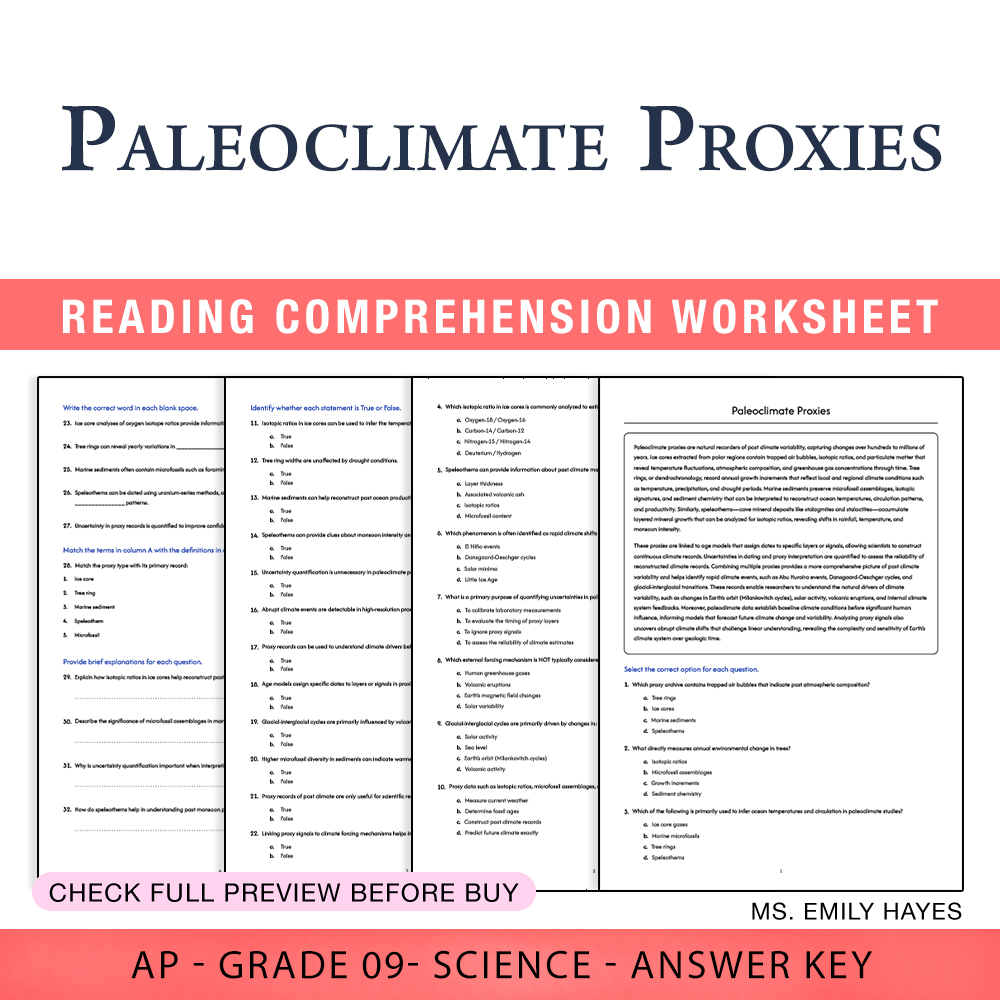
9th Grade Science | Paleoclimate Proxies Worksheet (PDF+ Answer Key)
Created byCopper Leaf ClassroomLearning Objectives
- Interpret evidence from ice cores, tree rings, marine sediments, and speleothems using proxy indicators.
- Relate proxy records to past climate variability and events such as glacial-interglacial cycles and abrupt shifts.
- Apply age models and quantify uncertainties to link proxy signals to climate forcing mechanisms.
Also included in: Grade 9 Science | Earth and Space Sciences AP Worksheet (PDF + Answer Key) +1 more
Instant download

Grade 7 Science – Conservation Applications in Chemistry | Reading Worksheet
Created byBright Mind ResourcesLearning Objectives
- Understand the principle of mass conservation in chemical reactions
- Identify real-world applications of mass balance concepts
- Recognize how mass conservation is monitored in different systems
Also included in: Grade 7 Solutions Science Daily Reading Worksheets Lesson Bundle | Alberta +2 more
Instant download
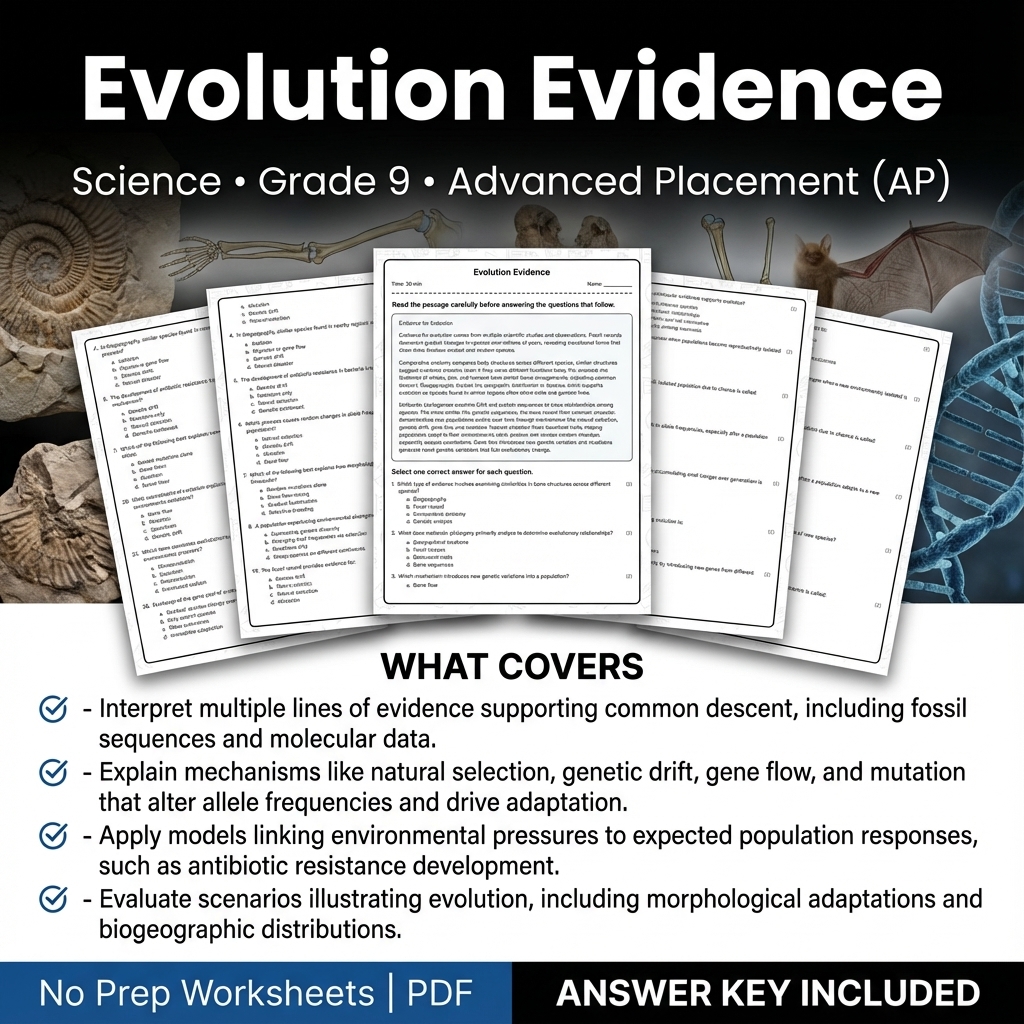
9th Grade Science | Evolution Evidence Worksheet (Printable PDF + Answer Key)
Created byCoral Reef LearningLearning Objectives
- Interpret multiple lines of evidence supporting common descent, including fossil sequences and molecular data.
- Explain mechanisms like natural selection, genetic drift, gene flow, and mutation that alter allele frequencies and drive adaptation.
- Apply models linking environmental pressures to expected population responses, such as antibiotic resistance development.
Also included in: Grade 9 Science Unit Worksheet Bundle | Cell Function to Ecosystem Dynamics +2 more
Instant download

Grade 9 Science | Resource Choices - Daily Reading Comprehension
Created byCoral Reef LearningLearning Objectives
- Understand the environmental impacts of coal energy production.
- Analyze trade-offs involved in different resource extraction methods.
- Recognize sustainable practices in resource management.
Instant download
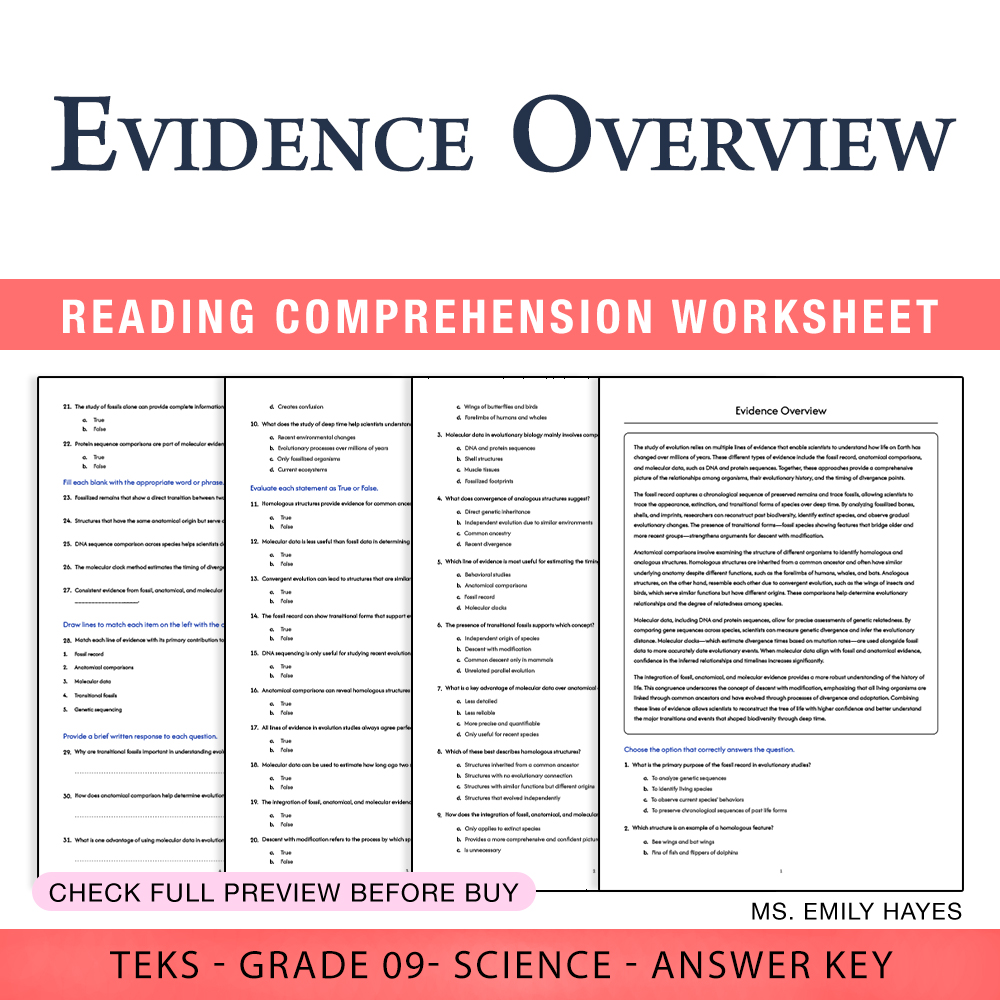
9th Grade Science | Evidence of Evolution Worksheet (PDF+ Answer Key)
Created byCopper Leaf ClassroomLearning Objectives
- Understand the different lines of evidence used to support evolutionary relationships among organisms.
- Identify how fossil records, anatomical comparisons, and molecular data contribute to understanding biodiversity through time.
- Evaluate the strength of evidence derived from different sources and their integration in evolutionary studies.
Instant download
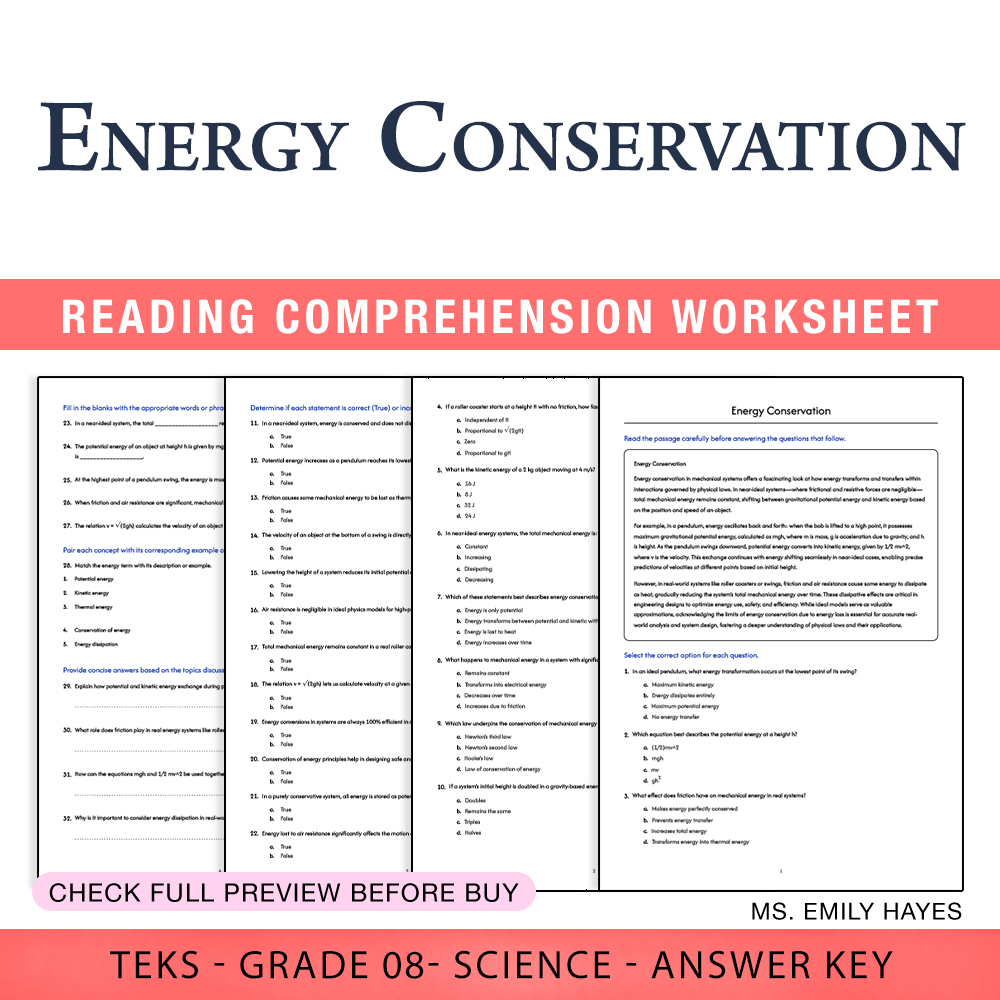
Grade 8 Science | Energy Conservation Worksheet (PDF+ Answer Key)
Created byCopper Leaf ClassroomLearning Objectives
- Explain the principles of mechanical energy conservation in near-ideal systems such as pendulums and roller coasters.
- Identify how energy transforms between potential and kinetic forms based on height and speed.
- Discuss how energy dissipates into thermal forms due to friction and air resistance.
Instant download
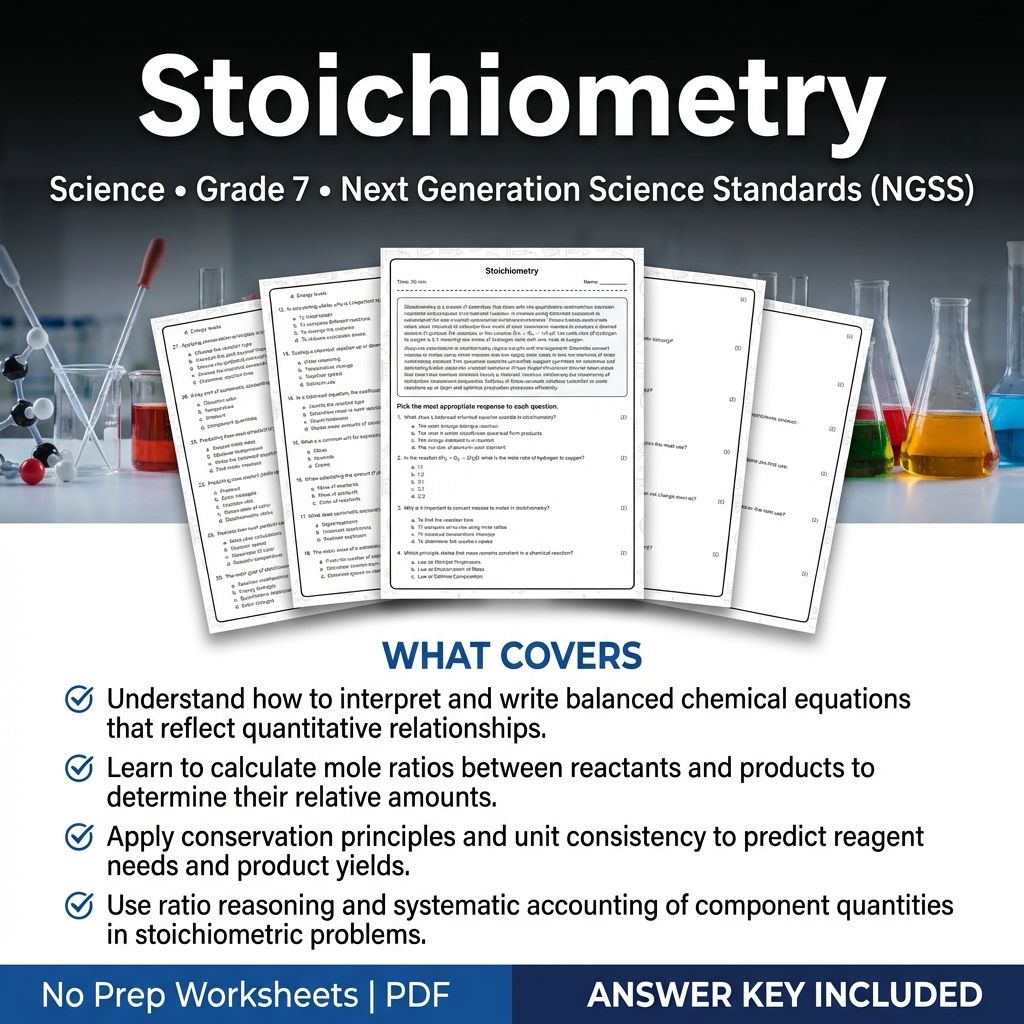
7th Grade Science | Stoichiometry Worksheet & PDF Answer Key (Printable)
Created byCoral Reef LearningLearning Objectives
- Understand how to interpret and write balanced chemical equations that reflect quantitative relationships.
- Learn to calculate mole ratios between reactants and products to determine their relative amounts.
- Apply conservation principles and unit consistency to predict reagent needs and product yields.
Instant download
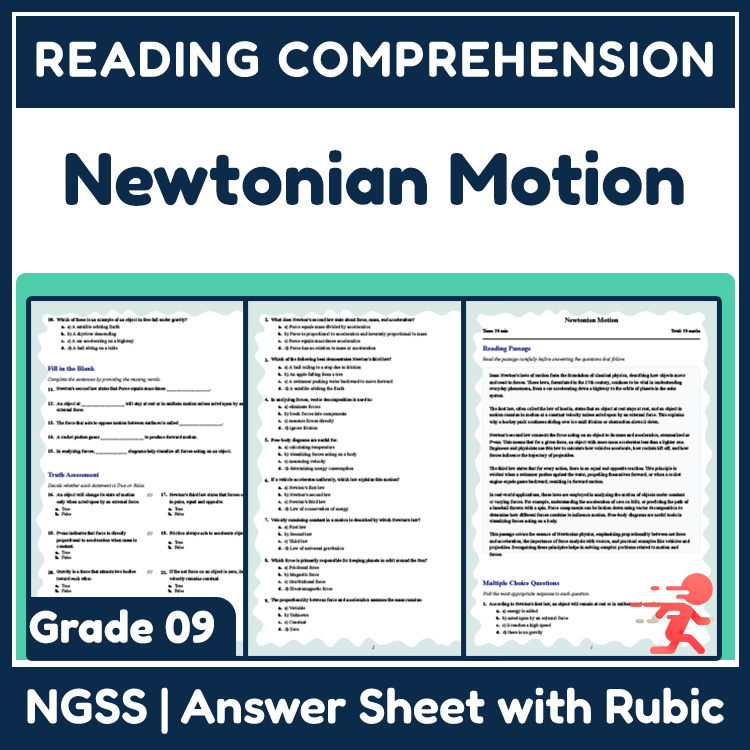
Grade 9 Science | Newtonian Motion Reading Worksheets (PDF & Rubric)
JCreated byJ.S SheetsLearning Objectives
- Understand Newton's three laws of motion and their implications
- Analyze forces acting on objects using free-body diagrams
- Apply vector components to resolve forces and predict motion
Also included in: Grade 9 Science Unit Bundle – Newtonian Motion & Force Laws Worksheets
Instant download
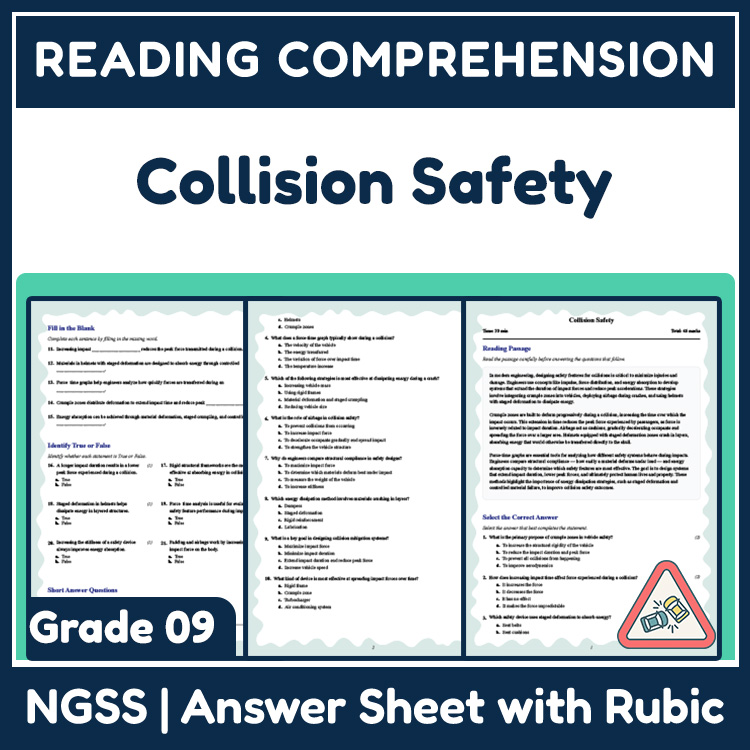
9th Grade Science | Collision Safety Reading Worksheet with Answer Key (PDF)
JCreated byJ.S SheetsLearning Objectives
- Understand the principles of impulse and force-time tradeoffs in collision mitigation
- Describe the roles of crumple zones, airbags, helmets, and padding in collision safety
- Analyze force-time graphs to evaluate energy absorption strategies
Also included in: Grade 9 Science Unit Bundle – Newtonian Motion & Force Laws Worksheets
Instant download
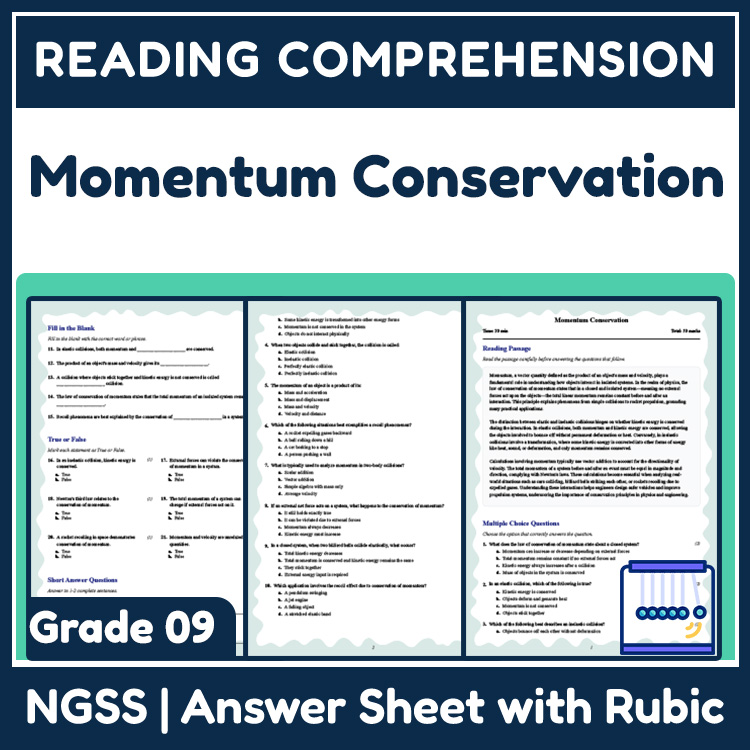
9th Grade Science | Momentum Conservation Reading Worksheet & Answer Key (PDF)
JCreated byJ.S SheetsLearning Objectives
- Understand the principle of conservation of linear momentum in isolated systems.
- Differentiate between elastic and inelastic collisions using momentum vectors.
- Learn how to mathematically calculate total momentum before and after collisions.
Also included in: Grade 9 Science Unit Bundle – Newtonian Motion & Force Laws Worksheets
Instant download
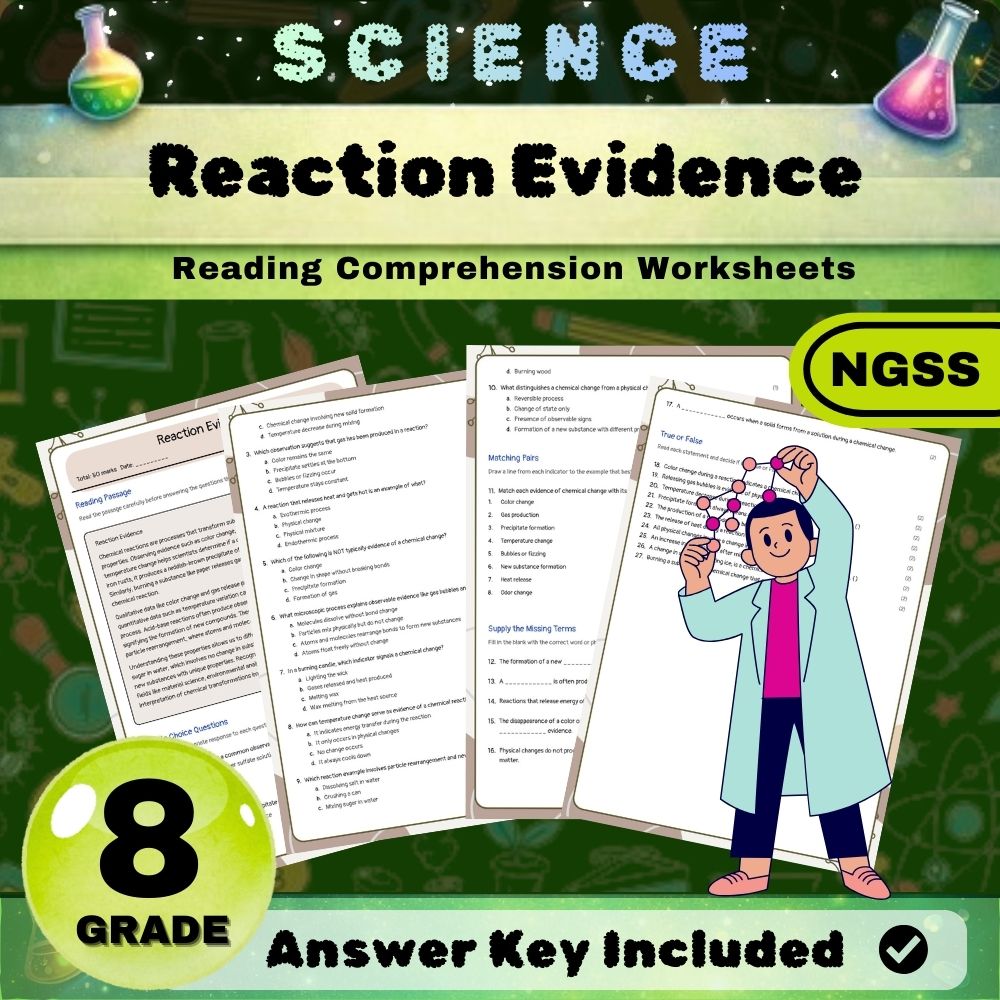
Grade 8 Science | Reaction Evidence Worksheet (PDF) NGSS Aligned
 Created byMaple Path Learning
Learning Objectives
- Understand and identify observable indicators of chemical change such as color change, gas production, precipitate formation, and temperature change.
- Analyze qualitative and quantitative data from various reactions like metal corrosion, combustion, and acid-base interactions.
- Differentiate chemical transformations from physical mixing based on macroscopic evidence.
Also included in: Grade 8 Science | Matter and Its Interactions NGSS Unit Bundle (Worksheet Pack) +1 more
Instant download
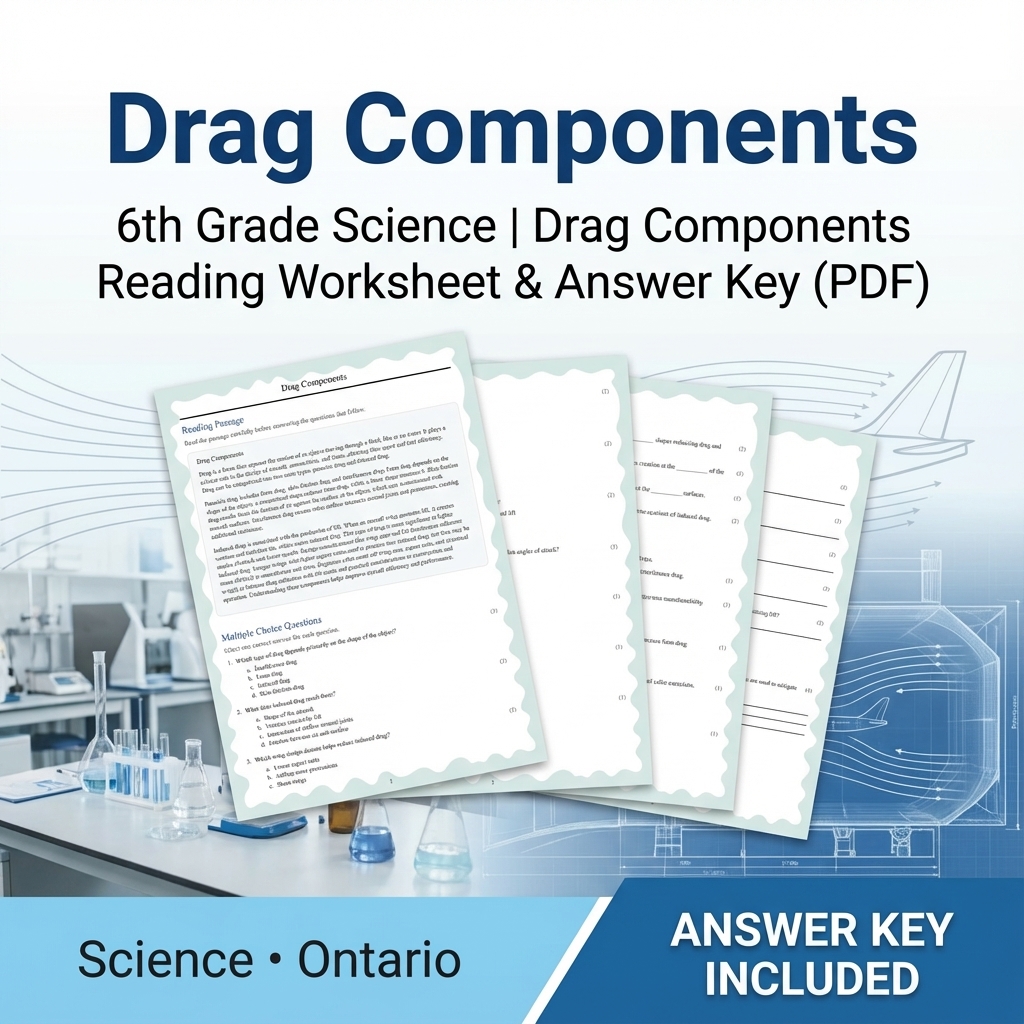
6th Grade Science | Drag Components Reading Worksheet & Answer Key (PDF)
JCreated byJ.S SheetsLearning Objectives
- Understand the different components of drag and their effects on aircraft performance.
- Describe how parasitic and induced drag depend on shape, speed, and wing design.
- Explain trade-offs in wing design related to drag reduction and lift production.
Also included in: Grade 6 Science | Aerodynamics & Flight Unit Worksheet Pack (PDF + Answer Keys) +1 more
Instant download

Grade 9 Science – Friction & Drag | Daily Reading Worksheet
Created byBright Mind ResourcesLearning Objectives
- Understand the factors that influence friction and drag forces.
- Identify how surface texture, normal force, and speed affect friction.
- Recognize the impact of air density and shape on aerodynamic drag.
Also included in: Grade 9 Simple Machines Science Daily Reading Lesson Bundle | Alberta +1 more
Instant download
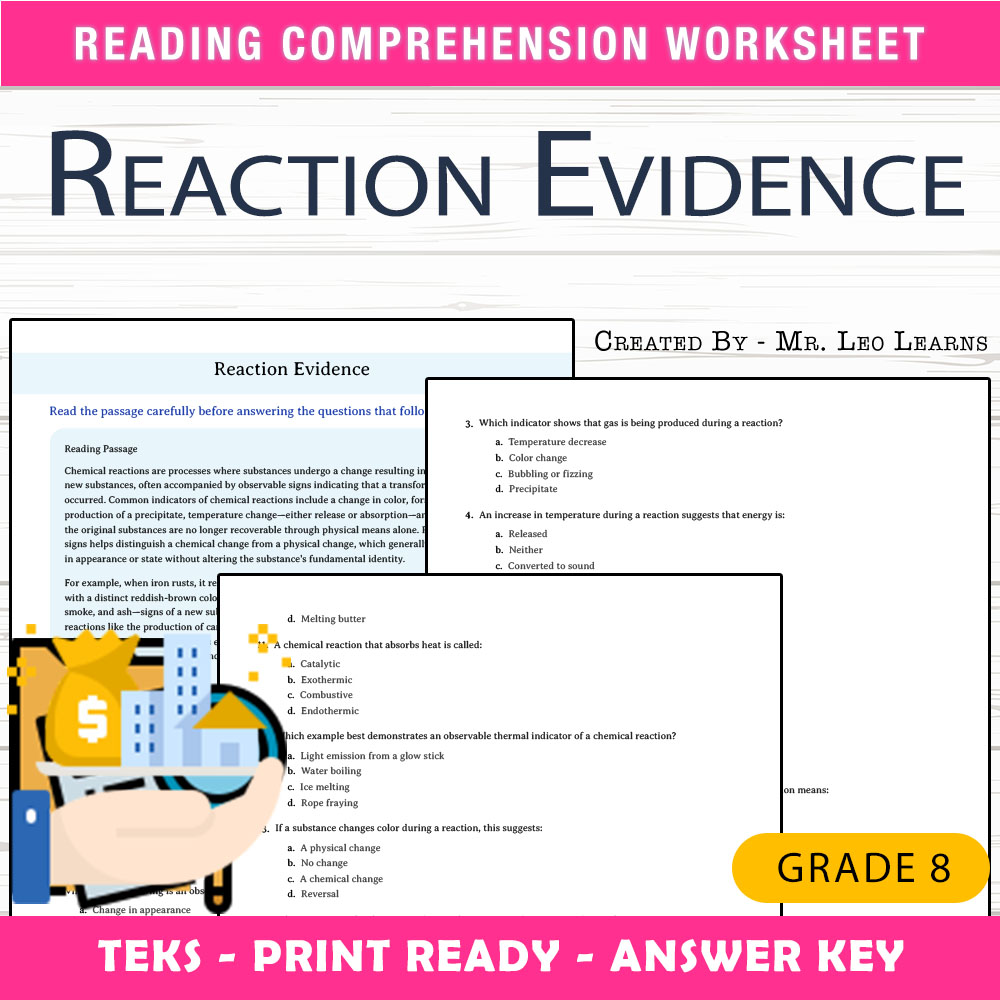
Grade 8 Science — Reaction Evidence Worksheet for Mastery | PDF + Answer Key
 Created byThe Resource Hub
Learning Objectives
- Identify observable indicators of chemical reactions such as color change, gas evolution, precipitate formation, temperature change, and irreversible transformations.
- Distinguish between chemical and physical changes based on observable evidence.
- Explain how conservation concepts are involved in chemical reactions within closed systems.
Also included in: Grade 8 Science Unit Bundle – Matter, Reaction Rates & Energy Mastery Worksheets +1 more
Instant download
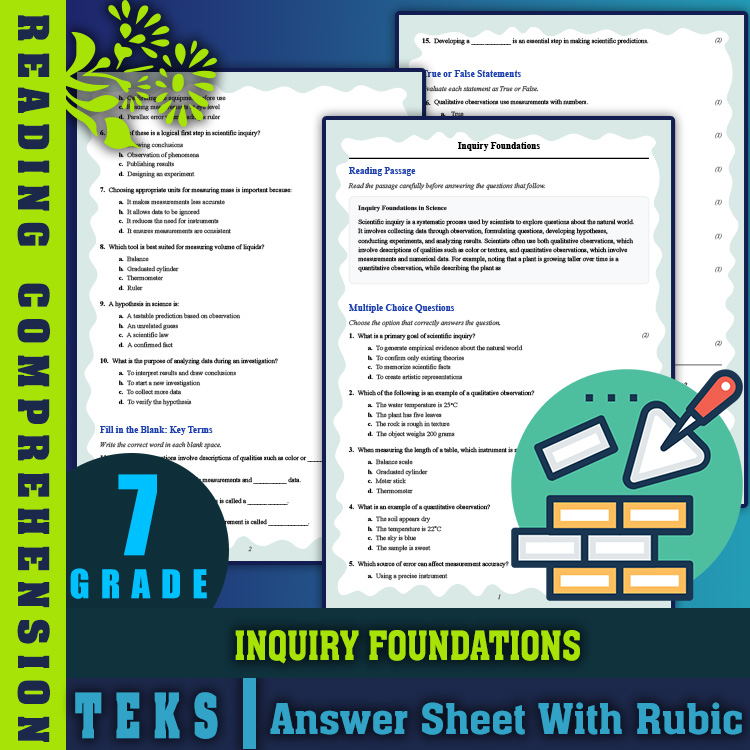
7th Grade Science Reading Worksheets | Inquiry Foundations PDF with Rubric
JCreated byJ.S SheetsLearning Objectives
- Understand the key components of the scientific inquiry process.
- Distinguish between quantitative and qualitative observations in experiments.
- Select appropriate metric units and instruments for measuring length, mass, and volume.
Instant download

Grade 8 Mass Conservation Worksheet | NGSS Chemical Reactions Activity
 Created byAmber Owl Education
Learning Objectives
- Explain mass conservation in chemical reactions by tracking atoms in a closed system.
- Use particulate models and balanced chemical equations to connect microscopic atom conservation to macroscopic mass measurements.
- Predict outcomes in sealed-container reactions by accounting for all matter as reactants and products.
Also included in: Grade 8 Science Thermal Effects & Chemical Reactions Lesson Bundle | NGSS +1 more
Instant download

Human Impacts on Earth Systems Worksheet | Grade 8 Science Activities
 Created byPrism Point Learning
Learning Objectives
- Explain how human activities can change Earth systems by altering energy and matter in the atmosphere, hydrosphere, and geosphere
- Describe how greenhouse-gas emissions can influence temperature patterns and then affect precipitation and storms
- Evaluate environmental solutions using evidence, while considering tradeoffs
Also included in: Earth Systems & Climate Lesson Bundle | Grade 8 Science | Florida NGSSS
Instant download
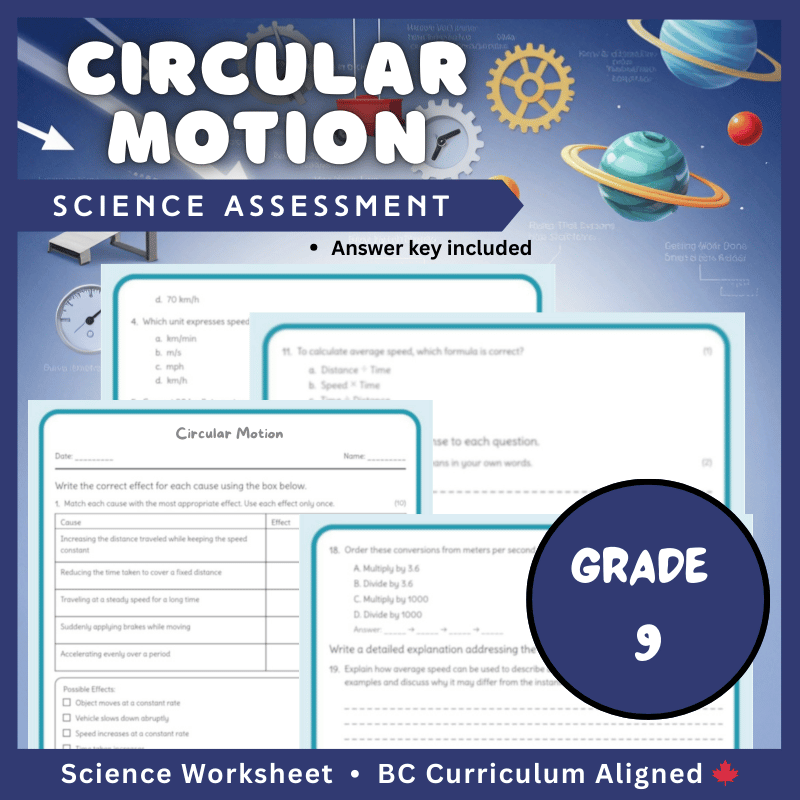
Grade 9 Science | Circular Motion Worksheet (PDF) – BC Standards
Created byBright Mind ResourcesLearning Objectives
- Understand the role of centripetal force in maintaining circular motion.
- Identify the factors influencing the acceleration and force in circular paths.
- Connect force components like tension, friction, and normal force to circular motion.
Instant download

Science Evidence for Claims Worksheet | Grade 9 Science - Standards-Aligned
JCreated byJ.S SheetsLearning Objectives
- Explain how scientific arguments connect evidence to reasoning when evaluating a claim.
- Identify patterns in data and interpret what they imply about a proposed explanation.
- Evaluate how uncertainty and potential bias affect confidence in a scientific claim.
Also included in: Grade 9 Claims & Uncertainty Science – lesson bundle: General framework +1 more
Instant download
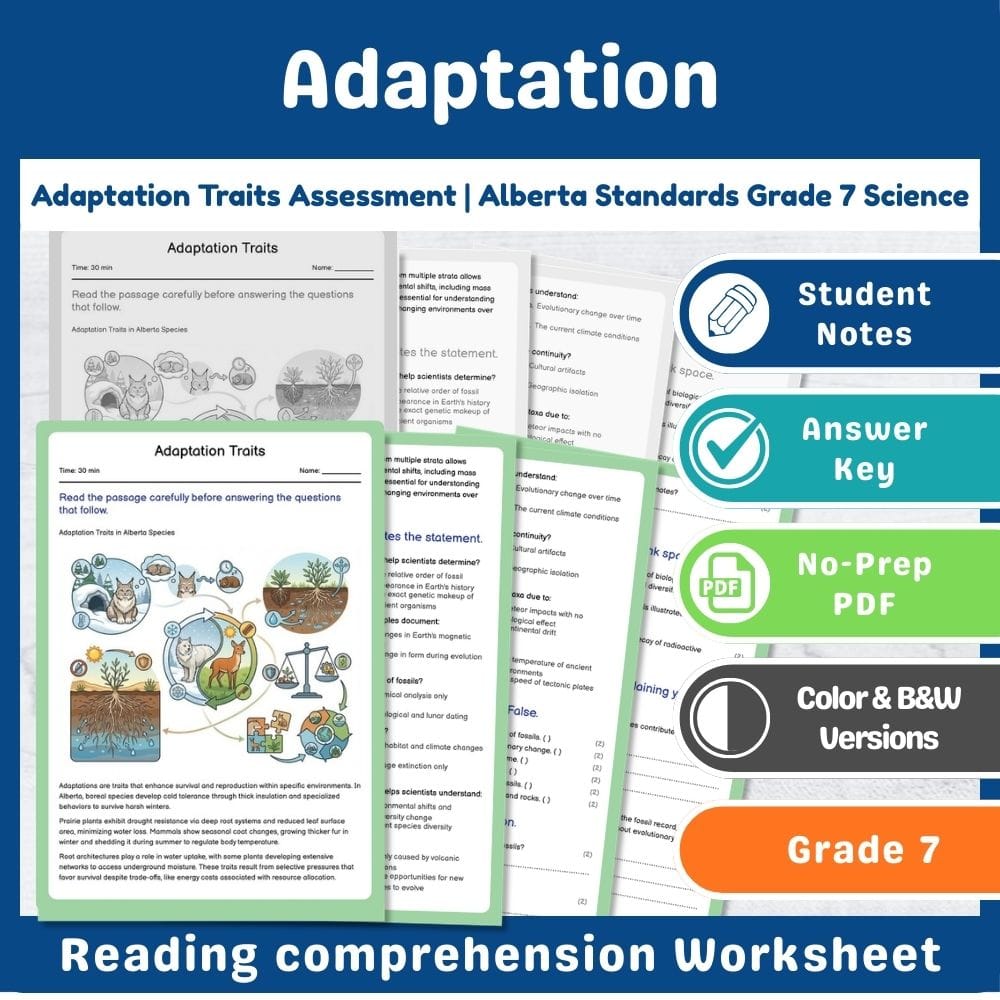
Adaptation Traits Assessment | Alberta Standards Grade 7 Science
Created byPrism Point LearningLearning Objectives
- Identify different types of adaptive traits in plants and animals.
- Understand how environmental pressures influence trait development.
- Describe various structural, physiological, and behavioral adaptations.
Also included in: Lesson Bundle Grade 7 Science - Interactions and Ecosystems +1 more
Instant download
Grade 11 Science – Covalent Structures Worksheet (Ontario, PDF)
Created byBright Mind ResourcesLearning Objectives
- Explain shared-electron bonding using Lewis structures and octet considerations.
- Assess formal charges and resonance structures to predict molecular stability.
- Describe the continuum between polar covalent and ionic bonding based on electronegativity differences.
Instant download
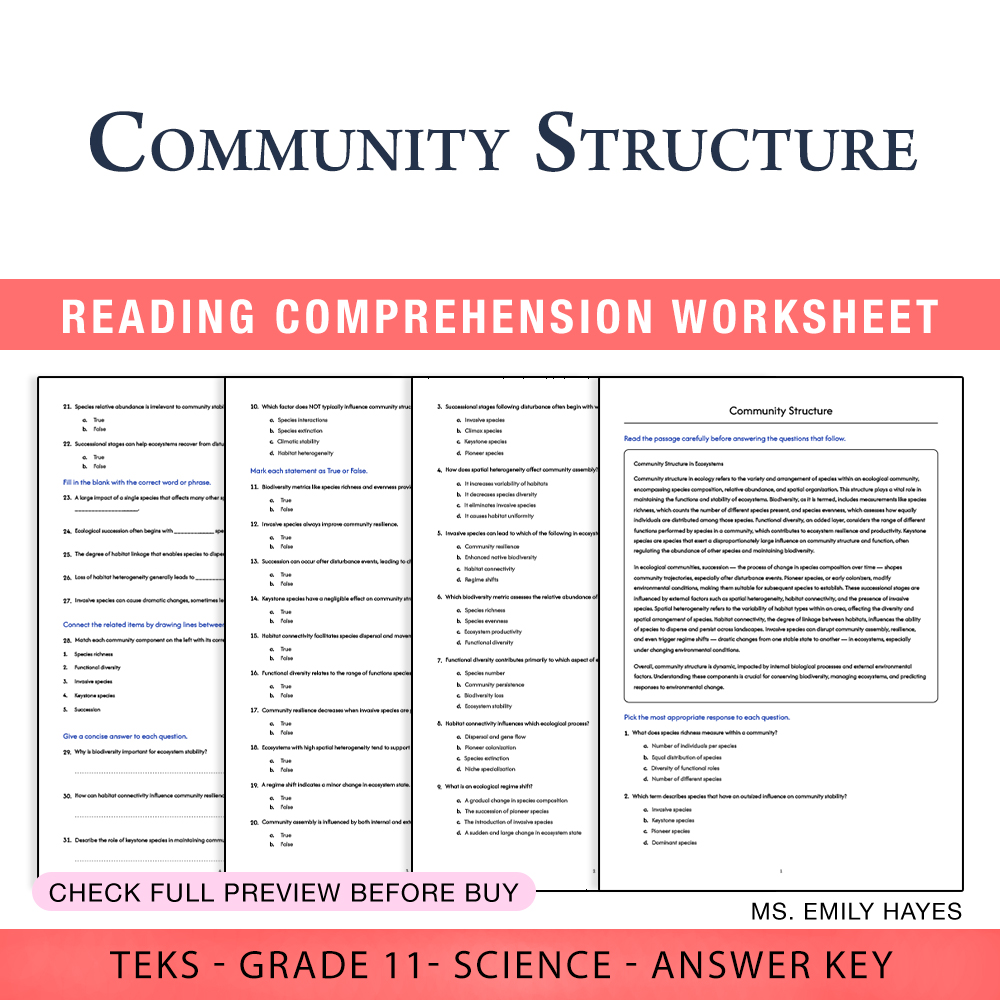
11th Grade Science | Community Structure Worksheet (PDF+ Answer Key)
Created byCopper Leaf ClassroomLearning Objectives
- Understand key concepts of species composition, diversity, and spatial arrangement within ecological communities.
- Explore biodiversity metrics such as species richness and evenness and their role in ecosystem stability.
- Analyze how successional stages and external factors influence community dynamics and resilience.
Instant download
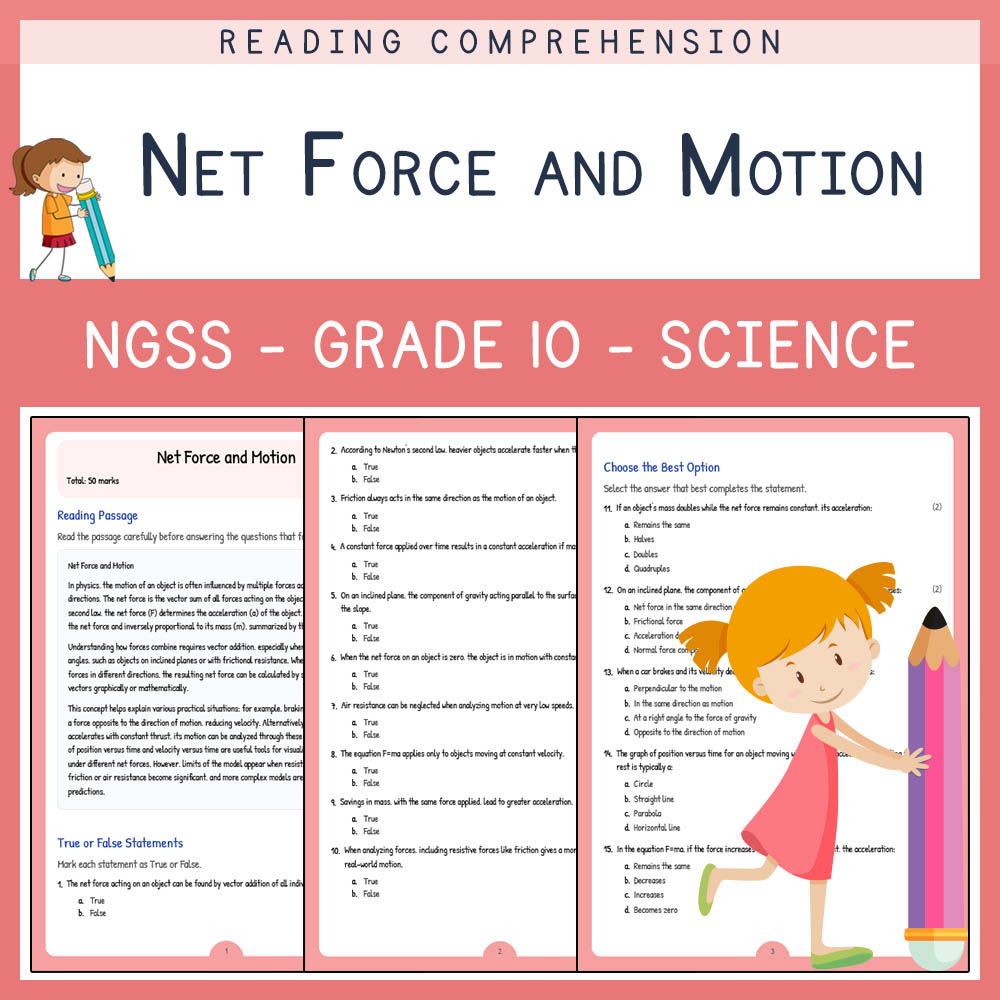
Grade 10 Science | Net Force and Motion Worksheet(PDF + Answer Key) NGSS Aligned
 Created byLumora Learning
Learning Objectives
- Understand the relationship between net force, mass, and acceleration as described by Newton's second law.
- Apply vector addition to analyze forces acting on objects in different contexts such as inclined planes and resistive media.
- Interpret motion graphs to understand the effects of forces on an object's acceleration and velocity.
Instant download
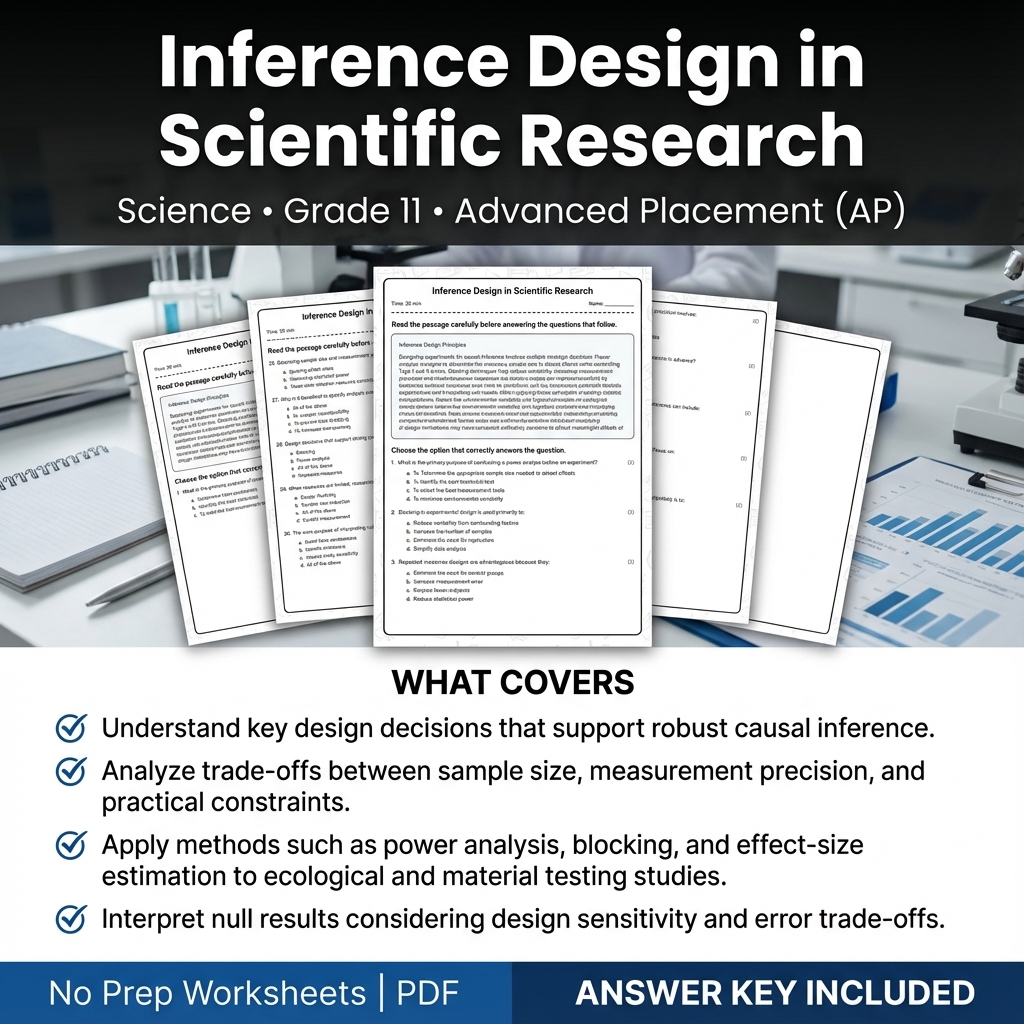
Grade 11 Science | Inference Design in Scientific Research Worksheet & Answers
Created byCoral Reef LearningLearning Objectives
- Understand key design decisions that support robust causal inference.
- Analyze trade-offs between sample size, measurement precision, and practical constraints.
- Apply methods such as power analysis, blocking, and effect-size estimation to ecological and material testing studies.
Also included in: Grade 11 Science Unit | Scientific Analysis & Data Skills Worksheet Pack +1 more
Instant download

Grade 11 Science | Synthesis Reasoning Worksheet (Printable PDF + Answer Key)
Created byCoral Reef LearningLearning Objectives
- Analyze complex phenomena by integrating models, empirical data, and design constraints.
- Evaluate multiple hypotheses using synthesis of quantitative and qualitative evidence.
- Apply iterative reasoning to refine models and assumptions in scientific problem-solving.
Also included in: Grade 11 Science Unit | Scientific Analysis & Data Skills Worksheet Pack +1 more
Instant download
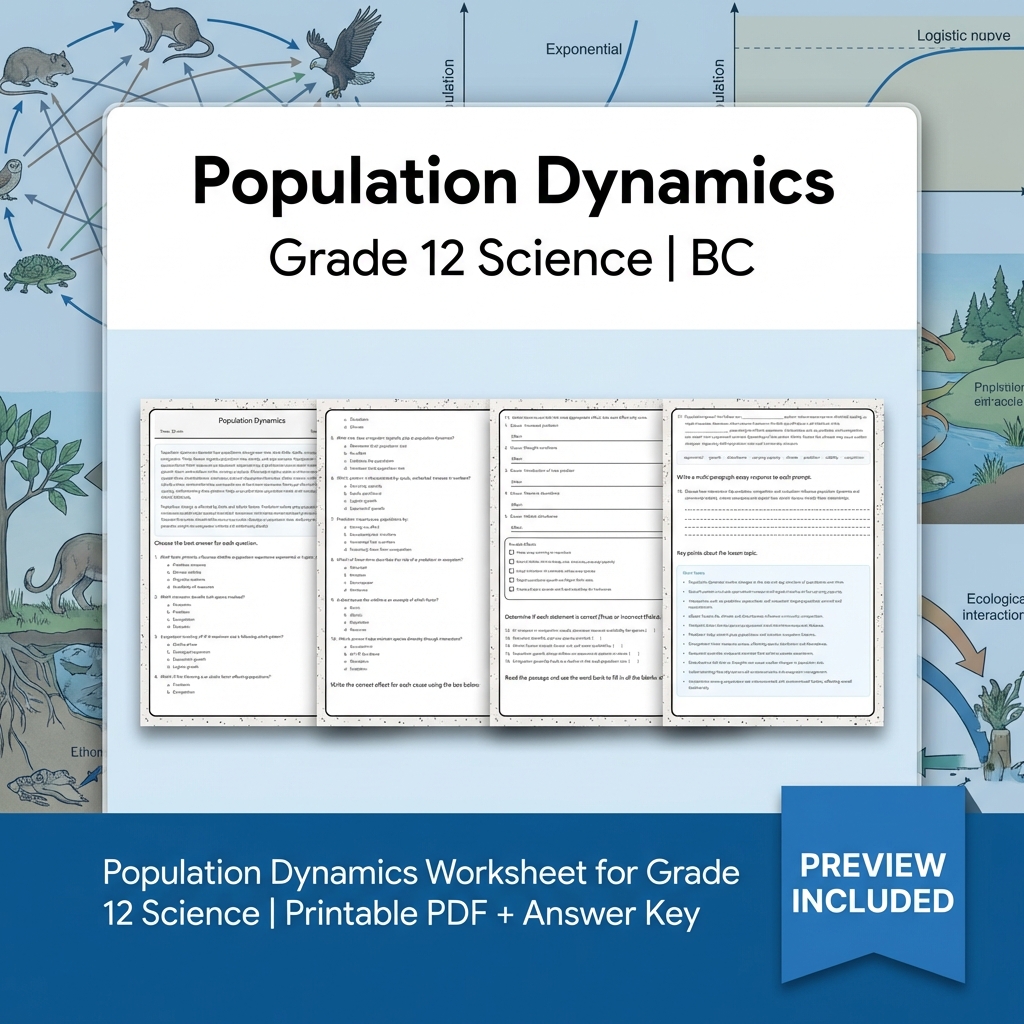
Population Dynamics Worksheet for Grade 12 Science | Printable PDF + Answer Key
Created byMeadowlark WorksheetsLearning Objectives
- Understand the factors that influence changes in population size and structure.
- Identify patterns like exponential and logistic growth in populations.
- Describe interactions such as predation, competition, and mutualism among species.
Also included in: Grade 12 Science Lesson Bundle | Genetics & Evolution Worksheets +1 more
Instant download
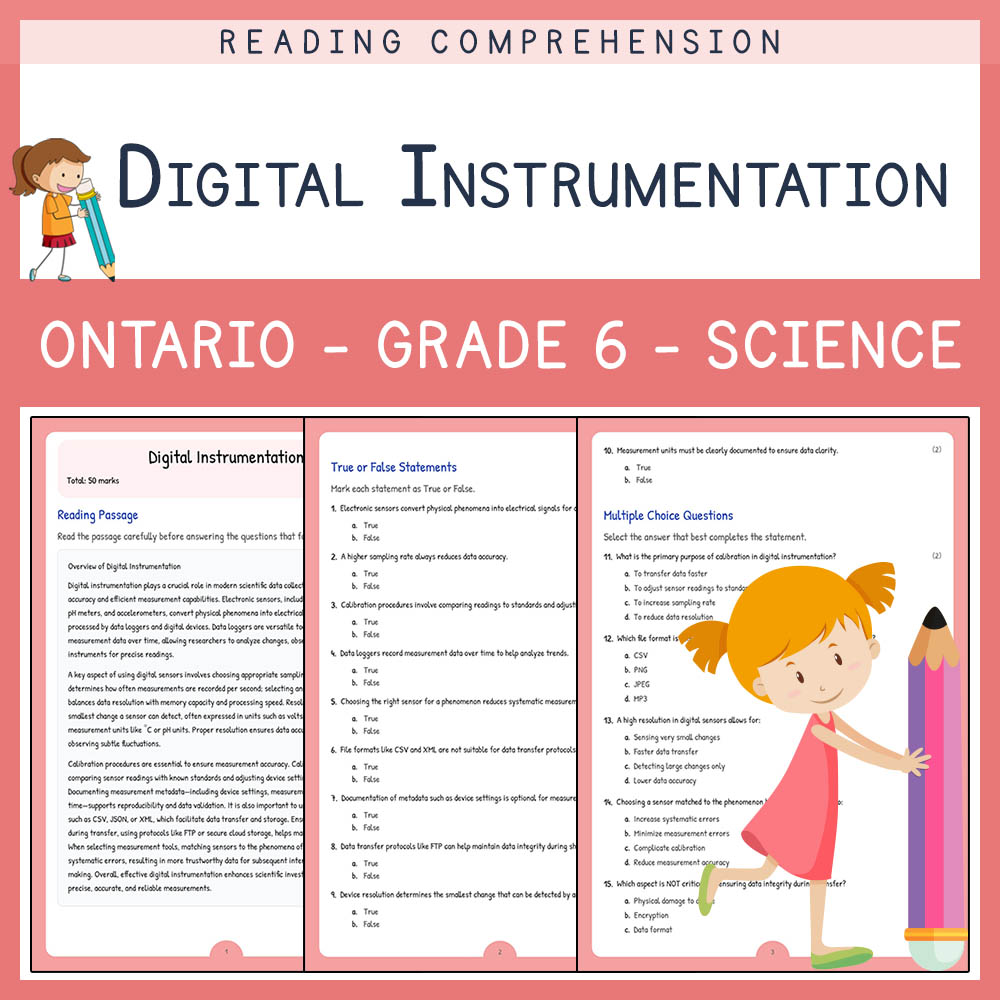
Grade 6 Science | Digital Instrumentation Worksheet & Answer Key (PDF)
Created byLumora LearningLearning Objectives
- Understand the components and functions of electronic sensors, data loggers, and digital probes.
- Identify proper procedures for calibration, operation, and metadata documentation of measurement tools.
- Explain the significance of sampling rate, resolution, units, and data integrity in digital measurements.
Instant download

Grade 9 Science Adaptation and Selection Worksheet – Alberta Standards (PDF)
 Created bySilver Birch Teaching
Learning Objectives
- Explain how natural selection works by linking heritable traits, selective pressure, and reproductive success
- Define fitness and describe how adaptive trade-offs affect survival and reproduction
- Compare natural selection with artificial selection and predict how traits can change over generations
Also included in: Grade 9 Genetics and Reproduction Science Lesson Bundle Worksheets – Alberta +1 more
Instant download
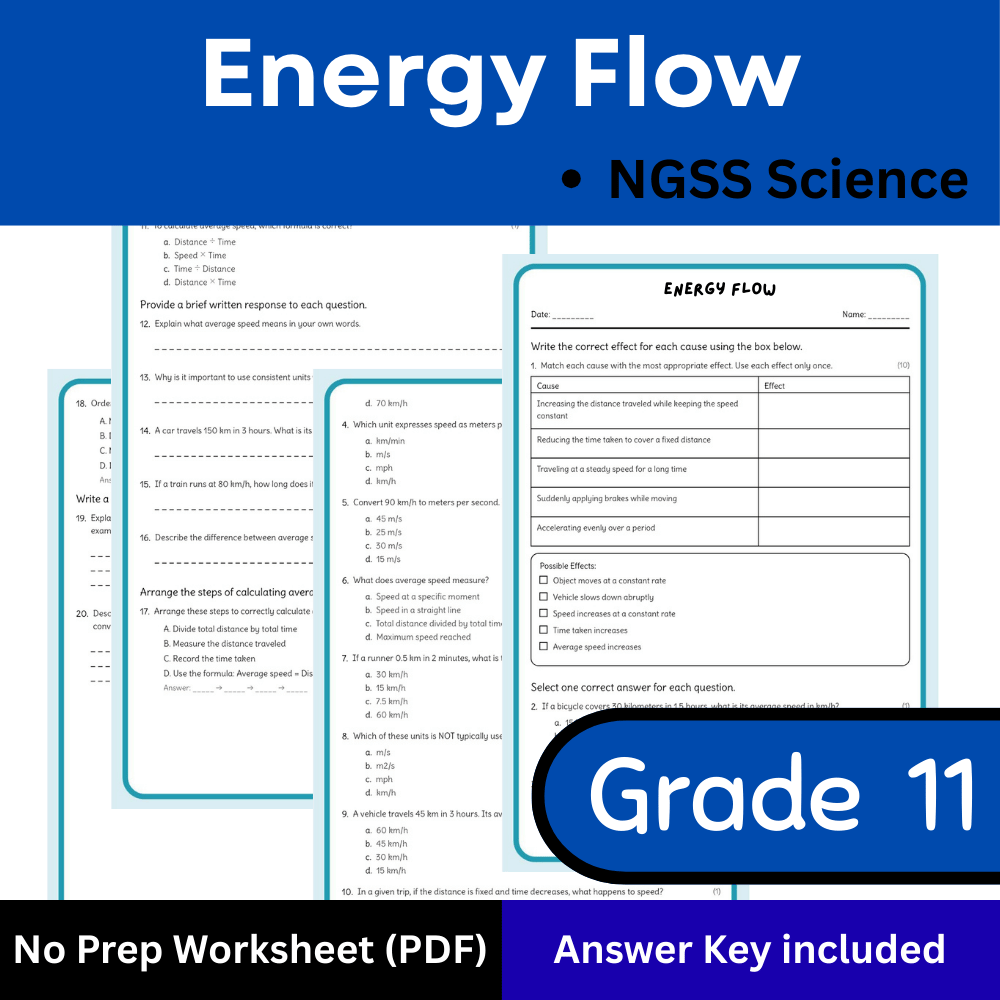
Grade 11 Science | Energy Flow Worksheet (PDF) aligned with NGSS
Created byBright Mind ResourcesLearning Objectives
- Understand the transfer of energy among producers, consumers, and decomposers in food webs.
- Identify the concepts of trophic levels, biomass pyramids, and energy loss.
- Calculate and evaluate efficiency of energy transfer in ecosystems.
Instant download
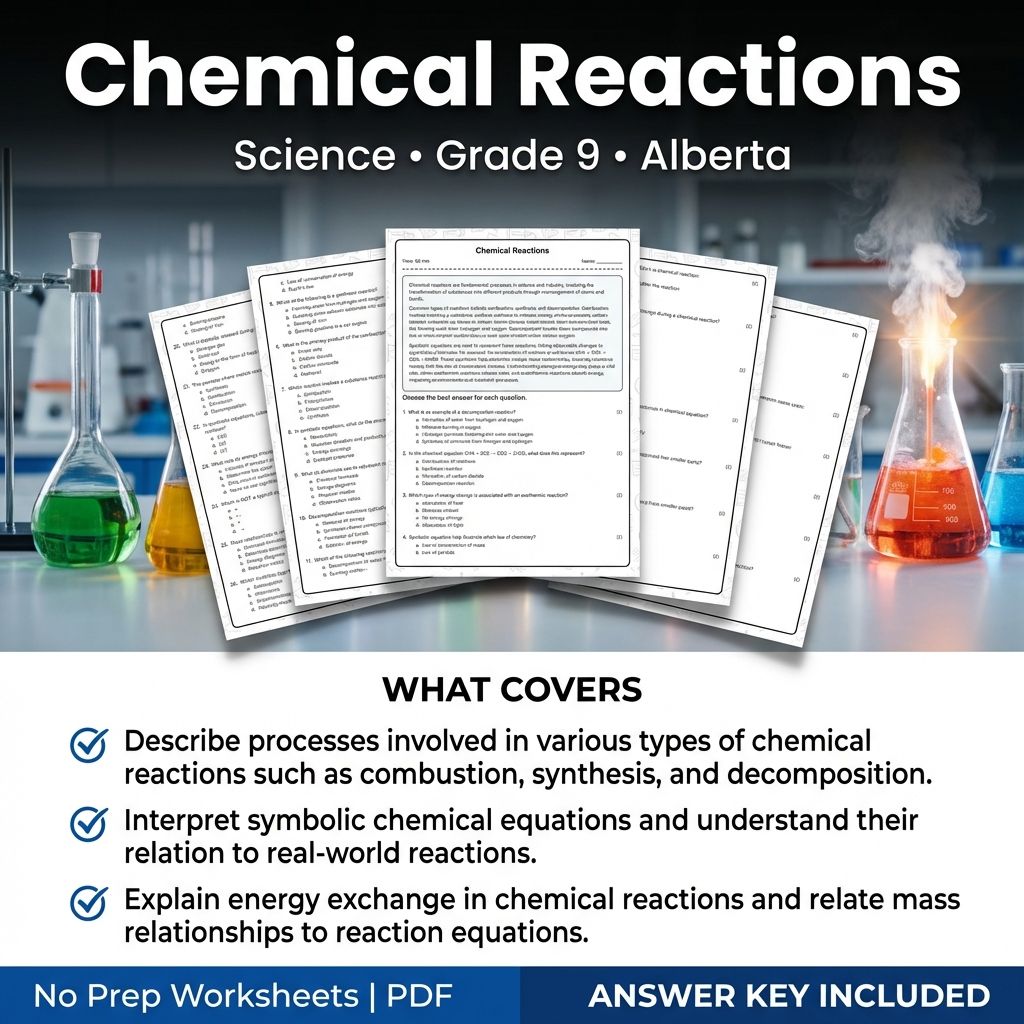
Chemical Reactions Worksheet for Grade 9 Science | Alberta Standards
Created byCoral Reef LearningLearning Objectives
- Describe processes involved in various types of chemical reactions such as combustion, synthesis, and decomposition.
- Interpret symbolic chemical equations and understand their relation to real-world reactions.
- Explain energy exchange in chemical reactions and relate mass relationships to reaction equations.
Instant download

Grade 9 Science Worksheet | Energy in Changes – Standard Practice (PDF)
 Created byEvergreen Desk Education
Learning Objectives
- Compare physical and chemical changes in terms of energy transfer and system–surroundings interactions.
- Explain how endothermic and exothermic processes relate to temperature changes.
- Use particle-bond ideas to describe what changes during physical vs. chemical processes.
Also included in: Grade 9 Waves, Forces, and Energy Science Lesson Bundle | General +1 more
Instant download
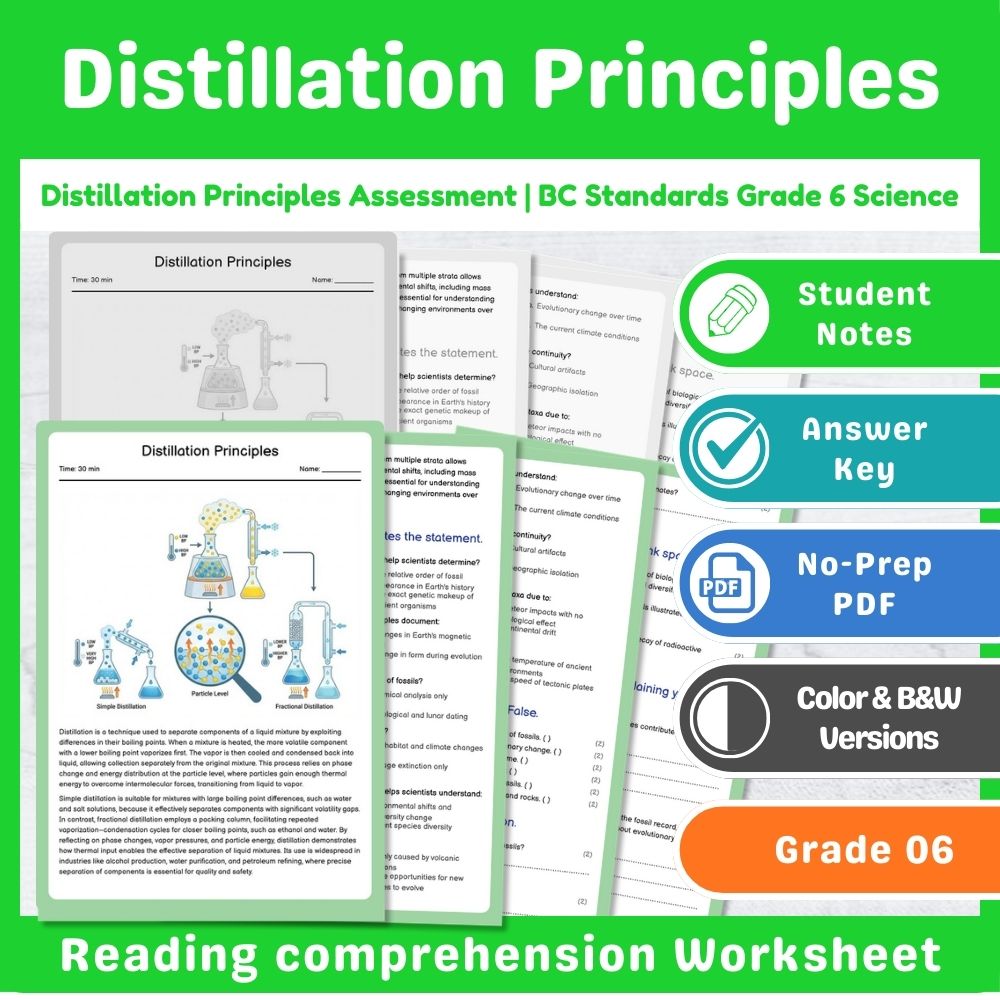
Distillation Principles Assessment | BC Standards Grade 6 Science
Created byPrism Point LearningLearning Objectives
- Explain the principle of distillation and how it separates components of a mixture.
- Differentiate between simple and fractional distillation methods.
- Describe the phase change process involved in distillation and its dependence on boiling points.
Instant download
Browse more categories
About Science Worksheets
Find Science worksheets spanning core skills, practice, and review. All 44,628 resources are instant PDF downloads for the classroom or home.
Every worksheet on MyTeachingSheets is created by independent teacher-authors and reviewed before publication. All resources download as printable PDFs for classroom, homework, or at-home practice, and many include answer keys. Preview any worksheet free before buying.