
Science Worksheets
44,628 subject resources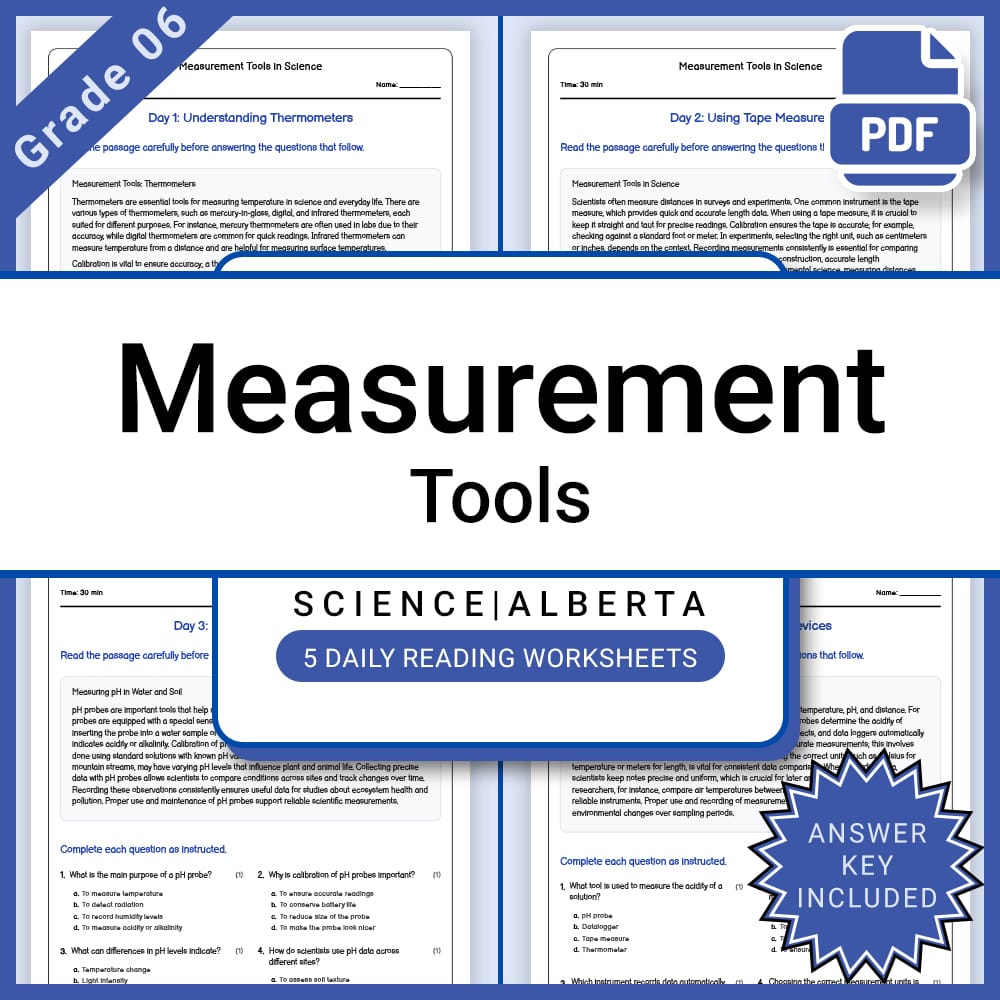
Grade 6 Science – Measurement Tools Daily Reading Worksheet with Answer Key
JCreated byJ.S SheetsLearning Objectives
- Identify different types of thermometers used in science.
- Understand how to select appropriate measurement tools for different data collection needs.
- Recognize the importance of calibration and unit selection in measurements.
Also included in: Grade 6 Science Lesson Group Bundle | Alberta Standards with Reading Worksheets +1 more
Instant download
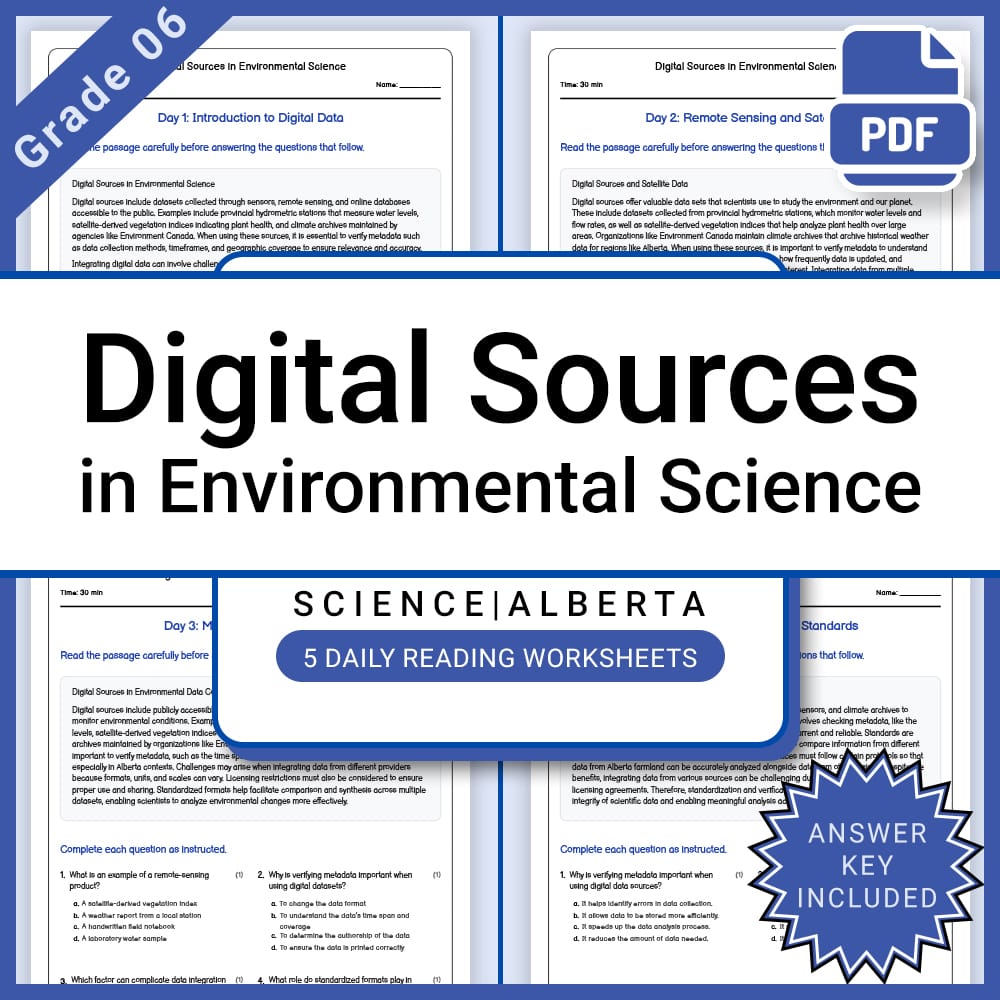
Grade 6 Science – Digital Sources in Environmental Daily Worksheet + Answer Key
JCreated byJ.S SheetsLearning Objectives
- Understand different types of digital sources used in environmental data collection.
- Learn to verify metadata, temporal, and spatial coverage of datasets.
- Recognize challenges and considerations for integrating digital environmental data.
Also included in: Grade 6 Science Lesson Group Bundle | Alberta Standards with Reading Worksheets +1 more
Instant download

Grade 6 Science – Evidence Communication Daily Reading Worksheet + Answer Key
JCreated byJ.S SheetsLearning Objectives
- Understand how to interpret patterns in environmental data.
- Learn methods for summarizing data using descriptive statistics.
- Identify appropriate visualizations such as bar, line, and scatter plots.
Also included in: Grade 6 Science Lesson Group Bundle | Alberta Standards with Reading Worksheets +1 more
Instant download
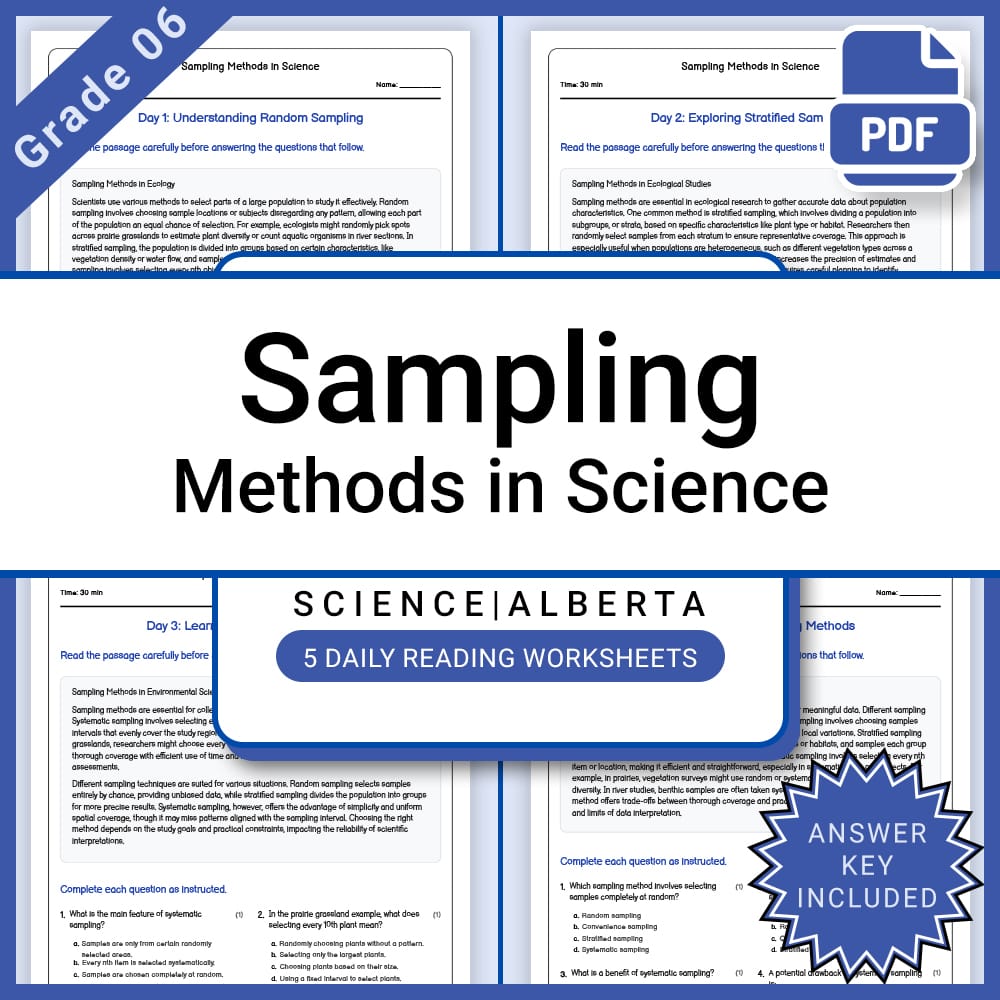
Grade 6 Science – Sampling Methods Daily Reading Worksheet + Answer Key
JCreated byJ.S SheetsLearning Objectives
- Understand the concept of random sampling.
- Identify different sampling methods used in ecological studies.
- Recognize the advantages and limitations of various sampling techniques.
Also included in: Grade 6 Science Lesson Group Bundle | Alberta Standards with Reading Worksheets +1 more
Instant download
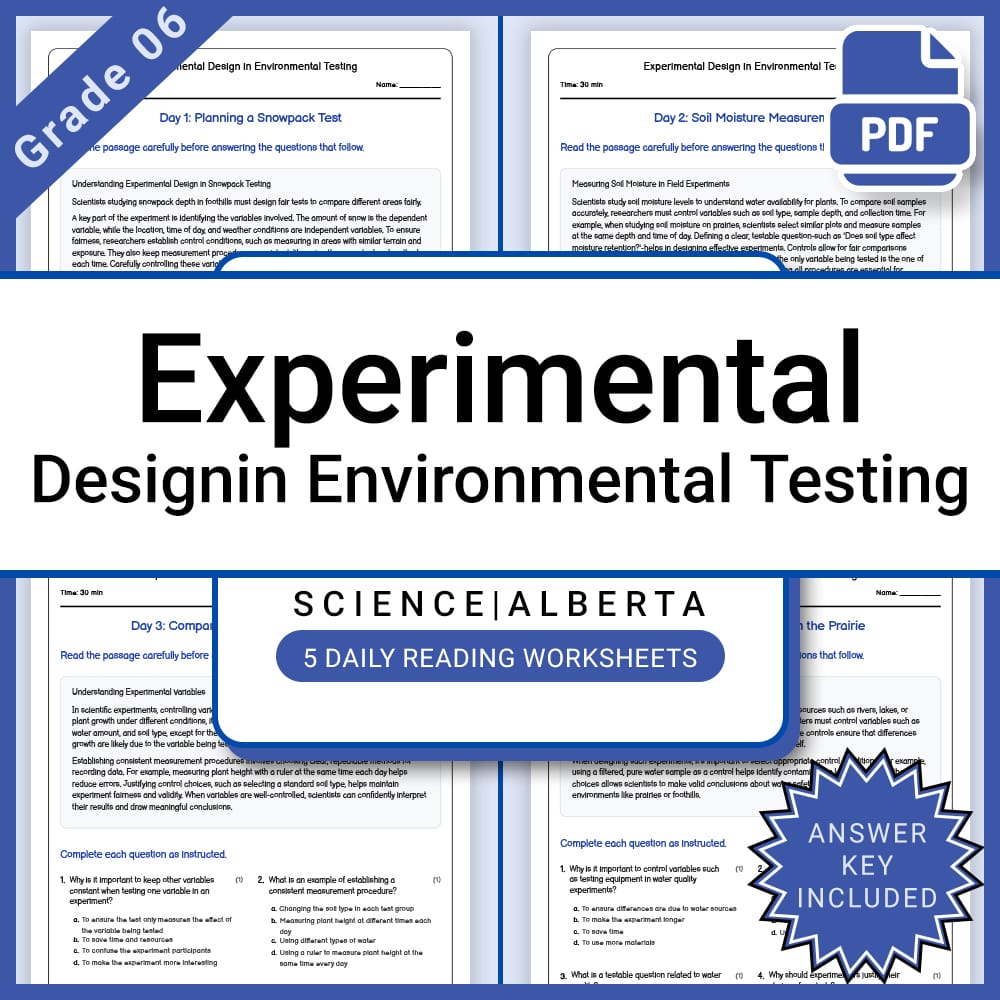
Grade 6 – Experimental Design in Environmental Daily Worksheet + Answer Key
JCreated byJ.S SheetsLearning Objectives
- Identify independent, dependent, and controlled variables in environmental experiments.
- Define suitable control conditions for testing environmental factors.
- Develop testable questions related to snowpack depth and soil moisture.
Also included in: Grade 6 Science Lesson Group Bundle | Alberta Standards with Reading Worksheets +1 more
Instant download
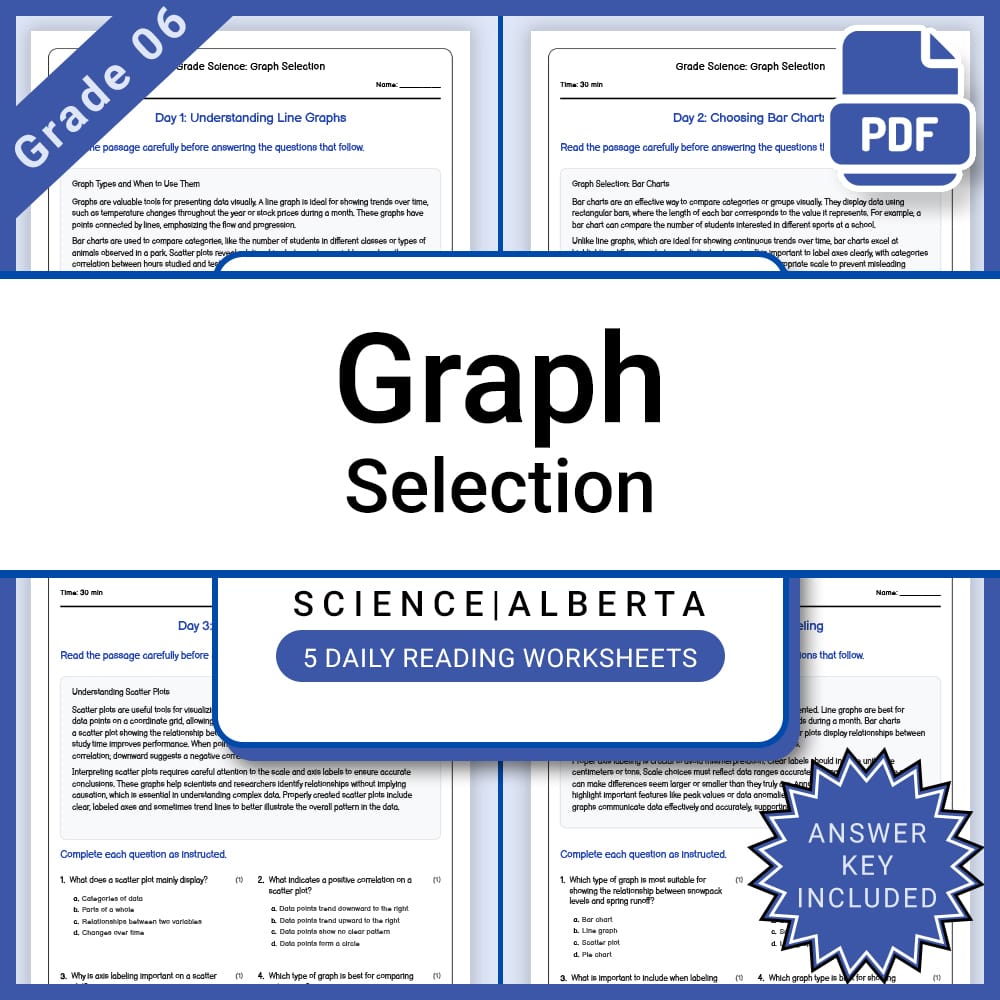
Grade 6 Science – Graph Selection Daily Reading Worksheet + Answer Key
JCreated byJ.S SheetsLearning Objectives
- Understand situations where different types of graphs are appropriate
- Learn to identify when to use line graphs, bar charts, and scatter plots
- Recognize key features of graphs such as axes labels, scales, and annotations
Also included in: Grade 6 Science Lesson Group Bundle | Alberta Standards with Reading Worksheets +1 more
Instant download

Electric Fields Worksheet | Grade 10 Science Practice
 Created byPrism Point Learning
Learning Objectives
- Explain what an electric field represents in terms of force per unit positive charge.
- Describe how electric field lines show direction and relative strength around charges.
- Use superposition to predict the net electric field from multiple charges.
Also included in: Forces, Motion & Fields Lesson Bundle | Grade 10 Science | BC +1 more
Instant download

Grade 8 Science – Graphical Reasoning in Motion | Daily Reading Worksheet
 Created byBright Mind Resources
Learning Objectives
- Interpret slopes of graphs to determine speed and acceleration
- Translate data between graphs, tables, and equations
- Understand how changing slopes reflect changes in motion
Also included in: Experiments Grade 8 Science Daily Reading Worksheets Lesson Bundle | TEKS +2 more
Instant download
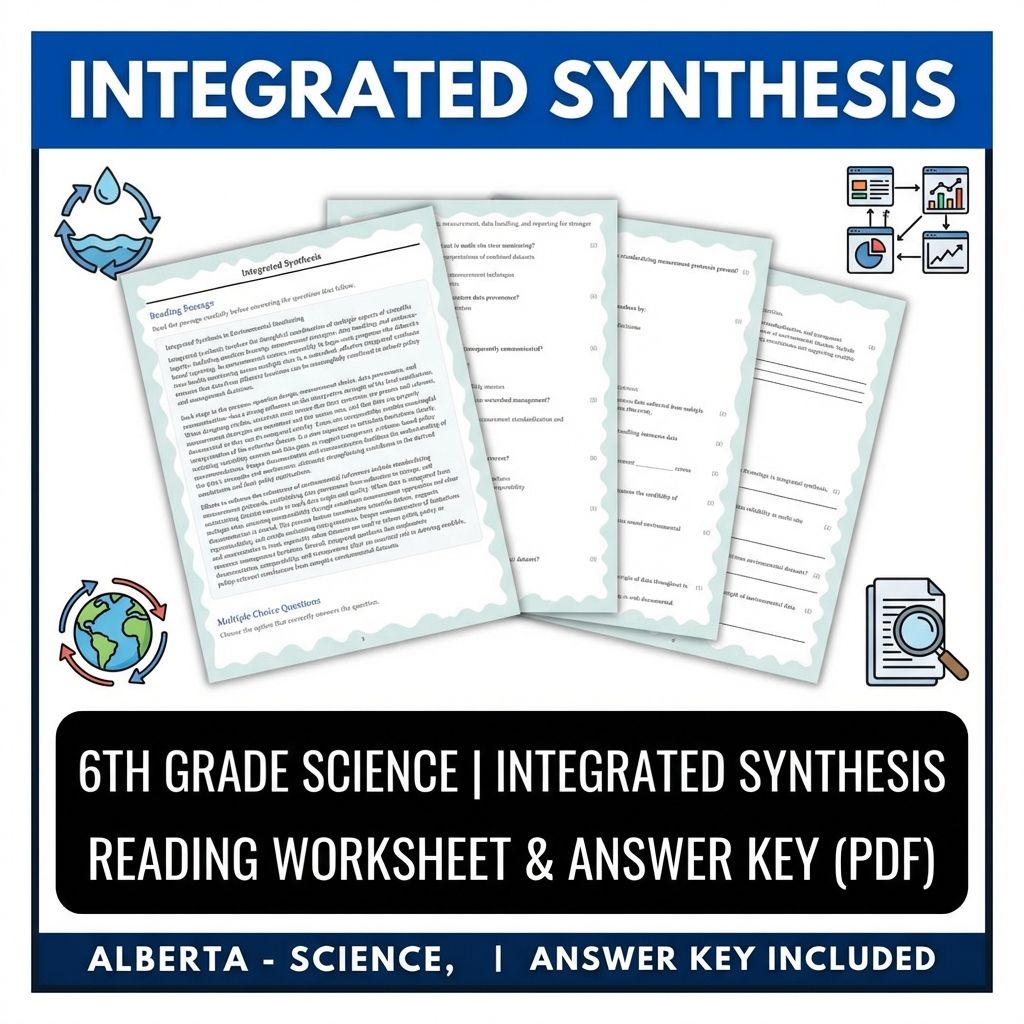
6th Grade Science | Integrated Synthesis Reading Worksheet & Answer Key (PDF)
JCreated byJ.S SheetsLearning Objectives
- Understand the components involved in integrated synthesis for environmental monitoring.
- Recognize the importance of documentation, data comparability, and evidence-based reporting.
- Analyze how different choices influence the strength of scientific conclusions.
Also included in: Grade 6 Science Bundle – Data Analysis, Scientific Inquiry & Measurement Skills +1 more
Instant download

Species Interactions Worksheet | NGSS Grade 6 Ecology Activity + Notes
 Created byAmber Owl Education
Learning Objectives
- Construct explanations for patterns of species interactions across forest, grassland, and freshwater ecosystems.
- Identify mutualism, competition, predation, and parasitism as recurrent interaction types and describe their outcomes.
- Use niche overlap, resource availability, and behavioral strategies to predict interaction strength under different abiotic conditions.
Also included in: Grade 6 Science Ecology & Ecosystems Lesson Bundle | NGSS +1 more
Instant download
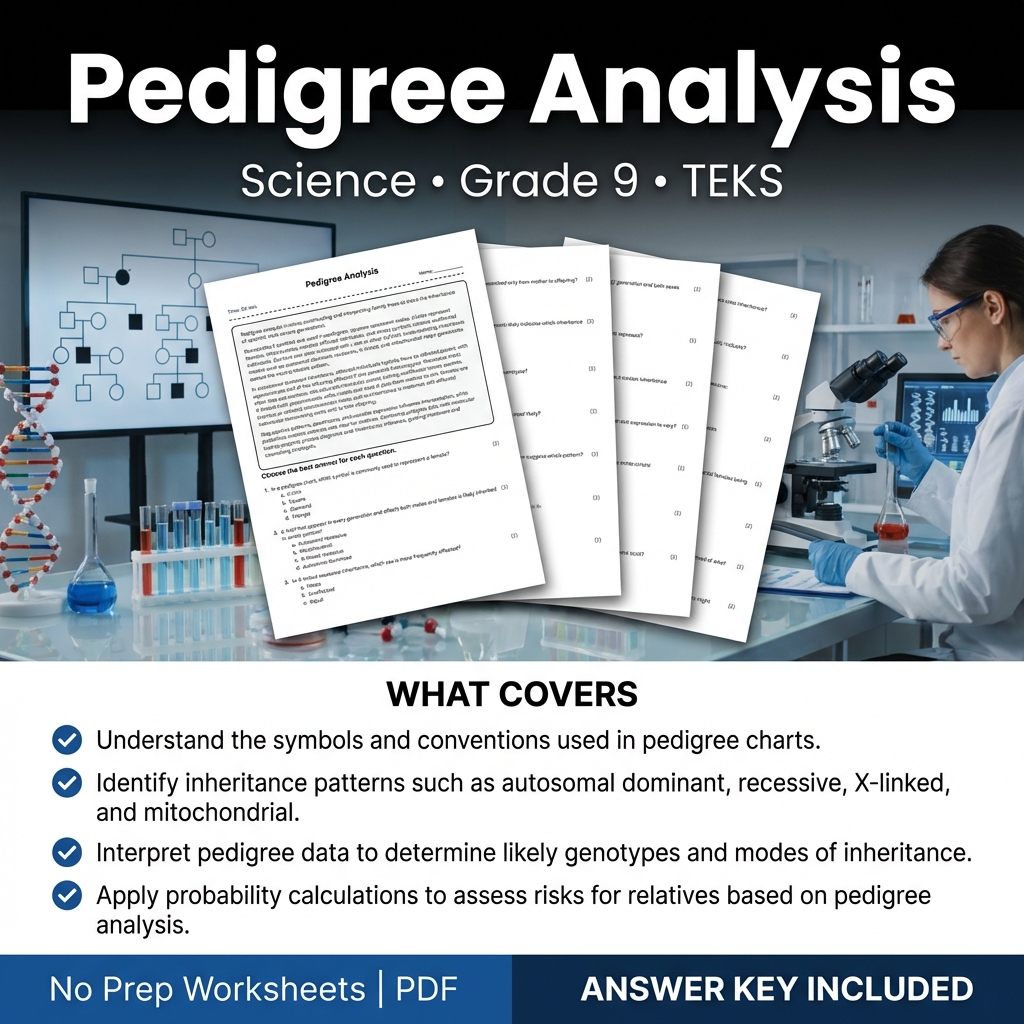
Grade 9 Science Pedigree Analysis Worksheet with Answer Key PDF
 Created byCoral Reef Learning
Learning Objectives
- Understand the symbols and conventions used in pedigree charts.
- Identify inheritance patterns such as autosomal dominant, recessive, X-linked, and mitochondrial.
- Interpret pedigree data to determine likely genotypes and modes of inheritance.
Instant download
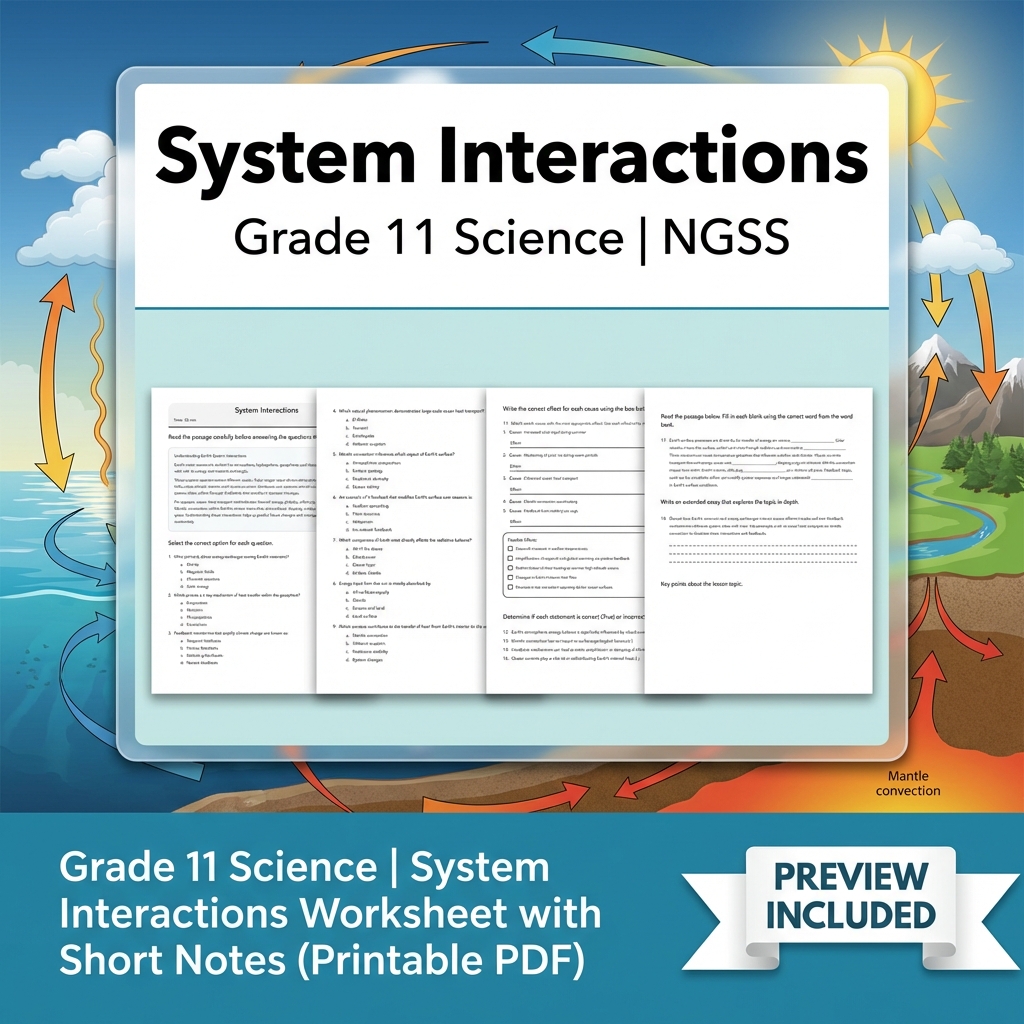
Grade 11 Science | System Interactions Worksheet with Short Notes (PDF)
 Created byMeadowlark Worksheets
Learning Objectives
- Analyze Earth's major reservoirs and their interactions within global systems.
- Explain energy exchanges among atmosphere, hydrosphere, geosphere, and biosphere.
- Understand how spatial and temporal scales influence system dynamics.
Also included in: Grade 11 Science | Earth’s Systems NGSS Unit Bundle – Classroom-Ready Worksheets +1 more
Instant download

7th Grade Science | Physical Change Worksheet & Answer Key (PDF Printable)
Created byCoral Reef LearningLearning Objectives
- Define and understand the concept of physical change.
- Identify examples of physical changes such as melting, freezing, vaporization, condensation, tearing, grinding, and dissolving.
- Explain the difference between physical and chemical changes based on observable attributes and substance composition.
Instant download
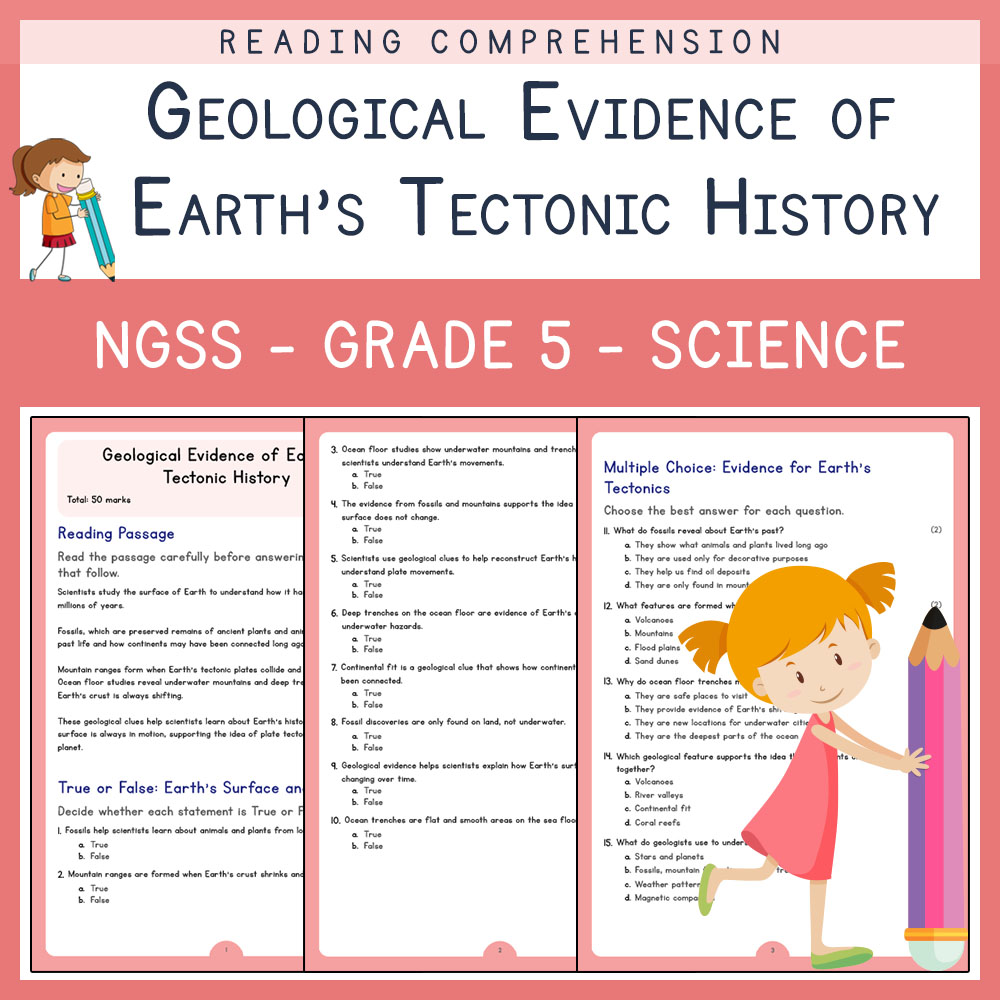
Grade 5 Science| Geological Evidence of Earth's Tectonic History Worksheet (PDF)
 Created byLumora Learning
Learning Objectives
- Understand how fossils, mountain formations, and ocean floor studies provide evidence of Earth's tectonic activity.
- Learn how geological features support the theory of plate tectonics.
- Identify examples of geological evidence such as continental fit and distribution of fossils.
Instant download
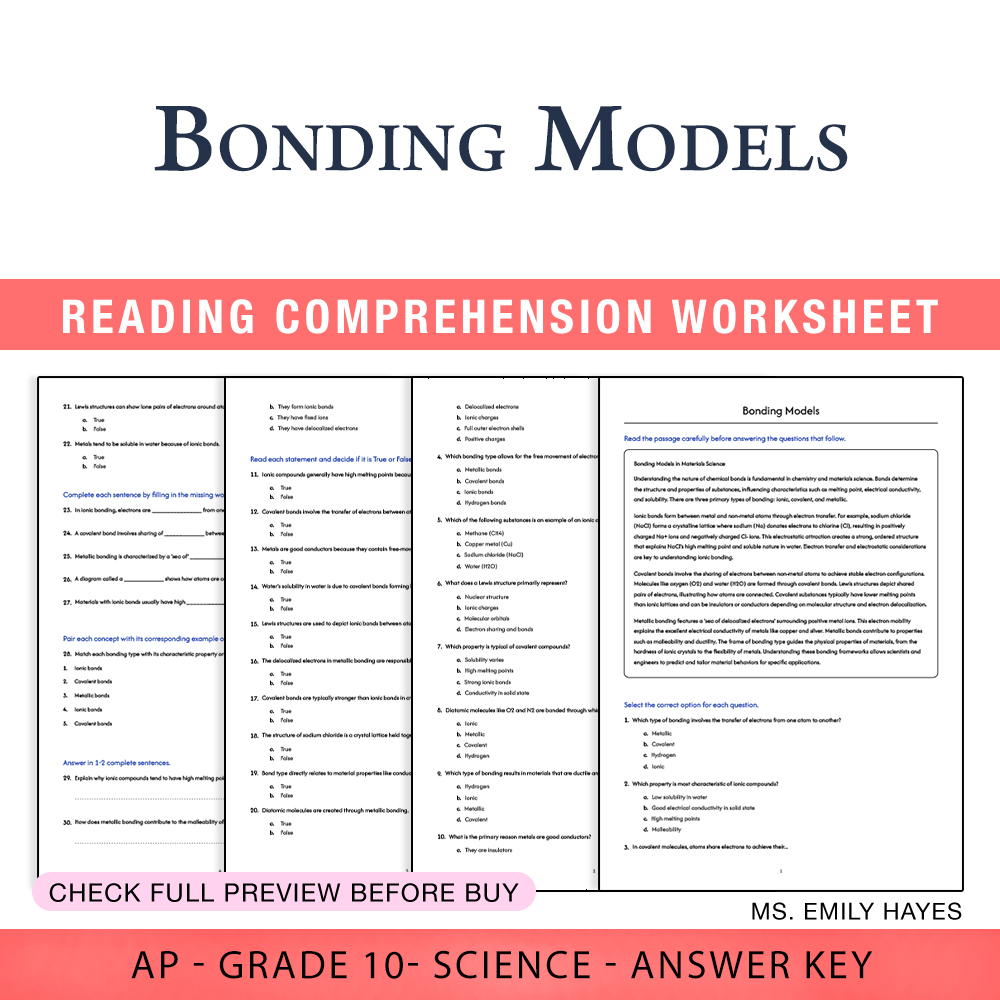
10th Grade Science | Bonding Models Worksheet (PDF+ Answer Key)
 Created byCopper Leaf Classroom
Learning Objectives
- Describe the major types of bonding: ionic, covalent, and metallic.
- Relate bonding frameworks to observable properties like conductivity, melting point, and solubility.
- Illustrate electron-sharing and electron-transfer representations, Lewis structures, and basic molecular orbital concepts.
Also included in: Grade 10 Science -Atomic Structure & Chemical Reactions (PDF+ Answer Key) +1 more
Instant download

Grade 11 Science – Gene Expression & Transcription Daily Reading Worksheet
Created byBright Mind ResourcesLearning Objectives
- Understand the process of transcription initiation in eukaryotic cells.
- Identify key regulatory elements such as promoters and enhancers involved in gene expression.
- Explain how chromatin remodeling influences gene activation.
Also included in: Grade 11 Metabolism & Genetics Science Daily Reading Lesson Bundle | Ontario +1 more
Instant download

Grade 11 Science – Cell Architecture & Types | Daily Reading Worksheet
Created byBright Mind ResourcesLearning Objectives
- Identify the main differences between prokaryotic and eukaryotic cells
- Understand the functions of major organelles such as the nucleus, mitochondria, chloroplasts, endoplasmic reticulum, and cytoskeleton
- Explain how cellular structures support metabolic and transport roles
Also included in: Grade 11 Metabolism & Genetics Science Daily Reading Lesson Bundle | Ontario +1 more
Instant download

Purity Assessment Worksheet Grade 7 Science | Ontario Chemistry Unit
 Created byChalk and Compass
Learning Objectives
- Identify how melting point, boiling point, conductivity, refractive index, and gravimetric residue can indicate impurities in a sample.
- Explain why different purity tests may give different results and how using multiple lines of evidence improves confidence.
- Apply purity concepts to evaluate whether a suspected substance is likely pure or contaminated.
Also included in: Separation of Mixtures & Matter Properties Lesson Bundle – Grade 7 Science +1 more
Instant download

ATP Synthase Worksheet for Grade 11 Science | TEKS-Aligned Practice
JCreated byJ.S SheetsLearning Objectives
- Explain how ATP synthase converts a proton gradient into ATP through rotational coupling.
- Describe the roles of the F0 and F1 regions in proton flow and ATP formation.
- Connect proton-motive force (membrane potential and concentration differences) to ADP and Pi condensation.
Instant download
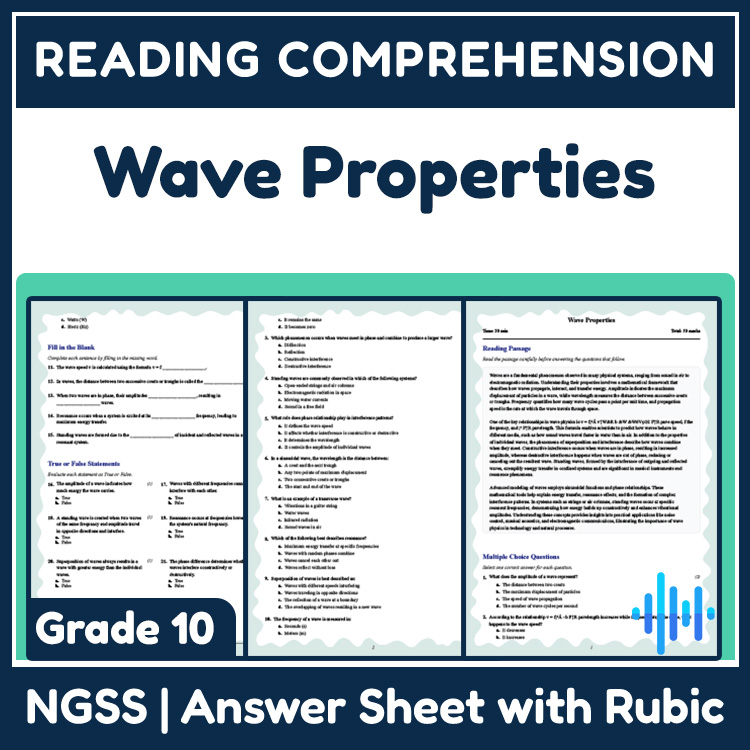
Grade 10 Science | Wave Properties Reading Worksheet (PDF + Answer Key)
JCreated byJ.S SheetsLearning Objectives
- Understand the mathematical characterization of wave properties such as amplitude, wavelength, frequency, and propagation speed.
- Explain the relationship v = fλ and apply it to various mechanical wave examples.
- Describe the concepts of superposition, interference patterns, and standing waves using trigonometric functions and phase relationships.
Instant download
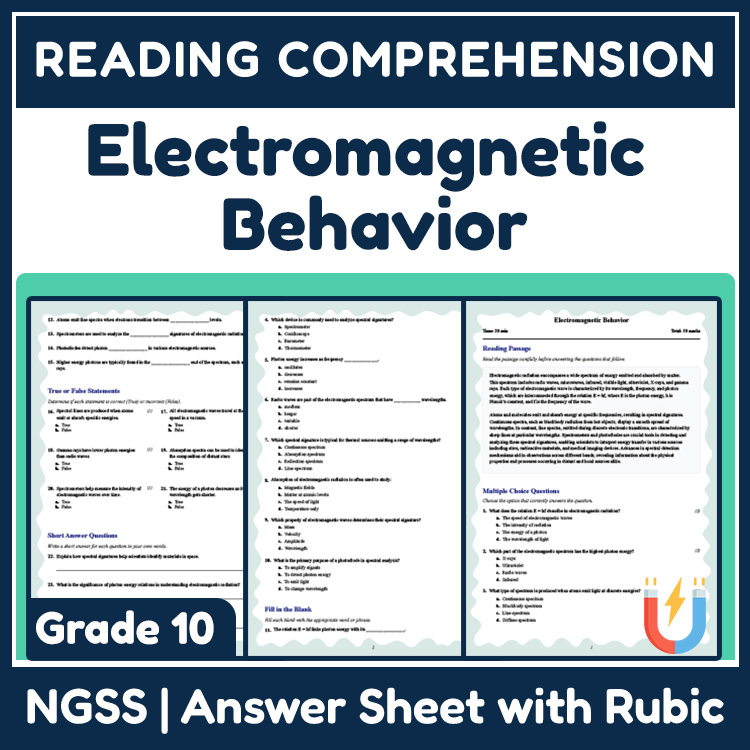
Grade 10 Science | Electromagnetic Behavior Reading Worksheet (PDF + Answer Key)
JCreated byJ.S SheetsLearning Objectives
- Understand the properties of electromagnetic emission and absorption through photon energy relations and spectral signatures.
- Apply Planck’s relation E = hf to interpret spectral data from various sources.
- Analyze atomic emission spectra to distinguish between continuous and line spectra.
Instant download
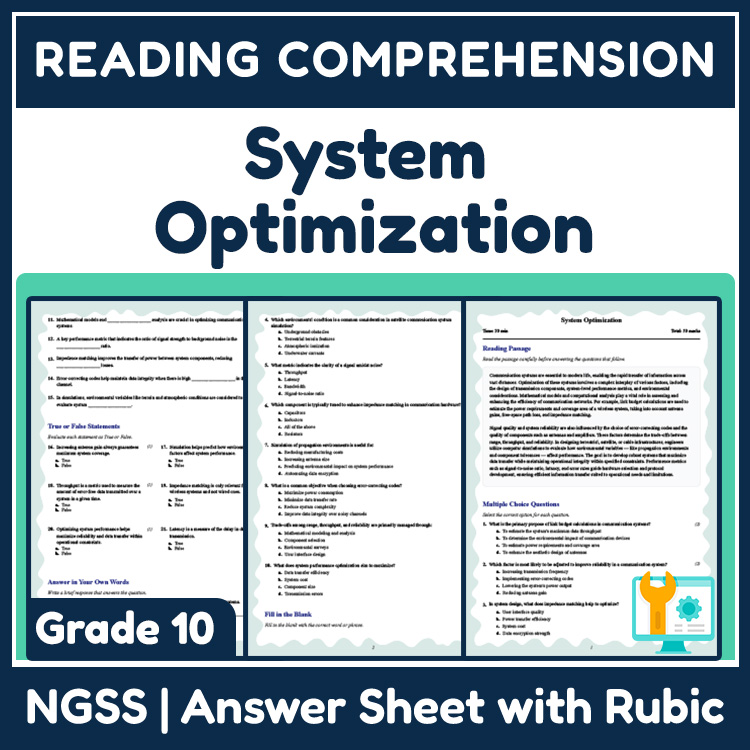
Grade 10 Science | System Optimization Reading Worksheet (PDF & Rubric)
JCreated byJ.S SheetsLearning Objectives
- Understand key concepts involved in the optimization of communication systems.
- Analyze factors affecting system performance such as gain, impedance matching, and error correction.
- Apply mathematical models to assess and improve communication system efficiency.
Instant download
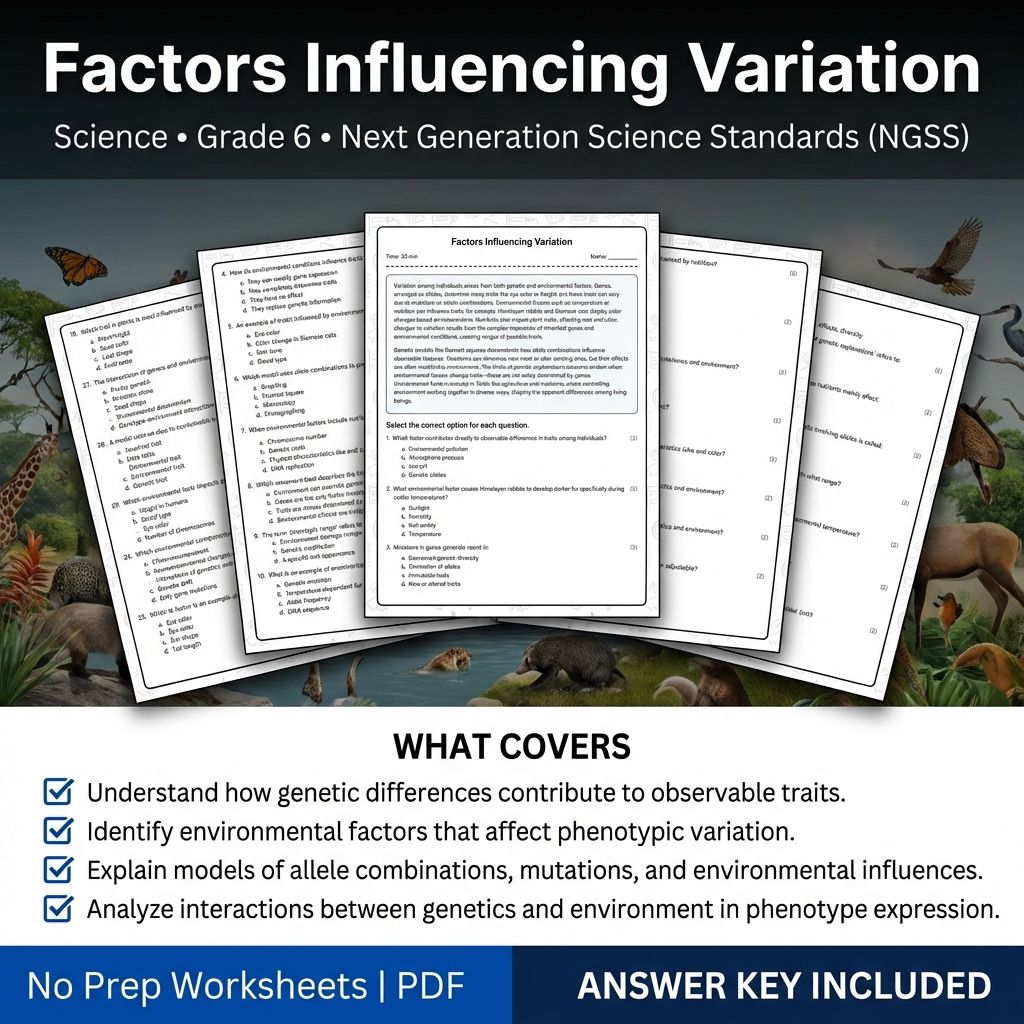
6th Grade Science | Factors Influencing Variation Worksheet & Answer Key
Created byCoral Reef LearningLearning Objectives
- Understand how genetic differences contribute to observable traits.
- Identify environmental factors that affect phenotypic variation.
- Explain models of allele combinations, mutations, and environmental influences.
Instant download
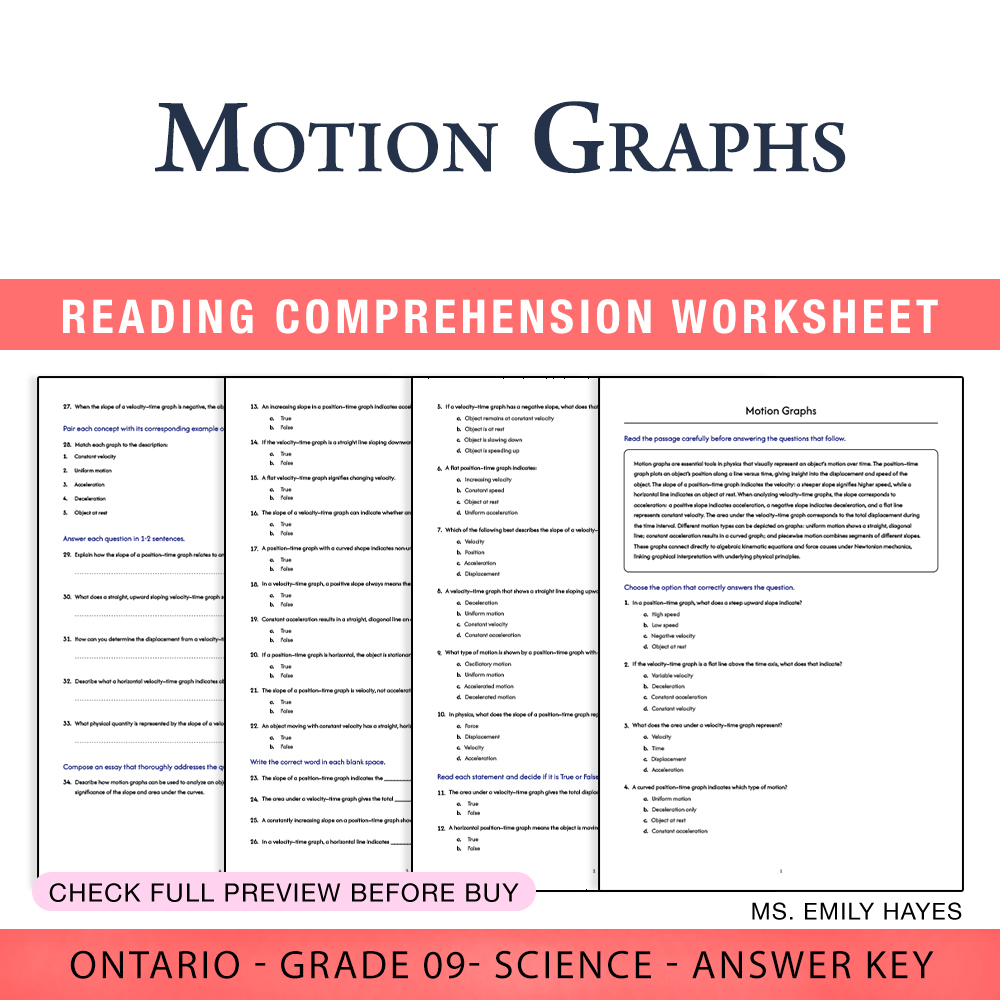
9th Grade Science | Motion Graphs Worksheet (PDF + Answer Key)
Created byCopper Leaf ClassroomLearning Objectives
- Interpret position–time graphs to determine an object's motion and understand what the slope indicates about velocity.
- Explain how the slope of a velocity–time graph relates to acceleration.
- Calculate displacement from the area under a velocity–time graph.
Instant download

Grade 12 Science | Senior Design in Science - Daily Reading Comprehension
Created byCoral Reef LearningLearning Objectives
- Understand the importance of formulating clear scientific research questions.
- Identify key components of a well-designed scientific study.
- Learn about the role of variables, instrumentation, and statistical analysis in scientific research.
Also included in: Science 30 Reading Comprehension Skills Lesson Bundle | Grade 12 Science Alberta +1 more
Instant download
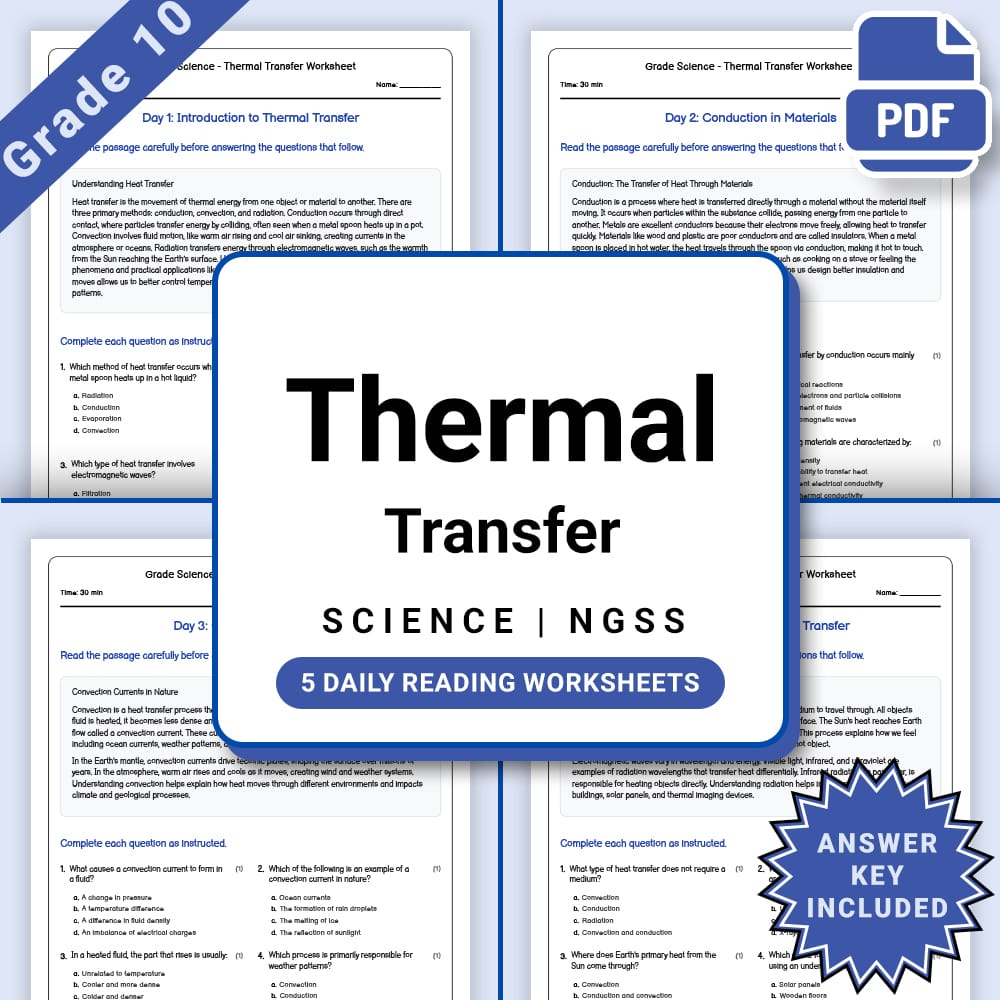
Grade 10 Science – Thermal Transfer Worksheet (PDF +Answer Key)
Created byCopper Leaf ClassroomLearning Objectives
- Understand the three methods of heat transfer: conduction, convection, and radiation.
- Identify examples of each heat transfer method in everyday life.
- Explain how thermal transfer affects temperature regulation and environmental processes.
Instant download
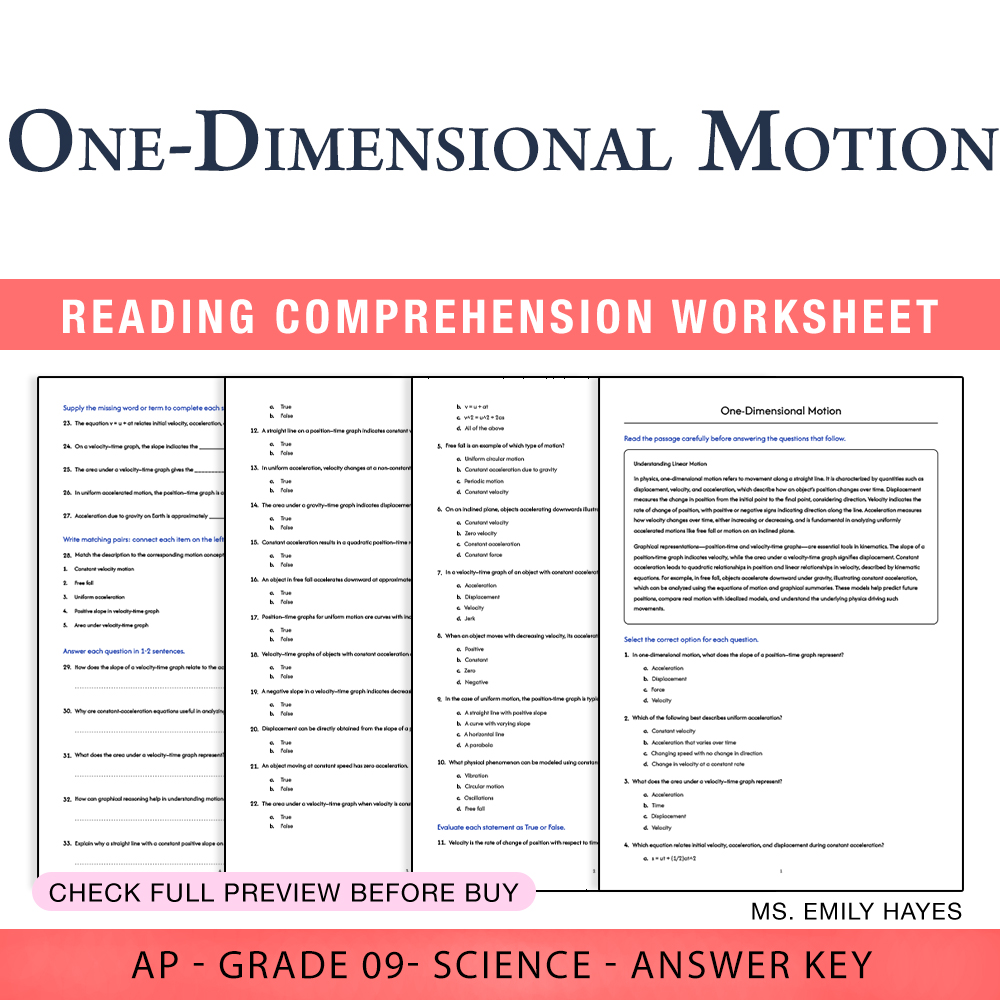
9th Grade Science | One-Dimensional Motion Worksheet (PDF+ Answer Key)
Created byCopper Leaf ClassroomLearning Objectives
- Understand the fundamental relationships among displacement, velocity, and acceleration for linear motion.
- Interpret position–time and velocity–time graphs to analyze motion patterns.
- Apply constant-acceleration equations to different types of motion, including free fall and inclined planes.
Also included in: Grade 9 Science | Motion & Force Concepts Worksheet(PDF+ Answer Key) +1 more
Instant download
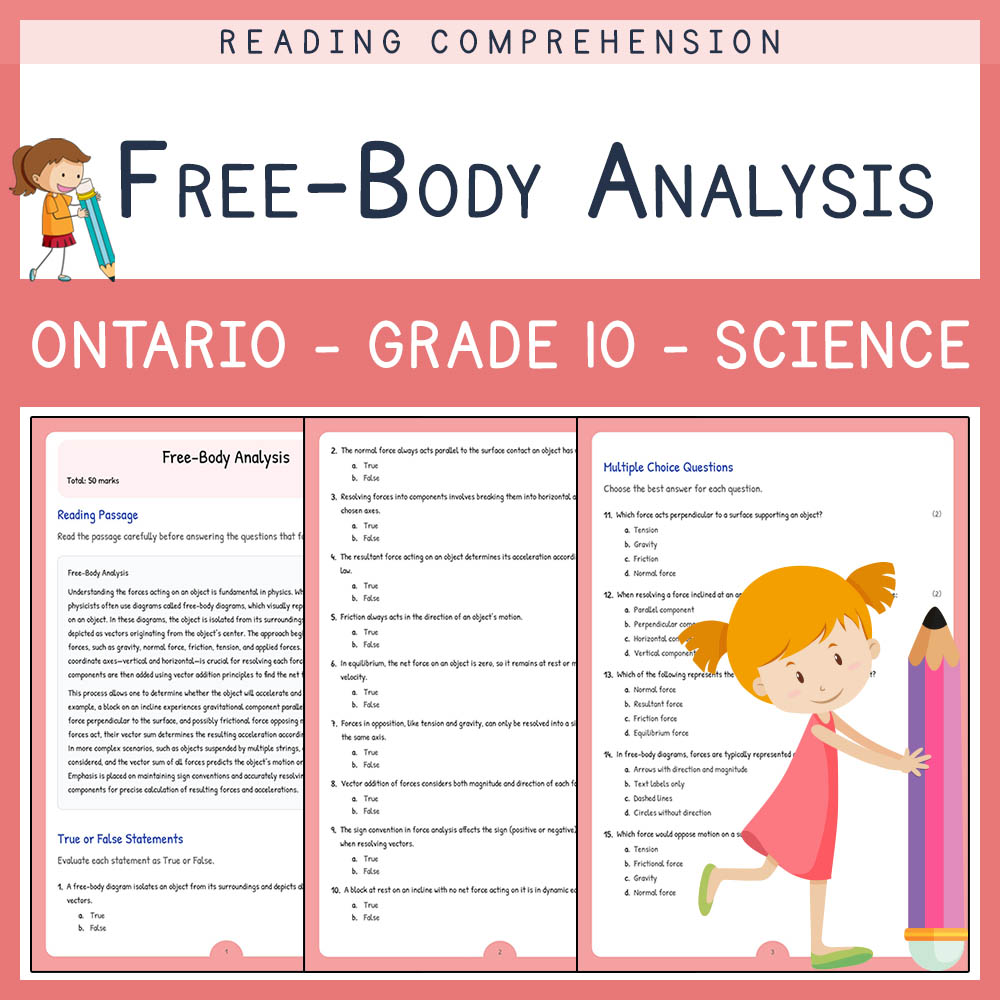
Grade 10 Science | Free-Body Analysis Worksheet Elena | Ontario Standard
Created byLumora LearningLearning Objectives
- Understand the concept of free-body diagrams and how they represent forces acting on objects.
- Learn procedures for identifying individual forces, choosing coordinate axes, and resolving force components.
- Apply vector addition to find the resultant force and relate it to the object's acceleration.
Also included in: Grade 10 Science | Motion & Forces Lesson Bundle | Ontario Standards
Instant download
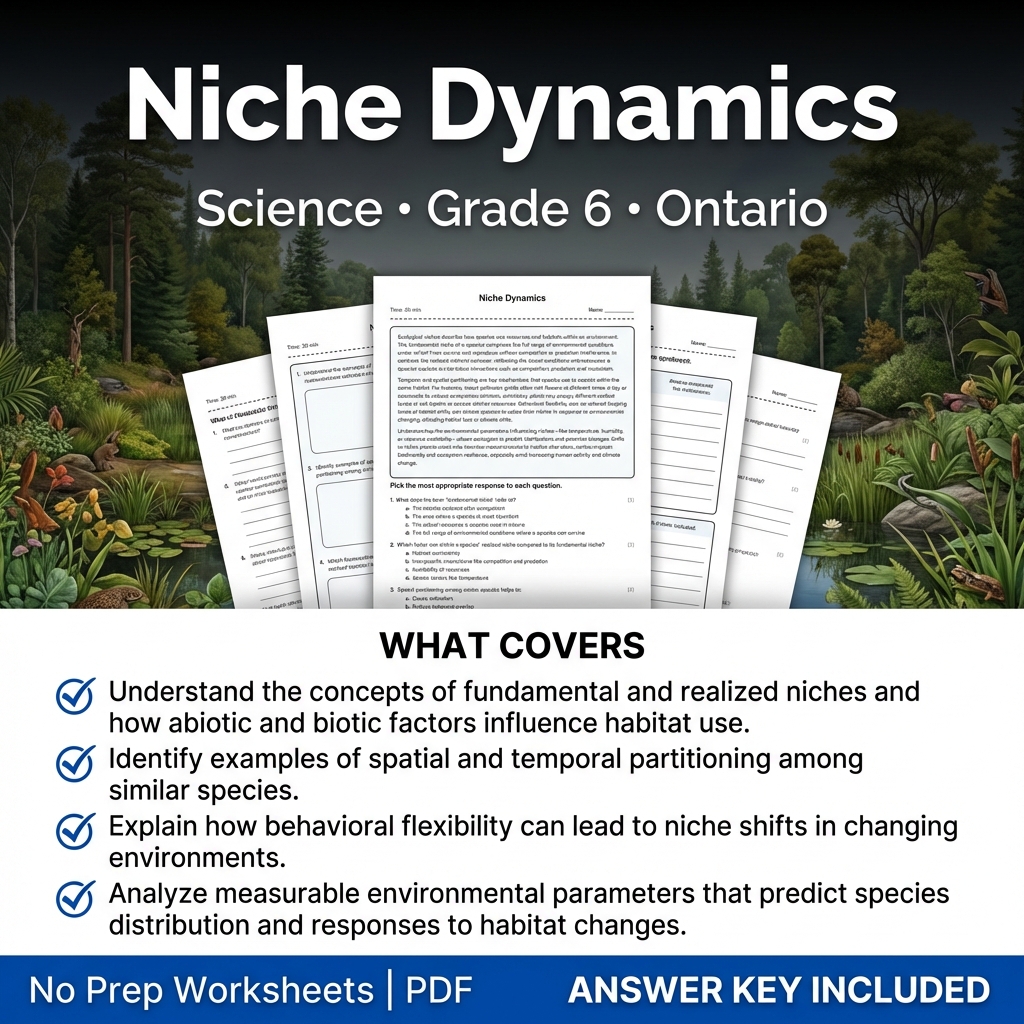
Niche Dynamics Worksheet | Science Grade 6 | Ontario
Created byCoral Reef LearningLearning Objectives
- Understand the concepts of fundamental and realized niches and how abiotic and biotic factors influence habitat use.
- Identify examples of spatial and temporal partitioning among similar species.
- Explain how behavioral flexibility can lead to niche shifts in changing environments.
Instant download
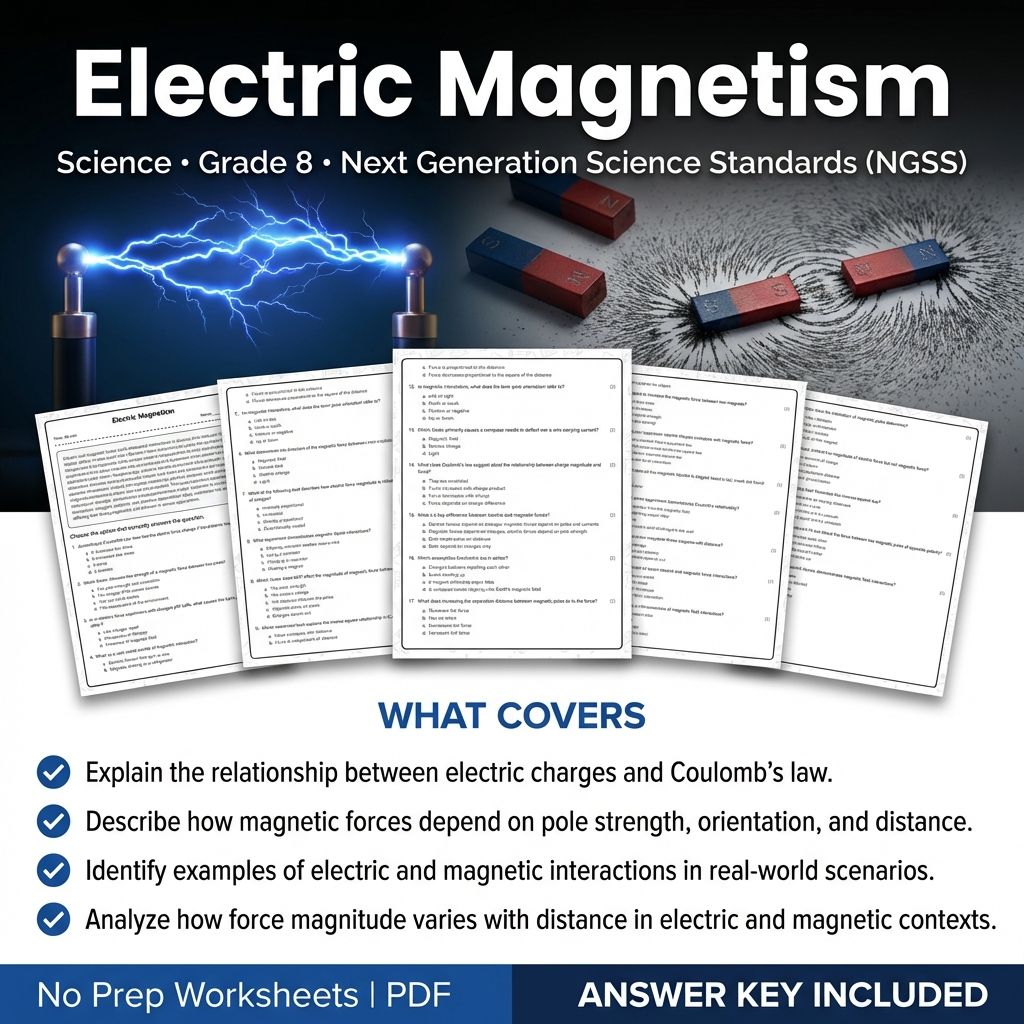
8th Grade Science | Electric Magnetism Worksheet & Answer Key (Printable PDF)
Created byCoral Reef LearningLearning Objectives
- Explain the relationship between electric charges and Coulomb's law.
- Describe how magnetic forces depend on pole strength, orientation, and distance.
- Identify examples of electric and magnetic interactions in real-world scenarios.
Instant download
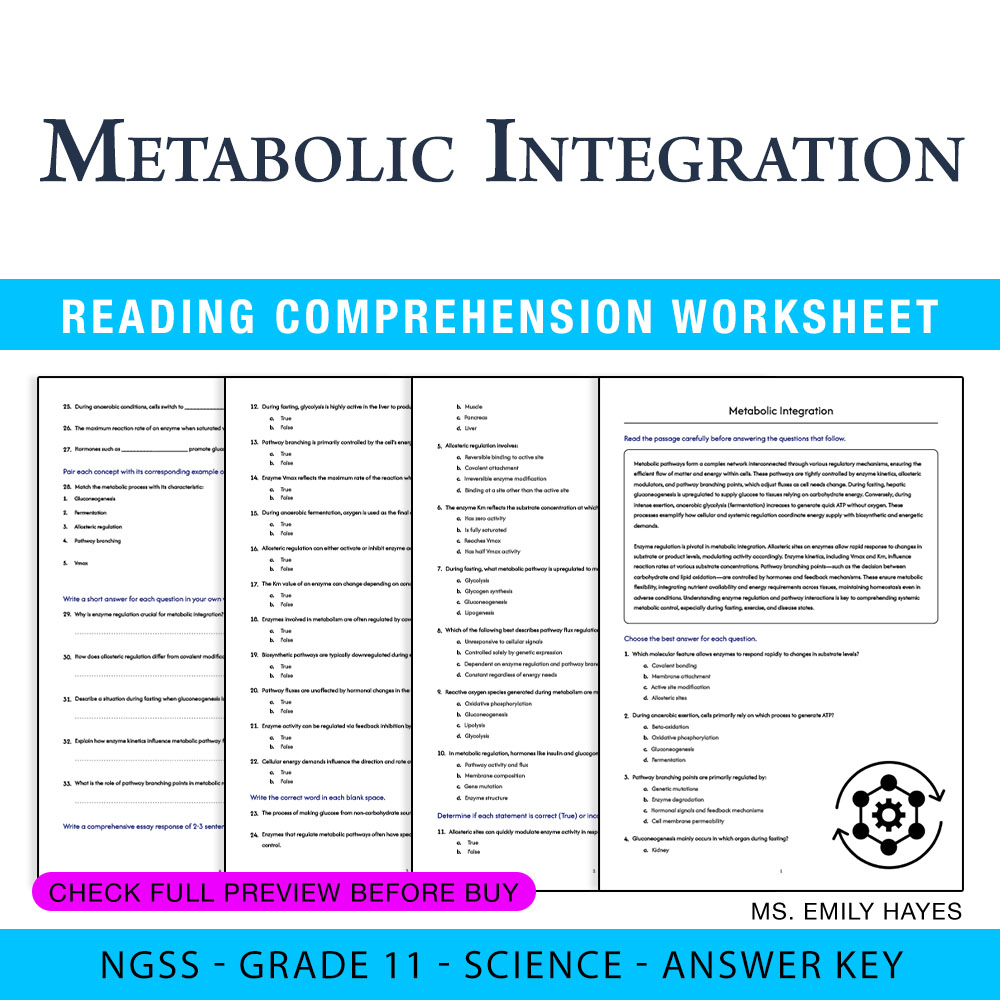
11th Grade Science | Metabolic Integration Worksheet (PDF+ Answer Key)
Created byCopper Leaf ClassroomLearning Objectives
- Understand how interconnected metabolic pathways regulate energy flow in cells.
- Identify key enzymes and their roles in carbohydrate, lipid, and protein metabolism.
- Explain examples of metabolic regulation during fasting and exertion.
Instant download
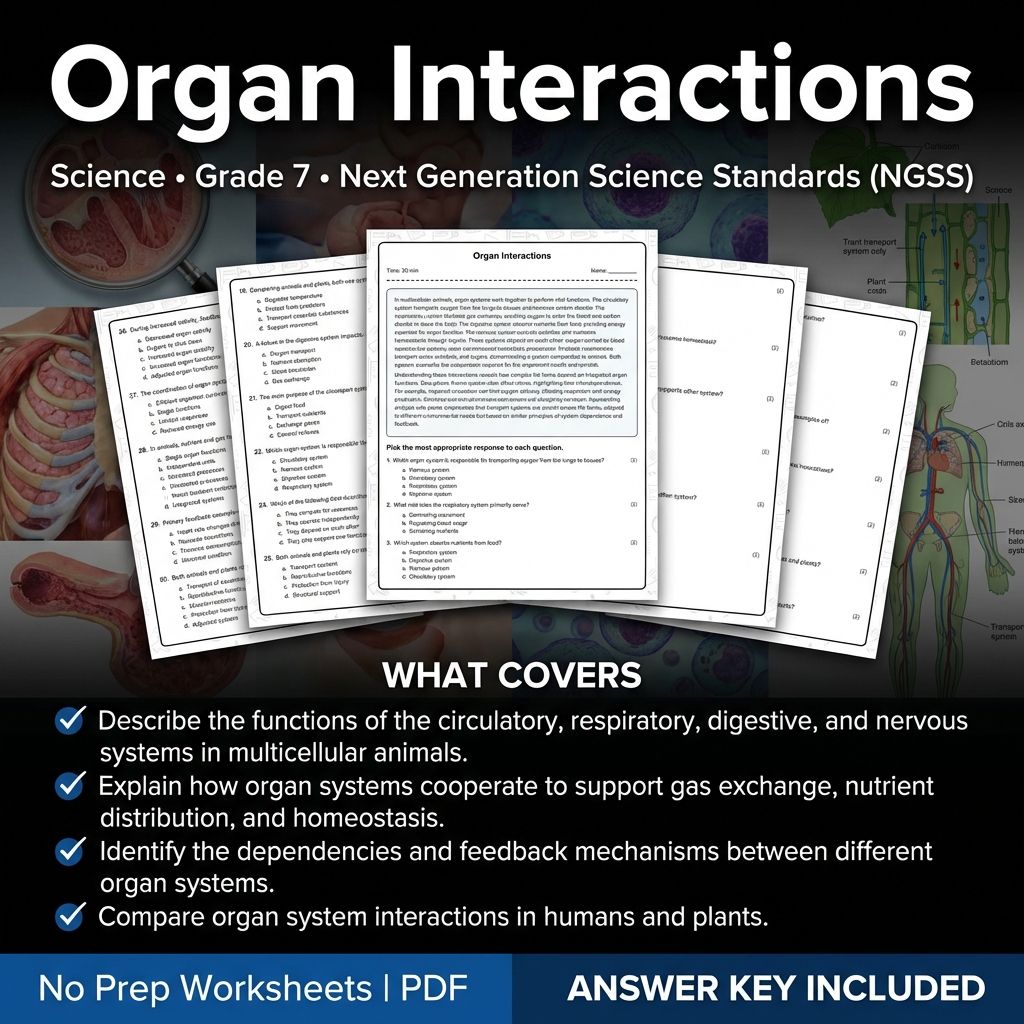
7th Grade Science | Organ Interactions Worksheet (Printable PDF + Answer Key)
Created byCoral Reef LearningLearning Objectives
- Describe the functions of the circulatory, respiratory, digestive, and nervous systems in multicellular animals.
- Explain how organ systems cooperate to support gas exchange, nutrient distribution, and homeostasis.
- Identify the dependencies and feedback mechanisms between different organ systems.
Instant download
Grade 9 Science | Feedback Mechanisms Worksheet (Worksheet + Answer Key) NGSS
Created byBright Mind ResourcesLearning Objectives
- Understand the concepts of negative and positive feedback and their roles in maintaining internal stability.
- Identify and describe specific physiological feedback processes such as thermoregulation, blood glucose control, and osmoregulation.
- Explain set points, sensor-effector loops, and the timing differences between rapid and slow feedback responses.
Instant download

Grade 11 Science | Stoichiometry Basics Worksheet | AP Aligned
Created byLumora LearningLearning Objectives
- Understand mole relationships, molar mass, and how to interpret balanced chemical equations.
- Apply limiting reagent reasoning and calculate percent yield in chemical reactions.
- Differentiate between empirical and molecular formulas using mass and mole data.
Also included in: Grade 11 Science | Chemistry Foundations Custom Bundle | AP-Aligned
Instant download
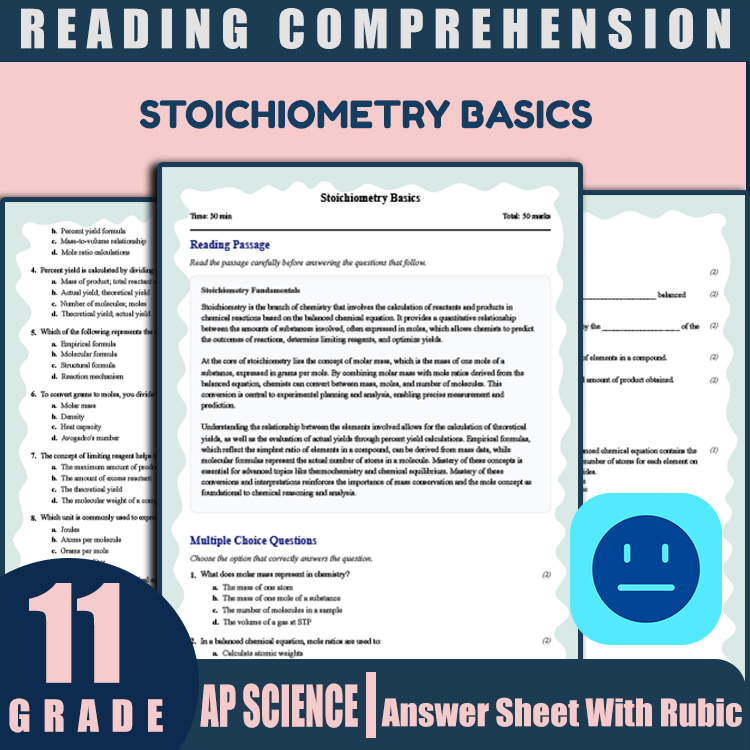
11th Grade Science | Stoichiometry Basics Reading Worksheet (PDF + Rubric)
JCreated byJ.S SheetsLearning Objectives
- Understand and interpret mole relationships, molar mass, and balanced equations in chemical reactions.
- Apply stoichiometric calculations to determine limiting reagents, percent yields, and empirical formulas.
Also included in: Grade 11 Science Unit Worksheet Bundle – Chemical Bonding, Kinetics & More (PDF) +1 more
Instant download
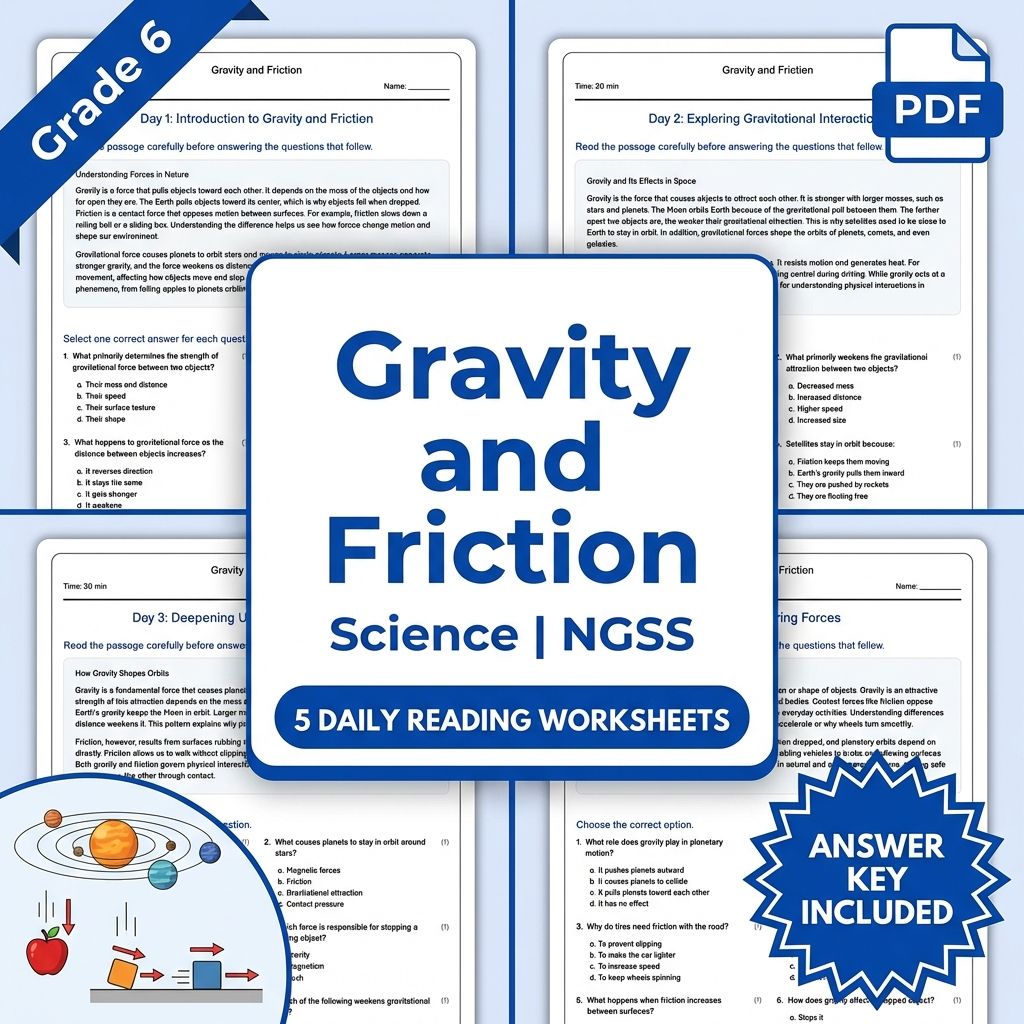
6th Grade Science | Gravity and Friction Worksheet (PDF+ Answer Key)
Created byCopper Leaf ClassroomLearning Objectives
- Understand how gravitational force depends on mass and distance.
- Identify examples of gravitational interactions such as planetary orbits and falling objects.
- Distinguish between attractive (gravitational) and contact (friction) forces.
Instant download

Grade 12 Science | Population Change Worksheet AP Standards (PDF)
Created byBright Mind ResourcesLearning Objectives
- Understand mechanisms such as natural selection, genetic drift, gene flow, and mutation that influence allele frequencies.
- Analyze case examples of phenotypic shifts and quantitative models related to population genetics.
- Evaluate evidence from molecular markers and experimental populations to understand evolutionary patterns.
Instant download
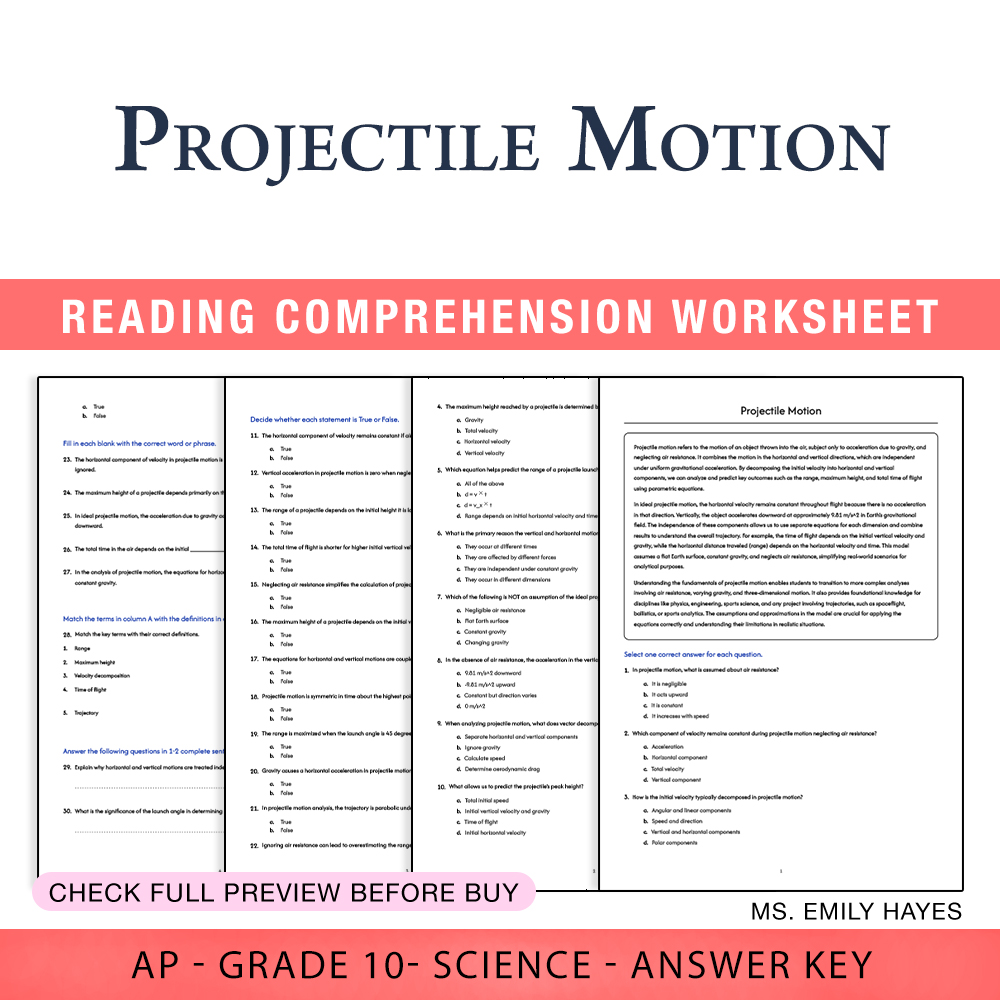
10th Grade Science | Projectile Motion Worksheet (PDF+ Answer Key)
Created byCopper Leaf ClassroomLearning Objectives
- Explain the independence of horizontal and vertical components of projectile motion.
- Calculate range, time of flight, and peak height for projectile trajectories ignoring air resistance.
- Use vector decomposition and parametric equations to analyze projectile motion scenarios.
Also included in: Grade 10 Science AP | Physics & Energy Concepts (PDF+ Answer Key) +1 more
Instant download

11th Grade Science | Momentum Collisions Worksheet (PDF + Answer Key)
Created byCopper Leaf ClassroomLearning Objectives
- Explain the concepts of linear momentum and impulse formalism in translational motion
- Analyze conservation of momentum during elastic and inelastic collisions
- Calculate post-collision velocities using impulse-momentum relations and vector decomposition
Instant download
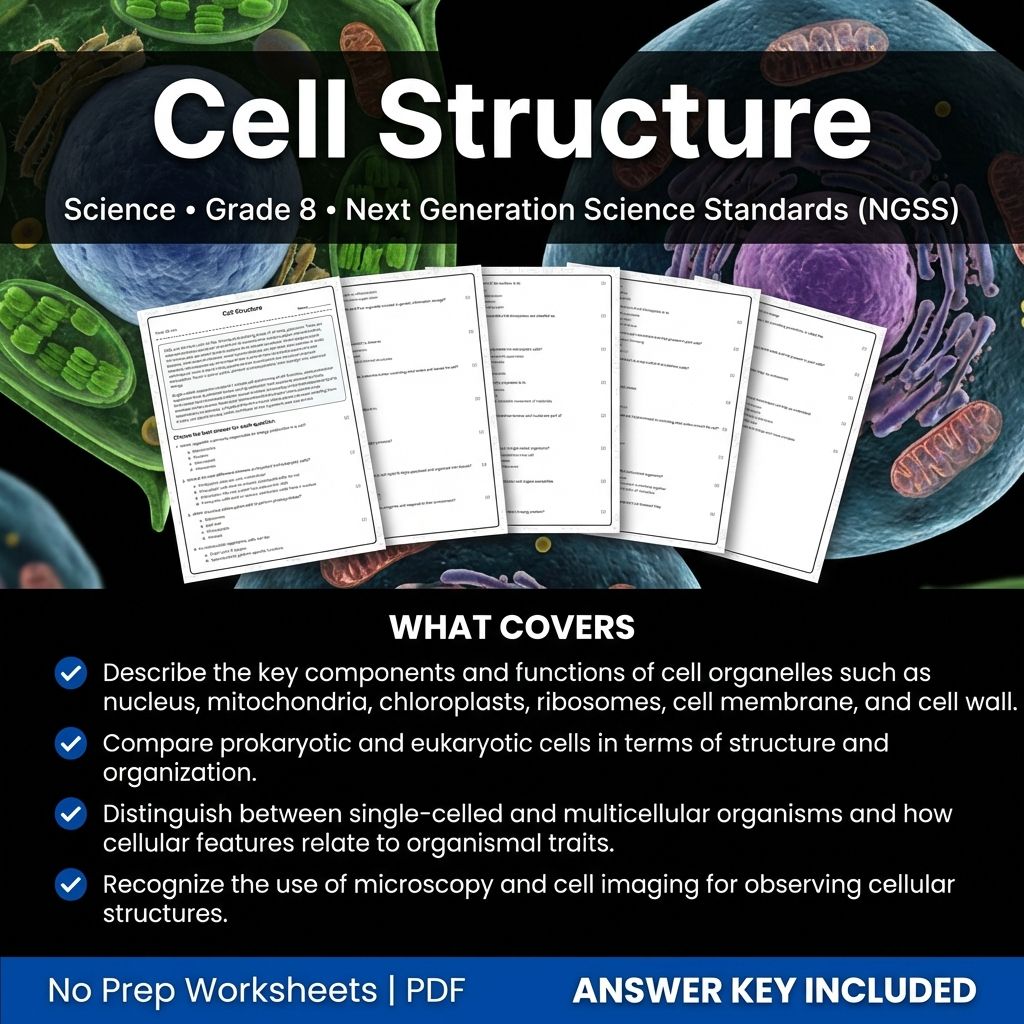
8th Grade Science | Cell Structure Worksheet & Answer Key (Printable PDF)
Created byCoral Reef LearningLearning Objectives
- Describe the key components and functions of cell organelles such as nucleus, mitochondria, chloroplasts, ribosomes, cell membrane, and cell wall.
- Compare prokaryotic and eukaryotic cells in terms of structure and organization.
- Distinguish between single-celled and multicellular organisms and how cellular features relate to organismal traits.
Instant download

Grade 6 Science | Pollution Effects Worksheet (PDF & Answer Key) for Ontario
Created byLumora LearningLearning Objectives
- Understand the ecological impacts of different types of pollution, including nutrient loading, chemicals, and bioaccumulation.
- Identify measurable indicators such as dissolved oxygen, algal biomass, and contaminant residues related to pollution.
- Analyze case studies like eutrophication, endocrine disruption, and biomagnification to comprehend pollution effects on ecosystems.
Also included in: Grade 6 Science | Biodiversity Custom Unit Resource | Ontario Framework
Instant download
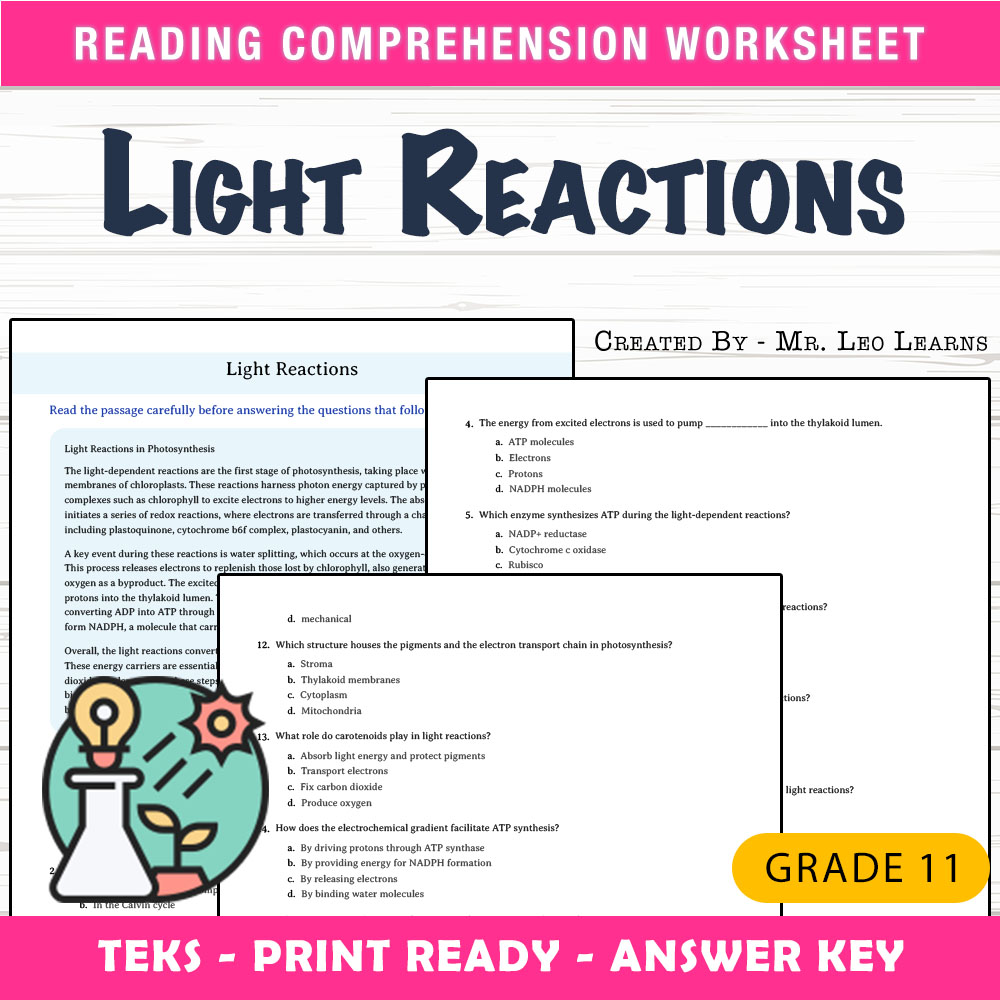
Grade 11 Science – Light Reactions Worksheet for Mastering Photosynthesis
 Created byThe Resource Hub
Learning Objectives
- Explain the process of light-dependent reactions in photosynthesis.
- Identify the roles of pigments, electron transport chain, and ATP synthase in light reactions.
- Describe how water splitting releases oxygen as a byproduct.
Also included in: Grade 11 Science | Cellular Energy & Photosynthesis Unit Worksheet Bundle +1 more
Instant download
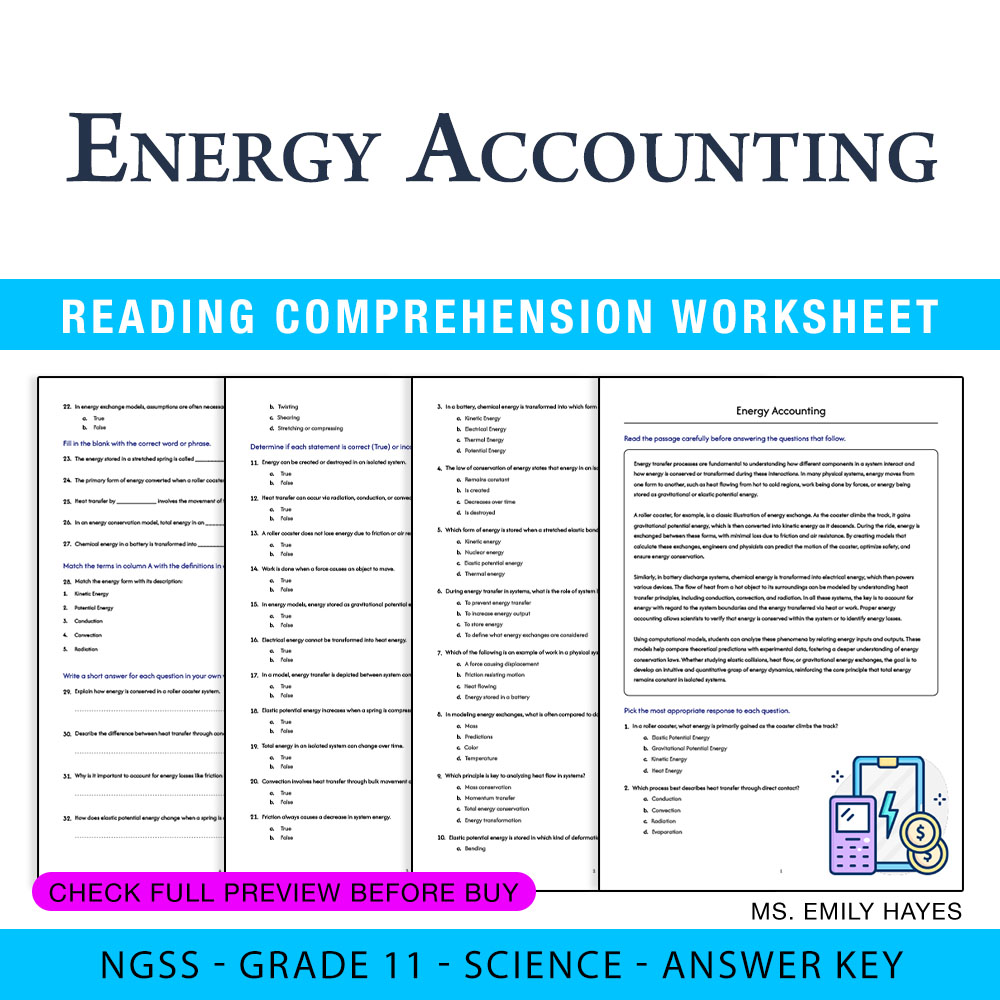
11th Grade Science | Energy Accounting Worksheet (PDF + Answer Key)
Created byCopper Leaf ClassroomLearning Objectives
- Create computational models to analyze energy transfers among system components.
- Relate heat, work, and stored energy in various physical systems using representations.
- Compare predicted energy flows to actual data, emphasizing total energy conservation.
Instant download

Population and Stability Worksheet | Grade 8 Ecosystems Review
Created byPrism Point LearningLearning Objectives
- Explain how interactions among organisms affect population sizes in an ecosystem.
- Describe how predation, competition, disease, and mutualism can change ecosystem stability over time.
- Connect population changes to changes in energy flow and matter cycling.
Instant download
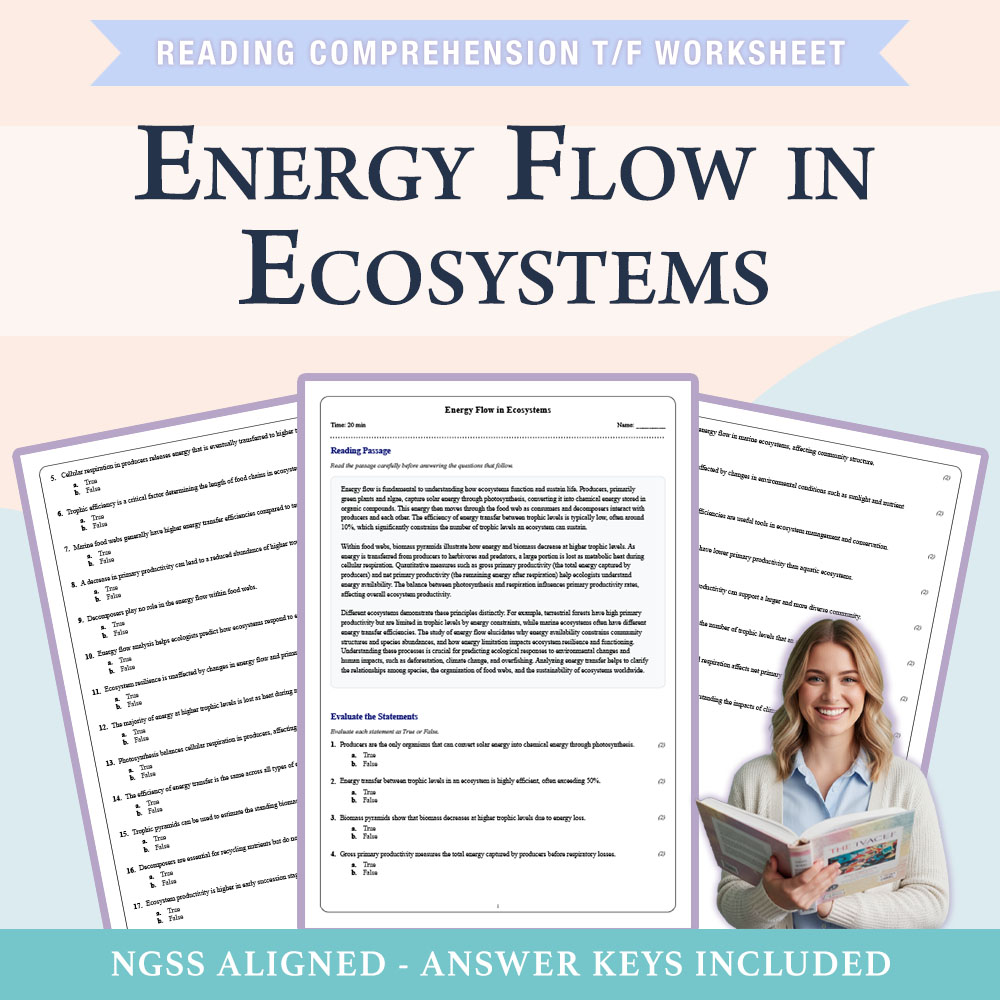
11th Grade Science | Energy Flow in Ecosystems Worksheet (PDF + Answer Key)
Created byCopper Leaf ClassroomLearning Objectives
- Understand the concept of energy transfer within food webs, including trophic levels and biomass pyramids.
- Recognize the processes of photosynthesis and cellular respiration and their roles in energy flow.
- Analyze how energy loss affects community structure, species abundance, and ecosystem functioning.
Instant download
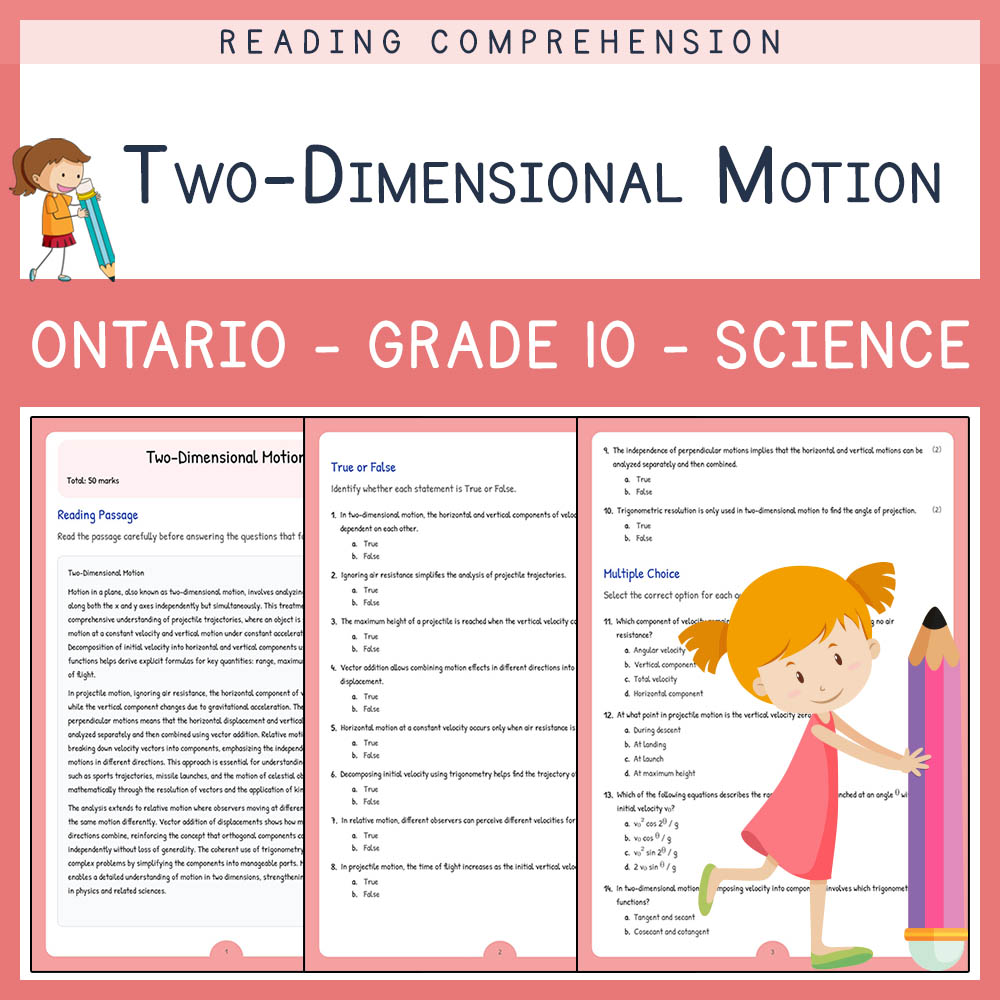
Grade 10 Science | Two-Dimensional Motion Worksheet Elena | Ontario Standard
Created byLumora LearningLearning Objectives
- Explain the concept of motion in a plane and the decomposition of velocity into orthogonal components.
- Analyze projectile trajectories using uniform gravitational acceleration neglecting air resistance.
- Derive and understand expressions for range, maximum height, and time of flight in two-dimensional motion.
Also included in: Grade 10 Science | Motion & Forces Lesson Bundle | Ontario Standards
Instant download

Anatomical Evidence for Evolution Worksheet | NGSS Grade 7 Science
 Created bySkylark Worksheets
Learning Objectives
- Explain how comparative anatomy supports evolution using homologous and analogous structures
- Identify examples of vestigial organs and describe how they can indicate common ancestry
- Use morphological comparisons to make basic claims about evolutionary relatedness
Also included in: Grade 7 Speciation and Evolution Evidence Science Lesson Bundle NGSS +1 more
Instant download

Science Grade 7 Worksheet: Fossil Patterns | NGSS Aligned Science
Created bySkylark WorksheetsLearning Objectives
- Explain how fossil patterns in stratigraphic layers provide evidence for common ancestry and evolutionary change over geologic time.
- Use index fossils and correlations between sedimentary layers to infer relative ages and interpret changes in fossil assemblages.
- Analyze how transitional fossils and morphological trends support ideas about lineage continuity, radiations, and mass extinctions.
Also included in: Grade 7 Speciation and Evolution Evidence Science Lesson Bundle NGSS +1 more
Instant download
Browse more categories
About Science Worksheets
Find Science worksheets spanning core skills, practice, and review. All 44,628 resources are instant PDF downloads for the classroom or home.
Every worksheet on MyTeachingSheets is created by independent teacher-authors and reviewed before publication. All resources download as printable PDFs for classroom, homework, or at-home practice, and many include answer keys. Preview any worksheet free before buying.