
Science Worksheets
44,627 subject resources
Grade 11 Reaction Types Worksheet with Answer Key | Florida NGSSS Chemistry
 Created byEvergreen Desk Education
Learning Objectives
- Classify common chemical reactions into synthesis, decomposition, single replacement, and double replacement
- Use conservation of atoms and typical reaction patterns to predict likely products
- Interpret evidence such as gas, precipitate, temperature change, and color change to identify reaction types
Instant download

Water Availability and Resources Worksheet Grade 7 Science | California Standards
 Created byPrism Point Learning
Learning Objectives
- Explain how natural processes and human use affect the availability of land, water, and air resources.
- Describe how precipitation patterns and groundwater storage influence access to freshwater.
- Evaluate how droughts, floods, and human demand can change ecosystem stress and resource availability.
Instant download

Grade 11 Science | Reaction Types in Chemistry - Daily Reading Comprehension
 Created byCoral Reef Learning
Learning Objectives
- Understand the basic classification of chemical reactions.
- Identify different reaction types based on descriptions and evidence.
- Predict possible products of simple chemical reactions.
Instant download

Grade 8 Science Worksheet | Fossil Record Clues & Evidence of Evolution
Created byEvergreen Desk EducationLearning Objectives
- Explain how fossils in sedimentary layers can provide evidence for Earth’s past environments and geologic time.
- Describe how matching fossil types and rock layers across distant regions supports ideas about plate tectonics.
- Use principles such as superposition and radiometric dating to interpret the ages of fossil-bearing layers.
Instant download
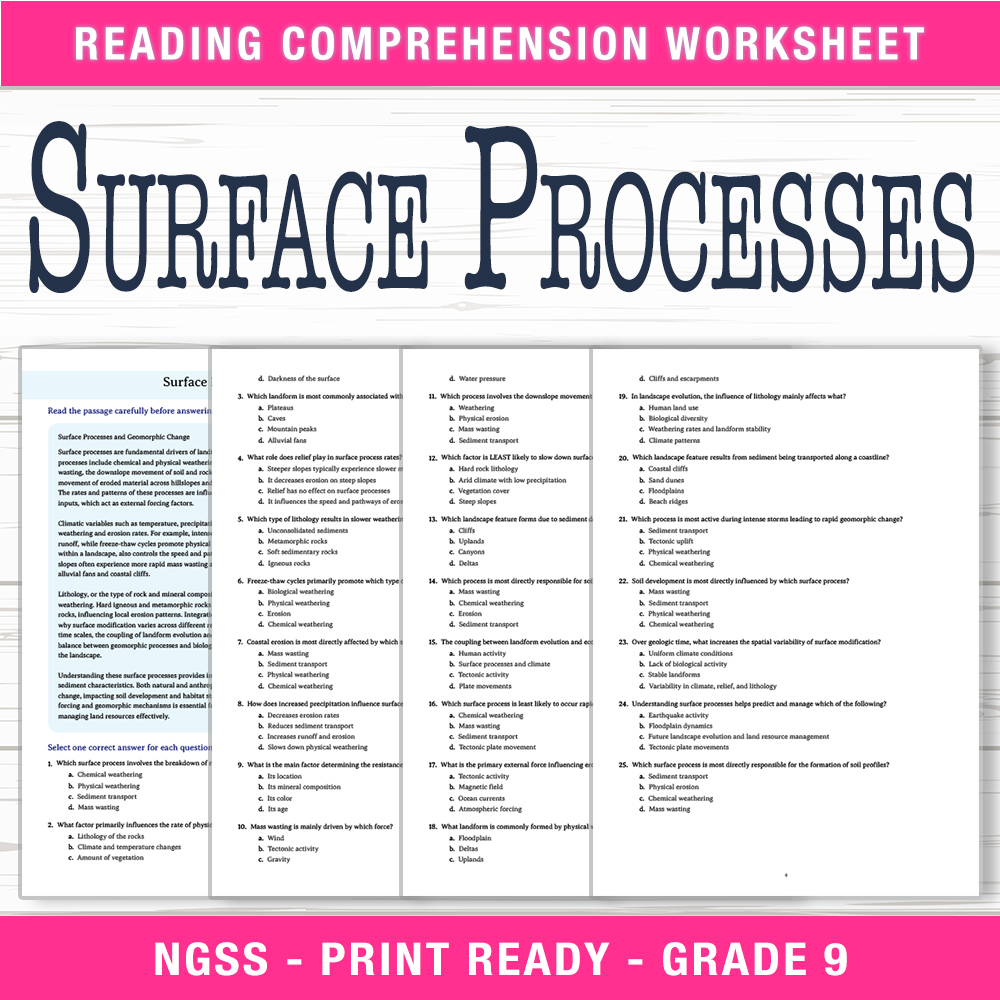
Grade 9 Science | Surface Processes Worksheet (PDF + Answer Key)
 Created byRiverstone Classroom
Learning Objectives
- Describe the key surface processes that influence landform development.
- Explain how climate, relief, and lithology affect surface process rates and patterns.
- Analyze the relationship between surface processes and geomorphic change over various time scales.
Also included in: Grade 9 Science Unit | Earth Processes & Climate Worksheet Bundle
Instant download

Grade 8 Science | Fossil Record Clues Worksheet | California Standards
 Created byLumora Learning
Learning Objectives
- Explain how fossils in sedimentary layers provide evidence for Earth’s past environments and conditions
- Use fossil correlations to infer that distant regions may have had similar organisms when tectonic plates were arranged differently
- Describe how rock characteristics and layer ages strengthen interpretations of geologic history and plate movement
Instant download

Grade 9 Surface Processes Science Worksheet | NGSS Earth Science Activity
 Created byAmber Owl Education
Learning Objectives
- Explain how chemical and physical weathering change rock into soil and regolith over time
- Describe how mass wasting and sediment transport move materials across hillslopes and floodplains
- Connect atmospheric forcing (such as rainfall) and hydrologic input to geomorphic change and landform patterns
Also included in: Grade 9 Science Earth’s Dynamic Processes Lesson Bundle | NGSS +1 more
Instant download

Surface Processes: Rates and Patterns Worksheets – Grade 9 Science
 Created byTeachers Club
Learning Objectives
- Describe how weathering, mass wasting, and sediment transport change landforms
- Explain how climate forcing and hydrologic input affect process rates
- Connect landform development with patterns of soil formation
Also included in: Earth's Systems Grade 9 NGSS Science Worksheets Bundle +1 more
Instant download

Grade 9 Science – Surface Processes & Weathering | Daily Reading Worksheet
 Created byBright Mind Resources
Learning Objectives
- Identify different types of weathering and explain their effects on Earth's surface.
- Describe how chemical and physical weathering contribute to landscape change.
- Understand the role of weathering in soil development and geomorphic patterns.
Also included in: Grade 9 Earth Processes Science Daily Reading Worksheets lesson bundle | NGSS +2 more
Instant download
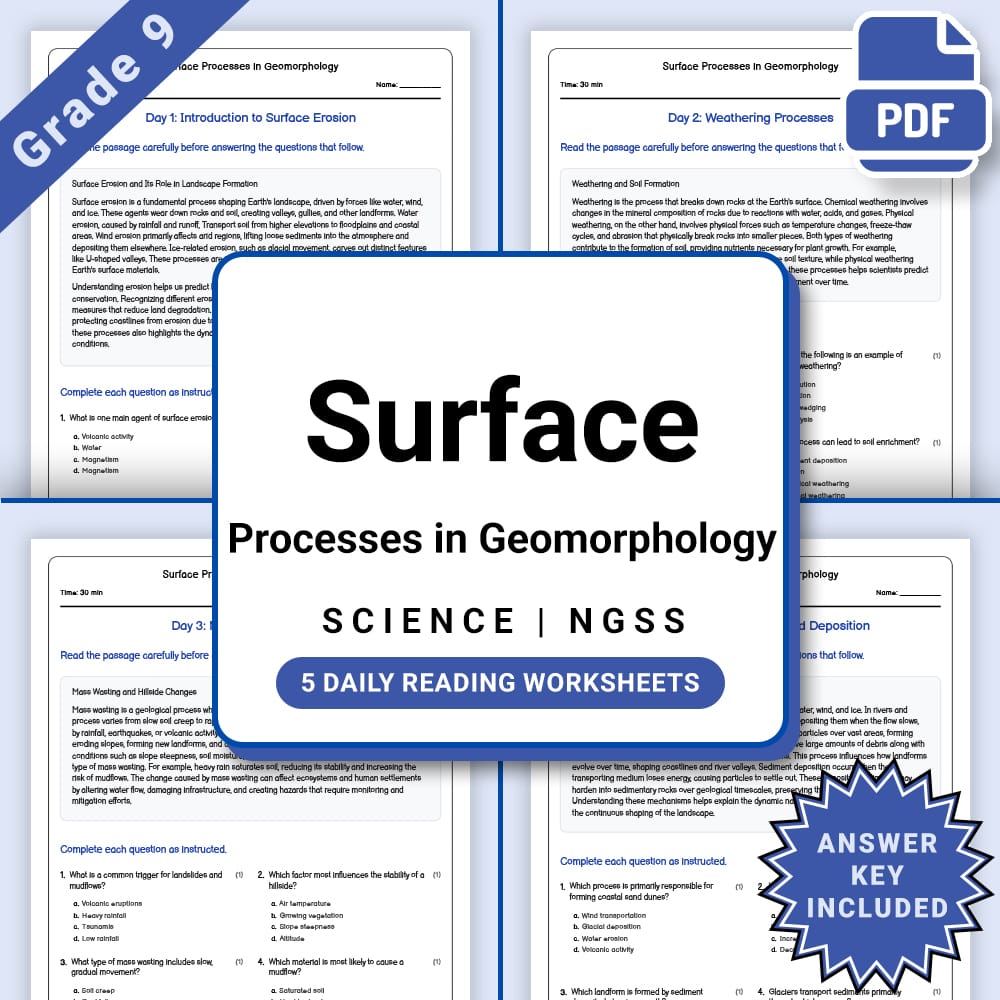
Grade 9 Science Surface Processes Daily Reading Worksheet(PDF + Answers)
 Created byCopper Leaf Classroom
Learning Objectives
- Understand the different types of surface erosion
- Explain how atmospheric and hydrologic factors influence earth surface changes
- Identify examples of erosion processes in nature
Instant download

Surface Processes Worksheet for Grade 9 Science NGSS Standards
JCreated byJ.S SheetsLearning Objectives
- Describe how atmospheric forcing influences geomorphic change and soil development.
- Identify and explain key surface process mechanisms such as chemical weathering, mass wasting, and sediment transport.
- Analyze examples of surface modification including alluvial fan formation and coastal erosion.
Also included in: Grade 9 Earth Systems and Geologic Processes Science Lesson Bundle: NGSS +1 more
Instant download

Gravity Attraction Worksheet | Standards-Based Practice for Grade 8 Science
JCreated byJ.S SheetsLearning Objectives
- Understand how gravitational force depends on mass and distance.
- Explain why objects with larger mass exert stronger gravity.
- Describe how increasing distance decreases gravitational attraction.
Also included in: Grade 8 Forces, Energy & Matter Science Lesson Bundle | California Standards +1 more
Instant download
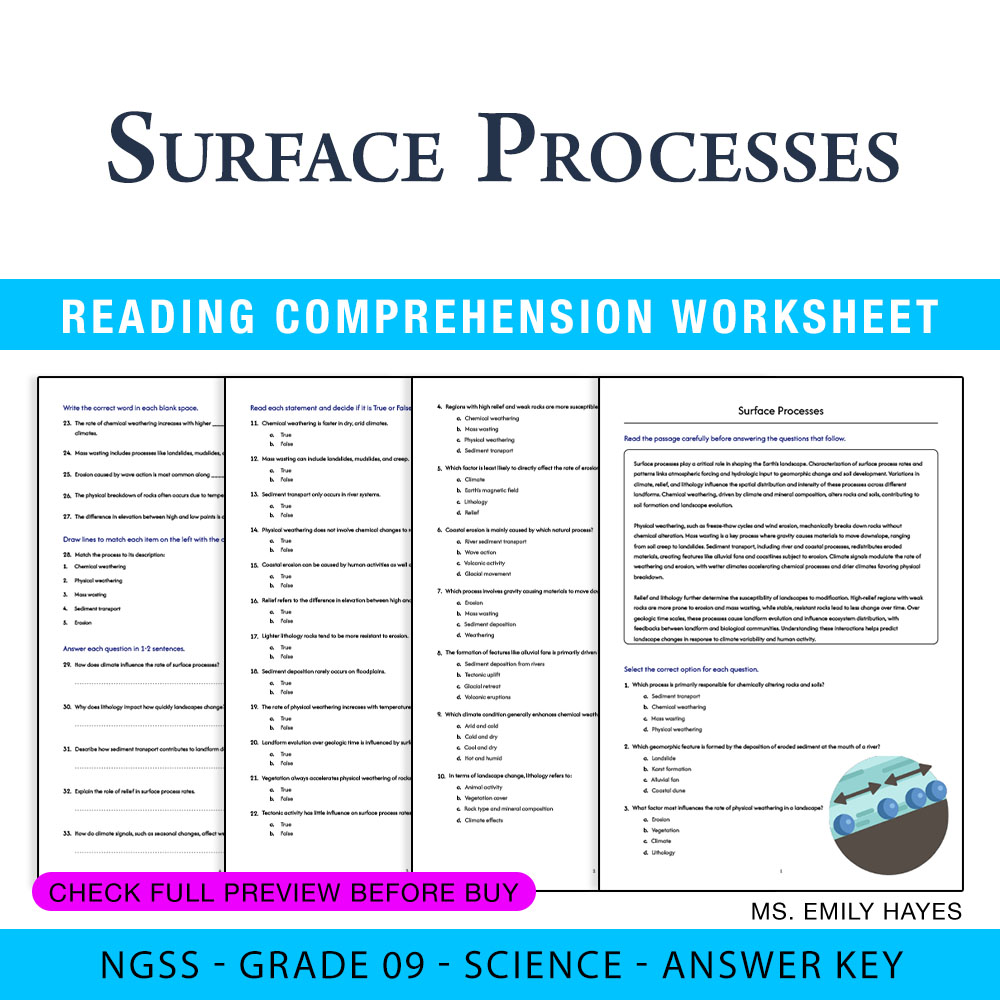
Grade 9 Science | Surface Processes Worksheet (PDF+ Answer Key)
Created byCopper Leaf ClassroomLearning Objectives
- Describe the main types of surface processes affecting landscape change.
- Analyze the factors influencing rates of chemical and physical weathering.
- Explain how mass wasting and sediment transport contribute to geomorphic patterns.
Instant download

Science Worksheet: Balanced vs. Unbalanced Forces | Standards-Aligned Grade 7
JCreated byJ.S SheetsLearning Objectives
- Explain how balanced forces affect net force and an object’s motion
- Predict how unbalanced forces change motion through acceleration
- Use real-world scenarios (like tug-of-war) to describe the direction of net force
Also included in: Grade 7 Matter, Energy & Forces Science Lesson Bundle – Florida NGSSS +1 more
Instant download
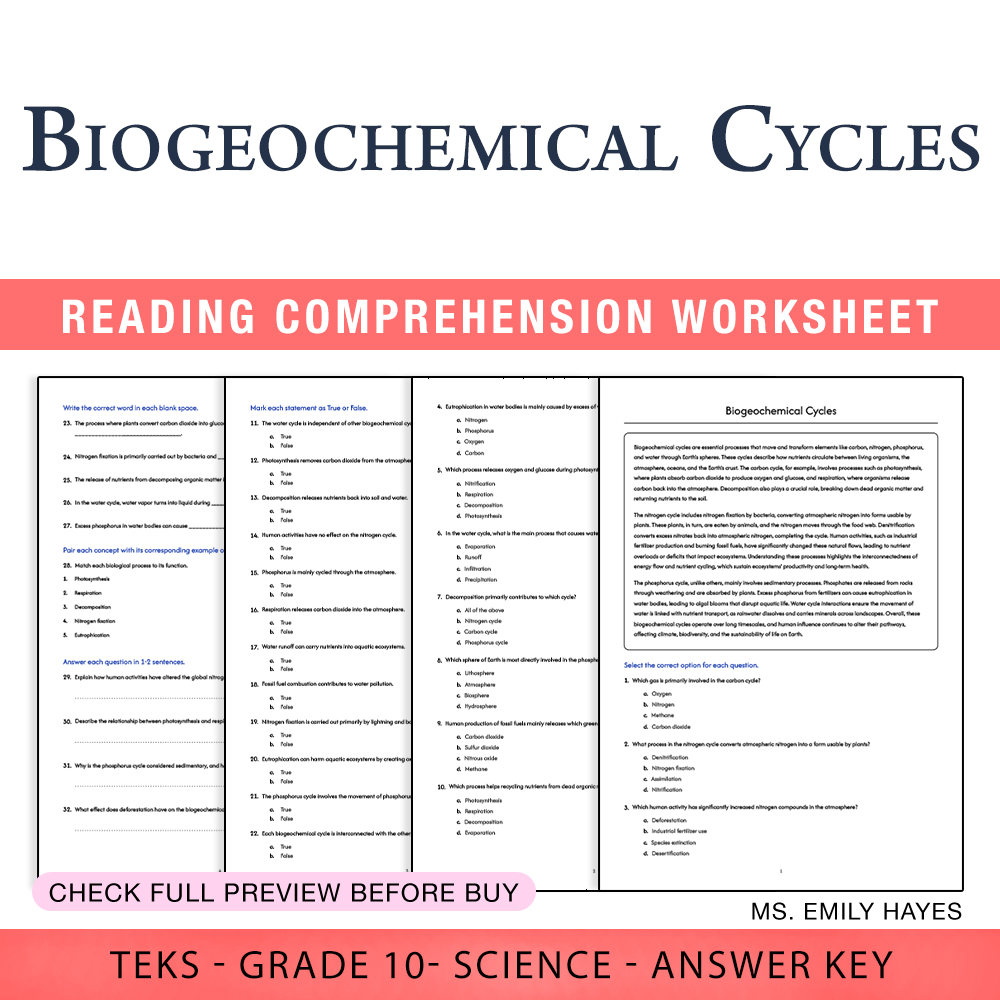
Grade 10 Science | Biogeochemical Cycles Worksheet (PDF+ Answer Key)
Created byCopper Leaf ClassroomLearning Objectives
- Describe the main types of biogeochemical cycles and their pathways.
- Explain how biological, physical, and human activities influence nutrient cycling.
- Identify key processes such as photosynthesis, respiration, and decomposition in nutrient flow.
Instant download

Gravity Attraction Worksheet Grade 8 Science Practice | Forces Review
Created byPrism Point LearningLearning Objectives
- Explain how gravitational attraction depends on mass and distance.
- Predict how changing mass or distance affects the strength of gravity.
- Use the idea of gravity as a force of interaction that acts at a distance to describe motion.
Instant download

Surface Processes Worksheet for Grade 9 Science | NGSS Printable PDF
Learning Objectives
- Explain how atmospheric and hydrologic forces influence geomorphic change and soil development.
- Analyze the roles of chemical and physical weathering, mass wasting, and sediment transport across different landforms.
- Evaluate how climate signals, relief, and lithology affect surface modification and landform evolution.
Also included in: Grade 9 Earth's Systems Science Lesson Bundle NGSS | Natural Hazards & Geology +1 more
Instant download

Grade 8 Science | Gravity Attraction - Daily Reading Comprehension
Created byCoral Reef LearningLearning Objectives
- Understand the basic concept of gravity.
- Recognize how mass and distance influence gravitational force.
- Describe everyday examples of gravitational effects.
Instant download

Grade 8 Gravity Attraction Worksheet | Practice & Standards PDF
 Created byClear Sky Classroom
Learning Objectives
- Explain how gravitational attraction depends on both mass and distance
- Describe gravity as a force that acts at a distance and affects motion
- Use evidence from real-world examples to make claims about changes in gravitational strength
Instant download

Grade 12 Science | Force Interactions Worksheet | AP Aligned
Created byLumora LearningLearning Objectives
- Explain the differences between contact and long-range forces.
- Apply Newton's laws to analyze force systems involving inclined planes, pulleys, and friction.
- Draw and interpret free-body diagrams for various physical scenarios.
Instant download

Grade 8 Science – Understanding Gravity & Forces | Daily Reading Worksheet
Created byBright Mind ResourcesLearning Objectives
- Explain what gravity is and how it affects objects.
- Understand the relationship between mass, distance, and gravitational force.
- Identify real-life examples of gravitational attraction.
Also included in: Grade 8 Energy, Forces & Matter Lesson Bundle - Daily Reading | Calif. Std. +1 more
Instant download

Grade 9 System Hierarchy Worksheet | NGSS Practice PDF
Created byClear Sky ClassroomLearning Objectives
- Understand the organization of biological systems from cells to organismal systems.
- Identify how tissues, organs, and systems interact to maintain organism functions.
- Explain examples of system coupling such as circulatory-respiratory and digestive-vascular interactions.
Also included in: Grade 9 Cellular Systems & Regulation Science Lesson Bundle NGSS Worksheet Set +1 more
Instant download

Grade 9 Natural Hazards Worksheet | NGSS Practice PDF
Created byClear Sky ClassroomLearning Objectives
- Understand the types and causes of natural hazards such as landslides, volcanic eruptions, tsunamis, floods, and storms.
- Analyze how hazard maps, recurrence intervals, and paleoevidence contribute to risk assessment.
- Evaluate the spatial patterns and triggering mechanisms of episodic geological and atmospheric events.
Also included in: Grade 9 Earth Systems & Processes Science Lesson Bundle NGSS Practice +1 more
Instant download

Grade 8 Gravity Attraction Worksheet PDF | California Standards Science
Created byEvergreen Desk EducationLearning Objectives
- Explain how gravitational attraction depends on the masses of two objects.
- Describe how changing the distance between objects affects the strength of gravity.
- Use the idea of gravity as an interaction that acts at a distance to predict changes in motion.
Instant download

Grade 6 Science | Inherited Adaptations - Daily Reading Comprehension
Created byCoral Reef LearningLearning Objectives
- Understand what inherited adaptations are
- Identify examples of adaptations in animals
- Explain how adaptations help animals survive in their environments
Instant download

Grade 6 Science | Inherited Adaptations Worksheet | Florida NGSSS Aligned
Created byLumora LearningLearning Objectives
- Explain how inherited adaptations help organisms survive and reproduce in specific environments
- Identify examples of adaptations that improve feeding, protection, or tolerance to temperature and moisture
- Describe how environmental pressures (living and nonliving factors) increase the usefulness of certain traits
Instant download

Natural Hazards Review Practice Assessment | Grade 9 Science
Created byPrism Point LearningLearning Objectives
- Explain how geological and atmospheric indicators help characterize natural hazards by origin, frequency, and potential impacts.
- Use hazard maps and recurrence intervals to discuss risk to human and ecological systems.
- Describe how triggering mechanisms and intersystem feedbacks influence the spread and long-term effects of natural hazards.
Instant download

Inherited Adaptations Worksheet Grade 6 Science NGSSS Florida
Created byPrism Point LearningLearning Objectives
- Explain how inherited adaptations help organisms survive and reproduce in specific environments.
- Distinguish adaptations from individual behavior changes and identify examples in real organisms.
- Describe how environmental pressures (living and nonliving factors) select which traits are most helpful.
Instant download

Grade 6 Inherited Adaptations Worksheet | Practice & Assessment PDF
Created byClear Sky ClassroomLearning Objectives
- Explain how inherited traits can improve survival and reproduction in specific environments
- Identify examples of adaptations that help organisms feed, protect themselves, or tolerate temperature and moisture
- Distinguish between inherited adaptations and learned behaviors
Instant download

Grade 8 Science | Seismic Activity - Daily Reading Comprehension
Created byCoral Reef LearningLearning Objectives
- Understand the basic concepts of seismic activity and earthquakes
- Learn key vocabulary related to faults, waves, and tectonic interactions
- Identify the methods used to locate epicenters and measure earthquake intensity and magnitude
Instant download

Natural Hazards Worksheet | Science Assessment for Grade 9 NGSS printable PDF
Learning Objectives
- Identify different types of natural hazards and their triggering mechanisms.
- Analyze spatial patterns and recurrence intervals of hazards.
- Evaluate the impacts of hazards on human and ecological systems.
Also included in: Grade 9 Earth's Systems Science Lesson Bundle NGSS | Natural Hazards & Geology +1 more
Instant download

Balanced vs Unbalanced Forces Worksheet | Grade 7 Science Practice
Created byPrism Point LearningLearning Objectives
- Explain how balanced forces lead to zero net force and constant velocity.
- Describe how unbalanced forces produce nonzero net force and acceleration.
- Use a tug-of-war scenario to predict how motion changes when forces differ.
Also included in: Physical Science Lesson Bundle | Grade 7 Science | Florida NGSSS
Instant download

Grade 7 Science Resource Availability Worksheet | CA Standards PDF
Created byEvergreen Desk EducationLearning Objectives
- Explain how natural processes and human needs influence the availability of Earth’s resources (land, freshwater, and air).
- Describe how precipitation patterns, groundwater storage, and ecosystem capacity affect access to resources.
- Analyze how droughts and floods, along with human use, can increase stress on shared systems.
Instant download

Grade 7 Design Process for Structures and Systems Science Worksheet Ontario
 Created byTeacher's Corner
Learning Objectives
- Explain how functional requirements and constraints guide the design process from ideas to solutions.
- Describe performance objectives (such as load capacity, stiffness, and serviceability) and how they affect design choices.
- Use criteria and trade-off analysis, including a decision matrix and sketches, to compare design options.
Instant download

Grade 7 Balanced Vs Unbalanced Worksheet | NGSS Practice PDF
Created byClear Sky ClassroomLearning Objectives
- Distinguish between balanced and unbalanced forces using the idea of net force
- Predict how an object’s motion (speed and/or direction) changes when forces are balanced versus unbalanced
- Connect real-life examples, such as tug-of-war, to acceleration and constant velocity
Instant download

Grade 7 Science | Design Process Worksheet (Ontario Standards) (PDF)
Created byEvergreen Desk EducationLearning Objectives
- Explain how functional requirements and constraints guide engineering design choices from problem definition to solution selection.
- Describe how performance objectives (such as load capacity, stiffness, and serviceability) influence design decisions.
- Use a simple decision matrix and sketches to compare concept options and justify a preferred solution using criteria and trade-offs.
Also included in: Grade 7 Engineering Design & Materials Science Lesson Bundle Ontario +1 more
Instant download

Grade 9 Natural Hazards Worksheet | Indicators, Triggers & Impacts NGSS
Created byAmber Owl EducationLearning Objectives
- Explain how geologic and atmospheric indicators help identify the origin and likely timing of natural hazards.
- Use ideas from hazard maps and recurrence intervals to reason about frequency and risk.
- Describe how triggering mechanisms and feedbacks affect the movement of mass and energy across Earth’s surface.
Also included in: Grade 9 Science Earth’s Dynamic Processes Lesson Bundle | NGSS +1 more
Instant download

Grade 7 Design Process Worksheet | Engineering Design Cycle Ontario
 Created byChalk and Compass
Learning Objectives
- Explain the design process from requirements and constraints to concept generation and solution selection.
- Describe how performance objectives (like load capacity, stiffness, and serviceability) guide engineering decisions.
- Use criteria and trade-off reasoning (including decision matrices and sketches) to compare design alternatives.
Also included in: Grade 7 Science Structural Engineering Design & Materials Lesson Bundle |Ontario +1 more
Instant download

Natural Hazards & Resilience Worksheets | Grade 9 Earth Science
 Created bythe curious pencil
Learning Objectives
- Identify geological and atmospheric processes that produce natural hazards
- Interpret hazard maps and recurrence intervals
- Explain how paleoevidence reveals past hazardous events
Also included in: Earth Systems: Tectonics & Climate Lesson Bundle | Grade 9 Science NGSS +2 more
Instant download

Grade 9 Science – Landslides & Natural Hazards Daily Reading Worksheet
Created byBright Mind ResourcesLearning Objectives
- Understand geological factors that contribute to landslide occurrences.
- Analyze indicators used to identify potential landslide zones.
- Evaluate how slope stability influences landslide risk.
Also included in: Grade 9 Earth Processes Science Daily Reading Worksheets lesson bundle | NGSS +2 more
Instant download

Grade 7 Design Process Worksheet | Ontario Science Practice PDF
Created byClear Sky ClassroomLearning Objectives
- Describe the steps of the design process from requirements and constraints to generating and selecting concepts using criteria.
- Explain how performance objectives such as load capacity, stiffness, and serviceability guide engineering decisions.
- Use decision matrices, sketches, and trade-off reasoning to compare design alternatives and choose preferred solutions.
Instant download
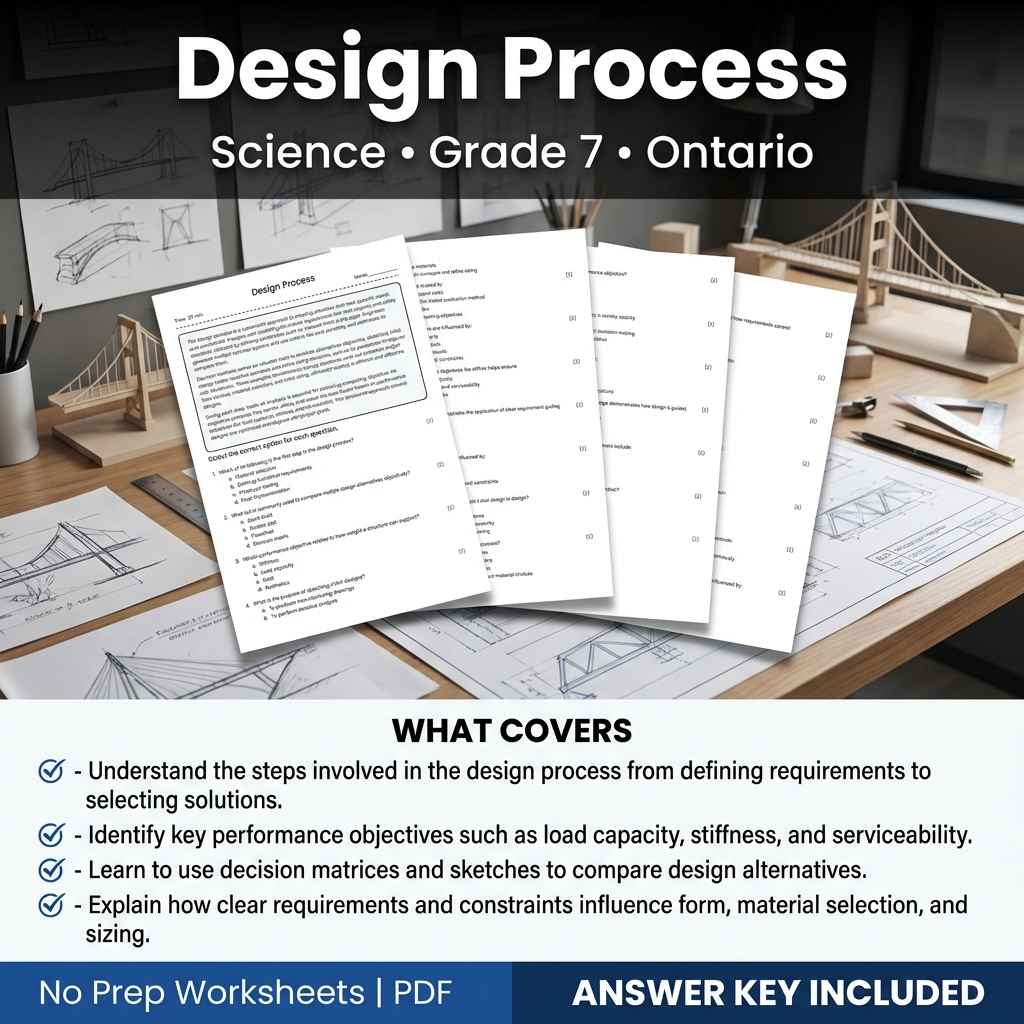
Grade 7 Science Worksheet on Design Process | Ontario Standards
Created byCoral Reef LearningLearning Objectives
- Understand the steps involved in the design process from defining requirements to selecting solutions.
- Identify key performance objectives such as load capacity, stiffness, and serviceability.
- Learn to use decision matrices and sketches to compare design alternatives.
Instant download

Grade 7 Science | Forces & Unbalanced Forces - Daily Reading Practice
Created byCoral Reef LearningLearning Objectives
- Define what a force is
- Explain the difference between balanced and unbalanced forces
- Identify real-life examples of balanced and unbalanced forces
Instant download
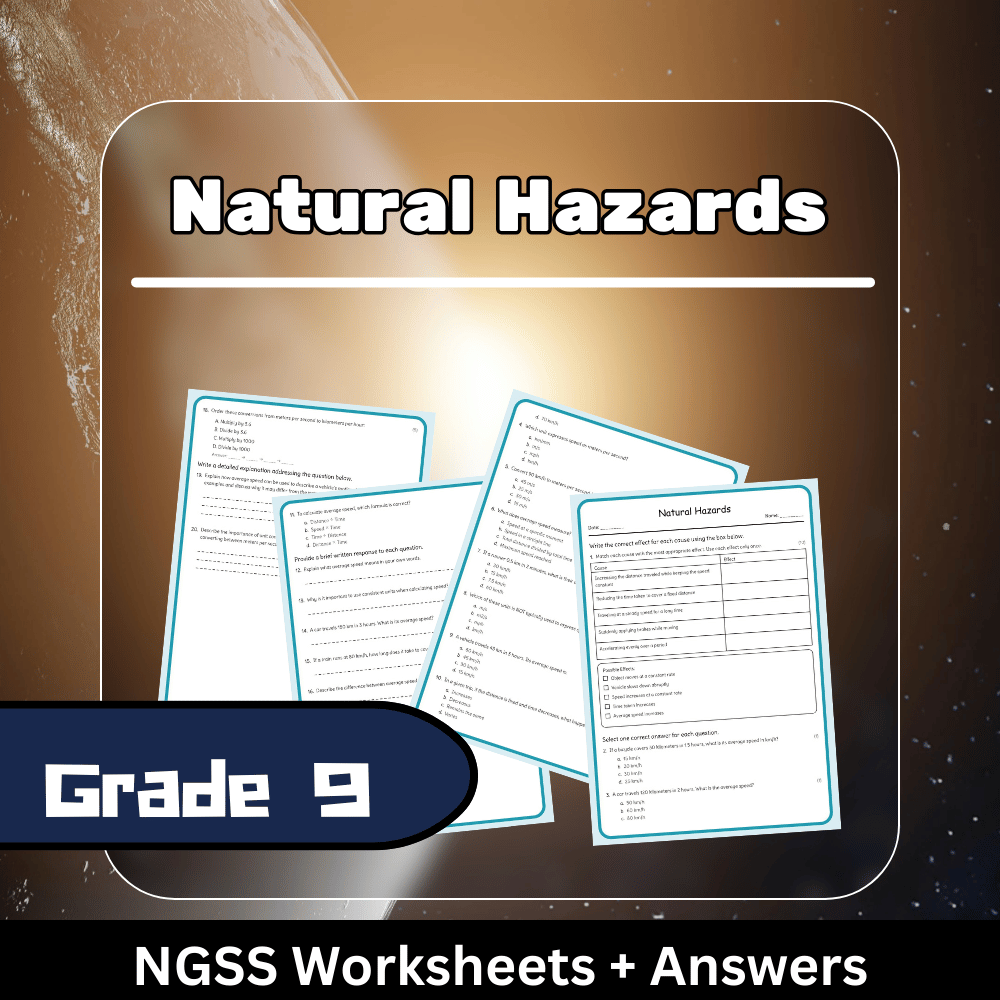
Grade 9 Science | Natural Hazards Worksheet + Answer Key (NGSS-Aligned, PDF)
Created byBright Mind ResourcesLearning Objectives
- Understand the different types of natural hazards and their triggers.
- Analyze geologic and atmospheric indicators used to assess hazards.
- Interpret hazard maps, recurrence intervals, and paleoevidence to evaluate risks.
Instant download

Grade 7 Science – Design Process & Inquiry Skills | Daily Reading Worksheet
Created byBright Mind ResourcesLearning Objectives
- Understand key concepts related to Science
- Apply knowledge through practice questions
- Demonstrate comprehension of the material
Also included in: Structural Eng. Grade 7 Science Daily Reading Worksheets Lesson Bundle | Ontario +1 more
Instant download
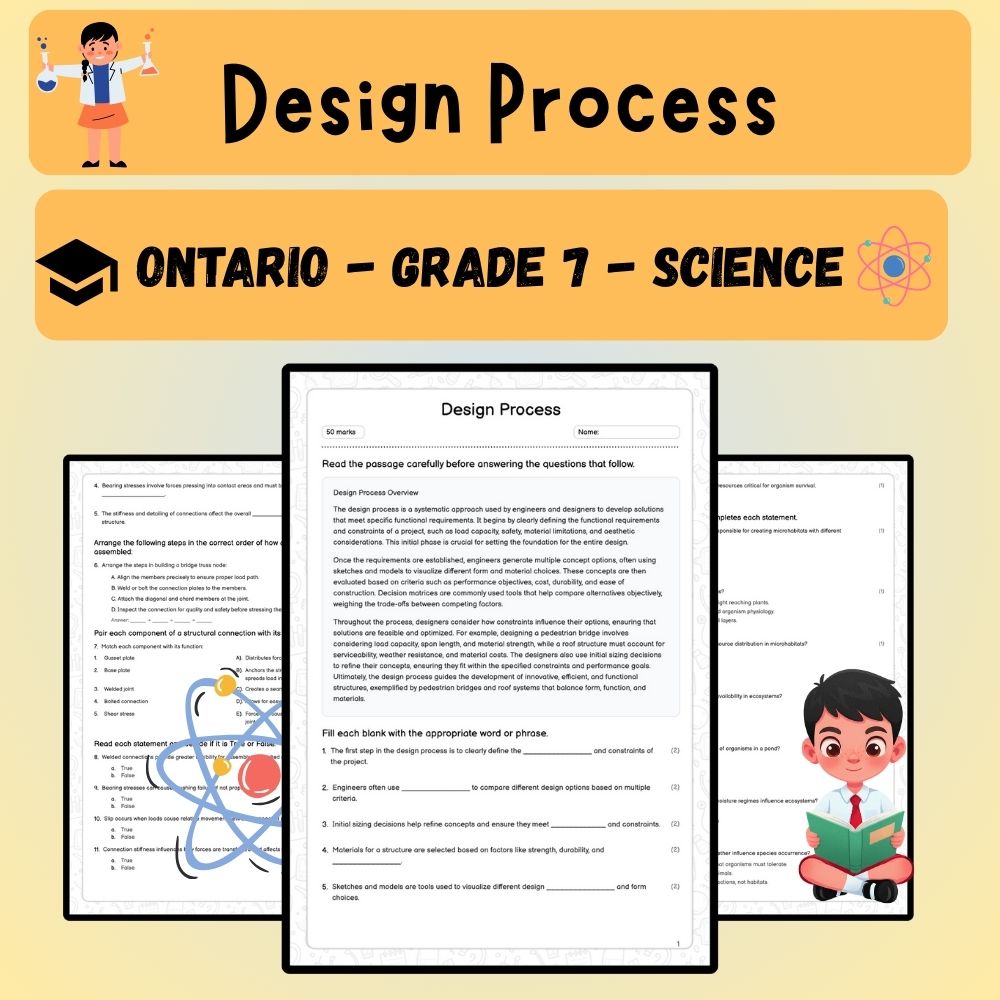
Grade 7 Science - Design Process Worksheet (PDF) – Ontario Standards
Created byPrism Point LearningLearning Objectives
- Understand the steps involved in the design process from defining requirements to selecting solutions.
- Identify key performance objectives and how they influence design choices.
- Apply decision matrices and sketches to compare different design alternatives.
Also included in: Grade 7 Science Unit | Structural Engineering & Material Testing Worksheets Bundle +1 more
Instant download
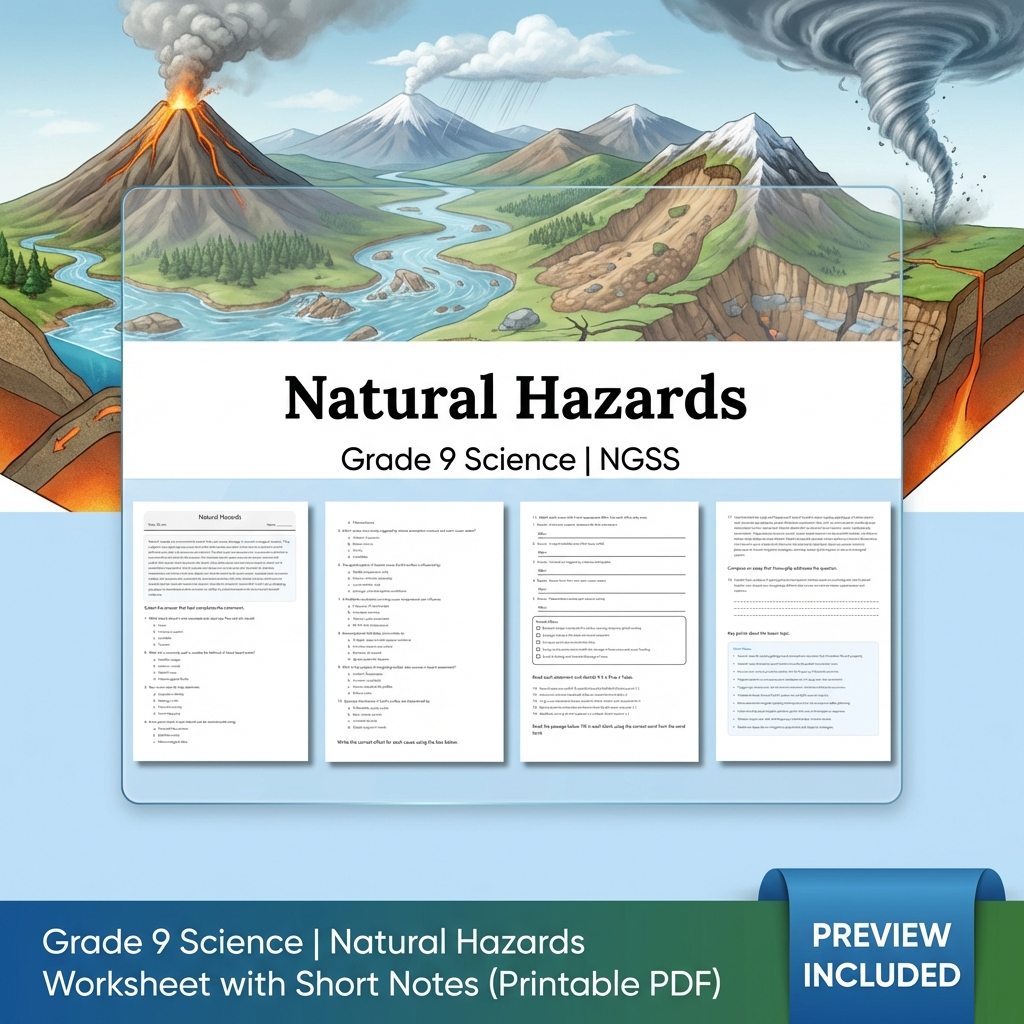
Grade 9 Science | Natural Hazards Worksheet with Short Notes (Printable PDF)
 Created byMeadowlark Worksheets
Learning Objectives
- Understand how geologic and atmospheric indicators are used to assess natural hazards.
- Identify different types of natural hazards, their triggers, and impacts.
- Learn how hazard maps, recurrence intervals, and paleoevidence inform risk assessment.
Also included in: Grade 9 Science | Earth's Systems Unit Bundle NGSS 7 Worksheets (Resource Pack) +1 more
Instant download

Grade 7 Embryonic Patterns and Evolution Worksheet | NGSS Life Science
 Created byBRIGHT PATH RESOURCES
Learning Objectives
- Identify key stages of embryonic development across different animal groups
- Compare and contrast embryonic features among taxa to understand evolutionary relationships
- Recognize conserved structures such as pharyngeal pouches and limb buds
Also included in: Evolution & Genetics Grade 7 Science Worksheets Lesson Bundle | NGSS +2 more
Instant download
Browse more categories
About Science Worksheets
Find Science worksheets spanning core skills, practice, and review. All 44,627 resources are instant PDF downloads for the classroom or home.
Every worksheet on MyTeachingSheets is created by independent teacher-authors and reviewed before publication. All resources download as printable PDFs for classroom, homework, or at-home practice, and many include answer keys. Preview any worksheet free before buying.