
Science Worksheets
44,628 subject resources
Grade 9 Science | Energy Transformations Worksheet | NGSSS Aligned
 Created byLumora Learning
Learning Objectives
- Explain how energy transforms between mechanical, thermal, electrical, and sound forms in real systems.
- Use the idea of energy balance for a chosen system to predict how resistive forces change outcomes.
- Describe how temperature changes can alter material behavior and influence motion.
Instant download
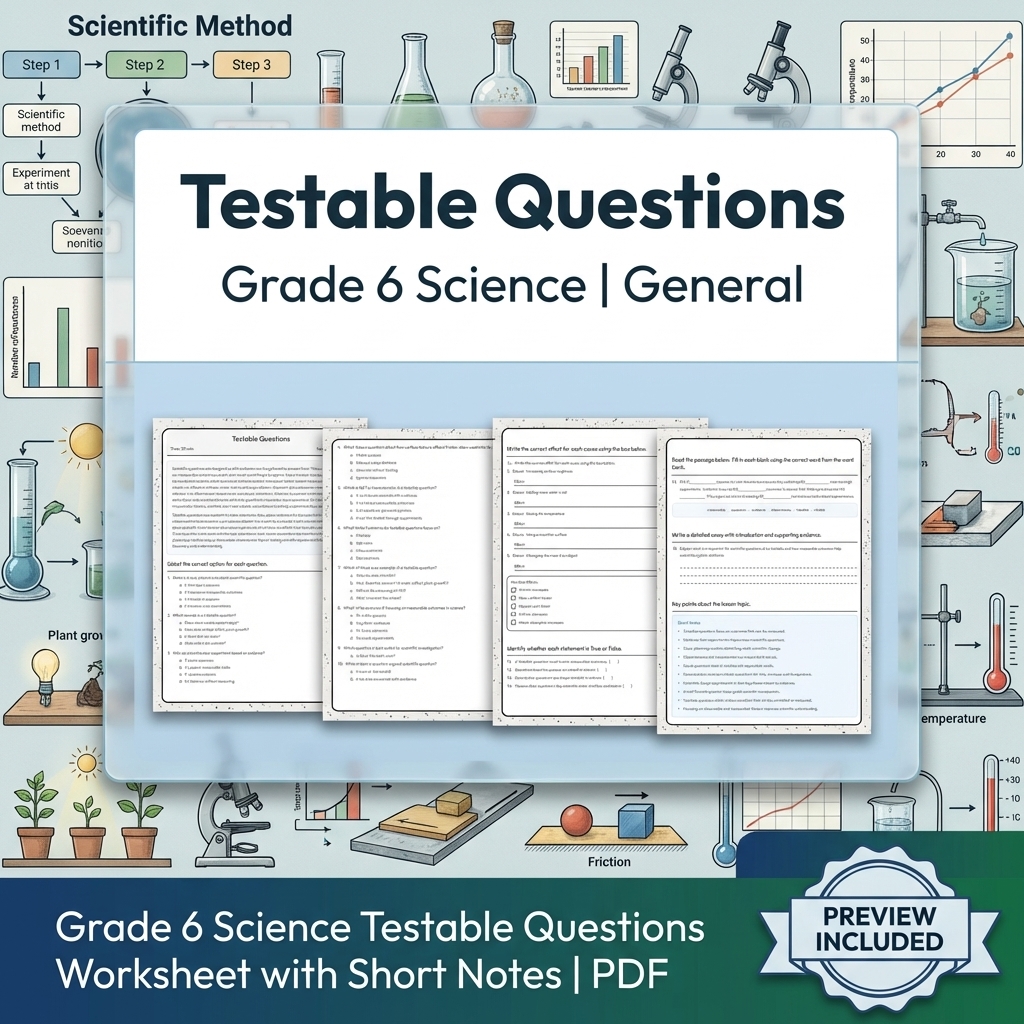
Grade 6 Science Testable Questions Worksheet with Short Notes | PDF
 Created byMeadowlark Worksheets
Learning Objectives
- Understand what makes a question testable with measurable outcomes.
- Identify different types of scientific questions and how evidence addresses them.
- Learn how to plan experiments based on measurable and observable outcomes.
Also included in: Grade 6 Science Lesson Group | Comprehensive Worksheets & Activities +1 more
Instant download

Grade 8 Science – Climate Impacts Worksheet with Answer Key (PDF)
 Created byEvergreen Desk Education
Learning Objectives
- Explain how climate variability and change can shift precipitation patterns and affect water availability.
- Describe how changes in snowpack, evapotranspiration, and runoff timing influence floods, droughts, groundwater recharge, and reservoir storage.
- Connect land-use change and climate feedbacks to impacts on regional hydrology and aquatic ecosystems.
Also included in: Grade 8 Watershed and Water Quality Science Lesson Bundle (Ontario) +1 more
Instant download

Grade 11 Science | Chemical Kinetics - Daily Reading Comprehension
 Created byCoral Reef Learning
Learning Objectives
- Understand the basic concepts of reaction rates and collision theory.
- Learn how molecular orientation affects reaction effectiveness.
- Explain the role of activation energy and temperature in chemical reactions.
Instant download
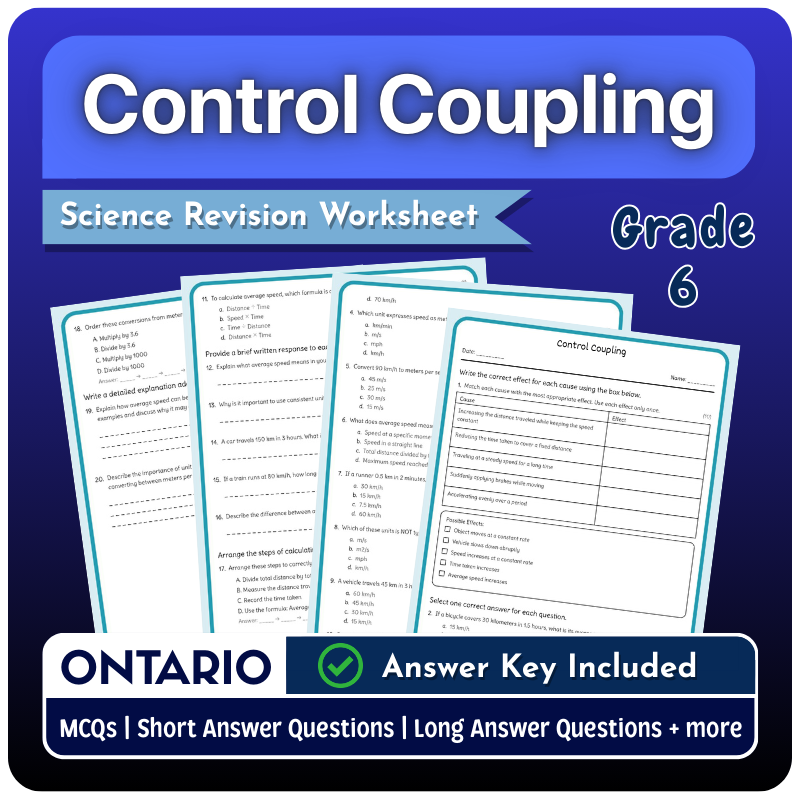
6th Grade Science – Control Coupling Worksheet (Ontario) (PDF)
 Created byBright Mind Resources
Learning Objectives
- Understand the concept of control coupling and its effects in aerodynamics.
- Identify causes of adverse yaw and techniques to mitigate it.
- Explain how control inputs can produce coupled responses in aircraft controls.
Instant download
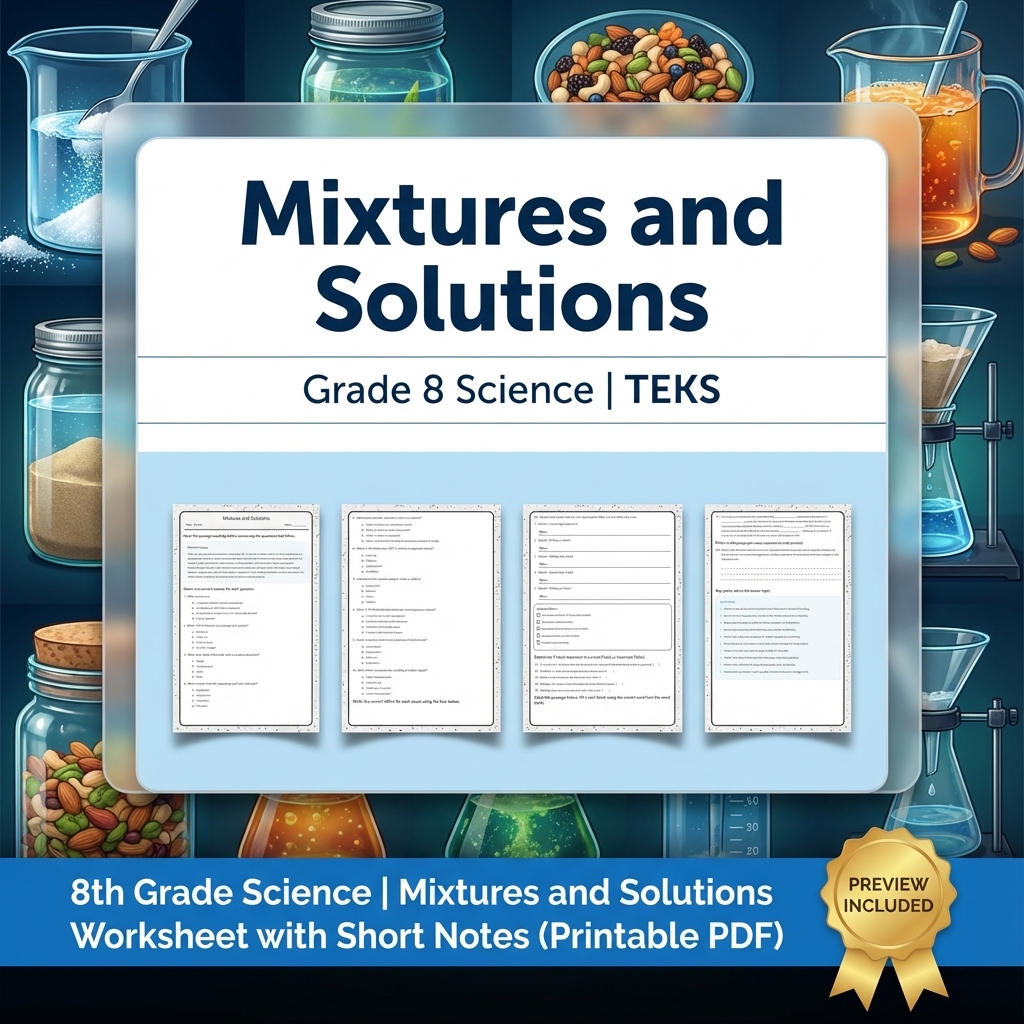
8th Grade Science Mixtures and Solutions Worksheet with Short Notes (PDF)
Created byMeadowlark WorksheetsLearning Objectives
- Understand the difference between mixtures and solutions.
- Identify examples of different types of mixtures and solutions.
- Describe methods used to separate mixtures.
Instant download
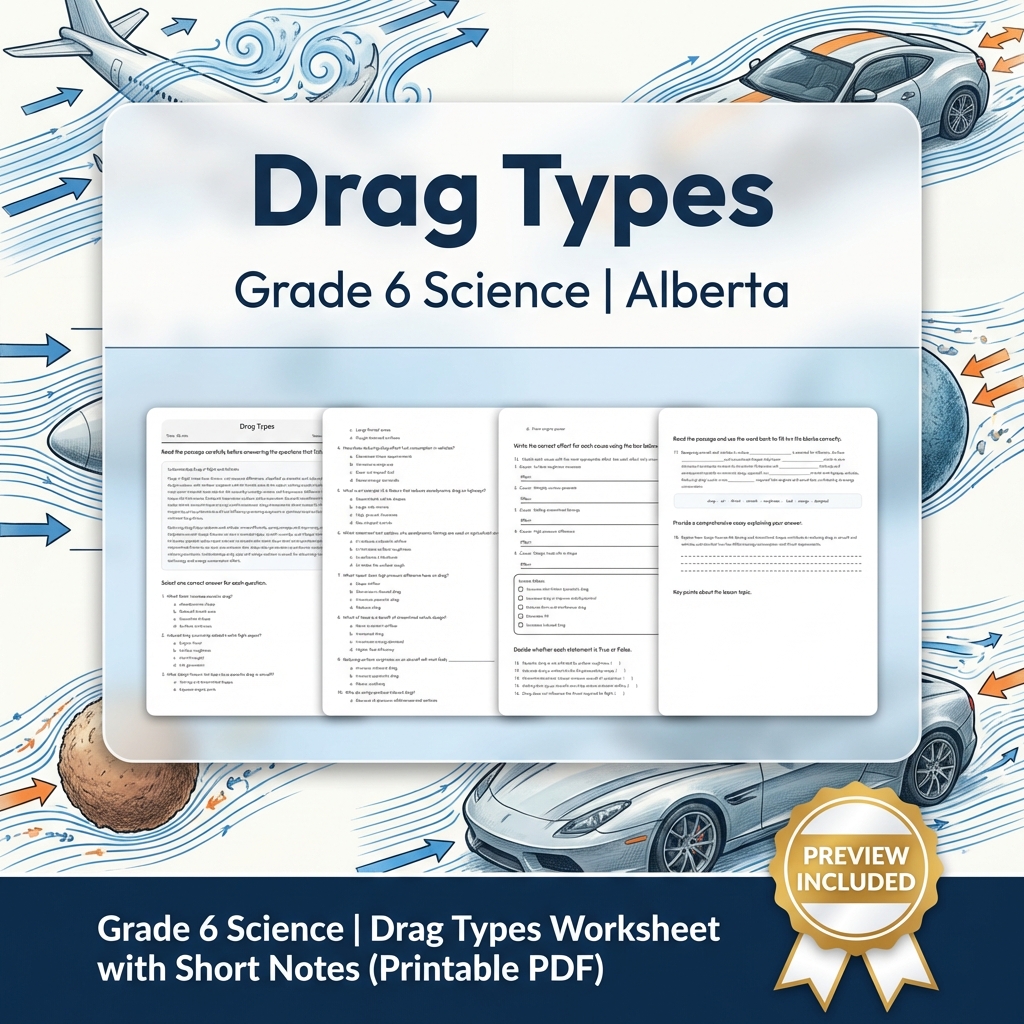
Grade 6 Science | Drag Types Worksheet with Short Notes (Printable PDF)
Created byMeadowlark WorksheetsLearning Objectives
- Understand how friction and pressure differences contribute to drag in flight and vehicle design
- Identify the categories of parasitic and induced drag
- Explain design features that reduce drag, such as streamlined shapes and fairings
Also included in: Grade 6 Science – Air and Aerodynamics UNIT Bundle | Alberta Curriculum Resources +1 more
Instant download
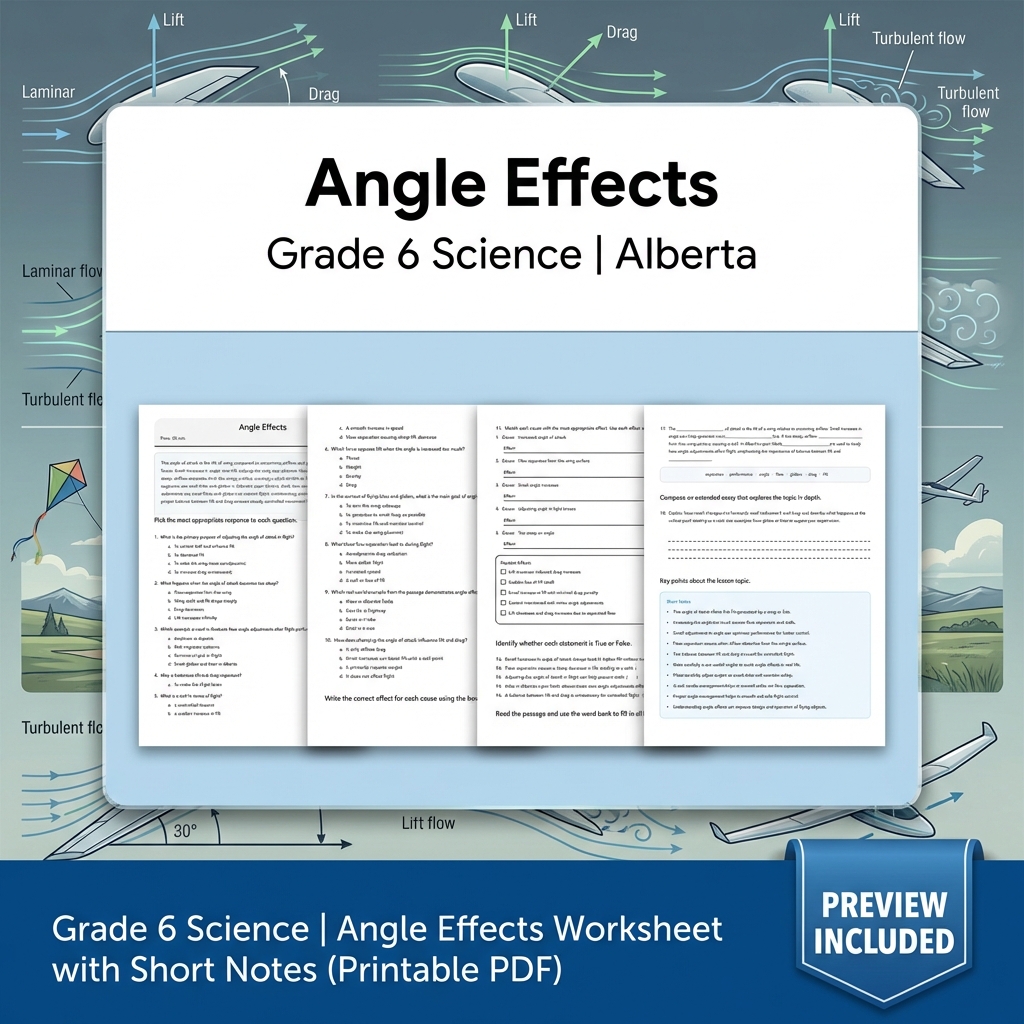
Grade 6 Science | Angle Effects Worksheet with Short Notes (Printable PDF)
Created byMeadowlark WorksheetsLearning Objectives
- Understand how the angle of attack influences lift and drag in flight.
- Explain the concept of stall and how it relates to angle changes.
- Describe real-world examples of angle adjustments in gliders and kites.
Also included in: Grade 6 Science – Air and Aerodynamics UNIT Bundle | Alberta Curriculum Resources +1 more
Instant download
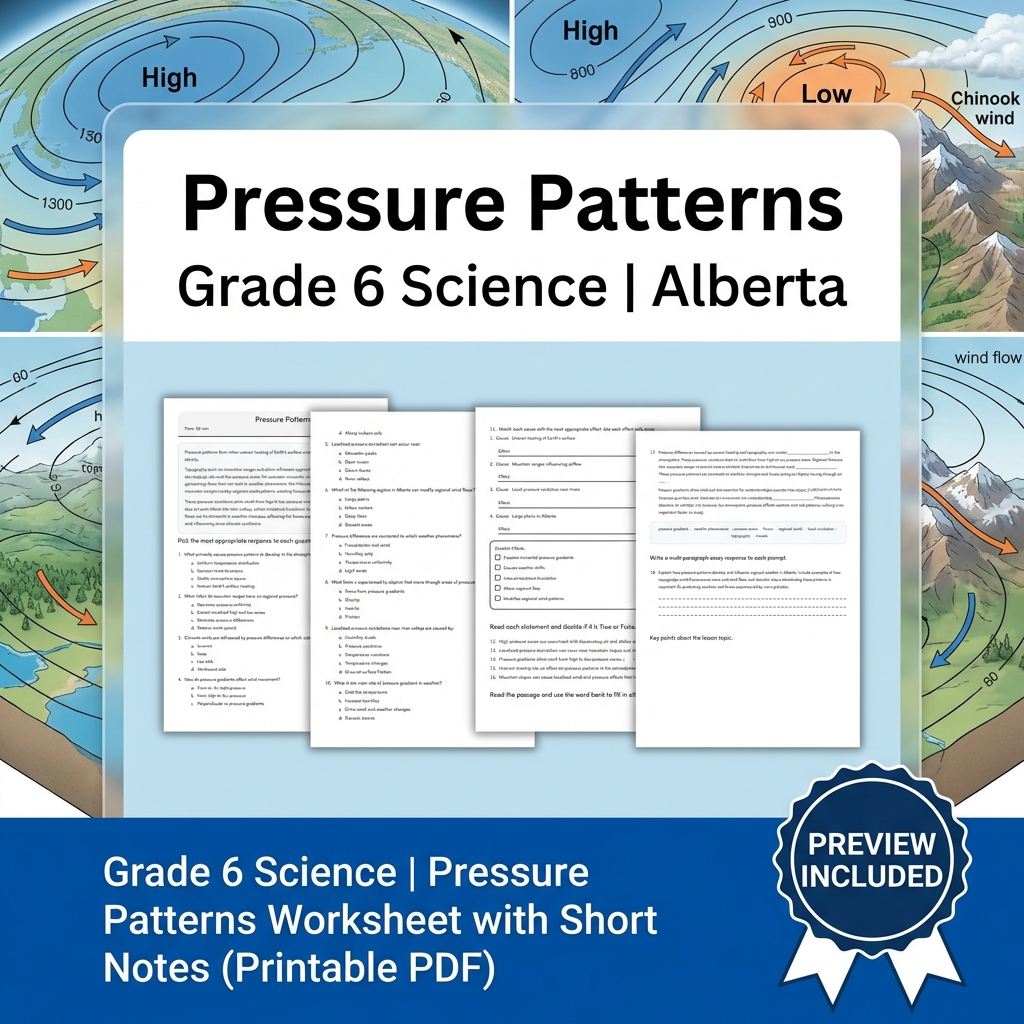
Grade 6 Science | Pressure Patterns Worksheet with Short Notes (Printable PDF)
Created byMeadowlark WorksheetsLearning Objectives
- Describe how pressure differences develop from uneven heating and topography.
- Explain how pressure gradients influence wind direction and speed.
- Identify regions such as mountain ranges and plains that modify regional pressure systems.
Also included in: Grade 6 Science – Air and Aerodynamics UNIT Bundle | Alberta Curriculum Resources +1 more
Instant download
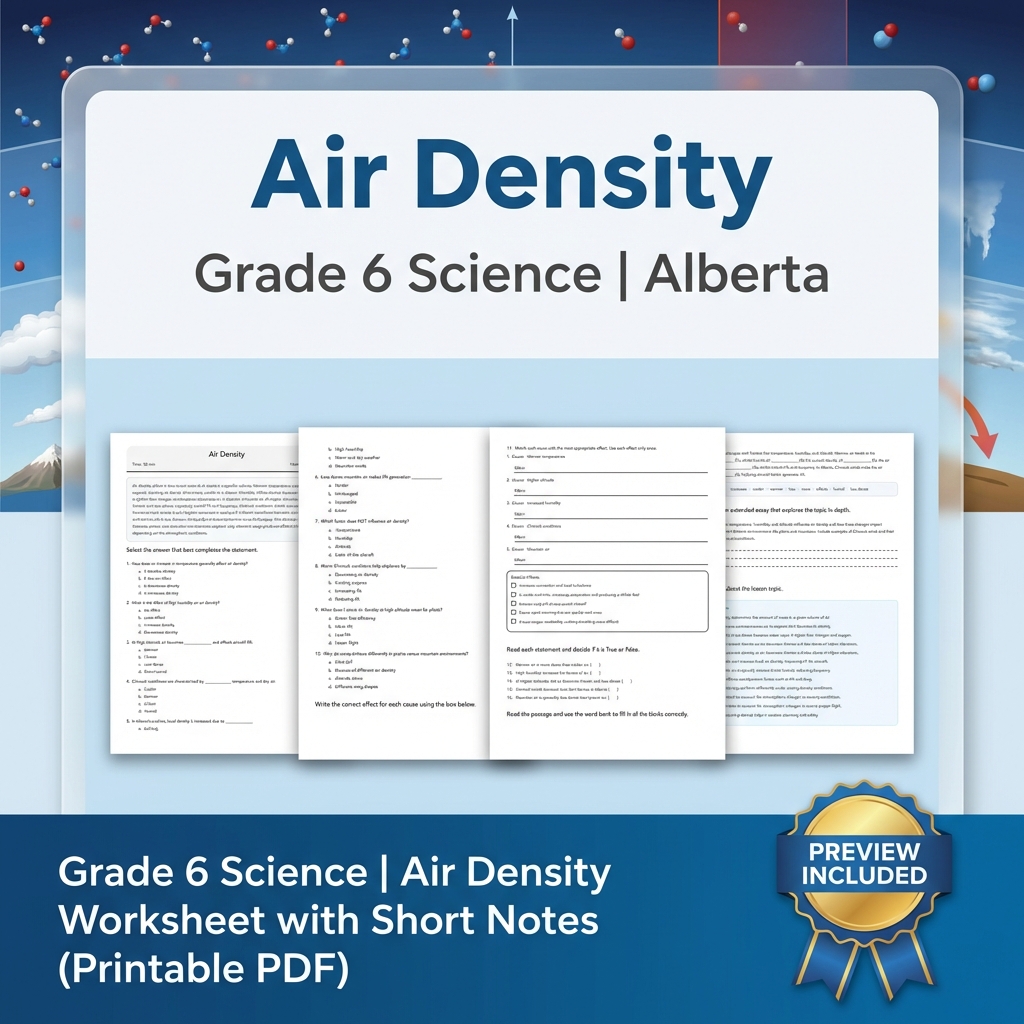
Grade 6 Science | Air Density Worksheet with Short Notes (Printable PDF)
Created byMeadowlark WorksheetsLearning Objectives
- Explain how temperature, humidity, and altitude affect air density.
- Understand the influence of air density on buoyancy and lift.
- Describe how local atmospheric conditions change in different environments like prairie and mountain areas.
Also included in: Grade 6 Science – Air and Aerodynamics UNIT Bundle | Alberta Curriculum Resources +1 more
Instant download
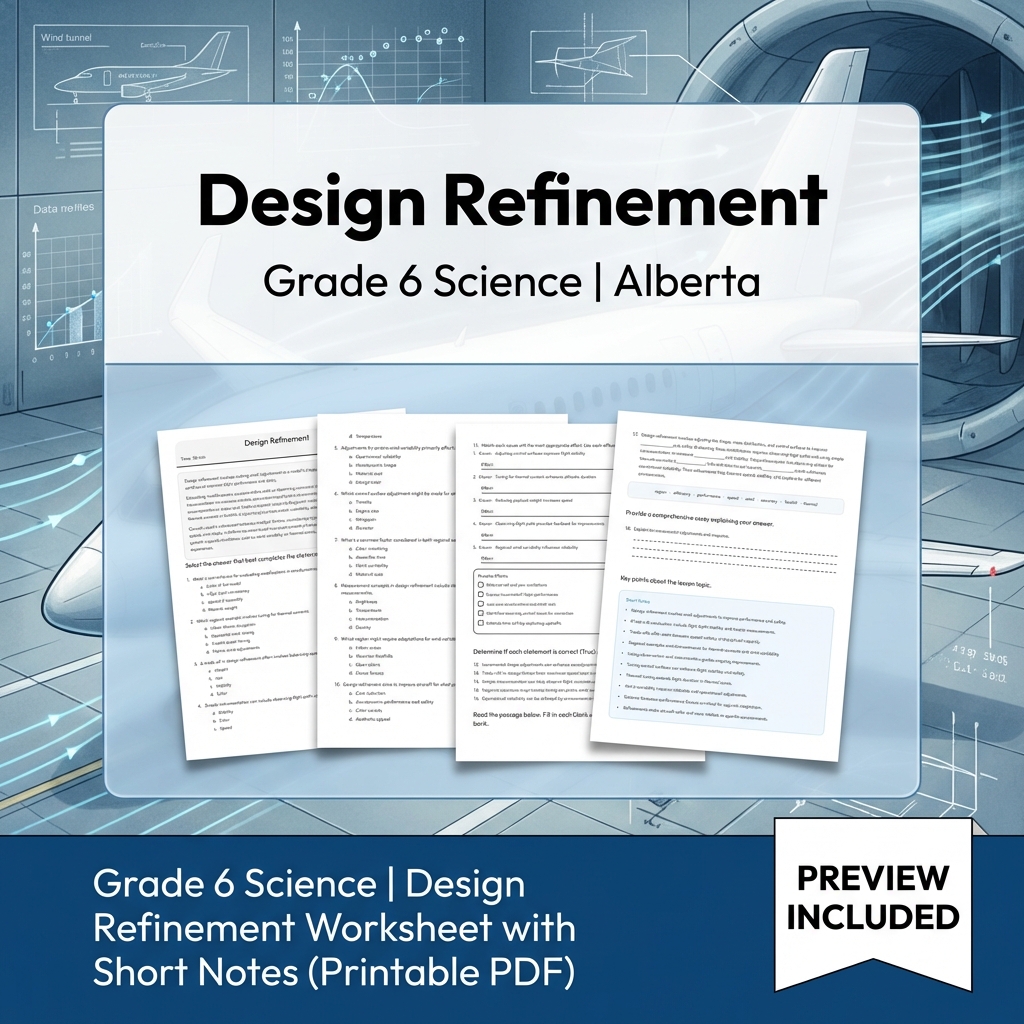
Grade 6 Science | Design Refinement Worksheet with Short Notes (Printable PDF)
Created byMeadowlark WorksheetsLearning Objectives
- Understand how incremental adjustments affect aerodynamic performance and safety.
- Learn to evaluate modifications based on flight paths and simple instrumentation.
- Identify trade-offs between speed, stability, and payload in design refinement.
Also included in: Grade 6 Science – Air and Aerodynamics UNIT Bundle | Alberta Curriculum Resources +1 more
Instant download
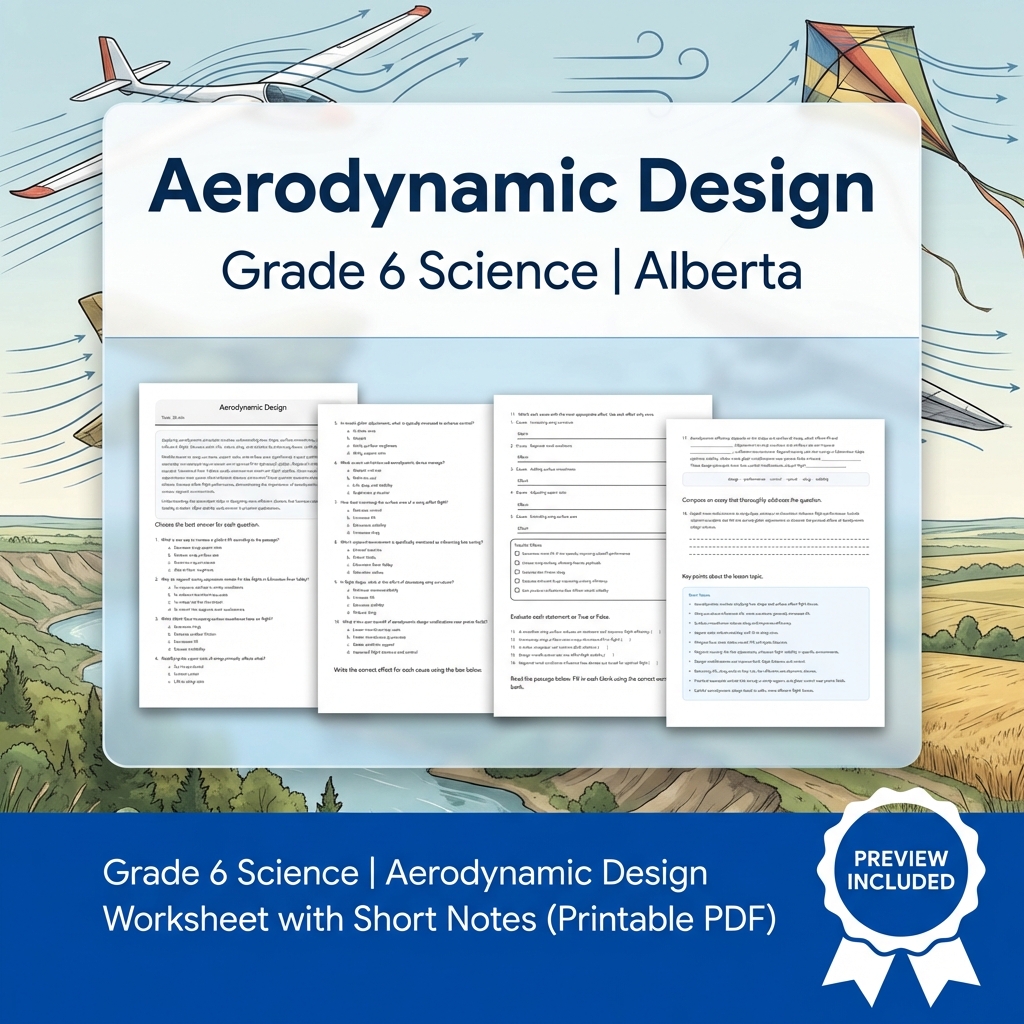
Grade 6 Science | Aerodynamic Design Worksheet with Short Notes (Printable PDF)
Created byMeadowlark WorksheetsLearning Objectives
- Understand the principles of aerodynamics and how shape, surface, and orientation affect flight.
- Identify how design modifications influence lift, drag, and stability in flight.
- Apply regional examples like kite tuning and glider adjustments to practical aerodynamics.
Also included in: Grade 6 Science – Air and Aerodynamics UNIT Bundle | Alberta Curriculum Resources +1 more
Instant download
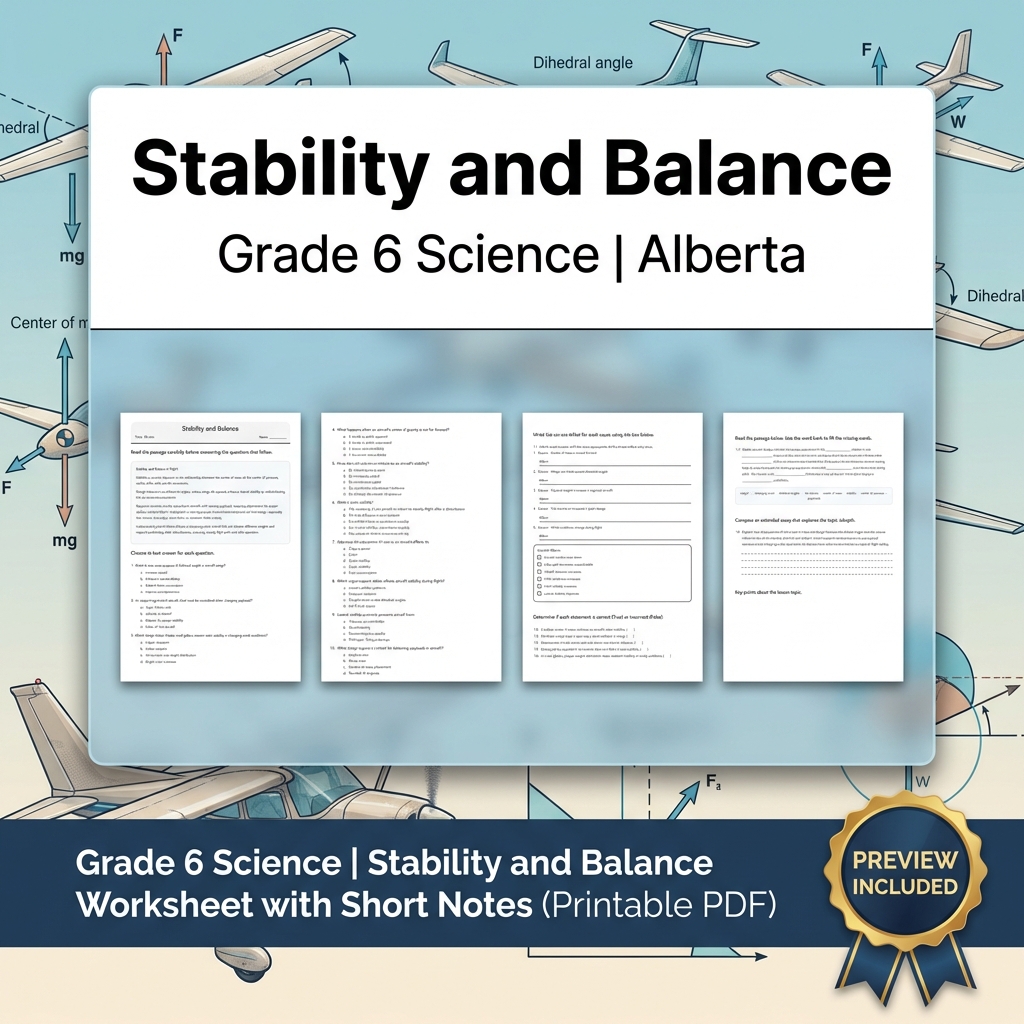
Grade 6 Science | Stability and Balance Worksheet with Short Notes PDF)
Created byMeadowlark WorksheetsLearning Objectives
- Understand how center of mass and center of pressure affect a vehicle's stability.
- Explain the role of design features like dihedral angles and tail volume in static stability.
- Describe how balance influences the ability of aircraft and gliders to return to steady attitudes after disturbances.
Also included in: Grade 6 Science – Air and Aerodynamics UNIT Bundle | Alberta Curriculum Resources +1 more
Instant download
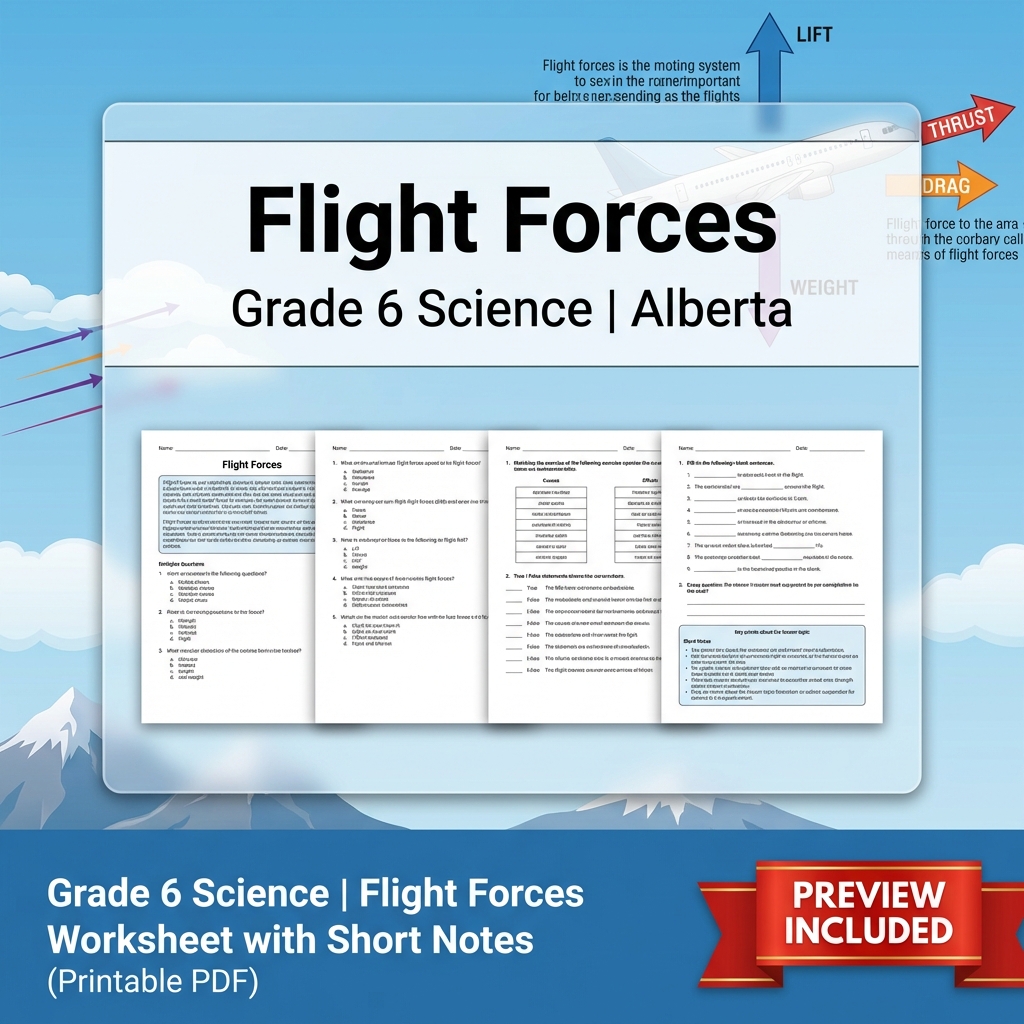
Grade 6 Science | Flight Forces Worksheet with Short Notes (Printable PDF)
Created byMeadowlark WorksheetsLearning Objectives
- Understand the four primary forces in flight: lift, thrust, drag, and weight.
- Describe how these forces interact to enable steady flight or descent.
- Identify examples of flight forces in real-world Alberta scenarios such as kites, aircraft, and parachutes.
Also included in: Grade 6 Science – Air and Aerodynamics UNIT Bundle | Alberta Curriculum Resources +1 more
Instant download
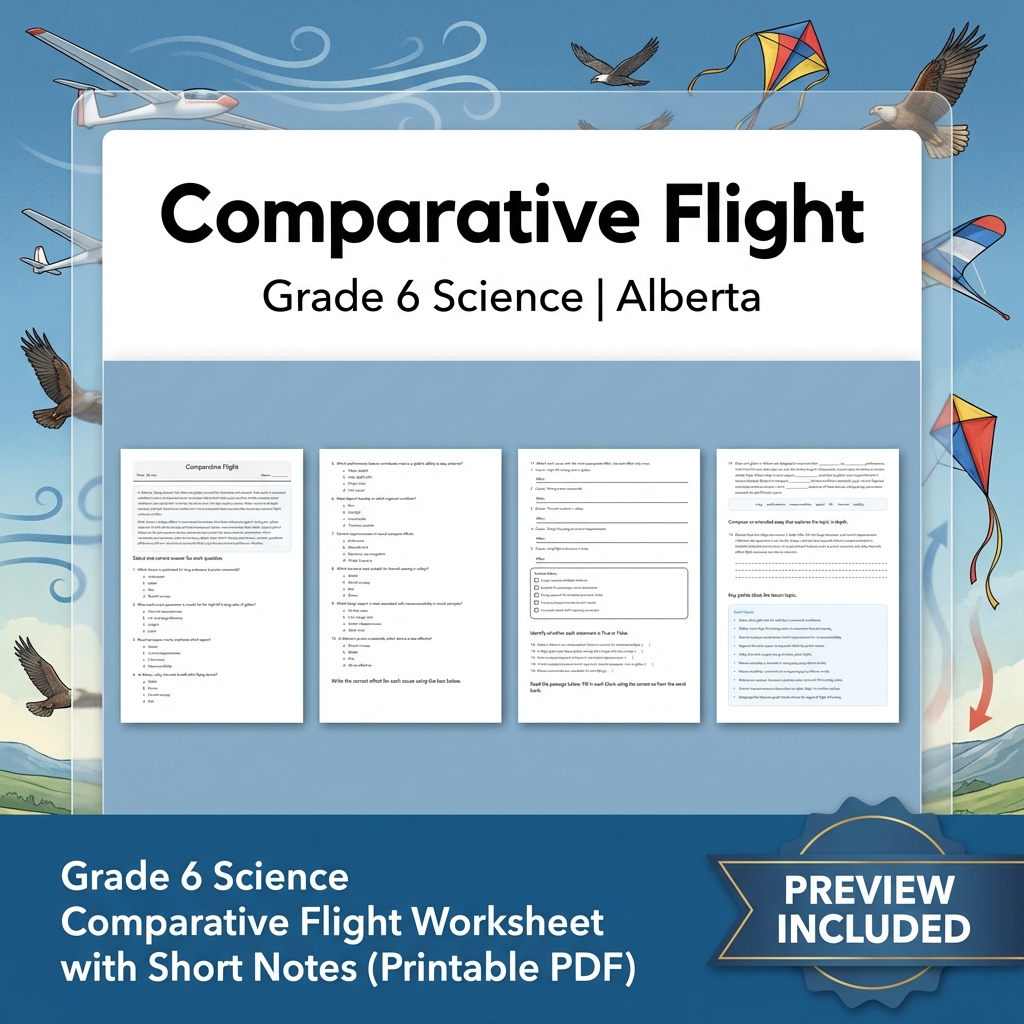
Grade 6 Science Comparative Flight Worksheet with Short Notes (Printable PDF)
Created byMeadowlark WorksheetsLearning Objectives
- Compare and contrast the flight performance of kites, gliders, and round canopies.
- Explain how design parameters like glide ratio and lift-to-drag performance affect flight endurance and maneuverability.
- Assess the influence of regional atmospheric conditions on flying device operations in Alberta contexts.
Also included in: Grade 6 Science – Air and Aerodynamics UNIT Bundle | Alberta Curriculum Resources +1 more
Instant download
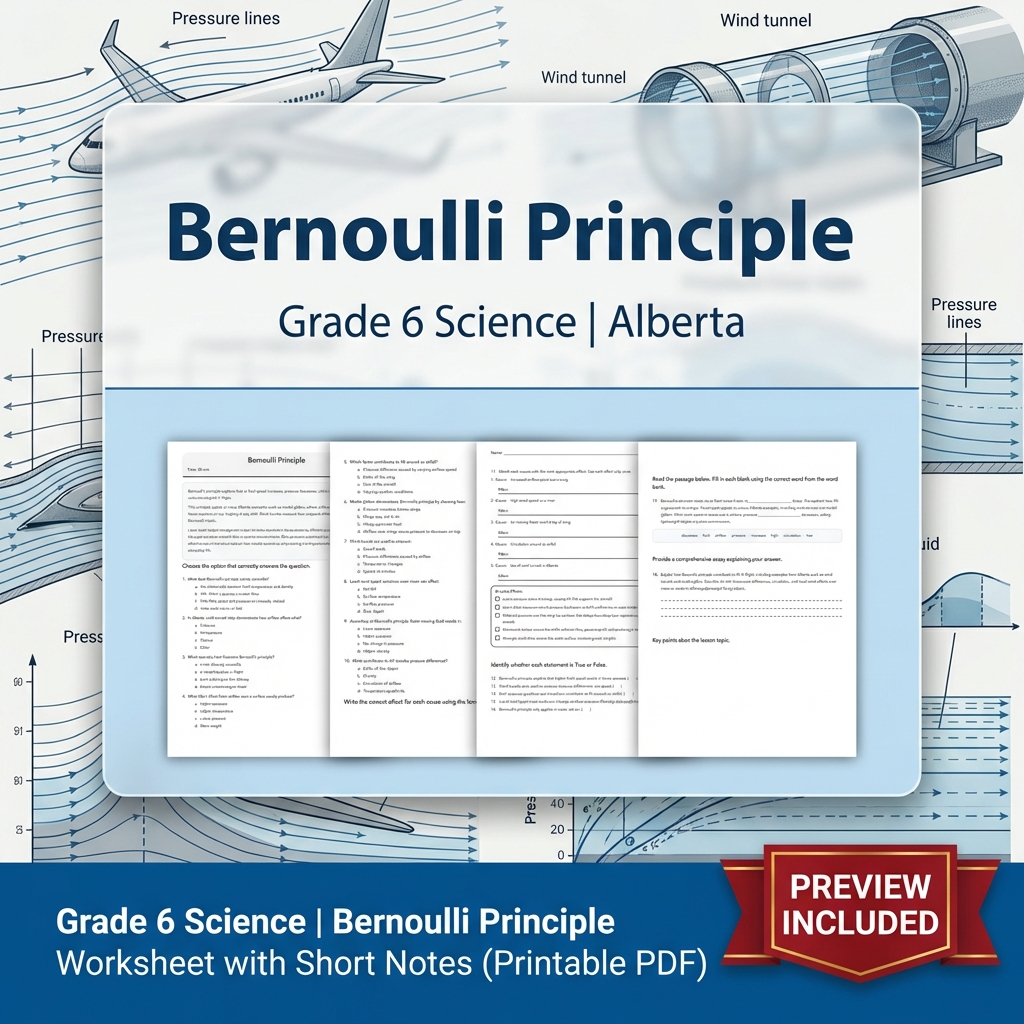
Grade 6 Science | Bernoulli Principle Worksheet with Short Notes (Printable PDF)
Created byMeadowlark WorksheetsLearning Objectives
- Understand how Bernoulli’s principle relates fluid speed and pressure
- Explain how pressure differences contribute to lift on airfoils
- Identify examples of Bernoulli’s principle in real-world Alberta environments
Also included in: Grade 6 Science – Air and Aerodynamics UNIT Bundle | Alberta Curriculum Resources +1 more
Instant download

Atoms and Particles Grade 6 Science Worksheet | Standards-Aligned Practice
JCreated byJ.S SheetsLearning Objectives
- Understand that matter is made of tiny particles called atoms.
- Identify the basic units that make up elements and substances.
- Connect particle models to properties like density, melting point, and reactivity.
Also included in: Grade 6 Physical Science Lesson Bundle for Science – California Standards +1 more
Instant download
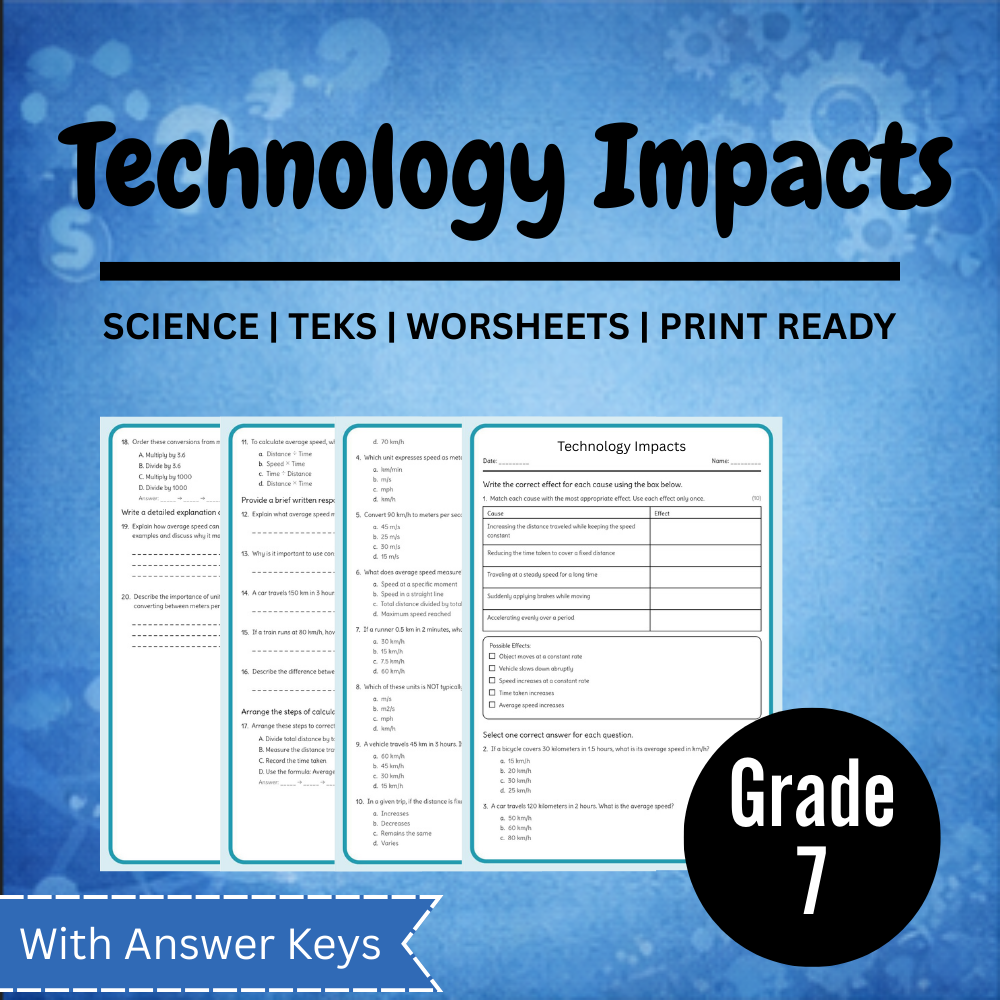
7th Grade Science | Technology Impacts Worksheet (Worksheet + Answer Key) – TEKS Aligned
Created byBright Mind ResourcesLearning Objectives
- Analyze societal, economic, and environmental impacts of various technologies.
- Evaluate short- and long-term consequences of technological development.
- Interpret case phenomena related to urban transportation, agriculture, and energy production.
Also included in: Grade 7 Science Unit Bundle | Standards, Safety, Innovation & Systems Aligned TEKS +2 more
Instant download

Grade 7 Science – Ethics & Communication in STEM | Daily Reading Worksheet
Created byBright Mind ResourcesLearning Objectives
- Understand the importance of honesty and transparency in scientific communication.
- Recognize ethical considerations in data sharing, attribution, and intellectual property.
- Learn conventions for technical reporting, graphical annotation, and peer review.
Also included in: Grade 7 Modeling & Simulation Science Daily Reading Lesson Bundle | Ontario +1 more
Instant download
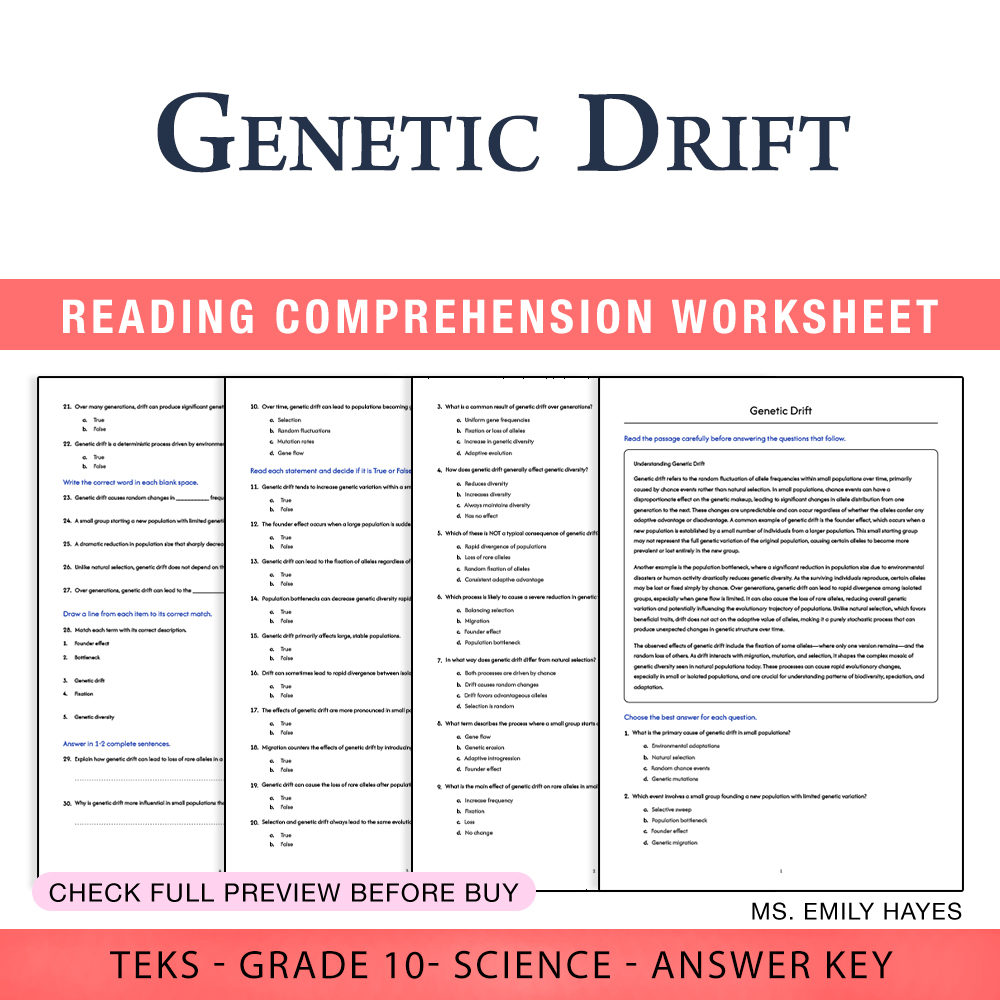
10th Grade Science | Genetic Drift Worksheet (PDF+ Answer Key)
 Created byCopper Leaf Classroom
Learning Objectives
- Understand the concept of genetic drift and its mechanisms in small populations.
- Identify how genetic drift differs from natural selection.
- Explain the effects of genetic drift such as loss of genetic variation and fixation of alleles.
Instant download
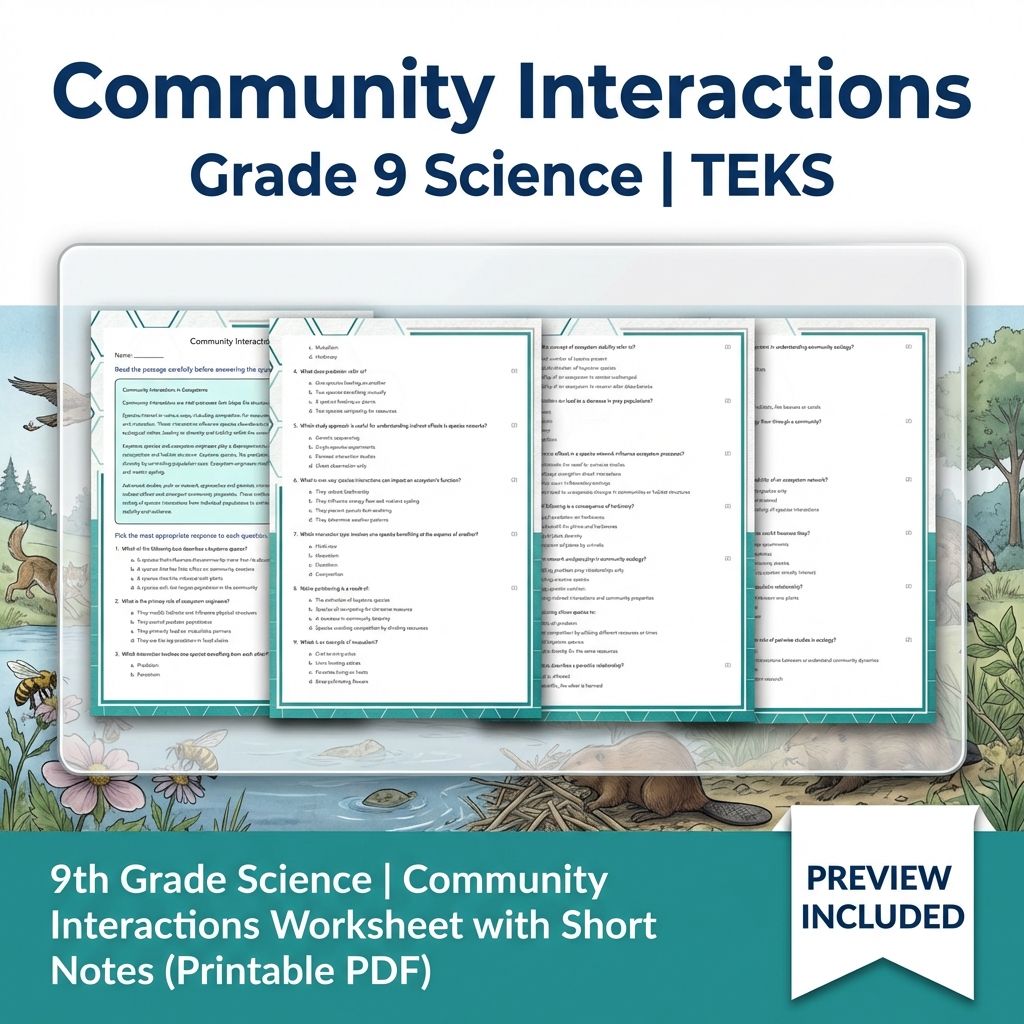
9th Grade Science | Community Interactions Worksheet with Short Notes (PDF)
Created byMeadowlark WorksheetsLearning Objectives
- Understand the various types of species interactions within a community.
- Identify the roles of keystone species and ecosystem engineers.
- Analyze how species relationships influence community structure and ecosystem stability.
Instant download

6th Grade Science | Solar Timekeeping Worksheet (PDF) – Alberta Standards
 Created bySilver Birch Teaching
Learning Objectives
- Explain how local solar noon is determined by the Sun’s highest apparent altitude
- Compare solar time to clock time and identify why they differ
- Describe how longitude, time zones, and the equation of time affect timekeeping
Also included in: Grade 6 Celestial Motion & Seasons Science Lesson Bundle | Alberta +1 more
Instant download
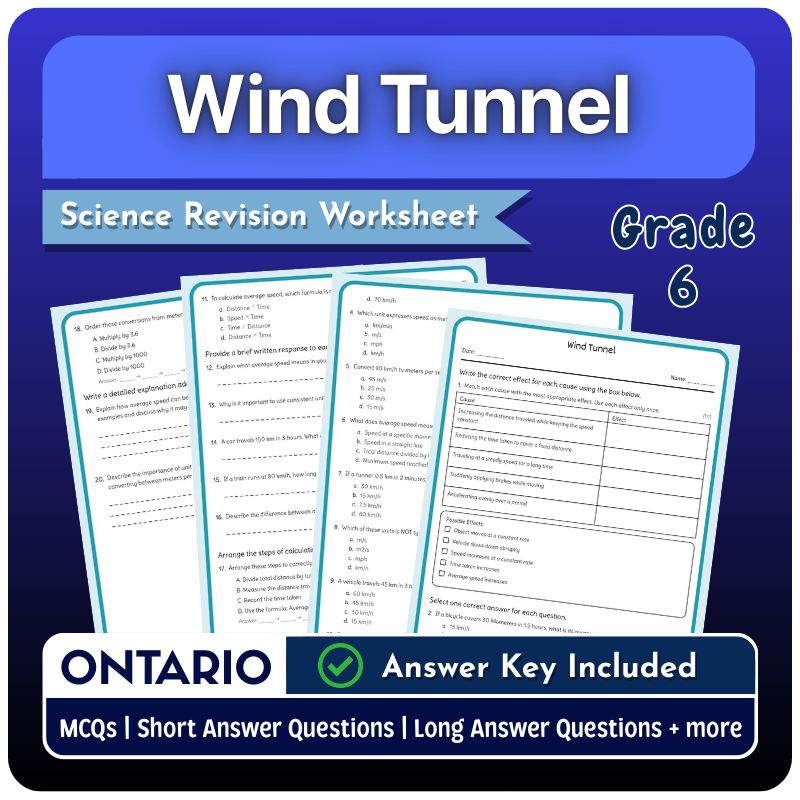
6th Grade Science | Wind Tunnel Worksheet (Ontario Standards) (PDF)
Created byBright Mind ResourcesLearning Objectives
- Understand the methods used to measure aerodynamic forces and moments.
- Identify and explain the concept of similarity parameters such as Reynolds and Mach numbers.
- Describe flow visualization techniques and their importance in wind tunnel testing.
Instant download
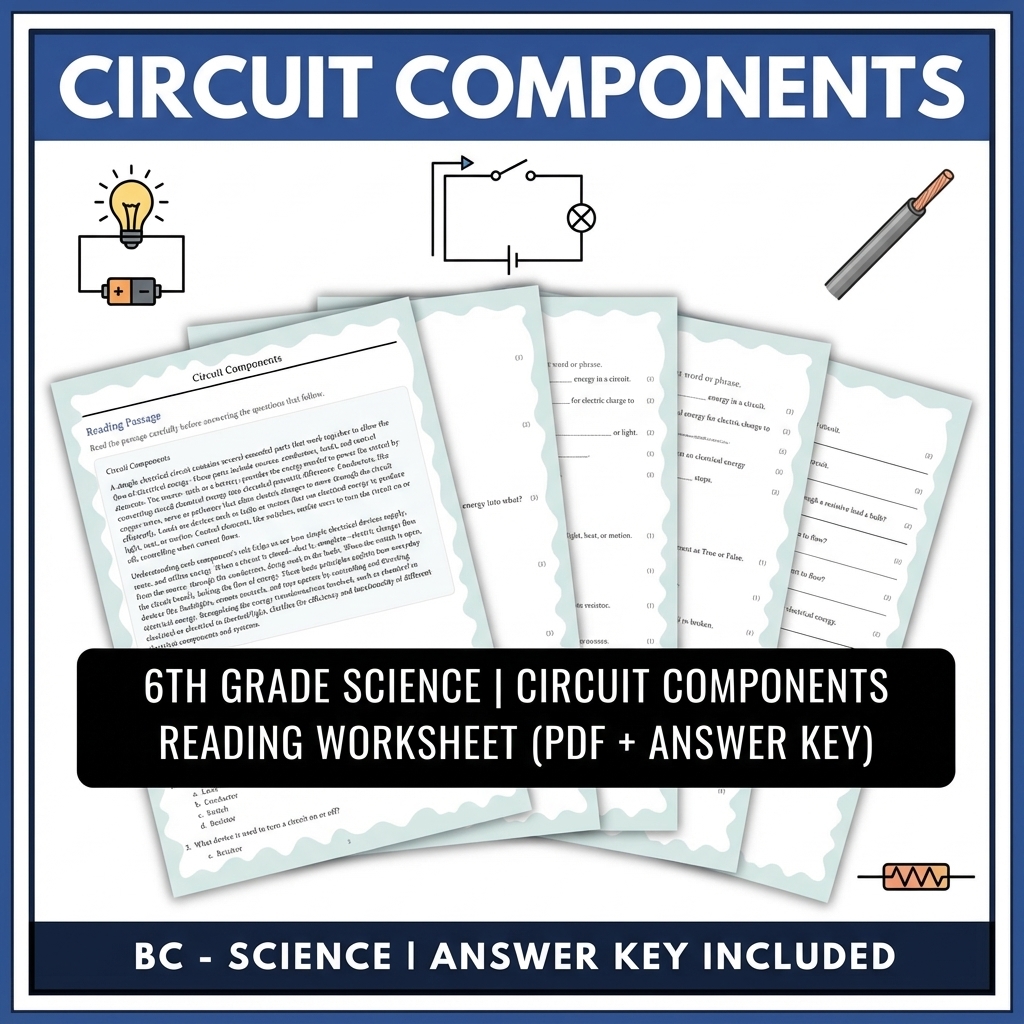
6th Grade Science | Circuit Components Reading Worksheet (PDF + Answer Key)
JCreated byJ.S SheetsLearning Objectives
- Identify the roles of different components in a simple electrical circuit.
- Explain how energy transformations occur within a circuit.
- Describe the functions of sources, conductors, loads, and switches in electrical devices.
Instant download
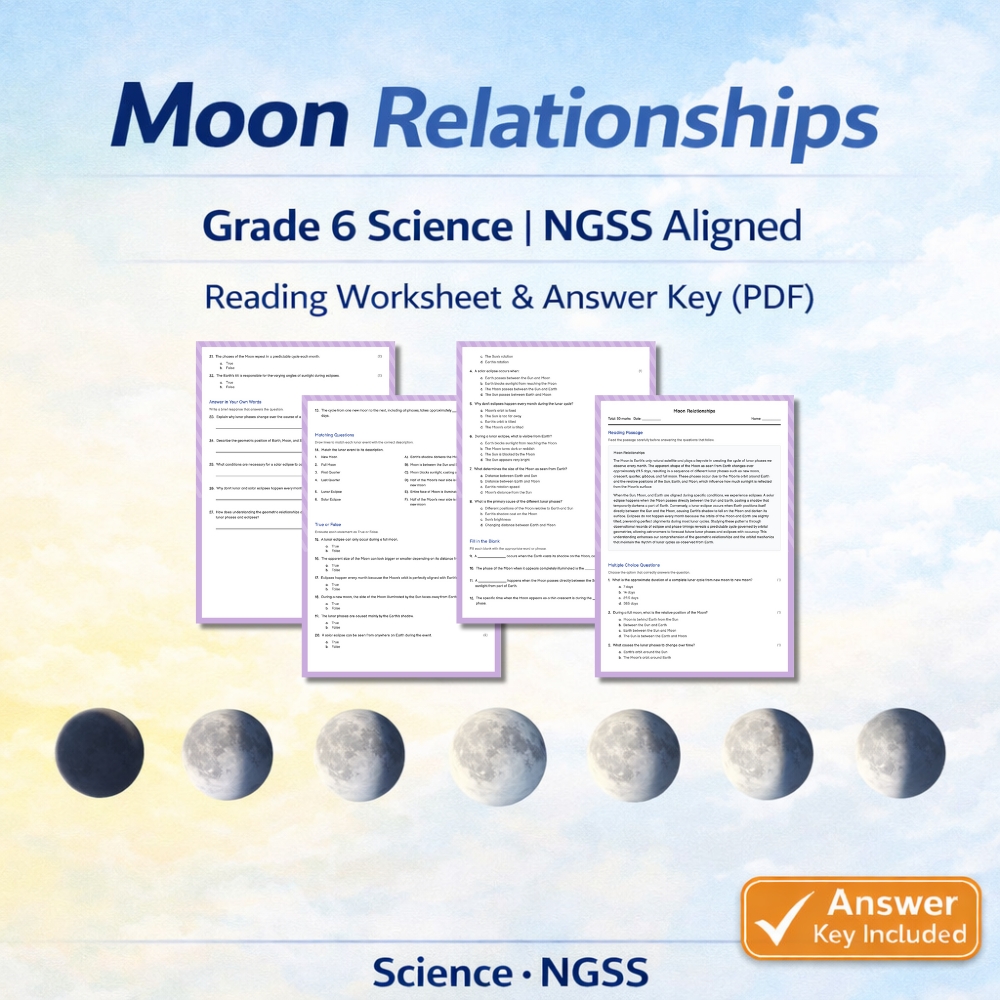
6th Grade Science | Moon Relationships | NGSS ( Worksheet + Answer Key )
 Created byCedar Grove Learning
Learning Objectives
- Describe the geometric relationships among Earth, Moon, and Sun that produce lunar phases and eclipses.
- Explain how the relative positions of Earth, Moon, and Sun create different lunar phases and eclipse conditions.
- Predict lunar phases and eclipse occurrences using observational data of Earth–Moon–Sun configurations.
Also included in: Grade 6 Science Unit Bundle | Space, Motion & Earth Cycles NGSS Worksheets +1 more
Instant download

Conductivity Worksheets: Conductor Properties Grade 6 Science Practice
 Created byPrism Point Learning
Learning Objectives
- Describe how free electrons enable charge movement through conductors
- Compare conductivity among copper, aluminum, graphite, and plastics
- Explain how temperature affects conductivity in metal conductors
Also included in: Grade 6 Electricity Lesson Bundle | Ontario Science Framework
Instant download

Voltage and Current Measurements in Circuits Worksheets Grade 6
Created byPrism Point LearningLearning Objectives
- Explain how voltage and current readings describe circuit performance
- Identify appropriate meter placement for measuring voltage and current
- Compare current readings to infer relative resistance between components
Also included in: Grade 6 Electricity Lesson Bundle | Ontario Science Framework
Instant download
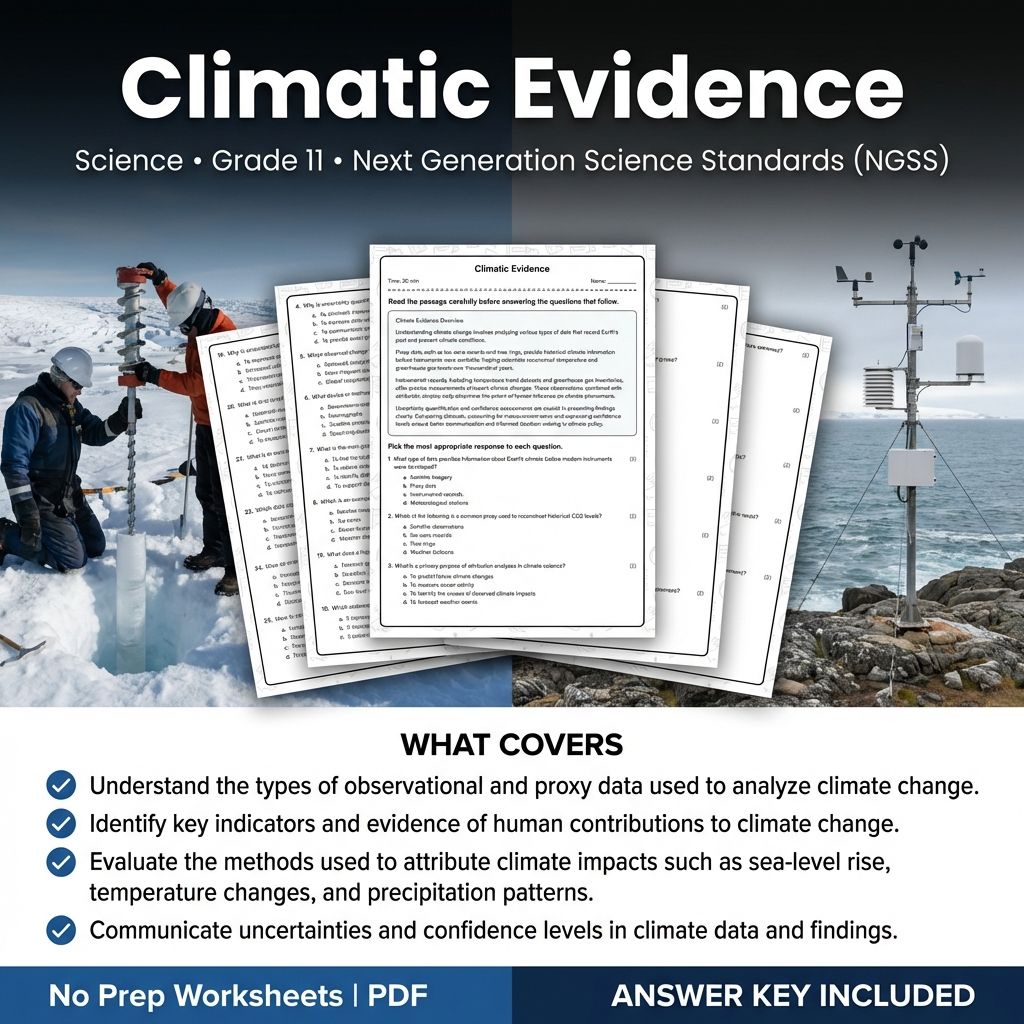
11th Grade Science | Climatic Evidence Worksheet & Answer Key (Printable PDF)
Created byCoral Reef LearningLearning Objectives
- Understand the types of observational and proxy data used to analyze climate change.
- Identify key indicators and evidence of human contributions to climate change.
- Evaluate the methods used to attribute climate impacts such as sea-level rise, temperature changes, and precipitation patterns.
Also included in: Grade 11 Science Unit Bundle – Sustainable Management & Environmental Models +1 more
Instant download
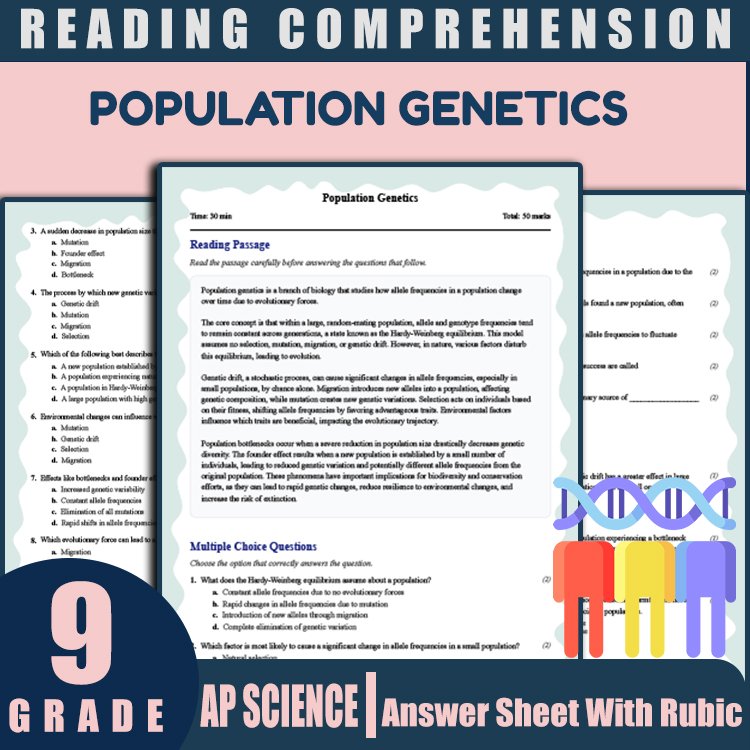
9th Grade Science | Population Genetics Reading Worksheet & Answer Key (PDF)
JCreated byJ.S SheetsLearning Objectives
- Understand the principles of allele frequency changes under various evolutionary forces.
- Describe the Hardy-Weinberg equilibrium and its significance in population genetics.
- Explain the concepts of genetic drift, selection, migration, and mutation.
Instant download

Grade 11 Balancing Equations Worksheet | Practice & Assessment PDF
 Created byClear Sky Classroom
Learning Objectives
- Explain how coefficients and subscripts affect the meaning of a chemical equation
- Use conservation of atoms to balance chemical equations correctly
- Connect balanced equations to conservation of mass and quantitative reasoning
Instant download
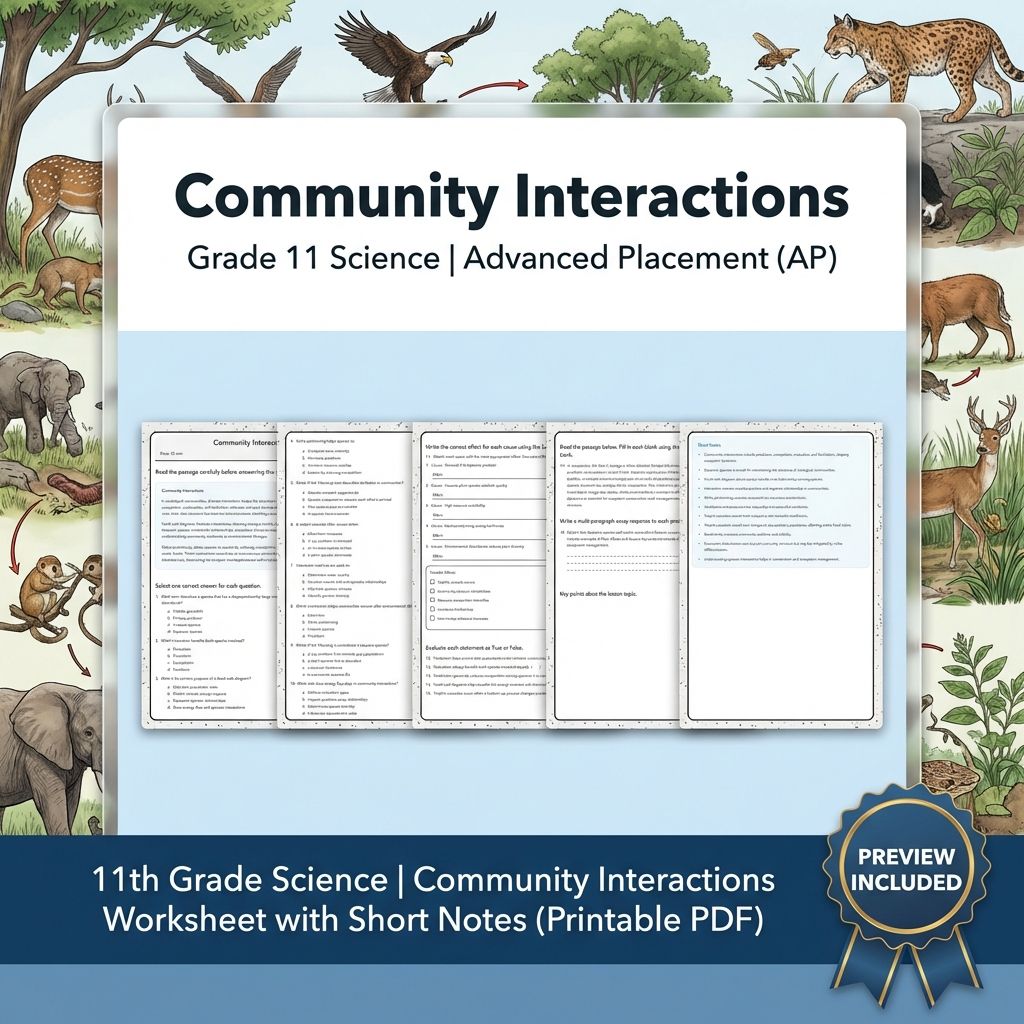
11th Grade Science | Community Interactions Worksheet with Short Notes (PDF)
Created byMeadowlark WorksheetsLearning Objectives
- Analyze different types of interspecific interactions within communities, including competition, predation, mutualism, and facilitation.
- Interpret food web diagrams, interaction matrices, and functional trait approaches to understand energy flow and interaction strength.
- Identify the roles of keystone species, trophic cascades, and niche partitioning in community assembly and resilience.
Also included in: Grade 11 Science | Biological Systems & Genetics Unit Worksheet Pack (PDF) +1 more
Instant download
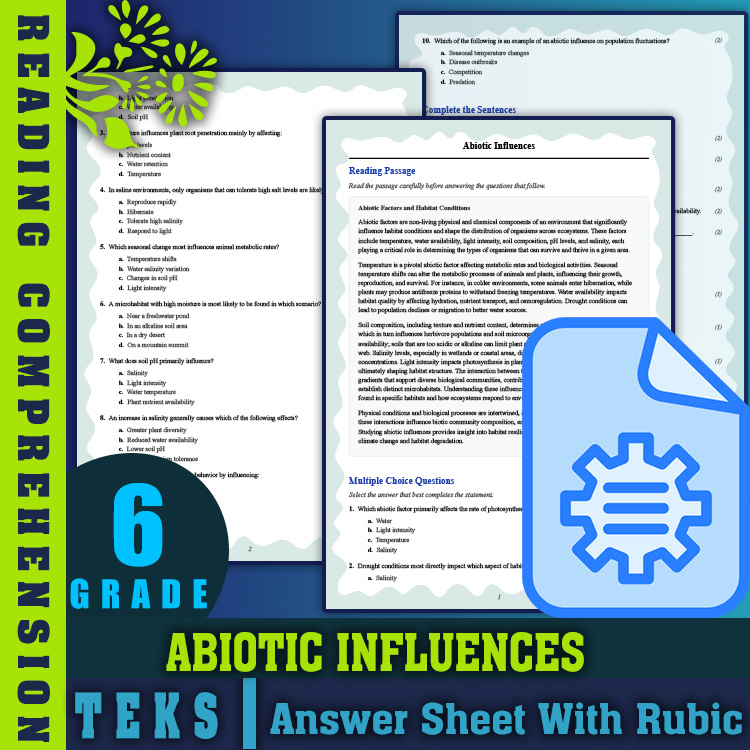
6th Grade Science | Abiotic Influences Reading Worksheet & Answer Key (PDF)
JCreated byJ.S SheetsLearning Objectives
- Understand how abiotic factors such as temperature, water, light, soil, pH, and salinity influence habitat conditions.
- Describe how abiotic factors affect organism distribution and population fluctuations.
- Explain interactions between physical environmental gradients and biological processes in ecosystems.
Instant download
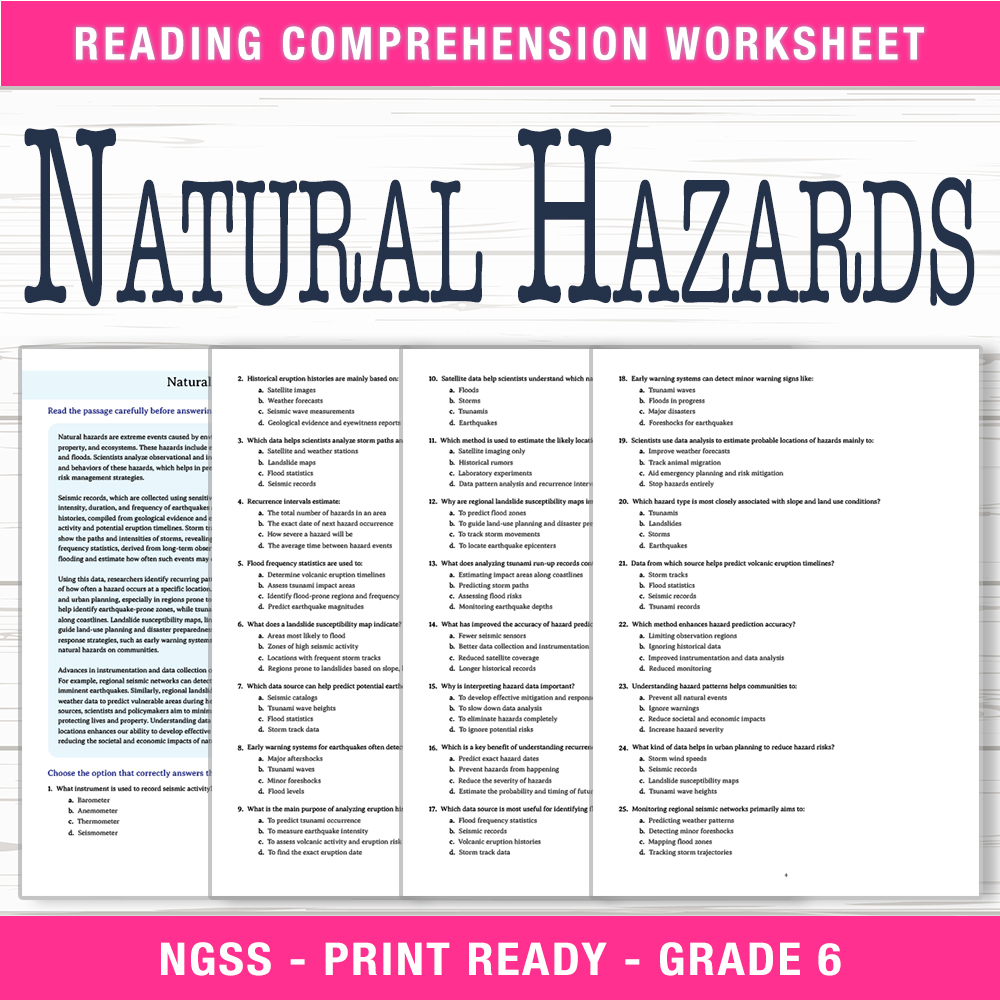
6th Grade Science | Natural Hazards Worksheet (PDF + Answer Key)
 Created byRiverstone Classroom
Learning Objectives
- Describe the types of natural hazards and how observational data are used to analyze them.
- Interpret data such as seismic records, eruption histories, and flood statistics to understand patterns.
- Explain methods for estimating the recurrence intervals and potential locations of natural hazards.
Instant download

High School Biology: Photosynthesis Basics Worksheet (TEKS) (Worksheet + Answer Key)
Created byEvergreen Desk EducationLearning Objectives
- Explain the inputs, outputs, and overall purpose of photosynthesis in terms of energy and matter.
- Describe the roles of the light-dependent reactions and the Calvin cycle in producing and using ATP, NADPH, and CO2 fixation.
- Compare photosynthesis and cellular respiration as complementary processes involving gas exchange and energy flow.
Instant download
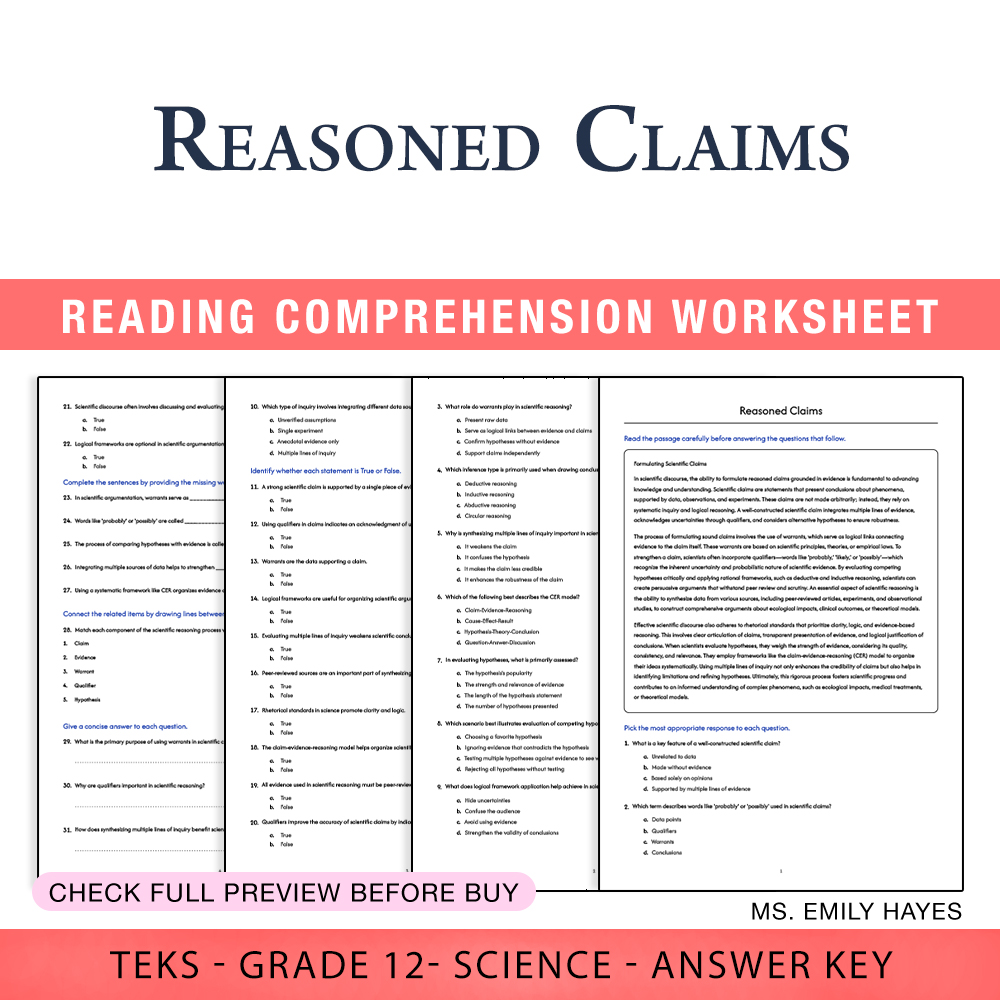
12th Grade Science | Reasoned Claims Worksheet (PDF+ Answer Key)
Created byCopper Leaf ClassroomLearning Objectives
- Understand the principles of scientific reasoning and how to formulate evidence-based claims.
- Evaluate and compare hypotheses using evidence, warrants, and qualifiers.
- Apply logical frameworks and rhetorical standards in scientific discourse.
Instant download
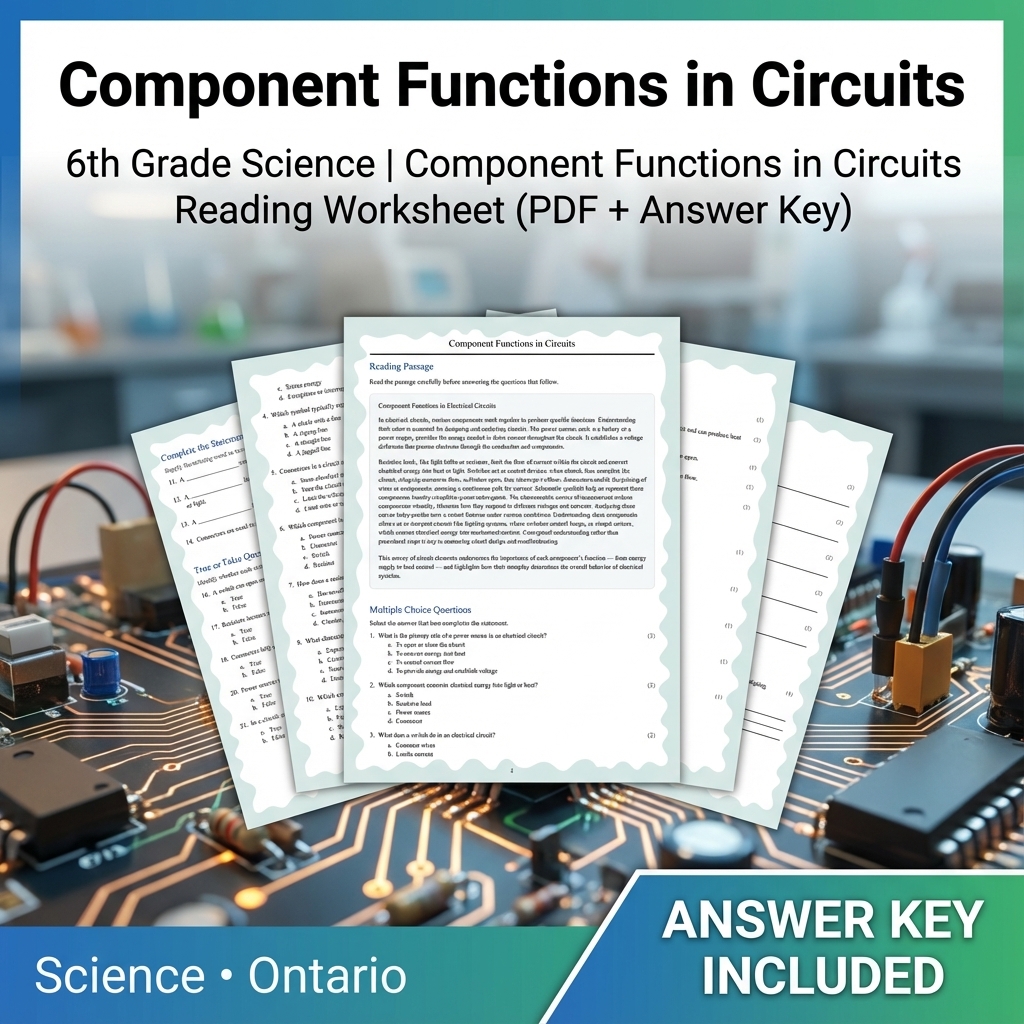
6th Grade Science | Component Functions in Circuits Reading (PDF + Answer Key)
JCreated byJ.S SheetsLearning Objectives
- Understand the purpose of common electrical circuit components such as power sources, resistive loads, switches, and connectors.
- Explain how each component affects current and voltage within a circuit.
- Interpret schematic symbols and relate them to physical components.
Also included in: Grade 6 Science Circuit & Electricity Unit Bundle – Worksheets & Answer Keys +1 more
Instant download

Genetic Drift Worksheet for Grade 10 Science | Standards-Aligned Practice
JCreated byJ.S SheetsLearning Objectives
- Explain how genetic drift causes allele frequencies to change due to chance events rather than natural selection.
- Describe why genetic drift has a stronger effect in small populations.
- Analyze how genetic drift can reduce genetic diversity and lead to divergence among populations.
Also included in: Grade 10 Life Science Evolution, Genetics & Cells Lesson Bundle – Florida NGSSS +1 more
Instant download

Grade 8 Science – Experimental Design Daily Reading Worksheet | TEKS Aligned
Created byBright Mind ResourcesLearning Objectives
- Understand the purpose of hypotheses in experiments
- Learn how to formulate testable hypotheses
- Identify components of an experimental hypothesis
Also included in: Experiments Grade 8 Science Daily Reading Worksheets Lesson Bundle | TEKS +2 more
Instant download
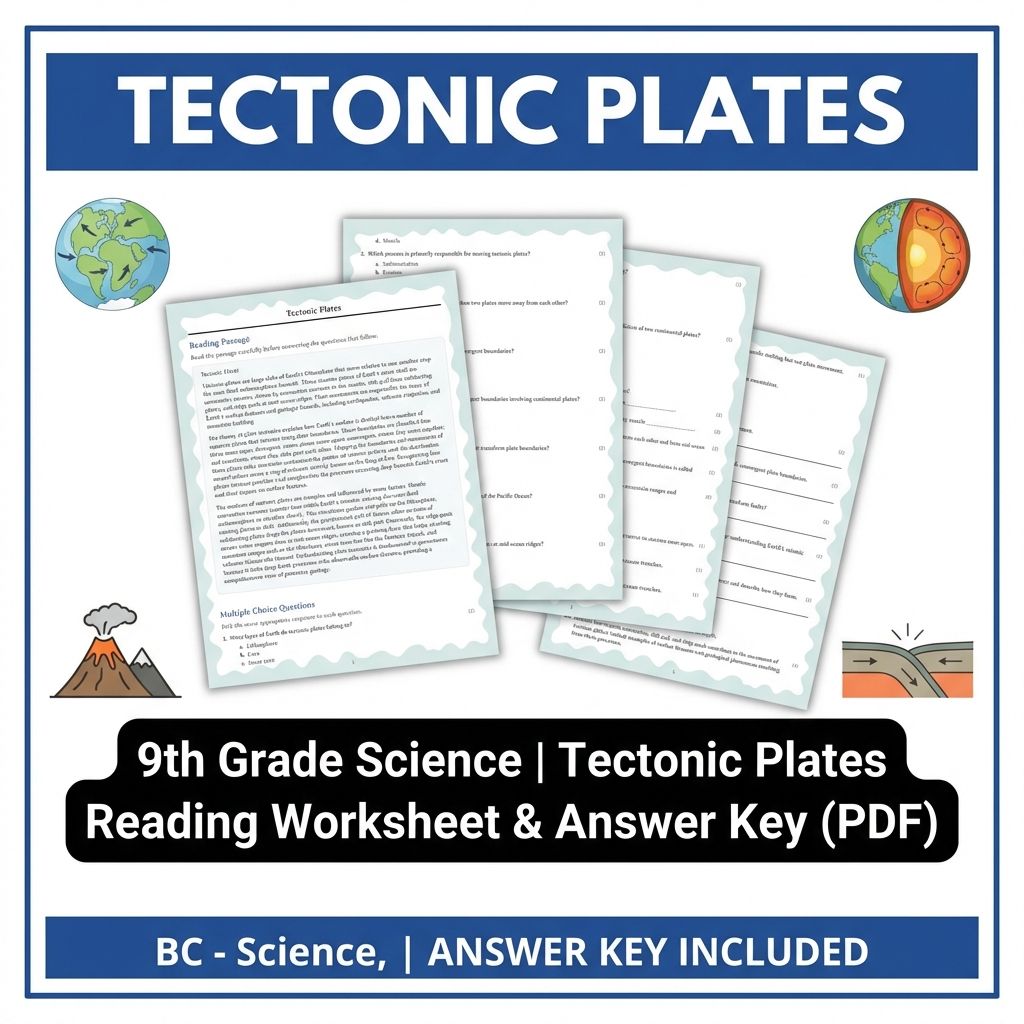
9th Grade Science | Tectonic Plates Reading Worksheet & Answer Key (PDF)
JCreated byJ.S SheetsLearning Objectives
- Understand the concept of tectonic plates and their role in Earth's geology.
- Identify the different types of plate boundaries and their associated landforms and phenomena.
- Explain how mantle convection, slab pull, and ridge push drive plate movements.
Instant download
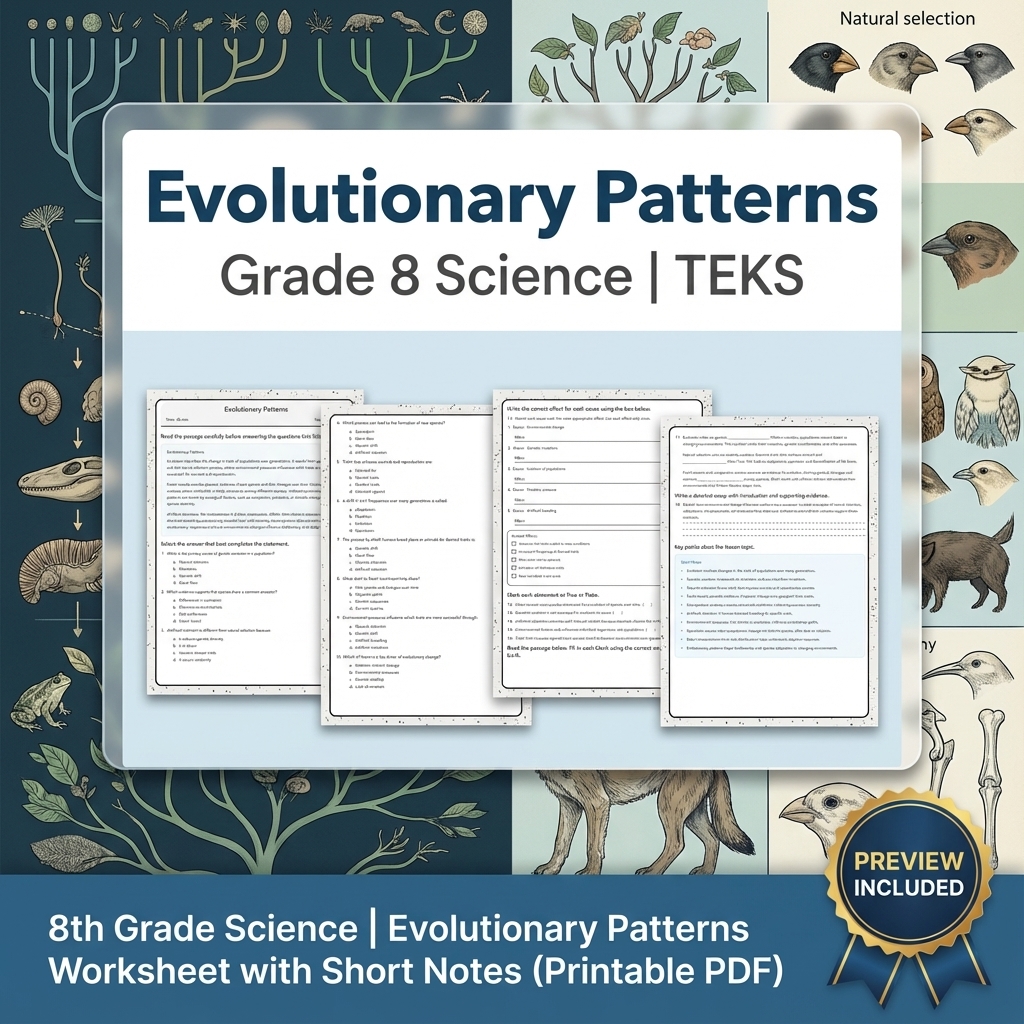
8th Grade Science Evolutionary Patterns Worksheet with Short Notes (PDF)
Created byMeadowlark WorksheetsLearning Objectives
- Identify key mechanisms driving microevolutionary change.
- Interpret data related to trait distribution and fitness comparisons.
- Differentiate between natural selection and artificial selection processes.
Instant download

Grade 10 Science | Phylogenetic Trees Worksheet | TEKS-Aligned
Created byLumora LearningLearning Objectives
- Understand the purpose and construction of phylogenetic trees.
- Identify shared derived traits, molecular sequences, and fossil data used in determining relationships.
- Explain how classification reflects evolutionary history and common ancestry.
Also included in: Grade 10 Science | Evolution & Classification Lesson Bundle | TEKS Aligned +1 more
Instant download
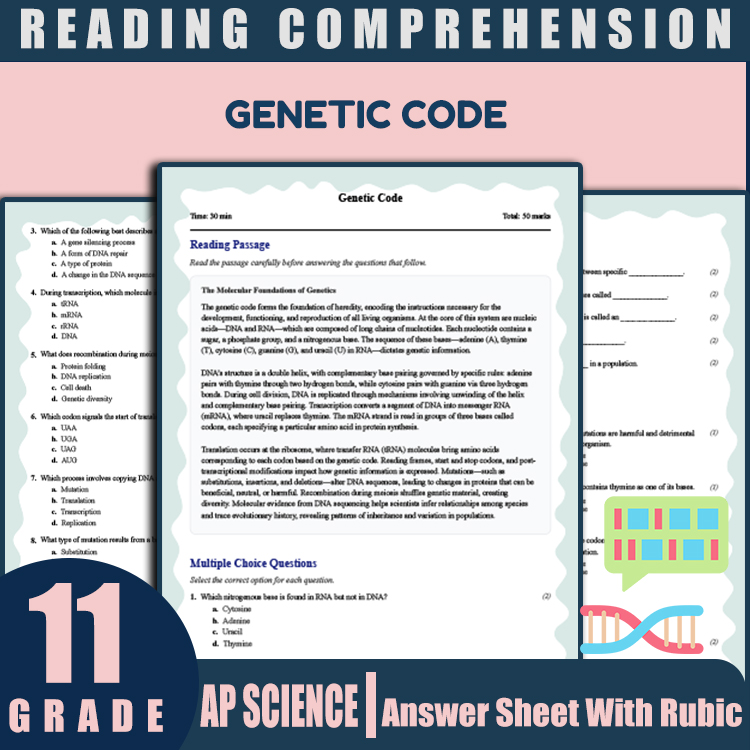
11th Grade Science Reading Worksheets | Genetic Code Mastery (PDF + Answer Key)
JCreated byJ.S SheetsLearning Objectives
- Understand the molecular basis of heredity through nucleic acid structures and base-pairing rules.
- Describe the processes of transcription and translation as mechanisms of genetic information transfer.
- Identify types of mutations and recombination and their effects on gene expression and phenotype.
Also included in: Grade 11 Science Unit Bundle – Cellular Systems, Genetics Ecosystems Worksheets +1 more
Instant download
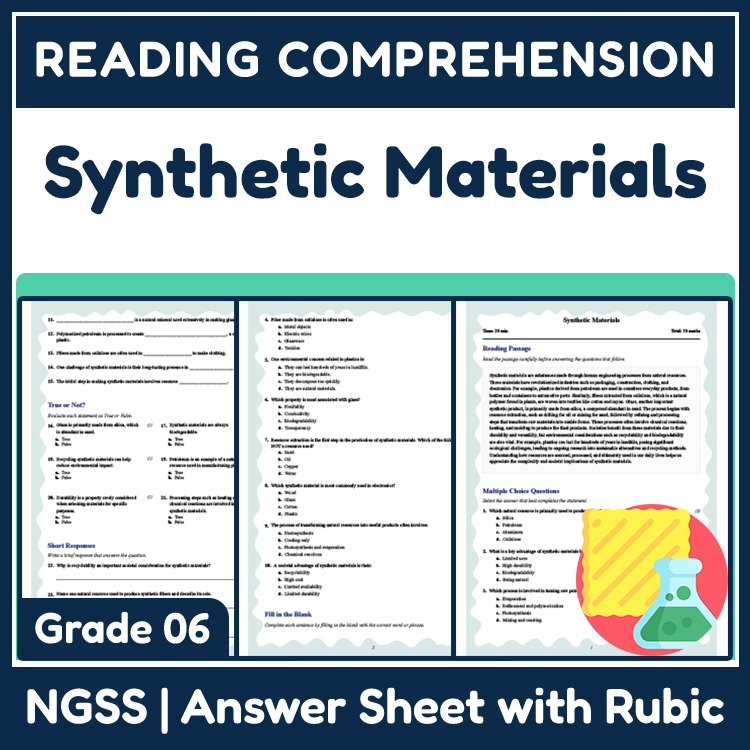
6th Grade Science | Synthetic Materials Reading Worksheet with Answer Key (PDF)
JCreated byJ.S SheetsLearning Objectives
- Understand the sources and origins of various synthetic materials used in daily life.
- Compare the properties of natural versus synthetic materials and relate them to their uses.
- Describe the processes involved in extracting and processing resources for manufacturing synthetic materials.
Instant download

Grade 7 Synthetic Materials Worksheet | NGSS Polymers & Material Science
 Created byNorthstar Worksheets
Learning Objectives
- Explain how synthetic materials can be produced from natural resources by outlining key steps such as feedstock selection, polymerization, and refining.
- Describe how chemical composition changes during processing and how those changes affect material properties like strength, flexibility, and durability.
- Compare examples (polyethylene, PET, nylon, and metals from ores) and discuss trade-offs involving recyclability and environmental impact.
Also included in: Grade 7 Physical Science: Matter & Chemical Reactions Lesson Bundle | NGSS +1 more
Instant download

Grade 7 Science Representations Worksheet | NGSS Graphs, Data & Models
Created byNorthstar WorksheetsLearning Objectives
- Explain how different representations (chemical equations, graphs, and data tables) help communicate matter interactions and measurable relationships.
- Interpret trends in graphs and stoichiometric information in balanced chemical equations to make quantitative comparisons.
- Select the most appropriate representation for a specific question about rate, mass/temperature change over time, or state changes.
Also included in: Grade 7 Physical Science: Matter & Chemical Reactions Lesson Bundle | NGSS +1 more
Instant download

Grade 7 Reaction Evidence Worksheet | NGSS Chemical Reactions Activity
Created byNorthstar WorksheetsLearning Objectives
- Identify observable indicators that a chemical reaction has occurred.
- Explain how gas production, precipitate formation, color change, and temperature change serve as evidence of new substances.
- Distinguish chemical changes from reversible physical changes using conservation of mass in sealed systems.
Also included in: Grade 7 Physical Science: Matter & Chemical Reactions Lesson Bundle | NGSS +1 more
Instant download

Grade 10 Extinction Patterns Worksheet | Practice & Assessment PDF
Created byClear Sky ClassroomLearning Objectives
- Explain how extinction patterns range from background losses to mass extinctions and how they influence biodiversity
- Identify major drivers of extinction, including environmental change, habitat loss, invasive species, and rapid climate shifts
- Describe how extinction events can leave fossil and genetic signatures that reveal past biodiversity crises
Instant download
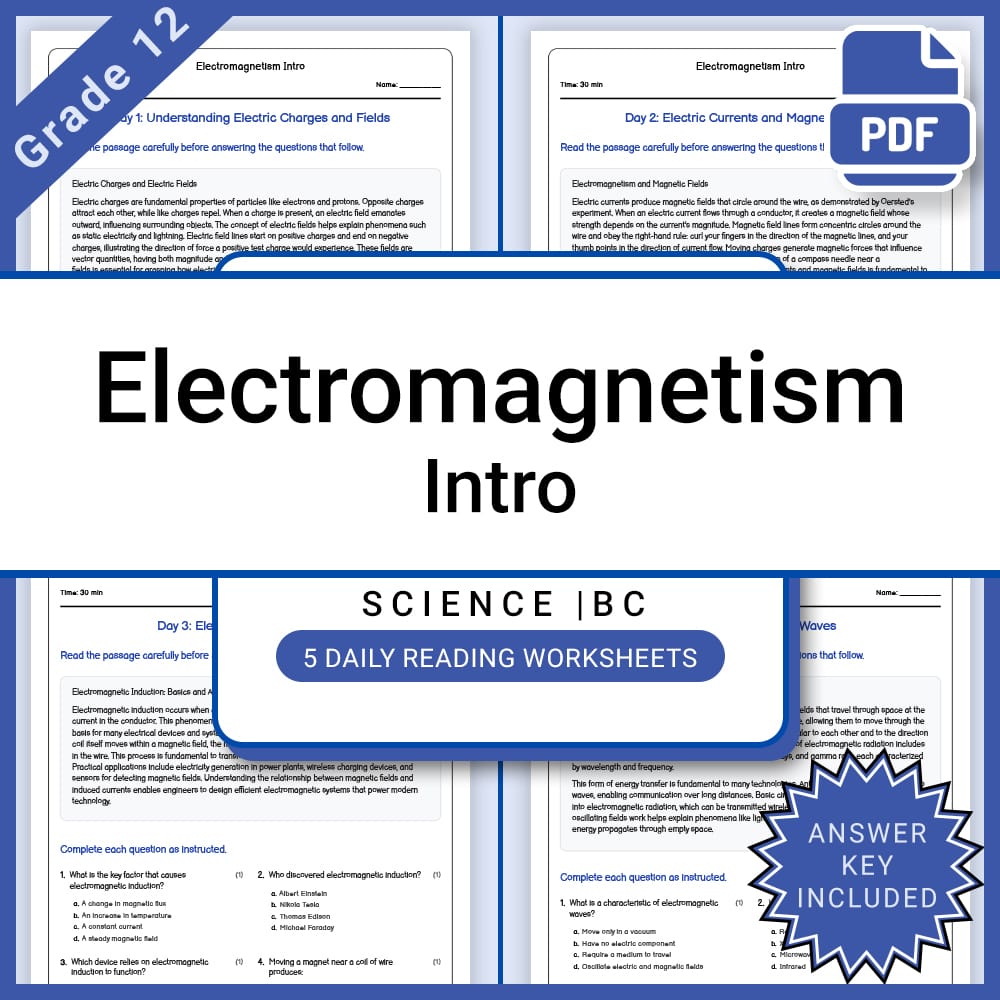
Grade 12 Science – Electromagnetism Daily Reading Worksheet with Answer Key
JCreated byJ.S SheetsLearning Objectives
- Understand the concept of electric charges and how they create electric fields
- Identify the relationship between electric charges and electric field lines
- Recognize the differences between positive and negative charges
Also included in: Grade 12 Science Lesson Group | Physics, Energy, Waves & Electromagnetism +1 more
Instant download
Browse more categories
About Science Worksheets
Find Science worksheets spanning core skills, practice, and review. All 44,628 resources are instant PDF downloads for the classroom or home.
Every worksheet on MyTeachingSheets is created by independent teacher-authors and reviewed before publication. All resources download as printable PDFs for classroom, homework, or at-home practice, and many include answer keys. Preview any worksheet free before buying.