
Science Worksheets
44,773 subject resources
Grade 7 Embryonic Patterns and Evolution Worksheet | NGSS Life Science
 Created byBRIGHT PATH RESOURCES
Learning Objectives
- Identify key stages of embryonic development across different animal groups
- Compare and contrast embryonic features among taxa to understand evolutionary relationships
- Recognize conserved structures such as pharyngeal pouches and limb buds
Also included in: Evolution & Genetics Grade 7 Science Worksheets Lesson Bundle | NGSS +2 more
Instant download
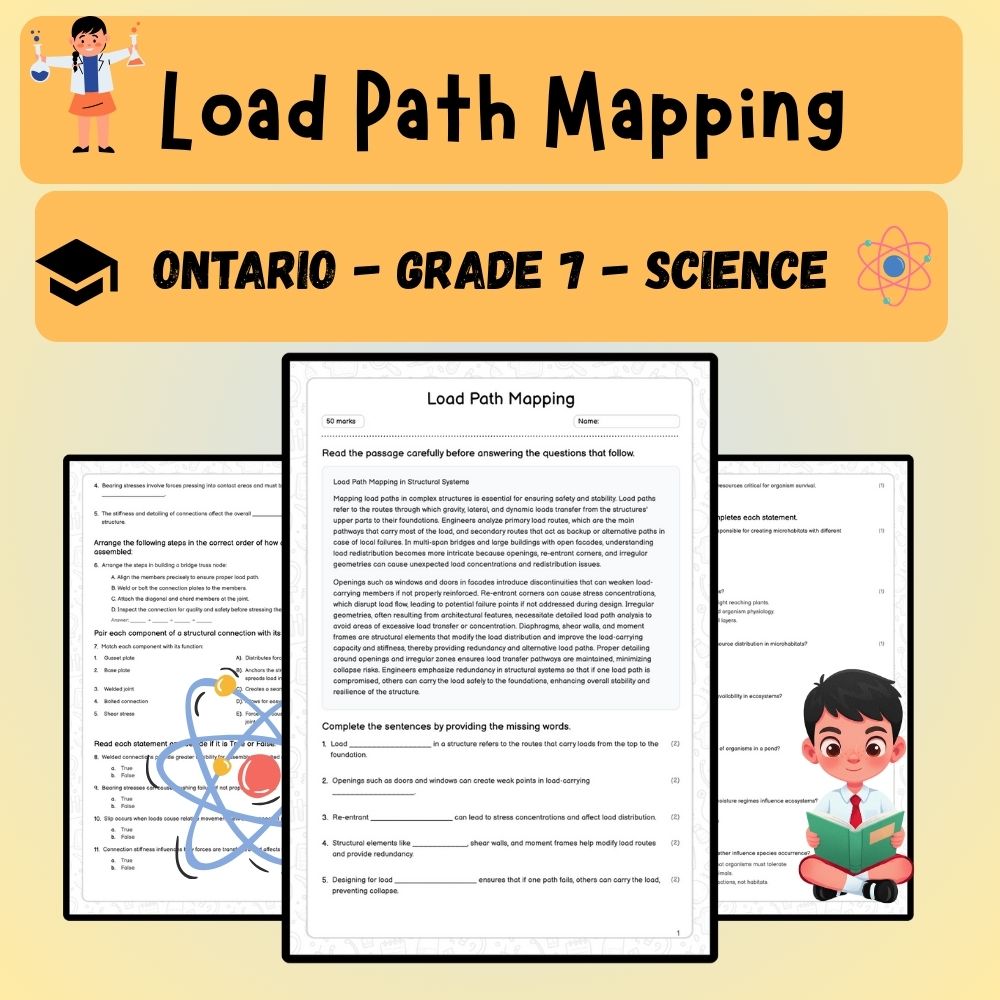
Grade 7 Science | Load Path Mapping Worksheet (PDF) - Ontario Standards
 Created byPrism Point Learning
Learning Objectives
- Understand methods for mapping load paths in complex structures.
- Identify primary and secondary load routes in structural systems.
- Analyze how openings and irregular geometries influence load redistribution.
Also included in: Grade 7 Science Unit | Structural Engineering & Material Testing Worksheets Bundle +1 more
Instant download
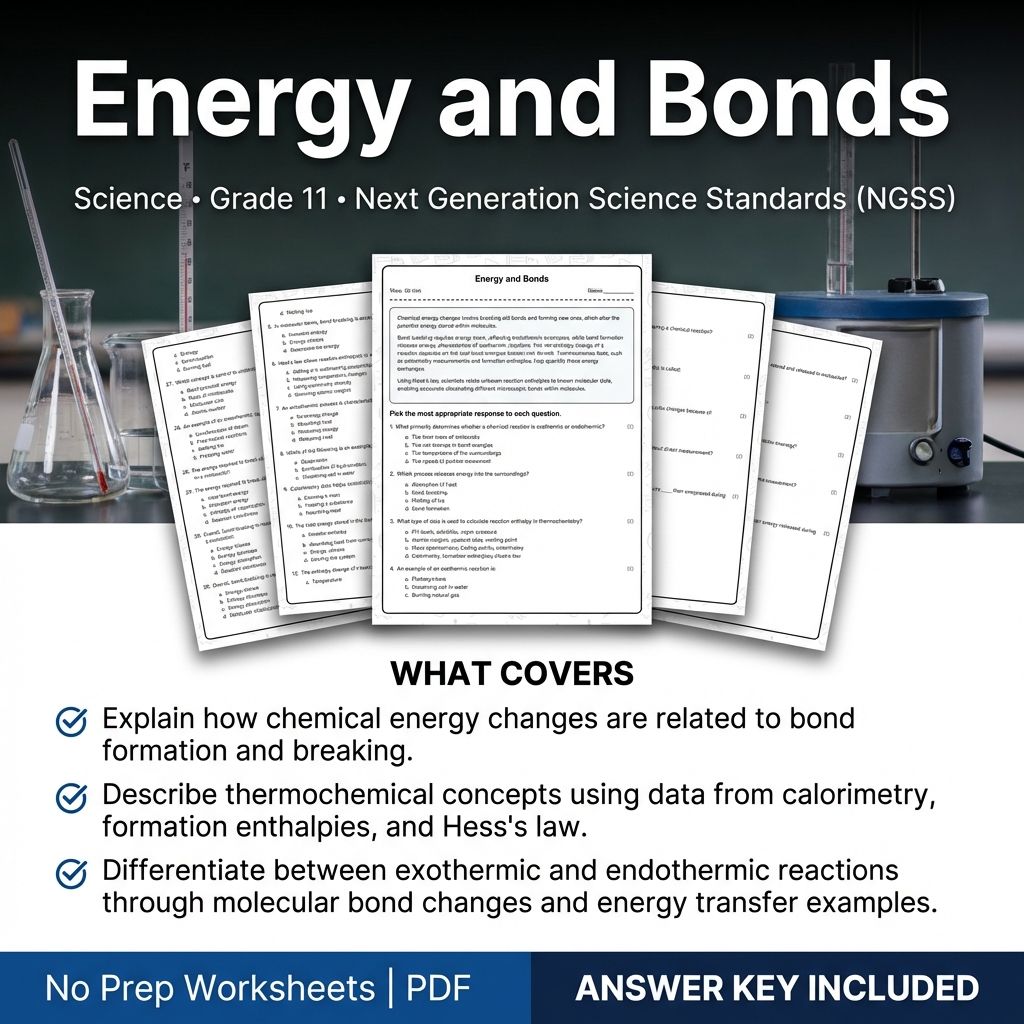
11th Grade Science | Energy and Bonds Worksheet & Answer Key (Printable PDF)
 Created byCoral Reef Learning
Learning Objectives
- Explain how chemical energy changes are related to bond formation and breaking.
- Describe thermochemical concepts using data from calorimetry, formation enthalpies, and Hess's law.
- Differentiate between exothermic and endothermic reactions through molecular bond changes and energy transfer examples.
Also included in: Grade 11 Science Unit Bundle – Chemical Reactions & Periodic Trends Worksheets +1 more
Instant download

Grade 7 Science – Resource Availability | Daily Reading Worksheet
 Created byBright Mind Resources
Learning Objectives
- Understand natural water sources and their limitations
- Identify factors that affect water availability such as natural events and human use
- Analyze how environmental conditions influence resource access and societal responses
Also included in: Water Cycle & Weather Grade 7 Science Daily Reading Lesson Bundle | CA Standards +1 more
Instant download

Grade 6 Human Water Disruptions Worksheet | Practice & NGSS PDF
 Created byClear Sky Classroom
Learning Objectives
- Explain how human actions such as dams and water withdrawals can alter river flow timing and water availability.
- Describe how pollutants can change water quality and harm aquatic organisms.
- Analyze how land cover changes can affect infiltration, runoff, and flood risk.
Instant download

Grade 11 Energy and Bonds Worksheet | NGSS Chemistry & Biology Activity
Created byBRIGHT PATH RESOURCESLearning Objectives
- Understand the types of chemical bonds and their energy characteristics
- Explain how bond formation and breaking involve energy changes
- Relate thermochemical data to microscopic bond rearrangements
Also included in: Matter and Its Interactions Grade 11 Science Lesson Bundle | NGSS +1 more
Instant download

Friction and Gravity Worksheet | Grade 7 Science Practice
Created byPrism Point LearningLearning Objectives
- Explain how friction affects the motion of objects on different surfaces using qualitative evidence.
- Describe gravity as a force that produces acceleration and changes apparent weight on slopes.
- Differentiate between contact forces (like friction and normal force) and long-range forces (like gravity).
Also included in: Grade 7 Motion, Forces & Energy Science Lesson Bundle for TEKS Practice
Instant download

Physiological Systems Practice Test | Grade 10 Science NGSS Worksheet
Created byPrism Point LearningLearning Objectives
- Compare how major physiological systems coordinate to move materials through the body (transport, gas exchange, nutrient delivery, and waste removal).
- Explain how structure supports function in circulatory, respiratory, digestive, excretory, and integumentary systems.
- Use surface area-to-volume and transport ideas to describe how organism demands are met.
Also included in: Grade 10 Cellular Regulation and Energy Science Lesson Bundle (NGSS)
Instant download
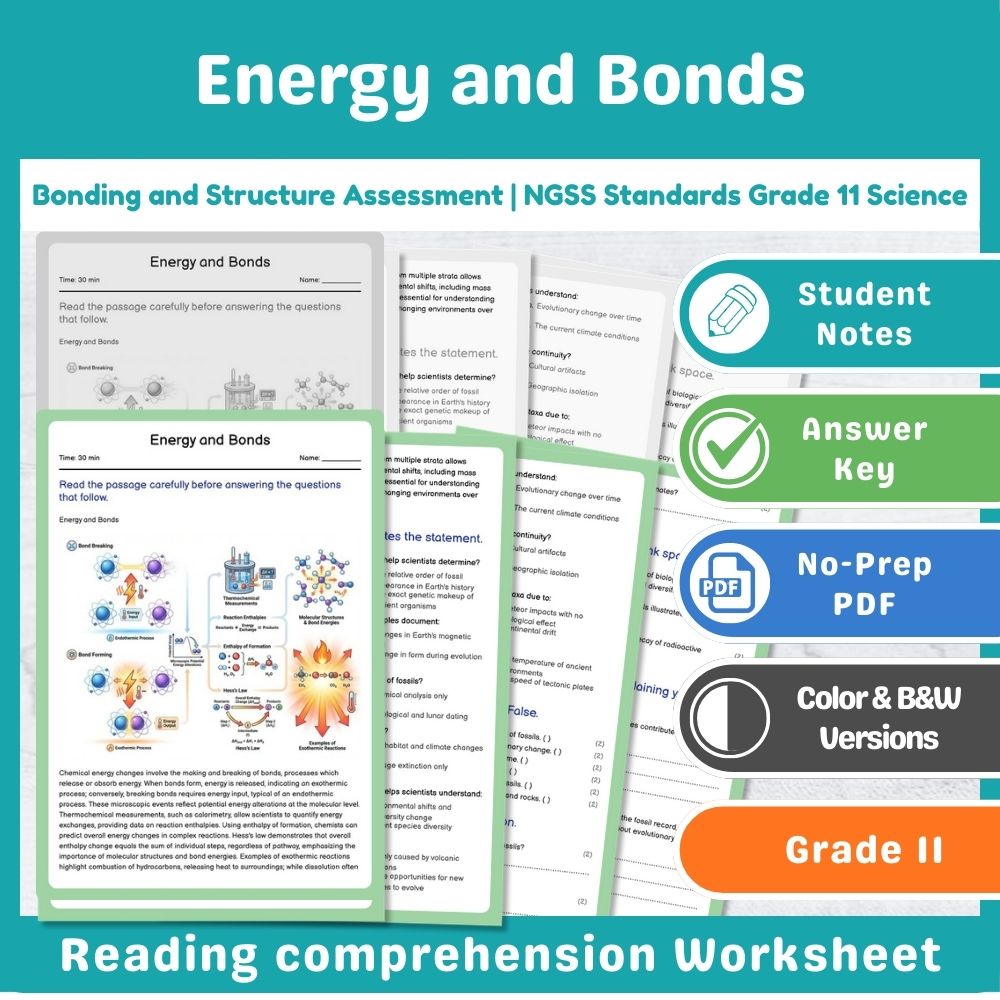
Energy and Bonds Assessment – NGSS Aligned Evaluation for Grade 11 Science
Created byPrism Point LearningLearning Objectives
- Understand the representation of chemical energy changes through bond formation and breaking.
- Explain how net enthalpy change relates to bond energies and molecular structure.
- Interpret thermochemical data, including calorimetry, formation enthalpies, and Hess's law.
Also included in: Grade 11 Science Mini Bundle – Matter and Its Interactions NGSS Unit
Instant download

Embryonic Development and Evolution Worksheets | Grade 7 Science
 Created bythe curious pencil
Learning Objectives
- Describe how embryonic similarities provide evolutionary evidence
- Identify conserved developmental features in vertebrate embryos
- Explain the role of transient developmental structures
Also included in: Biological Evolution Worksheets Bundle | Grade 7 Science NGSS +2 more
Instant download

Land Use Effects Worksheet Practice Test | Grade 10 Science NGSS
Created byPrism Point LearningLearning Objectives
- Explain how land-cover change from human activities affects ecosystem function, hydrologic cycles, and biodiversity.
- Use empirical indicators (e.g., soil erosion, habitat fragmentation, nutrient loading, and sediment runoff) to connect land use to ecological outcomes.
- Interpret how different land-use types can increase or decrease risks such as eutrophication and biodiversity loss.
Instant download
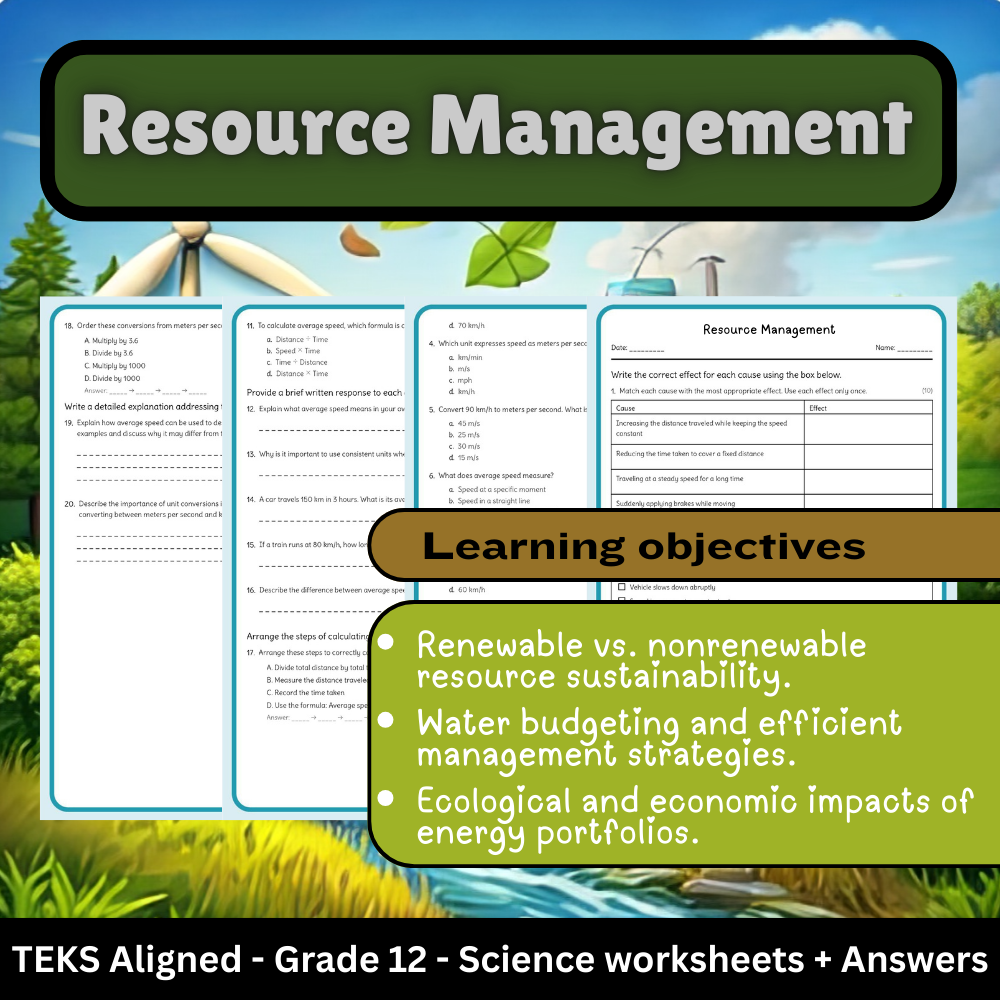
Grade 12 Science Resource Management Worksheet – TEKS Standards (PDF)
Created byBright Mind ResourcesLearning Objectives
- Evaluate the differences between renewable and nonrenewable resources and their sustainable use.
- Analyze water budgeting and identify strategies for efficient water management.
- Compare various energy portfolio options and their ecological and economic impacts.
Instant download

Grade 8 Science | Model-Based Refinement Worksheet | California Standards
 Created byLumora Learning
Learning Objectives
- Explain how comparing model predictions with expected outcomes can guide design refinements.
- Use model outputs as evidence to decide which design features to improve or revise.
- Describe how alternative model structures can produce different performance results and inform redesign decisions.
Instant download

Grade 8 Fossil Record Clues Worksheet | Practice & Standards PDF
Created byClear Sky ClassroomLearning Objectives
- Explain how fossils in sedimentary rock layers provide clues about Earth’s past environments and organisms.
- Describe how matching fossil types and rock-layer ages across regions can support plate-tectonic ideas.
- Use rock and sediment characteristics to infer past conditions such as changes in climate or deposition.
Instant download

Comparative Anatomical Evidence for Evolution Worksheets Grade 7 Science
 Created byTeachers Club
Learning Objectives
- Explain how homologous structures provide evidence of shared ancestry
- Compare homologous and analogous structures by evolutionary relatedness
- Interpret anatomical evidence from modern organisms
Also included in: Biological Evolution Grade 7 Science NGSS Unit Bundle +2 more
Instant download

Grade 8 Science – Model-Based Refinement & Scientific Modeling | Worksheet
Created byBright Mind ResourcesLearning Objectives
- Understand the concept of scientific models and their purpose.
- Learn how models are used to test and refine scientific ideas.
- Recognize the importance of comparing different models to improve designs.
Also included in: Design Grade 8 Science Daily Reading Worksheets Bundle | CA Standards +1 more
Instant download
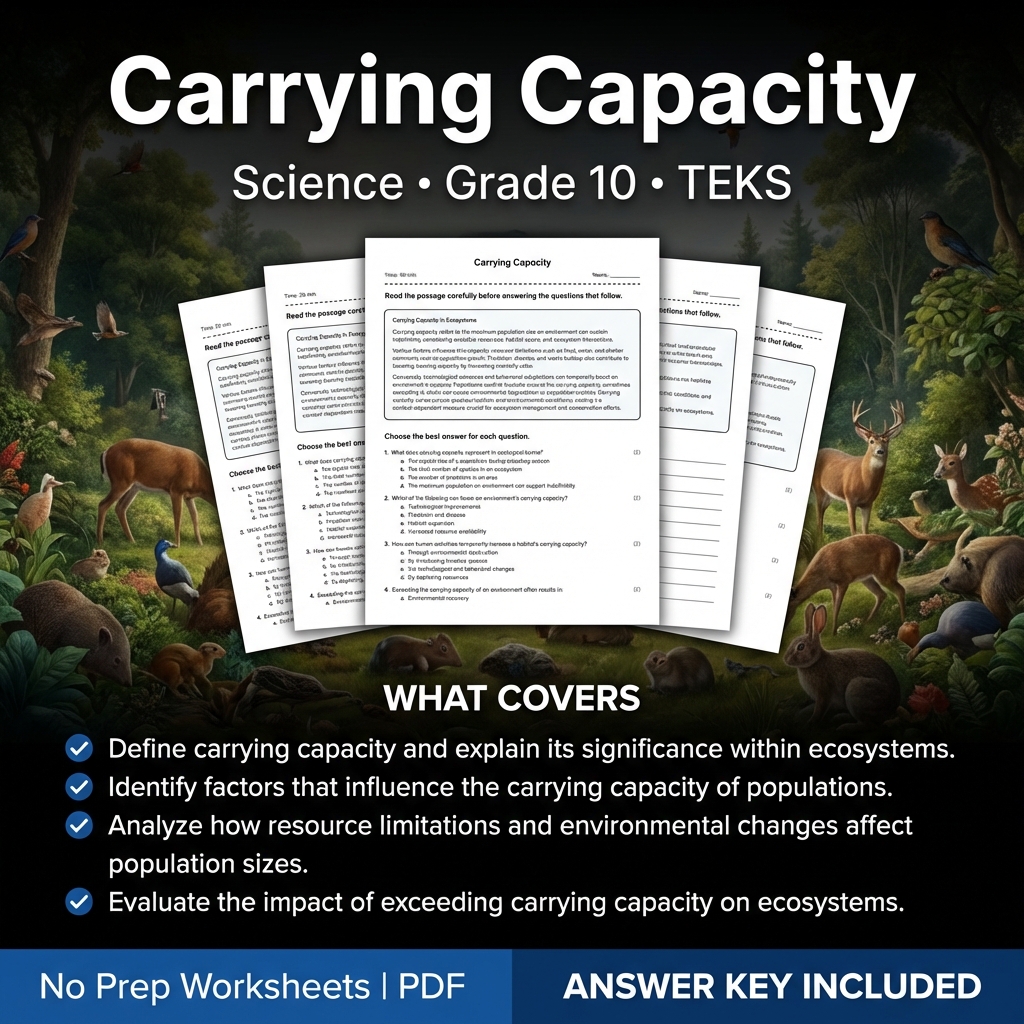
Grade 10 Science Worksheet Carrying Capacity TEKS Practice PDF
Created byCoral Reef LearningLearning Objectives
- Define carrying capacity and explain its significance within ecosystems.
- Identify factors that influence the carrying capacity of populations.
- Analyze how resource limitations and environmental changes affect population sizes.
Instant download
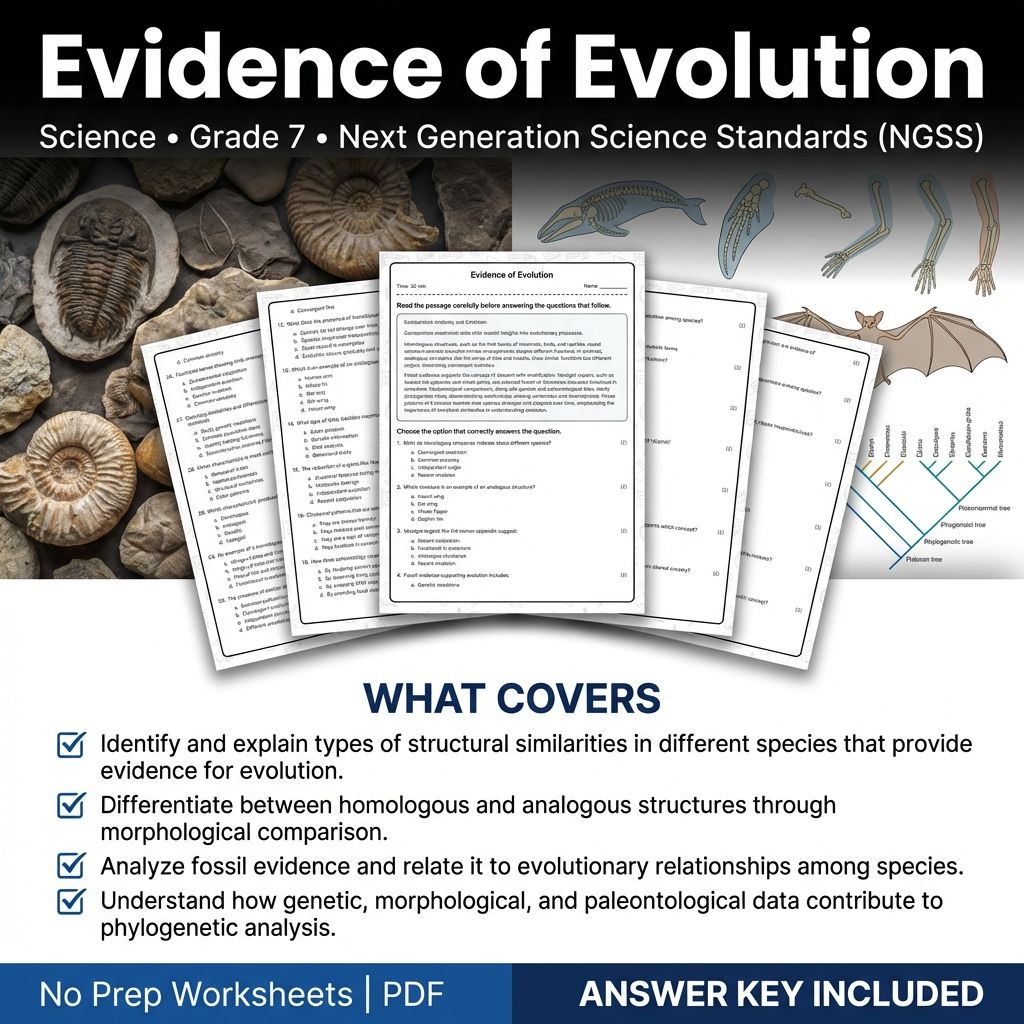
7th Grade Science | Evidence of Evolution Worksheet & Answer Key (Printable PDF)
Created byCoral Reef LearningLearning Objectives
- Identify and explain types of structural similarities in different species that provide evidence for evolution.
- Differentiate between homologous and analogous structures through morphological comparison.
- Analyze fossil evidence and relate it to evolutionary relationships among species.
Instant download

Grade 7 Science – Air Masses & Fronts Daily Reading Worksheet | Florida NGSSS
Created byBright Mind ResourcesLearning Objectives
- Understand what air masses are and how they form.
- Identify different types of fronts and their features.
- Explain how air masses and fronts affect weather conditions.
Also included in: Grade 7 Earth Science Daily Reading Worksheets Lesson Bundle | Florida NGSSS +1 more
Instant download

Argumentation Models Worksheet | Grade 7 Science Activities
Created byPrism Point LearningLearning Objectives
- Construct evidence-based scientific arguments using claims, evidence, and reasoning that are logically coherent.
- Critique and compare argumentation models by evaluating data quality, graphical representations, and limits of inference.
- Use quantitative results and model-based explanations to support or refute a hypothesis while citing sources of information.
Also included in: Grade 7 Scientific Data & Argumentation Science Lesson Bundle (TEKS)
Instant download
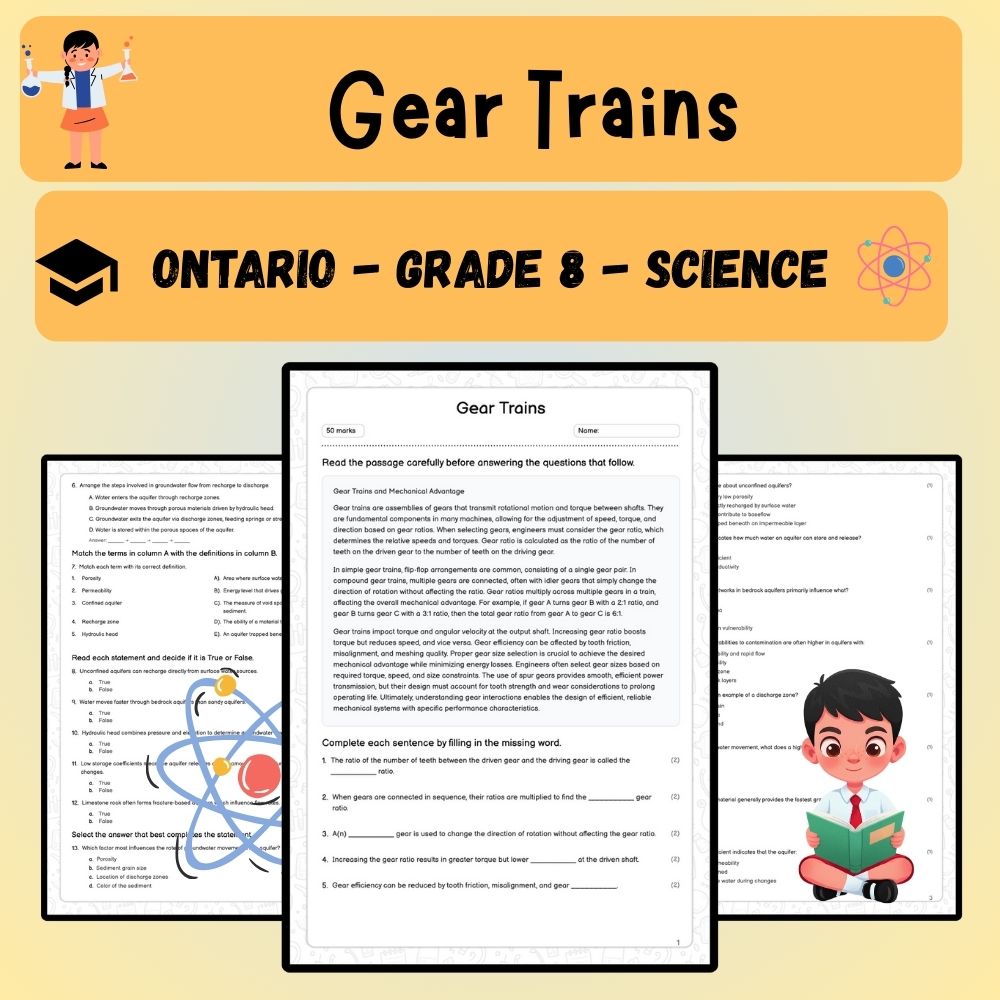
Grade 8 Science – Gear Trains Worksheet (PDF ) with Answer Key
Created byPrism Point LearningLearning Objectives
- Understand the basic principles of gear ratios, torque multiplication, and speed trade-offs in gear trains.
- Calculate overall gear ratios and analyze the effects of gear interactions on torque and rotational speed.
- Identify the roles of spur gears and idler gears within simple and compound gear trains.
Also included in: Grade 8 Science Unit Bundle | Forces, Energy & Motion Worksheets +1 more
Instant download
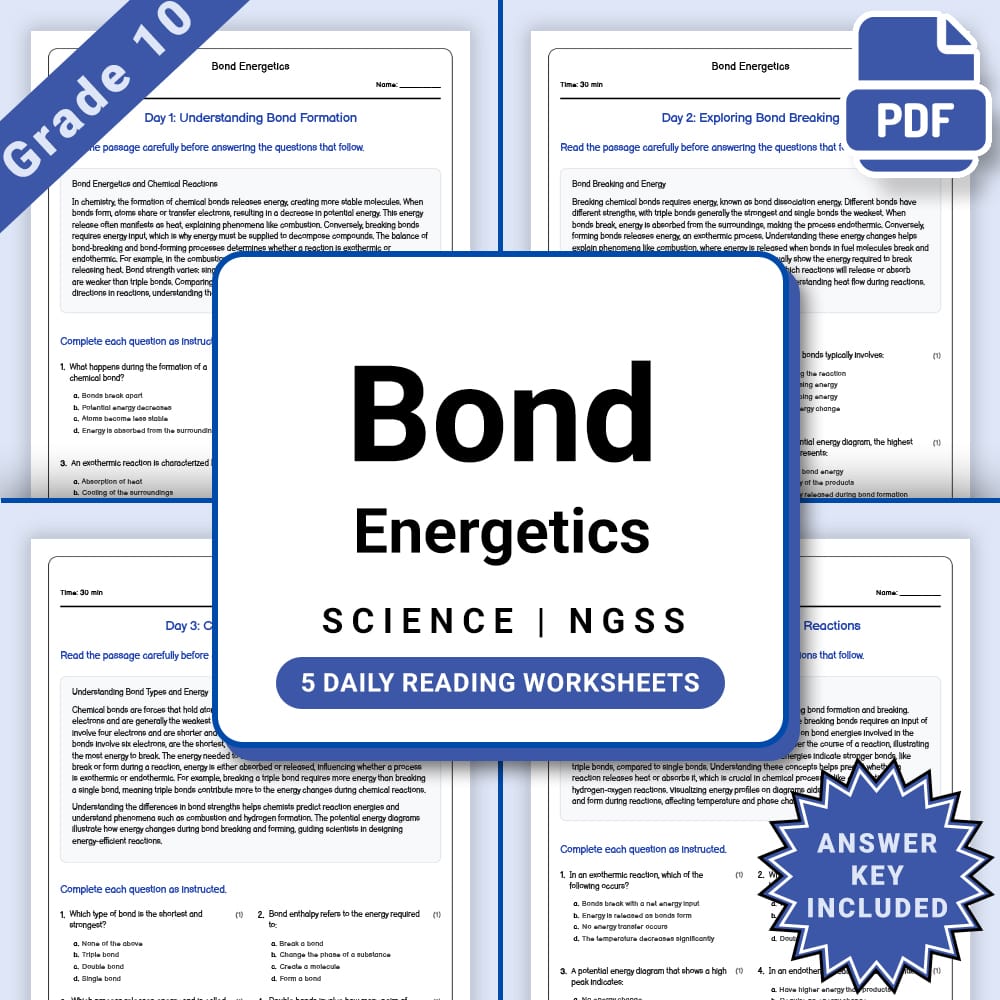
Grade 10 Science – Bond Energies Daily Worksheet (PDF +Answer Key)
 Created byCopper Leaf Classroom
Learning Objectives
- Understand the concept of bond formation and energy change
- Differentiate between exothermic and endothermic reactions
- Interpret potential energy diagrams related to chemical bonds
Instant download

Plate Boundaries and Earth’s Changing Surface Worksheets Grade 10
Created byTeachers ClubLearning Objectives
- Identify the three major plate boundary types
- Explain how seafloor spreading creates new oceanic crust
- Describe how subduction produces earthquakes and volcanic arcs
Also included in: Grade 10 Earth Science Worksheets | NGSS Earth’s Systems Bundle +1 more
Instant download

Grade 10 Predator Prey Dynamics Worksheet | California Standards Practice PDF
Created byClear Sky ClassroomLearning Objectives
- Explain how predator and prey populations influence each other over time
- Interpret how predation can change carrying capacity and ecosystem stability
- Use scientific vocabulary (predation, carrying capacity, feedback loop, oscillation) to describe ecosystem dynamics
Instant download
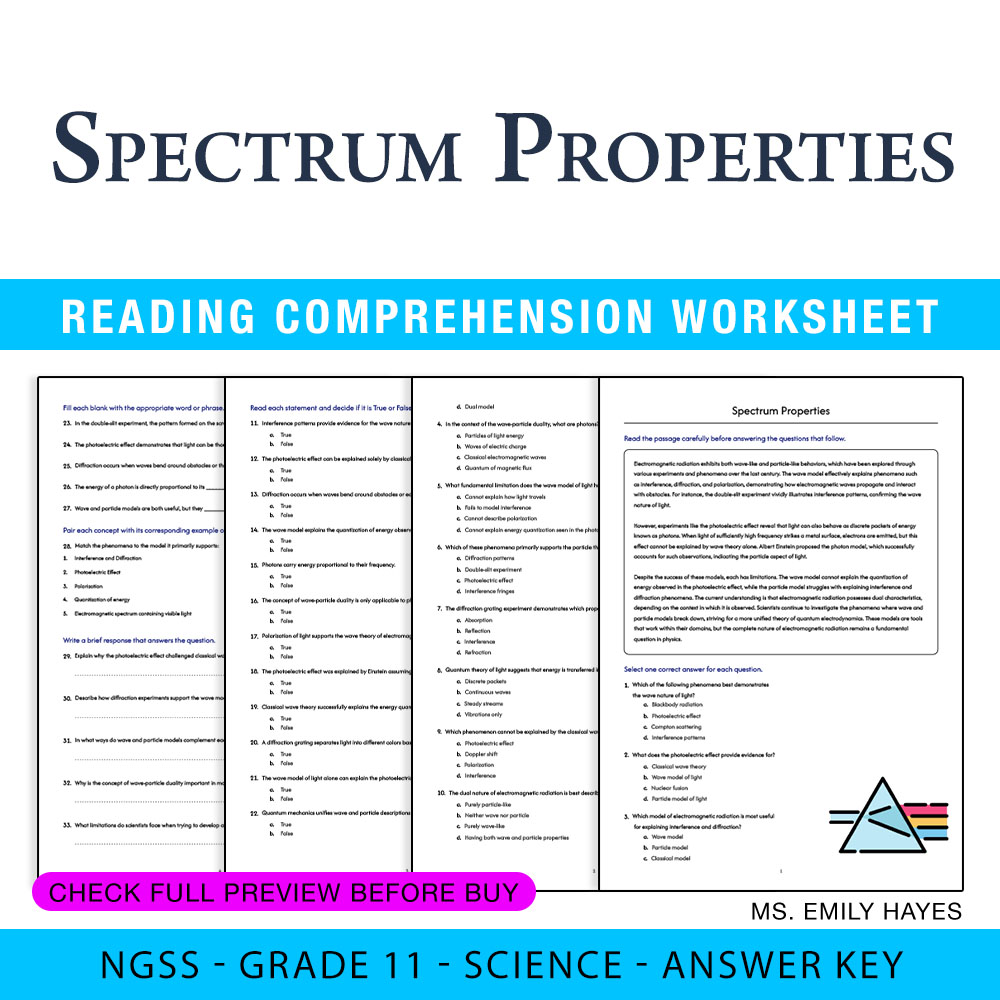
Grade 11 Science | Spectrum Properties Worksheet (PDF+ Answer Key)
Created byCopper Leaf ClassroomLearning Objectives
- Understand the evidence supporting wave and particle models of electromagnetic radiation.
- Explain how phenomena like interference, diffraction, and the photoelectric effect support different models.
- Evaluate where each model of electromagnetic radiation applies and where it breaks down.
Instant download

Circular Motion Worksheet Pack AP Physics Grade 12 Practice
Created byPrism Point LearningLearning Objectives
- Explain why centripetal acceleration points toward the center in uniform circular motion using vector change of velocity
- Use relationships among speed, radius, and centripetal acceleration (a_c = v^2/r) and relate them to net radial force
- Decompose acceleration into tangential and radial components to analyze nonuniform circular motion
Also included in: AP Physics Grade 12 Science Mechanics & Electricity Lesson Bundle | AP
Instant download

Energy Transfer Worksheet | Grade 8 Science Activities
Created byPrism Point LearningLearning Objectives
- Explain how conduction, convection, and radiation transfer thermal energy.
- Describe how energy transfer can cause observable temperature changes and phase changes.
- Distinguish between endothermic and exothermic processes using everyday examples.
Also included in: Grade 8 Matter & Reactions Science Lesson Bundle (TEKS Worksheets) +1 more
Instant download

Newtonian Forces Worksheet Grade 10 Science Practice & Assessment NGSSS
Created byPrism Point LearningLearning Objectives
- Explain how net force relates to changes in velocity and acceleration.
- Connect equilibrium to balanced forces and predict motion outcomes.
- Use Newton’s second law to predict how changing force or mass affects acceleration.
Also included in: Grade 10 Physical Science Lesson Bundle | Florida NGSSS
Instant download
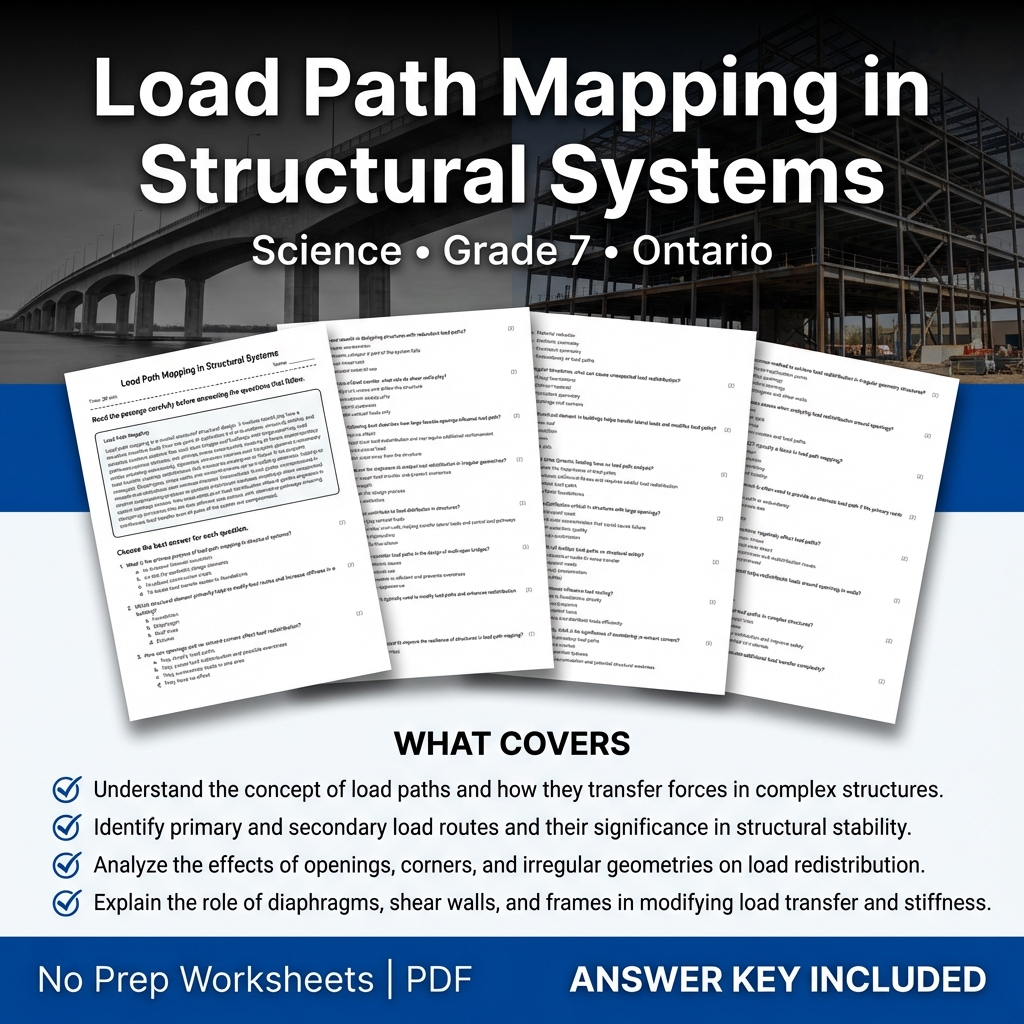
Load Path Mapping in Structural Systems Worksheet for Grade 7 Science
Created byCoral Reef LearningLearning Objectives
- Understand the concept of load paths and how they transfer forces in complex structures.
- Identify primary and secondary load routes and their significance in structural stability.
- Analyze the effects of openings, corners, and irregular geometries on load redistribution.
Instant download
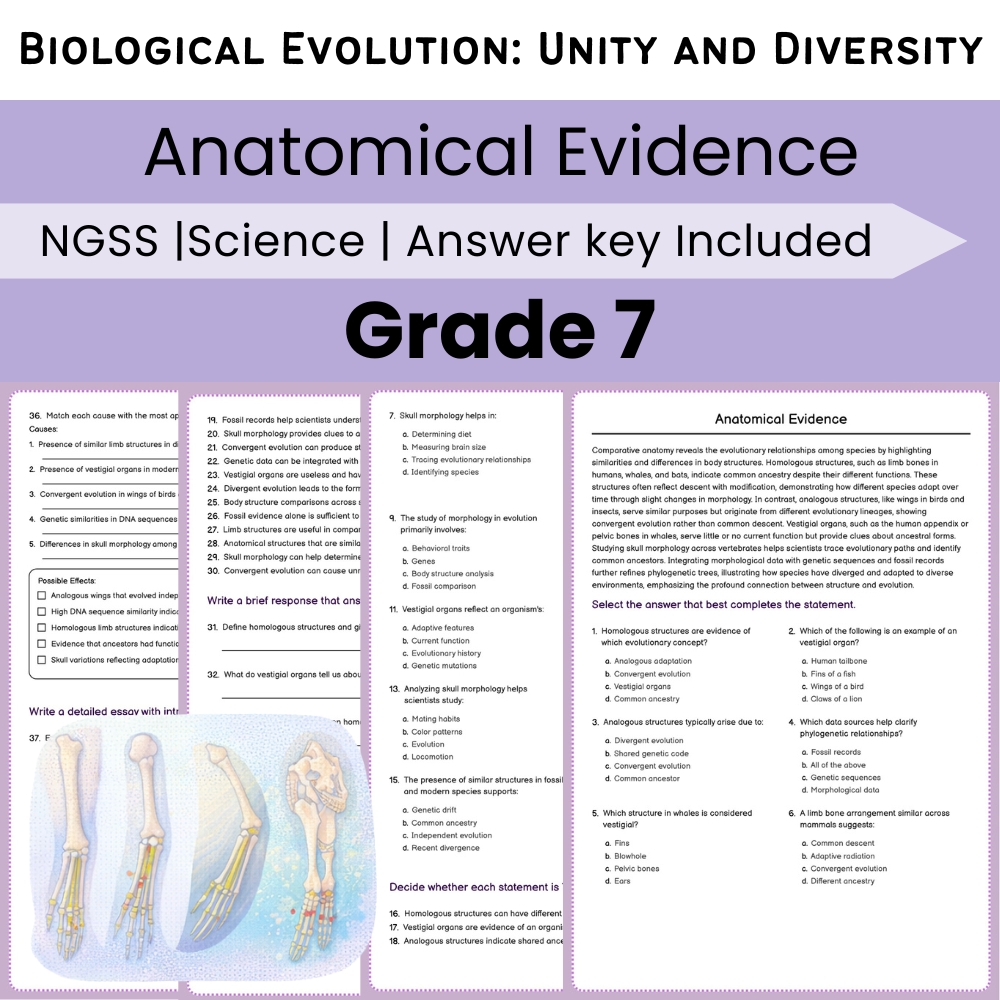
Anatomical Evidence Worksheet | Grade 7 Science Printable PDF Assessment
Learning Objectives
- Understand how comparative anatomy provides evidence for evolution.
- Identify homologous, analogous, and vestigial structures among species.
- Interpret morphological data to infer phylogenetic relationships and adaptive divergence.
Also included in: Grade 7 Science Lesson Bundle | Biological Evolution: Unity and Diversity +1 more
Instant download
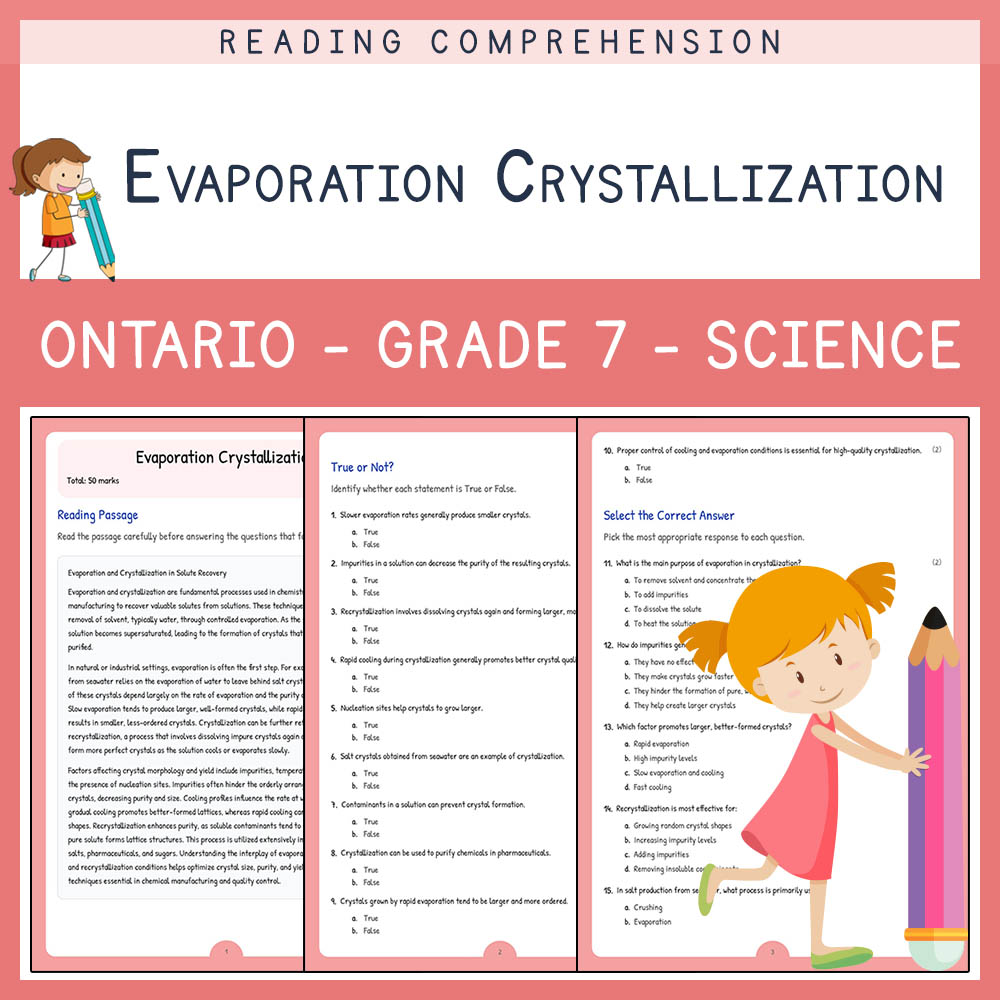
Grade 7 Science | Evaporation Crystallization Worksheet | Ontario Standards
Created byLumora LearningLearning Objectives
- Understand the processes of evaporation and controlled crystallization used to recover solutes.
- Identify factors influencing crystal growth, size, and purity, such as evaporation rate and impurities.
- Describe examples like salt production and sugar crystallization.
Also included in: Grade 7 Science | Pure Substances and Mixtures Unit Bundle | Ontario
Instant download
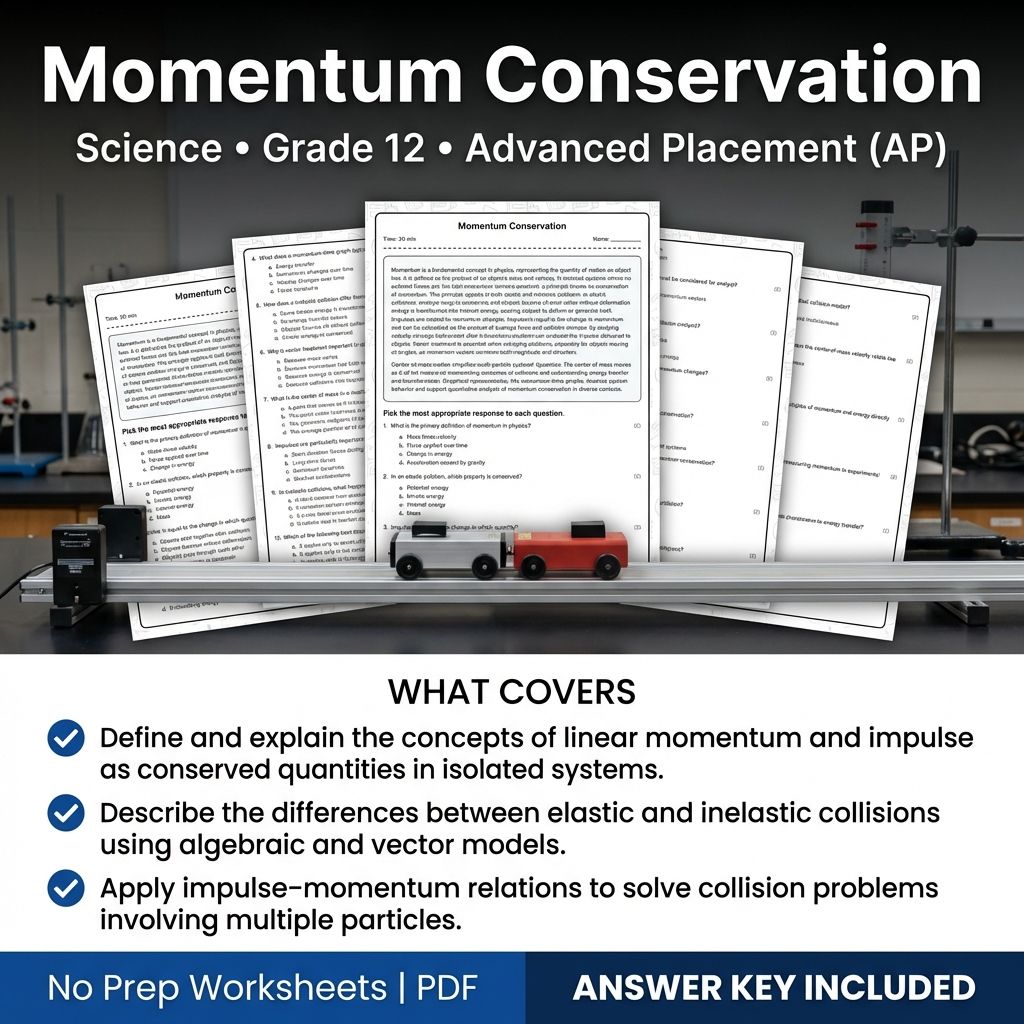
Grade 12 Science | Momentum Conservation Worksheet & Answer Key (Printable PDF)
Created byCoral Reef LearningLearning Objectives
- Define and explain the concepts of linear momentum and impulse as conserved quantities in isolated systems.
- Describe the differences between elastic and inelastic collisions using algebraic and vector models.
- Apply impulse–momentum relations to solve collision problems involving multiple particles.
Also included in: Grade 12 Science Unit Bundle – Physics Topics with Worksheets & Answer Keys +1 more
Instant download

Grade 12 Plate Tectonic Time Worksheet | Earth Science | California Standards
 Created byEvergreen Desk Education
Learning Objectives
- Explain how Earth’s internal and surface processes drive plate tectonics over geologic time.
- Interpret how tectonic events (mountain building, earthquakes, volcanism) connect to changes in landforms through weathering and erosion.
- Use evidence from rock layers and present-day features to reason about past geological conditions.
Instant download

Plate Tectonic Time Worksheet | California Standards Grade 12 Science
JCreated byJ.S SheetsLearning Objectives
- Understand the processes involved in Earth's geologic time scale, including tectonic activity, mountain building, earthquakes, and volcanism.
- Explain how surface processes like weathering and erosion reshape landforms over time.
- Connect present geological features to past events through analysis of Earth's evolving structure.
Also included in: Grade 12 Earth and Space Systems Science Lesson Bundle: California Standards +1 more
Instant download

6th Grade Science | Data Representation Worksheet (PDF) TEKS Aligned
Created byEvergreen Desk EducationLearning Objectives
- Use proper conventions to label axes and choose scales when creating tables and graphs.
- Interpret data displays (tables, line graphs, bar graphs, scatter plots) to identify trends and relationships.
- Recognize outliers and patterns in data representations and use them to compare results across conditions.
Instant download

Data Representation Worksheet Pack | Grade 6 Science Activities
Created byPrism Point LearningLearning Objectives
- Use tables and graphs to organize data and communicate meaning clearly.
- Identify correct axis labels and choose an appropriate scale for graphs.
- Recognize patterns and relationships (trends, clusters, or outliers) in data representations.
Also included in: Grade 6 Scientific Investigation Practices Science Lesson Bundle TEKS +1 more
Instant download
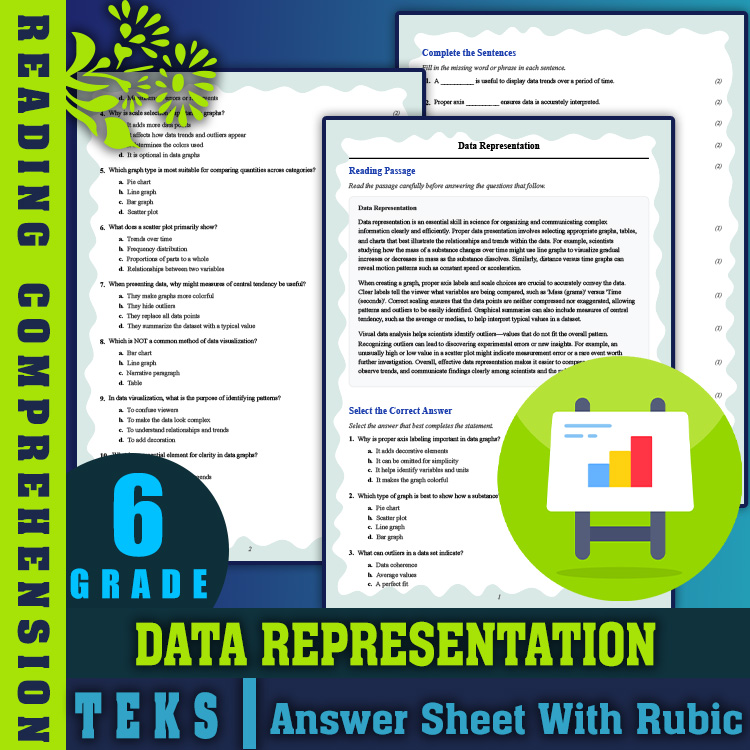
6th Grade Science | Data Representation Reading Worksheet & Answer Key (PDF)
JCreated byJ.S SheetsLearning Objectives
- Understand the conventions for organizing data in tables, line graphs, bar graphs, and scatter plots.
- Apply the principles of data presentation to interpret trends and relationships in datasets.
- Identify proper axis labeling, scale selection, and graphical summaries of data.
Instant download

Grade 6 Science Daily Reading Data Representation TEKS Worksheet
Created byBRIGHT PATH RESOURCESLearning Objectives
- Explain what a data table shows and what each column and row means
- Read entries accurately using labels and units
- Use basic meanings of mean (average) to describe data
Also included in: Scientific Methods 6th Science Daily Reading Worksheets Lesson Bundle | TeKS +1 more
Instant download
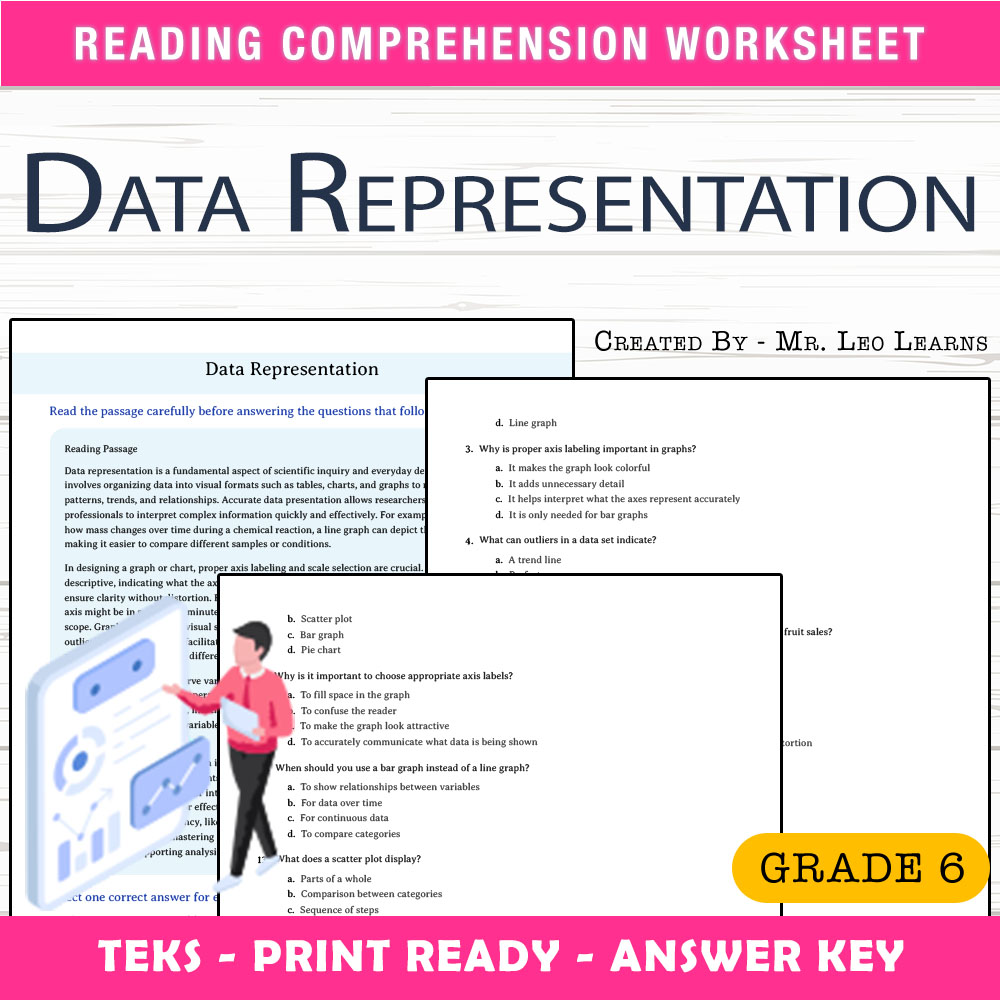
Grade 6 Science – Data Representation Worksheet for Mastering Scientific Graphs
 Created byThe Resource Hub
Learning Objectives
- Understand conventions for organizing and presenting data using different graphical methods.
- Interpret trends, patterns, outliers, and relationships in data visualizations.
- Apply proper axis labeling, scale selection, and graphical summaries to data sets.
Instant download
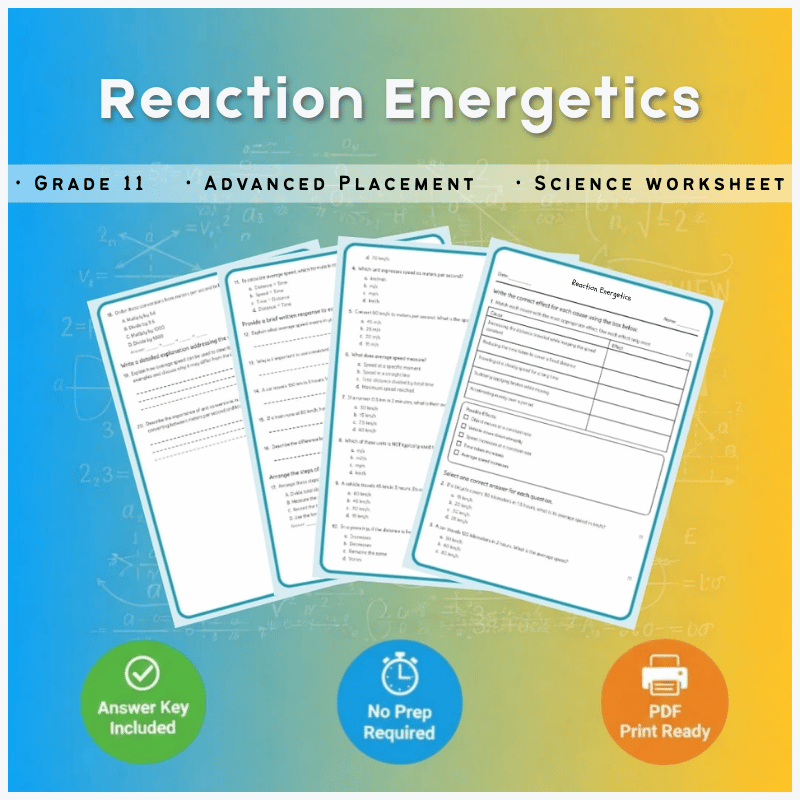
Grade 11 Science | Reaction Energetics Worksheet (Answer Key) | AP Standards
Created byBright Mind ResourcesLearning Objectives
- Understand enthalpy changes and how calorimetry measures reaction heat.
- Explain Hess’s law and how energy steps are combined to determine overall reaction enthalpy.
- Relate bond enthalpies and formation energies to reaction stability and macroscopic enthalpy.
Instant download

Grade 11 Science – Reaction Energetics Worksheet (AP Standards) (PDF)
Created byEvergreen Desk EducationLearning Objectives
- Explain enthalpy changes using calorimetry results and state assumptions.
- Apply Hess’s law to combine energy steps and determine overall reaction heat.
- Connect bond enthalpies and standard formation energies to reaction enthalpy and energy diagrams.
Also included in: Grade 11 Chemistry Foundations Science Lesson Bundle: AP Advanced Placement +1 more
Instant download
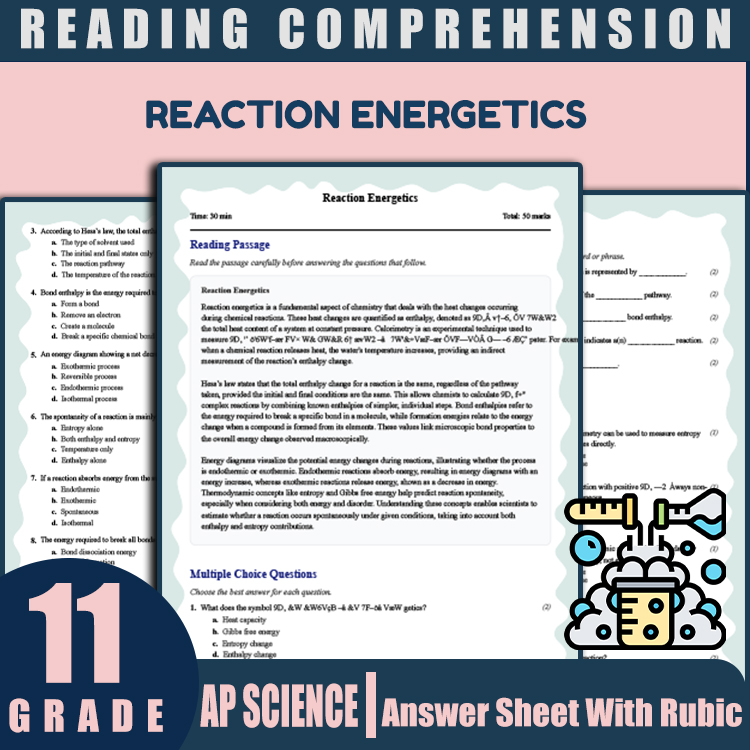
Grade 11 Science | Reaction Energetics Reading Worksheet & Answer Key (PDF)
JCreated byJ.S SheetsLearning Objectives
- Understand the concept of enthalpy change and how it's measured using calorimetry.
- Explain Hess’s law and how it allows the calculation of overall reaction heat from individual steps.
- Relate bond enthalpies and formation energies to the macroscopic enthalpy of reactions and stability.
Also included in: Grade 11 Science Unit Worksheet Bundle – Chemical Bonding, Kinetics & More (PDF) +1 more
Instant download
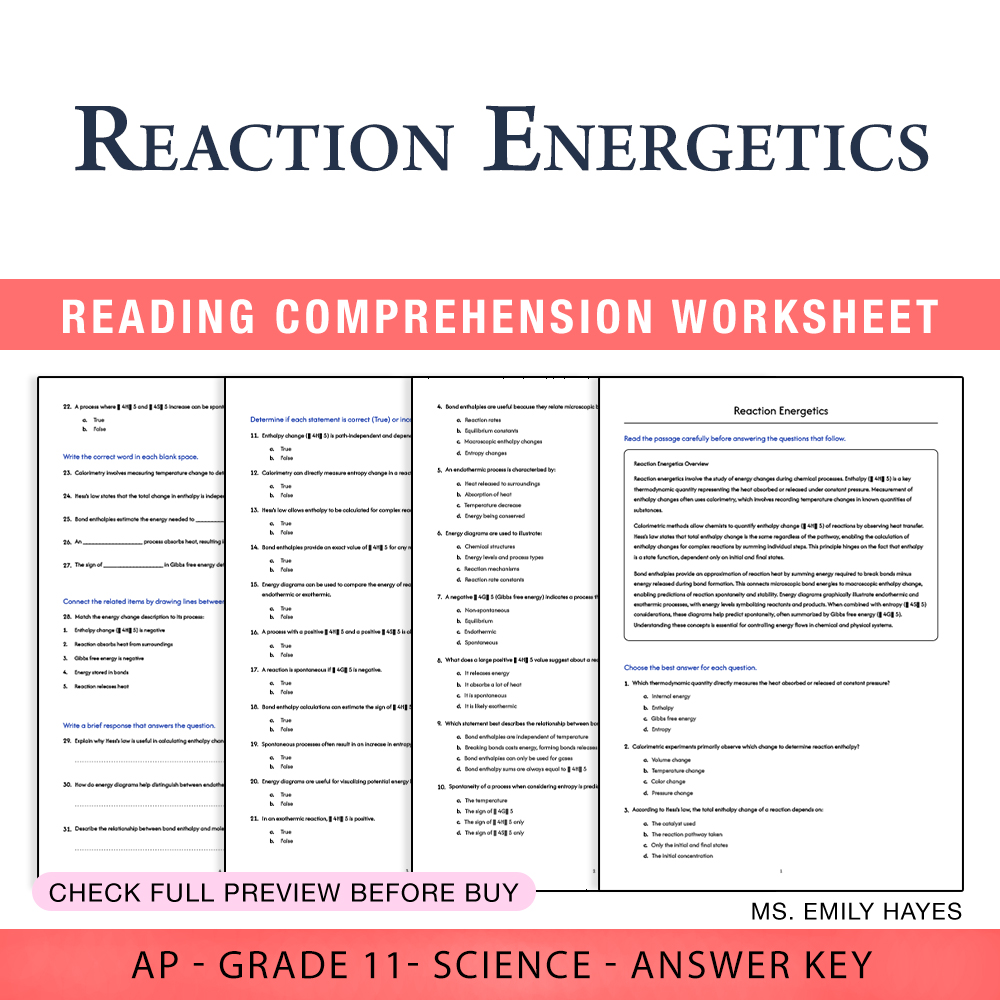
11th Grade Science | Reaction Energetics Worksheet (PDF+ Answer Key)
Created byCopper Leaf ClassroomLearning Objectives
- Describe enthalpy changes and their measurement in chemical reactions.
- Explain calorimetric reasoning and how it relates to reaction heat.
- Apply Hess's law to calculate overall enthalpy changes from steps.
Also included in: Grade 11 Science | Chemistry Foundations AP Worksheet Bundle (PDF+ Answer Keys) +1 more
Instant download

Grade 11 Reaction Energetics Worksheet | Practice & Assessment PDF
Created byClear Sky ClassroomLearning Objectives
- Explain how enthalpy changes relate to reaction heat and how calorimetry measurements connect to q = m c ΔT
- Use Hess’s law, bond enthalpies, and formation energies to calculate overall reaction enthalpy
- Interpret energy diagrams to distinguish endothermic and exothermic processes and predict qualitative spontaneity using entropy ideas
Also included in: Grade 11 AP Chemistry Science Lesson Bundle: Foundations & Models +1 more
Instant download

Reaction Energetics Worksheet | AP Science Practice for Grade 11
JCreated byJ.S SheetsLearning Objectives
- Explain how enthalpy changes relate to energy transfer in chemical reactions.
- Apply calorimetric reasoning and Hess’s law to determine overall reaction heats.
- Relate bond enthalpies and formation energies to reaction stability and energy diagrams.
Instant download
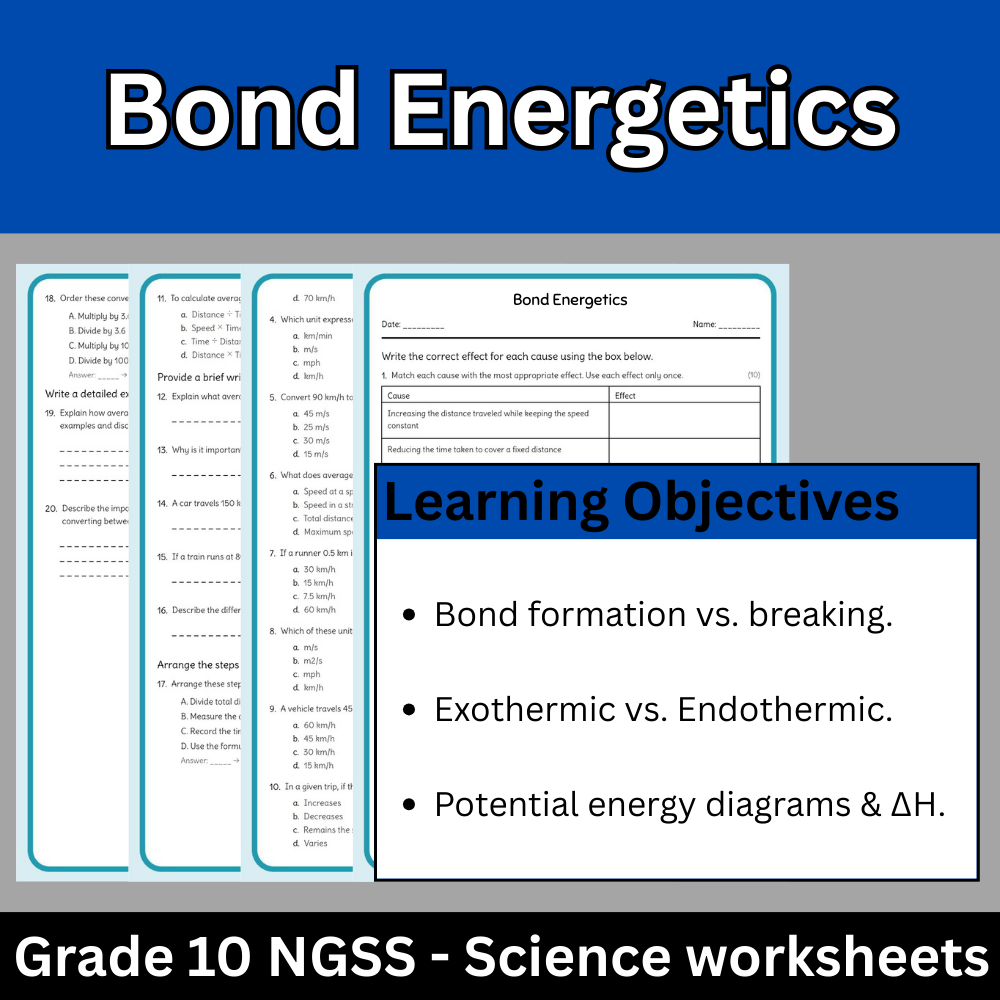
Grade 10 Science | Bond Energetics Worksheet (Answer Key) – NGSS Aligned
Created byBright Mind ResourcesLearning Objectives
- Explain how bond formation and breaking relate to energy changes in reactions.
- Distinguish between exothermic and endothermic processes based on bond energies.
- Interpret potential energy diagrams and bond enthalpy values in chemical reactions.
Instant download

Grade 10 Science | Bond Energetics Worksheet with Short Notes (Printable PDF)
 Created byMeadowlark Worksheets
Learning Objectives
- Understand how bond formation and breaking relate to energy changes in chemical reactions.
- Distinguish between exothermic and endothermic processes using bond energy models.
- Interpret potential energy diagrams and bond enthalpy values to analyze energy flow during reactions.
Also included in: Grade 10 Science – Matter and Its Interactions NGSS Unit Bundle (7 Worksheets) +1 more
Instant download

Bond Energetics Practice Worksheet | Grade 10 Science NGSS Review
Created byPrism Point LearningLearning Objectives
- Explain how bond breaking and bond formation are linked to energy changes during chemical reactions.
- Use bond enthalpy ideas and potential energy diagrams to distinguish exothermic and endothermic reactions.
- Relate combustion and hydrogen–oxygen formation to net bond energy and observed temperature/phase changes.
Also included in: Grade 10 Reaction Rates and Equilibrium Science Lesson Bundle NGSS
Instant download
Browse more categories
About Science Worksheets
Find Science worksheets spanning core skills, practice, and review. All 44,773 resources are instant PDF downloads for the classroom or home.
Every worksheet on MyTeachingSheets is created by independent teacher-authors and reviewed before publication. All resources download as printable PDFs for classroom, homework, or at-home practice, and many include answer keys. Preview any worksheet free before buying.