
Science Worksheets
45,024 subject resources
Grade 7 Science | Geologic Processes Worksheet | Florida NGSSS Aligned
 Created byLumora Learning
Learning Objectives
- Explain how tectonic activity, weathering, erosion, and deposition work together to shape Earth’s surface
- Identify how different agents (water, wind, ice, and gravity) transport weathered material
- Use evidence from landforms and rock layers to describe how landscapes can appear stable while still changing
Instant download

Geologic Processes Assessment | NGSSS Standards Grade 7 Science
 Created byPrism Point Learning
Learning Objectives
- Explain how tectonic activity, weathering, erosion, and deposition shape Earth’s surface.
- Identify how transporting agents and energy changes lead to deposition.
- Use geologic vocabulary (tectonic activity, weathering, erosion, deposition) to describe landform change over time.
Also included in: Grade 7 Earth and Climate Systems Science Lesson Bundle: Florida NGSSS
Instant download

Grade 3 Friction Effects Worksheet | NGSS Practice PDF
 Created byClear Sky Classroom
Learning Objectives
- Describe how friction affects the motion of objects
- Explain how surface roughness and material change the strength of friction
- Identify everyday examples where friction helps or slows movement
Instant download

Grade 2 Science | Material Suitability Worksheet with Short Notes (PDF)
 Created byMeadowlark Worksheets
Learning Objectives
- Compare the physical properties of different materials such as absorbency, waterproofing, flexibility, strength, and thermal conductance.
- Interpret simple data from experiments to determine which materials best meet design needs like holding liquids, resisting tearing, or insulating.
- Make evidence-based choices between materials based on observable measurements and physical properties.
Also included in: Grade 2 Science Unit | Matter and Its Interactions NGSS Worksheet Collection +1 more
Instant download
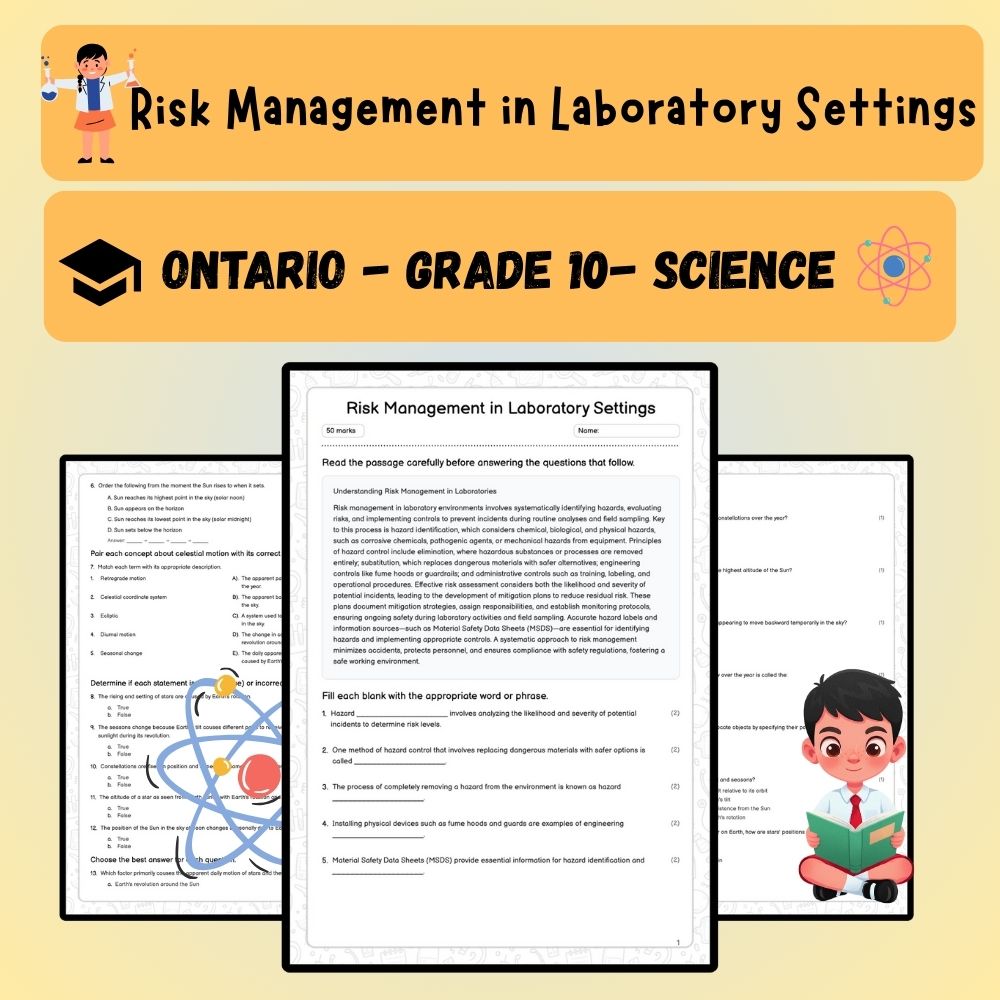
Grade 10 Science | Risk Management in Laboratory Settings Worksheet (Answer Key)
Created byPrism Point LearningLearning Objectives
- Understand the principles of hazard identification and risk assessment.
- Identify chemical, biological, and physical hazards in laboratory environments.
- Learn strategies for hazard elimination, substitution, and control measures.
Also included in: Grade 10 Science UNIT Bundle | Data Analysis, Safety & Modeling Worksheets +1 more
Instant download

Grade 10 Science | Risk Management in Laboratory Settings - Comprehension
 Created byCoral Reef Learning
Learning Objectives
- Identify chemical, biological, and physical hazards in laboratory environments.
- Understand principles of hazard elimination and substitution.
- Describe engineering controls and administrative procedures for risk mitigation.
Instant download
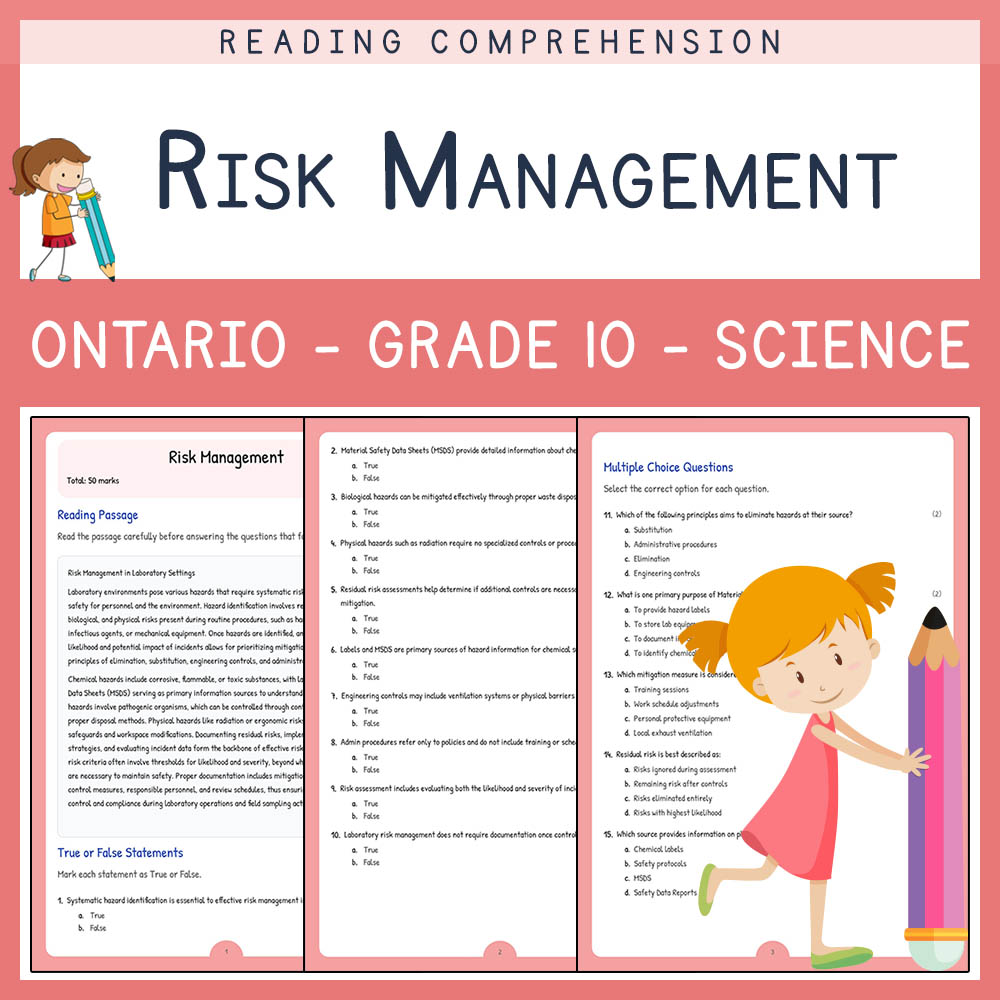
Grade 10 Science | Risk Management Worksheet | Ontario Standards
Created byLumora LearningLearning Objectives
- Understand systematic hazard identification and risk assessment methods in laboratory settings.
- Identify chemical, biological, and physical hazards and appropriate mitigation strategies.
- Explain principles of hazard elimination, substitution, engineering controls, and administrative procedures.
Instant download
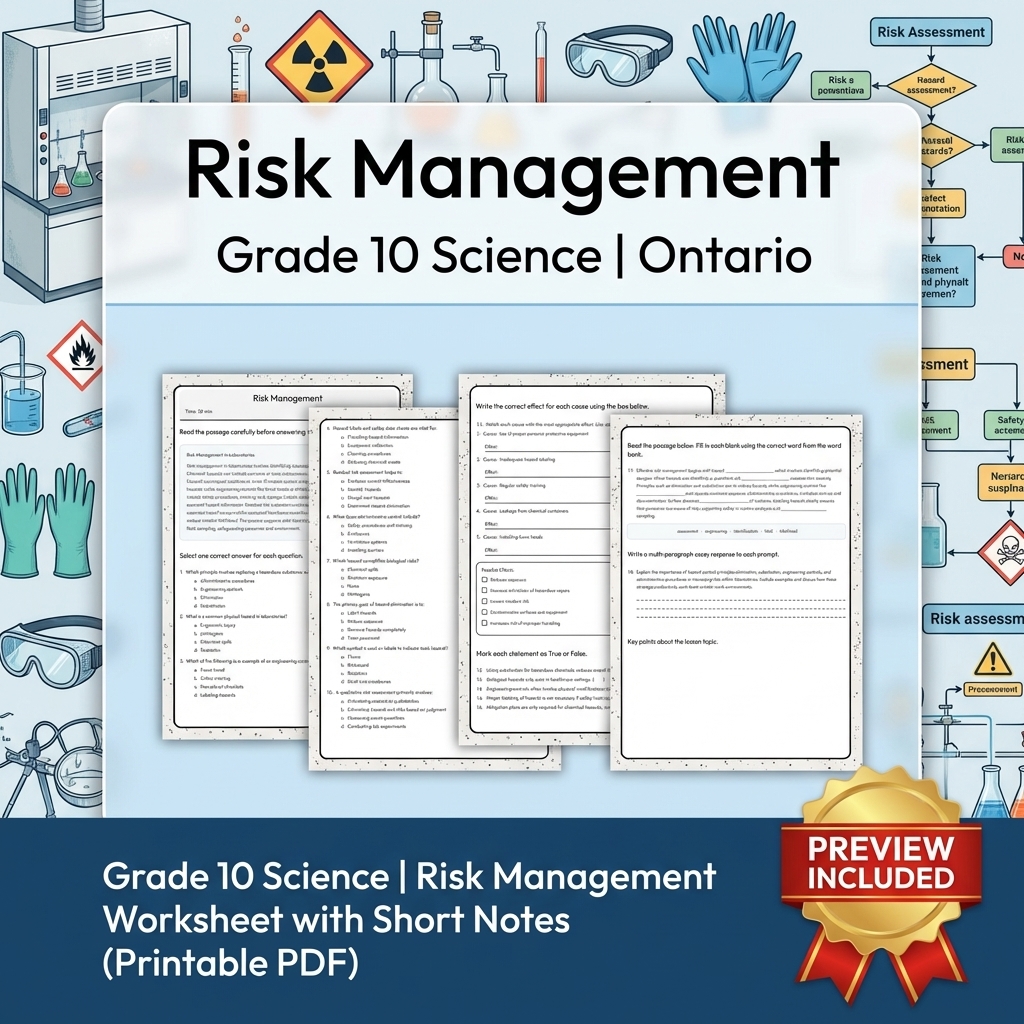
Grade 10 Science | Risk Management Worksheet with Short Notes (Printable PDF)
Created byMeadowlark WorksheetsLearning Objectives
- Understand systematic hazard identification processes in laboratory settings.
- Identify qualitative risk assessment techniques for chemical, biological, and physical hazards.
- Learn principles of hazard elimination, substitution, engineering controls, and administrative procedures.
Also included in: Grade 10 Science Lesson Group Bundle | Ontario Curriculum Worksheets +1 more
Instant download
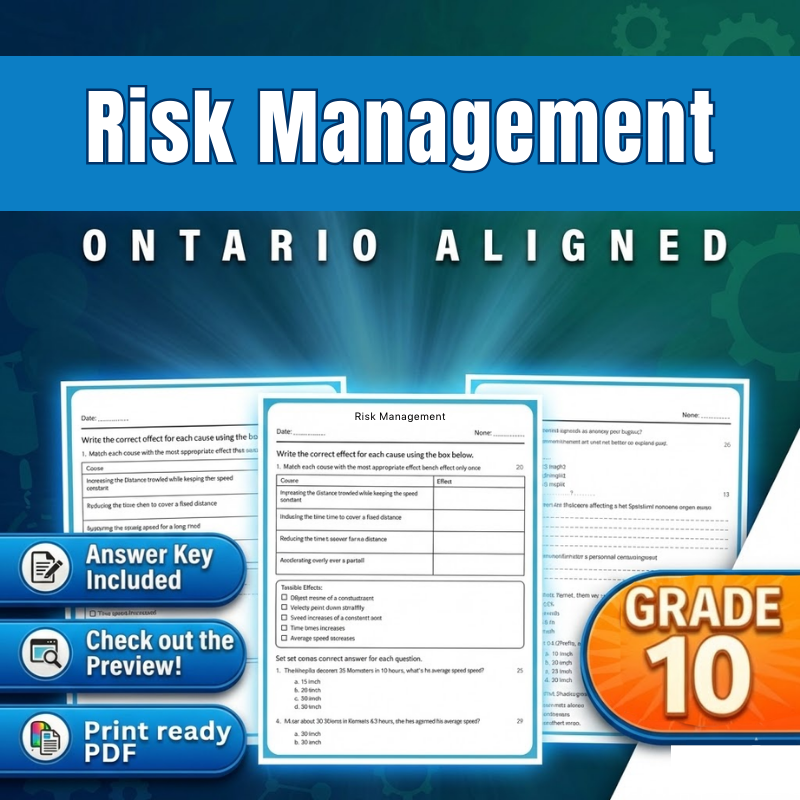
Grade 10 Science | Risk Management Worksheet (Ontario) (PDF)
 Created byBright Mind Resources
Learning Objectives
- Identify hazards systematically in laboratory settings and field sampling.
- Understand principles of hazard mitigation including elimination, substitution, engineering controls, and administrative procedures.
- Evaluate residual risks and document mitigation plans to improve safety during routine analyses and field activities.
Instant download

Grade 10 Science | Risk Management Worksheet (PDF + Answer Key)
 Created byCopper Leaf Classroom
Learning Objectives
- Understand systematic hazard identification techniques in laboratory settings.
- Apply principles of risk assessment including elimination, substitution, engineering controls, and administrative procedures.
- Identify and interpret hazard labels and information sources to evaluate risks.
Instant download

Laboratory Risk Management Worksheets: Residual Risk Grade 10 Science
Created byPrism Point LearningLearning Objectives
- Describe systematic steps for identifying laboratory and field hazards
- Evaluate qualitative risk using likelihood and consequence
- Explain how the hierarchy of controls reduces laboratory risk
Also included in: Grade 10 Science Worksheets Ontario Scientific Investigation Bundle
Instant download

Grade 10 Science Risk Management Laboratory Safety Worksheet Ontario
 Created byChalk and Compass
Learning Objectives
- Identify common hazards in chemical, biological, and physical laboratory settings using systematic observation.
- Apply qualitative risk assessment by estimating likelihood and consequence to prioritize controls.
- Select appropriate hazard-reduction measures using the hierarchy of elimination, substitution, engineering controls, and administrative procedures.
Also included in: Grade 10 Science Variables & Control Data Analysis Lesson Bundle | Ontario +1 more
Instant download

Grade 10 Science – Risk Management & Laboratory Safety | Daily Reading Worksheet
Created byBright Mind ResourcesLearning Objectives
- Identify chemical, biological, and physical hazards commonly found in laboratories.
- Understand systematic hazard identification and risk assessment methods.
- Learn principles of hazard control including elimination, substitution, engineering controls, and administrative procedures.
Also included in: Inquiry Grade 10 Science Daily Reading Worksheets Lesson Bundle | Ontario +1 more
Instant download

Risk Management in Laboratory and Field Sampling Worksheet | Grade 10
JCreated byJ.S SheetsLearning Objectives
- Identify hazards systematically in laboratory and field sampling workflows using credible sources (e.g., SDS, labels, and observations).
- Explain qualitative risk assessment using likelihood and consequence to rank hazards and decide controls.
- Apply the hierarchy of controls (elimination, substitution, engineering controls, administrative procedures) to reduce risk.
Instant download

Risk Management Worksheet | Grade 10 Science Practice & Review
Created byPrism Point LearningLearning Objectives
- Identify hazards in chemical, biological, and physical laboratory or field activities using a systematic approach.
- Use qualitative risk assessment to describe likelihood and consequence and to compare risk levels before and after controls.
- Apply the hazard-reduction hierarchy: elimination, substitution, engineering controls, and administrative procedures.
Also included in: Grade 10 Evidence-Based Science Data Analysis Lesson Bundle: Ontario
Instant download
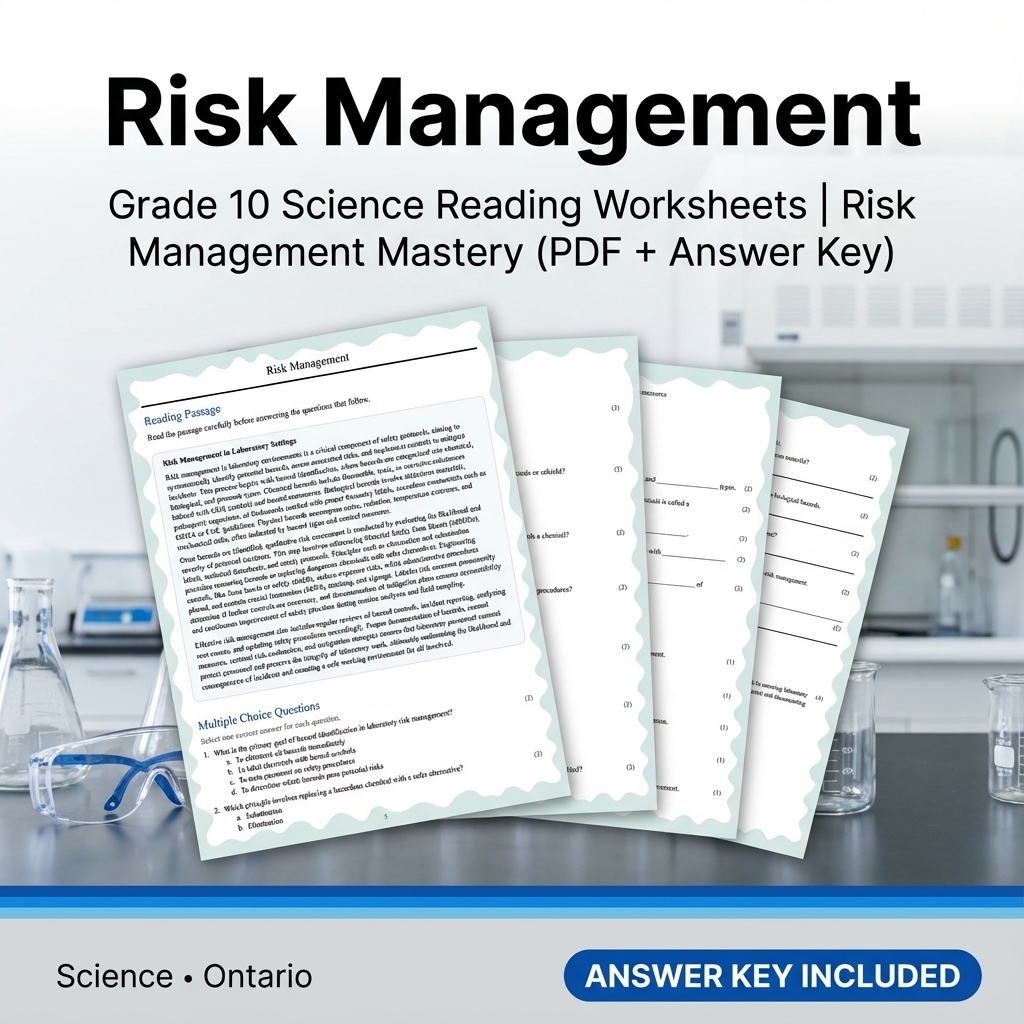
Grade 10 Science Reading Worksheets | Risk Management Mastery (PDF + Answer Key)
JCreated byJ.S SheetsLearning Objectives
- Understand the systematic process of hazard identification in laboratory settings.
- Explain the principles of risk assessment and mitigation to reduce incidents.
- Identify common chemical, biological, and physical hazards and their labels.
Also included in: Grade 10 Science UNIT Bundle – Data Representation, Safety & Research Skills +1 more
Instant download

Grade 10 Science | Risk Management Worksheet (Ontario) (PDF)
 Created byEvergreen Desk Education
Learning Objectives
- Identify hazards in laboratory and field sampling contexts using chemical, biological, and physical hazard examples.
- Apply qualitative risk assessment steps to estimate likelihood and consequence and support mitigation decisions.
- Explain how the hierarchy of controls (elimination, substitution, engineering, and administrative procedures) reduces risk.
Also included in: Grade 10 Scientific Inquiry & Data Reasoning Science Lesson Bundle: Ontario +1 more
Instant download

Grade 10 Risk Management in Laboratory Settings Daily Worksheet + Answer Key
JCreated byJ.S SheetsLearning Objectives
- Understand the principles of hazard identification and risk assessment
- Recognize chemical, biological, and physical hazards in labs
- Learn mitigation strategies such as elimination, substitution, engineering controls, and administrative procedures
Also included in: Grade 10 Science Lesson Bundle | Ontario Framework Reading Worksheets +1 more
Instant download

Grade 10 Science – Risk Management & Laboratory Safety | Daily Reading Worksheet
 Created byQuiet Forest Education
Learning Objectives
- Identify different types of hazards present in laboratory environments.
- Understand principles of hazard elimination, substitution, engineering controls, and administrative procedures.
- Evaluate residual risks and discuss mitigation strategies to ensure safety during laboratory operations.
Also included in: Scientific Investigation Grade 10 Science Daily Worksheets Bundle | Ontario +1 more
Instant download
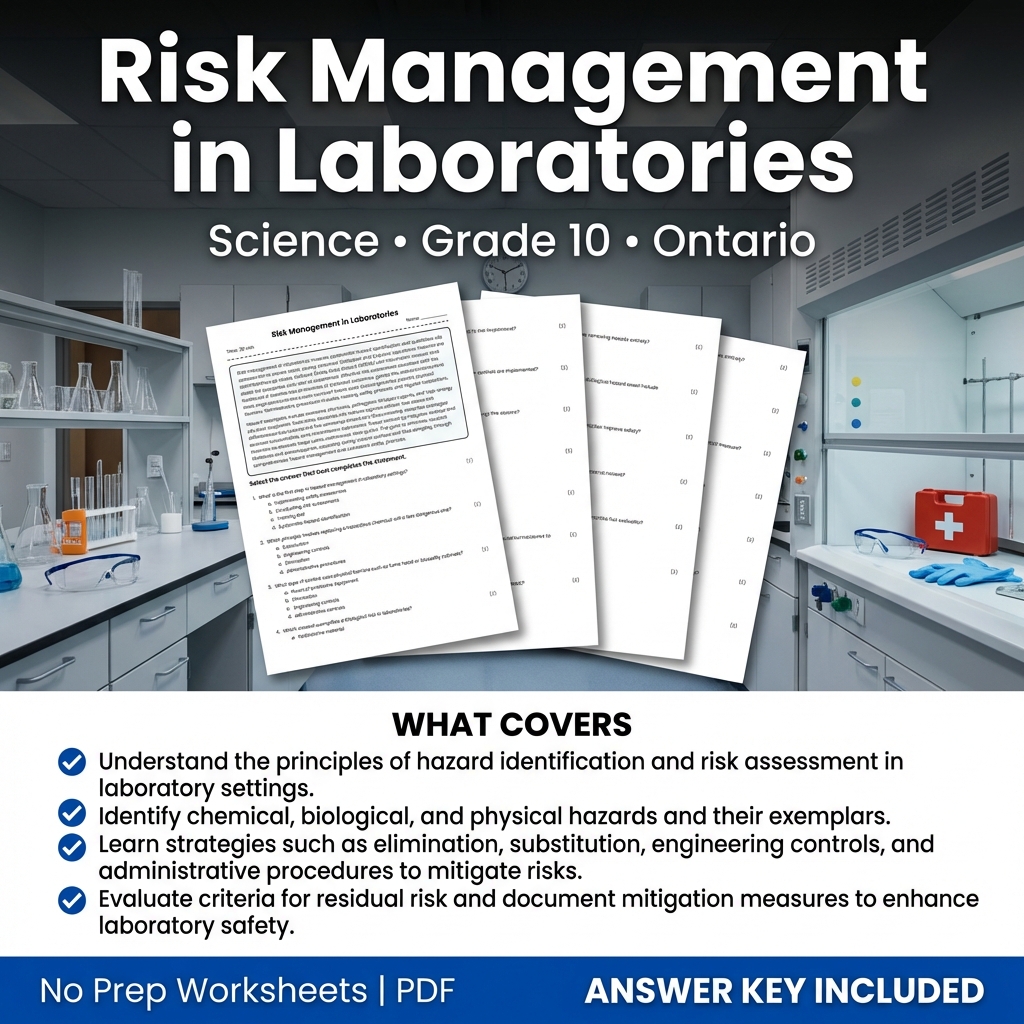
Risk Management in Laboratories Worksheet for Grade 10 Science – Ontario
Created byCoral Reef LearningLearning Objectives
- Understand the principles of hazard identification and risk assessment in laboratory settings.
- Identify chemical, biological, and physical hazards and their exemplars.
- Learn strategies such as elimination, substitution, engineering controls, and administrative procedures to mitigate risks.
Instant download

Grade 12 Science – Genomic Technologies & DNA Structure | Reading Worksheet
Created byBright Mind ResourcesLearning Objectives
- Understand the structure and components of DNA.
- Explain the principles of DNA replication and double helix structure.
- Identify key genomic technologies such as PCR, DNA sequencing, and CRISPR.
Also included in: Biological Concepts Grade 12 Science Daily Reading Lesson Bundle | TEKS +2 more
Instant download

Grade 12 Science | Genomic Technologies Worksheet | TEKS Alignment
Created byLumora LearningLearning Objectives
- Describe fundamental molecular techniques used in analyzing and manipulating genetic material.
- Explain the mechanisms underlying PCR, DNA sequencing, recombinant DNA, and CRISPR–Cas systems.
- Identify applications of genomic technologies in diagnostics, trait modification, and ethical considerations.
Also included in: Grade 12 Science | Biological Concepts Lesson Bundle | TEKS Aligned
Instant download

Genomic Technologies Worksheet | Grade 12 Science Practice
Created byPrism Point LearningLearning Objectives
- Explain how PCR, DNA sequencing, cloning, and CRISPR–Cas editing are used to analyze and modify genetic material
- Interpret genomic data by linking sequencing errors, SNPs, and copy number variation to inheritance and diagnosis
- Evaluate ethical considerations and limitations when using genomic technologies
Also included in: Population Genetics & Evolution Lesson Bundle: Grade 12 Science TEKS
Instant download

Grade 12 Science | Genomic Technologies - Daily Reading Comprehension
Created byCoral Reef LearningLearning Objectives
- Understand the basic molecular techniques used in genetics such as PCR, DNA sequencing, and recombinant DNA.
- Learn the mechanisms behind amplification and readout technologies.
- Identify different cloning vectors and their applications.
Also included in: Grade 12 Science Daily Reading Worksheets Full-Year Bundle | TEKS
Instant download

Grade 12 Science – Genomic Technologies Daily Reading Worksheet + Answer Key
JCreated byJ.S SheetsLearning Objectives
- Understand the basic structure and function of DNA.
- Learn about molecular techniques such as PCR, DNA sequencing, and recombinant DNA methods.
- Explore genome editing tools including CRISPR–Cas systems.
Also included in: Grade 12 Science Lesson Group Bundle – TEKS Standards-Based Worksheets +1 more
Instant download

Grade 12 Science | Genomic Technologies Worksheet (PDF) aligned to TEKS
Created byEvergreen Desk EducationLearning Objectives
- Explain how PCR amplification, DNA sequencing, recombinant DNA cloning, and CRISPR–Cas editing work mechanistically
- Interpret genomic data concepts such as SNPs, copy number variation, and sequencing errors
- Evaluate ethical considerations and limits of genomic inference in real-world applications
Instant download
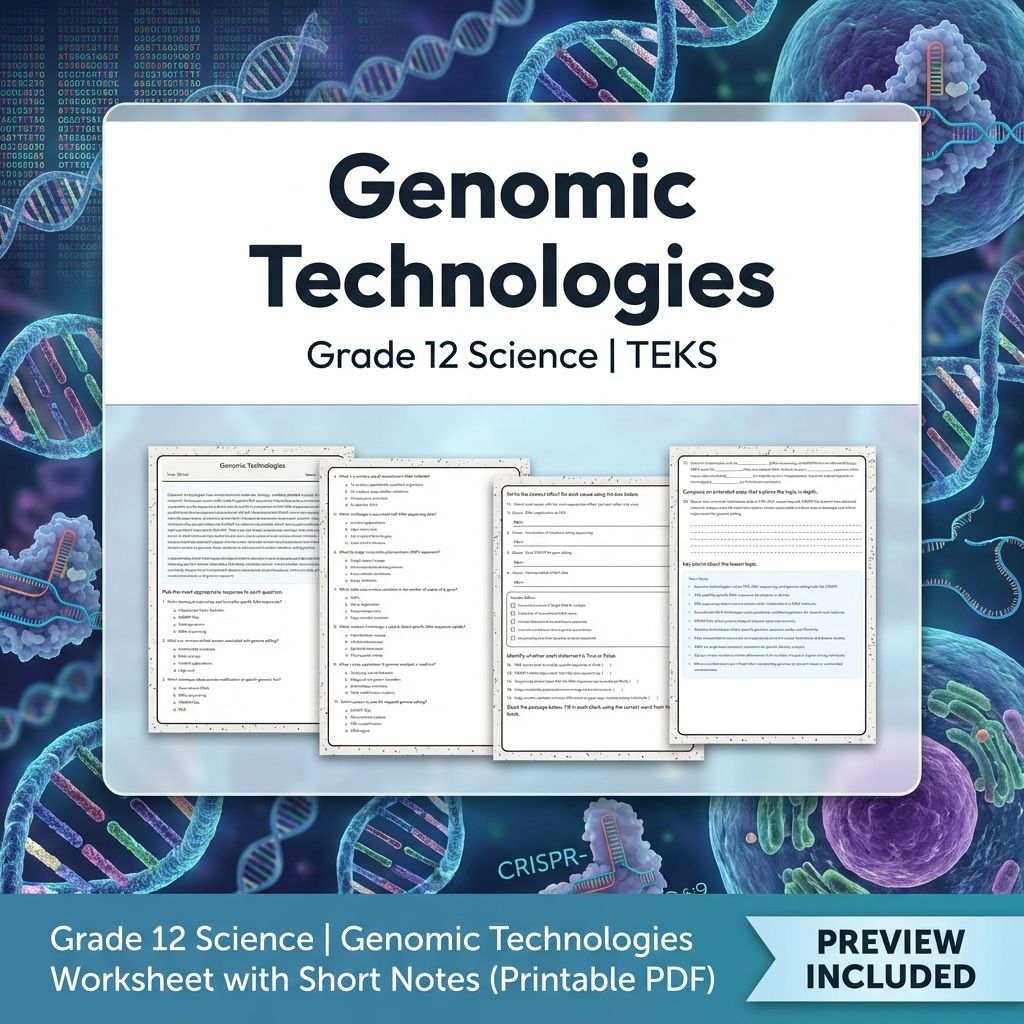
Grade 12 Science | Genomic Technologies Worksheet with Short Notes (PDF)
Created byMeadowlark WorksheetsLearning Objectives
- Understand various molecular techniques used in genomics, including PCR, DNA sequencing, and genome editing.
- Explore applications of genomic technologies in diagnostics, research, and trait modification.
- Identify data interpretation issues like sequencing errors, SNPs, and copy number variations.
Also included in: Grade 12 Science Unit Bundle | Genetics, Evolution & Cell Biology Worksheets +2 more
Instant download
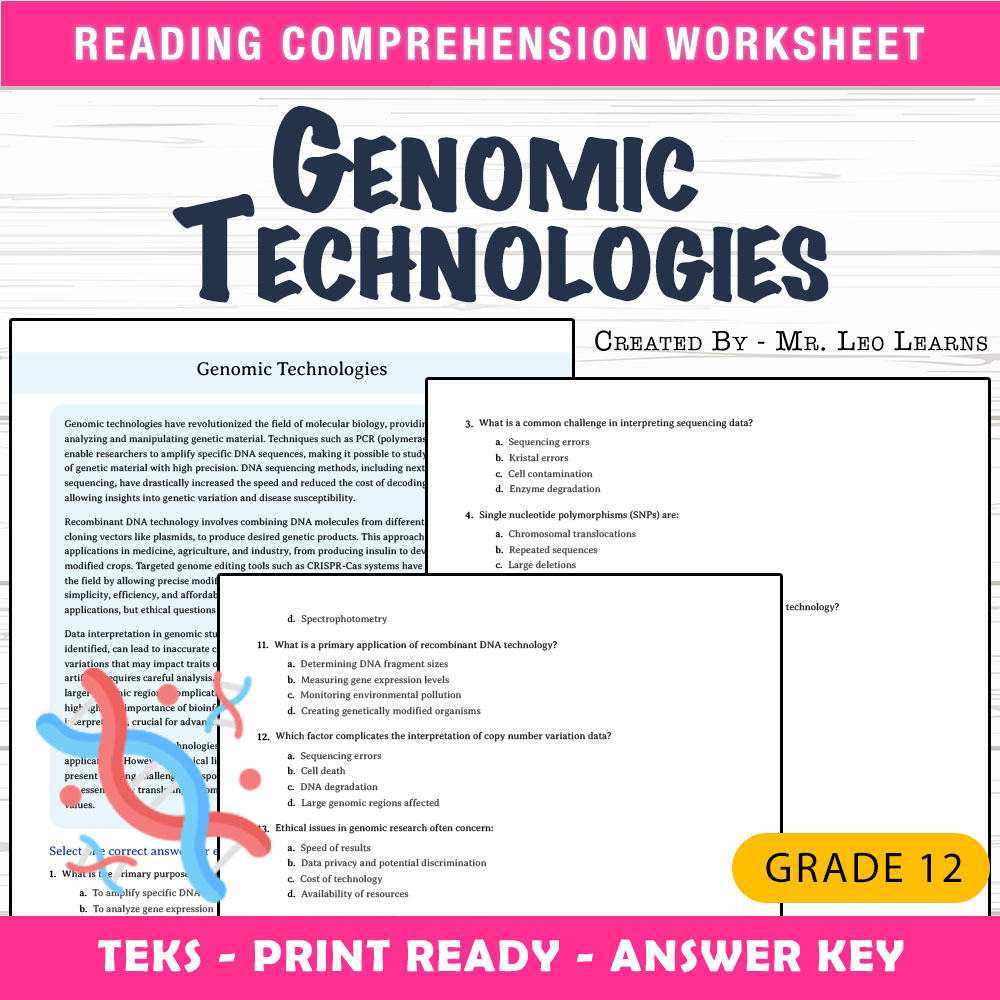
Grade 12 Science — Genomic Technologies Worksheet for Mastery
 Created byThe Resource Hub
Learning Objectives
- Understand key molecular techniques used in genomic analysis.
- Describe applications of recombinant DNA and genome editing methods.
- Identify data interpretation issues in genomic studies.
Also included in: Grade 12 Science Worksheet Bundle – Genetics, Evolution & Biodiversity Mastery +1 more
Instant download

Genomic Technologies Assessment | TEKS Grade 12 Science Standards
Created byPrism Point LearningLearning Objectives
- Describe the main molecular techniques used in genomic analysis, including PCR, DNA sequencing, and CRISPR-Cas systems.
- Explain the mechanistic basis of amplification, readout technologies, and genome editing methods.
- Identify applications of genomic technologies in diagnostics, trait modification, and ethical considerations.
Also included in: Grade 12 Genetics and Evolution Science Lesson Bundle Unit | TEKS
Instant download
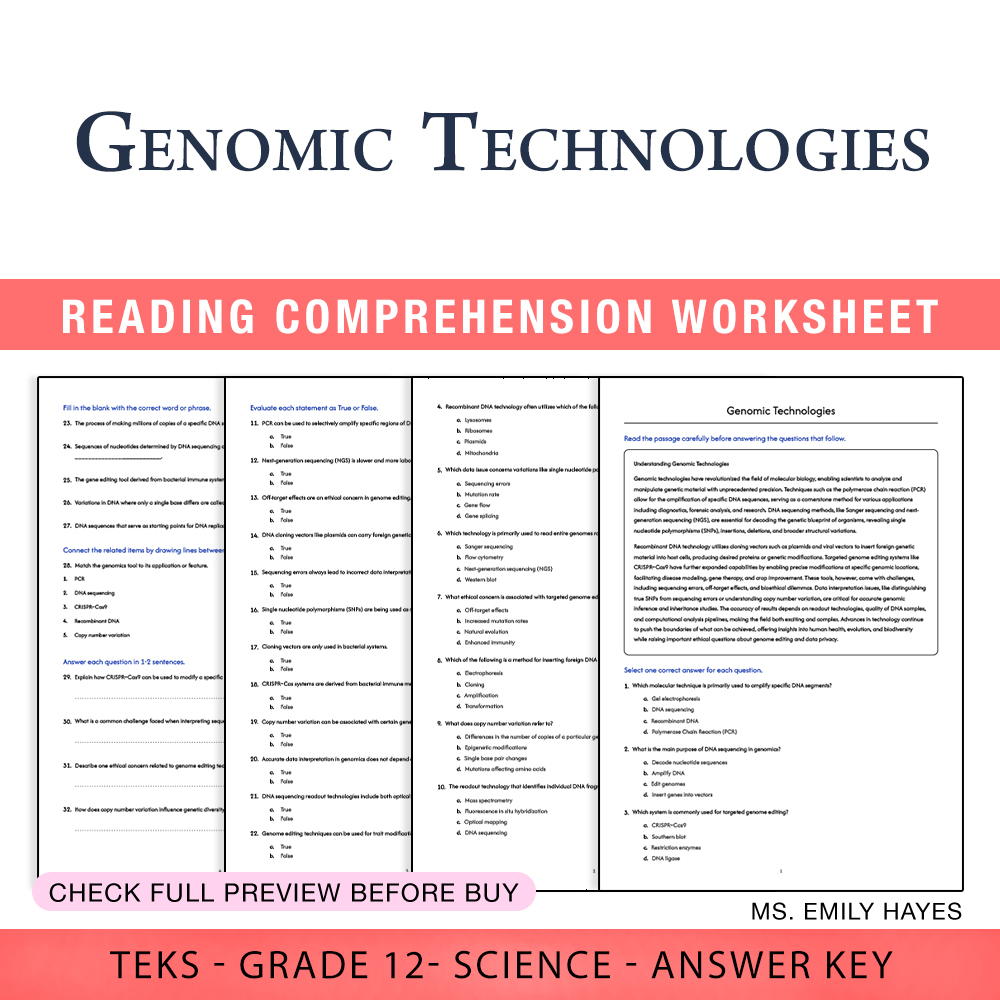
12th Grade Science | Genomic Technologies Worksheet (PDF+ Answer Key)
Created byCopper Leaf ClassroomLearning Objectives
- Understand the mechanistic basis of key genomic techniques such as PCR, DNA sequencing, and CRISPR-Cas systems.
- Identify applications of molecular tools in diagnostics, trait modification, and ethical considerations.
- Recognize challenges and data interpretation issues related to sequencing errors, SNPs, and copy number variations.
Instant download
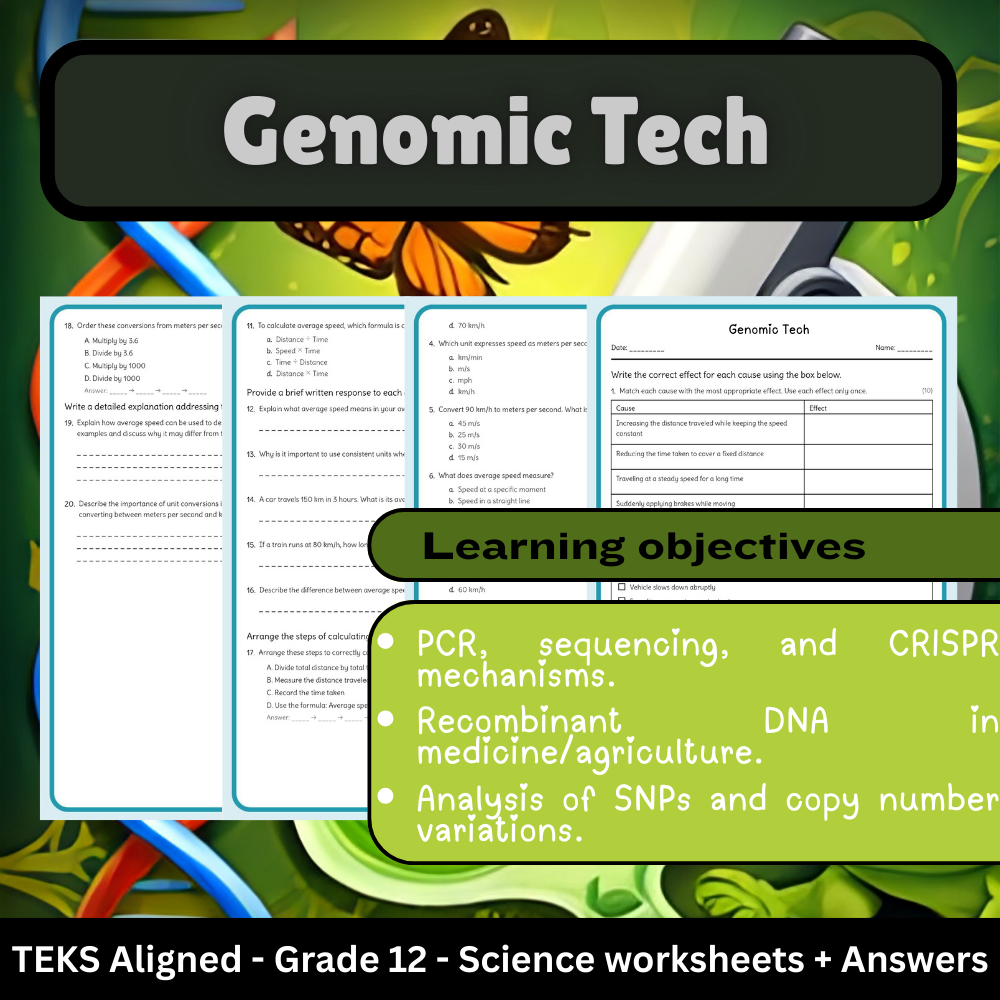
12th Grade Science | Genomic Technologies Worksheet – TEKS Aligned (PDF)
Created byBright Mind ResourcesLearning Objectives
- Explain the mechanisms of PCR, DNA sequencing, and genome editing techniques.
- Identify applications of recombinant DNA and CRISPR-Cas systems in medicine and agriculture.
- Interpret data related to sequencing errors, SNPs, and copy number variations for genomic analysis.
Instant download

Genomic Technologies Worksheet | Science Assessment for Grade 12 | TEKS
JCreated byJ.S SheetsLearning Objectives
- Explain how PCR amplifies specific DNA regions and why primer design and contamination control matter.
- Describe how sequencing readouts support variant calling, including SNPs and CNV, and identify common sources of interpretation error.
- Compare recombinant DNA cloning and CRISPR–Cas targeted genome editing in terms of mechanisms and applications.
Instant download

Molecular Structure Worksheet | Assessment for Grade 8 Science Printable PDF
Learning Objectives
- Describe the atomic composition of simple molecules using particle models and formulas.
- Represent atoms, element symbols, and bonding arrangements in common molecules.
- Distinguish between discrete molecules and extended solids through structural models.
Also included in: Grade 8 Science Lesson Bundle on Matter and Its Interactions NGSS +1 more
Instant download
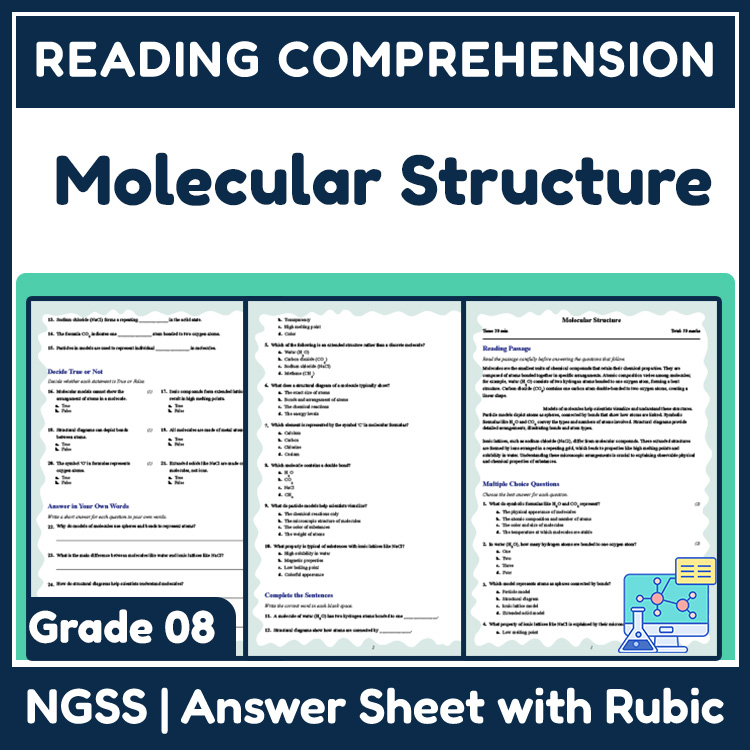
8th Grade Science | Molecular Structure Reading Worksheet (Answer Key)
JCreated byJ.S SheetsLearning Objectives
- Understand the atomic composition of simple molecules such as water (H2O) and carbon dioxide (CO2).
- Learn how to represent molecules using particle models and symbolic formulas.
- Distinguish between discrete molecular units and extended solids like ionic lattices.
Instant download

Grade 8 Molecular Structure Worksheet | NGSS Practice PDF
Created byClear Sky ClassroomLearning Objectives
- Describe the atomic composition and bonding arrangements in simple molecules like water and carbon dioxide.
- Explain how particle models and symbolic formulas represent molecular structures.
- Distinguish between discrete molecules and extended solids such as ionic lattices.
Also included in: Grade 8 Conservation of Matter Science Lesson Bundle | NGSS +1 more
Instant download

8th Grade Science | Molecular Structure Worksheet with Answer Key (Printable PDF)
Created byCoral Reef LearningLearning Objectives
- Describe how atoms combine to form simple molecules using particle models and formulas.
- Identify different types of bonds and how they influence molecular structures.
- Interpret molecular diagrams and formulas to understand atom types and arrangements.
Instant download

Molecular Structure Worksheet | NGSS Grade 8 Science Assessment
 Created bySkylark Worksheets
Learning Objectives
- Use particle models and symbolic formulas to represent the types and numbers of atoms in simple molecules (e.g., H2O, CO2).
- Differentiate discrete molecular units from extended ionic solids using particle model ideas and element/ion symbols (e.g., NaCl).
- Explain how bonding arrangements affect observable properties such as melting point and behavior of substances.
Also included in: Matter and Its Interactions Lesson Bundle | Grade 8 Science | NGSS +1 more
Instant download
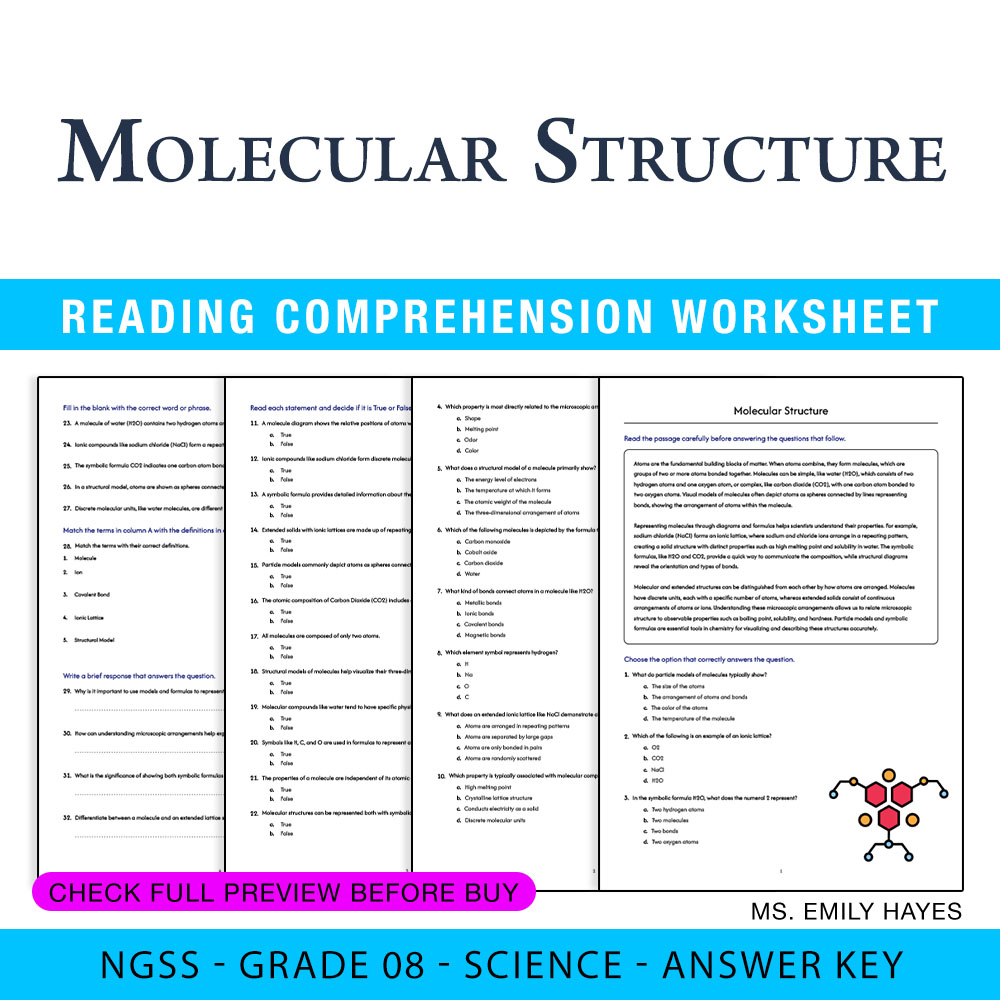
8th Grade Science | Molecular Structure Worksheet (PDF+ Answer Key)
Created byCopper Leaf ClassroomLearning Objectives
- Describe the atomic composition of simple molecules and extended structures using particle models and symbolic formulas.
- Understand how to represent atoms, element symbols, and bonding arrangements in common examples such as water (H2O), carbon dioxide (CO2), and ionic lattices like sodium chloride.
- Explain how molecule diagrams and structural models convey the relative atom types and numbers.
Instant download

Molecular Structure and Particle Models Worksheet | Grade 8 Science
 Created bythe curious pencil
Learning Objectives
- Identify atoms and elements represented in simple molecular formulas
- Interpret subscripts and formulas using particle models
- Distinguish discrete molecules from extended ionic lattice structures
Also included in: Matter and Its Interactions Grade 8 Science Worksheets NGSS Bundle +2 more
Instant download

Grade 8 Science | Molecular Structure Worksheet with Short Notes (PDF)
Created byMeadowlark WorksheetsLearning Objectives
- Understand the atomic composition of simple molecules using particle models and formulas.
- Interpret structural diagrams and symbolic formulas of molecules like H2O, CO2, and NaCl.
- Distinguish between molecular units and extended solids based on microscopic arrangements.
Also included in: Grade 8 Science | Matter and Its Interactions NGSS Unit Bundle – Worksheets +1 more
Instant download
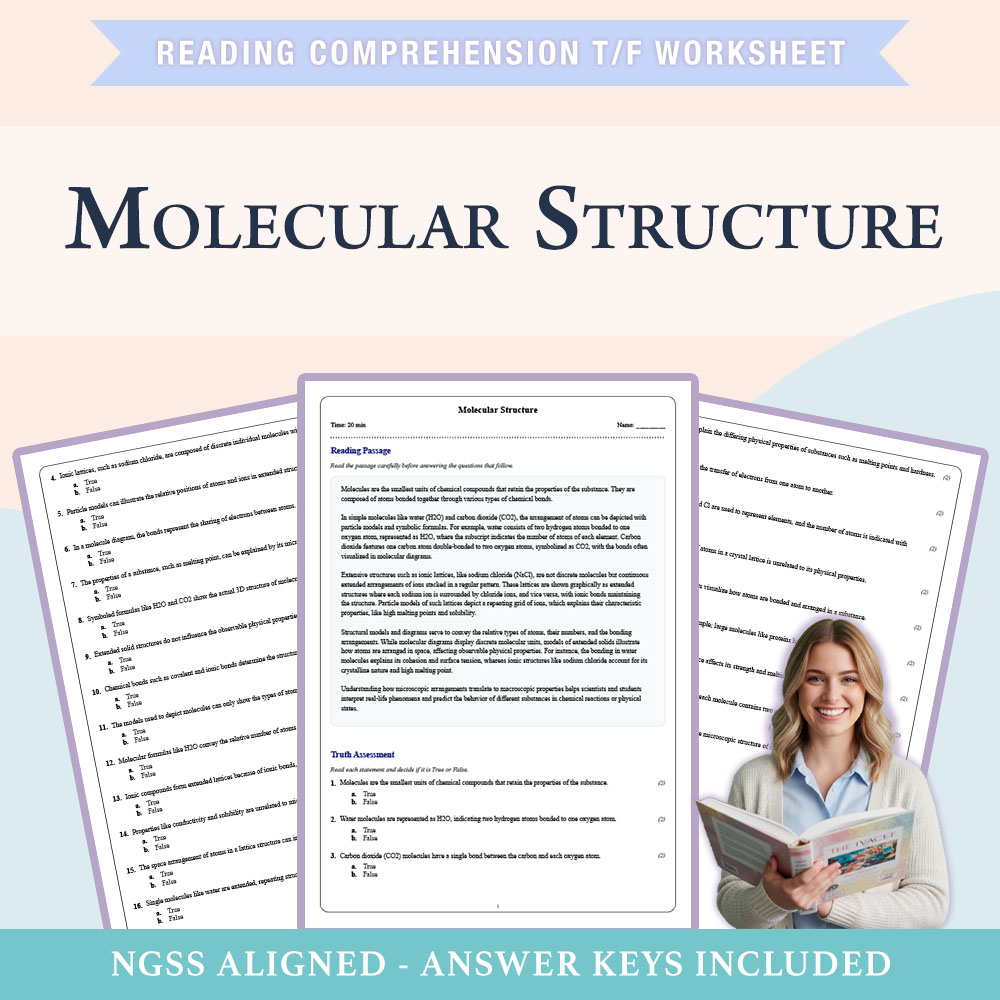
Grade 8 Science | Molecular Structure Worksheet (PDF + Answer Key)
Created byCopper Leaf ClassroomLearning Objectives
- Understand the atomic composition of simple molecules and extended structures.
- Interpret particle models and symbolic formulas of molecules.
- Distinguish between molecular units and extended solids based on microscopic arrangements.
Also included in: Grade 8 Science Bundle| Critical Concepts & Applications Unit (PDF + Answer Key) +1 more
Instant download

Grade 8 Molecular Structure Worksheet | NGSS Atoms & Molecules Activity
 Created byBRIGHT PATH RESOURCES
Learning Objectives
- Identify and describe atoms in simple molecules using particle models and symbolic formulas.
- Understand how molecules like water (H2O) and carbon dioxide (CO2) are represented diagrammatically.
- Differentiate between discrete molecules and extended structures like ionic lattices.
Also included in: Reactions & Matter Grade 8 Science Daily Reading Worksheets Lesson Bundle | NGSS +2 more
Instant download

Molecular Structure Worksheet | NGSS Grade 8 Science Assessment
 Created byCedar Grove Learning
Learning Objectives
- Describe how atoms combine to form molecules using particle models and symbolic formulas.
- Identify the types and numbers of atoms in common molecules such as H2O and CO2.
- Interpret molecular diagrams and structural models to understand bonding arrangements.
Instant download
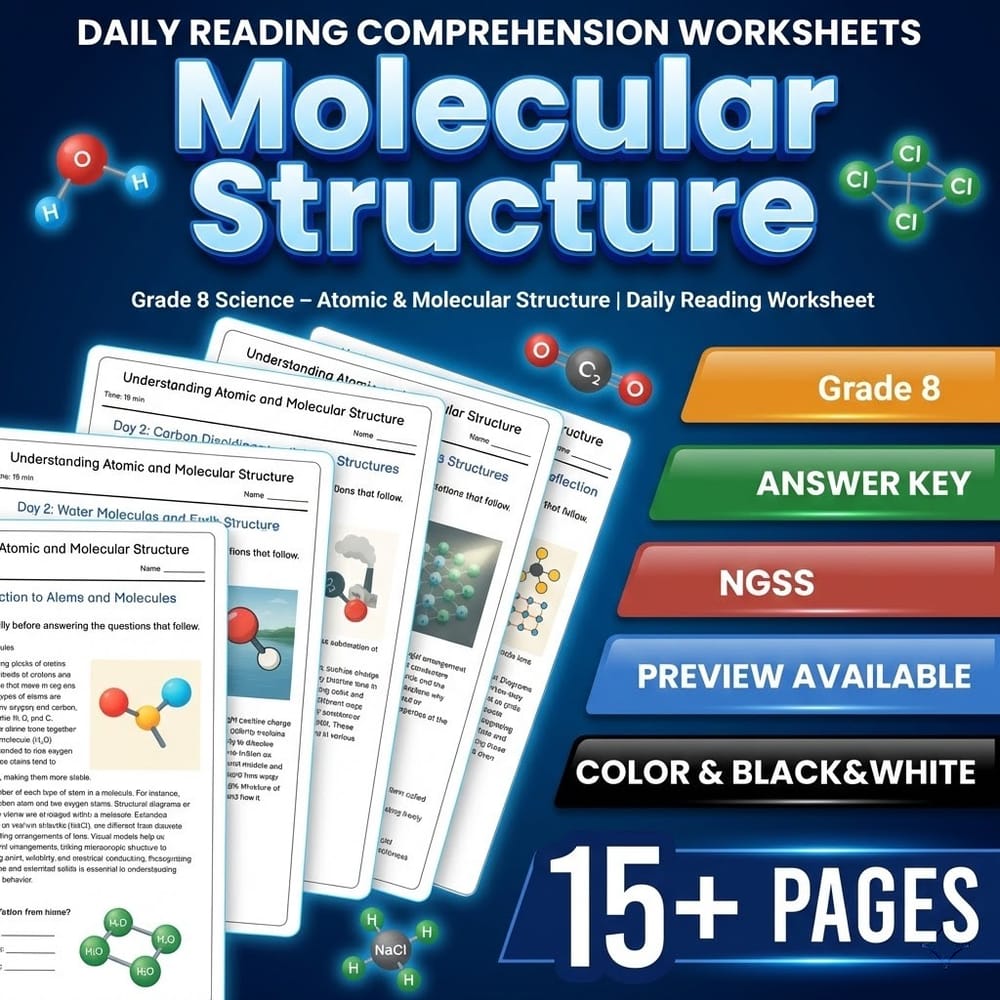
Grade 8 Science – Atomic & Molecular Structure | Daily Reading Worksheet
 Created byElena Brooks
Learning Objectives
- Identify atoms and molecules using particle models and symbols.
- Understand how atoms combine to form molecules.
- Interpret molecular formulas and structural representations.
Instant download

Grade 8 Science | Molecular Structures - Daily Reading Comprehension
Created byCoral Reef LearningLearning Objectives
- Identify different atoms in simple molecules.
- Understand how atoms bond to form molecules such as water and carbon dioxide.
- Represent molecules using particle models and symbolic formulas.
Instant download

Molecular Structure Assessment | NGSS Standards-Aligned Grade 8 Science
Created byPrism Point LearningLearning Objectives
- Explain the atomic composition of simple molecules and their extended structures using particle models.
- Identify elements and interpret symbolic formulas of molecules such as H2O and CO2.
- Understand how molecular diagrams and models convey atom types, numbers, and bonding arrangements.
Also included in: Grade 8 Science Mini Bundle | Matter and Its Interactions NGSS Not specified +1 more
Instant download
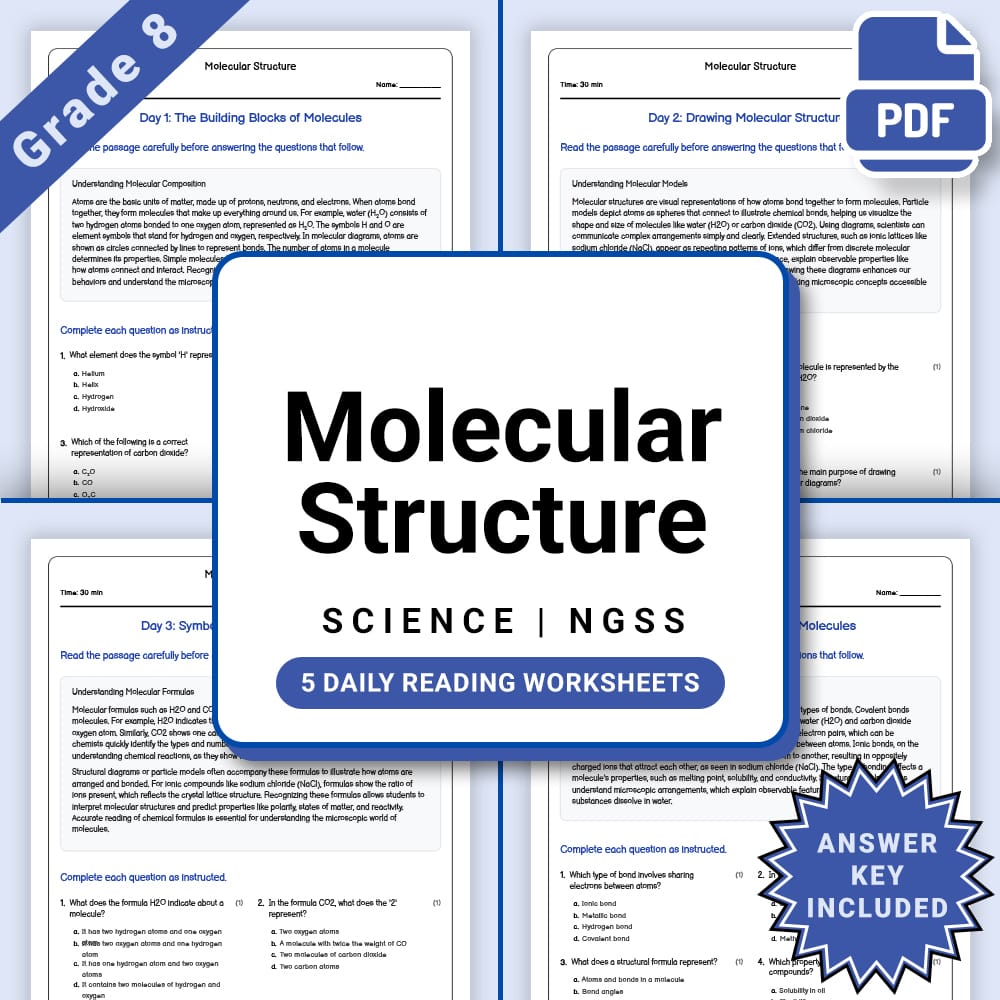
Grade 8 Science – Molecular Structure Daily Reading Worksheet(PDF + Answer Key)
Created byCopper Leaf ClassroomLearning Objectives
- Understand basic atomic composition of simple molecules
- Identify element symbols and how atoms combine
- Learn to interpret particle models and symbolic formulas
Instant download

Molecular Structure Test Prep Worksheet | Grade 8 Science NGSS
Created byPrism Point LearningLearning Objectives
- Use particle models and symbolic formulas to represent atoms in simple molecules and in ionic solids.
- Identify how molecule diagrams show relative atom types and numbers for compounds like H2O and CO2.
- Distinguish discrete molecular units from extended ionic lattices and relate structure to observable properties.
Also included in: Grade 8 Matter & Chemical Reactions Science Lesson Bundle (NGSS)
Instant download
Browse more categories
About Science Worksheets
Find Science worksheets spanning core skills, practice, and review. All 45,024 resources are instant PDF downloads for the classroom or home.
Every worksheet on MyTeachingSheets is created by independent teacher-authors and reviewed before publication. All resources download as printable PDFs for classroom, homework, or at-home practice, and many include answer keys. Preview any worksheet free before buying.