
Science Worksheets
45,024 subject resources
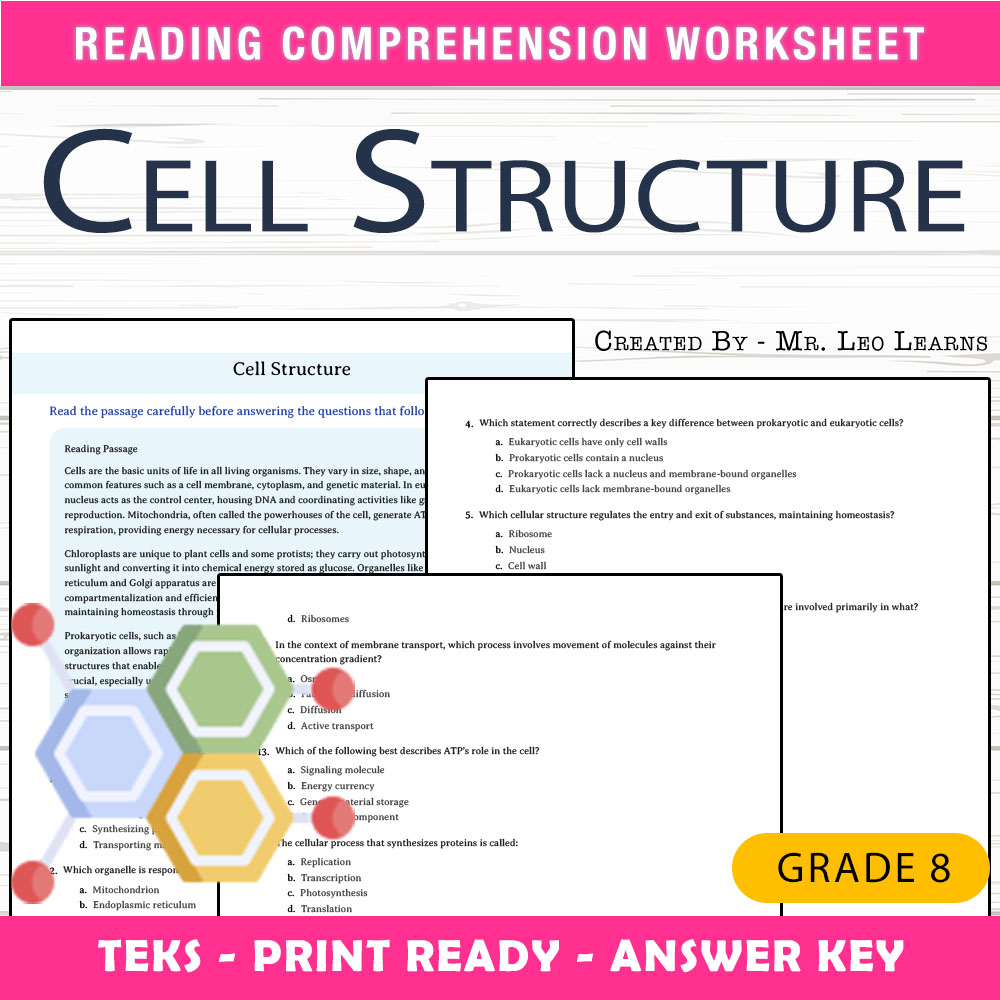
Cell Structure Worksheet | Standards-Aligned Grade 8 Science Practice
JCreated byJ.S SheetsLearning Objectives
- Describe the roles of the cell membrane, cytoplasm, nucleus, mitochondria, and chloroplast in maintaining cell function and homeostasis
- Explain how compartmentalization helps organize chemical reactions inside cells
- Compare prokaryotic and eukaryotic cell structure and identify key similarities and differences
Instant download
Grade 8 Science – Cell Structure Worksheet for Mastery | PDF + Answer Key
 Created byThe Resource Hub
Learning Objectives
- Describe the organization of cellular components such as membranes, cytoplasm, and organelles.
- Explain the roles of nucleus, mitochondria, chloroplasts, and other organelles in maintaining cell function and homeostasis.
- Understand the relationship between membrane transport, compartmentalization, and cellular activity.
Also included in: Grade 8 Science Unit | Ecosystems, Evolution & Cell Processes Worksheet Pack +1 more
Instant download

Grade 8 Science Cell Structure Worksheet (TEKS) | PDF
 Created byEvergreen Desk Education
Learning Objectives
- Explain how membrane-bound compartments and cytoplasm support cell functions and homeostasis.
- Describe the roles of the nucleus, mitochondria, and chloroplasts in maintaining cellular activity.
- Compare prokaryotic and eukaryotic cell organization and relate the differences to observable structures.
Instant download
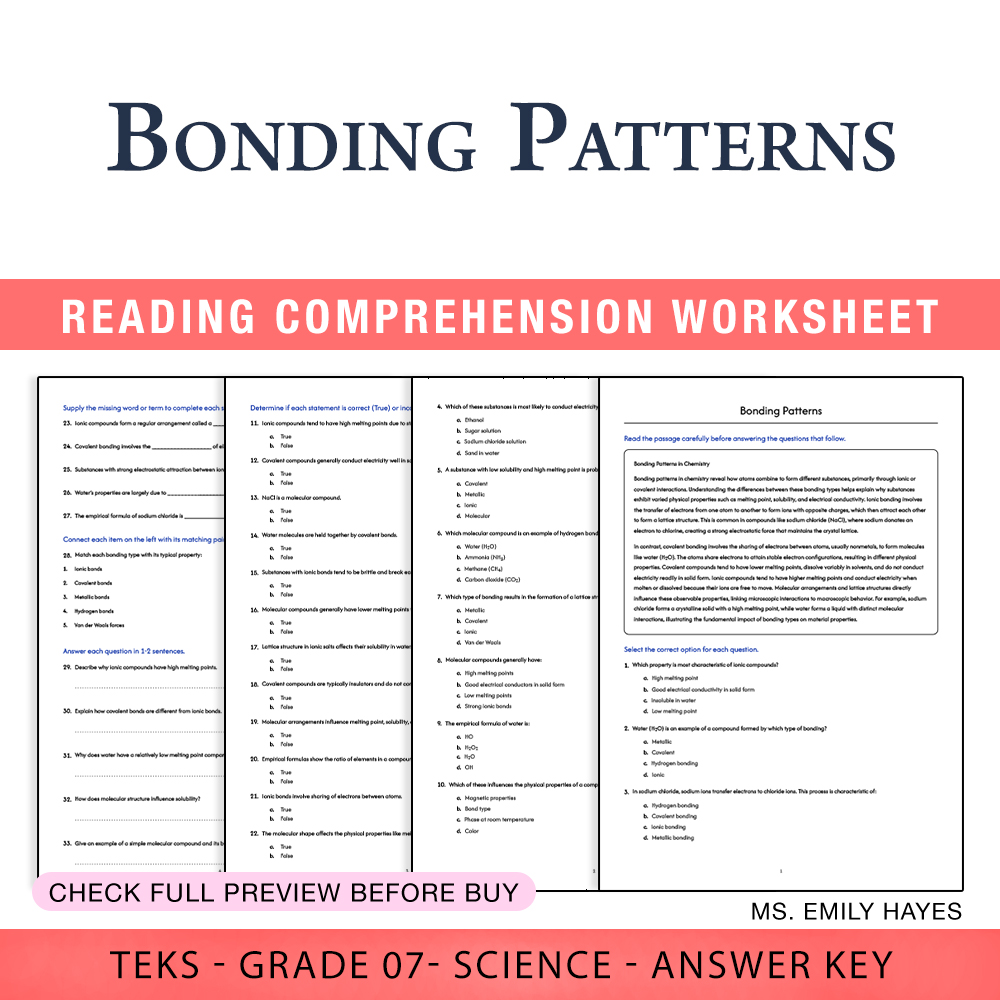
7th Grade Science | Bonding Patterns Worksheet (PDF+ Answer Key)
 Created byCopper Leaf Classroom
Learning Objectives
- Distinguish between ionic and covalent bonding based on properties and formation.
- Relate bonding types to macroscopic properties such as melting point, solubility, and electrical conductivity.
- Describe the formation of simple binary ionic salts and molecular compounds using empirical formulas.
Instant download
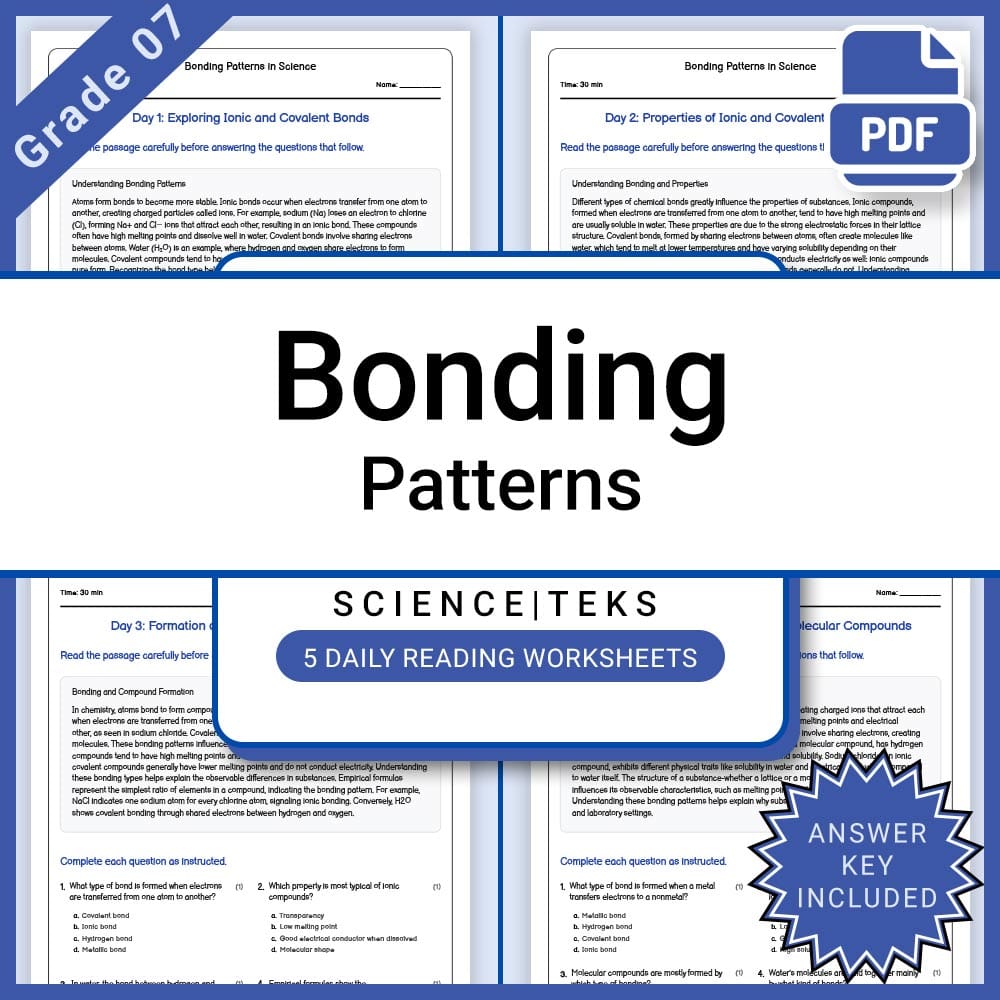
Grade 7 Science – Bonding Patterns Daily Reading Worksheet + Answer Key
JCreated byJ.S SheetsLearning Objectives
- Understand key concepts related to Science
- Apply knowledge through practice questions
- Demonstrate comprehension of the material
Also included in: Grade 7 Science Lesson Group: TEKS-Aligned Daily Reading Worksheets +1 more
Instant download

Bonding Patterns Worksheet for Grade 7 Science | Standards-Aligned Practice
JCreated byJ.S SheetsLearning Objectives
- Distinguish ionic and covalent bonding using particle-level evidence (ions vs. electron sharing).
- Relate bonding type to macroscopic properties such as melting point, solubility, and electrical conductivity.
- Use empirical formula ideas to explain simple formation of binary ionic salts and molecular compounds.
Instant download

Bonding Patterns Assessment | TEKS Standards-Aligned Grade 7 Science
 Created byPrism Point Learning
Learning Objectives
- Distinguish between ionic and covalent bonding based on observed properties.
- Relate bonding types to macroscopic properties such as melting point, solubility, and electrical conductivity.
- Describe the formation of binary ionic salts and molecular compounds using empirical formulas.
Also included in: Grade 7 Matter and Energy Science Lesson Bundle: TEKS assessments
Instant download
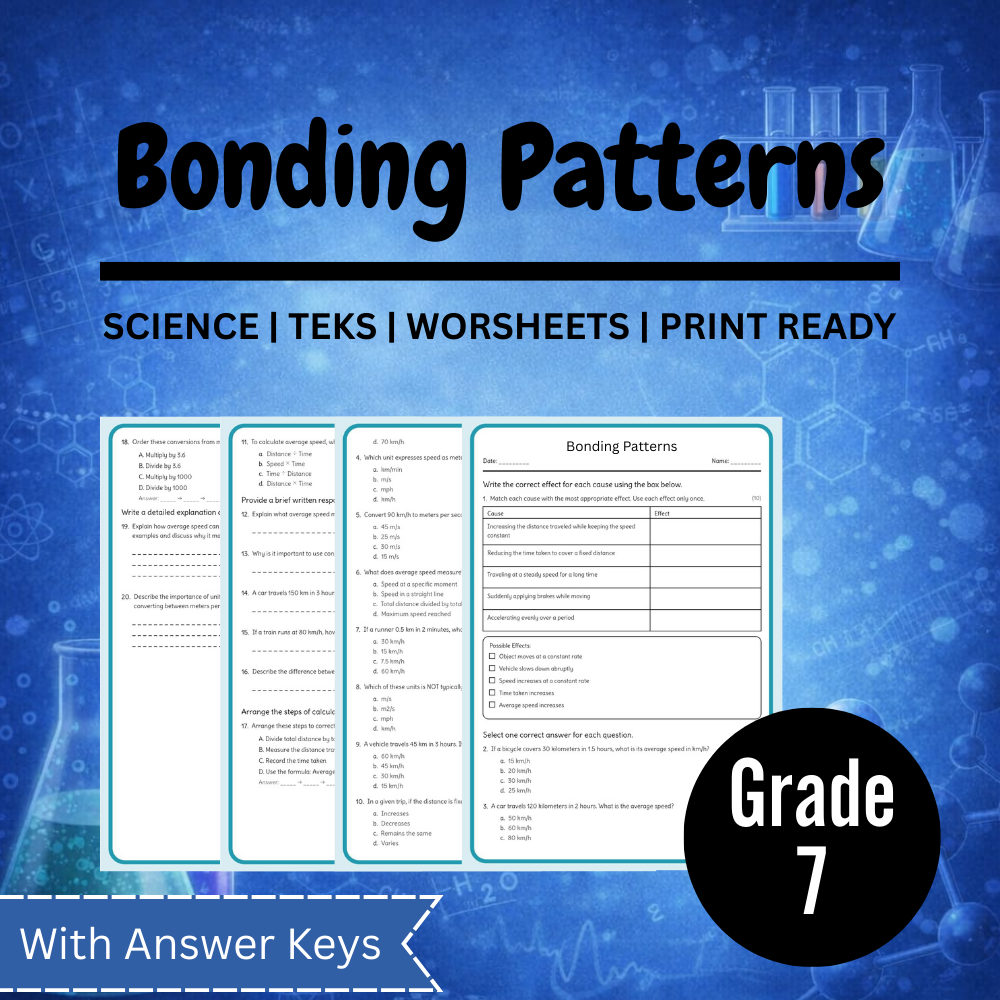
Grade 7 Science – Bonding Patterns Worksheet (Science 1 + TEKS) PDF
 Created byBright Mind Resources
Learning Objectives
- Distinguish between ionic and covalent bonding interactions
- Relate bonding types to properties like melting point, solubility, and electrical conductivity
- Describe formation of binary ionic salts and molecular compounds using empirical formulas
Also included in: Grade 7 Science Unit Bundle | States of Matter & Atomic Structure Worksheets +2 more
Instant download

Grade 7 Science | Bonding Patterns Worksheet (TEKS) PDF
Created byEvergreen Desk EducationLearning Objectives
- Distinguish ionic from covalent bonding using particle-level evidence and bonding patterns.
- Relate bonding type to macroscopic properties such as melting point, solubility, and electrical conductivity.
- Construct simple binary ionic salts and molecular compounds using empirical formulas.
Instant download

Grade 7 Science | Bonding Patterns in Science - Daily Reading Comprehension
 Created byCoral Reef Learning
Learning Objectives
- Identify and distinguish ionic and covalent bonds based on descriptions and examples.
- Understand how bonding types influence properties like melting point, solubility, and electrical conductivity.
- Describe the formation of binary ionic salts and molecular compounds using empirical formulas.
Instant download
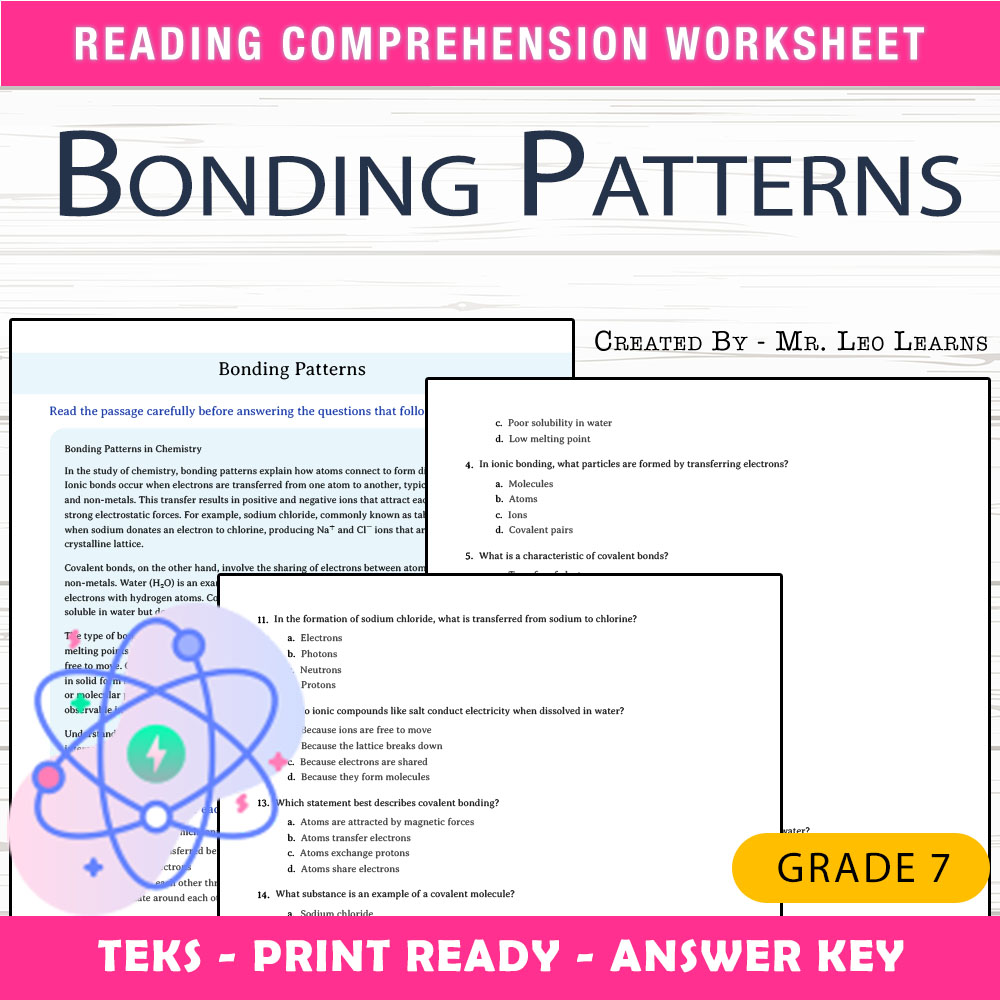
Grade 7 Science – Bonding Patterns Worksheet for Mastery
Created byThe Resource HubLearning Objectives
- Explain the differences between ionic and covalent bonding based on atomic interactions.
- Relate bonding types to properties like melting point, solubility, and electrical conductivity.
- Describe simple formation processes of binary ionic salts and molecular compounds.
Also included in: Grade 7 Science Unit Bundle – States, Reactions & Atomic Structure Worksheets +1 more
Instant download
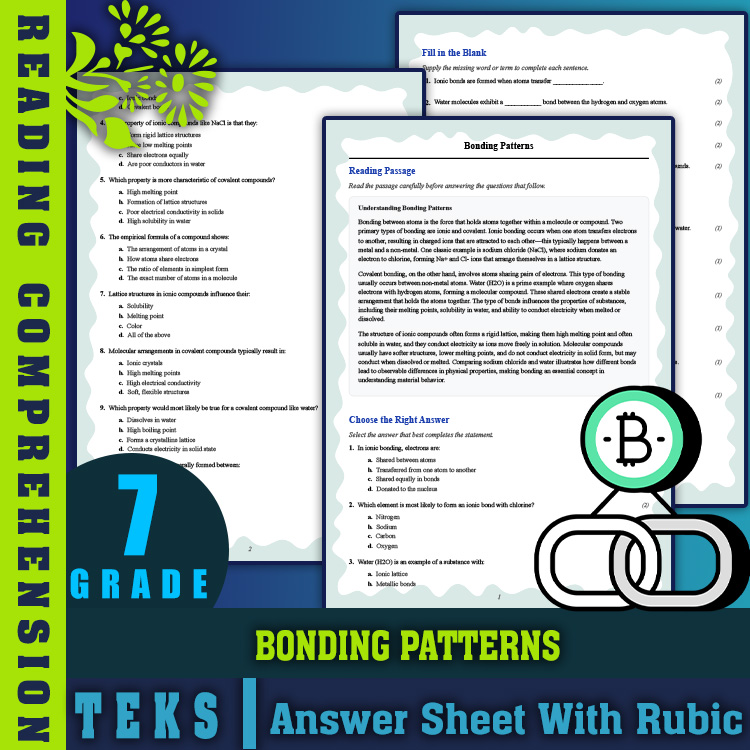
7th Grade Science | Bonding Patterns Reading Worksheet & Answer Key (PDF)
JCreated byJ.S SheetsLearning Objectives
- Understand the differences between ionic and covalent bonding.
- Relate bonding types to properties like melting point, solubility, and electrical conductivity.
- Describe how simple binary ionic salts and molecular compounds form using empirical formulas.
Instant download
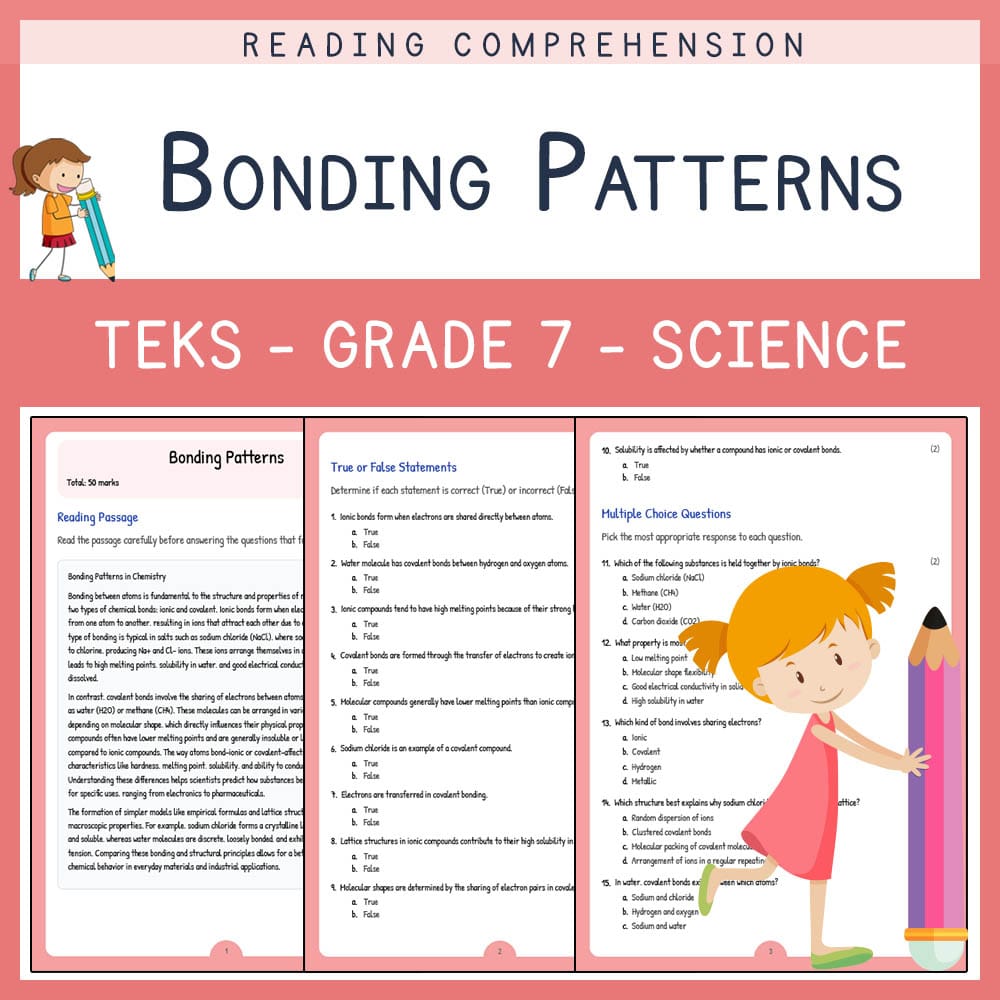
Grade 7 Science | Bonding Patterns Worksheet | TEKS-Aligned
 Created byLumora Learning
Learning Objectives
- Understand the differences between ionic and covalent bonding and their effects on macroscopic properties.
- Identify and describe simple formation of binary ionic salts and molecular compounds using empirical formulas.
- Relate bonding types to observable properties such as melting point, solubility, and electrical conductivity.
Also included in: Grade 7 Science | Matter and Energy Lesson Bundle | TEKS Aligned
Instant download

Grade 7 Science – Bonding Patterns & Chemical Bonds | Daily Reading Worksheet
Created byBright Mind ResourcesLearning Objectives
- Identify the differences between ionic and covalent bonds
- Recognize examples of ionic and covalent compounds
- Relate bonding types to properties like melting point, solubility, and electrical conductivity
Also included in: 7th Grade States of Matter Science Daily Reading Lesson Bundle | TEKS +2 more
Instant download

Bonding Patterns Worksheet | Grade 7 Science TEKS Practice
Created byPrism Point LearningLearning Objectives
- Differentiate ionic and covalent bonding using evidence from bonding structure and particle interactions.
- Relate bonding type to observable properties such as melting point, solubility, and electrical conductivity.
- Use empirical formulas to describe simple binary ionic salts and molecular compounds.
Also included in: Grade 7 Matter, States, and Reactions in Science Lesson Bundle TEKS
Instant download
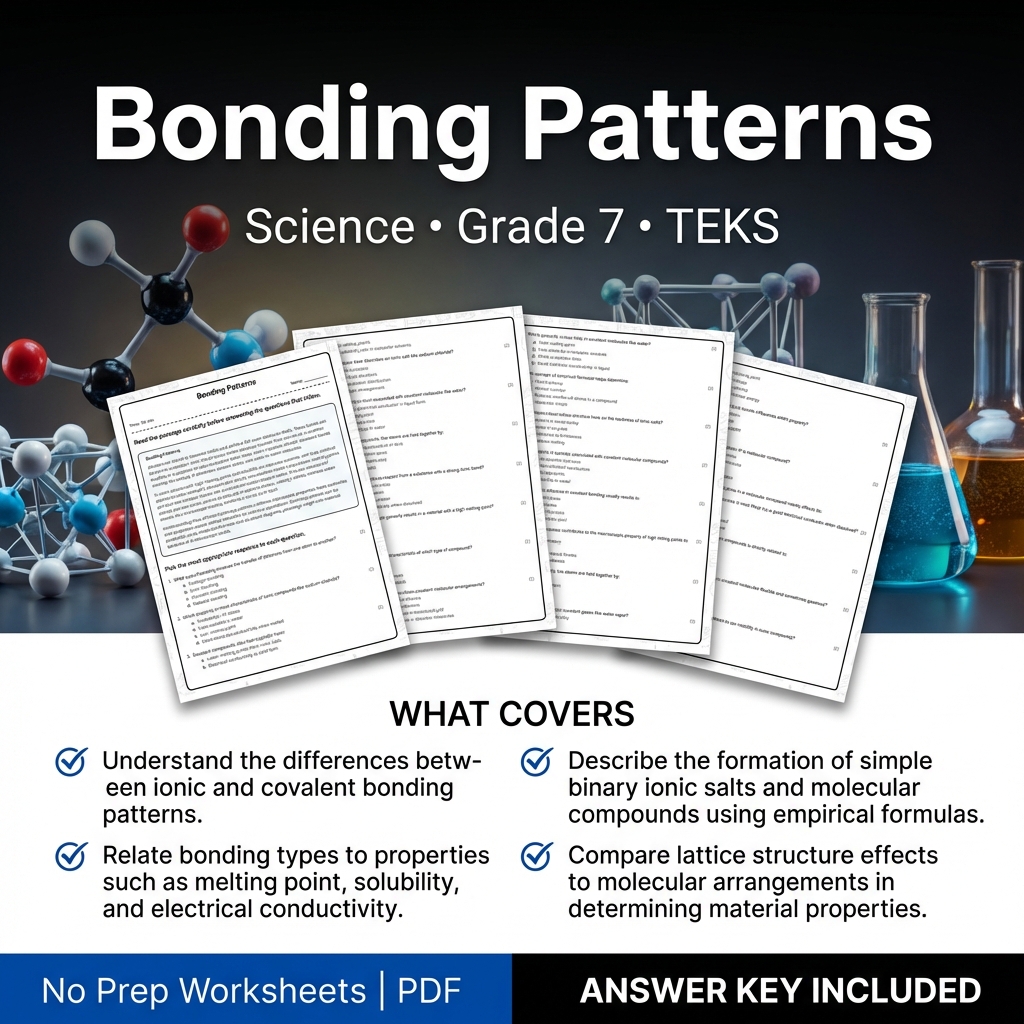
Grade 7 Science Bonding Patterns Worksheet with Answer Key | TEKS
Created byCoral Reef LearningLearning Objectives
- Understand the differences between ionic and covalent bonding patterns.
- Relate bonding types to properties such as melting point, solubility, and electrical conductivity.
- Describe the formation of simple binary ionic salts and molecular compounds using empirical formulas.
Instant download

Grade 7 Bonding Patterns Science Daily Reading Worksheet | TEKS
 Created byBRIGHT PATH RESOURCES
Learning Objectives
- Describe how electron transfer can form ions
- Distinguish ionic and covalent bonding using electron behavior
- Connect bonding patterns to observable properties
Also included in: Matter-Energy Grade 7 Science Daily Reading Worksheets Lesson Bundle | TEKS +1 more
Instant download

Grade 11 Science – Electromagnetic Spectrum & Radiation | Reading Worksheet
Created byBright Mind ResourcesLearning Objectives
- Identify different parts of the electromagnetic spectrum based on wavelength and energy.
- Understand the relationship between wavelength, frequency, and energy of electromagnetic radiation.
- Recognize how materials respond differently to various parts of the spectrum.
Also included in: Grade 11 Energy Science Daily Reading Lesson Bundle | California Standards +1 more
Instant download

Grade 11 Science | Electromagnetic Spectrum Worksheet | California Standards
Created byLumora LearningLearning Objectives
- Explain how wavelength and frequency relate across the electromagnetic spectrum and how photon energy depends on frequency
- Describe how absorption and emission produce characteristic spectra tied to atomic energy levels
- Analyze how reflection and scattering depend on wavelength relative to material structures
Instant download

Grade 11 Science | Electromagnetic Spectrum - Daily Reading Comprehension
Created byCoral Reef LearningLearning Objectives
- Identify different types of electromagnetic waves based on wavelength and frequency
- Explain how energy varies across the electromagnetic spectrum
- Describe how matter interacts with various electromagnetic waves
Instant download

Electromagnetic Spectrum Worksheet | Grade 11 Physics Science Activity
Created byPrism Point LearningLearning Objectives
- Explain how wavelength and frequency relate to the energy of electromagnetic radiation.
- Classify parts of the electromagnetic spectrum in order of increasing energy.
- Describe how absorption, emission, reflection, and scattering depend on wavelength and atomic energy levels.
Instant download

Electromagnetic Spectrum Worksheet | Standard-Aligned Science Practice Grade 11
JCreated byJ.S SheetsLearning Objectives
- Understand the range and classification of the electromagnetic spectrum.
- Explain how energy varies with wavelength and frequency in electromagnetic radiation.
- Describe interactions such as absorption, emission, reflection, and scattering related to different spectrum regions.
Also included in: Energy and Particle Interactions Grade 11 Science Lesson Bundle +1 more
Instant download

Electromagnetic Spectrum Worksheet | Waves & Light Grade 11 Science CA
Created byEvergreen Desk EducationLearning Objectives
- Explain how frequency and wavelength relate to the energy of electromagnetic radiation.
- Classify parts of the electromagnetic spectrum using wavelength, frequency, and typical applications.
- Describe how absorption, emission, reflection, and scattering depend on atomic energy levels and wavelength.
Instant download

Ocean Currents Grade 6 | Florida NGSSS Assessment
Created byPrism Point LearningLearning Objectives
- Explain how ocean currents move water and distribute heat around Earth.
- Describe how wind patterns and Earth’s rotation help drive surface currents.
- Connect ocean currents to regional climate and weather differences near coasts.
Instant download

Ocean Currents Science Worksheet Grade 6 | Florida NGSSS Earth Science
Created byEvergreen Desk EducationLearning Objectives
- Explain how wind patterns and Earth’s rotation help drive ocean currents.
- Describe how ocean currents move water and heat and influence regional climate.
- Use evidence from a text to identify causes and effects related to coastal weather.
Instant download

Ocean Currents Worksheet | Grade 6 Weather & Climate Science Activity
Created byPrism Point LearningLearning Objectives
- Explain how wind patterns and Earth’s rotation help create ocean current systems.
- Describe how moving warm and cool water affects coastal climates and weather.
- Identify key differences between surface currents and deeper ocean movement.
Also included in: Grade 6 Weather & Climate Science Lesson Bundle | Florida NGSSS
Instant download

Ocean Currents Worksheet | Standards-Aligned Grade 6 Science Practice
JCreated byJ.S SheetsLearning Objectives
- Understand how ocean currents are driven by wind patterns and Earth's rotation.
- Explain how ocean currents influence regional climates and weather patterns.
- Identify the effects of warm and cold currents on coastal environments.
Also included in: Grade 6 Climate and Atmospheric Systems Science Lesson Bundle: Florida NGSSS +1 more
Instant download

Grade 6 Ocean Currents Worksheet | NGSS Practice PDF
 Created byClear Sky Classroom
Learning Objectives
- Explain how ocean currents move water and transport heat around Earth.
- Identify how wind patterns and Earth’s rotation influence surface currents.
- Describe how warm and cold currents affect coastal climates compared with inland areas.
Instant download

Grade 6 Science | Ocean Currents Worksheet | Florida NGSSS
Created byLumora LearningLearning Objectives
- Explain how wind patterns and Earth’s rotation drive ocean currents
- Describe how ocean currents transport heat and moisture and influence regional climates
- Use cause-and-effect reasoning to connect ocean current temperature to coastal weather
Instant download

Grade 6 Science | Ocean Currents - Daily Reading Comprehension
Created byCoral Reef LearningLearning Objectives
- Understand what ocean currents are and how they move water across the globe.
- Learn the causes of ocean currents, including wind patterns and Earth's rotation.
- Explore how ocean currents influence regional climates and weather.
Instant download

Grade 6 Science – Ocean Currents & Climate | Daily Reading Worksheet
Created byBright Mind ResourcesLearning Objectives
- Understand key concepts related to Science
- Apply knowledge through practice questions
- Demonstrate comprehension of the material
Also included in: Climate Grade 6 Science Daily Reading Worksheets Lesson Bundle | Florida NGSSS +1 more
Instant download
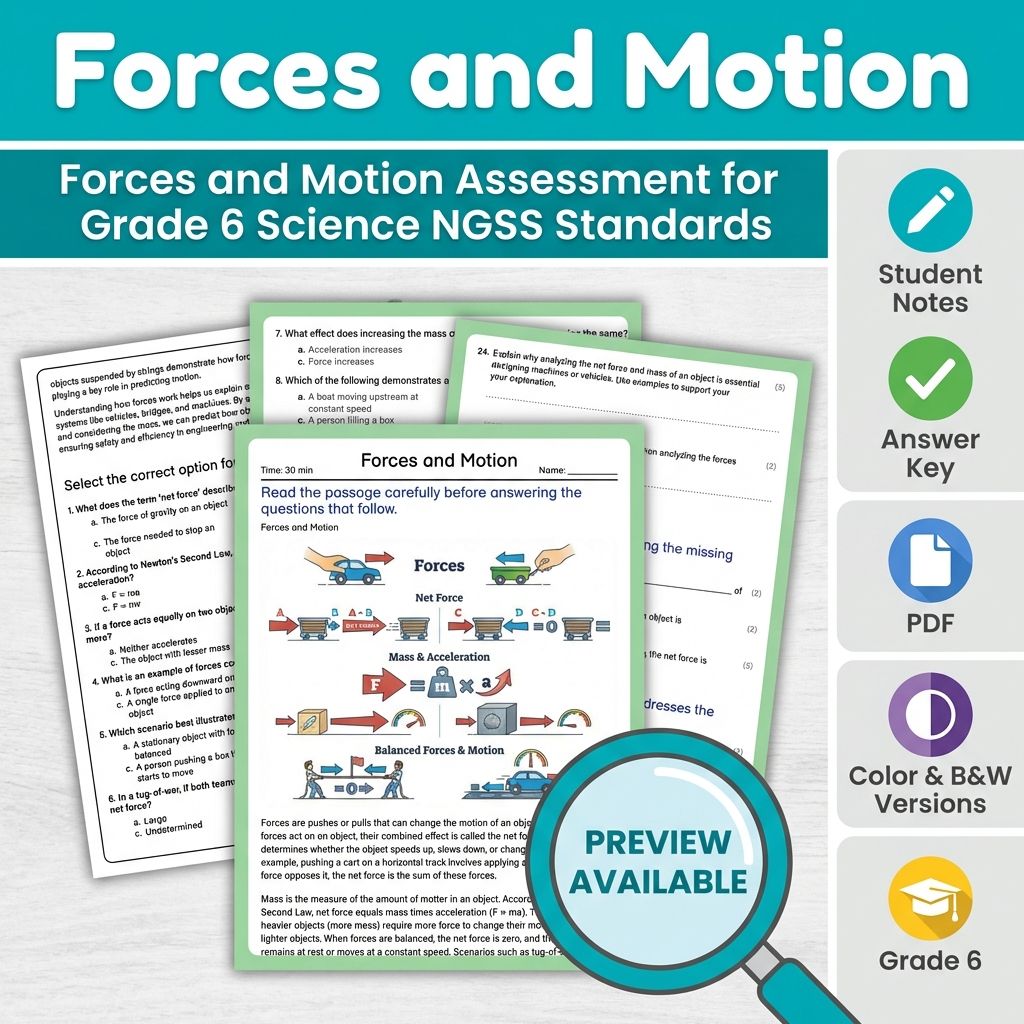
Forces and Motion Assessment for Grade 6 Science NGSS Standards
Created byPrism Point LearningLearning Objectives
- Explain how net force and mass influence the motion of objects.
- Describe real-life scenarios involving forces, such as carts on tracks and tugging systems.
- Apply the formula net force equals mass times acceleration to analyze motion.
Also included in: Grade 6 Science Mini Bundle | Forces and Interactions NGSS Standards +1 more
Instant download
6th Grade Science | Forces and Motion NGSS Worksheet (PDF)
 Created byMaple Path Learning
Learning Objectives
- Explain how net force affects the motion of objects based on mass and force vectors.
- Use the equation net force equals mass times acceleration to analyze different scenarios.
- Identify and describe how multiple forces combine to produce net force.
Also included in: Grade 6 Science Forces & Motion Unit Bundle (NGSS Worksheets + Answer Keys) +1 more
Instant download

Forces and Motion Net Force and Mass Worksheet | NGSS Grade 6 Science
 Created bySkylark Worksheets
Learning Objectives
- Explain how net force (the vector sum of forces) affects an object's motion.
- Use the relationship net force = mass × acceleration to predict changes in motion.
- Distinguish between balanced and unbalanced forces using real-world scenarios.
Also included in: Forces, Motion, and Interactions Grade 6 Science Lesson Bundle NGSS +1 more
Instant download
Grade 6 Science | Forces and Motion Worksheet with Answer Key (PDF) | NGSS
Created byLumora LearningLearning Objectives
- Understand the relationship between net force, mass, and acceleration
- Identify real-world examples of forces in motion
- Explain how changing forces affects movement of objects
Instant download

Forces and Motion Worksheet | Grade 6 NGSS Science Activity & Doodle Notes
 Created byAmber Owl Education
Learning Objectives
- Explain how net force (the vector sum of forces) determines changes in an object's motion
- Use the relationship net force equals mass times acceleration to predict how acceleration changes
- Distinguish between balanced and unbalanced forces using real-world scenarios
Also included in: Grade 6 Science Forces and Motion Unit Lesson Bundle | NGSS +1 more
Instant download

Grade 6 Forces and Motion Worksheet | NGSS Practice PDF
Created byClear Sky ClassroomLearning Objectives
- Understand the relationship between net force, mass, and acceleration.
- Identify scenarios where forces act on objects and analyze their effects.
- Apply the formula net force equals mass times acceleration to solve problems.
Also included in: Grade 6 Motion and Stability: Forces and Interactions Science Lesson Bundle NGSS +1 more
Instant download

Forces and Motion Worksheet | NGSS-Aligned Grade 6 Science Practice
JCreated byJ.S SheetsLearning Objectives
- Understand the relationship between net force, mass, and acceleration.
- Identify how different forces affect motion in various scenarios.
- Apply the formula net force equals mass times acceleration to solve problems.
Also included in: Grade 6 Forces, Motion, and Interactions Science Lesson Bundle: NGSS +1 more
Instant download

6th Grade Science | Forces and Motion Worksheet with Answer Key (Printable PDF)
Created byCoral Reef LearningLearning Objectives
- Describe the relationship between net force, mass, and acceleration based on Newton's Second Law.
- Explain how vector addition influences the motion of objects under multiple forces.
- Identify real-world scenarios involving net force and calculate resulting motion changes.
Instant download

Grade 6 Science – Forces & Motion | Daily Reading Worksheet
 Created byElena Brooks
Learning Objectives
- Identify different types of forces and understand their effects on objects
- Explain how net force influences the motion of objects
- Relate force, mass, and acceleration using mathematical concepts
Also included in: Grade 6 Science Motion and Stability Bundle | NGSS Forces and Interactions +1 more
Instant download
Grade 6 Science | Forces and Motion Worksheet (PDF + Answer Key)
 Created byRiverstone Classroom
Learning Objectives
- Understand how net force affects the motion of objects based on their mass.
- Explain the relationship between force, mass, and acceleration using the formula net force equals mass times acceleration.
- Identify scenarios where forces change and predict resulting motion alterations.
Instant download

Grade 6 Science | Forces & Motion - Daily Reading Comprehension
Created byCoral Reef LearningLearning Objectives
- Understand the concept of force and how it affects objects in motion.
- Identify different types of forces acting on objects.
- Learn the relationship between net force, mass, and acceleration.
Instant download

Grade 6 Forces and Motion Worksheet | NGSS Science Activities & Answer Key
 Created byNorthstar Worksheets
Learning Objectives
- Explain how net force (vector sum of forces) and mass affect an object's acceleration
- Identify and use the relationship net force equals mass times acceleration to predict motion
- Interpret everyday scenarios involving tug-of-war, carts on tracks, and multiple forces on a hanging object
Also included in: Grade 6 Physical Science Forces, Gravity, Electricity & Momentum Lesson Bundle | NGSS +1 more
Instant download

Forces and Motion Worksheet | Grade 6 Science Test Prep
Created byPrism Point LearningLearning Objectives
- Explain how net force (the vector sum of forces) affects the motion of an object.
- Use the relationship net force equals mass times acceleration to predict changes in acceleration.
- Distinguish between mass (inertia) and forces when reasoning about motion.
Also included in: Grade 6 Physical Science NGSS Lesson Bundle: Test Prep Worksheets
Instant download

Forces, Net Force and Motion Grade 6 Science Practice Worksheets
 Created bythe curious pencil
Learning Objectives
- Explain how multiple forces combine to produce net force
- Calculate acceleration using net force and mass
- Predict acceleration changes when force or mass changes
Also included in: Grade 6 Science Forces and Motion Worksheets Bundle | NGSS +2 more
Instant download

Net Force and Motion Worksheets: Grade 6 Science Forces & Interactions
 Created byTeachers Club
Learning Objectives
- Explain how net force and mass affect an object's acceleration using vector addition
- Identify how changing one or more forces changes the direction and magnitude of motion
- Match common motion scenarios to definitions of net force and balanced forces
Also included in: Grade 6 Science Forces & Interactions Worksheets | NGSS Bundle +2 more
Instant download
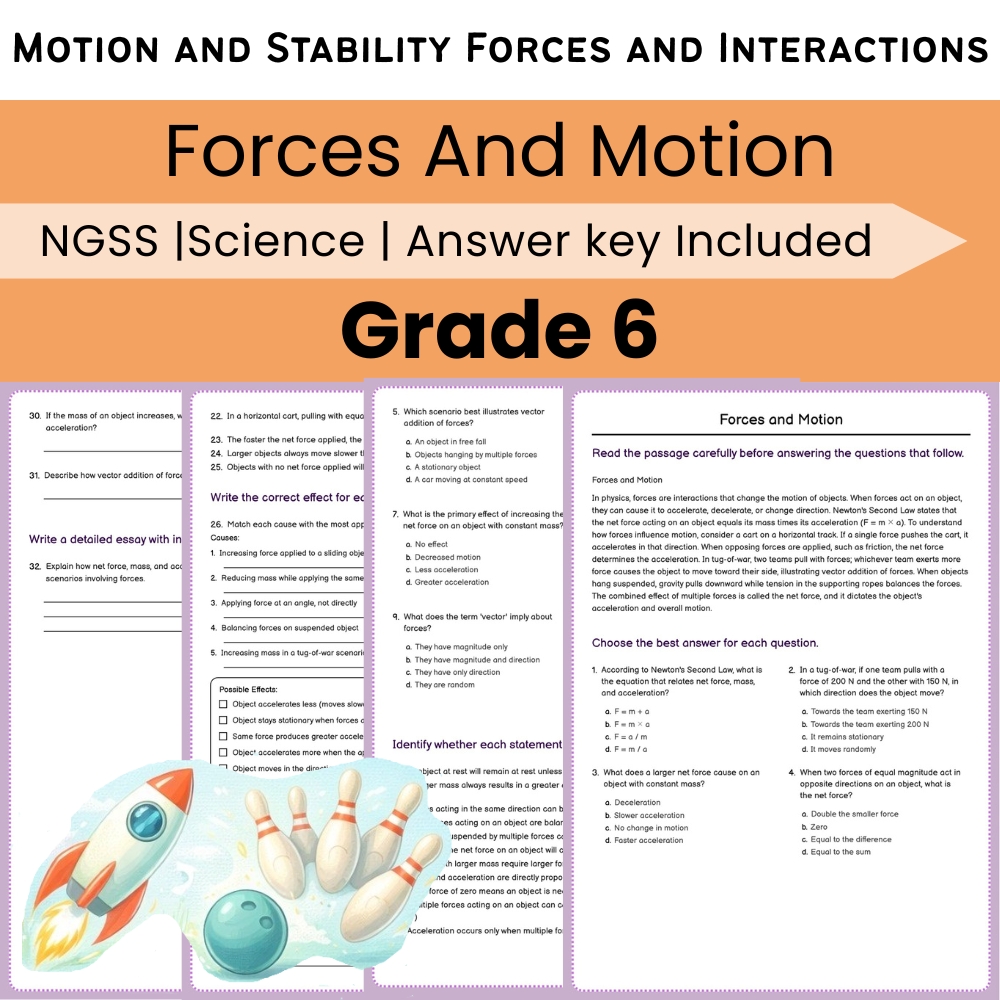
Forces and Motion Worksheet | NGSS Grade 6 Science printable PDF
Learning Objectives
- Understand the relationship between net force, mass, and acceleration.
- Explain how vector addition affects motion in different scenarios.
- Apply the formula net force equals mass times acceleration to solve problems.
Also included in: Grade 6 Science | Forces and Motion NGSS Unit Bundle (4 Worksheets Included) +1 more
Instant download
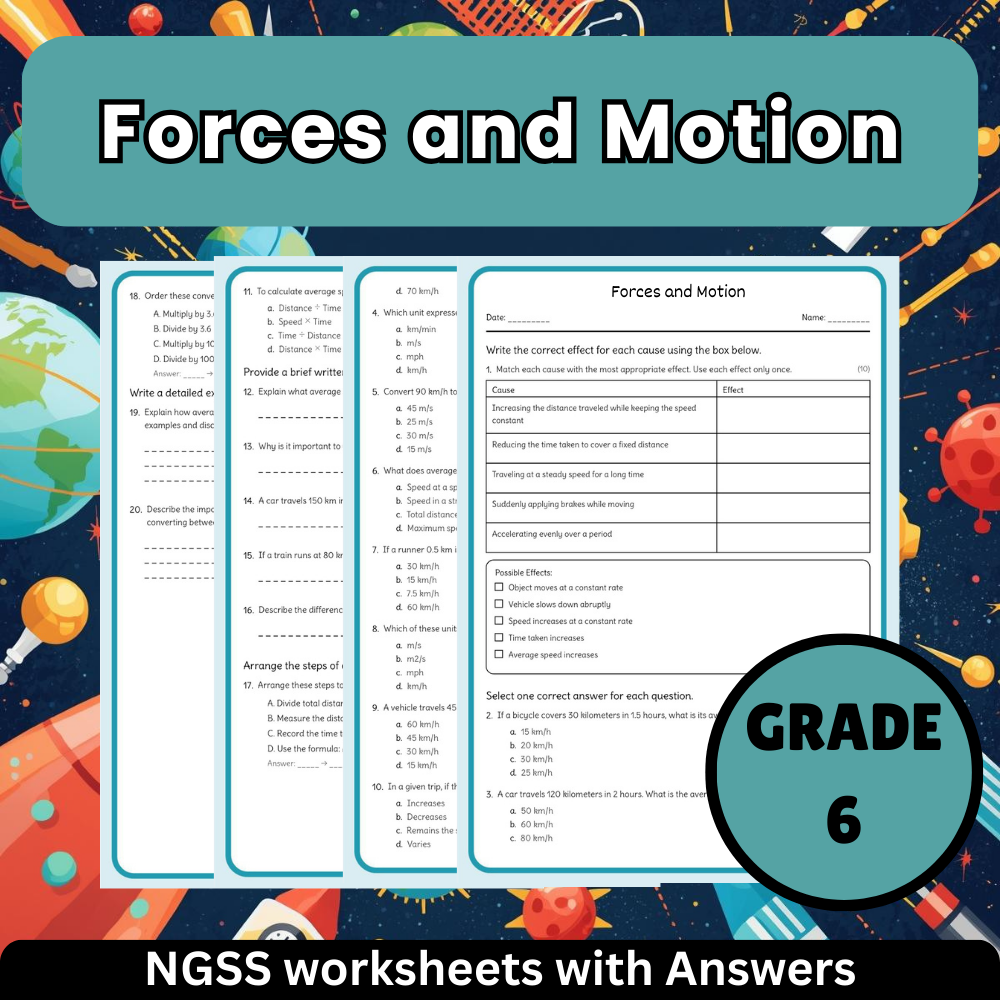
6th Grade Science | Forces and Motion Worksheet (Answer Key) – NGSS Standard
Created byBright Mind ResourcesLearning Objectives
- Understand how net force affects the motion of objects.
- Describe the relationship between mass, force, and acceleration.
Also included in: Grade 6 Science Unit Bundle – Forces, Motion & Magnetism Worksheets (NGSS) +2 more
Instant download
Browse more categories
About Science Worksheets
Find Science worksheets spanning core skills, practice, and review. All 45,024 resources are instant PDF downloads for the classroom or home.
Every worksheet on MyTeachingSheets is created by independent teacher-authors and reviewed before publication. All resources download as printable PDFs for classroom, homework, or at-home practice, and many include answer keys. Preview any worksheet free before buying.