
Science Worksheets
42,685 subject resources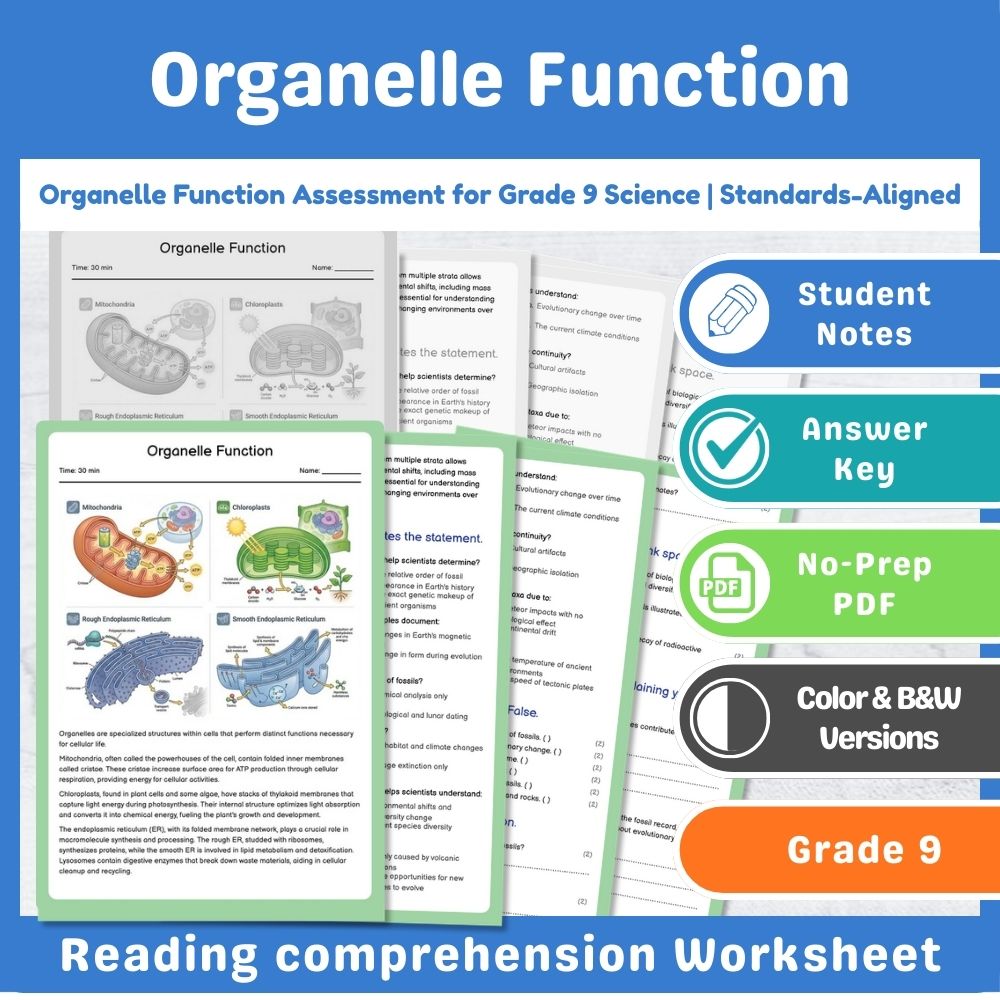
Organelle Function Assessment for Grade 9 Science | Standards-Aligned
 Created byPrism Point Learning
Learning Objectives
- Describe the roles of major organelles such as mitochondria, chloroplasts, endoplasmic reticulum, and lysosomes in cellular functions.
- Explain how the internal structures like folded membranes and stacks contribute to organelle efficiency.
- Compare the functions of different organelles in organizing metabolic pathways and cellular maintenance.
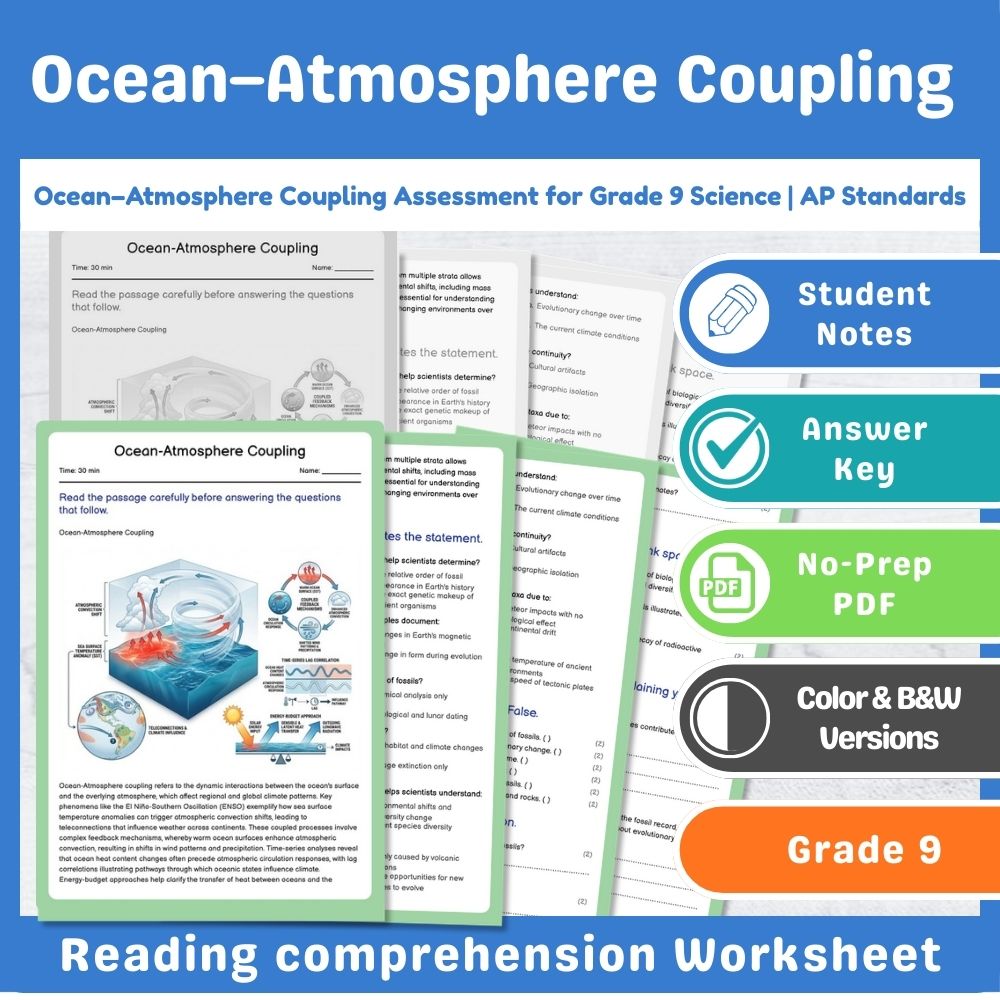
Ocean–Atmosphere Coupling Assessment for Grade 9 Science | AP Standards
Created byPrism Point LearningLearning Objectives
- Explain the processes of ocean–atmosphere interactions and their impact on climate variability.
- Identify phenomena such as ENSO and understand their mechanisms and effects on regional weather patterns.
- Analyze time-series data and interpret lag-correlation maps related to ocean–atmosphere coupling.
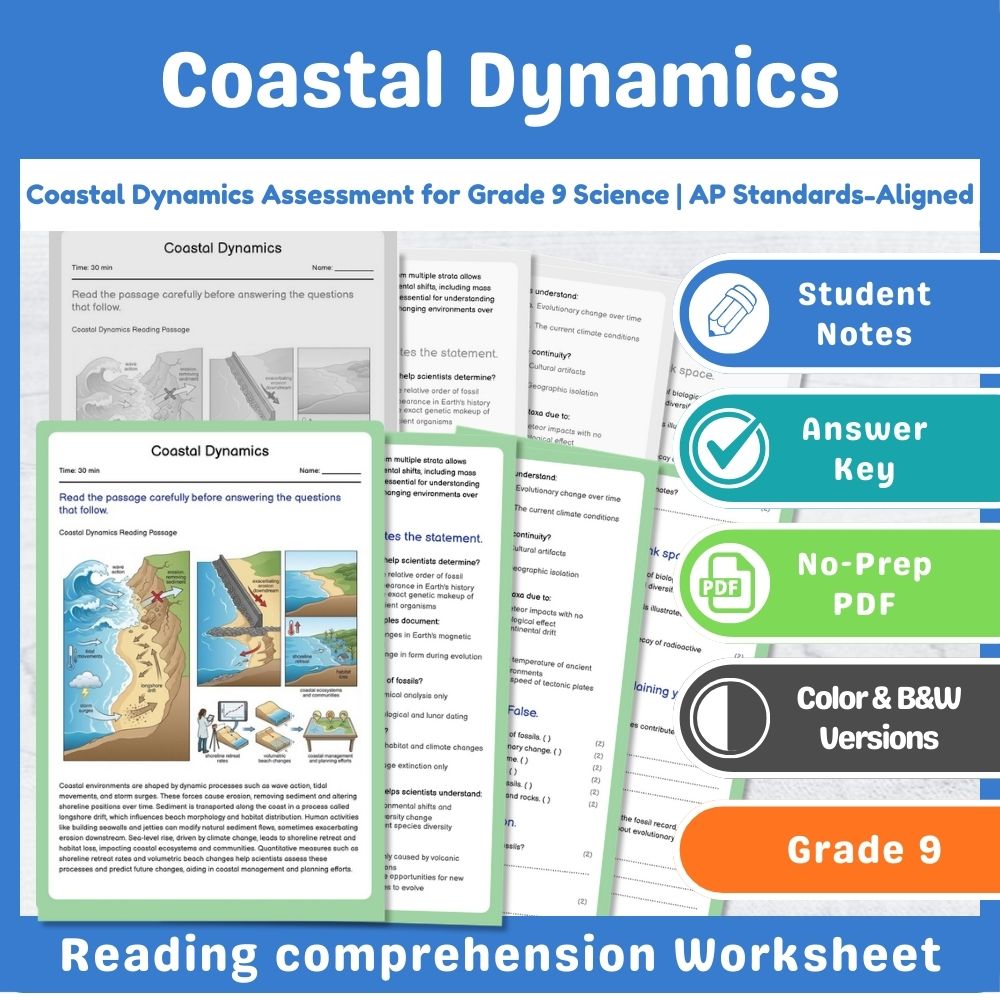
Coastal Dynamics Assessment for Grade 9 Science | AP Standards-Aligned
Created byPrism Point LearningLearning Objectives
- Understand the processes of coastal erosion, sediment transport, and shoreline response to natural forces.
- Analyze the impact of sea-level change on coastal morphology and habitats.
- Interpret quantitative indicators such as shoreline retreat rates and beach volume changes.
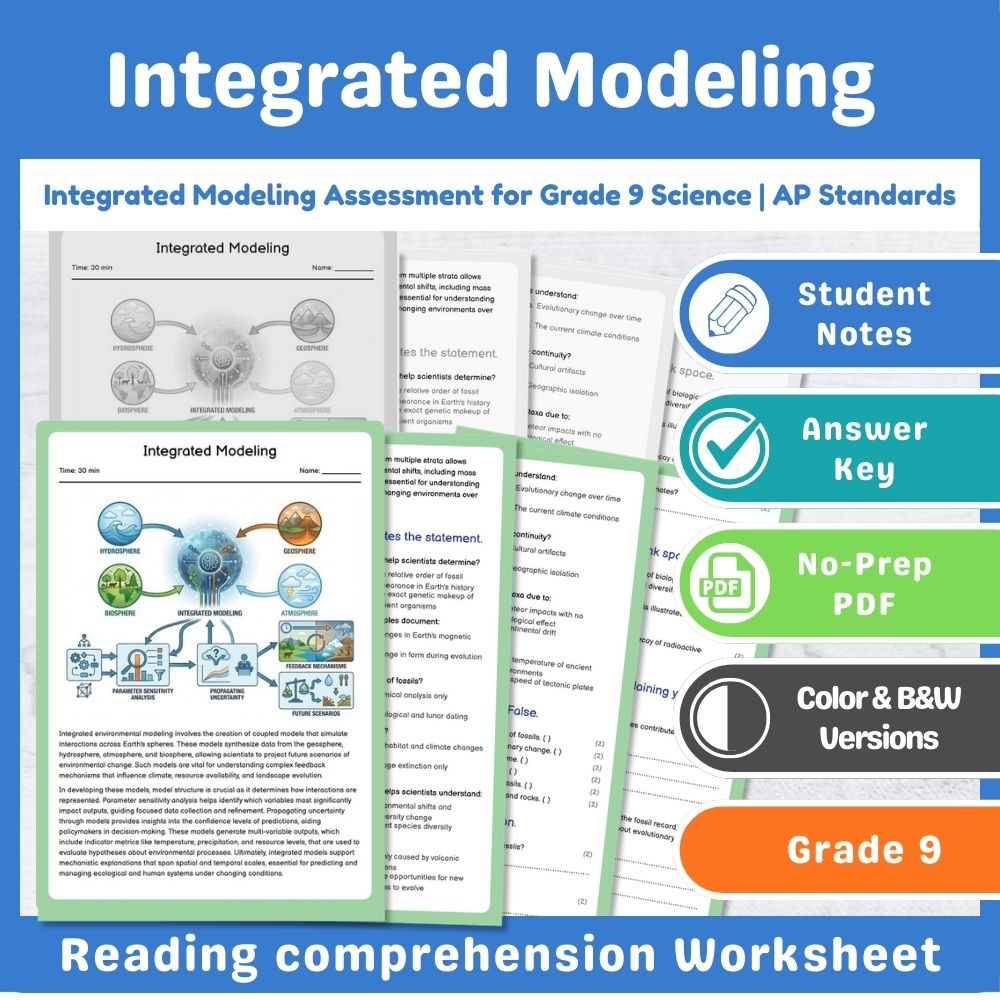
Integrated Modeling Assessment for Grade 9 Science | AP Standards
Created byPrism Point LearningLearning Objectives
- Understand the structure and purpose of coupled quantitative models in environmental science.
- Analyze how interactions among geosphere, hydrosphere, atmosphere, and biosphere influence environmental outcomes.
- Evaluate the significance of model parameters, uncertainty propagation, and hypothesis testing in environmental modeling.
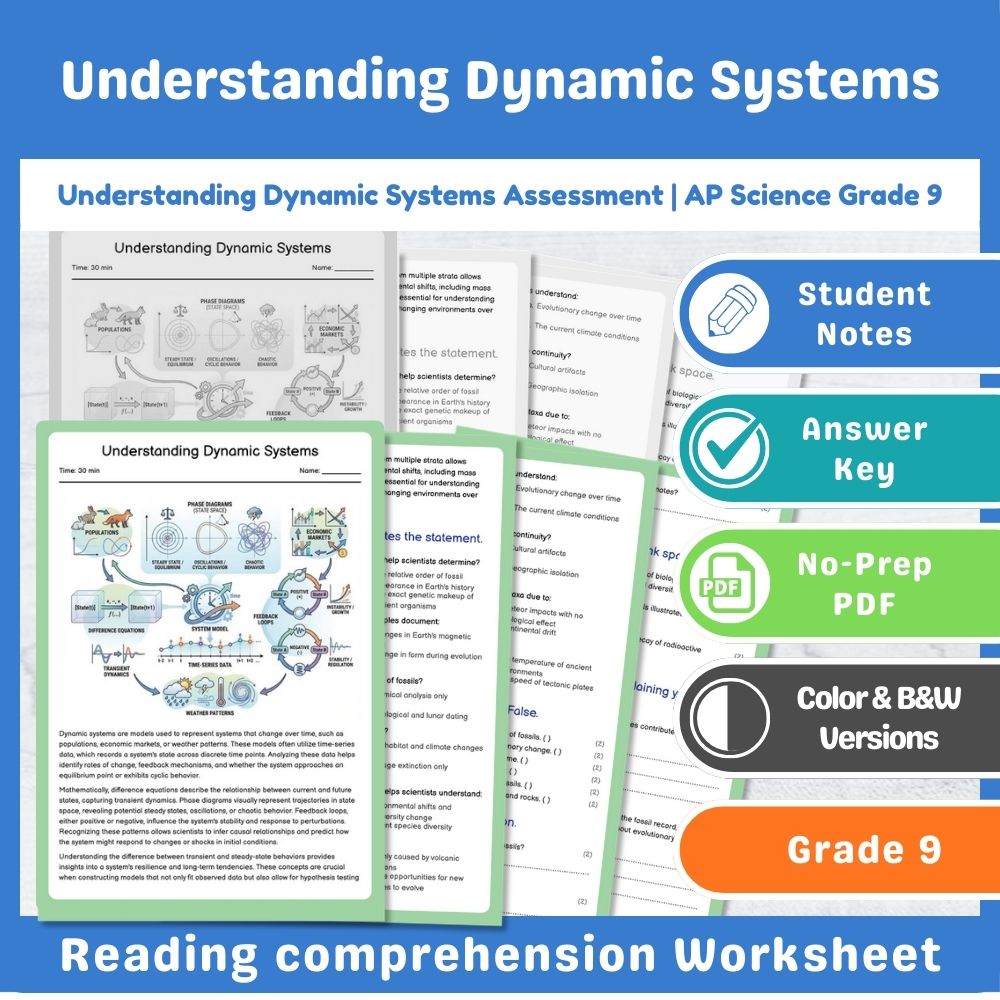
Understanding Dynamic Systems Assessment for Grade 9 Science AP
Created byPrism Point LearningLearning Objectives
- Explain how time-series data can be used to analyze changing systems
- Describe the role of difference equations and phase diagrams in modeling dynamics
- Identify feedback loops, equilibrium points, and causal structures in empirical data

Biodiversity Overview Assessment | BC Standards Grade 10 Science
Created byPrism Point LearningLearning Objectives
- Define biodiversity and explain its levels including genetic, species, and ecosystem diversity.
- Identify factors that influence patterns of biodiversity such as habitat availability, climate stability, and disturbance rates.
- Analyze how interactions among species and environmental gradients contribute to biodiversity variation.

Reaction Energy Assessment | Florida NGSSS Standards Grade 10 Science
Created byPrism Point LearningLearning Objectives
- Explain how reaction energy changes when comparing reactants and products.
- Distinguish endothermic and exothermic reactions using energy absorbed or released to the surroundings.
- Interpret energy profiles in terms of bond breaking, bond forming, and activation energy.

Cell Membrane Transport Assessment for Grade 10 Science | NGSSS
Created byPrism Point LearningLearning Objectives
- Explain selective permeability and how it supports maintaining stable internal conditions in cells.
- Compare passive transport (diffusion and osmosis) with active transport (energy-requiring transport).
- Describe how water movement by osmosis affects cell size and function.

Friction And Drag Assessment | NGSSS Standards Grade 10 Science
Created byPrism Point LearningLearning Objectives
- Explain how nonconservative forces like friction and drag oppose motion and remove mechanical energy
- Analyze how friction and drag affect acceleration and velocity over time
- Relate real-world observations (slowing down, reaching terminal velocity) to the concept of net force
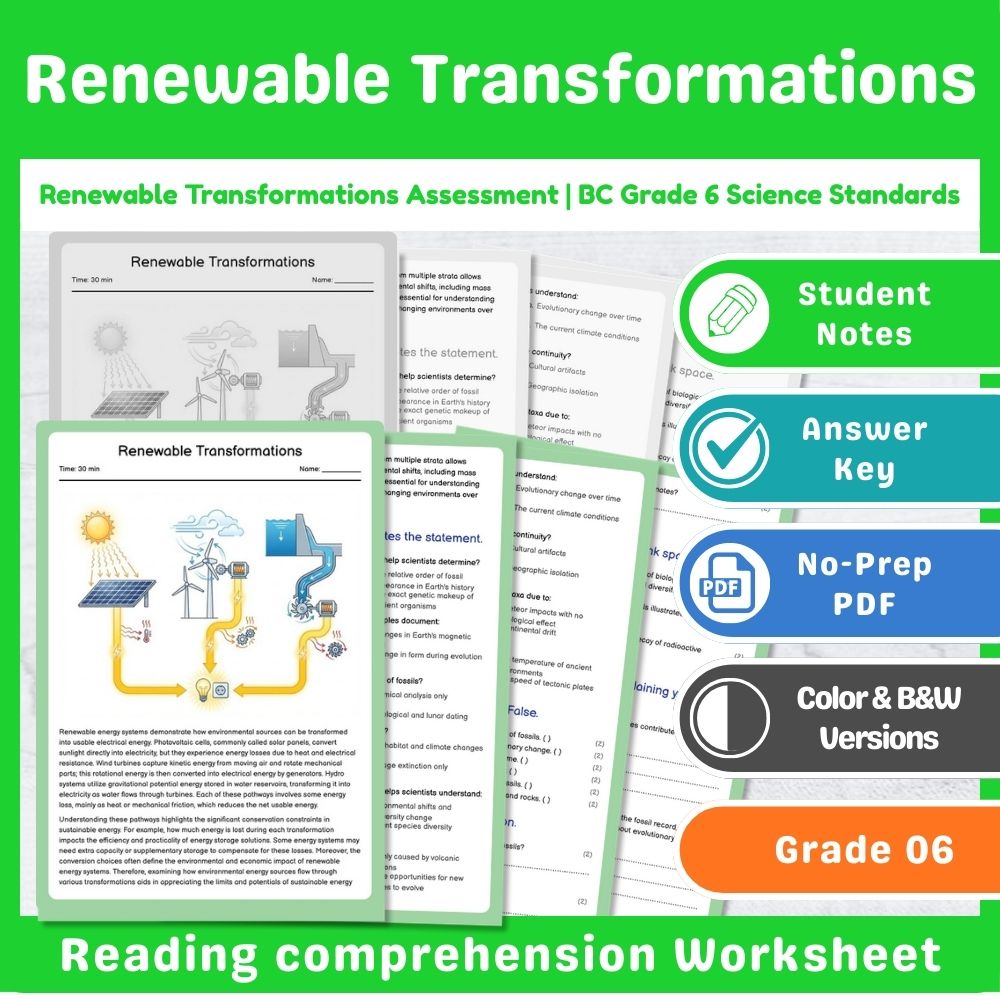
Renewable Transformations Assessment | BC Grade 6 Science Standards
Created byPrism Point LearningLearning Objectives
- Identify different types of renewable energy systems and their energy transformation processes.
- Explain how energy is converted and where losses occur in renewable energy systems.
- Assess the practical limits and conservation constraints of sustainable energy sources.
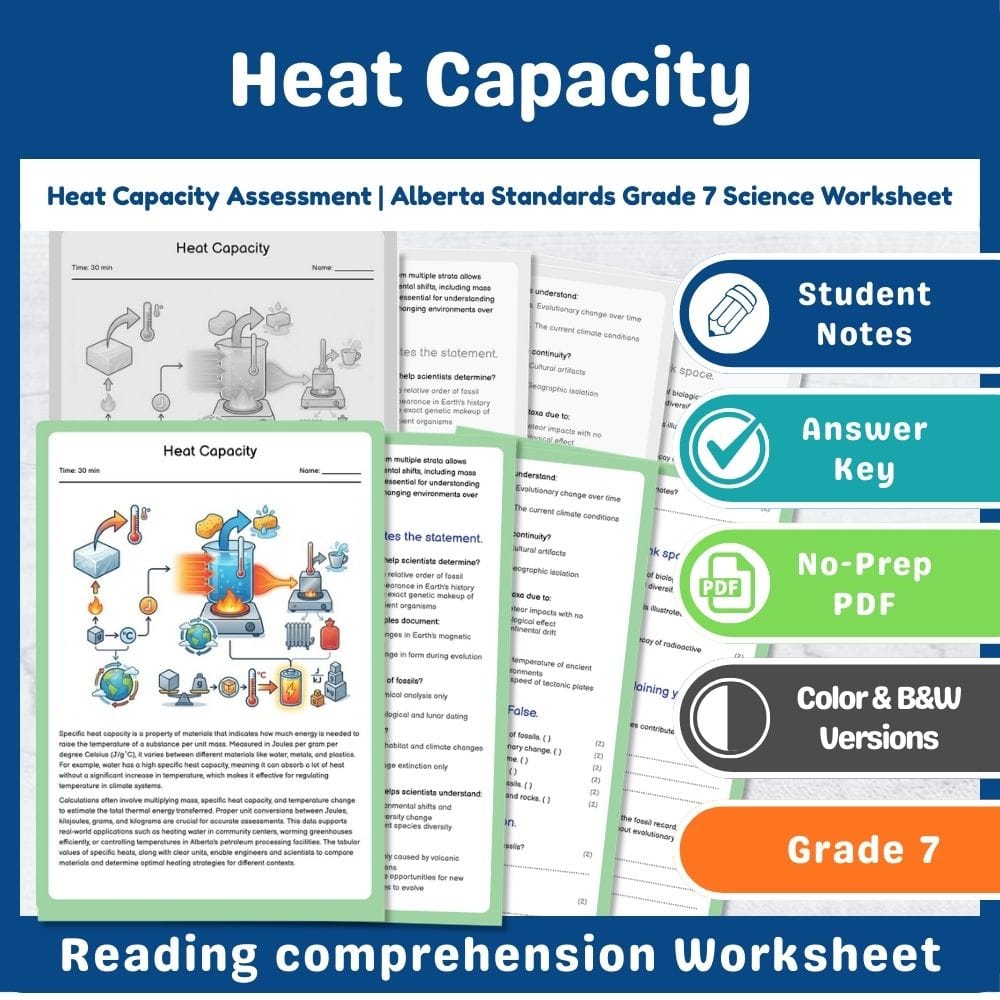
Heat Capacity Assessment | Alberta Standards Grade 7 Science Worksheet
Created byPrism Point LearningLearning Objectives
- Understand the concept of specific heat capacity and its units.
- Perform calculations involving mass, specific heat, and temperature change to find energy in Joules or kilojoules.
- Interpret tabular data of thermal properties for different materials.
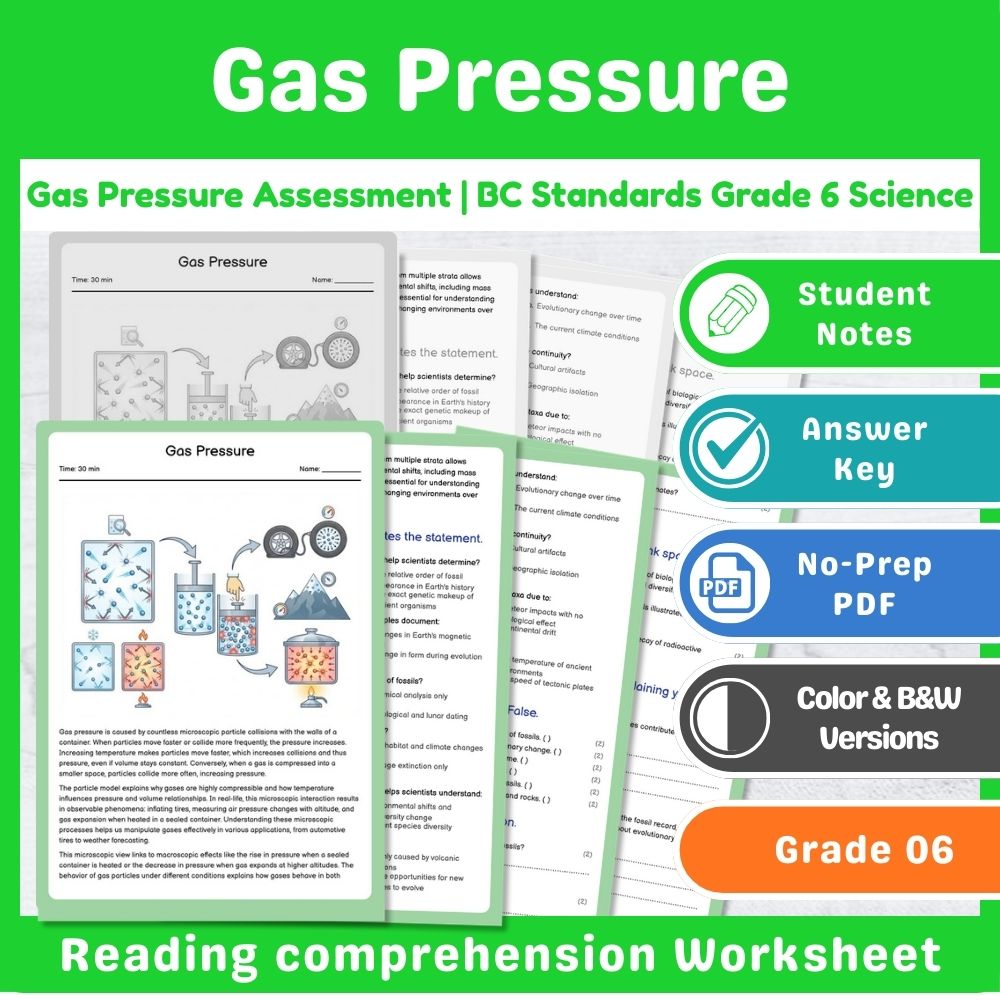
Gas Pressure Assessment | BC Standards Grade 6 Science
Created byPrism Point LearningLearning Objectives
- Explain how gas pressure results from particle collisions with container walls.
- Describe how increasing particle speed or collision frequency affects pressure.
- Understand the particle model to explain gas compressibility and pressure-temperature relationships.
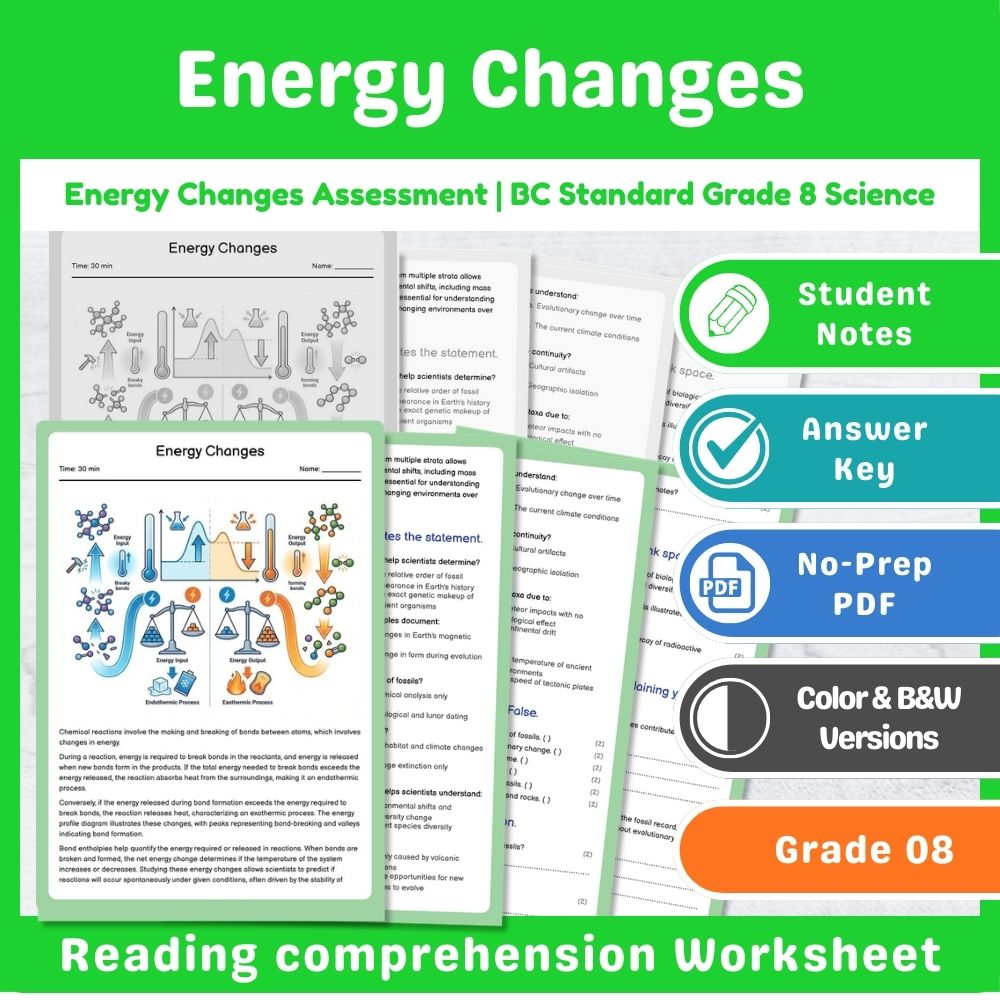
Energy Changes Assessment | BC Standard Grade 8 Science
Created byPrism Point LearningLearning Objectives
- Understand how chemical bonds involve energy changes during reactions.
- Differentiate between endothermic and exothermic reactions based on energy transfer.
- Interpret energy profiles and bond enthalpy diagrams to explain temperature changes.
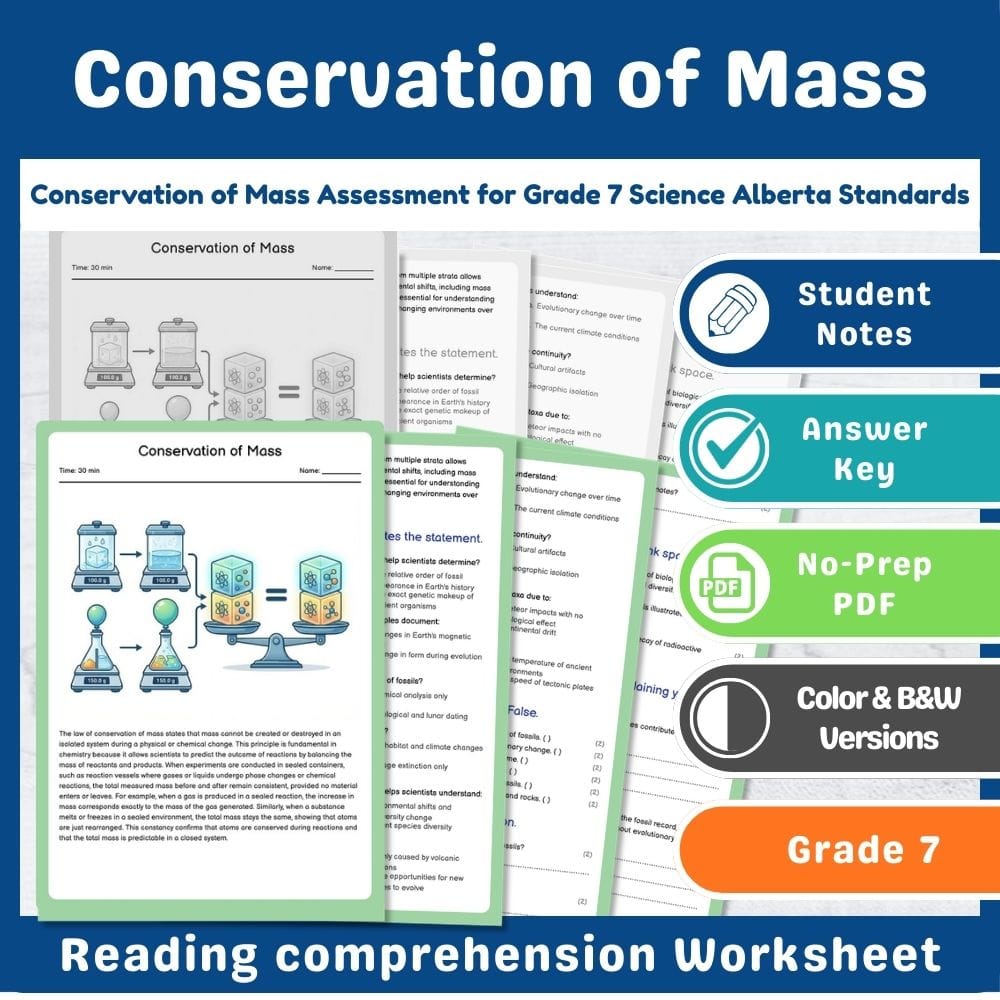
Conservation of Mass Assessment for Grade 7 Science Alberta Standards
Created byPrism Point LearningLearning Objectives
- Understand the principle of conservation of mass in physical and chemical changes.
- Describe how mass remains constant in a sealed system during reactions.
- Explain observations of sealed-container reactions that demonstrate mass conservation.
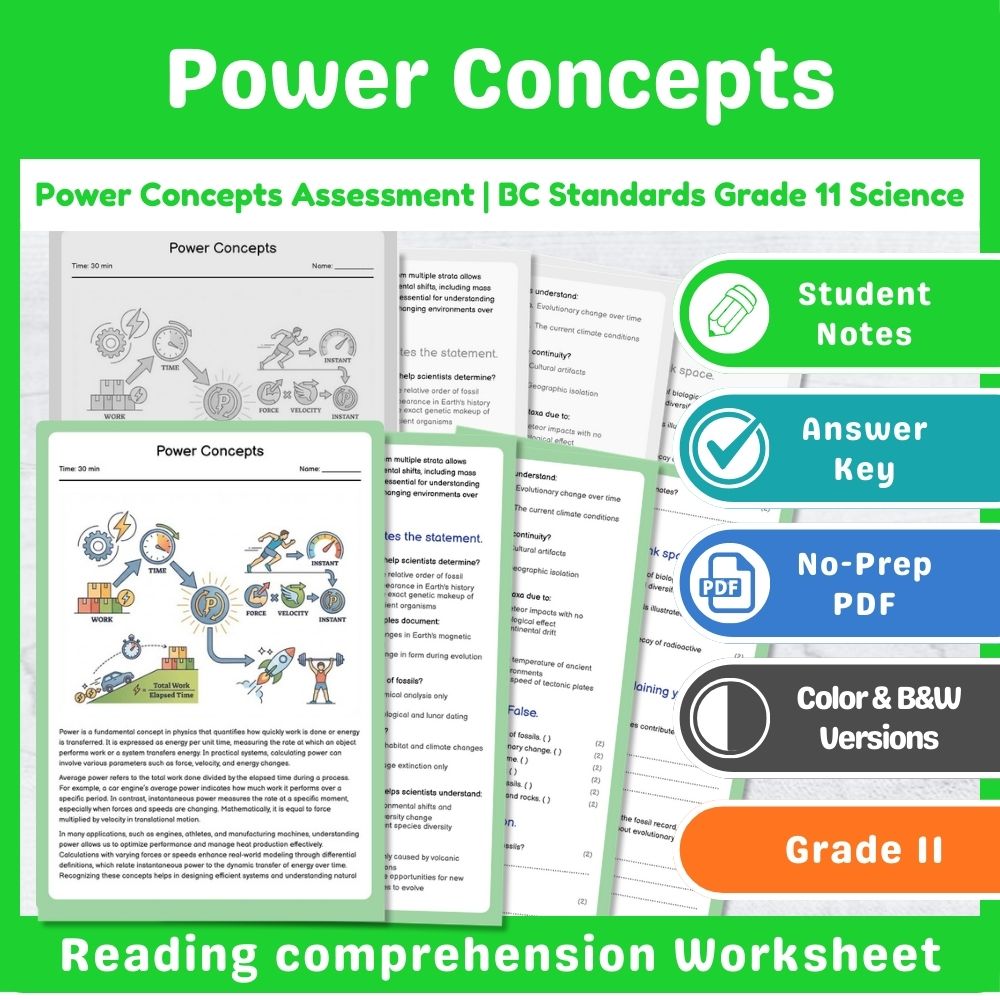
Power Concepts Assessment | BC Standards Grade 11 Science
Created byPrism Point LearningLearning Objectives
- Understand how power is defined as the rate of energy transfer over time.
- Learn to differentiate between average power and instantaneous power in various scenarios.
- Apply mathematical formulas to calculate power in systems with varying forces or velocities.
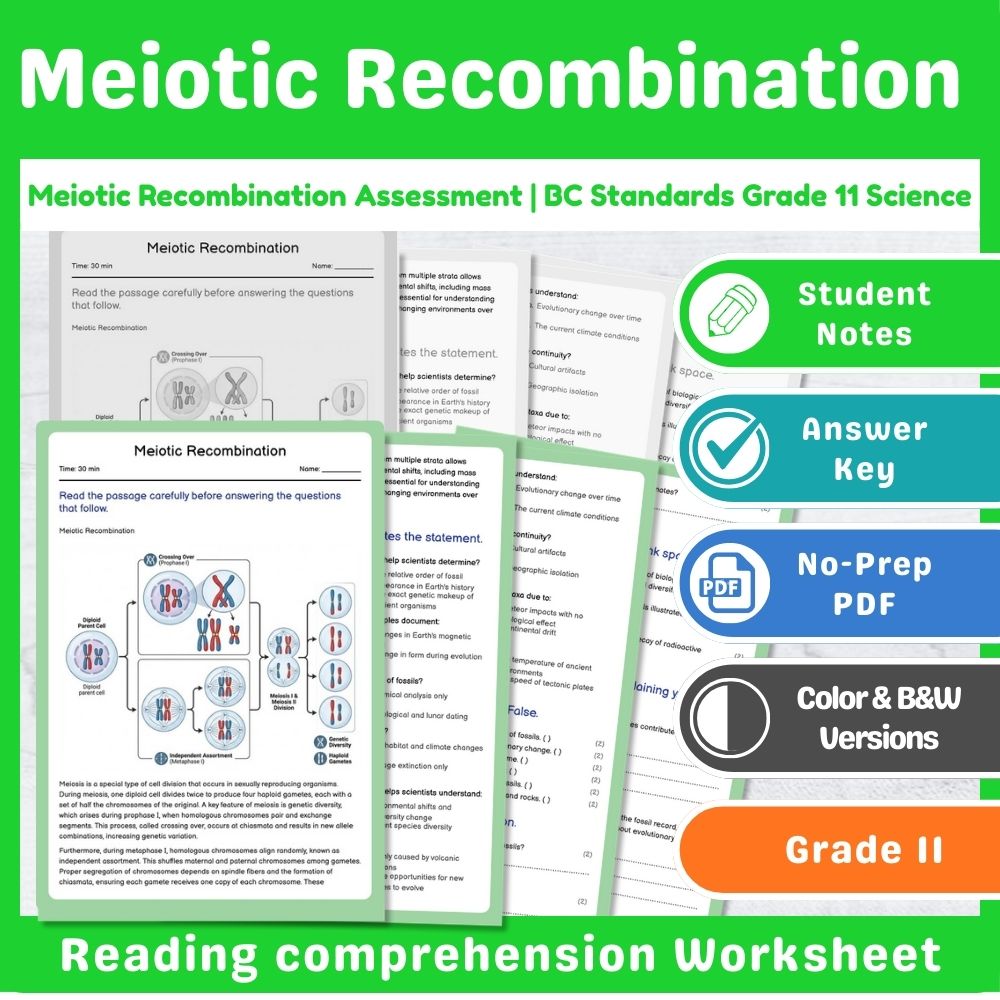
Meiotic Recombination Assessment | BC Standards Grade 11 Science
Created byPrism Point LearningLearning Objectives
- Explain the stages of meiosis involved in recombination and genetic variation.
- Describe the processes of crossing over and independent assortment.
- Identify factors that influence accurate chromosome segregation during meiosis.

Energy in Cells Assessment | Florida NGSSS Standard Grade 10 Science
Created byPrism Point LearningLearning Objectives
- Explain how cells obtain and use energy to perform work such as building molecules and maintaining organization
- Describe how cellular respiration converts chemical energy from carbohydrates into ATP
- Compare energy transformation in cellular respiration with energy capture in photosynthesis

Periodic Trends Assessment | NGSSS Assessment Grade 10 Science
Created byPrism Point LearningLearning Objectives
- Explain how effective nuclear charge and electron shielding influence atomic size across a period and down a group
- Predict trends in ion formation by relating electron configuration to typical ion charges
- Use periodic trends to reason about changes in ionization energy across periods and groups
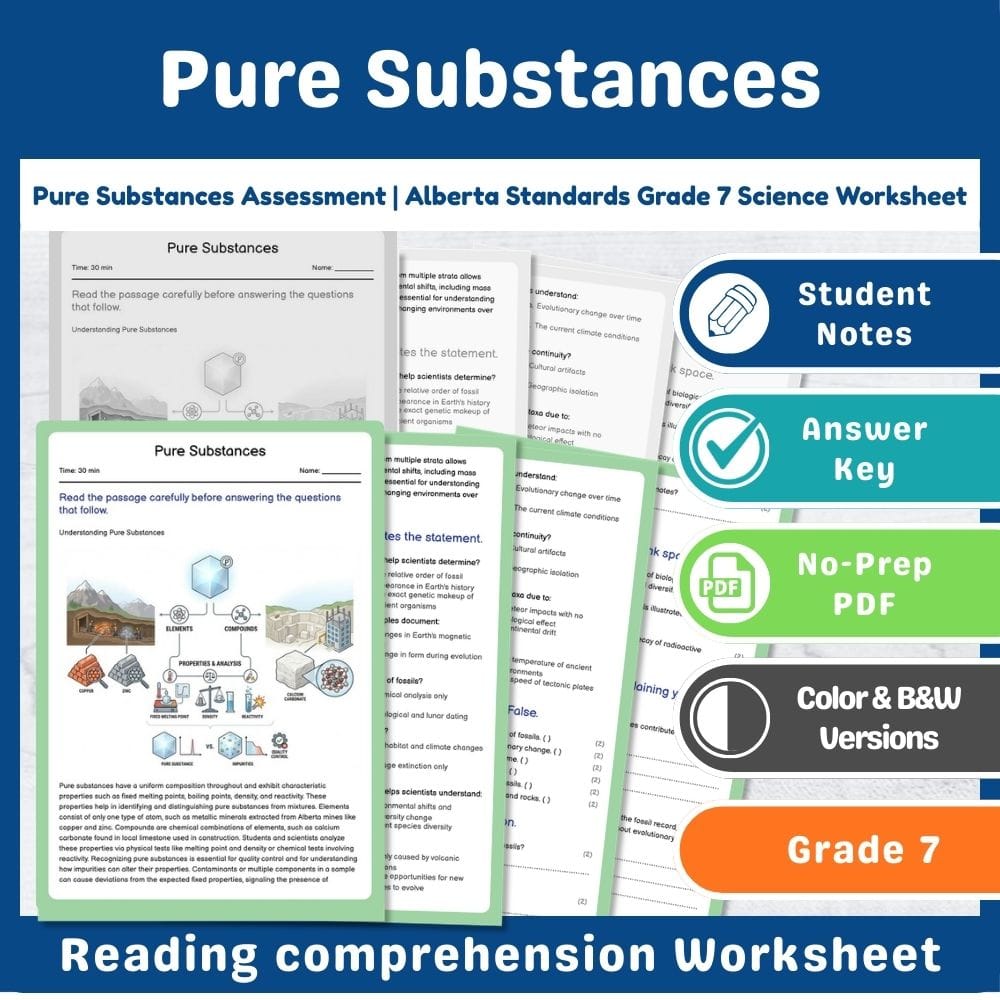
Pure Substances Assessment | Alberta Standards Grade 7 Science Worksheet
Created byPrism Point LearningLearning Objectives
- Understand the defining properties of pure substances such as fixed melting points, density, and reactivity.
- Differentiate between elements and compounds through physical and chemical tests.
- Identify real-world examples of pure substances from local sources and common compounds.

Gene Regulation Assessment for Grade 12 Science | NGSSS Standards
Created byPrism Point LearningLearning Objectives
- Explain how cells use signals and regulatory molecules to control gene transcription and gene expression outcomes.
- Compare roles of transcription factors, chromatin accessibility, and post-transcriptional regulation (splicing, RNA stability, microRNAs).
- Apply gene regulation concepts to predict how different cell types can produce different proteins from the same DNA.
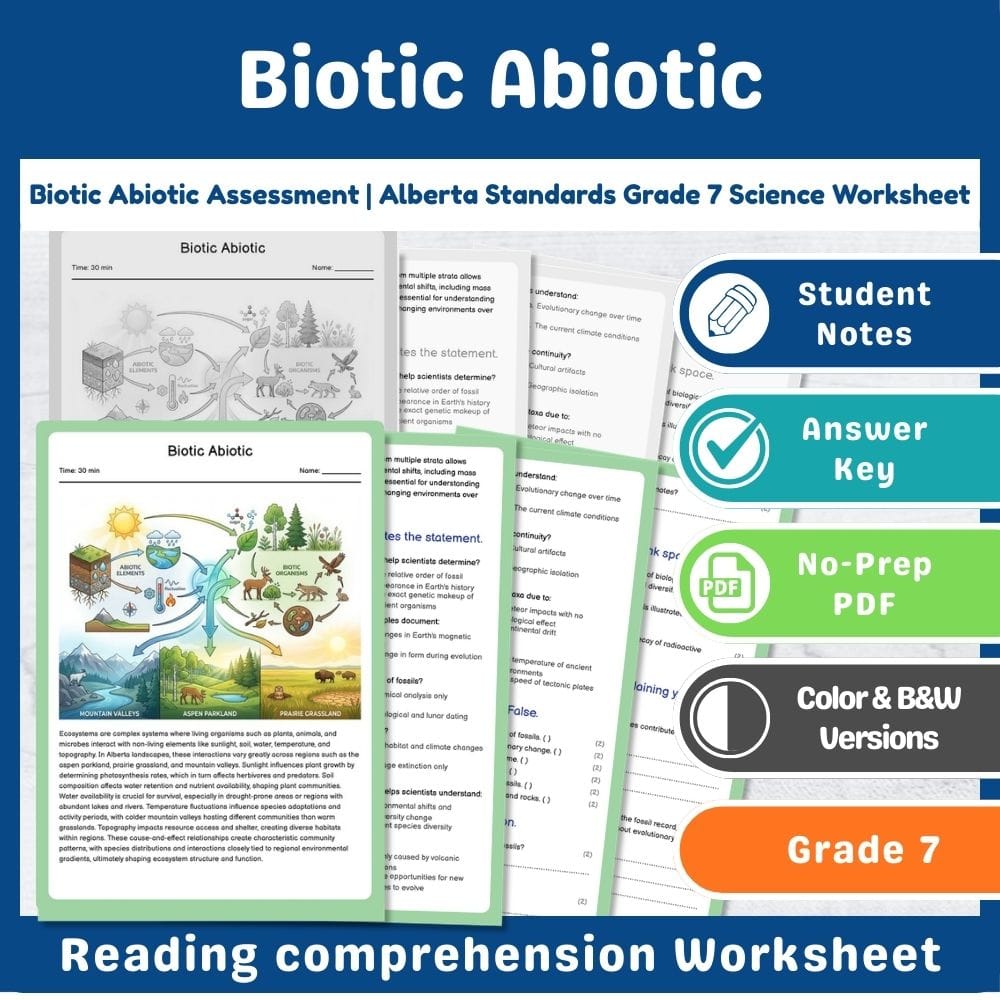
Biotic Abiotic Assessment | Alberta Standards Grade 7 Science Worksheet
Created byPrism Point LearningLearning Objectives
- Understand how sunlight, soil, water, temperature, and topography influence ecosystems.
- Identify the relationships between living organisms and non-living environmental factors.
- Explain how cause-and-effect links shape community patterns in Alberta landscapes.

Greenhouse Climate Assessment | Florida NGSSS Grade 12 Science
Created byPrism Point LearningLearning Objectives
- Explain how greenhouse gases affect Earth’s energy budget by interacting with infrared radiation
- Describe radiative forcing and how changes in greenhouse gas concentrations influence climate trends
- Evaluate how climate feedbacks can amplify or dampen temperature changes
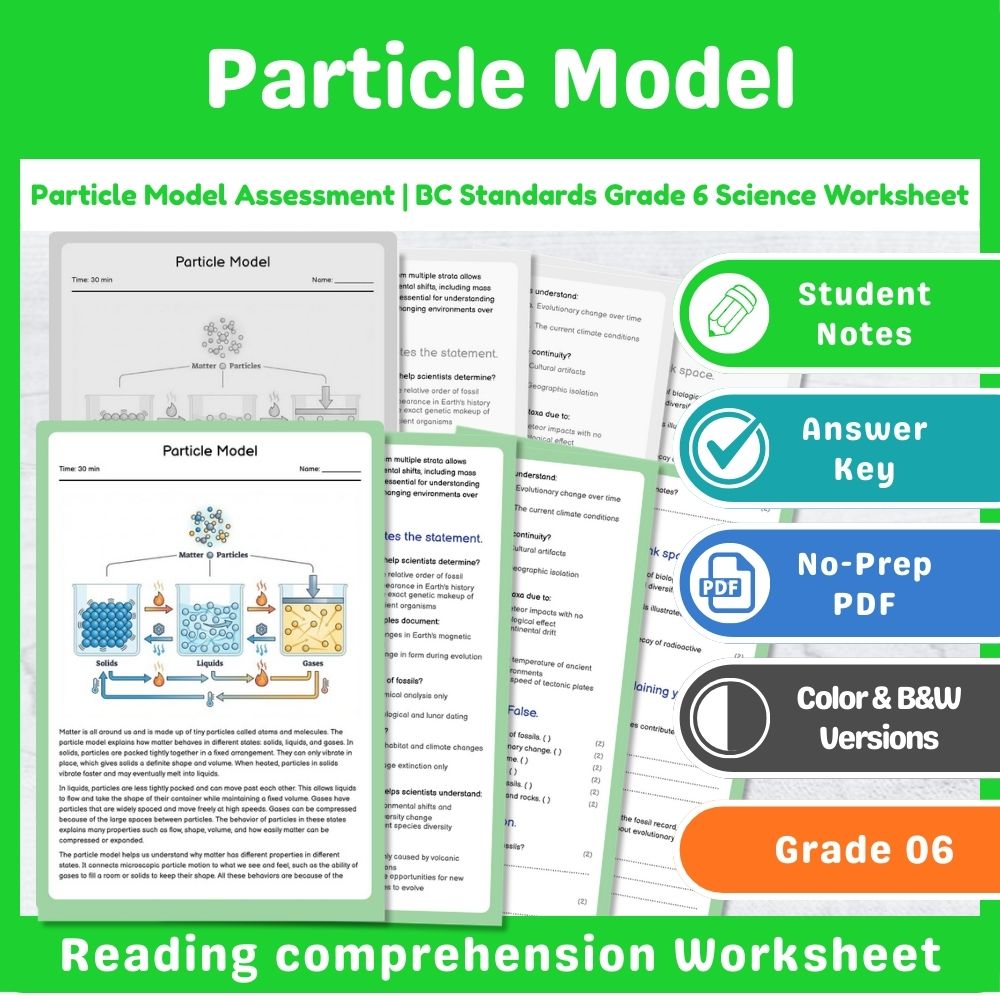
Particle Model Assessment | BC Standards Grade 6 Science Worksheet
Created byPrism Point LearningLearning Objectives
- Describe the particle model of matter and its states: solids, liquids, and gases.
- Explain how particle arrangements affect the properties of matter such as shape, volume, and flow.
- Relate microscopic particle behavior to macroscopic properties like compressibility and flow.
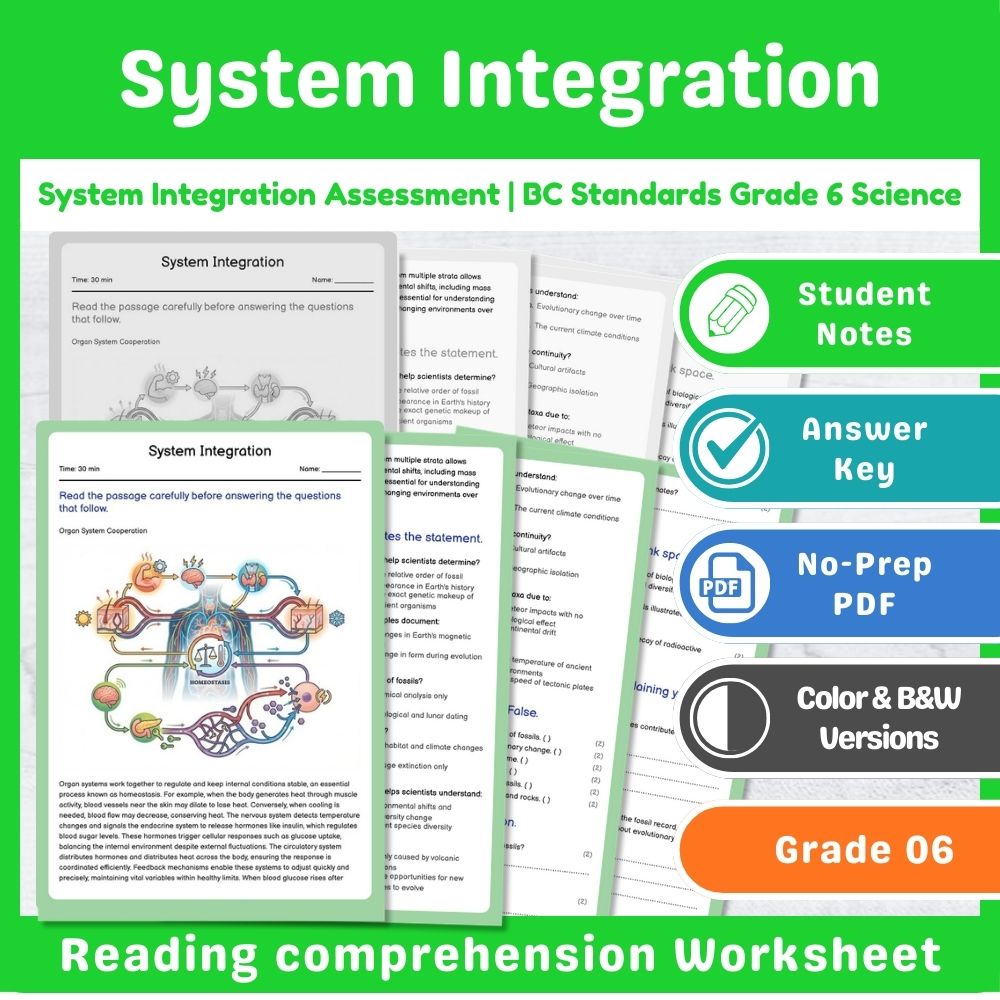
System Integration Assessment | BC Standards Grade 6 Science
Created byPrism Point LearningLearning Objectives
- Understand how different organ systems collaborate to maintain homeostasis amid external changes.
- Identify examples of feedback mechanisms involved in temperature regulation and blood sugar control.
- Describe the roles of the nervous, endocrine, and circulatory systems in homeostasis.
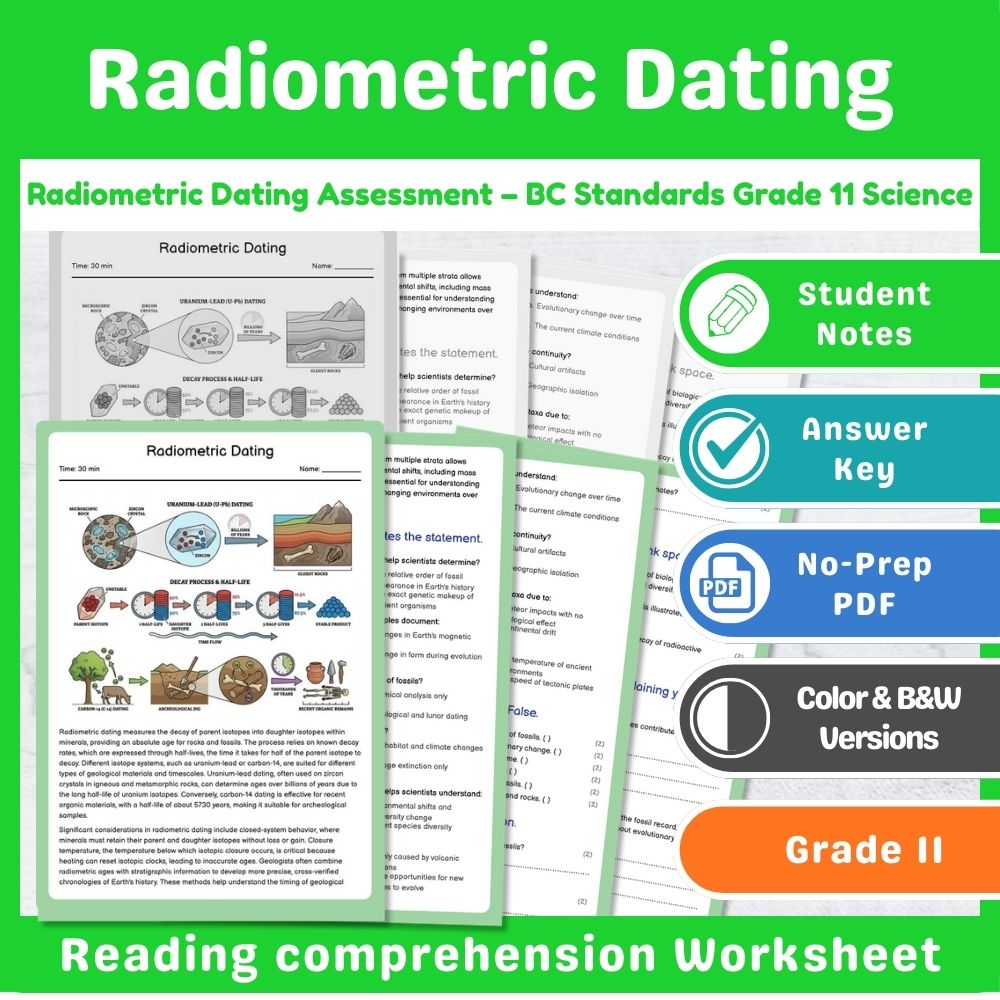
Radiometric Dating Assessment – BC Standards Grade 11 Science
Created byPrism Point LearningLearning Objectives
- Understand the principles of radiometric dating and how isotopic decay is used to determine geological ages.
- Identify different parent-daughter isotope systems suitable for various timescales and rock types.
- Explain the significance of closure temperature and how it affects isotopic retention in rocks.
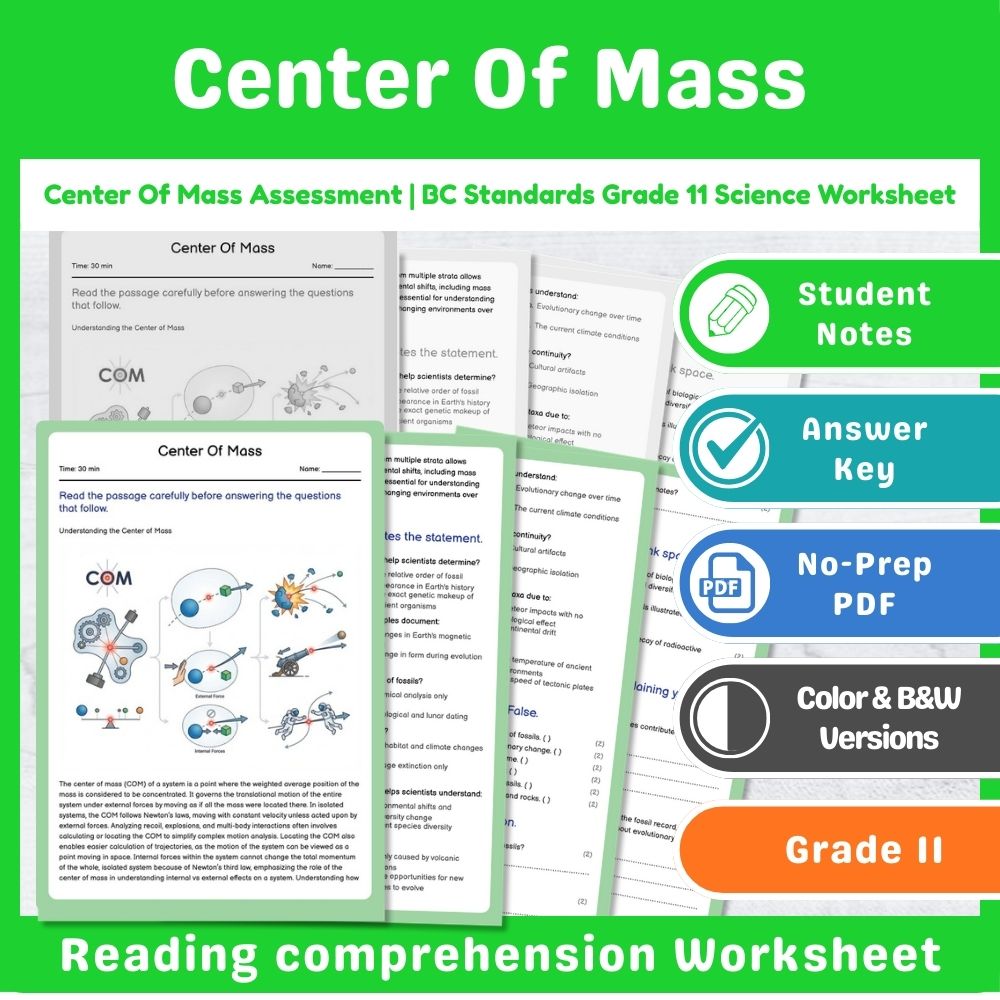
Center Of Mass Assessment | BC Standards Grade 11 Science Worksheet
Created byPrism Point LearningLearning Objectives
- Understand the concept of the center of mass in physical systems.
- Apply the principles of momentum conservation relative to the center of mass.
- Analyze system trajectories and internal forces using the center of mass concept.
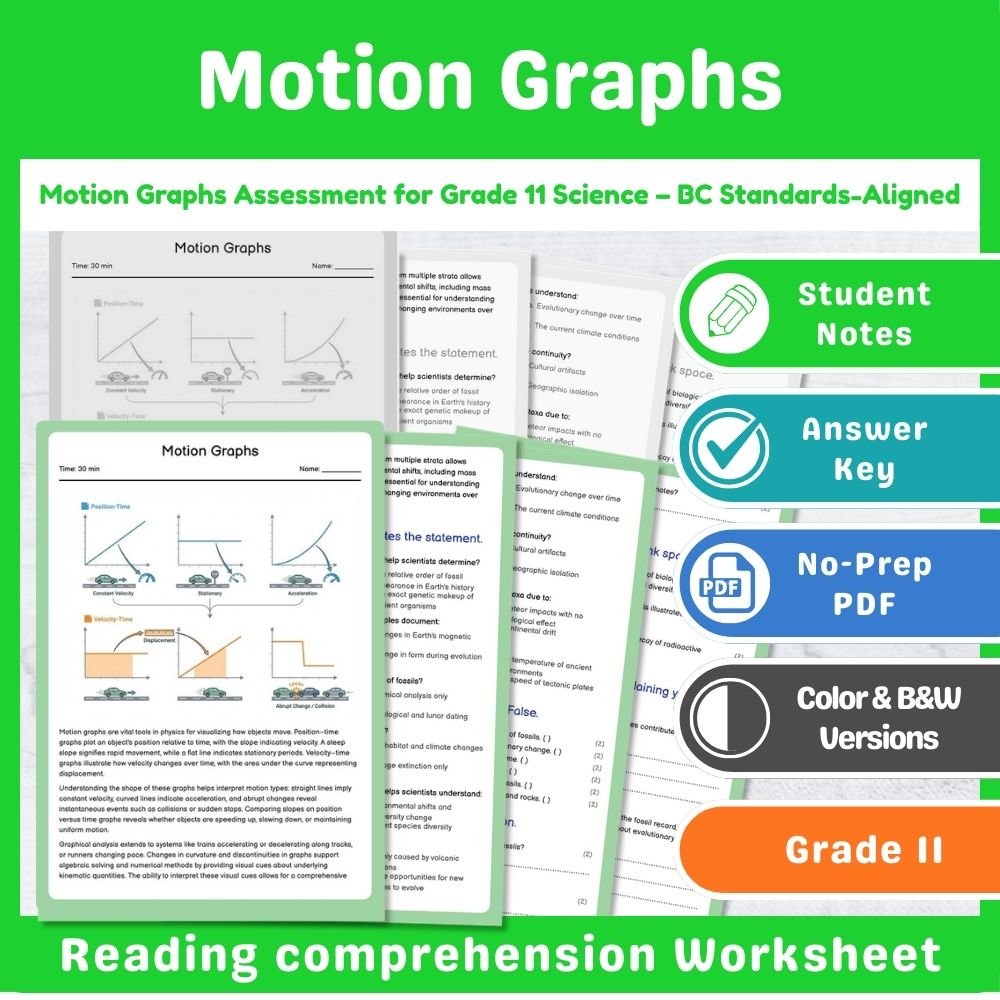
Motion Graphs Assessment for Grade 11 Science – BC Standards-Aligned
Created byPrism Point LearningLearning Objectives
- Understand how position–time graphs represent motion and interpret their slopes.
- Analyze velocity–time graphs to determine acceleration and displacement.
- Identify different types of motion such as uniform velocity, constant acceleration, and instantaneous events from graphs.
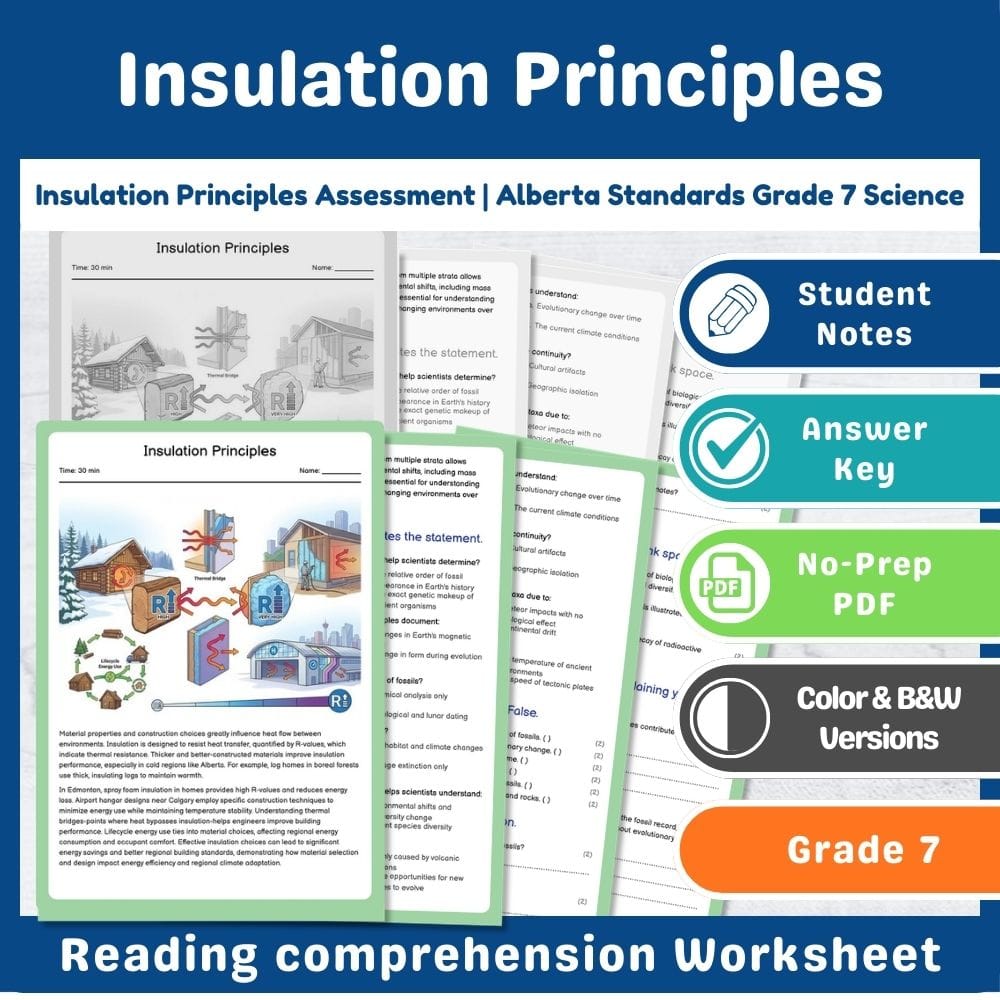
Insulation Principles Assessment | Alberta Standards Grade 7 Science
Created byPrism Point LearningLearning Objectives
- Understand how material properties influence heat flow.
- Identify regional examples of insulation techniques in Alberta.
- Determine the significance of R-values and thermal bridges in building design.

Solar Energy Balance Assessment | NGSSS Standards Grade 12 Science
Created byPrism Point LearningLearning Objectives
- Explain how incoming solar radiation and outgoing infrared radiation determine Earth’s energy balance
- Describe how radiation, conduction, and convection redistribute energy within the Earth system
- Interpret how latitude and surface properties (including albedo) influence heating and temperature
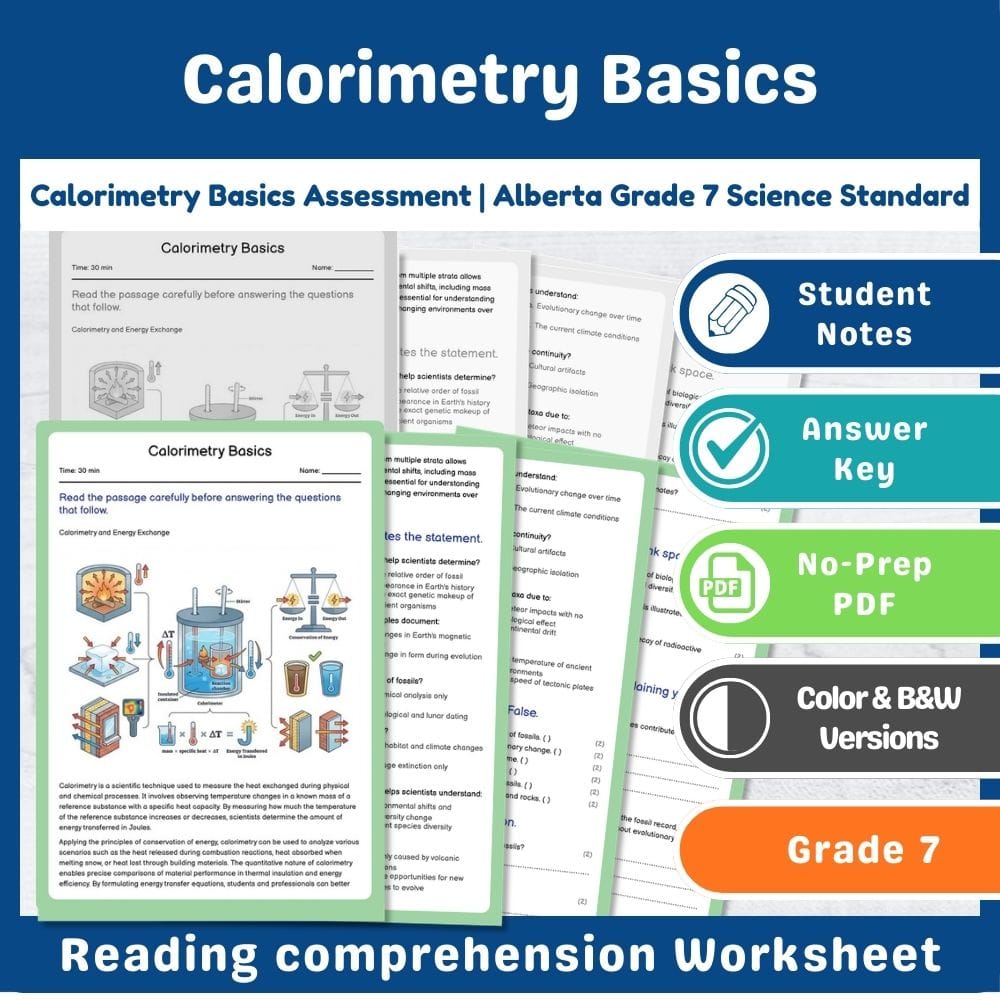
Calorimetry Basics Assessment | Alberta Grade 7 Science Standard
Created byPrism Point LearningLearning Objectives
- Explain the principles of calorimetry and how temperature changes relate to energy exchange.
- Apply energy conservation equations to quantitative heat transfer calculations.
- Describe real-world scenarios involving calorimetric reasoning in thermal performance of materials.
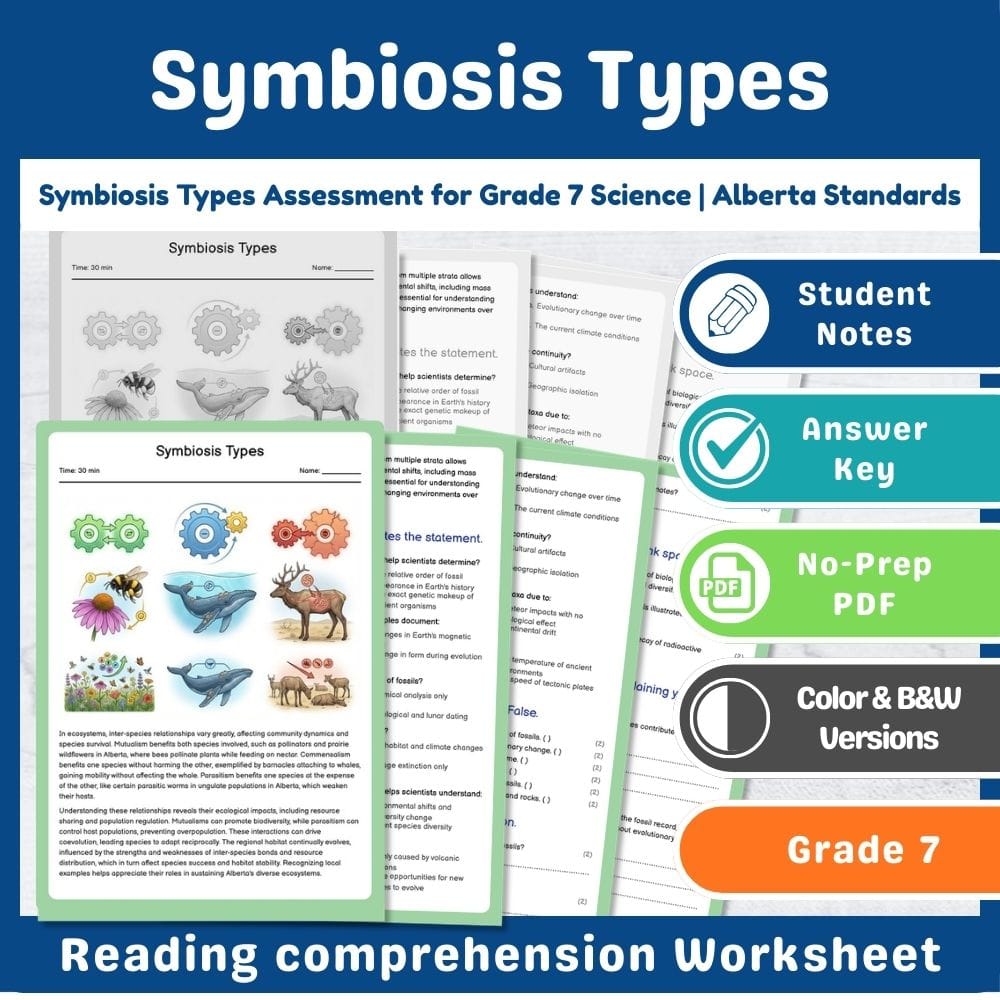
Symbiosis Types Assessment for Grade 7 Science | Alberta Standards
Created byPrism Point LearningLearning Objectives
- Define and differentiate among mutualism, commensalism, and parasitism.
- Identify Alberta-relevant examples of inter-species relationships.
- Explain ecological consequences of different symbiosis types on populations and habitats.
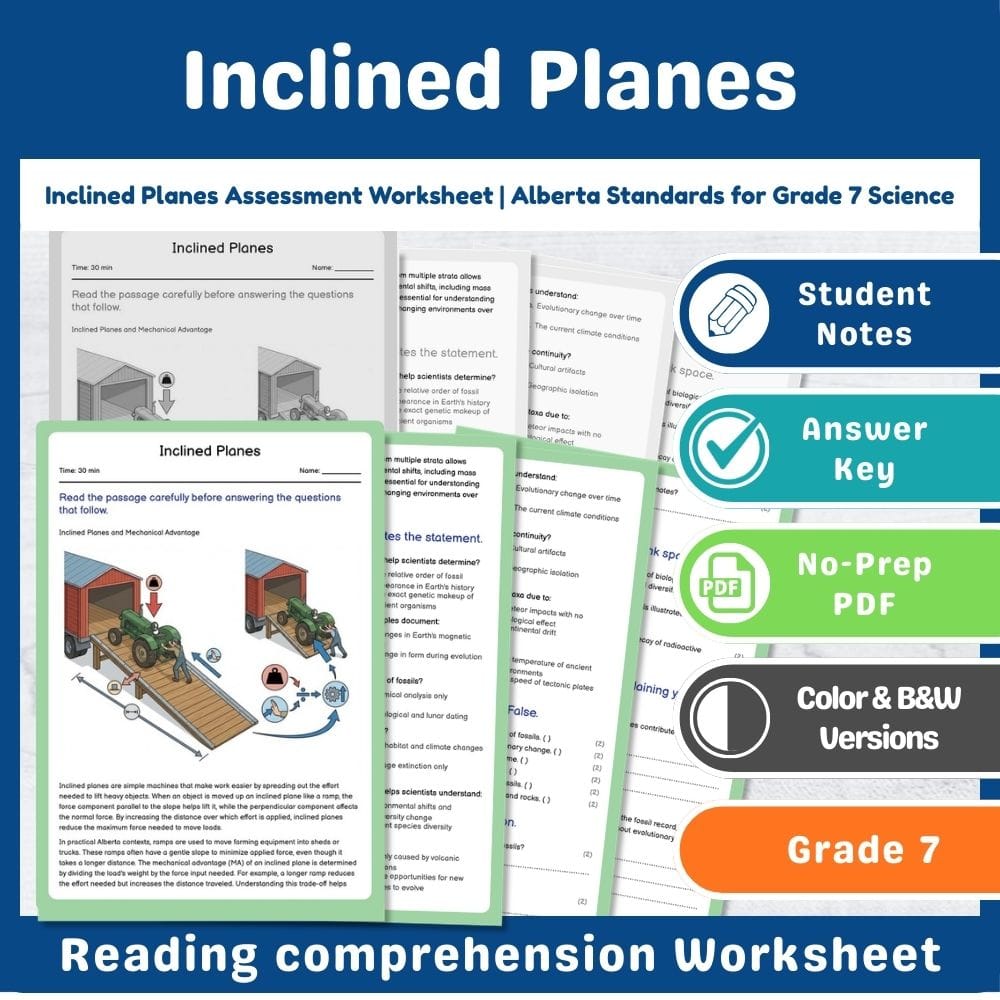
Inclined Planes Assessment Worksheet | Alberta Standards for Grade 7 Science
Created byPrism Point LearningLearning Objectives
- Understand how inclined planes reduce the force needed to move loads.
- Identify components of force parallel and perpendicular to an inclined plane.
- Calculate mechanical advantage of inclined planes based on input force and load.
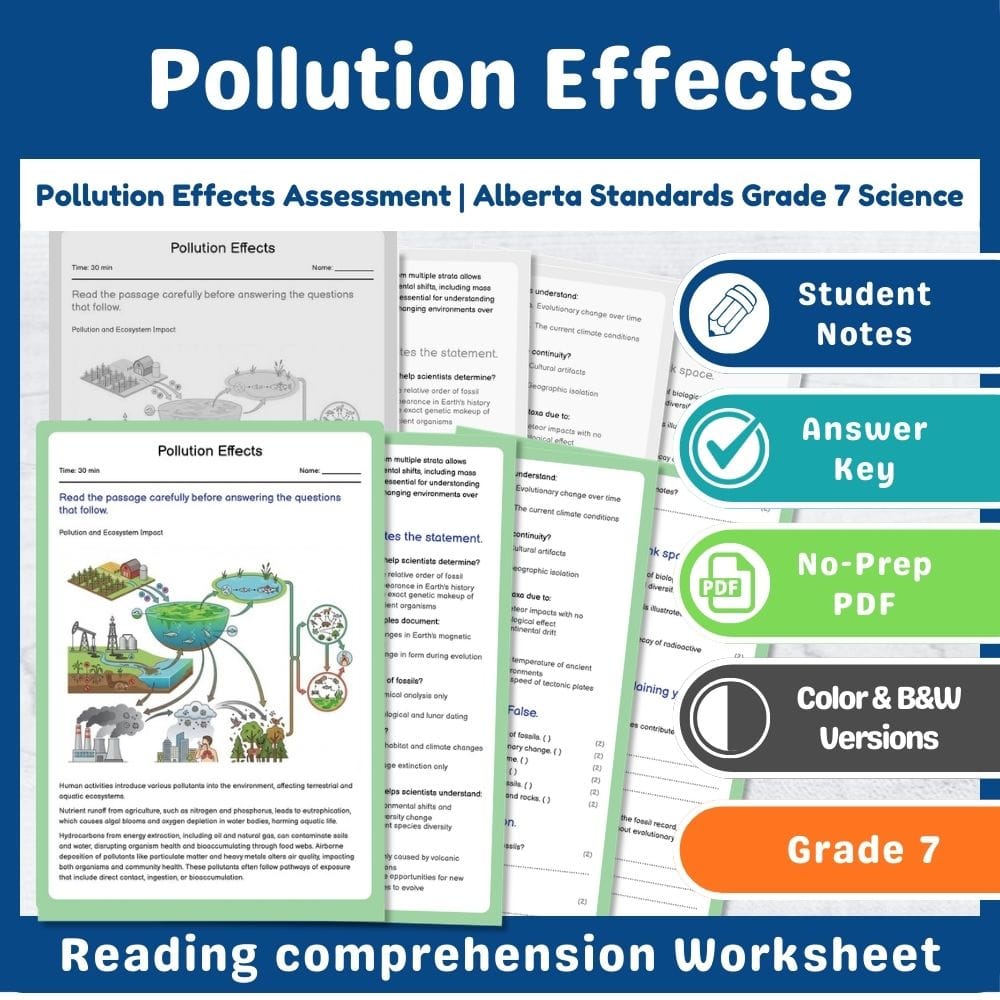
Pollution Effects Assessment | Alberta Standards Grade 7 Science
Created byPrism Point LearningLearning Objectives
- Describe basic types of pollutants affecting terrestrial and aquatic ecosystems.
- Explain how pollutants travel pathways lead to bioaccumulation and community impacts.
- Identify measurable ecological effects caused by different pollutants.
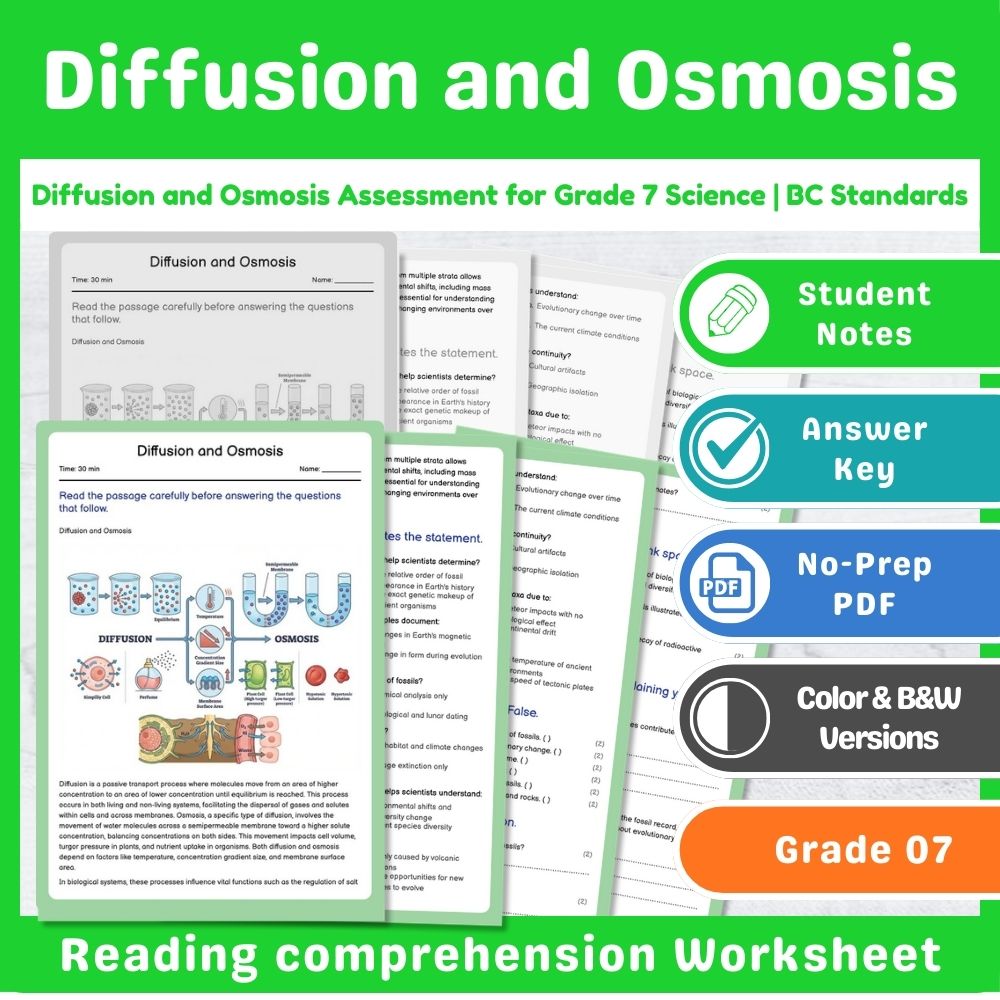
Diffusion and Osmosis Assessment for Grade 7 Science | BC Standards
Created byPrism Point LearningLearning Objectives
- Understand the processes of diffusion and osmosis and their roles in cells.
- Identify factors that influence the rate of diffusion and osmosis.
- Explain how diffusion and osmosis affect cell volume, nutrient uptake, and salt balance.

Evolution Evidence Assessment for Grade 12 Science | NGSSS Standards
Created byPrism Point LearningLearning Objectives
- Explain how fossils, comparative anatomy, biogeography, and genetics provide evidence for evolution and common descent
- Distinguish homologous structures from analogous structures and interpret what each implies
- Use multiple evidence sources to justify why species change over time
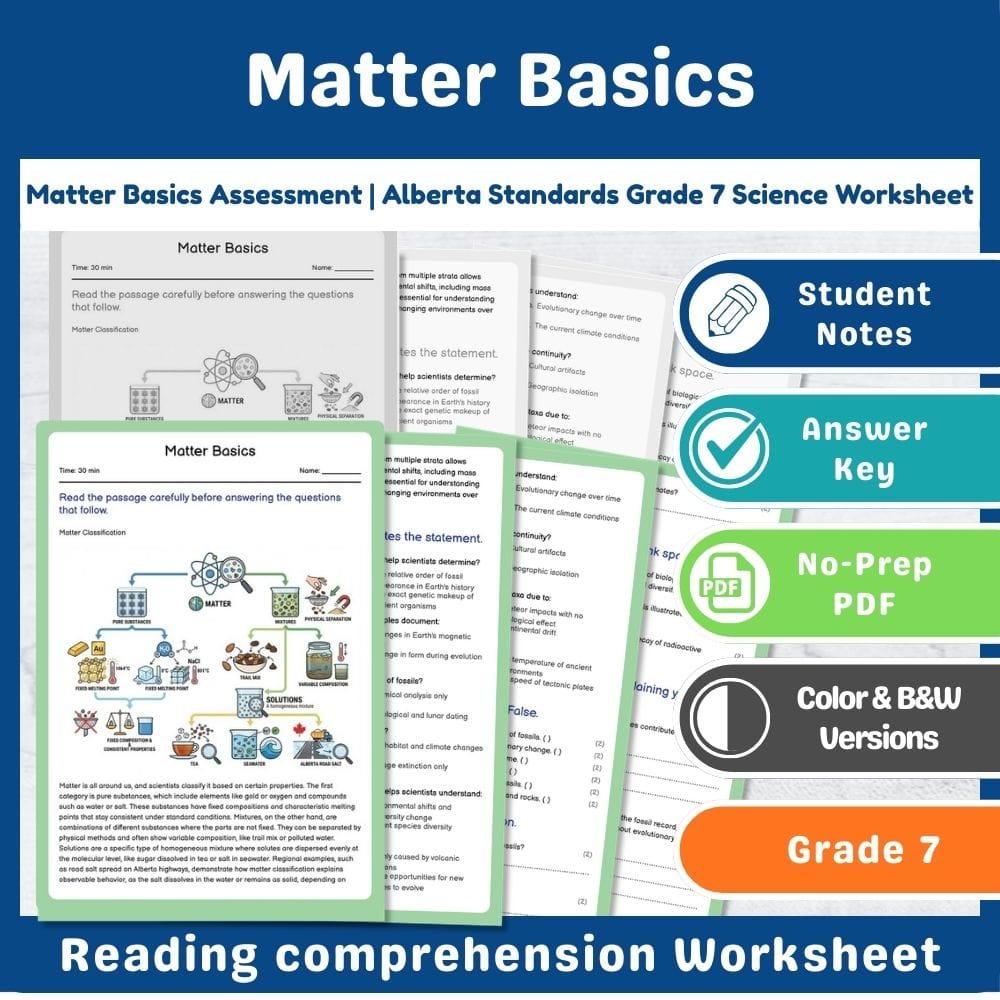
Matter Basics Assessment | Alberta Standards Grade 7 Science Worksheet
Created byPrism Point LearningLearning Objectives
- Identify and describe different types of matter including pure substances, mixtures, and solutions.
- Explain the properties that distinguish pure substances from mixtures and solutions.
- Apply regional examples, such as road salt and dissolved salts, to classify different matter types.
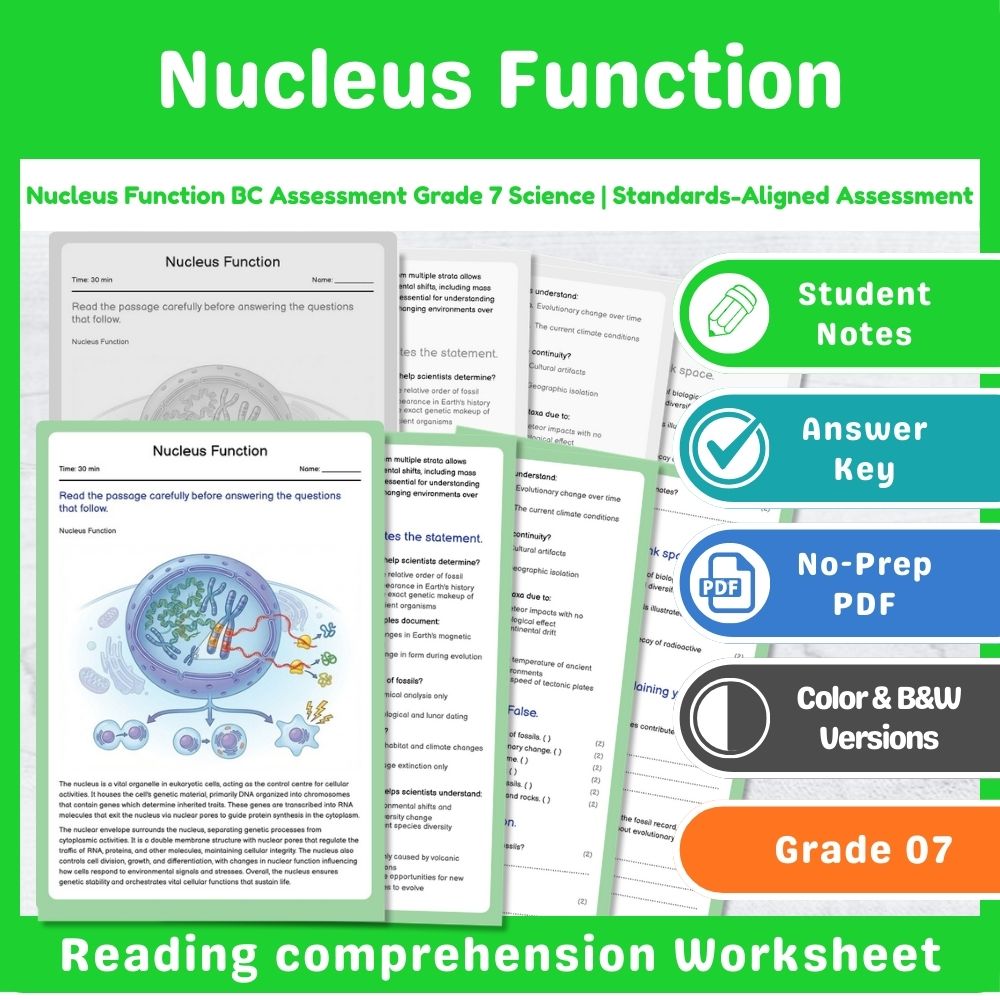
Nucleus Function BC Assessment Grade 7 Science | Standards-Aligned Assessment
Created byPrism Point LearningLearning Objectives
- Describe the structure and role of the nucleus in the cell.
- Explain how genetic material is organized within the nucleus.
- Identify the functions of nuclear envelope and nuclear pores.
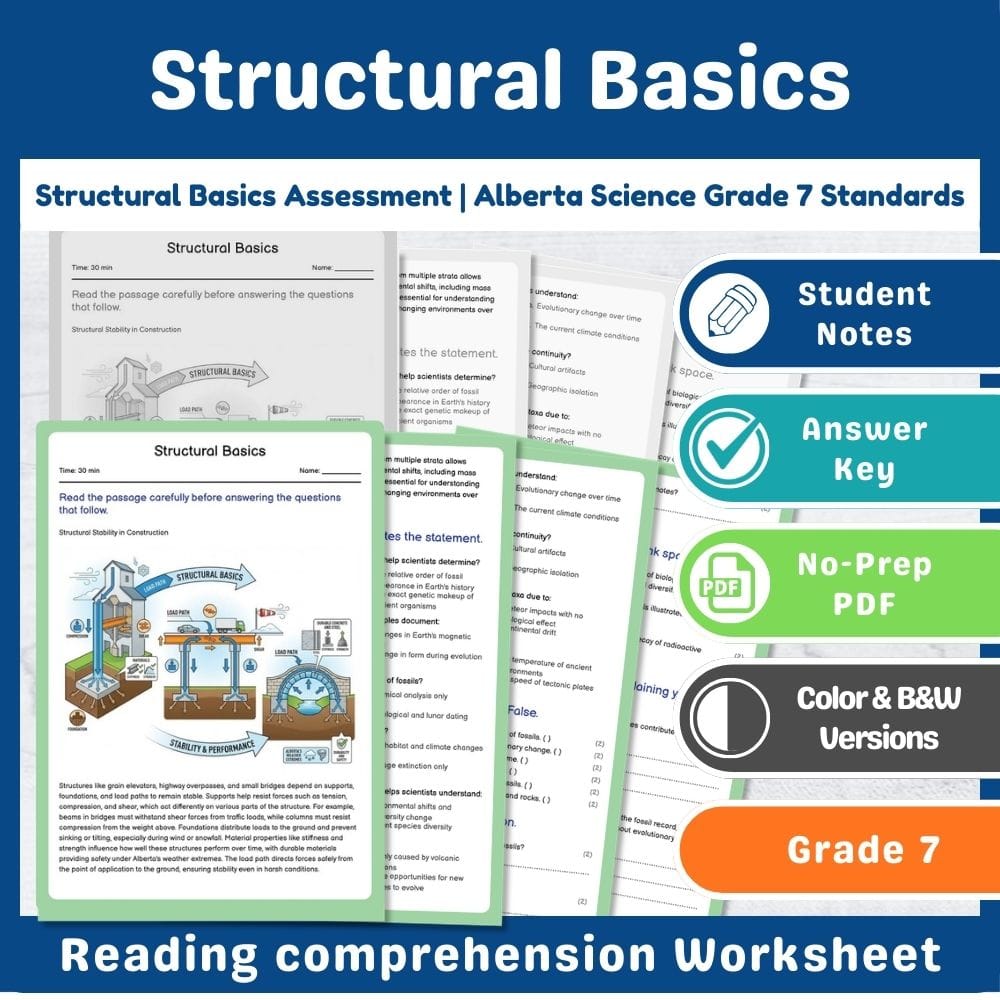
Structural Basics Assessment | Alberta Science Grade 7 Standards
Created byPrism Point LearningLearning Objectives
- Explain how supports, foundations, and load paths contribute to structural stability.
- Describe the effects of compression, tension, and shear on beams, columns, and foundations.
- Identify material properties such as stiffness, strength, and durability relevant to construction safety.
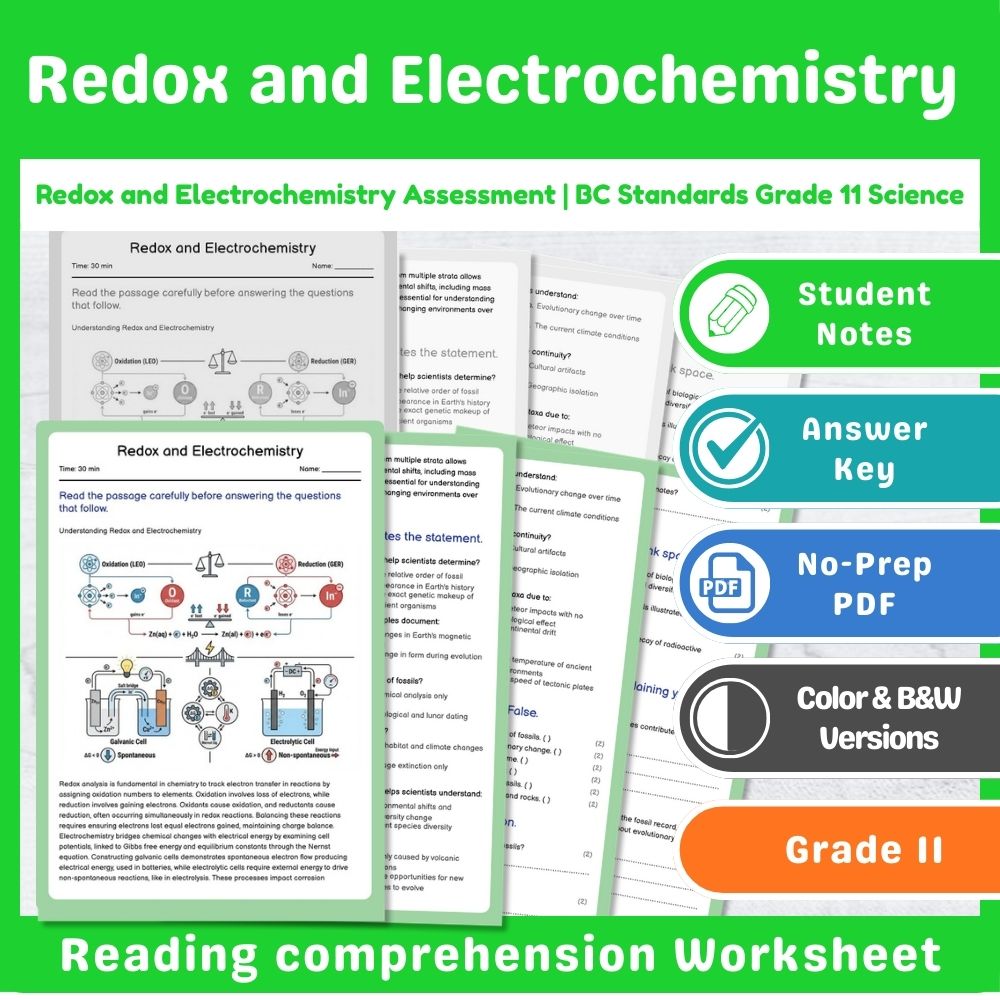
Redox and Electrochemistry Assessment | BC Standards Grade 11 Science
Created byPrism Point LearningLearning Objectives
- Understand how oxidation numbers are assigned and used to analyze redox reactions.
- Explain the concepts of oxidants and reductants in electron transfer.
- Describe the relationship between cell potentials, Gibbs free energy, and equilibrium constants.
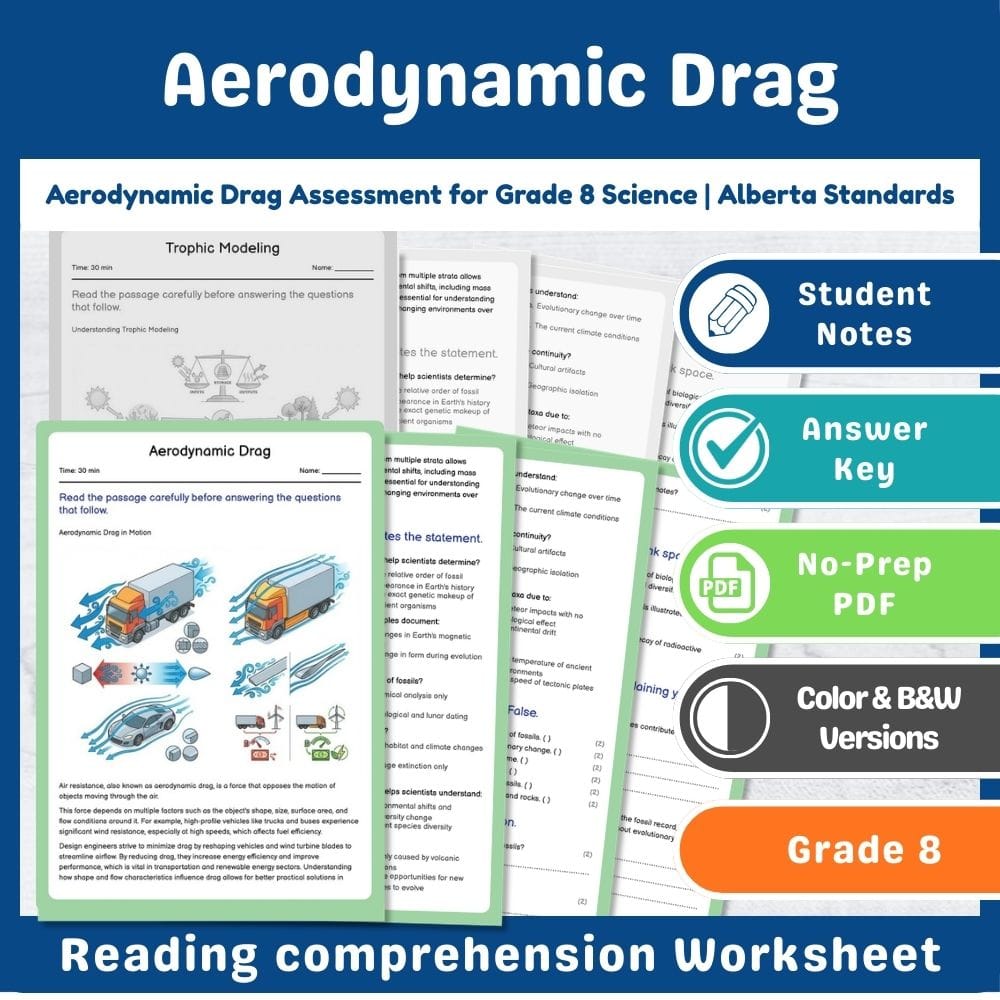
Aerodynamic Drag Assessment for Grade 8 Science | Alberta Standards
Created byPrism Point LearningLearning Objectives
- Understand the concept of aerodynamic drag and factors affecting it.
- Identify how shape and flow conditions influence air resistance.
- Analyze practical applications where drag reduction is important.
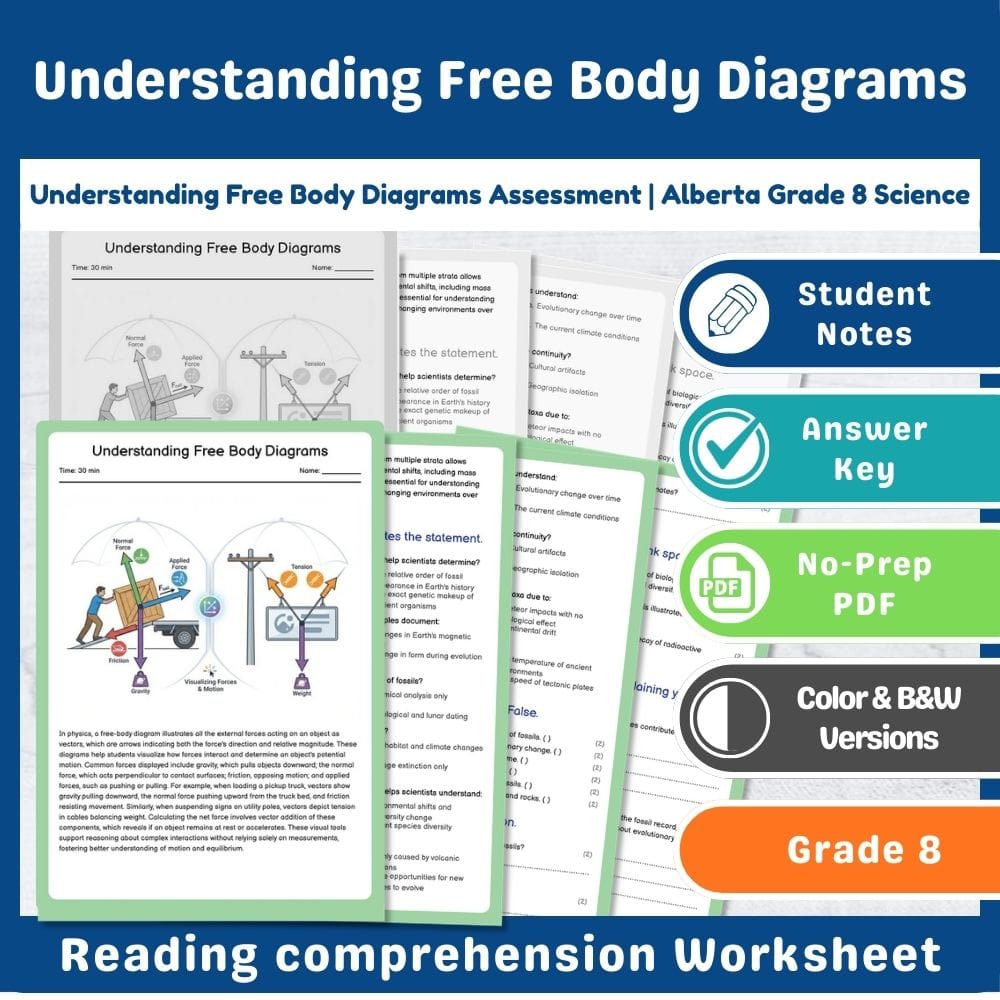
Understanding Free Body Diagrams Assessment | Alberta Grade 8 Science
Created byPrism Point LearningLearning Objectives
- Describe how forces are represented as vectors in free-body diagrams.
- Identify and distinguish between gravitational, normal, frictional, and applied forces in various scenarios.
- Support reasoning about combined forces and resulting motion using vector addition.
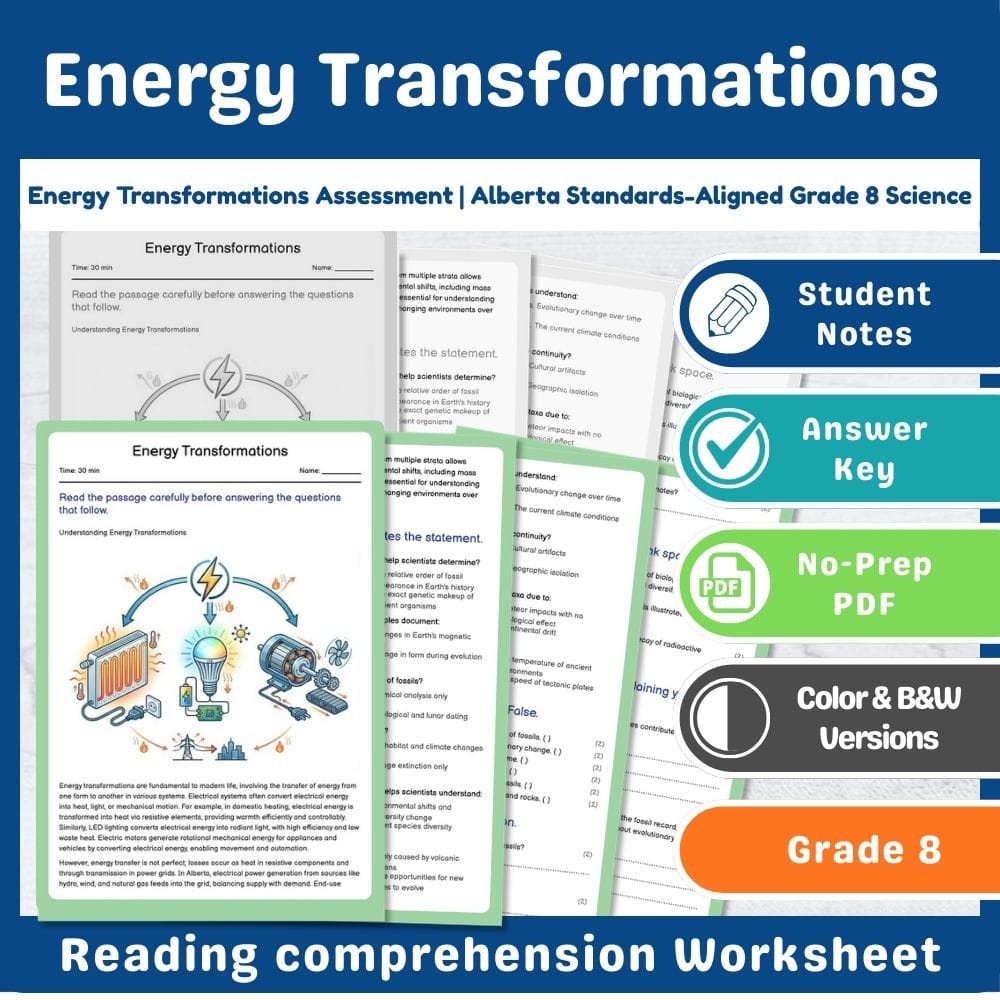
Energy Transformations Assessment | Alberta Standards-Aligned Grade 8 Science
Created byPrism Point LearningLearning Objectives
- Understand how electrical energy is transferred and transformed into thermal, radiant, and mechanical energy.
- Identify examples of energy conversions in domestic and industrial systems.
- Explain the concepts of power and efficiency in energy systems.
Closed Systems Assessment | Alberta Standards Grade 8 Science
Created byPrism Point LearningLearning Objectives
- Understand the concept of closed systems in chemical and physical processes.
- Identify examples and applications of closed-system analysis in real-world scenarios.
- Explain how mass conservation applies in closed environments to interpret reactions and changes.
Electromagnetic Induction Assessment | Alberta Grade 8 Science Standards
Created byPrism Point LearningLearning Objectives
- Explain the principle of electromagnetic induction and how changing magnetic flux induces current.
- Identify applications of electromagnetic induction in power generation and renewable energy.
- Describe the factors affecting the magnitude of induced electromotive force in coils.
Friction Concepts Alberta Assessment | Standards-Aligned Grade 8 Science
Created byPrism Point LearningLearning Objectives
- Explain the difference between static and kinetic friction.
- Identify factors affecting the strength of frictional forces.
- Describe real-world examples of friction in transportation and agriculture.
Energy Pathways Assessment for Grade 6 Science | NGSS Standards-Aligned
Created byPrism Point LearningLearning Objectives
- Describe the processes of photosynthesis and respiration in plant and animal cells.
- Explain how energy is transferred through chemical reactions in biological systems.
- Identify reactants and products involved in photosynthesis and respiration.
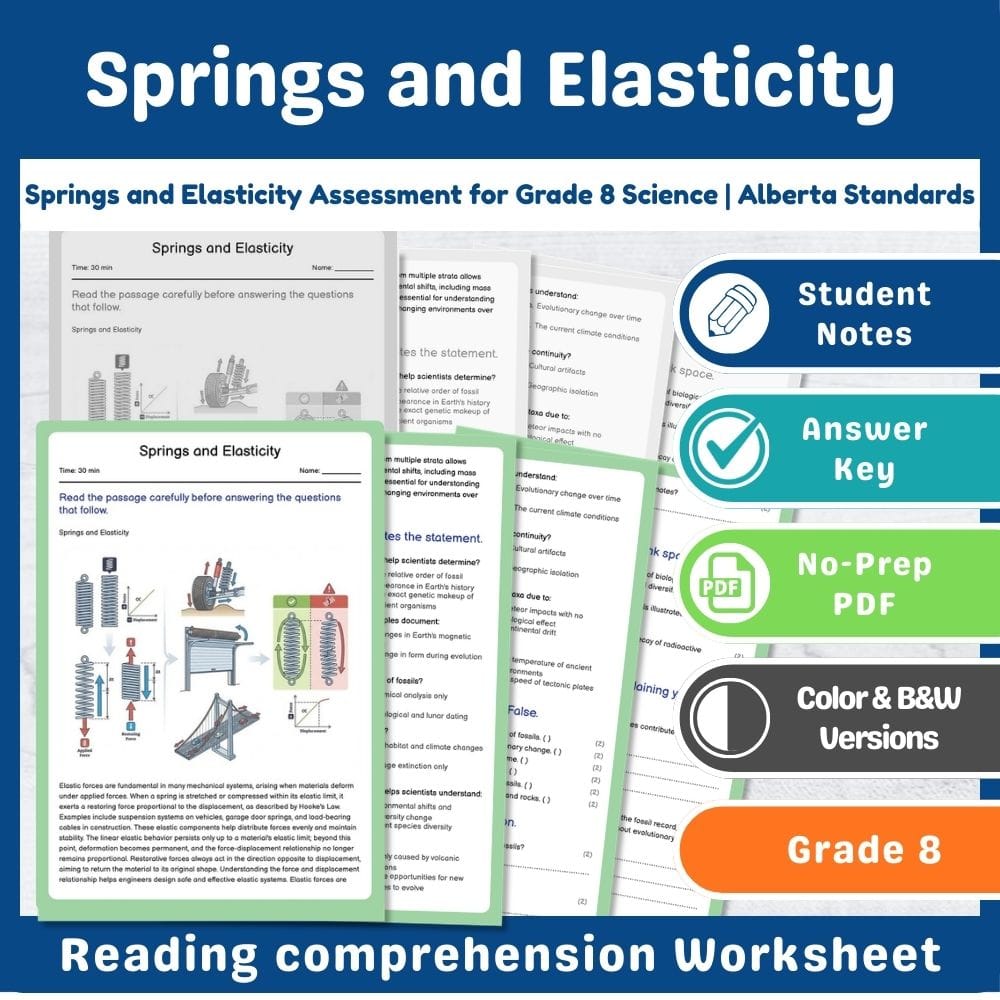
Springs and Elasticity Assessment for Grade 8 Science | Alberta Standards
Created byPrism Point LearningLearning Objectives
- Understand how elastic forces depend on deformation of materials.
- Identify examples of springs and elastic components in real-world systems.
- Explain the concept of linear elastic behavior limits and force direction.

Behavioral Strategies Assessment | Florida NGSSS Standards Grade 6 Science
Created byPrism Point LearningLearning Objectives
- Explain how behavioral adaptations help organisms survive in changing environments
- Identify examples of behavioral adaptations such as migration, hibernation, and daily timing
- Describe how behavior works together with structural and physiological traits
Browse more categories
About Science Worksheets
Find Science worksheets spanning core skills, practice, and review. All 42,685 resources are instant PDF downloads for the classroom or home.
Every worksheet on MyTeachingSheets is created by independent teacher-authors and reviewed before publication. All resources download as printable PDFs for classroom, homework, or at-home practice, and many include answer keys. Preview any worksheet free before buying.