
Grade 6 Worksheets
8,578 grade resources
Grade 6 Math Worksheet | Unit Conversions in Context (PDF)
 Created byClear Sky Classroom
Learning Objectives
- Understand how to convert measurement units within real-world contexts such as construction or landscaping.
- Apply different methods of unit conversions accurately in problem-solving scenarios.
- Analyze the relationships between measurement units and interpret conversions in practical situations.
Also included in: Grade 6 Geometry and Spatial Sense Lesson Bundle for Ontario Maths +1 more
Instant download

Grade 6 Social Studies — Responsibility and Ethics Worksheet MCQ
 Created byThe Resource Hub
Learning Objectives
- Understand the role of ethical considerations in land care and resource use.
- Identify Indigenous values of respect and reciprocity related to the environment.
- Analyze contemporary issues involving environmental stewardship and cultural preservation.
Also included in: Grade 6 Social Studies BC: Indigenous Relationships & Knowledge Systems Bundle +1 more
Instant download

Adaptation Basics Test Prep Printable | Grade 6 Science
 Created byPrism Point Learning
Learning Objectives
- Distinguish structural, behavioural, and physiological adaptations and give examples for each
- Explain how inherited traits can increase survival and reproductive success in a specific niche
- Describe how natural selection can change traits in a local population over generations
Also included in: Grade 6 Biodiversity & Adaptation Science Lesson Bundle Ontario
Instant download

Human Impacts Practice Test | Grade 6 Science NGSS Assessment
Created byPrism Point LearningLearning Objectives
- Explain how human land use, fossil fuel use, agriculture, and waste management change Earth’s systems.
- Describe how these changes can alter biogeochemical cycles, climate drivers, and ecosystem structure.
- Use causal reasoning to connect human activities with environmental trends over time and space.
Instant download

Grade 6 System Interactions Worksheet | NGSS Practice PDF
Created byClear Sky ClassroomLearning Objectives
- Describe how Earth's systems transfer matter and energy through models.
- Identify feedback mechanisms such as albedo changes and sediment transport.
- Explain the role of energy sources and sinks in system processes.
Also included in: Grade 6 Earth's Systems Science Lesson Bundle (NGSS-Aligned) Worksheets +1 more
Instant download

Grade 6 Science | Evaporation Separation Worksheet | General Standard
 Created byLumora Learning
Learning Objectives
- Explain how evaporation separates a soluble solid from a liquid using state change
- Identify evidence that evaporation separation has occurred, such as disappearance of liquid and appearance of residue
- Compare evaporation separation with size-based separation methods (like filtration and sieving)
Instant download
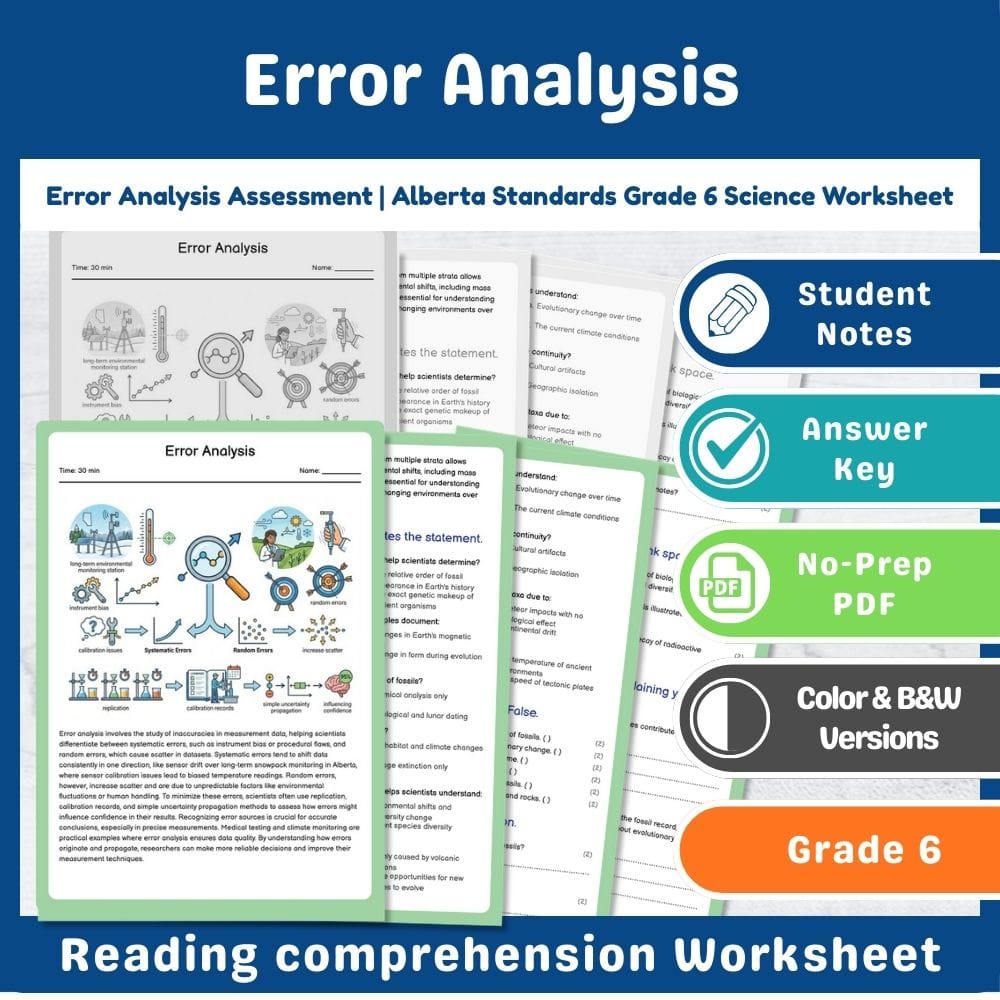
Error Analysis Assessment | Alberta Standards Grade 6 Science Worksheet
Created byPrism Point LearningLearning Objectives
- Understand sources of systematic and random error in scientific data.
- Identify methods used to estimate the effects of errors on results.
- Describe how environmental, procedural, and instrument-related errors impact data accuracy.
Also included in: Lesson Grade 6 Science Mini Bundle | Evidence and Investigation
Instant download

Grade 6 Social Studies — Worksheet MCQ Paper for Mastering Sources
Created byThe Resource HubLearning Objectives
- Differentiate between primary and secondary sources of historical evidence.
- Identify examples of firsthand documents, artifacts, and retellings.
- Classify sources based on their origin and role in history.
Also included in: Grade 6 Social Studies - Evidence & Narratives Lesson Bundle for BC Framework +1 more
Instant download

Classification Basics Worksheet | Grade 6 Science Review & Practice
Created byPrism Point LearningLearning Objectives
- Explain how observable characteristics help scientists group living things
- Use a simple dichotomous key to identify organisms
- Describe how hierarchical classification moves from broader categories to species
Also included in: Grade 6 Biodiversity & Adaptation Science Lesson Bundle Ontario
Instant download

Christmas Traditions and Cultural Vocabulary Worksheets Grade 6
 Created byElena Brooks
Learning Objectives
- Use holiday vocabulary to describe how Christmas is celebrated in different countries
- Compare and contrast customs, traditions, and festive activities across cultures
- Explain how cultural background shapes the way people celebrate Christmas
Instant download

Grade 6 Science – Change Evidence & Content | Daily Reading Worksheet
 Created byBright Mind Resources
Learning Objectives
- Identify observable signs of physical changes
- Differentiate physical changes from chemical changes
- Recognize examples of physical and chemical evidence in everyday phenomena
Also included in: Matter & Energy Grade 6 Science Daily Reading Worksheets Bundle | TEKS +2 more
Instant download

Science Conservation of Mass Worksheet | NGSS Grade 6 Science Assessment
 Created bySkylark Worksheets
Learning Objectives
- Explain conservation of mass using the idea that atoms are neither created nor destroyed in a closed system.
- Use particle models and symbolic representations to show that atom counts stay constant even when molecules rearrange.
- Connect measured mass before and after physical or chemical changes to modeled atom conservation.
Also included in: Grade 6 Matter and Chemical Reactions Science Lesson Bundle NGSS Worksheets +1 more
Instant download

Adaptation Tradeoffs Practice Worksheet | Grade 6 Science BC Standards
Created byPrism Point LearningLearning Objectives
- Explain how adaptation trade-offs happen when a trait increases one benefit but creates a cost
- Compare costs and benefits of traits to predict how they help organisms survive in specific environments
- Use examples to describe how trade-offs can shape where species live and how they reproduce
Also included in: Multicellular Systems & Functions Lesson Bundle | Grade 6 Science | BC +1 more
Instant download

Grade 6 Science – Particle Models & Matter | Daily Reading Worksheet
Created byBright Mind ResourcesLearning Objectives
- Understand what particle models represent in matter.
- Visualize atoms and molecules as parts of matter.
- Describe how particle arrangements relate to properties of substances.
Also included in: Grade 6 Matter Science Daily Reading Worksheets Lesson Bundle | CA Standards +1 more
Instant download

Science Evidence Explanations Worksheet | Standard-Aligned Grade 6 Science
JCreated byJ.S SheetsLearning Objectives
- Explain the difference between a claim, evidence, and a scientific idea that provides the reasoning link.
- Describe evidence in terms of trends, ranges, or matches between expected and observed results.
- Evaluate competing explanations by comparing which one is better supported by the evidence.
Also included in: Grade 6 Scientific Investigation Science lesson bundle: General Framework +1 more
Instant download

Insulator Behavior and Electrical Safety Worksheets Grade 6
Created byPrism Point LearningLearning Objectives
- Explain how bound electrons limit charge flow through insulators
- Compare bulk insulation with surface charge behavior
- Identify materials commonly used as electrical insulators
Also included in: Grade 6 Electricity Lesson Bundle | Ontario Science Framework
Instant download

Grade 6 Math Pattern Analysis Worksheet – Ontario Standards (PDF)
Created byClear Sky ClassroomLearning Objectives
- Understand and identify algebraic and numeric patterns.
- Generate and extend pattern sequences using rules.
- Apply pattern analysis to solve real-world problems.
Also included in: Grade 6 Algebra and Mathematical Modelling Lessons | Ontario Standards +1 more
Instant download

Grade 6 Math Patterns and Factors Worksheet (Ontario Standard) (PDF)
Created byClear Sky ClassroomLearning Objectives
- Identify and extend number patterns involving addition, subtraction, multiplication, and division.
- Calculate and apply greatest common factors (GCF) and least common multiples (LCM) to solve problems.
- Determine prime and composite numbers and explain their properties.
Also included in: Grade 6 Math Number Bundle | Ontario Standards for Operations & Patterns +1 more
Instant download

Grade 6 Science | Sun, Earth, Moon - Daily Reading Comprehension
 Created byCoral Reef Learning
Learning Objectives
- Understand how the Sun influences the Earth and Moon.
- Identify the relative sizes and distances among the Sun, Earth, and Moon.
- Explain the gravitational interactions that produce stable orbits.
Instant download
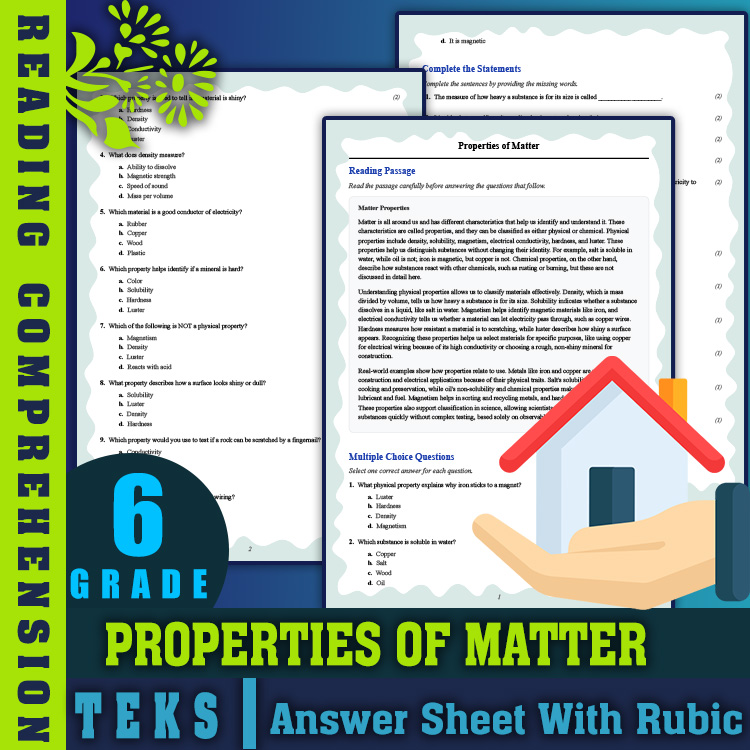
6th Grade Science | Properties of Matter Reading Worksheet (PDF & Rubric)
JCreated byJ.S SheetsLearning Objectives
- Understand and describe physical and chemical properties used to distinguish substances.
- Identify properties such as density, solubility, magnetism, electrical conductivity, hardness, and luster in various materials.
- Relate observed properties to real-world examples and applications in material classification and selection.
Instant download

Tree Anatomy Worksheet | Grade 6 Science Practice
Created byPrism Point LearningLearning Objectives
- Identify major parts of a tree (roots, trunk, branches, leaves, buds, and bark) and describe their functions.
- Explain how form–function relationships help trees survive in different habitats.
- Use tree anatomy vocabulary to answer science questions accurately.
Also included in: Trees and Forests Lesson Bundle | Grade 6 Science | Alberta Framework
Instant download

Interpreting Inequalities Grade 6 Maths Worksheet | Common Core CCSS
Created byElena BrooksLearning Objectives
- Interpret inequalities using the direction of shading (left/right) on a number line
- Identify whether an endpoint is included by using open vs closed circles
- Write an inequality from a number line graph (and vice versa) using rational numbers
Also included in: Grade 6 Rational Numbers, Percents & Inequalities Maths Bundle: Common Core +1 more
Instant download

Friction Effects Worksheet | Grade 6 Force & Motion Science Activity
Created byPrism Point LearningLearning Objectives
- Explain how friction affects motion between contacting surfaces
- Describe how surface texture changes the distance an object slides
- Connect friction and air resistance to the conversion of energy and slowing down of moving objects
Also included in: Grade 6 Energy, Matter & Motion Lesson Bundle | Florida NGSSS
Instant download

Grade 6 Social Studies — Environmental Impact Worksheet MCQ Paper
Created byThe Resource HubLearning Objectives
- Explain how natural processes such as flooding, volcanic activity, and climate variation can influence where humans settle and what economic activities they develop.
- Identify cause-and-effect relationships between environmental changes and human responses (such as building levees or changing farming practices).
- Analyze how coastal and river-valley case studies show the interconnectedness of natural forces and human choices.
Also included in: Maps & Physical/Political Features Lesson Bundle | Grade 6 Social Studies | TEKS +1 more
Instant download

Inherited Adaptations Worksheet Grade 6 Science NGSSS Florida
Created byPrism Point LearningLearning Objectives
- Explain how inherited adaptations help organisms survive and reproduce in specific environments.
- Distinguish adaptations from individual behavior changes and identify examples in real organisms.
- Describe how environmental pressures (living and nonliving factors) select which traits are most helpful.
Instant download

Grade 6 Building Knowledge Worksheet | NGSSS Science Reading & Inquiry Activity
 Created byEvergreen Desk Education
Learning Objectives
- Explain how scientific knowledge improves through iterative refinement when new evidence becomes available.
- Differentiate scientific theories and laws and describe how evidence supports each.
- Identify how communication, peer evaluation, and reproducibility strengthen scientific claims.
Instant download

6th Grade Science | Modeling Systems Worksheet (Ontario) (PDF)
Created byEvergreen Desk EducationLearning Objectives
- Explain how scientists use physical, diagrammatic, and mathematical models to represent real systems.
- Identify model assumptions and define model boundaries to determine what a model can (and cannot) predict.
- Compare model predictions with observable outcomes to evaluate limitations and guide model refinement.
Also included in: Grade 6 Science Inquiry and Data Collection Lesson Bundle | Ontario +1 more
Instant download

Grade 6 Science – Eclipses & Tides Daily Reading Worksheet | Ontario Standards
Created byBright Mind ResourcesLearning Objectives
- Understand the geometric alignment during solar and lunar eclipses
- Distinguish between umbra and penumbra effects
- Explain how the positions of the Earth, Moon, and Sun cause eclipses
Also included in: Space Systems Grade 6 Science Daily Reading Worksheets Bundle | Ontario +1 more
Instant download

Grade 6 Social Studies — Historical Contact Worksheet MCQ Papery
Created byThe Resource HubLearning Objectives
- Understand the effects of contact between different societies in history.
- Identify examples of intercultural exchange through trade, exploration, migration, and colonization.
- Analyze how contact influences cultural traits, beliefs, and practices.
Also included in: Grade 6 Social Studies Bundle: Cultures and Identities – BC Framework +1 more
Instant download

Water Cycle Pathways Worksheet | NGSSS Grade 6 Science Practice
JCreated byJ.S SheetsLearning Objectives
- Describe the main processes involved in the water cycle, including evaporation, condensation, precipitation, runoff, and infiltration.
- Explain how water changes its state and location during the water cycle.
- Understand the importance of water cycle pathways in distributing heat and freshwater across Earth's surface.
Also included in: Grade 6 Climate and Atmospheric Systems Science Lesson Bundle: Florida NGSSS +1 more
Instant download

Diffusion Rates Worksheet | BC Standards Grade 6 Science Practice
JCreated byJ.S SheetsLearning Objectives
- Explain the process of diffusion and how particles move from high to low concentration.
- Describe how temperature, particle size, and medium viscosity affect diffusion rates.
- Connect microscopic particle motion to observable phenomena such as scent spreading and dye dispersal.
Instant download

6th Grade ELA | Claim Statements Worksheet – Common Core (PDF)
 Created byGolden Apple Studio
Learning Objectives
- Identify the difference between a fact and an arguable claim in argumentative writing.
- Write a central claim that clearly states a position and can be supported with evidence and logical reasoning.
- Revise claim statements to improve clarity, specificity, and alignment with supporting evidence.
Also included in: Grade 6 ELA Claim, Evidence & Argument Writing Lesson Bundle | CCSS +1 more
Instant download

Sources Worksheet | BC Standards Grade 6 Social Studies Practice
JCreated byJ.S SheetsLearning Objectives
- Distinguish between primary and secondary sources and explain how each provides evidence.
- Classify examples (diaries, photographs, artifacts, and textbooks) as primary or secondary sources.
- Use source details such as date and purpose to support claims about historical events.
Instant download

Grade 6 Trophic Levels Worksheet | NGSS Practice & PDF
Created byClear Sky ClassroomLearning Objectives
- Explain how energy moves through producers and consumers in trophic levels
- Identify examples of primary, secondary, and higher-level consumers
- Describe the role of decomposers in nutrient recycling
Instant download

Evidence and Reasoning Worksheet Grade 6 Science Florida NGSSS Claims
Created byPrism Point LearningLearning Objectives
- Use evidence such as measurements and observations to support scientific claims.
- Explain why evidence must be relevant and described consistently in appropriate units or terms.
- Distinguish correlation from causation when interpreting data.
Also included in: Scientific Inquiry Lesson Bundle | Grade 6 Science | Florida NGSSS
Instant download

Grade 6 ELA – Interpreting Formats & Diagrams | Daily Reading Worksheet
 Created byQuiet Forest Education
Learning Objectives
- Understand different visual formats such as diagrams, charts, timelines, and photographs.
- Identify the main message conveyed by visual formats.
- Locate key details within diagrams and charts.
Also included in: Grade 6 Speaking and Listening ELA Daily Reading Lesson Bundle | General ELA +2 more
Instant download

National Read a Book Day Worksheets: Grade 6 Reading & Empathy
 Created byShaNova Worksheets
Learning Objectives
- Explain how independent reading exposes readers to different ideas
- Identify details about independent reading and its benefits
- Describe how stories can build empathy and understanding
Also included in: National Read a Book Day Lesson Bundle | Grade 6 Holiday | September
Instant download

Observation Techniques Worksheet for Grade 6 Science | TEKS Aligned Assessment
JCreated byJ.S SheetsLearning Objectives
- Define systematic observation and explain the difference between qualitative notes and quantitative measurements.
- Use data-collection strategies such as repeated measurements, consistent sampling frequency, and accurate record-keeping.
- Identify common observation instruments and describe how calibration and maintenance support reliable results.
Instant download

Grade 6 Reading Receipts and Reviews Worksheet | Financial Literacy Alberta
Created byThe Resource HubLearning Objectives
- Identify what a payment receipt tells you about a digital transfer
- Explain how reviews can help you judge whether a digital money tool is trustworthy
- Choose safe actions when using bank apps, transfer screens, and payment links
Instant download

Grade 6 Science – Angle Effects in Flight Reading Worksheet | Alberta Standards
Created byBright Mind ResourcesLearning Objectives
- Understand what the angle of attack is and how it affects flight performance.
- Recognize how increasing the angle influences lift and drag until a stall occurs.
- Identify examples of wings, gliders, and kites and how angle adjustments impact their flight.
Also included in: Aerodynamics Grade 6 Science Daily Reading Worksheets Lesson Bundle | Alberta +2 more
Instant download

Grade 6 Safe Digital Payments Worksheet | Financial Literacy Alberta
Created byThe Resource HubLearning Objectives
- Explain how passwords, PINs, and privacy protect accounts in digital payments
- Identify safe habits for keeping account information private
- Choose strategies that reduce the risk of account theft or unauthorized purchases
Instant download
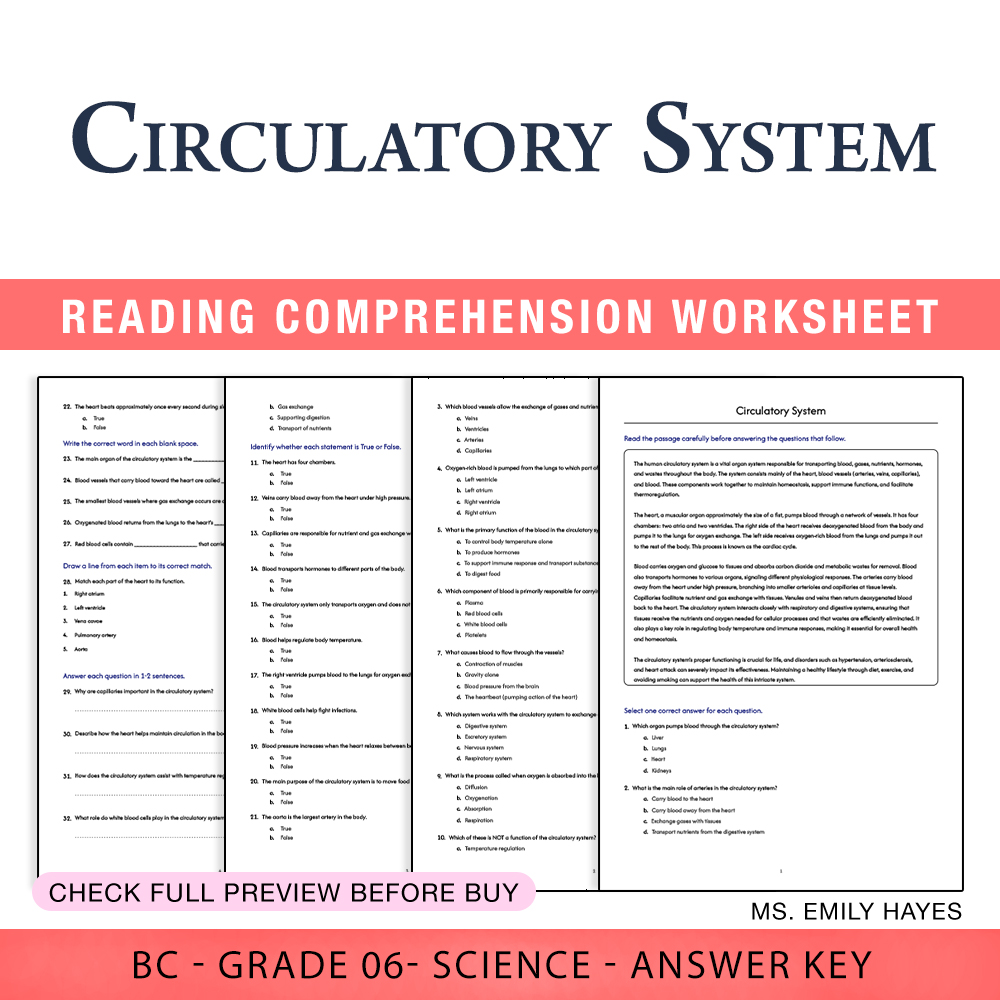
6th Grade Science | Circulatory System Worksheet (PDF+ Answer Key)
 Created byCopper Leaf Classroom
Learning Objectives
- Understand the main functions of the human circulatory system.
- Identify key components of the circulatory system and their roles.
- Explain how blood transports gases, nutrients, hormones, and wastes.
Also included in: Grade 6 Science BC | Human Body Systems & Adaptations (PDF+ Answer Keys) +1 more
Instant download

Grade 6 ELA – Summarizing Ideas in Nature Texts | Daily Reading Worksheet
Created byQuiet Forest EducationLearning Objectives
- Identify main ideas and key details in a passage about nature.
- Practice selecting important facts and explanations for a summary.
- Distinguish between factual information and opinions in a text.
Also included in: Grade 6 Reading & Viewing ELA Lesson Bundle for Daily Reading | Alberta +1 more
Instant download

Text Features Worksheet Pack | Grade 6 ELA Practice and Review
 Created bySunny Desk Resources
Learning Objectives
- Identify common text features (headings, subheadings, captions, and graphics) in informational text
- Explain how text features help readers find key information and understand main ideas
- Use text features to answer questions and make predictions about what an informational text will cover
Also included in: Grade 6 Reading Comprehension Strategies Lesson Bundle | ELA | CCSS +1 more
Instant download

Logical Transitions Test Prep Printable | Grade 6 ELA
 Created byMeadowlark Worksheets
Learning Objectives
- Use common transition words and phrases to show relationships between ideas (addition, contrast, cause and effect, sequence, and emphasis).
- Revise sentences to improve coherence by adding, replacing, or repositioning transitions between sentences and paragraphs.
- Explain how transitions help readers follow a writer’s line of thinking during revision.
Also included in: Grade 6 Evidence-Based Writing Skills in ELA Lesson Bundle | Alberta +1 more
Instant download

Historical Perspectives Worksheet | Grade 6 Science Activities
Created byPrism Point LearningLearning Objectives
- Explain how different communities used patterns in the sky to plan for seasonal changes.
- Describe how oral knowledge and early records helped people predict celestial positions.
- Compare cultural interpretations of celestial motion with scientific explanations of motion and seasons.
Also included in: Celestial Patterns & Seasons Lesson Bundle | Grade 6 Science | Alberta
Instant download
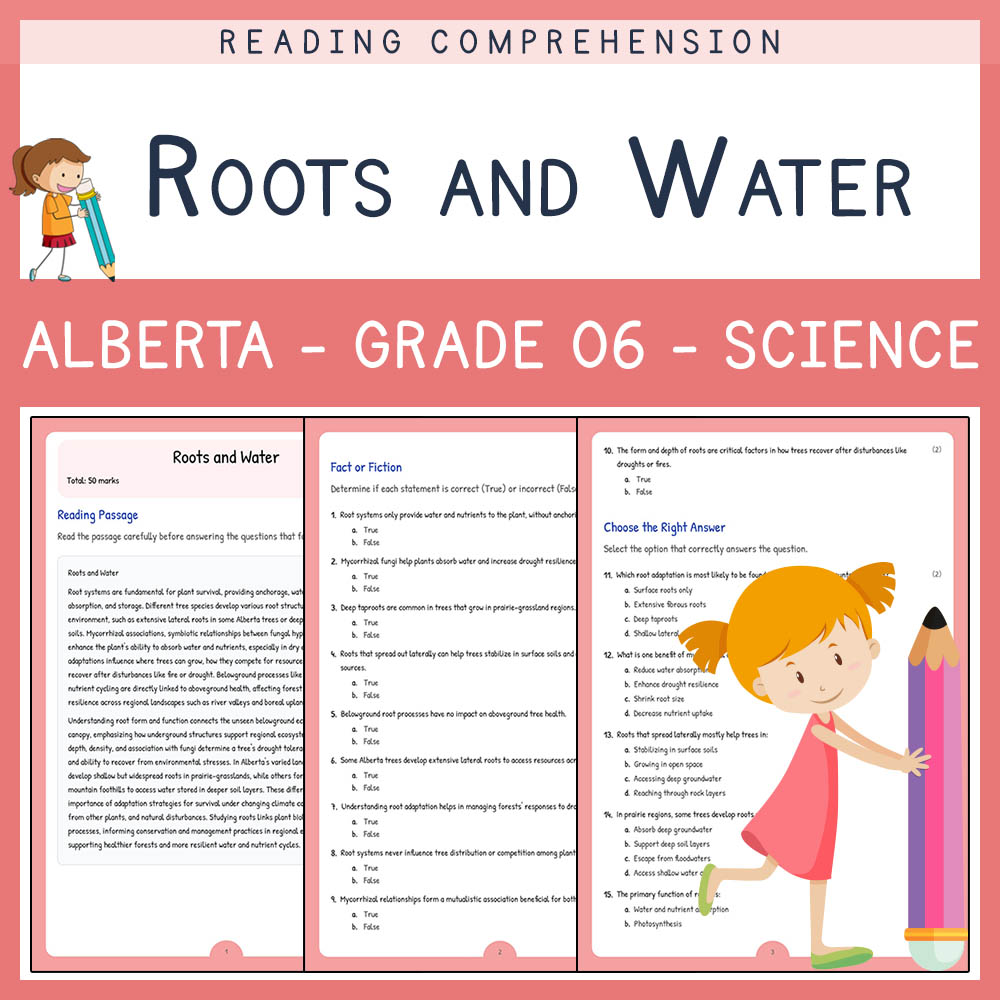
Grade 6 Science Assessment | Roots and Water Worksheet Elena | Alberta
Created byLumora LearningLearning Objectives
- Understand the role of root systems in plant water and nutrient absorption.
- Identify different root adaptations and their impact on tree distribution and resilience.
- Explain how belowground processes influence aboveground tree health and regional ecosystems.
Instant download

Heat and States Assessment | General Grade 6 Science Standards
Created byPrism Point LearningLearning Objectives
- Understand how heat transfer causes changes in the state of matter.
- Identify examples of melting, evaporation, and boiling in everyday life.
- Explain how energy affects particle movement and matter organization.
Also included in: Grade 6 Physical Science Science Lesson Bundle: General Framework
Instant download
Browse more categories
About Grade 6 Worksheets
Browse 8,578 printable Grade 6 worksheets across math, ELA, science, and social studies — each a ready-to-print PDF with optional answer keys.
MyTeachingSheets worksheets are made by real teacher-authors and checked before they go live. Download any as a print-ready PDF for lessons, homework, or independent practice — most include answer keys, and previews are always free.