
Grade 6 Worksheets
8,582 grade resources
Grade 6 Science | Shadow Patterns Worksheet (Alberta Standard PDF)
 Created byEvergreen Desk Education
Learning Objectives
- Describe how the Sun’s position changes during the day and how that changes shadow length and direction.
- Explain how seasonal changes in Sun angle affect the longest and shortest shadows over the year.
- Use observations of shadows to connect Earth’s rotation and axial tilt to day/night and seasons.
Instant download
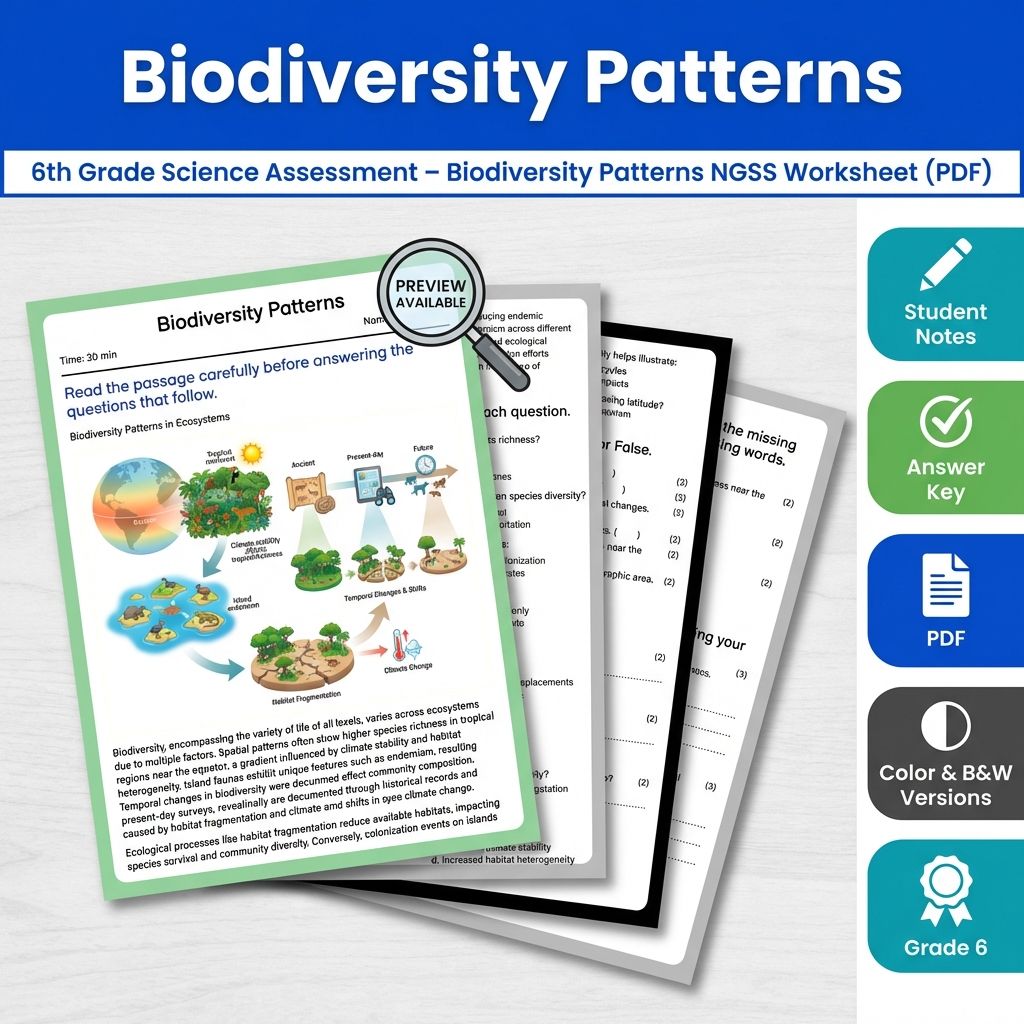
Biodiversity Patterns Assessment | NGSS Grade 6 Science Worksheet
 Created byPrism Point Learning
Learning Objectives
- Understand how species occurrence and richness reveal biodiversity patterns across ecosystems.
- Compare spatial and temporal biodiversity among different habitats and regions.
- Interpret ecological and historical factors that influence biodiversity distribution.
Also included in: Grade 6 Science Mini Bundle – Biological Evolution: Unity & Diversity +1 more
Instant download
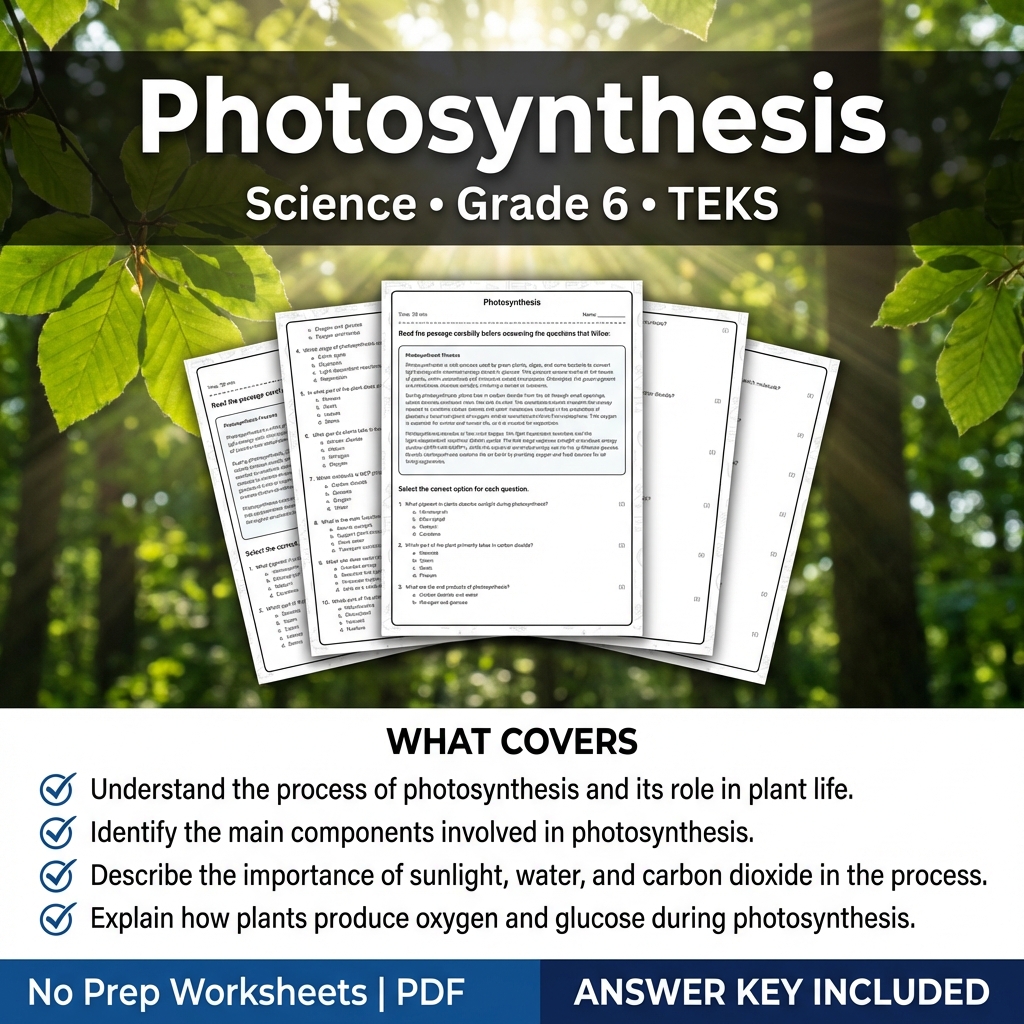
Grade 6 Science Worksheet on Photosynthesis | TEKS-Aligned Practice
 Created byCoral Reef Learning
Learning Objectives
- Understand the process of photosynthesis and its role in plant life.
- Identify the main components involved in photosynthesis.
- Describe the importance of sunlight, water, and carbon dioxide in the process.
Instant download

Two-Factor Authentication Security Worksheet Grade 6 Computer Science
Created byPrism Point LearningLearning Objectives
- Explain how two-factor authentication adds an extra layer of security after a password.
- Identify examples of verification codes and other second-step prompts.
- Describe why using more than one lock (more than one step) improves account safety.
Also included in: Digital Safety & Security Lesson Bundle | Grade 6 Computer Science | General +1 more
Instant download

6th Grade Science | Synthetic Materials Worksheet (PDF + Answer Key)
 Created byRiverstone Classroom
Learning Objectives
- Understand the origins of synthetic materials and their connection to natural resources.
- Compare the properties of materials such as plastic, fiber, and glass used for specific purposes.
- Analyze the processes involved in extracting and processing resources to produce synthetic materials.
Instant download

States of Matter Worksheets | Properties, Particles & Changes Practice
LCreated byLearnora ResourcesLearning Objectives
- Identify solids, liquids, and gases from their observable properties
- Compare particle arrangement and movement in the three states
- Explain how shape and volume differ among states of matter
Instant download

Natural Hazards Using Data to Assess Risk Worksheet | NGSS Grade 6 Science
 Created bySkylark Worksheets
Learning Objectives
- Analyze observational and instrumental data to identify patterns in natural hazards.
- Explain how recurrence intervals and frequency statistics relate to probable events.
- Use hazard information to estimate locations and magnitudes for basic risk assessment.
Also included in: Grade 6 Earth & Climate Systems Science Lesson Bundle | NGSS Worksheets +1 more
Instant download

Grade 6 Science | Atoms and Particles Worksheets | California Standards
 Created byLumora Learning
Learning Objectives
- Explain how atoms are the basic units that make up elements and how atoms combine to form substances
- Use a particle model to connect atomic composition to observable properties such as density, melting point, and reactivity
- Differentiate between macroscopic observations and particle-level explanations for matter
Instant download

Grade 6 Circuit Symbols & Schematic Reading Worksheet | Ontario Science
 Created byTeacher's Corner
Learning Objectives
- Identify common circuit symbols for cells, batteries, resistors, lamps, switches, ammeters, and voltmeters.
- Explain how arrows, orientations, and line connections in a schematic show circuit topology and current paths.
- Predict how series, parallel, and mixed connections affect the behaviour of components.
Instant download
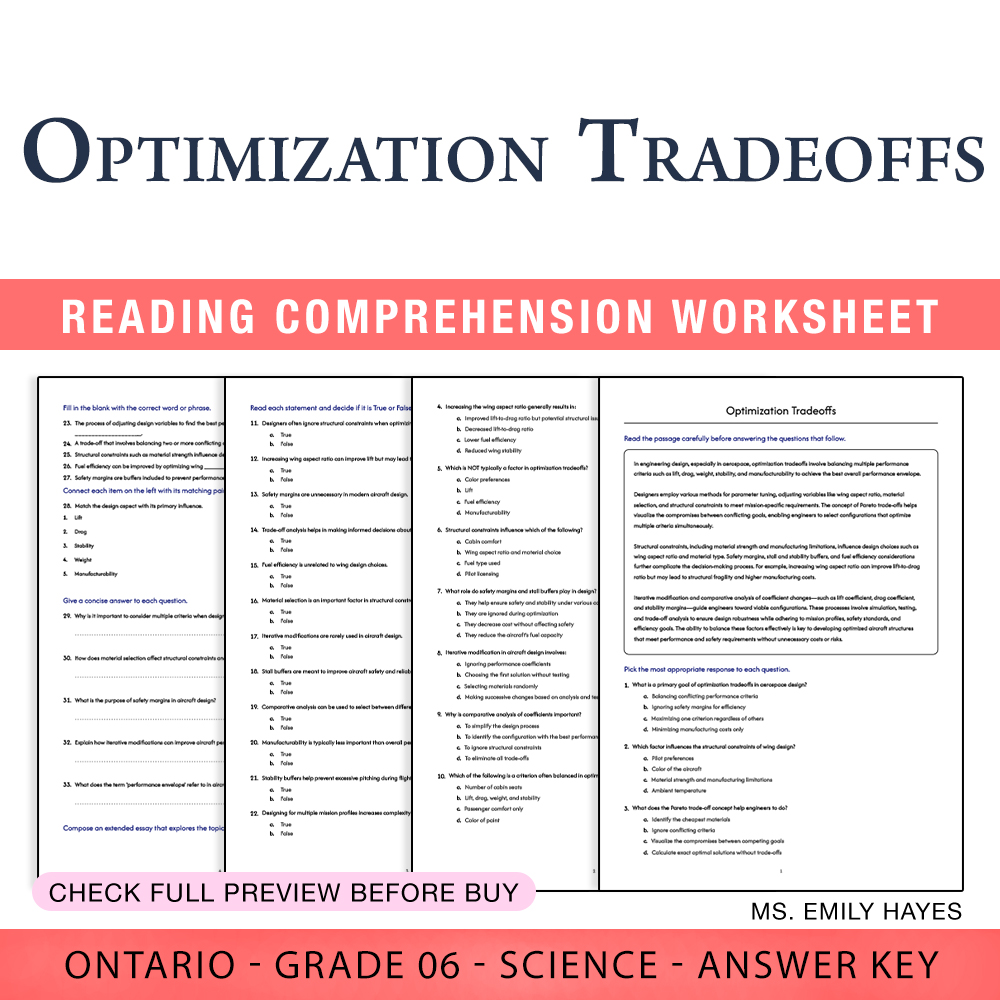
6th Grade Science | Optimization Tradeoffs in Engineering (PDF + Answer Key)
 Created byCopper Leaf Classroom
Learning Objectives
- Understand how multi-criteria design involves balancing lift, drag, weight, stability, and manufacturability to optimize aircraft performance.
- Explain methods for parameter tuning and Pareto trade-off concepts in engineering design.
- Analyze how structural constraints influence wing aspect ratio and material choices.
Instant download

Grade 6 ELA | Clarity and Precision Worksheet | Alberta Practice Assessment
Created byLumora LearningLearning Objectives
- Revise sentences by replacing vague words with precise, specific language.
- Identify and correct unclear relationships between ideas by adjusting sentence structure.
- Remove or reduce repeated wording that adds little meaning.
Also included in: Writing with Evidence & Clarity Lesson Bundle | Grade 6 ELA | Alberta
Instant download

Scale of Space Assessment Worksheets | Grade 6 Science NGSS
Created byPrism Point LearningLearning Objectives
- Use astronomical units (AU) and orders of magnitude to compare Earth–Sun distances at an appropriate scale.
- Compare planetary sizes and orbital periods using data and proportional or log-scale representations.
- Interpret tables and charts that show relative spacing and relationships in the solar system.
Instant download
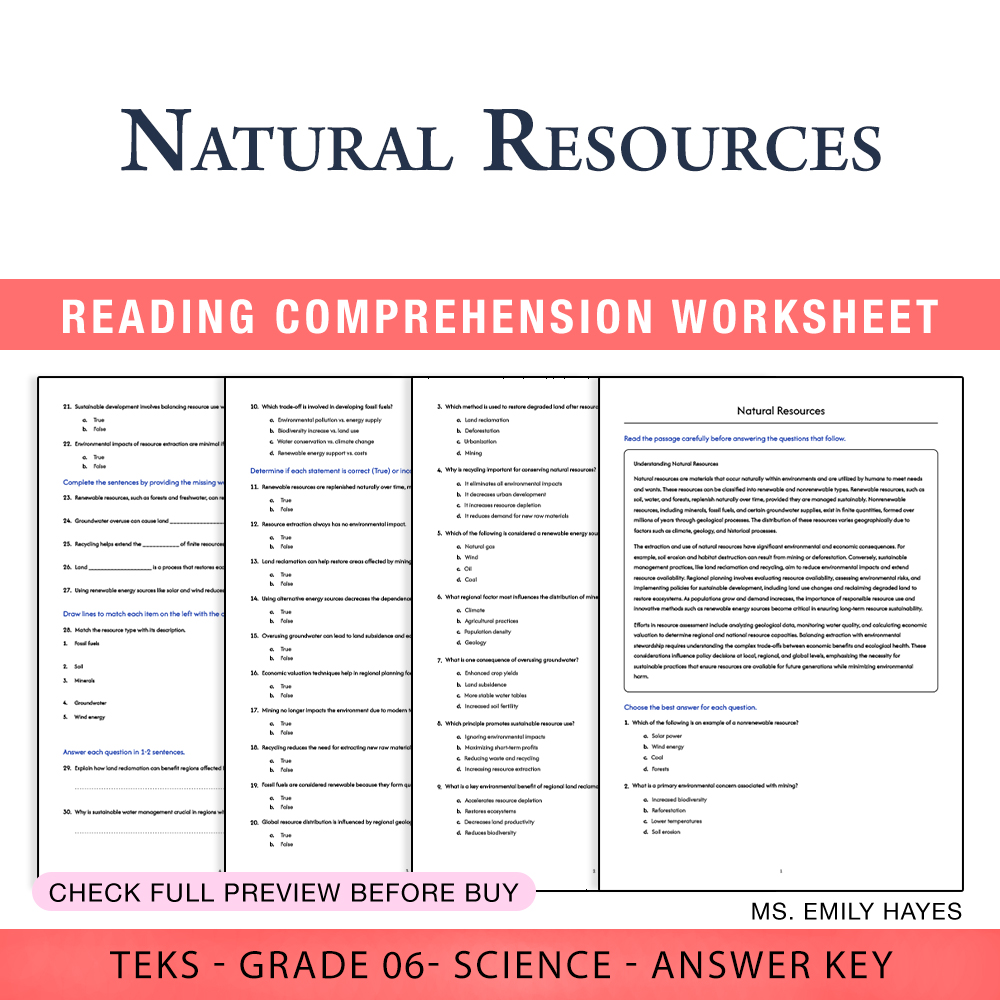
Grade 6 Science | Natural Resources Worksheet (PDF+ Answer Key)
Created byCopper Leaf ClassroomLearning Objectives
- Identify different types of natural resources and their distribution across regions.
- Understand the environmental and economic implications of renewable and nonrenewable resources.
- Explore methods for resource assessment, sustainable use, and land reclamation.
Instant download

Science, Technology & Society Worksheets | Grade 6 Social Studies
 Created byWorld Paper Hub
Learning Objectives
- Explain how new scientific knowledge can improve production methods over time
- Describe how advances in communication and transportation increase connections between communities
- Use evidence from a passage to support claims about economic growth and daily life changes
Also included in: Grade 6 Social Studies Worksheets Science Technology TEKS Bundle +1 more
Instant download
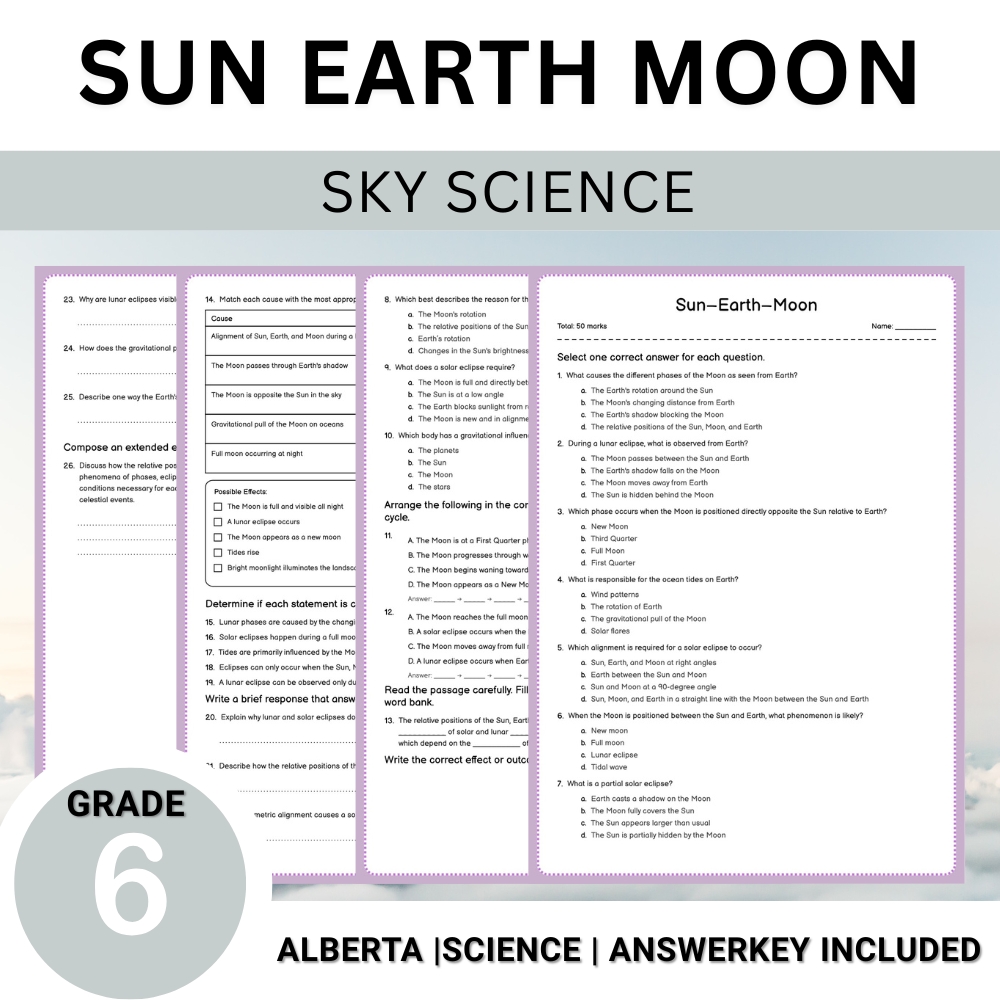
Grade 6 Science | Sun–Earth–Moon Worksheet (Assessment & Student Practice PDF)
Learning Objectives
- Describe the relative positions and movements of the Sun, Earth, and Moon.
- Explain how gravitational interactions influence lunar phases, eclipses, and tides.
- Identify the geometric relationships that cause observable lunar and solar phenomena.
Also included in: Grade 6 Science | Celestial & Space Phenomena UNIT Worksheet Bundle (Assessment & Practice) +1 more
Instant download

Grade 6 Heat and Temperature Worksheet | NGSS Practice PDF
 Created byClear Sky Classroom
Learning Objectives
- Distinguish heat from temperature using the idea of energy transfer versus particle motion.
- Explain how heating and cooling depend on temperature differences and energy movement.
- Compare how mass and material affect how much heat energy a system can hold at the same temperature.
Instant download
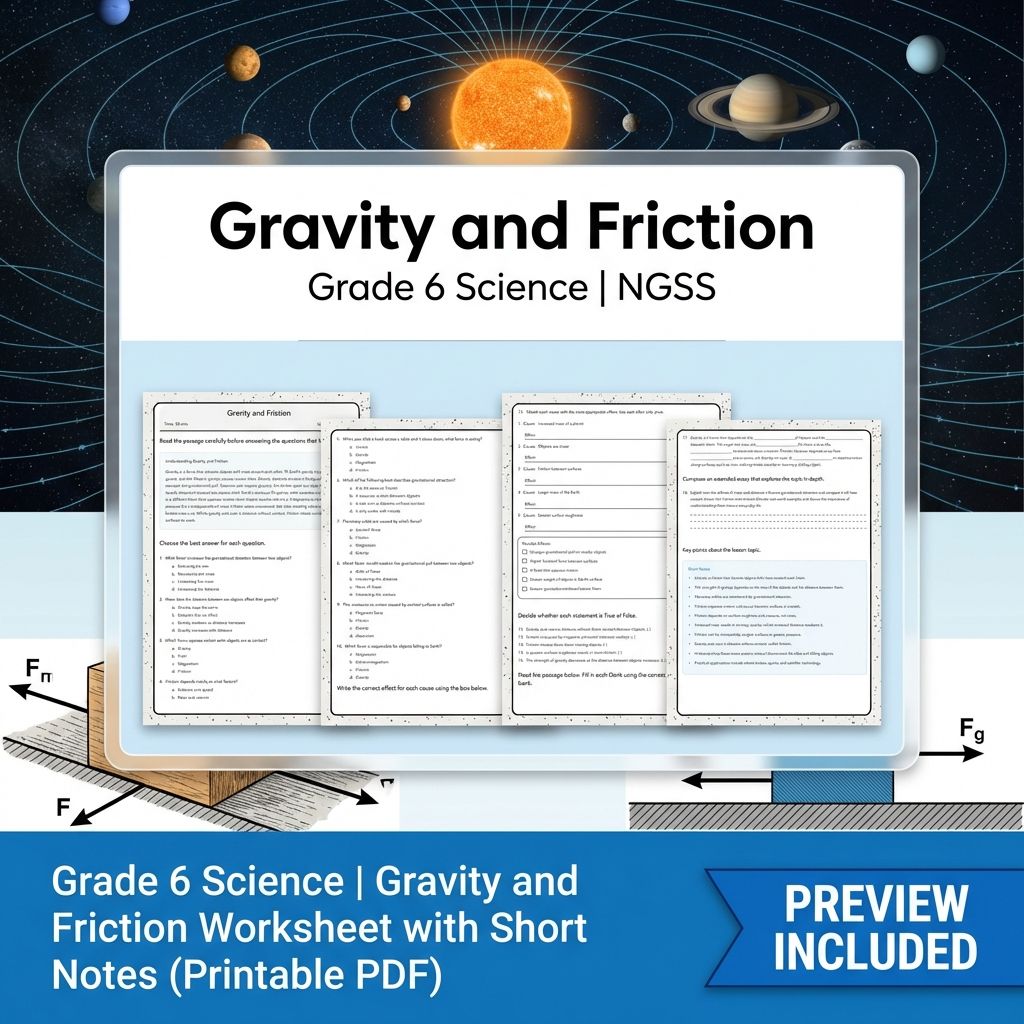
Grade 6 Science | Gravity and Friction Worksheet with Short Notes (PDF)
 Created byMeadowlark Worksheets
Learning Objectives
- Explain how gravitational attraction depends on mass and distance.
- Identify examples of gravitational interactions such as planetary motion and falling objects.
- Differentiate between contact forces like friction and non-contact forces like gravity.
Also included in: Grade 6 Science | Forces & Motion Unit Bundle NGSS Aligned Worksheets +1 more
Instant download
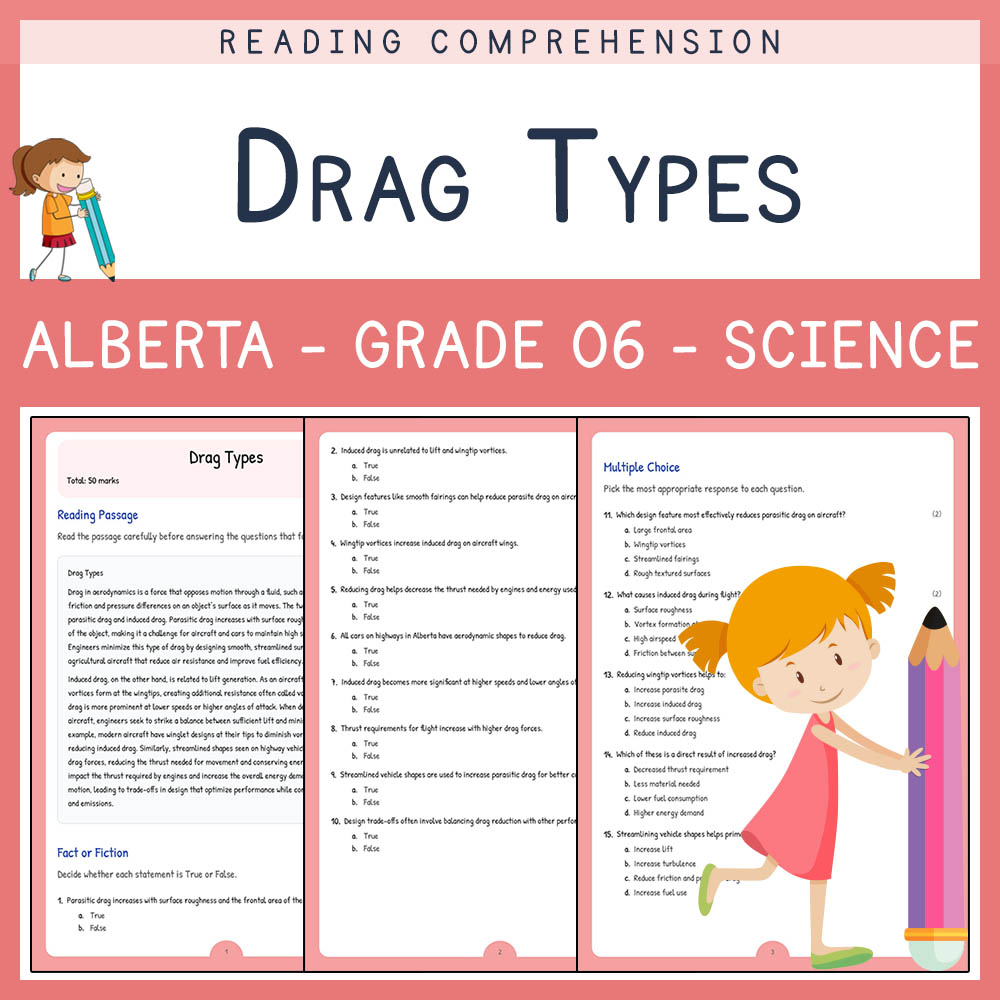
Grade 6 Science Assessment | Drag Types Worksheet Elena | Alberta Standard
Created byLumora LearningLearning Objectives
- Understand the different types of drag in aerodynamics and their causes.
- Identify how design features can reduce parasitic and induced drag.
- Explain the impact of drag on thrust requirements and energy use during flight.
Also included in: Grade 6 Science | Air and Aerodynamics Science Lesson Bundle | Alberta
Instant download

Series and Parallel Circuits Worksheet | Grade 6 Science Standards Aligned
JCreated byJ.S SheetsLearning Objectives
- Understand the differences between series and parallel circuit arrangements.
- Explain how current and voltage distribute in series and parallel circuits.
- Identify real-world examples of series and parallel circuits.
Instant download

Setting and Mood Worksheet for Grade 6 ELA | Standards-Aligned Practice
JCreated byJ.S SheetsLearning Objectives
- Explain how setting details (time, place, and context) create or reinforce a story’s mood.
- Use evidence from a text to infer the author’s tone and how it is supported by setting.
- Analyze how setting connects to theme and influences character actions and plot events.
Instant download
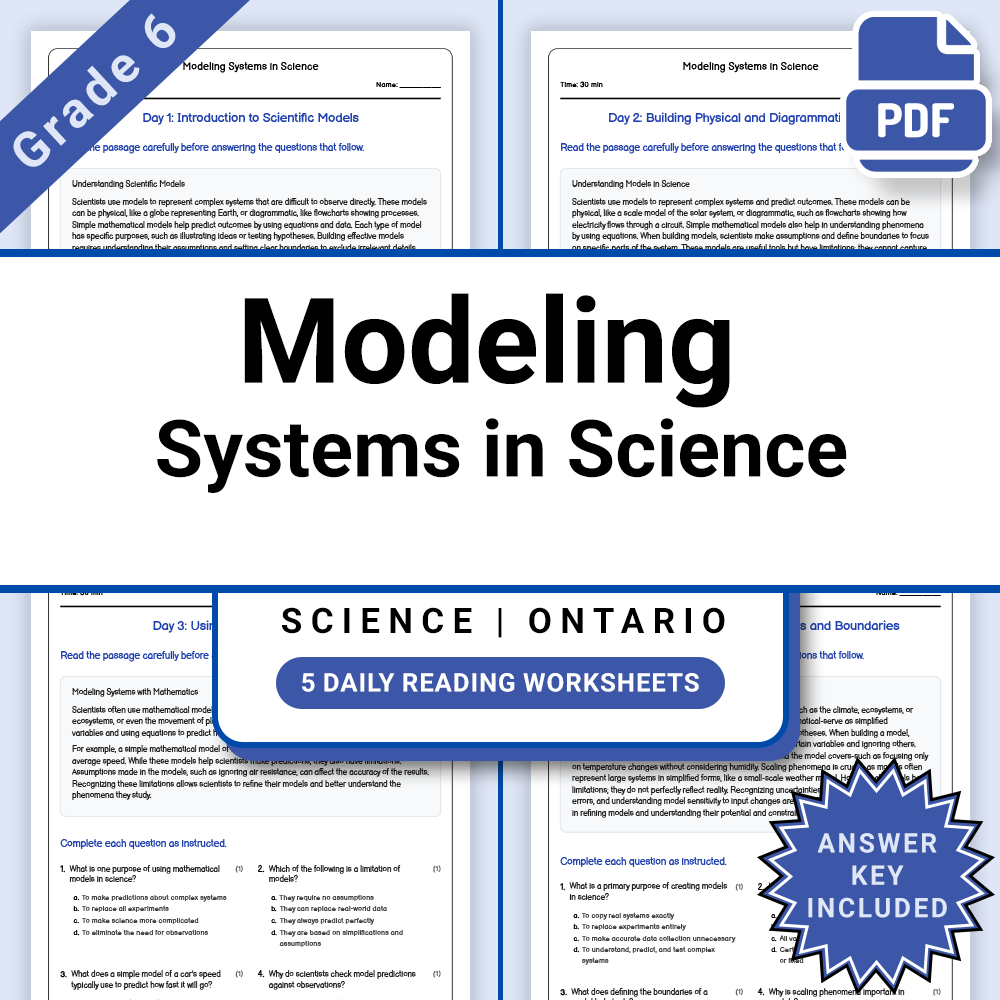
Grade 6 Science – Modeling Systems Daily Reading Worksheet with Answer Key
JCreated byJ.S SheetsLearning Objectives
- Understand different types of scientific models and their purposes.
- Learn how models support representation and prediction of complex systems.
- Identify assumptions, define boundaries, and consider scaling in models.
Also included in: Grade 6 Science STEM Skills and Connections Lesson Bundle with Ontario Framework +1 more
Instant download

Grade 6 ELA | Text Inferences Worksheet | Alberta Assessment
Created byLumora LearningLearning Objectives
- Make reasonable inferences about characters’ motivations using clues from events, dialogue, and word choice
- Use textual evidence to support an inference when multiple explanations are possible
- Infer likely outcomes or implied relationships by connecting details across the passage
Instant download
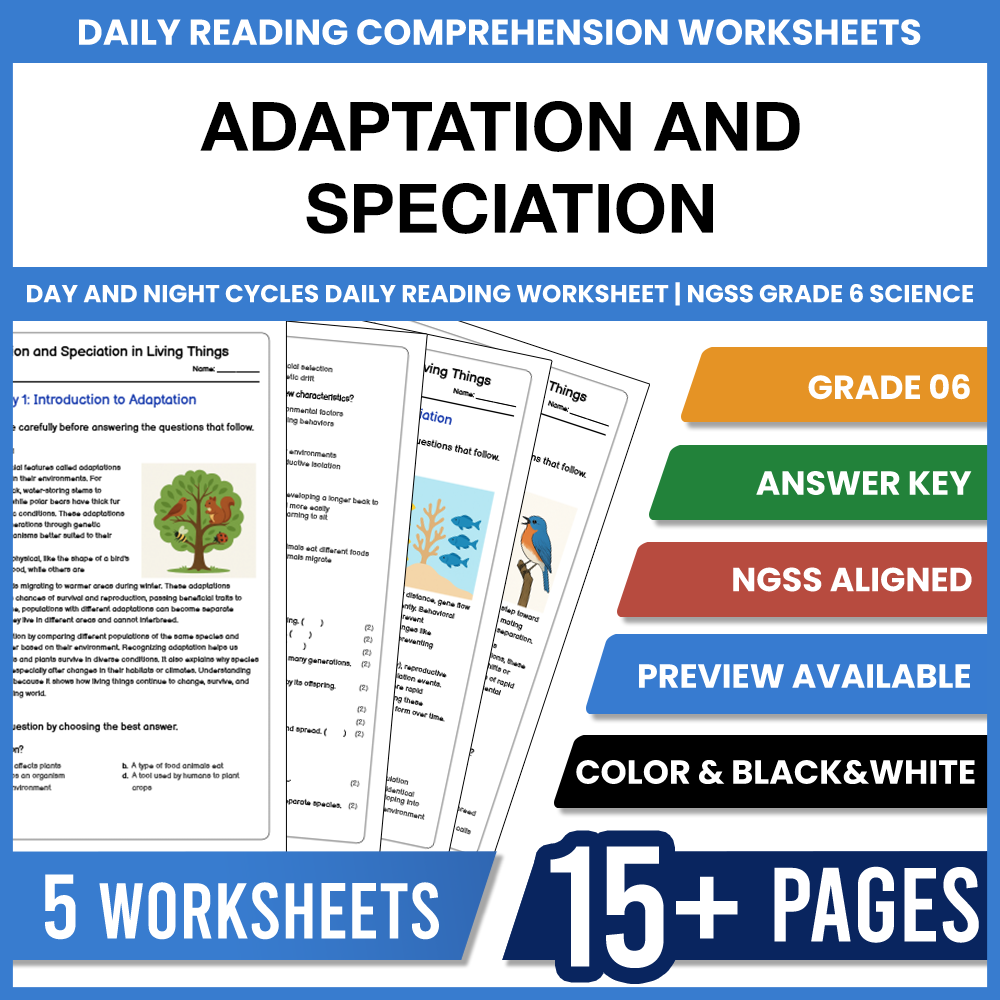
Grade 6 Science – Species Interactions & Ecosystems | Daily Reading Worksheet
 Created byElena Brooks
Learning Objectives
- Identify mutualism among species in forest ecosystems
- Explain how species benefit from mutualistic relationships
- Predict patterns of species interactions across different ecosystems
Also included in: Grade 6 Science Ecosystems Lesson Bundle | NGSS Interactions & Energy +1 more
Instant download

Purposeful Transitions Worksheet Grade 6 ELA TEKS Cause Contrast Support
 Created bySunny Desk Resources
Learning Objectives
- Analyze how transitions connect ideas and clarify relationships between sentences in informational text.
- Describe the specific relationship created by transitions such as therefore, however, for example, and in contrast.
- Use transitional words and phrases to strengthen coherence in a written response.
Instant download
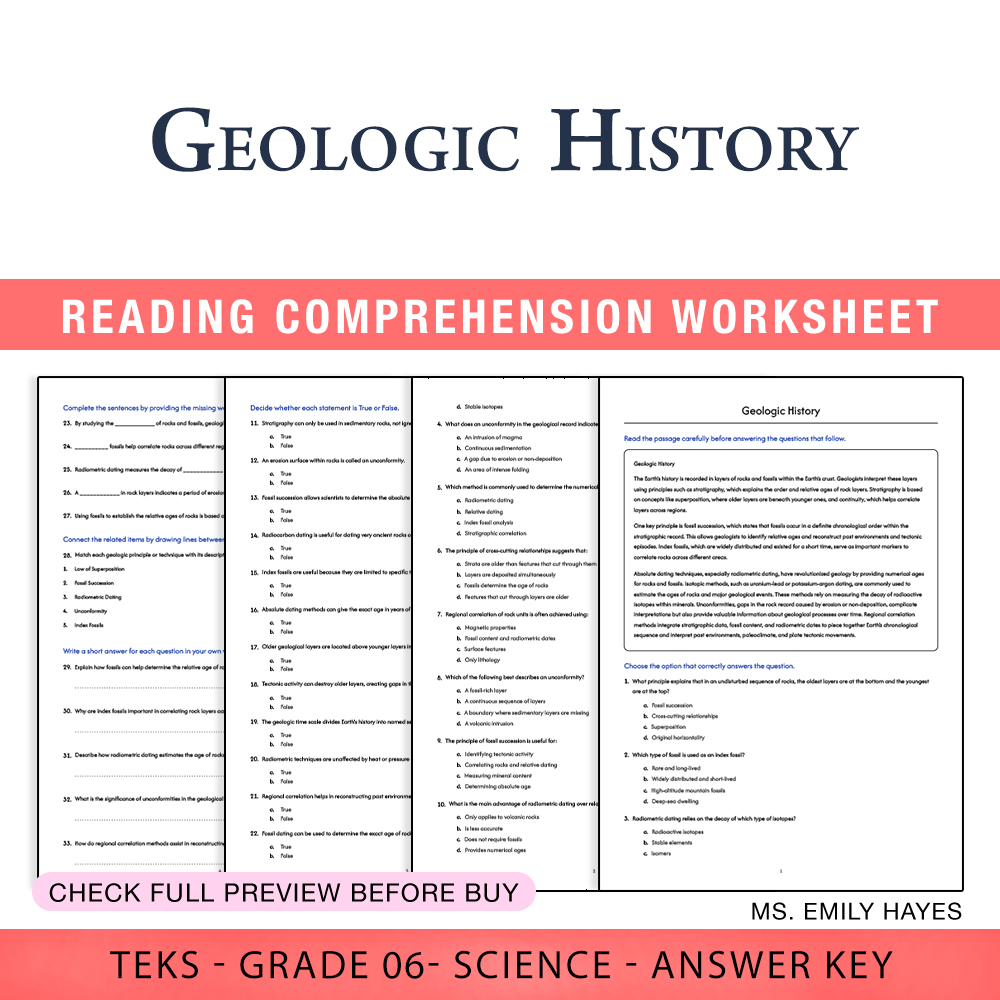
6th Grade Science | Geologic History Worksheet (PDF+ Answer Key)
Created byCopper Leaf ClassroomLearning Objectives
- Understand principles of relative and absolute dating used in geology.
- Identify key features of the geologic time scale and fossil succession.
- Recognize methods for correlating rock units across distances.
Instant download

Ethical Media Creation Test Prep Worksheet | Grade 6 ELA Alberta
Created byMeadowlark WorksheetsLearning Objectives
- Explain how ethical media creation includes accurate, credible information and appropriate representation of perspectives.
- Identify common ethical responsibilities in media products, such as attribution and avoiding unauthorized copying.
- Evaluate whether a media message is misleading due to missing context or unbalanced supporting details.
Also included in: Grade 6 Media Literacy in ELA Lesson Bundle for Alberta Framework +1 more
Instant download
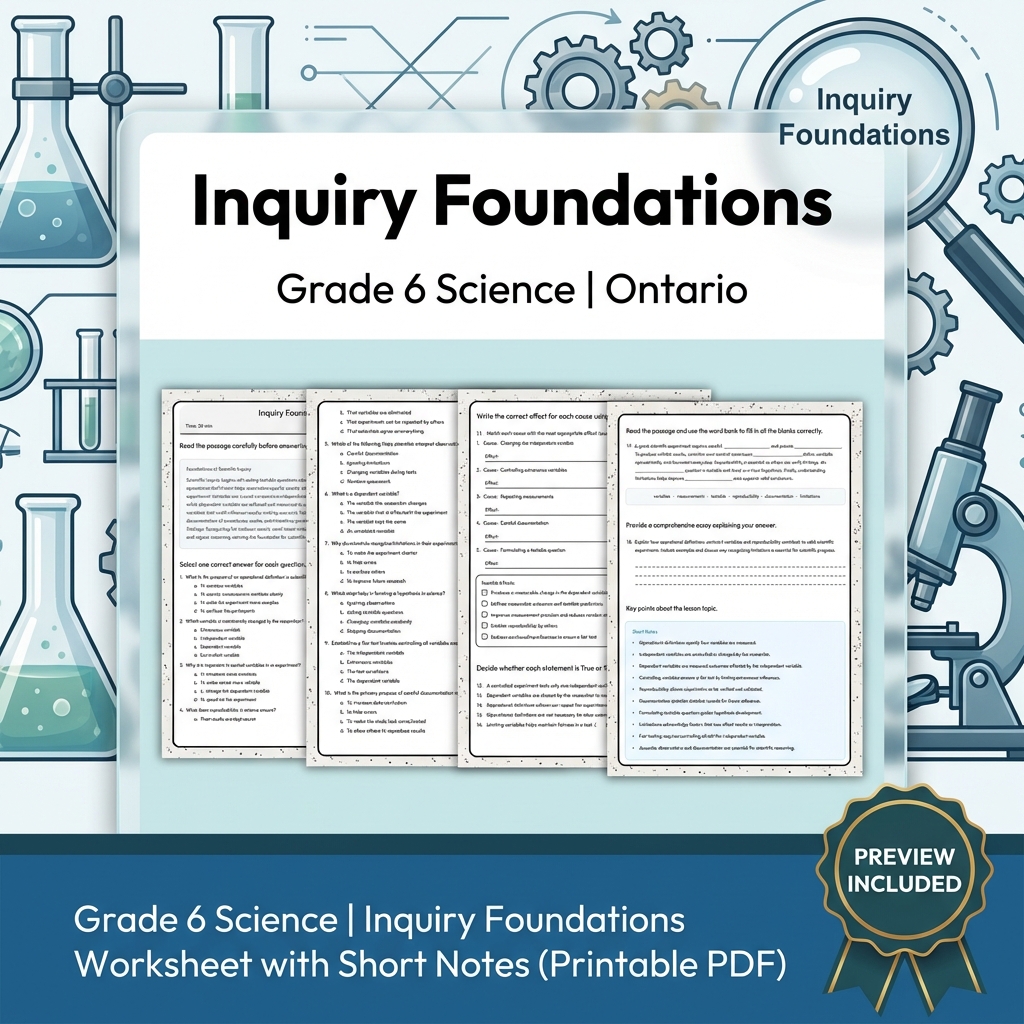
Grade 6 Science | Inquiry Foundations Worksheet with Short Notes (Printable PDF)
Created byMeadowlark WorksheetsLearning Objectives
- Identify operational definitions and their importance in scientific inquiry.
- Distinguish between independent and dependent variables.
- Understand the use of controlled comparisons in experiments.
Also included in: Grade 6 Science Lesson Bundle | Ontario Framework & Inquiry Skills +1 more
Instant download
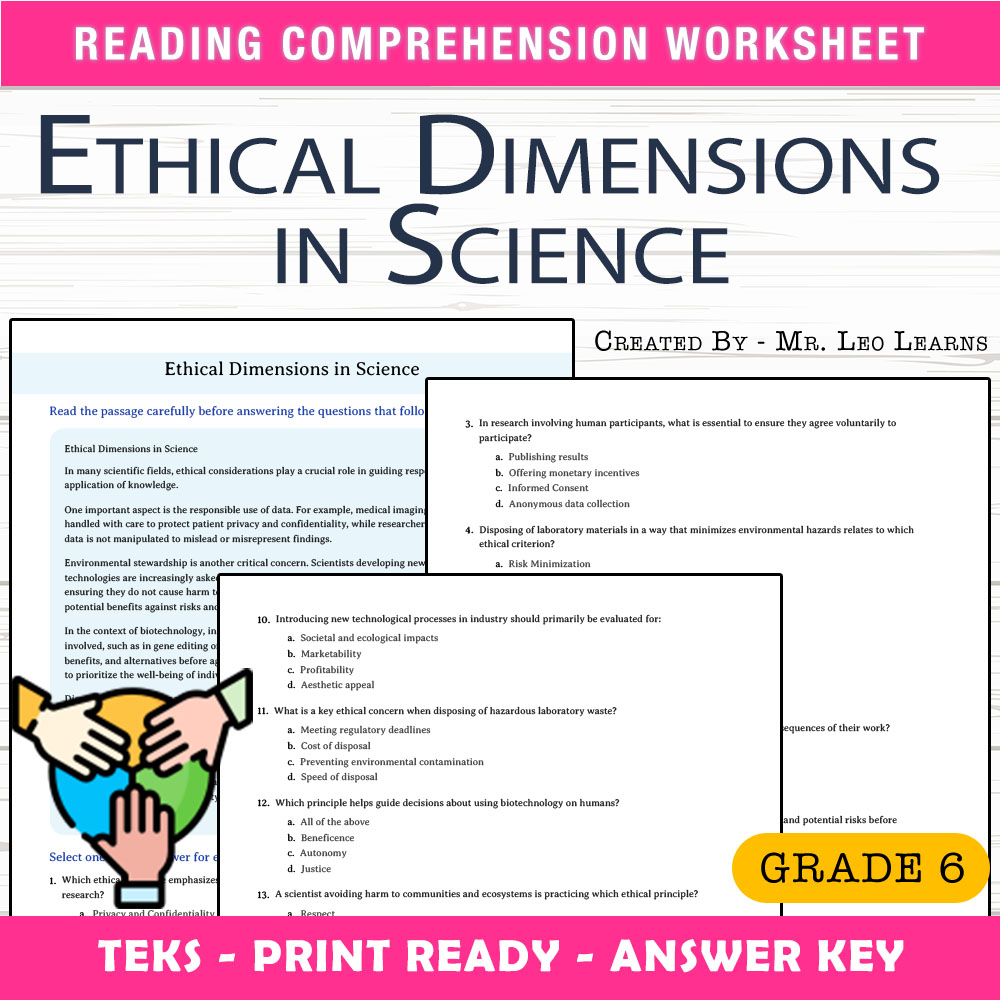
Grade 6 Science — Ethical Dimensions in Science Worksheet for TEKS
 Created byThe Resource Hub
Learning Objectives
- Understand key ethical principles such as beneficence, risk minimization, and informed consent in scientific contexts.
- Recognize ethical dilemmas in scientific applications like data privacy, environmental stewardship, and biotechnology.
- Apply criteria for ethical judgment to given scenarios involving scientific decision-making.
Instant download
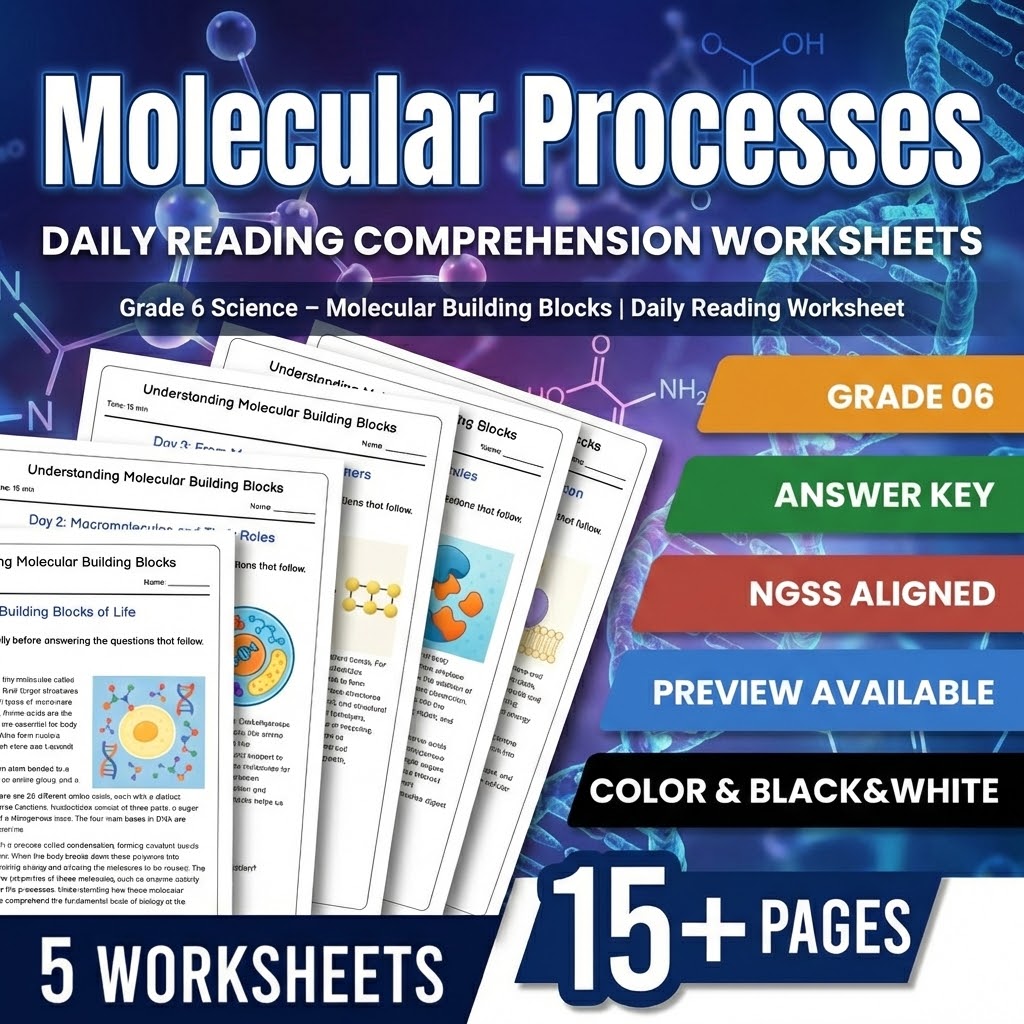
Grade 6 Science – Molecular Building Blocks | Daily Reading Worksheet
Created byElena BrooksLearning Objectives
- Understand key concepts related to Science
- Apply knowledge through practice questions
- Demonstrate comprehension of the material
Also included in: Grade 6 Science From Molecules to Organisms Worksheet Bundle | NGSS +1 more
Instant download

Grade 6 Social Studies — Nonrenewable Resources Worksheet MCQ PDF + Answer Key
Created byThe Resource HubLearning Objectives
- Explain why nonrenewable resources are finite and how that affects long-term planning
- Describe how extraction and processing can change local economies and the environment
- Analyze boom–bust cycles and their effects on communities
Also included in: Grade 6 People and Environments Social Studies Custom Bundle: Ontario
Instant download

Theme Meaning Inferences Worksheet | BC Standards | Grade 6 ELA
JCreated byJ.S SheetsLearning Objectives
- Use inference to connect repeated ideas, events, and conflicts to a theme.
- Explain how character choices and patterns of events reveal an underlying message.
- Determine what a text implies by comparing explicit statements to broader meanings.
Instant download

Grade 6 Science – Digestive System & Function | Daily Reading Worksheet
 Created byBright Mind Resources
Learning Objectives
- Understand the organs involved in digestion
- Learn the chemical processes of digestion
- Identify the absorption of nutrients into the body
Also included in: Grade 6 Science: Organ Systems & Adaptations Daily Reading Lesson Bundle | BC +1 more
Instant download

Grade 6 Science | Ecological Succession - Daily Reading Comprehension
Created byCoral Reef LearningLearning Objectives
- Understand the concept of ecological succession
- Differentiate between primary and secondary succession
- Identify the roles of pioneer species in succession
Instant download

Grade 6 Social Studies Chronology & Historical Change Worksheet | BC
 Created byQuiet Forest Education
Learning Objectives
- Learn the importance of chronological order in historical understanding.
- Construct basic timelines to illustrate technological advancements.
- Analyze how sequencing of events influences perceptions of progress and causality.
Also included in: Chronology & Change Grade 6 Social Studies Daily Reading Worksheets Bundle | BC +1 more
Instant download

Grade 6 Habitat Stewardship & Erosion Control Worksheet | Alberta Science
 Created byBRIGHT PATH RESOURCES
Learning Objectives
- Identify cause-and-effect relationships in local stewardship actions.
- Explain how planting and shelterbelts can reduce erosion and support habitat.
- Use evidence from a passage to answer questions about land care practices.
Also included in: Forest Ecosystem Adaptations Grade 6 Science Worksheets Lesson Bundle | Alberta +1 more
Instant download

6th Grade Social Studies Resource Distribution Worksheet (PDF) – TEKS
Created bySunny Desk ResourcesLearning Objectives
- Explain how the location of natural resources (water, minerals, and arable land) affects where people live and build communities.
- Describe how resource availability and population density can influence economic development in a region.
- Use examples to connect spatial patterns of resources and populations to regional growth and trade.
Also included in: Grade 6 Maps & Spatial Skills Social Studies Lesson Bundle Worksheets TEKS +1 more
Instant download

Grade 6 Standards | Civil Rights Beginnings Worksheet Elena | January Holiday
Created byLumora LearningLearning Objectives
- Describe civil rights conditions for African Americans before Martin Luther King Jr. became a national leader
- Identify key ideas related to justice, segregation, and activism and use them in context
- Explain how earlier organizing and protests helped set the stage for later civil rights leadership
Instant download

Water Reservoirs Worksheet Grade 6 Science Water Cycle Systems
Created byPrism Point LearningLearning Objectives
- Identify major water reservoirs on Earth and describe the form of water each one stores.
- Explain how state changes move water between reservoirs and affect where water is available over time.
- Distinguish between fast and gradual water movement between reservoirs using examples.
Also included in: Grade 6 Water Cycle Systems Lesson Bundle | California Standards
Instant download

Water & Land Worksheet for Grade 6 Social Studies | Standards-Aligned Practice
JCreated byJ.S SheetsLearning Objectives
- Explain how access to water sources and fertile land supported early river valley civilizations
- Describe how irrigation and floodplain farming helped communities grow and produce food surpluses
- Identify ways that controlling water influenced settlement patterns and the development of complex societies
Instant download

Search Skills and Keywords Worksheet Grade 6 Computer Science Activity
Created byPrism Point LearningLearning Objectives
- Explain how search engines use keywords to return results.
- Choose effective keywords and queries to improve search results.
- Compare broad searches with more focused searches.
Also included in: Grade 6 How the Internet Works Lesson Bundle | Computer Science | General +1 more
Instant download
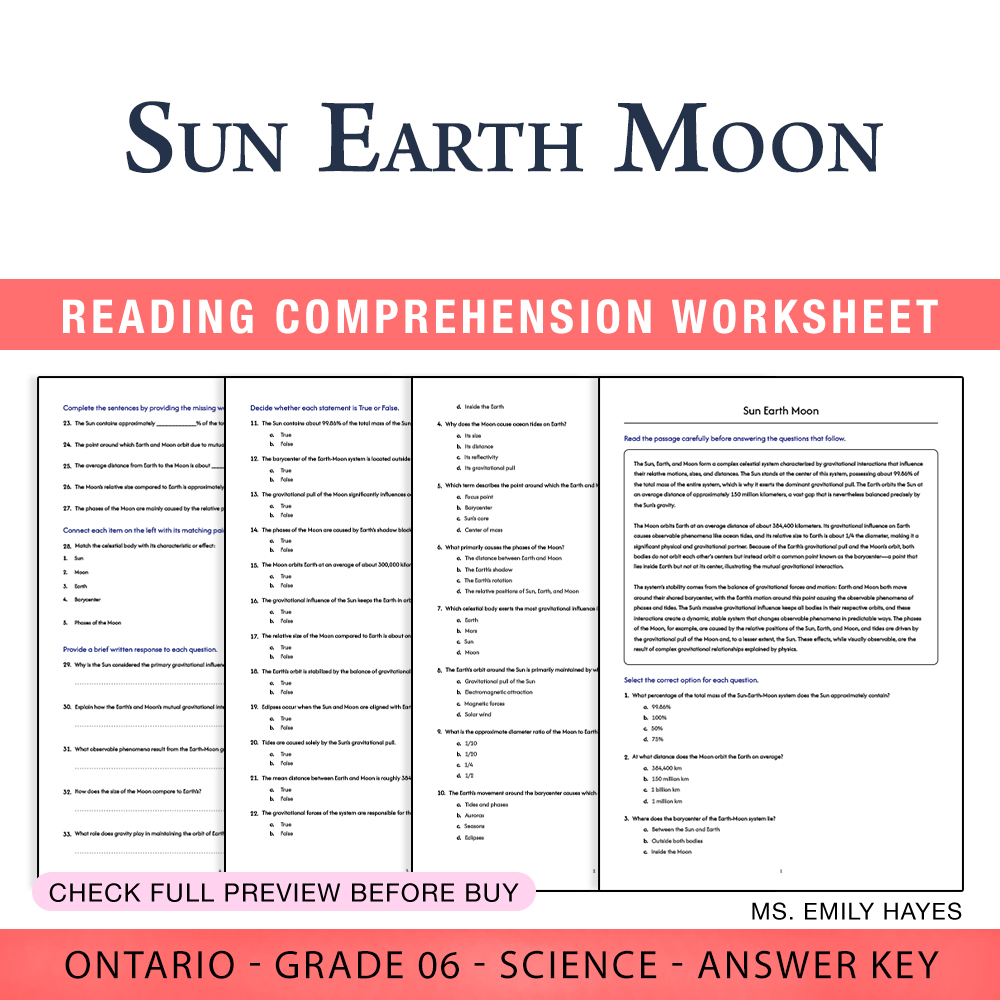
6th Grade Science | Sun Earth Moon System Worksheet (PDF + Answer Key)
Created byCopper Leaf ClassroomLearning Objectives
- Describe the relative sizes, masses, and distances among the Sun, Earth, and Moon.
- Explain how gravitational interactions influence the orbital relationships of the Sun, Earth, and Moon.
- Understand the concept of the Earth's barycenter and the role of the Sun as a dominant gravitational influence.
Instant download

Evidence Reasoning Assessment | Florida NGSSS Grade 6 Science Standards
Created byPrism Point LearningLearning Objectives
- Explain how scientific claims should be supported by relevant evidence
- Distinguish correlation from causation in data-based reasoning
- Use units, measurements, and observations consistently to strengthen explanations
Also included in: Grade 6 Scientific Assessment Science Lesson Bundle – Florida NGSSS
Instant download
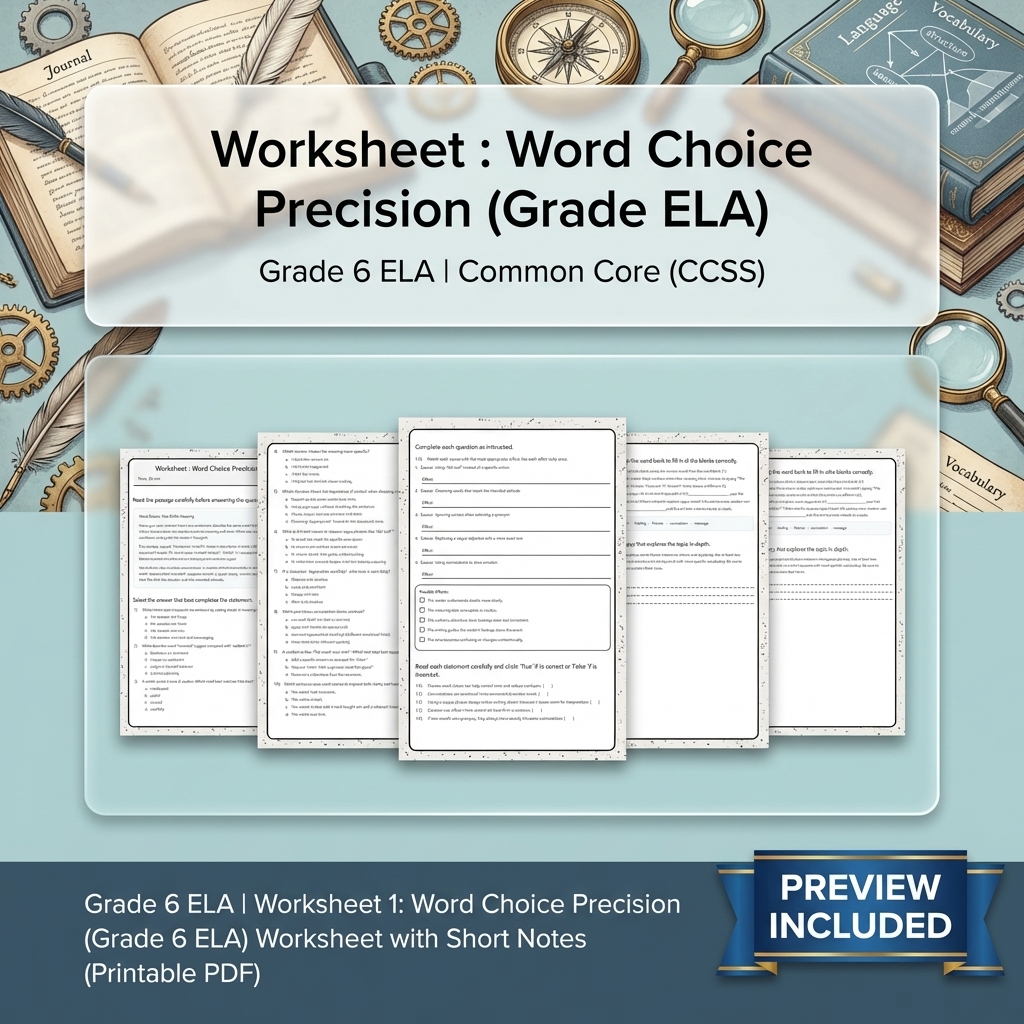
Grade 6 ELA | Worksheet Word Choice Precision Worksheet with Short Notes
Created byMeadowlark WorksheetsLearning Objectives
- Explain how precise word choice helps communicate meaning and tone.
- Identify how connotations change the impact of a sentence.
- Replace vague words with more specific vocabulary to improve writing and speaking.
Also included in: Grade 6 ELA Grammar, Vocabulary, and Sentence Variety Lesson Bundle: CCSS +1 more
Instant download
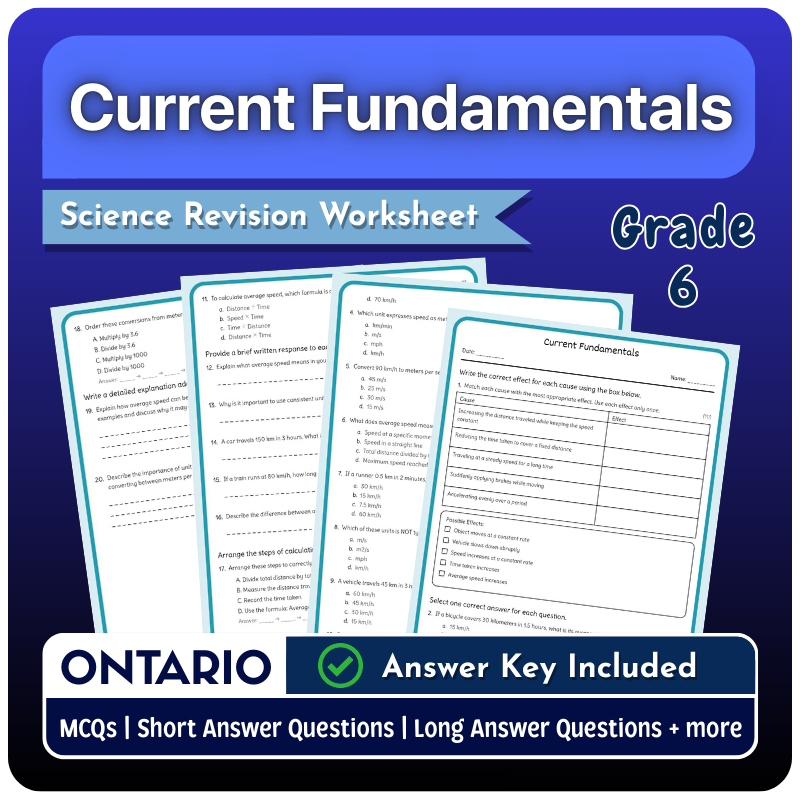
Grade 6 Science – Electricity Fundamentals Worksheet (PDF) – Ontario Standards
Created byBright Mind ResourcesLearning Objectives
- Describe electric current as a organized movement of charges through a conductor.
- Distinguish between conventional current direction and electron flow.
- Explain potential difference as a driving force in electric circuits.
Instant download

Evidence Based Answers Worksheet | General ELA | Grade 6 Practice
JCreated byJ.S SheetsLearning Objectives
- Use evidence from a text to support each part of a response to a prompt.
- Distinguish between what a text states directly and what can be inferred.
- Use structural cues (such as headings, topic sentences, and transitions) to synthesize information accurately.
Instant download

Chemical Reactions Worksheets: Evidence of Chemical Reactions Grade 6
 Created byTeachers Club
Learning Objectives
- Identify indicators of chemical reactions from qualitative observations such as color change, gas production, and precipitate formation.
- Use quantitative data (mass and temperature changes) to determine whether new substances were formed.
- Interpret pre-reaction and post-reaction measurements to decide if a reaction produced new chemical species.
Also included in: Matter and Its Interactions Grade 6 Science NGSS Worksheets Bundle +2 more
Instant download

Grade 6 Science | Mixtures and Compounds Worksheet | California Standards
Created byLumora LearningLearning Objectives
- Distinguish mixtures from compounds using particle models.
- Explain how atomic arrangement affects properties and separability.
- Use appropriate vocabulary (mixture, compound, atom, bonded, uniform) when describing matter.
Instant download

Grade 6 Circulatory System Worksheet | BC Practice & PDF
Created byClear Sky ClassroomLearning Objectives
- Describe how the heart pumps and how blood moves through arteries, veins, and capillaries.
- Explain how circulation delivers oxygen and nutrients and removes carbon dioxide and wastes.
- Identify how circulation supports thermoregulation and helps the immune system respond to infection.
Instant download
Browse more categories
About Grade 6 Worksheets
Browse 8,582 printable Grade 6 worksheets across math, ELA, science, and social studies — each a ready-to-print PDF with optional answer keys.
MyTeachingSheets worksheets are made by real teacher-authors and checked before they go live. Download any as a print-ready PDF for lessons, homework, or independent practice — most include answer keys, and previews are always free.