
Grade 6 Science Worksheets
5,969 worksheets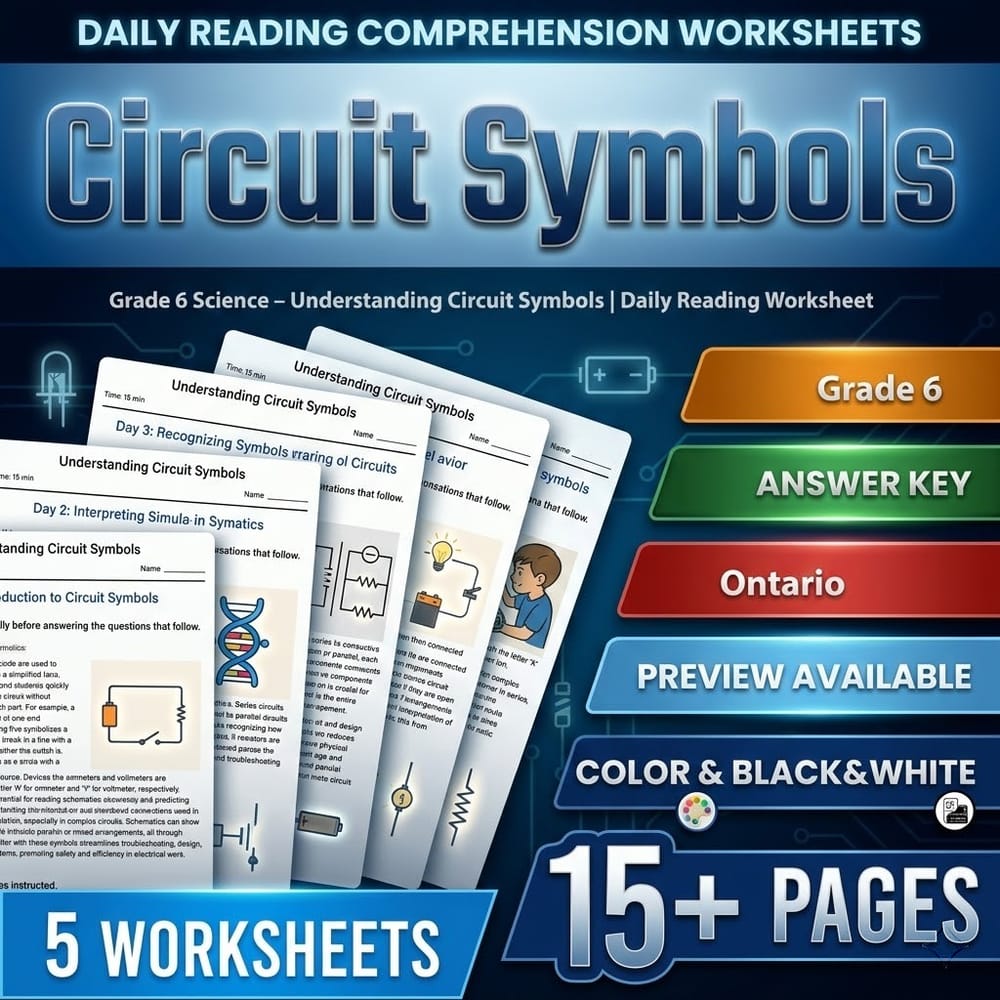
Grade 6 Science – Understanding Circuit Symbols | Daily Reading Worksheet
 Created byQuiet Forest Education
Learning Objectives
- Identify and interpret standard circuit symbols used in electrical schematics.
- Understand how symbols represent different circuit components like cells, resistors, and switches.
- Connect schematic symbols to their physical counterparts in electrical circuits.
Also included in: Electricity Grade 6 Science Daily Reading Worksheets Bundle | Ontario +1 more
Instant download

Grade 6 Science – Understanding Combined Circuits & Electricity Daily Worksheet
Created byQuiet Forest EducationLearning Objectives
- Identify basic components of electric circuits
- Understand the flow of electricity in a simple circuit
- Recognize different types of circuits and their functions
Also included in: Electricity Grade 6 Science Daily Reading Worksheets Bundle | Ontario +1 more
Instant download
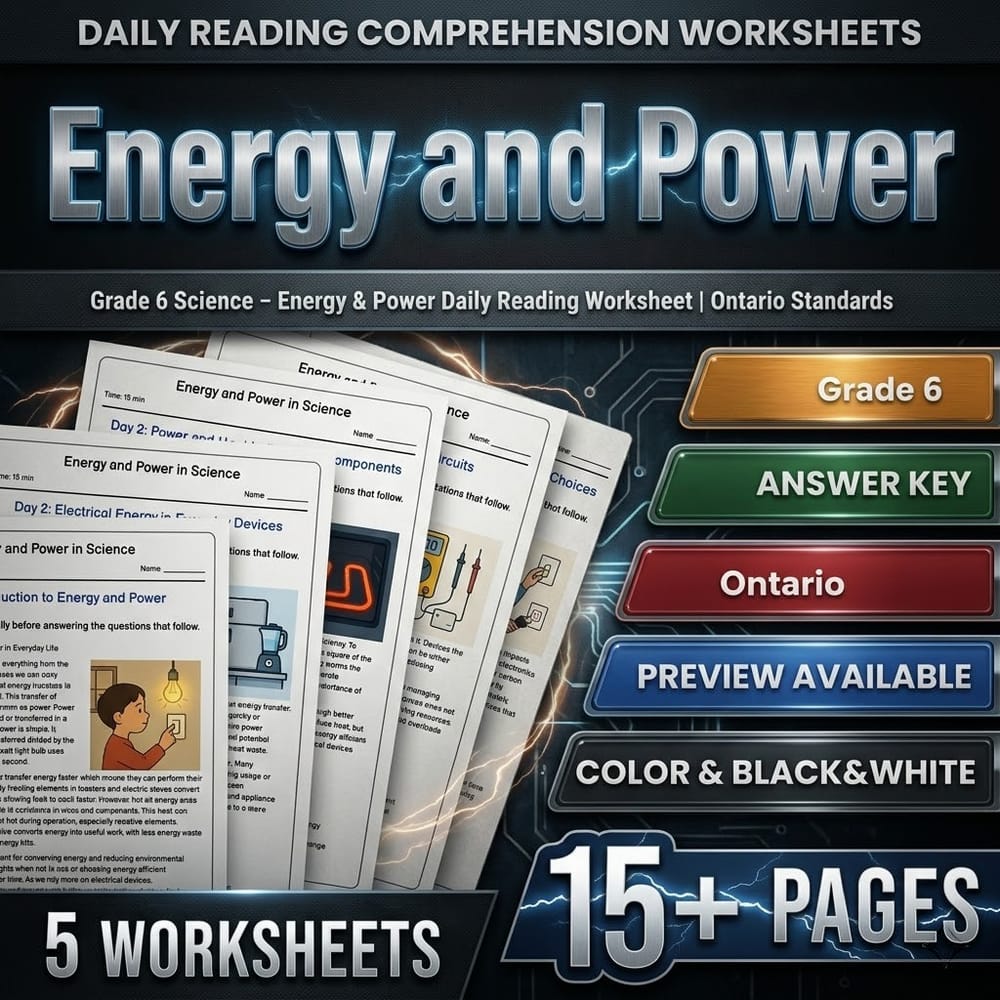
Grade 6 Science – Energy & Power Daily Reading Worksheet | Ontario Standards
Created byQuiet Forest EducationLearning Objectives
- Understand key concepts related to Science
- Apply knowledge through practice questions
- Demonstrate comprehension of the material
Also included in: Electricity Grade 6 Science Daily Reading Worksheets Bundle | Ontario +1 more
Instant download
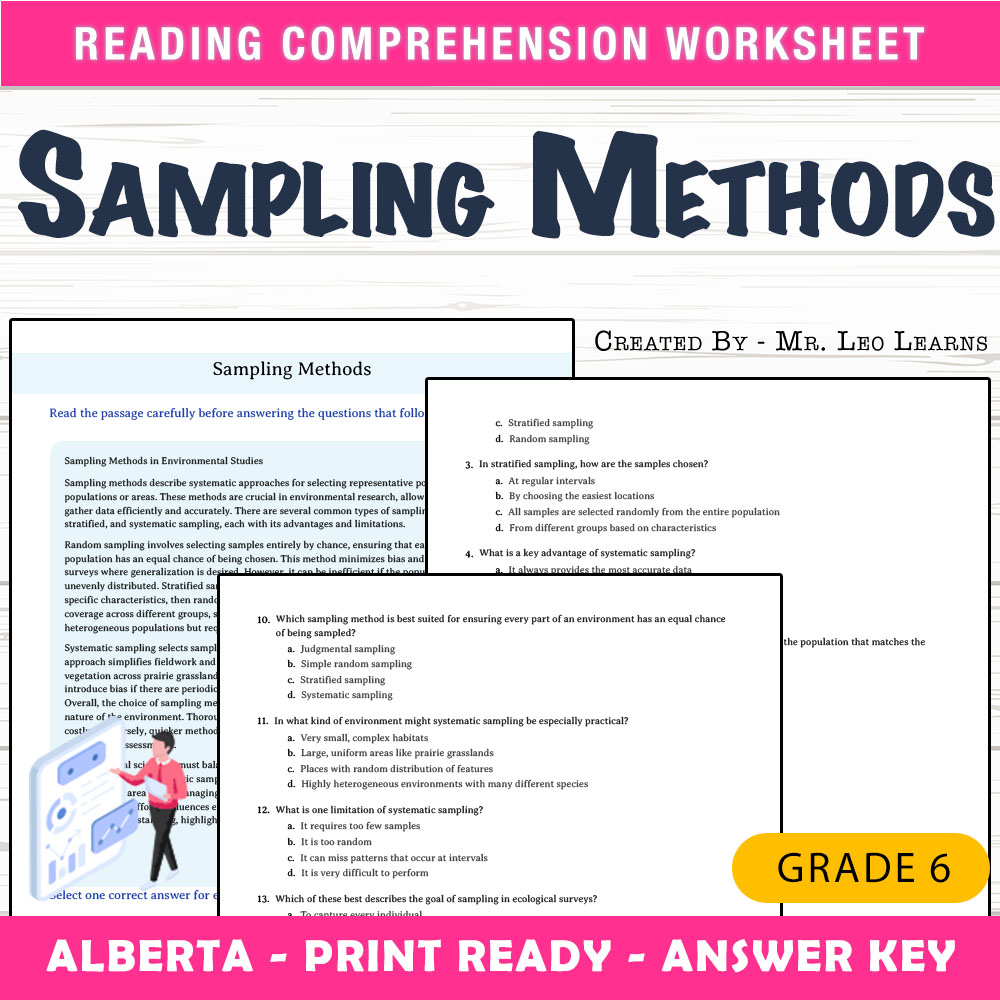
Grade 6 Science — Sampling Methods Worksheet for Mastery
 Created byThe Resource Hub
Learning Objectives
- Understand different sampling methods used in environmental studies.
- Identify the advantages and limitations of random, stratified, and systematic sampling.
- Describe how sampling choices affect data interpretation in ecological surveys.
Also included in: Grade 6 Science Unit | Evidence and Investigation Worksheets – Alberta Framework +1 more
Instant download
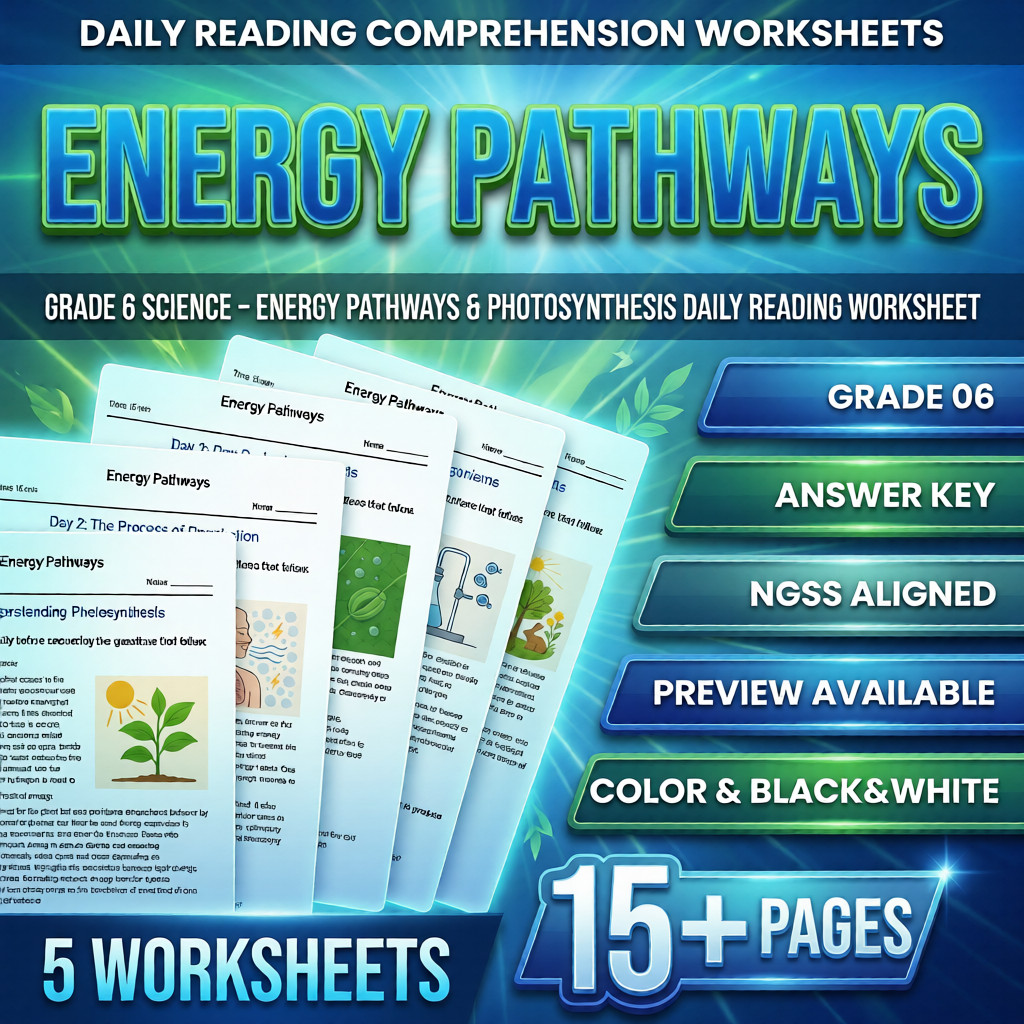
Grade 6 Science – Energy Pathways & Photosynthesis Daily Reading Worksheet
 Created byElena Brooks
Learning Objectives
- Understand how plants convert sunlight into chemical energy through photosynthesis.
- Identify the roles of chloroplasts and mitochondria in energy transformation.
- Describe the process of gas exchange in leaves and its importance in energy production.
Also included in: Grade 6 Science From Molecules to Organisms Worksheet Bundle | NGSS +1 more
Instant download

Forces and Motion Worksheet | Grade 6 Science Test Prep
 Created byPrism Point Learning
Learning Objectives
- Explain how net force (the vector sum of forces) affects the motion of an object.
- Use the relationship net force equals mass times acceleration to predict changes in acceleration.
- Distinguish between mass (inertia) and forces when reasoning about motion.
Also included in: Grade 6 Physical Science NGSS Lesson Bundle: Test Prep Worksheets
Instant download
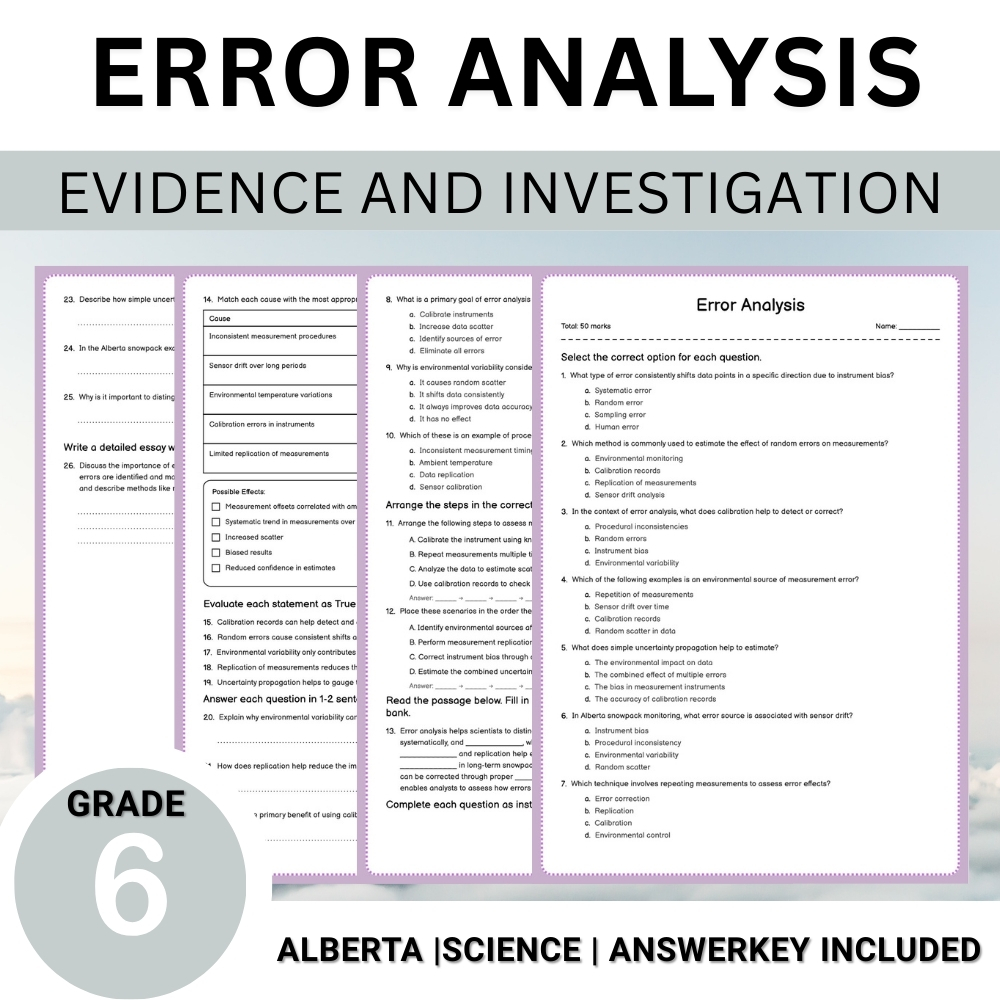
Grade 6 Science | Error Analysis Worksheet (Printable PDF + Answer Key)
Learning Objectives
- Understand sources of systematic and random errors in scientific data.
- Identify methods for estimating and analyzing errors in datasets.
- Apply error analysis techniques to real-world examples, including environmental measurements.
Also included in: Grade 6 Science Unit | Data & Measurement Worksheets Bundle (Assessment & Practice) +1 more
Instant download
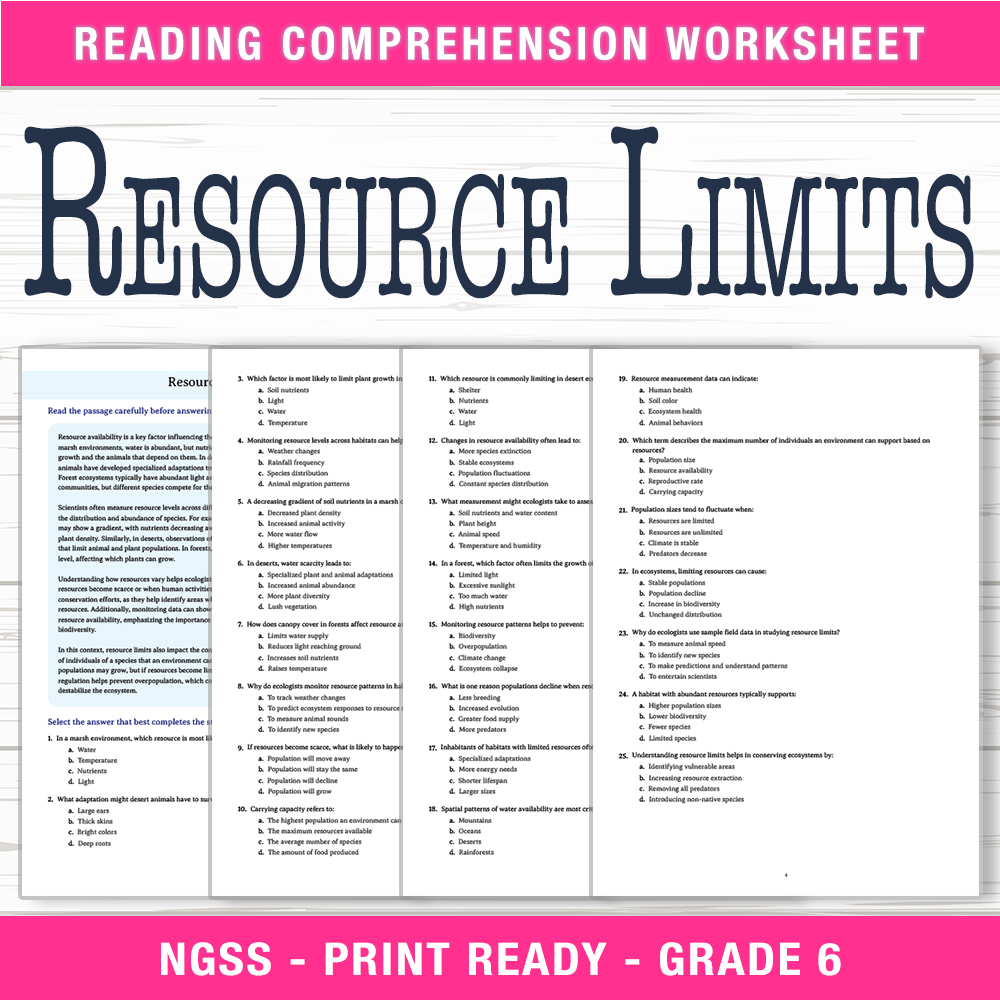
Grade 6 Science | Resource Limits Worksheet (PDF + Answer Key)
 Created byRiverstone Classroom
Learning Objectives
- Understand how resource availability impacts individual organisms and population sizes in different ecosystems.
- Interpret quantitative observations and measurement patterns related to resource gradients.
- Identify limiting resources such as water, nutrients, and light in marsh, desert, and forest environments.
Also included in: Grade 6 Science Unit Bundle | Ecosystems & Biodiversity Worksheets
Instant download
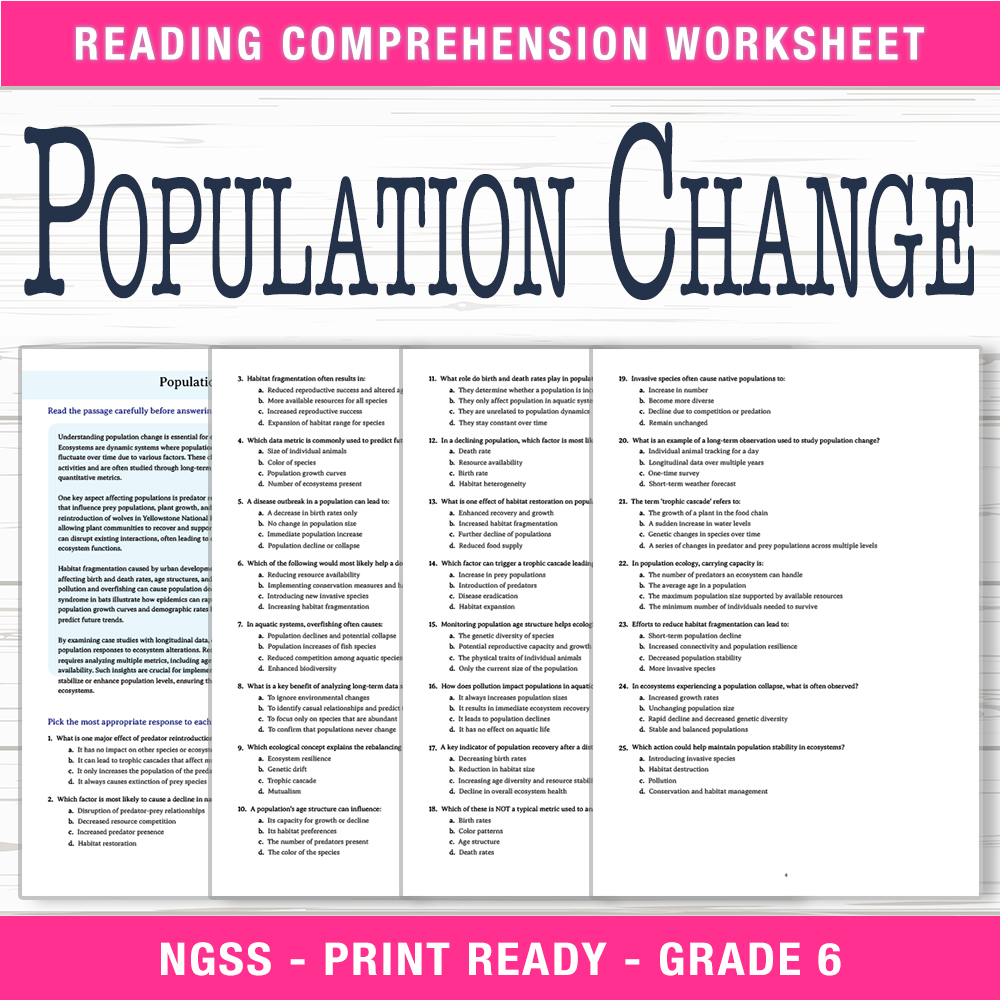
6th Grade Science | Population Change Worksheet (PDF + Answer Key)
Created byRiverstone ClassroomLearning Objectives
- Construct evidence-based arguments linking ecosystem component changes to population fluctuations.
- Analyze case studies involving predator reintroduction, invasive species, habitat fragmentation, and disease outbreaks.
- Interpret empirical data sets and longitudinal observations to determine causes of population responses.
Also included in: Grade 6 Science Unit Bundle | Ecosystems & Biodiversity Worksheets
Instant download
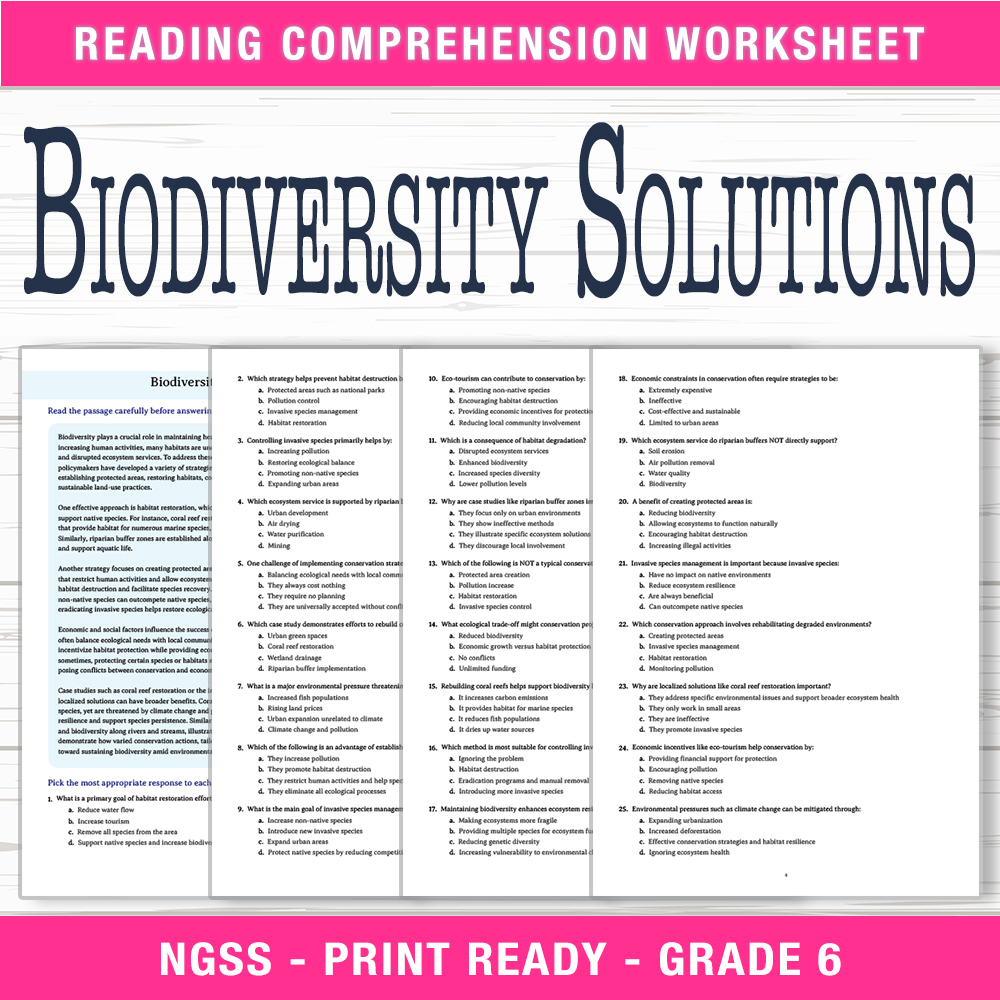
6th Grade Science | Biodiversity Solutions Worksheet (PDF + Answer Key)
Created byRiverstone ClassroomLearning Objectives
- Understand different conservation strategies and their ecological impacts.
- Compare and evaluate habitat restoration and invasive species management techniques.
- Analyze case studies to determine the effectiveness of biodiversity solutions under environmental pressures.
Also included in: Grade 6 Science Unit Bundle | Ecosystems & Biodiversity Worksheets
Instant download

6th Grade Science | Species Interactions Worksheet (PDF + Answer Key)
Created byRiverstone ClassroomLearning Objectives
- Explain different types of species interactions such as mutualism, competition, predation, and parasitism.
- Compare patterns of species interactions across forest, grassland, and freshwater ecosystems.
- Relate species traits, resource overlap, and abiotic conditions to the strength and outcomes of interactions.
Also included in: Grade 6 Science Unit Bundle | Ecosystems & Biodiversity Worksheets
Instant download

Ecosystem Biodiversity and Species Interactions Worksheets | Grade 6 Science
 Created bythe curious pencil
Learning Objectives
- Define biodiversity as the variety of living things in ecosystems.
- Identify the ecological roles of plants, fungi, and animals.
- Explain how beaver dams can create habitats for other organisms.
Also included in: Grade 6 Science Forest Ecosystems Lesson Bundle | Alberta
Instant download

Aerodynamic Design Worksheets: Wings, Lift and Drag Grade 6 Science
Created bythe curious pencilLearning Objectives
- Identify design features that influence an object's flight.
- Explain how wing curvature affects interactions with air.
- Describe how aspect ratio compares wing length and width.
Also included in: Grade 6 Science Aerodynamics and Flight Lesson Bundle | Alberta
Instant download

Forest Food Webs and Energy Flow Worksheet | Grade 6 Science
Created bythe curious pencilLearning Objectives
- Identify producers, consumers, and decomposers in forest food webs.
- Explain how energy moves through connected feeding relationships.
- Describe how decomposers recycle nutrients to support plant growth.
Also included in: Grade 6 Science Forest Ecosystems Lesson Bundle | Alberta
Instant download

Sun Earth Moon Relationships and Cycles Worksheets Grade 6 Science
Created bythe curious pencilLearning Objectives
- Explain how gravity influences the orbital motion of celestial bodies.
- Describe how the Moon's position produces different lunar phases.
- Distinguish between solar eclipses and lunar eclipses.
Instant download

Bernoulli Principle and Lift Worksheets | Grade 6 Science Aerodynamics
Created bythe curious pencilLearning Objectives
- Explain the relationship between fluid speed and pressure.
- Describe how pressure differences around an airfoil contribute to lift.
- Identify how wind tunnels help scientists investigate airflow.
Also included in: Grade 6 Science Aerodynamics and Flight Lesson Bundle | Alberta
Instant download

Sun’s Apparent Path Through the Seasons Worksheets | Grade 6 Science
Created bythe curious pencilLearning Objectives
- Describe the Sun’s apparent daily movement across the sky.
- Compare noon solar elevation during summer and winter.
- Explain how daylight duration changes with the seasons.
Instant download

Alberta Seasonal Patterns and Solar Energy Worksheet Grade 6 Science
Created bythe curious pencilLearning Objectives
- Explain how Earth's tilted axis contributes to seasonal patterns
- Describe changes in Alberta's daylight duration across seasons
- Compare solar angles during summer and winter
Instant download

Solar Timekeeping and Local Solar Noon Worksheets Grade 6 Science
Created bythe curious pencilLearning Objectives
- Identify local solar noon from the Sun's apparent movement.
- Explain how longitude affects the timing of solar noon.
- Describe how time zones establish shared civil clock times.
Instant download

Environmental Data Patterns and Analysis Worksheets for Grade 6 Science
Created bythe curious pencilLearning Objectives
- Identify long-term trends and seasonal cycles in environmental data
- Explain how averages and moving averages summarize measurements
- Recognize anomalies in temperature and river-flow observations
Instant download

Stem Transport Through Xylem and Phloem Worksheet | Grade 6 Science
Created bythe curious pencilLearning Objectives
- Identify the transport functions of xylem and phloem.
- Explain how freeze–thaw cycles affect water movement through trees.
- Describe how drought influences water availability and stem transport.
Also included in: Grade 6 Science Forest Ecosystems Lesson Bundle | Alberta
Instant download

Celestial Motion and Seasonal Patterns Worksheets for Grade 6 Science
Created bythe curious pencilLearning Objectives
- Identify predictable daily and seasonal patterns in the sky.
- Describe apparent changes in the positions of celestial objects.
- Explain why different constellations are visible in different seasons.
Instant download

Air Pressure and Wind Patterns Worksheets Grade 6 Science
Created bythe curious pencilLearning Objectives
- Explain how uneven heating creates air pressure differences.
- Describe how pressure gradients produce wind.
- Identify how mountains influence regional airflow.
Also included in: Grade 6 Science Aerodynamics and Flight Lesson Bundle | Alberta
Instant download

Air Properties Worksheets: Density, Pressure & Temperature Grade 6 Science
Created bythe curious pencilLearning Objectives
- Identify the main gases that make up Earth's air.
- Explain how altitude affects air density and pressure.
- Compare particle spacing in warm air and cool air.
Also included in: Grade 6 Science Aerodynamics and Flight Lesson Bundle | Alberta
Instant download

Sky Observations and Apparent Motion Worksheets | Grade 6 Science
Created bythe curious pencilLearning Objectives
- Identify repeating patterns in daily sky observations.
- Explain how Earth's rotation relates to apparent daily sky motion.
- Recognize repeating patterns in the Moon's visible phases.
Instant download

Earth’s Axial Tilt and Seasonal Changes Worksheets | Grade 6 Science
Created bythe curious pencilLearning Objectives
- Identify Earth's axial tilt as a cause of seasonal sunlight changes.
- Explain how sunlight angle affects the concentration of incoming solar energy.
- Compare daylight duration during summer and winter.
Instant download

Historical Perspectives on Celestial Motion Worksheets | Grade 6 Science
Created bythe curious pencilLearning Objectives
- Describe how sky observations helped communities recognize seasonal changes
- Identify the Sun, Moon, and stars in historical observations
- Explain how oral traditions preserved astronomical knowledge
Instant download

Measurement Uncertainty and Data Reliability Worksheets | Grade 6 Science
Created bythe curious pencilLearning Objectives
- Identify instrument resolution, environmental variability, and observational uncertainty.
- Calculate the range of repeated measurements to describe variability.
- Distinguish measurement precision from accuracy using scientific examples.
Instant download

Aircraft Control Surfaces and Motion Worksheet | Grade 6 Science
Created bythe curious pencilLearning Objectives
- Identify the functions of ailerons, elevators, and rudders
- Explain how control surface deflection changes airflow
- Distinguish rolling, pitching, and yawing aircraft motions
Also included in: Grade 6 Science Aerodynamics and Flight Lesson Bundle | Alberta
Instant download

Field Measurement Tools Safety and Care Worksheets | Grade 6 Science
Created bythe curious pencilLearning Objectives
- Identify appropriate instruments for common field measurements.
- Explain how calibration checks support reliable scientific readings.
- Describe cleaning procedures that reduce sample contamination.
Instant download

Forest Disturbance Regimes Worksheets for Grade 6 Science
Created bythe curious pencilLearning Objectives
- Identify major types of forest ecosystem disturbance.
- Describe disturbance frequency, intensity, and spatial extent.
- Explain how disturbances create opportunities for forest regeneration.
Also included in: Grade 6 Science Forest Ecosystems Lesson Bundle | Alberta
Instant download

Tree Root Systems and Water Uptake: Grade 6 Science Worksheets
Created bythe curious pencilLearning Objectives
- Identify lateral roots and taproots by their growth patterns.
- Explain how root structures help trees access soil water.
- Describe how mycorrhizal fungi support water and mineral absorption.
Also included in: Grade 6 Science Forest Ecosystems Lesson Bundle | Alberta
Instant download

Operational Definitions in Science: Grade 6 Measurement Worksheets
Created bythe curious pencilLearning Objectives
- Explain how operational definitions make observations measurable.
- Identify appropriate tools and units for environmental measurements.
- Describe why fixed locations and consistent timing improve comparisons.
Instant download

Angle of Attack and Flight Forces Worksheet | Grade 6 Science
Created bythe curious pencilLearning Objectives
- Define the angle of attack in relation to a wing and airflow.
- Explain how increasing angle of attack affects lift before stalling.
- Identify the critical angle and describe airflow separation.
Also included in: Grade 6 Science Aerodynamics and Flight Lesson Bundle | Alberta
Instant download

Flight Design Refinement Worksheets | Grade 6 Science Aerodynamics
Created bythe curious pencilLearning Objectives
- Explain how shape and mass distribution affect flight.
- Identify control surfaces used to adjust a flying object.
- Describe how repeated observations improve flight-test comparisons.
Also included in: Grade 6 Science Aerodynamics and Flight Lesson Bundle | Alberta
Instant download

Sampling Methods and Representative Surveys Worksheet | Grade 6 Science
Created bythe curious pencilLearning Objectives
- Define random, stratified, and systematic sampling methods.
- Explain how sample size affects survey reliability.
- Compare sampling methods for different environmental investigations.
Instant download

Tree Growth Rings and Dendrochronology Worksheets Grade 6 Science
Created bythe curious pencilLearning Objectives
- Explain how growth rings record annual radial growth.
- Interpret ring width as evidence of changing growing conditions.
- Identify environmental factors that influence tree-ring patterns.
Also included in: Grade 6 Science Forest Ecosystems Lesson Bundle | Alberta
Instant download

Earth–Sun Geometry and Seasonal Daylight Prediction Worksheet Grade 6
Created bythe curious pencilLearning Objectives
- Explain how Earth's axial tilt influences seasonal daylight duration
- Predict seasonal changes in daylight using Earth–Sun models
- Interpret how solar angle relates to apparent solar position
Instant download

Aerodynamic Design Worksheets: Wings, Lift and Drag Grade 6 Science
Created bythe curious pencilLearning Objectives
- Identify design features that influence an object's flight.
- Explain how wing curvature affects interactions with air.
- Describe how aspect ratio compares wing length and width.
Instant download

Streamlining and Aerodynamics Worksheets | Grade 6 Science
Created bythe curious pencilLearning Objectives
- Identify shape features that can reduce aerodynamic resistance.
- Explain how surface smoothness influences airflow around objects.
- Describe how engineers apply streamlining in aerodynamic designs.
Also included in: Grade 6 Science Aerodynamics and Flight Lesson Bundle | Alberta
Instant download

Lunar Phases and Orbital Geometry Worksheets for Grade 6 Science
Created bythe curious pencilLearning Objectives
- Explain how Sun, Earth, and Moon positions produce lunar phases.
- Identify the sequence of major lunar phases.
- Describe the approximately 29.5-day synodic period.
Instant download

Forest Management and Conservation Worksheets Grade 6 Science
Created bythe curious pencilLearning Objectives
- Explain how integrated management balances different forest values.
- Describe how monitoring informs changes to forest management plans.
- Identify stakeholders involved in forest management decisions.
Also included in: Grade 6 Science Forest Ecosystems Lesson Bundle | Alberta
Instant download

Leaf Functions and Seasonal Adaptations Worksheets Grade 6 Science
Created bythe curious pencilLearning Objectives
- Identify the roles of stomata, guard cells, and chlorophyll.
- Explain how leaves support photosynthesis and transpiration.
- Compare seasonal leaf characteristics of spruce and poplar trees.
Also included in: Grade 6 Science Forest Ecosystems Lesson Bundle | Alberta
Instant download

Forest Types and Environmental Conditions Worksheets | Grade 6 Science
Created bythe curious pencilLearning Objectives
- Identify major forest types and their characteristic plant communities.
- Explain how elevation influences forest distribution and growing conditions.
- Describe how soil moisture affects tree establishment and growth.
Also included in: Grade 6 Science Forest Ecosystems Lesson Bundle | Alberta
Instant download

Solar and Lunar Eclipses Worksheets: Eclipse Types Grade 6 Science
Created bythe curious pencilLearning Objectives
- Identify the alignments that produce solar and lunar eclipses.
- Distinguish between total, partial, and annular solar eclipses.
- Explain how the Moon’s tilted orbit affects eclipse frequency.
Instant download

Air Density and Lift Worksheets | Grade 6 Science Aerodynamics
Created bythe curious pencilLearning Objectives
- Define air density using the relationship between mass and volume.
- Explain how temperature affects the density of air.
- Compare humid and dry air at the same temperature and pressure.
Also included in: Grade 6 Science Aerodynamics and Flight Lesson Bundle | Alberta
Instant download

Parachute Physics Worksheets: Drag and Canopy Design Grade 6
Created bythe curious pencilLearning Objectives
- Explain how drag slows a falling parachute payload
- Describe how canopy surface area affects descent speed
- Interpret how porosity influences airflow through canopy material
Also included in: Grade 6 Science Aerodynamics and Flight Lesson Bundle | Alberta
Instant download

Day and Night from Earth's Rotation Worksheets | Grade 6 Science
Created bythe curious pencilLearning Objectives
- Explain how Earth's rotation produces the cycle of day and night.
- Describe how sunlight illuminates the side of Earth facing the Sun.
- Identify how axial tilt and orbit affect seasonal daylight duration.
Instant download
About Grade 6 Science Worksheets
Explore Grade 6 Science worksheets for classwork, homework, or review. Our 5,969 printables download instantly as PDFs.
MyTeachingSheets worksheets are made by real teacher-authors and checked before they go live. Download any as a print-ready PDF for lessons, homework, or independent practice — most include answer keys, and previews are always free.