
Grade 6 Science Worksheets
5,969 worksheets
6th Grade Science | Fossil Patterns Worksheet (PDF + Answer Key)
 Created byRiverstone Classroom
Learning Objectives
- Understand how fossil occurrences reveal patterns of organism origin, diversification, and extinction over geologic time.
- Analyze morphological transitions in the fossil record to infer evolutionary change.
- Interpret stratigraphic sequences, dating methods, and geographic distribution data to trace lineage continuity and environmental shifts.
Instant download
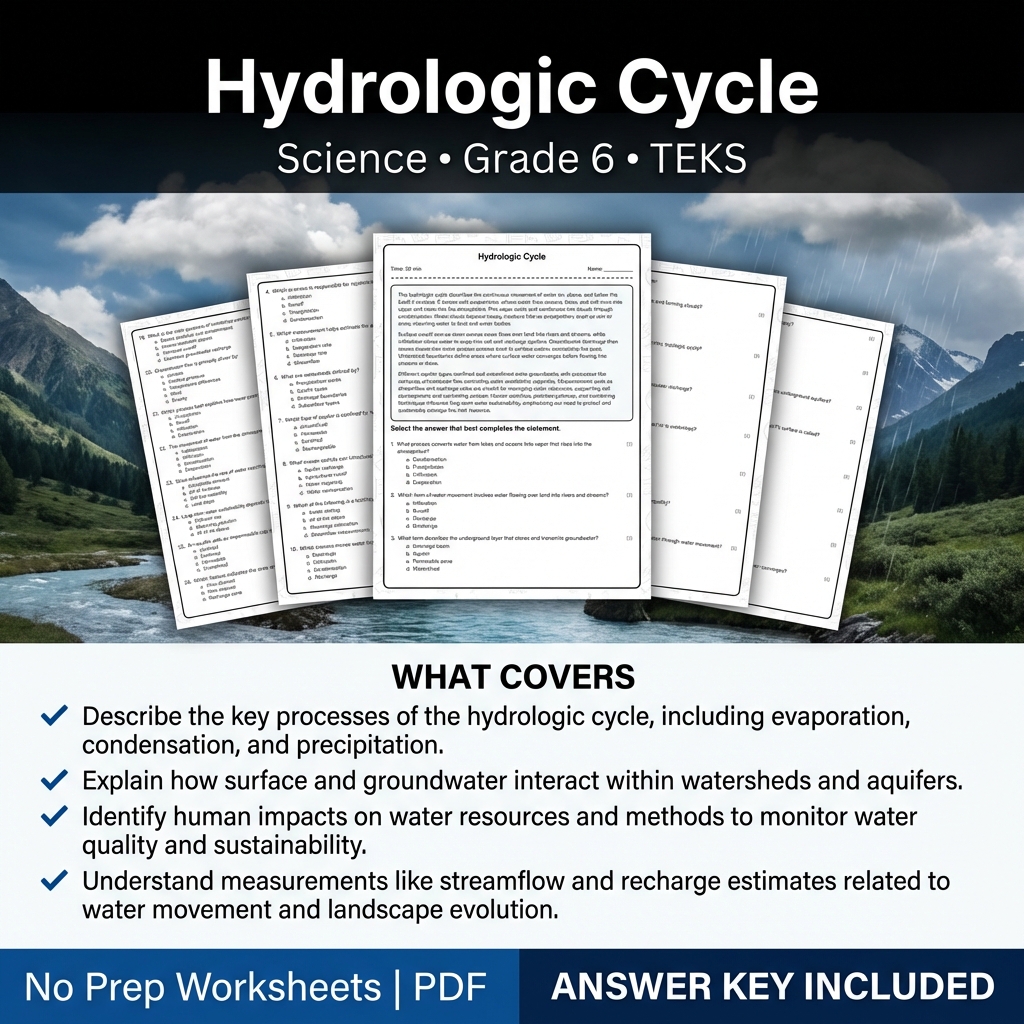
Hydrologic Cycle Science Worksheet for Grade 6 | TEKS Aligned
 Created byCoral Reef Learning
Learning Objectives
- Describe the key processes of the hydrologic cycle, including evaporation, condensation, and precipitation.
- Explain how surface and groundwater interact within watersheds and aquifers.
- Identify human impacts on water resources and methods to monitor water quality and sustainability.
Instant download
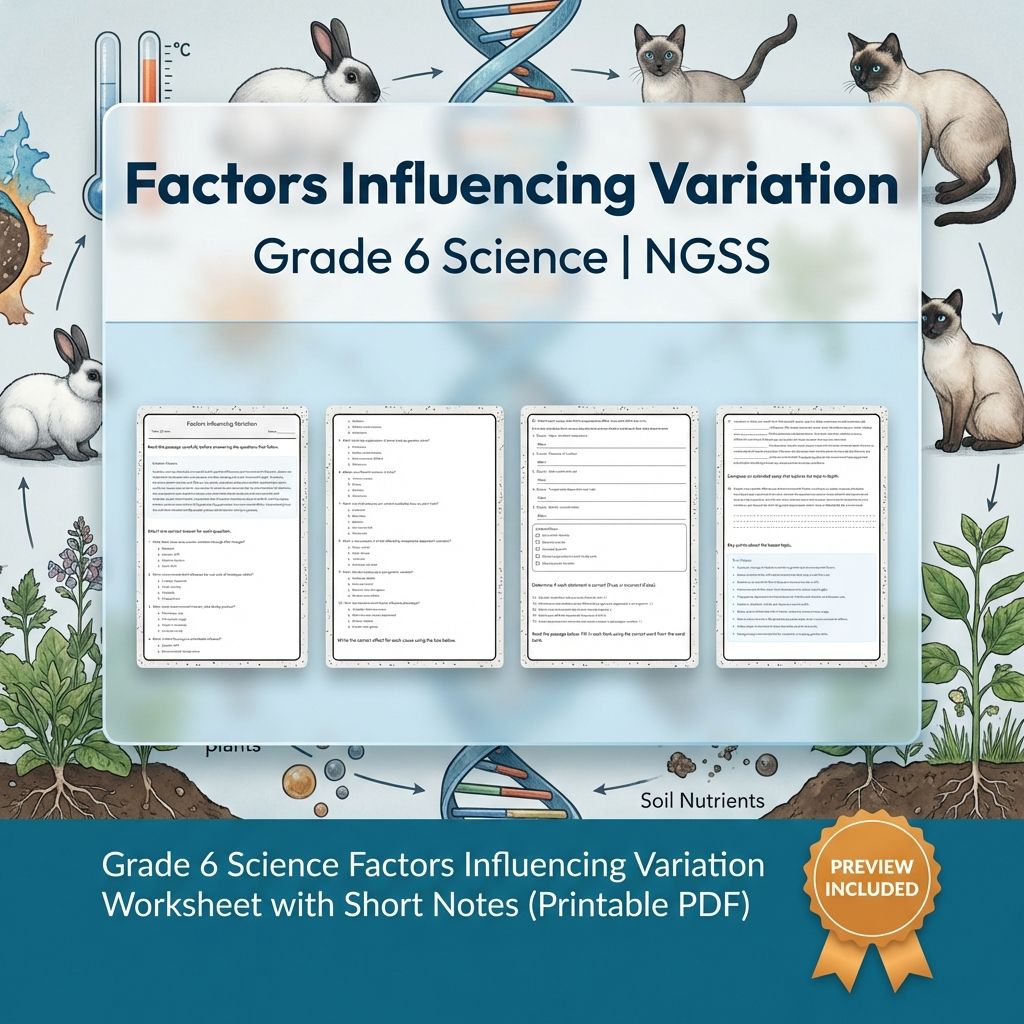
Grade 6 Science Factors Influencing Variation Worksheet with Short Notes (PDF)
 Created byMeadowlark Worksheets
Learning Objectives
- Understand how genetic and environmental factors contribute to observable traits.
- Explain examples like allele combinations, mutations, and nonheritable influences.
- Analyze interactions between inherited genes and environmental conditions.
Also included in: Grade 6 Science | Heredity: Inheritance & Variation NGSS Unit | Worksheets +1 more
Instant download
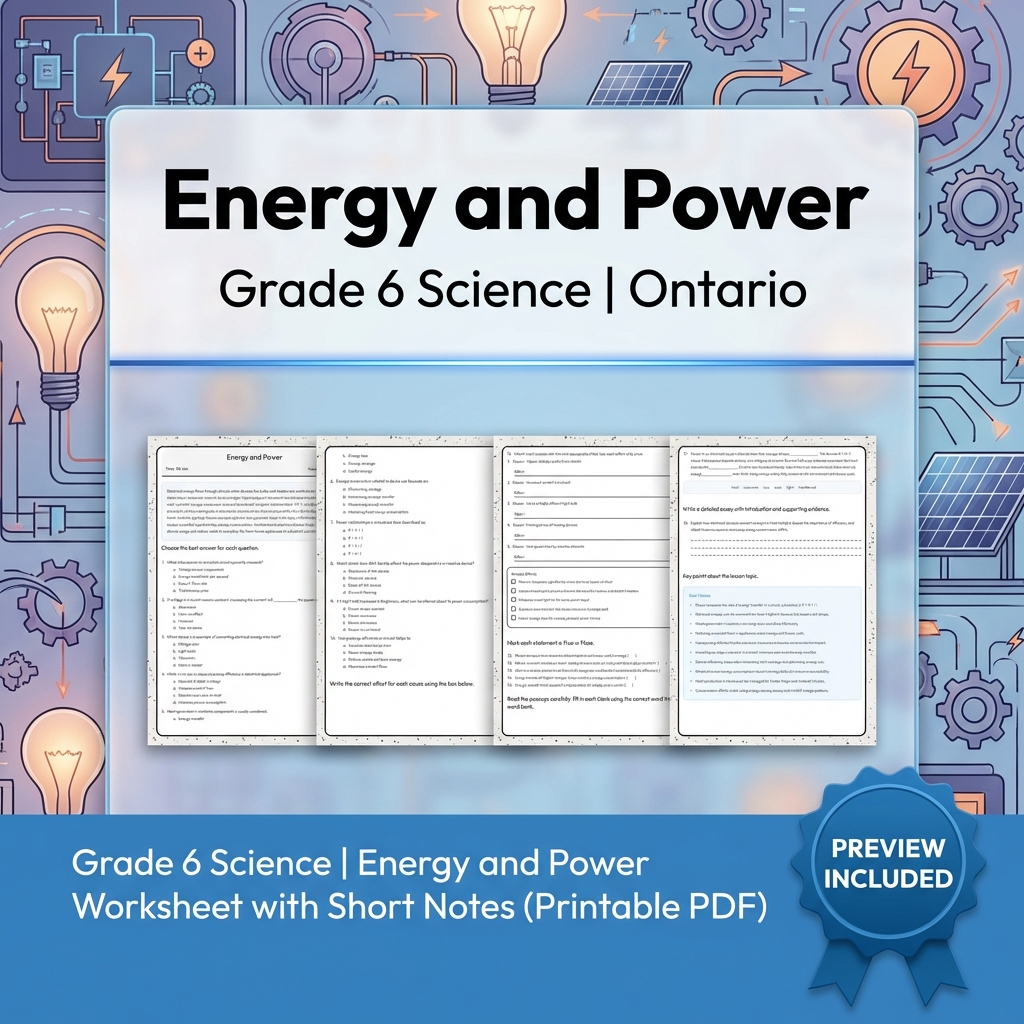
Grade 6 Science | Energy and Power Worksheet with Short Notes (Printable PDF)
Created byMeadowlark WorksheetsLearning Objectives
- Understand the concept of energy transfer in electrical circuits.
- Explain how power is related to energy transfer rate, current, and voltage.
- Identify everyday examples of electrical power usage and heat generation.
Also included in: Grade 6 Science Lesson Group on Energy, Circuits & Properties +1 more
Instant download

Biodiversity Patterns Worksheets: Richness, Turnover & Endemism Grade 6
 Created byWorld Paper Hub
Learning Objectives
- Explain how species richness and species occurrence can be used to describe biodiversity patterns.
- Compare biodiversity patterns across space (islands, latitudes, and habitat types) and time (community turnover).
- Identify ecological and historical factors that influence endemism and species composition.
Instant download

Chemical Reactions Worksheet Grade 6 NGSS | Doodle Notes & Guide
 Created byAmber Owl Education
Learning Objectives
- Identify chemical reactions by analyzing quantitative and qualitative evidence such as gas production, precipitate formation, color change, and temperature change.
- Compare measurements taken before and after a reaction to determine whether new substances (new chemical species) formed.
- Use data reasoning to interpret evidence from typical reactions such as acid–carbonate reactions and metal oxidation.
Also included in: Grade 6 Science Matter and Chemical Reactions Lesson Bundle | NGSS +1 more
Instant download
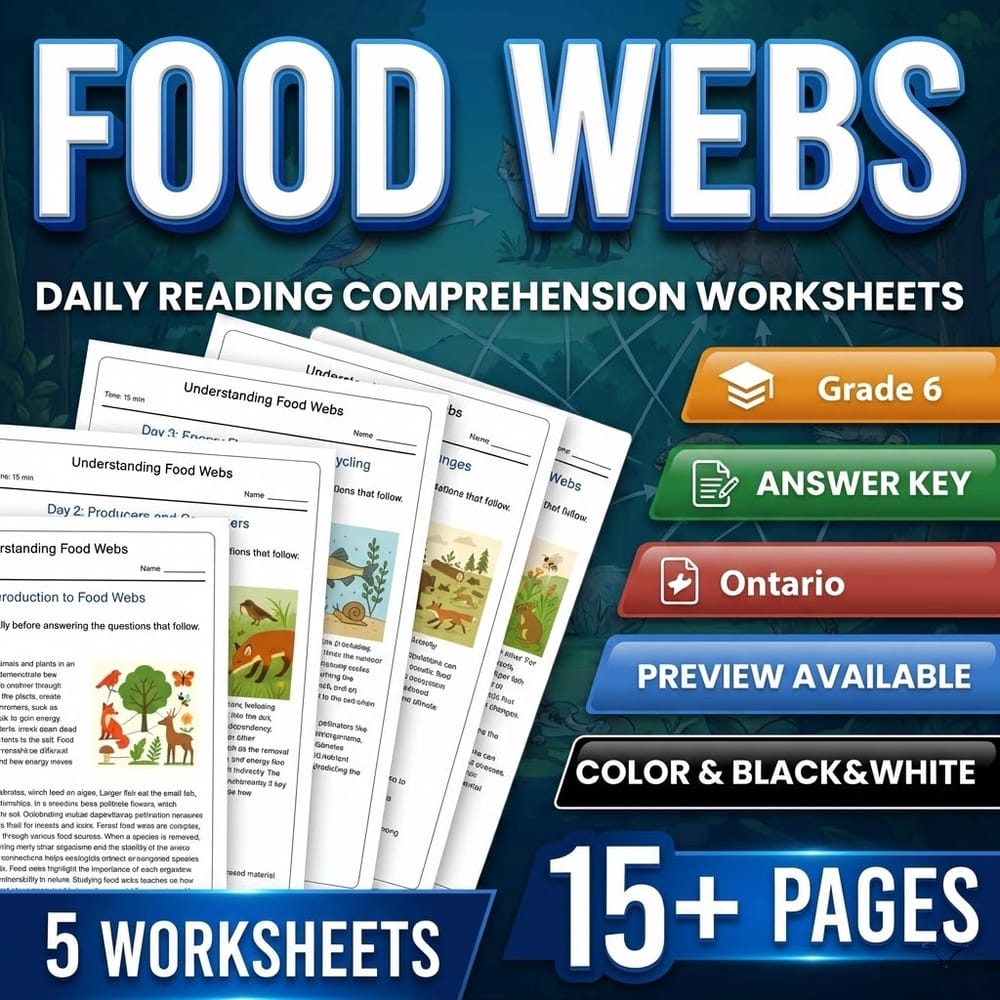
Grade 6 Science – Food Webs & Ecosystem Relationships | Daily Reading Worksheet
 Created byQuiet Forest Education
Learning Objectives
- Define what a food web is and explain its importance in ecosystems.
- Identify producers, consumers, and decomposers within a food web.
- Describe the flow of energy through different trophic levels in food webs.
Also included in: Ecosystems and Environment Grade 6 Science Daily Worksheets Bundle | Ontario +1 more
Instant download
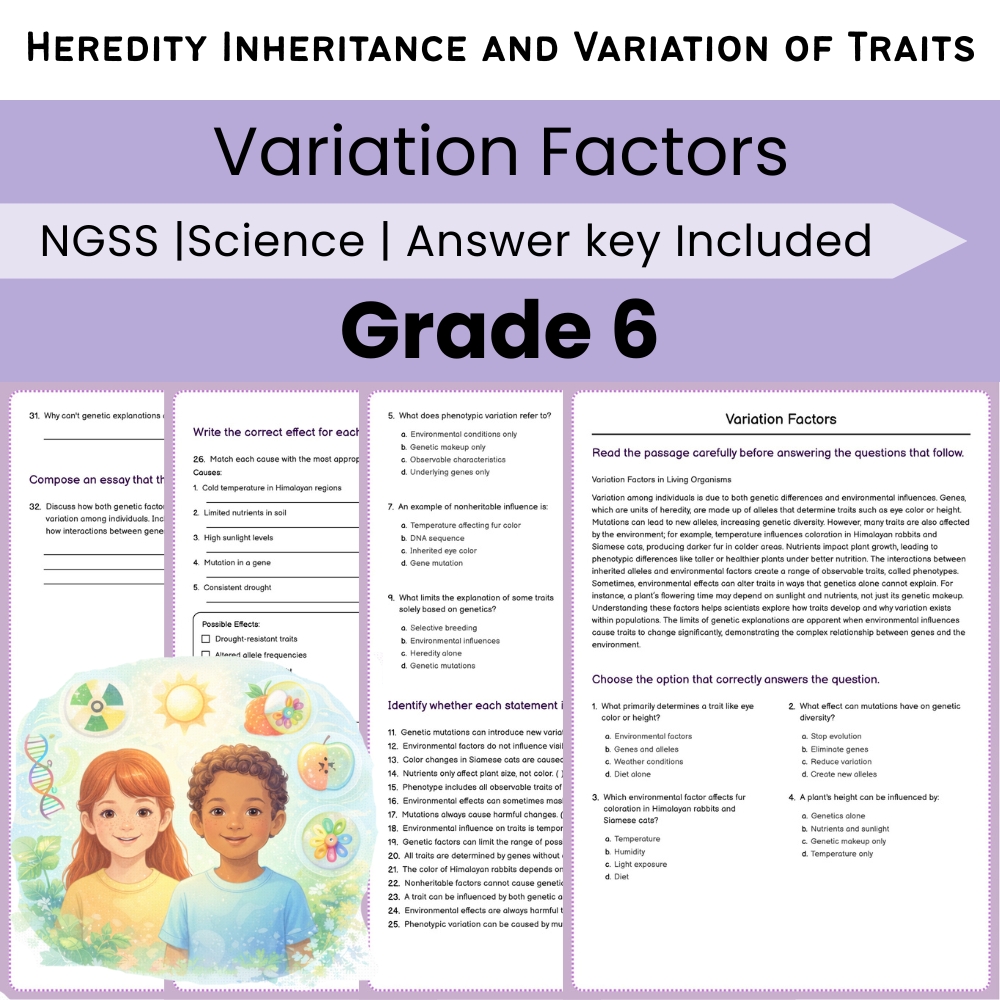
Variation Factors Worksheet | Grade 6 Science Printable PDF | NGSS
Learning Objectives
- Explain how genetic differences and environmental factors contribute to observable variations among individuals.
- Identify models of allele combinations and mutation impacts on traits.
- Describe nonheritable influences such as temperature-dependent coloration and nutrient effects on plants.
Also included in: Grade 6 Science INHERITANCE & VARIATION UNIT | Heredity NGSS Worksheet Bundle (2 Worksheets) +1 more
Instant download
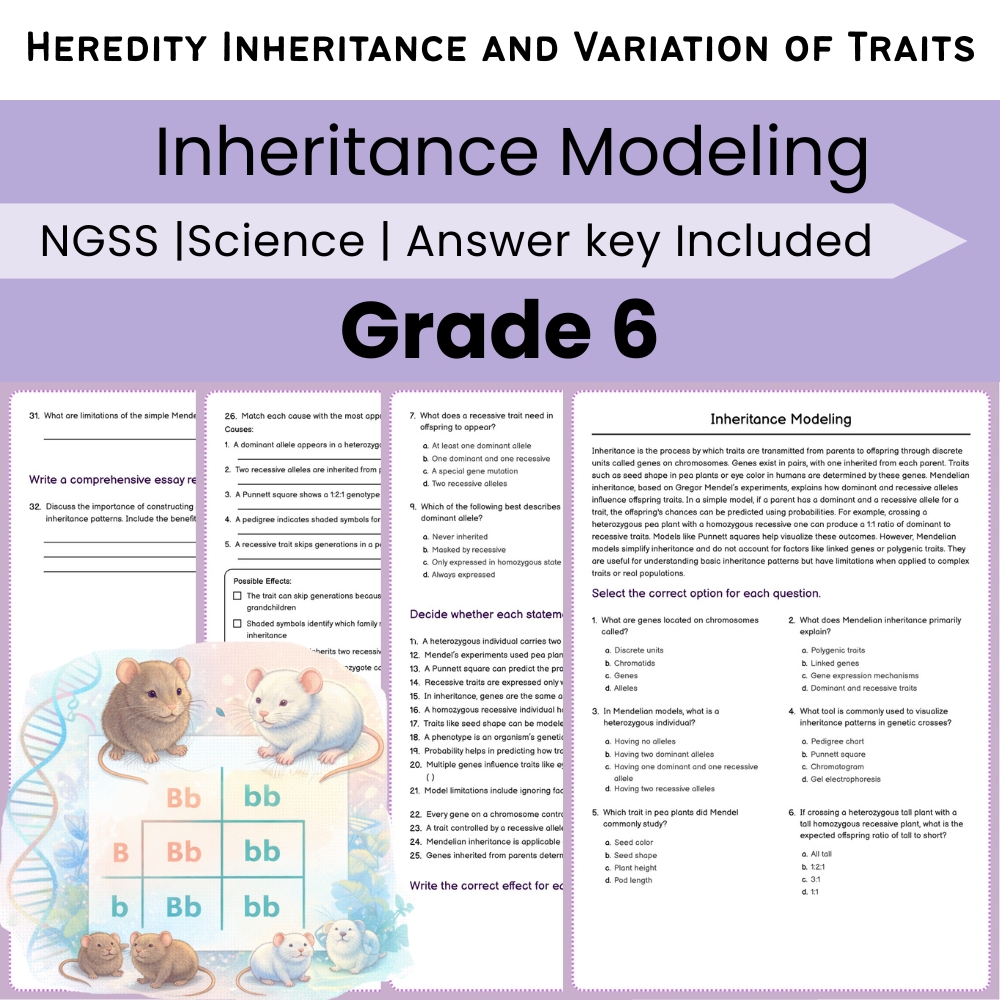
Inheritance Modeling Worksheet | Grade 6 Science Printable PDF NGSS
Learning Objectives
- Explain how traits are transmitted from parents to offspring using genes.
- Predict offspring trait ratios using Mendelian inheritance models.
- Construct and interpret simple models of dominant and recessive inheritance patterns.
Also included in: Grade 6 Science INHERITANCE & VARIATION UNIT | Heredity NGSS Worksheet Bundle (2 Worksheets) +1 more
Instant download
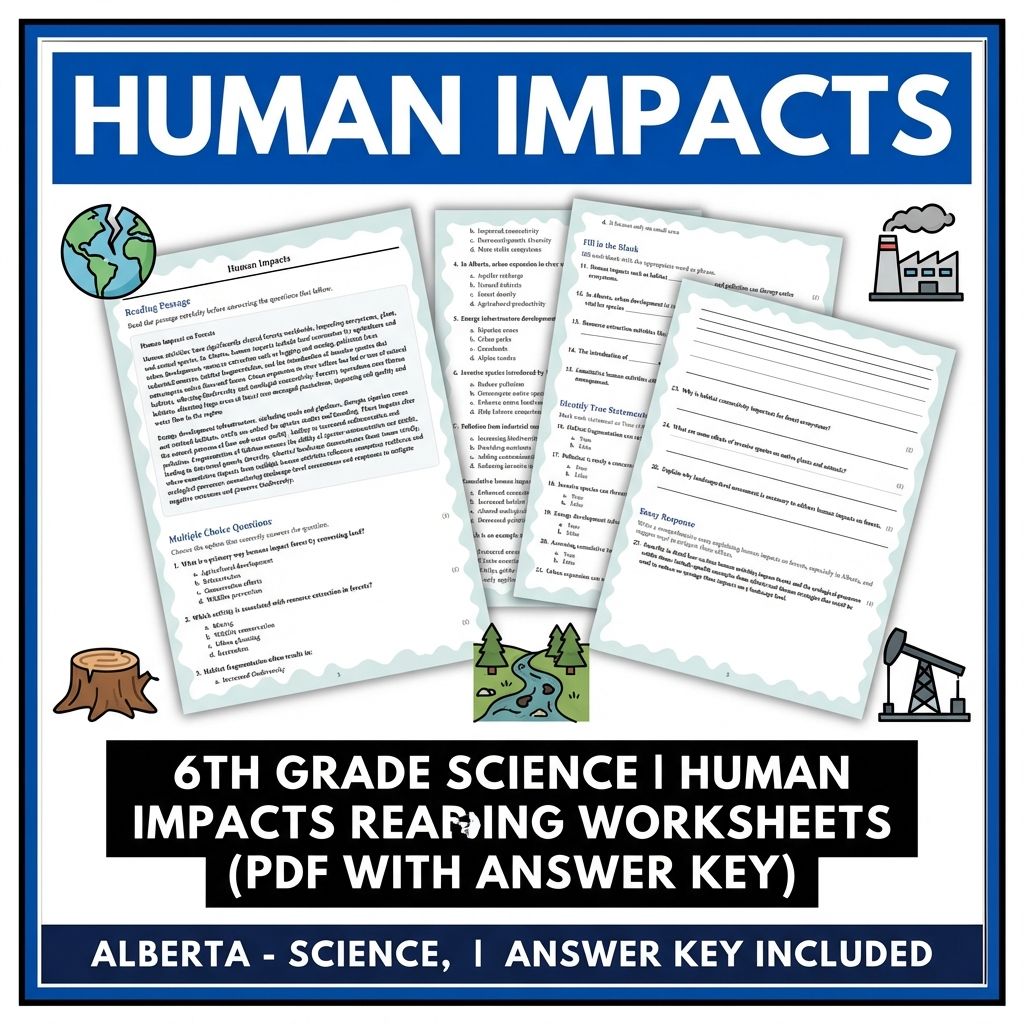
6th Grade Science | Human Impacts Reading Worksheets (PDF with Answer Key)
JCreated byJ.S SheetsLearning Objectives
- Understand the types of human impacts on forest ecosystems.
- Identify specific examples of land conversion, resource extraction, and pollution.
- Explain how these impacts affect habitat connectivity, soil, water quality, and species diversity.
Also included in: Grade 6 Science Unit Bundle | Ecosystems and Biodiversity (Answer Keys Included) +1 more
Instant download
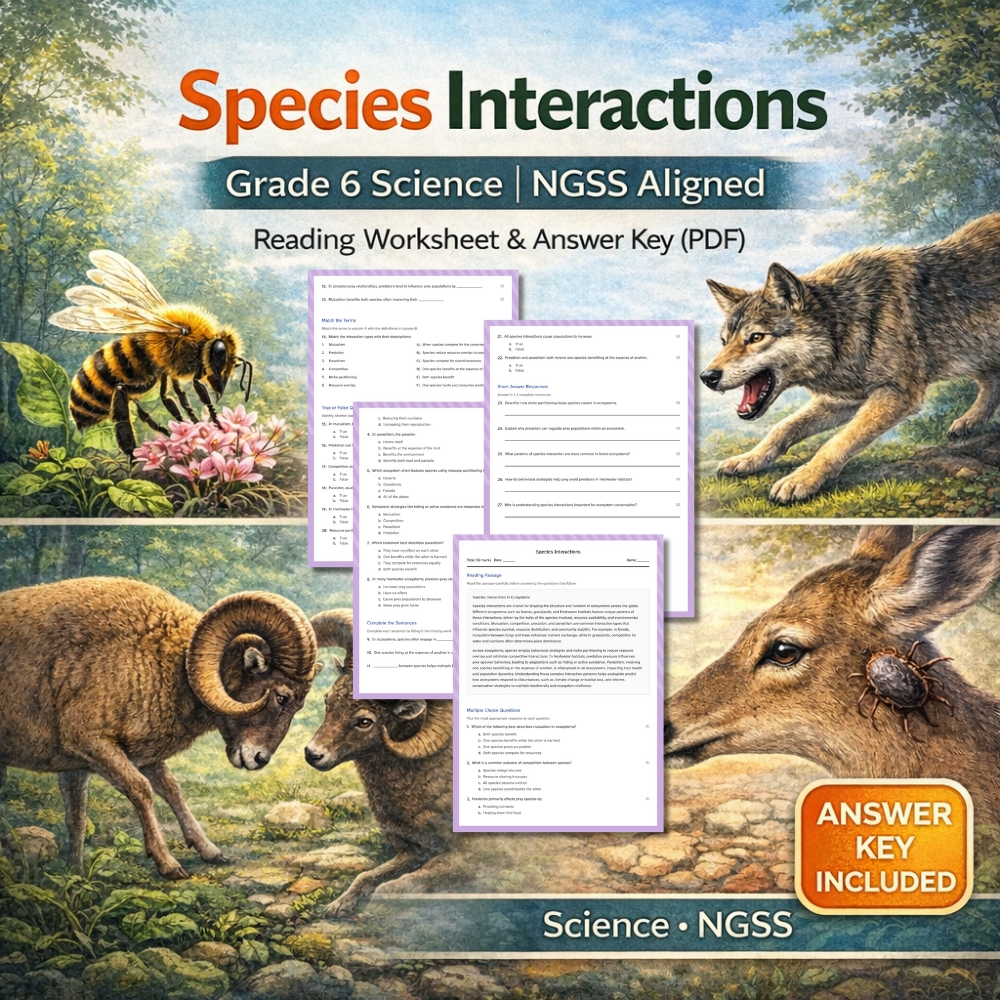
Grade 6 Science | Species Interactions | NGSS Worksheet & Answer Key
 Created byCedar Grove Learning
Learning Objectives
- Construct explanations predicting patterns of species interactions across different ecosystems.
- Identify and describe the types of species interactions such as mutualism, competition, predation, and parasitism.
- Compare interaction outcomes in forest, grassland, and freshwater ecosystems while relating niche partitioning, resource overlap, and behavioral strategies.
Also included in: Grade 6 Science | Ecosystem Interactions & Population Dynamics Worksheet Bundle +1 more
Instant download
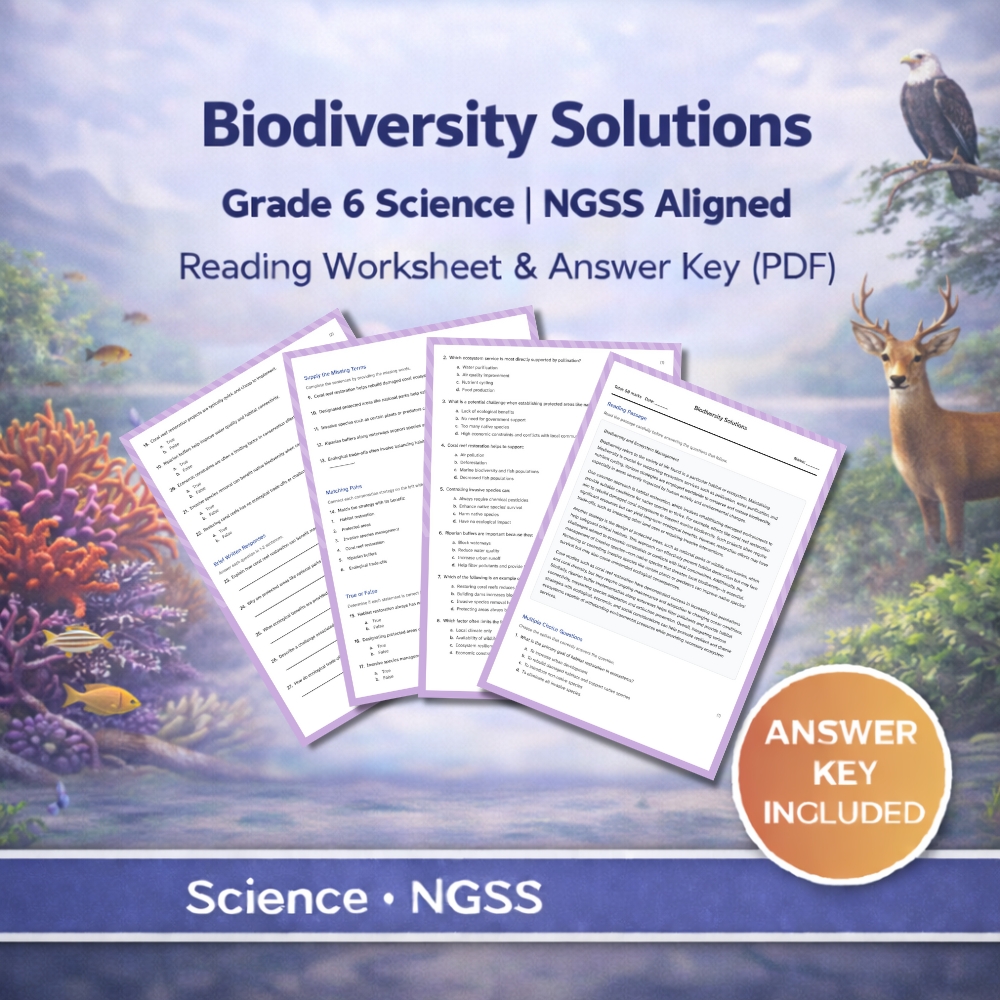
6th Grade Science | Biodiversity Solutions | Worksheet (NGSS Aligned)
Created byCedar Grove LearningLearning Objectives
- Compare different conservation strategies and understand their ecological trade-offs.
- Evaluate case studies of habitat restoration and invasive species management.
- Analyze effectiveness and feasibility of biodiversity solutions under environmental pressures.
Also included in: Grade 6 Science | Ecosystem Interactions & Population Dynamics Worksheet Bundle +1 more
Instant download

6th Grade Science Worksheet – Adaptation Patterns TEKS Alignment (PDF)
 Created byEvergreen Desk Education
Learning Objectives
- Identify morphological, physiological, and behavioral adaptations that help organisms survive in specific environments.
- Explain how inherited traits can improve survival, predator avoidance, and reproductive success.
- Compare how different environments (desert vs. temperate regions) favor different adaptation patterns.
Instant download
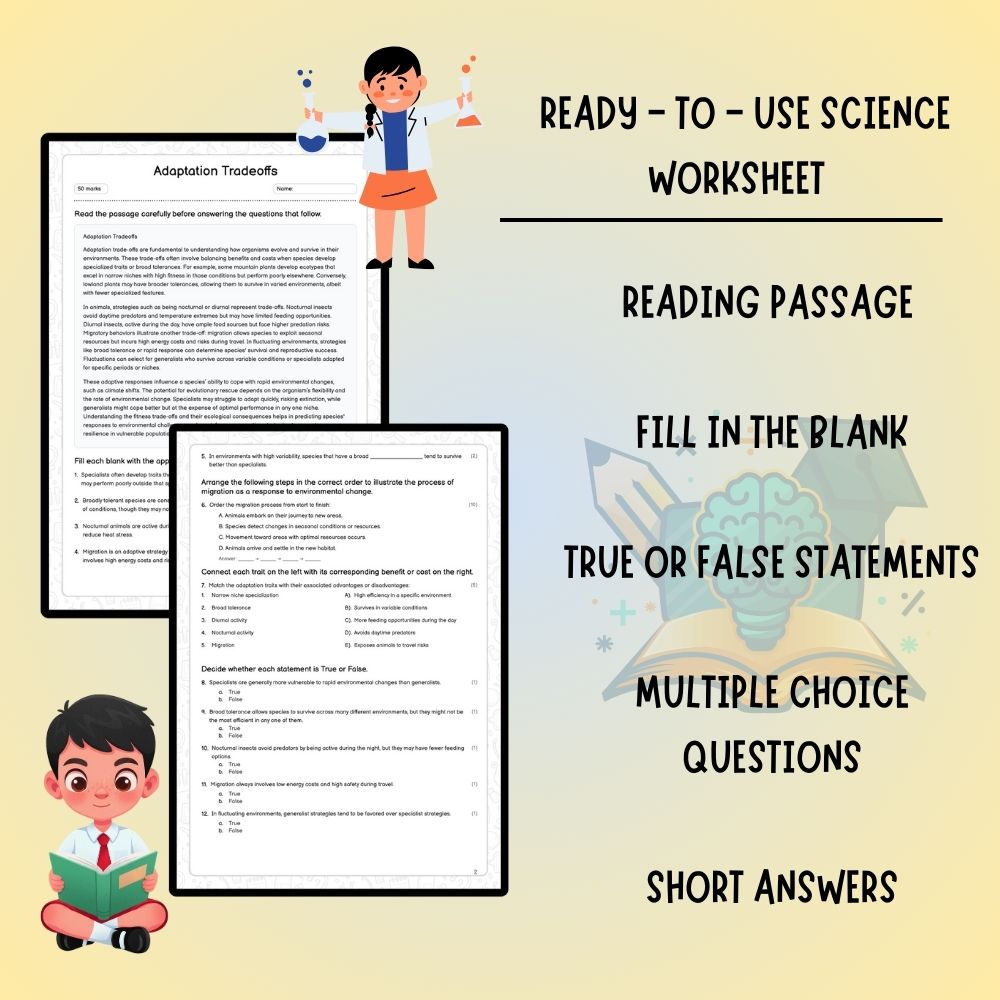
6th Grade Science | Adaptation Tradeoffs Worksheet (PDF )
 Created byPrism Point Learning
Learning Objectives
- Understand the concept of fitness trade-offs and how they influence adaptation strategies.
- Differentiate between specialists and generalists based on benefits and costs.
- Analyze real-world examples illustrating adaptation trade-offs, such as plant ecotypes and animal behaviors.
Also included in: Grade 6 Science Unit Bundle – Ecology, Classification & Environment
Instant download

Series Circuits Worksheet Grade 6 Science | Current & Voltage
 Created byChalk and Compass
Learning Objectives
- Explain how a series circuit forms a single-path (one-loop) configuration for current.
- Describe why the current is the same through each element in a series circuit.
- Use the idea of voltage division to predict how voltage is shared across series components.
Also included in: Grade 6 Science Circuits & Electricity Lesson Bundle | Ontario +1 more
Instant download
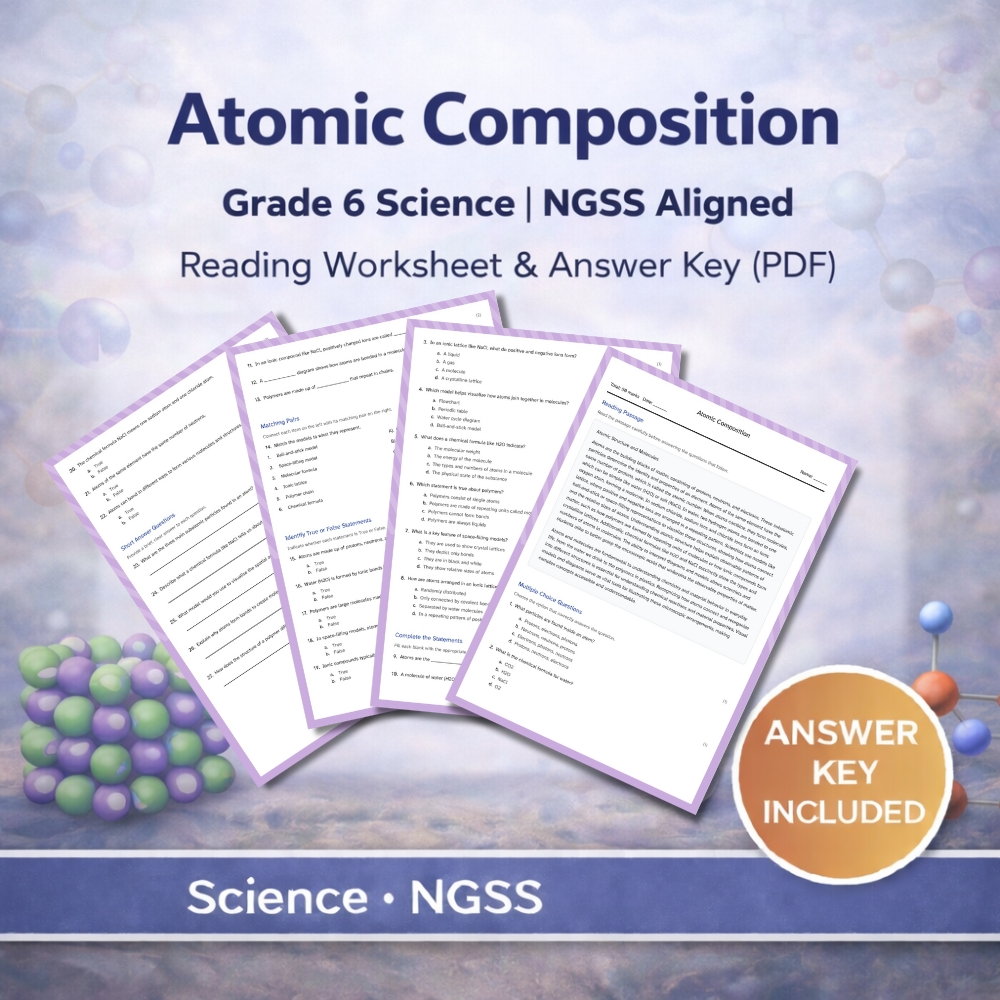
6th Grade Science | Atomic Composition | Worksheet & Answer Key (NGSS Aligned)
Created byCedar Grove LearningLearning Objectives
- Understand the basic structure of atoms and how they form molecules.
- Use models and representations to describe simple molecules like H2O and NaCl.
- Recognize patterns in the structure of polymers and ionic lattices.
Also included in: Grade 6 Science | Atomic & Molecular Models, Conservation & Reactions | NGSS +1 more
Instant download
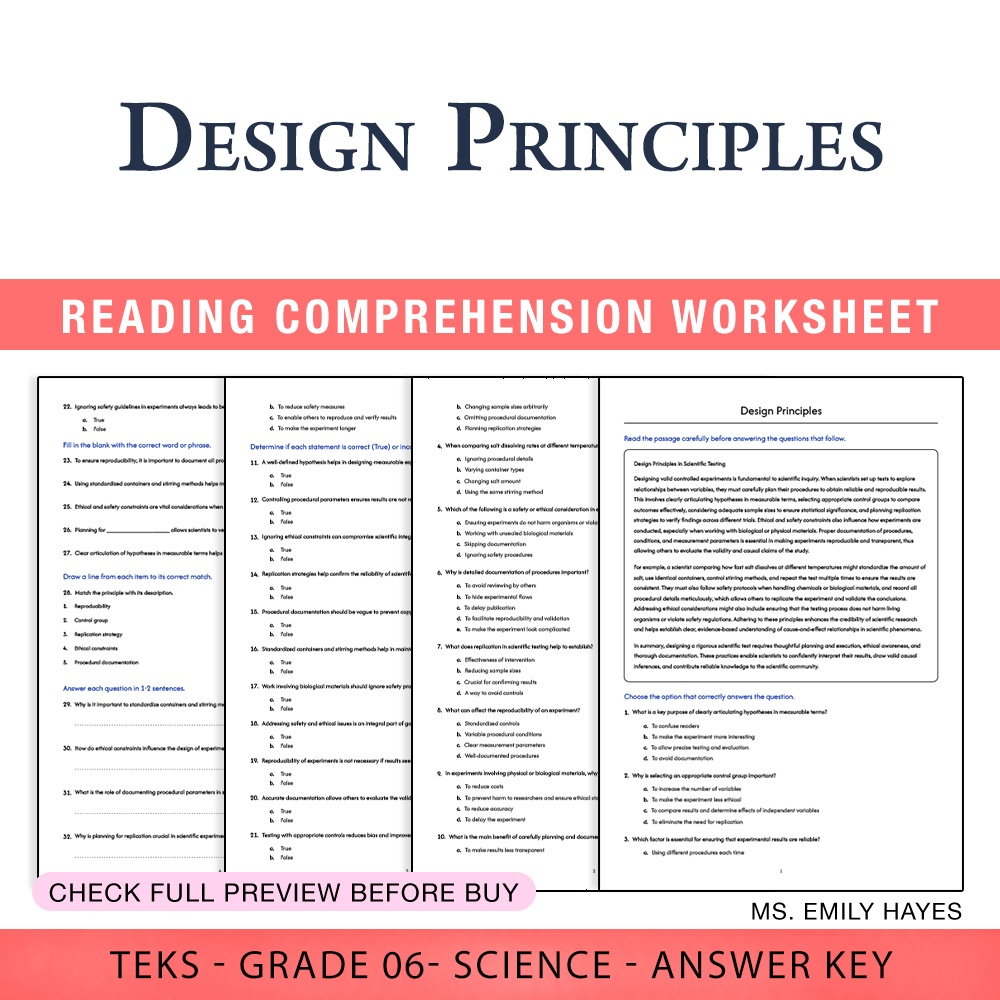
6th Grade Science | Design Principles Worksheet (PDF+ Answer Key)
 Created byCopper Leaf Classroom
Learning Objectives
- Understand and articulate hypotheses in measurable terms for controlled experiments.
- Identify appropriate control groups and sample sizes in scientific testing.
- Describe strategies for replication to ensure reliability of experimental results.
Instant download

Prototype Evaluation Assessment for Grade 6 Science | Standards-Aligned
Created byPrism Point LearningLearning Objectives
- Understand how data and constraints are used to evaluate prototypes.
- Identify different types of evidence, including measurements and observations.
- Learn how to interpret failures and compare results to criteria.
Instant download
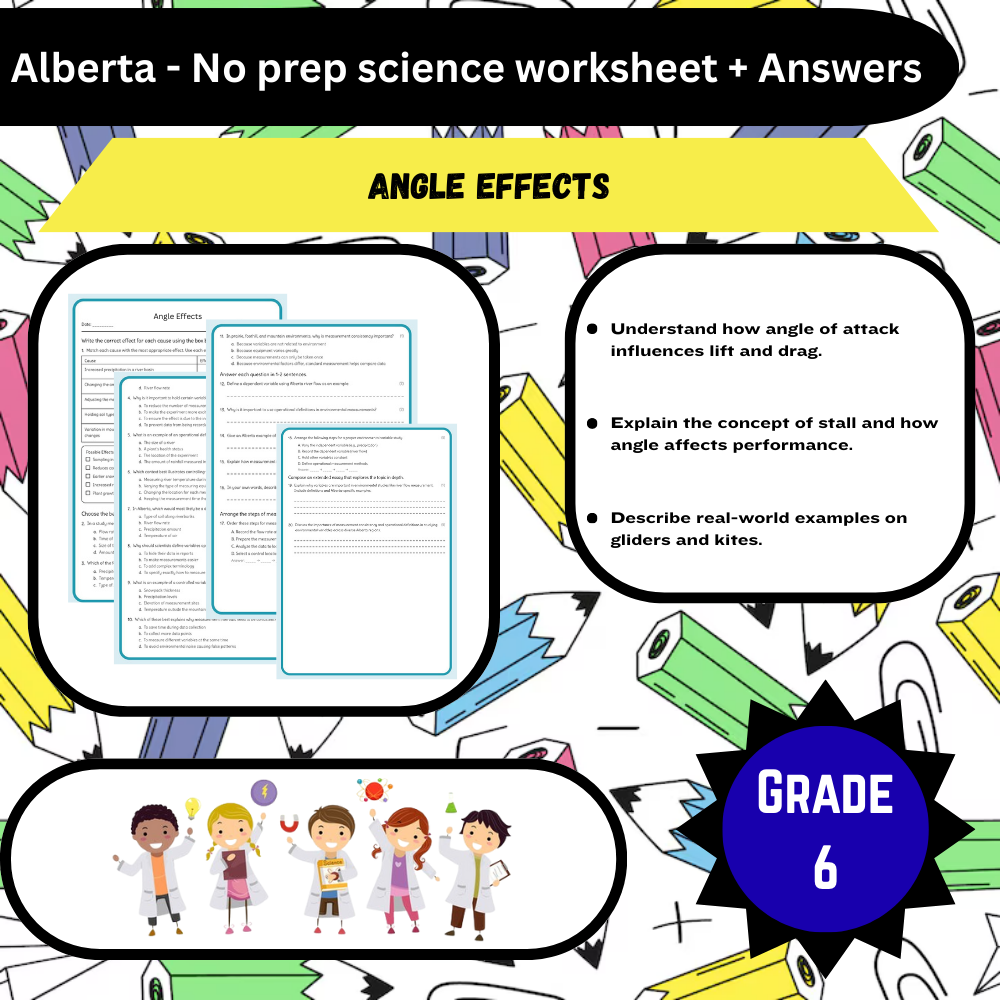
6th Grade Science | Angle Effects Worksheet (PDF) – Alberta Standards
 Created byBright Mind Resources
Learning Objectives
- Understand how the angle of attack influences lift and drag in flight.
- Explain the concept of stall and how angle adjustment affects flight performance.
- Describe real-world examples of angle effects on gliders and kites used in open fields.
Instant download

Grade 6 Science | Chemical Reactions - Daily Reading Comprehension Practice
Created byCoral Reef LearningLearning Objectives
- Identify indicators of chemical reactions such as color change, gas evolution, precipitates, and temperature change.
- Analyze qualitative and quantitative data to determine if a chemical reaction has occurred.
- Understand classic examples of chemical reactions like acid–carbonate reactions and metal oxidation.
Instant download
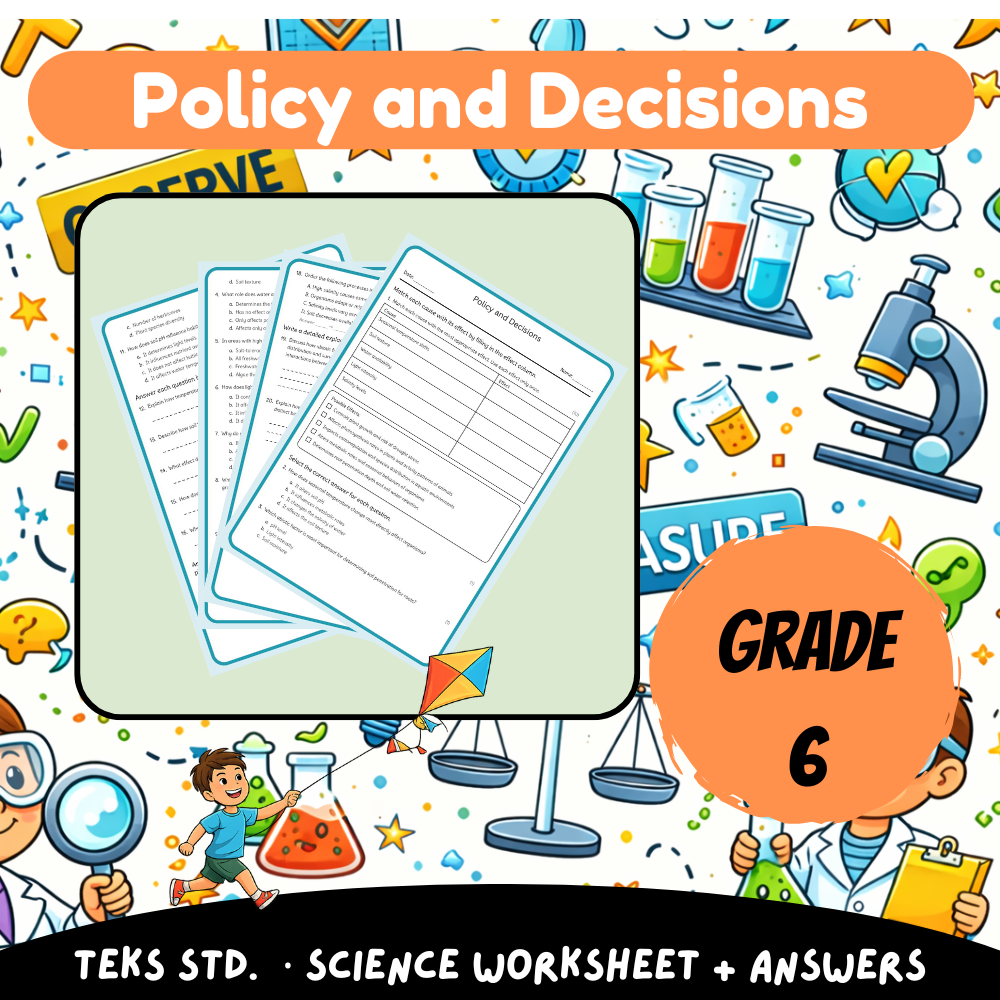
6th Grade Science – Policy and Decisions Worksheet (Worksheet + Answer Key) – TEKS Alignment
Created byBright Mind ResourcesLearning Objectives
- Understand how scientific evidence influences policy and decision-making.
- Identify key factors such as risk assessment, cost-benefit analysis, and stakeholder values.
- Interpret data and weigh uncertainties in societal decisions involving science and technology.
Instant download
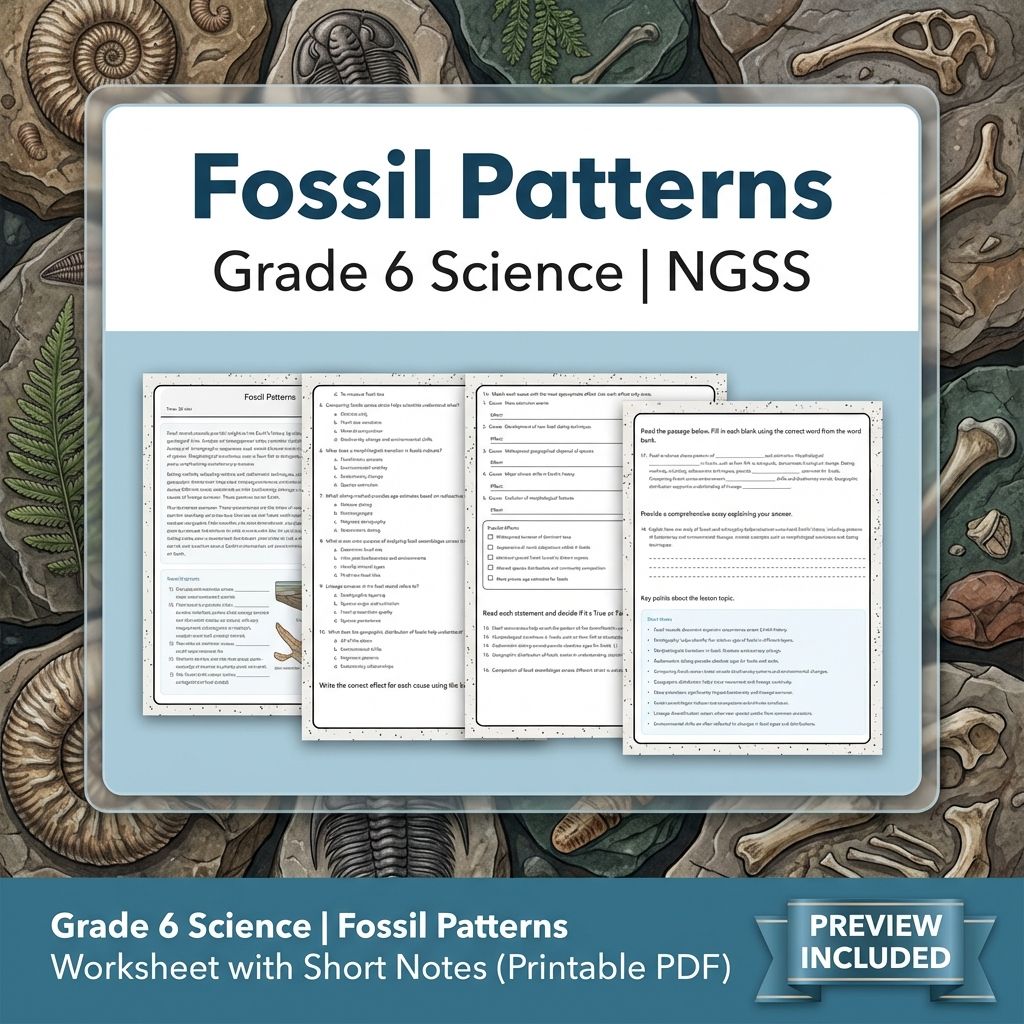
Grade 6 Science | Fossil Patterns Worksheet with Short Notes (Printable PDF)
Created byMeadowlark WorksheetsLearning Objectives
- Understand how fossil occurrences and stratigraphy reveal patterns of biodiversity over time.
- Analyze morphological transitions in the fossil record, such as fish-to-tetrapod evolution.
- Explain the role of dating methods and geographic distribution in tracing lineage continuity.
Also included in: Grade 6 Science | Biological Evolution: Unity and Diversity Unit Bundle +1 more
Instant download

6th Grade Science Atoms & Particles Worksheet | Matter Properties (PDF)
Created byEvergreen Desk EducationLearning Objectives
- Explain how matter can be modeled as particles and how atoms form elements.
- Describe how different particle compositions lead to measurable properties of substances.
- Use particle model ideas to interpret properties like density, melting point, and reactivity.
Instant download
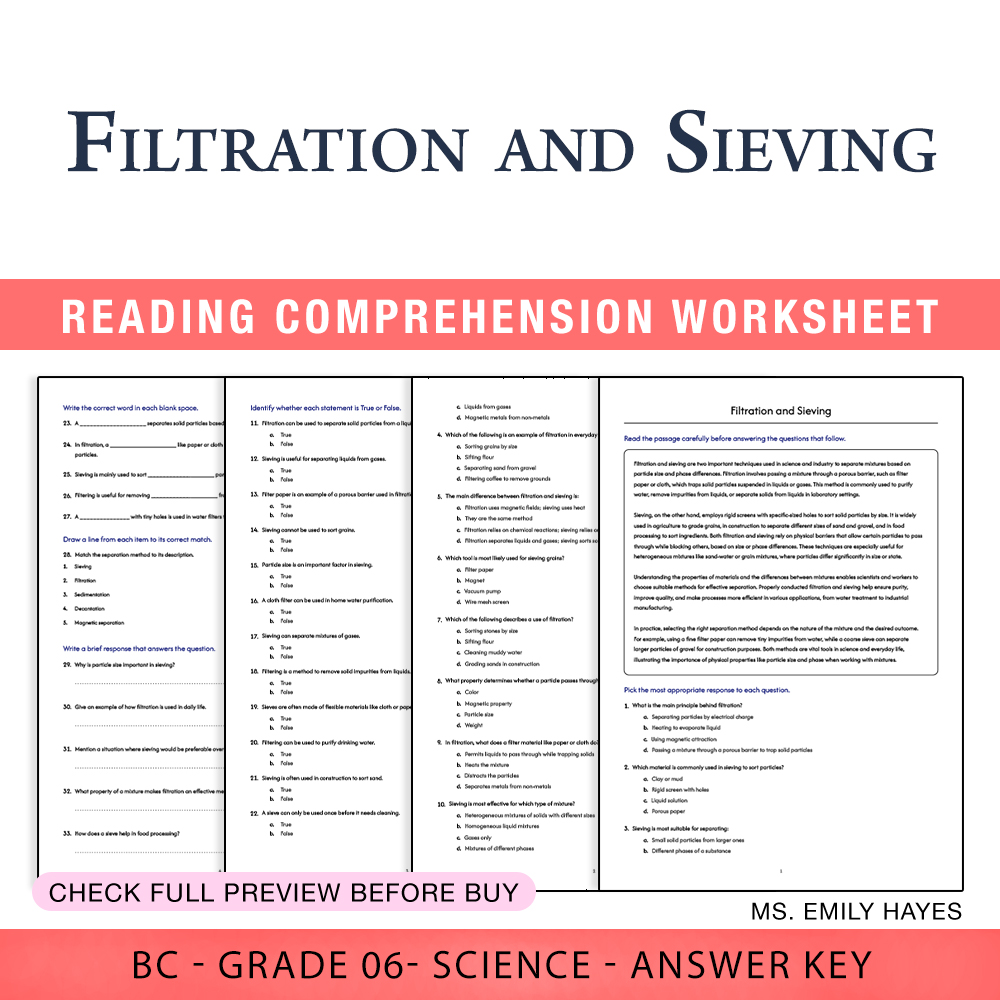
6th Grade Science | Filtration and Sieving Practice Worksheet (PDF+ Answer Key)
Created byCopper Leaf ClassroomLearning Objectives
- Understand the differences between filtration and sieving as methods for separating mixtures.
- Identify suitable materials and techniques used in filtration and sieving processes.
- Explain real-world applications of filtration and sieving in everyday life and industry.
Also included in: Grade 6 Science BC| Reaction Rates & Chemical Properties (PDF+ Answer Keys) +1 more
Instant download
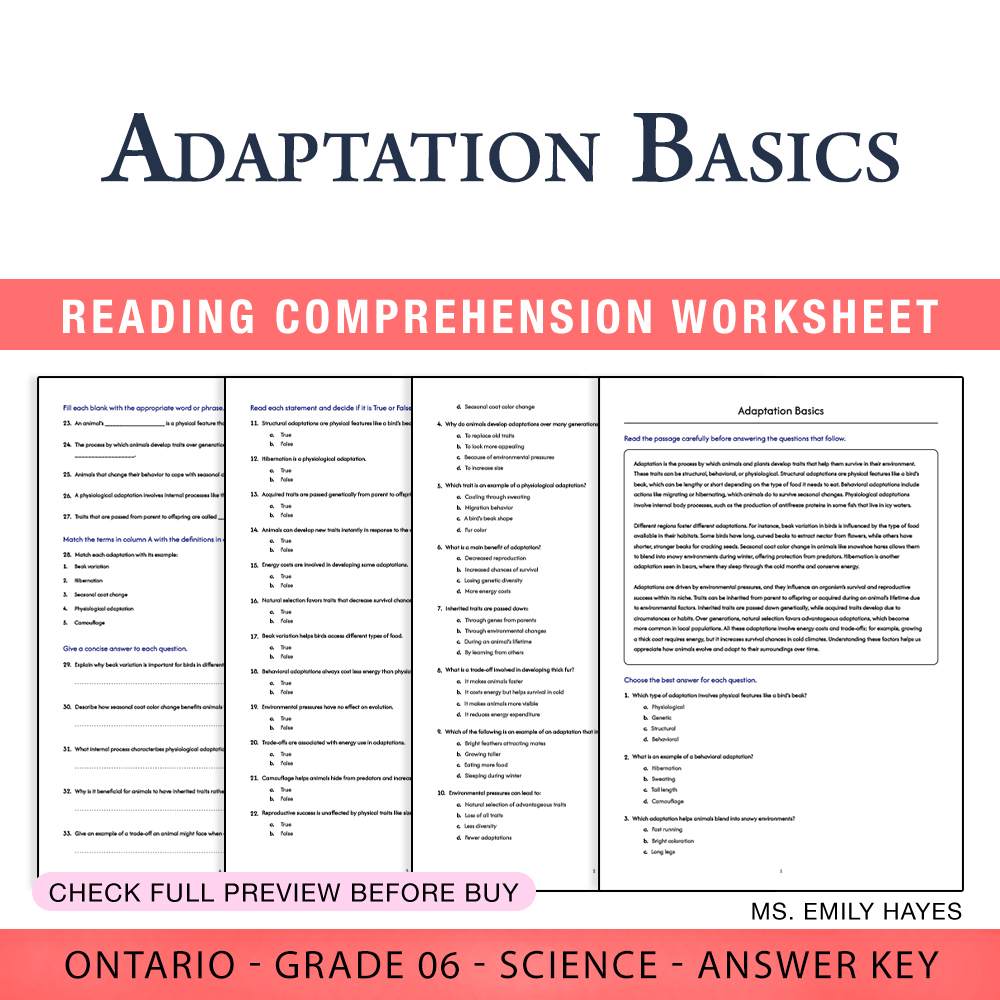
6th Grade Science | Adaptation Basics Worksheet (PDF+ Answer Key)
Created byCopper Leaf ClassroomLearning Objectives
- Understand the three main types of animal adaptations: structural, behavioral, and physiological.
- Identify regional examples of adaptations such as beak variation, seasonal coat color change, and hibernation.
- Explain how adaptations contribute to survival and reproductive success within specific niches.
Instant download
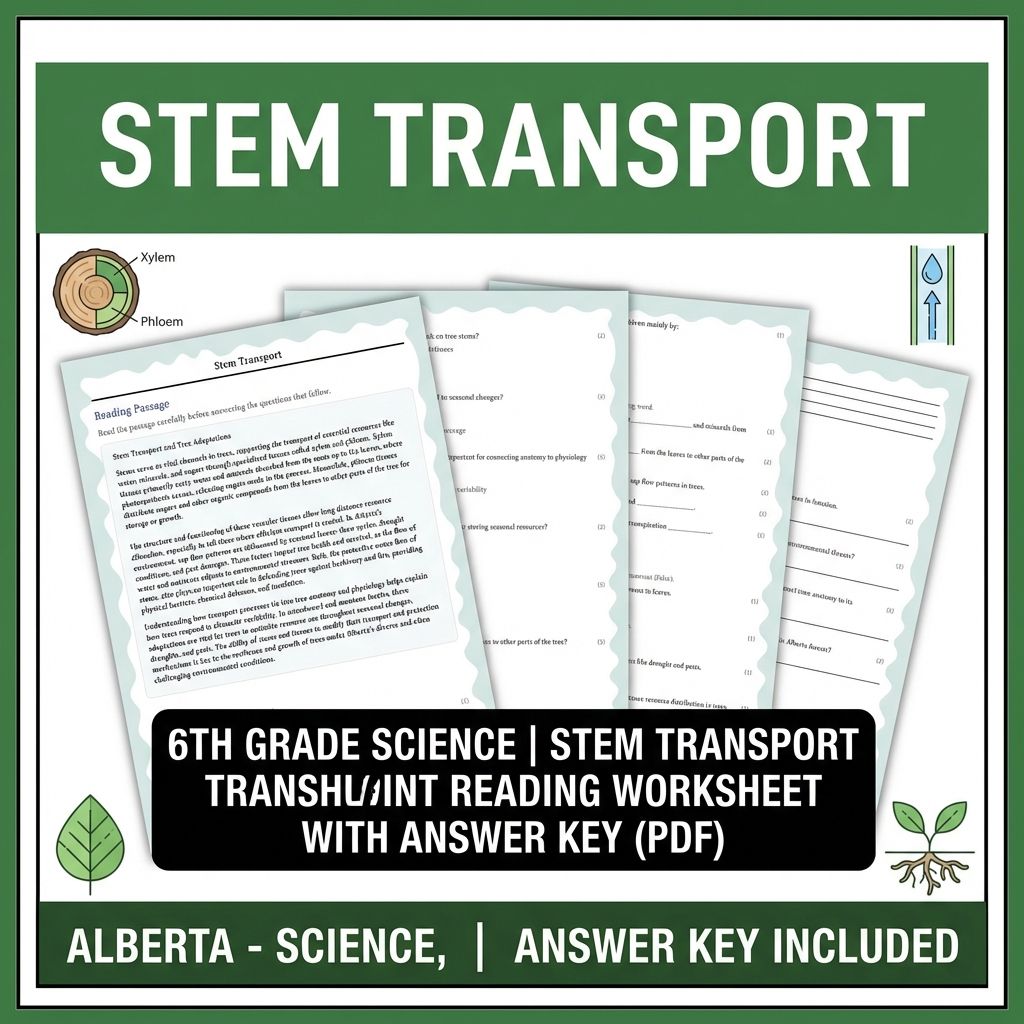
6th Grade Science | Stem Transport Reading Worksheet with Answer Key (PDF)
JCreated byJ.S SheetsLearning Objectives
- Understand how stems and vascular tissues transport water, minerals, and sugars in trees.
- Explain the roles of xylem and phloem in resource transport.
- Describe how environmental factors like freeze–thaw cycles and drought influence sap flow.
Also included in: Grade 6 Science Unit Bundle | Ecosystems and Biodiversity (Answer Keys Included) +1 more
Instant download
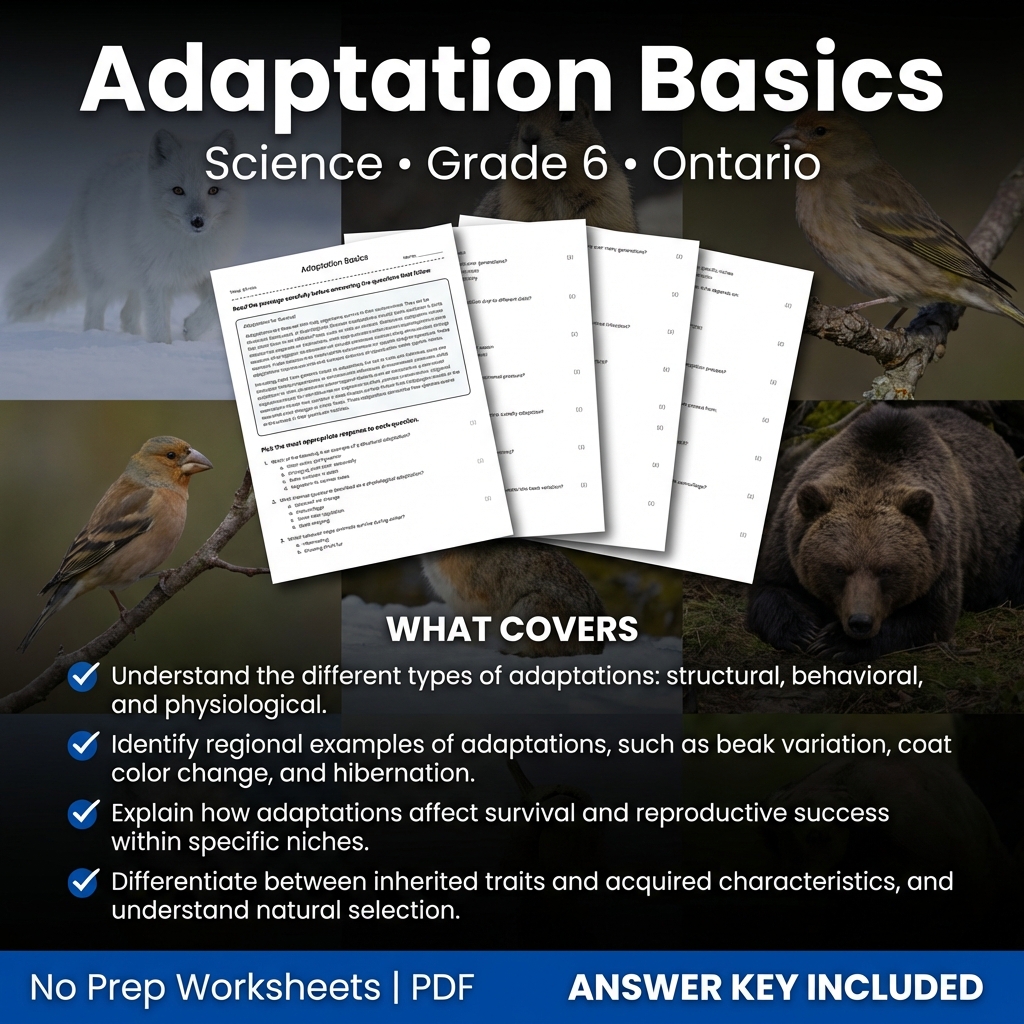
Adaptation Basics Science Worksheet | Ontario Grade 6 Assessment
Created byCoral Reef LearningLearning Objectives
- Understand the different types of adaptations: structural, behavioral, and physiological.
- Identify regional examples of adaptations, such as beak variation, coat color change, and hibernation.
- Explain how adaptations affect survival and reproductive success within specific niches.
Instant download

Resource Limits Worksheet | Grade 6 Science NGSS Practice & Assessment
Created byPrism Point LearningLearning Objectives
- Explain how limiting resources affect individual organisms and population sizes
- Interpret measurement patterns (such as resource gradients) to predict where species will be most abundant
- Connect carrying capacity to population fluctuations in different environments
Also included in: Grade 6 Species Interactions Science Lesson Bundle | NGSS
Instant download
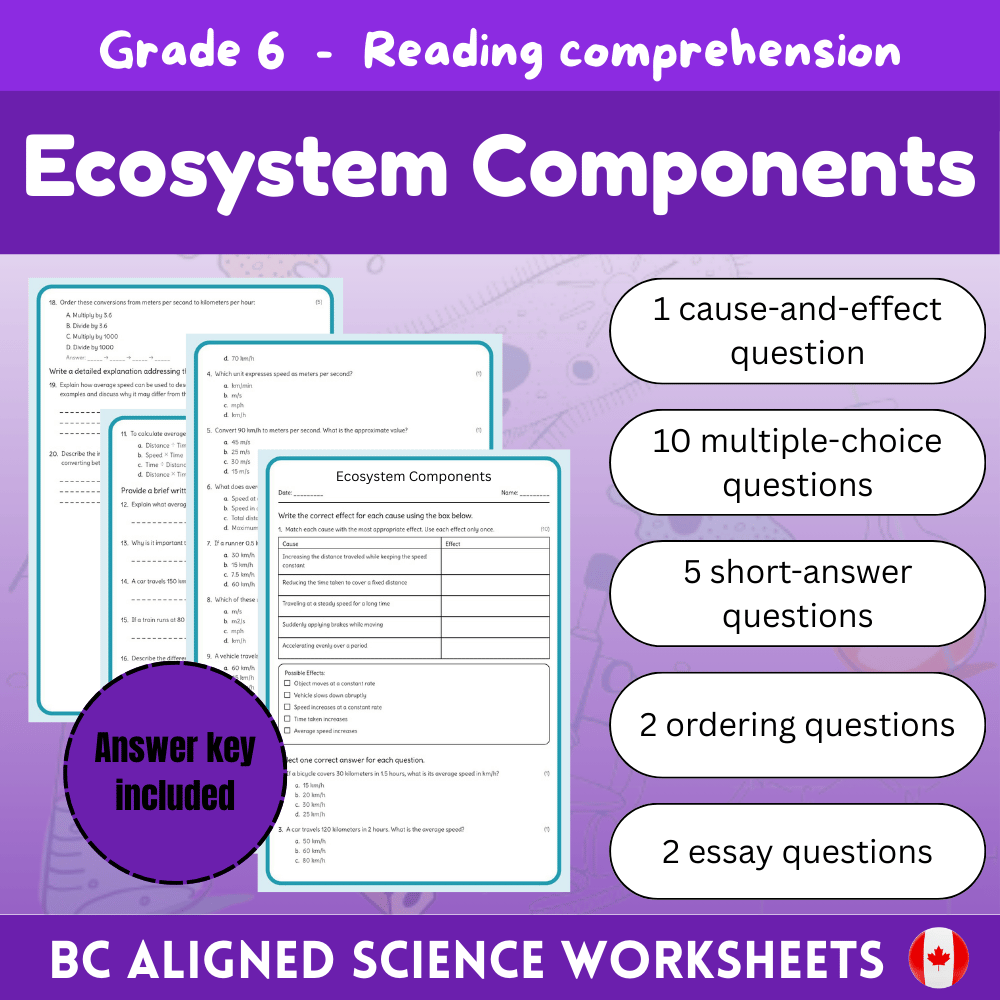
6th Grade Science | Ecosystem Components Worksheet + Answer Key (PDF)
Created byBright Mind ResourcesLearning Objectives
- Understand the roles of biotic and abiotic factors in an ecosystem.
- Identify different components that make up an ecosystem.
- Explain how biotic and abiotic factors interact to influence habitats.
Instant download

6th Grade Science – Design Problem Worksheet (General Standards) (PDF)
 Created byMaple Path Learning
Learning Objectives
- Understand the key components of a design problem, including needs and constraints.
- Learn how to generate solution ideas using sketches, measurements, and goals.
- Explore real-world examples of designing protective cases for fragile items.
Instant download
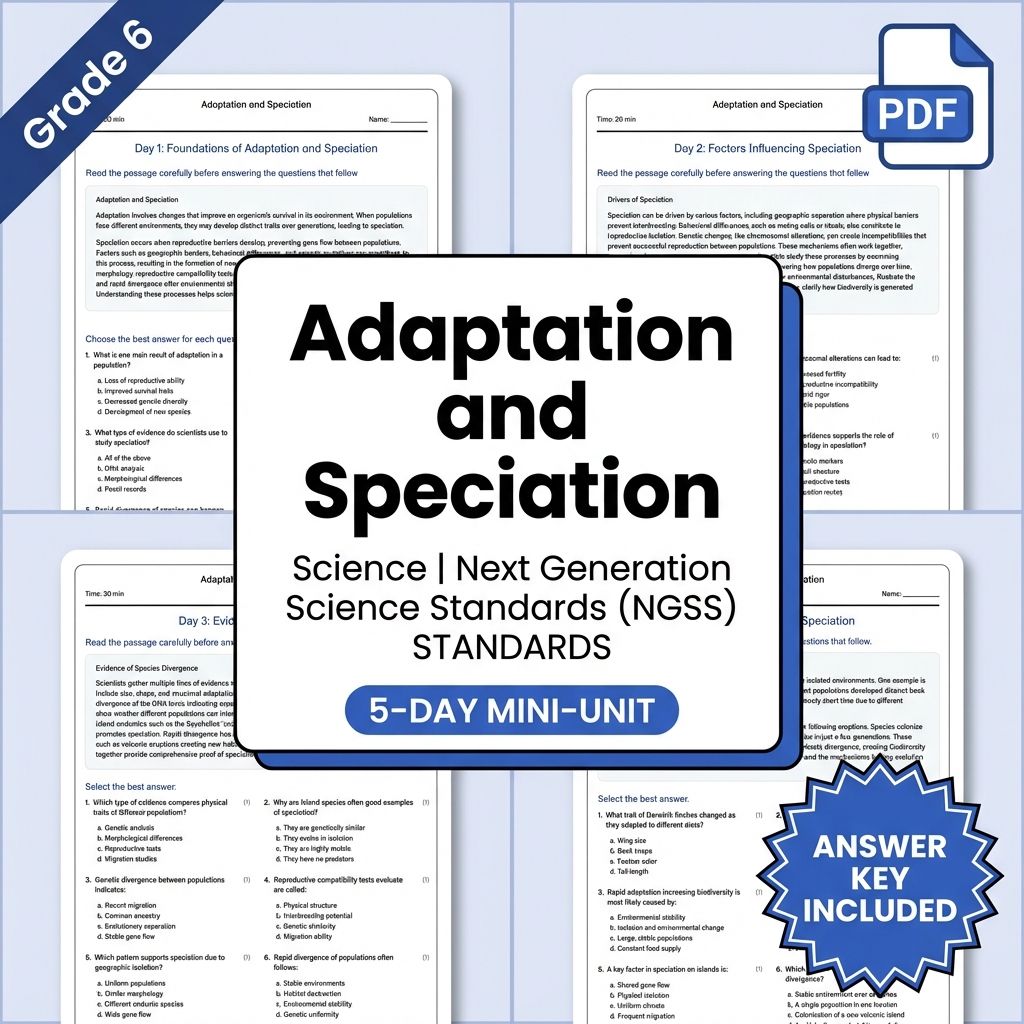
6th Grade Science | Adaptation and Speciation Daily Worksheet (PDF + Answer Key)
Created byCopper Leaf ClassroomLearning Objectives
- Understand the processes of adaptation and how they lead to species divergence.
- Identify the factors contributing to speciation, including geographic and genetic changes.
- Recognize evidence used by scientists to study speciation events.
Instant download

6th Grade Science Worksheet – Climate Data Patterns (PDF)
Created byMaple Path LearningLearning Objectives
- Understand how climate data is collected and organized over long periods.
- Interpret graphs of temperature and precipitation to identify patterns.
- Compare current climate data with historical baselines to detect shifts.
Instant download
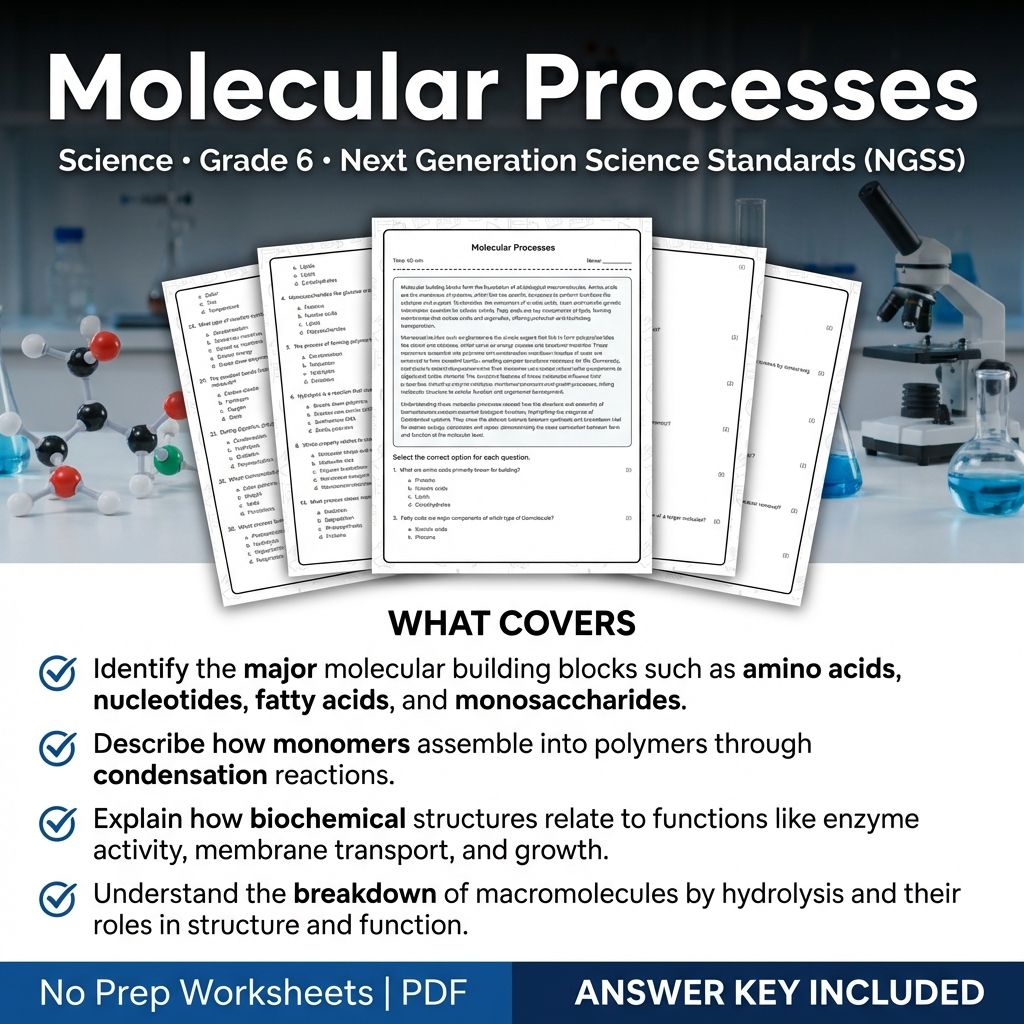
6th Grade Science Worksheet | Molecular Processes NGSS Practice & Review (Printable PDF & Answer Key)
Created byCoral Reef LearningLearning Objectives
- Identify the major molecular building blocks such as amino acids, nucleotides, fatty acids, and monosaccharides.
- Describe how monomers assemble into polymers through condensation reactions.
- Explain how biochemical structures relate to functions like enzyme activity, membrane transport, and growth.
Instant download
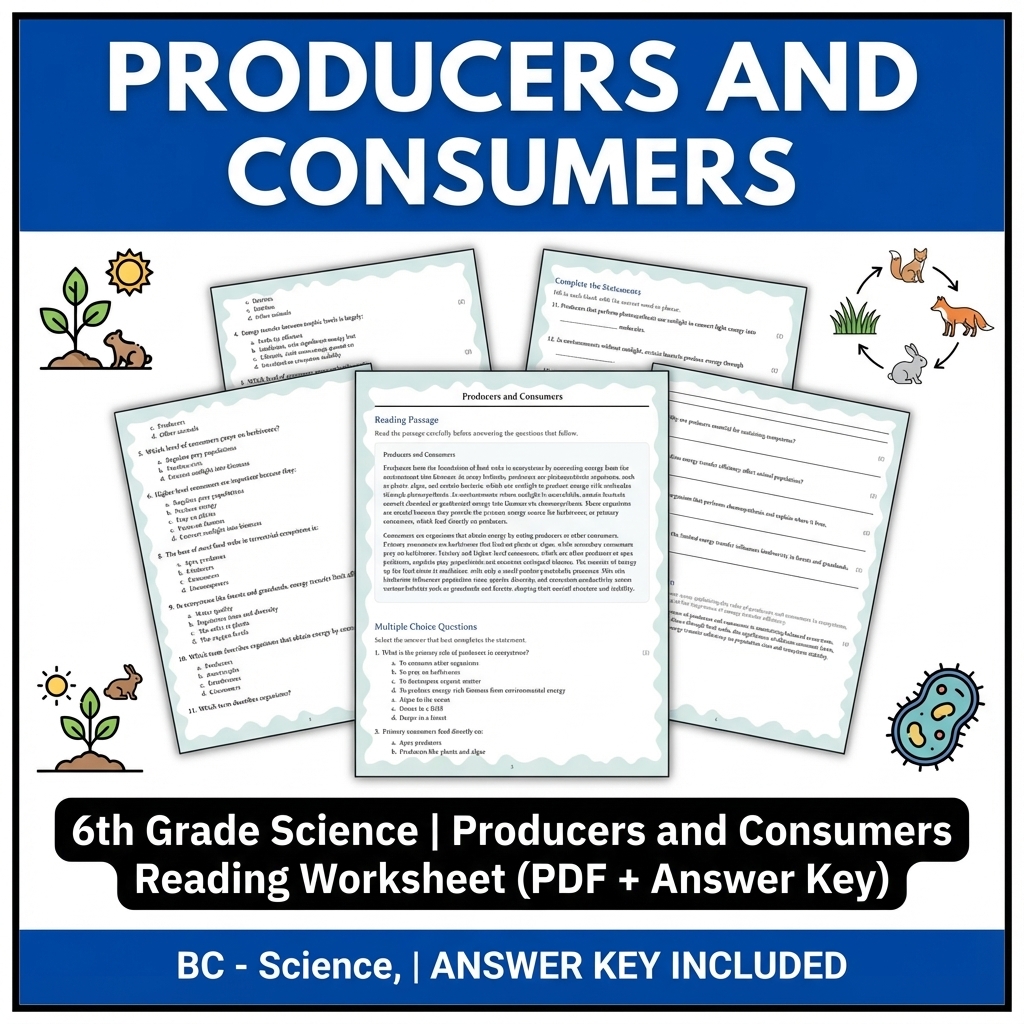
6th Grade Science | Producers and Consumers Reading Worksheet (PDF + Answer Key)
JCreated byJ.S SheetsLearning Objectives
- Understand the roles of producers and consumers in ecosystems.
- Identify different types of consumers and their position in food webs.
- Explain how energy transfer efficiency influences population sizes and ecosystem stability.
Instant download

6th Grade Science | Mass and Density Reading Worksheet (PDF + Rubric)
JCreated byJ.S SheetsLearning Objectives
- Understand the concepts of mass and volume and how they relate through density.
- Learn how to calculate density using sample measurements.
- Interpret density values to distinguish between objects that sink or float.
Instant download
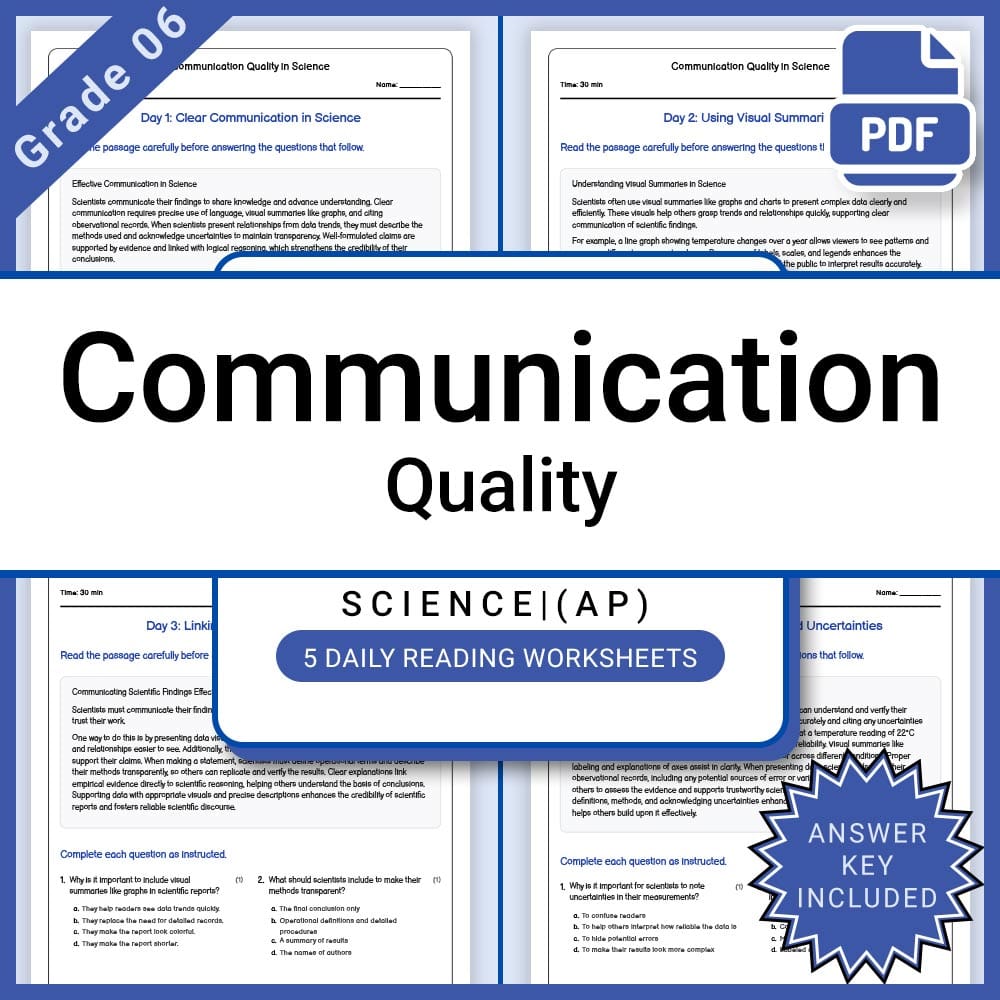
Grade 6 Science – Communication Quality Daily Reading Worksheet + Answer Key
JCreated byJ.S SheetsLearning Objectives
- Understand how to formulate clear scientific claims supported by evidence.
- Learn the importance of visual summaries and proper citation of observations.
- Develop skills to present scientific data transparently and coherently.
Also included in: Grade 6 Science Lesson Group Bundle TEKS Standards +1 more
Instant download
Grade 6 Science – Measurement Precision Daily Reading Worksheet with Answer Key
JCreated byJ.S SheetsLearning Objectives
- Understand the conventions of measurement units in scientific experiments
- Learn how to maintain unit consistency in data collection
- Recognize instrument resolution and its impact on measurement accuracy
Also included in: Grade 6 Science Lesson Group Bundle TEKS Standards +1 more
Instant download
Grade 6 Science Observation Techniques Daily Reading Worksheet with Answer Key
JCreated byJ.S SheetsLearning Objectives
- Understand the concept of systematic observation in scientific studies.
- Differentiate between qualitative notes and quantitative measurements.
- Identify common instruments used in scientific observation such as rulers, balances, and thermometers.
Also included in: Grade 6 Science Lesson Group Bundle TEKS Standards +1 more
Instant download
Grade 6 Science – Reasoning Claims Daily Reading Worksheet with Answer Key
JCreated byJ.S SheetsLearning Objectives
- Understand how scientific evidence supports explanatory claims.
- Interpret patterns and data in scientific contexts like graphs.
- Distinguish between raw observations and inferences.
Also included in: Grade 6 Science Lesson Group Bundle TEKS Standards +1 more
Instant download
Grade 6 Science – Modeling Systems Daily Reading Worksheet + Answer Key
JCreated byJ.S SheetsLearning Objectives
- Understand how the water cycle model illustrates natural processes
- Interpret diagrams and models used in science to represent systems
- Identify the assumptions and limitations of different scientific models
Also included in: Grade 6 Science Lesson Group Bundle TEKS Standards +1 more
Instant download
Grade 6 Science – Design Principles Daily Reading Worksheet + Answer Key
JCreated byJ.S SheetsLearning Objectives
- Understand the importance of formulating clear, measurable hypotheses.
- Identify appropriate control groups in experiments.
- Recognize how sample size and replication affect experimental validity.
Also included in: Grade 6 Science Lesson Group Bundle TEKS Standards +1 more
Instant download
Grade 6 Science – Variables in Plant Growth Daily Reading Worksheet + Answer Key
JCreated byJ.S SheetsLearning Objectives
- Identify independent, dependent, and controlled variables in a scientific experiment.
- Understand the importance of operational definitions in controlled testing.
- Recognize potential confounding variables and how to control them.
Also included in: Grade 6 Science Lesson Group Bundle TEKS Standards +1 more
Instant download
Grade 6 – Error Analysis in Scientific Experiments Worksheet with Answer Key
JCreated byJ.S SheetsLearning Objectives
- Understand the distinction between systematic and random errors.
- Identify common sources of error in experimental data.
- Learn methods to estimate and account for errors in measurements.
Also included in: Grade 6 Science Lesson Group Bundle TEKS Standards +1 more
Instant download
Grade 6 Science – Scientific Methods and Observation Worksheet + Answer Key
JCreated byJ.S SheetsLearning Objectives
- Differentiate between observation and hypothesis in scientific investigations.
- Understand the role of prior observation in forming testable questions.
- Learn how to select appropriate methods like controlled testing and comparative observation based on phenomena.
Also included in: Grade 6 Science Lesson Group Bundle TEKS Standards +1 more
Instant download

Data Representation Worksheet | TEKS Aligned Grade 6 Science Practice
JCreated byJ.S SheetsLearning Objectives
- Identify how tables and graphs (line, bar, and scatter) represent data and reveal patterns
- Select appropriate axis labels, units, and scales to make graphs accurate and readable
- Interpret trends, relationships, central tendency summaries, and outliers in data displays
Instant download
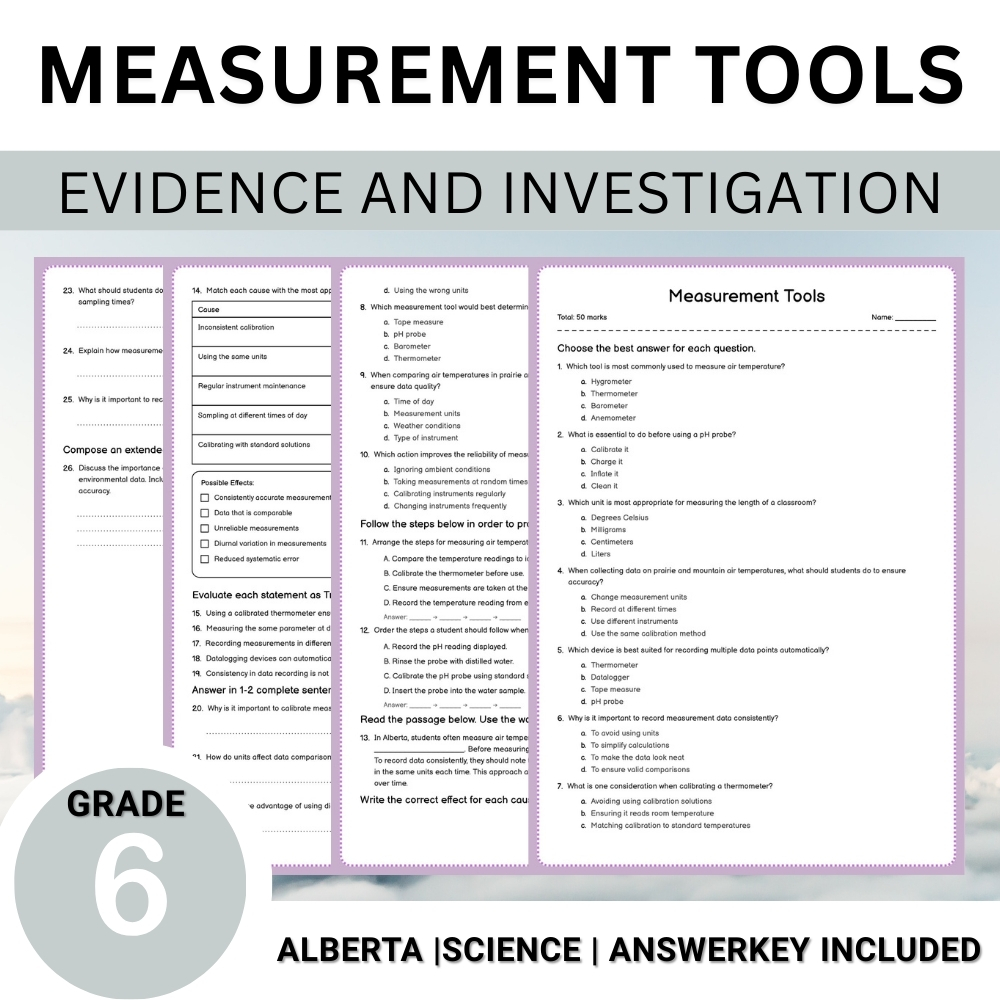
Grade 6 Science | Measurement Tools Worksheet (Printable PDF + Assessment)
Learning Objectives
- Identify common measurement instruments such as thermometers, pH probes, and tape measures.
- Understand how to calibrate and select appropriate units for accurate data collection.
- Learn methods for consistent recording and representation of measurement data.
Also included in: Grade 6 Science Unit | Data & Measurement Worksheets Bundle (Assessment & Practice) +1 more
Instant download
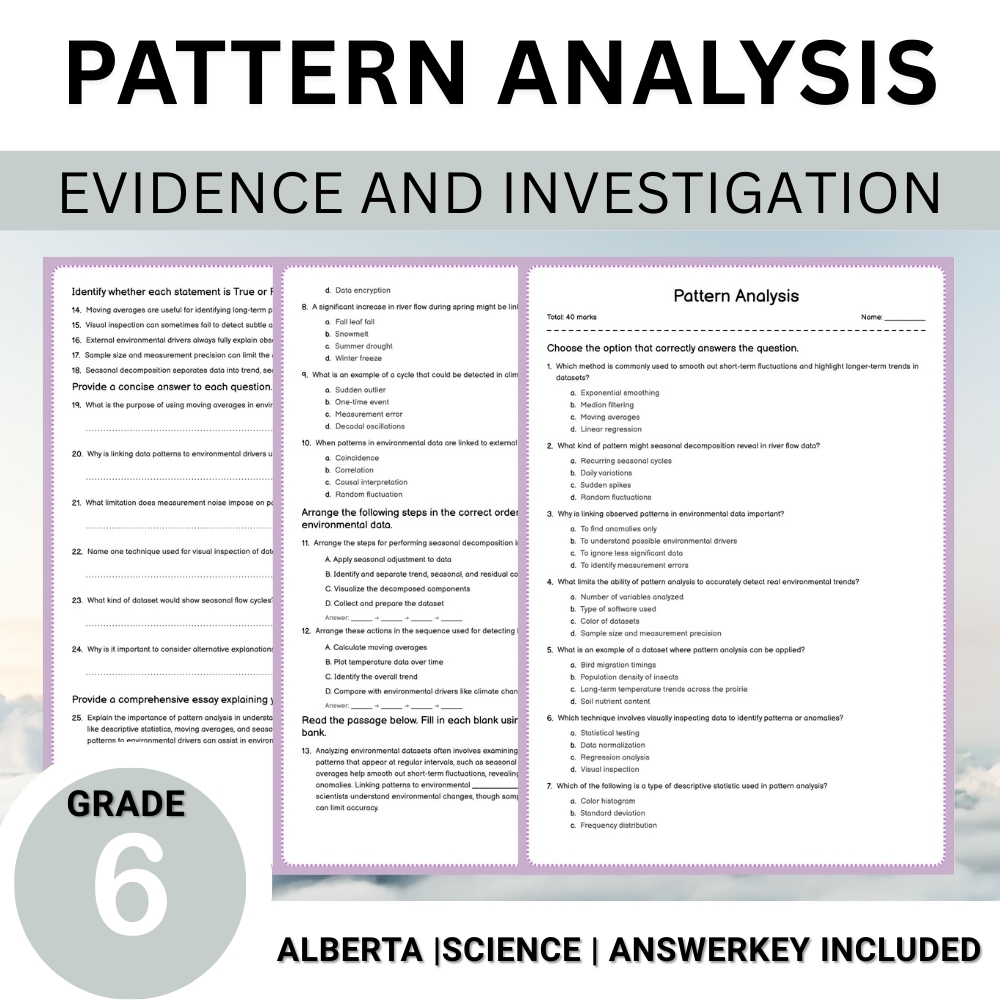
6th Grade Science | Pattern Analysis Worksheet (Answer Key) for Environmental Data
Learning Objectives
- Understand methods for detecting trends, cycles, and anomalies in datasets.
- Learn to interpret simple descriptive statistics and moving averages.
- Apply seasonal decomposition techniques to environmental data examples.
Also included in: Grade 6 Science Unit | Data & Measurement Worksheets Bundle (Assessment & Practice) +1 more
Instant download
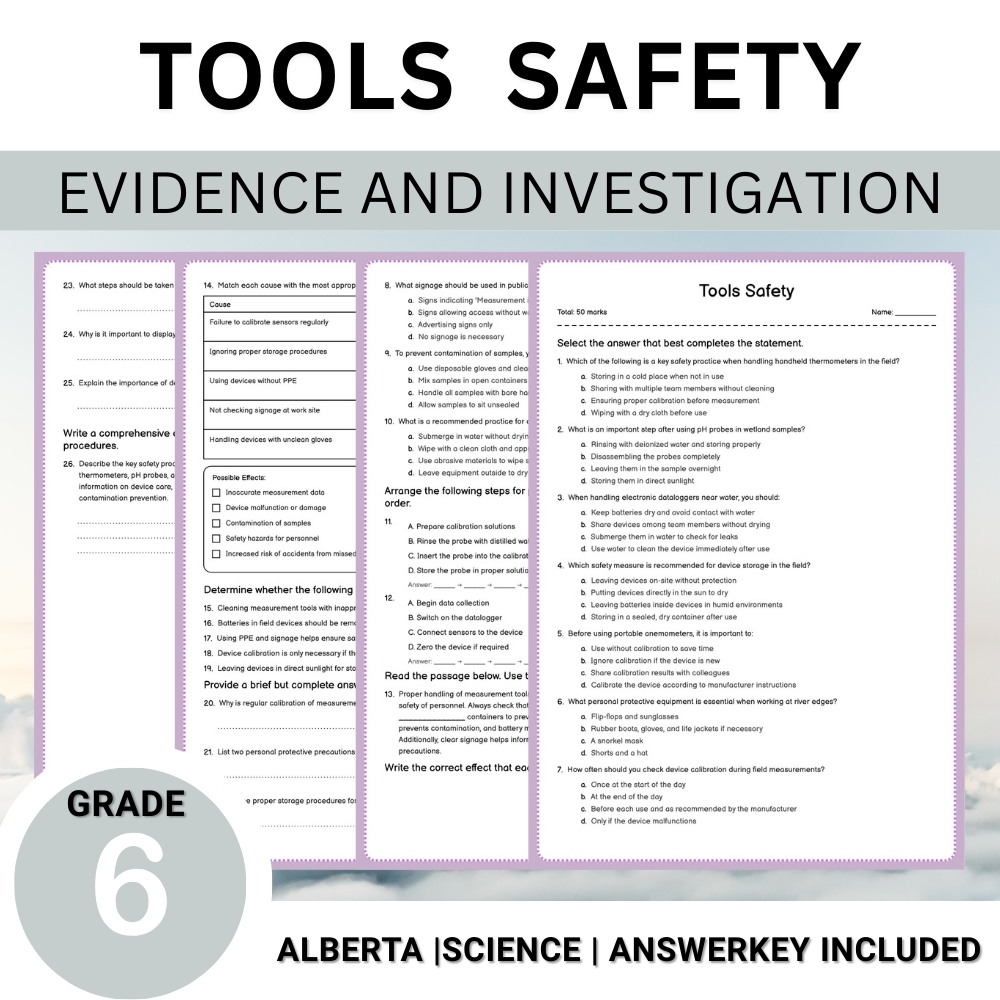
Grade 6 Science | Tools Safety Worksheet – Classroom Assessment & Student Practice (Printable PDF)
Learning Objectives
- Identify safe practices for handling measurement tools near Alberta field sites.
- Explain proper storage, cleaning, and maintenance of scientific devices.
- Describe personal protective precautions for wetland or river-edge work.
Also included in: Grade 6 Science Unit | Data & Measurement Worksheets Bundle (Assessment & Practice) +1 more
Instant download
About Grade 6 Science Worksheets
Explore Grade 6 Science worksheets for classwork, homework, or review. Our 5,969 printables download instantly as PDFs.
MyTeachingSheets worksheets are made by real teacher-authors and checked before they go live. Download any as a print-ready PDF for lessons, homework, or independent practice — most include answer keys, and previews are always free.