
Grade 6 Science Worksheets
5,969 worksheets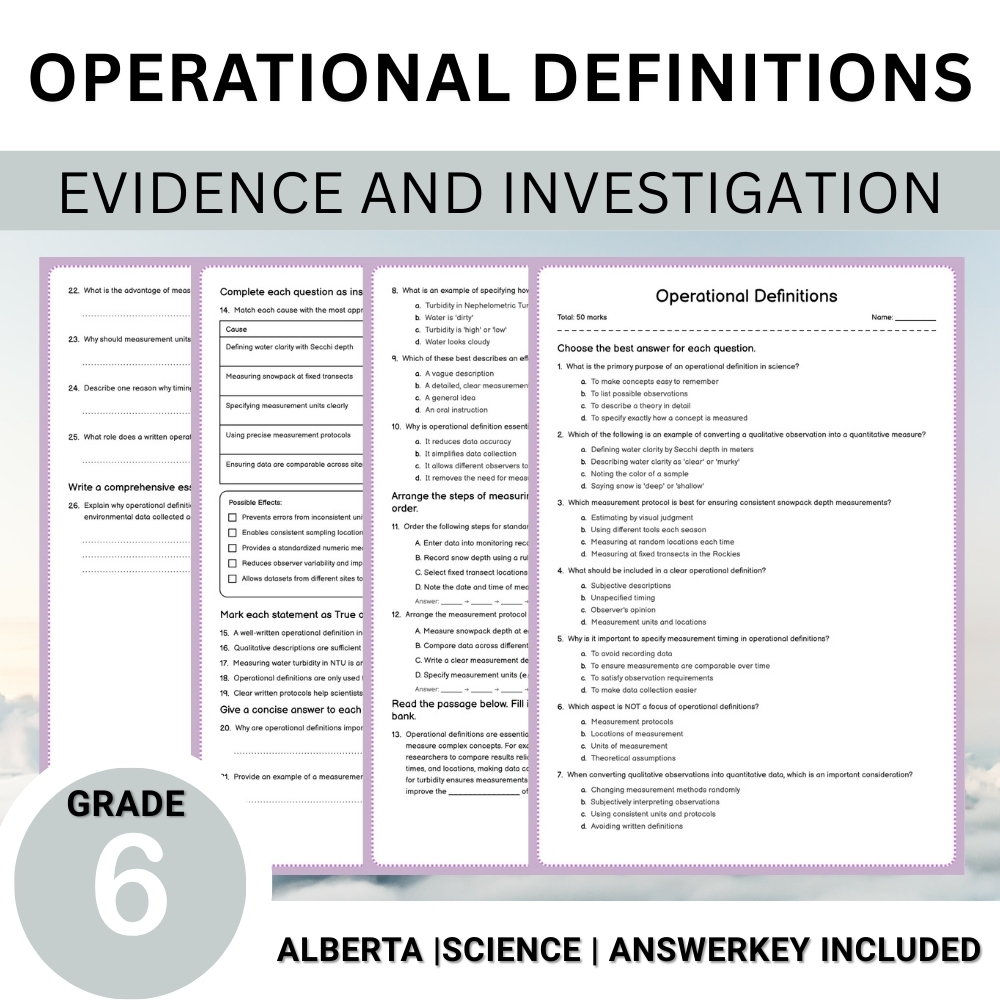
Grade 6 Science | Operational Definitions Worksheet (Printable PDF + Answer Key)
Learning Objectives
- Understand the concept of operational definitions and their importance in science.
- Learn how to create clear and measurable definitions for qualitative concepts.
- Identify different methods for converting qualitative observations into quantitative data.
Also included in: Grade 6 Science Unit | Data & Measurement Worksheets Bundle (Assessment & Practice) +1 more
Instant download

Grade 6 Current Electricity Circuits Worksheet | Ontario Science Activity Pack
 Created byTeacher's Corner
Learning Objectives
- Explain how electric current is the organized movement of charges through a conductor.
- Distinguish conventional current direction from electron flow in a circuit.
- Describe how potential difference (voltage) acts as the driving force for current.
Instant download

6th Grade Science Worksheet | Space Tools TEKS Practice (PDF)
 Created byEvergreen Desk Education
Learning Objectives
- Explain how different space tools (telescopes, probes, and satellites) help scientists observe Earth and space systems.
- Describe how spectral imaging and remote sensing collect information about temperature, vegetation, and atmospheric composition.
- Interpret data using ideas like resolution limits and coordinate mapping to understand landforms and ocean conditions.
Instant download
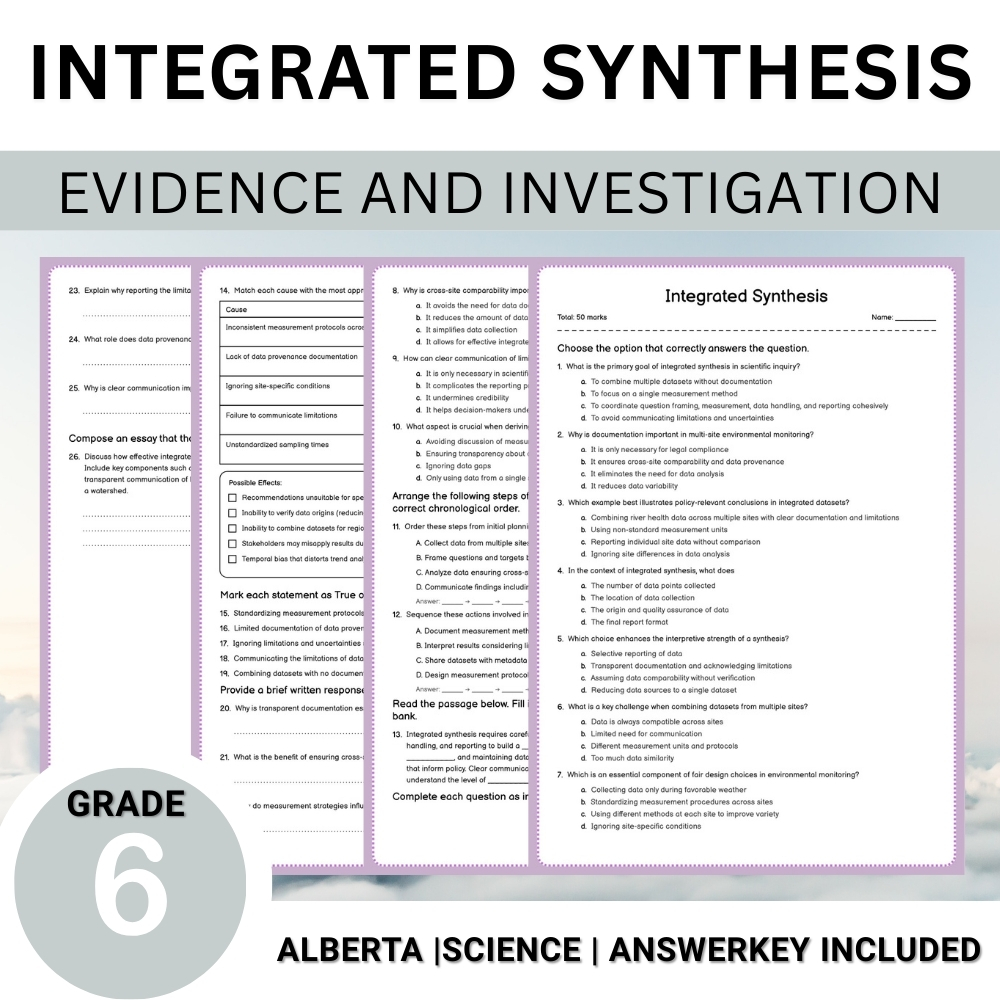
6th Grade Science | Integrated Synthesis Worksheet (Answer Key)
Learning Objectives
- Understand the components of integrated synthesis in scientific inquiry.
- Recognize the importance of documentation, comparability, and provenance in data collection across sites.
- Learn how to interpret and communicate limitations and evidence-based conclusions.
Also included in: Grade 6 Science Unit | Data & Measurement Worksheets Bundle (Assessment & Practice) +1 more
Instant download
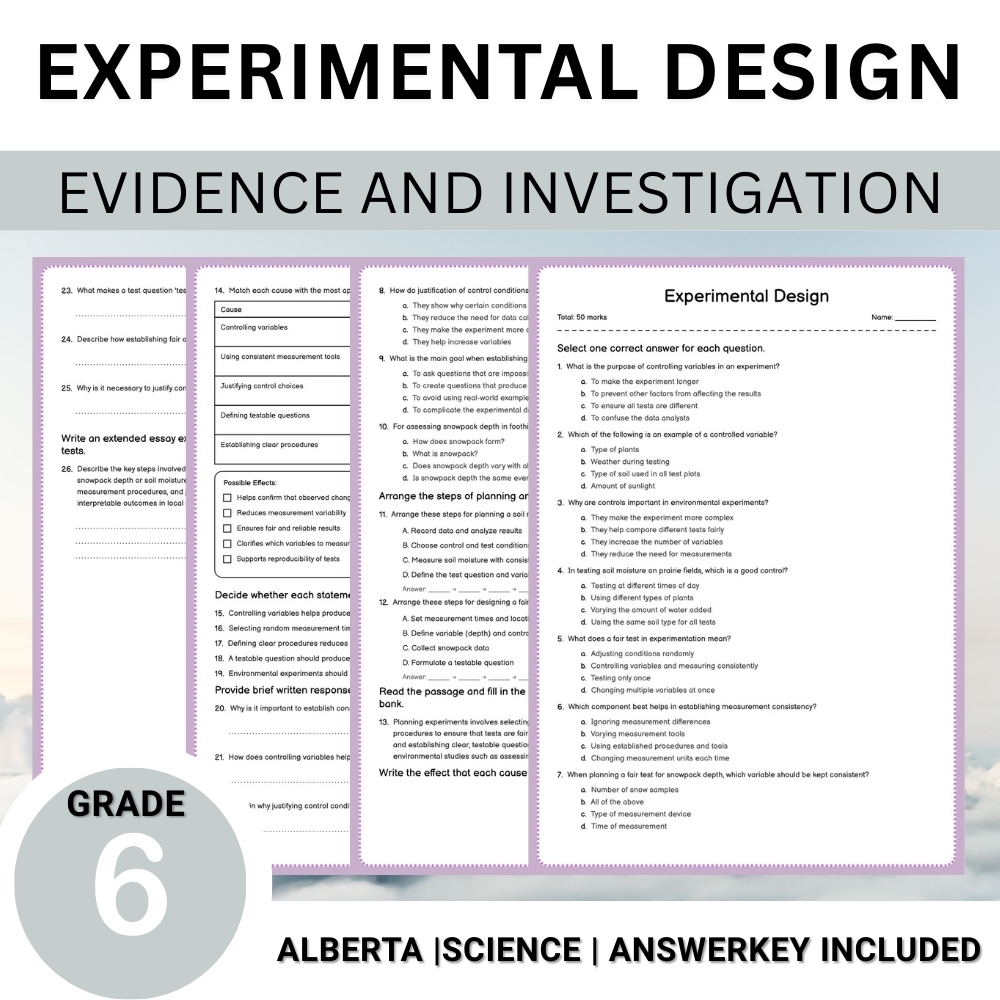
Grade 6 Science | Experimental Design Worksheet (Printable PDF & Assessment)
Learning Objectives
- Identify variables, controls, and measurement procedures in experiments.
- Explain how to plan fair tests for meaningful comparisons.
- Justify choices of control conditions in environmental experiments.
Also included in: Grade 6 Science Unit | Data & Measurement Worksheets Bundle (Assessment & Practice) +1 more
Instant download
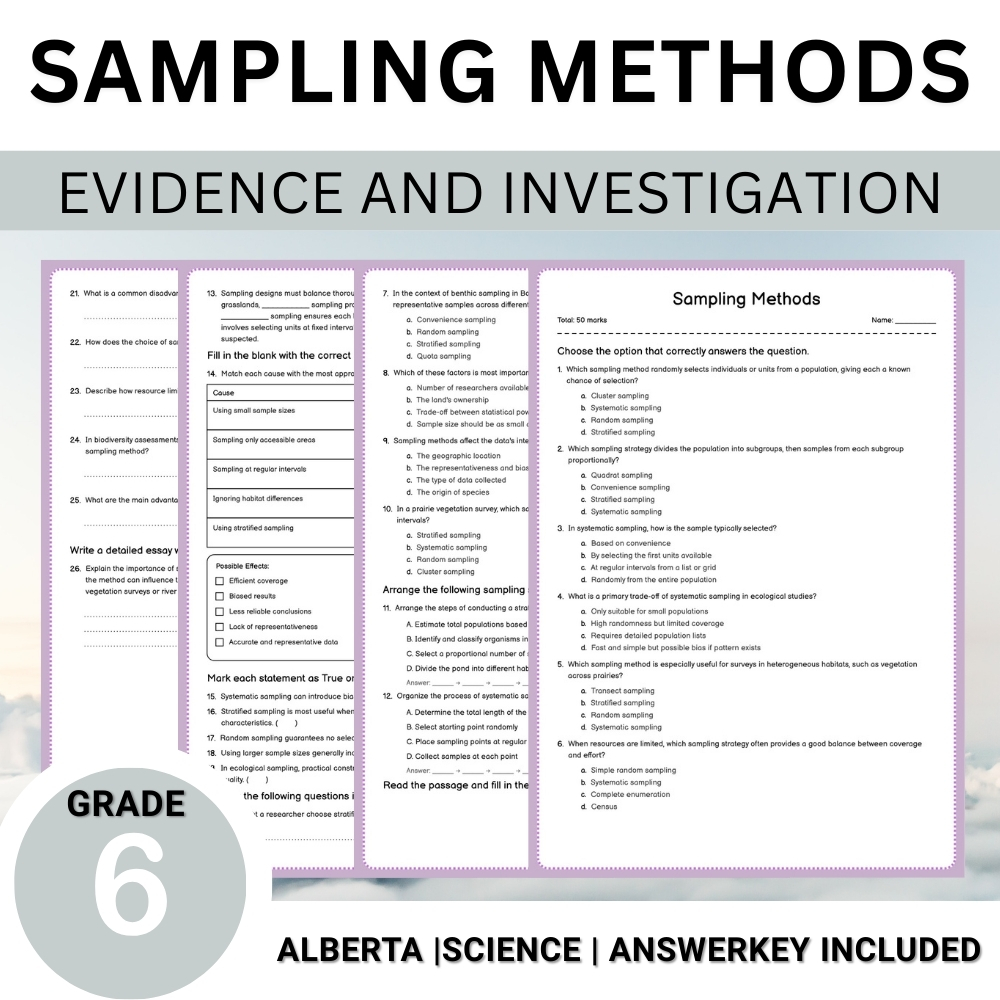
Grade 6 Science | Sampling Methods Worksheet (Printable PDF with Answer Key)
Learning Objectives
- Understand different sampling methods used in environmental and ecological studies.
- Identify how sampling strategies influence data interpretation and resource management.
- Compare random, stratified, and systematic sampling techniques with real-world examples.
Also included in: Grade 6 Science Unit | Data & Measurement Worksheets Bundle (Assessment & Practice) +1 more
Instant download
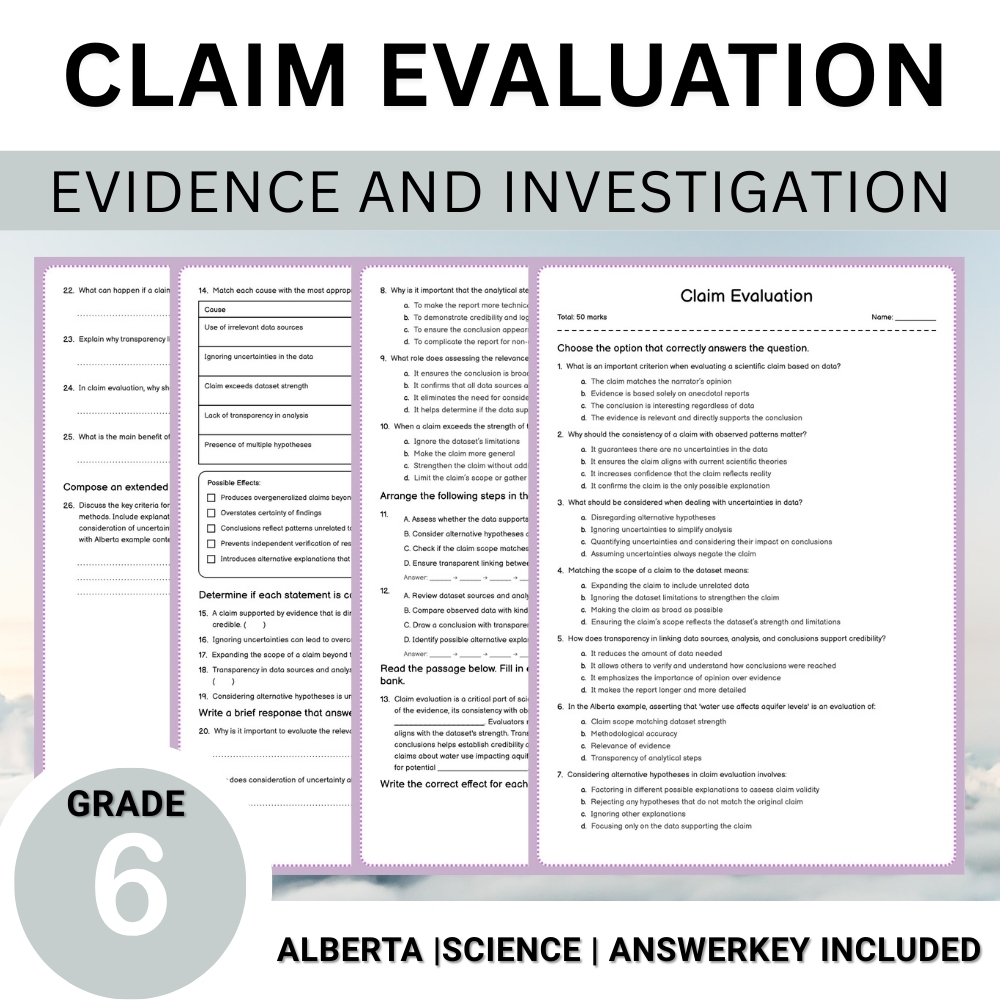
Grade 6 Science | Claim Evaluation Worksheet (Printable PDF & Assessment)
Learning Objectives
- Understand criteria for judging whether conclusions follow from data and methods.
- Evaluate evidence relevance, consistency with observed patterns, and consideration of uncertainties.
- Match claim scope to the dataset strength and assess transparency linking data, analysis, and conclusions.
Also included in: Grade 6 Science Unit | Data & Measurement Worksheets Bundle (Assessment & Practice) +1 more
Instant download
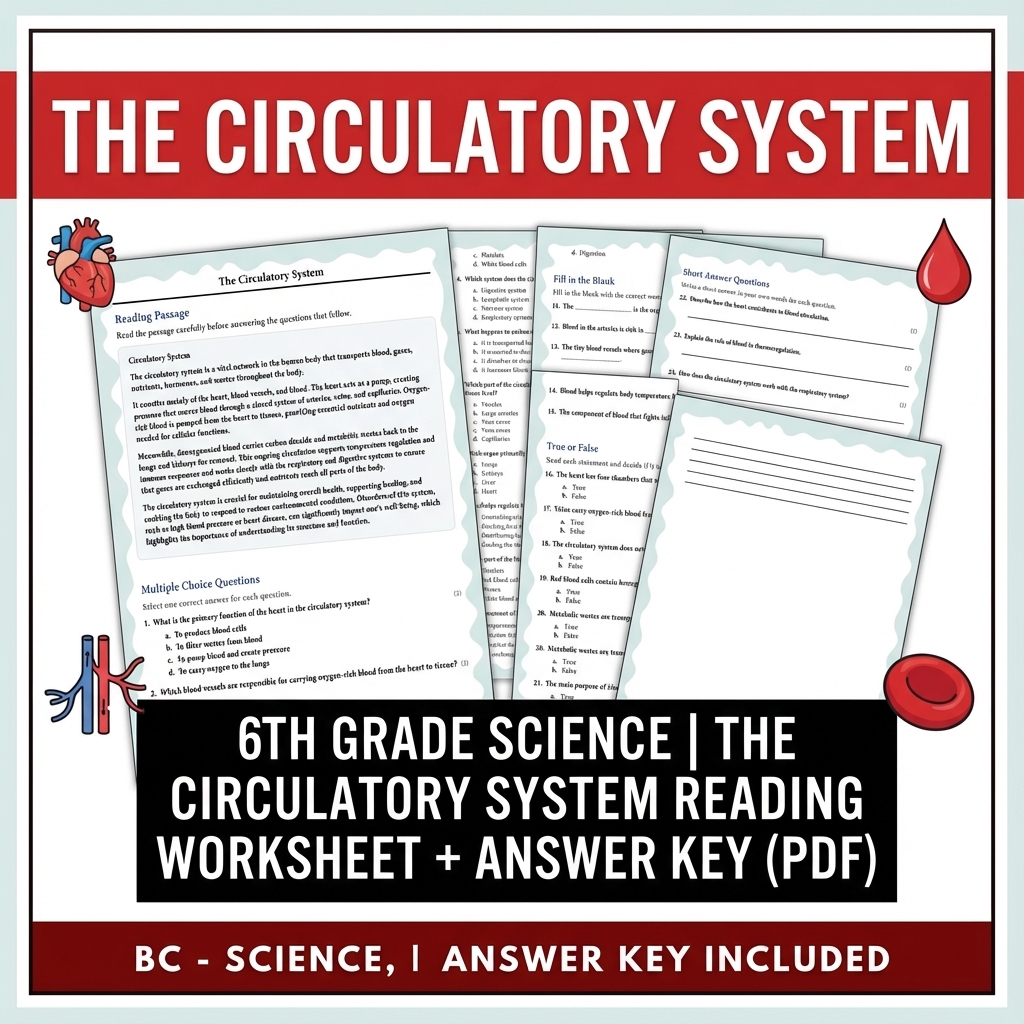
6th Grade Science | The Circulatory System Reading Worksheet + Answer Key (PDF)
JCreated byJ.S SheetsLearning Objectives
- Understand the structure and function of the circulatory system.
- Identify the components of blood and their roles.
- Describe how the heart pumps blood through vessels.
Instant download
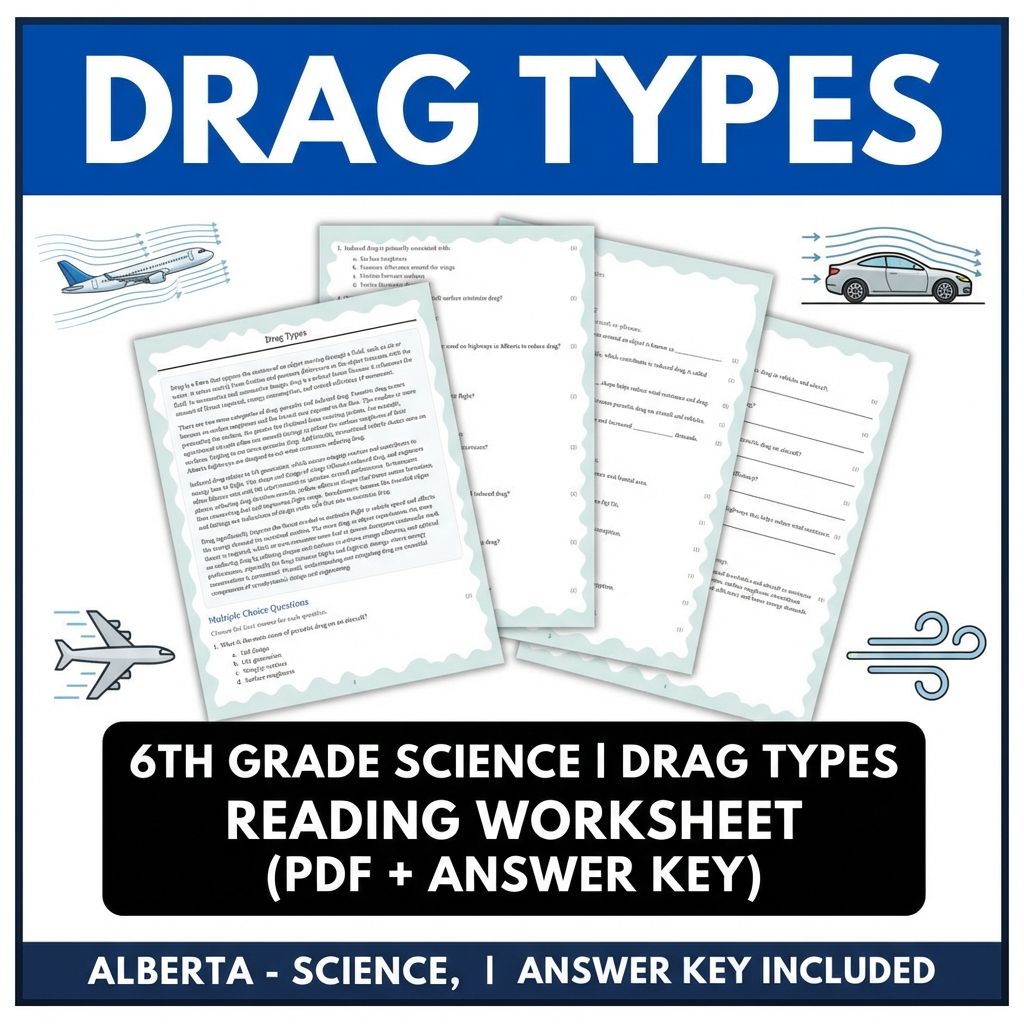
6th Grade Science | Drag Types Reading Worksheet (PDF + Answer Key)
JCreated byJ.S SheetsLearning Objectives
- Understand the different types of drag that affect flight and vehicle movement.
- Explain how friction and pressure differences influence drag.
- Identify design features that reduce drag, such as streamlined shapes and fairings.
Also included in: Grade 6 Science | Flight Physics & Aerodynamics UNIT Pack (Answer Keys Included) +1 more
Instant download
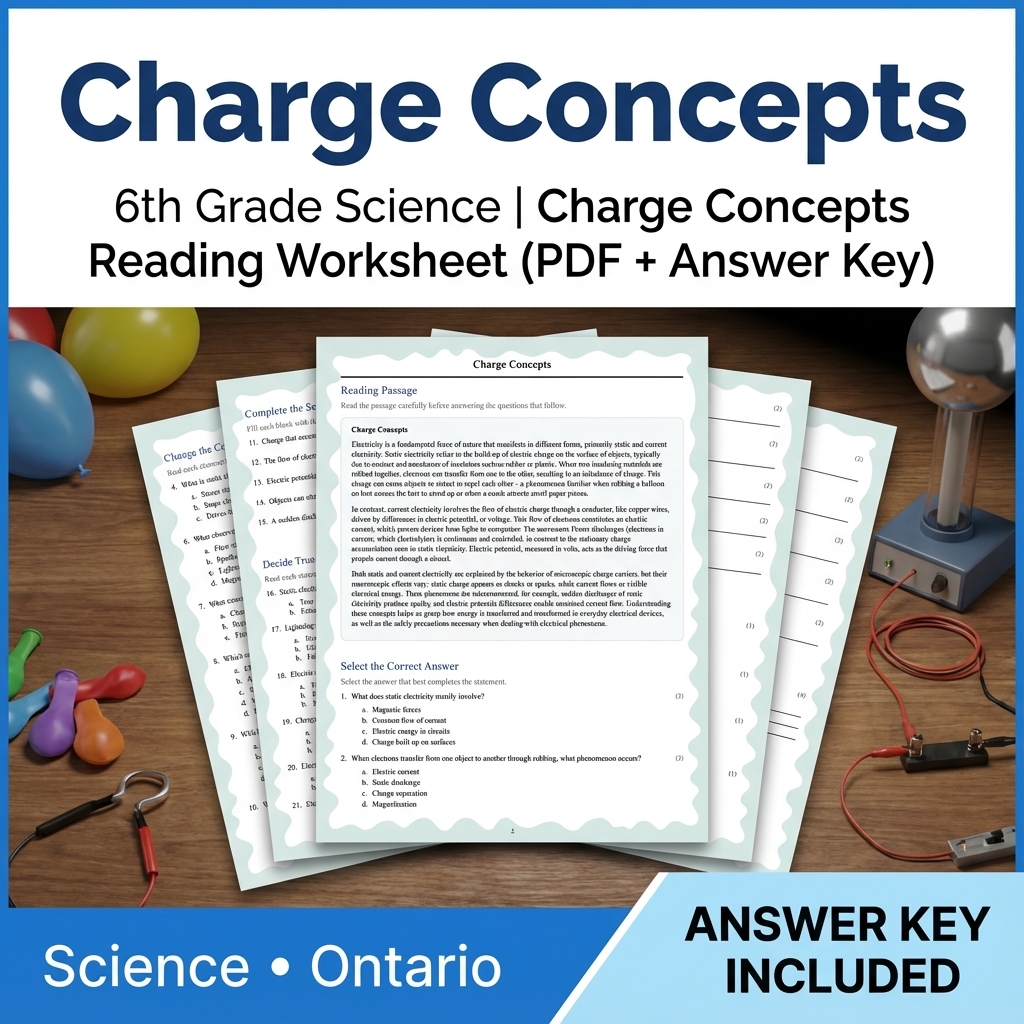
6th Grade Science | Charge Concepts Reading Worksheet & Answer Key (PDF)
JCreated byJ.S SheetsLearning Objectives
- Understand the difference between static and current electricity
- Define electric charge, charge separation, and flow
- Link observable phenomena like sparks and hair attraction to charge imbalance
Also included in: Grade 6 Science Circuit & Electricity Unit Bundle – Worksheets & Answer Keys +1 more
Instant download
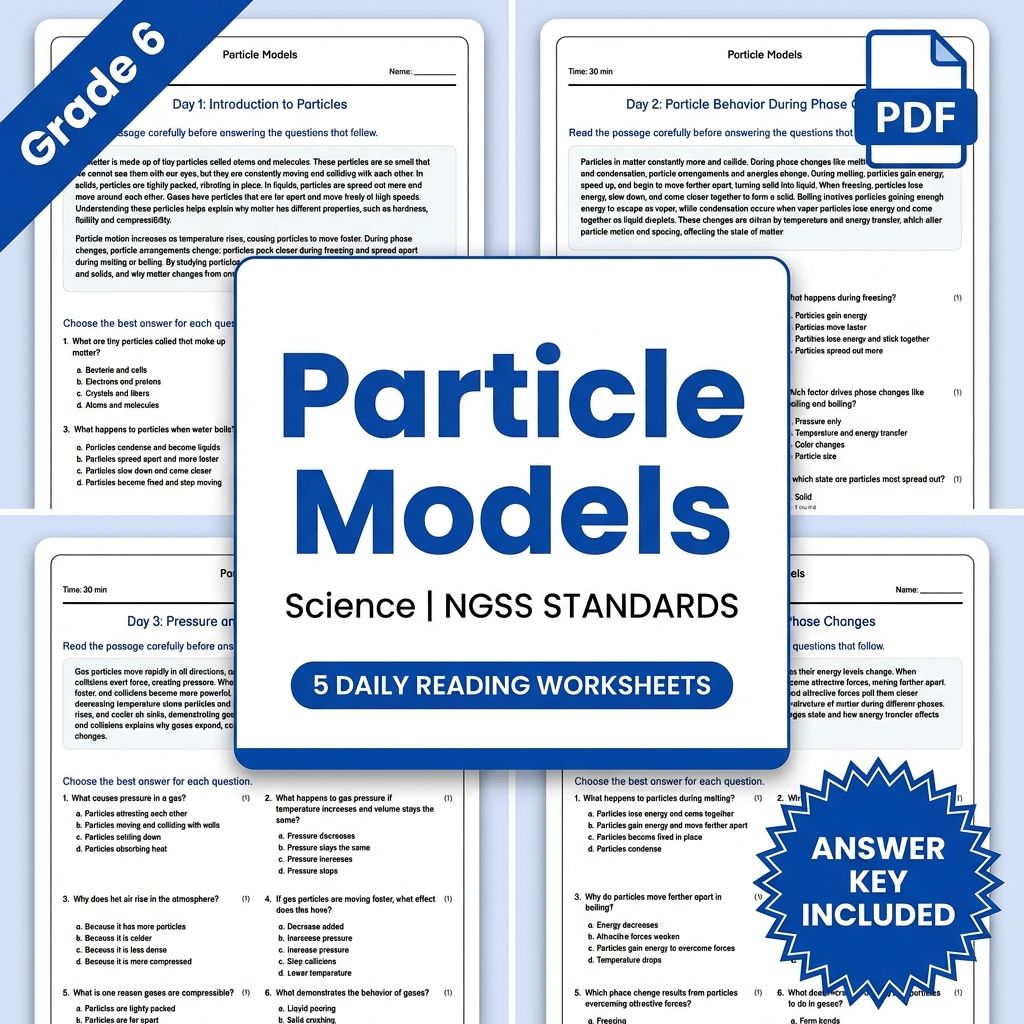
6th Grade Science | Particle Models Reading Worksheet (PDF+ Answer Key )
 Created byCopper Leaf Classroom
Learning Objectives
- Understand that matter is made of tiny particles too small to see.
- Explain how particle motion relates to temperature and phase changes.
- Describe particle collisions, spacing, and behavior during melting, freezing, boiling, and condensation.
Instant download
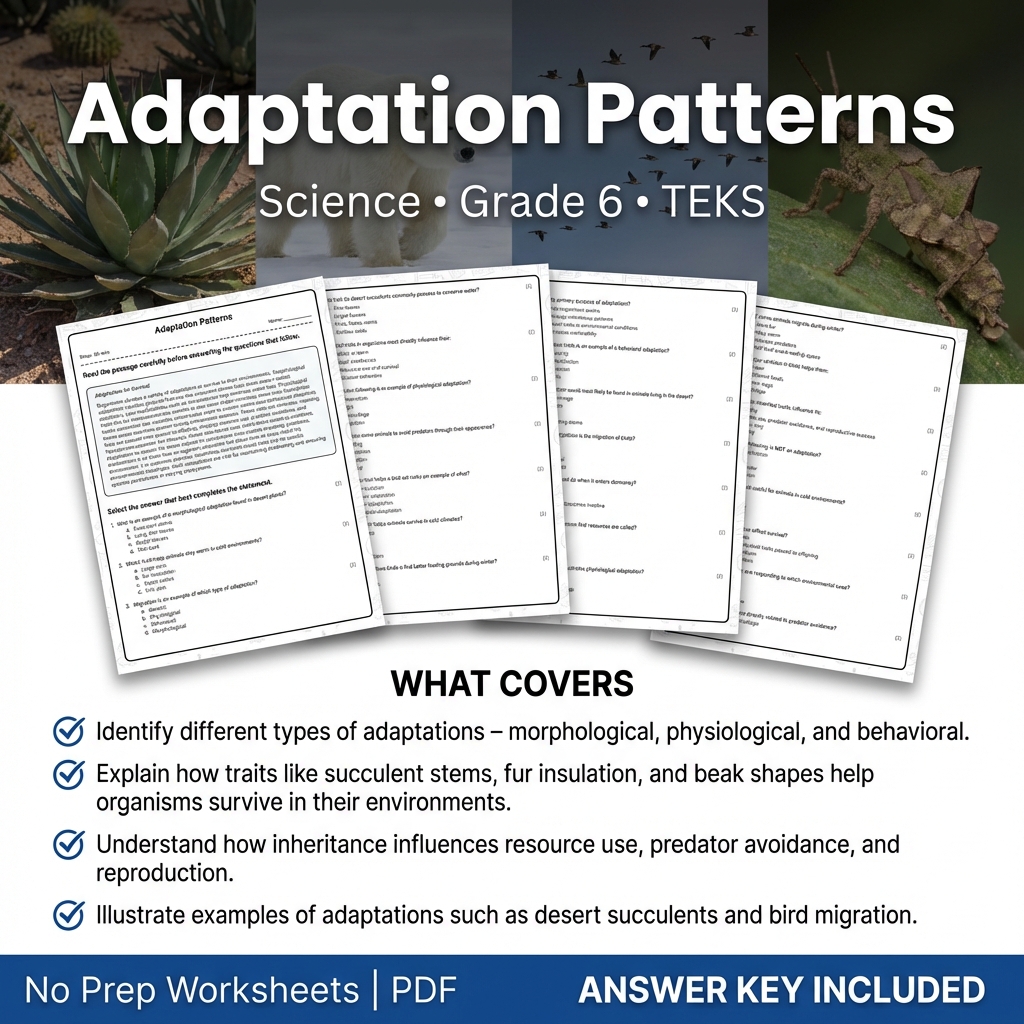
Grade 6 Science Worksheet on Adaptation Patterns | TEKS Standards
 Created byCoral Reef Learning
Learning Objectives
- Identify different types of adaptations – morphological, physiological, and behavioral.
- Explain how traits like succulent stems, fur insulation, and beak shapes help organisms survive in their environments.
- Understand how inheritance influences resource use, predator avoidance, and reproduction.
Instant download
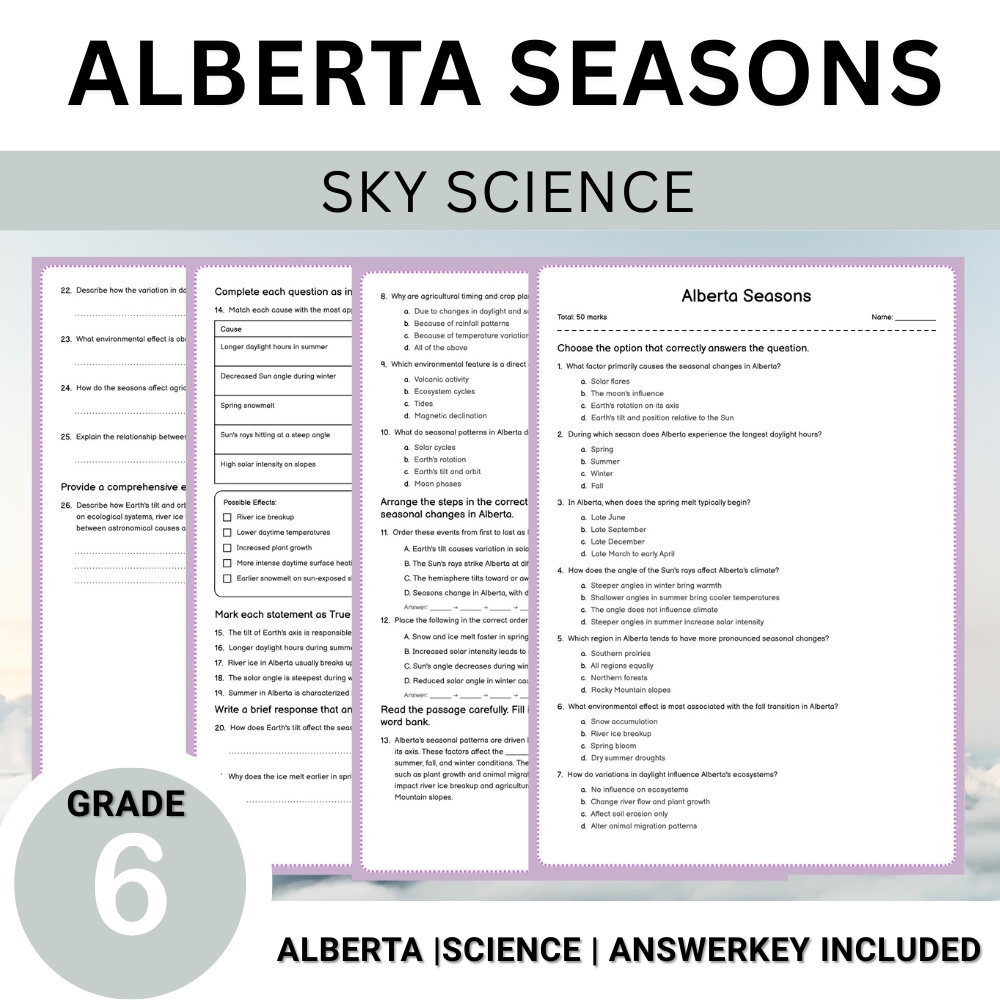
Grade 6 Science | Alberta Seasons Worksheet (Printable PDF + Answer Key)
Learning Objectives
- Understand how Earth's tilt and position relative to the Sun create seasonal variations in Alberta.
- Describe the regional manifestations of seasons in Alberta, including environmental and agricultural effects.
- Explain how astronomical causes influence terrestrial climate patterns and ecosystems.
Also included in: Grade 6 Science | Celestial & Space Phenomena UNIT Worksheet Bundle (Assessment & Practice) +1 more
Instant download
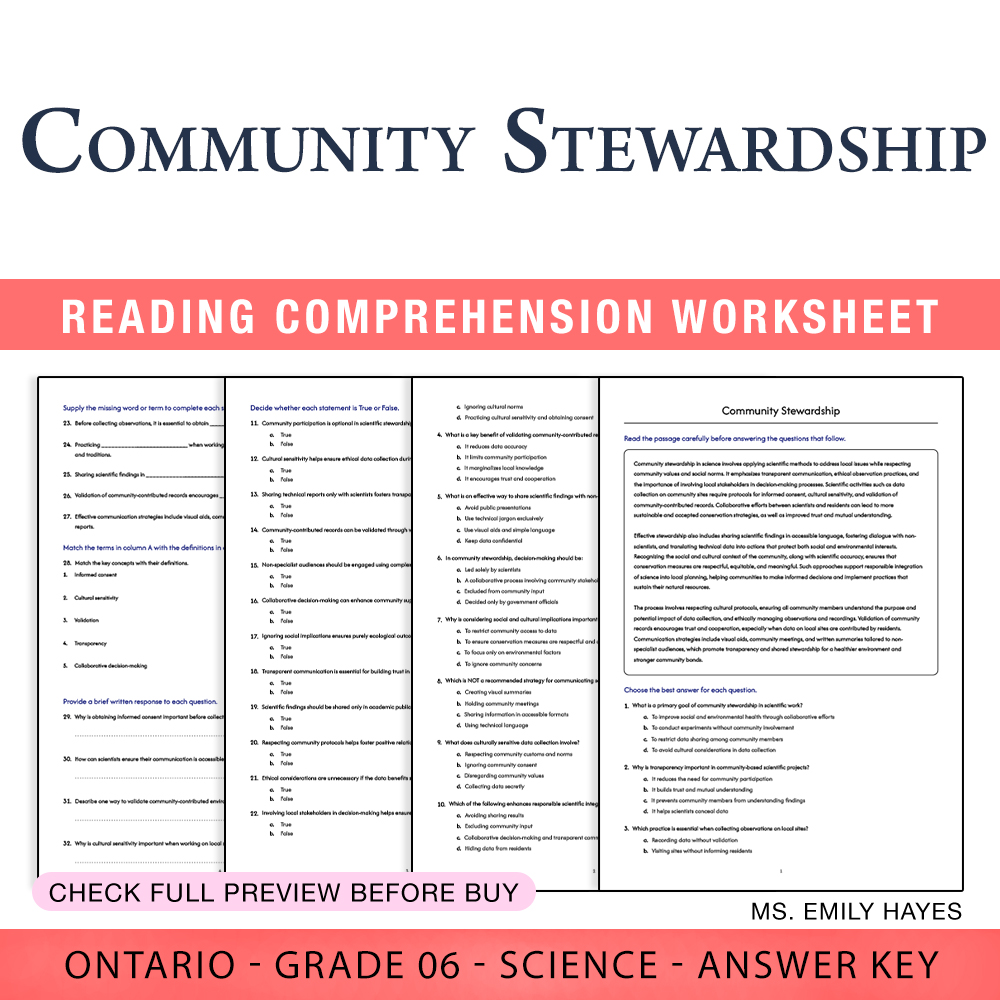
6th Grade Science | Community Stewardship Worksheet (PDF+ Answer Key)
Created byCopper Leaf ClassroomLearning Objectives
- Understand the importance of community engagement in scientific stewardship.
- Learn protocols for obtaining consent and practicing cultural sensitivity during local environmental assessments.
- Develop skills to validate and share community-contributed scientific records effectively.
Instant download
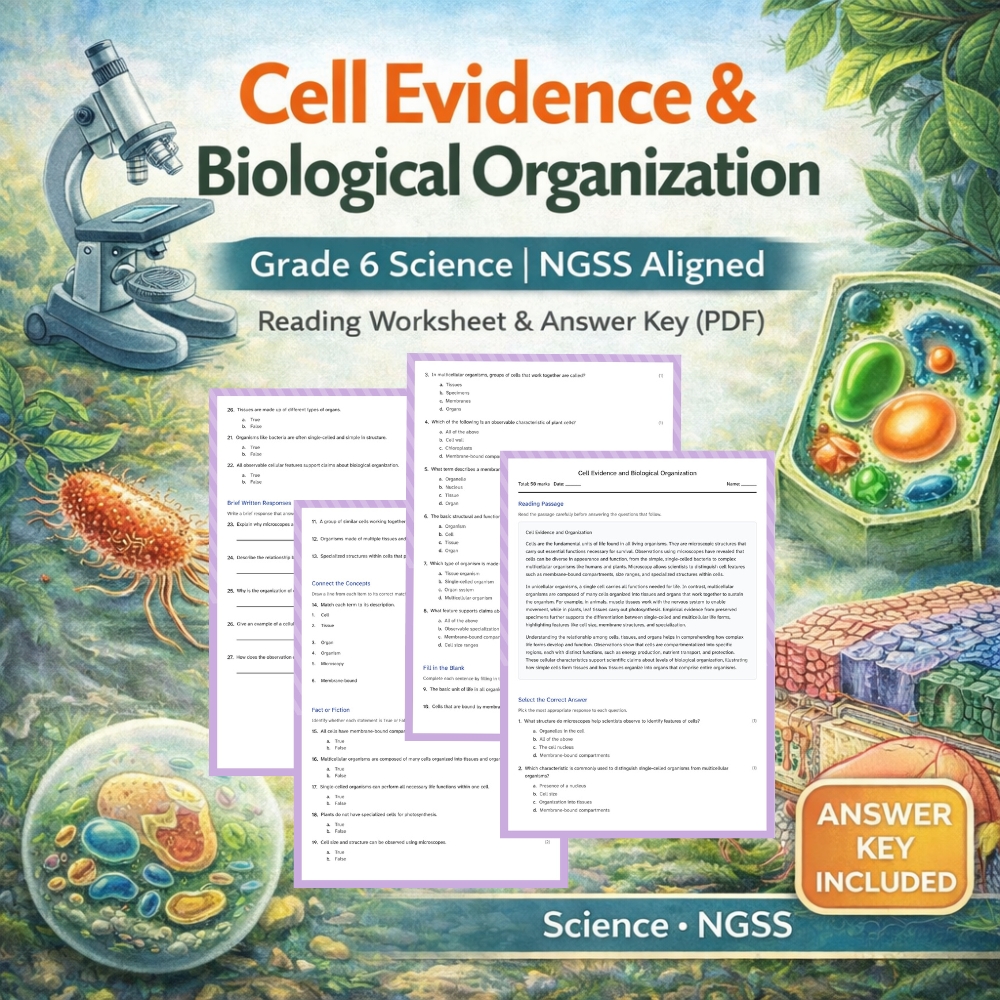
6th Grade Science | Cell Evidence & Biological Organization | NGSS Worksheet
 Created byCedar Grove Learning
Learning Objectives
- Identify and describe the basic unit of life, the cell, through observation and comparison.
- Differentiate between single-celled and multicellular organisms based on cellular evidence.
- Understand the relationships among cells, tissues, organs, and whole organisms.
Also included in: Grade 6 Science Worksheet Bundle | Cell Processes & Systems NGSS(PDF+Answer Key) +1 more
Instant download
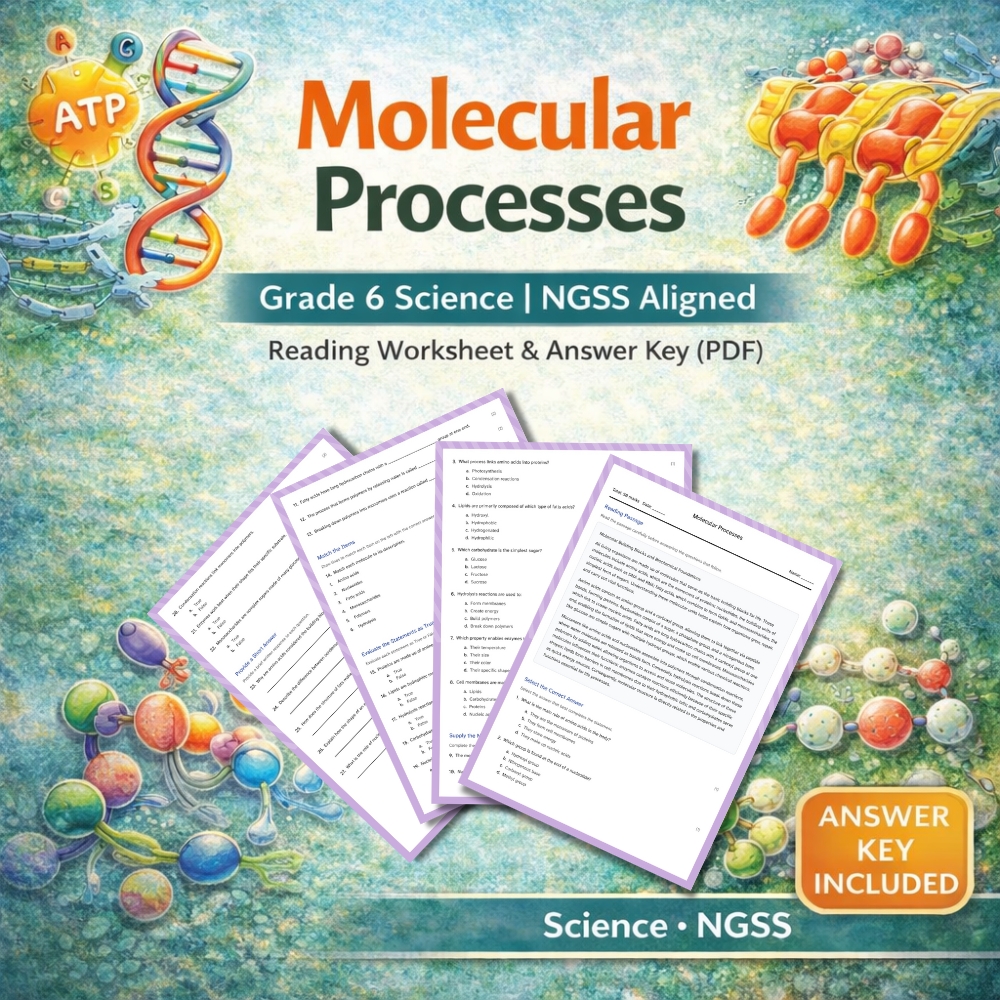
6th Grade Science | Molecular Processes | Worksheet (PDF + Answer Key) NGSS
Created byCedar Grove LearningLearning Objectives
- Understand the building blocks of molecules such as amino acids, nucleotides, fatty acids, and monosaccharides.
- Explain how monomers assemble into polymers through condensation reactions and are broken down by hydrolysis.
- Relate molecular structure to properties like enzyme catalysis, membrane transport, and polymerization during growth.
Also included in: Grade 6 Science Worksheet Bundle | Cell Processes & Systems NGSS(PDF+Answer Key) +1 more
Instant download
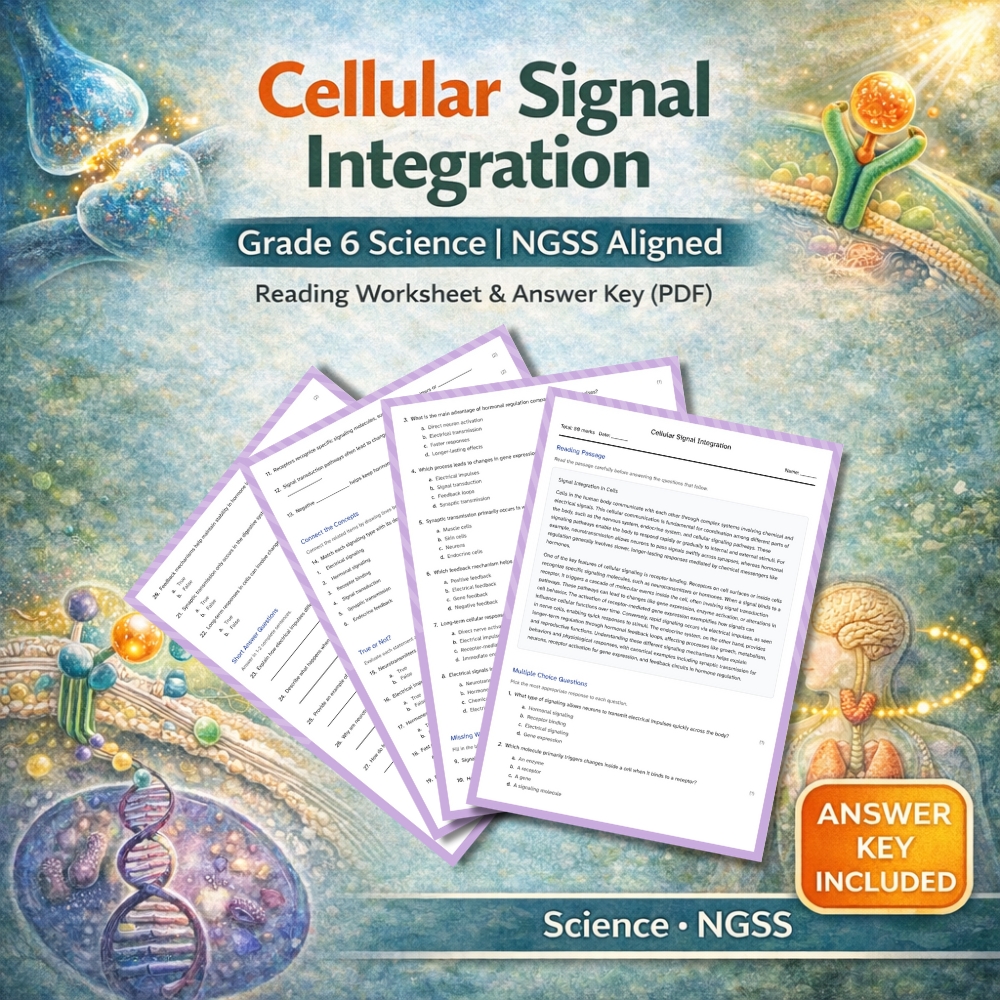
6th Grade Science | Cellular Signal Integration | Worksheet & Answer Key - NGSS
Created byCedar Grove LearningLearning Objectives
- Explain how cells communicate using chemical and electrical signals.
- Describe the processes of neurotransmission, hormonal regulation, and signal transduction cascades.
- Differentiate between rapid nervous impulses and longer-term endocrine effects.
Also included in: Grade 6 Science Worksheet Bundle | Cell Processes & Systems NGSS(PDF+Answer Key) +1 more
Instant download
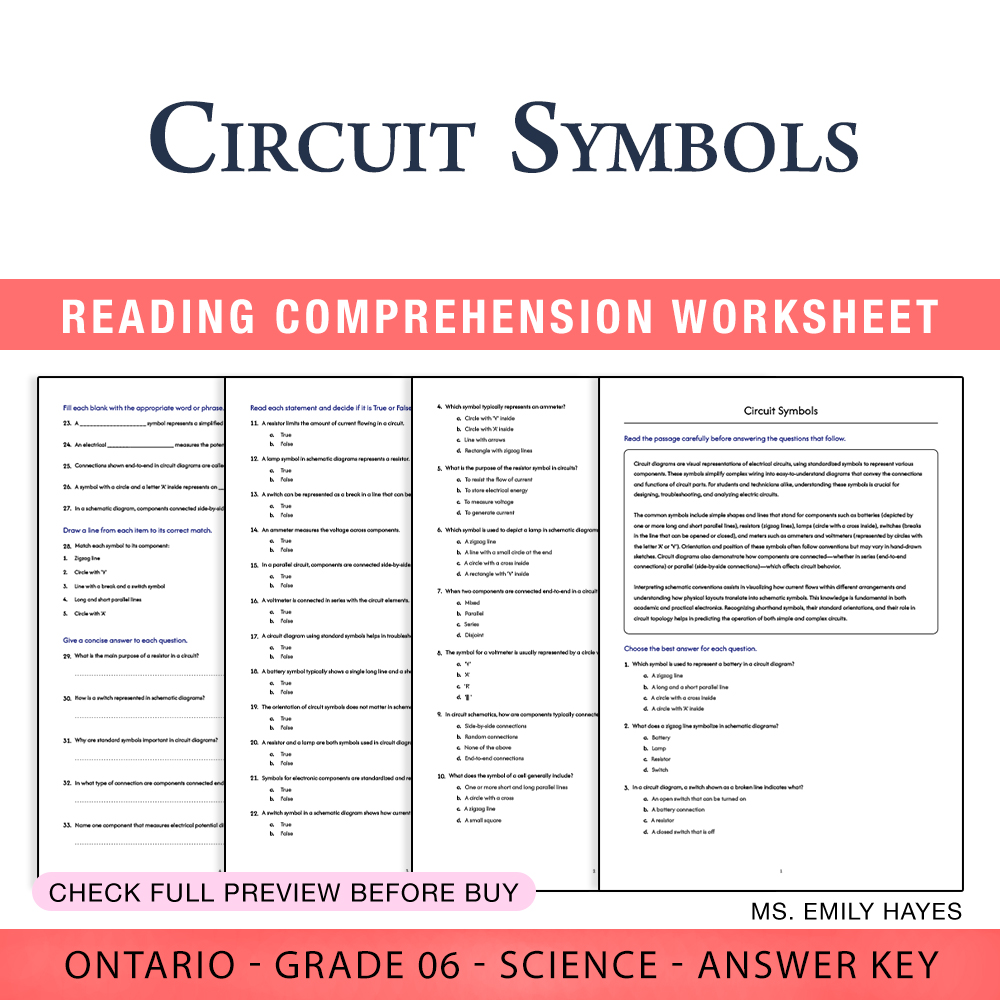
6th Grade Science | Circuit Symbols Worksheet (PDF + Answer Key)
Created byCopper Leaf ClassroomLearning Objectives
- Identify and interpret standard schematic symbols for circuit components such as cells, batteries, resistors, lamps, switches, ammeters, and voltmeters.
- Read and interpret circuit diagrams to understand connections and predict circuit behavior across series, parallel, and mixed configurations.
Instant download
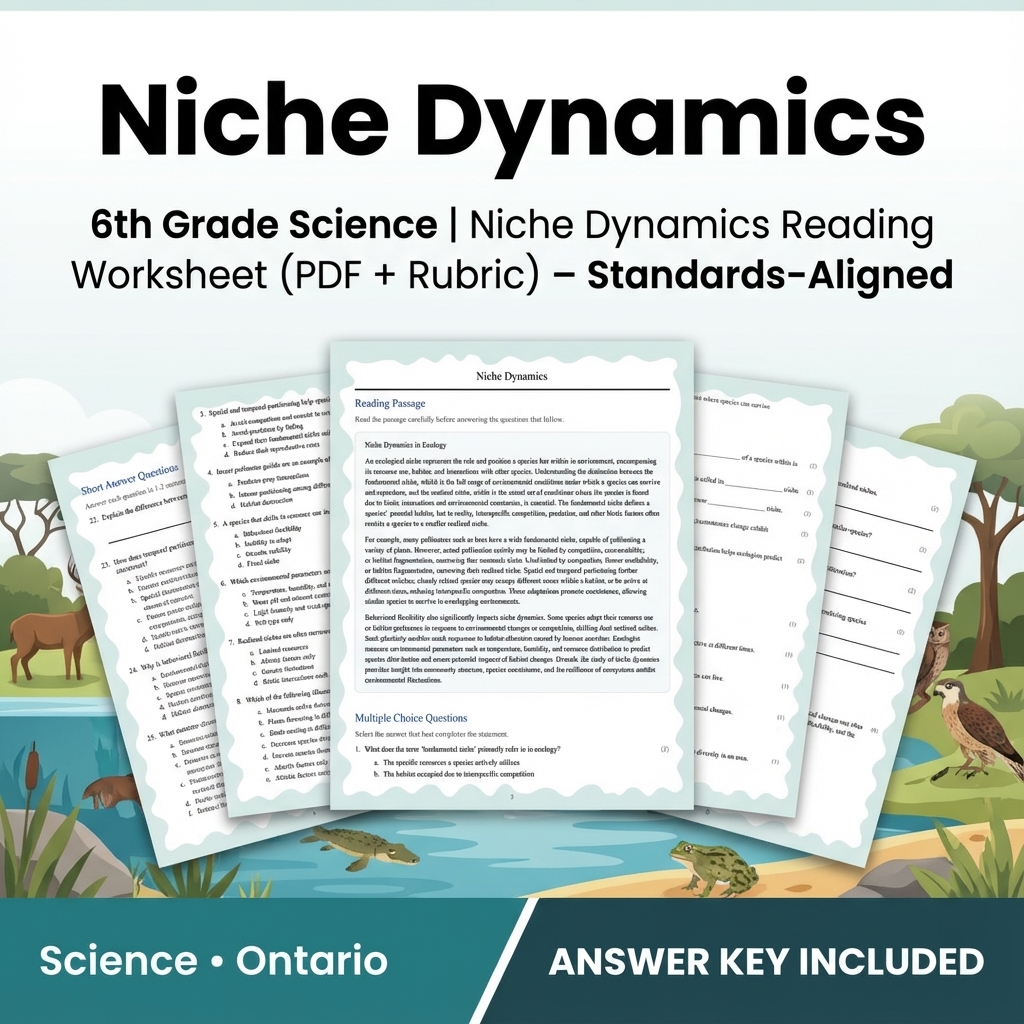
6th Grade Science | Niche Dynamics Reading Worksheet (PDF + Rubric)
JCreated byJ.S SheetsLearning Objectives
- Understand the difference between fundamental and realized niches in ecological systems.
- Identify how abiotic and biotic factors influence resource use and habitat occupation.
- Describe how species partition their niches temporally and spatially.
Also included in: Grade 6 Science Unit Bundle – Ecosystems, Biodiversity & Environmental Impact +1 more
Instant download

Grade 6 Science | Forces Basics Worksheet | TEKS Alligned
 Created byLumora Learning
Learning Objectives
- Understand the difference between contact and noncontact forces including gravity, friction, and normal force.
- Explain how balanced and unbalanced forces affect motion.
- Describe the concept of net force and its effects on objects in everyday situations.
Also included in: Grade 6 Science | Matter and Energy Lesson Bundle | TEKS Aligned
Instant download
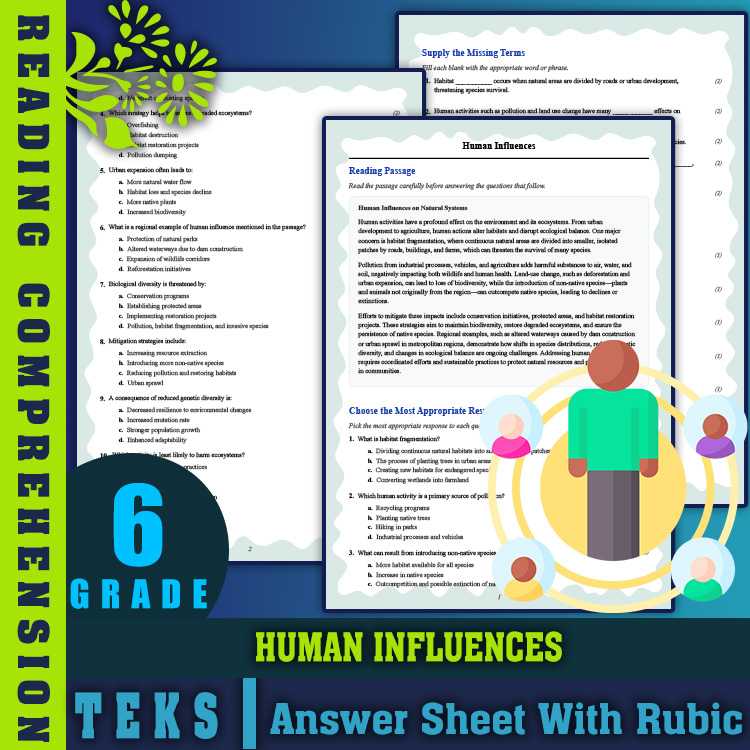
6th Grade Science | Human Influences Reading Worksheet (PDF + Answer Key)
JCreated byJ.S SheetsLearning Objectives
- Understand how human activities impact natural ecosystems
- Identify effects of habitat fragmentation, pollution, and resource extraction on biodiversity
- Describe mitigation strategies such as conservation and restoration
Instant download

6th Grade Science | Biodiversity Solutions Worksheet (PDF +Answer Key)
Created byCopper Leaf ClassroomLearning Objectives
- Compare different conservation strategies and their ecological trade-offs.
- Analyze case studies like coral reef restoration and riparian buffer implementation.
- Evaluate the effectiveness of biodiversity solutions in supporting ecosystem services.
Instant download
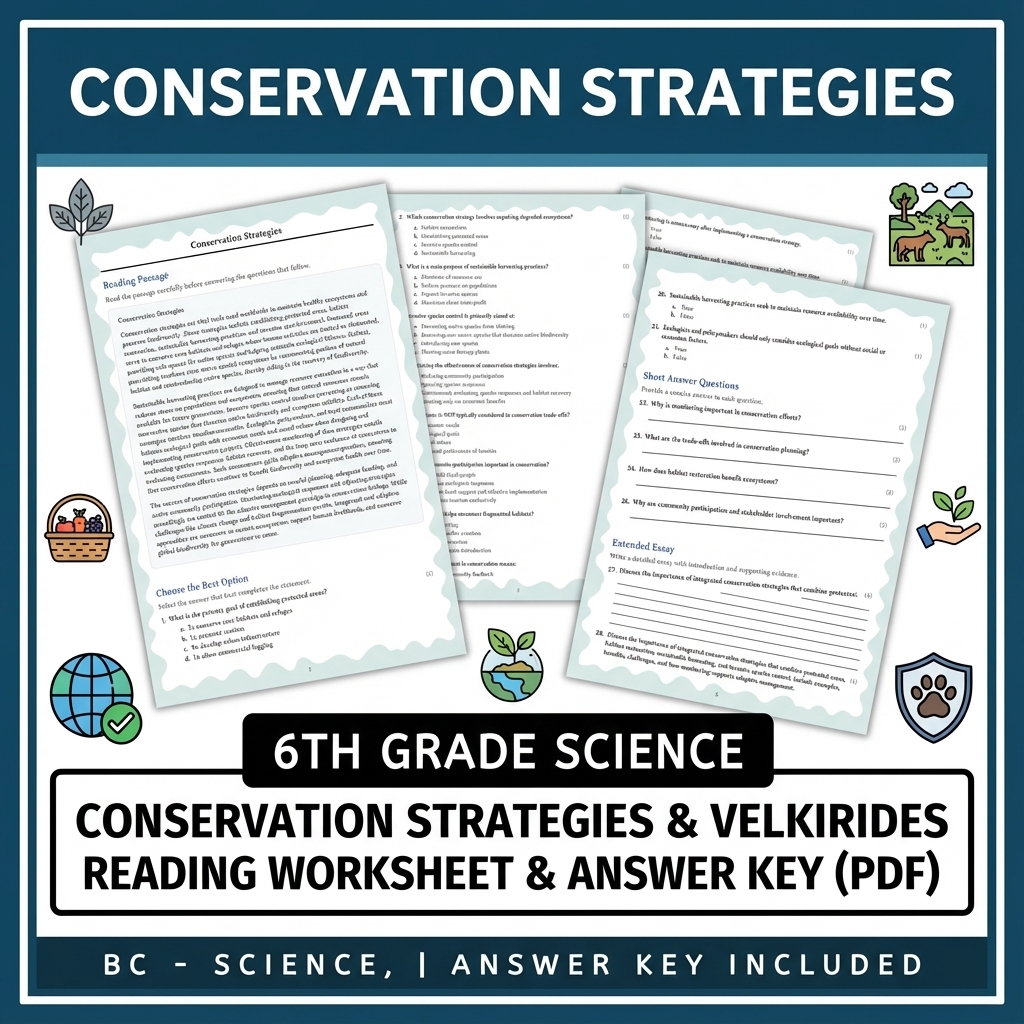
6th Grade Science | Conservation Strategies Reading Worksheet & Answer Key (PDF)
JCreated byJ.S SheetsLearning Objectives
- Understand various conservation strategies used to protect ecosystems.
- Identify key features and purposes of protected areas, habitat restoration, sustainable harvesting, and invasive species control.
- Evaluate the benefits and trade-offs of different conservation methods.
Instant download
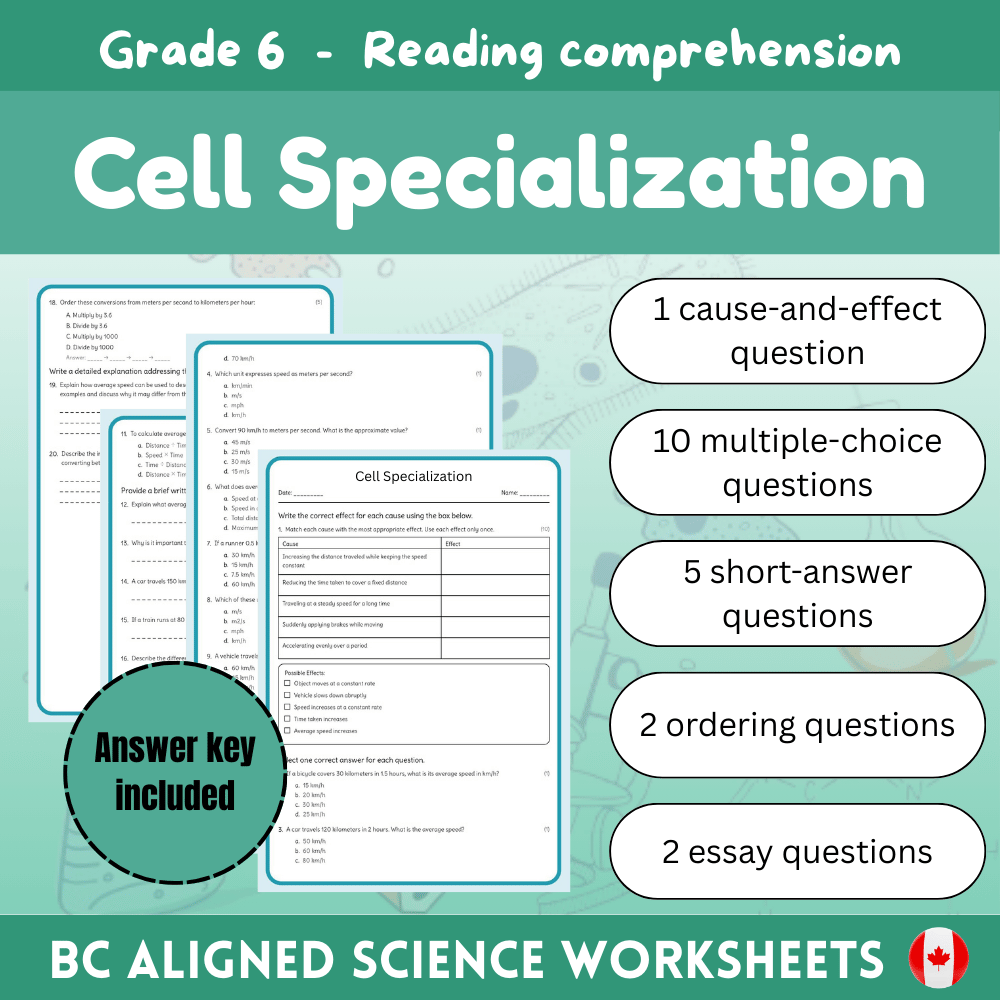
6th Grade Science | Cell Specialization Worksheet + Answer Key - BC Standard
 Created byBright Mind Resources
Learning Objectives
- Understand how cells develop unique structures for specific functions.
- Explain the process of differentiation and gene expression in cells.
- Recognize how specialized cells form tissues and organs that perform complex tasks.
Instant download
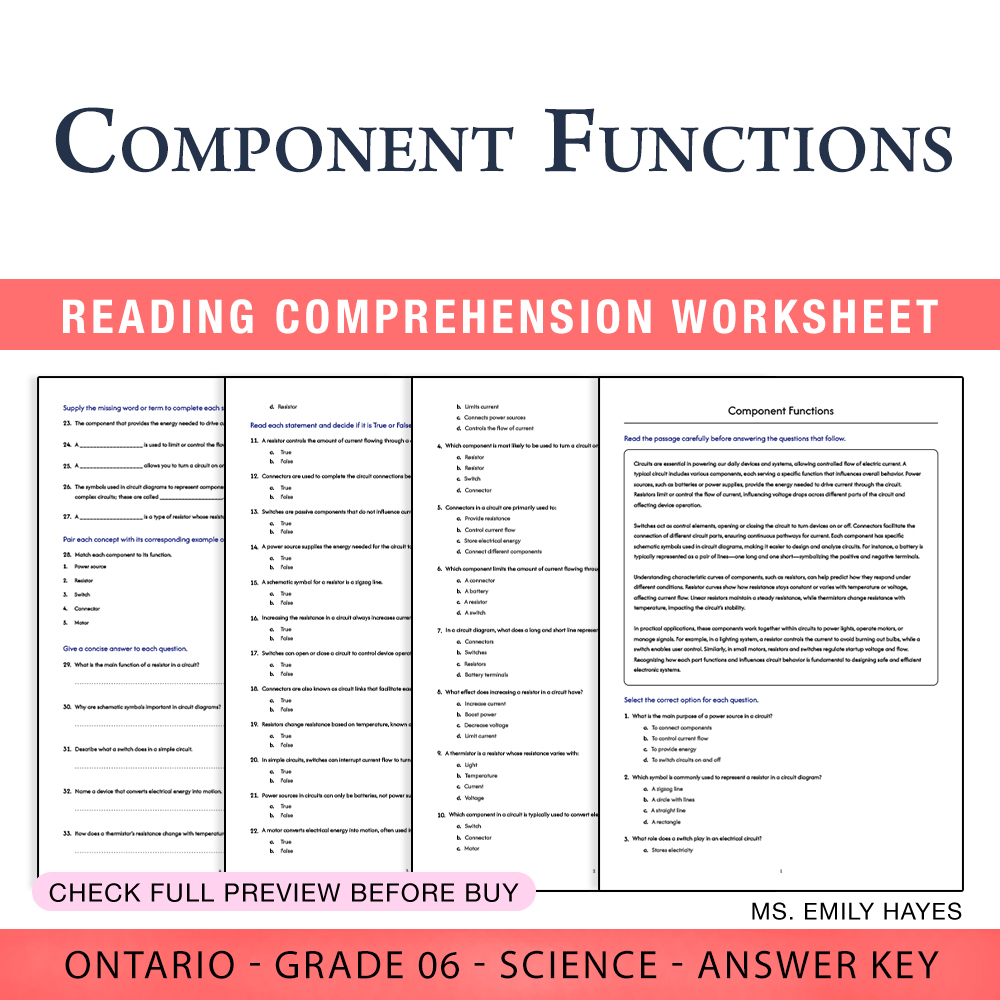
6th Grade Science | Component Functions Worksheet (PDF + Answer Key)
Created byCopper Leaf ClassroomLearning Objectives
- Identify and describe the roles of common circuit components such as power sources, resistors, switches, and connectors.
- Interpret schematic symbols and link them to physical components in a circuit.
- Analyze how circuit components affect current and voltage, including their characteristic curves.
Instant download
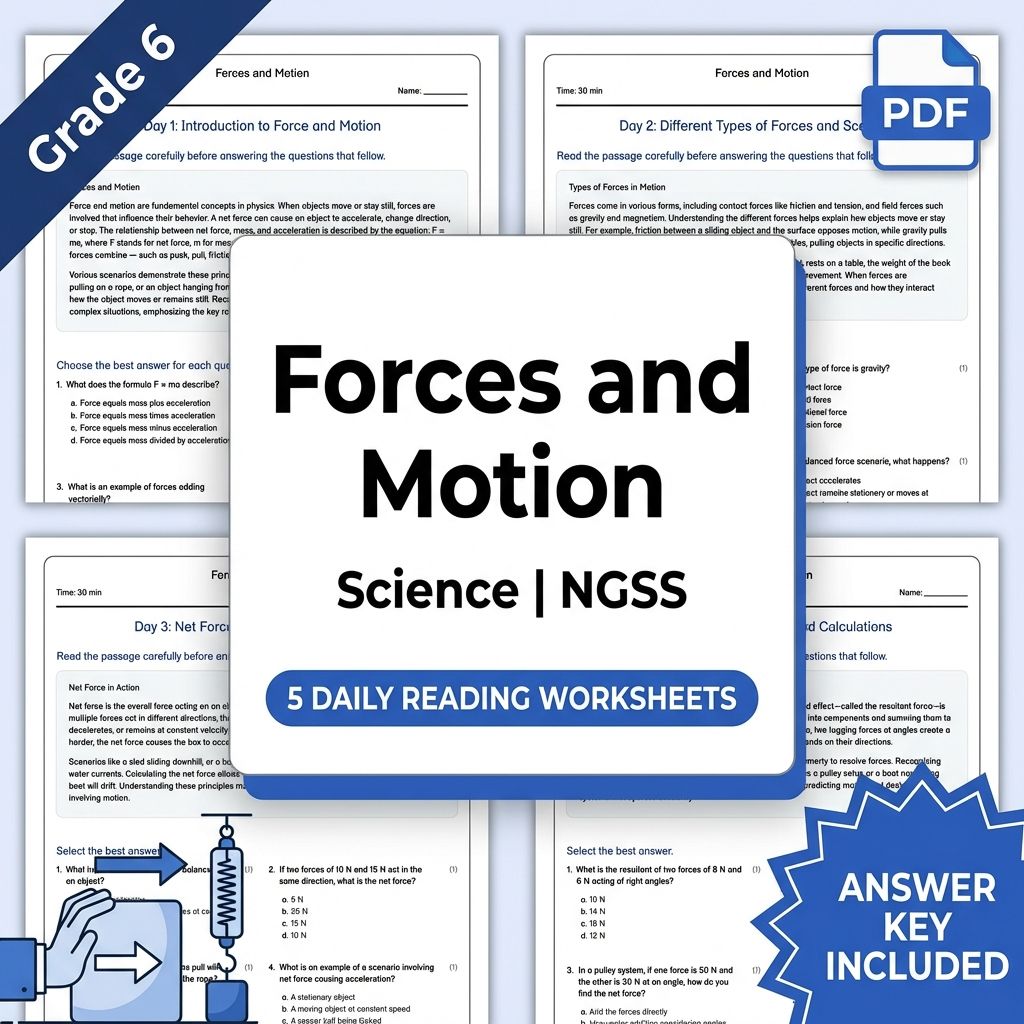
6th Grade Science | Forces and Motion Daily Reading Worksheet (PDF + Answer Key)
Created byCopper Leaf ClassroomLearning Objectives
- Understand the relationship between net force, mass, and acceleration.
- Identify different scenarios where forces act on objects.
- Apply the equation net force equals mass times acceleration to real-world problems.
Instant download
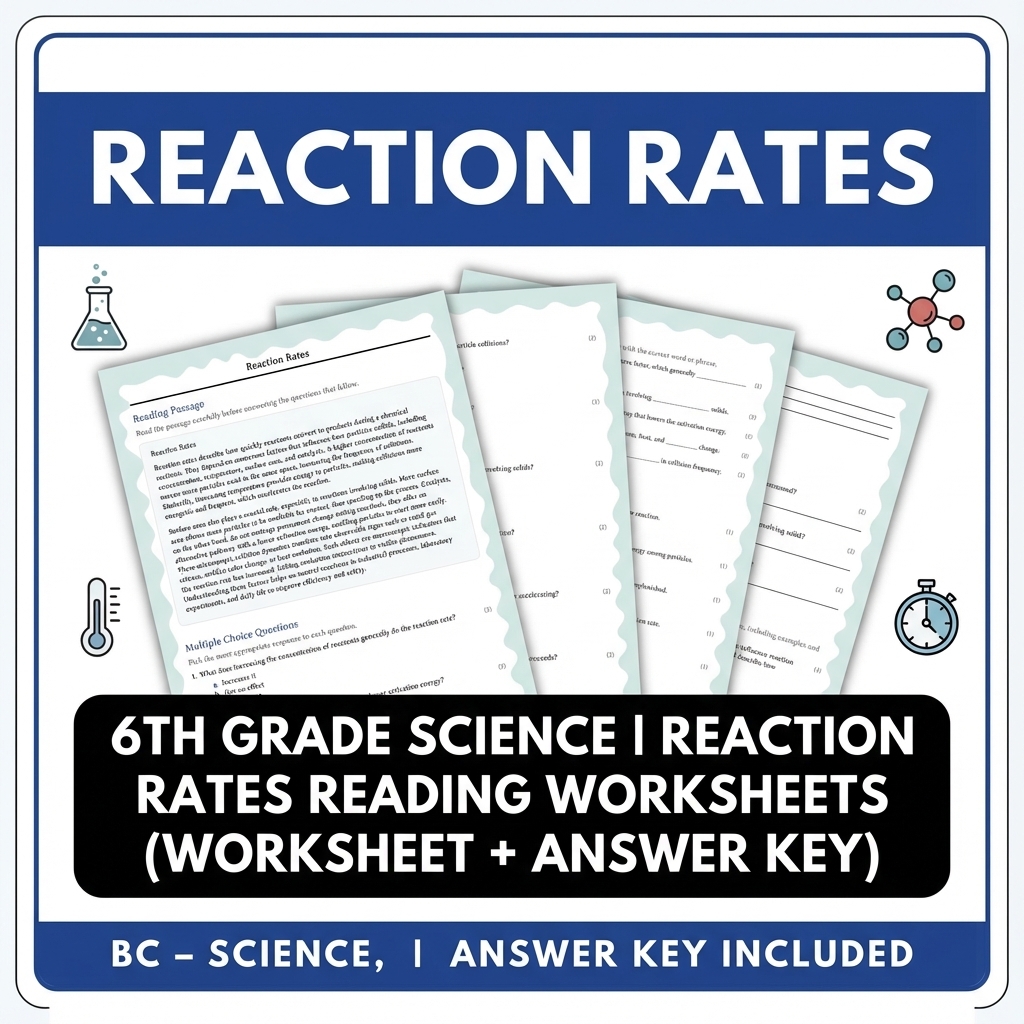
6th Grade Science | Reaction Rates Reading Worksheets (Worksheet + Answer Key)
JCreated byJ.S SheetsLearning Objectives
- Describe what reaction rates are and how they measure the speed of chemical reactions.
- Explain how factors like concentration, temperature, surface area, and catalysts influence reaction rates.
- Relate microscopic collision dynamics to observable signs of reaction progress such as gas release, color change, or heat production.
Instant download

6th Grade Science – Species Classification Worksheet (Alberta Standards) (PDF)
 Created bySilver Birch Teaching
Learning Objectives
- Explain how species classification groups organisms into functional categories such as producers, consumers, and decomposers
- Distinguish native species from invasive or pest species and describe how they can affect ecosystem balance
- Use functional classification to predict energy flow and interactions among organisms in an Alberta ecosystem
Also included in: Grade 6 Ecosystem Interactions Science Lesson Bundle: Alberta Framework +1 more
Instant download
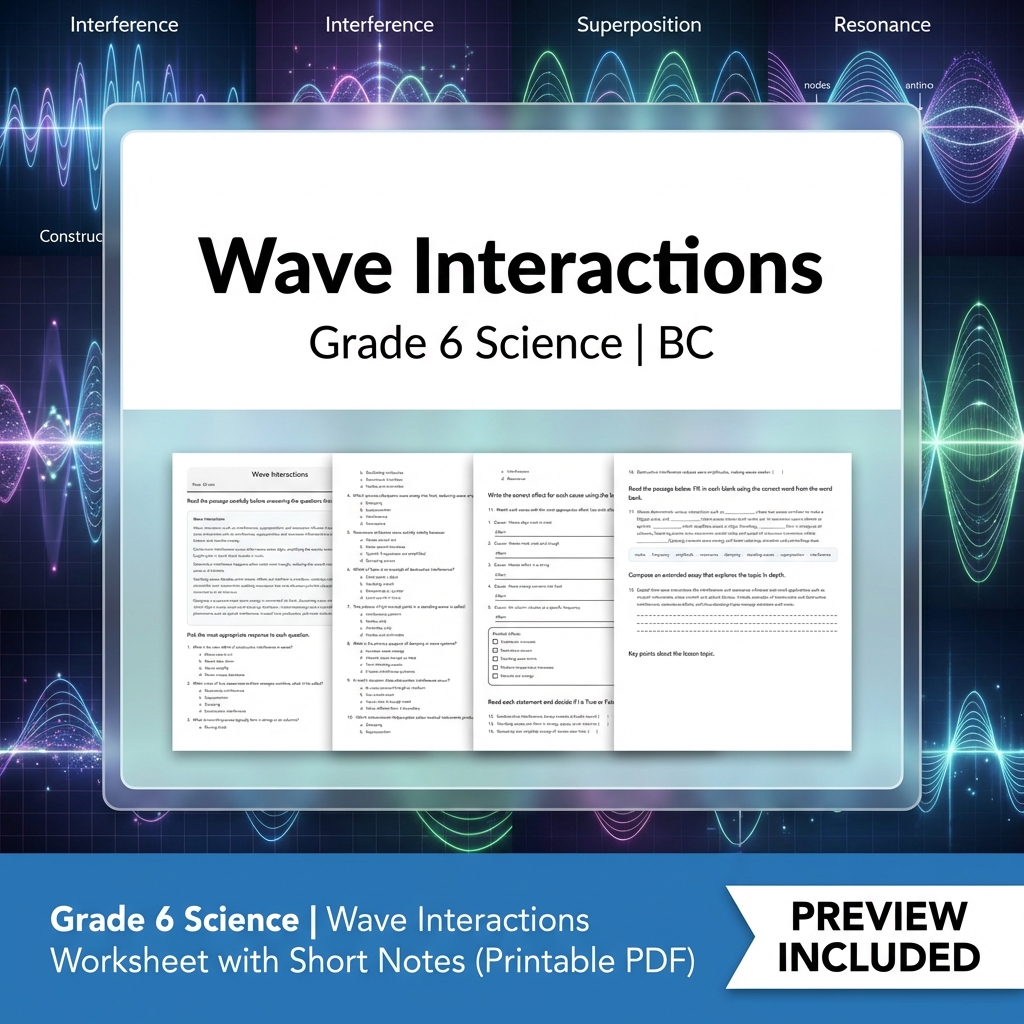
Grade 6 Science | Wave Interactions Worksheet with Short Notes (Printable PDF)
 Created byMeadowlark Worksheets
Learning Objectives
- Understand the key concepts of wave interactions such as interference, superposition, and resonance.
- Describe how constructive and destructive interference affect sound and light waves.
- Explain the phenomenon of standing waves and how resonance amplifies specific frequencies.
Also included in: Grade 6 Science | Energy, Waves & Circuits UNIT Bundle (BC Frame work) +1 more
Instant download
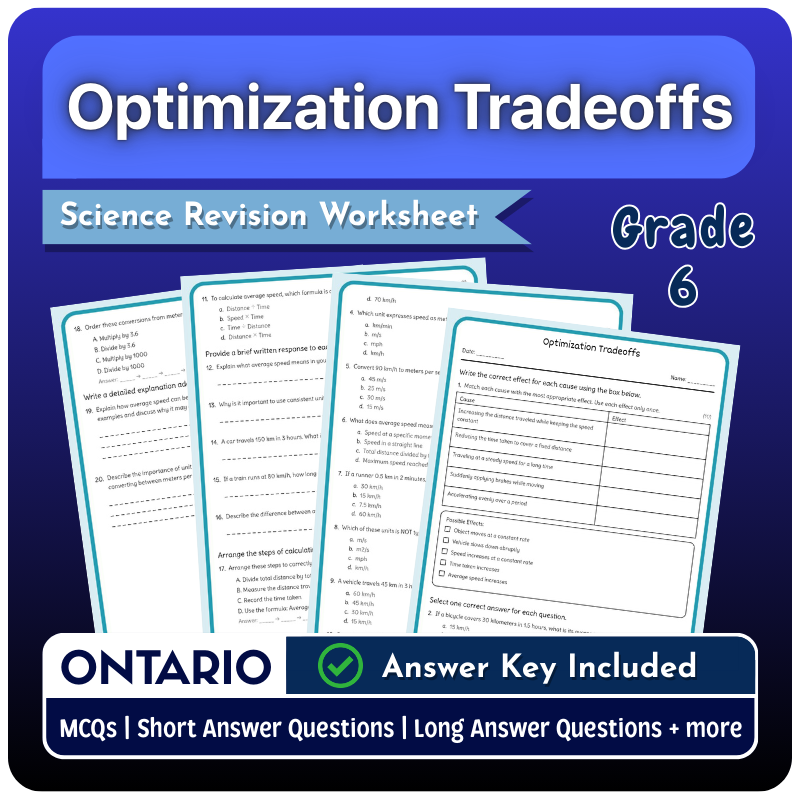
6th Grade Science | Optimization Tradeoffs Worksheet (Ontario) (PDF)
Created byBright Mind ResourcesLearning Objectives
- Understand how multi-criteria design balances lift, drag, weight, stability, and manufacturability.
- Analyze methods for parameter tuning and Pareto trade-off concepts.
- Evaluate how structural constraints influence wing aspect ratio and material selection.
Instant download
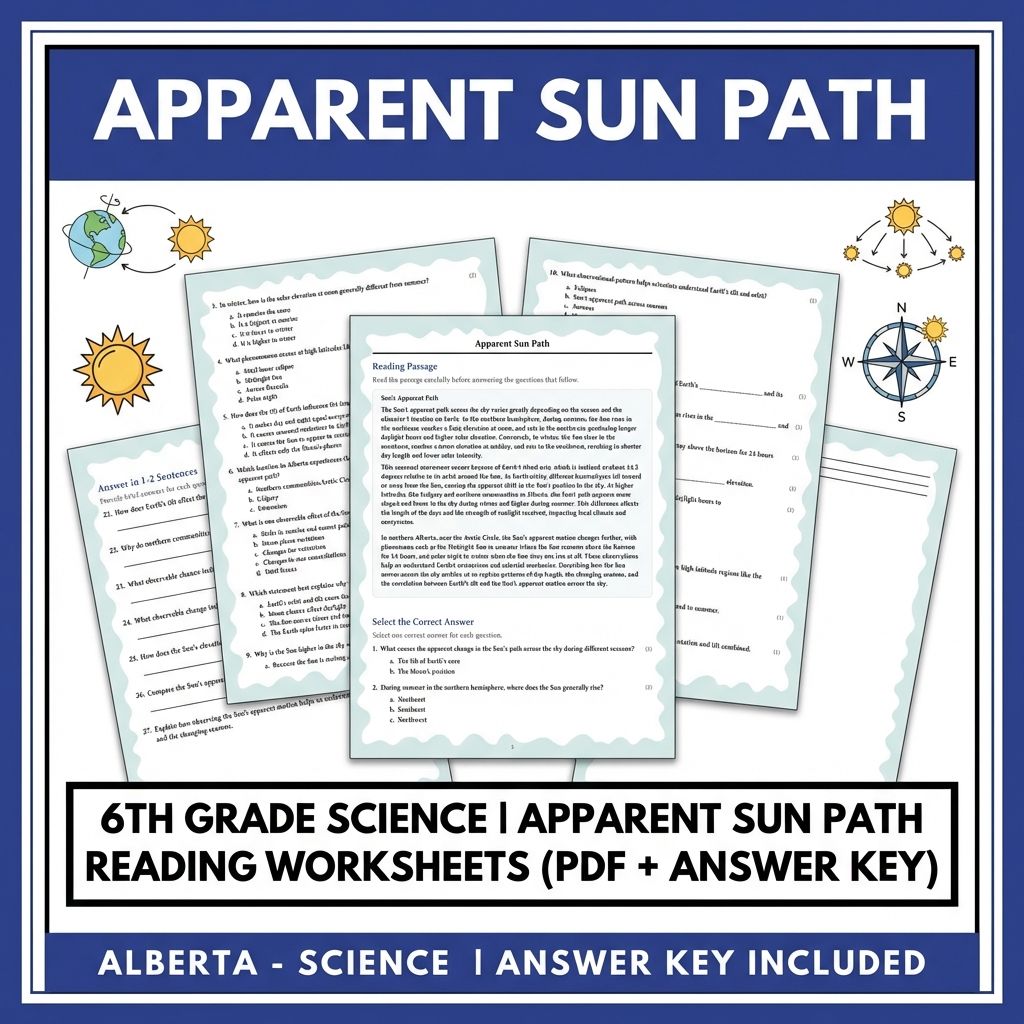
6th Grade Science | Apparent Sun Path Reading Worksheets (PDF + Answer Key)
JCreated byJ.S SheetsLearning Objectives
- Describe how the Sun's apparent path across the sky changes with season and latitude.
- Explain the effects of Earth's tilt and position on sunrise and sunset locations.
- Compare the Sun's elevation at noon in different seasons and locations within Alberta.
Also included in: Grade 6 Science | Celestial Motion & Sky Observation Worksheets Bundle +1 more
Instant download

Criteria and Constraints Assessment | Standards-Aligned Grade 6 Science
 Created byPrism Point Learning
Learning Objectives
- Understand the difference between criteria and constraints in the design process.
- Identify examples of criteria and constraints in real-world design scenarios.
- Explain how constraints limit possible solutions while criteria define success.
Instant download
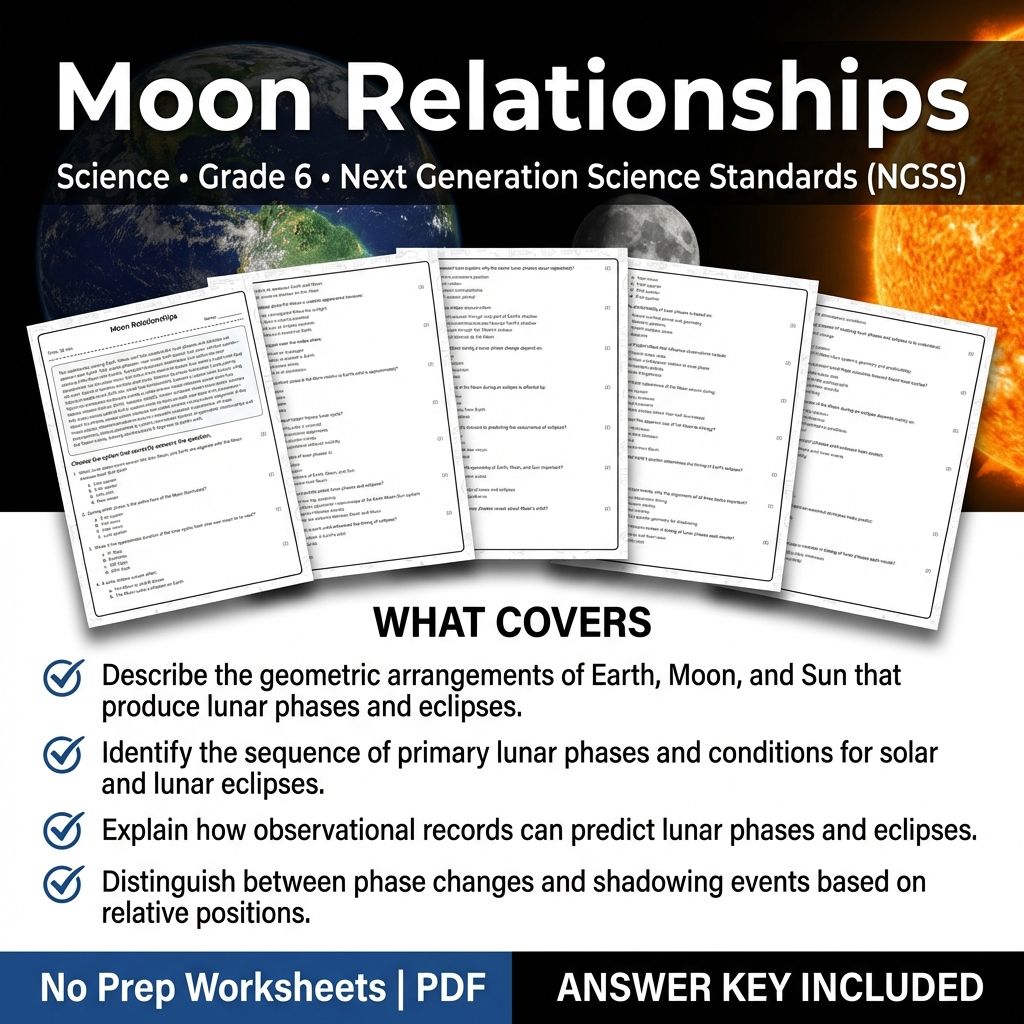
6th Grade Science | Moon Relationships Worksheet & Answer Key (Printable PDF)
Created byCoral Reef LearningLearning Objectives
- Describe the geometric arrangements of Earth, Moon, and Sun that produce lunar phases and eclipses.
- Identify the sequence of primary lunar phases and conditions for solar and lunar eclipses.
- Explain how observational records can predict lunar phases and eclipses.
Instant download
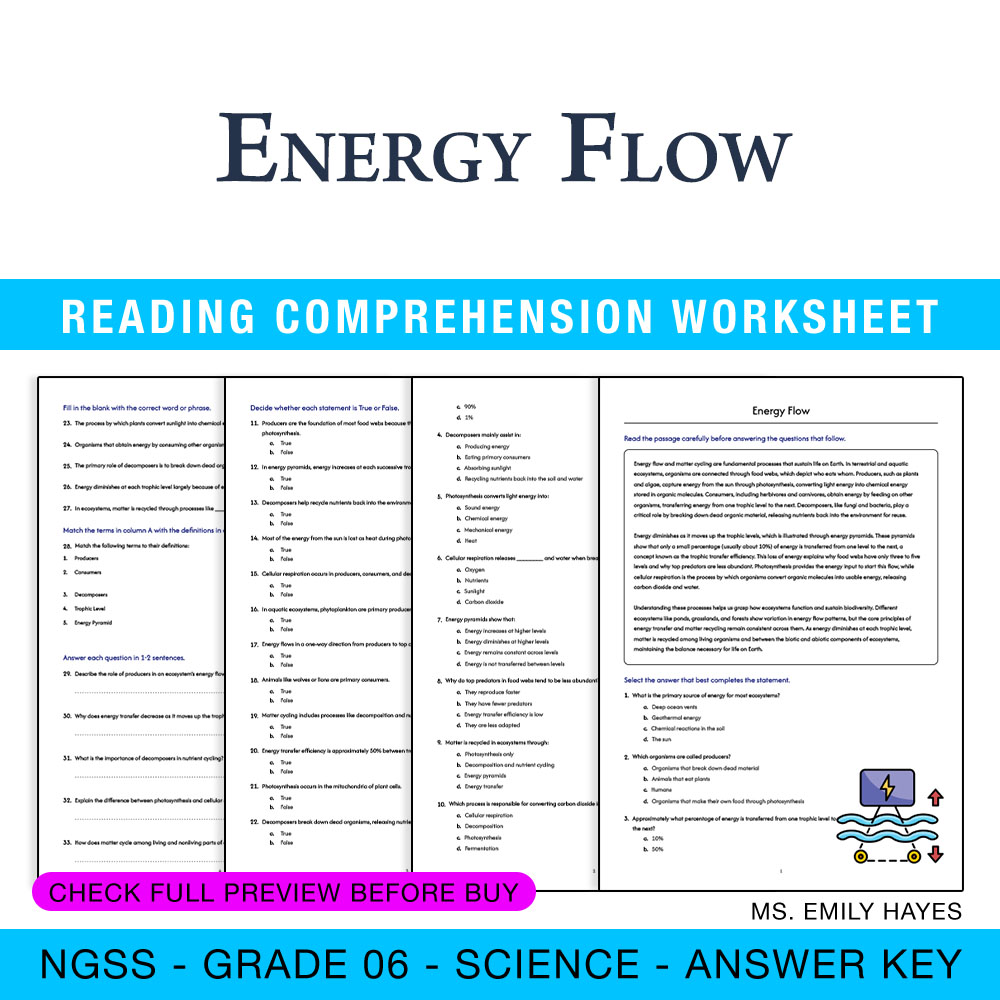
6th Grade Science | Energy Flow Worksheet (PDF +Answer Key)
Created byCopper Leaf ClassroomLearning Objectives
- Describe how energy flows through and matter cycles within terrestrial and aquatic food webs.
- Identify the roles of producers, consumers, and decomposers in energy transfer and nutrient cycling.
- Interpret energy pyramids and understand trophic transfer efficiency.
Instant download

Science Grade 6 Worksheet: Variation Factors Assessment | NGSS Aligned
 Created bySkylark Worksheets
Learning Objectives
- Explain how genetic differences and environmental factors can both cause observable variation in individuals.
- Use allele and mutation ideas to describe how inherited traits can produce a range of phenotypes.
- Analyze examples (animals and plants) to identify which variations are inherited and which are environment-dependent.
Also included in: Grade 6 Inheritance & Variation Science Lesson Bundle Worksheets for NGSS +1 more
Instant download

Science Grade 6: Inheritance Modeling Worksheet | NGSS Grade 6 Science
Created bySkylark WorksheetsLearning Objectives
- Explain how genes on chromosomes can pass traits from parents to offspring.
- Use Mendelian cross models to predict possible offspring trait ratios for dominant and recessive traits.
- Apply simple probability to interpret and compare modeled outcomes.
Also included in: Grade 6 Inheritance & Variation Science Lesson Bundle Worksheets for NGSS +1 more
Instant download
Grade 6 Science – Population & Population Growth | Daily Reading Worksheet
 Created byQuiet Forest Education
Learning Objectives
- Understand the concepts of population growth models including exponential and logistic growth.
- Identify factors influencing population size such as birth rates, death rates, immigration, and emigration.
- Differentiate between density-dependent and density-independent limiting factors.
Also included in: Ecosystems and Environment Grade 6 Science Daily Worksheets Bundle | Ontario +1 more
Instant download
Grade 6 Science | Waves And Technology Worksheet with Short Notes (PDF)
Created byMeadowlark WorksheetsLearning Objectives
- Understand how sound and light waves transfer energy and information in technological devices.
- Identify the functions of speakers, microphones, and cameras as related to wave energy conversions.
- Explain how properties of waves like frequency and intensity affect device performance and fidelity.
Also included in: Grade 6 Science | Energy, Waves & Circuits UNIT Bundle (BC Frame work) +1 more
Instant download

Natural Resources Worksheet | Standards-Aligned Grade 6 Science Practice
JCreated byJ.S SheetsLearning Objectives
- Identify renewable and nonrenewable natural resources and explain how their formation times affect supply
- Describe how natural resources are distributed regionally and how scientists assess resource availability
- Explain economic and environmental trade-offs of extracting resources, including reclamation and sustainability
Instant download
6th Grade Science | Natural Selection Daily Reading Worksheet (PDF + Answer Key)
Created byCopper Leaf ClassroomLearning Objectives
- Understand how heritable variation influences natural selection.
- Identify examples of natural selection in various environments.
- Evaluate mechanisms that lead to shifts in trait frequencies over generations.
Instant download
6th Grade Science | Scientific Methods Worksheet (PDF+ Answer Key)
Created byCopper Leaf ClassroomLearning Objectives
- Understand the iterative nature of scientific methods and how observations inform hypotheses.
- Differentiate between descriptive, observational approaches and comparative, experimental approaches.
- Identify operational definitions and appropriate methodologies based on observable phenomena.
Instant download
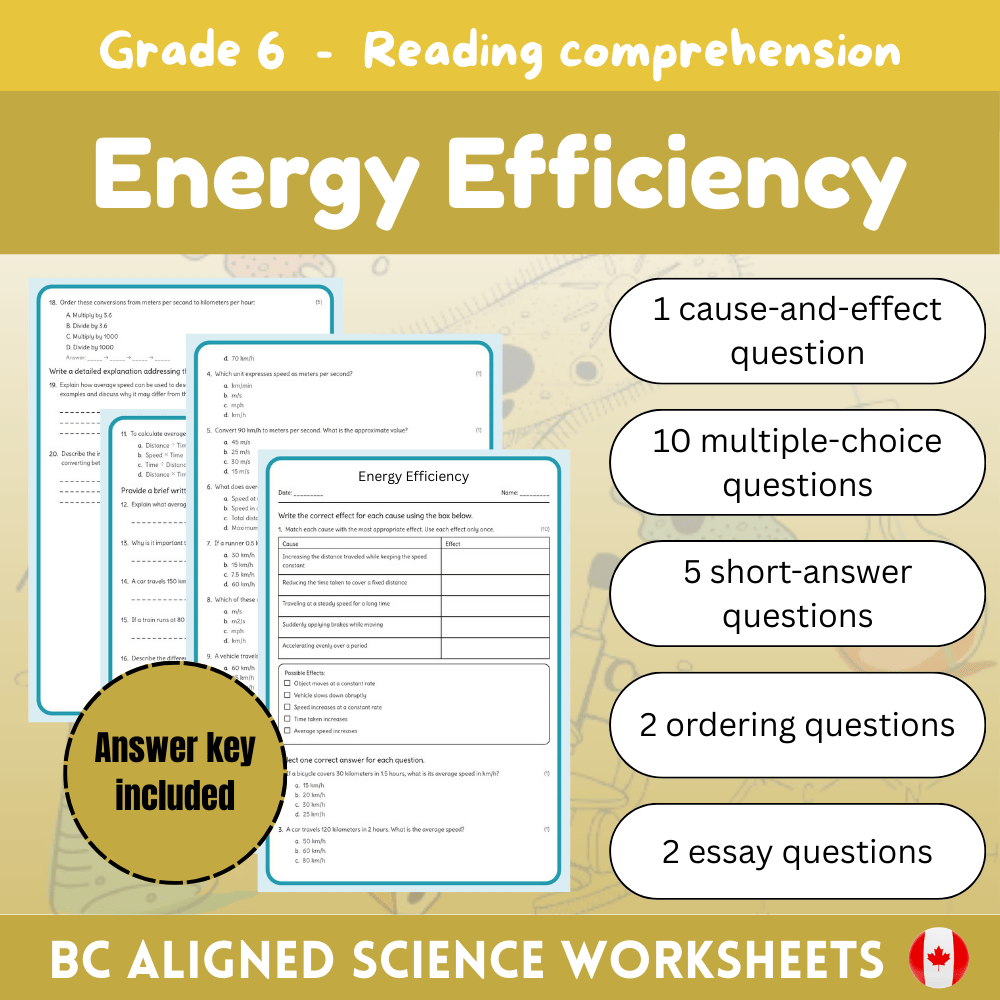
6th Grade Science | Energy Efficiency Worksheet + Answer Key – BC Standards
Created byBright Mind ResourcesLearning Objectives
- Define energy efficiency and explain its importance.
- Identify causes of energy loss in machines and systems.
- Evaluate different technologies based on their energy efficiency.
Instant download
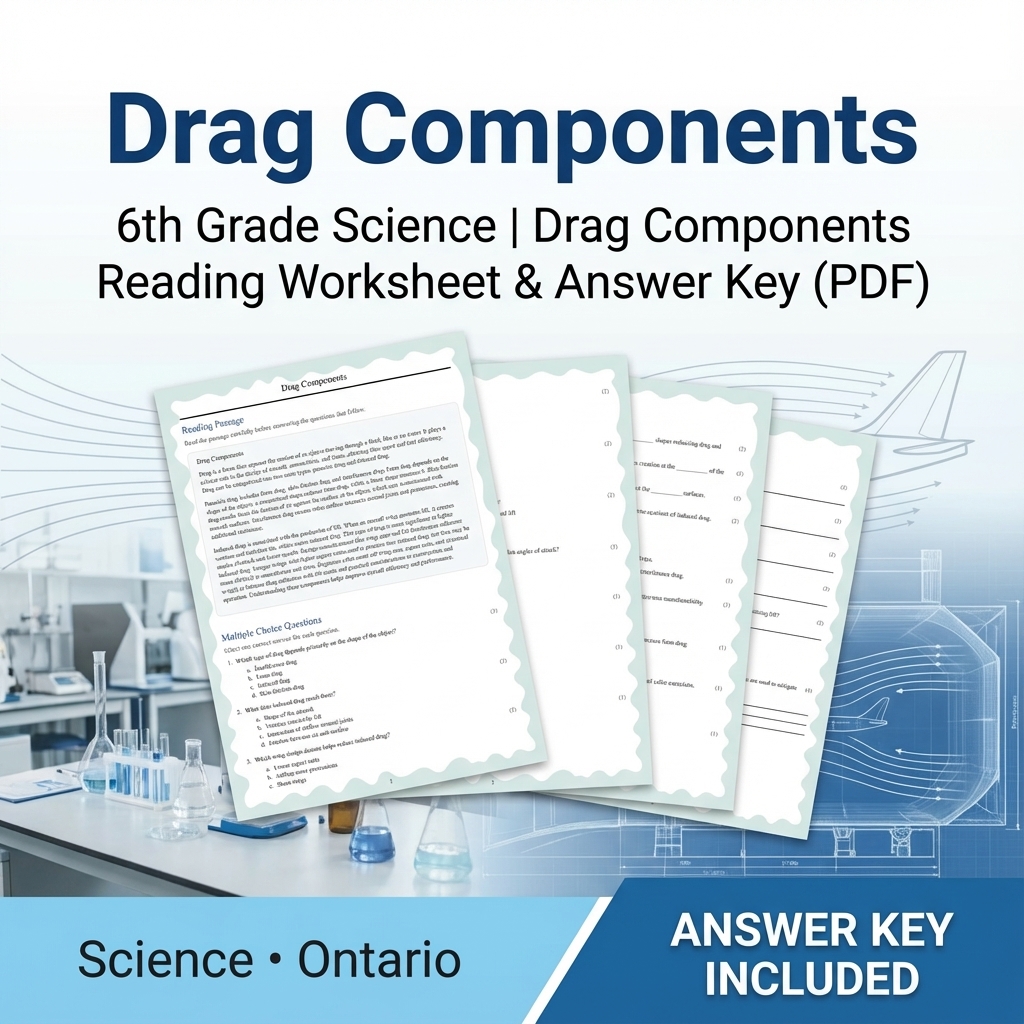
6th Grade Science | Drag Components Reading Worksheet & Answer Key (PDF)
JCreated byJ.S SheetsLearning Objectives
- Understand the different components of drag and their effects on aircraft performance.
- Describe how parasitic and induced drag depend on shape, speed, and wing design.
- Explain trade-offs in wing design related to drag reduction and lift production.
Also included in: Grade 6 Science | Aerodynamics & Flight Unit Worksheet Pack (PDF + Answer Keys) +1 more
Instant download
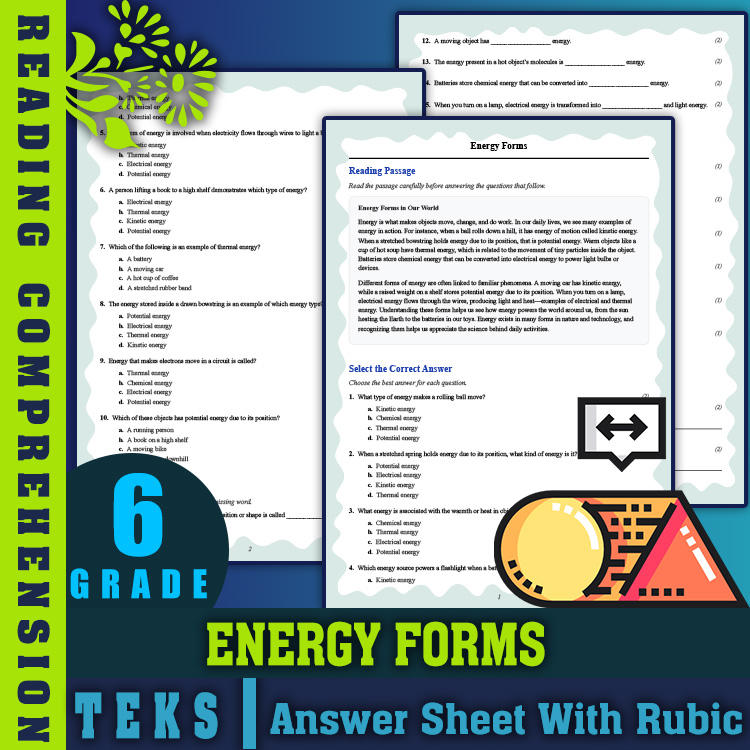
6th Grade Science | Energy Forms Reading Worksheet (PDF + Answer Key)
JCreated byJ.S SheetsLearning Objectives
- Identify and describe different forms of energy such as kinetic, potential, thermal, chemical, and electrical.
- Relate each form of energy to familiar phenomena and everyday objects.
- Distinguish between energy related to motion, position, internal activity, and stored energy.
Instant download
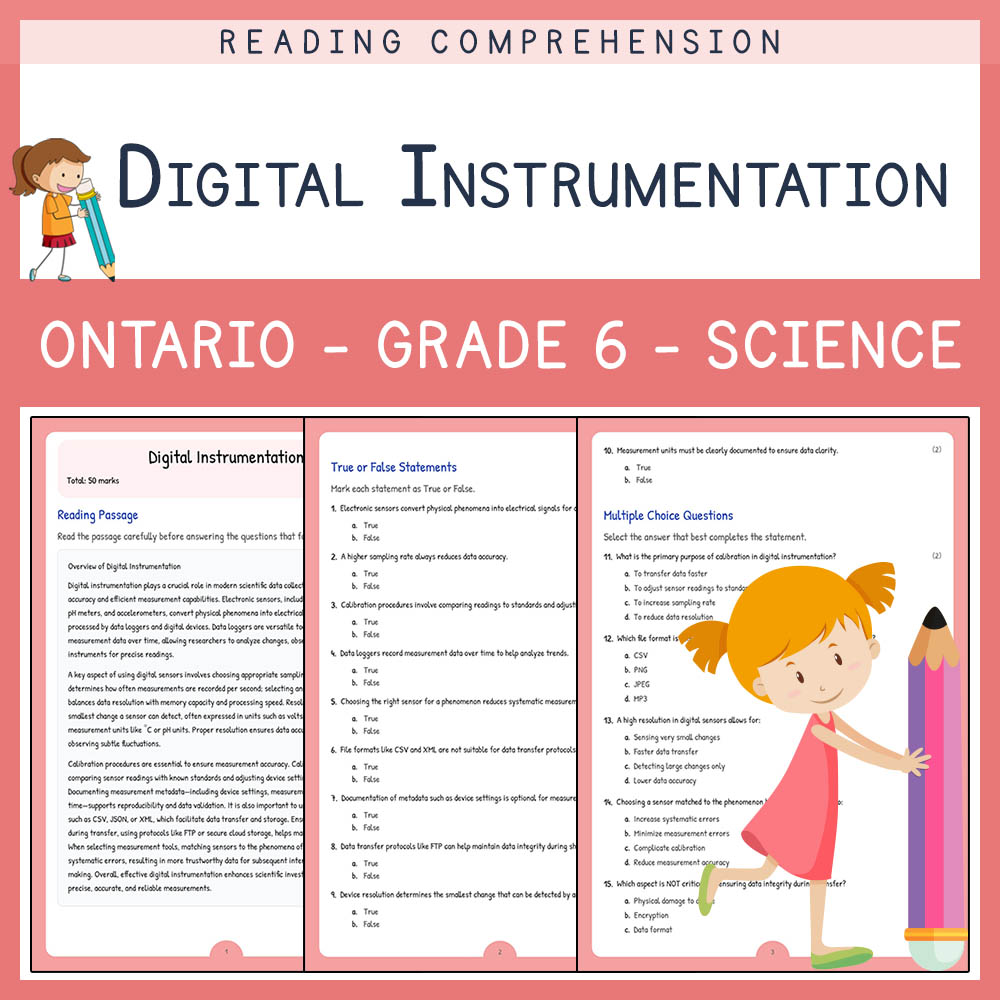
Grade 6 Science | Digital Instrumentation Worksheet & Answer Key (PDF)
Created byLumora LearningLearning Objectives
- Understand the components and functions of electronic sensors, data loggers, and digital probes.
- Identify proper procedures for calibration, operation, and metadata documentation of measurement tools.
- Explain the significance of sampling rate, resolution, units, and data integrity in digital measurements.
Instant download
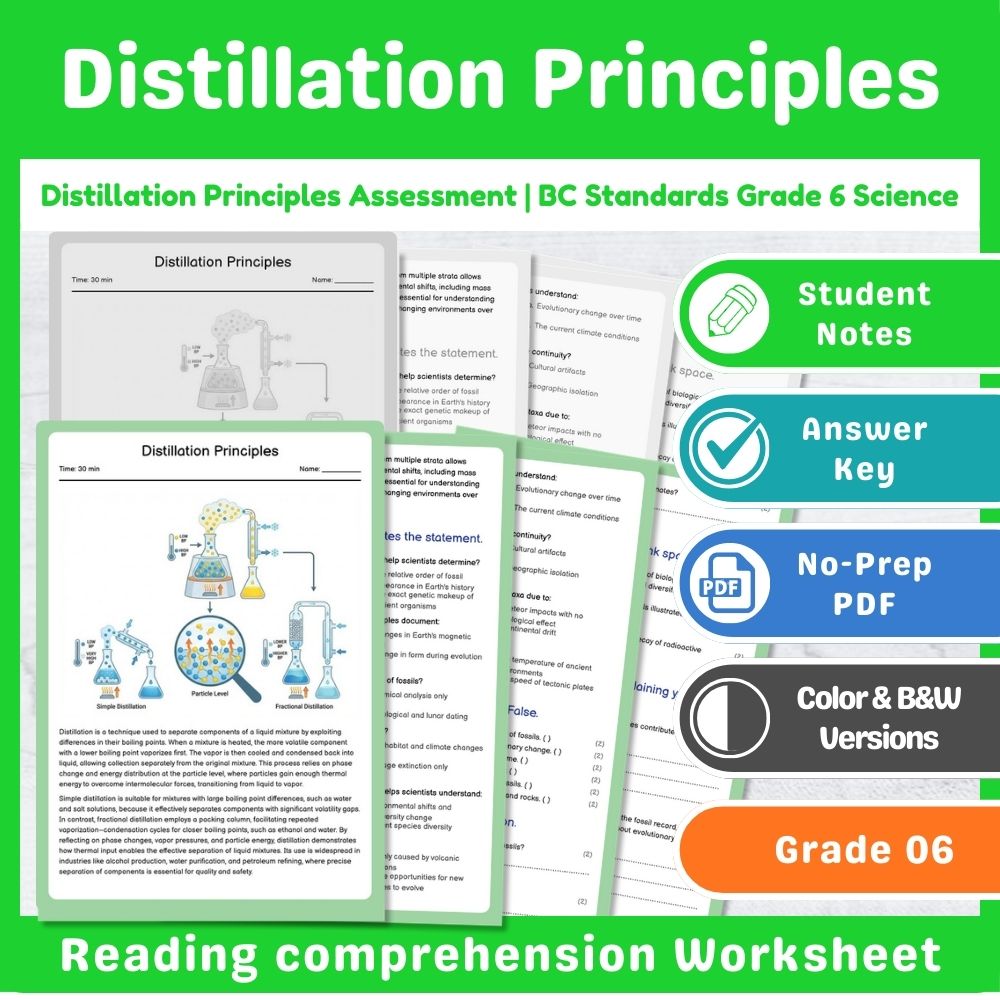
Distillation Principles Assessment | BC Standards Grade 6 Science
Created byPrism Point LearningLearning Objectives
- Explain the principle of distillation and how it separates components of a mixture.
- Differentiate between simple and fractional distillation methods.
- Describe the phase change process involved in distillation and its dependence on boiling points.
Instant download
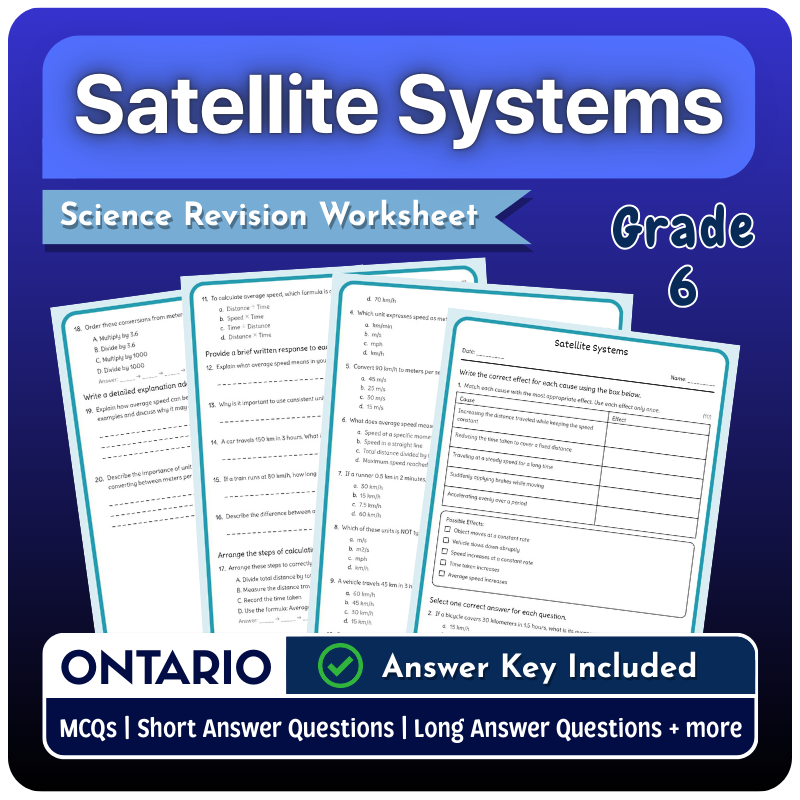
6th Grade Science | Exploring Satellite Systems Worksheet (PDF)
Created byBright Mind ResourcesLearning Objectives
- Identify the different functions and categories of artificial satellites.
- Understand the significance of orbital choices such as geostationary and polar orbits.
- Explain how satellite data contribute to Earth observation, communication, navigation, and scientific monitoring.
Instant download
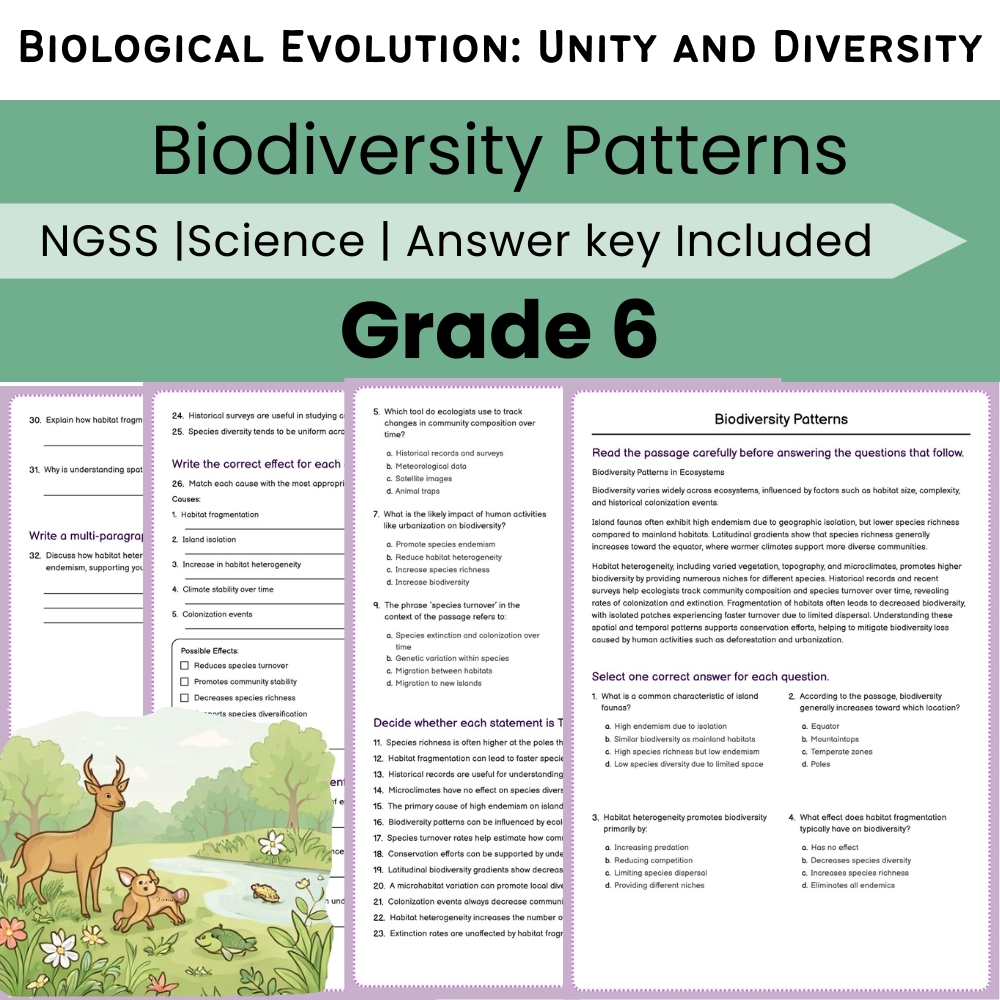
Grade 6 Science | Biodiversity Patterns Worksheet (Printable PDF & Assessment)
Learning Objectives
- Understand how species occurrence and richness reveal biodiversity patterns across ecosystems.
- Compare biodiversity variations in island, latitudinal, and habitat contexts.
- Interpret ecological and historical factors influencing biodiversity distribution.
Also included in: Grade 6 Science | Biological Evolution: Unity and Diversity Unit Bundle (NGSS-aligned Worksheets) +1 more
Instant download
About Grade 6 Science Worksheets
Explore Grade 6 Science worksheets for classwork, homework, or review. Our 5,969 printables download instantly as PDFs.
MyTeachingSheets worksheets are made by real teacher-authors and checked before they go live. Download any as a print-ready PDF for lessons, homework, or independent practice — most include answer keys, and previews are always free.