
Grade 6 Science Worksheets
5,969 worksheets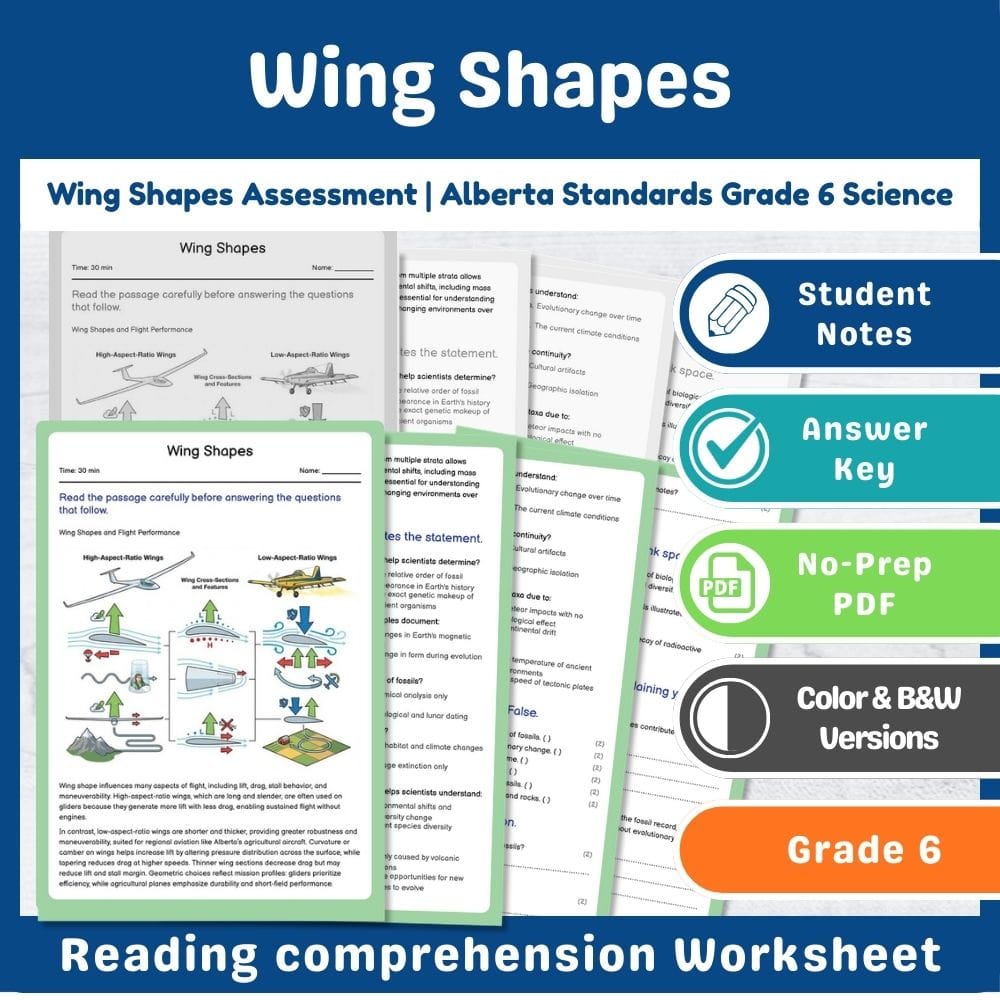
Wing Shapes Assessment | Alberta Standards Grade 6 Science
 Created byPrism Point Learning
Learning Objectives
- Understand how wing shape influences lift, stall behavior, and maneuverability.
- Identify features such as camber, thickness, and aspect ratio that affect flight performance.
- Compare high-aspect-ratio wings used on gliders with low-aspect wings on agricultural aircraft.
Also included in: Lesson Grade 6 Science Assessment | Alberta Standards and Topics
Instant download
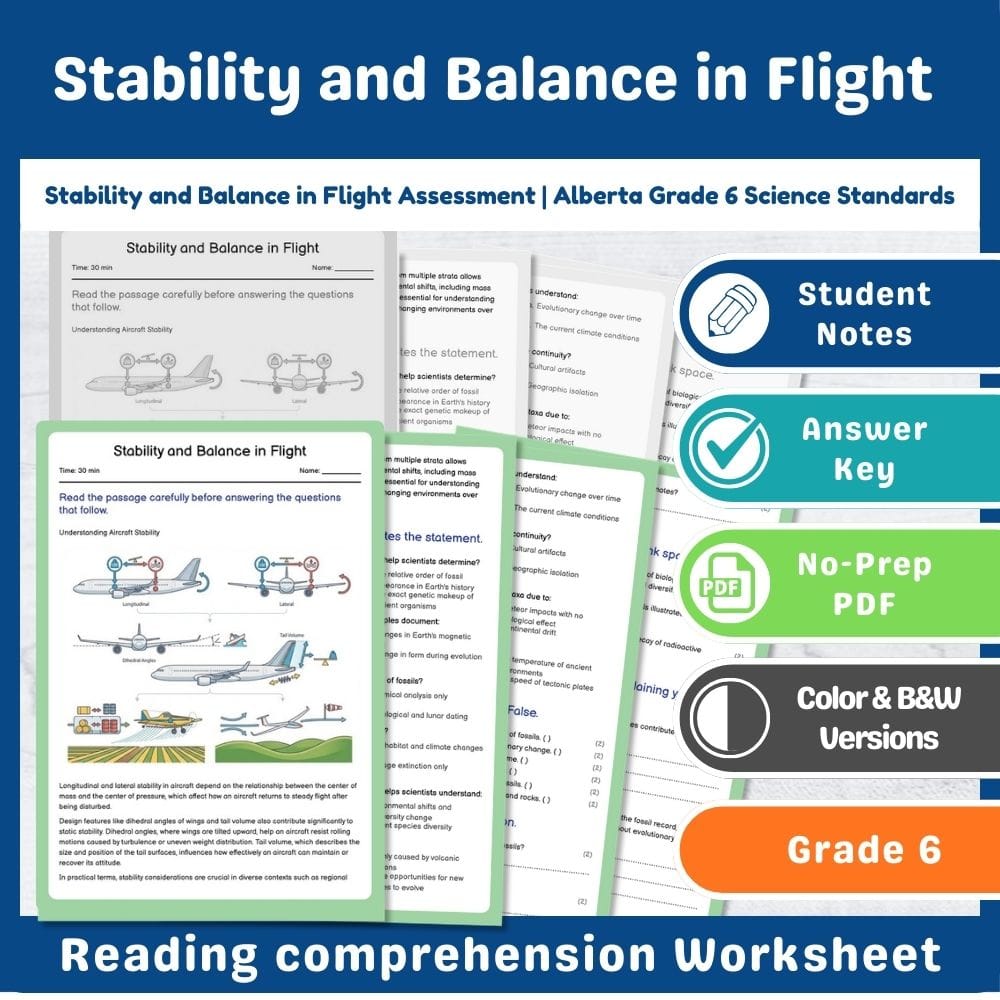
Stability and Balance in Flight Assessment | Alberta Grade 6 Science Standards
Created byPrism Point LearningLearning Objectives
- Understand how center of mass and center of pressure affect aircraft stability.
- Explain how design features like dihedral angles and tail volume influence static stability.
- Describe how balance impacts aircraft behavior under different payloads and wind conditions.
Also included in: Lesson Grade 6 Science Assessment | Alberta Standards and Topics
Instant download
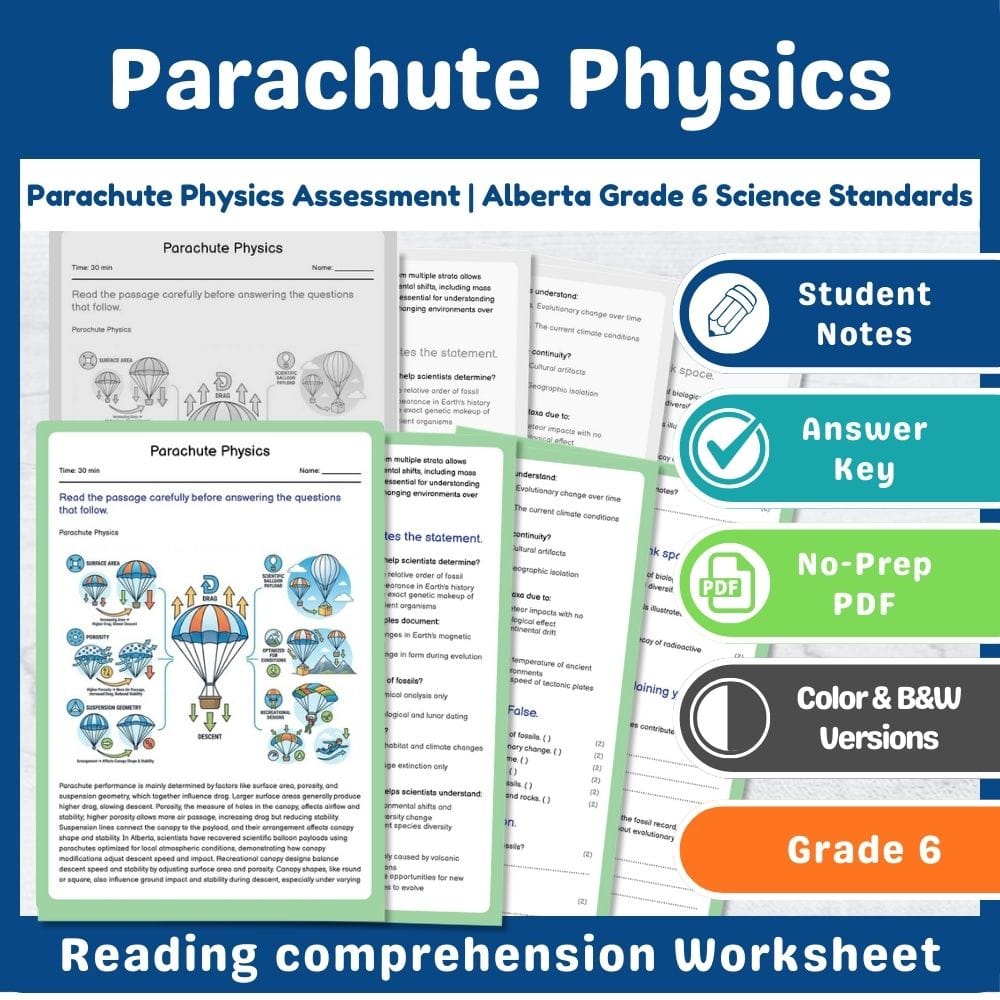
Parachute Physics Assessment | Alberta Grade 6 Science Standards
Created byPrism Point LearningLearning Objectives
- Understand how surface area, porosity, and suspension geometry affect parachute drag and descent rate.
- Explain how mass-to-area ratio influences terminal velocity during parachute descent.
- Analyze how canopy design trade-offs impact descent stability and ground impact in different atmospheric conditions.
Also included in: Lesson Grade 6 Science Assessment | Alberta Standards and Topics
Instant download
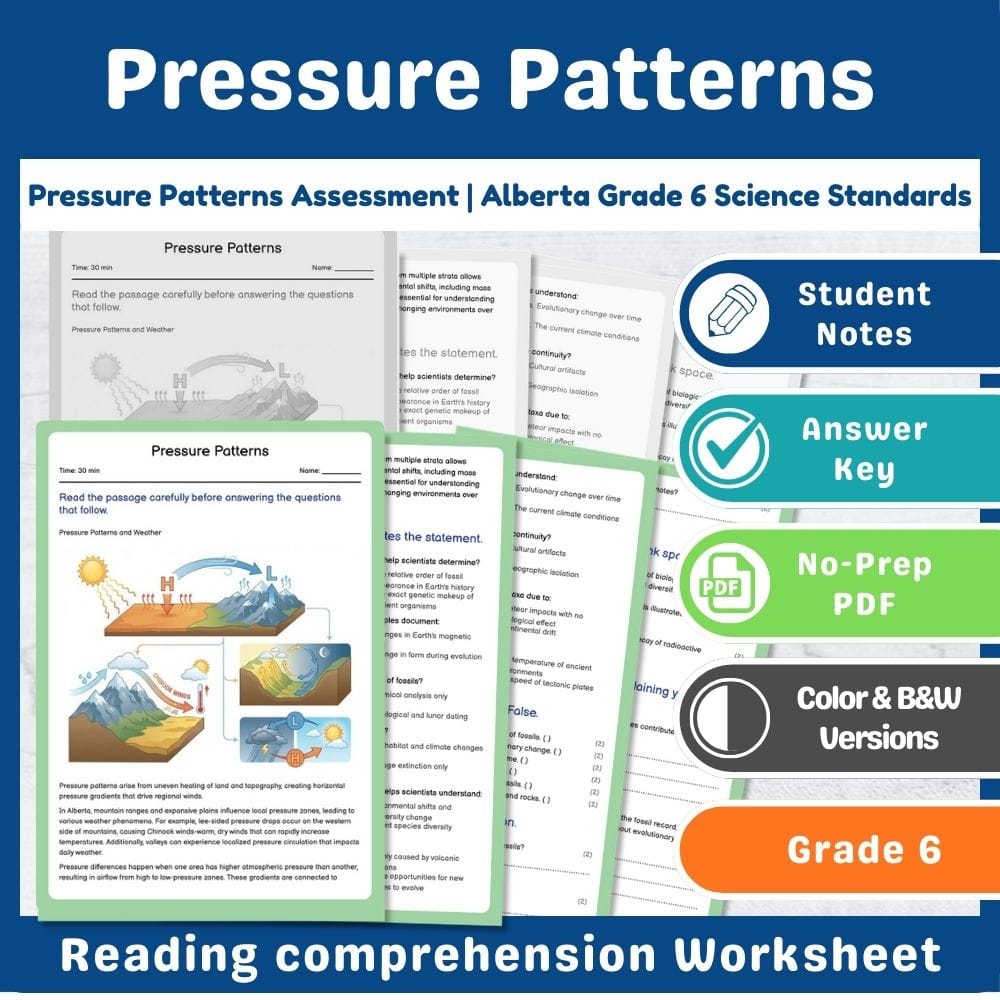
Pressure Patterns Assessment | Alberta Grade 6 Science Standards
Created byPrism Point LearningLearning Objectives
- Understand how pressure differences from uneven heating and topography influence wind patterns.
- Identify examples of pressure zones and their effects on regional weather in Alberta.
- Connect pressure gradients to everyday weather changes and forces experienced by moving bodies.
Also included in: Lesson Grade 6 Science Assessment | Alberta Standards and Topics
Instant download
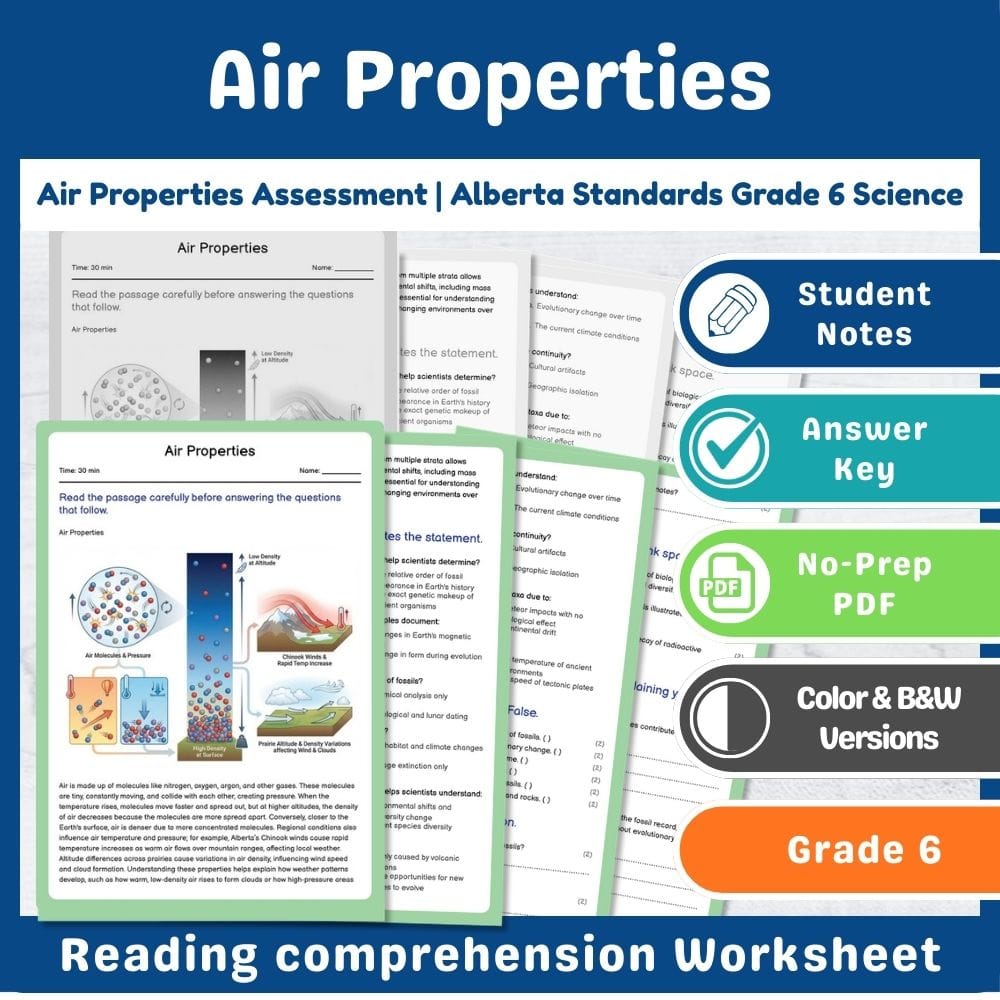
Air Properties Assessment | Alberta Standards Grade 6 Science
Created byPrism Point LearningLearning Objectives
- Understand the molecular composition of air and how it influences its properties.
- Explain how air density and pressure change with altitude and temperature.
- Describe regional examples, such as the Chinook wind, illustrating variations in air properties.
Also included in: Lesson Grade 6 Science Assessment | Alberta Standards and Topics
Instant download
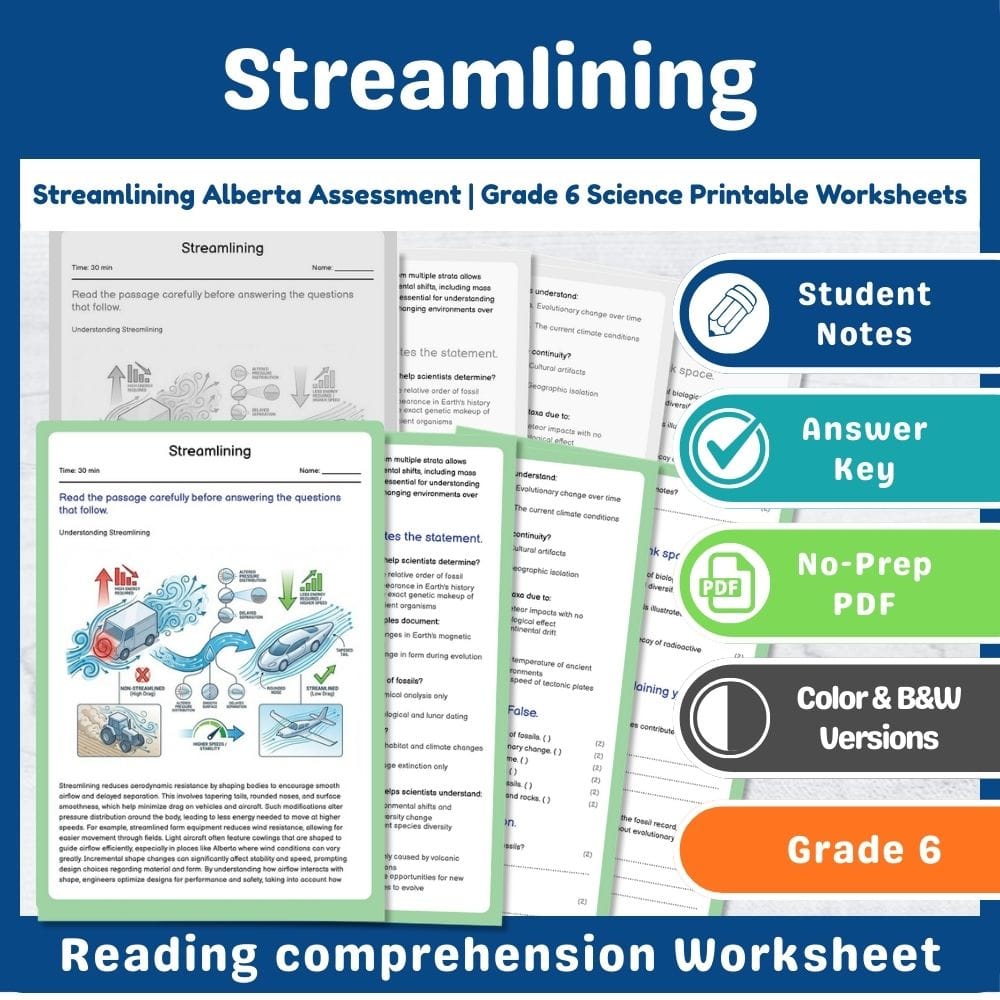
Streamlining Alberta Assessment | Grade 6 Science Printable Worksheets
Created byPrism Point LearningLearning Objectives
- Understand how the shape of objects affects their airflow and resistance.
- Identify key features like tapered tails and rounded noses that improve aerodynamics.
- Explain how shape changes influence pressure distribution and energy use in flight and machinery.
Also included in: Lesson Grade 6 Science Assessment | Alberta Standards and Topics
Instant download

Structural Traits Assessment | Florida NGSSS Grade 6 Science Worksheet
Created byPrism Point LearningLearning Objectives
- Explain how structural traits help organisms obtain food, move efficiently, and avoid predation
- Identify examples of structural adaptations (e.g., shells, webbed feet, long roots, camouflage) and match them to functions
- Use evidence from observations to describe how traits relate to specific habitats
Also included in: Grade 6 Ecosystems Science Lesson Bundle | Florida NGSSS Assessment
Instant download

Water and Resources Assessment | General Standards Grade 6 Science
Created byPrism Point LearningLearning Objectives
- Describe the stages of the water cycle and how it connects Earth's systems.
- Identify the processes involved in water movement and storage on Earth.
- Explain how land cover and temperature influence water infiltration, runoff, and ecosystem conditions.
Also included in: Grade 6 Life Science Science Lesson Bundle – General Framework Unit
Instant download
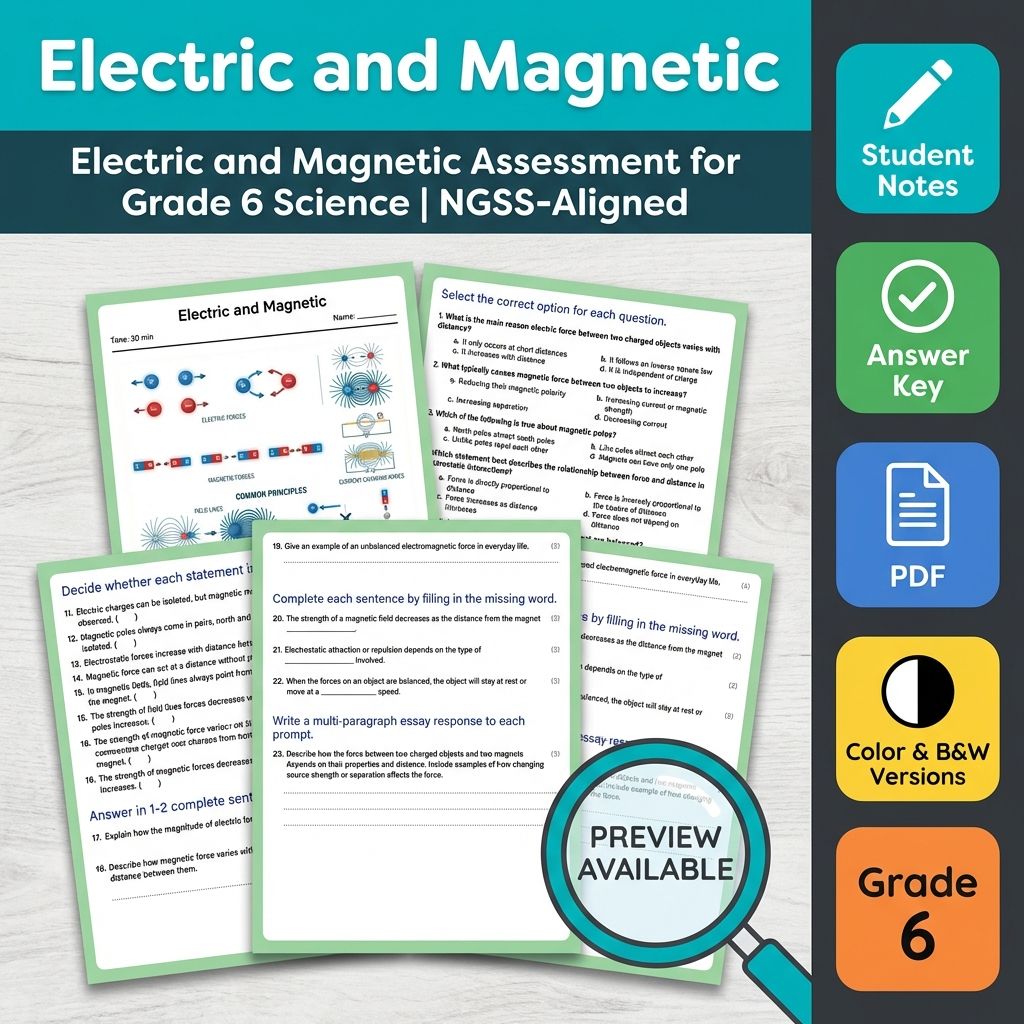
Electric and Magnetic Assessment for Grade 6 Science | NGSS-Aligned
Created byPrism Point LearningLearning Objectives
- Understand the basic properties of electric and magnetic forces and how they depend on source strength and separation.
- Identify examples of electrostatic and magnetic interactions in real-world situations.
- Analyze how the magnitude of forces varies with factors such as distance, charge, and current.
Also included in: Grade 6 Science Mini Bundle | Forces and Interactions NGSS Standards +1 more
Instant download
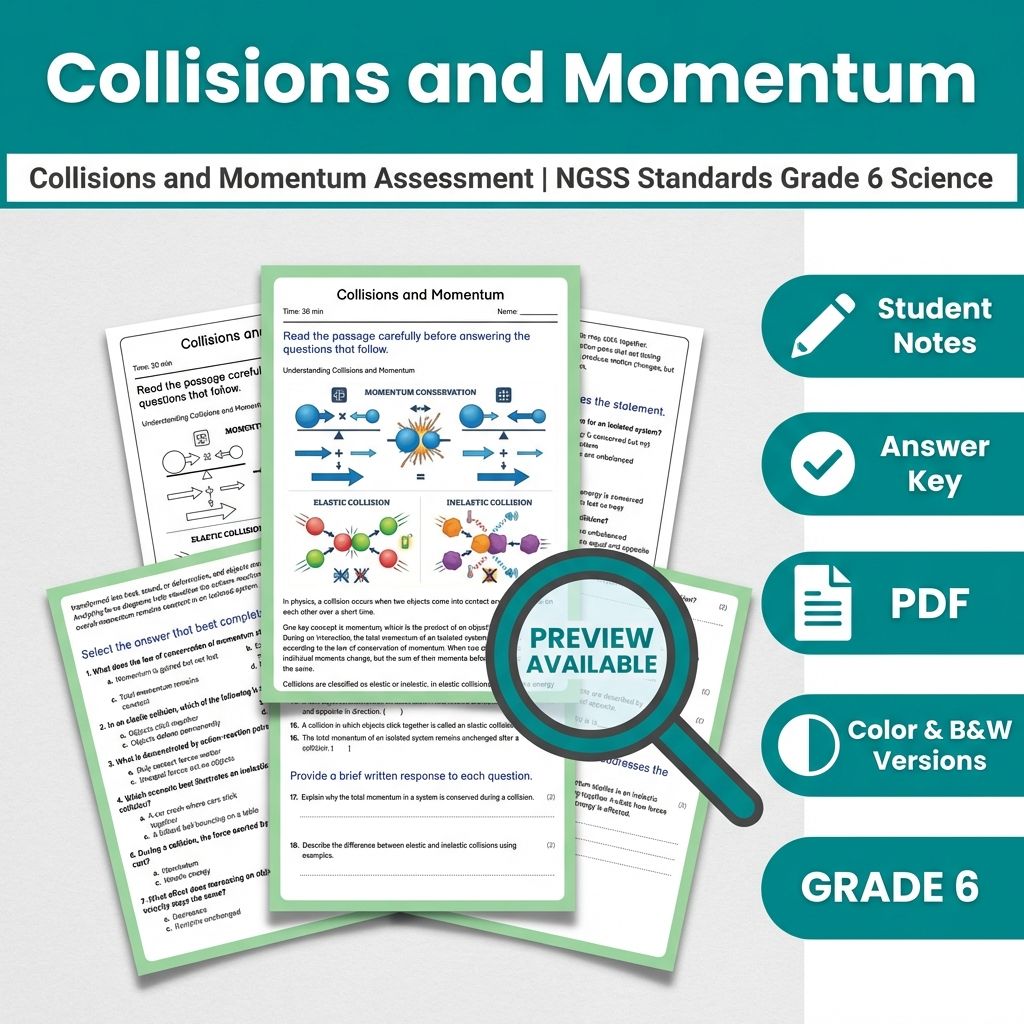
Collisions and Momentum Assessment | NGSS Standards Grade 6 Science
Created byPrism Point LearningLearning Objectives
- Understand the principles of conservation of momentum in two-body collisions.
- Differentiate between elastic and inelastic collisions through examples.
- Calculate momentum and analyze forces during object contact scenarios.
Also included in: Grade 6 Science Mini Bundle | Forces and Interactions NGSS Standards +1 more
Instant download
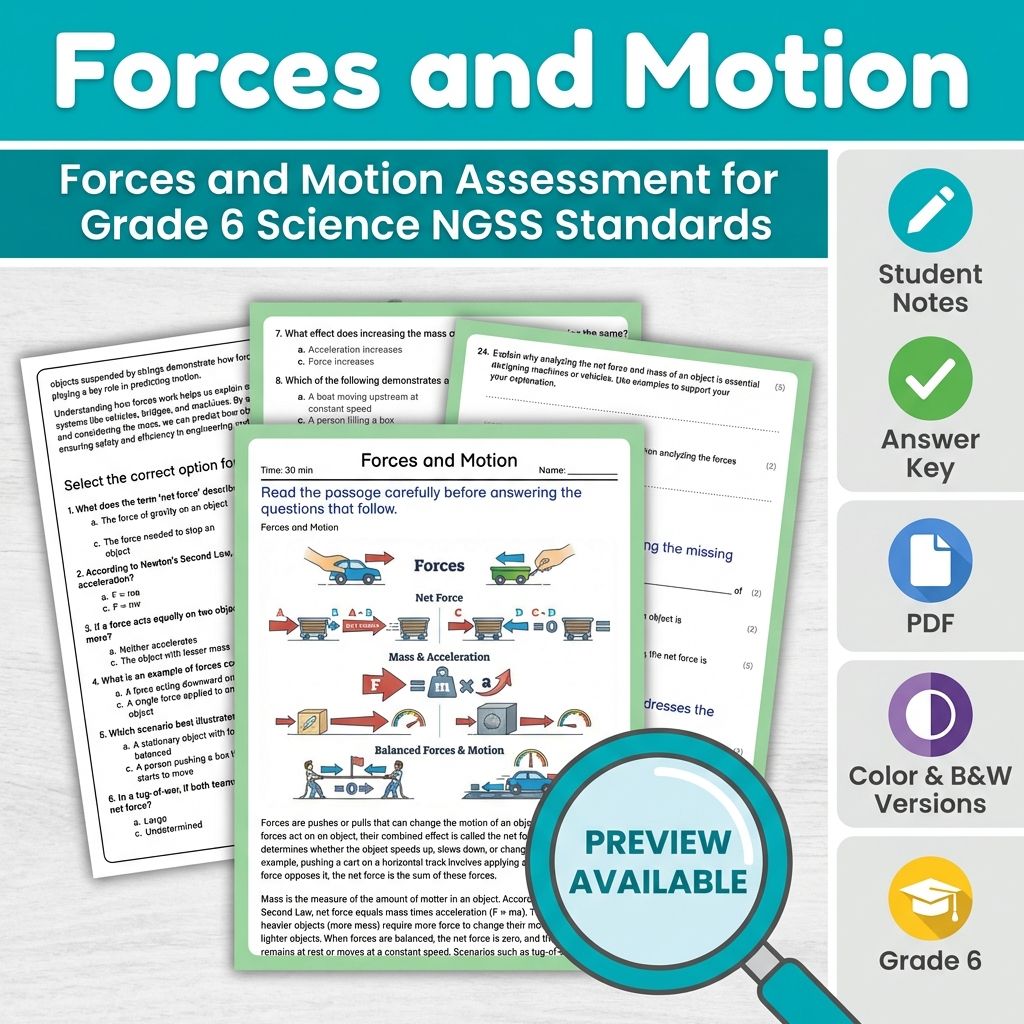
Forces and Motion Assessment for Grade 6 Science NGSS Standards
Created byPrism Point LearningLearning Objectives
- Explain how net force and mass influence the motion of objects.
- Describe real-life scenarios involving forces, such as carts on tracks and tugging systems.
- Apply the formula net force equals mass times acceleration to analyze motion.
Also included in: Grade 6 Science Mini Bundle | Forces and Interactions NGSS Standards +1 more
Instant download
Grade 6 Science | Inheritance Modeling Worksheet (NGSS Aligned, PDF)
 Created byBright Mind Resources
Learning Objectives
- Understand the concept of inheritance and how traits are transmitted from parents to offspring through genes.
- Learn to model inheritance patterns using Punnett squares and probability.
- Predict offspring trait ratios in monohybrid crosses, including dominant and recessive traits.
Also included in: Grade 6 Science Unit Bundle | Variation & Inheritance Worksheets (NGSS Aligned) +2 more
Instant download
6th Grade Science | Energy Forms Worksheet (Answer Key) | TEKS Aligned
Created byBright Mind ResourcesLearning Objectives
- Identify and describe common forms of energy: kinetic, potential, thermal, chemical, and electrical.
- Relate each energy form to familiar phenomena such as moving objects, stretched springs, warm objects, and batteries.
- Distinguish among different energy types based on their characteristics and everyday examples.
Instant download
6th Grade Science | Scale of Space | NGSS ( Worksheet + Answer Key )
 Created byCedar Grove Learning
Learning Objectives
- Understand the relative sizes and distances of objects in the solar system using proportional models and log scales.
- Interpret data tables and charts to compare planetary properties and orbital periods.
- Describe the use of astronomical units and planetary radii to understand spatial relationships within the solar system.
Also included in: Grade 6 Science Unit Bundle | Space, Motion & Earth Cycles NGSS Worksheets +1 more
Instant download
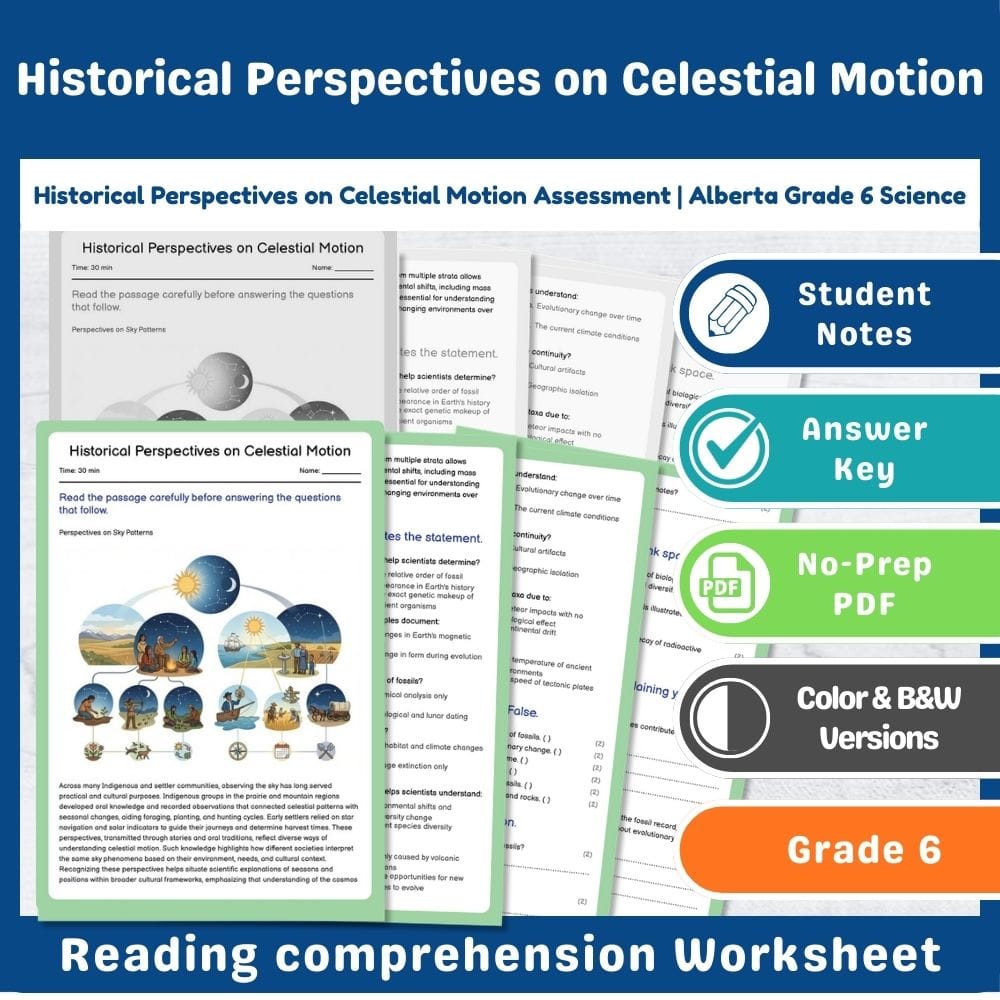
Historical Perspectives on Celestial Motion Assessment | Alberta Grade 6 Science
Created byPrism Point LearningLearning Objectives
- Understand how Indigenous and settler communities historically interpreted sky patterns for practical and cultural purposes.
- Identify different observational strategies used by various communities to track celestial movements.
- Explain the significance of solar and lunar cycles in cultural practices and navigation.
Also included in: Lesson Grade 6 Science Assessment | Celestial & Earth Movements
Instant download
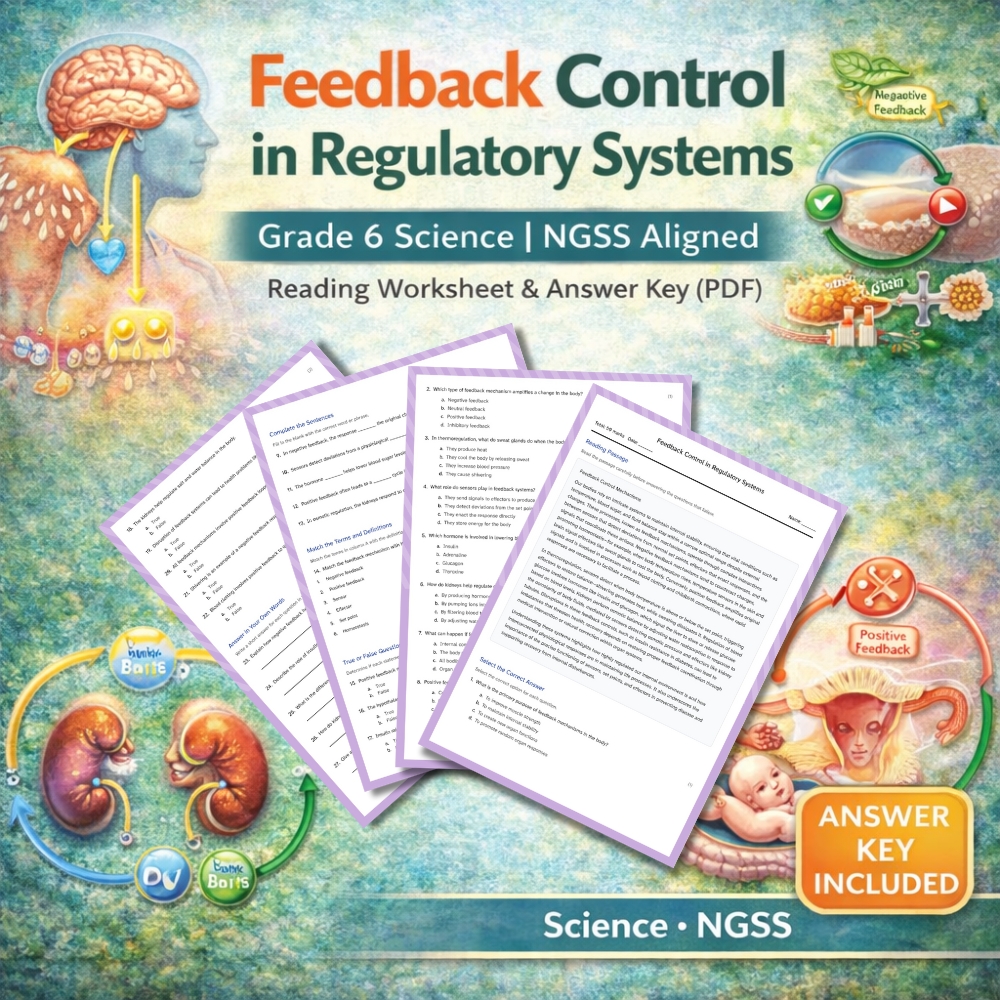
6th Grade Science | Feedback Control in Regulatory Systems | NGSS Worksheet
Created byCedar Grove LearningLearning Objectives
- Describe how negative and positive feedback mechanisms maintain internal stability in the body.
- Identify examples of feedback control such as thermoregulation, blood glucose regulation, and osmotic balance.
- Explain the roles of sensors, set points, and effectors in physiological feedback systems.
Also included in: Grade 6 Science Worksheet Bundle | Cell Processes & Systems NGSS(PDF+Answer Key) +1 more
Instant download
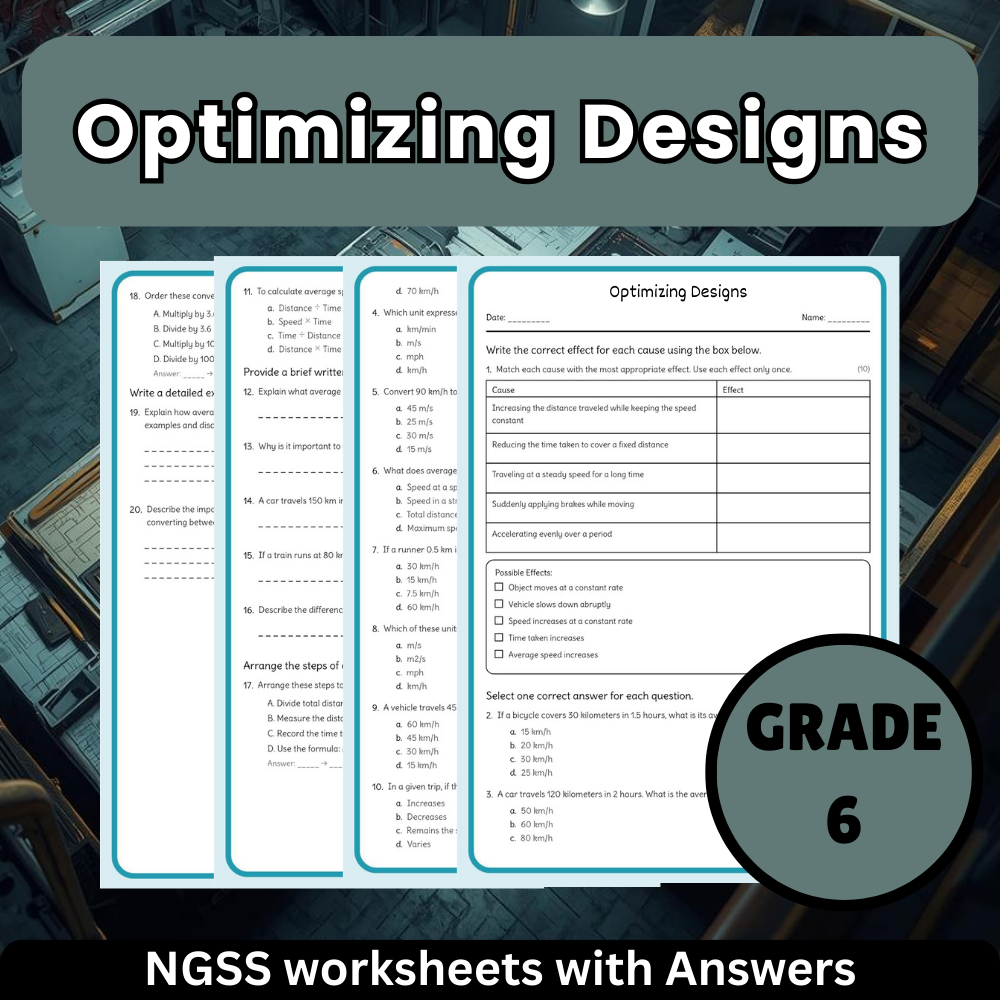
6th Grade Science | Optimizing Designs Worksheet (NGSS Aligned) PDF
Created byBright Mind ResourcesLearning Objectives
- Analyze data from comparative tests to identify performance characteristics and trade-offs.
- Use graphs, averages, and error discussion to support decision-making.
- Evaluate different design options by comparing strengths and weaknesses.
Also included in: Grade 6 Science | Designing and Solving Problems Unit Bundle (NGSS Aligned) +2 more
Instant download
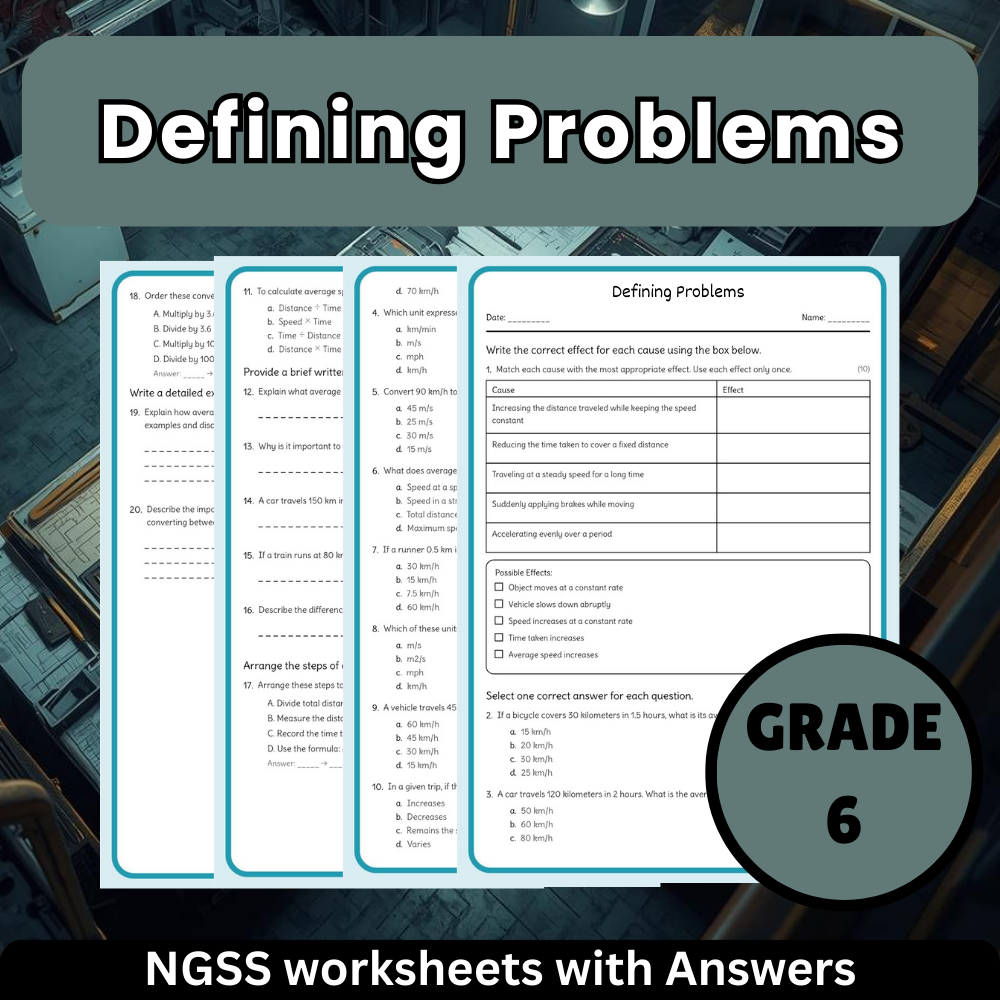
6th Grade Science | Defining Problems Worksheet (NGSS Aligned) – Science PDF
Created byBright Mind ResourcesLearning Objectives
- Understand how to specify criteria and constraints for a design problem.
- Identify relevant scientific principles that relate cause and effect.
- Use models to clarify problem requirements and potential impacts on systems.
Also included in: Grade 6 Science | Designing and Solving Problems Unit Bundle (NGSS Aligned) +2 more
Instant download
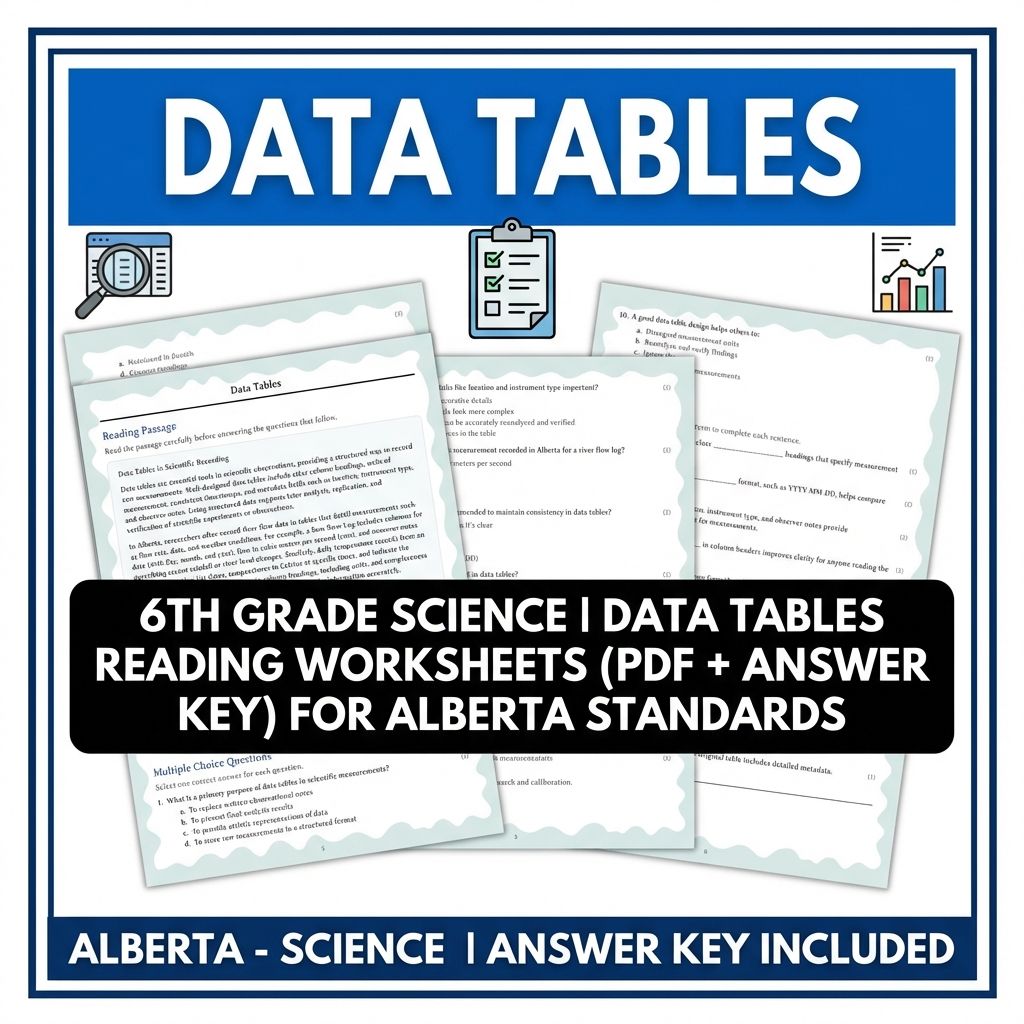
6th Grade Science | Data Tables (PDF + Answer Key) for Alberta Standards
JCreated byJ.S SheetsLearning Objectives
- Understand the purpose of data tables in recording measurements.
- Identify key components such as column headings, units, and timestamps.
- Learn best practices for recording metadata like location, instrument type, and observer notes.
Also included in: Grade 6 Science Bundle – Data Analysis, Scientific Inquiry & Measurement Skills +1 more
Instant download
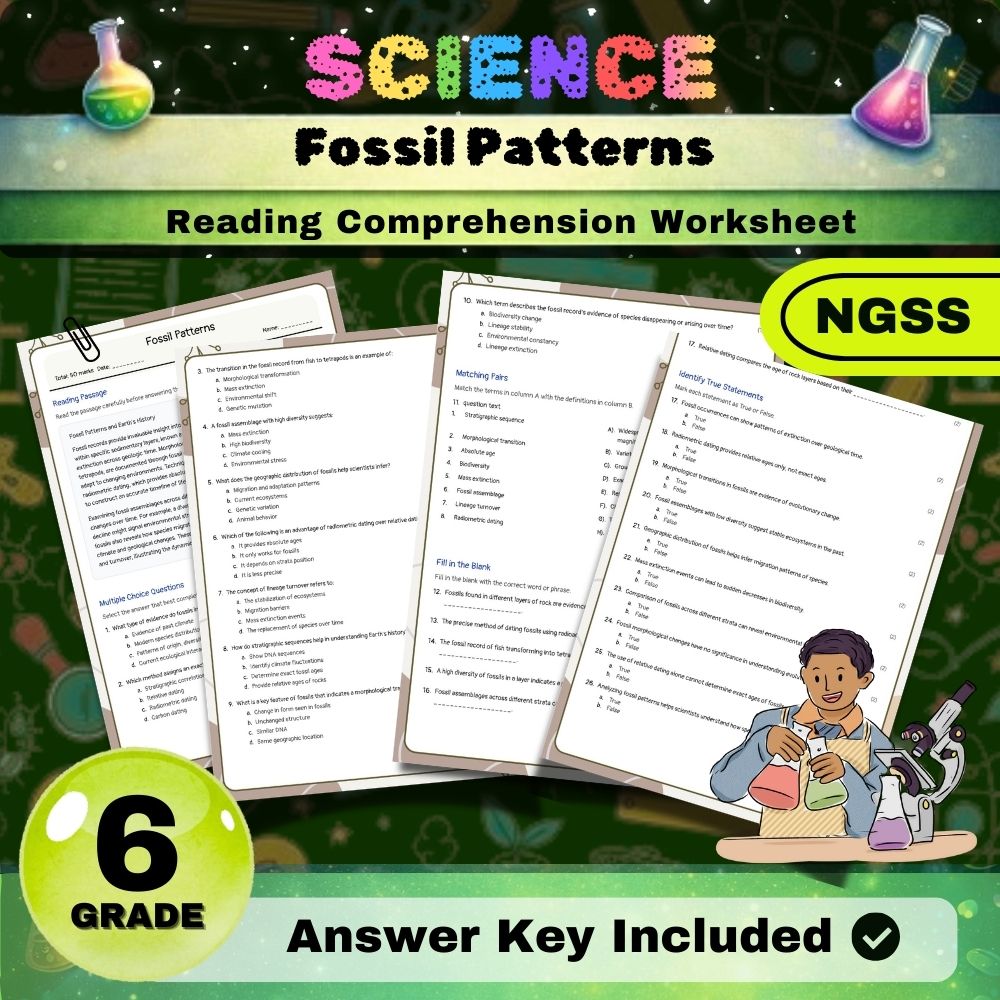
6th Grade Science | Fossil Patterns NGSS Worksheet (PDF + Google Form)
 Created byMaple Path Learning
Learning Objectives
- Understand how fossil occurrences and stratigraphy reveal patterns of life's history.
- Identify morphological transitions in the fossil record, such as fish to tetrapod evolution.
- Explain methods like relative and radiometric dating used to determine fossil ages.
Also included in: Grade 6 Science Bundle | Evolution, Natural Selection & Biodiversity Worksheets +1 more
Instant download

Ethical Dimensions Worksheet | Grade 6 Science Activities
Created byPrism Point LearningLearning Objectives
- Explain how ethical principles like beneficence and risk minimization apply to scientific decisions.
- Identify how privacy, informed consent, and responsible data use should guide the use of human-related scientific data.
- Evaluate environmental and long-term ecological impacts when applying scientific knowledge or new technologies.
Also included in: Grade 6 Science Ethics and Societal Impacts Lesson Bundle for TEKS +1 more
Instant download

Grade 6 Component Functions Worksheet | Ontario Science Assessment
 Created byClear Sky Classroom
Learning Objectives
- Identify the function of key circuit components such as power sources, resistive loads, switches, and connectors
- Connect physical circuit parts to their typical schematic roles and symbols in simple lighting and motor circuits
- Explain how component functions influence qualitative current and voltage behavior
Instant download
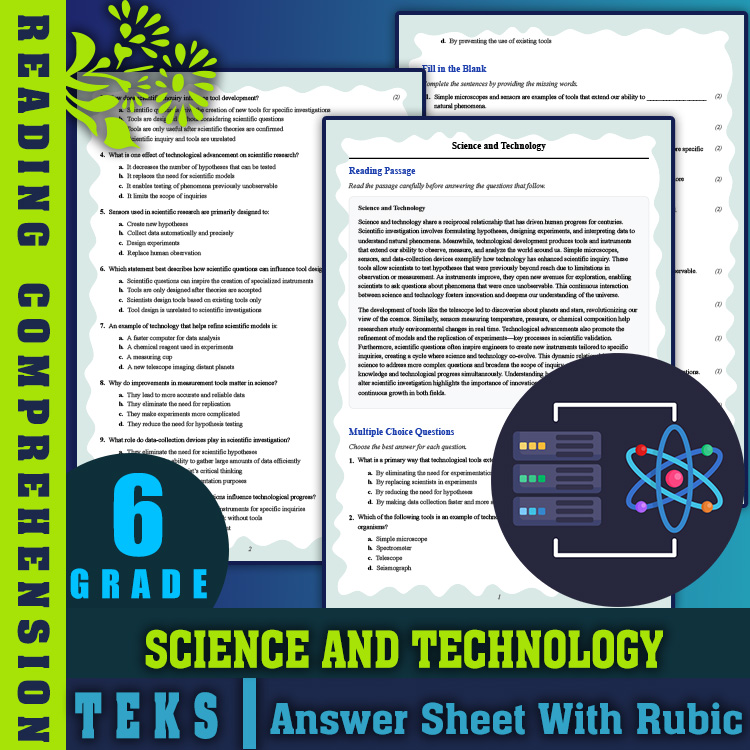
6th Grade Science | Technology in Science Reading Worksheet with Answer Key
JCreated byJ.S SheetsLearning Objectives
- Understand how scientific investigation and technological development influence each other.
- Explore examples of instruments and tools that extend observation and measurement in science.
- Analyze how technological advances can expand the scope of scientific inquiries.
Instant download
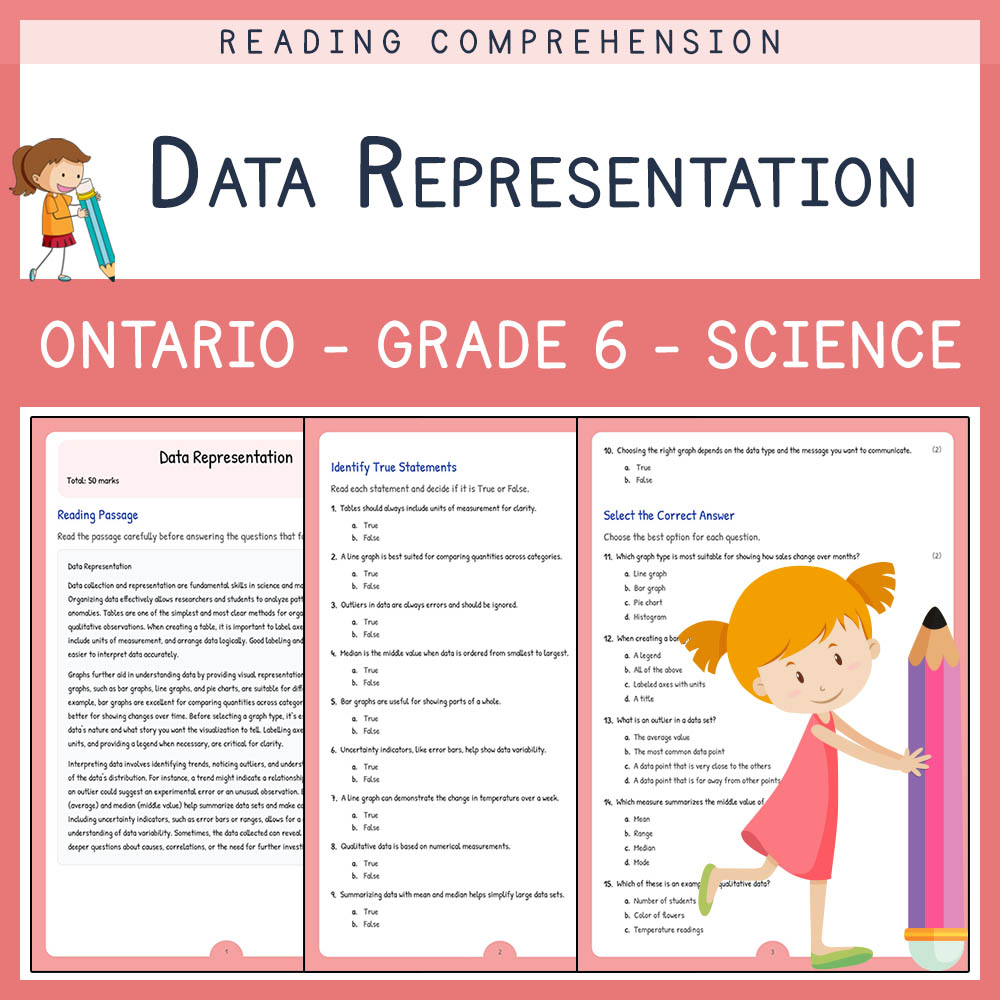
Grade 6 Science | Data Representation Worksheet (PDF + Answer Key) for Ontario Standards
 Created byLumora Learning
Learning Objectives
- Understand ways to organize and display data using tables and graphs.
- Identify appropriate graph types for different data sets.
- Interpret data patterns, including trends and outliers, from various representations.
Instant download
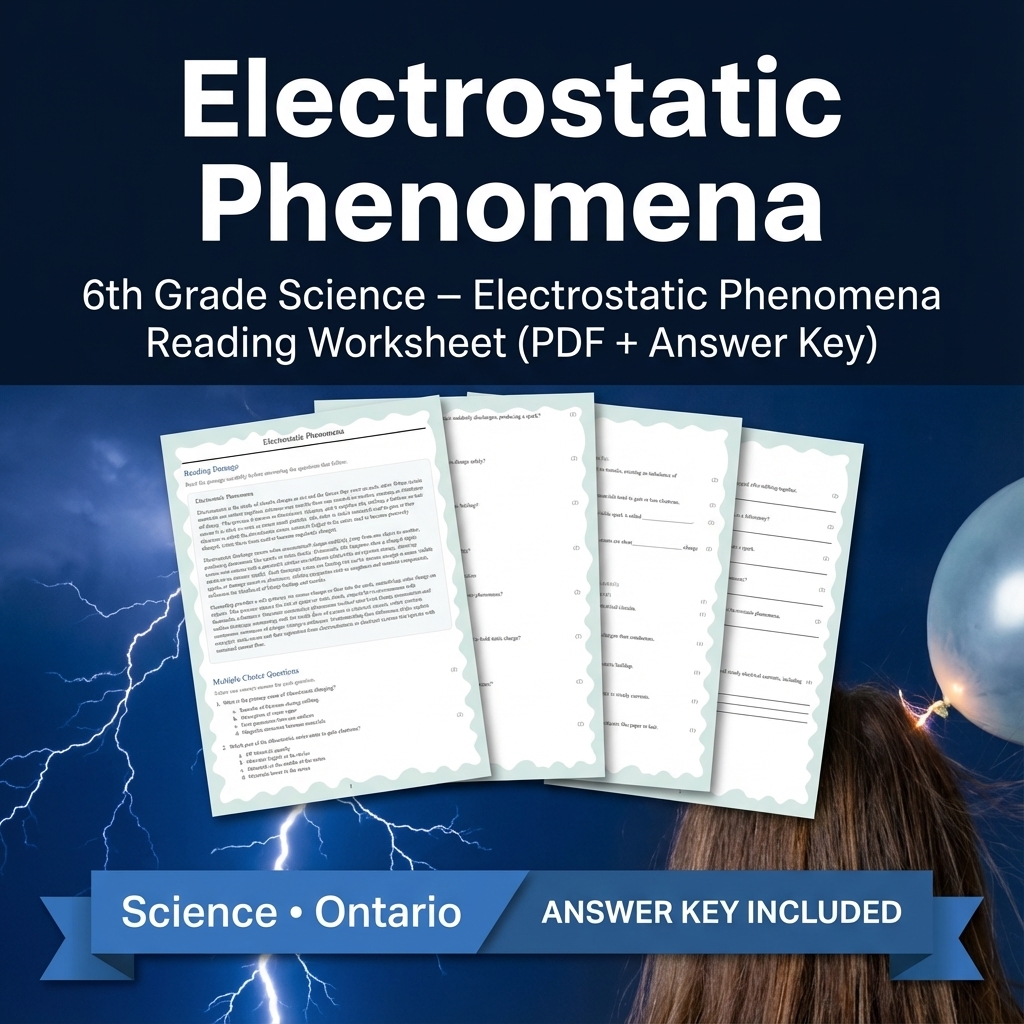
6th Grade Science – Electrostatic Phenomena Reading Worksheet (PDF + Answer Key)
JCreated byJ.S SheetsLearning Objectives
- Understand the principles of static charge transfer and the triboelectric series.
- Describe phenomena such as attraction, repulsion, and sparks caused by static electricity.
- Explain grounding and charge neutralization concepts.
Also included in: Grade 6 Science Circuit & Electricity Unit Bundle – Worksheets & Answer Keys +1 more
Instant download
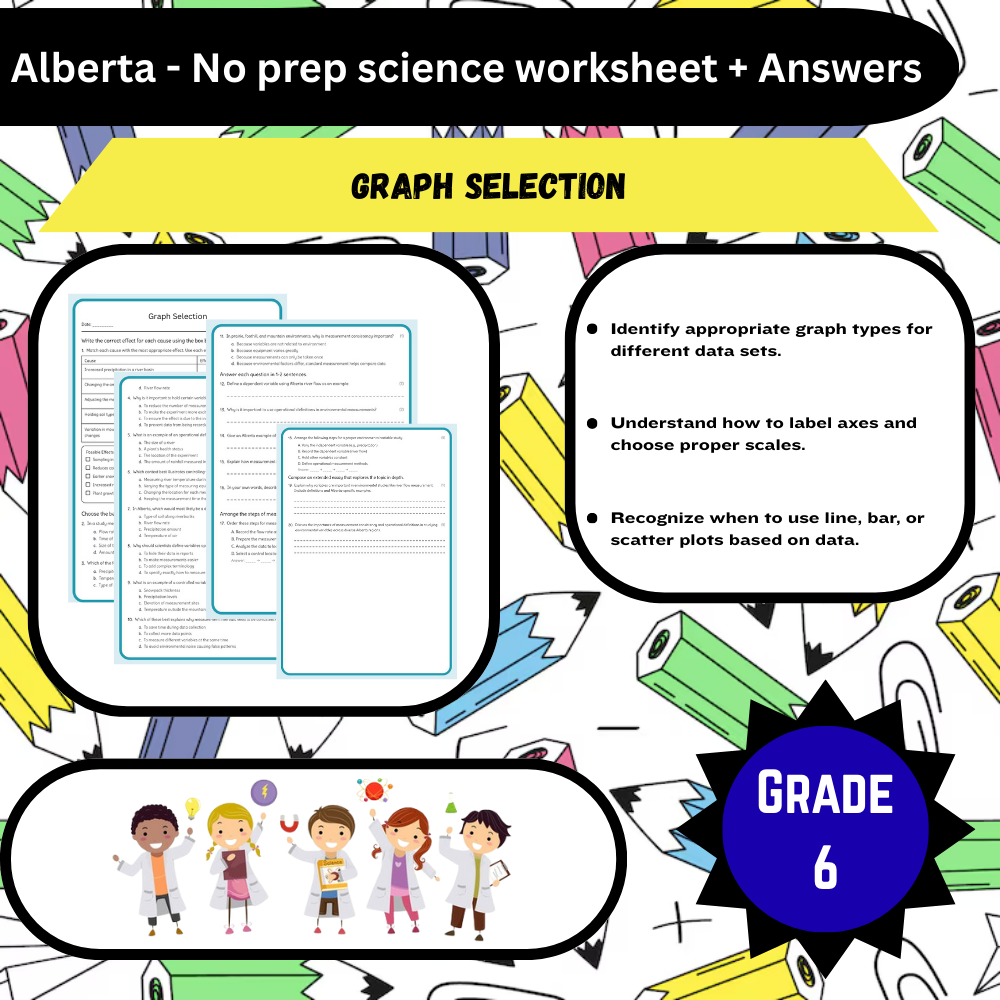
6th Grade Science | Graph Selection Worksheet (PDF) - Alberta Standards
Created byBright Mind ResourcesLearning Objectives
- Identify appropriate graph types for different data sets.
- Understand how to label axes and choose proper scales for graphs.
- Recognize when to use line graphs, bar charts, and scatter plots based on data characteristics.
Instant download
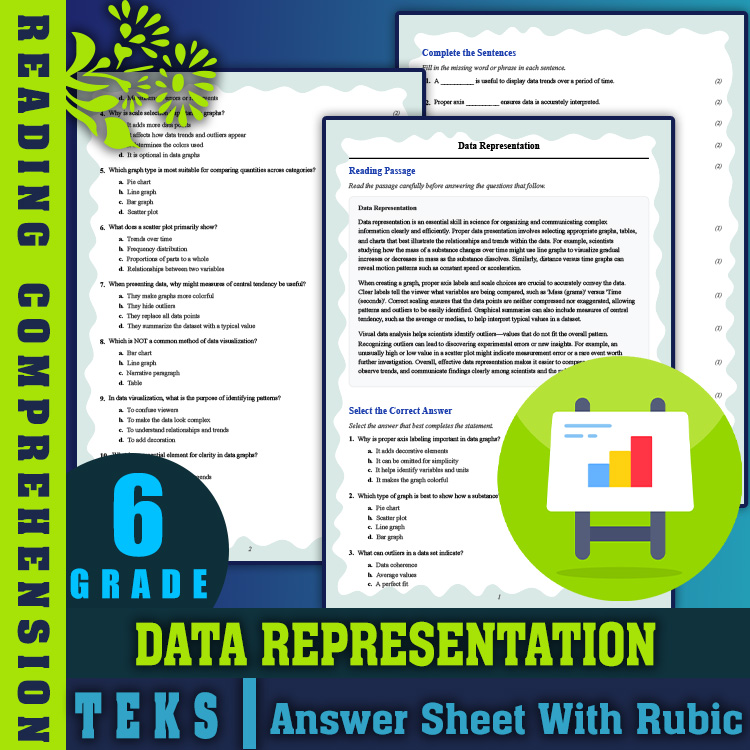
6th Grade Science | Data Representation Reading Worksheet & Answer Key (PDF)
JCreated byJ.S SheetsLearning Objectives
- Understand the conventions for organizing data in tables, line graphs, bar graphs, and scatter plots.
- Apply the principles of data presentation to interpret trends and relationships in datasets.
- Identify proper axis labeling, scale selection, and graphical summaries of data.
Instant download
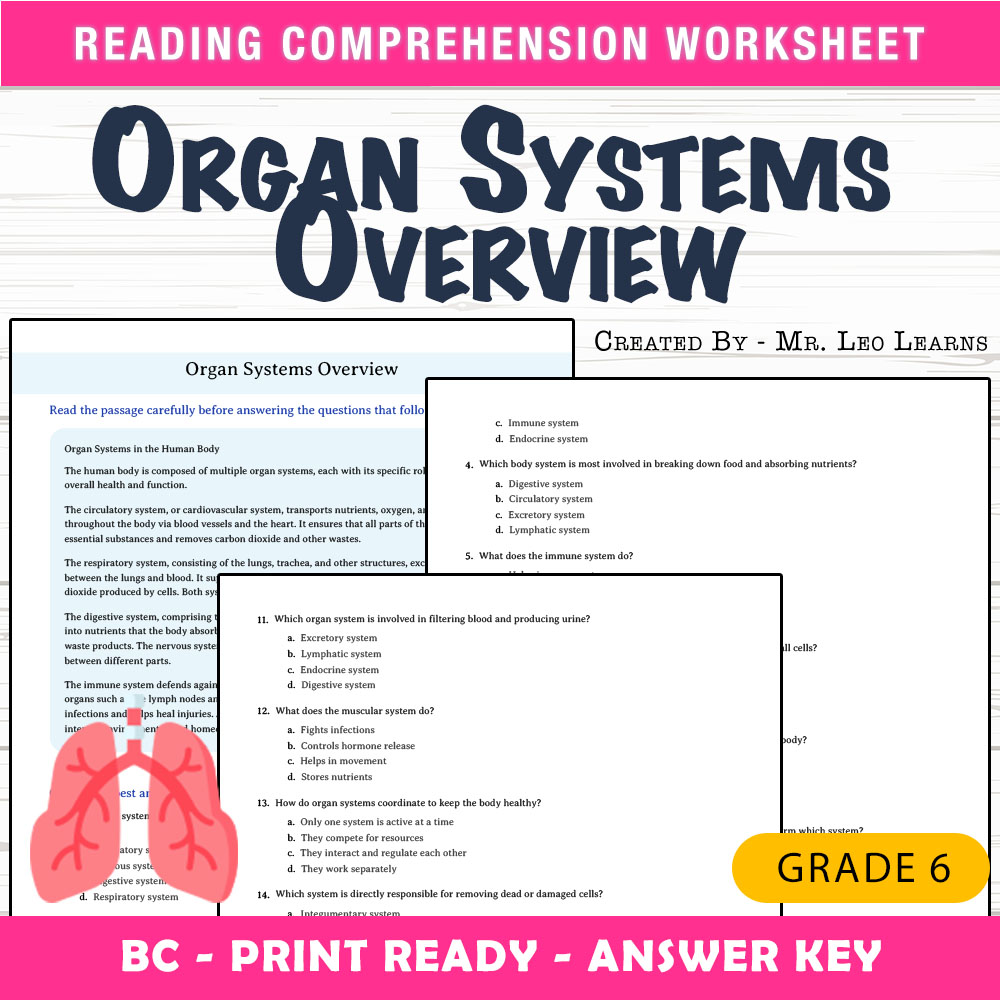
Grade 6 Science — Organ Systems Overview Worksheet MCQ Paper for Mastery
 Created byThe Resource Hub
Learning Objectives
- Identify the major organ systems and their principal functions.
- Explain how different organ systems interact to maintain internal balance.
- Describe the roles of transport, exchange, digestion, defense, and control in the body.
Also included in: Grade 6 Science Unit | Multicellular Systems & Functions Worksheet Bundle +1 more
Instant download
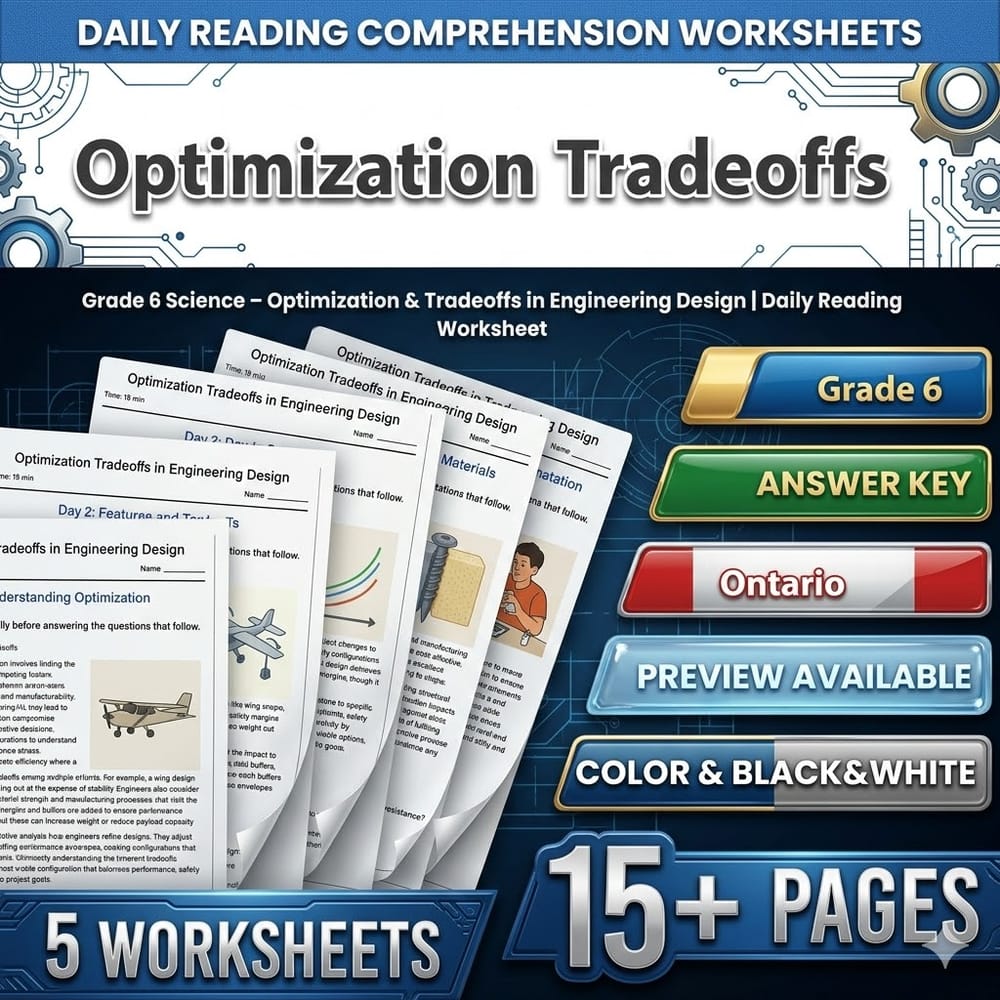
Grade 6 Science – Optimization & Tradeoffs in Engineering | Daily Worksheet
 Created byQuiet Forest Education
Learning Objectives
- Understand the concept of tradeoffs in engineering design.
- Identify key factors influencing optimization tradeoffs.
- Analyze how different design choices impact overall performance.
Also included in: Flight Science Grade 6 Daily Reading Worksheets Bundle | Ontario +1 more
Instant download
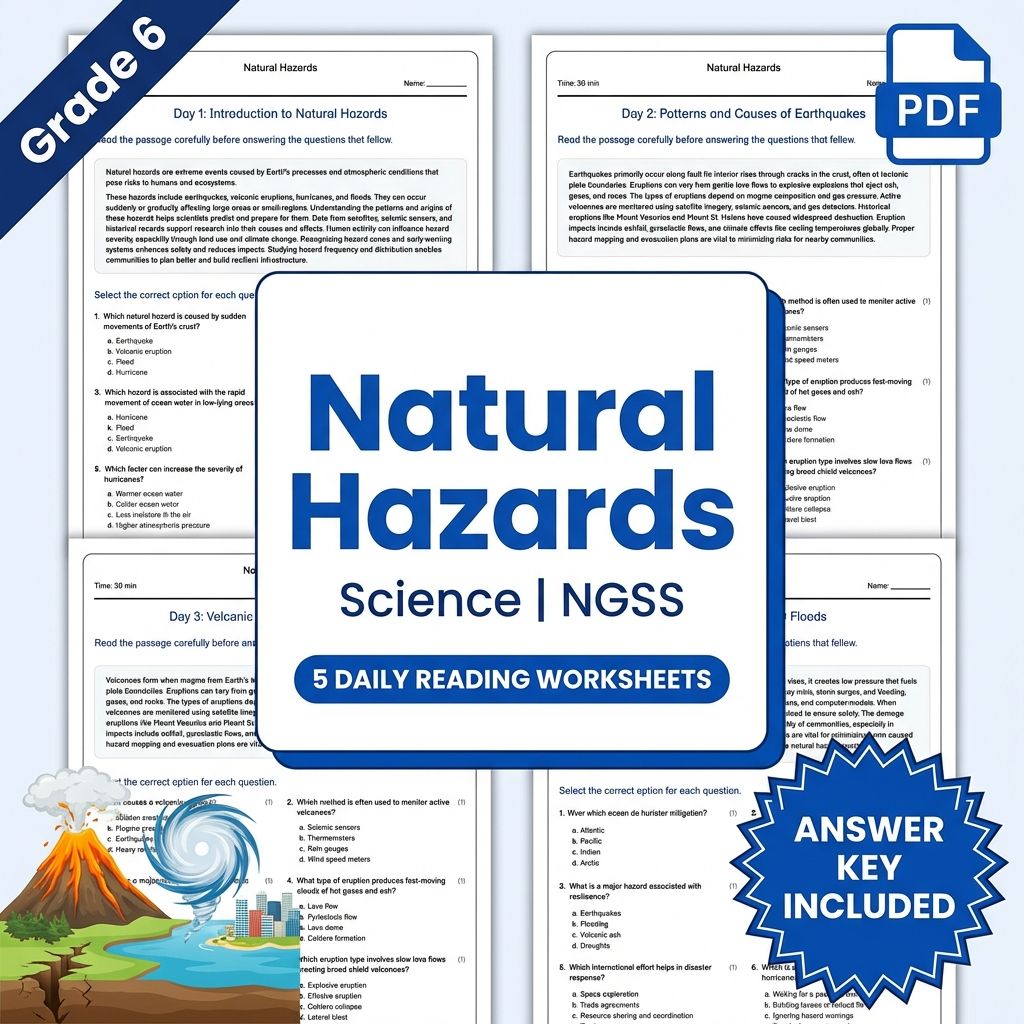
Grade 6 Science – Natural Hazards Daily Reading Worksheet (PDF+ Answer Key)
 Created byCopper Leaf Classroom
Learning Objectives
- Understand the causes and types of natural hazards such as earthquakes, volcanoes, hurricanes, and floods.
- Analyze the patterns and effects of different natural hazards on communities and infrastructure.
- Evaluate how tectonic and atmospheric processes contribute to hazard occurrence.
Instant download
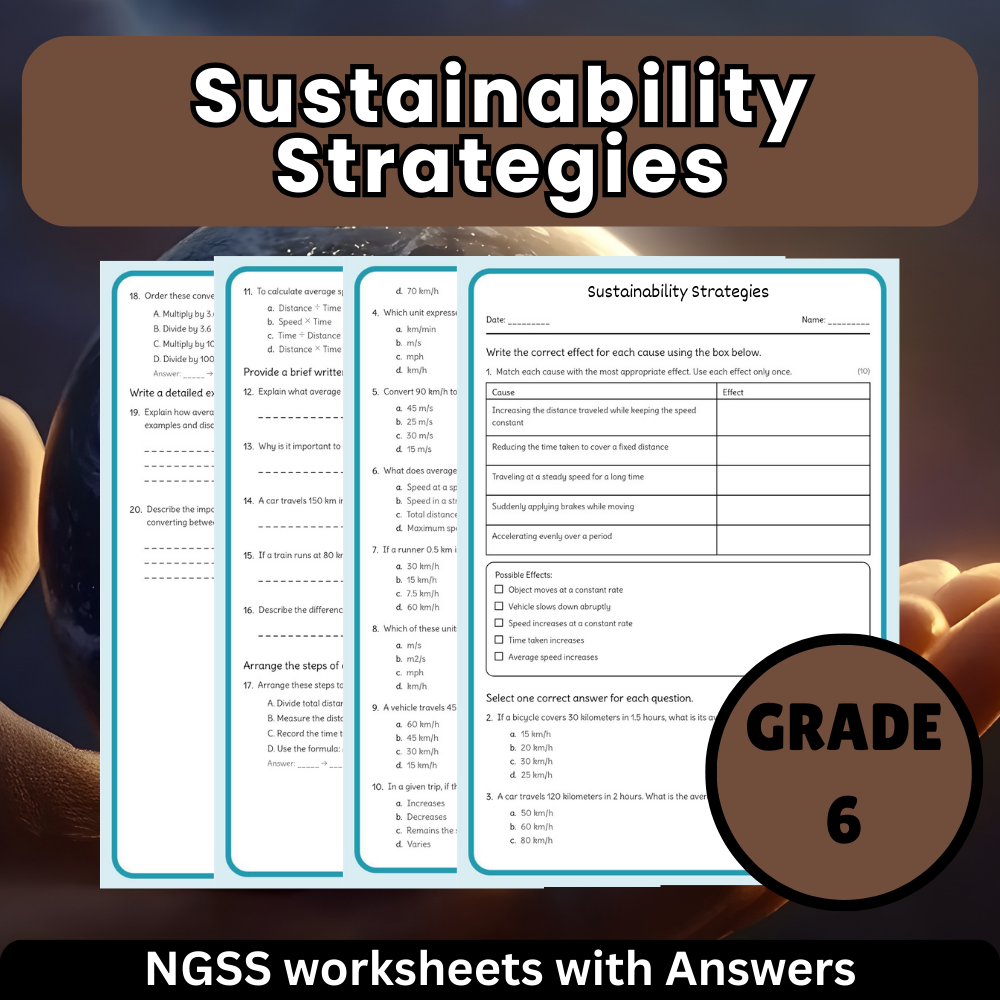
6th Grade Science | Sustainability Strategies Worksheet (PDF) – NGSS Aligned
Created byBright Mind ResourcesLearning Objectives
- Understand how population trends and resource use impact Earth's systems.
- Compare different sustainable practices such as energy, conservation, and land management.
- Evaluate the trade-offs involved in implementing sustainability policies and technologies.
Also included in: Grade 6 Science Unit | Natural Hazards & Human Impacts Worksheet Pack (NGSS) +2 more
Instant download
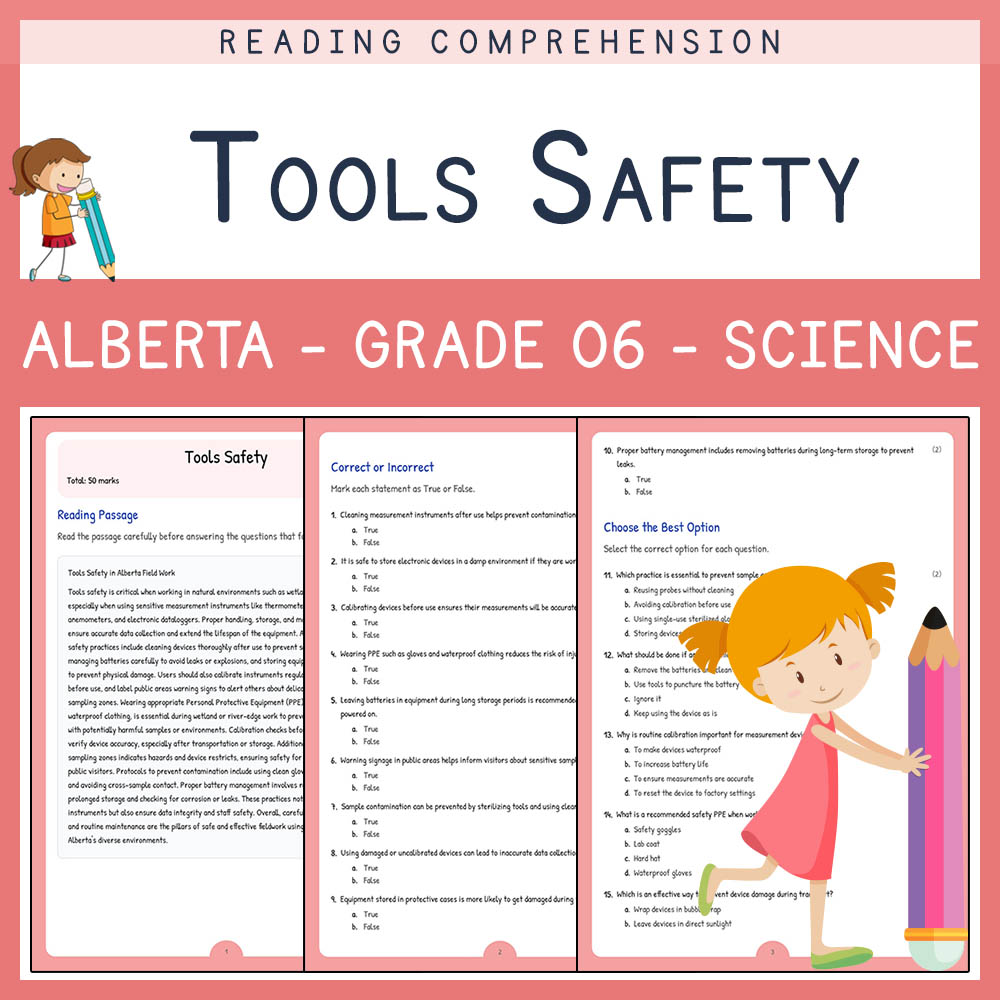
Grade 6 Science Worksheet | Tools Safety | Alberta-Aligned Assessment
Created byLumora LearningLearning Objectives
- Understand key safety practices for handling measurement tools near Alberta field sites.
- Identify proper storage, cleaning, and maintenance procedures for field equipment.
- Learn safety precautions for using electronic devices such as thermometers, pH probes, and dataloggers.
Also included in: Grade 6 Science | Evidence and Investigation Custom Bundle | Alberta
Instant download

Ecosystem Components Worksheet | Standards-Aligned Grade 6 Science Practice
JCreated byJ.S SheetsLearning Objectives
- Understand the different components that make up an ecosystem.
- Explain the roles of abiotic and biotic factors in ecosystems.
- Identify examples of various ecosystems and their features.
Also included in: Grade 6 Ecosystem Adaptations and Energy Flow Science Lesson Bundle | Florida NGSSS +1 more
Instant download
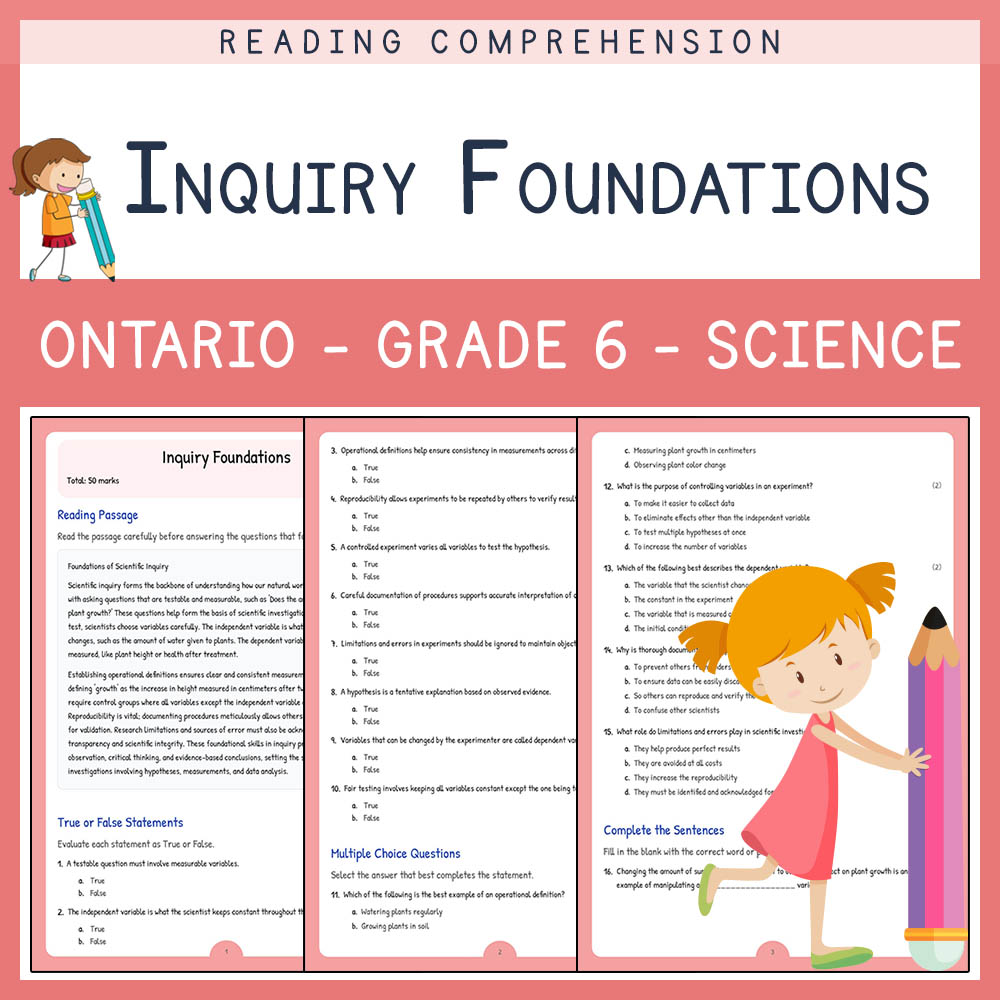
Grade 6 Science | Inquiry Foundations Worksheet & Answer Key (PDF)
Created byLumora LearningLearning Objectives
- Understand how to formulate testable questions in scientific inquiry.
- Identify and define independent and dependent variables.
- Learn the importance of operational definitions and controlled experiments.
Instant download

Grade 6 Science | Gravity & Friction - Daily Reading Comprehension
 Created byCoral Reef Learning
Learning Objectives
- Understand the concept of gravity as a force of attraction between objects with mass.
- Identify how mass and distance affect the strength of gravitational pull.
- Differentiate between gravitational forces and contact forces such as friction.
Instant download
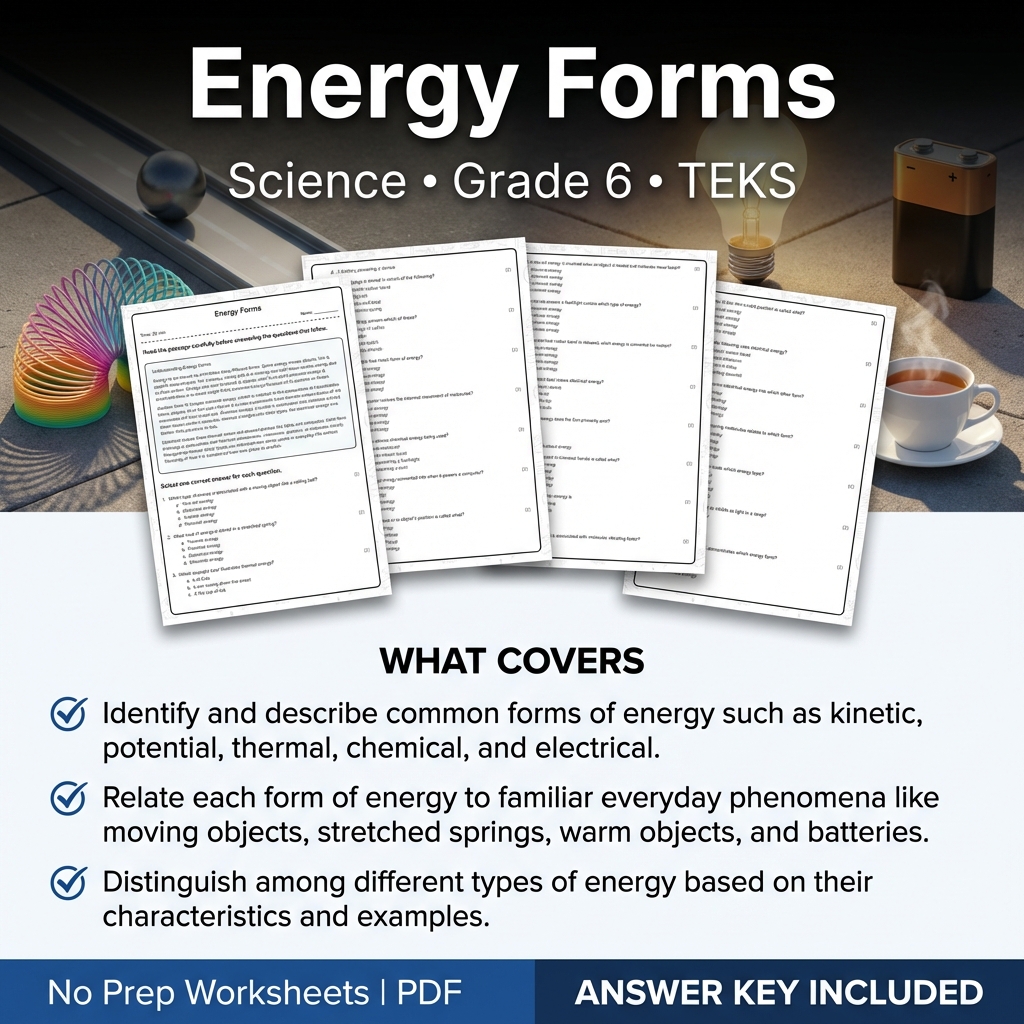
Grade 6 Science Worksheet on Energy Forms | TEKS Aligned
Created byCoral Reef LearningLearning Objectives
- Identify and describe common forms of energy such as kinetic, potential, thermal, chemical, and electrical.
- Relate each form of energy to familiar everyday phenomena like moving objects, stretched springs, warm objects, and batteries.
- Distinguish among different types of energy based on their characteristics and examples.
Instant download

Invasive Species Worksheet Grade 6 Ontario Science + Doodle Notes
 Created byChalk and Compass
Learning Objectives
- Explain how invasive species are introduced and why they can spread rapidly in new ecosystems
- Describe how invasive species affect native species through competition, predation, and habitat alteration
- Use indicators and monitoring to predict and evaluate ecological consequences of invasive species
Also included in: Grade 6 Science Ecosystems, Adaptations & Biodiversity Lesson Bundle | Ontario +1 more
Instant download
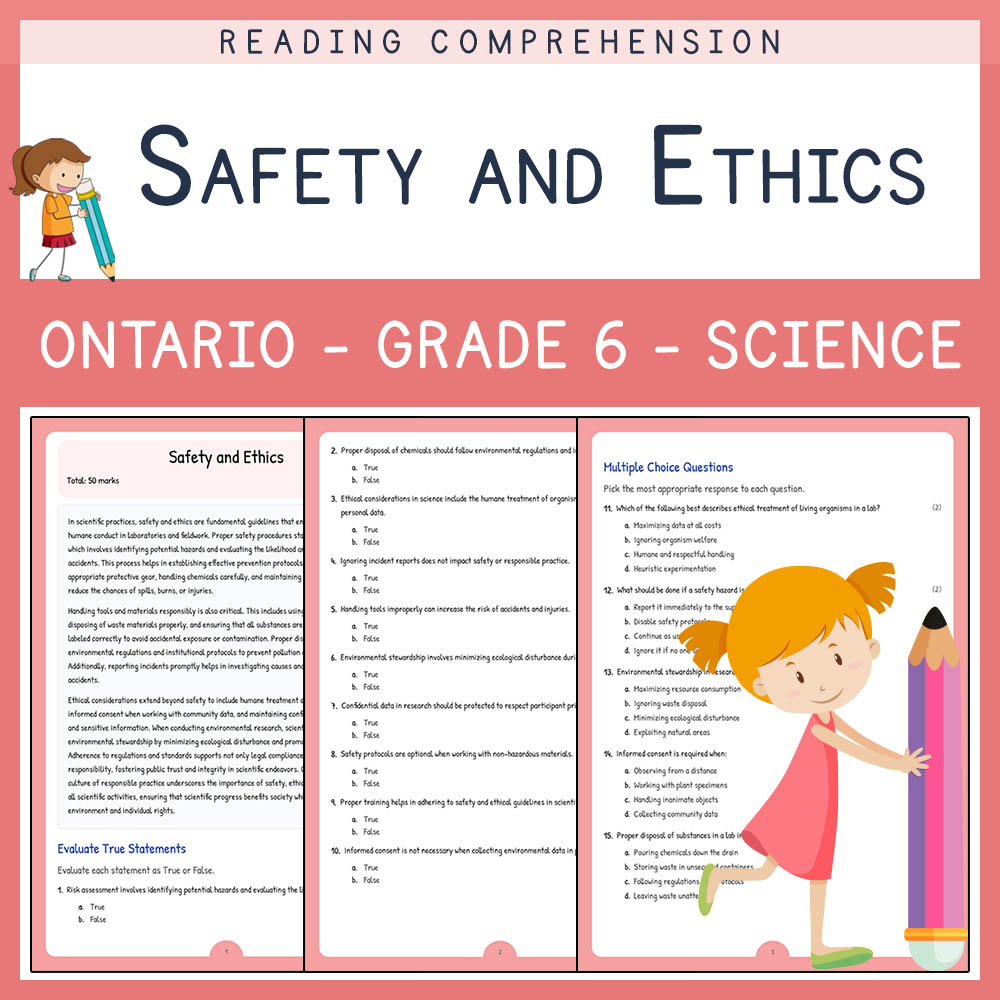
Grade 6 Science | Safety and Ethics Worksheet (PDF + Answer Key)
Created byLumora LearningLearning Objectives
- Understand foundational safety principles including risk assessment and hazard prevention.
- Identify proper handling and disposal procedures for materials and tools.
- Recognize ethical considerations such as humane treatment, confidentiality, and environmental stewardship.
Instant download
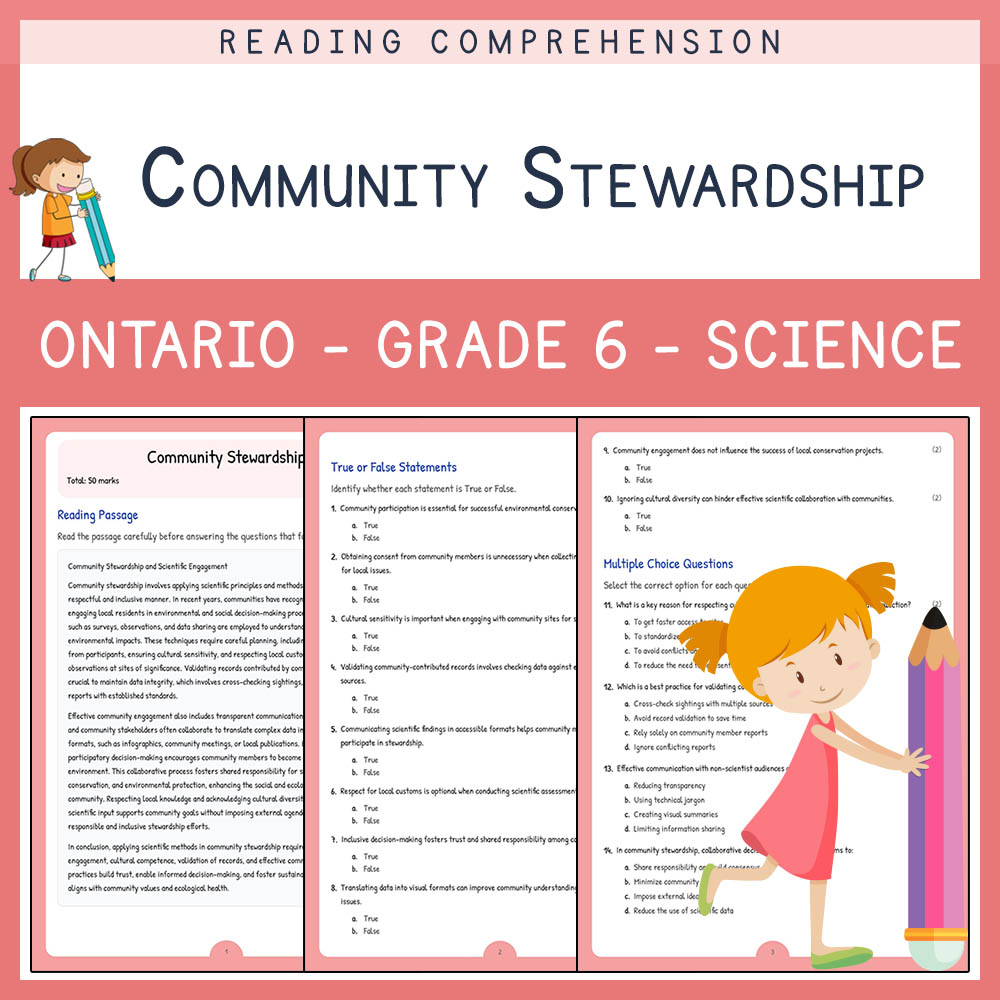
Grade 6 Science | Community Stewardship Worksheet & Answer Key (PDF)
Created byLumora LearningLearning Objectives
- Understand the application of scientific methods in local community issues.
- Identify protocols for obtaining consent and practicing cultural sensitivity during data collection.
- Evaluate strategies for validating and sharing community-contributed records.
Instant download
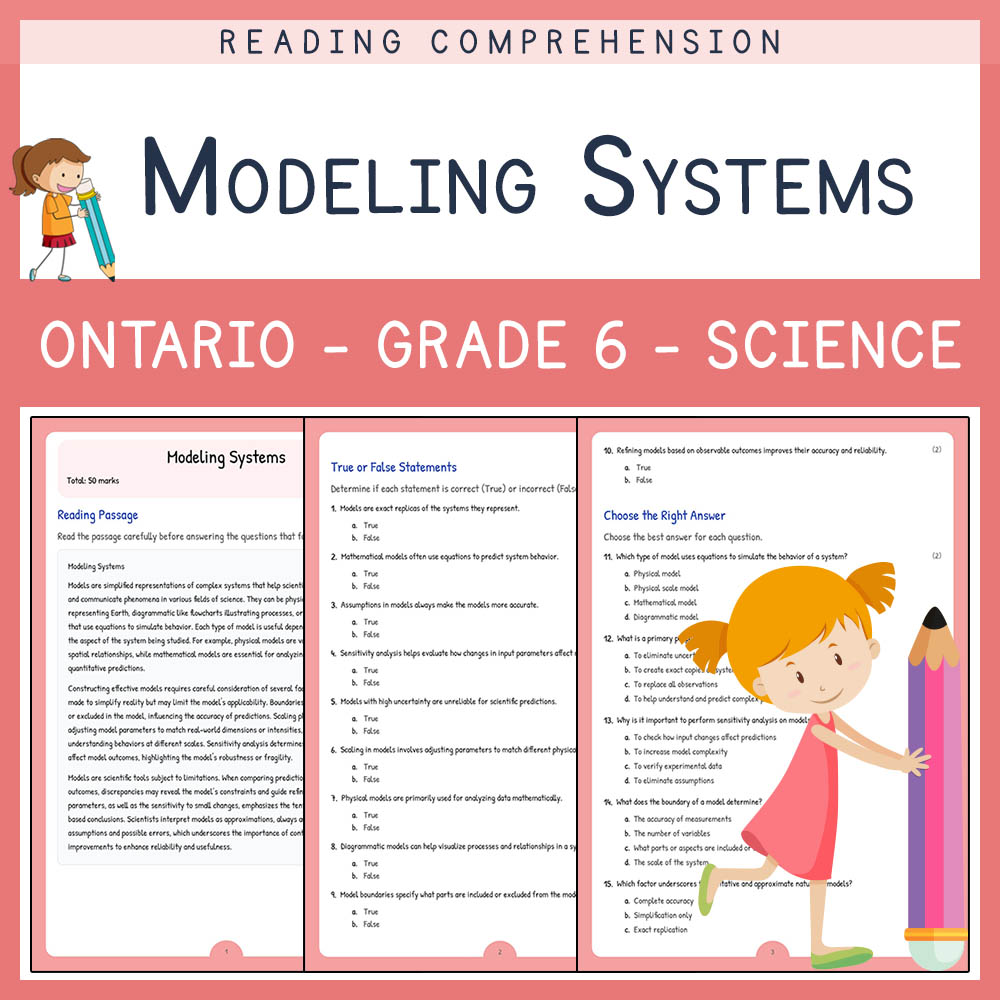
Grade 6 Science | Modeling Systems Worksheet & Answer Key – Ontario Curriculum
Created byLumora LearningLearning Objectives
- Understand different types of models used in science, such as physical, diagrammatic, and mathematical models.
- Identify the purpose and limitations of various models in representing complex systems.
- Evaluate the assumptions, boundaries, and scaling factors in models to interpret outcomes correctly.
Instant download
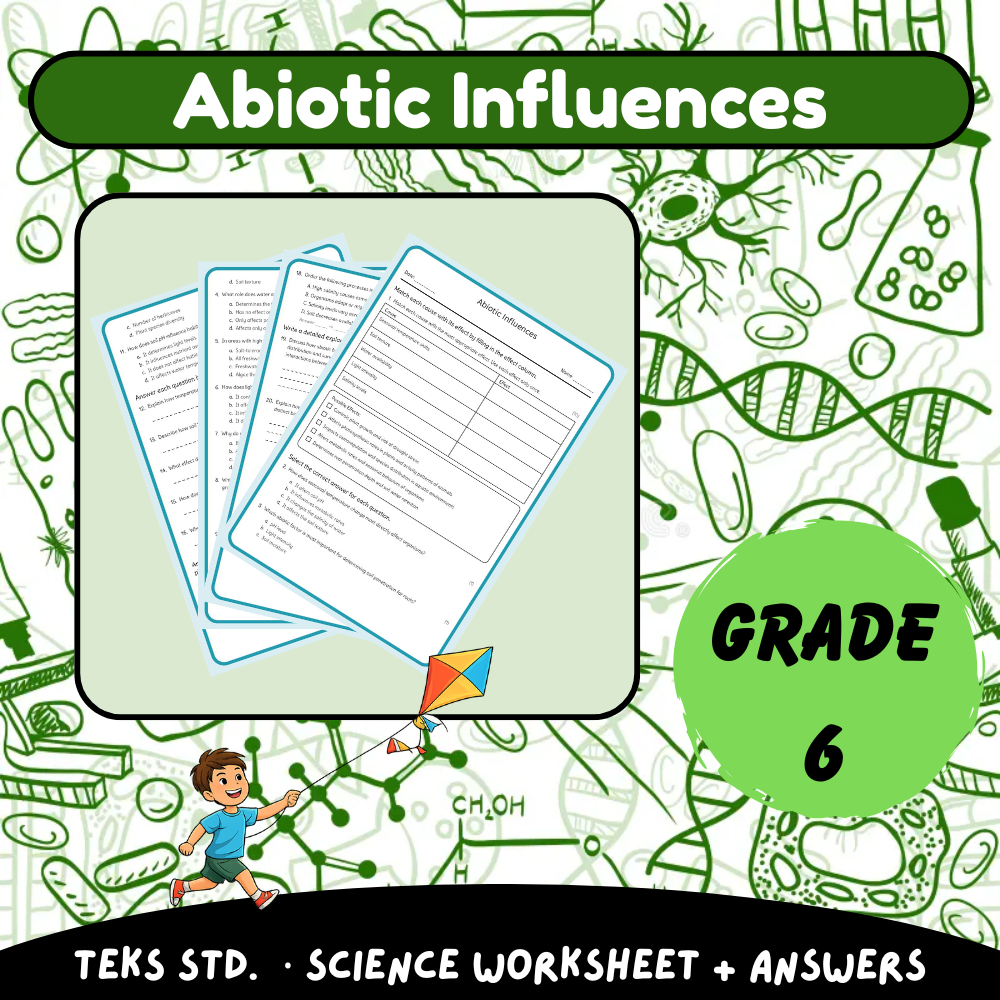
6th Grade Science | Abiotic Influences Worksheet (Answer Key) – TEKS Aligned
Created byBright Mind ResourcesLearning Objectives
- Identify key abiotic factors that affect habitats and organism distribution.
- Understand how temperature, water, light, soil, pH, and salinity influence living organisms.
- Explain interactions between environmental conditions and biological processes.
Instant download
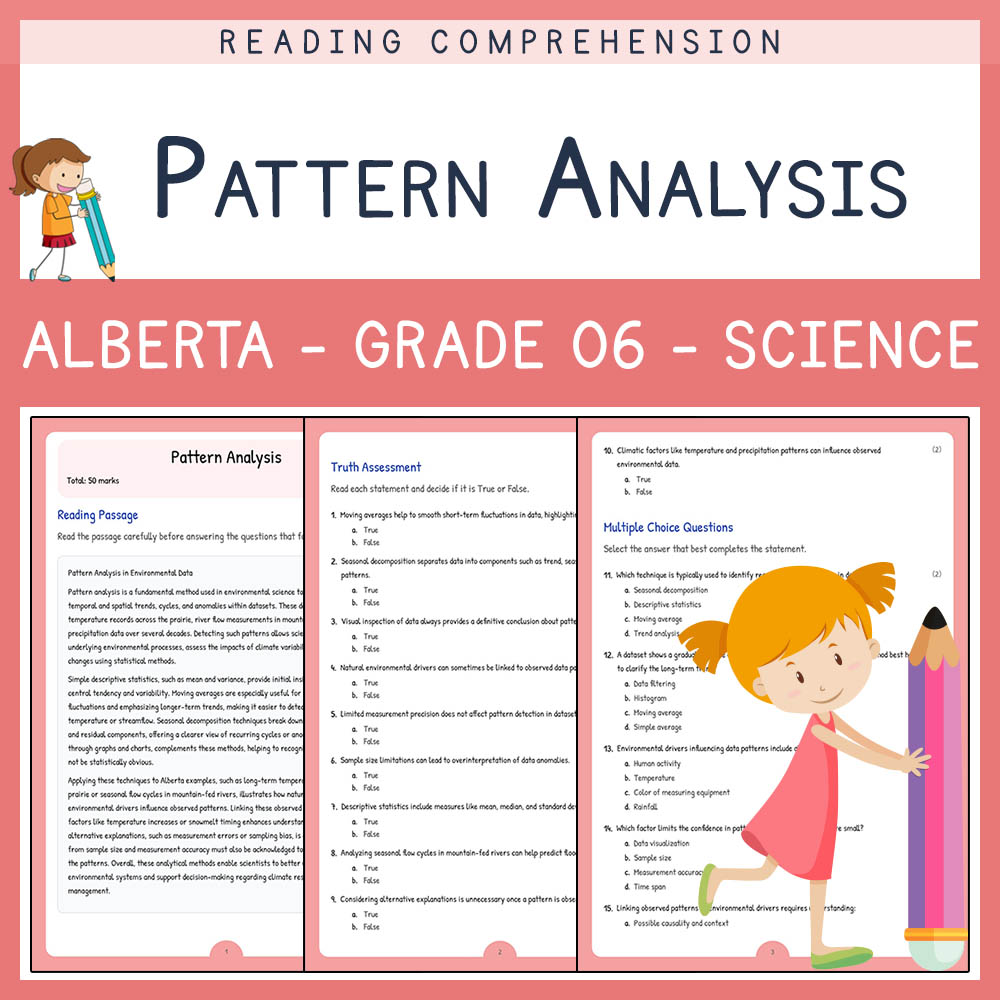
Grade 6 Science | Pattern Analysis Worksheet | Alberta Standard
Created byLumora LearningLearning Objectives
- Understand methods for detecting trends, cycles, and anomalies in datasets.
- Apply simple descriptive statistics and moving averages to real-world data.
- Interpret seasonal decomposition and visual inspection techniques.
Also included in: Grade 6 Science | Evidence and Investigation Custom Bundle | Alberta
Instant download
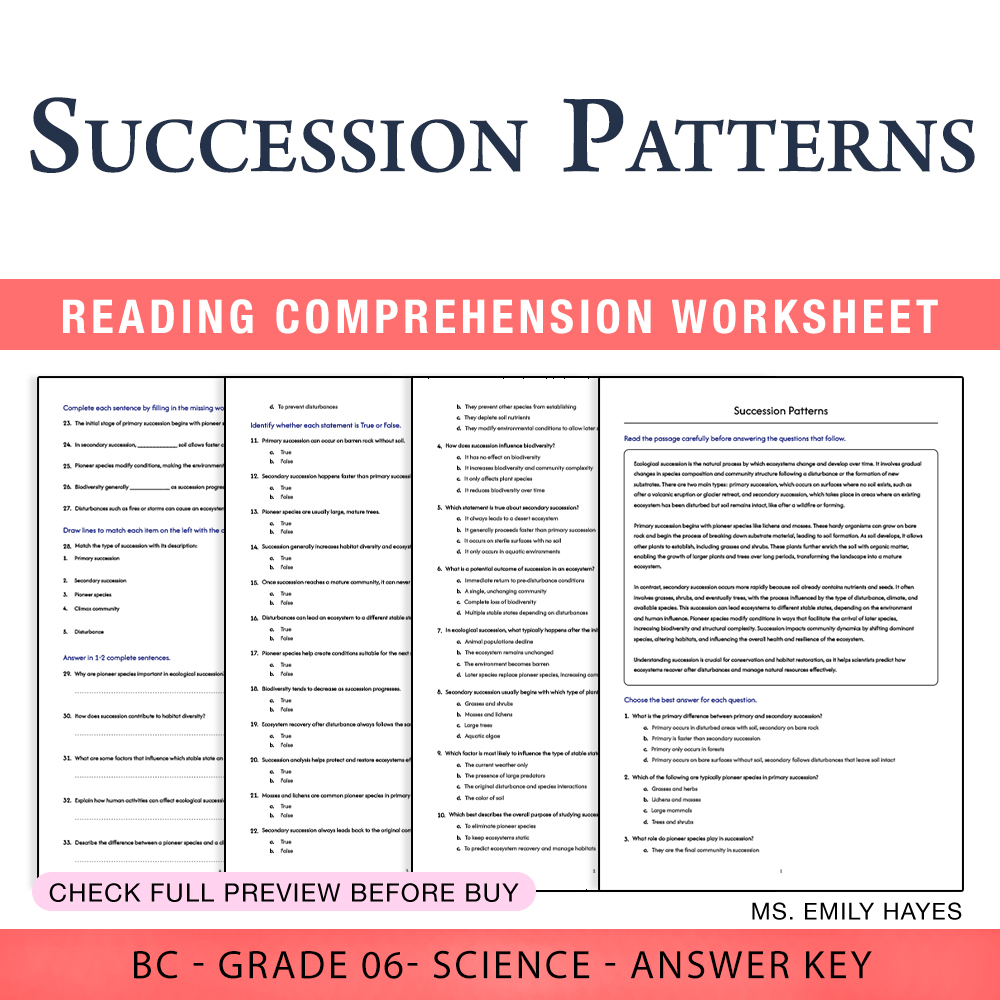
6th Grade Science | Succession Patterns Worksheet (PDF+ Answer Key)
Created byCopper Leaf ClassroomLearning Objectives
- Describe the process of ecological succession and distinguish between primary and secondary succession.
- Identify the role of pioneer species during succession and understand how they modify environments for later species.
- Explain how succession affects biodiversity, community structure, and habitat availability.
Also included in: Grade 6 Science BC | Ecosystems and Human Impact Unit (PDF + Answer Keys) +1 more
Instant download

6th Grade Science | Control Surfaces Worksheet (PDF) – Alberta Standards
 Created byEvergreen Desk Education
Learning Objectives
- Explain how ailerons, elevators, and rudders change airflow to create aerodynamic moments.
- Describe how deflecting control surfaces alters lift and produces rolling, pitching, and yawing motions.
- Connect control-surface responses to real-world flight examples, including short-field operations and crosswind control.
Instant download
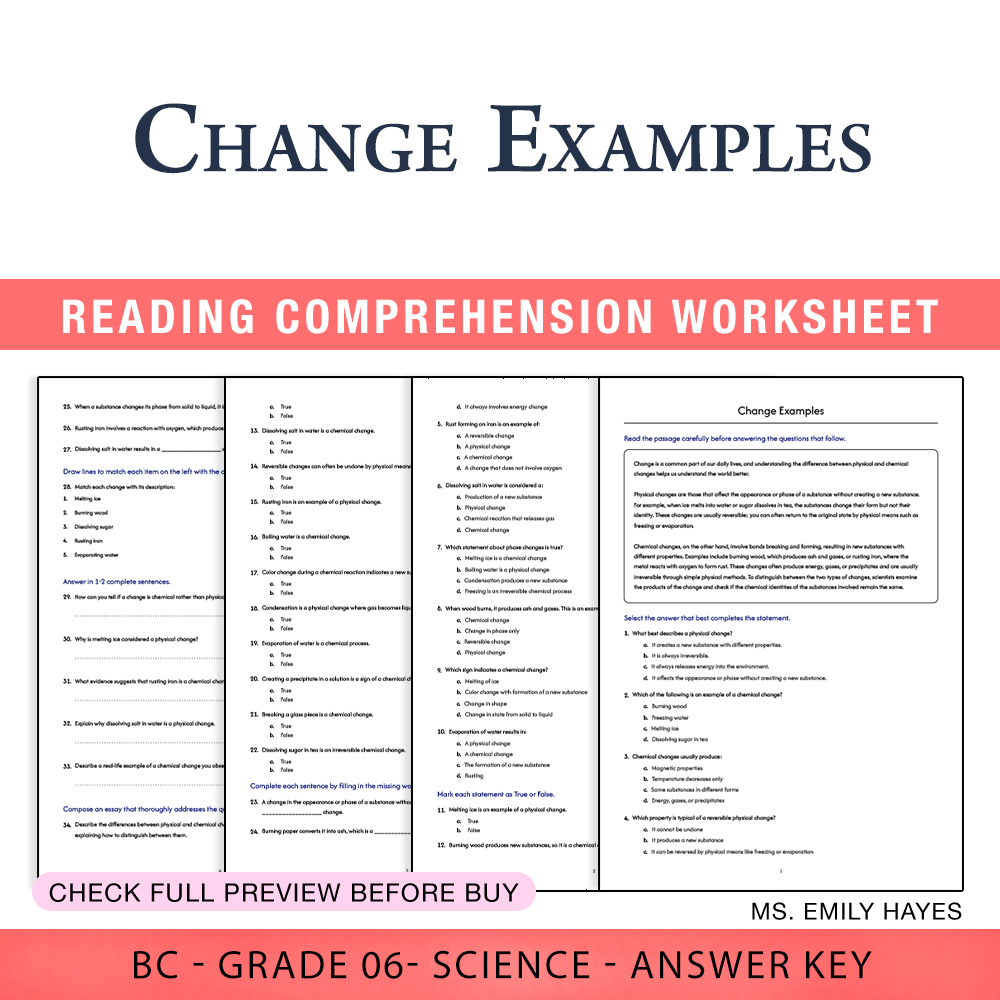
6th Grade Science | Change Examples Worksheet (PDF+ Answer Key)
Created byCopper Leaf ClassroomLearning Objectives
- Identify and differentiate between physical and chemical changes using real-world examples.
- Explain how to determine whether a change is physical or chemical by examining products and properties.
- Describe the features of reversible physical changes versus irreversible chemical changes.
Also included in: Grade 6 Science BC| Reaction Rates & Chemical Properties (PDF+ Answer Keys) +1 more
Instant download

6th Grade Science | Fossil Patterns Worksheet (PDF + Answer Key)
 Created byRiverstone Classroom
Learning Objectives
- Understand how fossil occurrences reveal patterns of organism origin, diversification, and extinction over geologic time.
- Analyze morphological transitions in the fossil record to infer evolutionary change.
- Interpret stratigraphic sequences, dating methods, and geographic distribution data to trace lineage continuity and environmental shifts.
Instant download
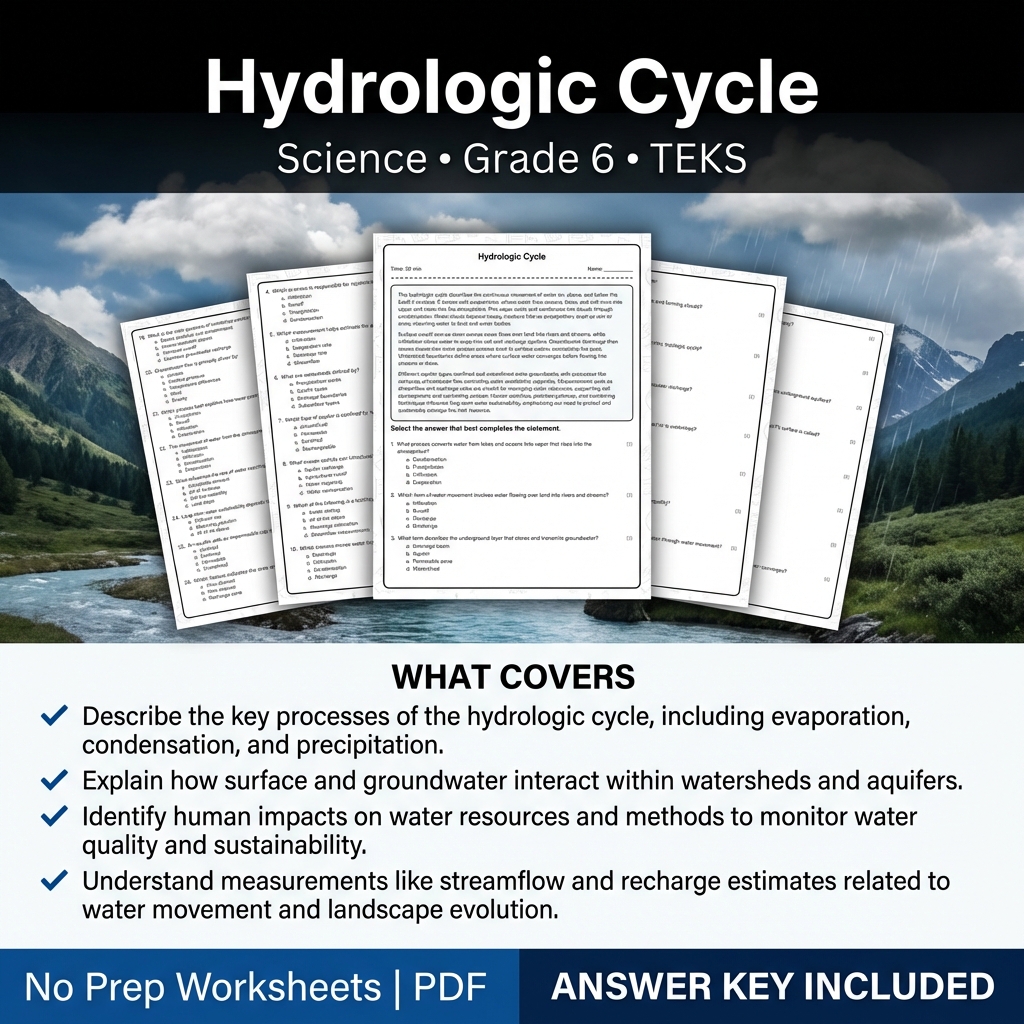
Hydrologic Cycle Science Worksheet for Grade 6 | TEKS Aligned
Created byCoral Reef LearningLearning Objectives
- Describe the key processes of the hydrologic cycle, including evaporation, condensation, and precipitation.
- Explain how surface and groundwater interact within watersheds and aquifers.
- Identify human impacts on water resources and methods to monitor water quality and sustainability.
Instant download
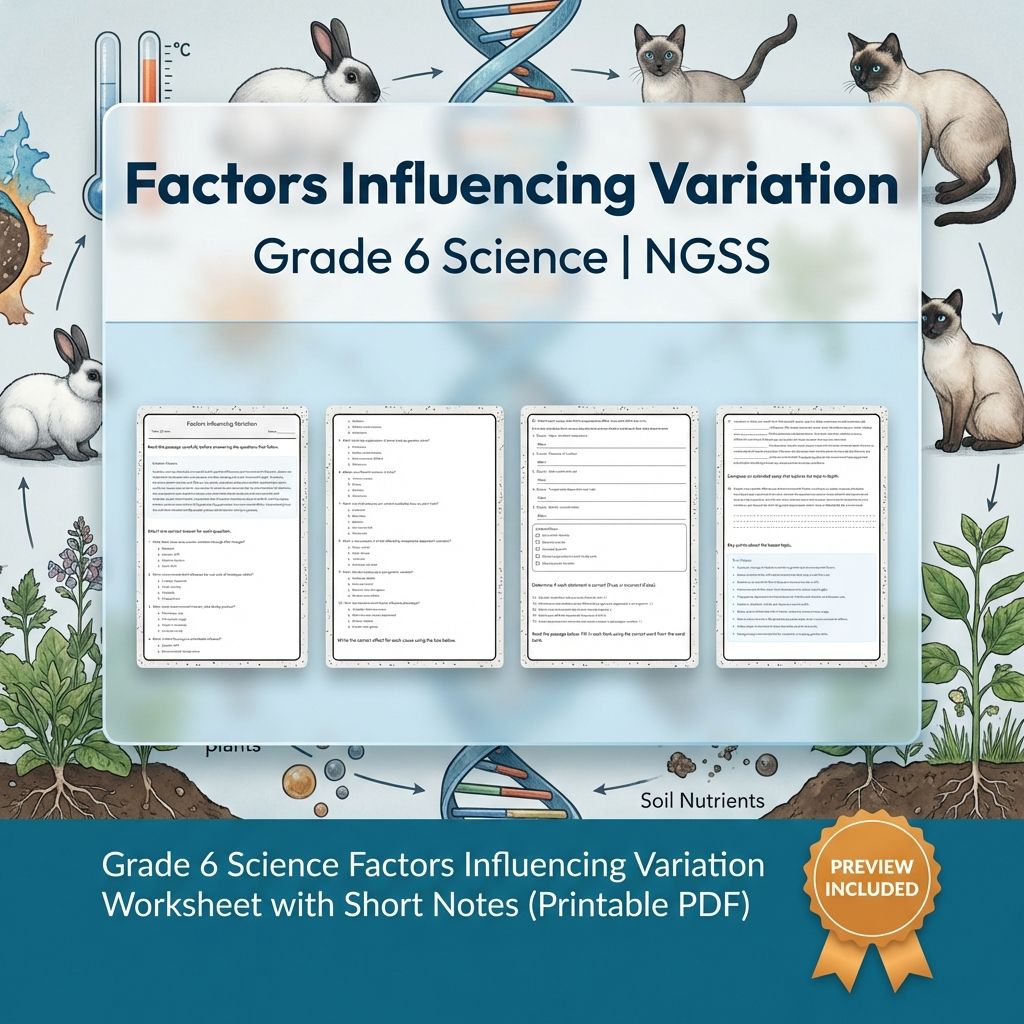
Grade 6 Science Factors Influencing Variation Worksheet with Short Notes (PDF)
 Created byMeadowlark Worksheets
Learning Objectives
- Understand how genetic and environmental factors contribute to observable traits.
- Explain examples like allele combinations, mutations, and nonheritable influences.
- Analyze interactions between inherited genes and environmental conditions.
Also included in: Grade 6 Science | Heredity: Inheritance & Variation NGSS Unit | Worksheets +1 more
Instant download
About Grade 6 Science Worksheets
Explore Grade 6 Science worksheets for classwork, homework, or review. Our 5,969 printables download instantly as PDFs.
MyTeachingSheets worksheets are made by real teacher-authors and checked before they go live. Download any as a print-ready PDF for lessons, homework, or independent practice — most include answer keys, and previews are always free.