
Science Worksheets
44,620 subject resources
Classification Foundations Worksheet | Grade 9 Science Activities
 Created byPrism Point Learning
Learning Objectives
- Explain how hierarchical biological classification helps organize biodiversity.
- Describe traditional taxonomic ranks and how binomial nomenclature supports clear communication.
- Compare how evolutionary relationships and clades are used in modern classification.
Also included in: Grade 9 Evolution & Speciation Lesson Bundle | TEKS Science
Instant download
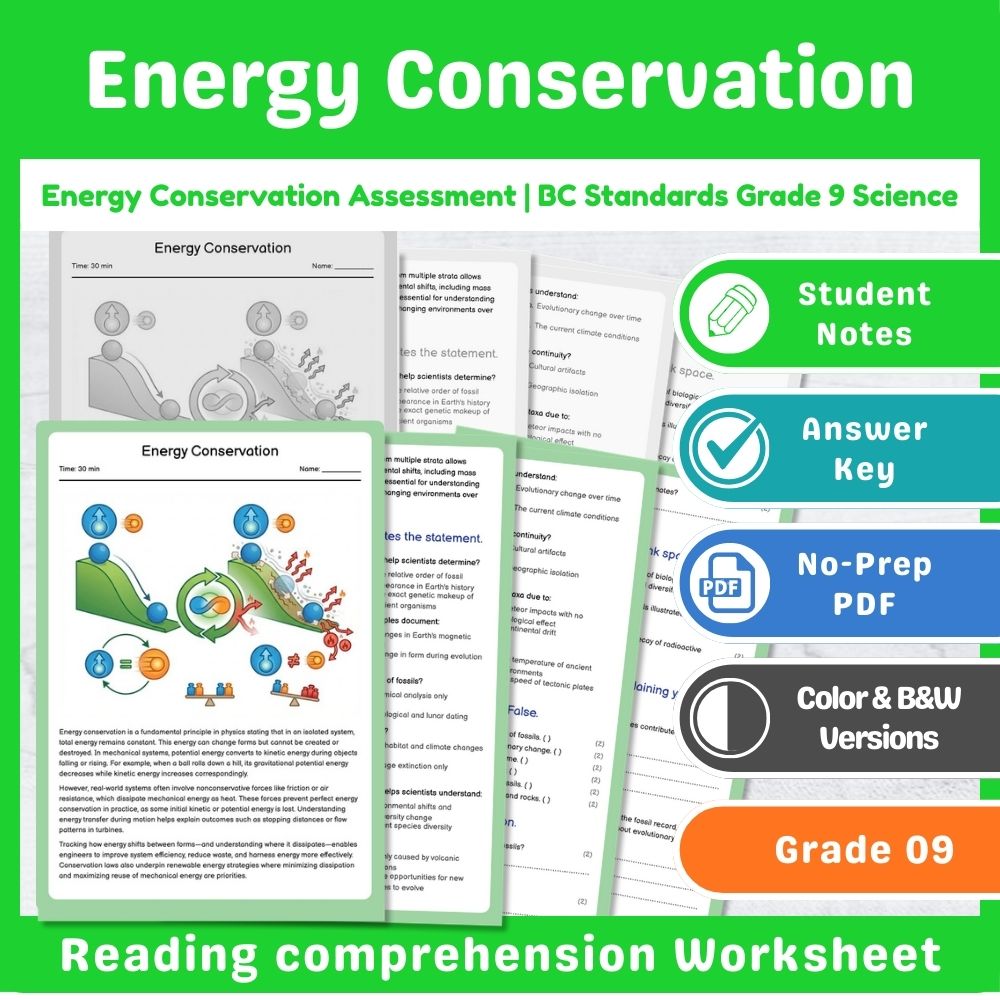
Energy Conservation Assessment | BC Standards Grade 9 Science
Created byPrism Point LearningLearning Objectives
- Explain the principle of conservation of energy in isolated systems.
- Identify different forms of energy and how they interconvert.
- Describe how nonconservative forces like friction dissipate mechanical energy into heat.
Instant download
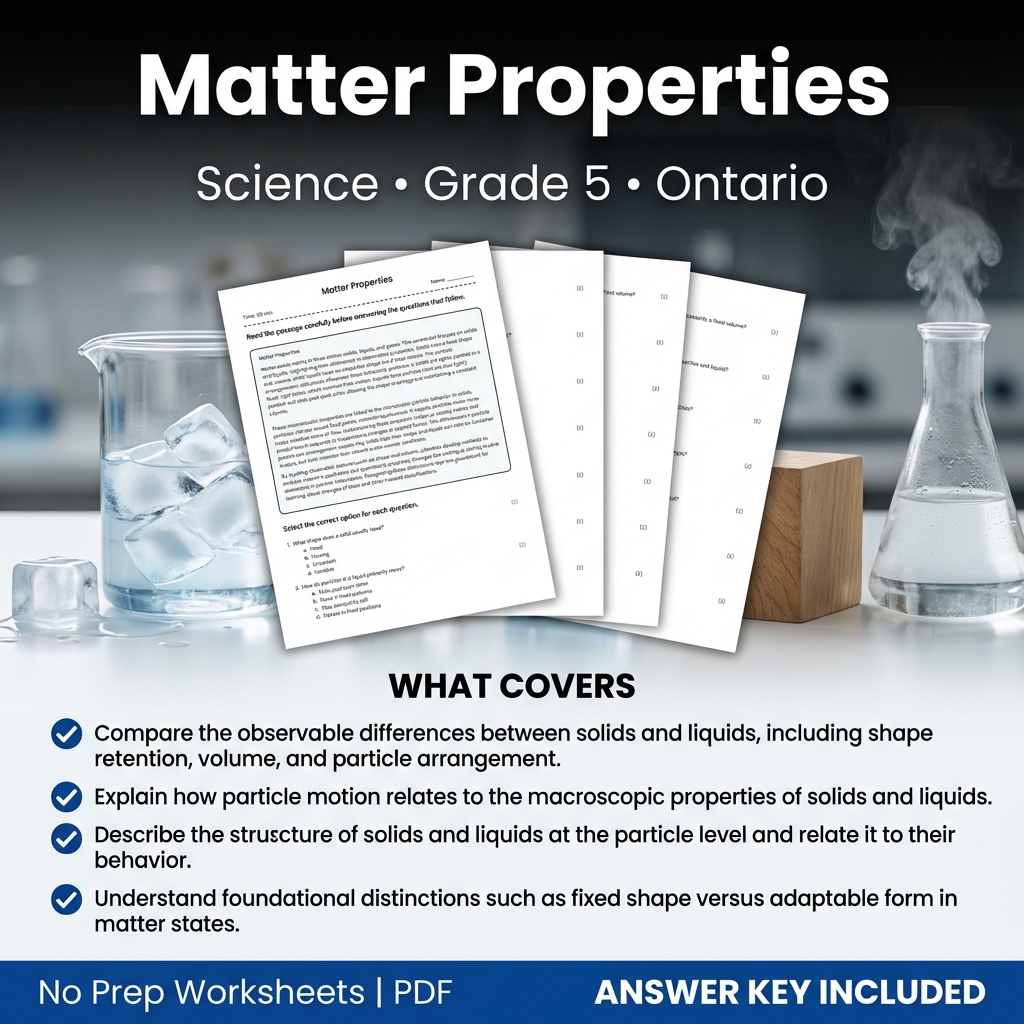
Matter Properties Worksheet for Grade 5 Science | Ontario Standards
 Created byCoral Reef Learning
Learning Objectives
- Compare the observable differences between solids and liquids, including shape retention, volume, and particle arrangement.
- Explain how particle motion relates to the macroscopic properties of solids and liquids.
- Describe the structure of solids and liquids at the particle level and relate it to their behavior.
Instant download

Grade 10 Photosynthesis Basics Worksheet | Light Reactions & Calvin Cycle
 Created byChalk and Compass
Learning Objectives
- Explain how chloroplast thylakoid membranes help capture light energy and convert it to chemical energy
- Describe how the Calvin cycle fixes carbon dioxide into organic molecules
- Identify how light intensity, carbon dioxide availability, and temperature limit net carbon fixation
Also included in: Cells, Photosynthesis, Respiration & Microbes Lesson Bundle – Grade 10 Science +1 more
Instant download

Grade 4 Wheel and Axle & Pulley Systems Worksheet | Ontario Science
Created byChalk and CompassLearning Objectives
- Explain how a wheel-and-axle system turns rotational motion into linear motion or force
- Compare fixed and movable pulleys and describe how each changes the direction and size of input force
- Use wheel radius and axle radius to predict mechanical advantage in simple wheel-and-axle examples
Also included in: Grade 4 Science Simple Machines & Mechanical Advantage Lesson Bundle | Ontario +1 more
Instant download
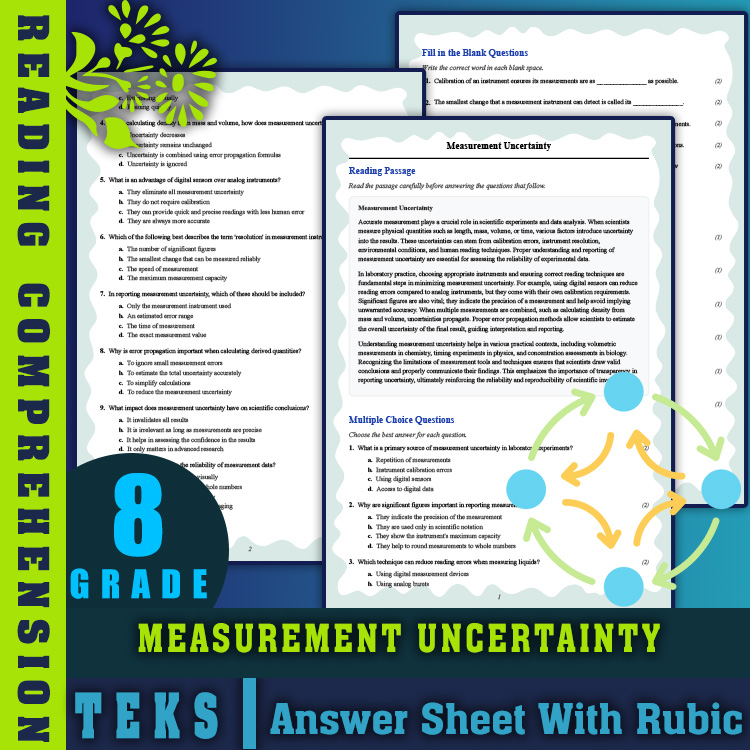
8th Grade Science | Measurement Uncertainty Reading Worksheets PDF + Answer Key
JCreated byJ.S SheetsLearning Objectives
- Understand the concept of measurement uncertainty and its sources.
- Apply principles of calibration, resolution, and significant figures to experimental data.
- Calculate and propagate errors in measurements for derived quantities.
Instant download
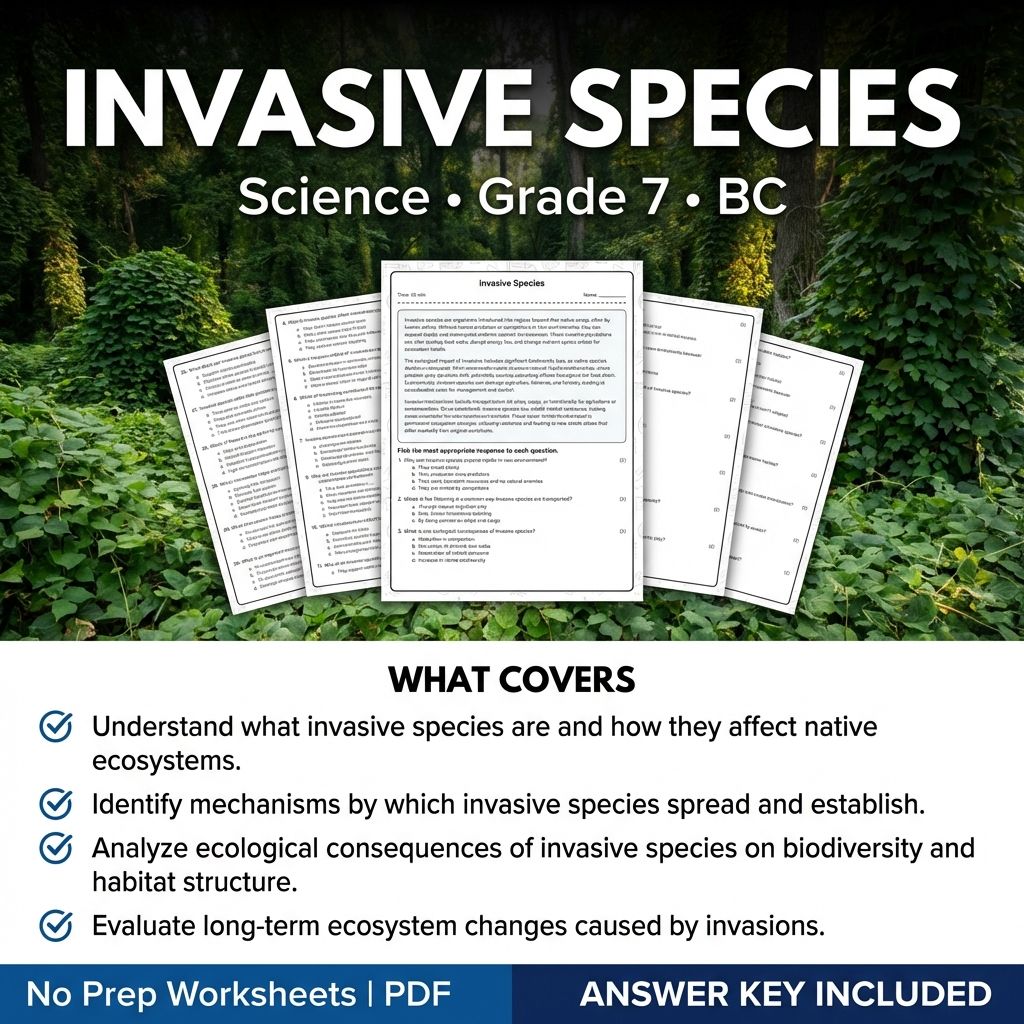
7th Grade Science | Invasive Species Worksheet & Answer Key (Printable PDF)
Created byCoral Reef LearningLearning Objectives
- Understand what invasive species are and how they affect native ecosystems.
- Identify mechanisms by which invasive species spread and establish.
- Analyze ecological consequences of invasive species on biodiversity and habitat structure.
Instant download

Grade 12 DNA To Proteins Worksheet | Practice & Assessment PDF
 Created byClear Sky Classroom
Learning Objectives
- Explain how base pairing in DNA and RNA enables faithful information transfer during gene expression
- Describe how codons in messenger RNA determine the order of amino acids in a protein
- Connect changes in DNA sequence (mutations) to changes in protein structure and function
Instant download
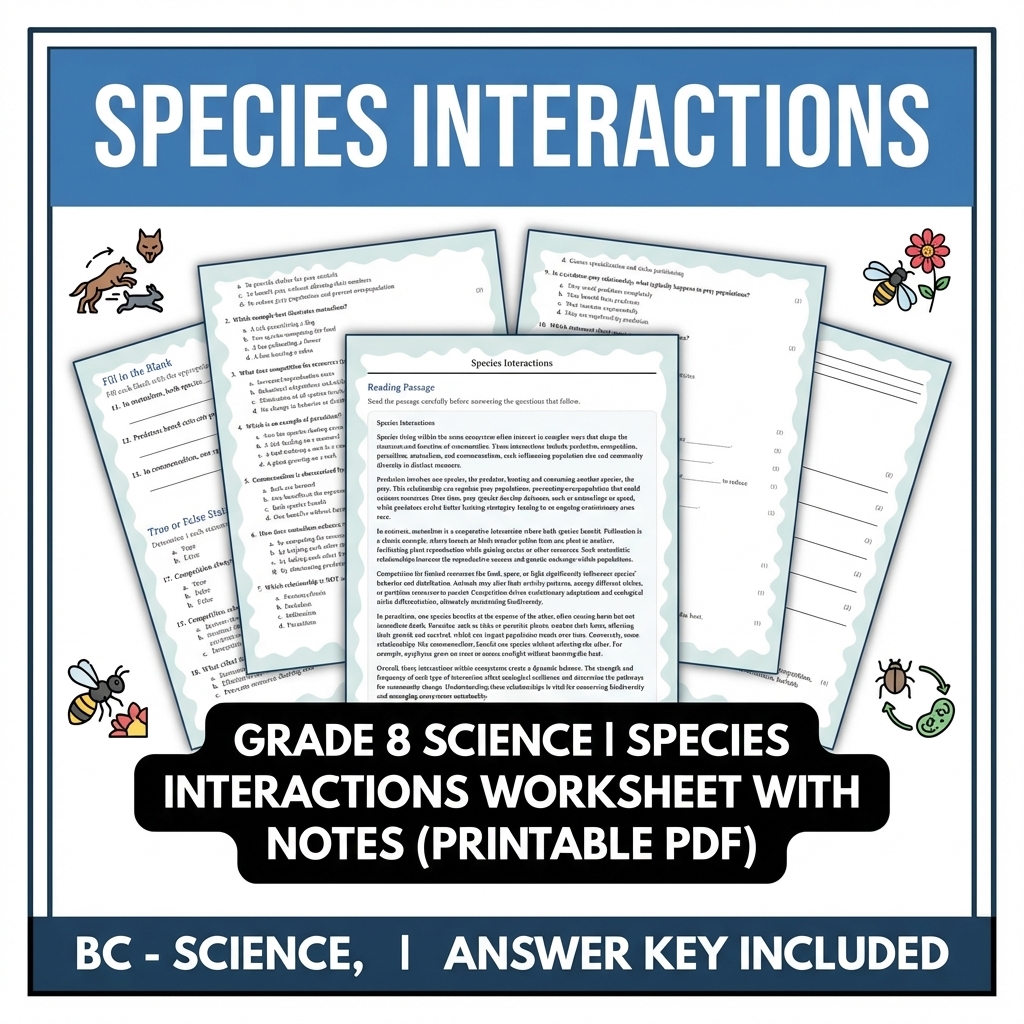
8th Grade Science | Species Interactions Reading Worksheet & Answer Key (PDF)
JCreated byJ.S SheetsLearning Objectives
- Identify different types of species interactions such as predation, competition, parasitism, mutualism, and commensalism.
- Explain how species interactions influence population dynamics and community structure.
- Describe the roles of predators and mutualistic relationships in ecosystems.
Instant download
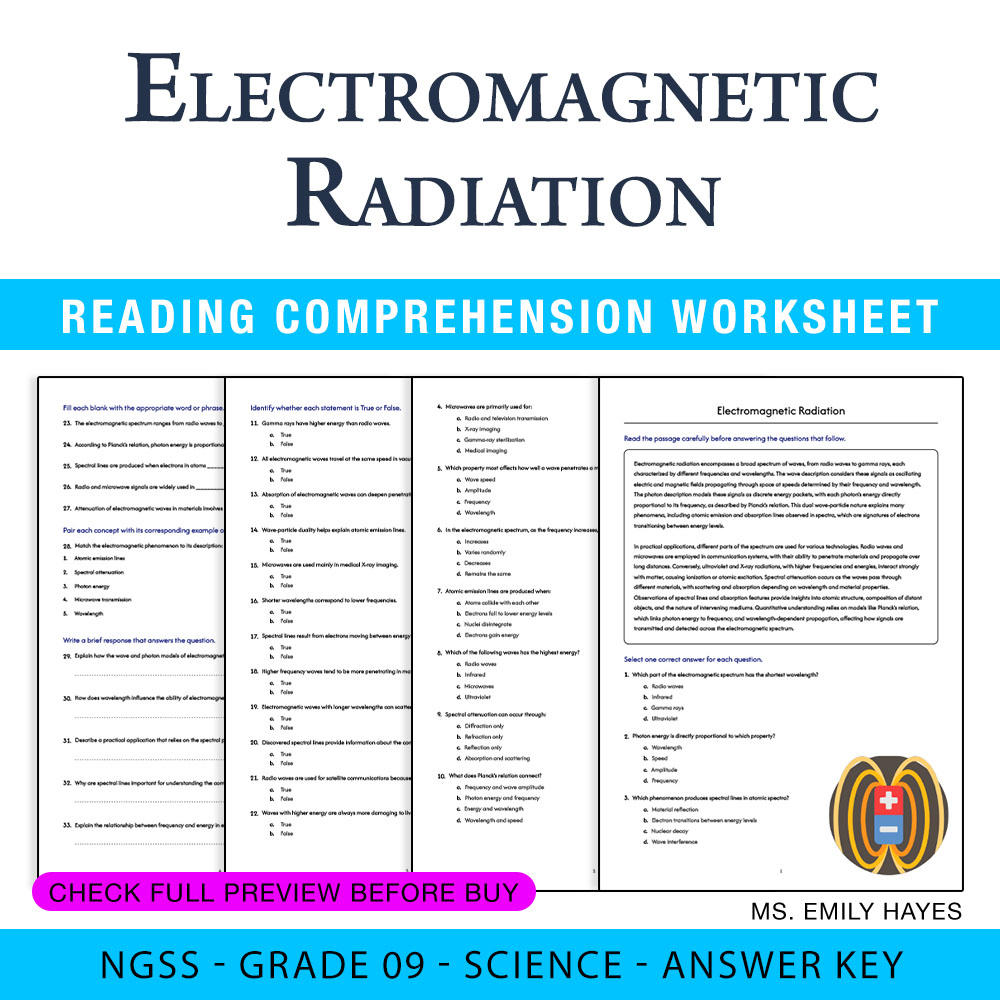
Grade 9 Science | Electromagnetic Radiation Worksheet (PDF+ Answer Key)
 Created byCopper Leaf Classroom
Learning Objectives
- Understand the wave and photon descriptions of electromagnetic radiation.
- Relate frequency and wavelength to photon energy and interaction with matter.
- Explain phenomena such as atomic emission and absorption lines, signal transmission, and spectral attenuation.
Instant download
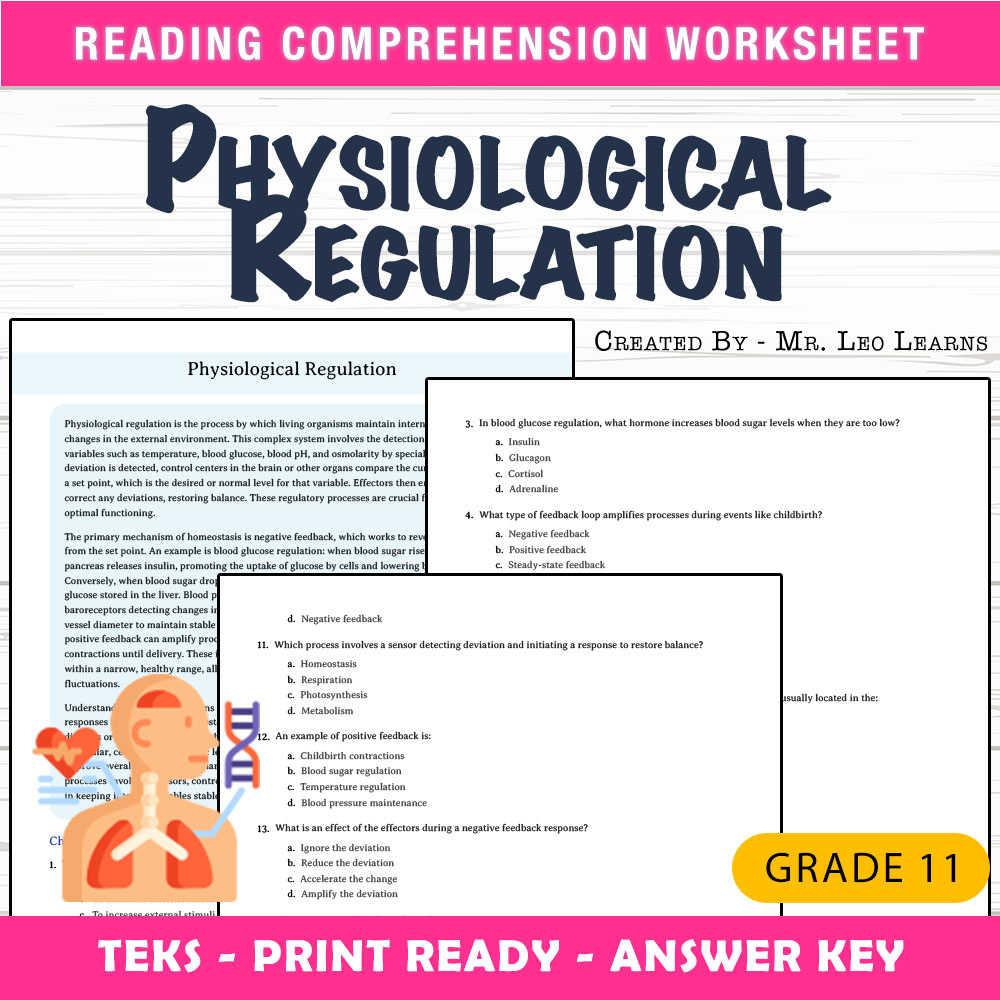
Grade 11 Science — Physiological Regulation Worksheet for Mastery
 Created byThe Resource Hub
Learning Objectives
- Describe the mechanisms of physiological regulation involving sensors, control centers, and effectors.
- Explain how negative and positive feedback loops maintain internal stability.
- Identify examples of physiological regulation such as blood glucose control and blood pressure adjustments.
Also included in: Grade 11 Science | Human Body Systems & Physiology Worksheet Bundle +1 more
Instant download
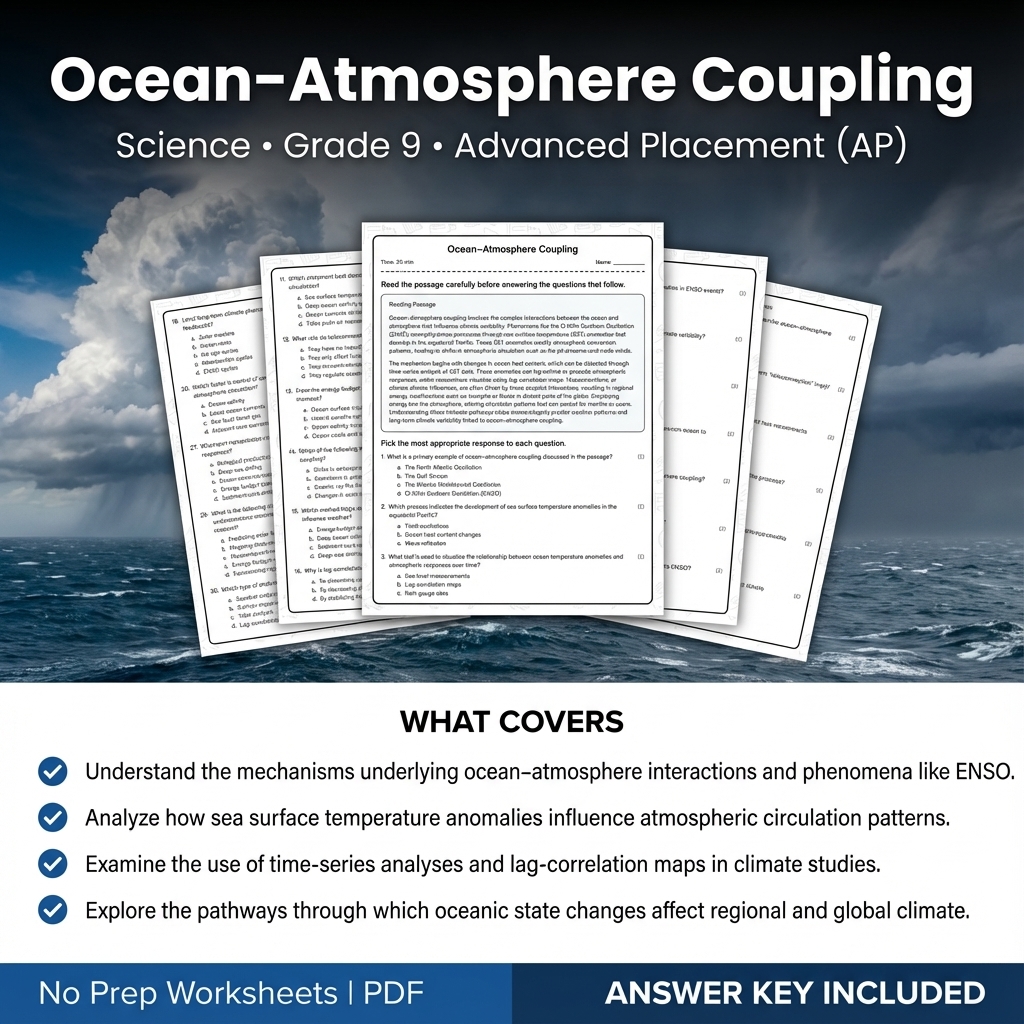
Grade 9 Science | Ocean–Atmosphere Coupling Worksheet (Printable PDF + Answer Key)
Created byCoral Reef LearningLearning Objectives
- Understand the mechanisms underlying ocean–atmosphere interactions and phenomena like ENSO.
- Analyze how sea surface temperature anomalies influence atmospheric circulation patterns.
- Examine the use of time-series analyses and lag-correlation maps in climate studies.
Also included in: Grade 9 Science Unit | Earth Processes & Climate Worksheets Pack (PDF & Answer Keys) +2 more
Instant download

Transport Mechanisms Worksheet | Grade 9 Science Practice
Created byPrism Point LearningLearning Objectives
- Explain how passive transport, facilitated diffusion, and osmosis move substances across cell membranes using concentration gradients.
- Describe how active transport uses membrane proteins and ATP to move substances against gradients.
- Compare vesicular transport (endocytosis and exocytosis) with transport through membrane proteins.
Instant download
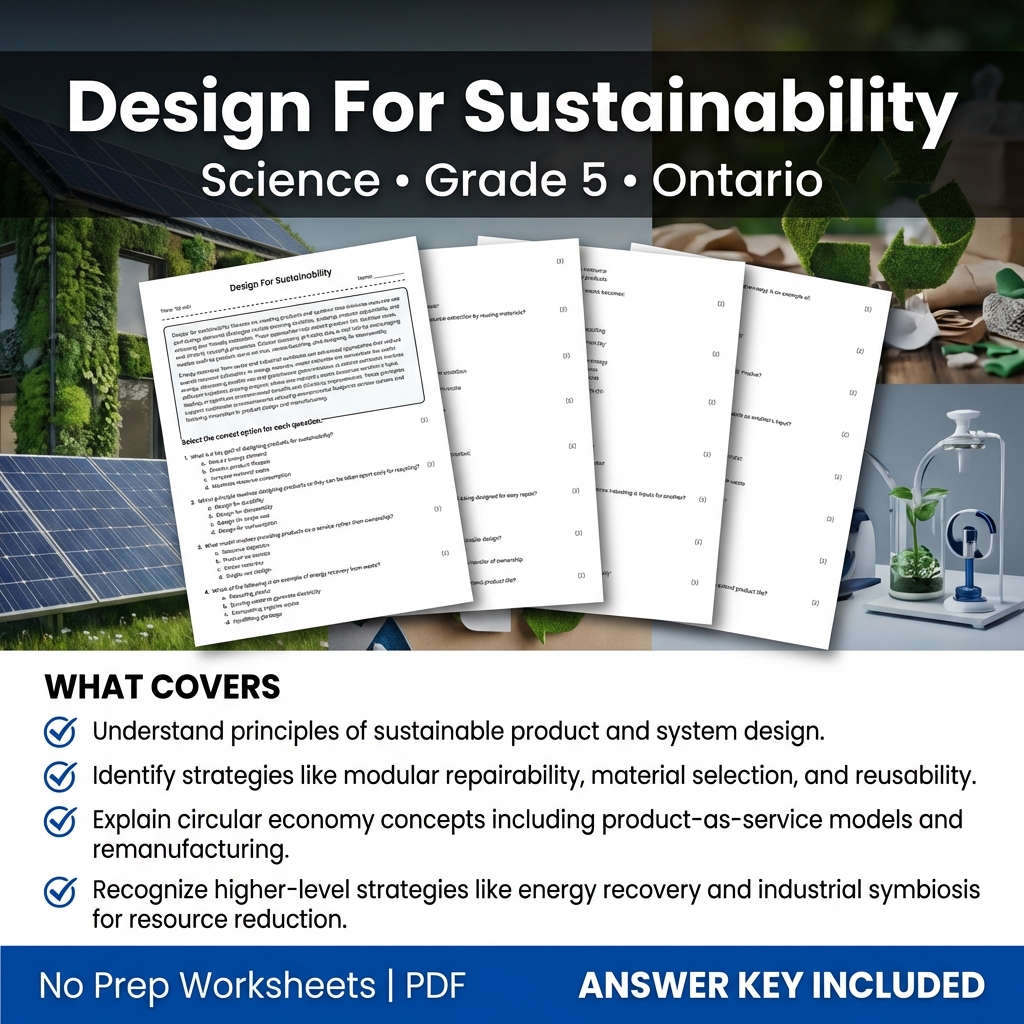
Design For Sustainability Grade 5 Science Worksheet | Ontario Standards
Created byCoral Reef LearningLearning Objectives
- Understand principles of sustainable product and system design.
- Identify strategies like modular repairability, material selection, and reusability.
- Explain circular economy concepts including product-as-service models and remanufacturing.
Instant download
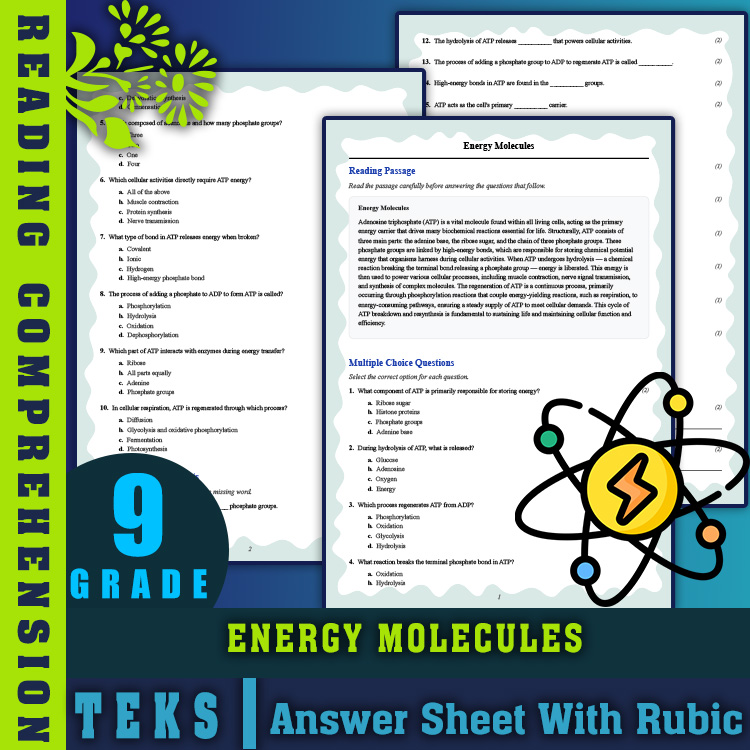
9th Grade Science | Energy Molecules Reading Worksheet & Answer Key (PDF)
JCreated byJ.S SheetsLearning Objectives
- Understand the structure and function of ATP as the cell's primary energy currency.
- Explain how ATP hydrolysis releases energy for cellular processes.
- Describe the process of ATP regeneration through phosphorylation.
Instant download

Circular Motion Worksheet | Grade 9 Science Activities
Created byPrism Point LearningLearning Objectives
- Explain how centripetal net force produces acceleration toward the center in circular motion
- Use the relationship between speed, radius, and centripetal acceleration to predict changes in motion
- Identify common inward forces (tension, friction, normal force) that maintain curved trajectories
Also included in: Forces and Motion Lesson Bundle – Grade 9 Science Framework BC +1 more
Instant download

Energy Conservation Worksheet | Grade 9 Science Practice
Created byPrism Point LearningLearning Objectives
- Explain conservation of energy in an isolated system and describe how energy can change forms.
- Differentiate between mechanical energy (kinetic and potential) and nonconservative transfers (such as heat from friction).
- Use energy-conversion reasoning to predict motion outcomes for real-world situations.
Also included in: Forces and Motion Lesson Bundle – Grade 9 Science Framework BC +1 more
Instant download

Water and Resources Worksheet | Grade 6 Science Practice and Review
Created byPrism Point LearningLearning Objectives
- Explain the main steps of the water cycle and how they move water between Earth systems.
- Describe how water storage in glaciers and groundwater affects freshwater availability over time.
- Use water-cycle vocabulary to predict how land cover and temperature influence infiltration and streamflow.
Instant download

Power and Efficiency Review Worksheet | Grade 9 Science Ontario
Created byPrism Point LearningLearning Objectives
- Explain power as the rate of energy transfer (or work per unit time) using average and instantaneous ideas
- Use appropriate SI units (joule, watt) to describe energy/work and power
- Calculate mechanical efficiency and interpret how losses like friction reduce useful output
Also included in: Grade 9 Work, Energy & Forces Science Lesson Bundle Ontario Curriculum
Instant download

Grade 8 Science | Common Ancestry Worksheet (PDF + Answer Key) | NGSS Standards
 Created byLumora Learning
Learning Objectives
- Understand the types of evidence—fossil, anatomical, embryological, and molecular—that support common ancestry.
- Interpret patterns of biological data to infer evolutionary relationships.
- Identify examples of transitional fossils, homologous structures, and DNA sequence similarities.
Instant download
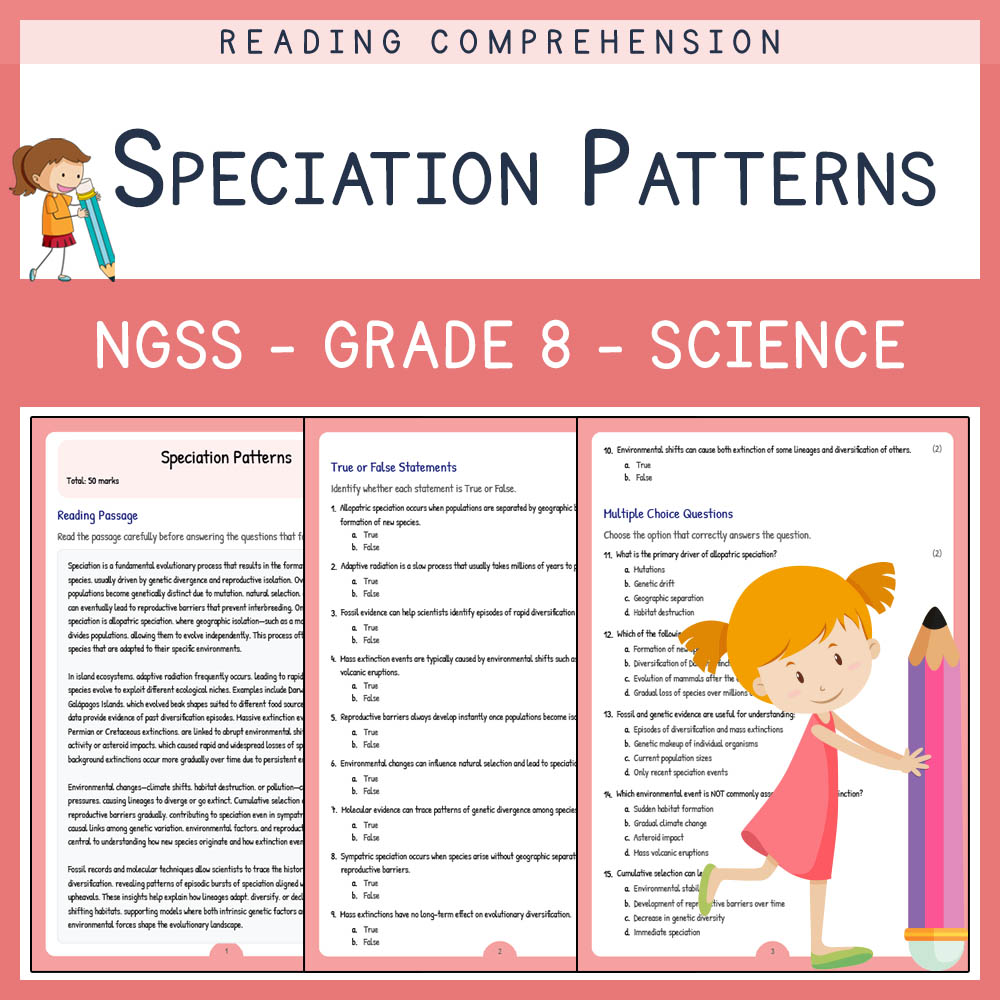
Grade 8 Science | Speciation Patterns Worksheet & Answer Key (NGSS Aligned)
Created byLumora LearningLearning Objectives
- Explain the processes that lead to the formation of new species, including genetic divergence and reproductive isolation.
- Identify different modes of speciation such as allopatric and adaptive radiation.
- Interpret fossil and genetic evidence supporting episodes of diversification and mass extinction.
Instant download
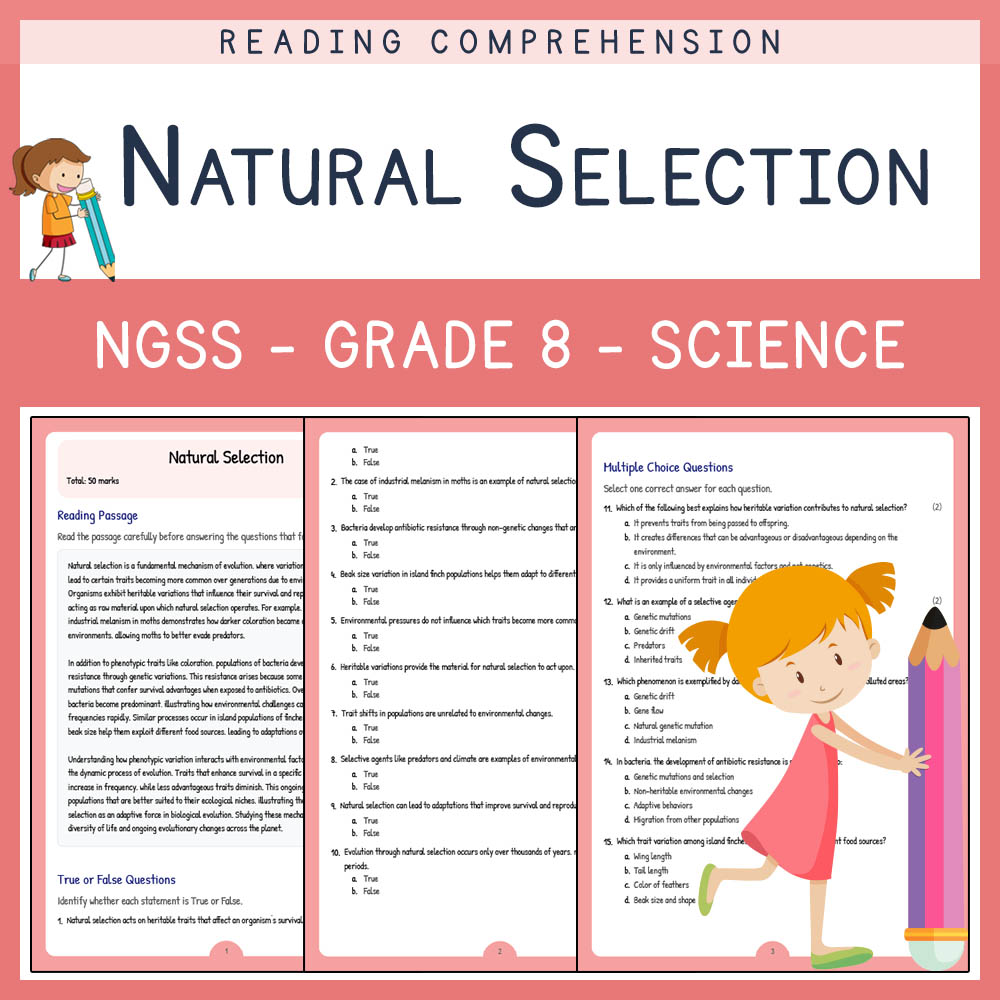
Grade 8 Science | Natural Selection Worksheet & Answer Key (NGSS-Aligned)
Created byLumora LearningLearning Objectives
- Explain the mechanisms of variation and natural selection in populations.
- Identify examples of adaptive change such as industrial melanism and antibiotic resistance.
- Describe how phenotypic variation and environmental factors influence trait frequency shifts over generations.
Instant download
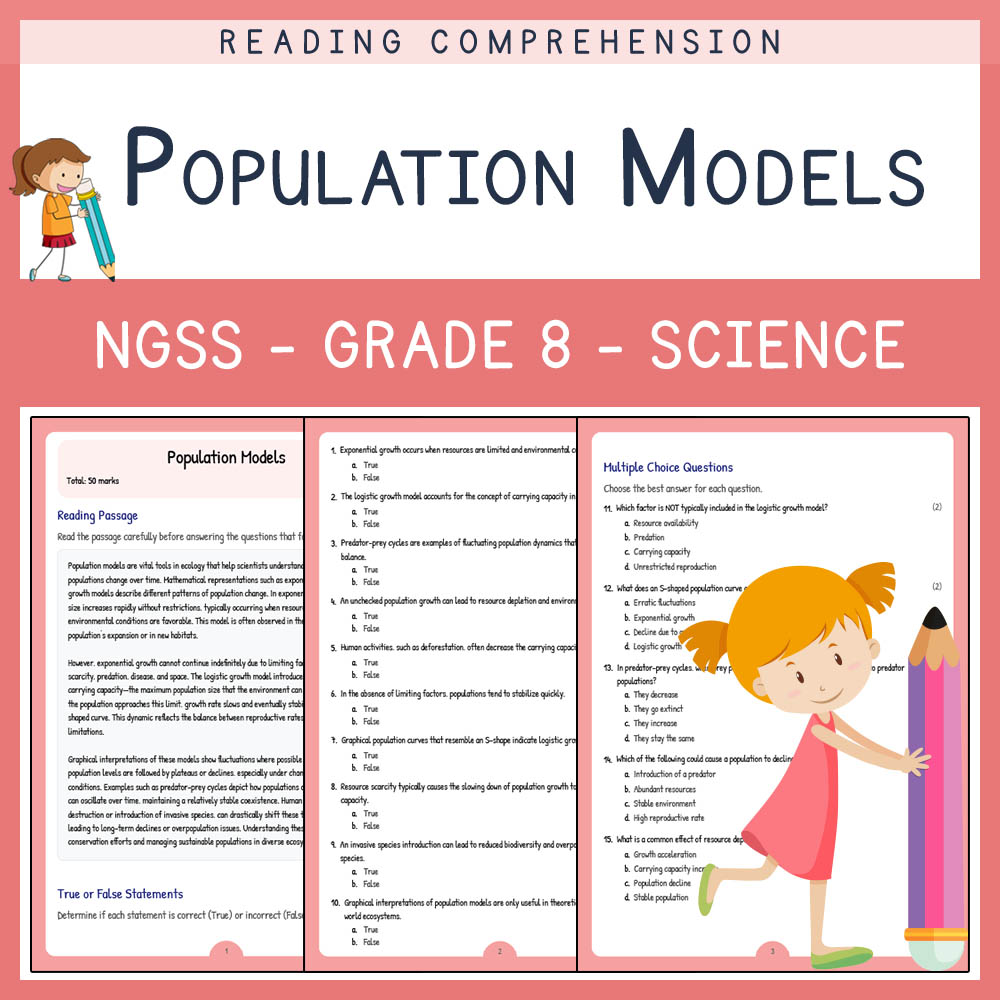
Grade 8 Science | Population Models Worksheet & Answer Key (NGSS Aligned)
Created byLumora LearningLearning Objectives
- Understand the basic concepts of population growth, including exponential and logistic models.
- Interpret graphical representations of population changes over time.
- Identify factors that limit populations such as resource availability and predation.
Instant download
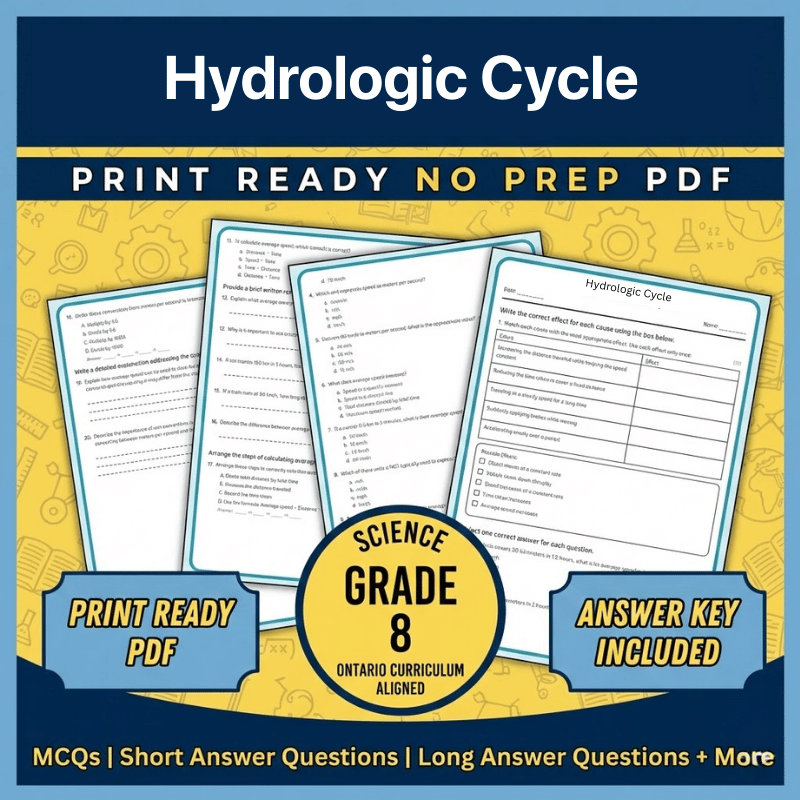
Grade 8 Science – Hydrologic Cycle Worksheet (Ontario) (PDF)
 Created byBright Mind Resources
Learning Objectives
- Understand the processes involved in the water cycle, including evaporation, condensation, precipitation, infiltration, and runoff.
- Explain the role of solar energy and gravity in driving water fluxes and seasonal changes.
- Describe how water reservoirs like oceans, glaciers, and aquifers interact and impact freshwater availability.
Instant download
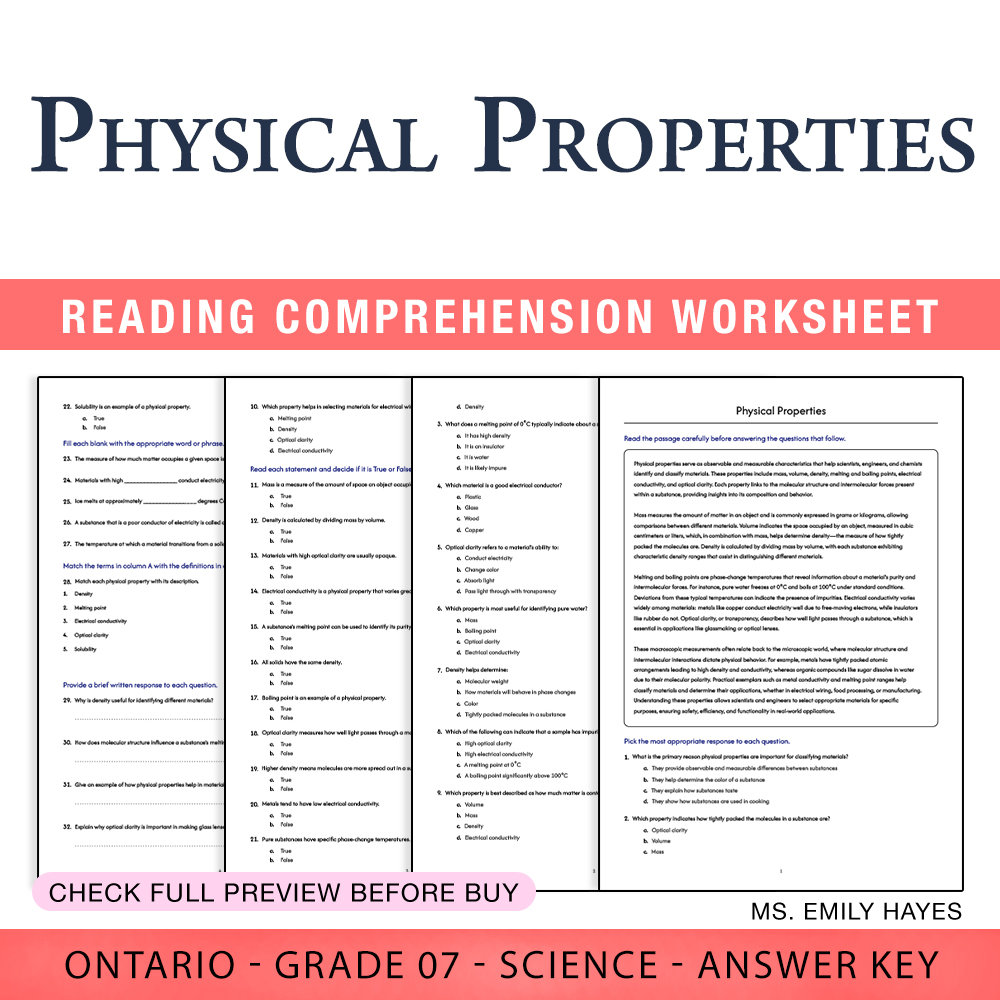
7th Grade Science | Physical Properties Worksheet (PDF+ Answer Key)
Created byCopper Leaf ClassroomLearning Objectives
- Define and describe physical properties such as mass, volume, density, melting point, boiling point, electrical conductivity, and optical clarity.
- Explain how physical properties are used to differentiate and classify substances based on their molecular structure and intermolecular forces.
- Relate macroscopic measurements to microscopic structures and discuss practical examples like metal conductivity and melting points.
Instant download
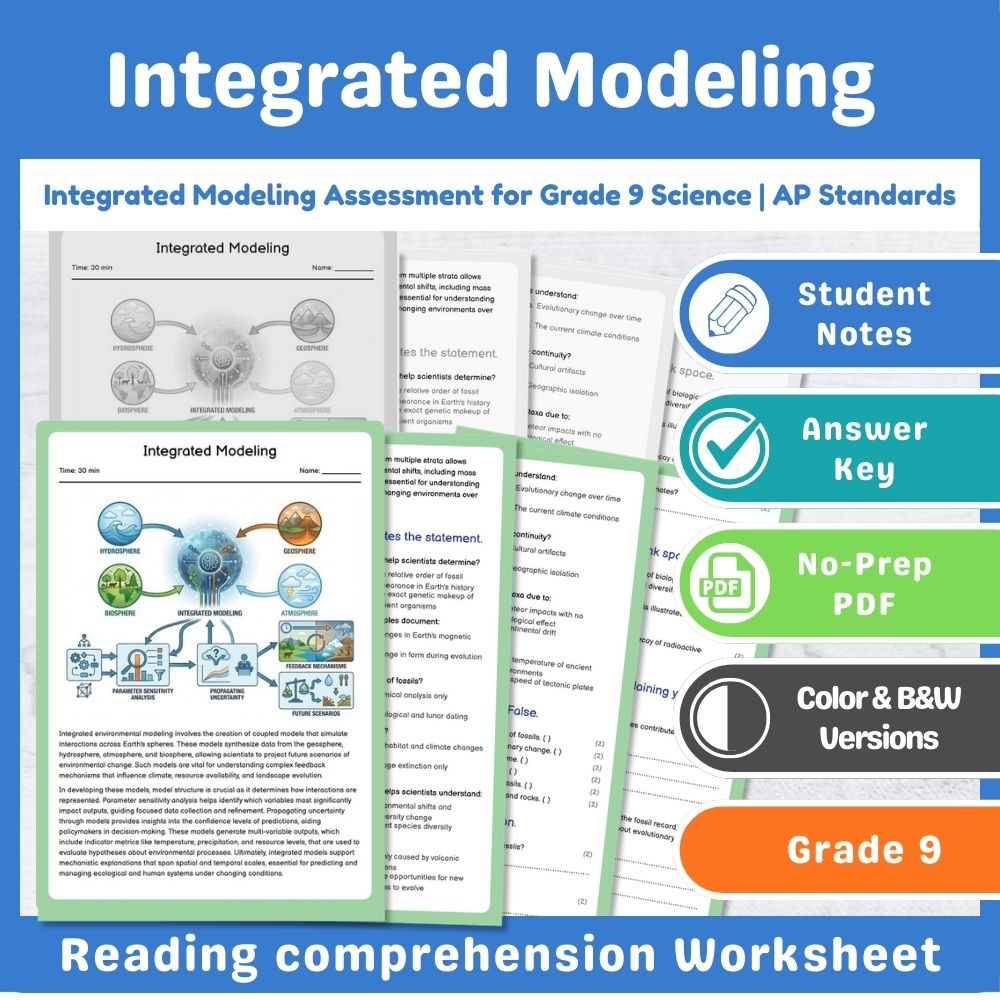
Integrated Modeling Assessment for Grade 9 Science | AP Standards
Created byPrism Point LearningLearning Objectives
- Understand the structure and purpose of coupled quantitative models in environmental science.
- Analyze how interactions among geosphere, hydrosphere, atmosphere, and biosphere influence environmental outcomes.
- Evaluate the significance of model parameters, uncertainty propagation, and hypothesis testing in environmental modeling.
Also included in: Grade 9 Science Mini Bundle | Earth and Space Sciences AP Standards
Instant download

Nutrient Cycling Worksheet | Grade 9 Science Activities
Created byPrism Point LearningLearning Objectives
- Explain how nitrogen and phosphorus move through organisms, soils, water, and the atmosphere.
- Describe how biological processes (nitrogen fixation, assimilation, mineralization, and denitrification) affect nutrient availability.
- Analyze how human activities can increase nutrient loading and lead to eutrophication and oxygen loss.
Instant download
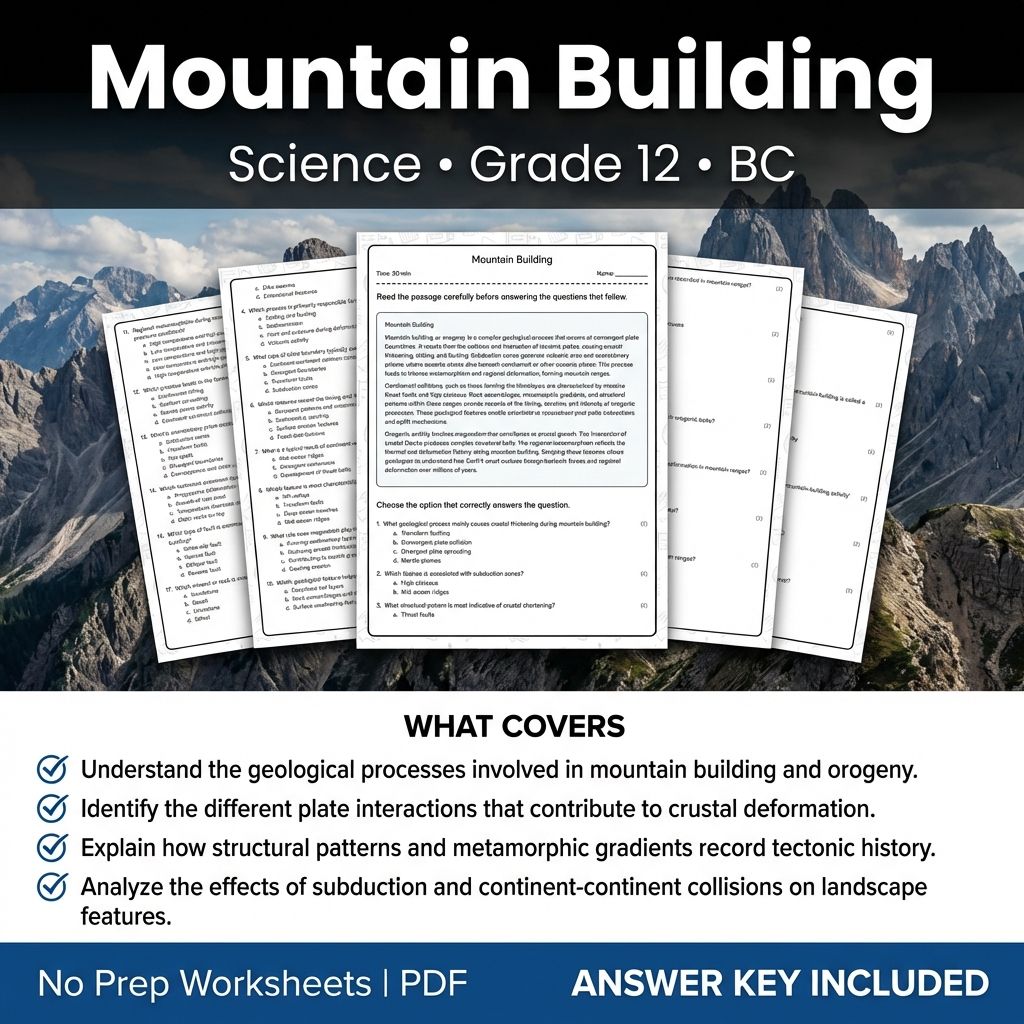
Mountain Building Science Worksheet Grade 12 | Standard BC Practice
Created byCoral Reef LearningLearning Objectives
- Understand the geological processes involved in mountain building and orogeny.
- Identify the different plate interactions that contribute to crustal deformation.
- Explain how structural patterns and metamorphic gradients record tectonic history.
Instant download
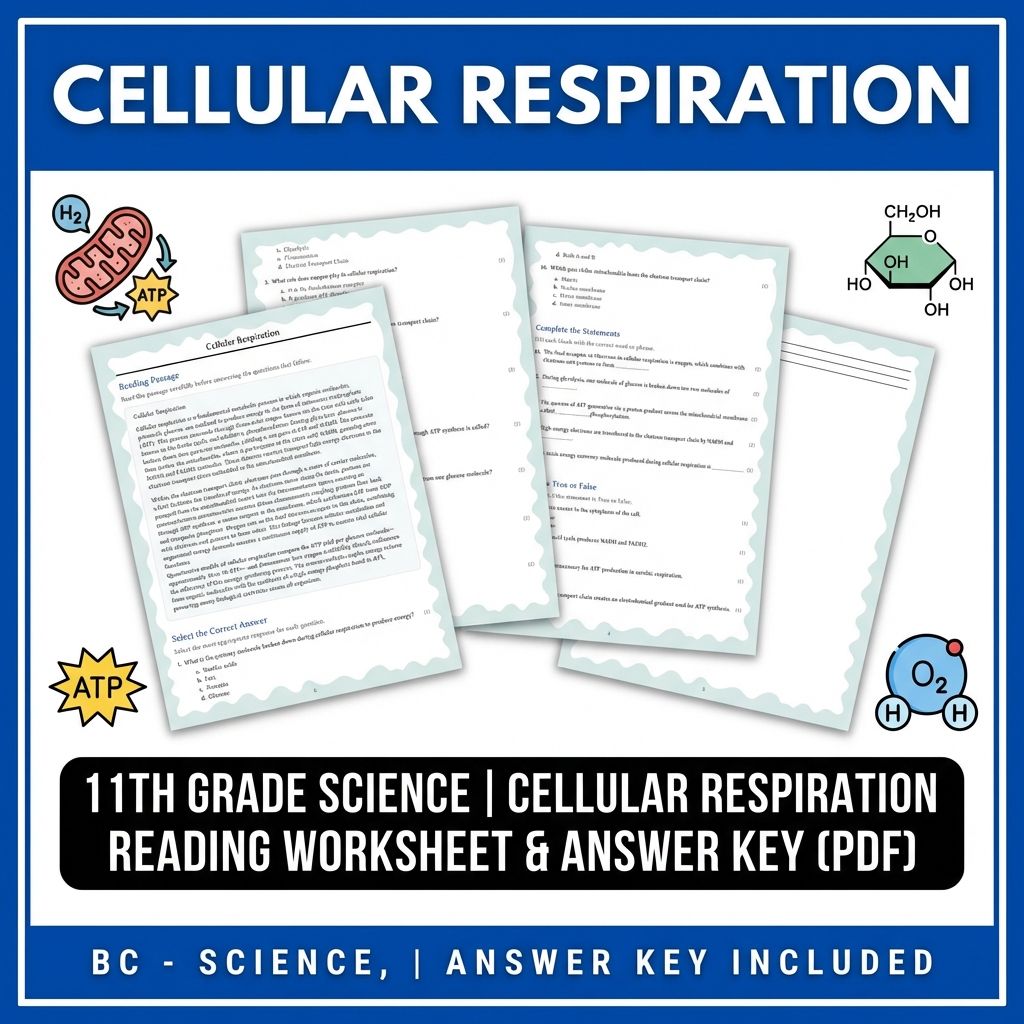
11th Grade Science | Cellular Respiration Reading Worksheet & Answer Key (PDF)
JCreated byJ.S SheetsLearning Objectives
- Describe the process of cellular respiration and its main stages.
- Explain how electrons pass through carrier molecules to generate ATP.
- Identify the role of oxygen as the final electron acceptor in respiration.
Instant download

Friction and Drag Worksheet | Grade 9 Science Activities
Created byPrism Point LearningLearning Objectives
- Explain how friction and aerodynamic drag oppose motion and convert mechanical energy into thermal energy.
- Identify the variables that affect friction on surfaces and drag in air for real-world objects.
- Use coefficients and basic models to estimate resistance forces qualitatively.
Also included in: Forces, Motion & Energy Lesson Bundle | Grade 9 Science (Alberta)
Instant download

Grade 9 Science | Metabolic Pathways Worksheet (TEKS)
 Created byEvergreen Desk Education
Learning Objectives
- Explain how catabolic and anabolic metabolic pathways differ in energy use and products.
- Describe how enzyme regulation (feedback, compartmentalization, and substrate availability) controls metabolic flux.
- Use pathway concepts to predict how changes in substrates or enzymes affect ATP production and biosynthesis.
Instant download

Grade 4 Wave Properties Science Daily Reading Worksheet | NGSS Activity
 Created byBRIGHT PATH RESOURCES
Learning Objectives
- Define the parts of a wave: crest, trough, and displacement
- Explain what wavelength and amplitude mean using a model
- Identify wave patterns described by position and displacement
Also included in: Waves & Transfer Grade 4 Science Daily Reading Worksheets Lesson Bundle | NGSS +2 more
Instant download
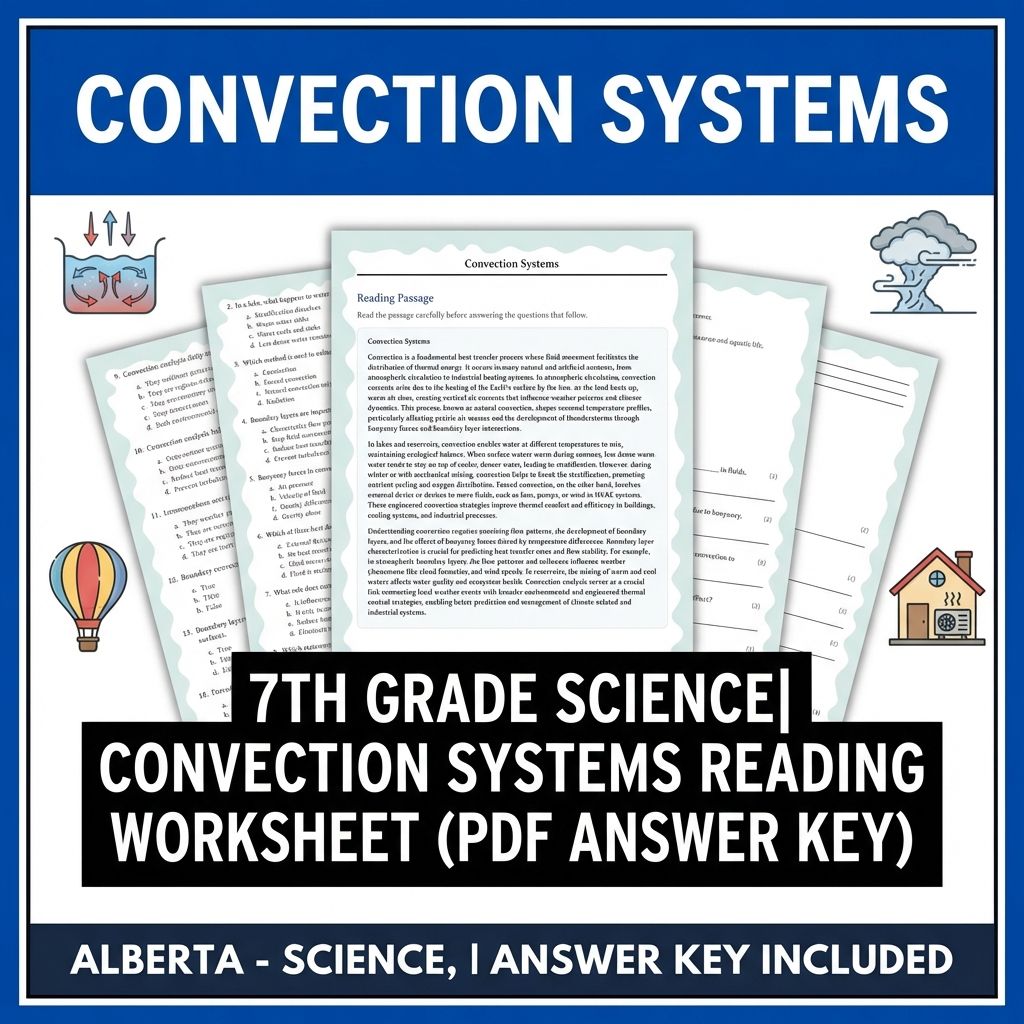
7th Grade Science | Convection Systems Reading Worksheet (PDF Answer Key)
JCreated byJ.S SheetsLearning Objectives
- Understand the principles of convection and how it transports heat in fluids.
- Identify natural and forced convection examples in environmental and engineered systems.
- Analyze flow patterns, boundary layers, and buoyancy forces in convection processes.
Instant download

Net Force Worksheet | Grade 7 Science NGSS Forces and Motion Activity
 Created byAmber Owl Education
Learning Objectives
- Define net force as the vector sum of all forces acting on an object and explain the effect of balanced vs. unbalanced forces on motion.
- Use free-body diagrams to identify forces (including applied forces and friction) and determine the direction of the net force.
- Describe how net force relates to acceleration and how mass affects acceleration using proportional reasoning within Grade 7 scope.
Also included in: Grade 7 Science Forces and Motion Lesson Bundle – NGSS Worksheets +1 more
Instant download
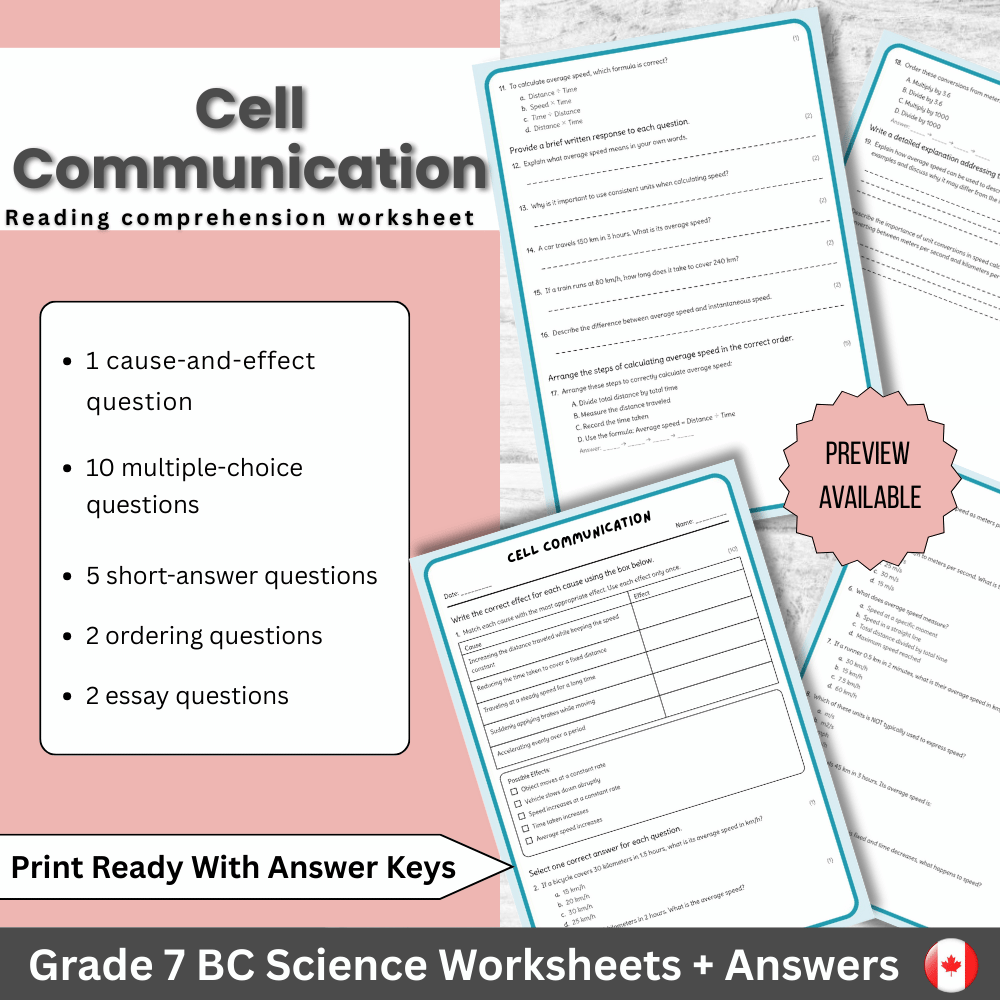
7th Grade Science | Cell Communication Worksheet (Answer Key) | BC Standards
Created byBright Mind ResourcesLearning Objectives
- Explain how cells communicate through chemical and electrical signals.
- Identify structures involved in cell signaling such as receptor proteins, gap junctions, and plasmodesmata.
- Describe mechanisms like signal specificity, amplification, and feedback regulation in cellular processes.
Instant download

Cell Components Worksheet for Grade 9 Science | AP Biology Practice
Created byPrism Point LearningLearning Objectives
- Identify major cell components (membranes, organelles, cytoskeleton) and describe their core functions
- Explain how compartmentalization supports specialized metabolism inside cells
- Relate membrane and organelle structure to selective transport and diffusion rates
Instant download
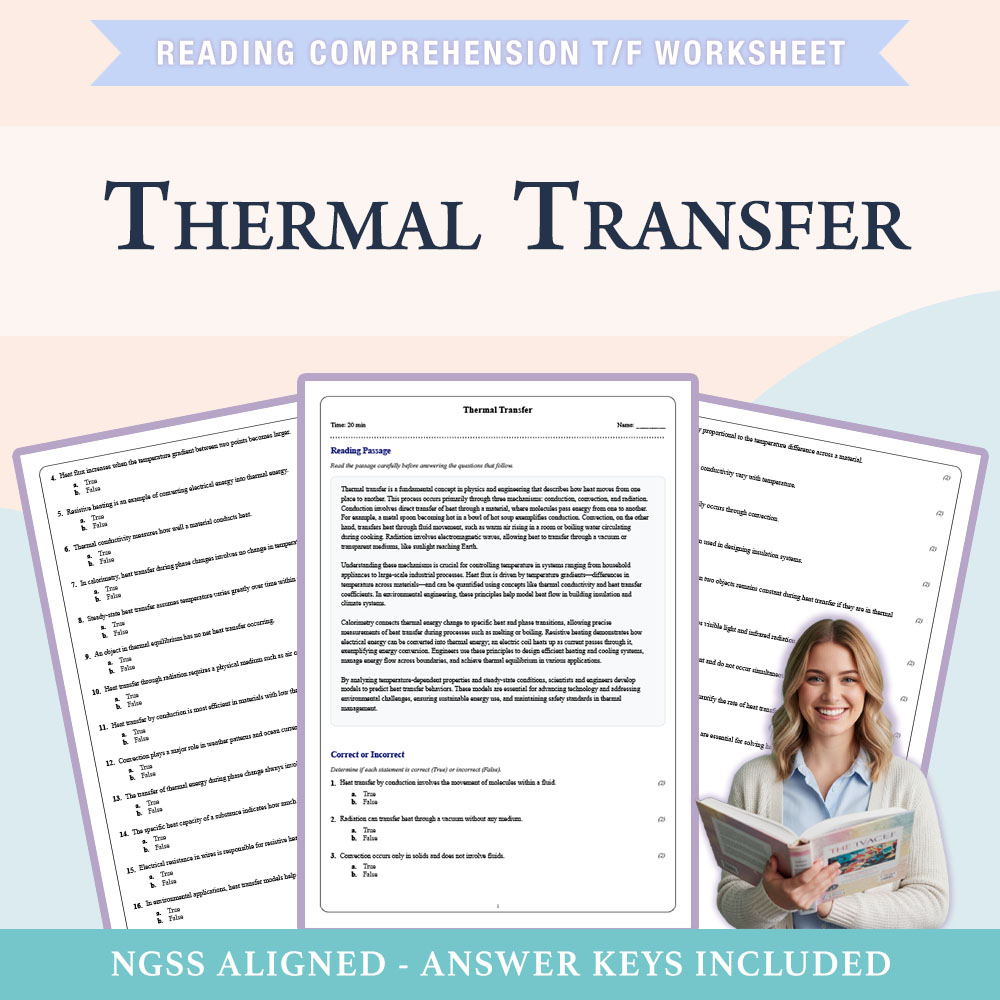
Grade 10 Science | Thermal Transfer Worksheet (PDF +Answer Key)
Created byCopper Leaf ClassroomLearning Objectives
- Understand the mechanisms of heat transfer: conduction, convection, and radiation.
- Explain the concept of thermal energy and heat flux in temperature gradients.
- Connect calorimetric reasoning to thermal energy changes involving specific heat and phase changes.
Also included in: Grade 10 Science | Energy and Work Worksheets Bundle (PDF + Answer Key) +1 more
Instant download

Grade 7 Gravity and Weight Worksheet NGSSS Science Forces Practice
Created byEvergreen Desk EducationLearning Objectives
- Differentiate between mass and weight and explain how weight changes with gravity.
- Describe how gravity affects the motion of falling objects near Earth.
- Use evidence from comparing objects with different masses to support ideas about net force and motion.
Instant download
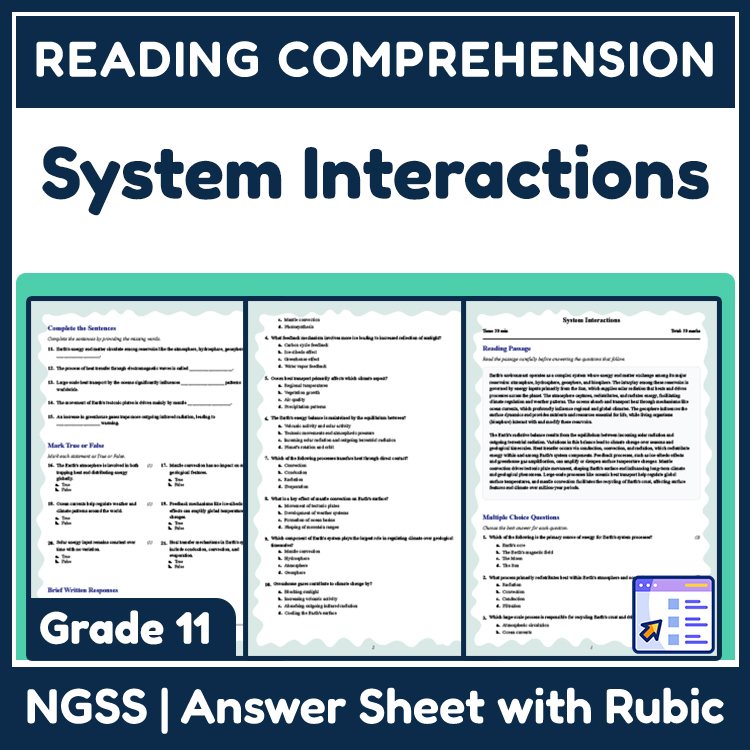
Grade 11 Science | System Interactions Reading Worksheet (PDF & Answer Key)
JCreated byJ.S SheetsLearning Objectives
- Understand the major reservoirs of Earth's system and how energy exchanges occur among atmosphere, hydrosphere, geosphere, and biosphere.
- Analyze the processes of solar energy input, radiative balance, and heat transfer mechanisms within Earth's systems.
- Identify feedback mechanisms that influence surface and subsurface processes on seasonal to geologic timescales.
Also included in: Grade 11 Science | Ecosystems & Earth Systems Worksheet Bundle
Instant download
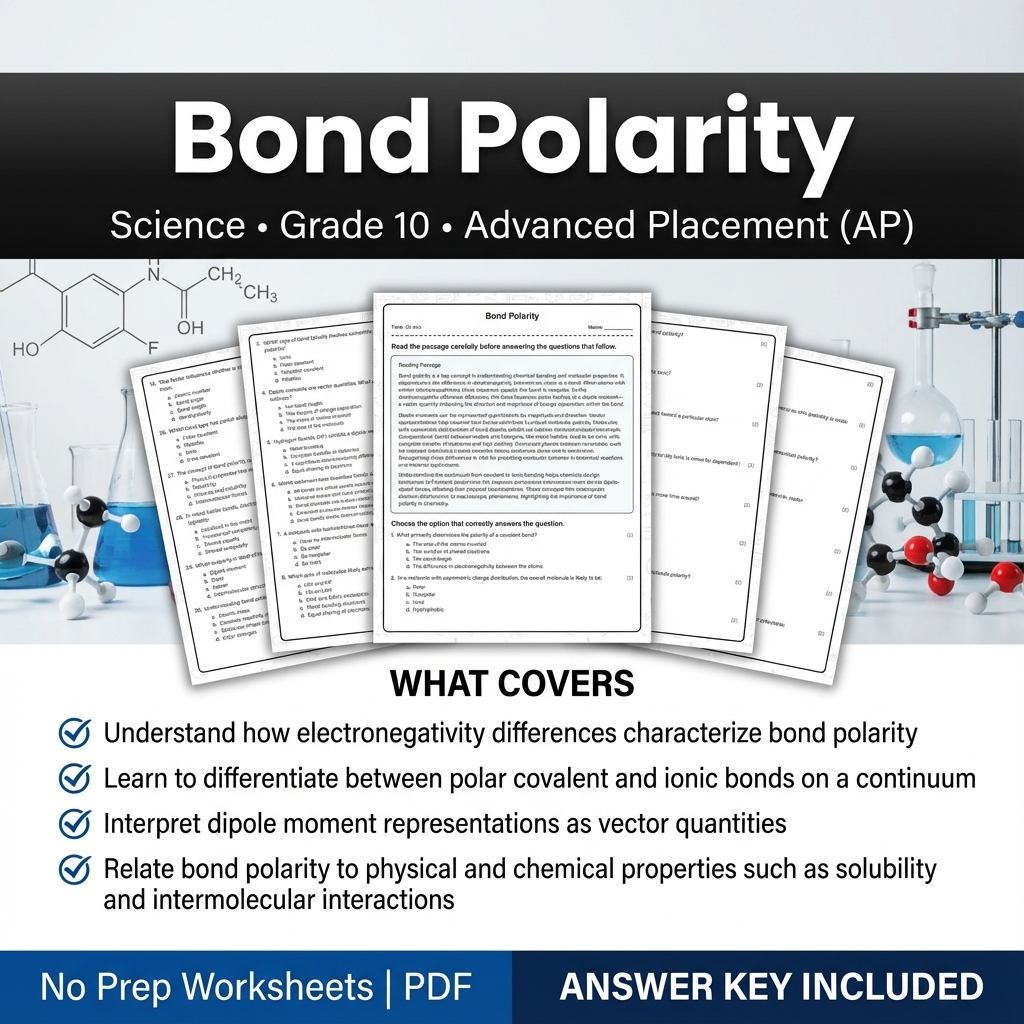
10th Grade Science | Bond Polarity Worksheet (Printable PDF + Answer Key)
Created byCoral Reef LearningLearning Objectives
- Understand how electronegativity differences characterize bond polarity
- Learn to differentiate between polar covalent and ionic bonds on a continuum
- Interpret dipole moment representations as vector quantities
Also included in: Grade 10 Science Unit Bundle | Thermochemistry, Stoichiometry & Atomic Structure +1 more
Instant download
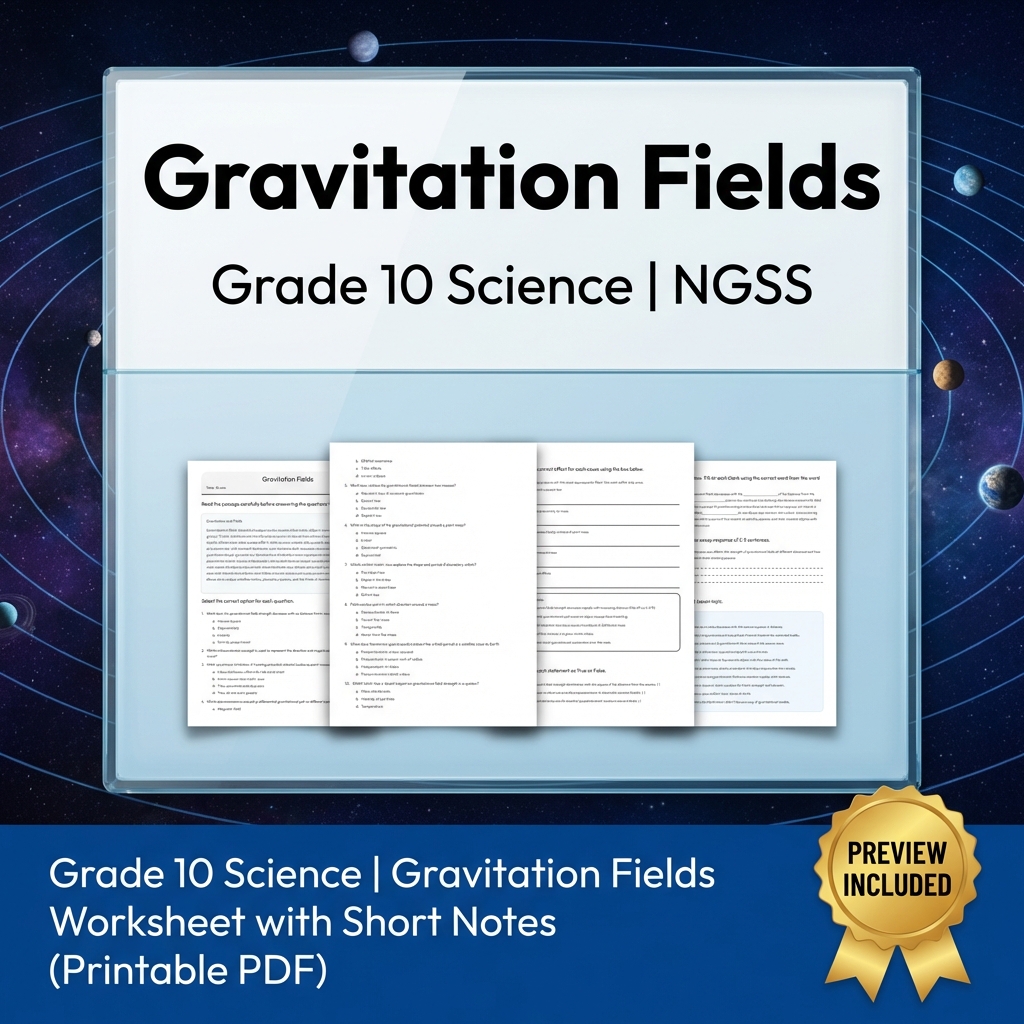
Grade 10 Science | Gravitation Fields Worksheet with Short Notes (Printable PDF)
 Created byMeadowlark Worksheets
Learning Objectives
- Understand the inverse-square behavior of gravitational fields.
- Analyze orbital dynamics using Newtonian gravity.
- Represent gravitational fields using vectors and potentials.
Also included in: Grade 10 Science NGSS Unit | Motion & Forces Interactions Worksheet Bundle +1 more
Instant download
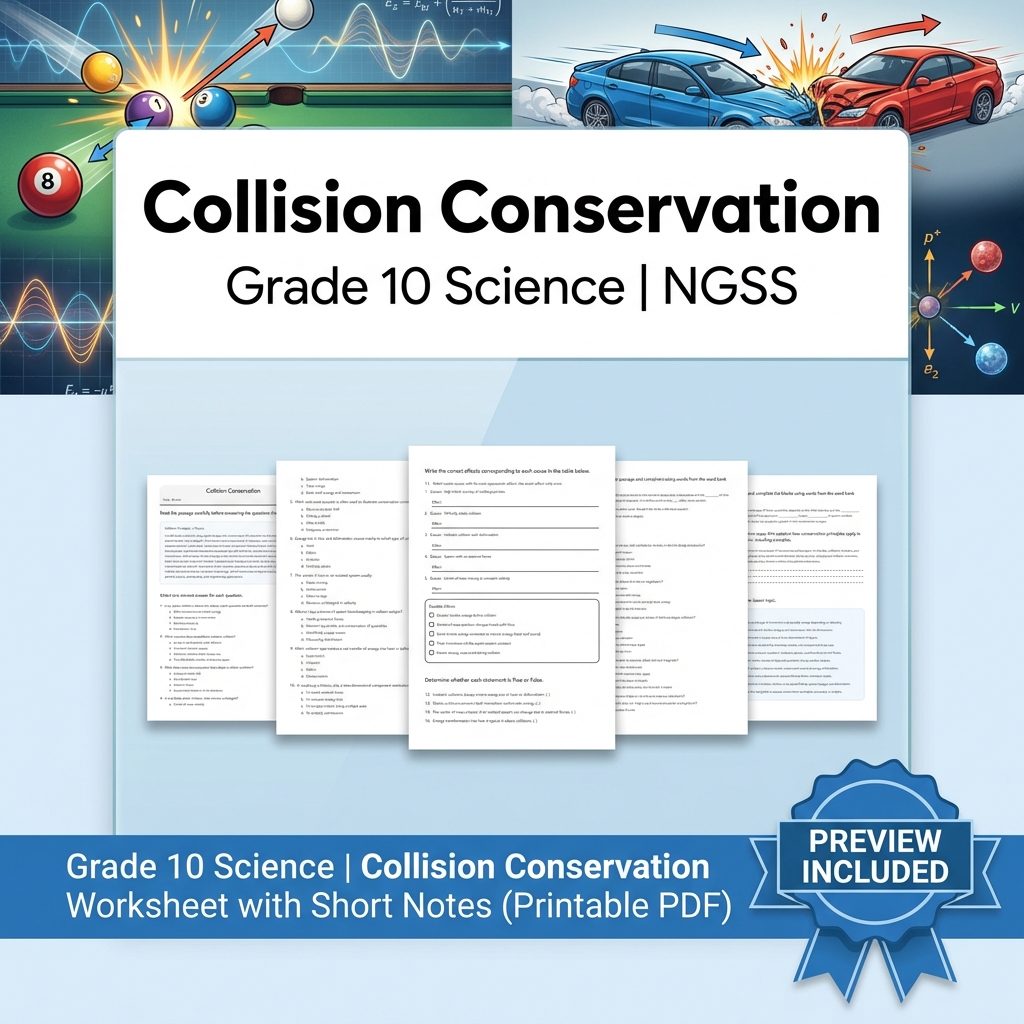
Grade 10 Science | Collision Conservation Worksheet with Short Notes (PDF)
Created byMeadowlark WorksheetsLearning Objectives
- Understand the principles of conservation of momentum and energy in multi-body collisions.
- Analyze two-dimensional collision components using vector resolution.
- Differentiate between elastic and inelastic collisions through speed and energy analysis.
Also included in: Grade 10 Science NGSS Unit | Motion & Forces Interactions Worksheet Bundle +1 more
Instant download
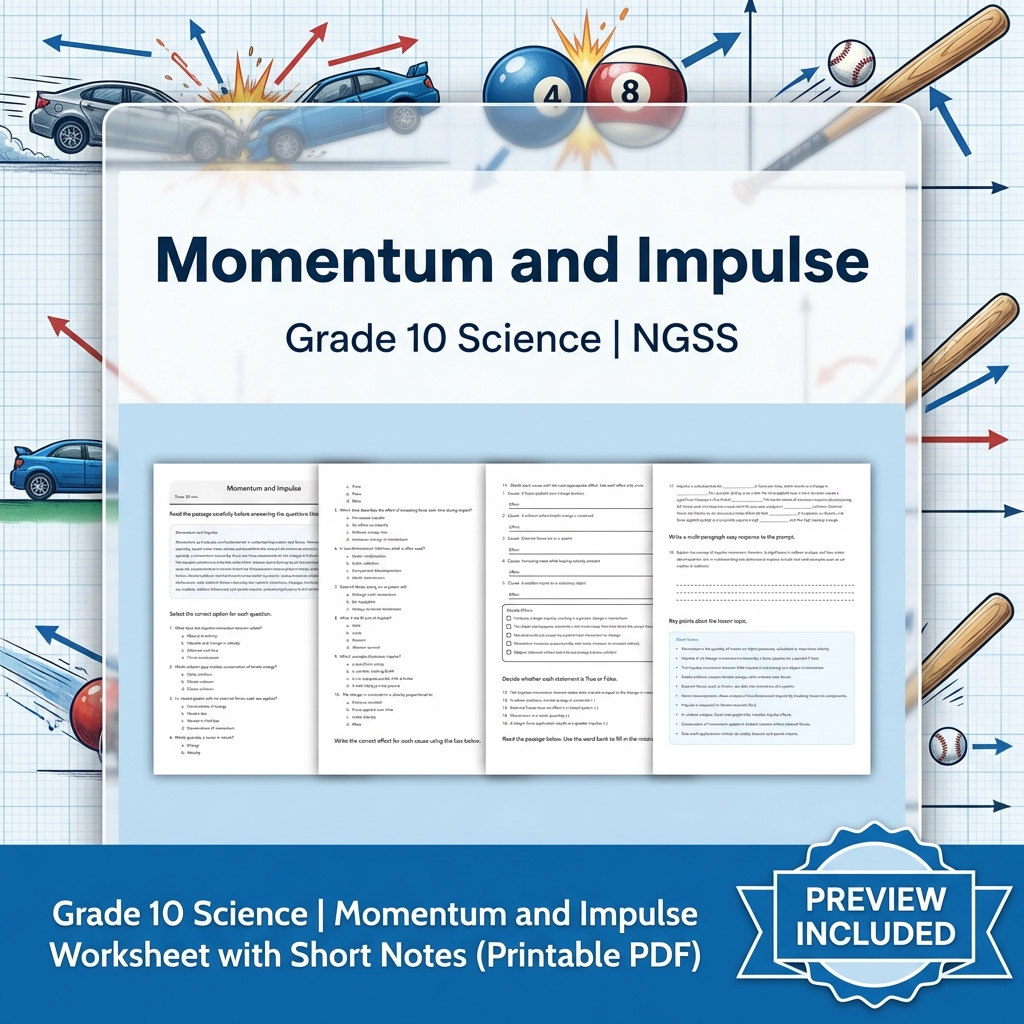
Grade 10 Science | Momentum and Impulse Worksheet with Short Notes (PDF)
Created byMeadowlark WorksheetsLearning Objectives
- Understand and apply the concepts of momentum and impulse in physical systems.
- Explain the impulse-momentum theorem and conservation principles in collisions.
- Analyze two-dimensional momentum interactions and vector decomposition.
Also included in: Grade 10 Science NGSS Unit | Motion & Forces Interactions Worksheet Bundle +1 more
Instant download
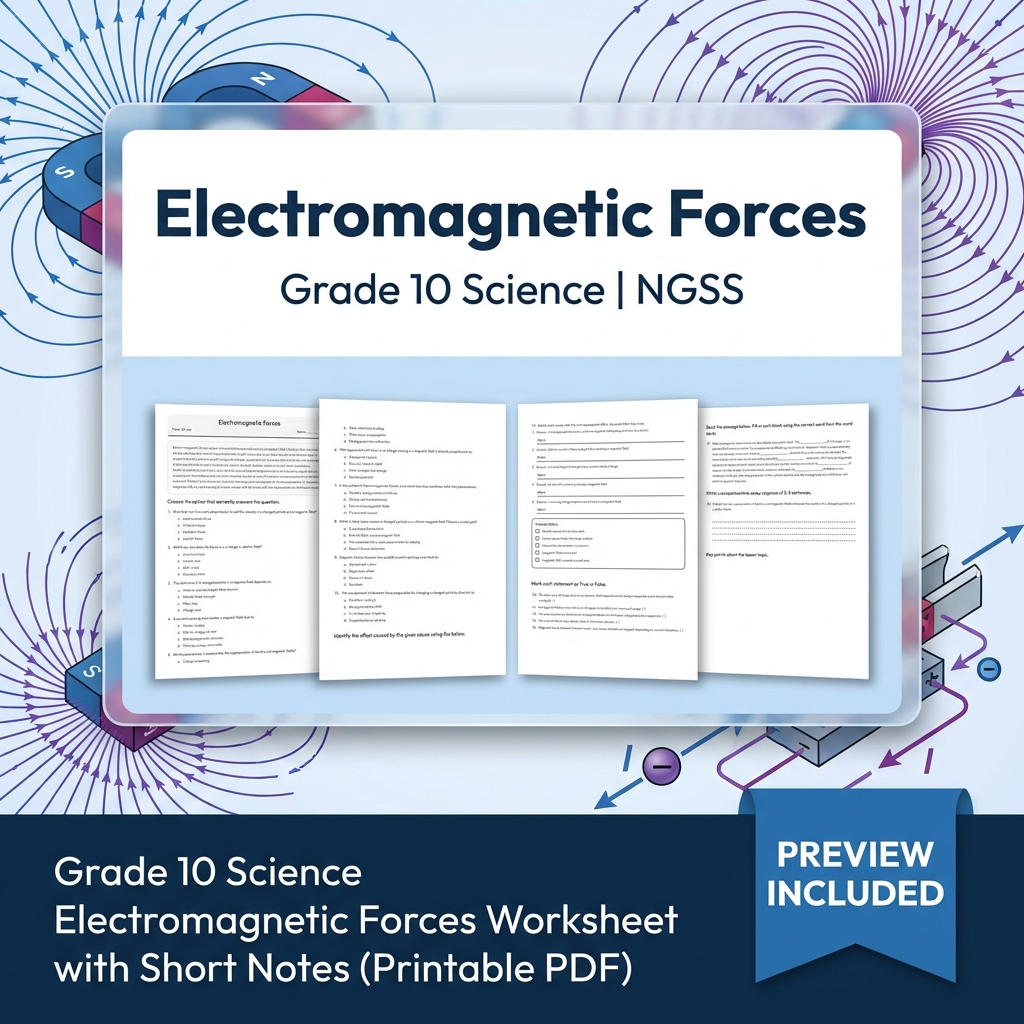
Grade 10 Science Electromagnetic Forces Worksheet with Short Notes (PDF)
Created byMeadowlark WorksheetsLearning Objectives
- Explain the concepts of electric and magnetic field interactions and their vector relationships.
- Describe the forces on charges and currents in uniform electromagnetic fields.
- Apply the Lorentz force law to simple charged particle deflections and current interactions.
Also included in: Grade 10 Science NGSS Unit | Motion & Forces Interactions Worksheet Bundle +1 more
Instant download
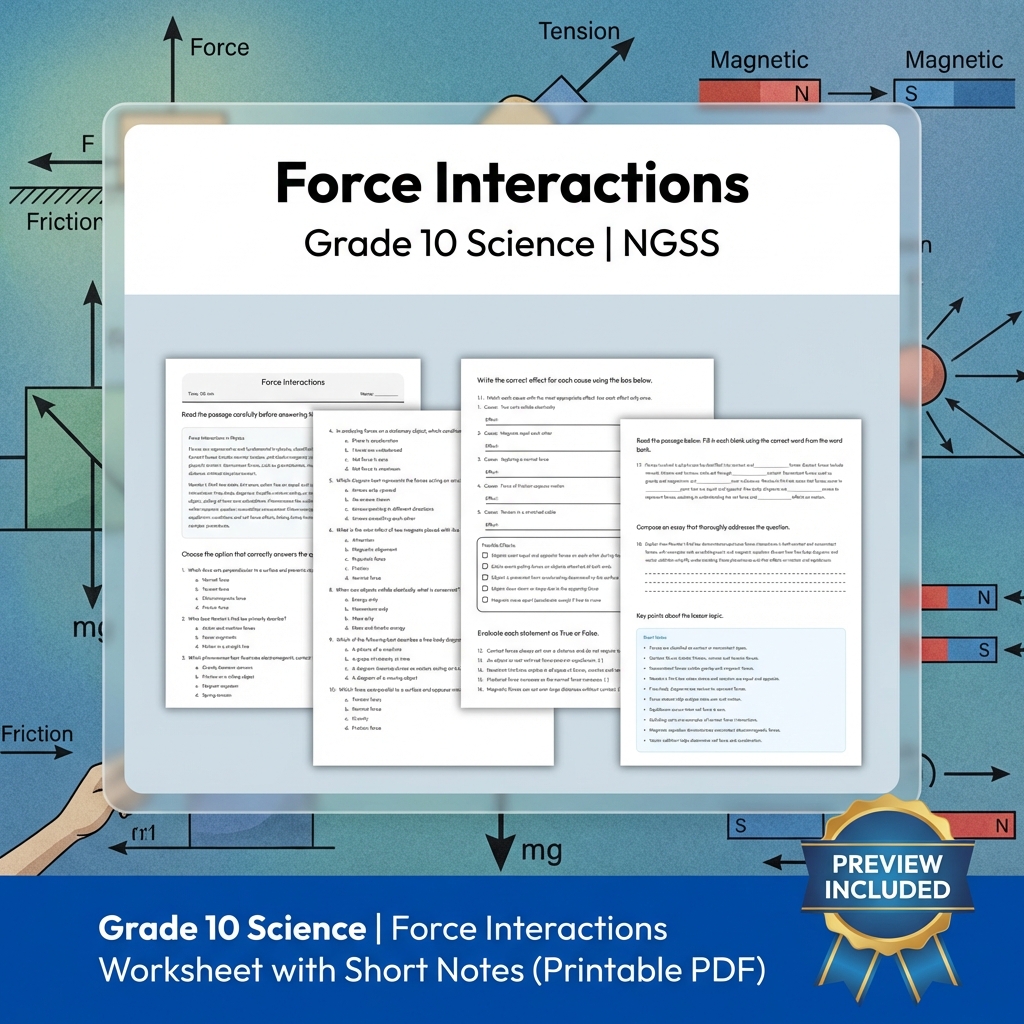
Grade 10 Science | Force Interactions Worksheet with Short Notes (Printable PDF)
Created byMeadowlark WorksheetsLearning Objectives
- Understand the classification of contact and noncontact forces.
- Represent force interactions using vectors and free-body diagrams.
- Explain Newton's third law and pairwise force interactions.
Also included in: Grade 10 Science NGSS Unit | Motion & Forces Interactions Worksheet Bundle +1 more
Instant download
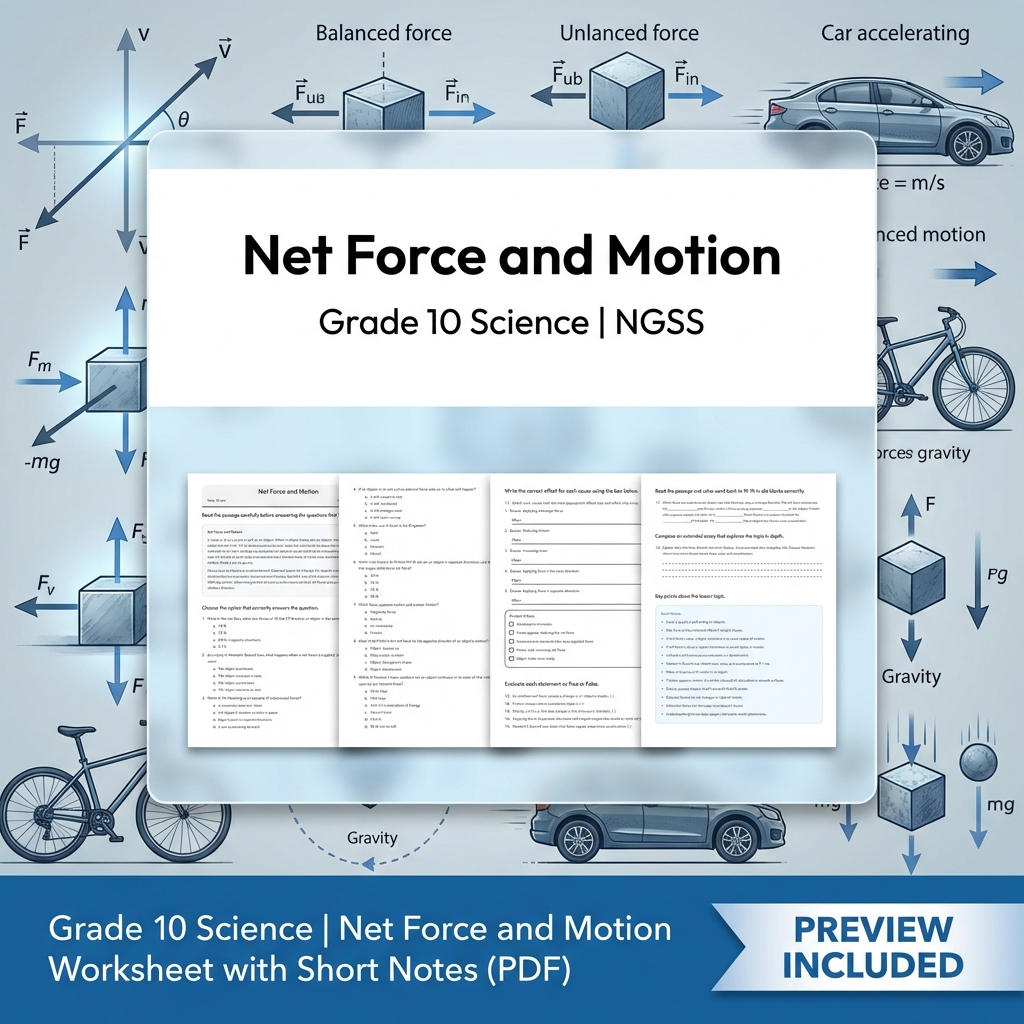
Grade 10 Science | Net Force and Motion Worksheet with Short Notes (PDF)
Created byMeadowlark WorksheetsLearning Objectives
- Understand the concept of net force and how it affects motion.
- Identify different types of forces and their effects on objects.
- Calculate net force in various scenarios.
Also included in: Grade 10 Science NGSS Unit | Motion & Forces Interactions Worksheet Bundle +1 more
Instant download
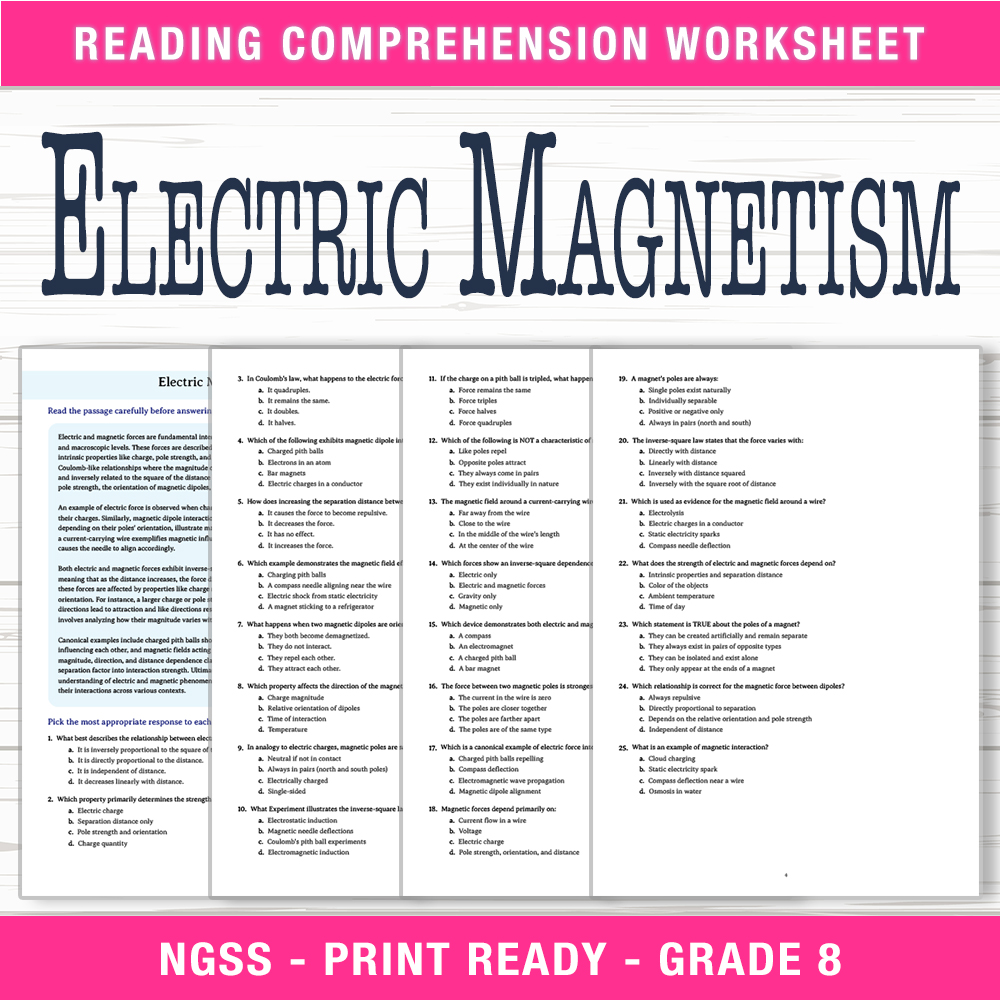
Grade 8 Science | Electric Magnetism Worksheet (PDF + Answer Key)
 Created byRiverstone Classroom
Learning Objectives
- Explain the fundamental forces involved in electric and magnetic interactions.
- Describe how electric and magnetic forces depend on properties like charge, pole strength, and distance.
- Identify real-world examples of electric and magnetic forces and analyze factors affecting their strength.
Also included in: Grade 8 Science Unit | Momentum, Forces & Magnetism Worksheets (PDF)
Instant download

Seasons, Earth’s Tilt and Orbit Worksheets Grade 5 Science
Created byBRIGHT PATH RESOURCESLearning Objectives
- Explain how Earth’s tilt changes the angle of sunlight on different hemispheres.
- Describe how the length of daylight varies during the year and how it relates to temperature.
- Interpret a simple sky model to predict longer and shorter days.
Also included in: Grade 5 Earth Science Worksheets | Weather, Water & Earth Systems +2 more
Instant download
Browse more categories
About Science Worksheets
Find Science worksheets spanning core skills, practice, and review. All 44,620 resources are instant PDF downloads for the classroom or home.
Every worksheet on MyTeachingSheets is created by independent teacher-authors and reviewed before publication. All resources download as printable PDFs for classroom, homework, or at-home practice, and many include answer keys. Preview any worksheet free before buying.