
Science Worksheets
44,628 subject resources
Grade 11 Science — Worksheet MCQ Paper for Mastering Hybridization
 Created byThe Resource Hub
Learning Objectives
- Understand the concept of atomic orbital hybridization and its role in molecular geometry.
- Identify types of hybridization (sp, sp2, sp3) and their associated molecular shapes.
- Explain how hybridization influences bond types, strength, and length in covalent molecules.
Also included in: Grade 11 Science – Chemistry Unit Worksheet Bundle (BC) +1 more
Instant download
Grade 11 Science — Worksheet MCQ Paper for Mastering Stoichiometric Calculations
Created byThe Resource HubLearning Objectives
- Understand mole relationships and their application in chemical equations.
- Identify limiting reagents and calculate percent yields.
- Perform mass-to-mass, mass-to-mole, and mole-to-mole conversions using molar masses.
Also included in: Grade 11 Science – Chemistry Unit Worksheet Bundle (BC) +1 more
Instant download
Grade 11 Science — Worksheet MCQ Paper for Mastering Atomic Models
Created byThe Resource HubLearning Objectives
- Explain the historical development of atomic models from Dalton to quantum mechanics.
- Identify the main features and differences of each atomic model.
- Understand the role of subatomic particles and quantum numbers in atomic structure.
Also included in: Grade 11 Science – Chemistry Unit Worksheet Bundle (BC) +1 more
Instant download
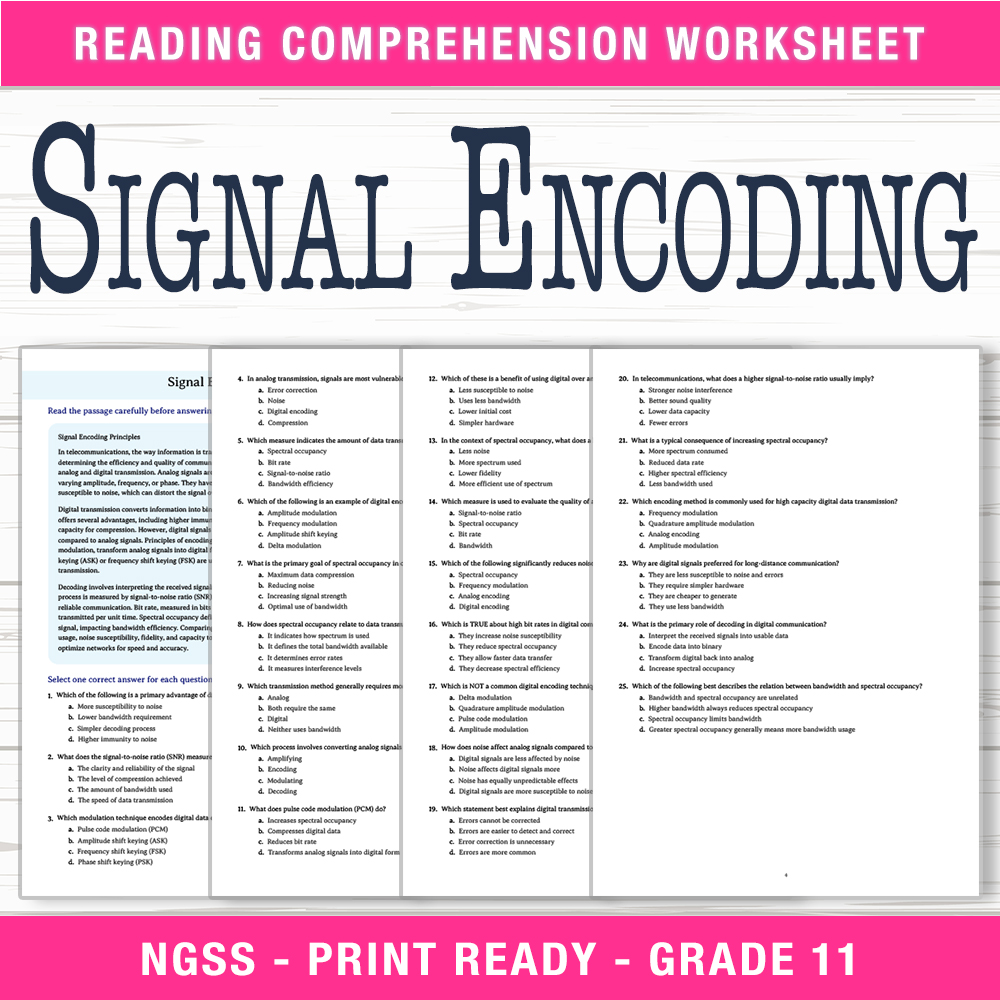
Grade 11 Science | Signal Encoding Worksheet (PDF + Answer Key)
 Created byRiverstone Classroom
Learning Objectives
- Understand the advantages and disadvantages of digital versus analog transmission and storage.
- Evaluate the principles of encoding, modulation, and decoding in terms of capacity and reliability.
- Interpret quantitative measures such as bit rate, signal-to-noise ratio, and spectral occupancy in communication systems.
Instant download

Grade 9 Science – Intermolecular Forces & BC Standards | Daily Reading Worksheet
 Created byBright Mind Resources
Learning Objectives
- Identify different types of intermolecular forces
- Understand how molecular structure influences intermolecular forces
- Explain the effect of intermolecular forces on physical properties
Also included in: Grade 9 Chemical Reactions Science Lesson Bundle: Daily Reading (BC) +1 more
Instant download
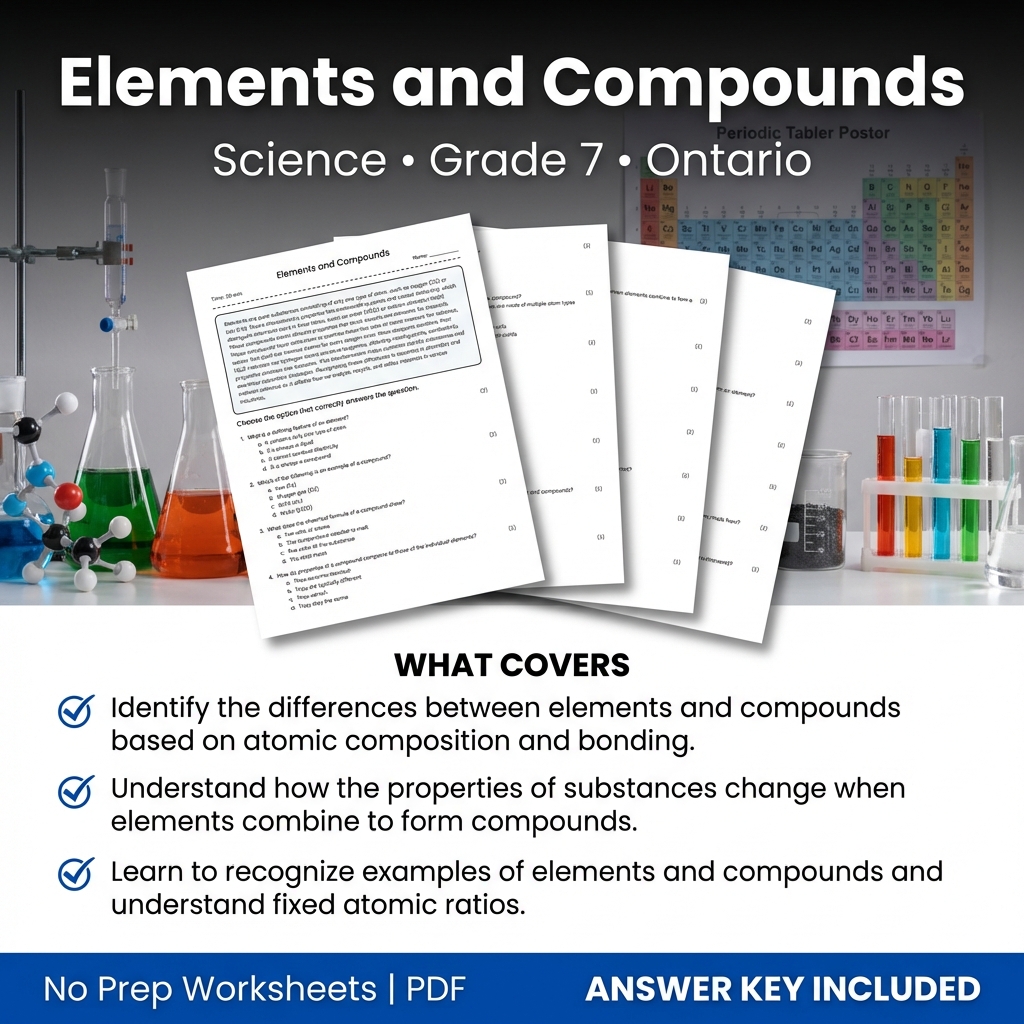
Elements and Compounds Worksheet | Grade 7 Science Ontario Standards
 Created byCoral Reef Learning
Learning Objectives
- Identify the differences between elements and compounds based on atomic composition and bonding.
- Understand how the properties of substances change when elements combine to form compounds.
- Learn to recognize examples of elements and compounds and understand fixed atomic ratios.
Instant download
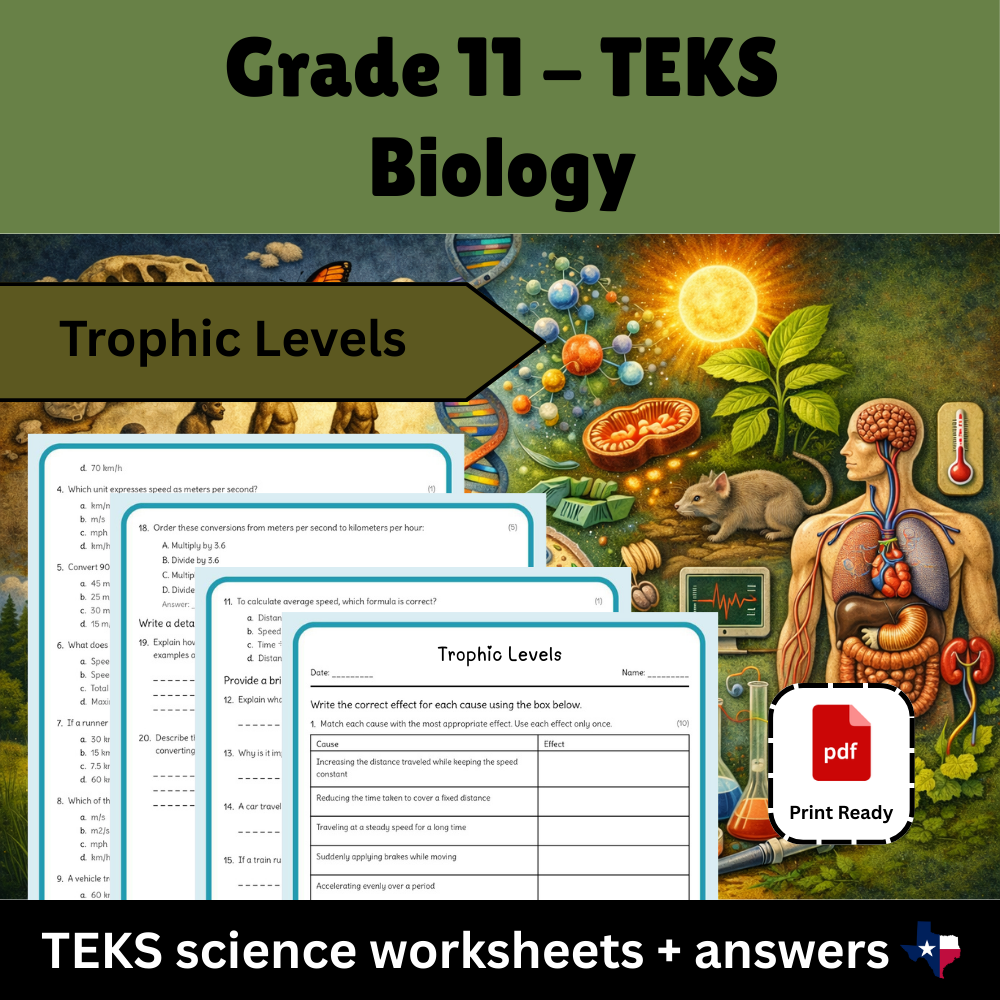
Grade 11 Science – Trophic Levels Worksheet (Worksheet + Answer Key) | TEKS Aligned
Created byBright Mind ResourcesLearning Objectives
- Understand the concept of trophic levels and their role in ecosystems.
- Identify different types of organisms within food chains and food webs.
- Explain energy transfer inefficiency between trophic levels and its ecological consequences.
Also included in: Grade 11 Science - Ecosystem & Biogeochemical Cycles Unit Worksheet Pack - TEKS +2 more
Instant download
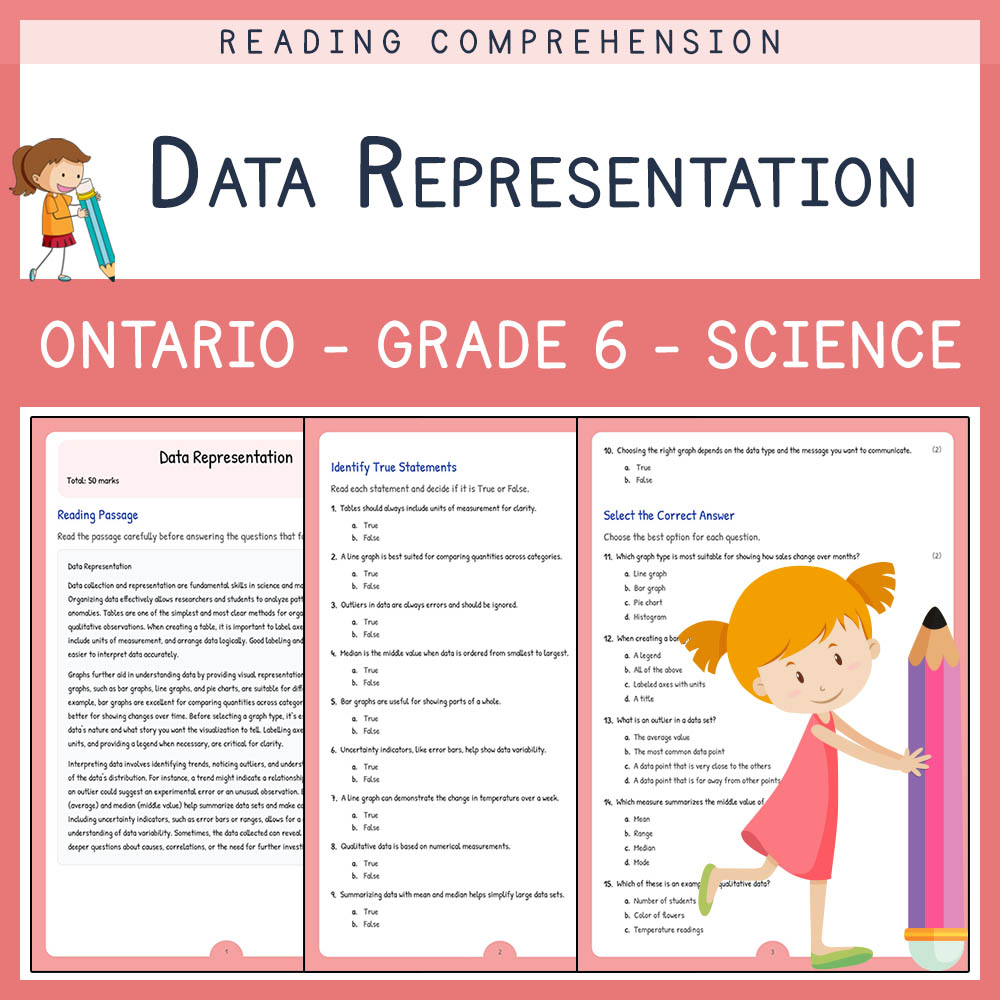
Grade 6 Science | Data Representation Worksheet (PDF + Answer Key) for Ontario Standards
 Created byLumora Learning
Learning Objectives
- Understand ways to organize and display data using tables and graphs.
- Identify appropriate graph types for different data sets.
- Interpret data patterns, including trends and outliers, from various representations.
Instant download
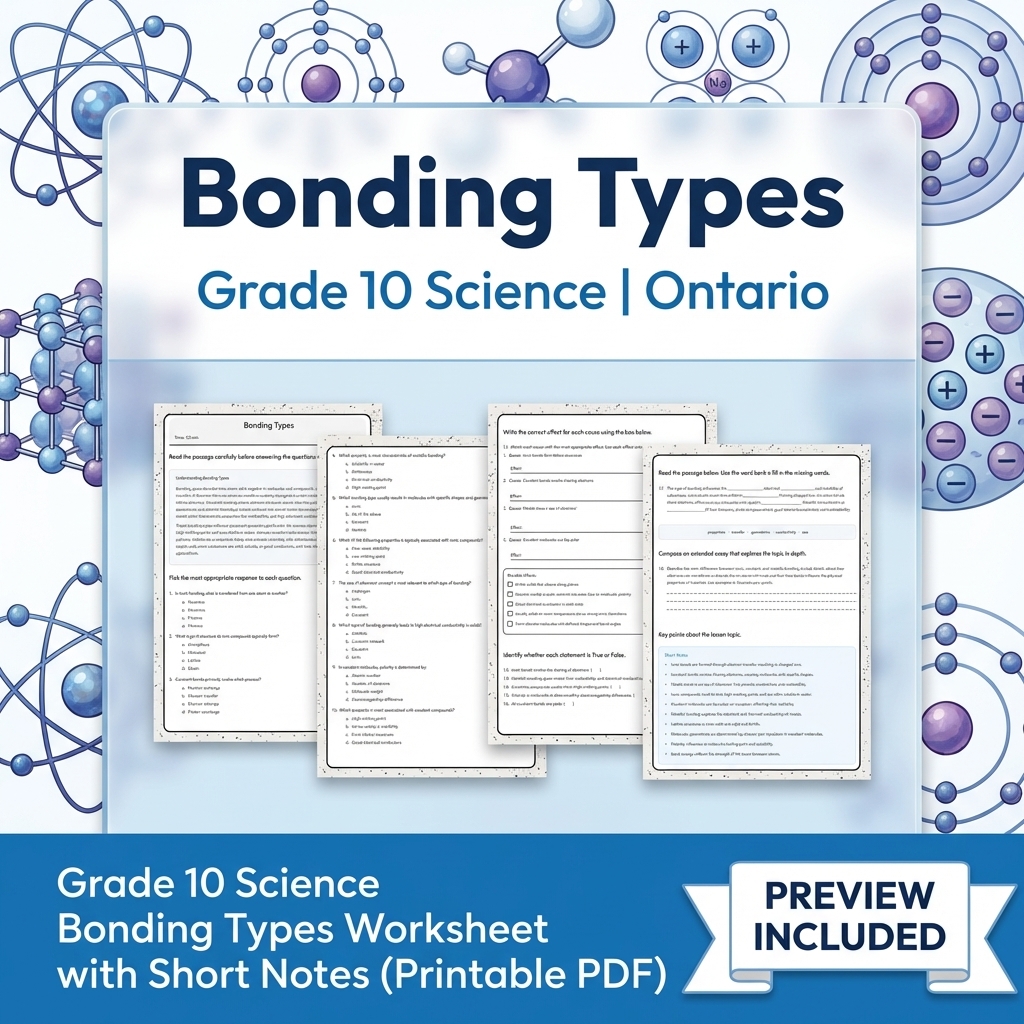
Grade 10 Science Bonding Types Worksheet with Short Notes (Printable PDF)
 Created byMeadowlark Worksheets
Learning Objectives
- Understand the differences between ionic, covalent, and metallic bonding.
- Explain electron transfer and sharing models in bonding.
- Identify molecular geometries and lattice structures resulting from bonding types.
Also included in: Grade 10 Science Lesson Group Bundle with Ontario Framework +1 more
Instant download
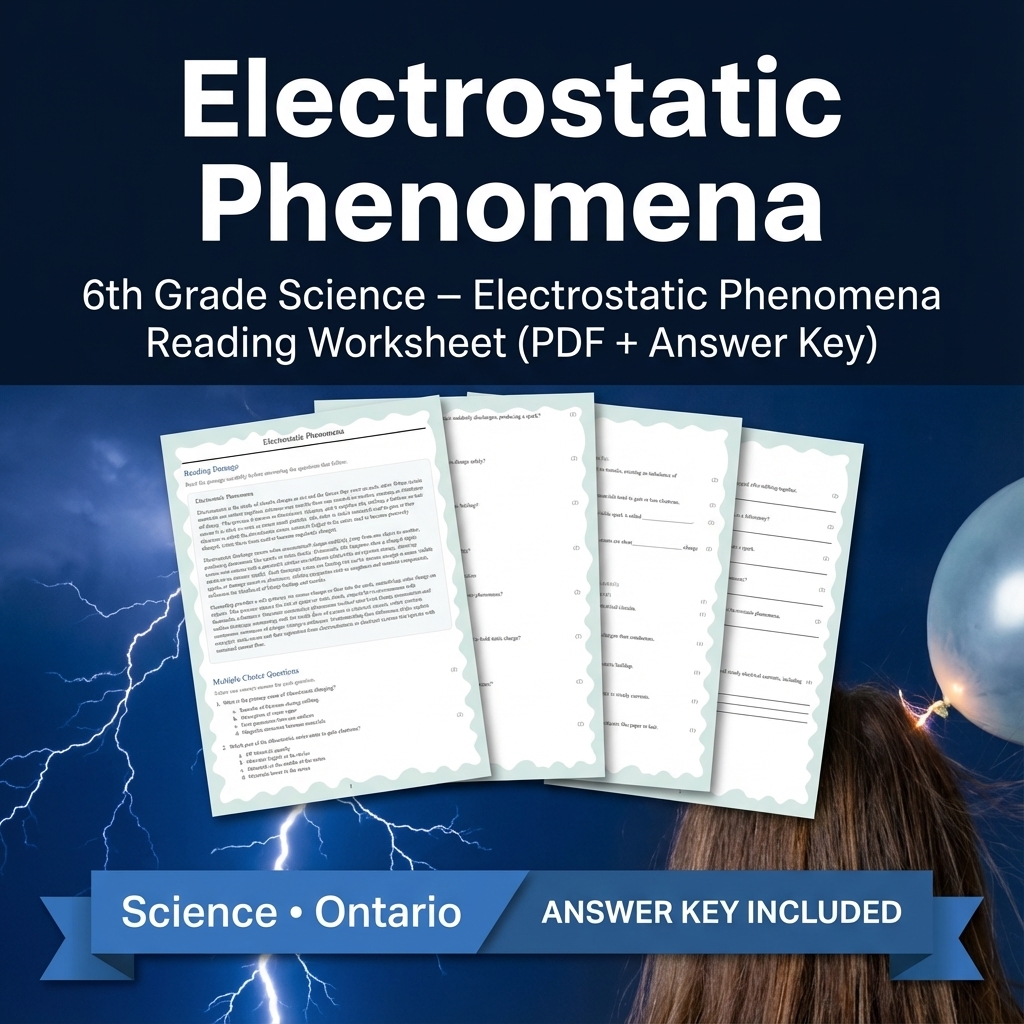
6th Grade Science – Electrostatic Phenomena Reading Worksheet (PDF + Answer Key)
JCreated byJ.S SheetsLearning Objectives
- Understand the principles of static charge transfer and the triboelectric series.
- Describe phenomena such as attraction, repulsion, and sparks caused by static electricity.
- Explain grounding and charge neutralization concepts.
Also included in: Grade 6 Science Circuit & Electricity Unit Bundle – Worksheets & Answer Keys +1 more
Instant download
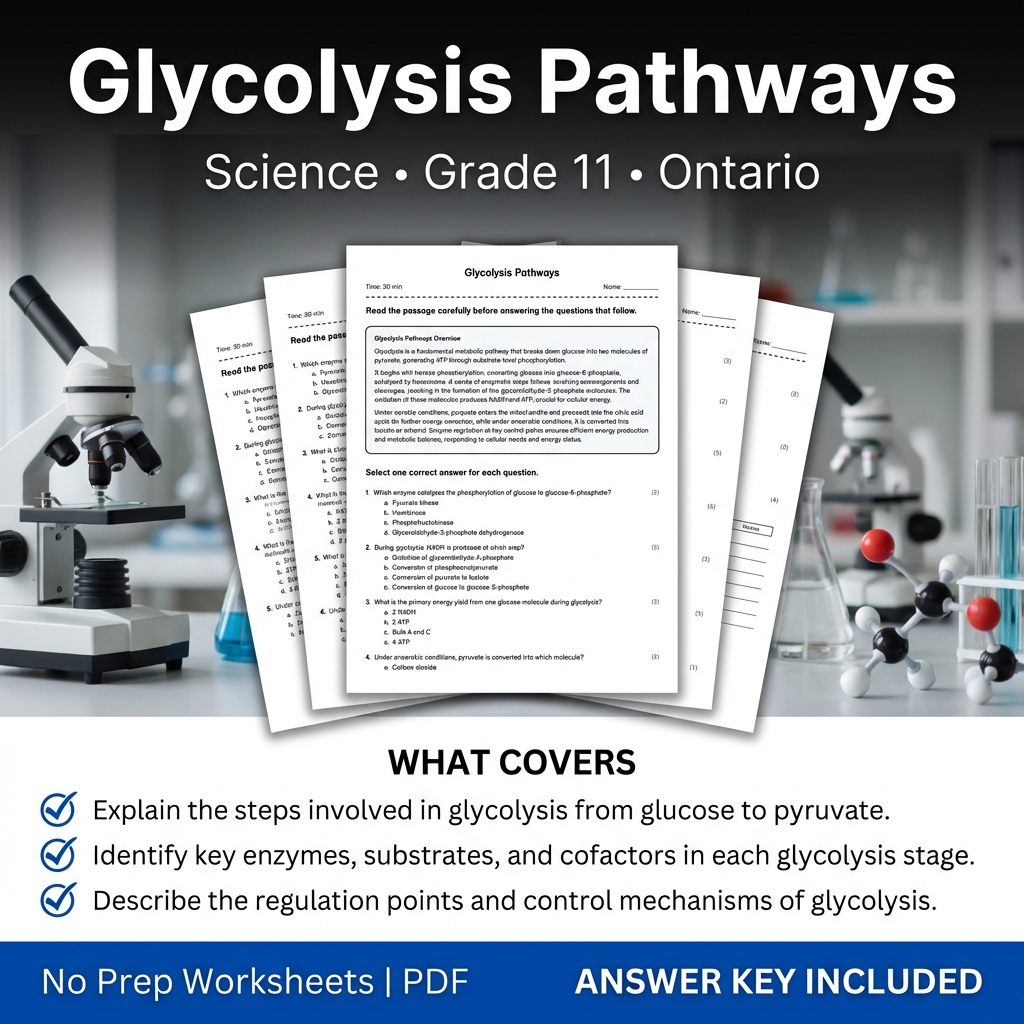
Glycolysis Pathways Grade 11 Science Worksheet | Ontario Standards
Created byCoral Reef LearningLearning Objectives
- Explain the steps involved in glycolysis from glucose to pyruvate.
- Identify key enzymes, substrates, and cofactors in each glycolysis stage.
- Describe the regulation points and control mechanisms of glycolysis.
Instant download
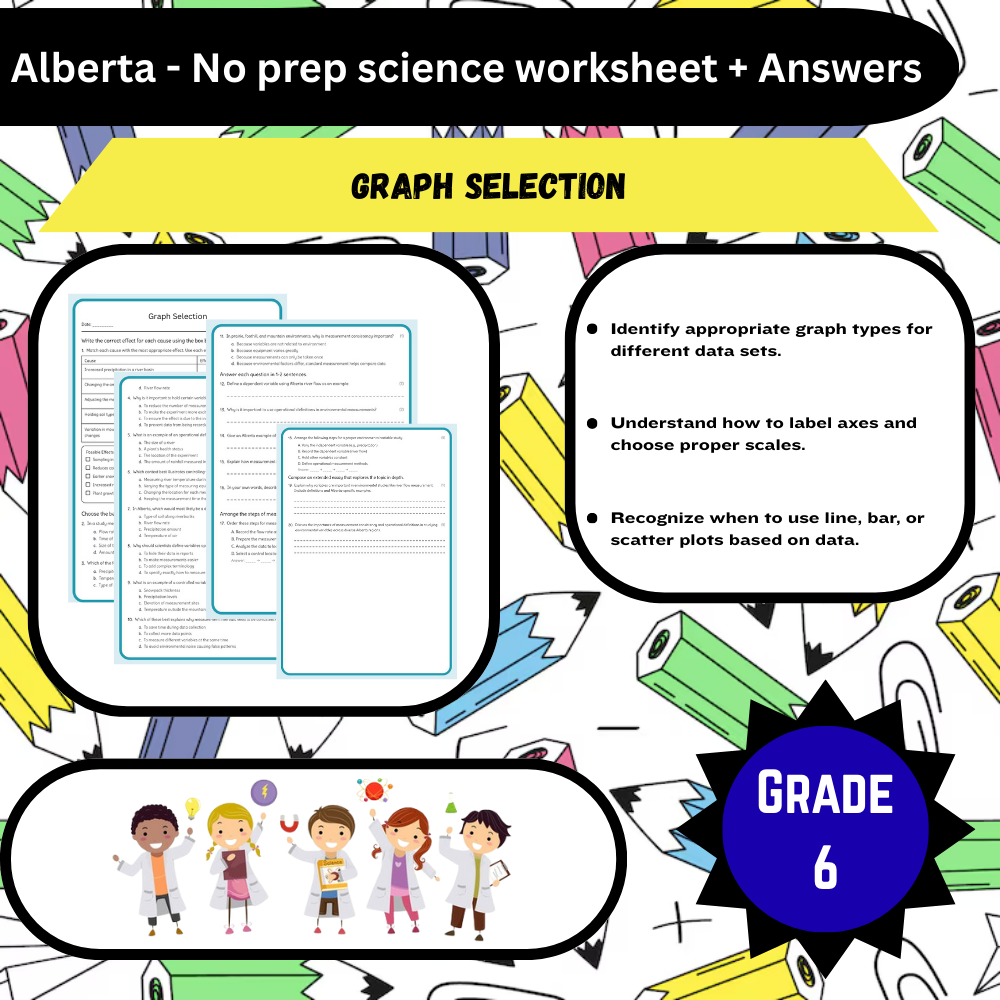
6th Grade Science | Graph Selection Worksheet (PDF) - Alberta Standards
Created byBright Mind ResourcesLearning Objectives
- Identify appropriate graph types for different data sets.
- Understand how to label axes and choose proper scales for graphs.
- Recognize when to use line graphs, bar charts, and scatter plots based on data characteristics.
Instant download

Grade 8 Causal Reasoning Worksheet | Practice & Assessment PDF
 Created byClear Sky Classroom
Learning Objectives
- Distinguish correlation from causation when evaluating scientific claims
- Use causal reasoning to check variable direction and consider alternative explanations
- Assess how well evidence supports a causal conclusion and what additional evidence would be needed
Instant download
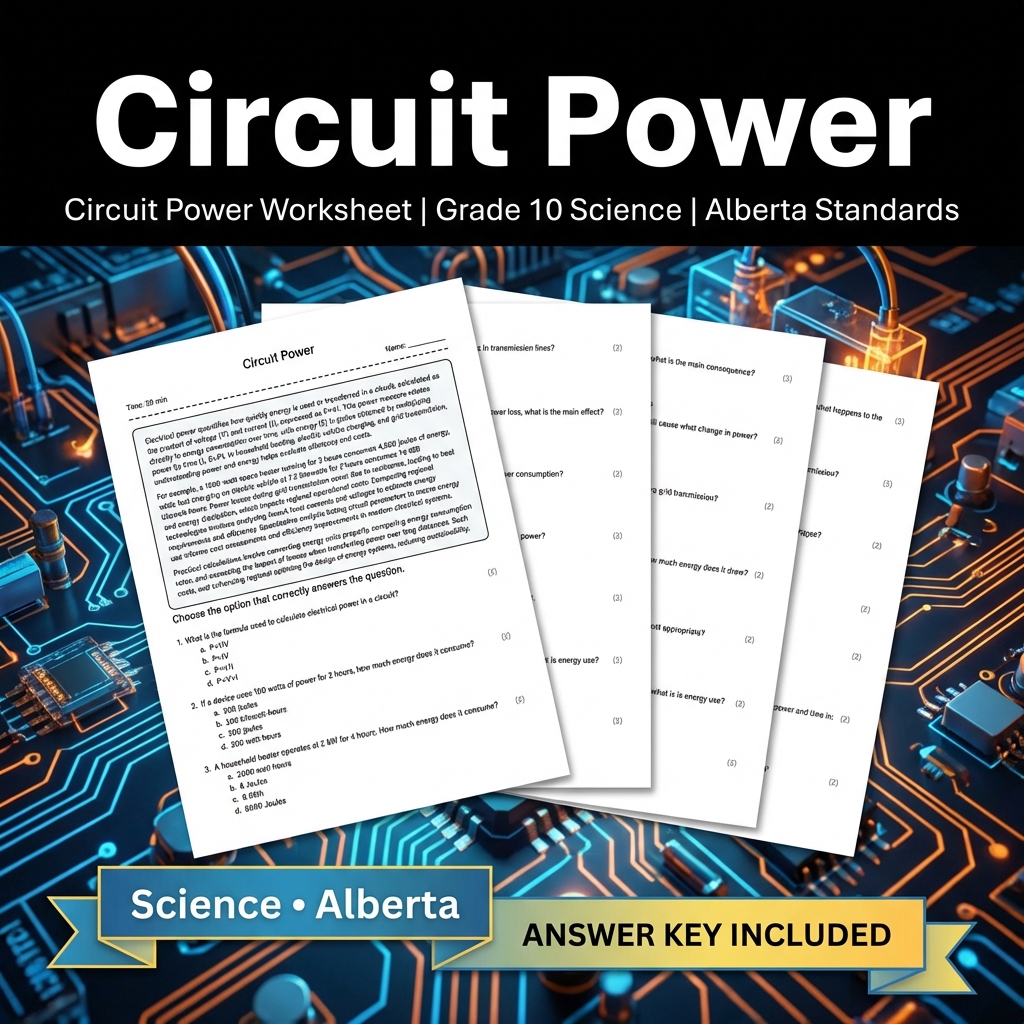
Circuit Power Worksheet | Grade 10 Science | Alberta Standards
Created byCoral Reef LearningLearning Objectives
- Understand how electrical power is calculated using voltage and current.
- Apply power, energy, and time relationships to practical electrical scenarios.
- Analyze energy consumption in household appliances, electric vehicles, and transmission systems.
Instant download
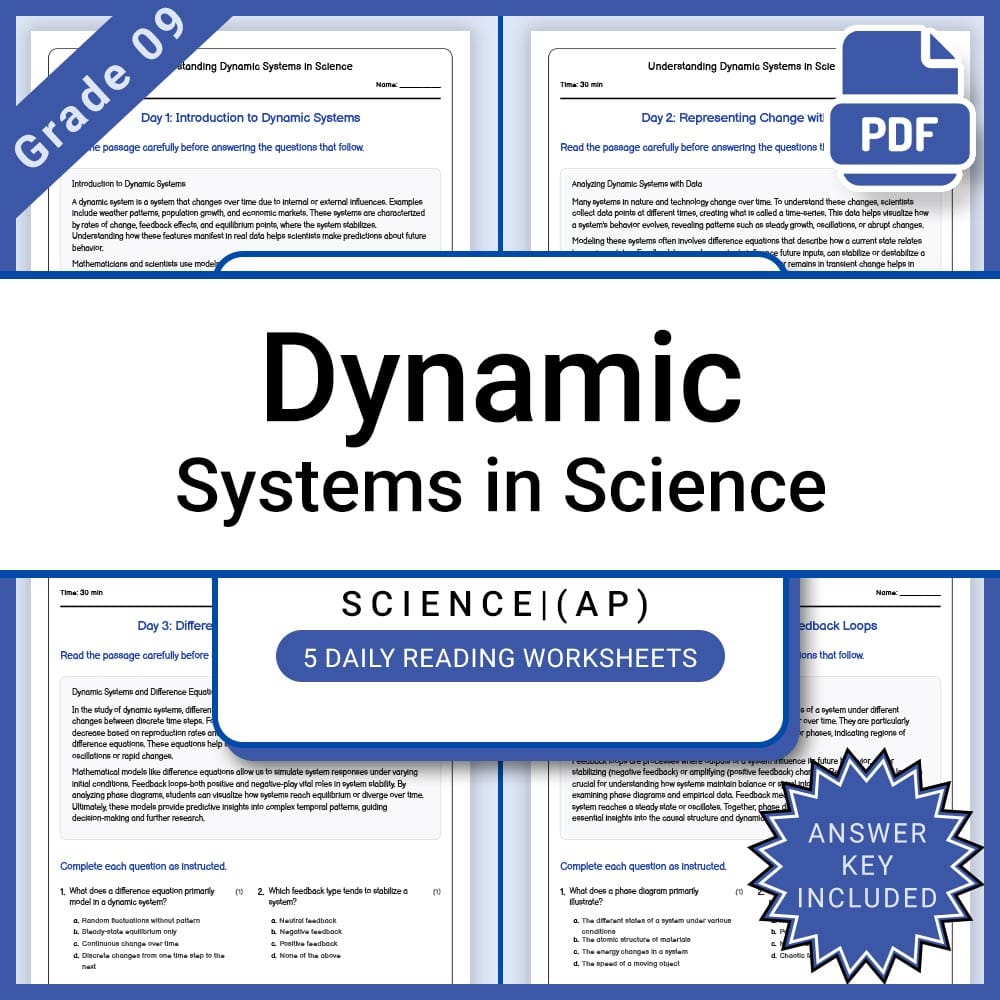
Grade 9 Science – Dynamic Systems Worksheet with Answer Key
JCreated byJ.S SheetsLearning Objectives
- Define what a dynamic system is and explain its key features.
- Identify how rates, feedback loops, and equilibrium manifest in real-world data.
- Differentiate between transient and steady-state behaviors in systems.
Also included in: Grade 9 Science Lesson Group - AP Framework Daily Reading Worksheets +1 more
Instant download

Grade 10 Science – Genomic Technologies & DNA Applications | Reading Worksheet
Created byBright Mind ResourcesLearning Objectives
- Understand the basic structure of DNA and how it functions as the blueprint of life.
- Learn about key genomic technologies such as PCR, DNA sequencing, and CRISPR.
- Explore how recombinant DNA methods are used in biotechnology.
Also included in: DNA & Genetics Grade 10 Science Daily Reading Worksheets Lesson Bundle | TEKS +2 more
Instant download

Grade 10 Science – Inheritance Patterns & Genetics | Daily Reading Worksheet
Created byBright Mind ResourcesLearning Objectives
- Understand basic Mendelian principles such as segregation and independent assortment.
- Learn how to interpret Punnett squares for mono- and dihybrid crosses.
- Identify dominant and recessive traits and predict phenotype probabilities.
Also included in: DNA & Genetics Grade 10 Science Daily Reading Worksheets Lesson Bundle | TEKS +2 more
Instant download
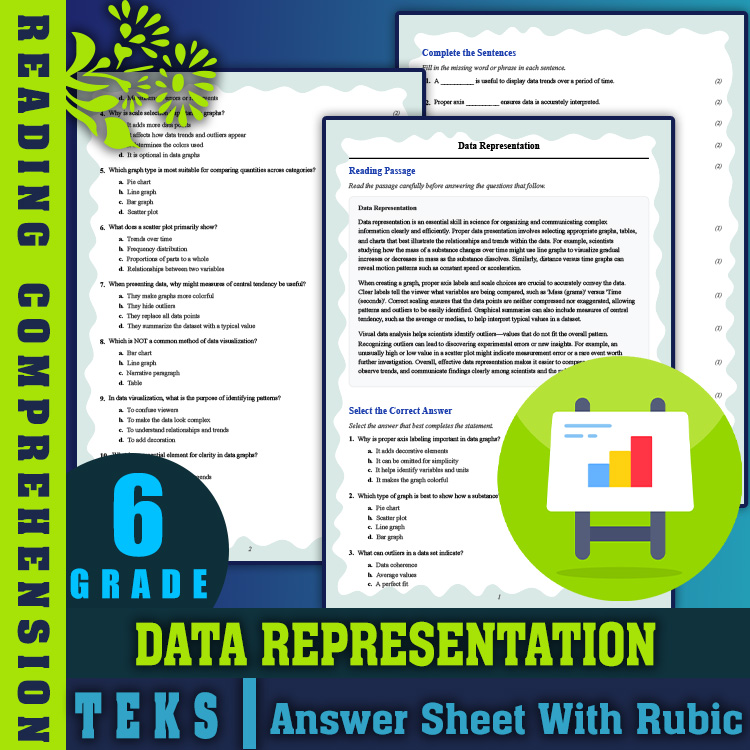
6th Grade Science | Data Representation Reading Worksheet & Answer Key (PDF)
JCreated byJ.S SheetsLearning Objectives
- Understand the conventions for organizing data in tables, line graphs, bar graphs, and scatter plots.
- Apply the principles of data presentation to interpret trends and relationships in datasets.
- Identify proper axis labeling, scale selection, and graphical summaries of data.
Instant download
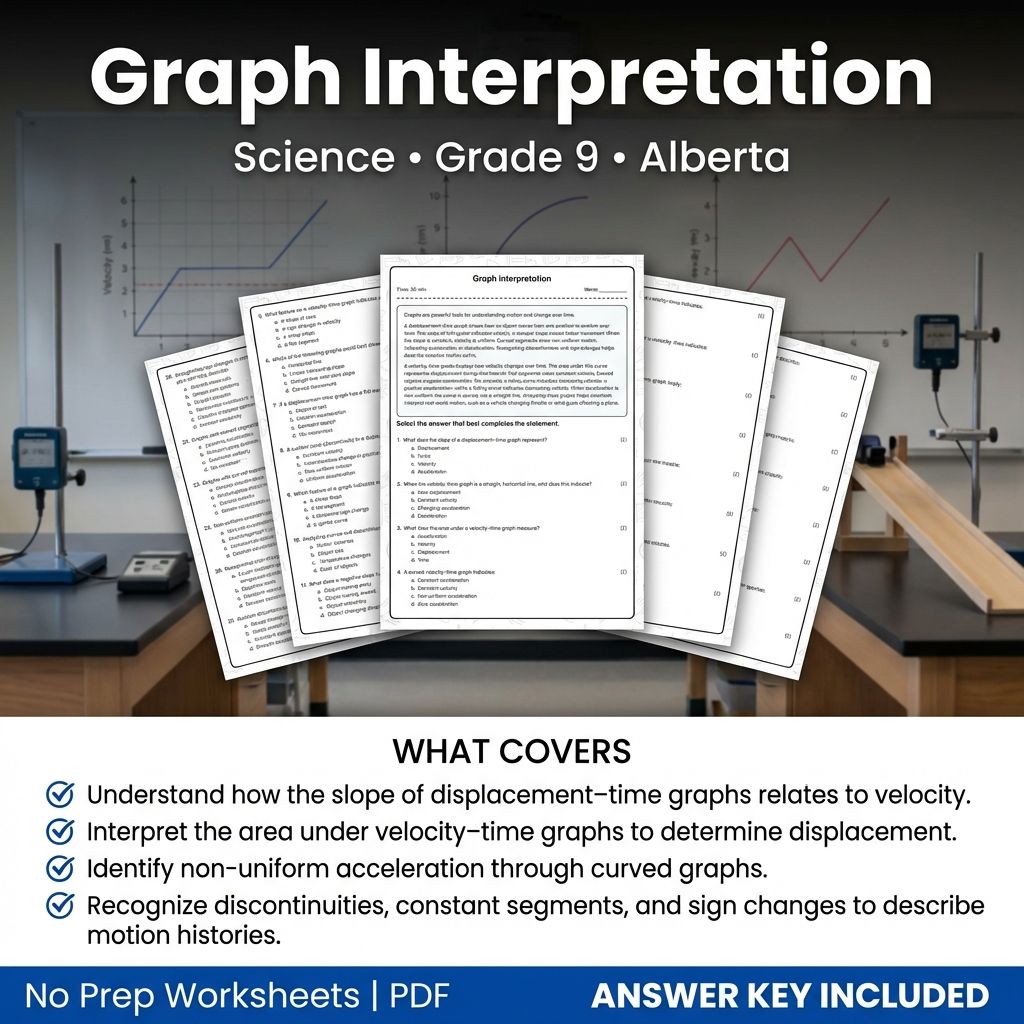
Grade 9 Science Worksheet on Graph Interpretation | Alberta Standards
Created byCoral Reef LearningLearning Objectives
- Understand how the slope of displacement–time graphs relates to velocity.
- Interpret the area under velocity–time graphs to determine displacement.
- Identify non-uniform acceleration through curved graphs.
Instant download
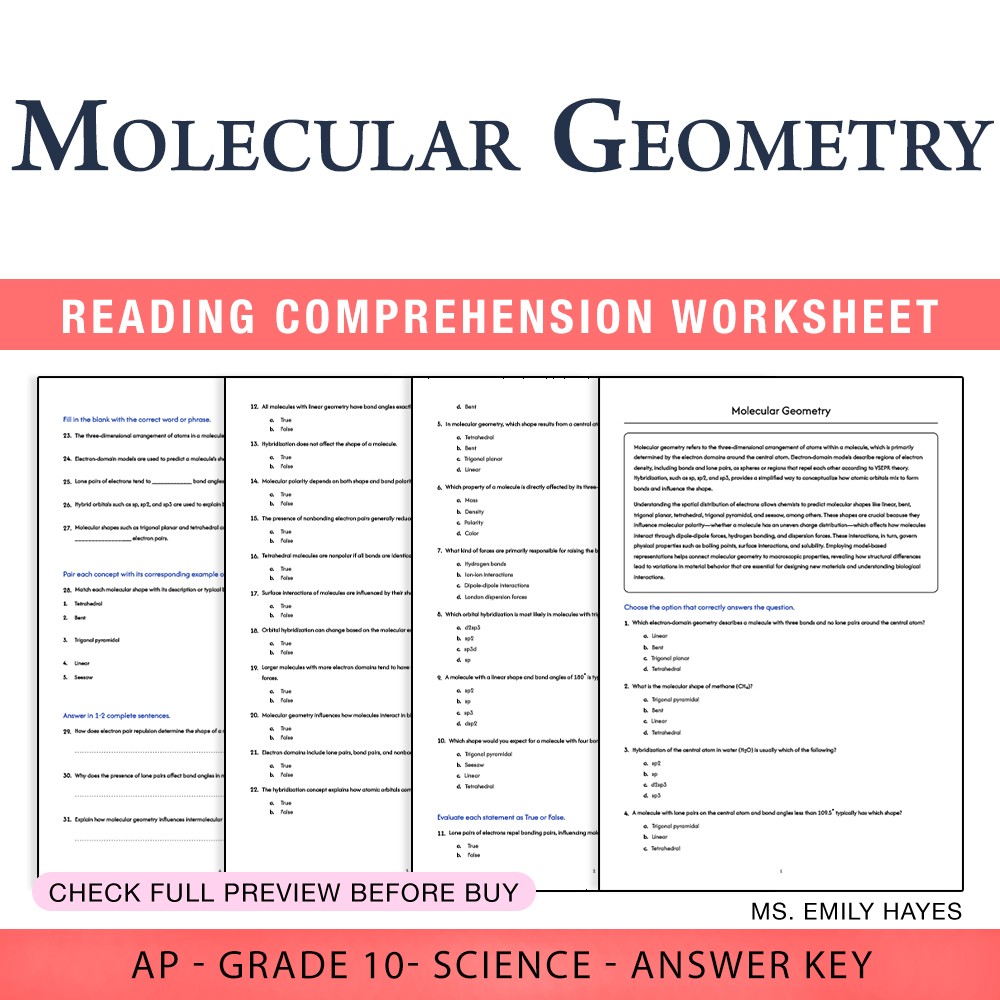
Grade 10 Science | Molecular Geometry Worksheet (PDF+ Answer Key)
 Created byCopper Leaf Classroom
Learning Objectives
- Define molecular geometry using electron-domain models and hybridization concepts.
- Predict three-dimensional molecular arrangements based on electron pair distribution.
- Explain how geometry impacts molecular polarity and intermolecular forces.
Also included in: Grade 10 Science -Atomic Structure & Chemical Reactions (PDF+ Answer Key) +1 more
Instant download
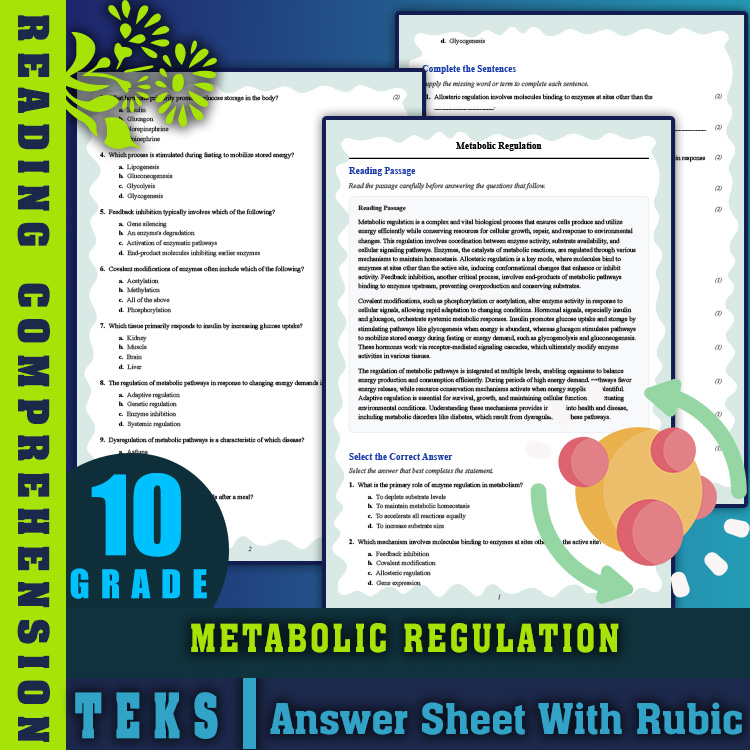
Grade 10 Science | Metabolic Regulation Reading Worksheet (PDF + Rubric)
JCreated byJ.S SheetsLearning Objectives
- Understand how enzyme activity is regulated in metabolic pathways.
- Identify different mechanisms of metabolic regulation, including allosteric and covalent modification.
- Explain the role of hormonal signals like insulin and glucagon in carbohydrate metabolism.
Instant download
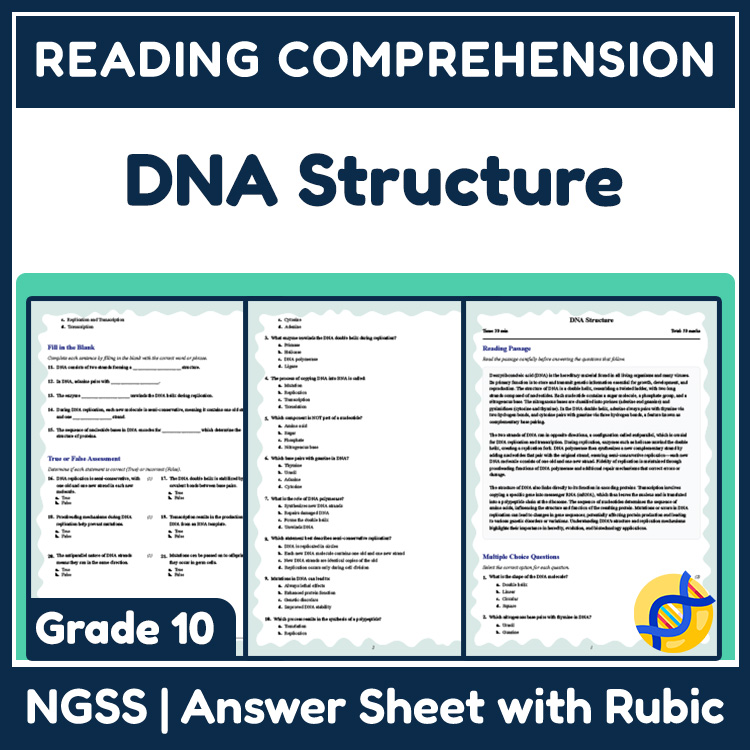
10th Grade Science | DNA Structure Reading Worksheet (PDF + Answer Key)
JCreated byJ.S SheetsLearning Objectives
- Describe the basic structural features of DNA, including the double helix, complementary base pairing, and antiparallel strands.
- Explain the mechanisms of DNA replication, including the roles of DNA polymerase and helicase, and how fidelity is maintained through proofreading and repair.
- Connect DNA structure to processes such as transcription and translation, illustrating how nucleotide sequences encode proteins.
Instant download
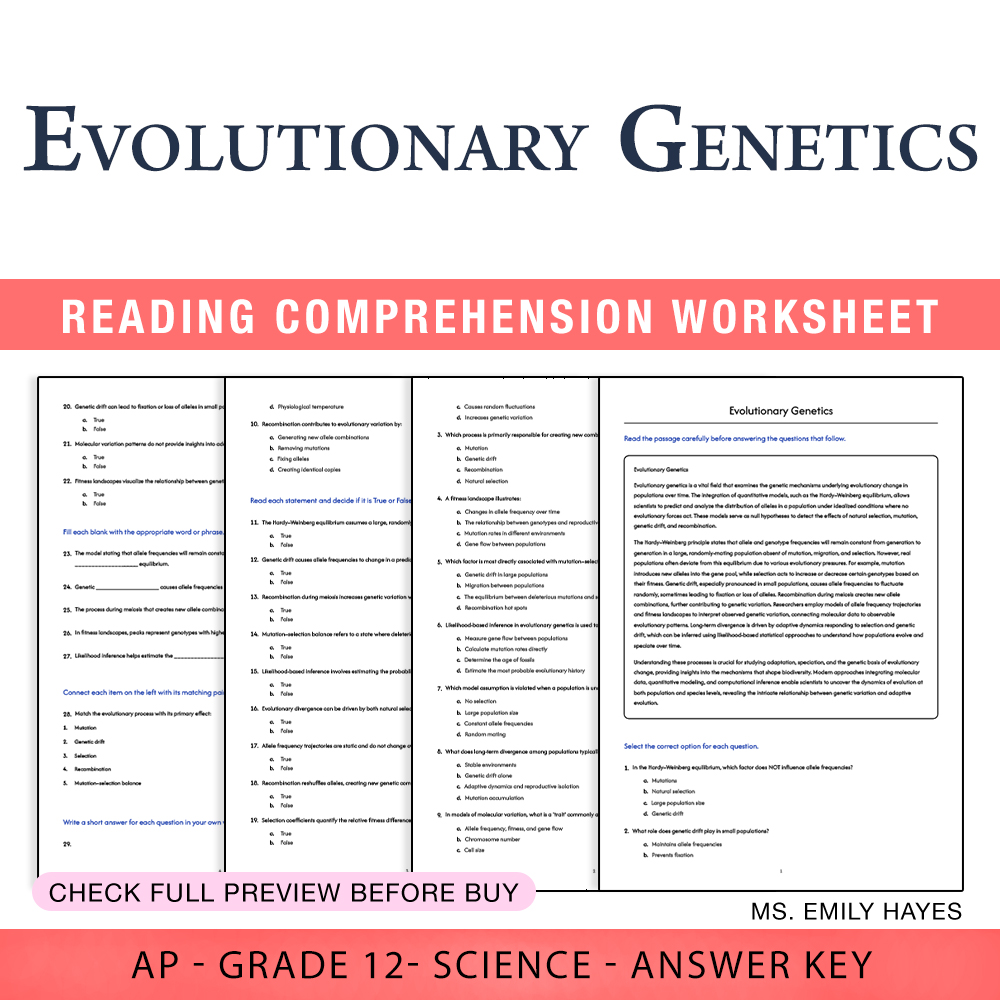
12th Grade Science | Evolutionary Genetics Worksheet (PDF+ Answer Key)
Created byCopper Leaf ClassroomLearning Objectives
- Understand the application of Hardy–Weinberg equilibrium in population genetics.
- Analyze the role of mutation, selection, and genetic drift in evolutionary change.
- Interpret allele frequency trajectories and fitness landscapes in adapting populations.
Also included in: Grade 12 Science | AP Biology & Ecology Worksheet Bundle (PDF+ Answer Keys) +1 more
Instant download

Grade 8 Trophic Modeling Worksheet | Alberta Use Practice PDF
Created byClear Sky ClassroomLearning Objectives
- Explain how trophic modeling uses compartments and environmental pools to represent energy and matter movement.
- Describe mass-balance ideas and how production, respiration, and decomposition relate in simple models.
- Use model assumptions and sensitivity reasoning to interpret what changes in a system could mean.
Instant download
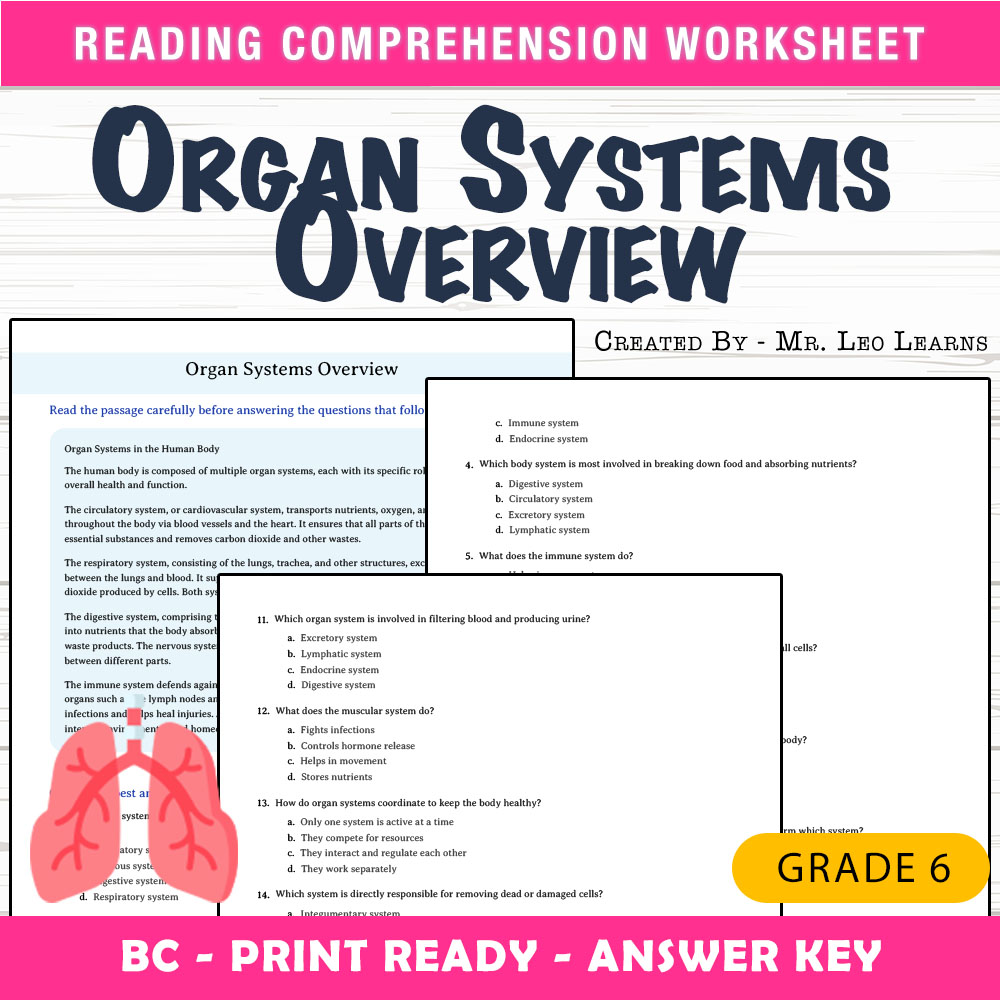
Grade 6 Science — Organ Systems Overview Worksheet MCQ Paper for Mastery
Created byThe Resource HubLearning Objectives
- Identify the major organ systems and their principal functions.
- Explain how different organ systems interact to maintain internal balance.
- Describe the roles of transport, exchange, digestion, defense, and control in the body.
Also included in: Grade 6 Science Unit | Multicellular Systems & Functions Worksheet Bundle +1 more
Instant download
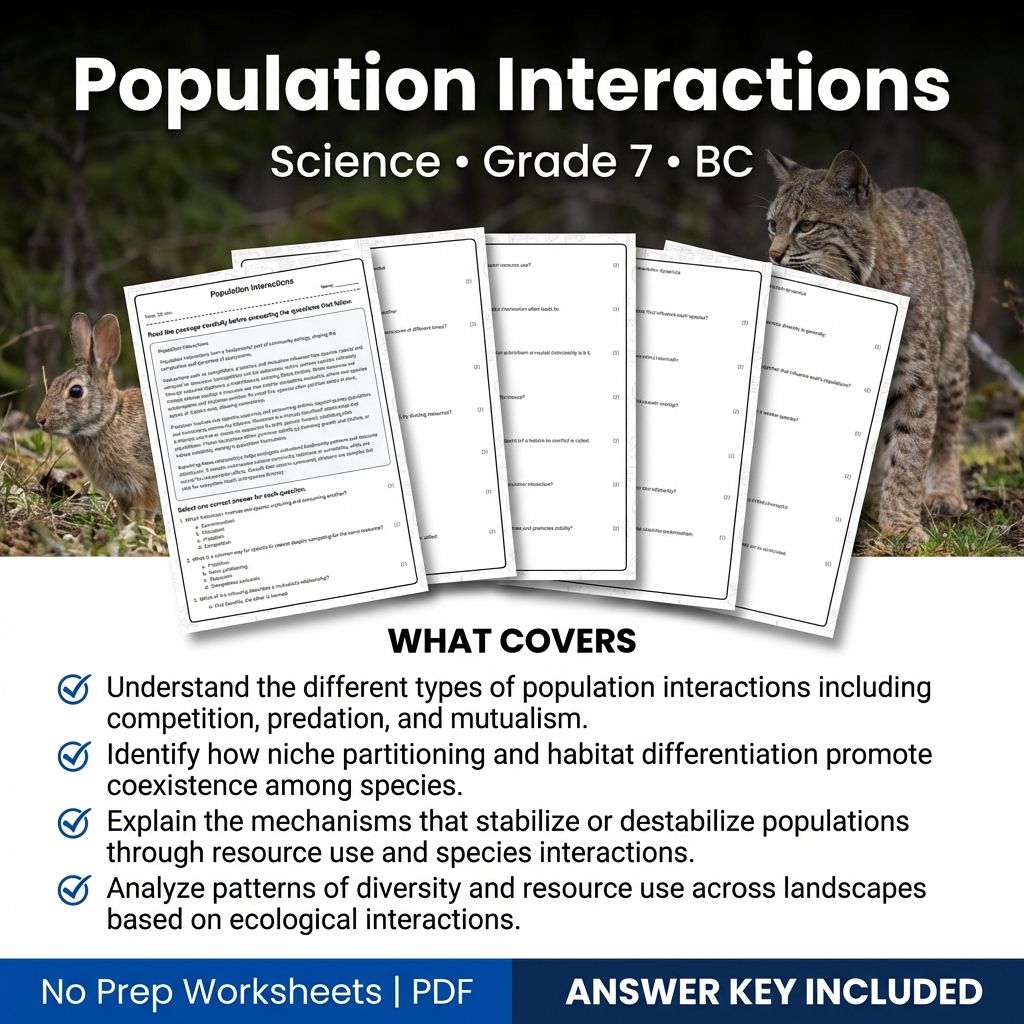
Grade 7 Science Worksheet | Population Interactions and Ecosystem Concepts (Printable PDF + Answer Key)
Created byCoral Reef LearningLearning Objectives
- Understand the different types of population interactions including competition, predation, and mutualism.
- Identify how niche partitioning and habitat differentiation promote coexistence among species.
- Explain the mechanisms that stabilize or destabilize populations through resource use and species interactions.
Instant download
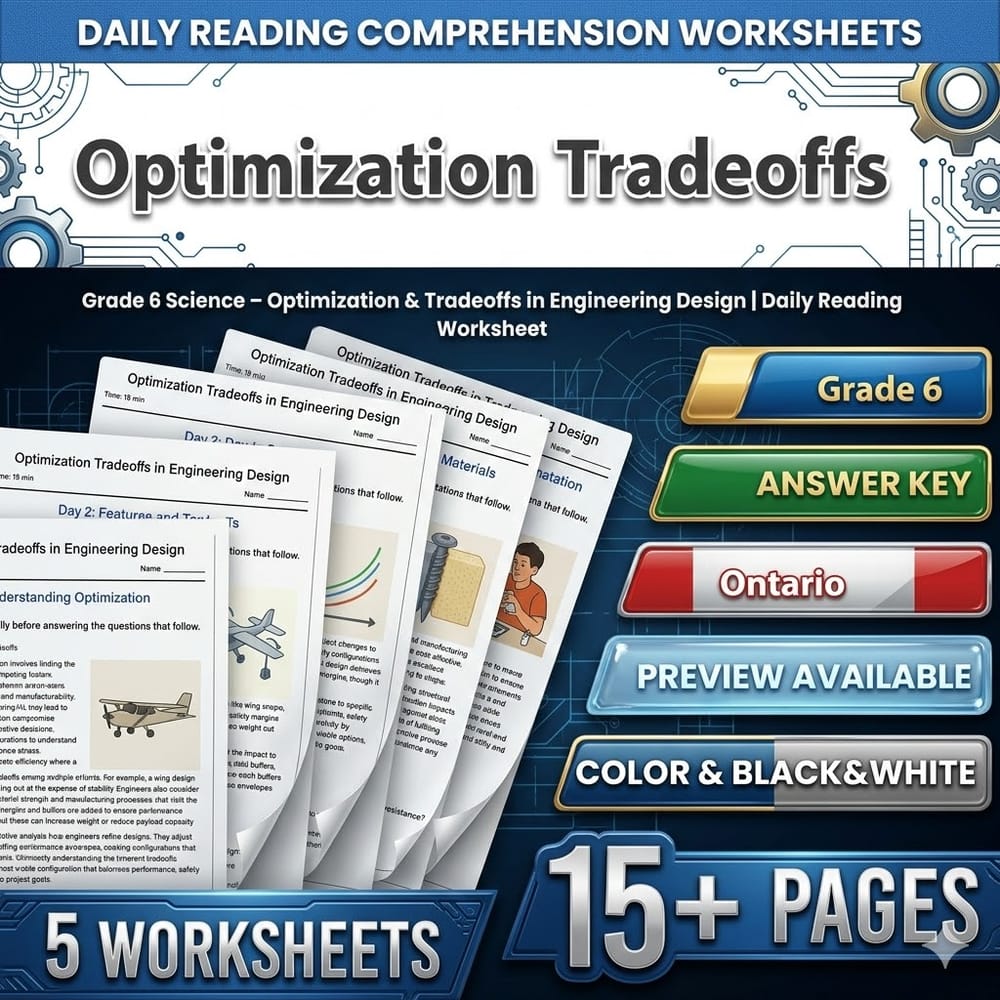
Grade 6 Science – Optimization & Tradeoffs in Engineering | Daily Worksheet
 Created byQuiet Forest Education
Learning Objectives
- Understand the concept of tradeoffs in engineering design.
- Identify key factors influencing optimization tradeoffs.
- Analyze how different design choices impact overall performance.
Also included in: Flight Science Grade 6 Daily Reading Worksheets Bundle | Ontario +1 more
Instant download
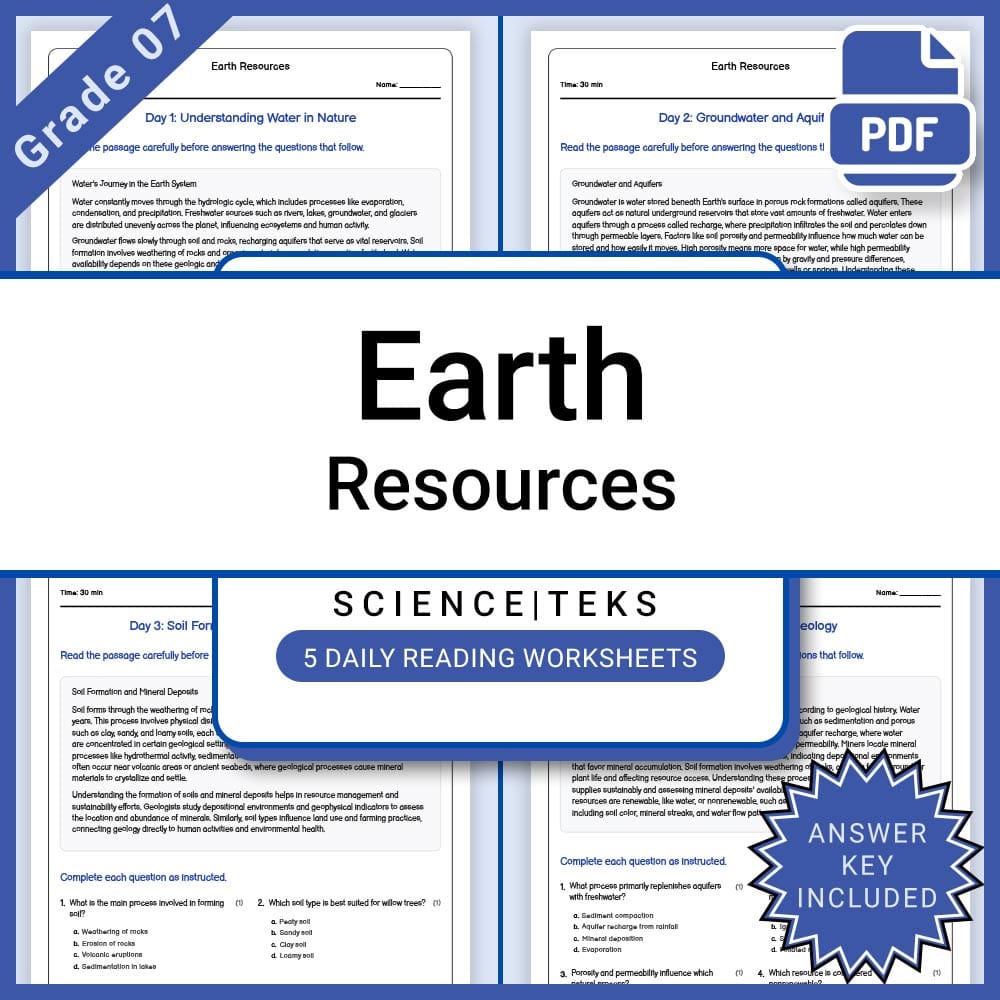
Grade 7 Science Earth Resources Daily Reading Worksheet with Answer Key
JCreated byJ.S SheetsLearning Objectives
- Identify sources of freshwater and understand how water moves through the Earth's hydrologic cycle.
- Describe processes involved in groundwater flow and soil formation.
- Explain how mineral deposits form and how geologic settings influence resource availability.
Also included in: Grade 7 Science Lesson Group – TEKS Aligned & Concept-Focused Lesson Bundle +1 more
Instant download
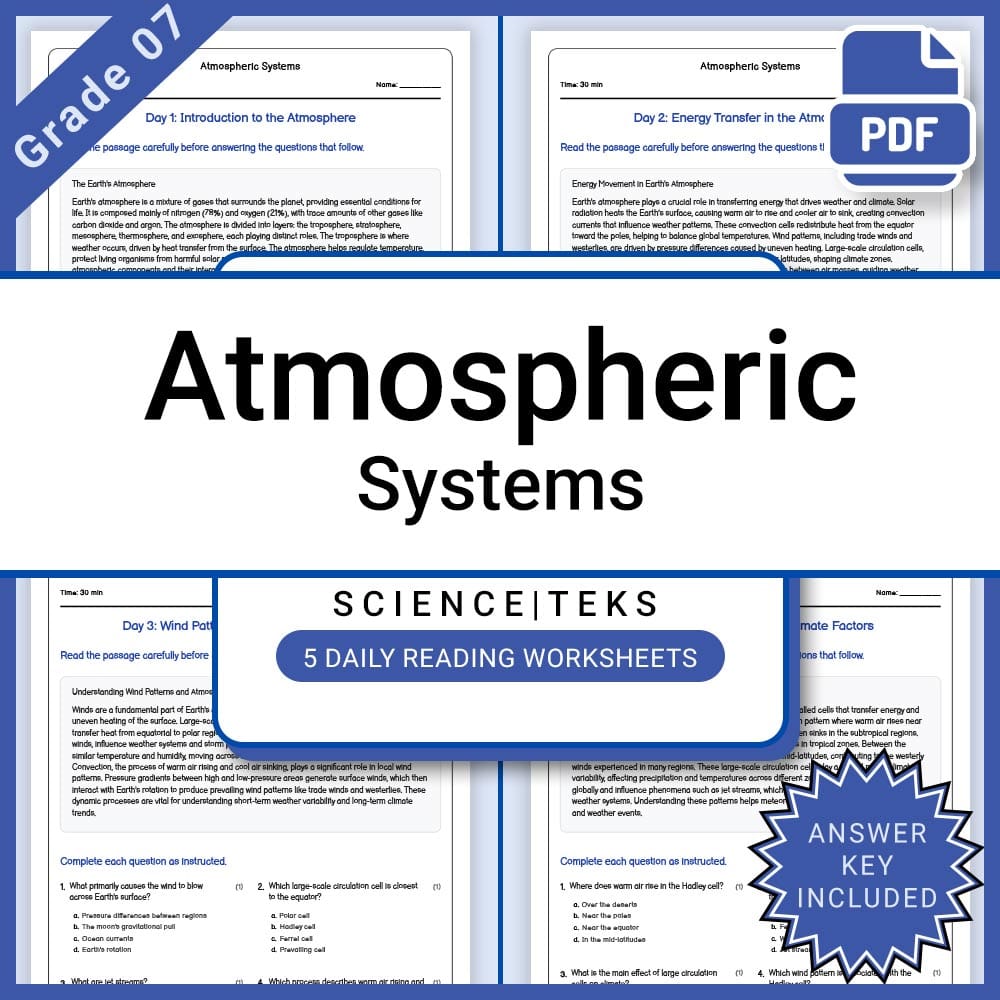
Grade 7 Science Atmospheric Systems Daily Reading Worksheet with Answer Key
JCreated byJ.S SheetsLearning Objectives
- Identify the main components of Earth's atmosphere
- Understand the processes of energy transfer within the atmosphere
- Describe the movement of air masses and pressure gradients
Also included in: Grade 7 Science Lesson Group – TEKS Aligned & Concept-Focused Lesson Bundle +1 more
Instant download
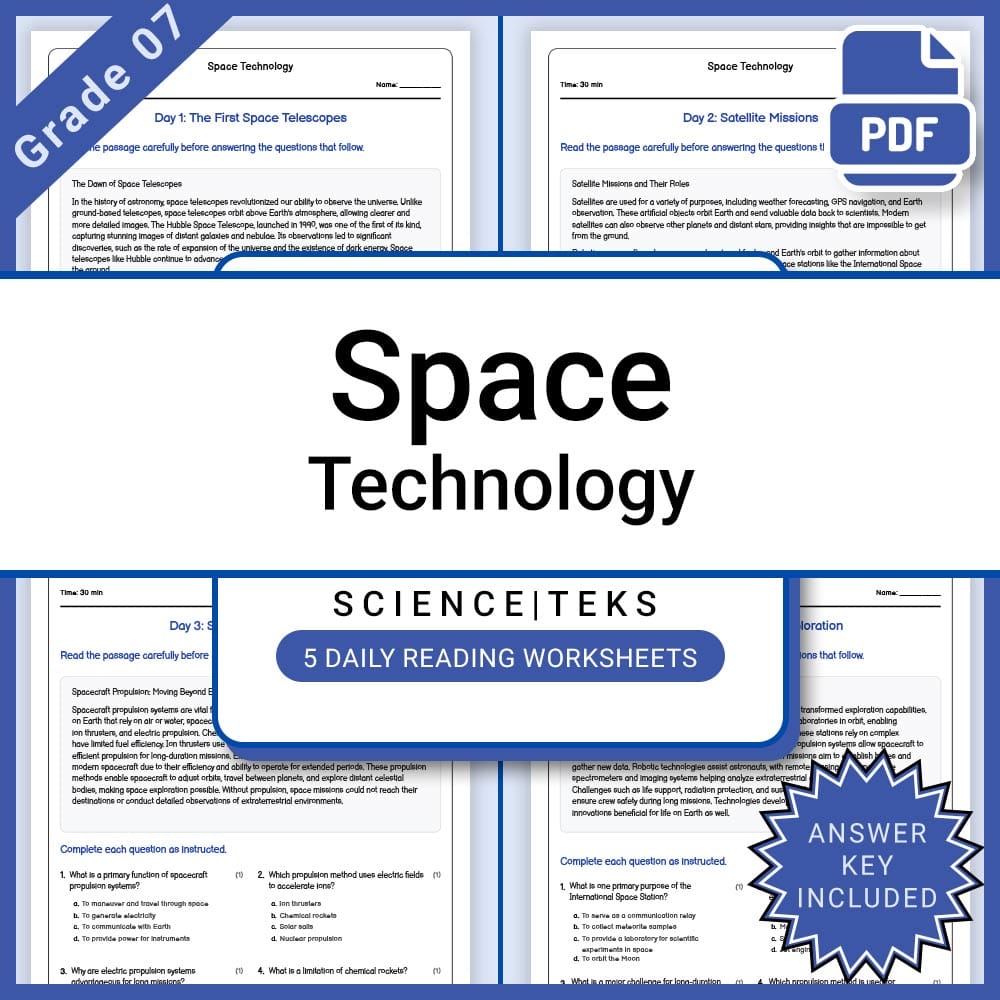
Grade 7 Science – Space Technology Daily Reading Worksheet with Answer Key
JCreated byJ.S SheetsLearning Objectives
- Understand the history and development of space telescopes.
- Learn how space telescopes extend our view of the universe.
- Recognize major space missions involving telescopes and satellites.
Also included in: Grade 7 Science Lesson Group – TEKS Aligned & Concept-Focused Lesson Bundle +1 more
Instant download
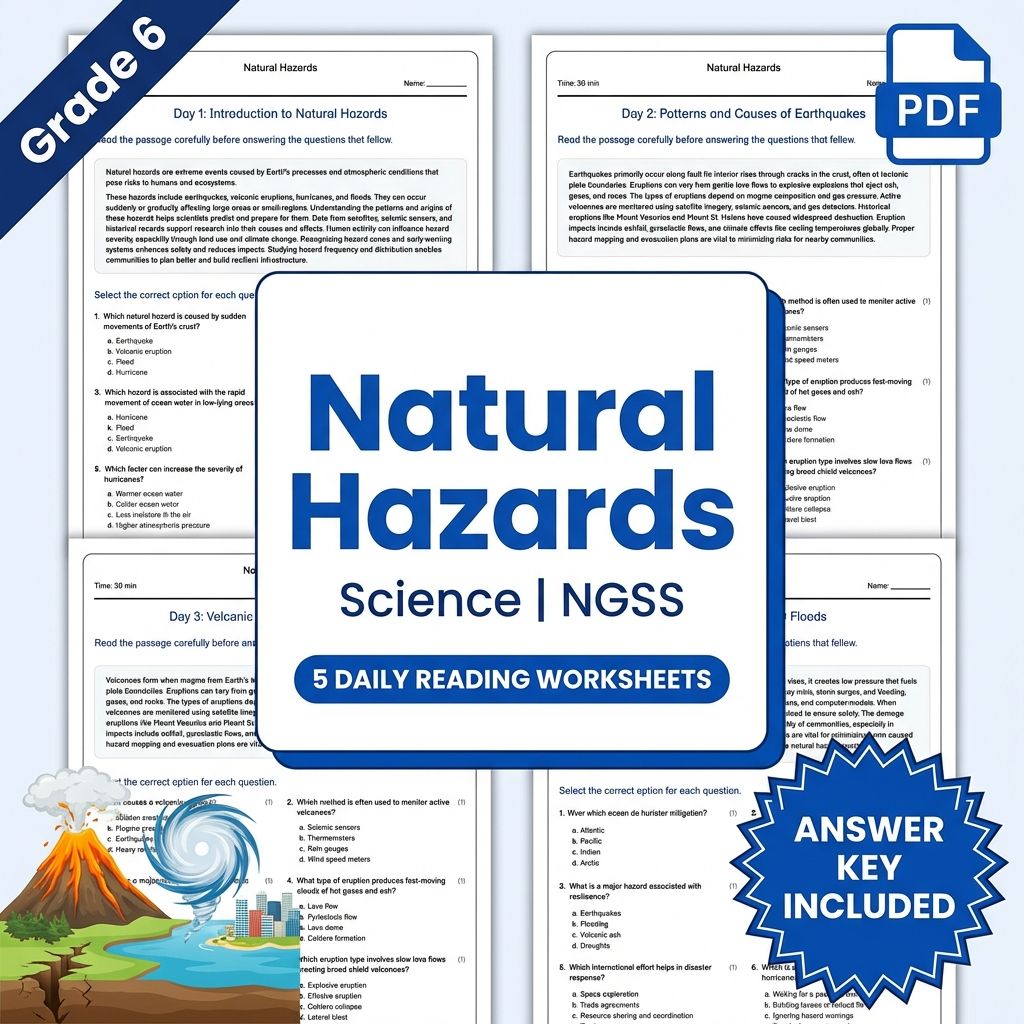
Grade 6 Science – Natural Hazards Daily Reading Worksheet (PDF+ Answer Key)
Created byCopper Leaf ClassroomLearning Objectives
- Understand the causes and types of natural hazards such as earthquakes, volcanoes, hurricanes, and floods.
- Analyze the patterns and effects of different natural hazards on communities and infrastructure.
- Evaluate how tectonic and atmospheric processes contribute to hazard occurrence.
Instant download
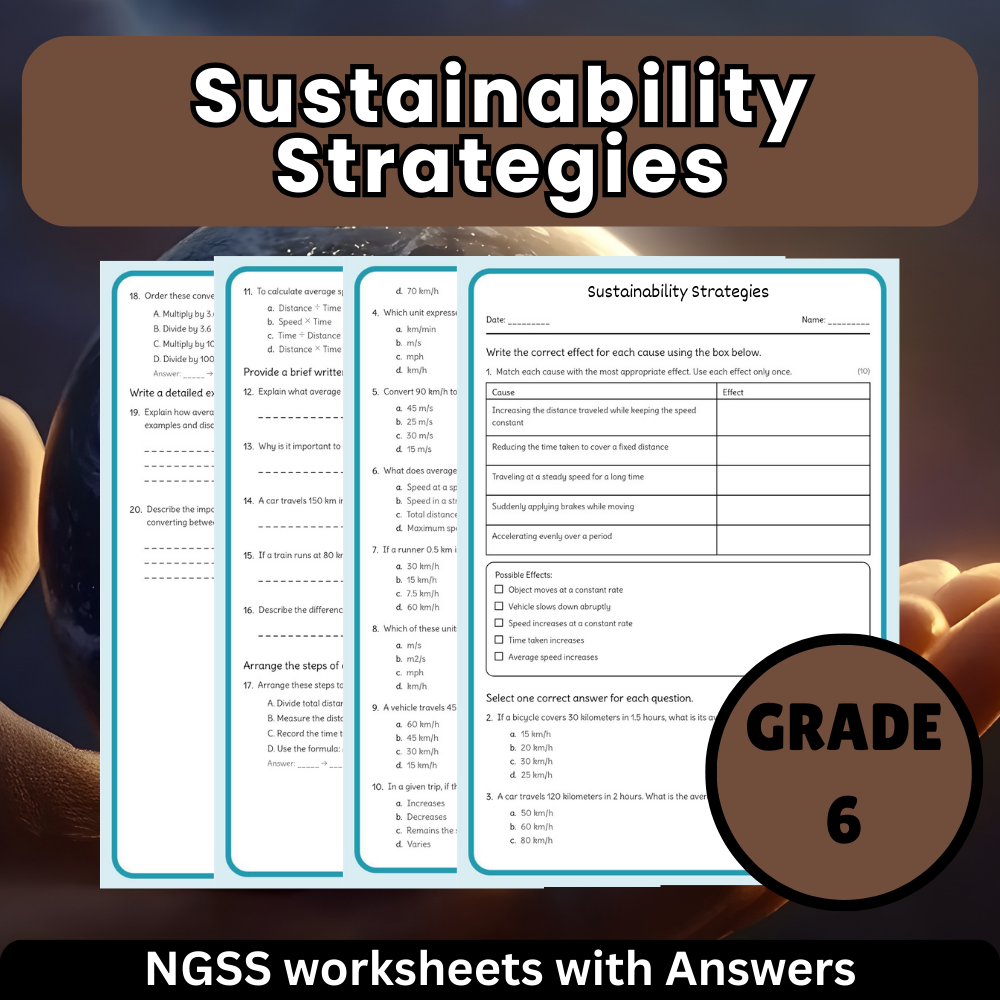
6th Grade Science | Sustainability Strategies Worksheet (PDF) – NGSS Aligned
Created byBright Mind ResourcesLearning Objectives
- Understand how population trends and resource use impact Earth's systems.
- Compare different sustainable practices such as energy, conservation, and land management.
- Evaluate the trade-offs involved in implementing sustainability policies and technologies.
Also included in: Grade 6 Science Unit | Natural Hazards & Human Impacts Worksheet Pack (NGSS) +2 more
Instant download
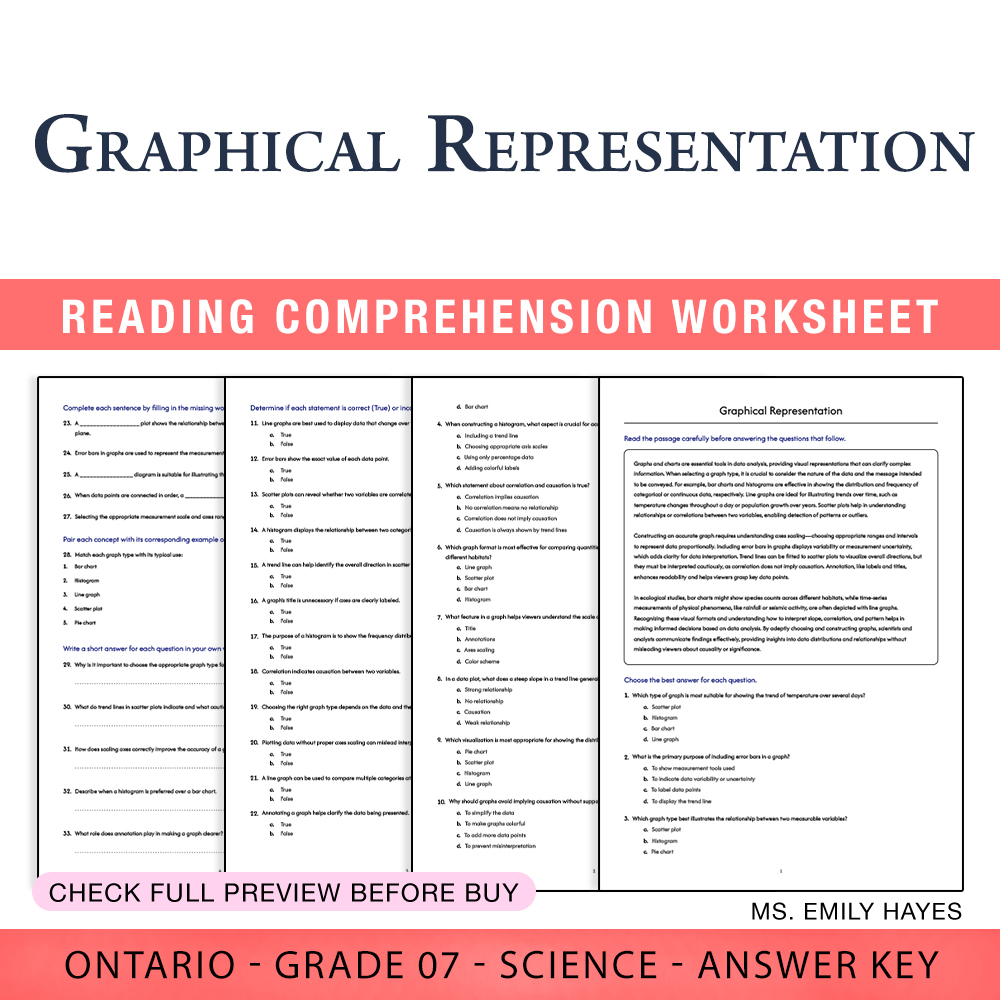
Grade 7 Science | Graphical Representation Worksheet (PDF+ Answer Key)
Created byCopper Leaf ClassroomLearning Objectives
- Understand the different types of graphs used to display data such as bar charts, histograms, line graphs, and scatter plots.
- Learn how to properly select and construct various graphs based on data type and measurement scales.
- Interpret elements of graphs including axes, error bars, trend lines, and patterns.
Instant download
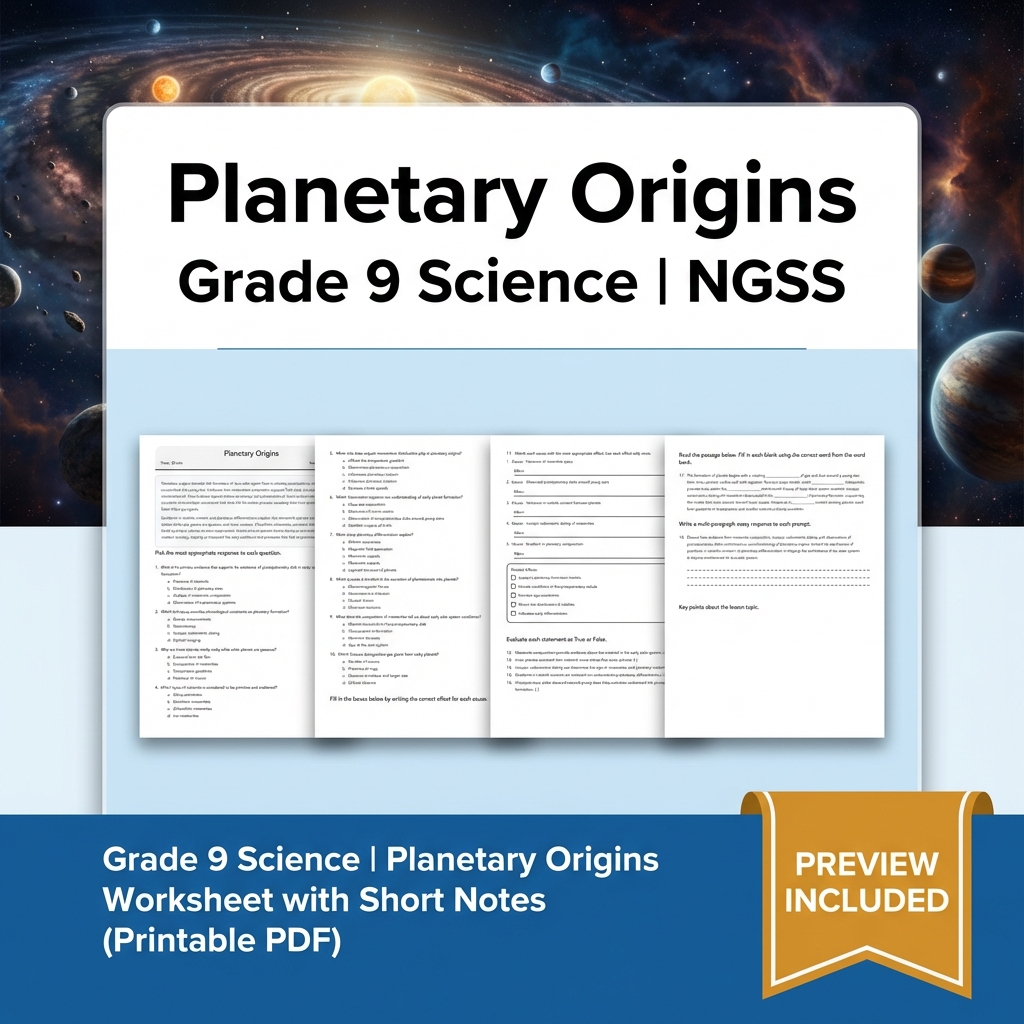
Grade 9 Science | Planetary Origins Worksheet with Short Notes (Printable PDF)
Created byMeadowlark WorksheetsLearning Objectives
- Understand the processes involved in planetary formation from a protoplanetary disk.
- Identify key evidence supporting models of planetary origins, such as meteorite composition and isotopic dating.
- Explain the differences in composition and structure between inner rocky planets and outer gas giants.
Also included in: Grade 9 Science NGSS Earth’s Place in the Universe Unit Bundle – Worksheet Pack +1 more
Instant download

Series and Parallel Circuits Worksheets Grade 8 Science Electricity
 Created bySunny Desk Resources
Learning Objectives
- Compare how series and parallel circuits affect total resistance, current, and voltage across components.
- Predict how current splits among parallel branches and how voltage stays the same across parallel branches.
- Explain how different circuit arrangements affect brightness in lighting circuits and reliability in power distribution.
Also included in: Electricity and Magnetism Grade 8 Alberta Unit Lesson Bundle +1 more
Instant download
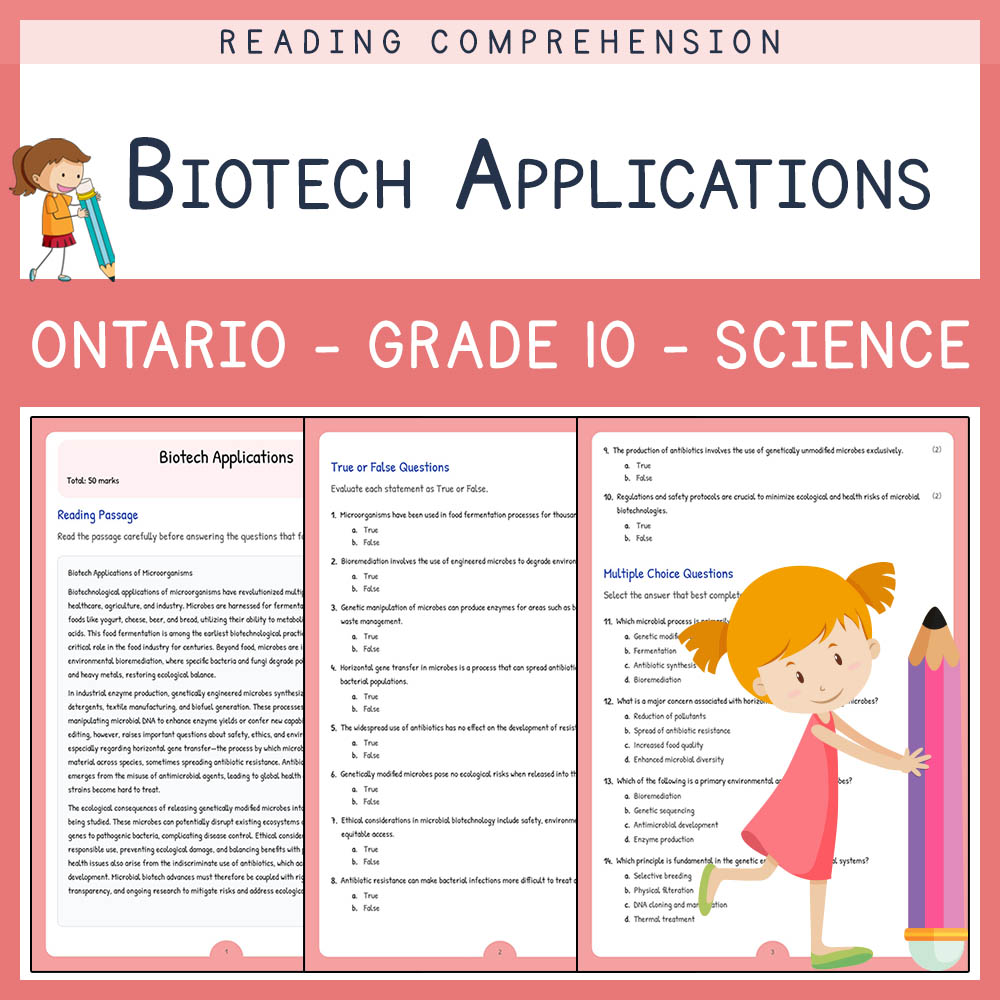
Grade 10 Science | Biotech Applications Worksheet Elena | Ontario Standard
Created byLumora LearningLearning Objectives
- Understand the various biotechnological applications of microorganisms in food production, pollution remediation, and enzyme manufacturing.
- Explain the principles of genetic manipulation and its rôle in microbial biotech products.
- Analyze issues related to antibiotic resistance and horizontal gene transfer in microbial systems.
Instant download

Rock Strata Worksheet | NGSS Grade 7 Science Practice and Assessment
JCreated byJ.S SheetsLearning Objectives
- Understand the principles of relative dating such as superposition, original horizontality, and cross-cutting relationships.
- Identify key stratigraphic markers like fossils, unconformities, and intrusive contacts used to correlate layers.
- Explain how field observations and stratigraphic data help construct Earth's geological history.
Also included in: Grade 7 Cosmic Solar Rock and Gravity Science Lesson Bundle: NGSS +1 more
Instant download
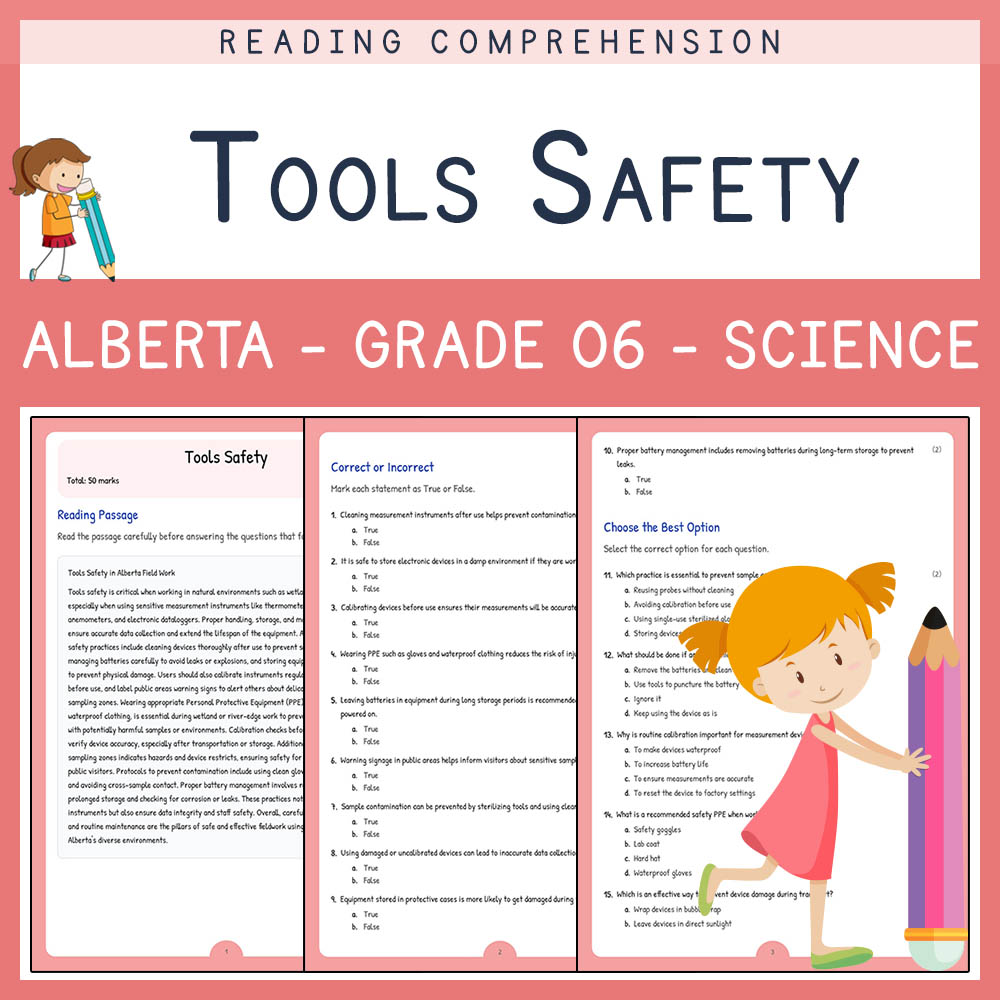
Grade 6 Science Worksheet | Tools Safety | Alberta-Aligned Assessment
Created byLumora LearningLearning Objectives
- Understand key safety practices for handling measurement tools near Alberta field sites.
- Identify proper storage, cleaning, and maintenance procedures for field equipment.
- Learn safety precautions for using electronic devices such as thermometers, pH probes, and dataloggers.
Also included in: Grade 6 Science | Evidence and Investigation Custom Bundle | Alberta
Instant download

Ecosystem Components Worksheet | Standards-Aligned Grade 6 Science Practice
JCreated byJ.S SheetsLearning Objectives
- Understand the different components that make up an ecosystem.
- Explain the roles of abiotic and biotic factors in ecosystems.
- Identify examples of various ecosystems and their features.
Also included in: Grade 6 Ecosystem Adaptations and Energy Flow Science Lesson Bundle | Florida NGSSS +1 more
Instant download

Neuroendocrine Control Worksheet | Grade 9 Science Practice
 Created byPrism Point Learning
Learning Objectives
- Explain the pathway from brain neural inputs to hormone release in the neuroendocrine system
- Describe how anatomical interfaces (portal vessels and fenestrated capillaries) help control timing and hormone magnitude
- Connect neuroendocrine control to body functions such as metabolism, growth, reproduction, and stress responses
Instant download
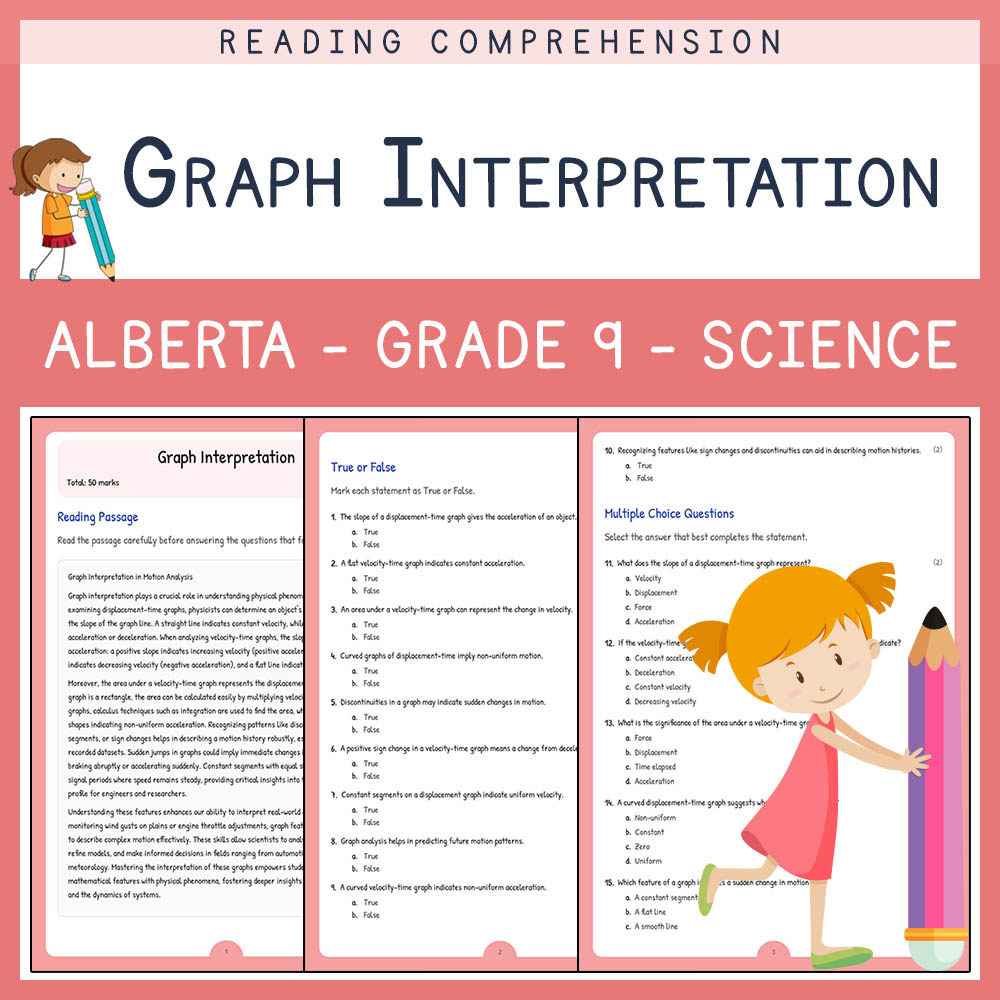
Grade 9 Science | Graph Interpretation Worksheet | Alberta Standards
Created byLumora LearningLearning Objectives
- Understand how the slope of displacement-time graphs relates to velocity.
- Interpret areas under velocity-time graphs to determine displacement.
- Identify non-uniform acceleration from curved graphs and discontinuities.
Instant download
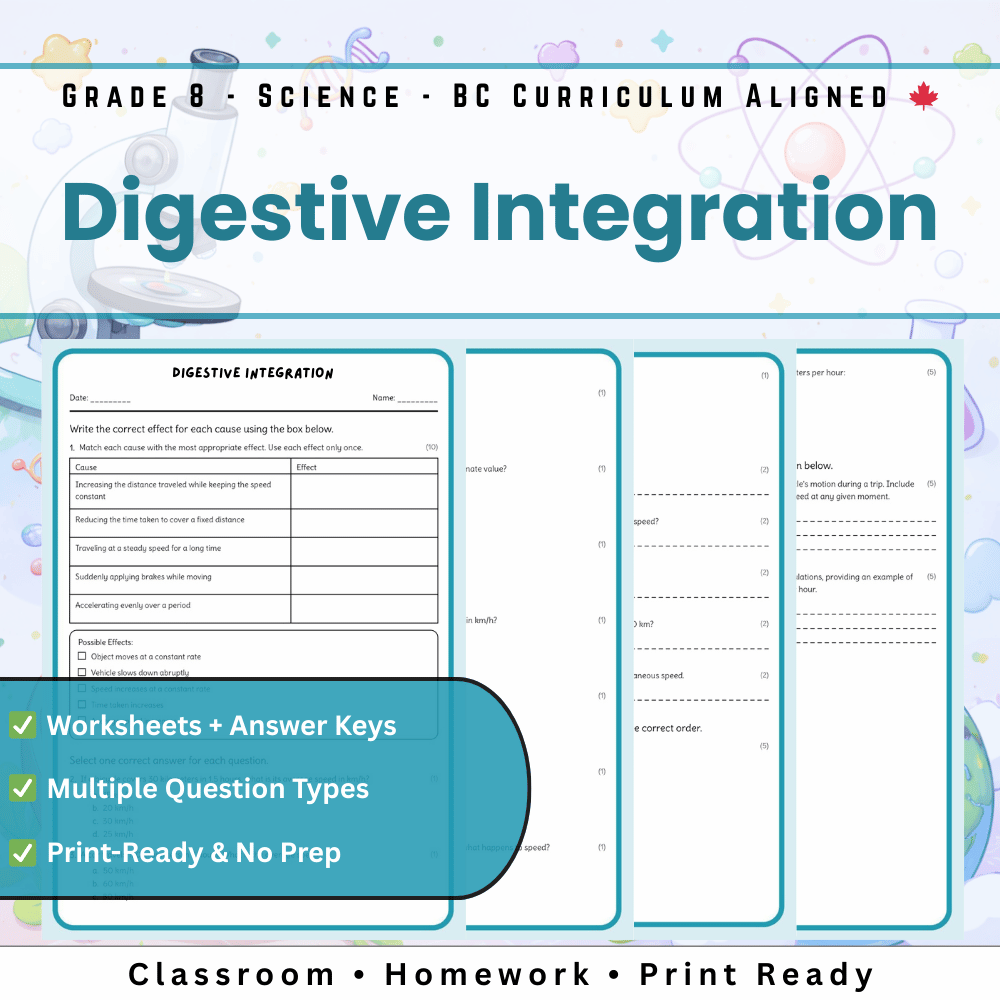
Grade 8 Science | Digestive System Integration Worksheet (PDF)
Created byBright Mind ResourcesLearning Objectives
- Understand how mechanical and chemical processes work together in digestion.
- Identify the roles of tissue specialization and organ functions in the digestive system.
- Explain how the circulatory system transports nutrients throughout the organism.
Instant download
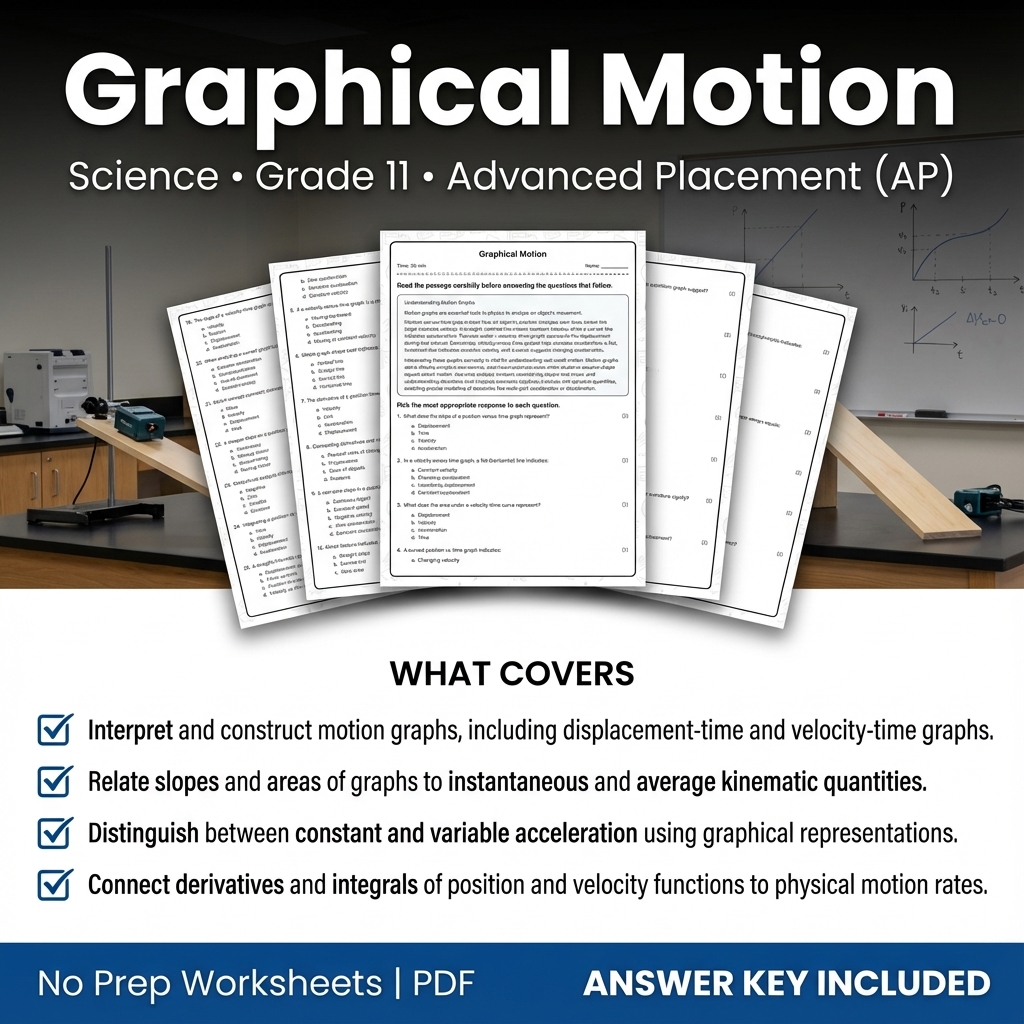
Grade 11 Science | Graphical Motion Worksheet (Printable PDF + Answer Key)
Created byCoral Reef LearningLearning Objectives
- Interpret and construct motion graphs, including displacement-time and velocity-time graphs.
- Relate slopes and areas of graphs to instantaneous and average kinematic quantities.
- Distinguish between constant and variable acceleration using graphical representations.
Also included in: Grade 11 Science Unit | Physics Worksheets on Work, Power & Motion PDF Bundle +1 more
Instant download
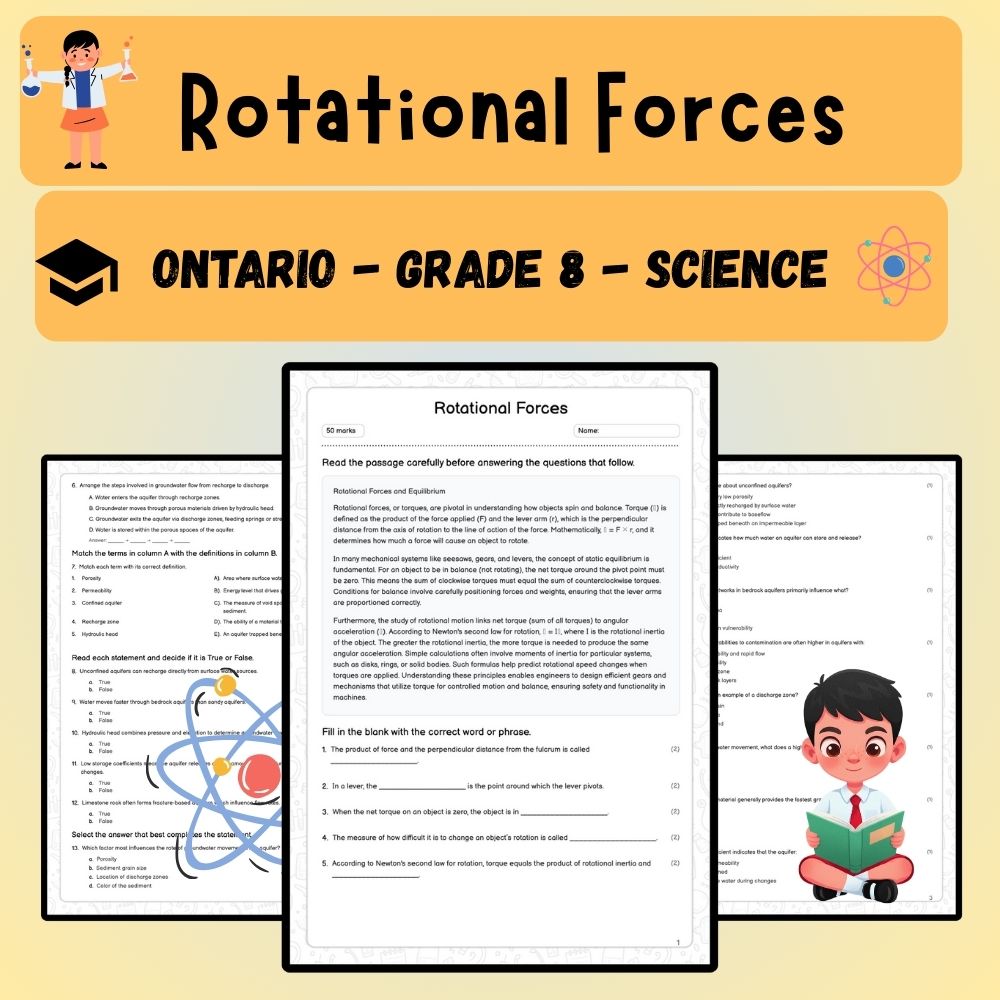
Grade 8 Science | Rotational Forces Worksheet (PDF ) - Ontario Standards
Created byPrism Point LearningLearning Objectives
- Explain the concepts of torque, lever arm, and moment of force and how they relate to rotational equilibrium.
- Identify the conditions for static balance in systems such as seesaws and crank mechanisms.
- Apply formulas linking rotational inertia, applied torque, and angular acceleration to simple rotational systems.
Also included in: Grade 8 Science Unit Bundle | Forces, Energy & Motion Worksheets +1 more
Instant download
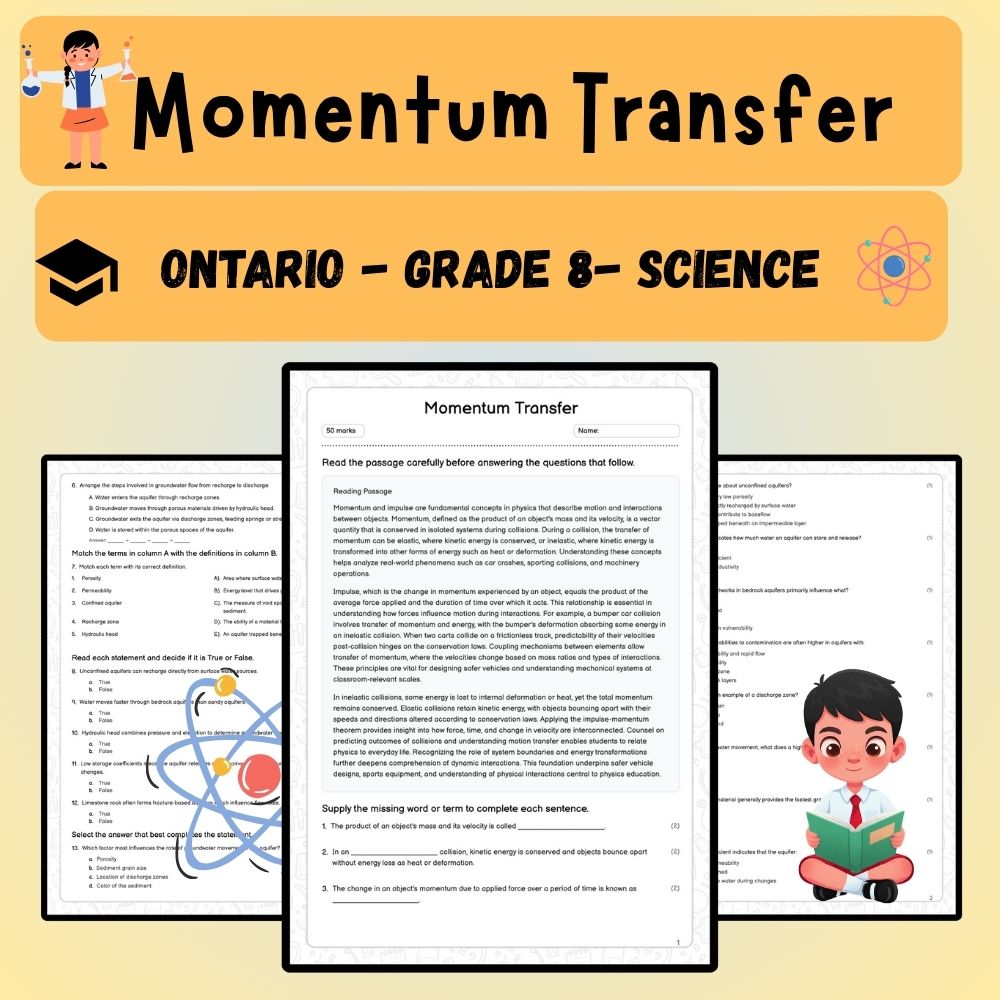
Grade 8 Science | Momentum Transfer Worksheet (PDF )
Created byPrism Point LearningLearning Objectives
- Describe the concept of linear momentum and how it is conserved in closed systems.
- Explain the relationship between impulse and change in momentum.
- Differentiate between elastic and inelastic collisions in terms of momentum transfer.
Also included in: Grade 8 Science Unit Bundle | Forces, Energy & Motion Worksheets +1 more
Instant download
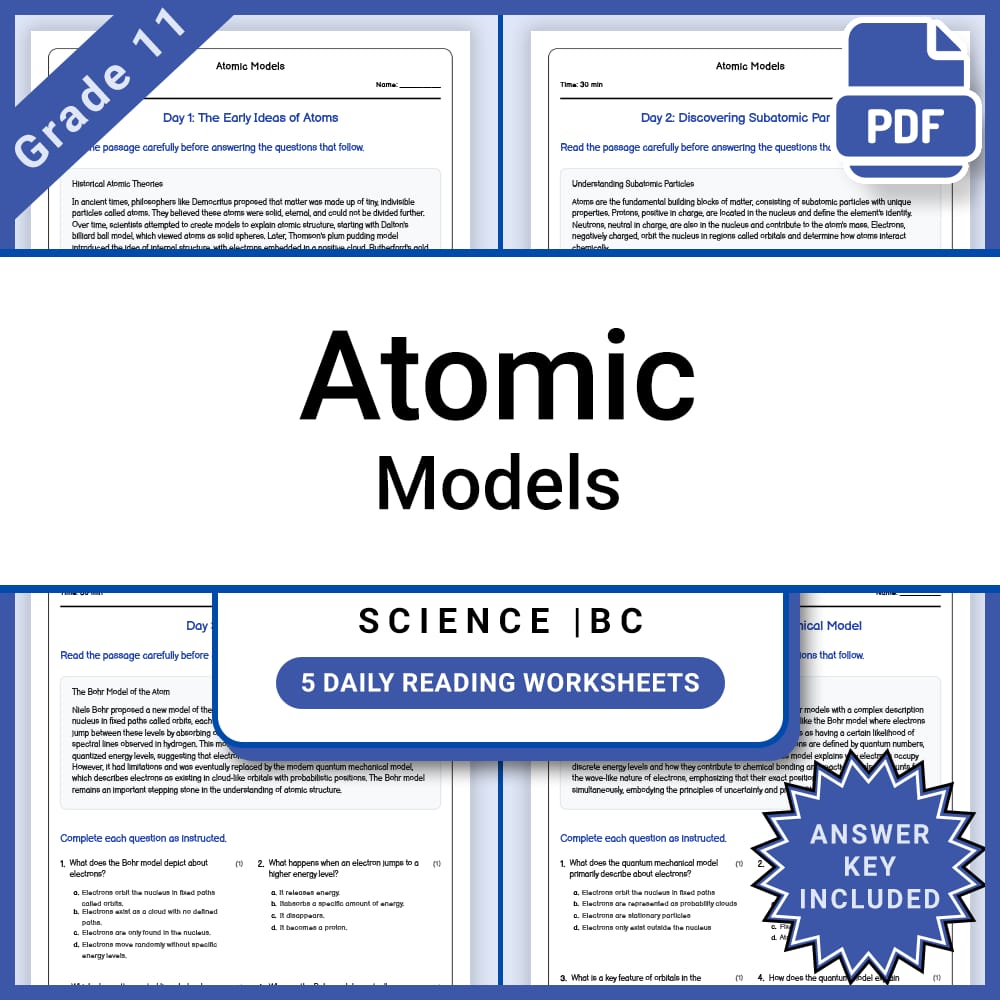
Grade 11 Science – Atomic Models Daily Reading Worksheet with Answer Key
JCreated byJ.S SheetsLearning Objectives
- Understand the progression of atomic models through history
- Identify key features of early atomic theories
- Explain how atomic models influence modern understanding of matter
Also included in: Grade 11 Science Lesson Group | BC Framework Daily Reading Worksheets +1 more
Instant download

Grade 9 Science Solution Behaviour Worksheet | Solubility & Solutions Ontario
 Created byChalk and Compass
Learning Objectives
- Describe dissolution in terms of solute–solvent interactions and qualitative solubility behaviour
- Differentiate unsaturated, saturated, and supersaturated solutions using simple examples
- Explain how temperature and agitation affect solubility qualitatively
Also included in: Matter and Chemical Change - Grade 9 Bundle +1 more
Instant download

Grade 9 Tissue Types Worksheet | Epithelial, Connective, Muscle & Nervous
Created byChalk and CompassLearning Objectives
- Compare the four principal tissue classes by cellular organization and key functions.
- Explain how extracellular matrix properties relate to connective tissue mechanics.
- Differentiate muscle tissue types based on contractile behavior and control.
Also included in: Homeostasis and Human Body Systems Lesson Bundle | Grade 9 Science | Ontario +1 more
Instant download
Browse more categories
About Science Worksheets
Find Science worksheets spanning core skills, practice, and review. All 44,628 resources are instant PDF downloads for the classroom or home.
Every worksheet on MyTeachingSheets is created by independent teacher-authors and reviewed before publication. All resources download as printable PDFs for classroom, homework, or at-home practice, and many include answer keys. Preview any worksheet free before buying.