
Science Worksheets
44,912 subject resources
Grade 7 Science | Recoil And Thrust Worksheet | California Standards
 Created byLumora Learning
Learning Objectives
- Explain recoil and thrust using Newton’s third law (action–reaction force pairs).
- Identify the correct force pair and the opposite directions of forces in a two-object interaction.
- Relate equal-and-opposite forces to different accelerations using mass.
Instant download

Grade 7 Science – Recoil & Thrust Daily Reading Worksheet | California Standards
 Created byBright Mind Resources
Learning Objectives
- Understand the concepts of action and reaction forces
- Identify examples of Newton's Third Law in everyday life
- Explain how forces produce acceleration in systems like rockets and skaters
Also included in: Grade 7 Matter & Forces Science Reading Lesson Bundle | California Standards +1 more
Instant download
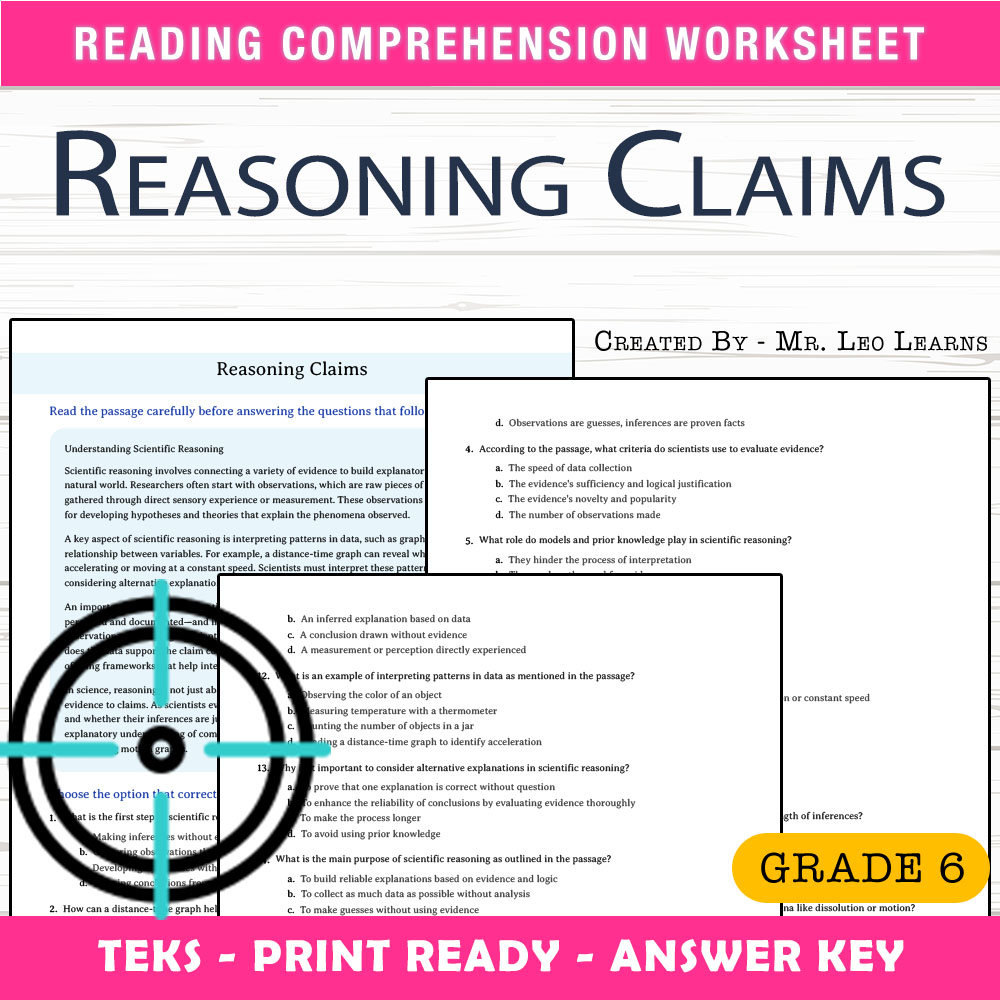
Grade 6 Science — Reasoning Claims Worksheet for Critical Thinking
 Created byThe Resource Hub
Learning Objectives
- Understand the process of connecting evidence to explanatory claims in science.
- Interpret data patterns such as graphs to make inferences.
- Evaluate the strength and validity of scientific arguments and evidence.
Instant download

Grade 6 Reasoning and Claims Daily Reading Worksheet | TEKS Science
 Created byBRIGHT PATH RESOURCES
Learning Objectives
- Distinguish an observation from an inferential claim.
- Identify evidence that supports or does not support a claim.
- Explain why a reasoning claim needs sufficient evidence.
Also included in: Scientific Methods 6th Science Daily Reading Worksheets Lesson Bundle | TeKS +1 more
Instant download

Grade 6 Science Worksheet on Evaporation and Transpiration
JCreated byJ.S SheetsLearning Objectives
- Explain the processes of evaporation and transpiration and their roles in the water cycle.
- Identify factors affecting evaporation and transpiration rates in the environment.
- Describe how phase changes link the hydrosphere and atmosphere.
Also included in: Grade 6 Earth & Space Science Lesson Bundle: California Standards +1 more
Instant download

Grade 6 Science | Evaporation and Transpiration - Daily Reading Comprehension
 Created byCoral Reef Learning
Learning Objectives
- Understand the process of evaporation in the water cycle.
- Identify the role of transpiration in atmospheric moisture.
- Explain how temperature influences evaporation rates.
Instant download
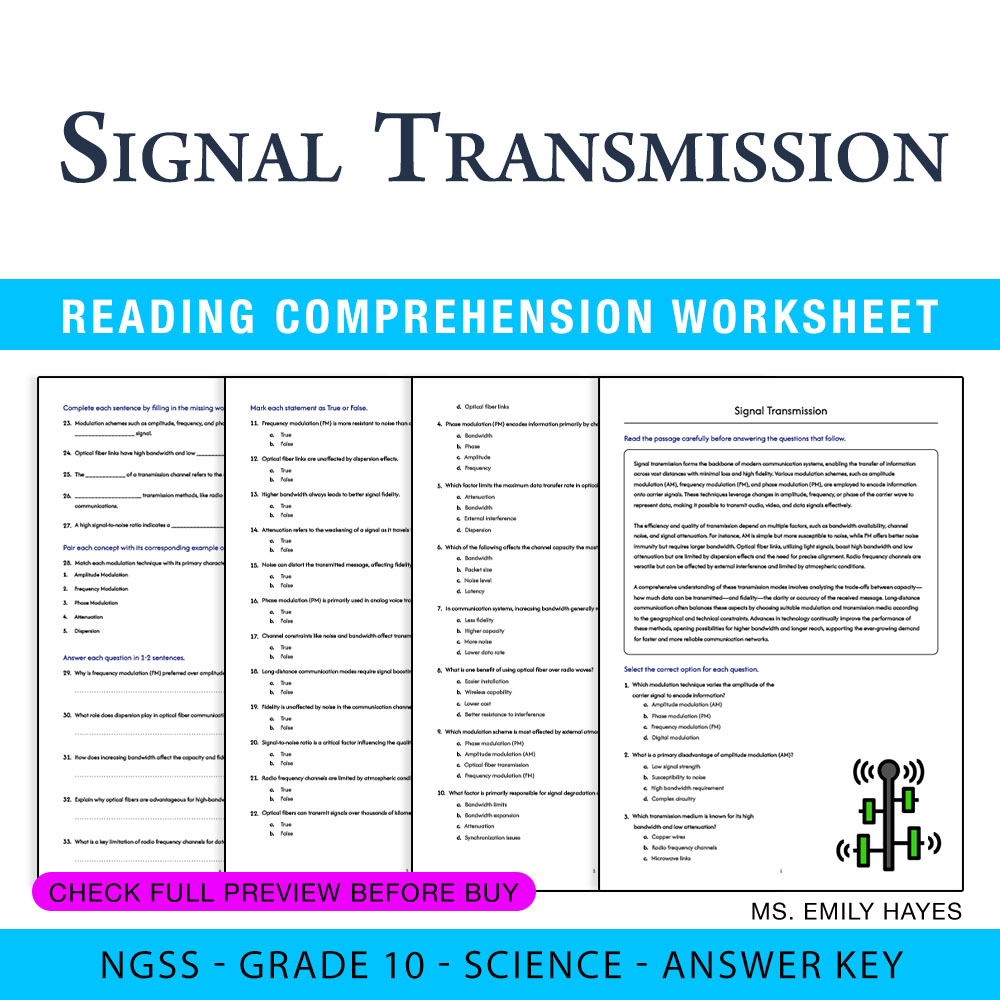
Grade 10 Science | Signal Transmission Worksheet (PDF+ Answer Key)
 Created byCopper Leaf Classroom
Learning Objectives
- Explain the principles of amplitude, frequency, and phase modulation techniques.
- Describe the factors affecting the capacity and fidelity of transmission channels.
- Compare different transmission modes such as radio frequency channels and optical fibers.
Instant download
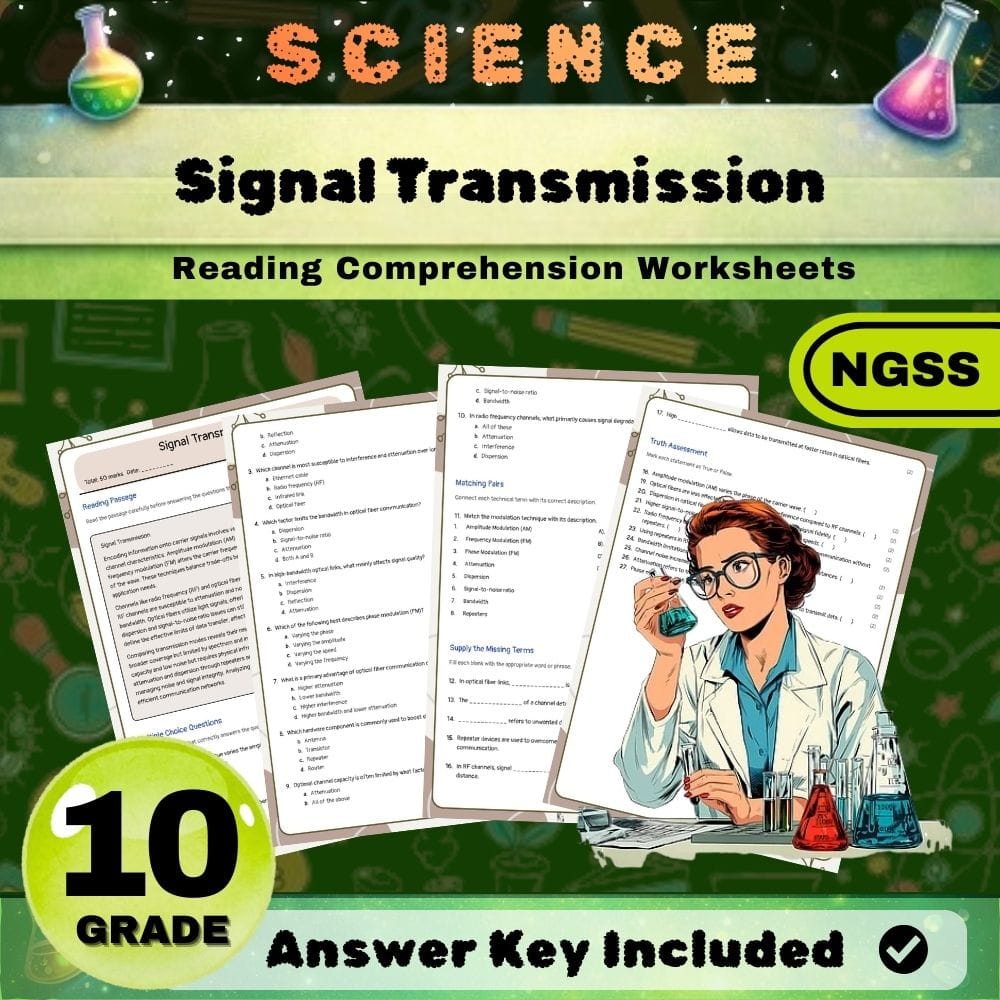
Grade 10 Science | Signal Transmission Worksheet (NGSS) PDF
 Created byMaple Path Learning
Learning Objectives
- Understand the principles of modulation techniques such as amplitude, frequency, and phase modulation.
- Compare the advantages and limitations of different communication channels like radio frequency and optical fiber links.
- Evaluate how channel constraints like bandwidth, noise, and attenuation affect signal capacity and fidelity.
Also included in: Grade 10 Science Waves and Their Applications in Technologies Bundle +1 more
Instant download

Grade 10 Science – Signal Transmission & Modulation | Daily Reading Worksheet
Created byBright Mind ResourcesLearning Objectives
- Understand the basic concepts of signal modulation techniques.
- Identify different types of modulation such as amplitude, frequency, and phase.
- Recognize the factors affecting signal transmission like bandwidth, noise, attenuation, and dispersion.
Also included in: Signal Modulation Grade 10 Science Daily Reading Worksheets Bundle | NGSS +2 more
Instant download

Grade 10 Science | Signal Transmission in Science - Daily Reading Comprehension
Created byCoral Reef LearningLearning Objectives
- Understand the basic concepts of signals and modulation techniques.
- Identify how amplitude, frequency, and phase modulation differ.
- Recognize the impact of channel constraints like bandwidth and noise.
Instant download

Modulation, Noise & Bandwidth Trade-offs Communication Worksheets Grade 10
 Created byTeachers Club
Learning Objectives
- Explain how modulation encodes information onto a carrier signal
- Identify how amplitude, frequency, and phase changes encode data
- Explain how bandwidth and noise affect signal fidelity
Also included in: Grade 10 Science Waves & Information Transfer NGSS Worksheets Bundle +1 more
Instant download
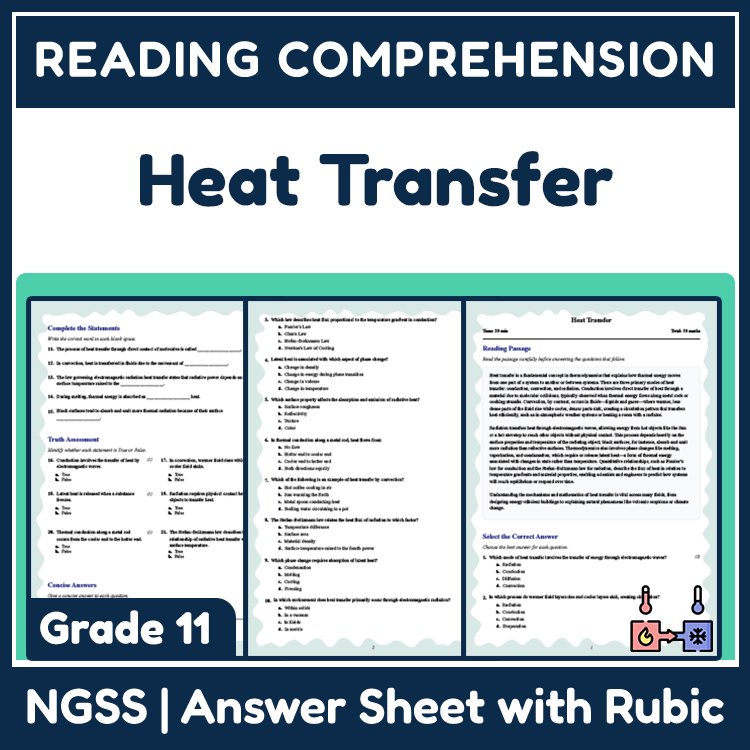
11th Grade Science | Heat Transfer Reading Worksheet & Answer Key (PDF)
JCreated byJ.S SheetsLearning Objectives
- Explain the three main mechanisms of heat transfer: conduction, convection, and radiation.
- Describe examples of heat transfer processes and their roles in temperature change and phase transitions.
- Apply quantitative relationships among heat flux, temperature gradients, and material properties to predict thermal behavior.
Instant download

Grade 11 NGSS Heat Transfer and Temperature Change Daily Reading Worksheet
Created byBRIGHT PATH RESOURCESLearning Objectives
- Identify the main idea of an informational science text about heat transfer.
- Use key vocabulary (conduction, convection, radiation, temperature, phase change, latent heat).
- Explain how heat transfer changes temperature and can cause melting or vaporization.
Also included in: Energy Grade 11 Science Daily Reading Worksheets Lesson Bundle | NGSS +1 more
Instant download

Grade 10 Science | Signal Transmission Worksheet with Short Notes (PDF)
 Created byMeadowlark Worksheets
Learning Objectives
- Understand the different modulation schemes used in signal transmission.
- Identify channel constraints and their effects on communication quality.
- Compare the advantages and limitations of radio frequency and optical fiber links.
Also included in: Grade 10 Science NGSS Waves & Technology Unit Bundle +1 more
Instant download

Grade 11 Heat Transfer: Conduction, Convection, and Radiation Worksheet | NGSS
 Created byClear Sky Classroom
Learning Objectives
- Explain how conduction, convection, and radiation transfer thermal energy and change temperature.
- Use material properties (e.g., thermal conductivity and heat capacity) to predict heat flow behavior.
- Describe phase changes using latent heat and relate them to temperature plateaus during heating/cooling.
Also included in: Grade 11 Energy & Heat Transfer Science Lesson Bundle (Worksheet B) | NGSS +1 more
Instant download

Heat Transfer Worksheet for Grade 11 Science | NGSS-Aligned Assessment
JCreated byJ.S SheetsLearning Objectives
- Understand the mechanisms of heat transfer: conduction, convection, and radiation.
- Identify real-world examples of heat transfer in thermal systems.
- Explain the roles of heat flux, temperature gradients, and material properties in thermal processes.
Also included in: Grade 11 Energy Transfer and Conversion Science Lesson Bundle – NGSS +1 more
Instant download

Climate Variability Worksheet Grade 9 Science Activity | NGSSS
 Created byPrism Point Learning
Learning Objectives
- Explain how climate variability can change weather patterns over months to years.
- Describe how ocean-atmosphere interactions such as El Niño and La Niña redistribute heat and moisture.
- Distinguish short-term natural variability from longer-term climate trends using evidence across timescales.
Also included in: Grade 9 Earth, Weather & Climate Systems Lesson Bundle | Florida ngsss
Instant download

Grade 9 Science | Climate Variability Worksheet | Florida NGSSS Aligned
Created byLumora LearningLearning Objectives
- Explain how climate variability affects weather averages over months to years
- Describe ocean-atmosphere interactions (El Niño and La Niña) and their impacts on temperature and rainfall
- Distinguish natural variability from long-term climate trends using evidence across timescales and regions
Instant download
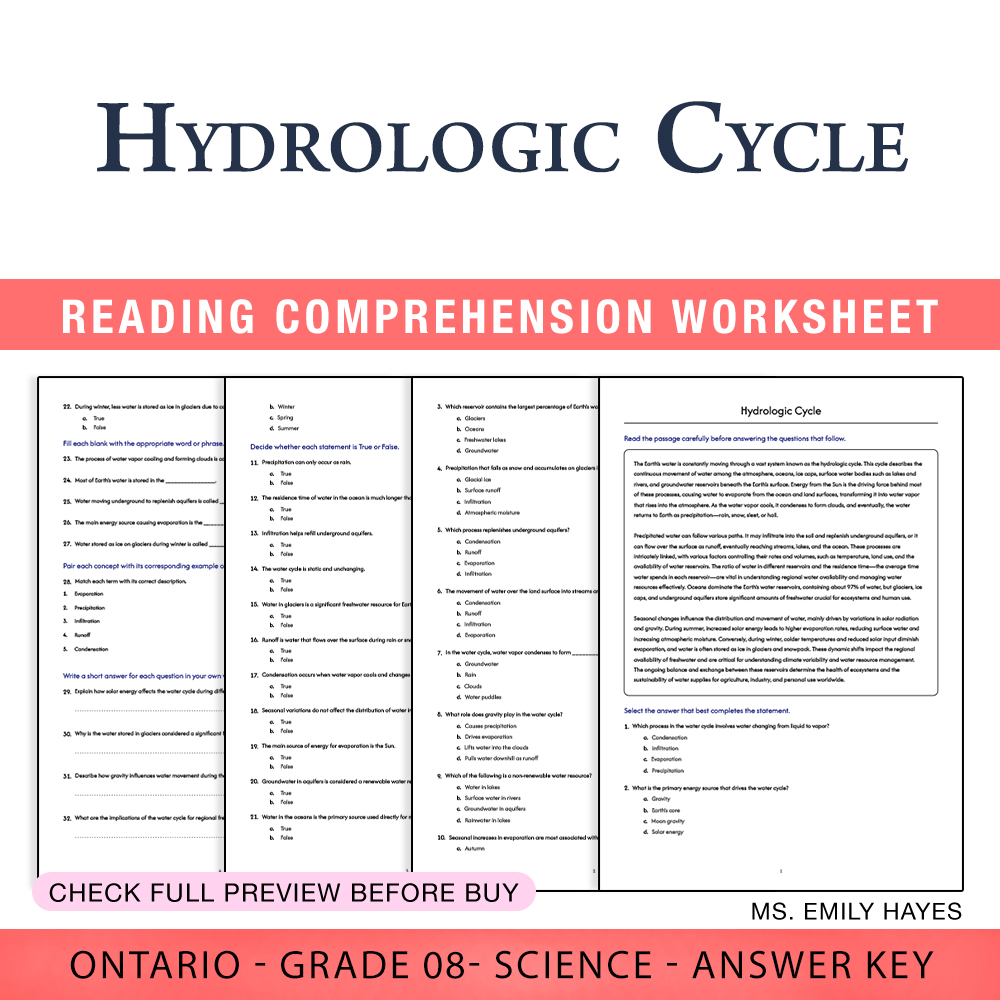
Grade 8 Science | Hydrologic Cycle Worksheet (PDF + Answer Key)
Created byCopper Leaf ClassroomLearning Objectives
- Describe the main processes involved in the hydrologic cycle, including evaporation, condensation, precipitation, infiltration, and runoff.
- Explain the role of solar energy and gravity in driving water fluxes and seasonal water redistribution.
- Identify the different reservoirs of water on Earth, such as oceans, glaciers, and aquifers, and discuss their sizes and residence times.
Instant download

Elements vs Compounds Worksheet Grade 7 Science Ontario Unit
 Created byChalk and Compass
Learning Objectives
- Compare elements and compounds using atomic composition, chemical formulas, and bonding
- Explain how chemical combination changes observable properties such as melting point and conductivity
- Identify substances as elements or compounds based on particle type and fixed ratios
Also included in: Separation of Mixtures & Matter Properties Lesson Bundle – Grade 7 Science +1 more
Instant download
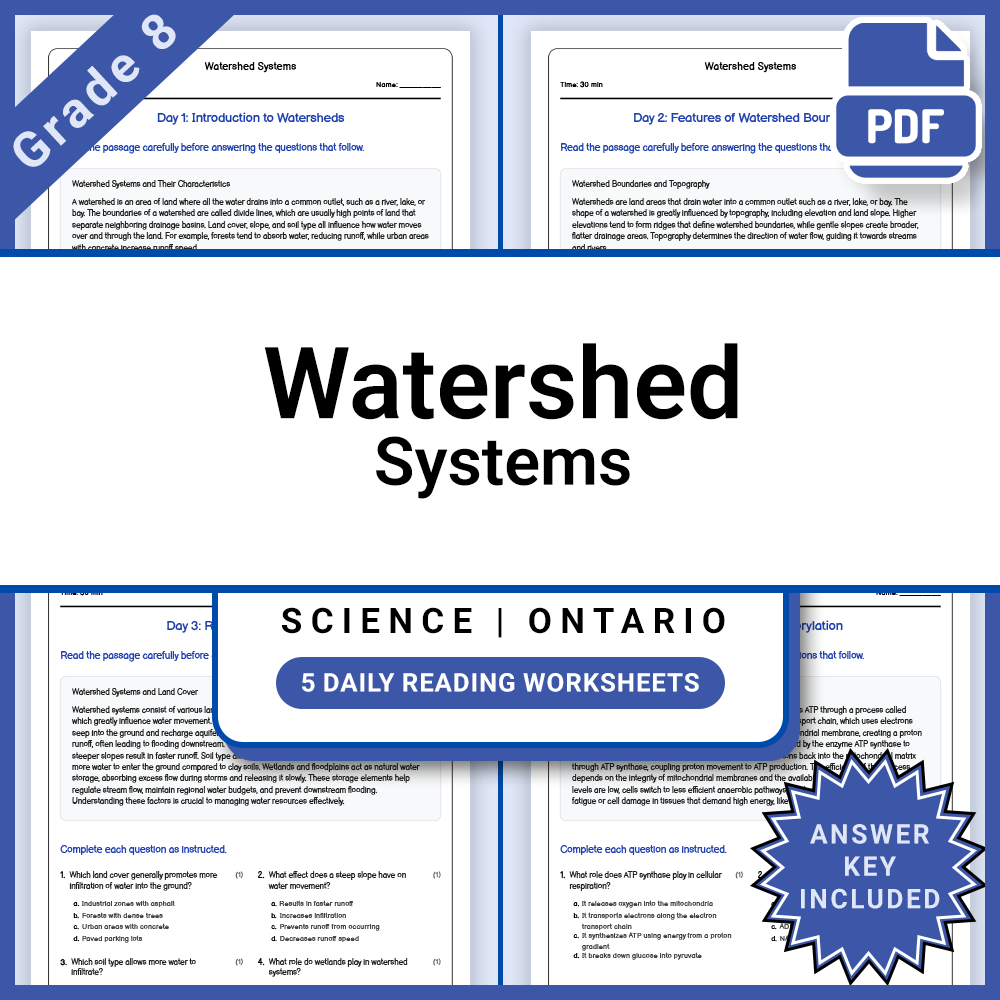
Grade 8 Science Water Cycle Study | Daily Reading Worksheet + Answer Key
JCreated byJ.S SheetsLearning Objectives
- Understand key concepts related to Science
- Apply knowledge through practice questions
- Demonstrate comprehension of the material
Also included in: Grade 8 Science Lesson Group: Water Systems and Water Quality Framework +1 more
Instant download

Grade 8 Hydrologic Cycle Worksheet | Water Cycle Science Activity
Created byClear Sky ClassroomLearning Objectives
- Explain how water moves through the atmosphere, surface water, and groundwater in the hydrologic cycle.
- Identify the roles of solar energy and gravity in driving evaporation, condensation, precipitation, infiltration, and runoff.
- Describe how residence time and reservoir size affect water availability in oceans, glaciers, and aquifers.
Instant download

Grade 8 Science | Hydrologic Cycle Worksheet (Ontario Standards) (PDF)
 Created byEvergreen Desk Education
Learning Objectives
- Explain how solar energy and gravity drive the hydrologic cycle processes.
- Describe evaporation, condensation, precipitation, infiltration, runoff, and groundwater movement.
- Compare the role of major water reservoirs (oceans, glaciers/ice, aquifers) using mass balance ideas and residence time.
Also included in: Grade 8 Watershed and Water Quality Science Lesson Bundle (Ontario) +1 more
Instant download

Grade 12 Science – Data Analysis & Scientific Research | Daily Reading Worksheet
Created byBright Mind ResourcesLearning Objectives
- Recognize and interpret data distributions in histograms
- Identify skewness and other distribution features
- Understand the basics of graphical data representation
Also included in: Grade 12 Scientific Inquiry & Data Analysis Science Lesson Bundle | TEKS +2 more
Instant download
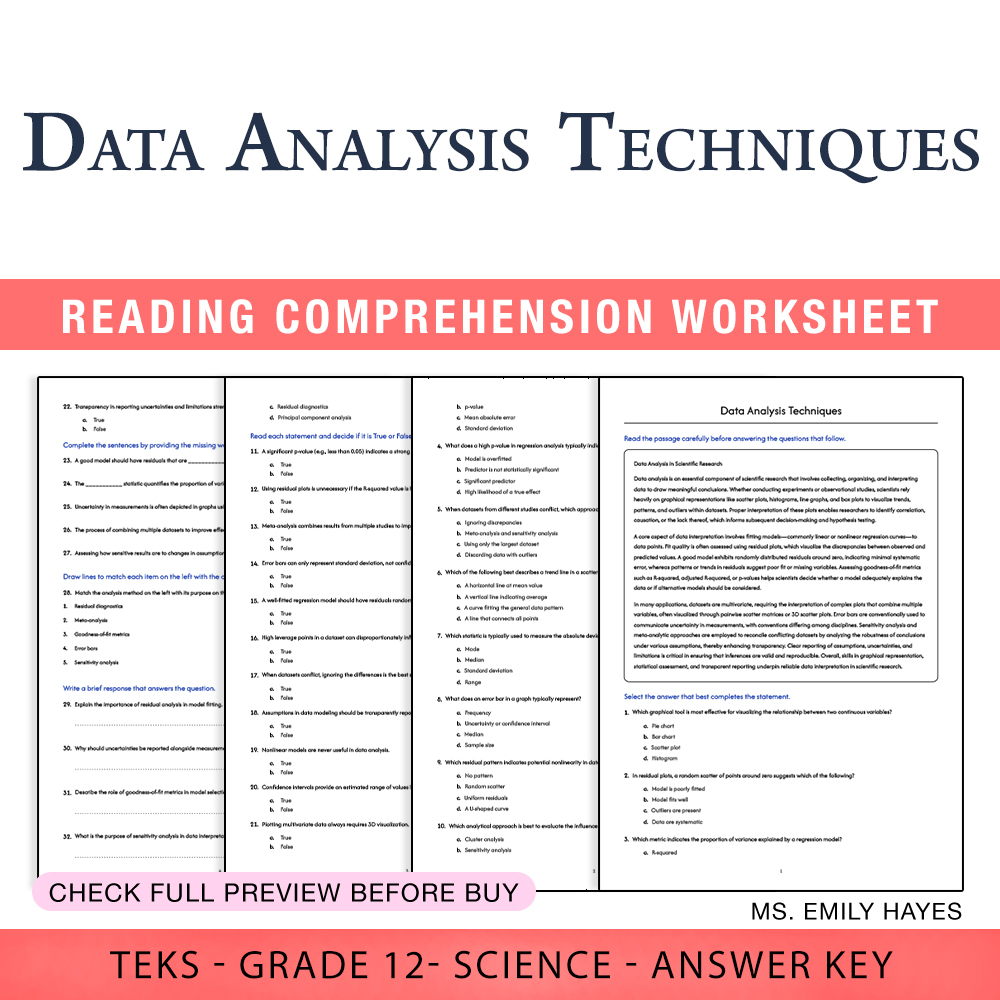
12th Grade Science | Data Analysis Techniques Worksheet (PDF+ Answer Key)
Created byCopper Leaf ClassroomLearning Objectives
- Interpret graphical data presentations and identify relevant trends.
- Apply model fitting techniques and assess residuals for data accuracy.
- Understand and compute descriptive statistics for datasets.
Instant download
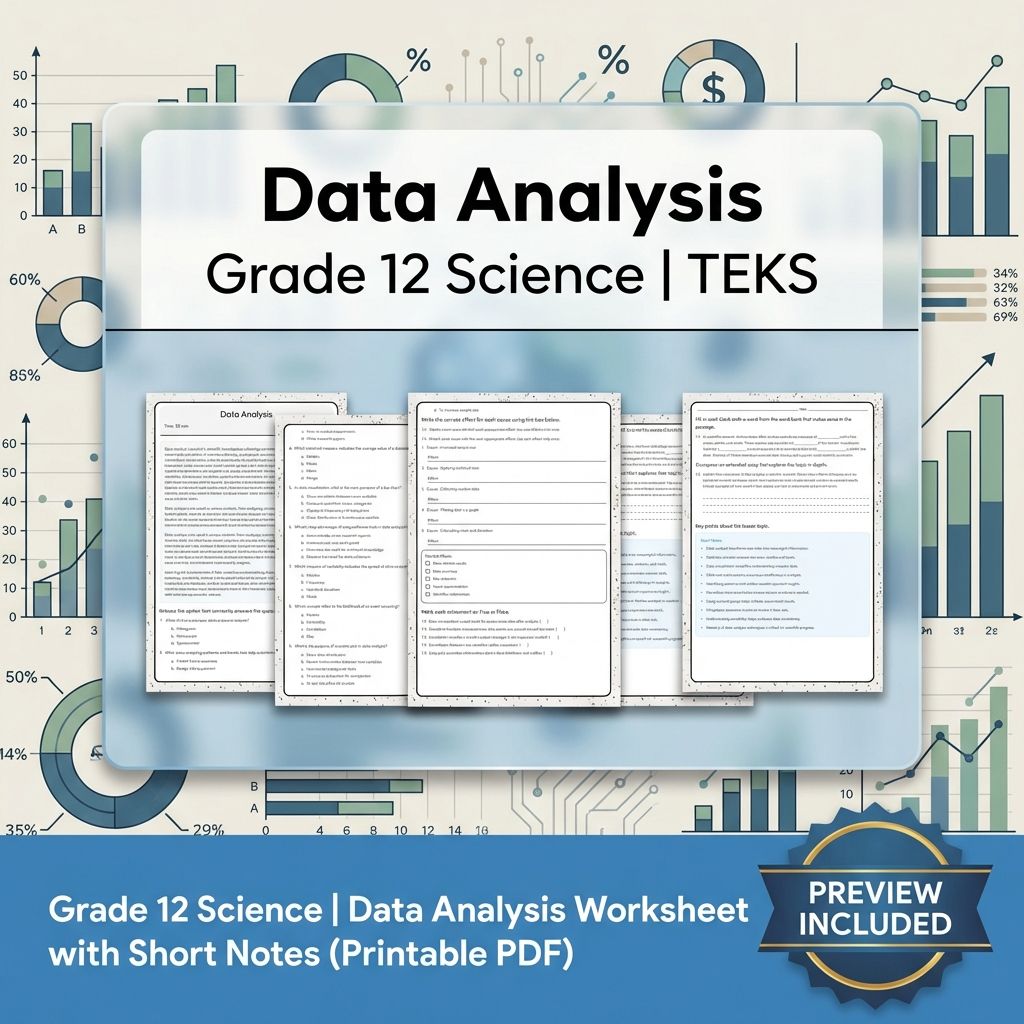
Grade 12 Science | Data Analysis Worksheet with Short Notes (Printable PDF)
Created byMeadowlark WorksheetsLearning Objectives
- Understand key concepts of data analysis in scientific research.
- Apply various question types to evaluate understanding of data interpretation.
- Learn how to summarize findings using short notes.
Also included in: Grade 12 Science Unit Bundle | Data Analysis, Modeling & Ethics Worksheets +2 more
Instant download

Grade 12 Science | Data Analysis in Science - Daily Reading Comprehension
Created byCoral Reef LearningLearning Objectives
- Identify patterns and trends in graphical data visualizations
- Interpreting regression and multivariate plots
- Assess goodness-of-fit metrics and residuals
Also included in: Grade 12 Science Daily Reading Worksheets Full-Year Bundle | TEKS
Instant download

Balancing Reactions Worksheet | Grade 12 Science Practice
Created byPrism Point LearningLearning Objectives
- Use chemical equations to represent chemical change and balance them using the law of conservation of mass
- Identify and classify common reaction types (synthesis, decomposition, single and double replacement, combustion)
- Apply stoichiometric coefficients and mole ratios to make quantitative relationships between reactants and products
Instant download
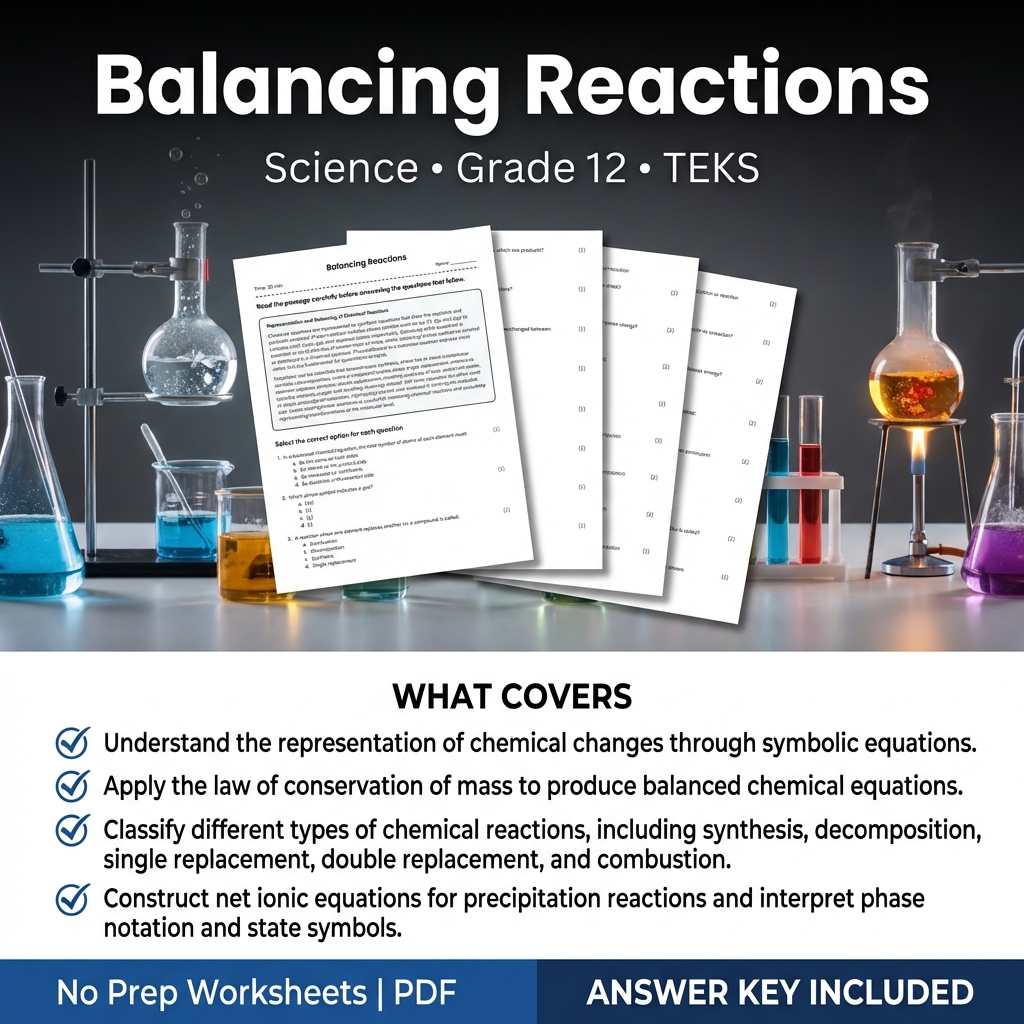
Grade 12 Science Worksheet on Balancing Reactions | TEKS Standards
Created byCoral Reef LearningLearning Objectives
- Understand the representation of chemical changes through symbolic equations.
- Apply the law of conservation of mass to produce balanced chemical equations.
- Classify different types of chemical reactions, including synthesis, decomposition, single replacement, double replacement, and combustion.
Instant download
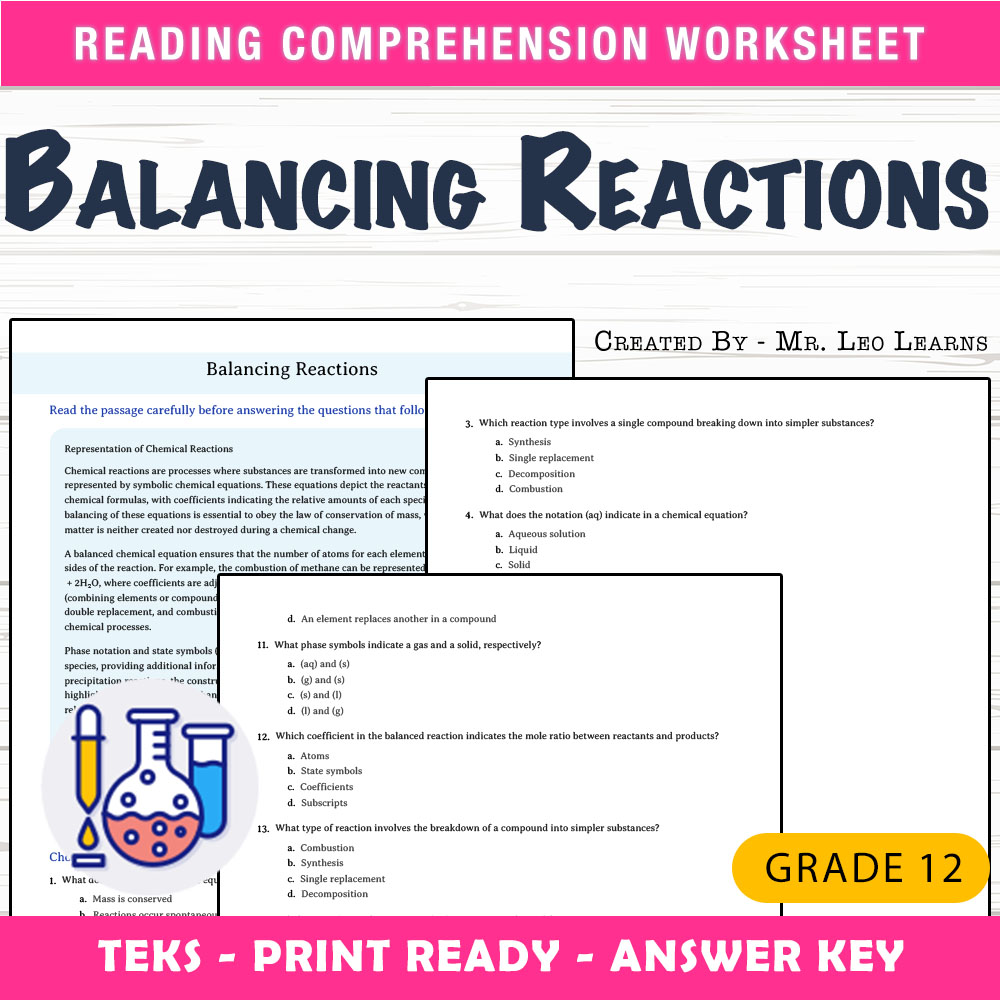
Grade 12 Science — Balancing Reactions Worksheet for Mastery
Created byThe Resource HubLearning Objectives
- Understand the representation of chemical change through symbolic equations.
- Apply the law of conservation of mass to produce balanced chemical equations.
- Classify different types of chemical reactions including synthesis, decomposition, single and double replacement, and combustion.
Also included in: Grade 12 Science Worksheet Bundle | Chemistry & Chemical Reactions Mastery +1 more
Instant download
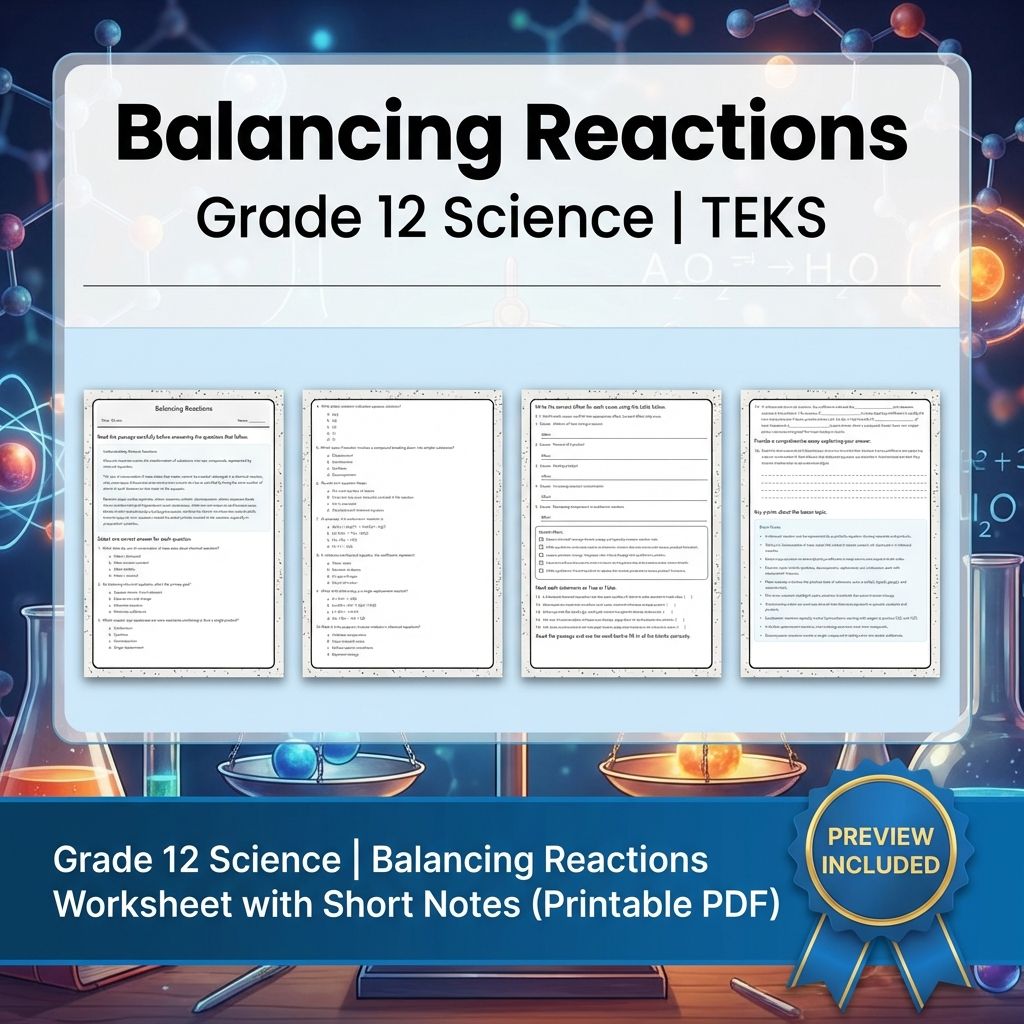
Grade 12 Science | Balancing Reactions Worksheet with Short Notes (PDF)
Created byMeadowlark WorksheetsLearning Objectives
- Understand the representation of chemical change through symbolic equations.
- Apply the law of conservation of mass to balance chemical equations.
- Classify different types of chemical reactions including synthesis, decomposition, replacement, and combustion.
Also included in: Grade 12 Science Unit Bundle | Atomic Structure, Thermochemistry & More +2 more
Instant download

Balancing Reactions Assessment for Grade 12 Science | TEKS Standards
Created byPrism Point LearningLearning Objectives
- Understand the representation of chemical change through symbolic equations.
- Apply the law of conservation of mass to balance chemical equations.
- Classify reaction types including synthesis, decomposition, single and double replacement, and combustion.
Also included in: Lesson Bundle Grade 12 Chemistry and Reactions Science Assessment TEKS
Instant download

Grade 7 Science | Heat Transfer - Daily Reading Comprehension
Created byCoral Reef LearningLearning Objectives
- Understand the mechanisms of heat transfer: conduction, convection, and radiation
- Identify examples of thermal conduction in everyday life
- Explain how heat flows from warmer to cooler objects
Instant download

Heat Transfer Test Prep Worksheet | Grade 7 Science NGSS Review
Created byPrism Point LearningLearning Objectives
- Describe how heat energy transfers between objects through conduction, convection, and radiation.
- Explain how temperature change and rate differences provide evidence of heat transfer.
- Connect heat transfer to real-world examples such as air currents, lamps, and electrical circuits.
Also included in: Grade 7 Energy Transfer and Conversion Science Lesson Bundle (NGSS)
Instant download

Grade 7 Heat Transfer Worksheet | Conduction Convection Radiation | NGSS
Created byBRIGHT PATH RESOURCESLearning Objectives
- Understand the mechanisms of heat transfer: conduction, convection, radiation
- Identify examples of heat transfer in everyday life
- Describe measurable evidence of heat transfer
Also included in: Energy & Heat Transfer Grade 7 Science Lesson Bundle Daily Reading | NGSS +2 more
Instant download

Heat Transfer Worksheet for Grade 7 Science | NGSS-Aligned Practice
JCreated byJ.S SheetsLearning Objectives
- Identify and describe the mechanisms of heat transfer: conduction, convection, radiation, sound, and electric current.
- Explain how energy transfer affects temperature and rate differences in objects and environments.
- Use examples to illustrate different modes of heat transfer and measure evidence of transfer.
Also included in: Grade 7: Energy Transformations and Accounting Science Lesson Bundle NGSS +1 more
Instant download

Heat Transfer Worksheets: Thermal Energy Movement | Grade 7 Science
 Created bythe curious pencil
Learning Objectives
- Identify conduction, convection, and radiation as energy-transfer mechanisms
- Explain how thermal energy moves between warmer and cooler regions
- Use temperature changes as evidence of thermal energy transfer
Also included in: Energy Grade 7 Science Worksheets | NGSS Energy Unit Bundle +2 more
Instant download

Heat Transfer Worksheet | Grade 7 NGSS Conduction Convection Radiation
 Created byNorthstar Worksheets
Learning Objectives
- Identify the main mechanisms of heat transfer: conduction, convection, and radiation.
- Explain how heat transfer relates to temperature change and the movement of thermal energy.
- Use examples (spoon in hot liquid, air currents, a lamp, and an electrical circuit) to match evidence to the correct mode of heat flow.
Also included in: Grade 7 Energy Transfer & Transformations Lesson Bundle | NGSS Science +1 more
Instant download
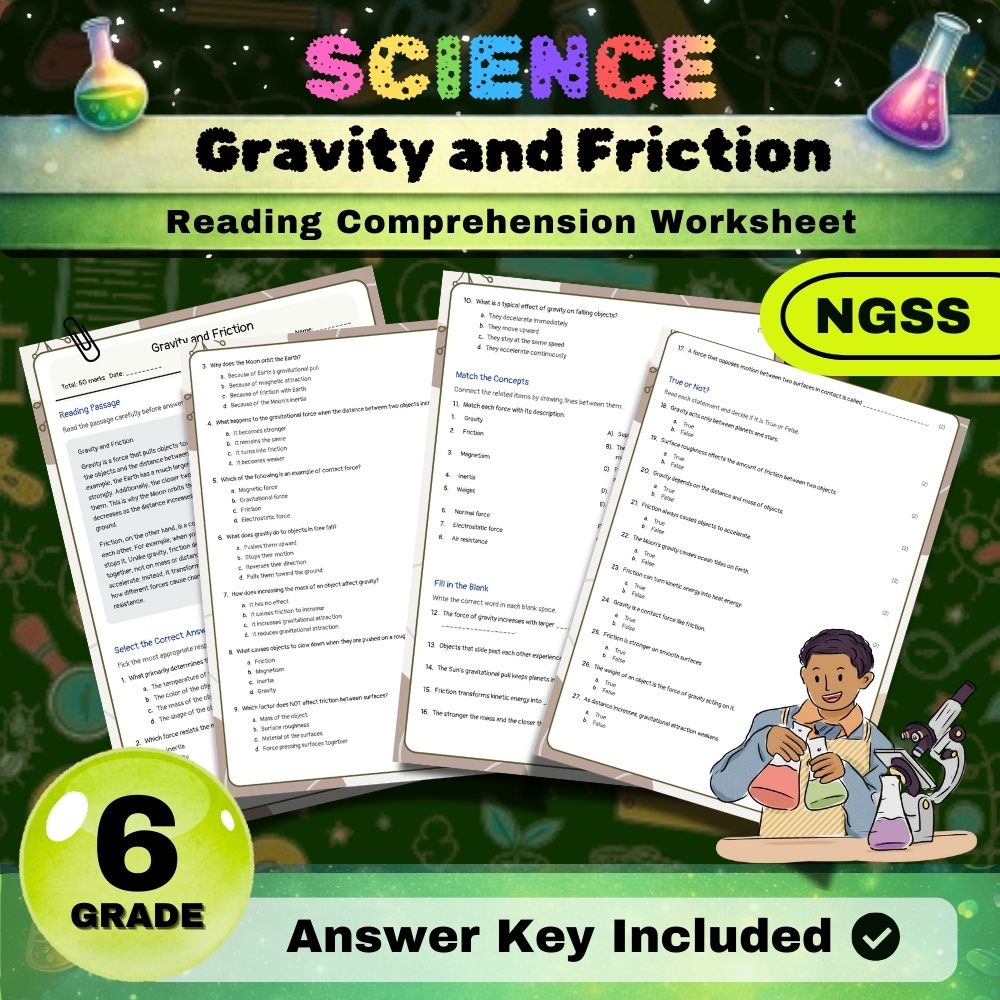
6th Grade Science | Gravity and Friction NGSS Worksheet (PDF + Answer Key)
Created byMaple Path LearningLearning Objectives
- Understand that gravitational attraction depends on mass and distance between objects.
- Differentiate between gravitational and contact forces, such as friction.
- Explain how gravity influences planetary orbits and falling objects.
Also included in: Grade 6 Science Forces & Motion Unit Bundle (NGSS Worksheets + Answer Keys) +1 more
Instant download
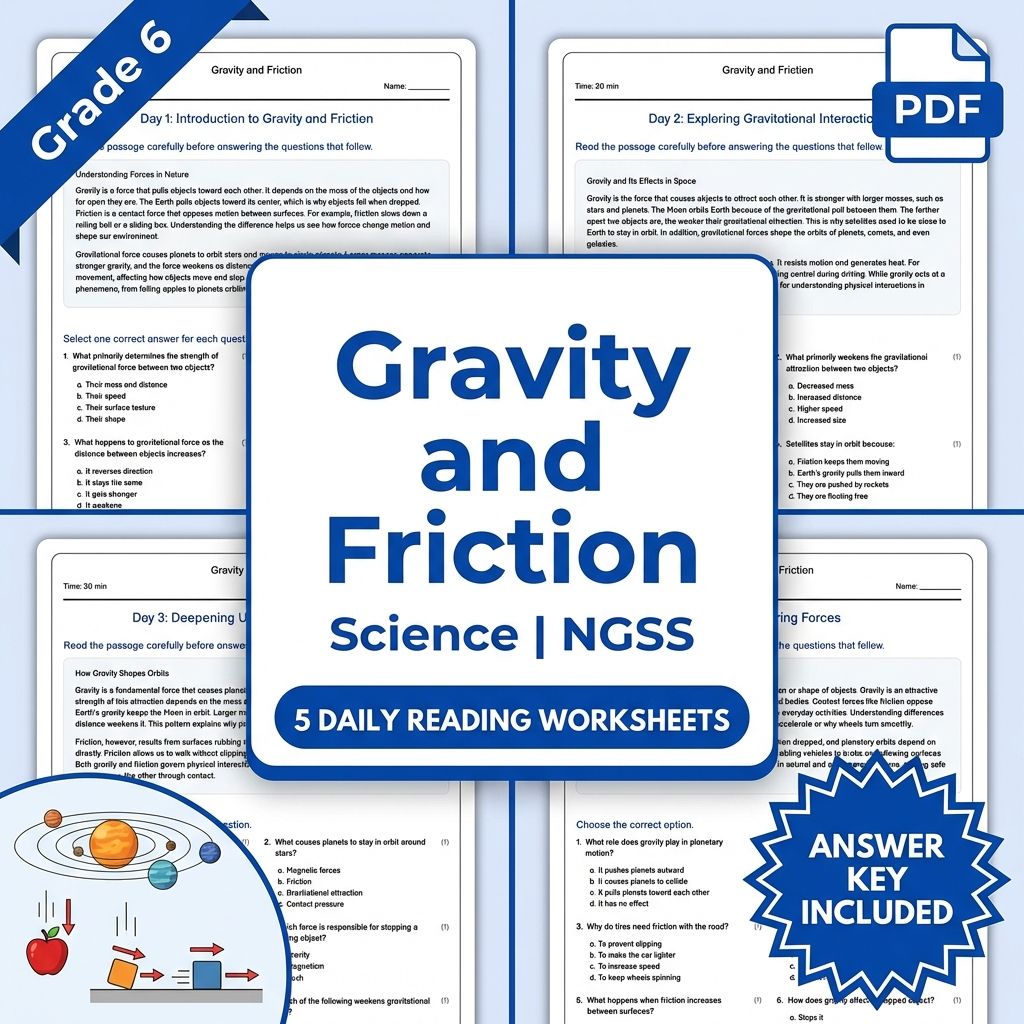
6th Grade Science | Gravity and Friction Worksheet (PDF+ Answer Key)
Created byCopper Leaf ClassroomLearning Objectives
- Understand how gravitational force depends on mass and distance.
- Identify examples of gravitational interactions such as planetary orbits and falling objects.
- Distinguish between attractive (gravitational) and contact (friction) forces.
Instant download

Gravity and Friction Evidence-Based Arguments Worksheet | NGSS Grade 6 Science
 Created bySkylark Worksheets
Learning Objectives
- Explain how gravity depends on mass and distance using examples such as Earth–Moon and falling objects.
- Distinguish gravity (a non-contact force) from friction (a contact force) by describing how each changes motion.
- Use evidence to support an argument about gravitational interactions and orbital behavior.
Also included in: Forces, Motion, and Interactions Grade 6 Science Lesson Bundle NGSS +1 more
Instant download

Grade 6 Science Worksheet on Gravity and Friction | NGSS Aligned Assessment
JCreated byJ.S SheetsLearning Objectives
- Explain how gravitational attraction depends on mass and distance.
- Compare and contrast gravitational forces with contact forces like friction.
- Use examples such as the Earth-Moon system and planetary orbits to illustrate gravitational interactions.
Also included in: Grade 6 Forces, Motion, and Interactions Science Lesson Bundle: NGSS +1 more
Instant download
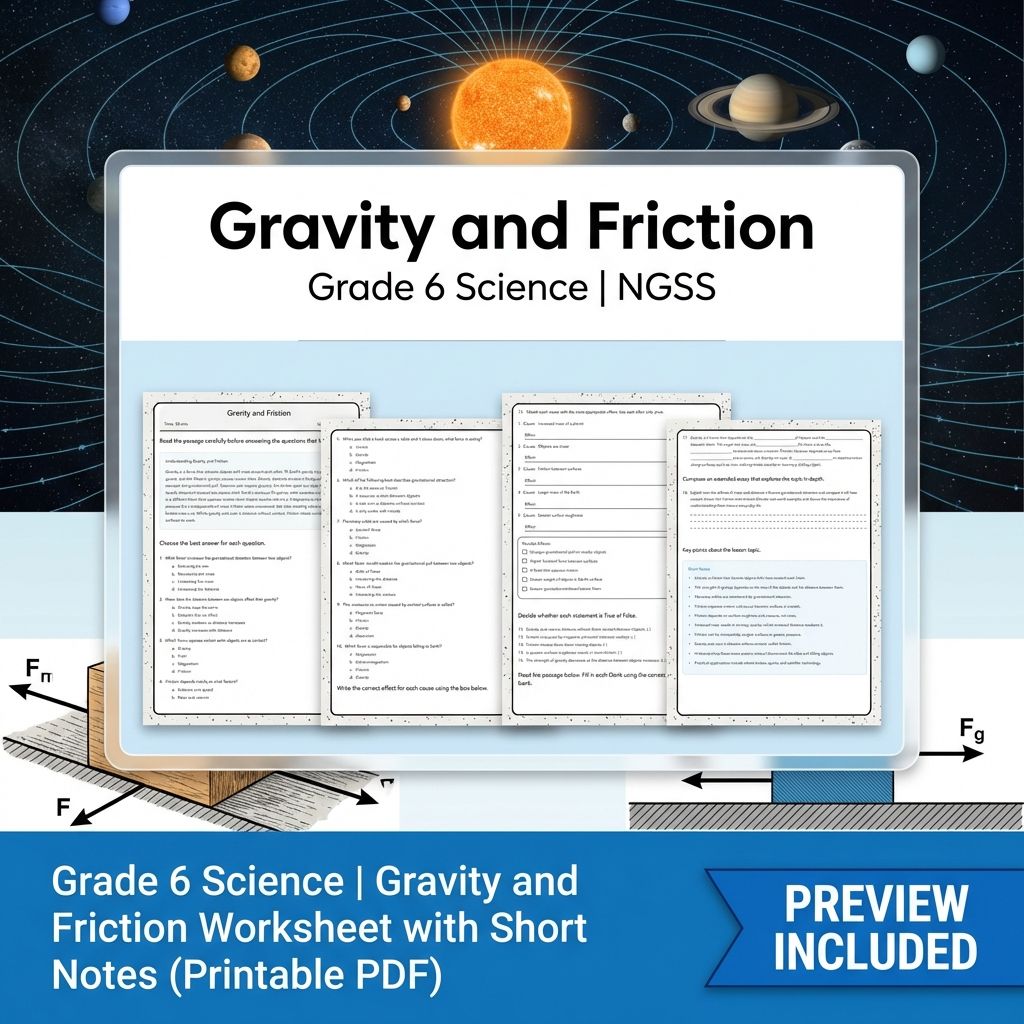
Grade 6 Science | Gravity and Friction Worksheet with Short Notes (PDF)
Created byMeadowlark WorksheetsLearning Objectives
- Explain how gravitational attraction depends on mass and distance.
- Identify examples of gravitational interactions such as planetary motion and falling objects.
- Differentiate between contact forces like friction and non-contact forces like gravity.
Also included in: Grade 6 Science | Forces & Motion Unit Bundle NGSS Aligned Worksheets +1 more
Instant download
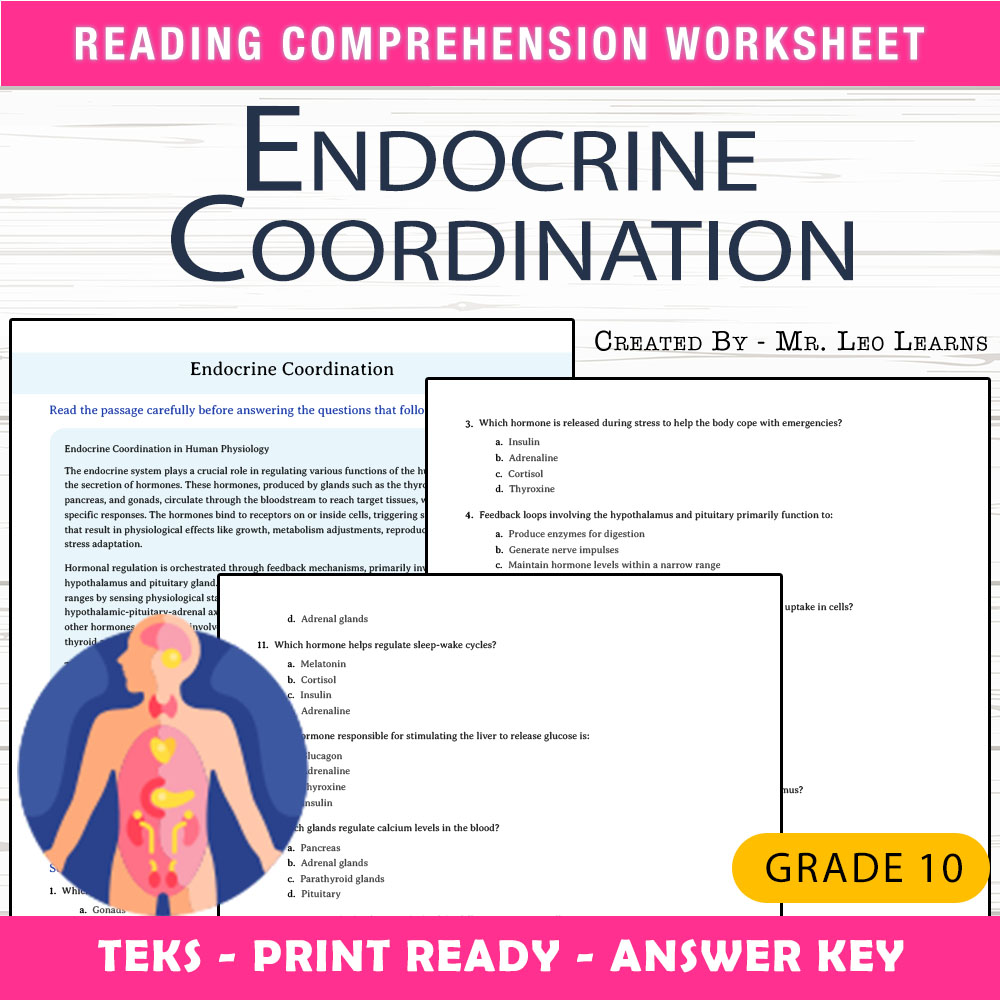
Grade 10 Science | Endocrine Coordination Worksheet for Mastery
Created byThe Resource HubLearning Objectives
- Explain how hormones regulate growth, metabolism, reproduction, and stress responses.
- Describe the role of specific endocrine glands and hormones in human physiological processes.
- Understand feedback loops involving the hypothalamus and pituitary to maintain hormonal balance.
Also included in: Grade 10 Science Worksheet Bundle – Cellular, Genetics & Ecology Mastery
Instant download
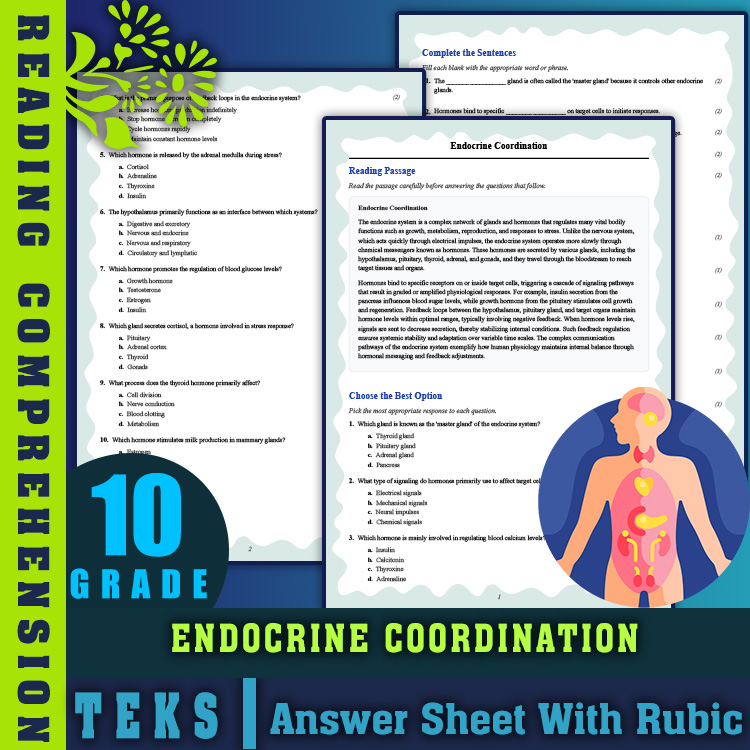
Grade 10 Science | Endocrine Coordination Reading Worksheet (PDF + Rubric)
JCreated byJ.S SheetsLearning Objectives
- Understand the role of hormones and endocrine glands in regulating bodily functions.
- Explain the feedback mechanisms involved in endocrine system regulation.
- Describe how hormones communicate and produce physiological effects.
Instant download

Grade 10 Science Endocrine Coordination Daily Reading Worksheet with Answer Key
JCreated byJ.S SheetsLearning Objectives
- Understand key concepts related to Science
- Apply knowledge through practice questions
- Demonstrate comprehension of the material
Also included in: Grade 10 Science Lesson Bundle | Human Physiology & Regulatory Systems +1 more
Instant download

Endocrine Coordination Worksheet | Grade 10 Science Practice
Created byPrism Point LearningLearning Objectives
- Explain how endocrine glands use hormones to coordinate body processes over different time scales
- Describe how hormone–receptor binding and signaling cascades lead to graded physiological effects
- Use hypothalamus–pituitary feedback loops to predict how hormone levels change in the body
Instant download

Endocrine Coordination Worksheet for Grade 10 Science TEKS aligned
JCreated byJ.S SheetsLearning Objectives
- Explain how hormones coordinate body functions using specific receptors and signaling cascades
- Describe the roles of the hypothalamus and pituitary in feedback regulation of hormone levels
- Compare short-term and long-term effects of hormonal signaling on growth, metabolism, reproduction, and stress responses
Instant download
Browse more categories
About Science Worksheets
Find Science worksheets spanning core skills, practice, and review. All 44,912 resources are instant PDF downloads for the classroom or home.
Every worksheet on MyTeachingSheets is created by independent teacher-authors and reviewed before publication. All resources download as printable PDFs for classroom, homework, or at-home practice, and many include answer keys. Preview any worksheet free before buying.