
Science Worksheets
42,685 subject resources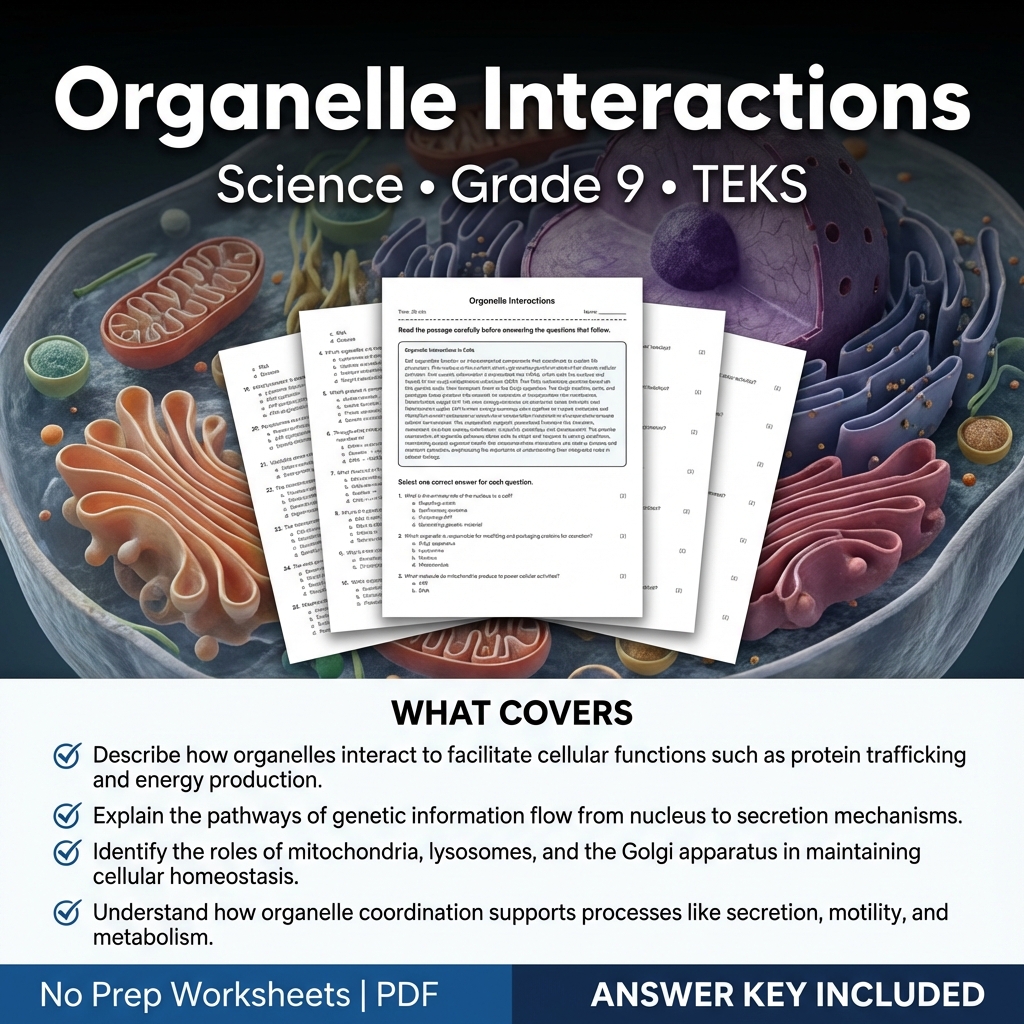
Grade 9 Science Worksheet on Organelle Interactions | TEKS-Aligned PDF
 Created byCoral Reef Learning
Learning Objectives
- Describe how organelles interact to facilitate cellular functions such as protein trafficking and energy production.
- Explain the pathways of genetic information flow from nucleus to secretion mechanisms.
- Identify the roles of mitochondria, lysosomes, and the Golgi apparatus in maintaining cellular homeostasis.
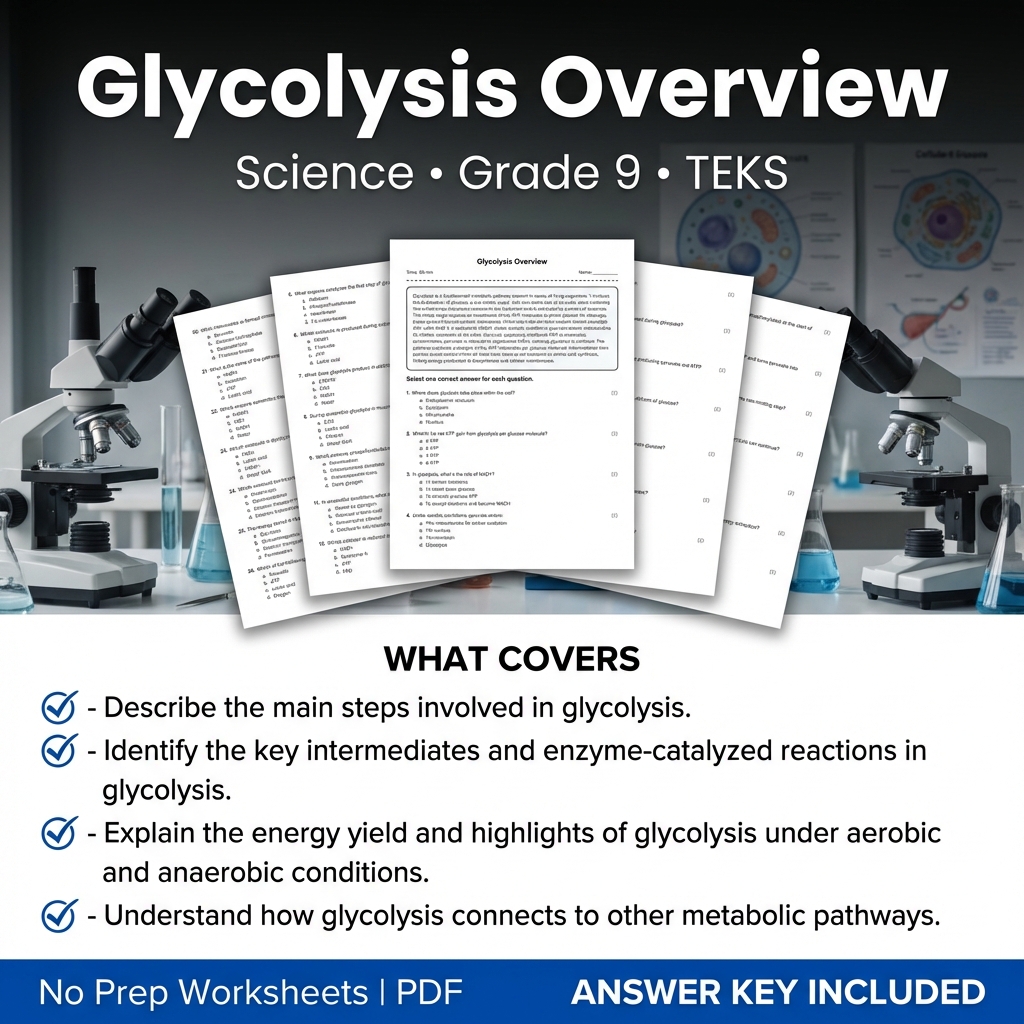
Grade 9 Science Worksheet Glycolysis Overview | TEKS Aligned PDF
Created byCoral Reef LearningLearning Objectives
- Describe the main steps involved in glycolysis.
- Identify the key intermediates and enzyme-catalyzed reactions in glycolysis.
- Explain the energy yield and highlights of glycolysis under aerobic and anaerobic conditions.
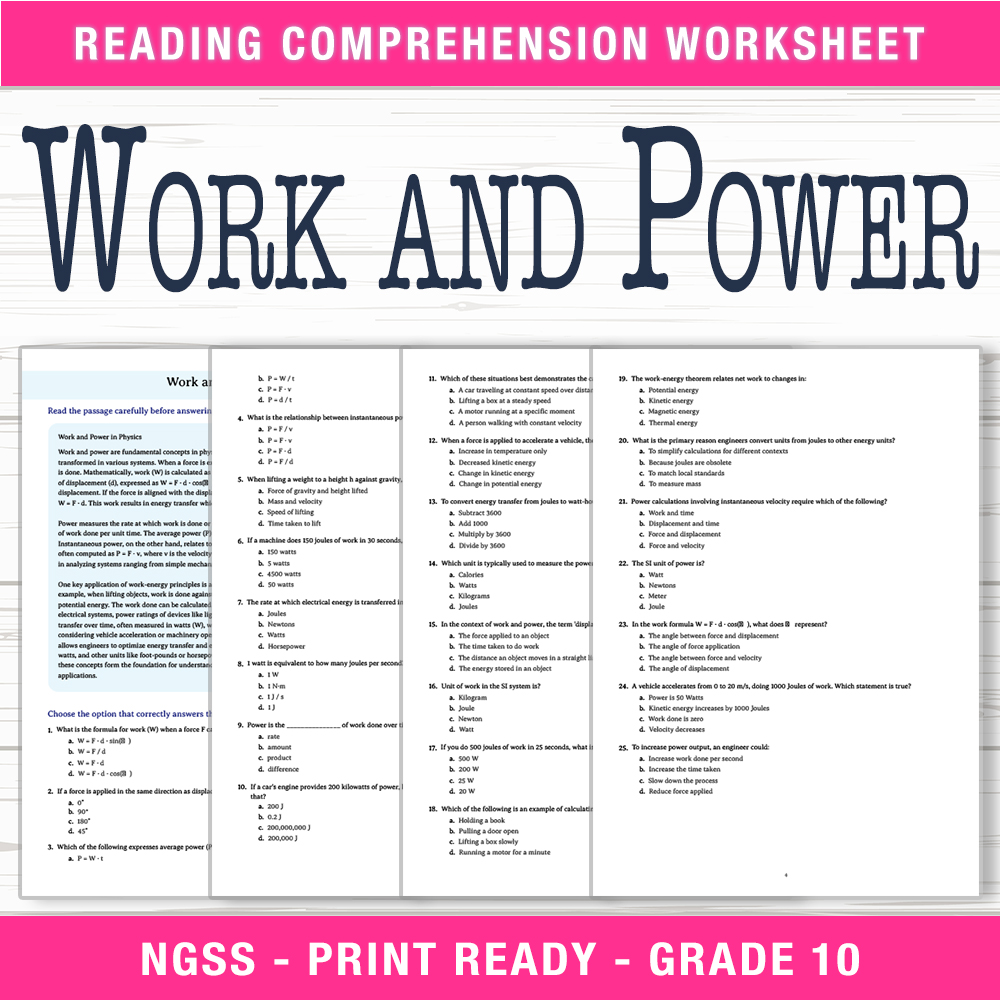
Grade 10 Science | Work and Power Worksheet (PDF + Answer Key)
 Created byRiverstone Classroom
Learning Objectives
- Understand the relationship between force, displacement, work, and energy using the work–energy theorem.
- Apply algebraic techniques to calculate work and power in various physical contexts.
- Convert between units such as joules, watts, and other common engineering units.

Grade 7 Science Worksheet on Variable Control | Ontario Standards Practice
Created byCoral Reef LearningLearning Objectives
- Understand the roles of independent, dependent, and controlled variables in experiments.
- Explain the importance of operational definitions and fair test design for valid causal conclusions.
- Identify sources of confounding and how to minimize bias in sampling and experimentation.
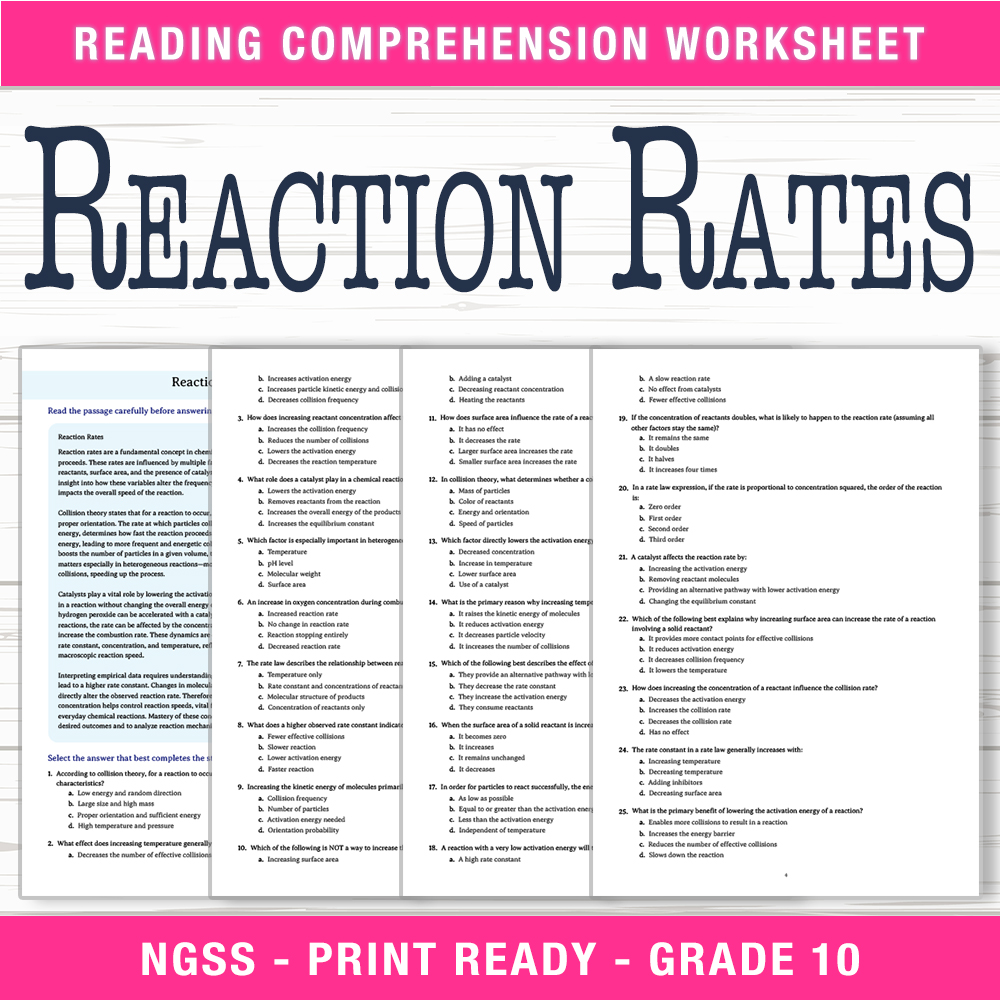
Grade 10 Science | Reaction Rates Worksheet (PDF + Answer Key)
Created byRiverstone ClassroomLearning Objectives
- Describe how collision theory explains reaction rates
- Analyze the effects of temperature, concentration, surface area, and catalysts on reaction speed
- Interpret experimental rate data using rate laws and molecular collision concepts
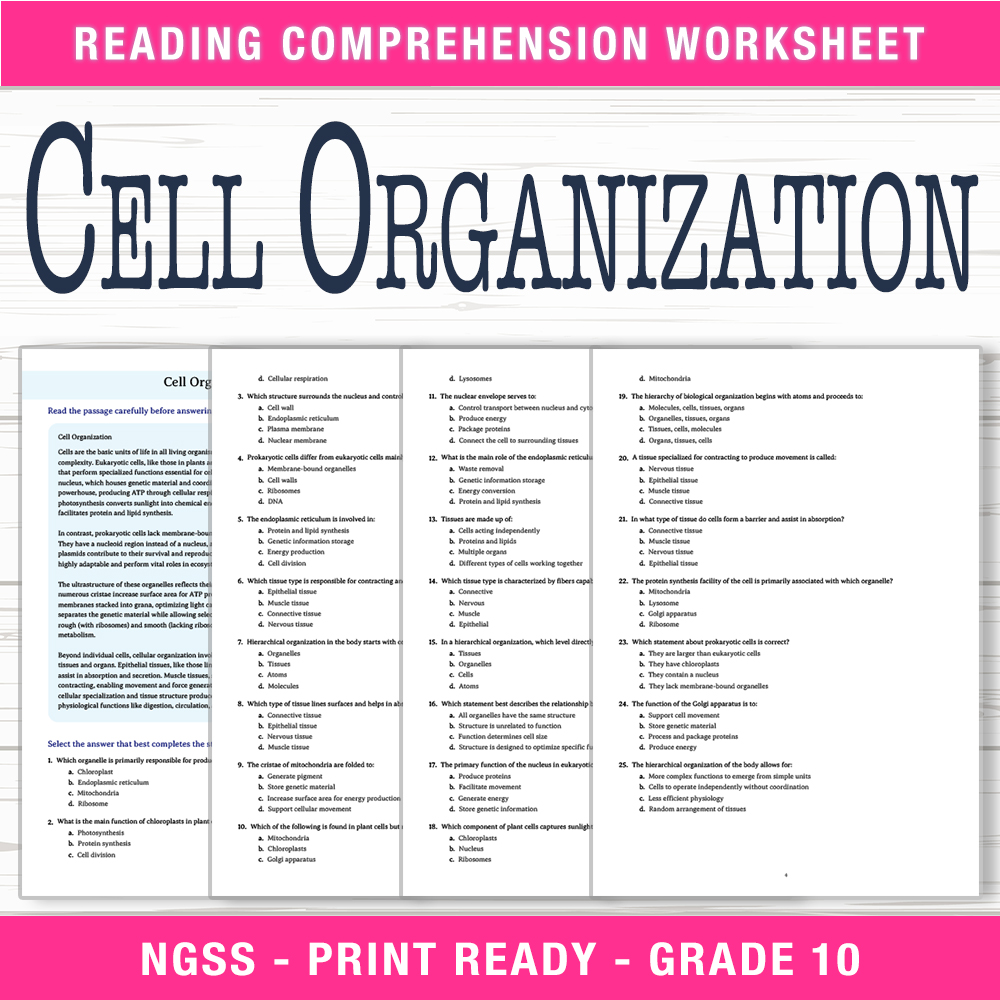
Grade 10 Science | Cell Organization Worksheet (PDF + Answer Key)
Created byRiverstone ClassroomLearning Objectives
- Understand the structure and function of membrane-bound organelles in eukaryotic and prokaryotic cells.
- Compare the ultrastructure of mitochondria, chloroplasts, endoplasmic reticulum, and nucleus and link their structures to their functions.
- Explain how cellular arrangements and tissue organization contribute to organ performance and physiological properties.

Grade 11 Science Worksheet on Stoichiometric Calculations | Ontario
Created byCoral Reef LearningLearning Objectives
- Understand and apply molar mass conversions and Avogadro's number to relate mass, moles, and particle count.
- Perform limiting reagent analysis and determine theoretical and percent yields in chemical reactions.
- Derive empirical and molecular formulas from percent composition data and predict product quantities based on reactant amounts.
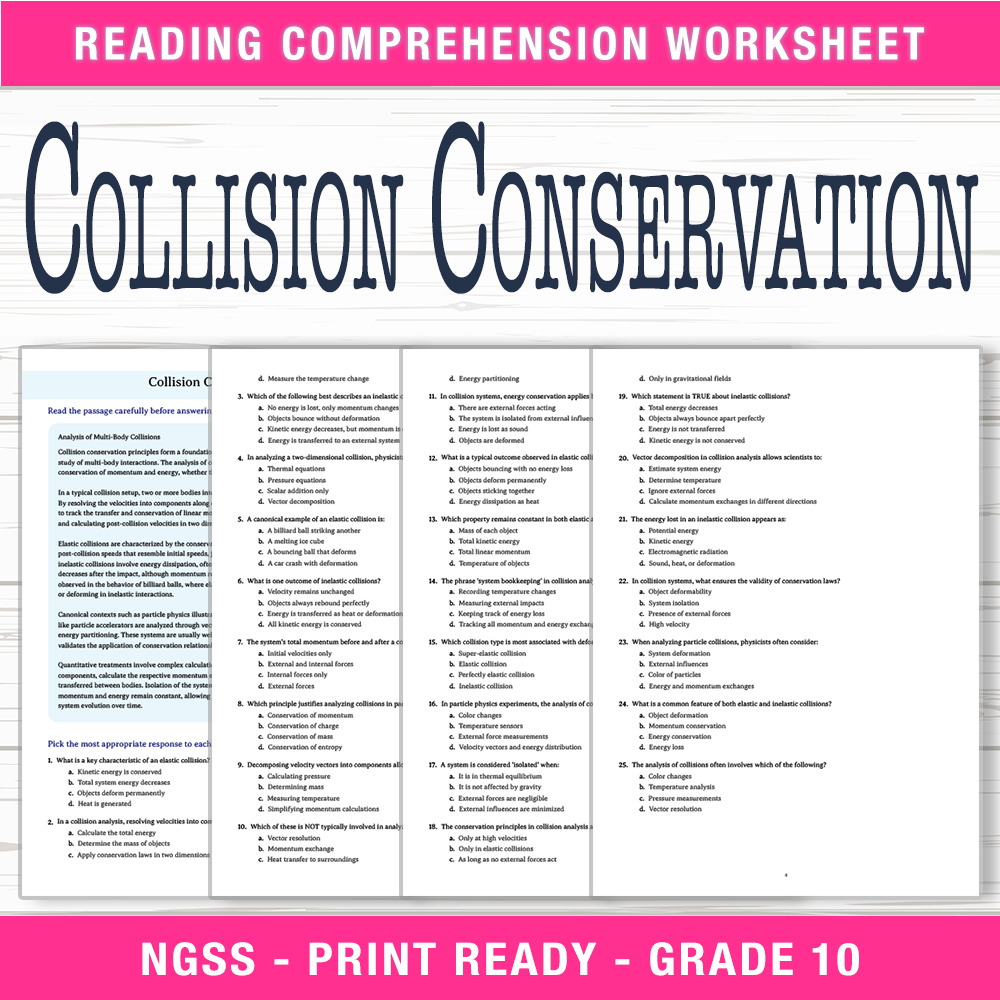
Grade 10 Science | Collision Conservation Worksheet (PDF + Answer Key)
Created byRiverstone ClassroomLearning Objectives
- Understand the principles of conservation of momentum and energy in multi-body collisions.
- Apply vector resolution techniques to analyze two-dimensional collisions.
- Differentiate between elastic and inelastic collisions using speed distributions and energy partitioning.
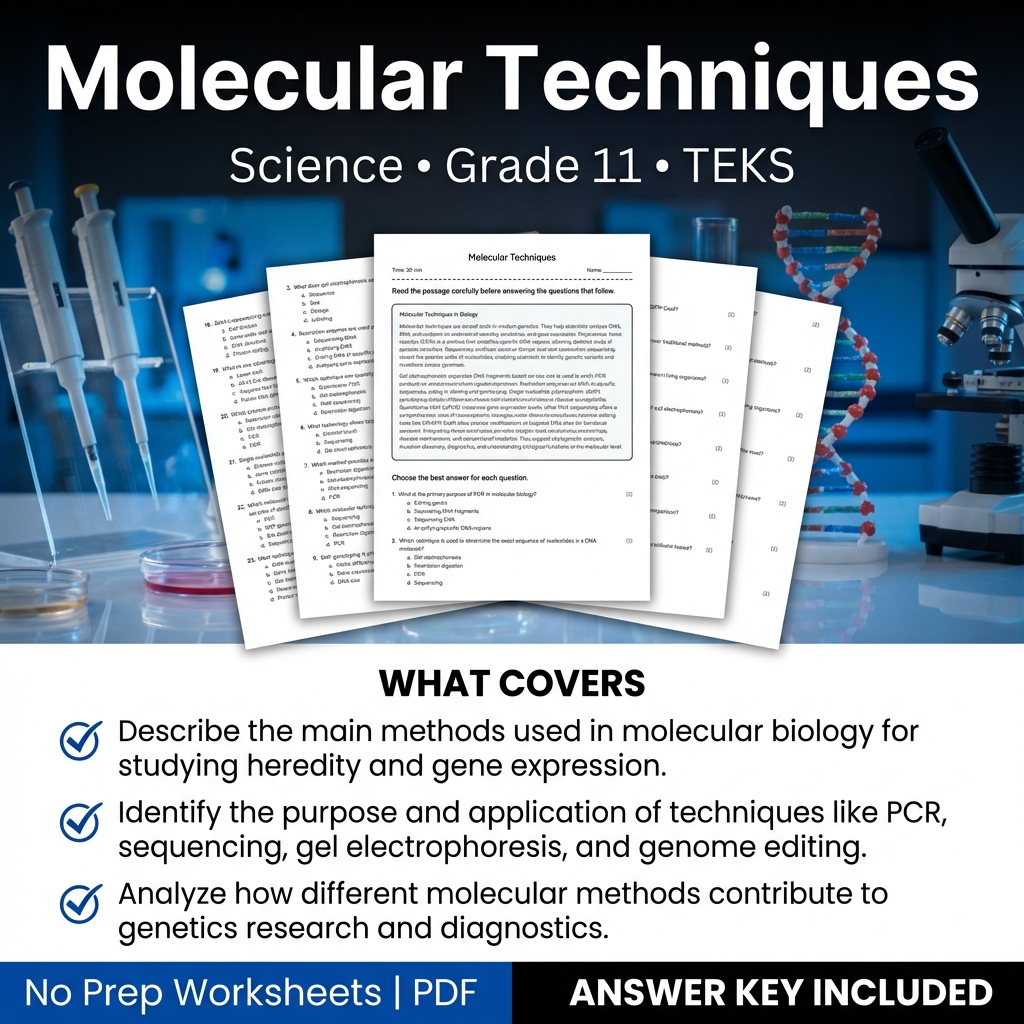
Molecular Techniques Worksheet for Grade 11 Science TEKS Practice
Created byCoral Reef LearningLearning Objectives
- Describe the main methods used in molecular biology for studying heredity and gene expression.
- Identify the purpose and application of techniques like PCR, sequencing, gel electrophoresis, and genome editing.
- Analyze how different molecular methods contribute to genetics research and diagnostics.
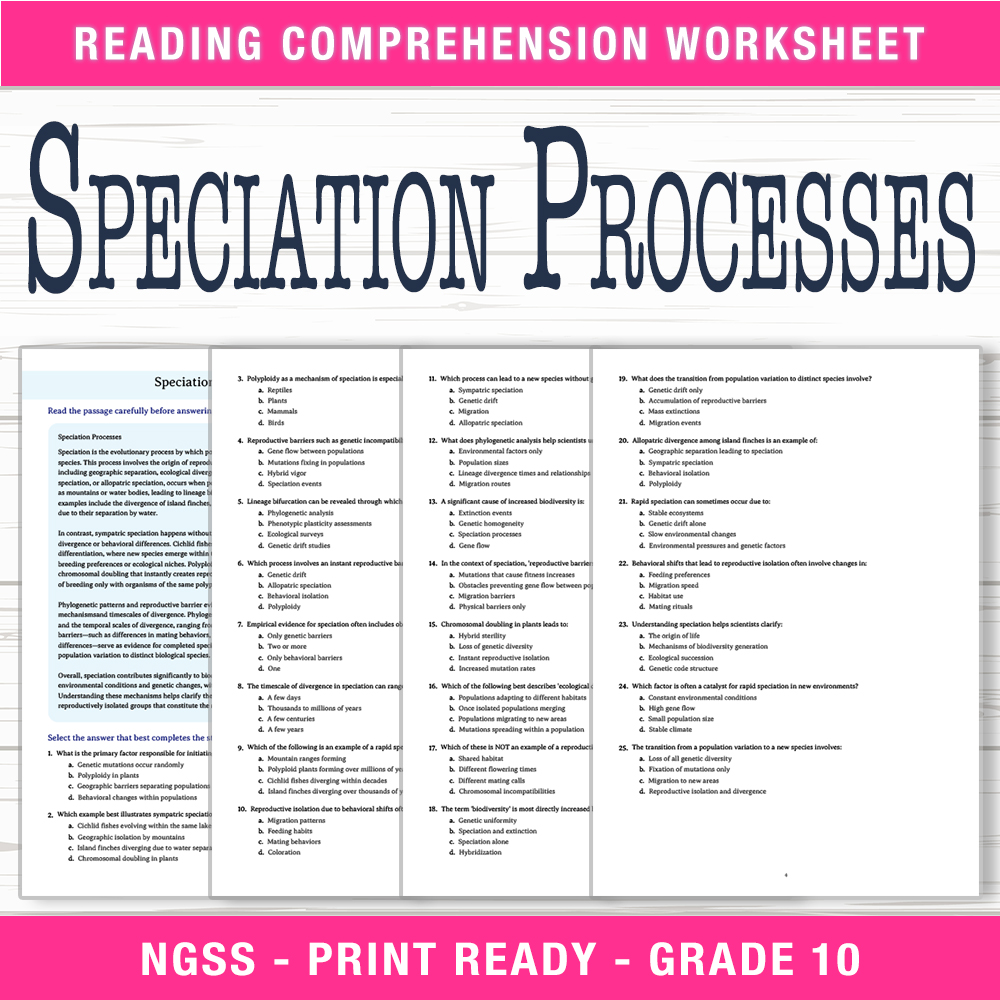
Grade 10 Science – Speciation Processes Worksheet (PDF + Answer Key)
Created byRiverstone ClassroomLearning Objectives
- Explain the mechanisms underlying different modes of speciation such as allopatric, sympatric, and polyploidy.
- Identify empirical examples of speciation in natural populations and understand their significance.
- Describe how phylogenetic patterns and reproductive barriers provide evidence for speciation events.
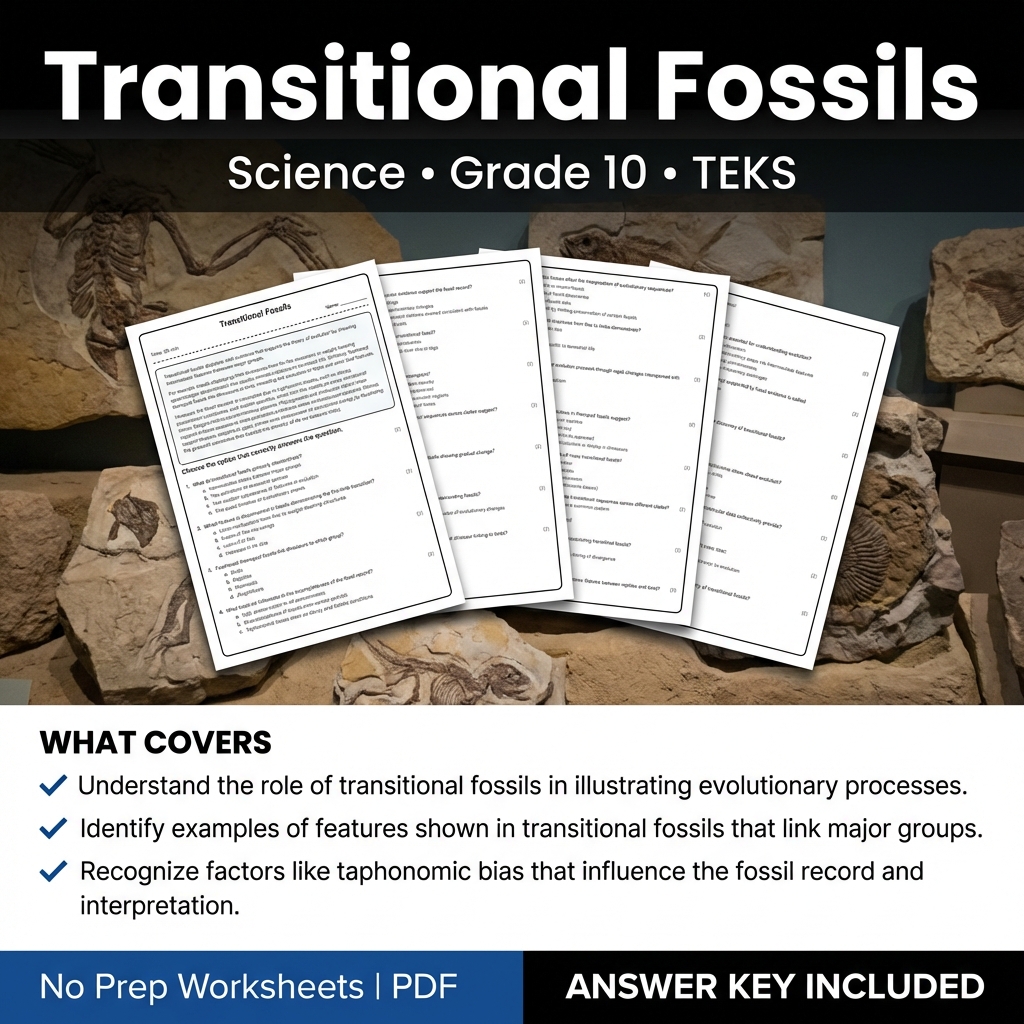
Transitional Fossils Worksheet – Grade 10 Science TEKS Practice PDF
Created byCoral Reef LearningLearning Objectives
- Understand the role of transitional fossils in illustrating evolutionary processes.
- Identify examples of features shown in transitional fossils that link major groups.
- Recognize factors like taphonomic bias that influence the fossil record and interpretation.
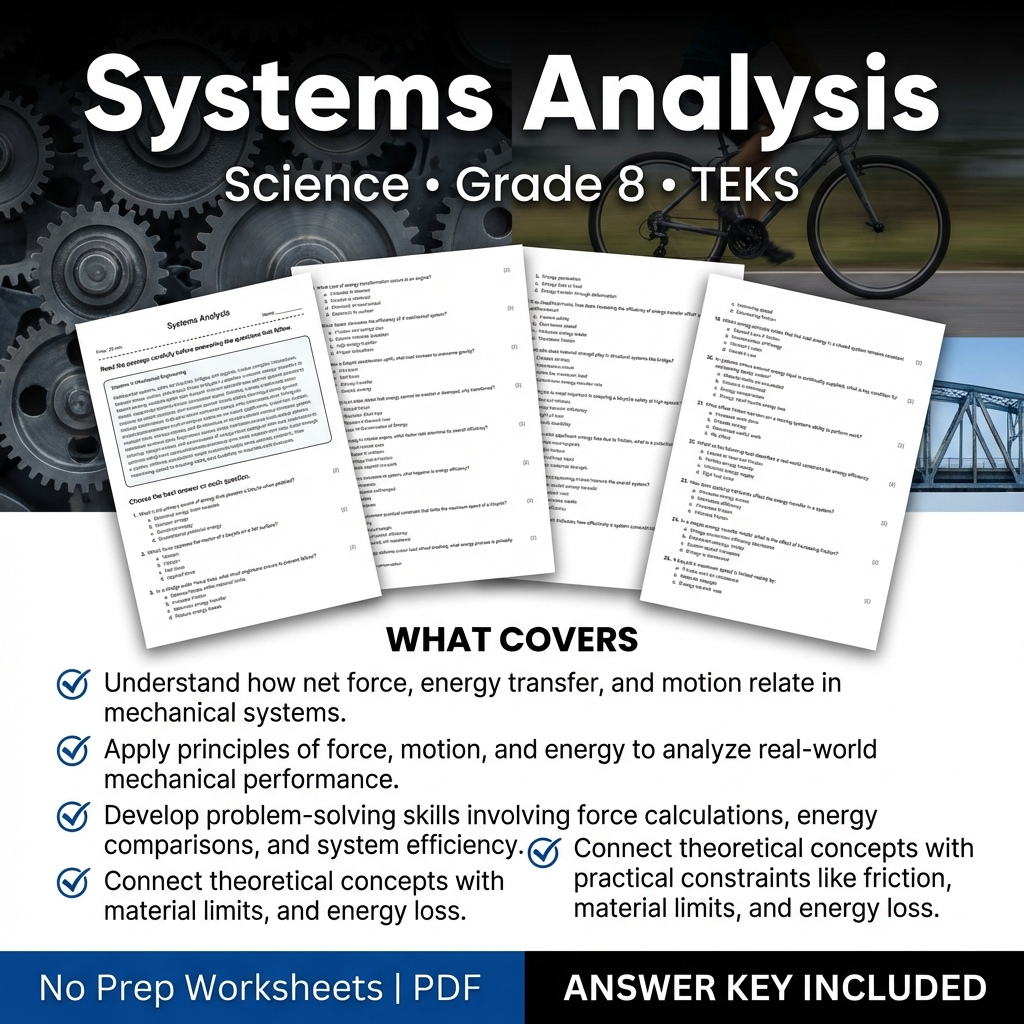
Systems Analysis Worksheet Grade 8 Science TEKS Practice PDF
Created byCoral Reef LearningLearning Objectives
- Understand how net force, energy transfer, and motion relate in mechanical systems.
- Apply principles of force, motion, and energy to analyze real-world mechanical performance.
- Develop problem-solving skills involving force calculations, energy comparisons, and system efficiency.
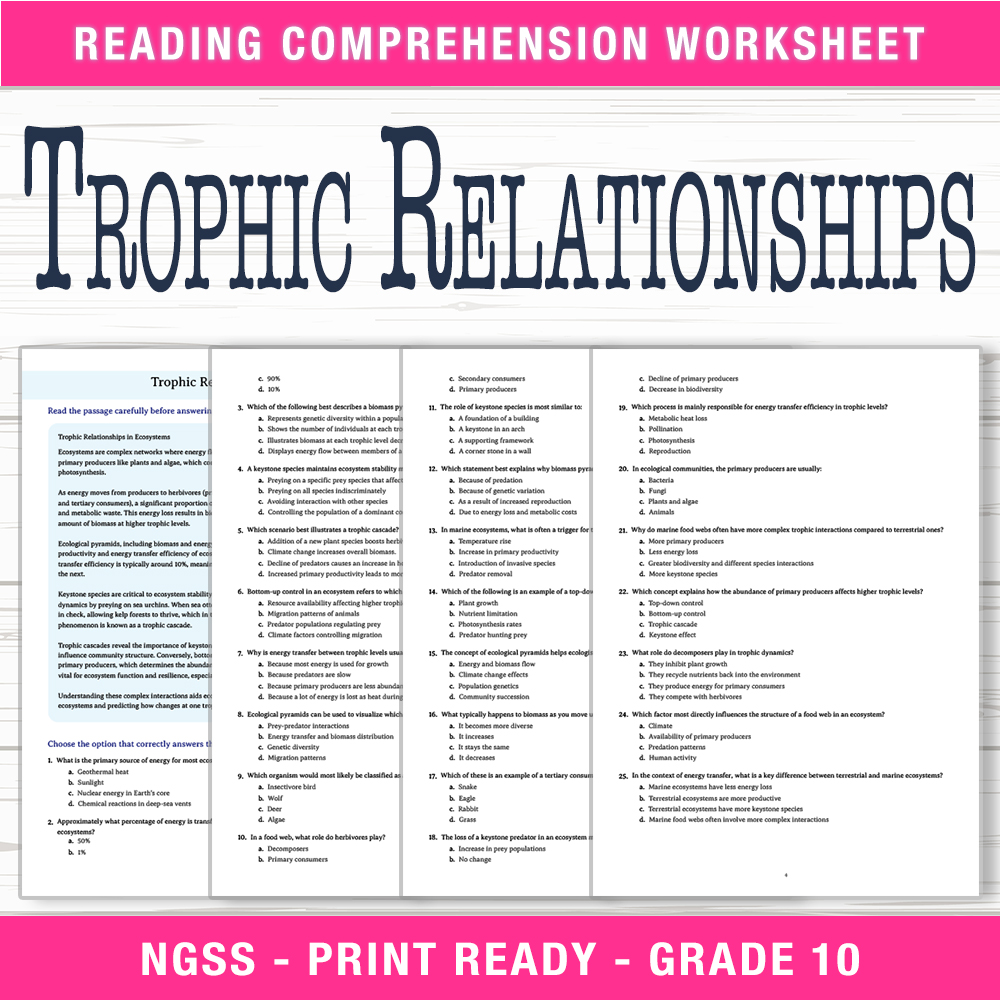
Grade 10 Science | Trophic Relationships Worksheet (PDF + Answer Key)
Created byRiverstone ClassroomLearning Objectives
- Explain the concept of energy transfer in trophic levels within ecosystems.
- Describe the roles of keystone species and trophic cascades in maintaining ecological balance.
- Analyze biomass pyramids and ecological pyramids to understand productivity distribution.
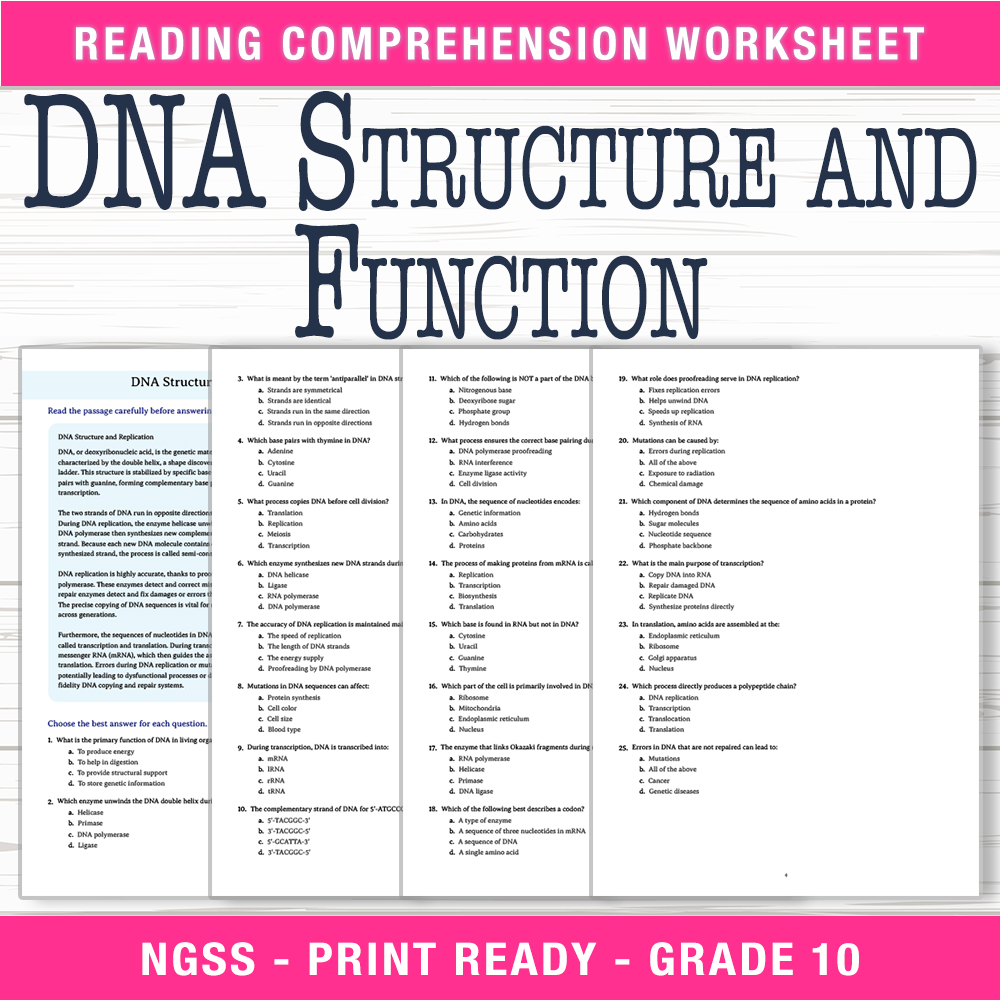
Grade 10 Science – DNA Structure & Function Worksheet (PDF + Answer Key)
Created byRiverstone ClassroomLearning Objectives
- Describe the structural features of DNA, including double helix geometry and complementary base pairing.
- Explain the process of semi-conservative DNA replication and the roles of DNA polymerase and helicase.
- Understand mechanisms ensuring replication fidelity such as proofreading and repair.
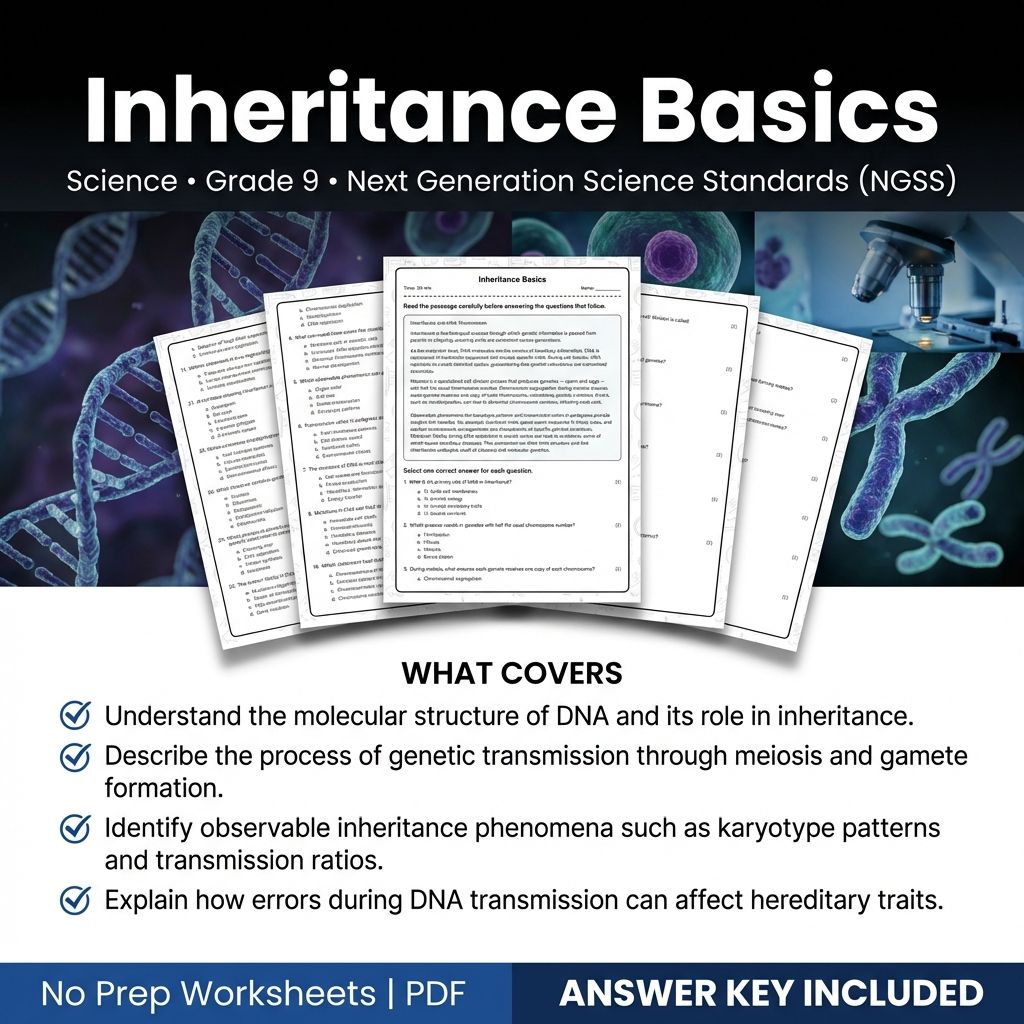
Grade 9 Science | Inheritance Basics Worksheet & Answer Key (Printable PDF)
Created byCoral Reef LearningLearning Objectives
- Understand the molecular structure of DNA and its role in inheritance.
- Describe the process of genetic transmission through meiosis and gamete formation.
- Identify observable inheritance phenomena such as karyotype patterns and transmission ratios.
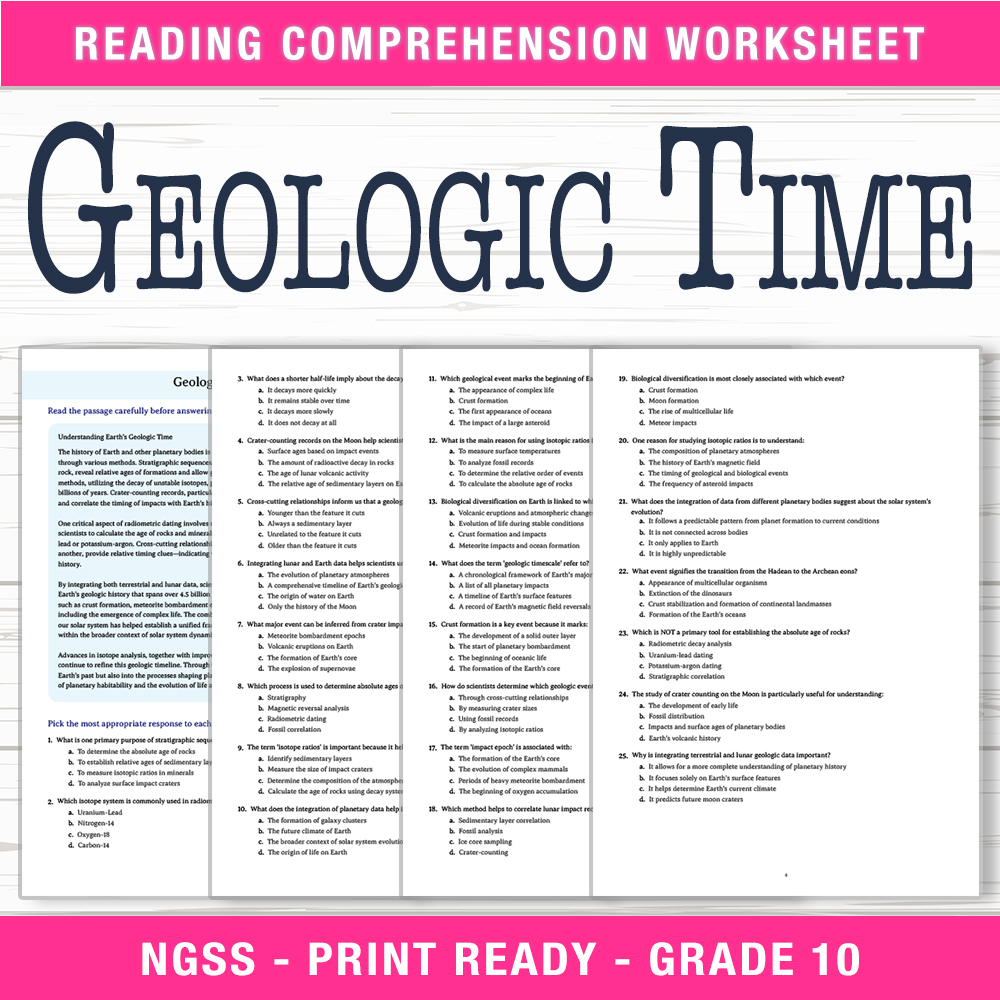
Grade 10 Science | Geologic Time Worksheet (PDF + Answer Key)
Created byRiverstone ClassroomLearning Objectives
- Understand the methods used to reconstruct Earth's and planetary bodies' chronologies, including stratigraphy and radiometric dating.
- Explain how isotopic ratios, half-life decay systems, and cross-cutting relationships help determine the timing of major geologic events.
- Describe the significance of integrating terrestrial and lunar time scales to develop a comprehensive history of Earth's geologic evolution.
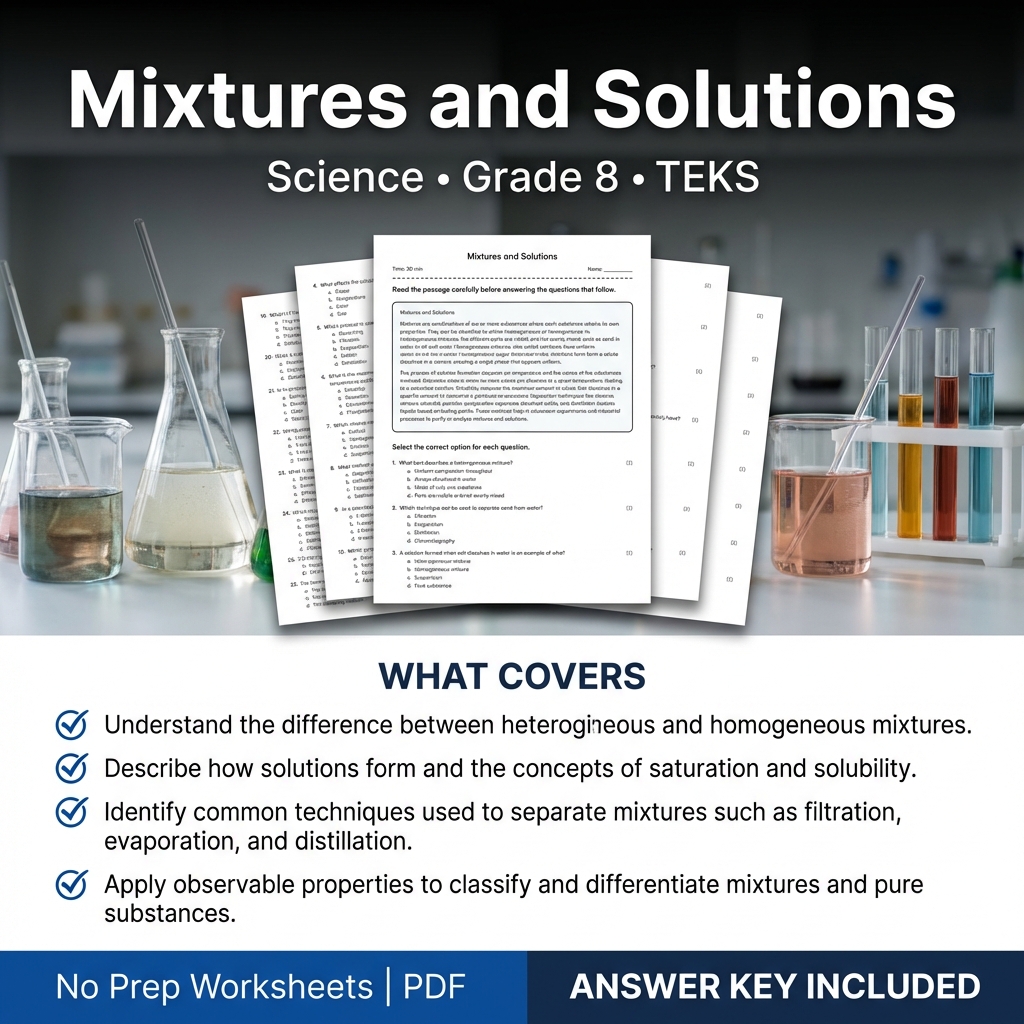
Grade 8 Science Worksheet on Mixtures and Solutions | TEKS Aligned
Created byCoral Reef LearningLearning Objectives
- Understand the difference between heterogeneous and homogeneous mixtures.
- Describe how solutions form and the concepts of saturation and solubility.
- Identify common techniques used to separate mixtures such as filtration, evaporation, and distillation.
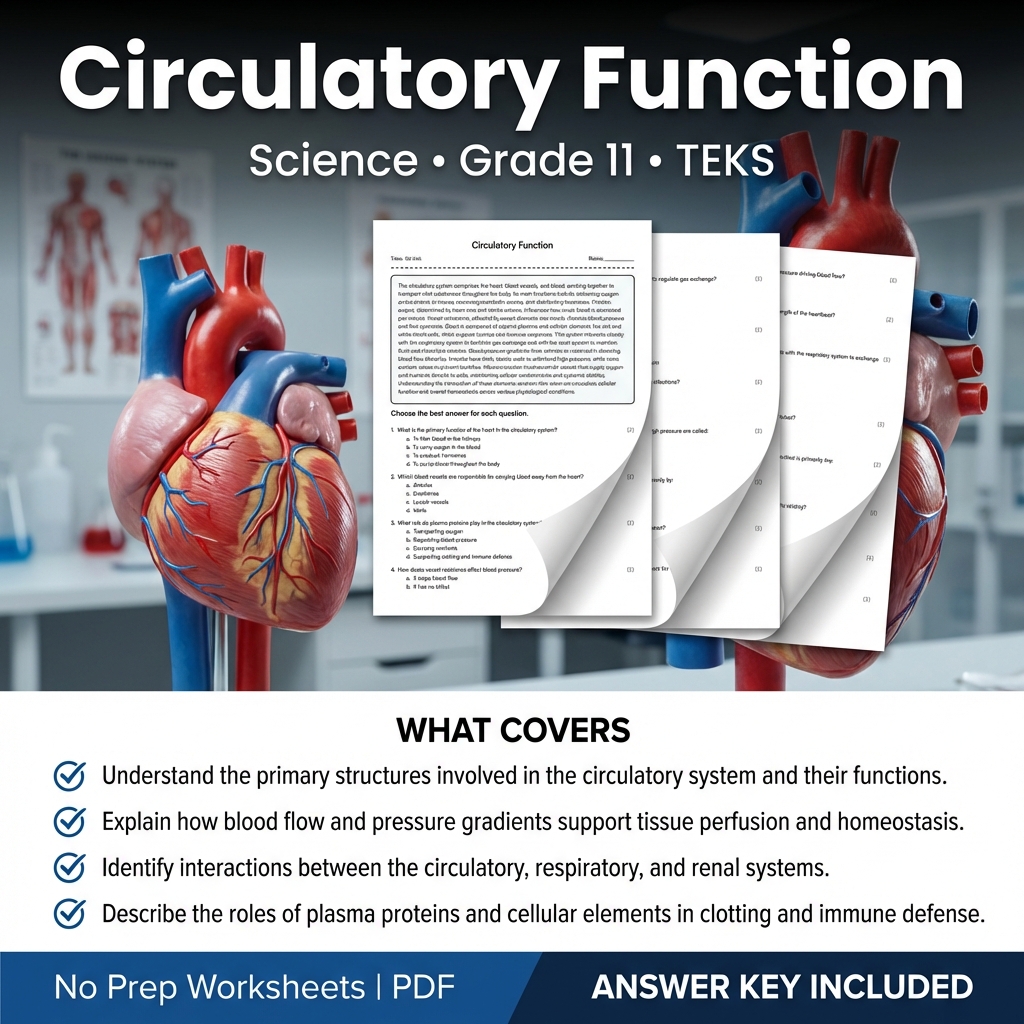
Circulatory Function Worksheet - Science - TEKS Grade 11
Created byCoral Reef LearningLearning Objectives
- Understand the primary structures involved in the circulatory system and their functions.
- Explain how blood flow and pressure gradients support tissue perfusion and homeostasis.
- Identify interactions between the circulatory, respiratory, and renal systems.
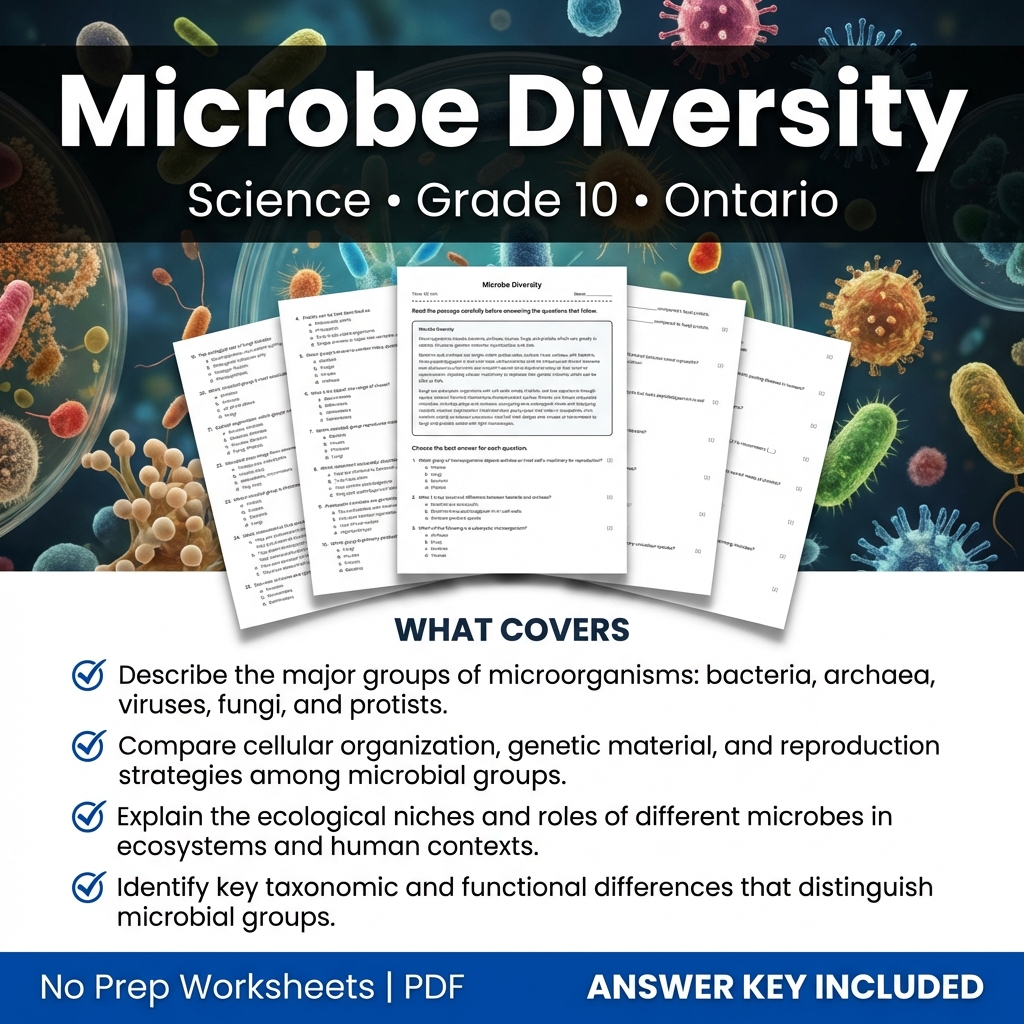
Microbe Diversity Worksheet for Grade 10 Science | Ontario Standards
Created byCoral Reef LearningLearning Objectives
- Describe the major groups of microorganisms: bacteria, archaea, viruses, fungi, and protists.
- Compare cellular organization, genetic material, and reproduction strategies among microbial groups.
- Explain the ecological niches and roles of different microbes in ecosystems and human contexts.

Natural Selection Worksheet for Grade 9 Science | Classroom PDF & Answer Key
Created byCoral Reef LearningLearning Objectives
- Understand the basic principles of natural selection and how it leads to evolution.
- Identify examples of natural selection in real-world scenarios.
- Distinguish between different types of selection: directional, stabilizing, and disruptive.
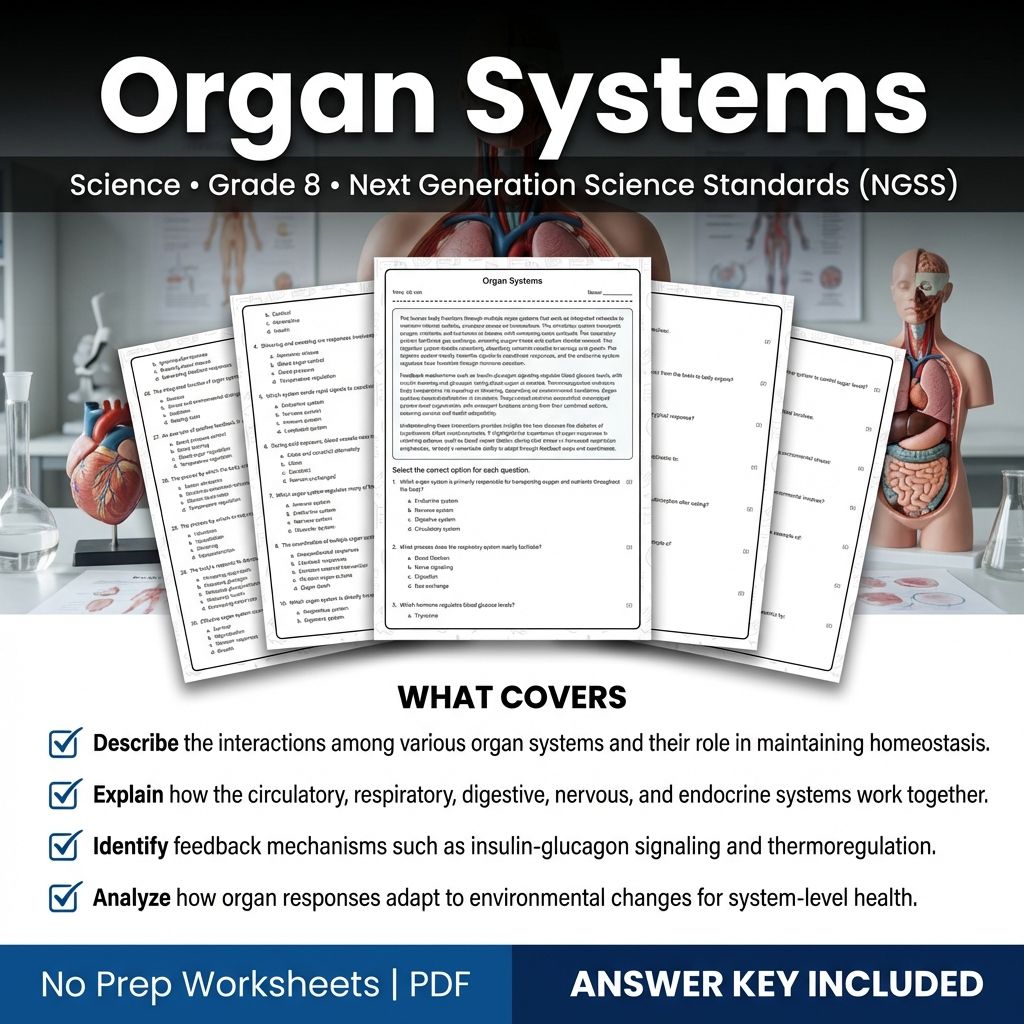
Grade 8 Science | Organ Systems Worksheet and Answer Key – NGSS Aligned
Created byCoral Reef LearningLearning Objectives
- Describe the interactions among various organ systems and their role in maintaining homeostasis.
- Explain how the circulatory, respiratory, digestive, nervous, and endocrine systems work together.
- Identify feedback mechanisms such as insulin-glucagon signaling and thermoregulation.
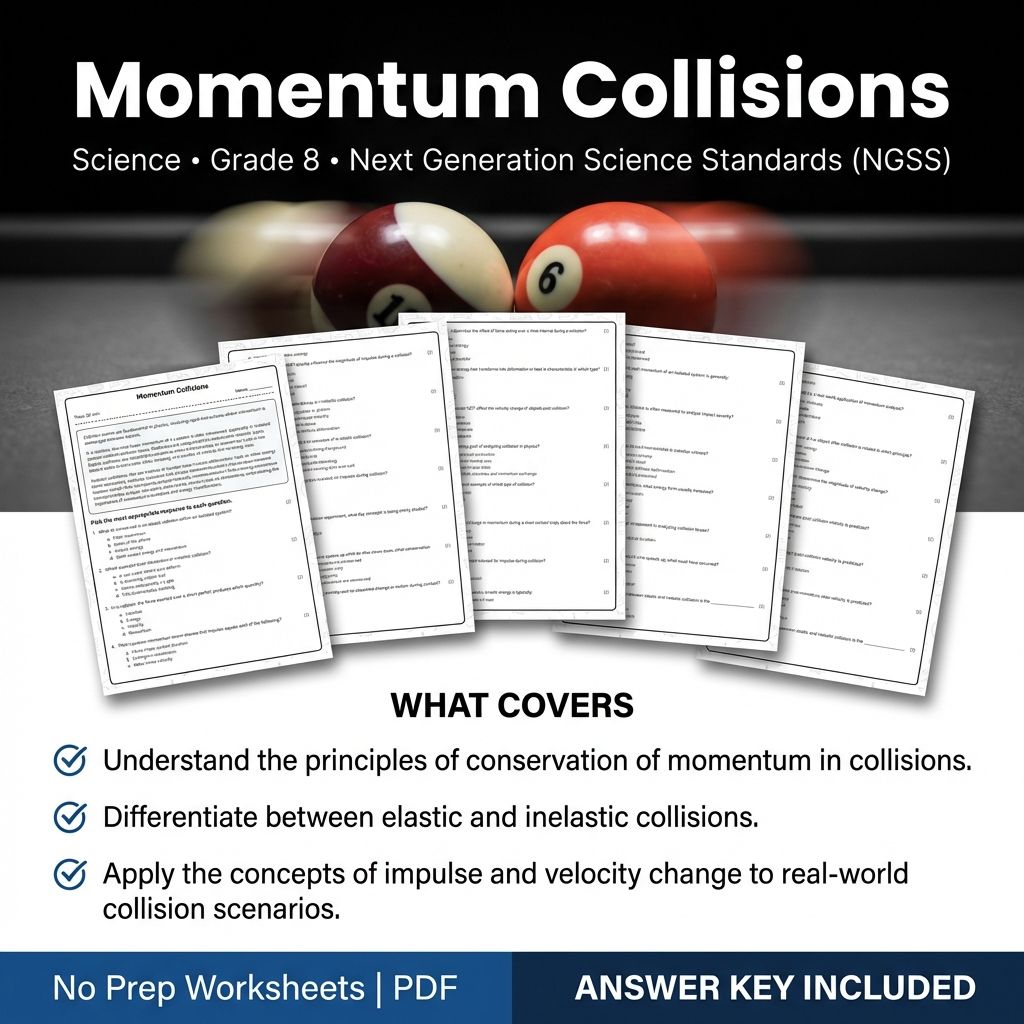
8th Grade Science | Momentum & Collisions Worksheet with Answer Key (PDF)
Created byCoral Reef LearningLearning Objectives
- Understand the principles of conservation of momentum in collisions.
- Differentiate between elastic and inelastic collisions.
- Apply the concepts of impulse and velocity change to real-world collision scenarios.
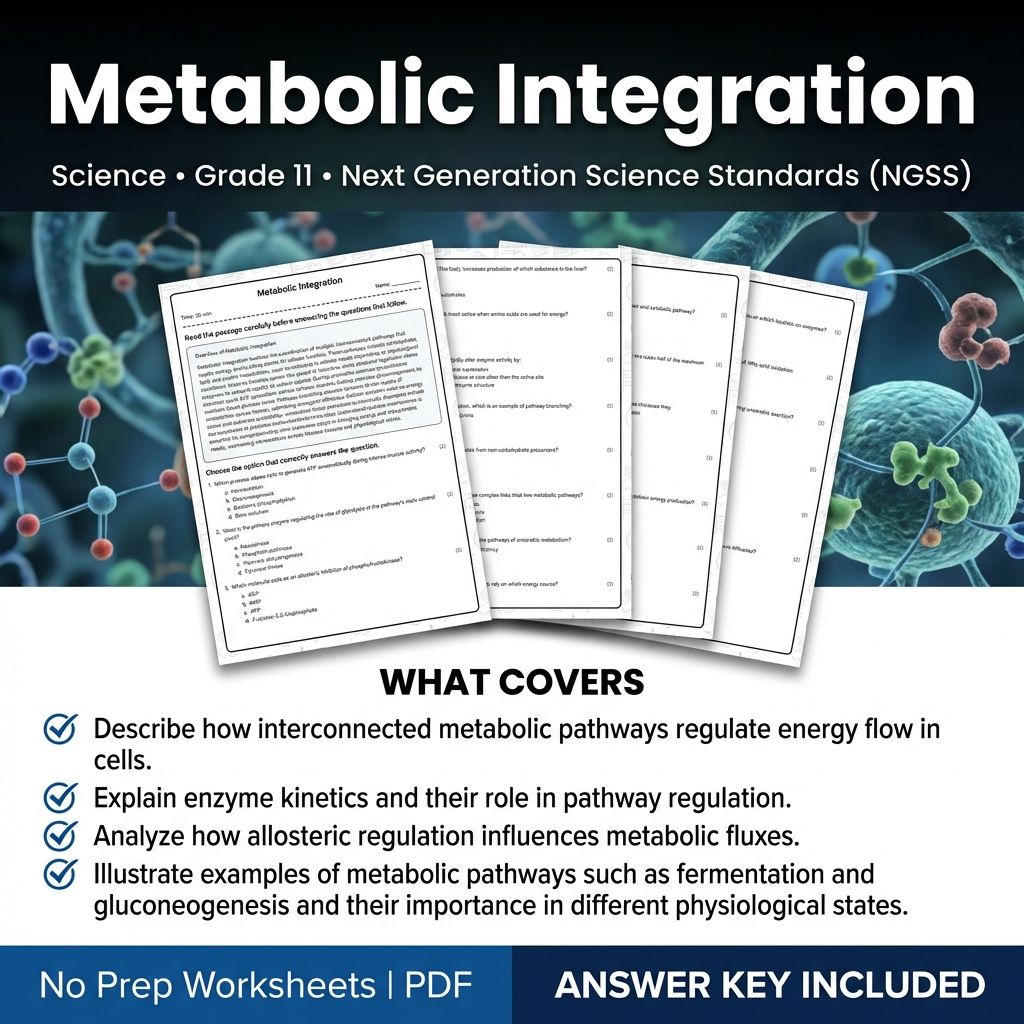
Grade 11 Science | Metabolic Integration Worksheet & Answer Key (Printable PDF)
Created byCoral Reef LearningLearning Objectives
- Describe how interconnected metabolic pathways regulate energy flow in cells.
- Explain enzyme kinetics and their role in pathway regulation.
- Analyze how allosteric regulation influences metabolic fluxes.
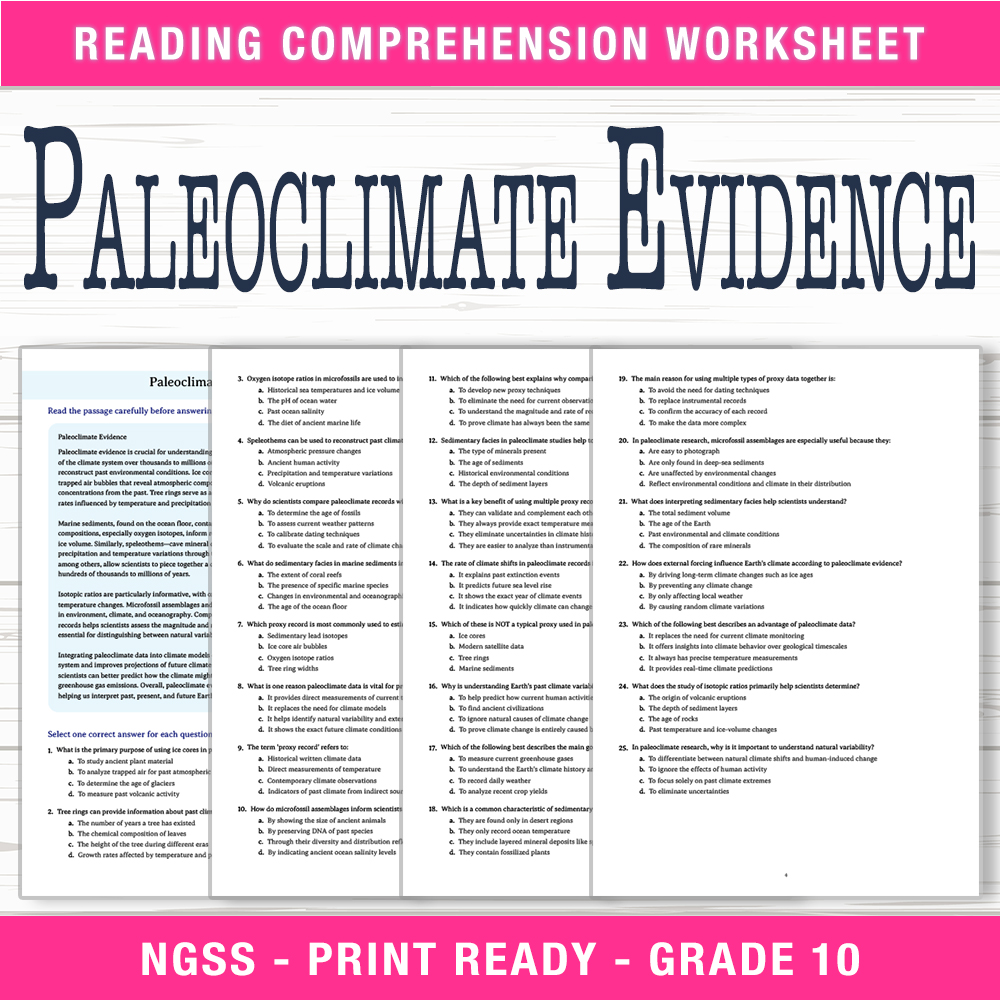
Grade 10 Science – Paleoclimate Evidence Worksheet (PDF + Answer Key)
Created byRiverstone ClassroomLearning Objectives
- Understand the types of proxy records used to reconstruct past climates, such as ice cores, tree rings, marine sediments, and speleothems.
- Explain how isotopic ratios, microfossil assemblages, and sedimentary facies provide information about historical climate changes.
- Evaluate how paleoclimate records are compared with instrumental data to analyze recent climate trends and variability.
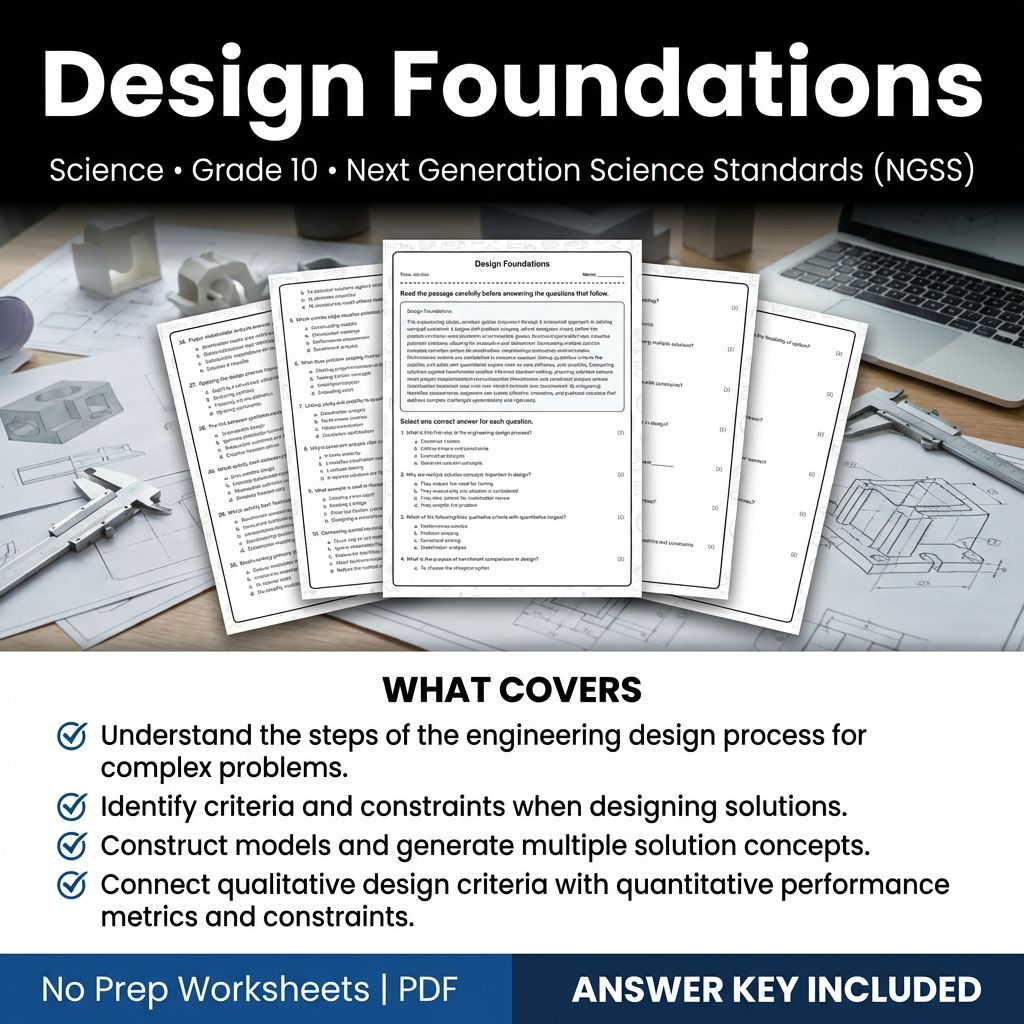
10th Grade Science | Design Foundations Worksheet & Answer Key (Printable PDF)
Created byCoral Reef LearningLearning Objectives
- Understand the steps of the engineering design process for complex problems.
- Identify criteria and constraints when designing solutions.
- Construct models and generate multiple solution concepts.
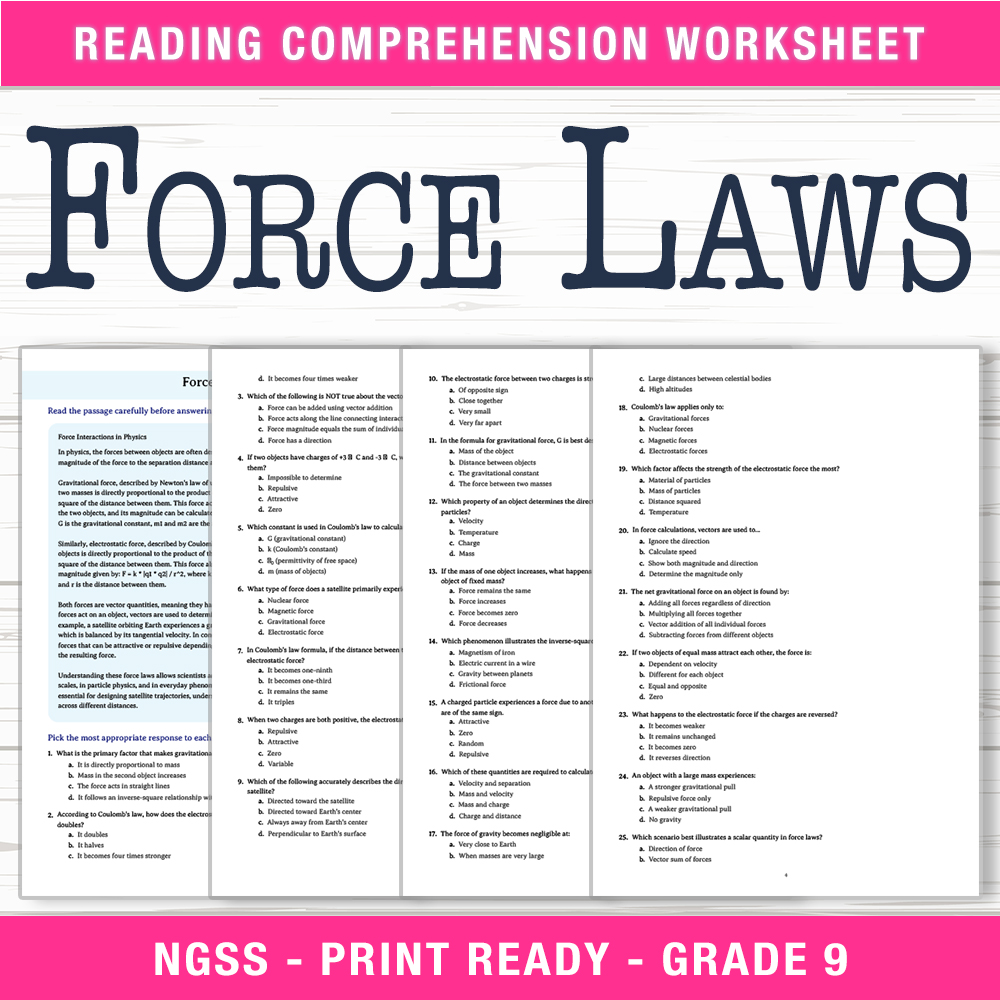
Grade 9 Science – Force Laws Worksheet (PDF + Answer Key)
Created byRiverstone ClassroomLearning Objectives
- Understand the inverse-square relationship in gravitational and electrostatic forces.
- Apply mathematical formulas to calculate magnitudes and directions of forces between objects.
- Differentiate between gravitational and electrostatic force interactions.
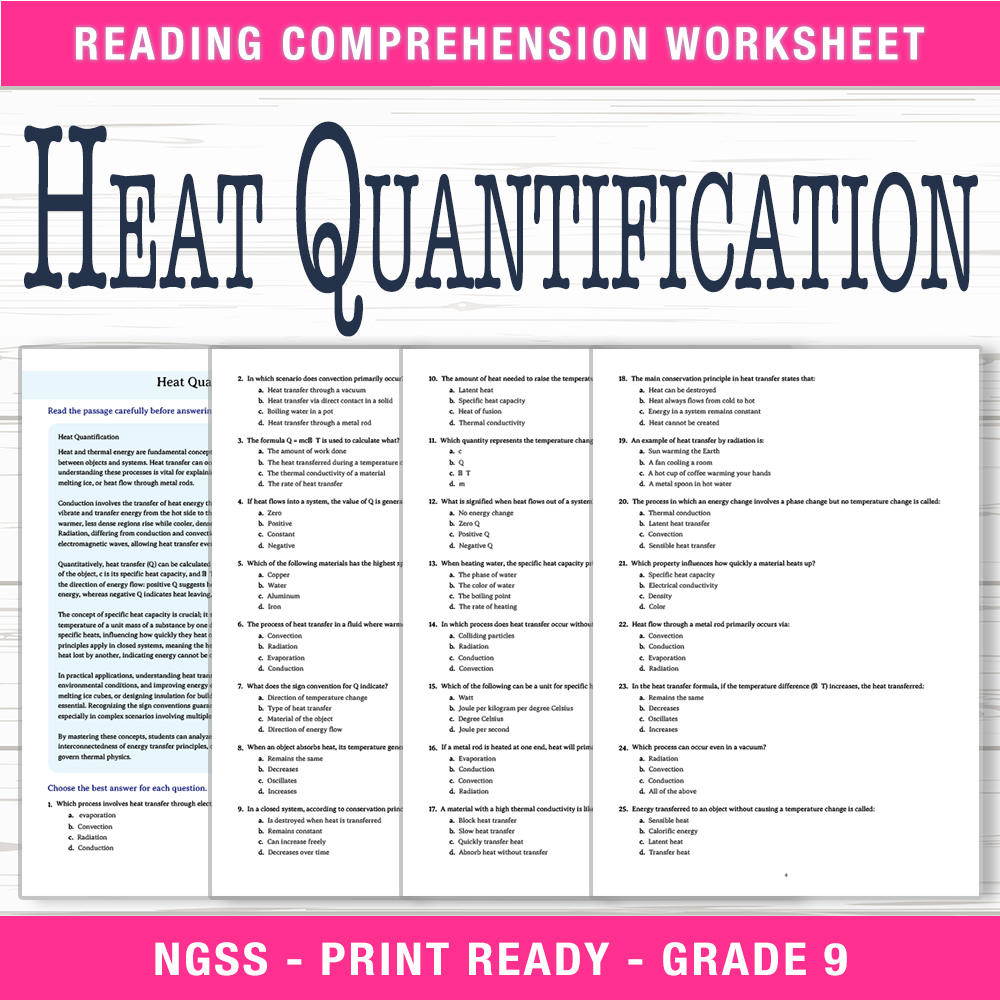
Grade 9 Science – Heat Quantification Worksheet (PDF + Answer Key)
Created byRiverstone ClassroomLearning Objectives
- Understand the concept of thermal energy transfer through conduction, convection, and radiation.
- Apply the formula Q = mcΔT to calculate heat transfer in various scenarios.
- Explain the sign conventions for heat flow and energy changes in closed systems.
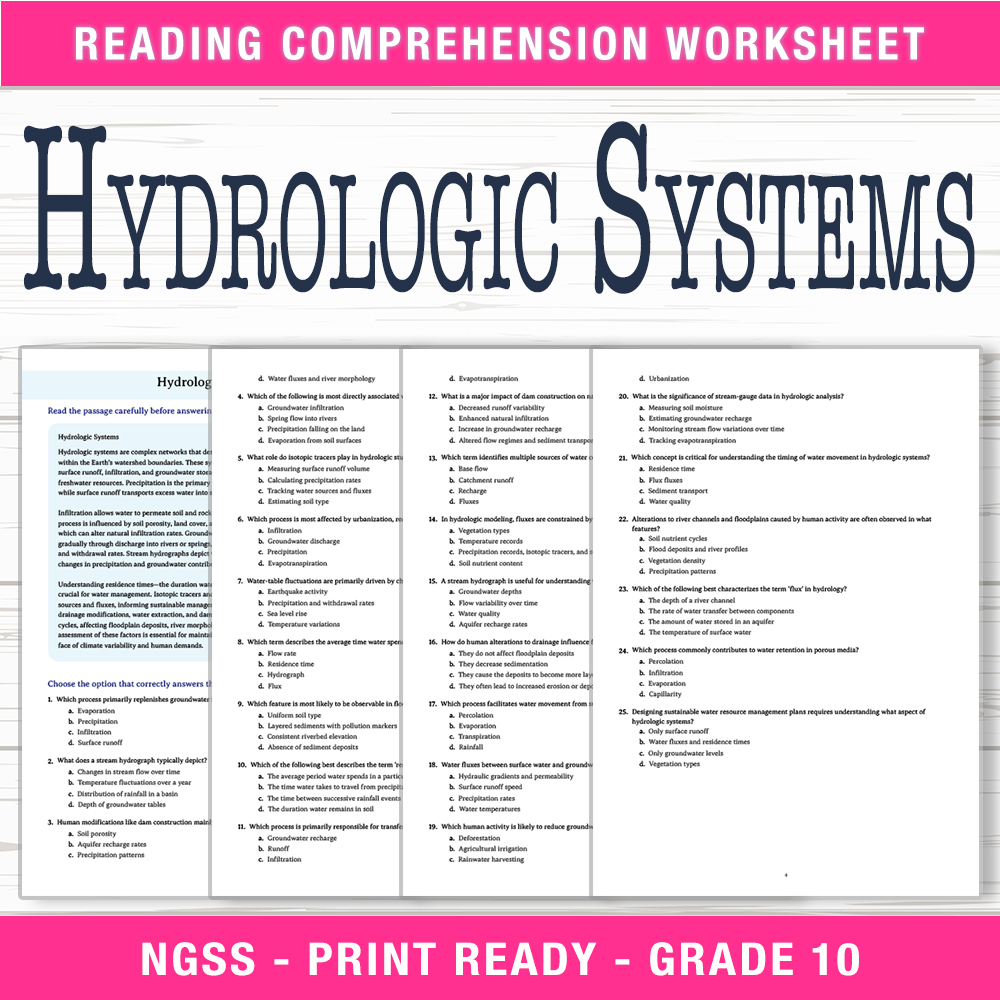
Grade 10 Science – Hydrologic Systems Worksheet (PDF + Answer Key)
Created byRiverstone ClassroomLearning Objectives
- Understand the components and interactions within hydrologic systems, including precipitation, infiltration, runoff, and groundwater flow.
- Explain concepts such as aquifer recharge and discharge, water-table fluctuations, and stream hydrographs.
- Analyze how human modifications influence watershed water budgets and river morphology.
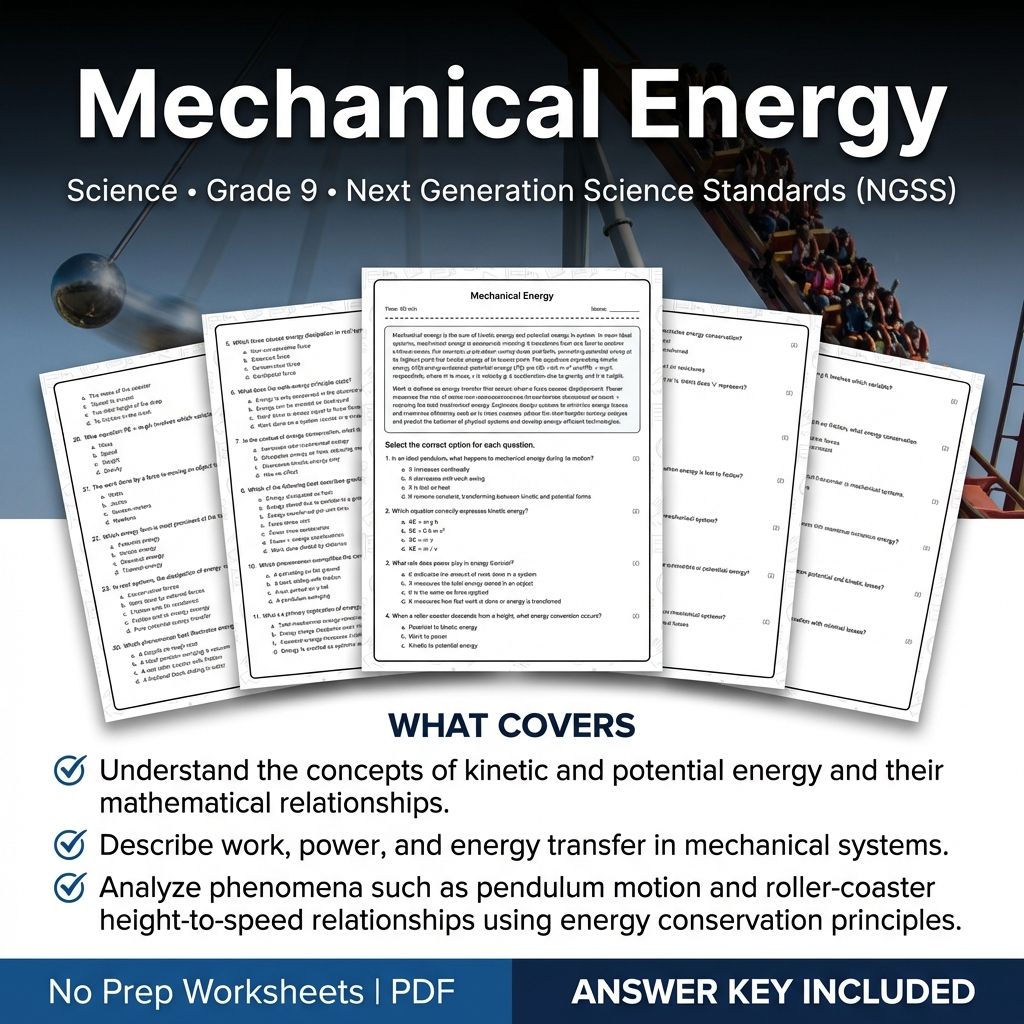
9th Grade Science Worksheet | Mechanical Energy Practice with Answer Key (PDF)
Created byCoral Reef LearningLearning Objectives
- Understand the concepts of kinetic and potential energy and their mathematical relationships.
- Describe work, power, and energy transfer in mechanical systems.
- Analyze phenomena such as pendulum motion and roller-coaster height-to-speed relationships using energy conservation principles.
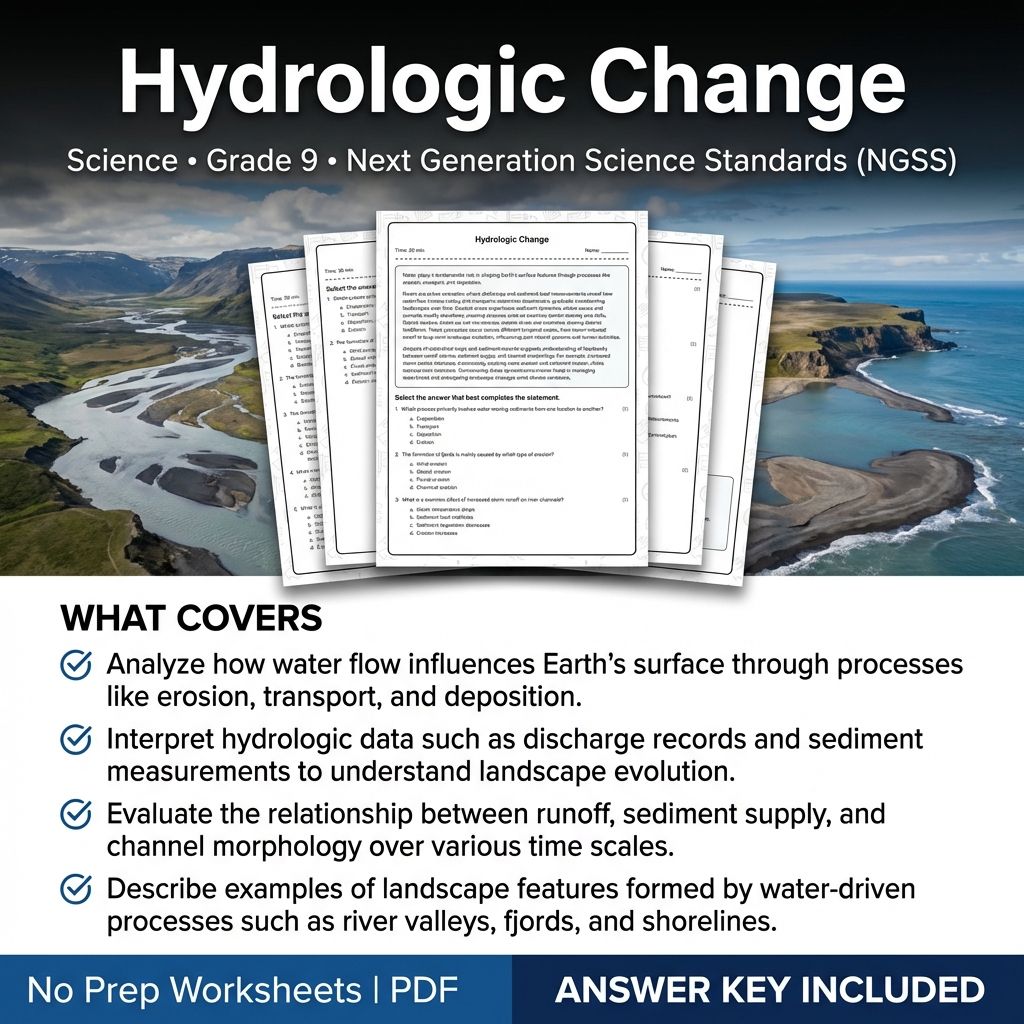
Grade 9 Science | Hydrologic Change Worksheet with Answer Key (Printable PDF)
Created byCoral Reef LearningLearning Objectives
- Analyze how water flow influences Earth's surface through processes like erosion, transport, and deposition.
- Interpret hydrologic data such as discharge records and sediment measurements to understand landscape evolution.
- Evaluate the relationship between runoff, sediment supply, and channel morphology over various time scales.
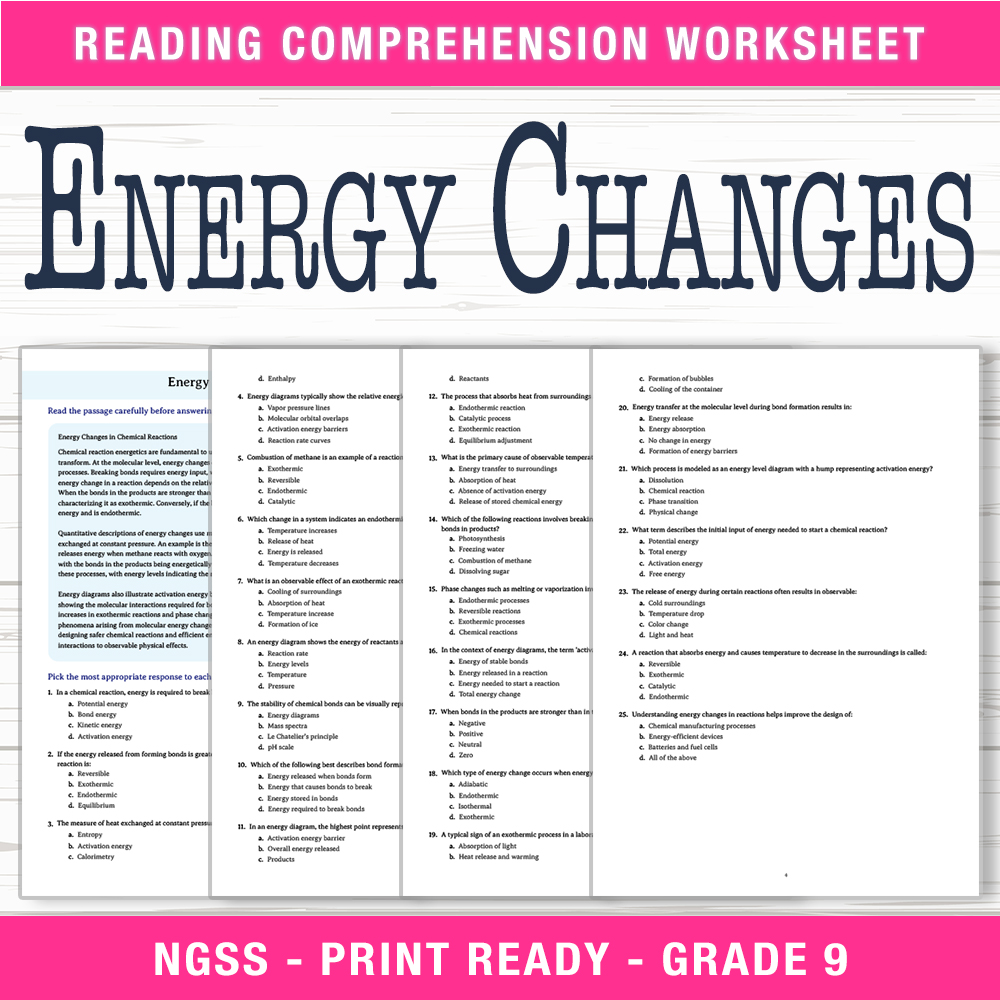
Grade 9 Science | Energy Changes Worksheet (PDF + Answer Key)
Created byRiverstone ClassroomLearning Objectives
- Explain how chemical reactions involve energy transfer through bond breaking and formation.
- Differentiate between endothermic and exothermic reactions based on energy diagrams.
- Describe quantitative measures of energy change, such as enthalpy, in chemical processes.
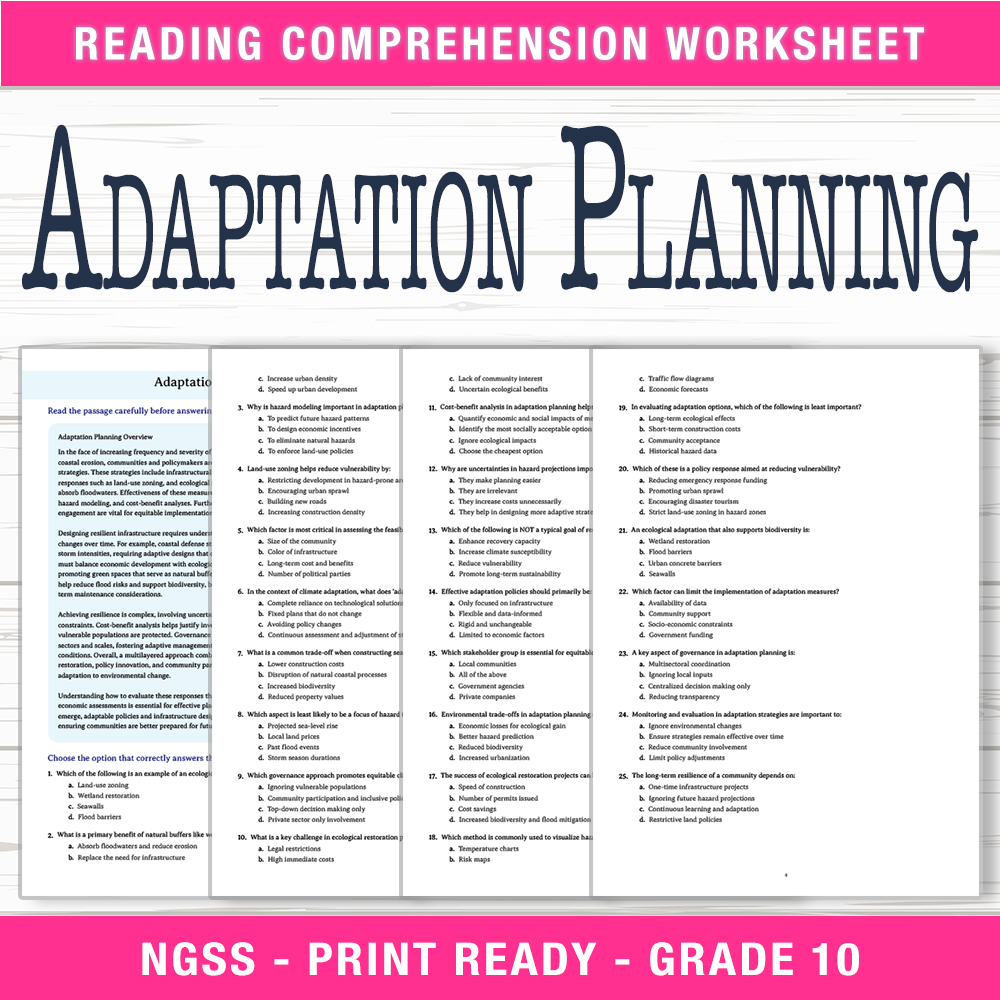
Grade 10 Science – Adaptation Planning Worksheet (PDF + Answer Key)
Created byRiverstone ClassroomLearning Objectives
- Understand different infrastructural and policy responses to natural hazards and environmental changes.
- Evaluate the effectiveness, feasibility, and trade-offs of various adaptation strategies.
- Analyze risk maps, hazard analyses, and governance frameworks to propose resilient solutions.
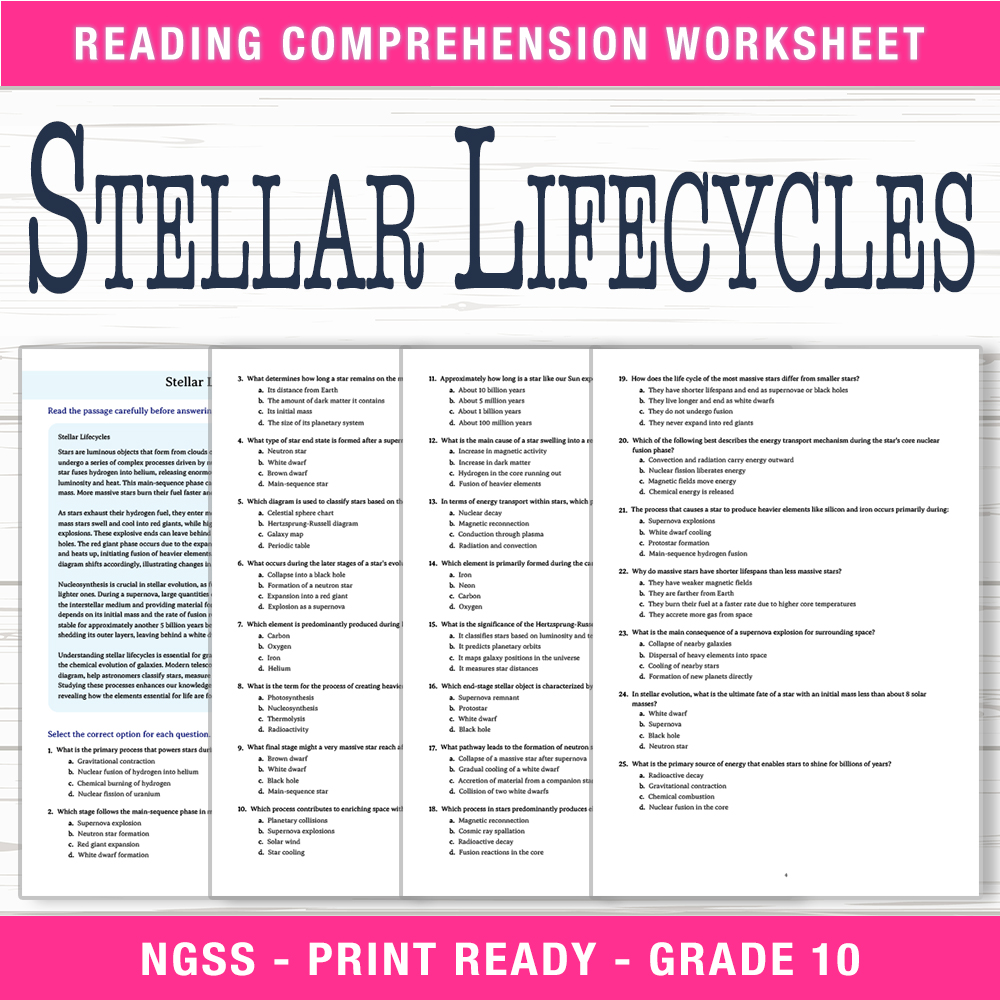
Grade 10 Science | Stellar Lifecycles Worksheet (PDF + Answer Key)
Created byRiverstone ClassroomLearning Objectives
- Describe the process of nuclear fusion in stellar cores and its role in stellar evolution.
- Identify different stages in the lifecycle of stars and their end states such as white dwarfs, neutron stars, and supernovae.
- Explain how the Hertzsprung-Russell diagram relates to stellar properties and evolution.
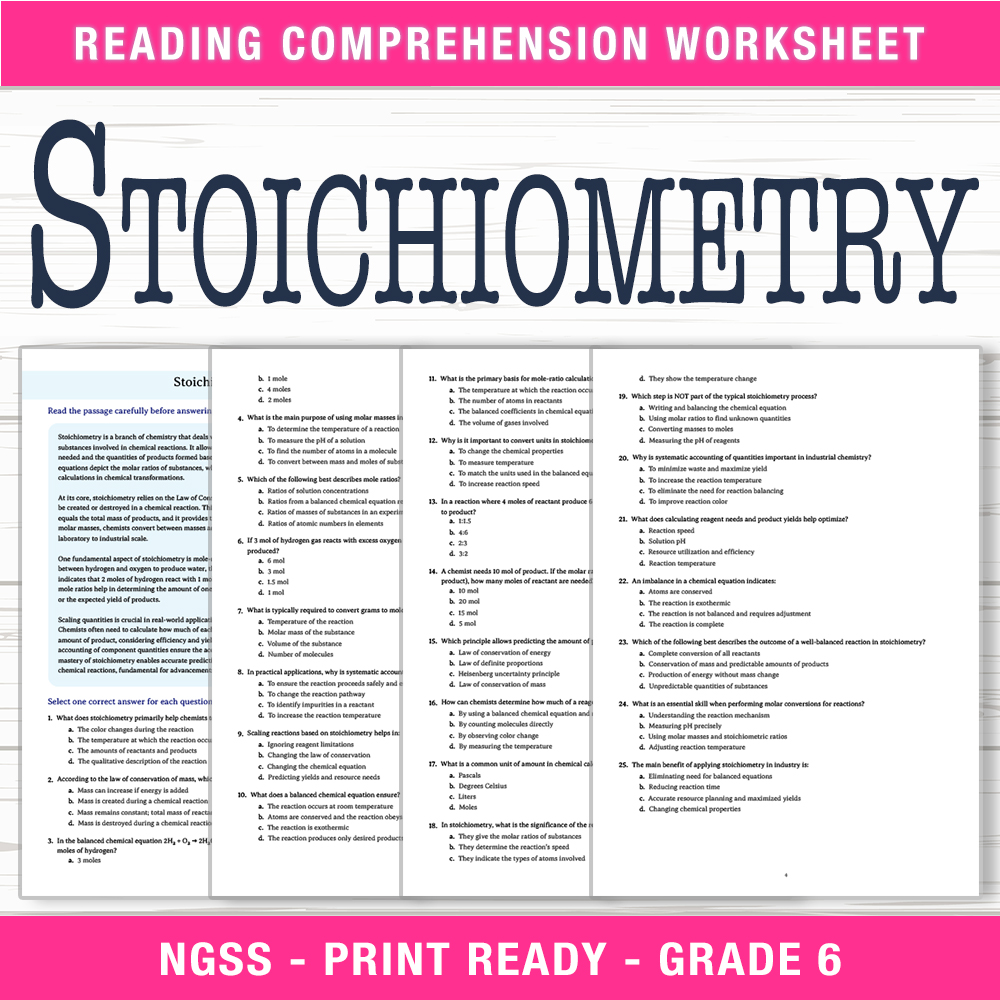
Grade 7 Science | Stoichiometry Worksheet (PDF+ Answer Key)
Created byRiverstone ClassroomLearning Objectives
- Understand and describe the concept of stoichiometry and its role in chemical reactions.
- Use balanced chemical equations to determine mole ratios and relate quantities of reactants and products.
- Apply conservation principles to calculate the amounts of substances needed or produced in a reaction.
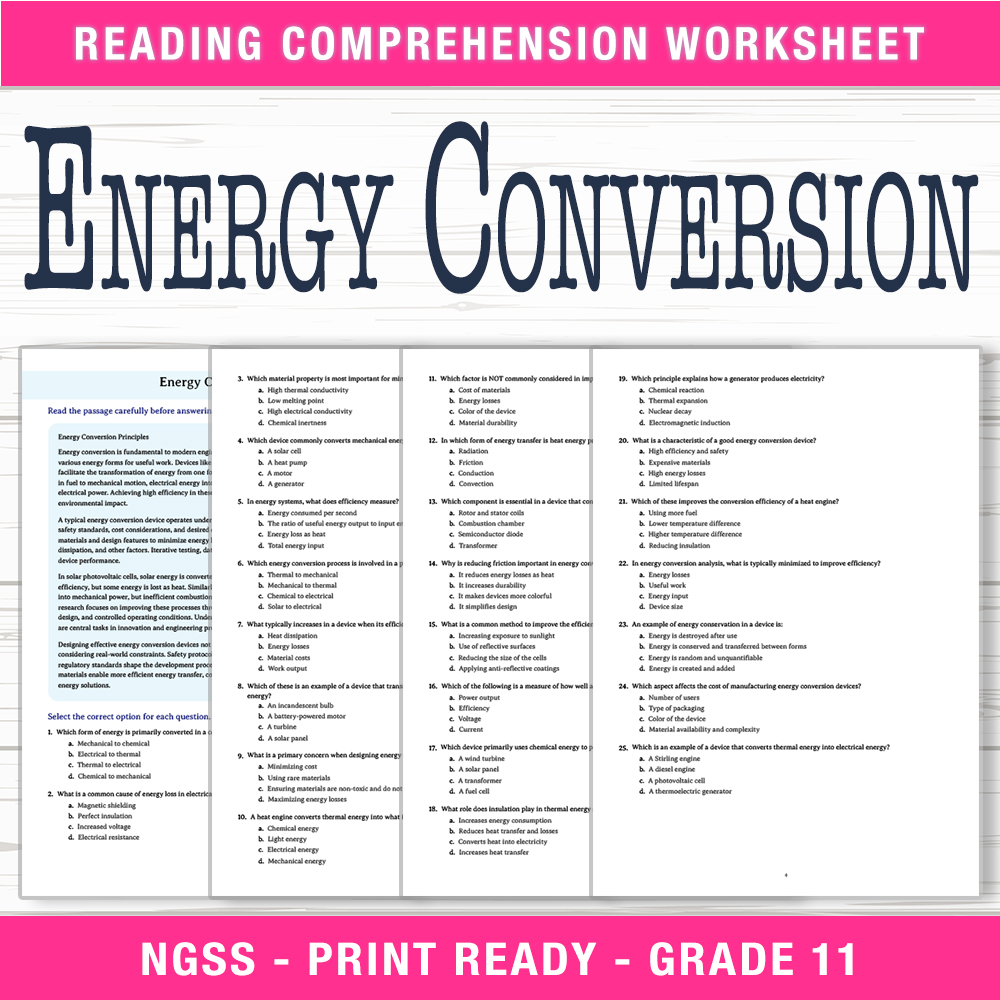
Grade 11 Science – Energy Conversion Worksheet (PDF + Answer Key)
Created byRiverstone ClassroomLearning Objectives
- Understand the principles of energy conversion between mechanical, electrical, chemical, and thermal forms
- Design and analyze devices that optimize energy transfer efficiency under practical constraints
- Evaluate losses in energy conversion systems and identify ways to improve performance
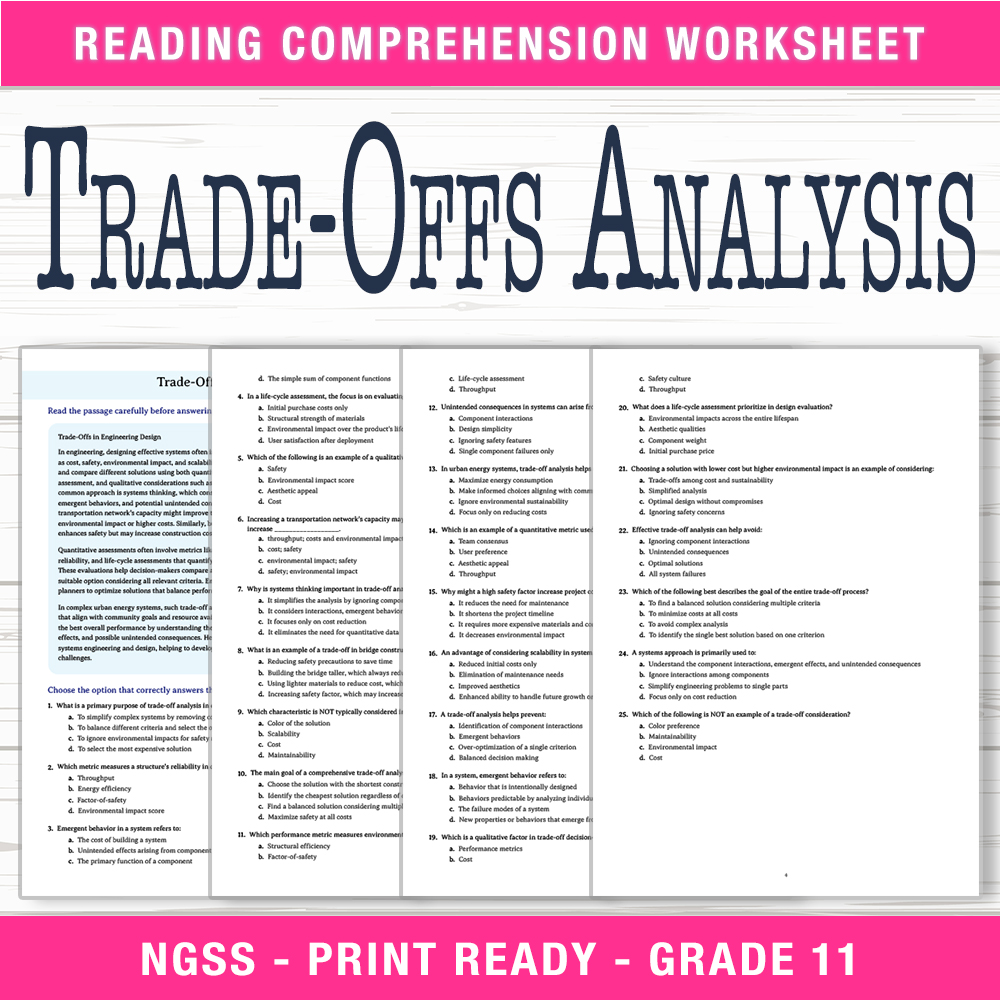
Grade 11 Science – Trade-Offs Analysis Worksheet (PDF + Answer Key)
Created byRiverstone ClassroomLearning Objectives
- Understand how to evaluate solutions based on multiple criteria and constraints.
- Apply systems thinking to assess component interactions and emergent behaviors.
- Quantify performance metrics such as throughput, safety factor, and life-cycle assessment.
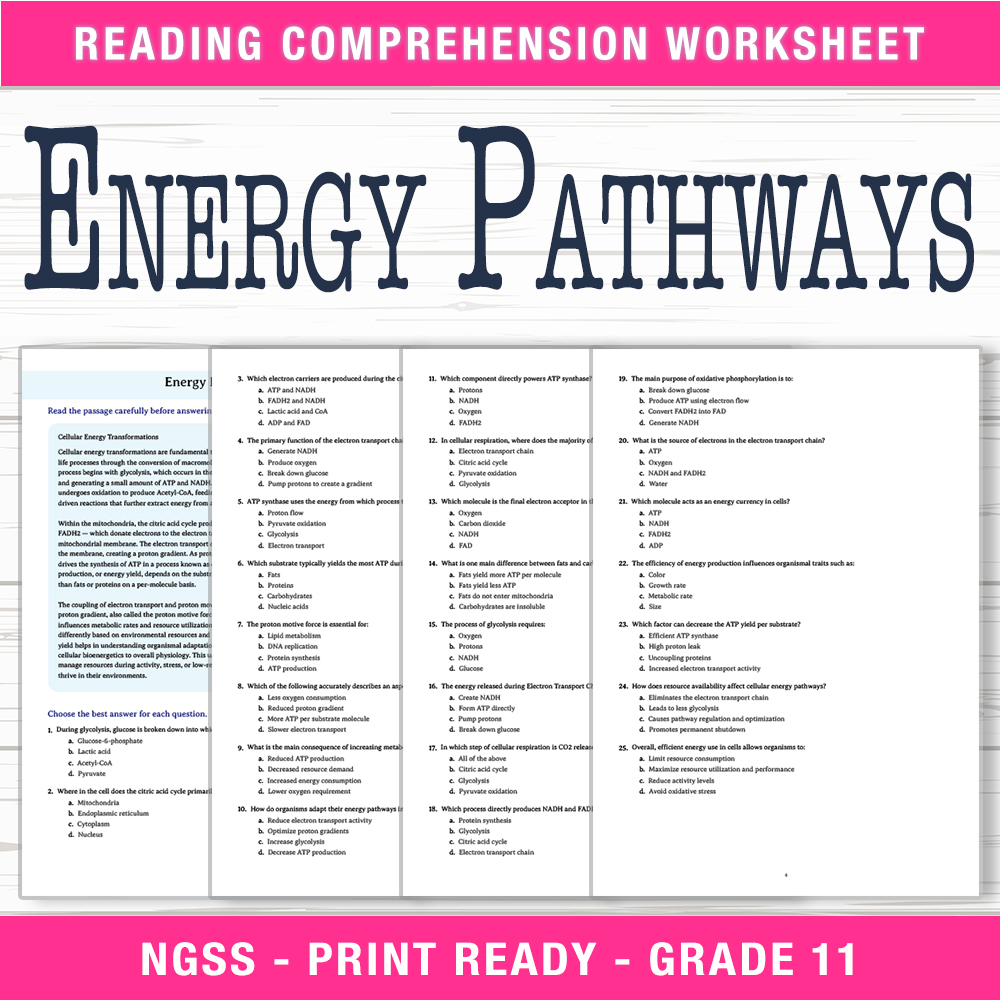
Grade 11 Science | Energy Pathways Worksheet (PDF + Answer Key)
Created byRiverstone ClassroomLearning Objectives
- Describe the main stages of cellular energy transformation, including glycolysis, pyruvate oxidation, the citric acid cycle, and oxidative phosphorylation.
- Explain how electron transport chains and proton gradients contribute to ATP production in mitochondria.
- Calculate the energy yield of different substrates during cellular respiration and understand its implications for organismal metabolism.
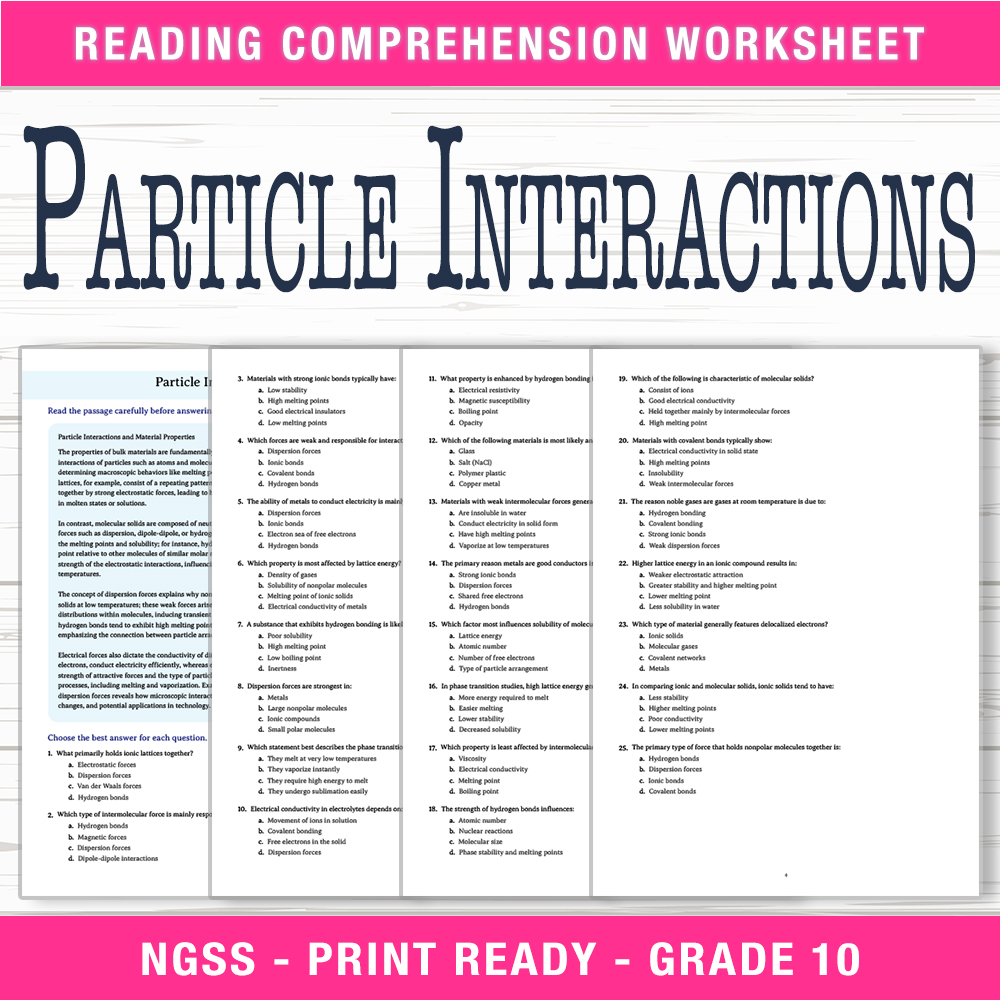
Grade 10 Science | Particle Interactions Worksheet (PDF + Answer Key)
Created byRiverstone ClassroomLearning Objectives
- Understand how crystal structures influence the physical properties of materials.
- Analyze the role of molecular interactions such as ionic bonds, dispersion forces, and hydrogen bonding in determining material behavior.
- Differentiate between types of solids (ionic lattices, molecular solids) based on their properties and particle interactions.
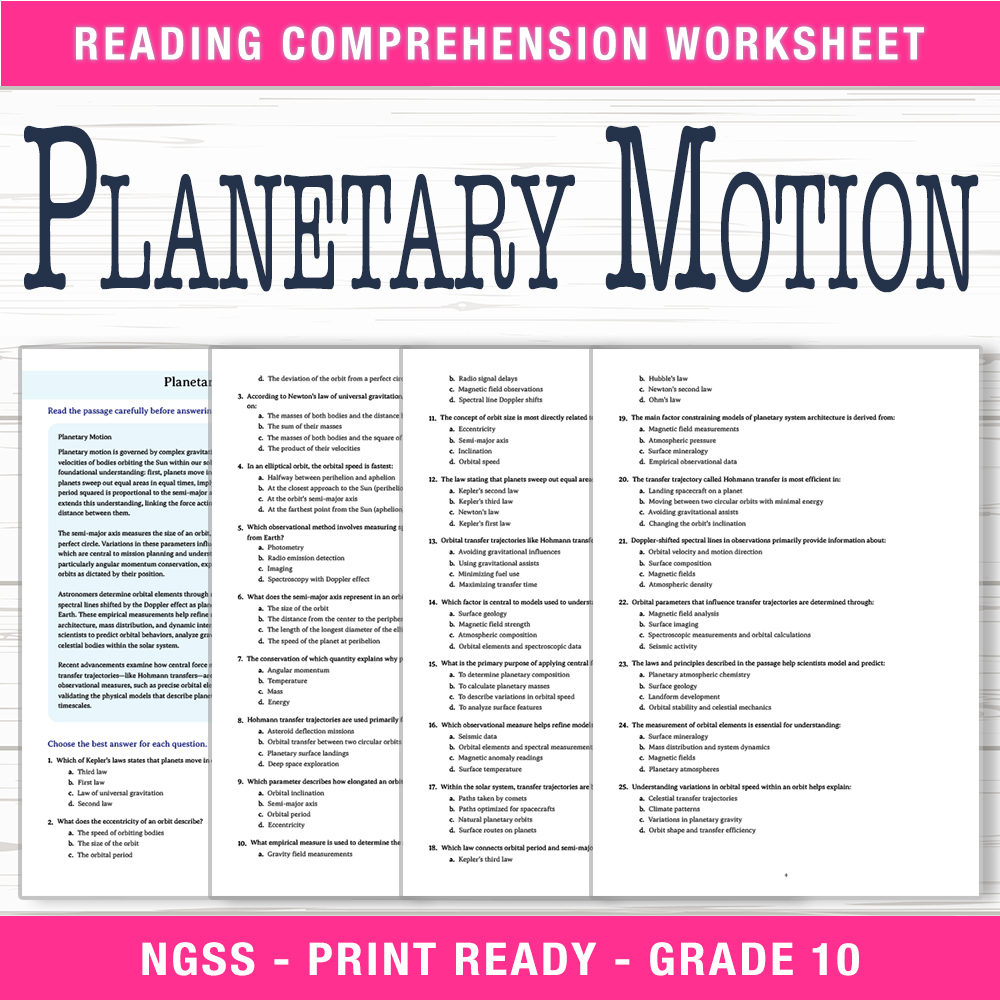
Grade 10 Science | Planetary Motion Worksheet (PDF + Answer Key)
Created byRiverstone ClassroomLearning Objectives
- Understand Kepler's laws and their application to planetary orbits.
- Explain the role of Newtonian gravity in planetary motion.
- Describe how orbital elements relate to observed planetary behavior.
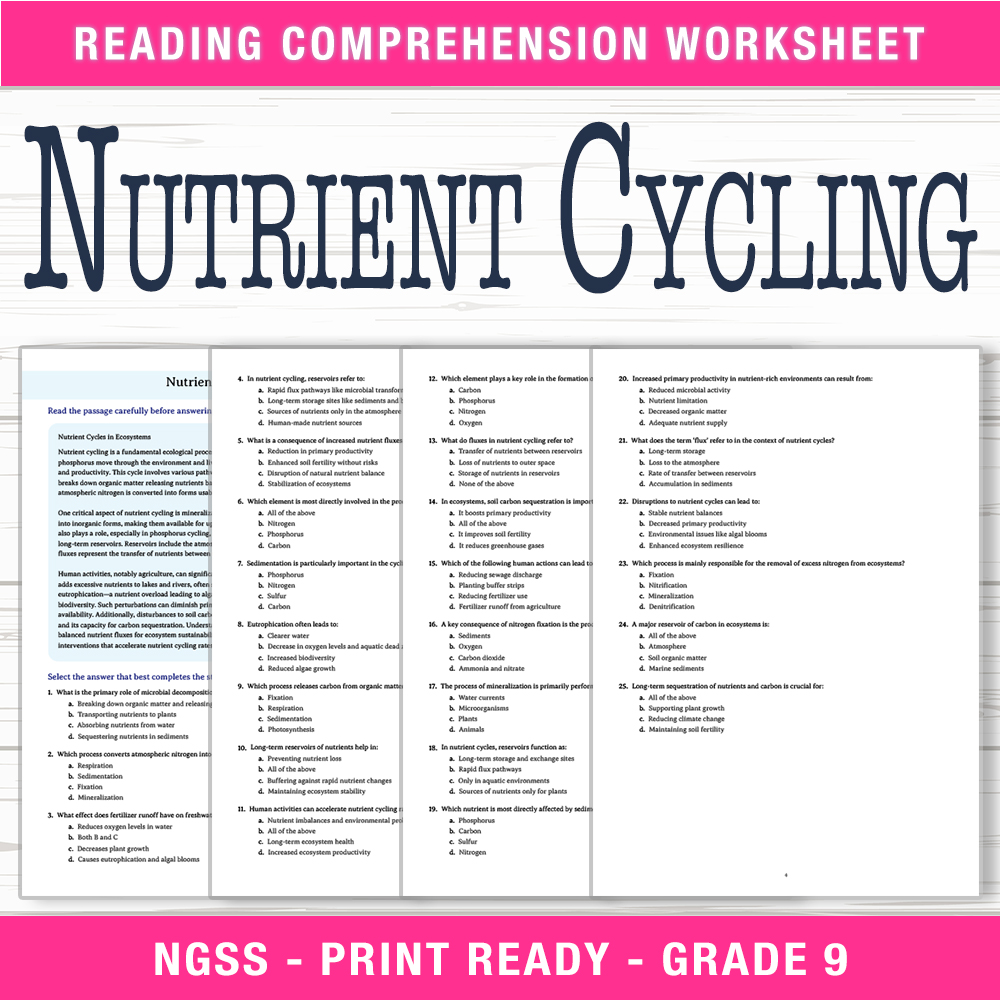
Grade 9 Science | Nutrient Cycling Worksheet (PDF + Answer Key)
Created byRiverstone ClassroomLearning Objectives
- Understand the key processes involved in nutrient cycling within ecosystems, including microbial decomposition, fixation, mineralization, and sedimentation.
- Explain how human activities, such as fertilizer runoff, disrupt nutrient cycles and lead to phenomena like eutrophication.
- Analyze the role of reservoirs and fluxes in nutrient cycling and how alterations affect primary productivity and long-term ecosystem health.
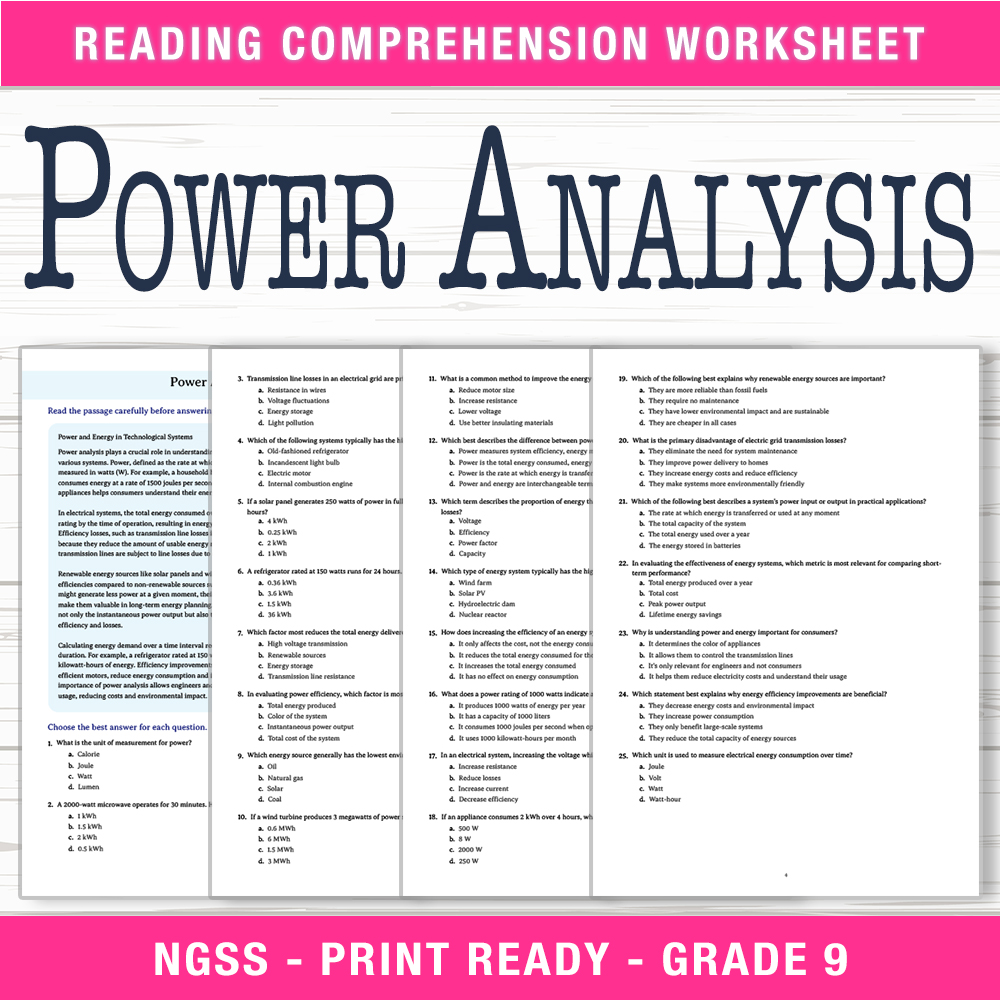
Grade 9 Science | Power Analysis Worksheet (PDF + Answer Key)
Created byRiverstone ClassroomLearning Objectives
- Understand the concept of power as the rate of energy transfer or conversion per unit time.
- Identify and compare the energy demand and efficiency of various systems, including household appliances and electrical grids.
- Calculate and analyze power ratings, energy consumption over time, and system losses in different contexts.
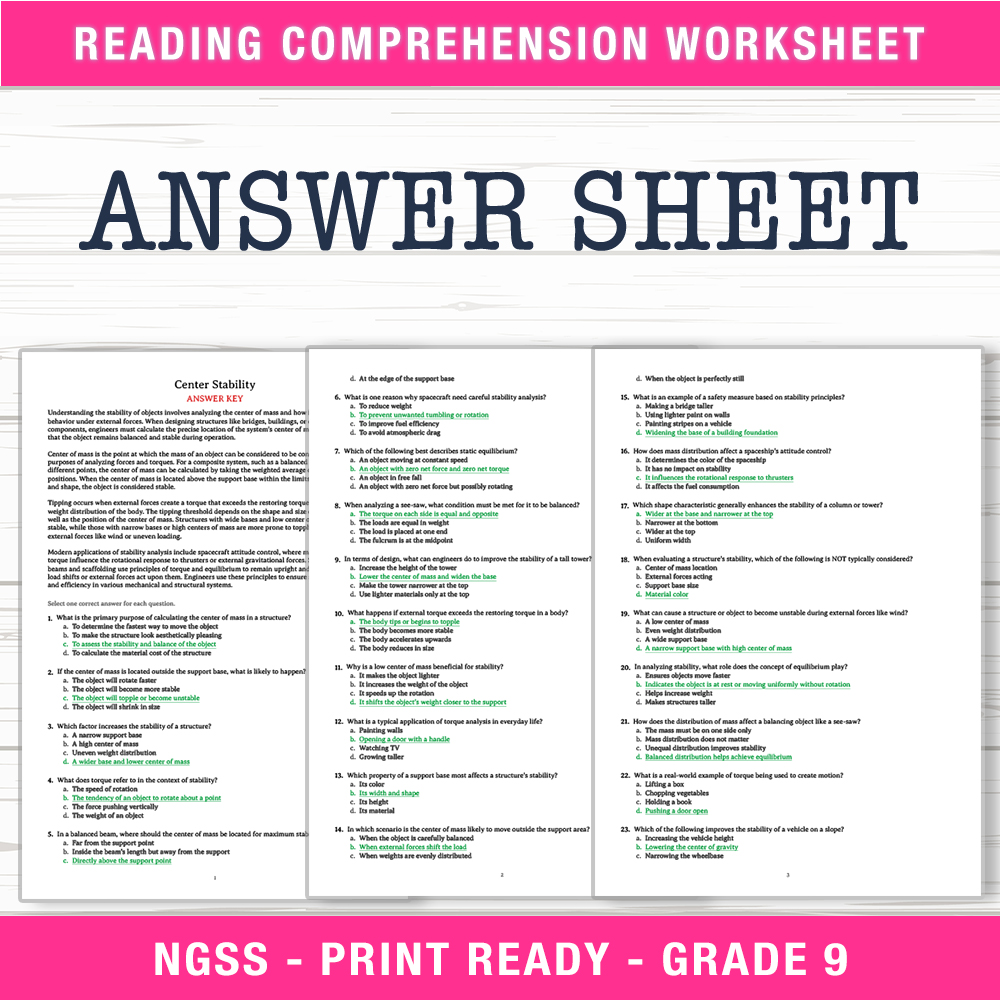
Grade 9 Science | Center Stability Worksheet (PDF + Answer Key)
Created byRiverstone ClassroomLearning Objectives
- Understand the concept of center of mass and how it affects the stability of rigid bodies
- Apply calculations to determine the center-of-mass location in composite systems
- Analyze moments and torque to assess static equilibrium and tipping thresholds

Grade 8 Science – Modeling Data Worksheet (PDF + Answer Key)
Created byRiverstone ClassroomLearning Objectives
- Understand the purpose and limitations of physical and computational models in scientific experiments.
- Apply principles of measurement accuracy, repeatability, and data recording when constructing models.
- Analyze how modeling can support the assessment of potential solutions in engineering contexts.
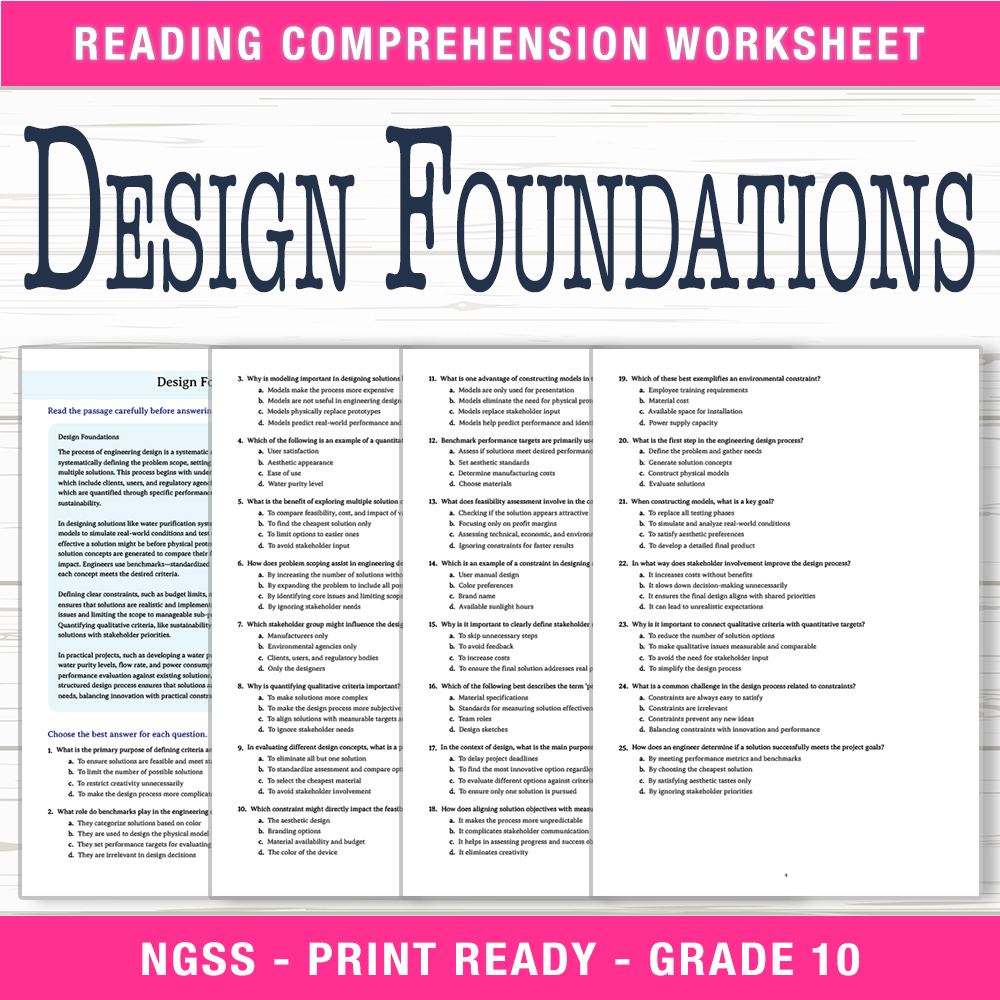
Grade 10 Science | Design Foundations Worksheet (PDF + Answer Key)
Created byRiverstone ClassroomLearning Objectives
- Understand the engineering design process for complex problems.
- Identify and define criteria and constraints in problem-solving scenarios.
- Construct models and generate multiple solution concepts.
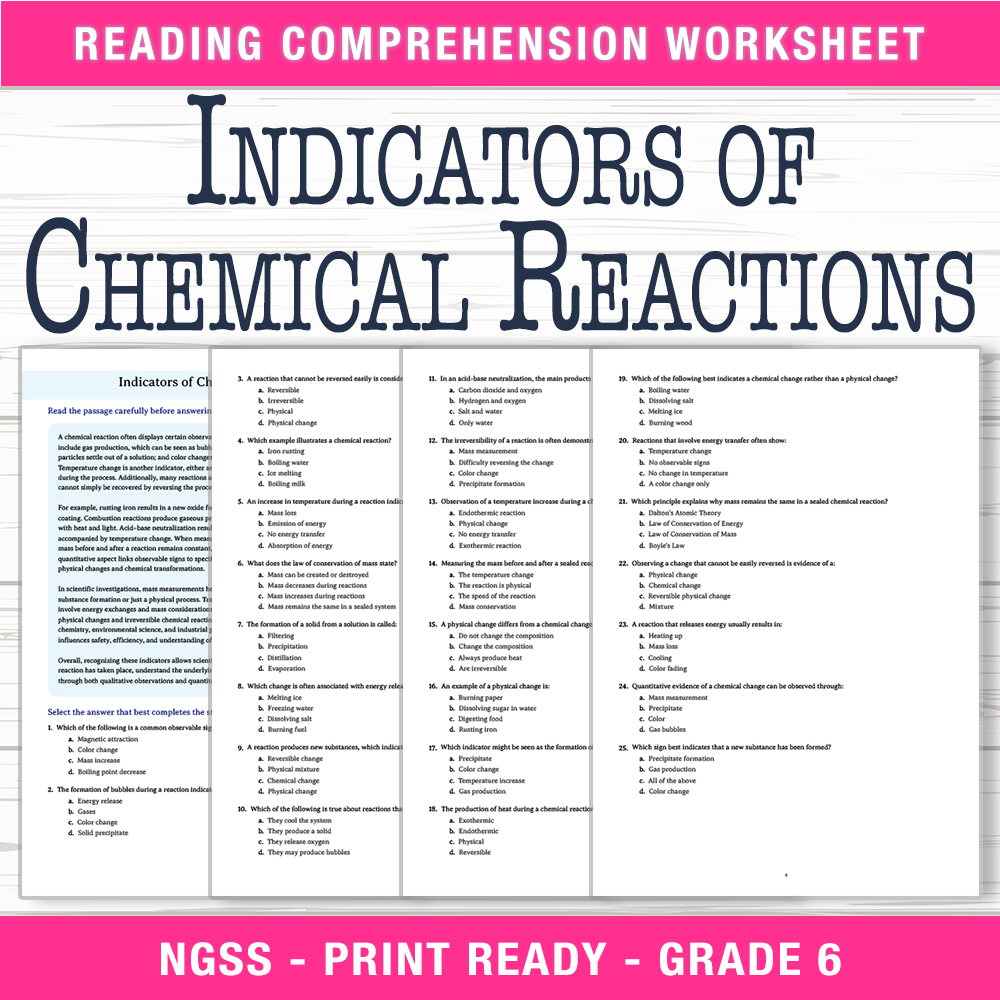
Grade 7 Science | Indicators of Chemical Reactions Worksheet (PDF + Answer Key)
Created byRiverstone ClassroomLearning Objectives
- Identify observable signs that indicate a chemical reaction has taken place.
- Understand examples of chemical reactions such as rusting, combustion, and neutralization.
- Explain the relationship between observable reaction indicators and changes in composition.
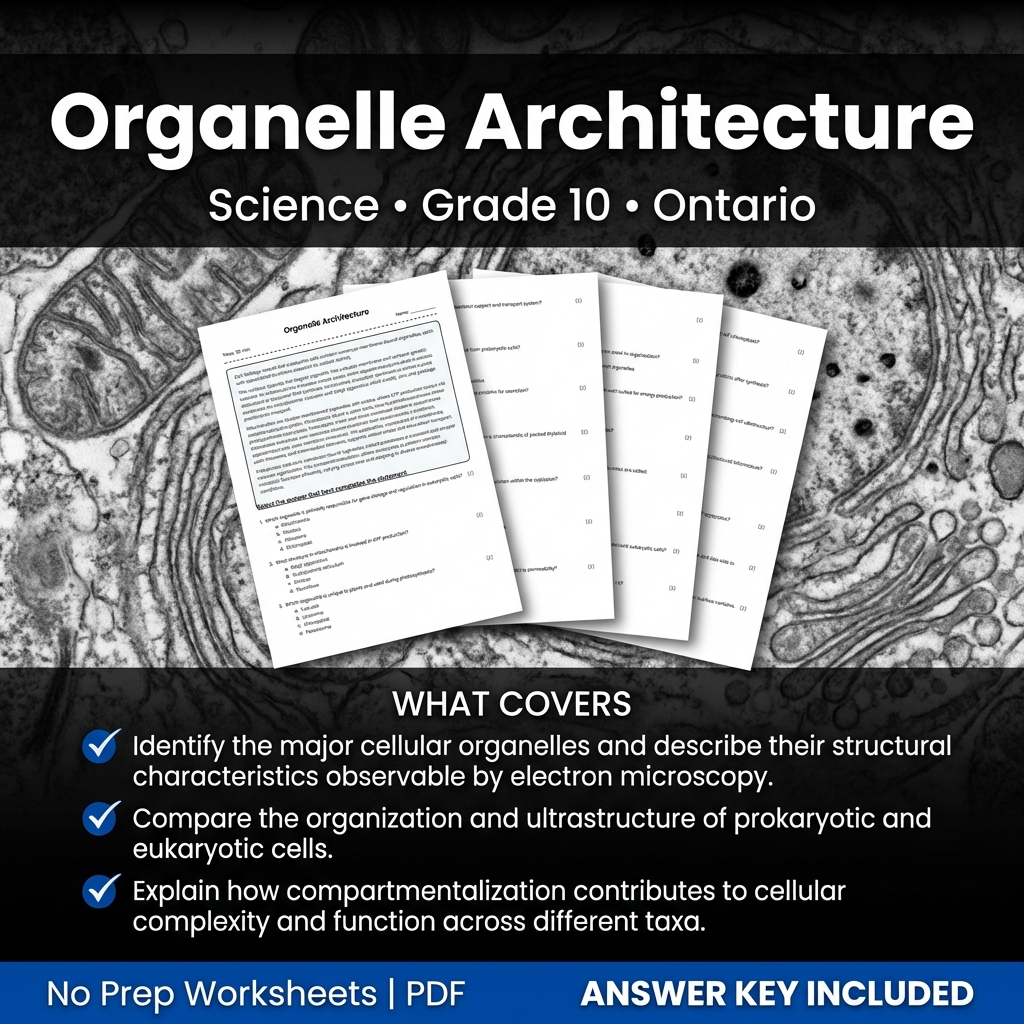
Organelle Architecture Worksheet | Science Assessment | Ontario Grade 10
Created byCoral Reef LearningLearning Objectives
- Identify the major cellular organelles and describe their structural characteristics observable by electron microscopy.
- Compare the organization and ultrastructure of prokaryotic and eukaryotic cells.
- Explain how compartmentalization contributes to cellular complexity and function across different taxa.
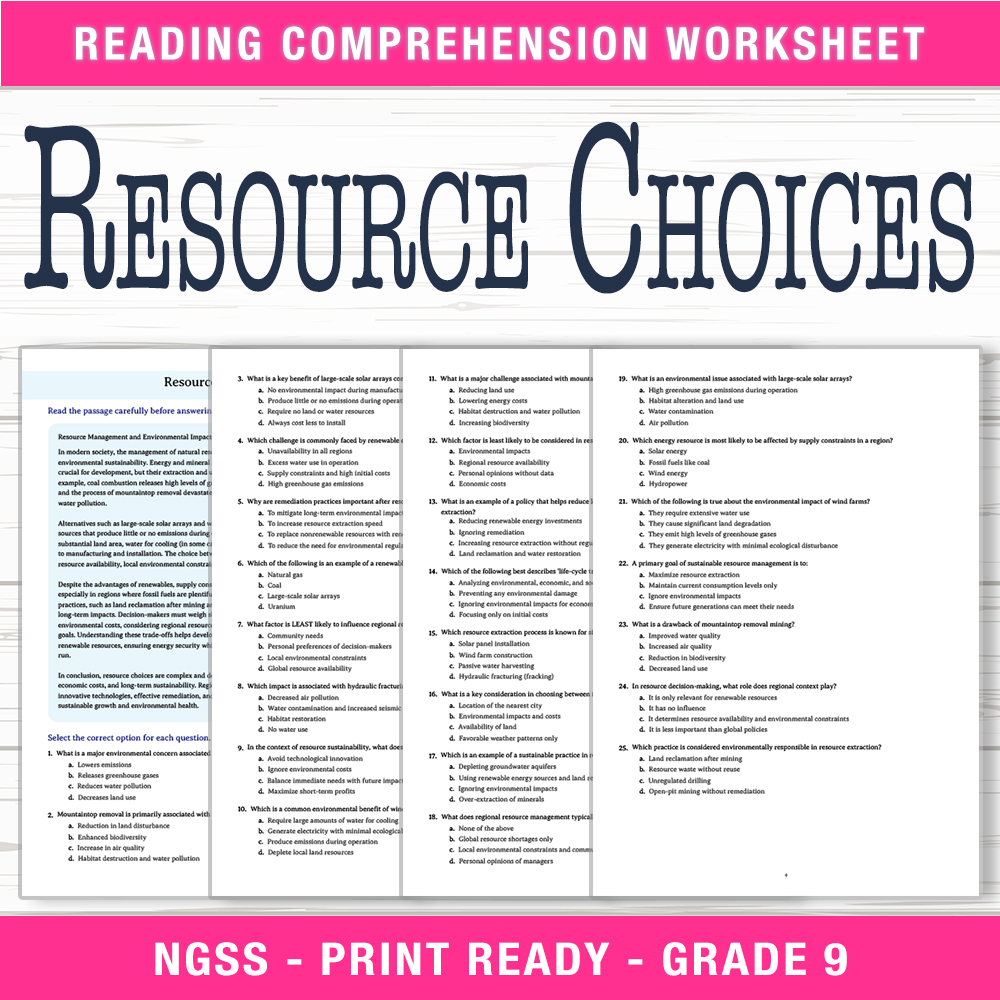
Grade 9 Science | Resource Choices Worksheet (PDF + Answer Key)
Created byRiverstone ClassroomLearning Objectives
- Evaluate different energy and mineral resource options considering environmental impacts, costs, and sustainability.
- Analyze how resource extraction methods affect ecosystems, land use, and water resources in regional contexts.
- Compare the life-cycle trade-offs of renewable and nonrenewable resources including environmental, economic, and social factors.
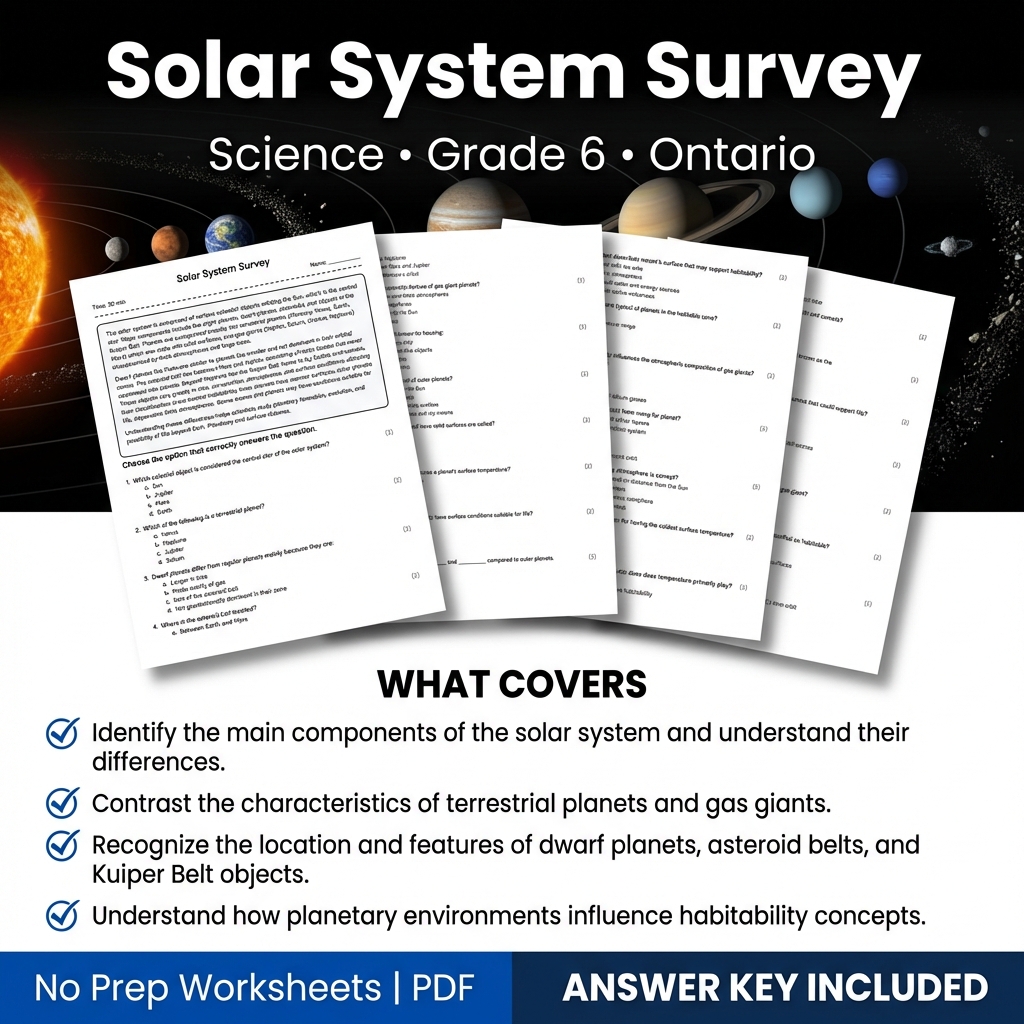
Grade 6 Science Worksheet Solar System Survey | Ontario Standards
Created byCoral Reef LearningLearning Objectives
- Identify the main components of the solar system and understand their differences.
- Contrast the characteristics of terrestrial planets and gas giants.
- Recognize the location and features of dwarf planets, asteroid belts, and Kuiper Belt objects.
Browse more categories
About Science Worksheets
Find Science worksheets spanning core skills, practice, and review. All 42,685 resources are instant PDF downloads for the classroom or home.
Every worksheet on MyTeachingSheets is created by independent teacher-authors and reviewed before publication. All resources download as printable PDFs for classroom, homework, or at-home practice, and many include answer keys. Preview any worksheet free before buying.