
Grade 6 Worksheets
8,582 grade resources
Grade 6 Holiday | D Day Overview Worksheet for Mastery | PDF + Answer Key
 Created byShaNova Worksheets
Learning Objectives
- Explain what D-Day was and why it mattered in World War II.
- Identify key countries and people involved in the Allied invasion of Normandy.
- Describe how planning, teamwork, and bravery helped shape the success of the landings.
Also included in: Grade 6 D Day Holiday Custom Bundle: Mastery Timeline Worksheets Set
Instant download
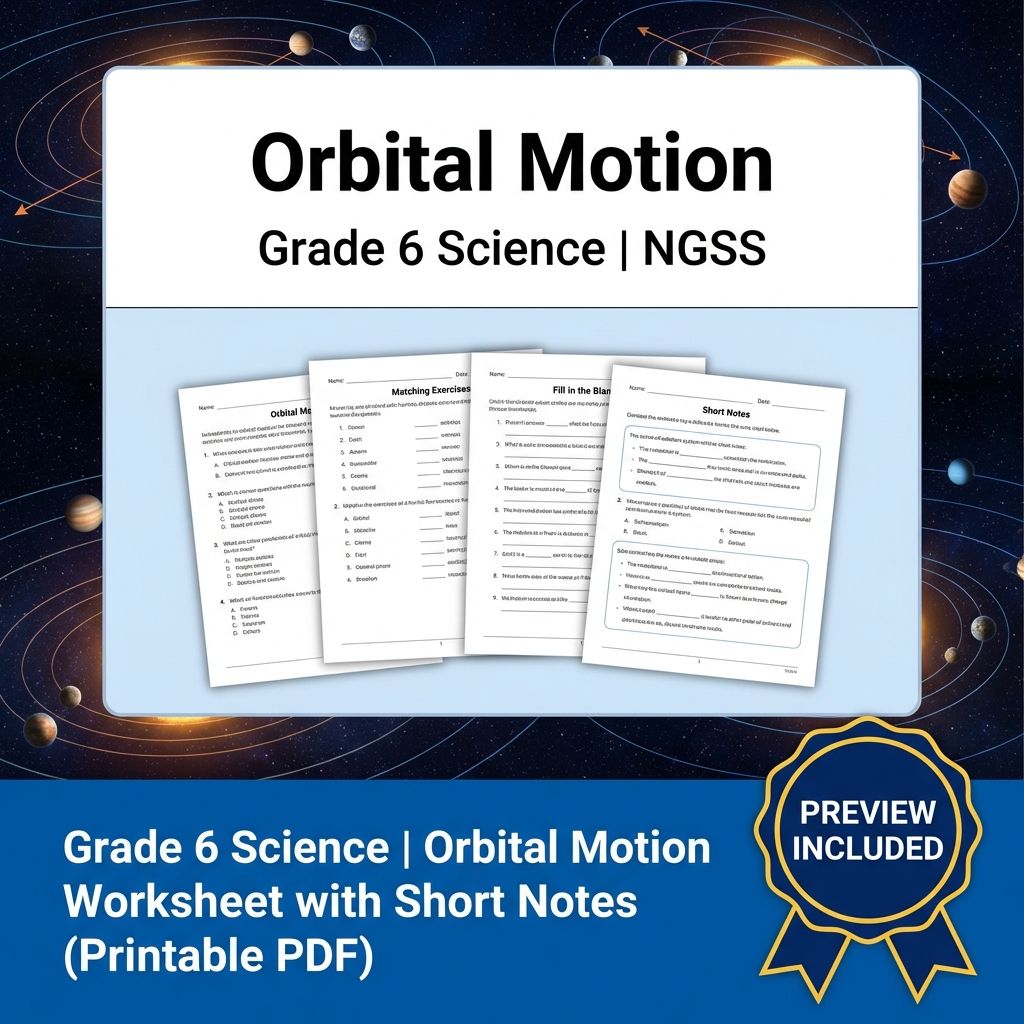
Grade 6 Science | Orbital Motion Worksheet with Short Notes (Printable PDF)
 Created byMeadowlark Worksheets
Learning Objectives
- Understand how gravitational attraction governs planetary and satellite orbits.
- Describe the elliptical nature of planetary orbits and Keplerian relationships.
- Explain the role of central gravitational potential in maintaining orbital paths.
Also included in: Grade 6 Science | Earth's Place in the Universe Unit Bundle (NGSS Worksheets) +1 more
Instant download

Grade 6 Biodiversity Patterns Worksheet | NGSS Practice PDF
 Created byClear Sky Classroom
Learning Objectives
- Understand how species occurrence and richness reveal biodiversity patterns across ecosystems.
- Identify different factors influencing biodiversity, such as habitat heterogeneity and colonization.
- Interpret data displays related to species diversity and endemism.
Also included in: Grade 6 Biological Evolution: Unity & Diversity Science lesson bundle NGSS +1 more
Instant download

Grade 6 ELA – Theme Development in Stories | Daily Reading Worksheet
 Created byQuiet Forest Education
Learning Objectives
- Identify emerging themes through patterns of events in a story.
- Track how conflicts, turning points, and resolutions contribute to developing a theme.
- Link theme statements to supporting details within the text.
Also included in: Theme, Evidence & Author’s Purpose Daily Lesson Bundle | Grade 6 ELA | TEKS +1 more
Instant download

Grade 6 Social Studies — Social and Economic Structures Worksheet MCQ
 Created byThe Resource Hub
Learning Objectives
- Understand the social hierarchies in ancient India and China.
- Identify the economic roles that supported these civilizations.
- Compare the influence of social and economic organization on stability and development.
Also included in: Grade 6 Ancient India and China Social Studies Lesson Bundle California +1 more
Instant download

Grade 6 Science | Pollution Effects Worksheet | BC Aligned
 Created byLumora Learning
Learning Objectives
- Understand the types of pollutants and their sources in ecosystems.
- Explain how pollutants bioaccumulate and biomagnify in food chains.
- Identify the impacts of nutrient over-enrichment and algal blooms on ecosystems.
Instant download

6th Grade Science | Safety and Ethical Reporting Worksheet (PDF)
 Created byEvergreen Desk Education
Learning Objectives
- Explain how to follow safety procedures when using common lab materials and heat sources.
- Identify ethical expectations for reporting results accurately, honestly, and with proper attribution.
- Present data clearly by describing results, limitations, and any safety-relevant observations.
Also included in: Grade 6 Science Inquiry Lesson Bundle: Variable Control & Models (General) +1 more
Instant download
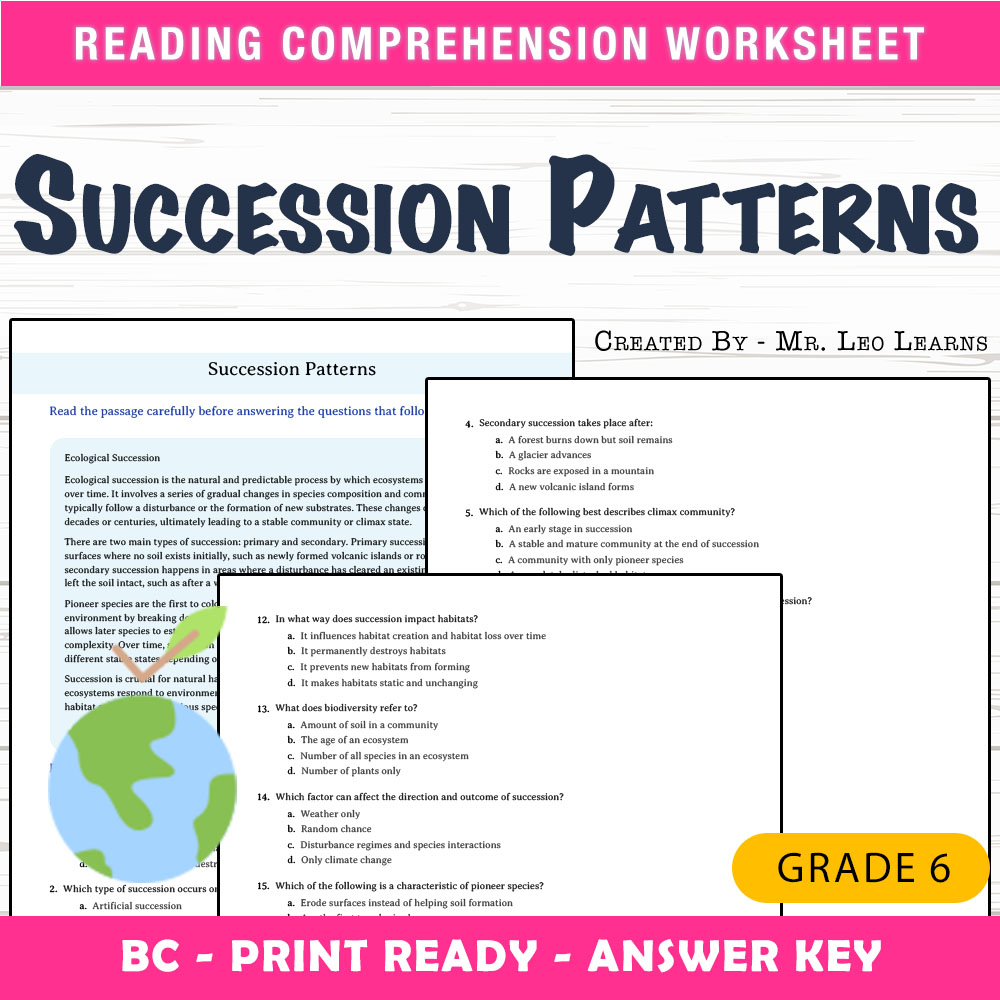
Grade 6 Science — Succession Patterns Worksheet MCQ Paper
Created byThe Resource HubLearning Objectives
- Understand the process of ecological succession and its types.
- Identify the roles of pioneer species in succession.
- Differentiate between primary and secondary succession.
Also included in: Grade 6 Science Ecosystems & Interdependence Worksheet Bundle – BC Curriculum +1 more
Instant download

Cause And Effect Worksheet | Grade 6 ELA Review & Assessment
Created byMeadowlark WorksheetsLearning Objectives
- Identify direct, indirect, and cumulative causes in narrative and informational texts.
- Distinguish between stated reasons and implied effects using context clues.
- Explain cause-and-effect relationships using transition words such as because, therefore, and as a result.
Also included in: Grade 6 Text Evidence and Inference ELA Lesson Bundle for Alberta +1 more
Instant download

Trait Heritability Worksheet | Ontario Grade 6 Science Assessment
 Created byCedar Grove Learning
Learning Objectives
- Explain what heritability means in terms of variation caused by genetic differences
- Distinguish heritable influences from environmental influences on a trait
- Describe how natural selection can change allele frequencies across generations
Also included in: Grade 6 Biodiversity and Adaptations Science Lesson Bundle Ontario +1 more
Instant download

Grade 6 Health – Physical Benefits of Regular Exercise | Daily Reading Worksheet
Created byQuiet Forest EducationLearning Objectives
- Understand the physical health benefits of regular physical activity.
- Identify main ideas and details in a reading passage.
- Answer comprehension questions about cardiovascular health and muscle strength.
Also included in: Active Living Grade 6 Health Daily Reading Worksheets Bundle | Ontario +2 more
Instant download
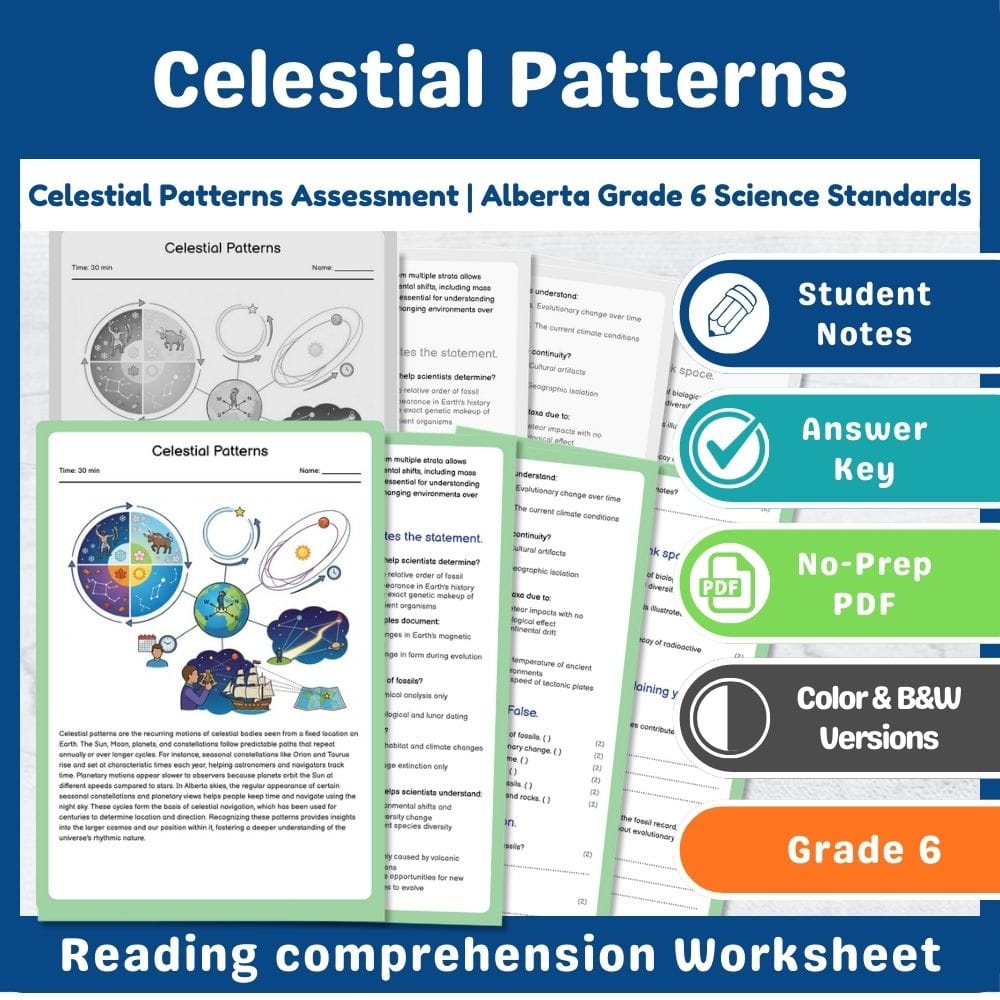
Celestial Patterns Assessment | Alberta Grade 6 Science Standards
 Created byPrism Point Learning
Learning Objectives
- Describe the predictable paths of the Sun, Moon, planets, and constellations as seen from a fixed location.
- Explain how seasonal constellations and planetary motions are used for timekeeping and navigation.
- Identify key celestial patterns observed in Alberta skies and their significance for predictability.
Also included in: Lesson Grade 6 Science Assessment | Celestial & Earth Movements
Instant download

Friction Effects Worksheet | Standards-Aligned Grade 6 Science Practice
JCreated byJ.S SheetsLearning Objectives
- Understand how different surfaces affect the amount of friction between objects.
- Explain how friction converts kinetic energy into thermal energy.
- Recognize how air resistance influences moving objects in fluids.
Also included in: Grade 6 Matter, Energy, and Forces Science lesson bundle – Florida (NGSSS) +1 more
Instant download

Atomic Composition Worksheet Grade 6 NGSS Atoms Matter & Molecules
 Created byNorthstar Worksheets
Learning Objectives
- Use models (ball-and-stick and space-filling) to describe how atoms combine to form simple molecules and extended structures.
- Interpret chemical formulas to identify the relative atom types and counts in H2O and NaCl.
- Explain how repeating units build polymer chains and how ionic charges relate to ionic lattices.
Also included in: Grade 6 Matter & Chemical Reactions Lesson Bundle | NGSS | Science +1 more
Instant download
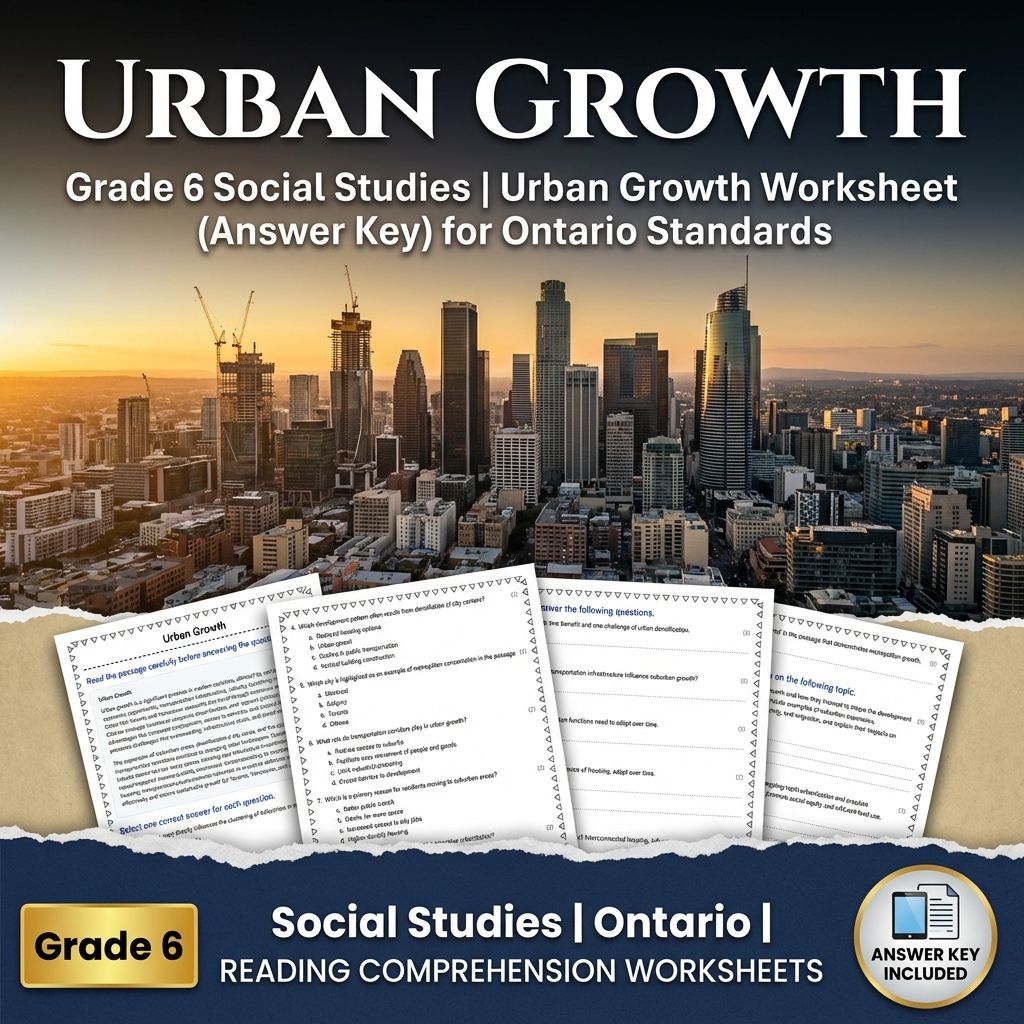
6th Grade Social Studies | Urban Growth Practice Worksheet & Answer Key (PDF)
JCreated byJ.S SheetsLearning Objectives
- Identify factors contributing to metropolitan concentration such as industry clustering, transportation routes, and immigration.
- Analyze the effects of urbanization on employment, services, and regional development.
- Compare causes and consequences of suburban expansion and densification in growing cities.
Instant download

Grade 6 Ecosystem Components Science Daily Reading TEKS Worksheet
 Created byBRIGHT PATH RESOURCES
Learning Objectives
- Define an ecosystem as an interacting system of biotic and abiotic components.
- Identify key biotic (living) and abiotic (nonliving) factors in a habitat.
- Explain how organism relationships and physical factors affect ecosystem balance.
Also included in: TEKS Ecosystems Grade 6 Science Daily Reading Worksheets Lesson Bundle | TEKS +1 more
Instant download
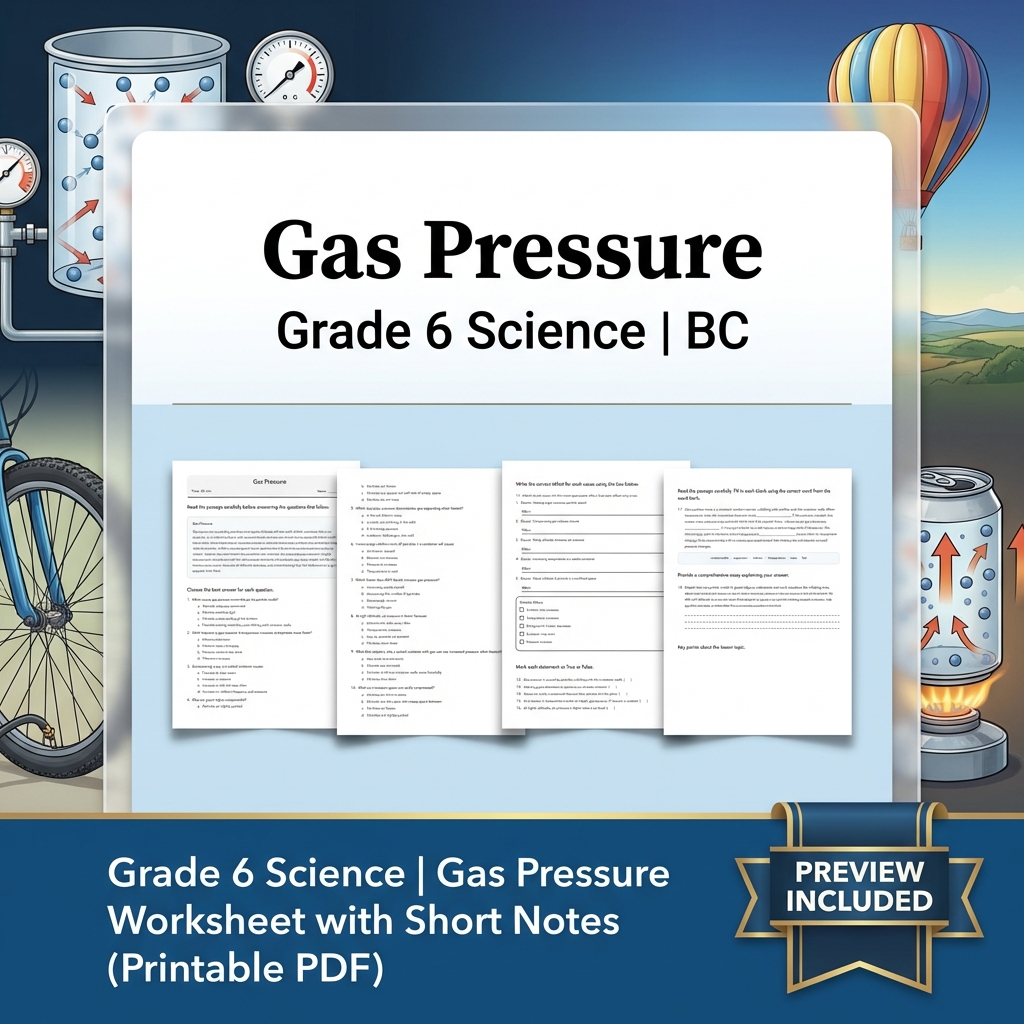
Grade 6 Science | Gas Pressure Worksheet with Short Notes (Printable PDF)
Created byMeadowlark WorksheetsLearning Objectives
- Explain how gas particles exert pressure through collisions with container walls.
- Describe how increasing particle speed or collision frequency affects gas pressure.
- Understand the relationship between temperature, volume, and pressure in gases based on the particle model.
Also included in: Grade 6 Science | Matter, Properties & Change UNIT Worksheet Bundle +1 more
Instant download

6th Grade Health | Decision Foundations Worksheet (NHES Standard) (PDF)
 Created bySunny Desk Resources
Learning Objectives
- Explain a simple process for making health decisions using available information, values, and context
- Identify how personal values and preferences influence everyday health choices
- Use decision steps to choose safer and healthier options when facing everyday dilemmas
Also included in: Grade 6 Decision-Making Skills in Health Lesson Bundle for NHES Framework +1 more
Instant download

Wave Interactions Test Prep Worksheet | Grade 6 Science
Created byPrism Point LearningLearning Objectives
- Explain how superposition leads to constructive and destructive interference in sound and light.
- Describe how resonance and standing waves create patterns and amplify specific frequencies.
- Relate damping to how wave energy decreases over time.
Also included in: Energy, Waves & Circuits Lesson Bundle | Grade 6 Science | BC Framework +1 more
Instant download

Trophic Levels Worksheet Grade 6 Science Florida NGSSS Ecosystems
Created byPrism Point LearningLearning Objectives
- Explain how trophic levels describe how organisms obtain energy in an ecosystem
- Identify producers, primary consumers, secondary consumers, higher-level consumers, and decomposers by role
- Describe how energy transfer between trophic levels affects population patterns
Instant download
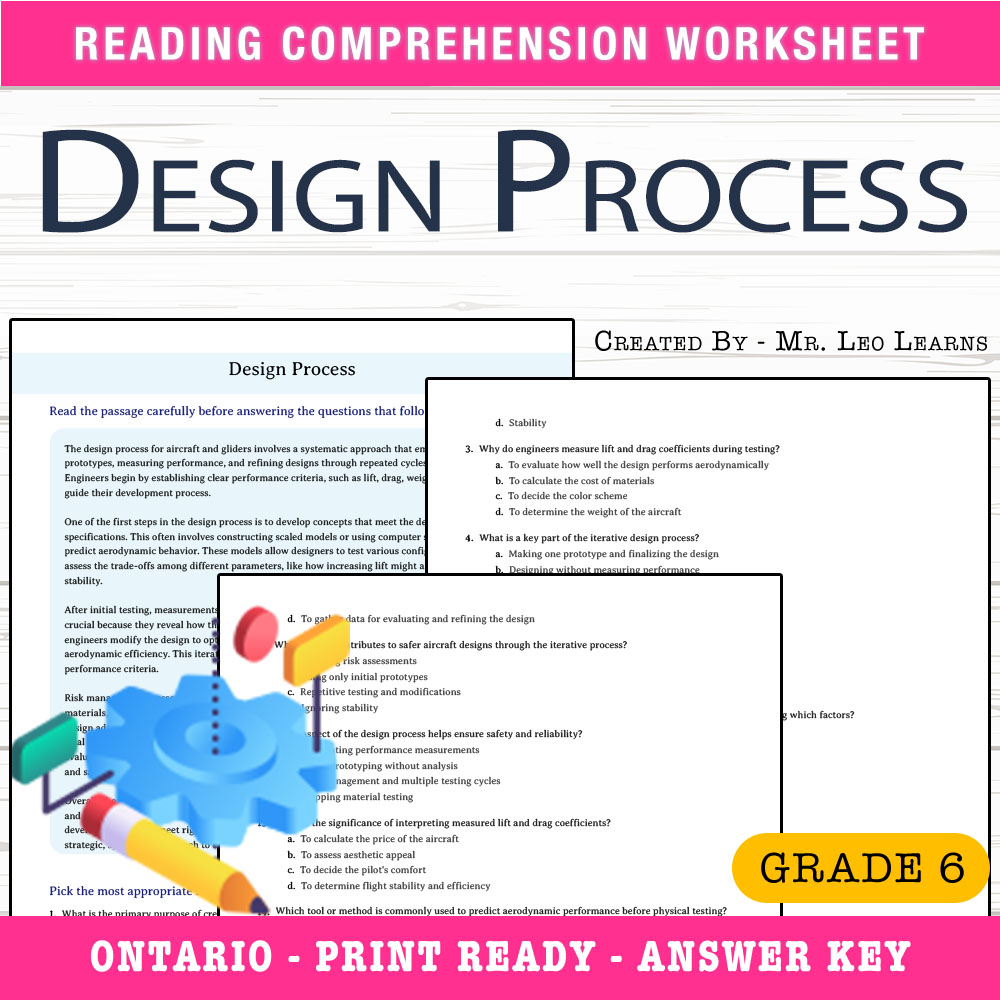
Grade 6 Science – Design Process Worksheet for Mastering Engineering Concepts
Created byThe Resource HubLearning Objectives
- Understand the steps involved in the iterative design process for aircraft and glider concepts.
- Identify key factors such as lift, drag, weight, and stability that influence aerodynamic performance.
- Explain how models and computational simulations are used to evaluate designs.
Also included in: Grade 6 Science | Aerodynamics & Engineering Unit Workbook (Worksheet Pack) +1 more
Instant download

6th Grade Health – Assessing Risks Worksheet (NHES) Practice Set (PDF)
Created bySunny Desk ResourcesLearning Objectives
- Explain how to evaluate health-related choices by considering potential benefits and risks.
- Distinguish between short-term and long-term consequences of health decisions.
- Use likelihood and severity to make safer, healthier choices.
Also included in: Grade 6 Decision-Making Skills in Health Lesson Bundle for NHES Framework +1 more
Instant download

6th Grade Science | Forest Types Worksheet (PDF) Alberta Standards
 Created bySilver Birch Teaching
Learning Objectives
- Identify major forest types (boreal/mixedwood, montane, subalpine, aspen parkland) using characteristic species and conditions
- Explain how abiotic gradients such as elevation, soil moisture, and fire history influence where forest types occur
- Use forest type knowledge to describe habitat diversity and potential impacts of climatic shifts
Also included in: Grade 6 Ecosystem Interactions Science Lesson Bundle: Alberta Framework +1 more
Instant download

Grade 6 Science – Measurement & Precision Daily Reading Worksheet | NGSSS
 Created byBright Mind Resources
Learning Objectives
- Identify different measurement tools used in science experiments.
- Understand the importance of units and scales in obtaining accurate measurements.
- Distinguish between precision and accuracy in measurement.
Also included in: Scientific Inquiry Grade 6 Science Daily Reading Worksheets Bundle | FL NGSSS +1 more
Instant download

Grade 6 Science – Energy & Water Cycle Reading Worksheet | California Standards
Created byBright Mind ResourcesLearning Objectives
- Understand how solar energy causes water to evaporate and form clouds
- Identify the processes of evaporation and cloud formation
- Explain the role of sunlight in Earth's water cycle
Also included in: Water Cycle Grade 6 Science Lesson Bundle Daily Reading | California Standards +1 more
Instant download

Comparing With Conversions Grade 6 Maths Worksheet | CCSS Aligned
 Created byElena Brooks
Learning Objectives
- Convert rational numbers between fractions, decimals, and percents.
- Use converted forms to decide which of two numbers is greater or less.
- Order numbers by interpreting their positions on a number line after converting.
Also included in: Grade 6 Rational Numbers, Percents & Inequalities Maths Bundle: Common Core +1 more
Instant download

Grade 6 Holiday| Easter Day for Mastering Cultural Celebrations|PDF + Answer Key
Created byShaNova WorksheetsLearning Objectives
- Understand various cultural traditions associated with Easter celebrations worldwide.
- Identify the significance of civic calendars and cultural diversity in global festivals.
- Recognize how different communities promote unity and shared history through customs.
Also included in: Grade 6 Easter Holiday Custom Bundle CCSS ELA Worksheets Practice
Instant download

Grade 6 Organ Systems Worksheet | NGSS Human Body Science with Answer Key
Created byNorthstar WorksheetsLearning Objectives
- Explain how the circulatory, respiratory, digestive, and nervous systems work together to support cell survival.
- Describe the roles of specific organs (heart, lungs, liver, and brain/nerves) in transporting or processing materials.
- Connect cellular needs (nutrients and gases) to system-level processes and outcomes.
Also included in: Cells & Human Body Systems Lesson Bundle | Grade 6 Science | NGSS +1 more
Instant download

Grade 6 Environmental Science Digital Sources Worksheet | Alberta
Created byBRIGHT PATH RESOURCESLearning Objectives
- Explain what digital sources provide for environmental investigations.
- Describe how metadata, temporal resolution, and spatial coverage help users evaluate digital datasets.
- Identify ways standardized formats and licensing affect how data can be combined and used.
Also included in: Inquiry Data Grade 6 Science Daily Reading Worksheets Lesson Bundle | Alberta +1 more
Instant download
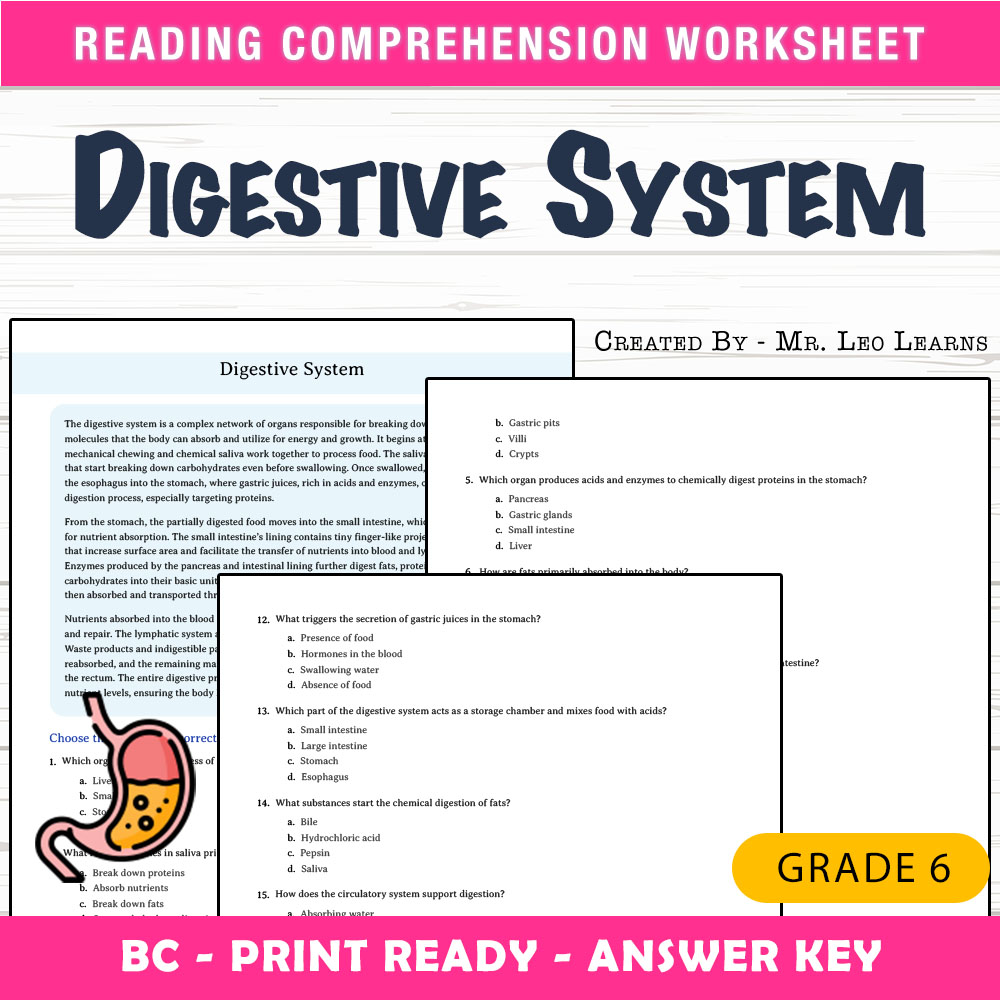
Grade 6 Science | Digestive System MCQ Worksheet for Mastery
Created byThe Resource HubLearning Objectives
- Describe the main organs involved in the digestive process.
- Understand how enzymes and acids chemically digest food.
- Explain how nutrients are absorbed into the blood and lymph.
Also included in: Grade 6 Science Unit | Multicellular Systems & Functions Worksheet Bundle +1 more
Instant download

6th Grade Social Studies | Source Analysis Worksheet (PDF) TEKS
Created bySunny Desk ResourcesLearning Objectives
- Identify whether a source is primary or secondary by examining its origin and purpose.
- Analyze a source’s reliability by considering bias, missing context, and what can be verified.
- Use evidence from multiple sources to support an evidence-based explanation.
Also included in: Grade 6 Source, Mapping & Perspectives Social Studies Lesson Bundle – TEKS +1 more
Instant download

Grade 6 Collaborative Practices Science Worksheet & Doodle Notes
 Created byChalk and Compass
Learning Objectives
- Explain how assigning roles and documenting shared work improve scientific teamwork.
- Use versioning and attribution to keep track of changes and contributions in group investigations.
- Describe protocols for constructive critique and how teams resolve conflicting observations.
Also included in: Grade 6 Science Scientific Inquiry and Evidence Lesson Bundle | Ontario +1 more
Instant download

6th Grade Science | Air Properties Worksheet (PDF) Alberta Standards
Created bySilver Birch TeachingLearning Objectives
- Explain how the composition and motion of gas molecules relate to air pressure
- Describe how air density changes with temperature and altitude
- Use real-world examples to connect air properties to weather and everyday phenomena
Also included in: Grade 6 Aerodynamics & Flight Forces Science Lesson Bundle: Alberta +1 more
Instant download

Checking Solutions Worksheet for Grade 6 | Math Practice and Answer Key
Created byElena BrooksLearning Objectives
- Check whether a proposed value makes an equation true by substituting it and comparing both sides
- Solve an equation step-by-step while keeping equality balanced using inverse operations
- Explain why equivalent transformations keep an equation true
Also included in: Grade 6 Equations & Expressions Maths Lesson Bundle (CCSS) +1 more
Instant download
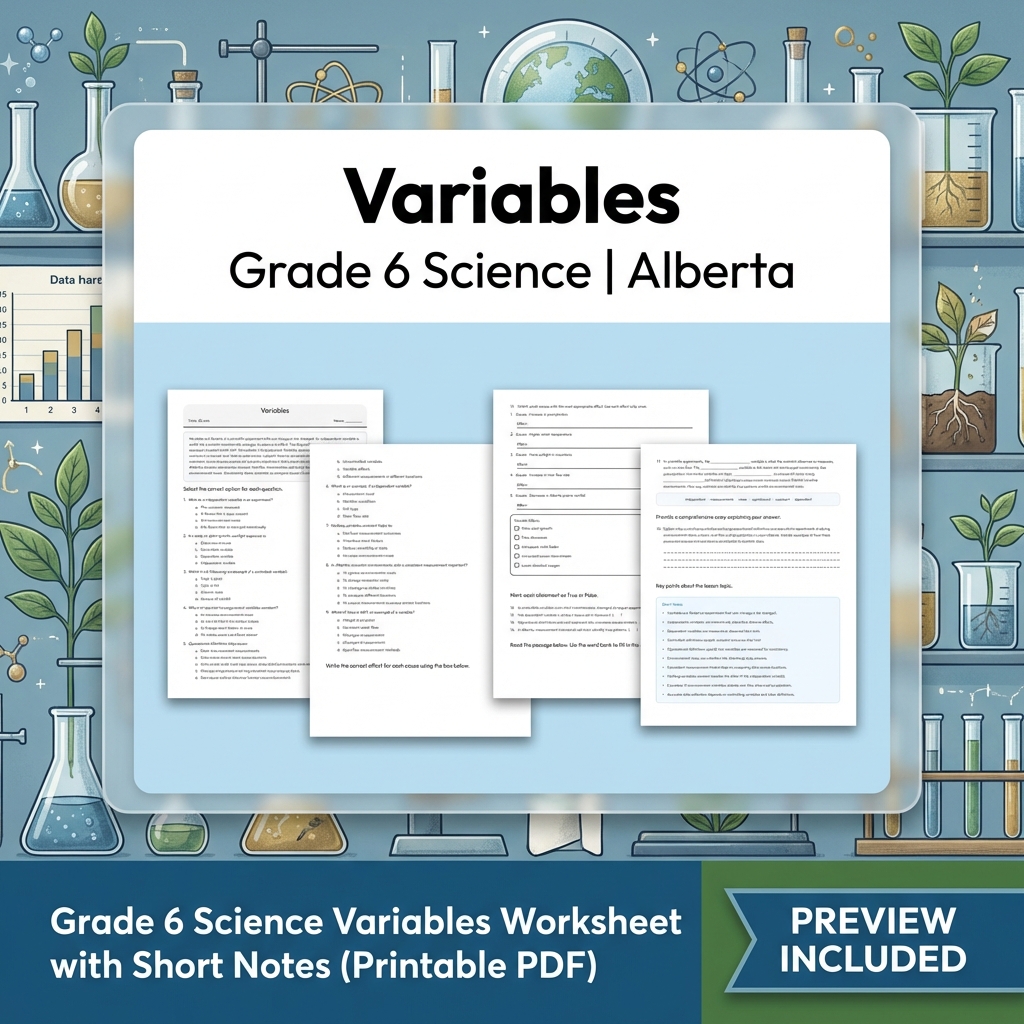
Grade 6 Science Variables Worksheet with Short Notes (Printable PDF)
Created byMeadowlark WorksheetsLearning Objectives
- Understand the different types of variables in scientific investigations.
- Identify examples of independent, dependent, and controlled variables in environmental contexts.
- Explain why controlling variables is important for accurate data collection.
Also included in: Grade 6 Science | Evidence & Investigation Unit Worksheet Bundle +1 more
Instant download

Back to School Reflective Planning Worksheets | Grade 6 Holiday
Created byShaNova WorksheetsLearning Objectives
- Explain how reflective thinking and goal setting help students plan for the school year
- Identify how milestone tracking supports perseverance when challenges occur
- Use examples from stories and traditions to describe the value of education and self-improvement
Instant download

Science Worksheet Life Processes In Cells Grade 6 | Standards-Aligned Practice
JCreated byJ.S SheetsLearning Objectives
- Explain how cells convert energy to support life processes such as growth and repair
- Describe how photosynthesis and cellular respiration are connected through gas exchange
- Compare diffusion with transport mechanisms for moving materials across cell membranes
Also included in: Grade 6 Life Processes & Ecosystems Science lesson bundle: General Framework +1 more
Instant download

Grade 6 Pressure Patterns Worksheet | Alberta NGSS Practice PDF
Created byClear Sky ClassroomLearning Objectives
- Explain how uneven heating creates pressure gradients that drive wind
- Identify how mountains and plains can change regional air flow patterns
- Describe real-life weather effects of low and high pressure zones
Also included in: Grade 6 Air and Aerodynamics Science Lesson Bundle (Alberta Framework) +1 more
Instant download
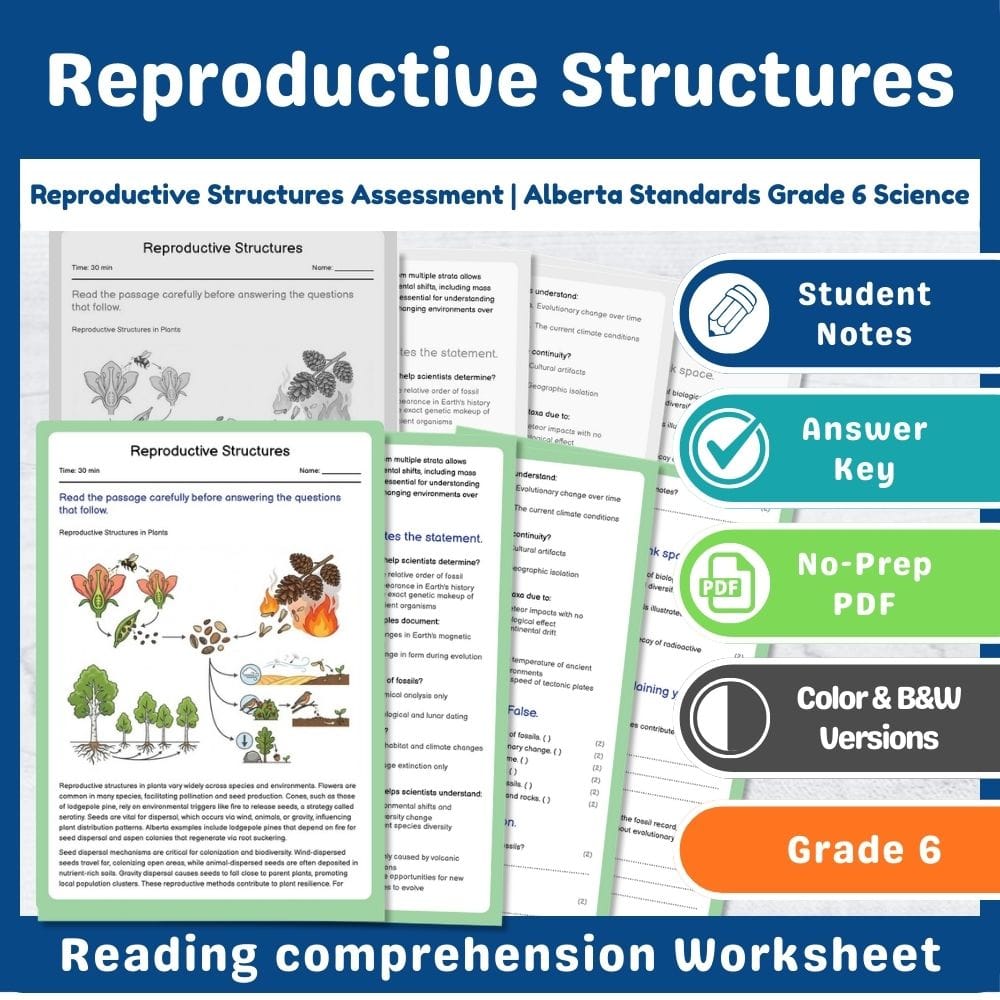
Reproductive Structures Assessment | Alberta Standards Grade 6 Science
Created byPrism Point LearningLearning Objectives
- Understand the role of flowers, cones, and seeds in plant reproduction.
- Identify different seed dispersal mechanisms and their effects on plant colonization.
- Explain how reproductive diversity contributes to population resilience and genetic variation.
Also included in: Lesson Grade 6 Science Mini Bundle Trees and Forests Alberta Standards
Instant download
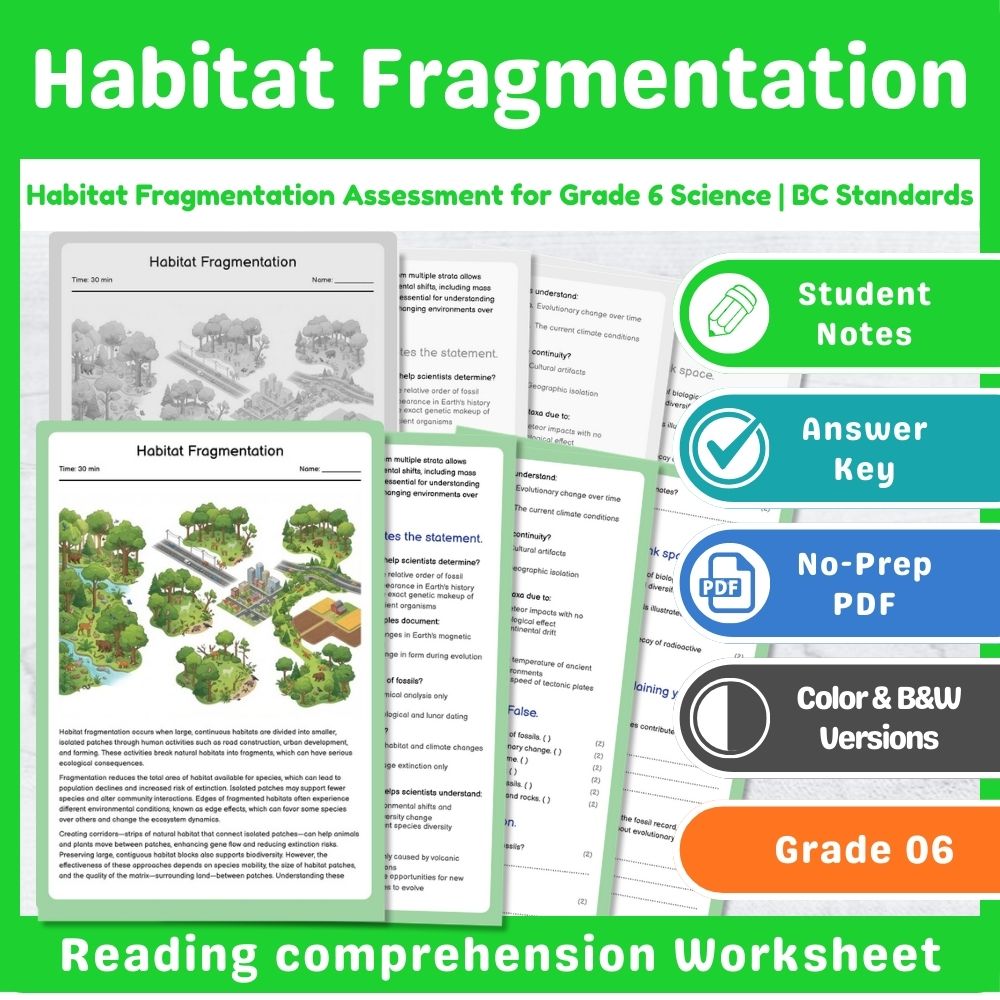
Habitat Fragmentation Assessment for Grade 6 Science | BC Standards
Created byPrism Point LearningLearning Objectives
- Understand what habitat fragmentation is and its causes.
- Identify the effects of habitat fragmentation on species and ecosystems.
- Explain strategies to mitigate habitat fragmentation.
Instant download

Survival Changes Worksheet Grade 6 Science Florida NGSSS Adaptations
Created byPrism Point LearningLearning Objectives
- Explain how survival and reproduction depend on how well traits match current environmental conditions.
- Describe how changes in temperature, drought, or food availability can shift which traits are most helpful.
- Connect adaptation to ecosystem change and resilience over time.
Instant download
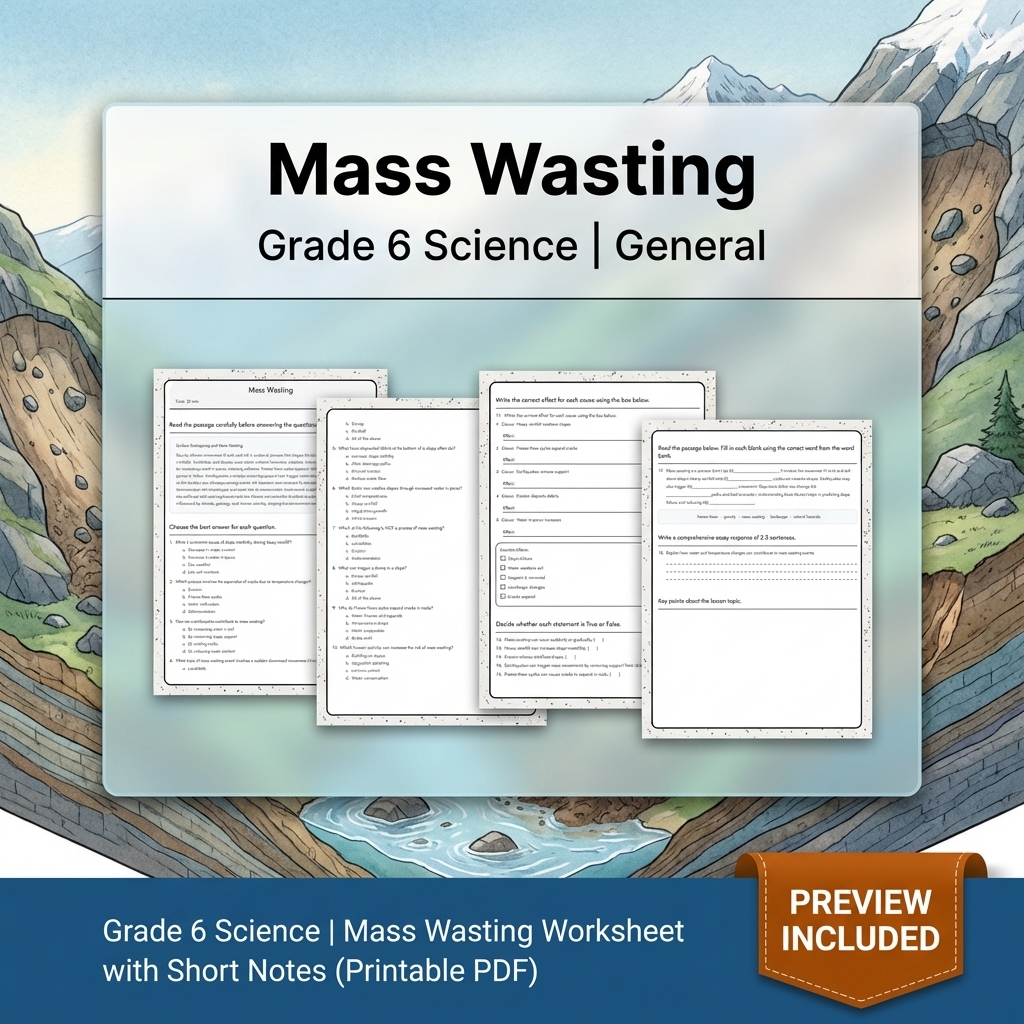
Grade 6 Science | Mass Wasting Worksheet with Short Notes (Printable PDF)
Created byMeadowlark WorksheetsLearning Objectives
- Understand the processes involved in mass wasting and surface reshaping.
- Identify causes and effects of slope instability.
- Describe different types of mass wasting events such as landslides and rockfalls.
Also included in: Grade 6 Science Lesson Group Weather, Water, Space, Erosion & Climate +1 more
Instant download
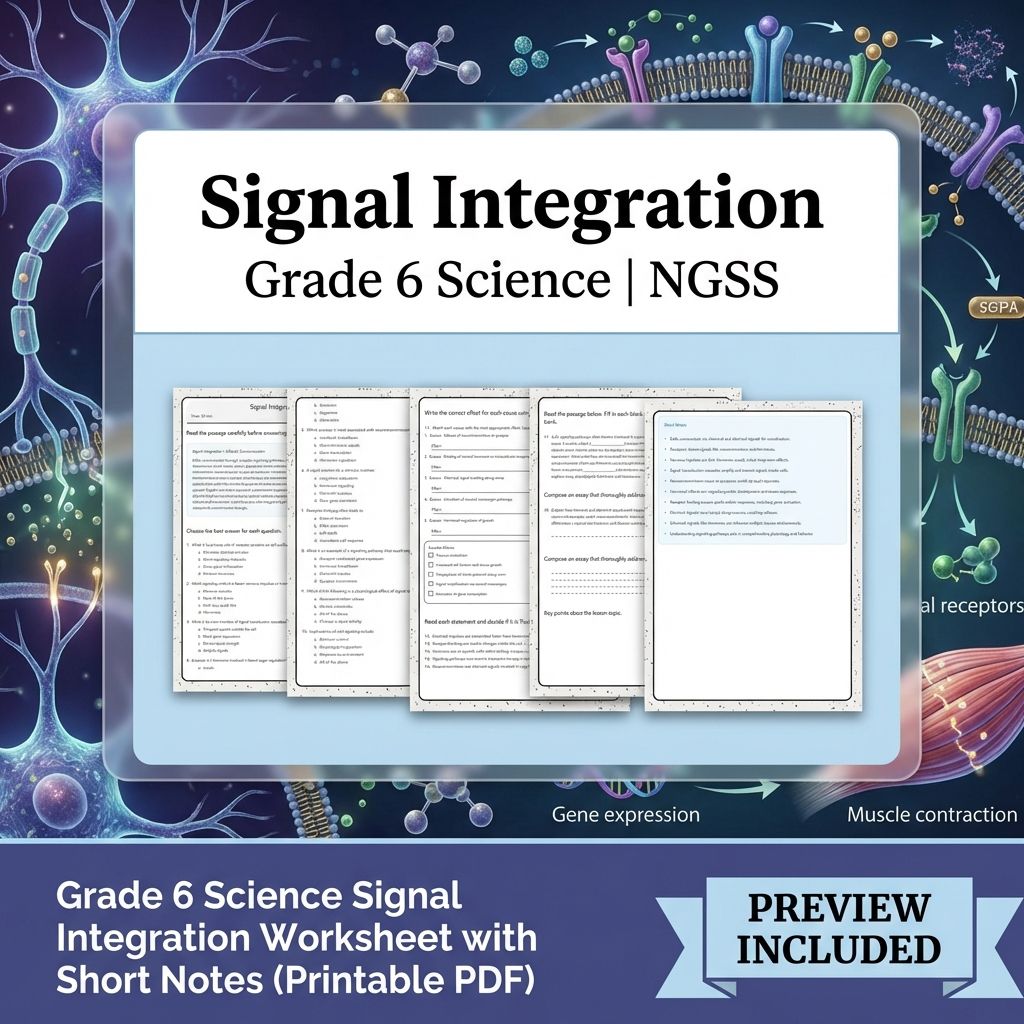
Grade 6 Science Signal Integration Worksheet with Short Notes (Printable PDF)
Created byMeadowlark WorksheetsLearning Objectives
- Understand how cells communicate through chemical and electrical signals.
- Differentiate between rapid nervous impulses and hormonal effects.
- Describe signaling pathways such as neurotransmission, receptor binding, and gene expression.
Also included in: Grade 6 Science NGSS From Molecules to Organisms: Structures & Processes +1 more
Instant download

Matter Cycling Carbon Worksheet | Grade 6 Carbon Cycle Science
Created byPrism Point LearningLearning Objectives
- Explain how carbon moves through air, water, and living organisms in an ecosystem
- Distinguish matter cycling from energy flow in food chains and trophic pathways
- Use carbon-cycle processes (photosynthesis, respiration, decomposition) to describe how matter is reused
Also included in: Animals Matter Lesson Bundle | Grade 6 Science | California Standards
Instant download
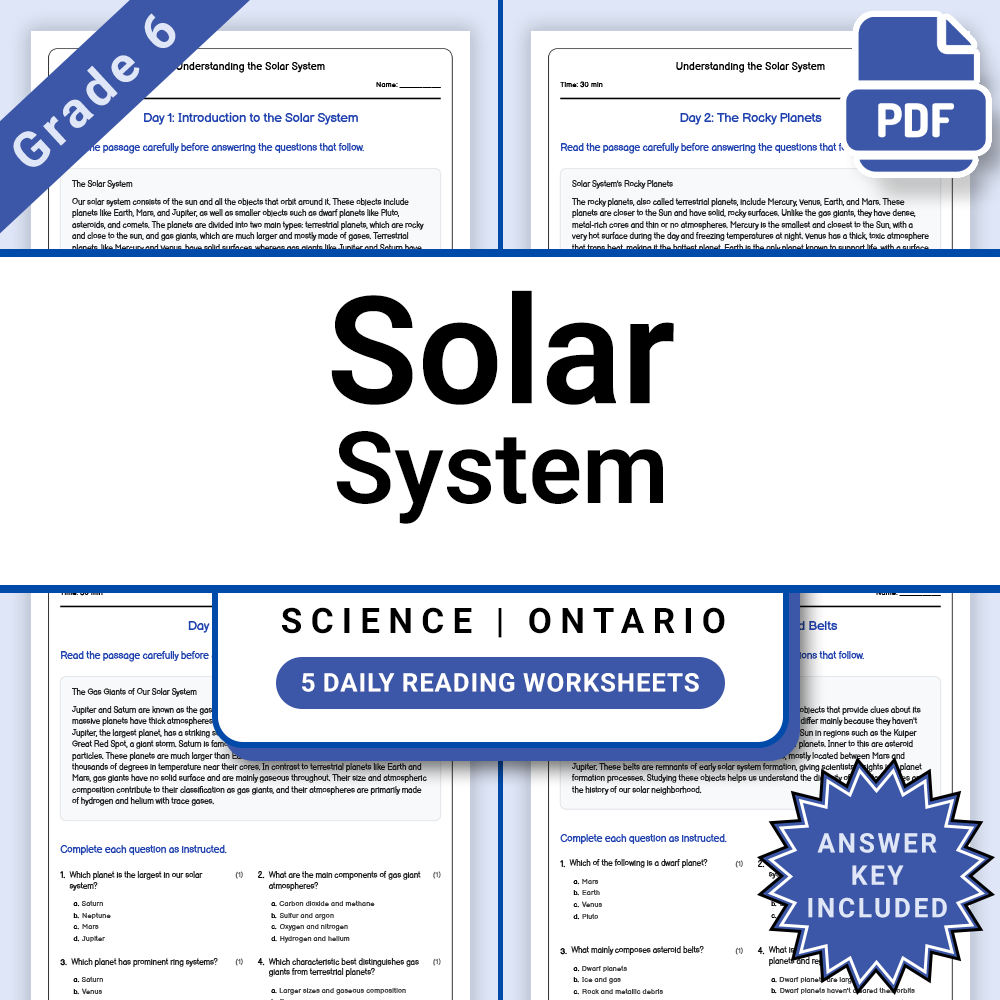
Grade 6 Science – Solar System Daily Reading Worksheet + Answer Key
JCreated byJ.S SheetsLearning Objectives
- Identify the major components of the solar system, including planets, dwarf planets, asteroids, and belts.
- Differentiate between terrestrial and gas giant planets based on their characteristics.
- Understand the concepts of planetary temperature, surface conditions, and habitability in relation to their environments.
Also included in: Grade 6 Science Lesson Bundle | Sun, Earth, Moon & Space Concepts +1 more
Instant download

Grade 6 Comparative Flight Worksheet | Alberta Practice & PDF
Created byClear Sky ClassroomLearning Objectives
- Compare how kites, gliders, and round canopies use lift, drag, and control surfaces to stay in flight.
- Explain how design choices affect glide ratio, lift-to-drag performance, and maneuverability.
- Use quantitative and qualitative evidence to predict likely flight outcomes in Alberta-like conditions.
Also included in: Grade 6 Air and Aerodynamics Science Lesson Bundle (Alberta Framework) +1 more
Instant download

Sustainability Strategies & Resource Use Worksheets Grade 6 Science
 Created bythe curious pencil
Learning Objectives
- Explain how population trends affect resource demand and Earth systems
- Compare renewable energy, conservation, and circular resource strategies
- Describe trade-offs among environmental, social, and economic needs
Also included in: Grade 6 Earth Science Worksheets Bundle | Earth & Human Activity NGSS +2 more
Instant download

Claim Evaluation Worksheet Pack | Grade 6 Science Activities
Created byPrism Point LearningLearning Objectives
- Use criteria to judge whether a scientific claim is supported by the evidence and methods provided.
- Evaluate relevance, consistency with observed patterns, and uncertainty when assessing claims.
- Match the scope of a claim to the strength and limits of the dataset.
Instant download
Browse more categories
About Grade 6 Worksheets
Browse 8,582 printable Grade 6 worksheets across math, ELA, science, and social studies — each a ready-to-print PDF with optional answer keys.
MyTeachingSheets worksheets are made by real teacher-authors and checked before they go live. Download any as a print-ready PDF for lessons, homework, or independent practice — most include answer keys, and previews are always free.