
Science Worksheets
42,859 subject resources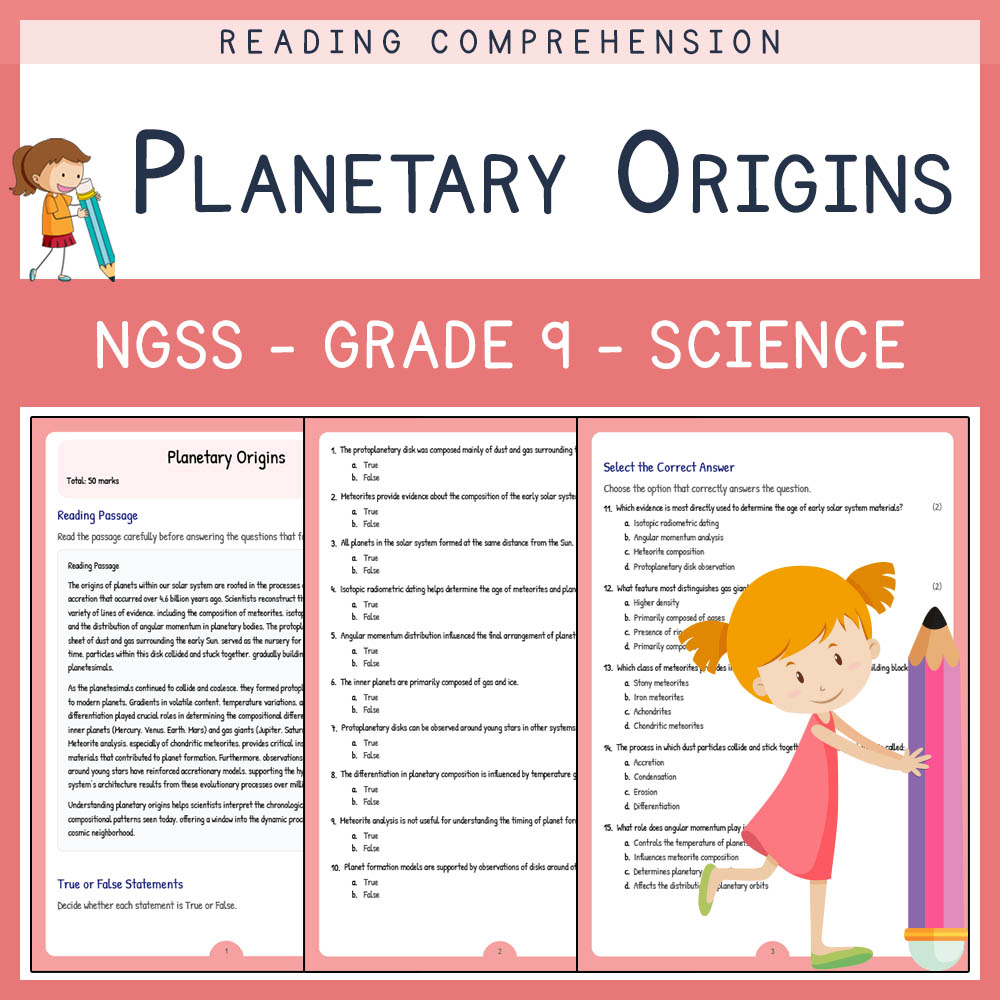
Grade 9 Science | Planetary Origins Worksheet (PDF + Answer Key) for NGSS Alignment
 Created byLumora Learning
Learning Objectives
- Explain the processes involved in the formation of the solar system based on current scientific evidence.
- Identify key features distinguishing inner rocky planets from outer gas giants.
- Describe the role of meteorites and isotopic dating in understanding planetary origins.
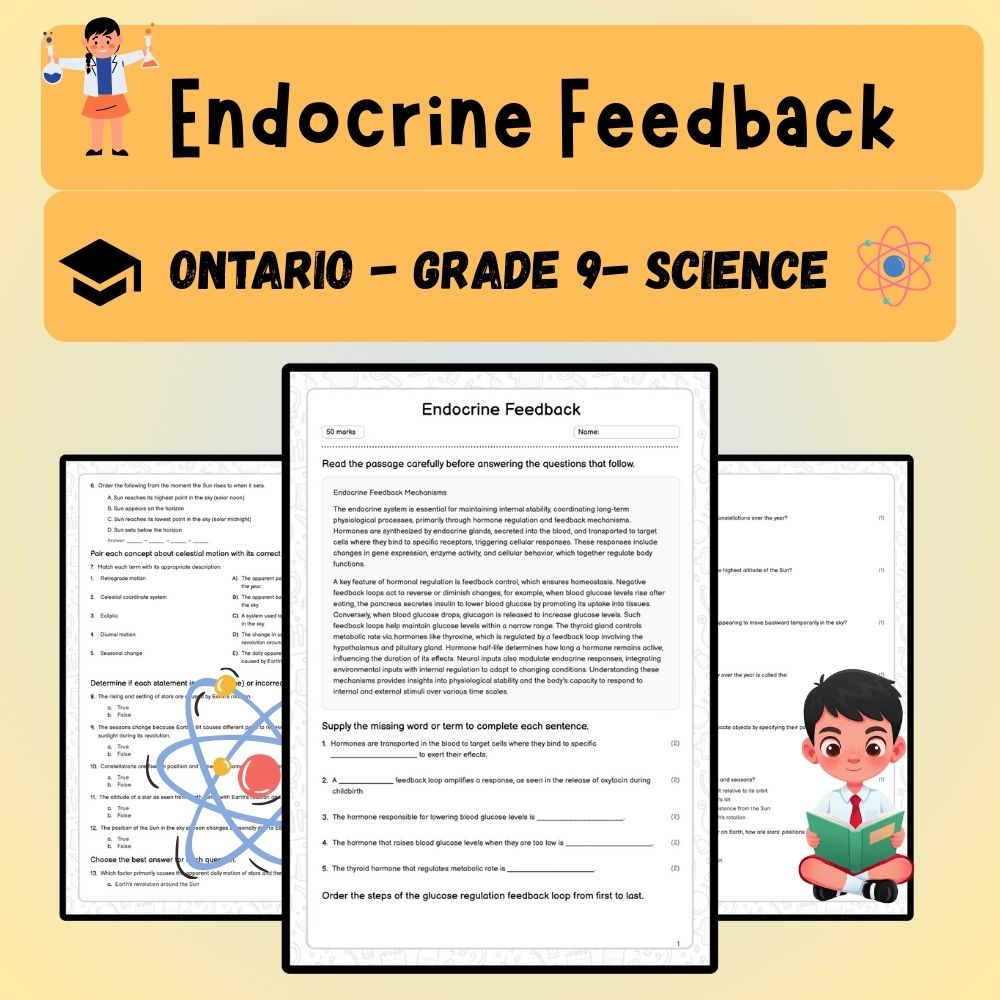
Grade 9 Science – Endocrine Feedback Worksheet (Answer Key) | Ontario Standards
 Created byPrism Point Learning
Learning Objectives
- Understand how hormones regulate physiological processes through feedback loops.
- Identify components of hormonal pathways involved in glucose homeostasis and thyroid control.
- Explain cellular hormone actions including gene expression and enzyme activity changes.
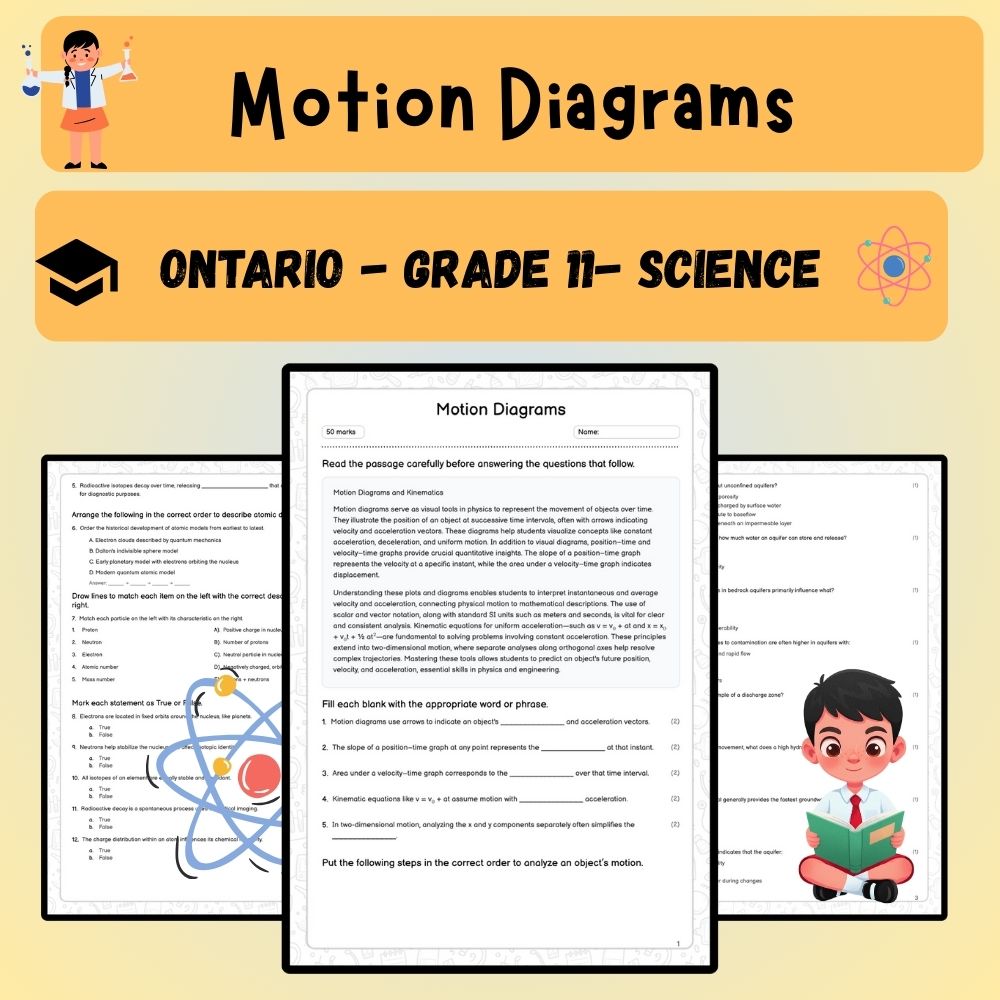
Grade 11 Science | Motion Diagrams Worksheet (PDF) – Ontario Standard Practice
Created byPrism Point LearningLearning Objectives
- Understand how to interpret position, velocity, and acceleration in motion diagrams.
- Analyze and construct velocity–time and position–time plots to determine instantaneous and average quantities.
- Apply kinematic equations for constant acceleration in straight-line motion.
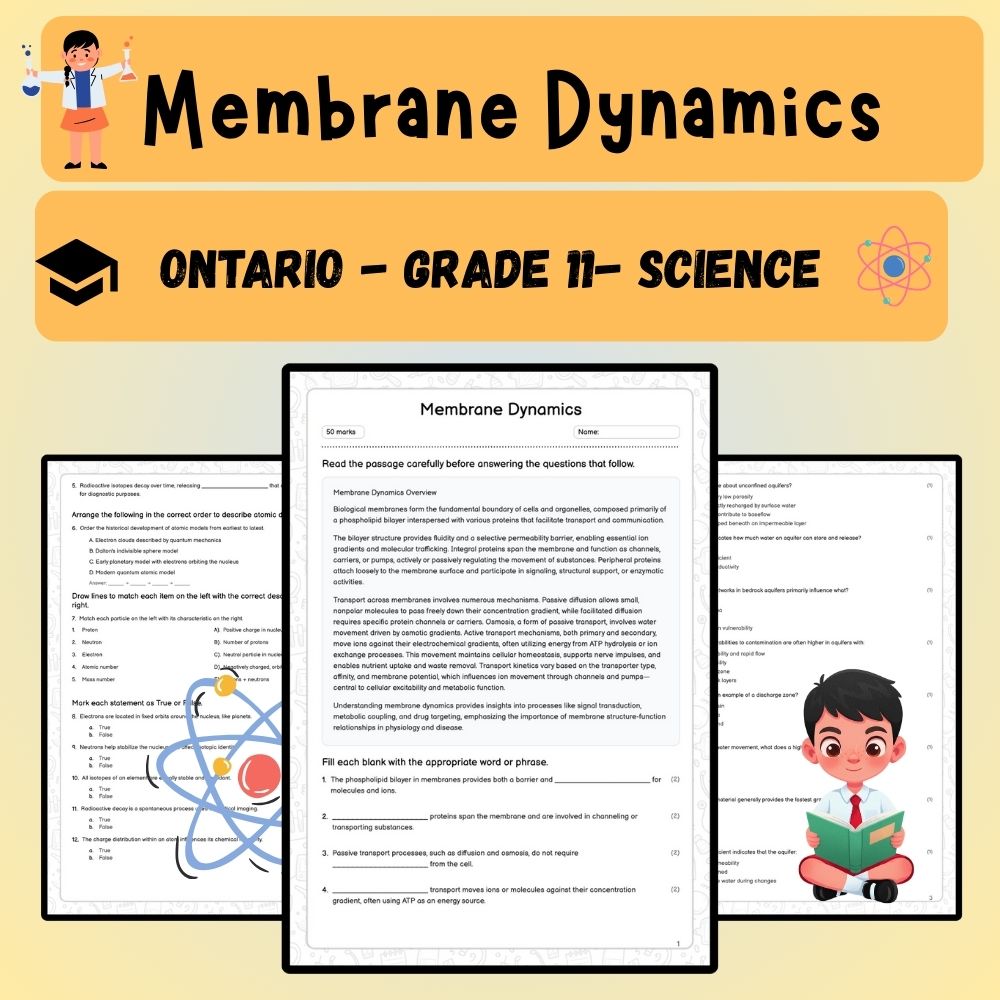
Grade 11 Science | Membrane Dynamics Worksheet (Answer Key) – Ontario Standards
Created byPrism Point LearningLearning Objectives
- Describe the structure and function of biological membranes, including bilayer composition and associated proteins.
- Explain passive and active transport mechanisms across membranes, including diffusion, osmosis, and protein-mediated processes.
- Differentiate between primary and secondary active transport and understand the concept of membrane potential and electrochemical gradients.
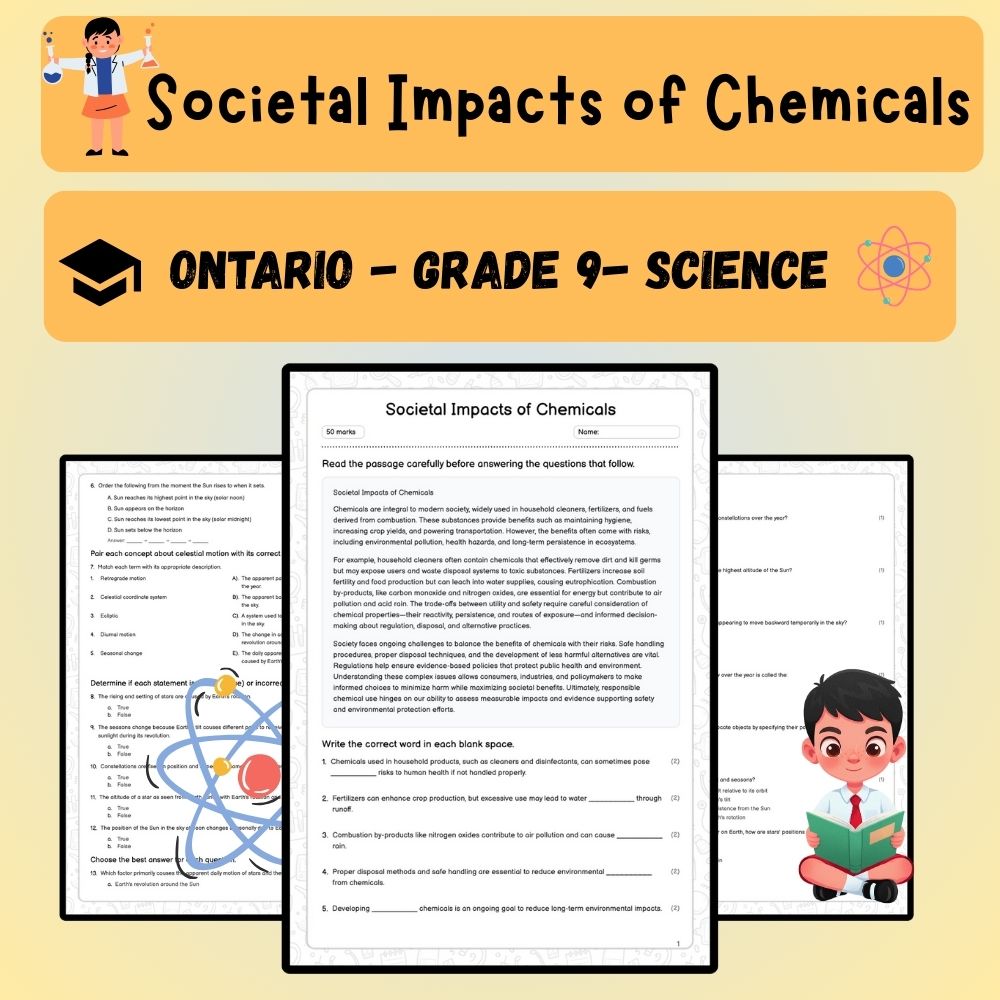
Grade 9 Science | Societal Impacts of Chemicals Worksheet (PDF) - Ontario Standards
Created byPrism Point LearningLearning Objectives
- Analyze the societal uses, benefits, and risks associated with everyday chemicals.
- Evaluate how chemical properties influence environmental persistence and routes of exposure.
- Discuss the importance of safe handling, disposal, and regulation of chemicals in society.
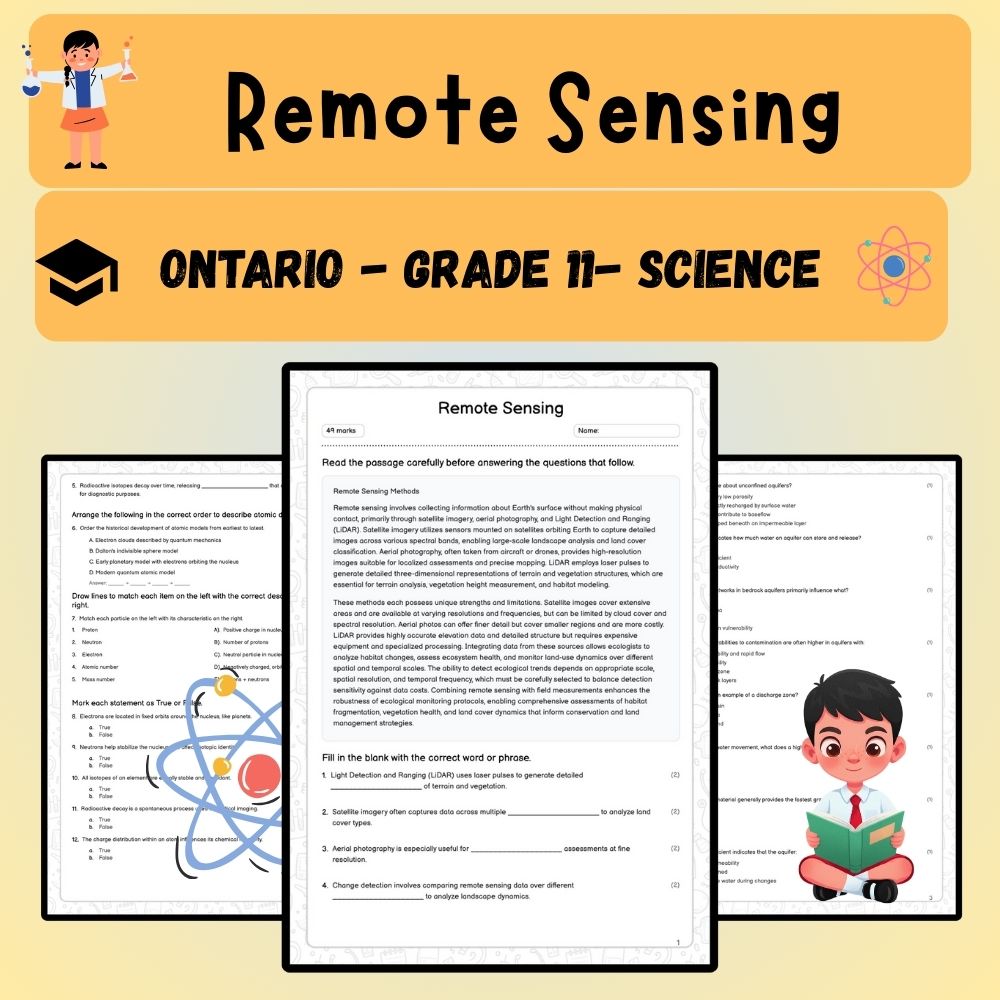
Grade 11 Science | Remote Sensing Worksheet (Worksheet + Answer Key) – Ontario Standards
Created byPrism Point LearningLearning Objectives
- Explain the main methods and technologies used in remote sensing, including satellite imagery, aerial photography, and LiDAR.
- Describe how land cover classification, vegetation indices, and change detection techniques are used for landscape monitoring.
- Evaluate the advantages and limitations of different scales, resolutions, and temporal frequencies in ecological remote sensing.
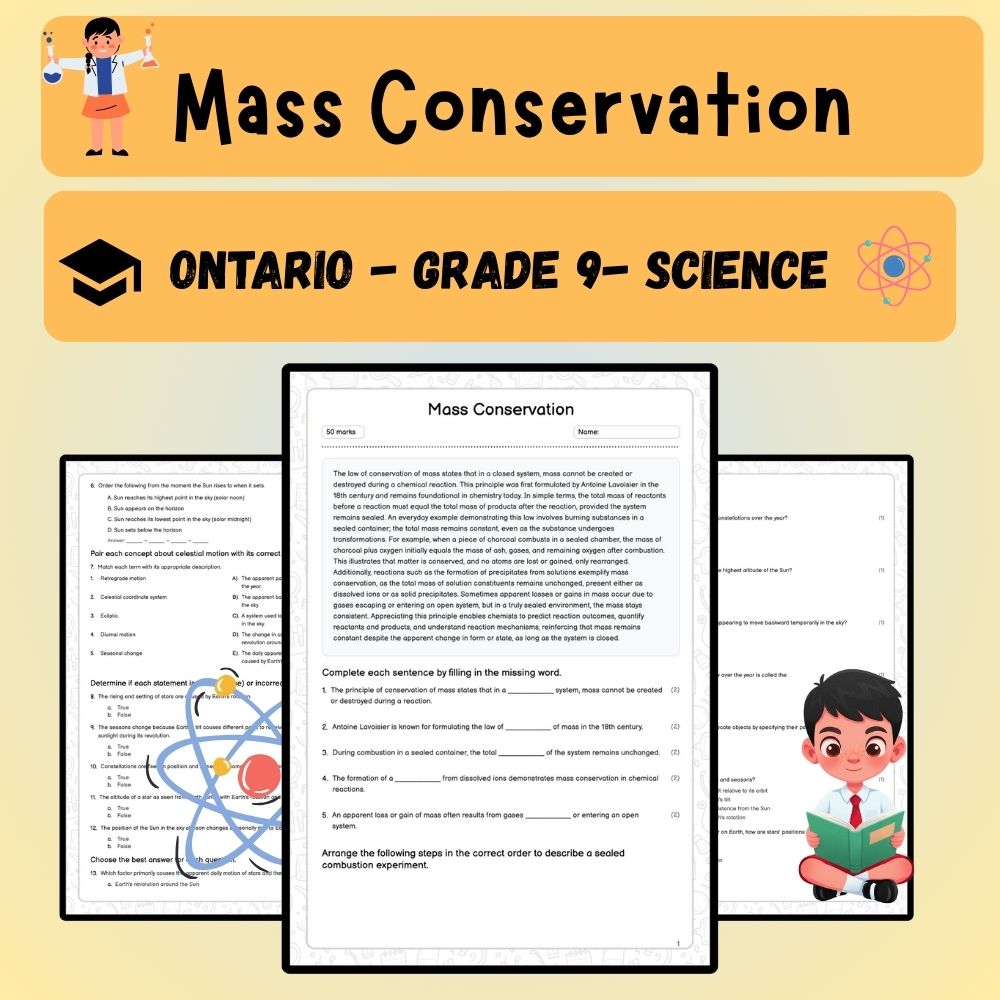
Grade 9 Science | Mass Conservation Worksheet (Answer Key) - Ontario Standards
Created byPrism Point LearningLearning Objectives
- Understand the principle of conservation of mass in closed systems during chemical reactions.
- Identify examples illustrating mass conservation, such as combustion and precipitate formation.
- Differentiate between apparent mass changes due to gas exchange and true mass conservation.
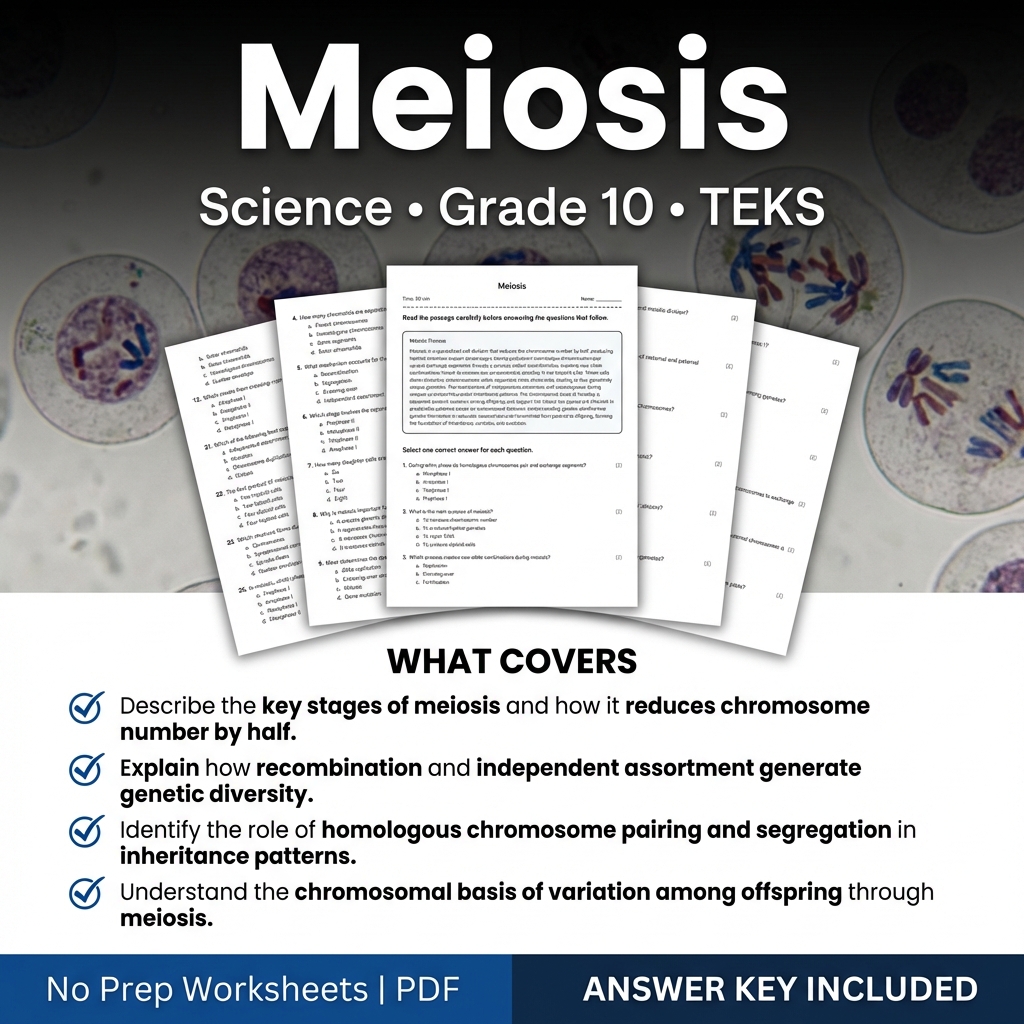
Meiosis Worksheet for Grade 10 Science | TEKS-Aligned Practice
 Created byCoral Reef Learning
Learning Objectives
- Describe the key stages of meiosis and how it reduces chromosome number by half.
- Explain how recombination and independent assortment generate genetic diversity.
- Identify the role of homologous chromosome pairing and segregation in inheritance patterns.
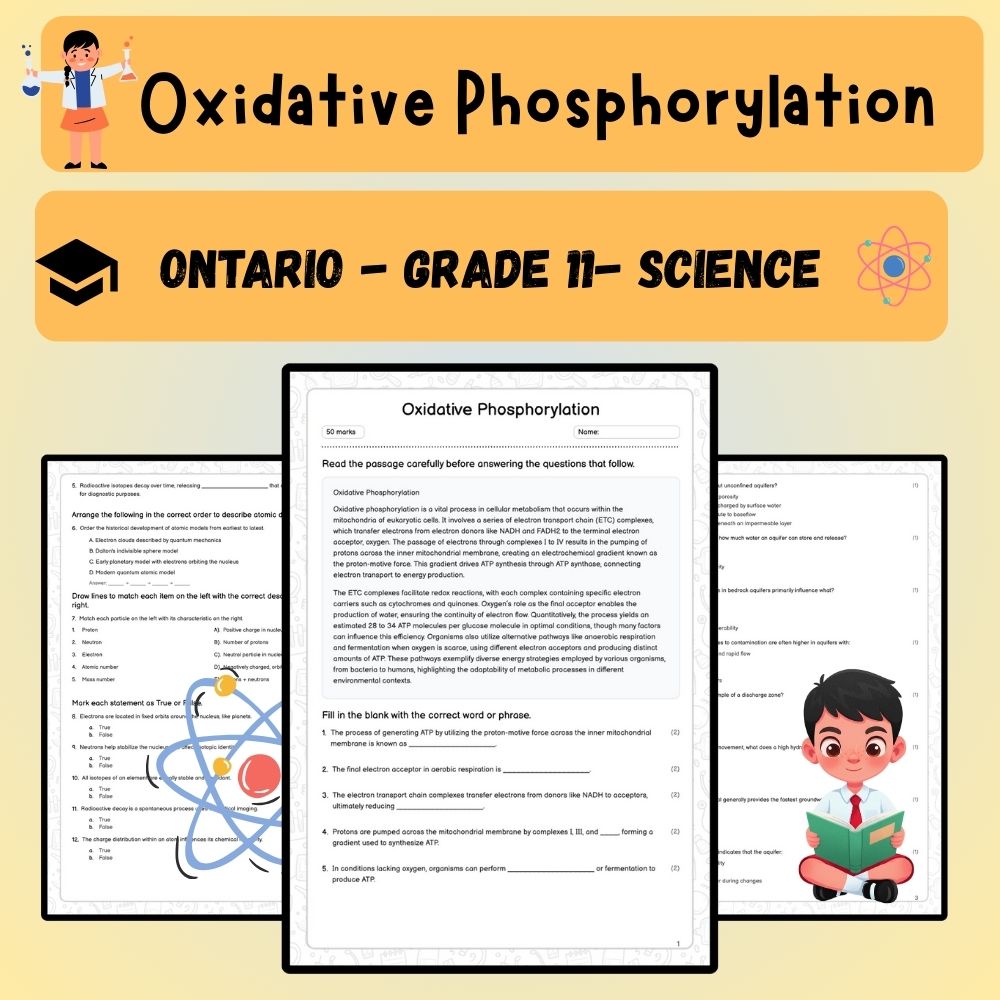
Grade 11 Science – Oxidative Phosphorylation – Ontario Standards
Created byPrism Point LearningLearning Objectives
- Describe the components and sequence of the electron transport chain complexes involved in oxidative phosphorylation.
- Explain the mechanism of proton-motive force generation and ATP synthesis via chemiosmotic coupling.
- Identify the roles of electron donors and acceptors, including the function of oxygen as the terminal acceptor.
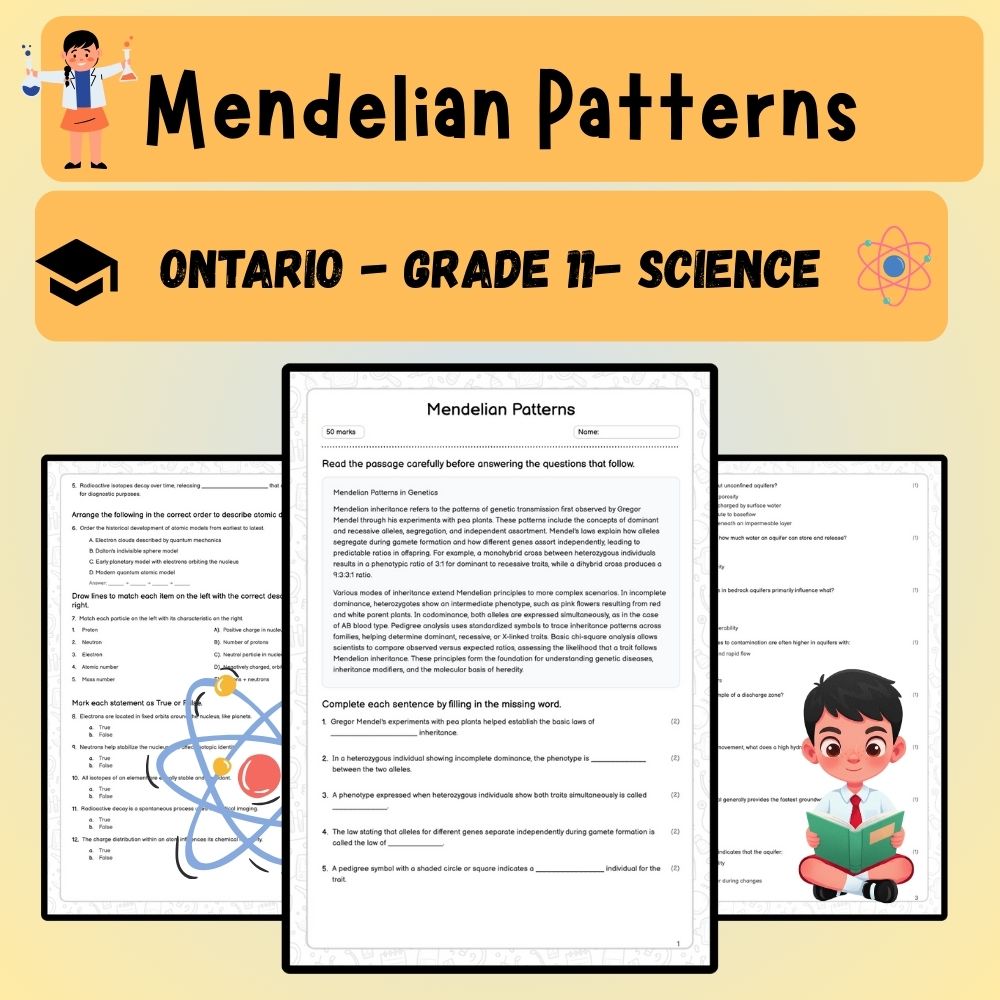
Grade 11 Science – Mendelian Patterns Worksheet (Answer Key) | Ontario Standards
Created byPrism Point LearningLearning Objectives
- Describe monohybrid and dihybrid inheritance patterns and their phenotypic ratios.
- Explain segregation and independent assortment in inheritance.
- Differentiate between dominant, recessive, incomplete dominance, and codominance scenarios with genetic notation.
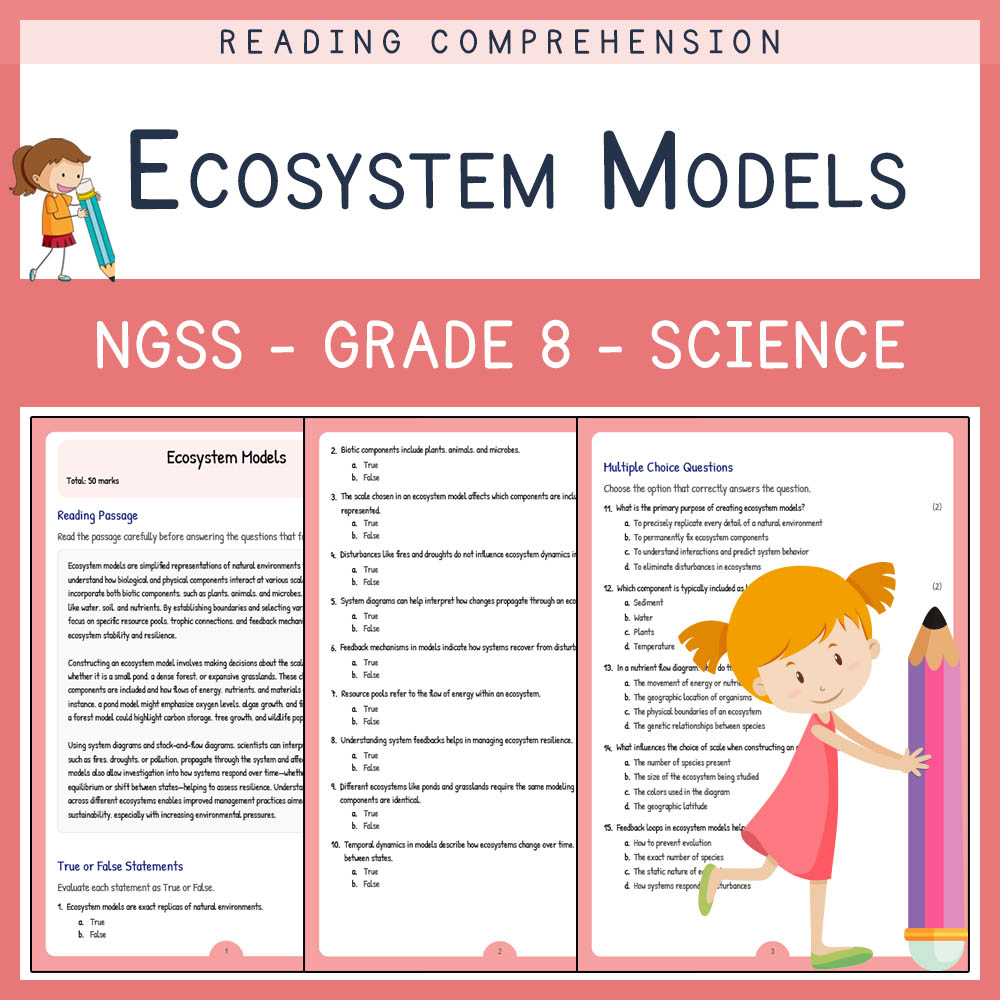
Grade 8 Science | Ecosystem Models Worksheet + Answer Key for NGSS Alignment
Created byLumora LearningLearning Objectives
- Understand the components of ecosystem models, including biotic and abiotic factors.
- Interpret how energy and nutrient flows propagate through ecosystems using stock-and-flow diagrams.
- Evaluate the influence of boundaries, scale, and variables in representing resource pools and trophic connections.
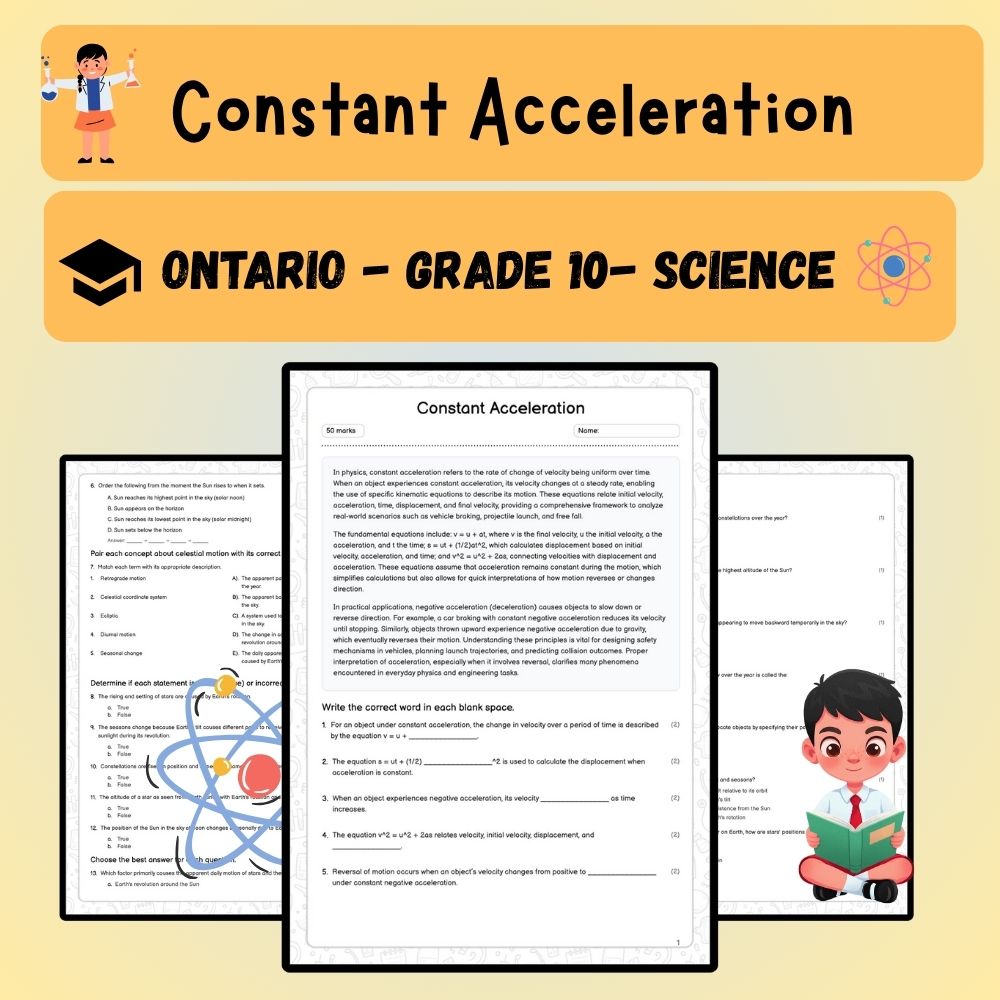
Grade 10 Science | Constant Acceleration Worksheet (PDF) – Ontario Standard
Created byPrism Point LearningLearning Objectives
- Understand the kinematic equations related to uniformly accelerated motion.
- Interpret and analyze motion scenarios with varying initial velocities, displacements, and times.
- Apply algebraic formulas to solve problems involving acceleration, velocity, and displacement.
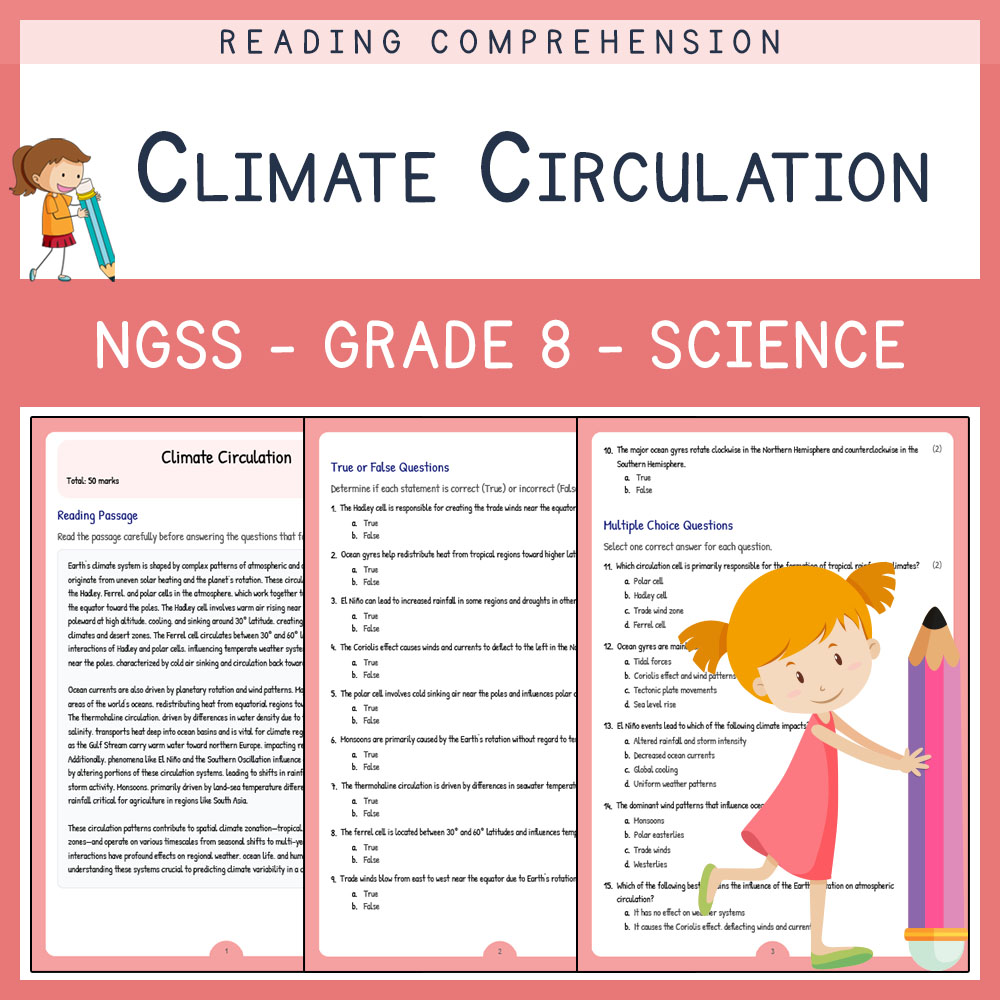
Grade 8 Science | Climate Circulation Worksheet (Answer Key) for NGSS Alignment
Created byLumora LearningLearning Objectives
- Explain the main atmospheric circulation cells and their roles in distributing heat around the planet.
- Describe how ocean currents like gyres and thermohaline circulation influence regional climates.
- Analyze the connection between circulation patterns like trade winds, monsoons, and El Niño with climate variability.
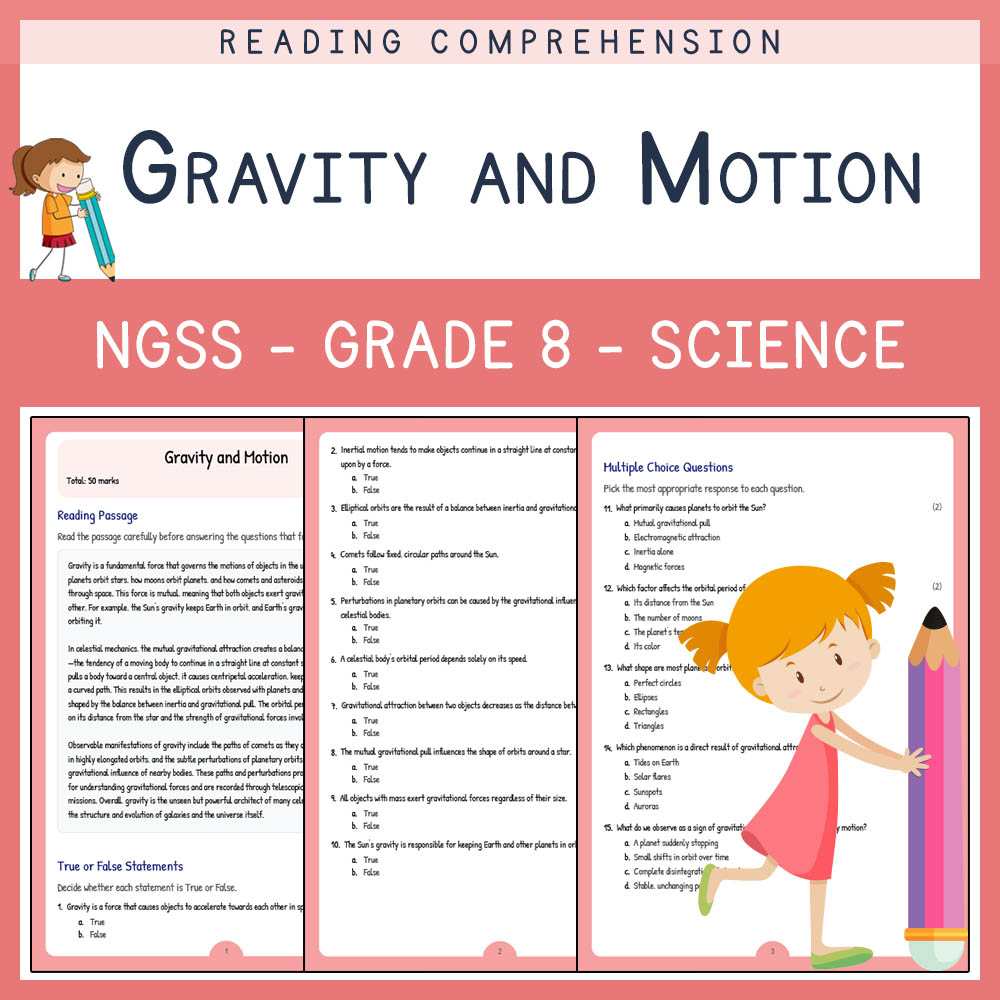
Grade 8 Science | Gravity and Motion Worksheet (PDF Answer Key & Rubric)
Created byLumora LearningLearning Objectives
- Understand how gravity influences the orbital motions of celestial bodies within the solar system and galaxies.
- Explain the concepts of mutual gravitational attraction and centripetal acceleration.
- Describe how the balance between inertia and gravity results in elliptical orbits.
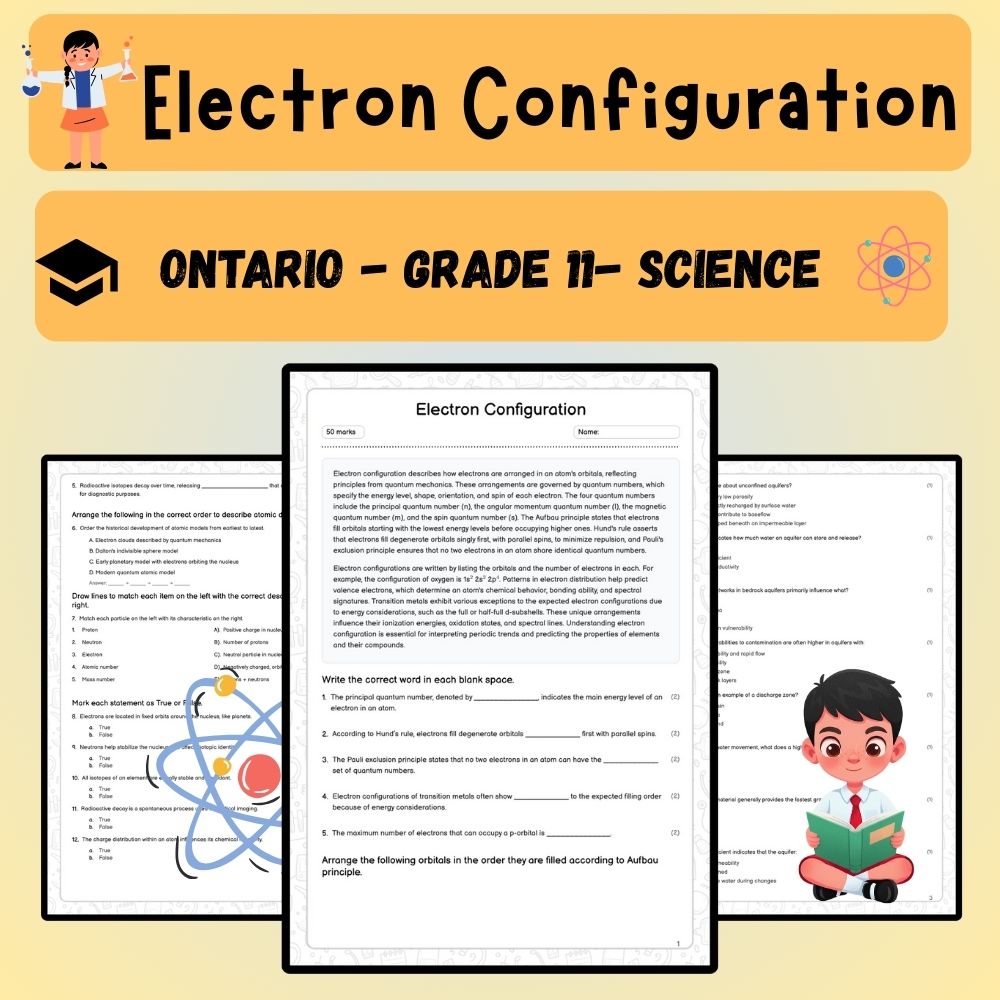
Grade 11 Science | Electron Configuration Worksheet (PDF) – Ontario Standards
Created byPrism Point LearningLearning Objectives
- Understand the principles of quantum numbers and their relation to electron arrangements in atoms.
- Explain orbital notation, Aufbau principle, Hund's rule, and Pauli exclusion principle in electron configuration.
- Identify patterns in electron configurations and relate them to valence electrons and chemical properties.
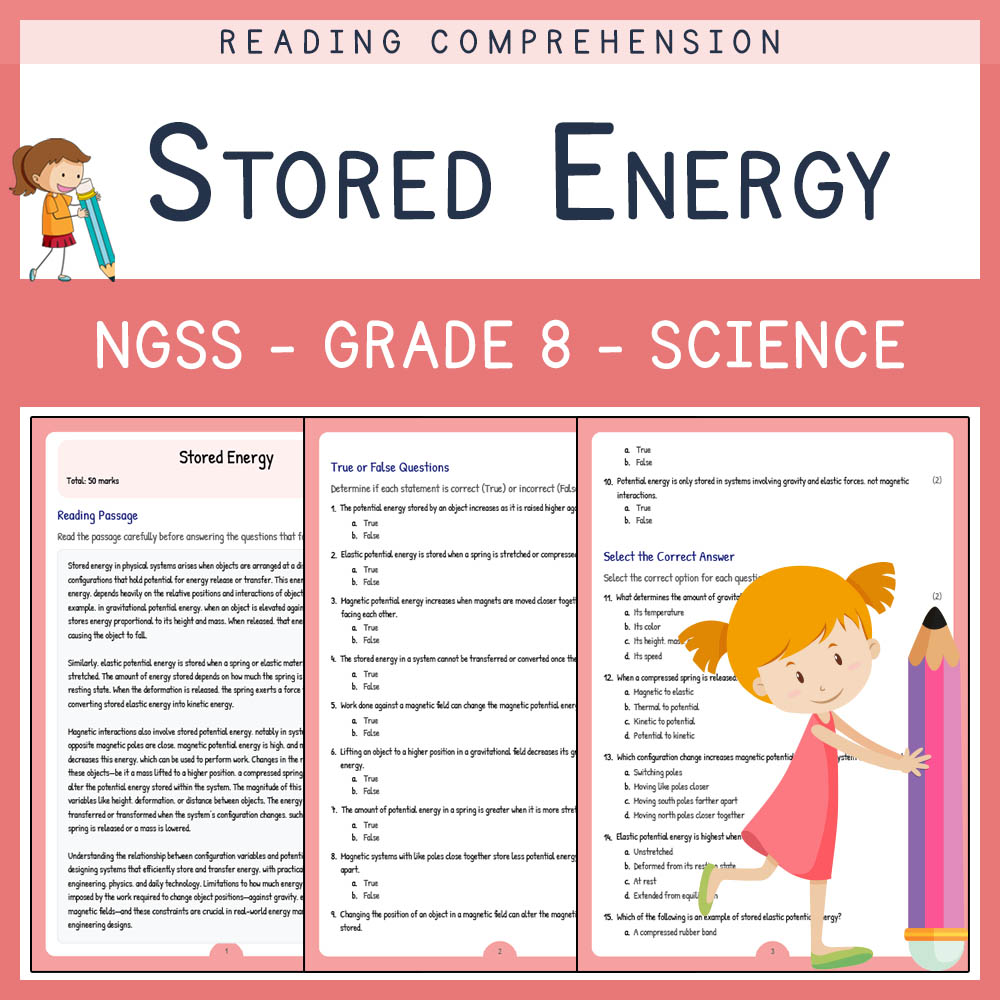
Grade 8 Science | Stored Energy Worksheet & Answer Key (NGSS Aligned)
Created byLumora LearningLearning Objectives
- Understand the concept of potential energy stored through objects interacting at a distance, including gravitational, elastic, and magnetic energy.
- Identify how changes in the relative positions of objects affect their stored energy and the work done during these changes.
- Apply the principles of stored energy to real-world systems such as springs, elevated masses, and magnets.
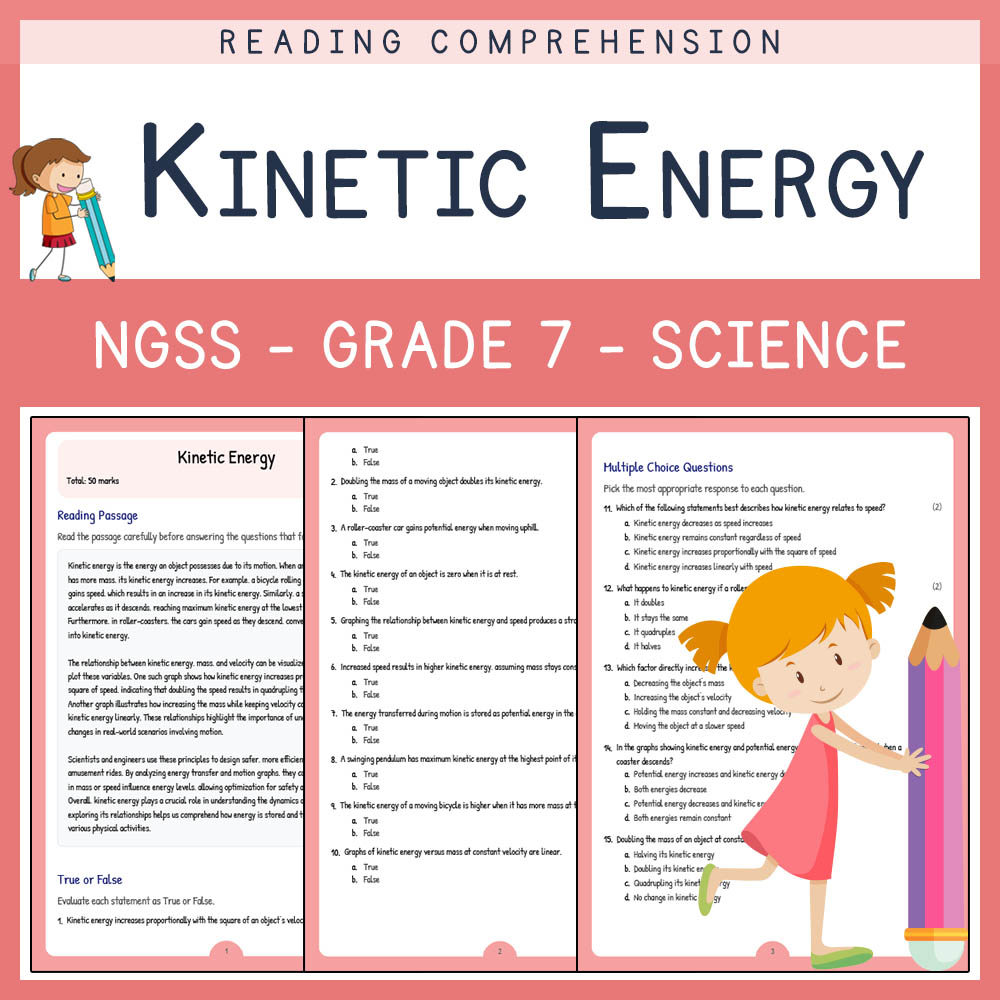
Grade 7 Science | Kinetic Energy Worksheet & Answer Key (NGSS-Aligned)
Created byLumora LearningLearning Objectives
- Construct and interpret graphical relationships between kinetic energy, potential energy, mass, and speed.
- Analyze how doubling the mass or speed of an object affects its kinetic energy through quantitative comparisons and graphs.
- Apply energy calculation formulas to real-world motion scenarios such as rolling bicycles, swinging pendulums, and roller-coaster cars.
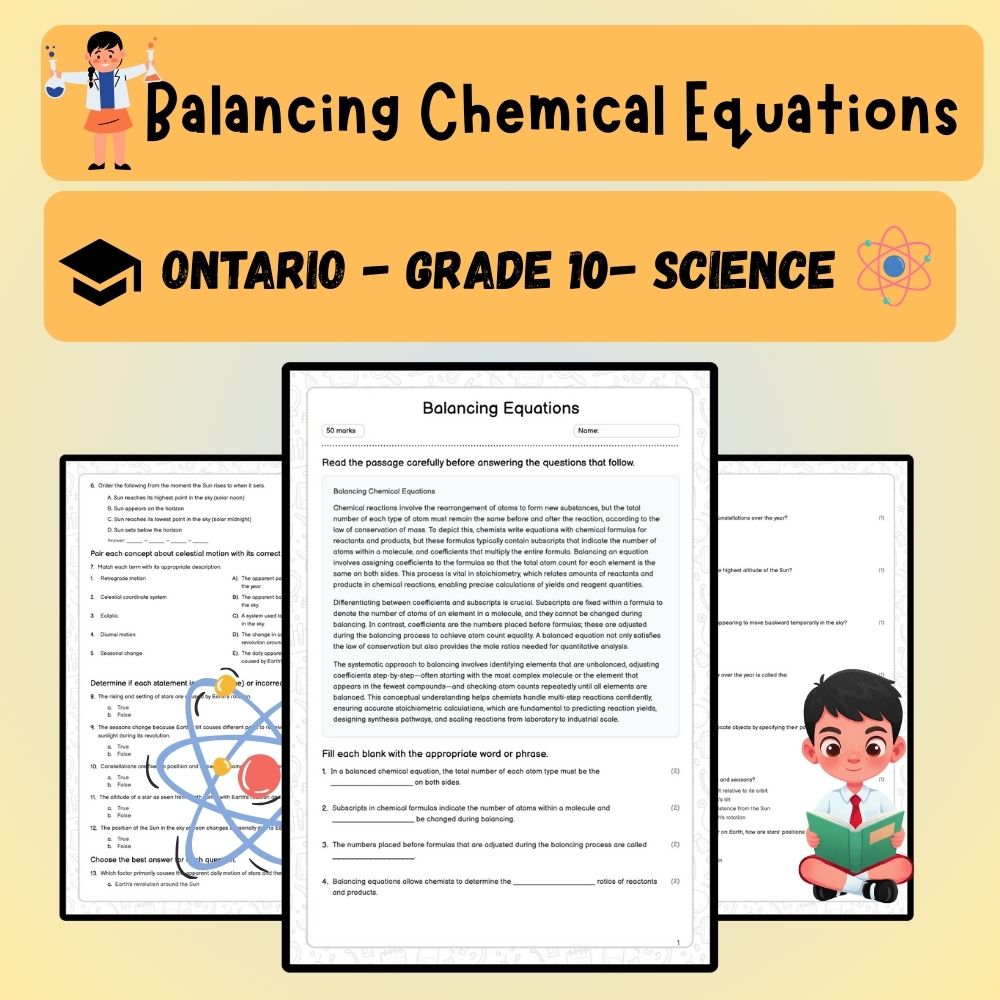
Grade 10 Science | Balancing Chemical Equations Worksheet (Answer Key) – Ontario Standards
Created byPrism Point LearningLearning Objectives
- Understand the concept of balancing chemical equations based on conservation of mass.
- Differentiate between coefficients and subscripts in chemical formulas.
- Apply systematic strategies to balance multi-step chemical equations.
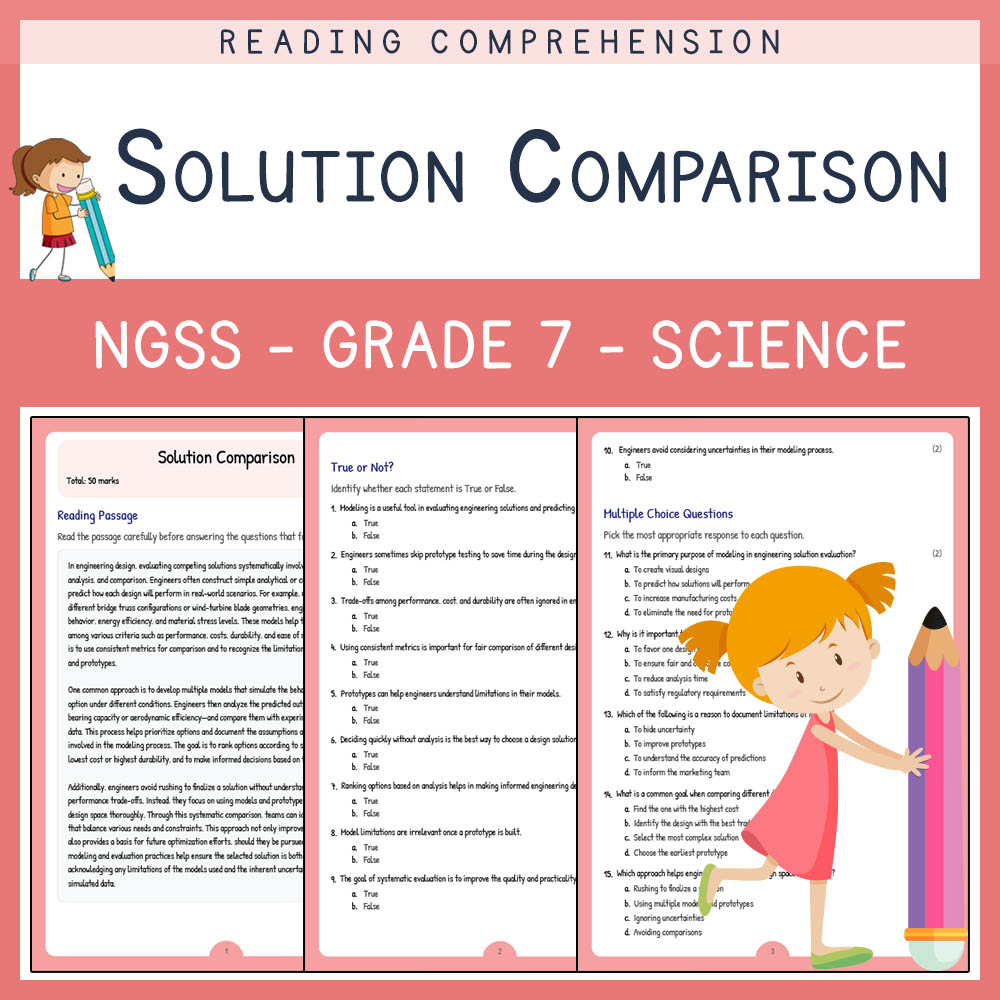
Grade 7 Science | Solution Comparison Worksheet NGSS-Aligned (PDF + Answer Key)
Created byLumora LearningLearning Objectives
- Understand how to systematically evaluate different design solutions through modeling and analysis.
- Identify and quantify trade-offs among performance, cost, durability, and manufacturability in engineering solutions.
- Apply metrics and model-based reasoning to rank design options and recognize limitations without final optimization.
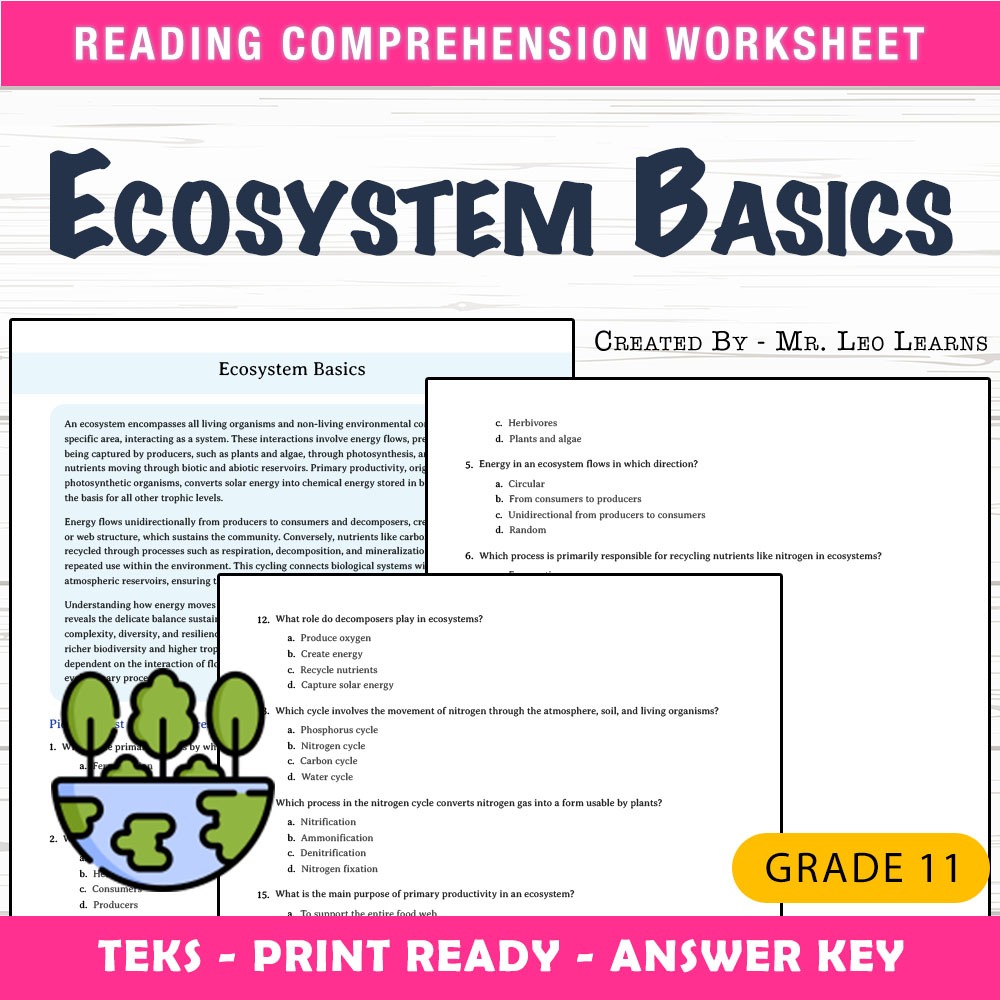
Grade 11 Science — Ecosystem Basics Worksheet for Mastering Key Concepts
 Created byThe Resource Hub
Learning Objectives
- Define the components and functions of an ecosystem.
- Describe energy flow and nutrient cycling within ecosystems.
- Explain the significance of primary productivity as the foundation of ecological communities.
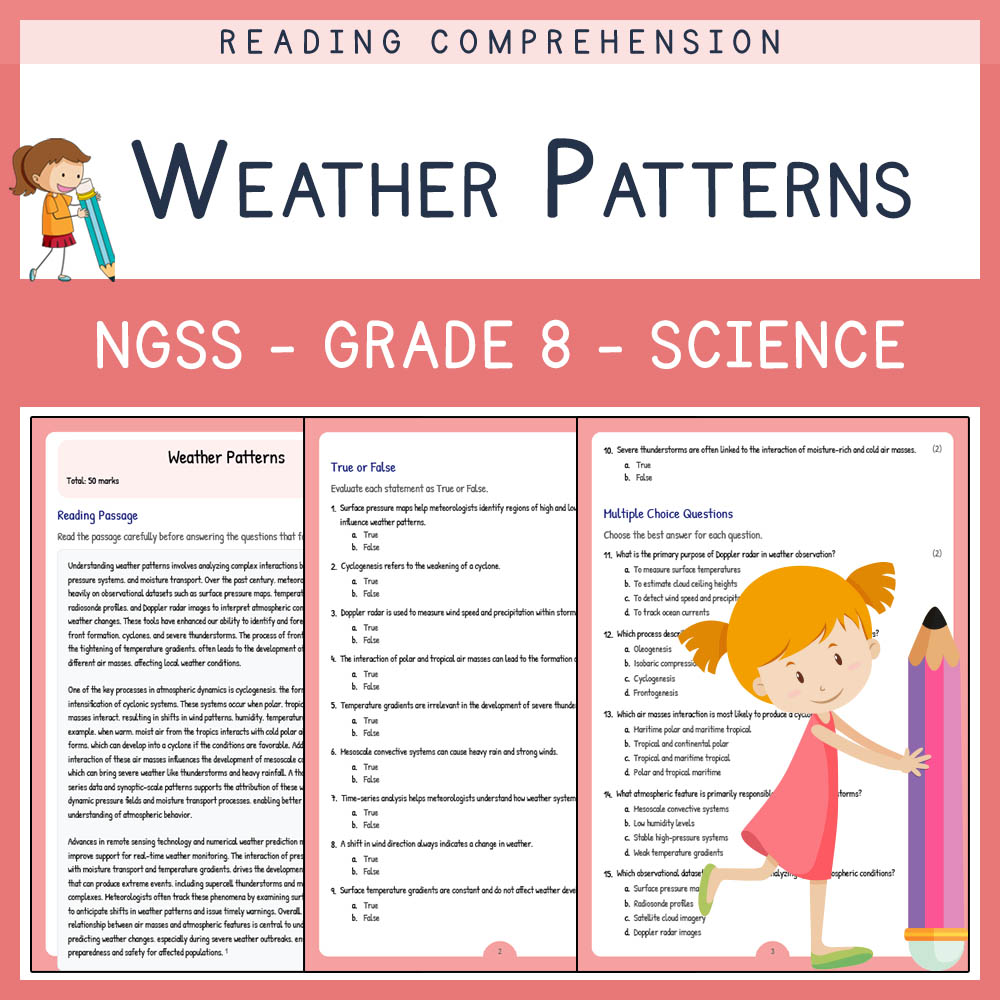
Grade 8 Science | Weather Patterns Worksheet & Answer Key (NGSS-Aligned)
Created byLumora LearningLearning Objectives
- Explain how air mass interactions influence weather changes.
- Identify key atmospheric features associated with cyclogenesis and frontogenesis.
- Analyze observational datasets such as pressure maps and Doppler radar to interpret weather systems.
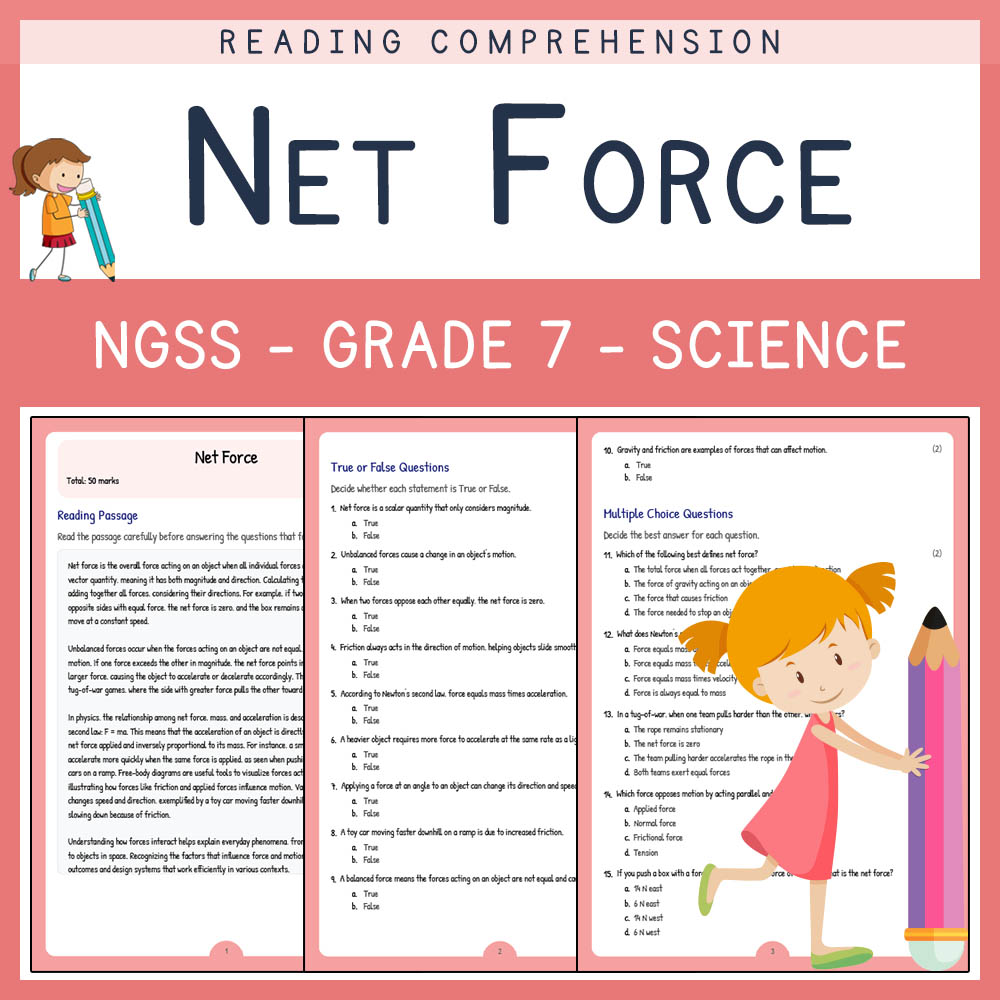
Grade 7 Science | Net Force Worksheet & Answer Key | NGSS Aligned
Created byLumora LearningLearning Objectives
- Define net force as the vector sum of all forces acting on an object.
- Explain how unbalanced forces produce changes in an object's motion.
- Understand the relationship between net force, mass, and acceleration using free-body diagrams.
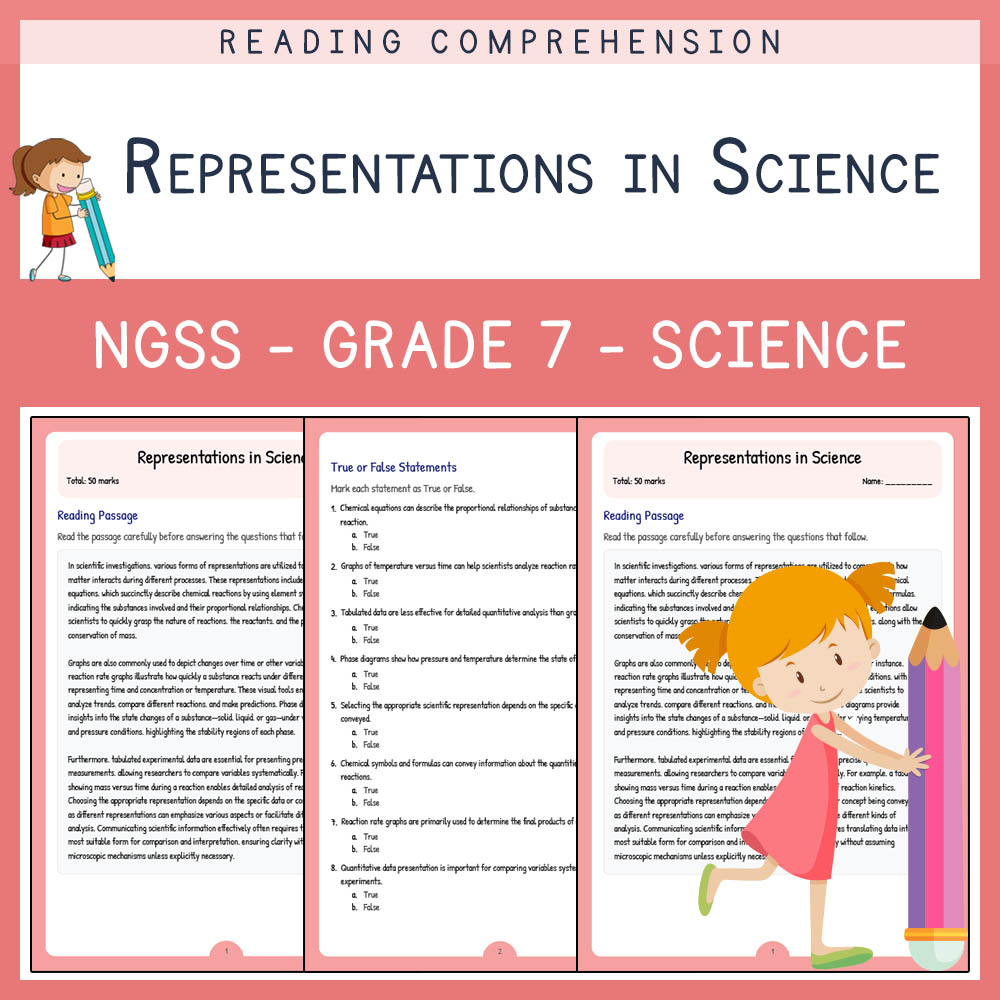
Grade 7 Science | Representations in Science Worksheet (Answer Key & Rubric)
Created byLumora LearningLearning Objectives
- Explain how different representations such as chemical equations, graphs, and tables convey matter interactions.
- Interpret scientific graphs, such as reaction rate graphs and phase diagrams.
- Identify appropriate representations for comparing quantitative data in scientific contexts.
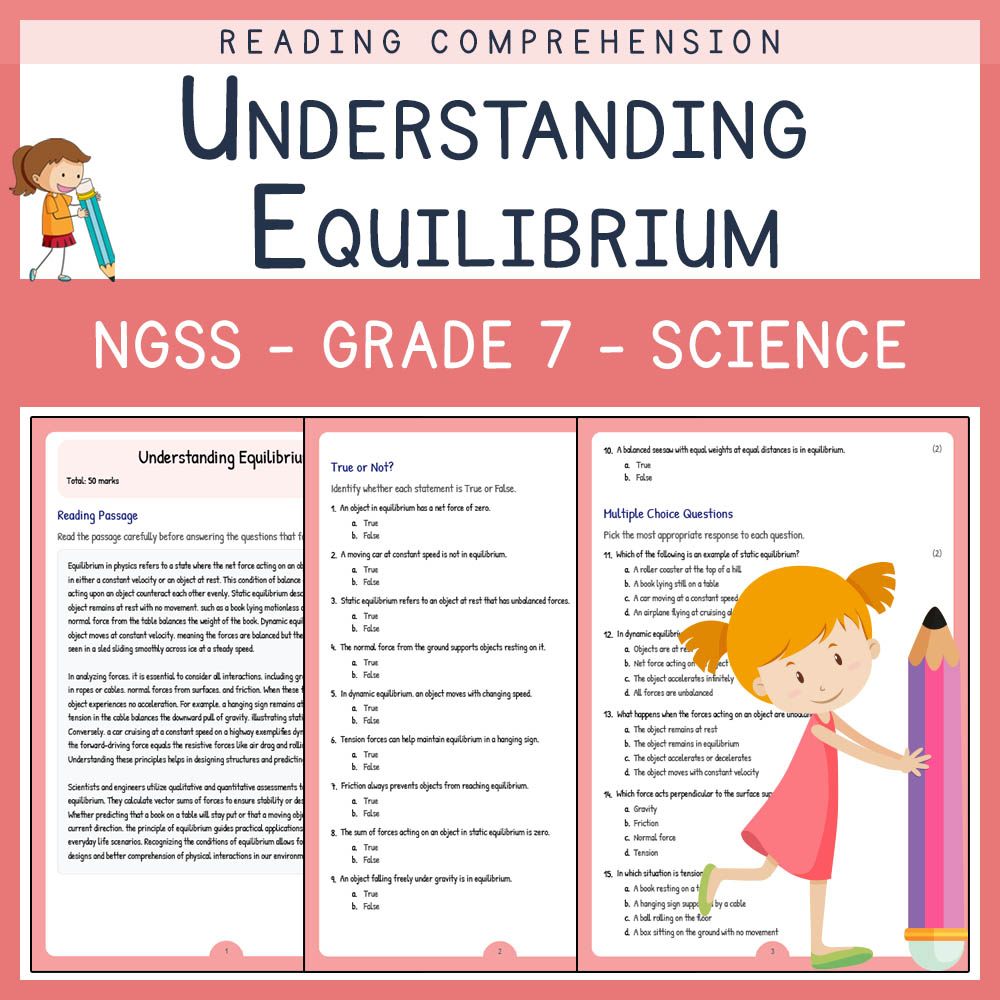
Grade 7 Science | Understanding Equilibrium Worksheet & Answer Key (PDF)
Created byLumora LearningLearning Objectives
- Explain the concept of equilibrium as the balance of forces in an object.
- Differentiate between static and dynamic equilibrium with real-world examples.
- Describe the roles of normal, gravitational forces, tension, and net zero acceleration in equilibrium.
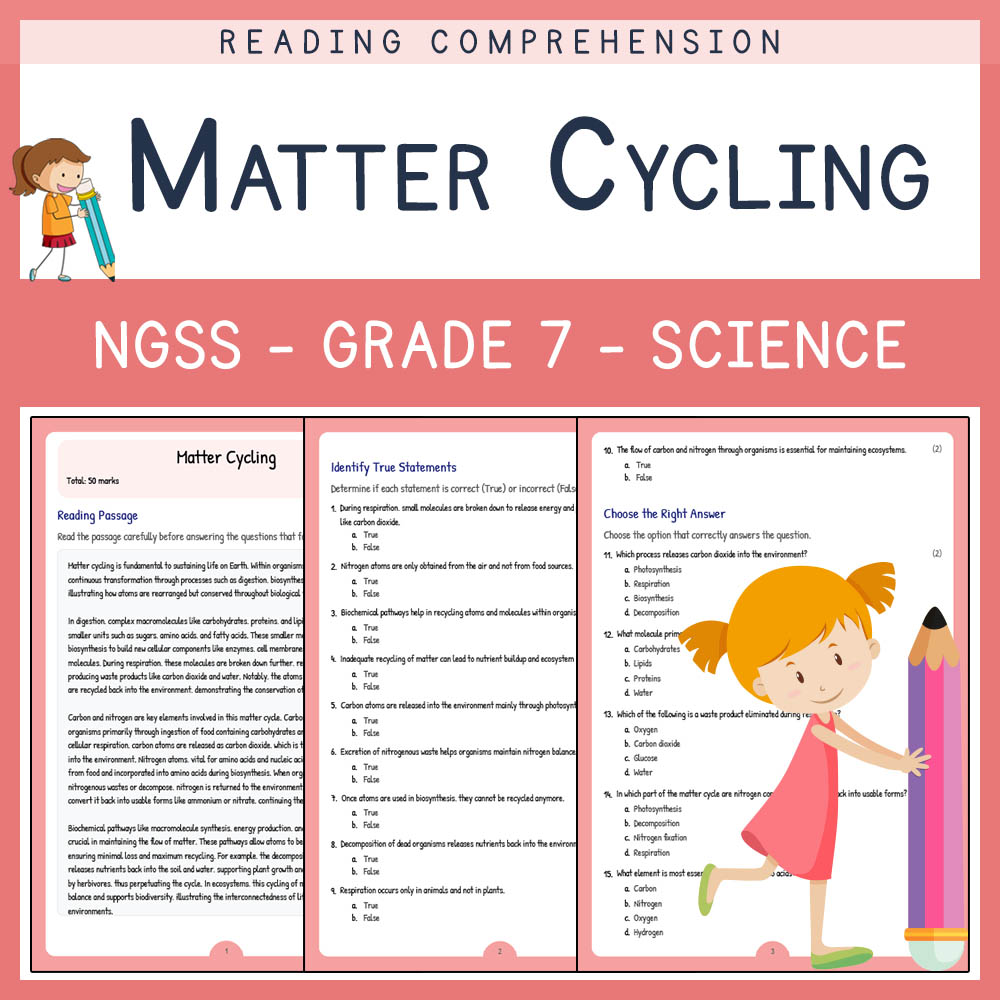
Grade 7 Science | Matter Cycling Worksheet + Answer Key – NGSS Aligned
Created byLumora LearningLearning Objectives
- Describe the process of matter cycling within organisms, including digestion, biosynthesis, and respiration.
- Explain the conservation of matter during biochemical pathways such as macromolecule synthesis and decomposition.
- Identify how carbon and nitrogen flow through organisms and are eventually released or excreted.
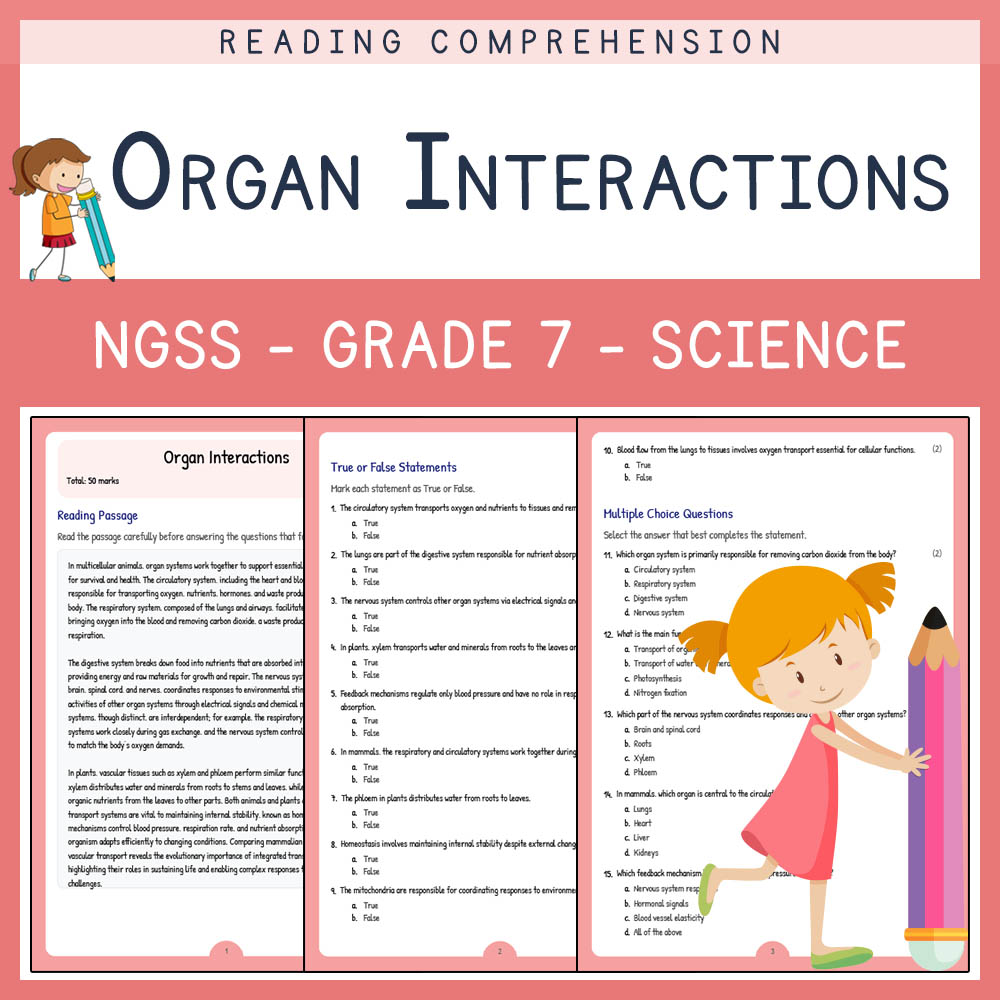
Grade 7 Science | Organ Interactions Worksheet (Answer Key) for NGSS Alignment
Created byLumora LearningLearning Objectives
- Describe the major organ systems involved in circulation, respiration, digestion, and nervous regulation in multicellular animals.
- Explain how different organ systems cooperate to maintain homeostasis and support gas exchange, nutrient distribution, and feedback mechanisms.
- Compare the organ system interactions in human mammals and plant vascular transport systems.
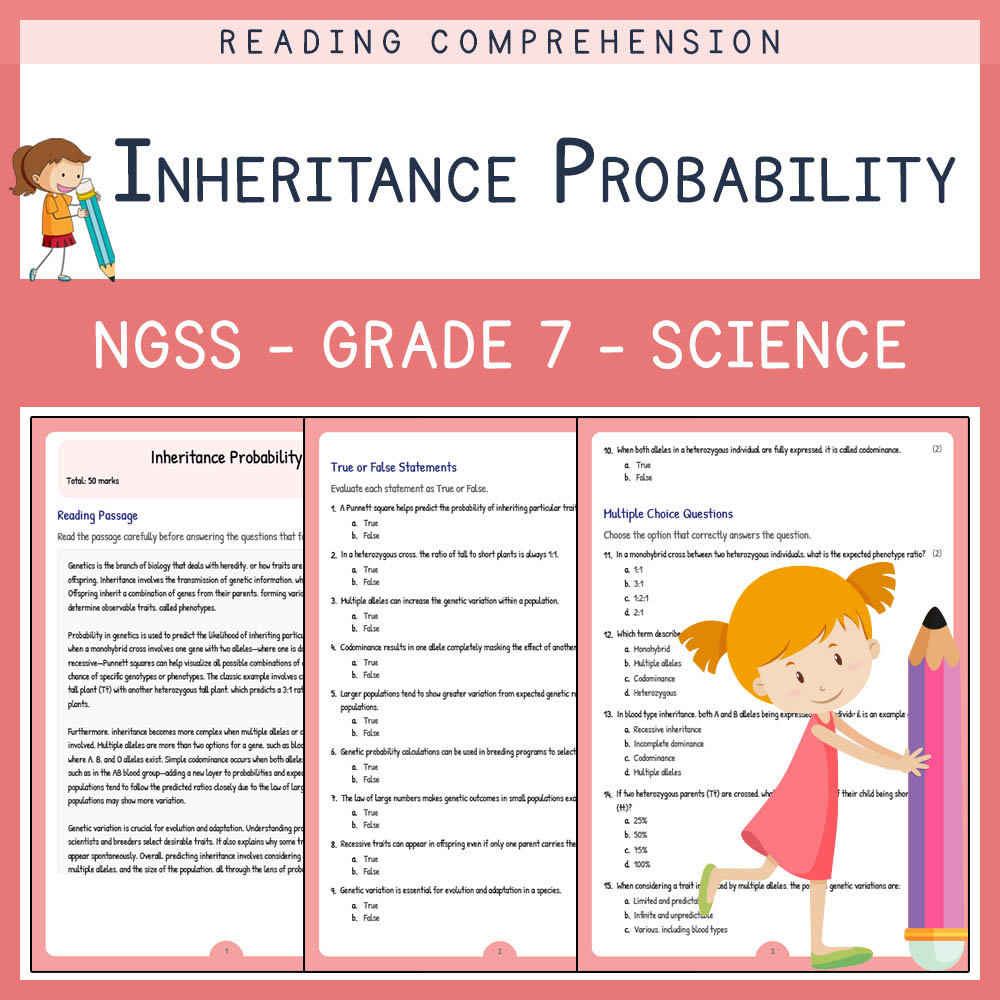
Grade 7 Science | Inheritance Probability Worksheet with Answer Key (PDF)
Created byLumora LearningLearning Objectives
- Explain how probability concepts can be used to predict genetic variation among offspring.
- Interpret Punnett square outcomes to determine likelihoods of genotypes and phenotypes.
- Calculate the expected proportions of different genotypes and phenotypes in monohybrid crosses.
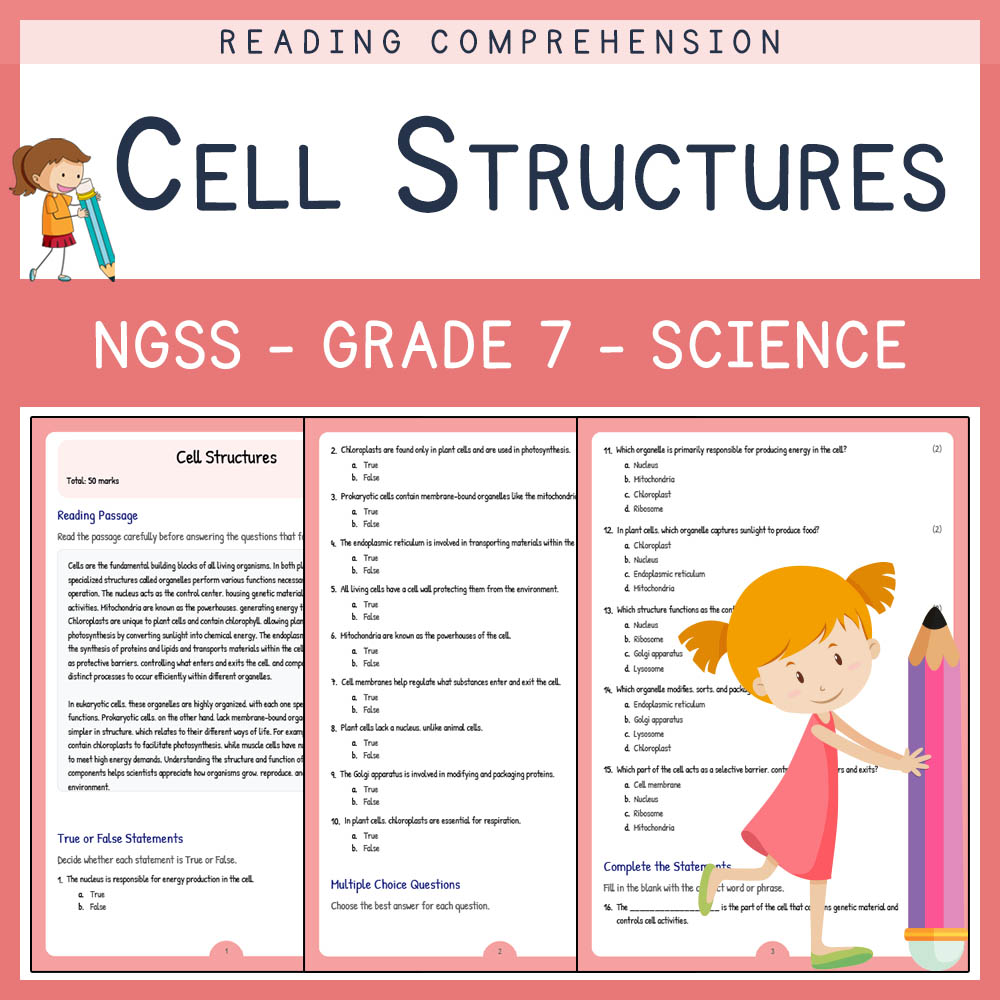
Grade 7 Science | Cell Structures Worksheet (PDF + Answer Key) | NGSS Standards
Created byLumora LearningLearning Objectives
- Identify the major organelles in plant and animal cells and describe their functions.
- Compare and contrast eukaryotic and prokaryotic cell organization.
- Explain the roles of nucleus, mitochondria, chloroplasts, endoplasmic reticulum, and membranes in cell function.
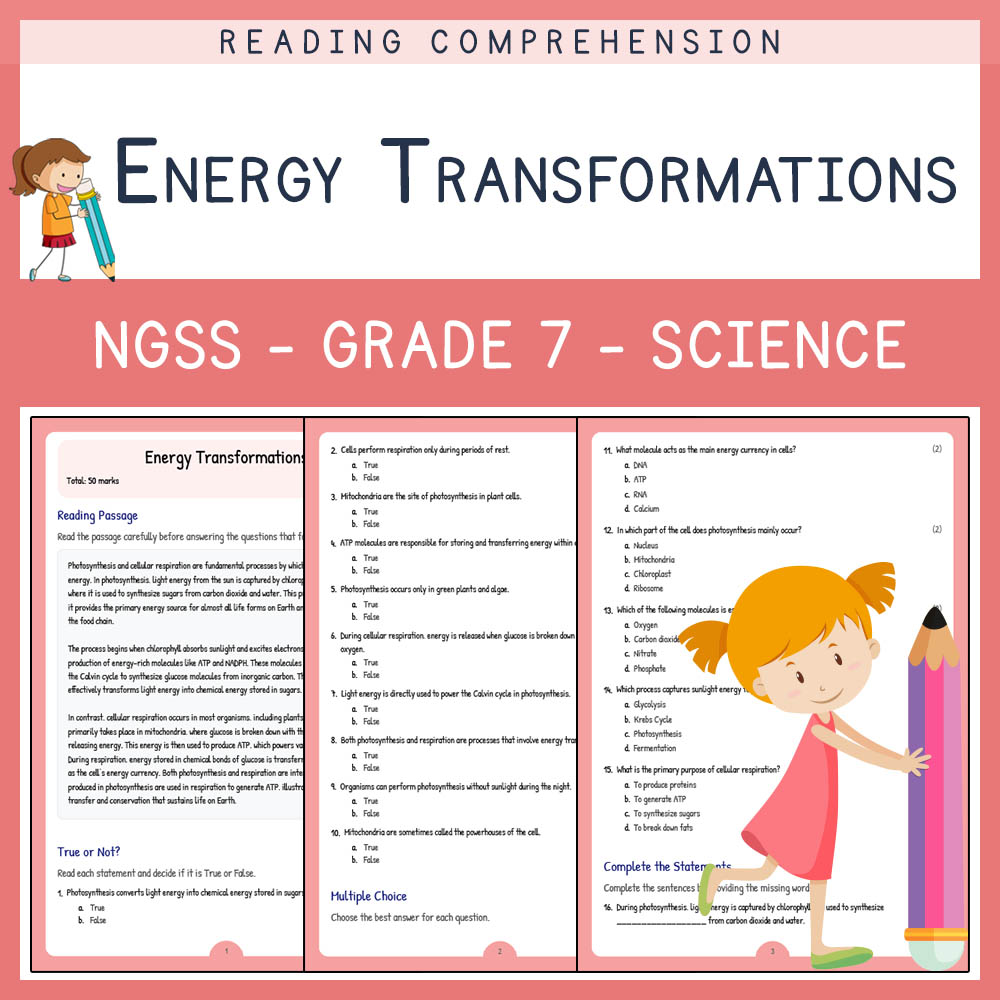
Grade 7 Science | Energy Transformations Worksheet (PDF + Answer Key)
Created byLumora LearningLearning Objectives
- Explain how light energy is converted into chemical energy during photosynthesis.
- Describe the process of cellular respiration and its role in energy transfer within cells.
- Illustrate how energy conservation occurs across biological systems during energy transformations.
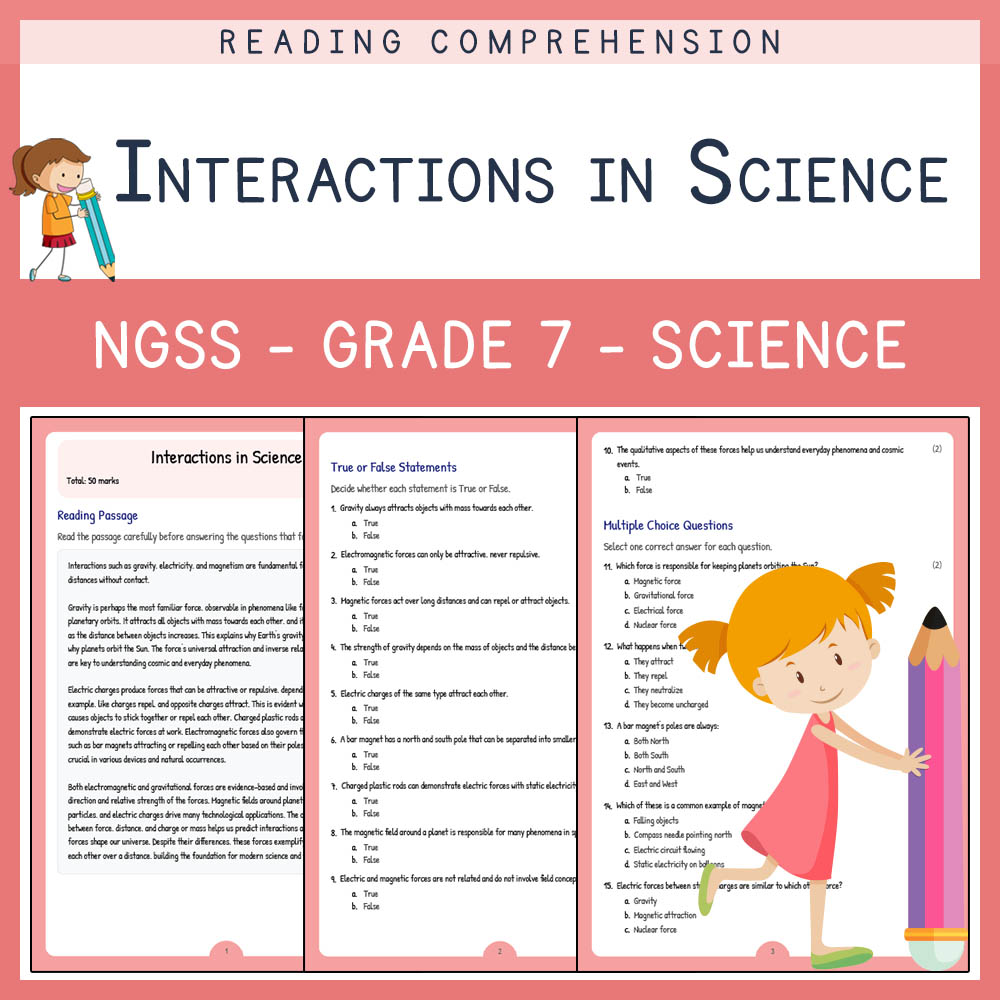
Grade 7 Science | Interactions in Science Worksheet (PDF) NGSS Aligned
Created byLumora LearningLearning Objectives
- Explain the concepts of gravitational, electric, and magnetic interactions as long-range forces.
- Describe how gravity acts universally and how electromagnetic forces can be attractive or repulsive.
- Relate force strength and direction to evidence and qualitative reasoning.
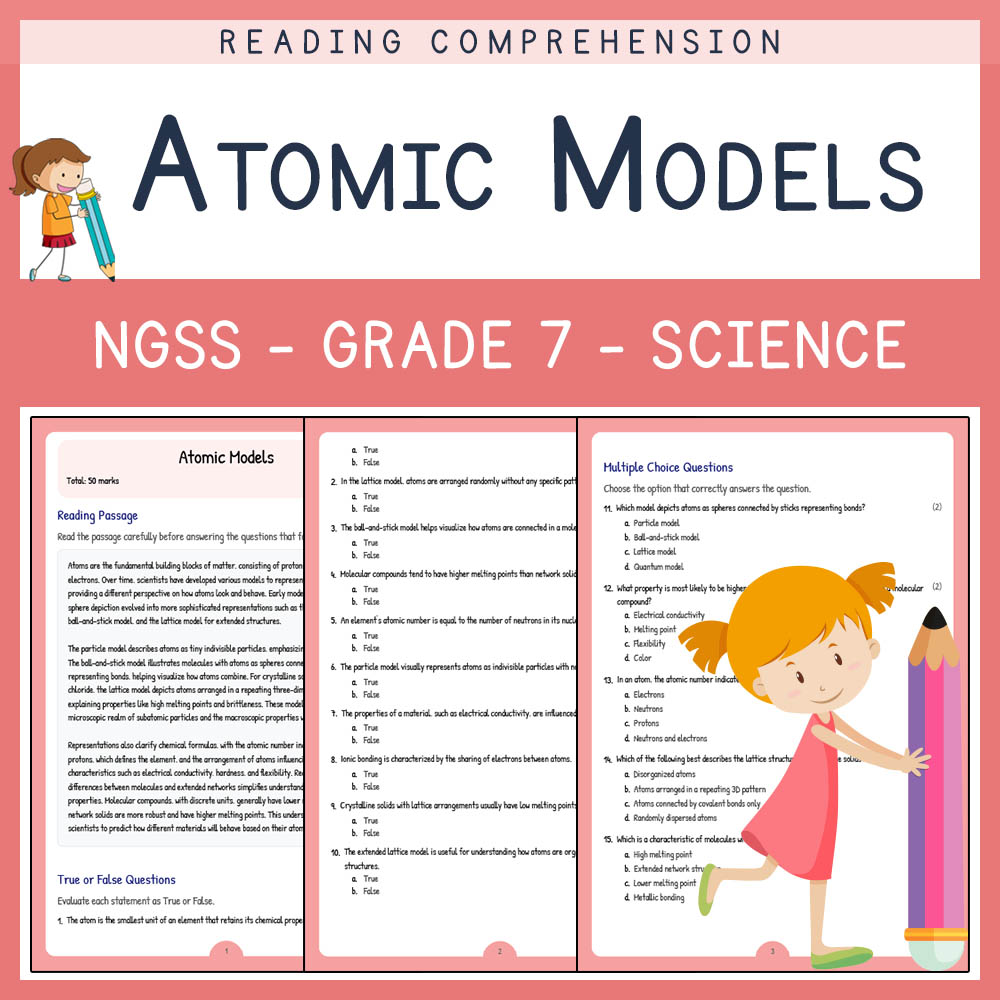
Grade 7 Science | Atomic Models Worksheet & Answer Key (NGSS-Aligned PDF)
Created byLumora LearningLearning Objectives
- Describe different representations of atomic models including particle, ball-and-stick, and lattice structures.
- Explain how atomic structure influences the properties of molecules and extended materials.
- Distinguish between molecular and extended network structures based on bonding patterns.
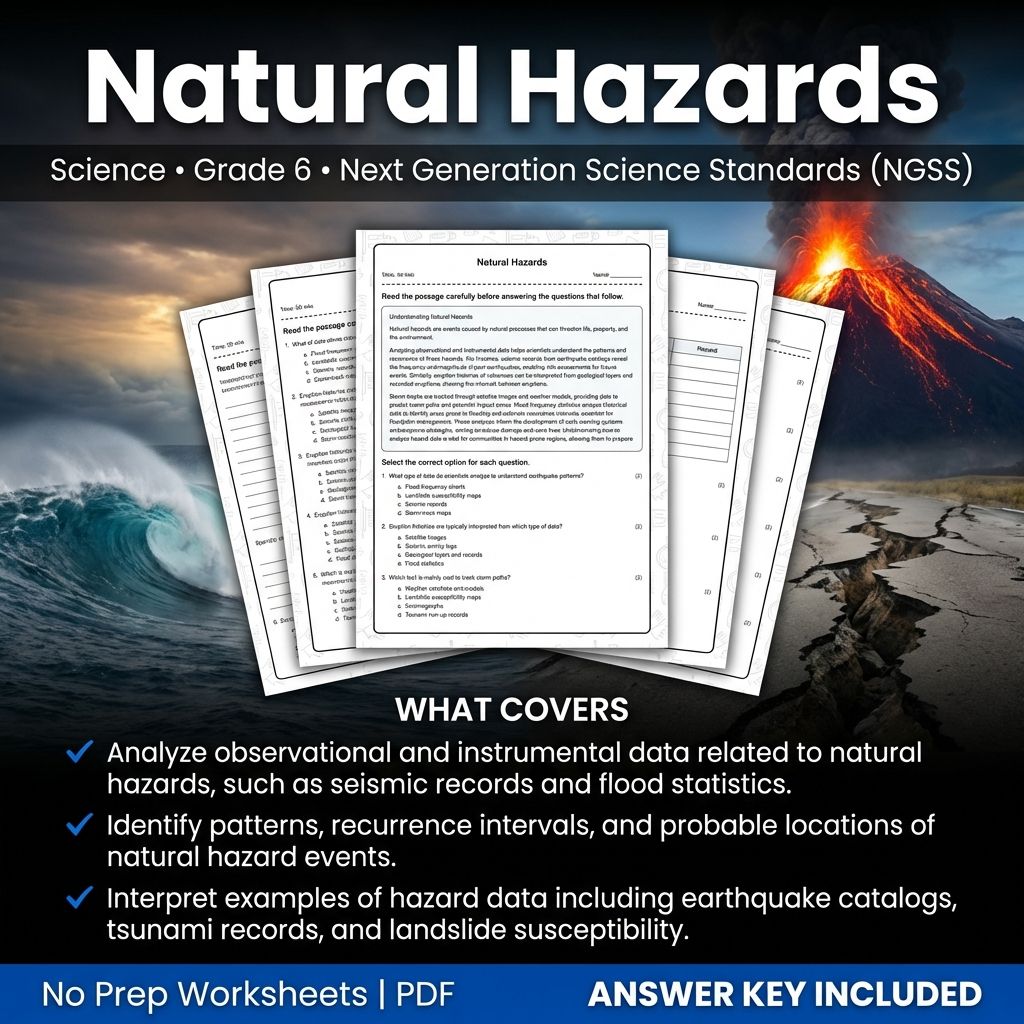
6th Grade Science | Natural Hazards Worksheet with Answer Key (Printable PDF)
Created byCoral Reef LearningLearning Objectives
- Analyze observational and instrumental data related to natural hazards, such as seismic records and flood statistics.
- Identify patterns, recurrence intervals, and probable locations of natural hazard events.
- Interpret examples of hazard data including earthquake catalogs, tsunami records, and landslide susceptibility.
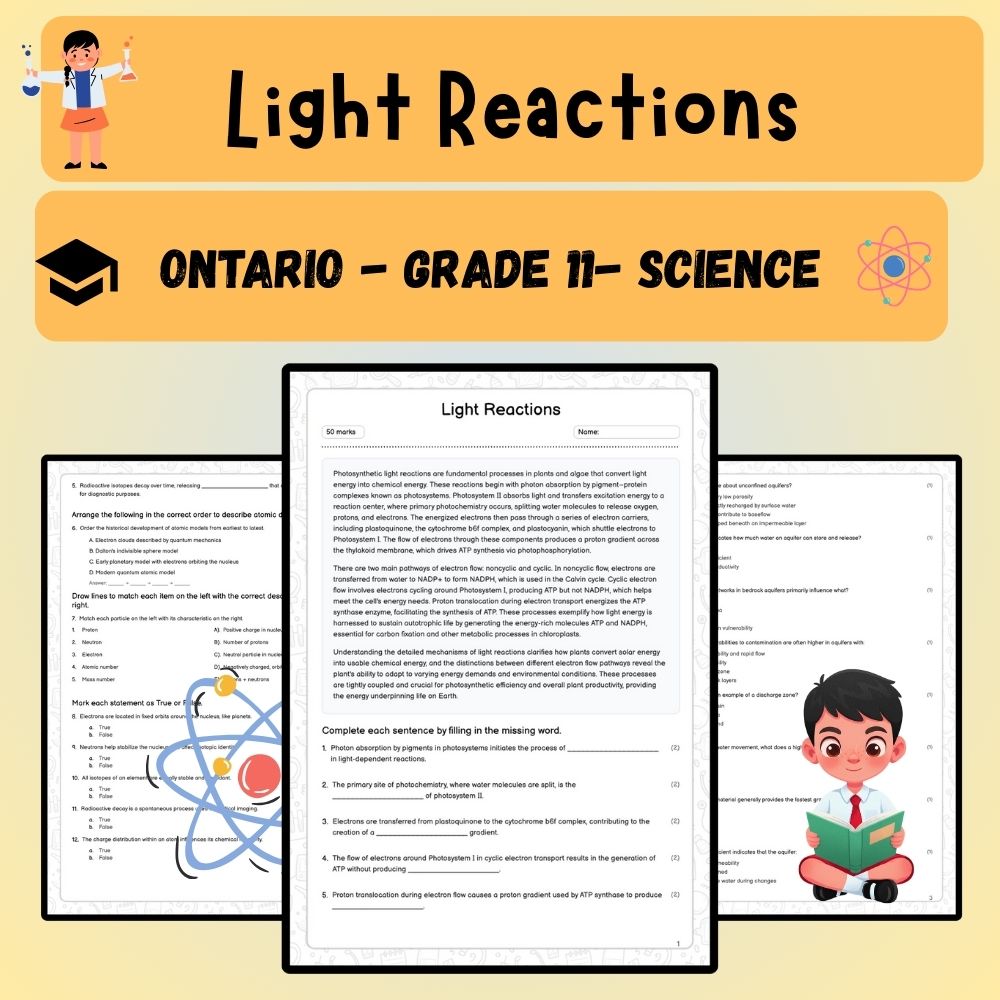
Grade 11 Science | Light Reactions Worksheet – Ontario Standard (PDF)
Created byPrism Point LearningLearning Objectives
- Describe the process of photon capture and excitation energy transfer in light-dependent reactions.
- Explain the electron transport chain involved in photosynthesis, including photosystems, plastoquinone, cytochrome b6f, and plastocyanin.
- Differentiate between noncyclic and cyclic electron flow and their roles in ATP and NADPH production.
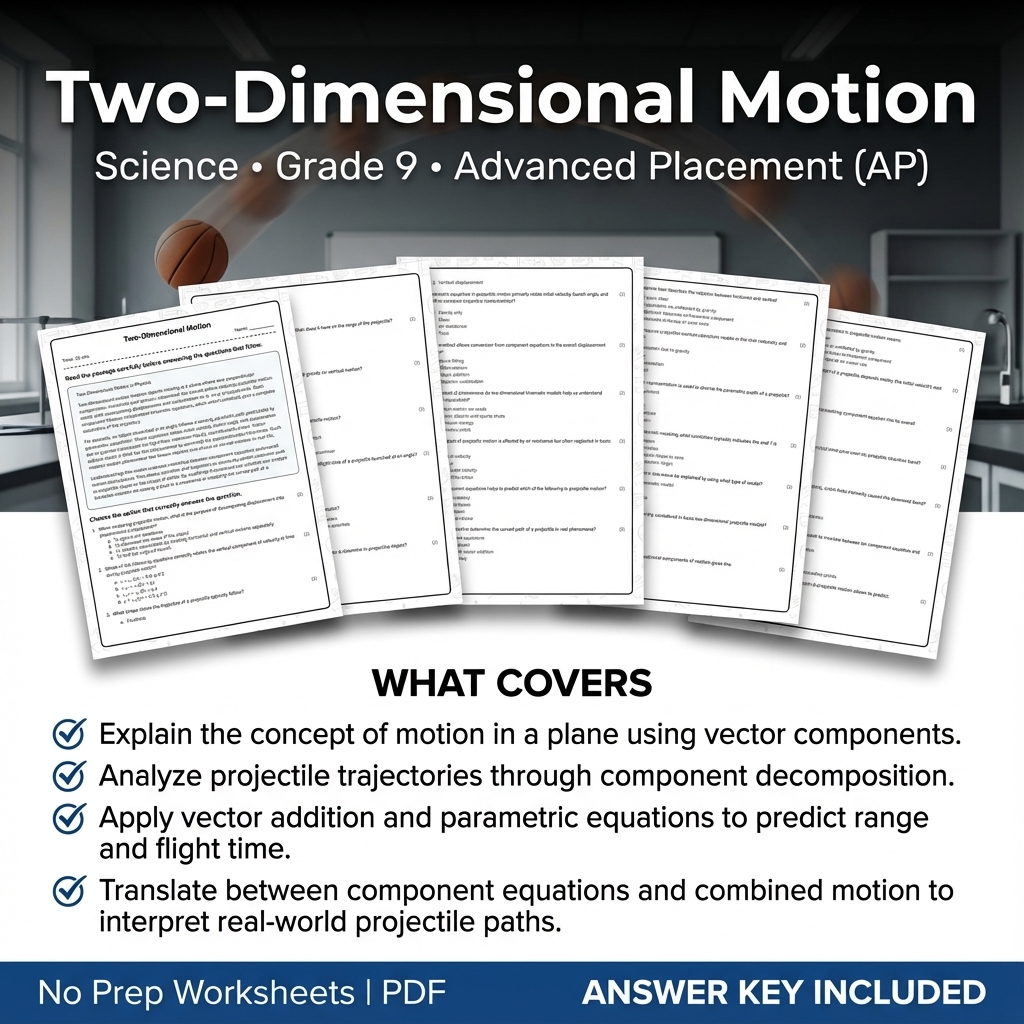
Grade 9 Science | Two-Dimensional Motion Worksheet (Printable PDF + Answer Key)
Created byCoral Reef LearningLearning Objectives
- Explain the concept of motion in a plane using vector components.
- Analyze projectile trajectories through component decomposition.
- Apply vector addition and parametric equations to predict range and flight time.
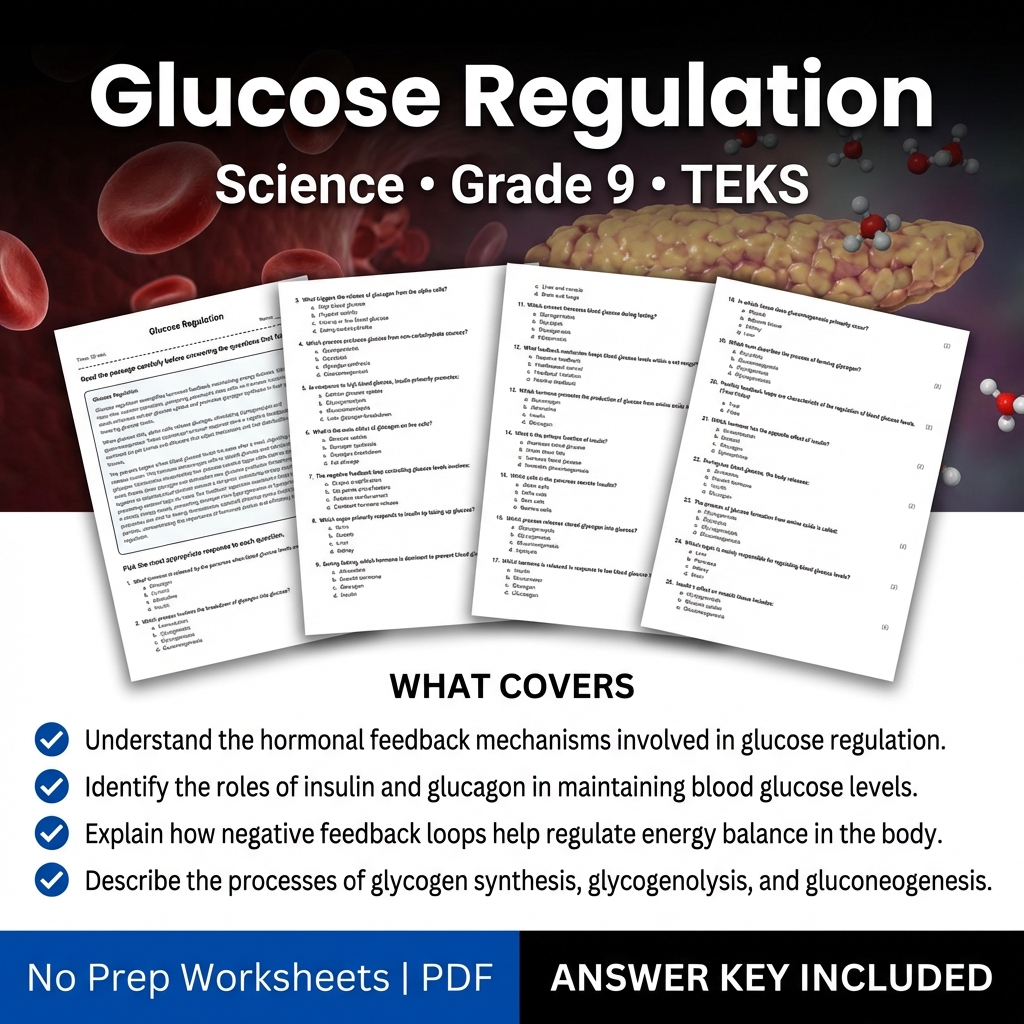
Grade 9 Science Worksheet on Glucose Regulation | TEKS-Aligned Practice
Created byCoral Reef LearningLearning Objectives
- Understand the hormonal feedback mechanisms involved in glucose regulation.
- Identify the roles of insulin and glucagon in maintaining blood glucose levels.
- Explain how negative feedback loops help regulate energy balance in the body.
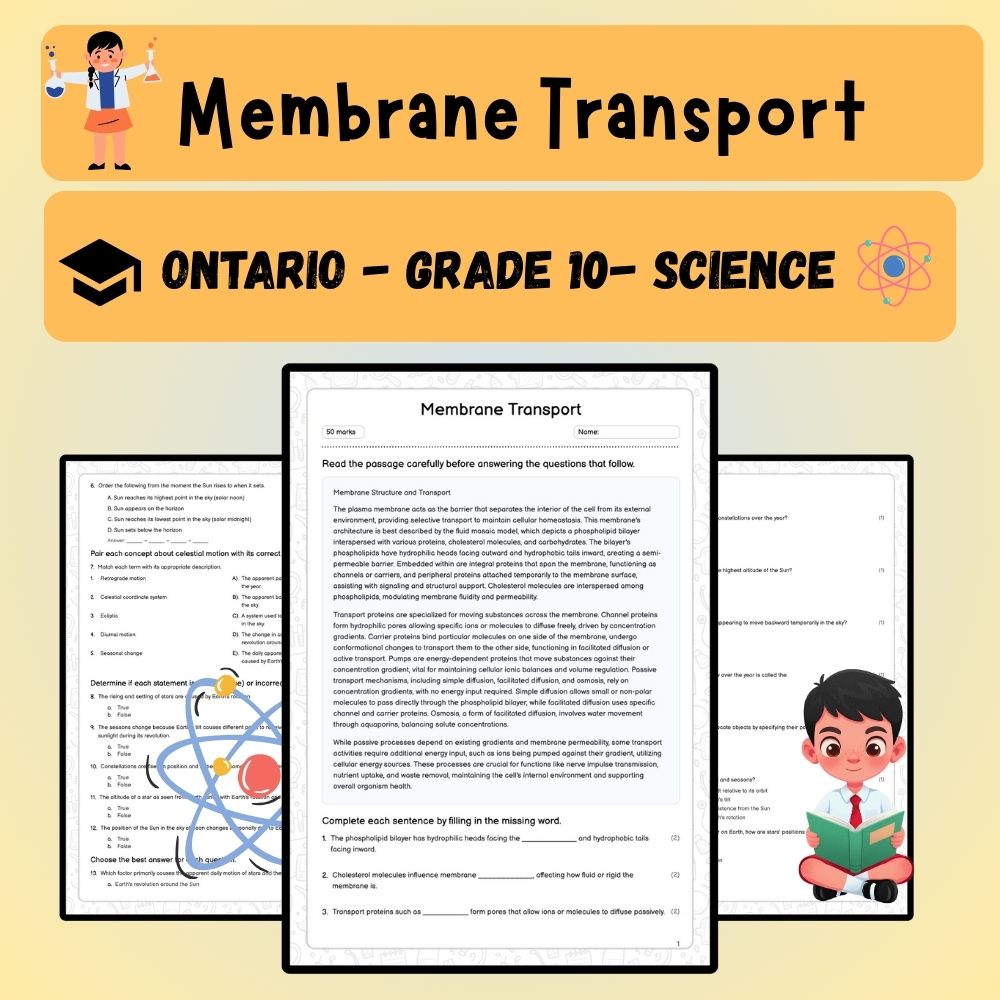
Grade 10 Science | Membrane Transport Worksheet (PDF) Aligned with Ontario Standards
Created byPrism Point LearningLearning Objectives
- Understand the structure and components of the plasma membrane as described by the fluid mosaic model.
- Differentiate between types of transport proteins such as channels, carriers, and pumps based on structural features and functions.
- Explain passive transport mechanisms—including simple diffusion, facilitated diffusion, and osmosis—in terms of concentration gradients and permeability.
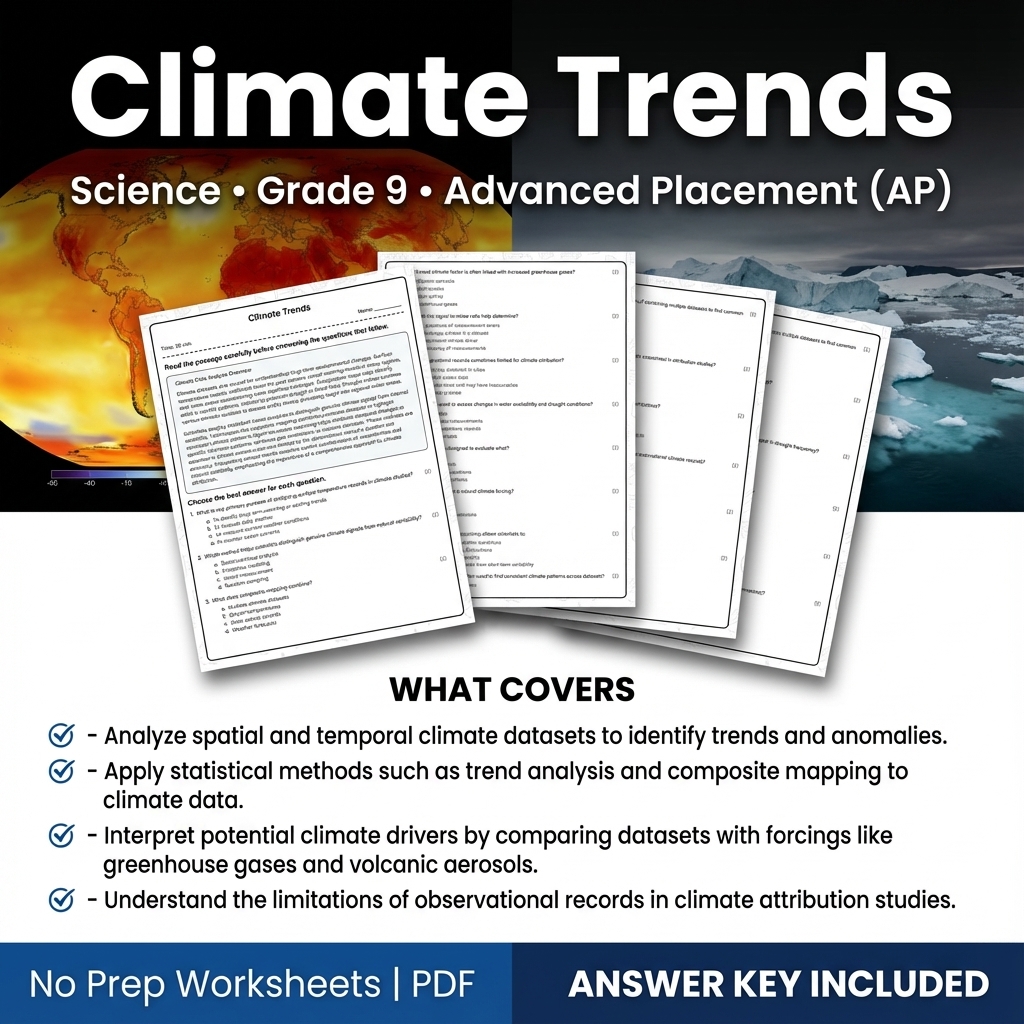
9th Grade Science | Climate Trends Worksheet (Printable PDF + Answer Key)
Created byCoral Reef LearningLearning Objectives
- Analyze spatial and temporal climate datasets to identify trends and anomalies.
- Apply statistical methods such as trend analysis and composite mapping to climate data.
- Interpret potential climate drivers by comparing datasets with forcings like greenhouse gases and volcanic aerosols.
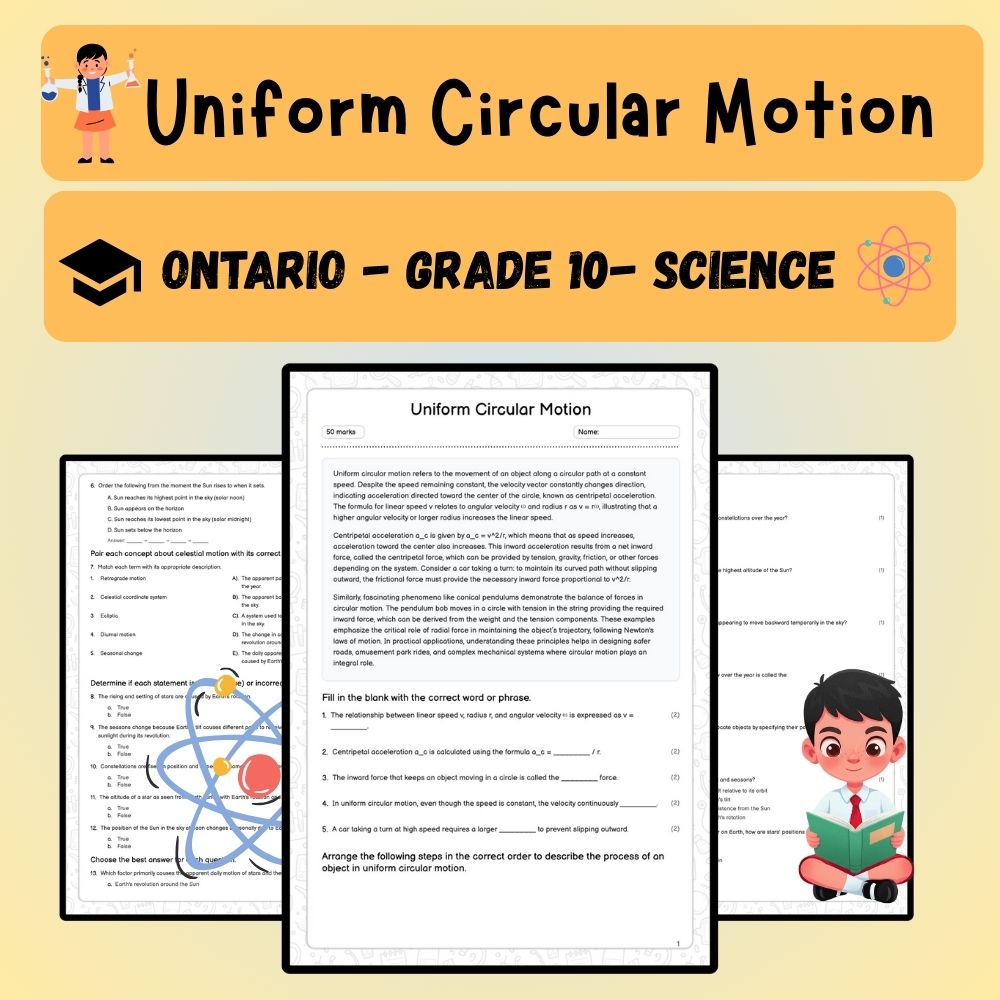
Grade 10 Science | Uniform Circular Motion Worksheet (PDF) for Ontario Standards
Created byPrism Point LearningLearning Objectives
- Explain the relationship between linear speed, angular velocity, and radius in uniform circular motion.
- Describe how centripetal acceleration depends on velocity and radius.
- Apply the formulas v = rω and a_c = v^2/r to solve problems involving circular motion.
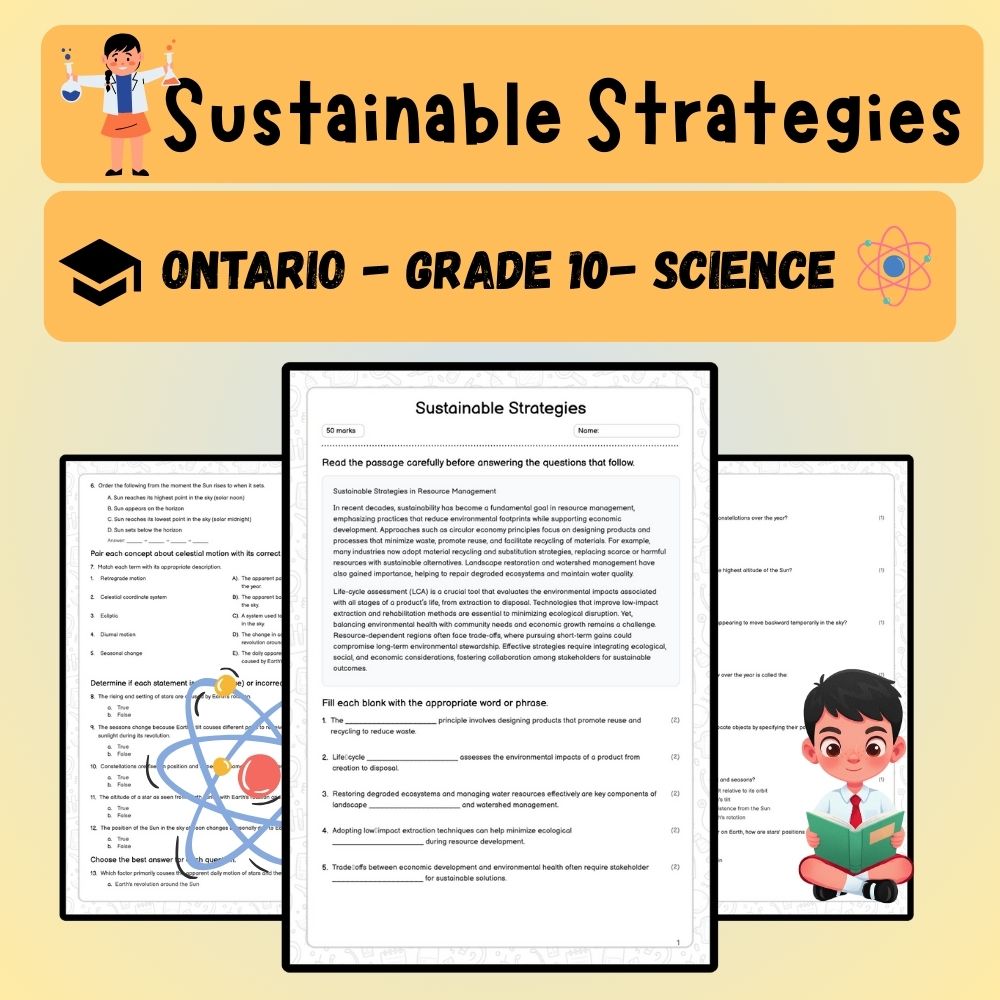
Grade 10 Science | Sustainable Strategies Worksheet (PDF) aligned with Ontario standards
Created byPrism Point LearningLearning Objectives
- Understand approaches for reducing environmental impact in resource extraction and use.
- Identify principles of circular economy, recycling, and substitution methods.
- Explain landscape restoration and watershed management strategies.
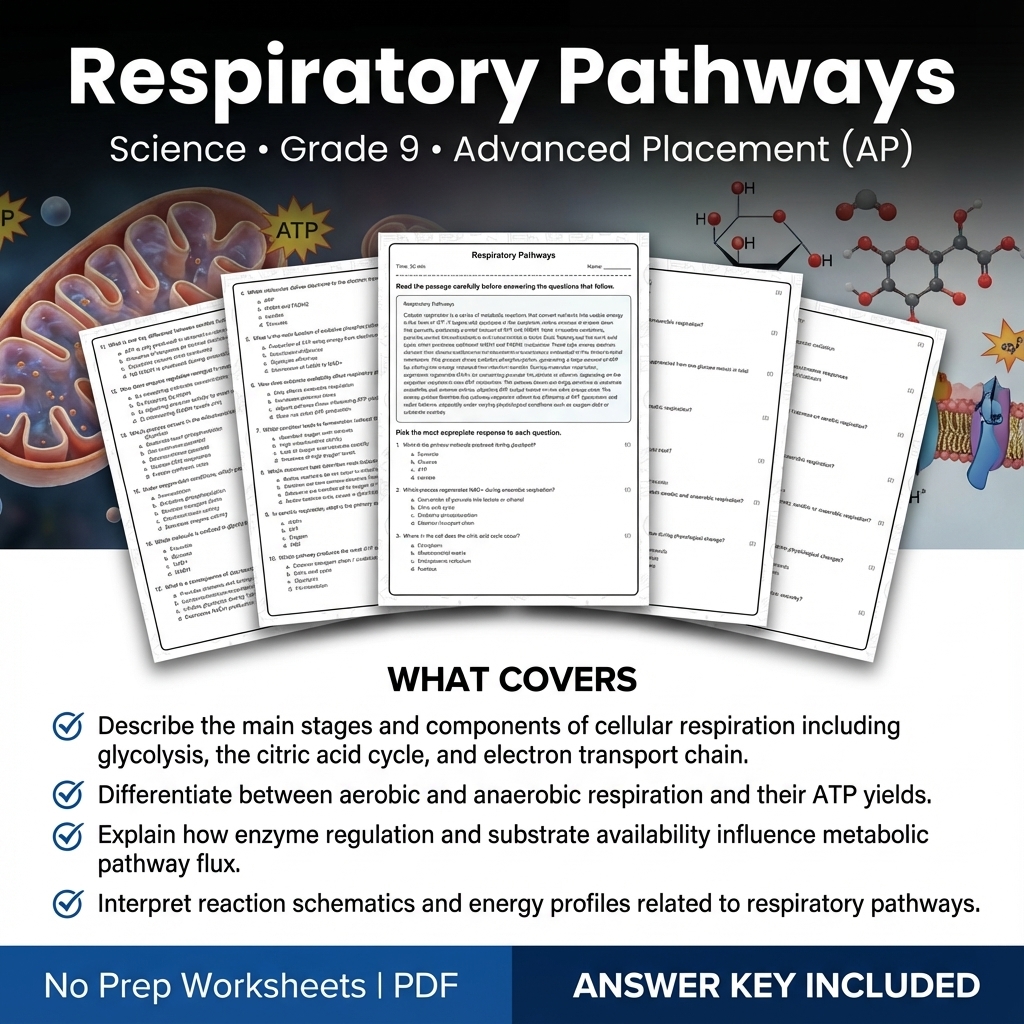
Grade 9 Science | Respiratory Pathways Worksheet (Printable PDF + Answer Key)
Created byCoral Reef LearningLearning Objectives
- Describe the main stages and components of cellular respiration including glycolysis, the citric acid cycle, and electron transport chain.
- Differentiate between aerobic and anaerobic respiration and their ATP yields.
- Explain how enzyme regulation and substrate availability influence metabolic pathway flux.
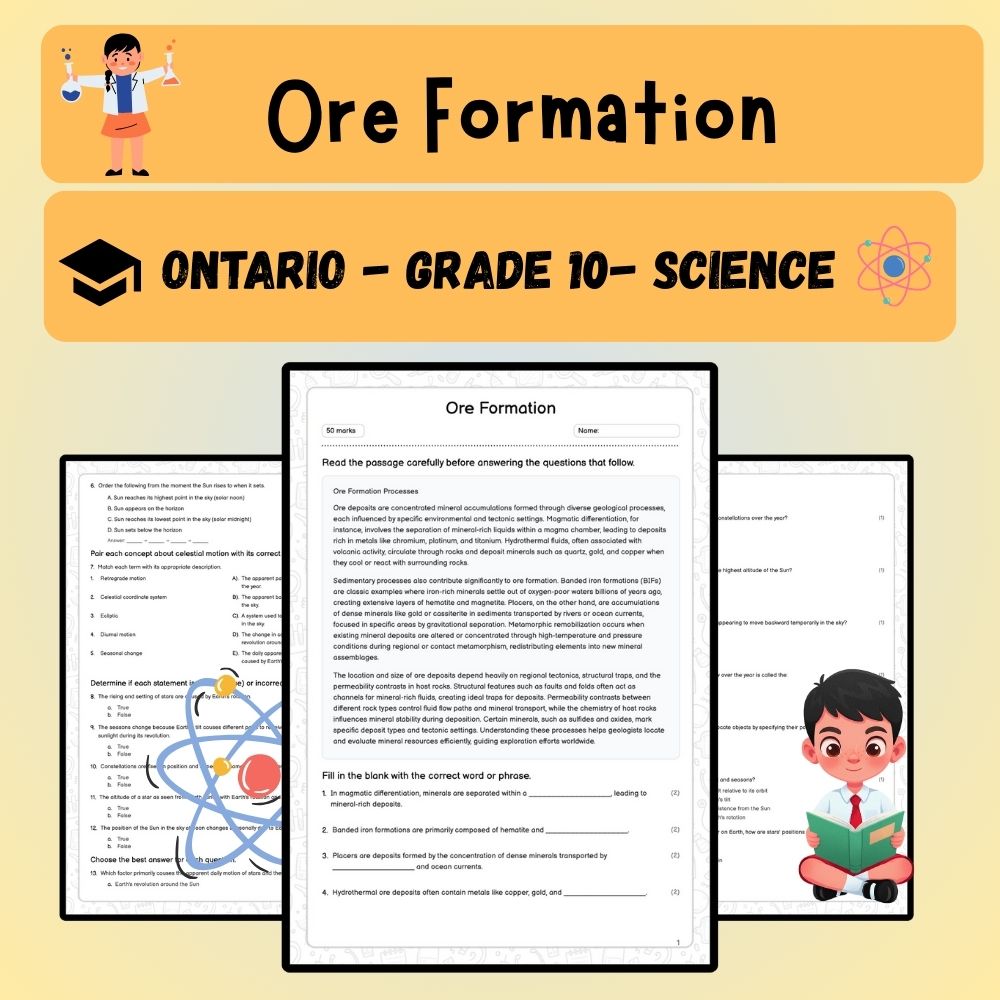
Grade 10 Science | Ore Formation Worksheet (Worksheet + Answer Key) – Ontario Standard
Created byPrism Point LearningLearning Objectives
- Describe principal ore-forming processes including magmatic differentiation, hydrothermal fluid circulation, sedimentary concentration, and metamorphic remobilization.
- Explain spatial controls such as structural traps, permeability contrasts, and host-rock chemistry in ore deposit localization.
- Identify typical mineral assemblages associated with different deposit types and tectonic settings.
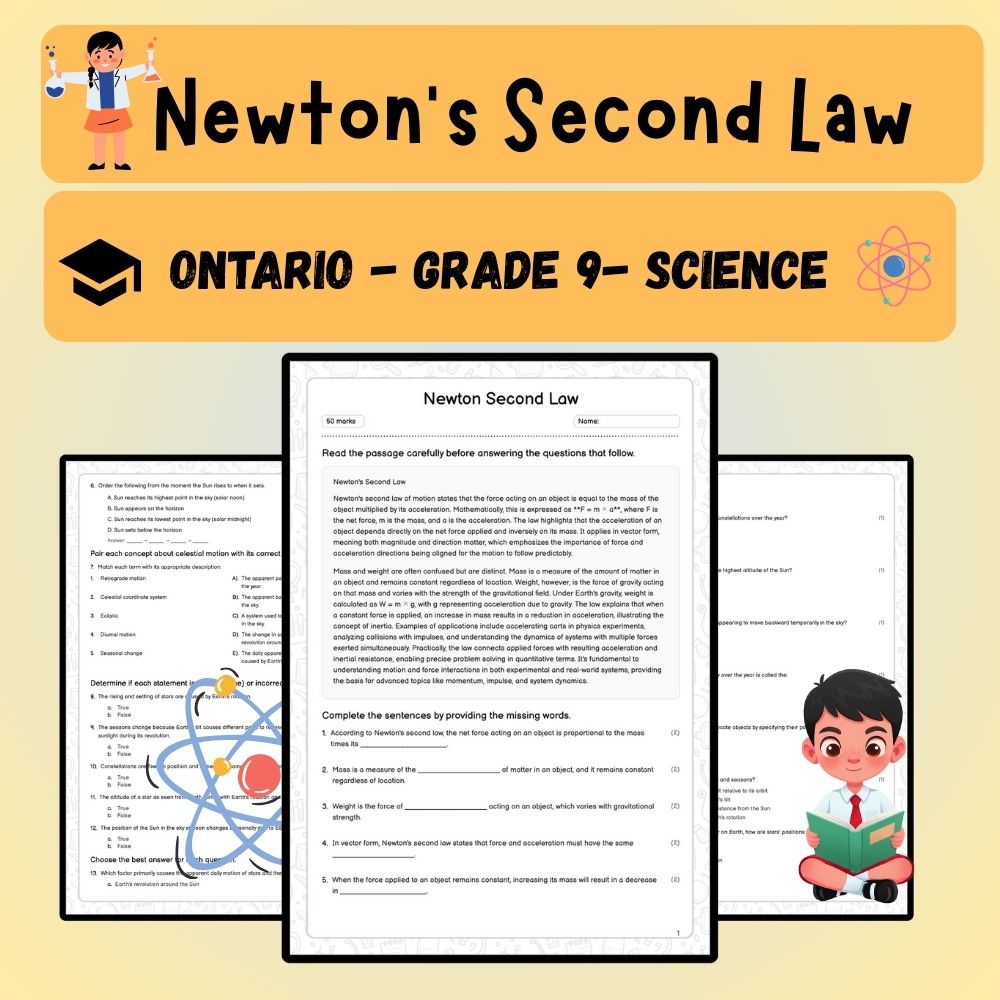
Grade 9 Science | Newton's Second Law Worksheet (PDF) – Ontario Standard
Created byPrism Point LearningLearning Objectives
- Understand the mathematical relationship between net force, mass, and acceleration as expressed in Newton's second law.
- Differentiate between and relate mass and weight, and comprehend their implications for force and acceleration.
- Apply Newton's second law to problems involving acceleration, force, and mass, including systems with multiple forces.
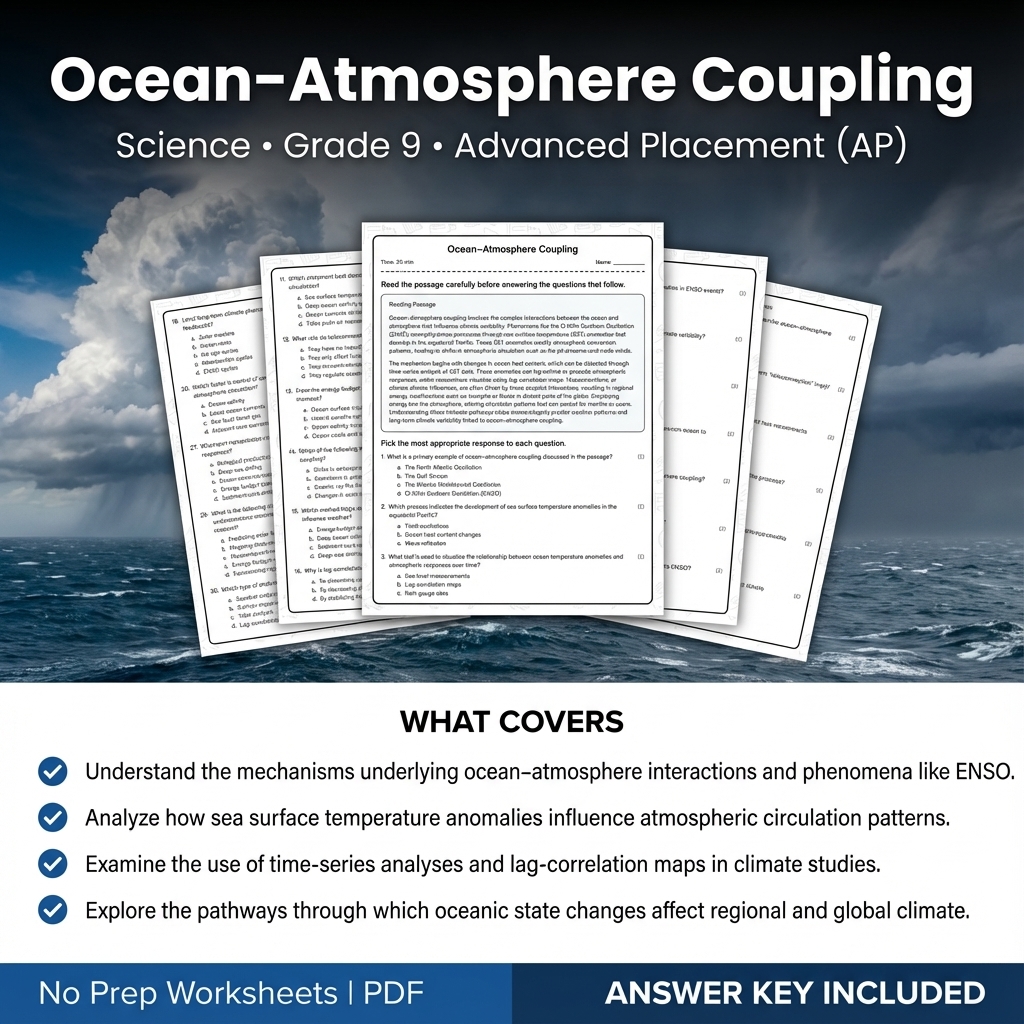
Grade 9 Science | Ocean–Atmosphere Coupling Worksheet (Printable PDF + Answer Key)
Created byCoral Reef LearningLearning Objectives
- Understand the mechanisms underlying ocean–atmosphere interactions and phenomena like ENSO.
- Analyze how sea surface temperature anomalies influence atmospheric circulation patterns.
- Examine the use of time-series analyses and lag-correlation maps in climate studies.
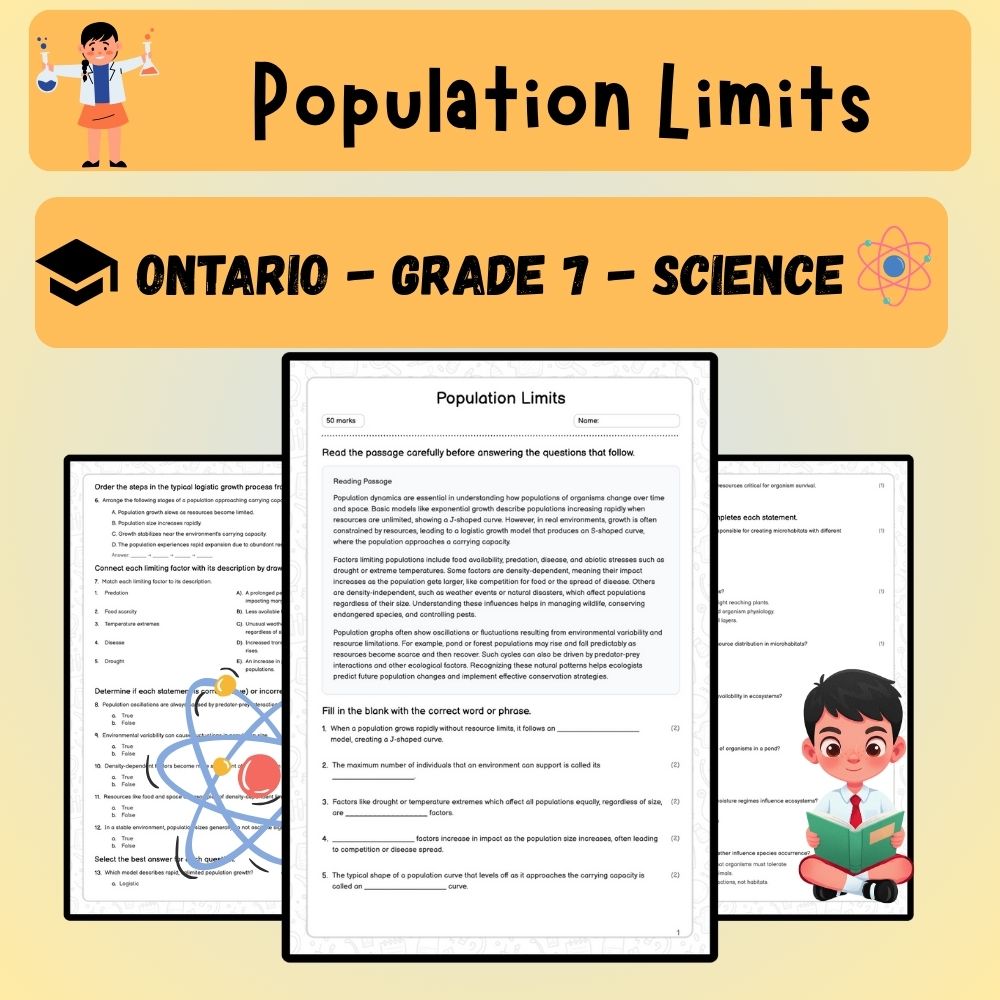
Grade 7 Science | Population Limits Worksheet (PDF ) – Ontario Standards
Created byPrism Point LearningLearning Objectives
- Understand basic models of population growth, including exponential and logistic growth.
- Identify factors that limit population size such as food, predation, disease, and environmental stresses.
- Differentiate between density-dependent and density-independent factors affecting populations.
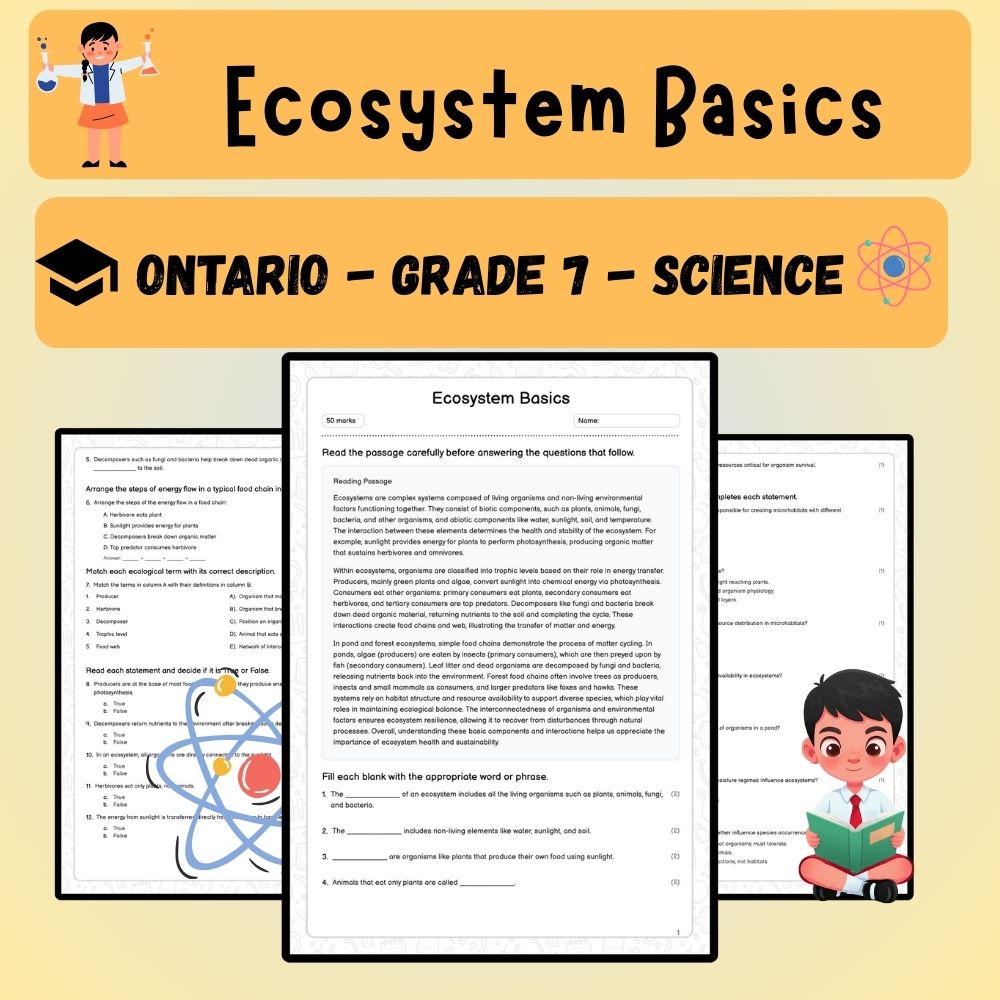
Grade 7 Science | Ecosystem Basics Worksheet (PDF ) – Ontario Standards
Created byPrism Point LearningLearning Objectives
- Understand the components and roles of biotic and abiotic elements in ecosystems.
- Identify trophic categories such as producers, consumers, and decomposers and their energy flow.
- Analyze simple food chains and the cycling of matter in pond and forest ecosystems.
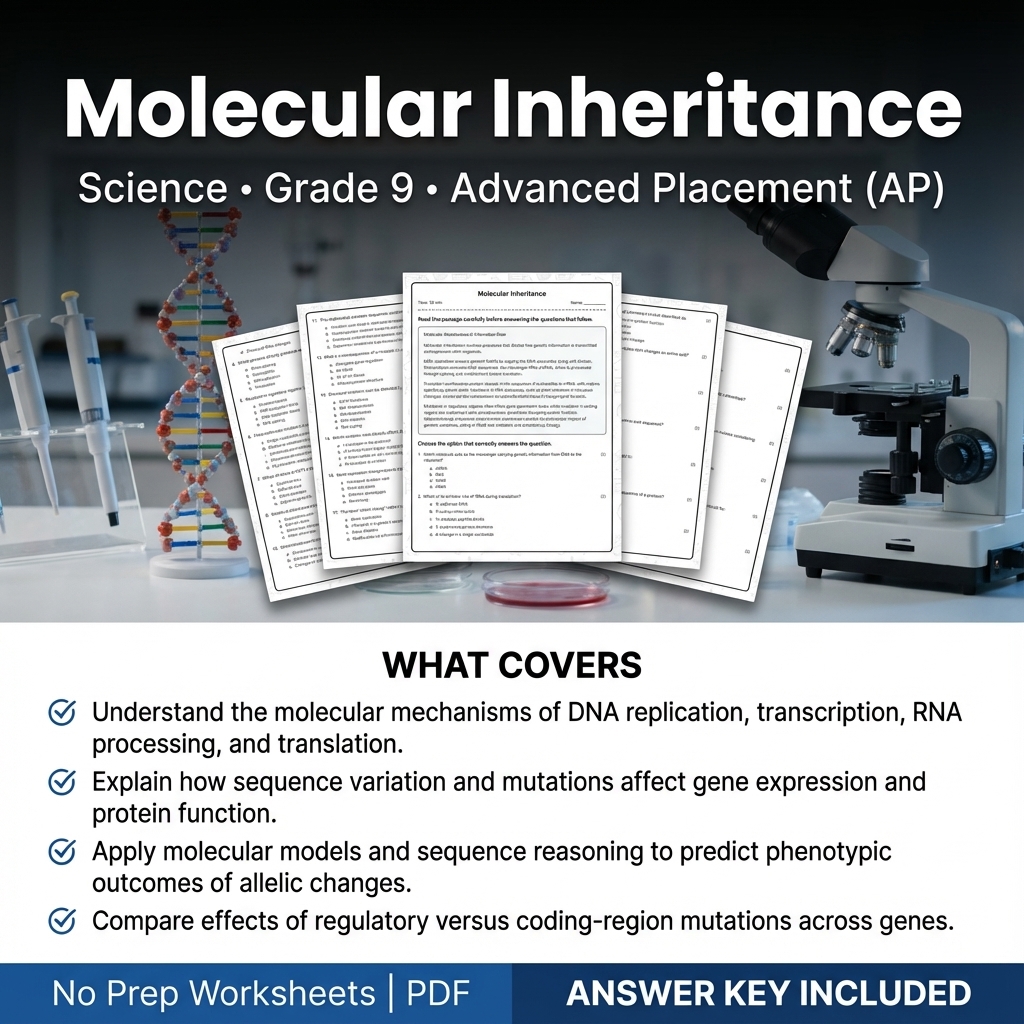
9th Grade Science | Molecular Inheritance Worksheet (Printable PDF + Answer Key)
Created byCoral Reef LearningLearning Objectives
- Understand the molecular mechanisms of DNA replication, transcription, RNA processing, and translation.
- Explain how sequence variation and mutations affect gene expression and protein function.
- Apply molecular models and sequence reasoning to predict phenotypic outcomes of allelic changes.
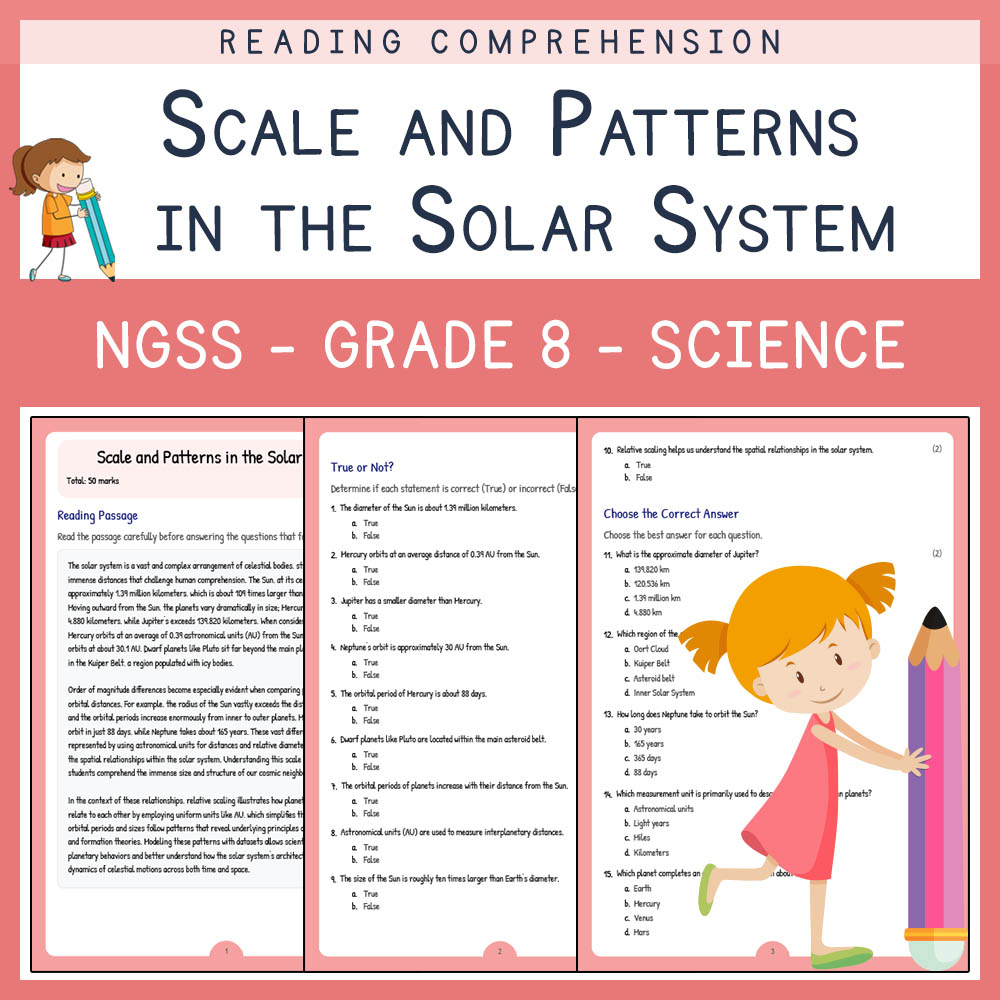
Grade 8 Science | Scale and Patterns in the Solar System Worksheets (PDF)
Created byLumora LearningLearning Objectives
- Understand and interpret scale relationships among solar system objects using quantitative data.
- Compare diameters, distances, and orbital periods of planets, dwarf planets, and moons.
- Use astronomical units and relative scaling to analyze spatial and temporal patterns.
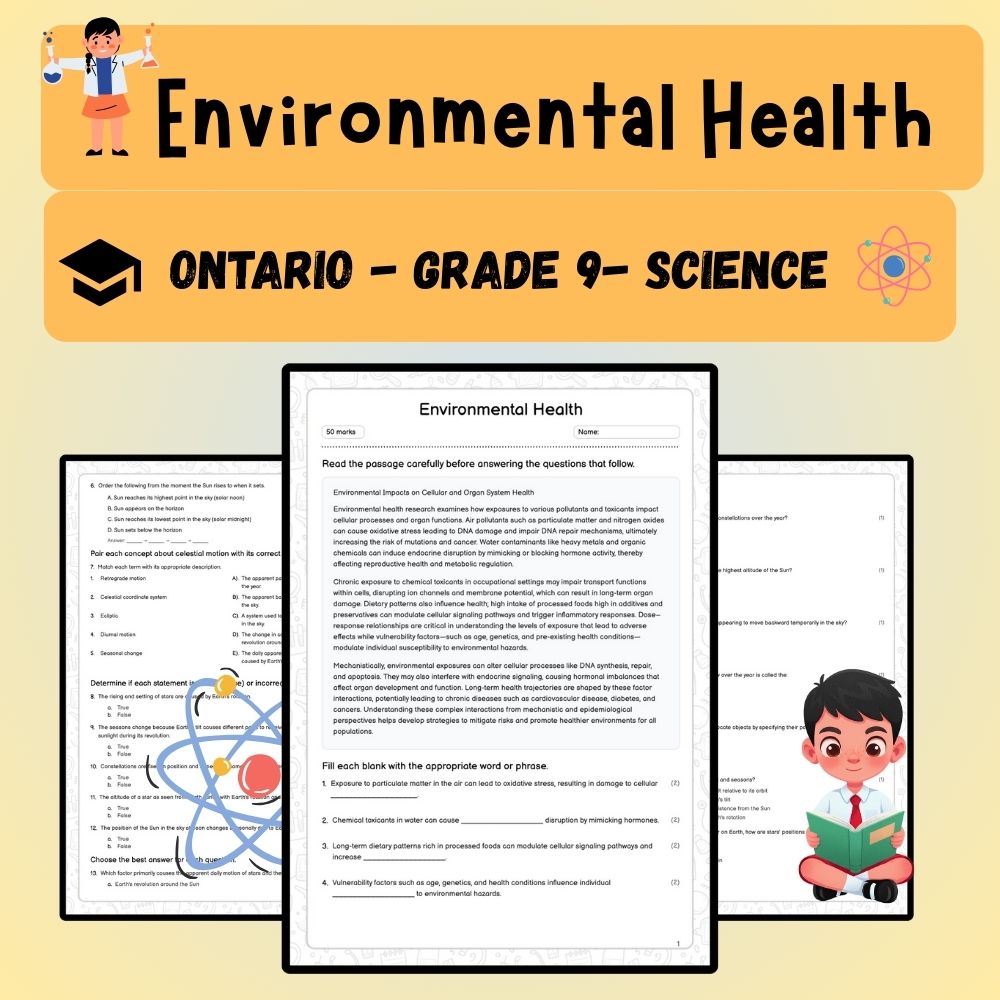
Grade 9 Science | Environmental Health Worksheet (Answer Key) - Ontario Standards
Created byPrism Point LearningLearning Objectives
- Understand how environmental exposures influence cellular and organ system health.
- Identify sources and effects of air and water pollutants on human health.
- Explain dose–response relationships and vulnerability factors related to environmental hazards.
Browse more categories
About Science Worksheets
Find Science worksheets spanning core skills, practice, and review. All 42,859 resources are instant PDF downloads for the classroom or home.
Every worksheet on MyTeachingSheets is created by independent teacher-authors and reviewed before publication. All resources download as printable PDFs for classroom, homework, or at-home practice, and many include answer keys. Preview any worksheet free before buying.