
Science Worksheets
42,859 subject resources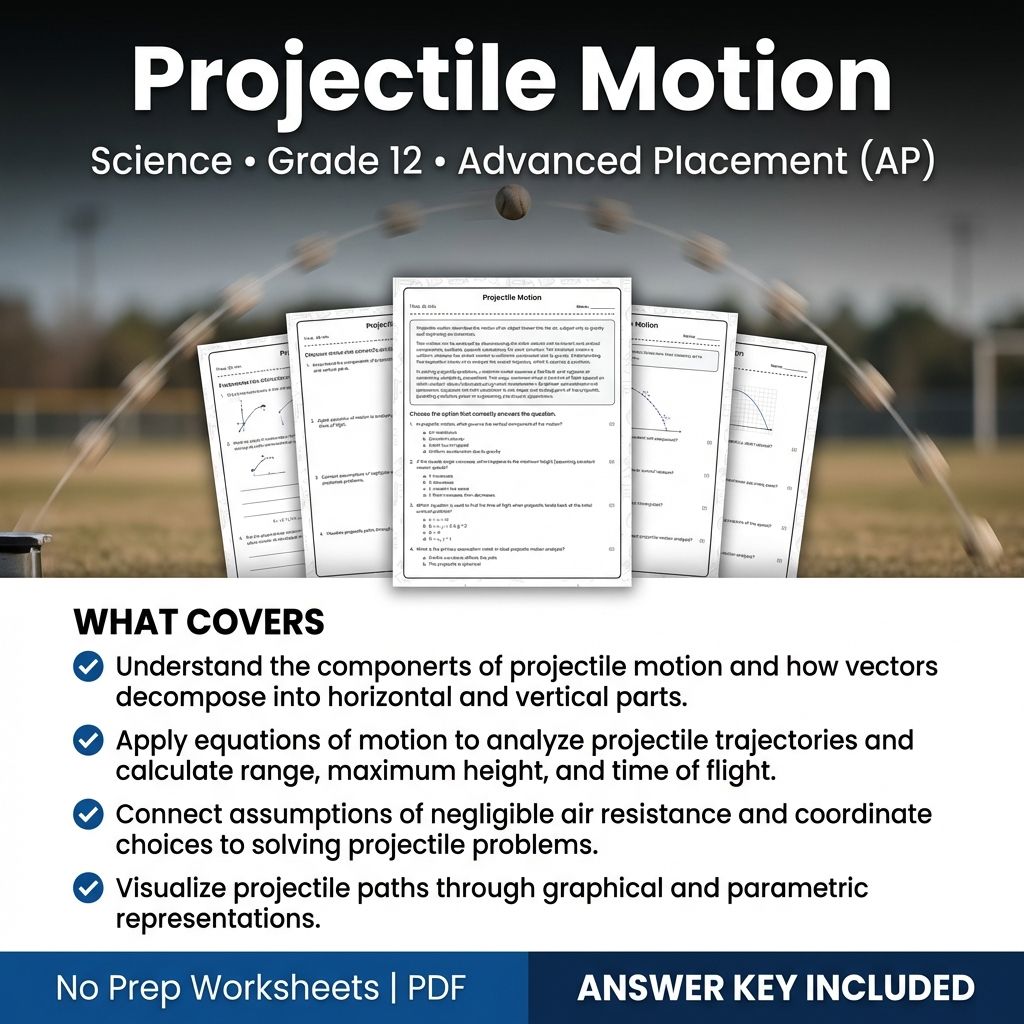
Grade 12 Science Worksheet | Projectile Motion Practice with Answer Key (PDF)
 Created byCoral Reef Learning
Learning Objectives
- Understand the components of projectile motion and how vectors decompose into horizontal and vertical parts.
- Apply equations of motion to analyze projectile trajectories and calculate range, maximum height, and time of flight.
- Connect assumptions of negligible air resistance and coordinate choices to solving projectile problems.
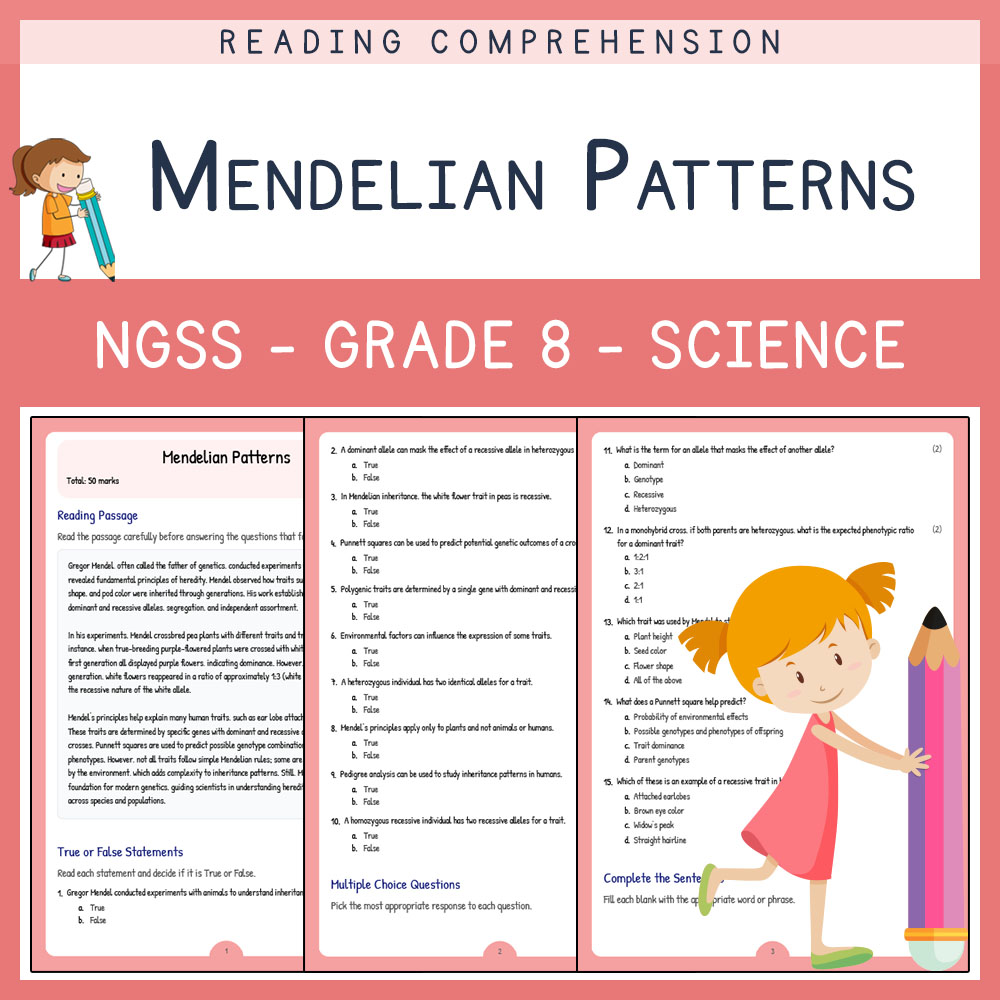
Grade 8 Science | Mendelian Patterns Worksheet (Answer Key & Rubric)
 Created byLumora Learning
Learning Objectives
- Understand how dominant and recessive alleles influence observable traits.
- Predict genotypic and phenotypic ratios using Punnett squares.
- Explain the segregation of alleles during inheritance.
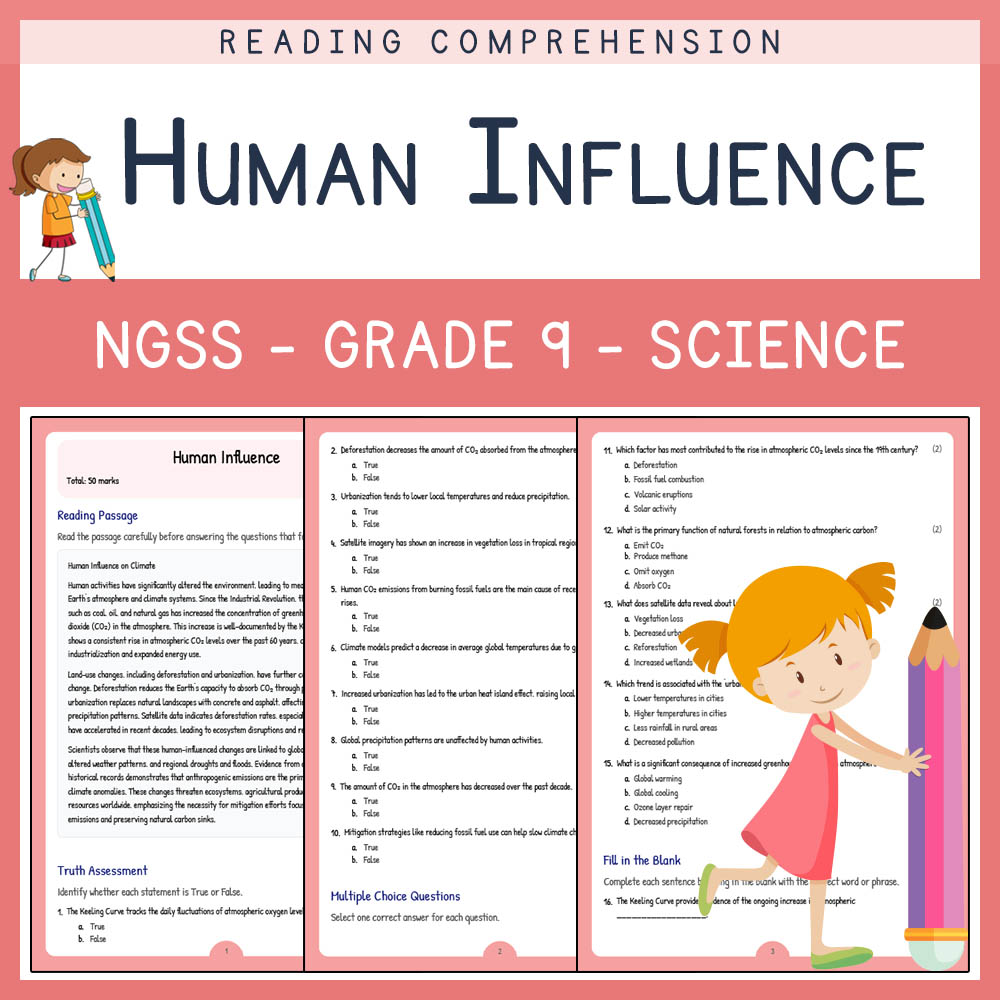
Grade 9 Science | Human Influence Worksheet & Answer Key (NGSS-Aligned)
Created byLumora LearningLearning Objectives
- Understand the impact of anthropogenic activities such as fossil fuel burning, deforestation, and urbanization on the atmosphere and climate.
- Analyze historical data and measurement indicators like the Keeling Curve and satellite imagery to identify trends in carbon emissions and ecosystem changes.
- Explain how human activities influence global temperature, precipitation patterns, and ecosystem health at regional and global scales.
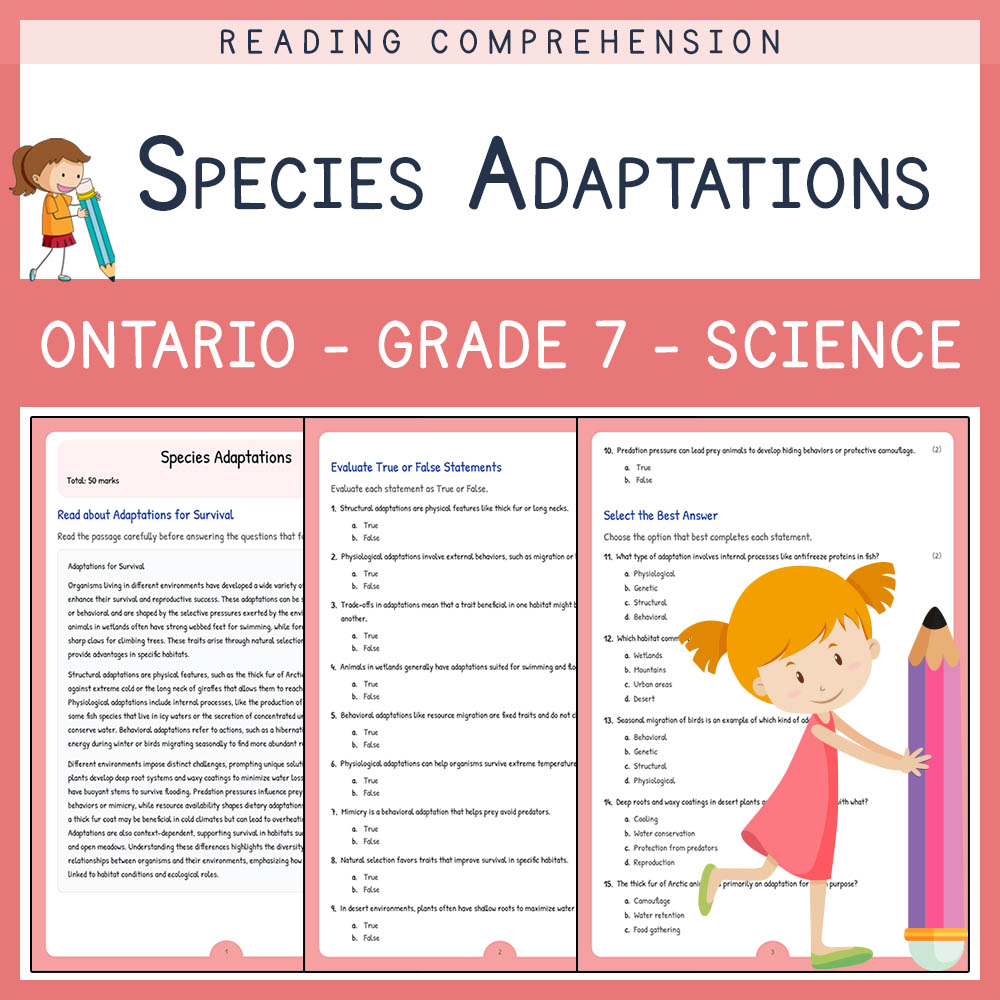
Grade 7 Science | Species Adaptations Worksheet (PDF + Answer Key) for Ontario
Created byLumora LearningLearning Objectives
- Understand the different types of adaptations organisms have for survival.
- Identify environmental factors that influence adaptations.
- Explain how structural, physiological, and behavioral traits help organisms thrive in specific habitats.
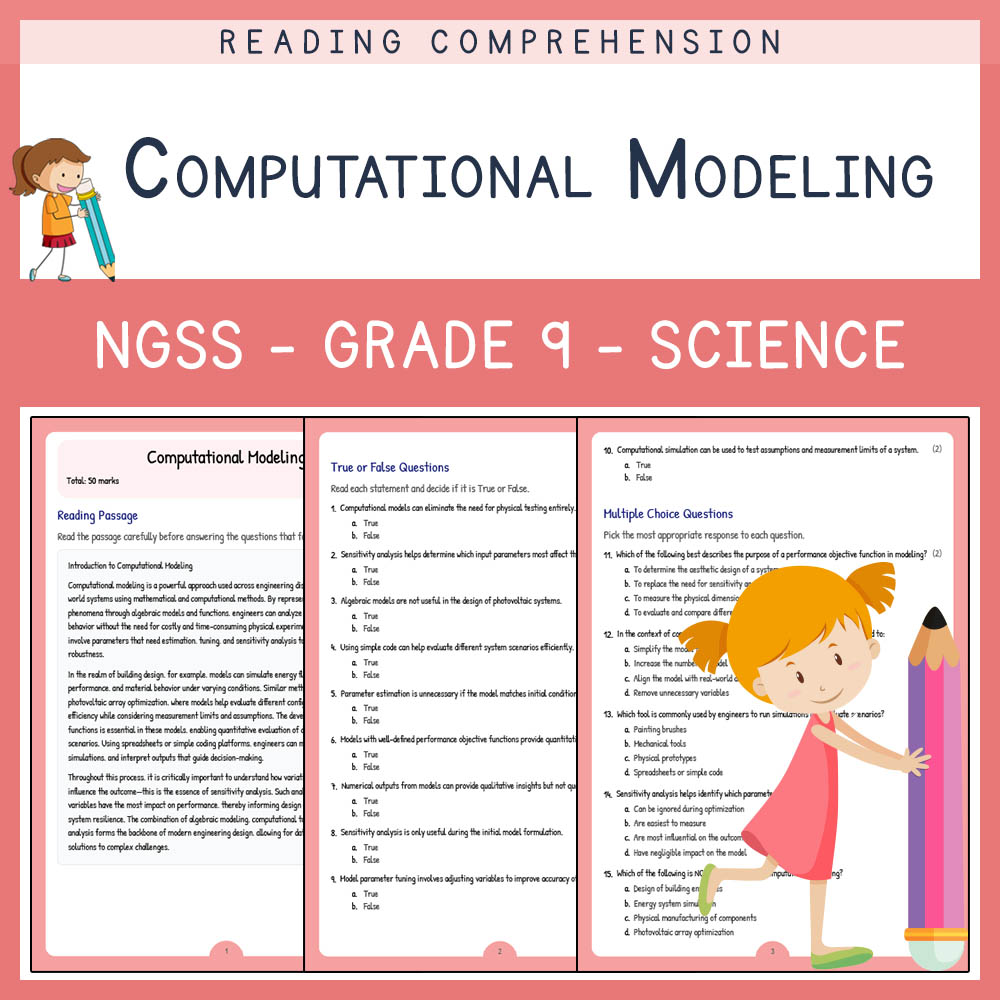
Grade 9 Science | Computational Modeling Worksheet & Answer Key (NGSS Alignment)
Created byLumora LearningLearning Objectives
- Understand the principles of computational modeling in engineering and system design.
- Apply mathematical methods to develop and analyze models for real-world systems.
- Evaluate scenarios using spreadsheets or simple code to optimize system performance.
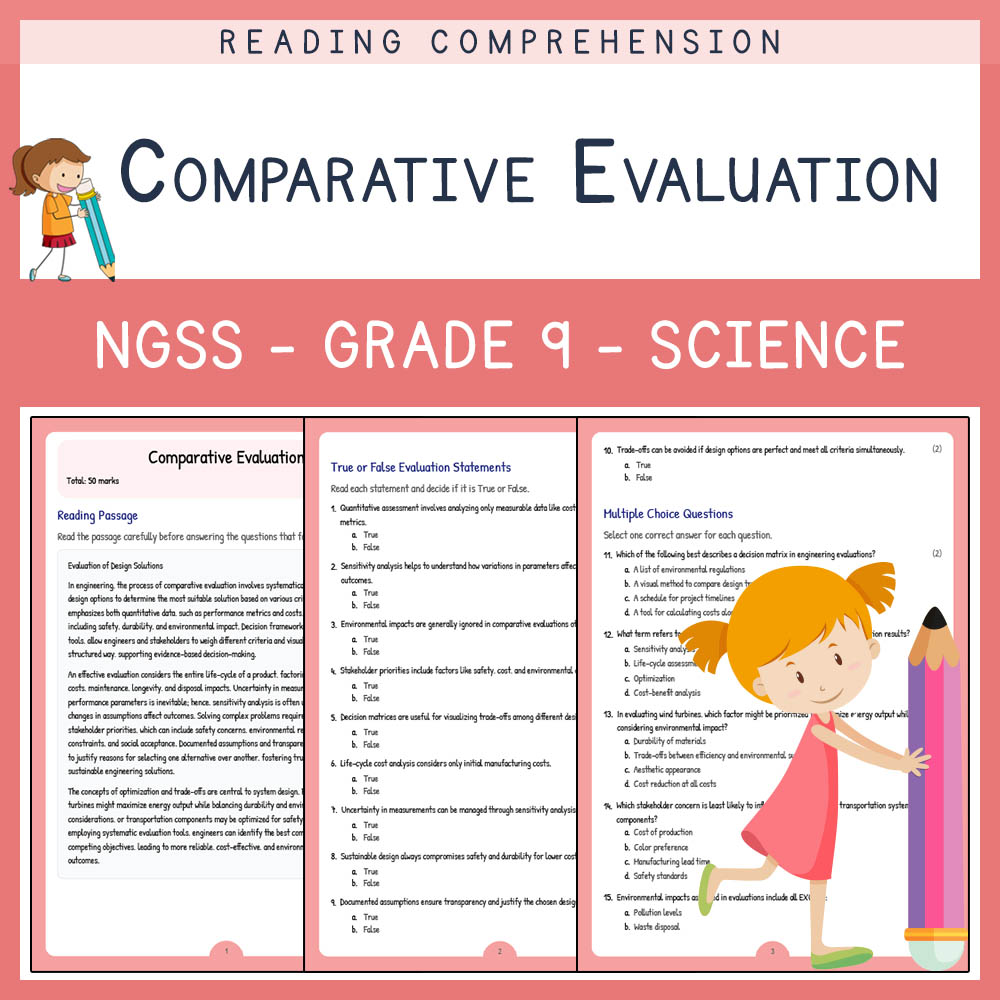
Grade 9 Science | Comparative Evaluation Worksheet & Answer Key (NGSS Aligned)
Created byLumora LearningLearning Objectives
- Understand the principles and importance of comparative evaluation in engineering design.
- Apply quantitative and qualitative assessment criteria to compare different systems or components.
- Use decision frameworks and matrices to analyze trade-offs among performance metrics, costs, and environmental impacts.
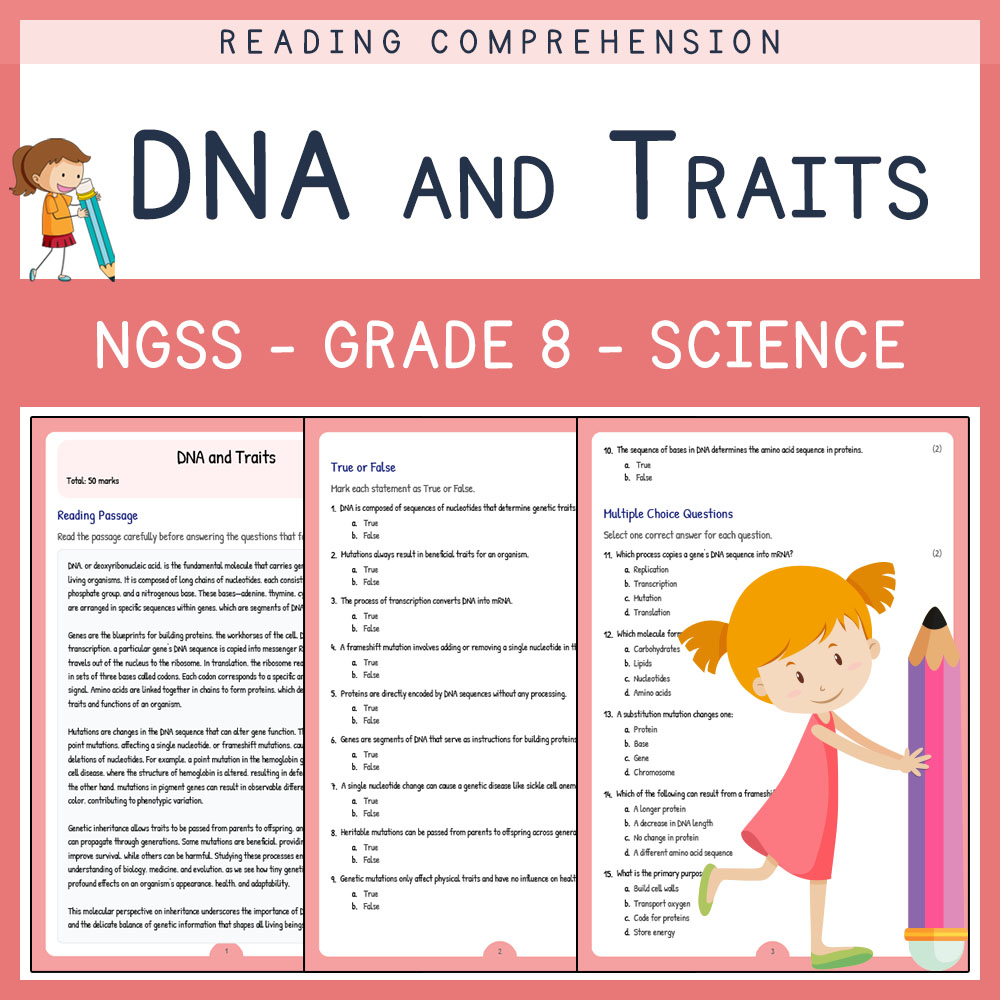
Grade 8 Science | DNA and Traits Worksheet (PDF + Answer Key) NGSS-Aligned
Created byLumora LearningLearning Objectives
- Explain the relationship between DNA sequence and protein structure.
- Describe how gene structure and mutations affect observable traits.
- Illustrate the processes of transcription and translation.
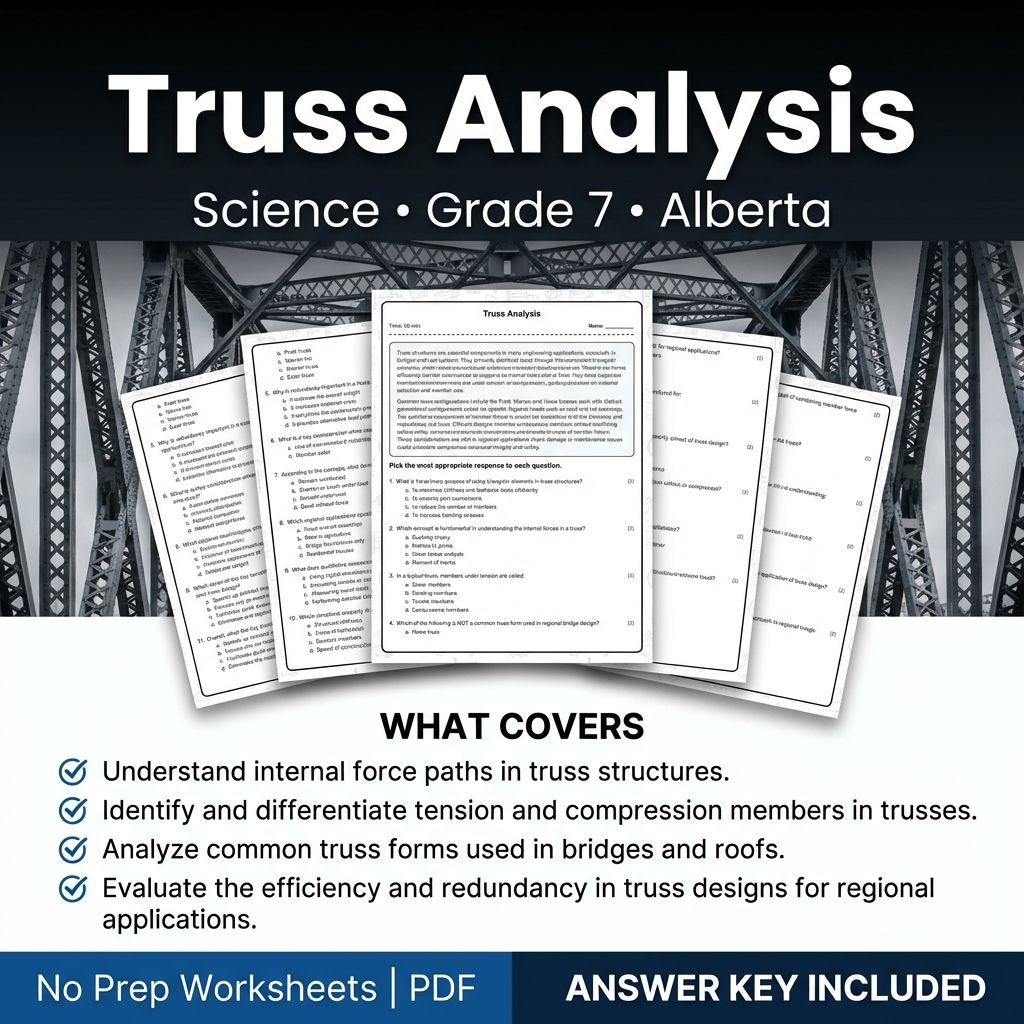
Grade 7 Science Worksheet on Truss Analysis | Alberta Standards
Created byCoral Reef LearningLearning Objectives
- Understand internal force paths in truss structures.
- Identify and differentiate tension and compression members in trusses.
- Analyze common truss forms used in bridges and roofs.
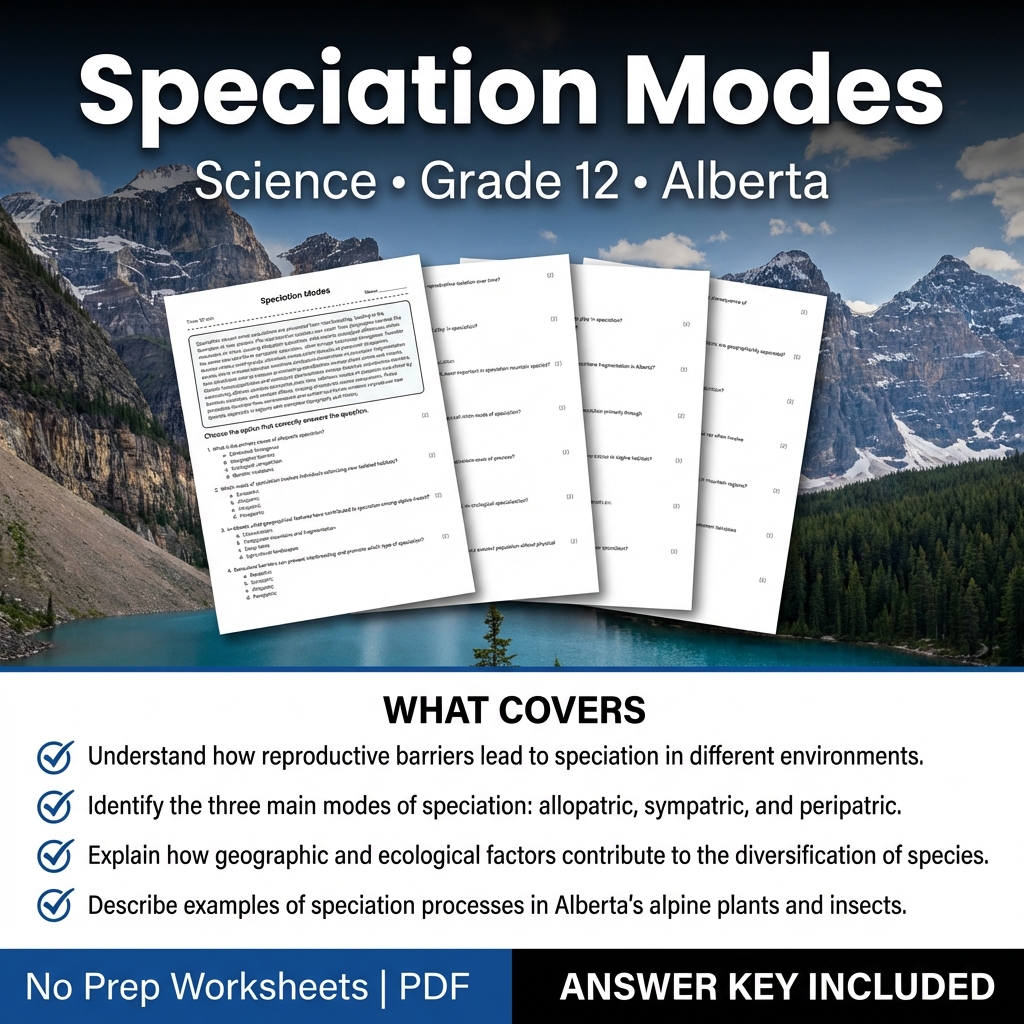
Speciation Modes Worksheet | Science | Grade 12 | Alberta Standards
Created byCoral Reef LearningLearning Objectives
- Understand how reproductive barriers lead to speciation in different environments.
- Identify the three main modes of speciation: allopatric, sympatric, and peripatric.
- Explain how geographic and ecological factors contribute to the diversification of species.
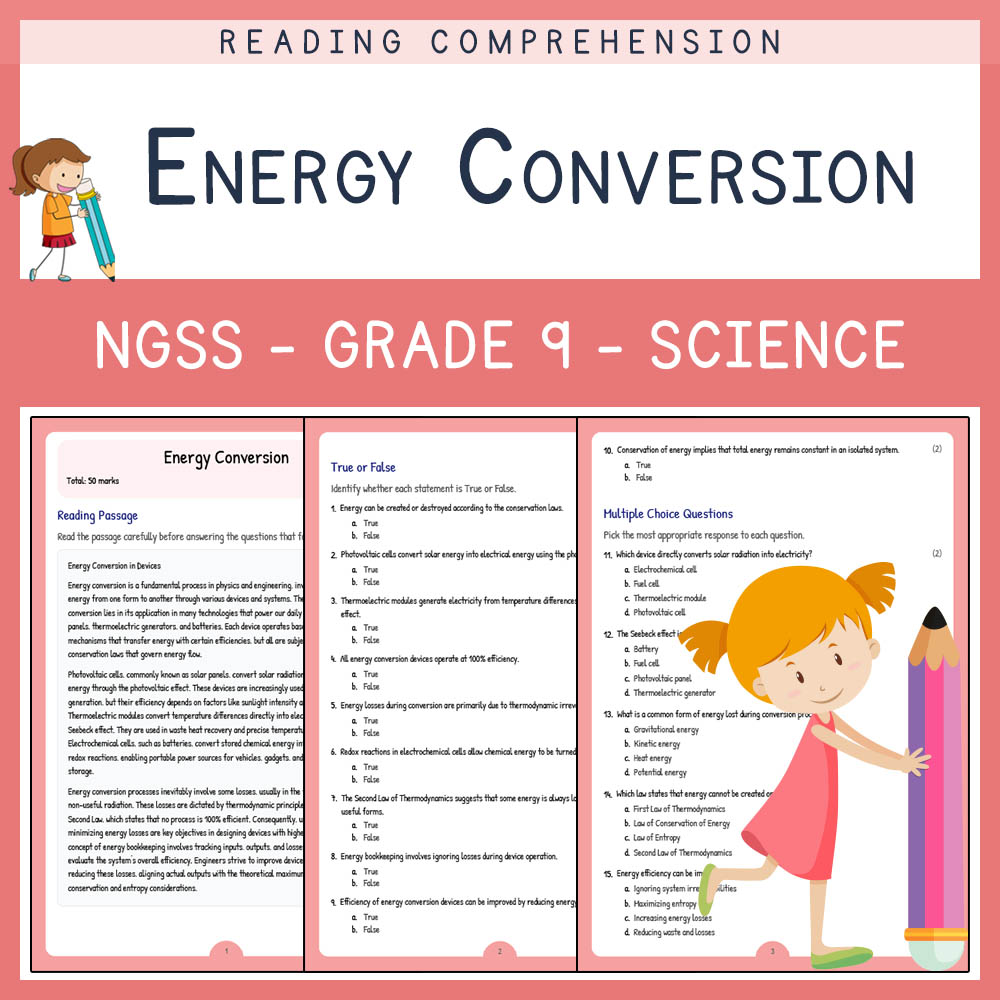
Grade 9 Science | Energy Conversion Worksheet (PDF + Answer Key) – NGSS Aligned
Created byLumora LearningLearning Objectives
- Understand the principles of energy conversion and the types of devices involved.
- Identify the sources, processes, and efficiencies of different energy transfer methods.
- Analyze energy losses and the importance of energy bookkeeping in practical applications.
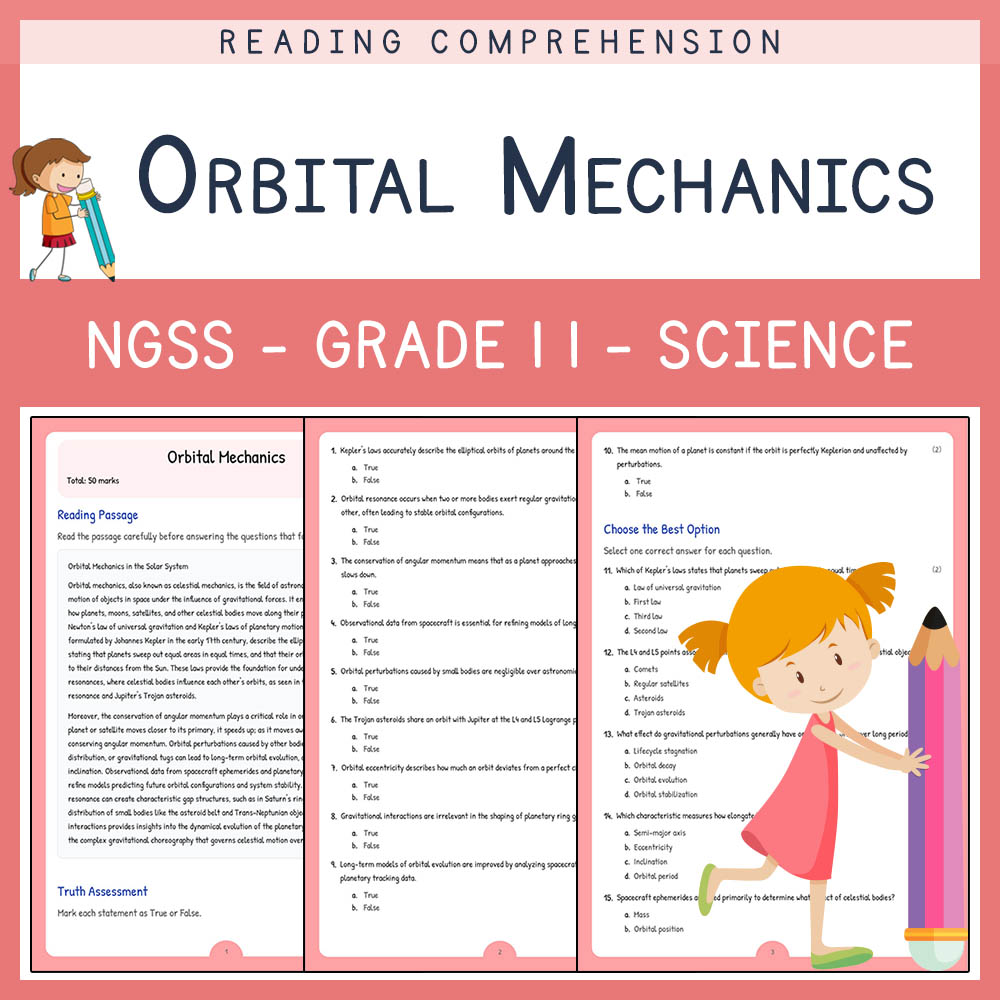
Grade 11 Science | Orbital Mechanics Worksheet & Answer Key (PDF)
Created byLumora LearningLearning Objectives
- Understand Kepler's laws and their applications to planetary motion
- Analyze gravitational interactions and their effects on orbital stability
- Explore phenomena such as orbital resonance and perturbations in the planetary system
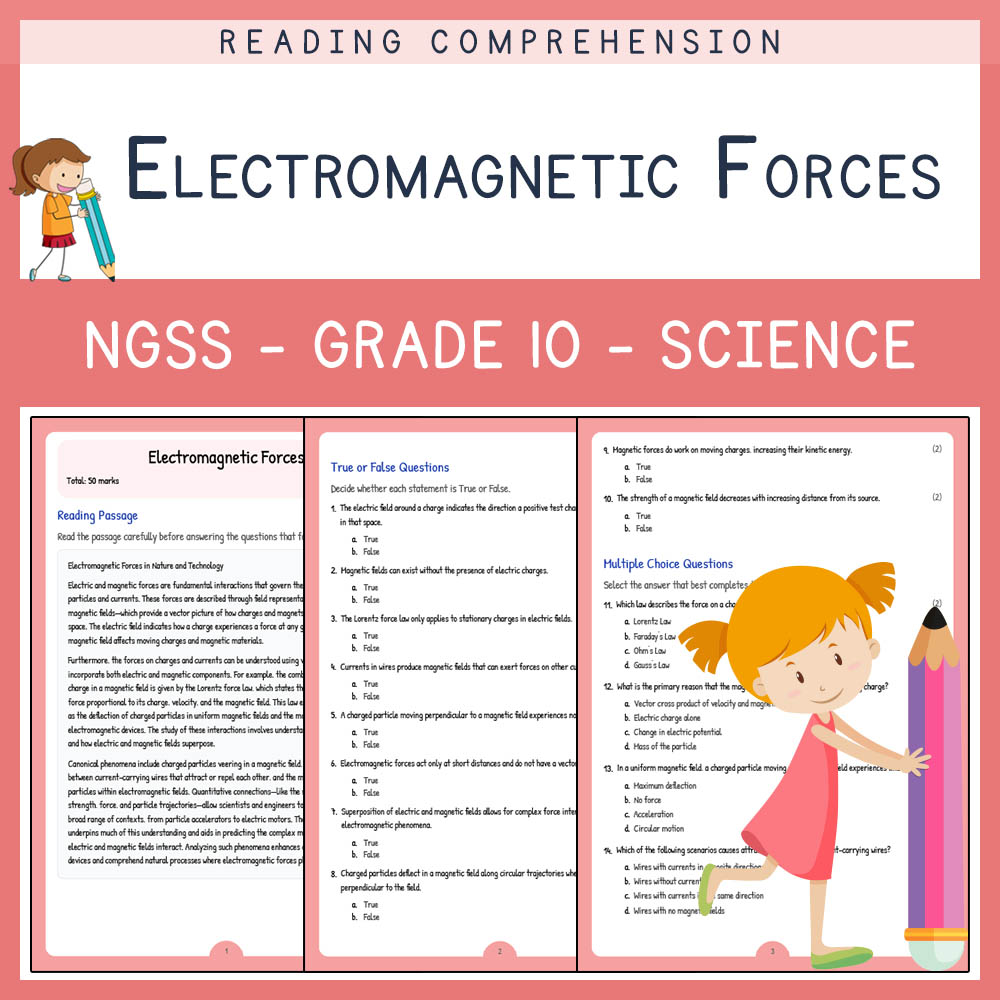
Grade 10 Science | Electromagnetic Forces Worksheet & Answer Key (NGSS Aligned)
Created byLumora LearningLearning Objectives
- Understand the principles of electric and magnetic fields and their vector relationships.
- Analyze forces on charges and currents within electric and magnetic fields, including the Lorentz force law.
- Apply concepts to phenomena such as charged particle deflection and magnetic interactions between current-carrying wires.
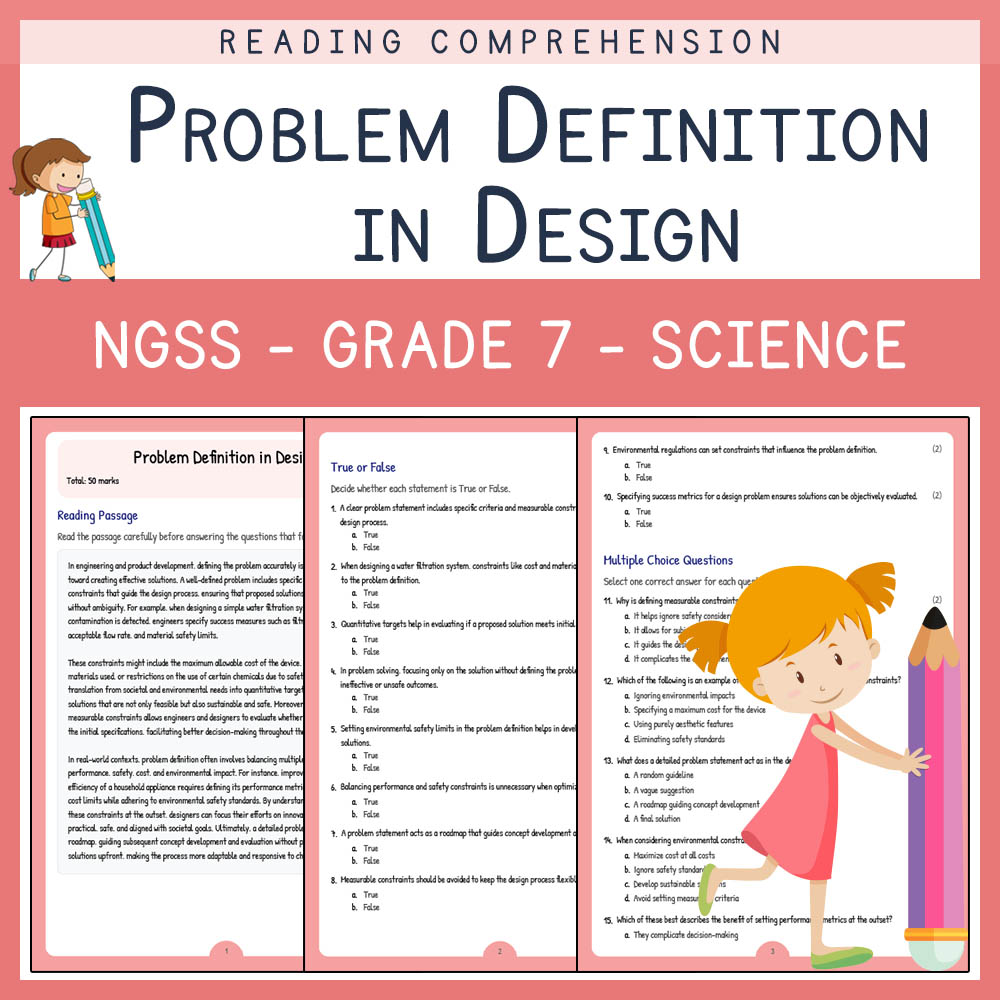
Grade 7 Science | Problem Definition in Design Worksheet & Answer Key (PDF)
Created byLumora LearningLearning Objectives
- Understand how to clearly define design problems with measurable constraints.
- Learn to translate societal and environmental needs into specific, quantitative criteria.
- Recognize real-world examples of problem specification for effective solution development.
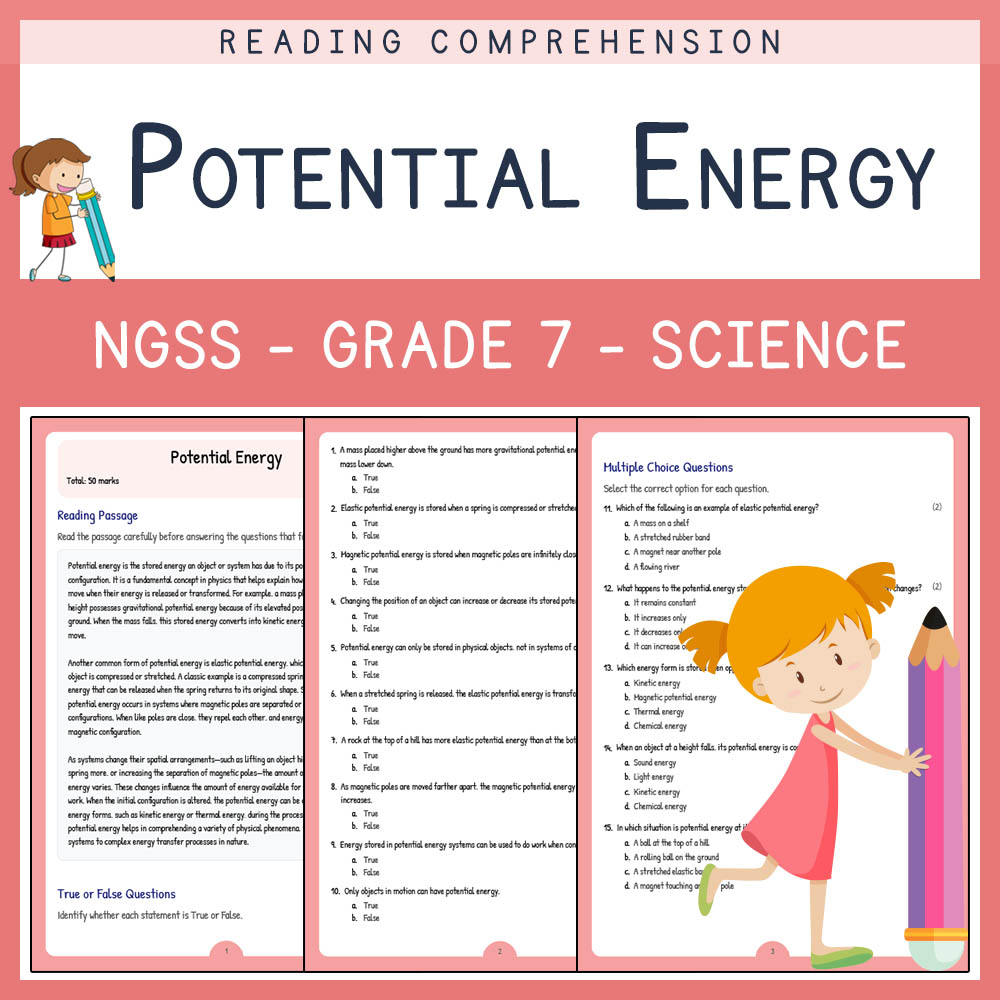
Grade 7 Science | Potential Energy Worksheet & Answer Key for NGSS Standards
Created byLumora LearningLearning Objectives
- Explain different types of potential energy and how they are stored in systems.
- Describe how changes in object arrangement and interactions can alter stored potential energy.
- Identify examples of gravitational, elastic, and magnetic potential energy in real-world situations.
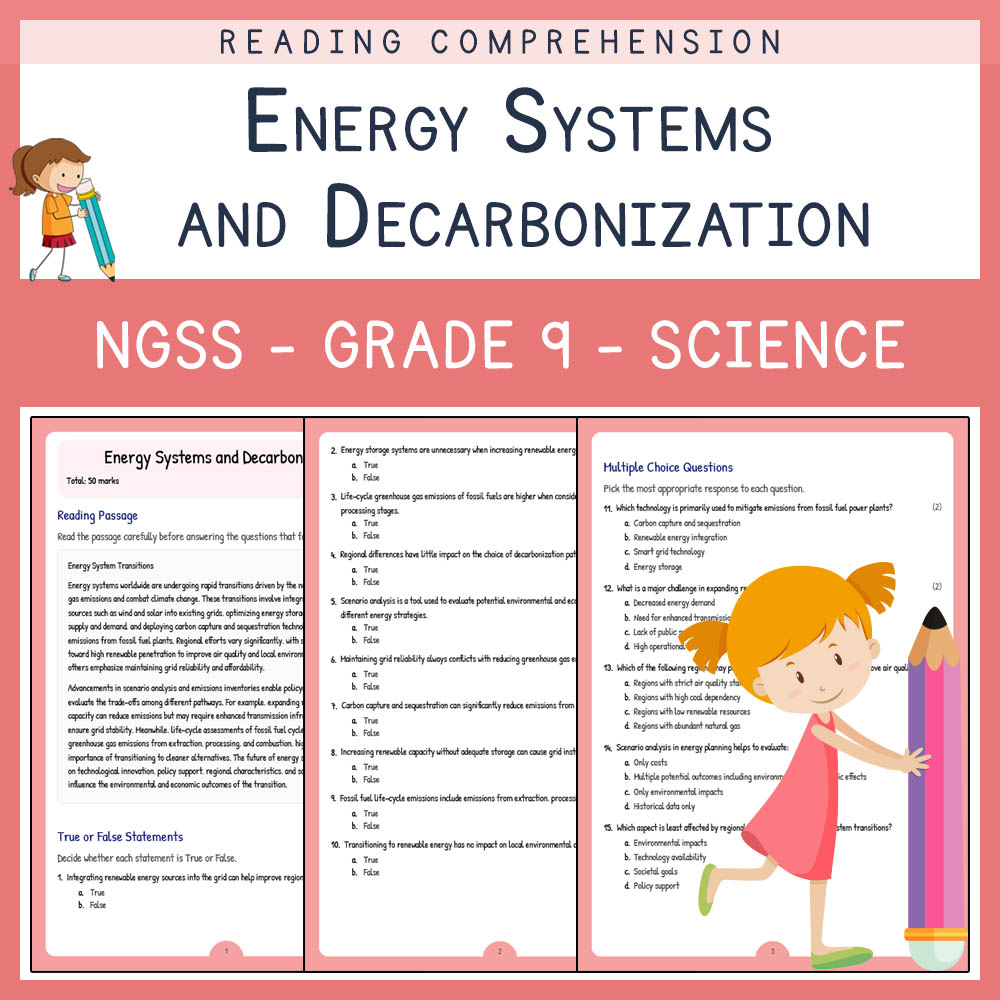
Grade 9 Science | Energy Systems & Decarbonization Worksheet (Answer Key + Rubric)
Created byLumora LearningLearning Objectives
- Understand the various energy transition pathways including renewable integration and energy storage.
- Analyze the trade-offs among reliability, affordability, and greenhouse gas reduction in energy systems.
- Evaluate life-cycle greenhouse gas emissions of different fossil fuel and renewable energy cycles.
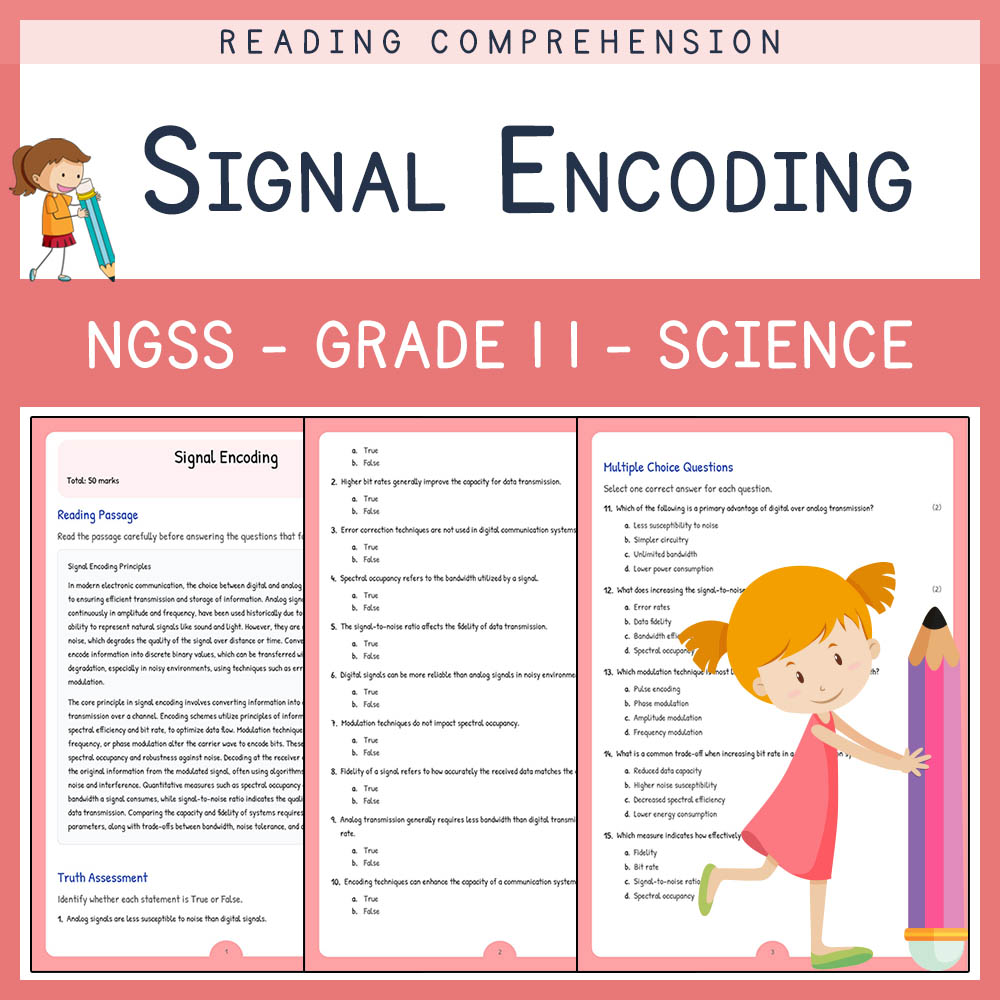
Grade 11 Science | Signal Encoding Worksheet & Answer Key – NGSS Aligned
Created byLumora LearningLearning Objectives
- Evaluate the principles of digital and analog transmission and storage regarding bandwidth, noise, and fidelity.
- Explain the concepts of encoding, modulation, and decoding in relation to communication capacity and reliability.
- Compare quantitative measures such as bit rate, signal-to-noise ratio, and spectral occupancy in signal processing.
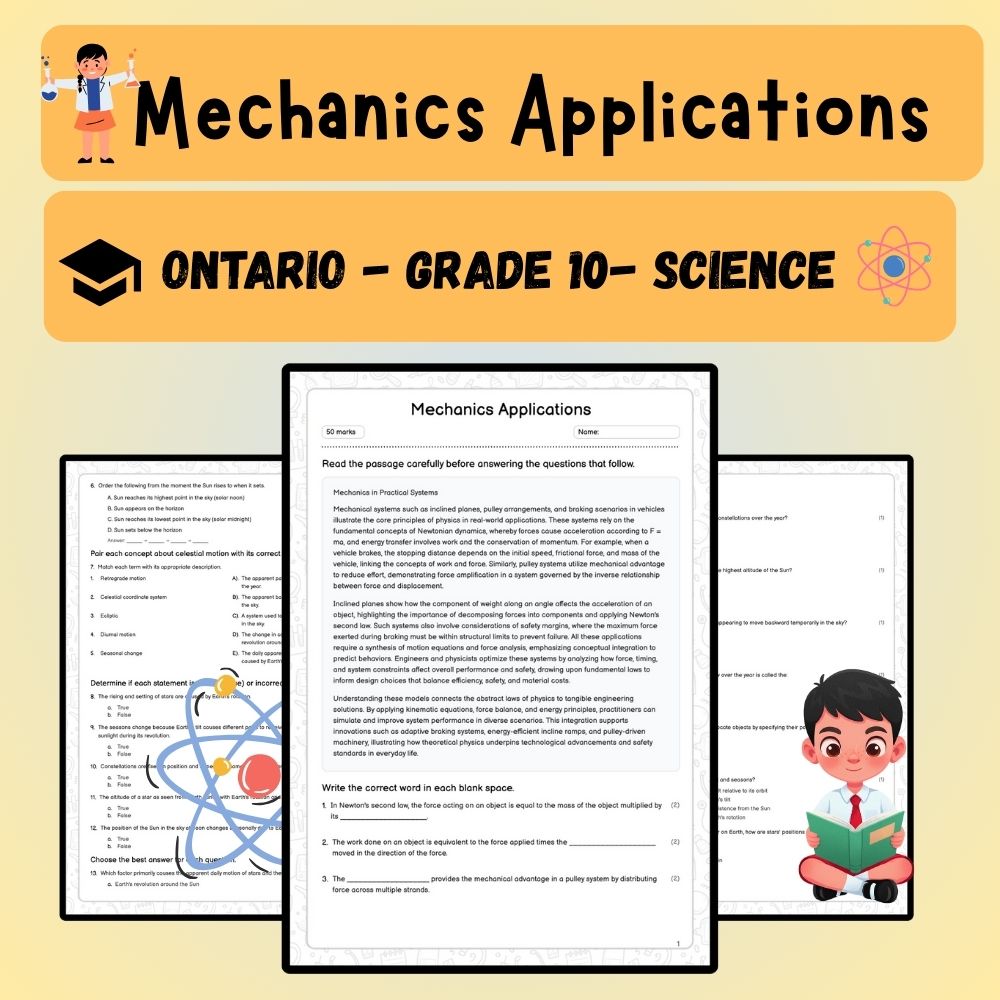
Grade 10 Science: Mechanics Applications Worksheet (Answer Key) – Ontario Standards
 Created byPrism Point Learning
Learning Objectives
- Understand how kinematic relations and Newtonian dynamics are applied to real-world mechanical systems.
- Analyze the connections between force, mass, acceleration, work, and momentum in practical contexts.
- Predict system behavior and interpret trade-offs between mass, force, and acceleration in engineering situations.
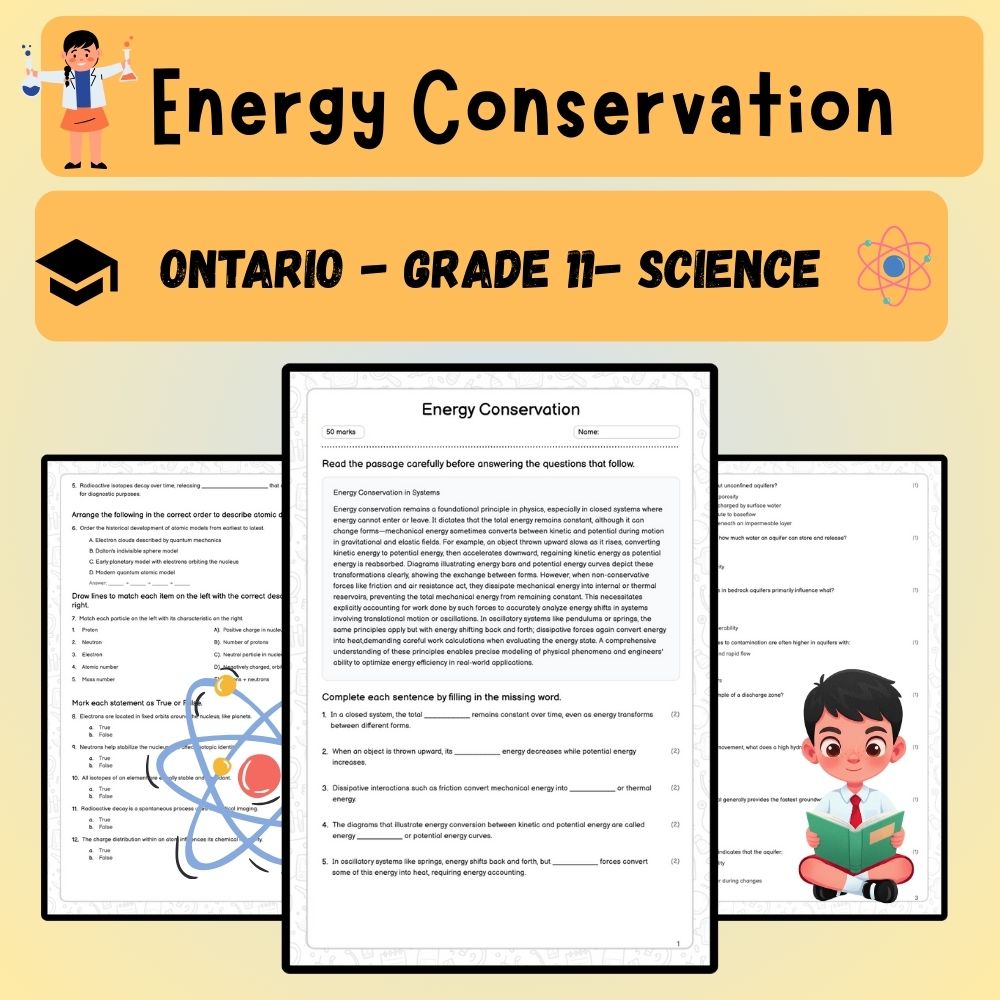
Grade 11 Science – Energy Conservation Worksheet | Ontario Curriculum
Created byPrism Point LearningLearning Objectives
- Explain the principles of energy conservation in closed systems.
- Illustrate energy transformations between kinetic and potential forms during motion.
- Identify how non-conservative forces dissipate mechanical energy and require energy accounting.
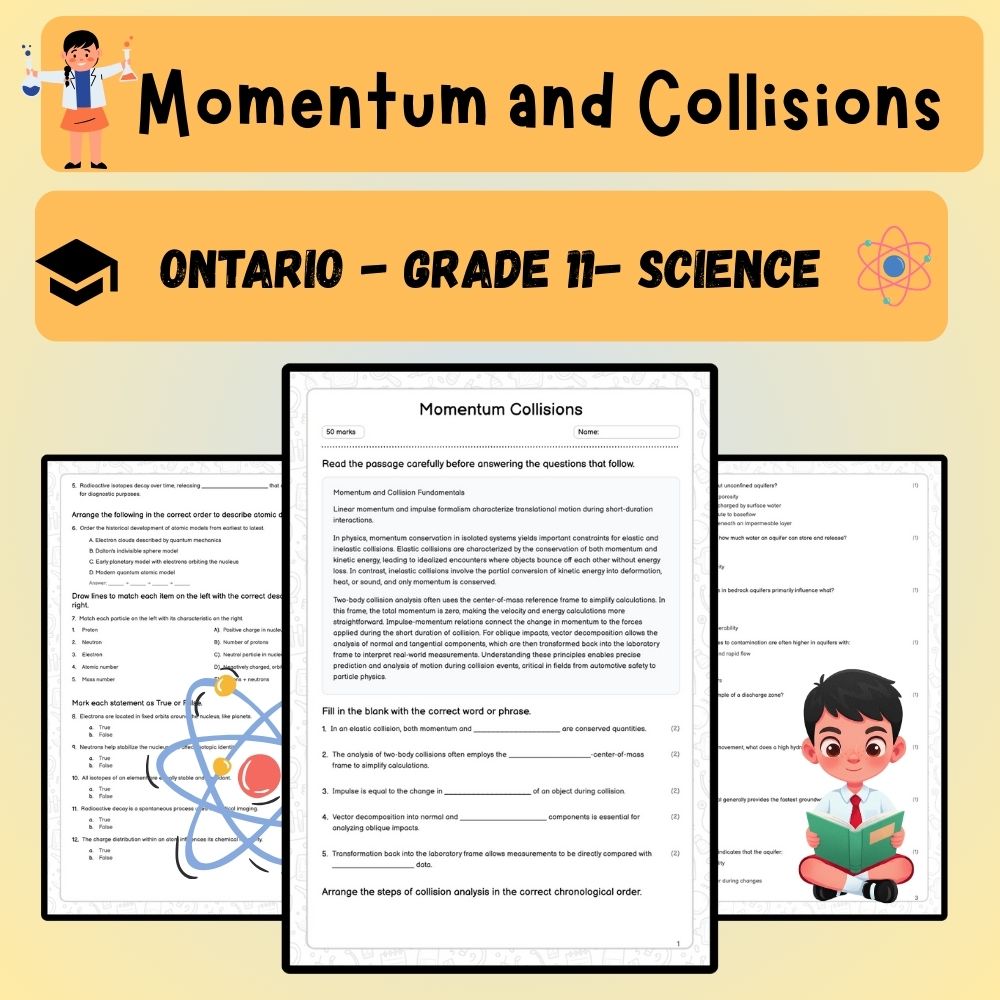
Grade 11 Science | Momentum and Collisions Worksheet (PDF) – Ontario Standards
Created byPrism Point LearningLearning Objectives
- Understand the concepts of linear momentum and impulse in collision processes.
- Apply conservation of momentum in analyzing elastic and inelastic collisions.
- Differentiate between elastic and inelastic collisions based on energy conservation.
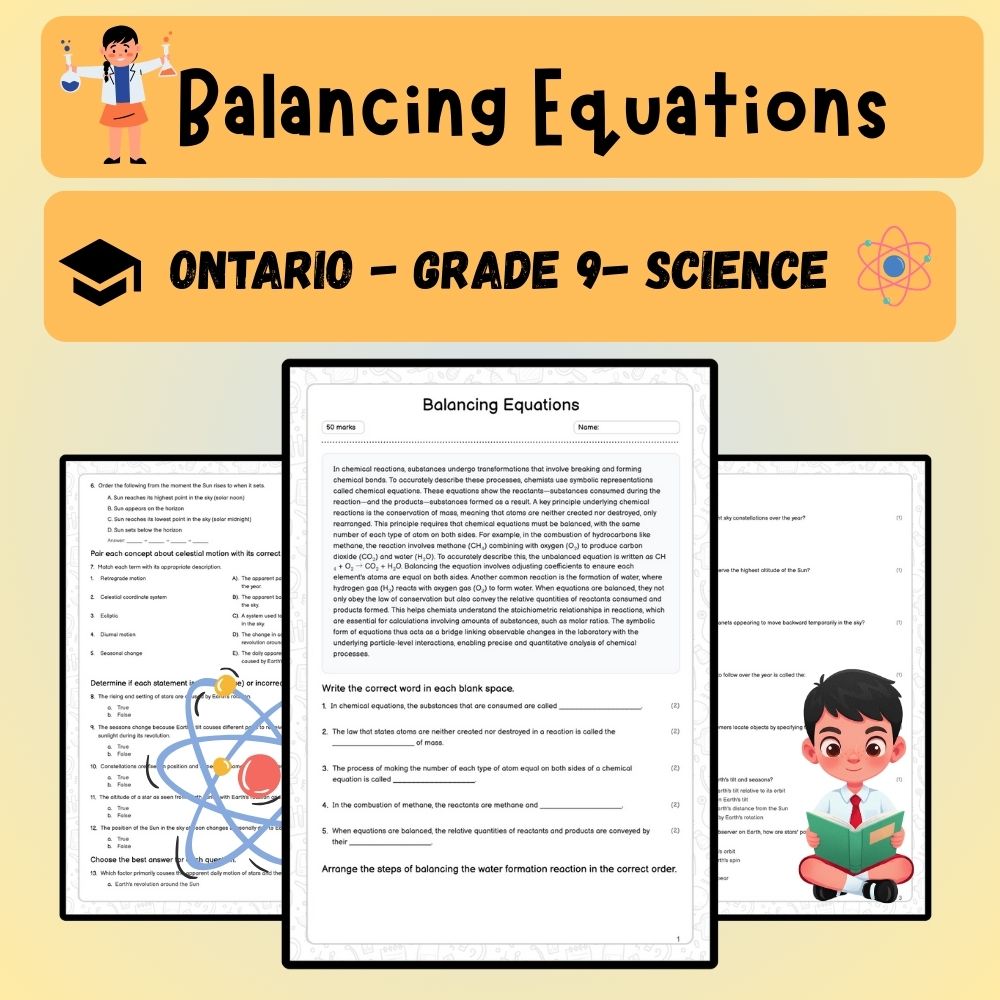
Grade 9 Science | Balancing Equations Worksheet (PDF) – Ontario Standards
Created byPrism Point LearningLearning Objectives
- Understand the purpose of chemical equations and the conservation of atoms.
- Learn how to represent reactions symbolically with correct formulas.
- Practice balancing chemical equations to reflect mass conservation.
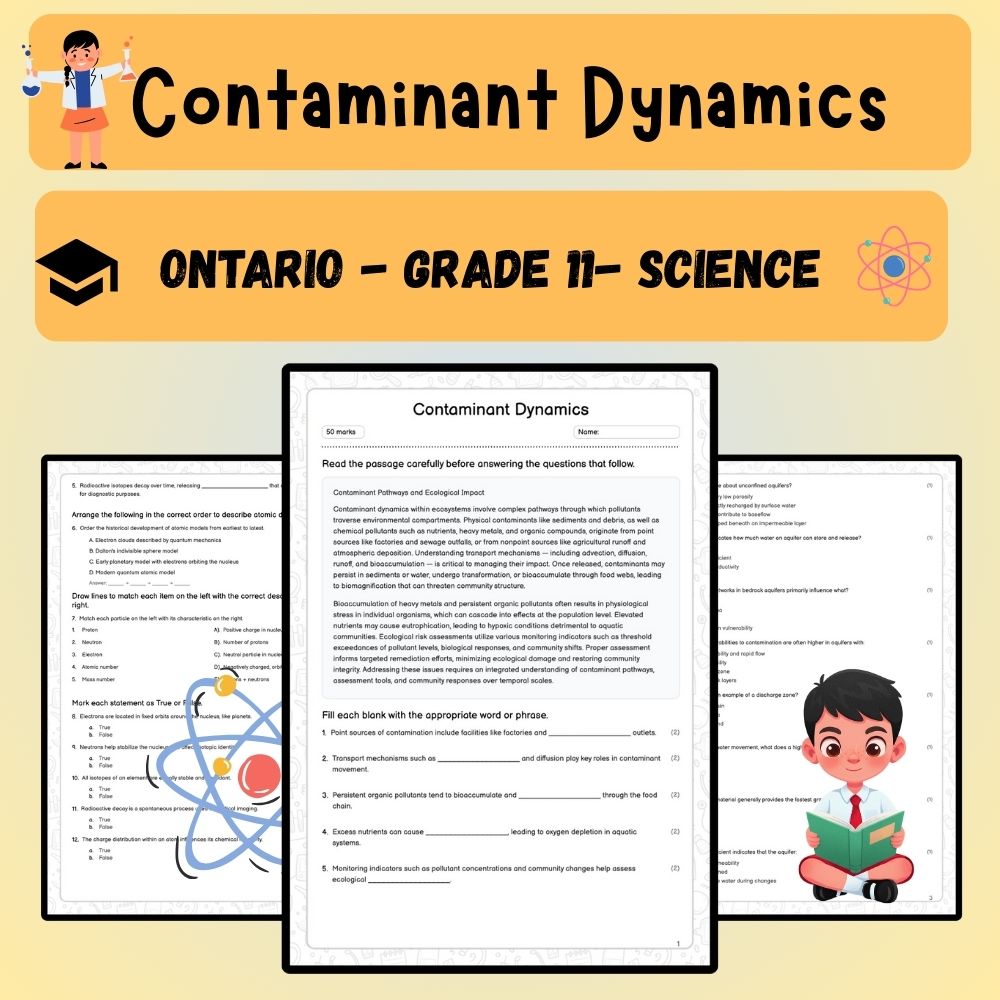
Grade 11 Science | Contaminant Dynamics Worksheet (PDF) – Ontario Standards
Created byPrism Point LearningLearning Objectives
- Understand the pathways and environmental fate of physical and chemical contaminants in ecosystems.
- Identify sources, transport mechanisms, and effects of nutrients, heavy metals, and persistent organic pollutants.
- Analyze how contaminants bioaccumulate and biomagnify in food webs and influence community composition.
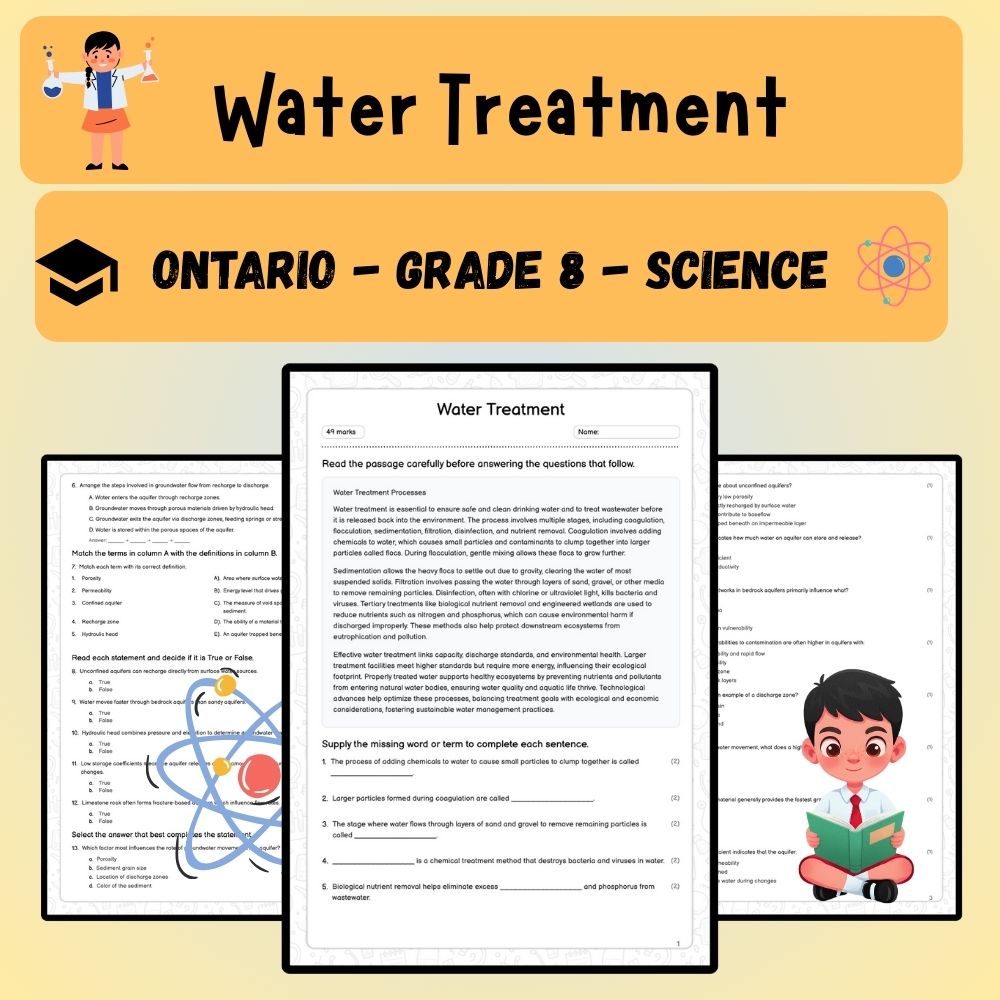
Grade 8 Science | Water Treatment Worksheet (Worksheet + Answer Key) – Ontario Standards
Created byPrism Point LearningLearning Objectives
- Understand the principles and stages of drinking water and wastewater treatment processes.
- Identify mechanisms for removal of suspended solids, pathogens, and dissolved contaminants.
- Explain tertiary treatment methods such as biological nutrient removal and engineered wetlands.
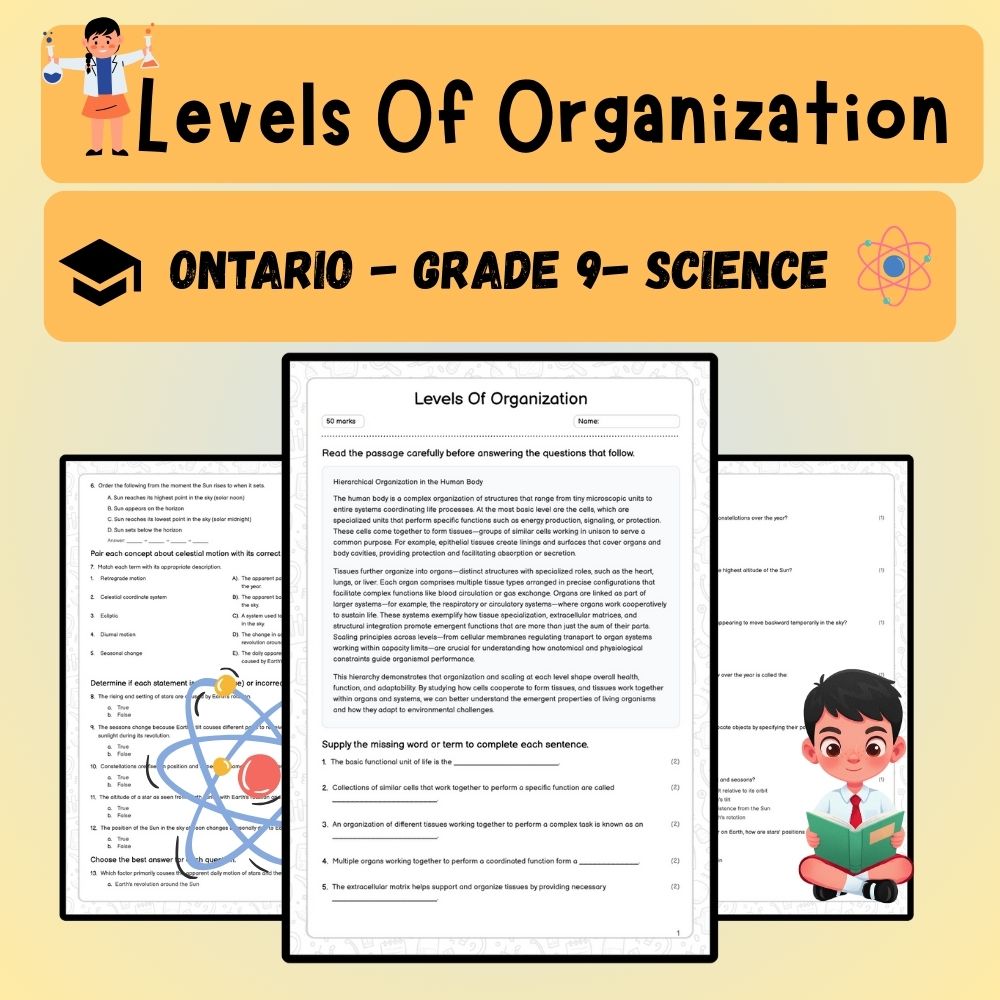
Grade 9 Science | Levels Of Organization Worksheet (PDF) Aligned with Ontario Standards
Created byPrism Point LearningLearning Objectives
- Explain the hierarchical relationship among cells, tissues, organs, and systems.
- Describe how cell specialization and extracellular matrices contribute to organ functions.
- Analyze how tissue arrangement supports organ-level processes.
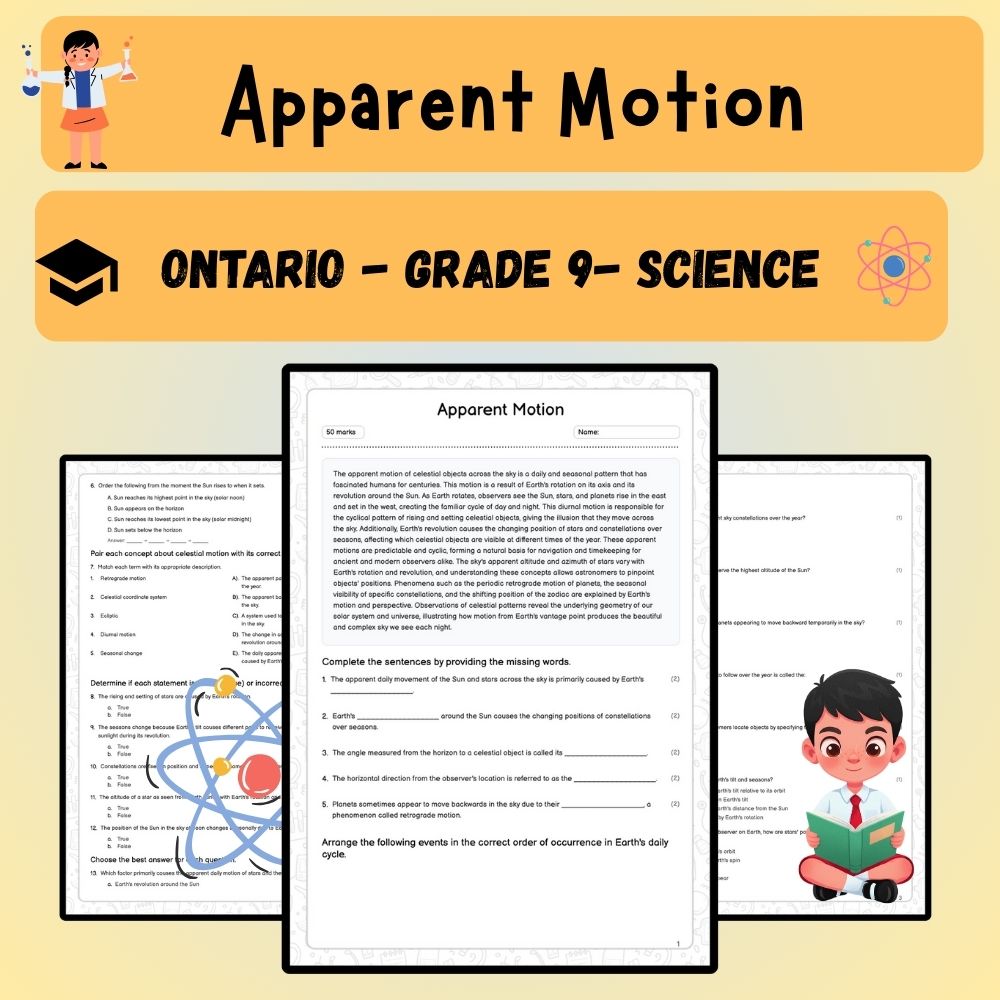
Grade 9 Science Worksheet | Apparent Motion of Celestial Objects (PDF)
Created byPrism Point LearningLearning Objectives
- Explain the causes of apparent diurnal and annual motion of celestial objects as observed from Earth.
- Describe how Earth's rotation and revolution produce observable changes in the night sky over nights and seasons.
- Use celestial coordinate concepts such as rising, setting, altitude, and azimuth to relate observed positions of celestial objects.
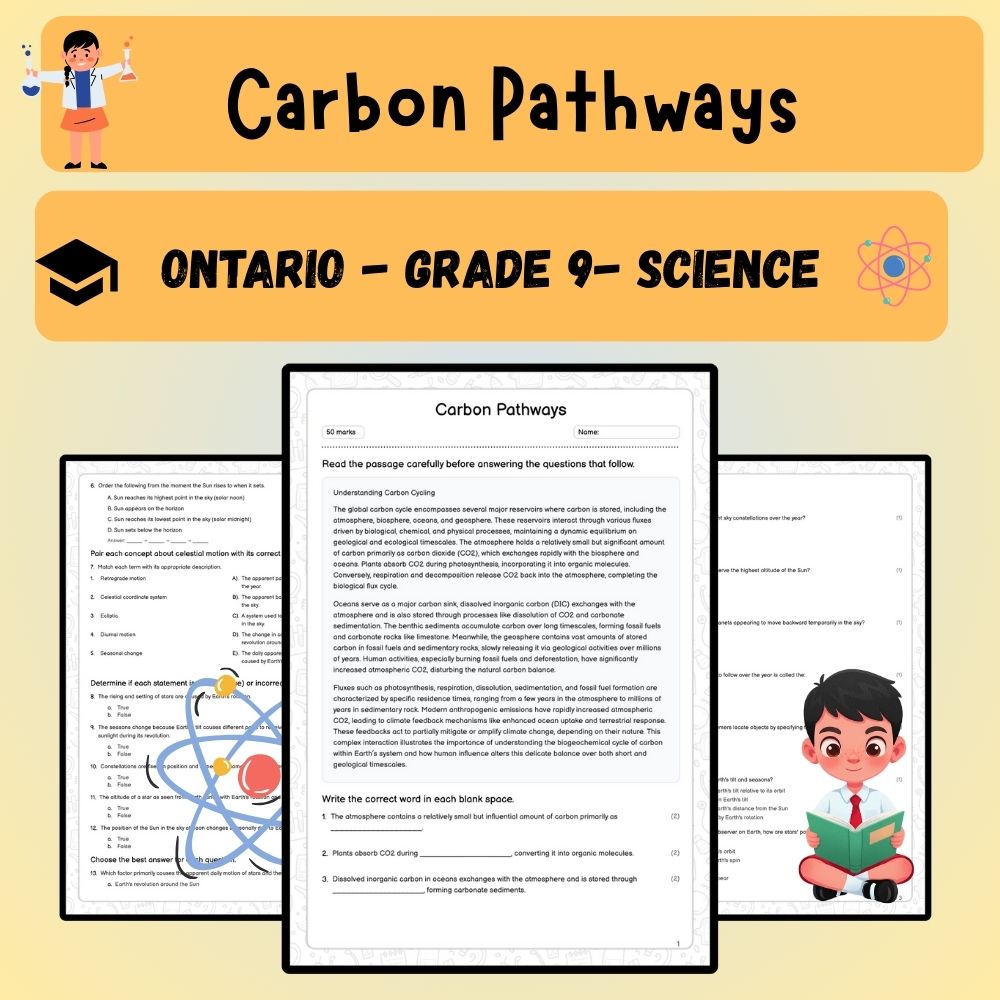
Grade 9 Science | Carbon Pathways Worksheet (Worksheet + Answer Key) - Ontario Standards
Created byPrism Point LearningLearning Objectives
- Describe the major carbon reservoirs in the atmosphere, biosphere, oceans, and geosphere.
- Explain the fluxes and processes that transfer carbon among different reservoirs, including photosynthesis, respiration, dissolution, sedimentation, and fossil fuel formation.
- Quantify basic exchanges and residence times of carbon in different parts of Earth's system.
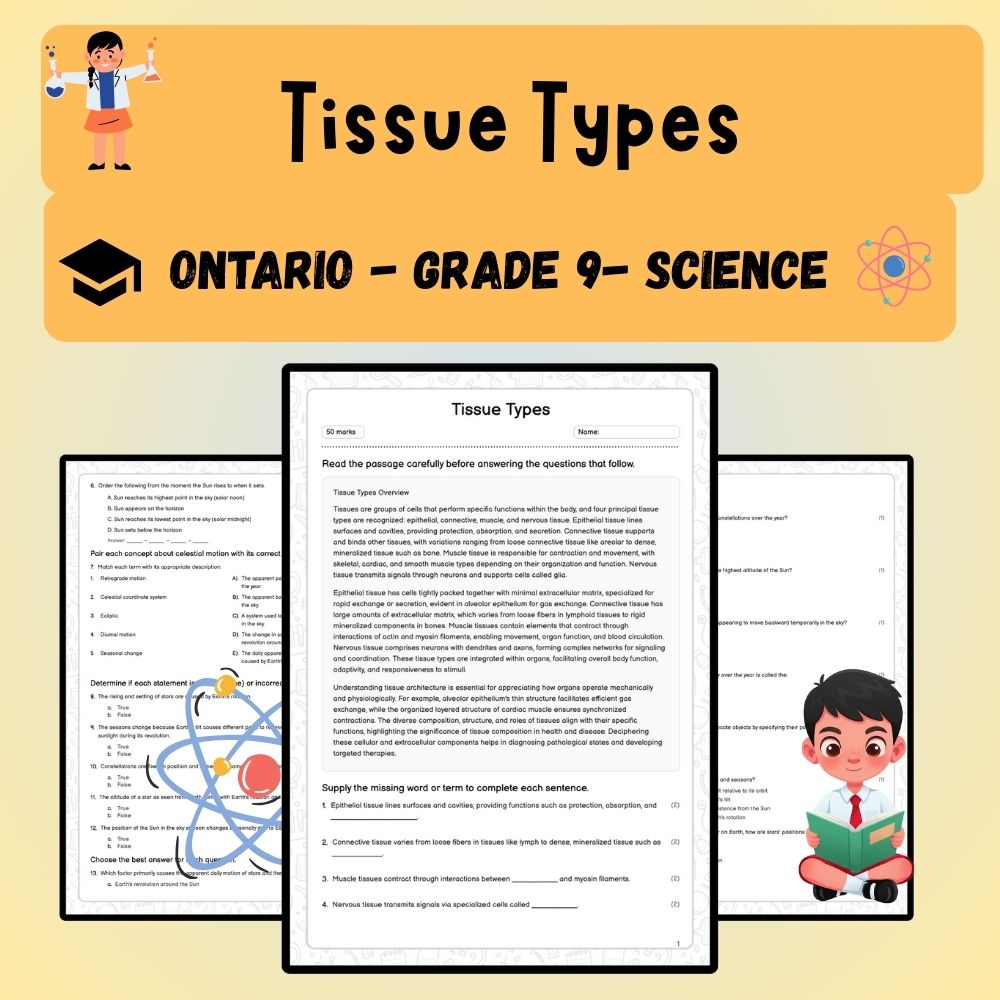
Grade 9 Science | Tissue Types Worksheet (PDF) Aligned with Ontario Standards
Created byPrism Point LearningLearning Objectives
- Describe the principal tissue classes: epithelial, connective, muscle, and nervous.
- Explain the cellular composition and extracellular matrix properties of each tissue type.
- Identify specialized epithelia for absorption and secretion and relate tissue architecture to organ functions.
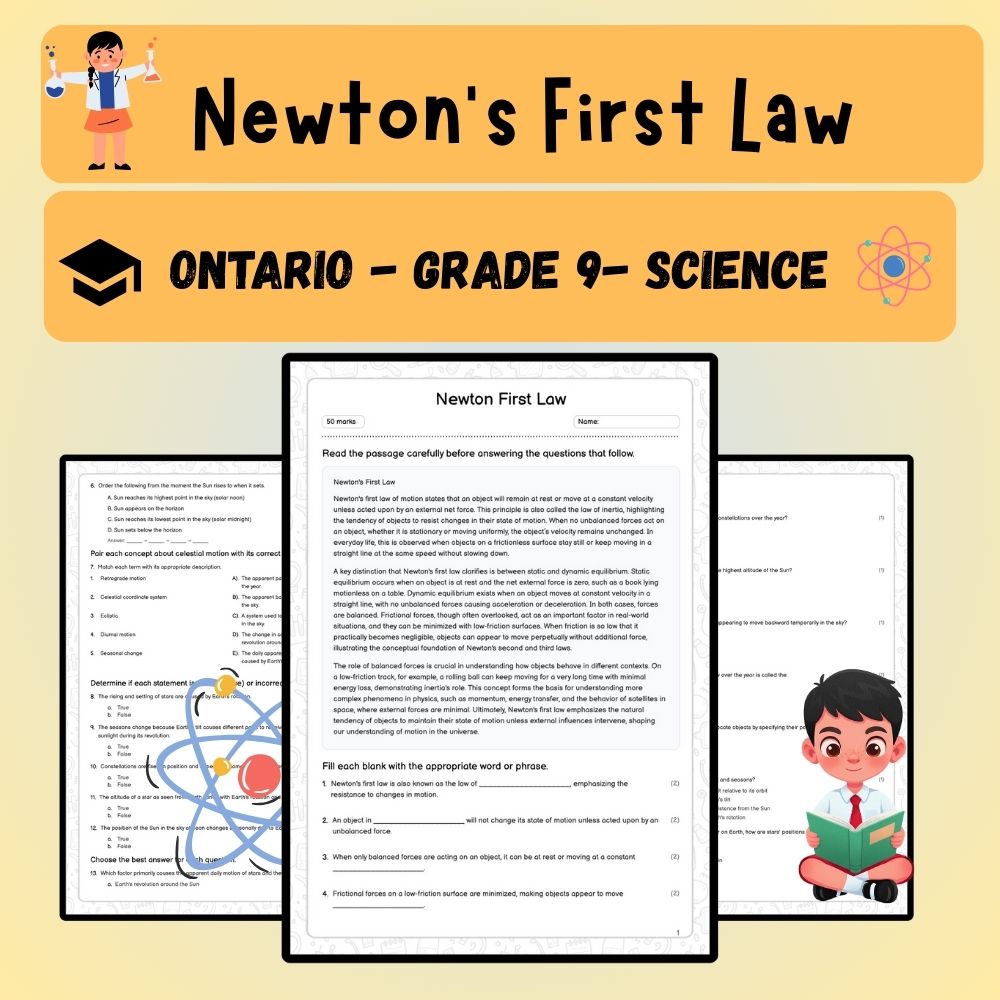
Grade 9 Science | Newton's First Law Worksheet (Answer Key) – Ontario Standard Practice
Created byPrism Point LearningLearning Objectives
- Understand Newton's first law as a statement about inertia and the relationship between net external force and motion.
- Distinguish between objects at rest and objects moving at constant velocity in the context of forces.
- Describe how balanced forces contribute to static and dynamic equilibrium.
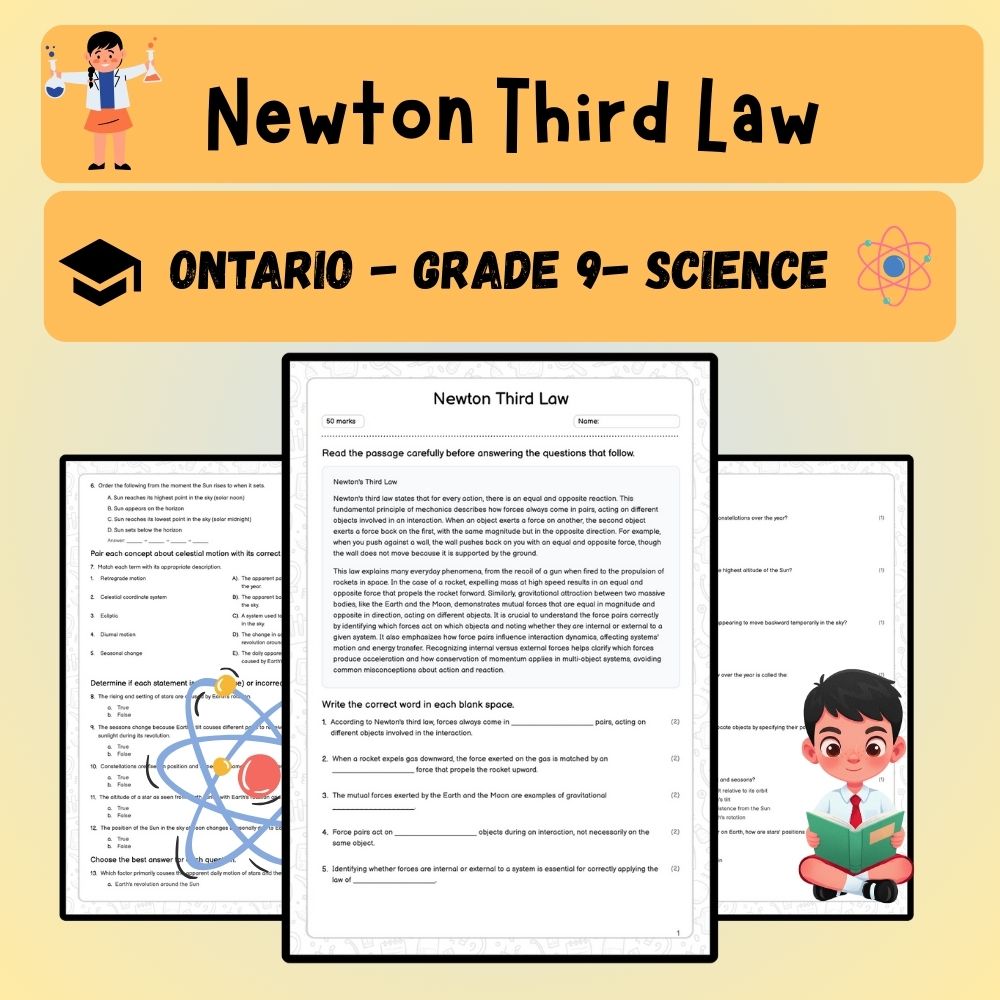
Grade 9 Science | Newton Third Law Worksheet (Worksheet + Answer Key) – Ontario Standards
Created byPrism Point LearningLearning Objectives
- Explain the principle of Newton's third law and identify action–reaction force pairs in various scenarios.
- Analyze common phenomena involving equal and opposite forces applied to different objects.
- Differentiate between internal and external forces when applying Newtonian mechanics to systems.
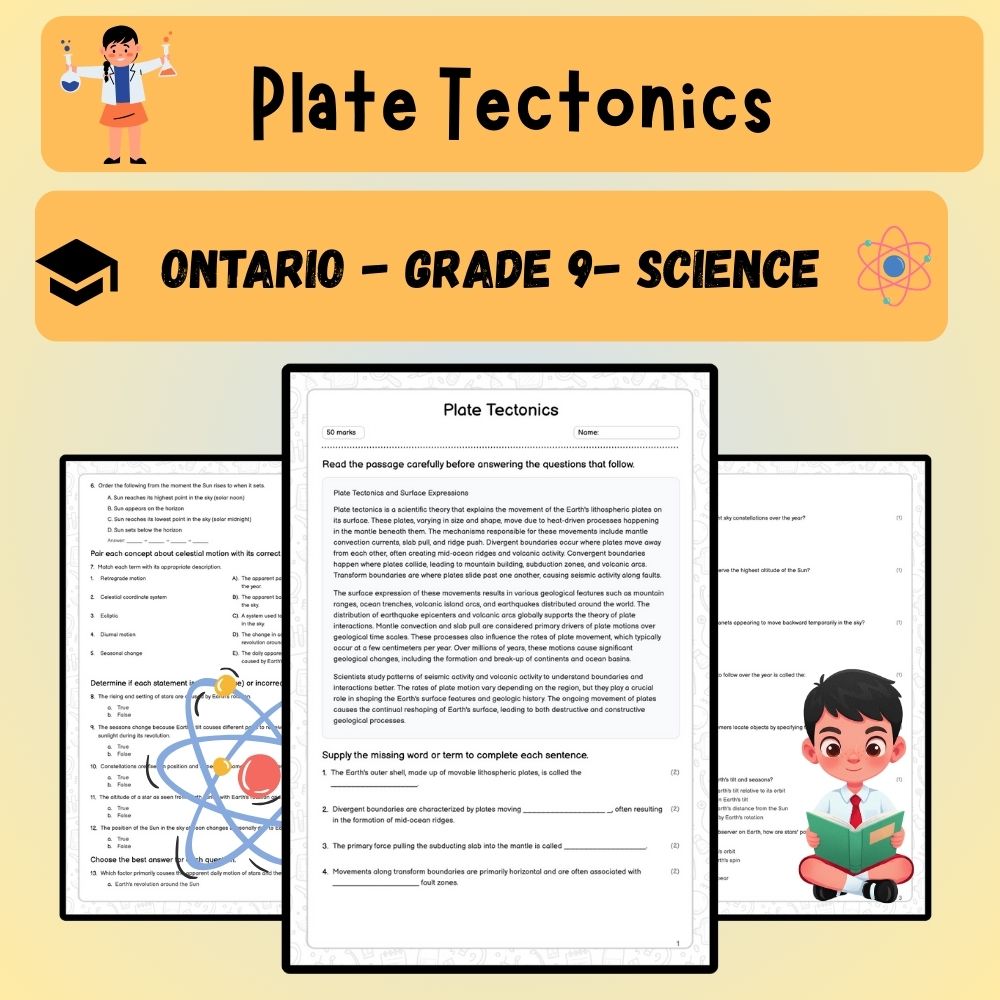
Grade 9 Science | Plate Tectonics Worksheet (Answer Key) – Ontario Standard
Created byPrism Point LearningLearning Objectives
- Describe the different types of plate boundaries and their surface expressions.
- Explain the mechanisms driving plate motions such as mantle convection and slab pull.
- Analyze global distribution of earthquakes and volcanic arcs as evidence for plate interactions.
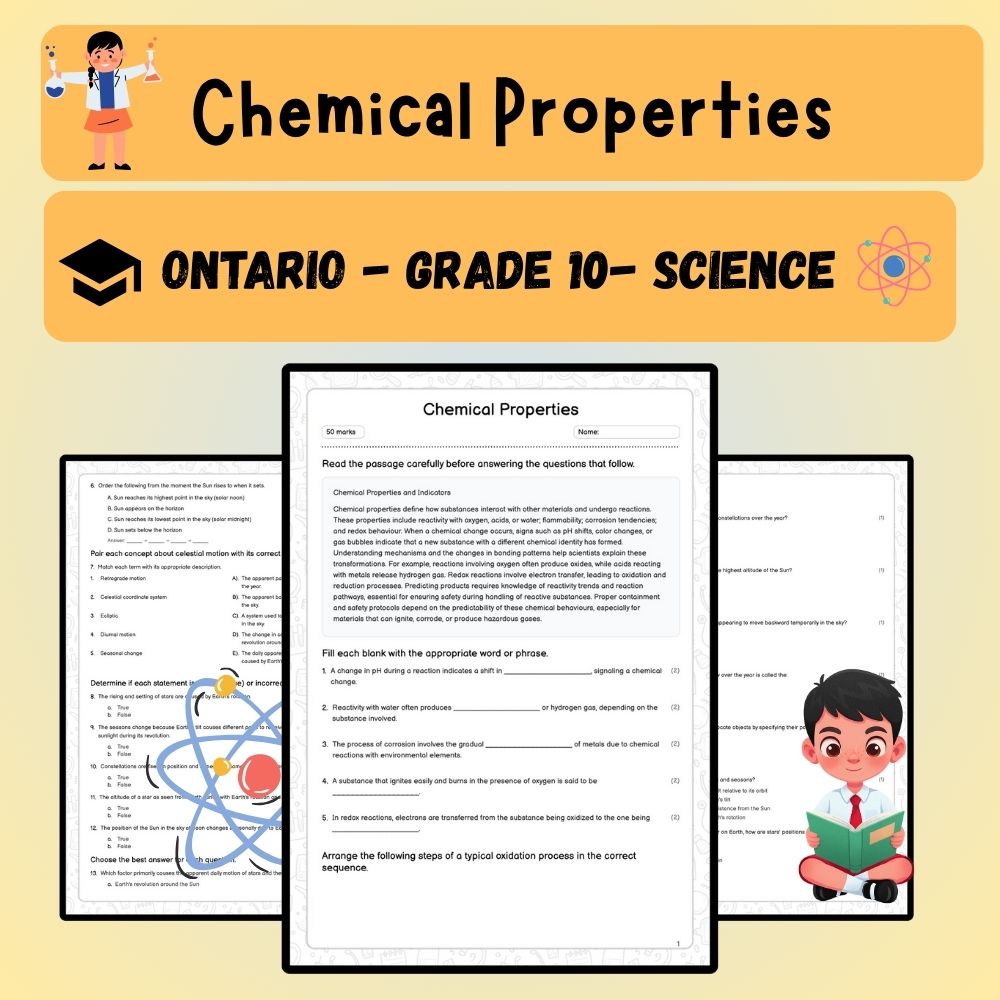
Grade 10 Science | Chemical Properties Worksheet (Ontario Standards) PDF
Created byPrism Point LearningLearning Objectives
- Understand the indicators that signal chemical changes such as pH shifts and gas evolution.
- Identify various reactions involving oxygen, acids, water, and redox processes.
- Explain reaction mechanisms and bonding changes during chemical reactions.
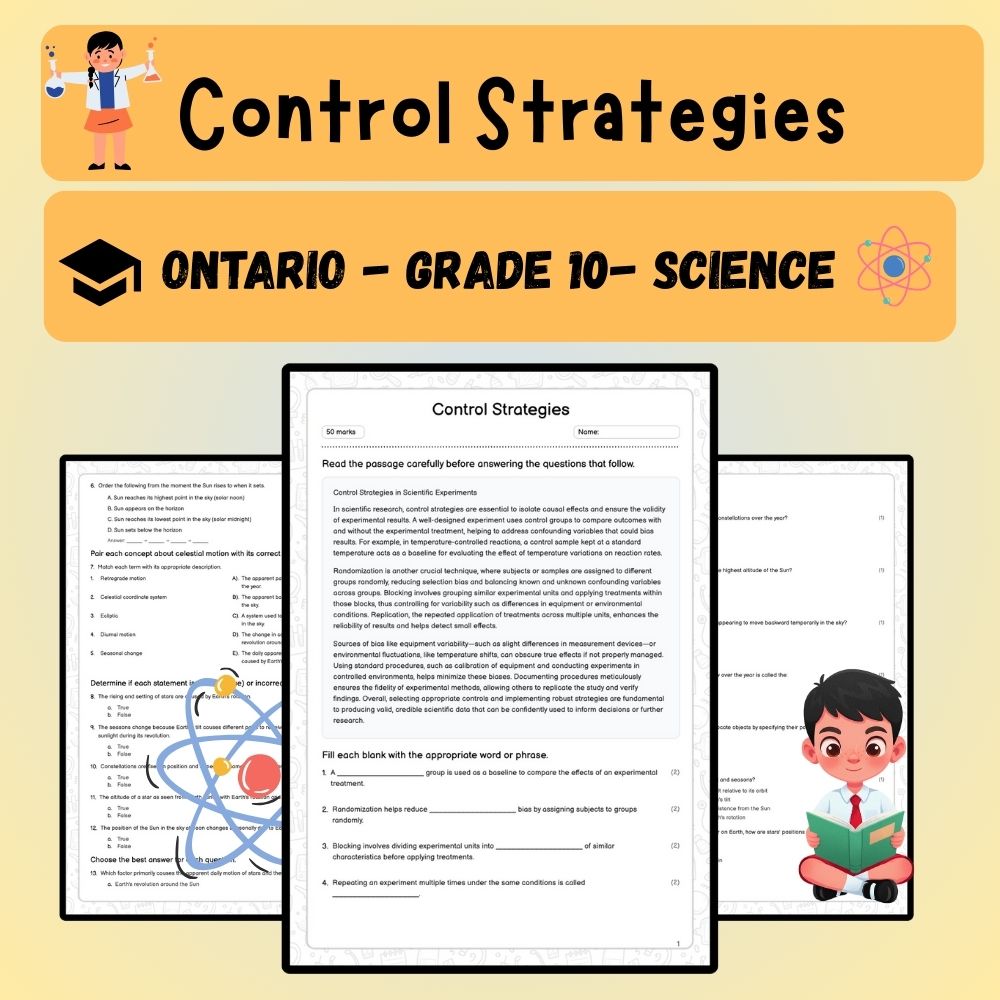
Grade 10 Science | Control Strategies Worksheet (Worksheet + Answer Key) - Ontario Standard
Created byPrism Point LearningLearning Objectives
- Explain the purpose and importance of control groups and randomization in experiments.
- Identify common sources of bias and confounding factors such as equipment variability and environmental fluctuations.
- Describe different levels of control, including techniques like blocking and replication.
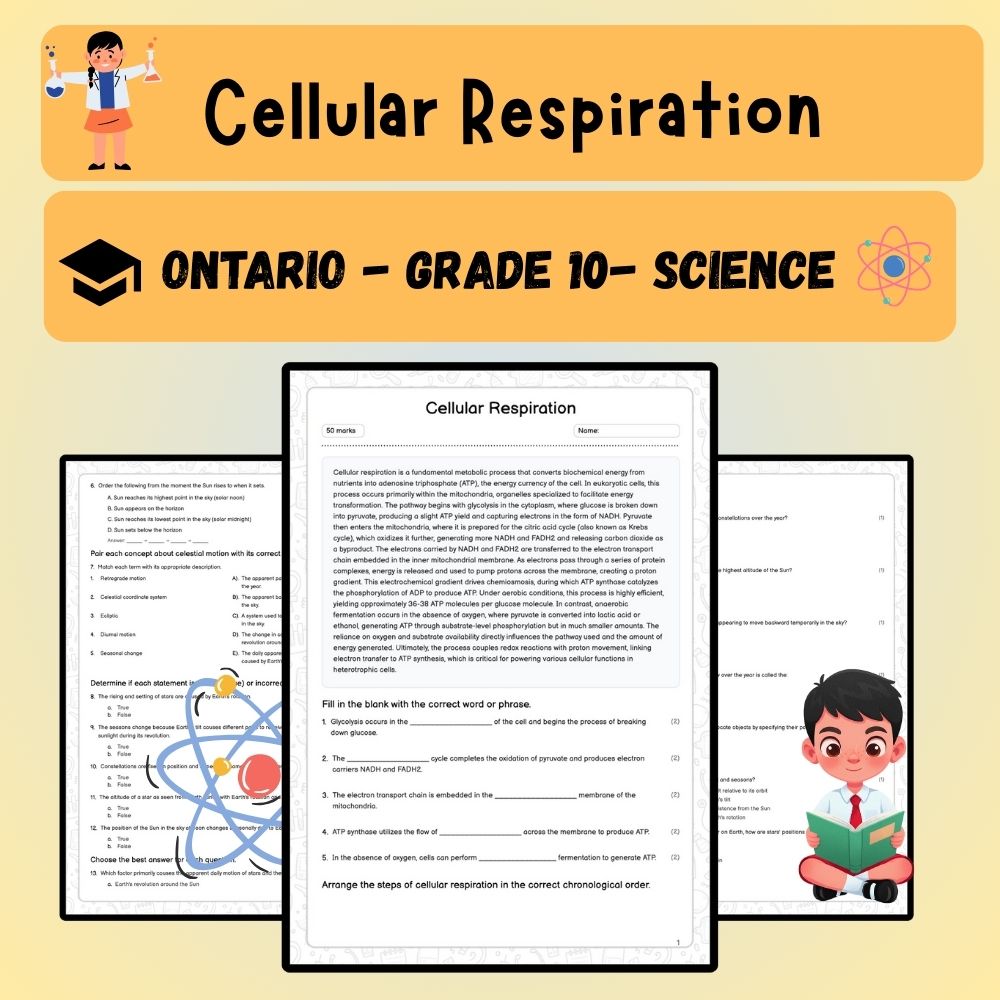
Grade 10 Science | Cellular Respiration Worksheet (Answer Key) – Ontario Standards
Created byPrism Point LearningLearning Objectives
- Describe the sequential pathways of cellular respiration: glycolysis, citric acid cycle, and electron transport chain.
- Explain the mitochondrial role in energy transformation within eukaryotic cells.
- Compare aerobic ATP production with anaerobic fermentation in terms of efficiency, substrate use, and oxygen dependence.
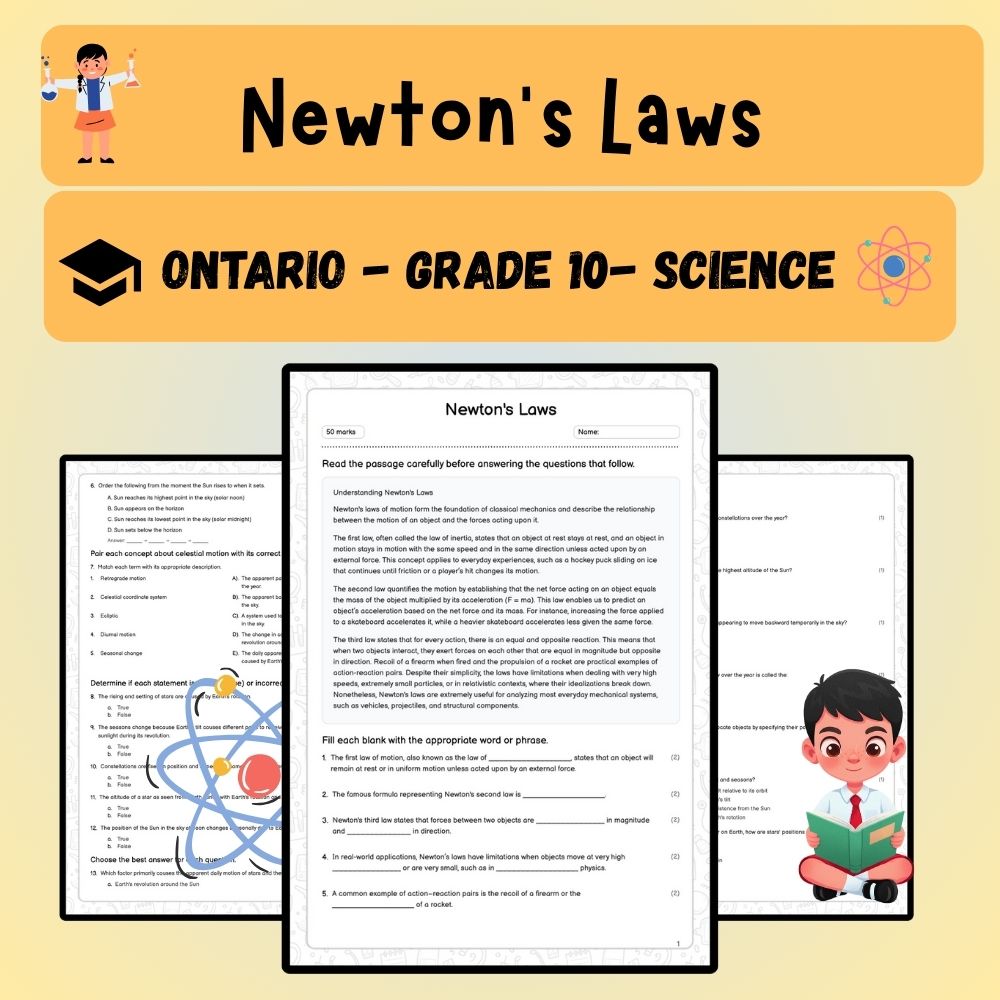
Grade 10 Science | Newton's Laws Worksheet (Answer Key) aligned with Ontario standards
Created byPrism Point LearningLearning Objectives
- Explain the three laws of motion and their conceptual significance.
- Apply Newton's second law to analyze forces and acceleration in various systems.
- Describe action-reaction pairs and their implications in physical interactions.
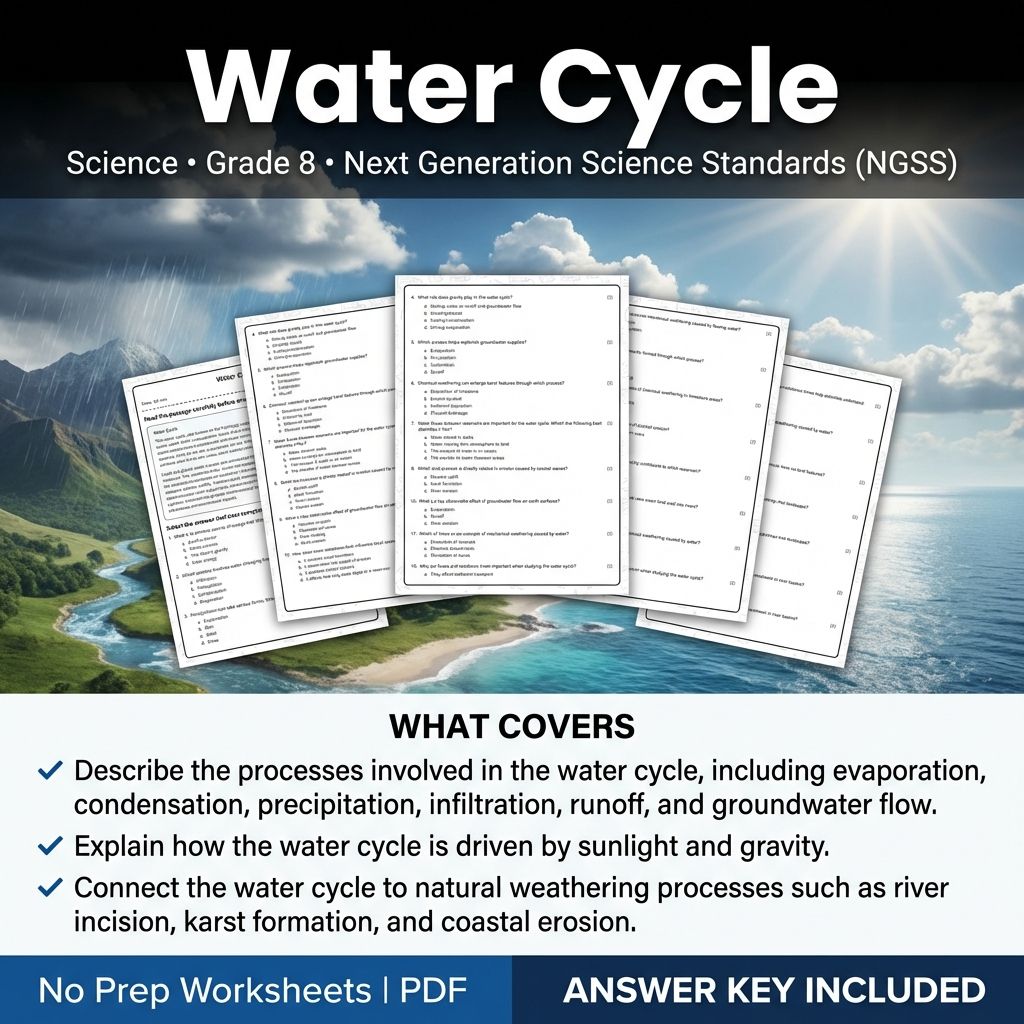
Grade 8 Science | Water Cycle Worksheet & Answer Key for Classroom Practice
Created byCoral Reef LearningLearning Objectives
- Describe the processes involved in the water cycle, including evaporation, condensation, precipitation, infiltration, runoff, and groundwater flow.
- Explain how the water cycle is driven by sunlight and gravity.
- Connect the water cycle to natural weathering processes such as river incision, karst formation, and coastal erosion.
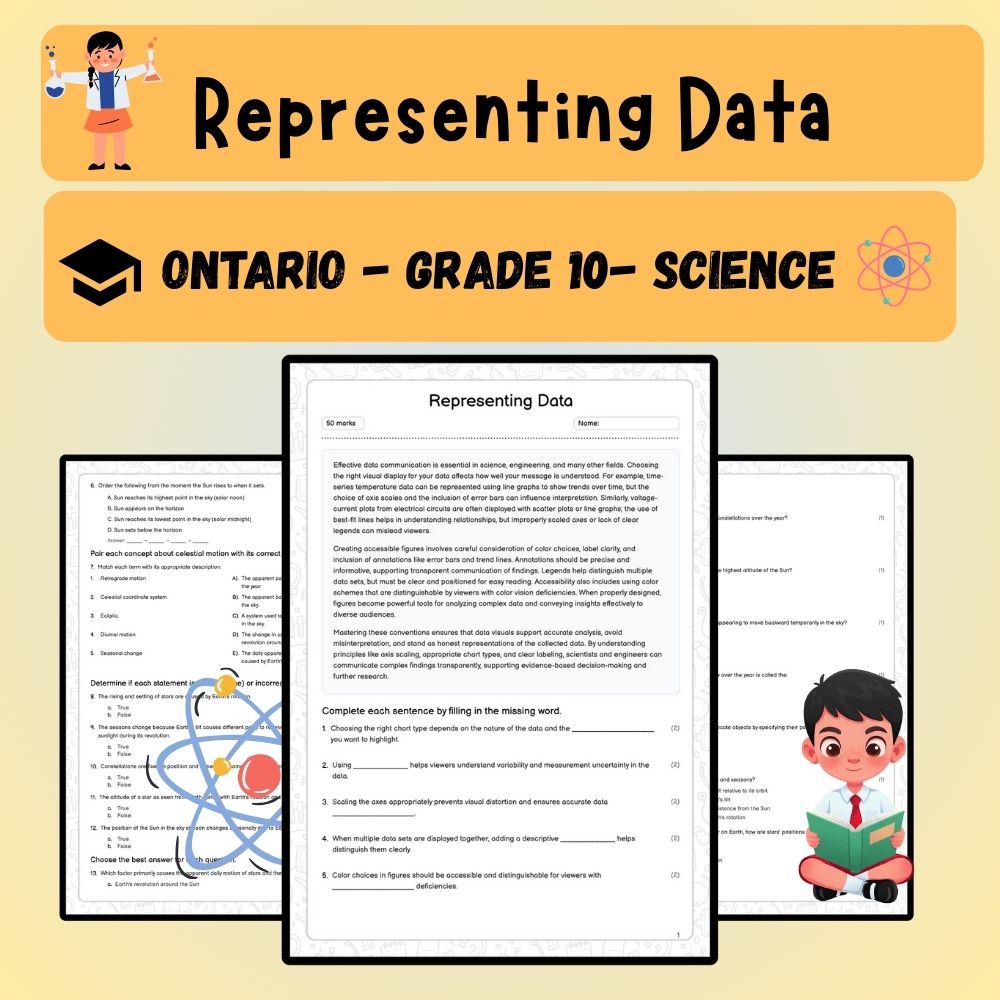
Grade 10 Science | Representing Data Worksheet (PDF) Aligned with Ontario Standards
Created byPrism Point LearningLearning Objectives
- Understand various conventions for tabular and graphical data representation.
- Select appropriate chart types based on data and context.
- Interpret the effects of axis scaling, error bars, and trend lines on data analysis.
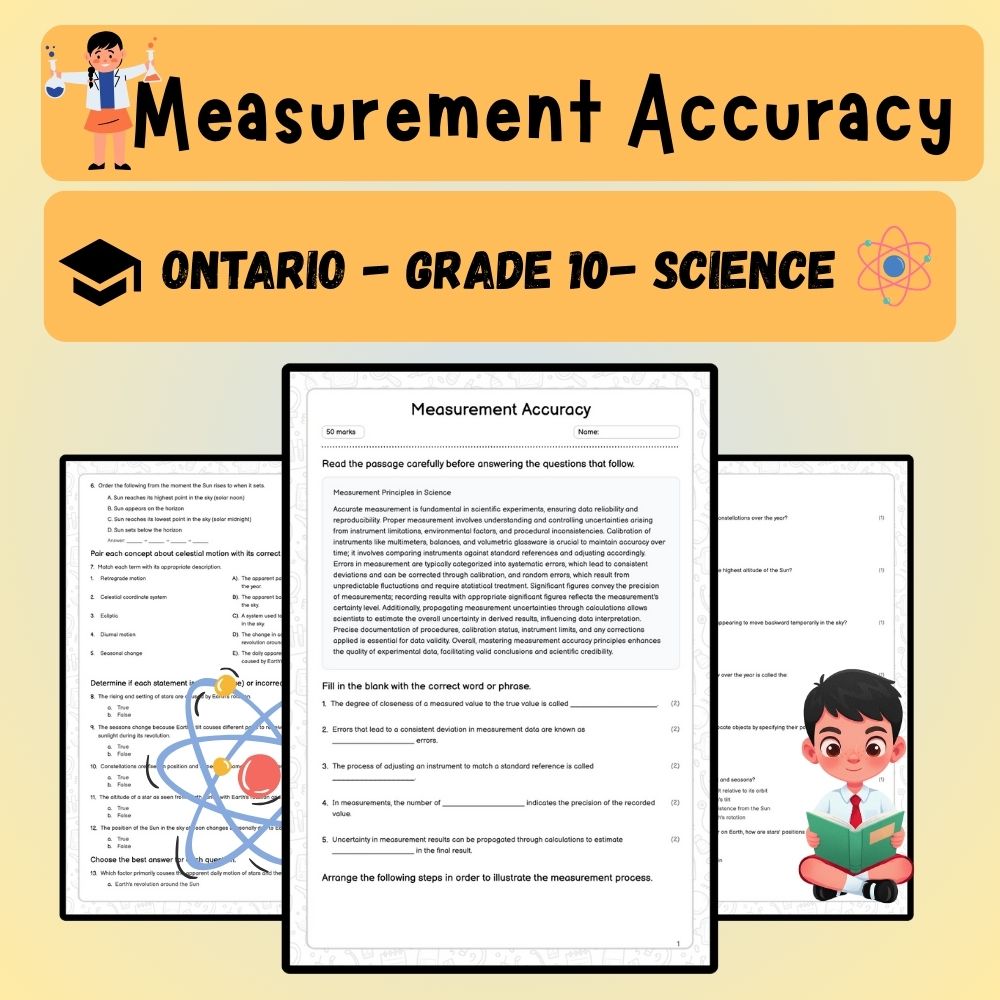
Grade 10 Science | Measurement Accuracy Worksheet (PDF) for Ontario Standards
Created byPrism Point LearningLearning Objectives
- Understand the principles of measurement accuracy and precision.
- Differentiate between systematic and random errors in measurement.
- Learn methods for calibrating and documenting measurement procedures.
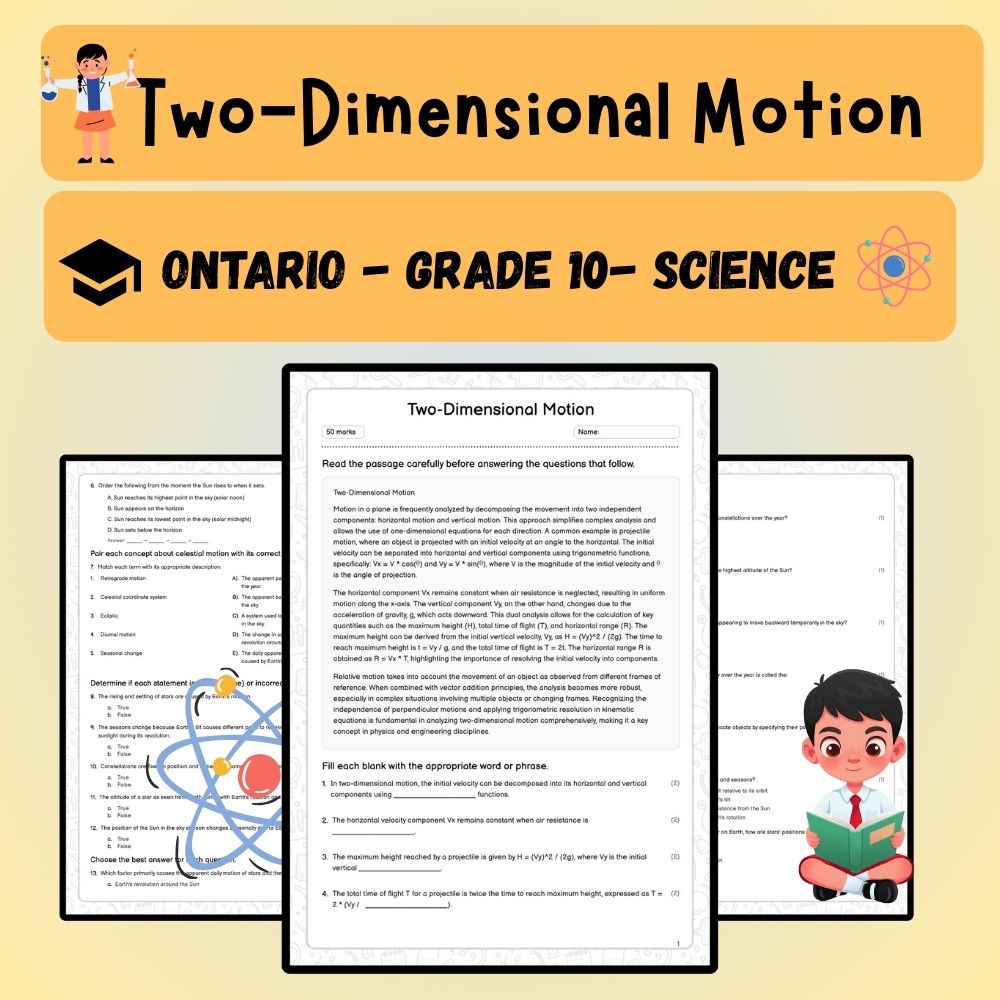
Grade 10 Science | Two-Dimensional Motion Worksheet (Ontario Standards) PDF
Created byPrism Point LearningLearning Objectives
- Understand the decomposition of motion into horizontal and vertical components.
- Analyze projectile trajectories under uniform gravitational acceleration ignoring air resistance.
- Apply trigonometric resolution to express initial velocity components and derive expressions for range, maximum height, and time of flight.
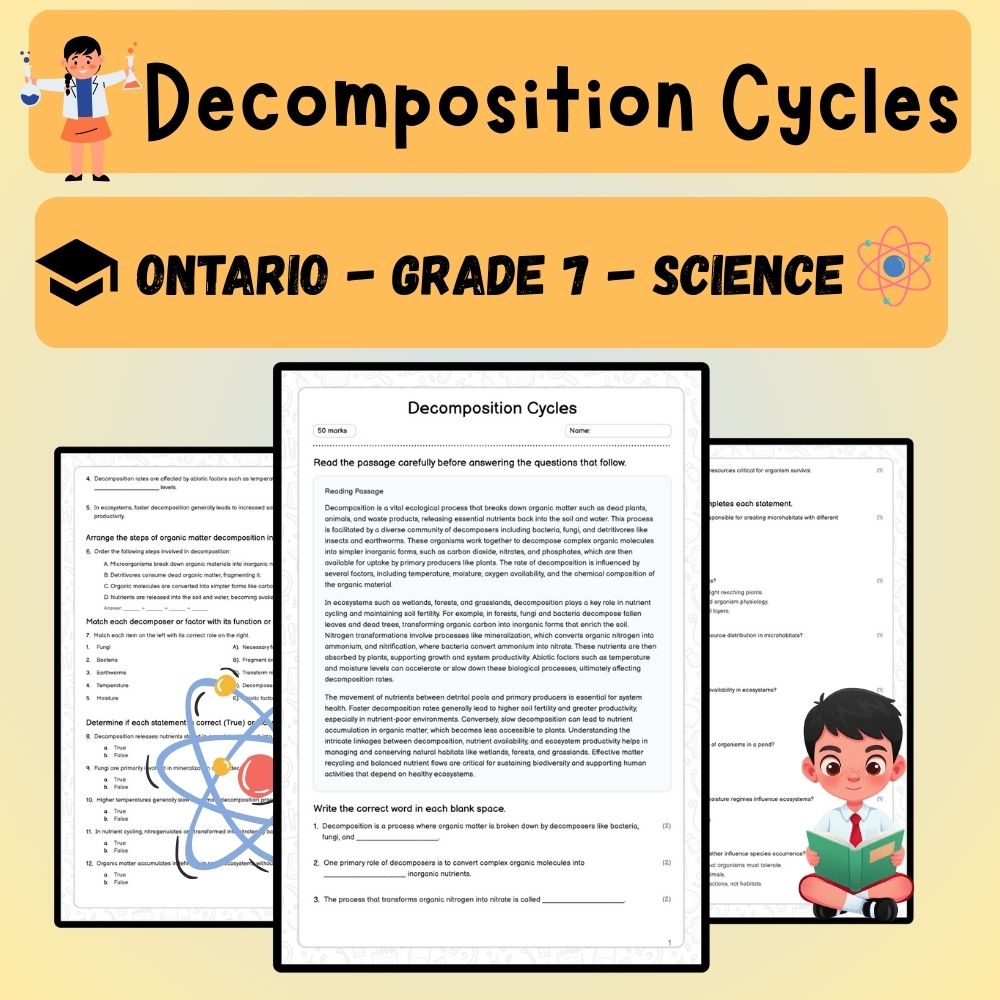
Grade 7 Science | Decomposition Cycles Worksheet (PDF )
Created byPrism Point LearningLearning Objectives
- Describe the processes involved in decomposition and nutrient cycling.
- Identify the roles of detritivores, fungi, bacteria, and abiotic factors in decomposition.
- Explain how carbon and nitrogen are transformed during decomposition.
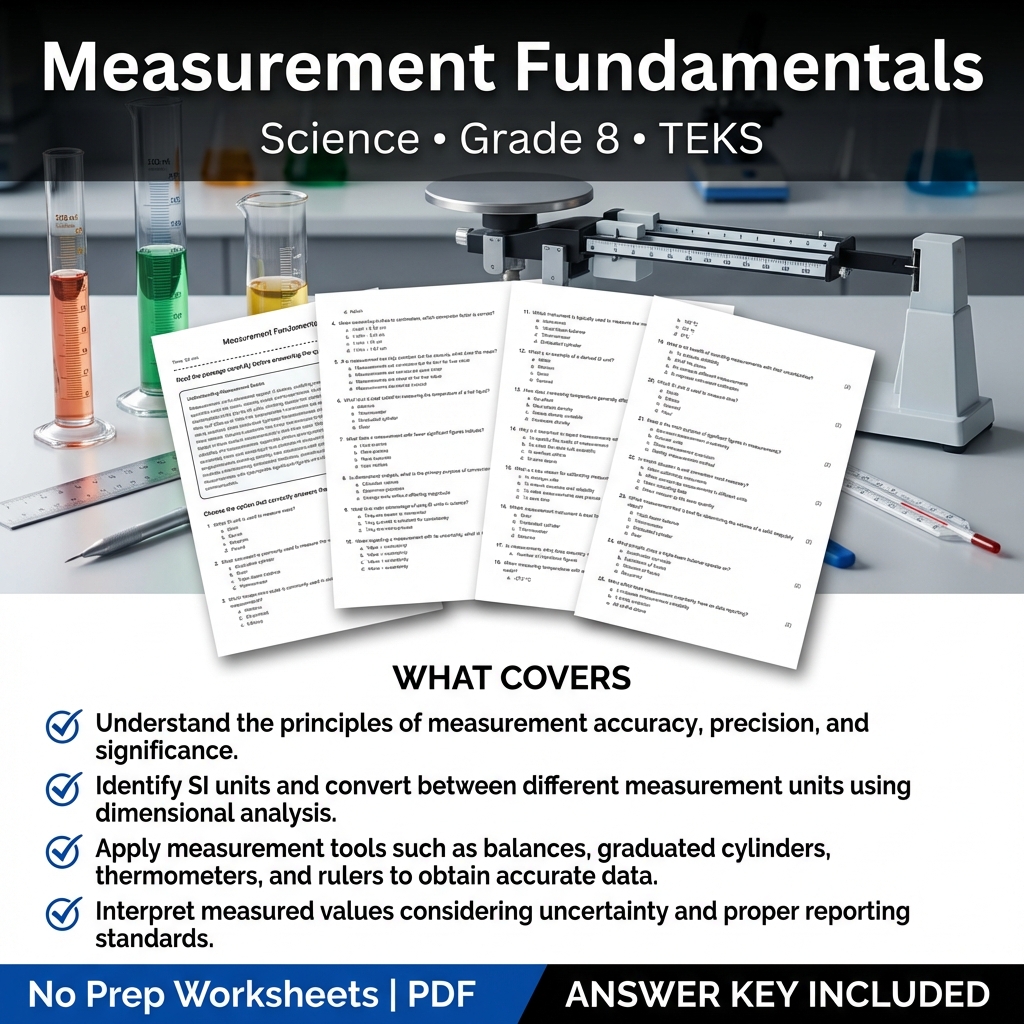
Measurement Fundamentals Worksheet for Grade 8 Science TEKS
Created byCoral Reef LearningLearning Objectives
- Understand the principles of measurement accuracy, precision, and significance.
- Identify SI units and convert between different measurement units using dimensional analysis.
- Apply measurement tools such as balances, graduated cylinders, thermometers, and rulers to obtain accurate data.
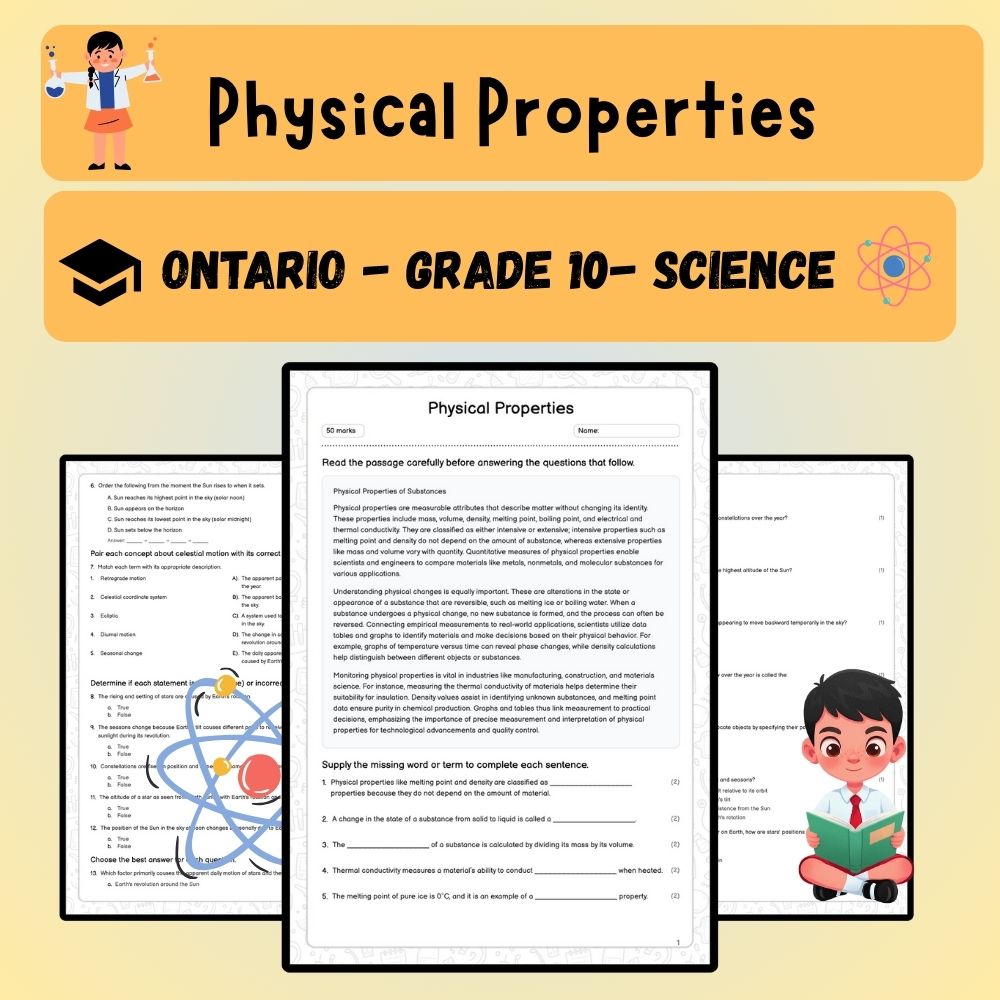
Grade 10 Science – Physical Properties Worksheet (PDF) Aligned with Ontario Standards
Created byPrism Point LearningLearning Objectives
- Define and distinguish between various physical properties such as density, melting point, and conductivity.
- Understand how measurable attributes help in comparing different substances.
- Explain the concept of physical changes and their reversibility.
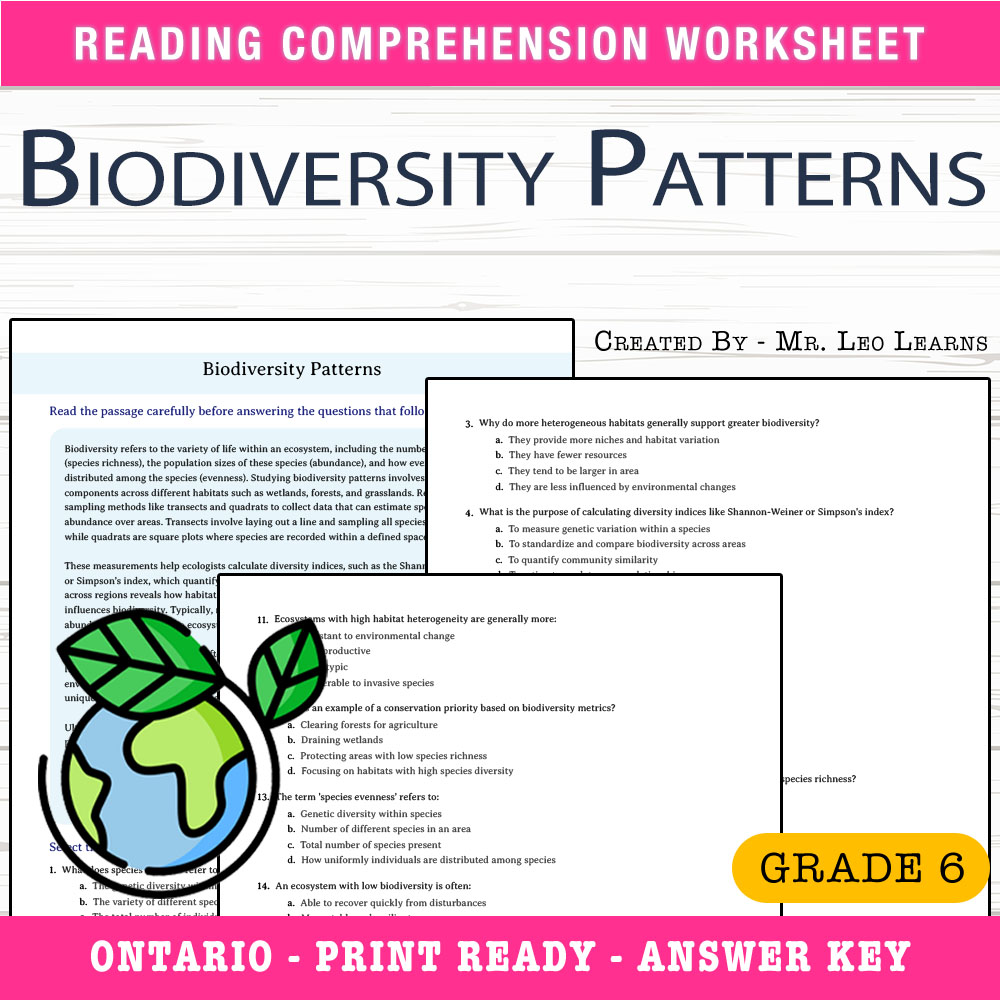
Grade 6 Science – Biodiversity Patterns Worksheet for Mastery | PDF + Answer Key
 Created byThe Resource Hub
Learning Objectives
- Understand different measures of biodiversity such as species richness, abundance, and evenness across various ecosystems.
- Learn sampling techniques like transects and quadrats used for quantifying biodiversity.
- Interpret spatial patterns of biodiversity and relate these to habitat heterogeneity and ecosystem stability.
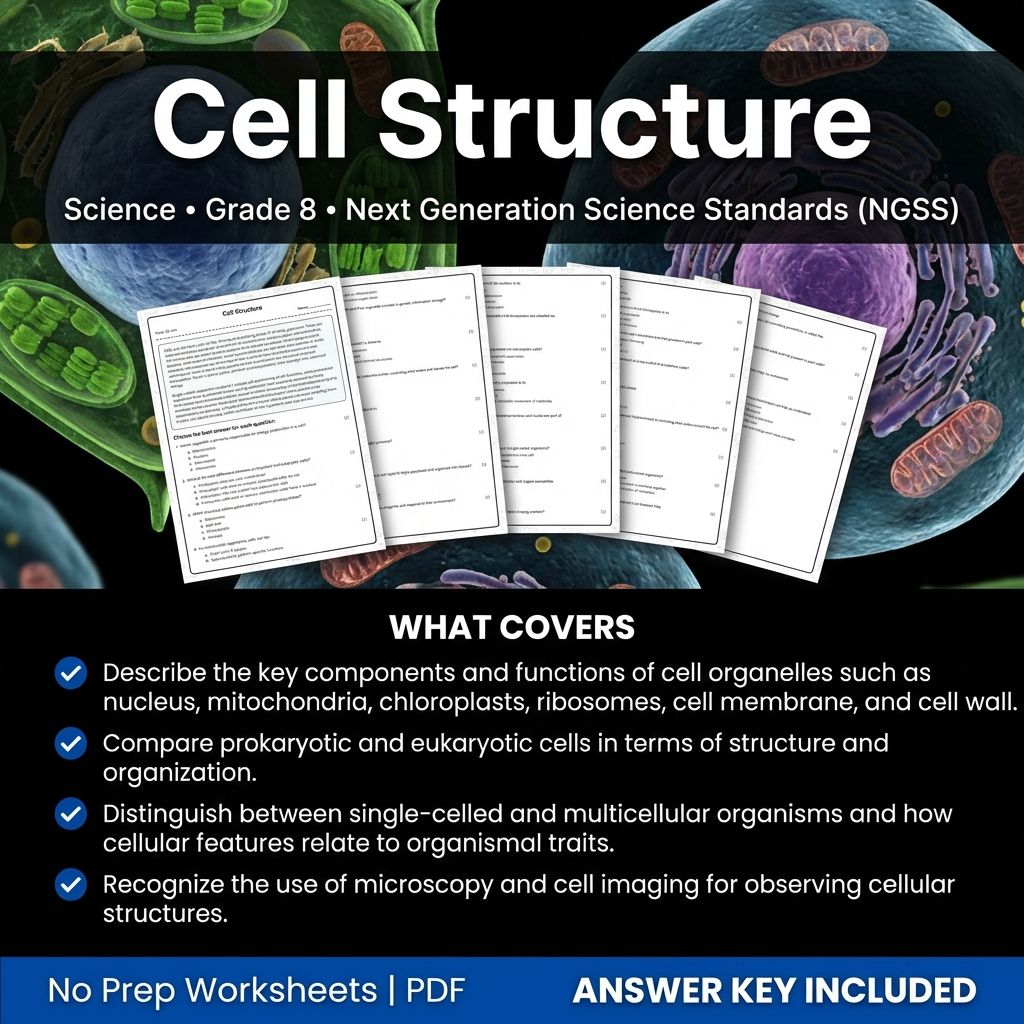
8th Grade Science | Cell Structure Worksheet & Answer Key (Printable PDF)
Created byCoral Reef LearningLearning Objectives
- Describe the key components and functions of cell organelles such as nucleus, mitochondria, chloroplasts, ribosomes, cell membrane, and cell wall.
- Compare prokaryotic and eukaryotic cells in terms of structure and organization.
- Distinguish between single-celled and multicellular organisms and how cellular features relate to organismal traits.
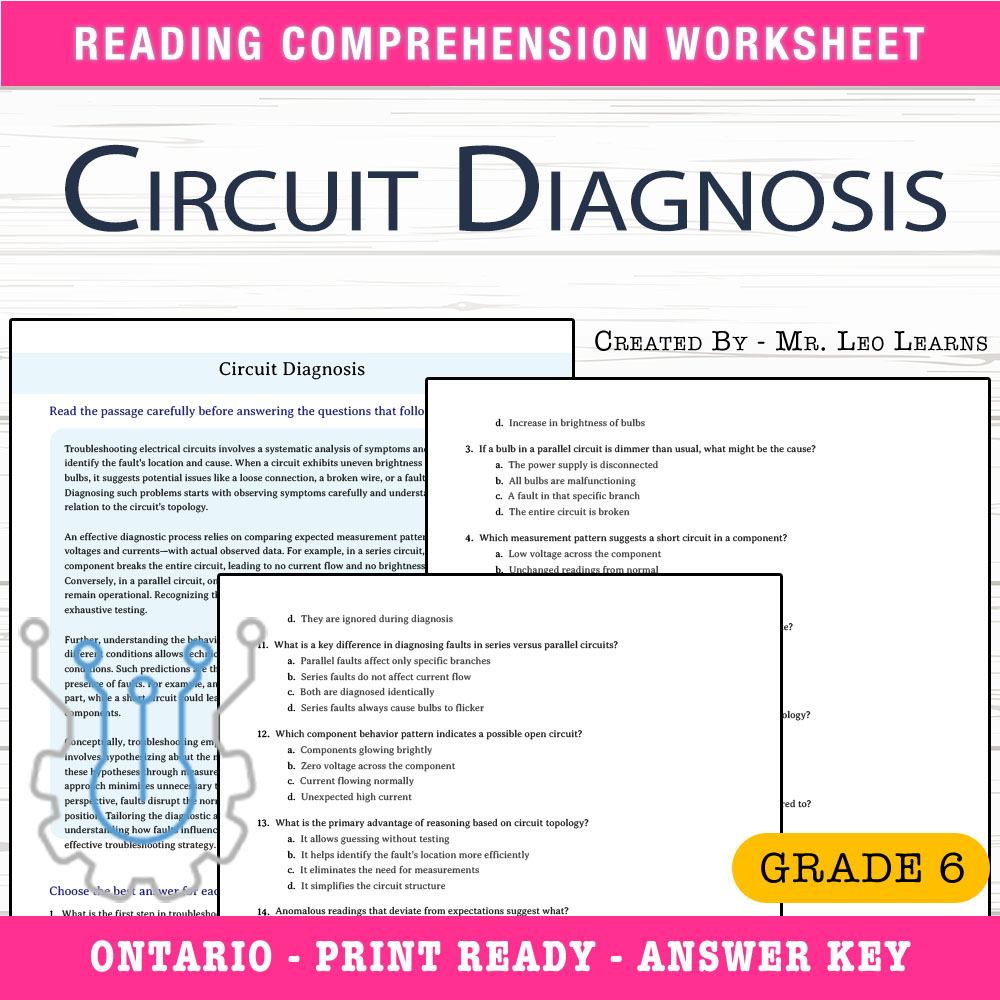
Grade 6 Science — Circuit Diagnosis Worksheet for Troubleshooting Skills
Created byThe Resource HubLearning Objectives
- Understand the principles of troubleshooting electrical circuits based on symptoms and observed behaviors.
- Apply diagnostic reasoning by analyzing circuit topology, expected measurement patterns, and component behavior.
- Differentiate between series and parallel arrangements to identify faults using observed symptoms.
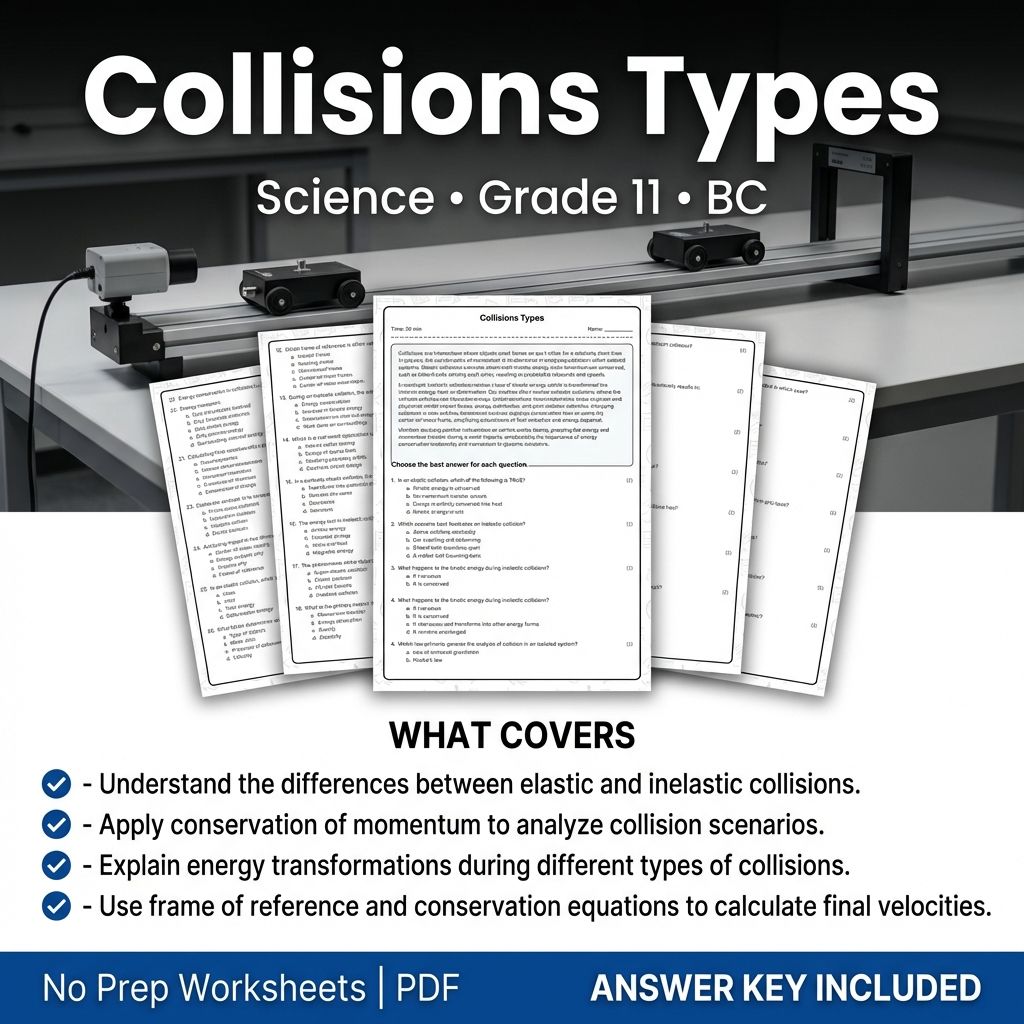
Collisions Types Worksheet for Grade 11 Science – BC Standards
Created byCoral Reef LearningLearning Objectives
- Understand the differences between elastic and inelastic collisions.
- Apply conservation of momentum to analyze collision scenarios.
- Explain energy transformations during different types of collisions.
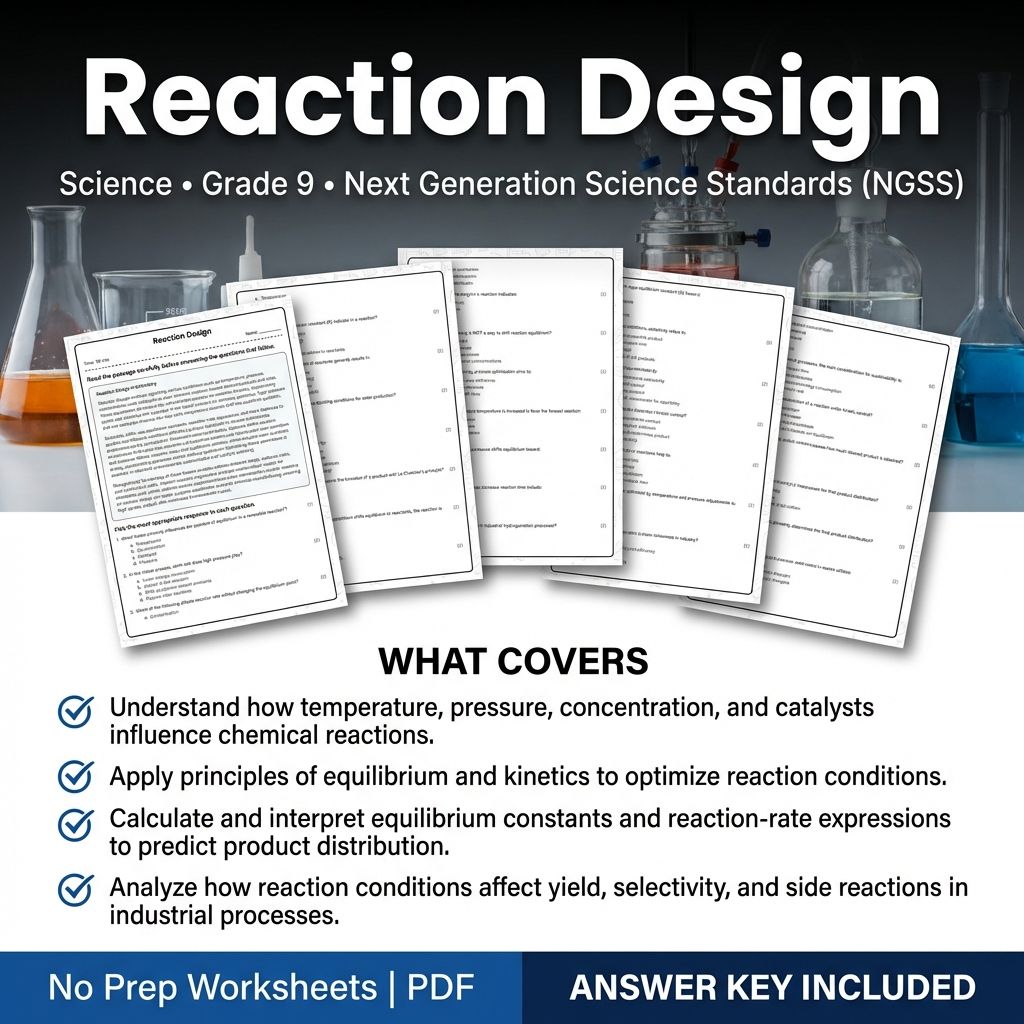
9th Grade Science | Reaction Design Worksheet & Answer Key (Printable PDF)
Created byCoral Reef LearningLearning Objectives
- Understand how temperature, pressure, concentration, and catalysts influence chemical reactions.
- Apply principles of equilibrium and kinetics to optimize reaction conditions.
- Calculate and interpret equilibrium constants and reaction-rate expressions to predict product distribution.
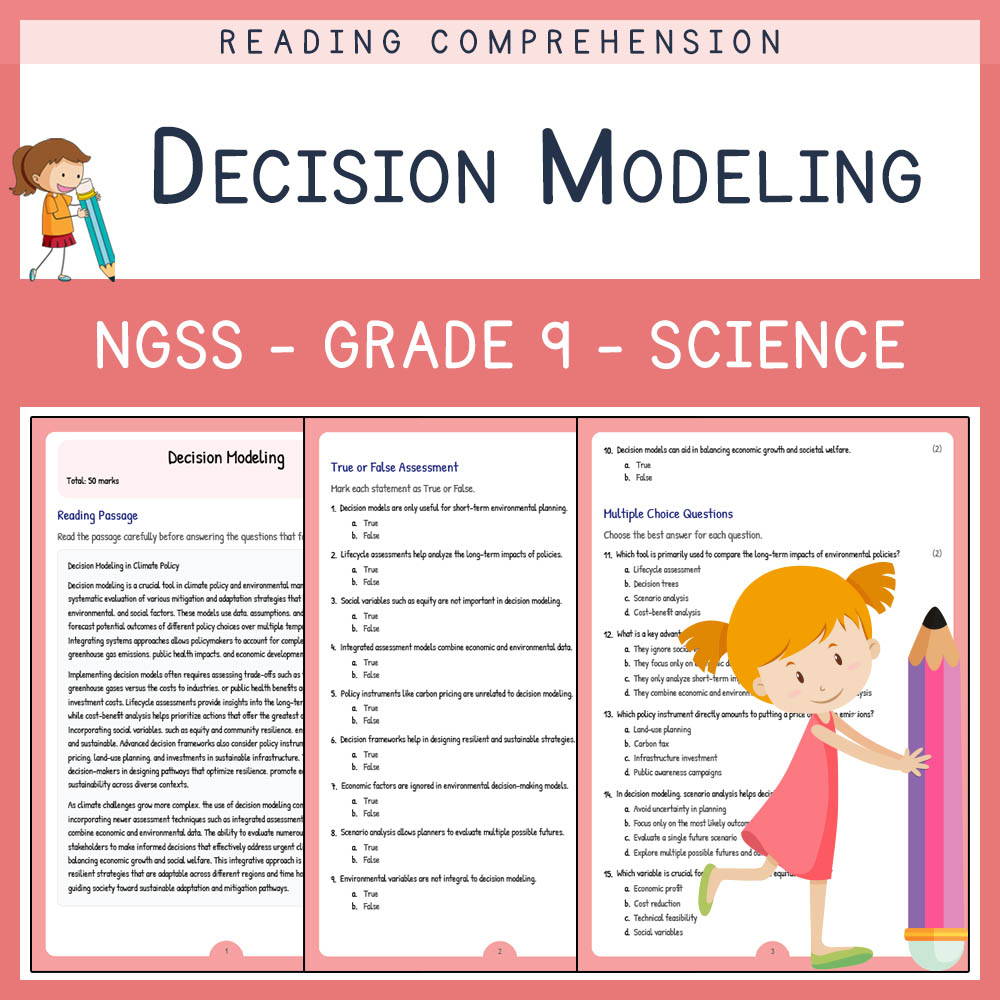
Grade 9 Science | Decision Modeling Worksheet with Answer Key (NGSS Aligned)
Created byLumora LearningLearning Objectives
- Understand the application of systems and decision models in evaluating mitigation and adaptation strategies.
- Analyze economic, environmental, and social variables involved in decision-making processes.
- Apply scenario analysis and integrated assessment approaches to real-world environmental challenges.
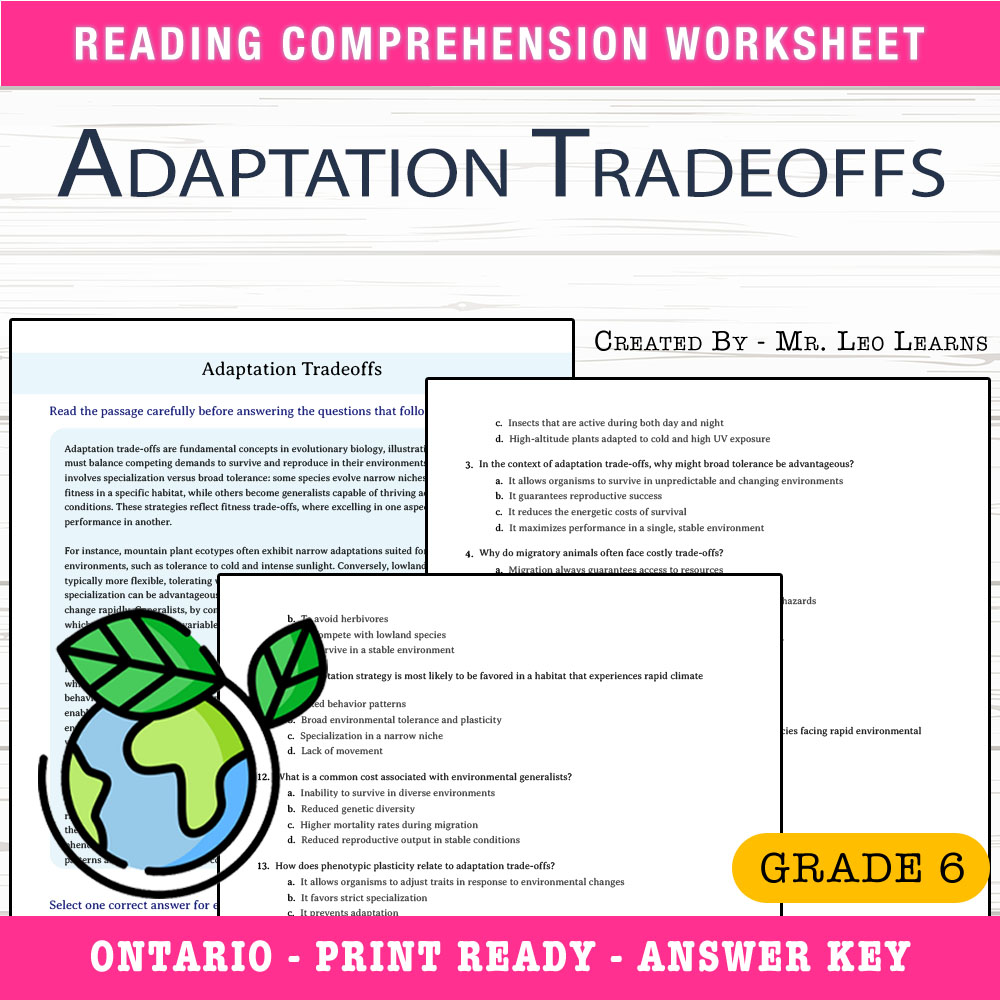
Grade 6 Science – Adaptation Tradeoffs Worksheet for Mastery | PDF + Answer Key
Created byThe Resource HubLearning Objectives
- Understand the concept of adaptation trade-offs and how they influence organism strategies.
- Identify examples of specialists and generalists in different environments.
- Analyze how environmental fluctuations affect evolutionary strategies such as niche specialization and broad tolerance.
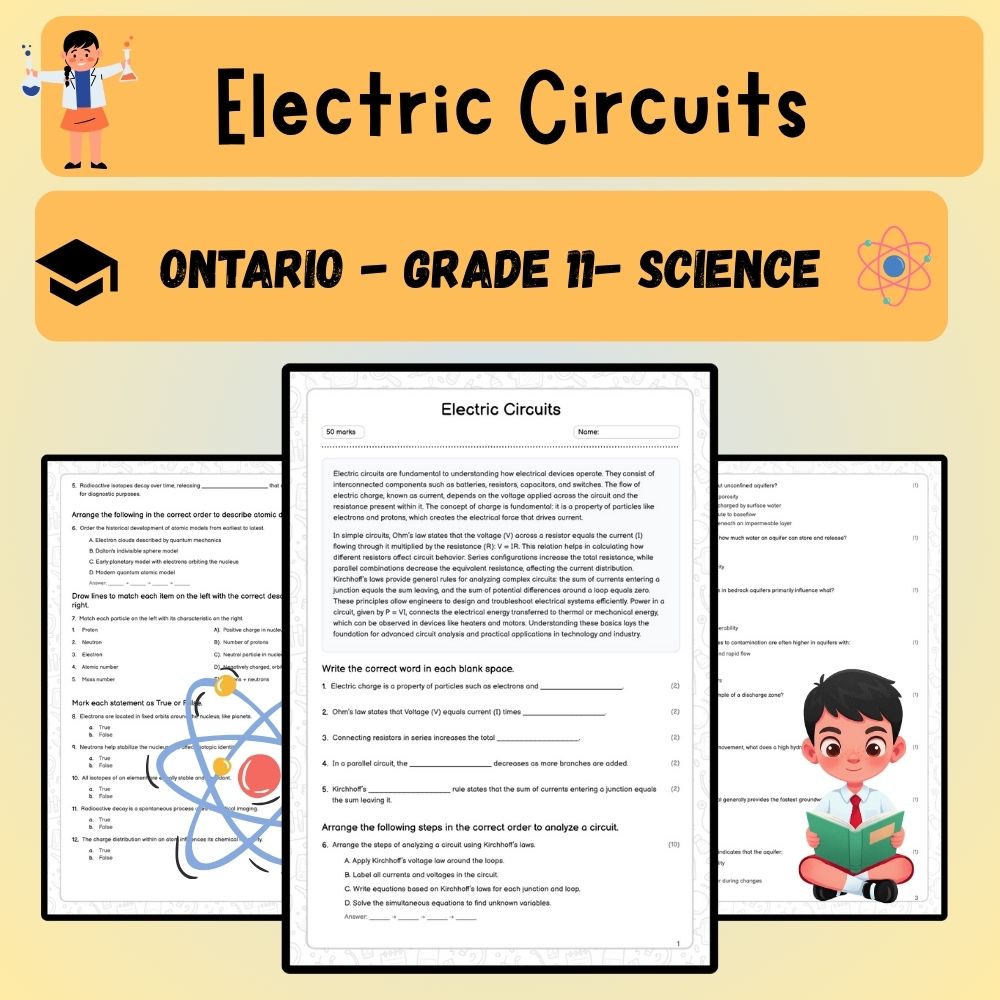
Grade 11 Science | Electric Circuits Worksheet (Answer Key) – Ontario Curriculum
Created byPrism Point LearningLearning Objectives
- Understand the basic concepts of charge, current, potential difference, and resistance in electrical circuits.
- Learn how Ohm's law relates voltage, current, and resistance for conductors.
- Identify the effects of series and parallel resistor combinations on circuit behavior.
Browse more categories
About Science Worksheets
Find Science worksheets spanning core skills, practice, and review. All 42,859 resources are instant PDF downloads for the classroom or home.
Every worksheet on MyTeachingSheets is created by independent teacher-authors and reviewed before publication. All resources download as printable PDFs for classroom, homework, or at-home practice, and many include answer keys. Preview any worksheet free before buying.