
Science Worksheets
42,685 subject resources
DNA Structure Assessment for Grade 10 Science TEKS Standards
 Created byPrism Point Learning
Learning Objectives
- Describe the fundamental structure of DNA, including the double helix and nucleotide subunits.
- Explain the base pairing rules: adenine with thymine, cytosine with guanine.
- Understand how the nucleotide sequence encodes genetic information and supports replication.

Thermal Expansion Assessment Grade 7 Science California Standards
Created byPrism Point LearningLearning Objectives
- Explain how increasing temperature affects particle motion and spacing in solids, liquids, and gases
- Describe and predict contraction and expansion when materials are heated or cooled
- Connect thermal expansion to real-world situations such as tight metal fits and gas pressure in sealed containers
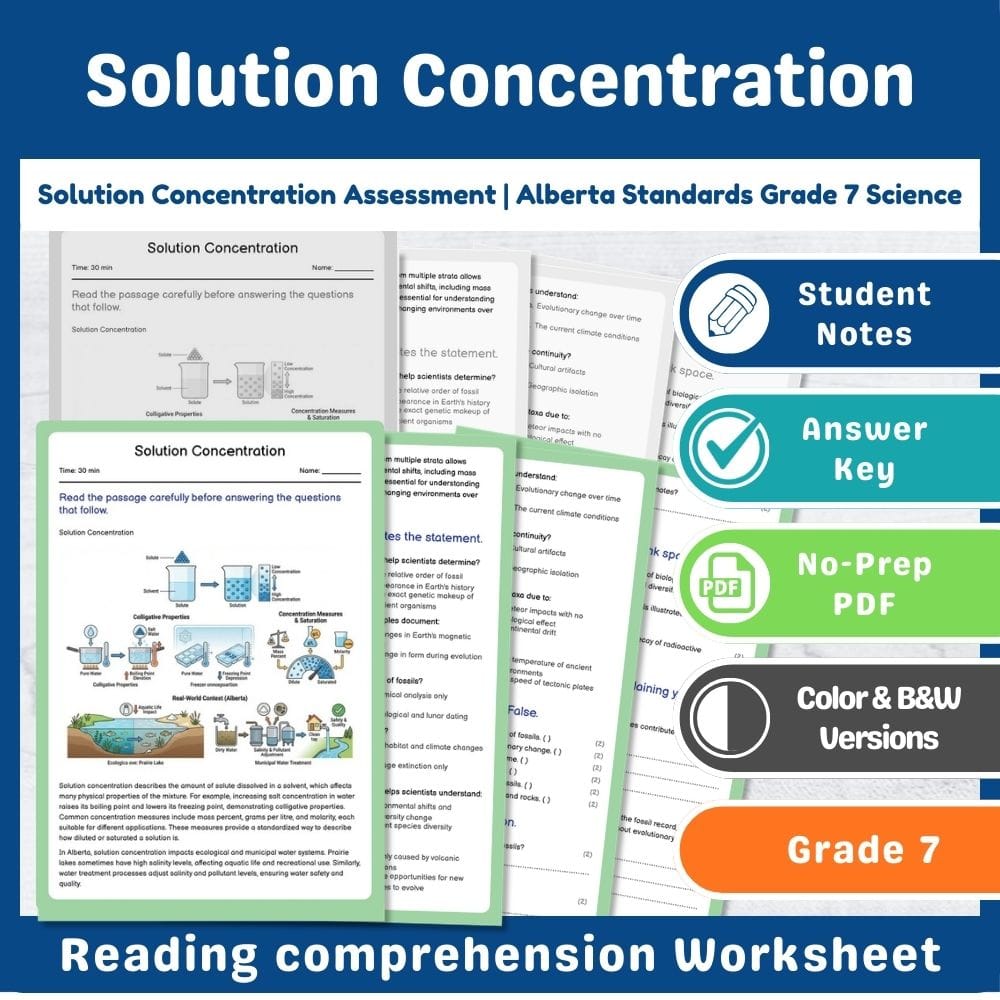
Solution Concentration Assessment | Alberta Standards Grade 7 Science
Created byPrism Point LearningLearning Objectives
- Understand how solution concentration quantifies the amount of solute relative to solvent.
- Recognize common measures of concentration such as mass percent and grams per litre.
- Explain the effects of concentration on physical properties like boiling point and freezing point.
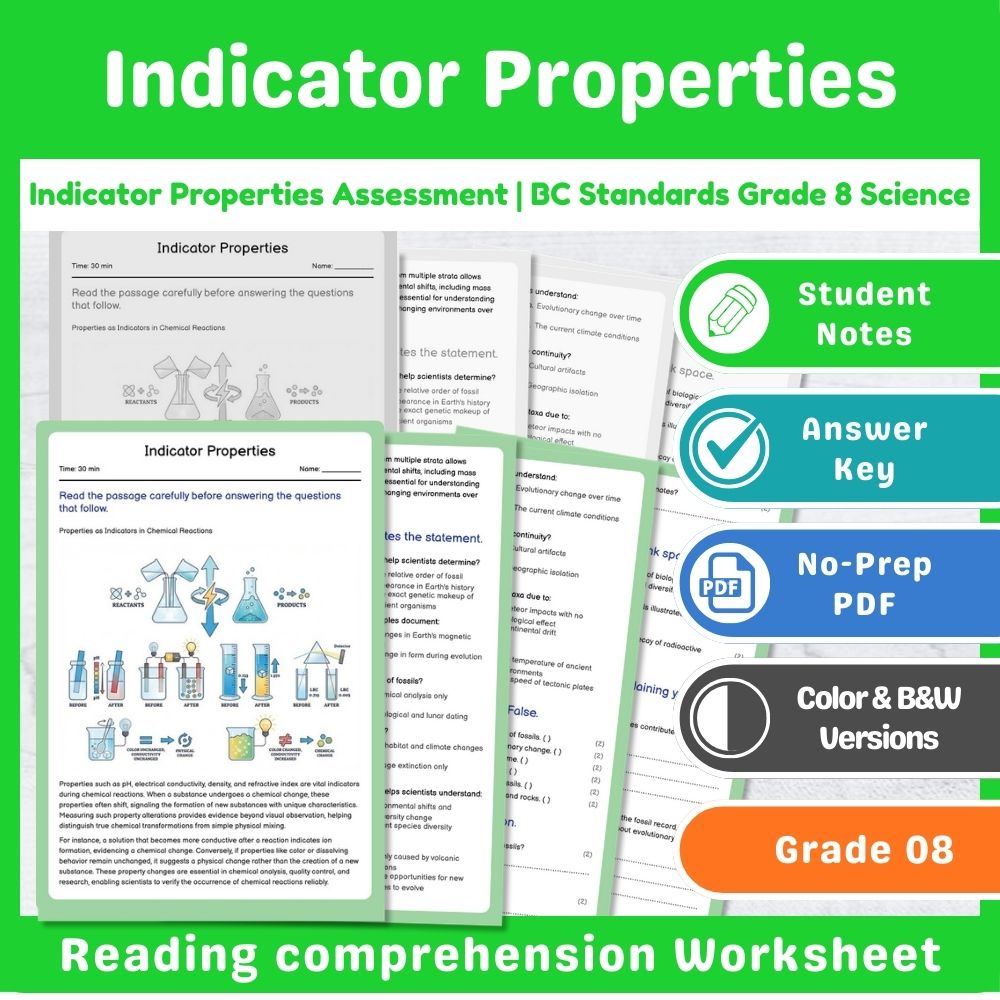
Indicator Properties Assessment | BC Standards Grade 8 Science
Created byPrism Point LearningLearning Objectives
- Understand how properties such as pH, conductivity, density, and refractive index change during chemical reactions.
- Identify property shifts indicating formation of new substances with distinct traits.
- Differentiate between physical and chemical changes using property measurements.
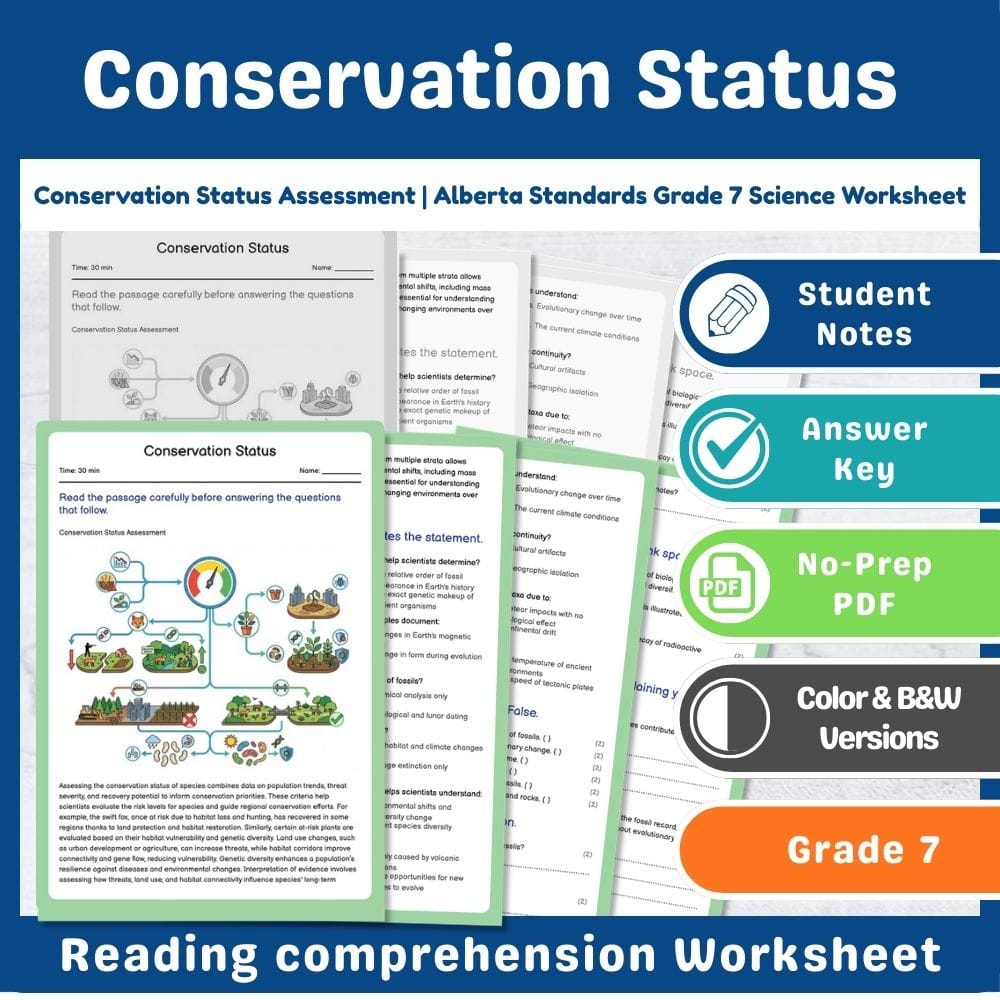
Conservation Status Assessment | Alberta Standards Grade 7 Science Worksheet
Created byPrism Point LearningLearning Objectives
- Understand the criteria used to evaluate the conservation status of species.
- Interpret evidence related to population trends, threats, and recovery potential.
- Identify factors like land use, genetic diversity, and connectivity that influence species vulnerability.

Net Force Effects Assessment | California Standards Grade 7 Science
Created byPrism Point LearningLearning Objectives
- Explain how forces add to create a net force using both magnitude and direction
- Predict how an unbalanced net force changes an object’s speed and/or direction
- Determine when forces are balanced and describe the resulting motion

Mass and Density Assessment | TEKS Grade 6 Science Standards-Aligned
Created byPrism Point LearningLearning Objectives
- Define mass and volume and understand their relationship through density.
- Calculate density of simple solids and liquids using basic measurements.
- Interpret density values to determine if an object will sink or float in water.
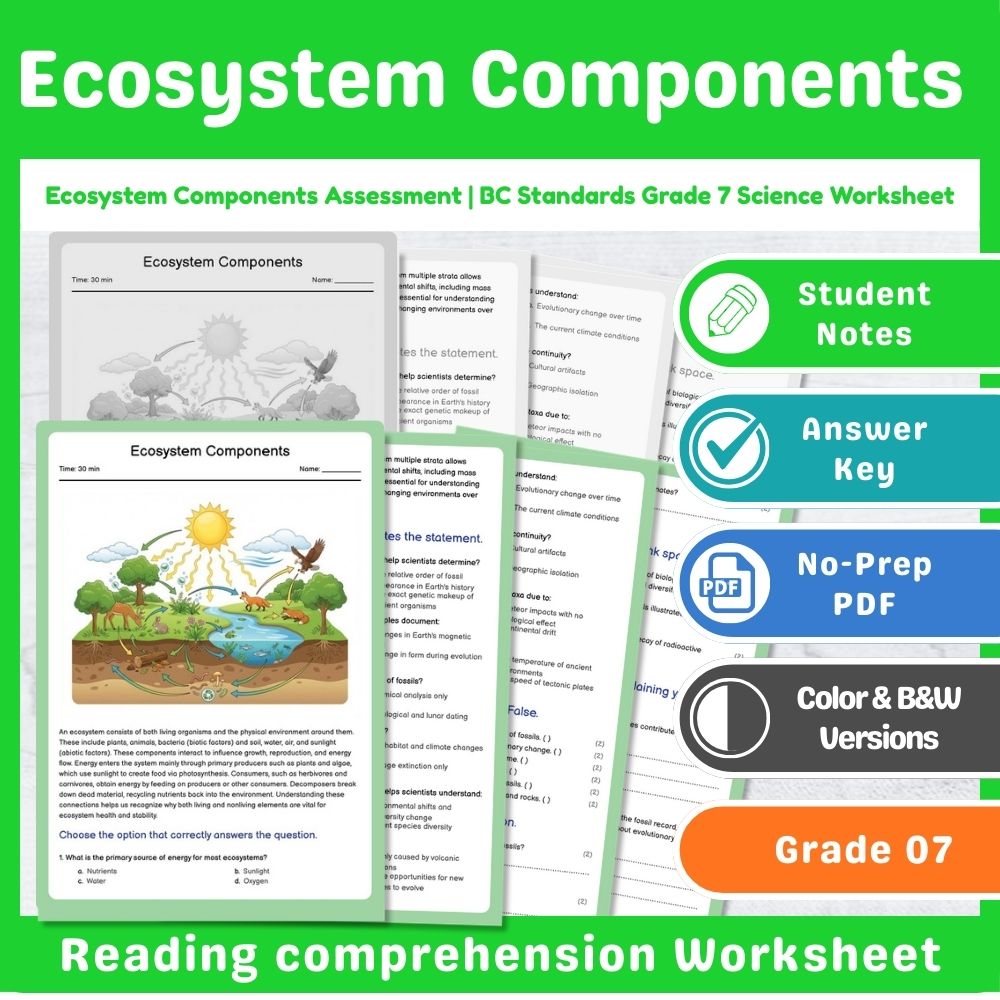
Ecosystem Components Assessment | BC Standards Grade 7 Science Worksheet
Created byPrism Point LearningLearning Objectives
- Describe the key components of an ecosystem, including both living and nonliving factors.
- Explain how biotic and abiotic components interact within an ecosystem.
- Understand the flow of energy through producers and consumers in an ecosystem.

Photosynthesis Basics Assessment for Grade 11 Science | TEKS
Created byPrism Point LearningLearning Objectives
- Describe the process of photosynthesis and its significance in converting light energy into chemical energy.
- Identify the main inputs and outputs of photosynthesis and cellular respiration.
- Differentiate between light-dependent reactions and the Calvin cycle in photosynthesis.
Signal Encoding Assessment | NGSS Grade 9 Science Standards-Aligned
Created byPrism Point LearningLearning Objectives
- Describe different methods of encoding information onto carrier waves, including amplitude, frequency, and phase modulation.
- Compare modulation and multiplexing schemes such as pulse-code modulation and amplitude modulation in terms of bandwidth and fidelity.
- Analyze practical examples of encoding techniques used in fiber-optic, radio, and microwave communications.

Periodic Trends Assessment for Grade 12 Science | Alberta Standards
Created byPrism Point LearningLearning Objectives
- Understand how atomic radius, ionization energy, electron affinity, and electronegativity vary across periods and groups.
- Interpret periodic trends to relate atomic structure to physical and chemical properties.
- Apply knowledge of trends to predict element reactivity and behavior in different environments.
Natural Selection Assessment for Grade 9 Science – NGSS Standards
Created byPrism Point LearningLearning Objectives
- Explain the mechanisms of natural selection, including variation, inheritance, and selection pressures.
- Identify classic examples of natural selection, such as finch beak morphology and bacterial resistance.
- Describe how models of fitness and allele frequency determine different types of selection.
Sources of Variation Assessment | BC Standards Grade 10 Science
Created byPrism Point LearningLearning Objectives
- Understand different sources of heritable variation such as mutations, recombination, and chromosomal rearrangements.
- Explain how natural selection acts on variation within populations.
- Describe the importance of genetic diversity for adaptation and evolution.
Consumers Hierarchy Assessment | Alberta Standards-Aligned Assessment Grade 8 Science
Created byPrism Point LearningLearning Objectives
- Understand the different trophic levels and feeding relationships within communities.
- Identify characteristics of herbivores, omnivores, and carnivores in Alberta ecosystems.
- Analyze how feeding modes influence energy transfer and ecological vulnerability.
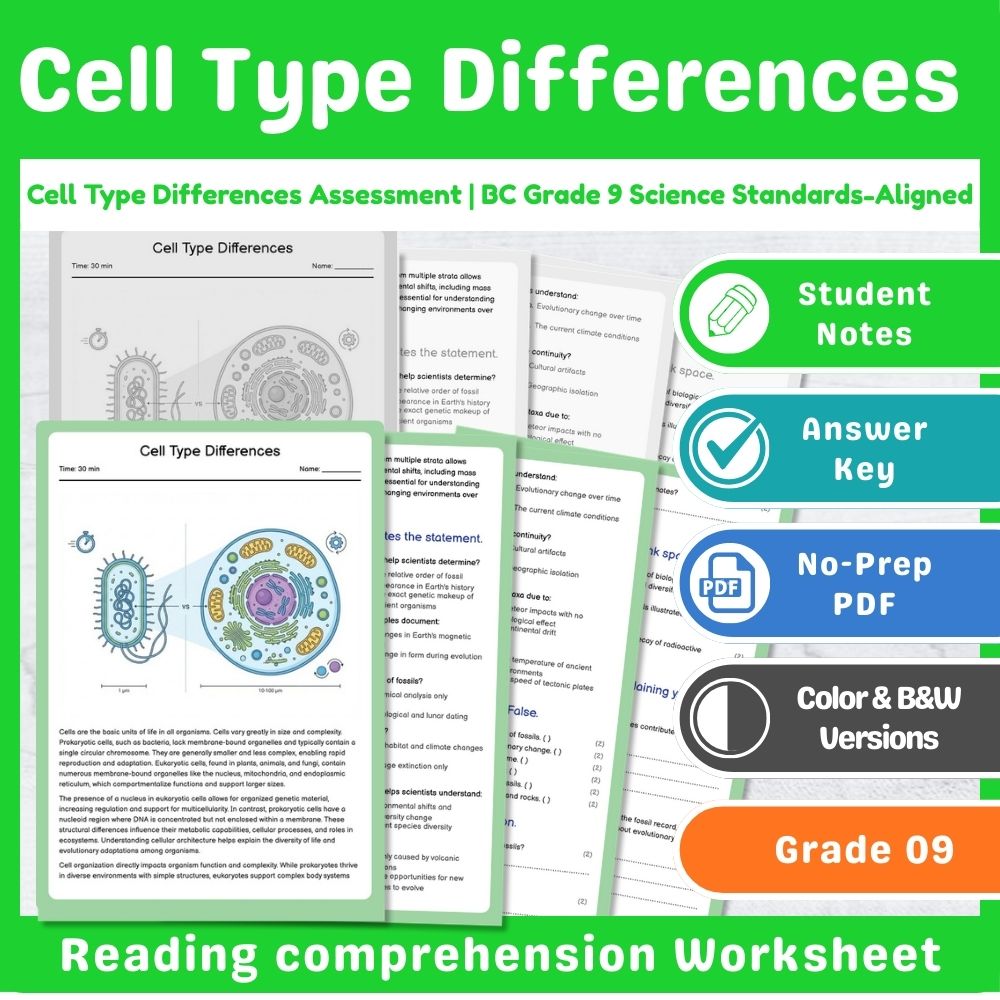
Cell Type Differences Assessment | BC Grade 9 Science Standards-Aligned
Created byPrism Point LearningLearning Objectives
- Understand the structural differences between prokaryotic and eukaryotic cells.
- Identify key components unique to each cell type.
- Explain how cell structure relates to function and organism complexity.
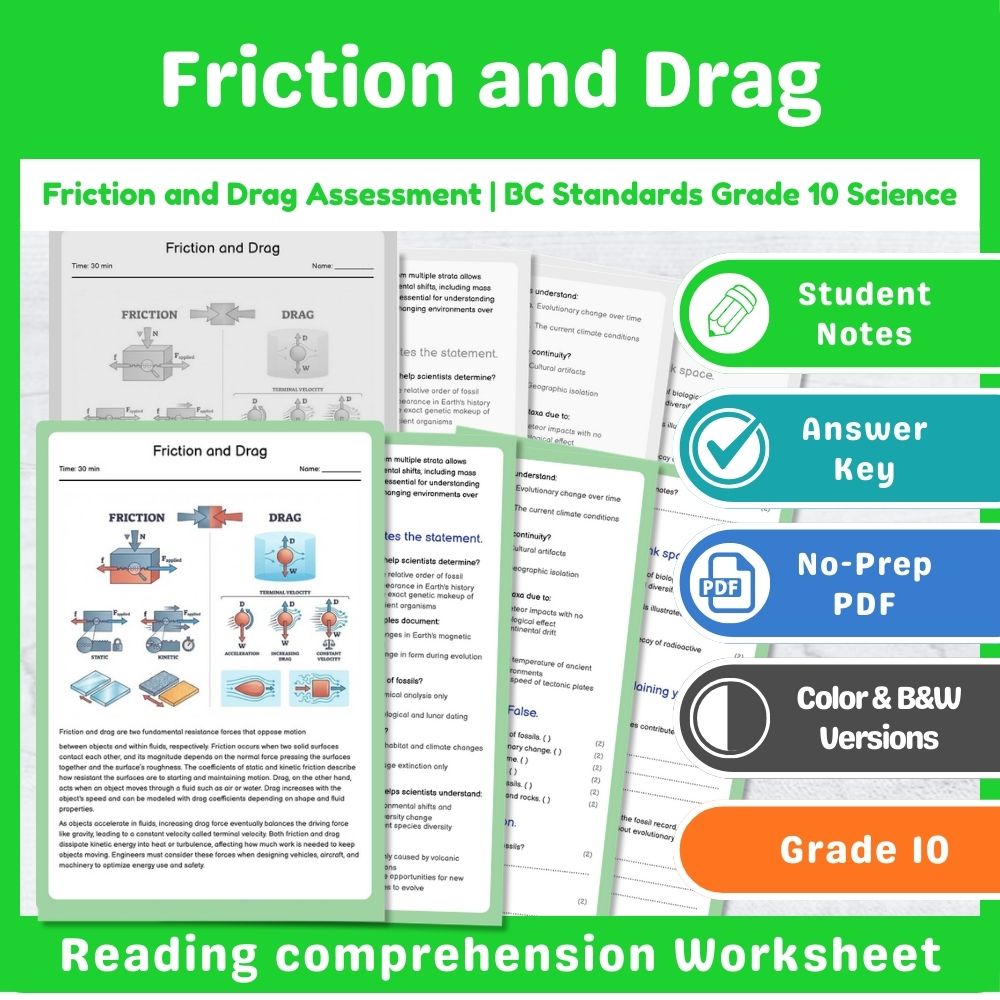
Friction and Drag Assessment | BC Standards Grade 10 Science
Created byPrism Point LearningLearning Objectives
- Understand the mechanisms of friction and drag as resistance forces in motion.
- Describe how contact surfaces affect friction based on normal force and surface characteristics.
- Explain how drag acts in fluids and the concept of terminal velocity.
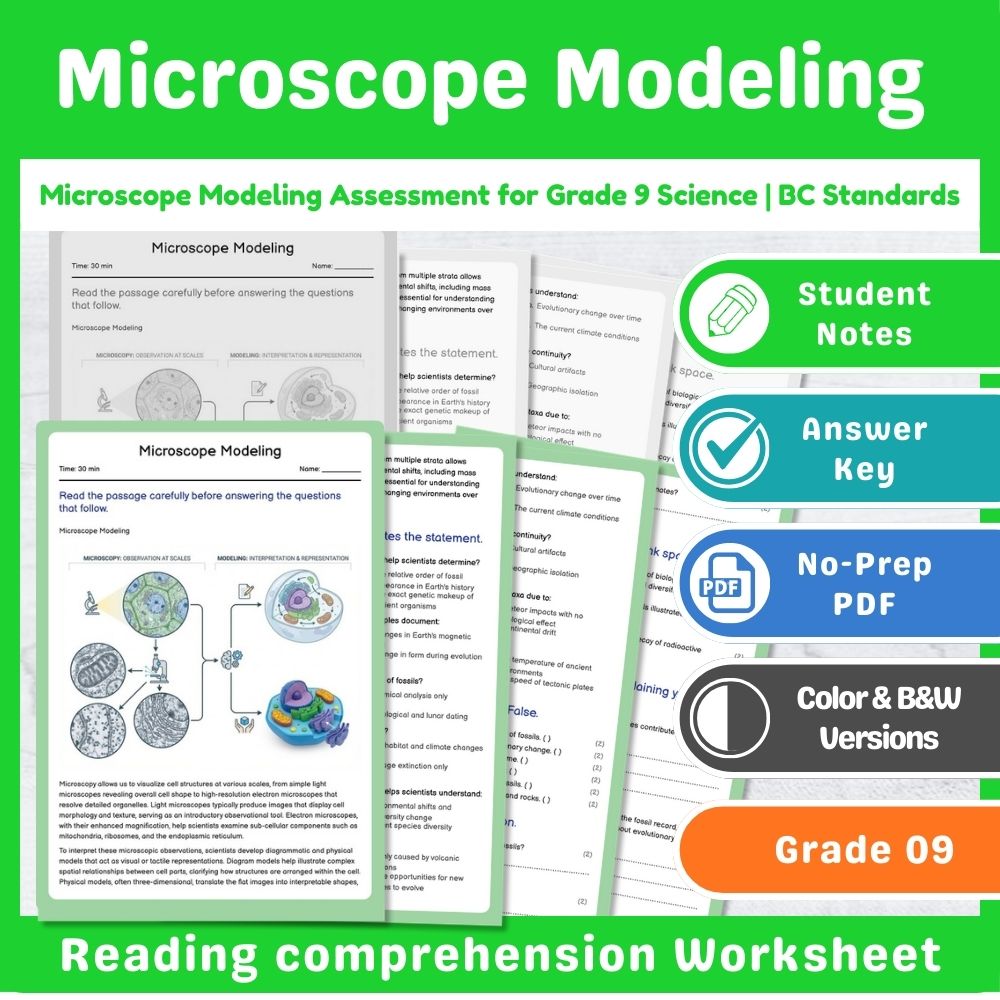
Microscope Modeling Assessment for Grade 9 Science | BC Standards
Created byPrism Point LearningLearning Objectives
- Understand how different microscope models reveal structural details of cells.
- Identify the role of diagrammatic and physical models in microscopy.
- Explain the importance of size, scale, and spatial relationships in cellular understanding.
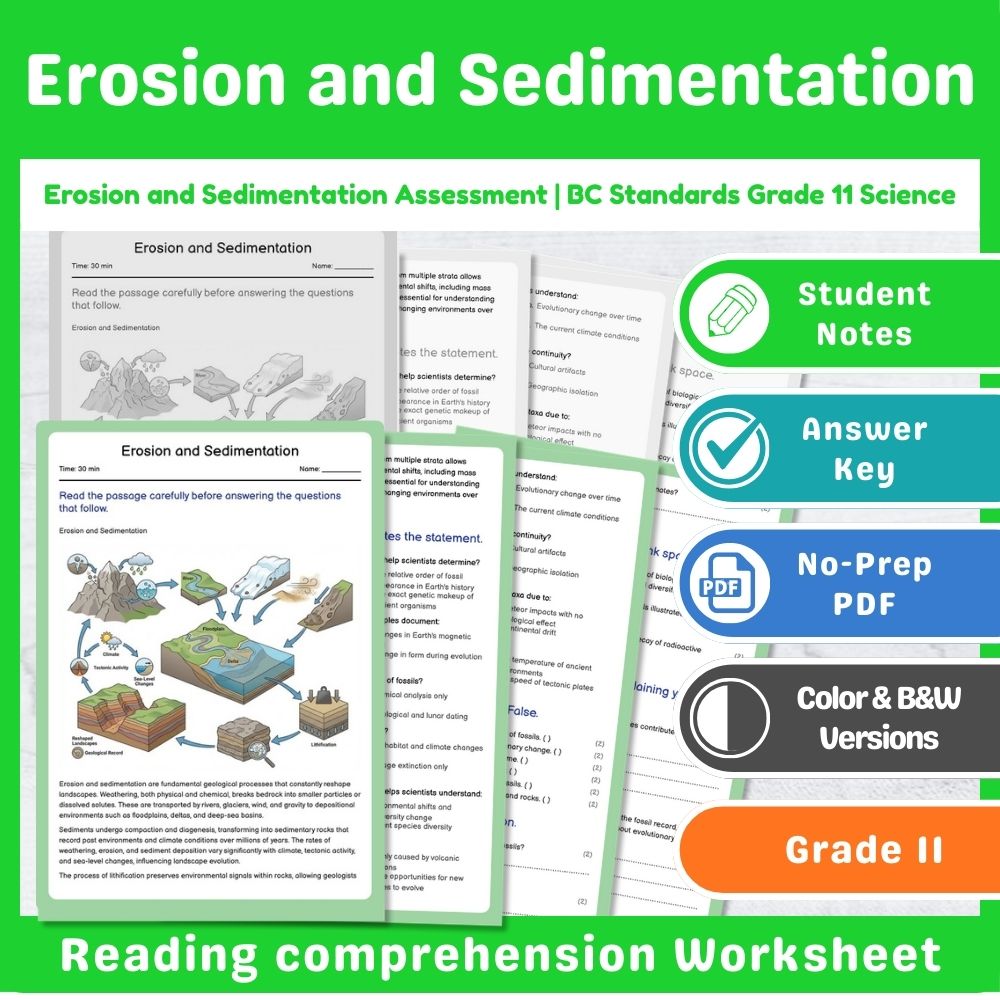
Erosion and Sedimentation Assessment | BC Standards Grade 11 Science
Created byPrism Point LearningLearning Objectives
- Explain the processes of weathering, erosion, transport, and deposition in landscape evolution.
- Identify factors that influence rates of erosion and sedimentation.
- Describe how sediment lithification preserves environmental and climatic signals.
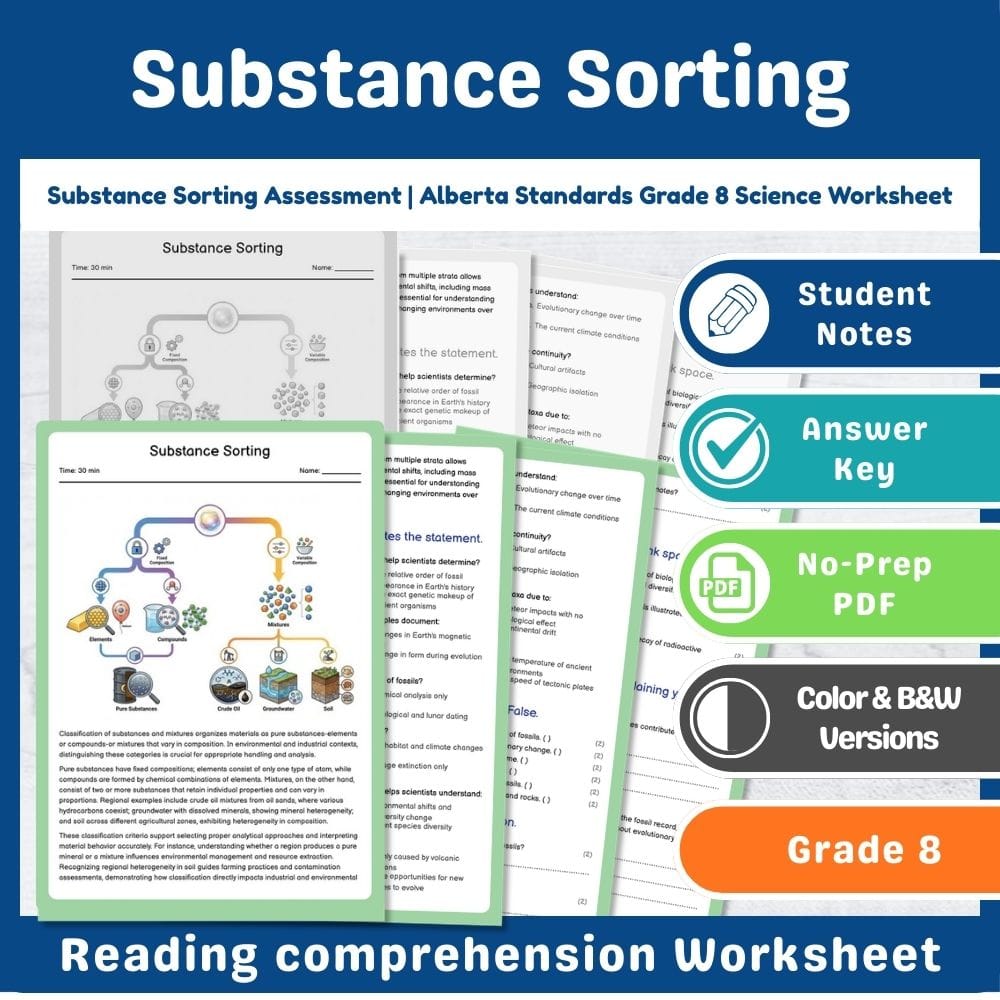
Substance Sorting Assessment | Alberta Standards Grade 8 Science Worksheet
Created byPrism Point LearningLearning Objectives
- Understand the classification of substances as pure elements, compounds, or mixtures.
- Identify different types of mixtures and their characteristics.
- Apply classification criteria to interpret material behavior in environmental and industrial contexts.
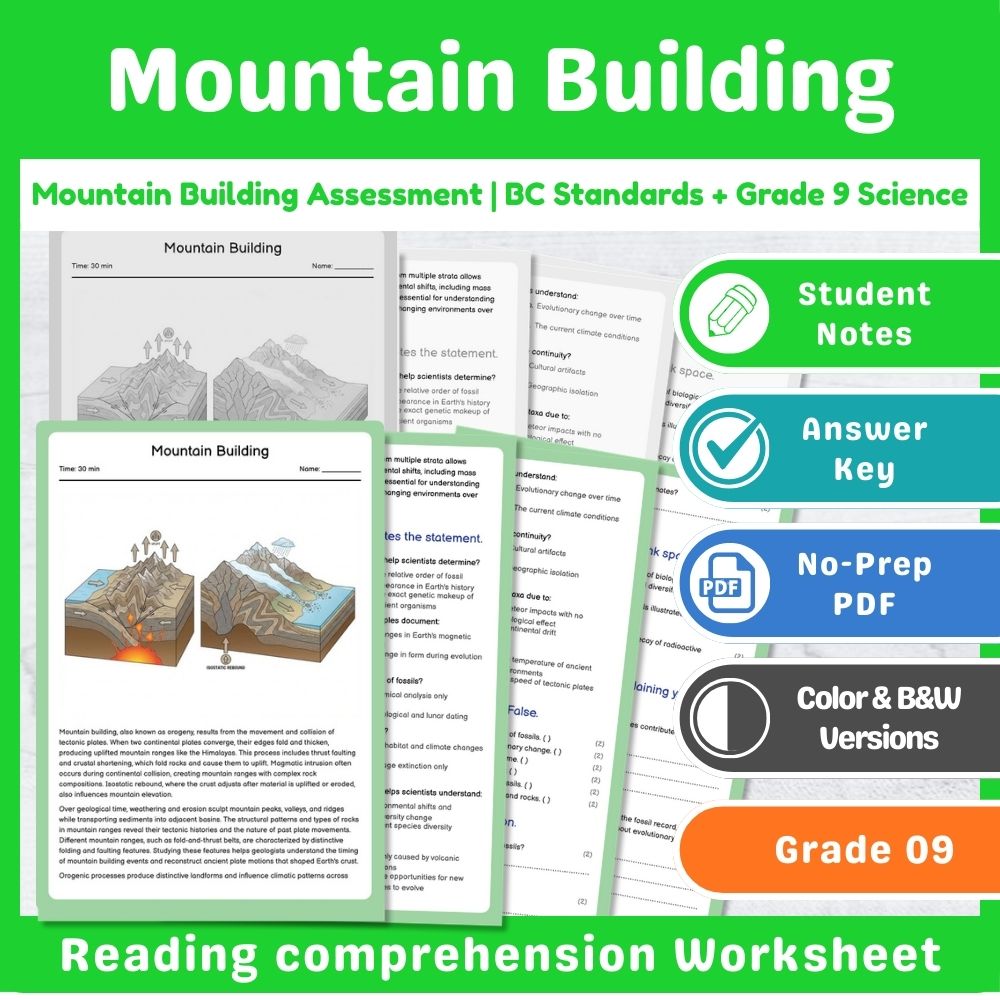
Mountain Building Assessment | BC Standards + Grade 9 Science
Created byPrism Point LearningLearning Objectives
- Explain the geological processes responsible for mountain formation, including plate convergence and continental collision.
- Identify the types of geological features produced by mountain building processes, such as fold-and-thrust belts.
- Describe the effects of weathering and erosion on mountain landscapes over time.
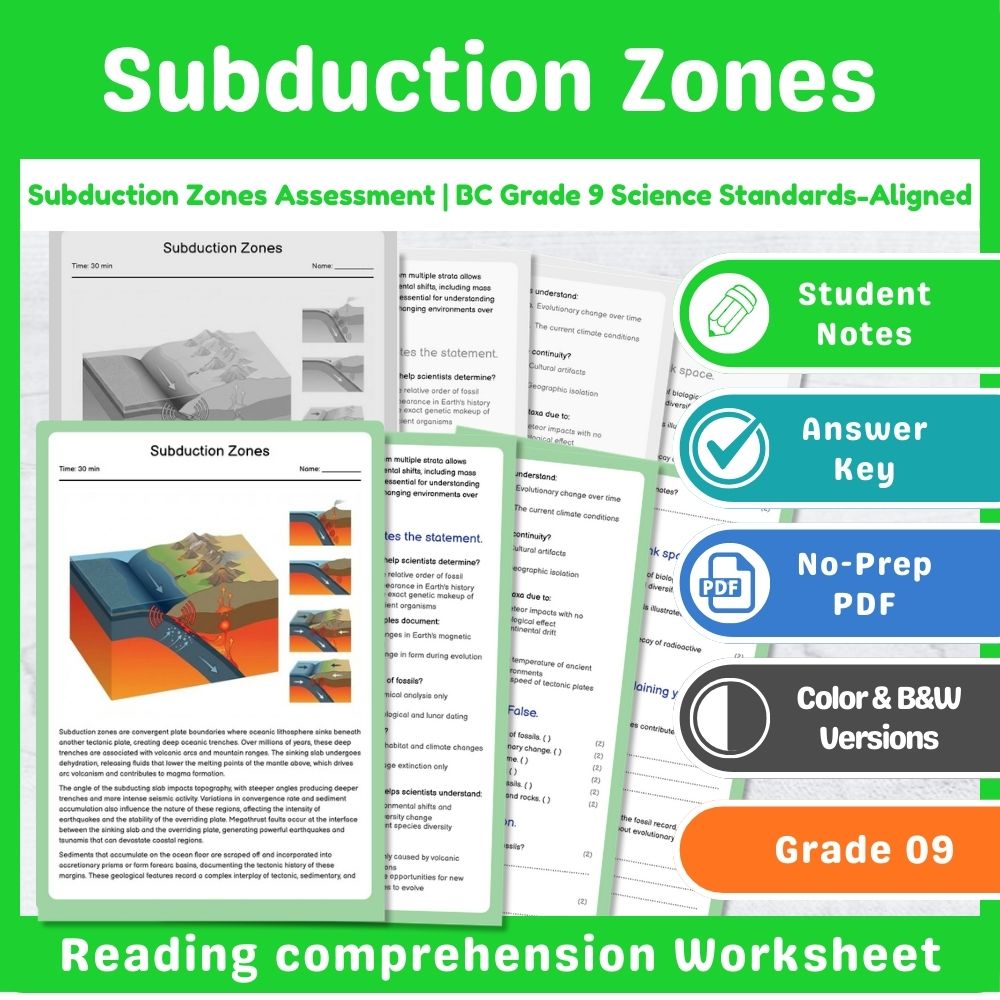
Subduction Zones Assessment | BC Grade 9 Science Standards-Aligned
Created byPrism Point LearningLearning Objectives
- Explain the formation and features of subduction zones.
- Describe the processes of slab dehydration and arc volcanism.
- Identify hazards associated with subduction zones, including earthquakes and tsunamis.
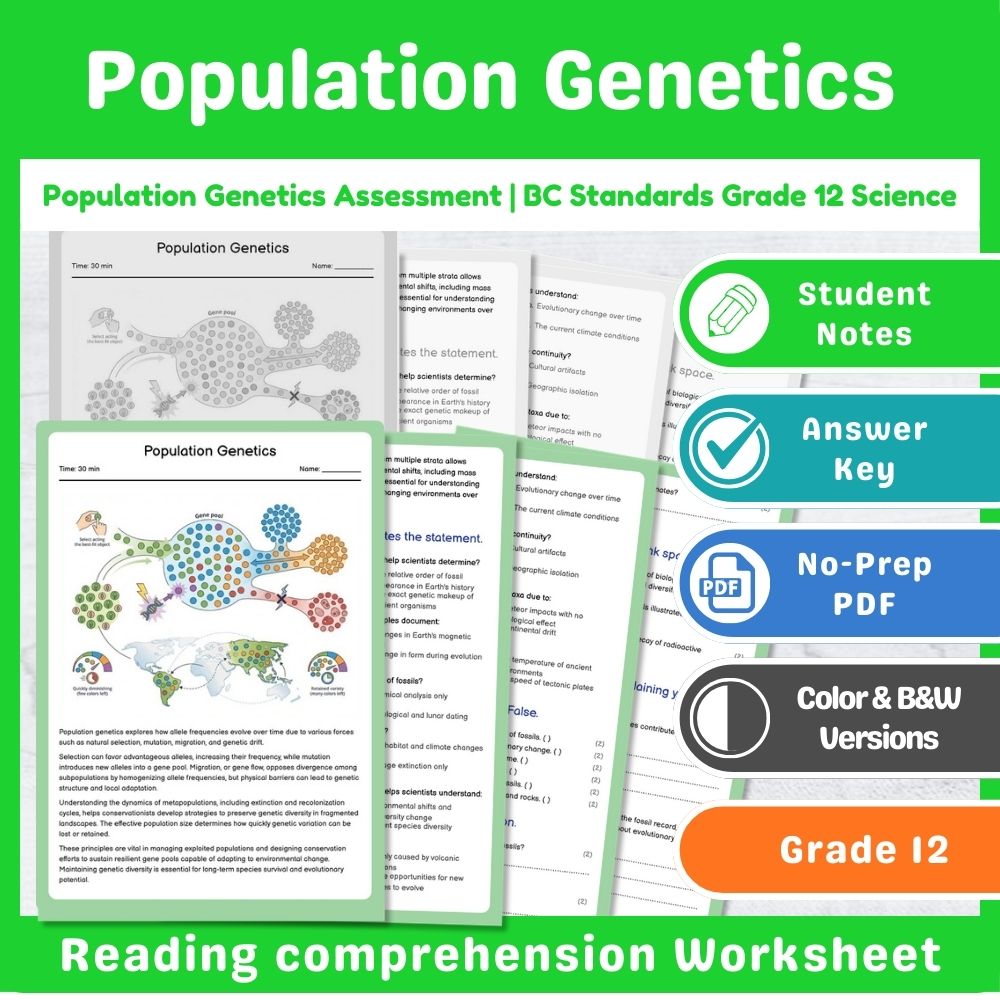
Population Genetics Assessment | BC Standards Grade 12 Science
Created byPrism Point LearningLearning Objectives
- Understand how allele frequencies are affected by evolutionary forces such as selection, mutation, migration, and drift.
- Describe the roles of gene flow, genetic structure, and local adaptation in populations.
- Explain concepts of metapopulation dynamics, extinction-recolonization cycles, and effective population size.
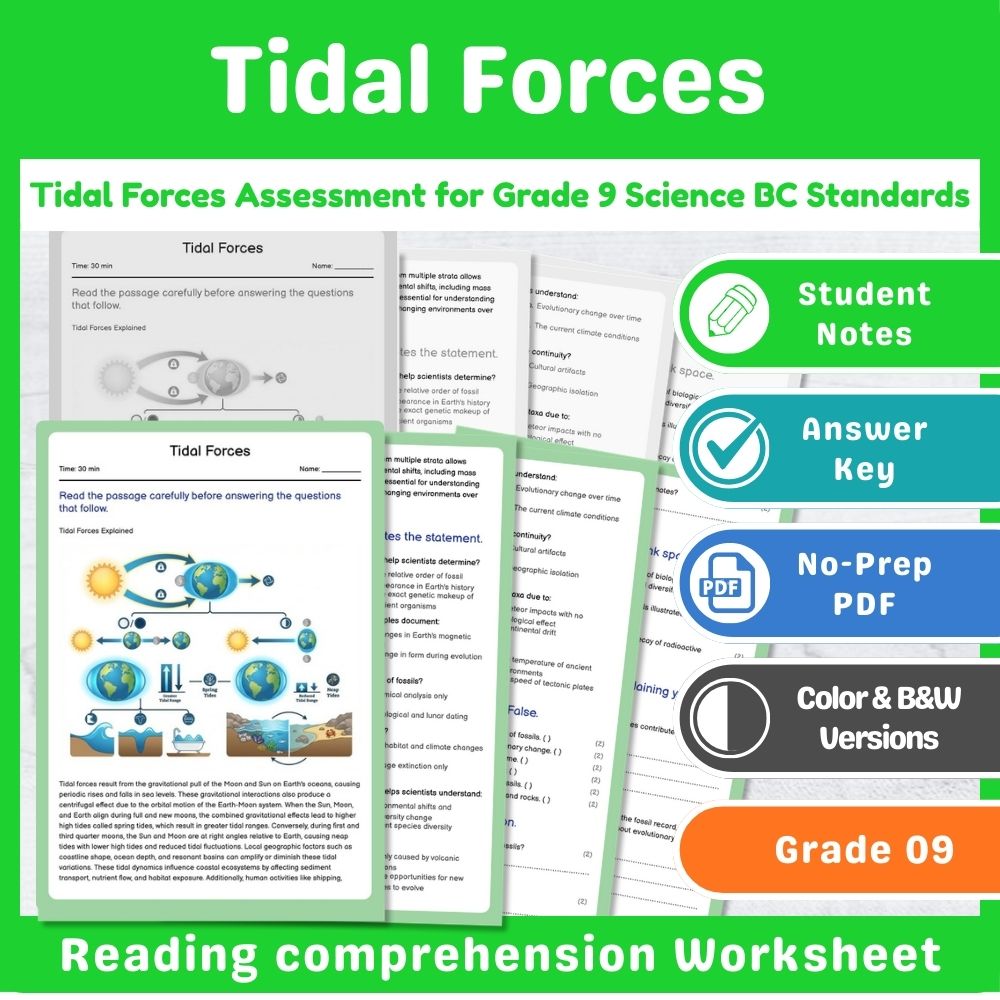
Tidal Forces Assessment for Grade 9 Science BC Standards
Created byPrism Point LearningLearning Objectives
- Explain how gravitational interactions among the Moon, Sun, and Earth produce tidal forces.
- Differentiate between spring and neap tides based on the relative positions of the Sun and Moon.
- Identify factors that influence local tidal amplitudes, including coastline geometry and ocean basin resonances.
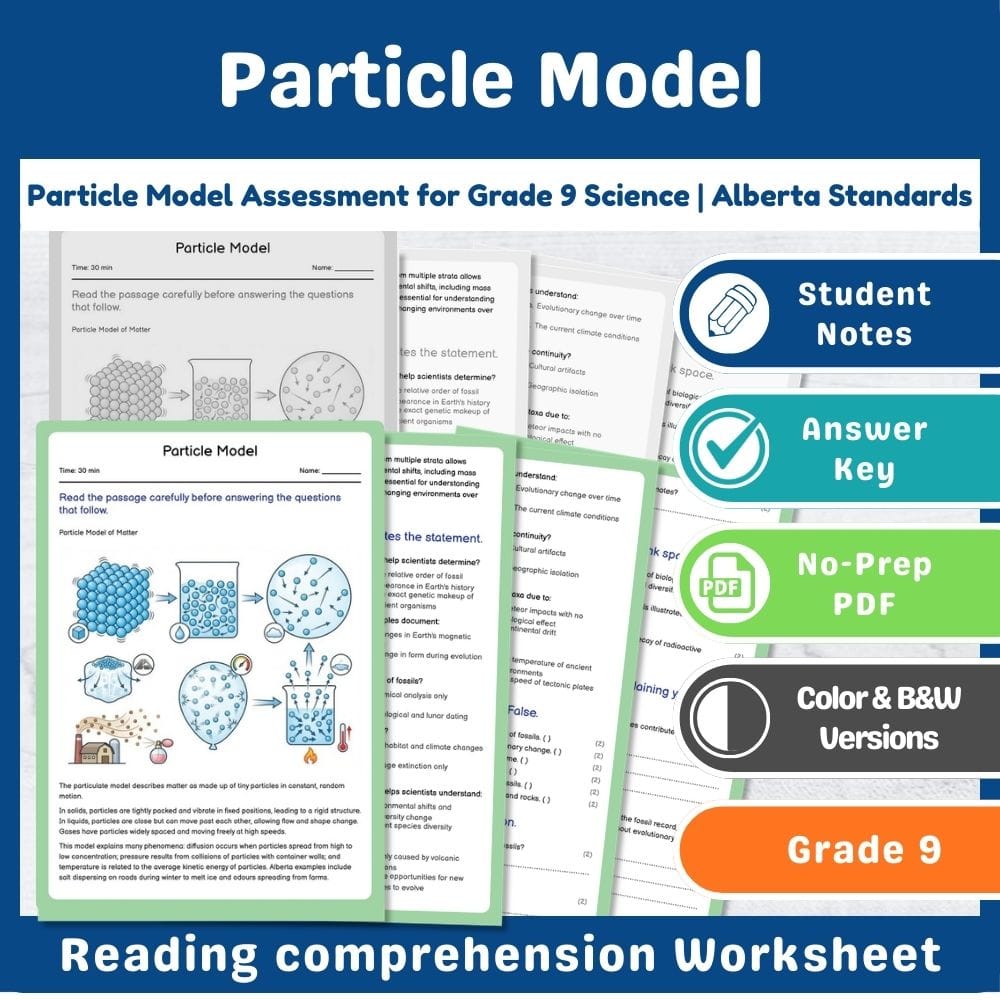
Particle Model Assessment for Grade 9 Science | Alberta Standards
Created byPrism Point LearningLearning Objectives
- Understand the basic principles of the particle model of matter.
- Explain how particle behavior affects macroscopic phenomena such as diffusion and pressure.
- Relate the particle model to real-world examples like salt dispersal on roads and odour spread.
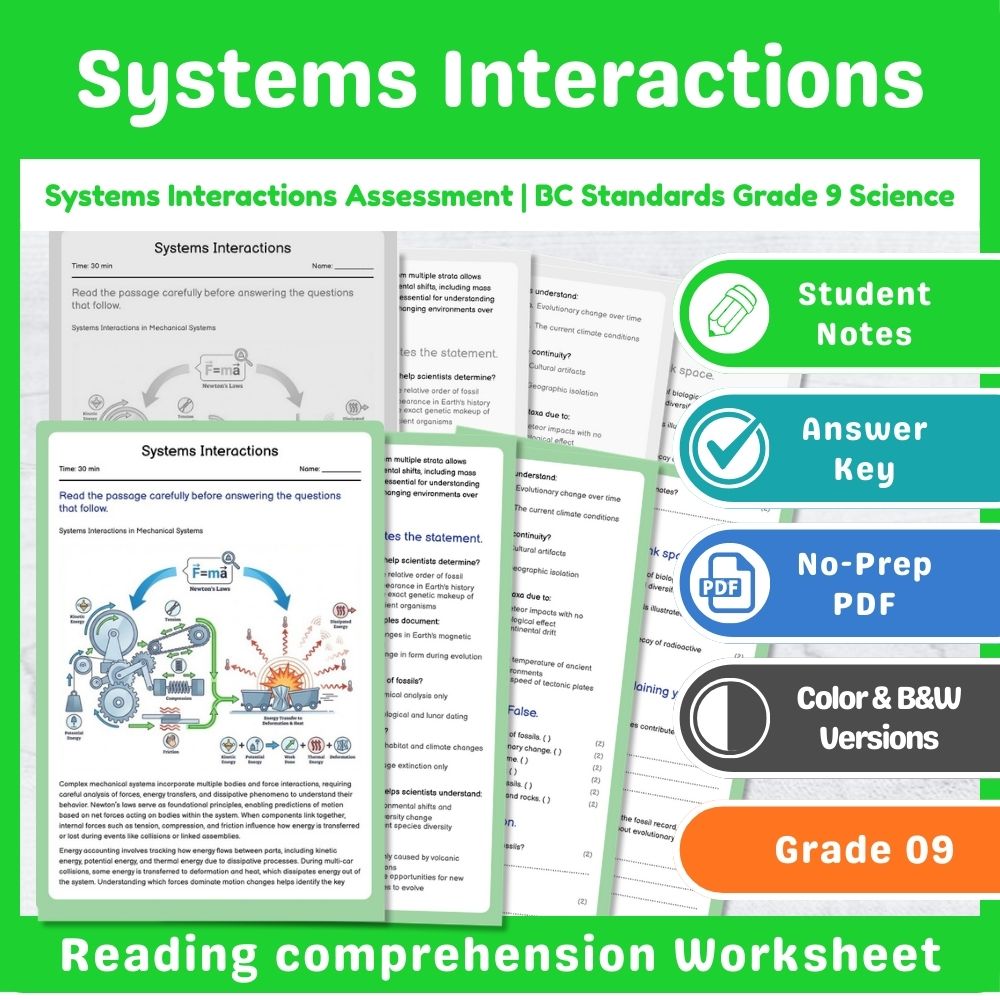
Systems Interactions Assessment | BC Standards Grade 9 Science
Created byPrism Point LearningLearning Objectives
- Understand how forces and energy interactions affect complex mechanical systems.
- Analyze net forces and predict system motion during collisions and assemblies.
- Evaluate energy transfers and dissipative forces within interconnected systems.
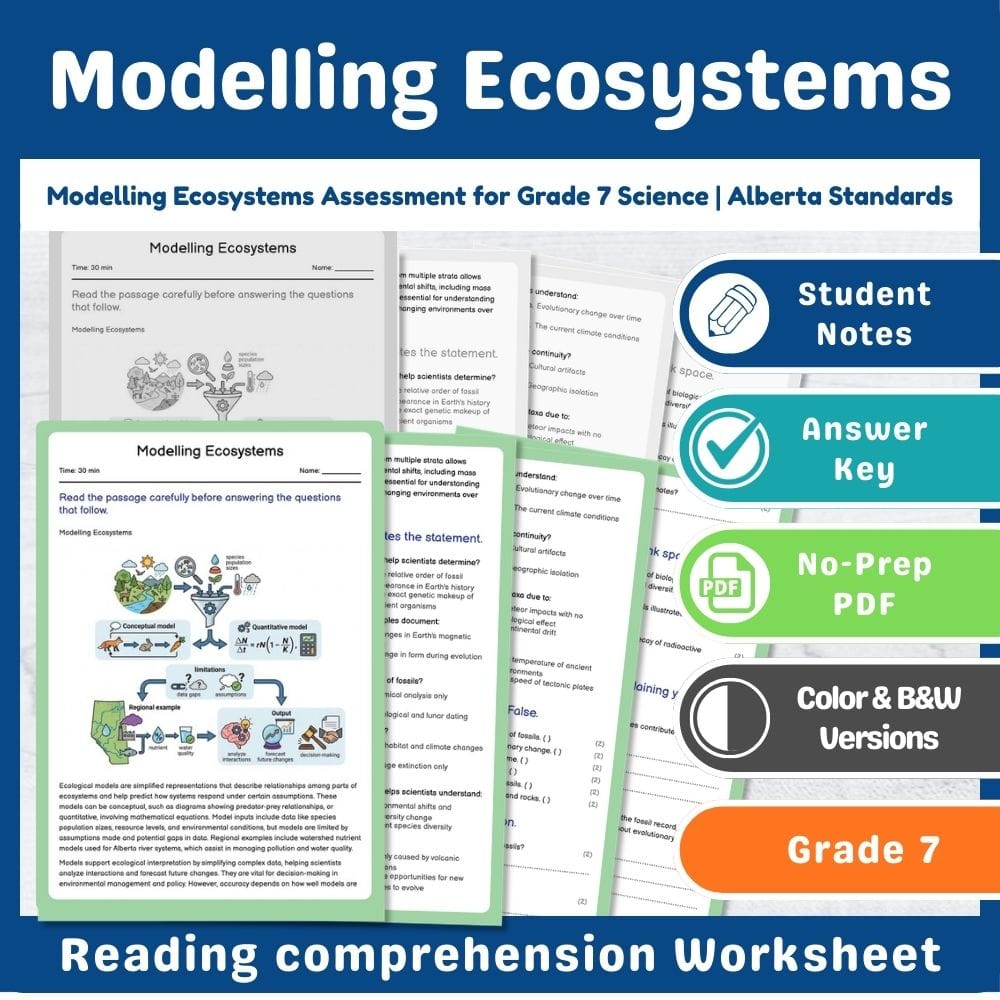
Modelling Ecosystems Assessment for Grade 7 Science | Alberta Standards
Created byPrism Point LearningLearning Objectives
- Understand the concept and importance of ecological models in environmental science.
- Identify different types of modelling approaches and their applications.
- Recognize regional examples of ecological models and their significance.
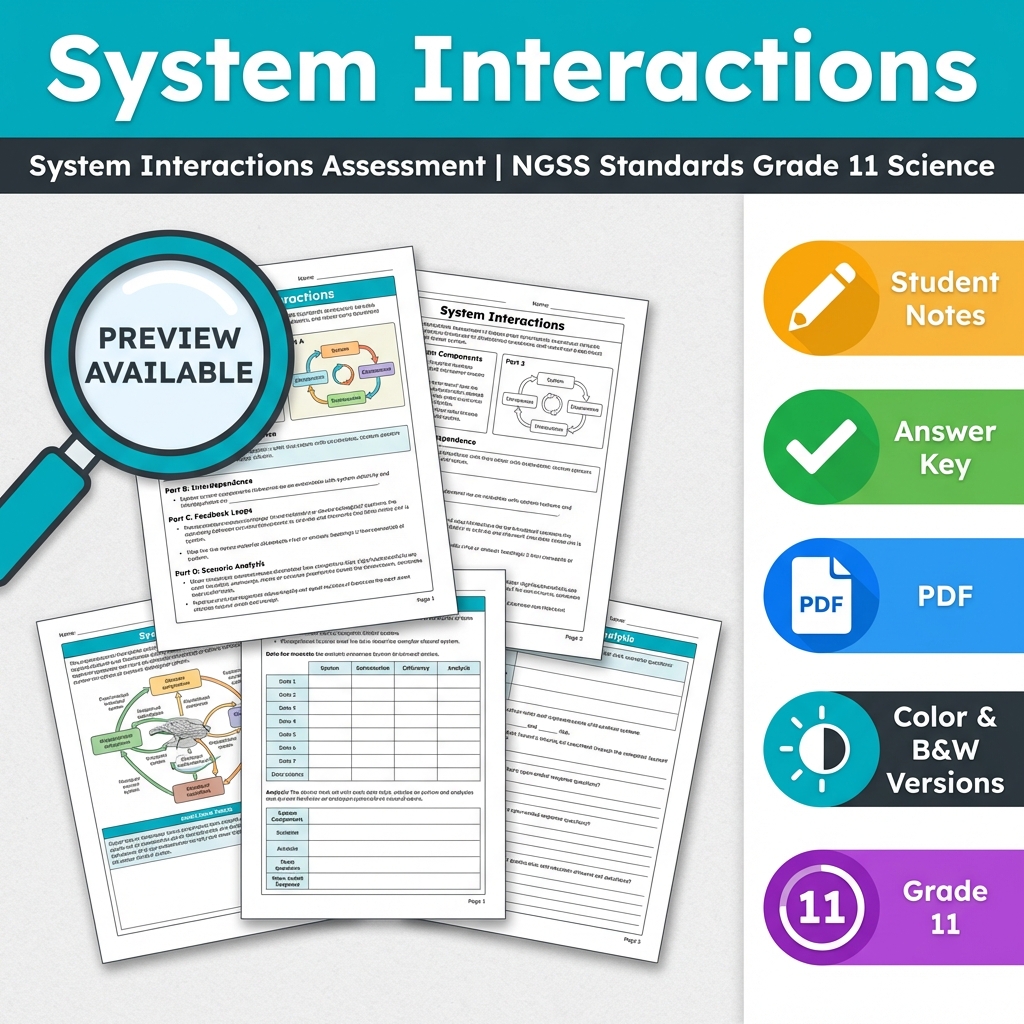
System Interactions Assessment | NGSS Standards Grade 11 Science
Created byPrism Point LearningLearning Objectives
- Understand Earth's major reservoirs and energy exchanges among atmosphere, hydrosphere, geosphere, and biosphere.
- Analyze the role of solar energy input and radiative balance in Earth's system.
- Describe mechanisms of heat transfer and feedbacks that influence system states over different timescales.
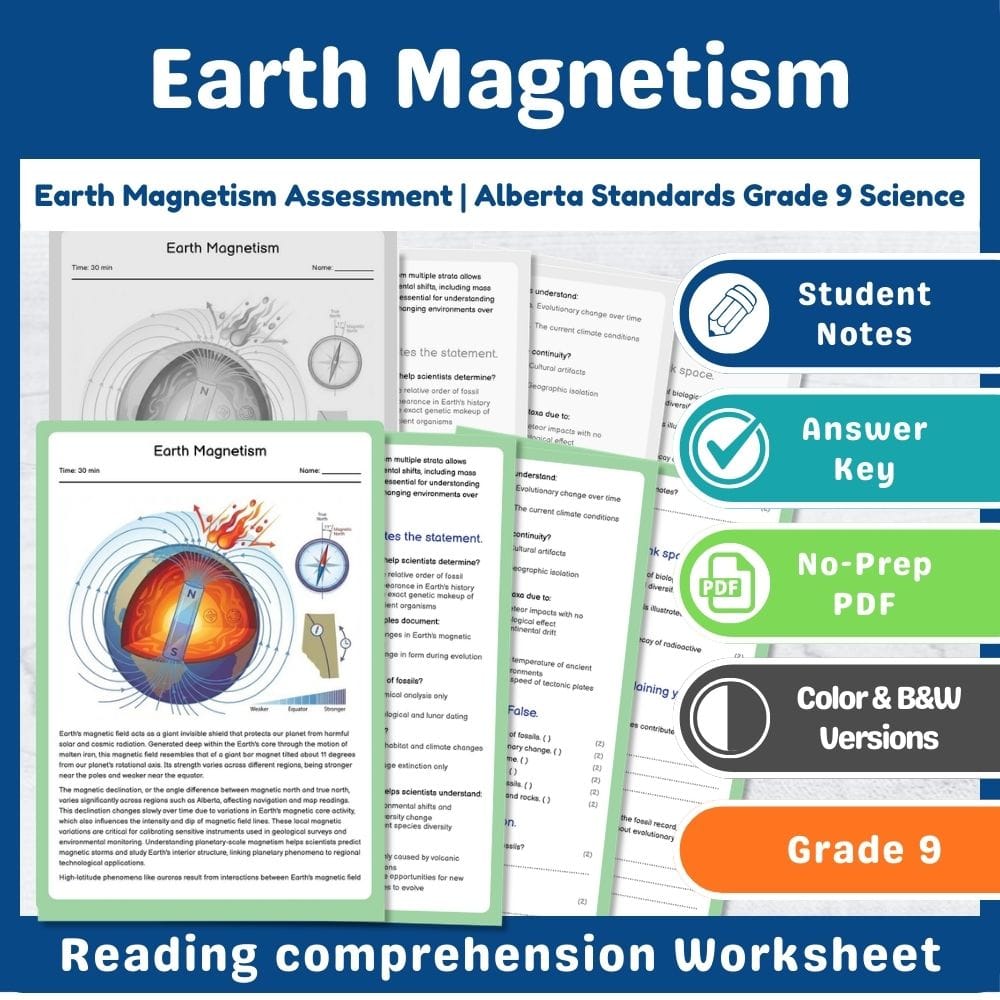
Earth Magnetism Assessment | Alberta Standards Grade 9 Science
Created byPrism Point LearningLearning Objectives
- Describe the origin and nature of Earth's magnetic field.
- Explain how declination varies regionally and affects navigation.
- Identify the technological applications of Earth's magnetism in surveying and environment monitoring.
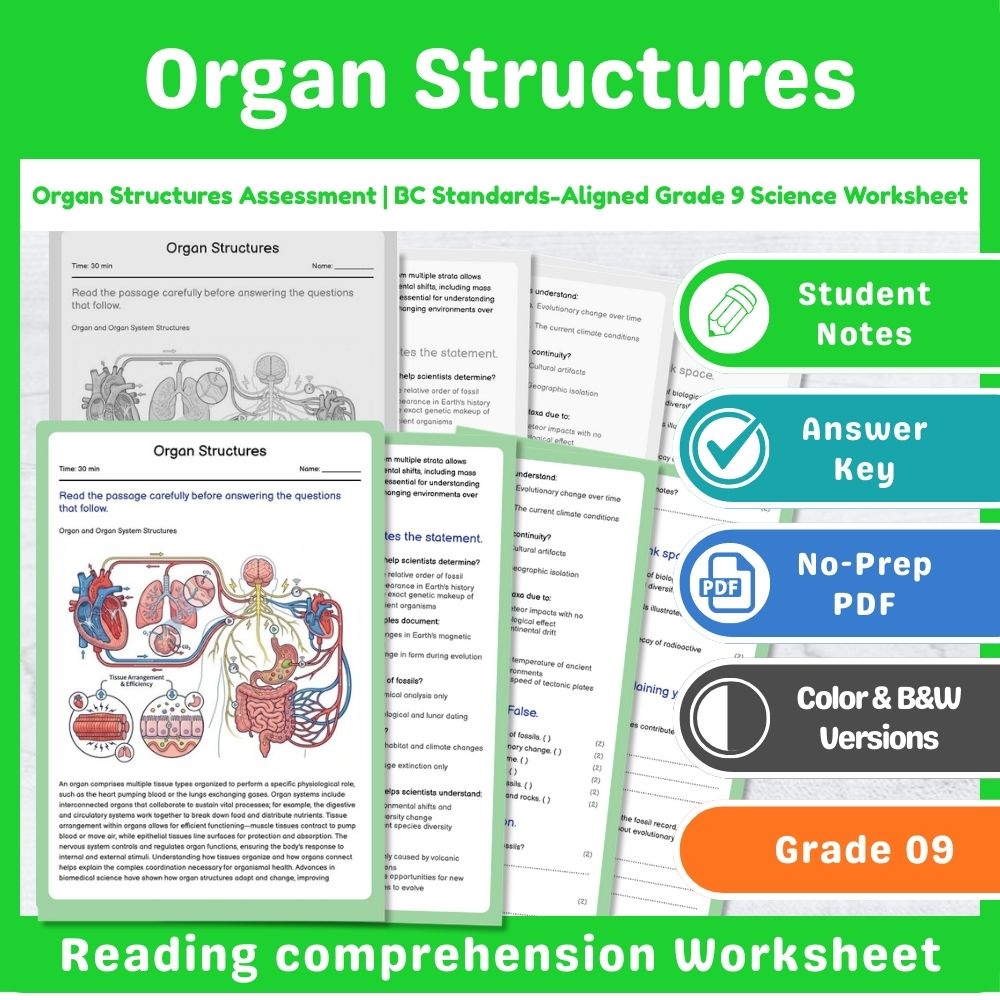
Organ Structures Assessment | BC Standards-Aligned Grade 9 Science Worksheet
Created byPrism Point LearningLearning Objectives
- Describe the structure and function of different organ types.
- Understand how organs are organized into systems to perform vital functions.
- Explain the importance of tissue organization within organs.
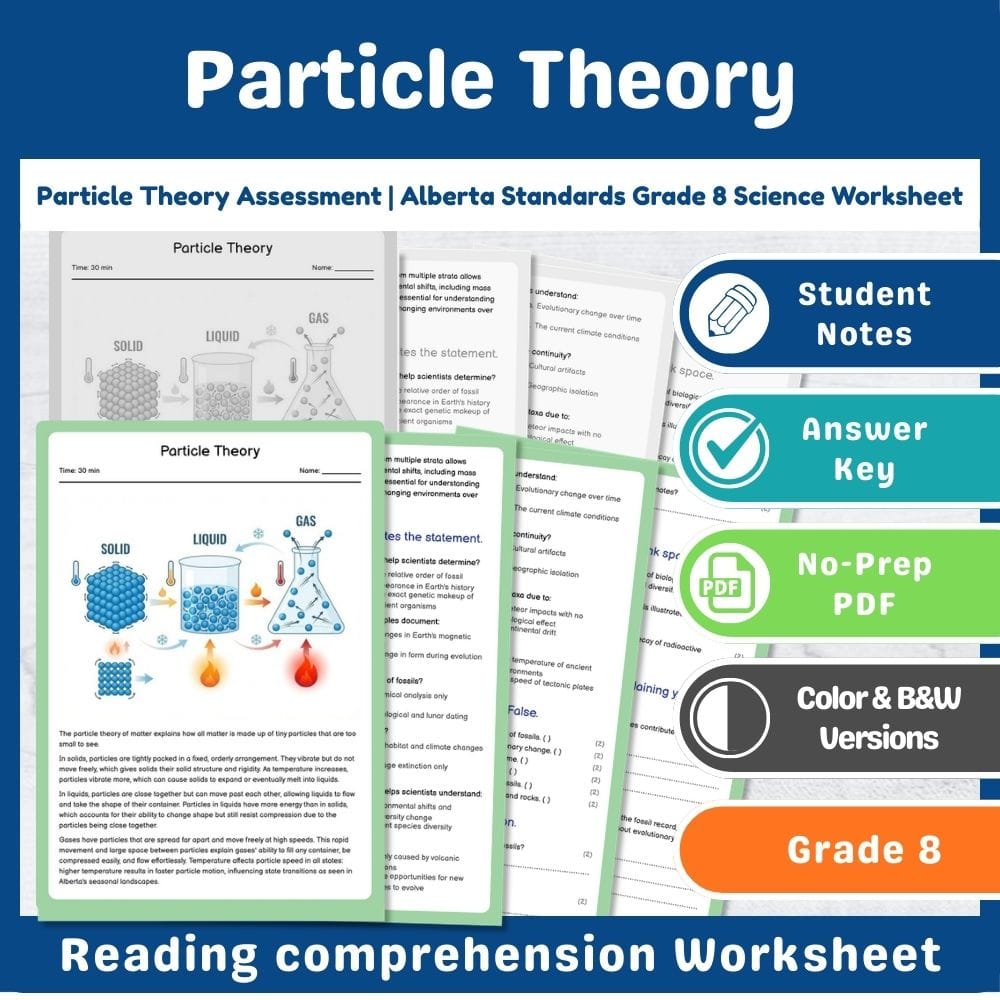
Particle Theory Assessment | Alberta Standards Grade 8 Science Worksheet
Created byPrism Point LearningLearning Objectives
- Describe the basic principles of the particle theory of matter.
- Explain how particle motion and arrangement influence the properties of solids, liquids, and gases.
- Connect microscopic particle behavior with observable macroscopic traits such as rigidity, flow, and compressibility.
Crystal Lattices BC Assessment | Standards-Aligned Grade 9 Science
Created byPrism Point LearningLearning Objectives
- Describe the structure and properties of different types of crystal lattices.
- Explain how unit cells define the repeating patterns in solids.
- Identify characteristics of ionic, metallic, and covalent network lattices.

Science Assessment: Cloud And Precipitation Grade 6 | NGSSS Assessment
Created byPrism Point LearningLearning Objectives
- Explain how clouds form when water vapor cools and condenses
- Describe how precipitation forms and name different types of precipitation
- Use temperature, moisture, and atmospheric conditions to predict precipitation outcomes

Work And Power Assessment for Grade 12 Science – Florida NGSSS
Created byPrism Point LearningLearning Objectives
- Explain how work depends on force magnitude and the angle between force and displacement
- Use the relationship between work and changes in mechanical energy to interpret real situations
- Calculate power from energy transfer rate and connect it to how quickly work is done
Phylogenetic Trees Assessment | BC Standards Grade 11 Science
Created byPrism Point LearningLearning Objectives
- Understand the purpose and key features of phylogenetic trees in evolutionary biology.
- Interpret molecular data and shared characters to infer ancestral relationships.
- Differentiate between homology and analogy in evolutionary patterns.
Comparative Anatomy Assessment | BC Standards Grade 10 Science
Created byPrism Point LearningLearning Objectives
- Understand the concepts of homologous and analogous structures and their significance in evolution.
- Identify vestigial organs and their implications for evolutionary history.
- Compare anatomical features across different organisms to infer phylogenetic relationships.
Momentum And Collisions Assessment | BC Standards Grade 10 Science
Created byPrism Point LearningLearning Objectives
- Understand the concept of linear momentum and how it is conserved in collisions.
- Differentiate between elastic and inelastic collisions and their energy implications.
- Explain the relationship between impulse, force, and change in momentum.

Evolving Knowledge Grade 9 Science Assessment | Florida NGSSS
Created byPrism Point LearningLearning Objectives
- Explain how scientific knowledge changes through new evidence, improved measurement, and revised models
- Identify how evidence, models, and measurement work together to support scientific conclusions
- Evaluate the role of transparency about assumptions and limitations in scientific reasoning
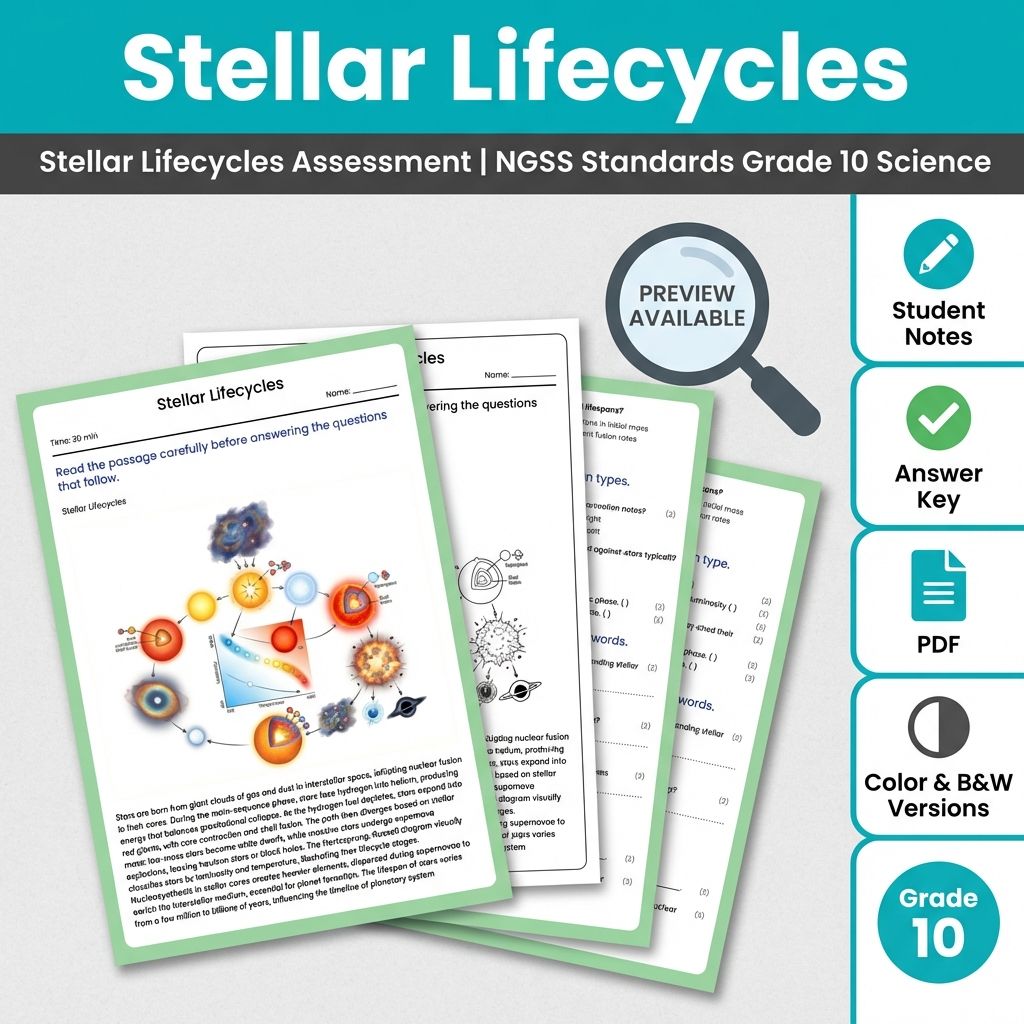
Stellar Lifecycles Assessment | NGSS Standards Grade 10 Science
Created byPrism Point LearningLearning Objectives
- Describe the main stages of stellar evolution and the processes occurring in stellar cores.
- Explain how the Hertzsprung-Russell diagram relates to different types of stars and their lifecycle paths.
- Identify the end-stage outcomes of stars and their significance in the cosmic cycle.
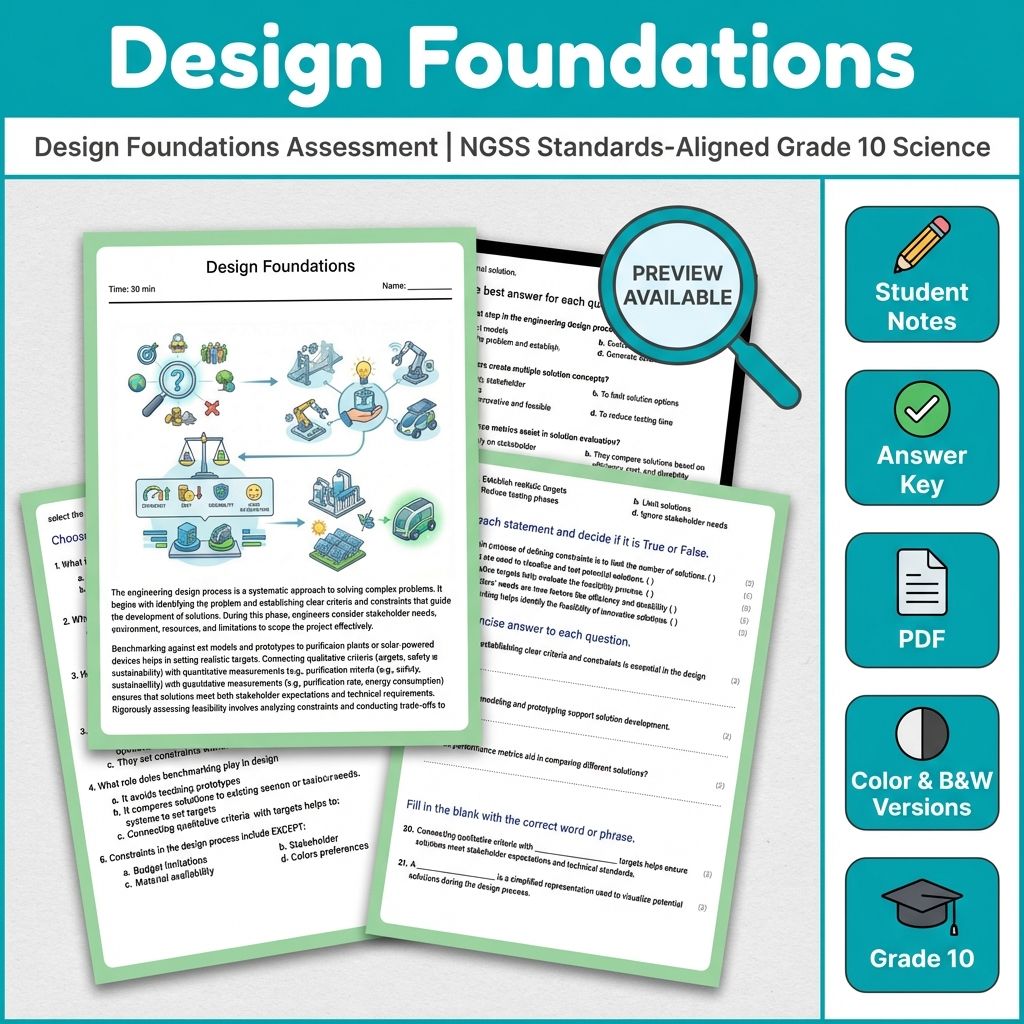
Design Foundations Assessment | NGSS Standards-Aligned Grade 10 Science
Created byPrism Point LearningLearning Objectives
- Understand the steps of the engineering design process for complex problems.
- Define criteria and constraints, and learn how to construct models.
- Develop multiple solution concepts and evaluate them against performance metrics.

Endothermic Processes Assessment | Florida NGSSS Grade 12 Science
Created byPrism Point LearningLearning Objectives
- Differentiate endothermic and exothermic chemical processes using energy changes and temperature observations
- Explain how bond energies and energy profiles support the idea of conservation of energy in chemical reactions
- Interpret particle-level and system-level energy exchange during endothermic reactions
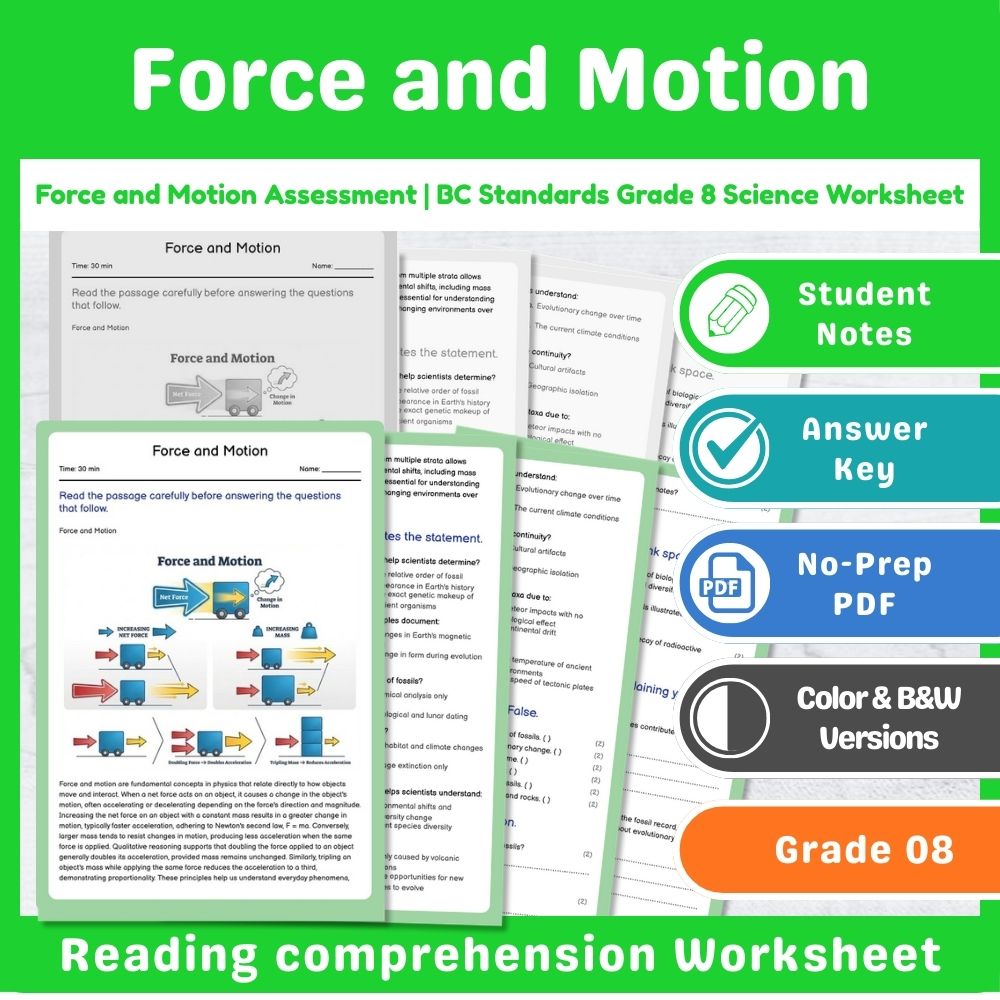
Force and Motion Assessment | BC Standards Grade 8 Science Worksheet
Created byPrism Point LearningLearning Objectives
- Understand the relationship between net force, mass, and acceleration.
- Explain qualitatively how increasing net force affects motion.
- Describe the effect of increased mass on acceleration under the same force.
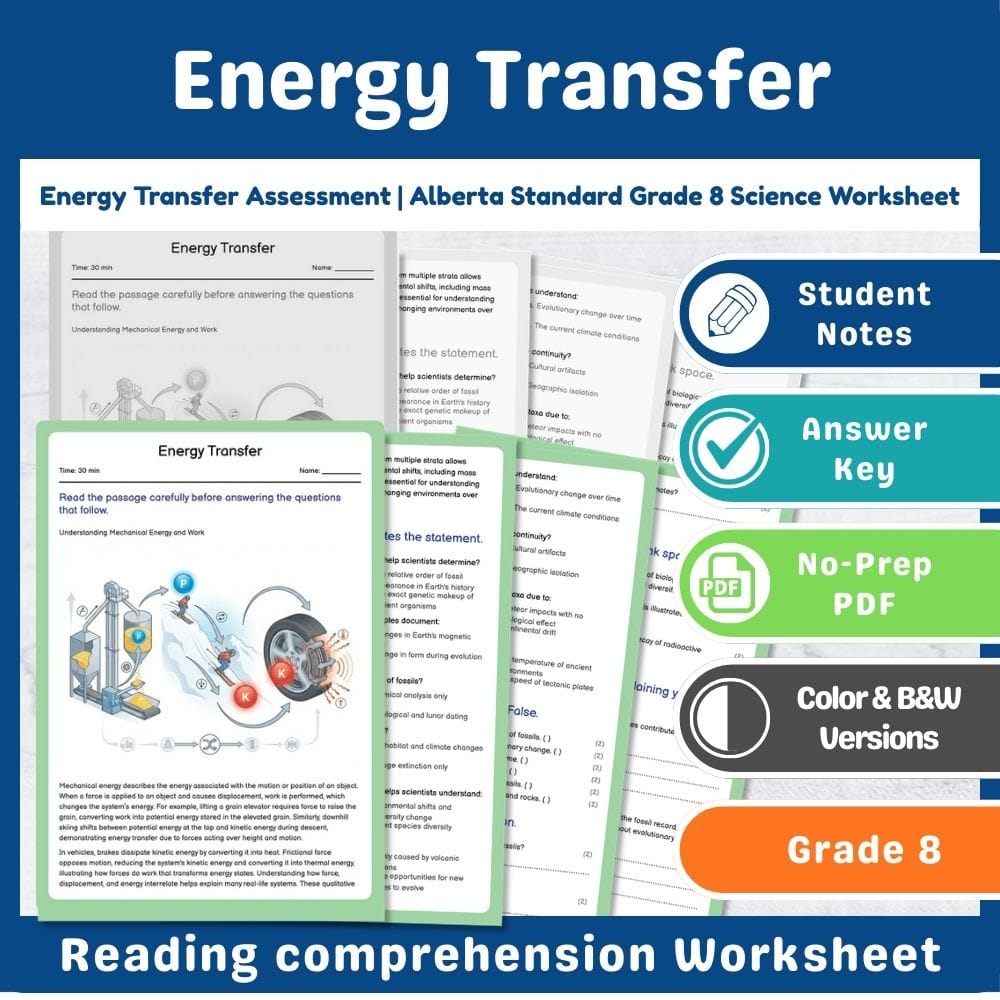
Energy Transfer Assessment | Alberta Standard Grade 8 Science Worksheet
Created byPrism Point LearningLearning Objectives
- Understand the concept of mechanical energy and how forces perform work on systems.
- Explain how potential and kinetic energy change during motion, using real-world examples.
- Qualitatively analyze force interactions and energy transformations in mechanical systems.
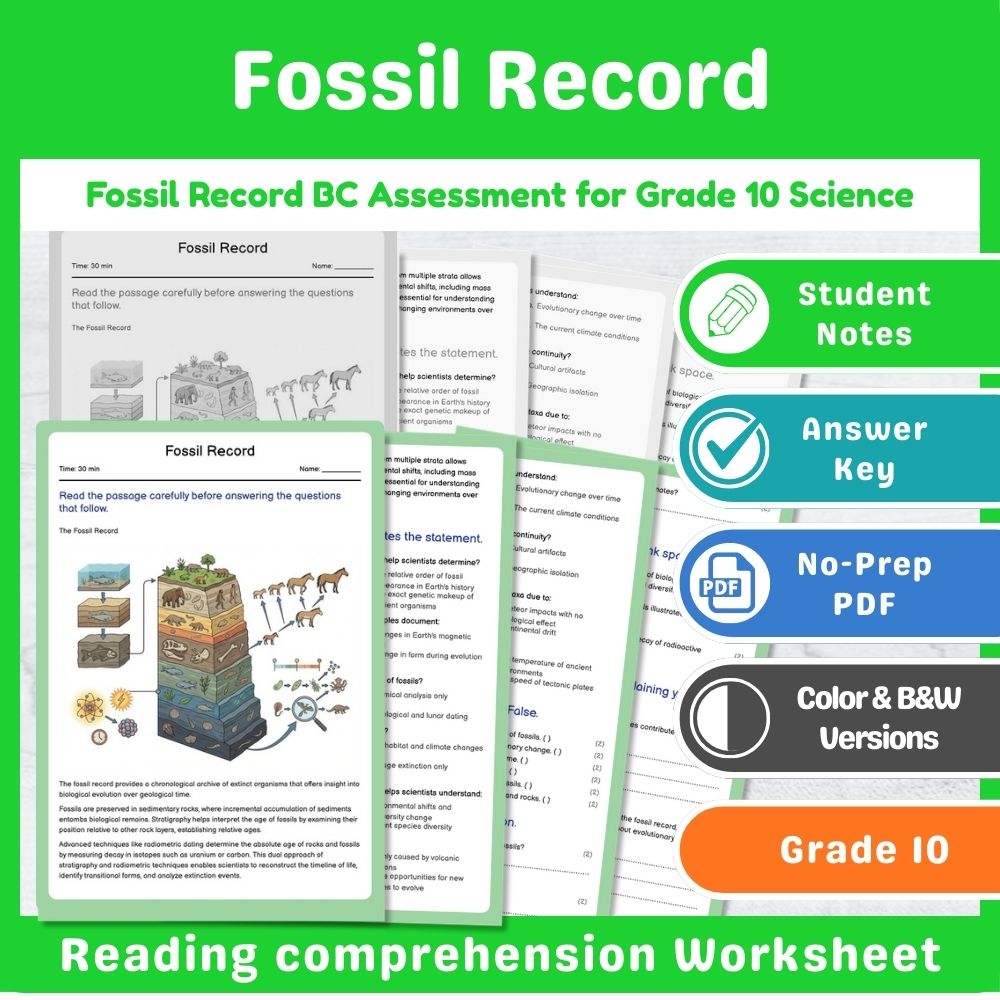
Fossil Record BC Assessment for Grade 10 Science
Created byPrism Point LearningLearning Objectives
- Understand how fossils are preserved and their significance in Earth's history.
- Identify methods used to interpret the fossil record, including stratigraphy and radiometric dating.
- Analyze patterns of biological change and extinction events through fossil evidence.
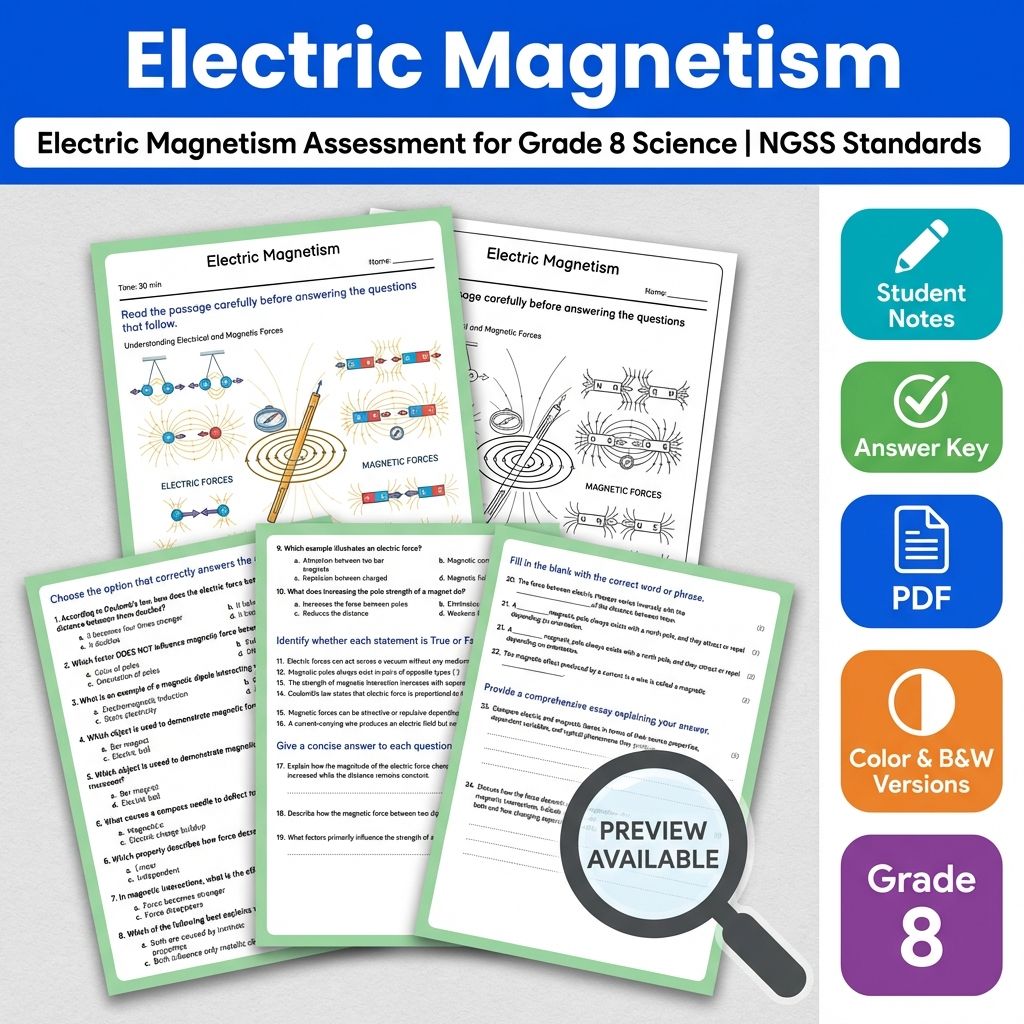
Electric Magnetism Assessment for Grade 8 Science | NGSS Standards
Created byPrism Point LearningLearning Objectives
- Understand how electric and magnetic forces are described through field interactions.
- Identify the relationships between force magnitude, charge/pole properties, and distance.
- Analyze examples such as charged objects, magnetic dipoles, and compass deflections to understand forces.
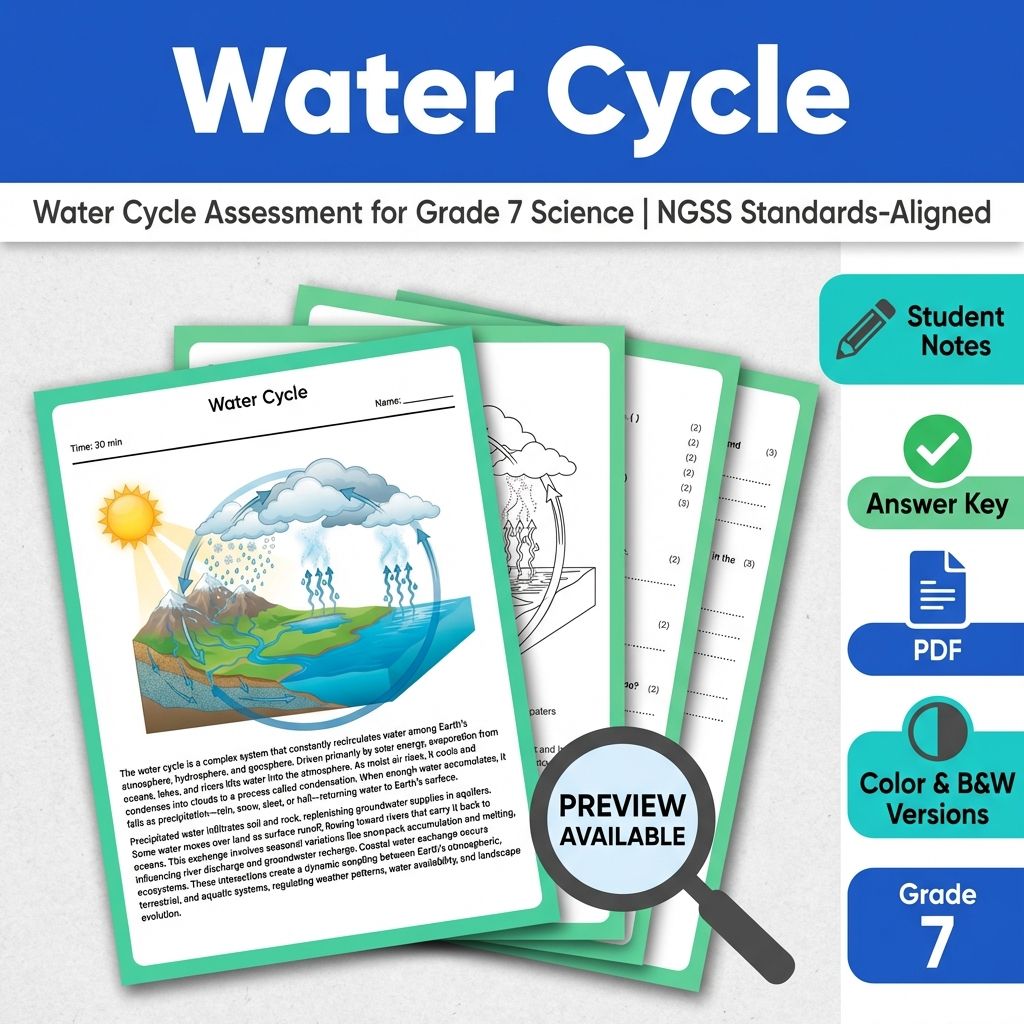
Water Cycle Assessment for Grade 7 Science | NGSS Standards-Aligned
Created byPrism Point LearningLearning Objectives
- Describe the processes involved in the water cycle, including evaporation, condensation, and precipitation.
- Explain how water moves through Earth's spheres via processes such as infiltration, runoff, and groundwater flow.
- Identify the interactions among rivers, aquifers, and ocean exchange in the water cycle, especially seasonal and seasonal variations.
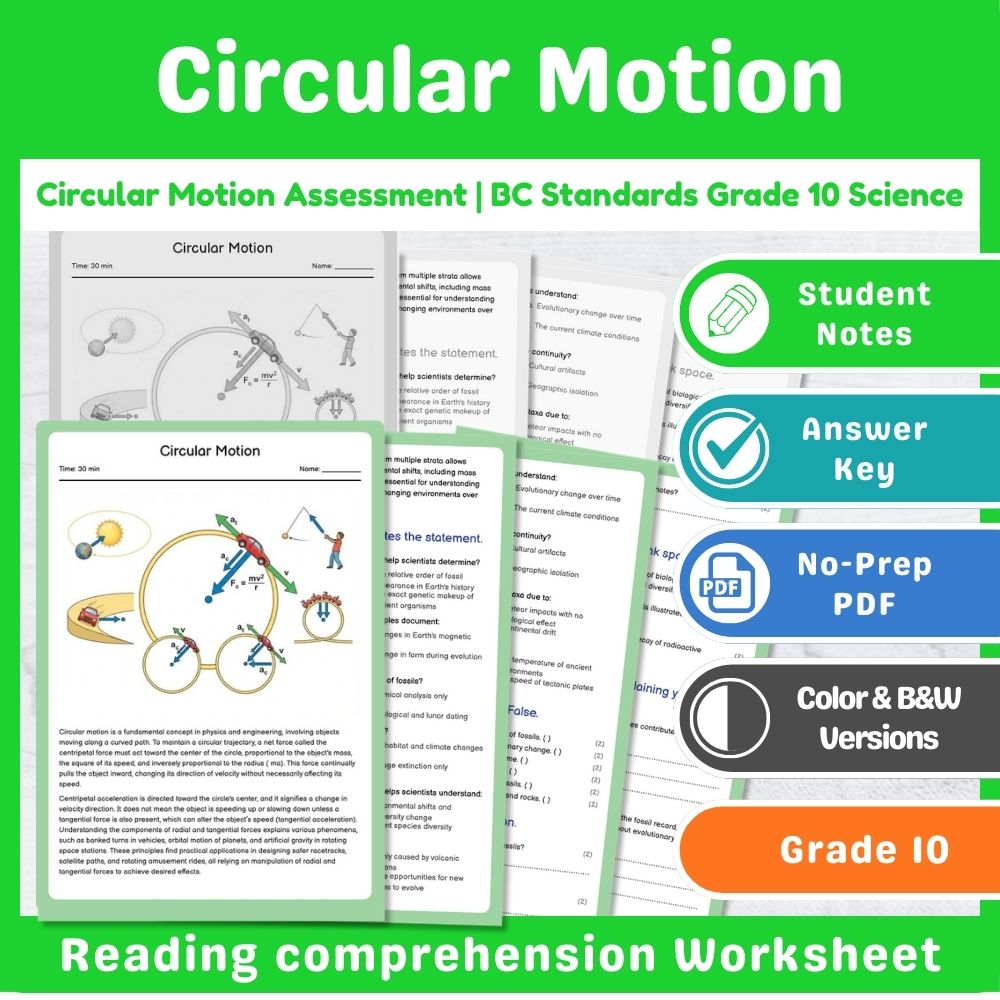
Circular Motion Assessment | BC Standards Grade 10 Science
Created byPrism Point LearningLearning Objectives
- Explain the concept of centripetal force and its role in circular motion.
- Differentiate between centripetal acceleration and tangential acceleration.
- Describe how radial and tangential components explain phenomena like banked turns and orbital motion.

Wave Properties Assessment for Grade 10 Science | Florida NGSSS
Created byPrism Point LearningLearning Objectives
- Explain wave properties (amplitude, wavelength, frequency, and wave speed) and how they describe repeating disturbances.
- Use the relationships among frequency, wavelength, and wave speed for waves traveling at the same speed.
- Interpret how reflection, refraction, and superposition affect wave behavior in real scenarios.
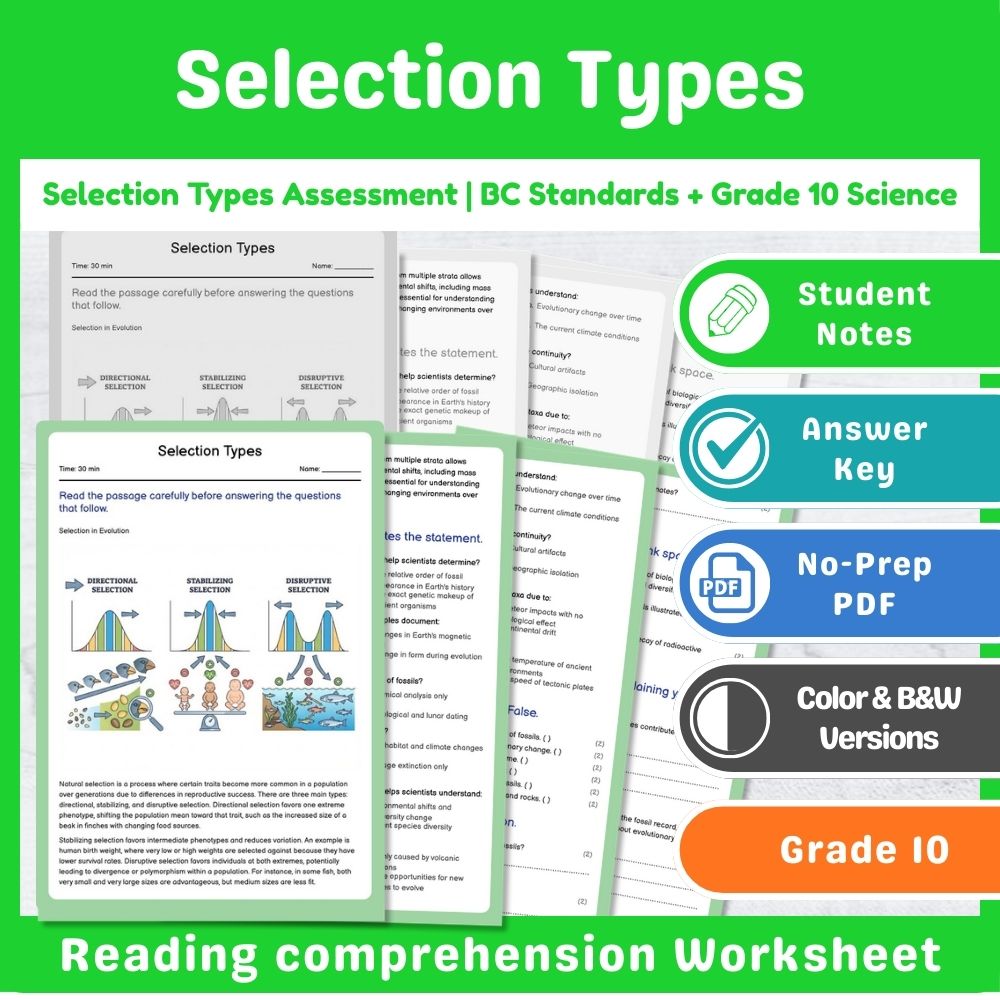
Selection Types Assessment | BC Standards + Grade 10 Science
Created byPrism Point LearningLearning Objectives
- Identify the different modes of natural selection and understand their effects on populations.
- Interpret how directional, stabilizing, and disruptive selection modify trait distributions over time.
- Explain the roles of frequency-dependent and sexual selection in evolution.
Browse more categories
About Science Worksheets
Find Science worksheets spanning core skills, practice, and review. All 42,685 resources are instant PDF downloads for the classroom or home.
Every worksheet on MyTeachingSheets is created by independent teacher-authors and reviewed before publication. All resources download as printable PDFs for classroom, homework, or at-home practice, and many include answer keys. Preview any worksheet free before buying.