
Science Worksheets
42,550 subject resources
Species Interactions Assessment for Grade 8 Science | Florida NGSSS
 Created byPrism Point Learning
Learning Objectives
- Explain how competition, predation, mutualism, commensalism, and parasitism affect survival and reproduction
- Describe how species interactions can change population sizes over time
- Use evidence from examples to identify the type of species interaction and its ecosystem impact
Atmospheric Patterns Assessment for Grade 10 Science | AP Standards
Created byPrism Point LearningLearning Objectives
- Understand key concepts related to Science
- Apply knowledge through practice questions
- Demonstrate comprehension of the material

Light Reactions Assessment | TEKS Grade 9 Science Standards-Aligned
Created byPrism Point LearningLearning Objectives
- Describe the process of light reactions in photosynthesis.
- Identify the roles of pigments, electron flow, and energy carriers.
- Explain how photon energy is converted into chemical energy.
Mountain Building Assessment | AP Standards-Aligned Grade 9 Science
Created byPrism Point LearningLearning Objectives
- Understand the geological processes involved in mountain formation, including crustal shortening, thickening, and metamorphism.
- Explain how isostatic adjustment influences mountain uplift and erosion patterns.
- Link plate convergence to changes in surface topography and regional climate effects.

Deep Time Processes Assessment | Florida NGSSS Grade 12 Science
Created byPrism Point LearningLearning Objectives
- Explain how weathering, erosion, and deposition shape landscapes over geologic time.
- Describe how plate tectonics and catastrophic events (volcanoes and earthquakes) modify Earth’s surface.
- Use evidence from rocks and landforms to infer relationships between process rate and deep time.

Matter Cycles Assessment for Grade 9 Science – Florida NGSSS Standards
Created byPrism Point LearningLearning Objectives
- Explain how chemical elements (carbon, nitrogen, and phosphorus) cycle through ecosystems between living things and the physical environment.
- Describe how processes like respiration, decomposition, and nutrient uptake connect trophic levels.
- Distinguish between how energy flows through ecosystems and how matter cycles in ecosystems.

Adaptation Patterns Assessment | TEKS Grade 6 Science Standards-Aligned
Created byPrism Point LearningLearning Objectives
- Identify different types of adaptation (morphological, physiological, behavioral).
- Explain how specific traits help organisms survive in their environments.
- Recognize examples of adaptations such as leaf modifications, fur insulation, migration, and dormancy.

Biotechnology Ethics Assessment for Grade 12 Science | Alberta Standards
Created byPrism Point LearningLearning Objectives
- Analyze key ethical issues related to biotechnology applications such as cloning and genome editing.
- Evaluate legal and social considerations surrounding biotechnology deployment in Alberta.
- Identify regulatory frameworks and community engagement processes shaping biotechnology innovations.

Population Change Assessment for Grade 7 Science | TEKS Standards
Created byPrism Point LearningLearning Objectives
- Understand the factors that influence population size and distribution.
- Explain the concepts of exponential and logistic growth patterns.
- Analyze how predator-prey interactions affect population dynamics.

Innovation History Assessment | TEKS Grade 7 Science Standards
Created byPrism Point LearningLearning Objectives
- Trace the causes and diffusion of technological inventions across history.
- Identify factors that enable invention, such as needs, materials, and incremental improvements.
- Differentiate between invention and innovation through historical examples.
Energy Changes Assessment Grade 10 Science AP Standards-Aligned
Created byPrism Point LearningLearning Objectives
- Describe the differences between endothermic and exothermic processes.
- Understand how bond breaking and formation relate to reaction heat.
- Explain the concepts of enthalpy and potential energy diagrams.

Physiological Regulation Assessment for Grade 11 Science TEKS
Created byPrism Point LearningLearning Objectives
- Describe the mechanisms involved in maintaining internal stability in the human body.
- Explain the roles of sensors, control centers, and effectors in physiological regulation.
- Identify examples of negative and positive feedback mechanisms in human physiology.
Rock Transformations Assessment for Grade 10 Science NGSS Standards
Created byPrism Point LearningLearning Objectives
- Describe the processes involved in the rock cycle including crystallization, lithification, metamorphism, and weathering.
- Explain how petrologic indicators such as mineral assemblages and geochemical signatures are used to interpret geological histories.
- Understand how radiometric dating and stratigraphic correlation aid in ordering geological events.
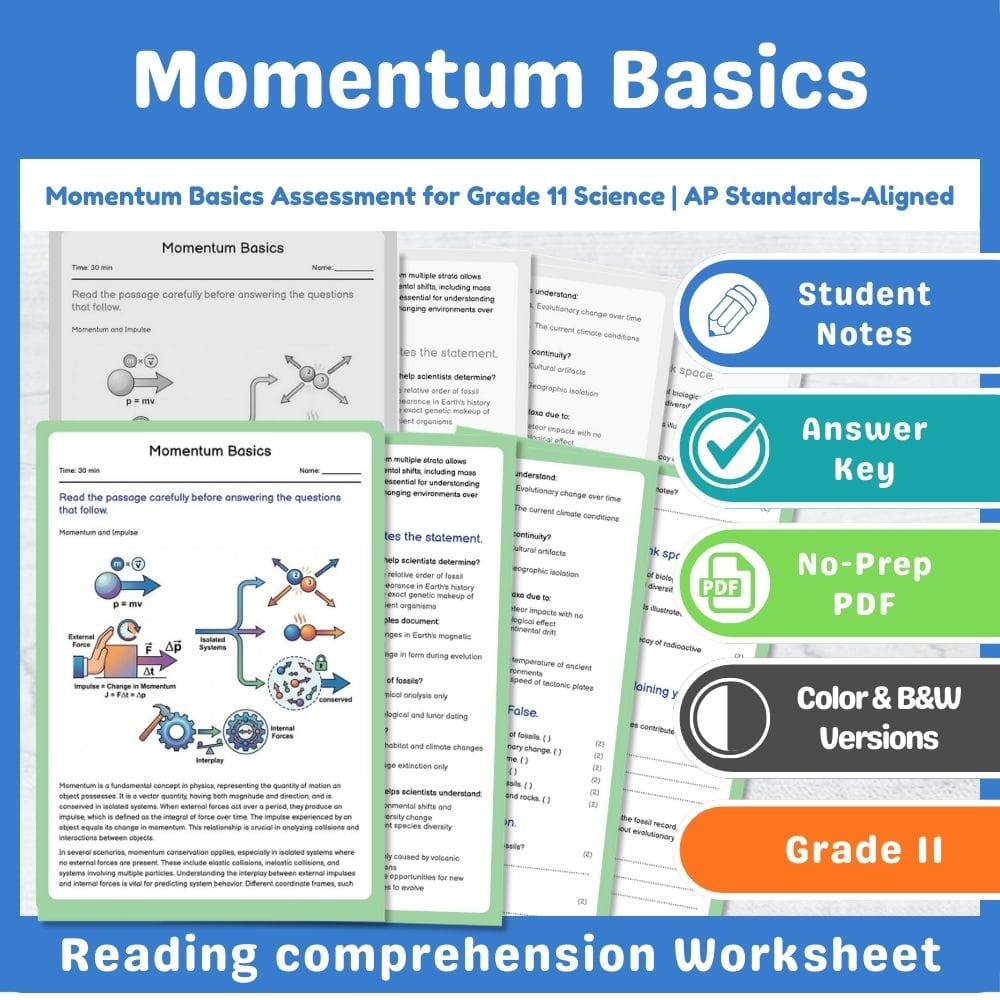
Momentum Basics Assessment for Grade 11 Science | AP Standards-Aligned
Created byPrism Point LearningLearning Objectives
- Understand linear momentum as a conserved vector quantity.
- Explain impulse as the time integral of force and relate it to changes in momentum.
- Apply algebraic conservation relations for isolated systems.

AC Circuits Assessment for Grade 12 Science | Alberta Standards
Created byPrism Point LearningLearning Objectives
- Understand the concept of impedance, reactance, and phase relationships in AC circuits.
- Calculate power, real and reactive components, and power factor in resistive, inductive, and capacitive networks.
- Analyze RLC circuits for resonance conditions and energy transfer in power systems.

Momentum Collisions Assessment for Grade 8 Science TEKS Standards
Created byPrism Point LearningLearning Objectives
- Define linear momentum and impulse in the context of collisions.
- Apply conservation principles to analyze elastic and inelastic collisions in one dimension.
- Distinguish between elastic and inelastic collisions using real-world examples.

Magnetic Separation Assessment for Grade 6 Science – Standards Aligned
Created byPrism Point LearningLearning Objectives
- Understand the principle of magnetic separation and its applications.
- Identify materials that respond to magnetic forces versus those that do not.
- Describe how magnetic separation can be used in everyday technology and recycling.
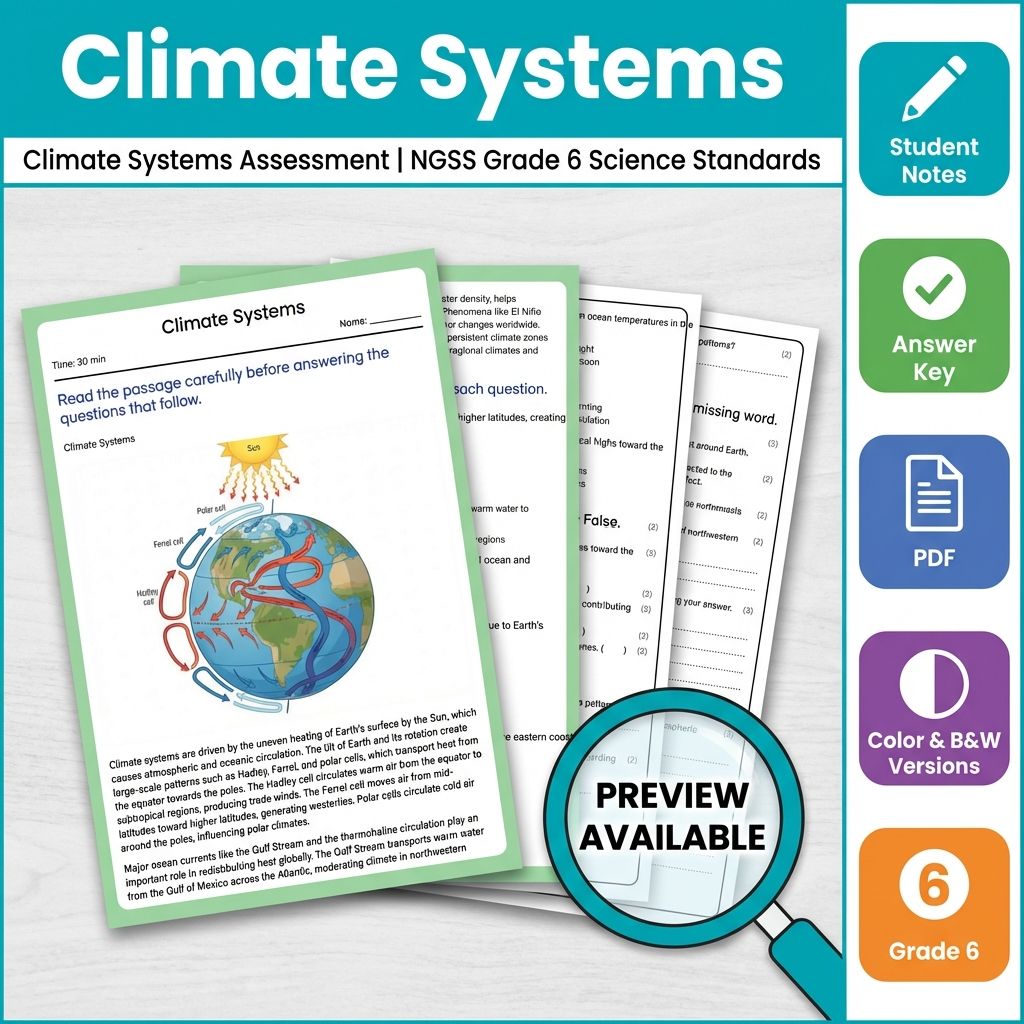
Climate Systems Assessment | NGSS Grade 6 Science Standards
Created byPrism Point LearningLearning Objectives
- Understand how unequal solar heating and planetary rotation influence global circulation patterns.
- Identify different atmospheric and oceanic circulation cells and their roles in climate.
- Explain how major ocean currents transport heat and moisture around the globe.

Light and Carbon Assessment | TEKS Grade 10 Science
Created byPrism Point LearningLearning Objectives
- Describe the process of light reactions and their role in photosynthesis.
- Understand how the Calvin cycle fixes carbon dioxide into sugars.
- Identify the roles of chlorophyll, accessory pigments, and enzymes like RuBisCO.

Linkage and Recombination Assessment for Grade 11 Science TEKS
Created byPrism Point LearningLearning Objectives
- Understand the concepts of linkage and recombination in genetics.
- Explain how crossover frequency reflects physical distance between genes.
- Identify factors like interference and hot spots that influence crossover distribution.

Ecosystem Structure Assessment for Grade 8 Science | TEKS Standards
Created byPrism Point LearningLearning Objectives
- Describe components and biomes of ecosystems, including abiotic factors.
- Explain trophic roles of producers, consumers, and decomposers within food webs.
- Analyze energy flow and matter cycling patterns in different biomes.

Circulatory Transport Assessment for Grade 6 Science | General Standards
Created byPrism Point LearningLearning Objectives
- Understand the structure and function of the circulatory system.
- Identify the roles of arteries, veins, and capillaries in blood transport.
- Explain how the heart's rhythmic pumping creates blood pressure.
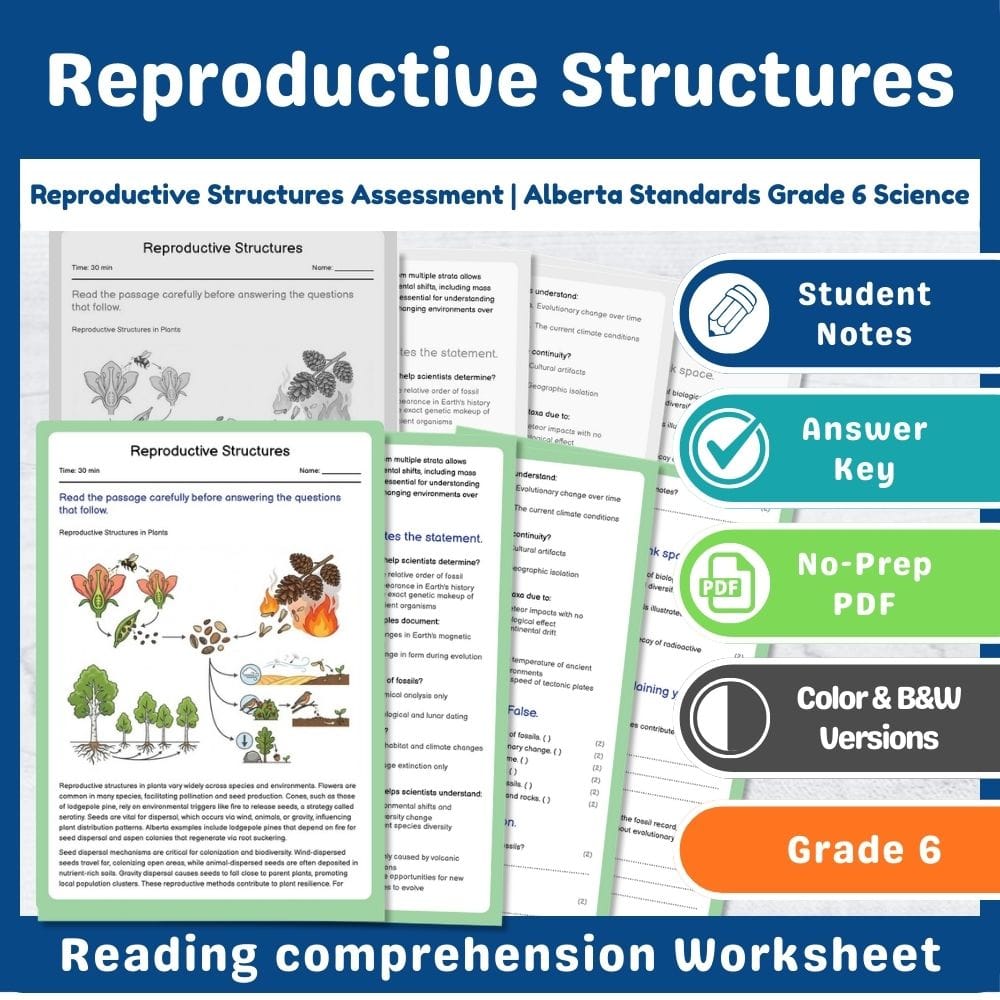
Reproductive Structures Assessment | Alberta Standards Grade 6 Science
Created byPrism Point LearningLearning Objectives
- Understand the role of flowers, cones, and seeds in plant reproduction.
- Identify different seed dispersal mechanisms and their effects on plant colonization.
- Explain how reproductive diversity contributes to population resilience and genetic variation.

Tissue Structure Assessment | TEKS Grade 9 Science Worksheet
Created byPrism Point LearningLearning Objectives
- Understand the organization of different tissue types and their cellular features.
- Identify the functions related to epithelial, connective, muscle, and nervous tissues.
- Link microscopic features of tissues to their roles in organ systems.

Cell Basics Assessment | Alberta Standards Grade 10 Science
Created byPrism Point LearningLearning Objectives
- Understand the fundamental structures and functions of cells.
- Identify key features such as membranes, cytoplasm, and genetic material in cells.
- Compare cellular features in regional examples like canola leaf cells and moss cells.

Buffer Capacity Assessment | Alberta Standards Assessment Grade 11 Science
Created byPrism Point LearningLearning Objectives
- Understand the concept of buffer capacity and its significance in environmental systems.
- Identify factors affecting buffer capacity in natural systems.
- Assess methods used to evaluate buffer capacity quantitatively.

Properties and Classification Assessment | TEKS Grade 7 Science Worksheet
Created byPrism Point LearningLearning Objectives
- Define physical and chemical properties used to classify substances.
- Identify measurable attributes such as density, solubility, hardness, and conductivity.
- Distinguish between elements, compounds, and mixtures based on observable properties.
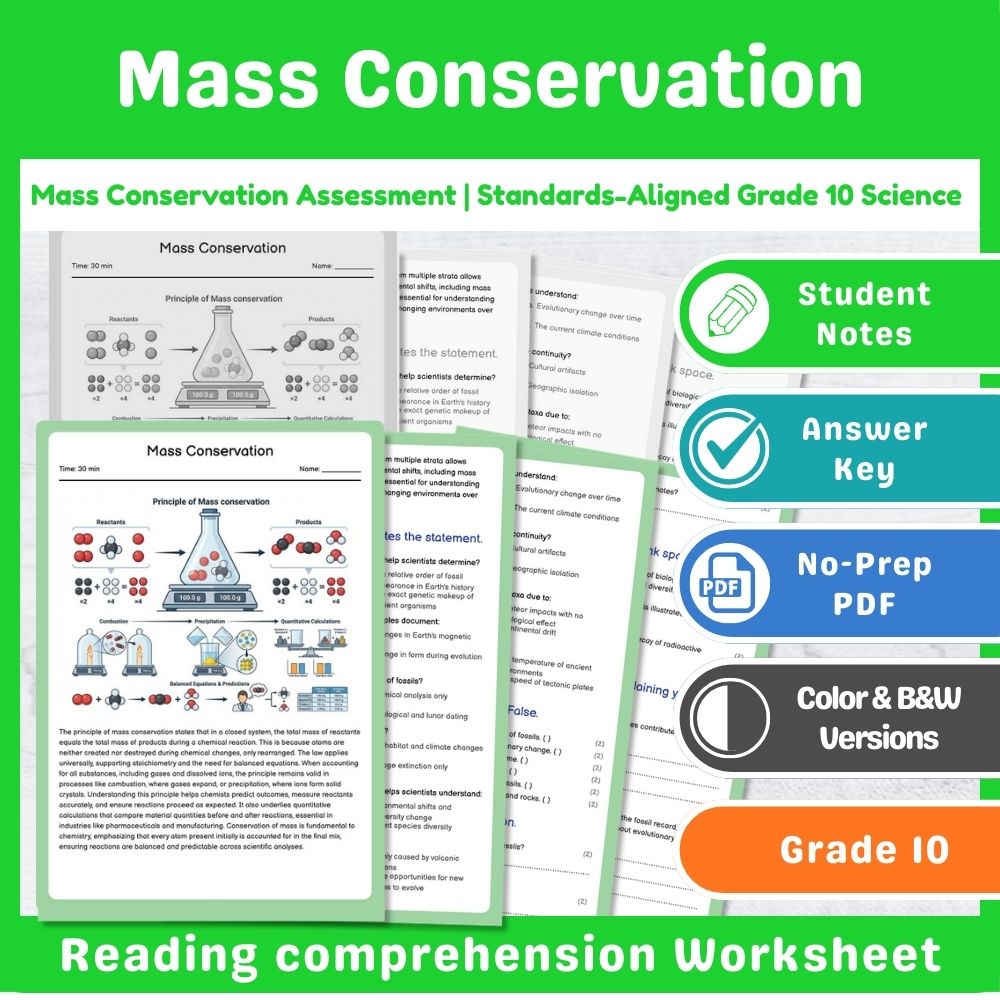
Mass Conservation Assessment | Standards-Aligned Grade 10 Science Worksheet
Created byPrism Point LearningLearning Objectives
- Understand the principle of conservation of mass in chemical reactions.
- Identify how mass is conserved in different types of chemical processes.
- Apply the concept of mass conservation to balance chemical equations.

Design Principles Assessment | TEKS Grade 7 Science Standards-Aligned
Created byPrism Point LearningLearning Objectives
- Understand key concepts of designing fair and reproducible experiments.
- Identify variables, operational definitions, and control conditions in experiments.
- Recognize ethical, safety, and sample size considerations in research design.

Titration Analysis Assessment | Alberta Grade 11 Science Standards
Created byPrism Point LearningLearning Objectives
- Understand the mathematical principles behind titration calculations involving molarity and reaction stoichiometry.
- Apply algebraic manipulation to determine unknown solution concentrations in titration experiments.
- Interpret equivalence point relationships and their applications in water quality control and reagent standardization.
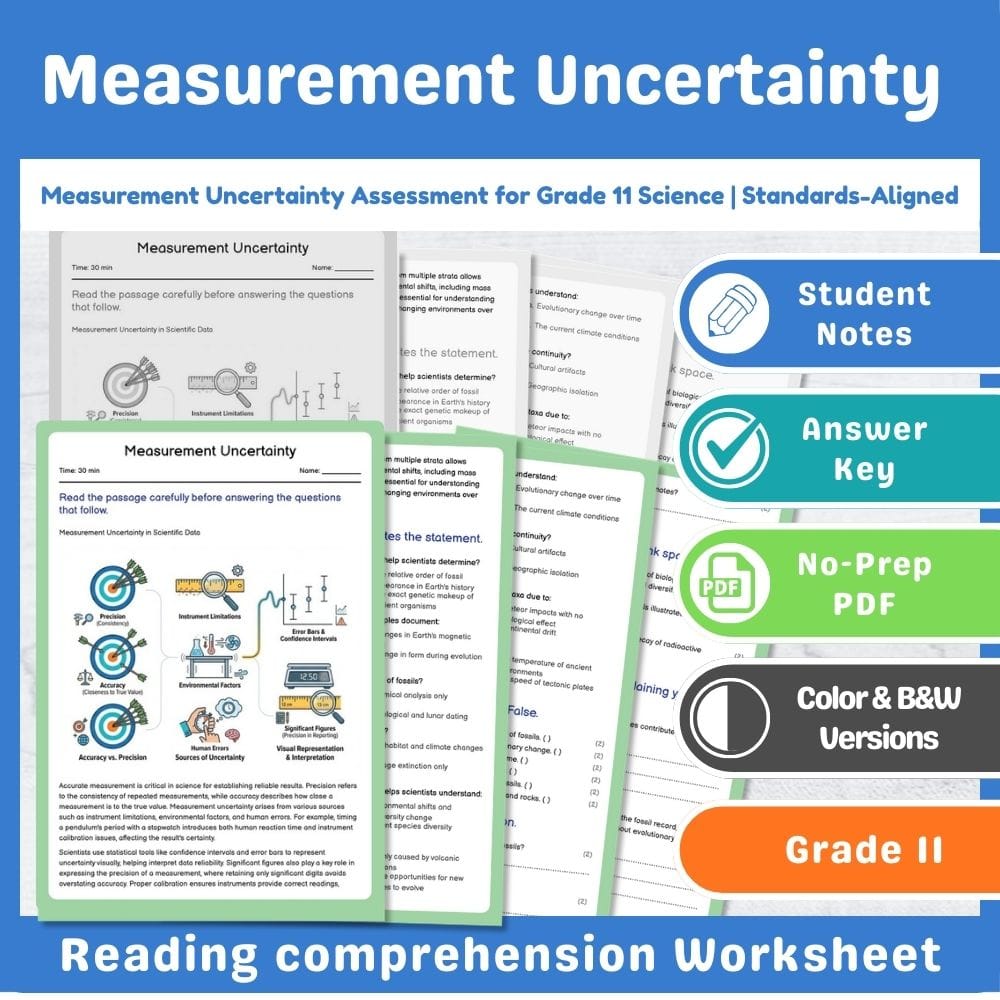
Measurement Uncertainty Assessment for Grade 11 Science | Standards-Aligned
Created byPrism Point LearningLearning Objectives
- Understand the concepts of precision and accuracy in measurements.
- Identify sources of measurement uncertainty in scientific experiments.
- Interpret representations of measurement uncertainty such as error bars and confidence intervals.

Biotech Ethics Assessment for Grade 9 Science | TEKS Standards-Aligned
Created byPrism Point LearningLearning Objectives
- Understand key ethical issues related to biotechnology and genetic manipulation.
- Evaluate societal implications, including privacy, consent, and ecological impact.
- Analyze regulatory frameworks and the role of public engagement in biotech policies.

Measurement Accuracy Assessment | General Grade 9 Science Standards
Created byPrism Point LearningLearning Objectives
- Understand the importance of appropriate scales, calibrated instruments, and units in measurement.
- Explain how significant figures reflect measurement precision and how to record data consistently.
- Recognize the importance of converting units accurately and expressing uncertainty ranges for fair comparisons.
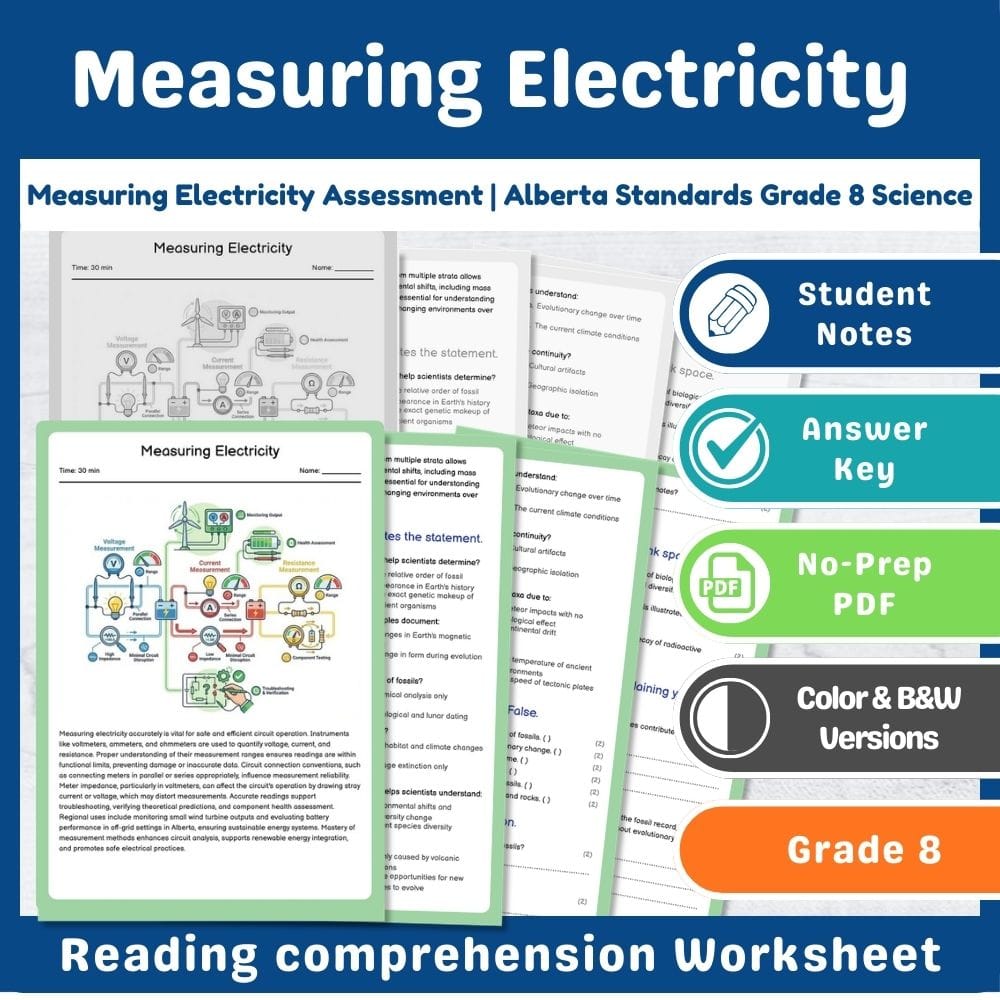
Measuring Electricity Assessment | Alberta Standards Grade 8 Science
Created byPrism Point LearningLearning Objectives
- Understand key concepts related to Science
- Apply knowledge through practice questions
- Demonstrate comprehension of the material
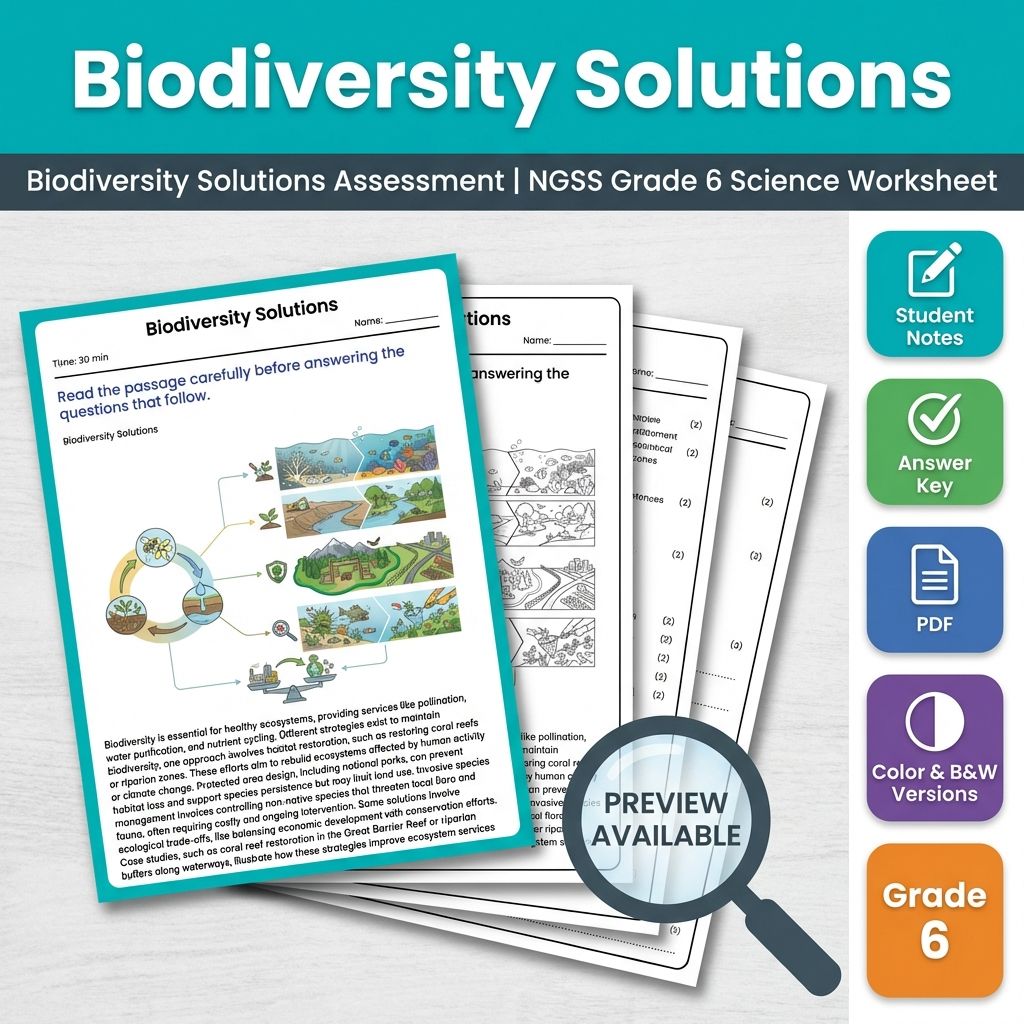
Biodiversity Solutions Assessment | NGSS Grade 6 Science Worksheet
Created byPrism Point LearningLearning Objectives
- Compare different conservation strategies and their ecological trade-offs.
- Analyze case studies like coral reef restoration and riparian buffers.
- Evaluate the effectiveness of various biodiversity maintenance solutions.
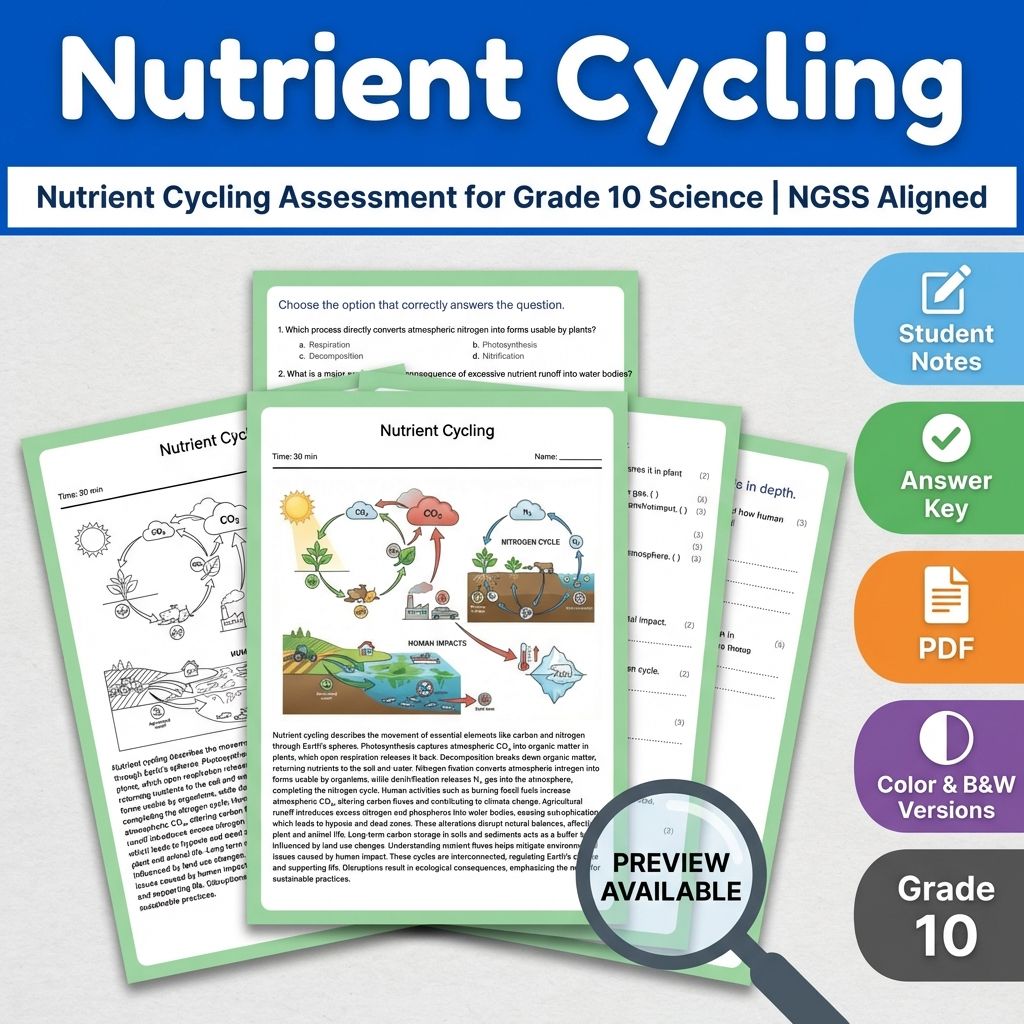
Nutrient Cycling Assessment for Grade 10 Science | NGSS Aligned
Created byPrism Point LearningLearning Objectives
- Understand the major biogeochemical cycles, including carbon and nitrogen fluxes.
- Describe the processes such as photosynthesis, respiration, nitrification, denitrification, and decomposition.
- Analyze how human activities alter nutrient reservoirs and flux rates.

Carrying Capacity Assessment for Grade 10 Science TEKS Standards
Created byPrism Point LearningLearning Objectives
- Understand the concept of carrying capacity and its importance in ecosystems.
- Identify factors that influence an environment's carrying capacity.
- Apply knowledge of resource limitations, predation, disease, and ecosystem interactions.
Fault Diagnosis Assessment | Alberta Standards Grade 9 Science
Created byPrism Point LearningLearning Objectives
- Understand the principles of diagnostic reasoning in electrical fault analysis.
- Identify symptoms and measurement data that suggest specific failure modes.
- Apply logical inference to determine probable causes of faults in electrical systems.

Ionic and Covalent Bonding Assessment for Grade 11 Science
Created byPrism Point LearningLearning Objectives
- Explain the differences between ionic and covalent bonds in terms of electron distribution.
- Describe how bonding types influence properties like melting point, electrical conductivity, and solubility.
- Identify examples of materials with ionic and covalent bonds and analyze their structural differences.
Force Concepts Assessment for Grade 10 Science | AP Standards-Aligned
Created byPrism Point LearningLearning Objectives
- Understand the vector nature of forces and how to determine net force in various scenarios.
- Explain Newton's three laws and their applications to motion and equilibrium.
- Interpret free-body diagrams and algebraic formulations of forces.

Energy Flow Assessment for Grade 10 Science TEKS Standards
Created byPrism Point LearningLearning Objectives
- Explain how sunlight enters ecosystems and is used by photosynthetic organisms.
- Describe the transfer and loss of energy through trophic levels in food chains and webs.
- Analyze how energy constraints influence biomass and population sizes in ecosystems.

Ecosystem Basics Assessment for Grade 10 Science | TEKS Standards
Created byPrism Point LearningLearning Objectives
- Understand the key components that make up an ecosystem.
- Identify the flows of energy and matter within ecosystems.
- Describe how different components in an ecosystem interact and influence each other.
Molecular Geometry Assessment for Grade 10 Science – Standards-Aligned
Created byPrism Point LearningLearning Objectives
- Define molecular geometry using electron-domain models and orbital hybridization.
- Explain how electron domain arrangements determine molecular shapes and polarity.
- Connect molecular structures to intermolecular forces and macroscopic properties.
Electron Configuration Assessment | AP Standards Grade 10 Science
Created byPrism Point LearningLearning Objectives
- Understand quantum numbers and how they describe electron distribution in atoms
- Identify orbital shapes and energy ordering for electrons in atoms
- Link microscopic electron arrangements to spectral lines and chemical properties
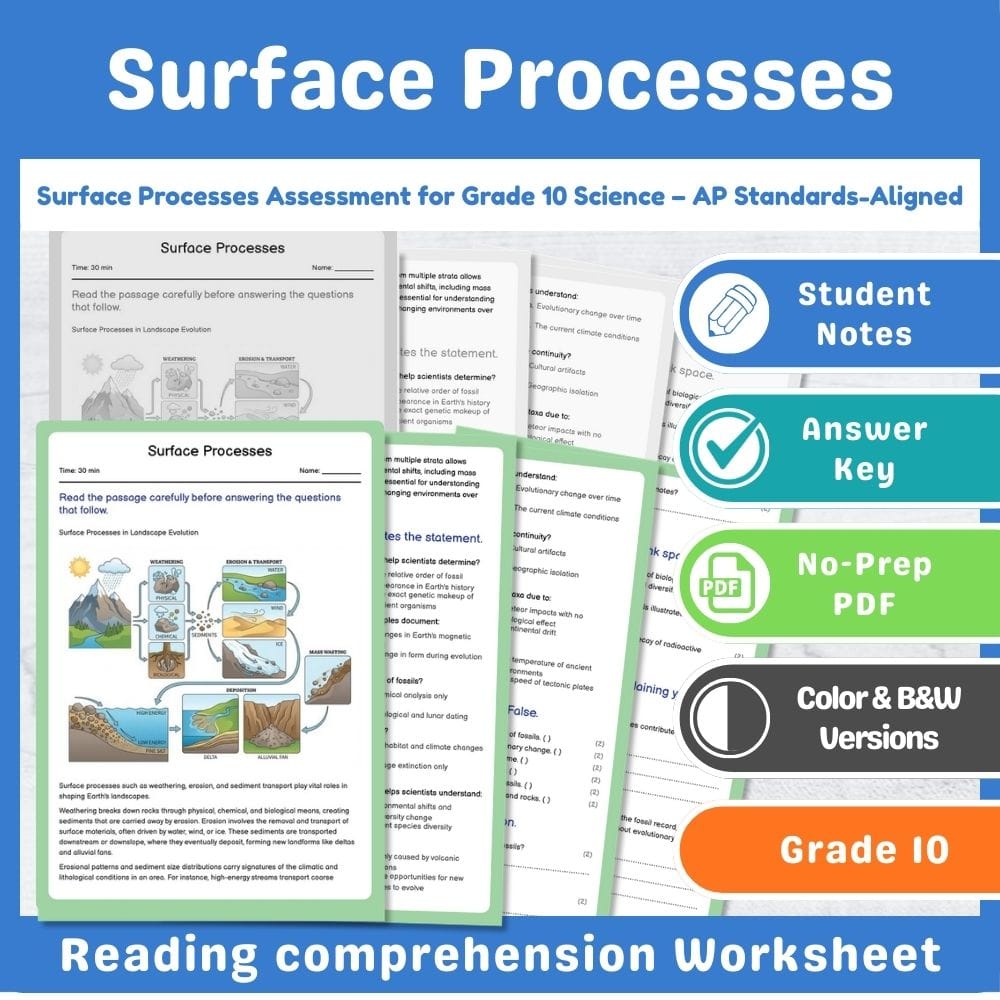
Surface Processes Assessment for Grade 10 Science – AP Standards-Aligned
Created byPrism Point LearningLearning Objectives
- Explain the key surface processes of weathering, erosion, sediment transport, and deposition.
- Interpret landscape changes using concepts like fluvial incision and mass wasting.
- Relate surface process signatures, such as sediment size and channel profiles, to environmental factors.
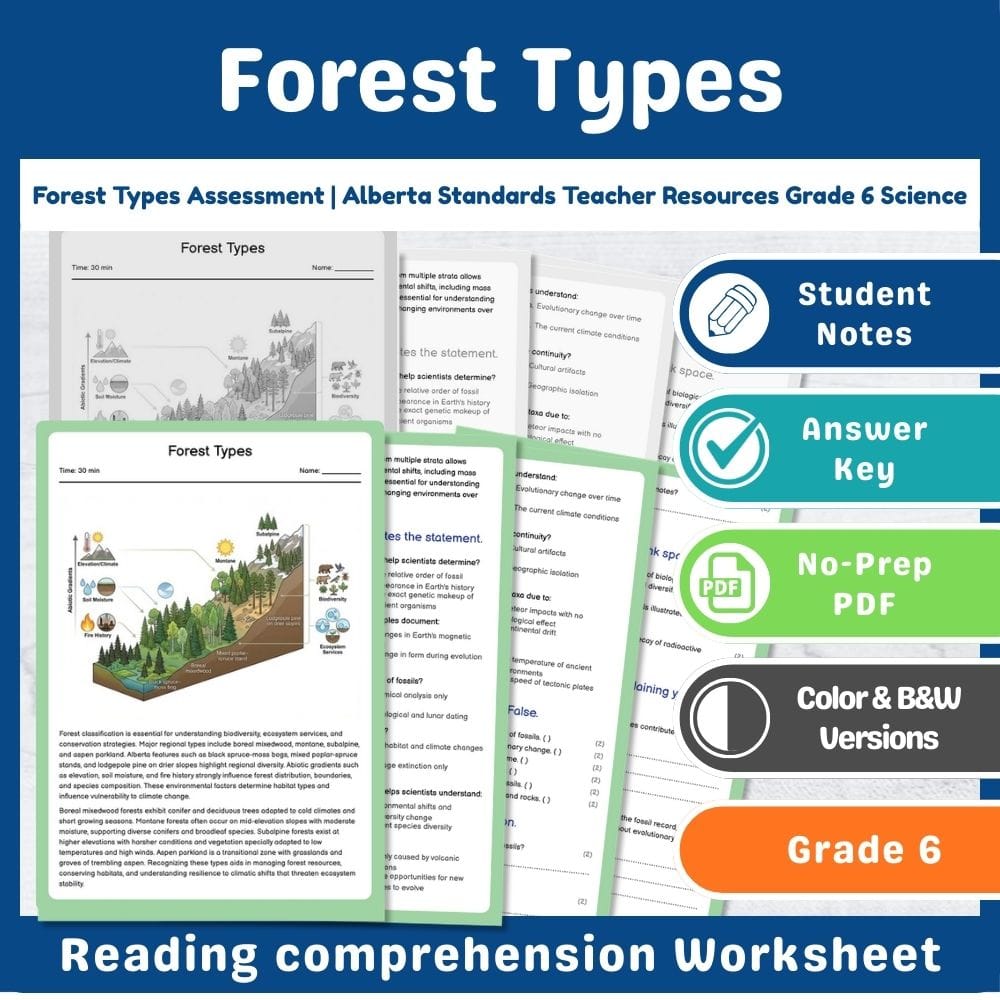
Forest Types Assessment | Alberta Standards Teacher Resources Grade 6 Science
Created byPrism Point LearningLearning Objectives
- Identify major regional forest types and their characteristic species
- Understand environmental factors shaping forest distribution
- Recognize different forest ecosystems and their ecological importance
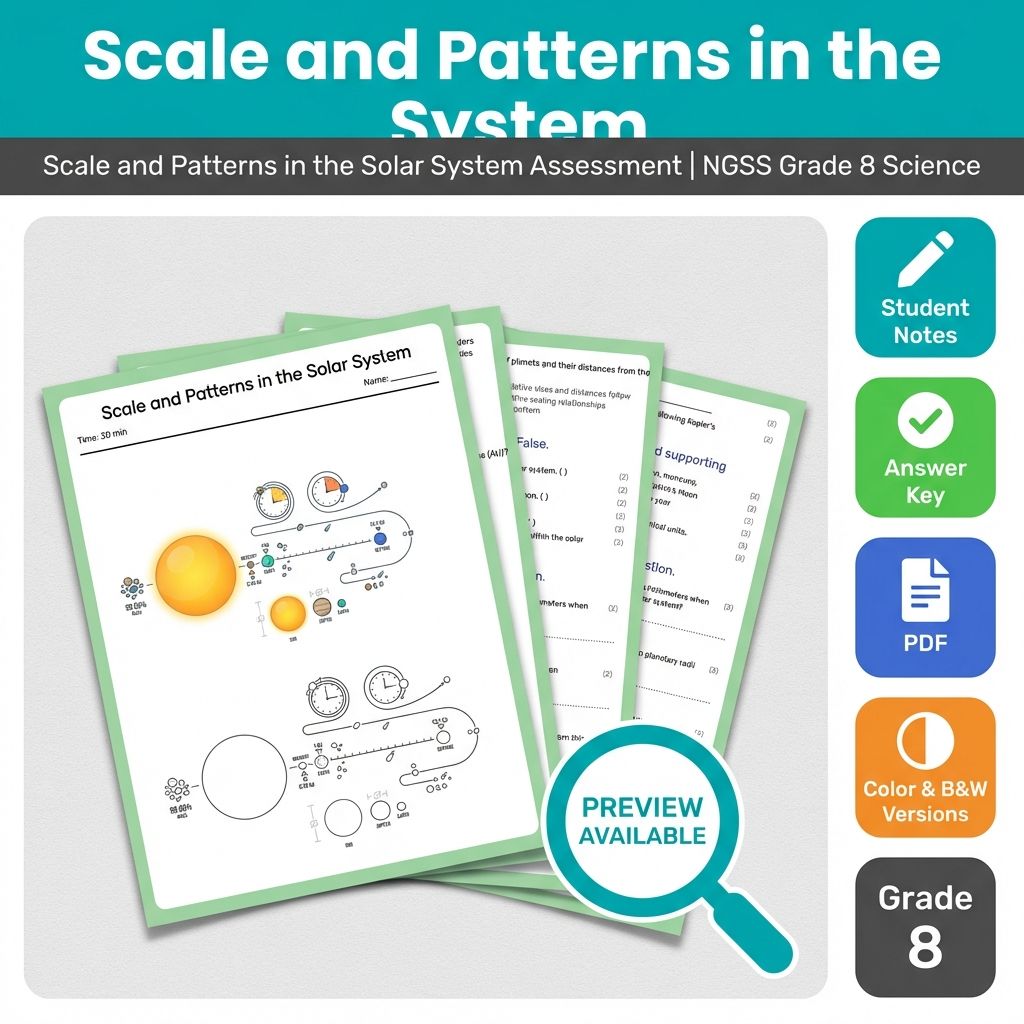
Scale and Patterns in the Solar System Assessment | NGSS Grade 8 Science
Created byPrism Point LearningLearning Objectives
- Interpret quantitative data related to solar system objects such as diameters, distances, and orbital periods.
- Compare and analyze patterns and relationships among planets, dwarf planets, moons, and the Sun using scaled data and astronomical units.
- Identify orders of magnitude differences in planetary radii and interplanetary distances.
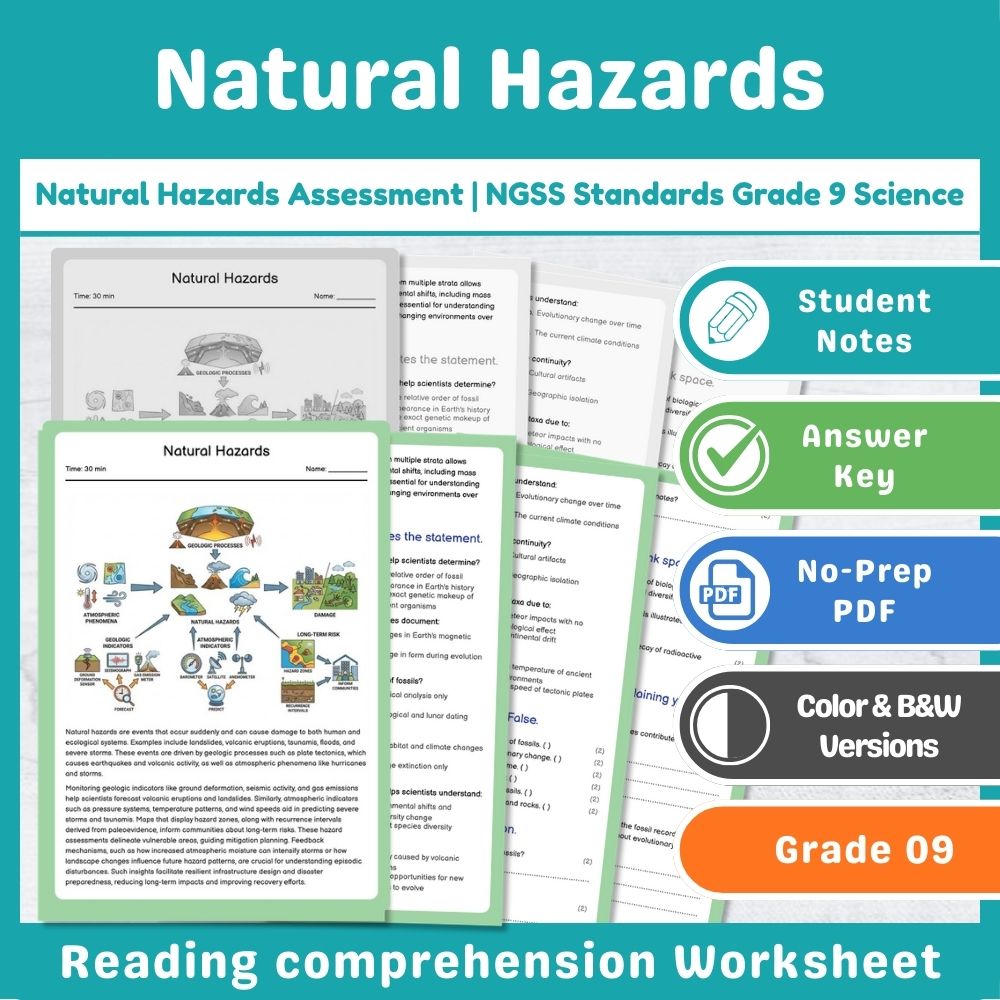
Natural Hazards Assessment | NGSS Standards Grade 9 Science
Created byPrism Point LearningLearning Objectives
- Describe the various types of natural hazards and their causes.
- Identify geologic and atmospheric indicators used to assess hazard risk.
- Interpret hazard maps and recurrence intervals to evaluate potential impacts.
Browse more categories
About Science Worksheets
Find Science worksheets spanning core skills, practice, and review. All 42,550 resources are instant PDF downloads for the classroom or home.
Every worksheet on MyTeachingSheets is created by independent teacher-authors and reviewed before publication. All resources download as printable PDFs for classroom, homework, or at-home practice, and many include answer keys. Preview any worksheet free before buying.