
Grade 6 Science Worksheets
5,969 worksheets
Properties of Matter Assessment | TEKS Grade 6 Science Worksheet
 Created byPrism Point Learning
Learning Objectives
- Identify and describe physical and chemical properties used to distinguish substances.
- Compare substances based on qualitative and simple quantitative properties.
- Relate observed material properties to examples like iron, salt, oil, and copper.
Also included in: Lesson Bundle Grade 6 Matter and Energy Science Assessment | TEKS
Instant download

Classifying Matter Assessment for Grade 6 Science TEKS Standards
Created byPrism Point LearningLearning Objectives
- Understand different classification schemes for elements, compounds, and mixtures.
- Identify characteristics that distinguish pure substances from mixtures.
- Recognize common separation techniques like filtration and distillation.
Also included in: Lesson Bundle Grade 6 Matter and Energy Science Assessment | TEKS
Instant download

Change Evidence Assessment | TEKS Grade 6 Science Standards-Aligned
Created byPrism Point LearningLearning Objectives
- Differentiate between physical and chemical changes based on observable indicators.
- Identify characteristic evidence such as gas formation, precipitate, color change, and temperature change in chemical processes.
- Recognize physical alterations like shape or phase reversibility and understand substance conservation.
Also included in: Lesson Bundle Grade 6 Matter and Energy Science Assessment | TEKS
Instant download

Atoms and Particles Worksheet Grade 6 Science Particle Model Practice
Created byPrism Point LearningLearning Objectives
- Explain how particle models describe matter as being made of particles and how atoms build elements.
- Identify how different combinations and relative numbers of atoms help determine properties like density and melting point.
- Connect atomic composition to observable/measureable properties rather than only macroscopic appearance.
Instant download

Grade 6 Science | Evaporation and Transpiration Worksheet | California Standards
 Created byLumora Learning
Learning Objectives
- Explain how energy and temperature affect evaporation and transpiration
- Describe how plants add water vapor to the atmosphere through transpiration
- Connect evaporation, transpiration, condensation, and precipitation as linked phase changes
Instant download
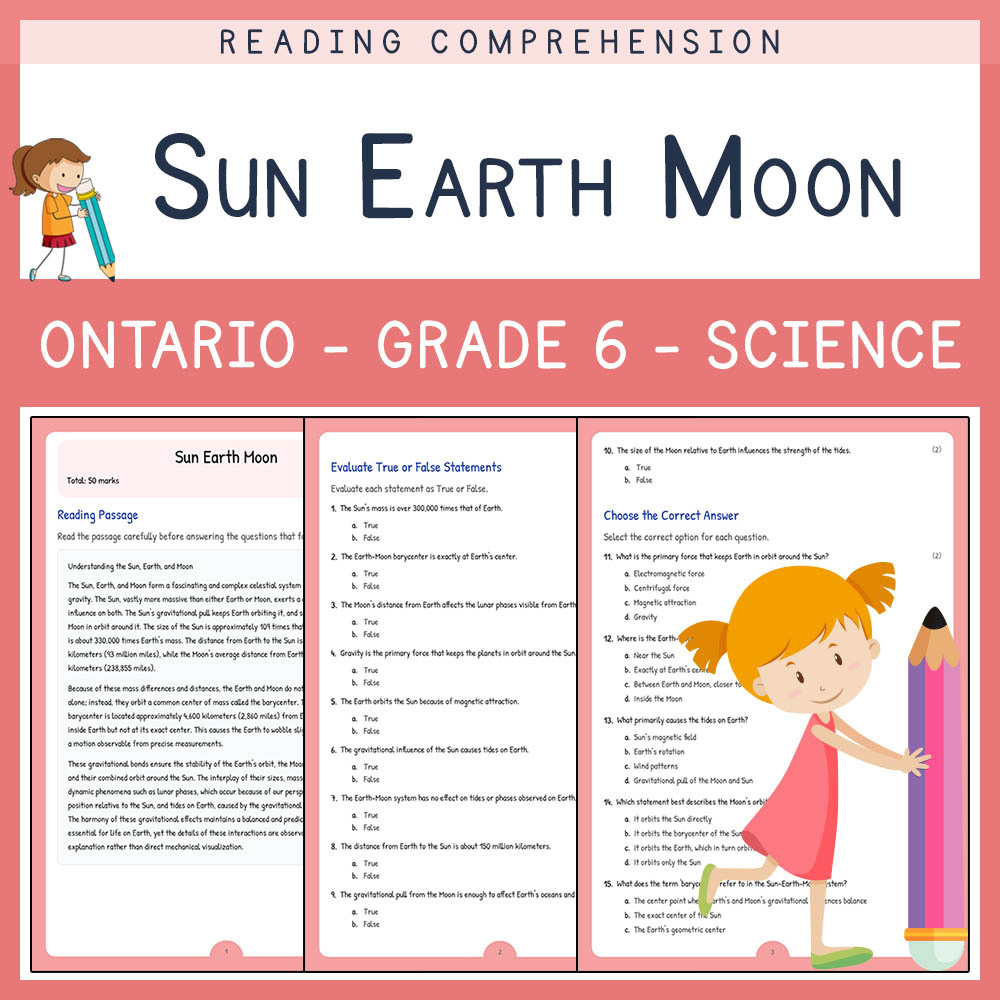
Grade 6 Science | Sun, Earth, Moon Worksheet with Answer Key (PDF) | Ontario
Created byLumora LearningLearning Objectives
- Understand the relative sizes and distances among the Sun, Earth, and Moon
- Explain how gravitational interactions influence orbital relationships
- Describe the concept of the Earth–Moon barycenter and the Sun's gravitational role
Also included in: Grade 6 | Space Science Lesson Bundle Worksheets | Ontario Framework
Instant download
6th Grade Science | Natural Hazards Worksheet + Answer Key – NGSS Aligned (PDF)
 Created byBright Mind Resources
Learning Objectives
- Analyze the origins and patterns of natural hazards such as earthquakes, volcanic eruptions, hurricanes, and floods.
- Understand the effects of tectonic, atmospheric, and hydrologic processes on hazard occurrence.
- Evaluate cause-effect relationships using data and hazard zone maps.
Also included in: Grade 6 Science Unit | Natural Hazards & Human Impacts Worksheet Pack (NGSS) +2 more
Instant download
Grade 6 Science | Cell Evidence NGSS Worksheet (Workbook + Answer Key)
Created byBright Mind ResourcesLearning Objectives
- Identify characteristics that define cells as the basic unit of life.
- Compare observations of single-celled and multicellular organisms using microscopy and preserved specimens.
- Assess relationships among cells, tissues, organs, and whole organisms based on empirical features.
Also included in: Grade 6 Science UNIT Bundle | Cell Functions, Energy & Systems NGSS Worksheets +2 more
Instant download
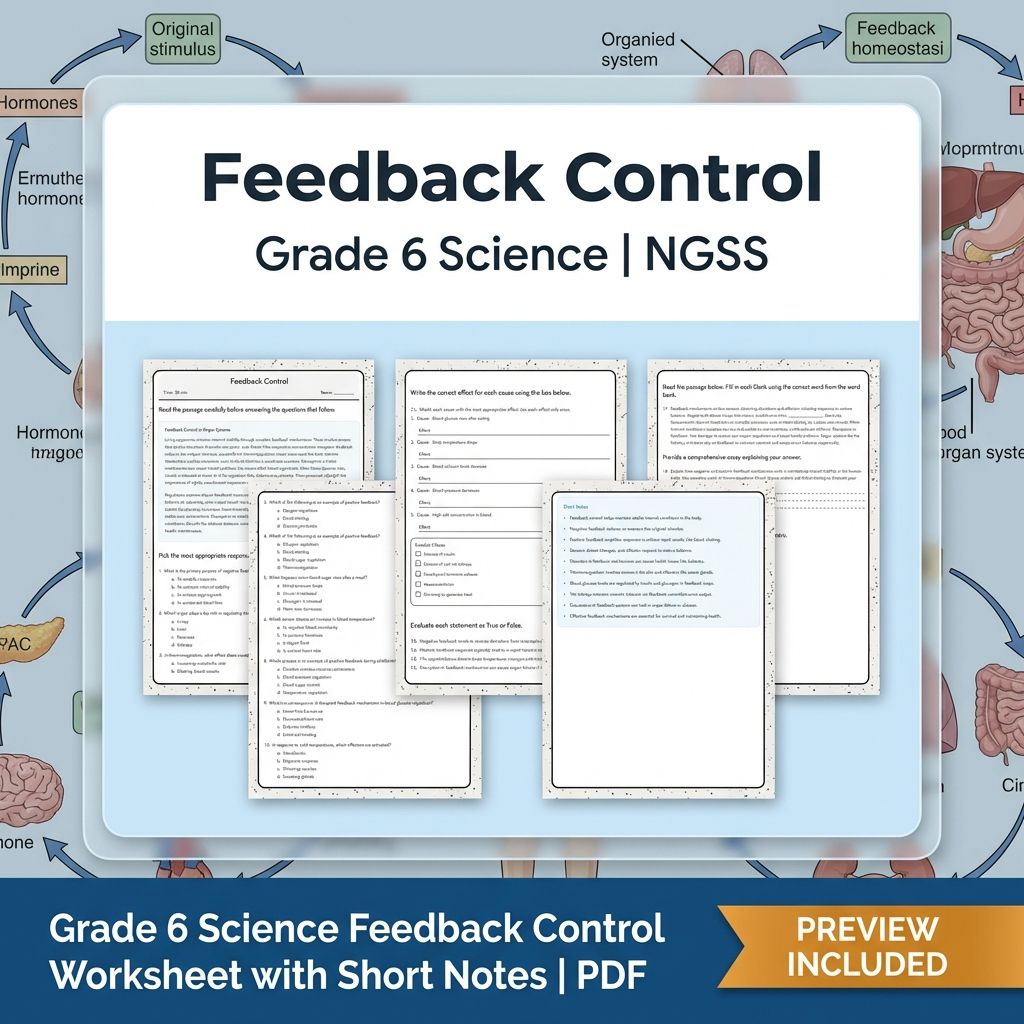
Grade 6 Science Feedback Control Worksheet with Short Notes | PDF
 Created byMeadowlark Worksheets
Learning Objectives
- Understand the mechanisms of negative and positive feedback in maintaining internal stability.
- Identify physiological examples of feedback regulation such as thermoregulation and blood glucose control.
- Explain the roles of sensors and effectors in feedback loops.
Also included in: Grade 6 Science NGSS From Molecules to Organisms: Structures & Processes +1 more
Instant download
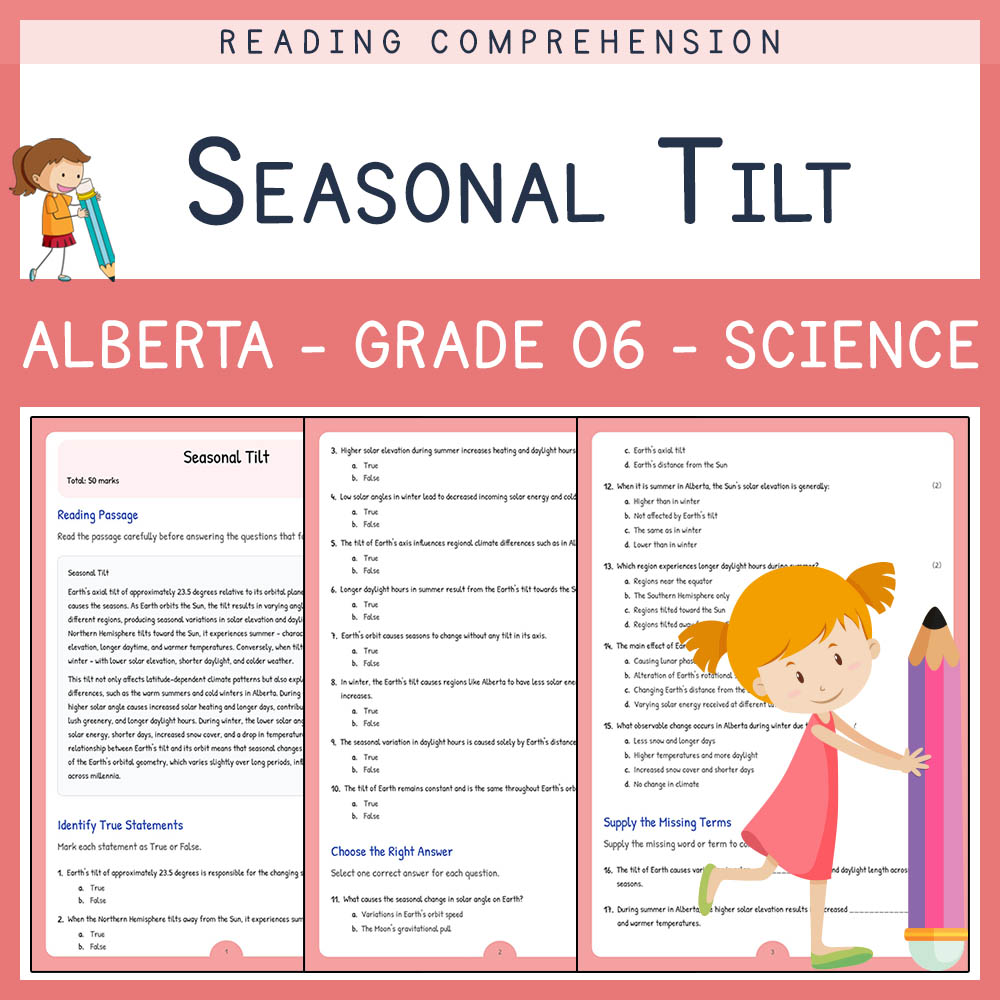
Grade 6 Science Worksheet | Earth's Tilt | Alberta Standards
Created byLumora LearningLearning Objectives
- Understand how Earth's axial tilt causes seasonal changes in solar angle and daylight duration.
- Explain how seasonal variations influence regional climates and biological rhythms.
- Connect Earth's tilt and orbital geometry to observable seasonal phenomena in regions like Alberta.
Instant download

Grade 6 Science | Physiological Adaptations Worksheet | BC Standards
Created byLumora LearningLearning Objectives
- Explain the concept of physiological adaptations and their role in survival.
- Identify different internal processes that help organisms respond to environmental challenges.
- Describe specific adaptations such as heat exchange, water conservation, and metabolic rate adjustments.
Instant download
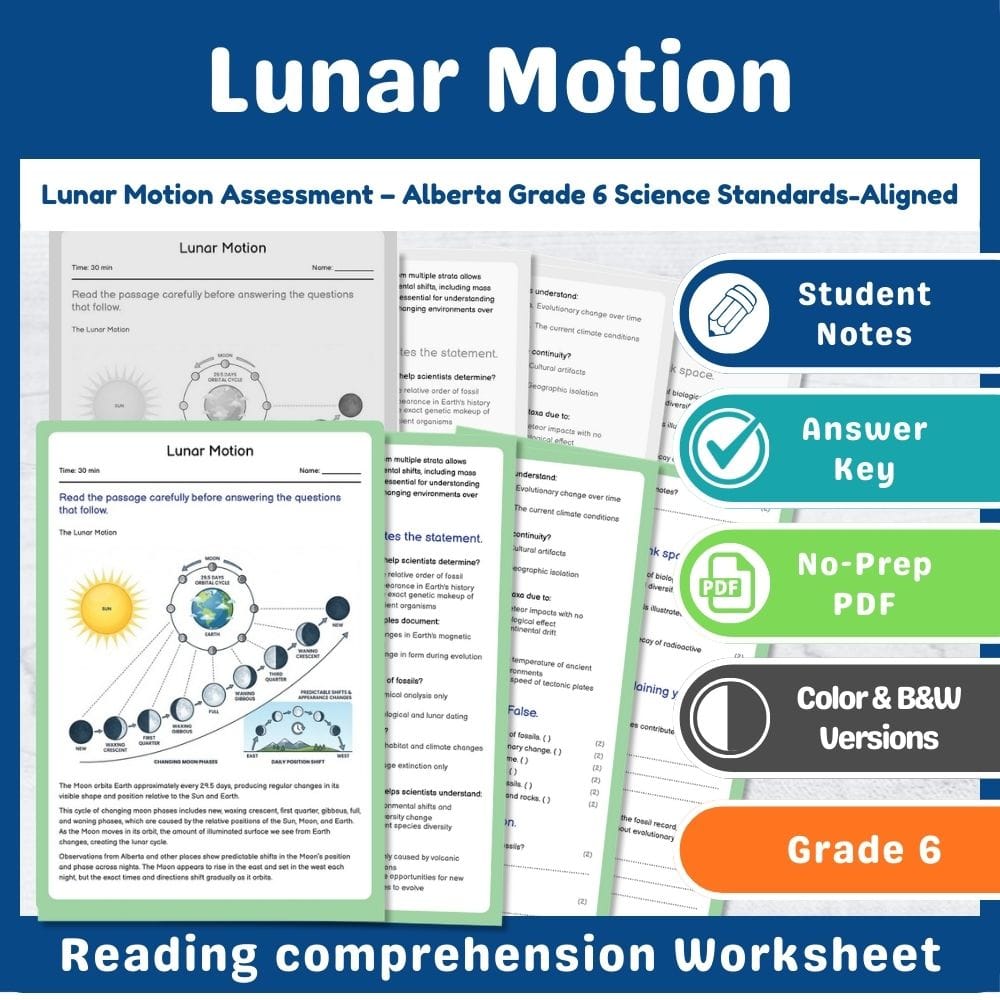
Lunar Motion Assessment – Alberta Grade 6 Science Standards-Aligned
Created byPrism Point LearningLearning Objectives
- Describe the Moon's orbit around Earth and how it affects the lunar phases.
- Explain the relationship between the Sun, Earth, and Moon in lunar observations.
- Predict the timing and directional shifts of the Moon as seen from locations like Alberta.
Also included in: Lesson Grade 6 Science Assessment | Celestial & Earth Movements
Instant download
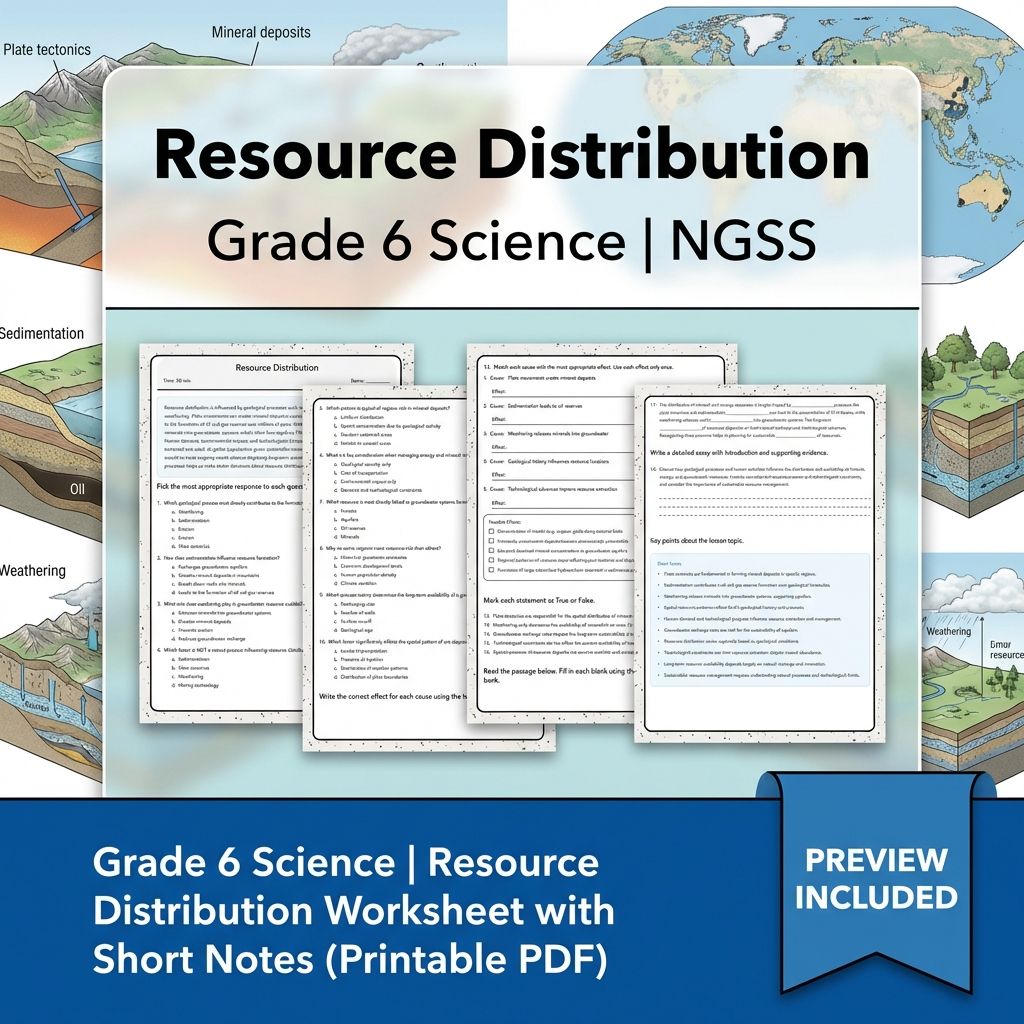
Grade 6 Science | Resource Distribution Worksheet with Short Notes (PDF)
Created byMeadowlark WorksheetsLearning Objectives
- Understand the processes that influence the distribution of mineral, energy, and groundwater resources.
- Identify how geological history affects spatial patterns of resource deposits.
- Analyze the impacts of extraction and technological constraints on resource availability.
Also included in: Grade 6 Science | Earth and Human Activity Unit Bundle – NGSS Standards +1 more
Instant download

Mass Wasting Processes Worksheets Grade 6 Earth Science
 Created byBRIGHT PATH RESOURCES
Learning Objectives
- Describe how gravity and slope instability can cause mass wasting on Earth’s surface
- Identify triggers of rockfalls, landslides, and slumps from provided scenarios
- Explain how water, freeze-thaw, earthquakes, erosion, and drainage changes can affect slope stability
Also included in: Grade 6 Earth Science Worksheets | Weather, Water & Climate Bundle +2 more
Instant download
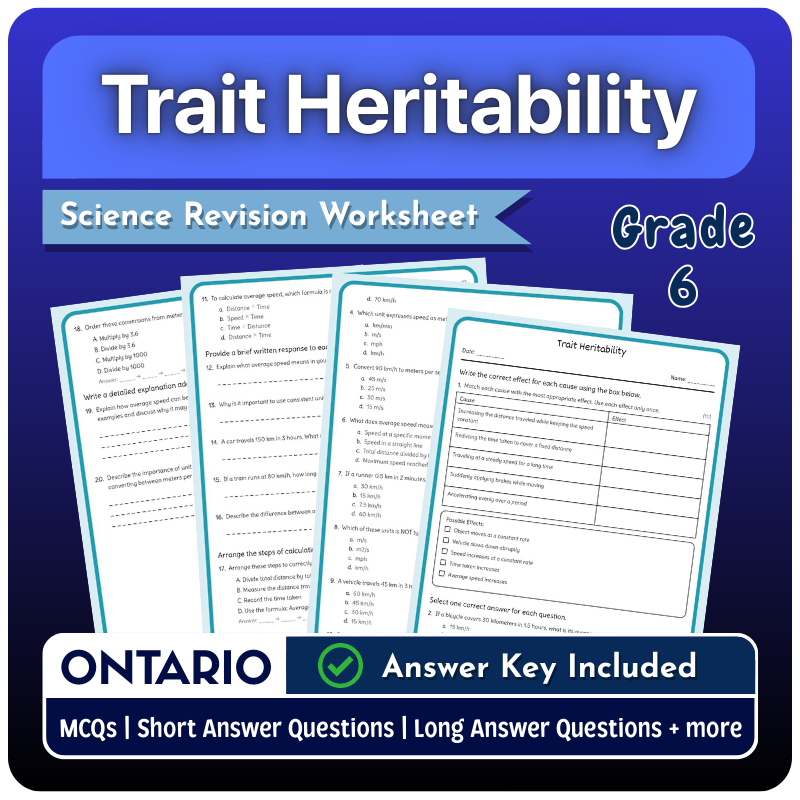
6th Grade Science | Heritability Worksheet (Ontario) – Science 1 (PDF)
Created byBright Mind ResourcesLearning Objectives
- Explain the concept of heritability and how it relates to genetic variation in populations.
- Distinguish between heritable traits and environmental influences on traits.
- Describe basic mechanisms of inheritance and how traits can shift over generations.
Instant download

6th Grade Science Worksheet | Evidence of Change TEKS (PDF)
 Created byEvergreen Desk Education
Learning Objectives
- Differentiate physical and chemical changes by using observable evidence such as gas formation, precipitate formation, permanent color change, and temperature change.
- Recognize physical-change indicators such as reversible shape changes or reversible phase changes (melting/freezing/condensing).
- Apply the idea of conservation of matter by tracking how the total amount of substance is preserved during both physical and chemical changes.
Instant download
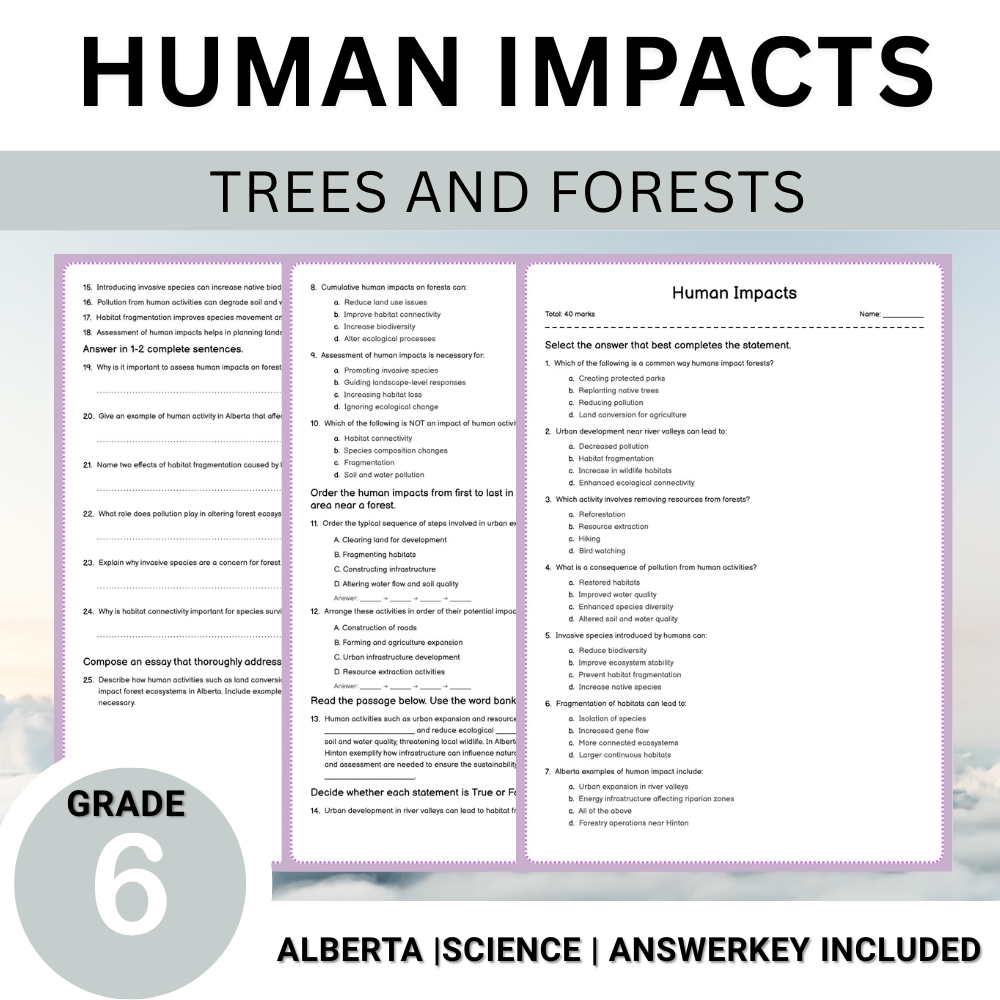
Grade 6 Science | Human Impacts Worksheet (Printable PDF) for Classroom Assessment
Learning Objectives
- Identify different human activities that impact forests and ecosystems.
- Understand how land conversion, resource extraction, and pollution affect habitat connectivity and species.
- Explain the importance of landscape-level assessment for ecological health.
Also included in: Grade 6 Science | Tree Anatomy, Ecology & Conservation Unit Worksheet Bundle +1 more
Instant download
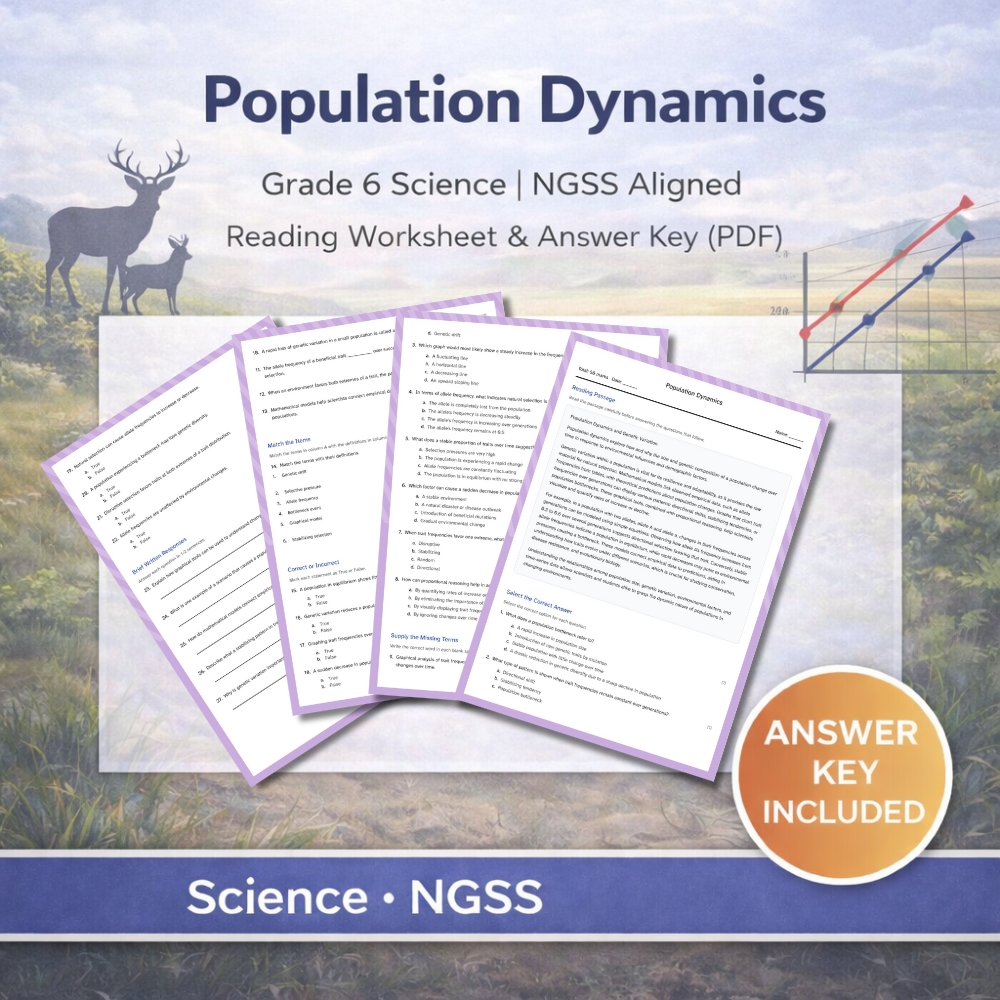
6th Grade Science | Population Dynamics | Worksheet & Answer Key | NGSS-Aligned
 Created byCedar Grove Learning
Learning Objectives
- Understand how trait frequencies and population sizes change over generations in response to environmental and demographic factors.
- Use graphical representations, proportional reasoning, and mathematical models to analyze population changes.
- Interpret data from allele frequency tables and simple models to predict population-level trends.
Also included in: Grade 6 Science | Ecosystems, Evolution & Biodiversity | NGSS Worksheet Bundle +1 more
Instant download
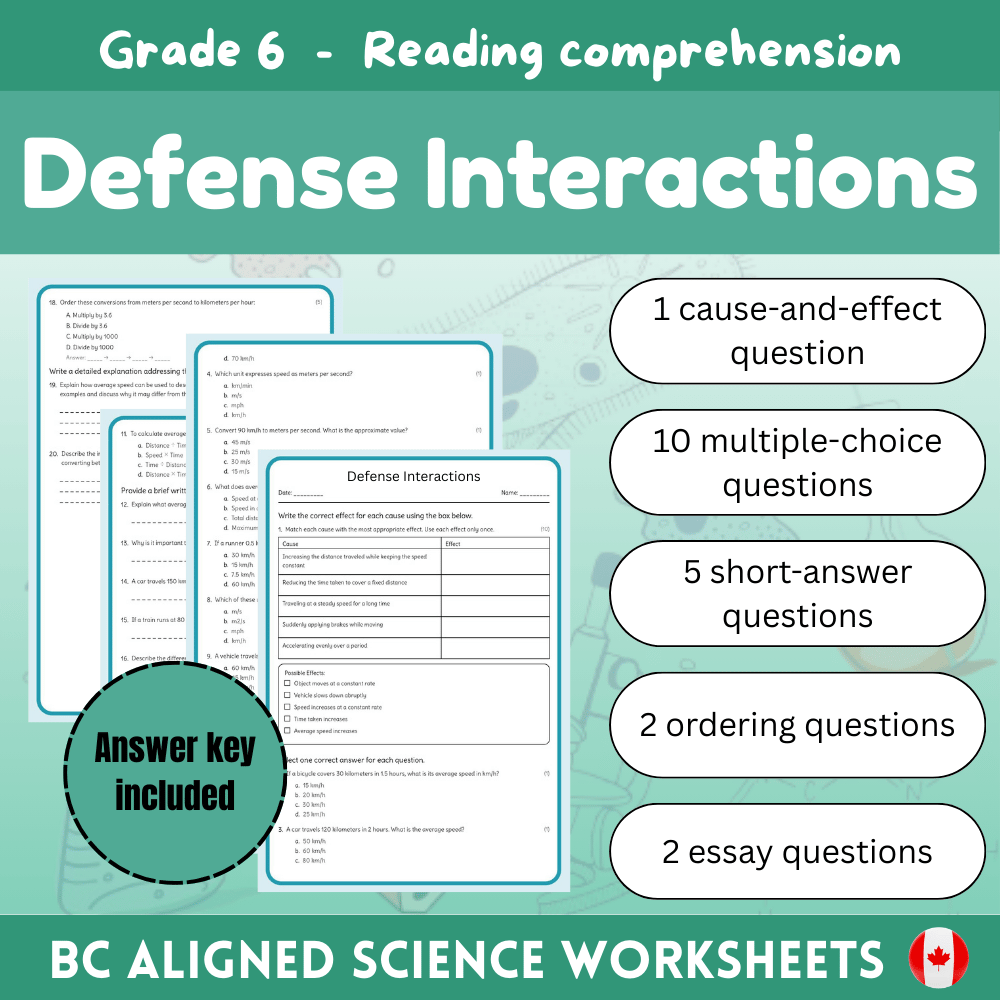
Grade 6 Science | Defense Interactions Worksheet (PDF) – BC Standards Aligned
Created byBright Mind ResourcesLearning Objectives
- Understand how the immune system defends organisms through various barriers and responses.
- Identify the roles of skin, mucous membranes, immune cells, and lymphatic vessels.
- Describe how immune activity interacts with circulatory and lymphatic systems to maintain health.
Instant download
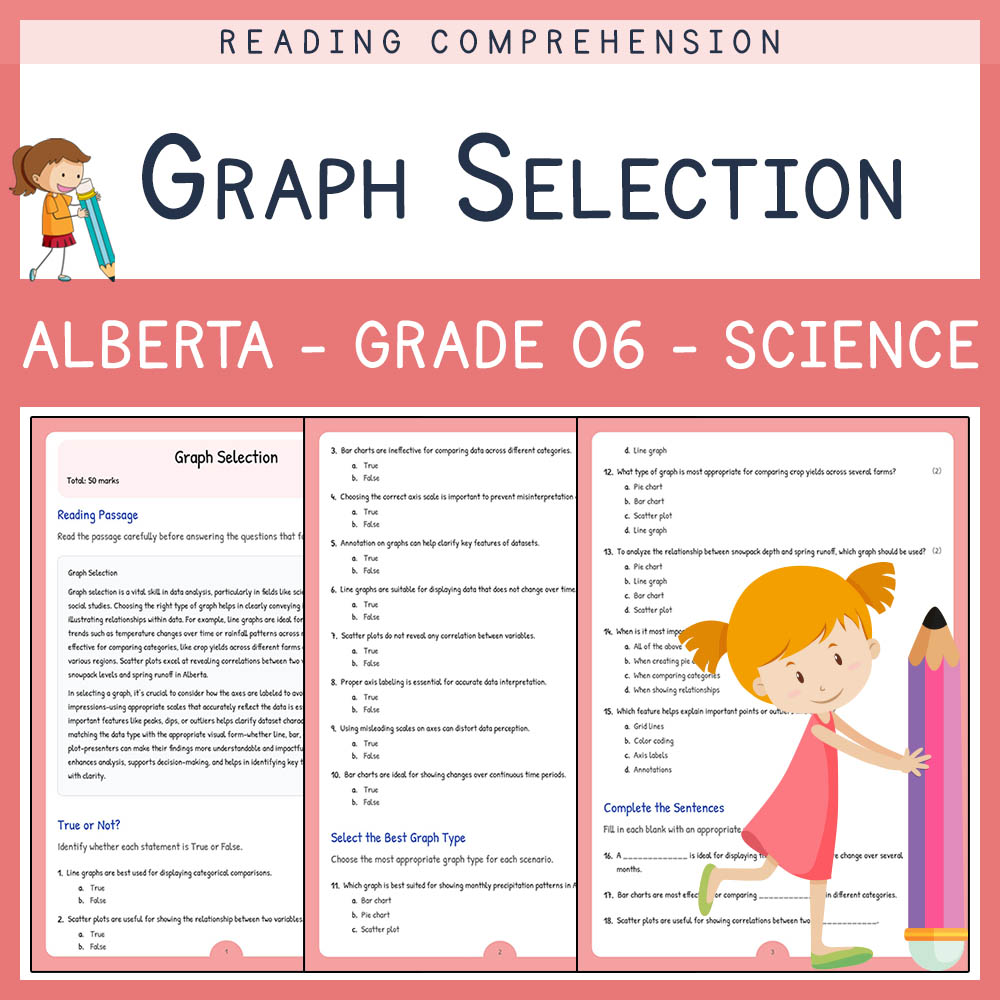
Grade 6 Science | Graph Selection Worksheet | Alberta | Data Analysis Skills
Created byLumora LearningLearning Objectives
- Understand different types of graphs and when to use each one.
- Learn how to appropriately label axes and choose scales to accurately represent data.
- Identify datasets where line graphs, bar charts, and scatter plots are most effective.
Also included in: Grade 6 Science | Evidence and Investigation Custom Bundle | Alberta
Instant download
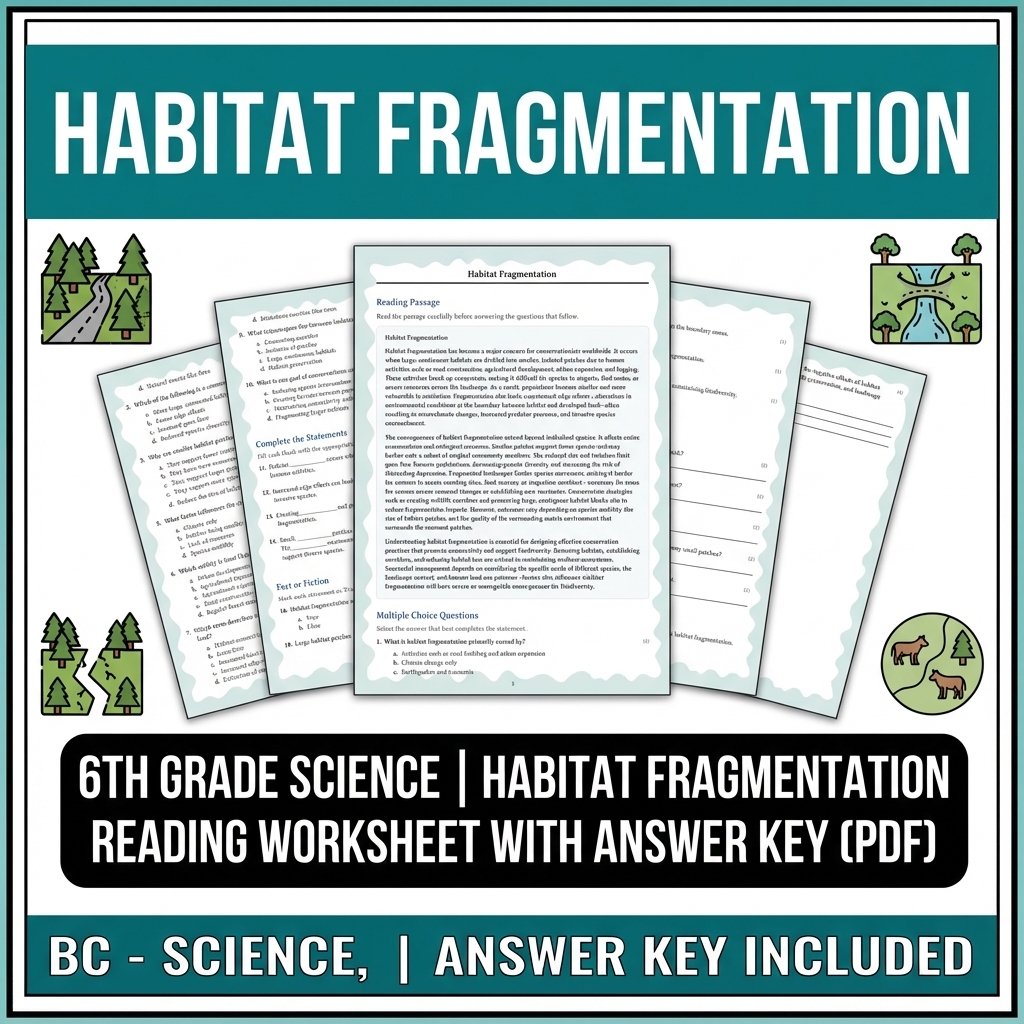
6th Grade Science | Habitat Fragmentation Reading Worksheet with Answer Key
JCreated byJ.S SheetsLearning Objectives
- Understand the causes and effects of habitat fragmentation.
- Identify strategies to mitigate habitat fragmentation impacts.
- Explain how habitat patches affect biodiversity and species survival.
Instant download
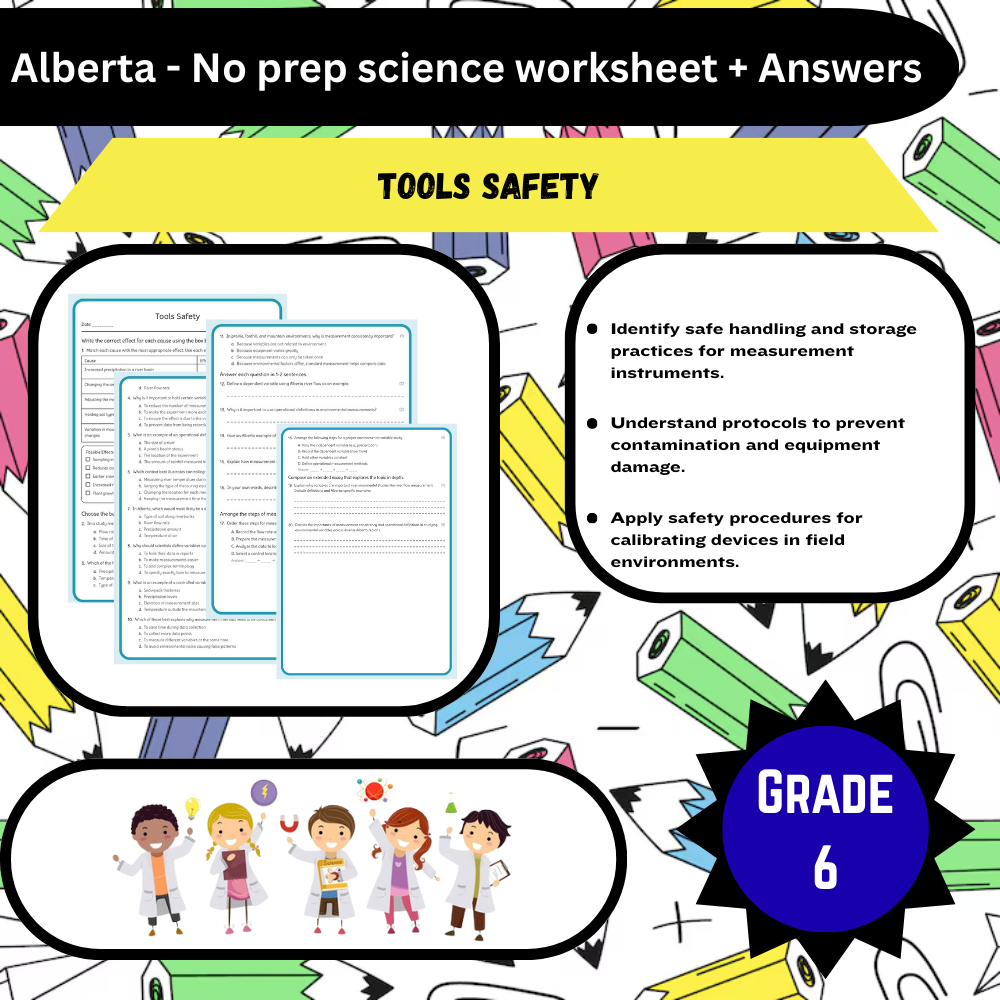
6th Grade Science | Tools Safety Worksheet (PDF) – Alberta Standards
Created byBright Mind ResourcesLearning Objectives
- Identify safe handling and storage practices for measurement instruments.
- Understand protocols to prevent contamination and equipment damage when using scientific tools.
- Apply safety procedures for calibrating and maintaining devices in field environments.
Instant download
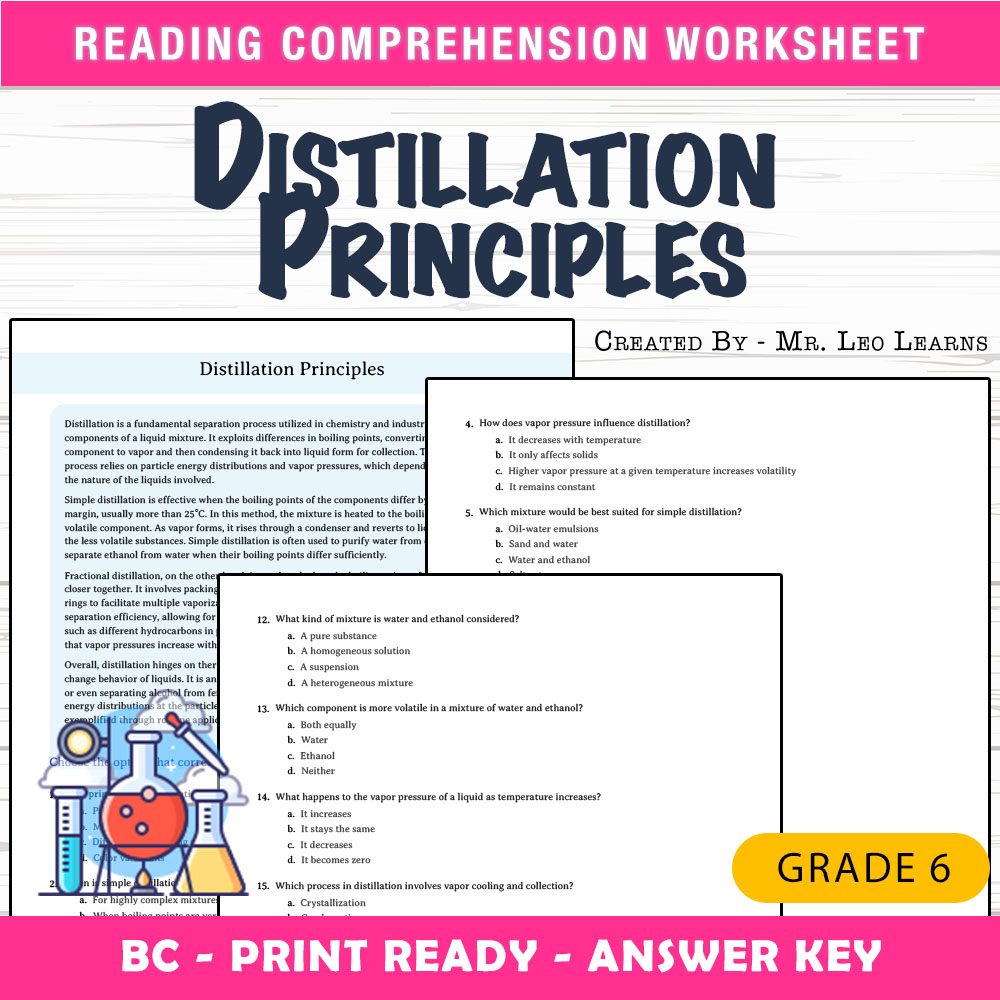
Grade 6 Science — Worksheet MCQ Paper for Mastering Distillation Principles
 Created byThe Resource Hub
Learning Objectives
- Understand the basic principles of distillation and how it separates liquid components.
- Differentiate between simple and fractional distillation techniques.
- Explain the role of boiling points, vapor pressure, and phase changes in distillation.
Also included in: Grade 6 Science | Matter, Properties & Change Worksheet Bundle (BC Framework) +1 more
Instant download
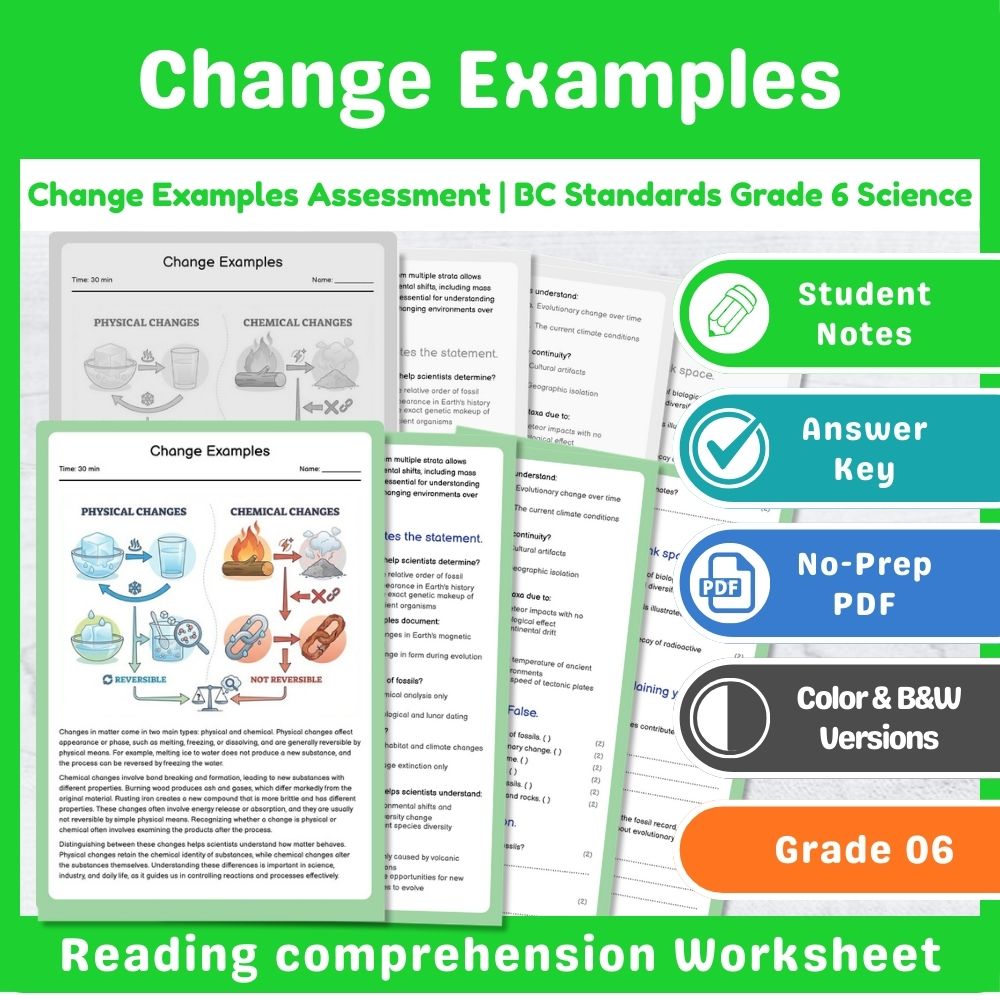
Change Examples Assessment | BC Standards Grade 6 Science
Created byPrism Point LearningLearning Objectives
- Differentiate between physical and chemical changes using examples.
- Identify products and properties that remain or change during a change.
- Explain the reversibility of physical changes versus chemical changes.
Instant download
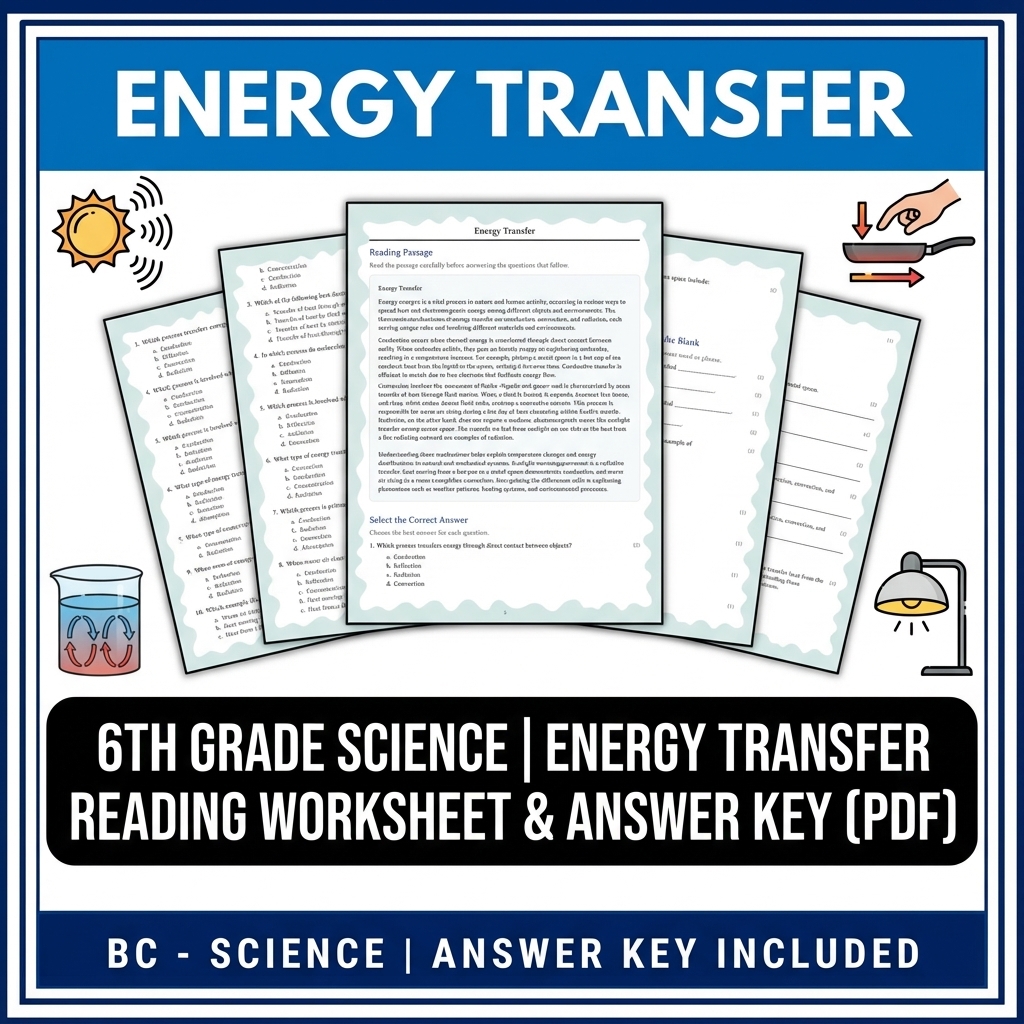
6th Grade Science | Energy Transfer Reading Worksheet & Answer Key (PDF)
JCreated byJ.S SheetsLearning Objectives
- Understand the three main mechanisms of energy transfer: conduction, convection, and radiation.
- Identify examples of each energy transfer process in real-world situations.
- Distinguish between conduction, convection, and radiation based on their characteristics.
Instant download
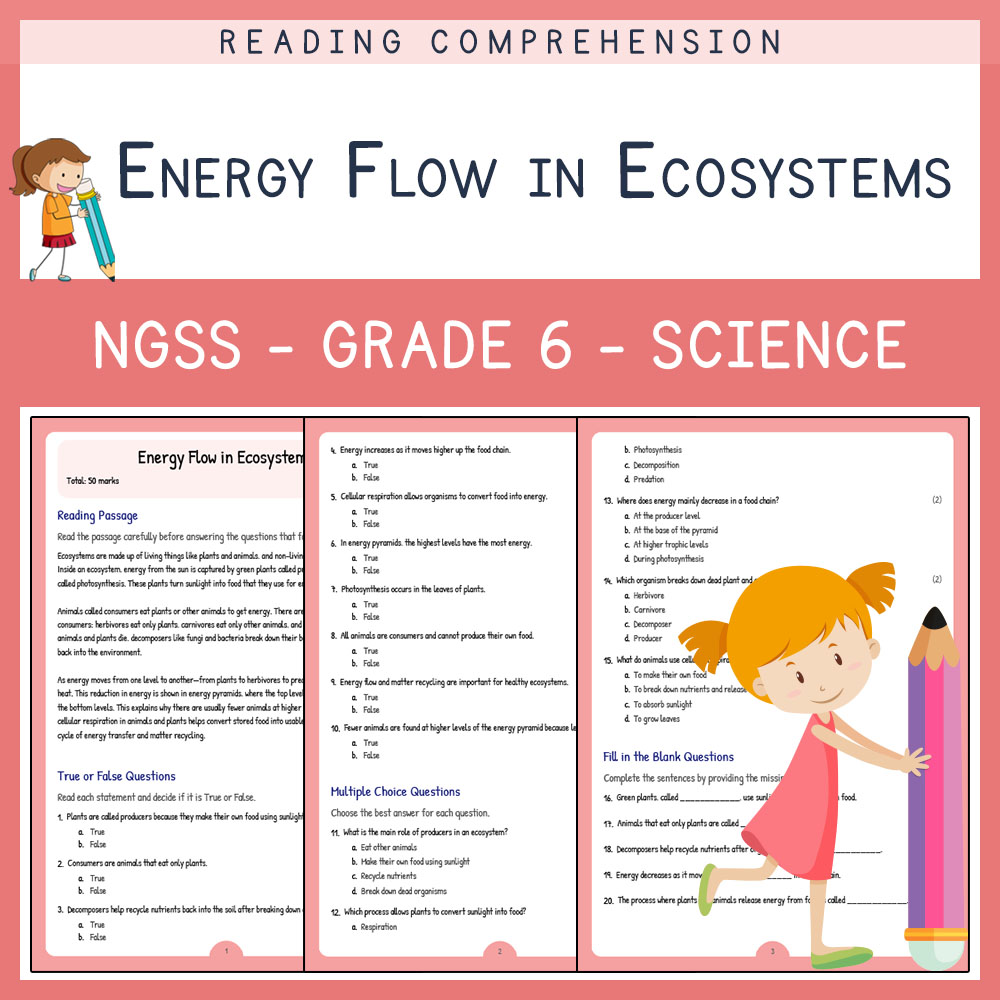
Grade 6 Science | Energy Flow in Ecosystems Worksheet (PDF) | NGSS Aligned
Created byLumora LearningLearning Objectives
- Understand the flow of energy through food webs in different ecosystems.
- Identify producers, consumers, and decomposers in food chains.
- Explain how energy diminishes at higher trophic levels.
Instant download
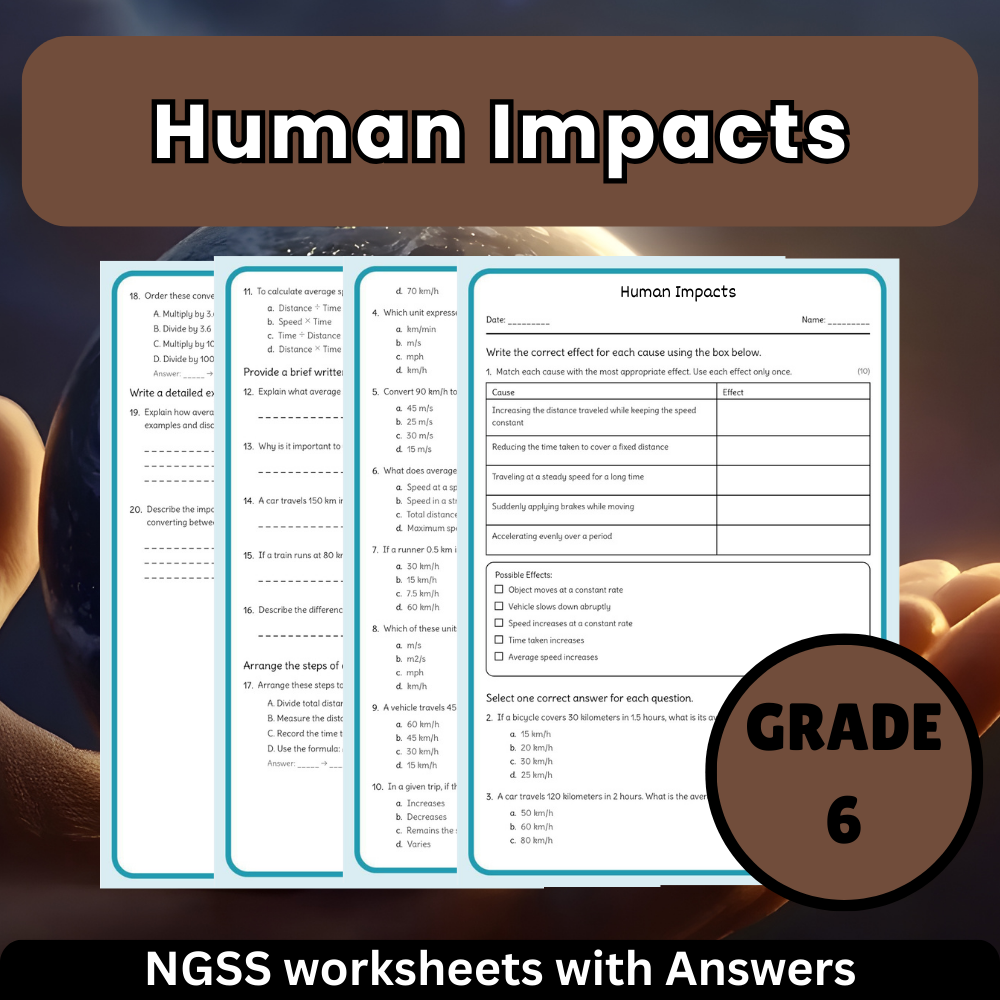
Grade 6 Science | Human Impacts on Earth Systems Worksheet (Answer Key) – NGSS
Created byBright Mind ResourcesLearning Objectives
- Describe how human activities modify earth systems such as biogeochemical cycles and climate drivers.
- Identify examples of human-induced environmental changes and their effects on ecosystems.
- Analyze causal links between human activities and environmental trends.
Also included in: Grade 6 Science Unit | Natural Hazards & Human Impacts Worksheet Pack (NGSS) +2 more
Instant download
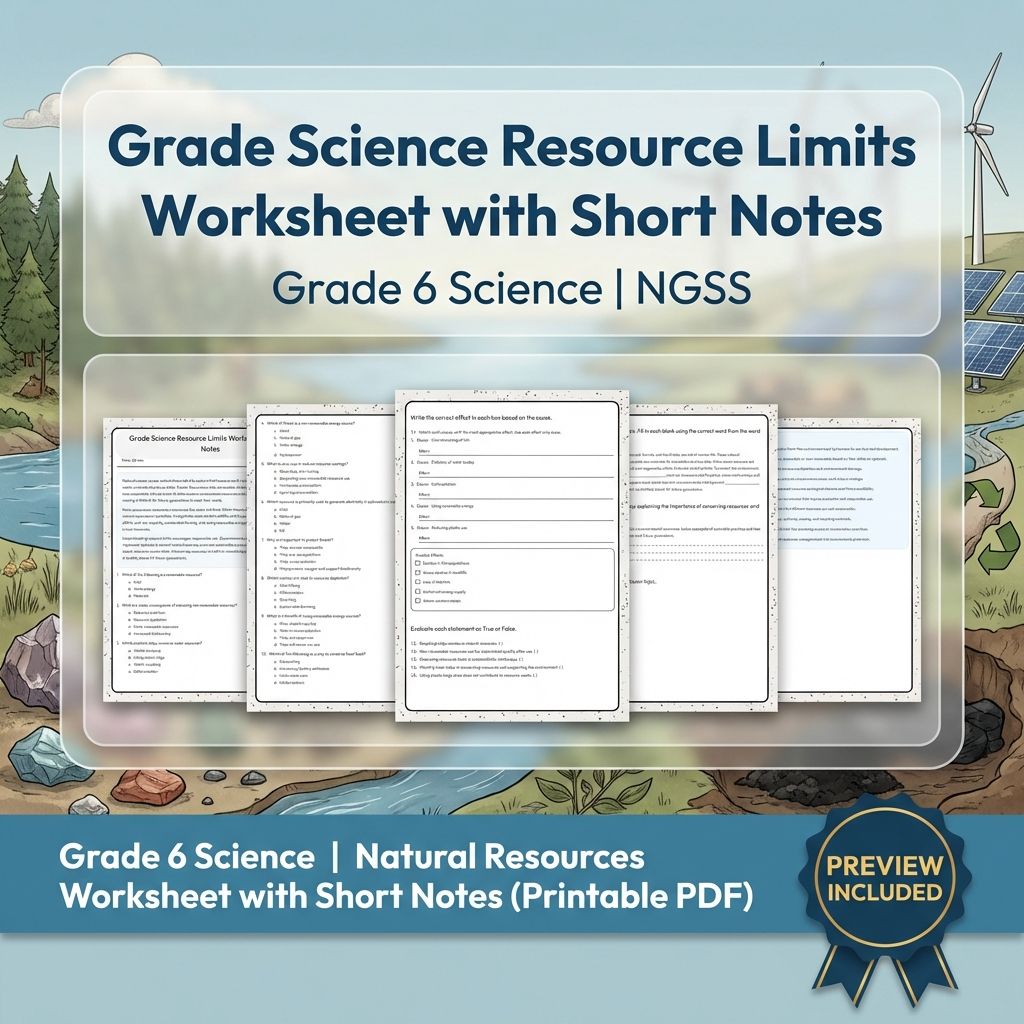
Grade 6 Science | Natural Resources Worksheet with Short Notes (Printable PDF)
Created byMeadowlark WorksheetsLearning Objectives
- Understand the concept of resource limits and their impact on ecosystems.
- Identify common natural resources and their sustainable use practices.
- Explain how resource limitations affect human activities and ecosystems.
Also included in: Grade 6 Science | Ecosystems: Interactions, Energy & Dynamics NGSS Unit Bundle +1 more
Instant download

Grade 6 Science | Molecular Processes in Science - Daily Reading Comprehension
 Created byCoral Reef Learning
Learning Objectives
- Understand the basic building blocks of molecules such as amino acids, nucleotides, fatty acids, and monosaccharides.
- Learn how monomers assemble into polymers through condensation reactions.
- Explore how molecular structures influence properties like enzyme activity, membrane transport, and growth.
Instant download
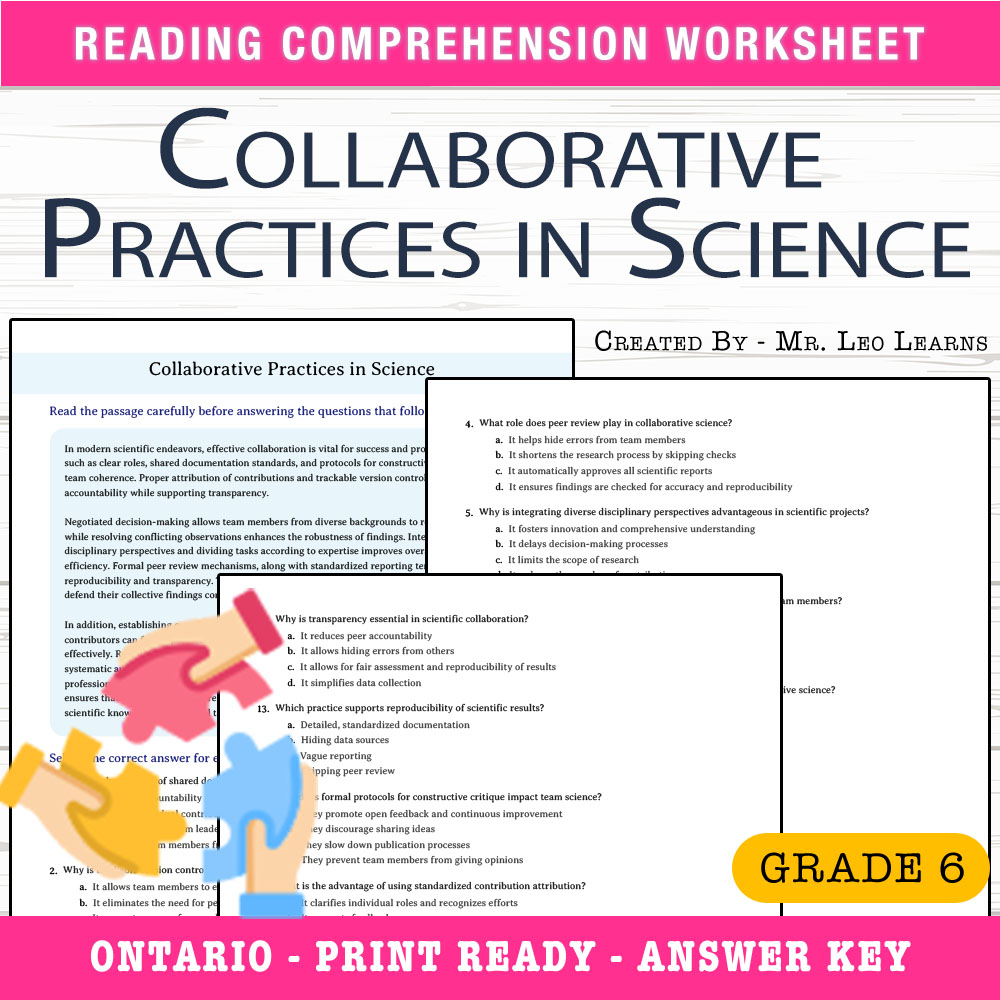
Grade 6 Science – Collaborative Practices in Science Worksheet for Mastery
Created byThe Resource HubLearning Objectives
- Understand key principles of team-based scientific work, including roles, documentation, and communication protocols.
- Recognize mechanisms for peer review, standardized reporting, and transparency in collaborative projects.
- Identify the benefits of integrating diverse disciplinary perspectives and division of labor in scientific teamwork.
Also included in: Grade 6 Science Unit | Scientific Skills & Responsible Practice Worksheet Bundle +1 more
Instant download
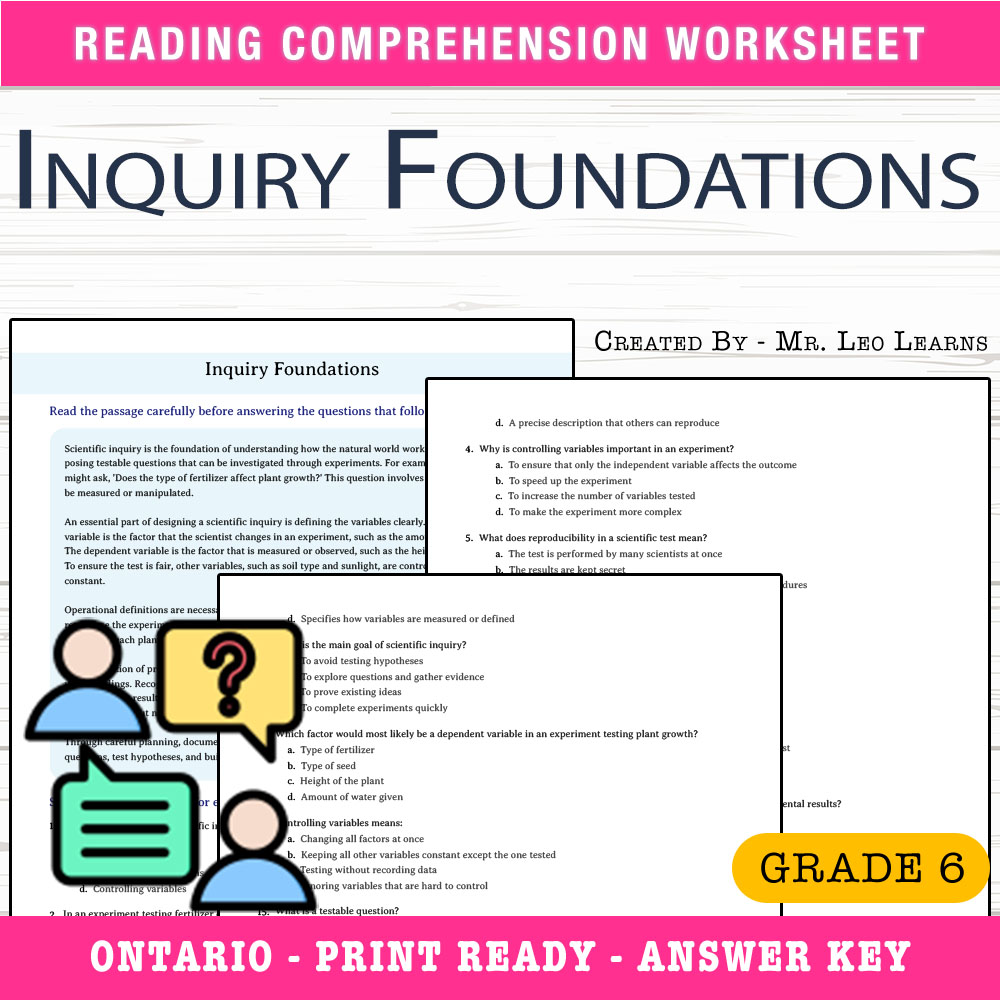
Grade 6 Science – Inquiry Foundations Worksheet for Mastery
Created byThe Resource HubLearning Objectives
- Understand the importance of operational definitions in scientific inquiry.
- Distinguish between independent and dependent variables in experiments.
- Learn to design fair tests by controlling variables.
Also included in: Grade 6 Science Unit | Scientific Skills & Responsible Practice Worksheet Bundle +1 more
Instant download
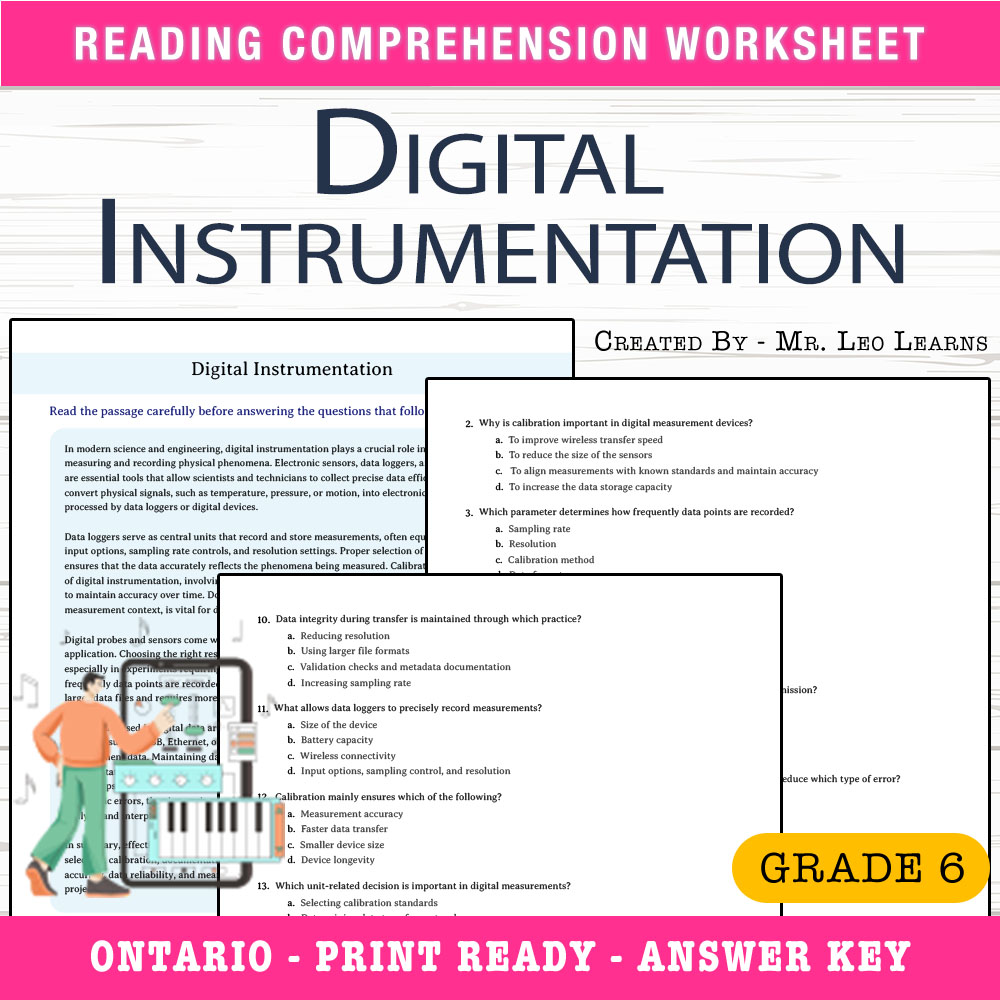
Grade 6 Science — Digital Instrumentation Worksheet for Mastery
Created byThe Resource HubLearning Objectives
- Understand the components and functions of electronic sensors, data loggers, and digital probes.
- Learn proper calibration procedures and importance of metadata documentation for accurate measurements.
- Recognize the significance of sampling rate, resolution, units, and data transfer protocols in data collection.
Also included in: Grade 6 Science Unit | Scientific Skills & Responsible Practice Worksheet Bundle +1 more
Instant download
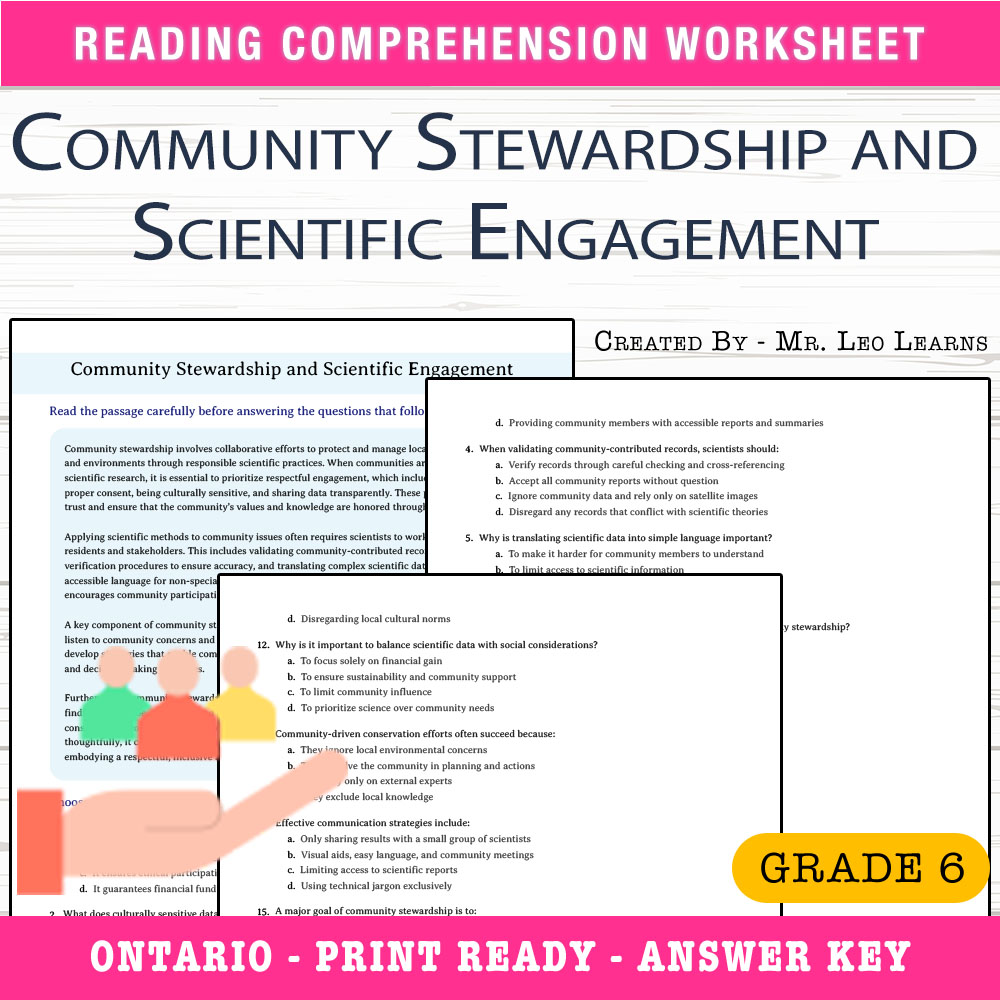
Grade 6 Science – Community Stewardship & Scientific Engagement Worksheet
Created byThe Resource HubLearning Objectives
- Understand the role of scientific methods in addressing local community issues.
- Identify best practices for respectful and ethical data collection from communities.
- Learn strategies for effective communication of scientific findings to non-expert audiences.
Also included in: Grade 6 Science Unit | Scientific Skills & Responsible Practice Worksheet Bundle +1 more
Instant download
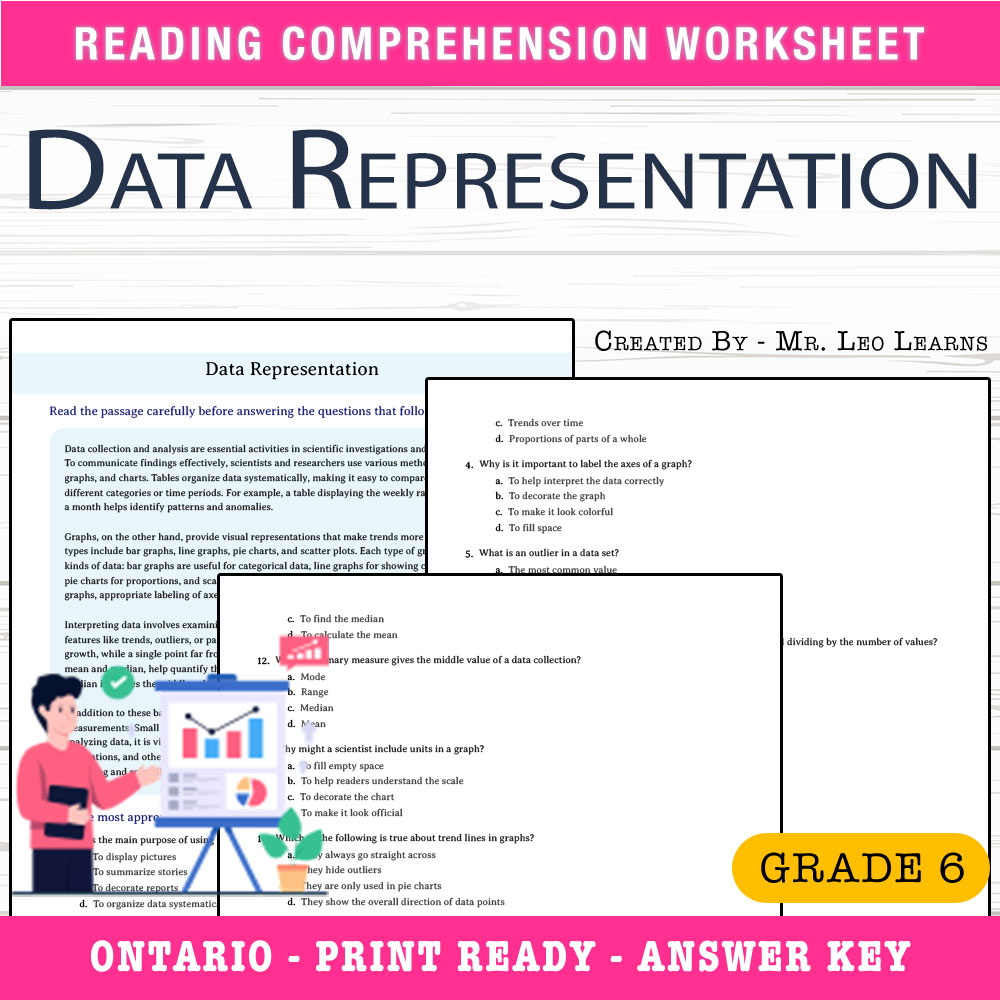
Grade 6 Science – Data Representation Worksheet for Mastery
Created byThe Resource HubLearning Objectives
- Understand different methods of data representation including tables and graphs.
- Identify trends, outliers, and summary measures in data sets.
- Learn to select appropriate graph types and label axes effectively.
Also included in: Grade 6 Science Unit | Scientific Skills & Responsible Practice Worksheet Bundle +1 more
Instant download
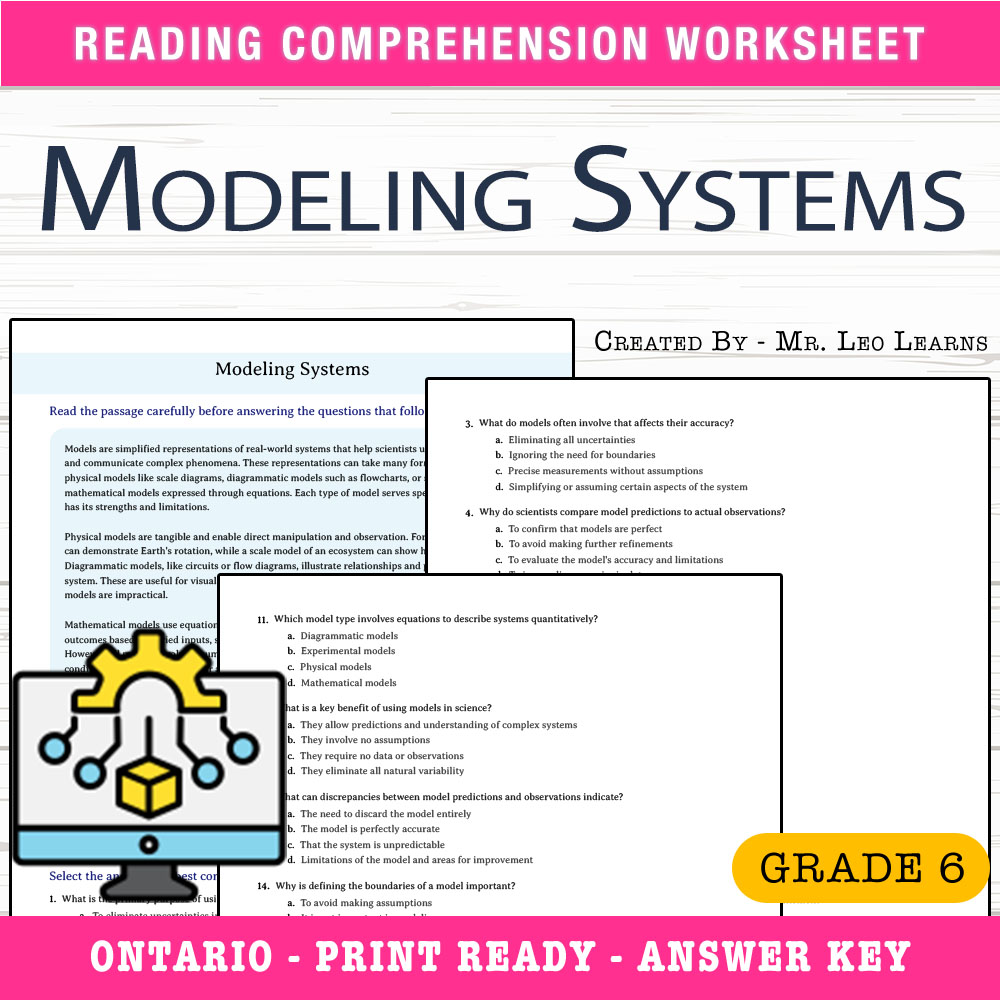
Grade 6 Science — Modeling Systems Worksheet for Mastery
Created byThe Resource HubLearning Objectives
- Understand the purpose of different types of models in representing complex systems.
- Identify assumptions, boundaries, and limitations when constructing models.
- Analyze how model predictions compare to observable outcomes to assess accuracy.
Also included in: Grade 6 Science Unit | Scientific Skills & Responsible Practice Worksheet Bundle +1 more
Instant download
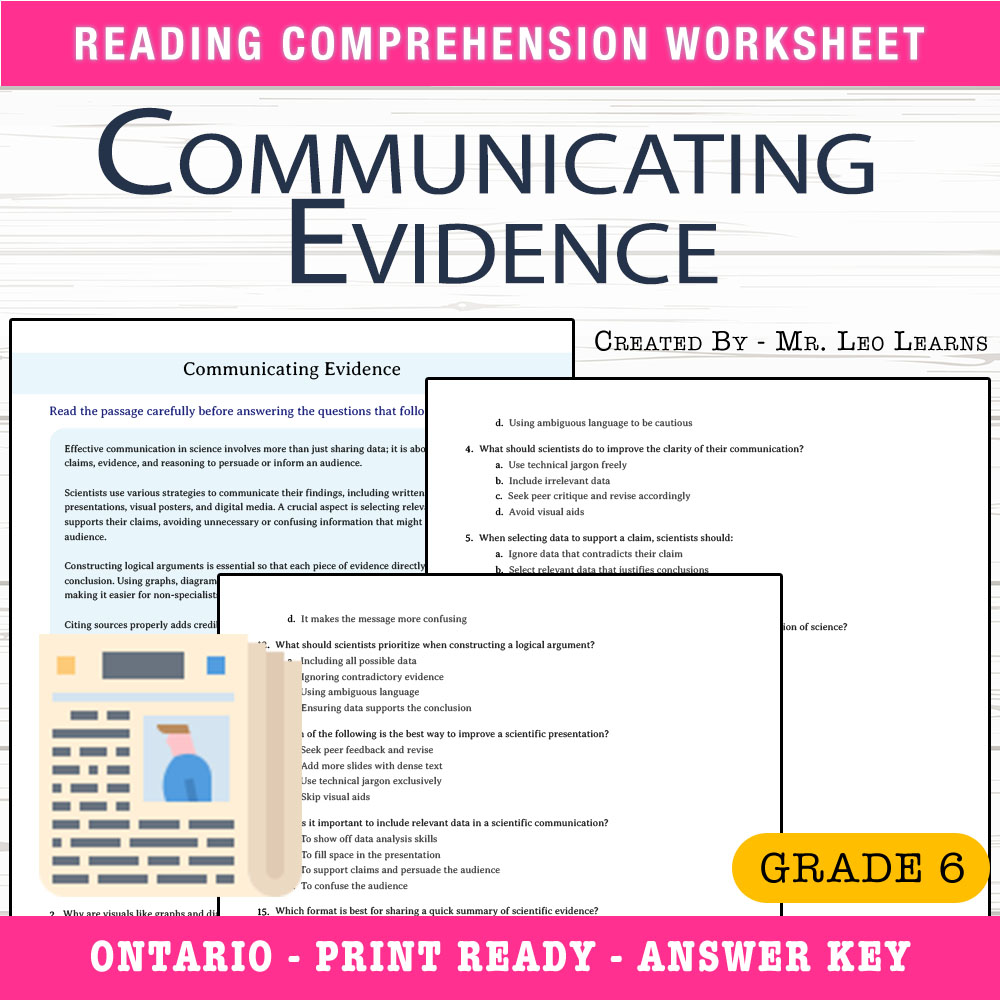
Grade 6 Science – Communicating Evidence Worksheet for Mastery
Created byThe Resource HubLearning Objectives
- Understand core strategies for effectively communicating scientific evidence.
- Learn how to select relevant data and construct logical arguments.
- Recognize different formats for presenting scientific information, including oral, written, and visual methods.
Also included in: Grade 6 Science Unit | Scientific Skills & Responsible Practice Worksheet Bundle +1 more
Instant download
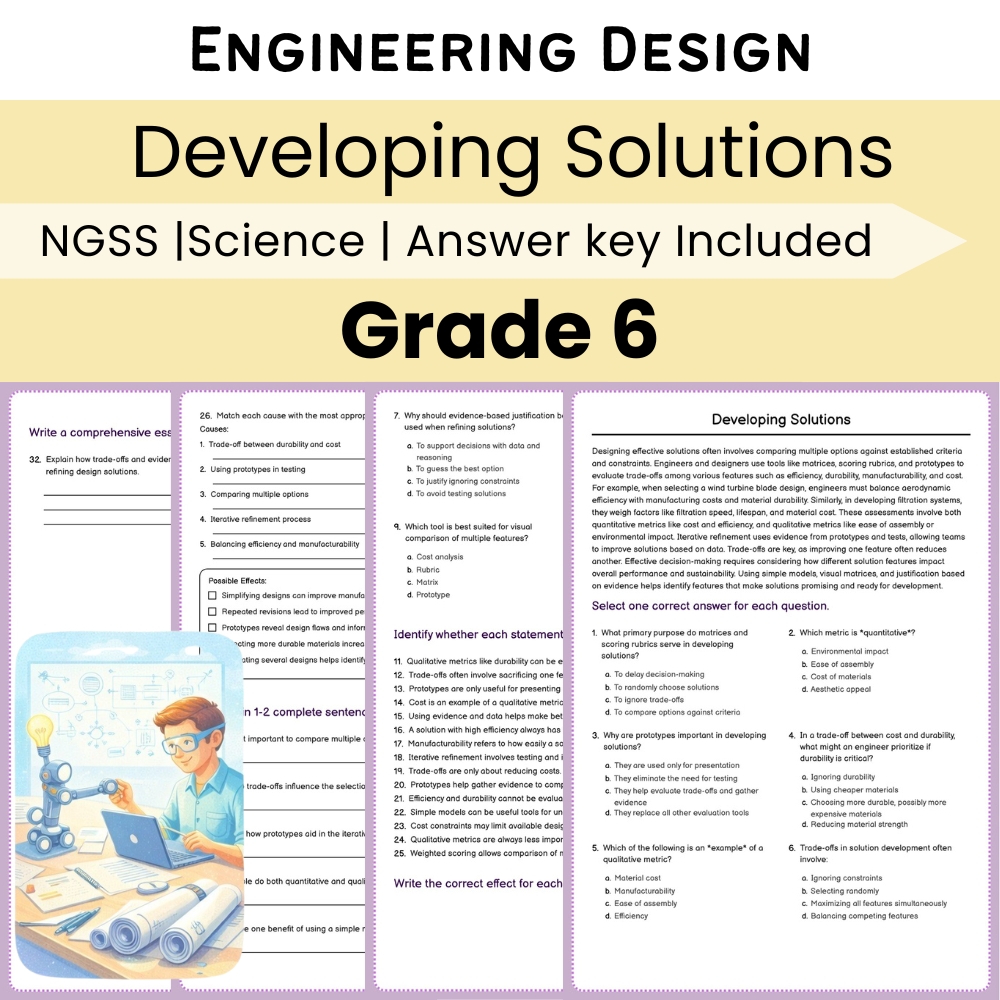
Developing Solutions Worksheet | Grade 6 Science Printable PDF NGSS Aligned
Learning Objectives
- Compare multiple design solutions using matrices, scoring rubrics, and prototypes.
- Evaluate and rank design options based on quantitative and qualitative metrics.
- Understand how trade-offs influence the selection of solutions.
Also included in: Grade 6 Science NGSS Engineering Design Unit Bundle | Problem Solving Worksheets +1 more
Instant download
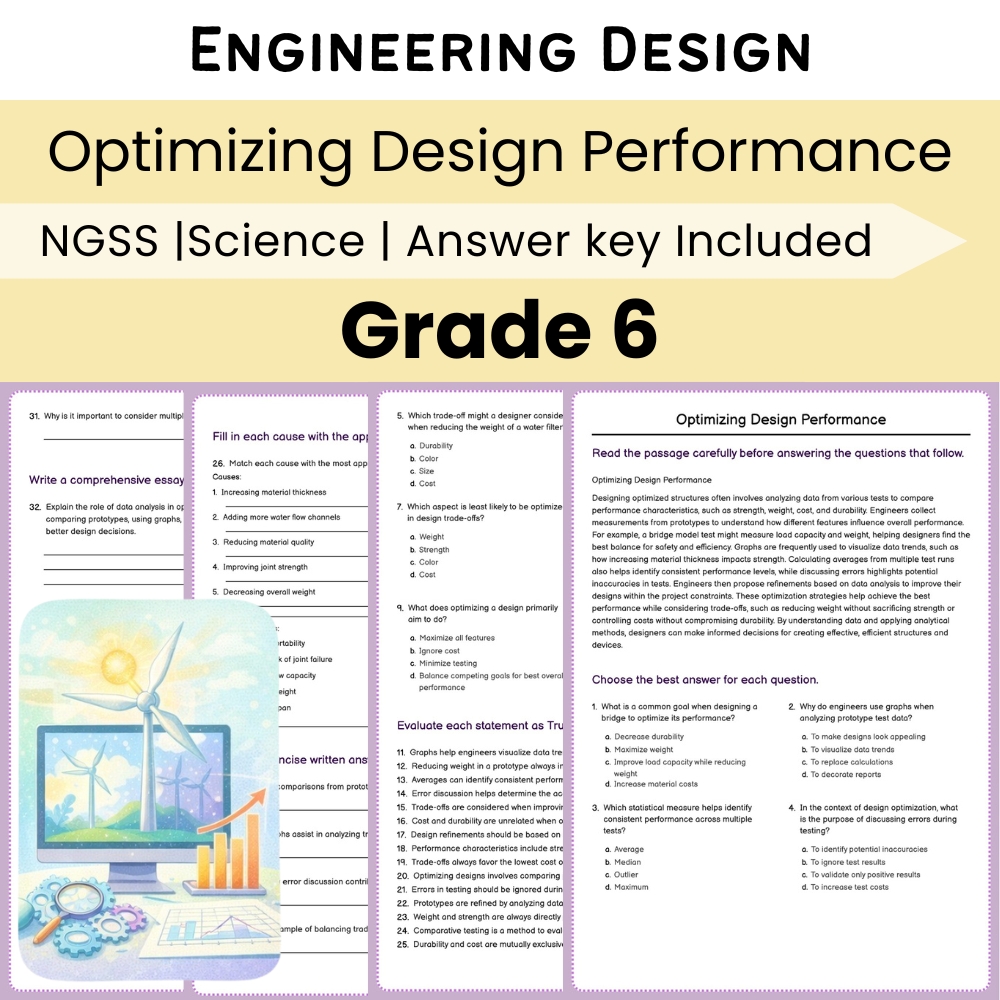
Optimizing Design Performance Science Worksheet | Grade 6 NGSS printable PDF
Learning Objectives
- Analyze data from comparative tests of different prototypes to determine performance characteristics.
- Interpret graphs, averages, and discuss errors to support design trade-offs.
- Apply optimization strategies that balance goals like strength versus weight or cost versus durability.
Also included in: Grade 6 Science NGSS Engineering Design Unit Bundle | Problem Solving Worksheets +1 more
Instant download

Grade 6 Mixture Separation Worksheet | NGSS Practice & PDF
 Created byClear Sky Classroom
Learning Objectives
- Explain why mixtures can be separated without forming new substances
- Identify physical properties used to separate mixture components (such as density, particle size, boiling point, and solubility)
- Use correct vocabulary to describe common separation methods (filtration, evaporation, distillation, and chromatography)
Instant download
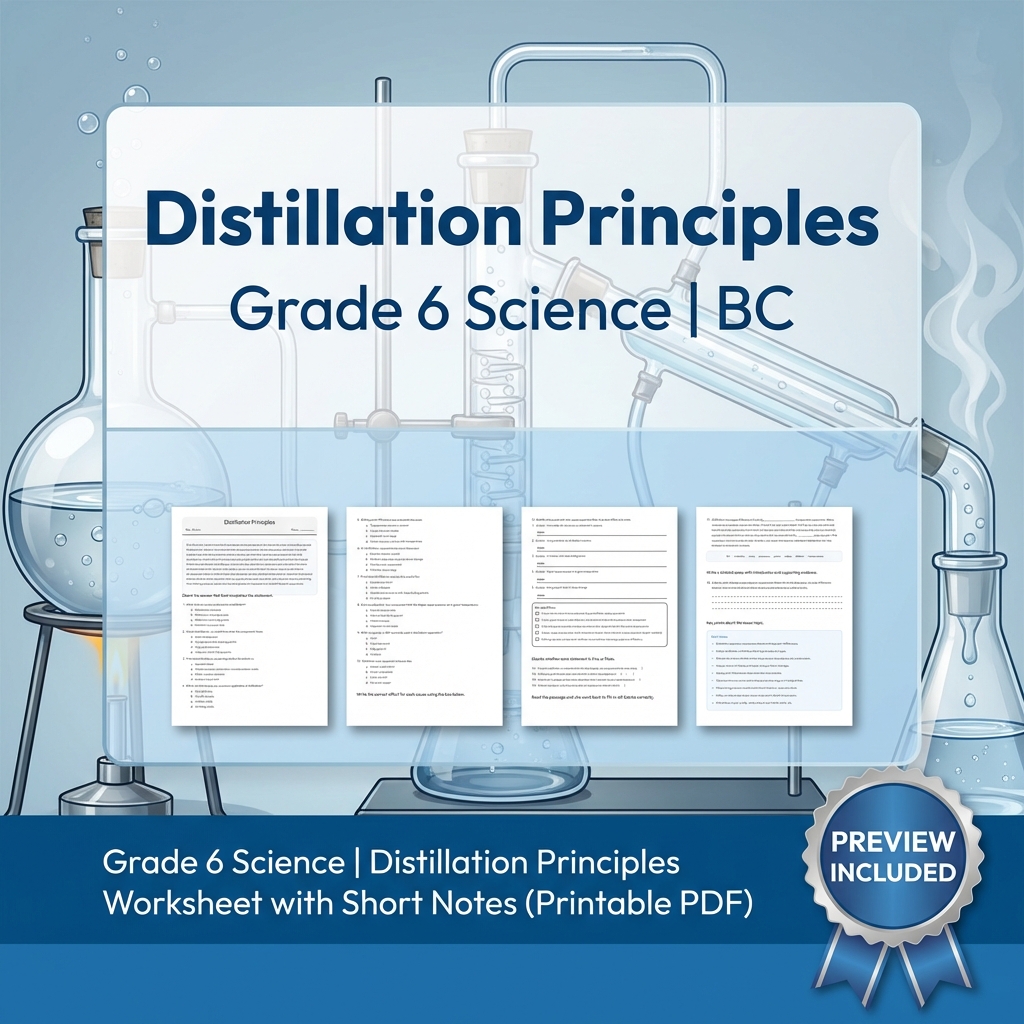
Grade 6 Science | Distillation Principles Worksheet with Short Notes (PDF)
Created byMeadowlark WorksheetsLearning Objectives
- Understand the basic principles of distillation and phase changes
- Differentiate between simple and fractional distillation techniques
- Identify real-world applications of distillation in separating liquids
Also included in: Grade 6 Science | Matter, Properties & Change UNIT Worksheet Bundle +1 more
Instant download
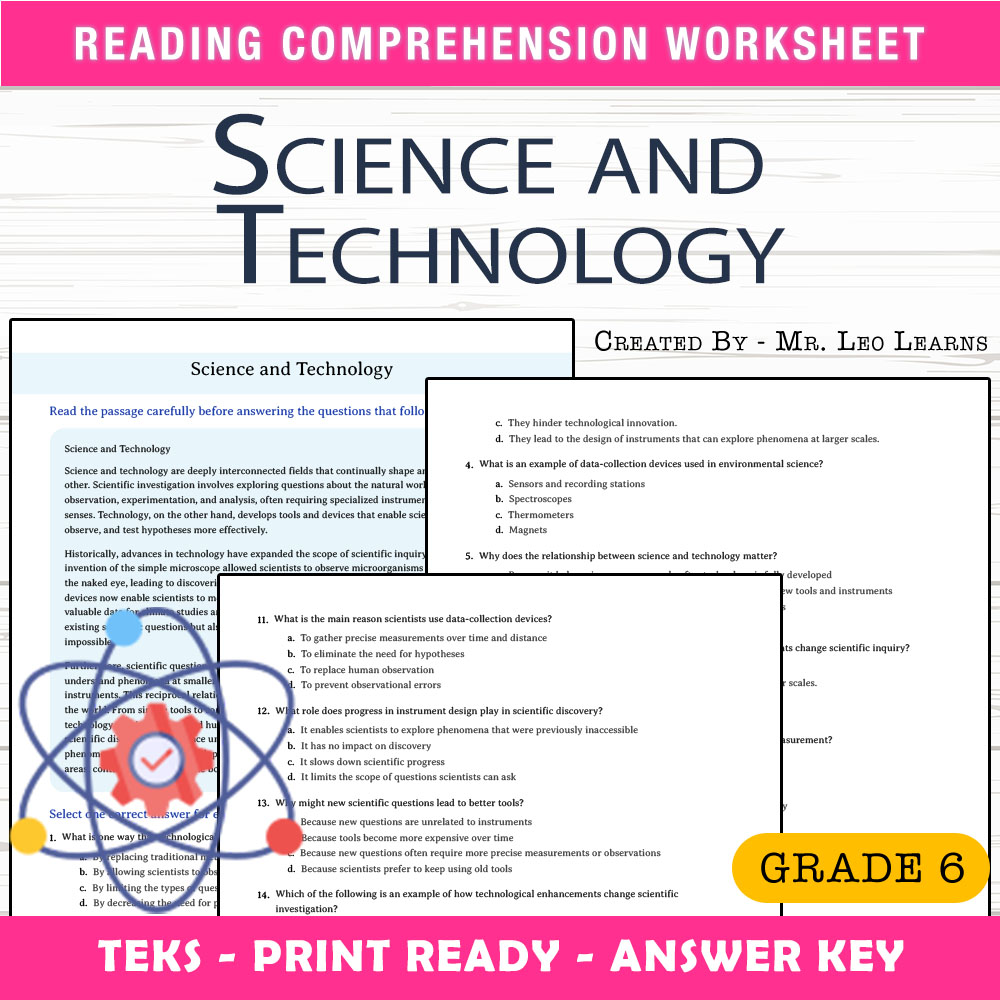
Grade 6 Science — Science and Technology Worksheet for Mastery
Created byThe Resource HubLearning Objectives
- Understand the reciprocal relationship between scientific investigation and technological development.
- Learn how instruments and tools extend observation and measurement in science.
- Identify examples of scientific instruments such as microscopes, sensors, and data collection devices.
Instant download
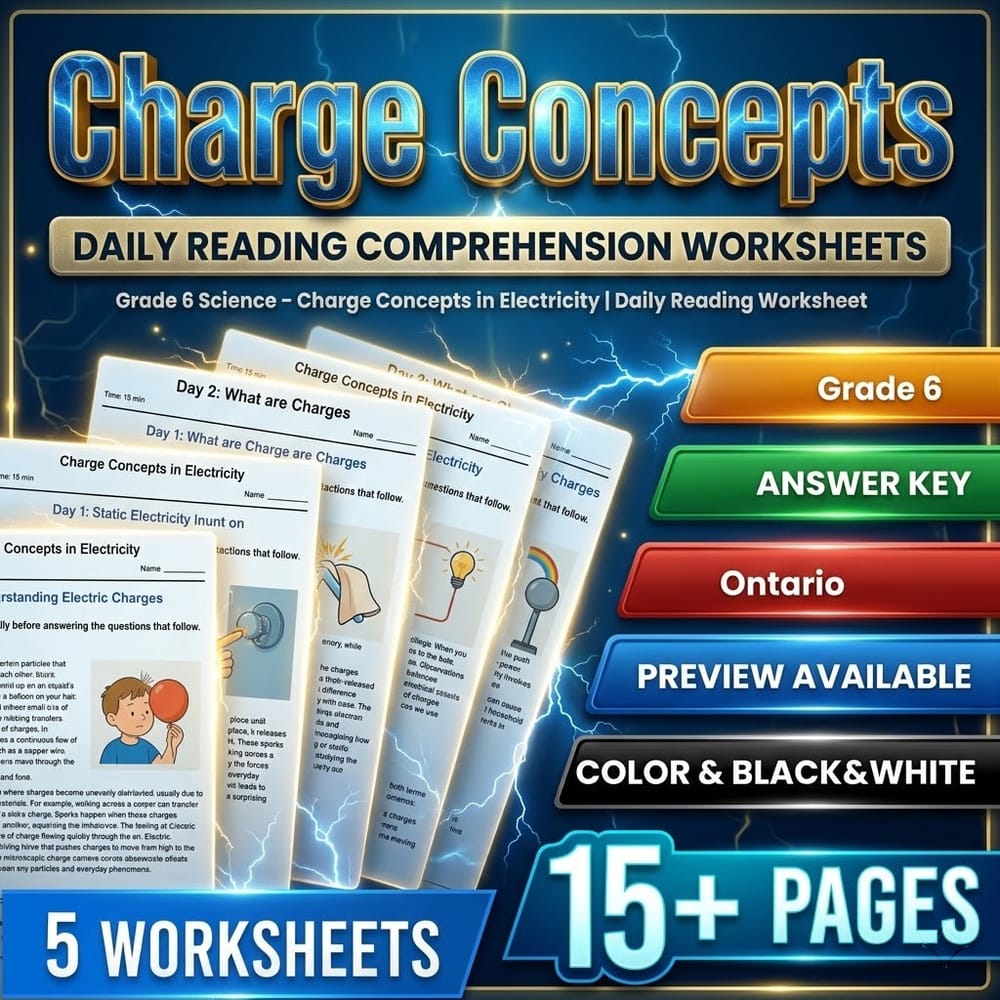
Grade 6 Science – Charge Concepts in Electricity | Daily Reading Worksheet
 Created byQuiet Forest Education
Learning Objectives
- Define electric charge and distinguish between static and current electricity.
- Explain how charge separation happens and how charge flows in conductors.
- Connect everyday phenomena like sparks and hair attraction to electric charges.
Also included in: Electricity Grade 6 Science Daily Reading Worksheets Bundle | Ontario +1 more
Instant download
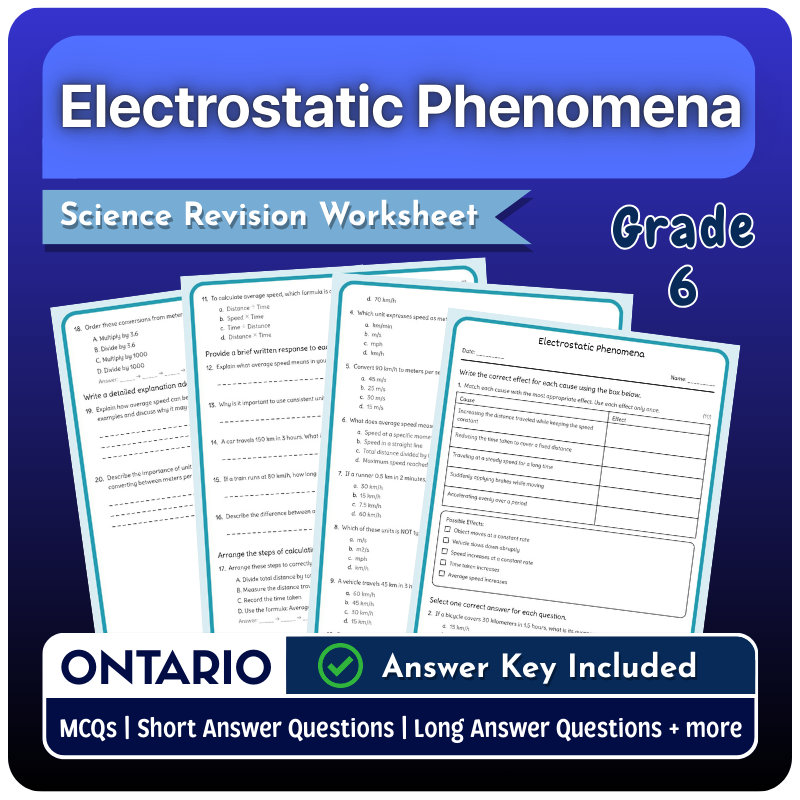
6th Grade Science | Electrostatic Phenomena Worksheet (PDF) Ontario Standard
Created byBright Mind ResourcesLearning Objectives
- Understand the causes and effects of static charge transfer between materials.
- Identify and interpret the triboelectric series and its application in predicting charge tendencies.
- Describe phenomena such as attraction, repulsion, and discharge sparked by static electricity.
Instant download

Grade 6 Science – Organ Systems Overview Daily Reading Worksheet | BC Standards
Created byBright Mind ResourcesLearning Objectives
- Identify the main organs of the circulatory system.
- Describe the primary functions of the circulatory system.
- Understand how the circulatory system interacts with other body systems.
Also included in: Grade 6 Science: Organ Systems & Adaptations Daily Reading Lesson Bundle | BC +1 more
Instant download
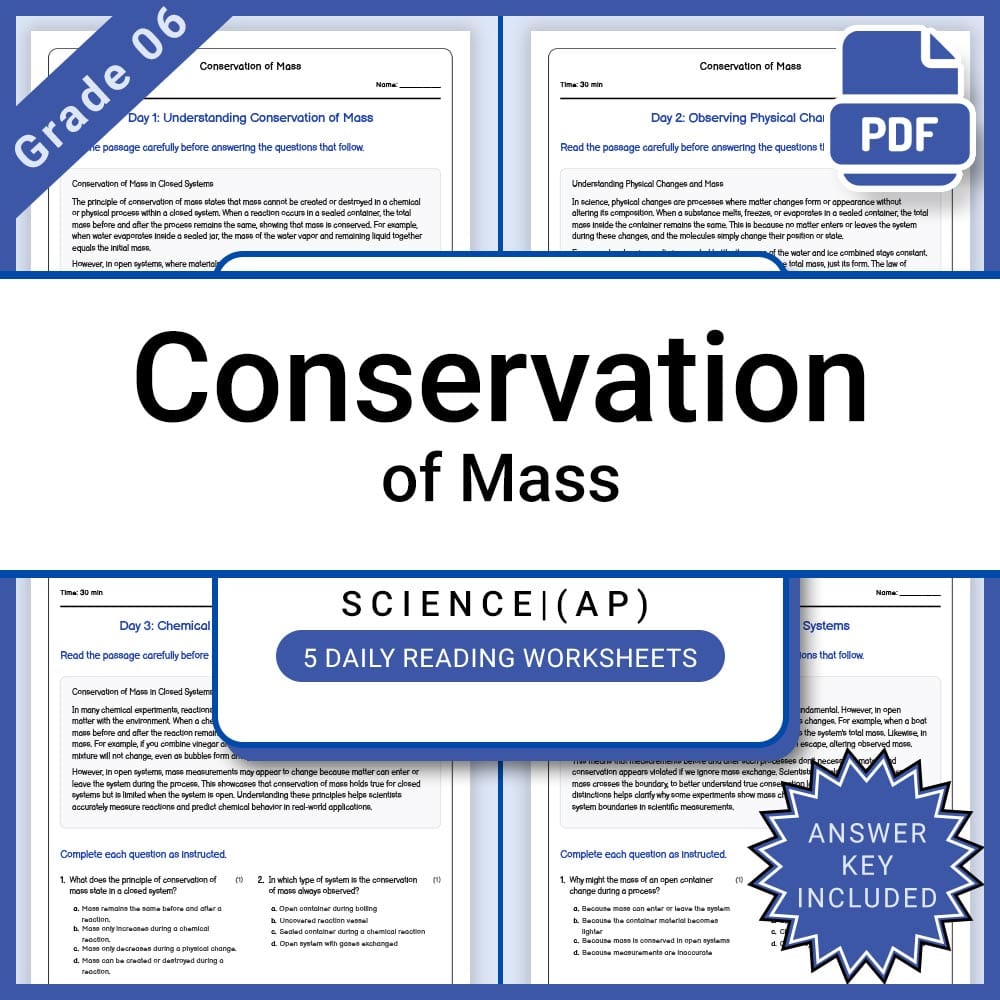
Grade 6 Science – Conservation of Mass Daily Reading Worksheet + Answer Key
JCreated byJ.S SheetsLearning Objectives
- Understand the principle of mass conservation in closed systems.
- Identify examples of physical and chemical processes that illustrate mass conservation.
- Distinguish between closed and open systems regarding mass exchange.
Also included in: Grade 6 Science Lesson Bundle | States of Matter, Energy, and More +1 more
Instant download
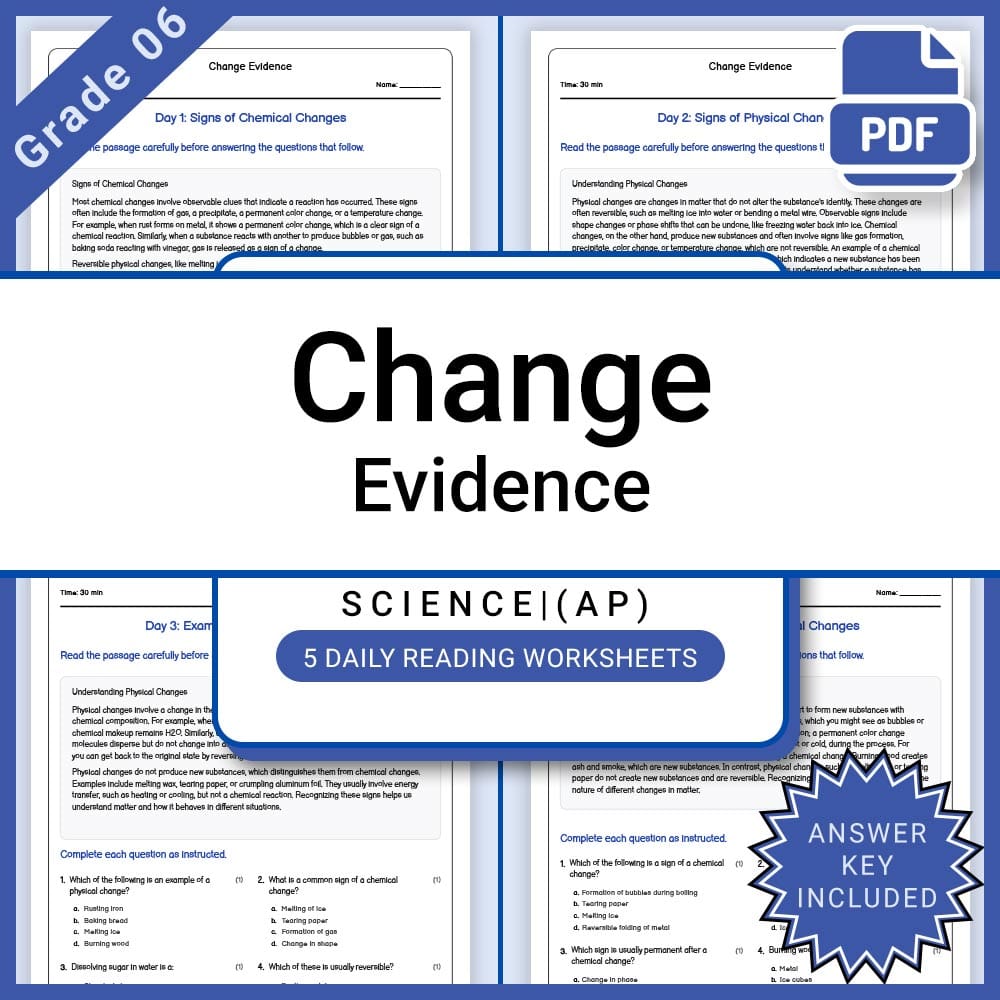
Grade 6 Science – Change Evidence Daily Reading Worksheet with Answer Key
JCreated byJ.S SheetsLearning Objectives
- Identify observable indicators of chemical changes
- Differentiate between physical and chemical changes using examples
- Understand the signs that indicate a chemical reaction has taken place
Also included in: Grade 6 Science Lesson Bundle | States of Matter, Energy, and More +1 more
Instant download
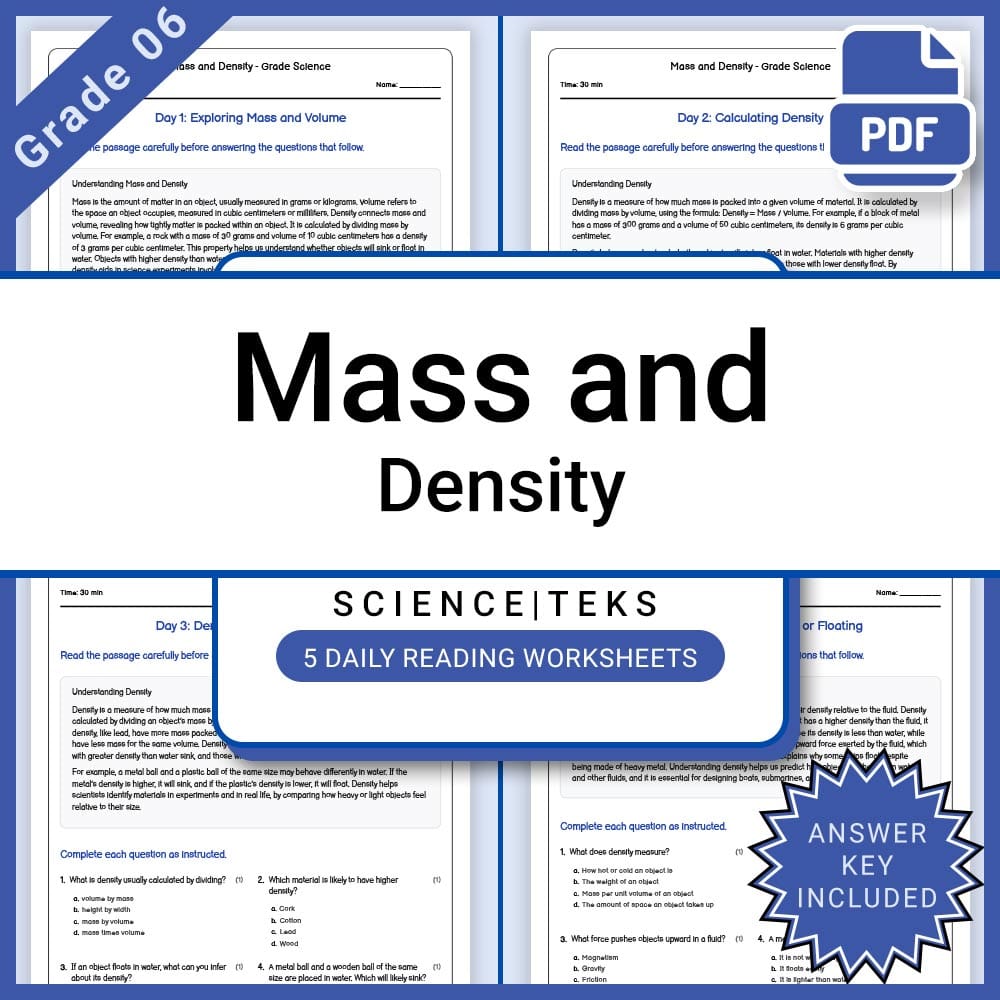
Grade 6 Science – Mass and Density Daily Reading Worksheet + Answer Key
JCreated byJ.S SheetsLearning Objectives
- Define and measure mass and volume of various objects.
- Calculate density using mass and volume measurements.
- Interpret density values to classify objects as solids or liquids.
Also included in: Grade 6 Science Lesson Bundle | States of Matter, Energy, and More +1 more
Instant download
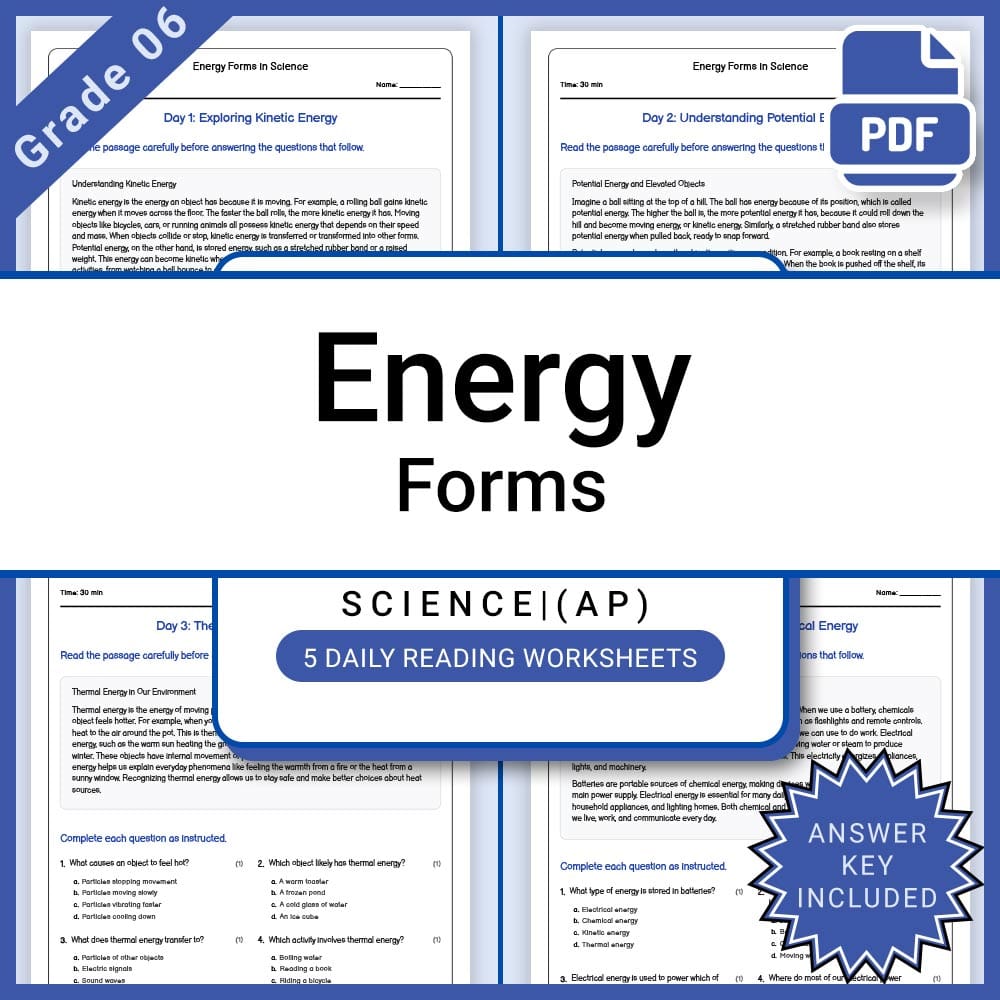
Grade 6 Science – Energy Forms Daily Reading Worksheet + Answer Key
JCreated byJ.S SheetsLearning Objectives
- Identify different forms of energy including kinetic, potential, thermal, chemical, and electrical.
- Relate each energy form to familiar phenomena such as moving objects, stretched springs, warm objects, and batteries.
- Describe how energy is associated with motion, position, and internal molecular activity.
Also included in: Grade 6 Science Lesson Bundle | States of Matter, Energy, and More +1 more
Instant download
About Grade 6 Science Worksheets
Explore Grade 6 Science worksheets for classwork, homework, or review. Our 5,969 printables download instantly as PDFs.
MyTeachingSheets worksheets are made by real teacher-authors and checked before they go live. Download any as a print-ready PDF for lessons, homework, or independent practice — most include answer keys, and previews are always free.