
Grade 6 Science Worksheets
5,997 worksheets
Forest Management Worksheets Grade 6 Trees and Forests Science Review
 Created bySunny Desk Resources
Learning Objectives
- Explain how integrated management balances ecological, economic, and social objectives in forest planning
- Identify examples of ecosystem-based management and adaptive harvest planning
- Use evidence about risks like mountain pine beetle and wildfire to inform long-term decisions
Also included in: Trees and Forests Grade 6 Alberta Science Worksheets Bundle +1 more
Instant download

Tree Growth Rings and Environmental Clues Worksheets Grade 6 Science
Created bySunny Desk ResourcesLearning Objectives
- Describe how tree growth rings can show a tree’s age and yearly radial growth
- Explain how ring width and density can reflect seasonal moisture, temperature, and disturbances
- Use ring patterns to understand past climate and fire frequency through dendrochronology
Also included in: Trees and Forests Grade 6 Alberta Science Worksheets Bundle +1 more
Instant download

6th Grade Science – Bernoulli Principle Worksheet (Alberta Standard) (PDF)
 Created bySilver Birch Teaching
Learning Objectives
- Explain how fluid speed and pressure are related using Bernoulli’s principle.
- Describe how pressure differences and airflow around an airfoil relate to lift.
- Apply Bernoulli’s principle to everyday Alberta examples such as gliders and wind on roadways or rivers.
Also included in: Grade 6 Aerodynamics & Flight Forces Science Lesson Bundle: Alberta +1 more
Instant download

Science Pure Mixtures Worksheet | Standards-Aligned Grade 6 Science Practice
JCreated byJ.S SheetsLearning Objectives
- Define a pure mixture and explain how its components keep their identities.
- Distinguish between uniform and nonuniform mixtures using observable patterns.
- Describe how mixture patterns help select an appropriate separation technique.
Also included in: Grade 6 Matter, Motion, and Heat Science Lesson Bundle – General Framework +1 more
Instant download

Grade 6 Limiting Resources Worksheet | NGSS Practice & PDF
 Created byClear Sky Classroom
Learning Objectives
- Explain how limiting resources affect population size in an ecosystem
- Identify examples of limiting resources (nutrients, water, space) and describe their effects
- Use evidence from scenarios to predict how populations change when resources become scarce
Instant download

Data Representations Assessment for Grade 6 Science | Standards-Aligned
 Created byPrism Point Learning
Learning Objectives
- Understand how data can be organized into tables, graphs, and simple representations.
- Identify the purpose of labels, units, and scales in data displays.
- Differentiate between types of graphs such as bar graphs and line graphs.
Also included in: Grade 6 Data & Evidence Science Lesson Bundle | General Framework
Instant download

Earth Structure Assessment for Grade 6 Science | TEKS Standards-Aligned
Created byPrism Point LearningLearning Objectives
- Describe the internal layers of Earth and their characteristics.
- Explain how plate boundary types cause geological phenomena such as earthquakes and volcanoes.
- Identify examples of divergent, convergent, and transform boundaries and their surface features.
Instant download

Grade 6 Science | Tree Evidence & Homologous Structures - Reading & Practice
 Created byCoral Reef Learning
Learning Objectives
- Understand what homologous structures are and how they indicate common ancestry.
- Identify vestigial organs and their significance in evolutionary biology.
- Recognize conserved DNA sequences and how they support evolutionary relationships.
Instant download
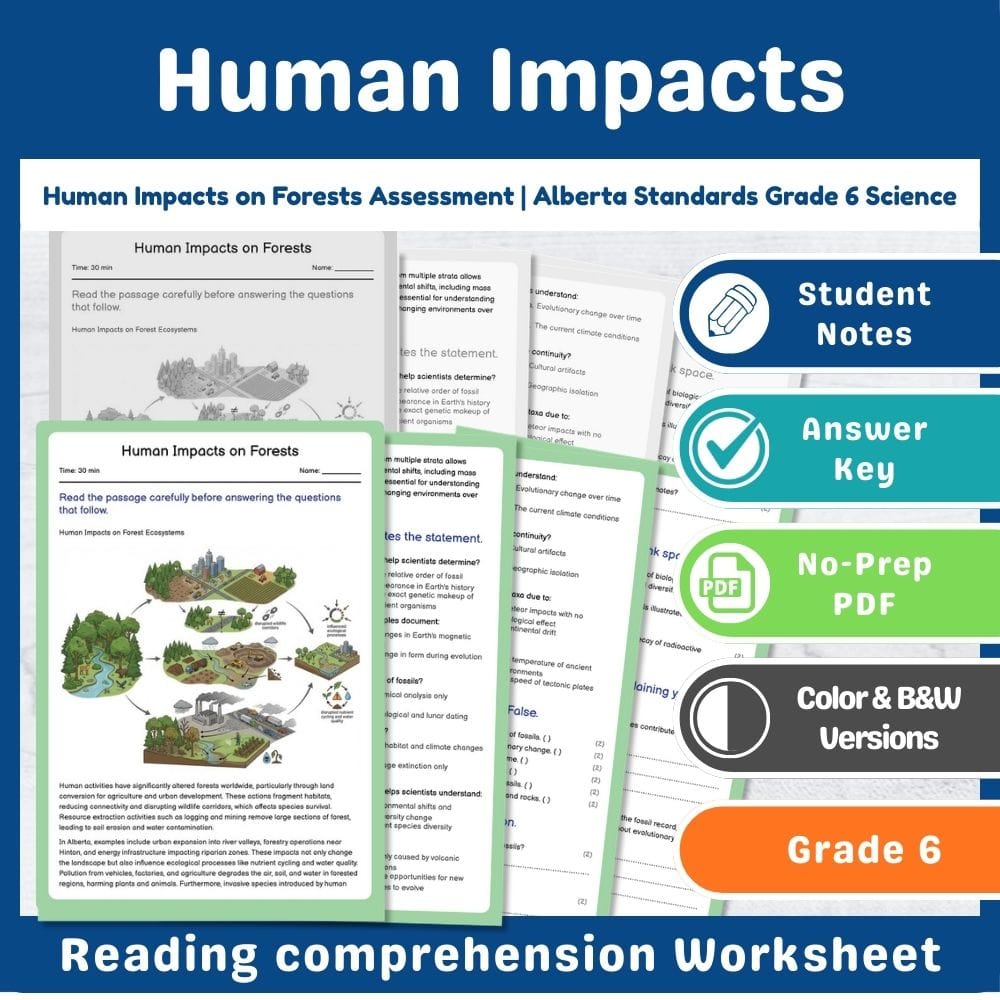
Human Impacts on Forests Assessment | Alberta Standards Grade 6 Science
Created byPrism Point LearningLearning Objectives
- Understand various human activities that impact forest ecosystems.
- Identify how urban expansion, resource extraction, and pollution affect forests.
- Evaluate the cumulative environmental effects caused by human impacts.
Also included in: Lesson Grade 6 Science Mini Bundle Trees and Forests Alberta Standards
Instant download
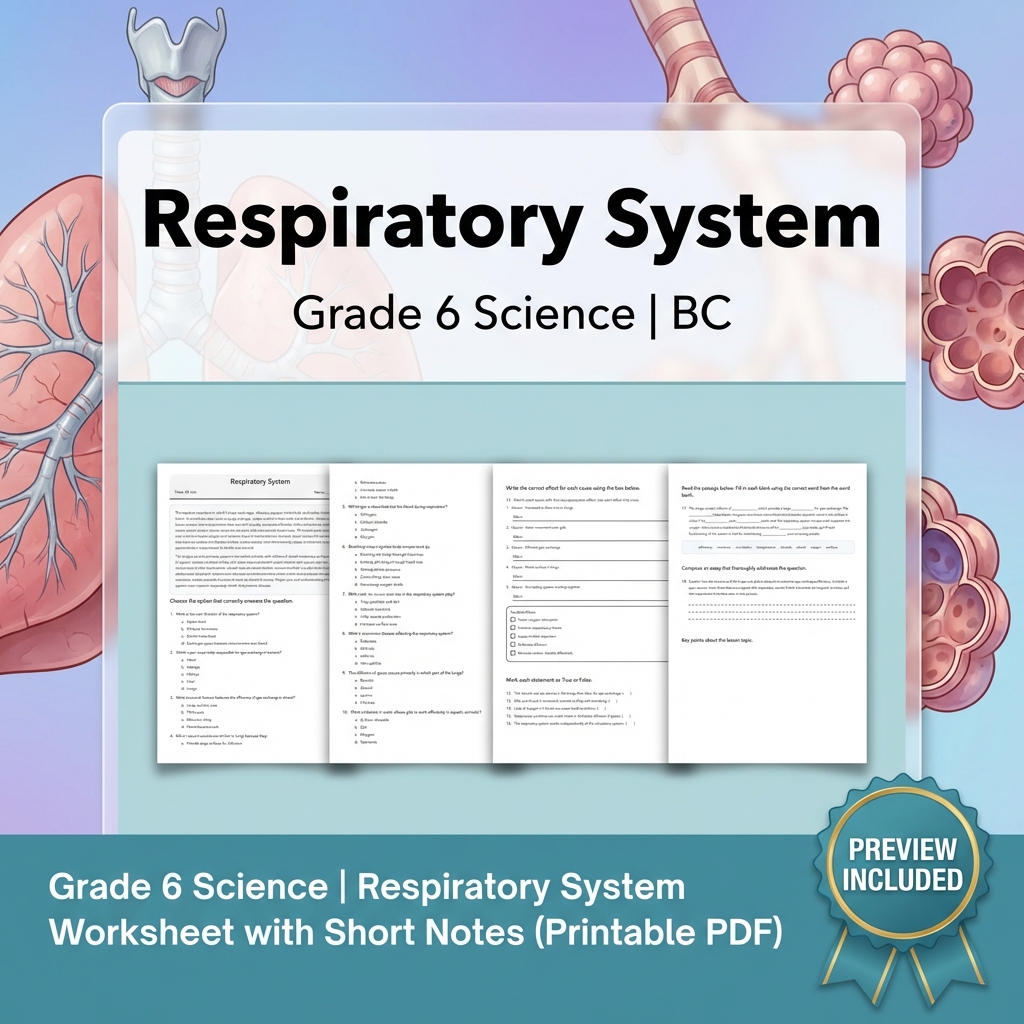
Grade 6 Science | Respiratory System Worksheet with Short Notes (Printable PDF)
 Created byMeadowlark Worksheets
Learning Objectives
- Describe the main functions of the respiratory system.
- Identify key organs involved in respiration.
- Explain how surface area adaptations enhance gas exchange efficiency.
Also included in: Grade 6 Science | Multicellular Systems & Functions Unit Worksheet Bundle +1 more
Instant download
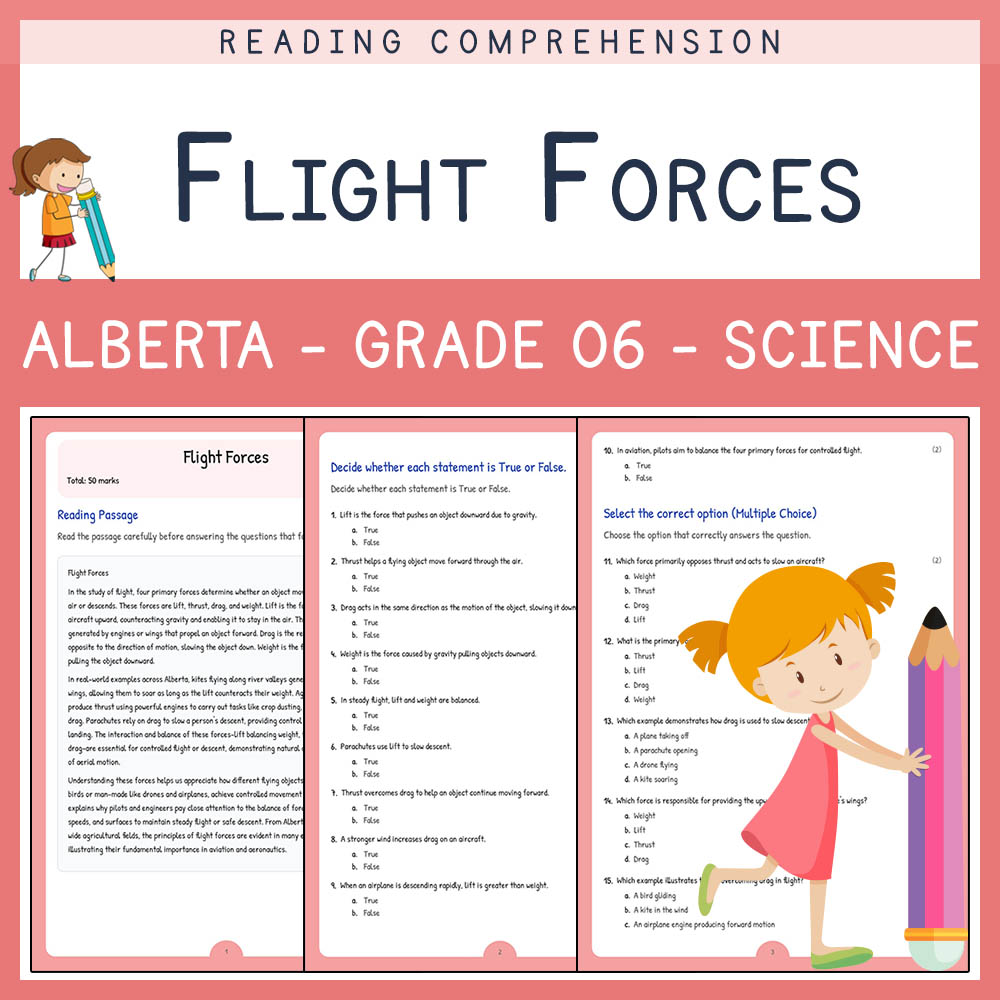
Grade 6 Science Assessment | Flight Forces Worksheet | Alberta Standards
 Created byLumora Learning
Learning Objectives
- Understand the four primary forces involved in flight: lift, thrust, drag, and weight.
- Describe how these forces interact to enable steady flight or cause descent.
- Identify examples of flight forces in real-world situations like kites, aircraft, and parachutes.
Also included in: Grade 6 Science | Air and Aerodynamics Science Lesson Bundle | Alberta
Instant download
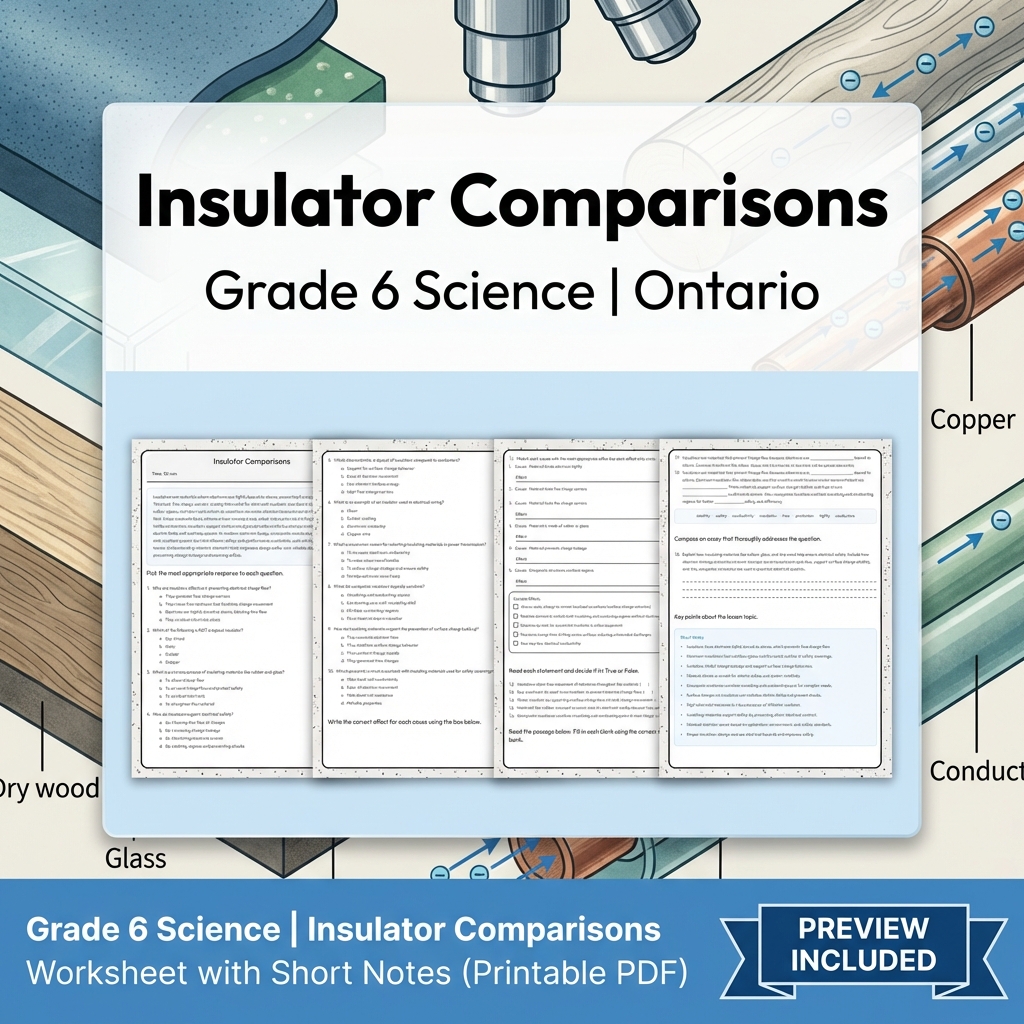
Grade 6 Science | Insulator Comparisons Worksheet with Short Notes (PDF)
Created byMeadowlark WorksheetsLearning Objectives
- Understand the properties that make materials good insulators and their role in electrical safety.
- Compare different insulating materials like rubber, glass, and dry wood based on electron binding and charge behavior.
- Explain how materials prevent charge flow and support safety through electrical isolation.
Also included in: Grade 6 Science Lesson Group on Energy, Circuits & Properties +1 more
Instant download

Grade 6 Science – El Niño Effects & Climate | Daily Reading Worksheet
 Created byBright Mind Resources
Learning Objectives
- Understand the scientific concept of El Niño and how it affects weather patterns.
- Identify key facts about ocean-atmosphere interactions during El Niño.
- Analyze how changes in sea surface temperatures influence global climate.
Also included in: Climate Grade 6 Science Daily Reading Worksheets Lesson Bundle | Florida NGSSS +1 more
Instant download

Grade 6 Energy From Sun Worksheet | NGSS Practice PDF
Created byClear Sky ClassroomLearning Objectives
- Explain how solar energy angle and location affect heating patterns on Earth.
- Describe how unequal heating drives air movement and ocean circulation.
- Connect energy transfers in the atmosphere and oceans to daily weather and seasonal climate changes.
Instant download

Grade 6 Community Stewardship Science Worksheet | Ontario Curriculum
Created byClear Sky ClassroomLearning Objectives
- Apply scientific methods to local environmental and community concerns while showing respectful engagement with community members.
- Use consent, cultural sensitivity, and privacy practices when collecting observations on local sites.
- Evaluate and validate community-contributed records using evidence and clear documentation.
Instant download

Grade 6 Adaptation and Speciation Worksheet | NGSS Evolution Activity
 Created byCurriculum Foundation
Learning Objectives
- Explain how heritable differences and natural selection can lead to adaptation in a population.
- Describe how populations can diverge into new species through reproductive isolation.
- Identify evidence of speciation using morphology, compatibility, and biogeographic patterns.
Instant download

Circuit Symbols Worksheet Practice Test Prep | Grade 6 Science
Created byPrism Point LearningLearning Objectives
- Interpret common circuit symbols for cells, batteries, resistors, lamps, switches, ammeters, and voltmeters.
- Explain how schematic diagrams show physical connections and predict basic circuit behaviour using series and parallel ideas.
Also included in: Grade 6 Circuits & Electricity Science lesson bundle: Ontario
Instant download
Grade 6 Science – Data Representation & Analyzing Data | Daily Reading Worksheet
 Created byQuiet Forest Education
Learning Objectives
- Understand the purpose and advantages of organizing data in tables
- Learn to create and interpret simple data tables
- Recognize different types of data and how to display them visually
Also included in: Science Grade 6 Daily Reading Worksheets Bundle | Ontario Framework +1 more
Instant download

Keystone Species Practice Worksheet | Grade 6 Science Assessment
Created byPrism Point LearningLearning Objectives
- Explain what makes a species a keystone species and describe how it can shape an ecosystem disproportionately.
- Identify examples of trophic control and cascading effects involving predators, ecosystem engineers, and pollinators.
- Use evidence-based indicators to predict how changes in keystone species can affect biodiversity and habitat complexity.
Also included in: Grade 6 Biodiversity & Adaptation Science Lesson Bundle Ontario
Instant download

Body Organization Levels Worksheets | Grade 6 Life Science
 Created byBRIGHT PATH RESOURCES
Learning Objectives
- Describe how cells, tissues, organs, and body systems work together to support life functions
- Identify the level of organization that matches a given body structure or function
- Explain how changes in one structure can affect how well an organ system maintains balance
Also included in: Grade 6 Life Science Worksheets Bundle | Ecosystems & Body Systems +2 more
Instant download

6th Grade Science Worksheet | Exploring the Solar System (PDF) – Ontario Standards
 Created byEvergreen Desk Education
Learning Objectives
- Identify major components of the solar system, including planets, dwarf planets, and small-body regions.
- Compare terrestrial and gas giant planets using basic composition, atmospheres, and typical temperatures.
- Explain how orbital distance and energy from the Sun relate to planetary environments and habitability.
Also included in: Grade 6 Solar System Space Science Lesson Bundle – Ontario Worksheets +1 more
Instant download
Grade 6 Science | Light Properties Worksheet (Answer Key) BC Standards
Created byBright Mind ResourcesLearning Objectives
- Understand that light behaves as waves and particles, characterized by wavelength, frequency, and energy.
- Identify the ranges of electromagnetic wavelengths, including visible, ultraviolet, and infrared light.
- Explain how wavelength relates to energy and chemical or thermal effects of light.
Instant download
Drag Components Science Worksheet for Grade 6 | Ontario Standards
Created byCoral Reef LearningLearning Objectives
- Identify different sources of drag in aerodynamics.
- Understand how shape and speed influence parasitic and induced drag.
- Explain the components of parasitic drag: form, skin-friction, and interference drag.
Instant download

6th Grade Condensation & Clouds Worksheet PDF | California Science Standards
Created byEvergreen Desk EducationLearning Objectives
- Explain how cooling and saturation lead to condensation of water vapor into droplets or ice crystals
- Describe how droplets and ice crystals collect to form clouds and how cloud growth can lead to precipitation
- Connect cloud properties to energy balance by explaining how clouds reflect and absorb sunlight and radiation
Instant download
Grade 6 Science | Error Analysis Worksheet | TEKS Aligned
Created byLumora LearningLearning Objectives
- Identify different sources of error in scientific data collection.
- Distinguish between systematic and random errors and understand their impacts.
- Analyze examples of error propagation in experiments.
Instant download

Circulatory Transport and Capillary Exchange Worksheets Grade 6
Created byBRIGHT PATH RESOURCESLearning Objectives
- Explain how the heart’s rhythmic pumping creates pressure that moves blood through vessels.
- Compare arteries, veins, and capillaries by describing their structure and function.
- Describe how capillary walls support the exchange of oxygen, nutrients, and wastes with body cells.
Also included in: Grade 6 Life Science Worksheets Bundle | Ecosystems & Body Systems +2 more
Instant download
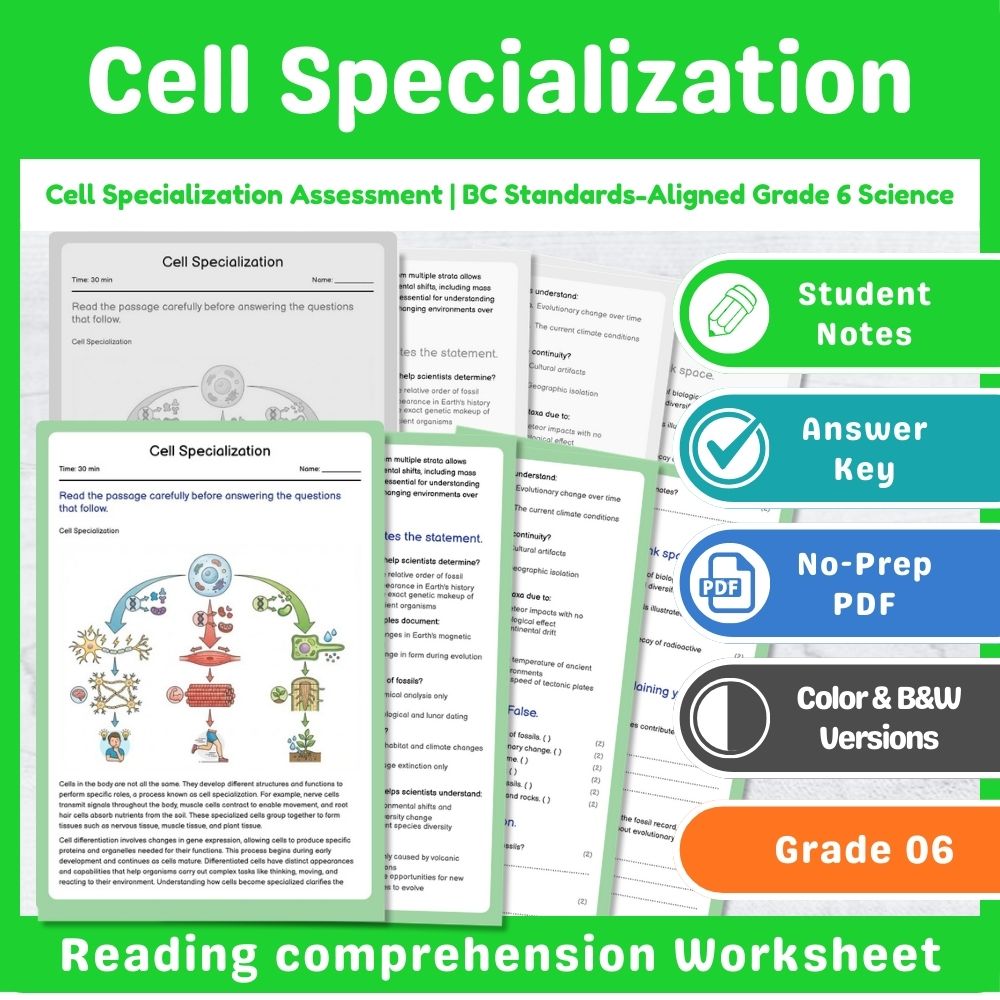
Cell Specialization Assessment | BC Standards-Aligned Grade 6 Science
Created byPrism Point LearningLearning Objectives
- Explain the concept of cell specialization and how it relates to tissue and organ function.
- Identify examples of specialized cells and their roles within an organism.
- Describe the process of differentiation and its importance in cellular diversity.
Instant download
Grade 6 Science – Stewardship Strategies & Habitat Restoration | Daily Worksheet
Created byQuiet Forest EducationLearning Objectives
- Understand the importance of habitat restoration in biodiversity conservation.
- Identify different methods used in wetland restoration.
- Recognize the trade-offs involved in various conservation approaches.
Also included in: Ecosystems and Environment Grade 6 Science Daily Worksheets Bundle | Ontario +1 more
Instant download

Grade 6 Science | Population Dynamics - Daily Reading & Comprehension Practice
Created byCoral Reef LearningLearning Objectives
- Understand how populations grow or decline over time.
- Identify factors that influence population changes.
- Analyze graphical data related to population studies.
Instant download

6th Grade Science Worksheet | Disturbance Regimes & Ecosystem Impact (PDF)
Created bySilver Birch TeachingLearning Objectives
- Describe how different disturbances (fire, insects, windthrow, flooding, and human activity) affect forest structure and succession.
- Explain how disturbance frequency, intensity, and spatial extent influence regeneration patterns and habitat mosaics.
- Use evidence from a landscape to infer how disturbance regimes can shape long-term ecosystem trajectories.
Also included in: Grade 6 Ecosystem Interactions Science Lesson Bundle: Alberta Framework +1 more
Instant download

Grade 6 Science Matter Properties Worksheet | Standards-Aligned Practice
JCreated byJ.S SheetsLearning Objectives
- Identify observable properties of matter (such as color, hardness, and texture).
- Explain how conductivity of heat and electricity helps classify materials.
- Compare matter in different forms (solid, liquid, gas) and connect evidence to predictions.
Also included in: Grade 6 Matter, Motion, and Heat Science Lesson Bundle – General Framework +1 more
Instant download

Competition for Limited Resources Worksheet | Grade 6 Science
Created byBRIGHT PATH RESOURCESLearning Objectives
- Explain how organisms compete for limited resources in a community.
- Describe how traits and timing can affect which species survives and persists.
- Use examples to predict how population sizes may change over generations due to competition.
Also included in: Grade 6 Life Science Worksheets Bundle | Ecosystems & Body Systems +2 more
Instant download

Grade 6 Science Worksheet: Magnetic Separation – Standards-Aligned Practice
JCreated byJ.S SheetsLearning Objectives
- Explain how magnetic separation sorts mixtures using differences in magnetic properties
- Describe observations of what moves toward a magnet versus what stays behind
- Distinguish physical separation from chemical change
Also included in: Grade 6 Matter, Motion, and Heat Science Lesson Bundle – General Framework +1 more
Instant download

Matter Cycles Through Ecosystems Worksheets | Grade 6 Science
Created byBRIGHT PATH RESOURCESLearning Objectives
- Explain how matter is recycled between living organisms and non-living parts of an ecosystem.
- Identify reservoirs and flows in a matter cycle model.
- Describe how producers, consumers, and decomposers help move matter through an ecosystem.
Also included in: Grade 6 Life Science Worksheets Bundle | Ecosystems & Body Systems +2 more
Instant download

Mixture Separation Worksheet | Standards-Aligned Science Practice Grade 6
JCreated byJ.S SheetsLearning Objectives
- Understand that mixtures are combinations of substances that retain their individual properties.
- Identify physical separation methods based on differences like density, particle size, boiling point, and solubility.
- Describe how oil and water separate without chemical reaction.
Also included in: Grade 6 Matter, Energy, and Forces Science lesson bundle – Florida (NGSSS) +1 more
Instant download

System Integration Worksheet for Grade 6 Science | Standards-Aligned Practice
JCreated byJ.S SheetsLearning Objectives
- Understand how different organ systems interact to maintain homeostasis.
- Identify feedback mechanisms involved in temperature regulation and blood sugar control.
- Describe the roles of the nervous, endocrine, and circulatory systems in system integration.
Instant download

6th Grade Science | Variables Worksheet (Alberta Standards) (PDF)
Created byEvergreen Desk EducationLearning Objectives
- Identify independent, dependent, and controlled variables in a science investigation.
- Explain why controlled variables must be kept constant to support valid conclusions.
- Use operational definitions and consistent measurement intervals to collect reliable data.
Instant download

Grade 6 Testable Questions Worksheet | Practice & Assessment PDF
Created byClear Sky ClassroomLearning Objectives
- Explain what makes a scientific question testable by linking it to measurable evidence.
- Identify independent and dependent variables and describe which conditions must stay constant.
- Revise a question so it includes clear measurable outcomes and observable criteria.
Instant download

Grade 6 Solar System Components & Planet Classification Science Worksheet
 Created byTeacher's Corner
Learning Objectives
- Describe major components of the solar system, including planets, dwarf planets, and belts of small bodies.
- Compare terrestrial and gas giant planets using composition, atmosphere, and surface conditions.
- Explain how orbital location and energy balance relate to temperature and habitability.
Instant download

Feedback Control Worksheet for Grade 6 Science | NGSS-Aligned Assessment
JCreated byJ.S SheetsLearning Objectives
- Understand how physiological feedback mechanisms maintain internal stability.
- Identify examples of negative and positive feedback in organ systems.
- Explain the roles of sensors, effectors, and set points in feedback loops.
Also included in: Grade 6 Cellular Processes and Feedback Science Lesson Bundle – NGSS +1 more
Instant download

Grade 6 Science | Forces And Motion Worksheet | General Standard
Created byLumora LearningLearning Objectives
- Explain how net force affects an object’s motion (speed and direction).
- Distinguish between balanced forces and unbalanced forces using real-life examples.
- Use friction and normal force ideas to predict whether an object will stay at rest, move steadily, or accelerate.
Instant download

Carbon Cycling Assessment | NGSSS Standards Grade 6 Science
Created byPrism Point LearningLearning Objectives
- Explain how carbon moves through living systems using photosynthesis, respiration, feeding, and decomposition.
- Identify the roles of producers, consumers, and decomposers in the carbon cycle.
- Describe how carbon can be stored in organic matter and soil and later used again.
Also included in: Grade 6 Ecosystems Science Lesson Bundle | Florida NGSSS Assessment
Instant download
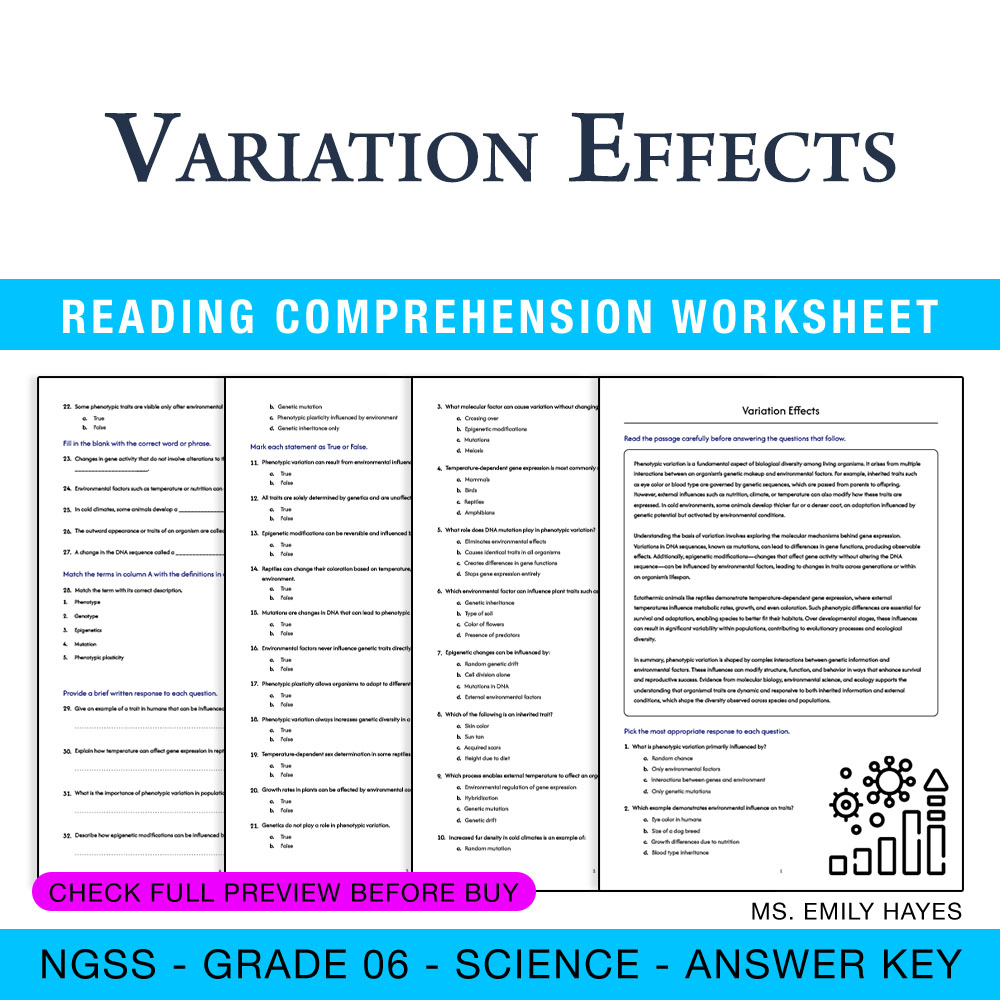
6th Grade Science | Variation Effects Worksheet (PDF + Answer Key)
 Created byCopper Leaf Classroom
Learning Objectives
- Understand the factors contributing to phenotypic variation in organisms.
- Explain how genetic and environmental influences affect organism characteristics.
- Identify examples of phenotypic variation caused by environmental factors.
Instant download

Grade 6 Tree Evidence in Science Worksheet | NGSS Science Activity & Notes
Created byBRIGHT PATH RESOURCESLearning Objectives
- Understand the concept of phylogenetic trees and how they illustrate evolutionary relationships.
- Identify homologous structures, vestigial organs, and conserved DNA sequences in organisms.
- Analyze how anatomical and molecular traits support hypotheses about common ancestry and divergence.
Also included in: Biological Evolution: Unity & Diversity Grade 6 Science Lesson Bundle | ngss +2 more
Instant download

Flight Forces Science Worksheet Grade 6 | Lift Drag Thrust Weight
 Created byChalk and Compass
Learning Objectives
- Explain how lift, drag, thrust, and weight act as interacting forces that determine motion.
- Identify weight as gravity acting downward and describe lift as the upward aerodynamic resultant.
- Use vector ideas and equilibrium to predict steady level flight, climb, and descent.
Also included in: Grade 6 Science Aviation Unit Aerodynamics & Flight Testing Lesson Bundle +1 more
Instant download

Science Worksheet Thrust Systems Propellers vs Jets Grade 6 | Ontario Standards
JCreated byJ.S SheetsLearning Objectives
- Explain how propellers create axial thrust by accelerating air backward.
- Describe how jet engines produce thrust using reaction momentum from exhaust gases.
- Compare how thrust-to-weight ratio affects climb and acceleration in flight.
Instant download

Variable Control Assessment | General Standards-Aligned Assessment Grade 6 Science
Created byPrism Point LearningLearning Objectives
- Understand the importance of controlling variables in scientific experiments.
- Identify different types of variables and how to keep them constant.
- Explain how variable control contributes to reliable evidence and conclusions.
Also included in: Grade 6 Data & Evidence Science Lesson Bundle | General Framework
Instant download

Grade 6 Science – Stability Modes in Aircraft & Flight Dynamics | Worksheet
Created byBright Mind ResourcesLearning Objectives
- Understand the difference between static and dynamic stability in aircraft.
- Identify how aircraft geometry contributes to longitudinal, lateral, and directional stability.
- Describe the effects of center of gravity and dihedral angles on stability.
Also included in: Grade 6 Aerodynamics Science Lesson Bundle Daily Reading Worksheets | Ontario +1 more
Instant download
About Grade 6 Science Worksheets
Explore Grade 6 Science worksheets for classwork, homework, or review. Our 5,997 printables download instantly as PDFs.
MyTeachingSheets worksheets are made by real teacher-authors and checked before they go live. Download any as a print-ready PDF for lessons, homework, or independent practice — most include answer keys, and previews are always free.