
Grade 6 Science Worksheets
5,997 worksheets
Grade 6 Cell Evidence Worksheet | NGSS Cells & Microscopy Science Activity
 Created byNorthstar Worksheets
Learning Objectives
- Explain how microscopy and preserved specimens provide evidence that cells are the basic unit of life.
- Compare single-celled organisms with multicellular organisms using observable cell evidence.
- Describe how cells, tissues, organs, and whole organisms are connected in biological organization.
Also included in: Cells & Human Body Systems Lesson Bundle | Grade 6 Science | NGSS +1 more
Instant download

Wind Tunnel Practice Worksheet | Grade 6 Science Assessment Ontario
 Created byPrism Point Learning
Learning Objectives
- Explain how wind tunnels measure aerodynamic forces and moments on models using balance systems and pressure taps.
- Describe how similar flow conditions, such as Reynolds and Mach numbers, affect scaling from models to real objects.
- Calculate lift and drag coefficients from measured forces and relate flow visualization to design improvements.
Also included in: Grade 6 Aerodynamics Flight Design Science lesson bundle - Ontario
Instant download

Control Surfaces Worksheet | Grade 6 Science Practice
Created byPrism Point LearningLearning Objectives
- Explain how ailerons, elevators, and rudders change airflow to create aerodynamic moments.
- Describe how control-surface deflection affects rolling, pitching, and yawing motions.
- Connect control-surface use to real aviation situations such as crosswinds and short-field takeoffs.
Also included in: Aerodynamics and Flight Design Lesson Bundle – Grade 6 Science Alberta
Instant download

Grade 6 Science | Chemical Evidence - Daily Reading Comprehension
 Created byCoral Reef Learning
Learning Objectives
- Identify observable signs that indicate a chemical change has occurred
- Differentiate between physical and chemical changes based on signs
- Recognize real-life examples of chemical reactions
Instant download

Grade 6 Competition for Survival Worksheet | California Science PDF
 Created byEvergreen Desk Education
Learning Objectives
- Explain how limited resources lead to competition between organisms.
- Describe how direct and indirect competition can affect survival and reproduction.
- Use evidence from a scenario to predict how population sizes may change.
Instant download

Adaptations & Natural Selection Worksheets | Grade 6 Science
Created byPrism Point LearningLearning Objectives
- Identify structural, behavioural, and physiological adaptations
- Explain how adaptations improve survival in environments
- Distinguish inherited traits from acquired characteristics
Instant download

Grade 6 Science | Competition & Resource Use - Daily Reading Comprehension
Created byCoral Reef LearningLearning Objectives
- Understand the concept of competition among organisms
- Identify different types of competition in nature
- Recognize how competition affects population and species survival
Instant download

Grade 6 Science – Biomass Building & Plant Growth | Daily Reading Worksheet
 Created byBright Mind Resources
Learning Objectives
- Understand how plants grow by building biomass through photosynthesis.
- Identify the role of carbon-based molecules in plant development.
- Explain the process of plant tissue formation including carbohydrates, proteins, and fats.
Also included in: Grade 6 Ecosystems and Energy Science Lesson Bundle | California Standards +1 more
Instant download

Grade 6 Science Respiration and Digestion Worksheet | Standards-Aligned Practice
JCreated byJ.S SheetsLearning Objectives
- Describe how the respiratory system exchanges oxygen and carbon dioxide through diffusion
- Explain how the digestive system breaks food into smaller molecules that can enter circulation
- Connect digestion and respiration to how cells release energy
Also included in: Grade 6 Life Processes & Ecosystems Science lesson bundle: General Framework +1 more
Instant download
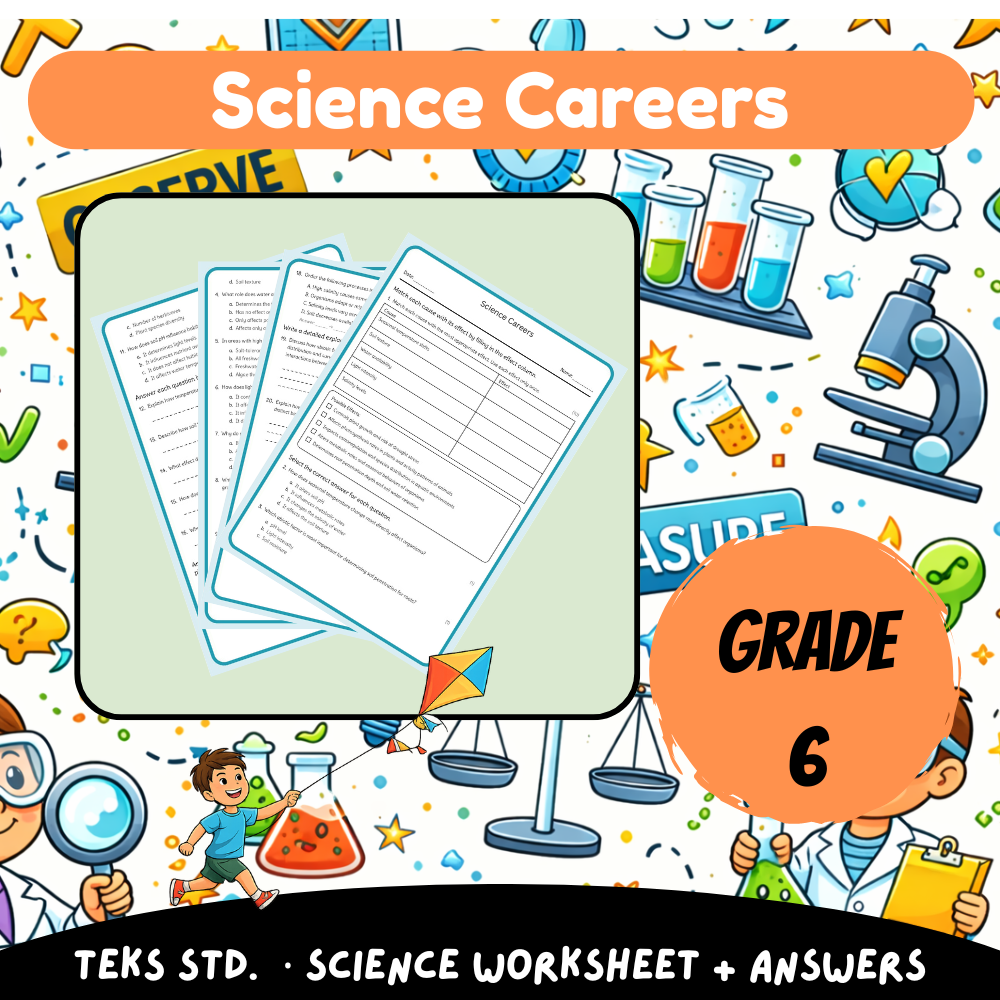
6th Grade Science | Careers in Science Worksheet (Worksheet + Answer Key) PDF
Created byBright Mind ResourcesLearning Objectives
- Identify various science-related careers and their roles.
- Understand the tasks performed by professionals in science careers.
- Recognize skills and coursework needed for science occupations.
Instant download

Functions of Circuit Components Worksheet | Grade 6 Science | Ontario
 Created byTeacher's Corner
Learning Objectives
- Match common circuit components to their functions in a complete circuit.
- Explain how switches change current flow and how resistors affect voltage and current qualitatively.
- Interpret schematic symbol meaning for power sources, switches, resistive loads, and connectors.
Instant download

Grade 6 Science | Friction Effects Worksheet | NGSSS Aligned
 Created byLumora Learning
Learning Objectives
- Explain how friction opposes motion between two contacting surfaces
- Describe how surface texture affects the distance an object slides
- Connect friction and air resistance to energy transfer and changes in motion
Instant download
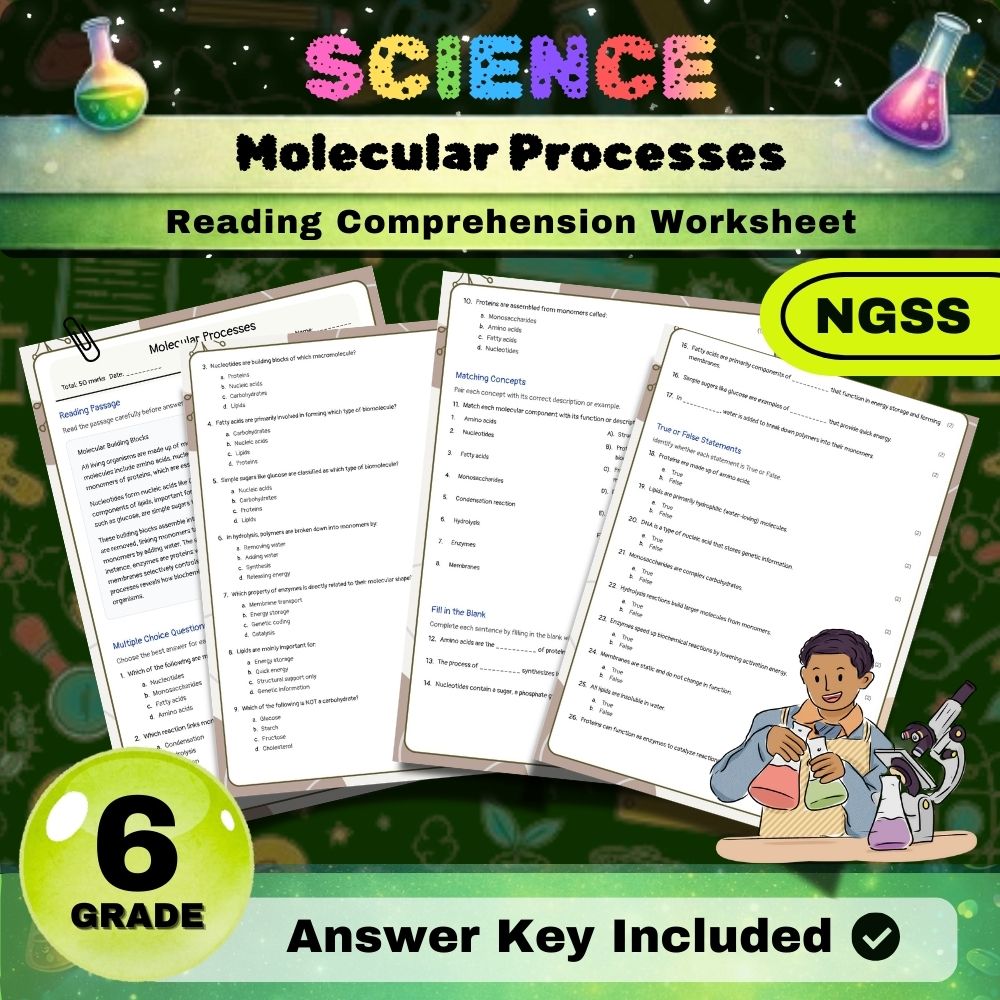
6th Grade Science | Molecular Processes Worksheet (PDF- NGSS Aligned)
 Created byMaple Path Learning
Learning Objectives
- Explain the role of monomers such as amino acids, nucleotides, fatty acids, and monosaccharides in forming macromolecules.
- Describe how condensation reactions build polymers and hydrolysis breaks them down.
- Relate molecular structure of biomolecules to their properties and functions in living organisms.
Also included in: Grade 6 Science Unit Bundle – Cell Functions, Energy & Organ Systems Worksheets +1 more
Instant download

Synthetic Materials Worksheet Grade 6 Science NGSS with Answer Key
Created byNorthstar WorksheetsLearning Objectives
- Explain how synthetic materials can be traced back to natural resources and processing steps.
- Compare properties of common synthetic materials (durability, flexibility, conductivity, biodegradability) to match materials to uses.
- Describe how resource extraction and manufacturing can affect society and the environment, including recyclability.
Also included in: Grade 6 Matter & Chemical Reactions Lesson Bundle | NGSS | Science +1 more
Instant download

Water Cycle Worksheet for Grade 6 | NGSS-Aligned Science Practice
JCreated byJ.S SheetsLearning Objectives
- Describe the processes involved in the water cycle, including evaporation, condensation, precipitation, runoff, infiltration, and groundwater storage.
- Explain how solar energy and gravity drive the movement of water through various reservoirs in the hydrosphere.
- Identify examples such as evapotranspiration, river discharge, aquifer recharge, and seasonal snowmelt that illustrate water transport and storage timescales.
Also included in: Grade 6 Earth System Interactions Climate Science Lesson Bundle – NGSS +1 more
Instant download

Measurement Precision Worksheet for Grade 6 Science | Standards-Aligned Practice
JCreated byJ.S SheetsLearning Objectives
- Understand the importance of selecting appropriate measurement tools and units.
- Differentiate between precision and accuracy in measurement.
- Identify common errors in measurement and ways to reduce them.
Also included in: Grade 6 Scientific Inquiry Evidence Reasoning Science Lesson Bundle +1 more
Instant download
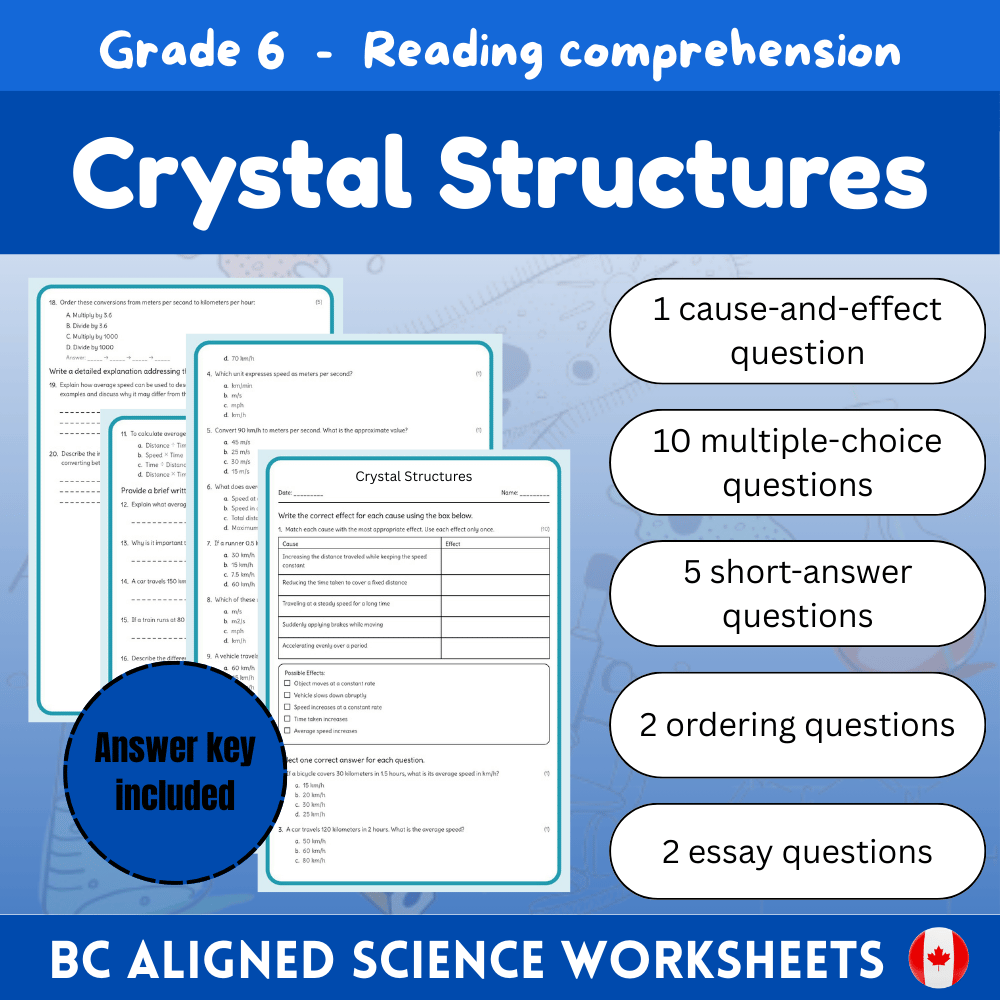
Grade 6 Science | Crystal Structures Worksheet (Answer Key) – BC Standards
Created byBright Mind ResourcesLearning Objectives
- Explain the difference between crystalline and amorphous solids based on their particle arrangements.
- Describe how particle bonding strength and spatial arrangement influence the properties of solids.
- Connect microscopic structures of solids to their observable behaviors such as melting points, brittleness, and cleavage.
Instant download

Grade 6 Science | Understanding Aerodynamic Design - Daily Reading Comprehension
Created byCoral Reef LearningLearning Objectives
- Identify key concepts of aerodynamics such as lift, drag, and stability.
- Understand how shape, surface, and orientation influence flight.
- Apply principles to practical devices like kites and model gliders.
Also included in: Air and Aerodynamics Lesson Bundle – Grade 6 Science Alberta Reading Comp. +1 more
Instant download

Model to Explain Change Worksheet | Standards-Aligned Grade 6 Science Practice
JCreated byJ.S SheetsLearning Objectives
- Understand how particle models represent physical and chemical changes.
- Identify differences in particle arrangements during physical and chemical changes.
- Explain how particle models support the conservation of atoms during matter changes.
Also included in: Grade 6 Physical Science Lesson Bundle for Science – California Standards +1 more
Instant download

Grade 6 Robotic Missions Worksheet | Space Exploration Science Activity
 Created byClear Sky Classroom
Learning Objectives
- Identify the main types of robotic missions (flyby, orbiter, lander, and sample-return) and what each is designed to do.
- Explain how distance and communication delay shape spacecraft design and mission timelines.
- Describe how planetary environments and engineering constraints affect instrumentation, propulsion choices, and data return.
Instant download

Grade 6 Science | Understanding Air Density - Daily Reading Comprehension
Created byCoral Reef LearningLearning Objectives
- Define air density and explain its importance in science and everyday life.
- Identify the factors that influence air density, including temperature, humidity, and altitude.
- Describe how variations in air density affect buoyancy and aerodynamic forces.
Also included in: Air and Aerodynamics Lesson Bundle – Grade 6 Science Alberta Reading Comp. +1 more
Instant download

Grade 6 Airfoil Shape Worksheet | Ontario Science Practice & Answer Key
Created byClear Sky ClassroomLearning Objectives
- Explain how airfoil geometry (camber, thickness, chord length, and leading-edge curvature) affects lift and pressure distribution.
- Compare simplified Bernoulli and Newtonian ideas for lift generation and relate them to pressure differences.
- Describe how angle of attack influences lift coefficient and how stall can occur at critical angles.
Instant download
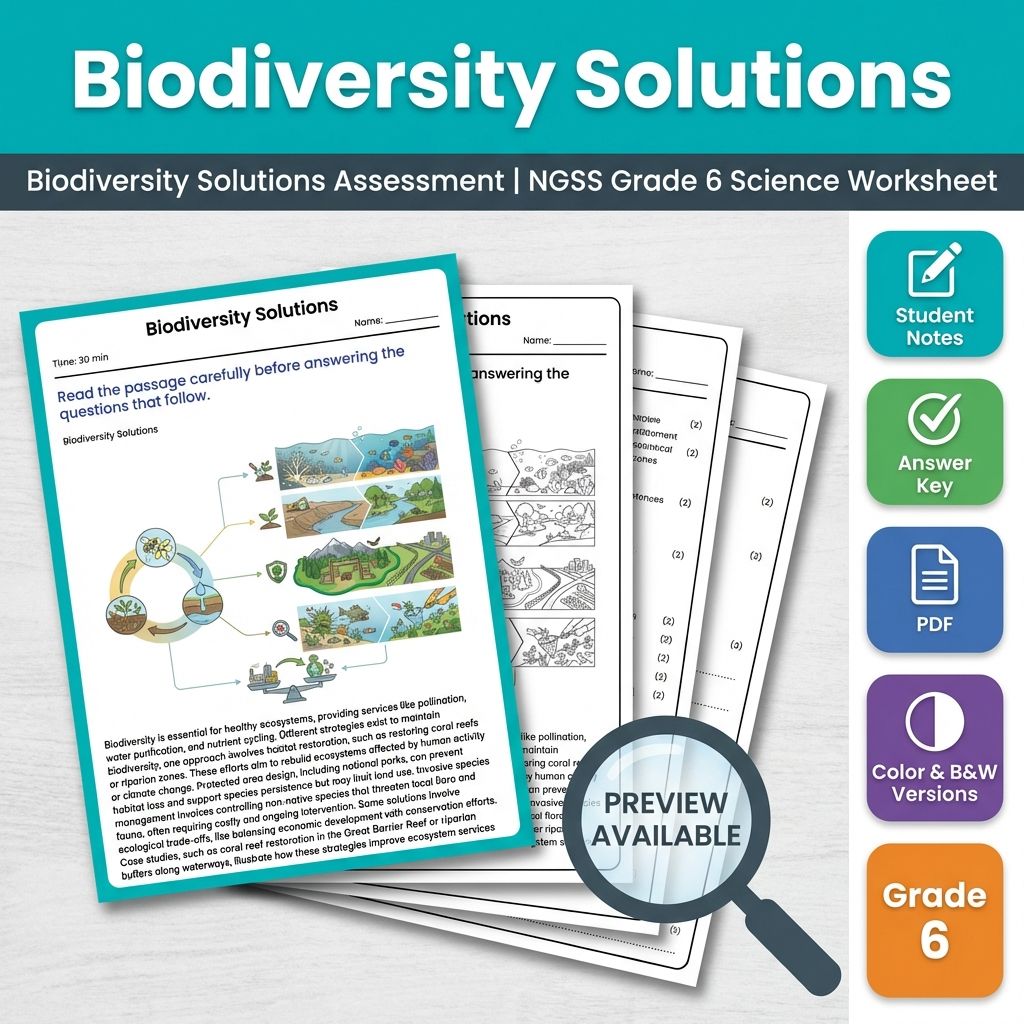
Biodiversity Solutions Assessment | NGSS Grade 6 Science Worksheet
Created byPrism Point LearningLearning Objectives
- Compare different conservation strategies and their ecological trade-offs.
- Analyze case studies like coral reef restoration and riparian buffers.
- Evaluate the effectiveness of various biodiversity maintenance solutions.
Also included in: Grade 6 Science Mini Bundle | Ecosystems: Interactions, Energy, and Dynamics +1 more
Instant download

6th Grade Science Worksheet – Musculoskeletal System BC Standards (PDF)
Created byEvergreen Desk EducationLearning Objectives
- Explain how bones, joints, and muscles work together to support and move the body.
- Describe how muscles create movement by contracting and how joints control motion.
- Connect the musculoskeletal system to the nervous and circulatory systems for coordinated activity.
Instant download

Evaporation and Transpiration Worksheet Grade 6 Water Cycle Science
Created byPrism Point LearningLearning Objectives
- Explain how evaporation adds water vapor to the atmosphere when temperatures increase.
- Describe how transpiration from plants contributes water vapor to the air.
- Connect phase changes to the hydrosphere and atmosphere and the start of precipitation.
Also included in: Grade 6 Water Cycle Systems Lesson Bundle | California Standards
Instant download

Grade 6 Food Molecules Worksheet | Practice & Standards PDF
Created byClear Sky ClassroomLearning Objectives
- Explain how food molecules provide building materials and stored energy in the body.
- Describe how digestion breaks large food molecules into smaller molecules for absorption.
- Identify examples of different food molecules (carbohydrates, proteins, fats) and the body uses they support.
Instant download

Grade 6 Science – Physical Properties & Changes | Daily Reading Worksheet
Created byBright Mind ResourcesLearning Objectives
- Understand and identify various physical properties of matter such as mass, volume, density, conductivity, melting point, and hardness.
- Describe how physical properties can be observed or measured without changing the chemical identity of a substance.
- Differentiate between physical changes and chemical changes based on the properties discussed.
Also included in: Matter & Change Grade 6 Science Daily Reading Worksheets Lesson Bundle | BC +1 more
Instant download

Water Cycle Pathways Worksheet | Grade 6 Science Water Cycle Activity
Created byPrism Point LearningLearning Objectives
- Describe the main pathways of the water cycle, including evaporation, condensation, precipitation, runoff, and infiltration.
- Explain how energy changes water’s state and how those changes move water between the atmosphere and Earth’s surface.
- Connect water cycle pathways to effects such as humidity, cloud formation, stream flow, and drought or flooding.
Also included in: Grade 6 Weather & Climate Science Lesson Bundle | Florida NGSSS
Instant download

6th Grade Science Worksheet | Disturbance Regimes (Alberta Standard) PDF
Created byEvergreen Desk EducationLearning Objectives
- Explain what disturbance regimes are and identify major types (fire, insects, windthrow, flooding, and human disturbance) in forest ecosystems
- Describe how disturbance frequency, intensity, and spatial extent influence regeneration and forest succession
- Interpret how disturbance-driven mosaics affect long-term ecosystem trajectories and habitat diversity
Instant download

Grade 6 Wing Shape and Lift Efficiency Worksheet | Alberta Science
 Created byBRIGHT PATH RESOURCES
Learning Objectives
- Identify cause-and-effect details about how wing features change lift and drag.
- Explain how camber, thickness, and aspect ratio connect to pressure patterns and stall behavior.
- Use text evidence to describe how wing geometry matches an aircraft’s mission.
Also included in: Aerodynamics & Flight Physics Grade 6 Science Worksheets Bundle | Alberta +1 more
Instant download
Grade 6 Science | Celestial Patterns Reading Worksheet (PDF + Answer Key)
JCreated byJ.S SheetsLearning Objectives
- Understand the predictable paths and cycles of celestial bodies as observed from Earth.
- Identify patterns of the Sun, Moon, and planets in the night sky.
- Describe how celestial motions assist in timekeeping and navigation.
Also included in: Grade 6 Science | Celestial Motion & Sky Observation Worksheets Bundle +1 more
Instant download

Grade 6 Science | Series & Parallel Circuits - Daily Reading Comprehension
Created byCoral Reef LearningLearning Objectives
- Understand key concepts related to Science
- Apply knowledge through practice questions
- Demonstrate comprehension of the material
Instant download

Grade 6 Science | Charge Concepts - Daily Reading Comprehension
Created byCoral Reef LearningLearning Objectives
- Define electric charge and understanding its basic properties.
- Differentiate between static and current electricity.
- Recognize phenomena related to charge imbalance, such as hair attraction and sparks.
Instant download

Invasive Species Worksheet Grade 6 Science | Ontario Curriculum
Created byClear Sky ClassroomLearning Objectives
- Explain how invasive species are introduced and why they can establish quickly in new environments.
- Describe how invasive species can alter native food webs through competition and predation.
- Analyze how ecosystem processes such as nutrient cycling and habitat structure may change after an invasion.
Instant download

Grade 6 Science | Respiration & Digestion Daily Reading Comprehension
Created byCoral Reef LearningLearning Objectives
- Understand how the respiratory system exchanges gases.
- Learn the main parts and functions of the respiratory system.
- Explore how breathing and gas exchange support life.
Instant download

Grade 6 Atom Conservation Worksheet | Practice & PDF with Standards
Created byClear Sky ClassroomLearning Objectives
- Explain that atoms of elements are neither created nor destroyed in chemical reactions.
- Use particle diagrams to represent reactants and products and check that the same atoms appear on both sides.
- Connect conservation of atoms to macroscopic observations such as new substances forming.
Instant download

Earth System Spheres Worksheet Pack Grade 6 Science Earth Systems
Created byPrism Point LearningLearning Objectives
- Identify Earth’s major spheres (geosphere, hydrosphere, atmosphere, biosphere) and describe how they interact.
- Explain how energy and gravity help move matter and influence changes across Earth systems.
- Use cause-and-effect reasoning to predict how changes in one sphere can affect other spheres.
Also included in: Grade 6 Water Cycle Systems Lesson Bundle | California Standards
Instant download

6th Grade Science Worksheet | Understanding Circuit Components (PDF)
Created byEvergreen Desk EducationLearning Objectives
- Identify the main components of a simple electrical circuit (battery, conductors, loads, and switches).
- Describe the role of each component in allowing charge to flow and using electrical energy.
- Explain how electrical energy is transformed into other forms of energy in common circuit loads (like bulbs or resistors).
Instant download

Grade 6 Science Data Tables, Column Headings & Units Worksheet | Alberta
Created byBRIGHT PATH RESOURCESLearning Objectives
- Identify what information belongs in data table column headings.
- Explain why units should be included with measurements.
- Recognize how consistent time stamps and clear metadata improve clarity and reuse of data.
Also included in: Inquiry Data Grade 6 Science Daily Reading Worksheets Lesson Bundle | Alberta +1 more
Instant download

Grade 6 Biodiversity Roles Worksheet | Alberta Practice PDF
Created byClear Sky ClassroomLearning Objectives
- Explain how different organisms (trees, understory plants, fungi, and animals) contribute to ecosystem functions.
- Describe how keystone and indicator species can affect ecosystem stability and biodiversity in Alberta.
- Use evidence to infer how changes in species roles can impact food webs and resilience.
Also included in: Grade 6 Biodiversity & Plant Ecosystems Science Lesson Bundle | Alberta +1 more
Instant download
6th Grade Science | Defining Problems Worksheet (PDF + Answer Key)
 Created byCopper Leaf Classroom
Learning Objectives
- Understand how to establish criteria and constraints for a design problem.
- Identify measurable success indicators and limits such as materials, cost, and safety.
- Use simple models and scientific principles to relate cause and effect in problem-solving.
Instant download

Grade 6 Drag Types Worksheet | Alberta Practice PDF
Created byClear Sky ClassroomLearning Objectives
- Explain the difference between parasitic drag and induced drag using evidence from flight and design examples
- Identify how surface roughness, frontal area, and lift-related wingtip vortices affect total drag
- Describe how drag influences required thrust and overall energy demands of flight
Also included in: Grade 6 Air and Aerodynamics Science Lesson Bundle (Alberta Framework) +1 more
Instant download

Grade 6 Science – Component Functions & Circuits | Daily Reading Worksheet
Created byBright Mind ResourcesLearning Objectives
- Identify and describe the roles of common circuit components such as power sources, resistive loads, switches, and connectors.
- Interpret schematic symbols and relate them to physical components.
- Understand how each component affects current and voltage within a circuit.
Also included in: Grade 6 Electricity Science Daily Reading Lesson Bundle | Ontario +1 more
Instant download

Carrying Capacity and Resource Limits Worksheets | Grade 6 Science
 Created byTeachers Club
Learning Objectives
- Explain how limited resources affect population size over time
- Interpret quantitative observations and identify patterns related to carrying capacity
- Use resource gradients to predict species distribution in different environments
Also included in: Grade 6 Science Full Year Bundle | NGSS Worksheets & Printables +1 more
Instant download
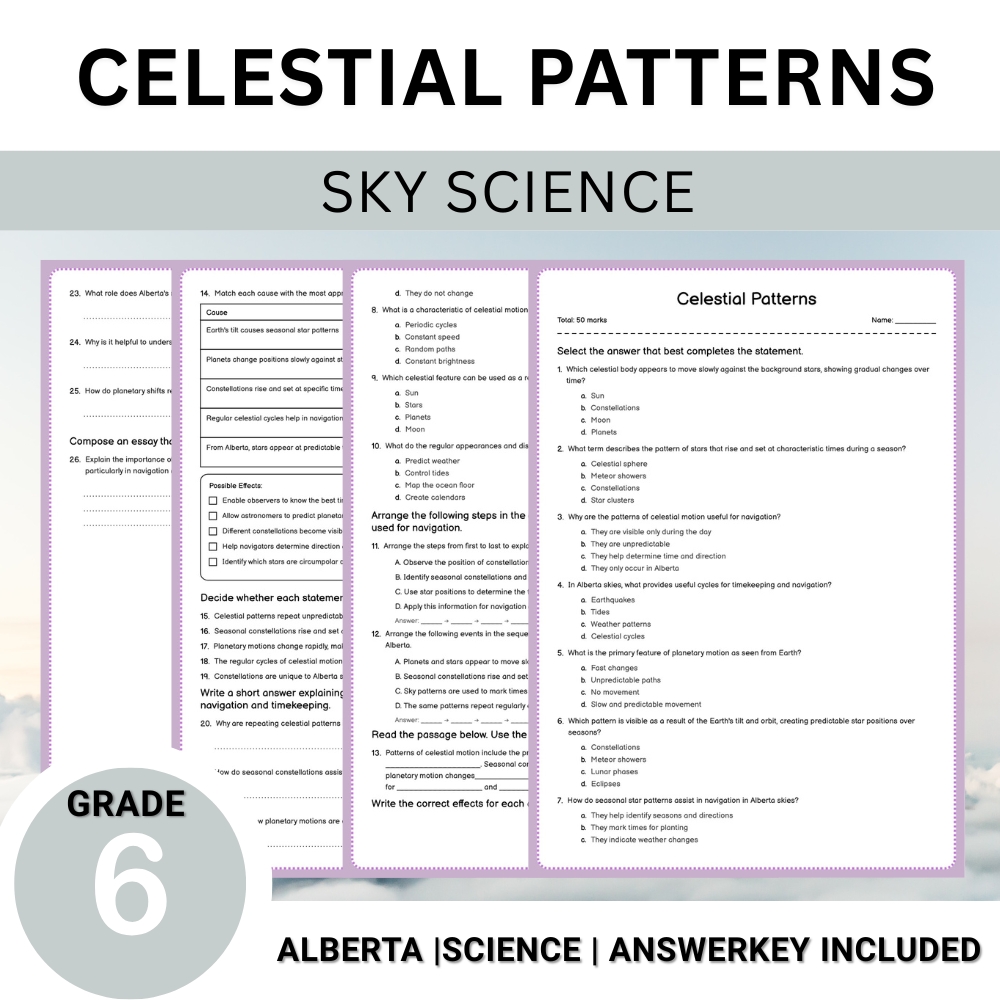
Grade 6 Science | Celestial Patterns Worksheet (Assessment & Student Practice PDF)
Learning Objectives
- Identify and describe common celestial motion patterns, including the paths of the Sun, Moon, planets, and constellations.
- Explain how seasonal constellations and planetary appearances are used for timekeeping and navigation.
- Predict celestial positions based on observed repeating patterns in the night sky.
Also included in: Grade 6 Science | Celestial & Space Phenomena UNIT Worksheet Bundle (Assessment & Practice) +1 more
Instant download
Grade 6 Science | Stability and Balance Reading Worksheets (PDF + Answer Key)
JCreated byJ.S SheetsLearning Objectives
- Understand how longitudinal and lateral stability affect aircraft and glider behavior.
- Explain the relationship between center of mass and center of pressure in maintaining stability.
- Identify design features such as dihedral angles and tail volume that contribute to static stability.
Also included in: Grade 6 Science | Flight Physics & Aerodynamics UNIT Pack (Answer Keys Included) +1 more
Instant download

Grade 6 Science – Tools Safety & Measurement Practices | Daily Reading Worksheet
Created byBright Mind ResourcesLearning Objectives
- Identify proper handling procedures for measurement tools.
- Recognize safety precautions for electronic and mechanical instruments.
- Understand protocols to prevent contamination and device damage.
Also included in: Grade 6 Science Data & Inquiry Daily Reading Worksheets Lesson Bundle | Alberta +2 more
Instant download

How Variation Becomes Traits: DNA, Environment & Grade 6 Worksheet
Created byTeachers ClubLearning Objectives
- Explain how DNA sequence differences can lead to phenotypic variation in a population.
- Describe how environmental factors can affect traits through development and gene expression.
- Use evidence-based examples to connect macromolecules and gene regulation to organism characteristics.
Also included in: From Molecules to Organisms Grade 6 Science NGSS Bundle +2 more
Instant download
About Grade 6 Science Worksheets
Explore Grade 6 Science worksheets for classwork, homework, or review. Our 5,997 printables download instantly as PDFs.
MyTeachingSheets worksheets are made by real teacher-authors and checked before they go live. Download any as a print-ready PDF for lessons, homework, or independent practice — most include answer keys, and previews are always free.