
Grade 6 Science Worksheets
5,997 worksheets
Forest Conservation Strategies and Biodiversity Worksheets Grade 6
 Created bySunny Desk Resources
Learning Objectives
- Identify conservation strategies that protect forest biodiversity and ecosystem services
- Explain how habitat protection and restoration support long-term ecosystem viability
- Describe why genetic diversity and seed-source choices matter for replanting
Also included in: Trees and Forests Grade 6 Alberta Science Worksheets Bundle +1 more
Instant download

Grade 6 Series Circuits Worksheet | Ontario Science Predictable Behavior
 Created byTeacher's Corner
Learning Objectives
- Describe how a series circuit forms a single path for current
- Explain why current is the same through series components
- Predict how total voltage is shared across series elements
Instant download

Grade 6 Sampling Methods Worksheet | Alberta Use Practice PDF
 Created byClear Sky Classroom
Learning Objectives
- Explain the differences between random, stratified, and systematic sampling
- Identify trade-offs between sample coverage, bias reduction, and practical constraints
- Evaluate how sampling choices affect the strength and limits of conclusions
Also included in: Grade 6 Scientific Investigation Data Analysis Science Lesson Bundle | Alberta +1 more
Instant download

Grade 6 Friction Effects Worksheet | Force & Motion Science Activity PDF
 Created byEvergreen Desk Education
Learning Objectives
- Explain how friction opposes motion between two contacting surfaces
- Compare how surface texture affects friction and sliding distance
- Describe how friction and air resistance influence motion and energy changes
Instant download

Grade 6 Science – Testable Questions & Inquiry Skills | Daily Reading Worksheet
 Created byBright Mind Resources
Learning Objectives
- Understand what makes a question testable in scientific experiments.
- Learn how to identify variables and measurable outcomes in questions.
- Develop skills to formulate testable scientific questions from observations.
Also included in: Variables & Experiments Data Grade 6 Science Worksheets Lesson Bundle | General +1 more
Instant download

Tree Anatomy Science Worksheet | Standards-Aligned Grade 6 Practice
JCreated byJ.S SheetsLearning Objectives
- Identify the major structures of a tree and their functions.
- Explain how tree structures support survival in different habitats.
- Describe relationships between form and function in tree parts.
Instant download
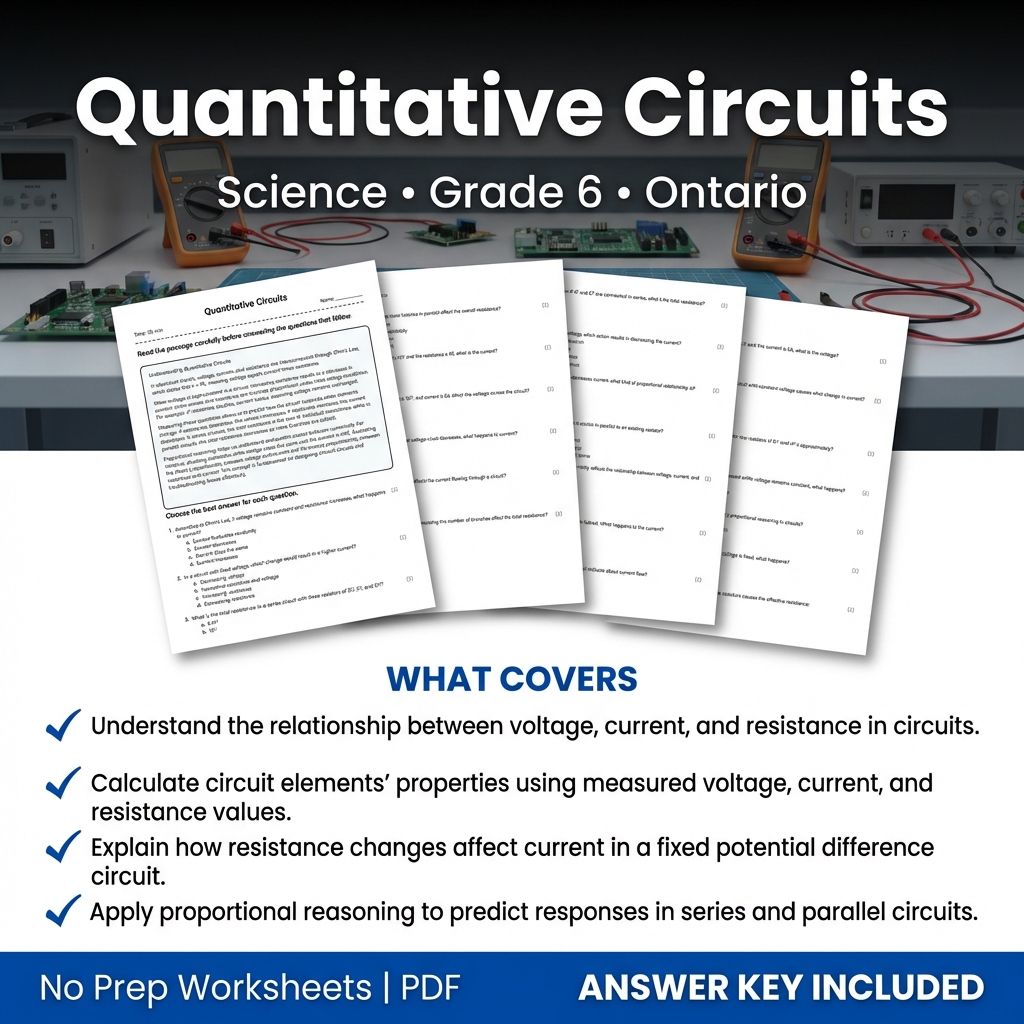
Grade 6 Science Worksheet on Quantitative Circuits | Ontario Standards
 Created byCoral Reef Learning
Learning Objectives
- Understand the relationship between voltage, current, and resistance in circuits.
- Calculate circuit elements' properties using measured voltage, current, and resistance values.
- Explain how resistance changes affect current in a fixed potential difference circuit.
Instant download

Grade 6 Forces and Motion Science Worksheet | NGSS Printable Activity
 Created byBRIGHT PATH RESOURCES
Learning Objectives
- Understand the concept of net force and how it affects object motion.
- Identify different forces acting on an object and their directions.
- Relate net force, mass, and acceleration using mathematical formulas.
Also included in: Motion and Stability: Forces and Interactions Grade 6 Science Bundle | NGSS +2 more
Instant download

Grade 6 Science | Energy From Sun - Daily Reading Comprehension
Created byCoral Reef LearningLearning Objectives
- Learn how the Sun’s energy reaches Earth
- Understand why energy varies by location and angle
- Discover how solar energy affects weather and climate
Instant download
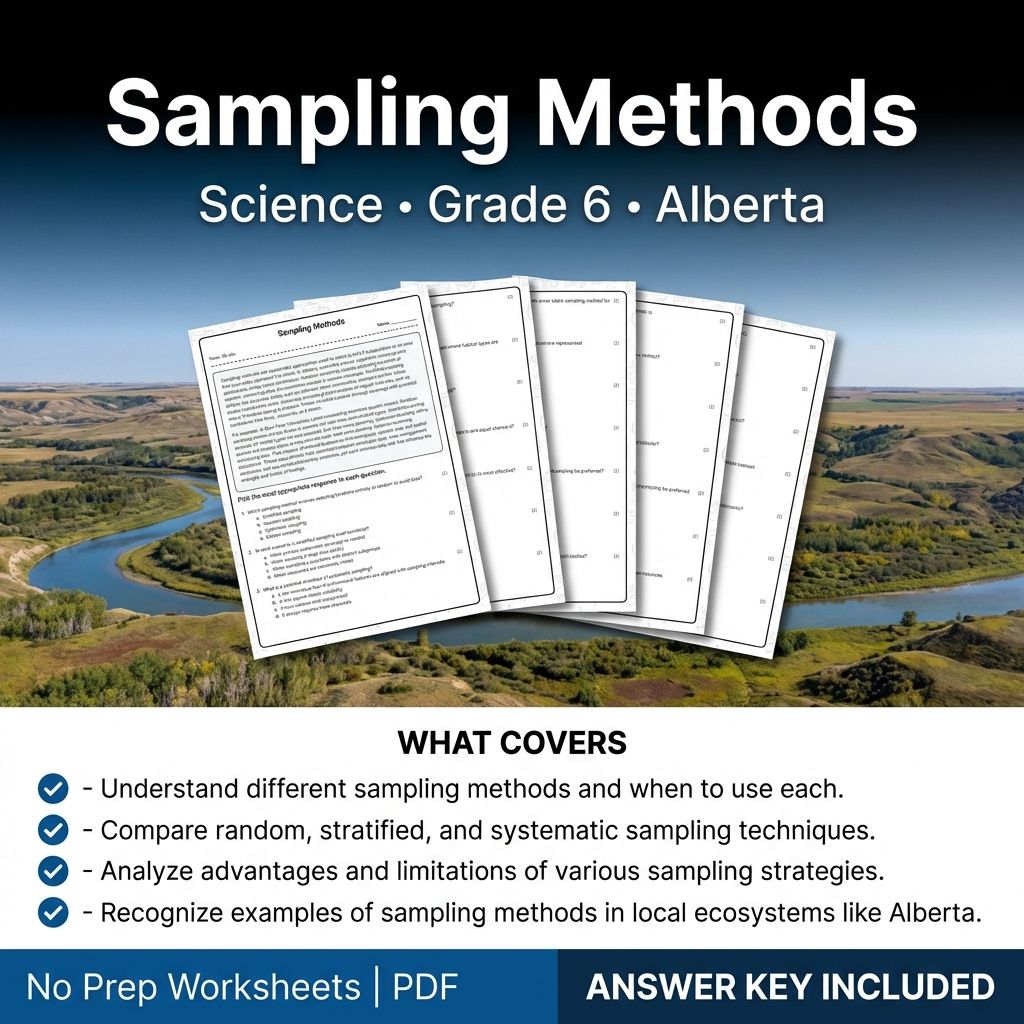
Sampling Methods Worksheet for Grade 6 Science | Alberta Standards Practice
Created byCoral Reef LearningLearning Objectives
- Understand different sampling methods and when to use each.
- Compare random, stratified, and systematic sampling techniques.
- Analyze advantages and limitations of various sampling strategies.
Instant download
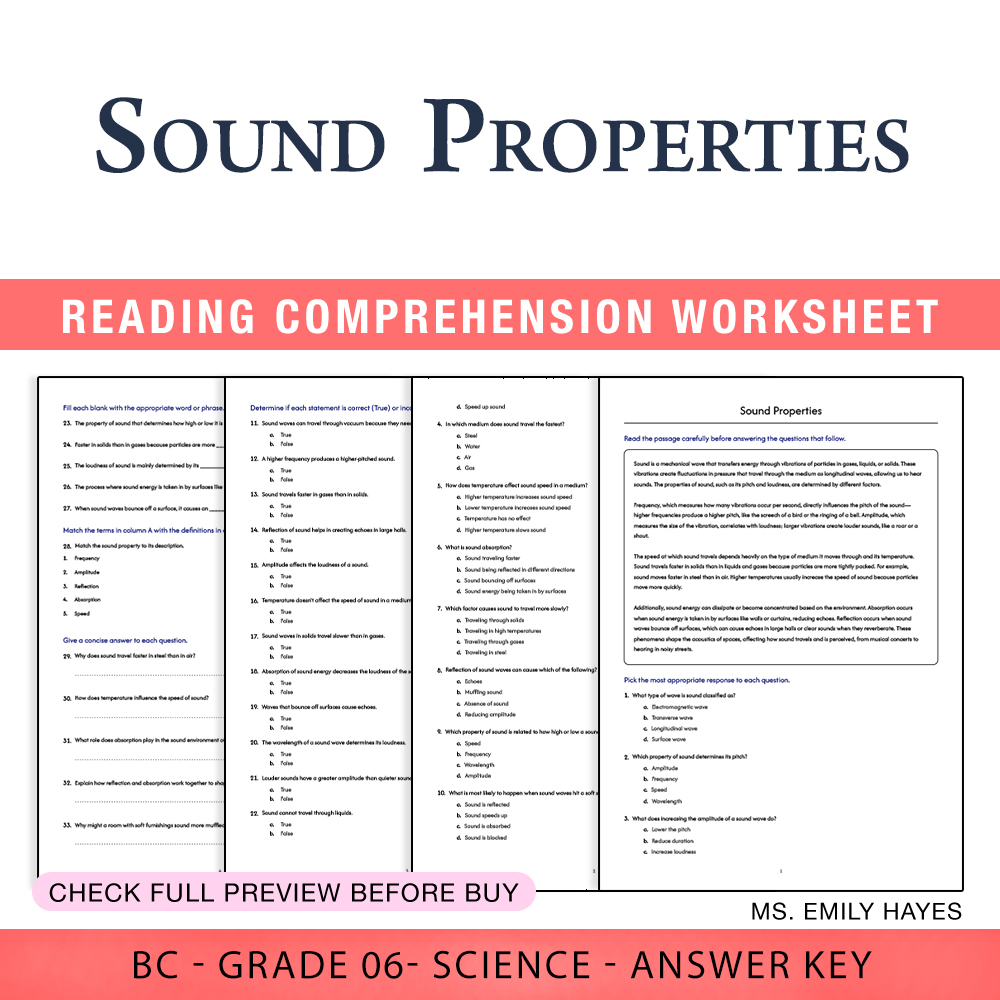
6th Grade Science | Sound Properties Worksheet (PDF+ Answer Key)
 Created byCopper Leaf Classroom
Learning Objectives
- Understand that sound is a mechanical wave that travels through various media.
- Identify how frequency affects pitch and amplitude affects loudness.
- Explain how sound speed varies depending on the medium and temperature.
Also included in: Grade 6 Science BC | Waves, Sound, Light & Energy Worksheets (PDF + Answer Key) +1 more
Instant download

Grade 6 Science – Energy & Power in Electricity | Daily Reading Worksheet
Created byBright Mind ResourcesLearning Objectives
- Understand the concept of electrical energy transfer
- Explain how power relates to energy transfer rate
- Identify everyday examples of electrical power use
Also included in: Grade 6 Electricity Science Daily Reading Lesson Bundle | Ontario +1 more
Instant download

Grade 6 Science | Photosynthesis Energy Conversion | California Standards
 Created byLumora Learning
Learning Objectives
- Explain how photosynthesis converts light energy into chemical energy stored in glucose and other molecules.
- Identify the inputs (carbon dioxide and water) and the byproduct (oxygen) of photosynthesis.
- Describe, at a basic level, how the light-dependent reactions form ATP and NADPH and how the Calvin cycle uses them to build sugars.
Instant download

Grade 6 Science – Habitat Fragmentation & Effects | Daily Reading Worksheet
Created byBright Mind ResourcesLearning Objectives
- Understand what habitat fragmentation is and how it impacts ecosystems.
- Analyze how landscape changes influence animal and plant populations.
- Identify examples of habitat division caused by human activities.
Also included in: Grade 6 Ecology & Biodiversity Science Lesson Bundle | Ontario Daily Reading +1 more
Instant download
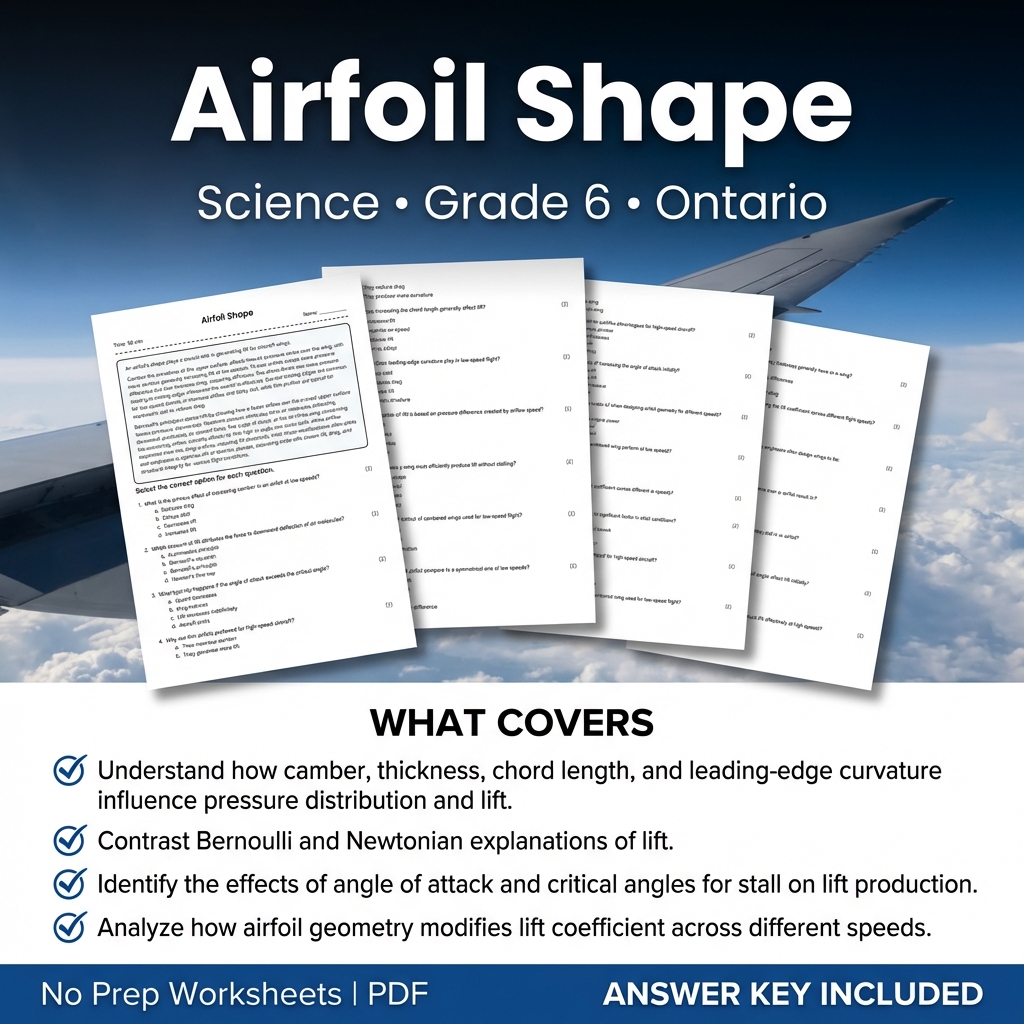
Grade 6 Science Worksheet on Airfoil Shape – Ontario Standards
Created byCoral Reef LearningLearning Objectives
- Understand how camber, thickness, chord length, and leading-edge curvature influence pressure distribution and lift.
- Contrast Bernoulli and Newtonian explanations of lift.
- Identify the effects of angle of attack and critical angles for stall on lift production.
Instant download

Density and Floating Worksheets | Grade 6 Science Practice and Review
LCreated byLearnora ResourcesLearning Objectives
- Define density as mass packed into a given volume
- Identify and compare mass, volume, density, and material
- Calculate density using mass divided by volume
Instant download

Apparent Sun, Moon & Star Motion Worksheets | Grade 6 Space Science
 Created byPrism Point Learning
Learning Objectives
- Explain how Earth’s rotation creates apparent daily sky motion
- Describe how Earth’s orbit changes the Sun’s apparent yearly path
- Define diurnal rising, setting, and apparent stellar paths
Also included in: Grade 6 Space Science Lesson Bundle | Ontario Science Framework
Instant download

Grade 6 Science | Growth Rings Worksheet (Alberta Standards) (PDF)
 Created bySilver Birch Teaching
Learning Objectives
- Explain how growth rings form and how they can be used to estimate a tree’s age and growth patterns.
- Describe how ring width and density can reflect environmental conditions such as moisture, temperature, and disturbances.
- Connect dendrochronology methods to reconstructing past climate and disturbance events (such as drought or fire).
Also included in: Grade 6 Ecosystem Interactions Science Lesson Bundle: Alberta Framework +1 more
Instant download

Grade 6 Science – Photosynthesis & Energy Conversion | Daily Reading Worksheet
Created byBright Mind ResourcesLearning Objectives
- Understand the process of photosynthesis and how plants convert sunlight into chemical energy.
- Identify the key components involved in photosynthesis, including light, water, carbon dioxide, and oxygen.
- Explain the energy transformation that occurs during photosynthesis and its importance to life on Earth.
Also included in: Grade 6 Ecosystems and Energy Science Lesson Bundle | California Standards +1 more
Instant download

Grade 6 Science | Reflection and Refraction Worksheet | BC Standards
Created byLumora LearningLearning Objectives
- Describe how light reflects off surfaces according to angle relationships.
- Explain how refraction bends light as it passes between different media.
- Identify the role of lenses in focusing or dispersing light through refraction.
Also included in: Grade 6 Science | Energy, Waves & Circuits | Custom Bundle | BC Aligned
Instant download

Biodiversity Solutions Test Prep Worksheets | Grade 6 Science
Created byPrism Point LearningLearning Objectives
- Compare conservation strategies, habitat restoration, protected area design, and invasive species management for biodiversity outcomes.
- Analyze trade-offs among effectiveness, feasibility, and economic constraints in maintaining ecosystem services.
- Explain how different solutions can support pollination, water purification, and nutrient cycling under changing environmental pressures.
Also included in: Grade 6 Species Interactions Science Lesson Bundle | NGSS
Instant download

Organizing Scientific Data Worksheets & Graph Selection Review Grade 6
Created byBRIGHT PATH RESOURCESLearning Objectives
- Identify descriptive observations and numerical measurements in scientific data.
- Complete and correct scientific data tables accurately.
- Choose appropriate graph types for different scientific data sets.
Instant download

6th Grade Science | Lunar Motion Worksheet (PDF) Alberta Standards
Created bySilver Birch TeachingLearning Objectives
- Explain how the Moon’s orbit around Earth creates predictable changes in lunar phases.
- Describe how the relative positions of the Sun, Earth, and Moon determine what portion of the Moon is illuminated from Earth.
- Use observations of nightly changes in the Moon’s position to connect lunar motion with time and direction.
Also included in: Grade 6 Celestial Motion & Seasons Science Lesson Bundle | Alberta +1 more
Instant download
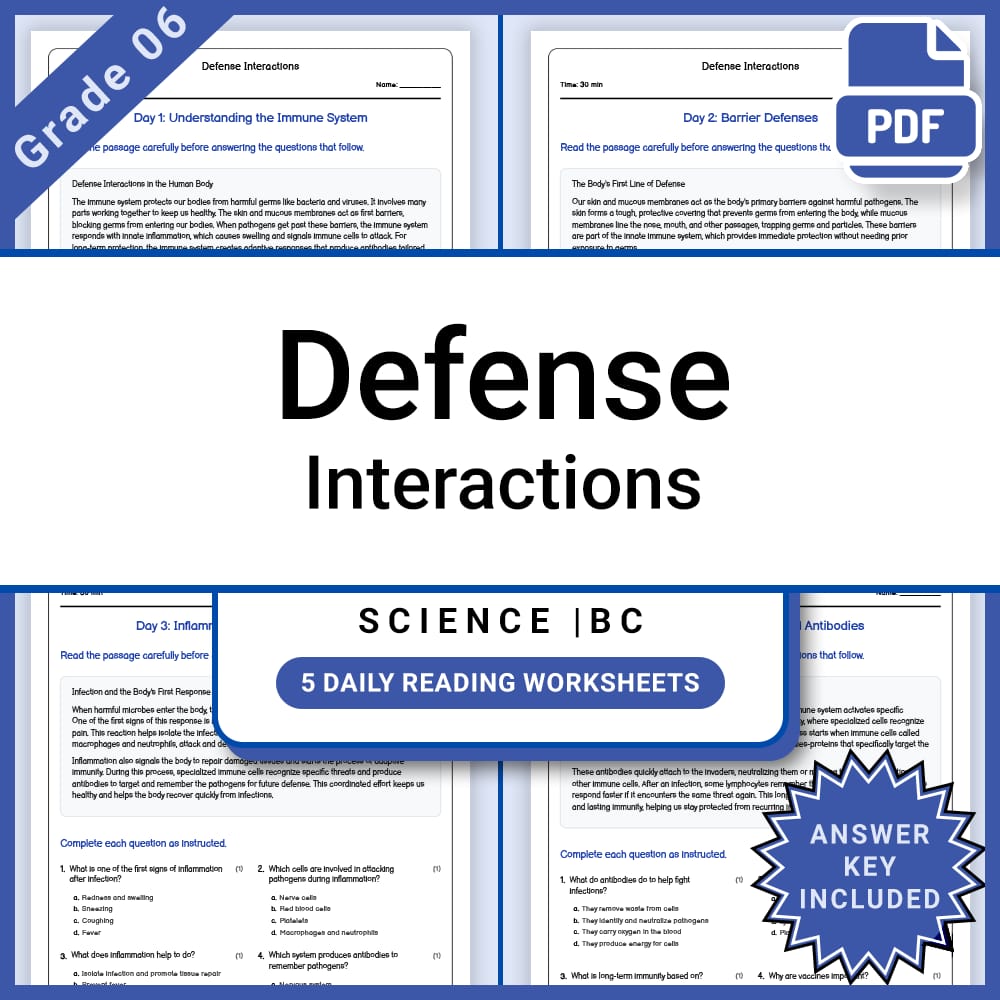
Grade 6 Science – Defense Interactions Daily Reading Worksheet with Answer Key
JCreated byJ.S SheetsLearning Objectives
- Understand the basic components of the immune system
- Identify how skin and mucous membranes act as first defenses
- Describe innate and adaptive immune responses
Also included in: Grade 6 Science Lesson Group | Body Systems and Adaptations Bundle +1 more
Instant download

Grade 6 Population Dynamics Worksheet | Ontario Science Activity PDF
Created byClear Sky ClassroomLearning Objectives
- Explain how birth rate, death rate, immigration, and emigration affect population size
- Describe carrying capacity and limiting factors in terrestrial and aquatic ecosystems
- Differentiate between exponential and logistic population growth models
Instant download

Key Construction Worksheet | Ontario Grade 6 Science Assessment
 Created byCedar Grove Learning
Learning Objectives
- Explain how dichotomous and multi-access identification keys use observable traits to sort organisms
- Construct binary branches in a key using contrasting, measurable characteristics
- Evaluate and improve the accuracy of a key by testing it with local specimens
Also included in: Grade 6 Biodiversity and Adaptations Science Lesson Bundle Ontario +1 more
Instant download

6th Grade Science | Aerodynamic Design Worksheet (PDF) – Alberta Standards
Created bySilver Birch TeachingLearning Objectives
- Explain how lift, drag, and stability relate to aerodynamic design choices.
- Describe how wing shape, surface smoothness, and orientation affect how devices fly.
- Use design evidence (test results) to make conclusions about aerodynamic performance.
Also included in: Grade 6 Aerodynamics & Flight Forces Science Lesson Bundle: Alberta +1 more
Instant download

Grade 6 Science – Understanding Evidence & Reasoning | Daily Reading Worksheet
Created byBright Mind ResourcesLearning Objectives
- Identify different types of evidence used in scientific explanations.
- Distinguish between correlation and causation using evidence.
- Interpret data and observations to support scientific claims.
Also included in: Scientific Inquiry Grade 6 Science Daily Reading Worksheets Bundle | FL NGSSS +1 more
Instant download
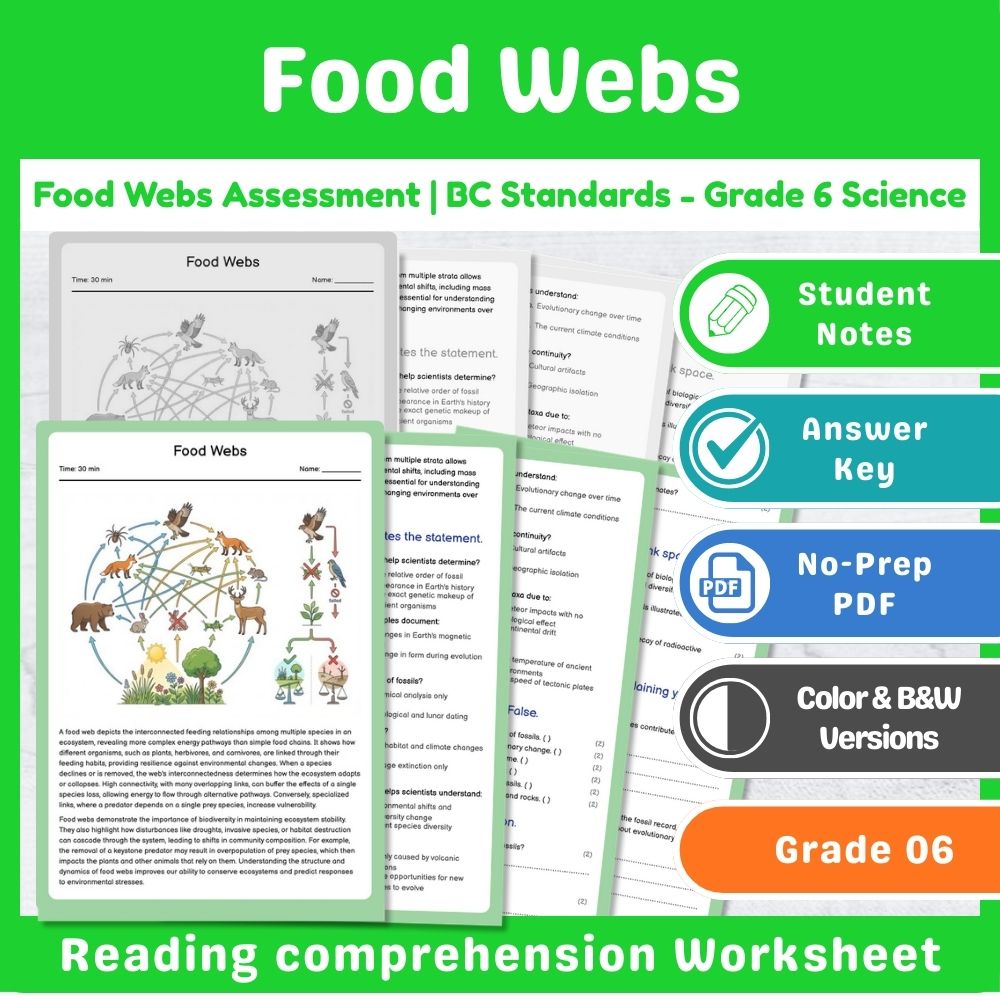
Food Webs Assessment | BC Standards - Grade 6 Science
Created byPrism Point LearningLearning Objectives
- Understand the structure and function of food webs in ecosystems.
- Identify different species roles within a food web, such as producers, consumers, and predators.
- Analyze how changes in one species can affect the entire ecosystem network.
Instant download

Grade 6: Stewardship Strategies for Biodiversity Worksheet
JCreated byJ.S SheetsLearning Objectives
- Describe how habitat restoration, protected areas, invasive species removal, and community-based monitoring support biodiversity.
- Explain why assisted migration is considered and why it can be risky or controversial.
- Use species-at-risk and ecosystem-service ideas to prioritize conservation actions.
Instant download

Grade 6 Science – Reactants & Products Reading Worksheet | Standards-Aligned
Created byBright Mind ResourcesLearning Objectives
- Understand the concept of reactants and products in a chemical reaction.
- Identify reactants and products in different diagrams and descriptions.
- Describe how properties of products differ from those of reactants.
Also included in: Grade 6 Matter Science Daily Reading Worksheets Lesson Bundle | CA Standards +1 more
Instant download

Grade 6 Science – Understanding Pure Mixtures | Daily Reading Worksheet
Created byBright Mind ResourcesLearning Objectives
- Define what a mixture is and identify examples in daily life.
- Recognize the properties that distinguish different types of mixtures.
- Understand how mixtures can be separated based on their observable features.
Also included in: Matter, Heat & Forces Lesson Bundle | Grade 6 Science | General +1 more
Instant download

Grade 6 Science – Understanding Circuit Components | Daily Reading Worksheet
Created byBright Mind ResourcesLearning Objectives
- Identify the main components of an electrical circuit
- Describe the function of each circuit component
- Explain how energy is transformed within a circuit
Also included in: Grade 6 Science Daily Reading Full-Year Bundle BC Curriculum Resource
Instant download

Levels Of Life Worksheet - Standards-Aligned Grade 6 Science Practice
JCreated byJ.S SheetsLearning Objectives
- Understand the hierarchical organization of biological levels from cells to organisms.
- Identify the relationships between cells, tissues, organs, organ systems, and organisms.
- Explain how disruptions at one level can affect higher levels of biological organization.
Instant download

El Niño Effects Worksheet | Standards-Aligned Grade 6 Science Practice
JCreated byJ.S SheetsLearning Objectives
- Understand how El Niño influences global weather patterns.
- Identify the atmospheric and oceanic changes associated with El Niño.
- Connect ocean surface temperature variations to climate impacts in different regions.
Also included in: Grade 6 Climate and Atmospheric Systems Science Lesson Bundle: Florida NGSSS +1 more
Instant download

Inquiry Foundations Worksheet | Ontario Grade 6 Science Assessment
Created byCedar Grove LearningLearning Objectives
- Pose testable questions and explain how they can be investigated scientifically
- Identify independent and dependent variables and distinguish them from controlled variables
- Use operational definitions and controlled comparisons to design fair tests
Also included in: Grade 6 Scientific Inquiry & Data Practices Science Lesson Bundle | Ontario +1 more
Instant download

Mixtures And Solutions Practice Worksheet | Grade 6 Science Review
Created byPrism Point LearningLearning Objectives
- Differentiate between homogeneous and heterogeneous mixtures using observable properties
- Identify solutions as homogeneous mixtures and explain what “uniform composition” means
- Describe common separation methods (filtration, decanting, evaporation) and what property they use
Also included in: Matter, Properties & Change Lesson Bundle — Grade 6 Science BC Framework +1 more
Instant download
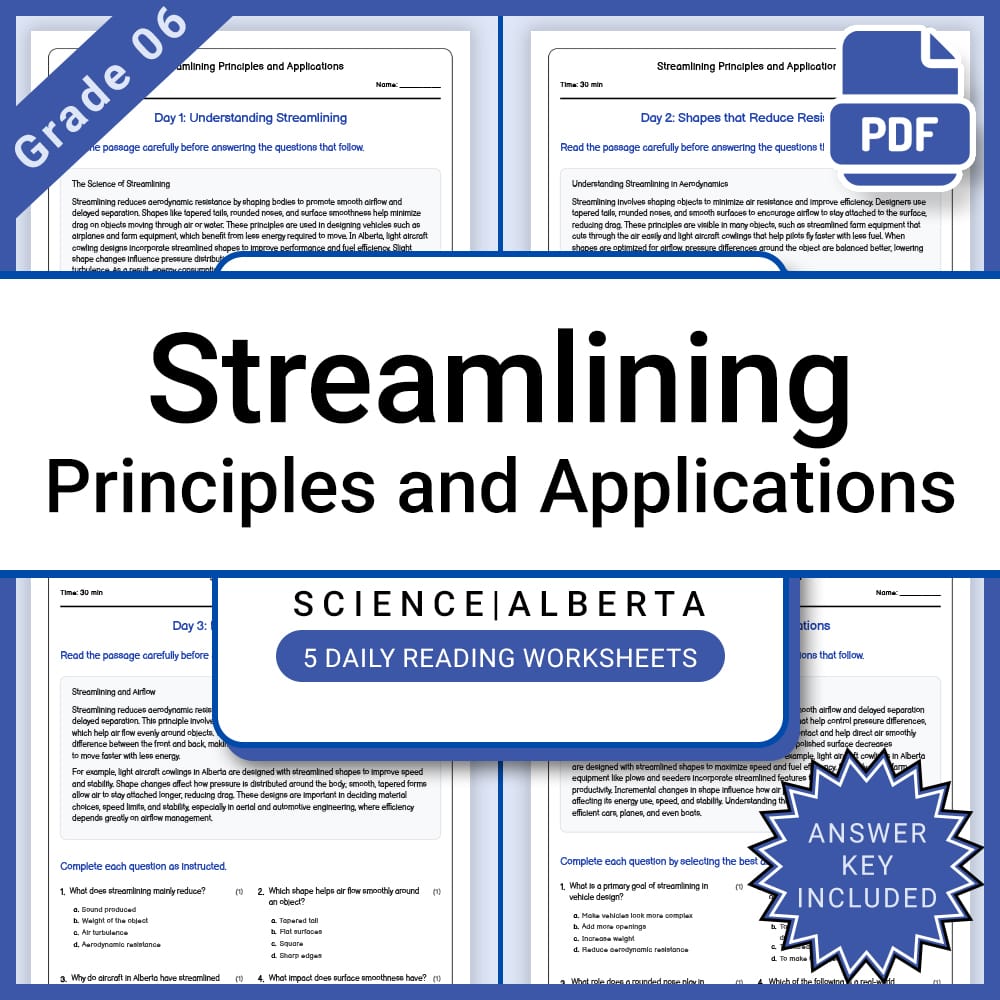
Grade 6 – Streamlining Principles and Applications Daily Worksheet + Answer Key
JCreated byJ.S SheetsLearning Objectives
- Understand the basic principles of streamlining
- Identify examples of streamlined objects
- Explain how shape influences airflow and energy use
Also included in: Grade 6 Science Lesson Bundle: Flight, Weather, and Aerodynamics +1 more
Instant download

Grade 6 Physiological Traits Worksheet | NGSSS Life Science Adaptations
Created byEvergreen Desk EducationLearning Objectives
- Explain how physiological adaptations help organisms survive in specific environments.
- Identify examples of internal processes such as water balance, metabolism changes, and ion regulation.
- Use evidence from a text to answer questions about survival and habitat suitability.
Instant download

Grade 6 Molecular Processes Worksheet | Practice & NGSS PDF
Created byClear Sky ClassroomLearning Objectives
- Identify the building blocks of macromolecules such as amino acids, nucleotides, fatty acids, and monosaccharides.
- Explain how monomers assemble into polymers through condensation reactions and are broken down by hydrolysis.
- Relate molecular structure to properties like enzyme catalysis, membrane transport, and polymerization.
Also included in: Grade 6 Molecules to Organisms Science Lesson Bundle: Structures (NGSS) +1 more
Instant download

Grade 6 Science – Levels Of Life & Biological Hierarchy | Reading Worksheet
Created byBright Mind ResourcesLearning Objectives
- Understand the hierarchy of biological levels from cells to organisms.
- Identify the roles of cells, tissues, organs, and organ systems.
- Explain how each level contributes to the overall functioning of an organism.
Also included in: Grade 6 Science: Organ Systems & Adaptations Daily Reading Lesson Bundle | BC +1 more
Instant download

Reflection and Refraction Worksheet | BC Standards Grade 6 Science Practice
JCreated byJ.S SheetsLearning Objectives
- Describe how light reflects off surfaces and the relationship between angles in reflection.
- Explain how refraction bends light when passing through different materials based on refractive indices.
- Identify real-world phenomena caused by reflection and refraction, such as mirages and lenses.
Instant download

Resource Limits and Carrying Capacity Worksheet | NGSS Grade 6 Science
 Created bySkylark Worksheets
Learning Objectives
- Explain how limiting resources affect individual organisms and population size.
- Use quantitative observations (measurements and patterns) to infer limiting resources and carrying capacity.
- Describe how resource gradients influence species distribution across marsh, desert, and forest habitats.
Also included in: Grade 6 Ecosystems Lesson Bundle: NGSS Science Worksheets & Food Webs +1 more
Instant download

Reading and Creating Graphs from Data Worksheets | Grade 6 Science
Created byBRIGHT PATH RESOURCESLearning Objectives
- Identify whether data are numerical or categorical and choose an appropriate representation.
- Read information from tables, bar graphs, and line graphs using consistent labels and scales.
- Compare categories and describe how a variable changes over time based on a graph.
Also included in: Grade 6 Scientific Inquiry Science Worksheets Bundle | General Science +2 more
Instant download
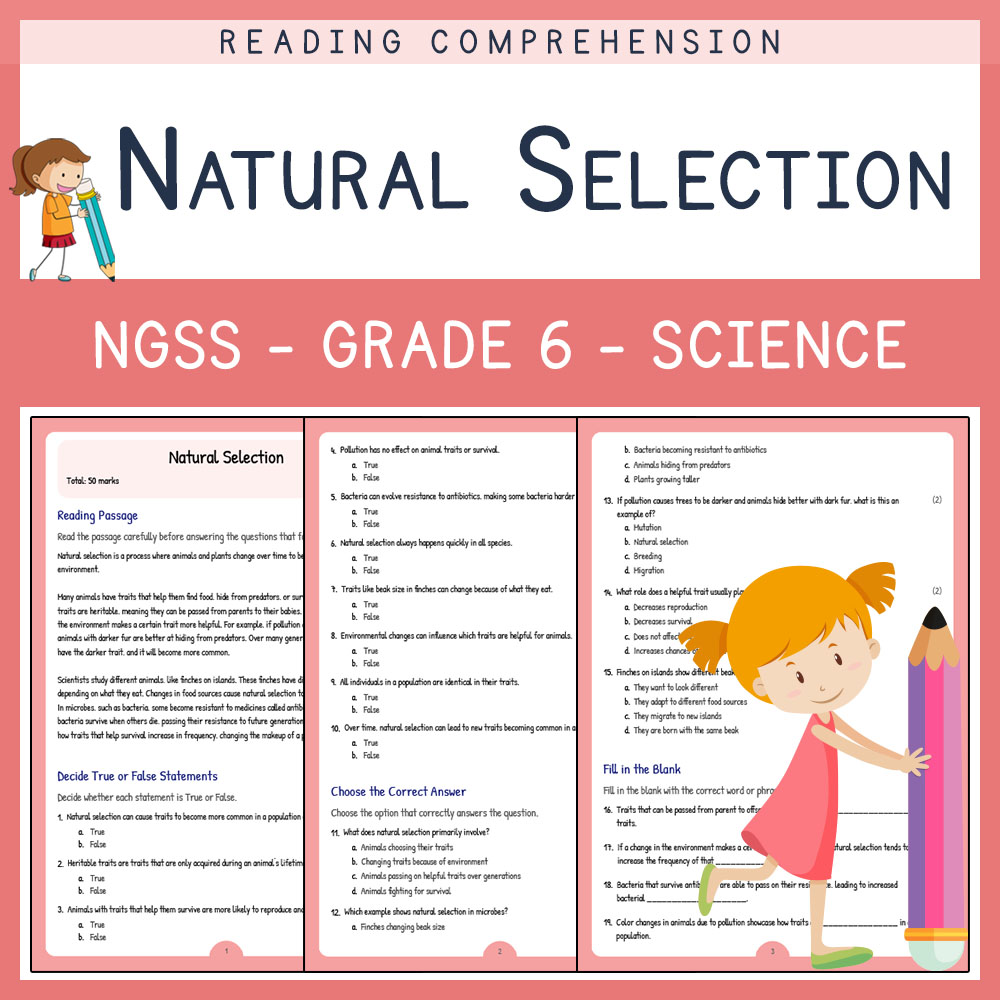
Grade 6 Science | Natural Selection Worksheet (PDF) | NGSS Aligned
Created byLumora LearningLearning Objectives
- Understand that variation in heritable traits affects survival and reproduction.
- Identify how environmental pressures influence trait frequencies in populations.
- Recognize real-world examples of natural selection, such as coloration changes and antibiotic resistance.
Instant download

Grade 6 Science | Energy Efficiency Worksheet | BC Aligned
Created byLumora LearningLearning Objectives
- Understand the concept of energy efficiency as the ratio of useful output to total input.
- Identify common causes of energy losses in machines and systems.
- Evaluate the trade-offs between performance and energy waste in different technologies.
Also included in: Grade 6 Science | Energy, Waves & Circuits | Custom Bundle | BC Aligned
Instant download

Data Representation and Analysis Worksheets | Grade 6 Science
Created byPrism Point LearningLearning Objectives
- Distinguish qualitative data from quantitative data
- Select appropriate graphs for different types of observations
- Interpret trends, clusters, and outliers in graphs
Instant download

Grade 6 Science | Circulatory System Worksheet | BC Aligned
Created byLumora LearningLearning Objectives
- Understand how the circulatory system transports blood, gases, nutrients, hormones, and wastes.
- Identify the key organs and vessels involved in circulation.
- Explain how the heart creates pressure to facilitate blood movement.
Instant download
About Grade 6 Science Worksheets
Explore Grade 6 Science worksheets for classwork, homework, or review. Our 5,997 printables download instantly as PDFs.
MyTeachingSheets worksheets are made by real teacher-authors and checked before they go live. Download any as a print-ready PDF for lessons, homework, or independent practice — most include answer keys, and previews are always free.