
Grade 6 Science Worksheets
5,997 worksheets
6th Grade Science | Population Dynamics Worksheet (PDF) BC Standards
 Created byEvergreen Desk Education
Learning Objectives
- Explain how birth rate, death rate, immigration, and emigration affect population size over time
- Distinguish between exponential growth and logistic growth, including the role of carrying capacity
- Describe how density-dependent and density-independent factors influence population changes
Instant download

6th Grade Science Worksheet | Mixtures And Solutions (PDF)
Created byEvergreen Desk EducationLearning Objectives
- Differentiate between mixtures, homogeneous mixtures (solutions), and heterogeneous mixtures using observable properties.
- Explain how physical properties (particle size, solubility, density, and magnetism) help separate mixture components.
- Select an appropriate separation method (filtration, evaporation, or decanting) based on the mixture type and component differences.
Instant download

Integrated Synthesis Worksheet | Alberta Grade 6 Science Standards
JCreated byJ.S SheetsLearning Objectives
- Understand how question framing, measurement strategies, and data handling influence scientific interpretation.
- Recognize the importance of documentation, data provenance, and communication of limitations in integrated research.
- Analyze examples of multi-site monitoring and how combined datasets inform policy decisions.
Instant download

Grade 6 Sustainability Strategies Science Worksheet | NGSS Printable Activity
 Created byBRIGHT PATH RESOURCES
Learning Objectives
- Understand the basic concepts of sustainability and how human actions impact the environment.
- Identify different sustainability strategies such as renewable energy, conservation, circular resource use, and land management.
- Evaluate the trade-offs among economic, social, and environmental priorities in sustainability practices.
Also included in: Earth & Human Activity Grade6 Science Daily Reading WorksheetsLesson Bundle|NGSS +2 more
Instant download

Rearrangement Explanation Worksheet for Grade 6 Science
JCreated byJ.S SheetsLearning Objectives
- Understand how atoms rearrange during a chemical reaction.
- Describe how new substances form through atomic rearrangement.
- Explain the difference between mere mixing and chemical reactions involving atom rearrangement.
Also included in: Grade 6 Physical Science Lesson Bundle for Science – California Standards +1 more
Instant download

Defining Design Problems: Criteria & Constraints Worksheets Grade 6
 Created byTeachers Club
Learning Objectives
- Identify the required function from an engineering problem statement
- List measurable criteria for evaluating a design solution
- Identify realistic constraints that shape engineering design choices
Also included in: Engineering Design Grade 6 Science Worksheets | NGSS Bundle +2 more
Instant download
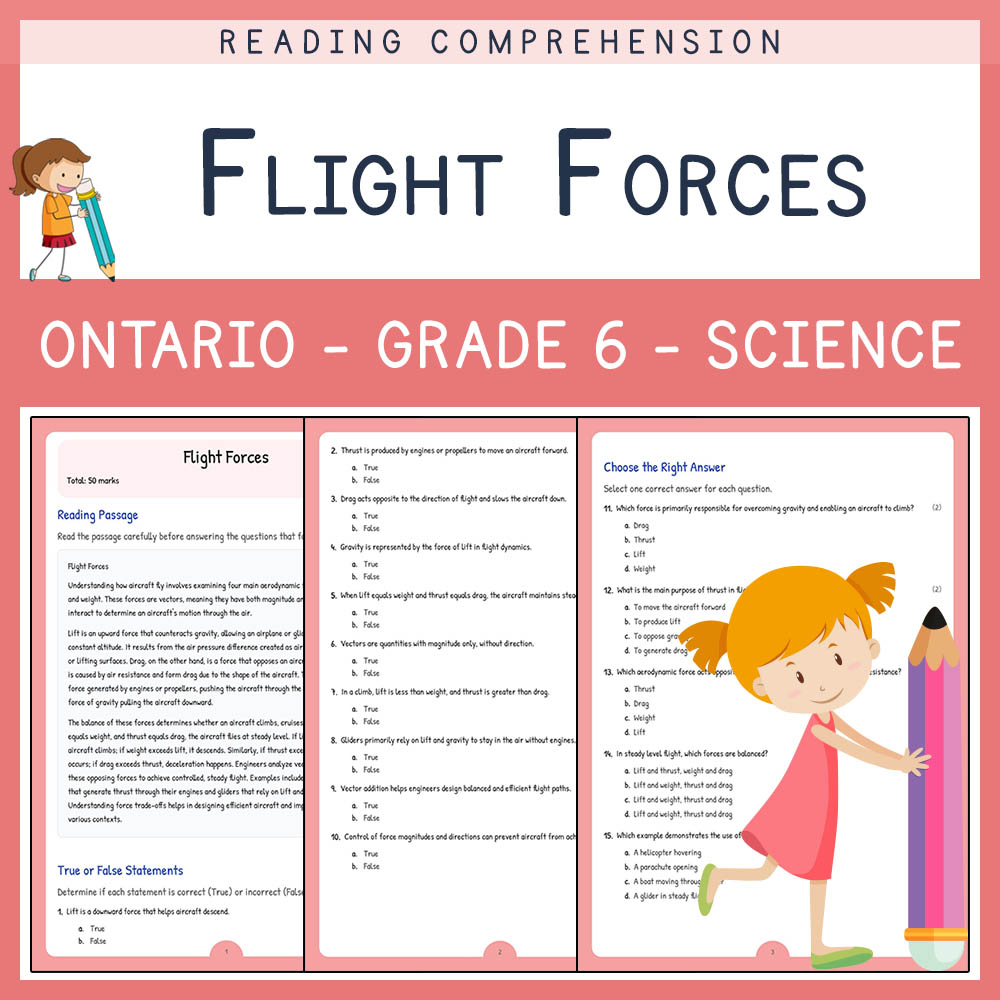
Grade 6 Science | Flight Forces Worksheet (PDF + Answer Key) – Aerodynamics & Flight Principles
 Created byLumora Learning
Learning Objectives
- Understand the four main aerodynamic forces: lift, drag, thrust, and weight.
- Explain how these forces interact to produce different flight motions such as climb, cruise, and descent.
- Identify examples of lift and thrust in real-world flight contexts, including propeller airplanes and gliders.
Also included in: Grade 6 Science | Flight Custom Bundle | Ontario Standards
Instant download

Molecular Processes Building Blocks and Macromolecules Worksheet | NGSS
 Created bySkylark Worksheets
Learning Objectives
- Explain how monomers (amino acids, nucleotides, fatty acids, monosaccharides) form polymers (proteins, nucleic acids, lipids, carbohydrates).
- Describe condensation reactions and hydrolysis as opposite processes that build and break macromolecules.
- Relate molecular structure of macromolecules to functions such as enzyme activity and transport across cell membranes.
Also included in: Grade 6 Cell Systems and Energy Pathways Science Lesson Bundle NGSS +1 more
Instant download

Grade 6 Science | Solar Motions - Daily Reading Comprehension
 Created byCoral Reef Learning
Learning Objectives
- Understand the path of the Sun across the sky during different times of the day
- Identify how Earth's tilt and orbit affect sunlight and seasons
- Describe how the Moon's phases correspond to its position relative to Earth and the Sun
Instant download

Atomic Composition Worksheet & Doodle Notes | NGSS Grade 6 Science
 Created byAmber Owl Education
Learning Objectives
- Use models (ball-and-stick and space-filling) to describe how atoms combine to form simple molecules and extended structures.
- Determine relative atom types and counts from chemical formulas such as H2O and NaCl.
- Explain how structure (molecules vs. ionic lattices vs. polymer chains) relates to observable patterns of matter.
Also included in: Grade 6 Science Matter and Chemical Reactions Lesson Bundle | NGSS +1 more
Instant download
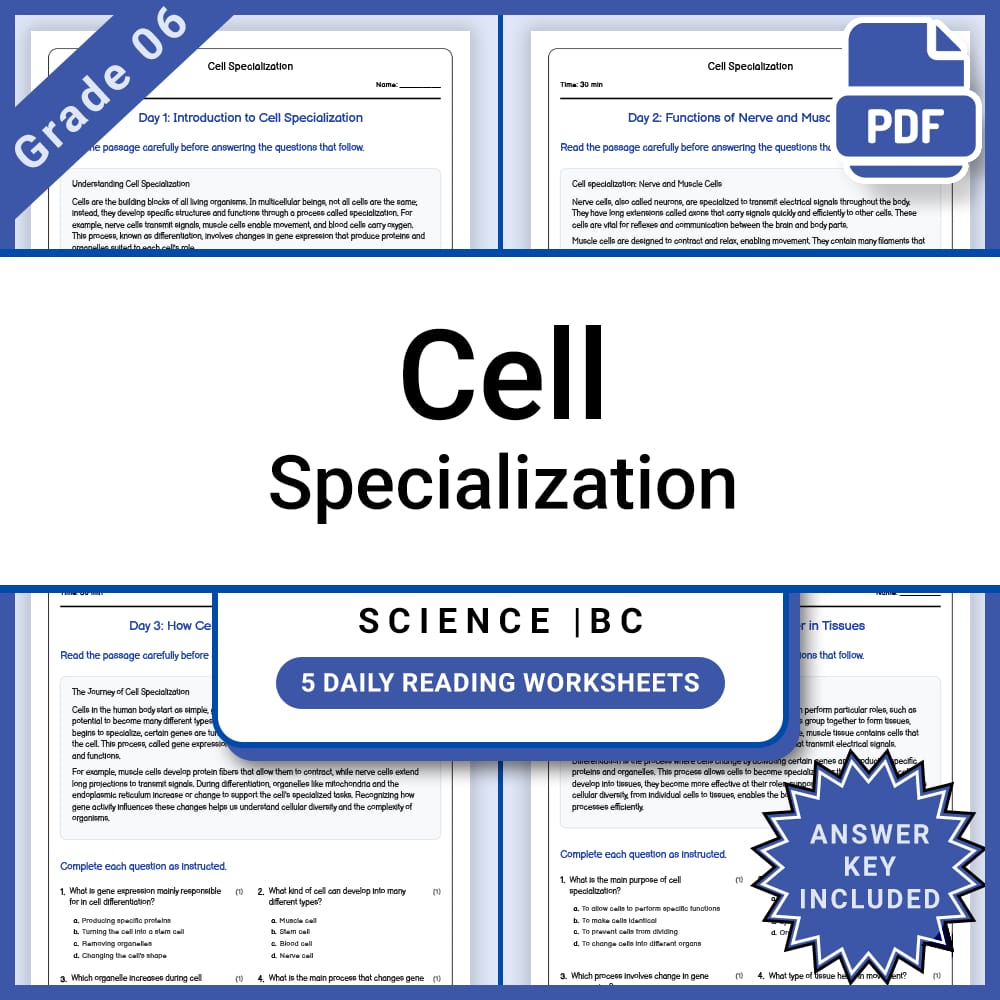
Grade 6 Science – Cell Specialization Daily Reading Worksheet + Answer Key
JCreated byJ.S SheetsLearning Objectives
- Understand what cell specialization is and why it occurs
- Identify different types of specialized cells and their functions
- Explain how specialized cells work together to form tissues and organs
Also included in: Grade 6 Science Lesson Group | Body Systems and Adaptations Bundle +1 more
Instant download
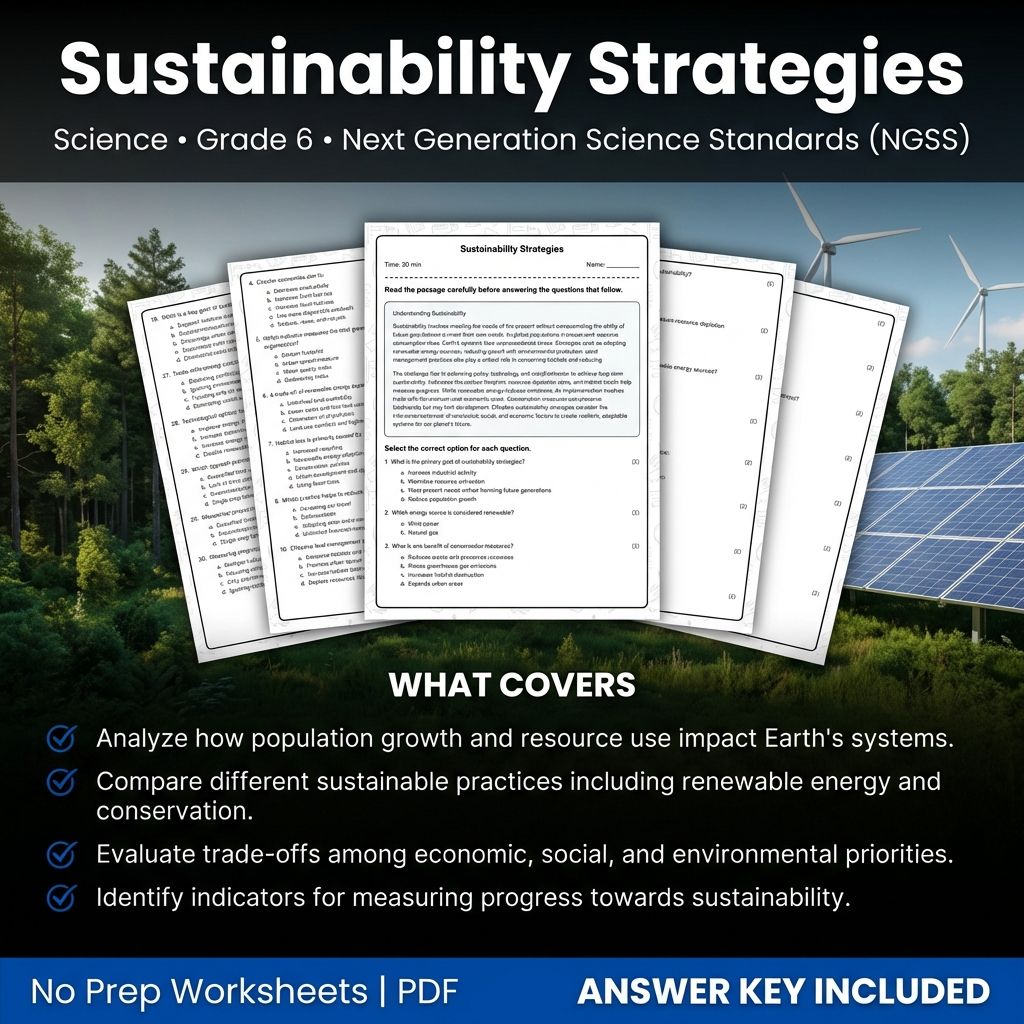
Grade 6 Science | Sustainability Strategies Worksheet & Answer Key (Printable PDF)
Created byCoral Reef LearningLearning Objectives
- Analyze how population growth and resource use impact Earth's systems.
- Compare different sustainable practices including renewable energy and conservation.
- Evaluate trade-offs among economic, social, and environmental priorities.
Instant download
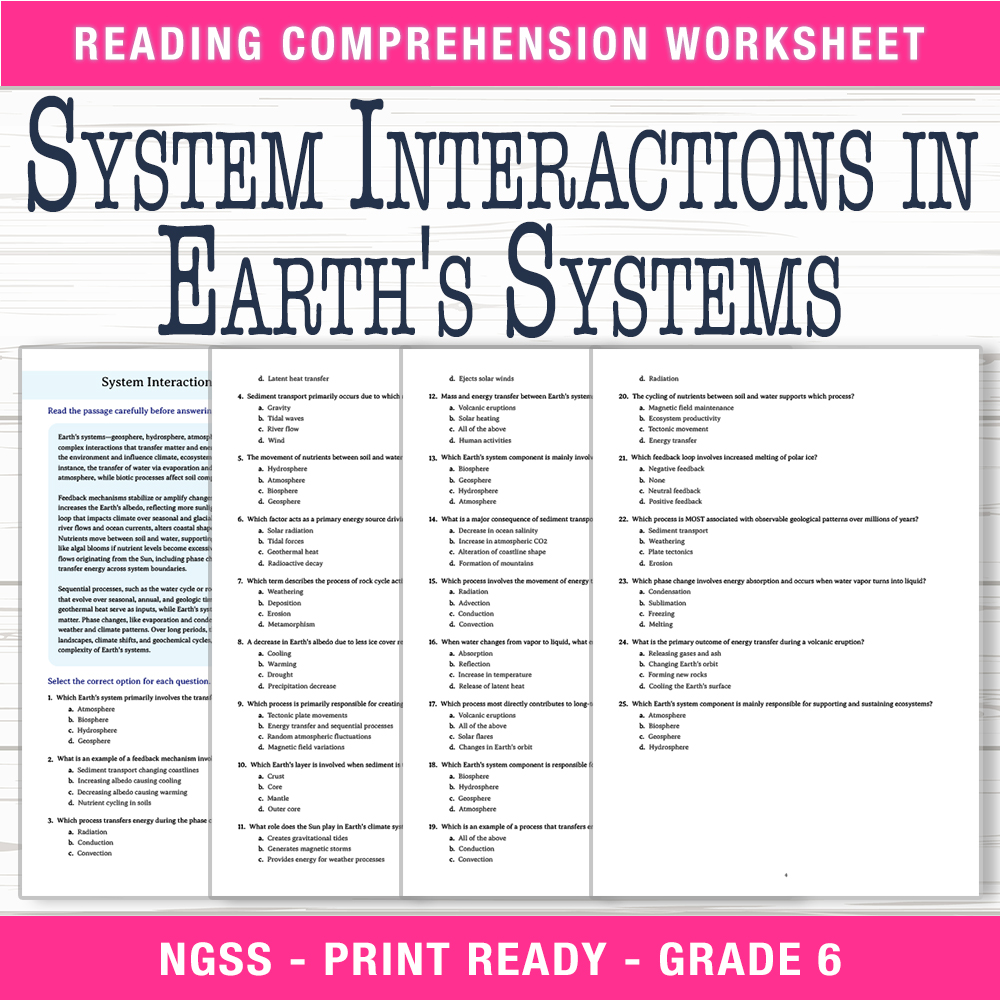
6th Grade Science | Earth's System Interactions Worksheet (PDF + Answer Key)
 Created byRiverstone Classroom
Learning Objectives
- Understand how Earth's geosphere, hydrosphere, atmosphere, and biosphere interact through transfer processes.
- Identify feedback mechanisms such as albedo changes and sediment transport in Earth's systems.
- Explain energy flow, phase changes, and sequential processes that produce observable patterns over different timescales.
Instant download

Grade 6 Operational Definitions & Science Measurement Worksheet | Alberta
Created byBRIGHT PATH RESOURCESLearning Objectives
- Identify characteristics of a vague description versus an operational definition.
- Write an operational definition that includes clear measurement steps and units.
- Explain how operational definitions improve fair comparison of data.
Also included in: Inquiry Data Grade 6 Science Daily Reading Worksheets Lesson Bundle | Alberta +1 more
Instant download

Electrical Measurement with Ammeters and Voltmeters Grade 6 Science Worksheet
 Created byTeacher's Corner
Learning Objectives
- Explain the purpose of an ammeter and a voltmeter in a circuit
- Distinguish between measuring current in amperes and measuring voltage in volts
- Predict and interpret how instrument readings change in series and parallel circuits
Instant download

Grade 6 Science | Understanding Eclipses & Tides - Daily Reading Comprehension
Created byCoral Reef LearningLearning Objectives
- Learn the difference between solar and lunar eclipses.
- Understand the alignment geometry causing eclipses.
- Distinguish between umbra and penumbra effects.
Instant download
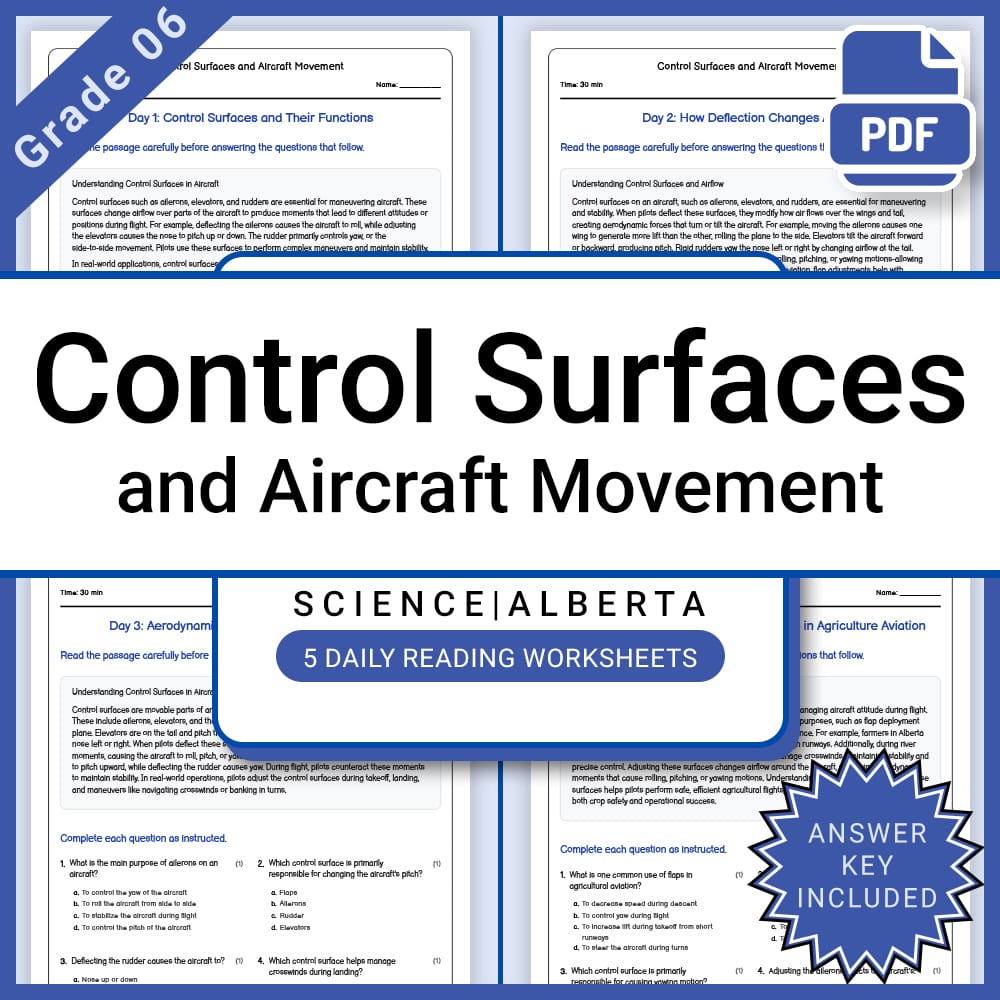
Grade 6 Control Surfaces and Aircraft Daily Reading Worksheet + Answer Key
JCreated byJ.S SheetsLearning Objectives
- Identify different control surfaces on an aircraft
- Understand how each control surface influences aircraft attitude
- Describe how deflections change airflow and produce different motions
Also included in: Grade 6 Science Lesson Bundle: Flight, Weather, and Aerodynamics +1 more
Instant download

Energy Efficiency Worksheet for Grade 6 Science | Standards-Aligned Practice
JCreated byJ.S SheetsLearning Objectives
- Understand the concept of energy efficiency and how it is measured.
- Identify common sources of energy loss in machines and systems.
- Evaluate trade-offs between performance and energy waste in various technologies.
Instant download
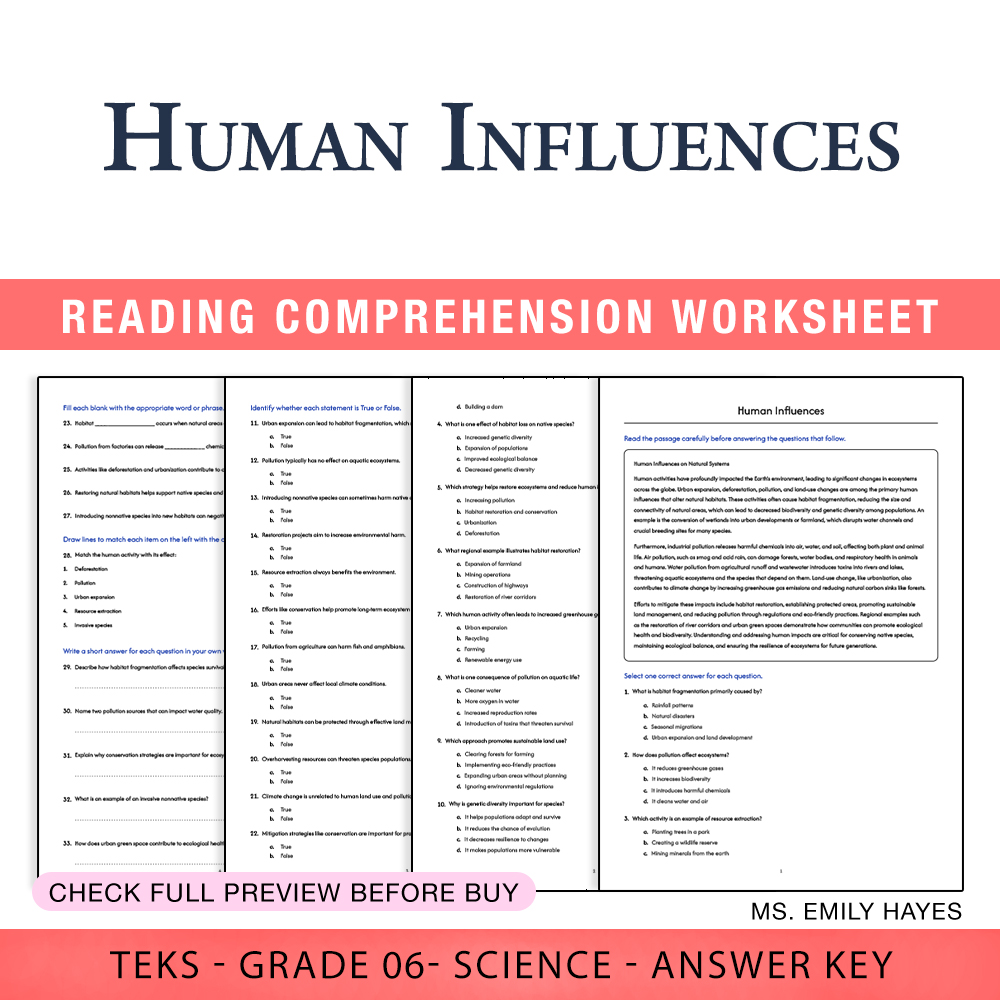
6th Grade Science | Human Influences Worksheet (PDF+ Answer Key)
 Created byCopper Leaf Classroom
Learning Objectives
- Understand human activities that impact natural ecosystems.
- Identify examples of habitat fragmentation, pollution, and resource extraction.
- Explain effects of human influences on species distribution and ecological balance.
Instant download

Decomposers and Nutrient Cycling Science Worksheets Grade 6
Created byBRIGHT PATH RESOURCESLearning Objectives
- Explain how decomposers break down dead organisms and waste
- Describe how nutrients return to soil and water for producers to use
- Model how changes in decomposer activity can affect ecosystem productivity
Also included in: Grade 6 Life Science Worksheets Bundle | Ecosystems & Body Systems +2 more
Instant download
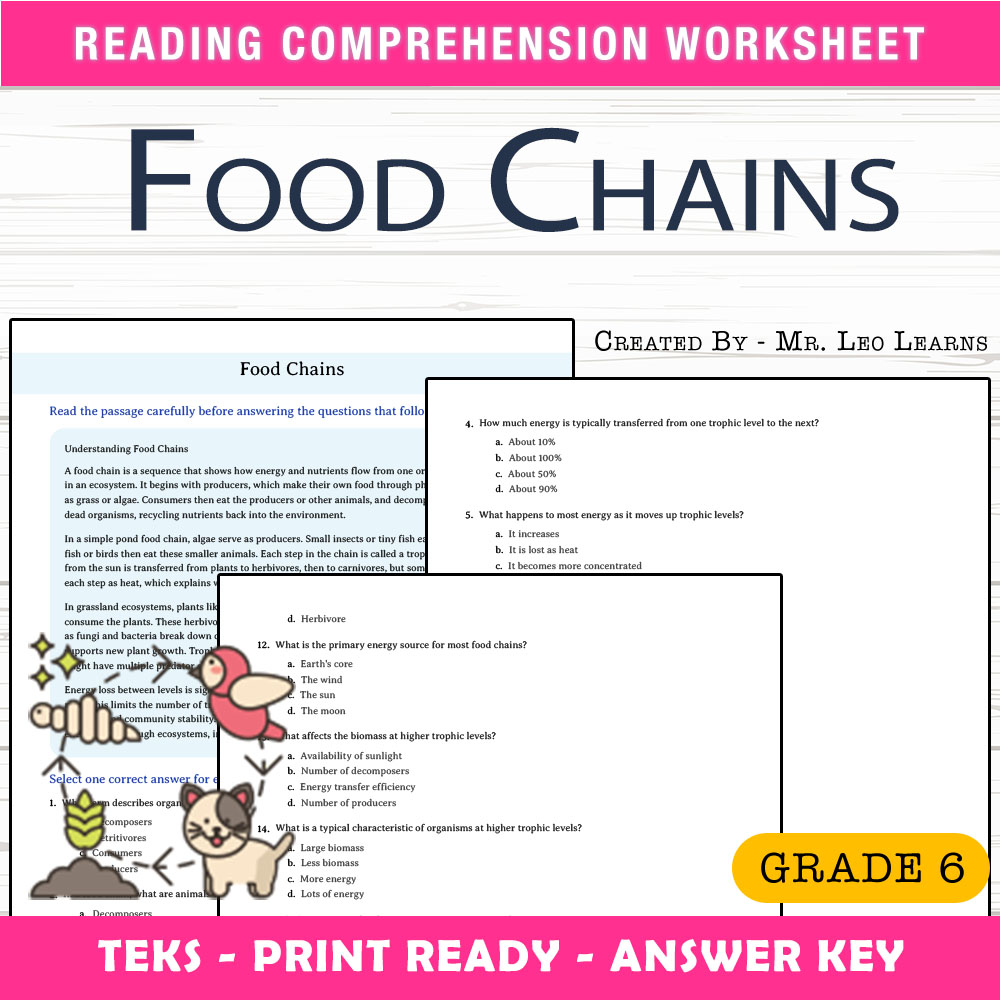
Grade 6 Science — Food Chains Worksheet for Mastering Energy Flow
 Created byThe Resource Hub
Learning Objectives
- Define producers, consumers, and decomposers and identify their roles in a food chain.
- Explain the flow of energy and matter through different trophic levels in simple ecosystems.
- Differentiate between linear food chains and networked food webs.
Also included in: Grade 6 Science Unit Bundle | Ecosystems & Environmental Relationships
Instant download

Synthetic Materials Worksheets: Origins & Properties for Grade 6 Science
Created byTeachers ClubLearning Objectives
- Explain how natural resources can be processed into synthetic materials
- Compare properties of materials and connect those properties to their uses
- Describe how durability, flexibility, conductivity, and biodegradability relate to material selection
Also included in: Matter and Its Interactions Grade 6 Science NGSS Worksheets Bundle +2 more
Instant download

6th Grade Science Worksheet | Mass Wasting Concepts & Assessment (PDF)
Created byEvergreen Desk EducationLearning Objectives
- Describe how gravity causes mass wasting and how unstable slopes lead to movement of rock and soil.
- Explain how water, freeze-thaw, earthquakes, and erosion can trigger mass wasting.
- Compare rockfalls, landslides, and slumps using key features and examples.
Also included in: 6th Grade Earth & Climate Science Lesson Bundle – General Framework +1 more
Instant download

6th Grade Science | Predictive Models Worksheet (Alberta Standards) (PDF)
 Created bySilver Birch Teaching
Learning Objectives
- Explain how predictive models represent Earth–Sun geometry to forecast observable sky events.
- Use seasonal geometry ideas (axial tilt and orbital position) to predict changes in daylight and solar angle.
- Interpret simple model outputs and connect them to real observations such as sunrise, sunset, and lunar phases.
Also included in: Grade 6 Celestial Motion & Seasons Science Lesson Bundle | Alberta +1 more
Instant download
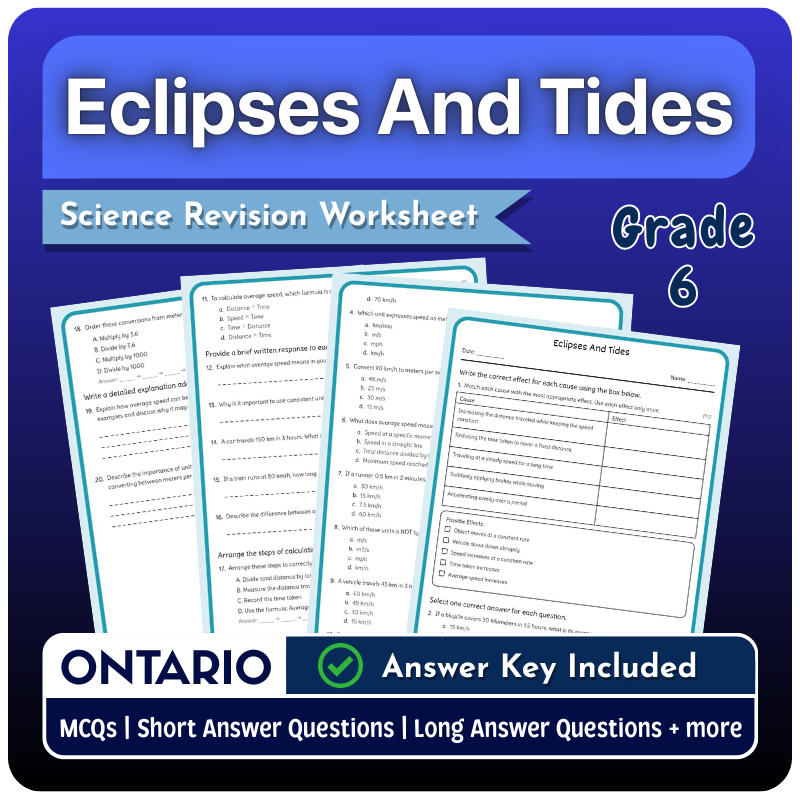
Grade 6 Science – Eclipses and Tides Worksheet (Ontario Standard PDF)
 Created byBright Mind Resources
Learning Objectives
- Describe the geometric conditions leading to solar and lunar eclipses, including the concepts of umbra and penumbra.
- Explain the difference between solar and lunar eclipses and their frequency and visibility patterns.
- Understand how gravitational forces from the Moon and Sun cause tides in Earth's oceans.
Instant download

Tree Anatomy and Form-Function Relationships Worksheets Grade 6
 Created bySunny Desk Resources
Learning Objectives
- Identify major parts of a tree (roots, trunk, branches, leaves, buds, bark) and describe what each one does.
- Explain how tree structures help with survival needs such as support, transport, storage, and protection.
- Use specific vocabulary from the lesson to make accurate form–function connections.
Also included in: Trees and Forests Grade 6 Alberta Science Worksheets Bundle +1 more
Instant download
Grade 6 Science – Organ Systems & Body Functions | Daily Reading Worksheet
 Created byElena Brooks
Learning Objectives
- Understand the basic functions of the circulatory system, including the roles of the heart and blood vessels.
- Identify how blood moves throughout the body and why the heart is essential.
- Describe the interaction between the circulatory system and other organ systems.
Also included in: Grade 6 Science From Molecules to Organisms Worksheet Bundle | NGSS +1 more
Instant download

Grade 6 Science Mass Conservation Worksheet | California Standards PDF
Created byEvergreen Desk EducationLearning Objectives
- Explain mass conservation by connecting conservation of atoms to conservation of mass in a closed system.
- Use particle-level reasoning to justify why total mass of reactants equals total mass of products.
- Interpret everyday examples of conservation of mass and distinguish closed-system from open-system situations.
Instant download

Instrumentation Principles Worksheet | Ammeters, Voltmeters & Circuits
 Created byChalk and Compass
Learning Objectives
- Explain the roles of ammeters and voltmeters in measuring electric current and potential difference.
- Identify correct measurement units (amperes and volts) and interpret ideal instrument behavior.
- Predict how current and voltage readings change in simple series and parallel circuits.
Also included in: Grade 6 Science Circuits & Electricity Lesson Bundle | Ontario +1 more
Instant download

Conservation Concepts Worksheet | Grade 6 Science Activities
 Created byPrism Point Learning
Learning Objectives
- Explain conservation of mass in closed systems using measurements taken before and after physical or chemical changes
- Distinguish closed systems from open systems based on whether matter can enter or leave
- Use real-world examples to make predictions about how total mass should change (or not change) during sealed processes
Also included in: Grade 6 Matter, Energy, and Change Science Lesson Bundle TEKS Worksheets +1 more
Instant download

Grade 6 Science | Integrated Synthesis in Science - Daily Reading Comprehension
Created byCoral Reef LearningLearning Objectives
- Understand the process of river monitoring and data collection
- Recognize the importance of accurate measurement and documentation
- Analyze how data handling impacts scientific conclusions
Also included in: Evidence and Investigation Lesson Bundle | Grade 6 Science | Alberta +1 more
Instant download

Experimental Design Worksheet Pack | Grade 6 Science Activities
Created byPrism Point LearningLearning Objectives
- Identify independent, dependent, and controlled variables in a fair test.
- Choose an appropriate control condition and justify it using evidence-based reasons.
- Plan consistent measurement steps so results can be compared and repeated.
Instant download

Science Grade 6: Prototype Evaluation Worksheet | Standards-Aligned Assessment
JCreated byJ.S SheetsLearning Objectives
- Explain how prototype evaluation uses evidence and criteria to judge how well a solution works as a system.
- Identify common constraints (such as material strength and time limits) that affect what improvements are acceptable.
- Use measurement and observations to describe failures and revise a prototype design.
Also included in: Grade 6 Engineering Design Process Science Lesson Bundle – General Framework +1 more
Instant download
Grade 6 Science | Particle Model Worksheet(PDF) - Understanding States of Matter
Created byBright Mind ResourcesLearning Objectives
- Describe the particle model of matter and how particles behave in solids, liquids, and gases.
- Explain how microscopic particle behaviors relate to macroscopic properties such as shape, volume, and flow.
- Identify differences in particle arrangements and motion in different states of matter.
Instant download

6th Grade Science | Atmospheric Patterns Worksheet (PDF) TEKS Alignment
Created byEvergreen Desk EducationLearning Objectives
- Describe how the atmosphere is structured and how air masses form and move.
- Explain how fronts and pressure systems affect regional weather and prevailing winds.
- Connect heat transfer and the greenhouse effect to local climate patterns and seasonal trends.
Instant download

Molecular Processes Worksheet | NGSS-Aligned Grade 6 Science Practice
JCreated byJ.S SheetsLearning Objectives
- Identify the basic building blocks of biomolecules such as amino acids, nucleotides, fatty acids, and monosaccharides.
- Explain how monomers assemble into polymers through condensation reactions and are broken down by hydrolysis.
- Relate molecular structures to properties like enzyme activity, membrane transport, and polymerization during growth.
Also included in: Grade 6 Cellular Processes and Feedback Science Lesson Bundle – NGSS +1 more
Instant download

Grade 6 States of Matter Worksheet | NGSS Practice & PDF
 Created byClear Sky Classroom
Learning Objectives
- Compare solids, liquids, and gases by using the ideas of shape, volume, and particle motion.
- Explain how changes in state are connected to energy and how particles move.
- Use accurate vocabulary (particle, volume, energy, motion, state) to describe matter.
Instant download

6th Grade Science Worksheet | Tree Anatomy / Alberta Standards (PDF)
Created byEvergreen Desk EducationLearning Objectives
- Identify major parts of a tree (roots, trunk, branches, leaves, buds, and bark).
- Explain how each tree structure supports, transports, stores, or protects.
- Connect form–function relationships to survival in different habitats in Alberta.
Instant download

Grade 6 Science | Integrated Management Worksheet (Alberta Standards) (PDF)
Created bySilver Birch TeachingLearning Objectives
- Explain how integrated management balances ecological, economic, and social objectives in forest and park landscapes
- Identify how Alberta forest planning uses ecosystem-based management, adaptive harvest planning, and monitoring to manage risks
- Describe how stakeholder collaboration and long-term monitoring support multiple forest values and resilience
Also included in: Grade 6 Ecosystem Interactions Science Lesson Bundle: Alberta Framework +1 more
Instant download

Grade 6 Cell Specialization Worksheet | BC Practice & Assessment PDF
Created byClear Sky ClassroomLearning Objectives
- Explain how cell specialization enables cells to perform specific functions in the body
- Describe how differentiation and gene expression can lead to specialized structures and proteins
- Connect specialized tissues to how organs carry out complex tasks
Instant download

Science Safety and Reporting Worksheet | Grade 6 Science Assessment
JCreated byJ.S SheetsLearning Objectives
- Describe key lab safety expectations when using common materials and risks (heat, eye protection, and cleanup).
- Explain how to report results ethically, including accurate measurements, appropriate attribution, and limitations.
- Choose and apply best practices for communicating data clearly using words, tables, and graphs.
Also included in: Grade 6 Scientific Investigation Science lesson bundle: General Framework +1 more
Instant download

Series Characteristics Worksheet Grade 6 Science | Ontario Standards
 Created byCedar Grove Learning
Learning Objectives
- Explain how series circuits create a single-path configuration for current.
- Describe how equal current flows through series components and how total resistance adds up.
- Predict how voltage divides among series components and how that affects bulb brightness.
Also included in: Grade 6 Electricity and Circuits Science lesson bundle: Ontario framework +1 more
Instant download
Musculoskeletal System Assessment for Grade 6 Science – BC Standards
Created byPrism Point LearningLearning Objectives
- Identify the components of the musculoskeletal system and their functions.
- Explain how bones, joints, and muscles work together to facilitate movement.
- Describe the interaction between the musculoskeletal and other systems such as the nervous and circulatory systems.
Instant download

Testable Questions Worksheet Pack | Grade 6 Science Activities
Created byPrism Point LearningLearning Objectives
- Identify what measurable evidence can answer a scientific question.
- Distinguish between variables to change, controlled conditions, and observations to keep consistent.
- Evaluate whether a question is testable based on measurable outcomes and planned measurements.
Instant download

Grade 6 Biodiversity Patterns in Island Ecosystems Worksheet | NGSS
Created byBRIGHT PATH RESOURCESLearning Objectives
- Understand key concepts related to Science
- Apply knowledge through practice questions
- Demonstrate comprehension of the material
Also included in: Biological Evolution: Unity & Diversity Grade 6 Science Lesson Bundle | ngss +2 more
Instant download

Grade 6 Science | Filtration & Sieving - Daily Reading Comprehension
Created byCoral Reef LearningLearning Objectives
- Understand the differences between filtration and sieving.
- Identify materials used in filtration and sieving processes.
- Recognize everyday examples of filtration and sieving.
Instant download
Integrated Management Assessment | Alberta Grade 6 Science Standards
Created byPrism Point LearningLearning Objectives
- Understand the concept of integrated management and its ecological, economic, and social objectives.
- Identify approaches used in Alberta for sustainable forest management, including ecosystem-based practices.
- Analyze the importance of landscape-scale planning, stakeholder collaboration, and resilience to climate variability.
Also included in: Lesson Grade 6 Science Mini Bundle Trees and Forests Alberta Standards
Instant download

Seed Dispersal Worksheets Grade 6 Reproductive Structures Science Review
Created bySunny Desk ResourcesLearning Objectives
- Identify major reproductive structures in plants and describe how they help produce new plants
- Explain how seed dispersal and vegetative propagation affect where plants can grow
- Compare how different reproductive strategies can influence genetic diversity and resilience
Also included in: Trees and Forests Grade 6 Alberta Science Worksheets Bundle +1 more
Instant download
About Grade 6 Science Worksheets
Explore Grade 6 Science worksheets for classwork, homework, or review. Our 5,997 printables download instantly as PDFs.
MyTeachingSheets worksheets are made by real teacher-authors and checked before they go live. Download any as a print-ready PDF for lessons, homework, or independent practice — most include answer keys, and previews are always free.