
Grade 6 Science Worksheets
5,997 worksheets
Science Worksheet Energy Pathways Photosynthesis & Respiration | NGSS Grade 6
 Created bySkylark Worksheets
Learning Objectives
- Explain how energy moves and changes form during photosynthesis and cellular respiration
- Describe how matter cycles through chloroplasts and mitochondria during chemical processes
- Use examples (stomata, leaf gas exchange, oxygen consumption) to connect energy pathways to real observations
Also included in: Grade 6 Cell Systems and Energy Pathways Science Lesson Bundle NGSS +1 more
Instant download

Scientific Inquiry Assessment | Florida NGSSS Grade 6 Science Standards
 Created byPrism Point Learning
Learning Objectives
- Explain how scientific inquiry begins with careful observations and leads to testable questions
- Identify how measurement and evidence support reliable explanations in investigations
- Use logical reasoning to connect results to conclusions and communicate findings clearly
Also included in: Grade 6 Scientific Assessment Science Lesson Bundle – Florida NGSSS
Instant download

Science Grade 6 Worksheet Trade-off Decisions | Standards-Aligned Practice
JCreated byJ.S SheetsLearning Objectives
- Explain what a trade-off is in engineering and design choices
- Connect material properties (strength, flexibility, insulation, friction) to user needs and constraints
- Justify design decisions by describing what improves and what limitations result
Also included in: Grade 6 Engineering Design Process Science Lesson Bundle – General Framework +1 more
Instant download
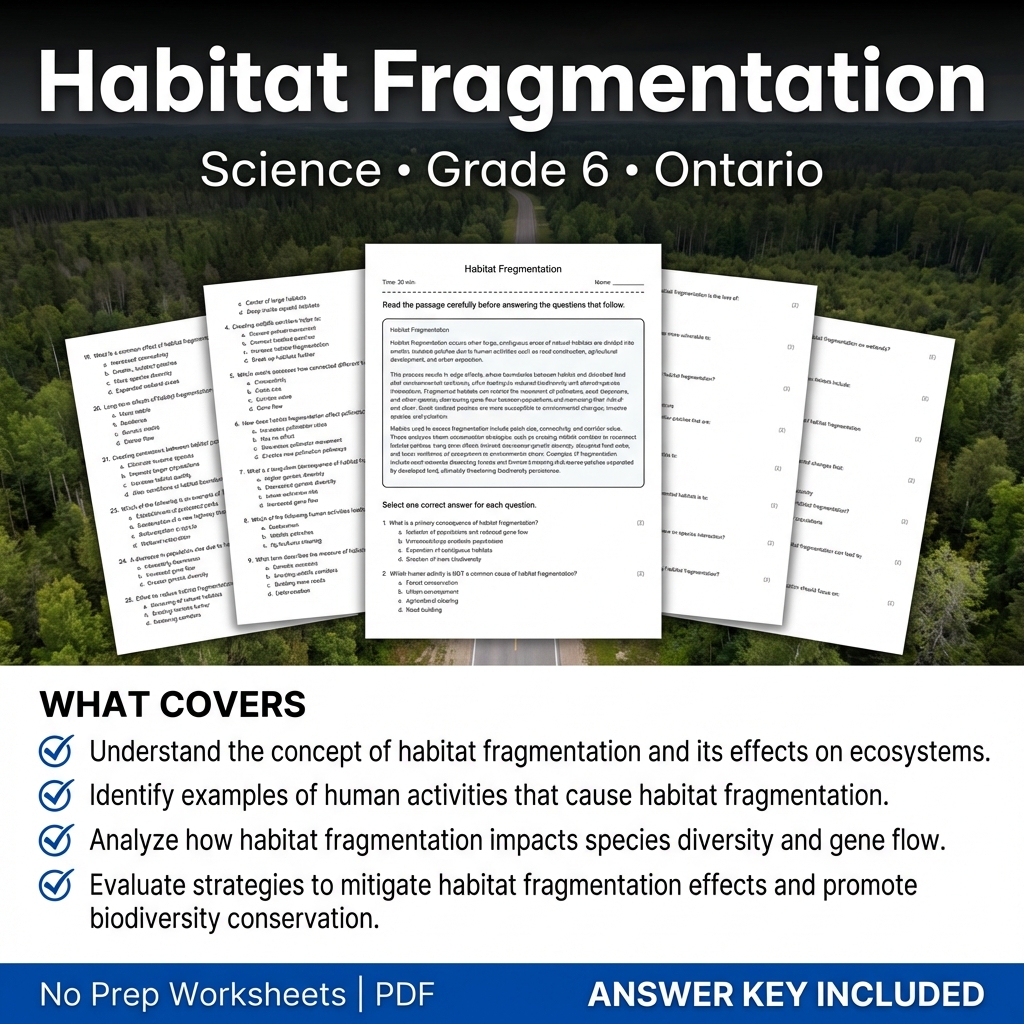
Habitat Fragmentation Worksheet | Grade 6 Science | Ontario Standards
 Created byCoral Reef Learning
Learning Objectives
- Understand the concept of habitat fragmentation and its effects on ecosystems.
- Identify examples of human activities that cause habitat fragmentation.
- Analyze how habitat fragmentation impacts species diversity and gene flow.
Instant download

Grade 6 Science | Species Interactions in Ecosystems - Reading Comprehension
Created byCoral Reef LearningLearning Objectives
- Understand what mutualism is and how it benefits species in forests
- Identify examples of mutualism in forest ecosystems
- Explain how mutualism helps species survive and thrive in their habitats
Instant download

Grade 6 Science – Food Chains & Ecosystems | Daily Reading Worksheet
 Created byBright Mind Resources
Learning Objectives
- Identify producers, consumers, and decomposers in a pond ecosystem.
- Understand how energy flows from one organism to another in a food chain.
- Recognize trophic levels and the transfer of energy among organisms.
Also included in: Ecosystems Grade 6 Science Daily Reading Worksheets Lesson Bundle | TEKS +2 more
Instant download
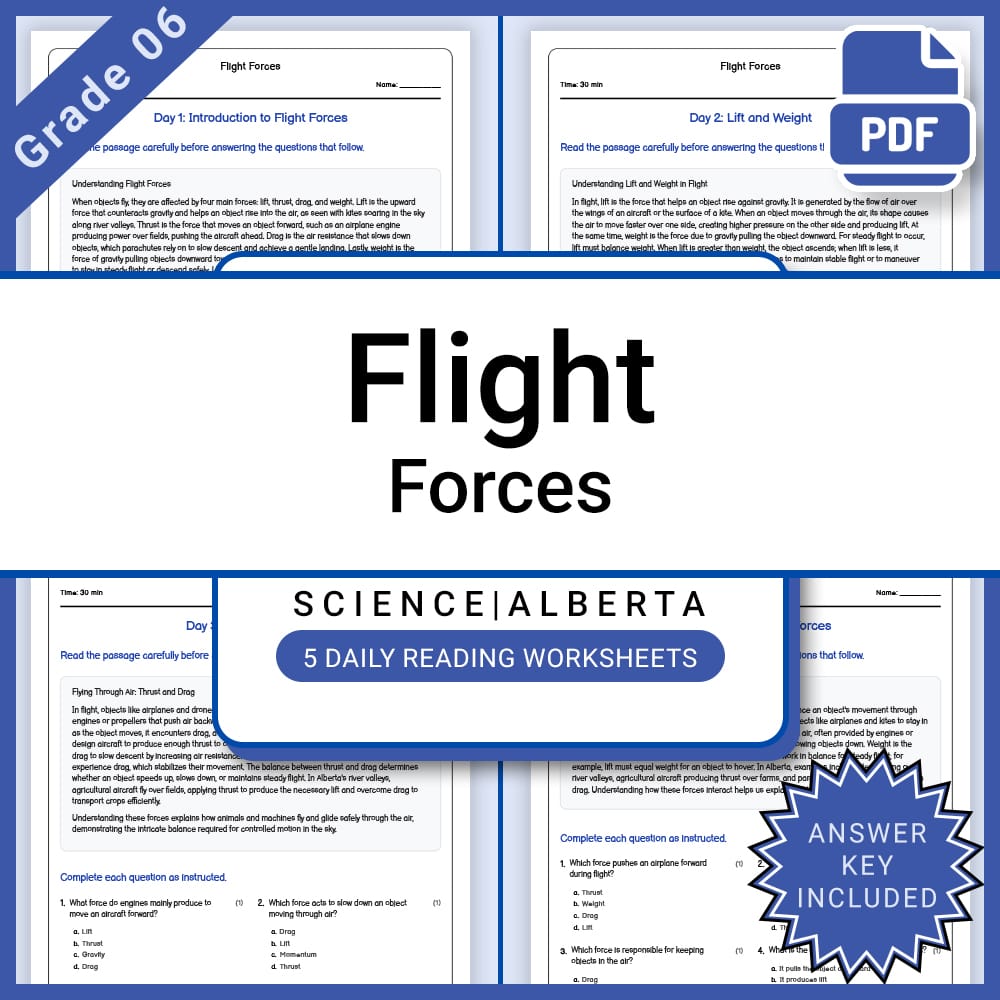
Grade 6 Science – Flight Forces Daily Reading Worksheet + Answer Key
JCreated byJ.S SheetsLearning Objectives
- Identify the key forces involved in flight: lift, drag, thrust, and gravity.
- Understand how airplane and device shapes affect their aerodynamic performance.
- Recognize how modifications in design, such as wing curvature and surface area, influence flight stability.
Also included in: Grade 6 Science Lesson Bundle: Flight, Weather, and Aerodynamics +1 more
Instant download

Mass Conservation Worksheet | Standards-Based Practice for Grade 6 Science
JCreated byJ.S SheetsLearning Objectives
- Understand the law of conservation of mass and its implications in physical and chemical processes.
- Differentiate between closed and open systems regarding mass changes.
- Apply the principle of mass conservation to real-world examples and experiments.
Instant download
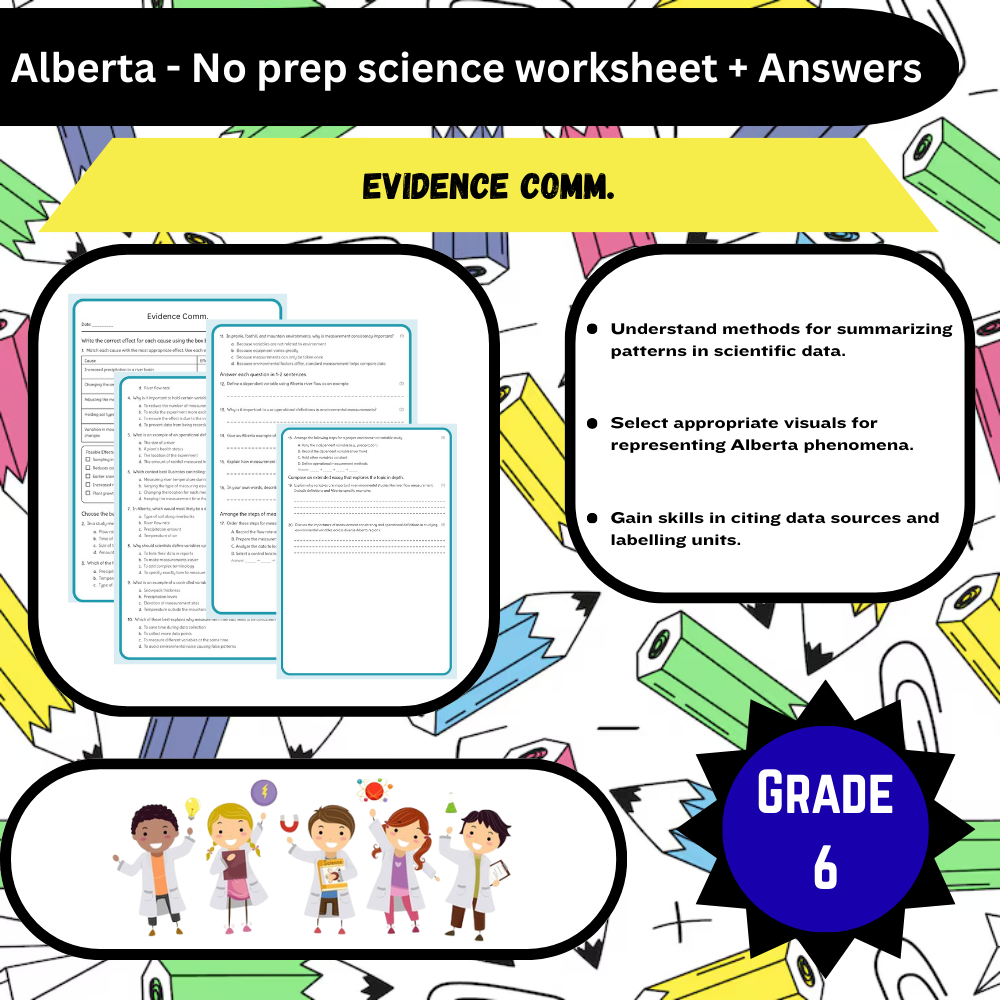
Grade 6 Science | Evidence Communication (Worksheet + Answer Key) – Alberta Standards
Created byBright Mind ResourcesLearning Objectives
- Understand methods for summarizing patterns in scientific data.
- Learn to select appropriate visuals such as bar, line, and scatter plots for representing Alberta phenomena.
- Gain skills in citing data sources, labelling units, and crafting clear evidence-based summaries.
Instant download

Science Grade 6 Worksheet: Optimization Tradeoffs | Ontario Standards
JCreated byJ.S SheetsLearning Objectives
- Explain how designers balance competing goals like lift, drag, weight, and stability when optimizing a vehicle.
- Use the idea of safety margins and stall/stability buffers to describe why performance envelopes matter.
- Describe Pareto trade-offs and how iterative tuning of design parameters can lead to viable configurations for a mission.
Instant download

Global Circulation and Climate Zones Worksheets | Grade 6 Science
 Created byTeachers Club
Learning Objectives
- Explain how uneven solar heating and Earth’s rotation drive large-scale atmospheric circulation.
- Describe how Hadley, Ferrel, and polar cells relate to trade winds, mid-latitude westerlies, and polar easterlies.
- Use ocean-current patterns and thermohaline circulation to predict regional differences in temperature and rainfall.
Also included in: Earth's Systems Grade 6 Science Worksheets | NGSS Unit Bundle +2 more
Instant download

Pattern From Graphs Assessment for Grade 6 Science | Standards-Aligned
Created byPrism Point LearningLearning Objectives
- Understand how to interpret different patterns in graphs, such as increasing, decreasing, and constant trends.
- Identify and describe patterns like scatter, plateau, and curved change using quantitative language.
- Apply models to summarize the shape of graph patterns and compare multiple conditions.
Also included in: Grade 6 Data & Evidence Science Lesson Bundle | General Framework
Instant download

Iterative Improvement Assessment | Standards-Aligned Grade 6 Science
Created byPrism Point LearningLearning Objectives
- Understand the concept of iterative improvement and how it involves evaluation and refinement.
- Identify the steps involved in using data to improve prototypes or designs.
- Explain how trade-offs are managed during iterative design processes.
Instant download

Evaporation Separation Assessment for Grade 6 Science | Standards-Aligned
Created byPrism Point LearningLearning Objectives
- Understand the process of evaporation as a method of separating soluble solids from liquids.
- Identify evidence that indicates evaporation has occurred during a separation process.
- Differentiate evaporation from other separation techniques based on the change of state.
Also included in: Grade 6 Physical Science Science Lesson Bundle: General Framework
Instant download
Grade 6 Science – Land Use & Human Impacts | Daily Reading Worksheet
 Created byElena Brooks
Learning Objectives
- Understand how land-use changes influence ecosystems and climate.
- Identify human activities that affect biogeochemical cycles.
- Analyze the causal relationship between land development and environmental trends.
Also included in: Grade 6 Science Earth and Human Activity Lesson Bundle | NGSS Aligned +1 more
Instant download
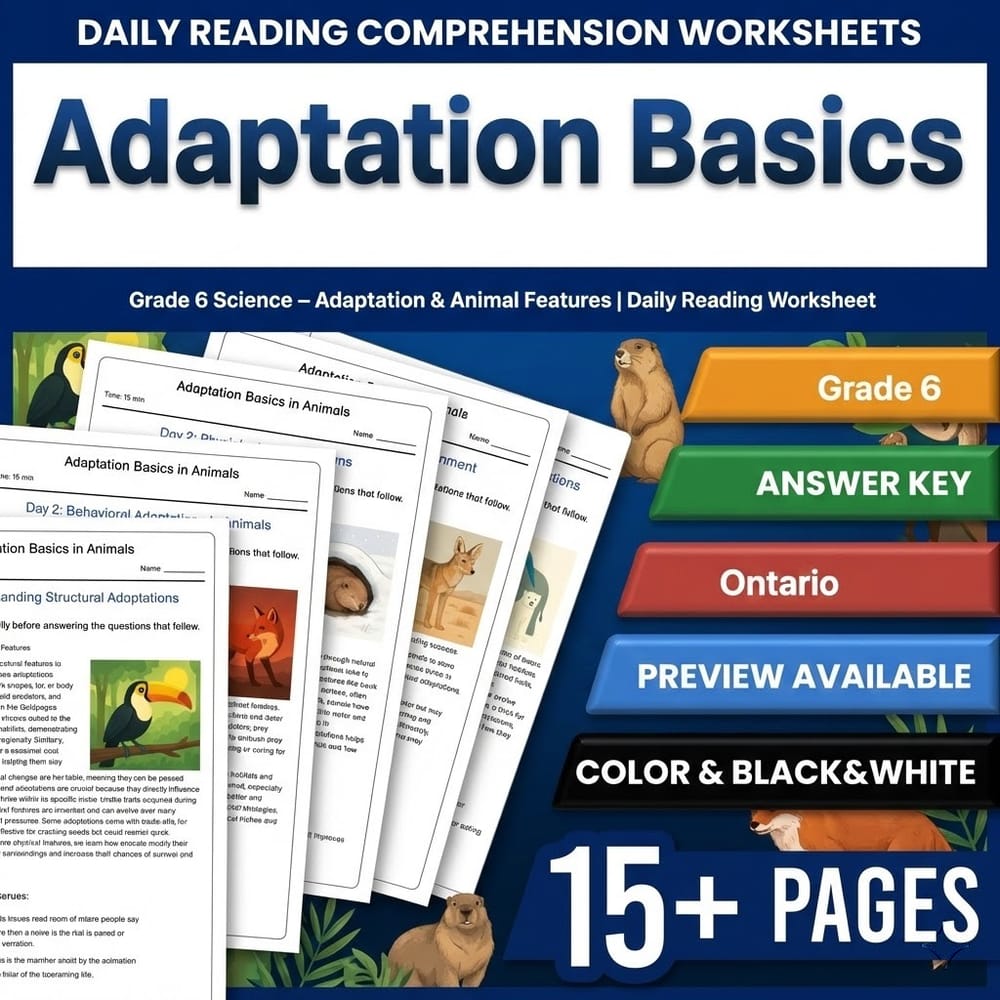
Grade 6 Science – Adaptation & Animal Features | Daily Reading Worksheet
Created byElena BrooksLearning Objectives
- Identify different types of structural adaptations in animals
- Differentiate between structural, behavioral, and physiological adaptations
- Understand how adaptations influence animal survival and reproduction
Instant download

Design Refinement Worksheet | Grade 6 Science Activities
Created byPrism Point LearningLearning Objectives
- Explain how incremental design changes can improve aerodynamic performance while maintaining safety.
- Identify trade-offs between speed, stability, and payload during design refinement.
- Describe how consistent observation of flight paths and simple measurements support testing decisions.
Also included in: Aerodynamics and Flight Design Lesson Bundle – Grade 6 Science Alberta
Instant download

Control Coupling Worksheet | Ontario Grade 6 Science Assessment
 Created byCedar Grove Learning
Learning Objectives
- Explain how roll, pitch, and yaw controls can produce coupled aircraft responses.
- Describe adverse yaw and how it can result from differential drag during roll.
- Identify design and control techniques (like differential and Frise ailerons) that reduce unwanted coupling.
Also included in: Grade 6 Aerodynamics | Flight - Science Lesson Bundle – Ontario Framework +1 more
Instant download

Grade 6 Conservation Strategies Worksheet | Practice & BC Standards PDF
 Created byClear Sky Classroom
Learning Objectives
- Describe how different conservation strategies (protected areas, habitat restoration, sustainable harvesting, and invasive species control) help maintain ecosystem balance.
- Explain how trade-offs among ecological goals, economic needs, and social values can affect conservation decisions.
- Use monitoring information to evaluate whether conservation strategies improve habitat and species resilience over time.
Instant download

Grade 6 Circuit Fault Diagnosis Worksheet | Ontario Science Electrical Circuits
 Created byTeacher's Corner
Learning Objectives
- Explain how observed circuit symptoms can be used to infer possible faults.
- Compare expected measurement patterns for series and parallel circuits to diagnose issues.
- Describe how component behavior helps narrow down likely causes of unequal brightness and abnormal readings.
Instant download
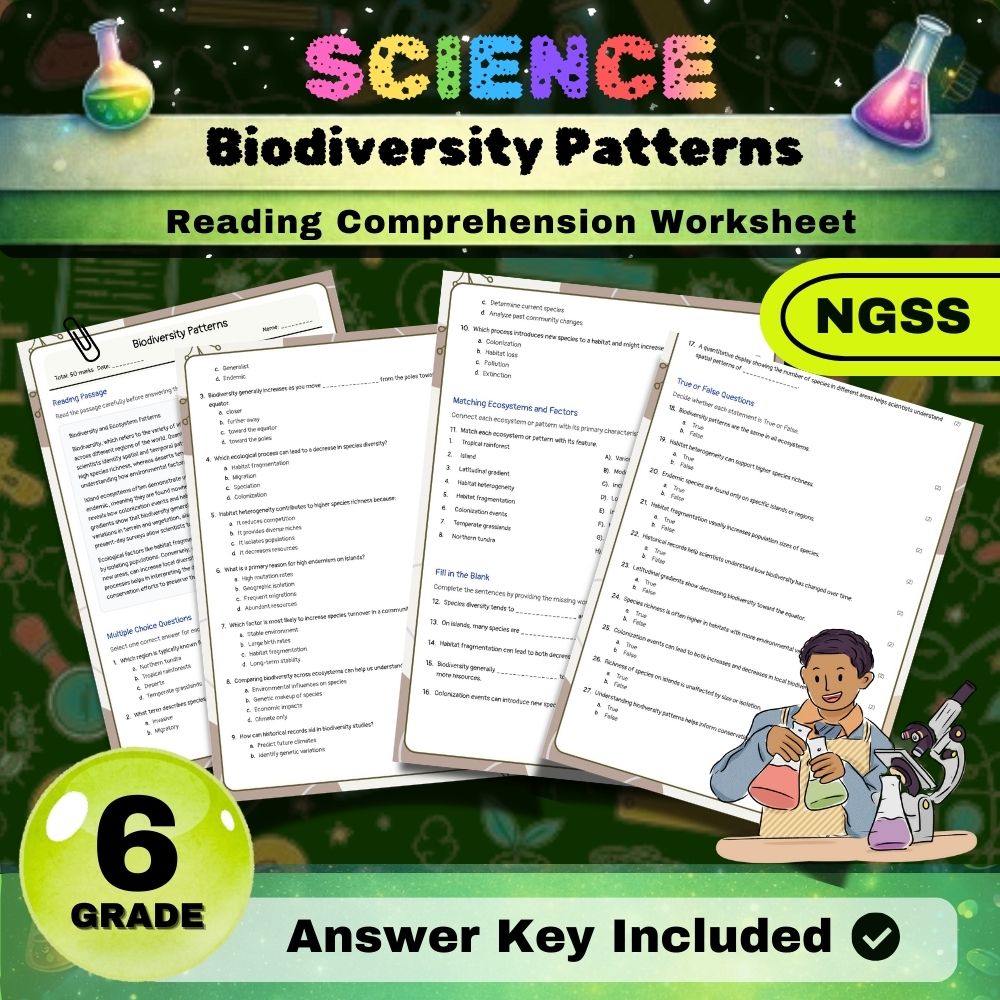
6th Grade Science | Biodiversity Patterns NGSS Worksheet (PDF + Google Form)
 Created byMaple Path Learning
Learning Objectives
- Understand how species occurrence and richness reveal biodiversity patterns across different ecosystems.
- Analyze comparisons of island faunas, latitudinal gradients, and habitat heterogeneity to interpret biodiversity variation.
- Explain how ecological and historical factors like habitat fragmentation and colonization influence species distribution.
Also included in: Grade 6 Science Bundle | Evolution, Natural Selection & Biodiversity Worksheets +1 more
Instant download

Forest Types Worksheet | Grade 6 Science Practice
Created byPrism Point LearningLearning Objectives
- Identify major forest types and describe how their species composition differs.
- Explain how abiotic factors such as elevation, soil moisture, and fire history affect where forests grow.
- Use forest types to predict likely habitat conditions and ecosystem services.
Also included in: Trees and Forests Lesson Bundle | Grade 6 Science | Alberta Framework
Instant download
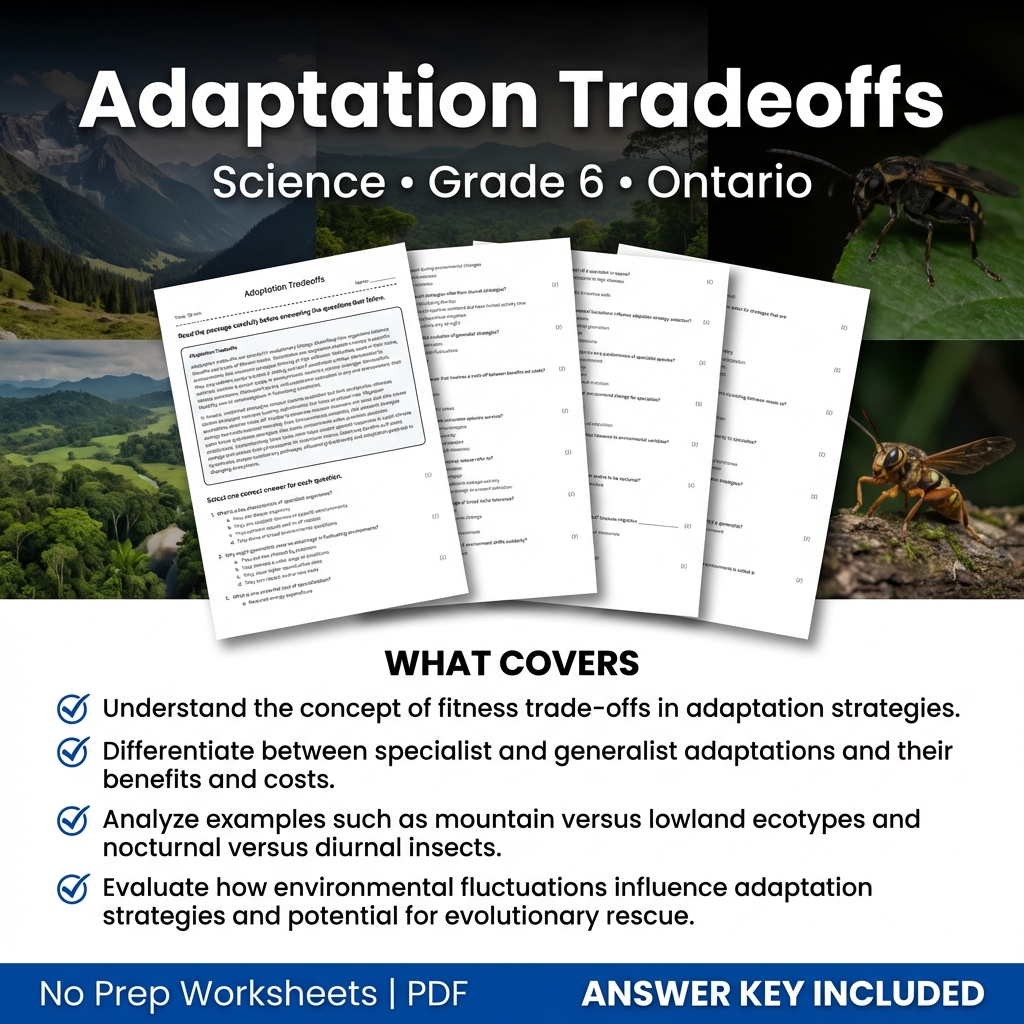
Adaptation Tradeoffs Worksheet | Ontario Grade 6 Science Practice
Created byCoral Reef LearningLearning Objectives
- Understand the concept of fitness trade-offs in adaptation strategies.
- Differentiate between specialist and generalist adaptations and their benefits and costs.
- Analyze examples such as mountain versus lowland ecotypes and nocturnal versus diurnal insects.
Instant download

Grade 6 Science – Growth Rings & Tree Study Daily Reading Worksheet
Created byBright Mind ResourcesLearning Objectives
- Understand what growth rings are and how they form in trees.
- Learn how growth rings can tell us about a tree's age and the environment during different years.
- Identify parts of a tree where growth rings are visible.
Also included in: Grade 6 Forest Ecology Science Daily Reading Worksheets Lesson Bundle | Alberta +2 more
Instant download

Grade 6 Inquiry Foundations Worksheet | Ontario Science PDF & Answer Key
Created byClear Sky ClassroomLearning Objectives
- Distinguish independent and dependent variables in simple investigations.
- Define variables using operational definitions and explain why they matter.
- Use controlled comparisons and identify constants to make a fair test.
Instant download

Trophic Interactions Practice Worksheet | Grade 6 Science Review
Created byPrism Point LearningLearning Objectives
- Explain how predation, herbivory, parasitism, competition, and mutualism affect organisms in an ecosystem.
- Describe how trophic interactions can change population size, behavior, and community structure.
- Use evidence from scenarios to identify the type of trophic interaction.
Also included in: Ecosystems & Interdependence Lesson Bundle | Grade 6 Science | BC +1 more
Instant download

Conservation Concepts Worksheet | TEKS Grade 6 Science Practice PDF
JCreated byJ.S SheetsLearning Objectives
- Explain conservation of mass in a closed system during physical and chemical processes using before-and-after measurements
- Use concrete examples (sealed reactions and closed-container phase changes) to distinguish conservation evidence from mass loss
- Identify why conservation of mass may not hold in open systems where mass exchange occurs
Instant download
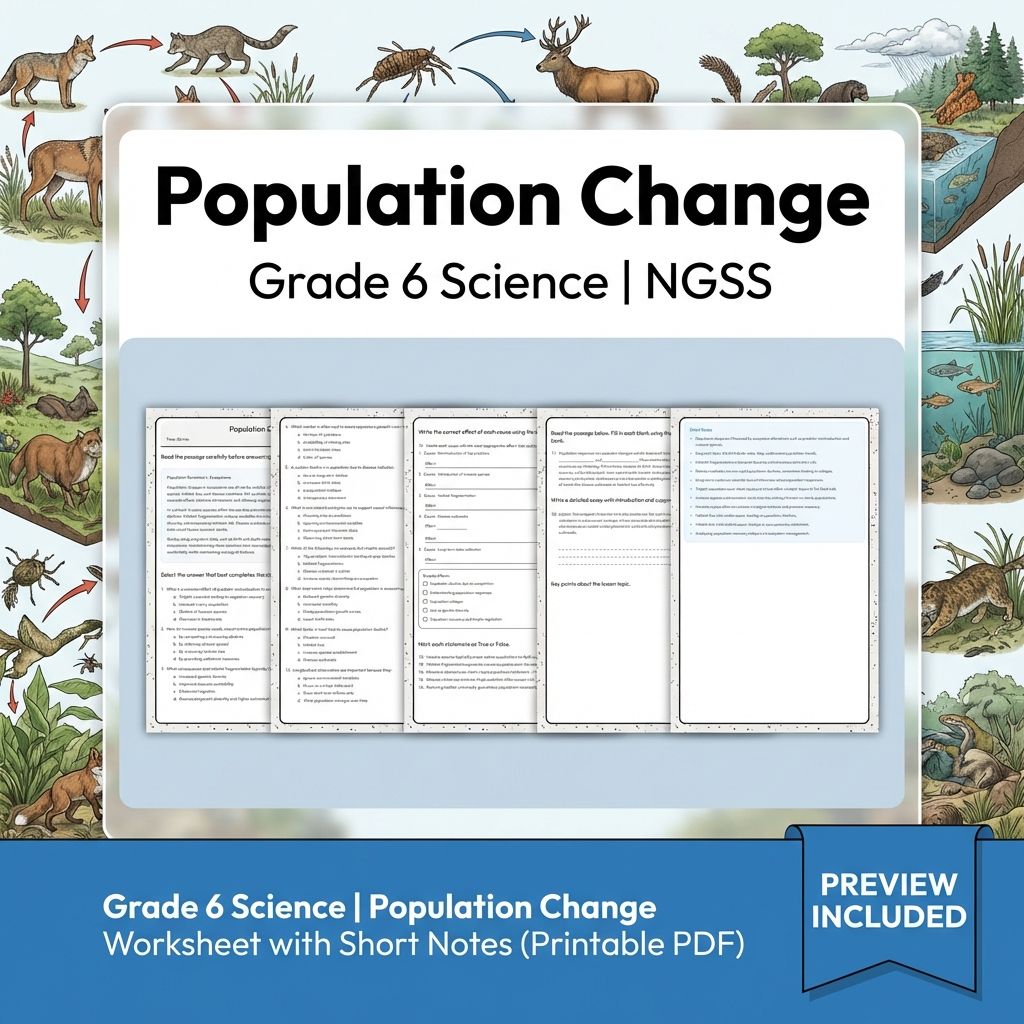
Grade 6 Science | Population Change Worksheet with Short Notes (Printable PDF)
 Created byMeadowlark Worksheets
Learning Objectives
- Construct evidence-based arguments linking ecosystem changes to population increases or declines.
- Analyze case studies such as predator reintroduction, invasive species, habitat fragmentation, and disease outbreaks.
- Interpret empirical data sets and longitudinal observations to understand population responses.
Also included in: Grade 6 Science | Ecosystems: Interactions, Energy & Dynamics NGSS Unit Bundle +1 more
Instant download

Grade 6 Science | Physical vs Chemical Worksheet | NGSSS Aligned
 Created byLumora Learning
Learning Objectives
- Differentiate between physical changes and chemical changes based on what happens to matter
- Identify evidence of chemical changes such as gas formation, color change, and permanent texture changes
- Explain how particle rearrangement differs from particle bonding in physical vs chemical changes
Instant download

6th Grade Science – Reproductive Structures Worksheet (Alberta Standards) (PDF)
 Created bySilver Birch Teaching
Learning Objectives
- Explain how flowers and cones support reproduction in plants.
- Describe how seeds and different dispersal mechanisms affect where plants grow.
- Compare vegetative propagation and seed-based reproduction in terms of regeneration and genetic diversity.
Also included in: Grade 6 Ecosystem Interactions Science Lesson Bundle: Alberta Framework +1 more
Instant download

Grade 6 NGSS Energy Flow and Food Webs Science Worksheet with Notes
 Created byBRIGHT PATH RESOURCES
Learning Objectives
- Identify producers, herbivores, and carnivores within food webs.
- Understand the flow of energy from producers to consumers.
- Recognize roles of decomposers in nutrient recycling.
Also included in: Ecosystems Interactions Energy Dynamics Lesson Bundle | Grade 6 Science | NGSS +2 more
Instant download

Grade 6 Science | Mixture Separation Worksheet | NGSSS Aligned
Created byLumora LearningLearning Objectives
- Explain why mixtures can be separated without forming a new substance
- Identify physical properties used to separate components of a mixture
- Match common separation methods to the mixtures and properties they use
Instant download
Grade 6 Science – Component Functions in Circuits Daily Worksheet + Answer Key
JCreated byJ.S SheetsLearning Objectives
- Understand key concepts related to Science
- Apply knowledge through practice questions
- Demonstrate comprehension of the material
Also included in: Grade 6 Science Lesson Group – Circuits and Energy Ontario Framework +1 more
Instant download

Grade 6 Policy and Decisions Daily Reading | TEKS Science Worksheet
Created byBRIGHT PATH RESOURCESLearning Objectives
- Identify the key scientific evidence used in a policy decision.
- Explain how uncertainty and costs can affect policy choices.
- Use evidence and stakeholder values to justify a decision.
Also included in: Science in Society Daily Reading Worksheets Bundle | Grade 6 Science | TEKS +1 more
Instant download

Climate Data Patterns Worksheet | Grade 6 Science Practice
Created byPrism Point LearningLearning Objectives
- Explain how climate data collected over many years is different from weather data about one day.
- Interpret how graphs of temperature and precipitation show averages, variability, and possible extremes.
- Use evidence from multiple years to compare current climate patterns with historical baselines.
Instant download

Grade 6 Science | Measurement Tools Daily Reading Comprehension
Created byCoral Reef LearningLearning Objectives
- Understand how to measure temperature using thermometers
- Identify different types of measurement tools used in science
- Learn how environmental factors affect temperature readings
Also included in: Evidence and Investigation Lesson Bundle | Grade 6 Science | Alberta +1 more
Instant download

Engineering Design Process Worksheets | Criteria, Constraints & Testing
LCreated byLearnora ResourcesLearning Objectives
- Identify problems, criteria, constraints, solutions, and prototypes
- Sequence the steps of the engineering design process
- Compare design solutions using criteria and test data
Instant download

Science Worksheet Pollution Effects Grade 6 | Standards-Aligned Practice
JCreated byJ.S SheetsLearning Objectives
- Explain how nutrient loading contributes to eutrophication in aquatic ecosystems.
- Describe how chemical contaminants can cause endocrine disruption and bioaccumulation in organisms.
- Use measurable indicators (dissolved oxygen, algal biomass, contaminant residues) to connect pollution to changes in species diversity and ecosystem functioning.
Instant download

Xylem and Phloem Transport in Trees Worksheets Grade 6 Science
 Created bySunny Desk Resources
Learning Objectives
- Explain how xylem and phloem move water, minerals, and sugars through a tree.
- Describe how freeze–thaw cycles, drought, and pest damage can change sap flow patterns.
- Identify how bark traits help protect trees from herbivory and fire.
Also included in: Trees and Forests Grade 6 Alberta Science Worksheets Bundle +1 more
Instant download

Grade 6 Science – Forms Of Energy Daily Reading Worksheet | BC Standards
Created byBright Mind ResourcesLearning Objectives
- Understand the concept of kinetic energy
- Identify different forms of energy as they appear in real examples
- Recognize how energy transforms from one form to another
Also included in: Grade 6 Daily Reading Science Worksheets | Lesson Bundle | BC Framework +1 more
Instant download

Building Explanations from Evidence Science Worksheets Grade 6
Created byBRIGHT PATH RESOURCESLearning Objectives
- Explain how evidence supports a scientific claim by linking observations to an accepted concept or mechanism.
- Describe evidence using trends, ranges, and comparisons between expected and observed values.
- Compare competing explanations by deciding which one is better supported by the evidence.
Also included in: Grade 6 Scientific Inquiry Science Worksheets Bundle | General Science +2 more
Instant download

6th Grade Science Water Reservoirs & Water Cycle Worksheet | California PDF
 Created byEvergreen Desk Education
Learning Objectives
- Describe how Earth’s water is stored in major reservoirs (oceans, lakes, rivers, groundwater, glaciers, and the atmosphere).
- Explain how water transfers between reservoirs when it changes state (solid, liquid, gas) and through processes like precipitation and runoff.
- Use reservoir connections to predict how water availability can change over time.
Instant download
Grade 6 Science | Tree Evidence Worksheet with Short Notes (Printable PDF)
Created byMeadowlark WorksheetsLearning Objectives
- Understand how anatomical and molecular traits support hypotheses of common ancestry.
- Identify homologous structures, vestigial organs, and conserved DNA sequences.
- Interpret patterns of similarity and difference among taxa using phylogenetic trees.
Also included in: Grade 6 Science | Biological Evolution: Unity and Diversity Unit Bundle +1 more
Instant download

Grade 6 Science – Pattern Analysis & Environmental Data | Reading Worksheet
Created byBright Mind ResourcesLearning Objectives
- Understand how to identify simple temperature patterns over time
- Learn to interpret visual data representations of environmental trends
- Recognize the significance of seasonal and long-term temperature cycles
Also included in: Grade 6 Science Data & Inquiry Daily Reading Worksheets Lesson Bundle | Alberta +2 more
Instant download

Stewardship Practices and Landscape Benefits Worksheets Grade 6 Science
Created bySunny Desk ResourcesLearning Objectives
- Describe how stewardship practices (planting, shelterbelts, urban canopy programs, and Indigenous land care) support ecosystems in Alberta.
- Explain how local actions can improve habitat connectivity, carbon storage, and water regulation over time.
- Use vocabulary from land stewardship to answer questions about cause and effect in landscapes.
Also included in: Trees and Forests Grade 6 Alberta Science Worksheets Bundle +1 more
Instant download

Grade 6 Science – Understanding States of Matter | Daily Reading Worksheet
Created byBright Mind ResourcesLearning Objectives
- Describe the characteristics of solids, liquids, and gases.
- Explain how particles behave in each state of matter.
- Identify changes in energy that cause state changes.
Also included in: Grade 6 Science Energy & Matter Daily Reading Lesson Bundle | Florida NGSSS +1 more
Instant download

Grade 6 Science – Wing Shapes & Aerodynamics | Daily Reading Worksheet
Created byBright Mind ResourcesLearning Objectives
- Describe different wing shapes and their functions
- Identify features such as camber, thickness, and aspect ratio
- Explain how wing design affects lift and maneuverability
Also included in: Aerodynamics Grade 6 Science Daily Reading Worksheets Lesson Bundle | Alberta +2 more
Instant download

Grade 6 Science | Matter Properties Worksheet | General Standard
Created byLumora LearningLearning Objectives
- Identify observable properties of matter (color, hardness, texture, and conductivity) and explain how they help describe substances.
- Classify matter based on its form (solid, liquid, or gas) and connect form to observable behavior.
- Use evidence from comparisons to support predictions about how materials will respond to heat or electricity.
Instant download
About Grade 6 Science Worksheets
Explore Grade 6 Science worksheets for classwork, homework, or review. Our 5,997 printables download instantly as PDFs.
MyTeachingSheets worksheets are made by real teacher-authors and checked before they go live. Download any as a print-ready PDF for lessons, homework, or independent practice — most include answer keys, and previews are always free.