
Grade 6 Science Worksheets
5,969 worksheets
Grade 6 Lunar Phase Illumination and Timing Worksheet | Ontario Science
 Created byTeacher's Corner
Learning Objectives
- Explain how the changing relative positions of the Sun, Earth, and Moon control the visible fraction of the Moon
- Sequence lunar phases using illumination geometry and recognize that the pattern repeats cyclically
- Differentiate lunar phases from eclipses by describing what each event requires
Instant download

Grade 6 Science Team Roles & Versioning Worksheet | Ontario Collaboration
Created byTeacher's CornerLearning Objectives
- Explain how roles and communication protocols help teams complete scientific investigations.
- Use shared documentation standards, including versioning and attribution, to track changes in records.
- Identify strategies for resolving conflicting observations during team work.
Instant download

Grade 6 Electrical Conductors & Conductivity Factors Worksheet | Ontario Science
Created byTeacher's CornerLearning Objectives
- Describe how free electrons allow charge to flow in electrical conductors
- Compare how different materials behave as conductors or poorer conductors
- Explain how temperature, material type, and cross-sectional area affect conductivity
Instant download

Grade 6 Adaptation Tradeoffs Worksheet | Specialists vs Generalists Science
Created byTeacher's CornerLearning Objectives
- Explain how adaptation tradeoffs can favor either specialization or broad tolerance.
- Compare how fitness benefits and costs differ for specialists and generalists in changing environments.
- Use examples (plants, insects, migration) to describe how environment affects survival and reproduction.
Instant download

Grade 6 Robotic Missions & Engineering Constraints Science Worksheet Ontario
Created byTeacher's CornerLearning Objectives
- Describe how robotic probes explore space using flyby, orbiter, lander, and sample-return mission types
- Explain how distance affects communication delay and mission planning
- Identify how propulsion, gravity assists, and instrumentation choices support data collection
Instant download

Grade 6 Aircraft and Glider Design Process Science Worksheet | Ontario
Created byTeacher's CornerLearning Objectives
- Describe the steps of an iterative design process used in aircraft and gliders.
- Use performance criteria and trade-offs to justify design choices related to lift, drag, weight, and stability.
- Interpret simple lift and drag measurements to decide how to refine a prototype.
Instant download

Grade 6 Control Surfaces Flight Control Authority Worksheet | Ontario Science
Created byTeacher's CornerLearning Objectives
- Identify primary and secondary control surfaces and describe what each one controls in flight.
- Explain how deflecting a control surface changes local lift and creates a turning moment.
- Describe control authority and how it affects an aircraft's response compared with stability.
Instant download
Grade 6 Science | Organ Systems Worksheet with Short Notes (Printable PDF)
 Created byMeadowlark Worksheets
Learning Objectives
- Describe the basic organization of circulatory, respiratory, digestive, and nervous systems.
- Explain the roles of tissues and organs within each organ system.
- Connect cellular functions to overall system-level processes and outcomes.
Also included in: Grade 6 Science NGSS From Molecules to Organisms: Structures & Processes +1 more
Instant download

TITLE: Particle Models Worksheet Grade 6 NGSS Science Activity & Answer Key DES
 Created byNorthstar Worksheets
Learning Objectives
- Explain how particle models describe matter as made of particles that are too small to see.
- Use particle ideas to predict what happens to a substance during melting, freezing, boiling, and condensation.
- Relate temperature and thermal energy to the motion and kinetic energy of particles.
Also included in: Grade 6 Matter & Chemical Reactions Lesson Bundle | NGSS | Science +1 more
Instant download

Grade 6 Species Interactions Worksheet | NGSS Ecosystems Science Activity
Created byNorthstar WorksheetsLearning Objectives
- Identify and classify major species interaction types: mutualism, competition, predation, and parasitism
- Use evidence to predict how species interactions can change across forest, grassland, and freshwater ecosystems
- Explain how niche partitioning, resource overlap, and behavioral strategies affect interaction strength
Also included in: Grade 6 Ecosystems Lesson Bundle | NGSS Science: Species, Energy & Biodiversity +1 more
Instant download

Grade 6 Day Night Seasons Worksheet | NGSS Earth Science Activity & Answer Key
Created byNorthstar WorksheetsLearning Objectives
- Explain how Earth’s rotation causes day and night.
- Describe how Earth’s orbit and 23.5° axial tilt lead to seasons.
- Use solstices and equinoxes as observable markers for seasonal change.
Also included in: Grade 6 Earth Science Scale of Space & Moon Seasons Lesson Bundle – NGSS +1 more
Instant download

Population Change Worksheet Grade 6 Science NGSS Answer Key
Created byNorthstar WorksheetsLearning Objectives
- Explain how changes in ecosystem components can cause population increases or declines using evidence.
- Interpret population data (birth/death rates, age structure, and growth curves) to make causal inferences.
- Use case studies (predator reintroduction, invasive species, habitat fragmentation, and disease outbreaks) to support claims.
Also included in: Grade 6 Ecosystems Lesson Bundle | NGSS Science: Species, Energy & Biodiversity +1 more
Instant download

Grade 6 Collisions and Momentum Worksheet | NGSS Physical Science Activity
Created byNorthstar WorksheetsLearning Objectives
- Explain how conservation of momentum applies to isolated two-object systems during collisions.
- Describe action-reaction force pairs that occur during contact between two objects.
- Distinguish elastic and inelastic collisions using momentum and resulting motion.
Also included in: Grade 6 Physical Science Forces, Gravity, Electricity & Momentum Lesson Bundle | NGSS +1 more
Instant download

Grade 6 Moon Relationships Worksheet | NGSS Earth Science Activity & Answer Key
Created byNorthstar WorksheetsLearning Objectives
- Explain how the relative positions of Earth, Moon, and Sun create lunar phases and eclipses.
- Describe the sequence of primary lunar phases and how illumination changes during the month.
- Identify the conditions for solar and lunar eclipses using line-of-sight and shadow explanations.
Also included in: Grade 6 Earth Science Scale of Space & Moon Seasons Lesson Bundle – NGSS +1 more
Instant download

Conservation of Mass Worksheet Grade 6 NGSS Science Activity & Answer Key
Created byNorthstar WorksheetsLearning Objectives
- Explain conservation of mass by tracking atoms and total mass in a closed system
- Use particle diagrams and symbolic models to show that atoms rearrange but their total count stays the same
- Connect mass measurements before and after changes to conservation of mass in physical and chemical processes
Also included in: Grade 6 Matter & Chemical Reactions Lesson Bundle | NGSS | Science +1 more
Instant download

Grade 6 Gravity and Friction Worksheet | NGSS Science Activity & Answer Key
Created byNorthstar WorksheetsLearning Objectives
- Explain how gravitational attraction depends on mass and distance using real-world examples.
- Describe how friction is a contact force that affects motion along surfaces.
- Use evidence to argue whether changes in motion are caused by gravity or friction.
Also included in: Grade 6 Physical Science Forces, Gravity, Electricity & Momentum Lesson Bundle | NGSS +1 more
Instant download

Grade 6 Orbital Motion Worksheet | NGSS Earth Science Activity & Answer Key
Created byNorthstar WorksheetsLearning Objectives
- Explain how gravitational attraction controls the motion of planets and satellites.
- Describe how gravity between the Sun and planets creates elliptical orbits and changes orbital speed.
- Connect orbital period and orbital speed to how distance affects gravitational pull.
Also included in: Grade 6 Earth Science Scale of Space & Moon Seasons Lesson Bundle – NGSS +1 more
Instant download
Grade 6 Science – Design Process & Engineering Workflow Daily Worksheet
 Created byQuiet Forest Education
Learning Objectives
- Explain the main steps of the design cycle in engineering.
- Identify key considerations when designing aircraft and gliders.
- Understand how measurement and refinement improve aerodynamic performance.
Also included in: Flight Science Grade 6 Daily Reading Worksheets Bundle | Ontario +1 more
Instant download

Grade 6 Science – Crystal Structures & Properties | Daily Reading Worksheet
 Created byBright Mind Resources
Learning Objectives
- Identify properties of crystalline solids
- Differentiate between crystalline and amorphous solids
- Understand how particle arrangements affect material properties
Also included in: Matter & Change Grade 6 Science Daily Reading Worksheets Lesson Bundle | BC +1 more
Instant download

Grade 6 Science – Ecosystem Components & Interactions | Daily Reading Worksheet
Created byBright Mind ResourcesLearning Objectives
- Identify biotic components in an ecosystem
- Understand the interactions between living and nonliving factors
- Explore how plants and animals influence their habitats
Also included in: Grade 6 Ecosystem Relationships Science Daily Reading Lesson Bundle | BC +1 more
Instant download

Grade 6 Science – Filtration Method Daily Reading Worksheet | Standards-Aligned
Created byBright Mind ResourcesLearning Objectives
- Understand what filtration is and how it separates mixtures.
- Identify key components involved in the filtration process.
- Explain observable evidence of filtration such as residue and liquid clarity.
Also included in: Matter, Heat & Forces Lesson Bundle | Grade 6 Science | General +1 more
Instant download
Grade 6 Science – Collaborative Practices & Teamwork | Daily Reading Worksheet
Created byQuiet Forest EducationLearning Objectives
- Understand the importance of clear roles in scientific teams
- Identify key principles that enhance team collaboration
- Recognize how documentation and communication support scientific work
Also included in: Science Grade 6 Daily Reading Worksheets Bundle | Ontario Framework +1 more
Instant download
Grade 6 Science – Biodiversity Solutions | Daily Reading Worksheet
 Created byElena Brooks
Learning Objectives
- Understand different conservation strategies for protecting coral reefs.
- Compare ecological trade-offs and effectiveness of various biodiversity solutions.
- Analyze case studies of habitat restoration and invasive species management.
Also included in: Grade 6 Science Ecosystems Lesson Bundle | NGSS Interactions & Energy +1 more
Instant download
Grade 6 Science – Signal Integration in Cells | Daily Reading Worksheet
Created byElena BrooksLearning Objectives
- Identify different types of signals that cells use for communication.
- Describe the basic pathways involved in cellular signaling.
- Differentiate between rapid nerve impulses and longer-term hormonal responses.
Also included in: Grade 6 Science From Molecules to Organisms Worksheet Bundle | NGSS +1 more
Instant download
Grade 6 Science – Developing Solutions & Engineering | Daily Reading Worksheet
Created byElena BrooksLearning Objectives
- Understand how to compare multiple design solutions using matrices and scoring rubrics.
- Learn to evaluate solutions based on quantitative criteria such as efficiency, durability, and cost.
- Analyze trade-offs in design choices to select the most promising options.
Also included in: Grade 6 Science Engineering Design Lesson Bundle | NGSS Worksheets +1 more
Instant download

Grade 6 Science – Energy Efficiency & Understanding Concepts | Reading Worksheet
Created byBright Mind ResourcesLearning Objectives
- Understand the concept of energy efficiency and how it compares useful energy output to total energy input.
- Identify examples of energy use in everyday devices and activities.
- Recognize factors that lead to energy losses such as friction and resistance.
Also included in: Grade 6 Daily Reading Science Worksheets | Lesson Bundle | BC Framework +1 more
Instant download
Grade 6 Science – Atomic Composition of Water | Daily Reading Worksheet
Created byElena BrooksLearning Objectives
- Identify atoms and molecules in chemical formulas
- Recognize models and representations of molecules
- Describe the composition of H2O and NaCl
Also included in: Grade 6 Science Matter and Its Interactions Lesson Bundle | NGSS +1 more
Instant download
Grade 6 Science – Sustainability Strategies & Renewable Energy | Daily Reading
Created byElena BrooksLearning Objectives
- Identify different types of renewable energy sources
- Understand the benefits of renewable energy for the environment
- Recognize conservation measures and circular resource use
Also included in: Grade 6 Science Earth and Human Activity Lesson Bundle | NGSS Aligned +1 more
Instant download

Grade 6 Science – Animals Matter Use Reading Worksheet | California Standards
Created byBright Mind ResourcesLearning Objectives
- Understand how animals consume and incorporate matter from food
- Explain the processes by which matter is used and expelled in animals
- Identify how energy and matter from food support animal life functions
Also included in: Grade 6 Ecosystems and Energy Science Lesson Bundle | California Standards +1 more
Instant download

Grade 6 Science – Evaporation & Water Changes | Daily Reading Worksheet
Created byBright Mind ResourcesLearning Objectives
- Explain what evaporation is and how it separates substances
- Identify evidence of evaporation in experiments
- Differentiate evaporation from other separation methods
Also included in: Matter, Heat & Forces Lesson Bundle | Grade 6 Science | General +1 more
Instant download

Grade 6 Science – System Thinking & Components | Daily Reading Worksheet
Created byBright Mind ResourcesLearning Objectives
- Understand the basic components of a system.
- Identify how parts of a system interact and influence each other.
- Learn cause-and-effect reasoning in system design.
Also included in: Engineering & Technology Grade 6 Science Worksheets Lesson Bundle | General +1 more
Instant download

Grade 6 Science – Sun's Daily Motion & Celestial Sphere | Reading Worksheet
Created byBright Mind ResourcesLearning Objectives
- Describe how Earth’s rotation affects the daily rising and setting of the Sun.
- Explain the concept of the celestial sphere and how it relates to the Sun’s apparent movement.
- Identify the paths of the Sun across the sky at different times of the day.
Also included in: Space Systems Grade 6 Science Daily Reading Worksheets Bundle | Ontario +1 more
Instant download

Grade 6 Science – Properties of Matter & Materials | Daily Reading Worksheet
Created byBright Mind ResourcesLearning Objectives
- Identify observable properties such as color, hardness, and texture of different materials.
- Describe physical characteristics of common materials like copper, wood, and glass.
- Understand how properties help classify substances and predict behavior.
Also included in: Matter, Heat & Forces Lesson Bundle | Grade 6 Science | General +1 more
Instant download

Grade 6 Science – Building Knowledge & Scientific Inquiry | Reading Worksheet
Created byBright Mind ResourcesLearning Objectives
- Understand how scientific evidence influences explanations
- Recognize the process of refining scientific ideas
- Differentiate between scientific theories and laws
Also included in: Scientific Inquiry Grade 6 Science Daily Reading Worksheets Bundle | FL NGSSS +1 more
Instant download

Grade 6 Science – Control Coupling & Aerodynamics | Daily Reading Worksheet
Created byBright Mind ResourcesLearning Objectives
- Understand the concept of control coupling and its impact on aircraft maneuverability
- Identify aerodynamic interactions among roll, pitch, and yaw controls
- Describe techniques used to mitigate adverse control effects
Also included in: Grade 6 Aerodynamics Science Lesson Bundle Daily Reading Worksheets | Ontario +1 more
Instant download

Grade 6 Science – Scientific Models & Limitations Daily Reading Worksheet
Created byBright Mind ResourcesLearning Objectives
- Identify assumptions made in simple scientific models.
- Explain how models are used to support scientific explanations.
- Recognize the limitations of models and how evidence refines them.
Also included in: Variables & Experiments Data Grade 6 Science Worksheets Lesson Bundle | General +1 more
Instant download

Grade 6 Science – Food Molecules Daily Reading Worksheet | California Standards
Created byBright Mind ResourcesLearning Objectives
- Identify different types of food molecules
- Understand the functions of carbohydrates, proteins, and fats
- Learn how digestive processes break down food molecules into smaller parts
Also included in: Grade 6 Ecosystems and Energy Science Lesson Bundle | California Standards +1 more
Instant download

Grade 6 Science – Respiration & Digestion | Daily Reading Worksheet
Created byBright Mind ResourcesLearning Objectives
- Understand the structure and function of the respiratory system, especially the lungs.
- Learn how gases are exchanged in the lungs through diffusion.
- Understand the role of the respiratory and digestive systems in supporting cellular energy.
Also included in: Life Processes Grade 6 Science Daily Reading Worksheets Lesson Bundle | General +1 more
Instant download

Grade 6 Science – Density & Materials | Daily Reading Worksheet
Created byBright Mind ResourcesLearning Objectives
- Understand the concept of density and how it relates mass and volume
- Observe how objects with different densities behave in water
- Identify the factors influencing whether objects sink or float
Also included in: Matter, Heat & Forces Lesson Bundle | Grade 6 Science | General +1 more
Instant download
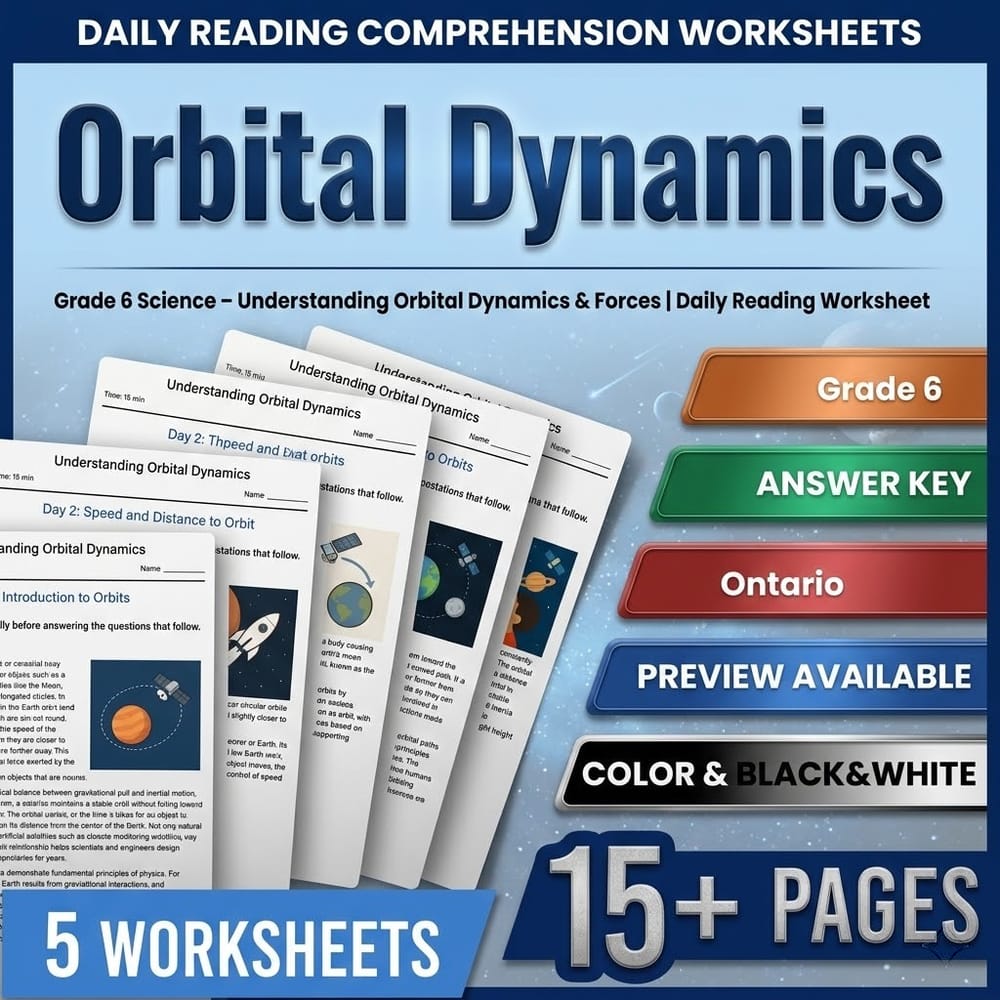
Grade 6 Science – Understanding Orbital Dynamics & Forces | Daily Worksheet
Created byQuiet Forest EducationLearning Objectives
- Describe what an orbit is and how elliptical paths differ from near-circular ones.
- Explain why satellite speed varies depending on their distance from the Earth.
- Understand the balance of gravitational force and inertial motion in maintaining stable orbits.
Also included in: Space Science Grade 6 Daily Reading Worksheets Bundle | Ontario +1 more
Instant download

Grade 6 Science – Energy Transfer & Heat Methods | Daily Reading Worksheet
Created byBright Mind ResourcesLearning Objectives
- Understand the three main mechanisms of heat transfer: conduction, convection, and radiation.
- Identify real-life examples of each heat transfer method.
- Connect observable temperature changes to different energy transfer processes.
Also included in: Matter & Energy Grade 6 Science Daily Reading Worksheets Bundle | TEKS +2 more
Instant download

Grade 6 Science – Community Stewardship & Scientific Methods | Reading Worksheet
Created byBright Mind ResourcesLearning Objectives
- Understand the importance of scientific observations in community environmental issues
- Recognize protocols for respectful data collection and cultural sensitivity
- Learn strategies for communicating scientific findings to the community
Also included in: Science Grade 6 Science Daily Reading Worksheets Lesson Bundle | Ontario +1 more
Instant download

Grade 6 Science – Symbiotic Relations & Mutualism | Daily Reading Worksheet
Created byBright Mind ResourcesLearning Objectives
- Understand the concept of mutualism in symbiotic relationships.
- Identify examples of mutualism in nature.
- Analyze how mutualistic interactions benefit both species involved.
Also included in: Ecosystems Grade 6 Science Daily Reading Worksheets Lesson Bundle | TEKS +2 more
Instant download

Grade 6 Science – Careers in Science Daily Reading Worksheet | TEKS Aligned
Created byBright Mind ResourcesLearning Objectives
- Understand key concepts related to Science
- Apply knowledge through practice questions
- Demonstrate comprehension of the material
Also included in: Grade 6 Science and Society Lesson Bundle Daily Reading Worksheets | TEKS +2 more
Instant download

Grade 6 Science – Ecosystems & Interactions Daily Reading Worksheet
Created byBright Mind ResourcesLearning Objectives
- Identify biotic components in various ecosystems
- Identify abiotic components in ecosystems
- Describe the roles of different components in habitat structure
Also included in: Ecosystems Grade 6 Science Daily Reading Worksheets Lesson Bundle | TEKS +2 more
Instant download

Grade 6 Science – Energy Forms & Concepts | Daily Reading Worksheet
Created byBright Mind ResourcesLearning Objectives
- Identify different forms of energy such as kinetic, potential, thermal, chemical, and electrical.
- Relate everyday phenomena to energy forms, like a rolling ball or a lit bulb.
- Differentiate between motion, position, and internal energy in objects.
Also included in: Matter & Energy Grade 6 Science Daily Reading Worksheets Bundle | TEKS +2 more
Instant download

Grade 6 Science – Communicating Evidence & Data Presentation | Reading Worksheet
Created byBright Mind ResourcesLearning Objectives
- Understand how to interpret and use graphs and charts to support scientific claims.
- Learn effective ways to present data visually for clear communication.
- Develop skills to analyze evidence and construct logical scientific arguments.
Also included in: Science Grade 6 Science Daily Reading Worksheets Lesson Bundle | Ontario +1 more
Instant download

Grade 6 Science – Scientific Ethics & Responsibility Daily Reading Worksheet
Created byBright Mind ResourcesLearning Objectives
- Understand the importance of privacy in medical data handling.
- Identify ethical considerations in digital measurement and data use.
- Analyze scenarios involving environmental stewardship and biotechnology decisions.
Also included in: Grade 6 Science and Society Lesson Bundle Daily Reading Worksheets | TEKS +2 more
Instant download
About Grade 6 Science Worksheets
Explore Grade 6 Science worksheets for classwork, homework, or review. Our 5,969 printables download instantly as PDFs.
MyTeachingSheets worksheets are made by real teacher-authors and checked before they go live. Download any as a print-ready PDF for lessons, homework, or independent practice — most include answer keys, and previews are always free.