
Science Worksheets
42,859 subject resources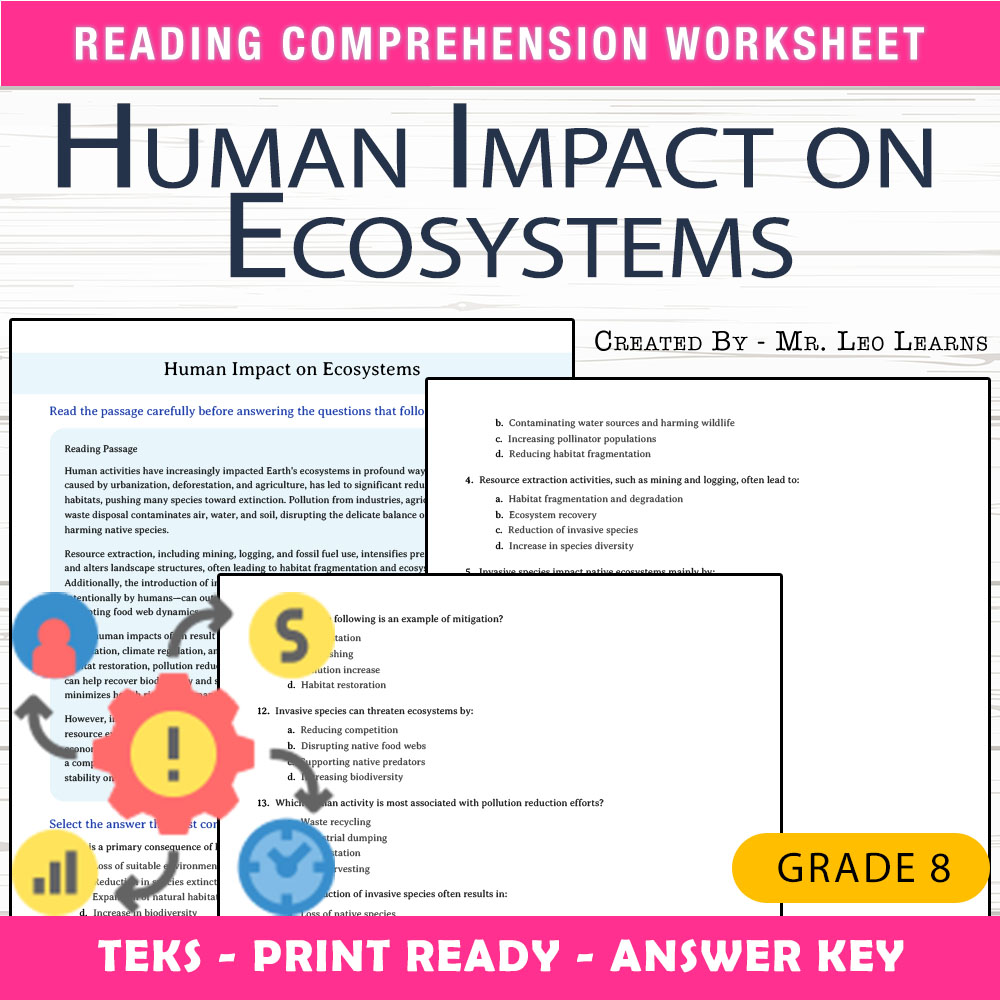
Grade 8 Science — Human Impact on Ecosystems Worksheet for Mastery | PDF + Answer Key
 Created byThe Resource Hub
Learning Objectives
- Identify key human activities that affect ecosystems such as habitat alteration, pollution, resource extraction, and invasive species introduction.
- Explain how these activities influence biodiversity, food webs, and ecosystem services.
- Evaluate mitigation strategies like habitat restoration and pollution control.
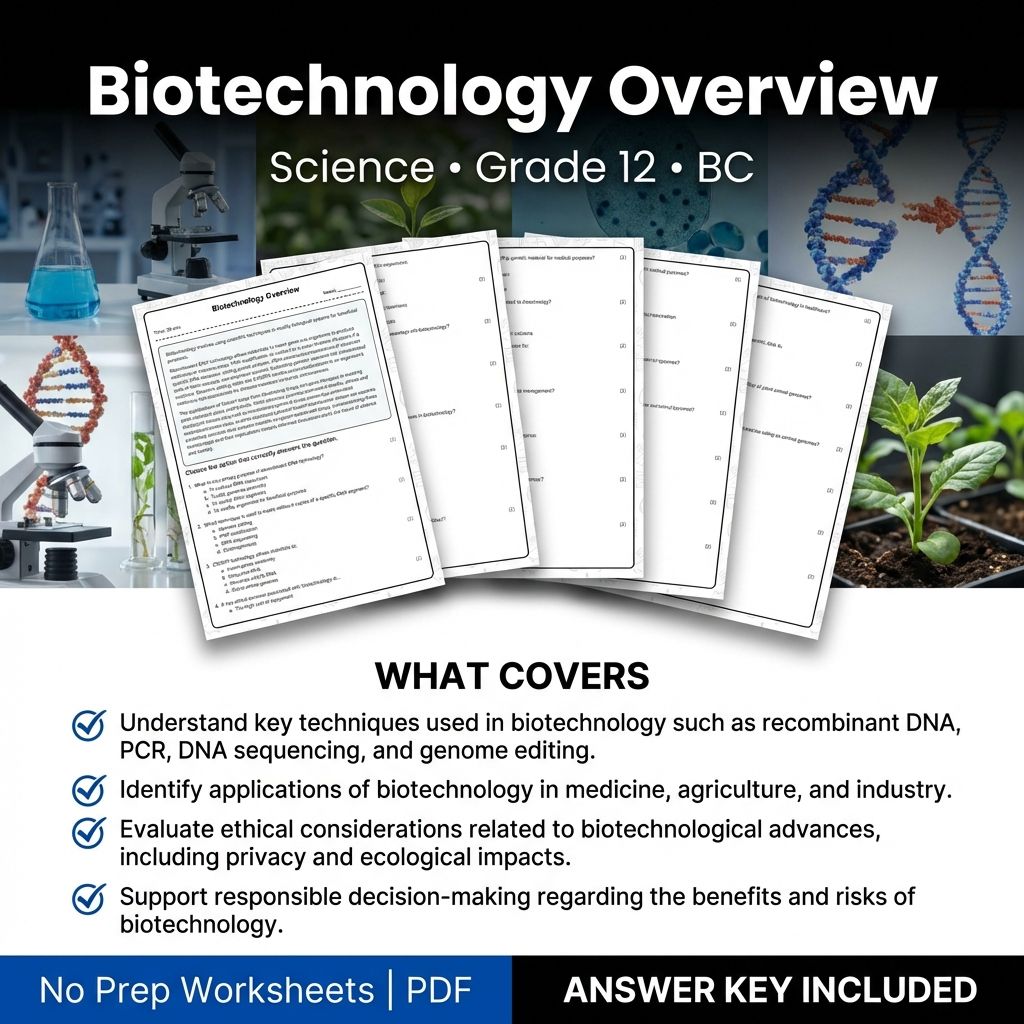
Biotechnology Overview Worksheet for Grade 12 Science | Standard Practice
 Created byCoral Reef Learning
Learning Objectives
- Understand key techniques used in biotechnology such as recombinant DNA, PCR, DNA sequencing, and genome editing.
- Identify applications of biotechnology in medicine, agriculture, and industry.
- Evaluate ethical considerations related to biotechnological advances, including privacy and ecological impacts.
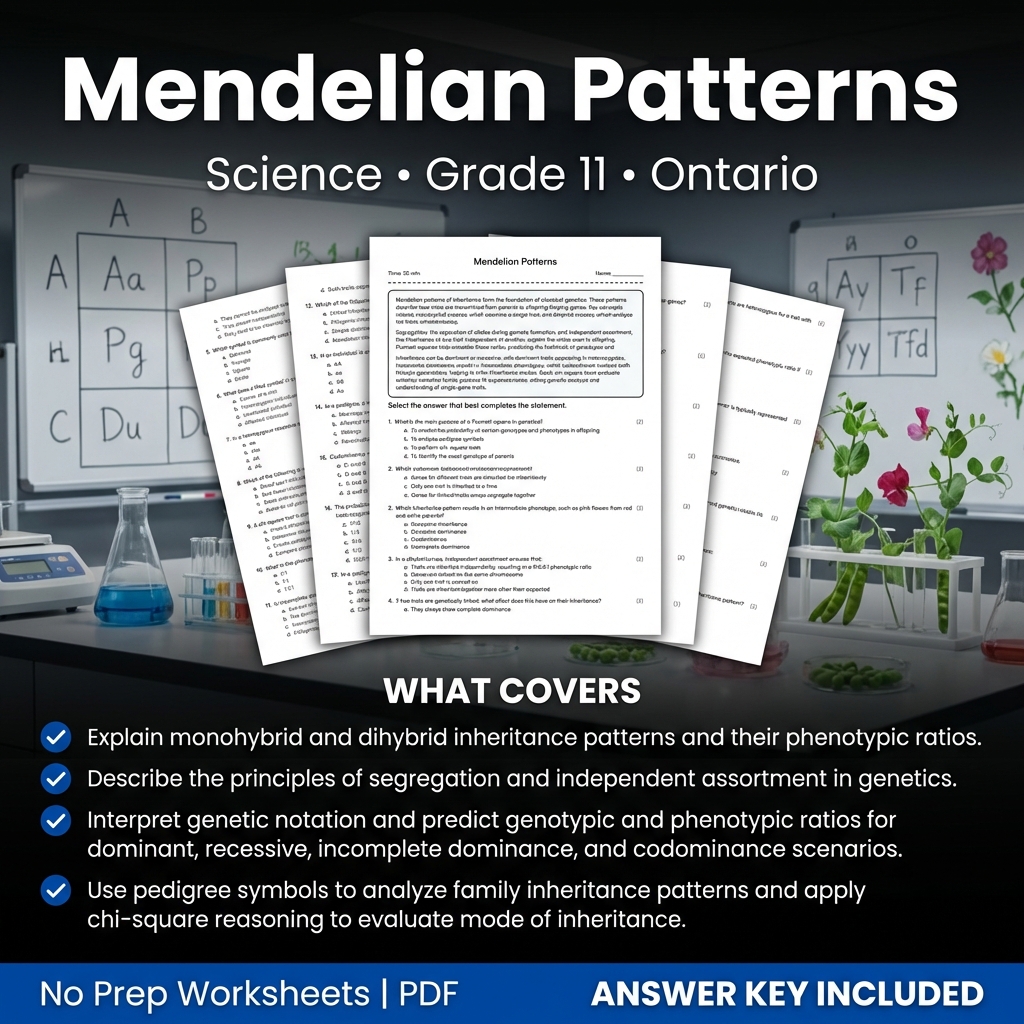
Mendelian Patterns Worksheet for Grade 11 Science | Ontario Standards
Created byCoral Reef LearningLearning Objectives
- Explain monohybrid and dihybrid inheritance patterns and their phenotypic ratios.
- Describe the principles of segregation and independent assortment in genetics.
- Interpret genetic notation and predict genotypic and phenotypic ratios for dominant, recessive, incomplete dominance, and codominance scenarios.
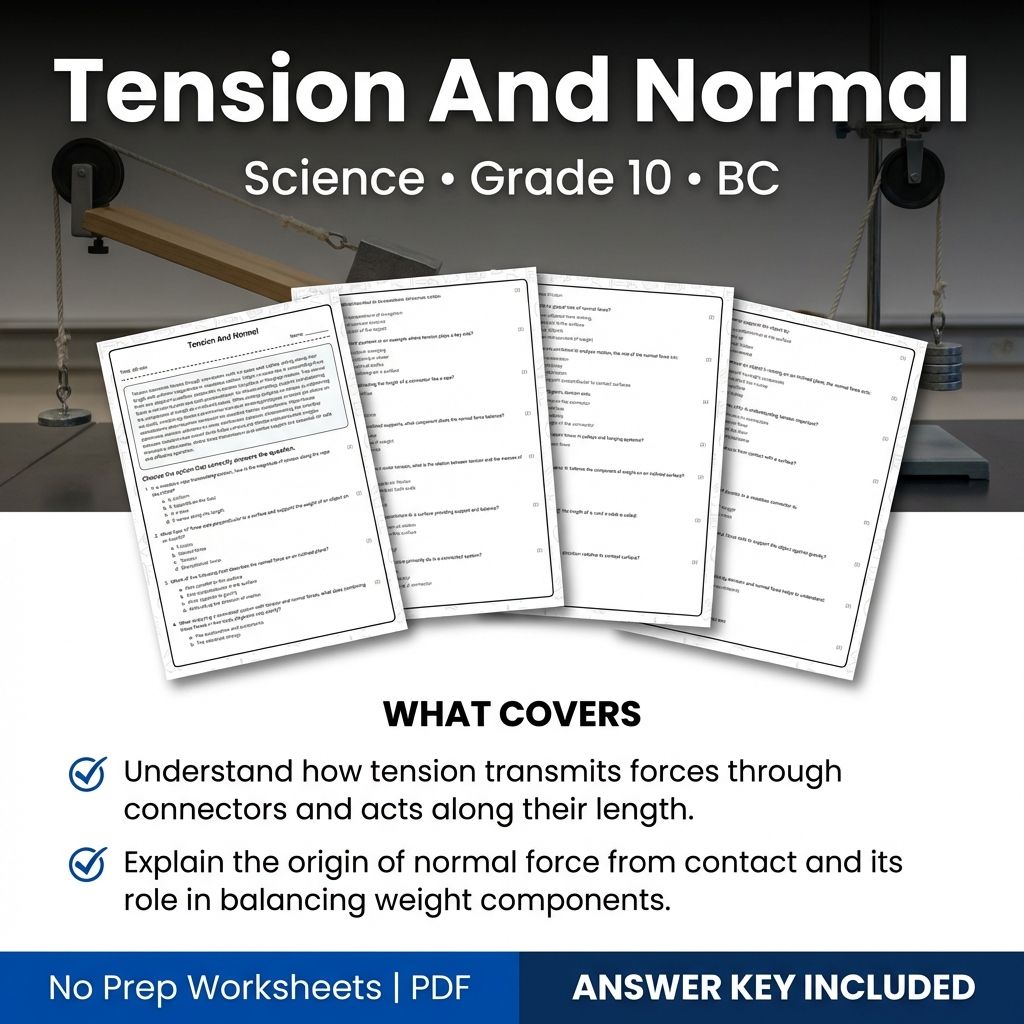
Grade 10 Science | Tension and Normal Forces Worksheet (PDF + Answer Key)
Created byCoral Reef LearningLearning Objectives
- Understand how tension transmits forces through connectors and acts along their length.
- Explain the origin of normal force from contact and its role in balancing weight components.
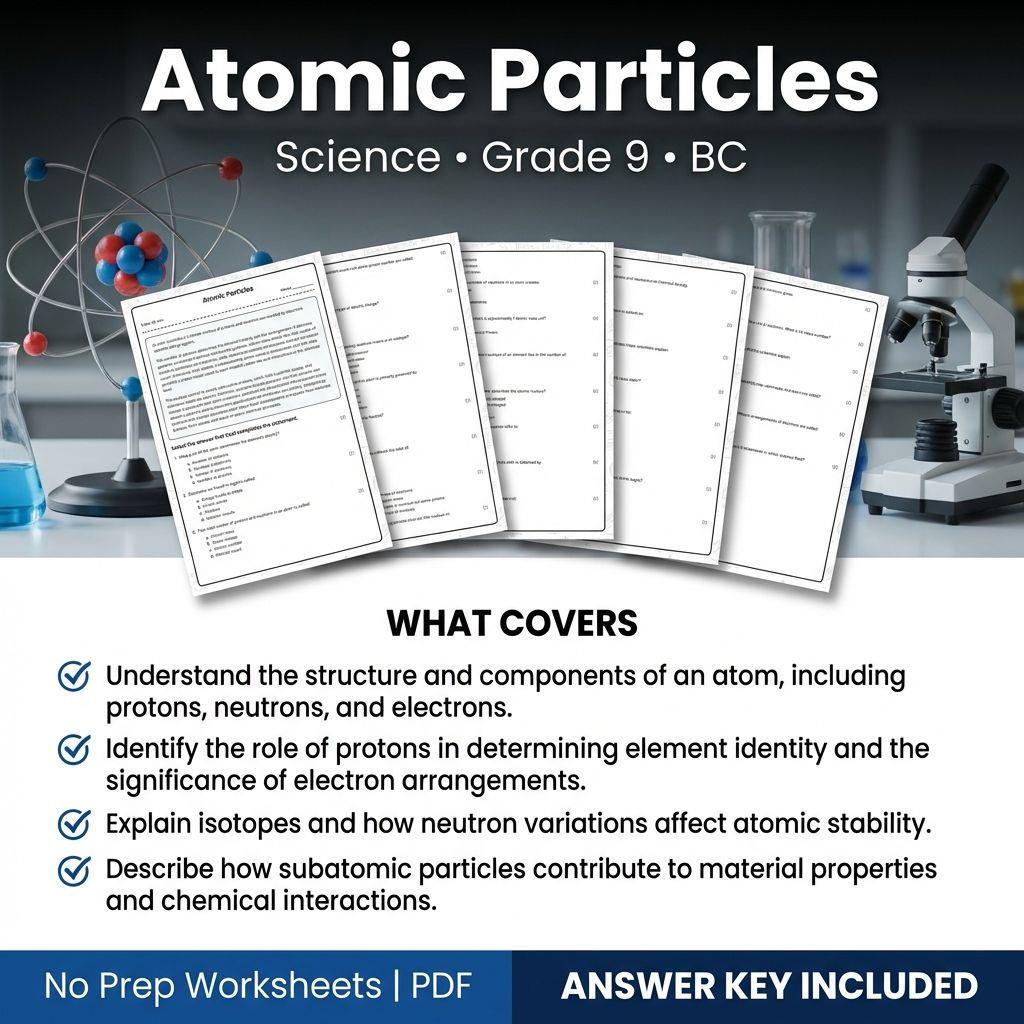
Grade 9 Science Worksheet | Atomic Particles & Structure – PDF & Answer Key
Created byCoral Reef LearningLearning Objectives
- Understand the structure and components of an atom, including protons, neutrons, and electrons.
- Identify the role of protons in determining element identity and the significance of electron arrangements.
- Explain isotopes and how neutron variations affect atomic stability.
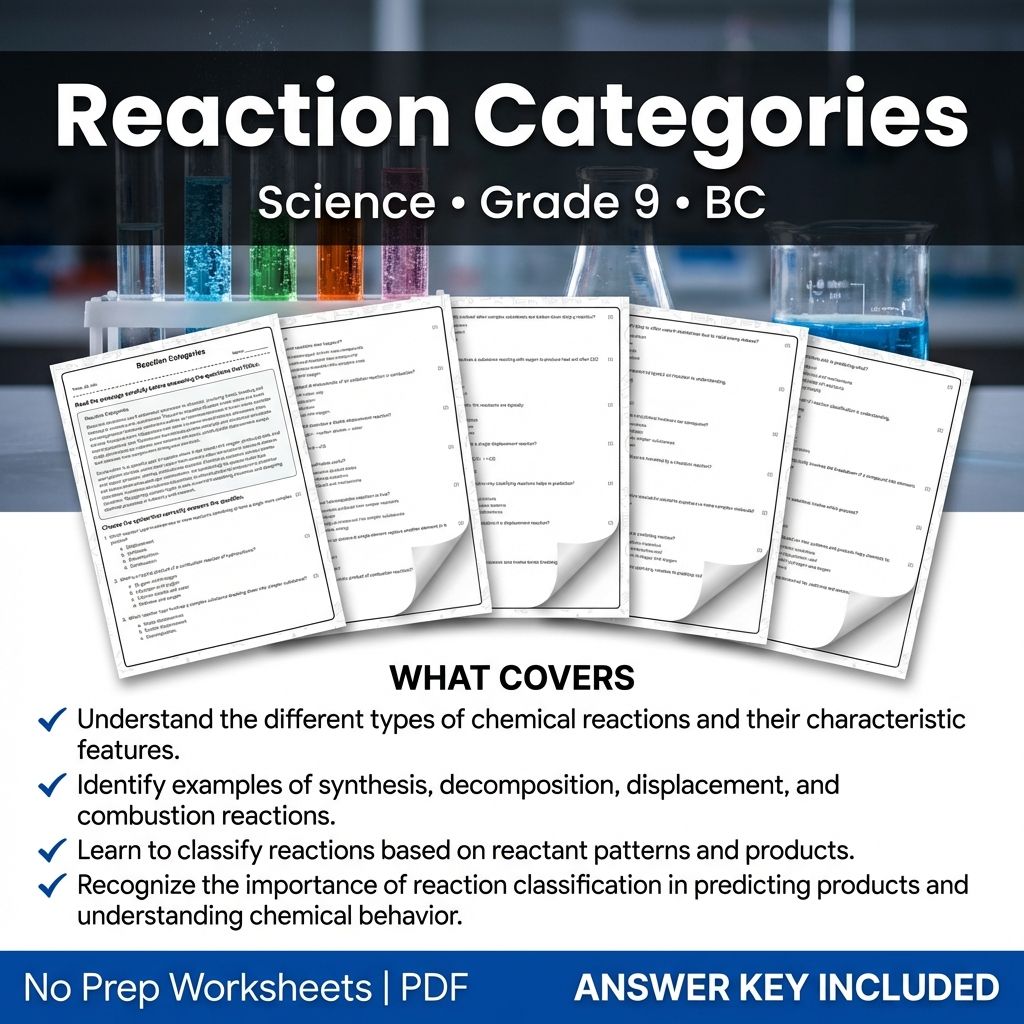
9th Grade Science | Reaction Categories Worksheet & Answer Key (PDF)
Created byCoral Reef LearningLearning Objectives
- Understand the different types of chemical reactions and their characteristic features.
- Identify examples of synthesis, decomposition, displacement, and combustion reactions.
- Learn to classify reactions based on reactant patterns and products.
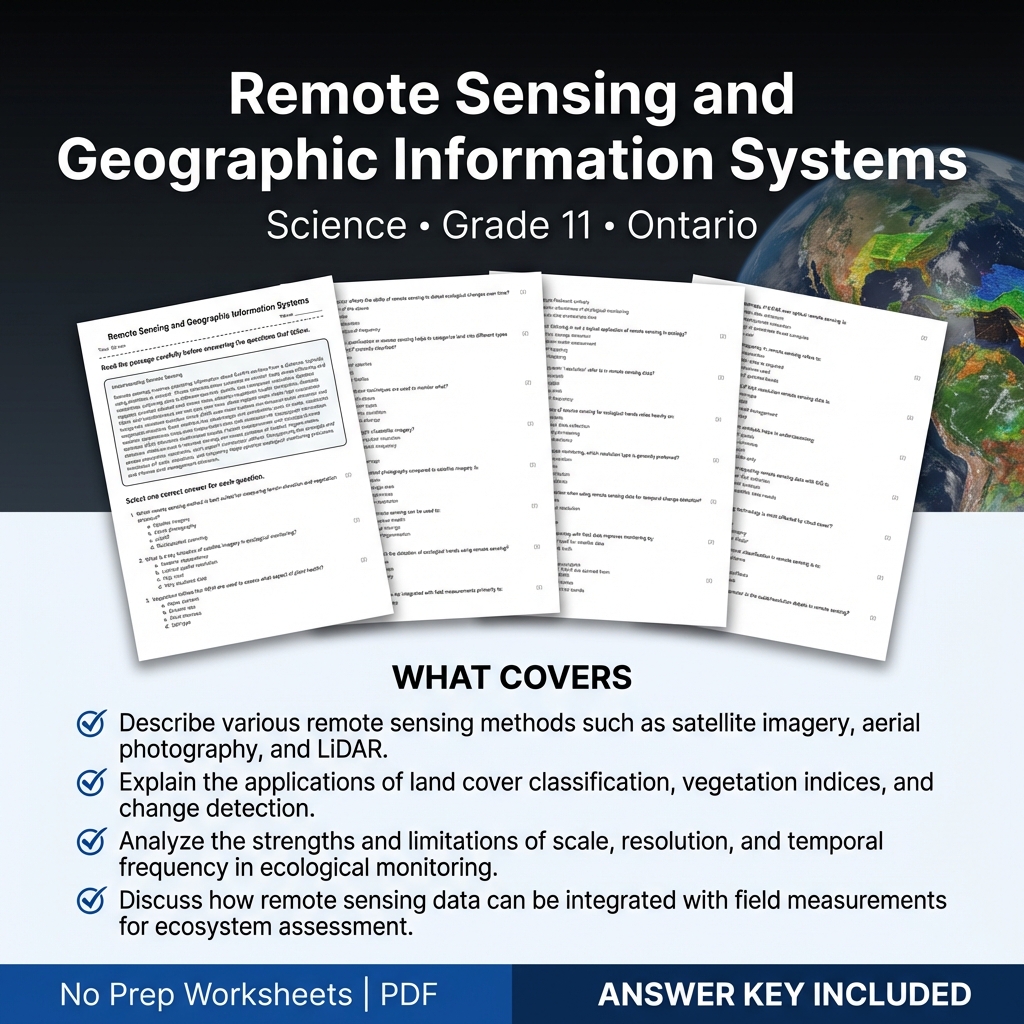
Grade 11 Science Worksheet on Remote Sensing and GIS | Ontario Standards
Created byCoral Reef LearningLearning Objectives
- Describe various remote sensing methods such as satellite imagery, aerial photography, and LiDAR.
- Explain the applications of land cover classification, vegetation indices, and change detection.
- Analyze the strengths and limitations of scale, resolution, and temporal frequency in ecological monitoring.
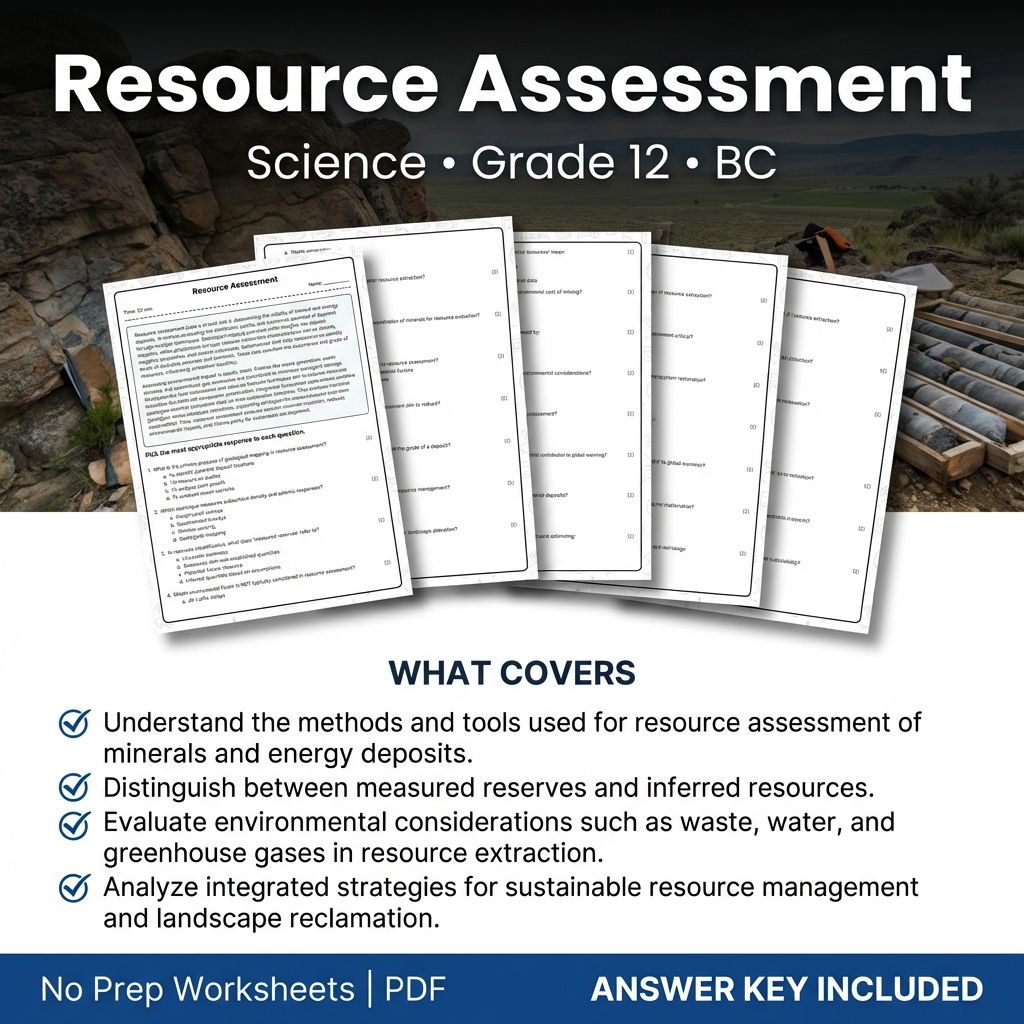
Grade 12 Science Worksheet Resource Assessment | BC Standards
Created byCoral Reef LearningLearning Objectives
- Understand the methods and tools used for resource assessment of minerals and energy deposits.
- Distinguish between measured reserves and inferred resources.
- Evaluate environmental considerations such as waste, water, and greenhouse gases in resource extraction.
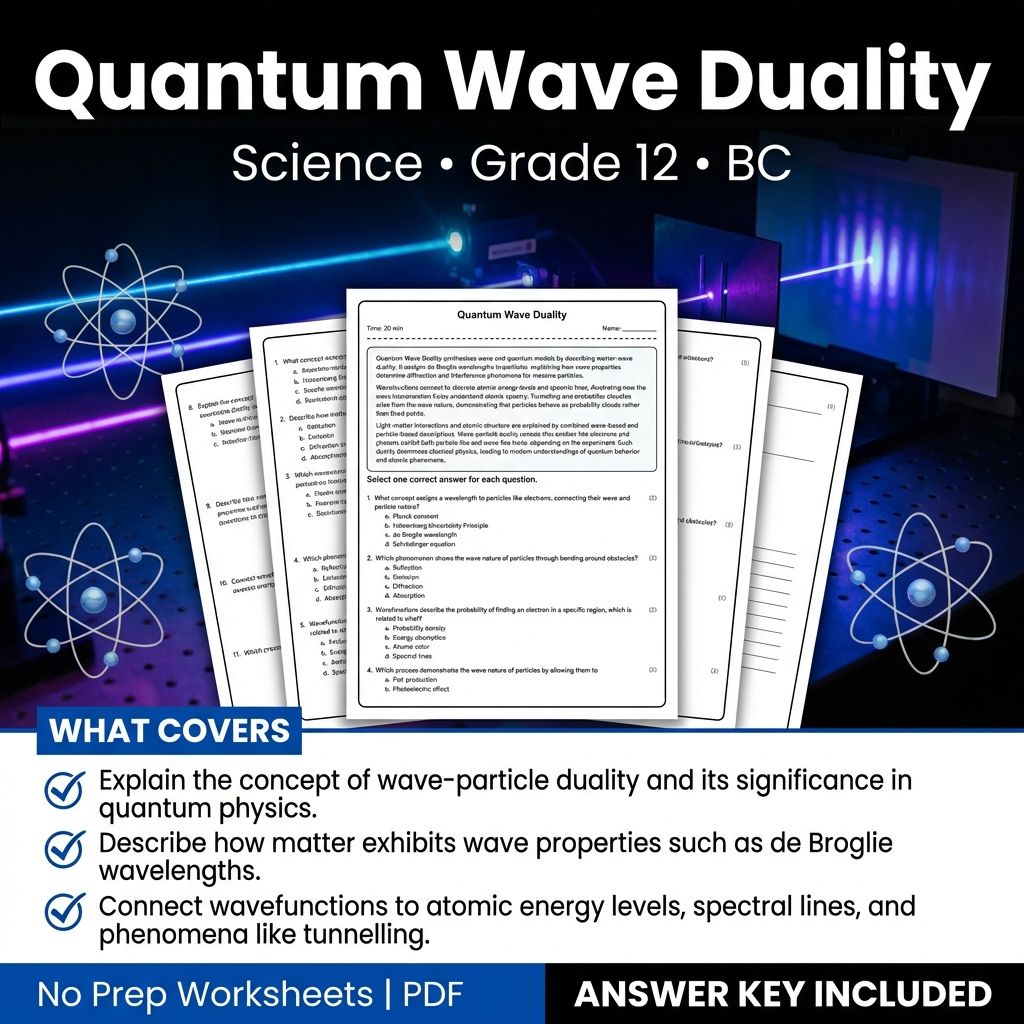
Grade 12 Science Worksheet on Quantum Wave Duality | BC Standards
Created byCoral Reef LearningLearning Objectives
- Explain the concept of wave-particle duality and its significance in quantum physics.
- Describe how matter exhibits wave properties such as de Broglie wavelengths.
- Connect wavefunctions to atomic energy levels, spectral lines, and phenomena like tunnelling.
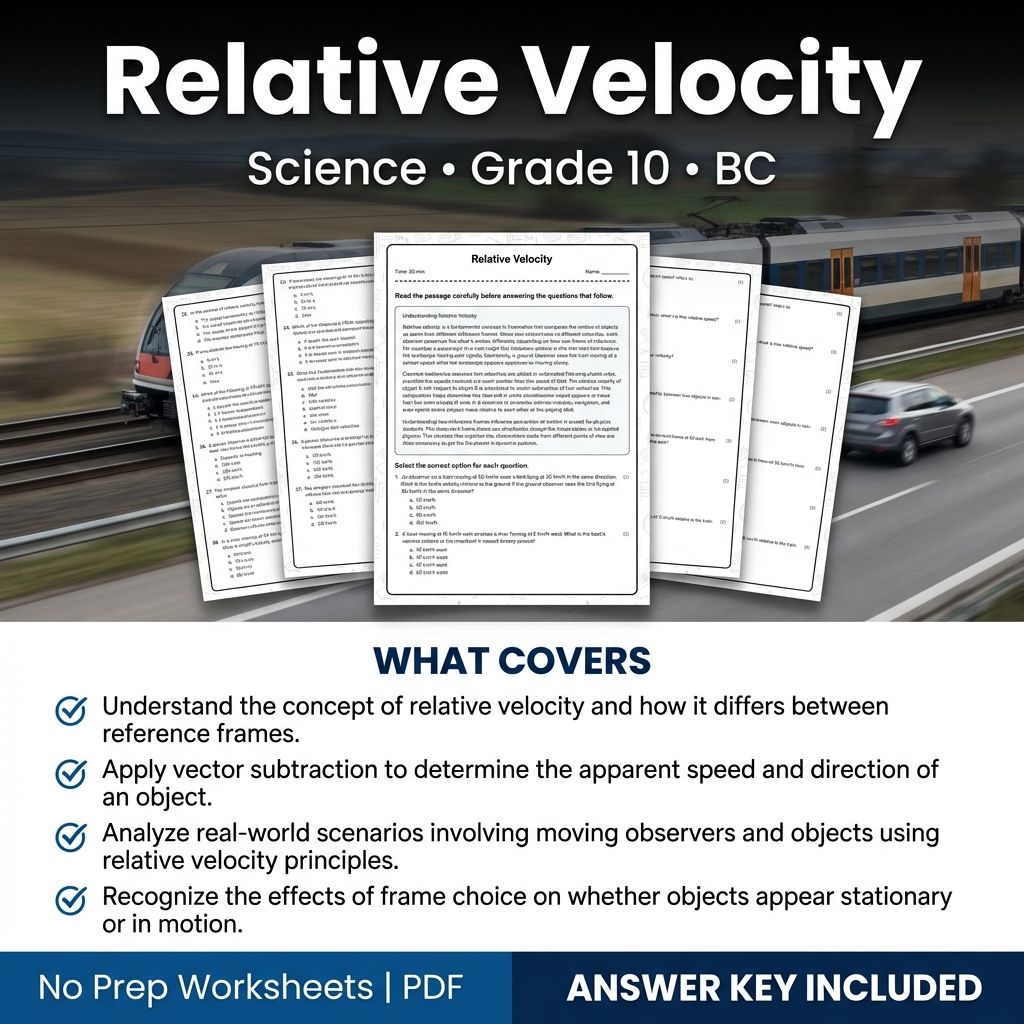
Grade 10 Science | Relative Velocity Worksheet & Answer Key (Printable PDF)
Created byCoral Reef LearningLearning Objectives
- Understand the concept of relative velocity and how it differs between reference frames.
- Apply vector subtraction to determine the apparent speed and direction of an object.
- Analyze real-world scenarios involving moving observers and objects using relative velocity principles.
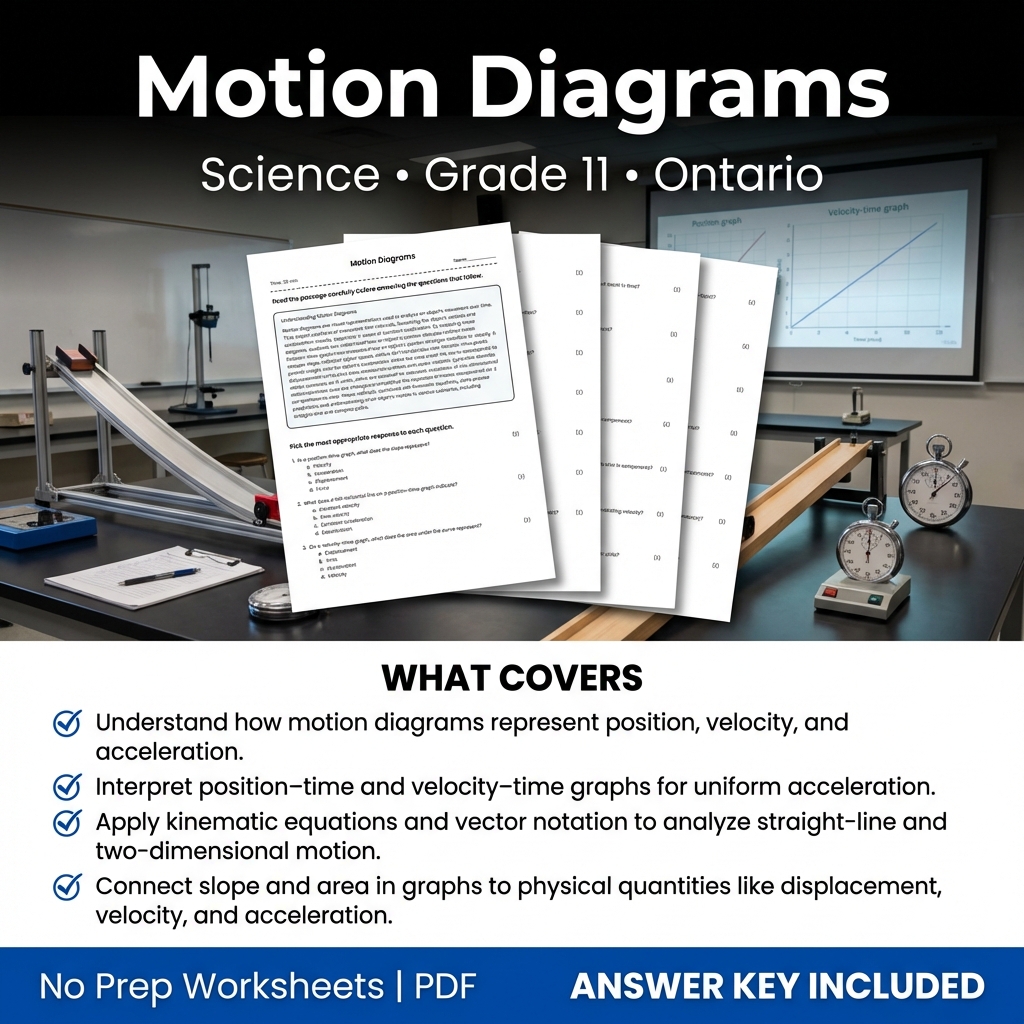
Motion Diagrams Worksheet for Grade 11 Science | Ontario Standards
Created byCoral Reef LearningLearning Objectives
- Understand how motion diagrams represent position, velocity, and acceleration.
- Interpret position–time and velocity–time graphs for uniform acceleration.
- Apply kinematic equations and vector notation to analyze straight-line and two-dimensional motion.
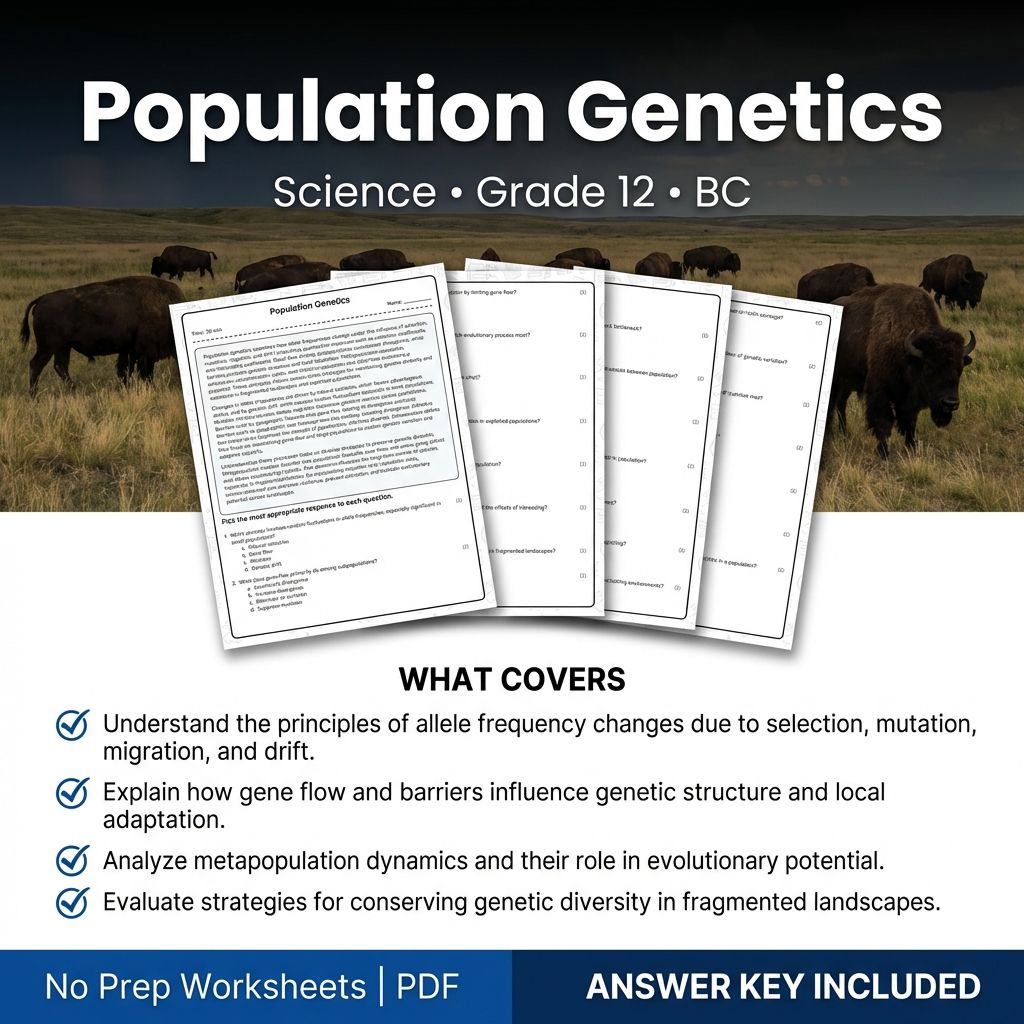
Population Genetics Worksheet for Grade 12 Science | Printable PDF
Created byCoral Reef LearningLearning Objectives
- Understand the principles of allele frequency changes due to selection, mutation, migration, and drift.
- Explain how gene flow and barriers influence genetic structure and local adaptation.
- Analyze metapopulation dynamics and their role in evolutionary potential.
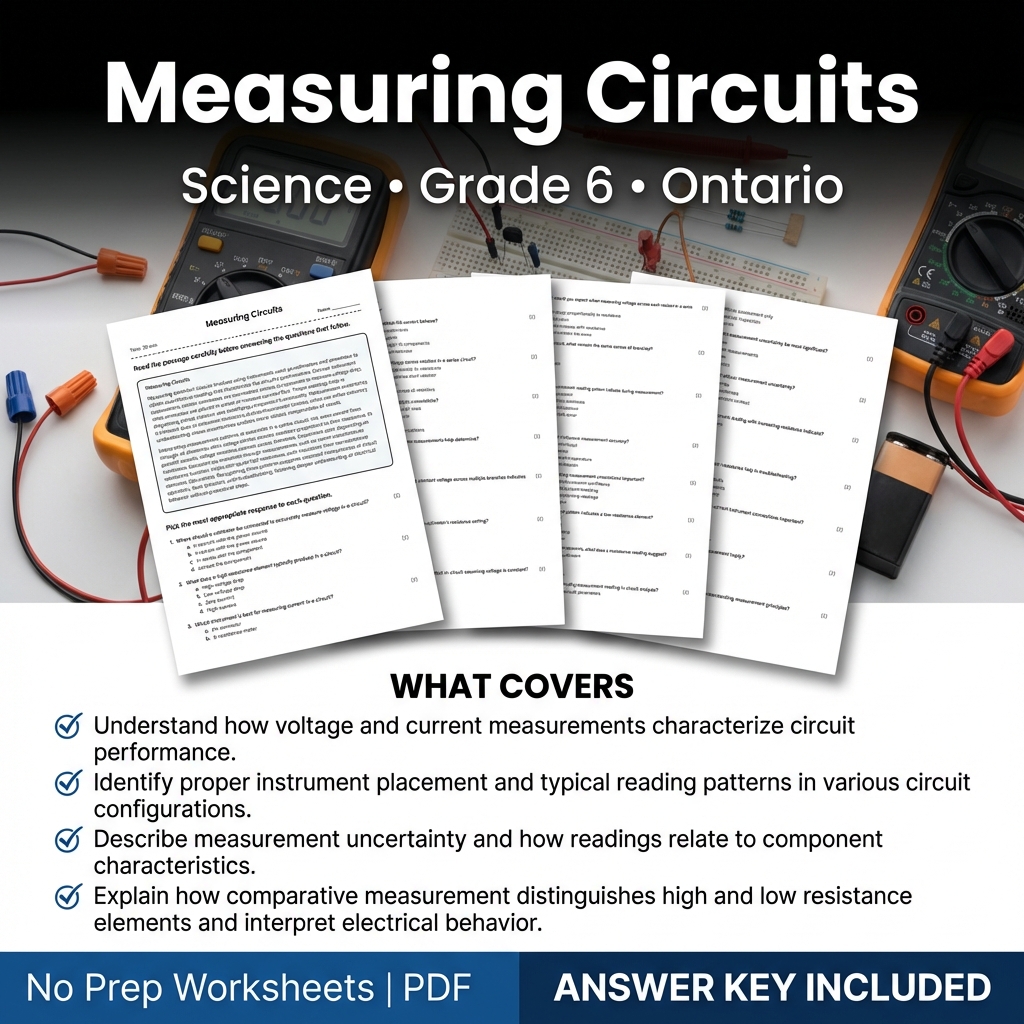
Measuring Circuits Grade 6 Science Worksheet with Answer Key – Ontario
Created byCoral Reef LearningLearning Objectives
- Understand how voltage and current measurements characterize circuit performance.
- Identify proper instrument placement and typical reading patterns in various circuit configurations.
- Describe measurement uncertainty and how readings relate to component characteristics.
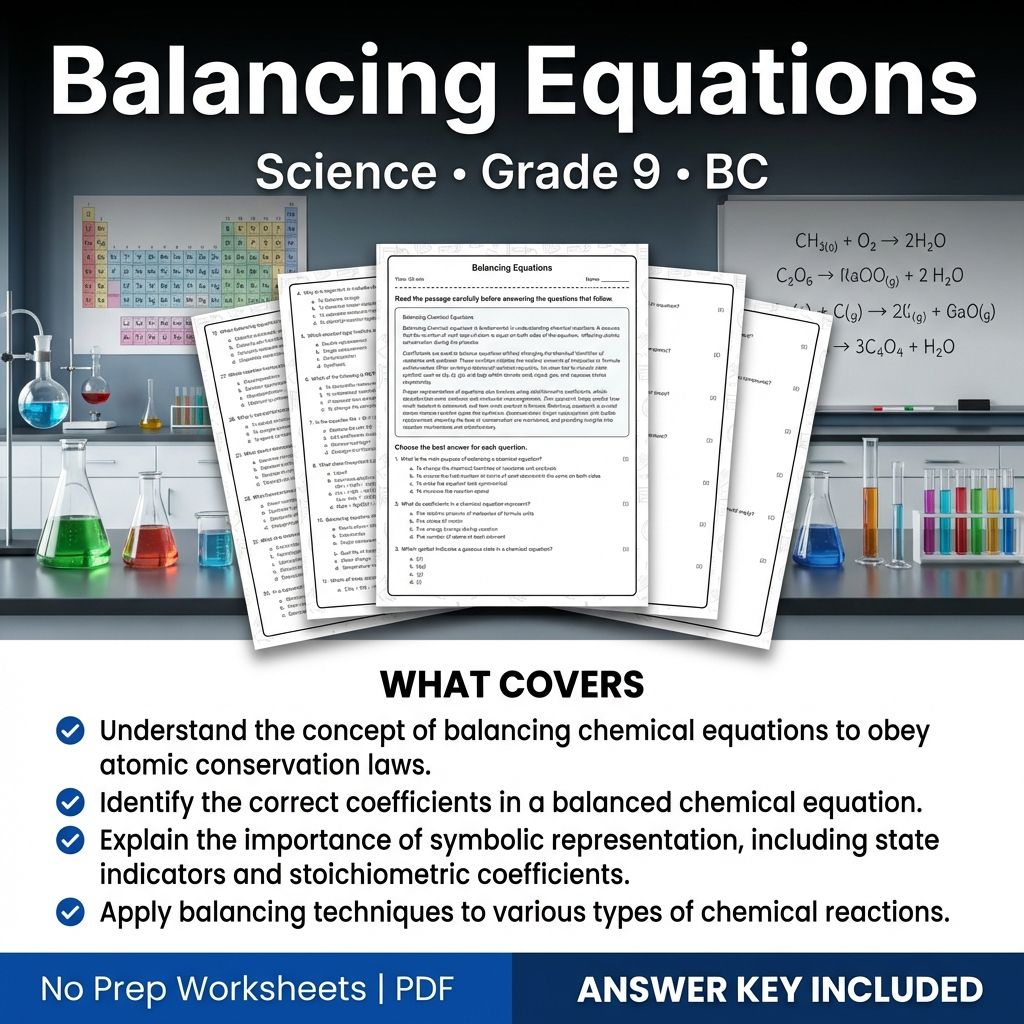
Grade 9 Science | Balancing Equations Worksheet & Answer Key (Printable PDF)
Created byCoral Reef LearningLearning Objectives
- Understand the concept of balancing chemical equations to obey atomic conservation laws.
- Identify the correct coefficients in a balanced chemical equation.
- Explain the importance of symbolic representation, including state indicators and stoichiometric coefficients.
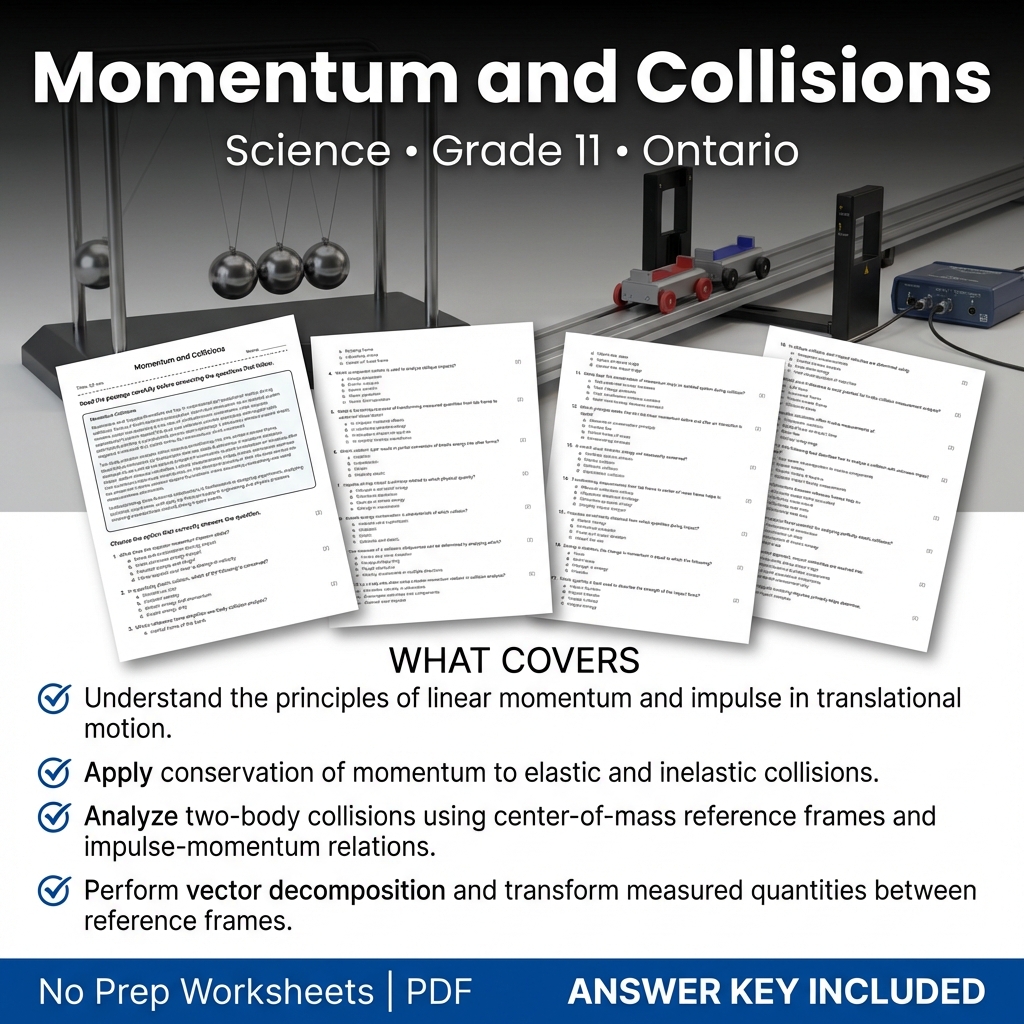
Momentum and Collisions Worksheet | Grade 11 Science | Ontario Standards
Created byCoral Reef LearningLearning Objectives
- Understand the principles of linear momentum and impulse in translational motion.
- Apply conservation of momentum to elastic and inelastic collisions.
- Analyze two-body collisions using center-of-mass reference frames and impulse-momentum relations.
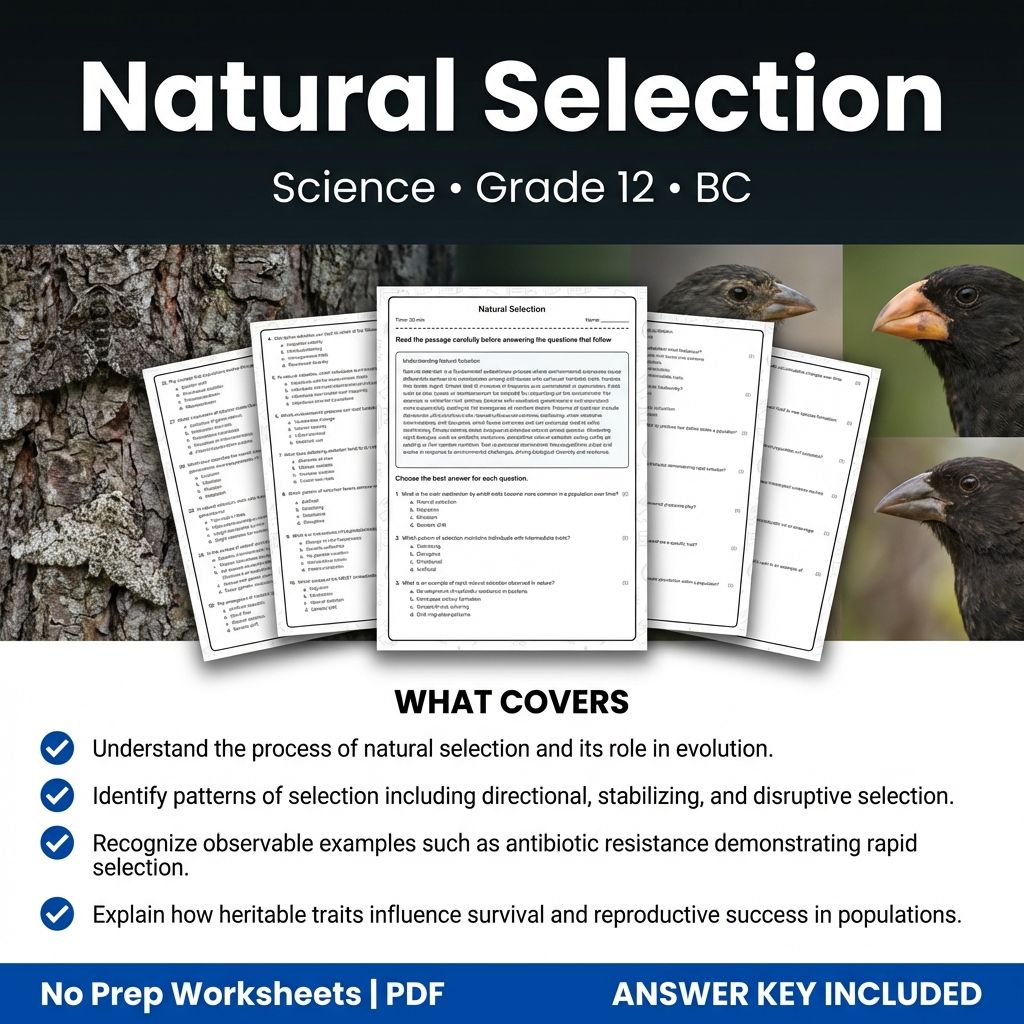
Natural Selection Grade 12 Science Worksheet | BC Standards Practice
Created byCoral Reef LearningLearning Objectives
- Understand the process of natural selection and its role in evolution.
- Identify patterns of selection including directional, stabilizing, and disruptive selection.
- Recognize observable examples such as antibiotic resistance demonstrating rapid selection.
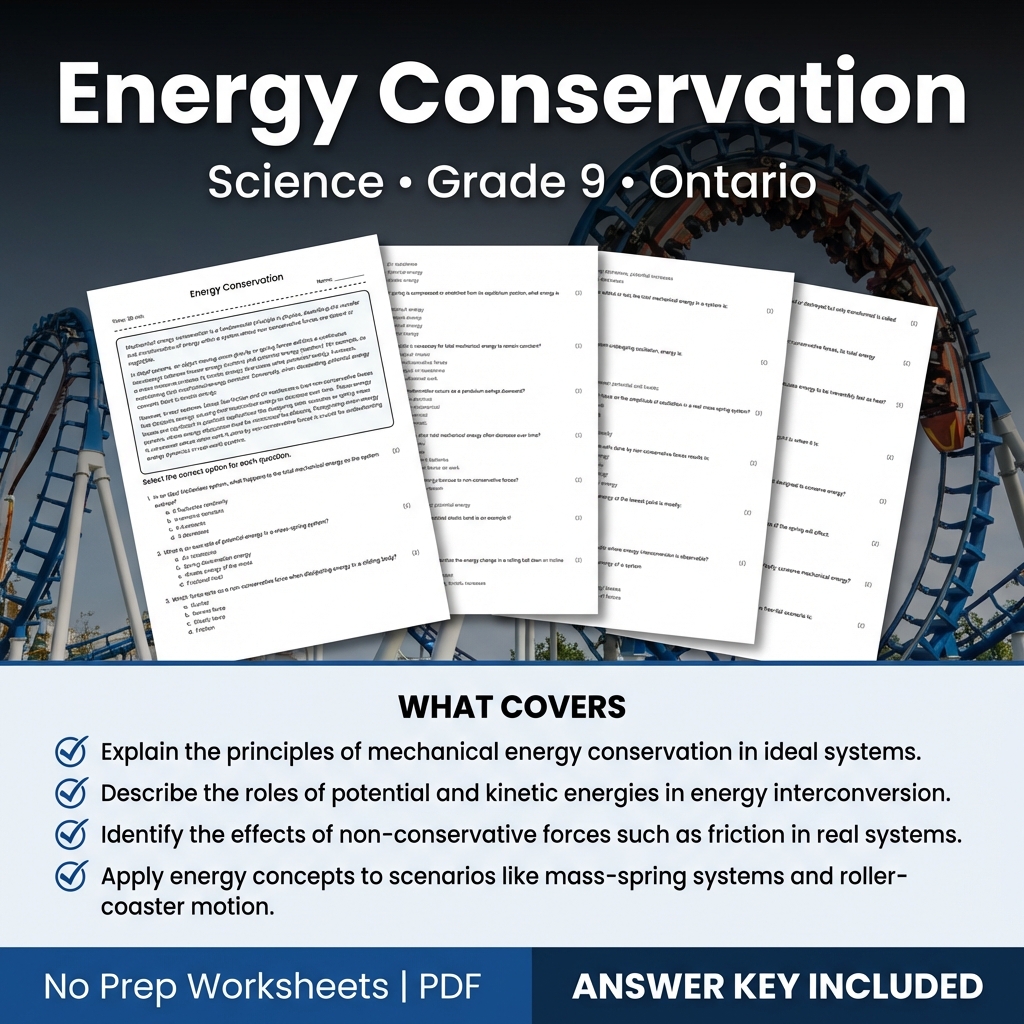
Energy Conservation Worksheet for Grade 9 Science | Ontario Standards
Created byCoral Reef LearningLearning Objectives
- Explain the principles of mechanical energy conservation in ideal systems.
- Describe the roles of potential and kinetic energies in energy interconversion.
- Identify the effects of non-conservative forces such as friction in real systems.
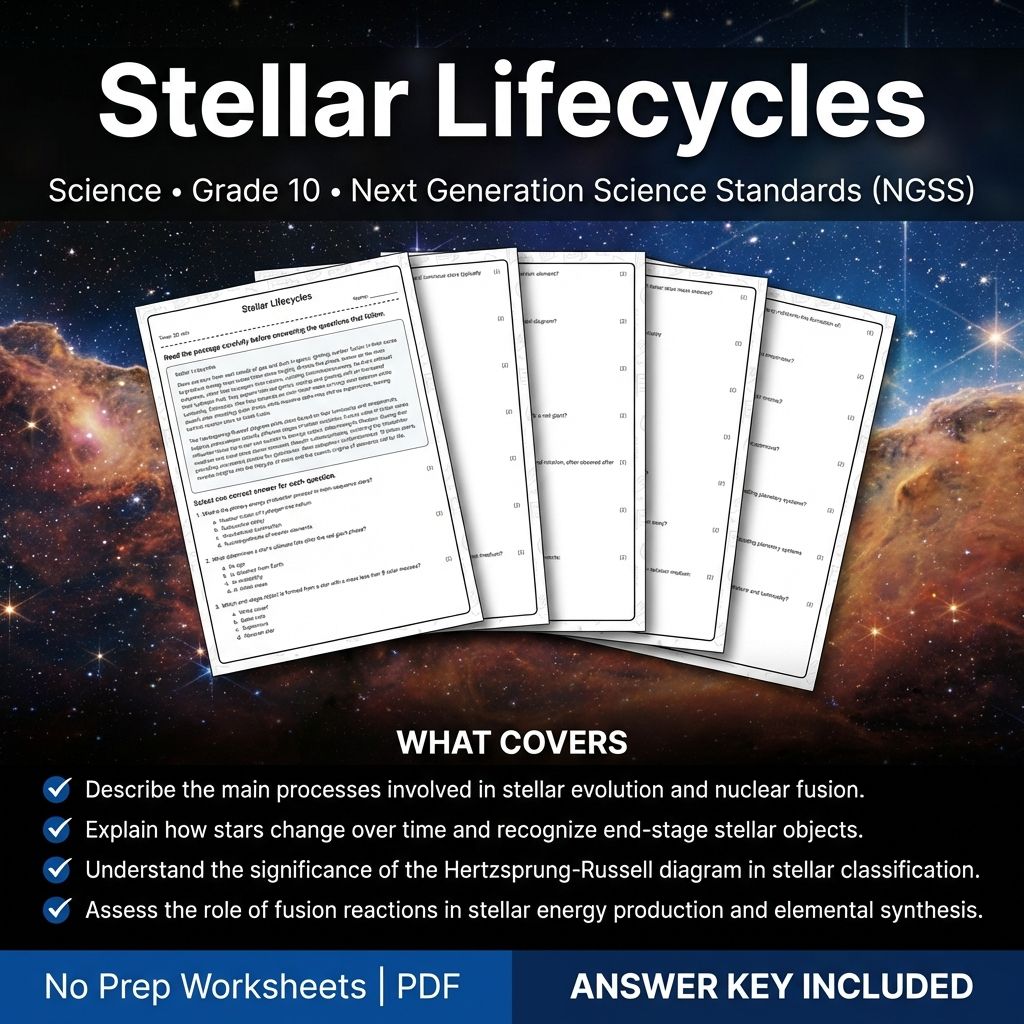
Grade 10 Science Worksheet| Stellar Lifecycles for Classroom Practice+Answer Key
Created byCoral Reef LearningLearning Objectives
- Describe the main processes involved in stellar evolution and nuclear fusion.
- Explain how stars change over time and recognize end-stage stellar objects.
- Understand the significance of the Hertzsprung-Russell diagram in stellar classification.
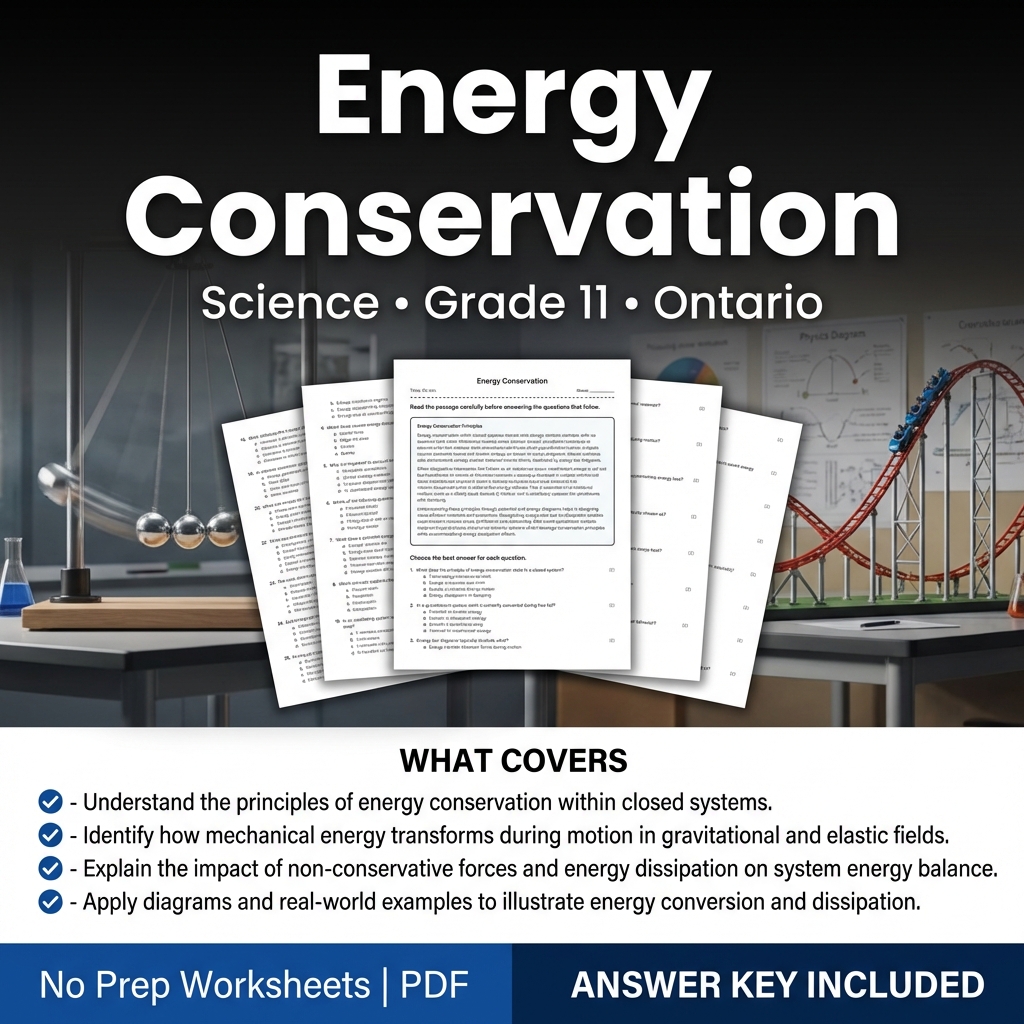
Grade 11 Science Worksheet on Energy Conservation – PDF with Answer Key
Created byCoral Reef LearningLearning Objectives
- Understand the principles of energy conservation within closed systems.
- Identify how mechanical energy transforms during motion in gravitational and elastic fields.
- Explain the impact of non-conservative forces and energy dissipation on system energy balance.
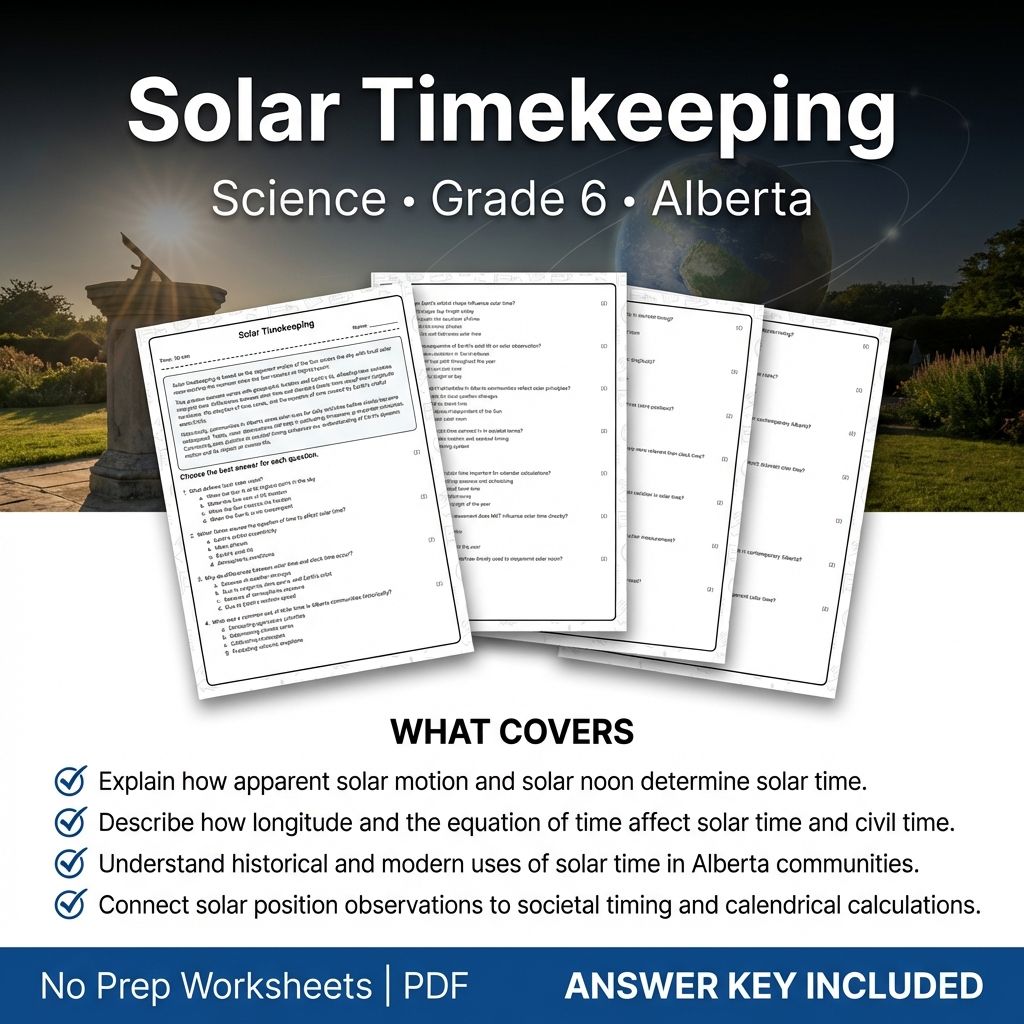
Grade 6 Science Worksheet on Solar Timekeeping | Alberta Standards
Created byCoral Reef LearningLearning Objectives
- Explain how apparent solar motion and solar noon determine solar time.
- Describe how longitude and the equation of time affect solar time and civil time.
- Understand historical and modern uses of solar time in Alberta communities.
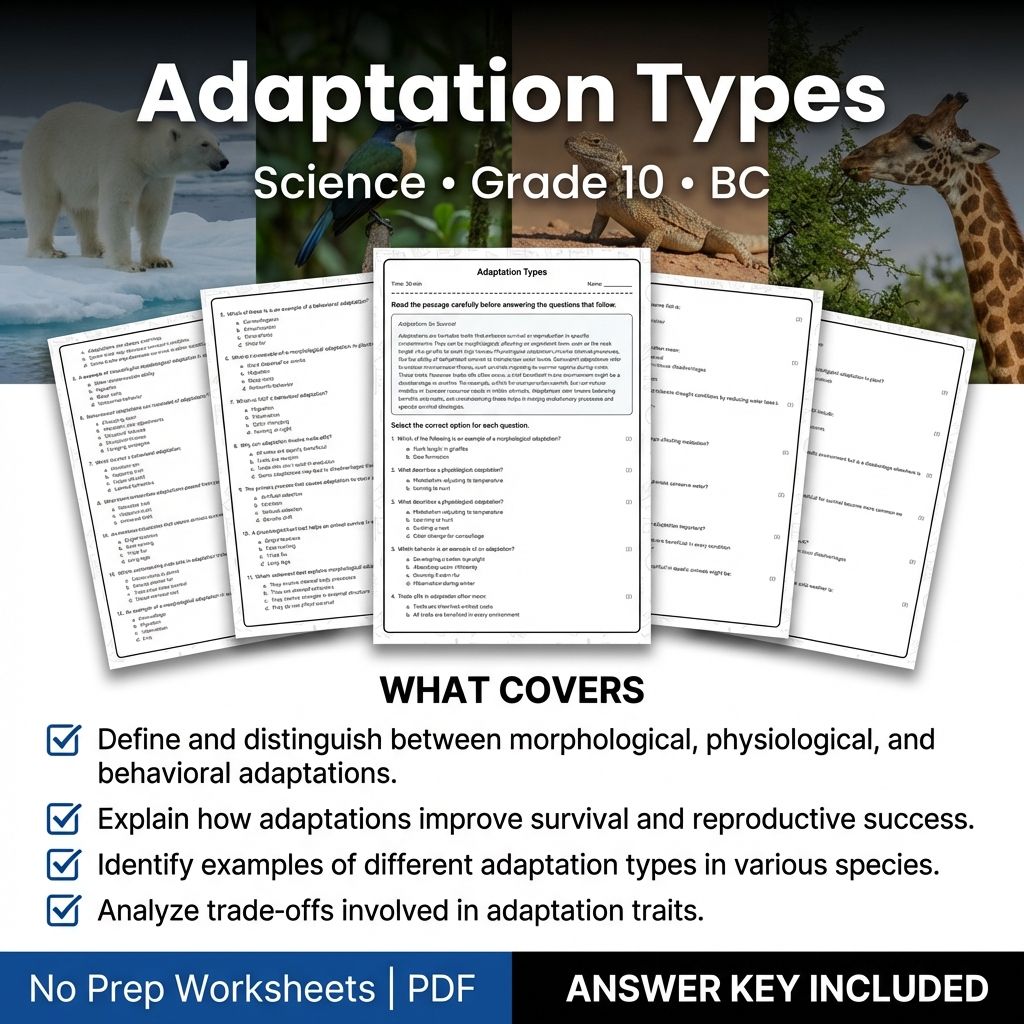
10th Grade Science | Adaptation Types Worksheet & Answer Key (PDF)
Created byCoral Reef LearningLearning Objectives
- Define and distinguish between morphological, physiological, and behavioral adaptations.
- Explain how adaptations improve survival and reproductive success.
- Identify examples of different adaptation types in various species.
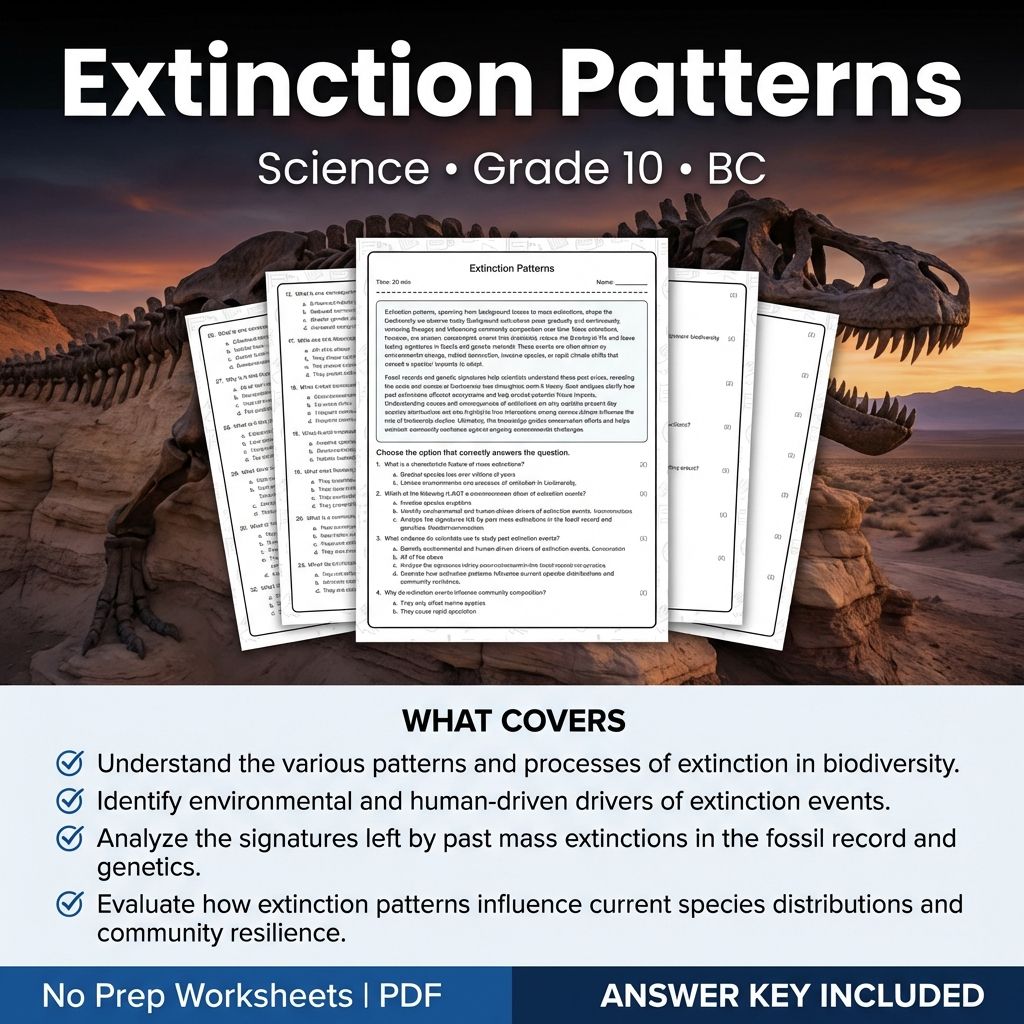
10th Grade Science | Extinction Patterns Worksheet & PDF Answer Key
Created byCoral Reef LearningLearning Objectives
- Understand the various patterns and processes of extinction in biodiversity.
- Identify environmental and human-driven drivers of extinction events.
- Analyze the signatures left by past mass extinctions in the fossil record and genetics.
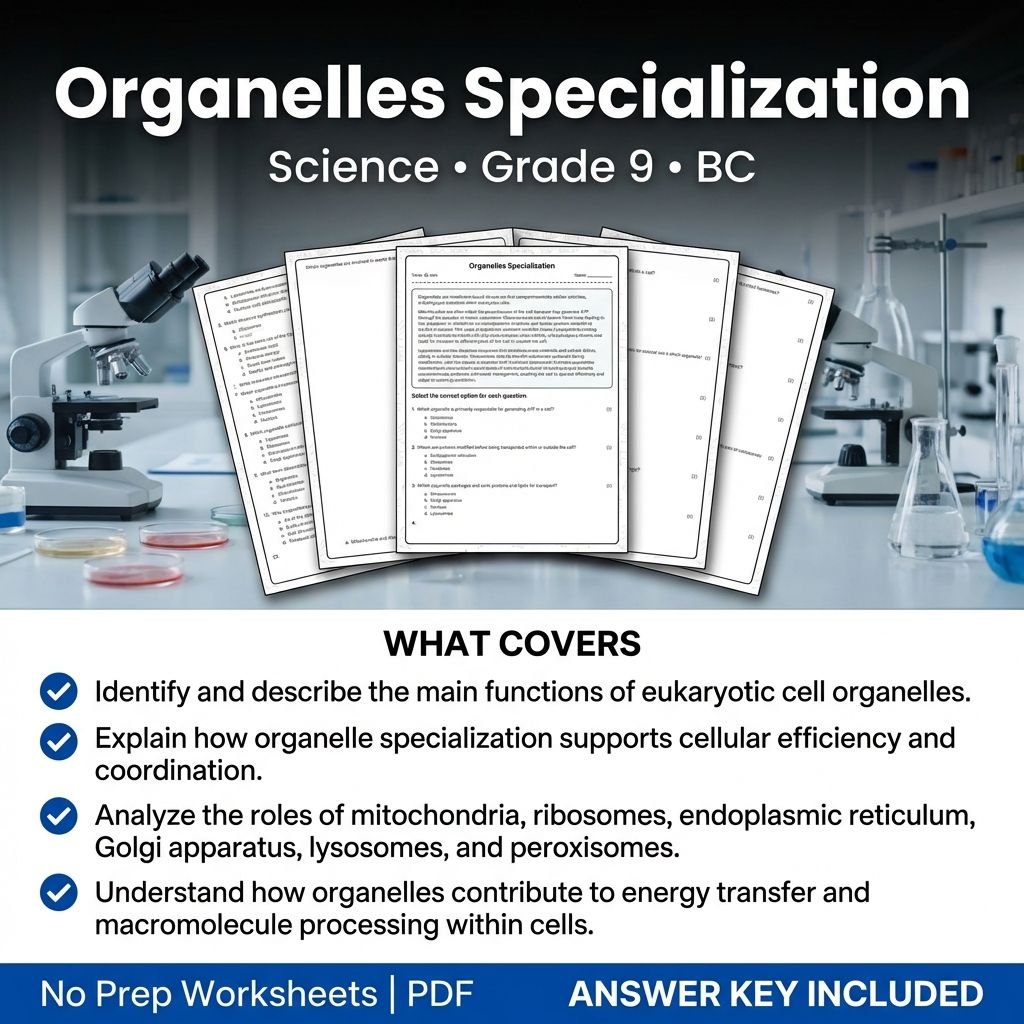
Organelles Specialization Grade 9 Science Worksheet | BC Standards
Created byCoral Reef LearningLearning Objectives
- Identify and describe the main functions of eukaryotic cell organelles.
- Explain how organelle specialization supports cellular efficiency and coordination.
- Analyze the roles of mitochondria, ribosomes, endoplasmic reticulum, Golgi apparatus, lysosomes, and peroxisomes.
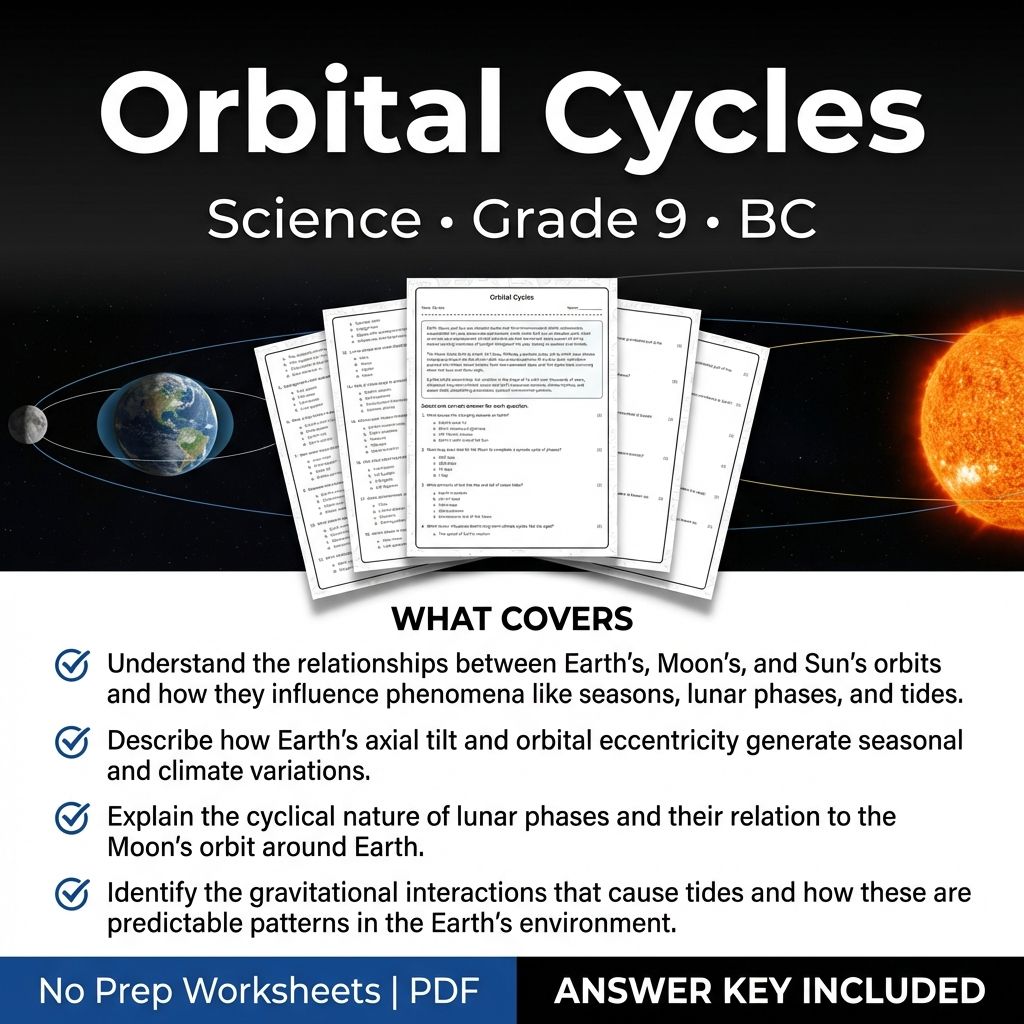
9th Grade Science | Orbital Cycles Worksheet & Answer Key – Classroom PDF
Created byCoral Reef LearningLearning Objectives
- Understand the relationships between Earth's, Moon's, and Sun's orbits and how they influence phenomena like seasons, lunar phases, and tides.
- Describe how Earth's axial tilt and orbital eccentricity generate seasonal and climate variations.
- Explain the cyclical nature of lunar phases and their relation to the Moon's orbit around Earth.
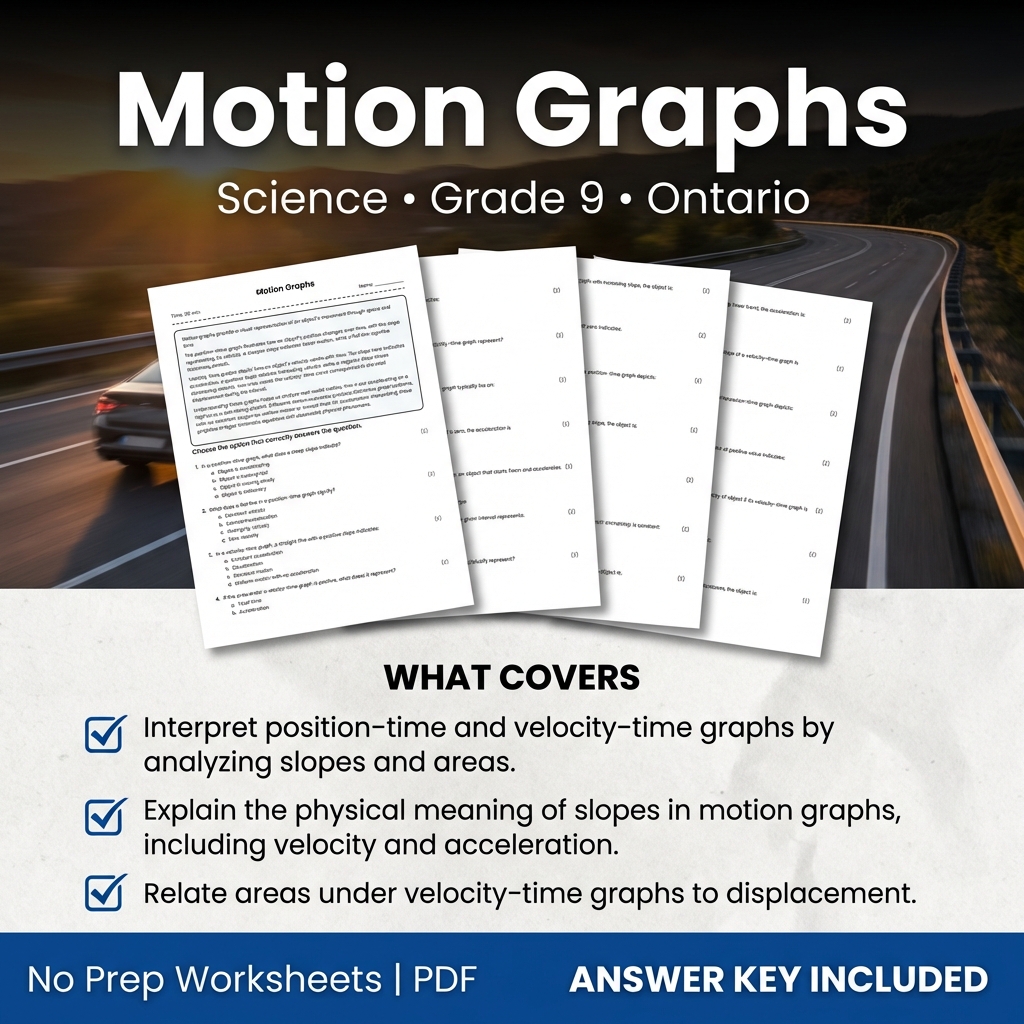
Motion Graphs Worksheet for Grade 9 Science | Ontario Standards
Created byCoral Reef LearningLearning Objectives
- Interpret position–time and velocity–time graphs by analyzing slopes and areas.
- Explain the physical meaning of slopes in motion graphs, including velocity and acceleration.
- Relate areas under velocity–time graphs to displacement.
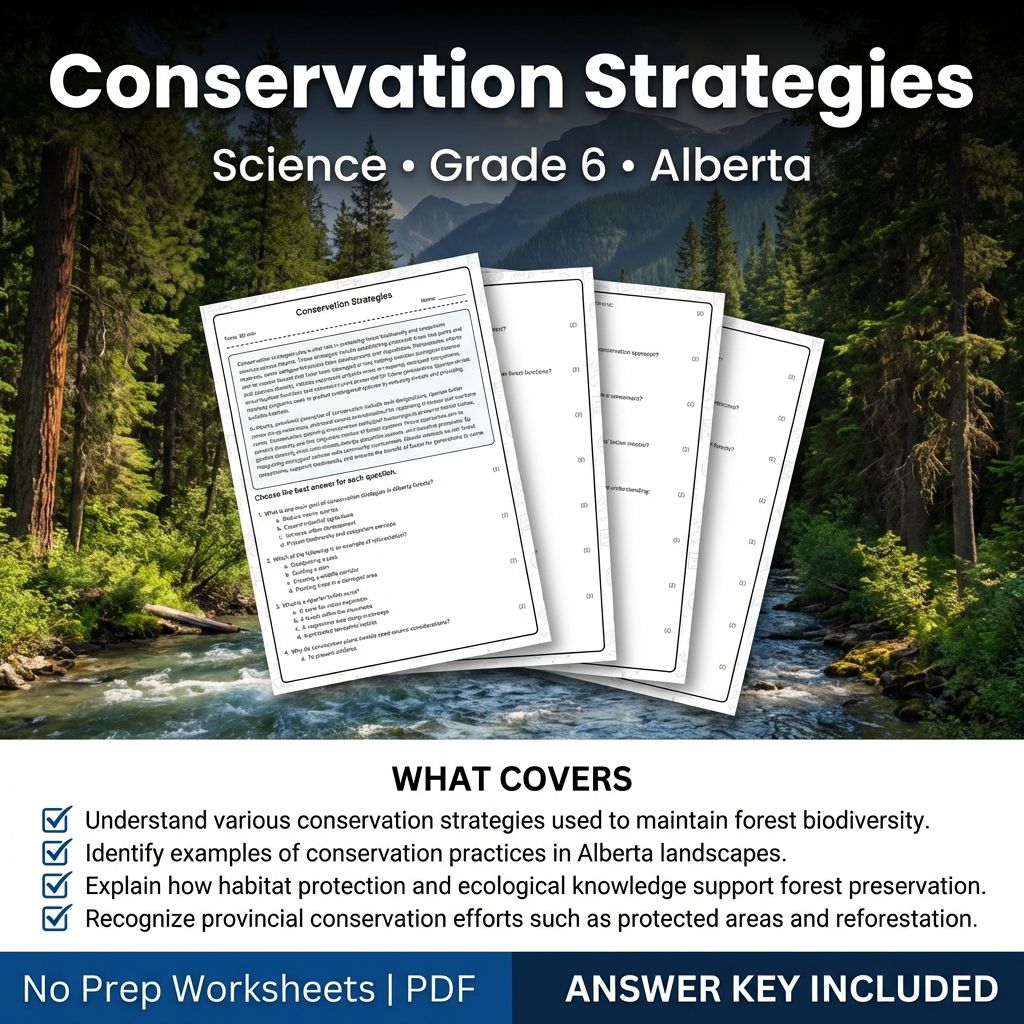
Grade 6 Science Worksheet on Conservation Strategies | Alberta Standards
Created byCoral Reef LearningLearning Objectives
- Understand various conservation strategies used to maintain forest biodiversity.
- Identify examples of conservation practices in Alberta landscapes.
- Explain how habitat protection and ecological knowledge support forest preservation.
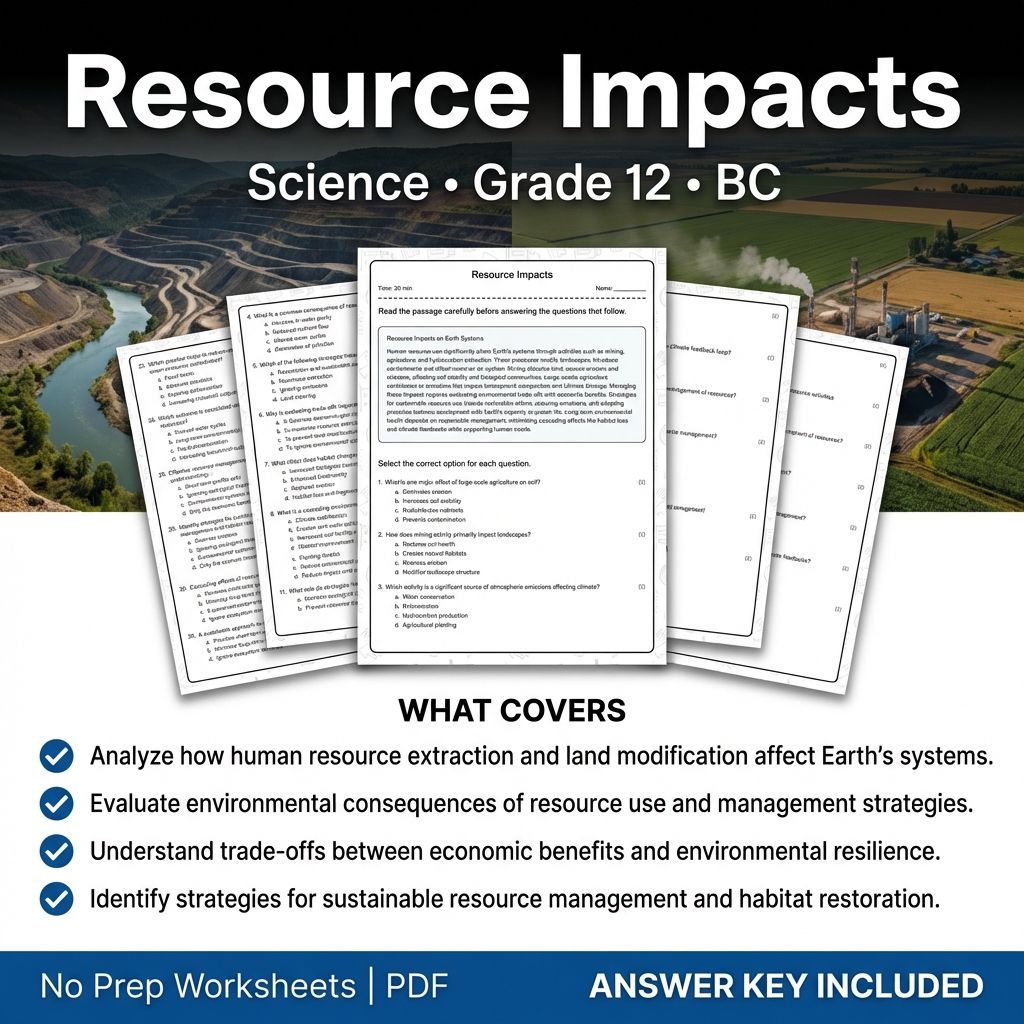
Grade 12 Science Worksheet on Resource Impacts | BC Standards Practice
Created byCoral Reef LearningLearning Objectives
- Analyze how human resource extraction and land modification affect Earth's systems.
- Evaluate environmental consequences of resource use and management strategies.
- Understand trade-offs between economic benefits and environmental resilience.
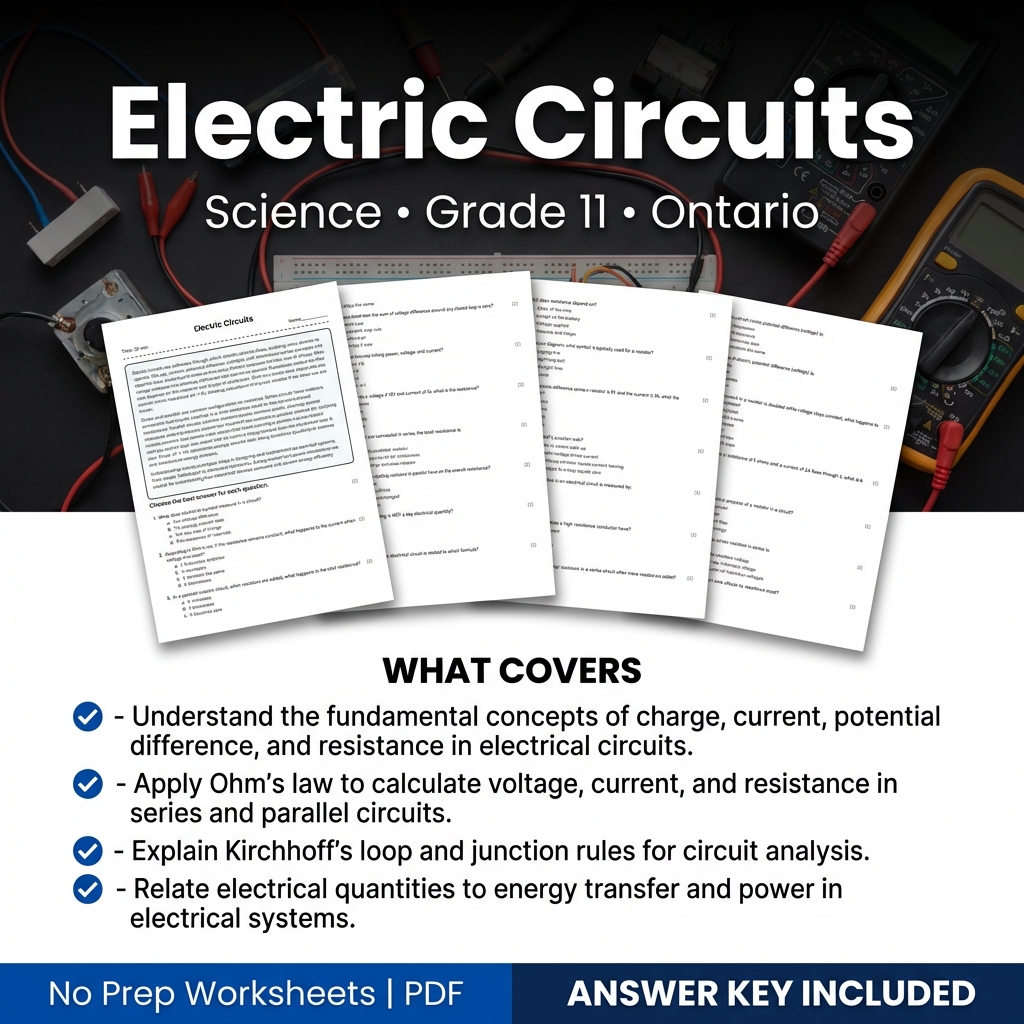
Electric Circuits Worksheet for Grade 11 Science | Ontario Standards
Created byCoral Reef LearningLearning Objectives
- Understand the fundamental concepts of charge, current, potential difference, and resistance in electrical circuits.
- Apply Ohm’s law to calculate voltage, current, and resistance in series and parallel circuits.
- Explain Kirchhoff’s loop and junction rules for circuit analysis.
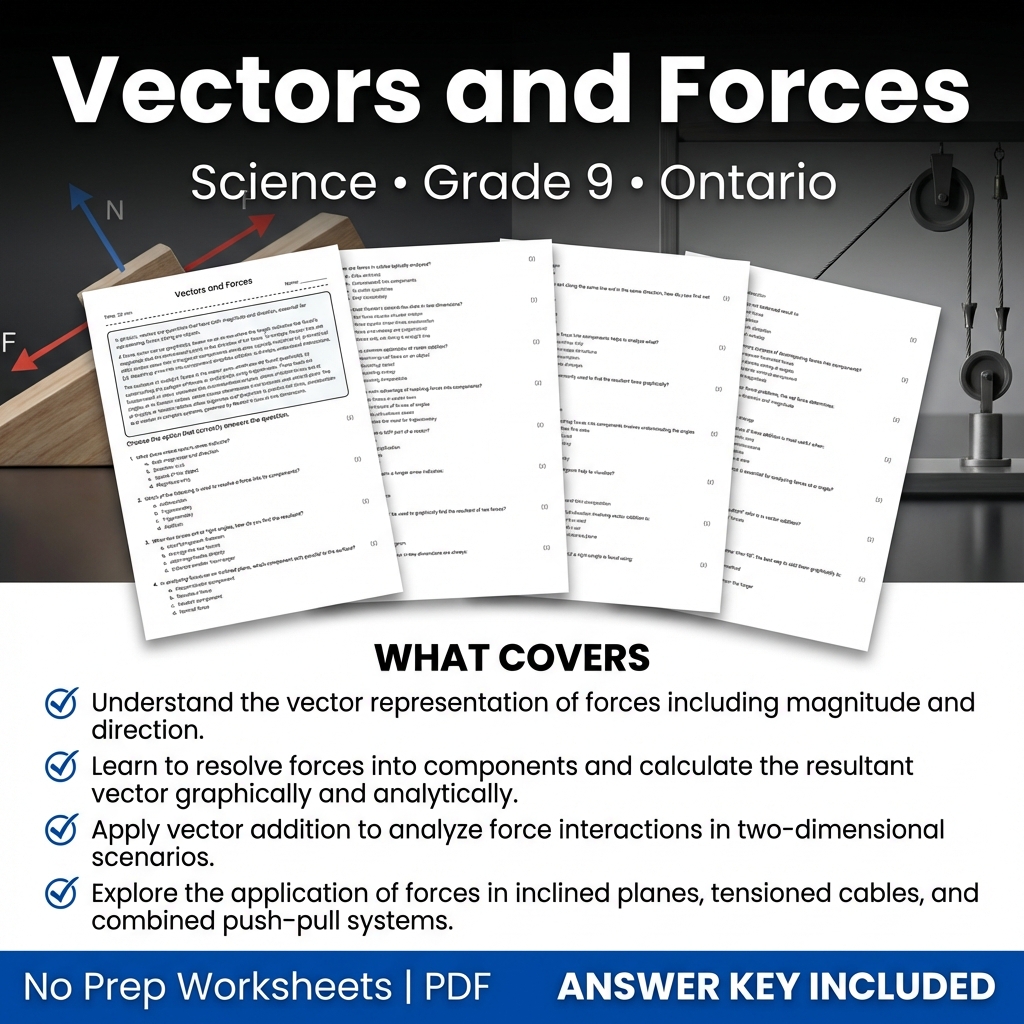
Vectors and Forces Worksheet Grade 9 Science Ontario Standard
Created byCoral Reef LearningLearning Objectives
- Understand the vector representation of forces including magnitude and direction.
- Learn to resolve forces into components and calculate the resultant vector graphically and analytically.
- Apply vector addition to analyze force interactions in two-dimensional scenarios.
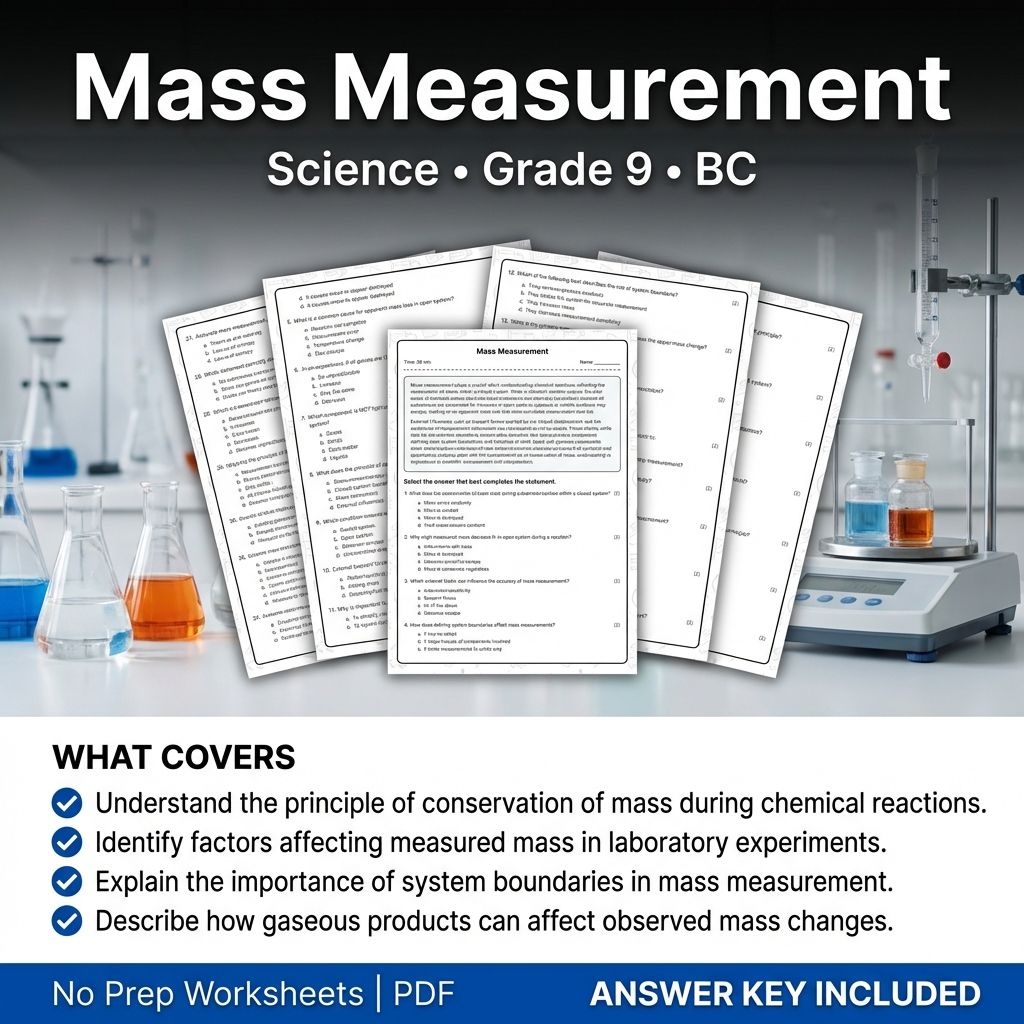
Grade 9 Science | Mass Measurement Worksheet + Answer Key (Printable PDFs)
Created byCoral Reef LearningLearning Objectives
- Understand the principle of conservation of mass during chemical reactions.
- Identify factors affecting measured mass in laboratory experiments.
- Explain the importance of system boundaries in mass measurement.
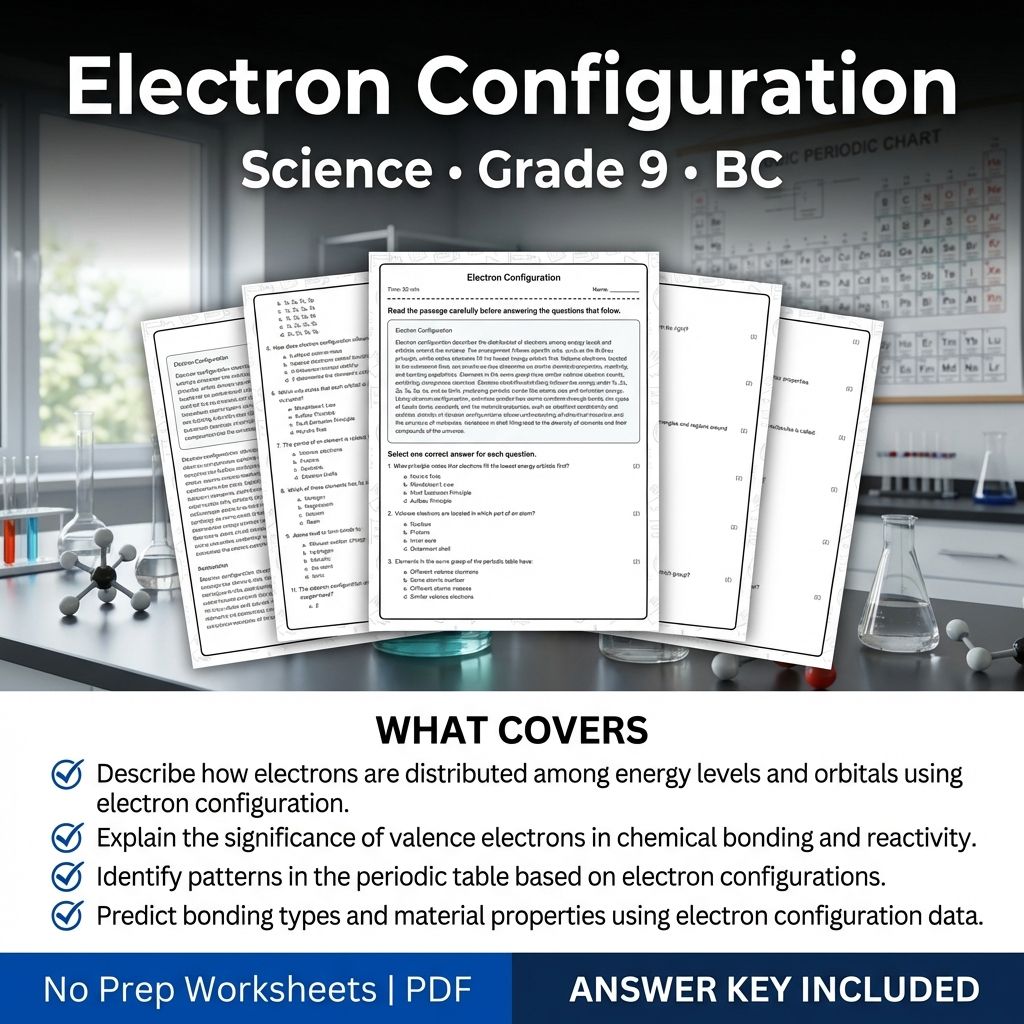
Grade 9 Science | Electron Configuration Worksheet & Answer Key (Printable PDF)
Created byCoral Reef LearningLearning Objectives
- Describe how electrons are distributed among energy levels and orbitals using electron configuration.
- Explain the significance of valence electrons in chemical bonding and reactivity.
- Identify patterns in the periodic table based on electron configurations.
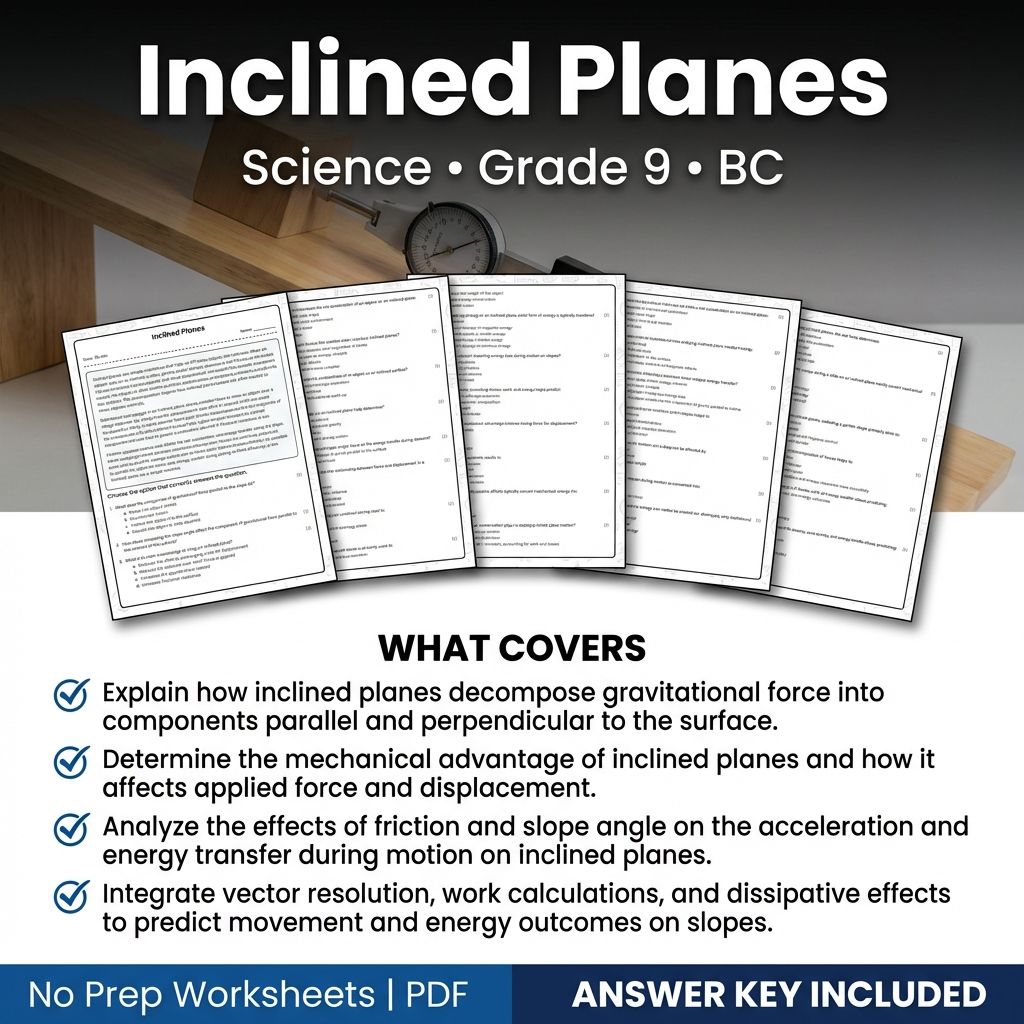
Inclined Planes Worksheet for Grade 9 Science | BC Standards
Created byCoral Reef LearningLearning Objectives
- Explain how inclined planes decompose gravitational force into components parallel and perpendicular to the surface.
- Determine the mechanical advantage of inclined planes and how it affects applied force and displacement.
- Analyze the effects of friction and slope angle on the acceleration and energy transfer during motion on inclined planes.
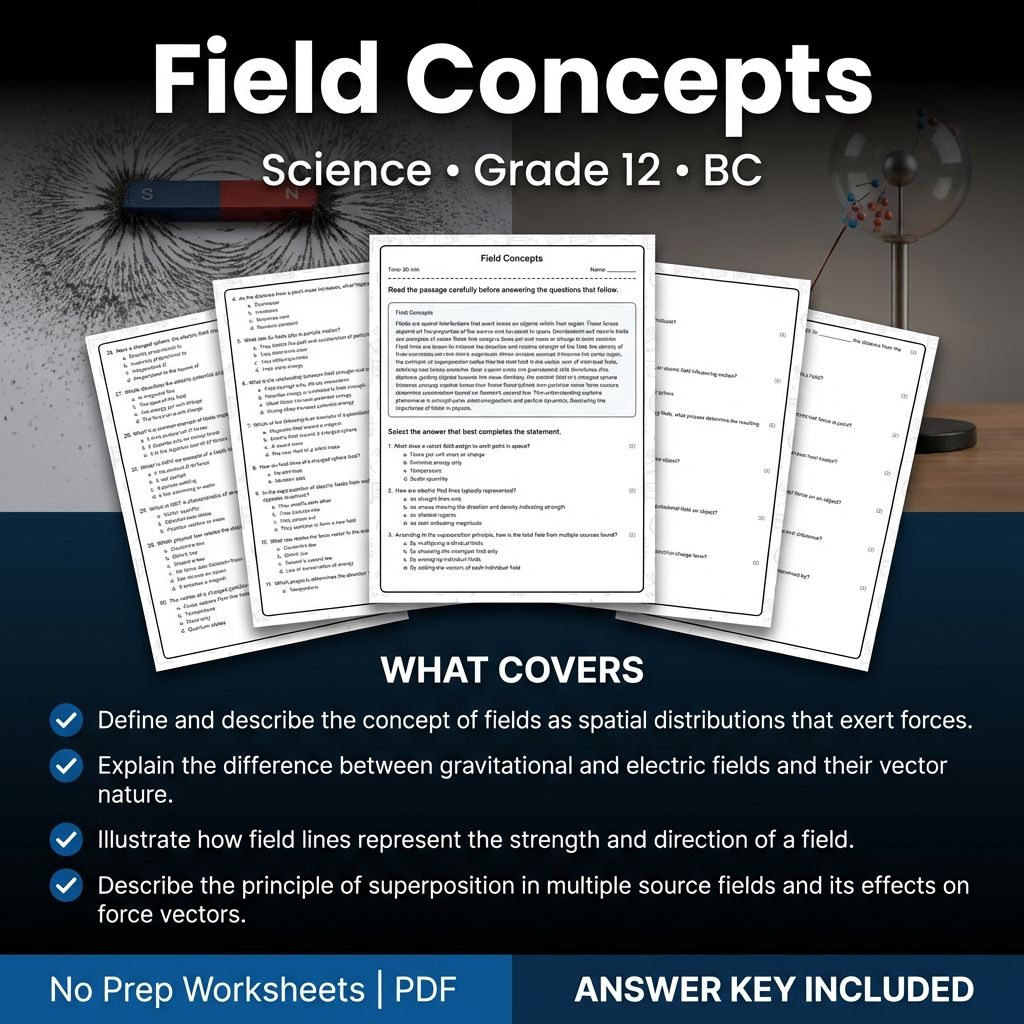
Grade 12 Science Worksheet on Field Concepts with Answer Key PDF
Created byCoral Reef LearningLearning Objectives
- Define and describe the concept of fields as spatial distributions that exert forces.
- Explain the difference between gravitational and electric fields and their vector nature.
- Illustrate how field lines represent the strength and direction of a field.
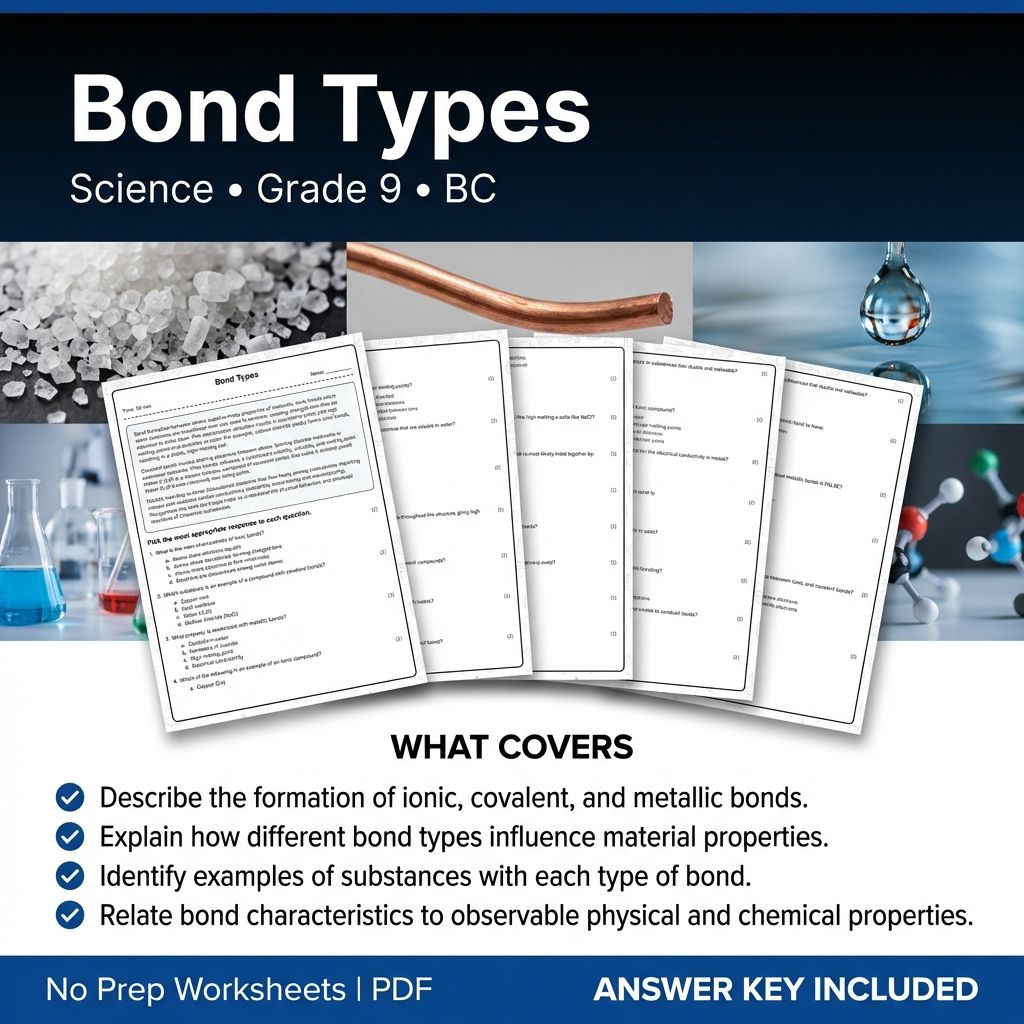
9th Grade Science | Bond Types Worksheet & Answer Key for Classroom Practice
Created byCoral Reef LearningLearning Objectives
- Describe the formation of ionic, covalent, and metallic bonds.
- Explain how different bond types influence material properties.
- Identify examples of substances with each type of bond.
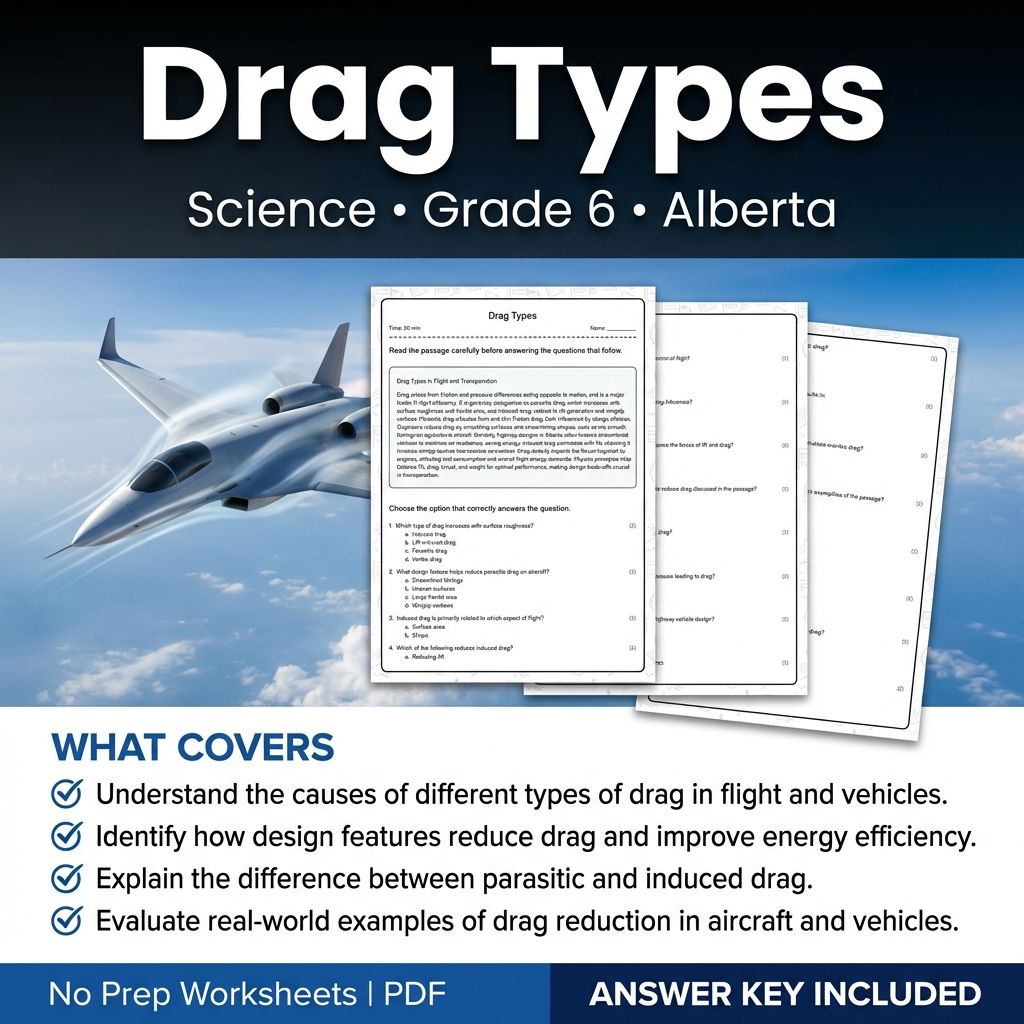
Grade 6 Science Worksheet on Drag Types | Alberta Curriculum Practice
Created byCoral Reef LearningLearning Objectives
- Understand the causes of different types of drag in flight and vehicles.
- Identify how design features reduce drag and improve energy efficiency.
- Explain the difference between parasitic and induced drag.
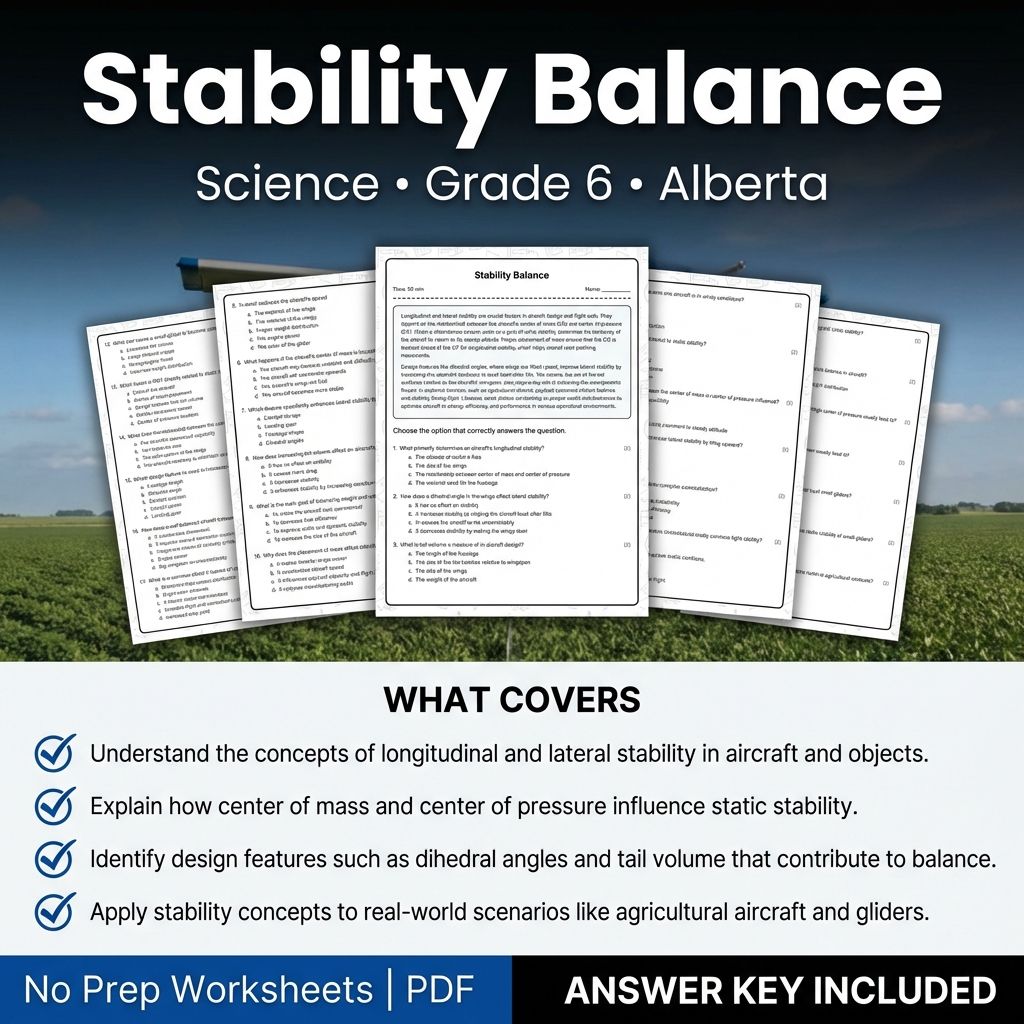
Grade 6 Science Worksheet on Stability Balance | Alberta Standards Practice
Created byCoral Reef LearningLearning Objectives
- Understand the concepts of longitudinal and lateral stability in aircraft and objects.
- Explain how center of mass and center of pressure influence static stability.
- Identify design features such as dihedral angles and tail volume that contribute to balance.
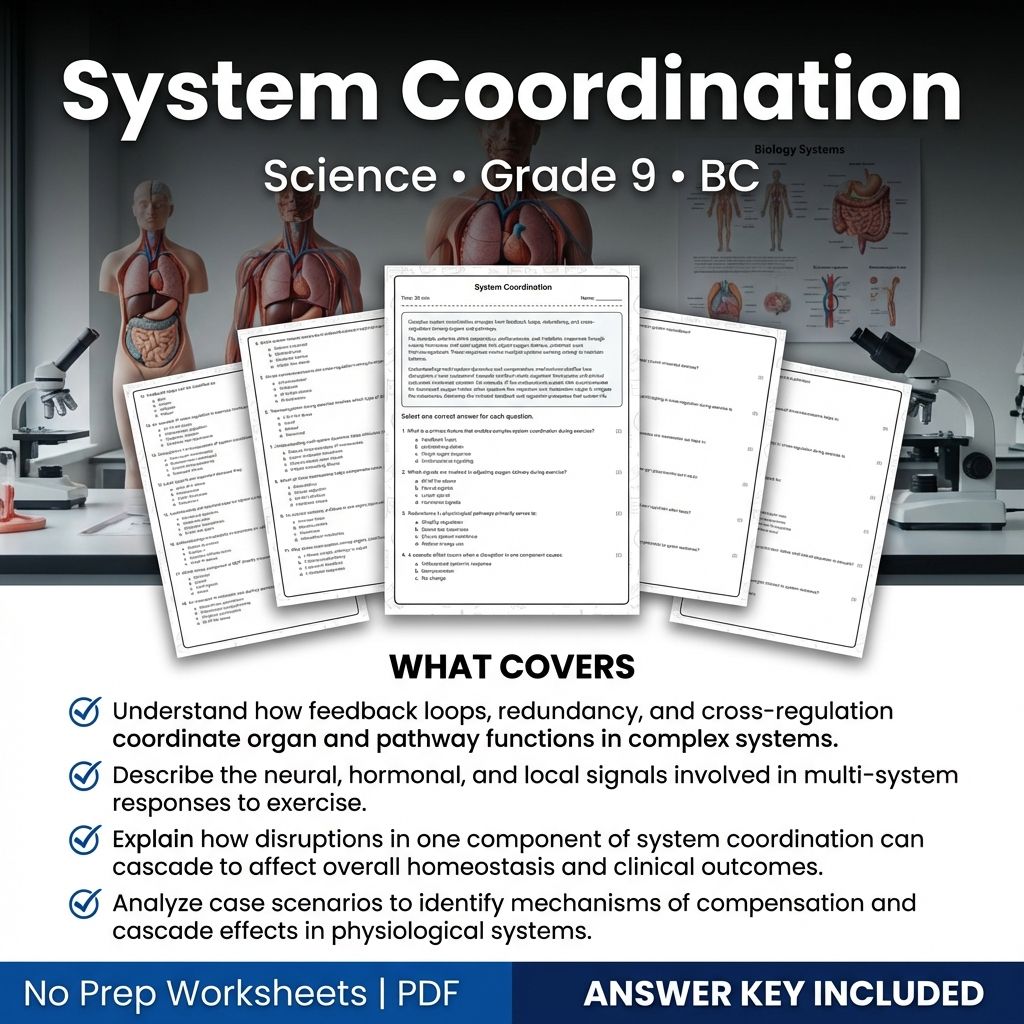
Grade 9 Science Worksheet on System Coordination | BC Standards
Created byCoral Reef LearningLearning Objectives
- Understand how feedback loops, redundancy, and cross-regulation coordinate organ and pathway functions in complex systems.
- Describe the neural, hormonal, and local signals involved in multi-system responses to exercise.
- Explain how disruptions in one component of system coordination can cascade to affect overall homeostasis and clinical outcomes.
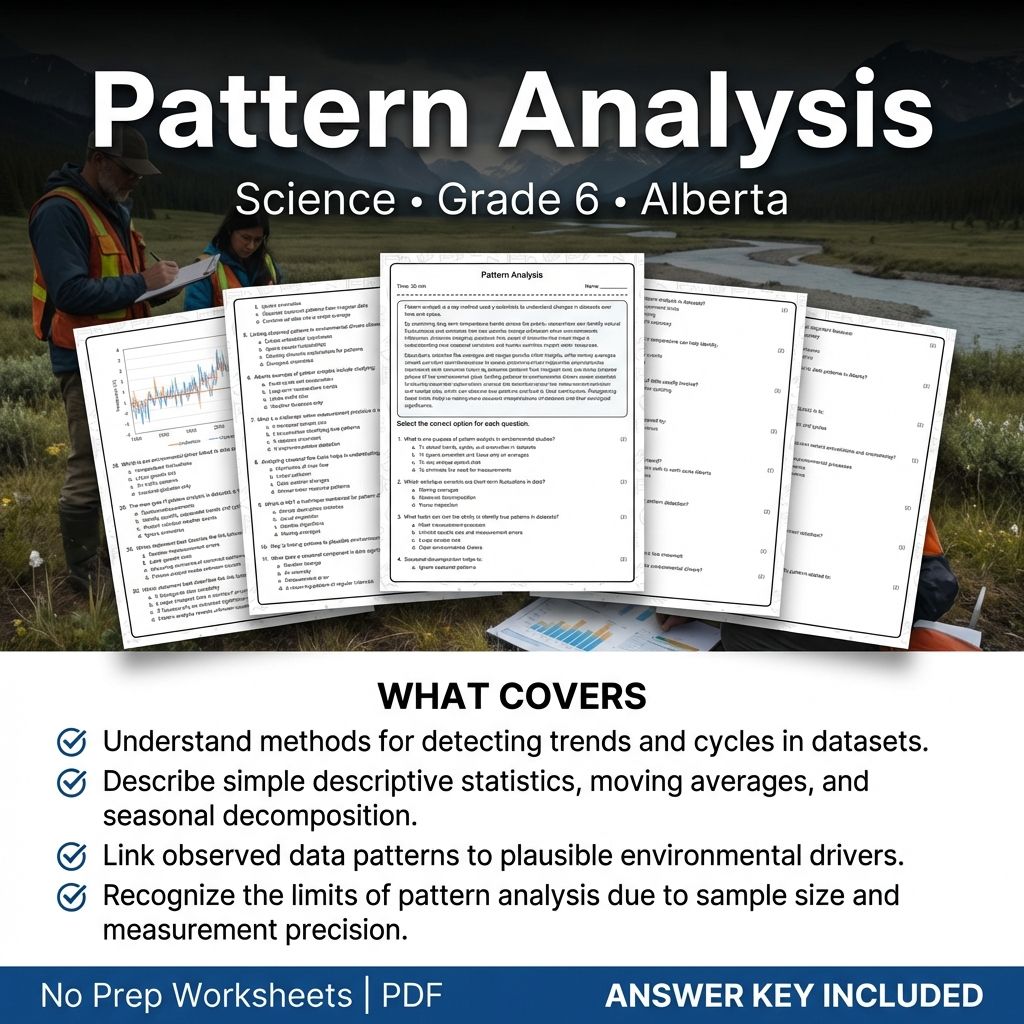
Grade 6 Science Worksheet on Pattern Analysis | Alberta Standards
Created byCoral Reef LearningLearning Objectives
- Understand methods for detecting trends and cycles in datasets.
- Describe simple descriptive statistics, moving averages, and seasonal decomposition.
- Link observed data patterns to plausible environmental drivers.

Energy Transfer Worksheet for Grade 9 Science – Classroom Practice
Created byCoral Reef LearningLearning Objectives
- Describe how mechanical systems transfer energy as kinetic or potential energy.
- Explain the roles of work, collisions, and friction in energy transfer.
- Identify examples of energy conversion pathways such as braking a bicycle or compressing a spring.
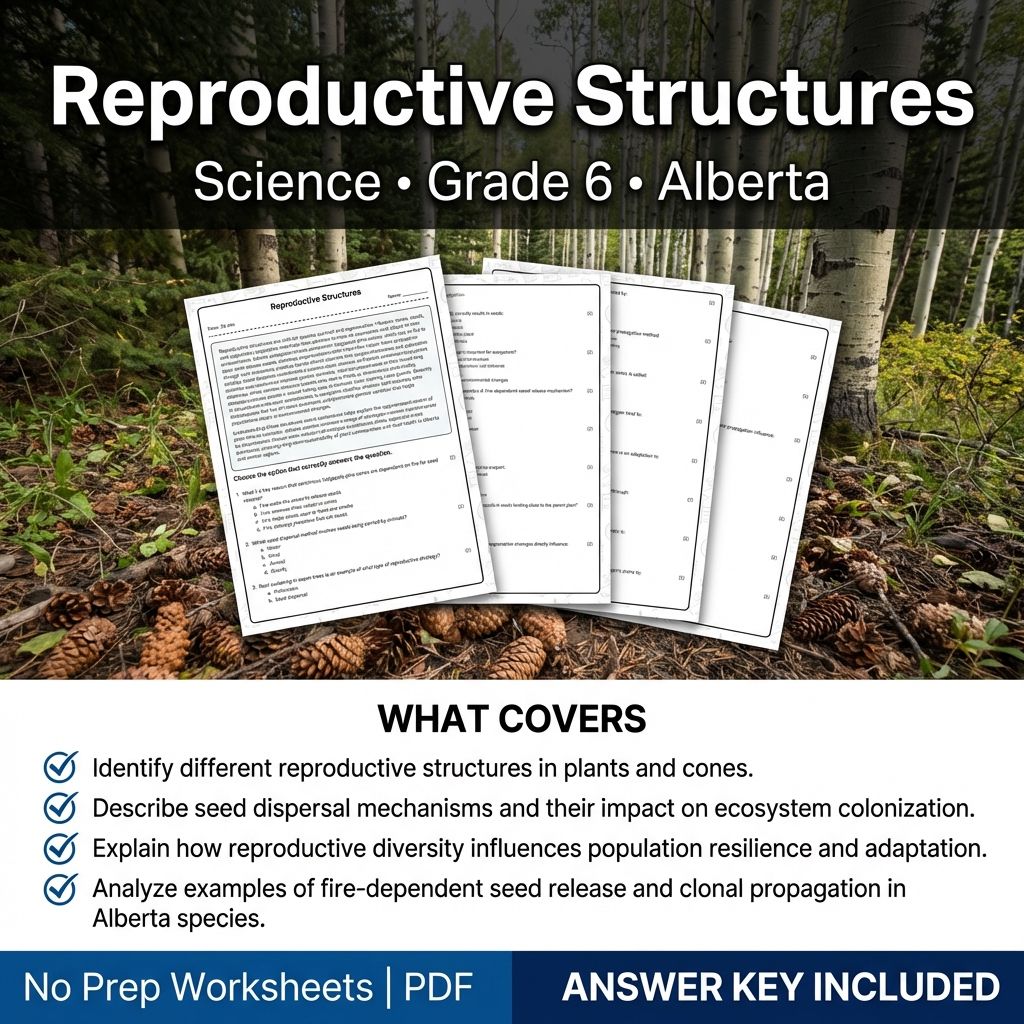
Grade 6 Science Worksheet on Reproductive Structures | Alberta Standards
Created byCoral Reef LearningLearning Objectives
- Identify different reproductive structures in plants and cones.
- Describe seed dispersal mechanisms and their impact on ecosystem colonization.
- Explain how reproductive diversity influences population resilience and adaptation.
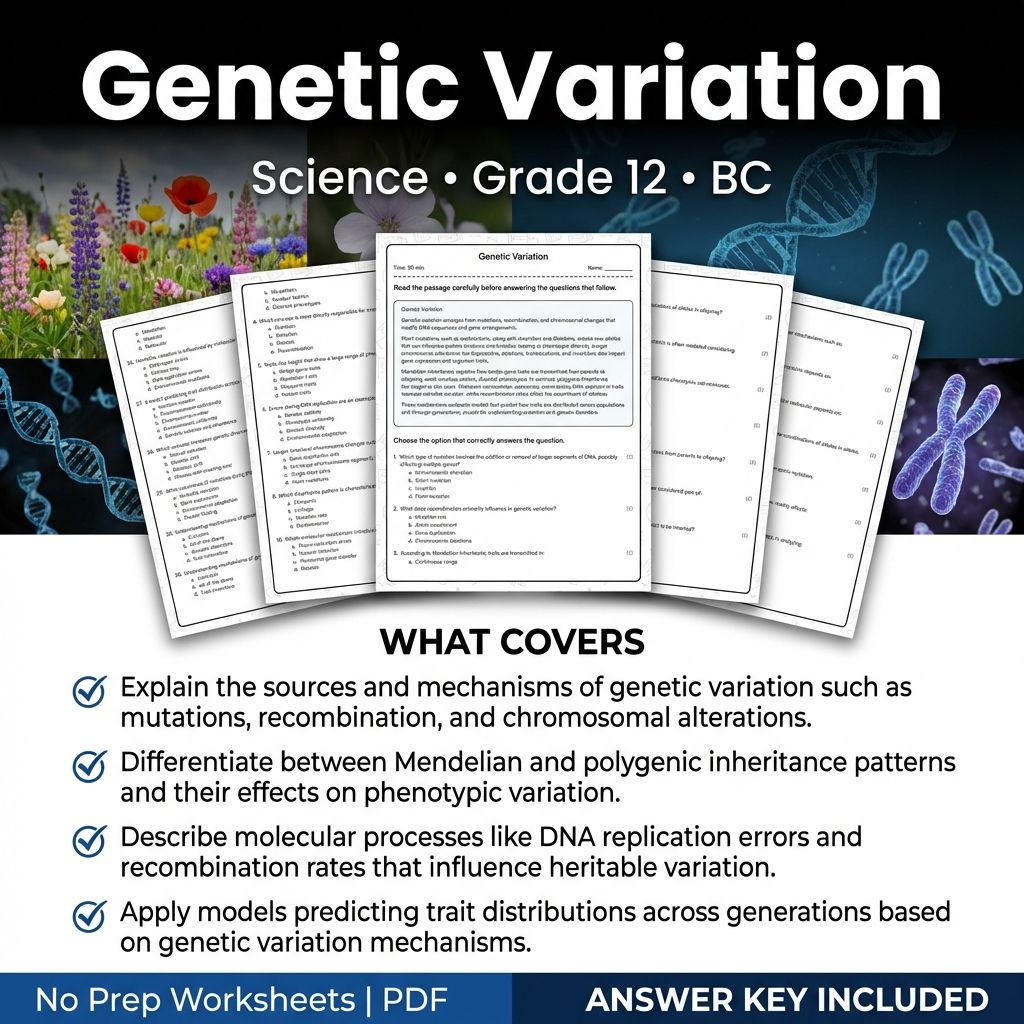
Genetic Variation Worksheet for Grade 12 Science | BC Standards
Created byCoral Reef LearningLearning Objectives
- Explain the sources and mechanisms of genetic variation such as mutations, recombination, and chromosomal alterations.
- Differentiate between Mendelian and polygenic inheritance patterns and their effects on phenotypic variation.
- Describe molecular processes like DNA replication errors and recombination rates that influence heritable variation.
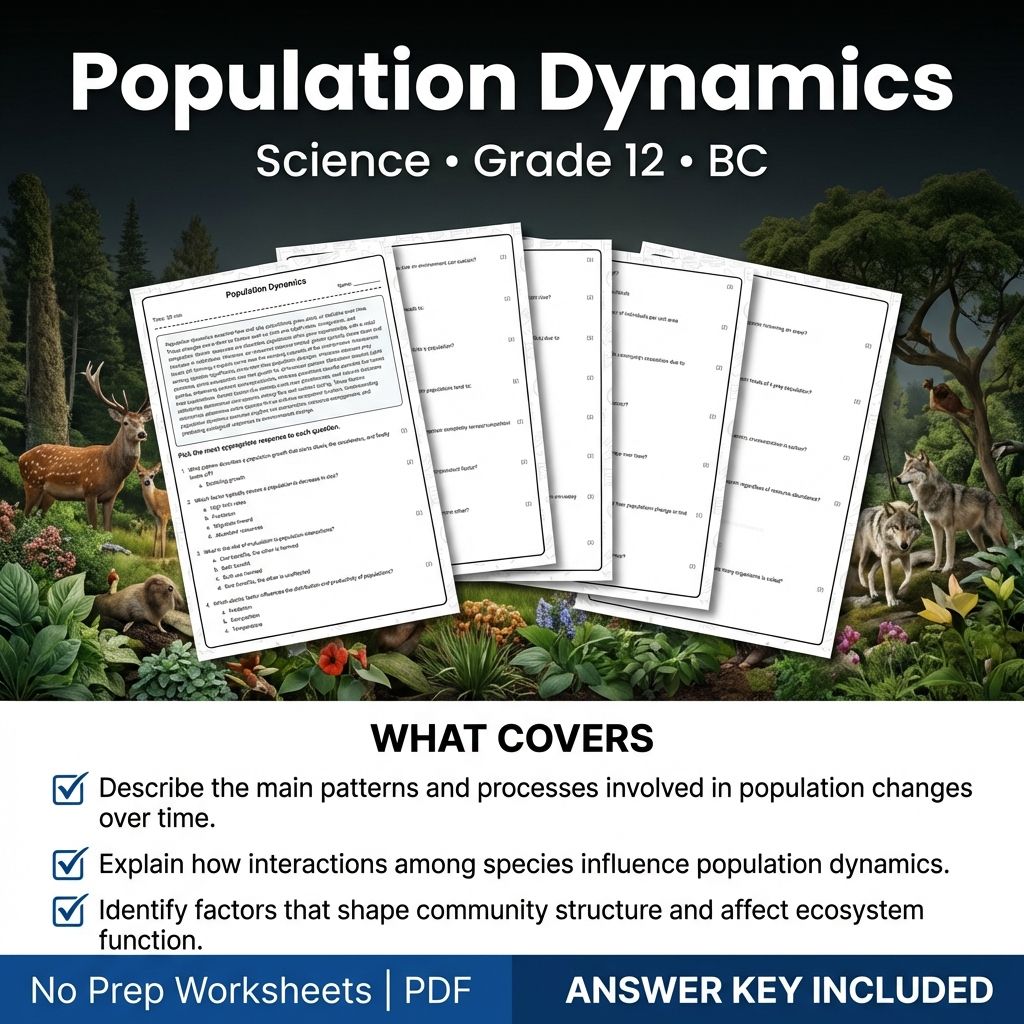
Population Dynamics Worksheet for Grade 12 Science | BC Standards
Created byCoral Reef LearningLearning Objectives
- Describe the main patterns and processes involved in population changes over time.
- Explain how interactions among species influence population dynamics.
- Identify factors that shape community structure and affect ecosystem function.
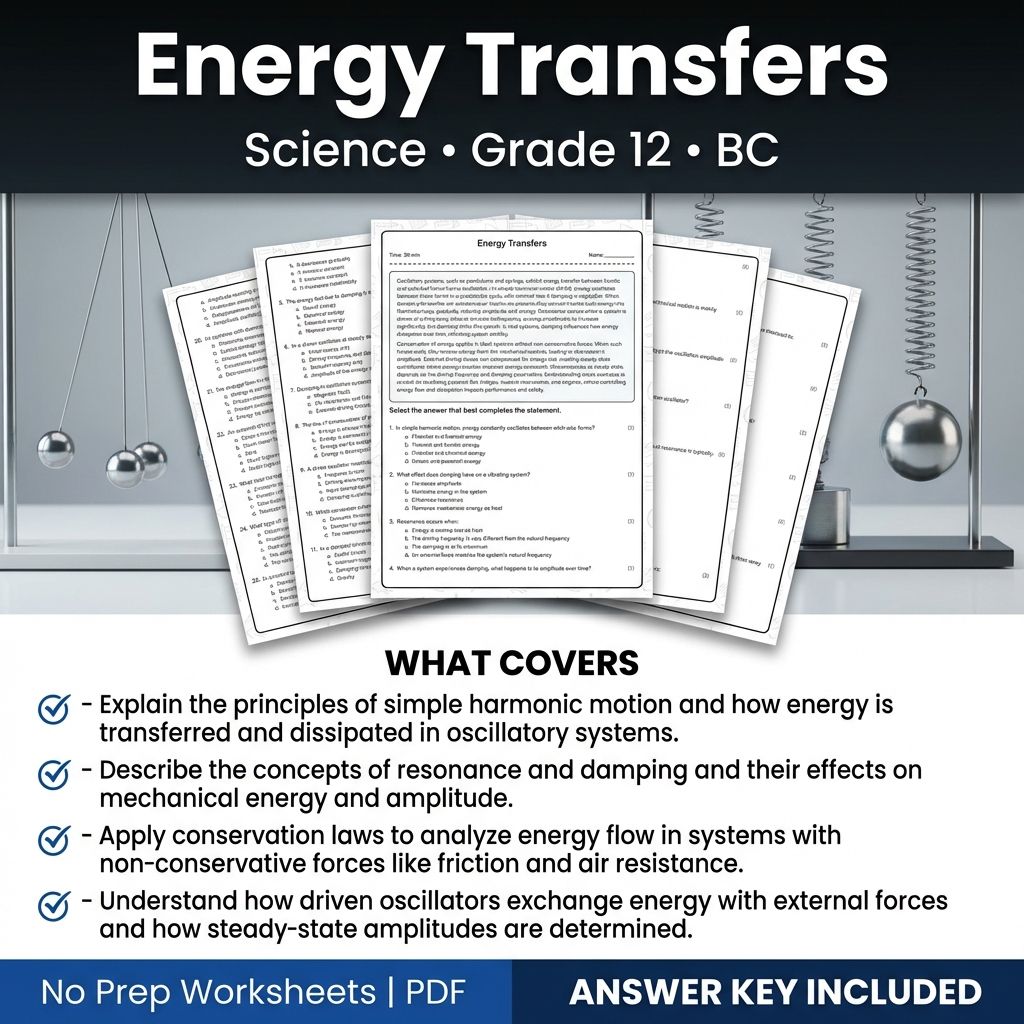
Energy Transfers Worksheet for Grade 12 Science – Practice & Assessment
Created byCoral Reef LearningLearning Objectives
- Explain the principles of simple harmonic motion and how energy is transferred and dissipated in oscillatory systems.
- Describe the concepts of resonance and damping and their effects on mechanical energy and amplitude.
- Apply conservation laws to analyze energy flow in systems with non-conservative forces like friction and air resistance.
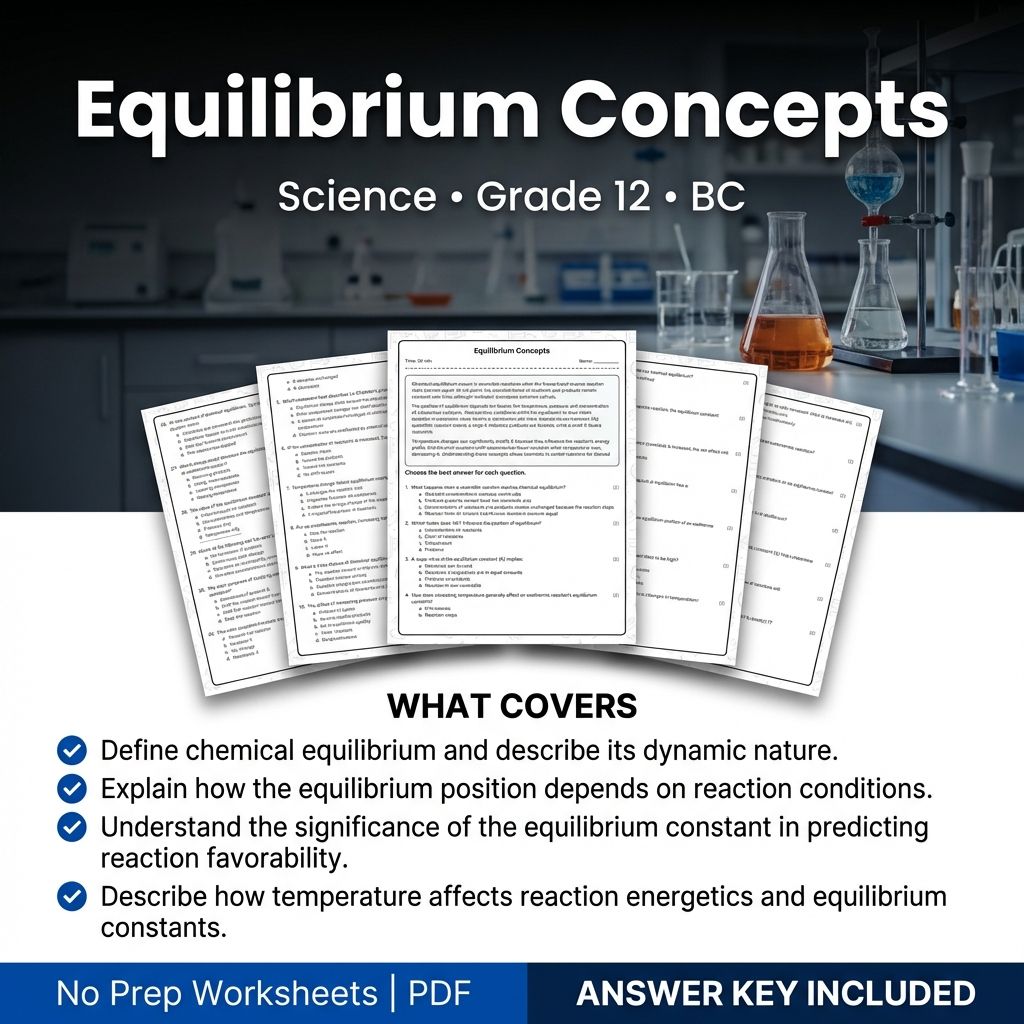
Equilibrium Concepts Worksheet for Grade 12 Science BC Standards
Created byCoral Reef LearningLearning Objectives
- Define chemical equilibrium and describe its dynamic nature.
- Explain how the equilibrium position depends on reaction conditions.
- Understand the significance of the equilibrium constant in predicting reaction favorability.
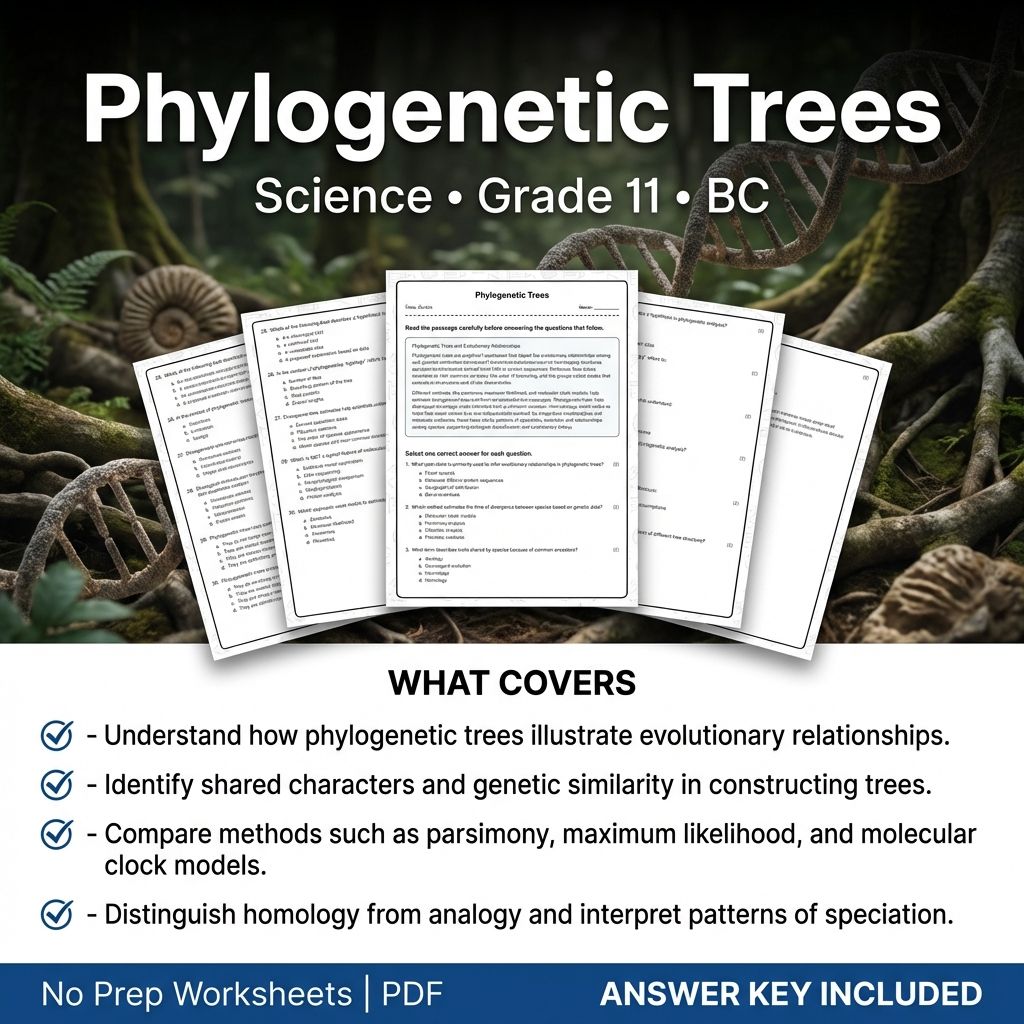
Grade 11 Science | Phylogenetic Trees Worksheet & Answer Key (Printable PDF)
Created byCoral Reef LearningLearning Objectives
- Understand how phylogenetic trees illustrate evolutionary relationships.
- Identify shared characters and genetic similarity in constructing trees.
- Compare methods such as parsimony, maximum likelihood, and molecular clock models.
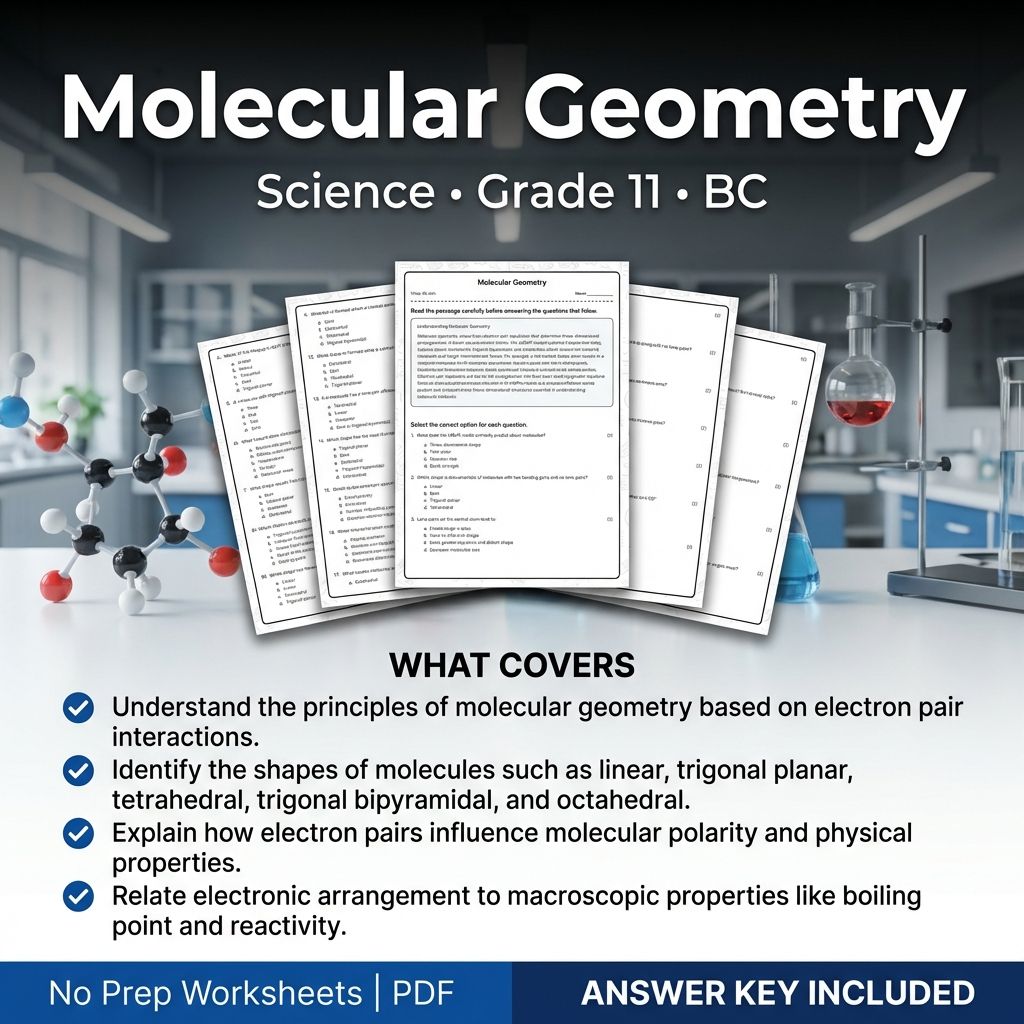
Grade 11 Science Worksheet | Molecular Geometry Practice with Answer Key (PDF)
Created byCoral Reef LearningLearning Objectives
- Understand the principles of molecular geometry based on electron pair interactions.
- Identify the shapes of molecules such as linear, trigonal planar, tetrahedral, trigonal bipyramidal, and octahedral.
- Explain how electron pairs influence molecular polarity and physical properties.
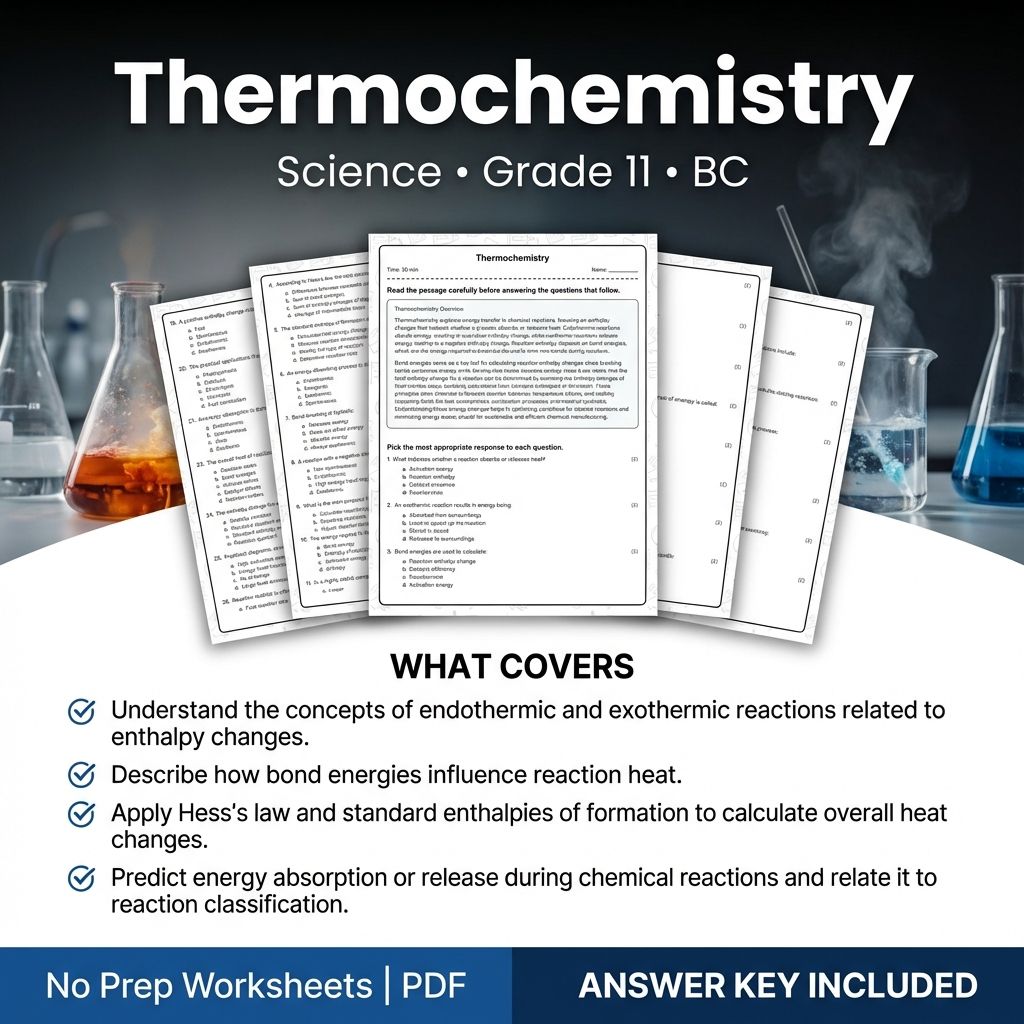
Grade 11 Science | Thermochemistry Worksheet & Answer Key (Printable PDF)
Created byCoral Reef LearningLearning Objectives
- Understand the concepts of endothermic and exothermic reactions related to enthalpy changes.
- Describe how bond energies influence reaction heat.
- Apply Hess’s law and standard enthalpies of formation to calculate overall heat changes.
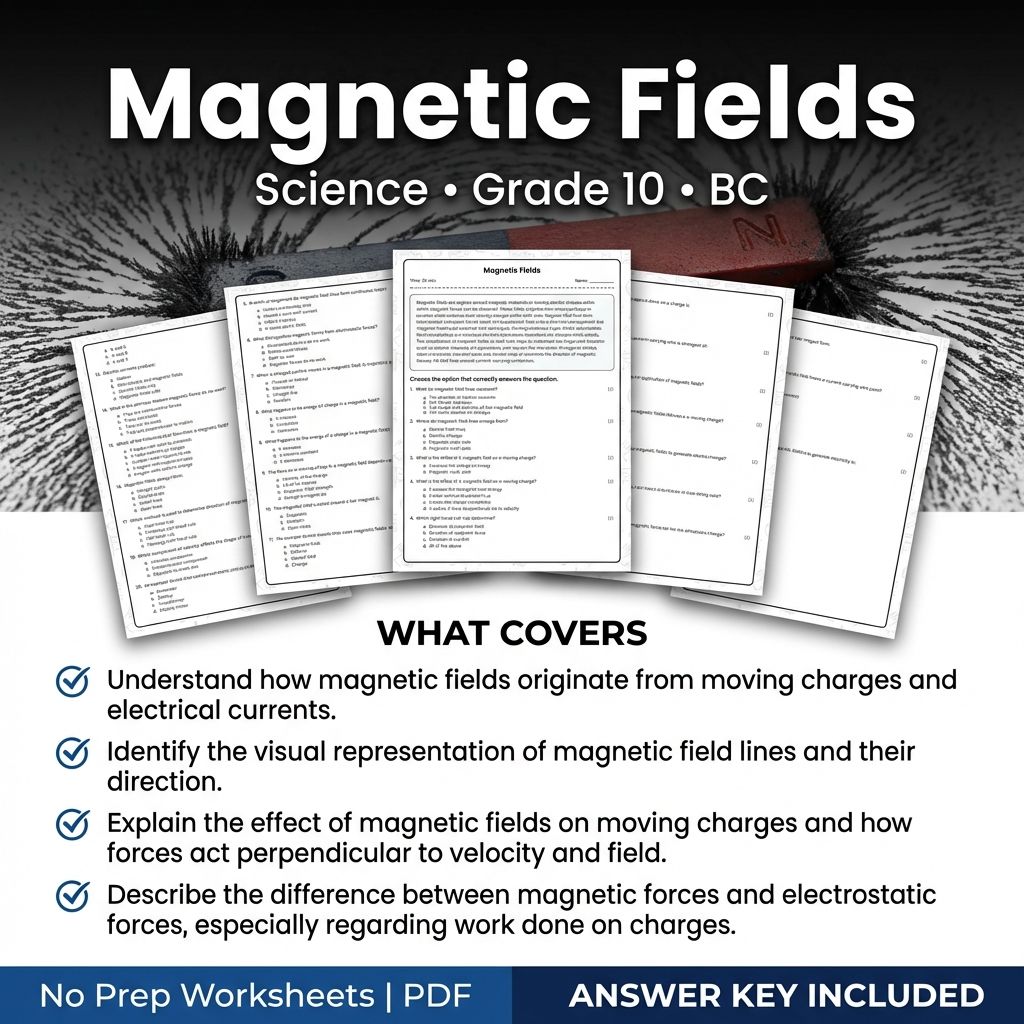
Grade 10 Science | Magnetic Fields Worksheet & Answer Key – Printable PDF
Created byCoral Reef LearningLearning Objectives
- Understand how magnetic fields originate from moving charges and electrical currents.
- Identify the visual representation of magnetic field lines and their direction.
- Explain the effect of magnetic fields on moving charges and how forces act perpendicular to velocity and field.
Browse more categories
About Science Worksheets
Find Science worksheets spanning core skills, practice, and review. All 42,859 resources are instant PDF downloads for the classroom or home.
Every worksheet on MyTeachingSheets is created by independent teacher-authors and reviewed before publication. All resources download as printable PDFs for classroom, homework, or at-home practice, and many include answer keys. Preview any worksheet free before buying.