
Science Worksheets
42,685 subject resources
Climate Drivers Assessment | NGSS Grade 9 Science Standards-Aligned
 Created byPrism Point Learning
Learning Objectives
- Explain how solar flux, albedo differences, greenhouse gases, and ocean heat transport influence Earth’s climate.
- Analyze observational records, radiative transfer calculations, and paleoclimate proxies to attribute climate variability.
- Describe phenomena such as ice-sheet dynamics, El Niño–Southern Oscillation, and seasonal monsoon shifts in terms of climate drivers.
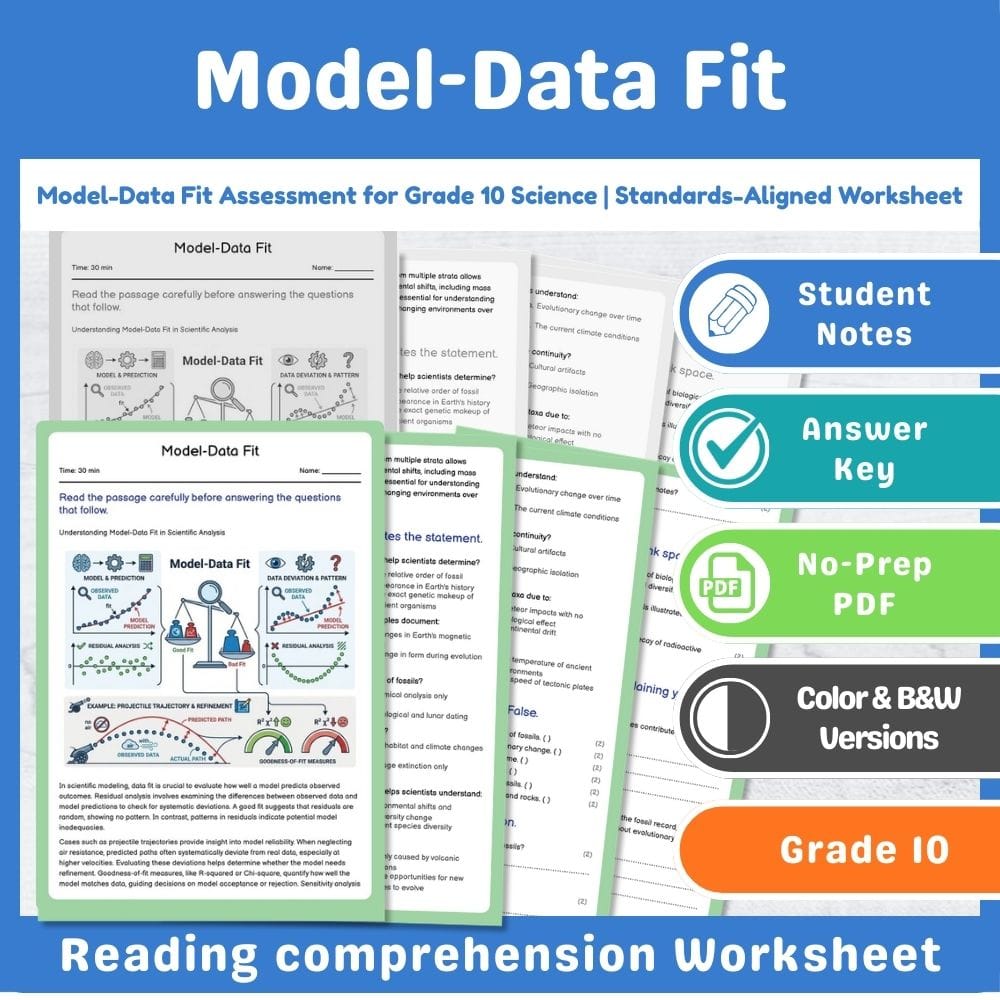
Model-Data Fit Assessment for Grade 10 Science | Standards-Aligned Worksheet
Created byPrism Point LearningLearning Objectives
- Interpret residuals and assess model adequacy using residual analysis.
- Apply goodness-of-fit concepts to evaluate the accuracy of model predictions.
- Analyze cases like projectile motion with and without air resistance to understand systematic deviations.
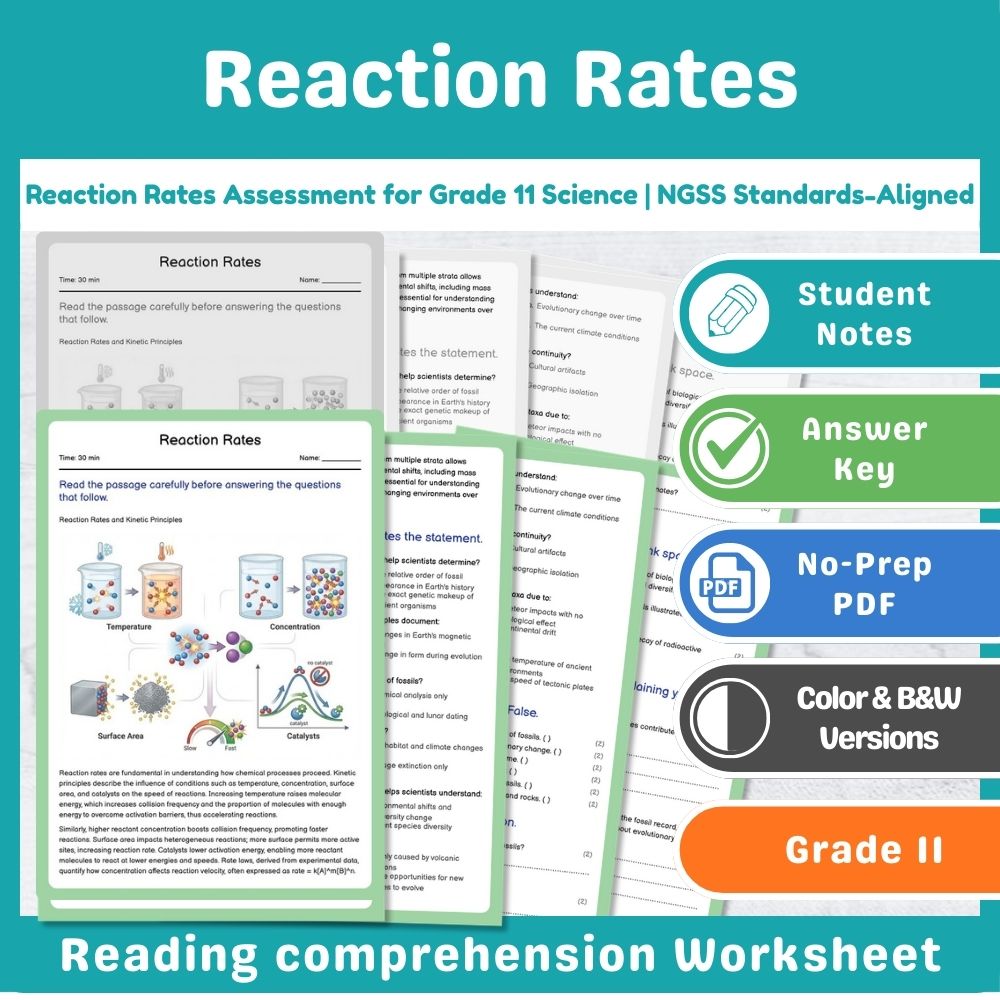
Reaction Rates Assessment for Grade 11 Science | NGSS Standards-Aligned
Created byPrism Point LearningLearning Objectives
- Explain how temperature, concentration, surface area, and catalysts influence reaction rates through collision and activation energies.
- Apply rate laws and concentration dependencies to elementary reaction steps.
- Interpret potential energy diagrams and Arrhenius parameters to understand temperature's effect on reaction rates.
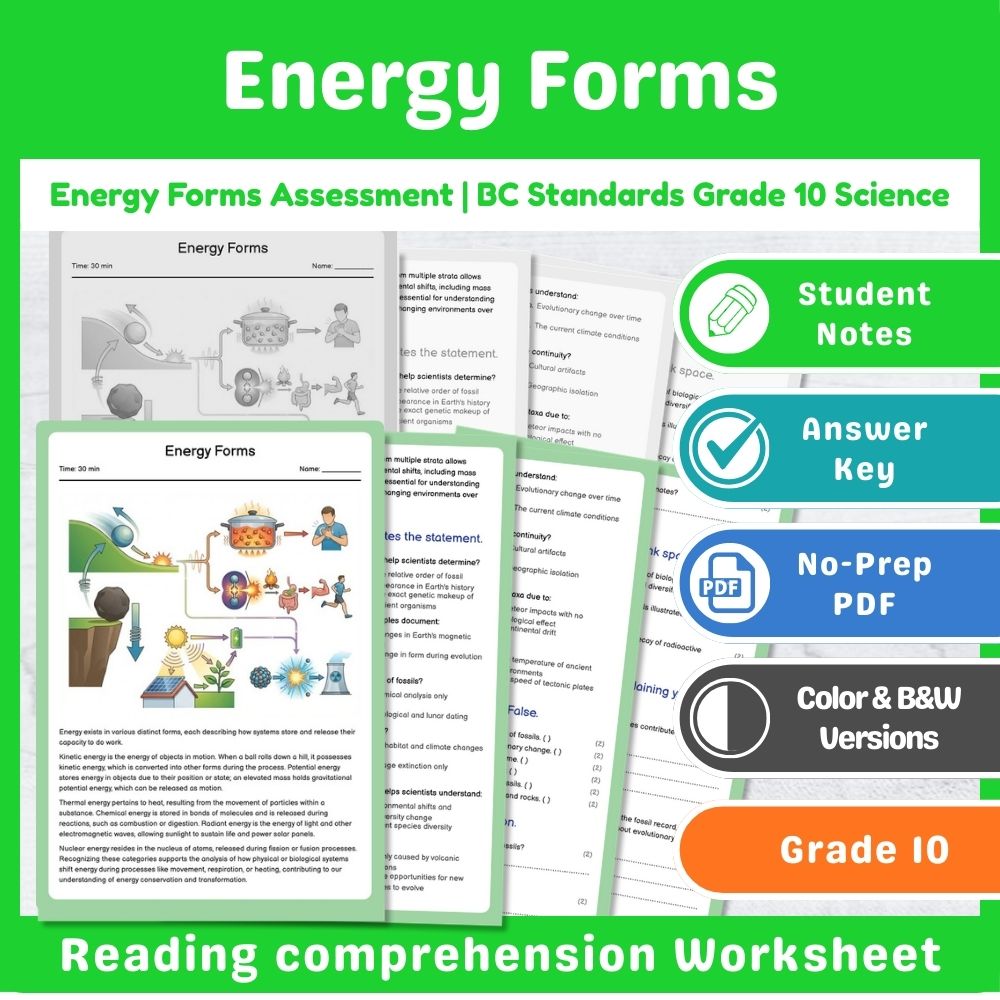
Energy Forms Assessment | BC Standards Grade 10 Science
Created byPrism Point LearningLearning Objectives
- Identify and describe different forms of energy such as kinetic, potential, thermal, chemical, radiant, and nuclear.
- Explain how energy transforms from one form to another during physical and biological processes.
- Analyze examples of energy transfer in systems like movement, respiration, or heating.

Heat and Work Assessment for Grade 9 Science | Standards-Aligned Worksheet
Created byPrism Point LearningLearning Objectives
- Understand the concepts of heat transfer and work in physical and chemical changes.
- Identify pathways of energy transfer during different processes.
- Explain how energy flows between a system and its surroundings through heat and work.
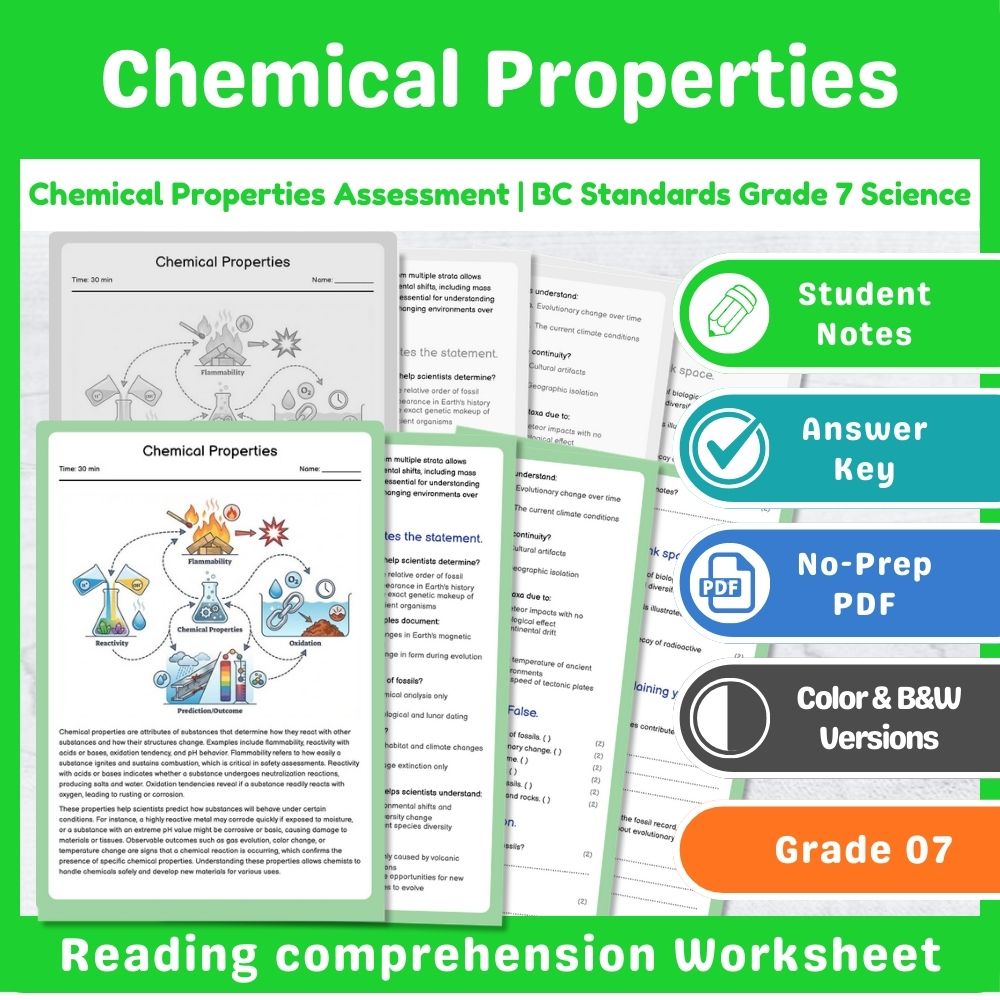
Chemical Properties Assessment | BC Standards Grade 7 Science
Created byPrism Point LearningLearning Objectives
- Understand the key chemical properties and how they describe a substance.
- Identify observable indicators of chemical reactions.
- Assist in predicting reactions based on chemical properties like flammability, reactivity, and pH.
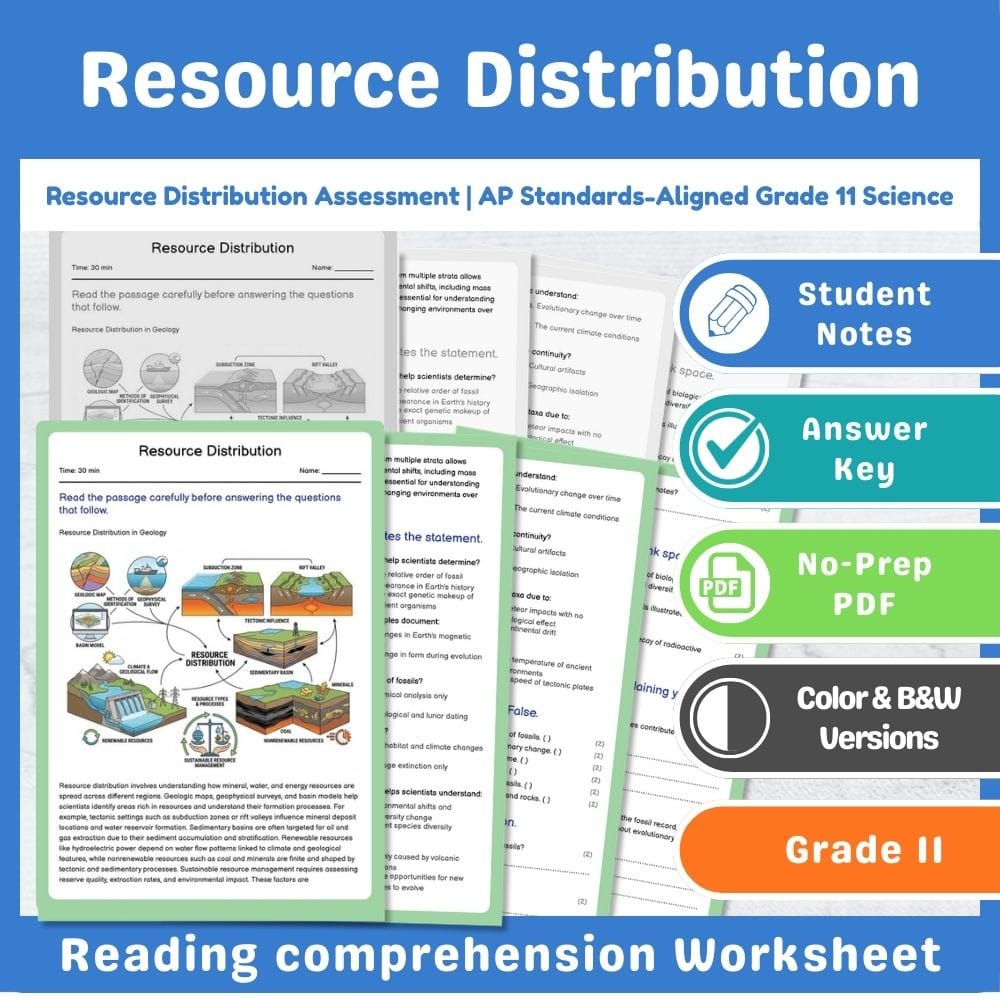
Resource Distribution Assessment | AP Standards-Aligned Grade 11 Science
Created byPrism Point LearningLearning Objectives
- Map and analyze the spatial patterns of mineral, water, and energy resources using various geologic tools.
- Distinguish between renewable and nonrenewable reservoirs and evaluate their sustainability.
- Assess resource occurrence in relation to tectonic setting and sedimentary processes using geologic information.

Electric Circuits Assessment | Alberta Standards Grade 12 Science
Created byPrism Point LearningLearning Objectives
- Understand and apply Ohm’s law to analyze circuit behavior.
- Differentiate between series and parallel circuits and their properties.
- Calculate power consumption and energy transfer in resistive elements.
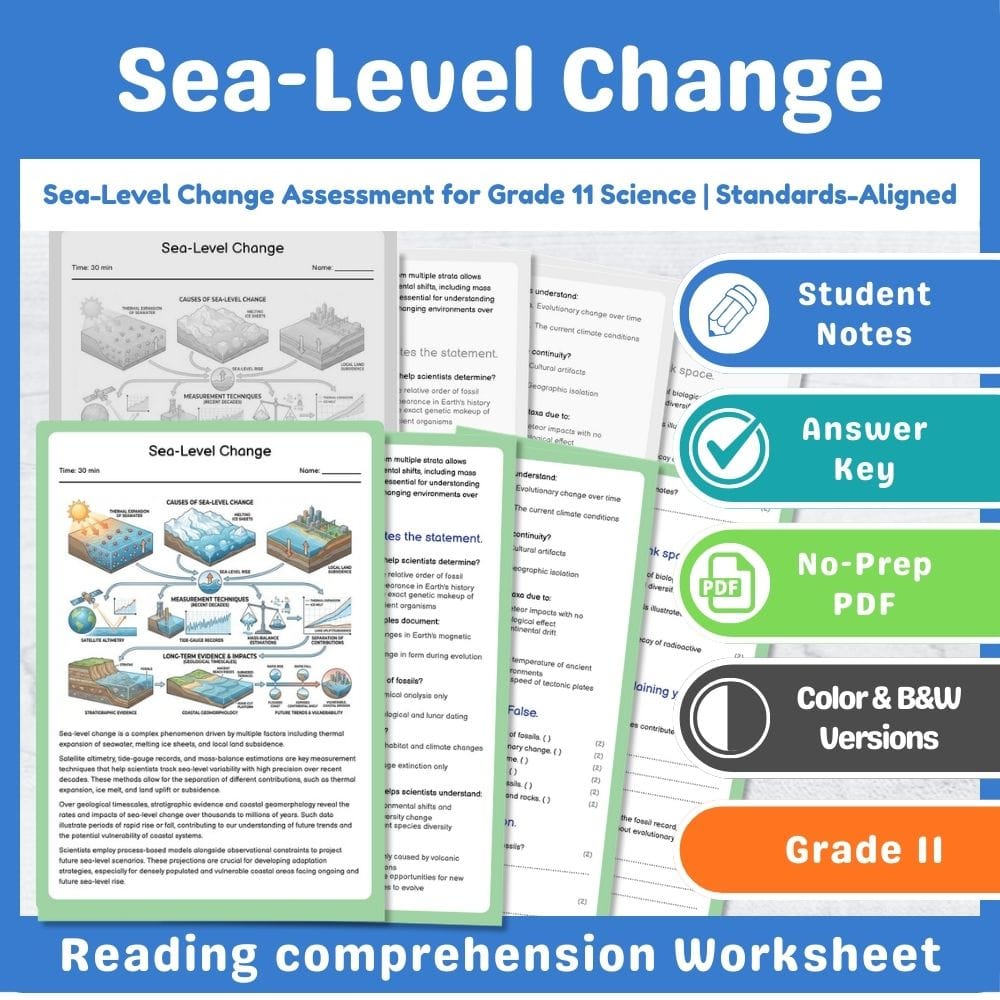
Sea-Level Change Assessment for Grade 11 Science | Standards-Aligned
Created byPrism Point LearningLearning Objectives
- Understand the causes of sea-level variability, including thermal expansion and ice-sheet mass loss.
- Analyze methods used to measure sea-level changes, such as satellite altimetry and tide-gauge records.
- Evaluate the impacts of sea-level change over different timescales using stratigraphic and geomorphological evidence.
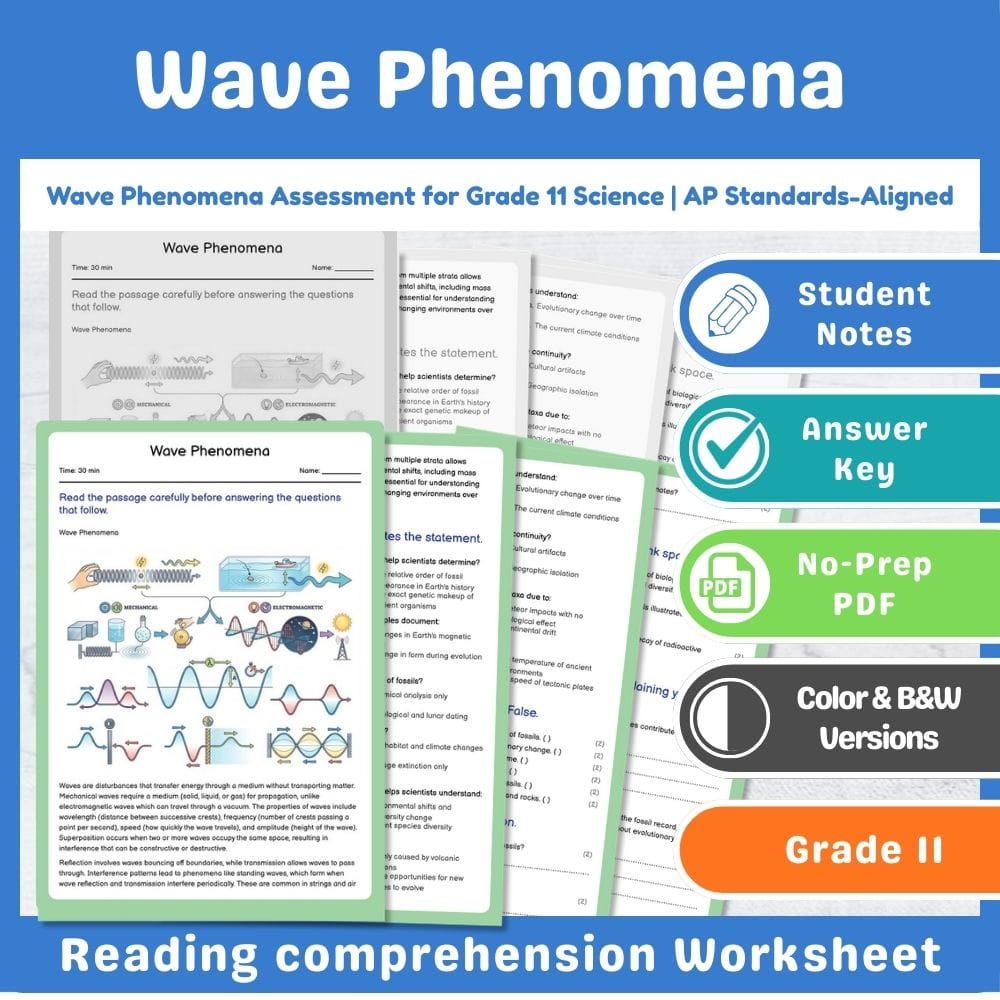
Wave Phenomena Assessment for Grade 11 Science | AP Standards-Aligned
Created byPrism Point LearningLearning Objectives
- Understand the properties of mechanical waves including wavelength, frequency, speed, and amplitude.
- Analyze wave behaviors such as reflection, transmission, interference, and standing waves.
- Relate sinusoidal and graphical models to energy transport and modal patterns in waves.

Gene Regulation Assessment for Grade 11 Science | TEKS Standards
Created byPrism Point LearningLearning Objectives
- Understand the mechanisms involved in gene regulation and expression.
- Identify cis-regulatory elements and their roles in gene activation.
- Explain how chromatin structure and epigenetic modifications influence gene accessibility.

Reaction Balancing Assessment | General Standards + Grade 9 Science
Created byPrism Point LearningLearning Objectives
- Understand the conservation of atoms in chemical reactions.
- Learn how to balance simple chemical equations accurately.
- Explain the significance of coefficients in representing particle ratios.

Molecular Phylogeny Assessment for Grade 11 Science TEKS Standards
Created byPrism Point LearningLearning Objectives
- Understand the principles of molecular phylogeny and how DNA, RNA, and protein sequences are used to infer evolutionary relationships.
- Describe the processes of sequence alignment and how models of molecular evolution account for substitution rates.
- Explain the concept of molecular clocks and how they are calibrated using fossil or biogeographic data.
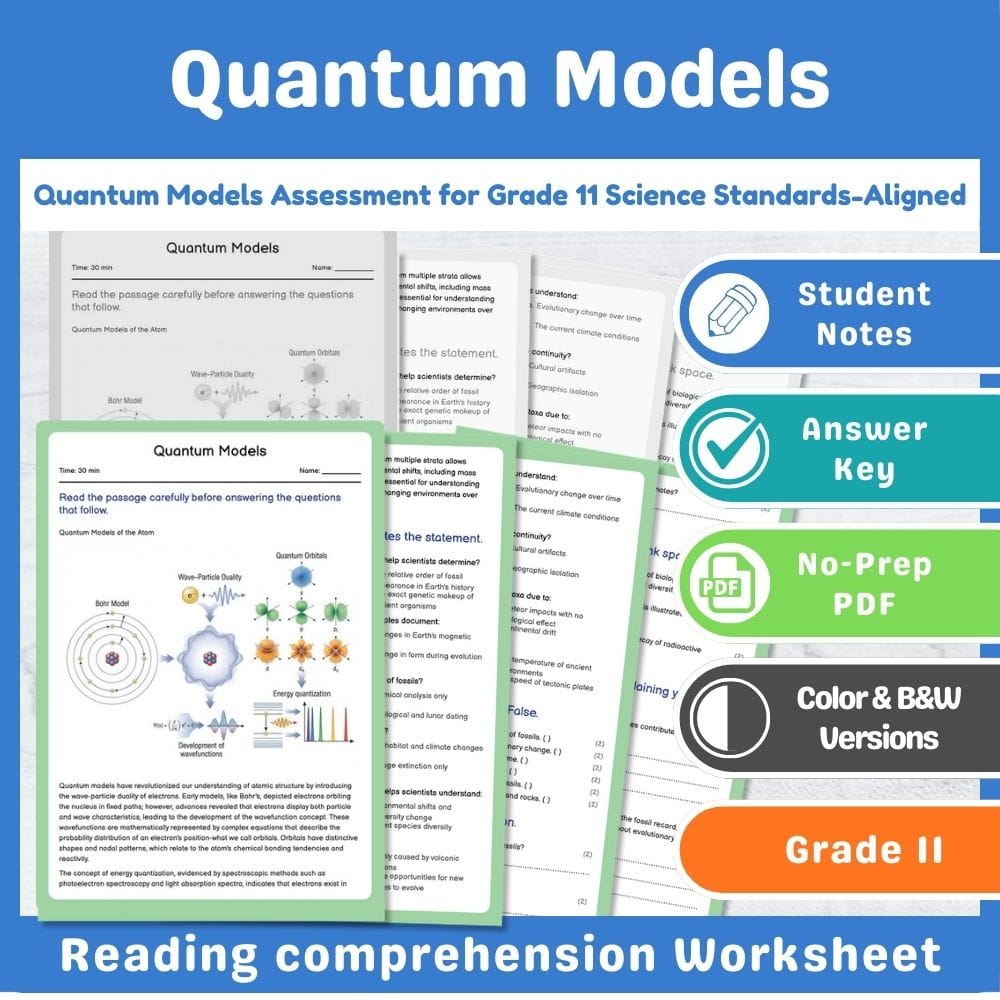
Quantum Models Assessment for Grade 11 Science Standards-Aligned
Created byPrism Point LearningLearning Objectives
- Explain the development of quantum models including wave–particle duality and orbital hybridization.
- Describe how energy quantization affects atomic spectra and chemical bonding.
- Apply mathematical representations of atomic orbitals to predict electron behavior and properties.
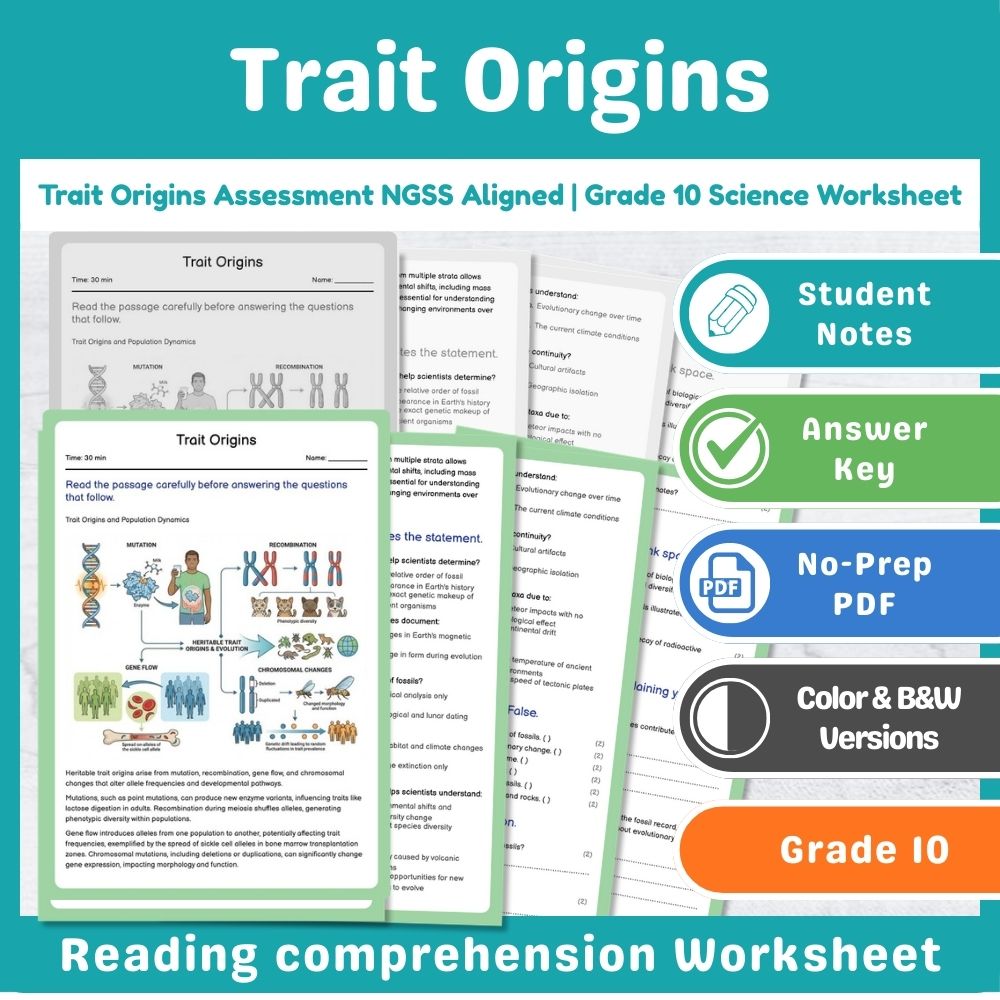
Trait Origins Assessment NGSS Aligned | Grade 10 Science Worksheet
Created byPrism Point LearningLearning Objectives
- Understand the molecular and population-level processes that influence heritable trait variation.
- Identify examples of genetic mutations and chromosomal changes affecting traits.
- Explain how population processes such as genetic drift and nonrandom mating modify trait distributions.

Heat and States Assessment | General Grade 6 Science Standards
Created byPrism Point LearningLearning Objectives
- Understand how heat transfer causes changes in the state of matter.
- Identify examples of melting, evaporation, and boiling in everyday life.
- Explain how energy affects particle movement and matter organization.

Motion Principles Assessment for Grade 7 Science – Standards-Aligned
Created byPrism Point LearningLearning Objectives
- Understand the basic concepts of speed, velocity, and acceleration in motion.
- Distinguish between scalar and vector quantities related to motion.
- Interpret motion scenarios qualitatively and relate them to displacement, time, and rate of change.
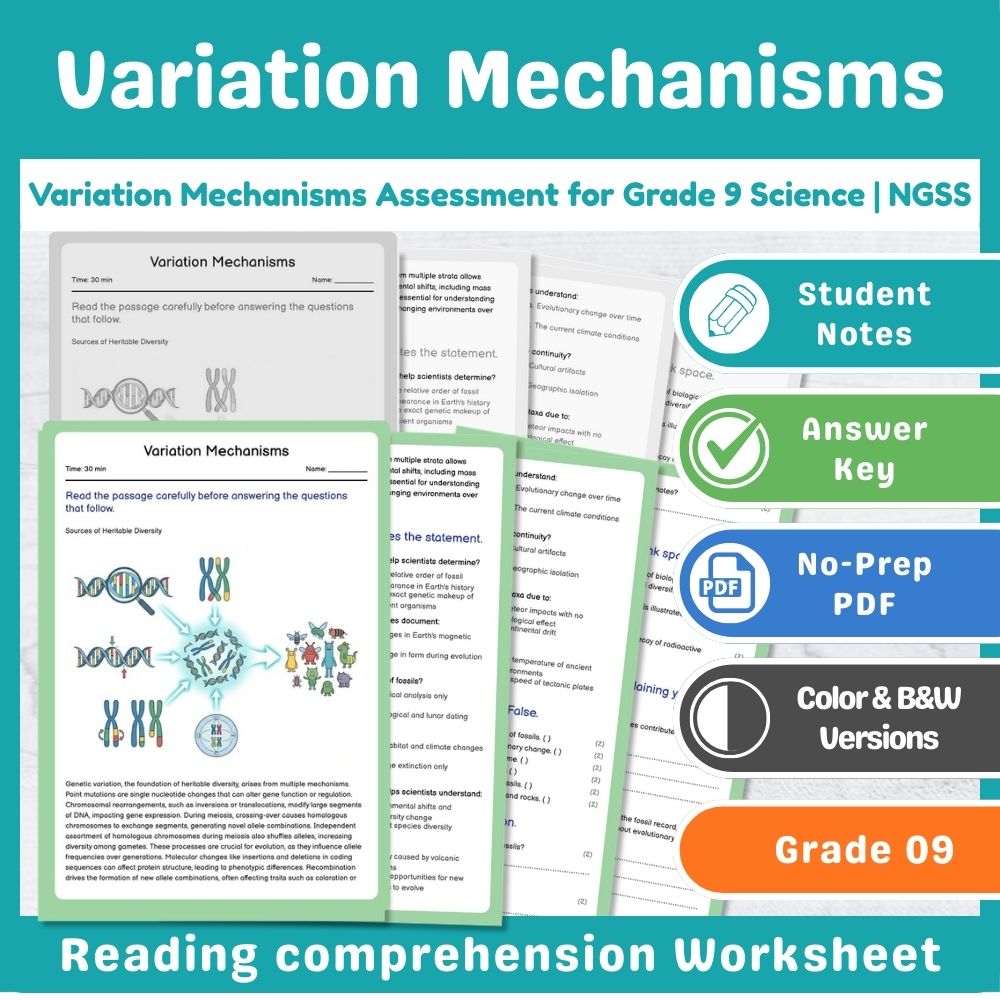
Variation Mechanisms Assessment for Grade 9 Science | NGSS
Created byPrism Point LearningLearning Objectives
- Describe the main sources of heritable genetic variation such as point mutations, chromosomal rearrangements, and recombination.
- Explain how mechanisms like crossing-over and independent assortment contribute to allelic and phenotypic diversity.
- Connect molecular changes to effects on gene expression, protein function, and trait variation at the population level.
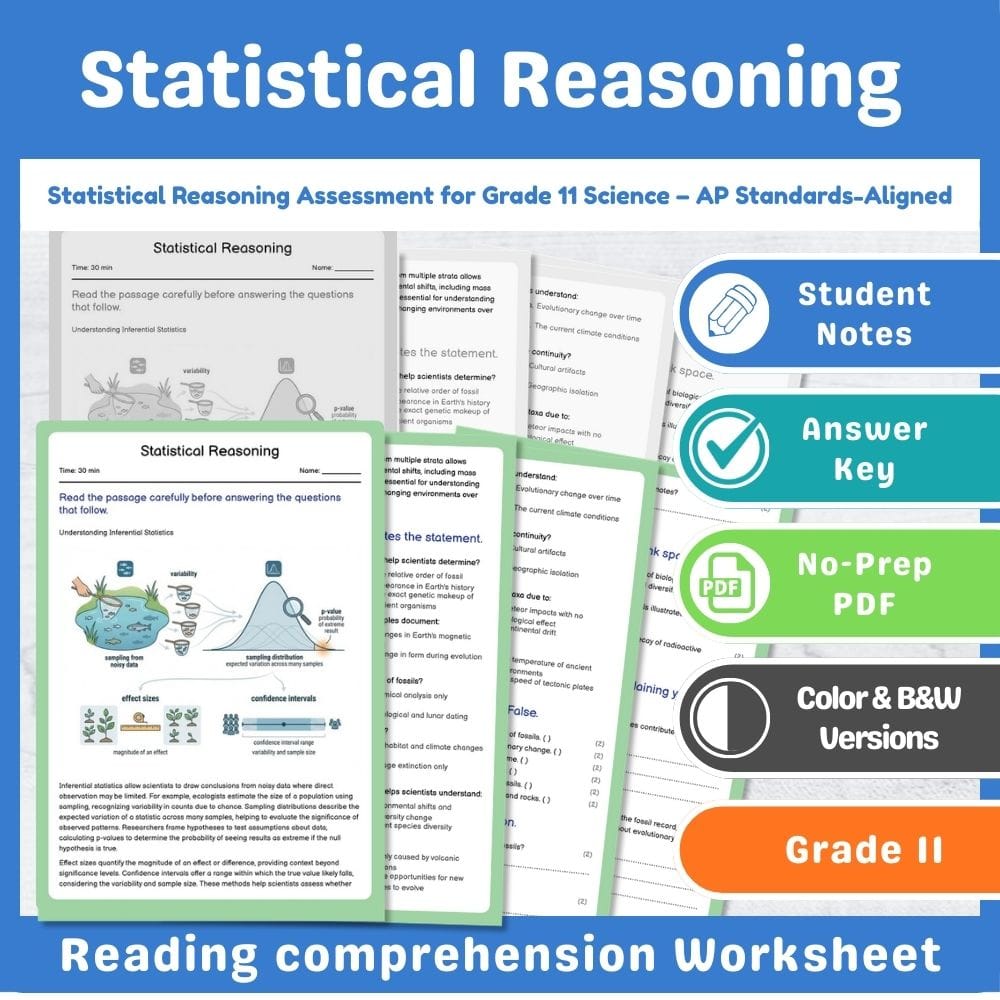
Statistical Reasoning Assessment for Grade 11 Science – AP Standards-Aligned
Created byPrism Point LearningLearning Objectives
- Understand the concepts of sampling distributions, hypothesis testing, and p-values in inferential statistics.
- Interpret confidence intervals, effect sizes, and their applications in real-world contexts.
- Evaluate the sufficiency of sample sizes and question the underlying assumptions of statistical tests.
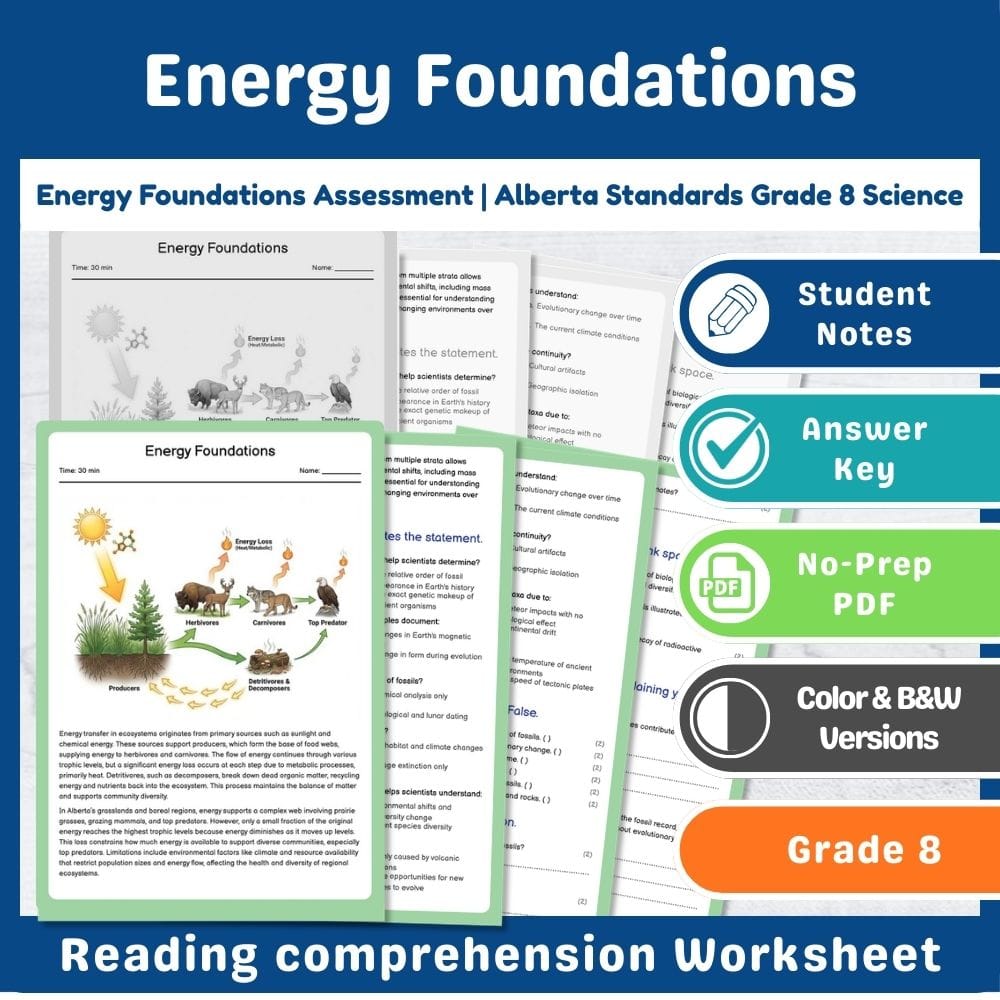
Energy Foundations Assessment | Alberta Standards Grade 8 Science
Created byPrism Point LearningLearning Objectives
- Describe the sources of energy in ecosystems such as sunlight and chemical energy.
- Explain how energy moves through different trophic levels including producers, consumers, and decomposers.
- Identify the concept of energy loss and the role of detritivores in food webs.
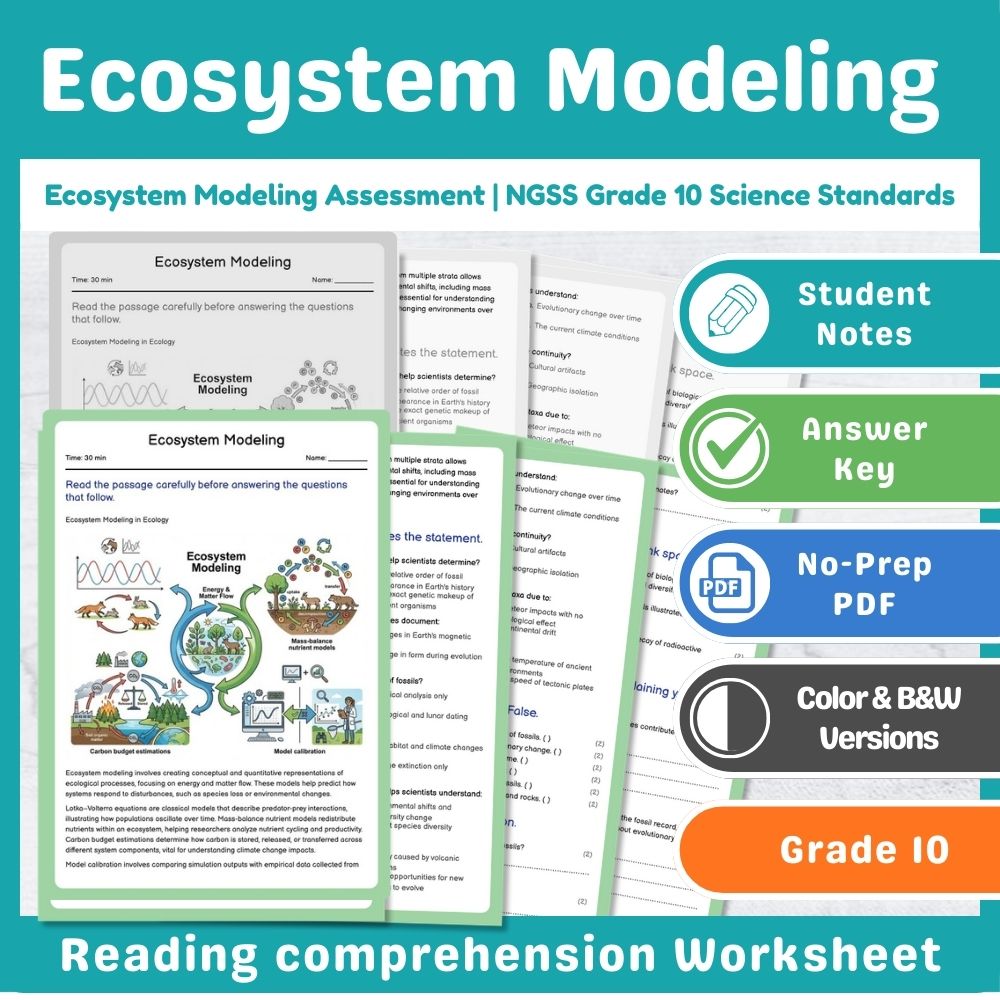
Ecosystem Modeling Assessment | NGSS Grade 10 Science Standards
Created byPrism Point LearningLearning Objectives
- Understand the development and interpretation of ecological models such as Lotka–Volterra equations.
- Analyze how energy and matter flows are represented in ecosystem models.
- Evaluate the impact of perturbations, species loss, and altered fluxes on ecosystem stability and resilience.
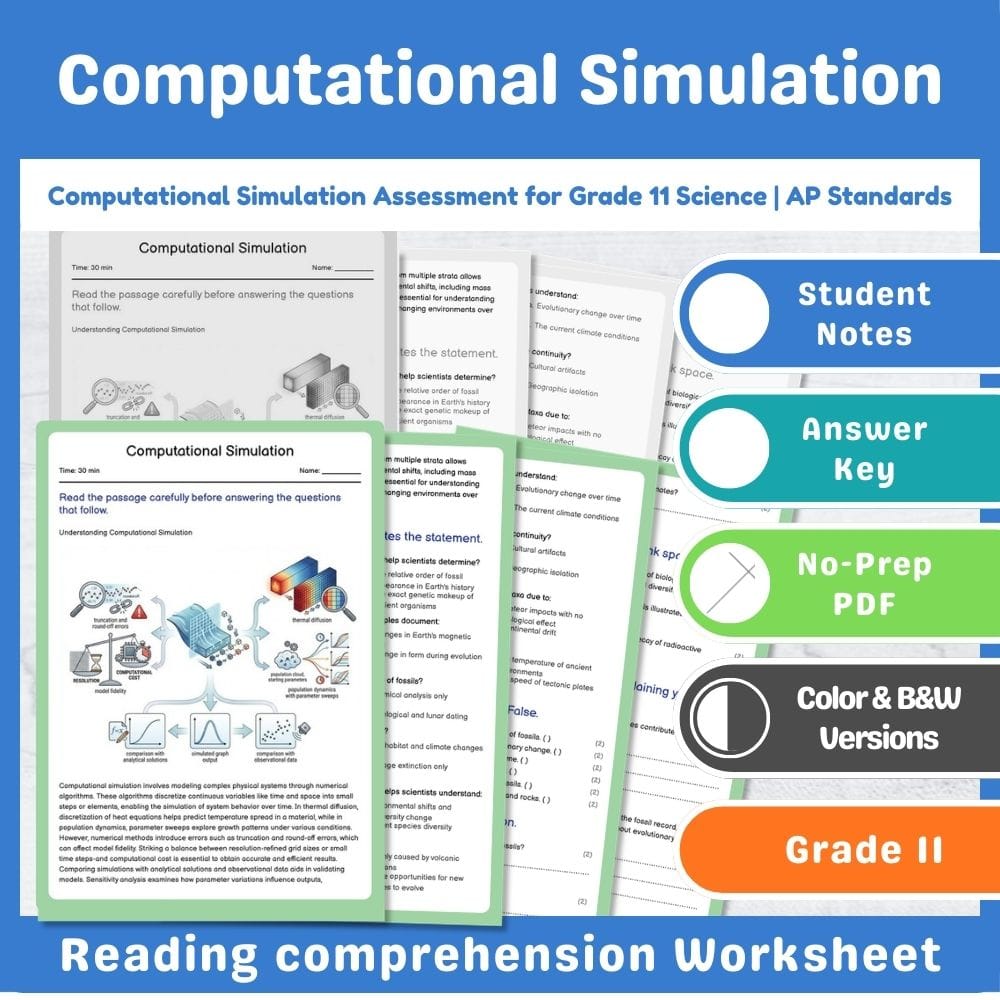
Computational Simulation Assessment for Grade 11 Science | AP Standards
Created byPrism Point LearningLearning Objectives
- Understand the principles of numerical methods used in simulating dynamic systems.
- Identify sources of numerical error and their impact on model fidelity.
- Compare simulated outputs with analytical and observational data for model validation.

Safety and Reporting Assessment for Grade 6 Science | Standards-Aligned
Created byPrism Point LearningLearning Objectives
- Understand the importance of safety practices in scientific experiments.
- Identify proper reporting methods for data and safety concerns.
- Recognize ethical standards in scientific communication.
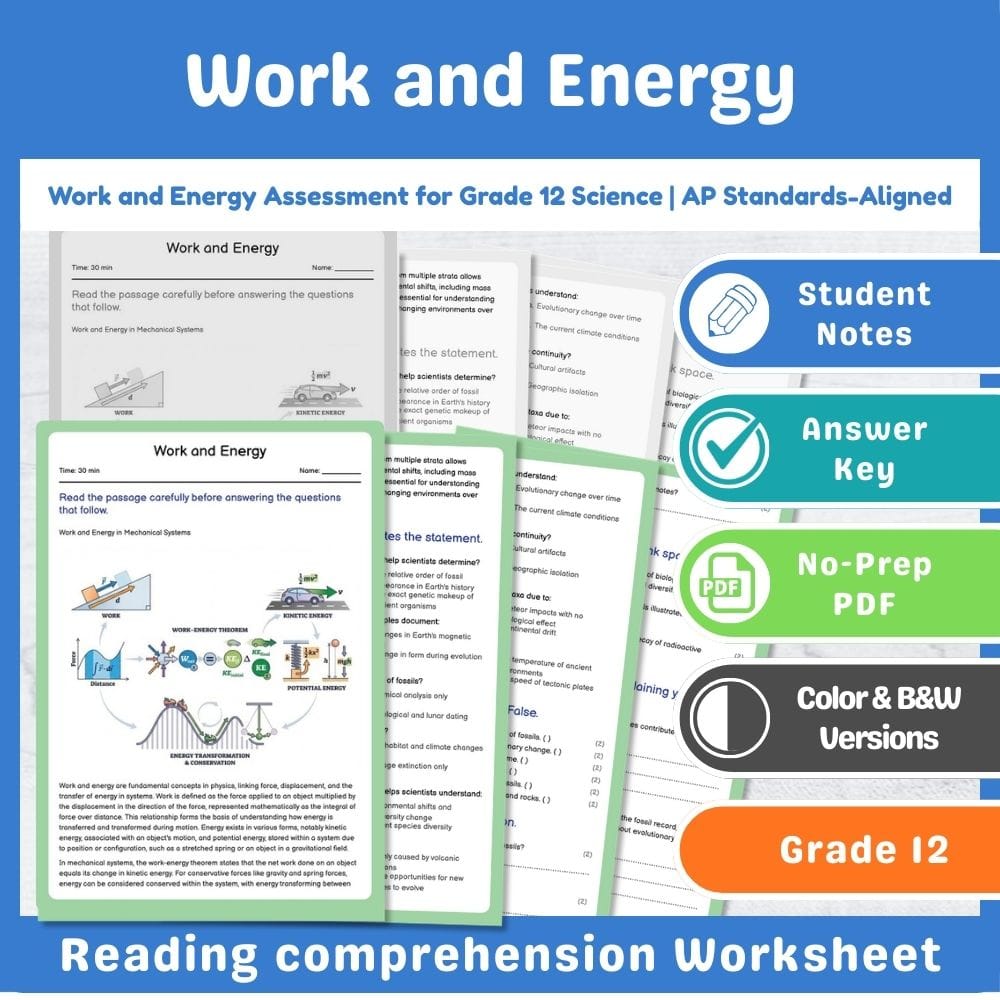
Work and Energy Assessment for Grade 12 Science | AP Standards-Aligned
Created byPrism Point LearningLearning Objectives
- Understand the concepts of work, energy, and power in mechanical systems.
- Apply force-displacement integrals to derive kinetic and potential energy.
- Differentiate between conservative and nonconservative forces and their effects on energy.

Measurement Uncertainty Assessment | TEKS Grade 12 Science Standards
Created byPrism Point LearningLearning Objectives
- Understand different types of measurement errors and their sources.
- Apply principles of calibration and propagation of uncertainty in quantitative analysis.
- Interpret significance of error analysis in scientific measurements.
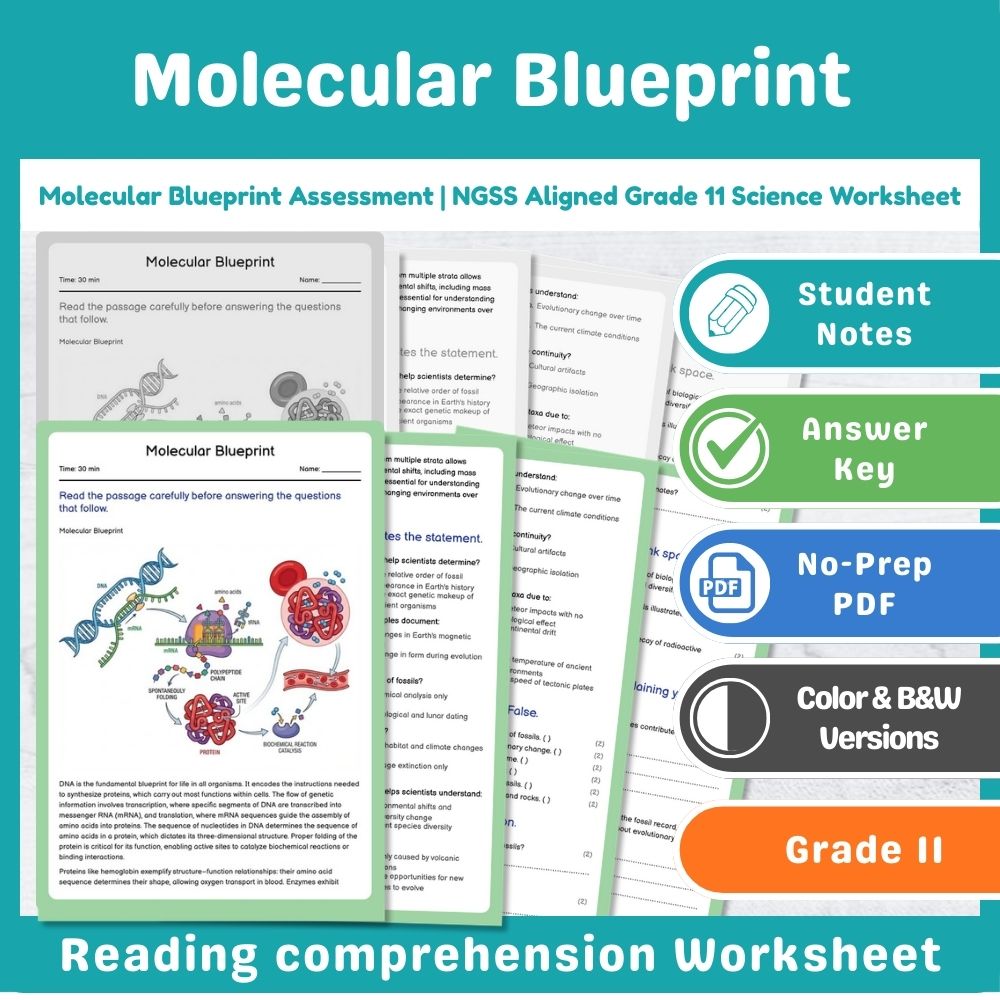
Molecular Blueprint Assessment | NGSS Aligned Grade 11 Science Worksheet
Created byPrism Point LearningLearning Objectives
- Explain how DNA sequence directs the synthesis of specific proteins through transcription and translation.
- Describe the relationship between amino acid sequences, protein folding, and active site function.
- Connect genotype variations to changes in protein conformation and their physiological effects.
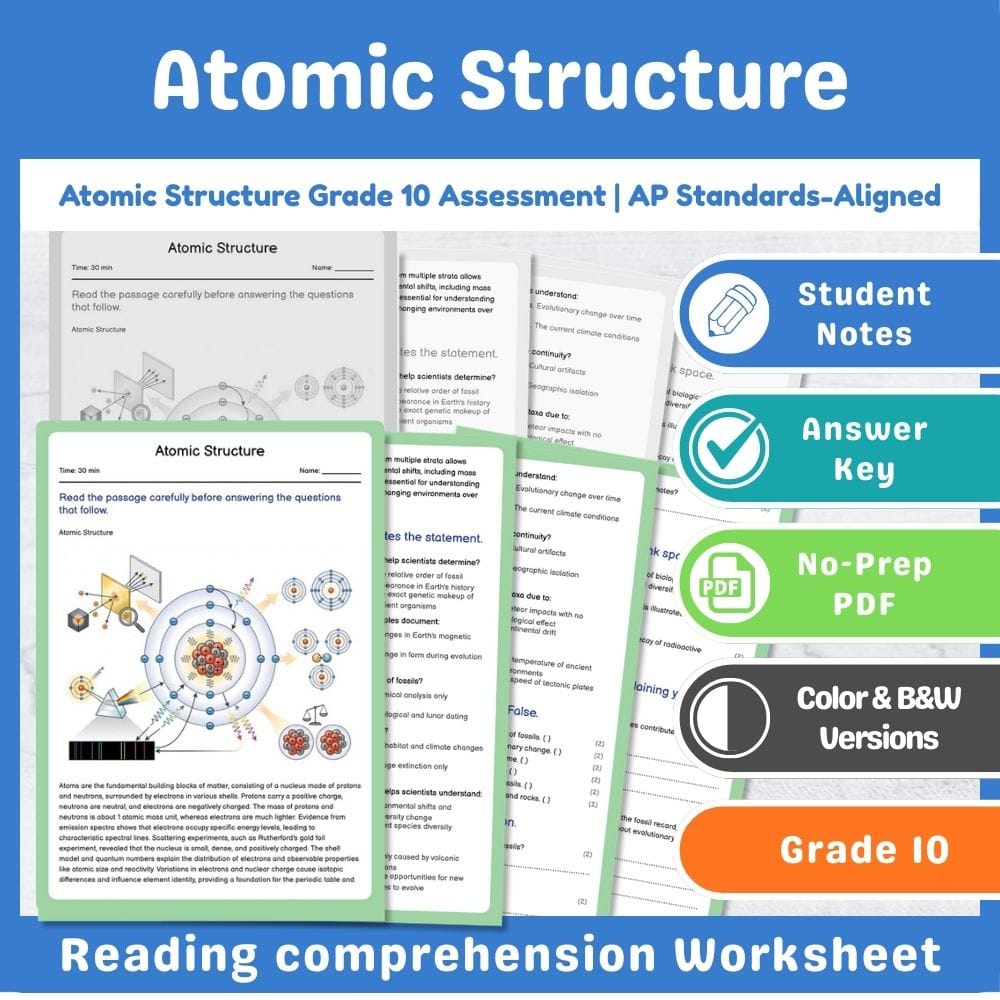
Atomic Structure Grade 10 Assessment | AP Standards-Aligned
Created byPrism Point LearningLearning Objectives
- Describe the subatomic particles that make up atoms and their relative masses.
- Explain how emission spectra and scattering experiments provide evidence for atomic models.
- Connect shell models and quantum numbers to observable atomic properties.

Model Evaluation Assessment for Grade 7 Science | Standards-Aligned
Created byPrism Point LearningLearning Objectives
- Understand how to evaluate scientific models and compare predicted outcomes with evidence.
- Identify assumptions in models that may be oversimplified or incomplete.
- Learn how computational simulations can reveal the impact of input changes on model outputs.
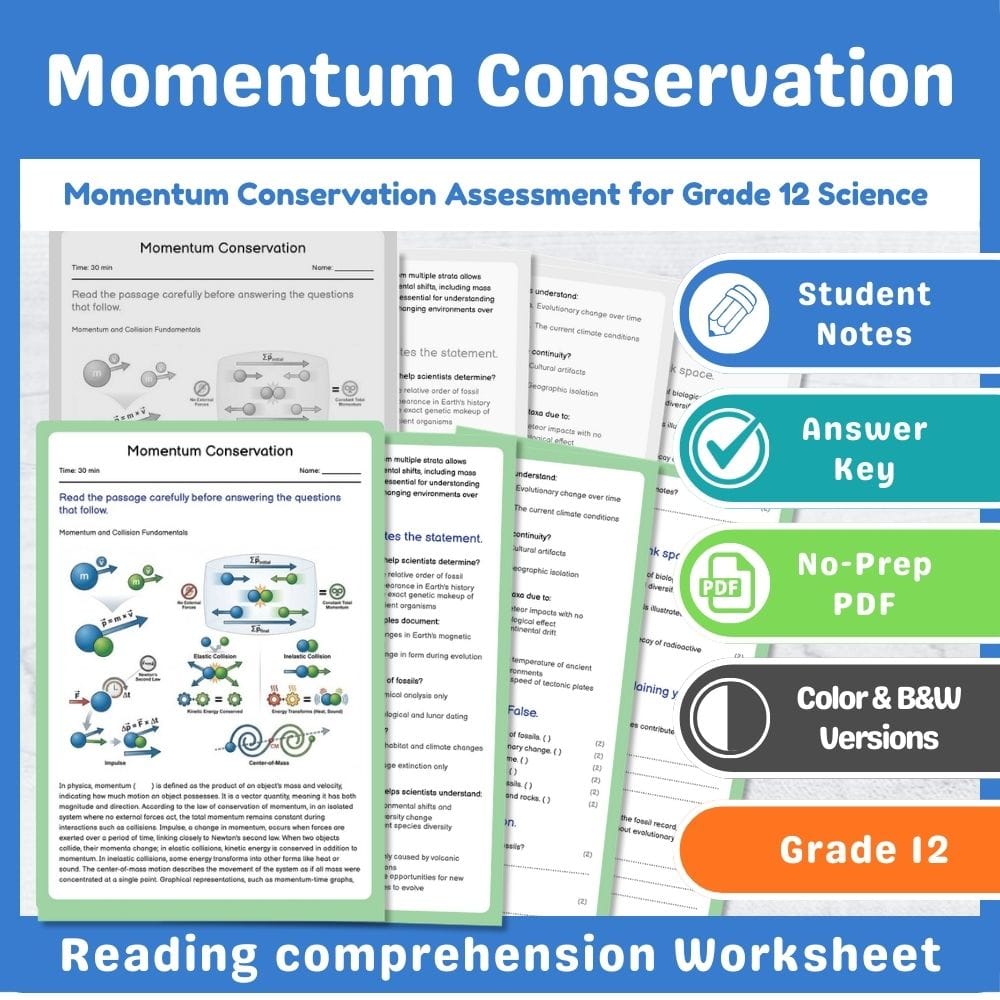
Momentum Conservation Assessment for Grade 12 Science – Standards-Aligned
Created byPrism Point LearningLearning Objectives
- Define and explain the concepts of linear momentum and impulse as conserved quantities in isolated systems.
- Relate pre- and post-collision velocities using algebraic and vector models based on momentum conservation.
- Differentiate between elastic and inelastic collisions in terms of momentum and energy transfer.
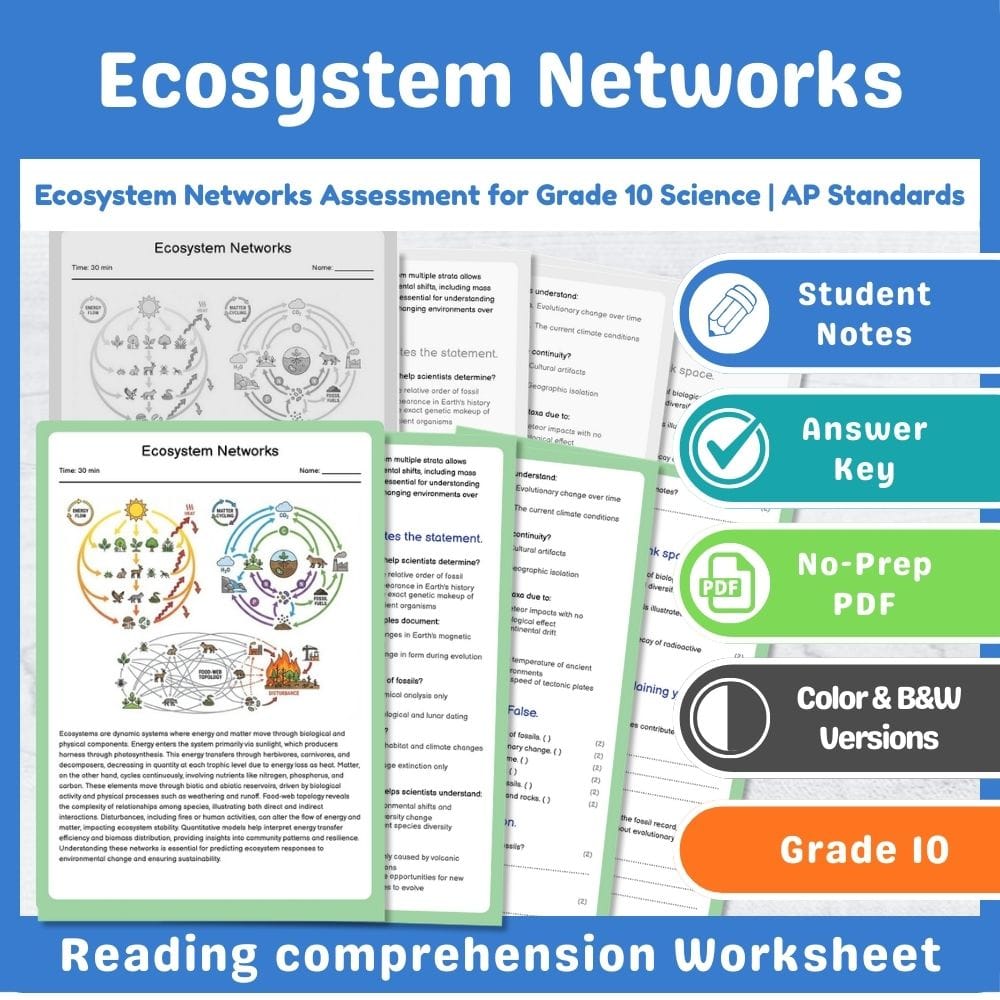
Ecosystem Networks Assessment for Grade 10 Science | AP Standards
Created byPrism Point LearningLearning Objectives
- Describe how energy flows through different levels of an ecosystem.
- Explain the cycling of matter and nutrients within ecosystems.
- Analyze the roles of species interactions and disturbances in ecosystem stability.

Motors And Generators Assessment for Grade 10 Science | Alberta Standards
Created byPrism Point LearningLearning Objectives
- Explain the operational principles of electric motors and generators.
- Describe how electromagnetic interactions produce rotation in coils within magnetic fields.
- Identify applications of motors and generators in regional power and industry.
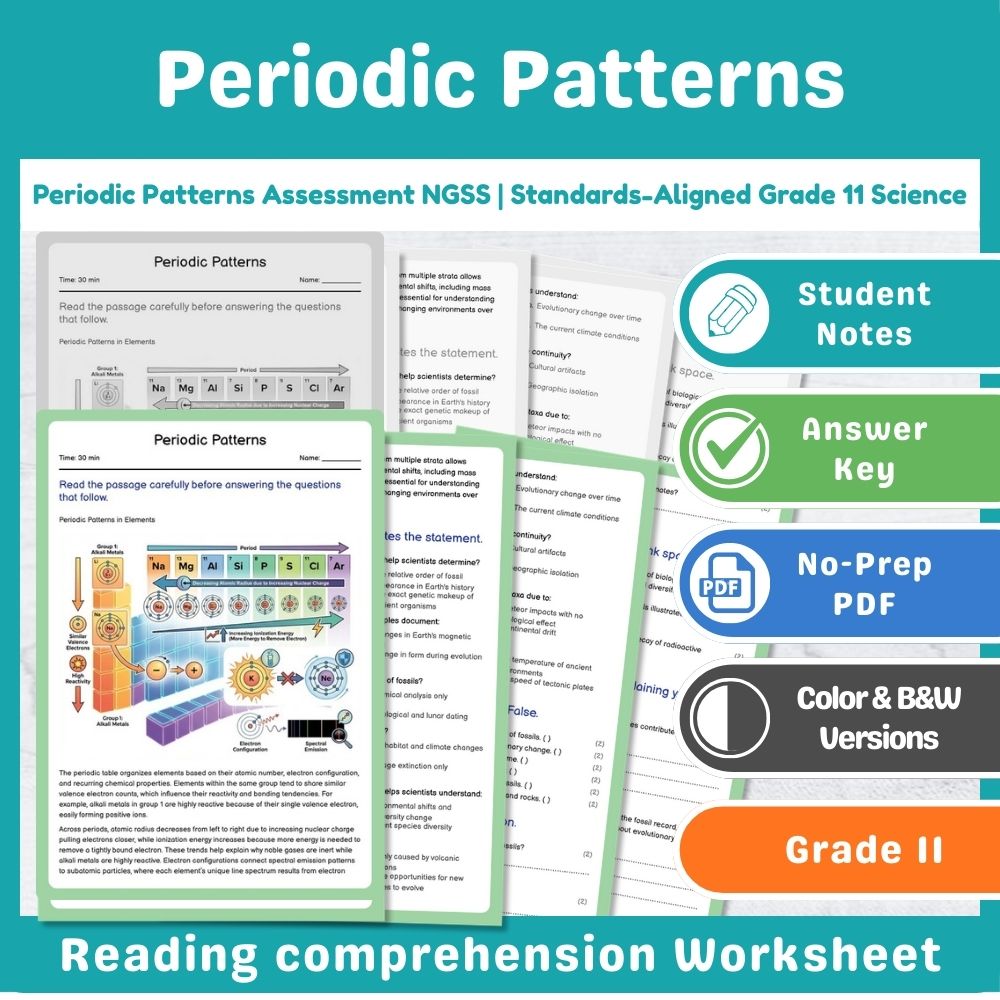
Periodic Patterns Assessment NGSS | Standards-Aligned Grade 11 Science
Created byPrism Point LearningLearning Objectives
- Explain how the periodic table organizes elements by atomic structure and chemical properties.
- Identify trends in reactivity, ionization energy, and atomic radius across periods and groups.
- Use electron configurations to analyze atomic properties and spectral emission patterns.

Scientific Methods Assessment | TEKS Grade 6 Science Standards
Created byPrism Point LearningLearning Objectives
- Describe the iterative nature of scientific methods and how they are used to develop testable questions.
- Differentiate between descriptive and comparative approaches in scientific investigations.
- Explain how observational phenomena guide methodological choices in experiments.
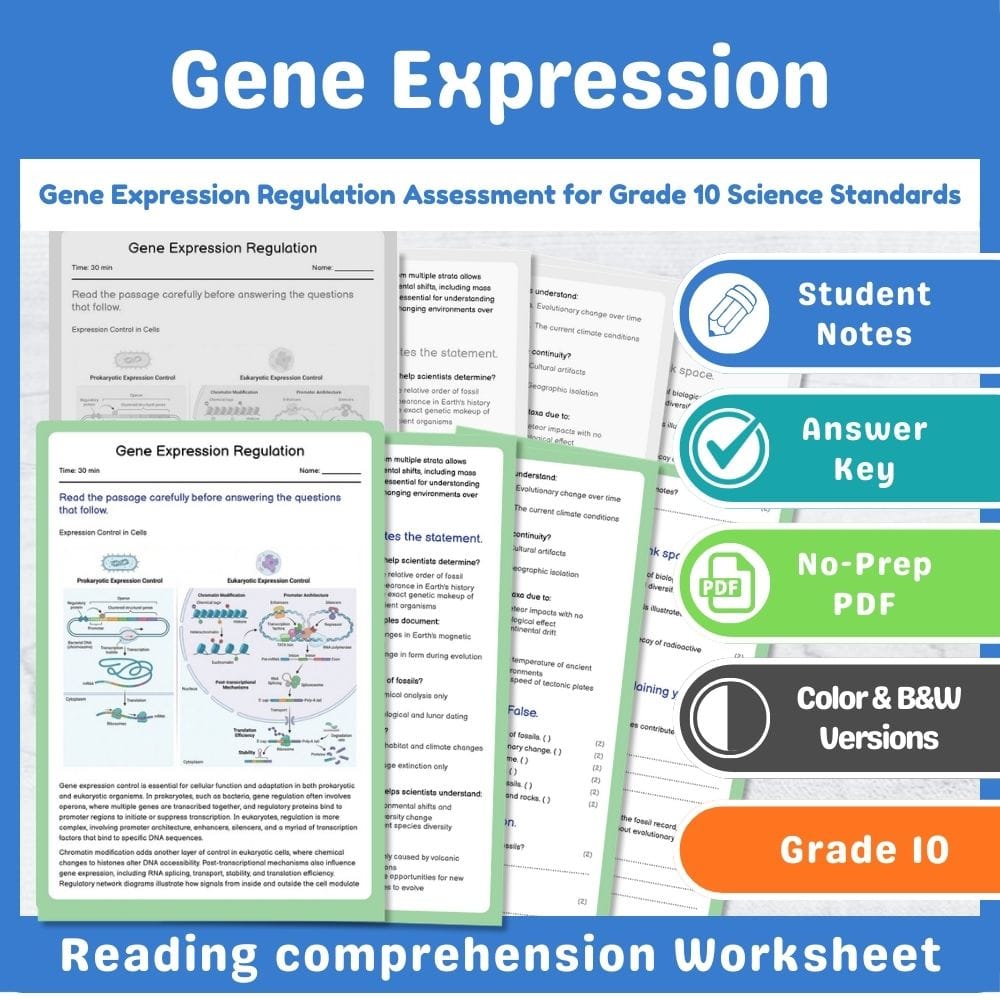
Gene Expression Regulation Assessment for Grade 10 Science Standards
Created byPrism Point LearningLearning Objectives
- Describe the mechanisms regulating gene expression in prokaryotic and eukaryotic systems.
- Identify the roles of promoter architecture, transcription factors, chromatin modification, and post-transcriptional control.
- Interpret regulatory network diagrams and expression profiles to understand signal integration effects.
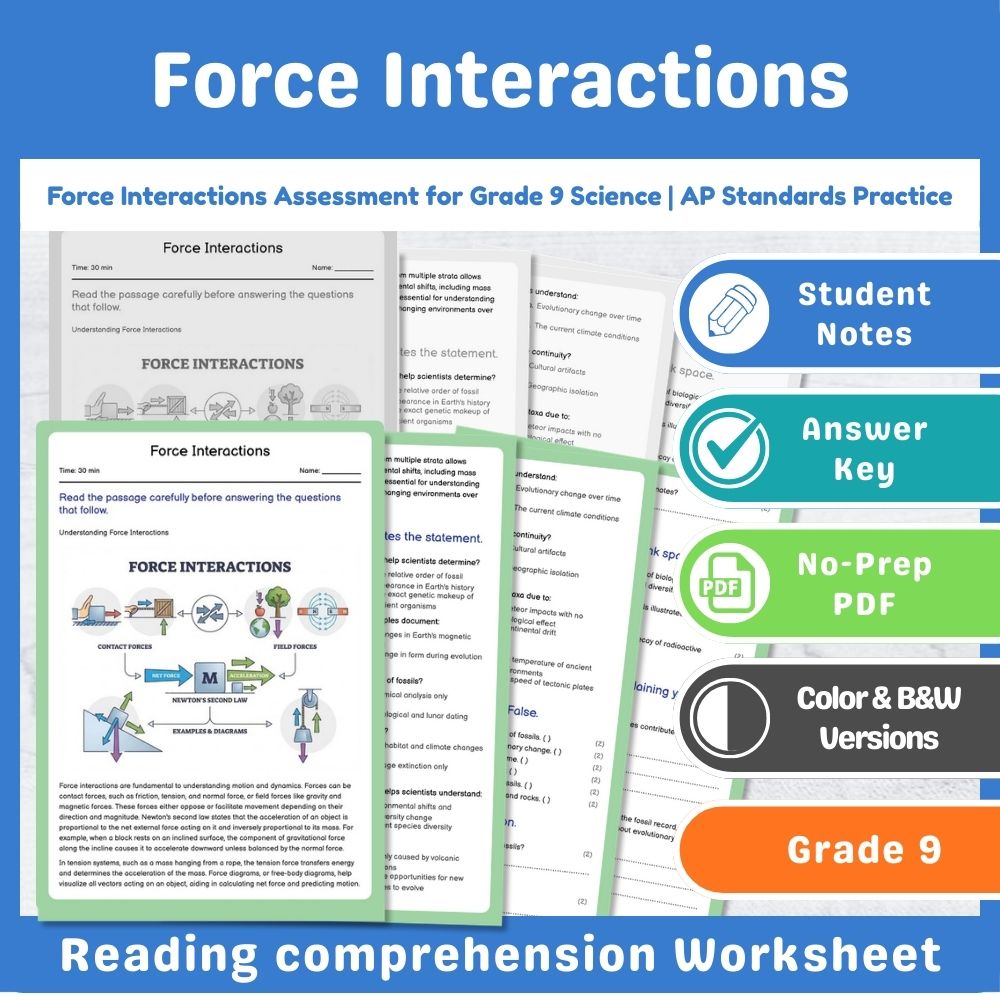
Force Interactions Assessment for Grade 9 Science | AP Standards Practice
Created byPrism Point LearningLearning Objectives
- Describe how net external forces influence the motion of objects.
- Explain the differences between contact and field forces using examples.
- Apply Newton's second law to analyze how varying forces affect acceleration.
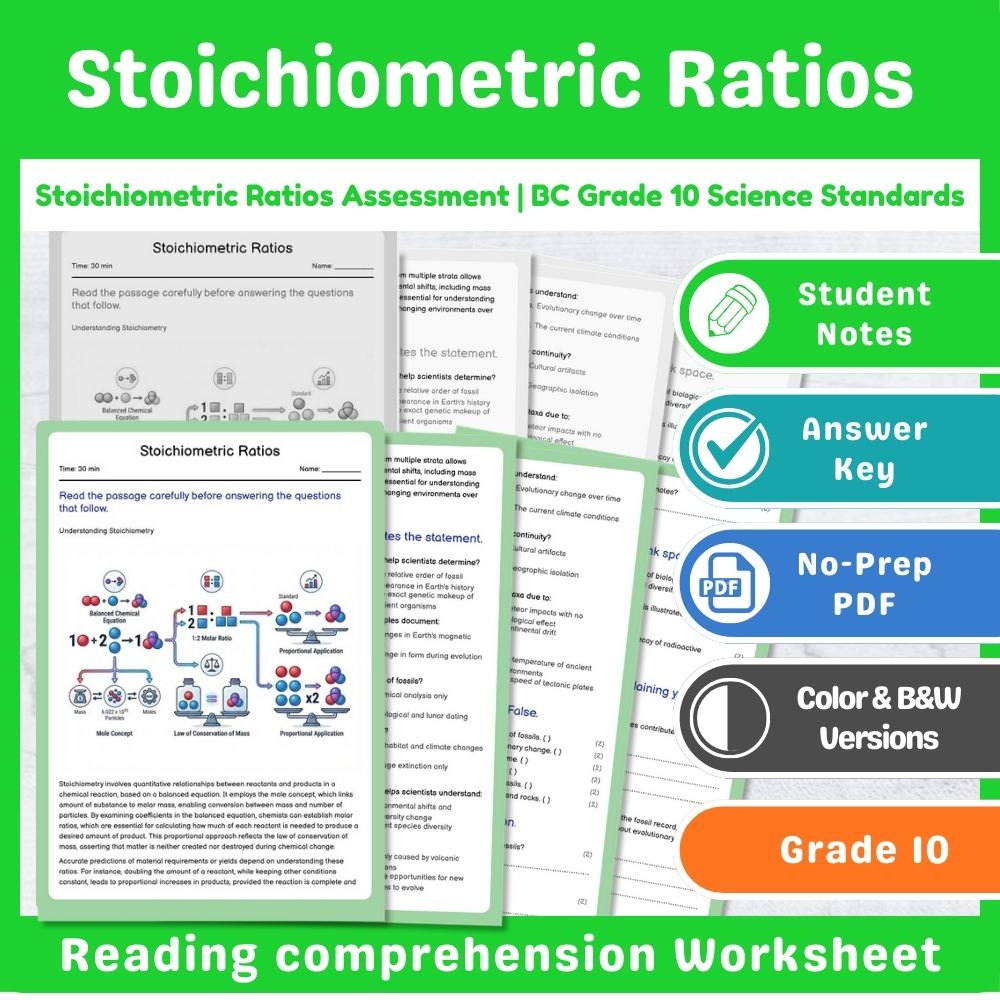
Stoichiometric Ratios Assessment | BC Grade 10 Science Standards
Created byPrism Point LearningLearning Objectives
- Understand how molar ratios connect reactants and products through balanced chemical equations.
- Learn to calculate the mass of substances involved in chemical reactions using molar masses and ratios.
- Apply mole concept to predict product yields and determine reactant requirements in reactions.
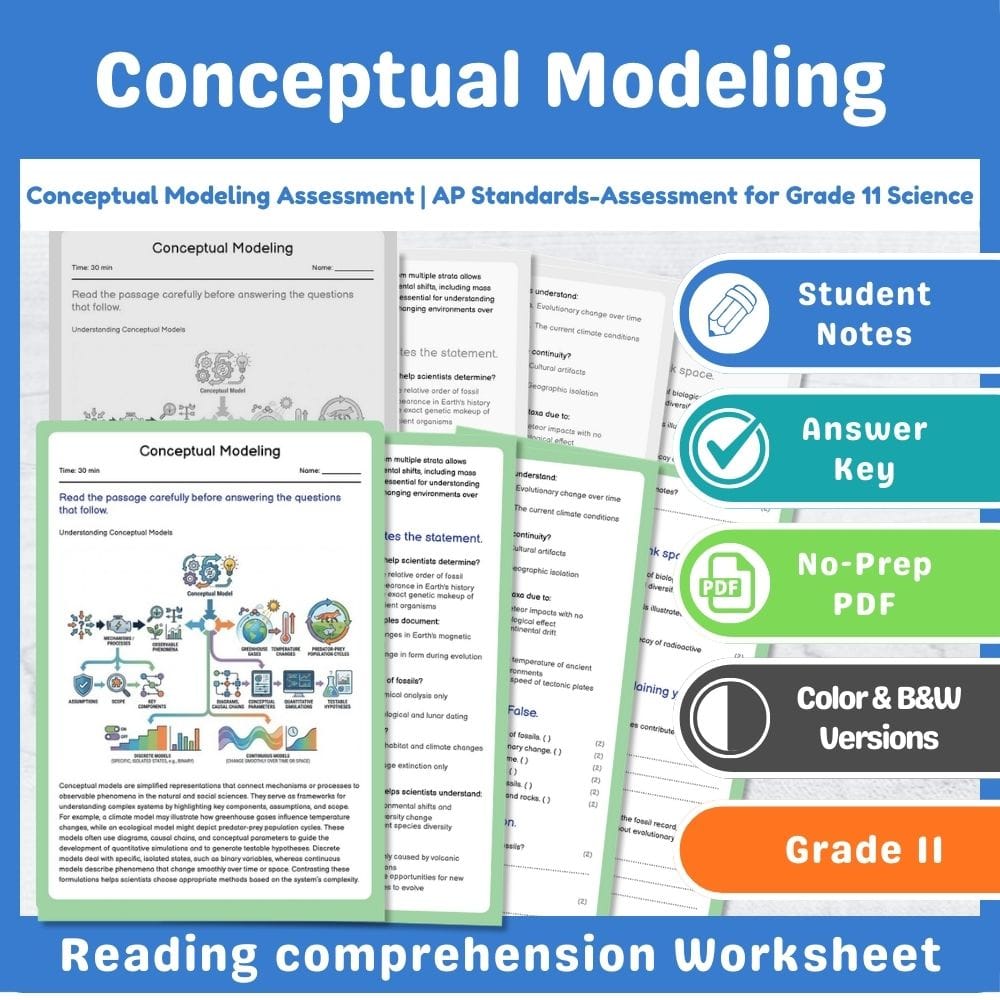
Conceptual Modeling Assessment | AP Standards-Aligned Assessment for Grade 11 Science
Created byPrism Point LearningLearning Objectives
- Define and describe the purpose of conceptual models in scientific research.
- Identify components, assumptions, and scope of conceptual models.
- Differentiate between discrete and continuous formulations in models.
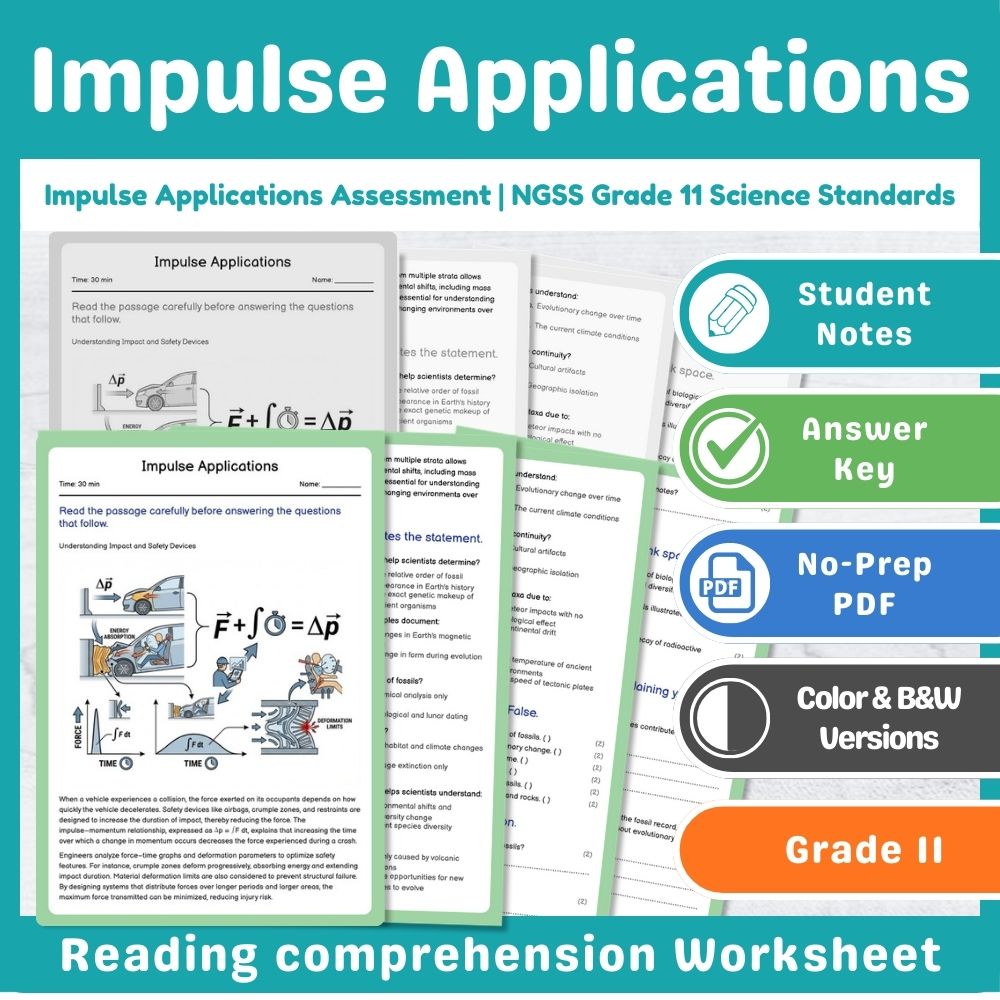
Impulse Applications Assessment | NGSS Grade 11 Science Standards
Created byPrism Point LearningLearning Objectives
- Understand the relationship between impulse and momentum in collision scenarios.
- Apply the impulse–momentum theorem to analyze crash-protection systems.
- Evaluate and refine design parameters to minimize forces during collisions.

Pressure and Temperature Assessment for Grade 8 Science – Standards-Aligned
Created byPrism Point LearningLearning Objectives
- Explain how particle motion relates to gas pressure and temperature.
- Describe how increased particle speed at higher temperatures affects collisions with container walls.
- Connect microscopic particle behavior to macroscopic gas properties.

Energy Currency Assessment | Alberta Grade 10 Science Standards
Created byPrism Point LearningLearning Objectives
- Understand the role of ATP as the energy currency in cellular processes.
- Explain how ATP synthesis and hydrolysis provide energy for metabolic reactions.
- Compare ATP turnover rates in different tissues and environmental contexts.
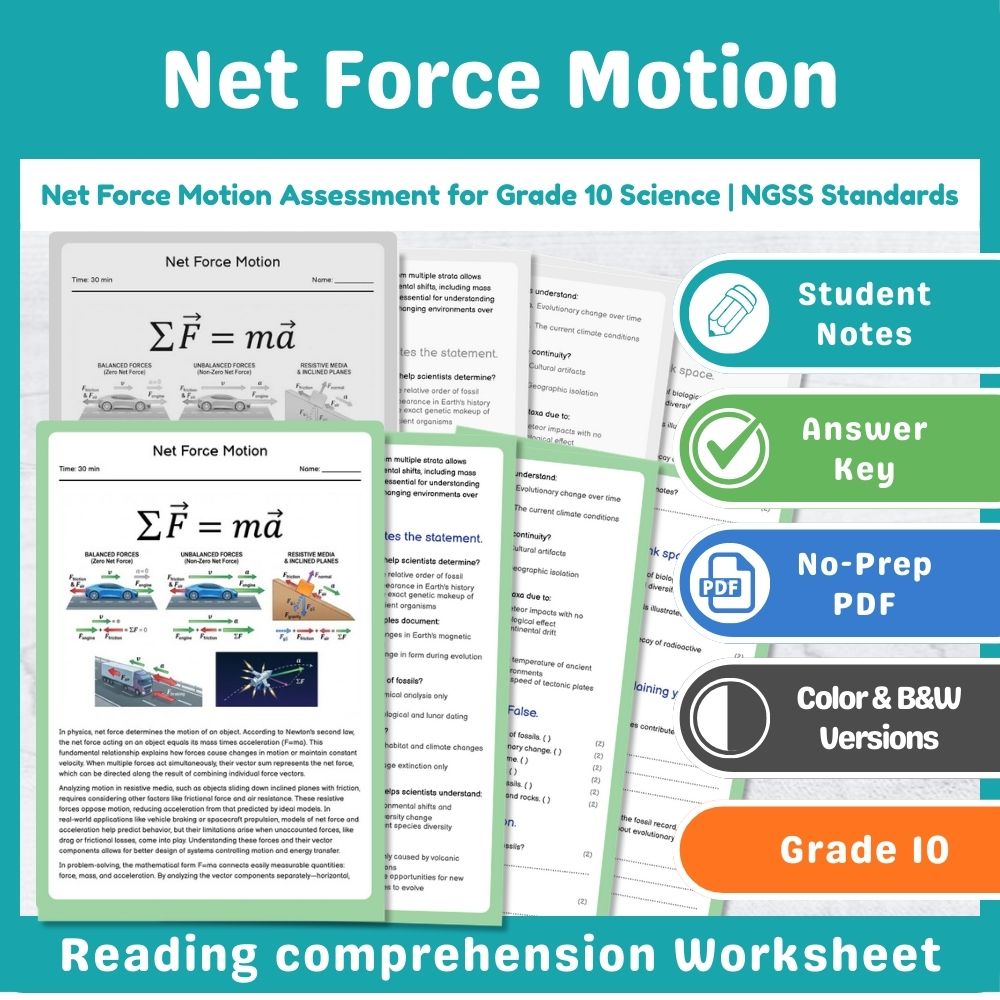
Net Force Motion Assessment for Grade 10 Science | NGSS Standards
Created byPrism Point LearningLearning Objectives
- Understand the quantitative relationship between net force, mass, and acceleration as described by Newton's second law.
- Apply vector summation to analyze net force in different motion scenarios, including inclined planes and friction.
- Use F=ma to connect force, mass, and acceleration in problem contexts like braking and constant-thrust motions.
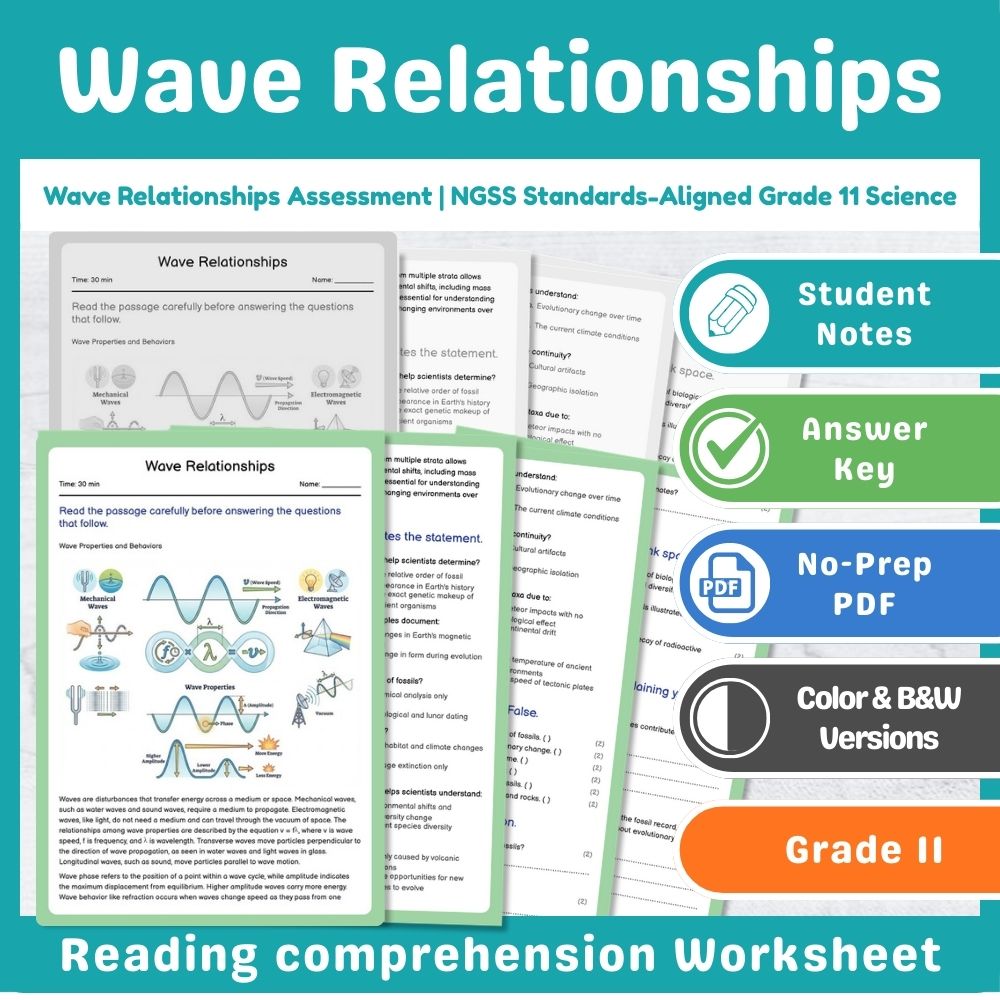
Wave Relationships Assessment | NGSS Standards-Aligned Grade 11 Science
Created byPrism Point LearningLearning Objectives
- Understand the mathematical relationships among wave properties including wave speed, frequency, and wavelength.
- Explain the differences between transverse and longitudinal waves and their examples.
- Analyze wave behavior such as refraction and dispersion across media using graphs and algebraic representations.
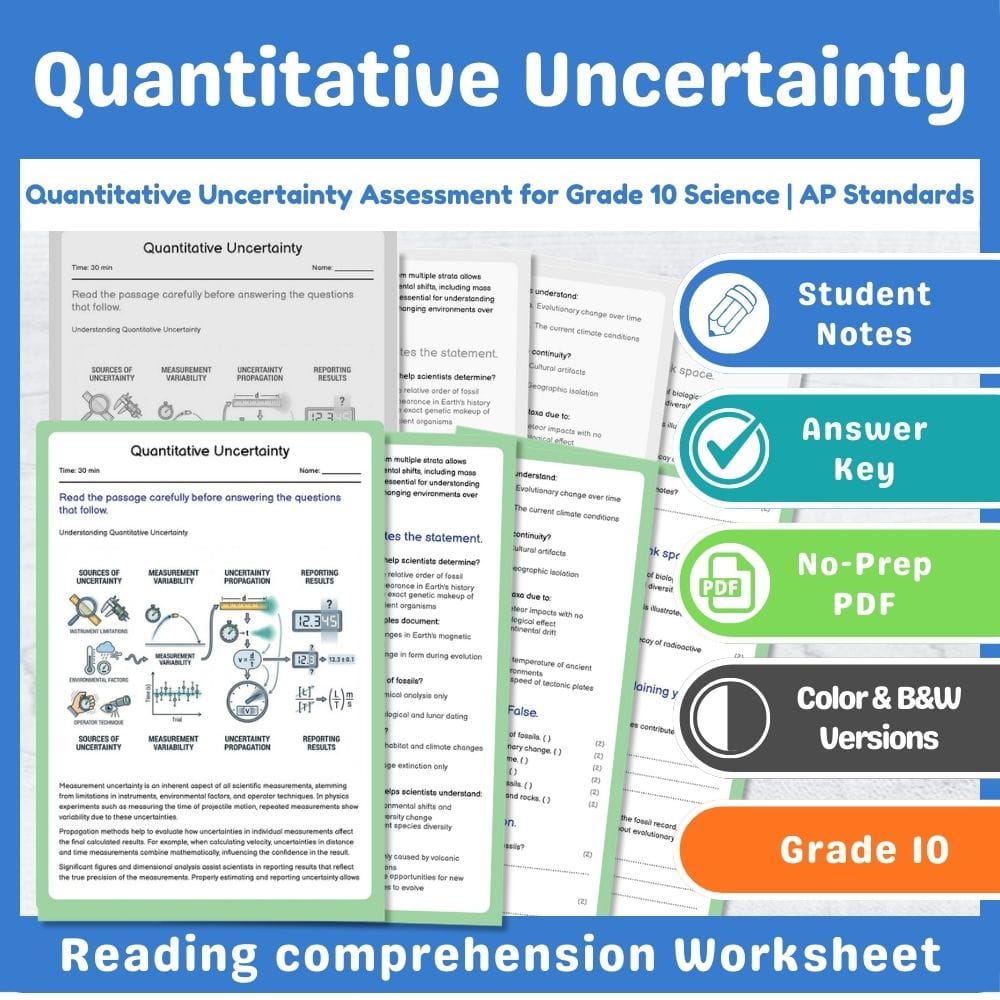
Quantitative Uncertainty Assessment for Grade 10 Science | AP Standards
Created byPrism Point LearningLearning Objectives
- Understand the concept of measurement uncertainty and its sources.
- Apply propagation methods to combine uncertainties in calculations.
- Interpret and report uncertainties using significant figures and dimensional analysis.
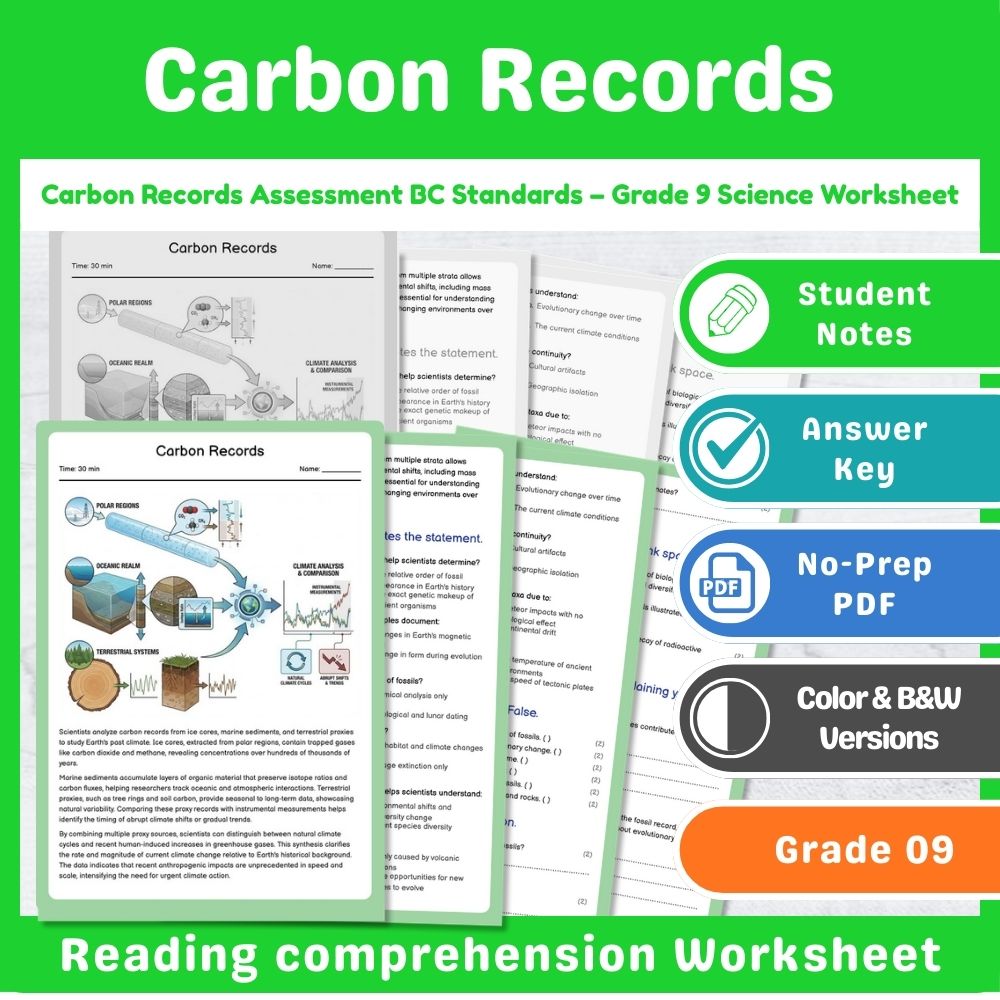
Carbon Records Assessment BC Standards – Grade 9 Science Worksheet
Created byPrism Point LearningLearning Objectives
- Understand how ice cores, marine sediments, and terrestrial proxies record past atmospheric carbon levels.
- Identify methods used to analyze past greenhouse gas concentrations.
- Explain the significance of long-term carbon trends in understanding climate change.
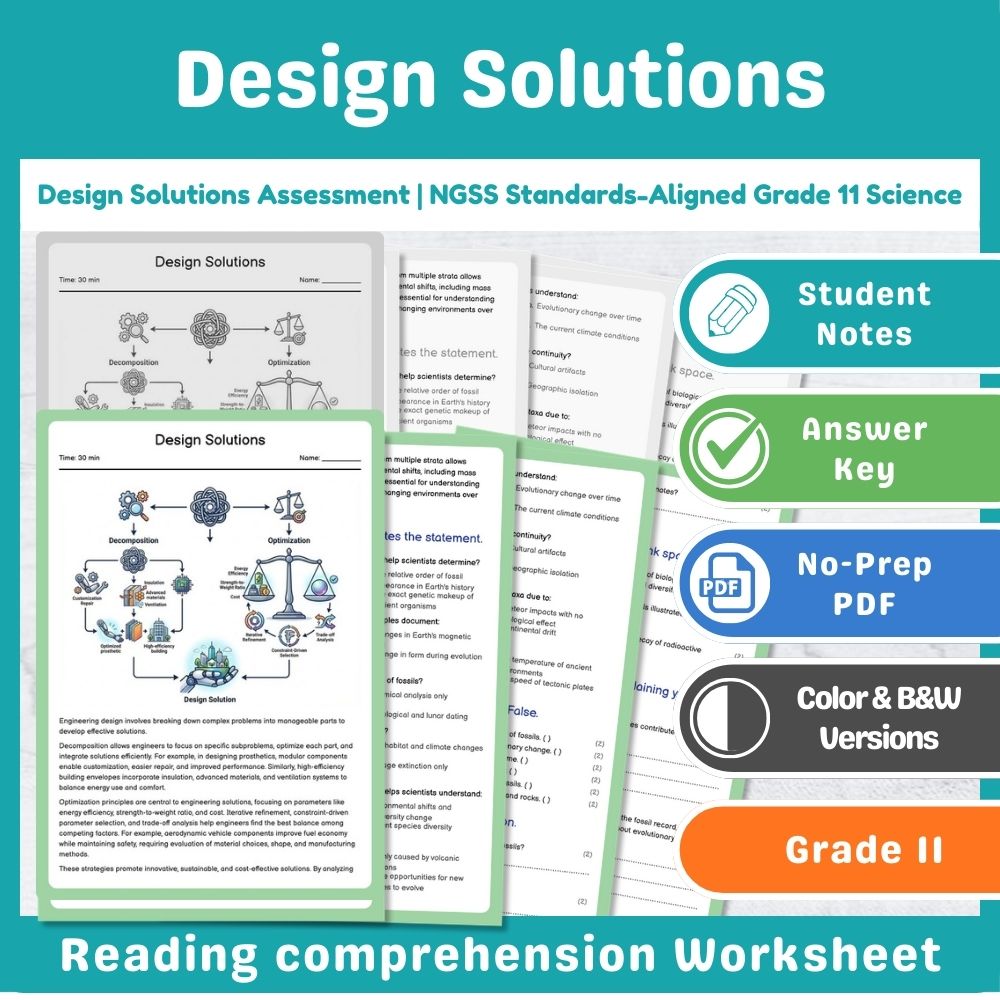
Design Solutions Assessment | NGSS Standards-Aligned Grade 11 Science
Created byPrism Point LearningLearning Objectives
- Understand strategies for decomposing complex engineering problems into manageable subproblems.
- Apply optimization principles to design solutions considering trade-offs such as cost, materials, and performance.
- Evaluate examples of modular design, energy efficiency, and aerodynamic optimization in engineering contexts.
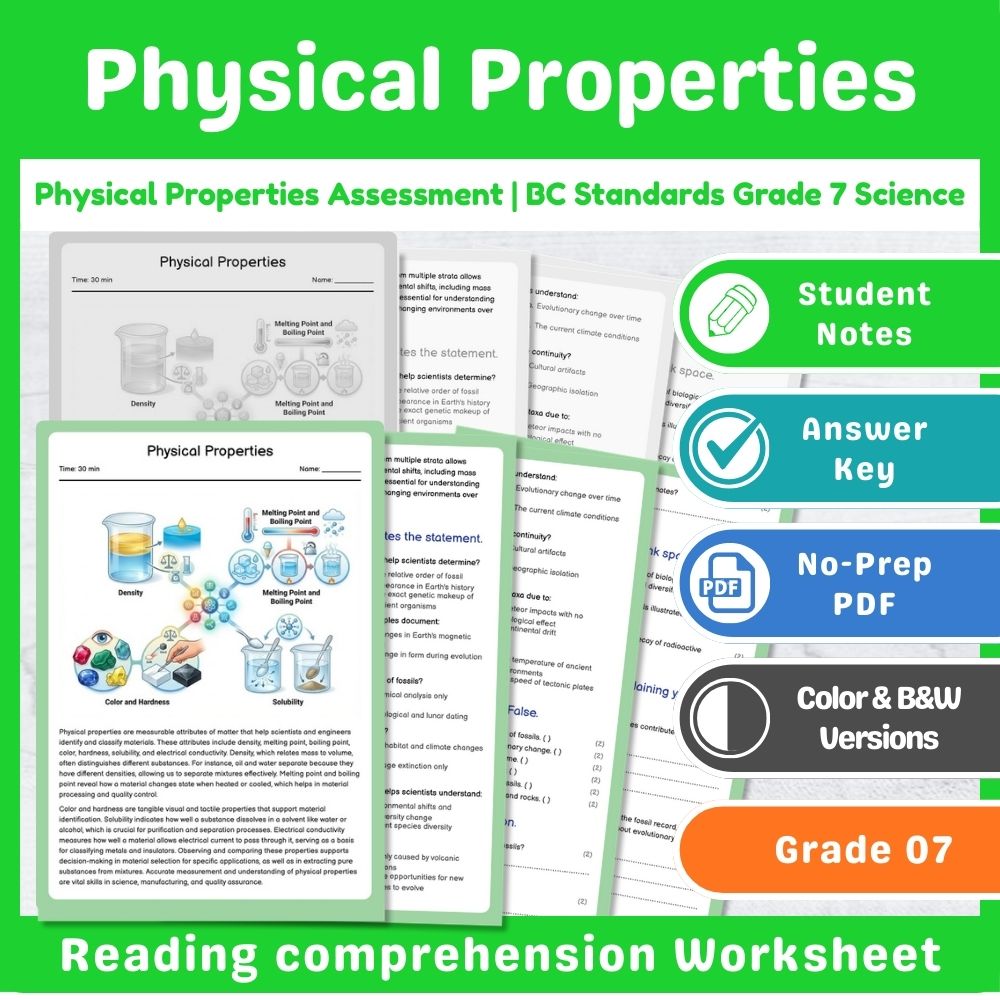
Physical Properties Assessment | BC Standards Grade 7 Science
Created byPrism Point LearningLearning Objectives
- Understand the key physical properties such as density, melting point, boiling point, color, hardness, solubility, and electrical conductivity.
- Identify and measure various physical properties to distinguish substances.
- Explain how physical properties support the identification and separation of mixtures.
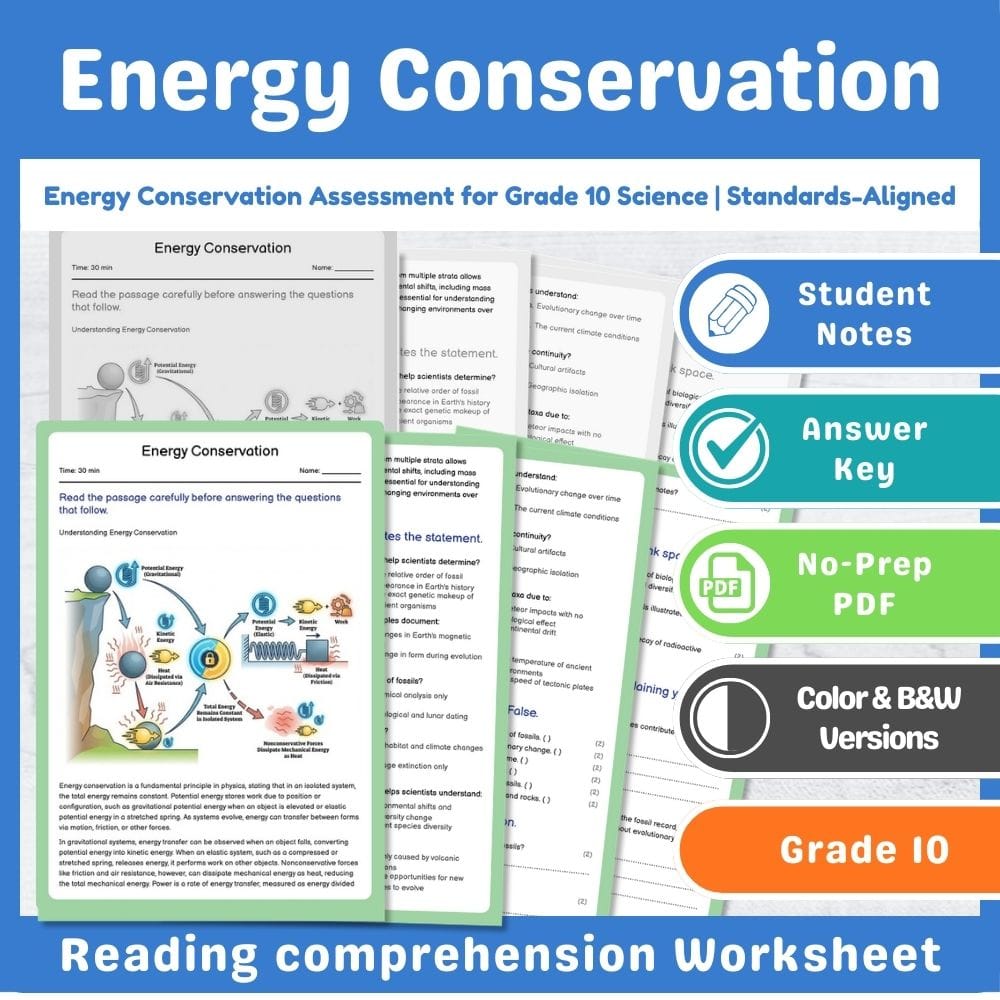
Energy Conservation Assessment for Grade 10 Science | Standards-Aligned
Created byPrism Point LearningLearning Objectives
- Explain the principles of potential energy in gravitational and elastic systems.
- Describe energy transfer and conversion processes in mechanical systems.
- Analyze the effect of nonconservative forces on mechanical energy.

Design Principles in Scientific Research Assessment | TEKS Grade 12 Science
Created byPrism Point LearningLearning Objectives
- Understand key principles of experimental design including control, replication, and randomization.
- Identify appropriate statistical methods for analyzing experimental data.
- Evaluate the importance of sample size, power, and effect size in research planning.
Browse more categories
About Science Worksheets
Find Science worksheets spanning core skills, practice, and review. All 42,685 resources are instant PDF downloads for the classroom or home.
Every worksheet on MyTeachingSheets is created by independent teacher-authors and reviewed before publication. All resources download as printable PDFs for classroom, homework, or at-home practice, and many include answer keys. Preview any worksheet free before buying.