
Science Worksheets
42,685 subject resources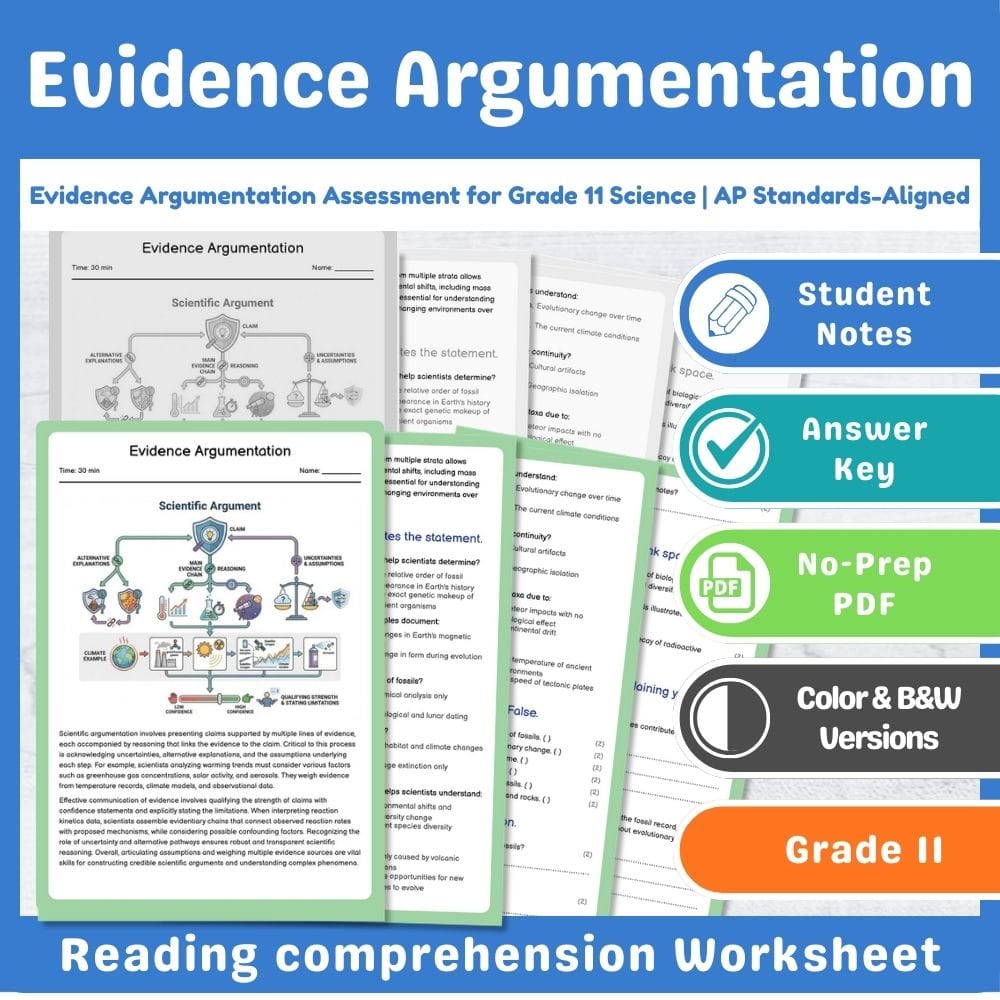
Evidence Argumentation Assessment for Grade 11 Science | AP Standards-Aligned
 Created byPrism Point Learning
Learning Objectives
- Understand the structure of scientific arguments connecting claims, evidence, and reasoning.
- Identify methods for articulating assumptions and qualifying claims with confidence statements.
- Assess various lines of evidence and interpret their implications for scientific hypotheses.
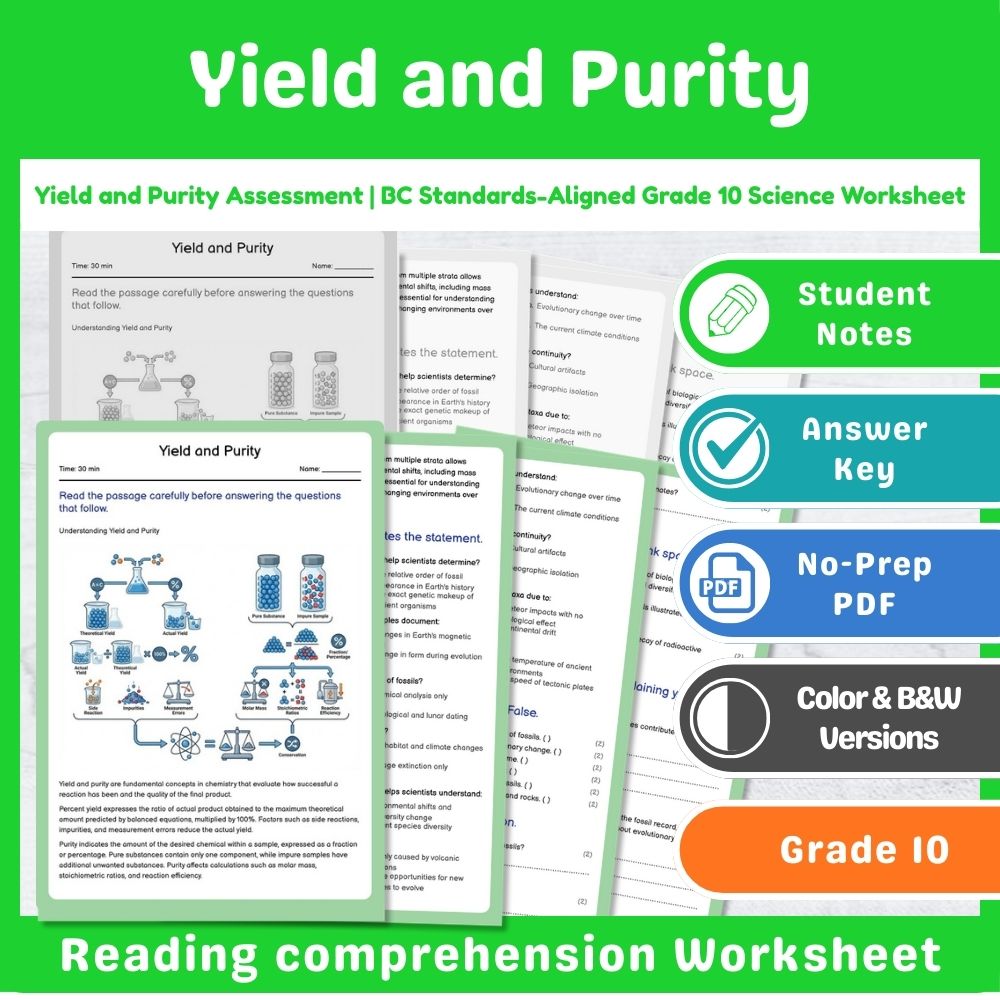
Yield and Purity Assessment | BC Standards-Aligned Grade 10 Science Worksheet
Created byPrism Point LearningLearning Objectives
- Understand the concept of percent yield and how it measures process efficiency.
- Explain the meaning of purity and how it affects product analysis.
- Apply stoichiometric relationships to calculate yield and purity in chemical reactions.
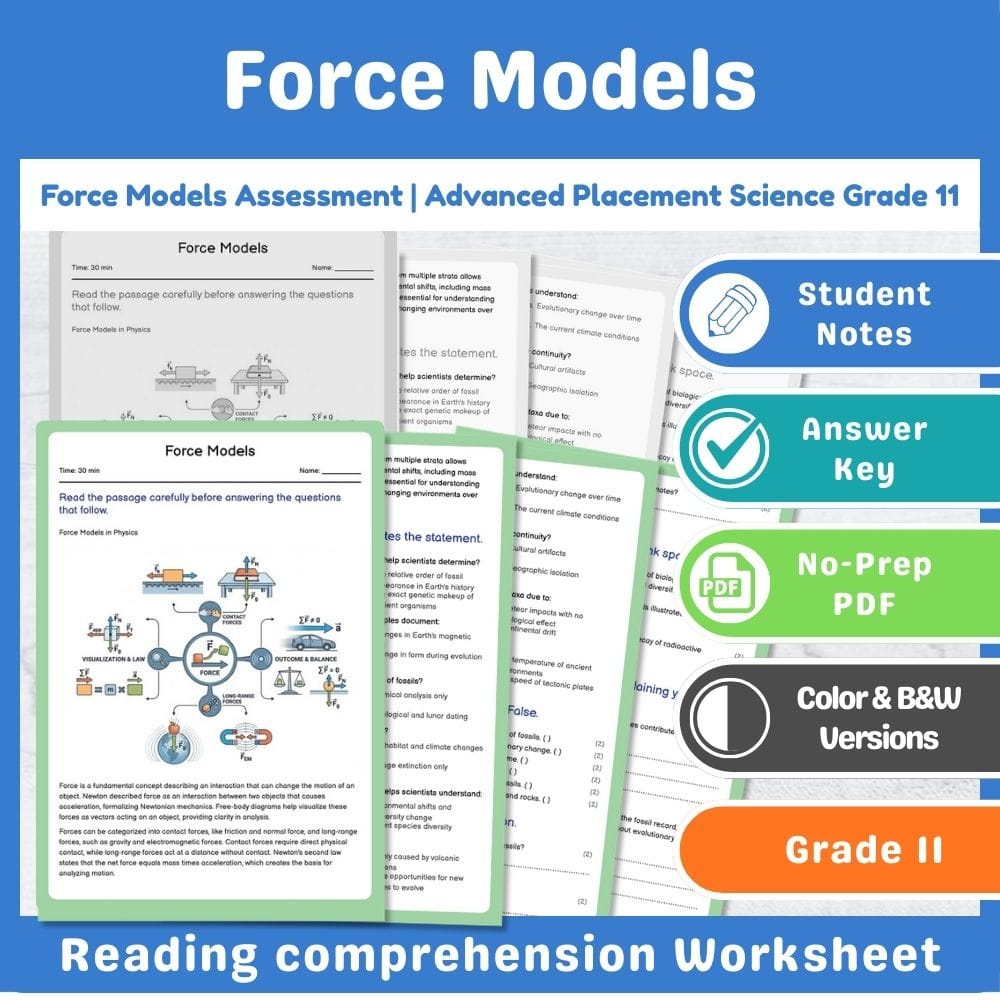
Force Models Assessment | Advanced Placement Science Grade 11
Created byPrism Point LearningLearning Objectives
- Explain the concept of force as an interaction between objects.
- Understand and apply Newton's laws of motion using free-body diagrams.
- Distinguish between contact and long-range forces such as gravity and electromagnetic forces.
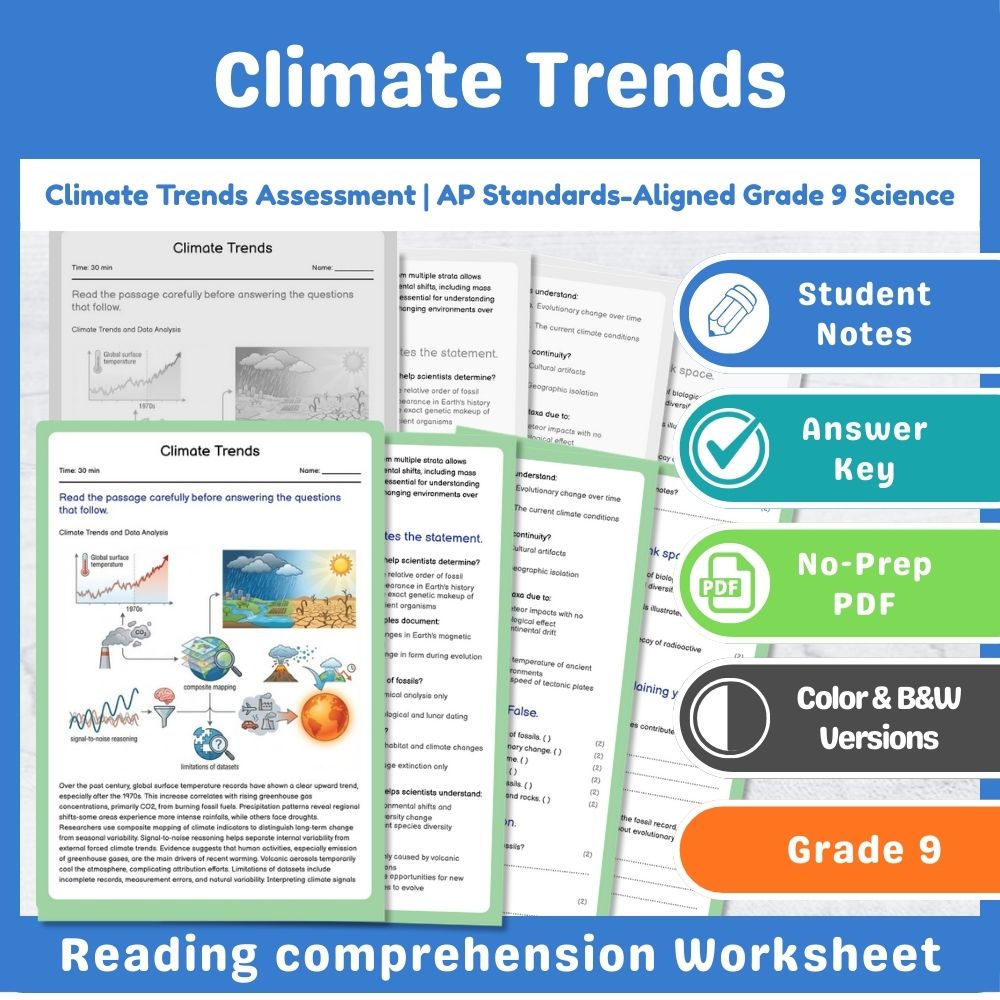
Climate Trends Assessment | AP Standards-Aligned Grade 9 Science
Created byPrism Point LearningLearning Objectives
- Analyze spatial and temporal climate datasets to identify trends and anomalies.
- Apply statistical trend analysis and composite mapping techniques.
- Interpret potential climate drivers by comparing datasets with external forcings.
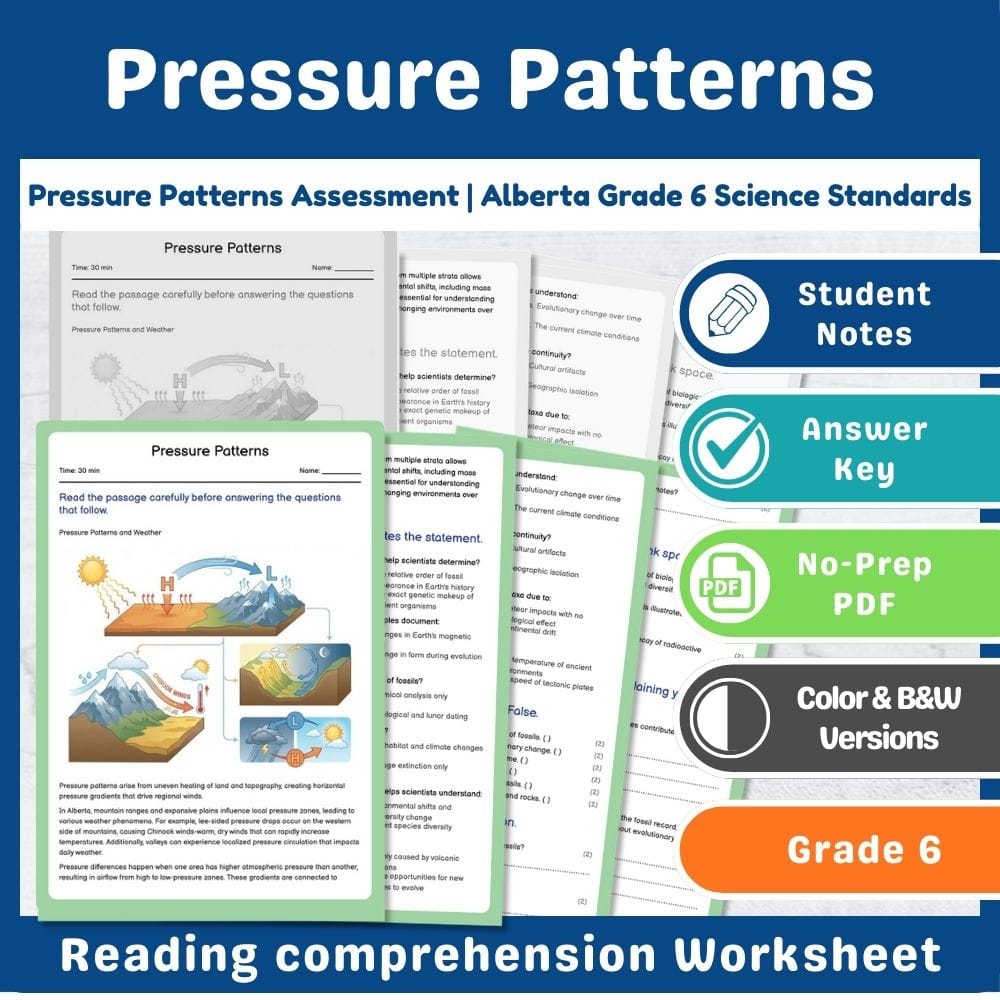
Pressure Patterns Assessment | Alberta Grade 6 Science Standards
Created byPrism Point LearningLearning Objectives
- Understand how pressure differences from uneven heating and topography influence wind patterns.
- Identify examples of pressure zones and their effects on regional weather in Alberta.
- Connect pressure gradients to everyday weather changes and forces experienced by moving bodies.

Orbital Forcing Assessment | Alberta Standards Grade 10 Science
Created byPrism Point LearningLearning Objectives
- Understand how Earth's orbital parameters influence climate cycles over long timescales.
- Describe the mechanisms by which orbital variations affect insolation and seasonal contrast.
- Distinguish between orbital drivers and short-term atmospheric or anthropogenic influences on regional climate.
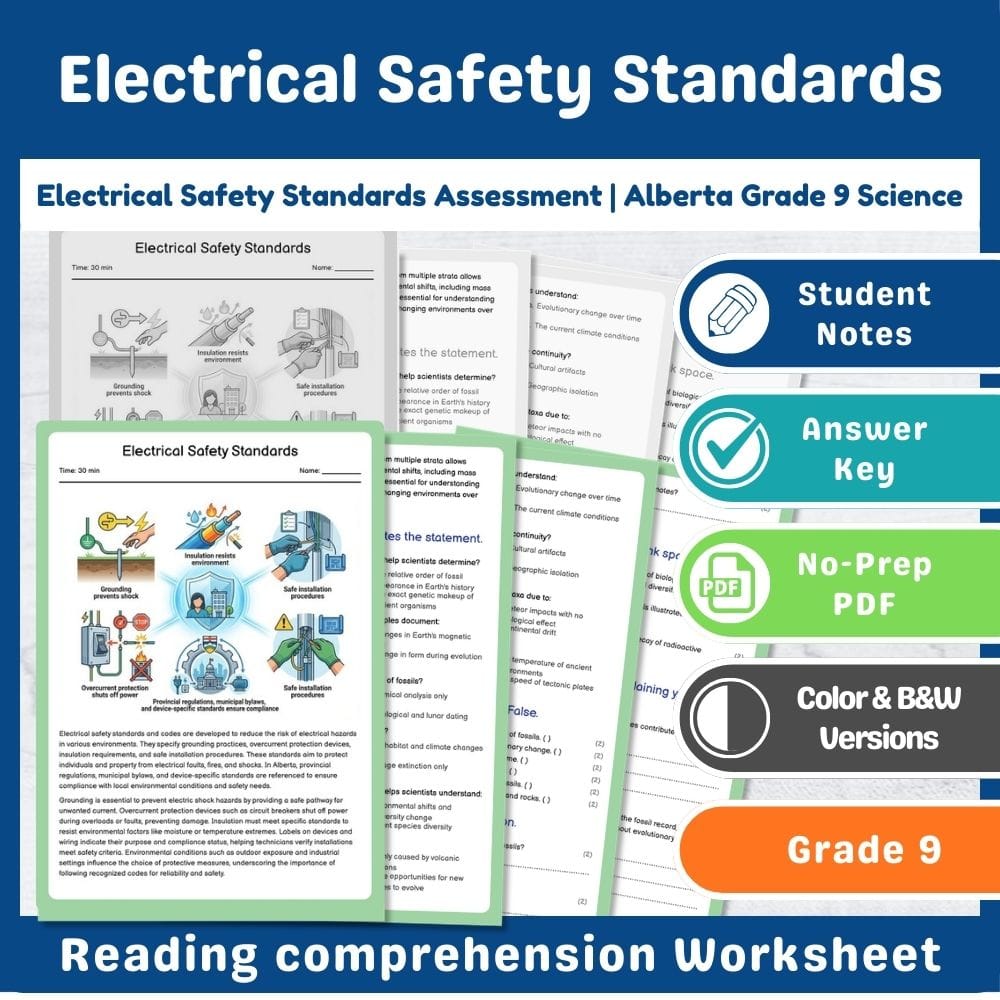
Electrical Safety Standards Assessment | Alberta Grade 9 Science
Created byPrism Point LearningLearning Objectives
- Understand the key components of electrical safety standards and codes.
- Identify protective devices and their purposes in electrical installations.
- Interpret safety labels and environmental considerations related to electrical safety.

Heat Transfer Models Assessment Grade 7 | Science Standards-Aligned
Created byPrism Point LearningLearning Objectives
- Explain the different methods of heat transfer: conduction, convection, and radiation.
- Identify real-world examples of heat transfer processes.
- Describe how temperature differences drive heat flow.
Reaction Rates Assessment for Grade 10 Science NGSS Standards
Created byPrism Point LearningLearning Objectives
- Understand how collision theory explains the factors affecting reaction rates.
- Interpret the relationships between temperature, concentration, surface area, catalysts, and reaction speed.
- Analyze empirical rate data to determine reaction mechanisms and rate laws.
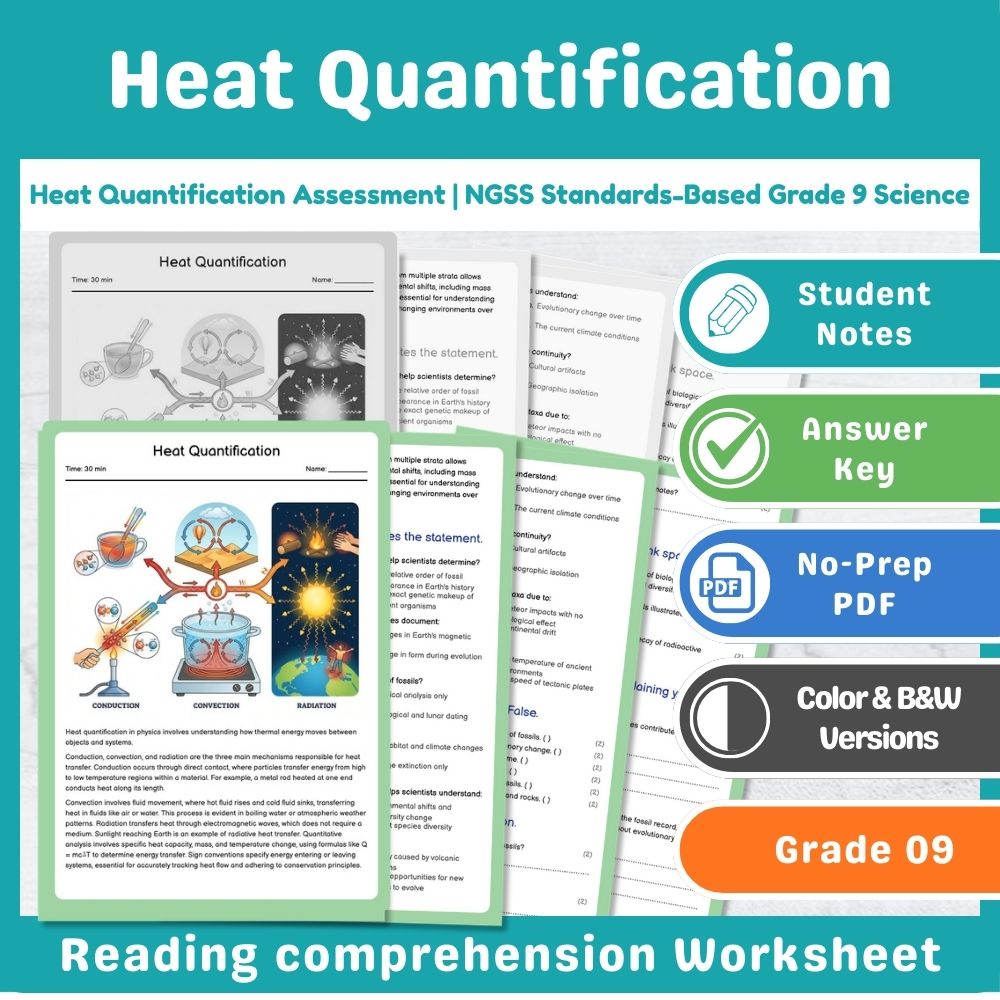
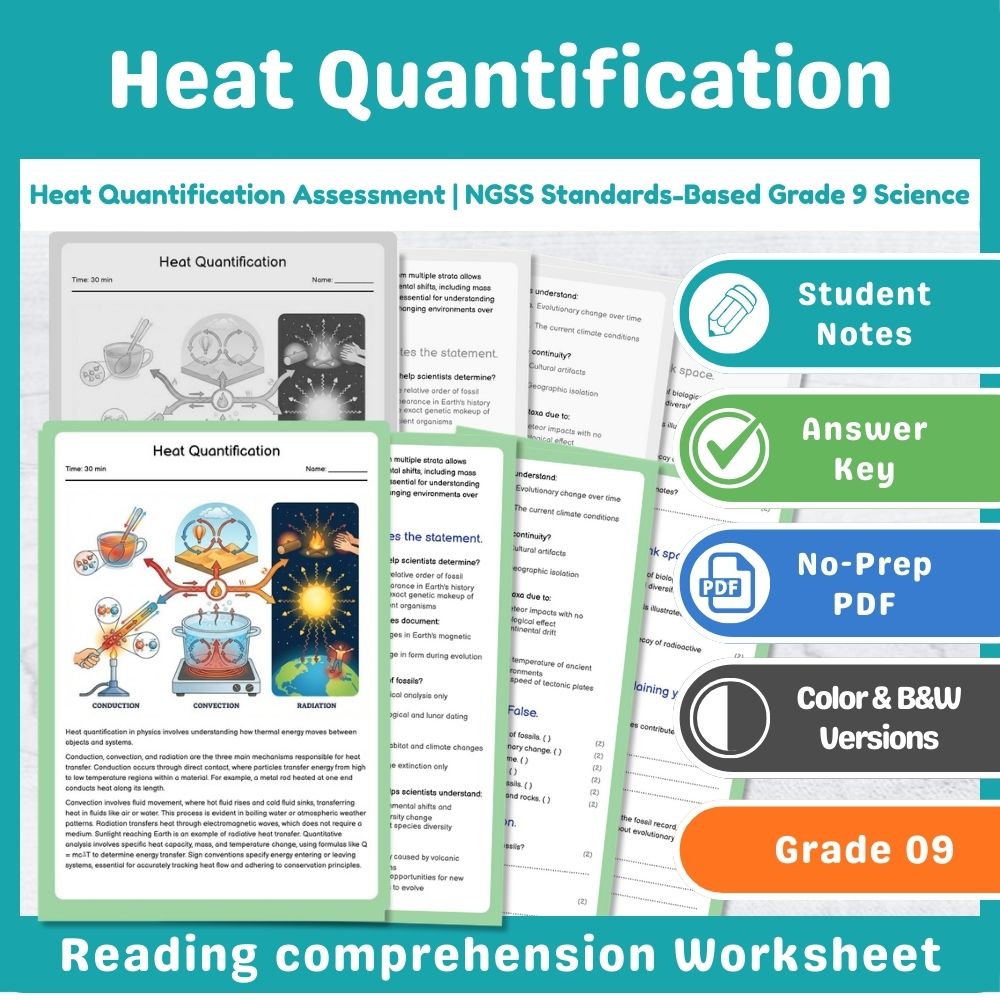
Heat Quantification Assessment | NGSS Standards-Based Grade 9 Science
Created byPrism Point LearningLearning Objectives
- Understand the mathematical representations of heat transfer, including conduction, convection, and radiation.
- Apply formulas involving specific heat capacity, mass, and temperature change to calculate thermal energy transfer.
- Distinguish sign conventions for energy flow and relate energy changes to conservation principles in closed systems.
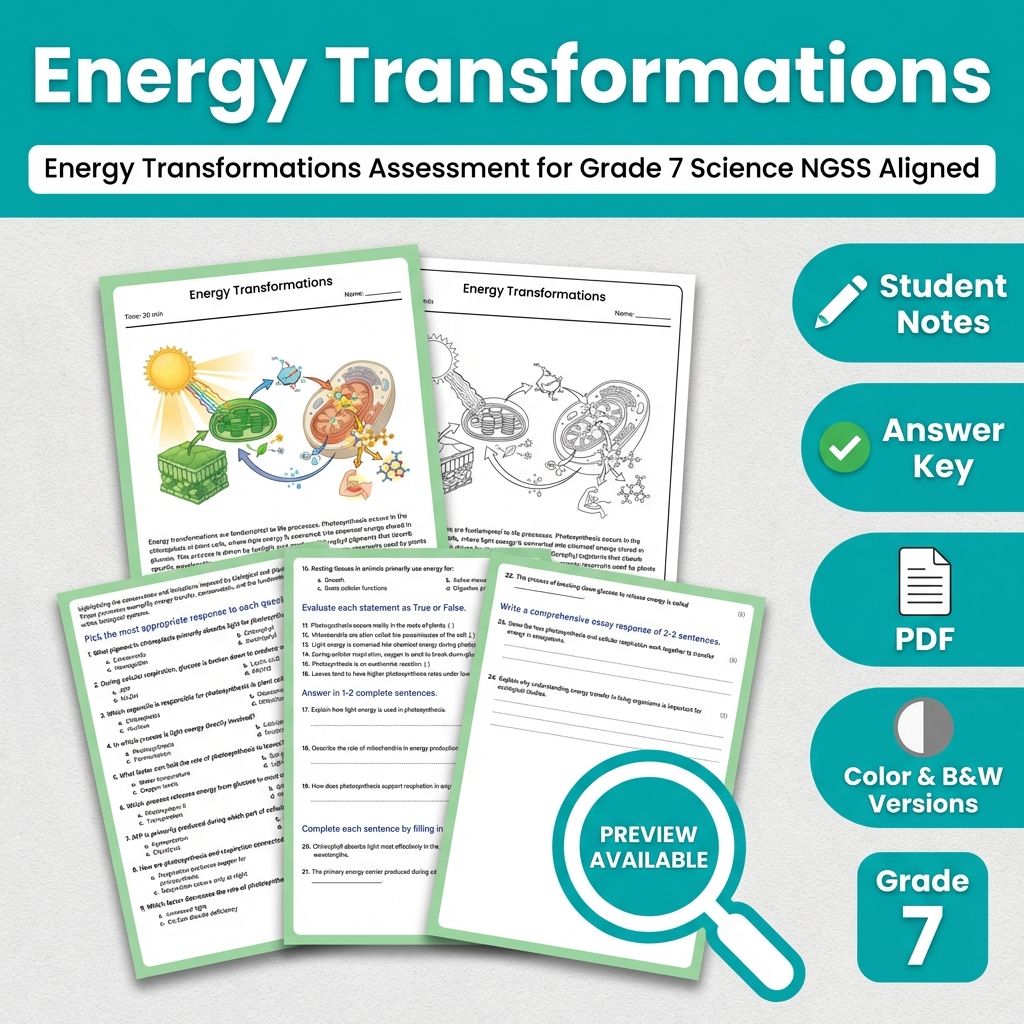
Energy Transformations Assessment for Grade 7 Science NGSS Aligned
Created byPrism Point LearningLearning Objectives
- Explain how light energy is converted into chemical bonds during photosynthesis.
- Describe how cellular respiration releases energy stored in glucose.
- Connect the processes in chloroplasts and mitochondria across different organisms.
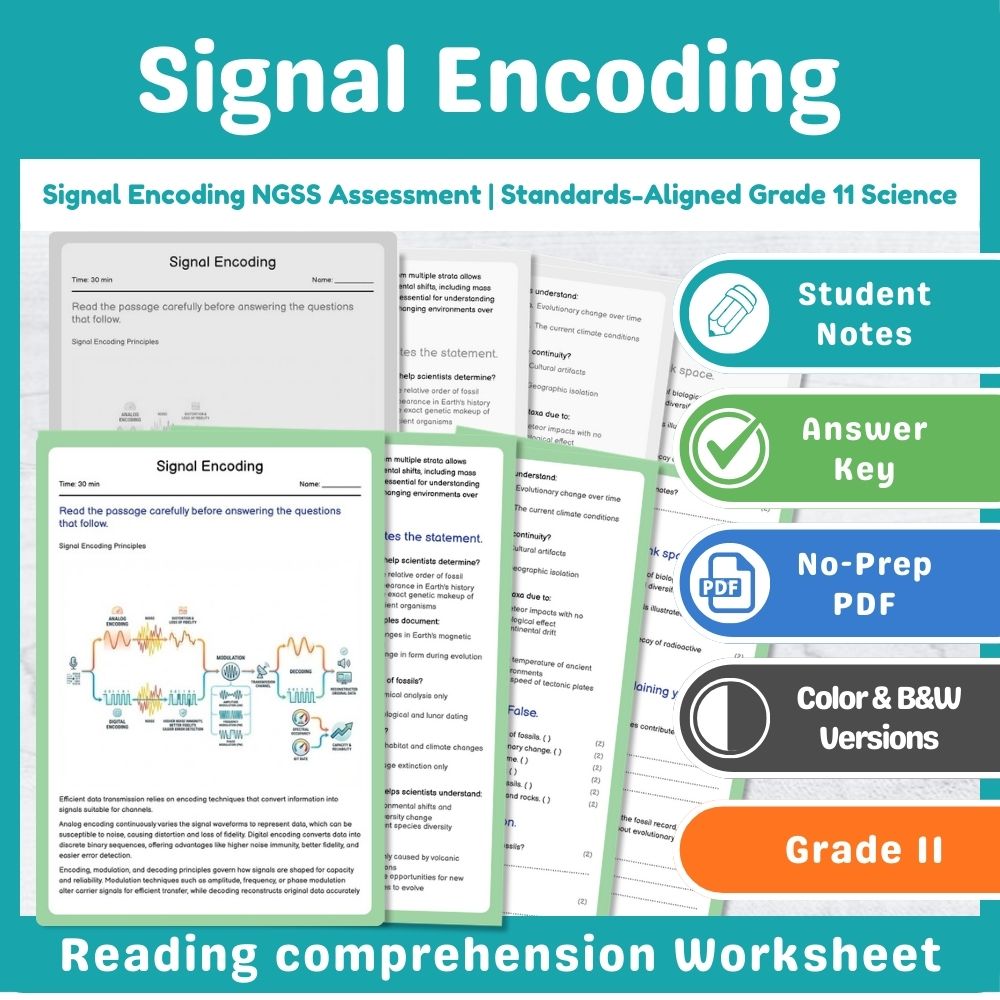
Signal Encoding NGSS Assessment | Standards-Aligned Grade 11 Science
Created byPrism Point LearningLearning Objectives
- Compare advantages of digital and analog transmission and storage focusing on bandwidth, noise, and fidelity.
- Explain the principles of encoding, modulation, and decoding in communication systems.
- Evaluate capacity and reliability of transmission methods using quantitative measures such as bit rate and signal-to-noise ratio.
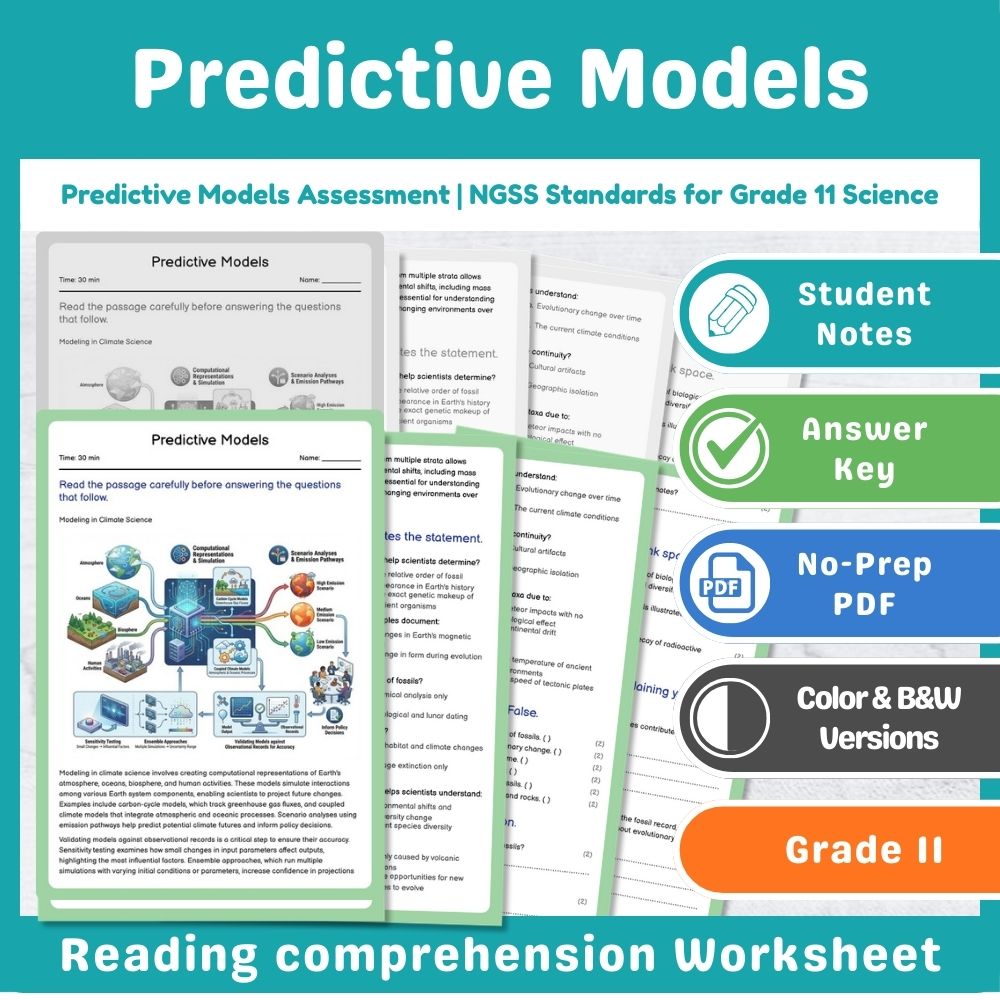
Predictive Models Assessment | NGSS Standards-Aligned Assessment for Grade 11 Science
Created byPrism Point LearningLearning Objectives
- Understand the role of modeling in projecting climate-related variables.
- Identify different types of climate models and their purposes.
- Evaluate the importance of model validation and sensitivity testing.

Ecosystem Interaction Networks Assessment for Grade 9 Science
Created byPrism Point LearningLearning Objectives
- Understand the various types of interactions among organisms within ecosystems.
- Identify how environmental factors influence population dynamics and community structure.
- Explain how changes in one species can cascade through an ecosystem affecting resources and habitats.
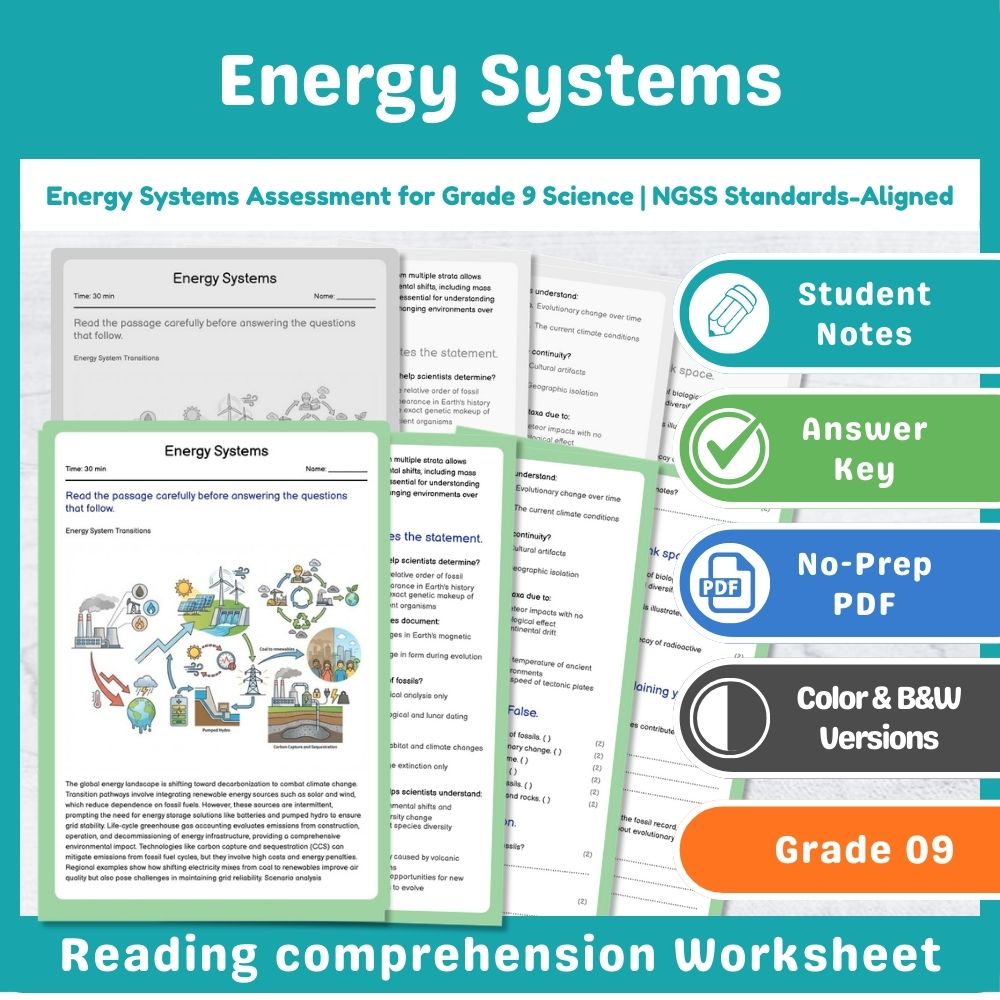
Energy Systems Assessment for Grade 9 Science | NGSS Standards-Aligned
Created byPrism Point LearningLearning Objectives
- Explain the processes involved in energy system transitions and decarbonization pathways.
- Analyze life-cycle greenhouse gas emissions for various energy technologies.
- Evaluate the trade-offs between reliability, affordability, and emissions reductions in energy planning.
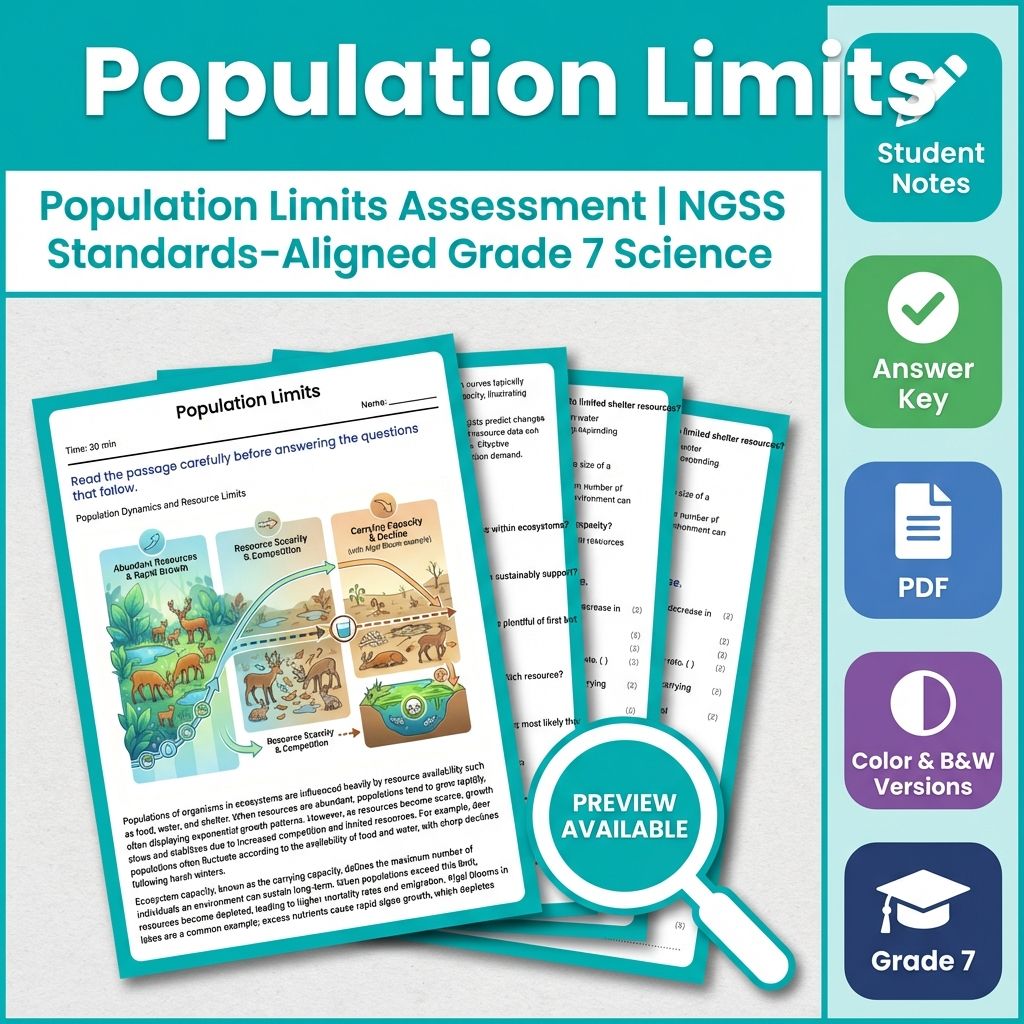
Population Limits Assessment | NGSS Standards-Aligned Grade 7 Science
Created byPrism Point LearningLearning Objectives
- Understand how resource availability influences population growth and decline.
- Interpret data on population changes and relate them to resources and competition.
- Analyze graphs and data sets related to ecosystem carrying capacity.
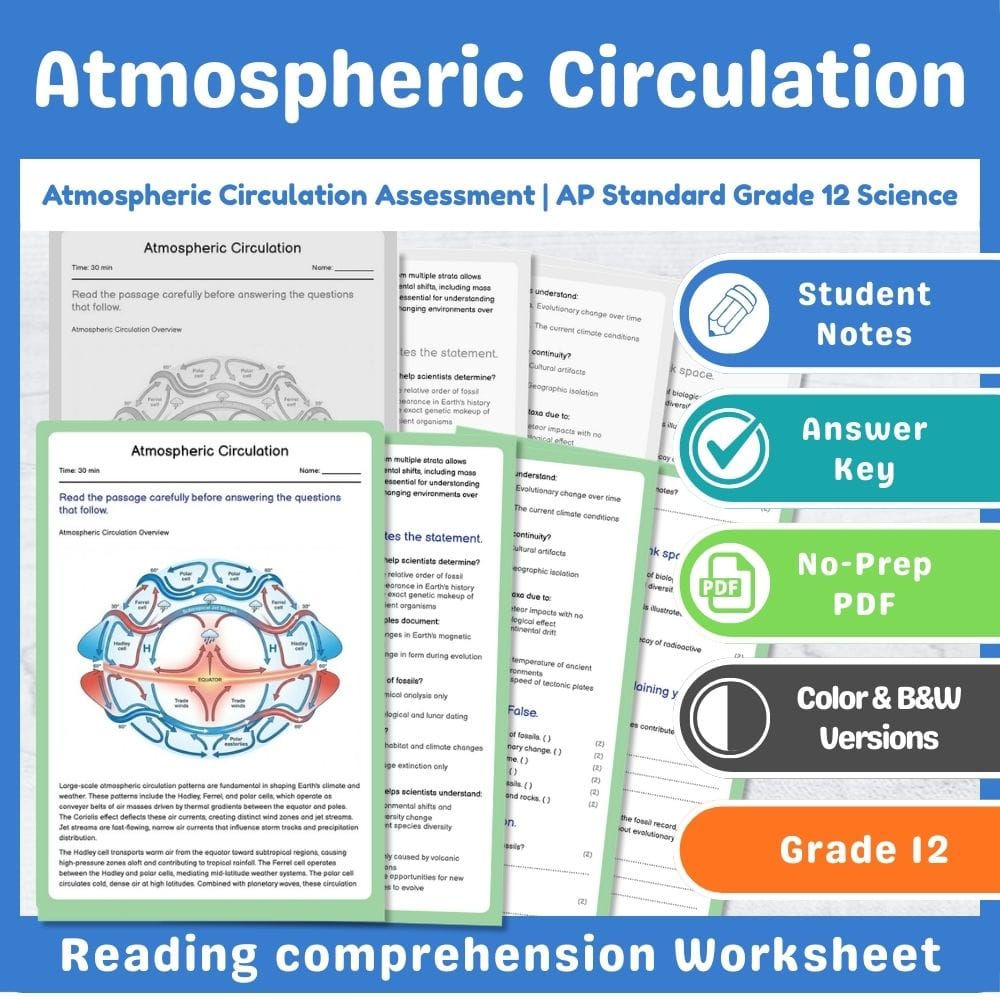
Atmospheric Circulation Assessment | AP Standard Grade 12 Science
Created byPrism Point LearningLearning Objectives
- Explain the global-scale atmospheric circulation patterns including Hadley, Ferrel, and polar cells.
- Describe the influence of thermal gradients and the Coriolis effect on pressure systems and storm tracks.
- Interpret circulation diagrams, pressure maps, and potential vorticity to understand weather regimes and climate shifts.
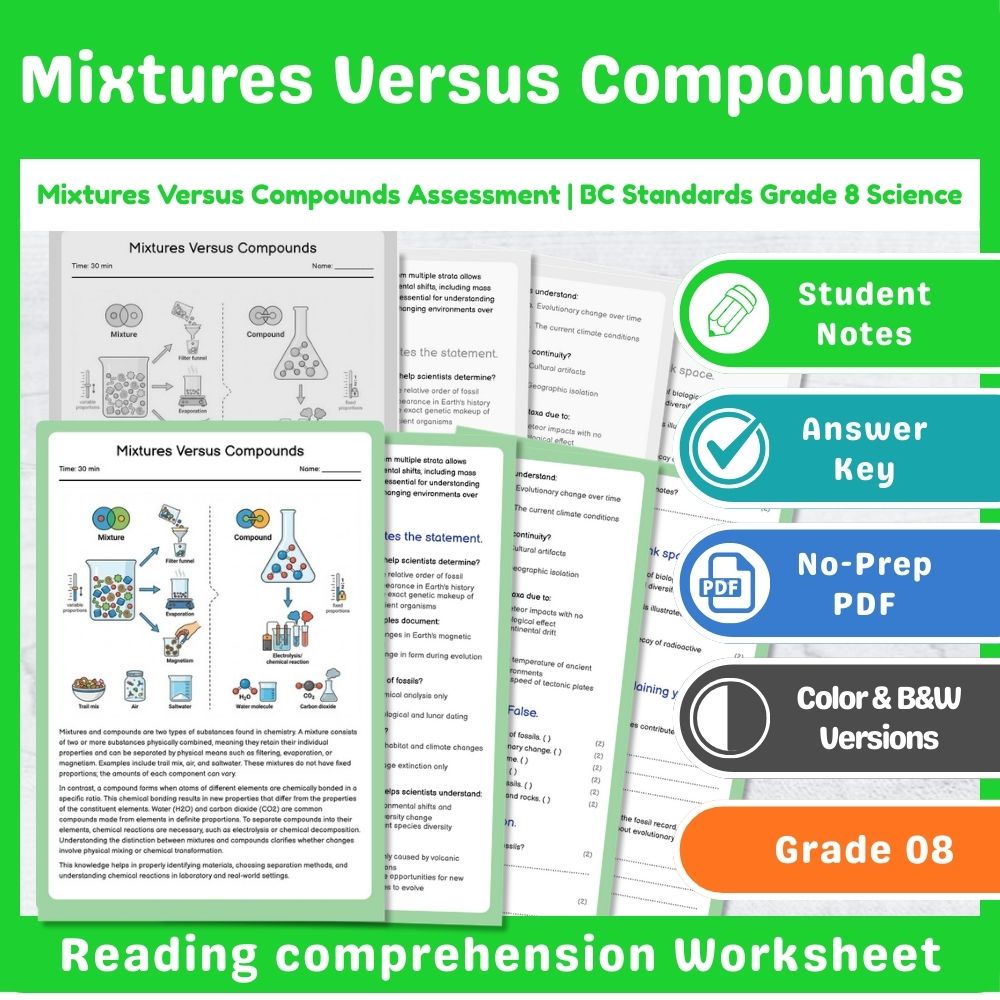
Mixtures Versus Compounds Assessment | BC Standards Grade 8 Science
Created byPrism Point LearningLearning Objectives
- Understand the differences between mixtures and compounds.
- Identify examples of mixtures and compounds in everyday life.
- Explain how mixtures can be separated physically and compounds require chemical change.
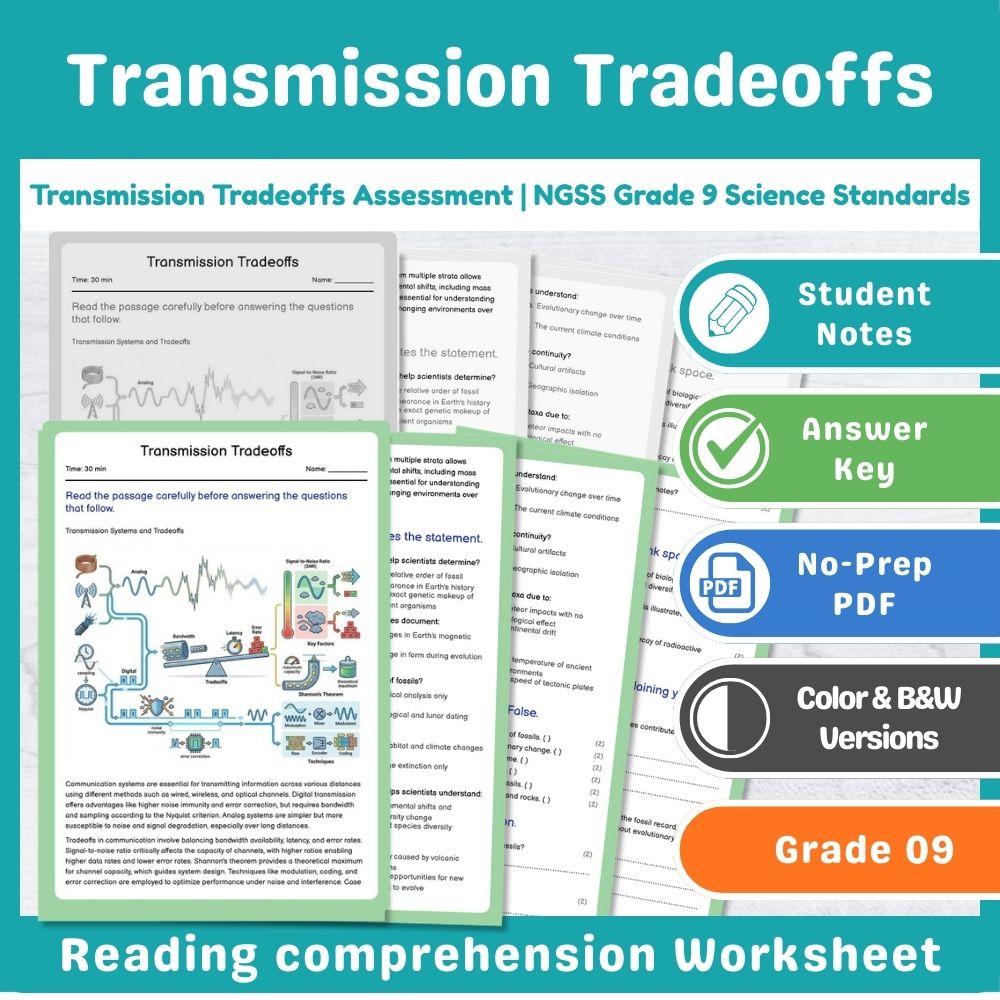
Transmission Tradeoffs Assessment | NGSS Grade 9 Science Standards
Created byPrism Point LearningLearning Objectives
- Understand the tradeoffs involved in digital and analog communication systems.
- Analyze the impact of bandwidth constraints, signal-to-noise ratio, and sampling criteria on transmission quality.
- Evaluate error-correcting techniques and their effect on data integrity in noisy environments.
Energy Conversion Assessment | NGSS Standards Grade 9 Science
Created byPrism Point LearningLearning Objectives
- Explain the different types of energy conversion devices and processes.
- Analyze how energy transfer involves losses and efficiency considerations.
- Evaluate real-world examples of energy conversion such as photovoltaic cells, thermoelectric modules, and electrochemical cells.
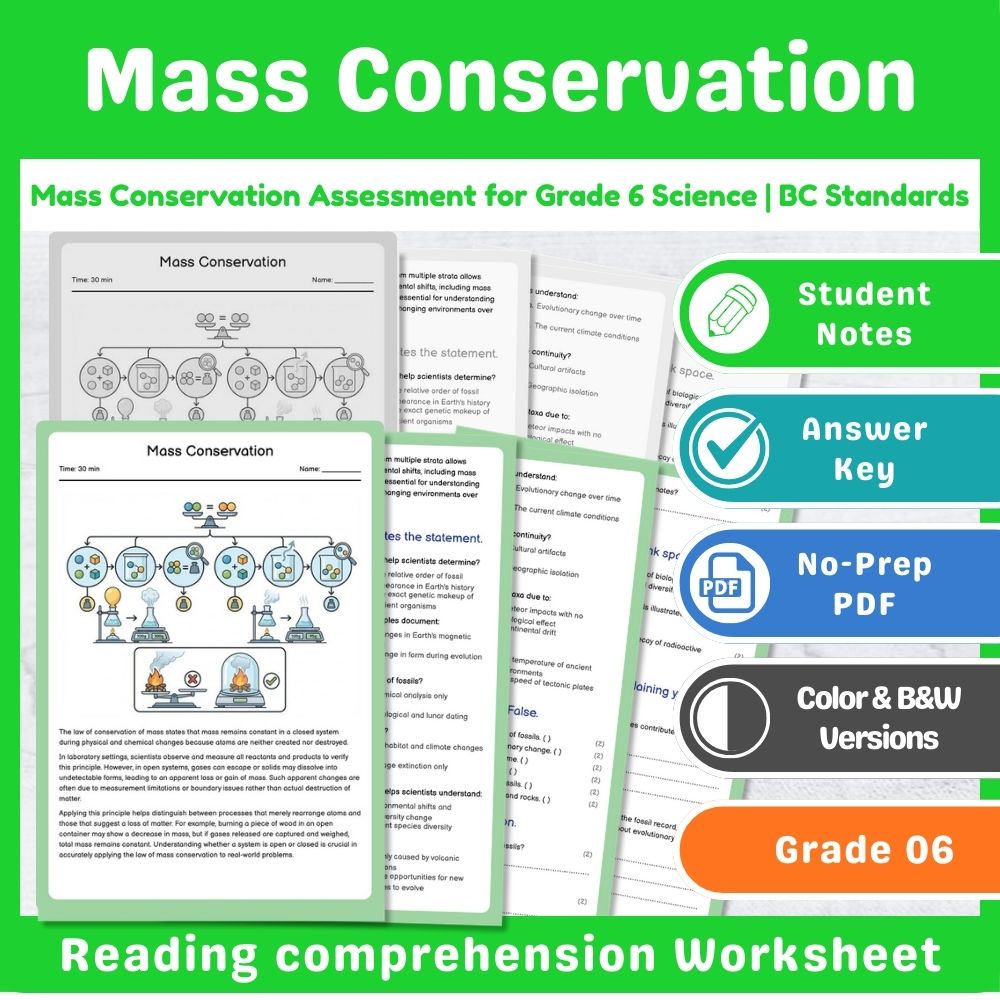
Mass Conservation Assessment for Grade 6 Science | BC Standards
Created byPrism Point LearningLearning Objectives
- Understand the law of conservation of mass and its application in physical and chemical changes.
- Identify situations where mass appears to change and explain why the apparent change occurs.
- Differentiate between closed and open systems in terms of mass conservation.
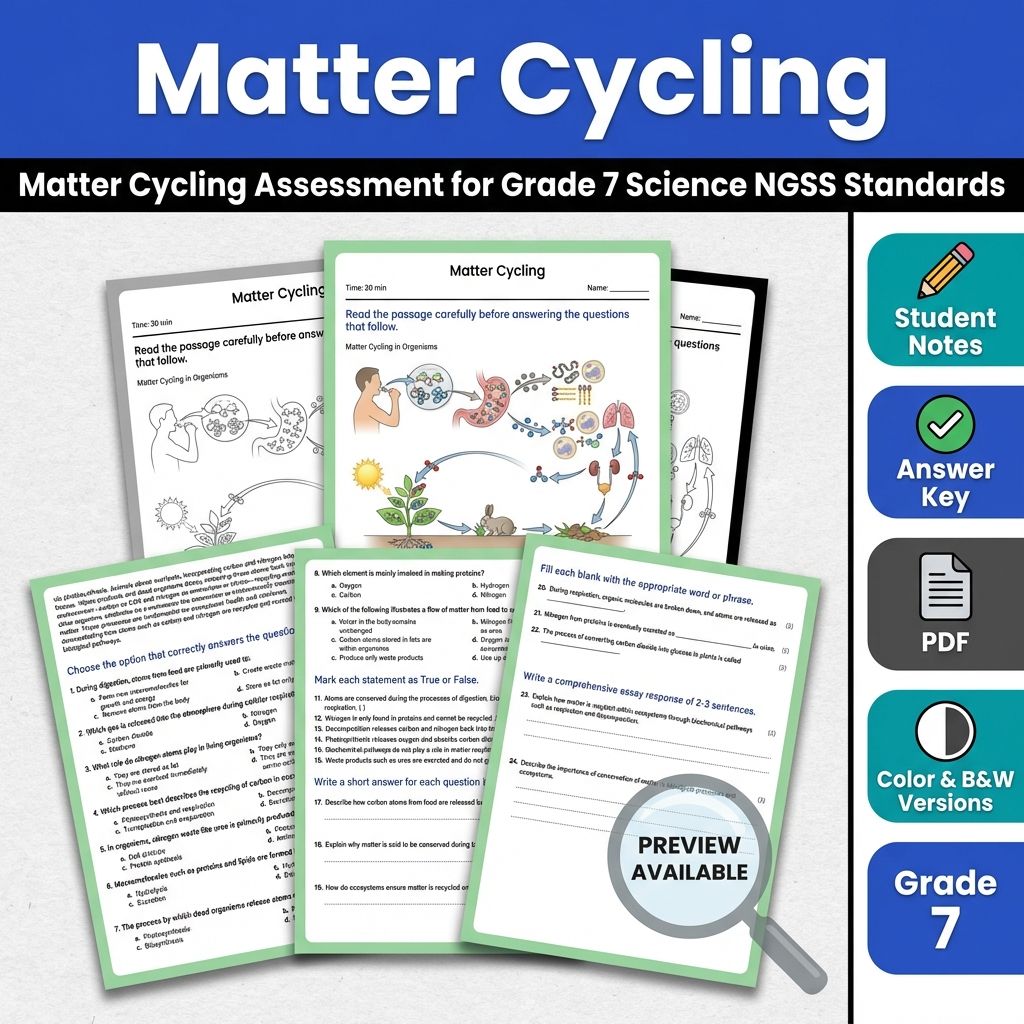
Matter Cycling Assessment for Grade 7 Science NGSS Standards
Created byPrism Point LearningLearning Objectives
- Explain how matter is transferred and transformed within organisms during digestion, biosynthesis, and respiration.
- Describe the flow of carbon and nitrogen through biological systems.
- Identify key biochemical pathways involved in matter recycling within ecosystems.
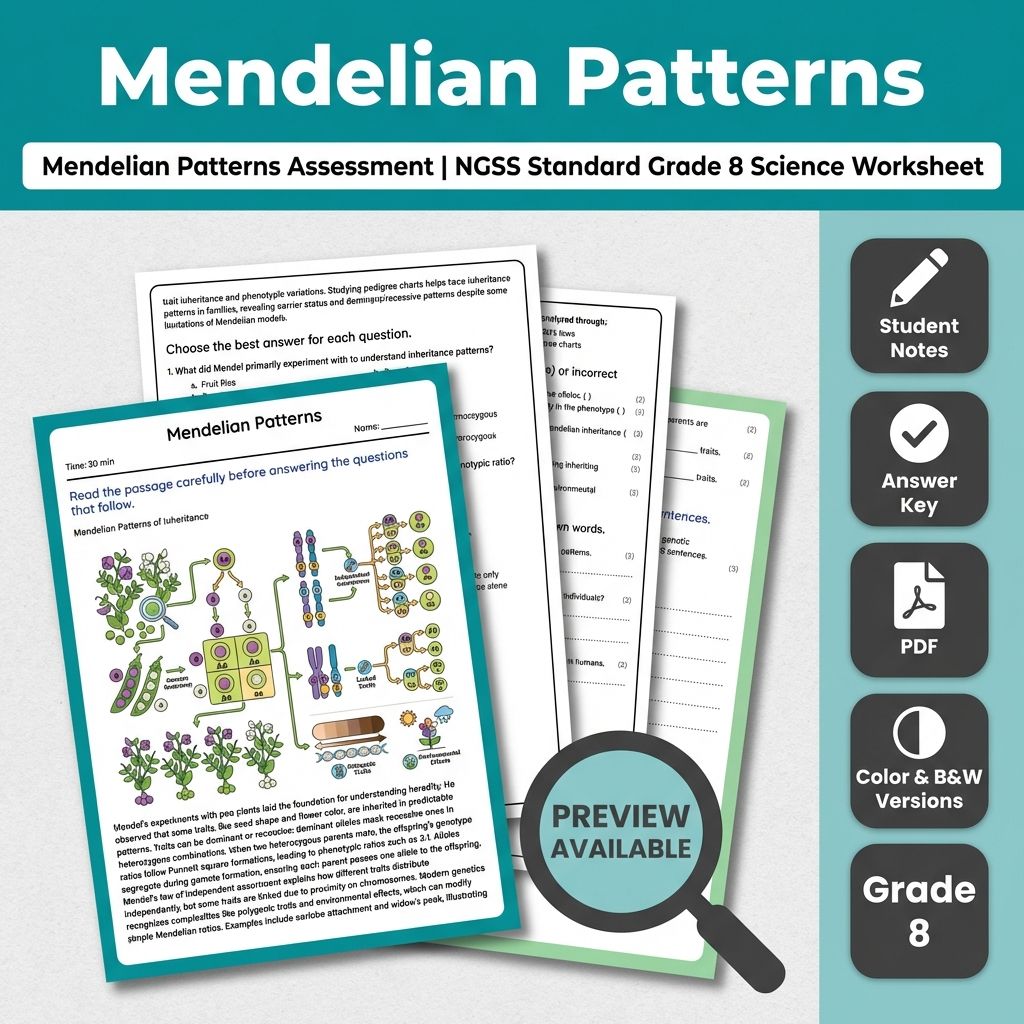
Mendelian Patterns Assessment | NGSS Standard Grade 8 Science Worksheet
Created byPrism Point LearningLearning Objectives
- Explain how allele combinations produce observable trait patterns through Mendelian inheritance.
- Describe dominant and recessive allele interactions and predict phenotypic ratios using Punnett squares.
- Interpret segregation of alleles, simple probability outcomes, and basic pedigree diagrams.
Climate Projections Assessment | NGSS Grade 10 Science Standards
Created byPrism Point LearningLearning Objectives
- Understand how instrumental records, proxy data, and model outputs are used to analyze climate trends.
- Identify sources of climate data such as surface temperature datasets, ice-core records, and satellite observations.
- Evaluate the attribution of climate trends to radiative forcing and assess the uncertainty in climate projections.
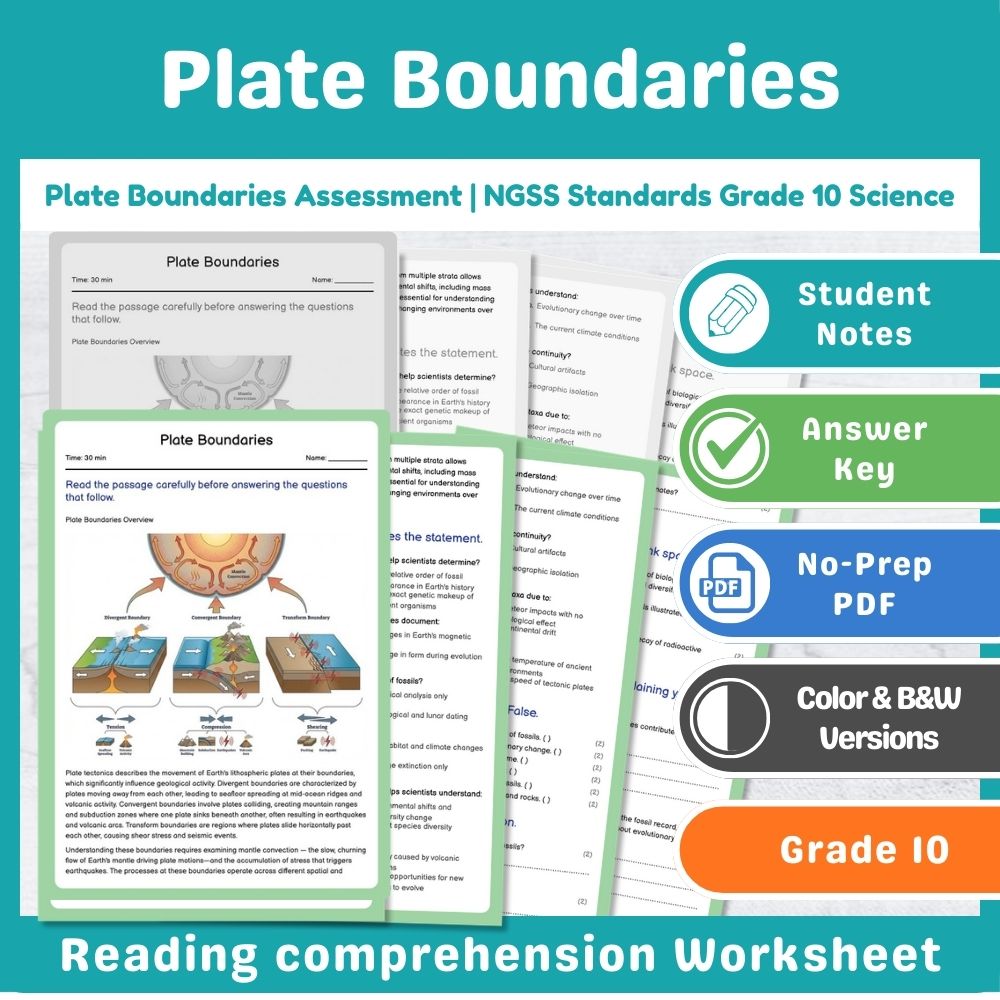
Plate Boundaries Assessment | NGSS Standards Grade 10 Science
Created byPrism Point LearningLearning Objectives
- Understand the three main types of plate boundaries: divergent, convergent, and transform.
- Describe key geological phenomena associated with each boundary type, such as mid-ocean ridges, subduction zones, and mountain uplift.
- Explain mechanisms of mantle convection and stress accumulation that cause earthquakes and volcanic activity.

Energy Conservation Assessment for Grade 12 Science TEKS Standards
Created byPrism Point LearningLearning Objectives
- Explain the first and second laws of thermodynamics in the context of chemical systems.
- Predict spontaneity and direction of reactions using Gibbs free energy, enthalpy, and entropy.
- Analyze energy flow in processes like combustion and electrochemical reactions.
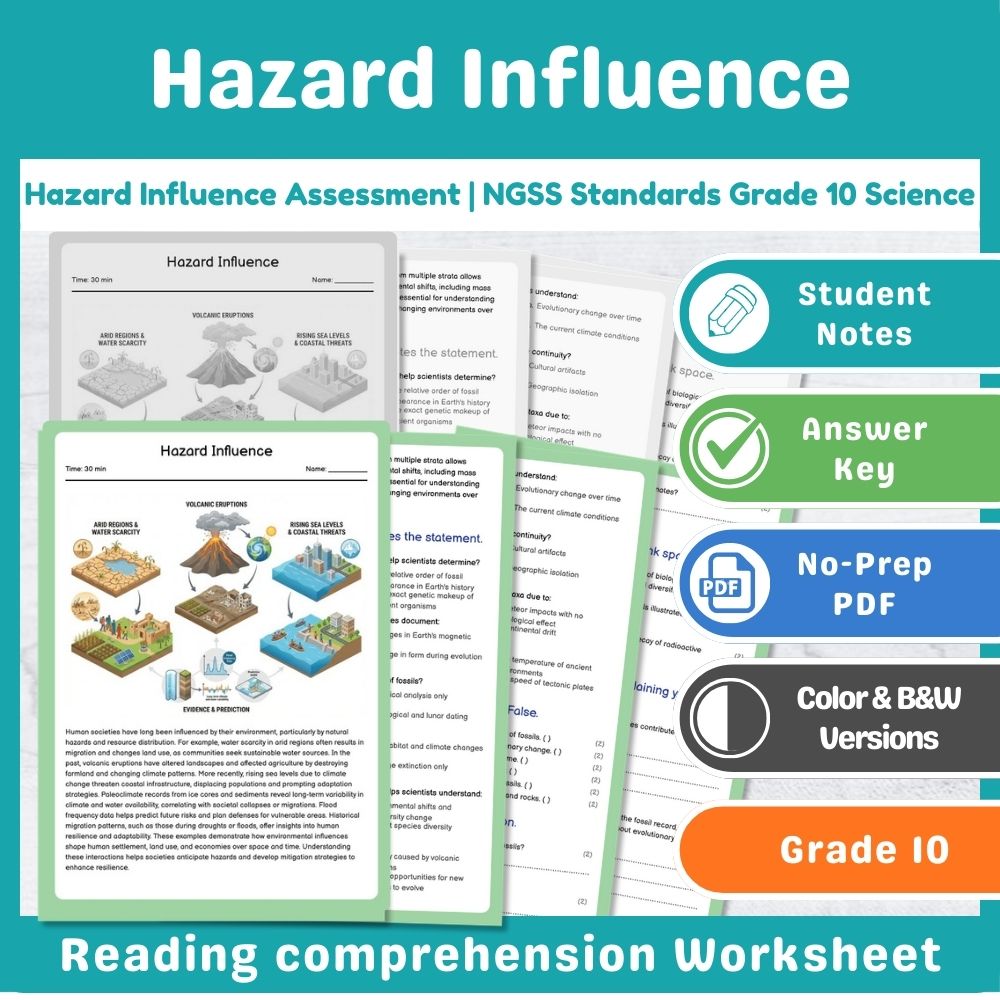
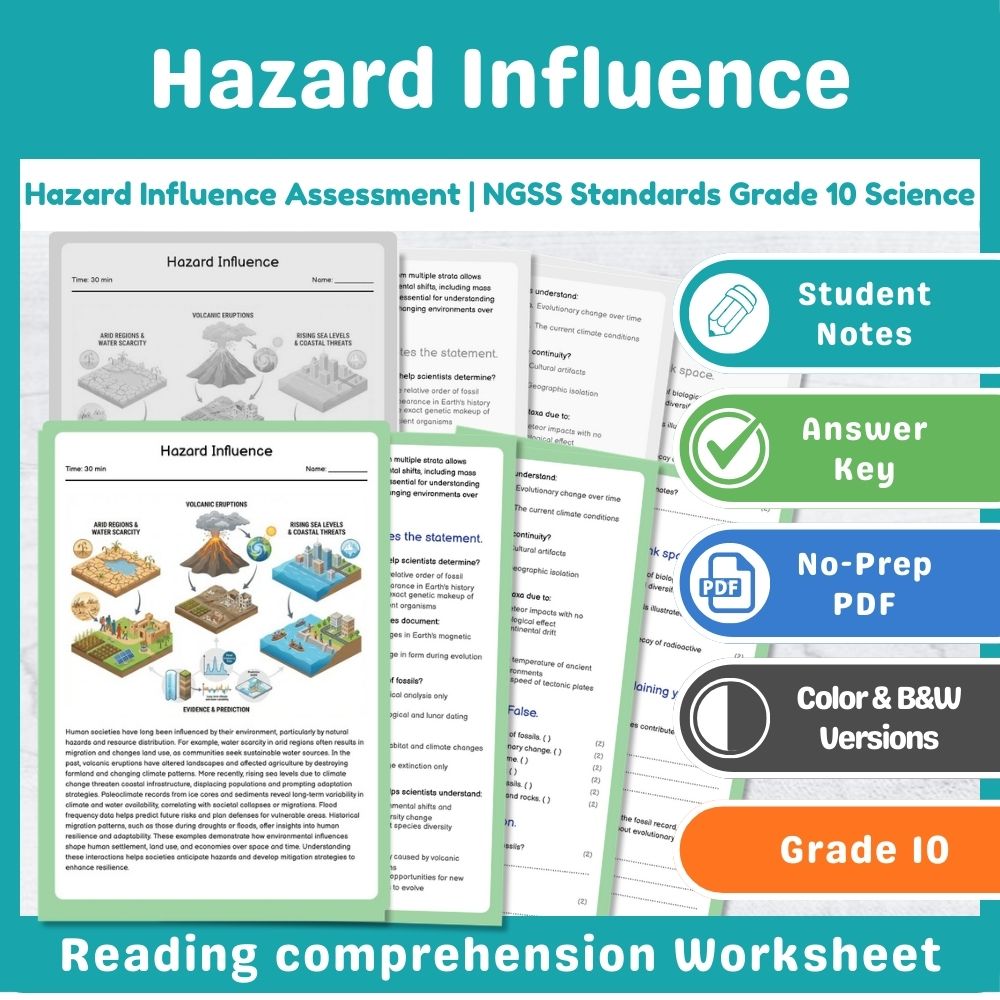
Hazard Influence Assessment | NGSS Standards Grade 10 Science
Created byPrism Point LearningLearning Objectives
- Understand how freshwater availability, natural hazards, and climate variability impact human settlement and land use.
- Analyze examples such as water scarcity, volcanic eruptions, and sea-level rise to evaluate societal responses.
- Interpret paleoclimate records, flood data, and migration patterns to recognize links between environmental factors and society.
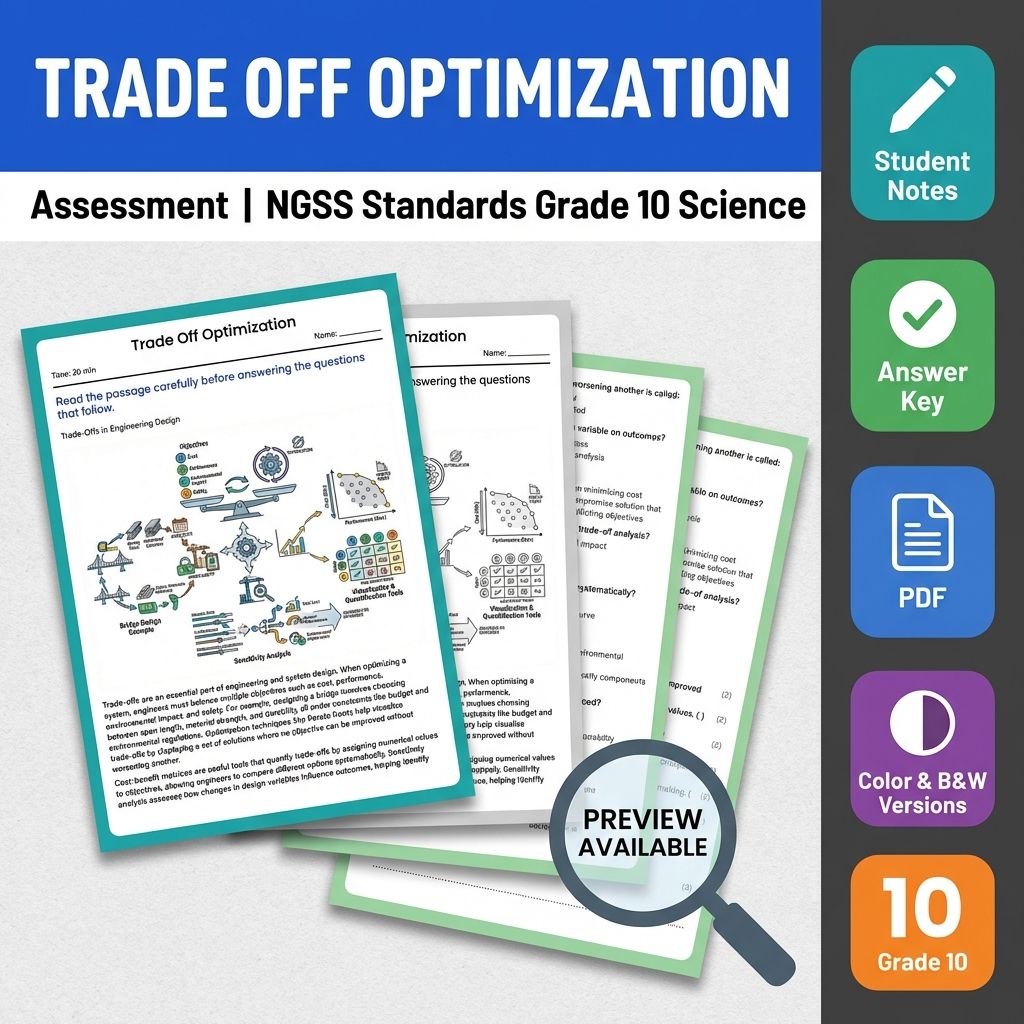
Trade Off Optimization Assessment | NGSS Standards Grade 10 Science
Created byPrism Point LearningLearning Objectives
- Understand how to analyze trade-offs and make optimization decisions in engineering design.
- Learn to use cost-benefit matrices, Pareto fronts, and sensitivity analysis to evaluate options.
- Apply concepts of performance metrics, constraints, and objective weighting to real-world problems.

Wave Speed Relations Assessment for Grade 9 Science – Standard-Aligned
Created byPrism Point LearningLearning Objectives
- Understand the relationship between wave speed, frequency, and wavelength.
- Explain how changes in frequency affect wavelength in wave propagation.
- Apply the wave speed formula to solve for unknown wave properties.
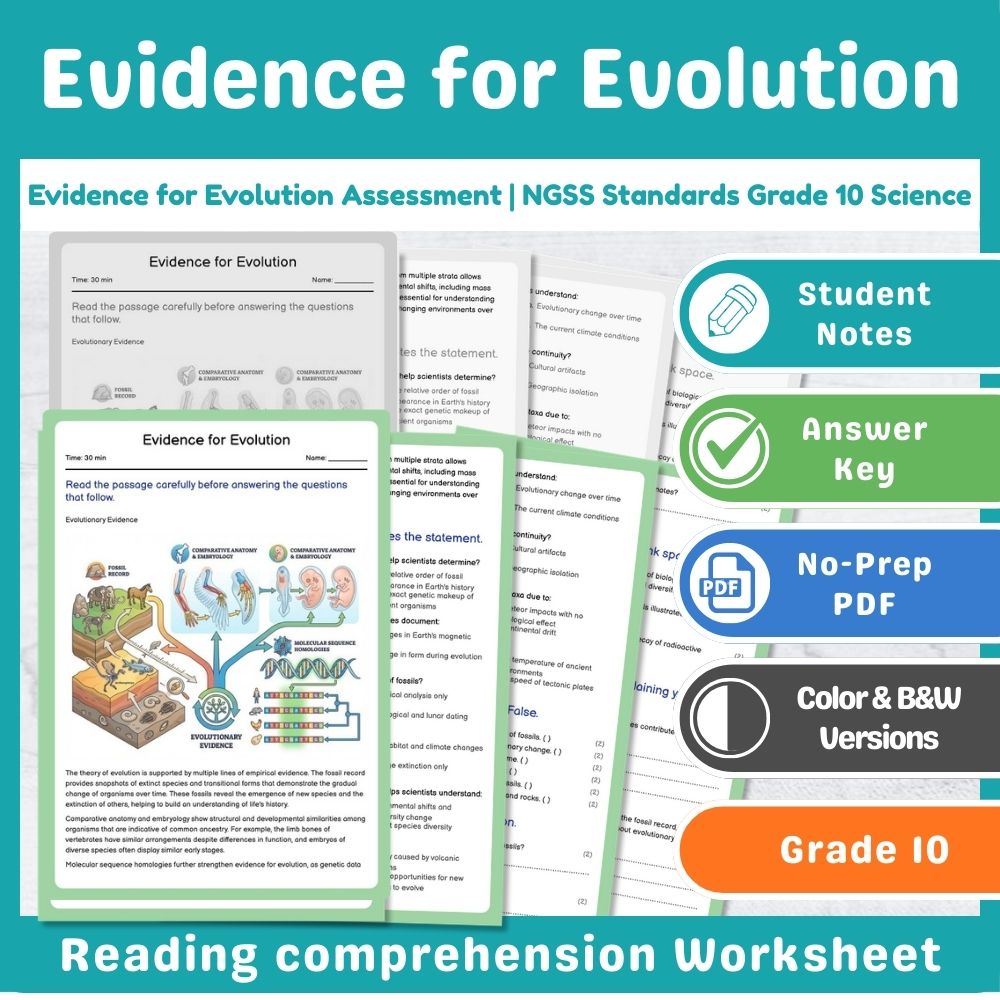
Evidence for Evolution Assessment | NGSS Standards Grade 10 Science
Created byPrism Point LearningLearning Objectives
- Understand the key lines of scientific evidence supporting common ancestry and evolution.
- Identify how fossil records, comparative anatomy, embryology, and molecular data corroborate evolutionary theory.
- Analyze the role of radiometric dating and biogeography in establishing evolutionary timelines.
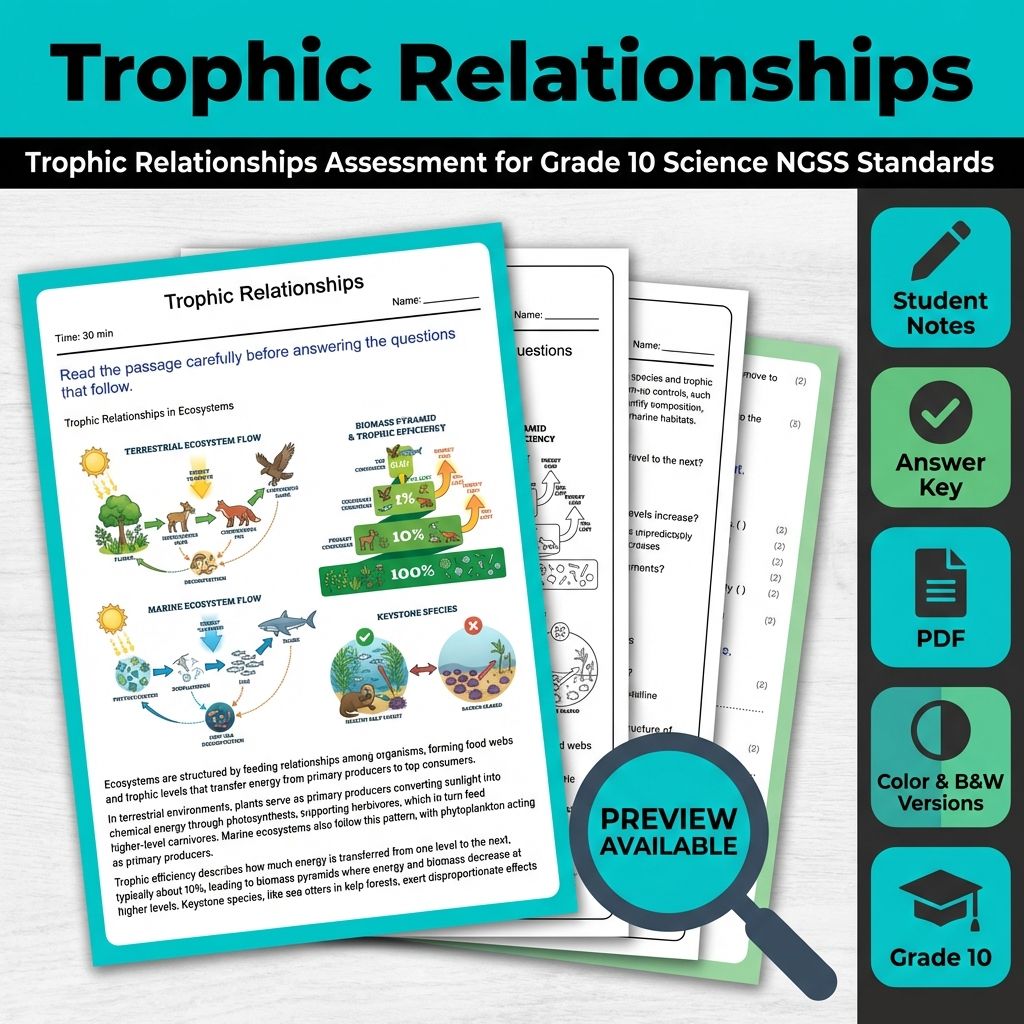
Trophic Relationships Assessment for Grade 10 Science NGSS Standards
Created byPrism Point LearningLearning Objectives
- Explain the concept of energy transfer within food webs and trophic levels.
- Analyze the effects of keystone species and trophic cascades on ecosystem stability.
- Evaluate how trophic efficiency influences biomass distribution in terrestrial and marine ecosystems.
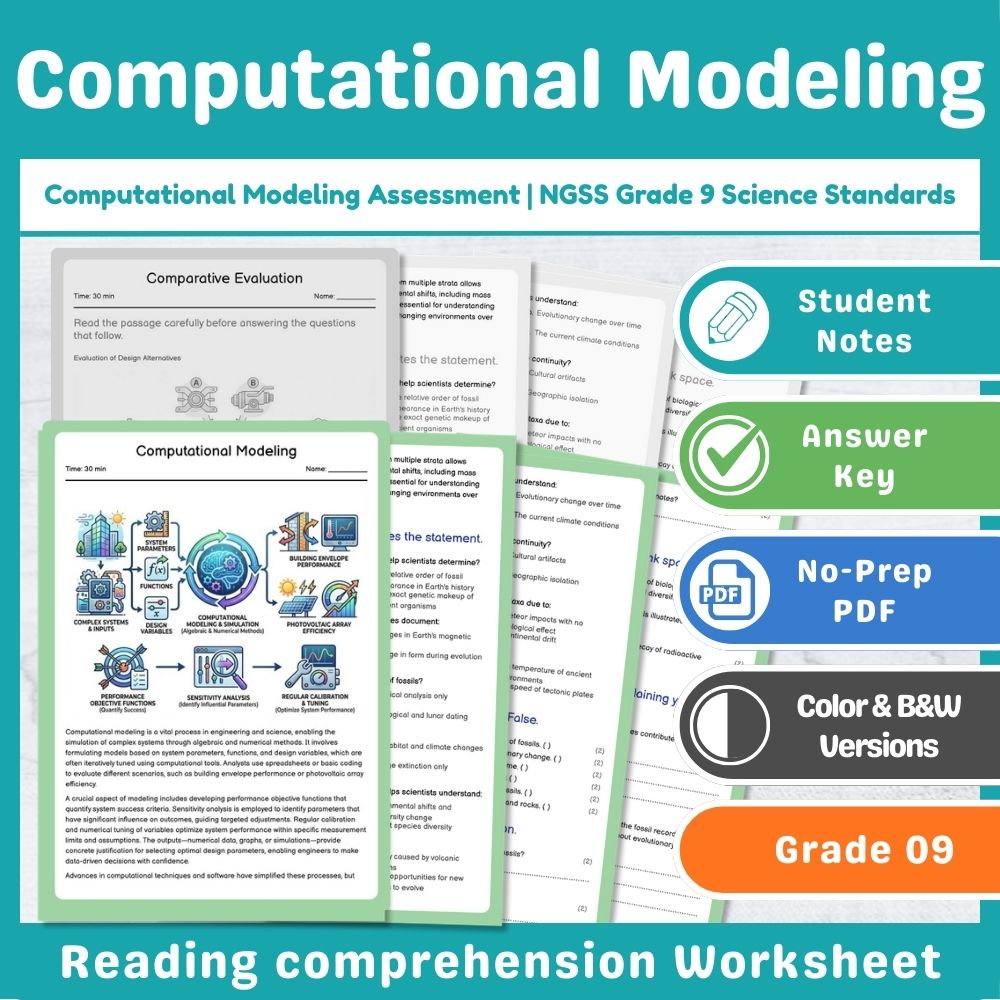
Computational Modeling Assessment | NGSS Grade 9 Science Standards
Created byPrism Point LearningLearning Objectives
- Understand the application of mathematical and computational methods in system modeling.
- Analyze how parameters and variables influence system performance.
- Develop and evaluate models using spreadsheets and simple code simulations.
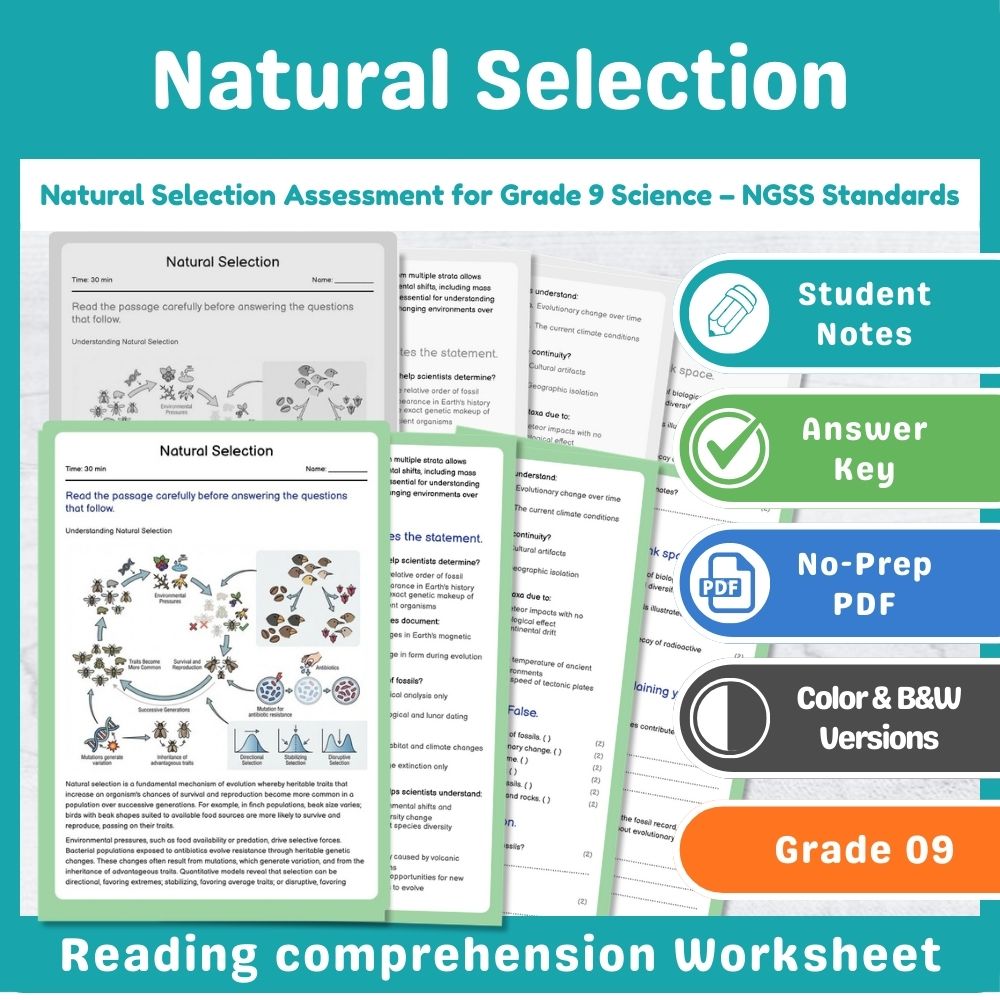
Natural Selection Assessment for Grade 9 Science – NGSS Standards
Created byPrism Point LearningLearning Objectives
- Explain the mechanisms of natural selection, including variation, inheritance, and selection pressures.
- Identify classic examples of natural selection, such as finch beak morphology and bacterial resistance.
- Describe how models of fitness and allele frequency determine different types of selection.
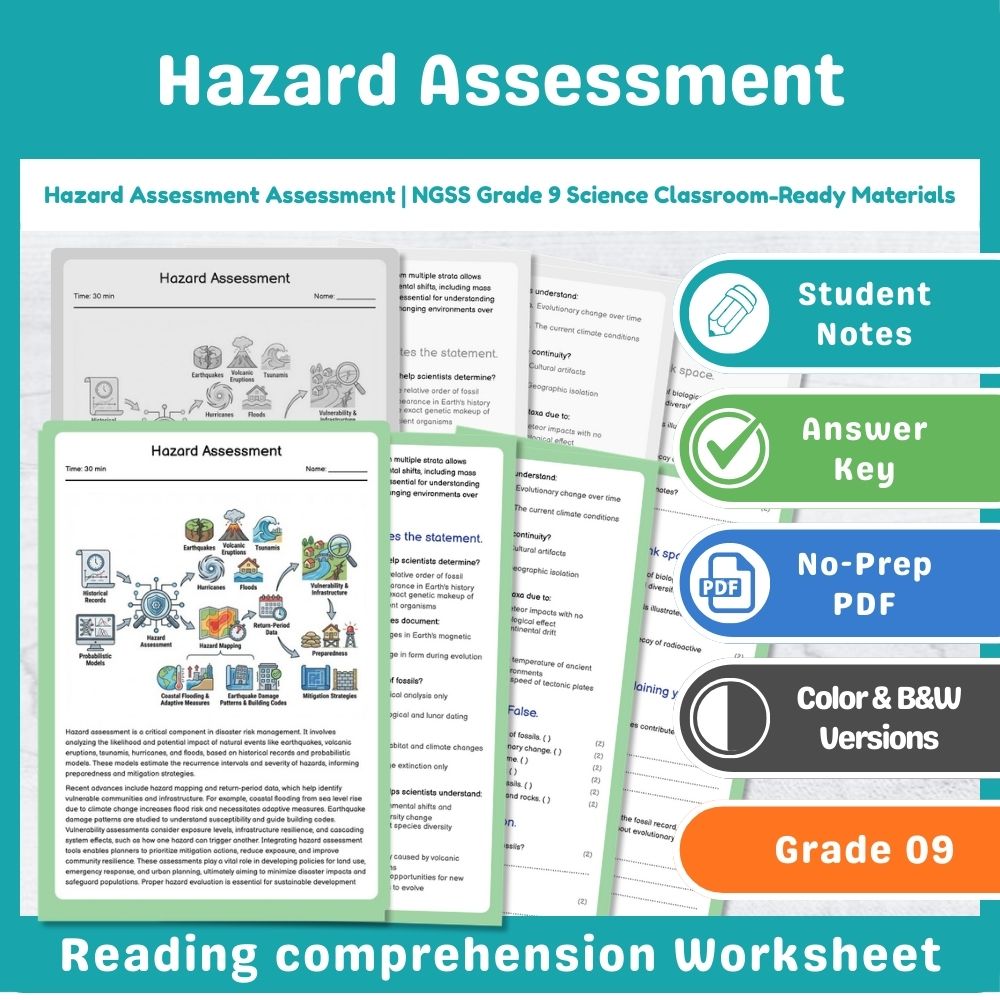
Hazard Assessment Assessment | NGSS Grade 9 Science Classroom-Ready Materials
Created byPrism Point LearningLearning Objectives
- Understand the methods used to evaluate hazard risks such as earthquakes, volcanoes, tsunamis, hurricanes, and floods.
- Analyze hazard occurrence, frequency, and consequences using historical data and probabilistic models.
- Recognize the importance of hazard mapping, return-period data, and mitigation strategies in assessing community susceptibility.
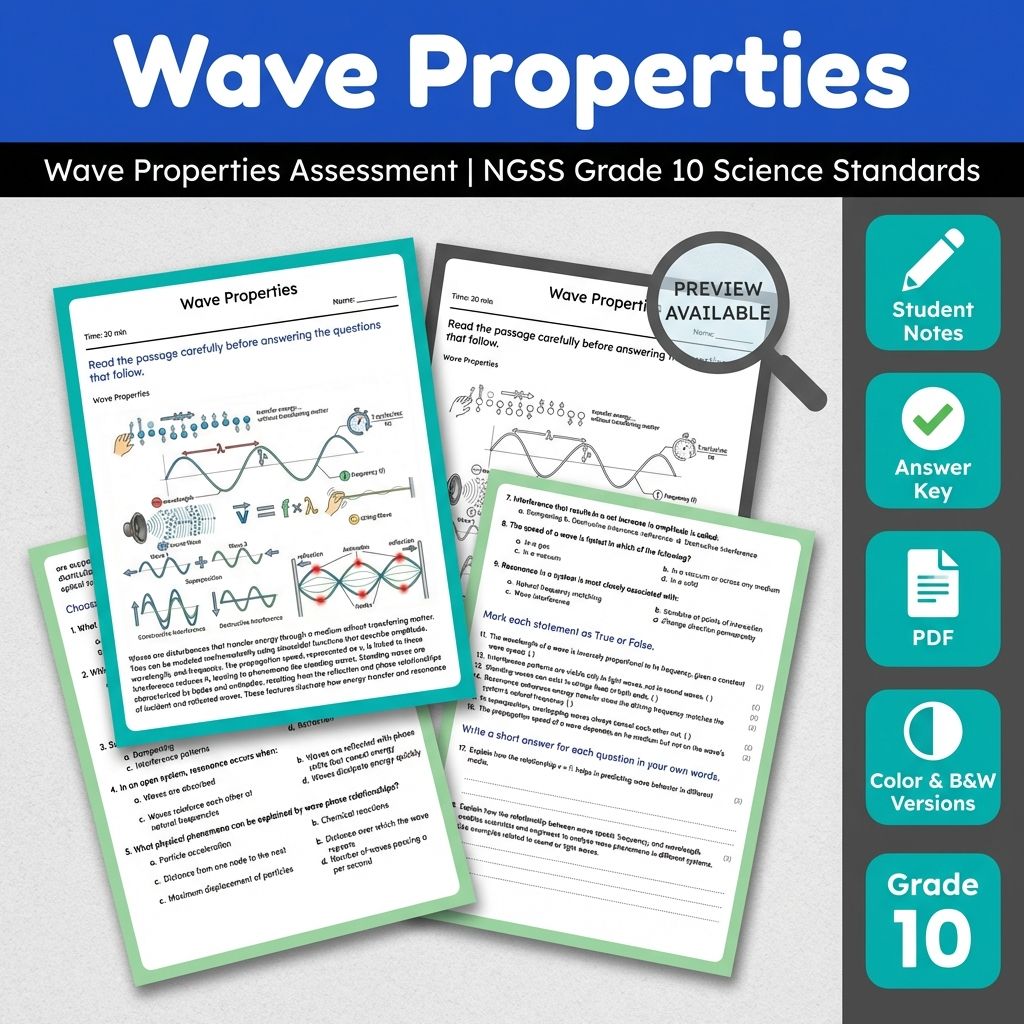
Wave Properties Assessment | NGSS Grade 10 Science Standards
Created byPrism Point LearningLearning Objectives
- Understand the mathematical descriptions of waves, including amplitude, wavelength, frequency, and propagation speed.
- Interpret the relationships between wave parameters, particularly the equation v = fλ, in various mechanical wave contexts.
- Explain the phenomenon of superposition and interference patterns, including standing waves, using trigonometric functions and phase relationships.

Titration Calculations Assessment for Grade 11 Science | Alberta Standards
Created byPrism Point LearningLearning Objectives
- Understand key concepts related to Science
- Apply knowledge through practice questions
- Demonstrate comprehension of the material
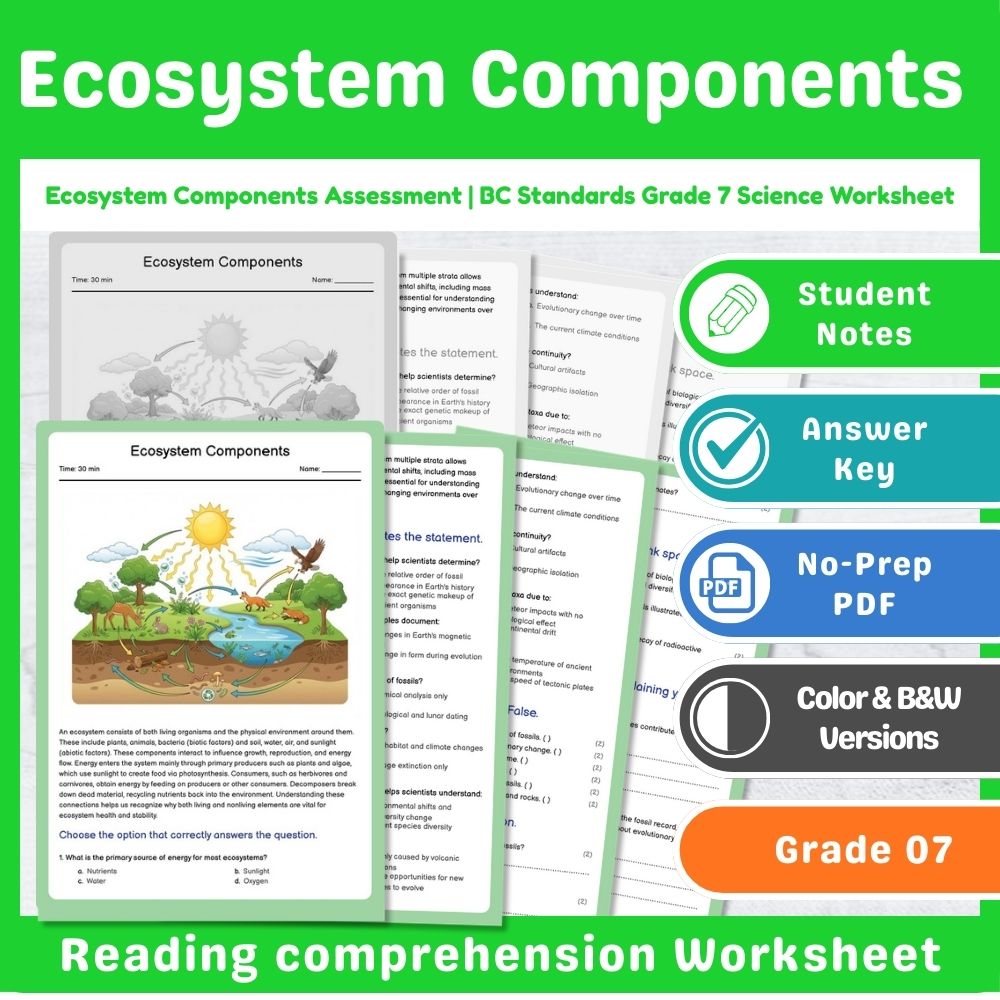
Ecosystem Components Assessment | BC Standards Grade 7 Science Worksheet
Created byPrism Point LearningLearning Objectives
- Describe the key components of an ecosystem, including both living and nonliving factors.
- Explain how biotic and abiotic components interact within an ecosystem.
- Understand the flow of energy through producers and consumers in an ecosystem.
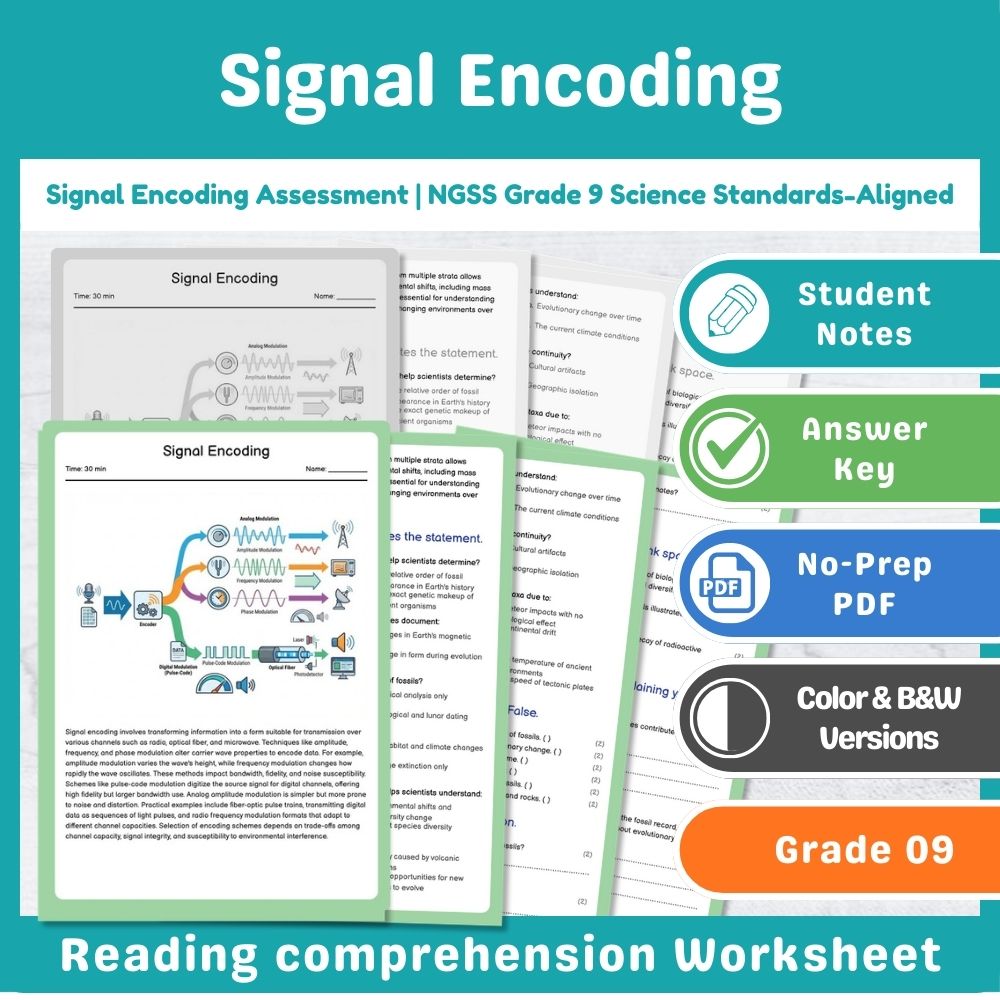
Signal Encoding Assessment | NGSS Grade 9 Science Standards-Aligned
Created byPrism Point LearningLearning Objectives
- Describe different methods of encoding information onto carrier waves, including amplitude, frequency, and phase modulation.
- Compare modulation and multiplexing schemes such as pulse-code modulation and amplitude modulation in terms of bandwidth and fidelity.
- Analyze practical examples of encoding techniques used in fiber-optic, radio, and microwave communications.
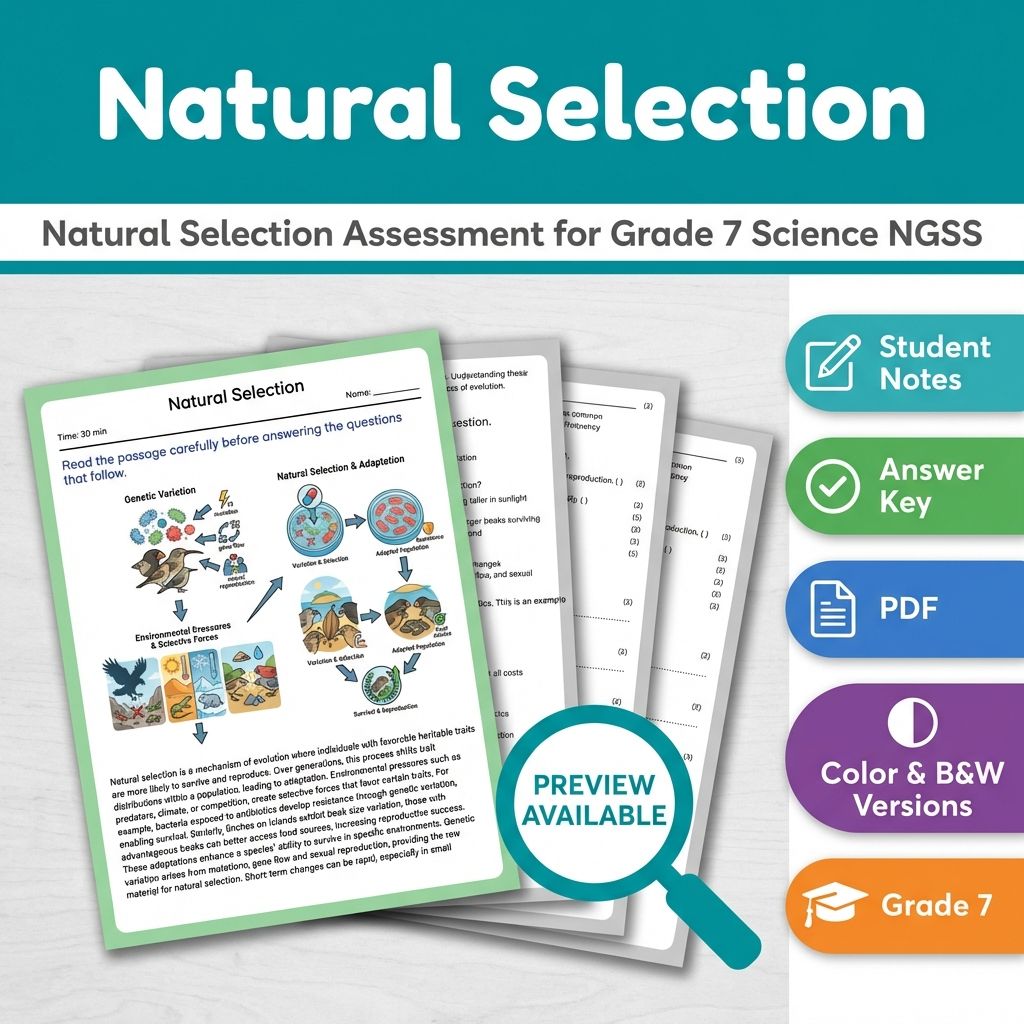
Natural Selection Assessment for Grade 7 Science NGSS
Created byPrism Point LearningLearning Objectives
- Explain how heritable variation and environmental pressures influence natural selection.
- Identify examples of adaptation in different species.
- Describe how reproductive success and selective pressures shape evolution.
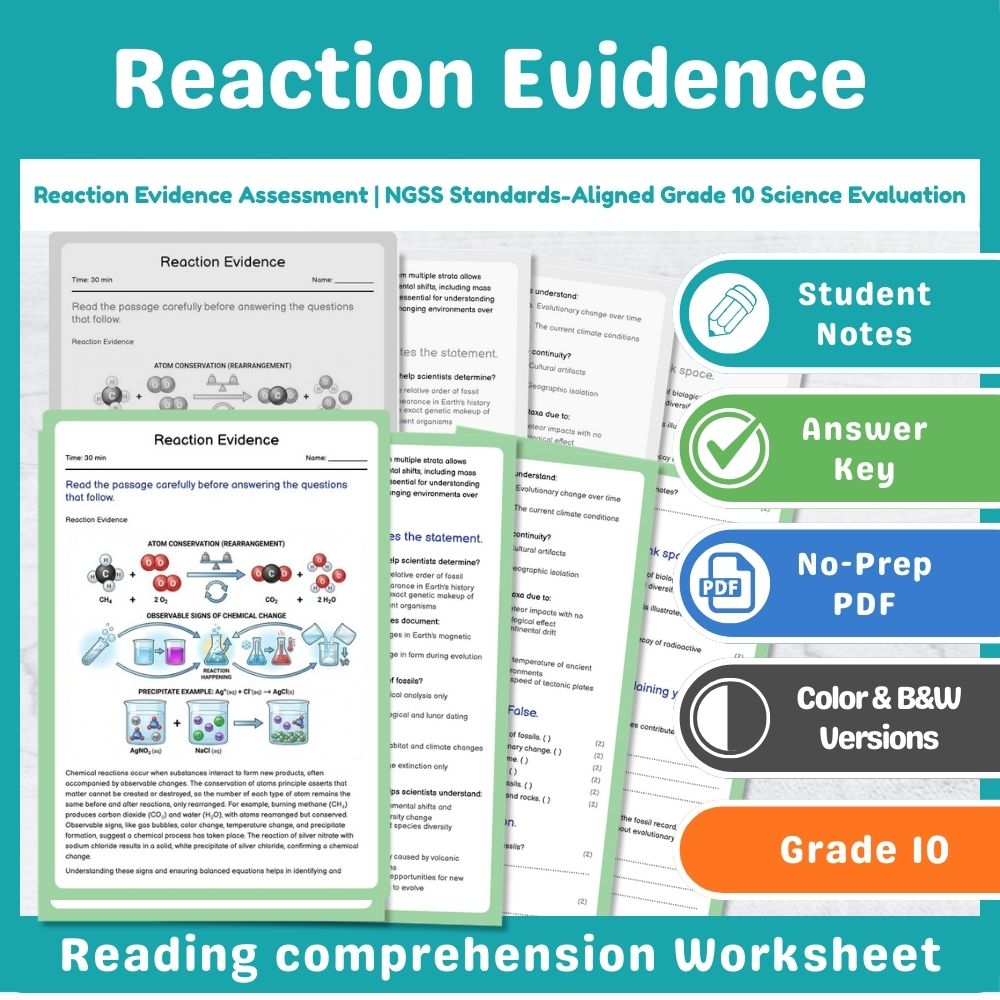
Reaction Evidence Assessment | NGSS Standards-Aligned Grade 10 Science Evaluation
Created byPrism Point LearningLearning Objectives
- Understand how conservation of atoms supports chemical reaction evidence.
- Identify observable signs indicating chemical reactions such as gas production, color change, and precipitate formation.
- Apply the principles of balanced equations to explain reaction outcomes.

Constraints Trade-Offs Assessment | General Standards & Grade 9 Science
Created byPrism Point LearningLearning Objectives
- Understand how design choices involve trade-offs among criteria such as cost, time, materials, safety, and reliability.
- Identify the role of constraints in limiting design options and criteria in evaluating success.
- Analyze how changing one criterion affects other aspects of a design, such as weight, safety, or cost.
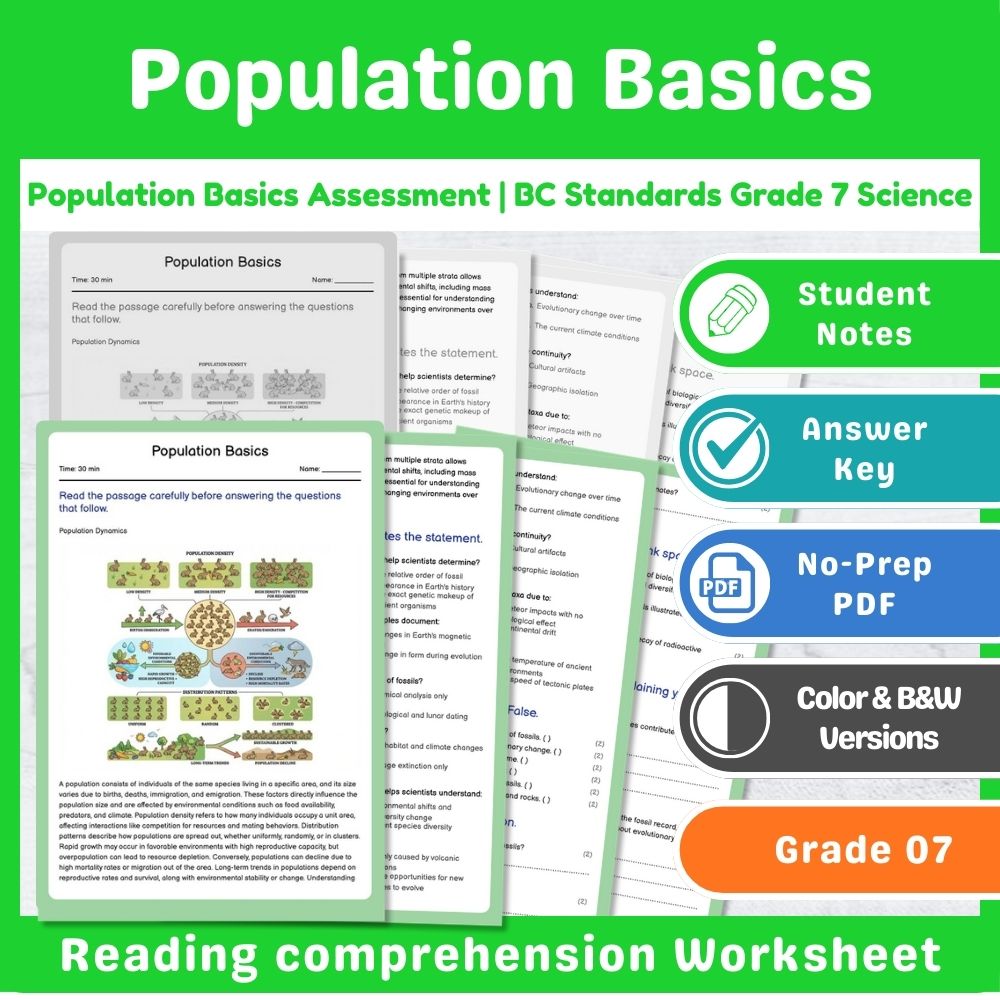
Population Basics Assessment | BC Standards Grade 7 Science
Created byPrism Point LearningLearning Objectives
- Understand the core metrics used to describe populations, such as size, density, and distribution patterns.
- Explain how demographic factors like births, deaths, immigration, and emigration influence population change.
- Analyze how environmental conditions interact with population dynamics over short-term and long-term scales.
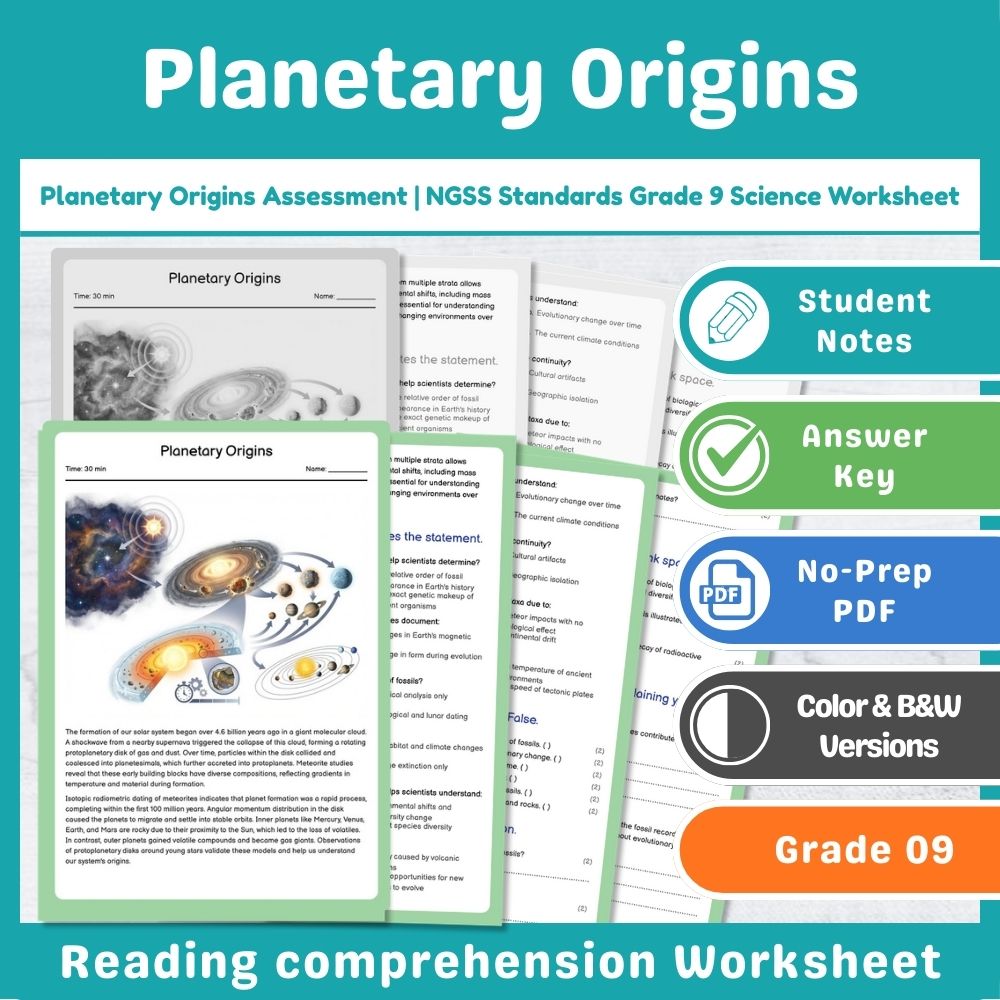
Planetary Origins Assessment | NGSS Standards Grade 9 Science Worksheet
Created byPrism Point LearningLearning Objectives
- Describe the formation processes of the solar system from a protoplanetary disk.
- Identify key evidence supporting planetary formation theories, including meteorite composition and isotopic dating.
- Explain the differences between inner rocky planets and outer gas giants based on planetary differentiation and volatile content.
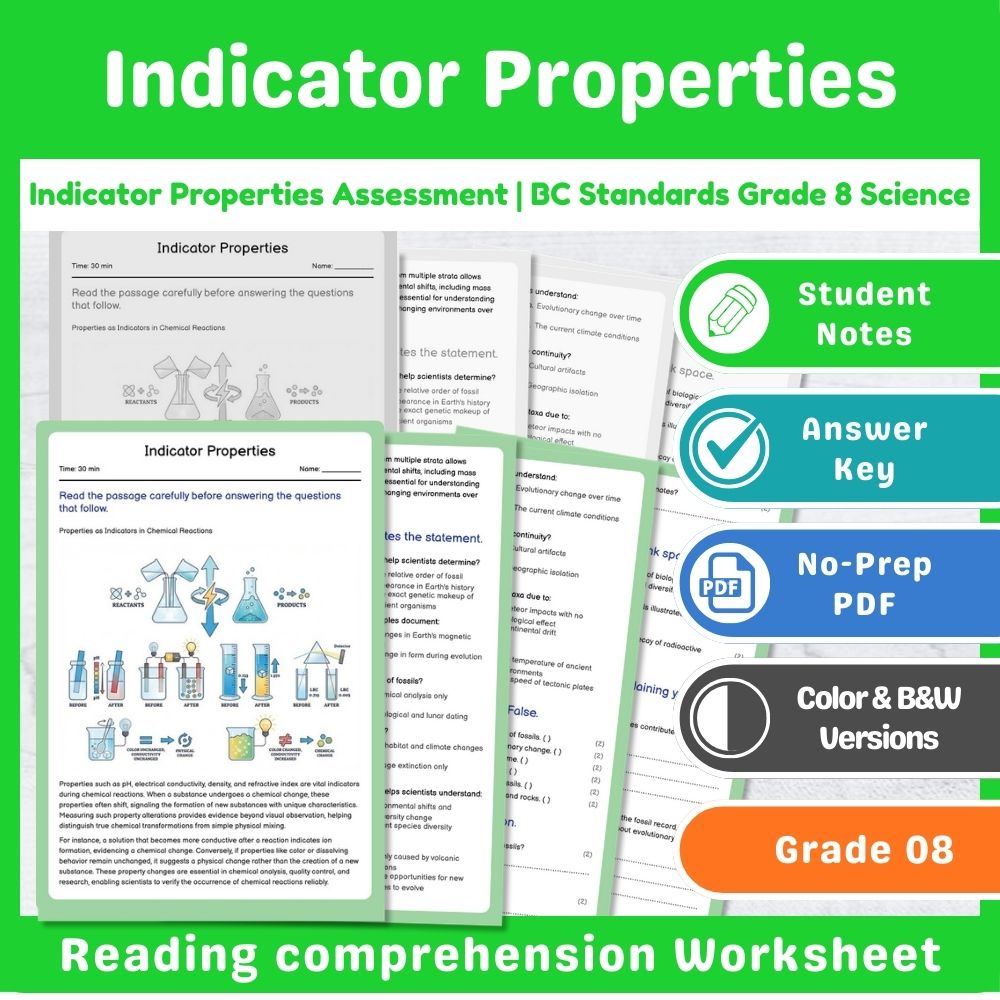
Indicator Properties Assessment | BC Standards Grade 8 Science
Created byPrism Point LearningLearning Objectives
- Understand how properties such as pH, conductivity, density, and refractive index change during chemical reactions.
- Identify property shifts indicating formation of new substances with distinct traits.
- Differentiate between physical and chemical changes using property measurements.
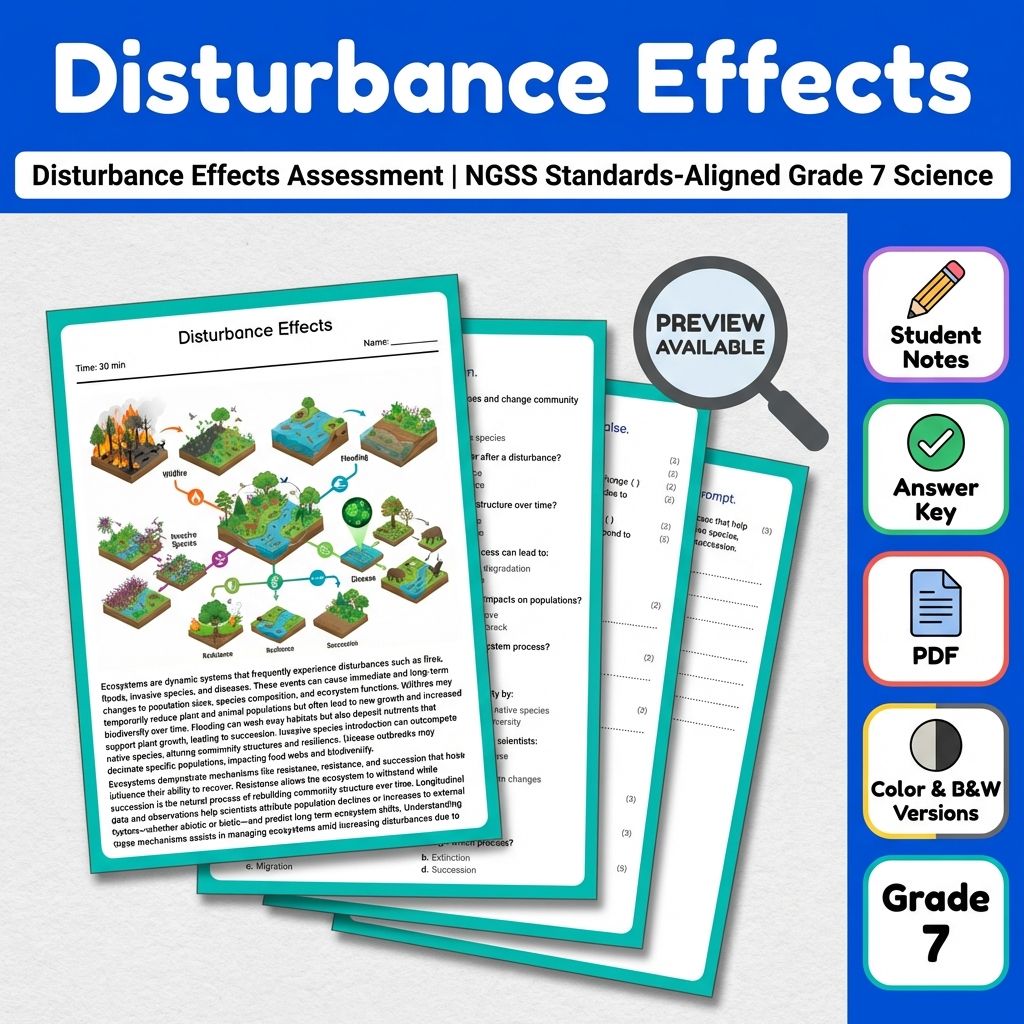
Disturbance Effects Assessment | NGSS Standards-Aligned Grade 7 Science
Created byPrism Point LearningLearning Objectives
- Understand how physical and biological disturbances impact ecosystems and populations.
- Identify mechanisms such as resilience, resistance, and succession that influence ecosystem recovery.
- Interpret empirical data and observations to determine causes of population changes.
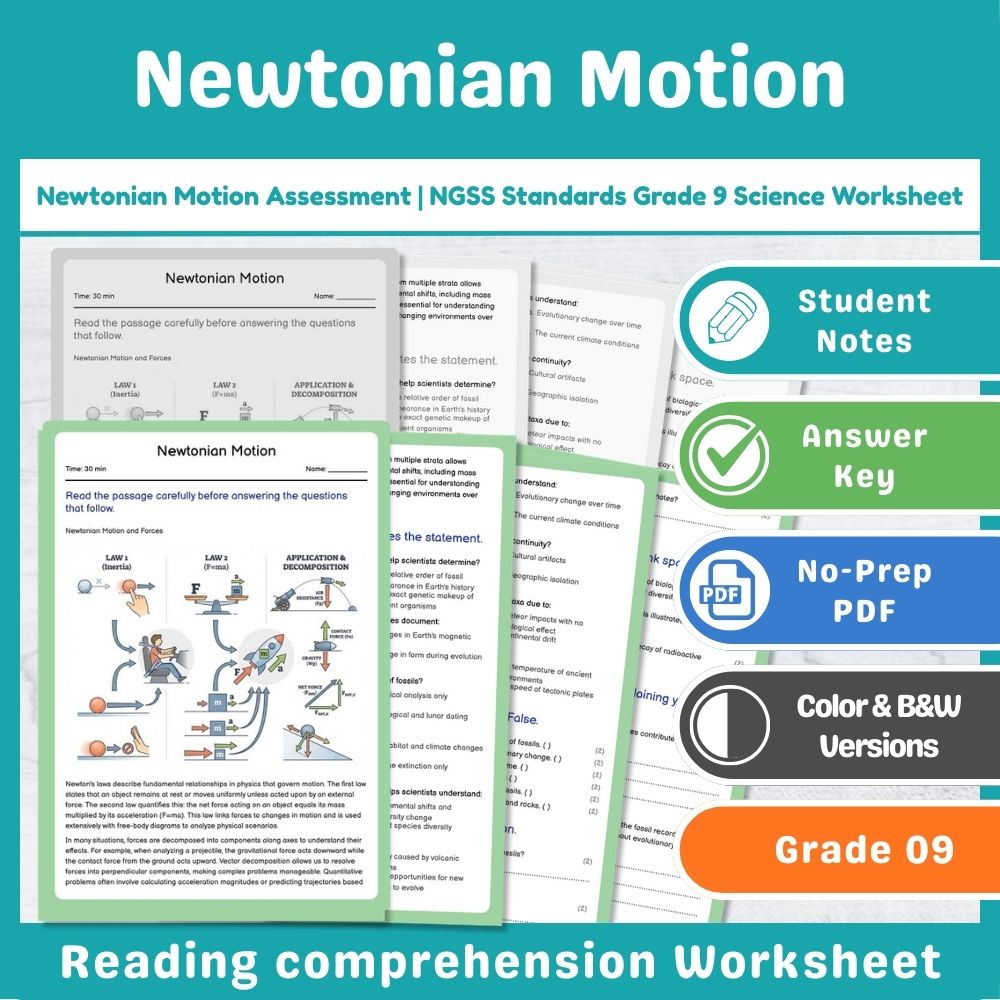
Newtonian Motion Assessment | NGSS Standards Grade 9 Science Worksheet
Created byPrism Point LearningLearning Objectives
- Explain the relationship between force, mass, and acceleration as described by Newton's second law.
- Analyze free-body diagrams to identify forces acting on objects in motion.
- Apply vector decomposition to determine forces and predict trajectories.

Mass Conservation Assessment | BC Standards Grade 9 Science
Created byPrism Point LearningLearning Objectives
- Understand the principle of conservation of mass during chemical reactions.
- Interpret balanced chemical equations to identify atom counts.
- Explain how mass remains constant before and after a chemical change.
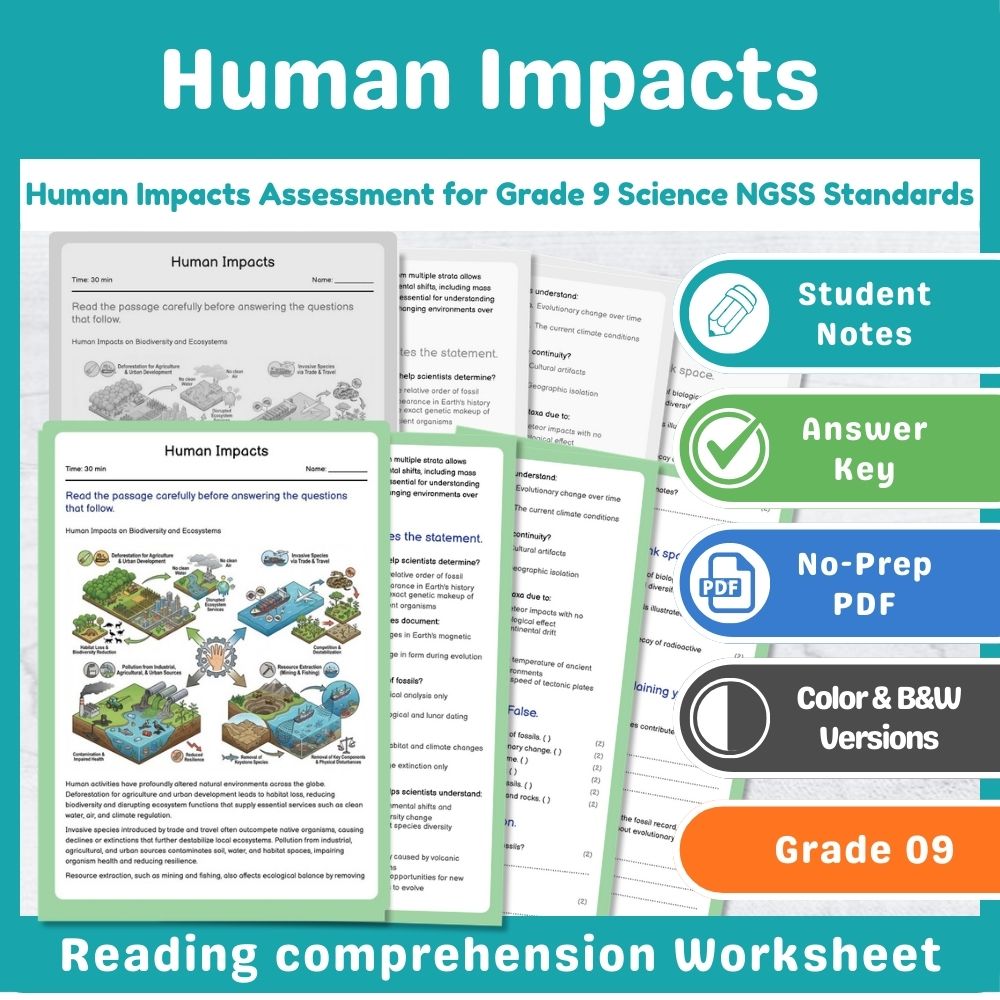
Human Impacts Assessment for Grade 9 Science NGSS Standards
Created byPrism Point LearningLearning Objectives
- Analyze how land-use change, invasive species, pollution, and resource extraction affect biodiversity and ecosystems.
- Interpret empirical data from case studies such as deforestation, coral reef degradation, and agricultural runoff.
- Evaluate trade-offs among conservation efforts, provisioning services, and socioecological outcomes.
Browse more categories
About Science Worksheets
Find Science worksheets spanning core skills, practice, and review. All 42,685 resources are instant PDF downloads for the classroom or home.
Every worksheet on MyTeachingSheets is created by independent teacher-authors and reviewed before publication. All resources download as printable PDFs for classroom, homework, or at-home practice, and many include answer keys. Preview any worksheet free before buying.