
Science Worksheets
42,859 subject resources
Grade 9 Science | Force Interactions Worksheet | AP Aligned
 Created byLumora Learning
Learning Objectives
- Explain how net external forces influence the motion of objects using Newtonian dynamics.
- Interpret force diagrams and free-body diagrams to analyze force interactions.
- Apply quantitative concepts to calculate acceleration resulting from various force scenarios.
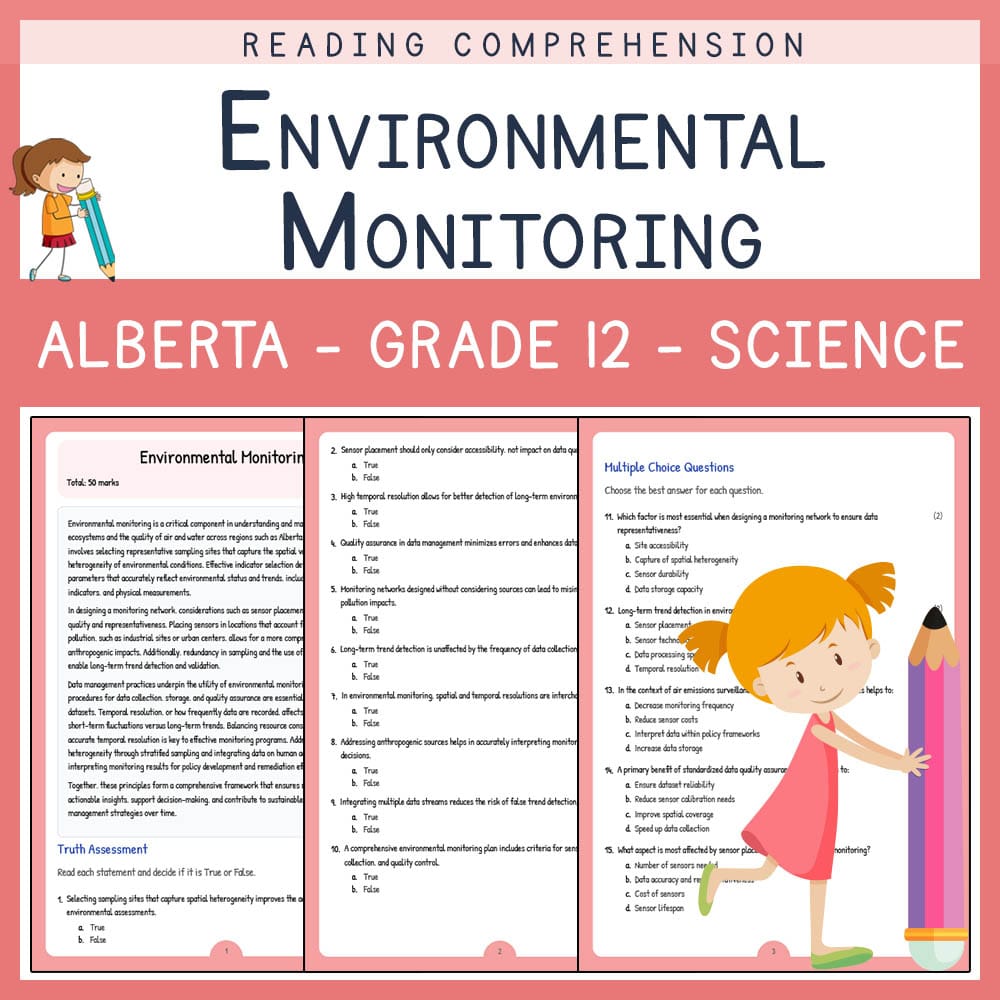
Grade 12 Science | Environmental Monitoring Worksheet | Alberta Standards
Created byLumora LearningLearning Objectives
- Understand the principles of environmental network design, indicator selection, and data management.
- Identify criteria for representative sampling and sensor placement in environmental monitoring.
- Analyze how spatial heterogeneity and anthropogenic sources influence monitoring interpretation.
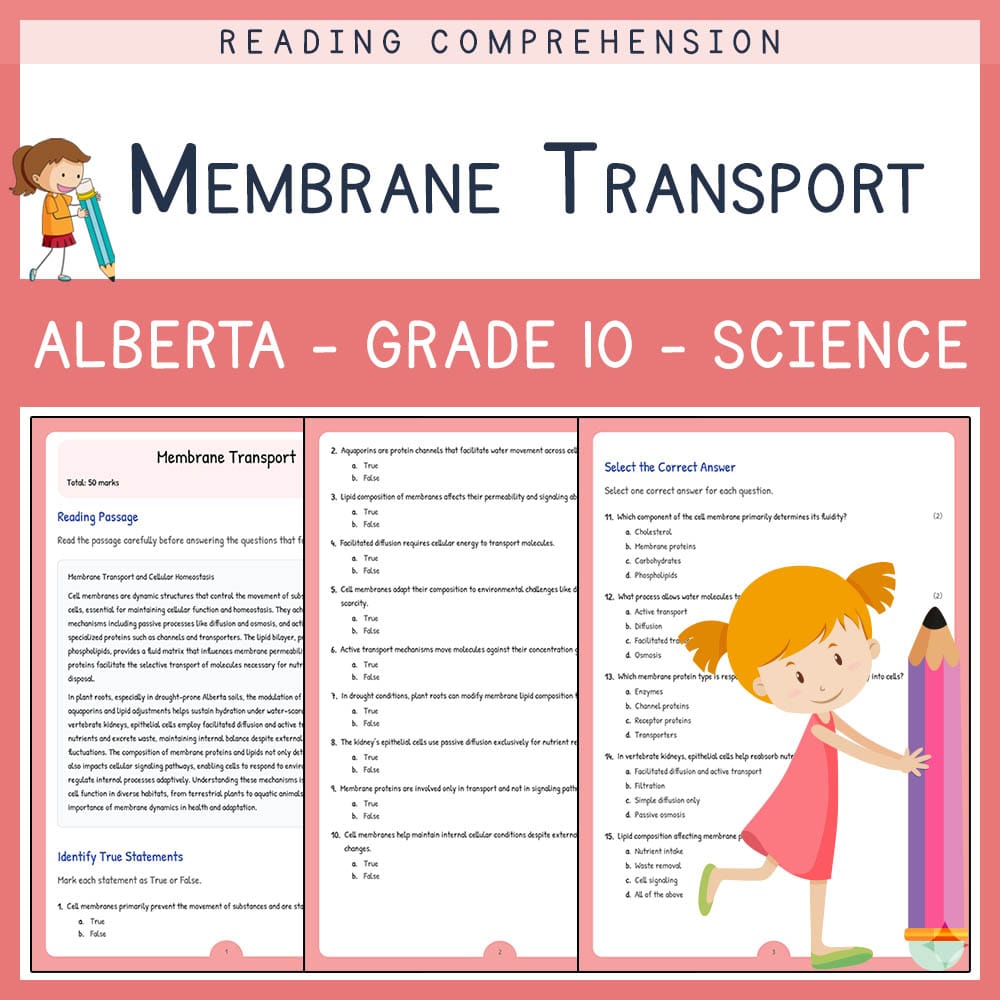
Grade 10 Science | Membrane Transport Worksheet | Alberta Standards
Created byLumora LearningLearning Objectives
- Understand the mechanisms of membrane transport such as diffusion, osmosis, and facilitated transport.
- Explain how membrane proteins and lipid composition influence permeability and cellular signaling.
- Connect membrane transport processes to cellular homeostasis, nutrient uptake, and waste removal in different habitats.
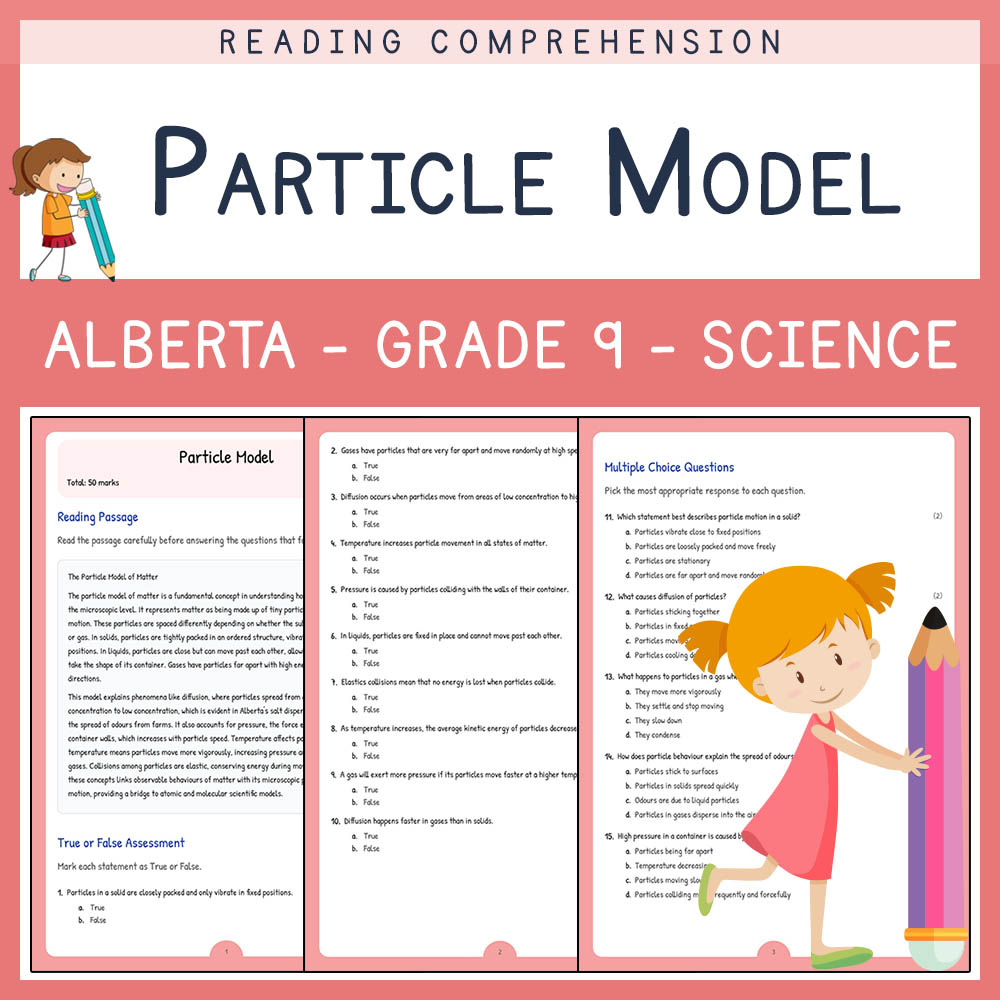
Grade 9 Science | Particle Model Worksheet | Alberta Standards
Created byLumora LearningLearning Objectives
- Explain the basic concepts of the particle model of matter, including particle spacing and motion.
- Describe how the particle model accounts for diffusion, pressure, and temperature changes.
- Relate particle behaviour in solids, liquids, and gases to their particle arrangements and movement.
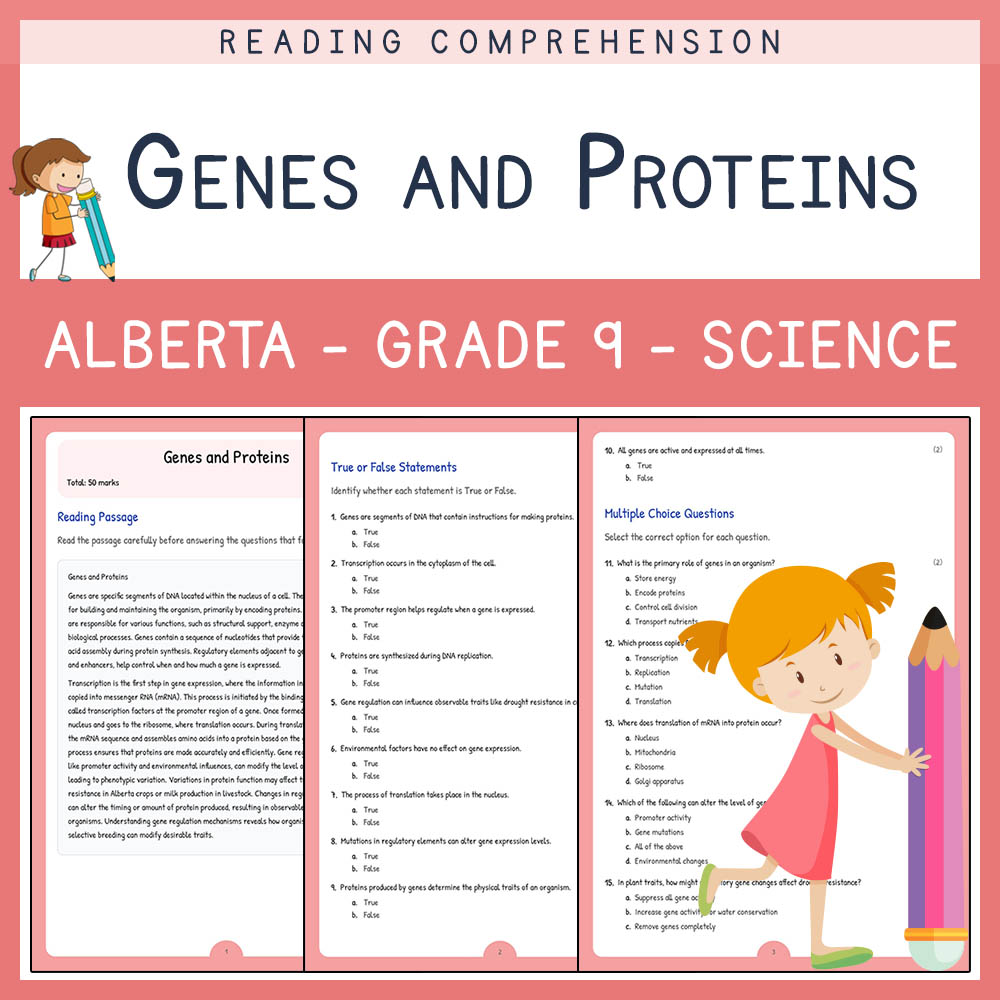
Grade 9 Science | Genes and Proteins Worksheet | Alberta Standards
Created byLumora LearningLearning Objectives
- Understand the structure and function of genes as DNA segments that encode proteins.
- Explain the processes of transcription and translation in gene expression.
- Identify how gene regulation influences phenotype and observable traits in organisms.
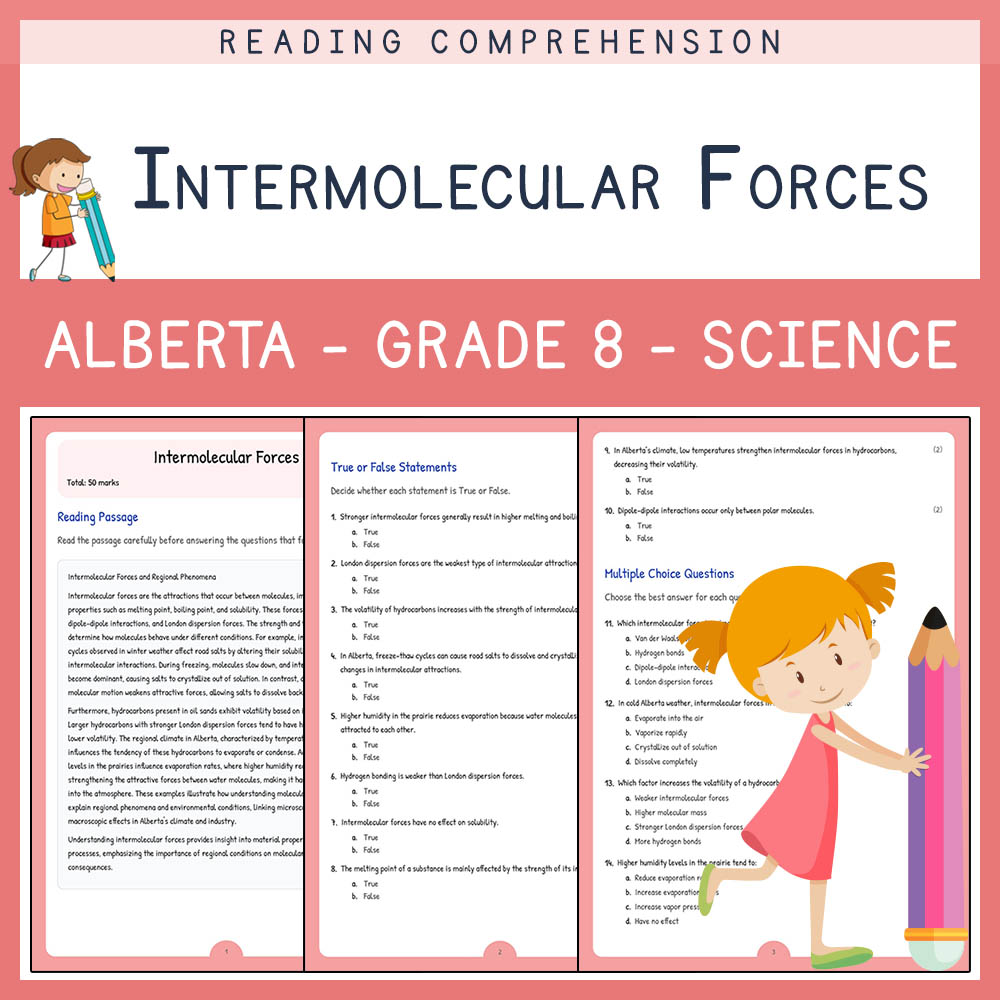
Grade 8 Science | Intermolecular Forces Worksheet | Alberta Standard
Created byLumora LearningLearning Objectives
- Explain how intermolecular forces influence melting point, boiling point, and solubility.
- Describe regional phenomena such as freeze–thaw cycles, hydrocarbon volatility, and humidity effects in terms of molecular interactions.
- Compare the strength of different types of intermolecular forces and their effects on physical properties.
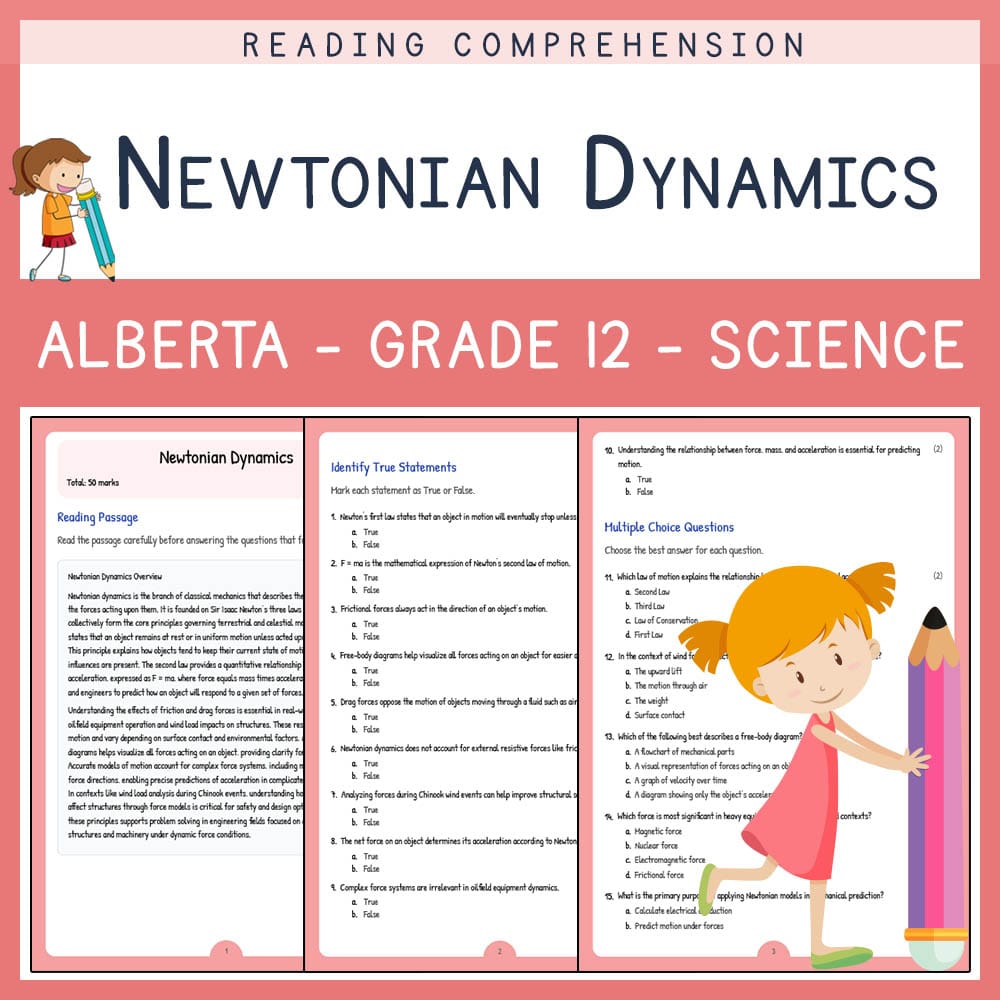
Grade 12 Science | Newtonian Dynamics Worksheet | Alberta Standards
Created byLumora LearningLearning Objectives
- Understand the fundamental principles of Newtonian mechanics and how forces influence motion.
- Apply Newton's three laws to analyze real-world problems involving frictional and drag forces.
- Interpret and construct free-body diagrams for complex systems under multiple forces.
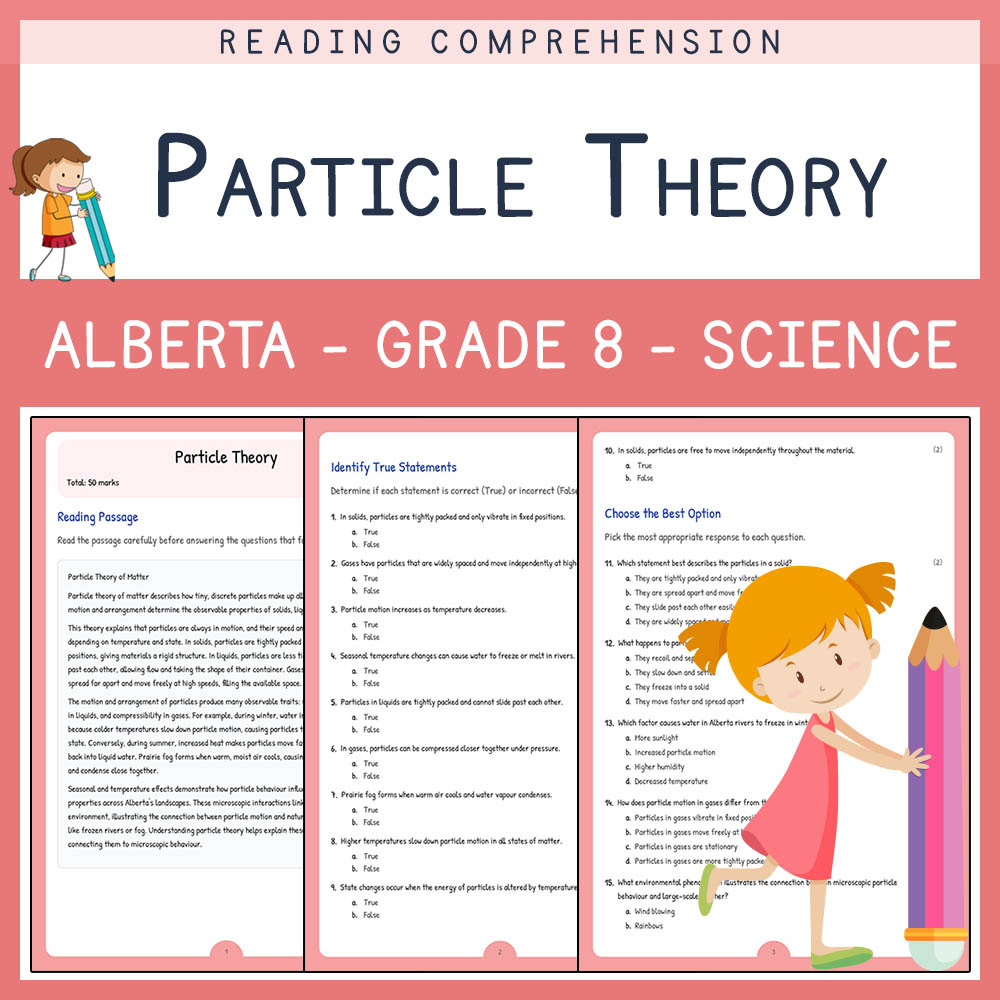
Grade 8 Science | Particle Theory Worksheet | Alberta Standard
Created byLumora LearningLearning Objectives
- Explain the basic concepts of particle theory of matter and how particles behave in solids, liquids, and gases.
- Connect microscopic particle behaviour to observable properties such as rigidity, flow, and compressibility.
- Describe how temperature and seasonal changes affect particle motion and state transitions.
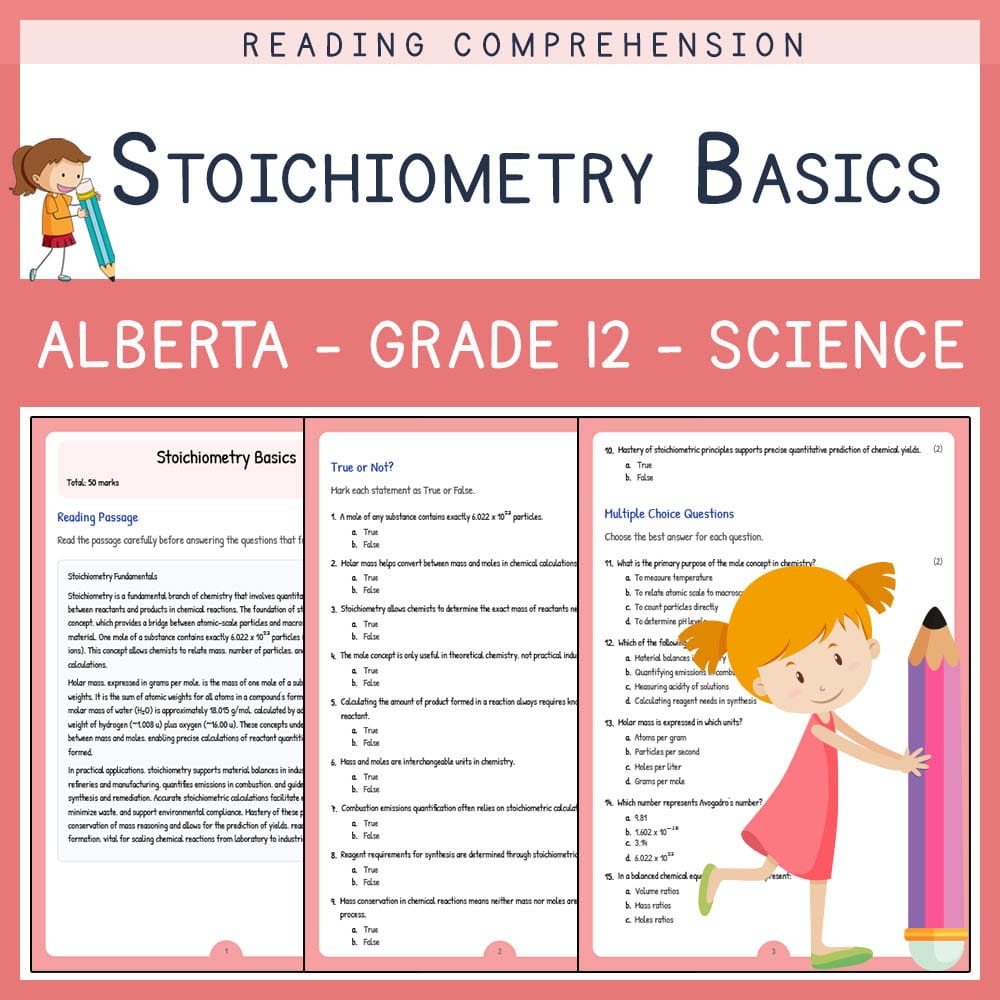
Grade 12 Science | Stoichiometry Basics Worksheet | Alberta Standards
Created byLumora LearningLearning Objectives
- Understand the mole concept and its significance in chemical calculations.
- Learn to calculate molar mass and convert between mass and moles.
- Apply mass and mole relationships to balanced chemical equations.
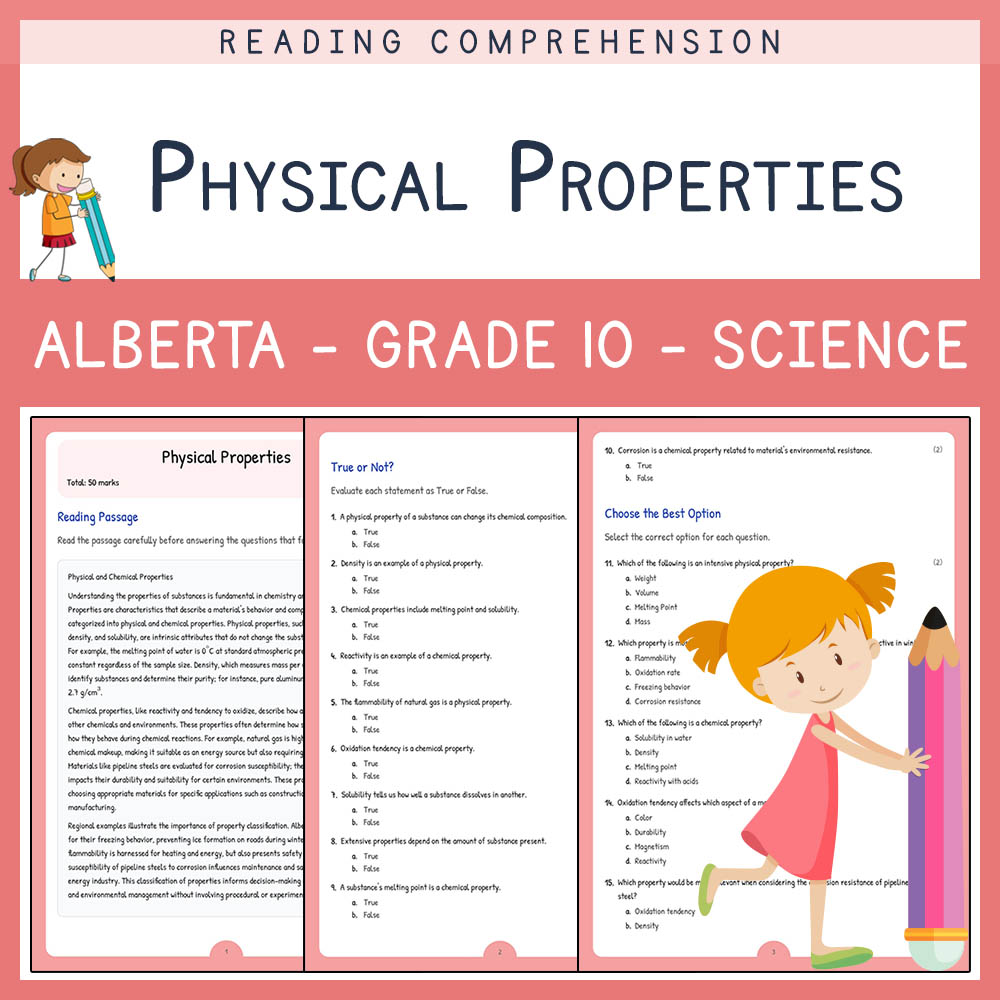
Grade 10 Science | Physical Properties Worksheet | Alberta Standards
Created byLumora LearningLearning Objectives
- Differentiate between physical and chemical properties of substances.
- Identify and classify various physical properties such as melting point, density, and solubility.
- Understand chemical properties like reactivity and oxidation tendency.
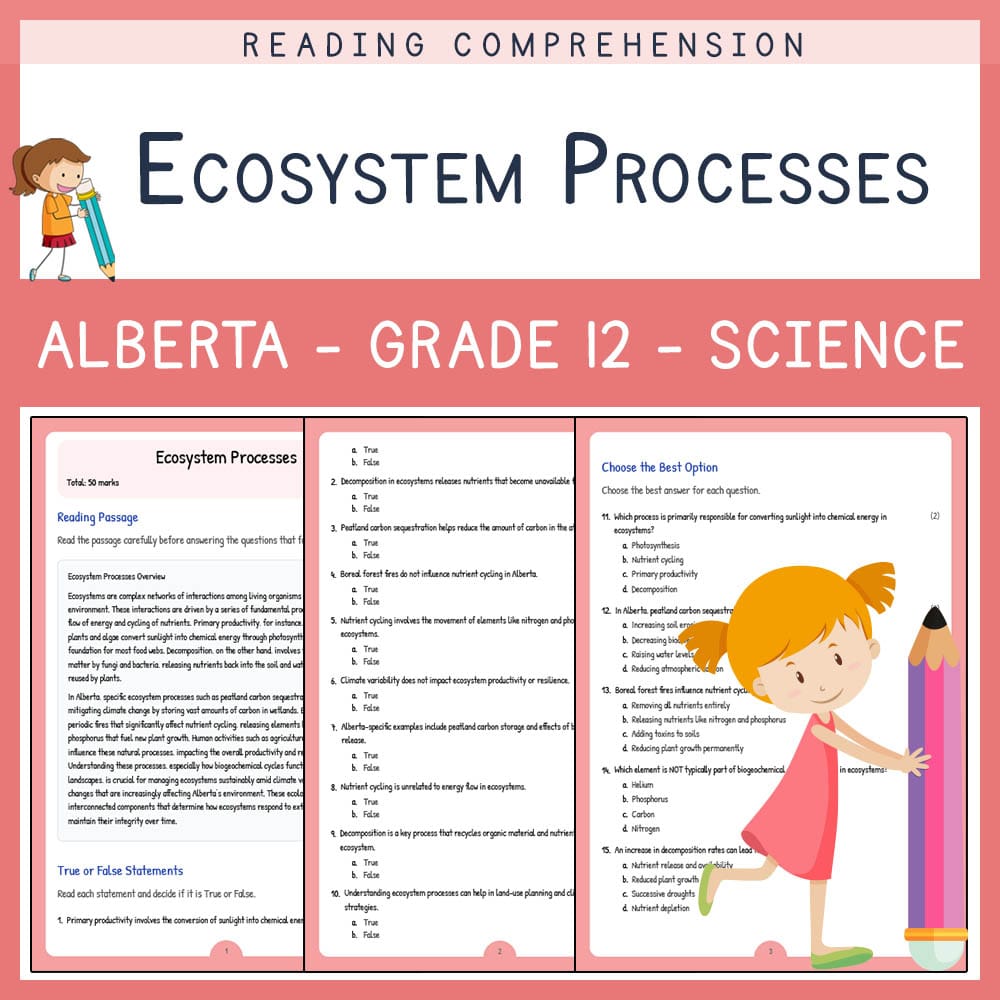
Grade 12 Science | Ecosystem Processes Worksheet | Alberta Standards
Created byLumora LearningLearning Objectives
- Describe key ecosystem processes such as primary productivity, decomposition, and nutrient cycling.
- Explain biogeochemical cycles of carbon, nitrogen, and phosphorus and their ecological significance.
- Identify Alberta-specific examples of ecosystem processes like peatland carbon sequestration and boreal fire effects.
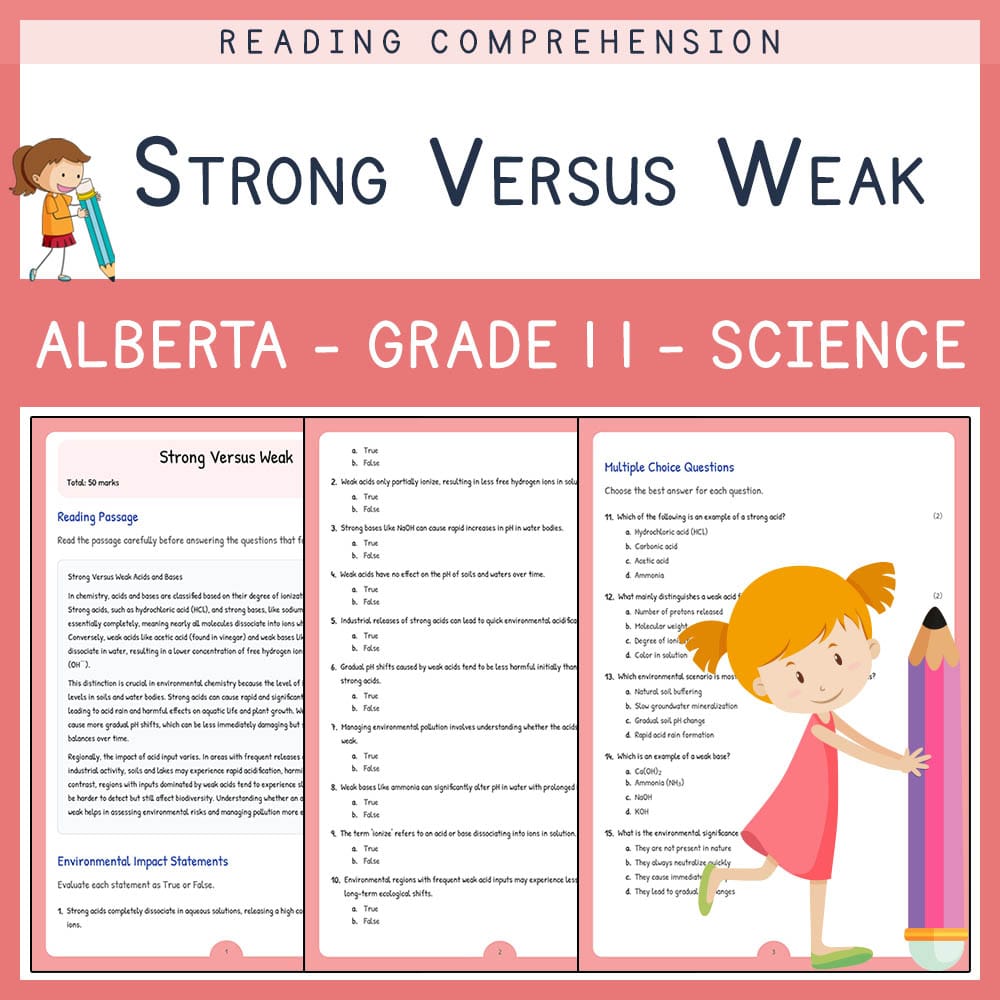
Grade 11 Science | Strong Versus Weak Acid Worksheet | Alberta Standards
Created byLumora LearningLearning Objectives
- Explain the difference between strong and weak acids and bases in terms of ionization.
- Identify examples of strong and weak acids/bases in environmental contexts.
- Understand how the strength of acids and bases impacts their environmental and biological effects.
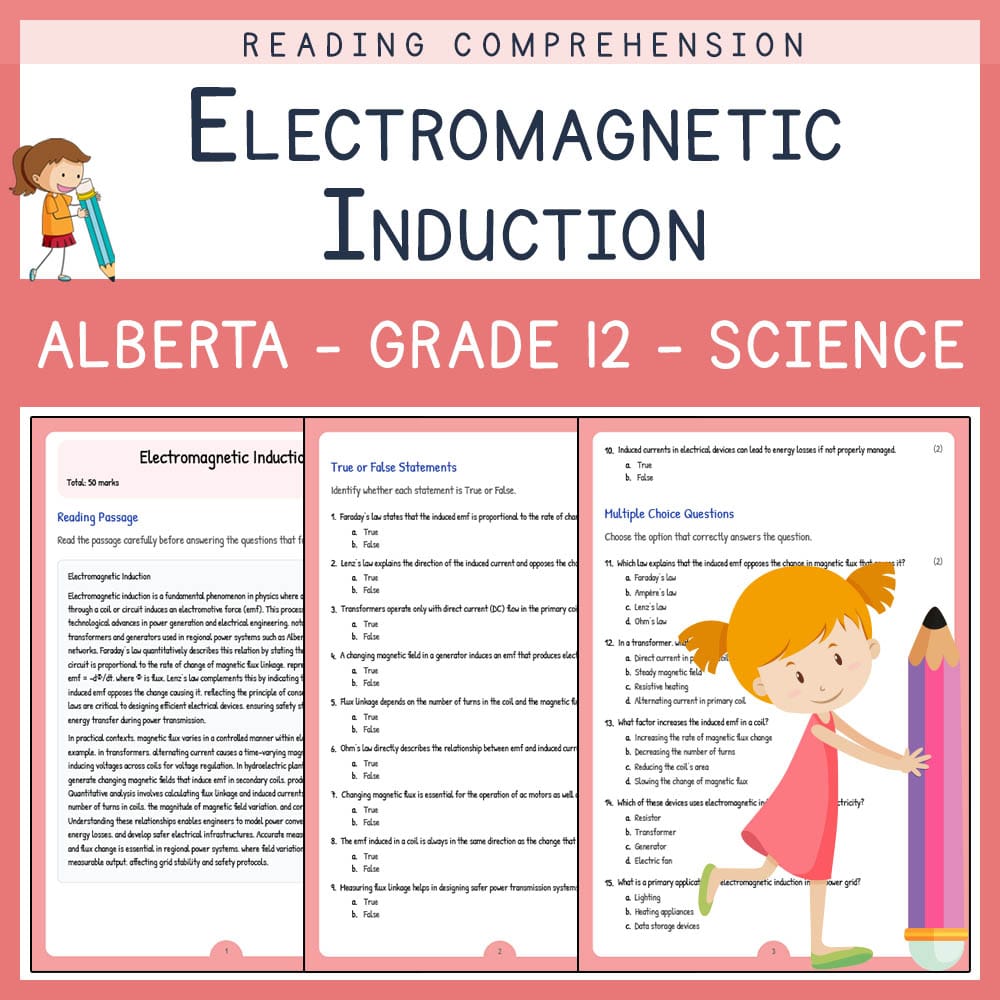
Grade 12 Science | Electromagnetic Induction Worksheet | Alberta Standards
Created byLumora LearningLearning Objectives
- Understand the principles of electromagnetic induction, including Faraday’s law and Lenz’s law.
- Analyze how changing magnetic flux induces emf in various practical applications.
- Explore the relationship between magnetic field variation, flux linkage, and induced currents.
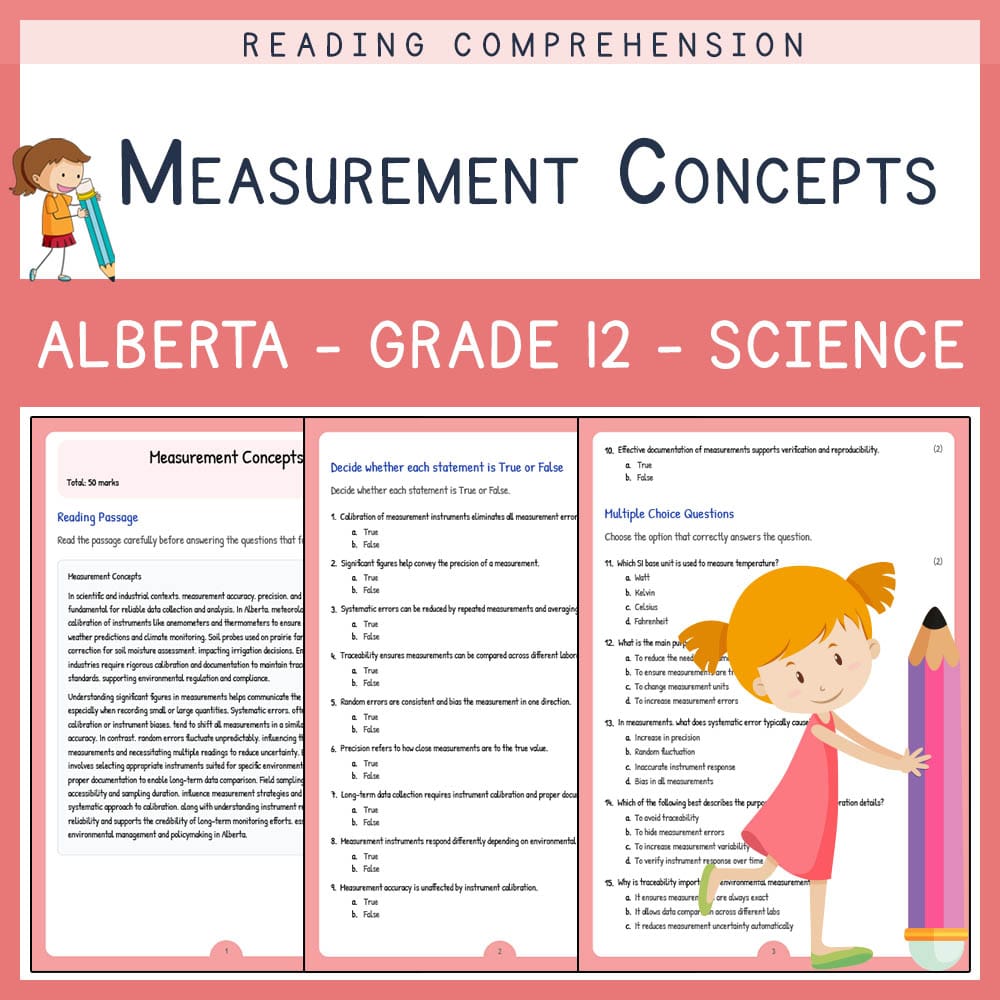
Grade 12 Science | Measurement Concepts Worksheet | Alberta Standards
Created byLumora LearningLearning Objectives
- Understand fundamental measurement units and their applications in Alberta contexts.
- Explain accuracy, precision, systematic and random errors, and traceability in measurement.
- Recognize how measurement choice and documentation impact data comparability.
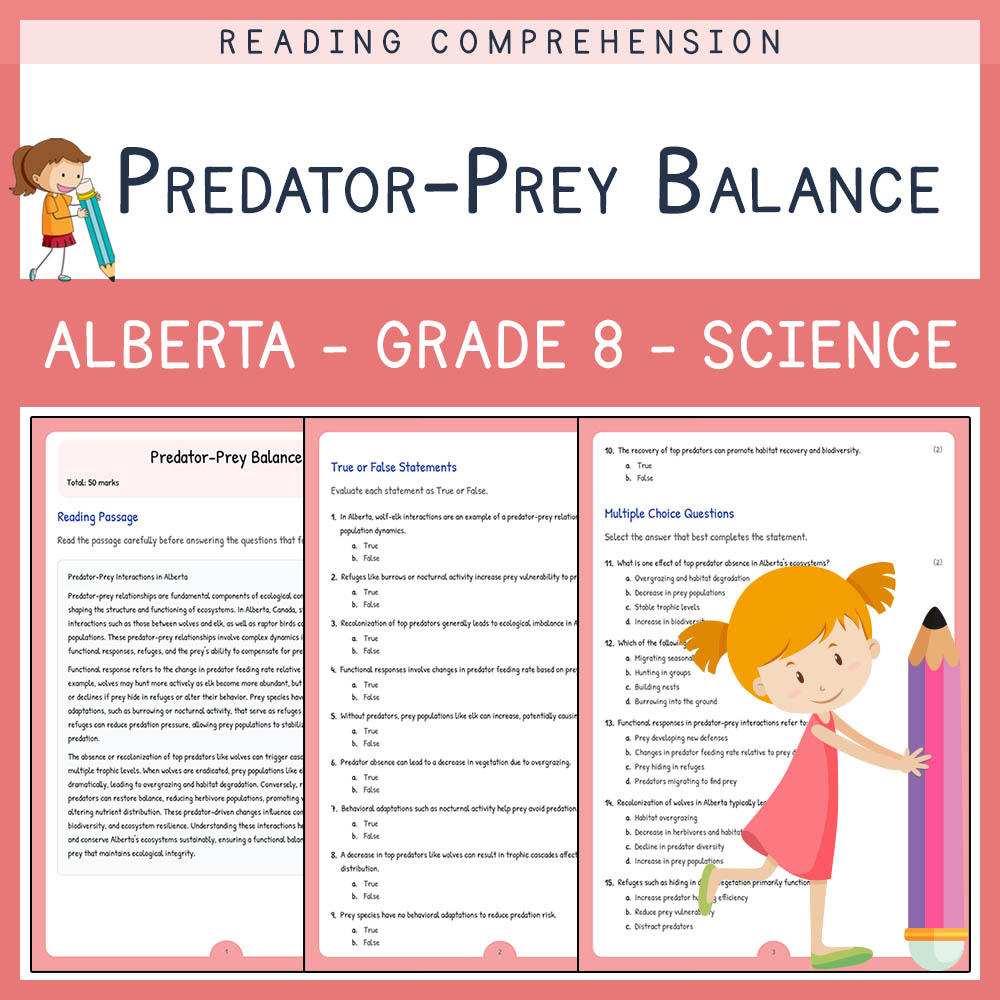
Grade 8 Science Worksheet | Predator–Prey Balance | Alberta Standards
Created byLumora LearningLearning Objectives
- Understand how predator-prey relationships influence population dynamics.
- Identify behavioral and community adaptations resulting from predation.
- Explain cascading effects caused by changes in top predator presence or recolonization.
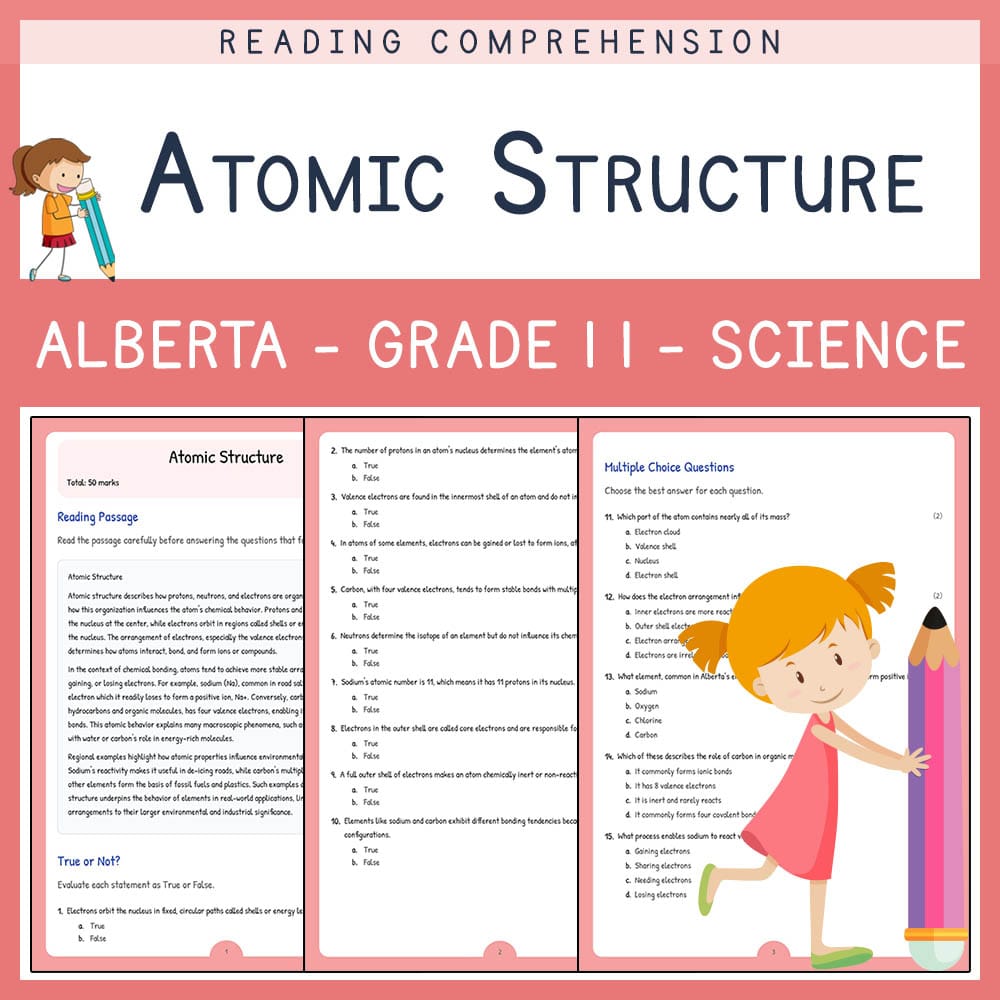
Grade 11 Science | Atomic Structure Worksheet | Alberta Standards
Created byLumora LearningLearning Objectives
- Describe the organization of protons, neutrons, and electrons within an atom.
- Explain how electron arrangements, including shells and valence electrons, influence chemical reactivity and bonding.
- Identify examples of elements used in industry and environment, such as sodium and carbon, and their atomic properties.
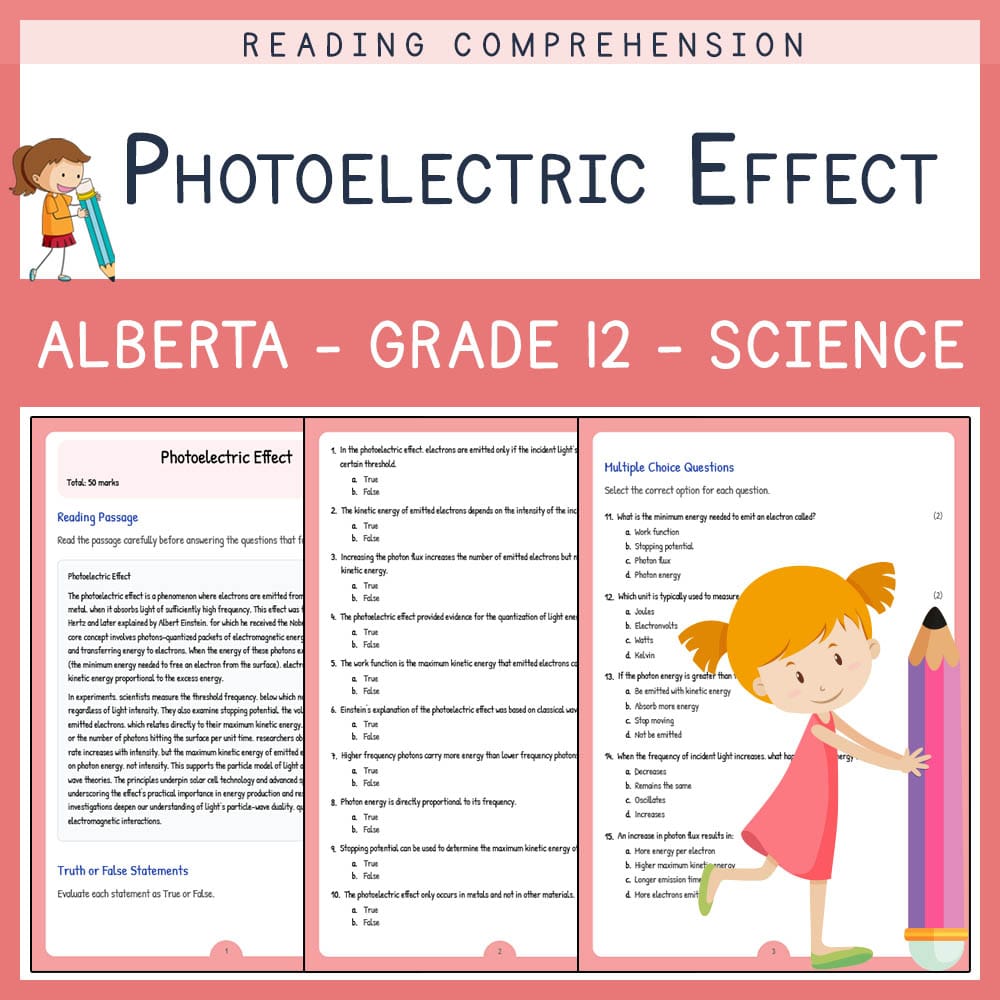
Grade 12 Science | Photoelectric Effect Worksheet | Alberta Standard
Created byLumora LearningLearning Objectives
- Explain the principles of the photoelectric effect and its significance in quantum physics.
- Connect the concepts of photon energy, work function, and kinetic energy of emitted electrons.
- Analyze how experimental measurements relate to the particle nature of light.
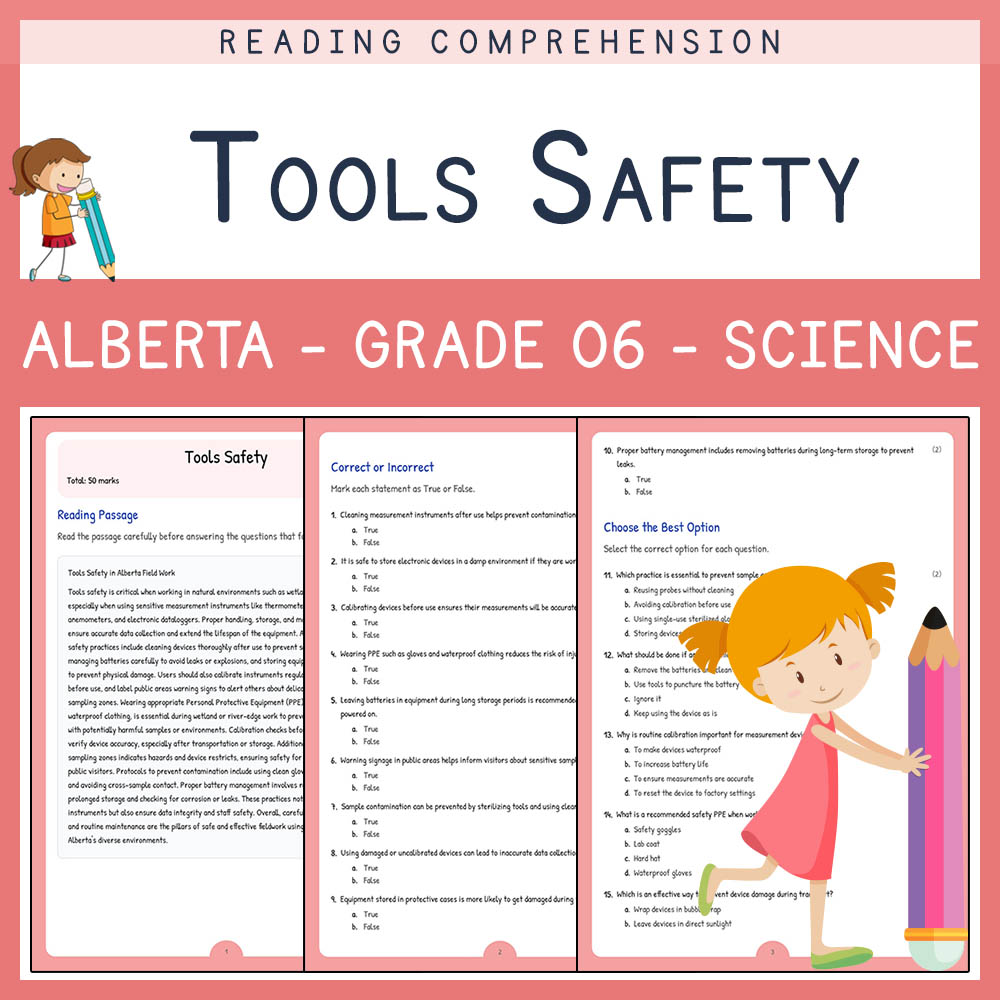
Grade 6 Science Worksheet | Tools Safety | Alberta-Aligned Assessment
Created byLumora LearningLearning Objectives
- Understand key safety practices for handling measurement tools near Alberta field sites.
- Identify proper storage, cleaning, and maintenance procedures for field equipment.
- Learn safety precautions for using electronic devices such as thermometers, pH probes, and dataloggers.
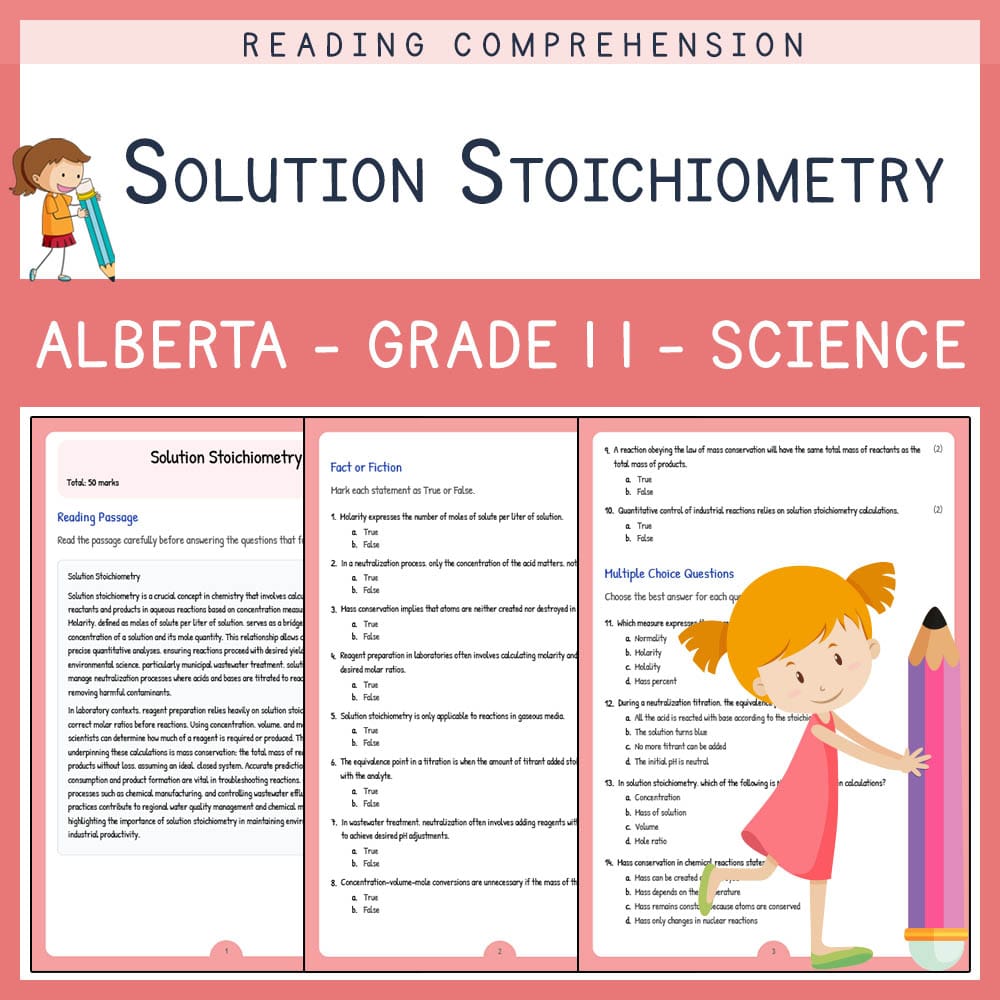
Grade 11 Science | Solution Stoichiometry Worksheet Elena | Alberta Standards
Created byLumora LearningLearning Objectives
- Understand the relationship between concentration, volume, and mole calculations in aqueous reactions.
- Apply mole relationships and equivalence concepts to predict reactant and product amounts.
- Utilize concentration-volume-mole conversions to support quantitative analysis in environmental and industrial contexts.
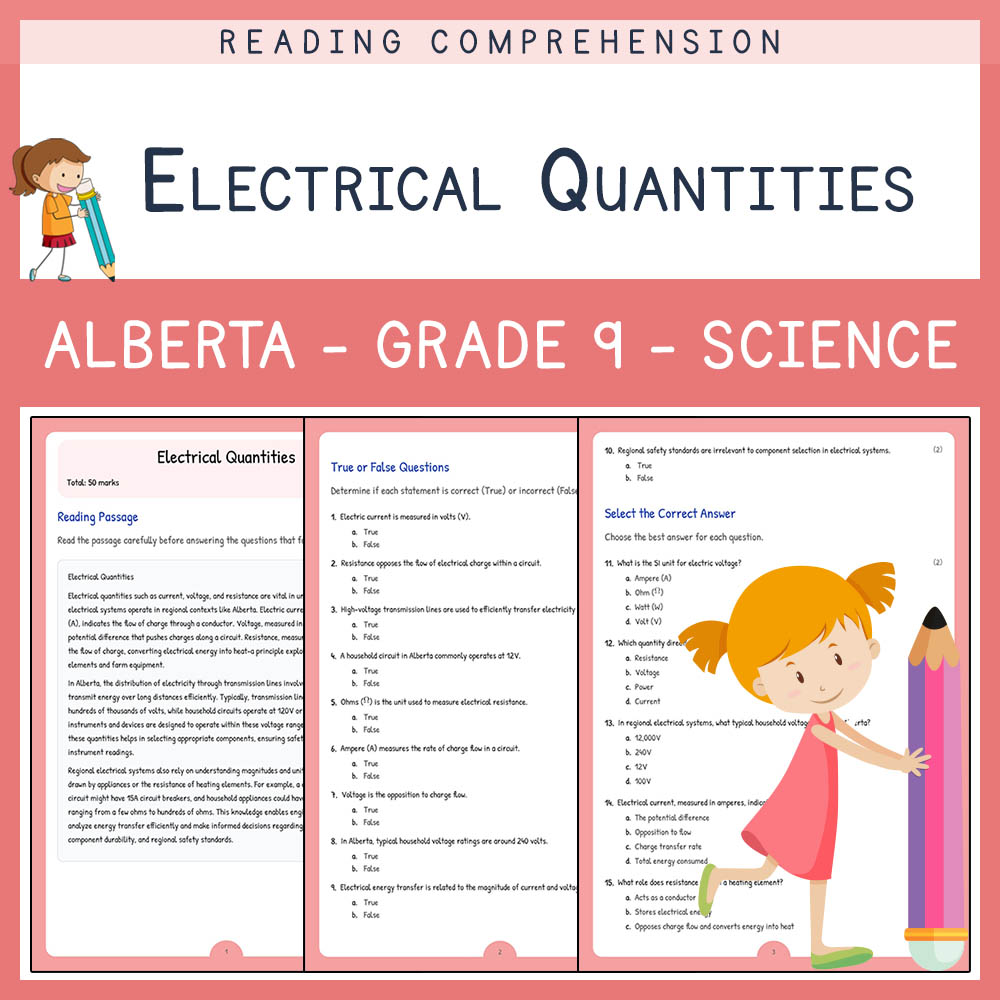
Grade 9 Science | Electrical Quantities Worksheet | Alberta Aligned
Created byLumora LearningLearning Objectives
- Understand the definitions of electric current, voltage, and resistance as fundamental electrical quantities.
- Interpret units, symbols, and typical magnitudes related to electrical measurements in regional contexts.
- Apply quantitative reasoning to analyze energy transfer, component selection, and instrument readings in electrical systems.
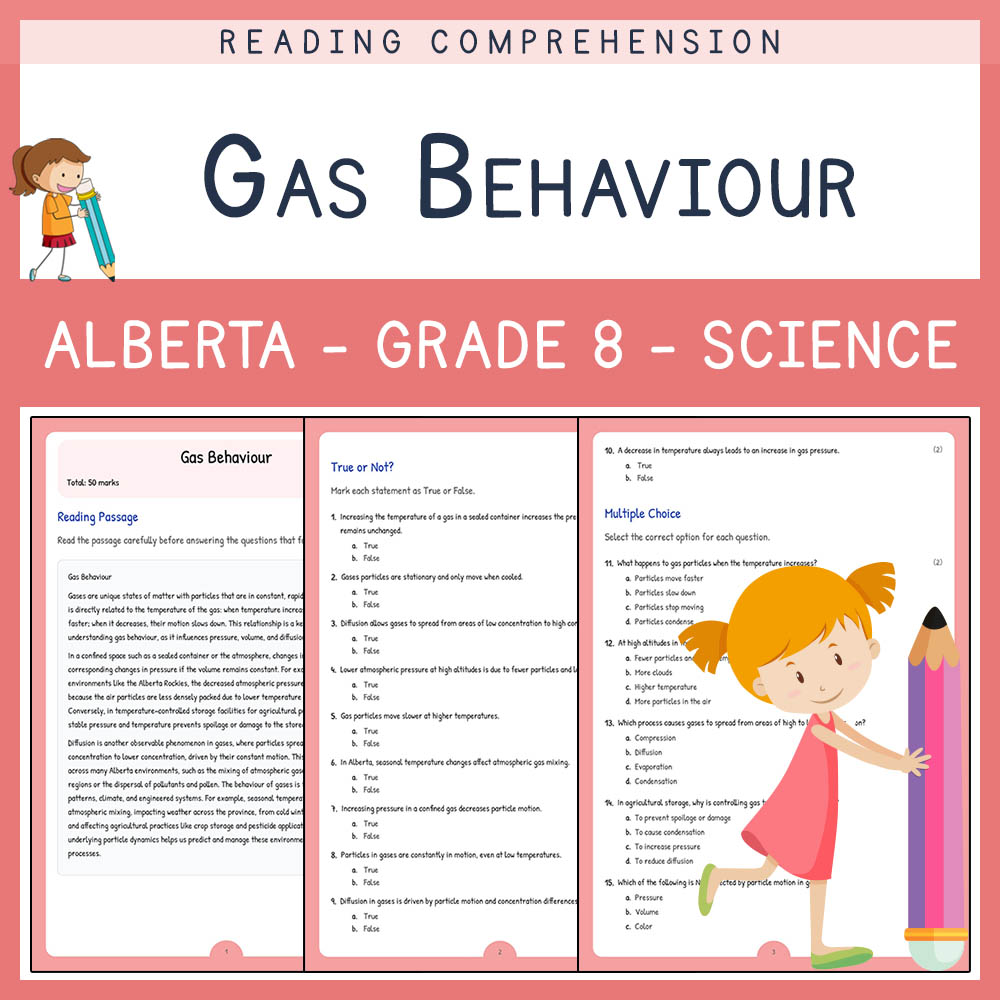
Grade 8 Science | Gas Behaviour Worksheet | Alberta Standards
Created byLumora LearningLearning Objectives
- Understand how particle motion, pressure, and temperature are interconnected in gases.
- Explain how changes in temperature can affect gas pressure and volume in closed systems.
- Describe real-world examples of gas behaviour, including atmospheric pressure variations and gas handling in agriculture.
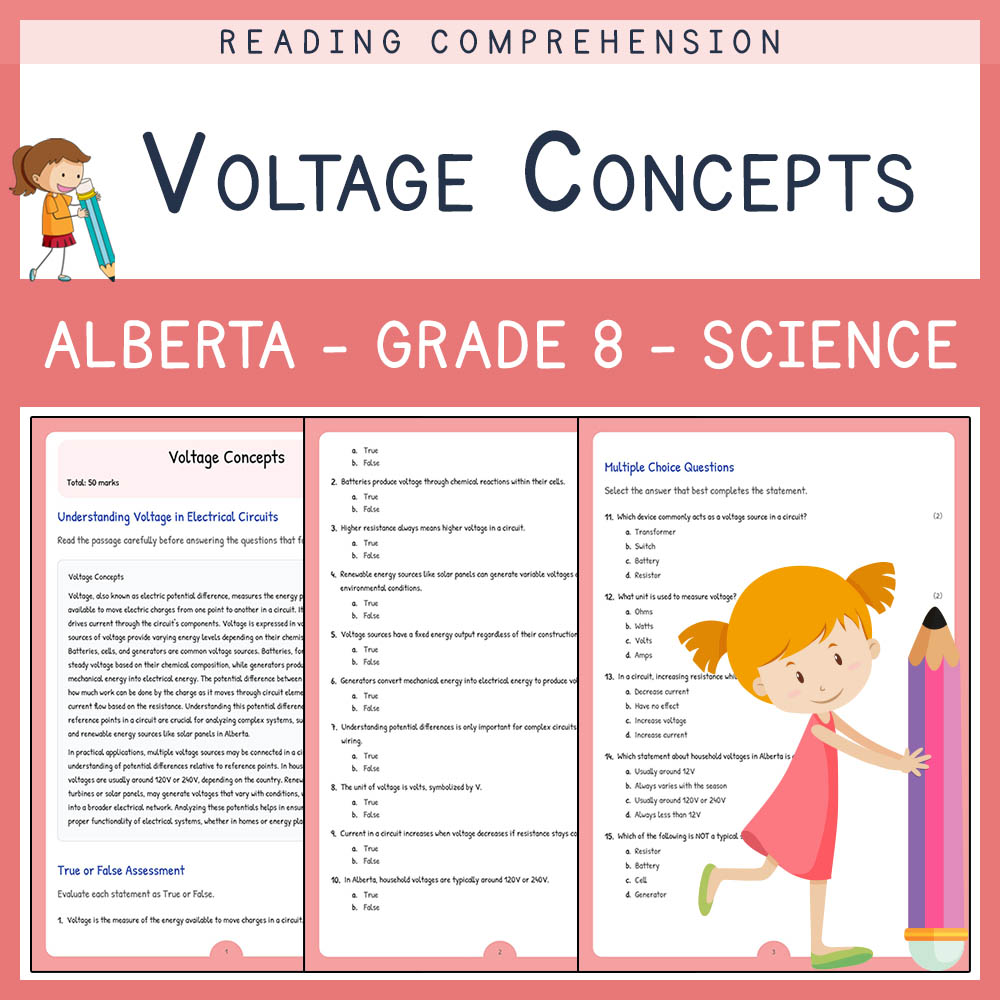
Grade 8 Science | Voltage Concepts Worksheet | Alberta Standards
Created byLumora LearningLearning Objectives
- Explain the concept of voltage and its role in electrical circuits.
- Identify different sources of voltage such as batteries, cells, and generators.
- Understand the relationship between voltage, current, and resistance in a circuit.
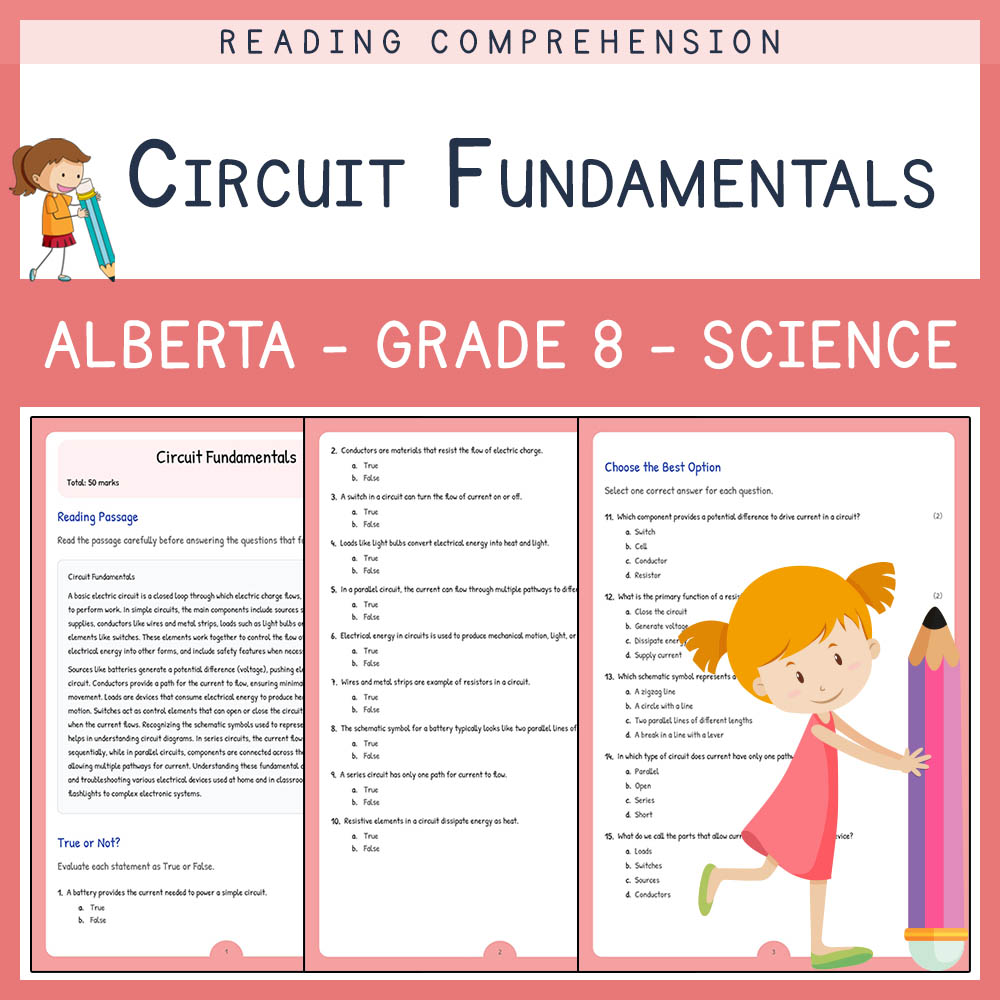
Grade 8 Science | Circuit Fundamentals Worksheet | Alberta Standard
Created byLumora LearningLearning Objectives
- Understand the basic components of a simple electric circuit and their functions.
- Identify schematic symbols for circuit elements such as sources, conductors, loads, and control devices.
- Differentiate between series and parallel circuit configurations.
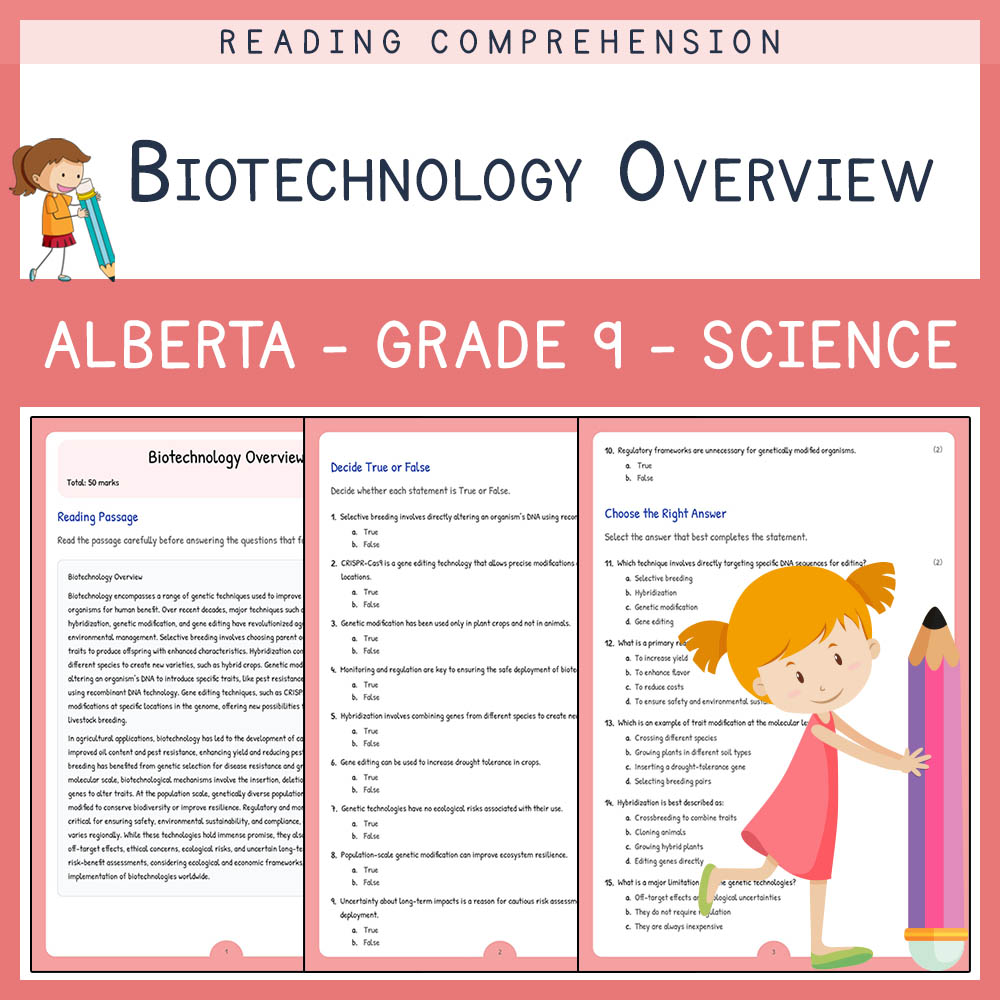
Grade 9 Science | Biotechnology Overview Worksheet | Alberta Standards
Created byLumora LearningLearning Objectives
- Understand major genetic technologies used in biotechnology.
- Identify applications of biotechnology in agriculture and livestock.
- Describe mechanisms of trait introduction and modification at molecular and population levels.
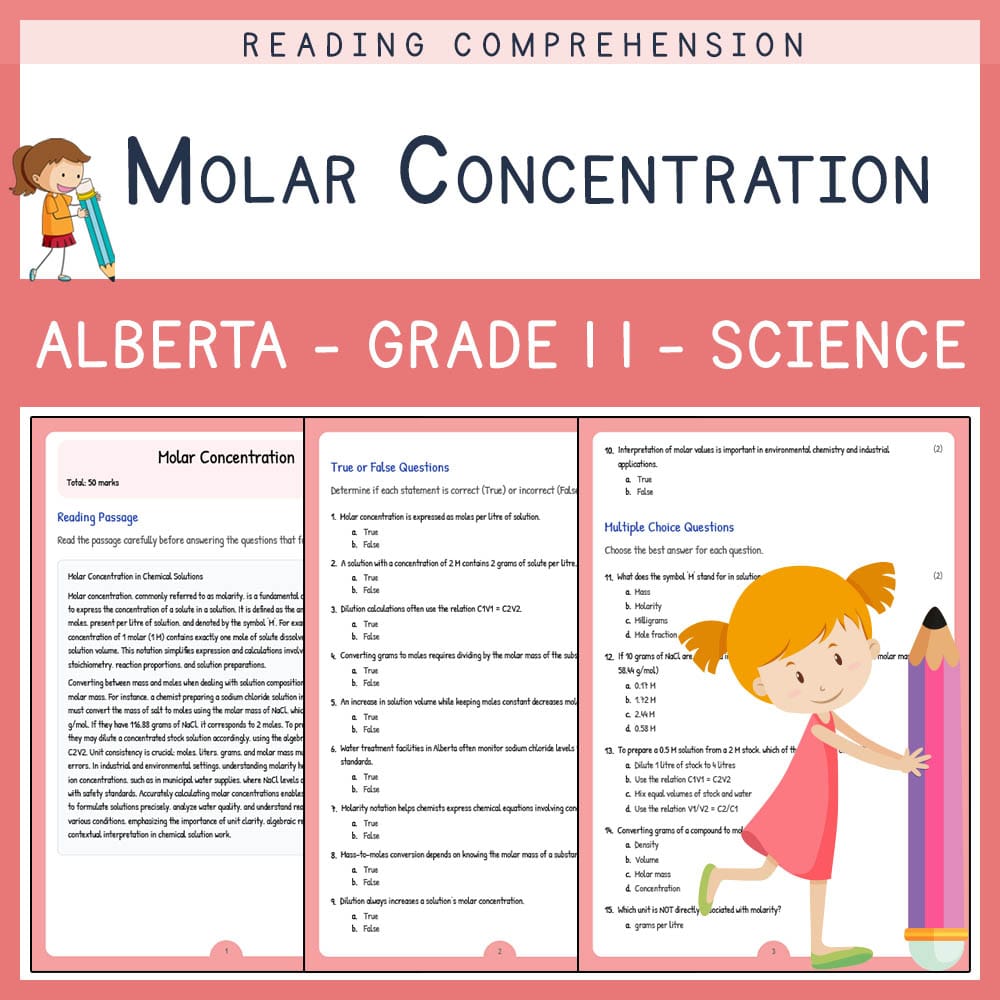
Grade 11 Science | Molar Concentration Worksheet | Alberta Standards
Created byLumora LearningLearning Objectives
- Define molar concentration and understand its notation.
- Convert between mass, moles, and volume in solution preparation.
- Apply dilution calculations to prepare solutions from concentrated stocks.

Grade 9 Science | Two-Dimensional Motion Worksheet | AP Aligned
Created byLumora LearningLearning Objectives
- Understand how vector decomposition helps analyze motion in a plane.
- Apply parametric equations to describe projectile trajectories.
- Use vector addition to predict range, maximum height, and time-of-flight.
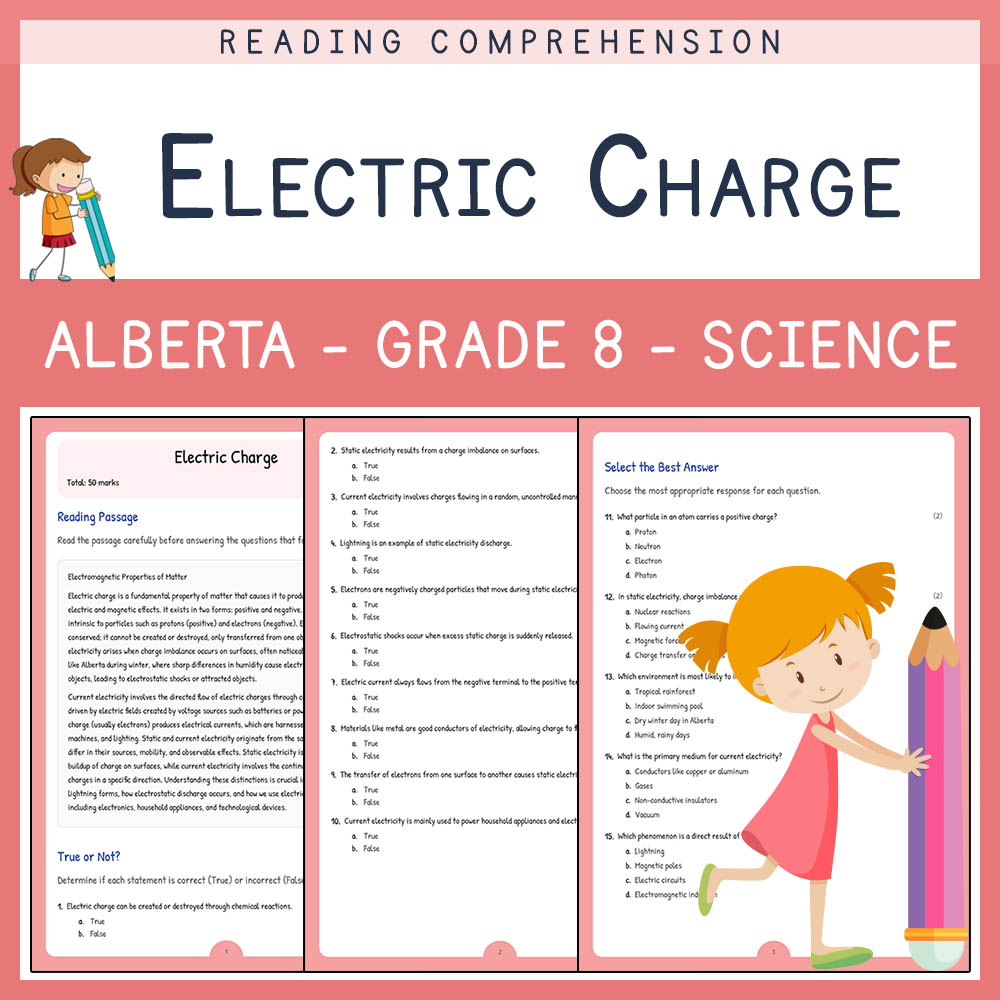
Grade 8 Science | Electric Charge Worksheet | Alberta Standards
Created byLumora LearningLearning Objectives
- Understand the concept of electric charge and its properties.
- Distinguish between static electricity and current electricity.
- Identify real-world phenomena related to electric charge.
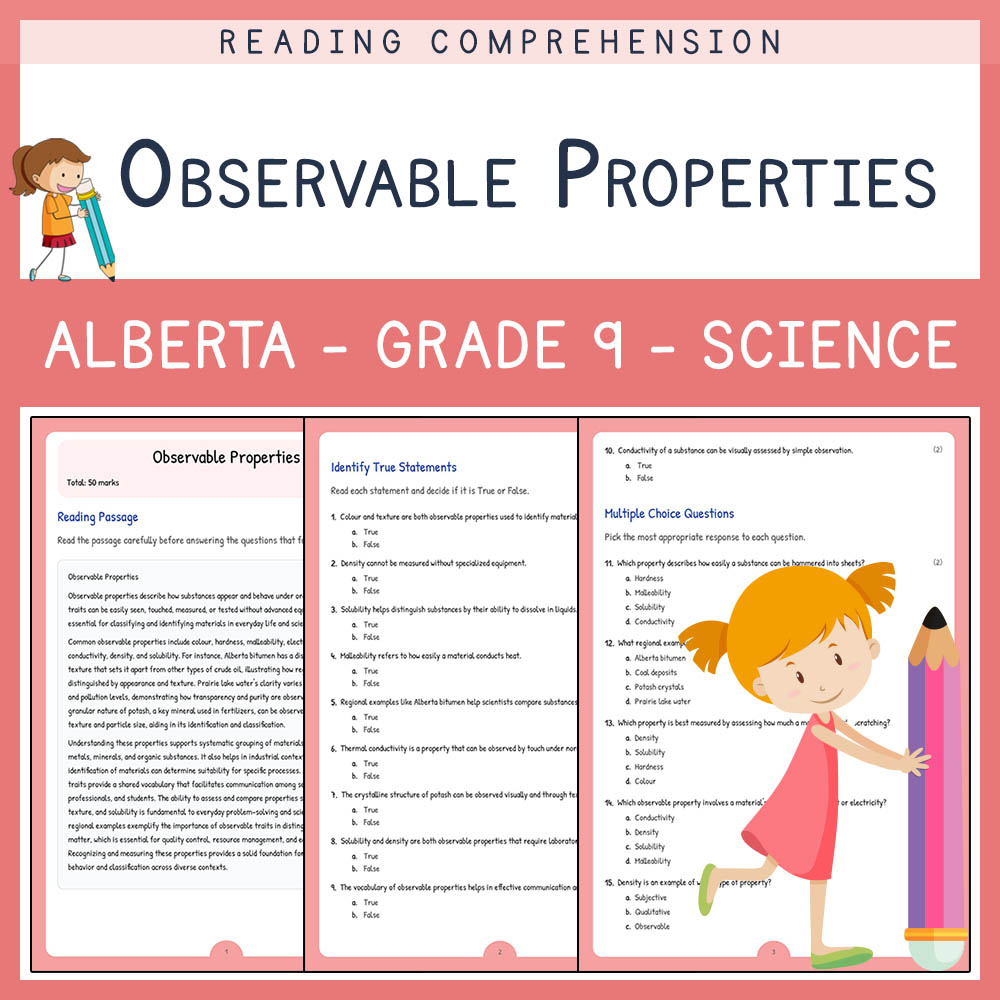
Grade 9 Science | Observable Properties Worksheet | Alberta Standards
Created byLumora LearningLearning Objectives
- Describe common observable properties used to classify substances.
- Identify examples of observable properties in real-world contexts.
- Differentiate materials based on their observable traits using measurable criteria.

Grade 6 Science | Cell Structure Worksheet | General Standard
Created byLumora LearningLearning Objectives
- Explain how the cell membrane, cytoplasm, and nucleus contribute to cell survival
- Describe how organelles help cells carry out specialized functions
- Use evidence from a text to answer questions about shared and distinct cell structures
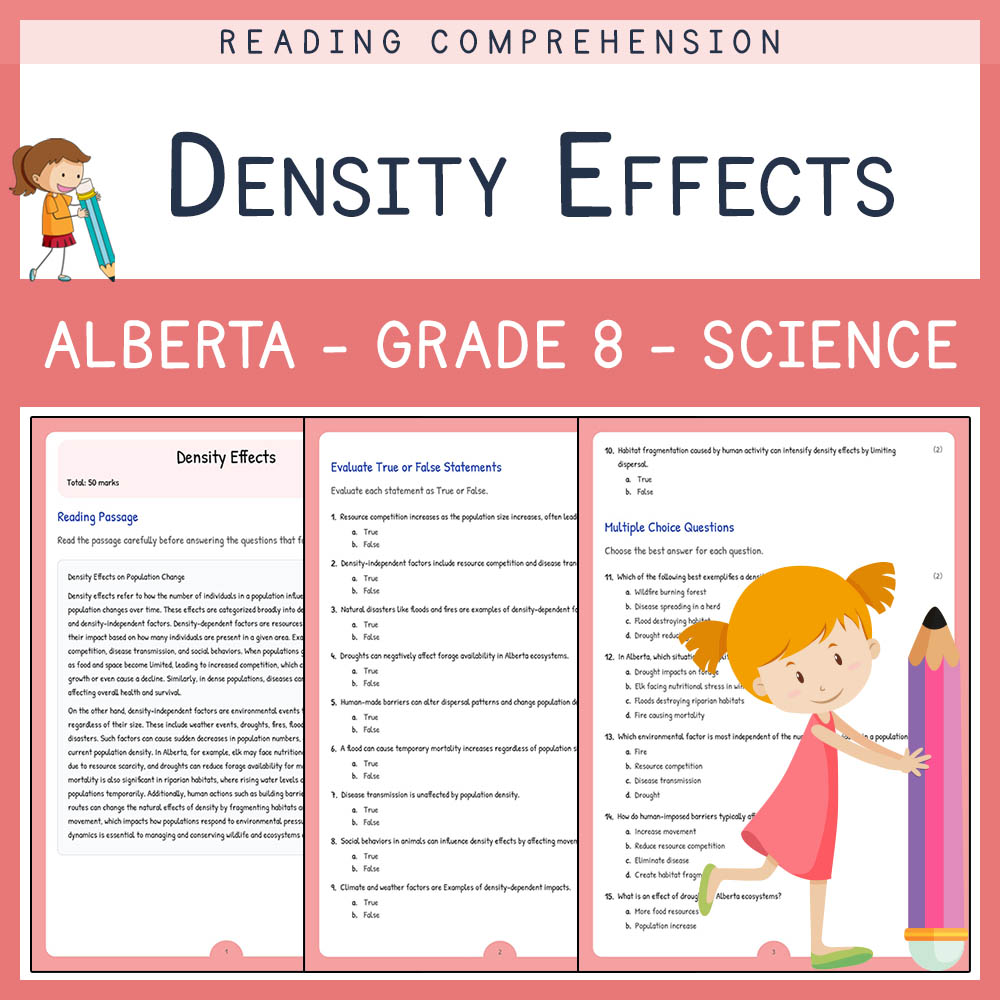
Grade 8 Science | Density Effects Worksheet | Alberta Standards
Created byLumora LearningLearning Objectives
- Explain the differences between density-dependent and density-independent factors affecting populations.
- Identify examples of density effects from real-world and Alberta ecosystems.
- Analyze how human activities alter density impacts through fragmentation and dispersal changes.
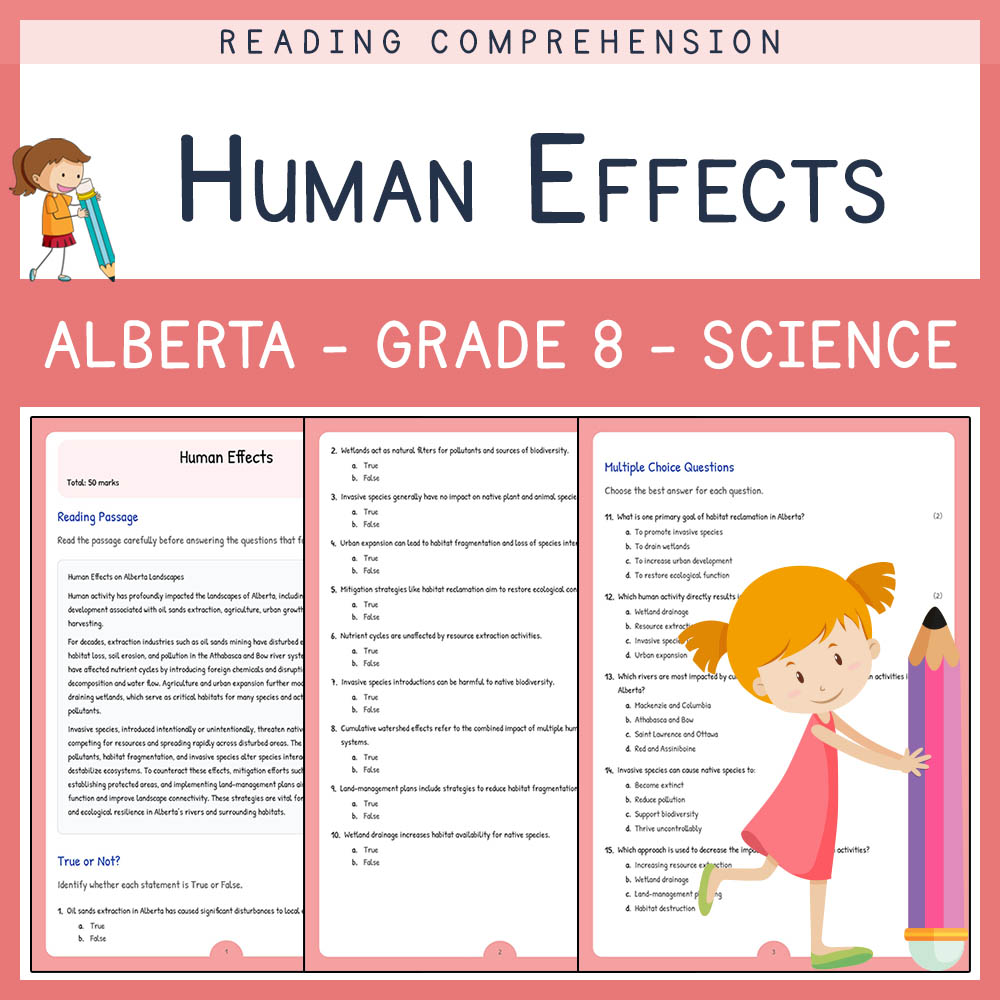
Grade 8 Science | Human Effects Worksheet | Alberta Standards
Created byLumora LearningLearning Objectives
- Understand how human land use and resource extraction impact ecosystems
- Identify specific human activities that modify habitat and nutrient cycles
- Analyze the effects of invasive species and wetlands drainage on biodiversity
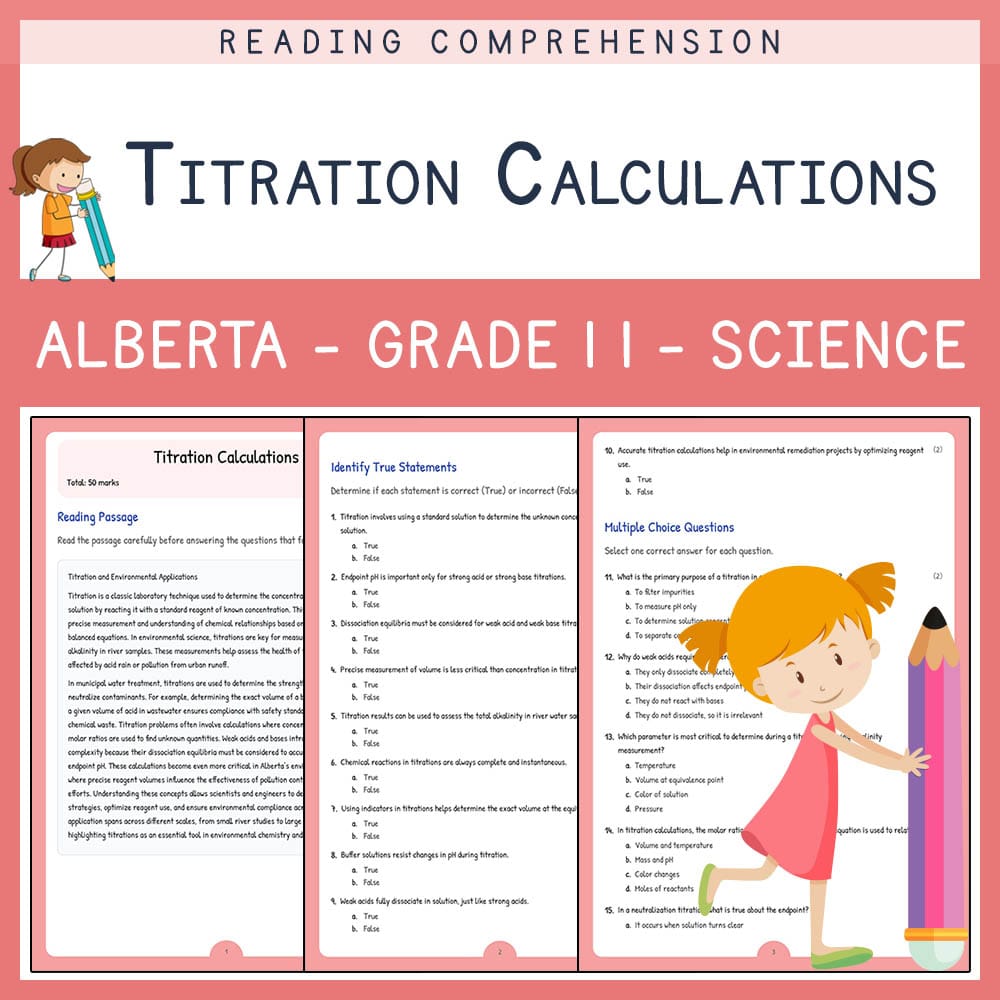
Grade 11 Science | Titration Calculations Worksheet | Alberta Standards
Created byLumora LearningLearning Objectives
- Understand how to perform stoichiometry calculations in titrations.
- Apply concentration relationships to determine unknown values in titration scenarios.
- Analyze endpoint pH variations for acids and bases with different strengths.
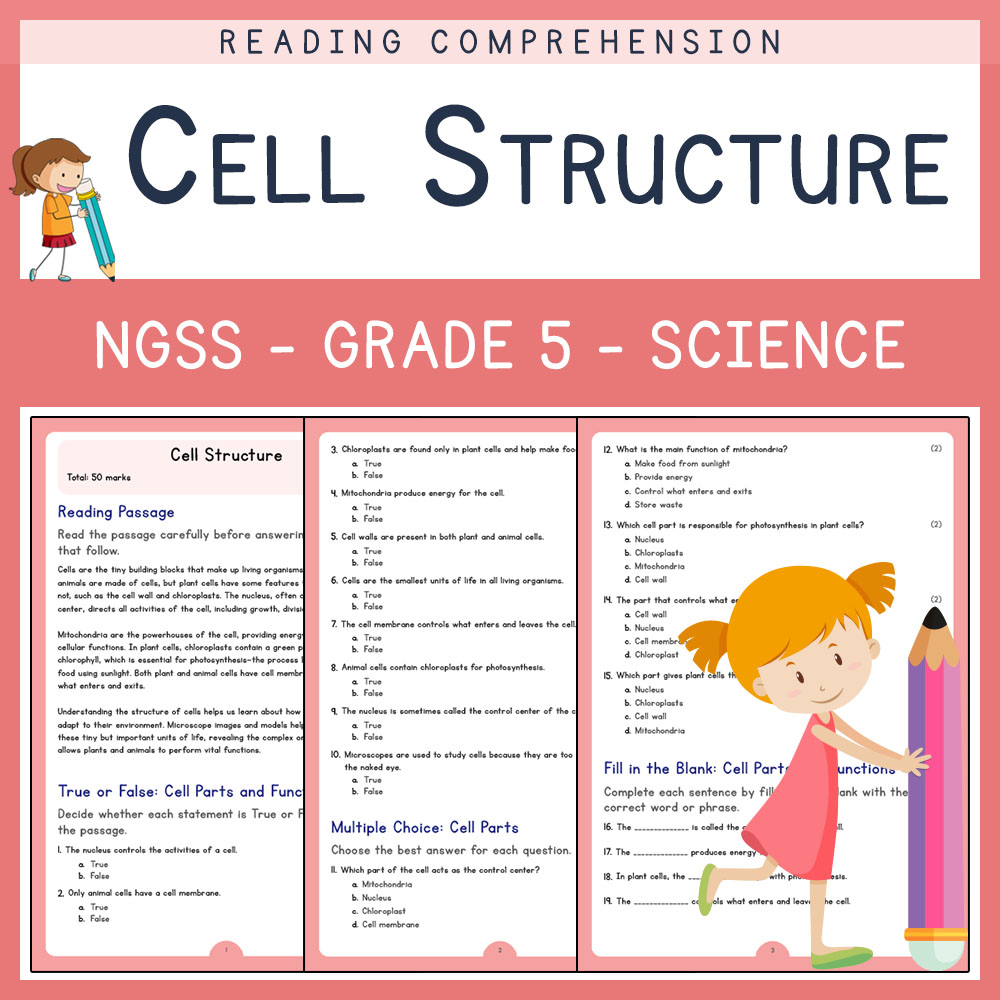
Grade 5 Science | Cell Structure Worksheet ( PDF ) | NGSS-Aligned
Created byLumora LearningLearning Objectives
- Identify and describe the parts of plant and animal cells.
- Understand how cell parts contribute to cell functions.
- Explain how cells form the basic units of life.
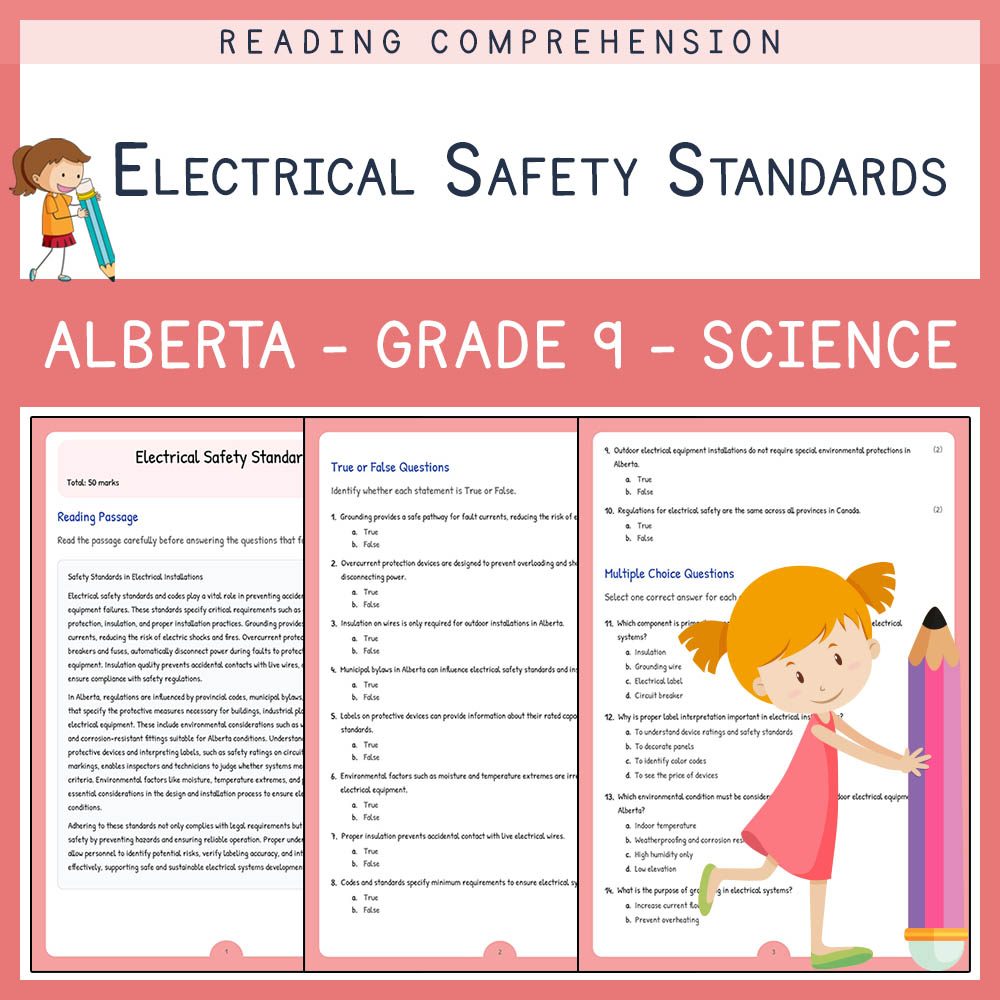
Grade 9 Science | Electrical Safety Standards Worksheet | Alberta Standards
Created byLumora LearningLearning Objectives
- Understand key electrical safety standards and their importance.
- Identify protective devices and their purposes in electrical installations.
- Interpret safety labels and environmental considerations for electrical systems.

Grade 11 Science | Atmospheric Circulation Worksheet | NGSSS Assessment
Created byLumora LearningLearning Objectives
- Explain how uneven solar heating creates pressure gradients that drive atmospheric circulation.
- Describe how the Coriolis effect influences wind direction and large-scale wind belts.
- Compare how global circulation cells transport heat and affect humidity, precipitation, and storm-track locations.

Grade 10 Science | Genetic Drift Worksheet | NGSSS Aligned
Created byLumora LearningLearning Objectives
- Define genetic drift and explain how it differs from natural selection
- Describe how small population size increases the effects of random allele frequency changes
- Evaluate how genetic drift can reduce genetic diversity and lead to divergence among populations
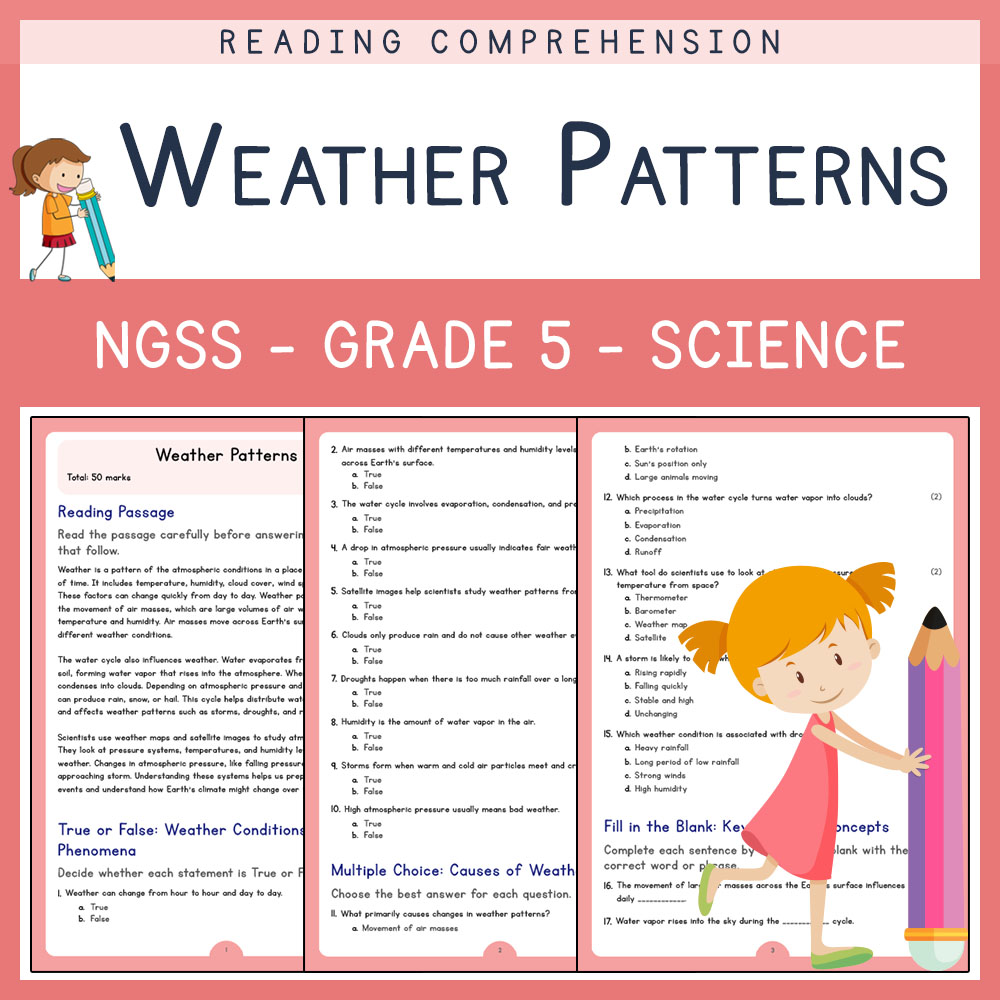
Grade 5 Science | Weather Patterns Worksheet (PDF) | NGSS Aligned
Created byLumora LearningLearning Objectives
- Understand how air masses move and influence weather
- Identify the water cycle and its role in weather patterns
- Describe atmospheric conditions that cause storms and droughts

Grade 6 Science | Food Chains Worksheet Elena | Florida NGSSS Aligned
Created byLumora LearningLearning Objectives
- Explain how energy moves through a food chain from producers to higher-level consumers
- Identify trophic levels (producer, primary consumer, secondary consumer) in a given food chain
- Describe how changes in one population can affect other populations in a food chain

Grade 12 Science | Adaptation Over Time Worksheet | NGSSS Aligned
Created byLumora LearningLearning Objectives
- Explain how natural selection changes allele frequencies across generations in a population.
- Describe how heritable traits that increase fitness become more common in particular environments.
- Distinguish between directional adaptation and habitat-specific (variable) adaptation.

Grade 6 Science | States of Matter Worksheet | NGSSS Aligned
Created byLumora LearningLearning Objectives
- Explain how the shape and volume of solids, liquids, and gases differ due to particle behavior.
- Use models of particle motion to describe changes in state and connect them to energy changes.
- Classify everyday materials as solids, liquids, or gases based on observed properties.

Grade 9 Science | Climate Variability Worksheet | Florida NGSSS Aligned
Created byLumora LearningLearning Objectives
- Explain how climate variability affects weather averages over months to years
- Describe ocean-atmosphere interactions (El Niño and La Niña) and their impacts on temperature and rainfall
- Distinguish natural variability from long-term climate trends using evidence across timescales and regions

Grade 9 Science | Heat Transfer Modes Worksheet | NGSSS Standards
Created byLumora LearningLearning Objectives
- Explain how thermal energy transfers through conduction, convection, and radiation
- Identify real-world examples of each heat transfer mode and justify why they occur
- Compare whether a medium is required for heat transfer and relate this to everyday phenomena

Grade 9 Science | Forces Overview Worksheet | NGSSS Aligned
Created byLumora LearningLearning Objectives
- Explain how forces change an object’s state of motion through acceleration and changes in velocity.
- Distinguish between contact forces and field forces and give examples of each.
- Use force vectors to represent both magnitude and direction of forces.
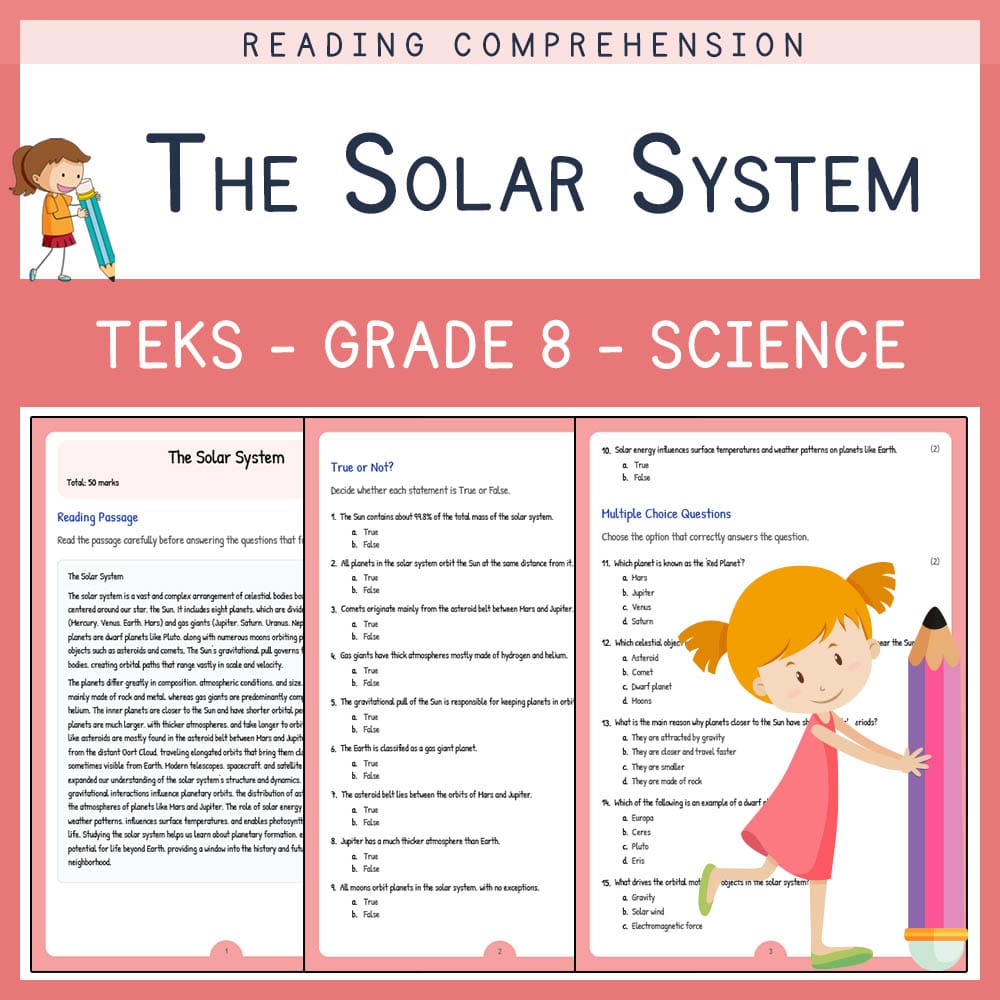
Grade 8 Science | The Solar System Worksheet Elena | TEKS Aligned
Created byLumora LearningLearning Objectives
- Understand the components of the solar system, including planets, moons, and smaller bodies.
- Describe the relative scale and composition of celestial objects in the solar system.
- Explain orbital characteristics and gravitational interactions among planets, asteroids, and comets.

Grade 9 Science | Measurement Practices Worksheet | NGSSS Assessment
Created byLumora LearningLearning Objectives
- Explain how measurement practices turn observations into usable scientific data.
- Distinguish between accuracy and precision using real measurement examples.
- Describe how calibration and repeatability improve reliability of experimental data.
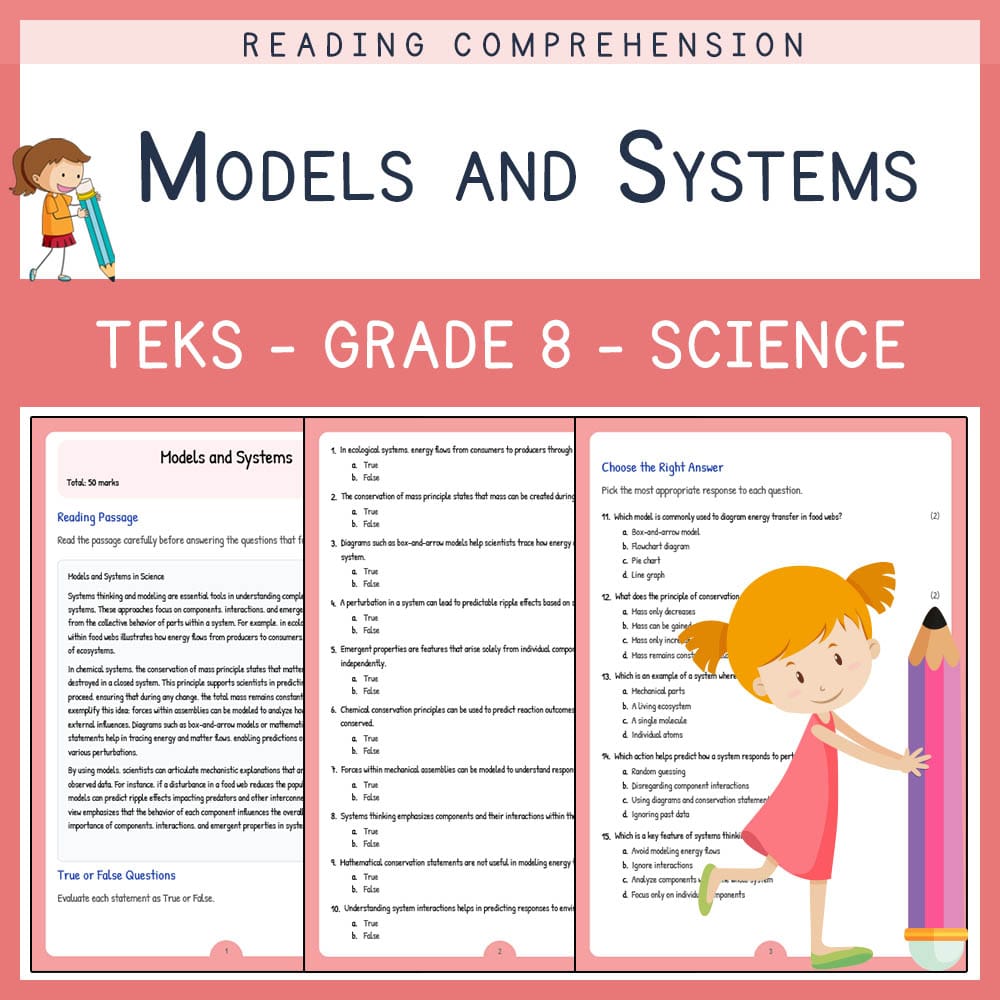
Grade 8 Science | Models and Systems Worksheet | TEKS Aligned
Created byLumora LearningLearning Objectives
- Describe the components and interactions within physical and ecological systems.
- Explain how models and diagrams are used to represent system processes.
- Predict system responses to perturbations using conservation principles.

Grade 9 Science | Greenhouse Effect Worksheet | NGSSS Standards
Created byLumora LearningLearning Objectives
- Explain how greenhouse gases affect the flow of energy in Earth’s atmosphere.
- Describe the process of infrared absorption and re-emission and how it changes outgoing heat.
- Interpret how changes in greenhouse gas concentration can alter Earth’s energy balance and surface temperature.

Grade 7 Science | Explanatory Models Worksheet | NGSSS Aligned
Created byLumora LearningLearning Objectives
- Define explanatory models and explain why they are simplified rather than exact replicas of real systems.
- Describe how cause-and-effect mechanisms and energy transfers can be used in explanations based on a model.
- Evaluate a model’s usefulness by comparing how well it matches observations and how accurately it predicts new evidence.
Browse more categories
About Science Worksheets
Find Science worksheets spanning core skills, practice, and review. All 42,859 resources are instant PDF downloads for the classroom or home.
Every worksheet on MyTeachingSheets is created by independent teacher-authors and reviewed before publication. All resources download as printable PDFs for classroom, homework, or at-home practice, and many include answer keys. Preview any worksheet free before buying.